Patch News – January 2023
In the last Patch News I asked if any members had received any modelling related presents for Christmas and apparently some of you had treated yourselves to new models so this month I have several new models to tell you about which makes my job much easier. Members managed quite a lot of flying in January as the spell of bad weather that had plagued us through much of December finally ended about a week into the new year.
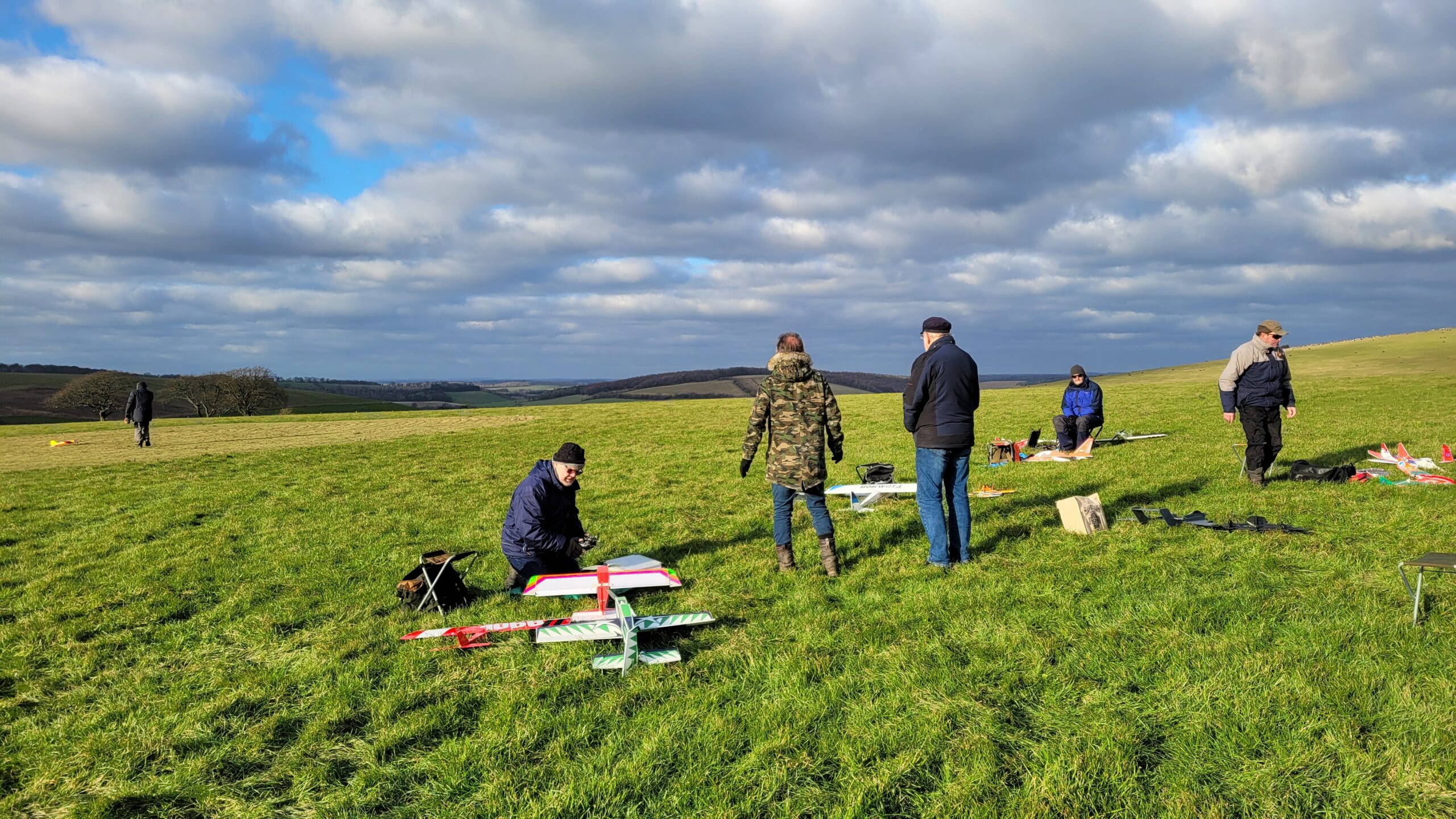 The rest of the month was mostly cold but dry and with quite light winds so the hardier members wrapped up well and made the most of it at every available opportunity.
January was the month of ‘If at first you don’t succeed, try, try, and try again’ with 1066, Woody, and me all flying new models that weren’t good at first but ended up flying well.
I’ll begin with mine: In the last Patch News I reported on a ‘toy’ model that I’d ordered in early November which eventually turned up at the end of December and I said I’d tell you more about it this month. It’s moulded from a tough foam that seems similar to EPP but has a pretty poor finish, no sharp edges to the moulding or any sort of surface detail.
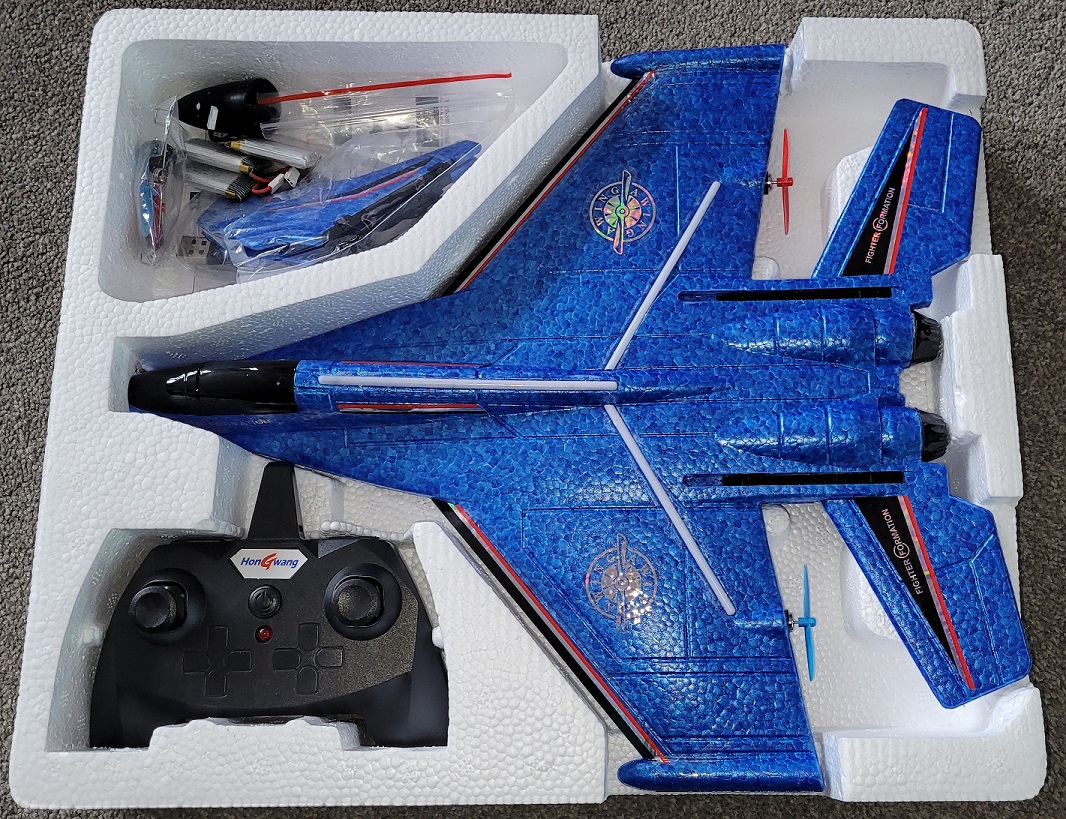 It has three LED strips on the top and underside which probably show up quite well in the dark but can’t be seen in the air even on a dull day. Maybe I’ll try a night flight sometime!
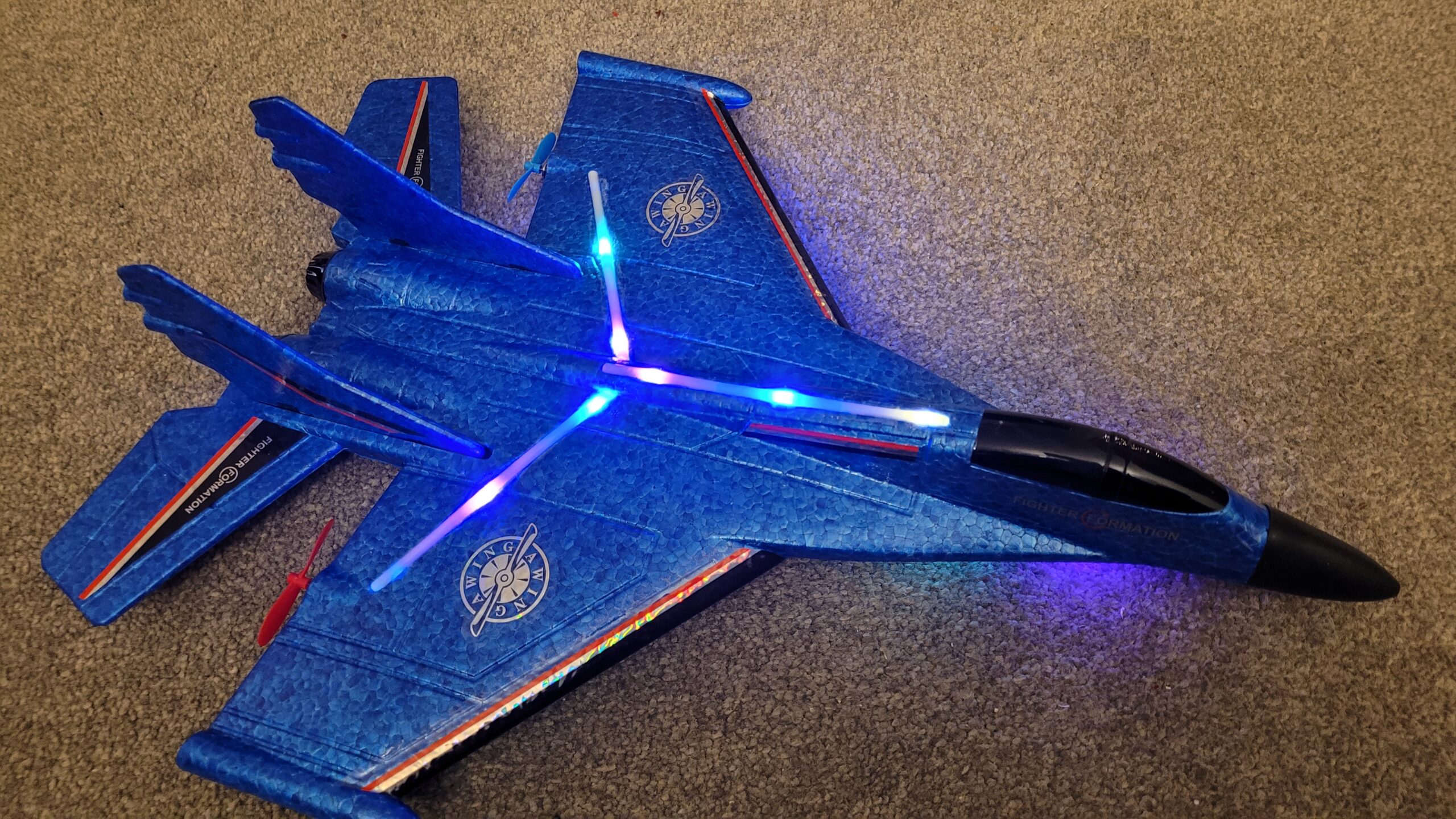 So how does it fly? Not very well is probably the honest answer! The plane is controlled only by the thrust from the two motors, there are no servos or moving surfaces, so it climbs or dives depending on the throttle position and turns by powering one motor more than the other. It takes a bit of getting used to and is really only flyable in very light winds.
 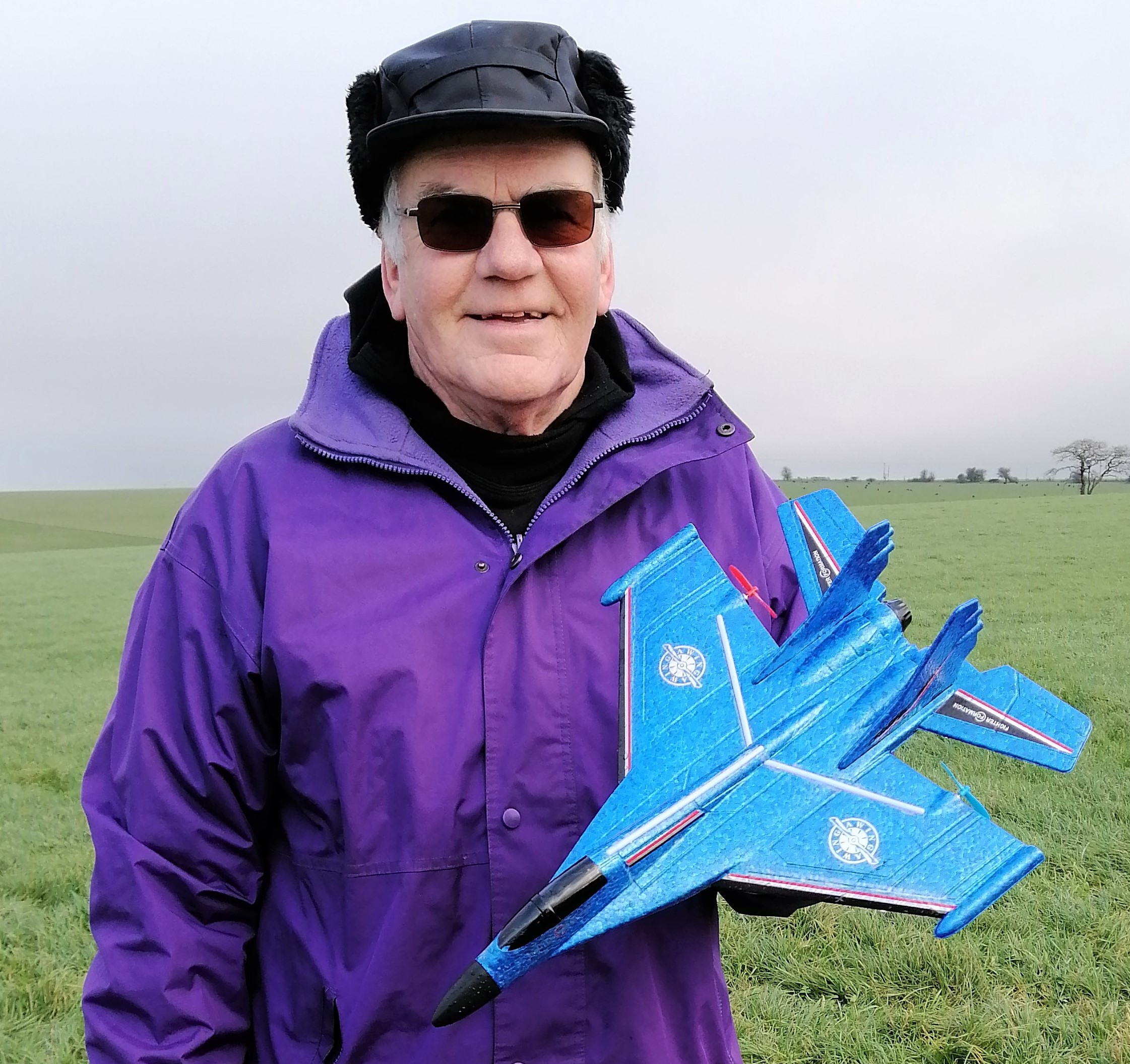 Sometimes it seems to turn quite well but other times it takes half the field to turn 180 degrees and I haven’t really worked out why yet. The only way to adjust the trim is to bend the foam tail which is neither very accurate nor consistent. As you’ll see in the video it almost looped from the first launch but over the next half dozen or so attempts I gradually sorted it out and eventually got it flying quite nicely. But at every session, with different wind speeds, the trim is different each time and it’s like starting from scratch again. But for £24 with three batteries I didn’t expect too much and I’m quite enjoying the challenge.
Woody spotted some foamboard models on Ali Express and ordered himself a J-10 along with an electronics pack containing a motor, speed controller, propeller, and two servos. 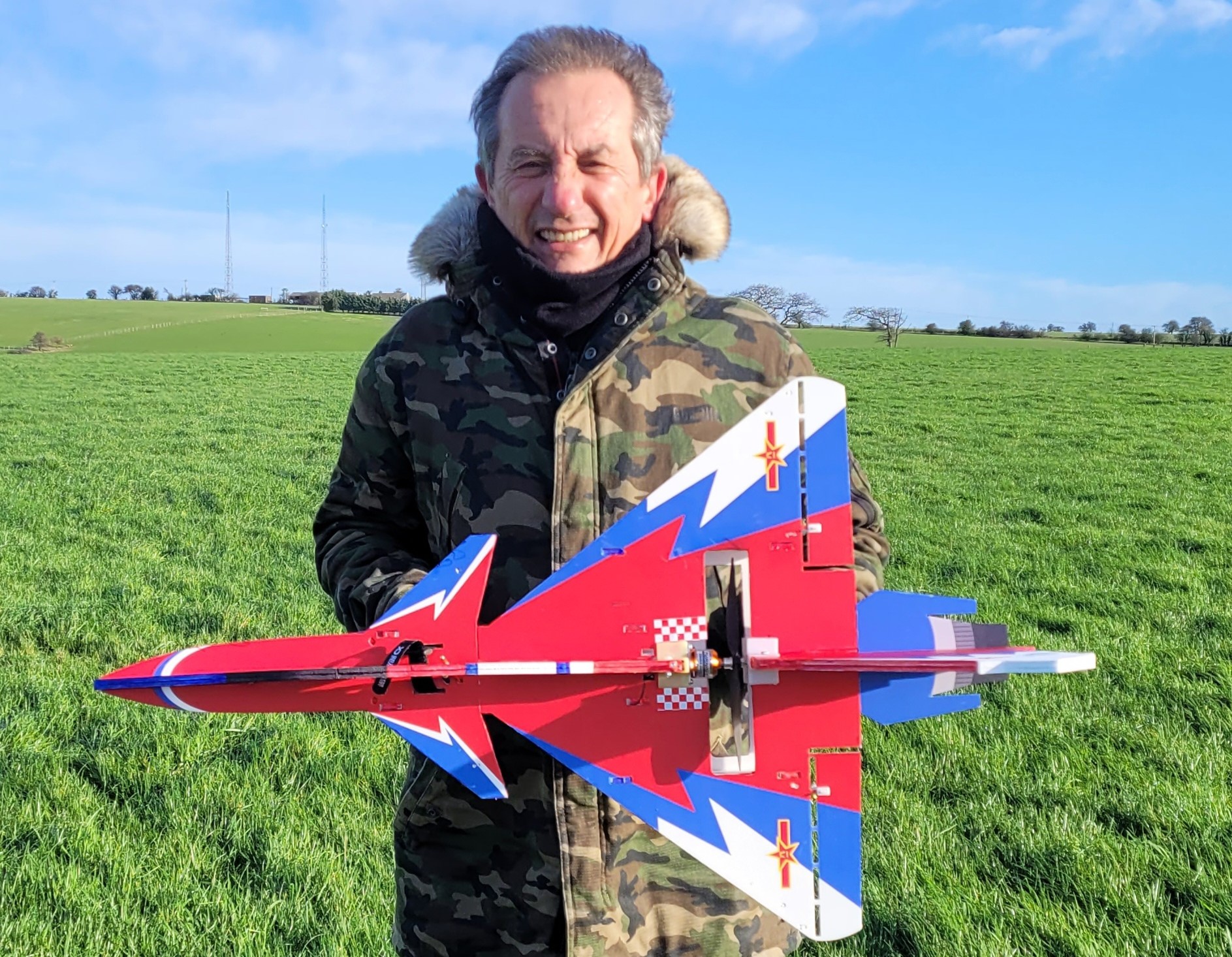 To give it the correct title the plane is a Chengdu J-10 Vigorous Dragon, a single engine Chinese multirole fighter than can reach Mach 2.2 and fly in all weathers. It has a delta wing layout with canards and is fitted with fly-by-wire controls.
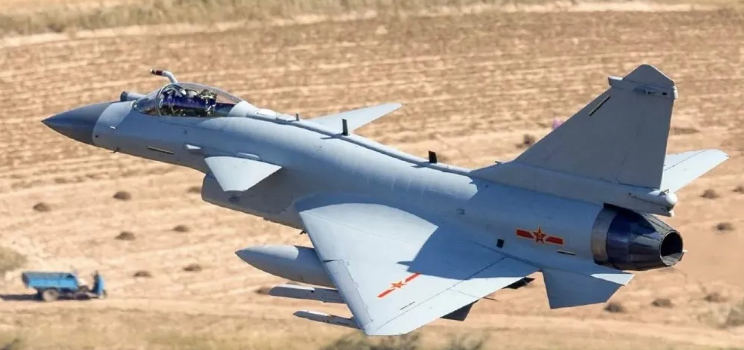 On Woody’s J-10 the foam is not the same as the foam on the models from HobbyKing, it has a smoother surface which takes printing better and I think it’s slightly denser so it’s probably a bit heavier. There are no instructions with the kit but construction is similar to the SU-27 and Mig-29 so Woody was able to get it all put together with no problems.
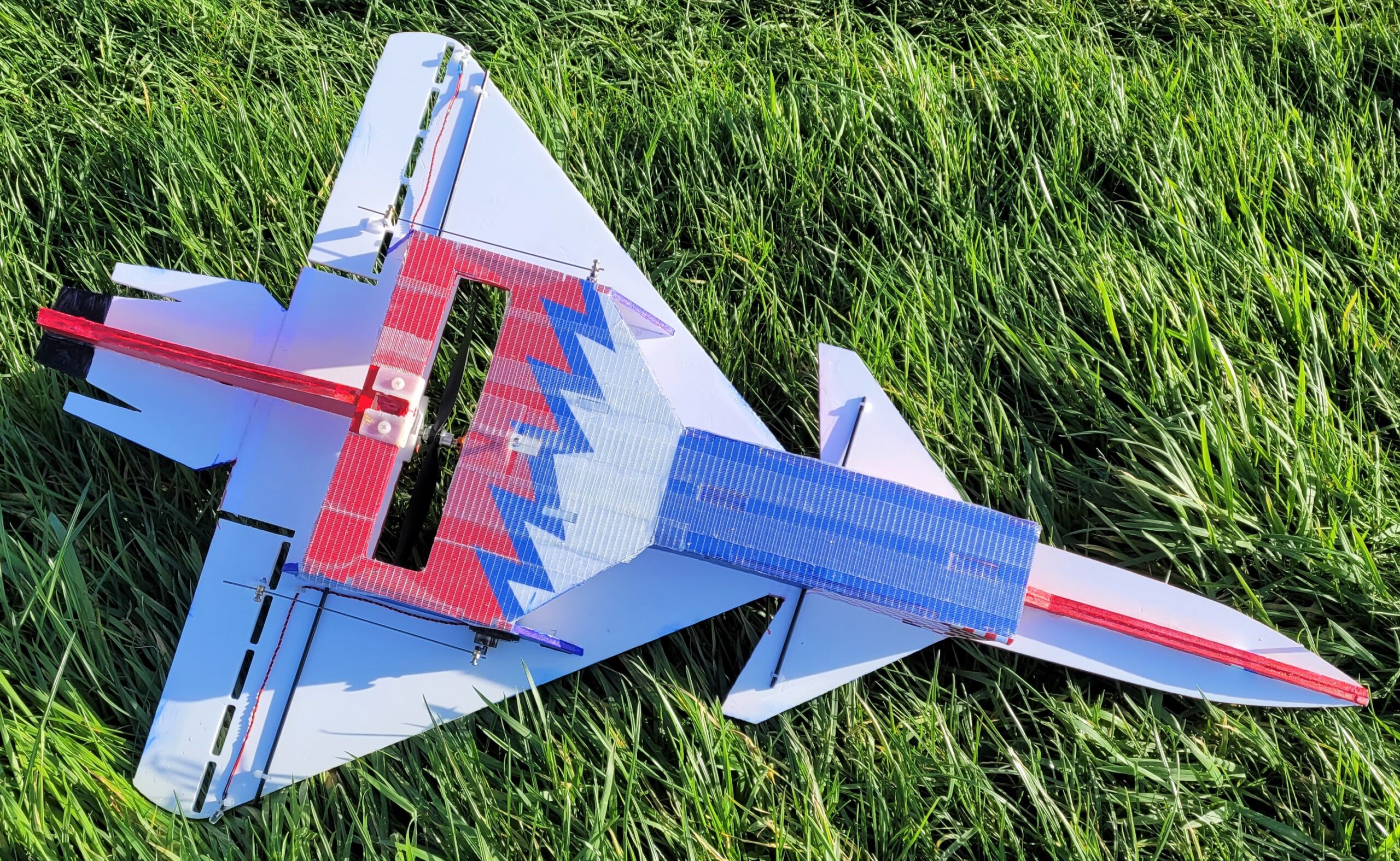 Woody added some lights and also a couple of extra pieces to stiffen the airframe up a little. To check the centre of gravity is correct there is a small hole near the top of the profile fuselage and the kit includes a piece of cord and ‘handle’ to dangle the plane from.
 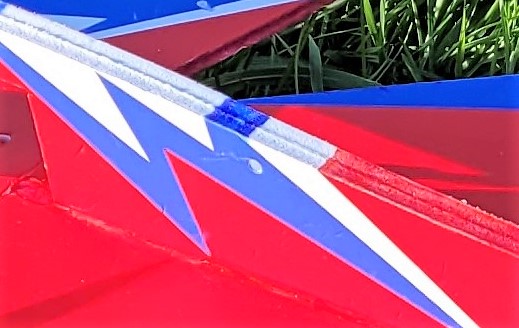 The finished model looks good and the general opinion was that it should fly well and would probably be quite fast. With no instructions Woody had set the surfaces to neutral and guessed what control movements would be needed but when we tried to fly it we quickly realised that it needed some reflex as the first few launches resulted in it sinking to the ground. So we adjusted the surfaces to add some reflex and it got airborne but it wasn’t pleasant to fly so more movement adjustments were made which improved things a lot.
 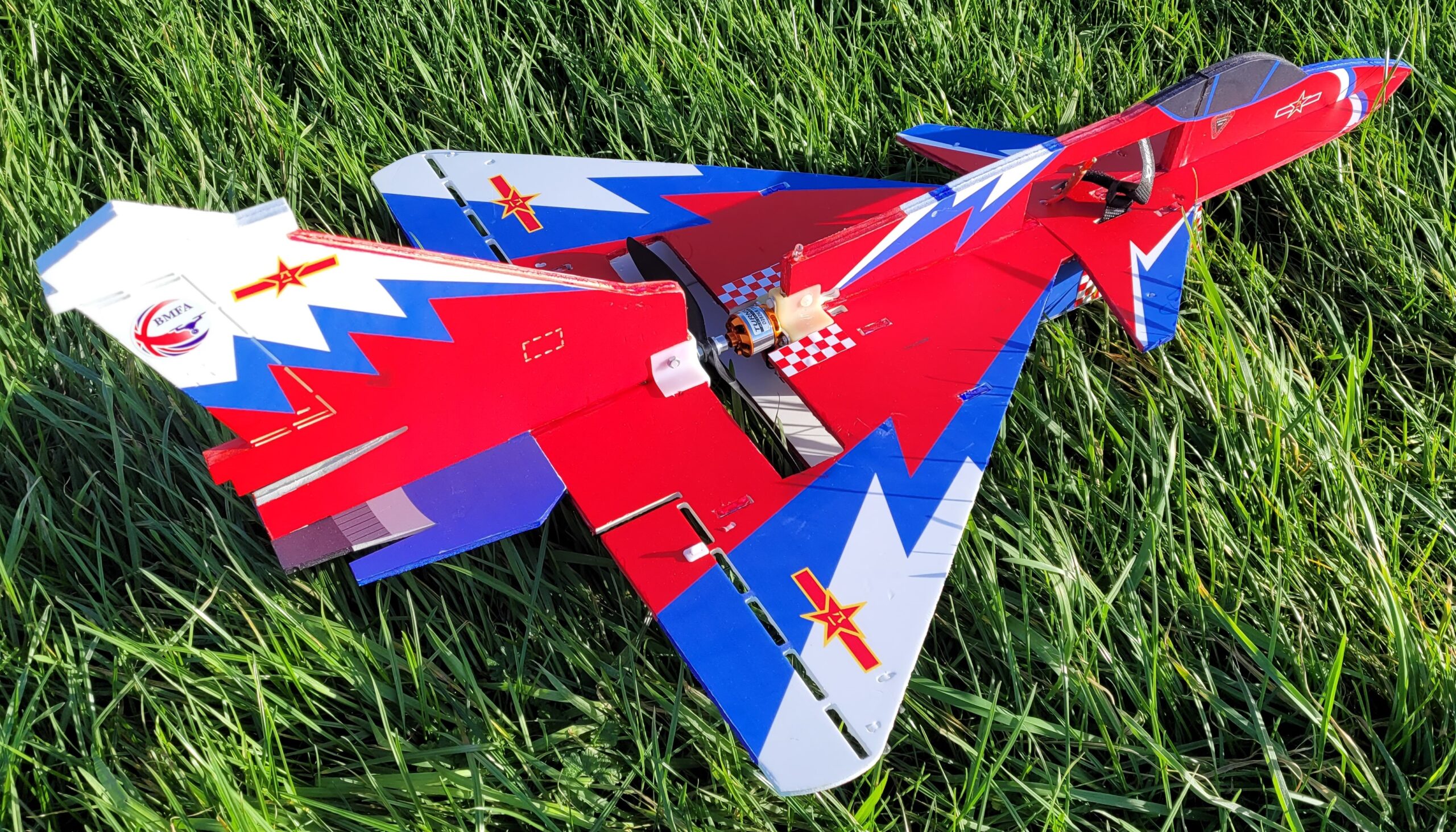 Although the C of G was where indicated the model seemed nose heavy so Woody enlarged the battery opening to enable him to move the battery 20mm further back. Eventually, with the C of G about 15mm behind the stated position the J-10 flew well. Woody is still experimenting with the control movements but it’s now a good flier, quite fast flat out but it will slow up nicely and has no nasty habits. It looks good in the air and I think it will be a strong and reliable model which is just as well as I have bought one for myself!
 Ali Express is rather like Amazon and sells stuff from a variety of shops which have a range of foam models including the SU-27, J-10, J-31, and JF-17 all available in various schemes.
 The prices shown on the site are without VAT but the price you will pay adds the 20% tax so there’s no need to worry about import duty. My J-10 was £25.99 including tax from XDRC store and I also bought an SU-27 from U-Angel-1988 Speciality Store for just £13.35 including tax but that is just the foam parts, no linkages or carbon rods etc.
Both my planes arrived at the same time, both much sooner than stated on the sites and the J-10 was in a nice cardboard box but the SU-27 was just in a jiffy bag!
The prices shown on the site are without VAT but the price you will pay adds the 20% tax so there’s no need to worry about import duty. My J-10 was £25.99 including tax from XDRC store and I also bought an SU-27 from U-Angel-1988 Speciality Store for just £13.35 including tax but that is just the foam parts, no linkages or carbon rods etc.
Both my planes arrived at the same time, both much sooner than stated on the sites and the J-10 was in a nice cardboard box but the SU-27 was just in a jiffy bag!
 Some of the foam parts were a bit bowed but neither plane had crushed or missing parts.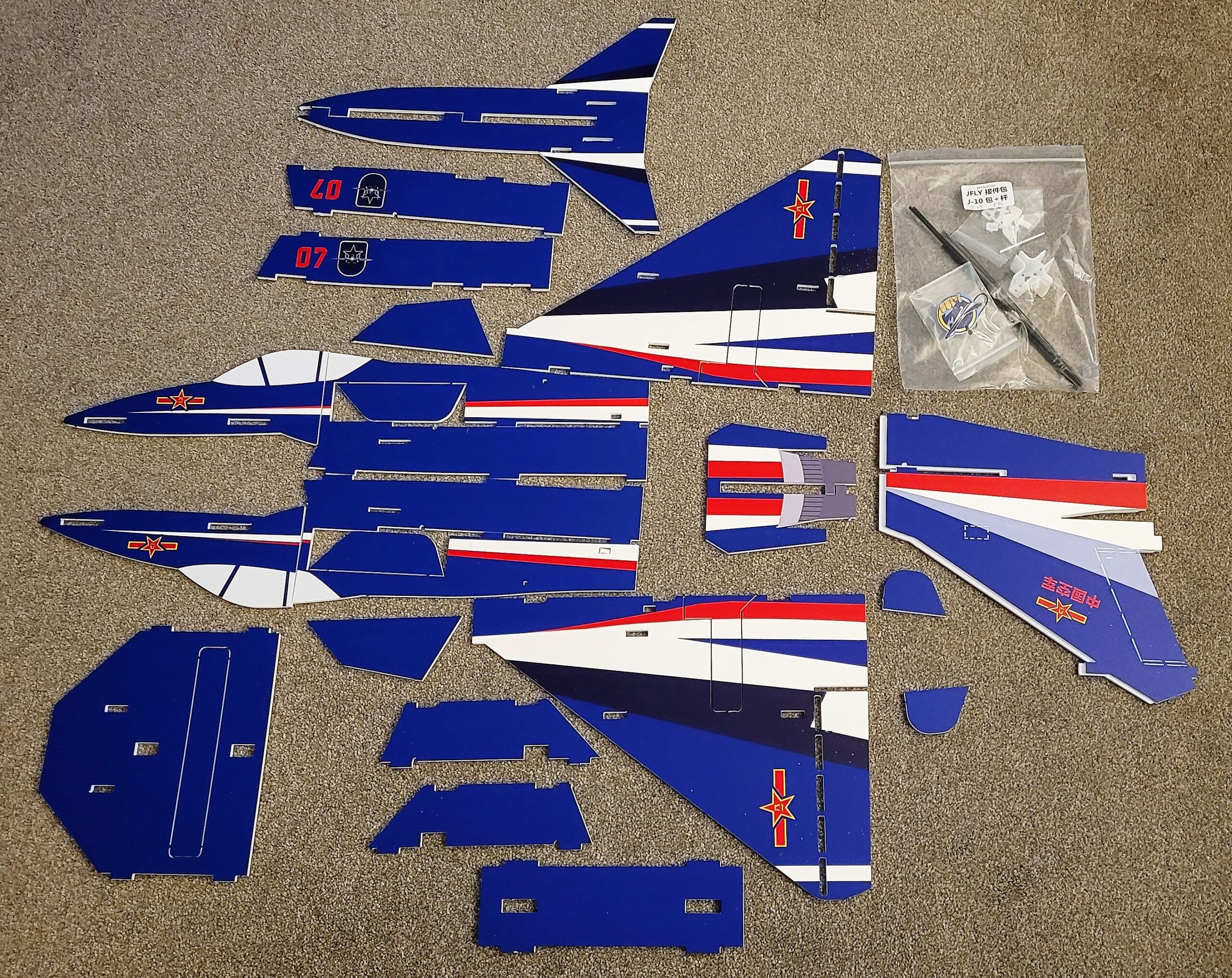
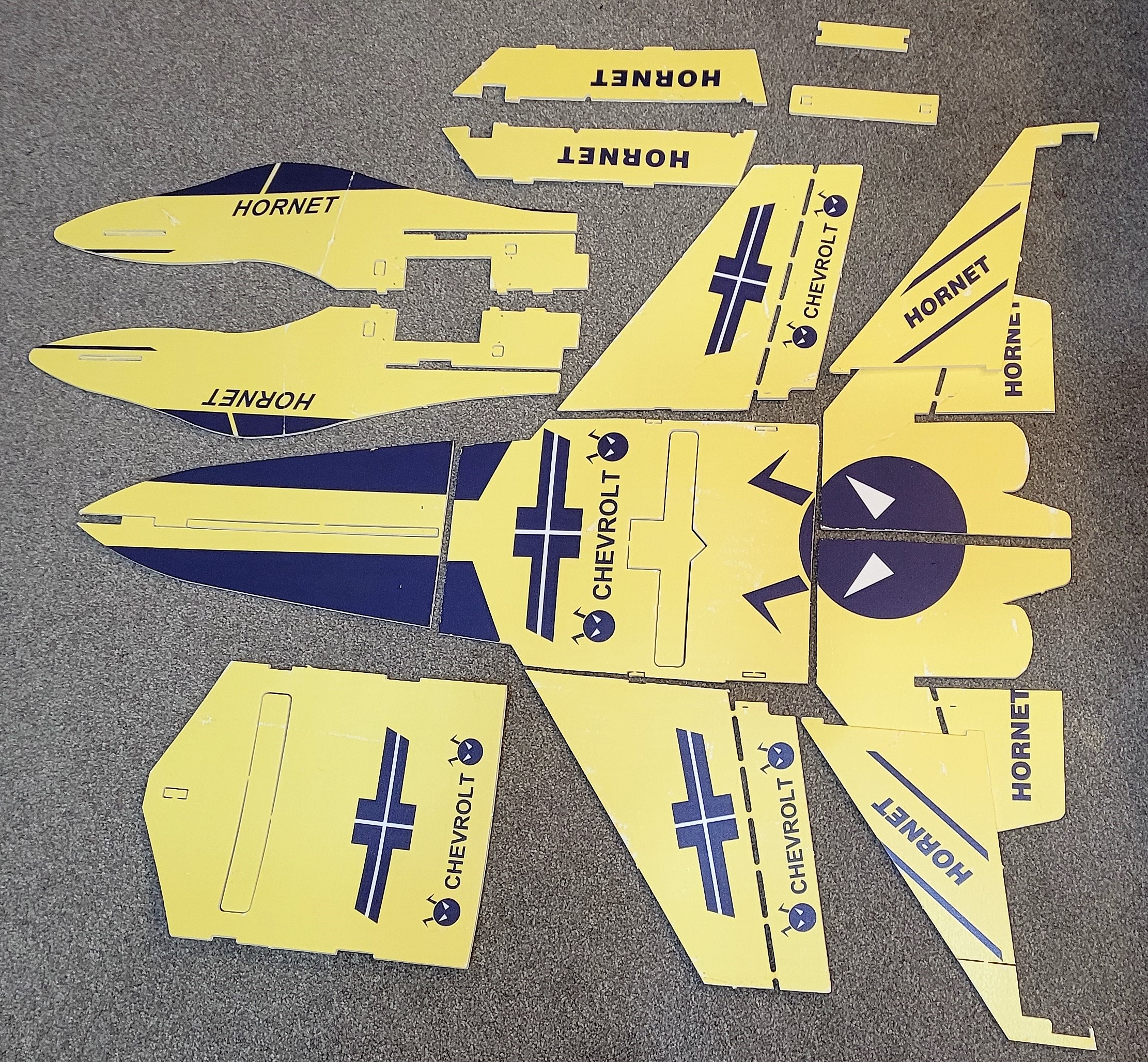 The printing on the SU-27 says Hornet in several places and I think it looks more like an F-18 Hornet than a Sukhoi SU-27 so I’m going to call it a Hornet from now on.
Bob the Builder has since ordered an SU-27 from the XDRC store so it will be interesting to see if it’s any different. While I was looking around the Ali Express site I came across a 40 second video of a foamboard plane being flown. I’m not sure the BMFA would approve!
The printing on the SU-27 says Hornet in several places and I think it looks more like an F-18 Hornet than a Sukhoi SU-27 so I’m going to call it a Hornet from now on.
Bob the Builder has since ordered an SU-27 from the XDRC store so it will be interesting to see if it’s any different. While I was looking around the Ali Express site I came across a 40 second video of a foamboard plane being flown. I’m not sure the BMFA would approve!
In the November Patch News I included a couple of photos of 1066’s incidence meter being demonstrated on a new model he was building. The model has now been finished and flown so here’s what 1066 has to say about it: Let me start by saying I am no builder or designer but sometimes I get ideas in my head that fire up my creative juices LOL!
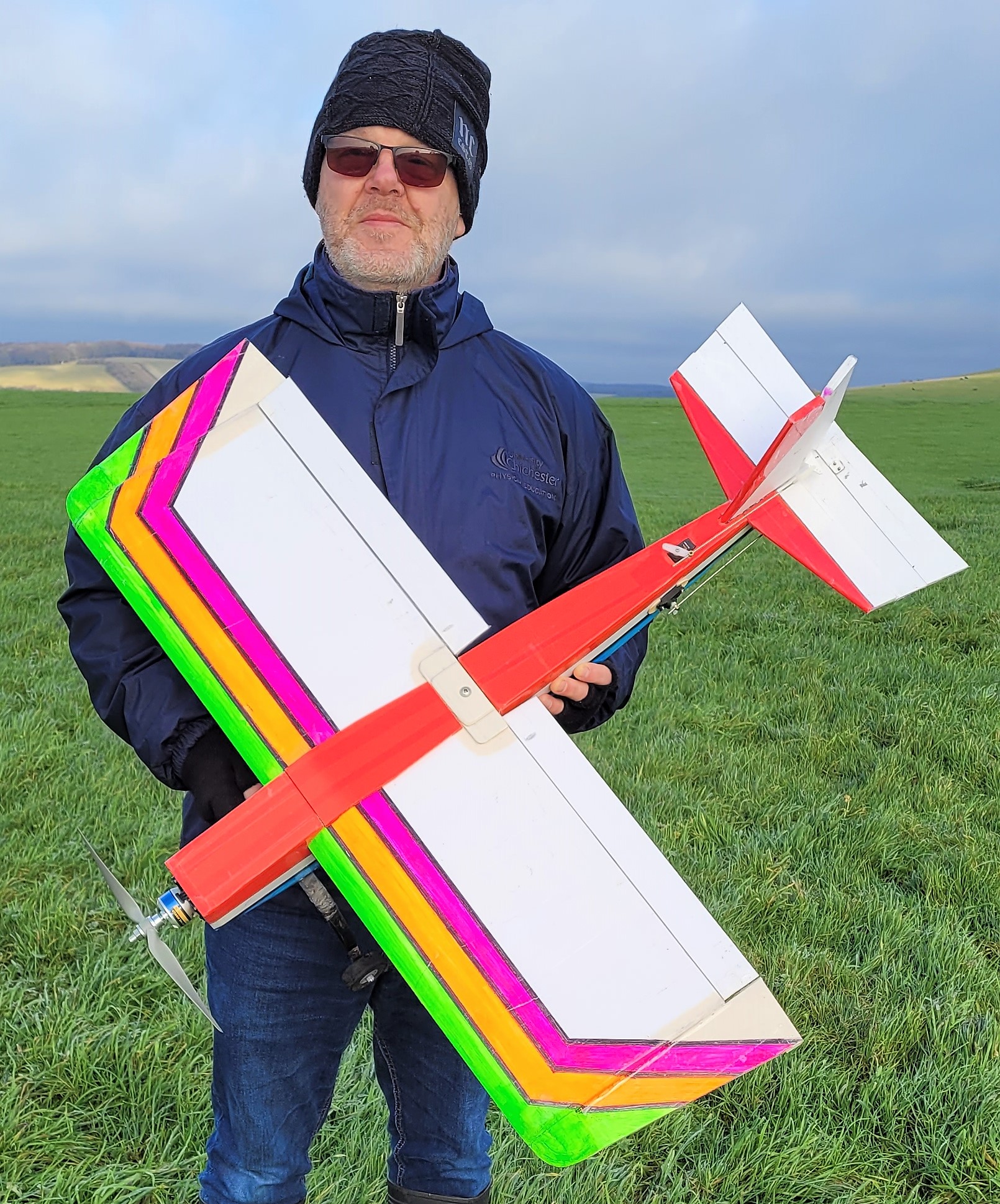 The idea I had, and the brief I gave myself, was to build a winter hack with a materials cost for the airframe of £10.00, and that would fit in the car in one piece.
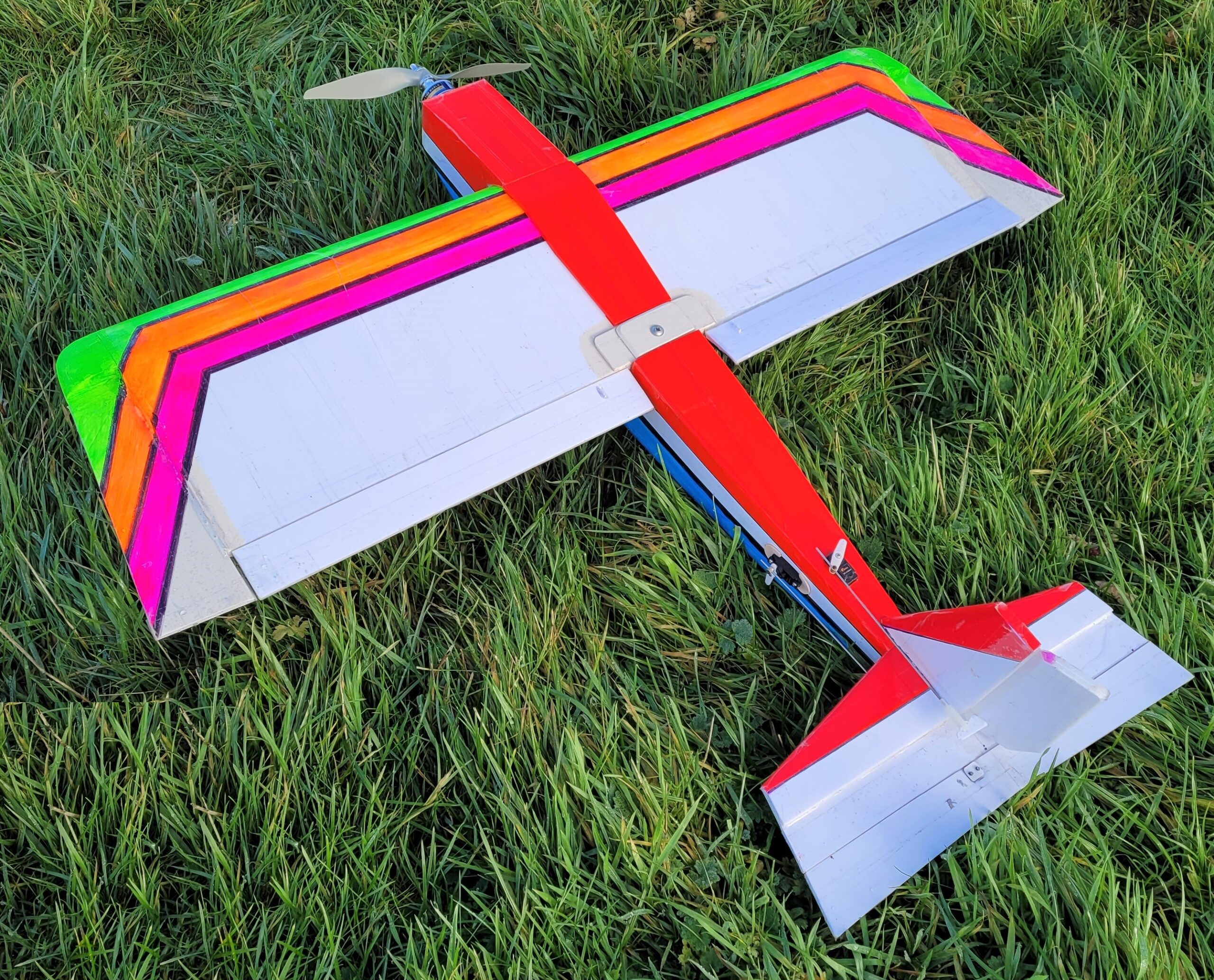 Straight away two things came to mind:- 1. Make it a high winger for ease of everything, and 2. Use 5mm craft board from Hobbycraft for cost. The build started with the wing and in my mind the plan was to produce a symmetrical wing. I did consider doing some trials on the wing construction but this would have eaten into my four sheets of board, therefore the first attempt was the one I used. I decided on what chord looked OK in relation to the maximum span I could get from a single board and cut a piece to twice that figure. I then cut out a vee on the centre line, making sure not to go through the second layer of card (mistake number 1 as this led to a very sharp leading edge which did give me some concerns). I then made many more score marks either side of the central vee to a point where I thought the main spar should go. The next stage was to glue three pieces of foam board on edge, along the line of the last score marks. Finally the board was gently folded back on itself, gluing along the spar, and at the trailing edge. Two end caps were then fitted on the tips. It was at this point I thought the span looked a little short so I decided to fit what have since been named Illusion tips which probably do nothing for the flying but did improve the plan view of the wing. The ailerons were simply cut to a pleasing size and a second strip of card added at the front edge in the Kline-Fogleman style, to add strength and also to allow top hinging with packing tape.
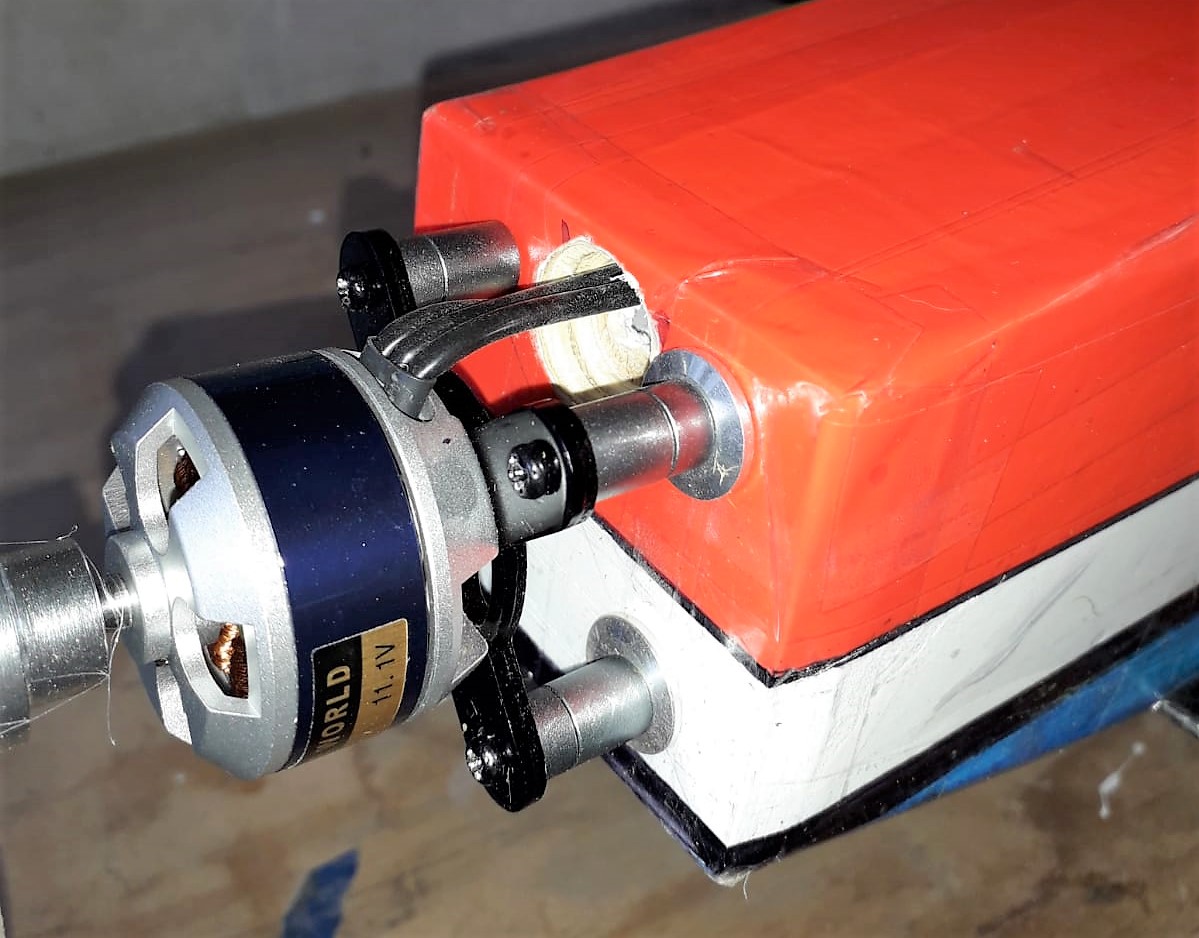 I now moved on to the fuselage, nothing clever here, just a box made to the maximum length I could get from one piece of material, the sides are two thicknesses of board to just past the wing. The firewall was a piece of board laminated with a piece of ply and slightly set back between the sides to get as much glue area as possible. Two pieces of 3mm ply were glued inside the fuselage where the undercarriage plate is fitted just to spread the landing loads. The wing cut-out was positioned so that I had one and a half times the wing chord to the leading edge of the tailplane. I did put a bit of thought into the battery bay; instead of traditional vertical formers I used a horizontal piece fitted at a slope along the whole length of the nose. This created two compartments, the first being accessible from the wing cut-out, this houses receiver and speed controller, and the second is accessible from a hatch on the underside and has room for the battery.
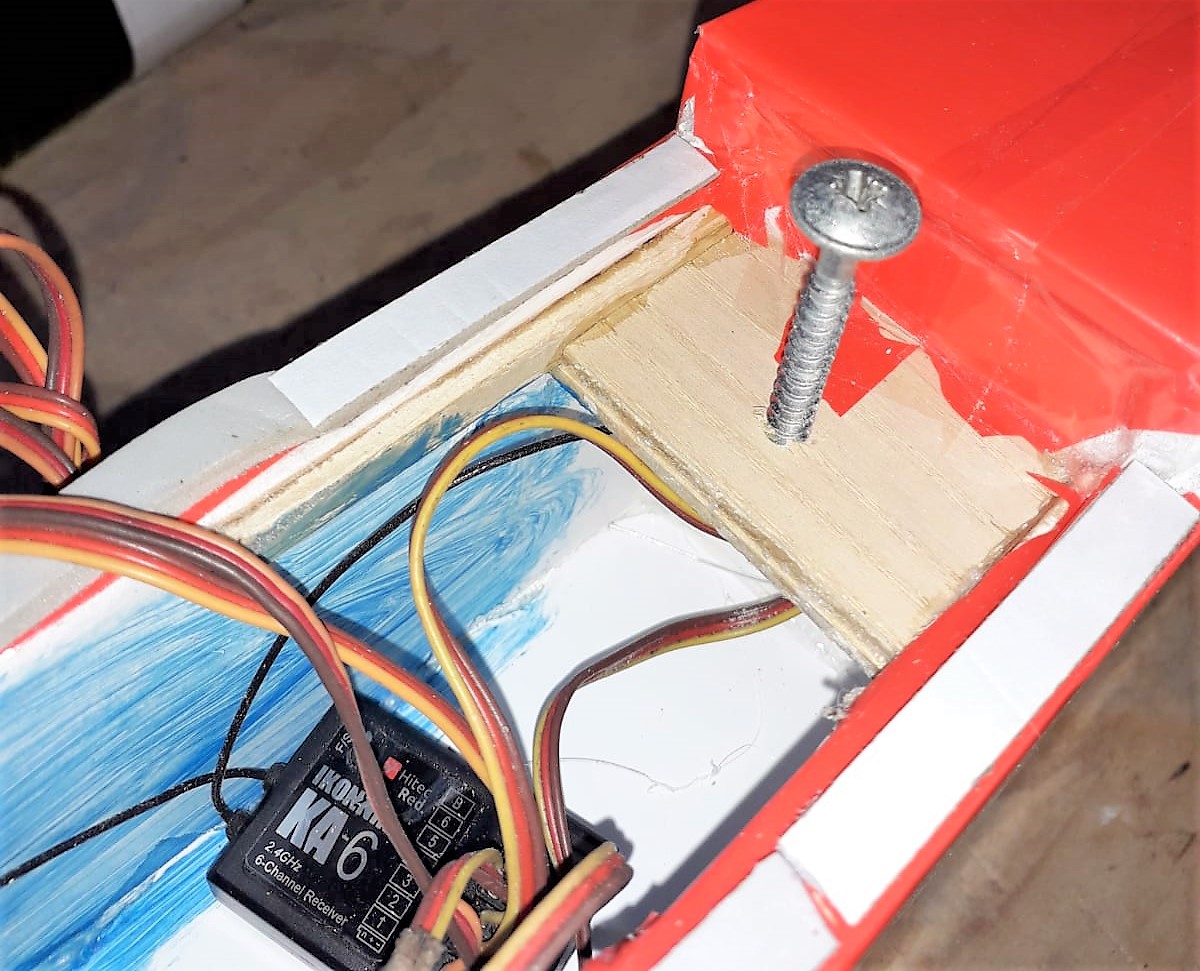 Finally a piece of 5mm ply across the fuselage at the rear of the wing takes the wing retaining wood screw. The tailplane was cut to a pleasing size and shape (good rule of thumb here is to make it about 25% the area of the wing). For the first attempt I laminated two pieces of board, again Kline-Fogleman style for strength, but I did not like the exposed foam and card on the leading edge, so after making a paper template, the second attempt was folded at the leading edge. Stronger, more aerodynamic, and far more pleasing on the eye. The elevator was cut out, again using the ‘if it looks right’ method and the rudder was then made in the same fashion.
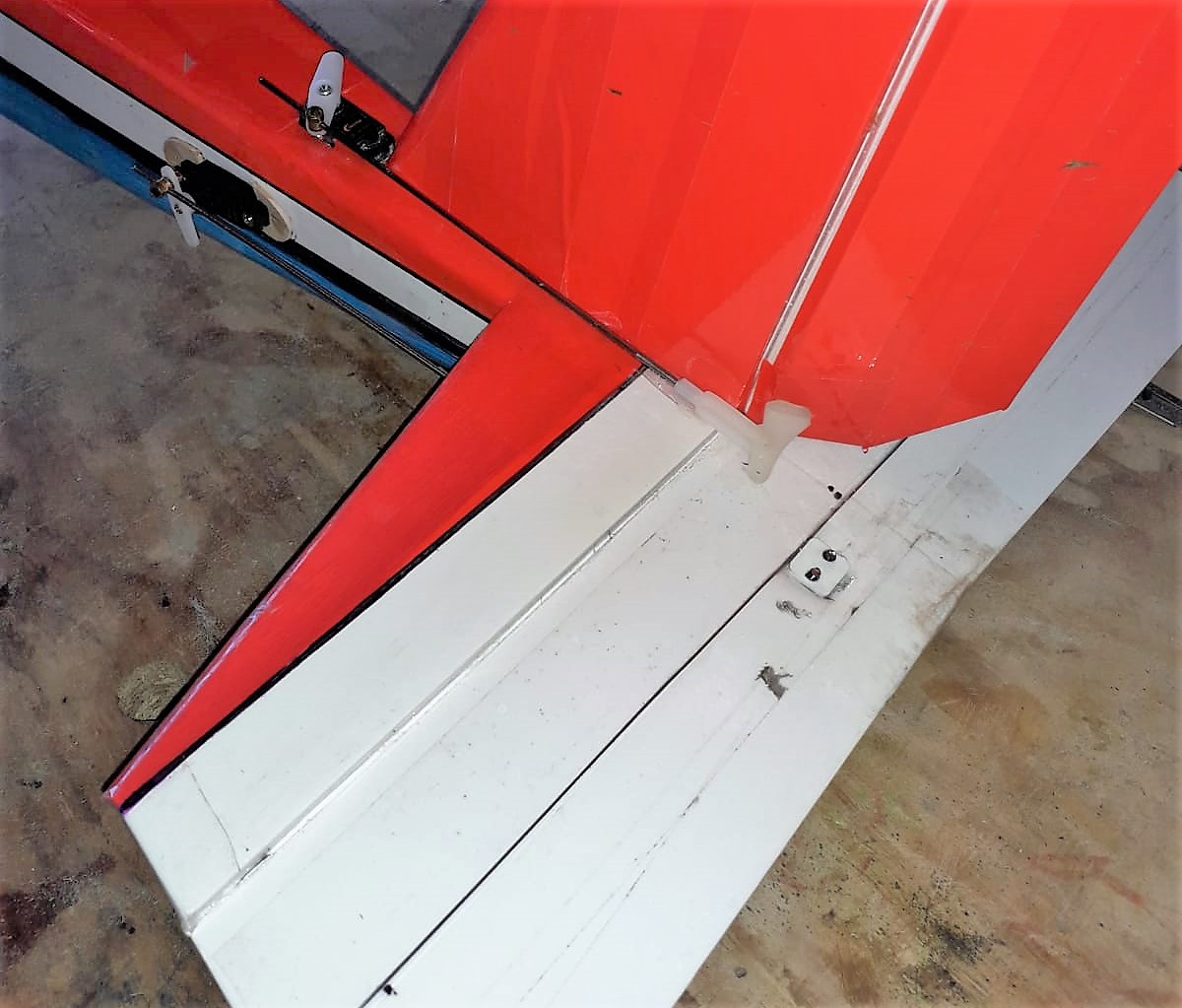 All that remained was finishing and fitting the electrics. Mistake number two was that I tried some painting but this had to be done freehand as any attempt at masking just ruined the card. I would have been very proud of the results if I was 50 years younger! After painting and the use of coloured tape for decoration the whole model was covered in clear packing tape for weather resilience. The electrics were robbed from other models and went in very easily, but as it turned out this was when I made mistake number three which became apparent during flight trials. Initial flights showed that I had a very rearward CG, partially caused by fitting the elevator and rudder servos at the rear of the fuselage when I had ample room in the front under the wing. Add to this way too much movement on elevator and the first flights were tricky but showed the potential. I also felt the model did not track very well in the air, the fin did look a little too small.
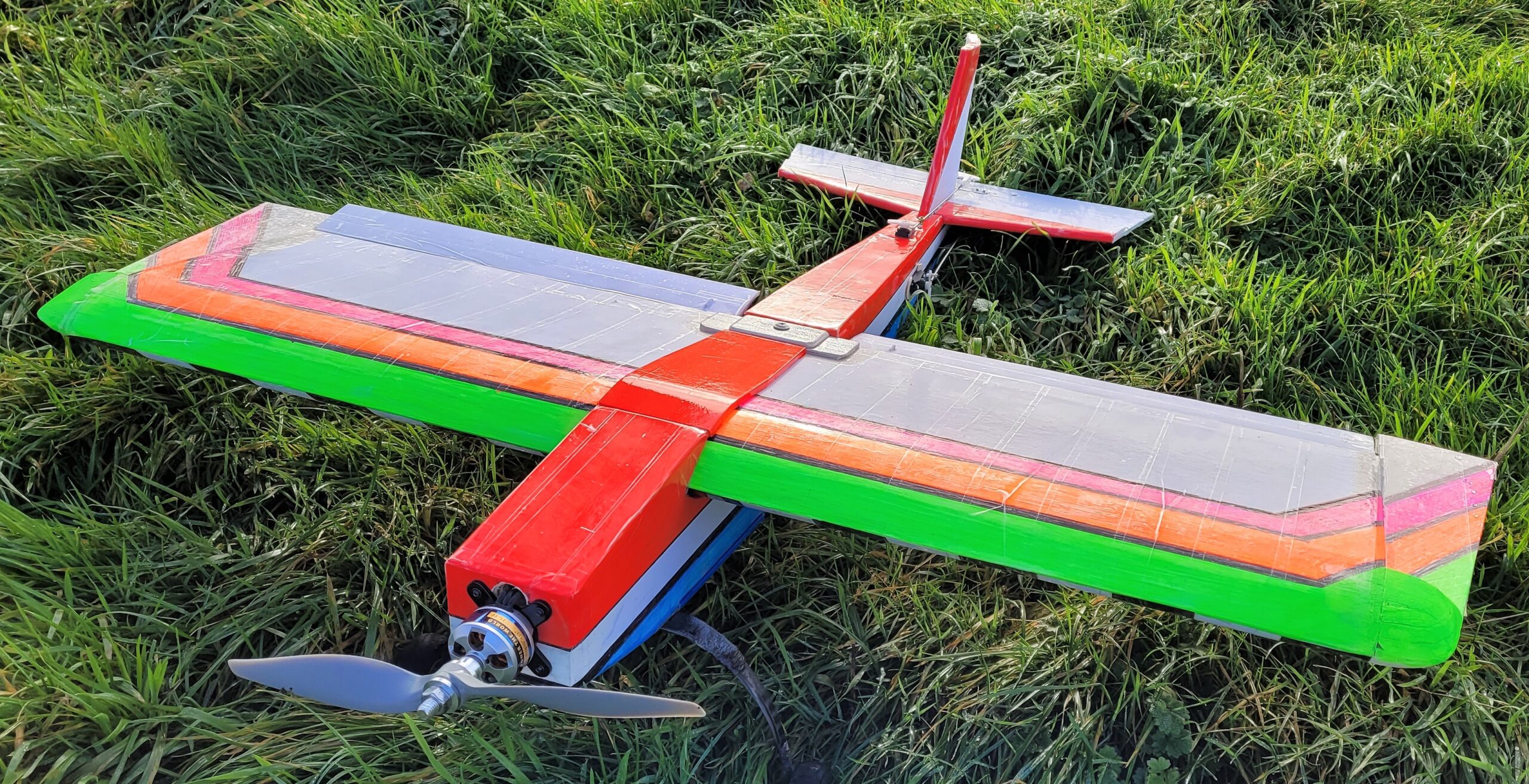 So after fitting two 10mm combination spanners in the battery compartment to correct the CG, reducing control throws etc. I had a well behaved model. Back at the workshop I made a new fin and rudder, 50% bigger than the original, and made some other small changes. On the next trip to the field the model proved itself very capable with all the attributes of a high wing plane. In summary, did I meet my brief? I think so, if you take out the mistakes and wasted card it could have been done with three sheets for £7.50.
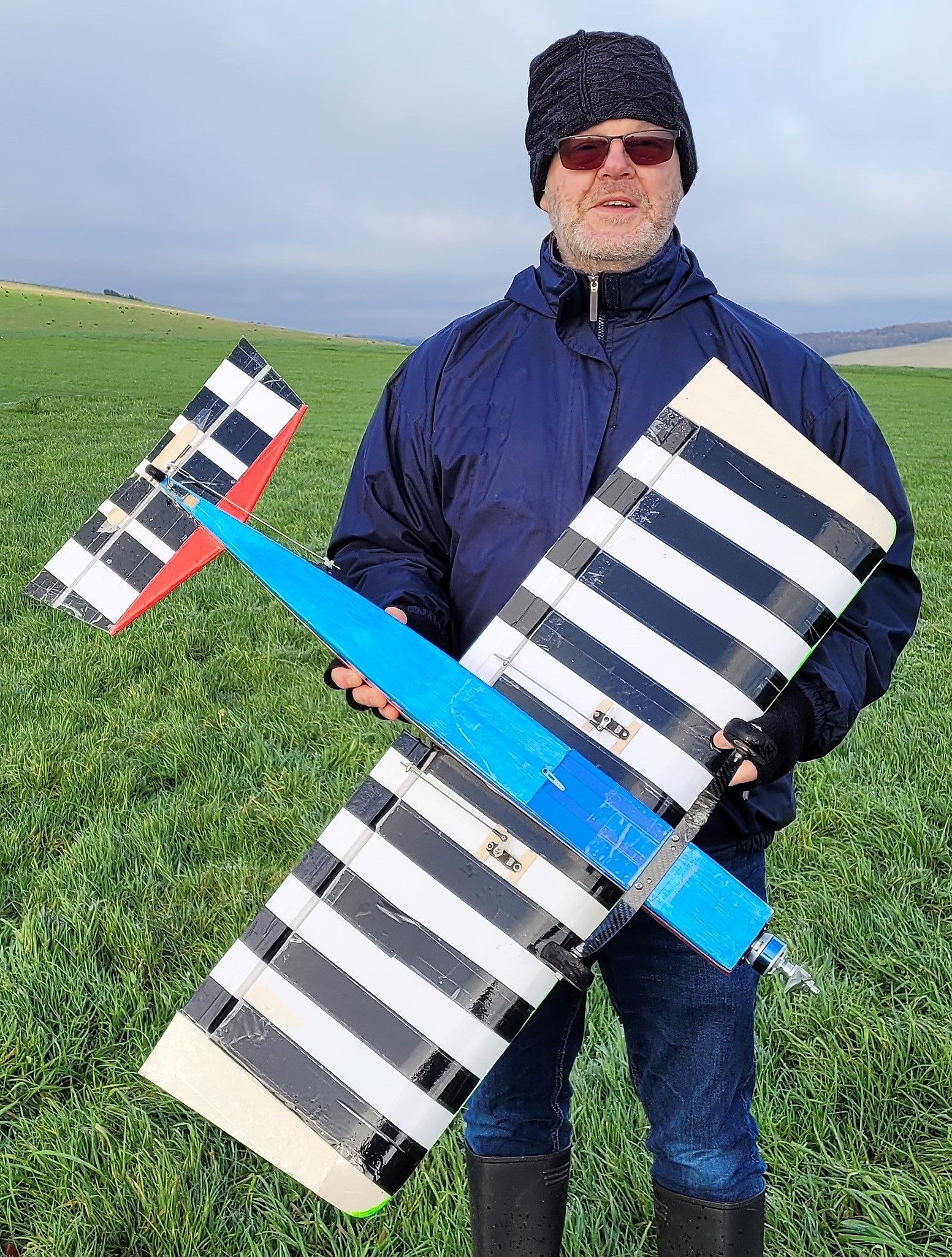 The only other thing I purchased was a roll of clear packing tape for £1.00 from Aldi, everything else was from the scrap box. Will it survive the elements? So far so good, it flies in varying wind and has spent a few hours sitting on wet grass. As a flying machine it has very few vices, is almost stall proof, not a 3D model but a very capable aerobatic plane. Three things to remember and almost anything will fly, just depends on how well, so get the correct CG, supply enough power, keep all the incidences correct, and if it looks right it probably is right. I know that’s four! So have a go at not designing a model, stick what you can see in your mind together you may surprise yourself. Thanks for that 1066, I can confirm that it flies very well indeed. Judge for yourselves in this month’s video.
Young Leo turned up with three new models in January, two EDFs and an electric glider. The first model Leo flew was his very attractive F/A-18 Hornet in the Blue Angels colour scheme. Leo tells me it’s a Park Flite model that is no longer available (I’ve never heard of Park Flite) and is 940mm long with a wingspan of 712mm. It’s powered by a 15L brushless motor that spins a 5 bladed fan and is fed by a 3 cell 1300mAh lipo via a 25A ESC.
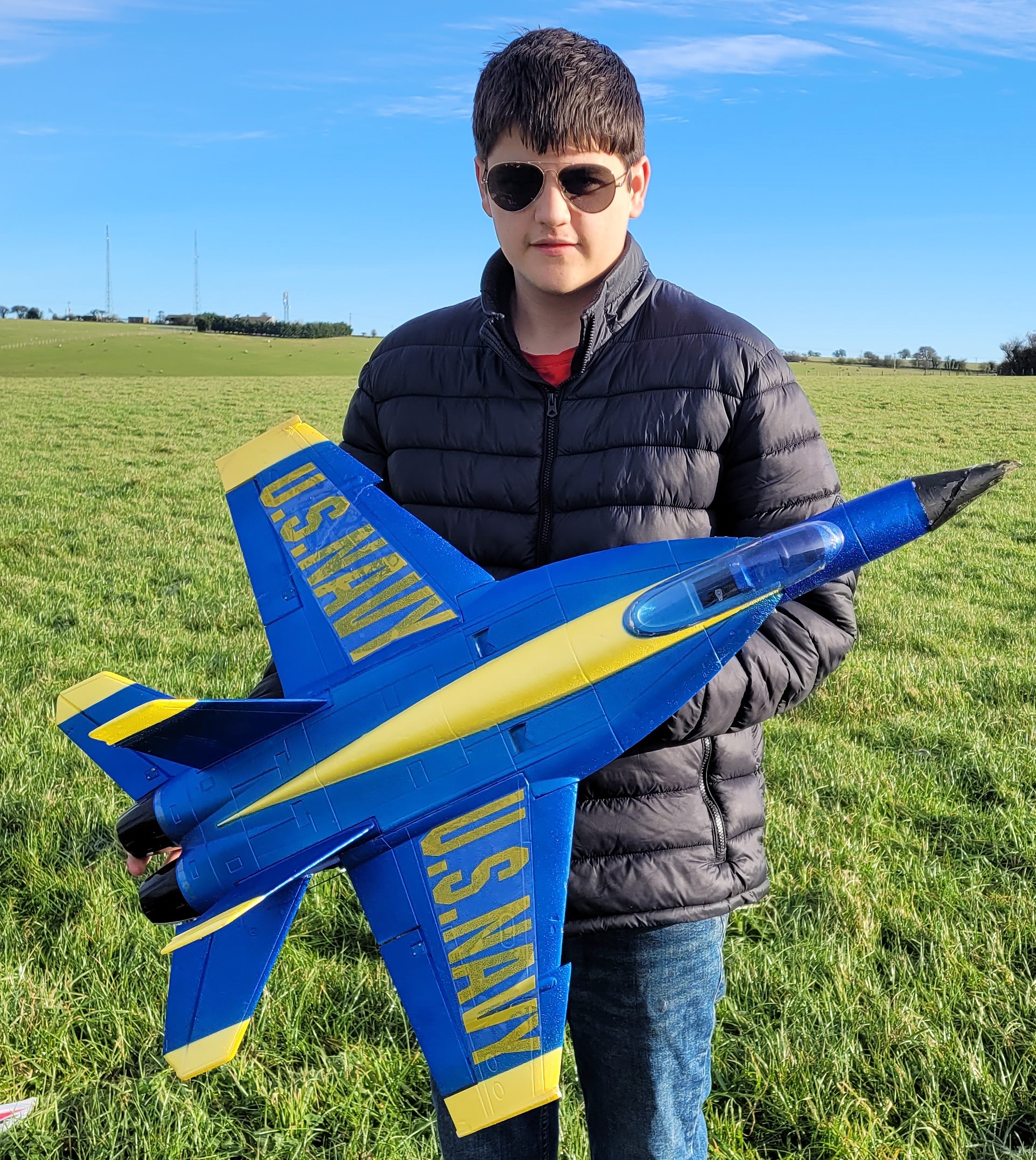 To me it seems a very small battery and motor set-up for the size of the model but it appeared to have plenty of power and flew extremely well with a reasonable duration.
The next EDF Leo flew was his HobbyKing T-45 Goshawk which originally featured in Patch News way back in 2013 when it belonged to belonged to a young Dougal Entendre! 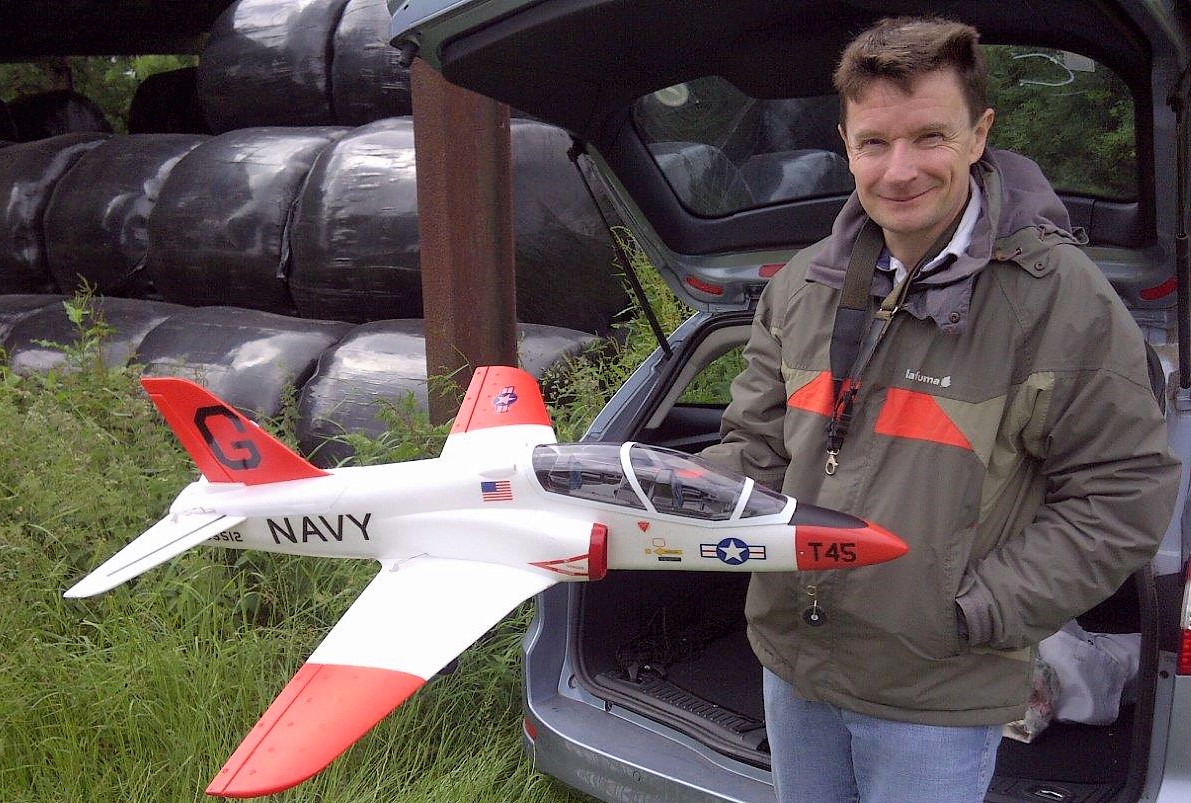 Since that photo was taken the Goshawk has been fitted with a new nosecone, one of a pair that were moulded in glass fibre by Norwegian Nick who also has (had?) the same model.
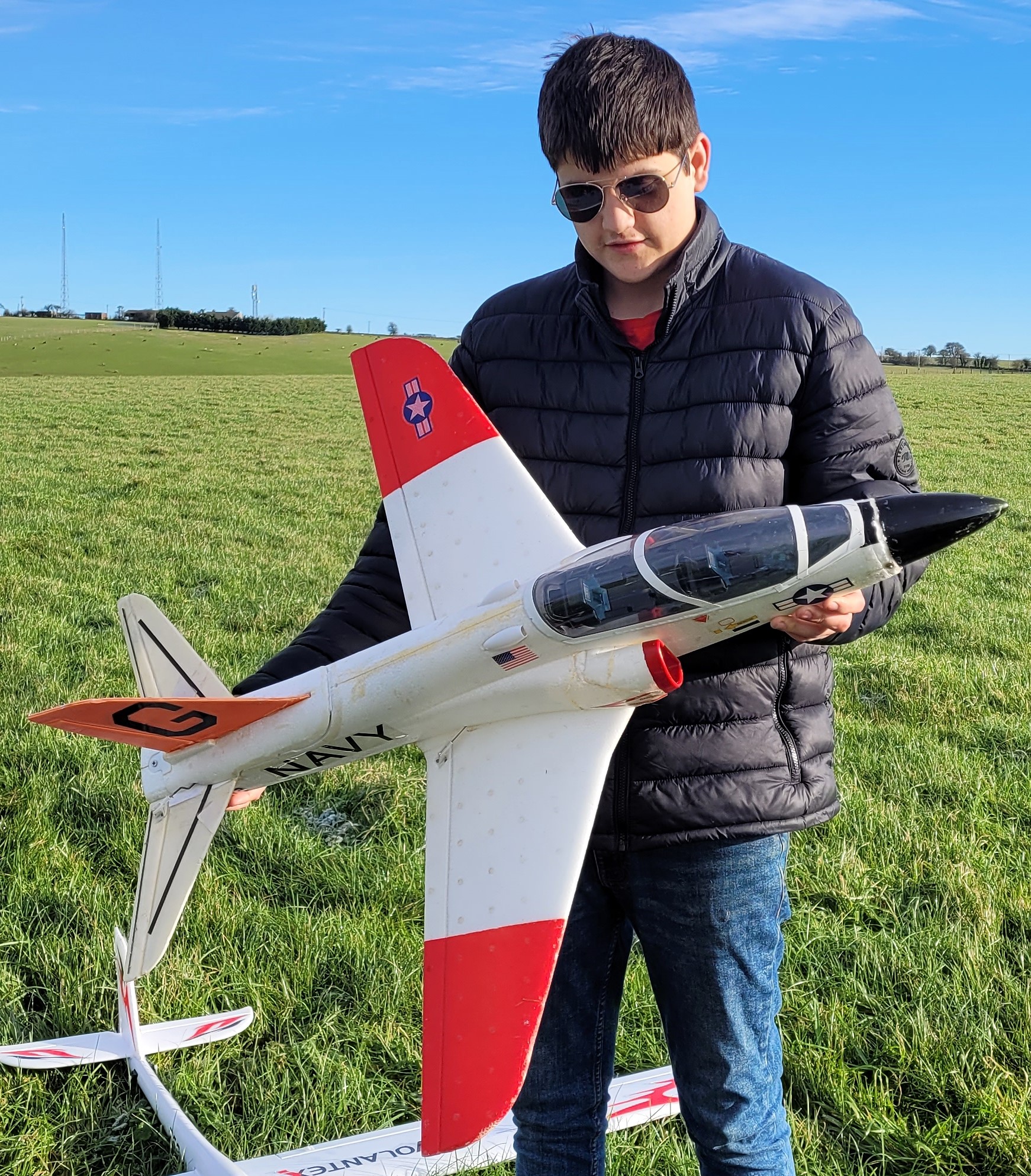 The plane flew well but sounded a bit rough, not especially loud but not like an EDF usually sounds. Apparently Dougal has got a 12 bladed 64mm that is going to be fitted as an upgrade so it will be interesting to see how it goes with the new set-up.
Leo’s last new model was a Volantex Phoenix 2000 V2 electric glider, a few of which already exist in the club and are known to be good performers. Leo’s Phoenix flew well, just as expected, but towards the end of the flight the motor started making an odd noise.
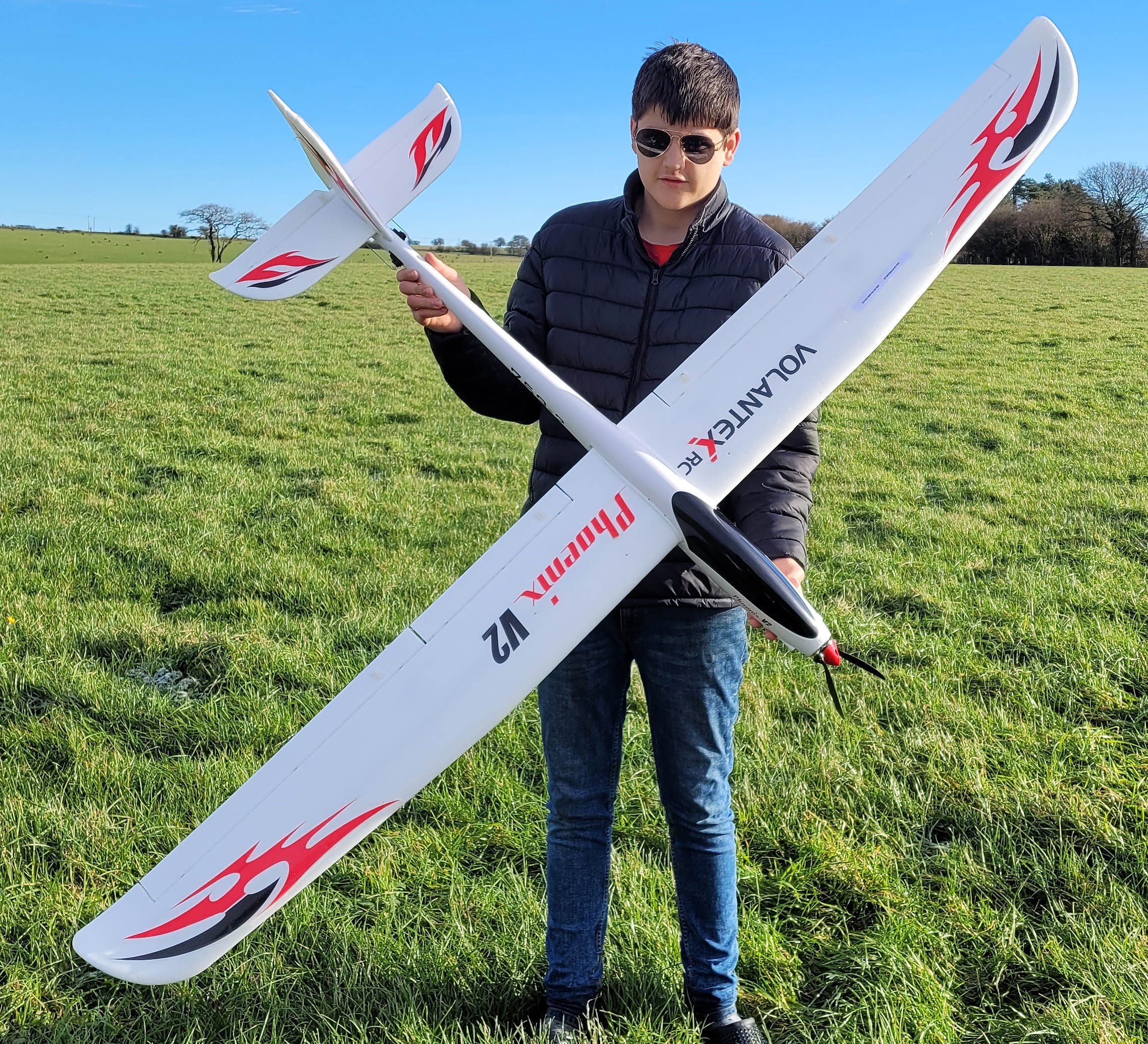 Leo landed the plane safely and received the benefit of advice from various members, all of whom had different opinions! Once back home he had a proper look and discovered the problem was a faulty motor, this is what he said: The motor on the Phoenix had fallen apart because the bearing had moved which should not have happened. I went back to Sussex Model Shop and told them about it and they contacted Volantex RC and hopefully they are going to send me a replacement. Fingers crossed they sort it out for you Leo, let us know the outcome. All three of Leo’s models can be seen flying in this month’s video.
A few flying photos for you now and this month they are some of Kryten’s older shots: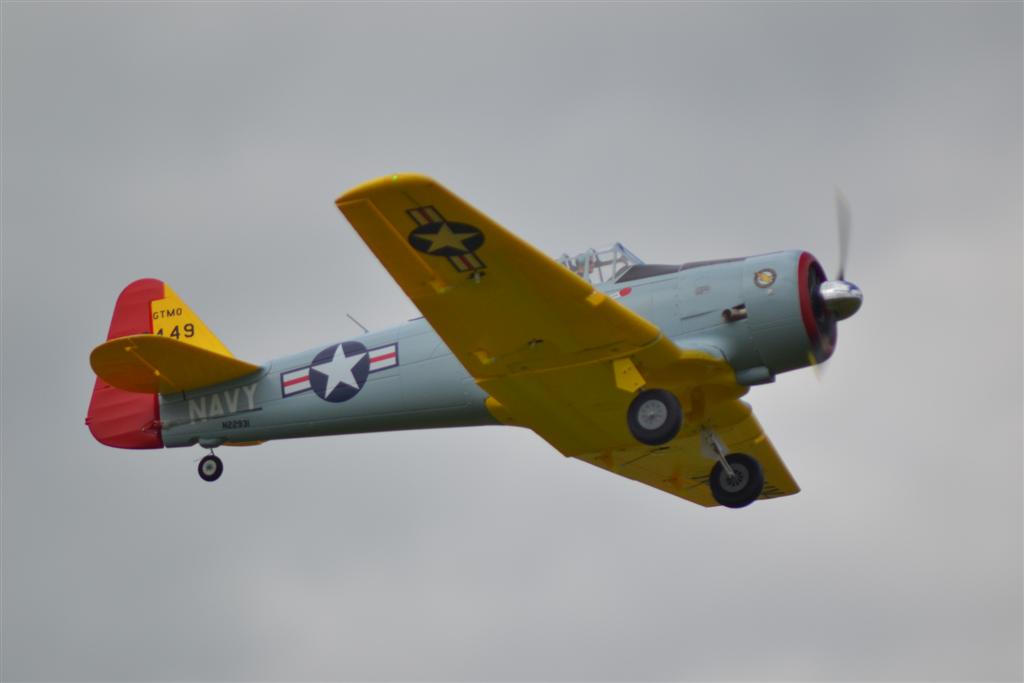
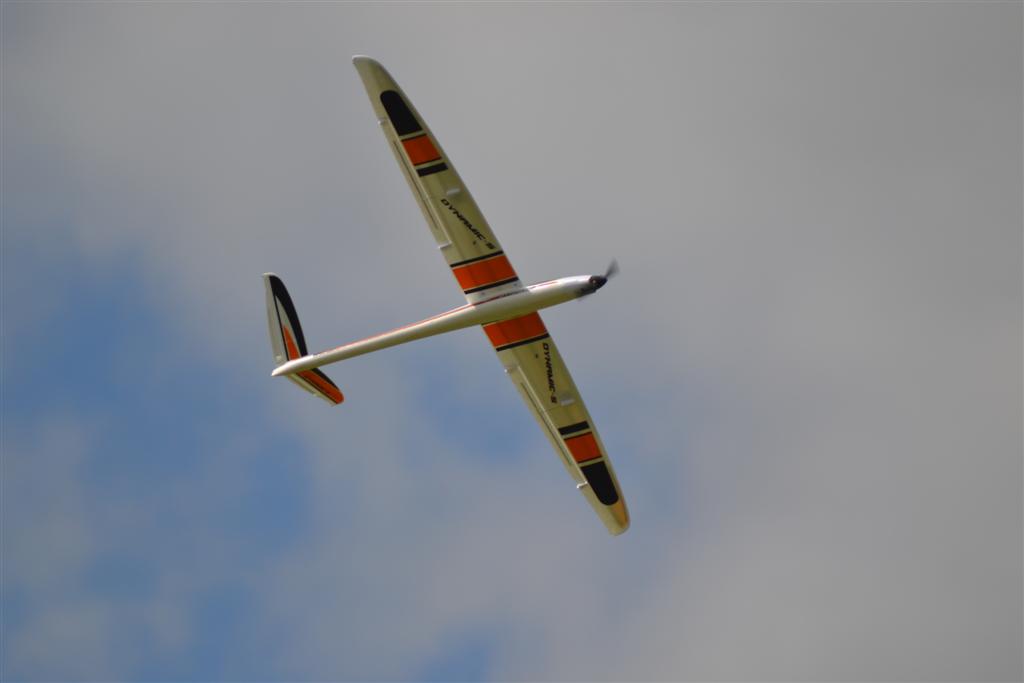
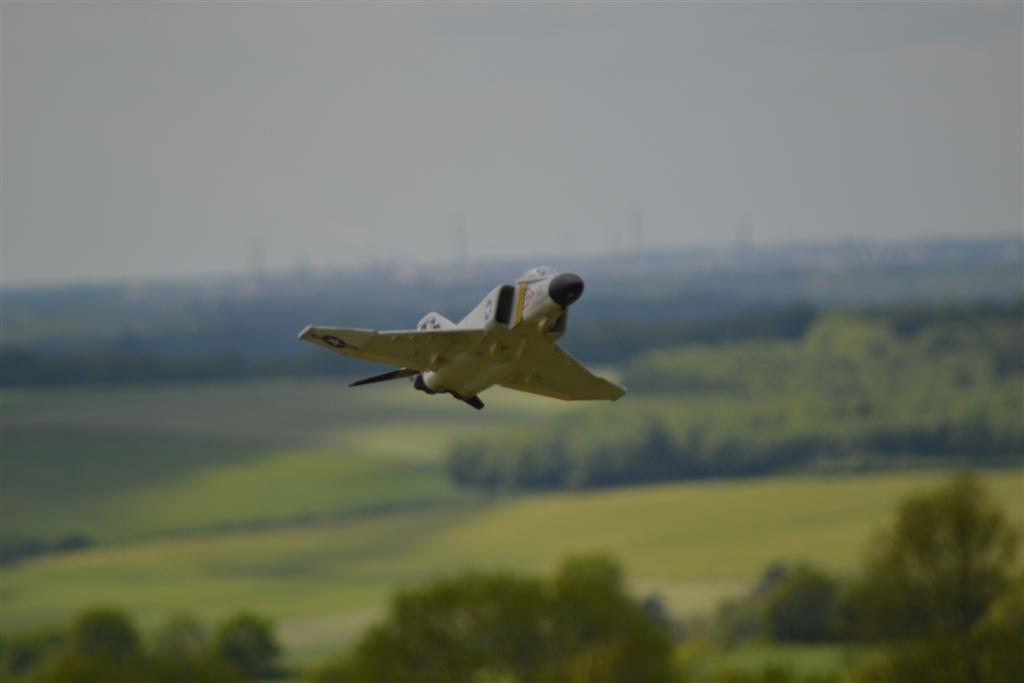
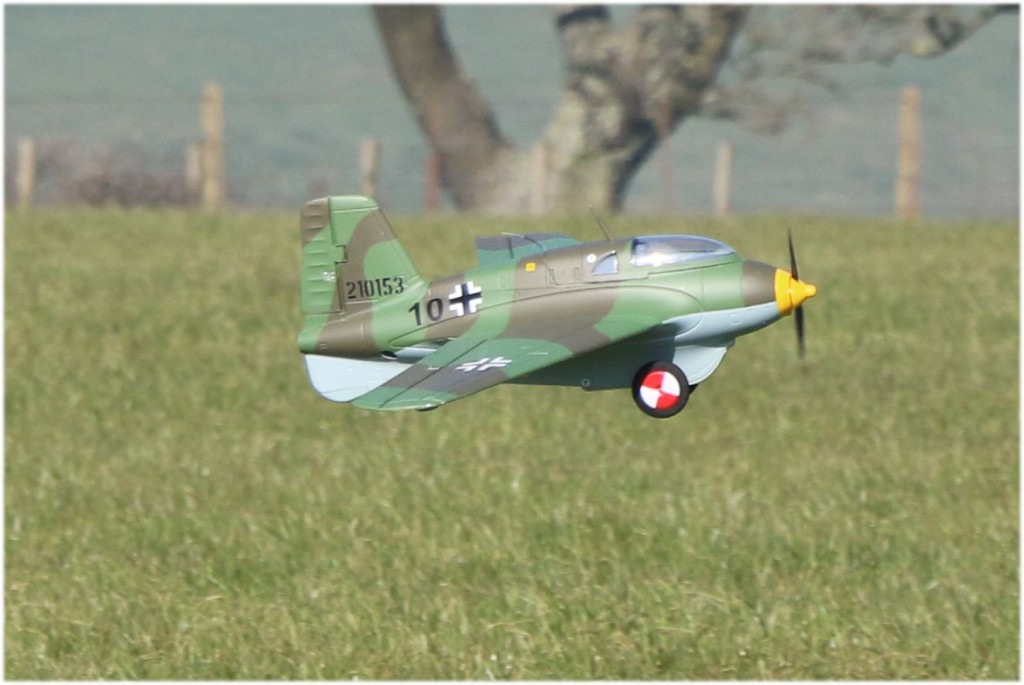
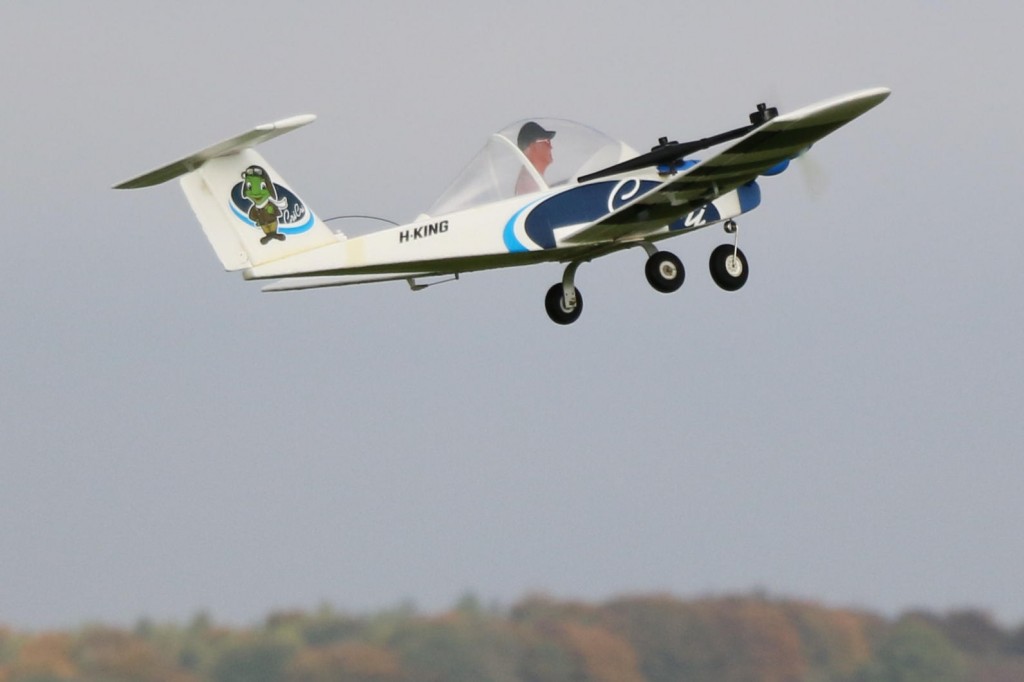
Video time now, with footage shot by Dougal Entendre, Gordon Bennett, and me. Please watch the video full-screen, it’s so much better with small models flying around: If the video won’t play for you please click HERE
An English pilot was flying a light aircraft across Australia but the engine failed and he crash landed in the Outback and lay unconscious until he was found the following day. When he came regained consciousness he was in a hospital bed with a nurse standing over him. Still groggy and fearing for his life, he asked, “Did you bring me here to die?” The nurse responded “Nah, ya got here yesta die.”
Colin Cowplain
Patch News – December 2022
Happy New Year everybody! I hope you’ve all had a great Christmas and maybe even received some modelling goodies. If you did please let me know what you got and tell me about them, I might feature them in a future edition of Patch News. Unfortunately much of the December weather was not conducive to model flying with the first half of the month being extremely cold and the second half warmer but wet and windy. I didn’t spot a single new model t0 feature this month, I think that’s a first. Rather oddly, just like last month, the weather always seemed to be better on Friday afternoons than on Sunday mornings and I took this sunset photo as we were loading up our cars on Friday 16th December.
But now we’re into a new year, the shortest day has come and gone, the evenings are already getting lighter, and we’ll soon have week after week of glorious long, hot, near windless days that are perfect for model flying…possibly!
December 1st was an excellent flying day, quite cold but with light winds so no wind chill. I flew FPV with my Volantex Ranger and hoped to copy Dougal Entendre’s cloud hopping that I featured last month. The day was similar to when Dougal had captured his excellent video footage but the clouds that were laying in the valleys stayed stubbornly down in the valleys rather than slowly blowing up and over our field. Never mind, although the clouds were just too far away for me to reach I did manage to get some nice footage and I quite like this shot where you can see the masts directly in front on the plane’s nose.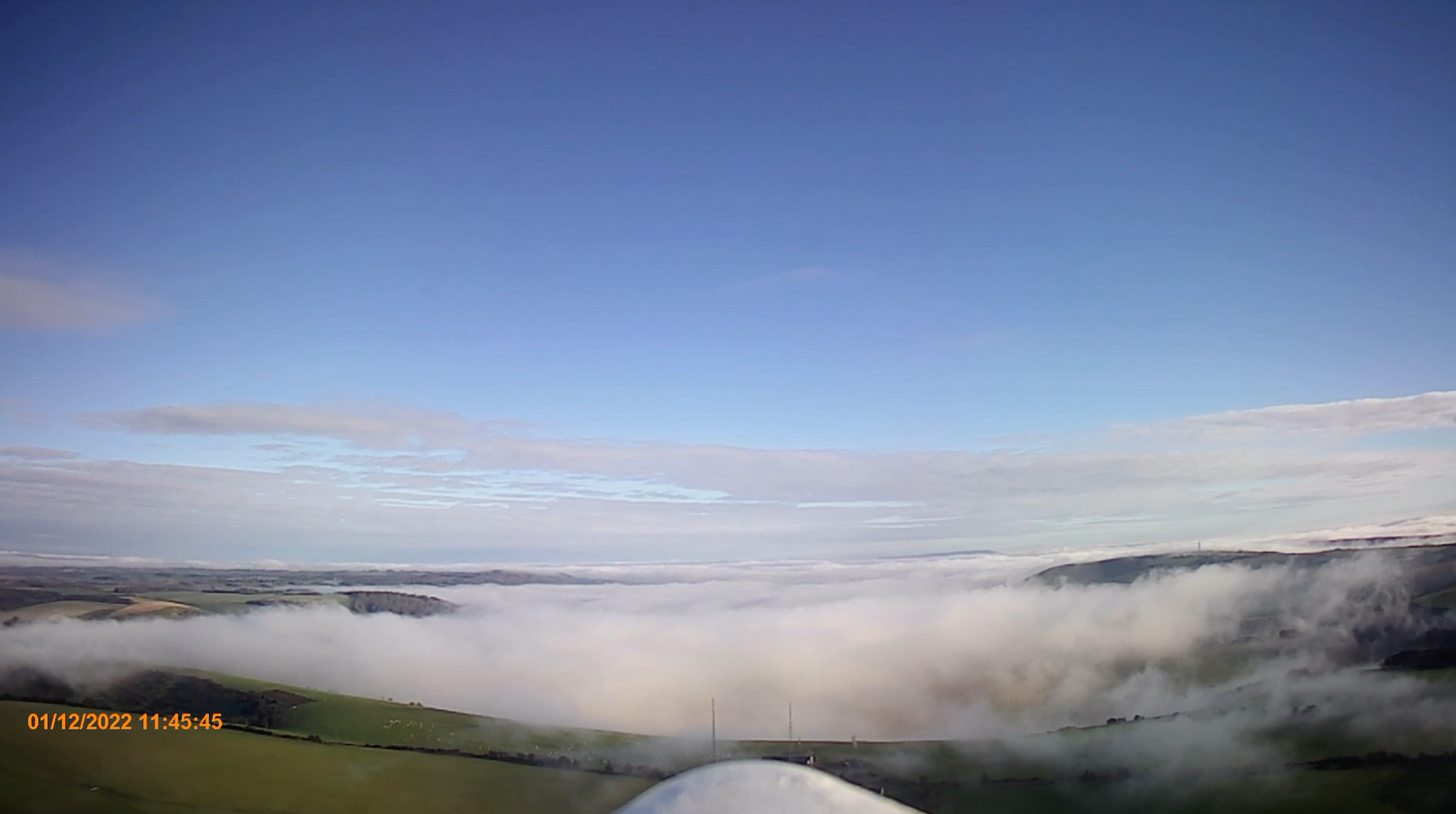
Back over our field I managed to follow Chas’s Wot4 as he did some touch & go’s.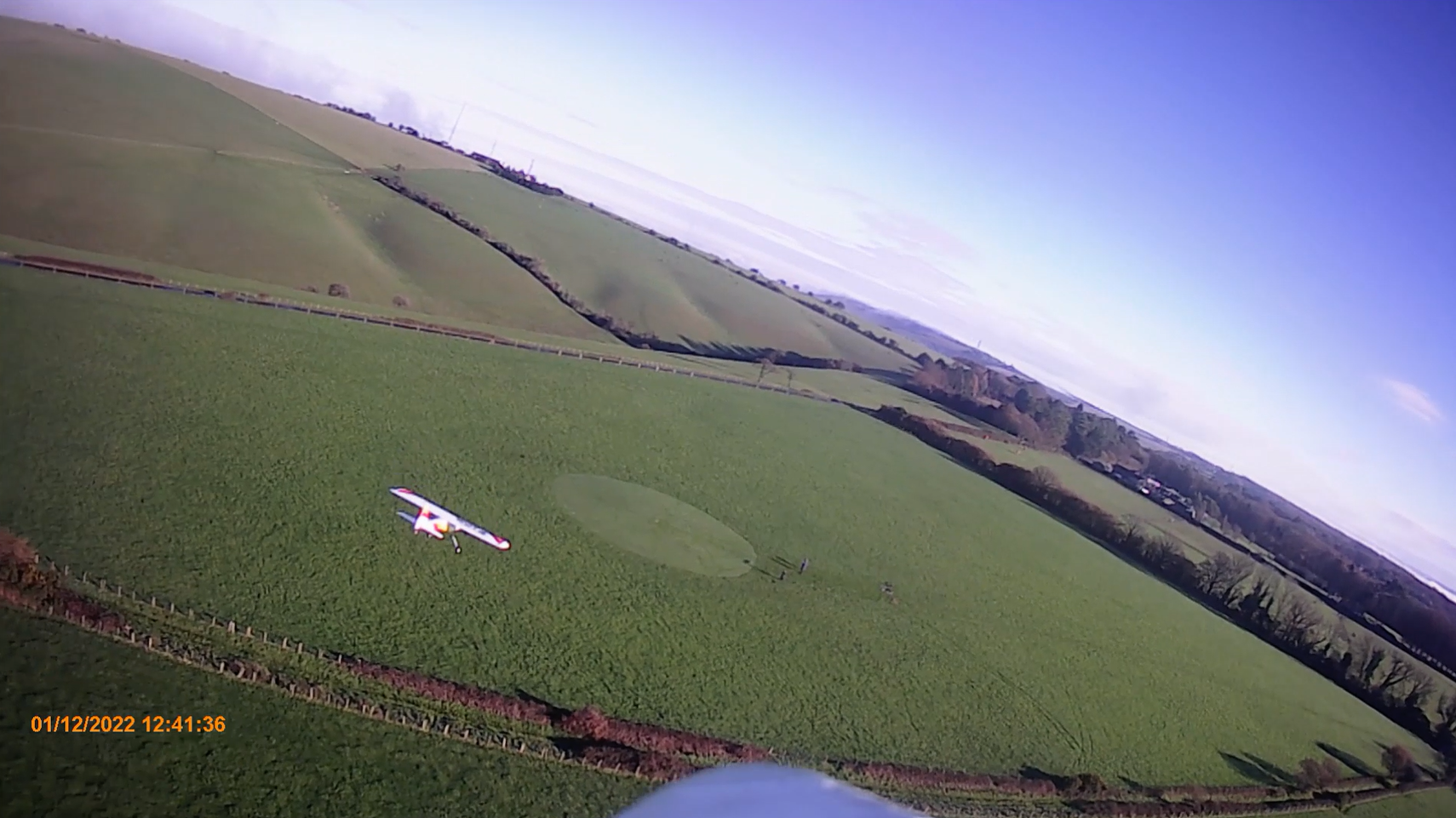
You can enjoy watching some of the footage in this month’s video.
Away from the patch the first club AGM in three years was held on Wednesday 7th December. With the various Covid-19 lockdowns and restrictions it had been impossible to have any meetings so this was a very important one. After a discussion with the other committee members Chairman Captain Slow chose a room at Clanfield Memorial Hall as the venue and it turned out to be an excellent choice with seventeen members making the meeting. The AGM began with reports from each of the committee, one of the important ones being the Treasurer’s report which showed that the club had managed to stay solvent despite all Nick Squire’s expensive holidays! Then it was onto the main event, the election of a new Chairman as Captain Slow had decided to step down after three years.
He’d done a great job of guiding us through the difficult Covid-19 times with several bouts of no flying at all or with only limited numbers allowed and various other complications along the way. Holding the club together when no meetings were possible was a feat in itself which Captain Slow handled admirably. But who would step up to become the new Chairman? We were very pleased and mightily relieved when Gordon Bennett volunteered to take on the job and within seconds he was elected, before he could change his mind!
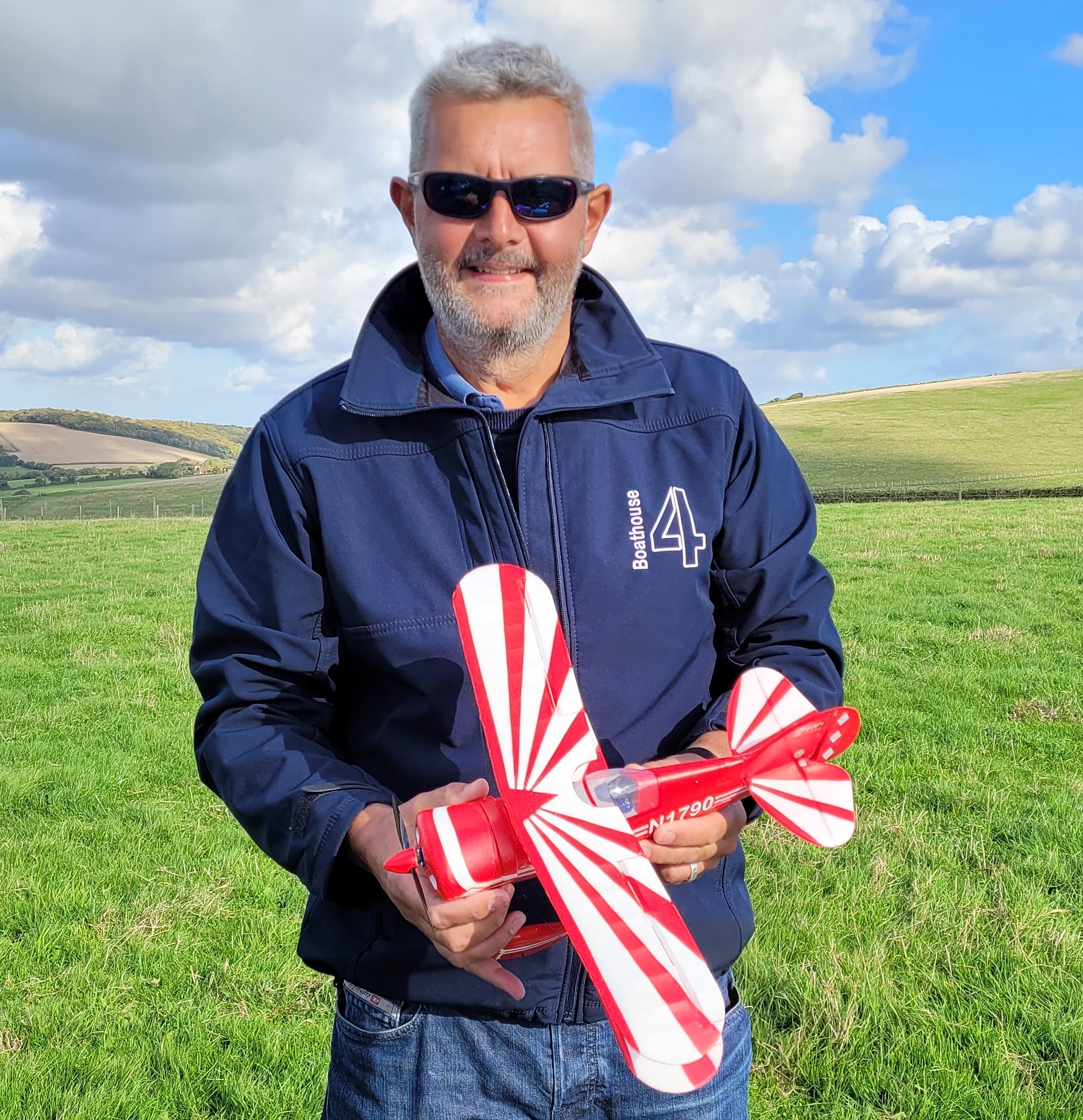 The remaining six committee members were happy to continue so with no other candidates coming forward were all re-elected. The topic of restarting club meetings was discussed at length and it was decided to try and hold quarterly formal meetings with maybe some social meetings in between those if members wanted them. I ran two raffles (Big and Small) with prizes that had been bought just before the first lockdown. The members were extremely generous and the total takings were £111, an excellent result.
Overall the AGM was a great success and I think everyone enjoyed it.
Way back in early November I’d spotted what looked to be a bargain on the Banggood site and in a moment of madness I’d hit the Buy button. It’s sold as an HW-34 and it’s another of the tiny Chinese models that come complete with a transmitter and are fitted with a gyro but unlike the others it’s not really even pretending to be a scale model, it’s much more of a toy. I think it’s roughly based on the Sukhoi SU-34 and I do mean roughly.
The other micro planes that lots of us are flying have the usual aileron, elevator, and rudder controls but this one has none of those. It is fitted with two pusher propellers and control is done by altering the speed of one or both of the motors to make it climb or dive and turn left or right so there’ll be no aerobatics with this one. It is moulded in coloured EPP foam and is said to be unbreakable, there’s a video showing various strength tests.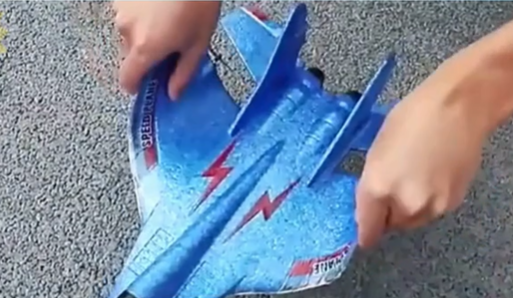
So why did I buy it? Well partly because it has multiple LEDs for night flying (the lights alone would be enough to convince Woody to buy it} but mostly because the complete package including three batteries and tracked delivery was only £24.12, what could possibly go wrong? Quite a lot as it turns out, it hasn’t arrived yet! It’s coming from China so I knew it would take a while and the estimated delivery was between December 2nd and 12th. I placed the order on 10th November and the tracking shows it was shipped on 11th and went through various parts of China before arriving by plane in the UK on 20th November. Since then nothing has happened and the Royal Mail tracking simply says “More information will be available when it arrives in the UK” so presumably it’s awaiting customs clearance. I used the Banggood online chat service to query the delivery and Archie (my new best friend) basically said to be patient. So it took 10 days from my placing the order to arrive in the UK and by 1st Jan it will have been sat in customs for 42 days.
STOP PRESS: The day after I wrote the above it arrived! That was 23rd December so it only took 33 days to be delivered once it had arrived in the UK. The Royal Mail tracking still shows that’s they are waiting to receive it from China even though they’ve now delivered it!
Oddly although I ordered an HW-34 according to the box it’s an HW-29 that’s been delivered but it looks identical to me. So presumably it’s supposed to be a Mig-29 not an SU-34. I’ll give more info and hopefully a flying report in the January 2023 Patch News.
Despite the very cold and frosty days at the start of December quite a few club members left the warmth of their homes behind and came out to fly. Just five of us were present when I took this photo fairly early in the morning on Sunday 11th December but soon afterwards several more brave souls turned up as well, a good turnout in those conditions.
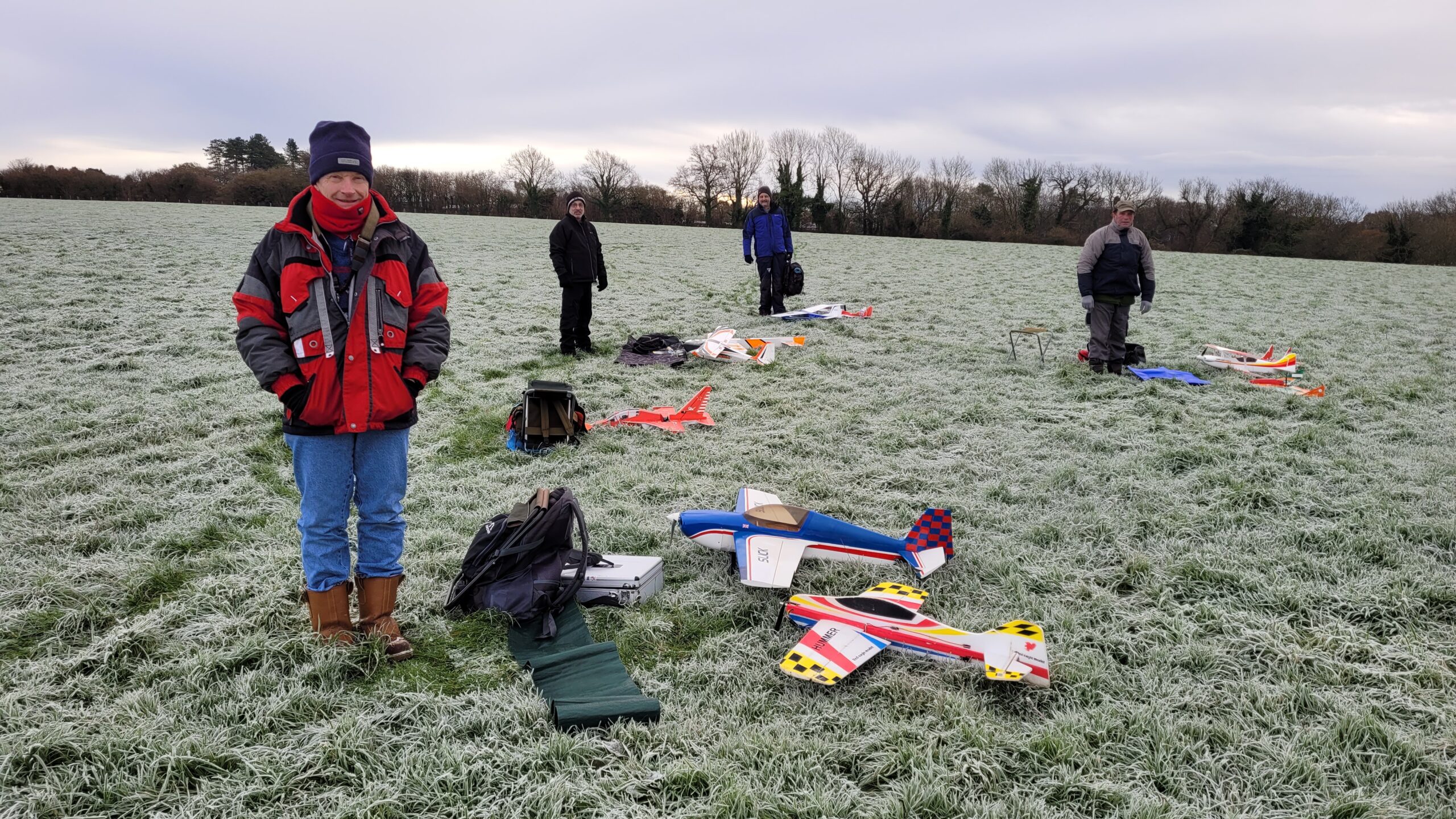 From the left it’s Dougal Entendre, Mini Mike, Gordon Bennett, and lastly Captain Slow.
Peter Fothergill dragged himself out in all kinds of weather to practice the flying schedule for his BMFA ‘A’ certificate and flew on days that varied from freezing cold but with light winds to wet, warm(ish), and windy. I admired his stoicism, he must have got very bored flying figure 8 after figure 8, after figure 8 but Peter never complained. Here’s Peter back in July when the weather was rather better with the Max Thrust Riot he used for the test.
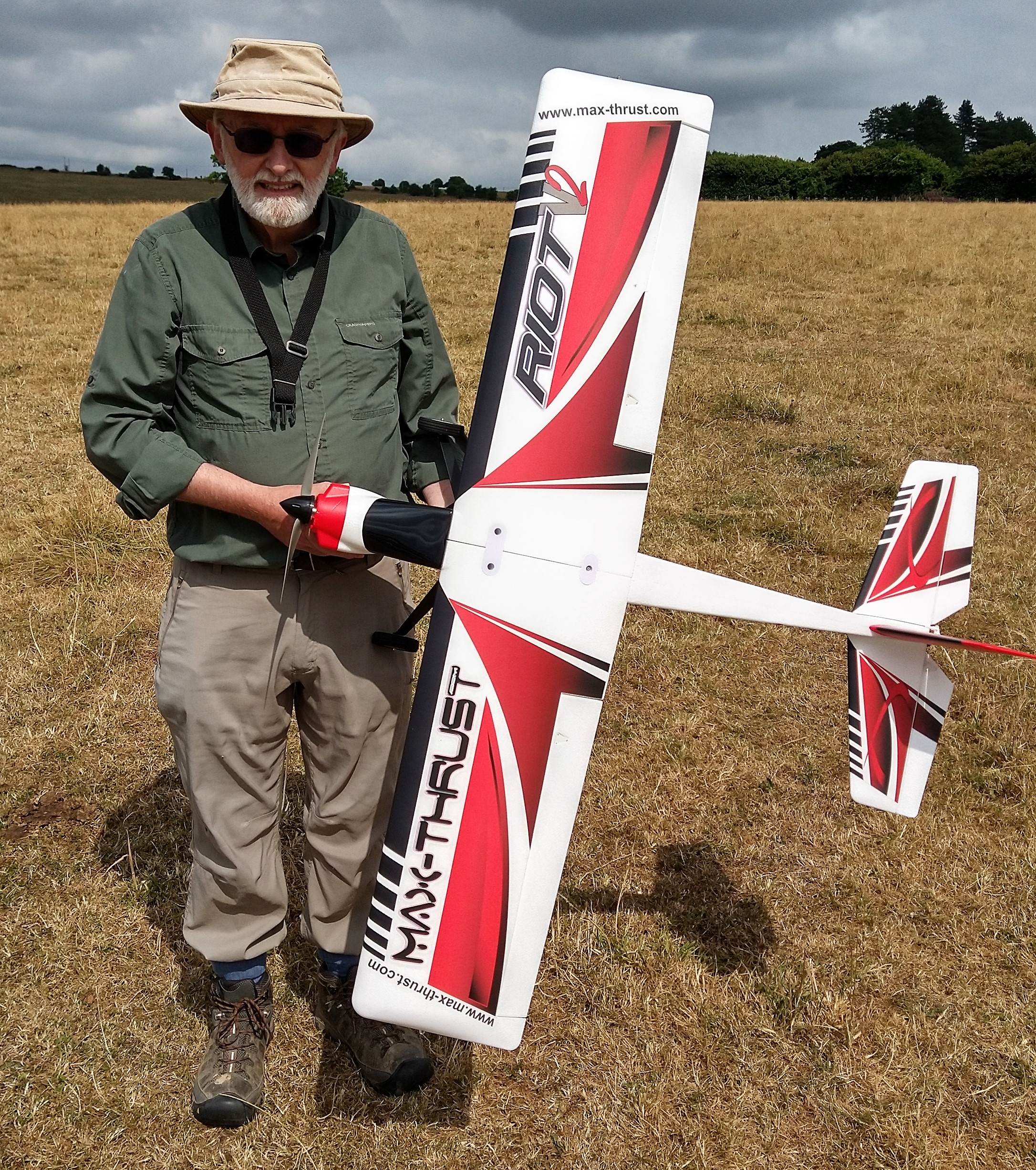 Peter had been looked after at various times by Dougal, Chas, Captain Slow, 1066, and me. Both Dougal and I are examiners but as I’d spent more time than Dougal teaching Peter it seemed best if Dougal took Peter for his test. But with the combination of dodgy weather and Dougal’s work commitments it was proving difficult to arrange so when the weather on Friday 16th December was perfect I took Peter by surprise and told him he was taking the test. All went well and his flying was excellent, Peter said later that being able to fly without the hindrance of gloves and a transmitter muff helped no end! He’d already passed the RCC test which simplified the question asking part of the test and he was able to answer all the questions I threw at him with no problems at all.
 Having passed and been congratulated by all those present Peter packed all his gear away and sat watching the rest of us. When I insisted he had his first solo flight he unpacked everything again and had a flight that included several loops and rolls followed by a perfect landing on our small patch. Well done Peter, you’re going to be fine!
Gordon Bennett asked to me to check out his Spitfire one day, I’m sure I heard him say he wanted to see how it looked when it was flown properly! Obviously I happily agreed to help out but then I realised there was a problem, Gordon uses Spektrum radio gear…yuk!

But I managed to overcome my dislike and of course the Spektrum performed faultlessly.
Dougal Entendre and I managed to escape the festivities for a while on Boxing Day and enjoyed some great flying in reasonable weather, chilly but not freezing and light winds.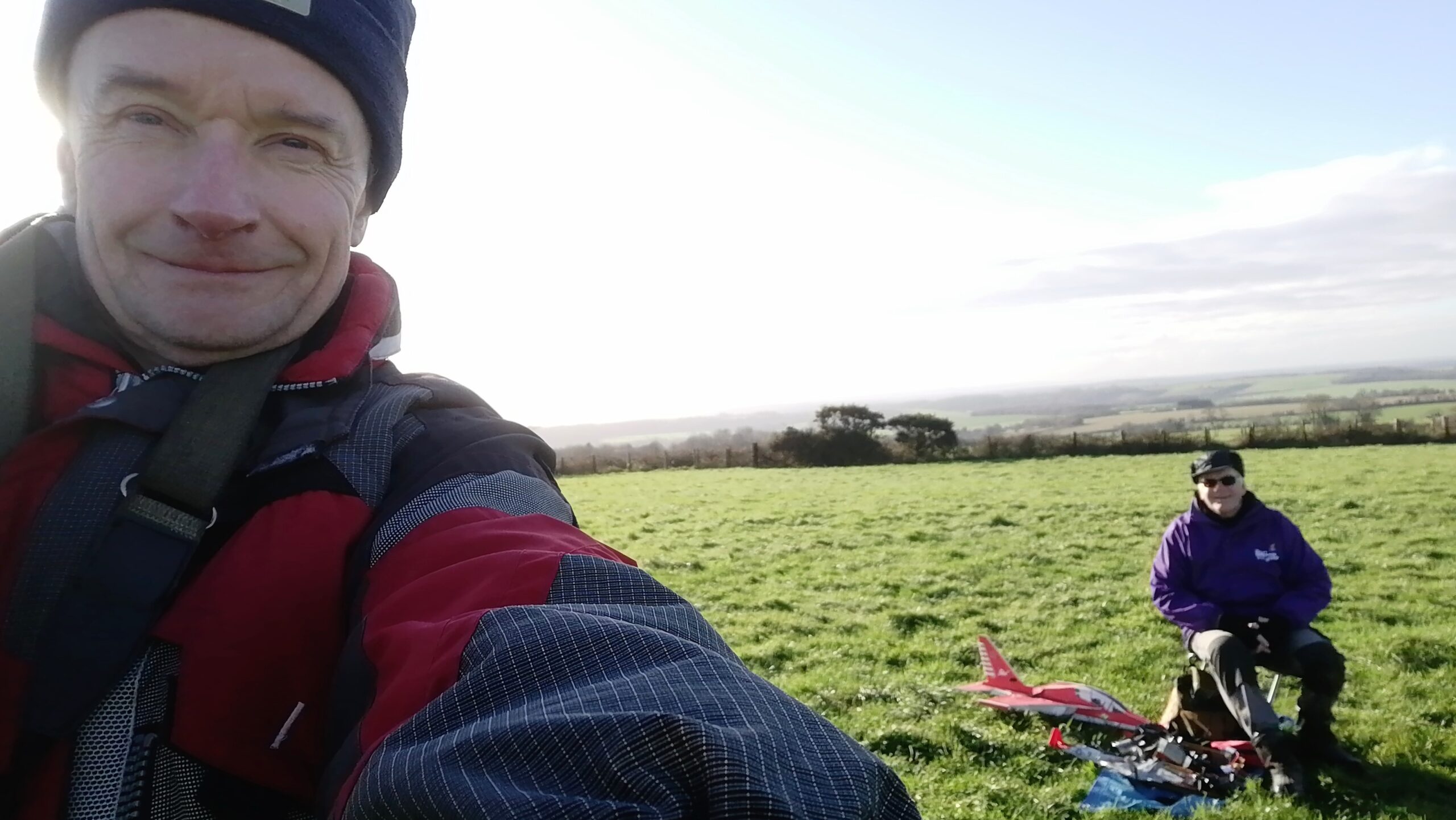
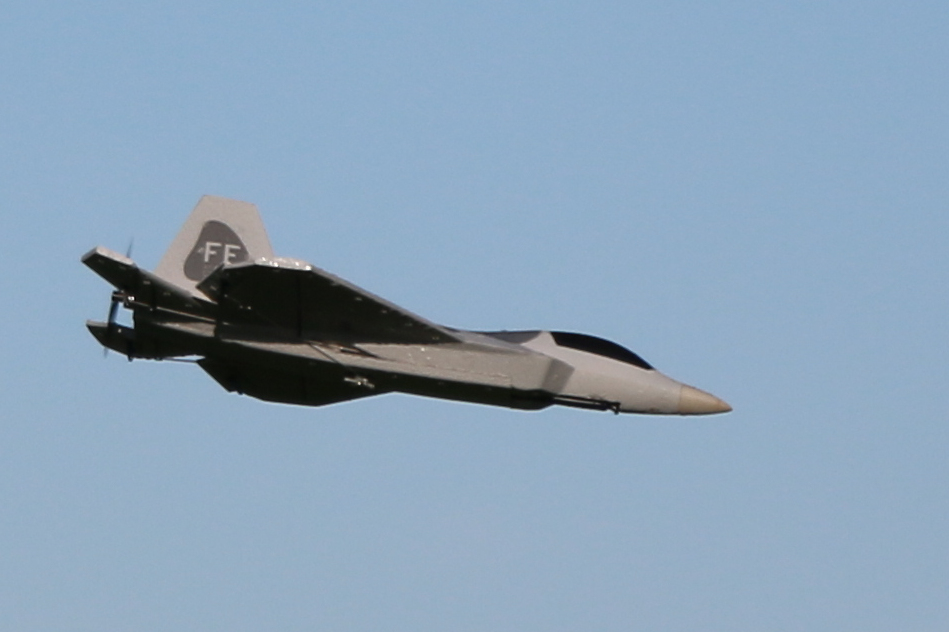
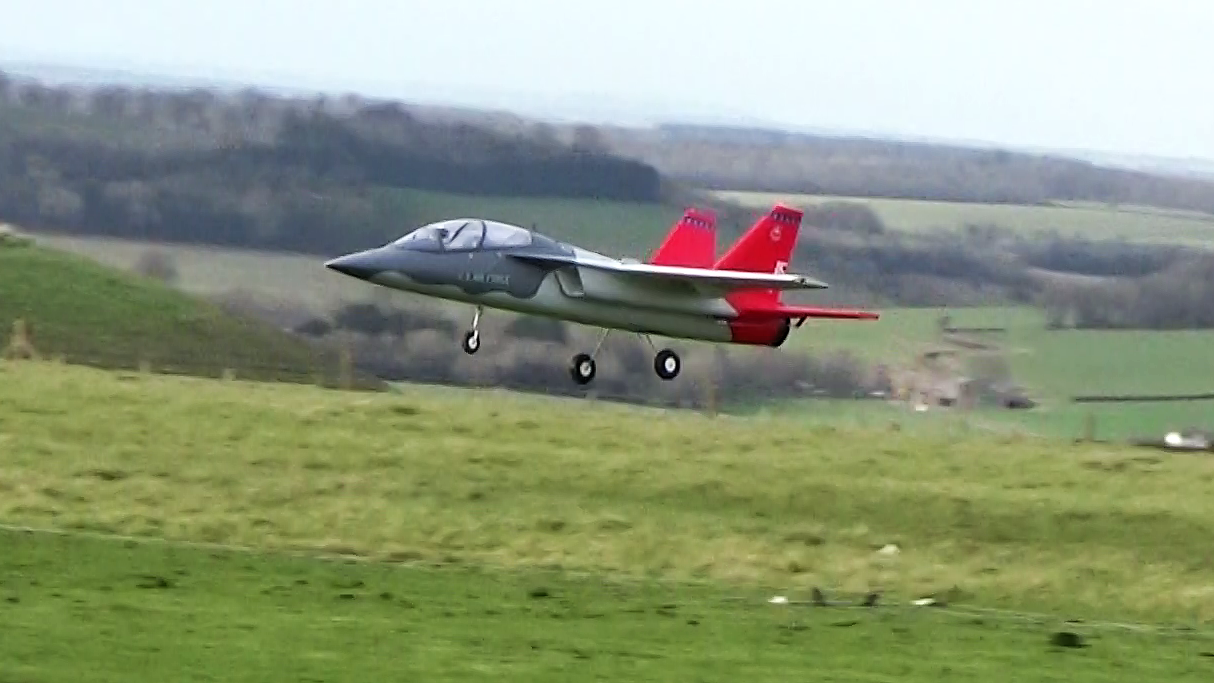
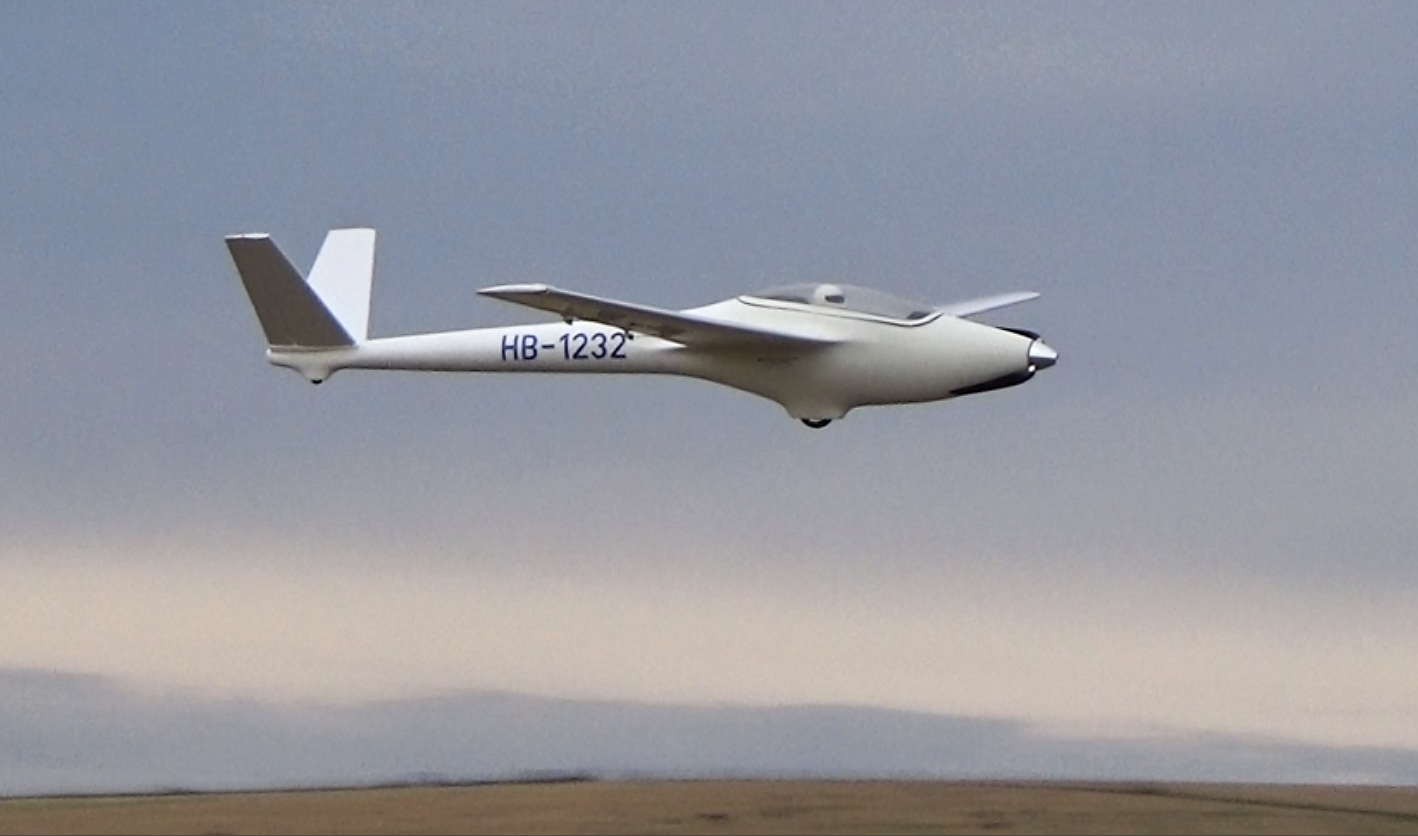
With little flying in December I’m afraid I don’t have any new flying shots so here’s a look back at some of Kryten’s excellent photos that he has taken throughout 2022:
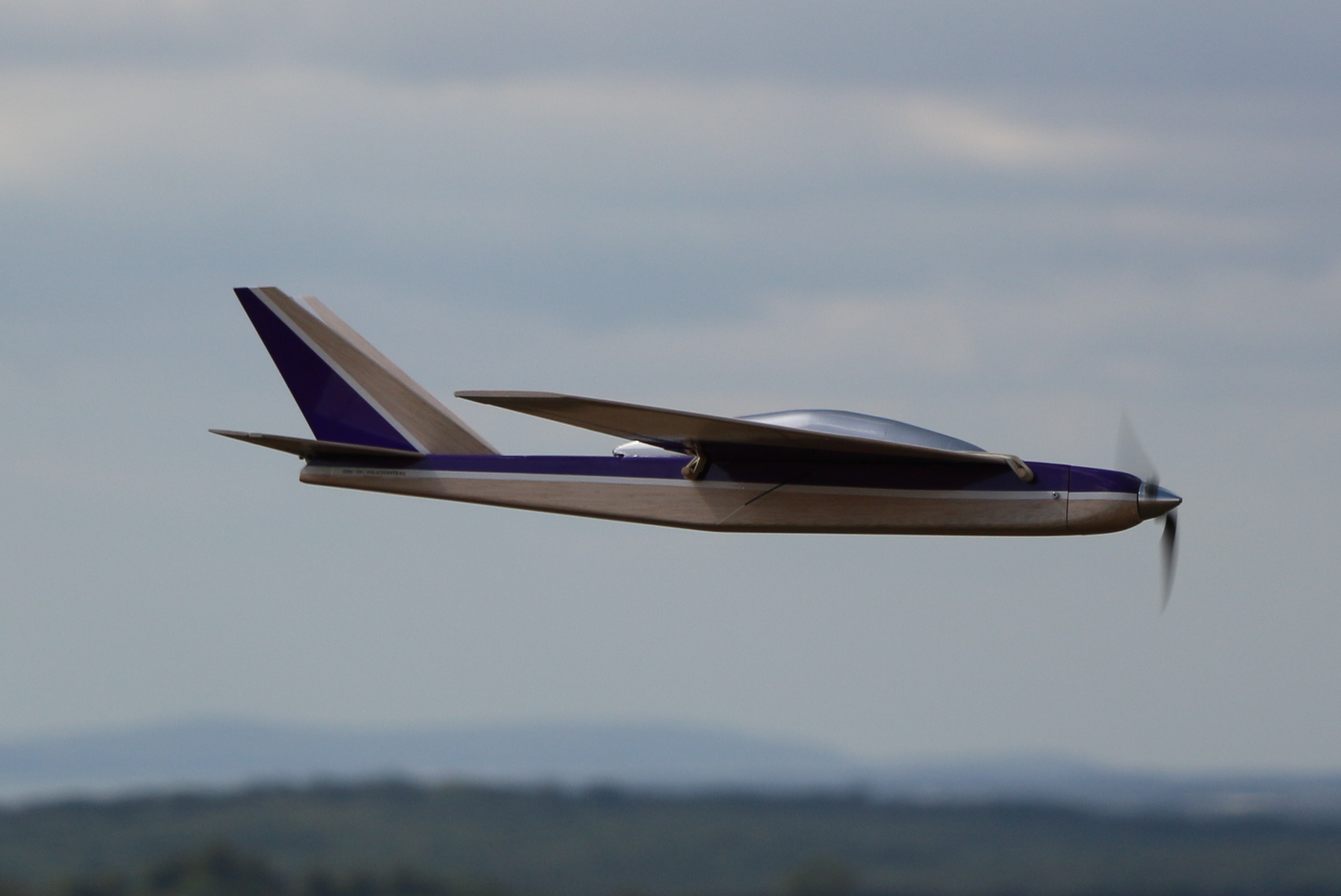
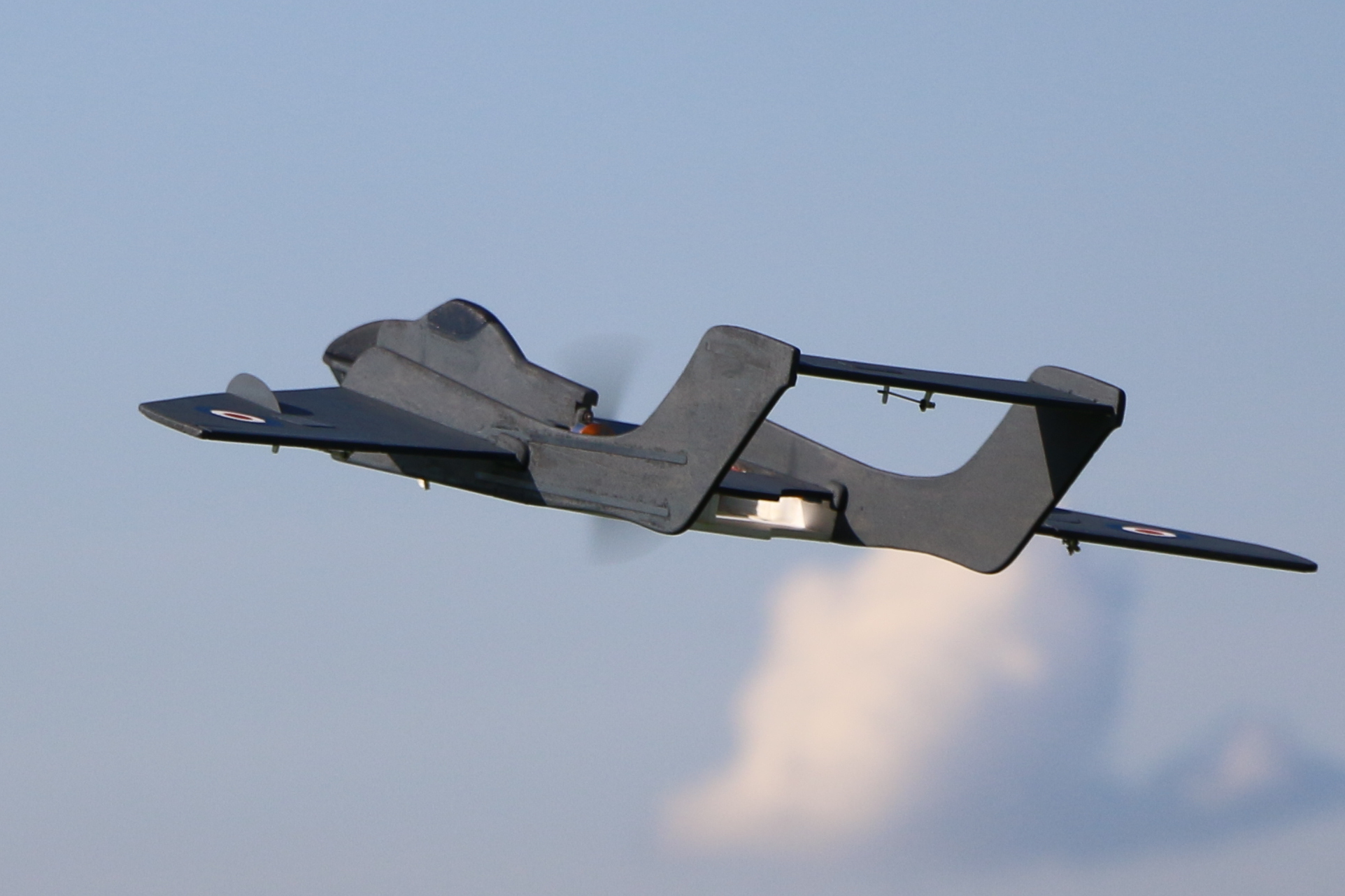
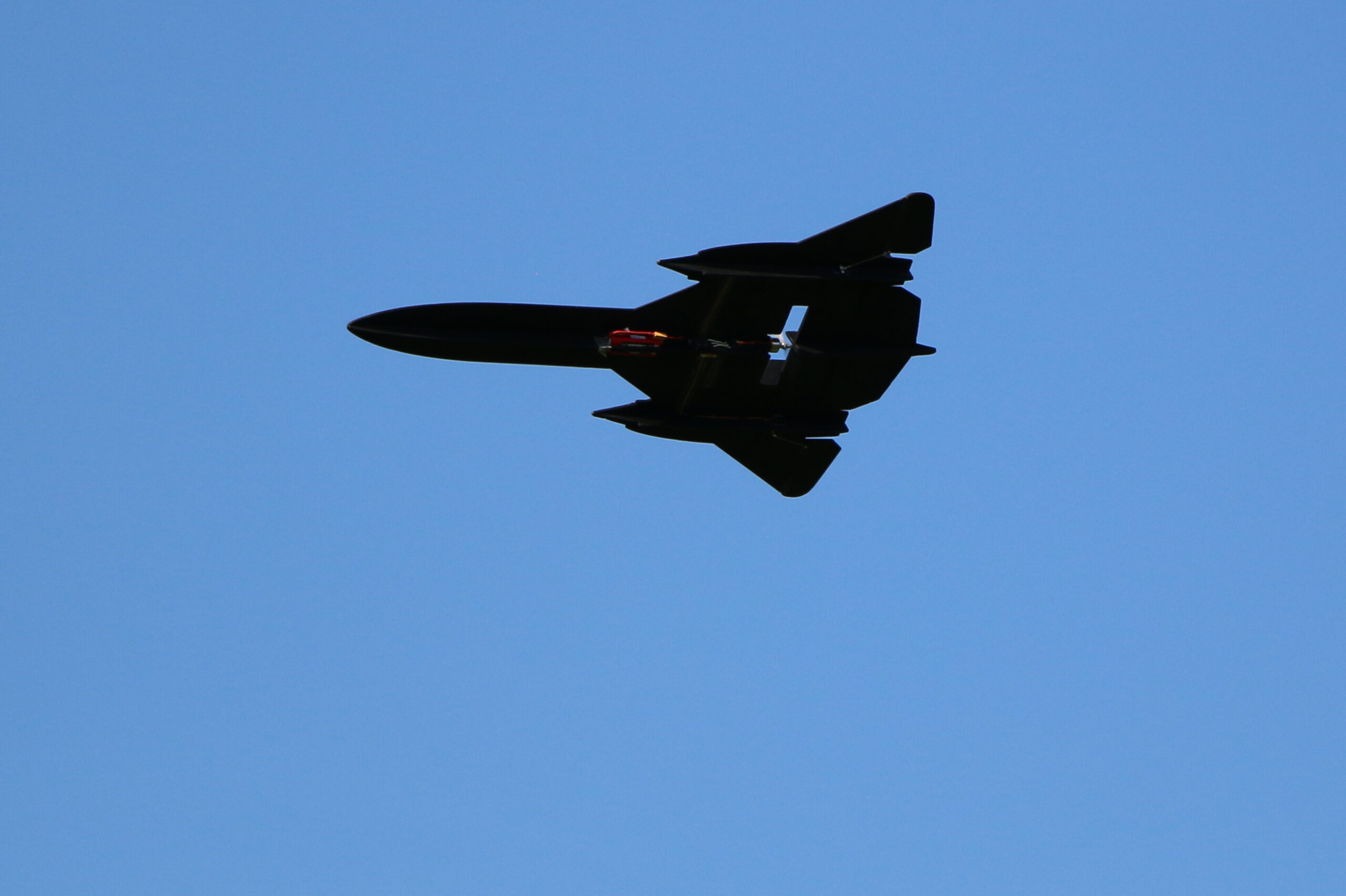
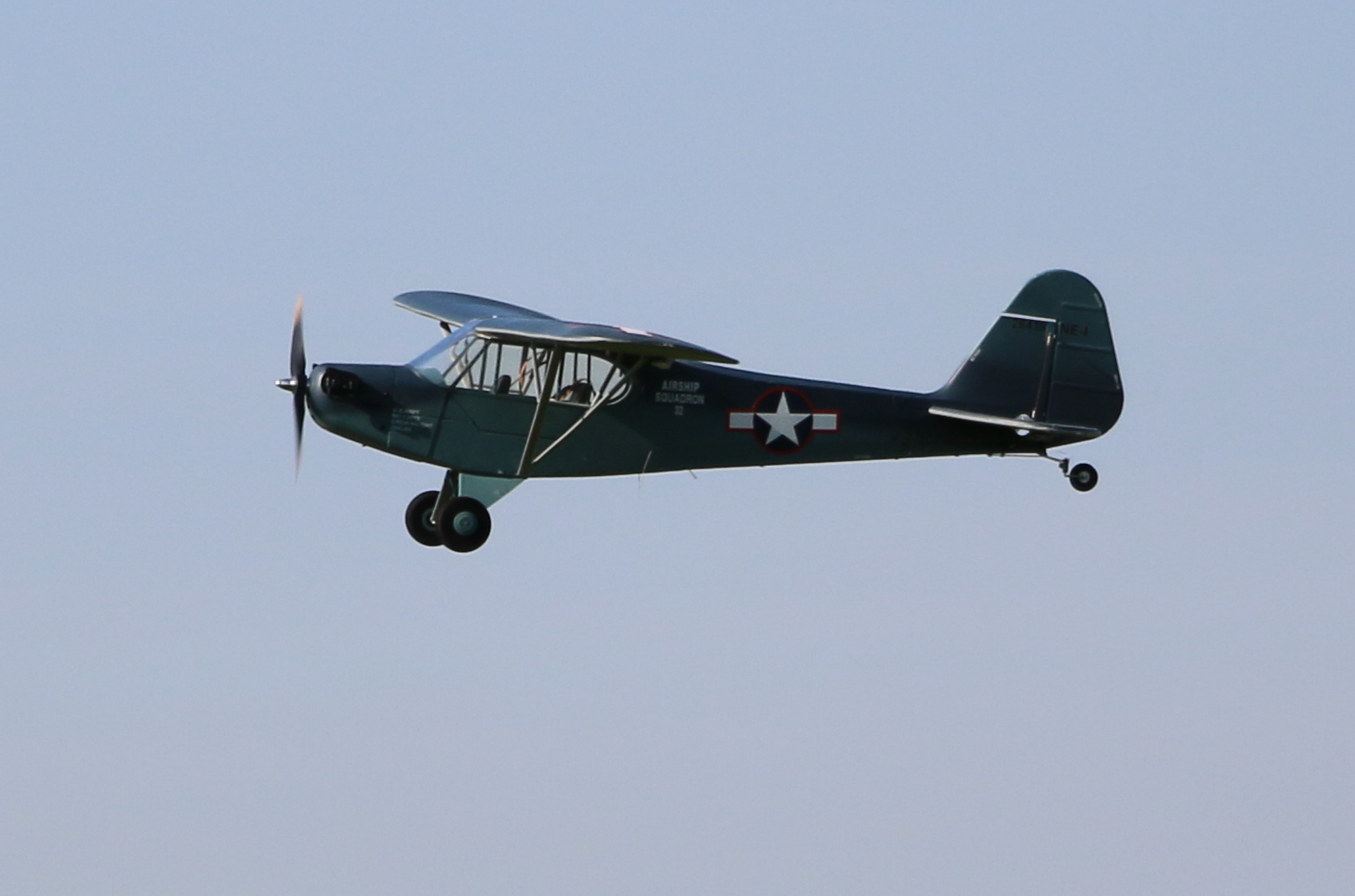
Video time now with footage taken by Dougal Entendre, Gordon Bennett, and myself. Please watch the video full-screen, it’s so much better with small models flying around.
If the video won’t play for you please click HERE
Does Father Christmas have to pay landing fees for his sleigh and reindeer?
No, they’re on the house…
Colin Cowplain
Patch News – November 2022
We always expect to lose a few flying sessions due to wind and/or rain through the winter months and that’s exactly what happened during what was a very mild November with a lot of rain. We were rained off on a couple of Sundays mornings but strangely some Friday afternoons turned out to be really good. Of course the midweekers were able to choose the days with the best weather so managed to fly fairly regularly throughout the month. After flying on one Friday afternoon I snapped this glorious sunset as we were packing up.
With the weather being both wet and warm the grass has continued to grow so the FARTS (Friday Afternoon Rural Trimming Society) dragged out the mower a few times.
At lunchtime on Friday 18th November as Chas and Captain Slow were driving down the track to the field they spotted a pick-up truck in the process of fly tipping a load of builders waste onto the track alongside the barn. As the driver saw the cars approaching he shot off down the bottom road and away before anyone could take a note of his number.
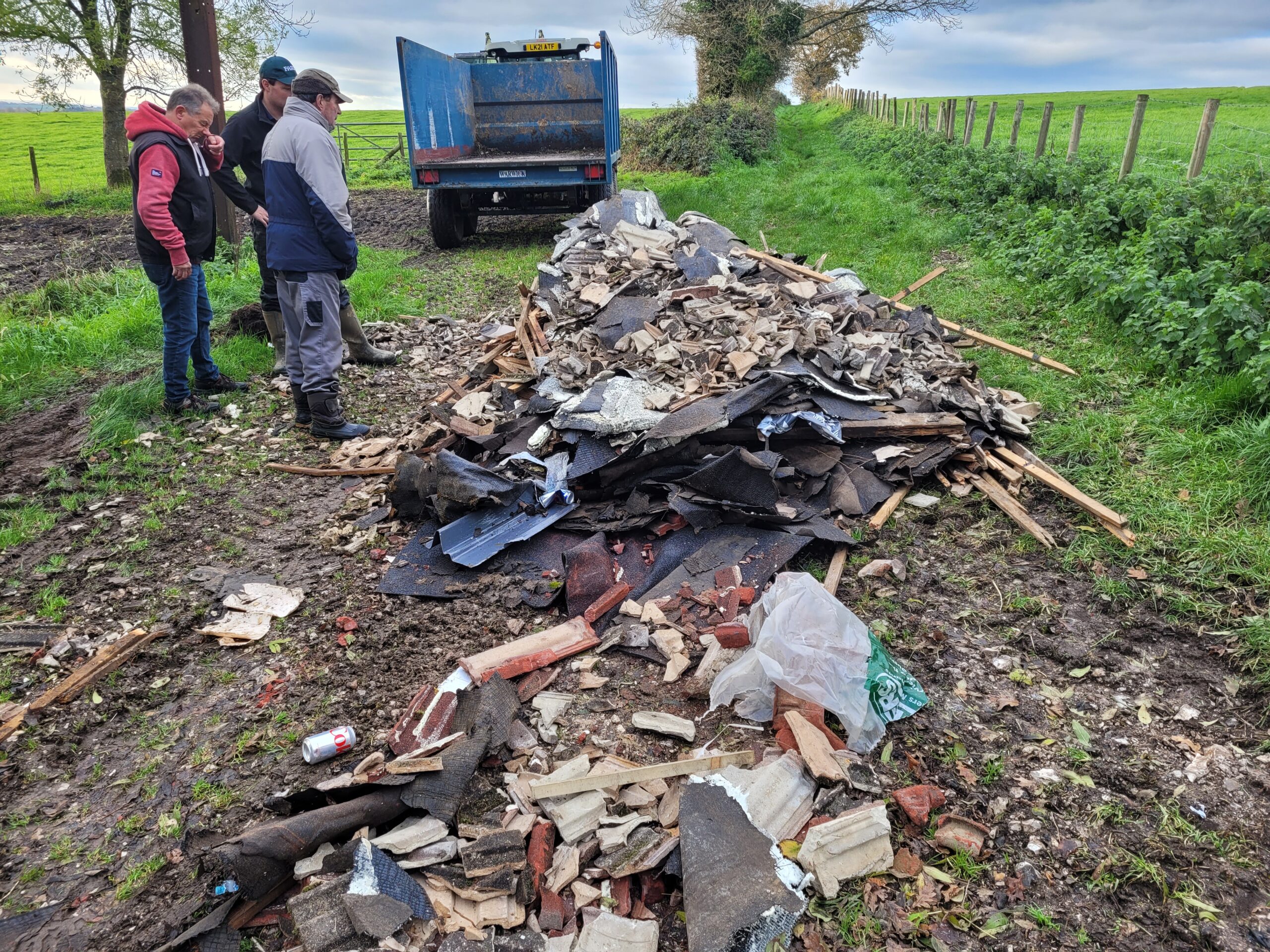 The rubble completely blocked the track and prevented us from parking there. Fortunately following a quick call to Farmer George his son Will very quickly arrived with a tractor and trailer and made short work of picking up the waste and taking it all away. There are some truly awful people around who think they can do whatever they want with no thought of the affect on others. As a club we are lucky to have such great farmers who were able to resolve the problem for us within a very short time, we were very grateful for their help.
Not too many new models appeared at the patch this month but early in Nov this box of surprises turned up at my house. Well it wasn’t actually a surprise to me as I’d ordered it on Woody’s behalf when it was at a knockdown price in the Banggood UK warehouse.
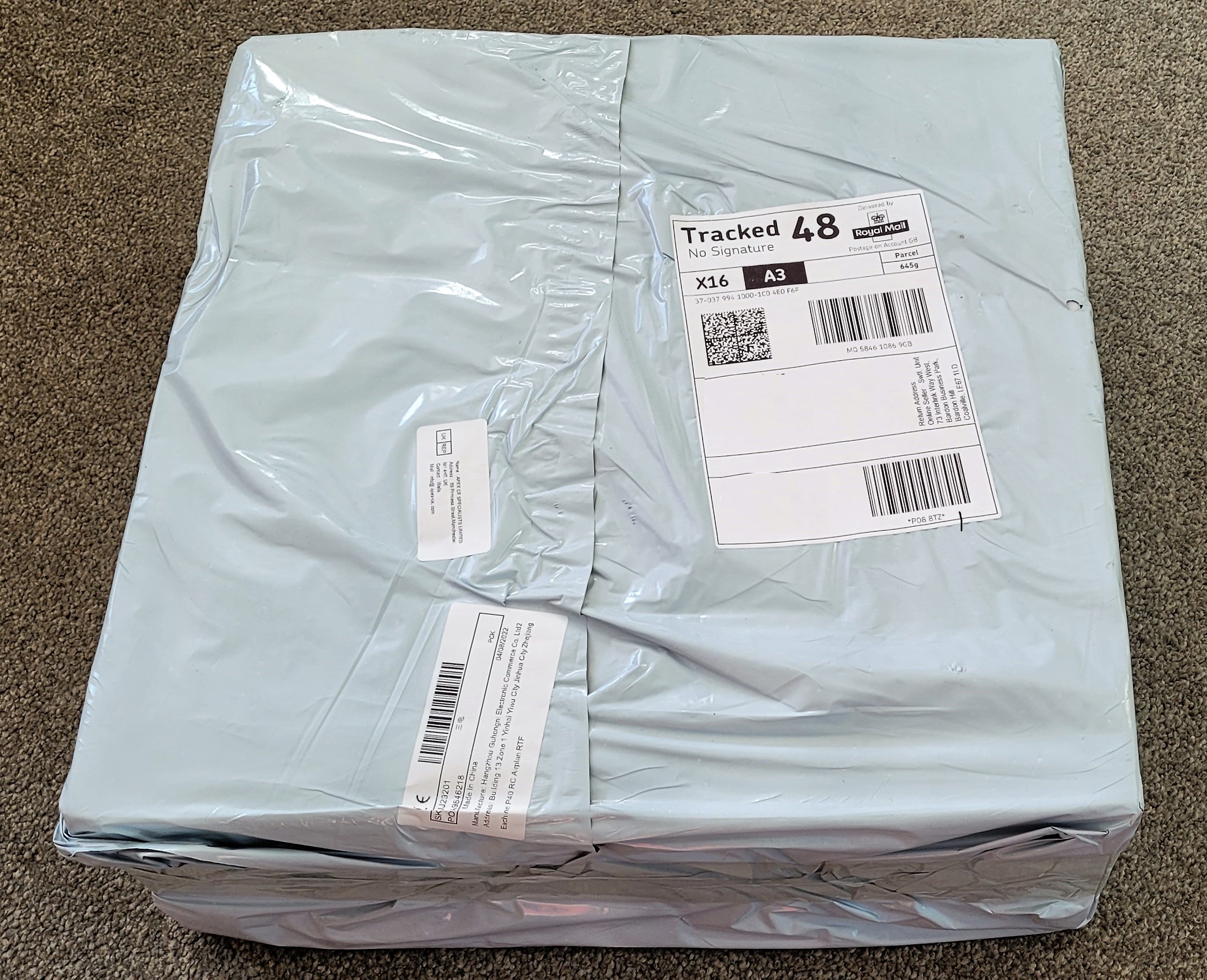 It’s another of the tiny gyro equipped fighters that come completely ready to fly straight out of the box and even come with a transmitter. This one is a P-40 Warhawk, the first one of these in the club and Woody soon found that it flies just as well as all the others in the range which includes the Trojan, Corsair, BF109, Mustang, Raptor, and the Spitfire.
 Woody’s Warhawk was just £68.43 in a Flash Sale and that included 3 batteries. As it came from the UK warehouse the package arrived in a couple of days. At the time of writing the UK Warehouse has sold out of the Warhawk but it’s available from China although the price is £101.63 and it would take three or four weeks to arrive. Many of the range are available from various UK retailers but I think most of them cost around £100.
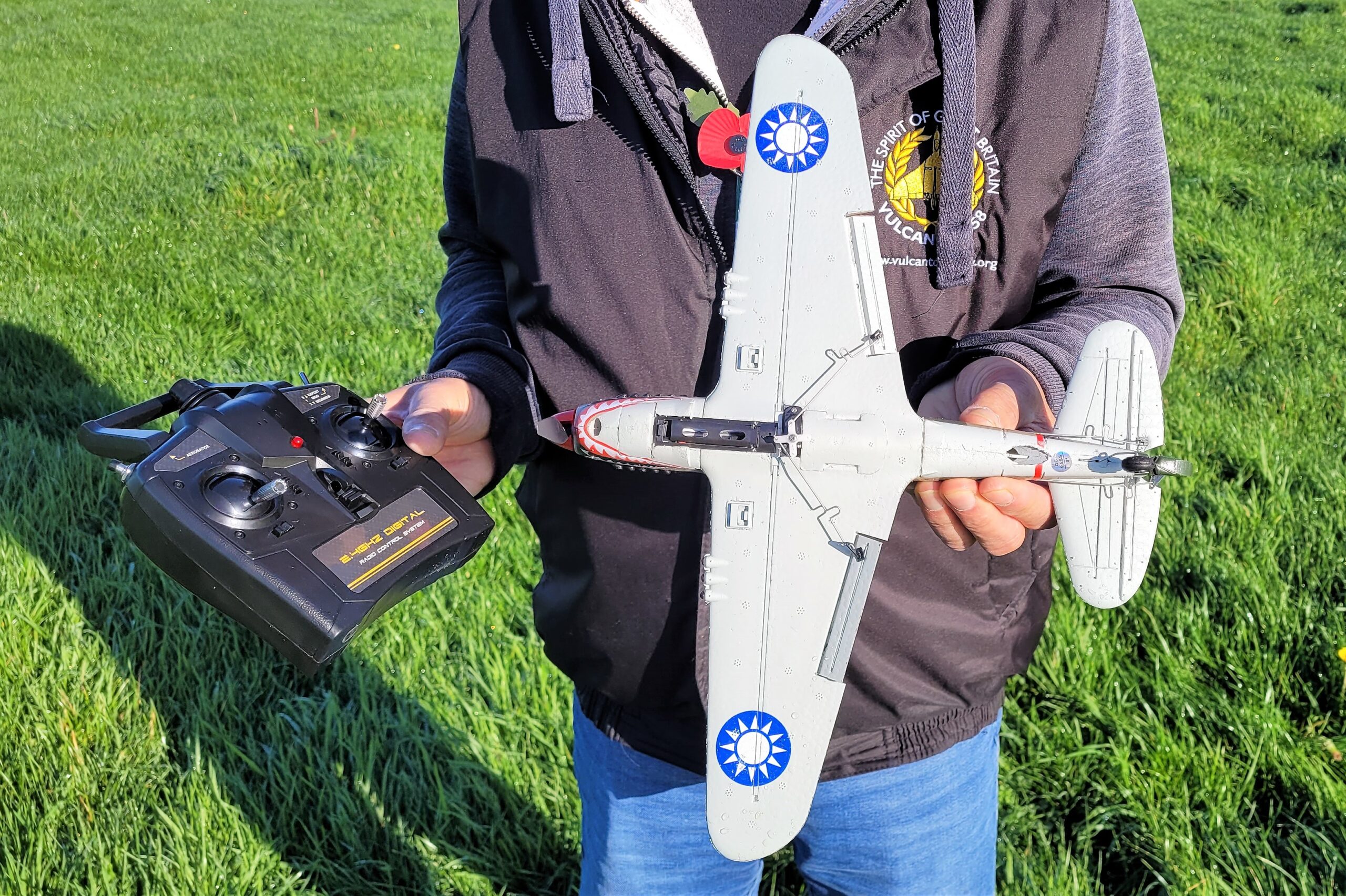 Woody loves the way it flies and has been using the one button press roll or loop function as well as perfecting his low passes. You can see a bit of his flying in this month’s video.
Bob the Builder has also splashed out on a mini warbird and he chose the Mustang. Bob had an ulterior motive with his purchase as he intends taking it with him when he visits family in New Zealand where I expect his grandson will be flying it. Needless to say Bob felt it was only right to test fly the Spitfire before taking it to the other side of the world.
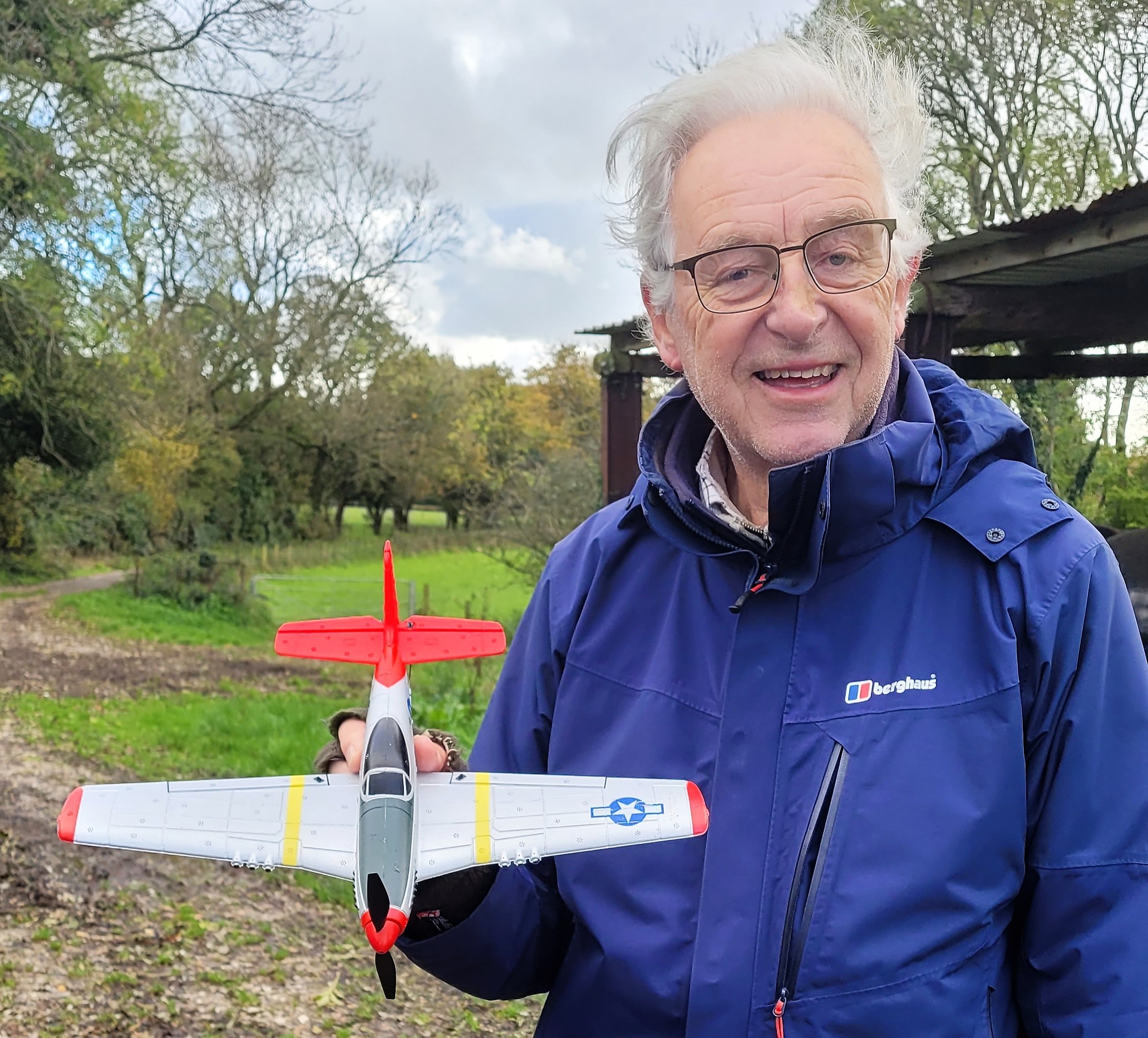 All went well and after a few tests he pronounced it fit to fly. Bob has checked with the airline and is happy that he’ll be able to take the Spit and it’s batteries on the flight as hand luggage. Have a great trip Bob, don’t forget to send some photos of flying in New Zealand.
In November I decided to bring out my foamboard Yak-130 that I hadn’t flown for a long time. It came from Banggood and is similar to the Su-27 and Mig-29 that many of us fly except that the front half of the fuselage is a box section rather than just a profile.
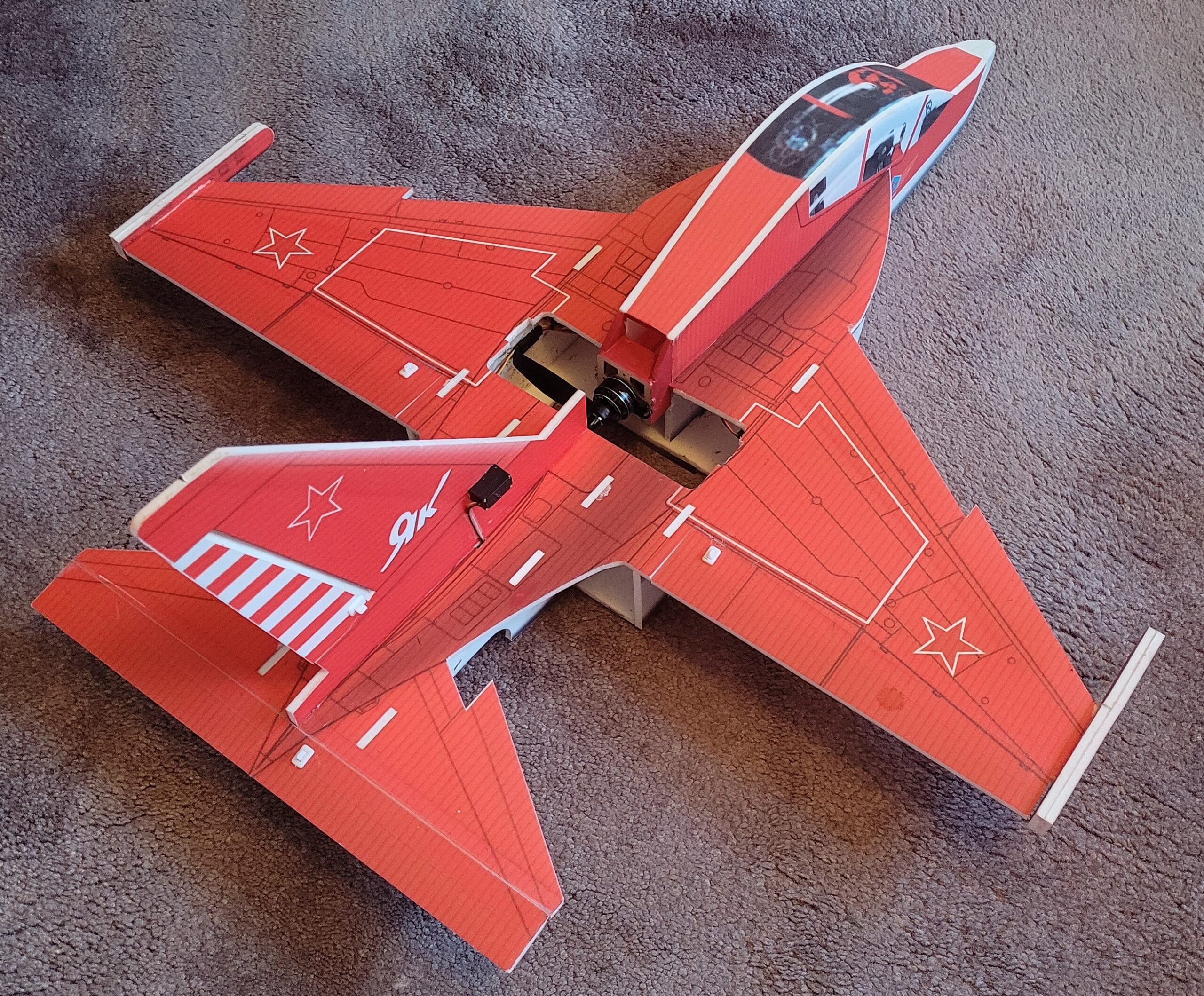 I think it looks better than the others but overall its’ flying characteristics probably aren’t as good. I have added a rudder to improve the handling as, like the others, it is reluctant to turn when the nose is high and there’s not much speed. The rudder helps and also means the Yak can spin which is does very well although it’s reluctant to come out of the spin.
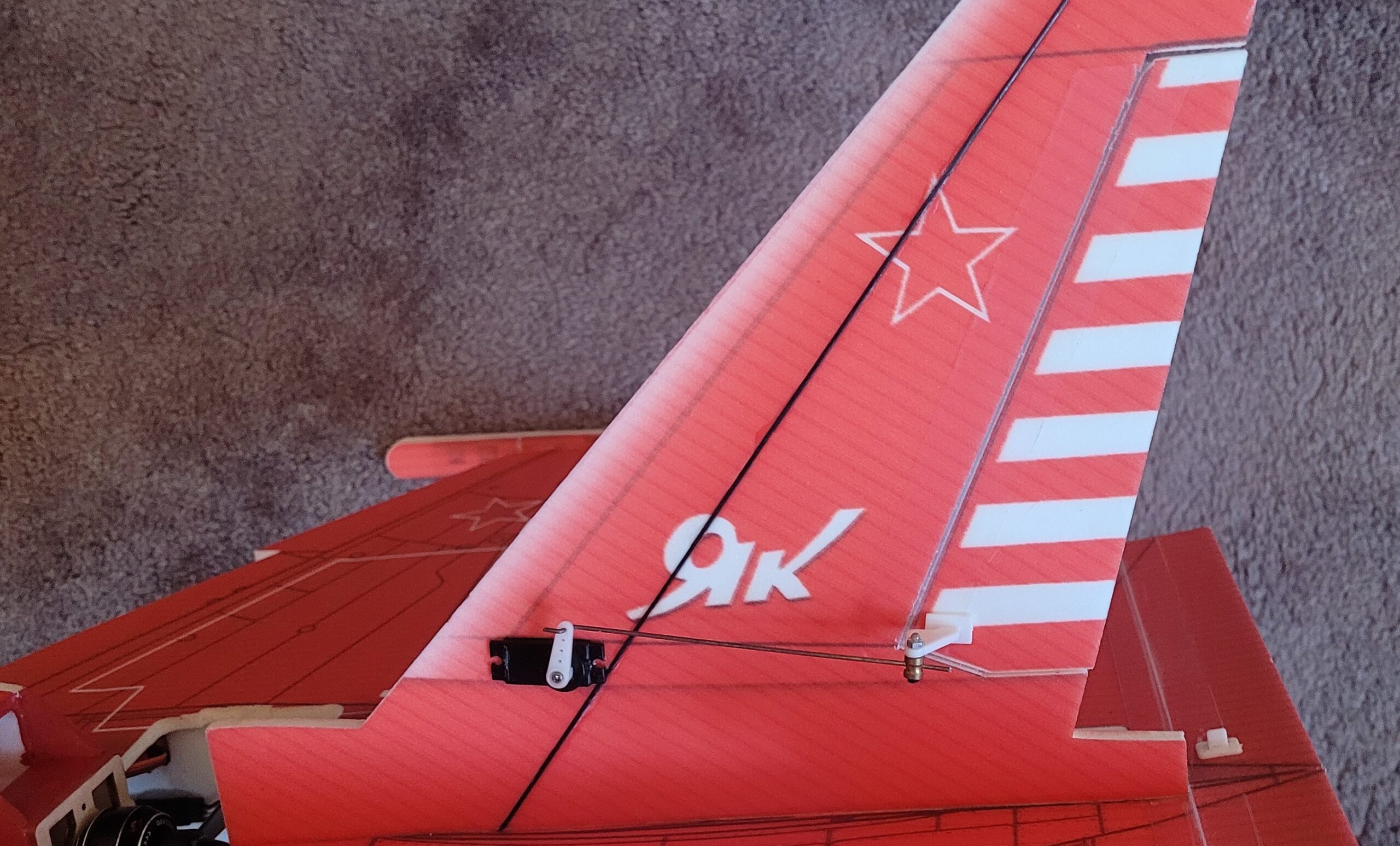 I stopped flying it because it was noisy, like the others it has a mid-mounted motor and the propeller generates a lot of noise where it’s close to the foamboard. The solution with the Su-27 and Mig-29 is to enlarge the slot the prop runs in, mostly in front of the prop. It makes a big difference but on the Yak I could only enlarge the slot a small amount because the servos were in the way. The obvious answer was to move the motor back towards the rear of the slot and after many months of ignoring the problem I finally got round to doing something about it! I cut the ply motor mounting plate away from its’ original position directly on the foam and made up a balsa box to space the motor 20mm further back.
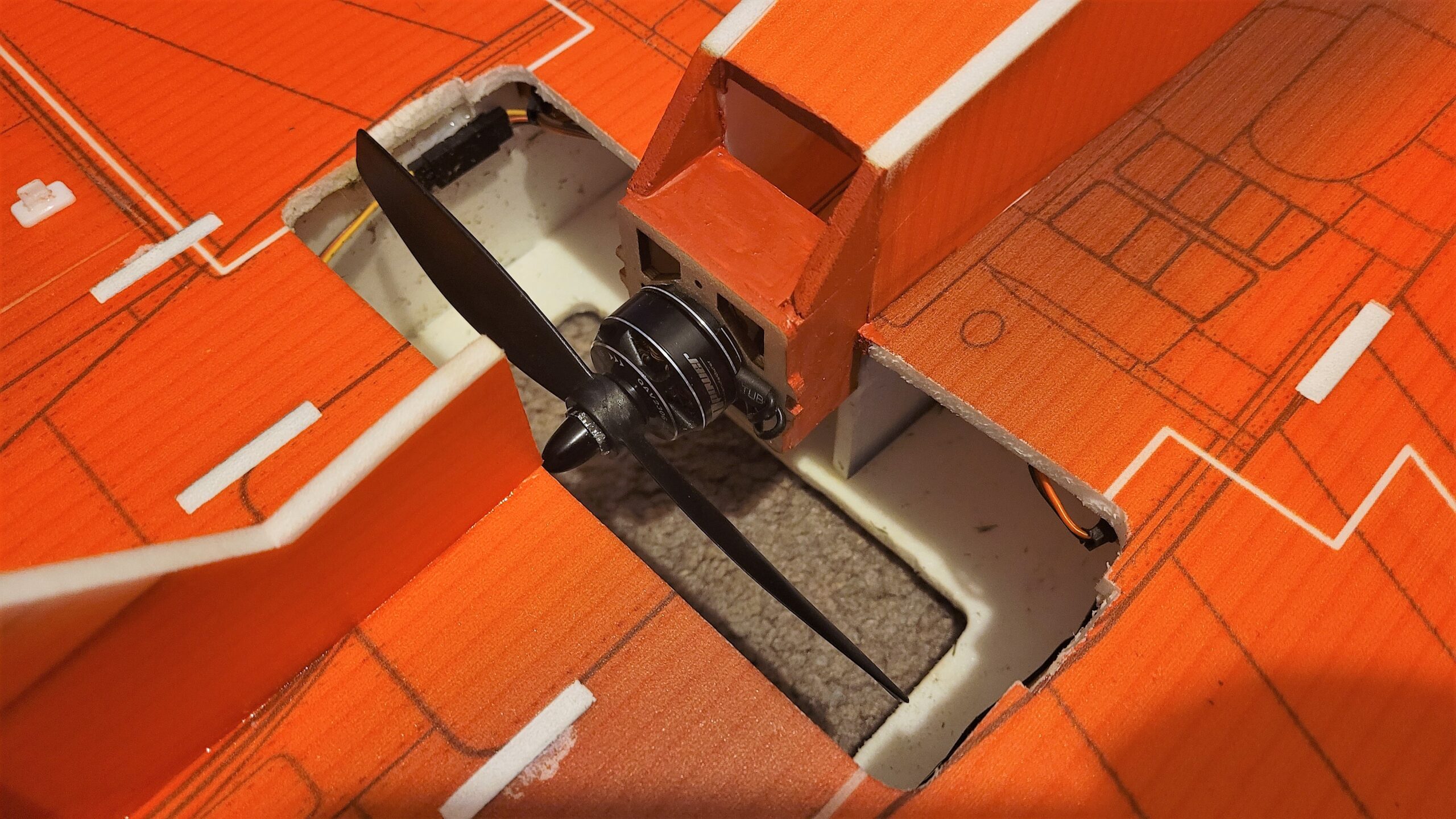 The prop is now well clear of the foam at the front but still far enough away from the foam behind it to not be a problem. The result is a big noise reduction, still not quiet but much better than before and I’m happy to fly it now. On the first couple of flights the motor started cutting out and I found the speed controller was overheating so I added an air scoop to the hatch on the underside and that seems to have solved the problem.
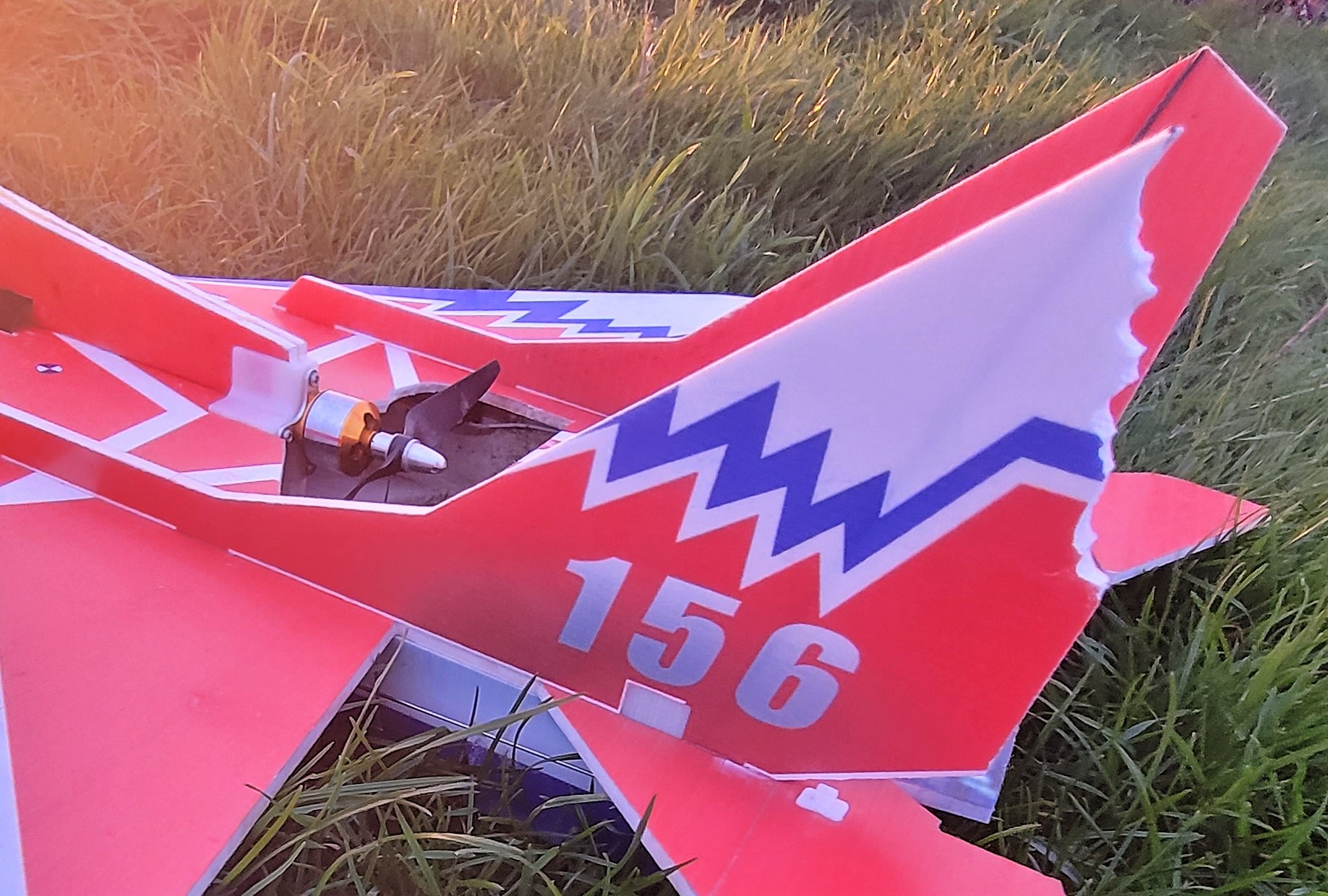
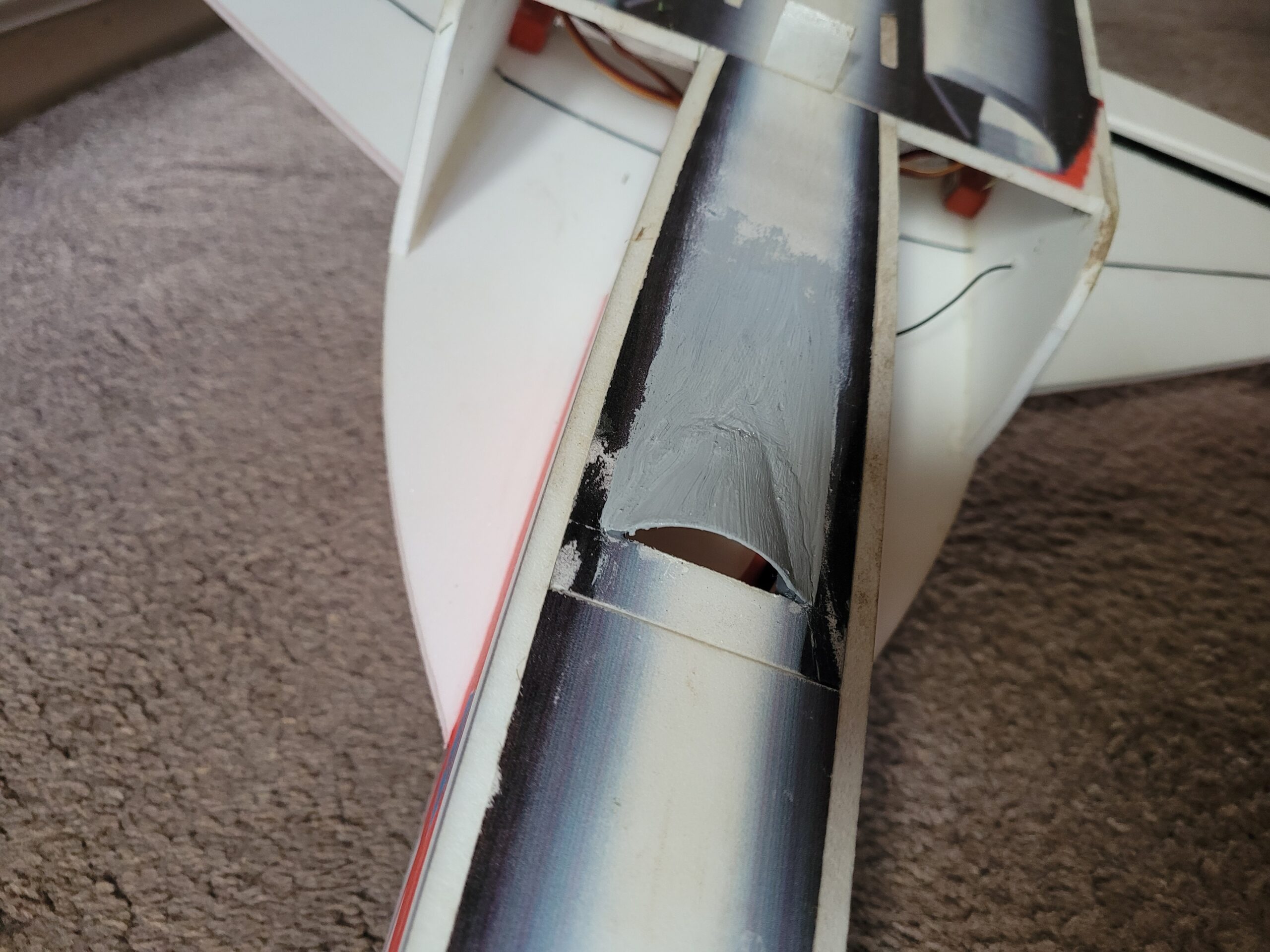 As soon as I started flying it again that big bully Gordon Bennett decided the Yak was fair game and started attacking it, something I obviously discouraged…! After a few battles the inevitable coming together happened and the planes spun down locked together. At first look it seemed that the only damage was to one of the fins of Gordon’s Mig which had been suitably chewed by the prop of my Yak and we both flew again with no further problems.
  However I later realised that the side of my fuselage had been hit up by Gordon’s prop…
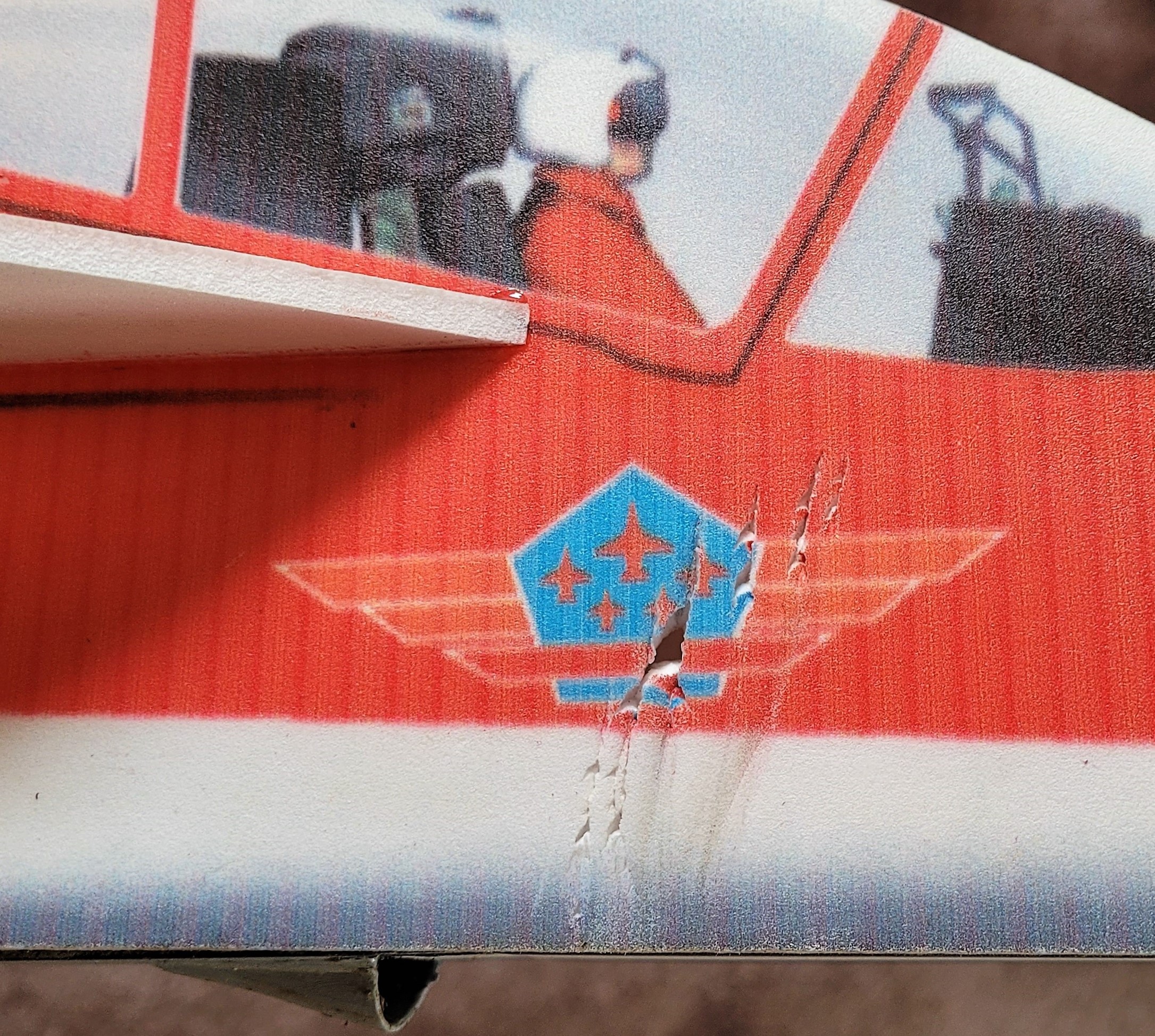 How dare he, I’ve a long memory and revenge will be sweet Gordon, revenge will be sweet!
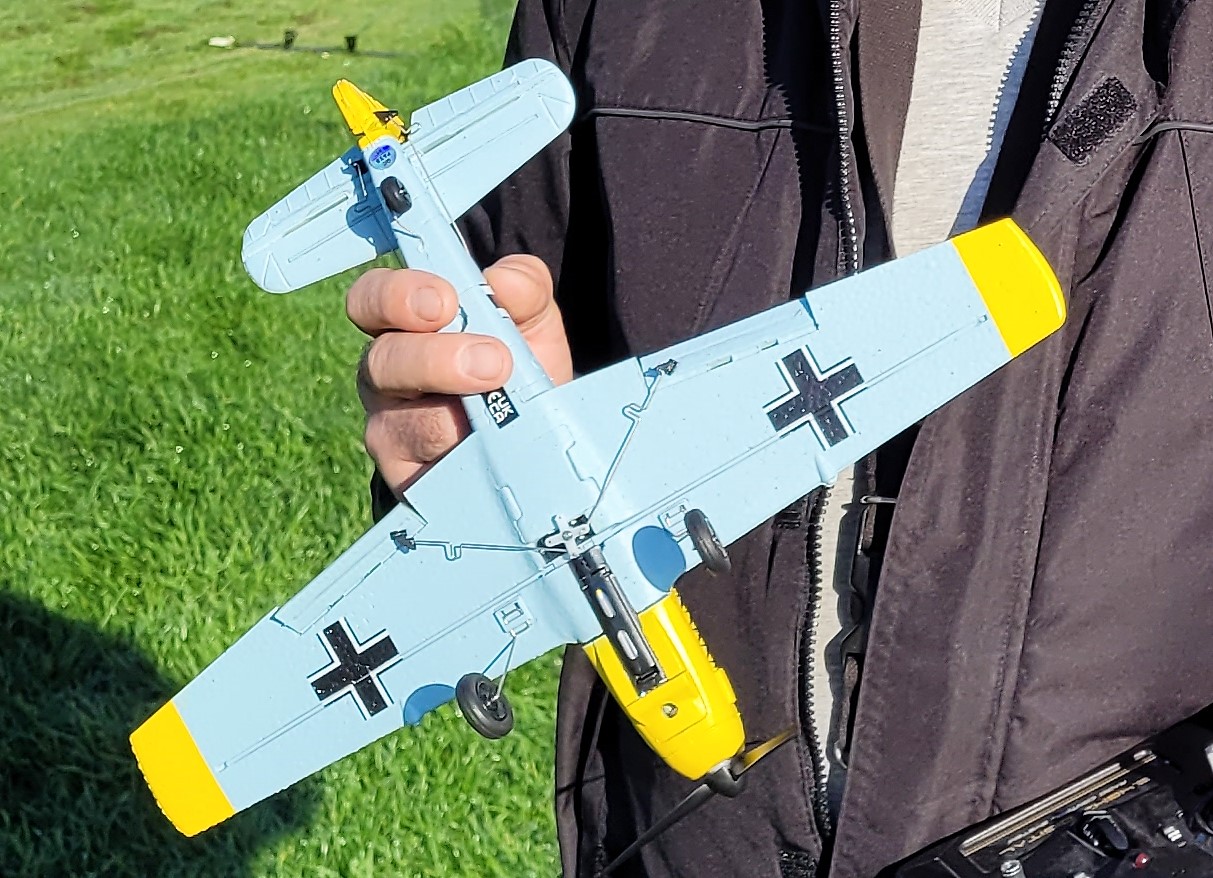
Back to the tiny planes again now, this time it’s Mini Mike who’s bought himself a Bf109.
 On the first flight Mike found the plane climbed constantly and he was having to hold in almost full down elevator to stop the climb. Before the next flight he asked for some ideas from an expert (me!) and carefully listened to the advice about switching between the gyro stages, setting everything up, and flying tips. So much better informed he then had a second flight and this time it was…exactly the same! Ok so obviously more investigation is required but I’m sure Mike will soon get it sorted out and flying as well as the others.
 Watch this space, I hope to be able to report more success in the December Patch News.
Following the first successful flights of his Flite Test Alpha last month young Charlie decided it needed a bit of colour. For the first few flights the Alpha had been in bare white foamboard and the damp grass proved to be a problem, the paper covering the foam started to peel away when it got wet. So this month Charlie painted it to match his jumper!
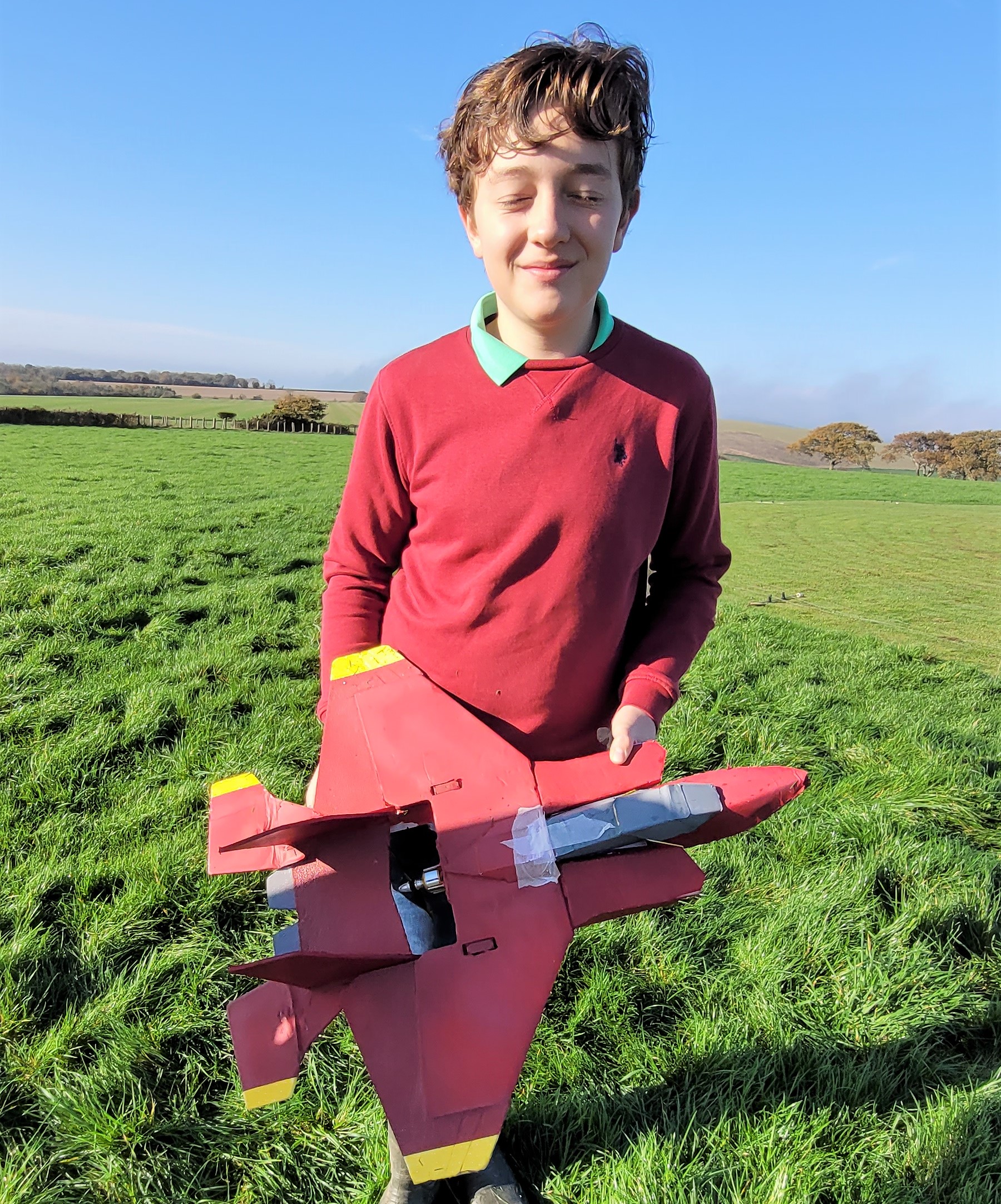 I reckon this was so it wouldn’t show when he got the paint all over his jumper! It looks much smarter with the new colour scheme and should be better protected from the wet grass at the field. Charlie is now concentrating on making a few adjustments to get the Alpha flying even better. You can see how it flies in the video and in the FPV photo below.
1066 has been working on a new foam model of his own design and this required the use of an incidence meter to be sure he had the correct relative incidence between the wings and the tailplane. Fortunately 1066 has a meter that he reckons he made about thirty years ago but hadn’t used it for several years and had even thought about binning it a few times.
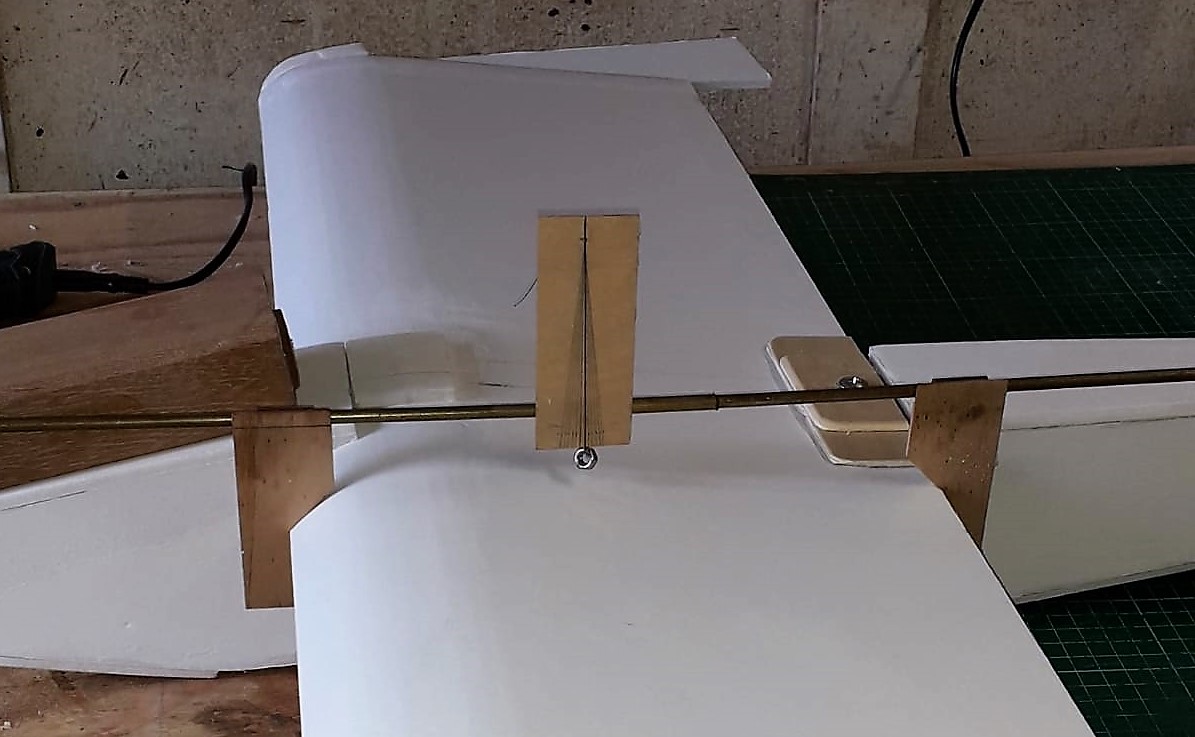
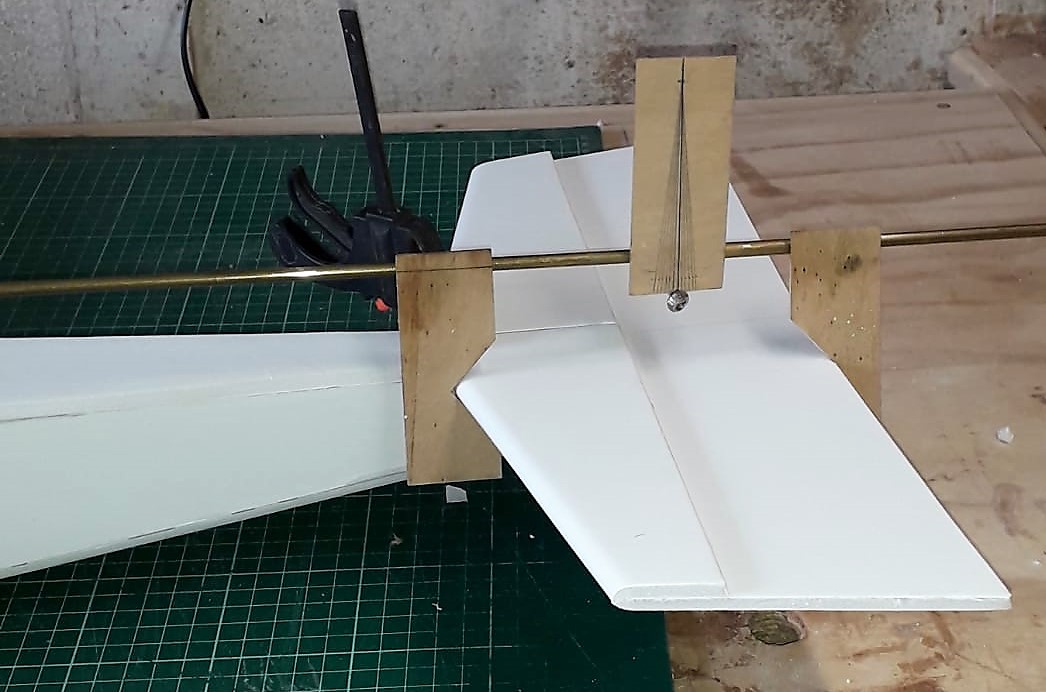 It’s lucky he didn’t bin it as the meter did the job beautifully on the new model. I don’t have any info about the model yet but hopefully I’ll be able to feature it next month.
Now for the last new model of this month and it’s yet another of the tiny fighters, this one being a Spitfire that Cream Egg bought at the Popham Model Show back in August.
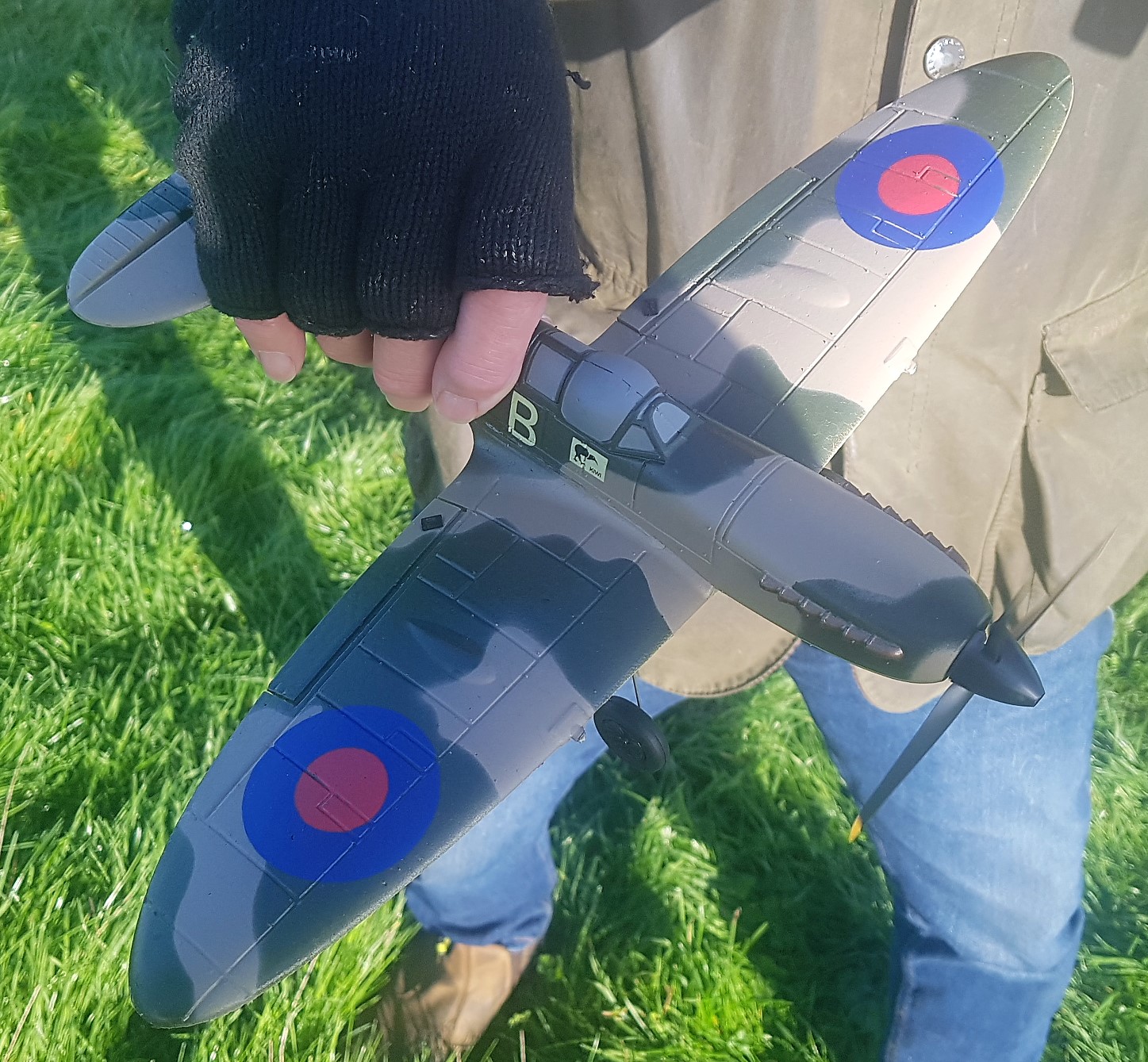 He only got round to flying it in Nov, it took 3 months to fit 4 dry cells in the transmitter!
 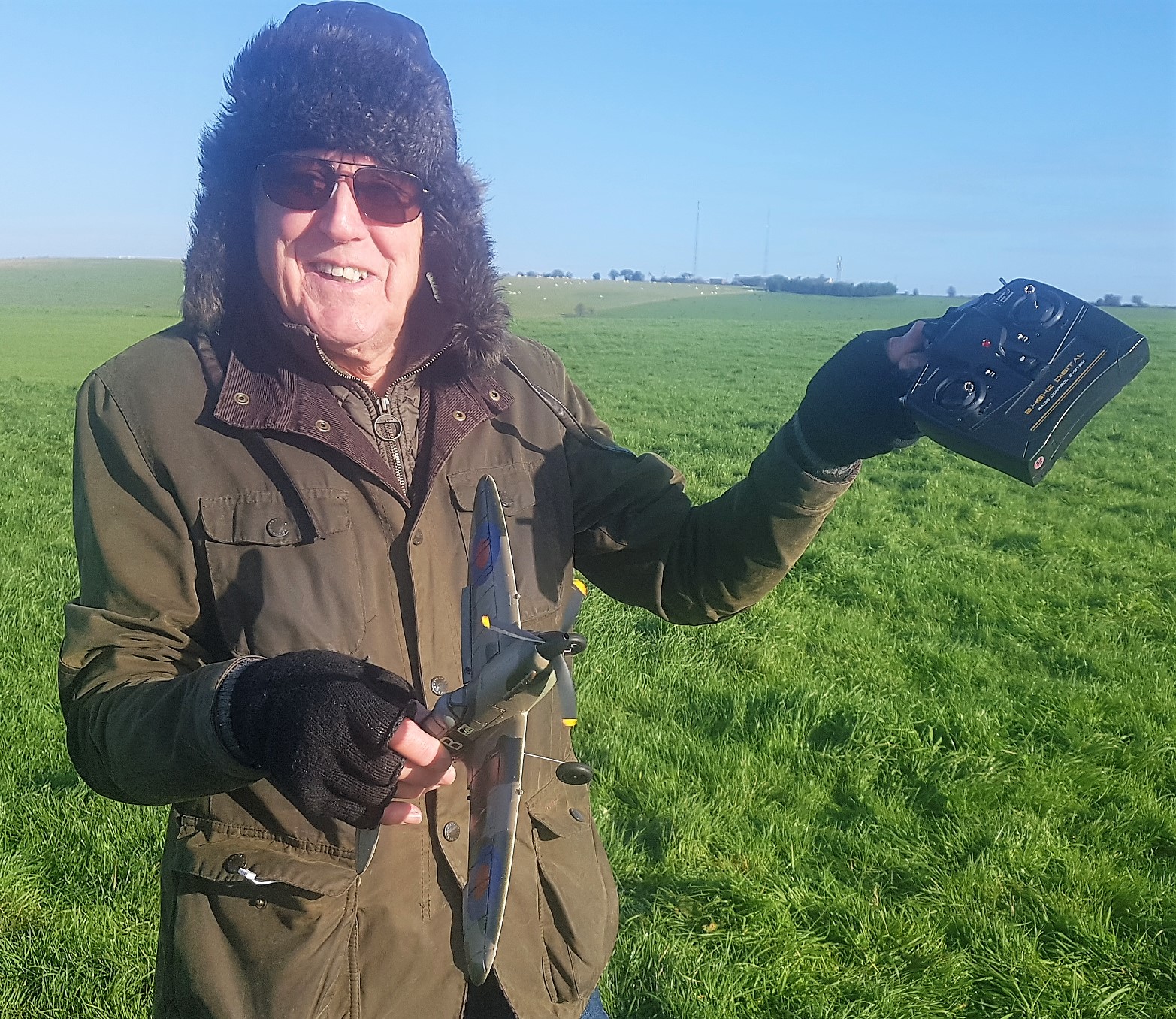 Like all the others (well except Mini Mike’s) it flies beautifully and Cream Egg is delighted.
Unfortunately Kryten wasn’t able to make it to the field this month so I have no new photos but here are some of his photos from previous months that I haven’t used before.
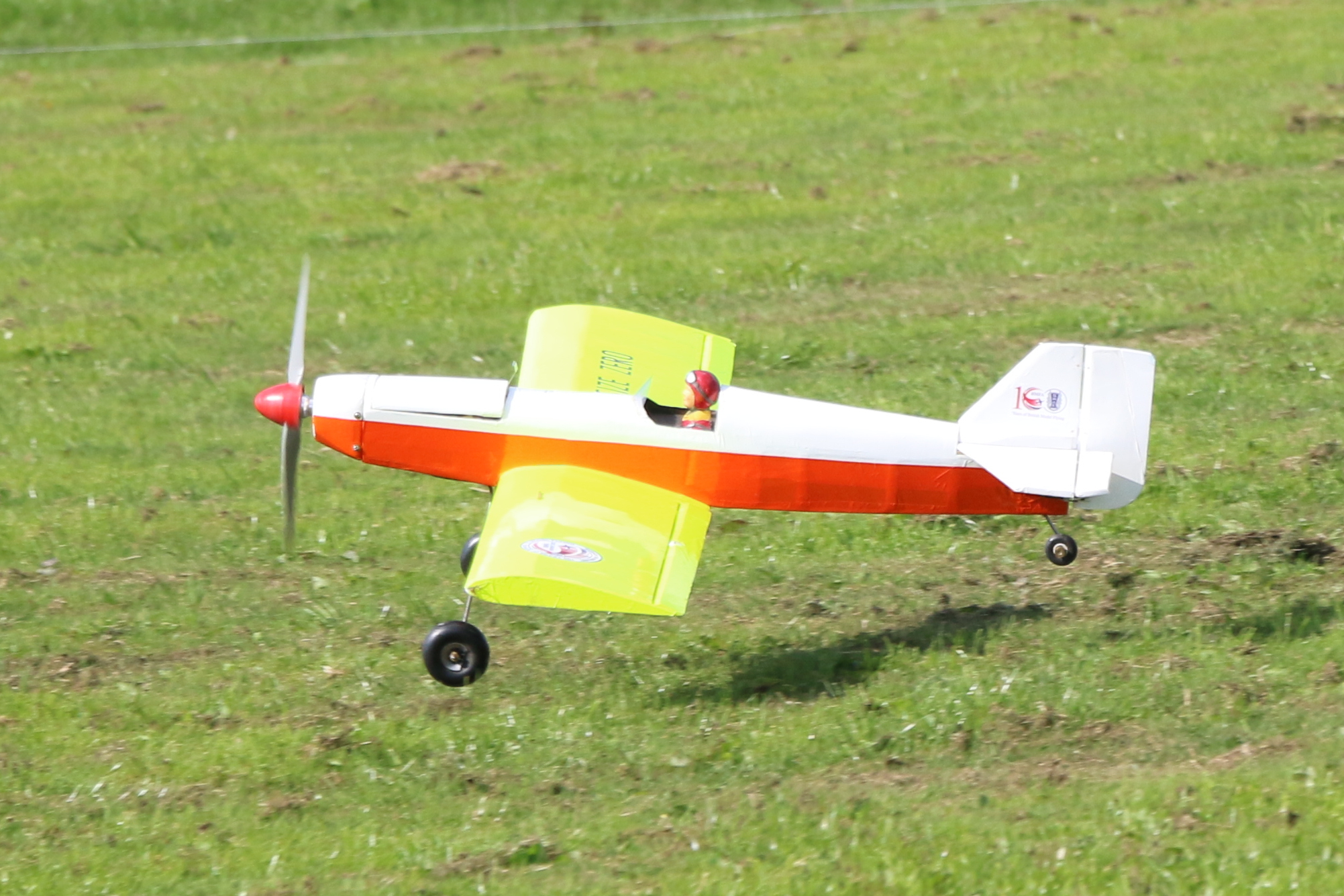
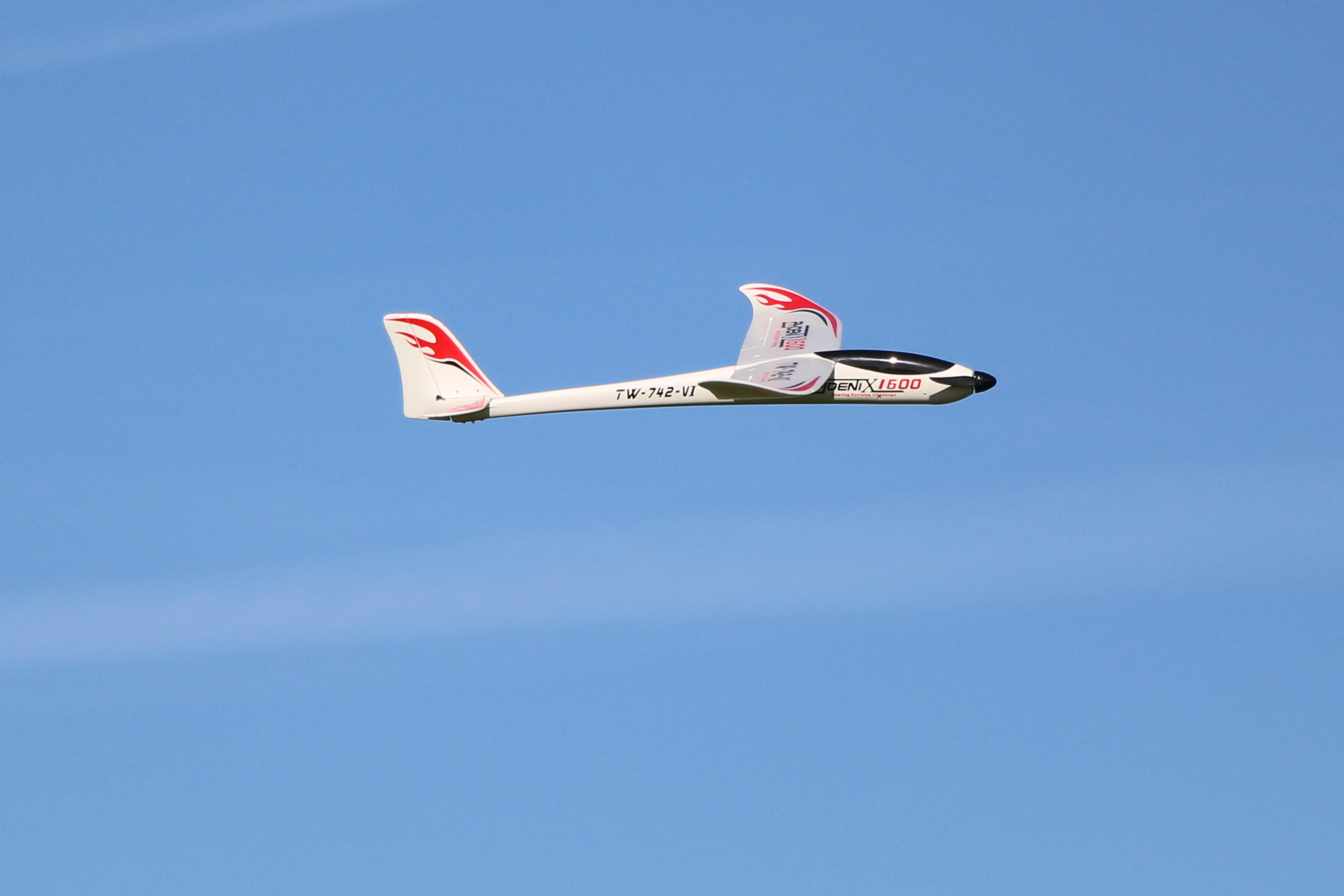

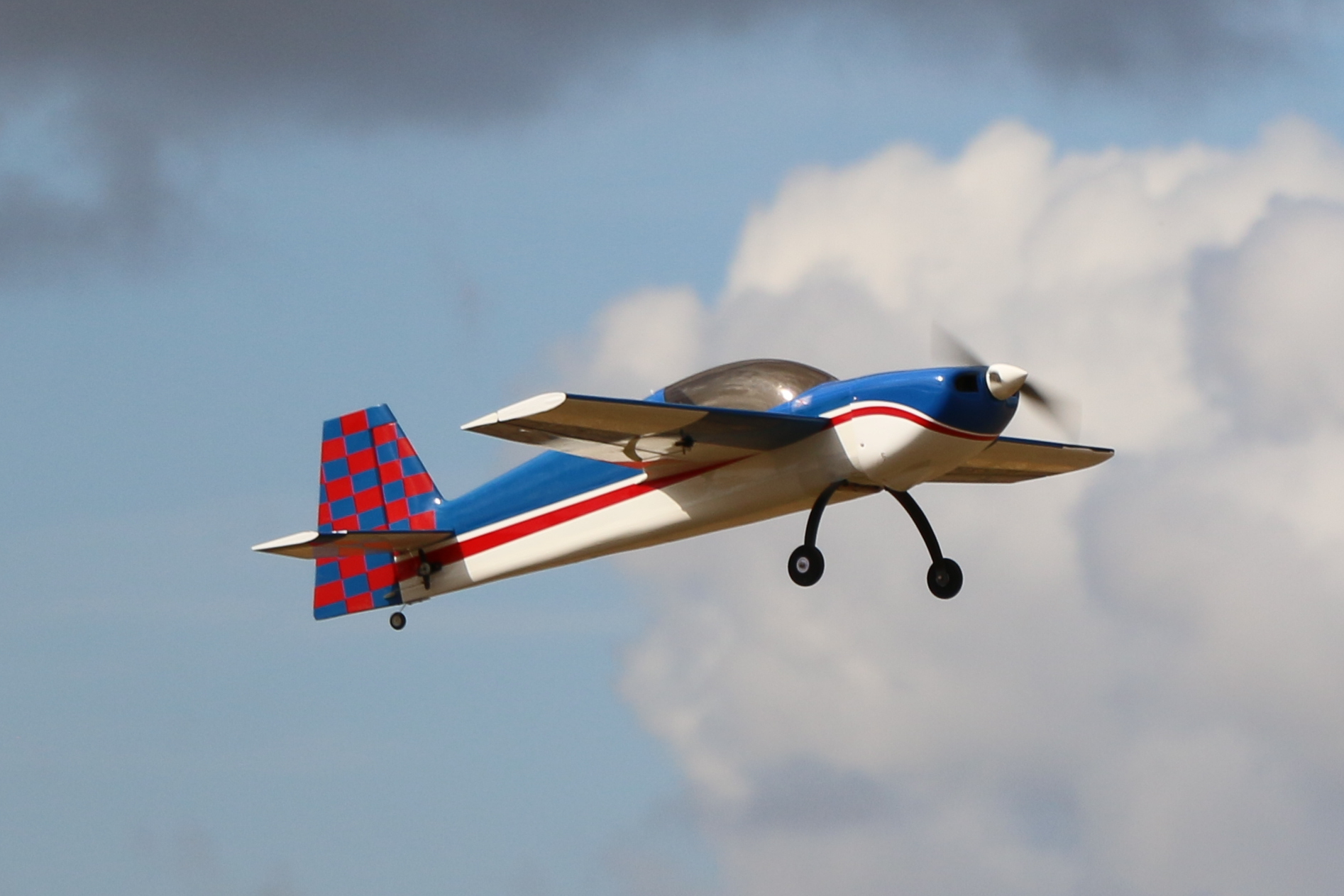
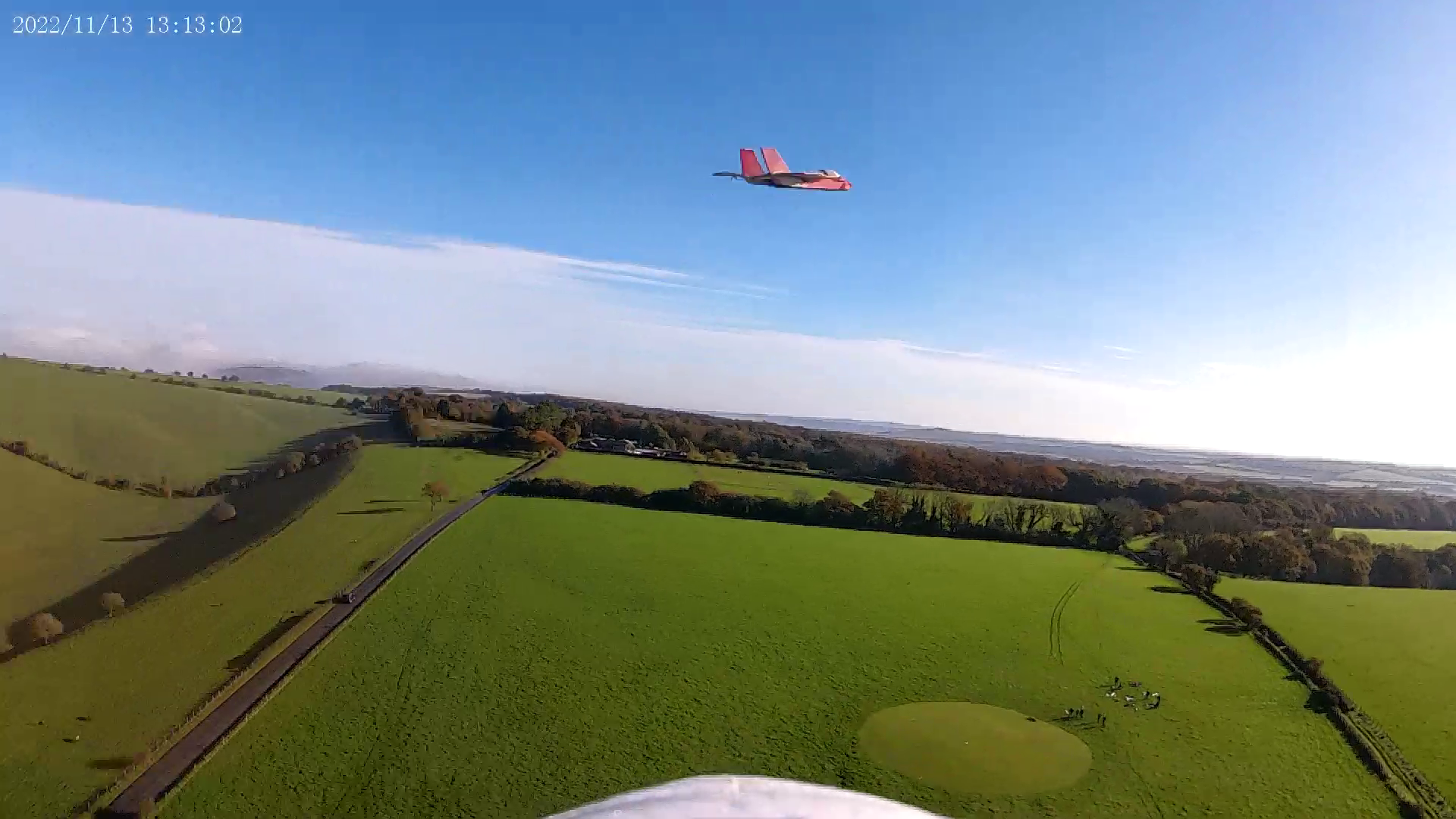 The last photo is a still taken from one of Dougal’s FPV flight videos and shows Charlie’s Alpha cruising past. I think it’s an excellent photo as it includes the patch, pits, and pilots. By the way, did you know that you can enlarge any Patch News photo by clicking on it?
Video time now which includes footage taken by me, Dougal, and Peter Fothergill. Please watch the video full-screen, it’s so much better with small models flying around.
If the video won’t play for you please click HERE
A young and foolish pilot wanted to sound cool on the aviation frequencies so once, when he was approaching an airfield at night, instead of making the usual call to the tower, he said: “Guess who?”
The controller promptly switched off the runway lights and replied: “Guess where!”
Colin Cowplain
Patch News – October 2022
The October weather was definitely autumnal, we had some really good flying days with sunshine and light winds but also a lot of wet and windy weather that prevented flying. The temperatures were generally higher than average and the grass continued to grow so we mowed a couple of times and Woody showed off with his one-handed mowing…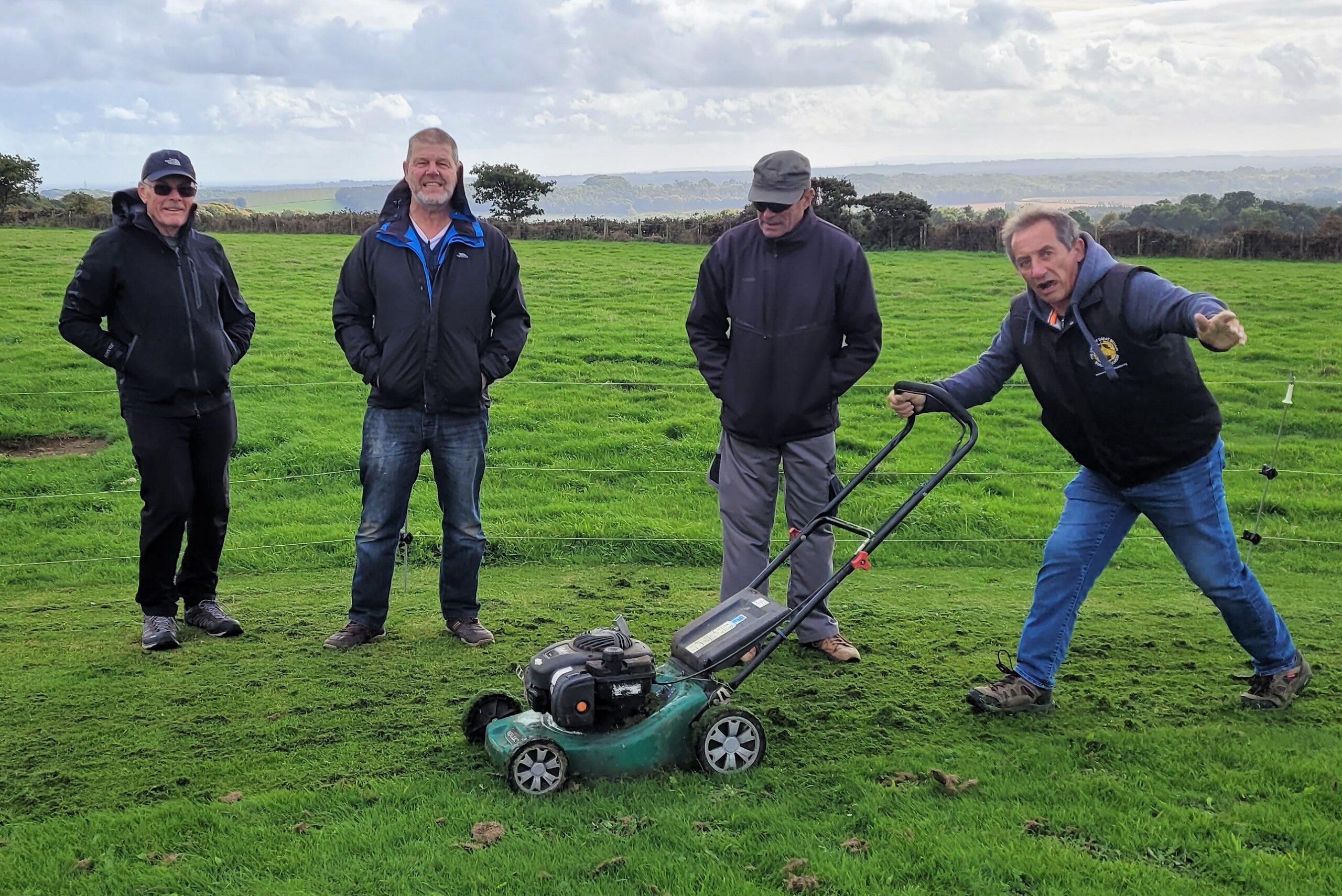
We mowed over his mistakes later! Leo’s mum Jill snapped this atmospheric photo which she called ‘Over the hill’. I’m not sure if she was referring to the scene or the members: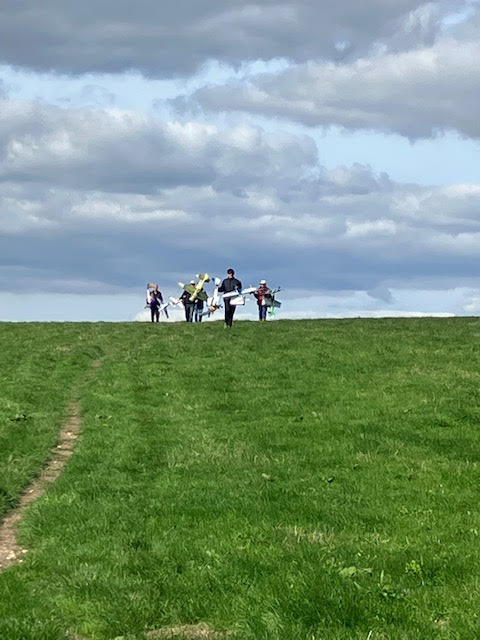
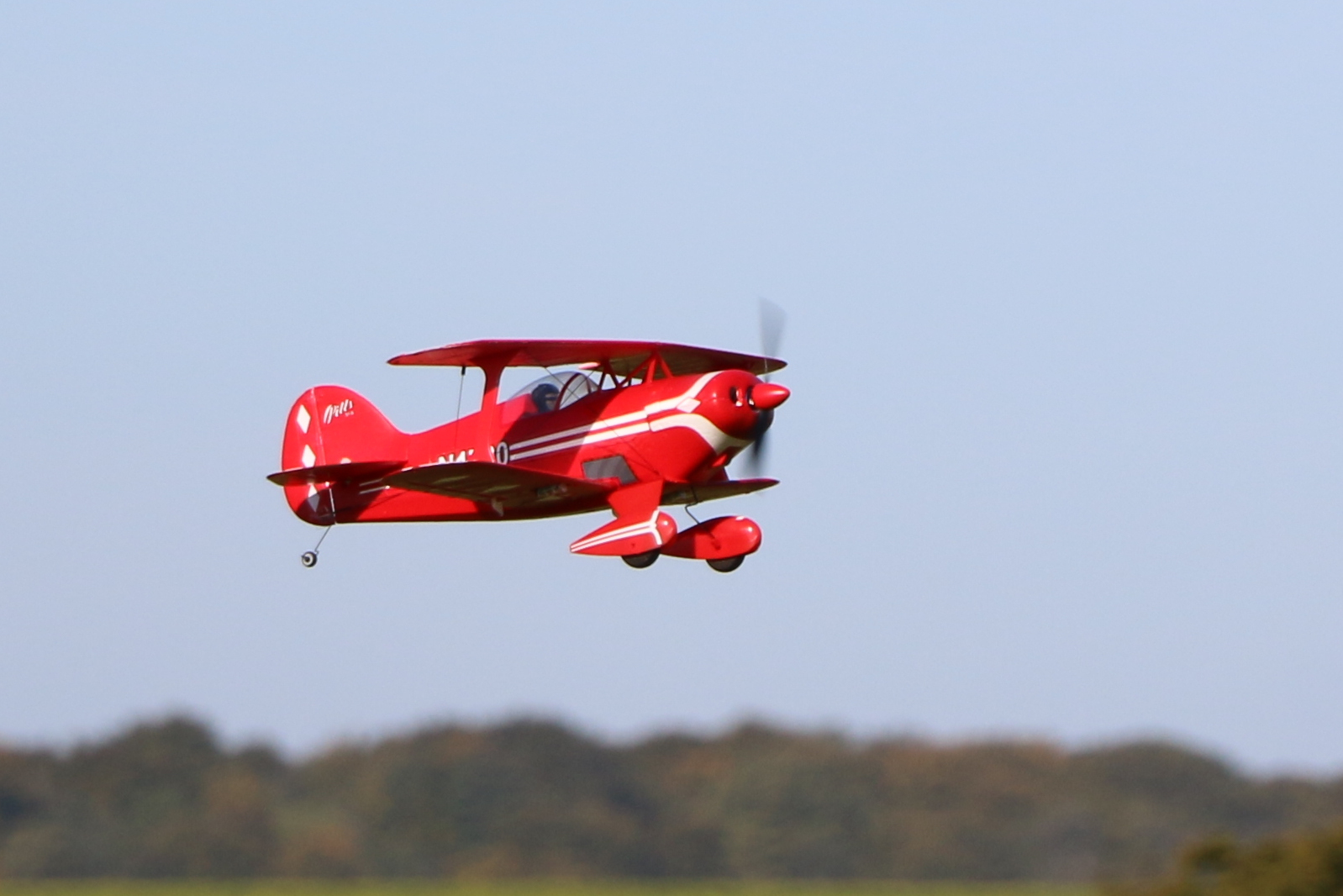
Several new models graced the sky in October, I’ll start with Gordon Bennett’s new Pitts Special. The Pitts is very small at just 434mm (17”) wingspan and 393mm (15.5”) long and Gordon brought it up to the patch in the box that the model was supplied in.
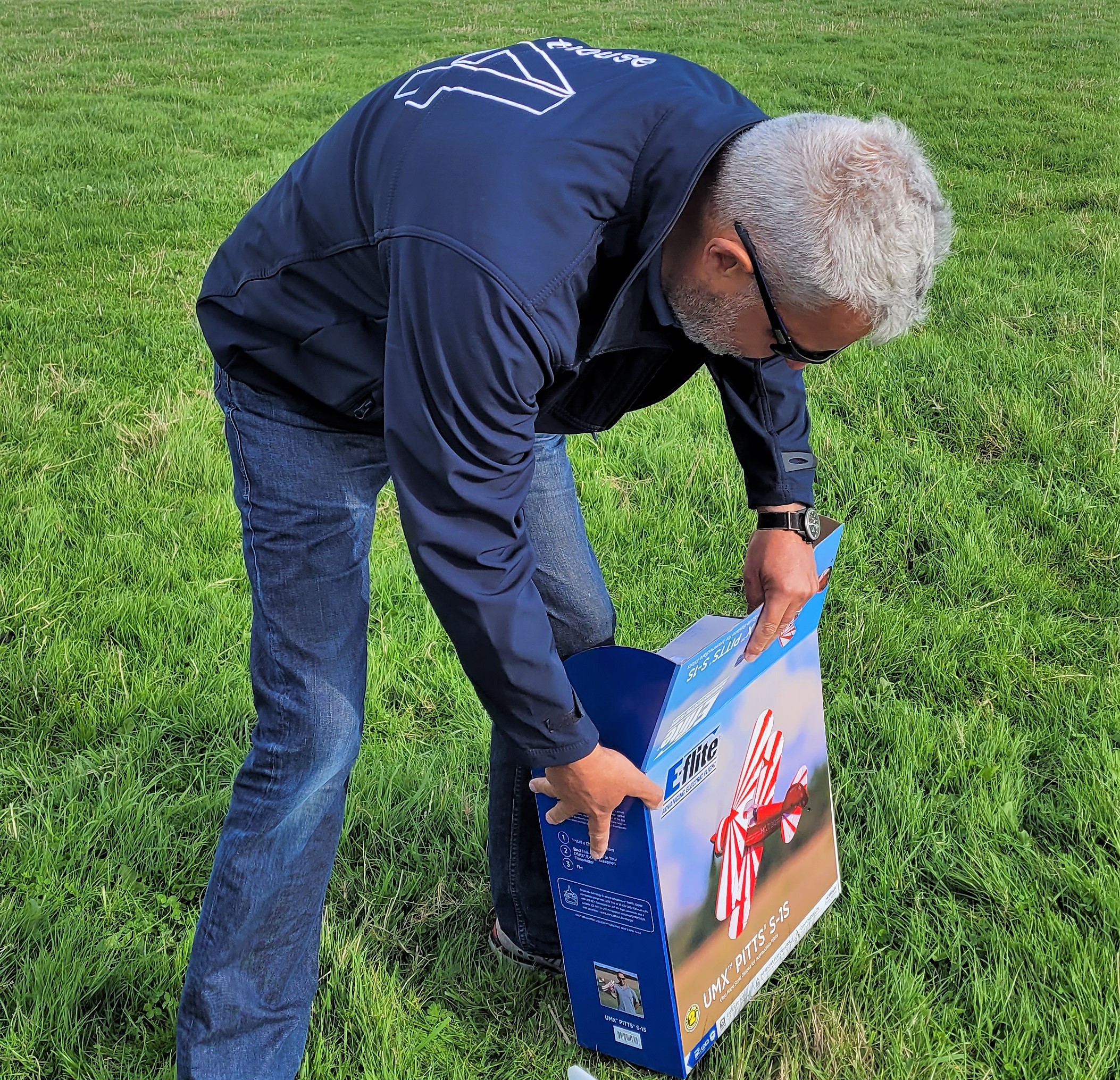 Its’ full title is the E-Flite UMX Pitts S-1S AS3X – BNF Basic with AS3X and SAFE Select.
I thought it was just intended for indoor flying but apparently it can be flown inside or out.
Gordon has only flown his outdoors and says it handles a breeze surprisingly well. It was certainly flying well when I saw it and I filmed some of the flight for this month’s video. This is from the E-Flite website: Due to its overwhelming popularity, E-flite® has brought back the UMX™ Pitts® S-1S with updates and upgrades that make it the easiest to fly, most convenient, and most affordable Pitts model yet! It now includes optional-use SAFE® Select, is both 2S and 3S compatible, and provides real-time battery voltage telemetry to compatible Spektrum AirWare™ equipped transmitters. Because of its ultra-micro size, the UMX Pitts® S-1S can be flown indoors in gymnasiums and other suitable spaces, or outdoors in many yards, parks, and sports fields.
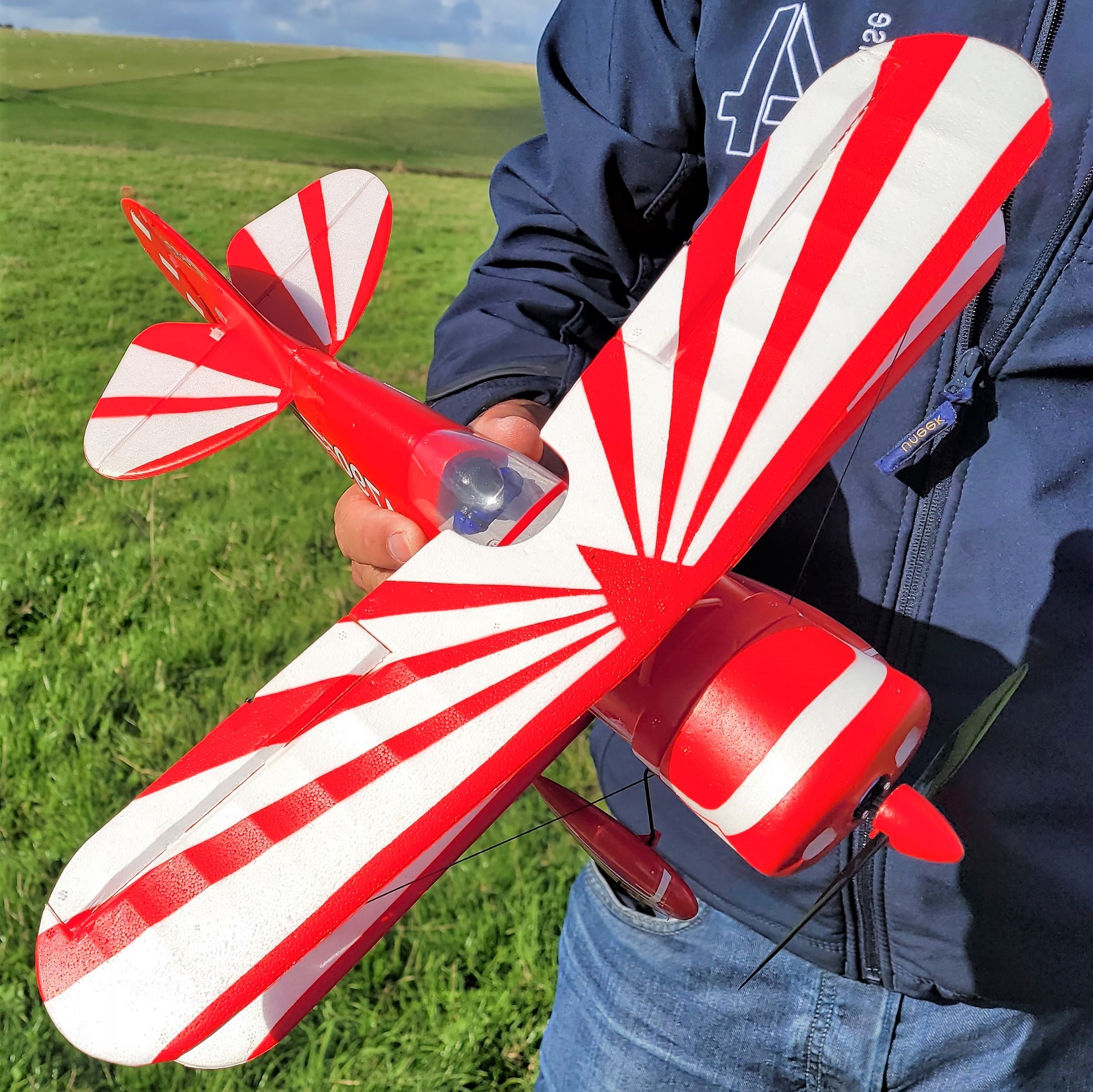 Gordon uses Spektrum radio with the AS3X and SAFE and I think he flies it with 3 cells.
Peter Fothergill has been successfully flying his Max Thrust Riot whenever possible and is learning fast and is now well on the way to taking his BMFA ‘A’ certificate. To accompany the Riot he recently also treated himself to a Volantex Phoenix 16oo S electric glider.
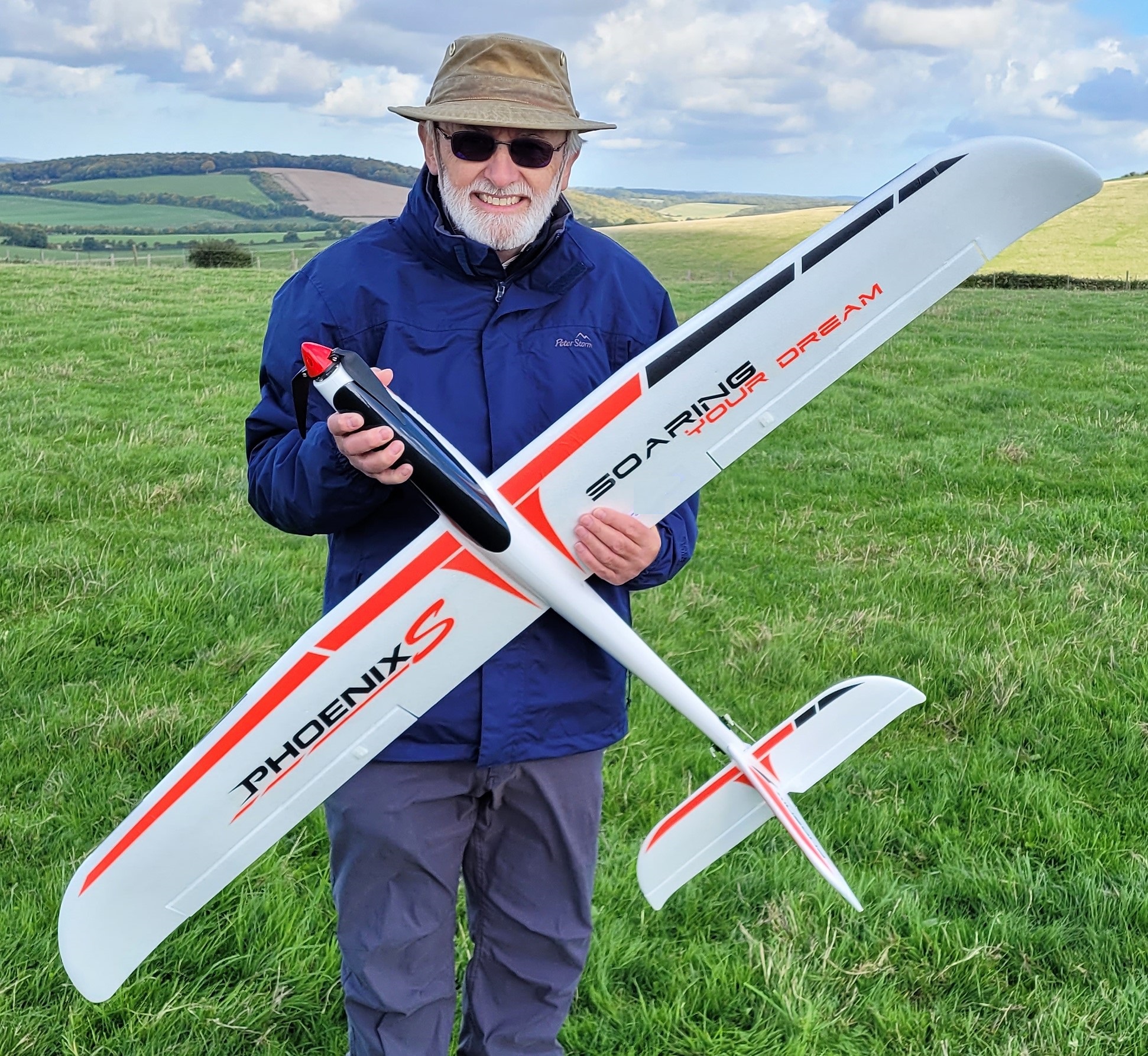 I have a Phoenix 16oo myself but mine is an earlier version and there are a lot of changes.
 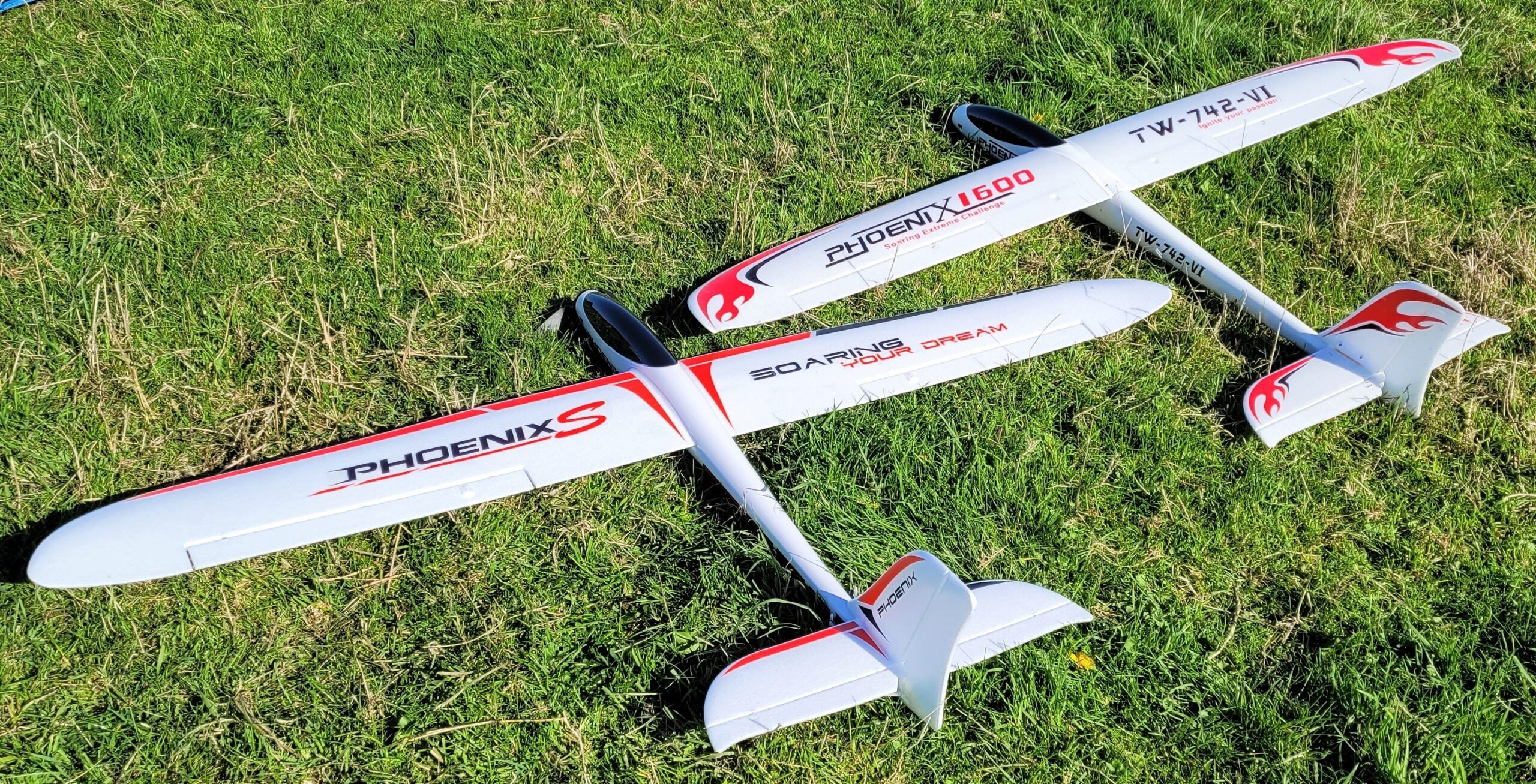 The earlier ones were sold as 3 cell models and were known for burning out motors (yes mine did) but the new version is sold as a 2 cell model. I wonder if both versions use the same motor but Volantex have found there aren’t any problems if it’s run on 2 cells.
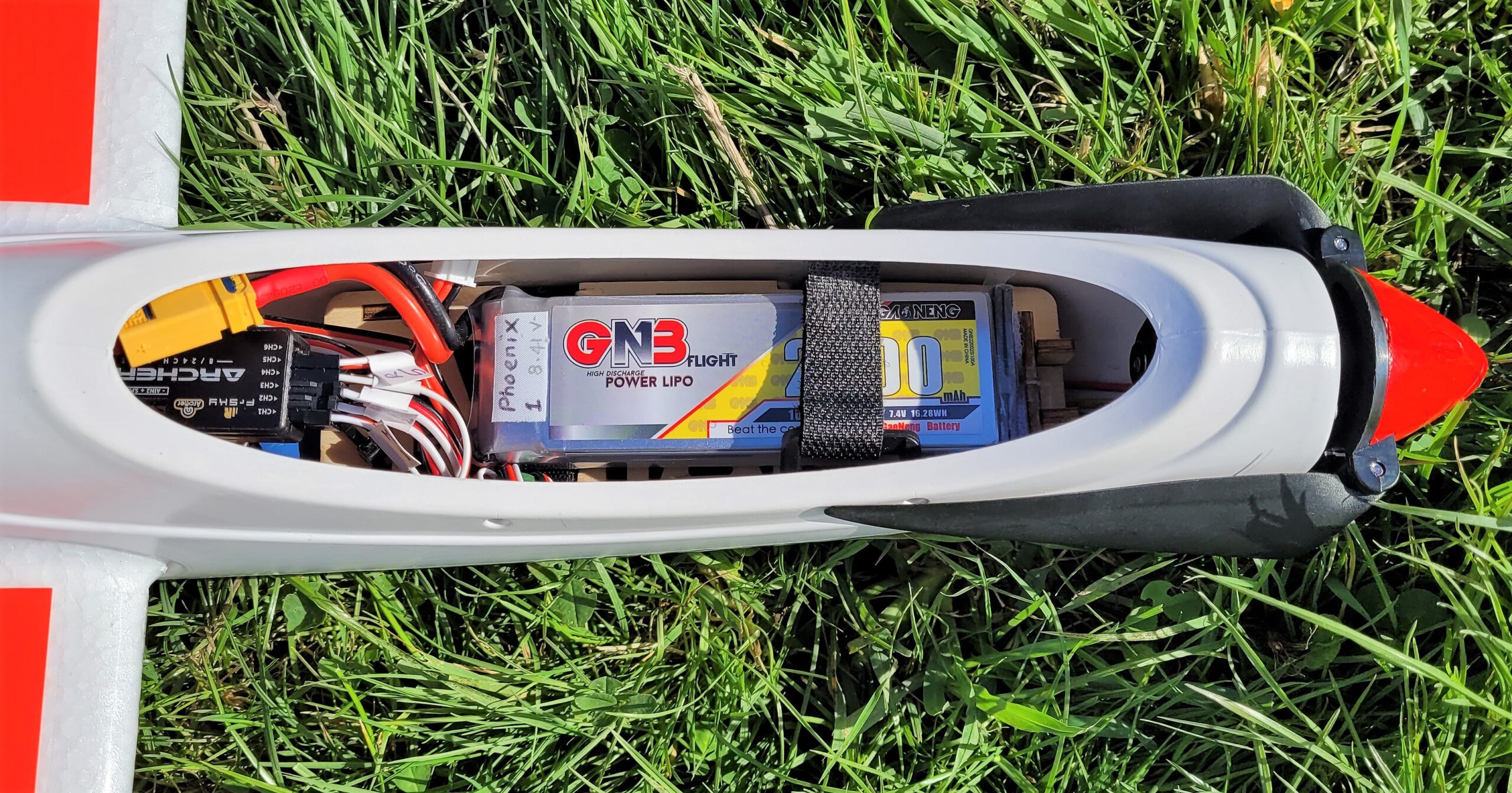 The wings on the new version plug into the fuselage sides rather than being screwed down on top and are a different shape with a partially swept leading edge. Also the fuselage is shorter on the later one but I think the tail is identical. It seems a little odd to go for 2 cell 1500mAh packs rather than the almost universal 3 cell 2200mAh ones but the model performs well on 2 cells and is no doubt lighter than the earlier version. Peter is getting on well with his and is getting used to the slightly tricky task of landing a glider than doesn’t always want to come down when the pilot thinks it should. Some of the first flight can be seen in the video as can Peter taking off and then landing his Riot absolutely perfectly.
Following on from his success with his Arrows Hobby Viper ducted fan model 1066 has been spending again, this time on an Arrows Hobby F-86 Sabre, another ducted fan plane.
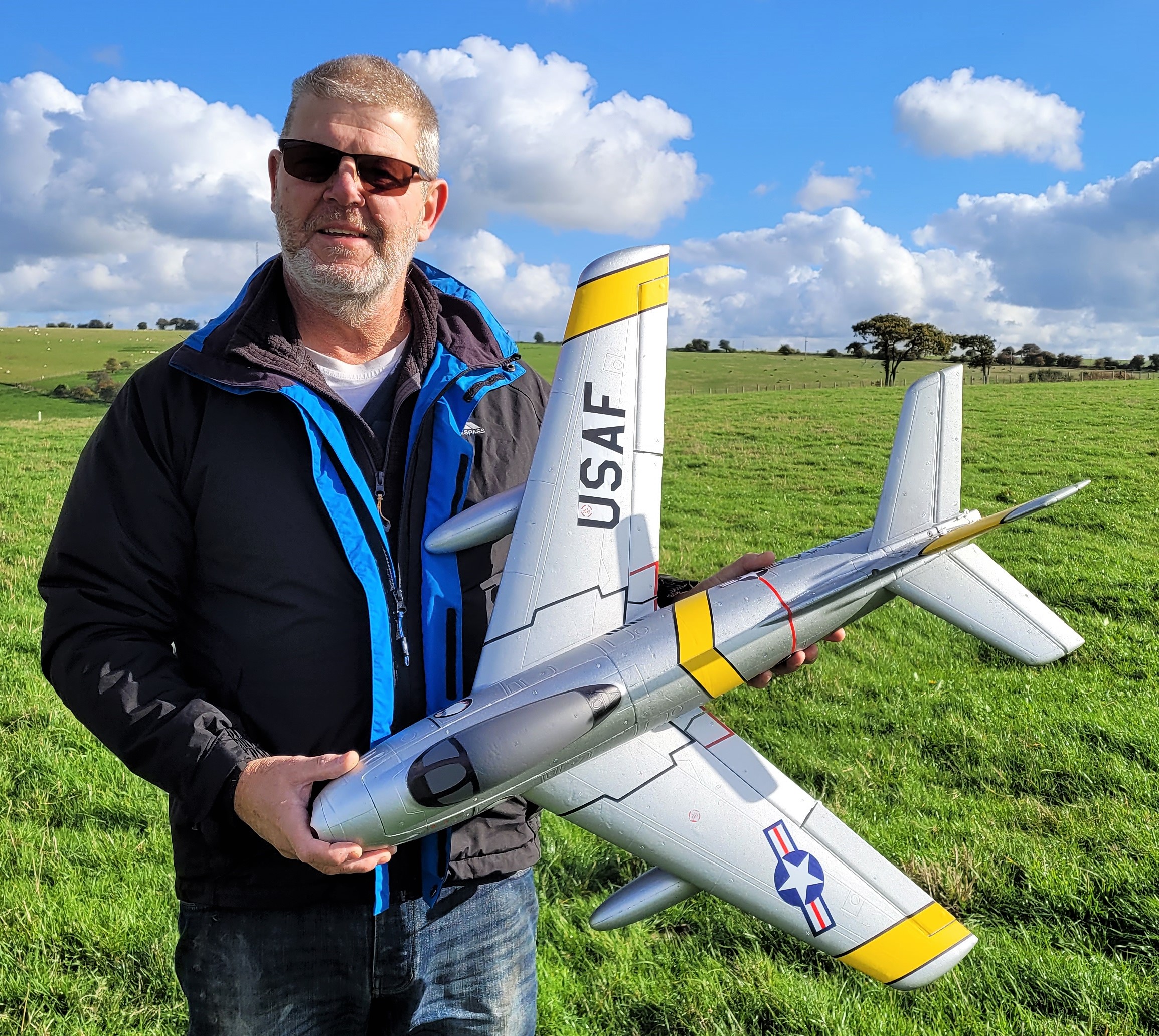 At 860mm span the Sabre is bigger than the 773mm Viper and it uses a 64mm fan running on 4 cells rather than the 50mm fan and 3 cells of the Viper. 1066 says he didn’t think the quality of the Sabre was quite as good as the Viper but overall it was perfectly satisfactory.
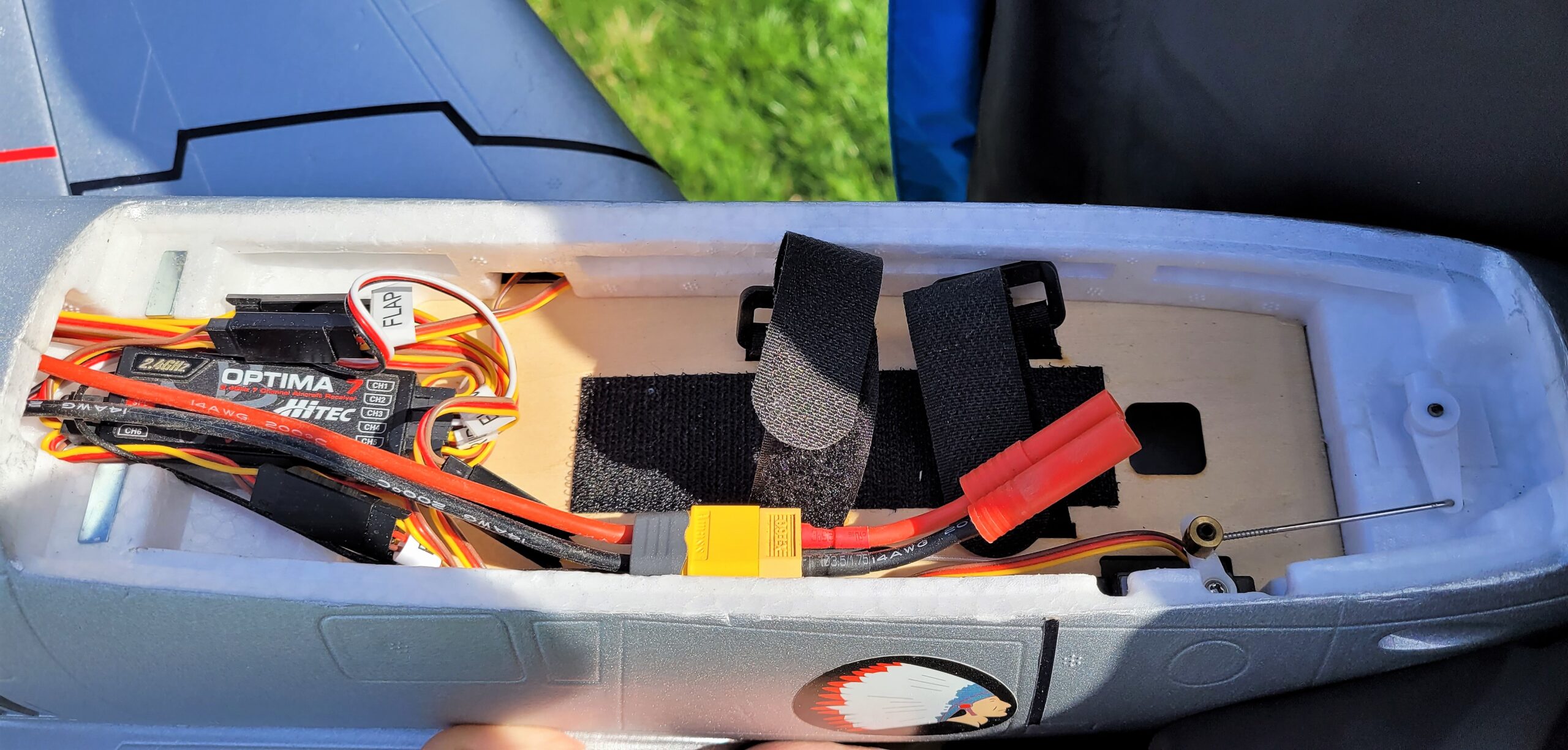 The completed model certainly looks nice and you will see in the video that it flies very well indeed. This is what Arrows say about it: While Arrows has introduced a number of EDF jets, from the hand tossed Viper to the high-end MiG-29 and F-15, our engineering team began with the Marlin 64mm EDF, still the best EDF trainer made. The F-86 is the successor to the Marlin with fixed gear for strength and the same full 5-channel performance with flaps. The plane has excellent performance and agility at high speed and stability during landings. The smooth 12-blade 64mm fan sounds more realistic than older 5-blade 64mm units others use. Because of the more powerful 2840-3150KV motor and a 40 amp ESC, this plane is capable of top performance even though it is larger than other 64mm F-86’s, with manoeuvers such as rolling, diving, looping, and inverted flight. The quick release landing gear allow for fast transition from ground take-off to hand launch and facilitates easy transport. The EPO foam is tough and at 820mm length and 860mm wingspan, it is a perfect 1/10 scale of the original full-scale plane. The contours, panel lines, and markings are highly accurate and realistic. The special water-based paint has a very realistic look. Assembly is fast and easy using only a few screws.
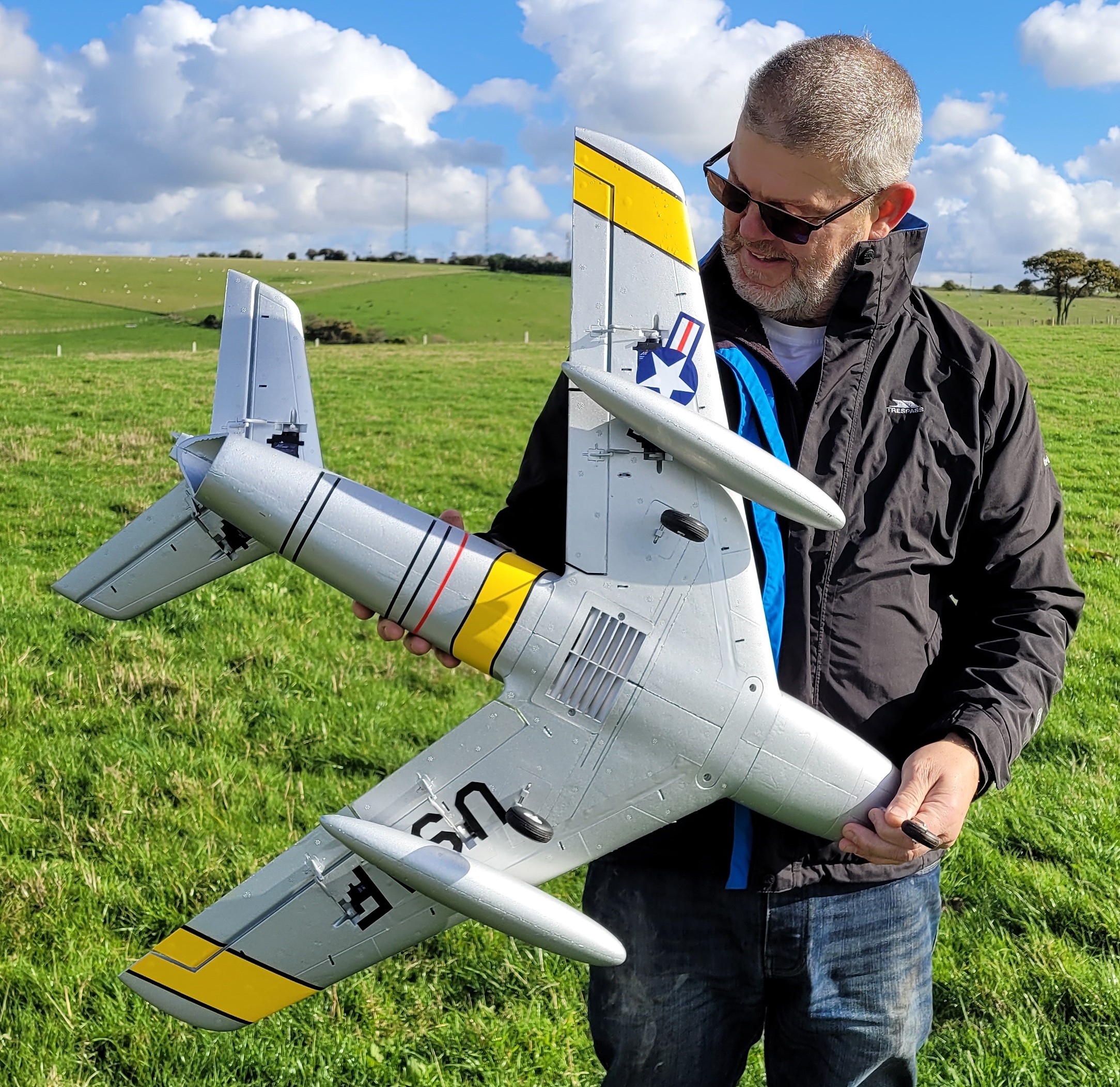 As Arrows mention the undercarriage is easily removable but so far 1066 has left it fixed in place and is enjoying doing proper take-offs and landings. The Sabre would obviously look better in the air without the wheels hanging down but hand launching and belly landing would make it more susceptible to damage so I think 1066 has made the right decision. The ideal solution would be to have retracts but with our small patch and grass that is sometimes not as perfect as we’d like retracts can be more trouble than they are worth.
In the August Patch News I reported on the Lancaster that Percy Vears had built. Sadly on its first flight we found there was a major glitch whenever the retracts were operated and the Lanc crashed. The damage wasn’t too bad and Percy did the necessary repairs and fitted a separate battery to power the retracts and when ground tested all seemed well.
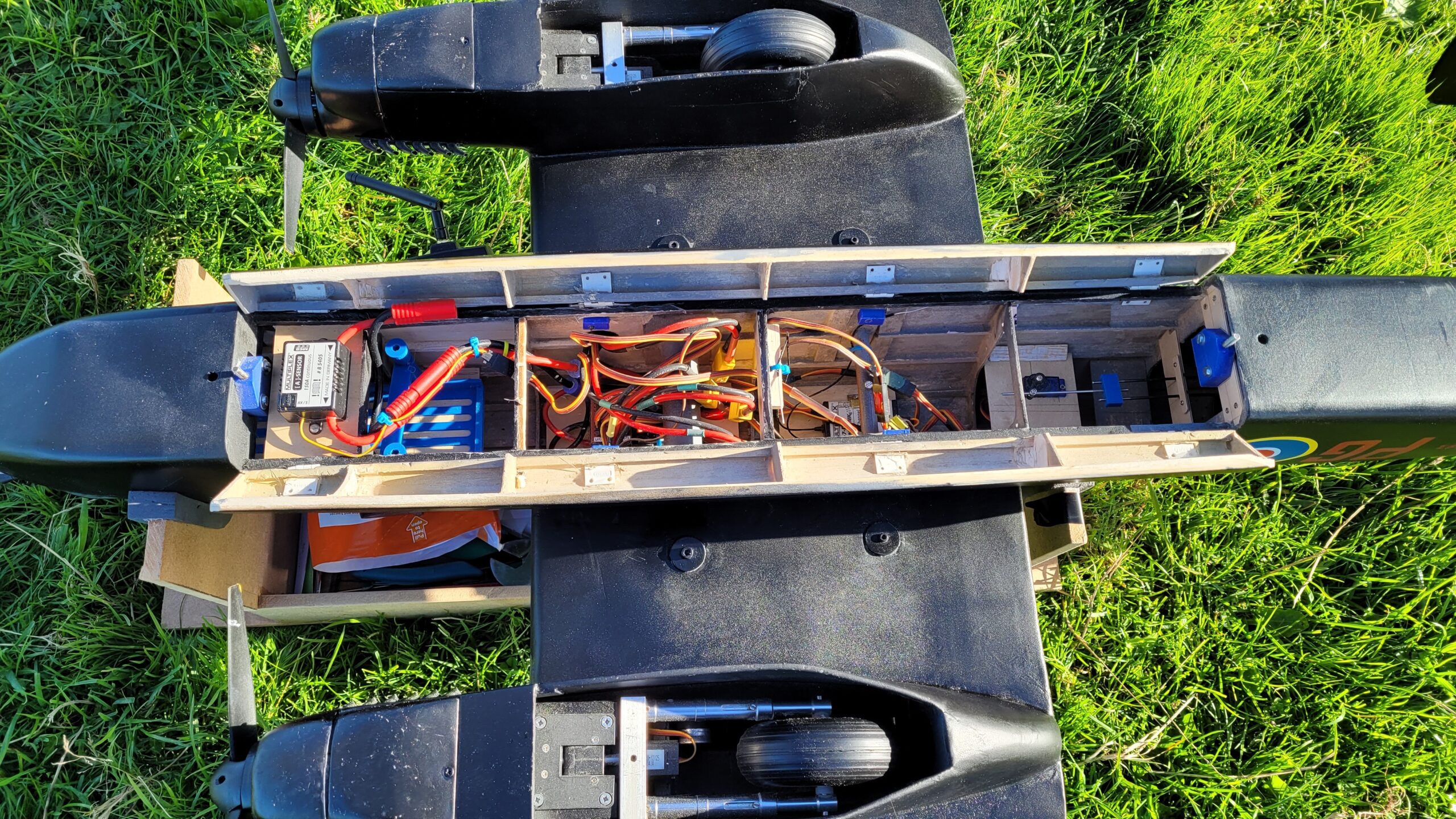 So in October we tried again and this time I decided to not try switching the retracts until the Lanc has reached a decent height. The plane took-off ok but was a fair bit out of trim and very twitchy which seemed strange as on the previous attempt the Lancaster was only slightly out of trim and wasn’t twitchy. But by the time I’d got onto the downwind leg I’d pretty much sorted things out and the Lanc was at a reasonable height. Then the plane pitched up but levelled out with some down elevator but after a few seconds went into a right hand spiral and nothing I tried made any difference. The only clue as to what went wrong was that the transmitter telemetry screen had switched from displaying how many the milliamp hours were left in the flight pack to showing the receiver voltage. The display only switches from the chosen setting when something reaches an alarm level so although the receiver battery voltage was showing at 4.9v (which should have been ok) presumably it had dropped to a dangerous level previously before recovering when the plane crashed.
 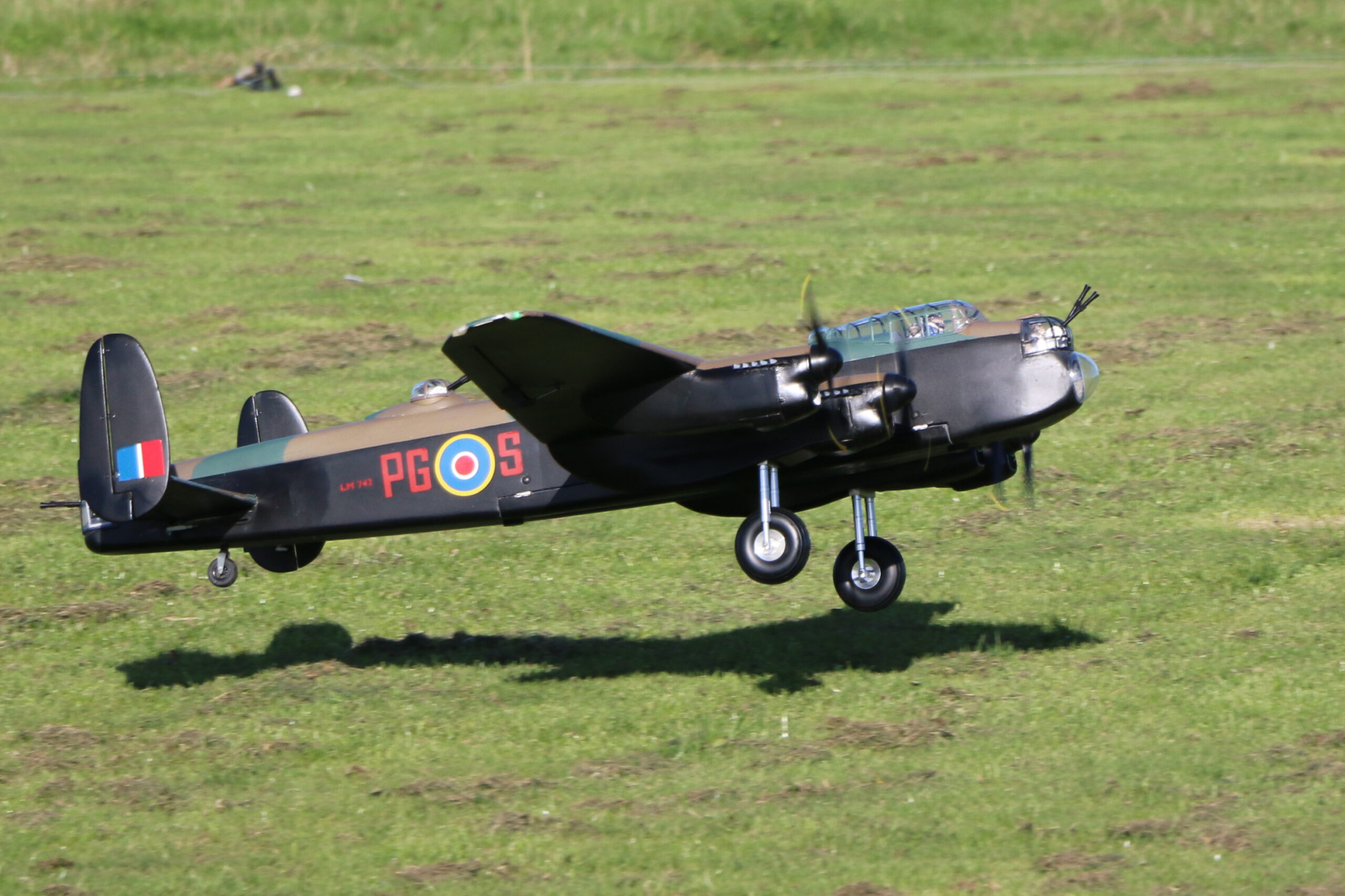 When Dougal watched the video he thought maybe the plane had a rearward C of G, that would explain why it was so twitchy I suppose. I really don’t know what went wrong, I’m pretty sure it didn’t tip stall into a spin so can only think it was a drop in receiver voltage that caused the spiral and lack of control. Take a look at the video and see what you think.
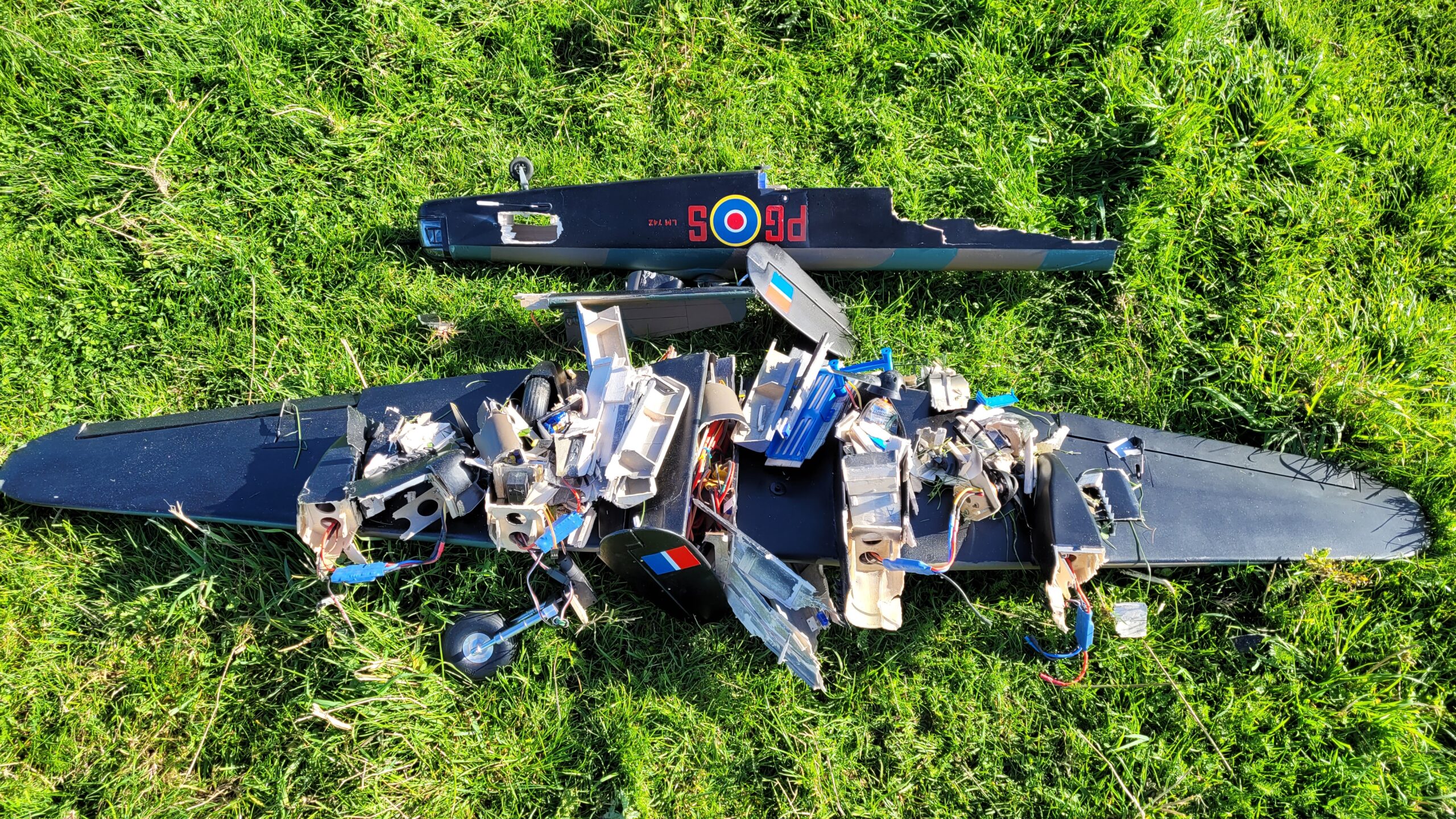 The result wasn’t pretty and I’m not sure Percy will repair it this time.
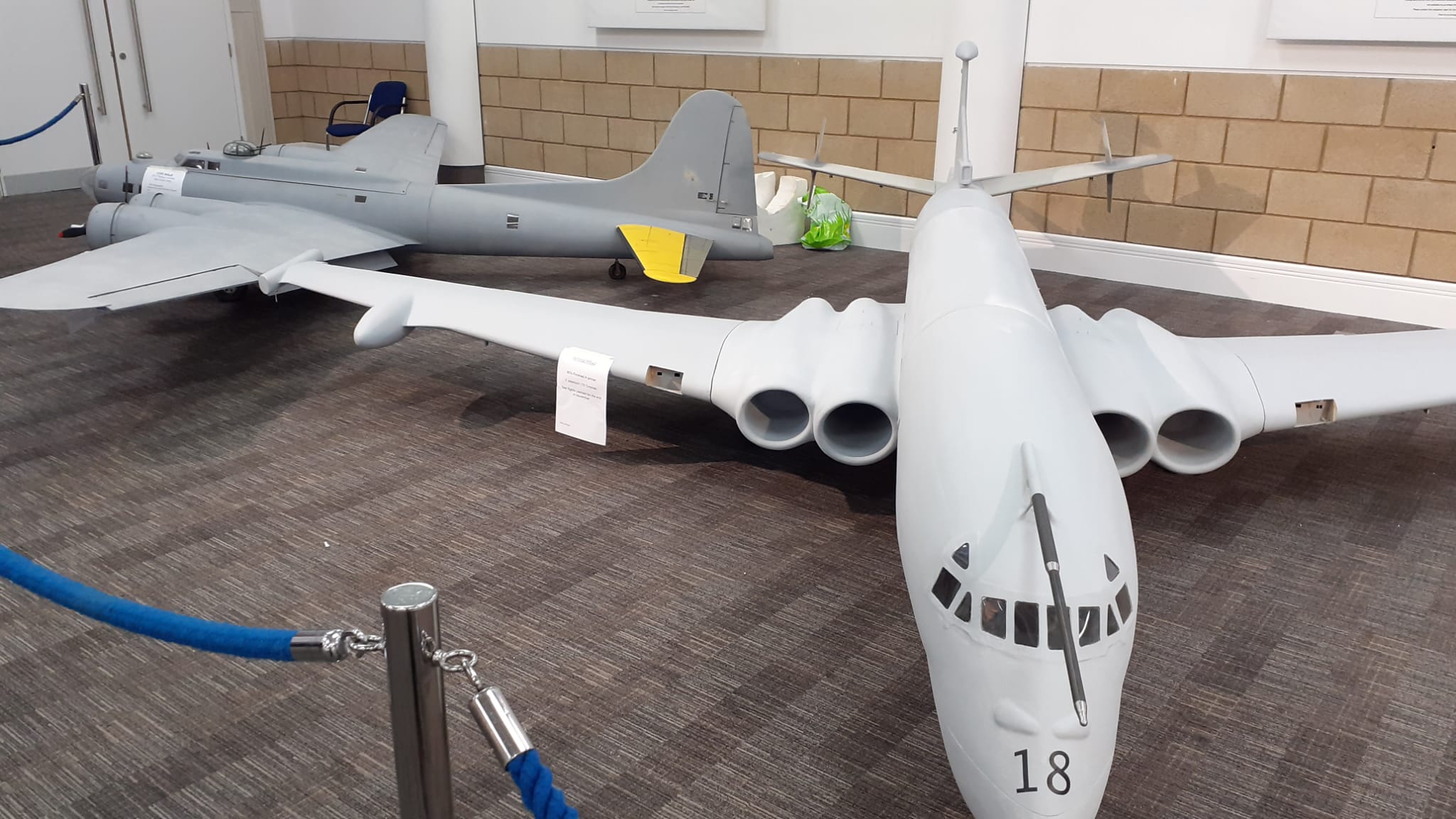
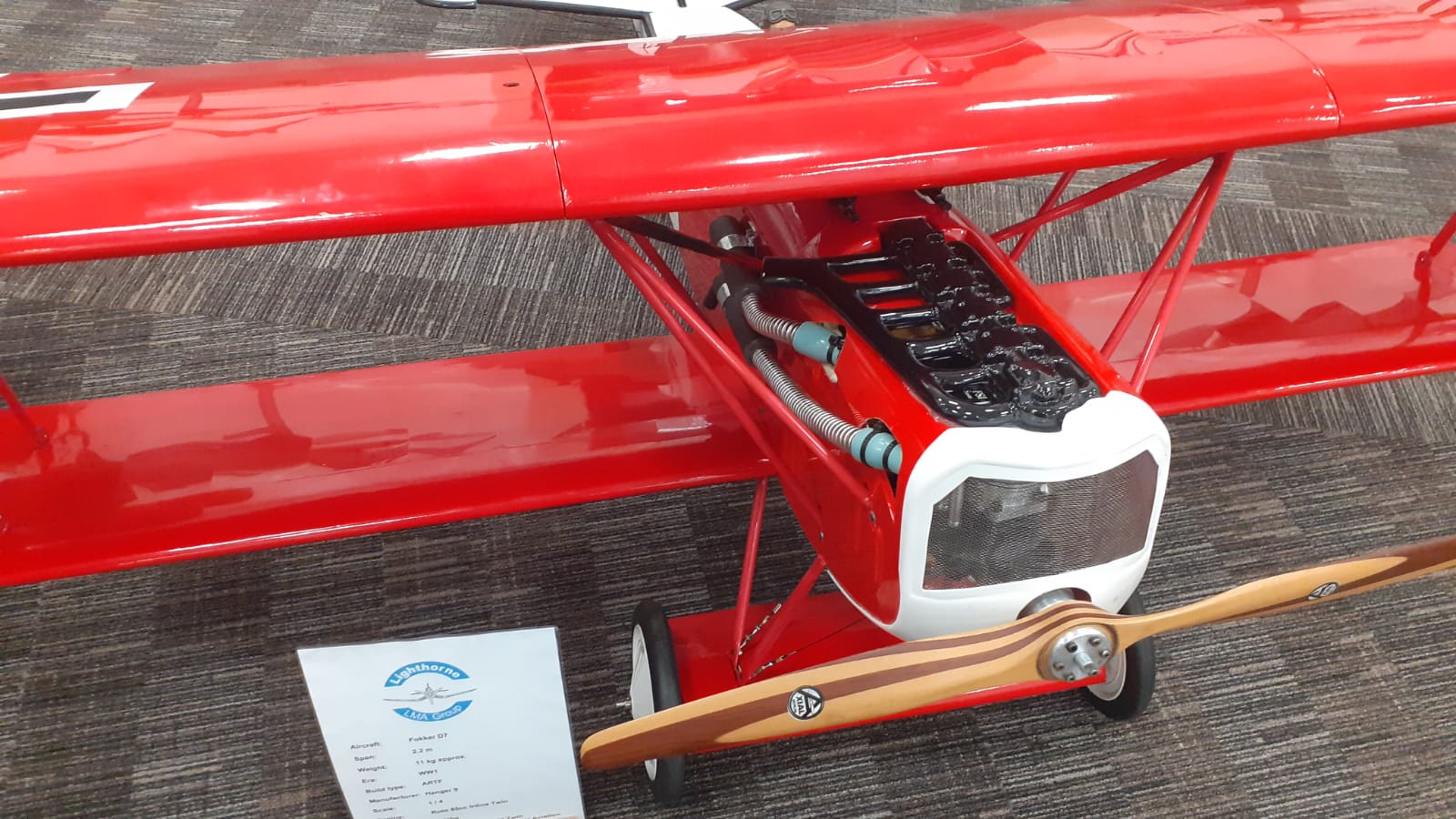
Most of you will have seen some photos on the PAM WhatsApp group that Chas took at the LMA static show at Gaydon. He took a lot more than he sent to the group so here are a few more for you to see. As you can see there were some superb models on show, thanks Chas:
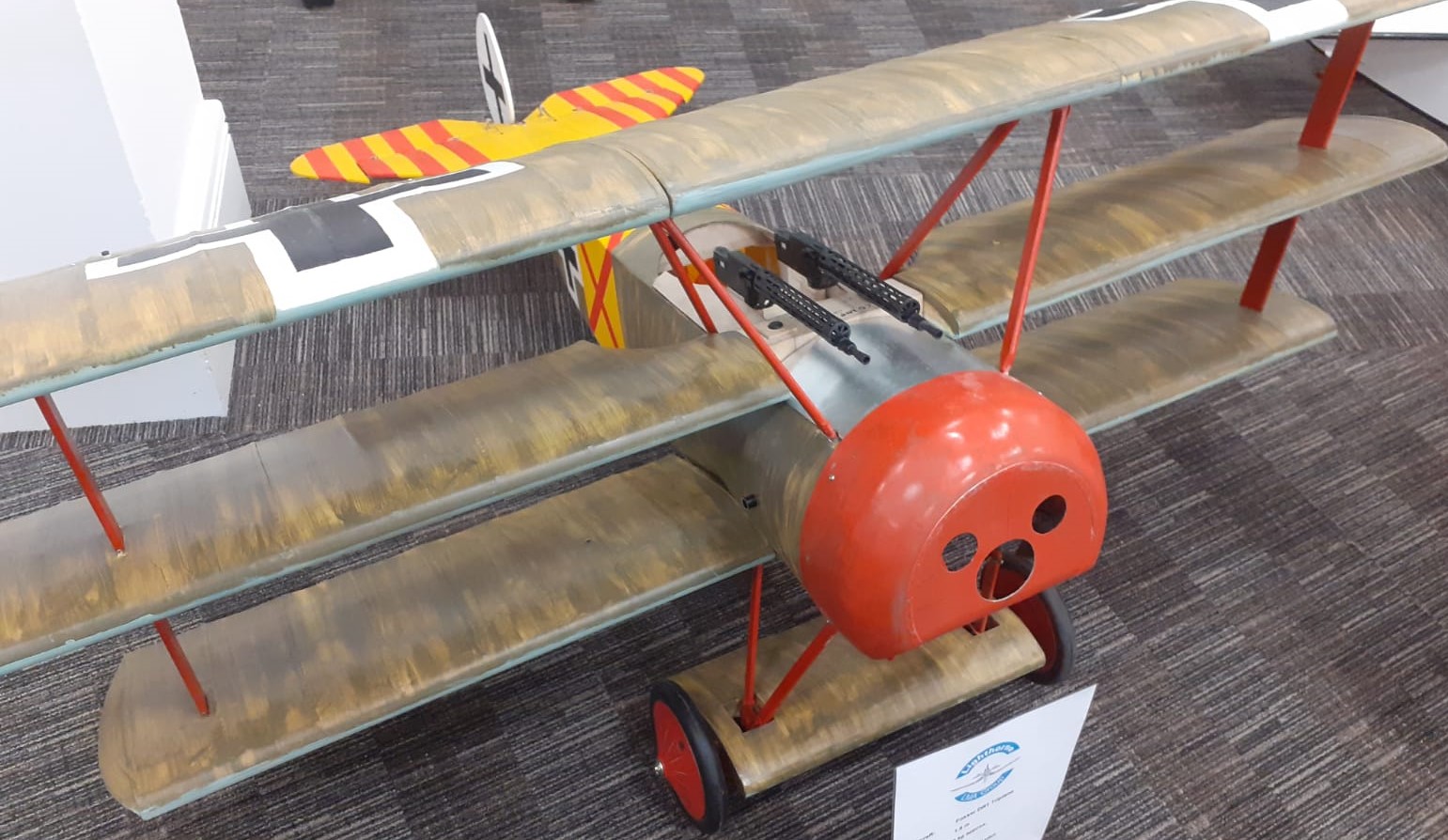
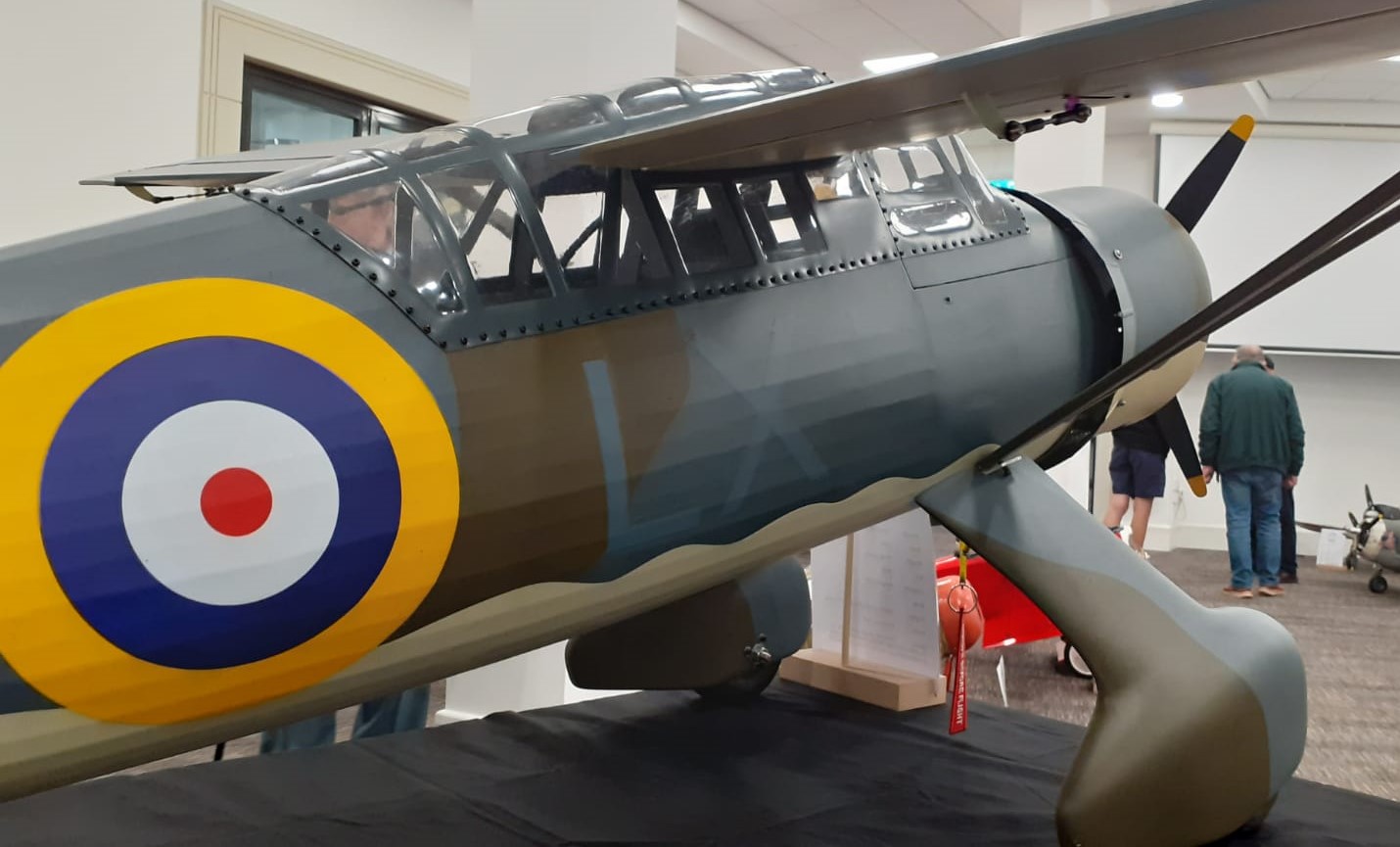
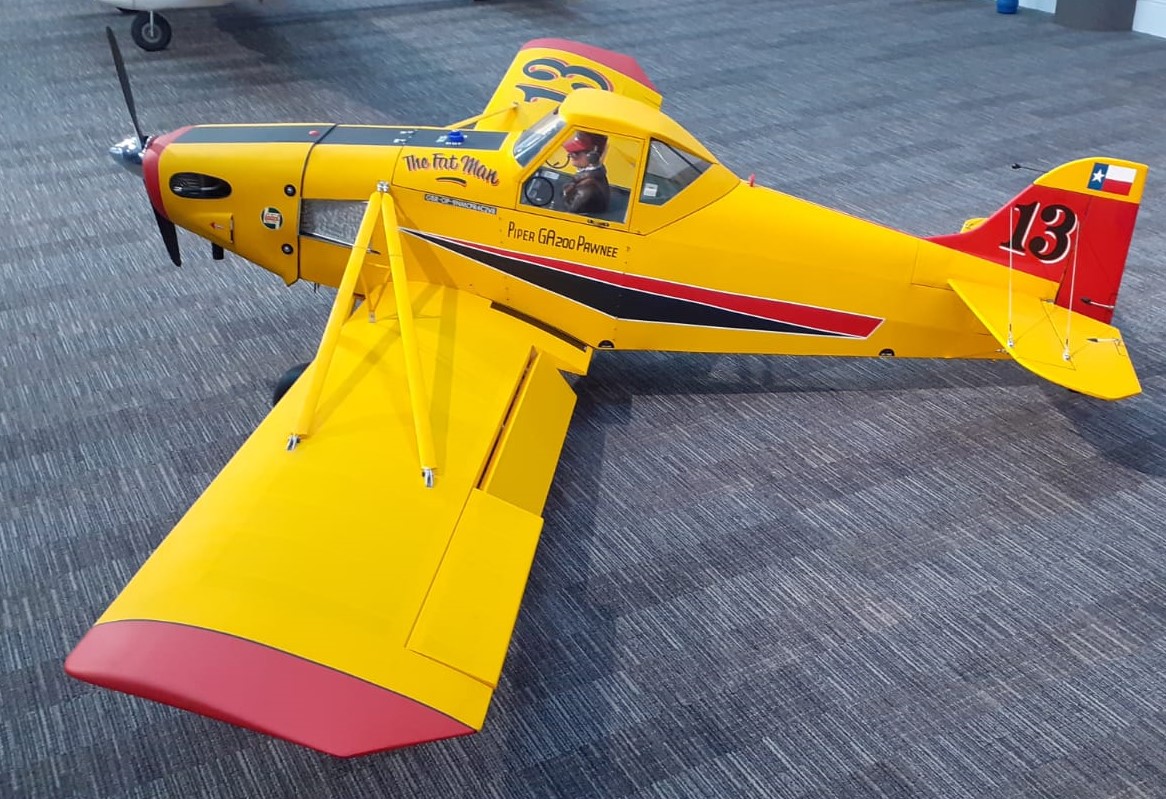
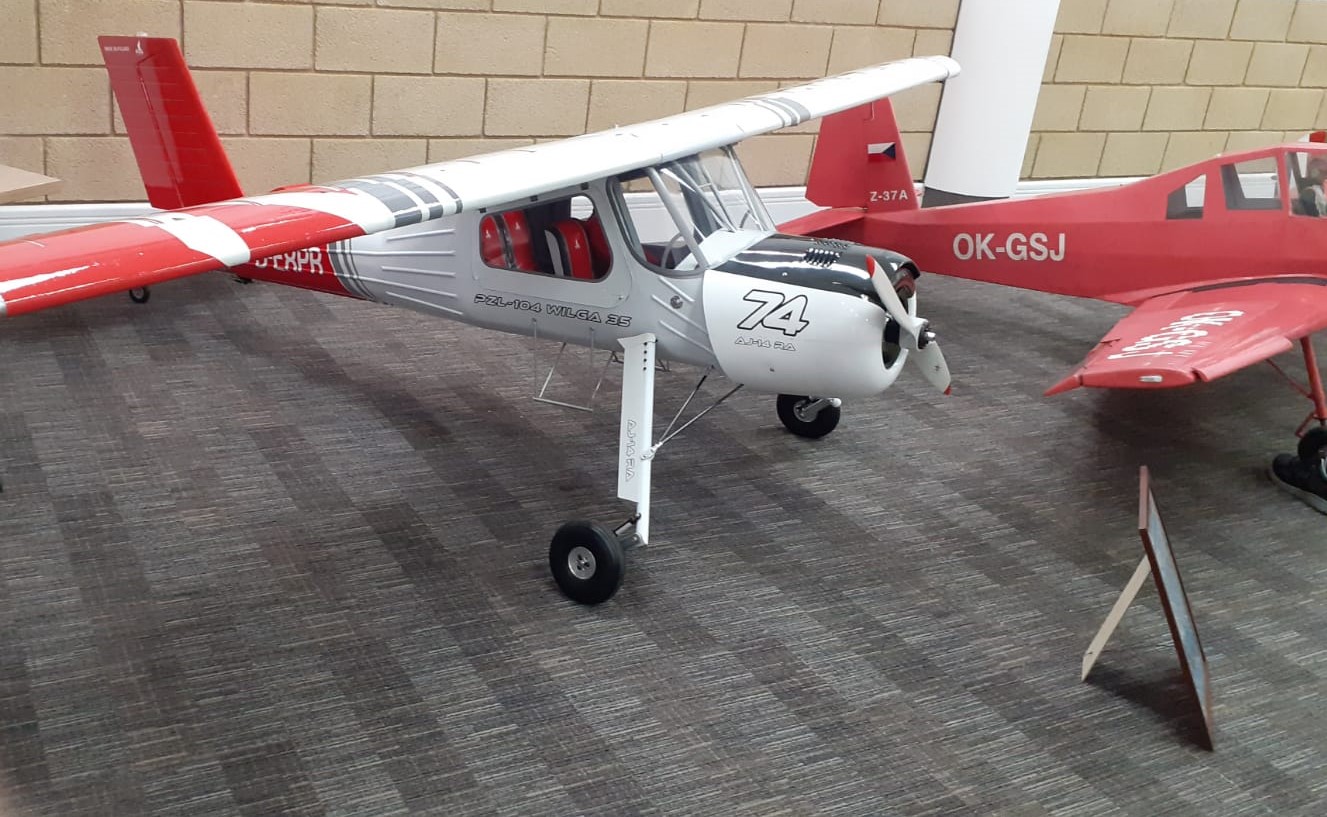
Long term club member Stanley Knife has been struggling with his eyesight recently and has sadly decided to sell off lots of his modelling gear. One of Stanley’s models that I flew a few times and really liked was his Durafly Excalibur electric hotliner. When Stanley put it up for sale Dougal Entendre snatched it up and in October he flew it at the field a few times. It has a 1600mm wingspan, a V-tail design and a serious spar structure for high speed flying. It comes with a 3542 800Kv outrunner motor, a 60amp Aerostar speed controller, and a 13×7 carbon fibre prop but if I remember correctly Stanley had fitted the optional 13×8 ‘pro’ prop for more performance. It is intended to be powered by a 4 cell 1800-2200mAH lipo and Dougal fitted a suitable 4 cell pack for the first couple of flights. 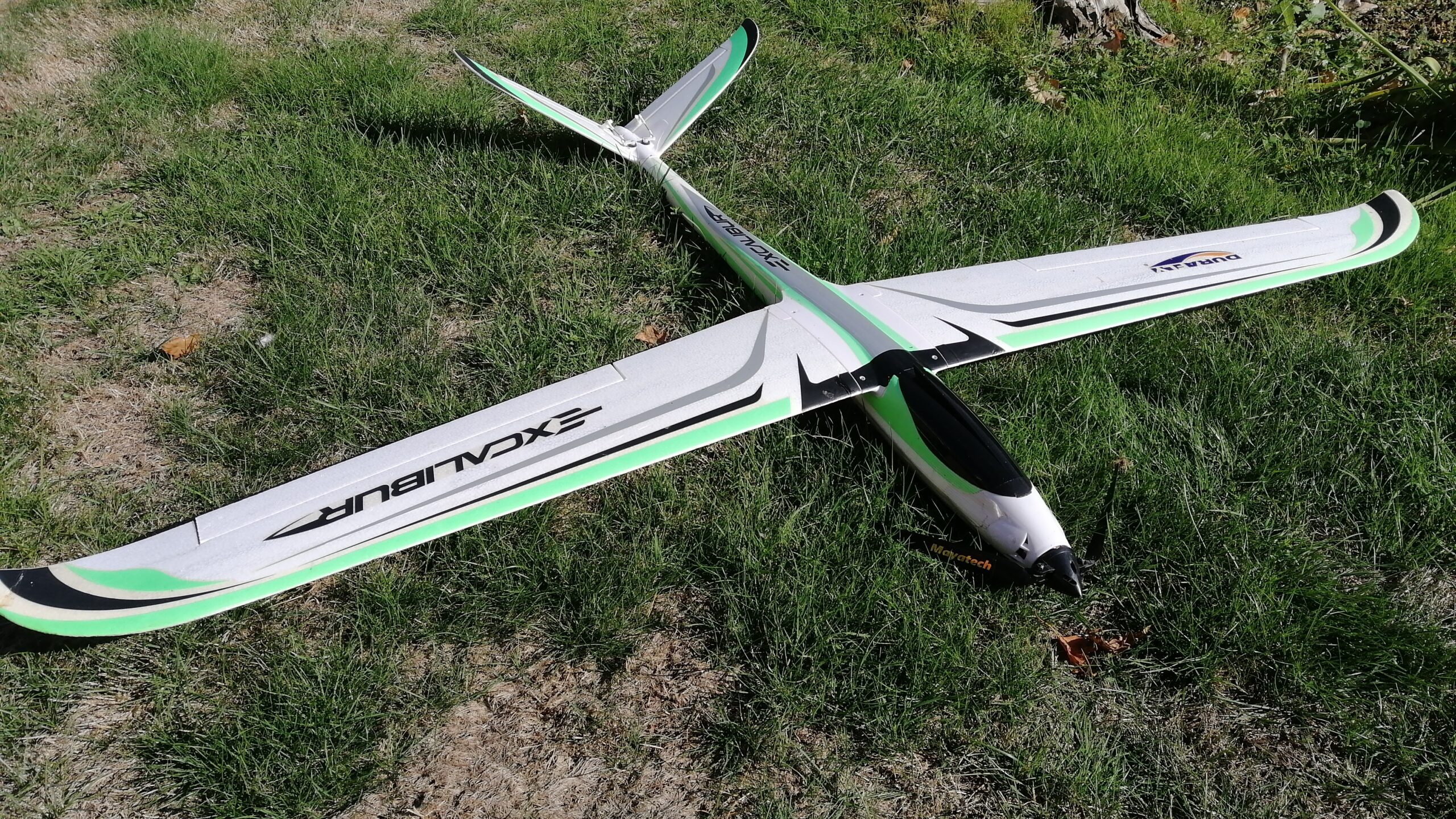 The Excalibur flew just as I remembered with loads of power for vertical climbs and it really shifts around the sky! The only problem Dougal found was that on the glide one blade of the folding prop got caught under the canopy which prevented the motor starting again. The problem was quickly sorted with a piece of tape along the canopy/fuselage join. I’m quite surprised it didn’t simply rip the canopy off! Dougal wondered if the 13×8 prop was a little too much for it and then tried flying with a 3 cell pack fitted and found it still went extremely well, just slightly slower on the climb. HobbyKing are now selling a V2 version of the Excalibur which features a new colour scheme and a few other minor changes so if you’re tempted and are willing to pay the mad postage from China go for it!
Woody has been building again and brought along his newly completed Splot to show us. At the time of writing he hasn’t flown it but no doubt I’ll report of how it flies next month.
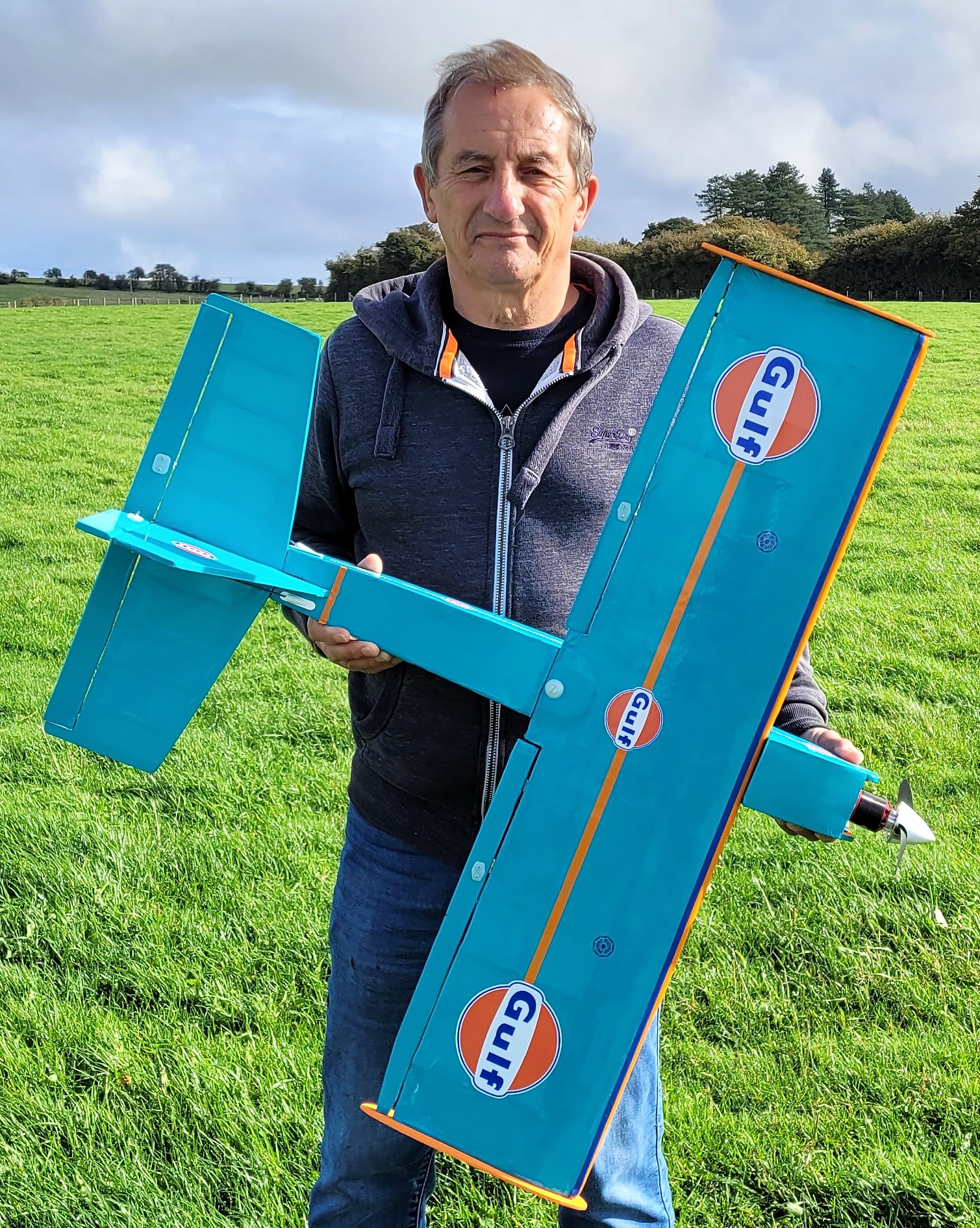 Woody has fitted the Splot out with a Ripmax 25 motor and a 4-Max 40A speed controller. He’s used Hitec HS81 servos in the wing and standard ones in the fuselage for rudder and elevator. When he brought it along to the field we said it felt heavy and Woody explained that he’d had to add an awful lot of weight to the nose in order to get the correct C of G.
 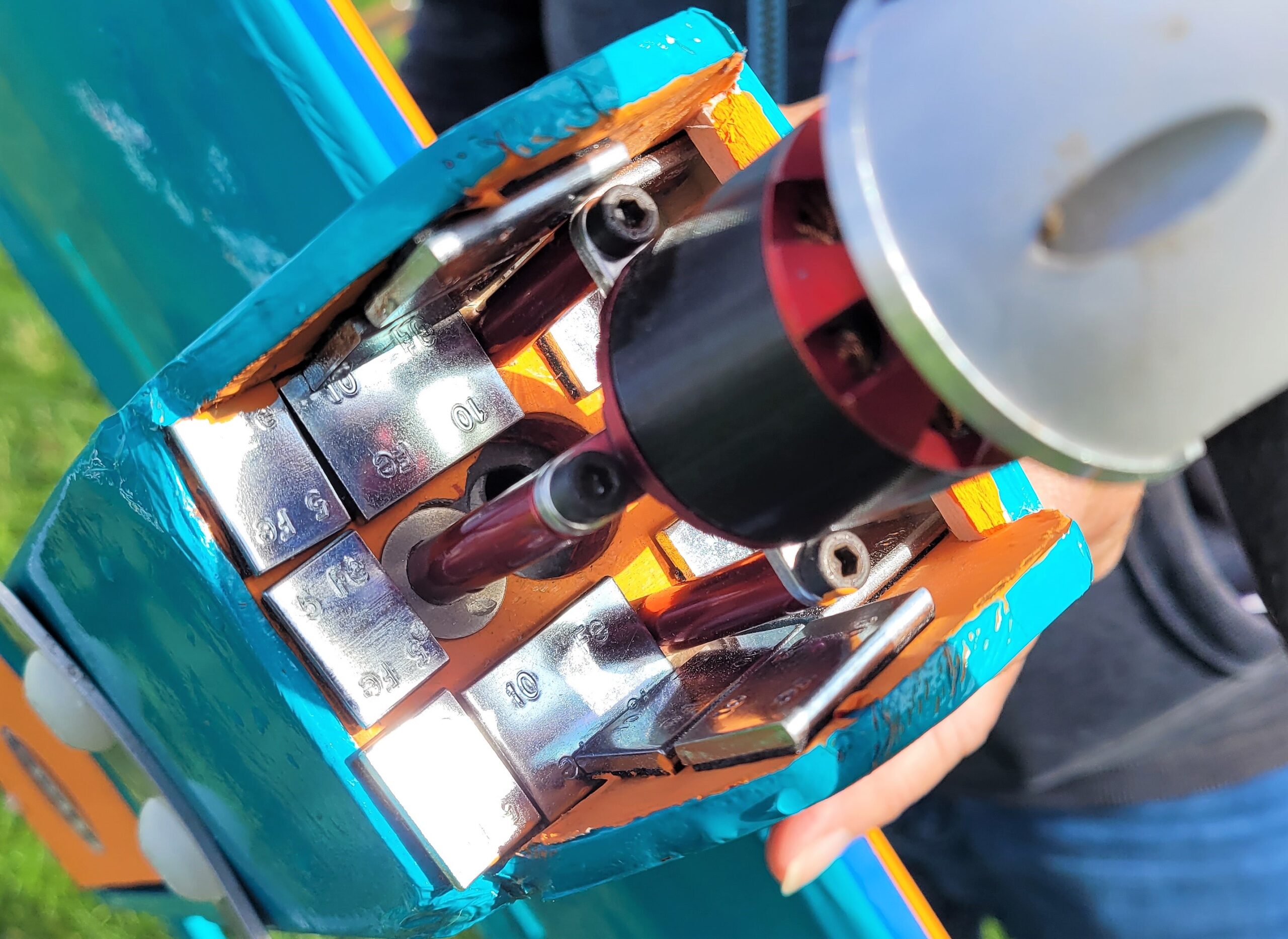 After we all very helpfully explained everything he’d done wrong Woody went away to try and move the battery further forward and hopefully be able to ditch some of the lead.
 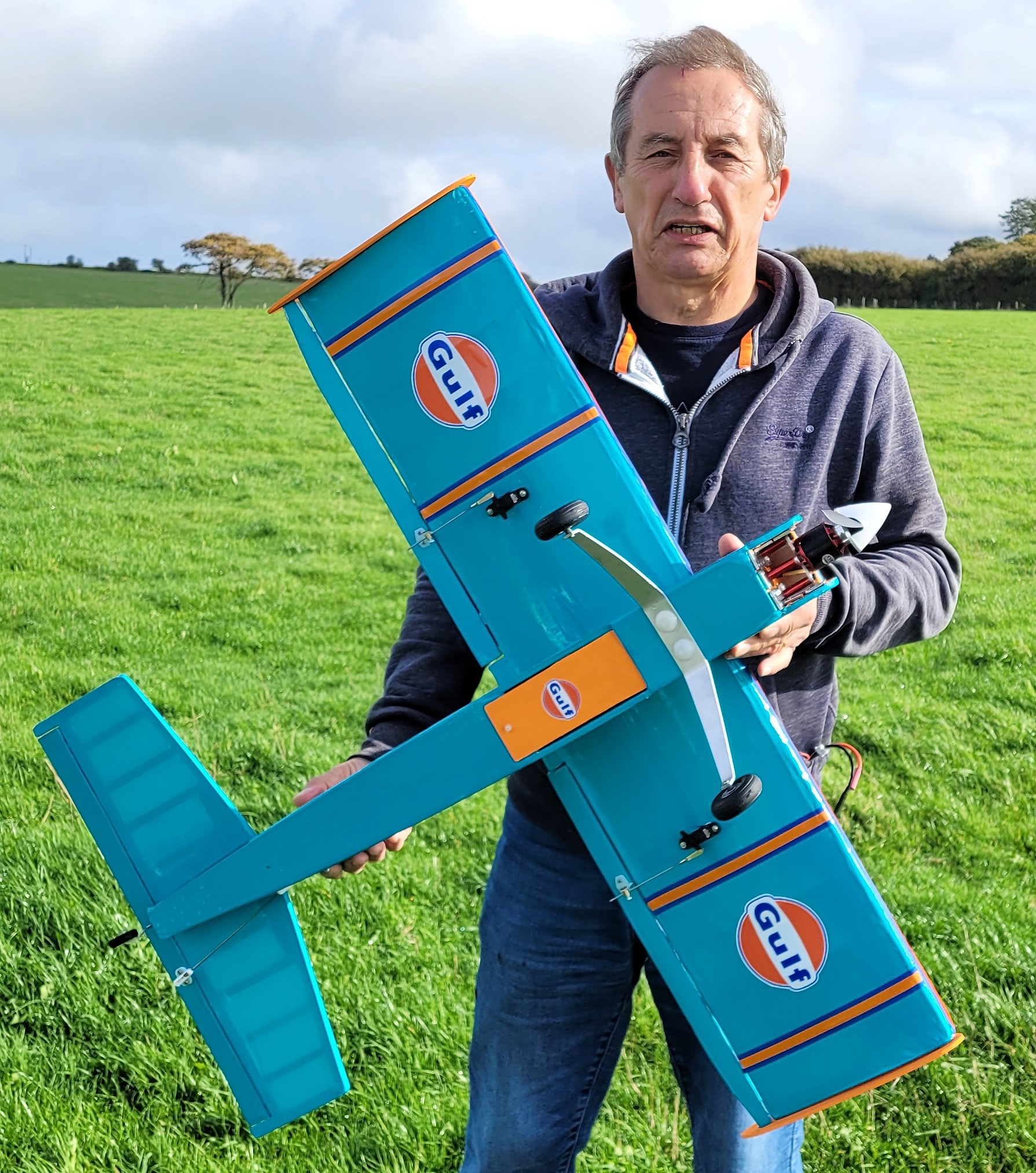 Apart from the rather excessive weight the model looked really good in its Gulf Porsche 917 colour scheme of the 1960’s & 70’s. I’m not sure if Woody intends to fly the Splot like Pedro Rodriguez or Jo Siffert. Personally I preferred the Gulf Ford GT40 but then I can’t fly like Derek Bell or Jacky Ickx so maybe I should shut up for a change!
Back in the August Patch News I wrote about two models that young Charlie had bought, a Flite Test Alpha kit and an Eachine Spitfire. He’s flown the tiny Spitfire a few times with no problems but that changed on the last Friday in October. We had mown the patch that afternoon and by the time we started flying the sun was low in the clear blue sky on the upwind side of the patch so we were mostly flying downwind, over the valley. With the combination of a tiny model and the poor light Charlie got disorientated, was blown too far downwind, and lost sight of the Spitfire somewhere out over the valley. Charlie and mum Nadine disappeared down in the valley and later returned looking shattered, saying they hadn’t realised how steep and deep the valley was. Fortunately the model was undamaged. 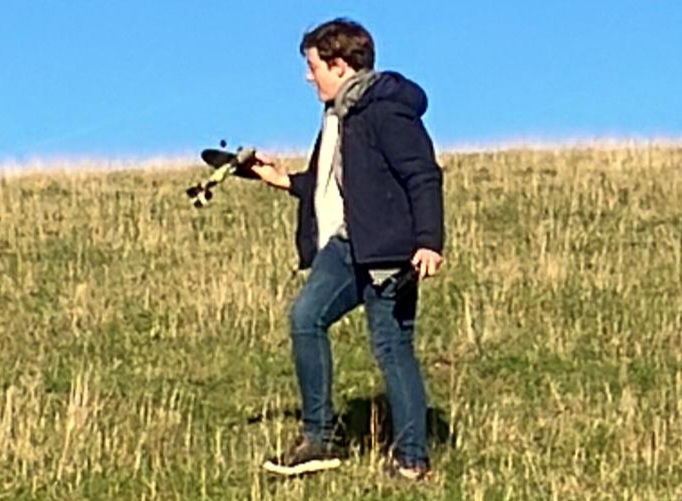 Having passed the initiation they’re now members of the Death Valley Appreciation Soc!
Meantime Charlie has been building the Flite Test Alpha, a foamboard jet style model.
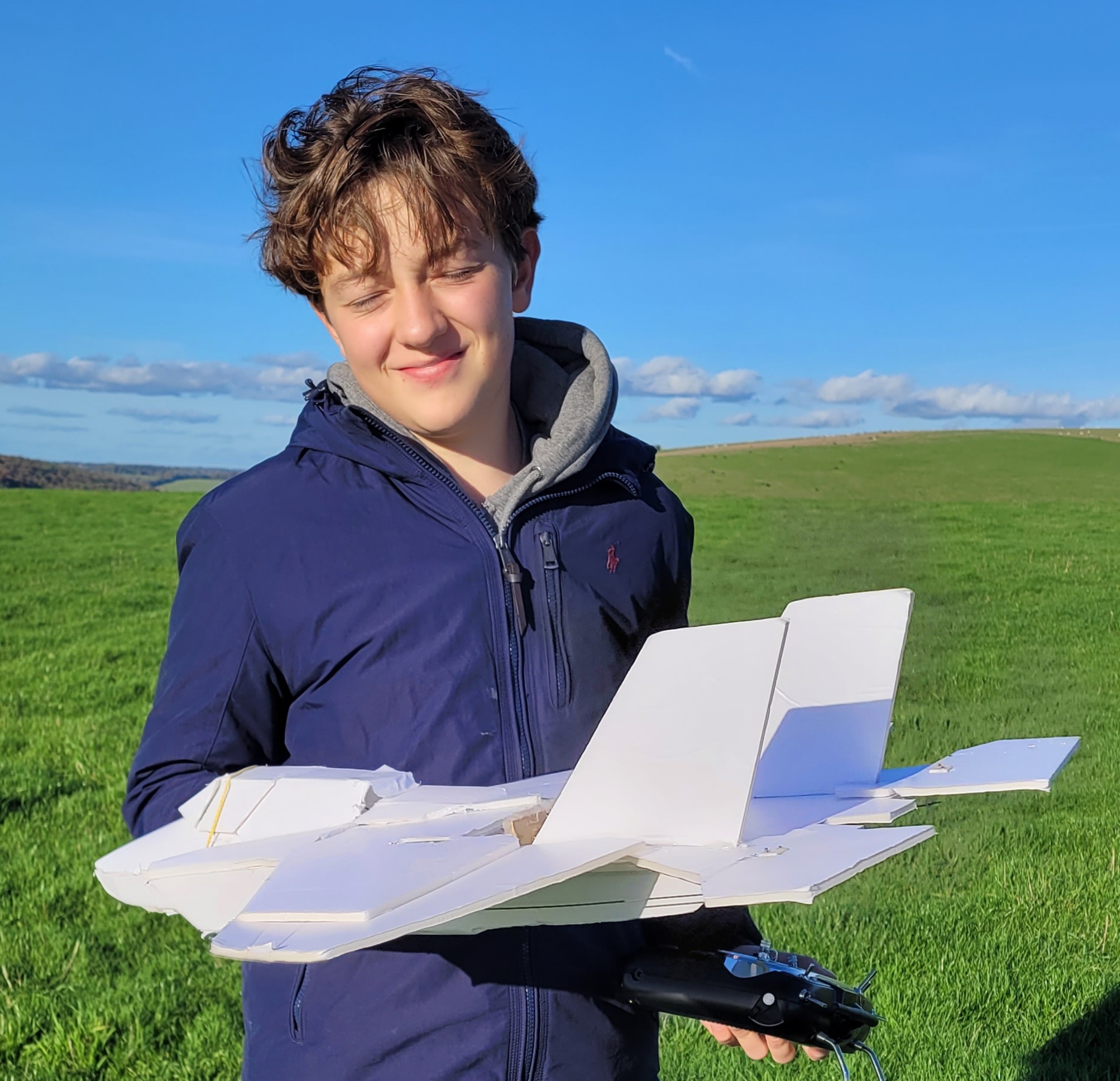 The kit contained foam pieces which were laser cut & scored and also control horns and linkages plus a few other bits. The foam is different to the foam Flite Test originally used, the most notable difference being that it’s covered with white paper rather than brown. According to the website it’s 3/16″ thick water resistant bifold Maker Foam.
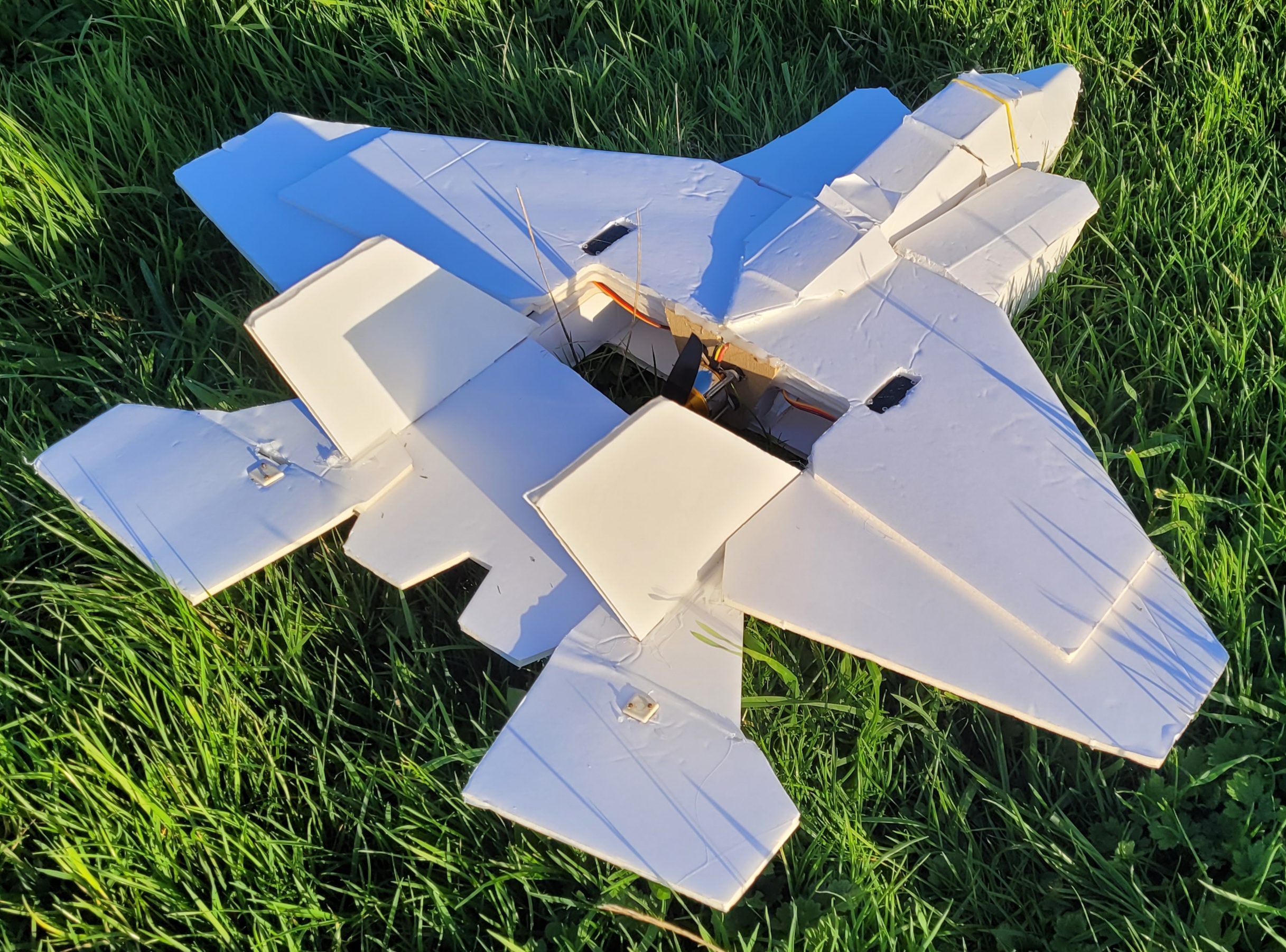 There is a very comprehensive build video on YouTube to guide beginners through every stage. Charlie has fitted a 2212 2200kv motor from 4-Max with a 6×4 propeller, a 30A speed controller and is running it on 3 cell 1000mAh lipos. The Alpha is controlled by elevons so only needs 2 servos which he bought from Sussex Model Centre with the kit.
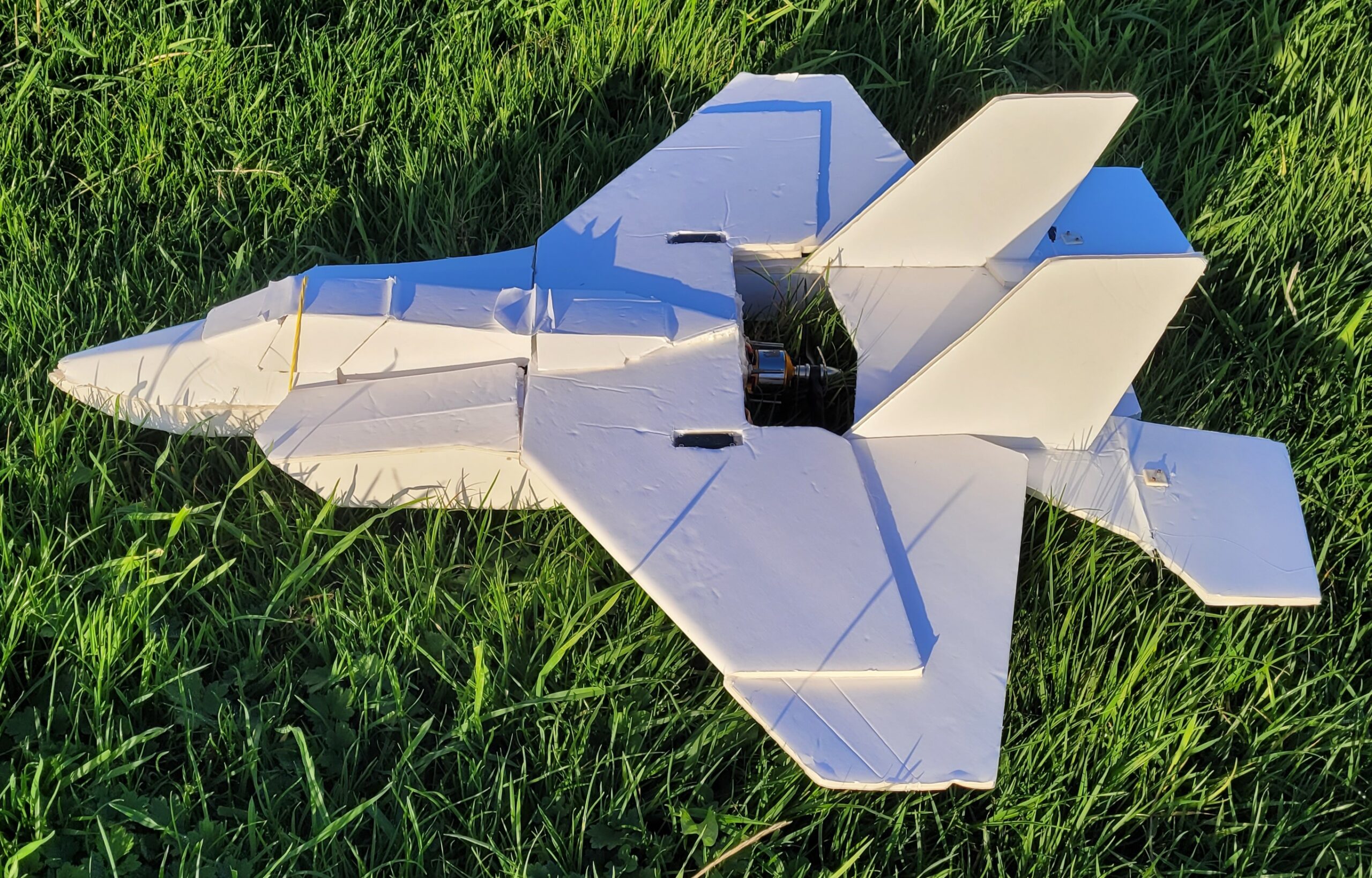 After a check that everything worked as it should Gordon launched the Alpha while I stirred the sticks. The plane climbed away with very little trim required and I flew it around for a few minutes doing all the usual checks. Like many of the foamboard models there was a tendency for lack of control when the speed dropped but otherwise it was fine. Charlie took the controls on the second flight and had no problems at all, he flew around for several minutes before ending the flight with a perfect landing on the patch.
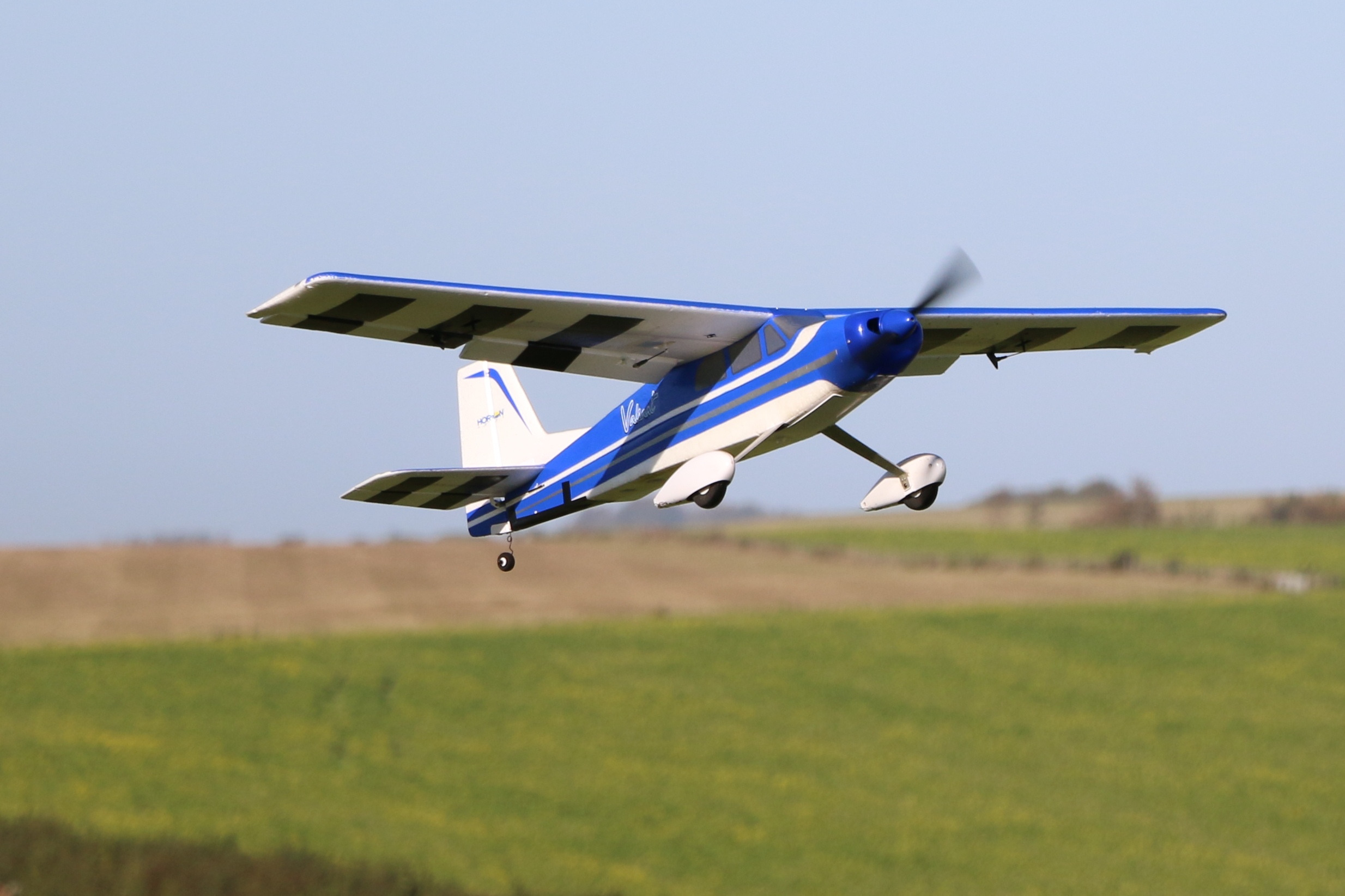
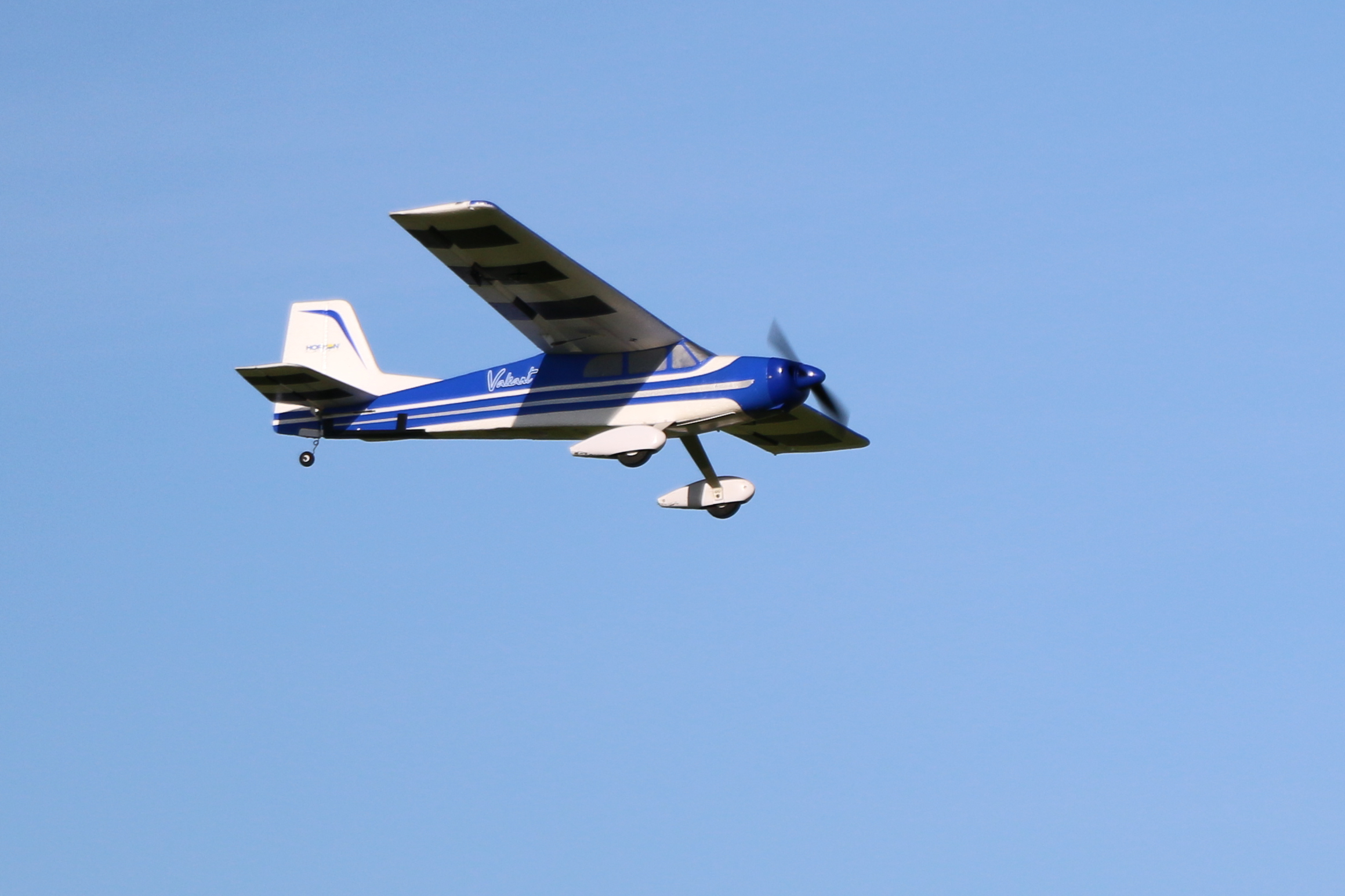
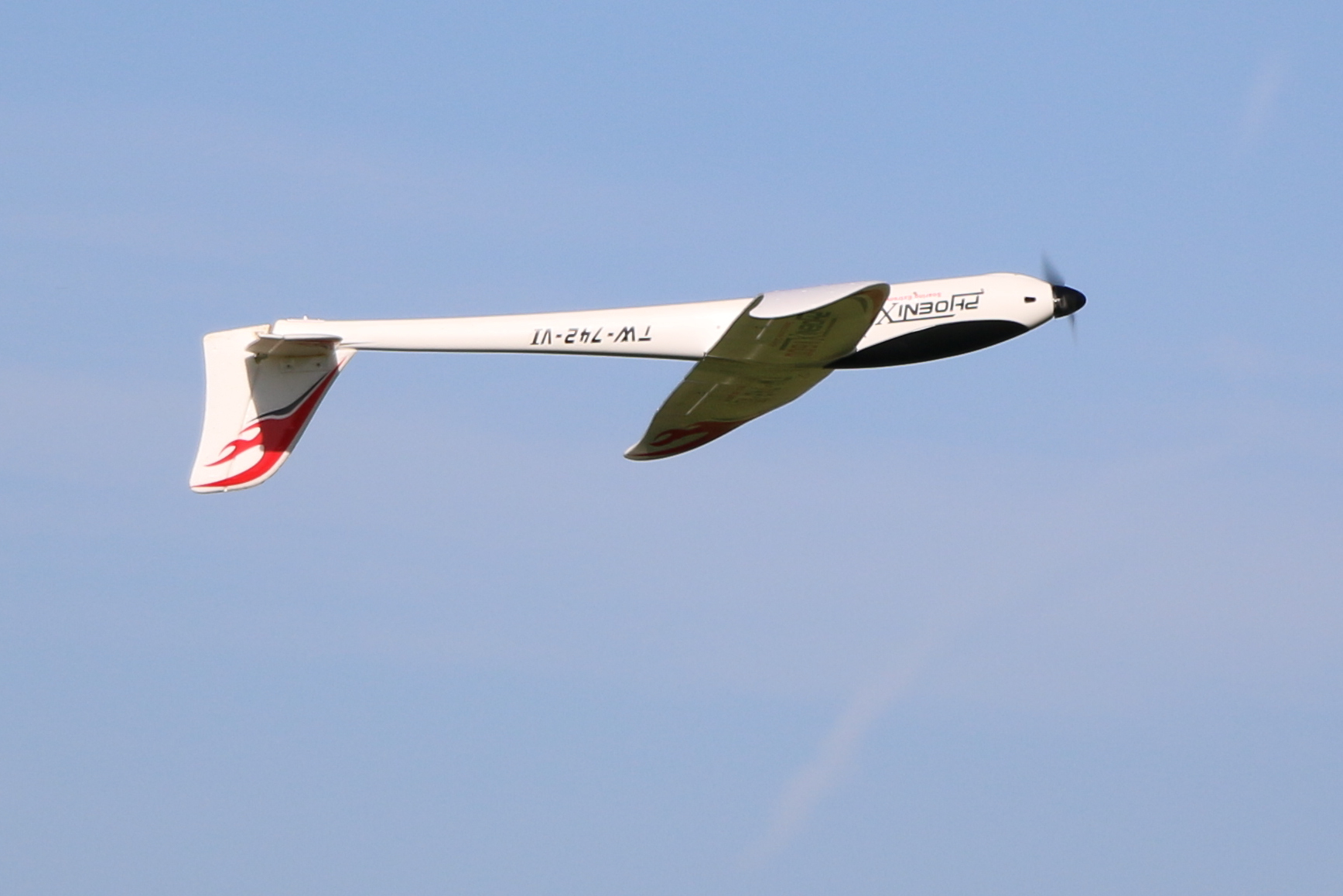
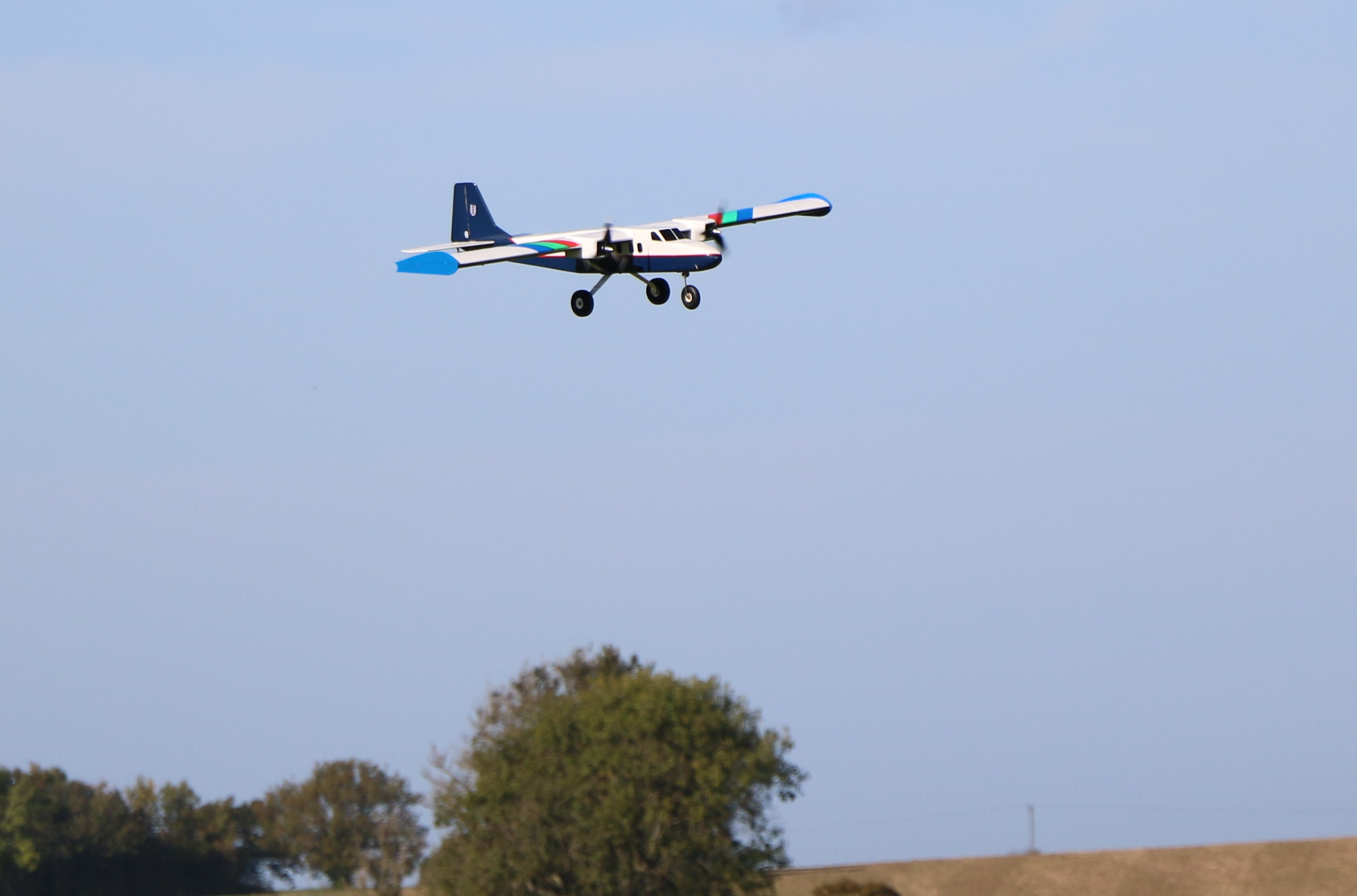
Kryten captured some cracking flying shots for us in October, I love the tiny Pitts ones:
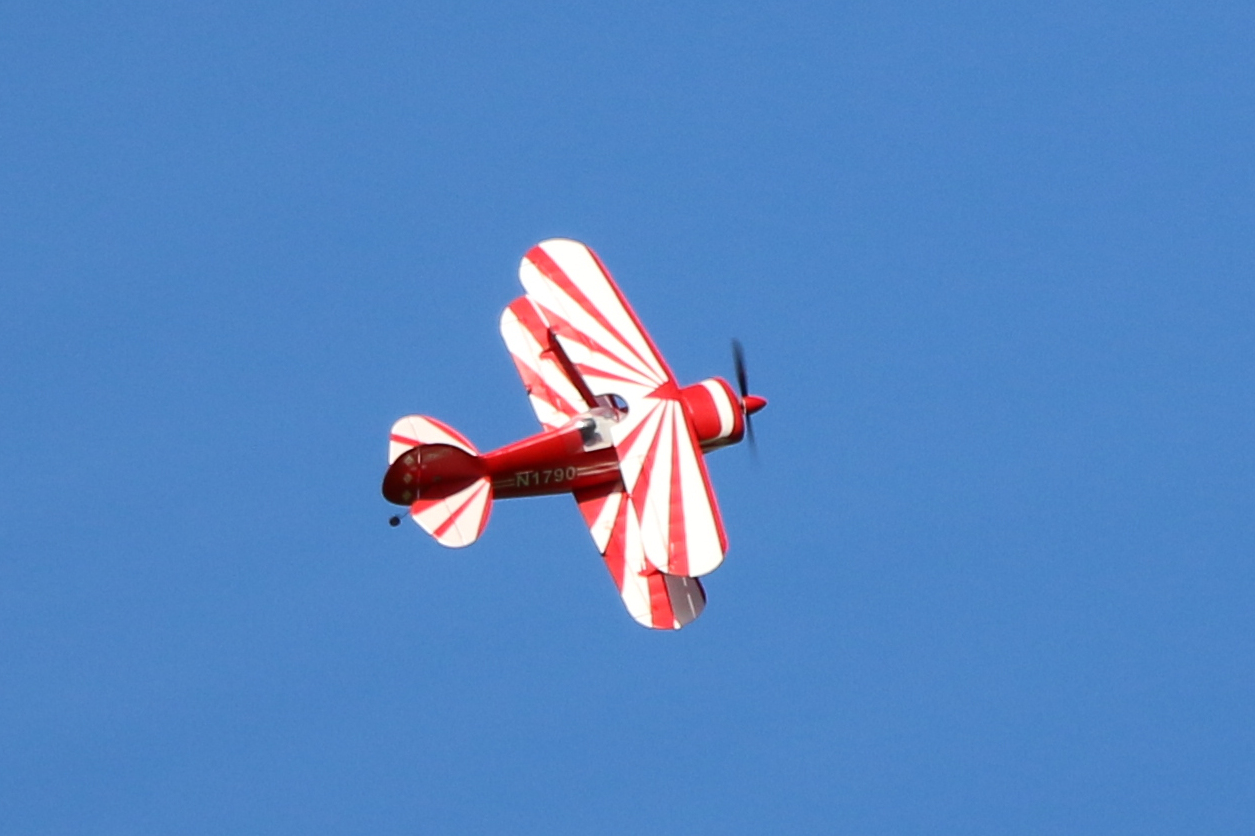
Video time now which this month includes footage shot by me, Dougal, and Nadine:
Please watch the video full-screen, it’s so much better with small models flying around:
If the video won’t play for you please click HERE
During the Covid-19 lockdown a pilot I know was doing some decorating at his house.
I went round to his house to check it out and saw he’d made a great job of the landing…
Colin Cowplain