
Patch News – September 2022
The start of September was rather windy but mostly dry, the first signs of autumn were upon us. Farmer George put lots of sheep in the flying field but they didn’t really cause us any problems and they were gone again by the middle of the month. They returned in the last few days of September but I doubt that they’ll be with us for long. The bullocks are currently in the lower field so we’ll probably be graced with their presence quite soon. With the end of the dry spell the grass recovered and shot up so the patch had to be mown for the first time for ages. Fortunately I was away on holiday so I missed that little treat!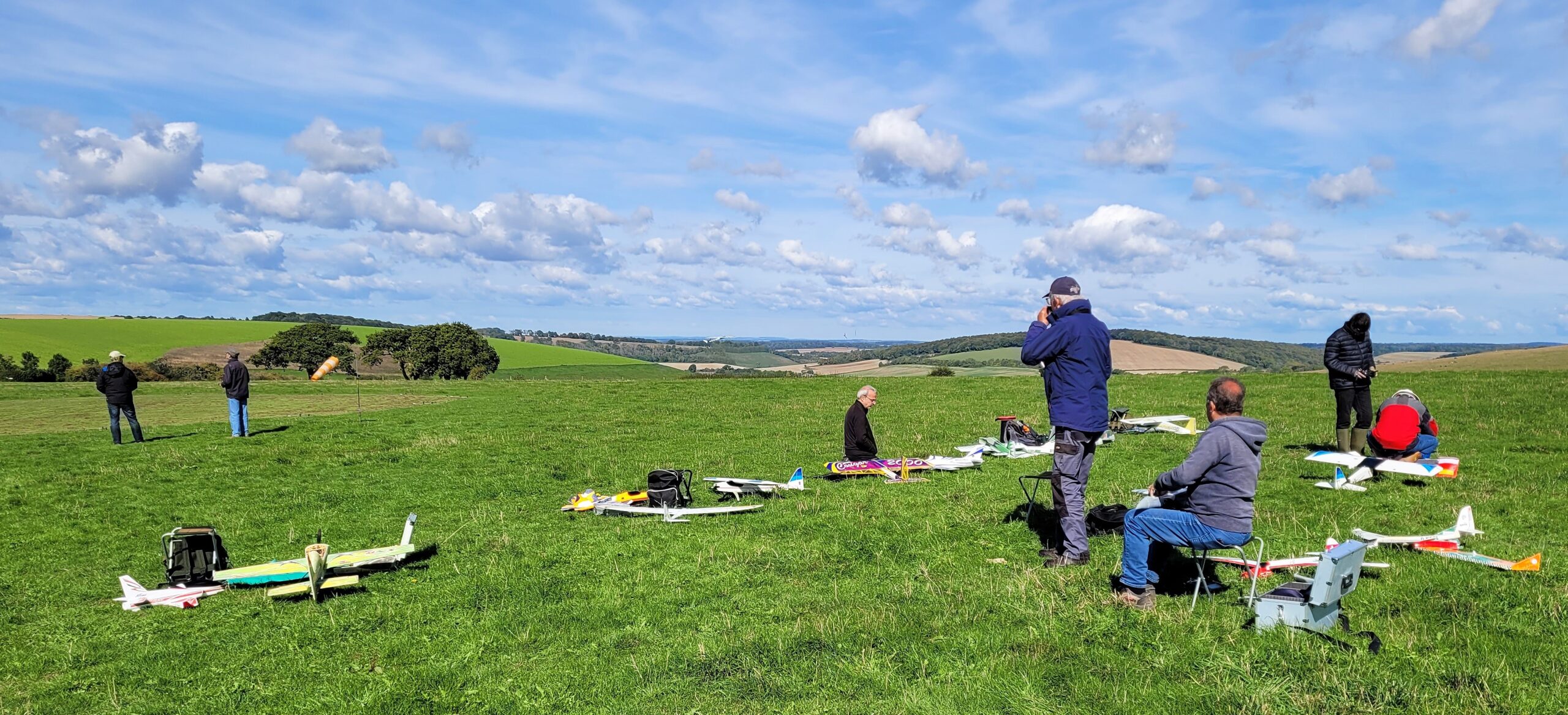
Dwayne Pipe caused some general chaos when he managed to fly his foamboard Sea Vixen into Harper’s Oak one Friday afternoon. He says he thought the plane was on the field side of the trees and was quite shocked when it suddenly stopped dead, surrounded by leaves! 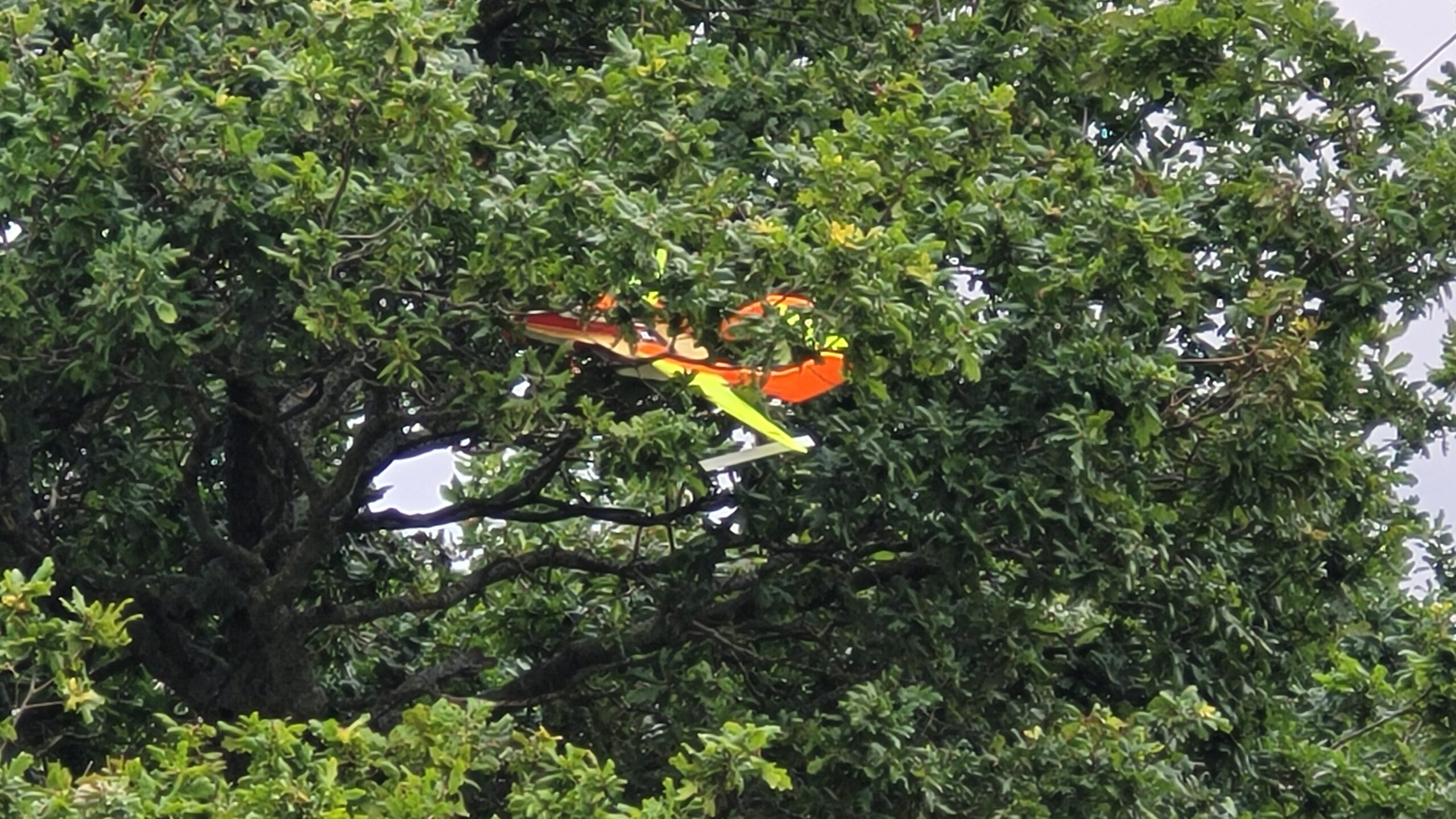 Several members wandered over to enjoy the spectacle… no sorry… they wandered over to help, yes, that was it! I promptly managed to snag myself on the barbed wire fence and proved that blood thinners really do work rather well, the stream of blood running down my left looked fairly dramatic but really wasn’t very bad at all. The Sea Vixen was lodged at the end of a branch, fairly high up in the tree, too difficult to reach by climbing so we began our retrieval efforts by attaching a large screwdriver to the bungee from Dwayne’s EDF launcher and tried to throw it over the branch, hoping to shake the model free.
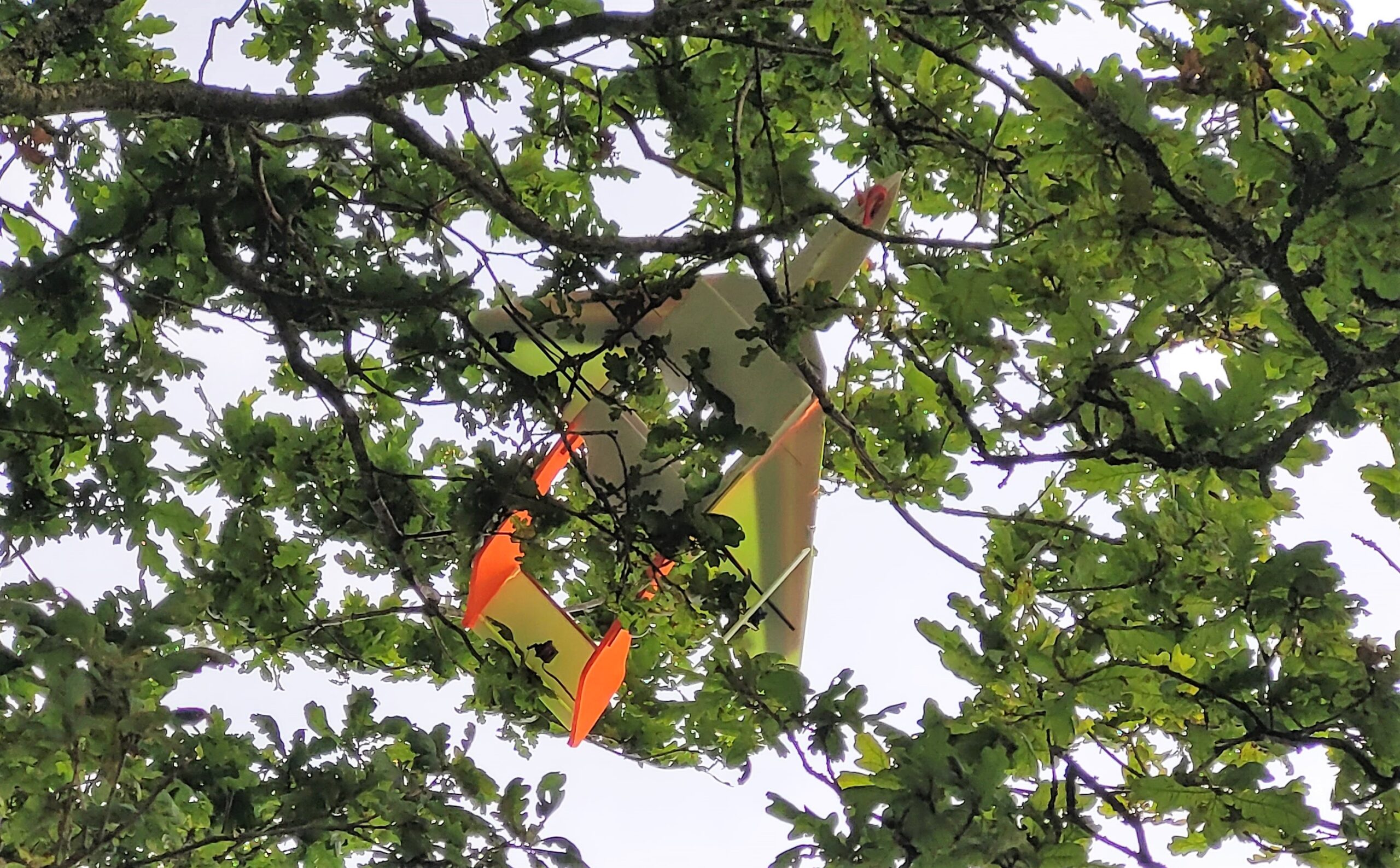 All this achieved was getting the screwdriver stuck in the tree so there was much pulling and waving about of the bungee in an effort to free it, all to no avail. Then Woody decided the only thing to do was to pull really hard on the bungee which ultimately proved to be successful but also very dangerous as when the screwdriver finally became free it speared Woody’s thumb. This produced a lot more blood along with lots of laughter! Of course it could have been a whole lot more serious had it hit Woody’s head or chest. At this point it started to rain and we decided to abandon the plane for the time being and come up with a better plan. So the following morning four of us returned armed with a step-ladder and various poles, gaffer tape, tie-wraps, rope, and anything else we thought might be useful.
 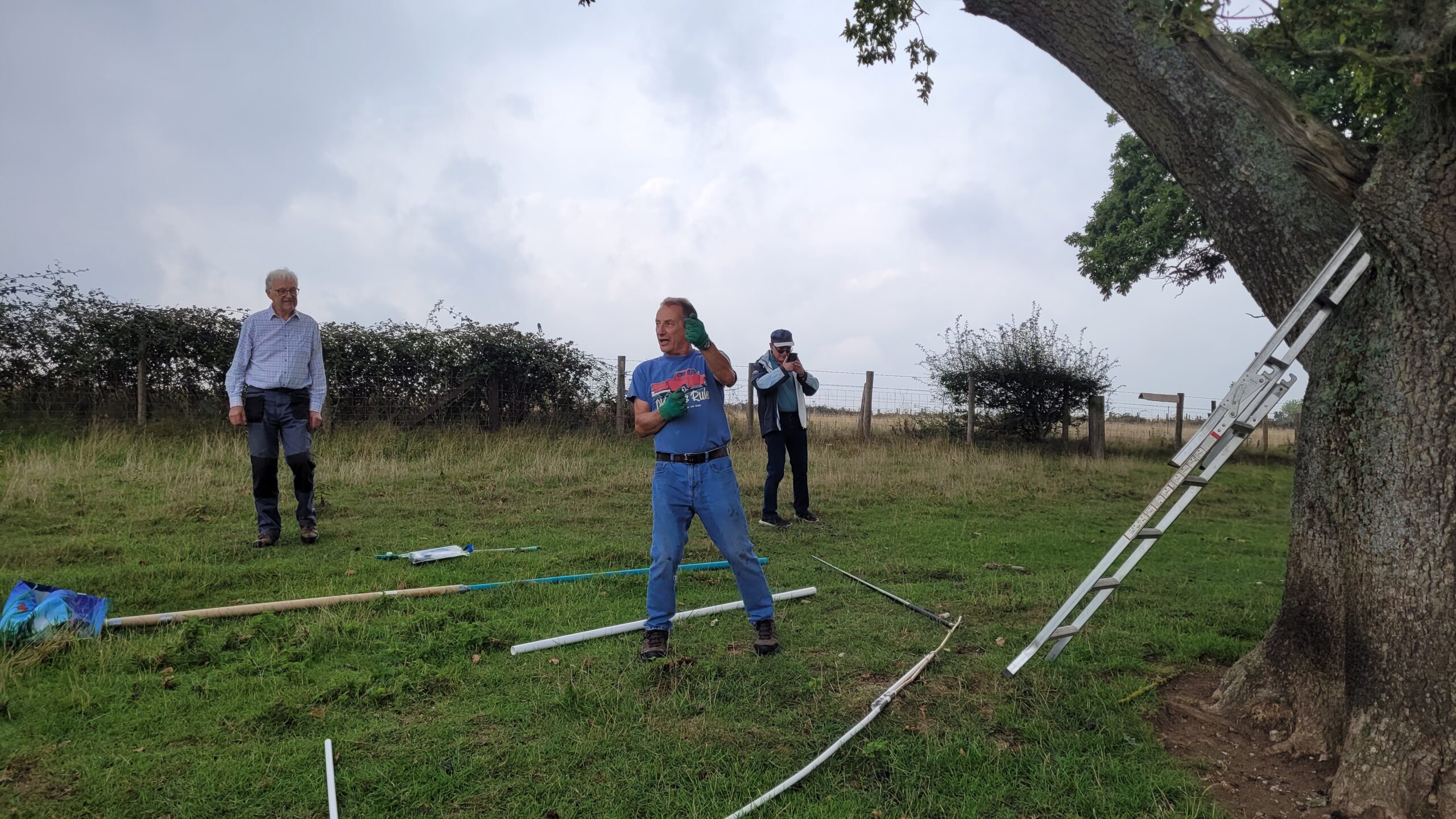 Bob the Builder had brought a sturdy cardboard tube to which we fixed pieces of plastic pipe to make it reach the model. The whole contraption was very bendy but with the mixed skills of three engineers and one postman (all retired) we were able to reach the model.
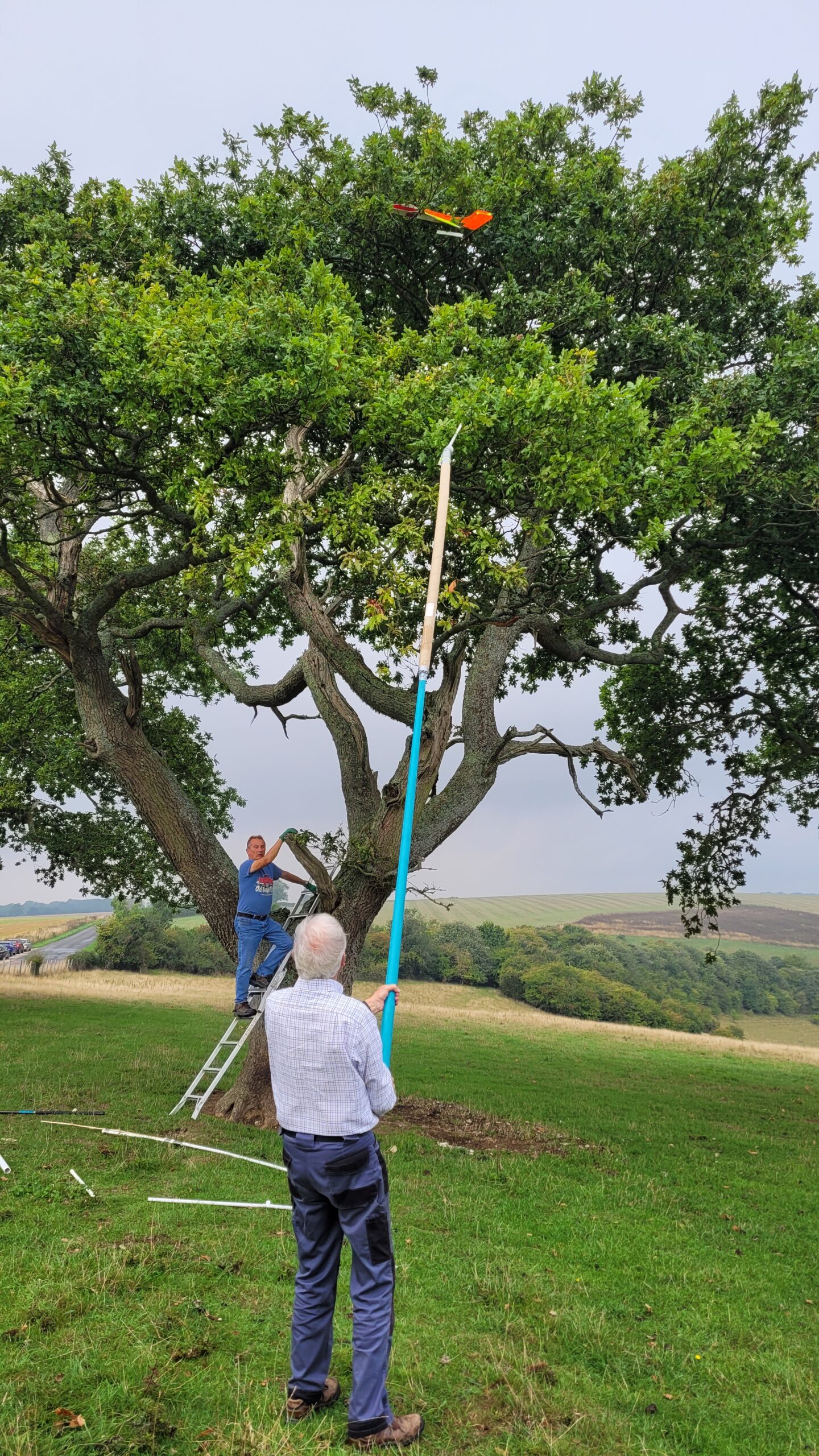 One wit said it was like watching an episode of Last of The Summer Wine or Dad’s Army! Woody insisted that we should guide the pole through the central propeller slot but I think he was just reminiscing about his days as a postman. Eventually after a lot of guidance from the other three Woody managed to get the remains of the plane back on terra firma. I say remains because by this time the poor Sea Vixen had seen much better days.
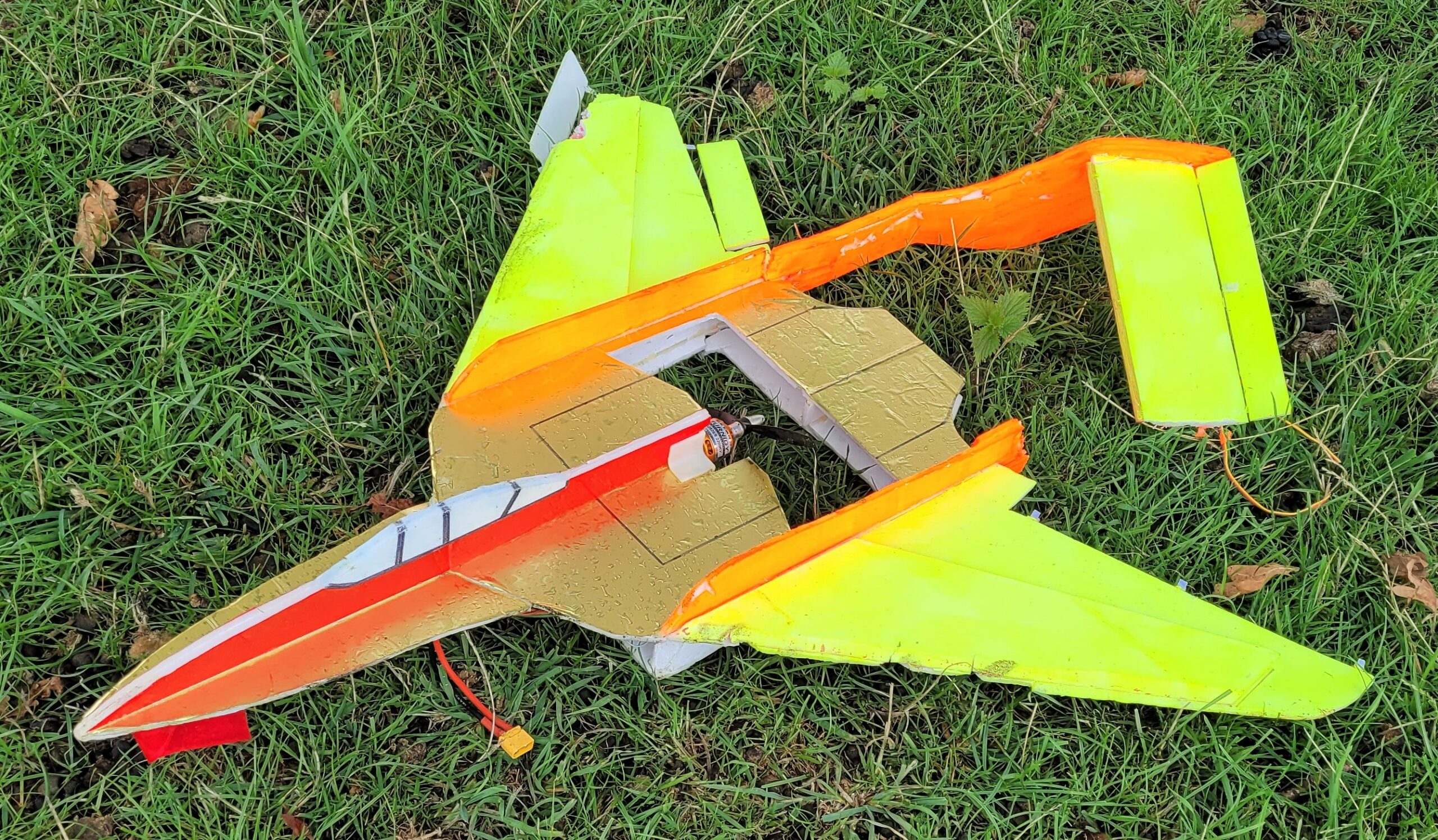 Never mind, overall the mission was a success. Dougal, who had returned to work earlier that week and missed the whole thing was heard to remark “I can’t leave you lot alone for five minutes without you getting into trouble.” I think he has a point…
Has anyone noticed the new HobbyKing Frenzy that they are advertising at the moment? It looks identical to a Max Thrust Riot to me, I have a Riot I can’t see any difference at all apart from the colour scheme. In the past HobbyKing have had some really good prices but now the UK warehouse has closed and it’s no longer possible to order models from the European warehouse the postage from Hong Kong make their prices unviable.

 Today the Frenzy is showing as costing £192.51 but there is a ‘shipping discount’ of £33.69 making the price £158.82 which is a good deal. But the cheapest shipping to the UK comes up as £98.34 which brings the delivered price £257.16. At the moment Kings Lynn models are offering a Riot for £169.00 with free delivery which makes it £88.16 cheaper than HobbyKing. I’ve been a huge fan of HobbyKing in the past and have bought loads of stuff but sadly with the current set-up it simply doesn’t make sense to buy from them. It’s a great shame and I really hope they can sort out a better deal for UK modellers soon.
There weren’t many new models flown in September but Norwegian Nick showed up with a couple of interesting ones. The first is a Lockheed SR-71 Blackbird, an interesting and fairly unusual subject for a model but it’s actually an ideal subject for foamboard.
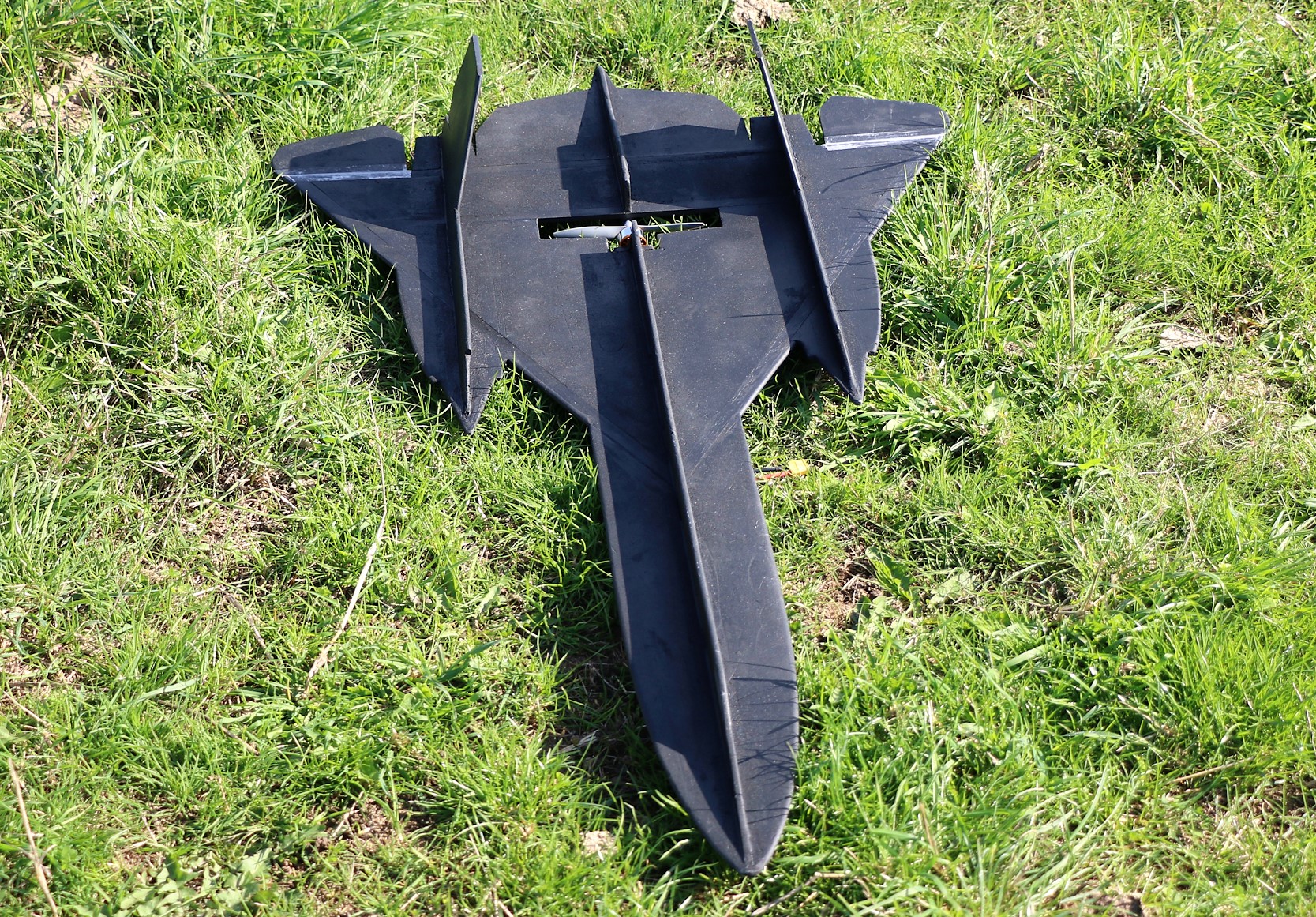

The Blackbird was a Strategic Reconnaissance (SR) aircraft that flew at over Mach 3 and 85000 feet altitude. Amazingly its’ first flight was in 1964, 58 years ago…does everyone feel old now?! Nick built his from a plan drawn up by Laddie Mikulasko which is available from Sarik Hobbies. They offer three different deals, you can buy just the plan for £17, or a laser cut Depron pack for £25, or a Short Kit containing both the plan and laser cut pack for £38.50.This is the description from the Sarik Hobbies website: Designed by Laddie Mikulasko, this is a quick and easy 693 mm span electric profile sport-scale build from the CAD drawn large single sheet plan. All Depron construction with some balsa and spruce strip, and uses an economical BL2212/06 2200KV motor, 40 Amp ESC and 3S 3000 Lipo with a 6″x4″ in. APC-E prop. A delight to fly.
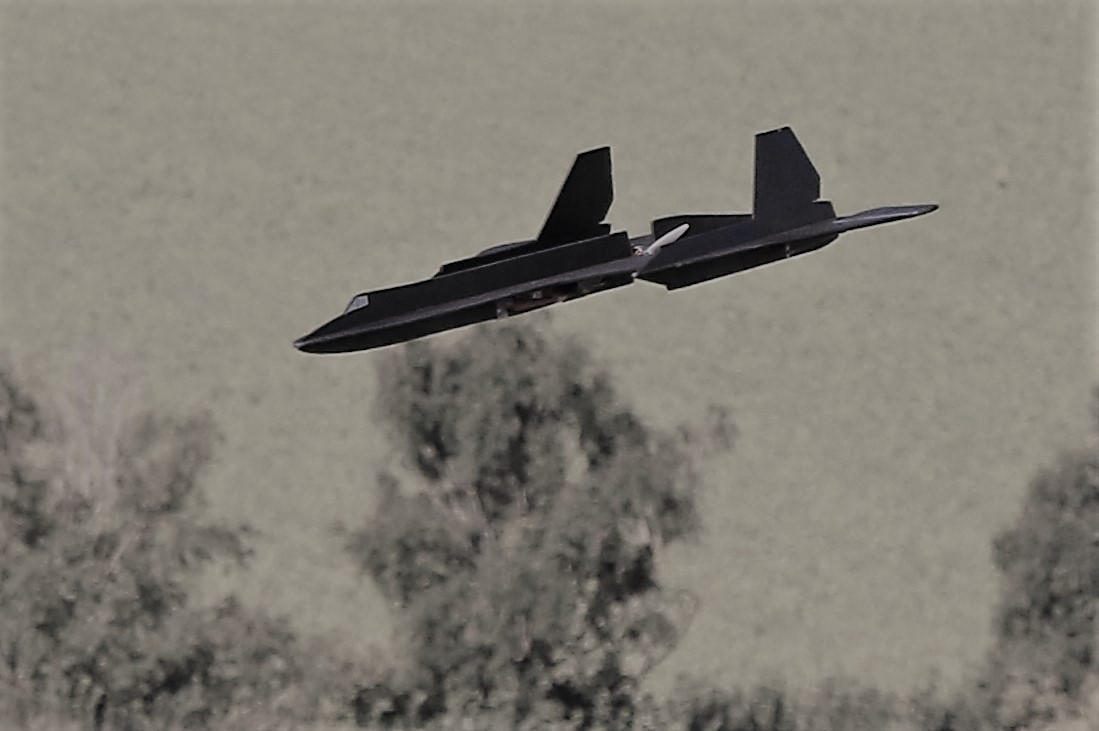 Nick’s model is 693mm span and 1270mm long, so rather larger than I first thought when I saw the photos. It weighs 488gms and uses three channels, having elevons and throttle but no rudder. Nick has fitted the suggested 2200kv motor and 40A speed controller but is flying it with a 2200mAh 3 cell lipo battery as he doesn’t have any 3 cell 3000mAh packs.
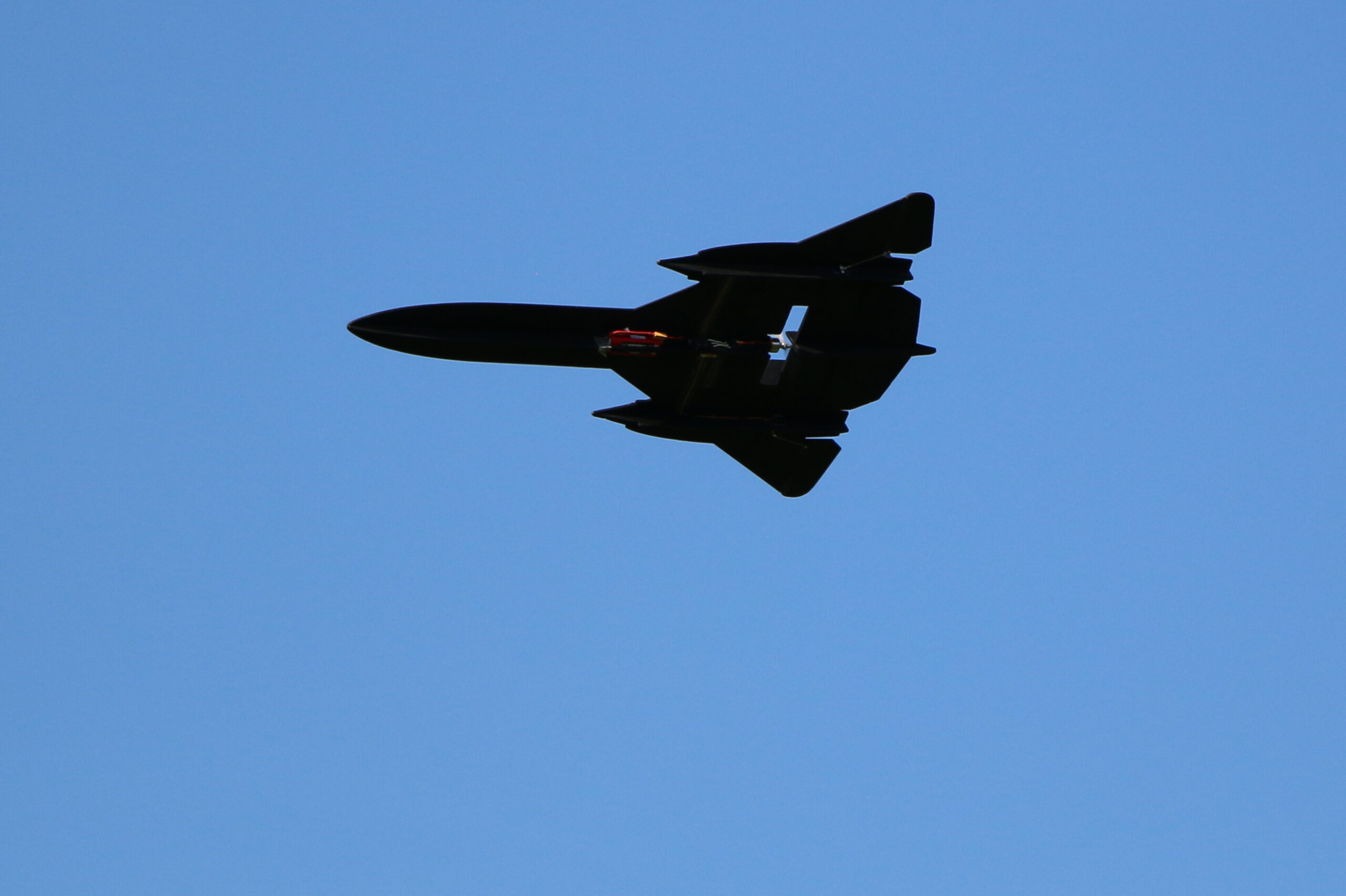 I would imagine you’d get a really long flight time with a 3000mAh pack so the 2200’s should be fine. Nick says the test flight was ok but the model was a little tail heavy, presumably because he used a smaller battery, but that should be easily sorted for the next outing. Unfortunately nobody shot any video of the flight but I’ll hopefully get some for next month’s Patch News. Kryten took all of the above photos of Nick’s model both on the ground and in the air and I have to say it looks very Blackbird’ish, I like it a lot.
Nick’s second new model is a Sea Vixen that he built using Dwayne Pipe’s templates but instead of using Hobbycraft foamboard Nick has built his from Depron.
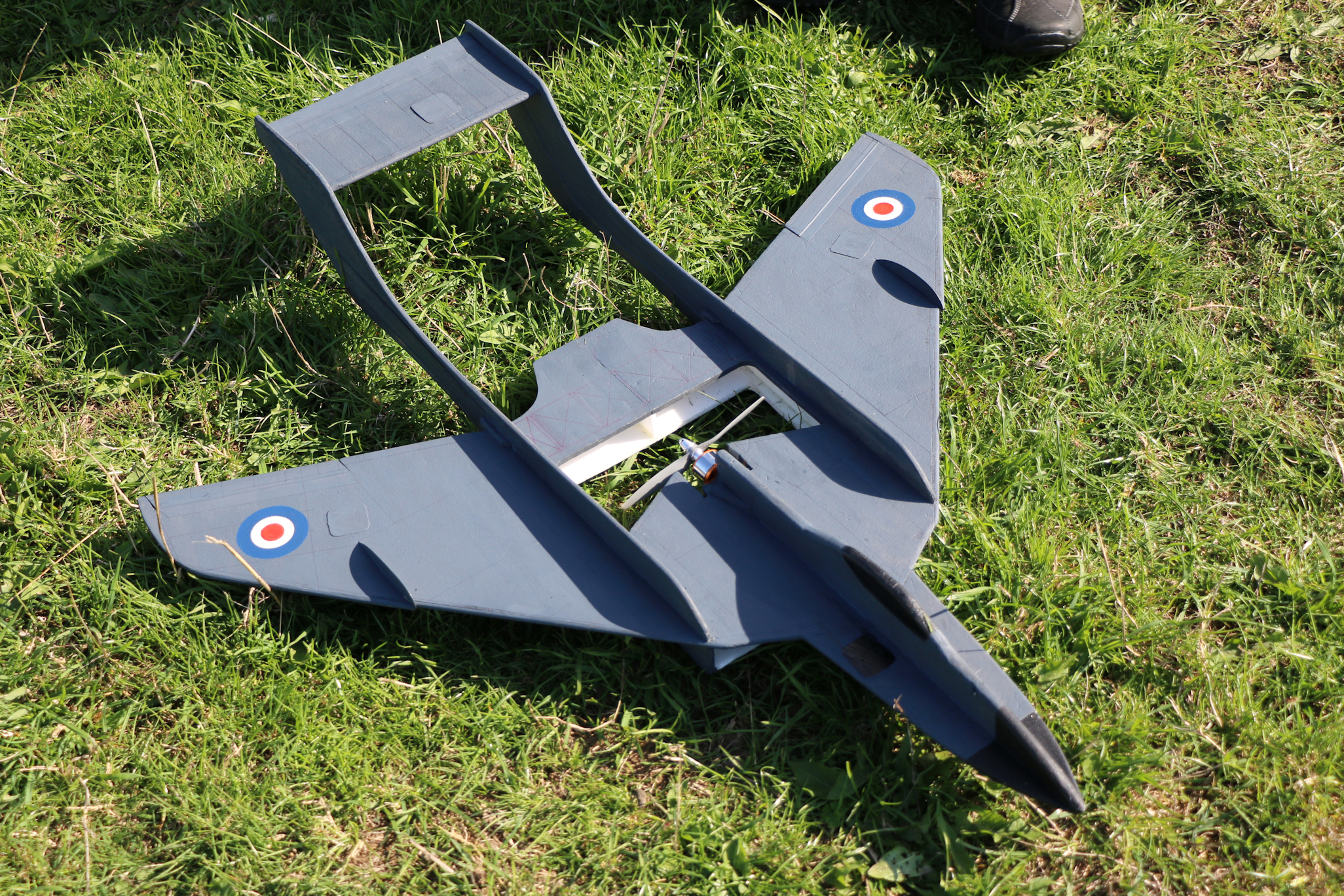 The Sea Vixen weighs 354gms, I wonder how that compares with the foamboard ones. Nick is using the same 2200kv motor as in the Blackbird but for the test flight he used a 1000mAh 3 cell lipo and found that the voltage sagged just a few seconds into the flight.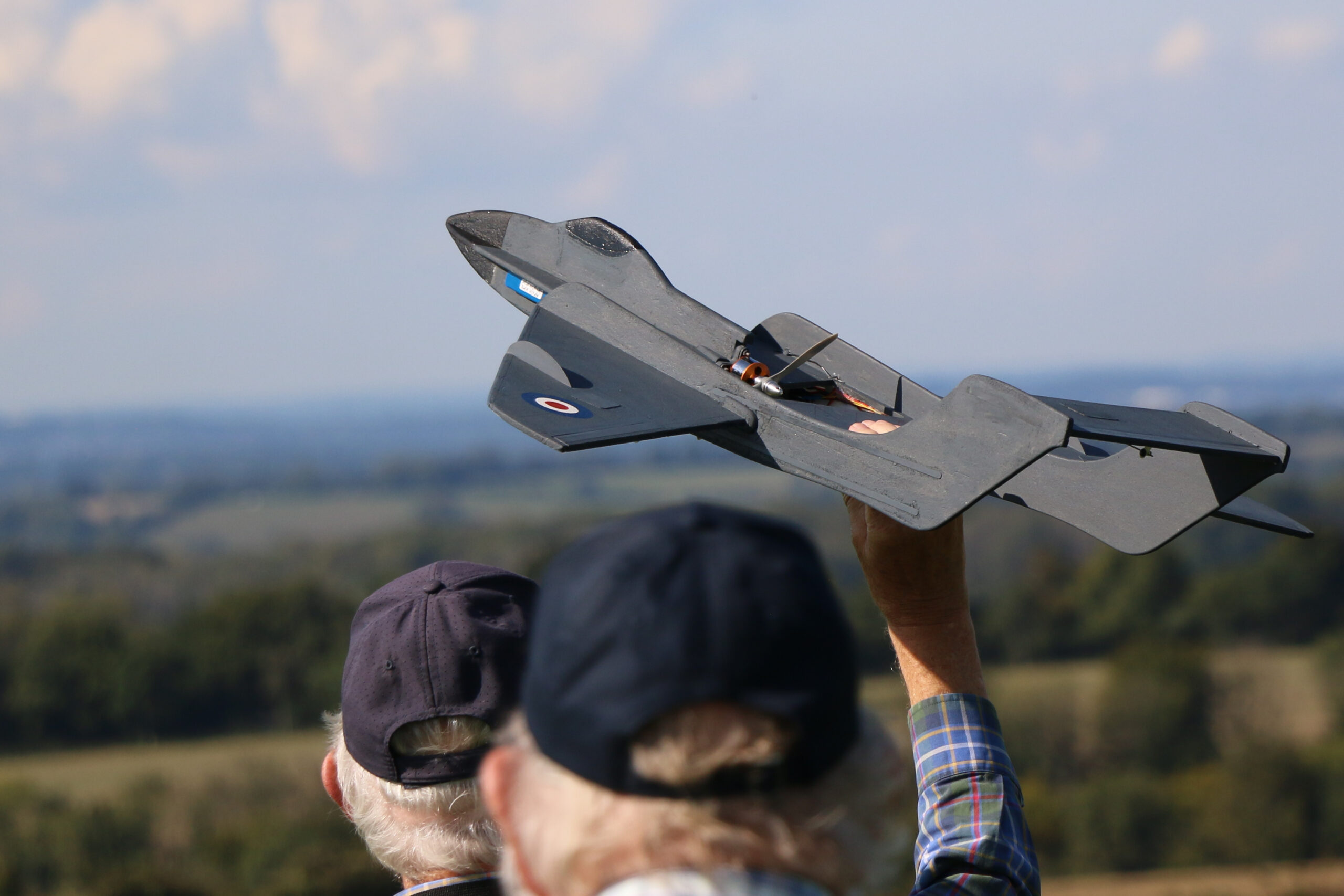
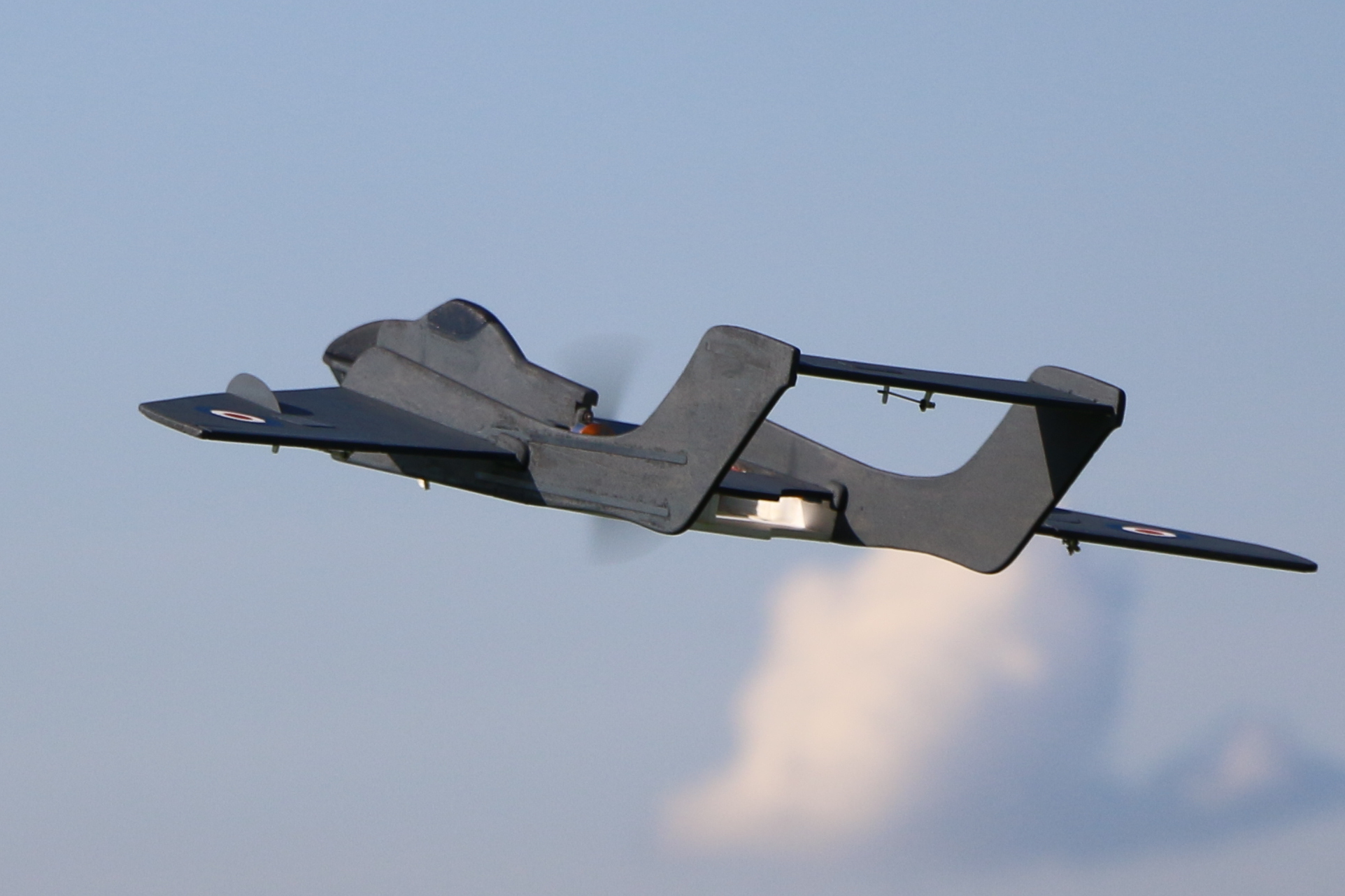 Apparently the 1000mAh packs are now 5 years old and obviously past their best so next time out Nick is intending to use some new 1300 or 1350mAh packs. I may be wrong but I think some of the other club members are using 2200mAh packs in their Sea Vixens so that might be worth trying although maybe it would be difficult to obtain the correct centre of gravity. Again, I don’t have any video but Kryten took some excellent photos.
Dougal Entendre had lucky moment early in the month, it turned out alright but could have been very different. I’ll let Dougal explain what happened: I hadn’t flown the Ghost Rider for at least a couple of months, and before I flew it I said that the gremlins had had plenty of time to get to work on it, so I checked it over carefully before flying. All went well on the first flight until right near the end, when I noticed a sudden change in aileron trim. On landing I found that the left aileron was stuck with several degrees of up deflection due to servo failure in that wing. I still had two batteries to use up, so remembering how some pylon racers are designed to have only one aileron, I disconnected the failed servo and taped the left aileron in the neutral position.
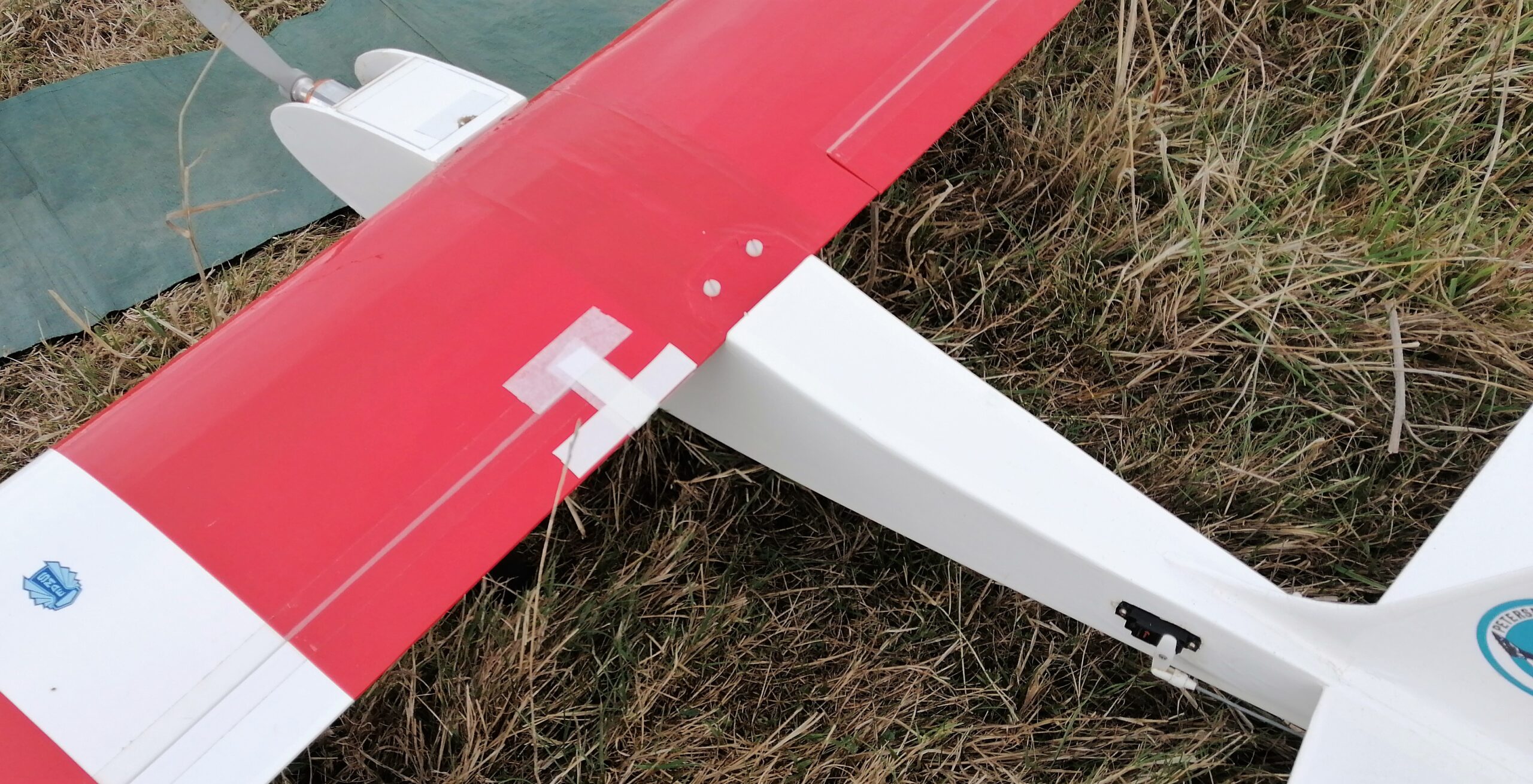 The subsequent flights both went OK, though as expected, aileron sensitivity was reduced. Surprisingly though, the roll rate was much faster to the right than to the left.
 I would have expected it to roll faster to the left as the one working aileron went down into the higher pressure area below the wing. Checking the radio showed there was no aileron differential programmed in. The control horns are on the underneath of each aileron, and are set back from the leading edge, so they do give some differential (more up than down) at large deflections. I think the main reason for the faster roll to the right is due to the top hinge though. There’s quite a large gap on the lower surface, and a sealed tape hinge on the top, so an upgoing aileron probably disrupts the airflow more than when it has the same downward deflection. That’s my theory and I’m sticking to it!
Captain Slow finally brought his long awaited Wots Wot Foam-E up to the patch for its’ first flight in September. I forget when he bought it but it seems to have been quite a long time ago. But never mind it’s not good to rush these things. The Wots Wot is a foam biplane with wingspan of 1000mm and it comes with the motor, speed controller, and four 9gms servos already fitted. The motor is a 920kv outrunner connected to a 40A esc which swings a 12×6 propeller when powered by a 3 cell 2200mAh lipo battery.
 Here’s what the Ripmax website says about it: The Wots Wot Foam-E makes for a perfect all round sports foam aircraft. The Wots Wot Foam-E combines the slow speed characteristics of the Wot4 Foam-E and the precision and ‘locked in feel’ of the Acrowot Foam-E. The Wots Wot Foam-E has been specifically designed to suit a popular 3S 2200mAh Li-Po battery resulting in a model that will fit in a hatchback car boot fully assembled! For a little more flight time, try the Hi-Energy 2700mAh pack instead. Using the latest in foam moulding technology you will notice the edges are very crisp and sharp without the weight penalty of a denser foam. The control surfaces use ‘live’ style moulded foam hinges but they also have plastic hinges moulded into the foam for extra security. Assembly is easy and requires only a cross head screwdriver. It’s so quick it takes longer to fit the decals than to assemble the airframe! In the air biplanes are associated with slow scale flight but not the Wots Wot, thanks to four large ailerons the roll rate is fast and authoritative and the short moment of the design gives great elevator and rudder power. The Wots Wot really excels during slow speed flight and can be really docile with low rates on. Up the rates and open the throttle for flicks, spins and knife edge loops. The stall is benign and thanks to the biplane layout it really slows down nicely for landing.
 Captain Slow aborted the first take-off because just as the model lifted off there was a horribly loud vibration noise. Although he’d run up the motor previously he hadn’t reached full throttle and upon investigation Captain Slow found the motor mount was very loose, hence the vibration. After a few minutes work with a screwdriver all was well so he tried again and this time the Wots Wot took to the skies with no further problems. Captain Slow tells me that he ran out of elevator travel on the first landing and he needs to increase the expo on the ailerons but otherwise all was good. I think he’s going to enjoy this model. A couple of years ago I did the test flight of Chris P Bacon’s identical Wots Wot and was really taken with the biplane, it felt solid and totally under control right from the start. Oddly I never really felt comfortable with his larger 50” wingspan balsa and ply Wots Wot on 5 cells. You can see Captain Slow’s first flight and second landing in this month’s video.
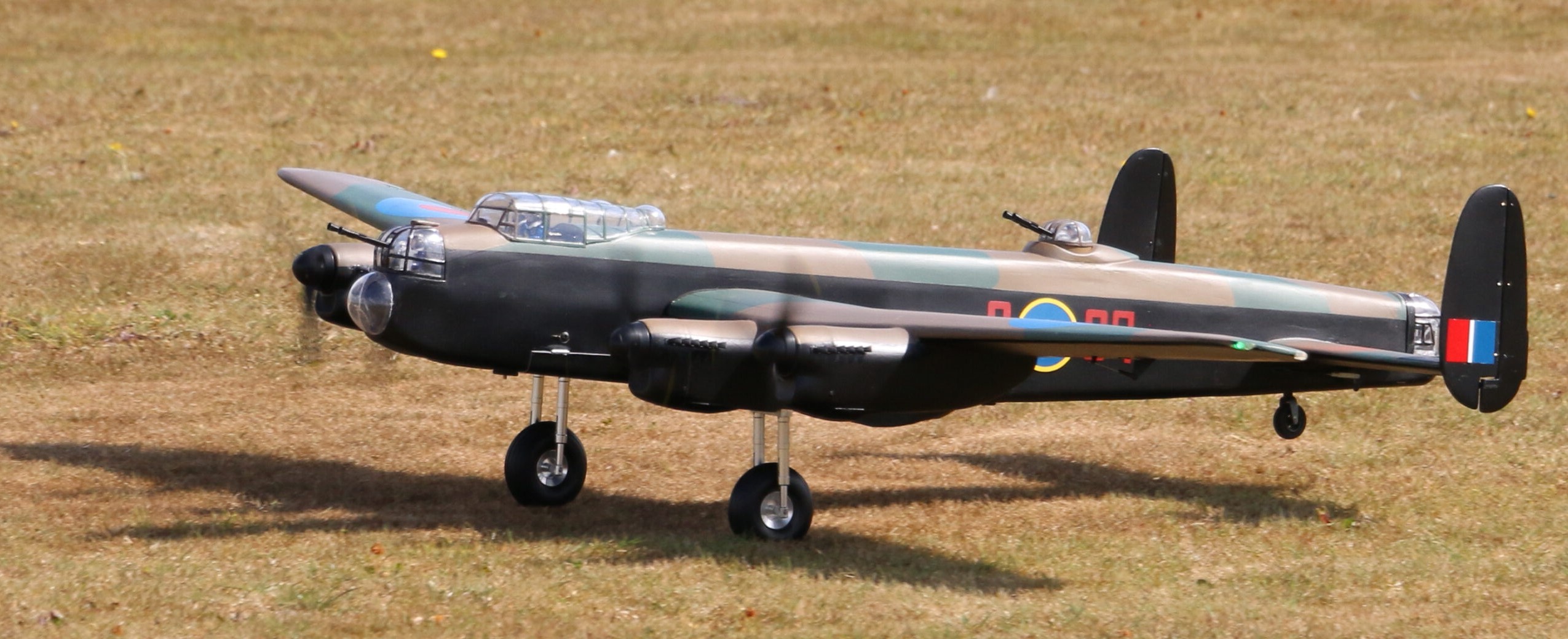 Sadly it suffered with extreme glitching and crashed but Percy has provided an update on the repairs and a fix for the glitching: I’ve completed all of the repairs – just some minor cosmetic items like redoing some of the panel lines. I’ve also taken advantage of making one or two minor improvements whilst doing the repair. The problem that caused the glitch and subsequent crash was caused by the 5A UBEC – no obvious reason for that! I tried replacing the UBEC with a 2s lipo and the system worked perfectly. I also tried using the 3A BEC of a spare ESC – again no problem, so came to the conclusion it must be the 5A UBEC responsible. Rather than replacing it with another 5A UBEC (which tend to be expensive!), I’m using two 3A UBECs – one to supply the receiver and servos, and the other to supply the retracts. All systems now function correctly.
Well done Percy, I look forward to the next flight which I sure will be trouble free.
Sadly it suffered with extreme glitching and crashed but Percy has provided an update on the repairs and a fix for the glitching: I’ve completed all of the repairs – just some minor cosmetic items like redoing some of the panel lines. I’ve also taken advantage of making one or two minor improvements whilst doing the repair. The problem that caused the glitch and subsequent crash was caused by the 5A UBEC – no obvious reason for that! I tried replacing the UBEC with a 2s lipo and the system worked perfectly. I also tried using the 3A BEC of a spare ESC – again no problem, so came to the conclusion it must be the 5A UBEC responsible. Rather than replacing it with another 5A UBEC (which tend to be expensive!), I’m using two 3A UBECs – one to supply the receiver and servos, and the other to supply the retracts. All systems now function correctly.
Well done Percy, I look forward to the next flight which I sure will be trouble free.
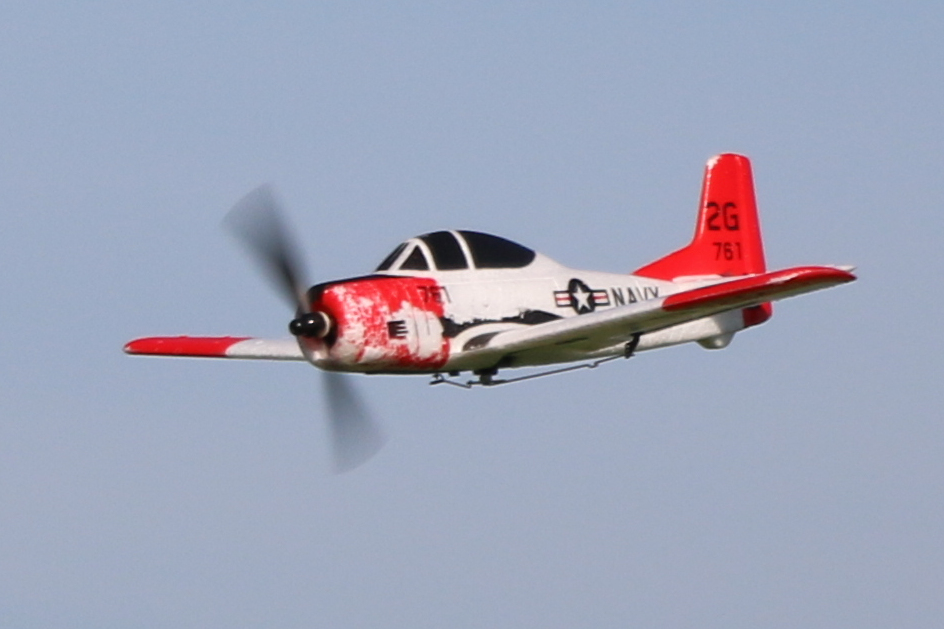
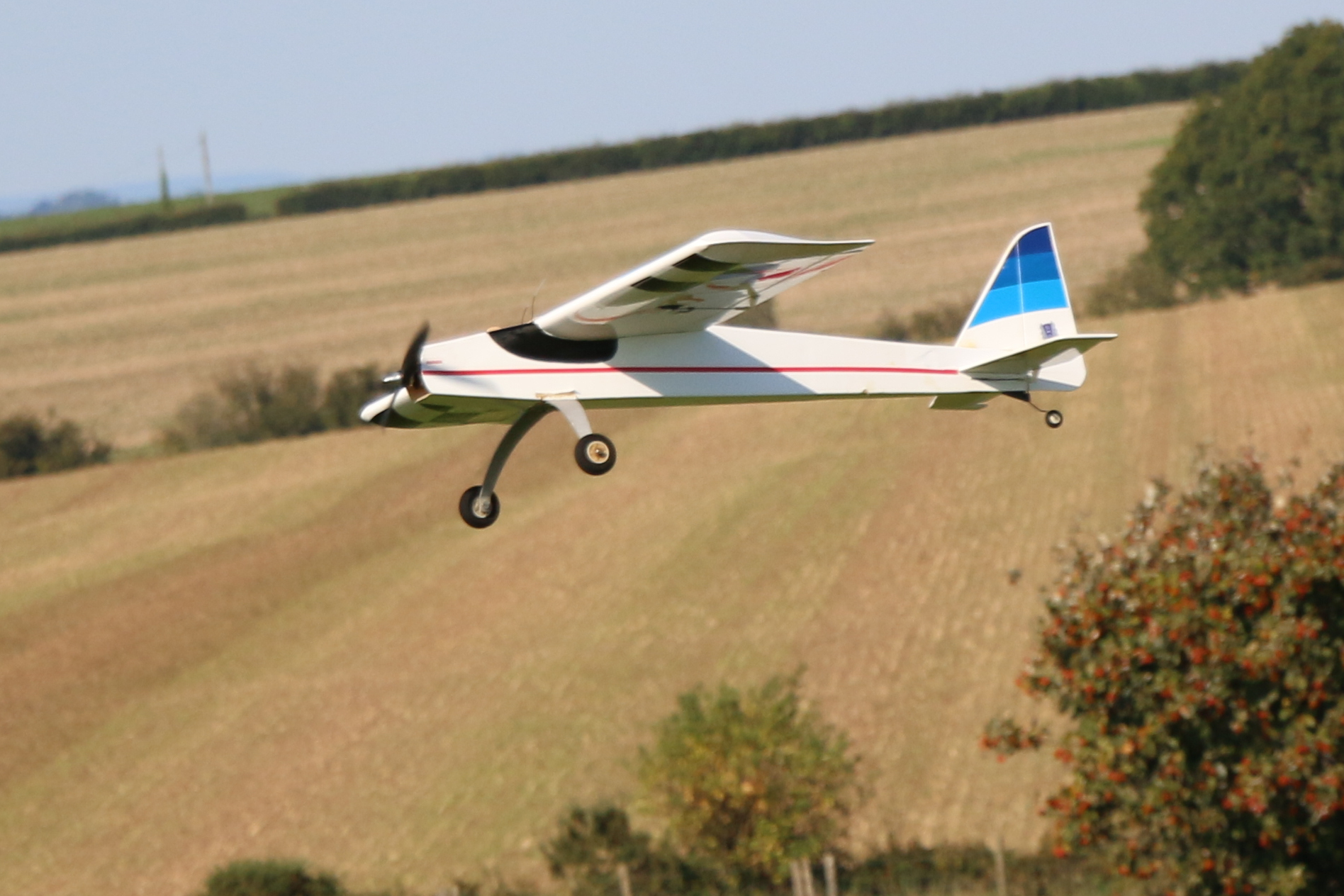
This month Kryten has sent through some more of his excellent photos for us to enjoy:


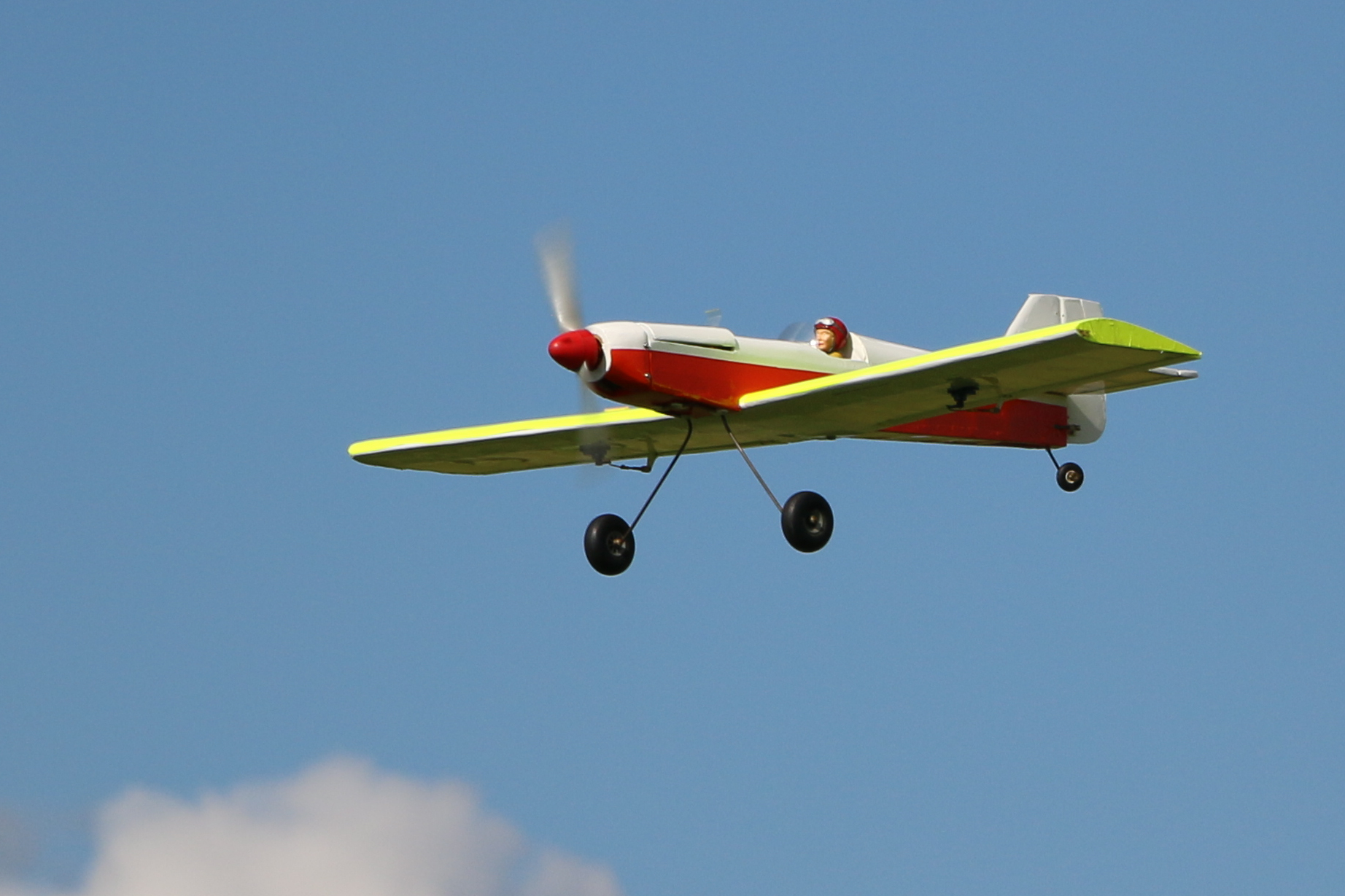
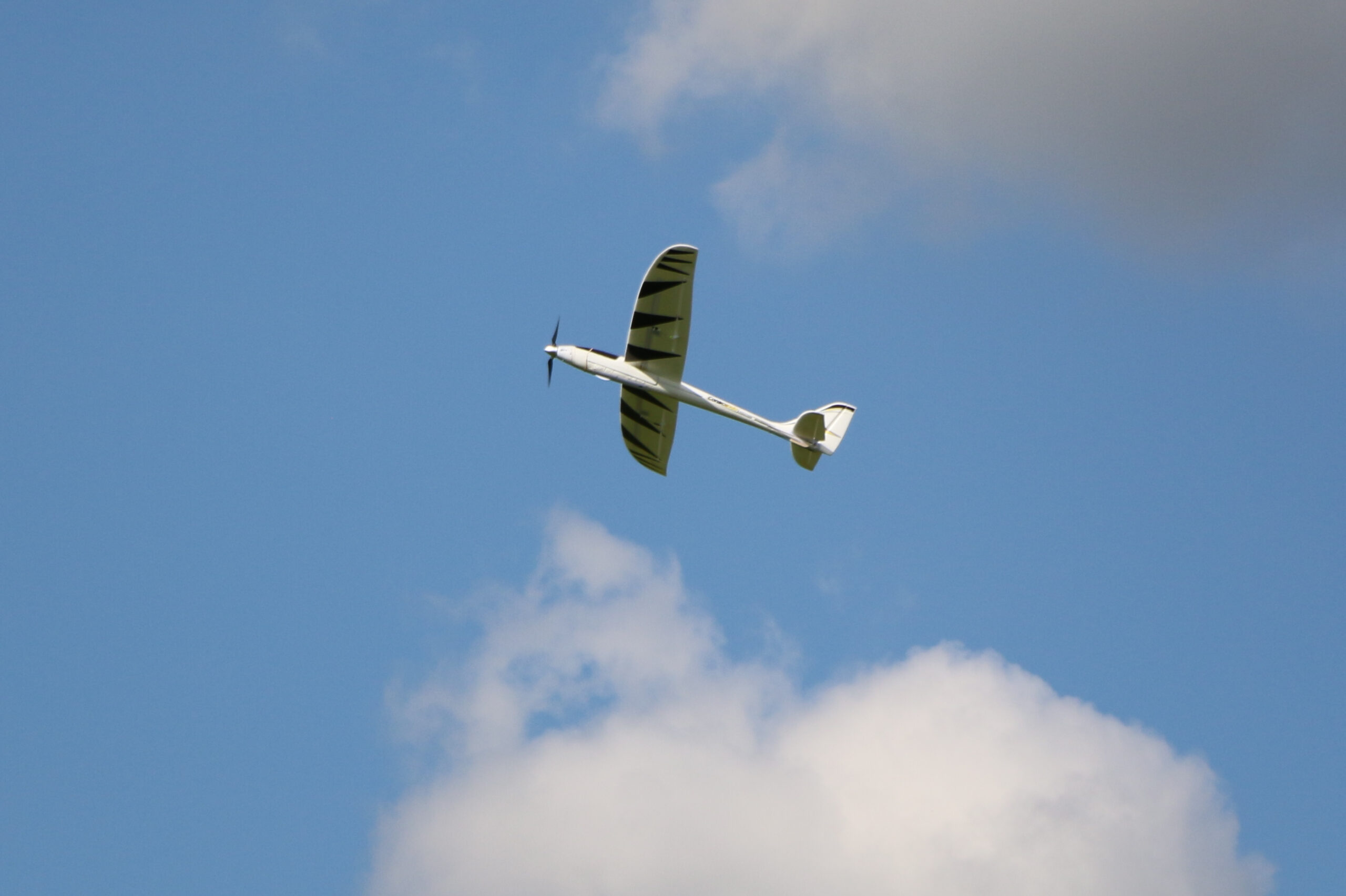
Video time now, this month with footage recorded by Dougal, and Peter Fothergill. Please watch the video full-screen, it’s so much better with small models flying around. If the video won’t play for you please click HERE
An F-111 fighter was flying as an escort to a B-52 bomber and generally making a nuisance of himself by flying loops and rolls all around the lumbering old bomber. The pilot radioed over to the B-52 crew “Anything you can do, I can do better.” Not to be outdone, the B-52 pilot replied that he would accept the challenge. But the bomber simply continued on with its flight, flying straight and level as before. Perplexed, the fighter pilot asked “So? What did you do, I didn’t see anything?” “We just shut down two engines.”
Colin Cowplain
Patch News – August 2022
The hot dry weather of July continued into August and with temperatures in the mid-thirties at the field we sometimes wilted a bit but at least we didn’t have to mow the patch or contend with the bullocks. Members took full advantage and enjoyed lots of flying.
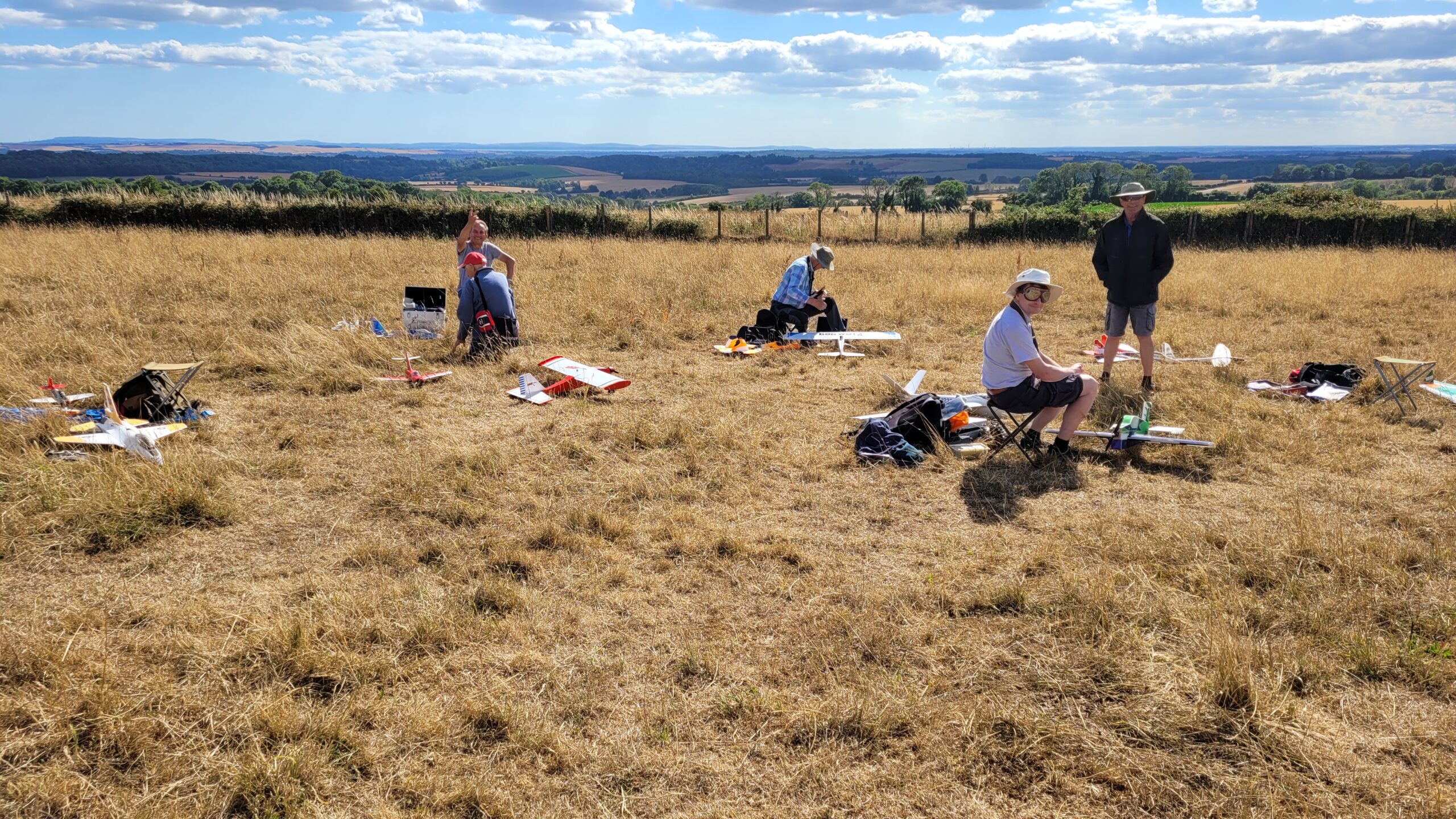 In the middle of month we had a few light showers but not enough rain to green up the field. Later, towards the end of August, there were stronger winds and a little more rain.
Early in August we received the sad news that club member Ian Daniels had passed away. 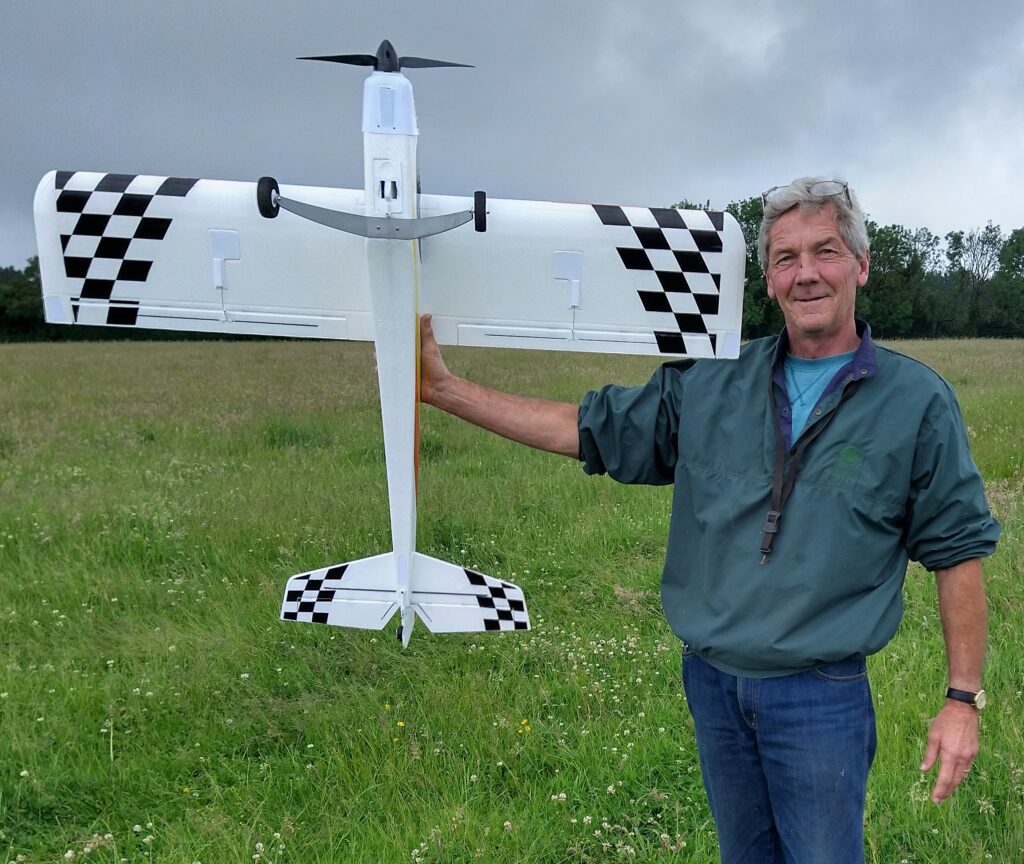 Ian was not a long-term member having only joined the club in June 2021 but he was a very popular chap with a long history of both model and full-size aviation. We were aware of Ian’s illness when he joined the club and on 31st July he lost his battle aged just 59.
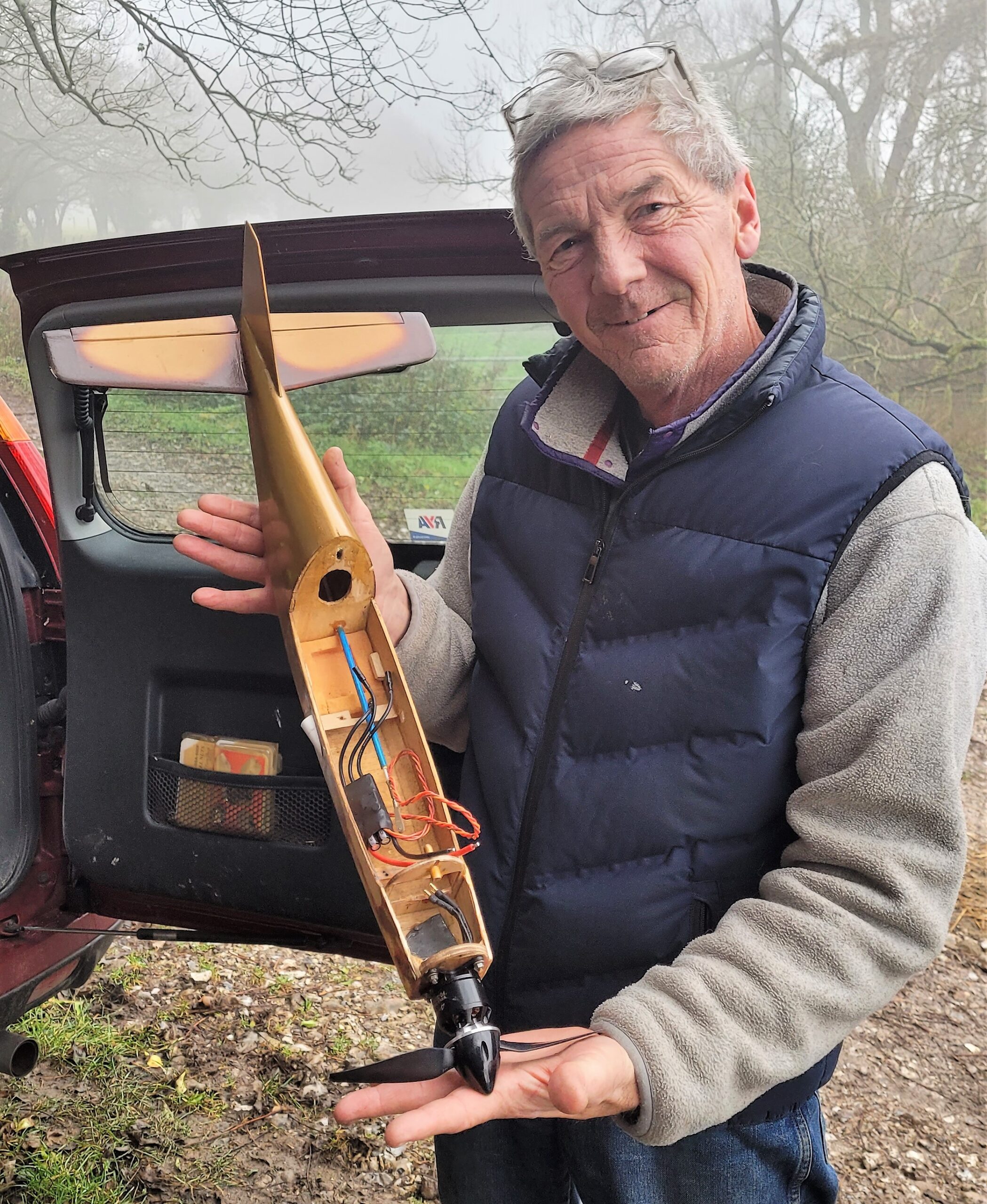 Five members attended Ian’s funeral at The Oaks crematorium on 22nd August where they learnt lots about his very full life including that he had been a ski instructor and had lived in St. Lucia for a while working as a scuba diving instructor. Ian will be greatly missed.
In the last Patch News I featured Dougal Entendre’s Salto H101 glider which he’d electrified and test flown but I hadn’t had time to edit the video I’d taken of it flying.
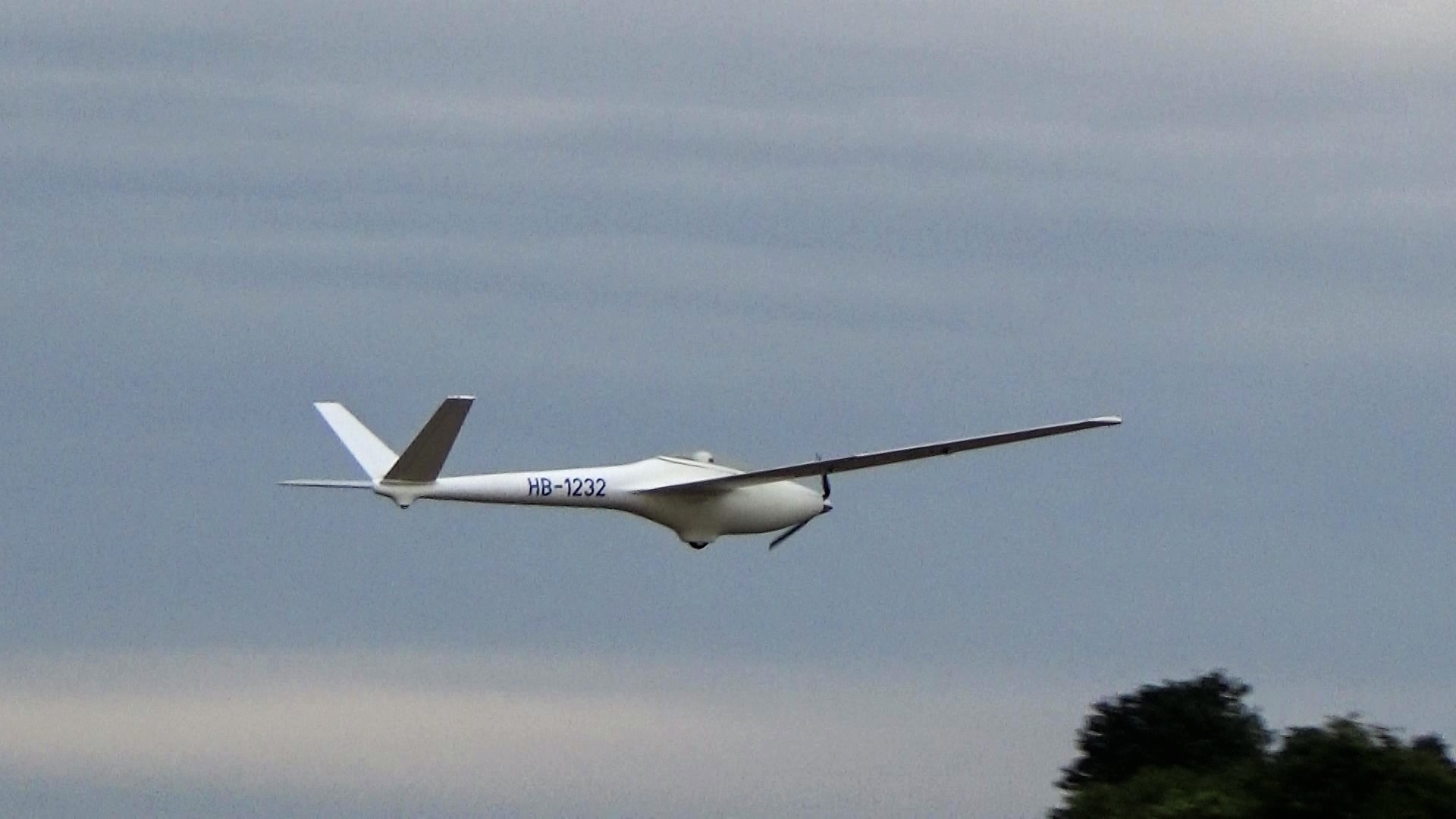 It’s done now and you can see ground based and FPV footage of it in this month’s video.
Young Charlie took a trip to Sussex Model Centre in Worthing and came away with two models, an Alpha and a Spitfire. The Alpha is one of a series of three produced by Flite Test, the others being called Bravo and Charlie. I can’t help thinking the Charlie would have been more appropriate but SMC didn’t have one! This is from the Flite Test website: The Alpha was designed to be a quick and easy to fly build, an all-around best performer out of the Triad series. The FT Alpha is compatible with the FT Bravo and FT Charlie kits. Each airplanes’ wings are built to be removable from the fuselage, and can be swapped with any of the other Triad planes, giving the builder essentially 9 planes to choose from. There is no need to re-calibrate the center of gravity on the aircraft after swapping, the CG remains the same no matter what combination you configure. This is great for the flight line and swapping with others, making it an enjoyable experience for all. We want you to have an amazing experience both in building and flying. This kit comes with everything you need to complete the FT Alpha Aircraft. Push-rods, control horns, firewalls and all other items needed to make this airframe electronics ready are included in the kit. If you choose to purchase our power pack F and battery, balance, flight performance and assembly will be quick and easy.
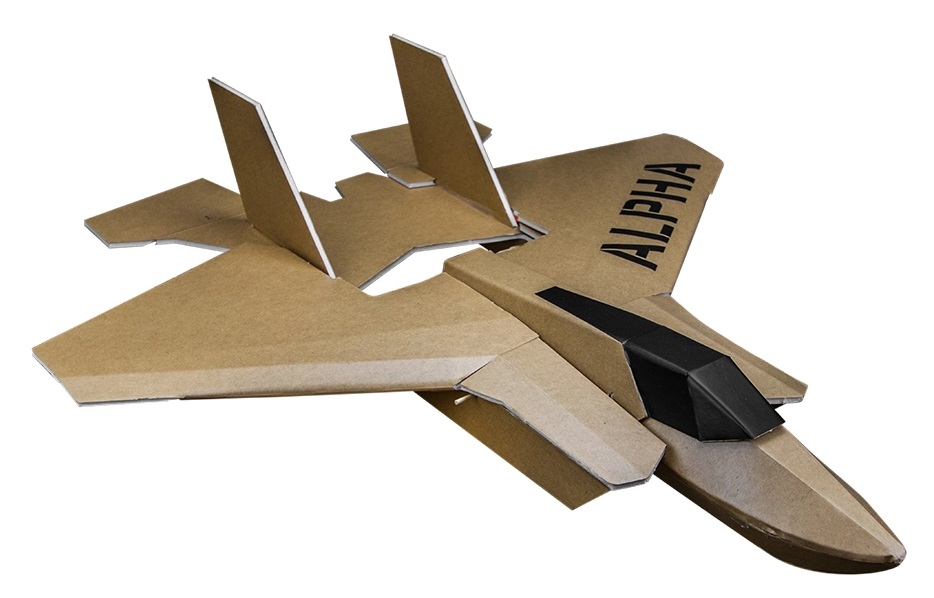 The website also has a series of build videos so Charlie should be able to build the Alpha without too many problems, he’ll learn a lot and will also have more idea about completing any repairs should they prove necessary. I expect mum Nadine will help and also learn! The Alpha is 736mm span so is a reasonable size and it appears to fly well in the videos.
The Spitfire Charlie bought at the same time is one of the tiny ones sold by Eachine although the models seems to appear with a variety of manufacturer’s names. Like the others is comes totally finished and ready to fly and the box even includes the transmitter. 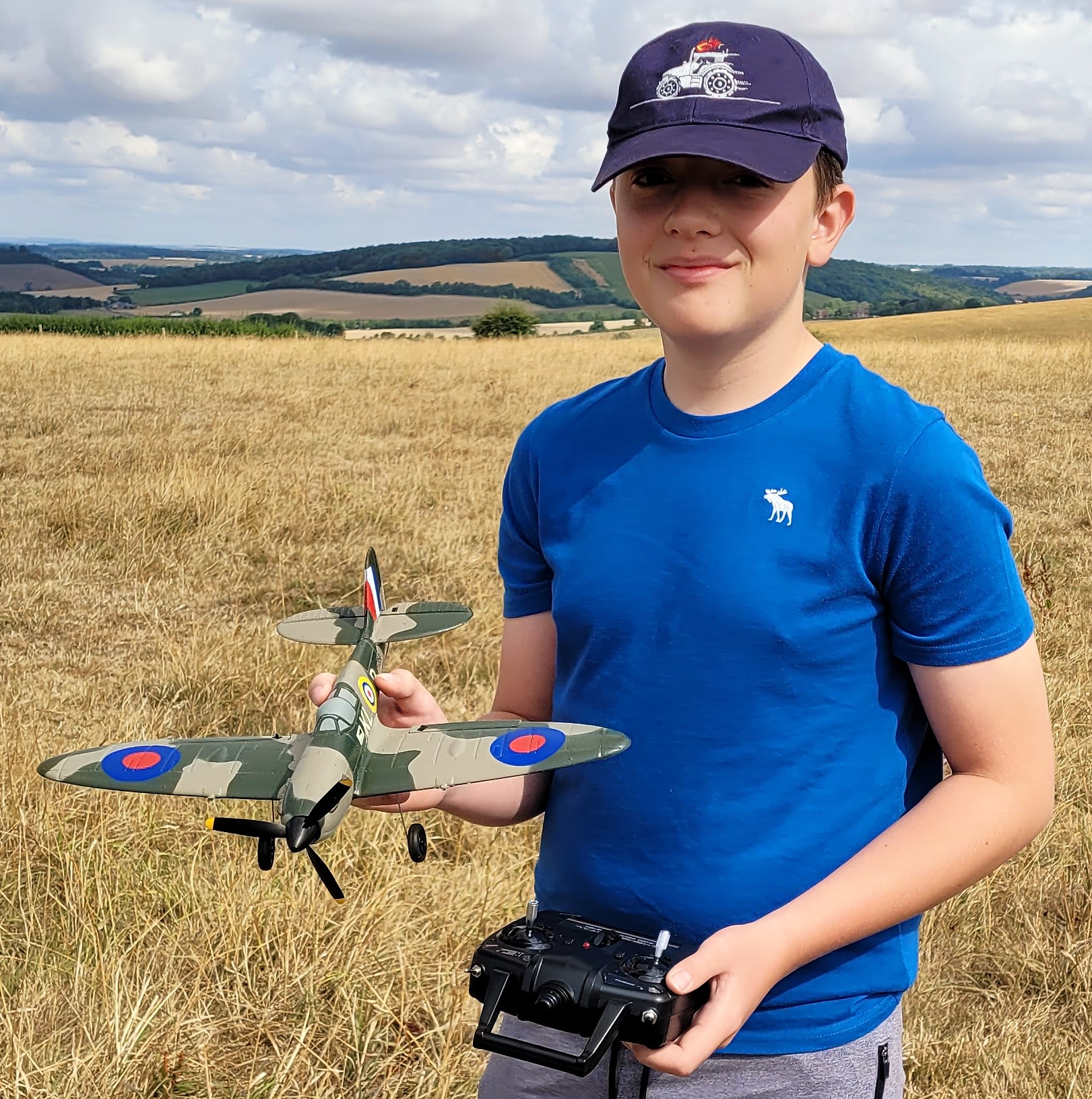 Also like the others the Spitfire is fitted with a switchable gyro which makes it easy to fly when it’s in the beginner mode. Charlie is having no problems at all flying the Spit although so far he’s tending to fly it at a very high altitude where some of the very slightly older people (me!) with poorer eyesight struggle to see it. Soon he’ll twig that we don’t fly low because we’re clever, it’s because that’s where we can see them!
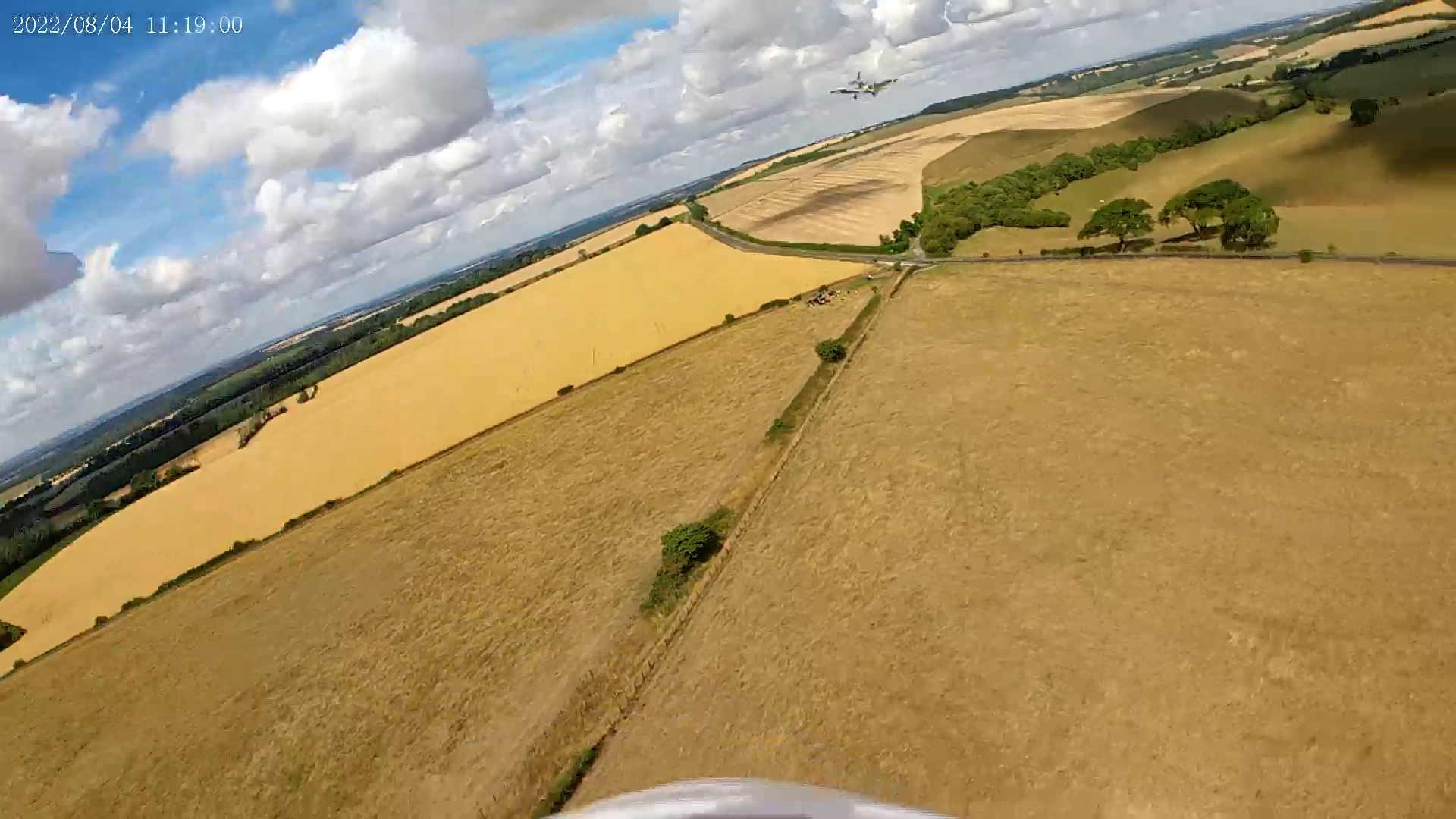 Dougal managed to catch Charlie’s tiny Spit in his FPV sights briefly during one flight.
I promise it really is there in the photo, just below the cloud and slightly right of centre!
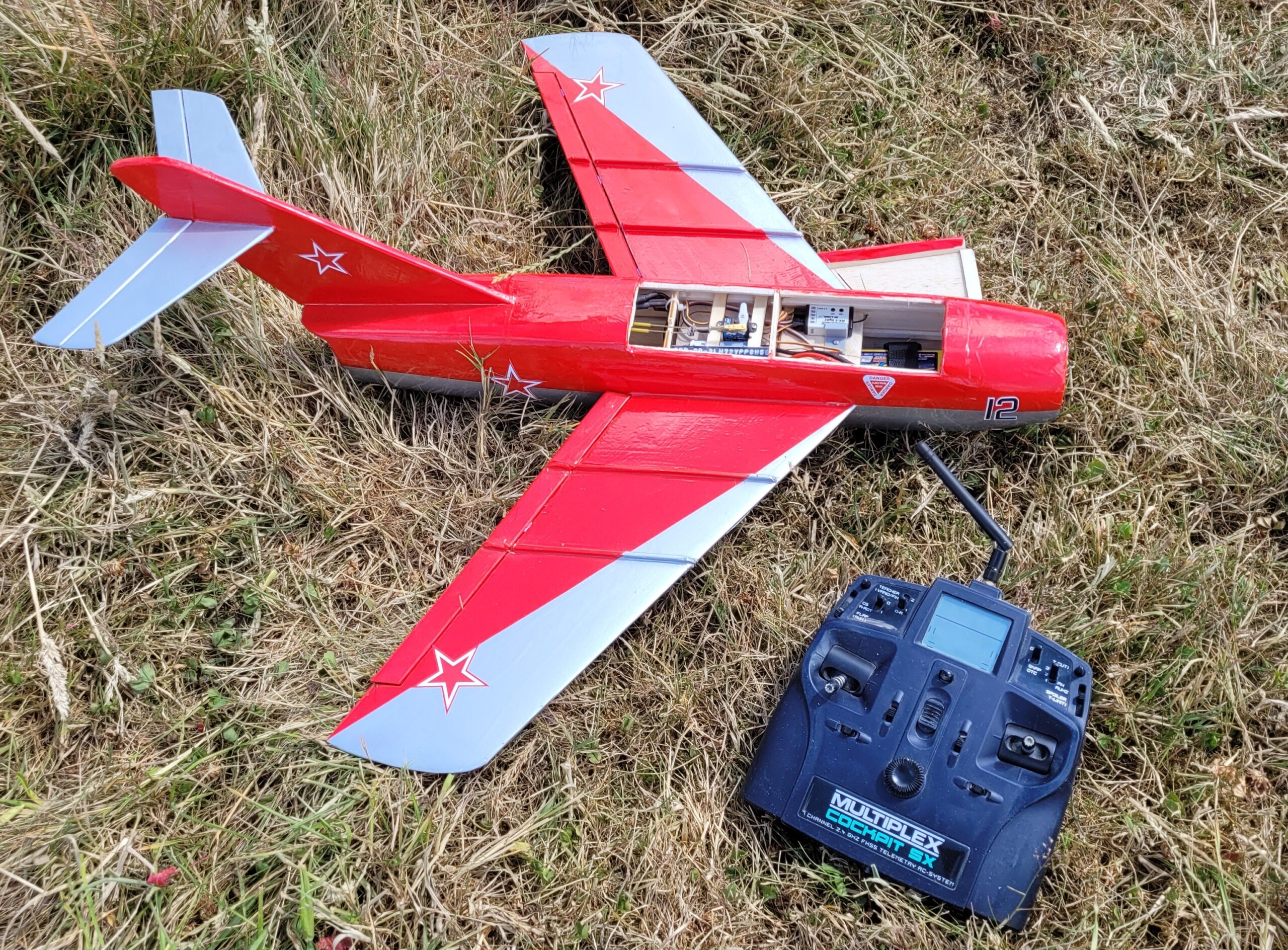
I featured a couple of new edf models last month that were built by Percy Vears during the lockdowns, both of which flew well. Last month’s video included his 3 cell Gnat flying and this month the video has the Mig-15 being pit through its paces on 4 cells, its very fast!
 Percy has also been building a Tony Nijhuis designed Lancaster over the last few years and in August he brought the recently completed model along for a test flight.
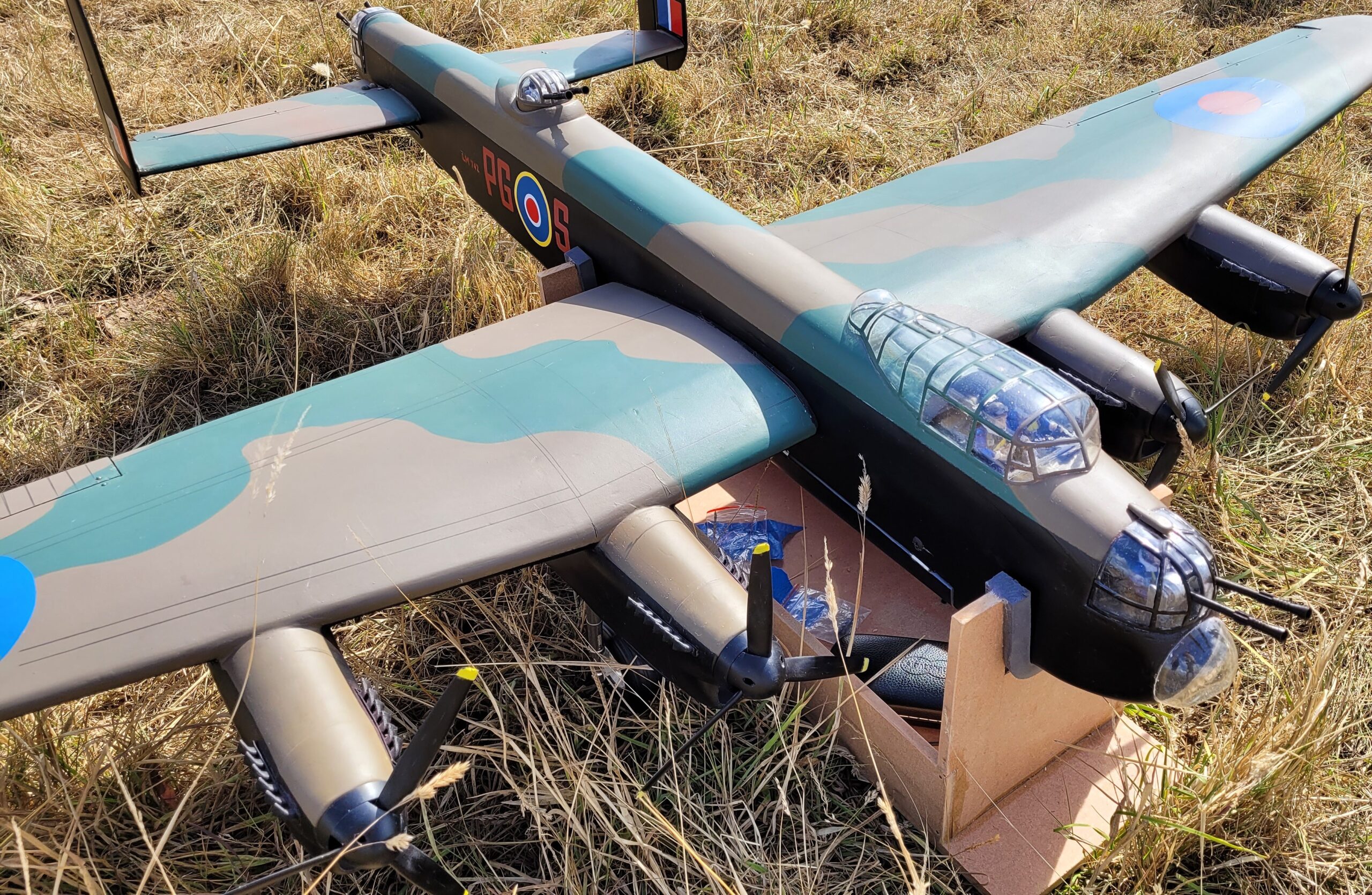
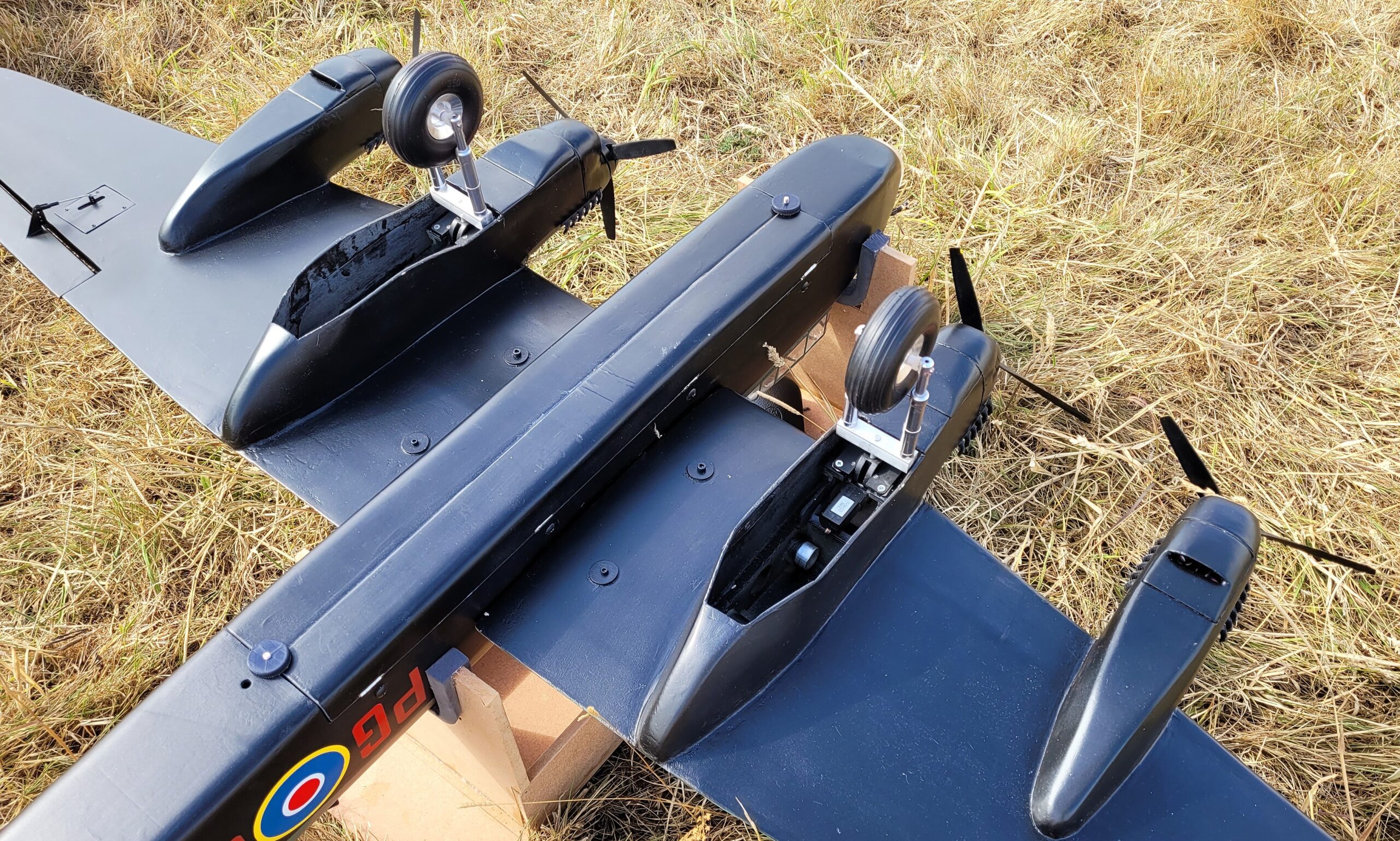 It’s a beautiful model that I have covered in previous editions of Patch News. During preparation for flight Percy noticed that one aileron and the elevator glitched momentarily when the electric retracts reached the end of their travel, rather worrying.
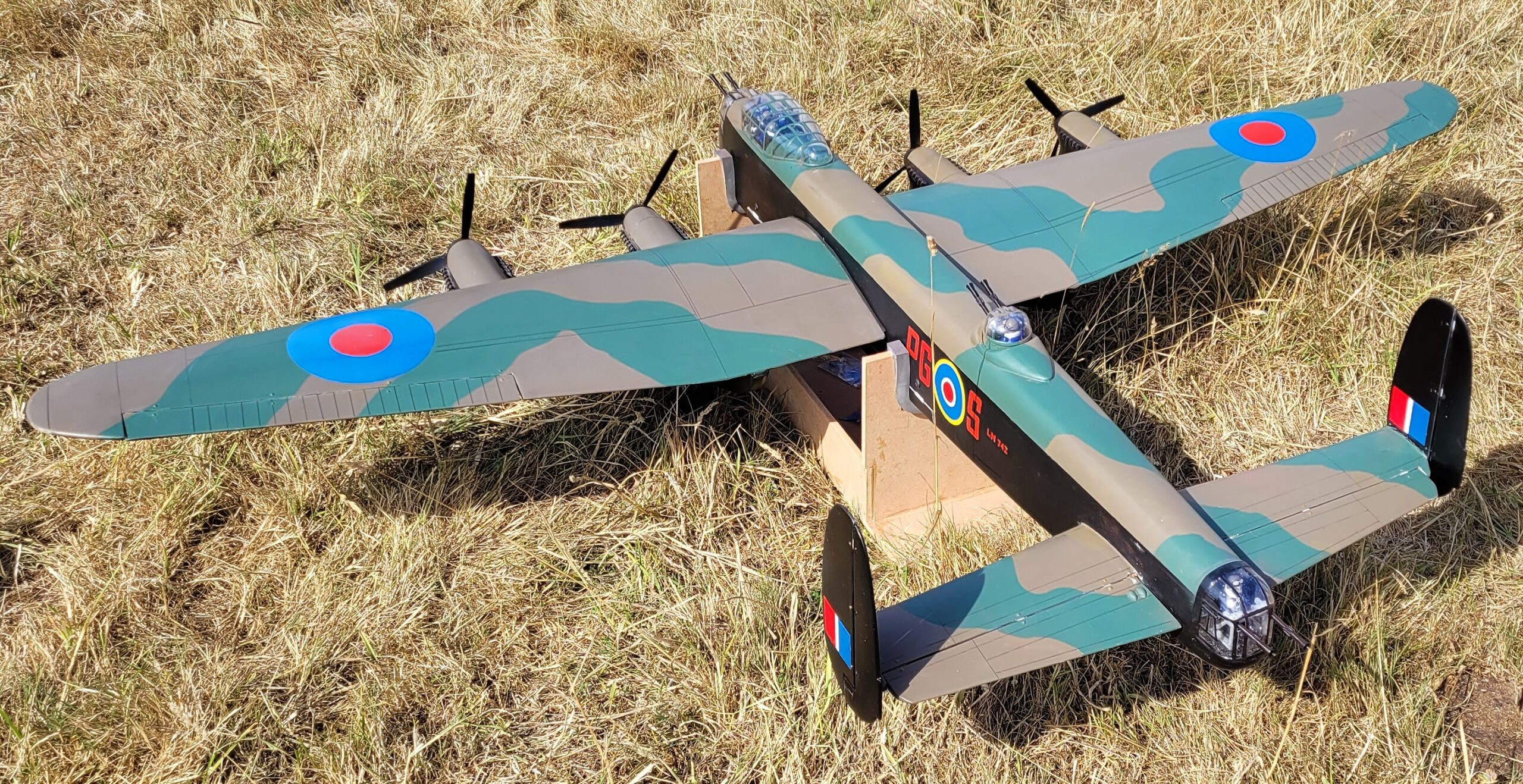
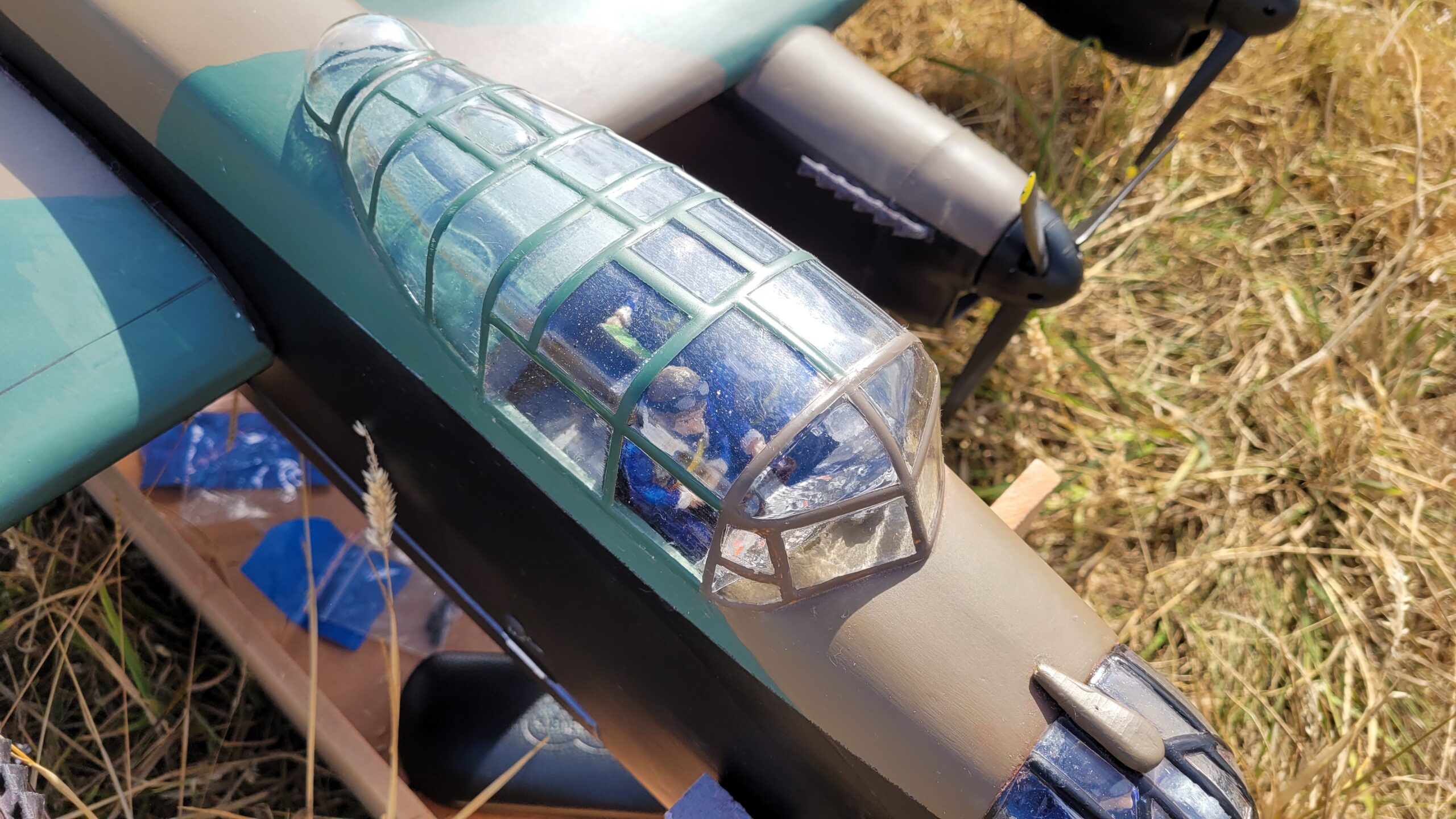 We did a check to see if they were pulling a lot of current and overloading the BEC but there didn’t seem to be a problem so Percy decided we should ahead with the flight.
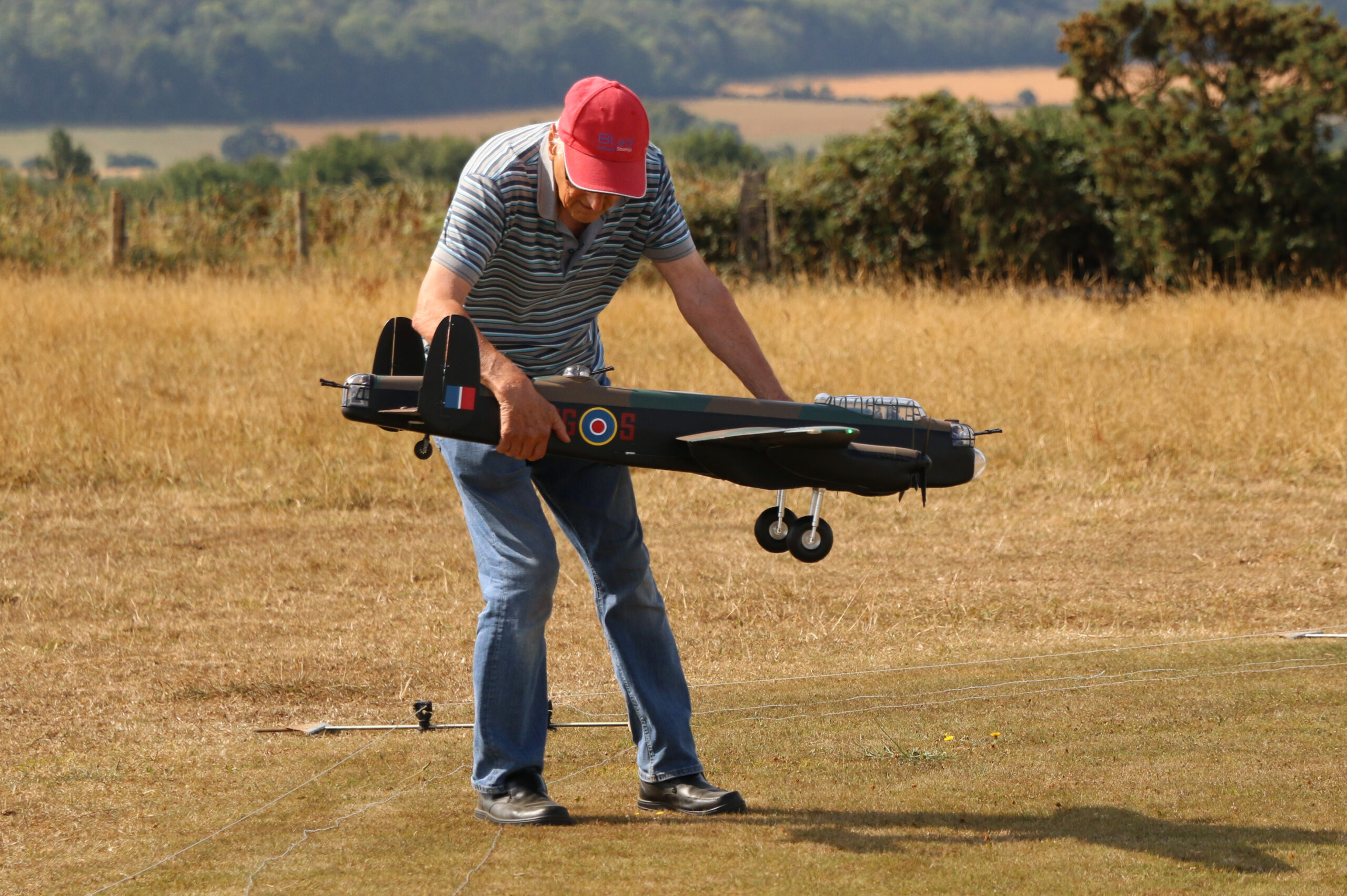 I was nominated as test pilot and the Lancaster looked great as it trundled across the patch and rose into the air beautifully, it just needed a little up trim to maintain level flight.
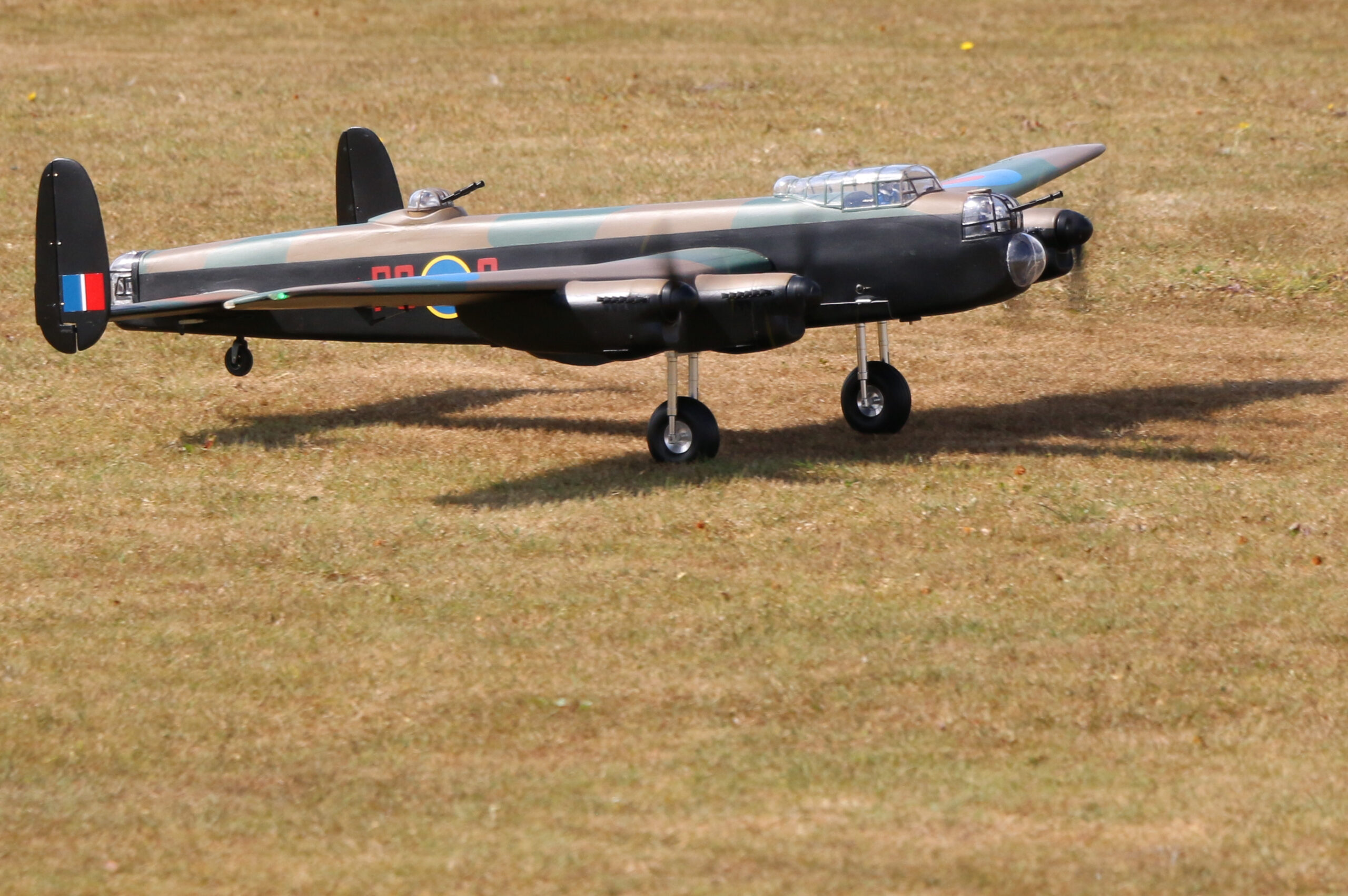 On the downwind leg I raised the retracts and the plane veered very violently to the right and downwards, much more than I thought the glitch would cause. I got it back level and decided I should continue round the circuit to land but when I lowered the retracts there was the same violent reaction which I manged to recover but then at low level it did it again and the Lanc hit the fence by the lower track. With the benefit of hindsight maybe I should have continued to climb for height after the initial glitch and not lowered the gear until I had plenty of height but who knows. At the time I just wanted to get it down.
The damage looked pretty bad, mostly at the root of the starboard wing but Percy was confident he could repair it fairly easily and just a week or so later he reported that he had already fixed the worst of the damage and was tidying it up cosmetically. Percy is going to fit a separate retract battery and will do some extensive testing before flying it again.
Not content with building two EDFs and a Lancaster Percy also found time to build himself a new Splot, saying his original one was getting a bit tatty in it’s old age.
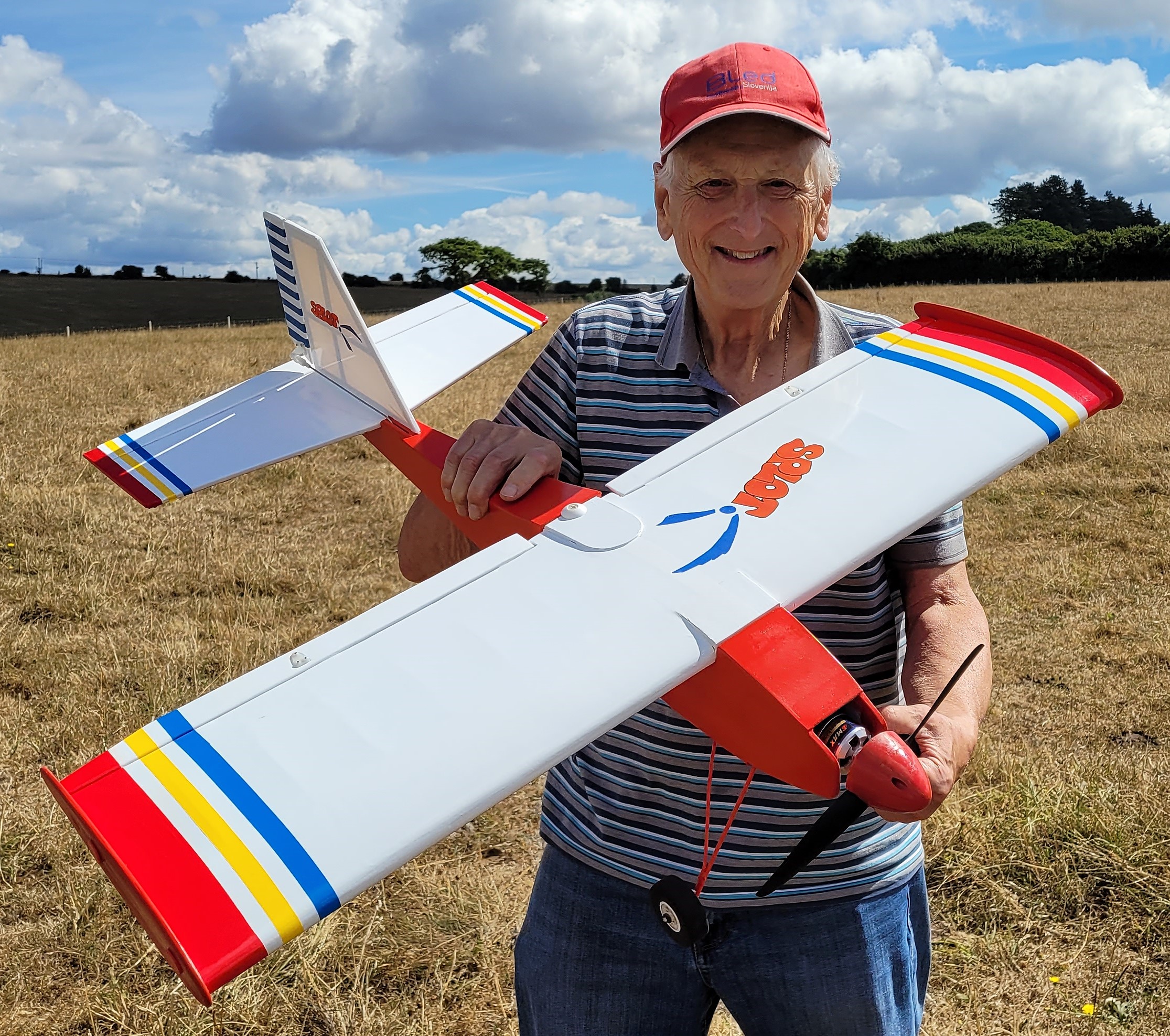
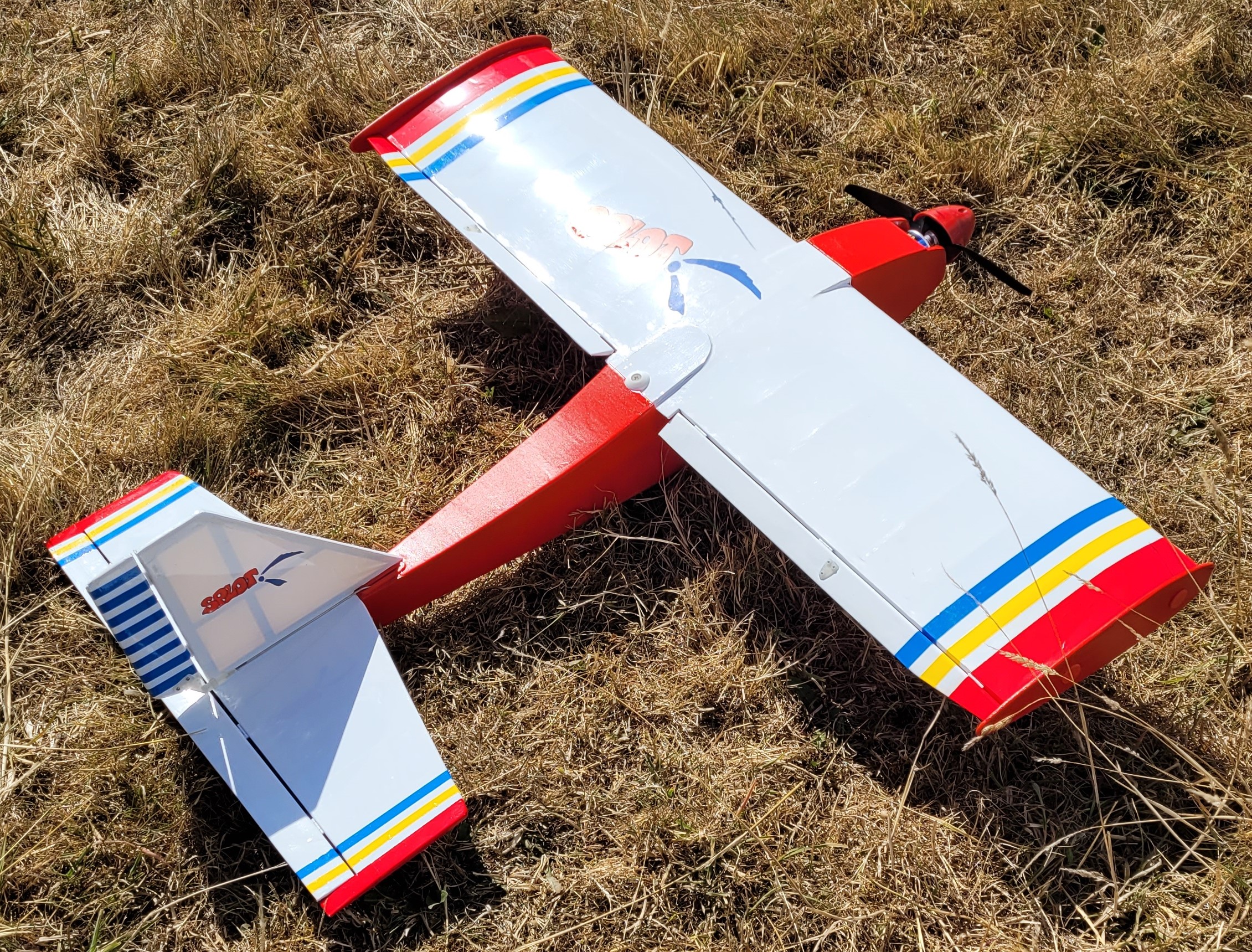 The new one is far from tatty, very smart in fact, and uses the same power set-up as his previous Splot and it flies just like the first one, very well like all Splots do.
It’s always encouraging for the lesser mortals when one of the so called experts gets it ever so slightly wrong and I thought we would all enjoy seeing the result of one of Dougal Entendre’s infamous low inverted passes going a little awry when encouraged by others.
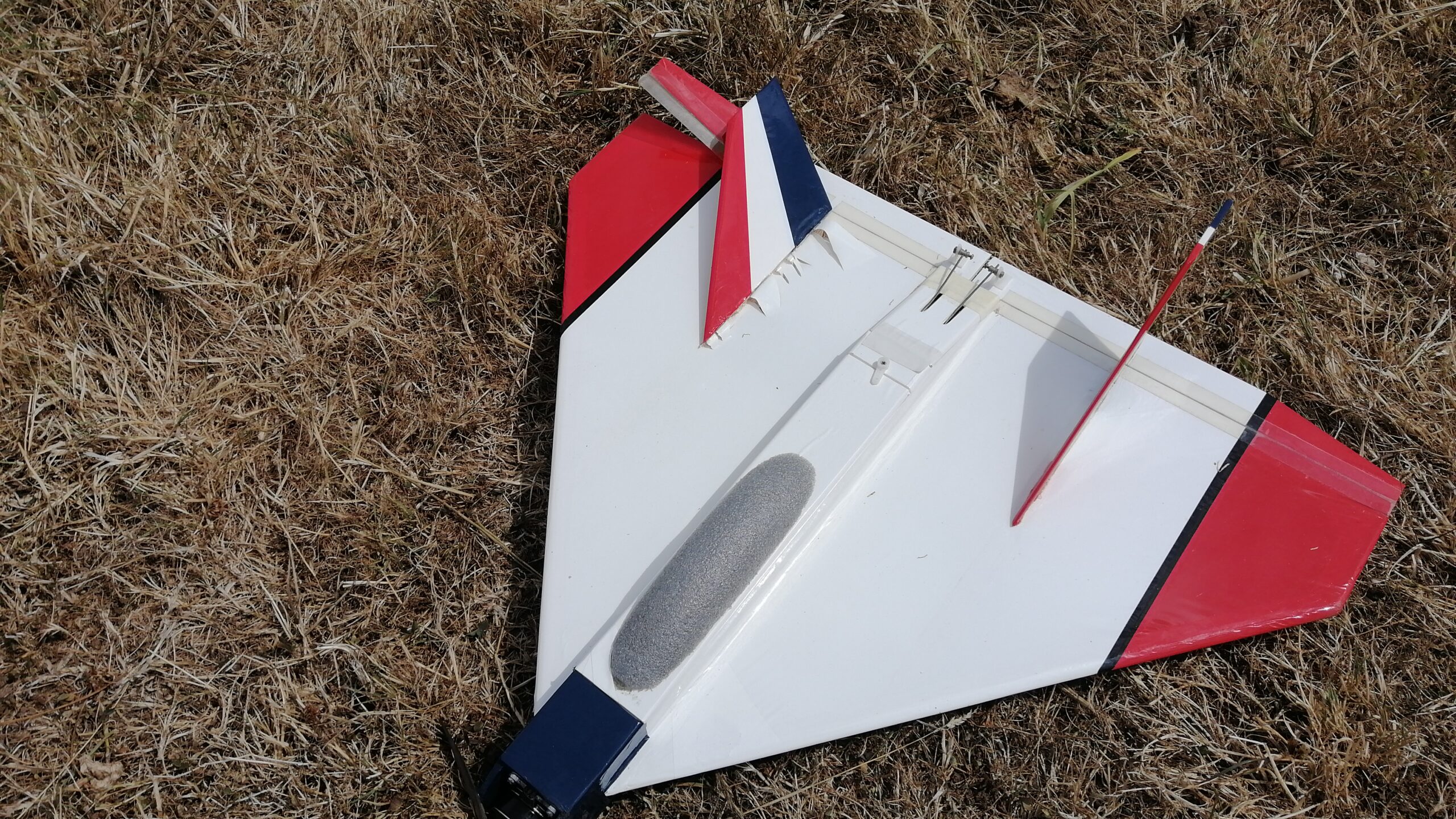 Dougal responded to the shouts of ‘Lower’ and pushed it just a tad too much when flying his Mini Blitz and the inevitable happened! Fortunately there was only minor damage.
Catapult King has been building again and he can always be relied on to come up with something unusual, no box like trainers with thick sectioned parallel chord wings for him.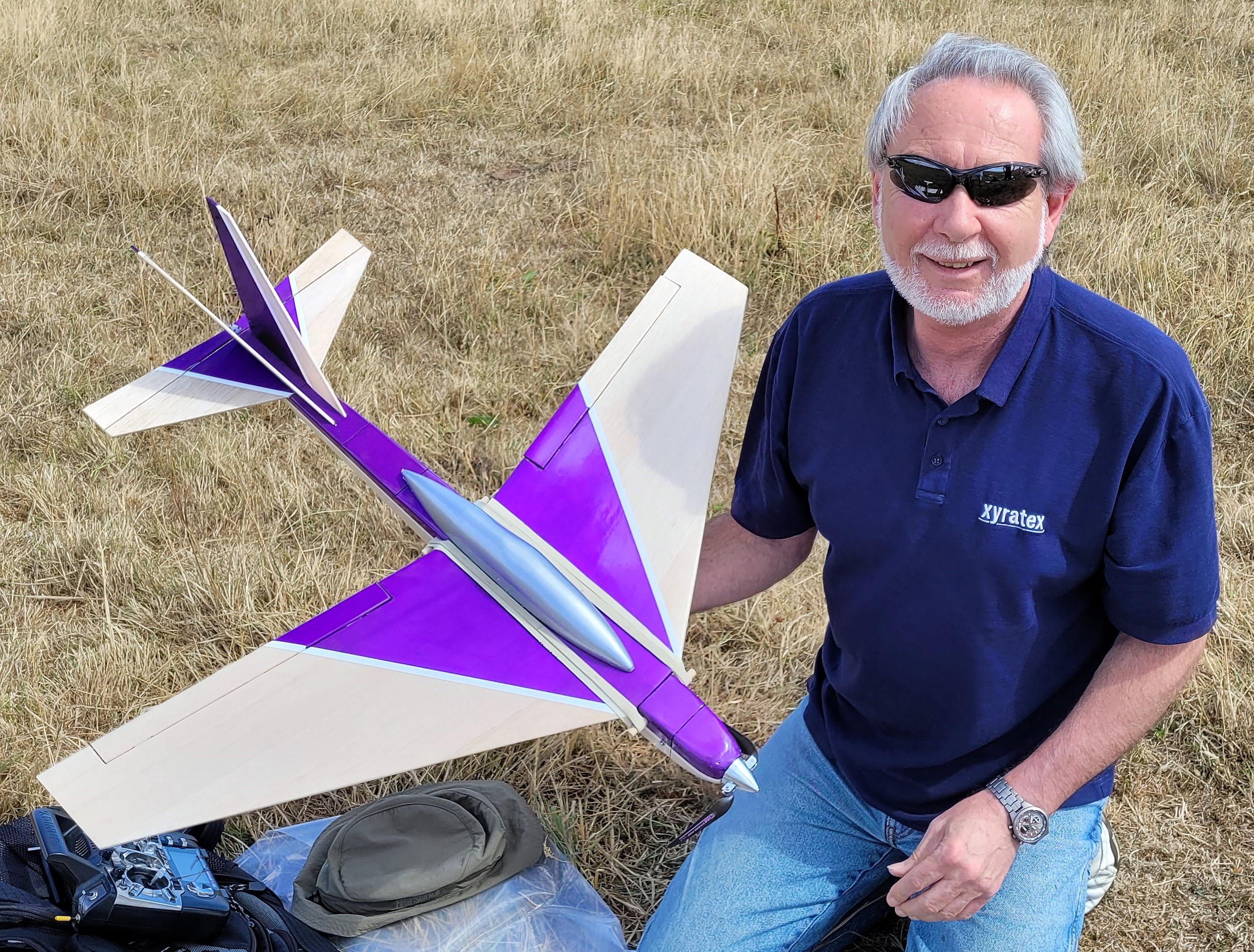 This time he’s built a Purple Piper. What’s that I hear you ask, I’ll let Catapult explain: The plans were first released in Radio Modeller in June 1989 but I got them from Outerzone. The designer is John Rutter who took the wing from an old Mirus as the fuselage for that model apparently wasn’t much use. So he designed this new fuselage and called it the ‘Pink Piper’ namely because his was pink. Mine’s purple so it seems fitting to call it the ‘Purple Piper’. Originally an IC design I’ve obviously changed it to electric. It currently uses a Turnigy 2836 – 1000Kv motor with a 3s 2200 battery. As we saw, with a 7 x 4 prop it only just flew so I changed that for a 9 x 5 which was better but that prop can just hit the rubber band wing dowels. I will change both the motor and prop for a 1200 to 1400Kv and an 8 x 6 prop when I can find some in stock. I think that combination will be successful; we’ll have to wait and see. As Catapult says the model was a little under-powered but, as you can see in the video, it actually flew pretty well, just rather too slowly.
 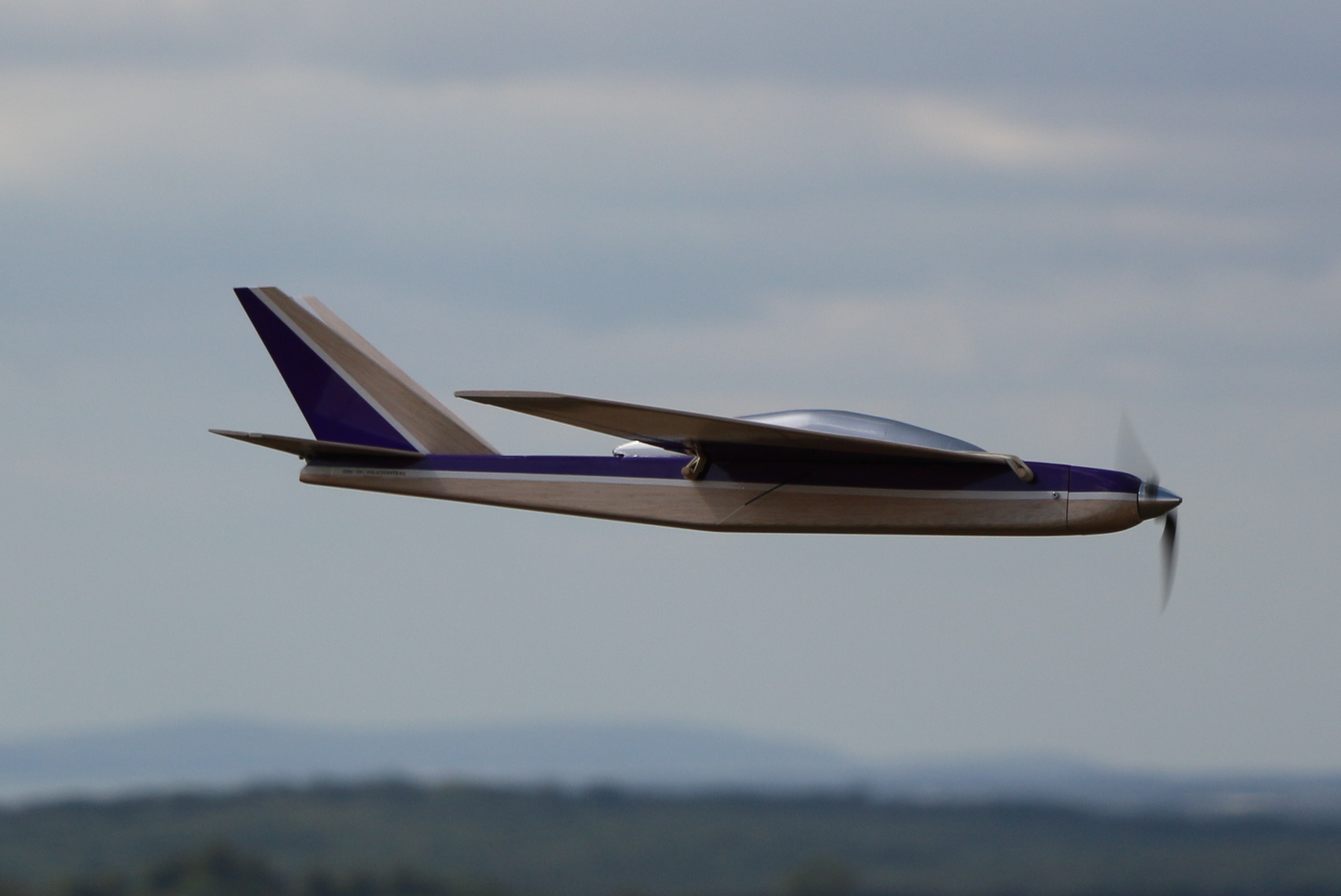 The next time out with a bigger prop was much better but the Purple Piper could still handle a bit more speed and by the time you read this it will probably have been re-motored. Any model with a Mirus wing is definitely something 1066 will drool over and if it ends up being fast as well I reckon he’ll be borrowing the plans.
Several PAM members attended the Popham Model Show in August and some came away with goodies! The show was excellent with some good models and equally good displays.
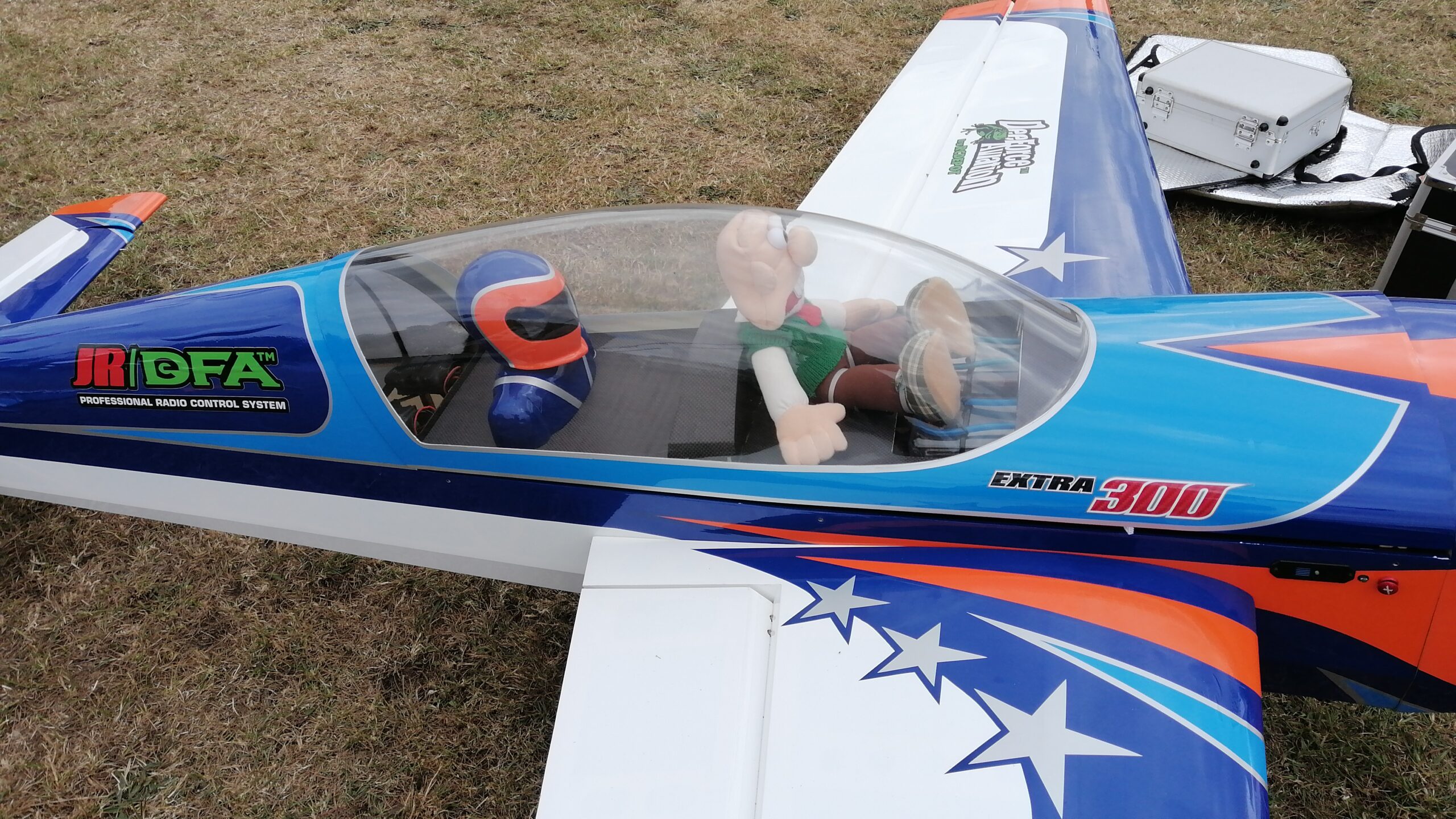
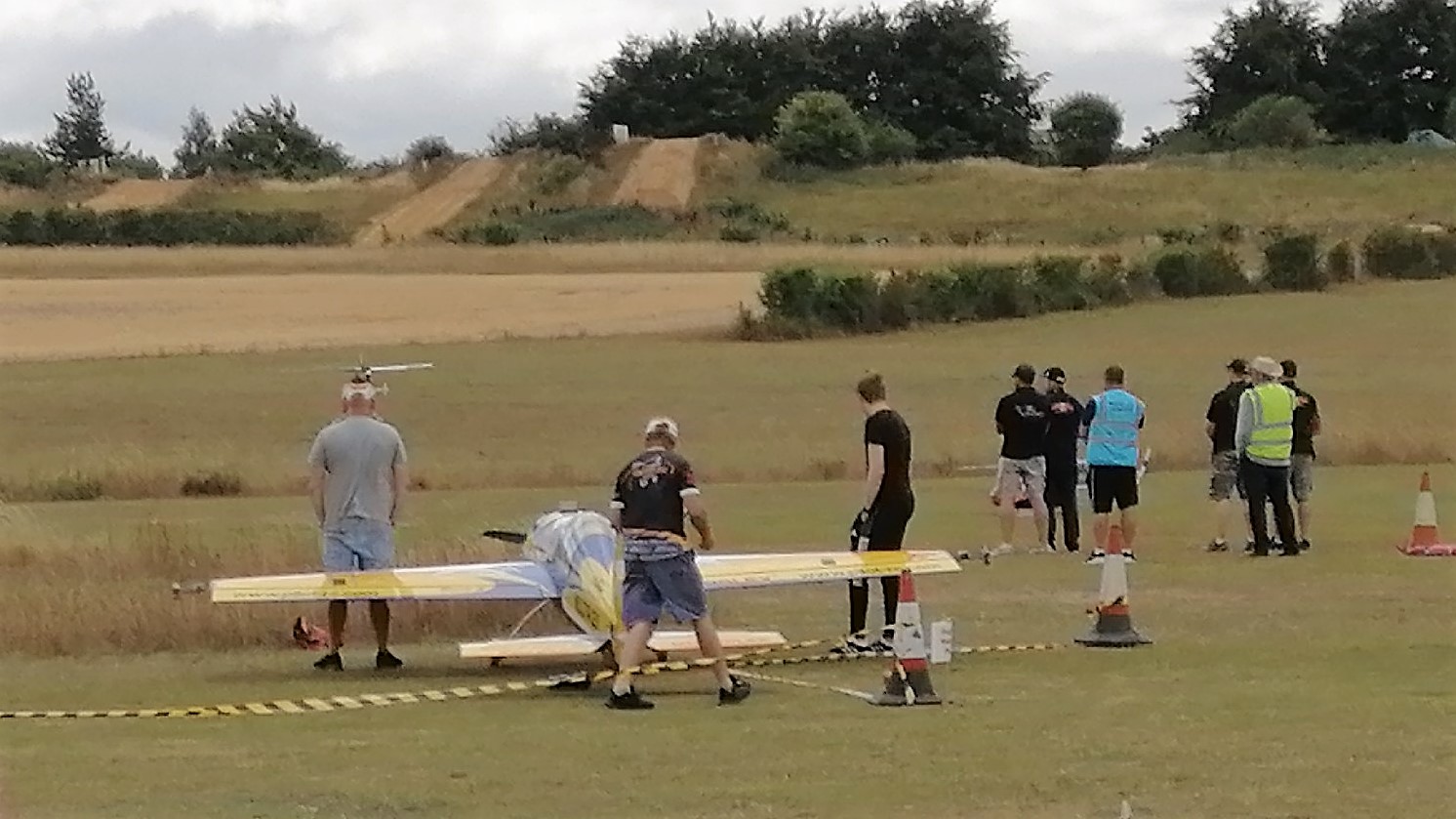
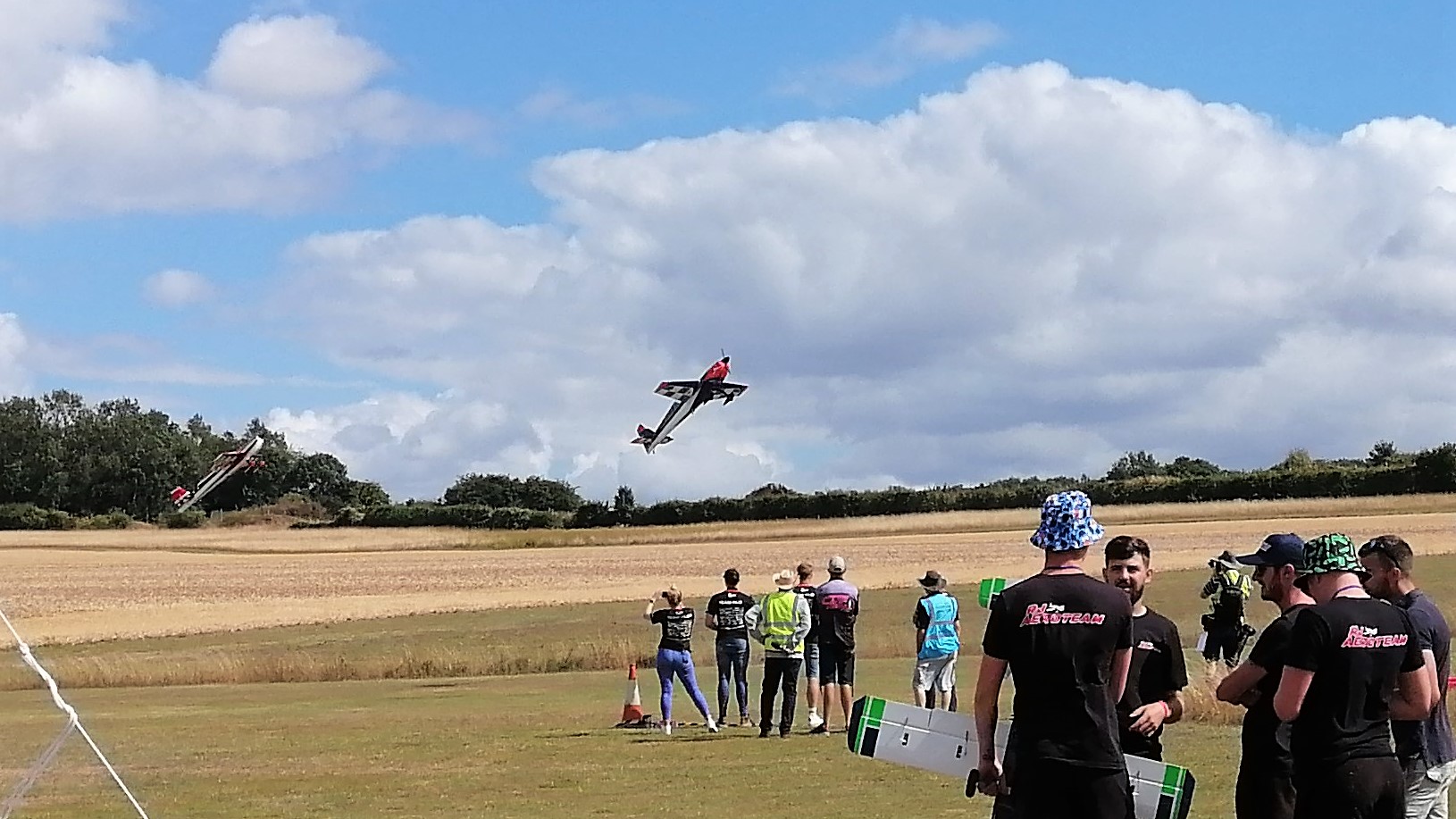 There were many more trade stands than last year so hopefully the show will just keep on getting bigger and better. Young Charlie fell for a second-hand HobbyKing Lancaster on one stall and despite Dougal and I urging caution he decided to go for it and haggled the price down to £80. Another member who splashed the cash was 1066 who picked up an Arrows Viper at a very good price. Once home he put it together in just a couple of hours.
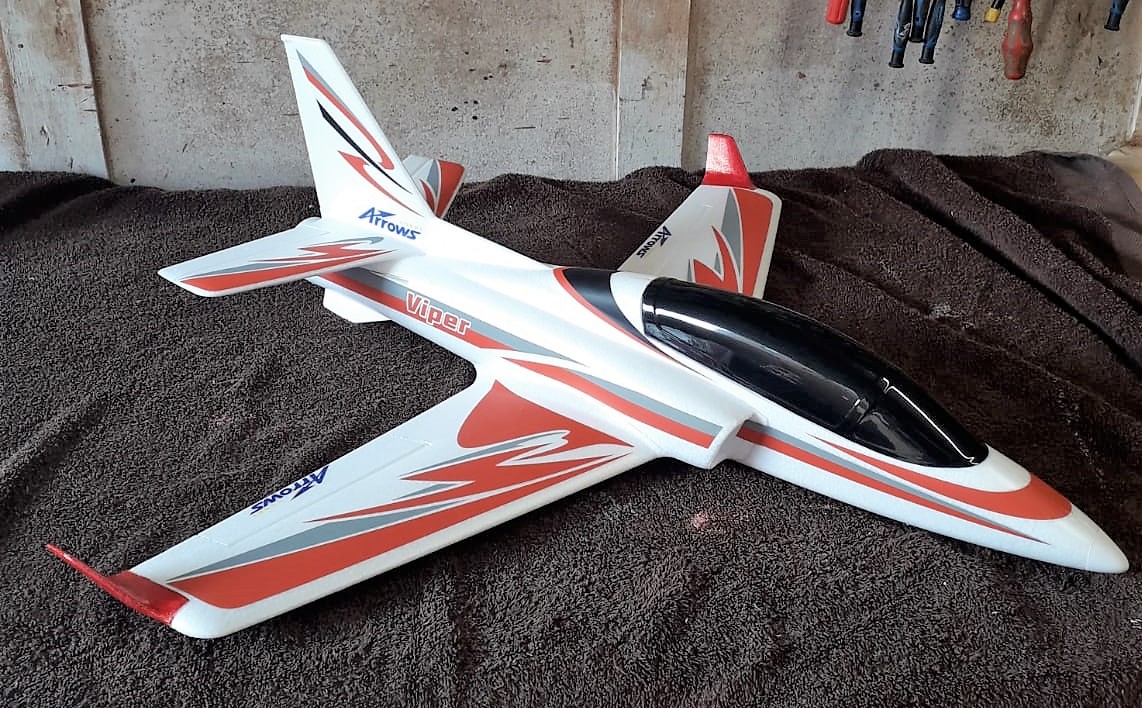 This is from the Kings Lynn Model Shop website: Sleek, powerful and perfectly formed the Arrows Hobby Viper will be something of an eye-opener to anyone who still thinks EDF jets have some catching up to do. Experience the Viper in action and you’ll quickly realise that nothing could be further from the truth. Packing a jet-like 50mm 11-blade fan that’s spun up by a precision 2627 4500KV brushless motor, this 3S-fuelled pocket rocket will find favour in the hands of all who seek smooth, flowing aerobatics, a cloud punching performance and exceptional speed. But that’s not the half of it, the Viper is also a beautifully practical jet that exhibits exceptional low speed handling, is small enough to transport in one piece, retract free (hassle free) and enticingly budget-friendly. All this grace and performance from a 3S LiPo will almost certainly have you reassessing your EDF spend. So good is the Arrows Viper we’re convinced it’ll become a frequent flyer in your air fleet and, as we all know, that equates to superb value for money. As Arrows Hobby so rightly says in its promotional blurb, “Small (and simple) is beautiful.” I’ve looked at the Viper a few times but keep telling myself I don’t need one!
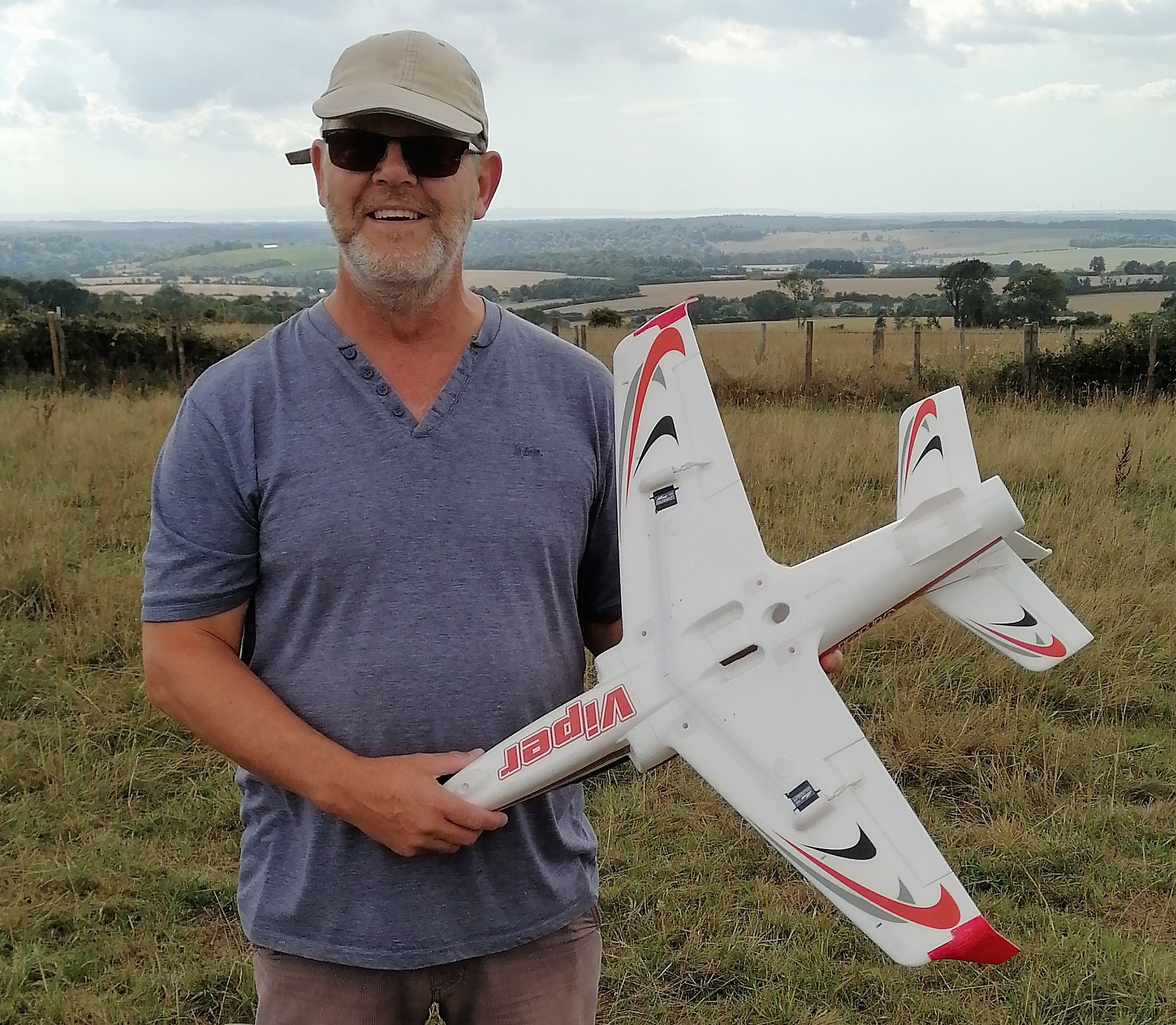 1066 flew his Viper while I was away and watching the video that Dougal shot of the first flight made me very jealous, I think maybe I do need one after all, I feel a pain in the wallet coming on! You can see what you think of the Viper’s performance in this month’s video.
Bob the Builder has been at it again and has produced a model he’s called Bigger Basher as it replaces his smaller Basher that he lost sight of one day with the inevitable result!
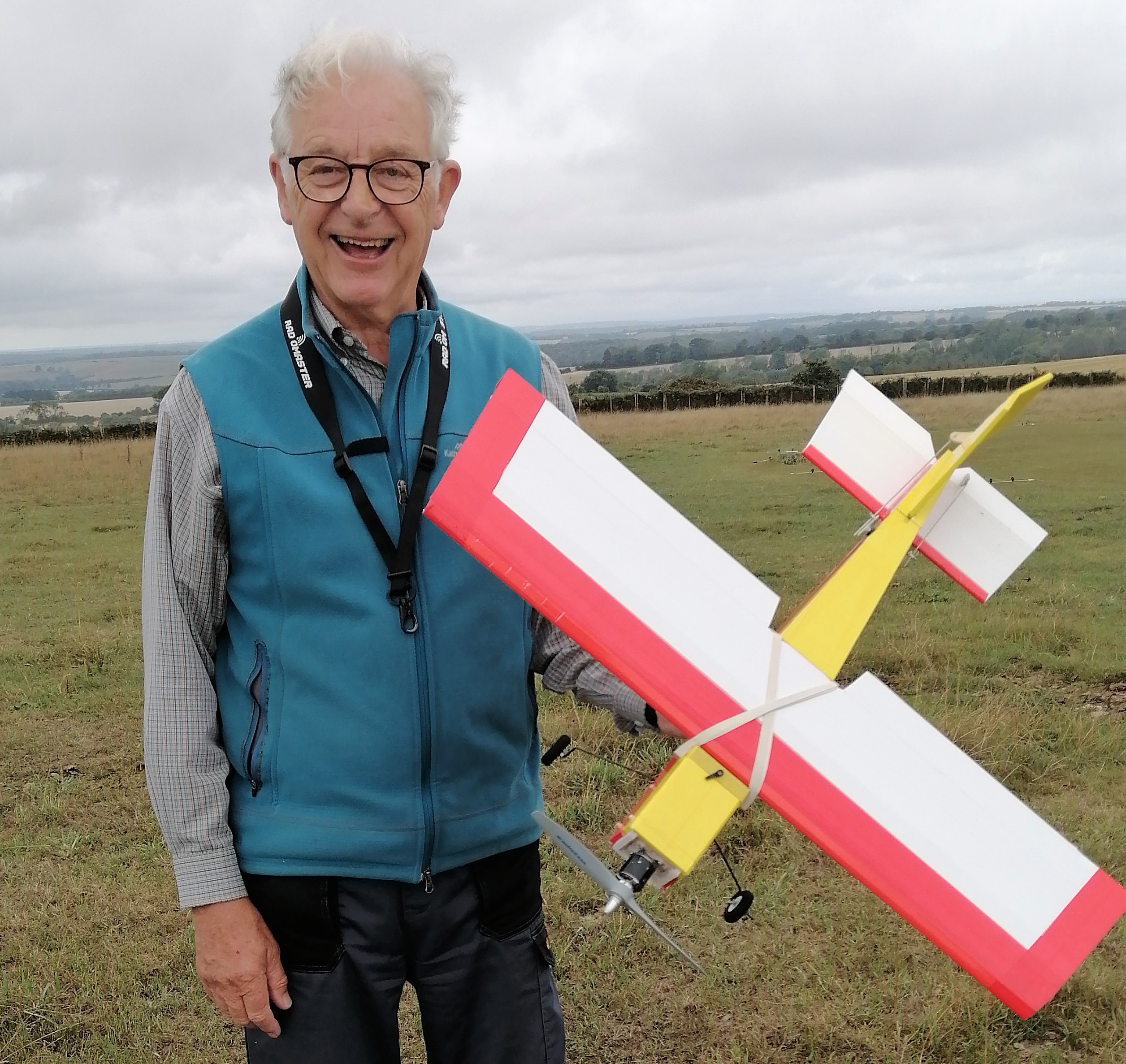 The Bigger Basher is based on a Flite Test Simple Stick and is made from 5mm Hobbycraft foamboard with the paper covering left on and stuck together with hot melt glue. The wingspan is 840mm (the width of the foamboard) and the spar is a section also made of foamboard. The motor is mounted on a foam box that slides into the front of the fuselage and held in place by three wooden dowels which makes for easy motor swaps and repairs.
 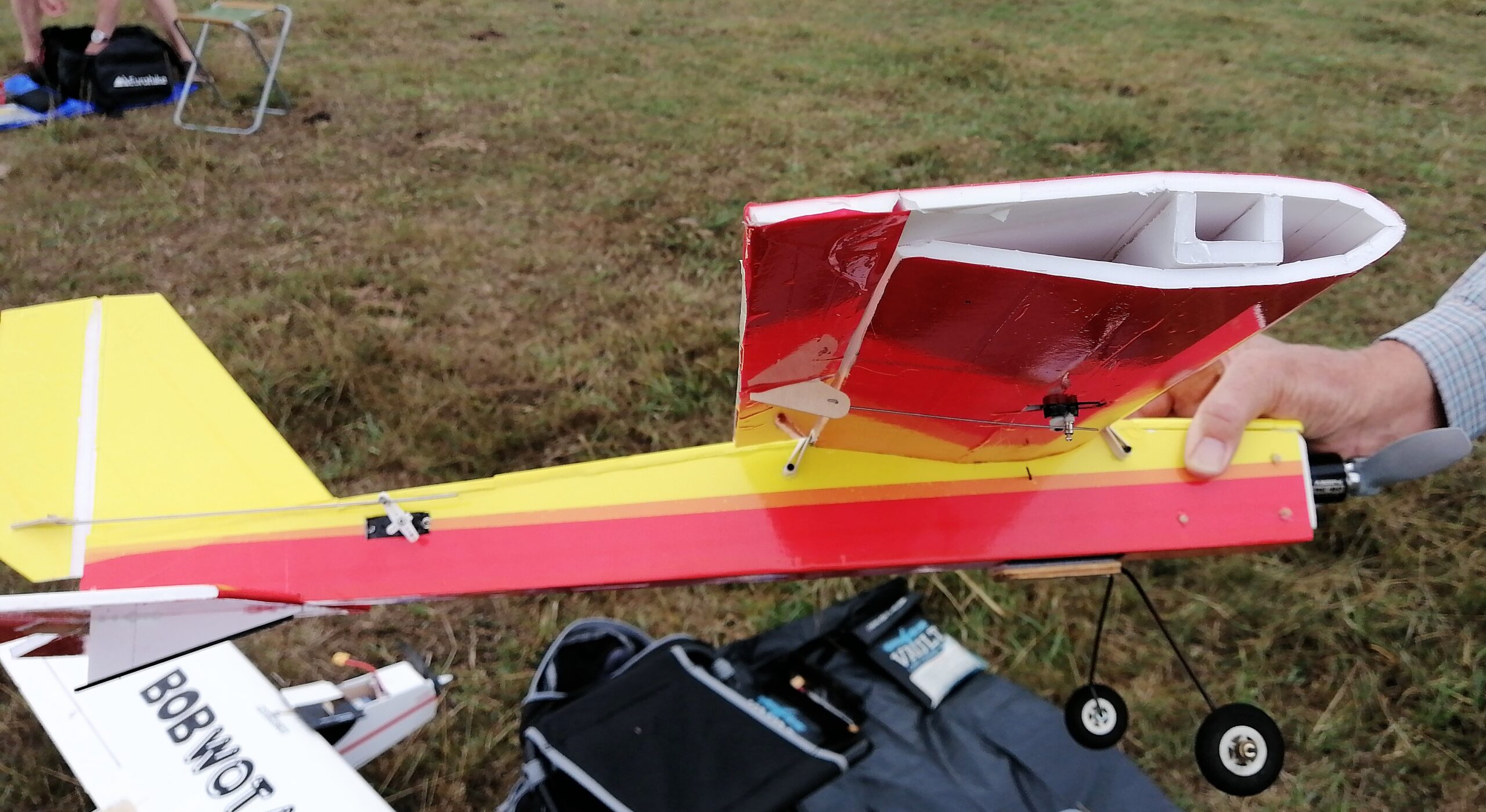 The undercarriage is currently held on by Velcro but Bob says it doesn’t work too well so he’s thinking of changing it. The motor is a Propdrive 2836 1400kv which swings a 9×6 prop and the power comes from a 1300mAh three cell battery. Servos are all standard 9gm ones as used on various other models. The Bigger Basher is covered in packing tape to add colour and strength. It’s proved to be an excellent aerobatic flyer, cheap and quick to build.
Geoff Hill produced not one but two new models in August. Well strictly speaking only one is new, the Orion E is what Geoff calls an “attic rebuild”. I think we can all relate to that!
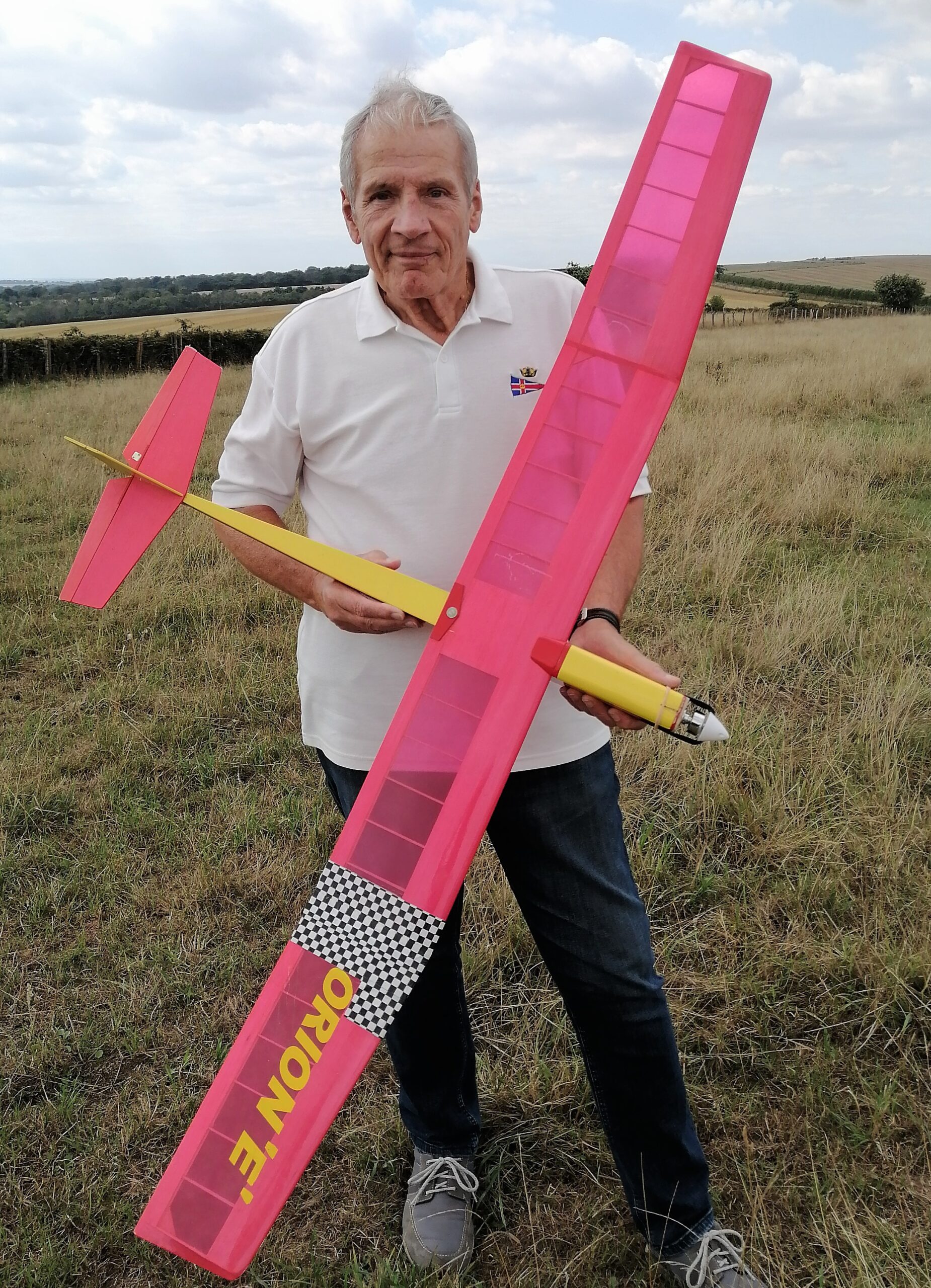 The Orion E is a powered glider that has been brought up to date with a Turnigy DST 1200 motor, a 30A speed controller and a 3 cell 2200mAh lipo. The receiver is Flysky FS-GR3E.
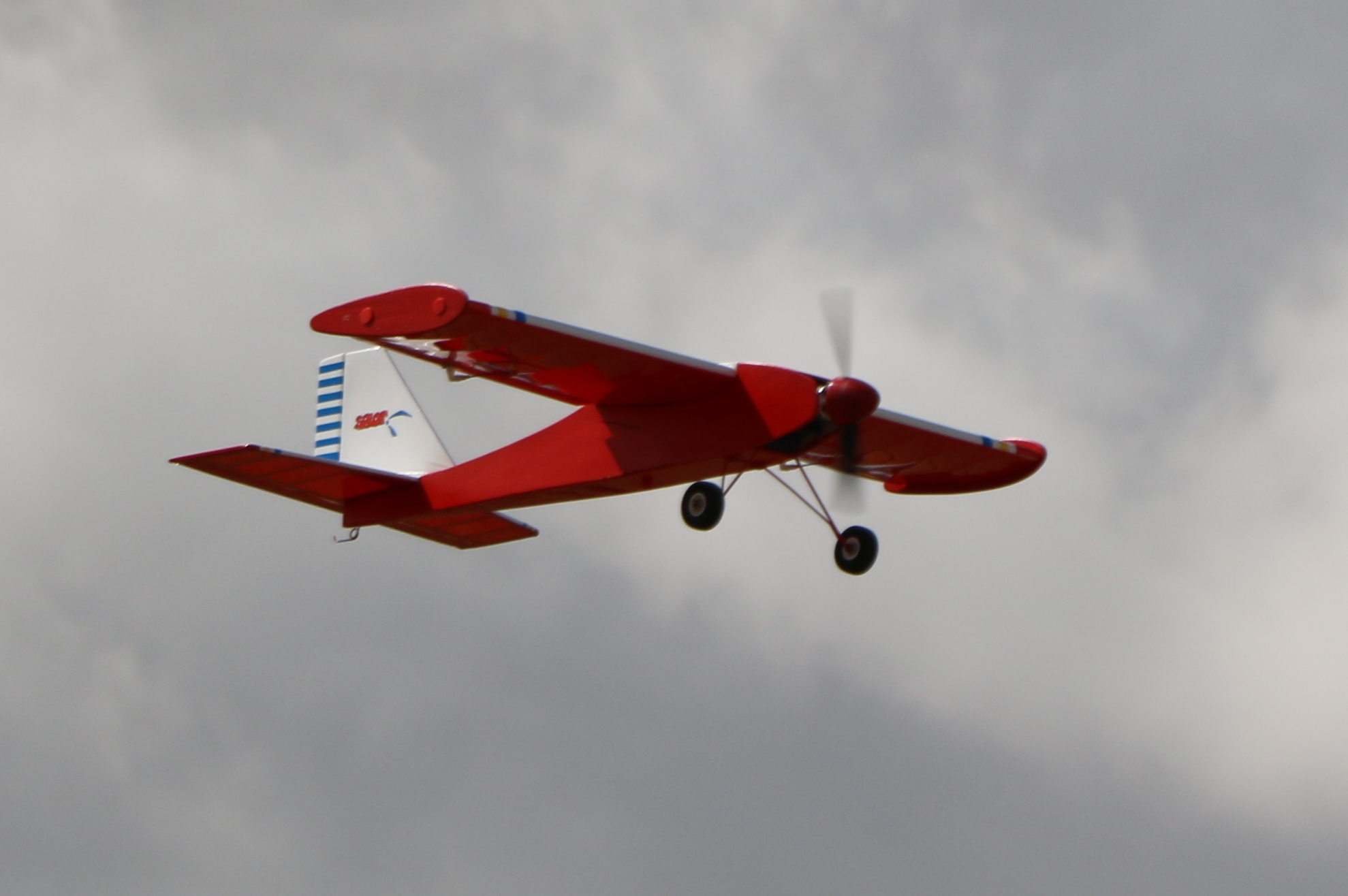
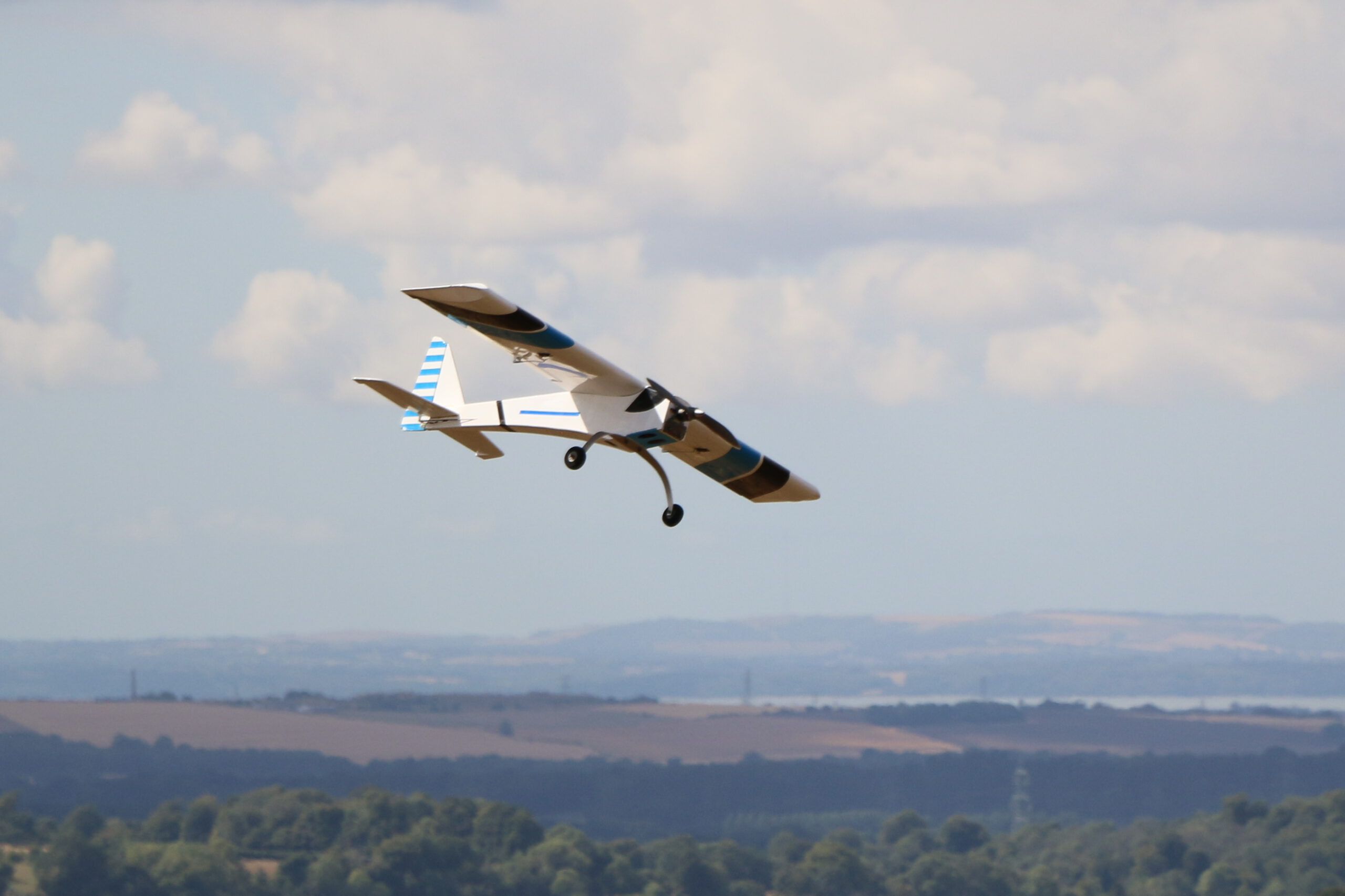
The genuinely new model is a Coachman, a four channel trainer plane which Geoff has built from an RCM&E magazine plan that was published way back in November 1996.
 It was designed for i/c engines but Geoff has extended the nose and fitted a Racestar 3536 1200kv electric motor which is powered by a 3 cell 3650mAh lipo. The Coachman is fitted with a Radiomater R88 receiver and although it flies ok it still requires a bit of tweaking .
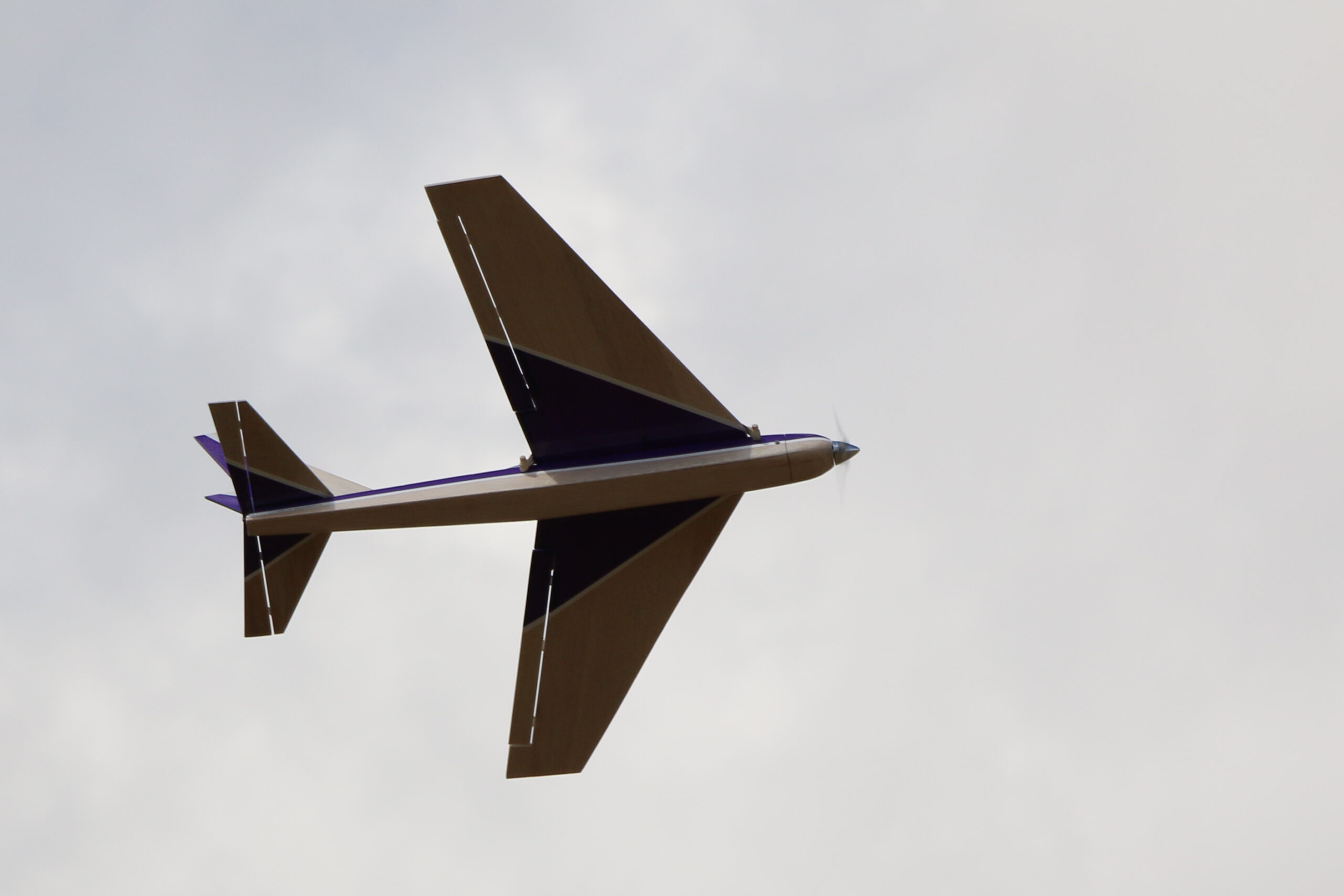
Kryten took lots of great photos for us in August, some static shots and some airborne. I’ve used some of his static shots in the write-up and here are some of his airborne ones:
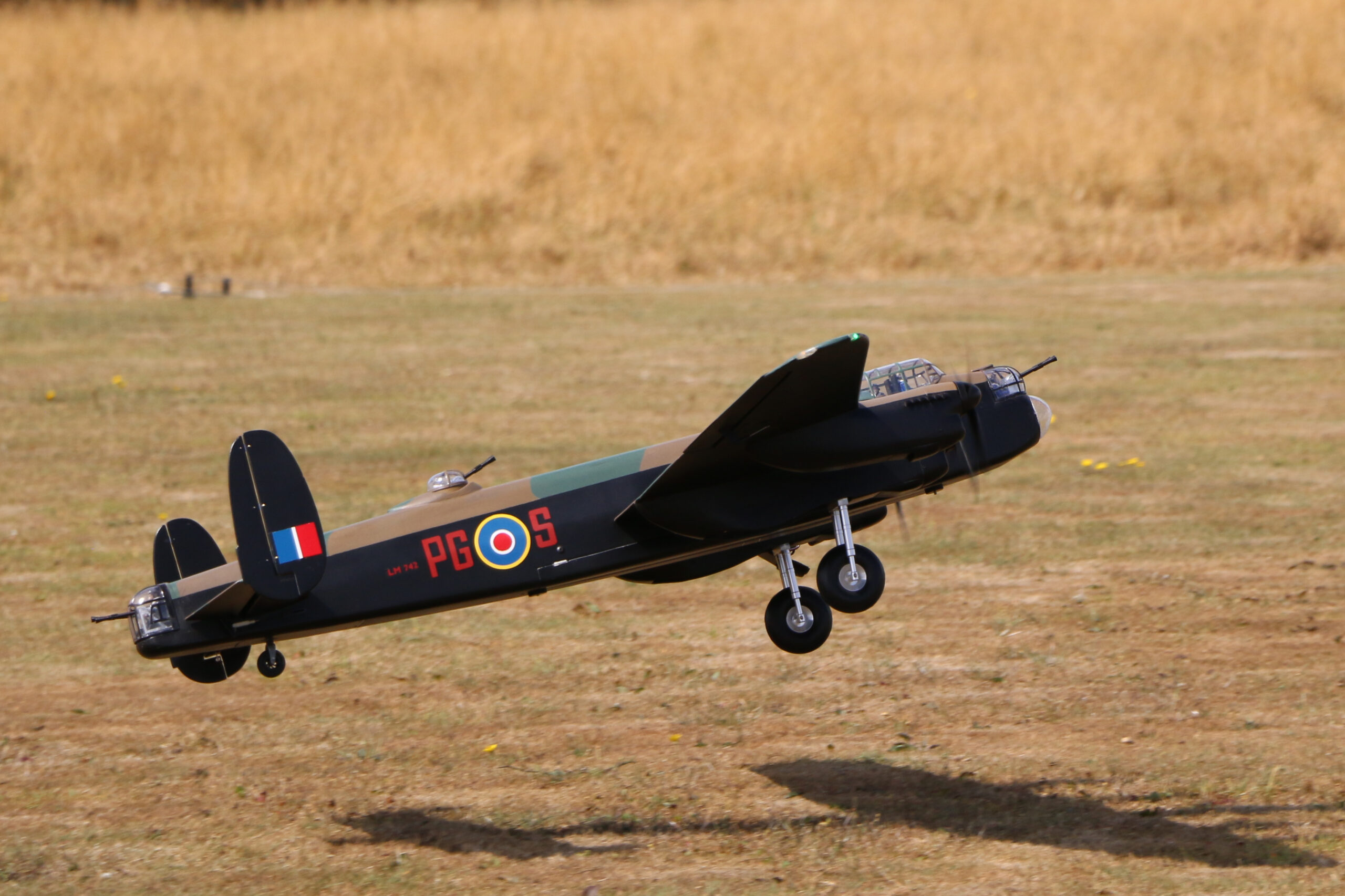

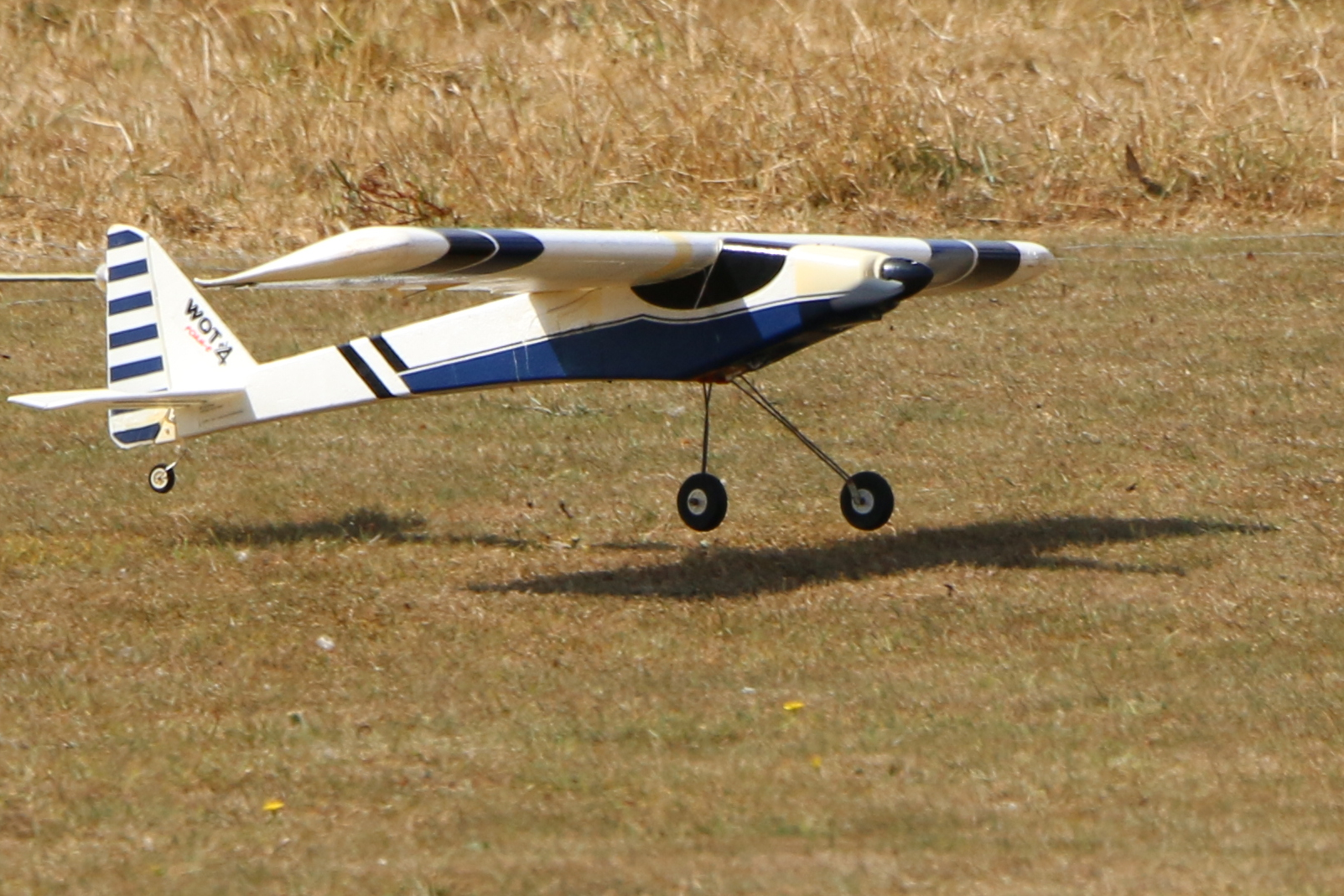 Video time now with footage taken by myself, Dougal, and Captain Slow. Please watch the video full-screen, it’s so much better with small models flying around.
If the video won’t play for you please click HERE
Son: Mum, when I grow up I want to be a pilot.
Mum: Make your mind up son, you can’t do both.
Colin Cowplain
Patch News – July 2022
Wow, July was certainly a hot one with England seeing a record high temperature of 40.3C on 19th July. On 1st July the bullocks were still in the field and members were wearing jackets but by the 24th an aerial shot shows just how parched the general area had become.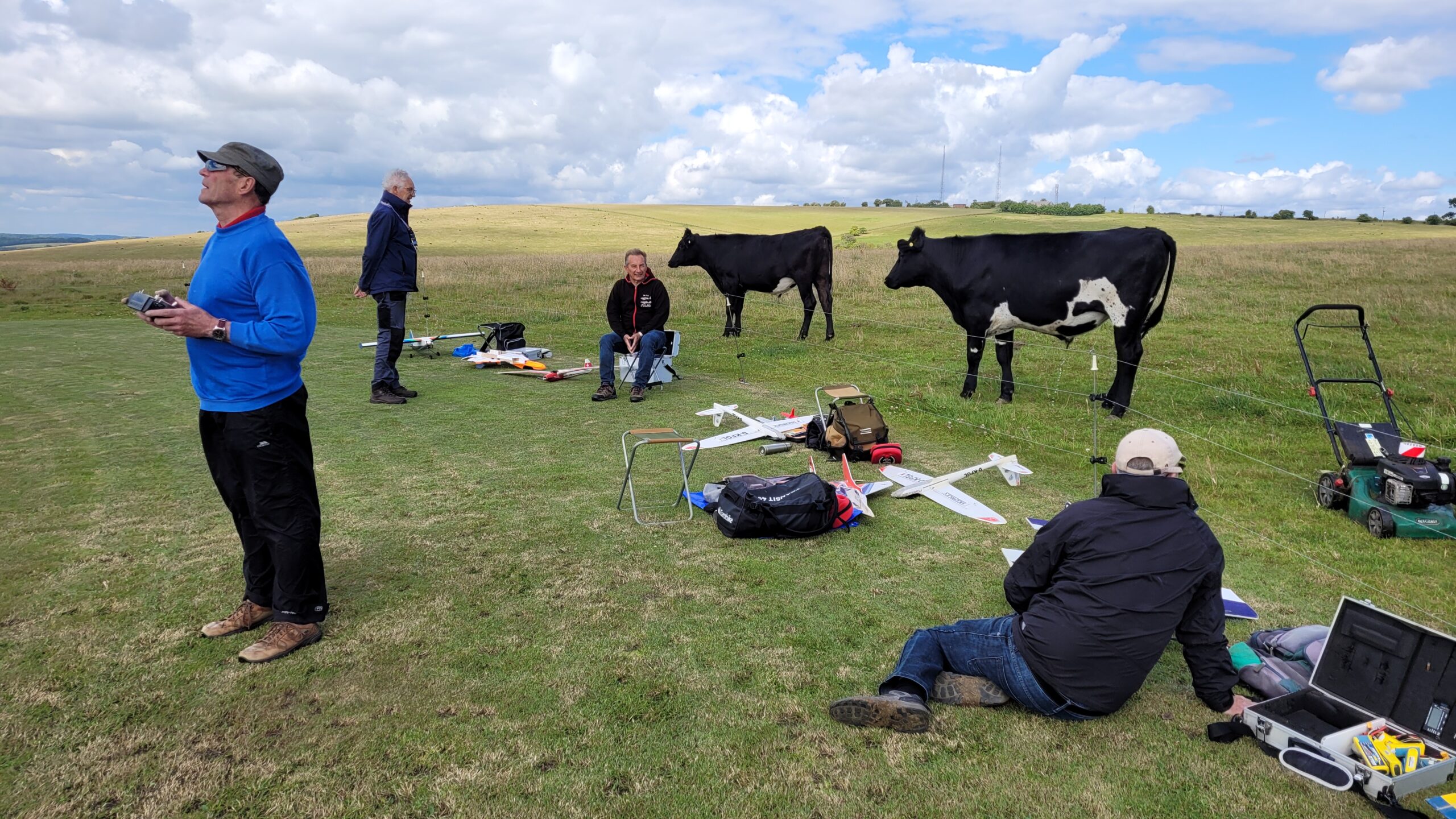
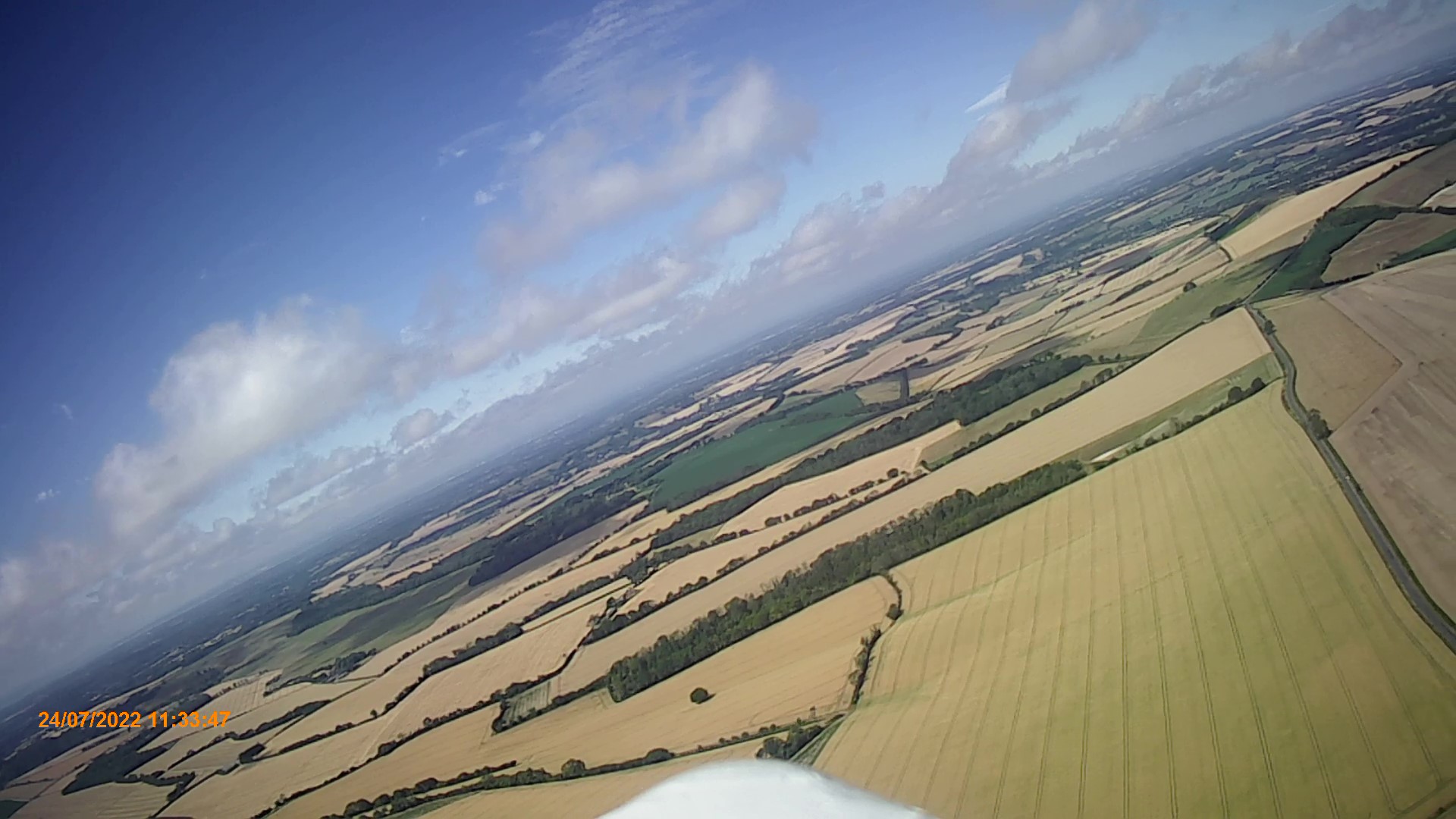 It made it quite difficult for FPV pilots to see the patch as the whole field had become the same colour. At least the heat meant that the bullocks were only in the field for a few days at the start of the month before being moved to the lower field where there’s more shelter. They returned briefly later in the month for a few days but they weren’t a problem to us.
Now a sobering warning to us all to take care with our battery charging. For some time 1066 has been using a very professional looking set-up using three chargers to charge multiple packs with no problems but in July one of the packs being charged caught fire.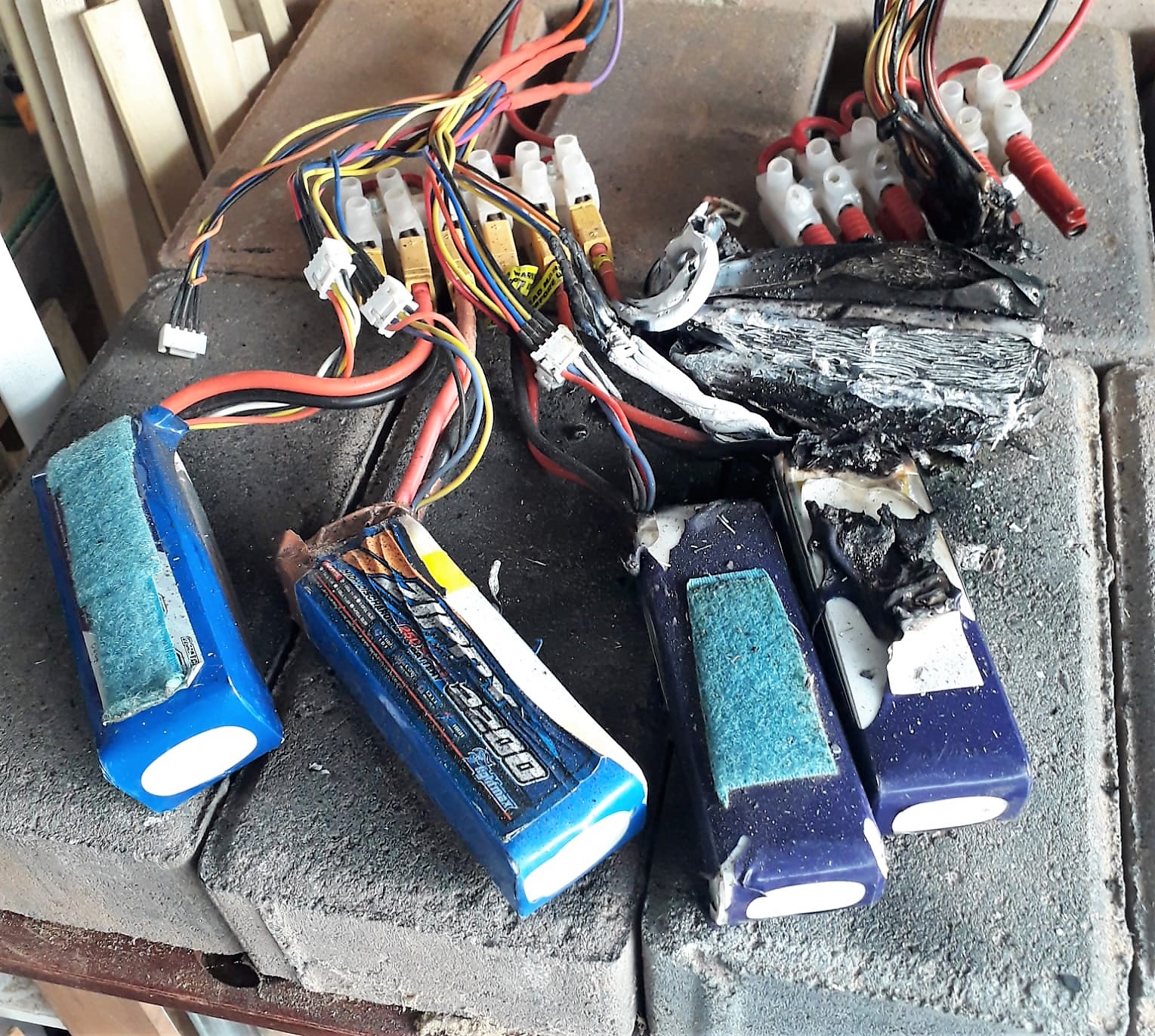
The fire spread to the other packs and destroyed several batteries along with the wiring and connectors. The chargers were all smoke damaged but seem to still be working ok.
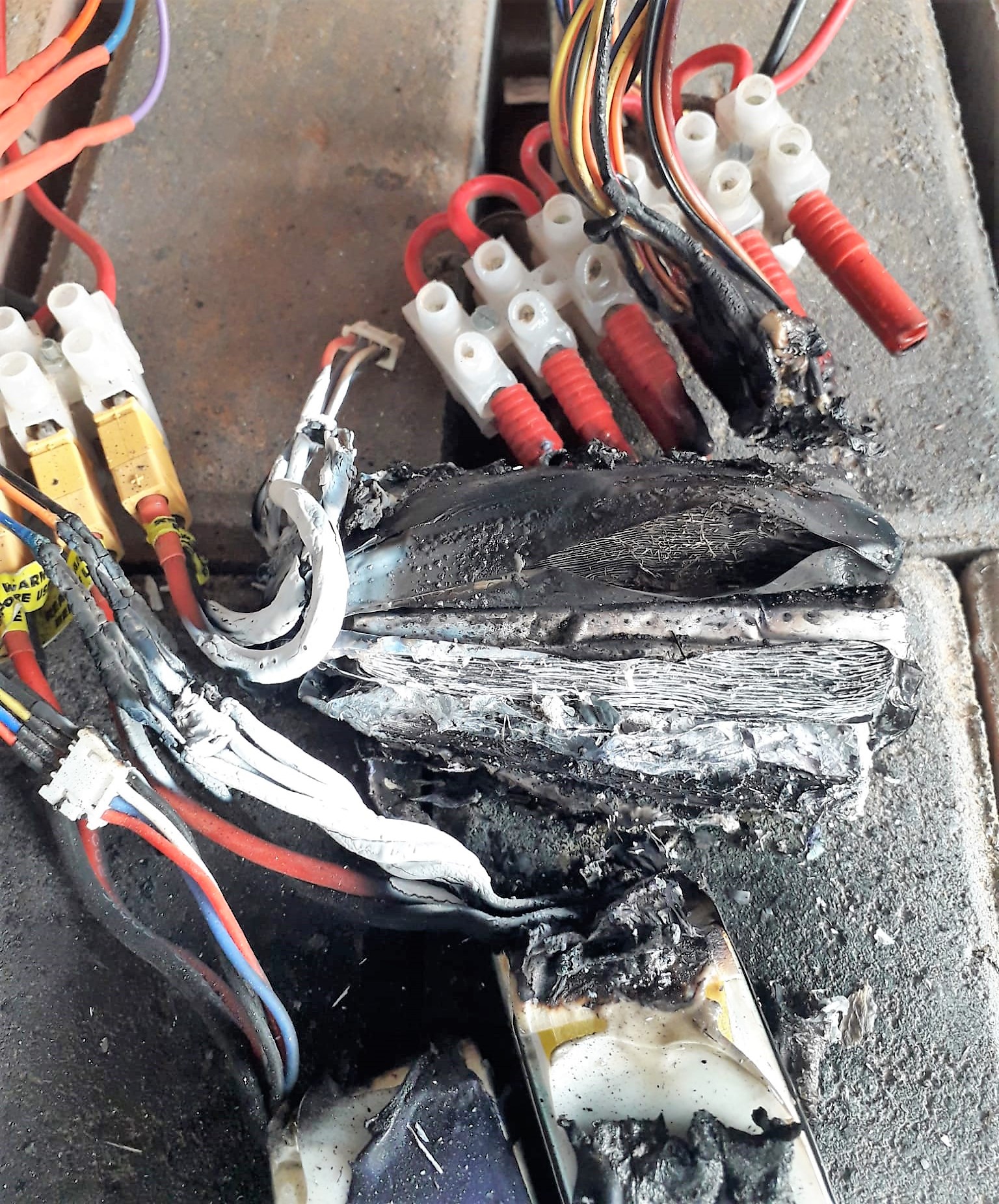 1066 was charging packs in parallel which some people aren’t keen on but that doesn’t seem to have been a factor in this case. The packs were all quite old and 1066 thinks one of them failed and caught fire. Very sensibly he had all the packs on a layer of bricks so the fire didn’t spread any further and this highlights the need to think about our own set-ups.
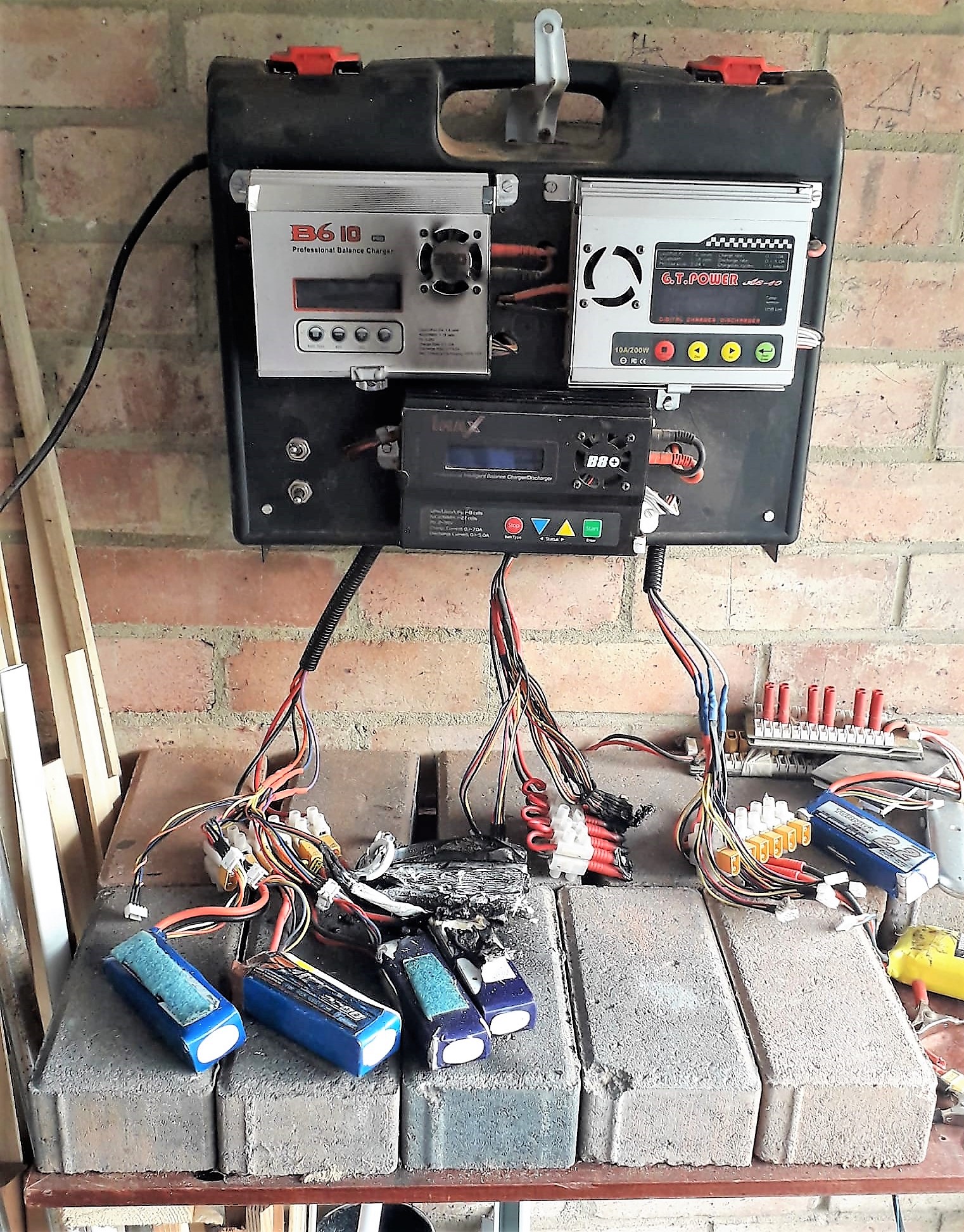 1066 has now made some changes so only one pack would be destroyed in a repeat event.
 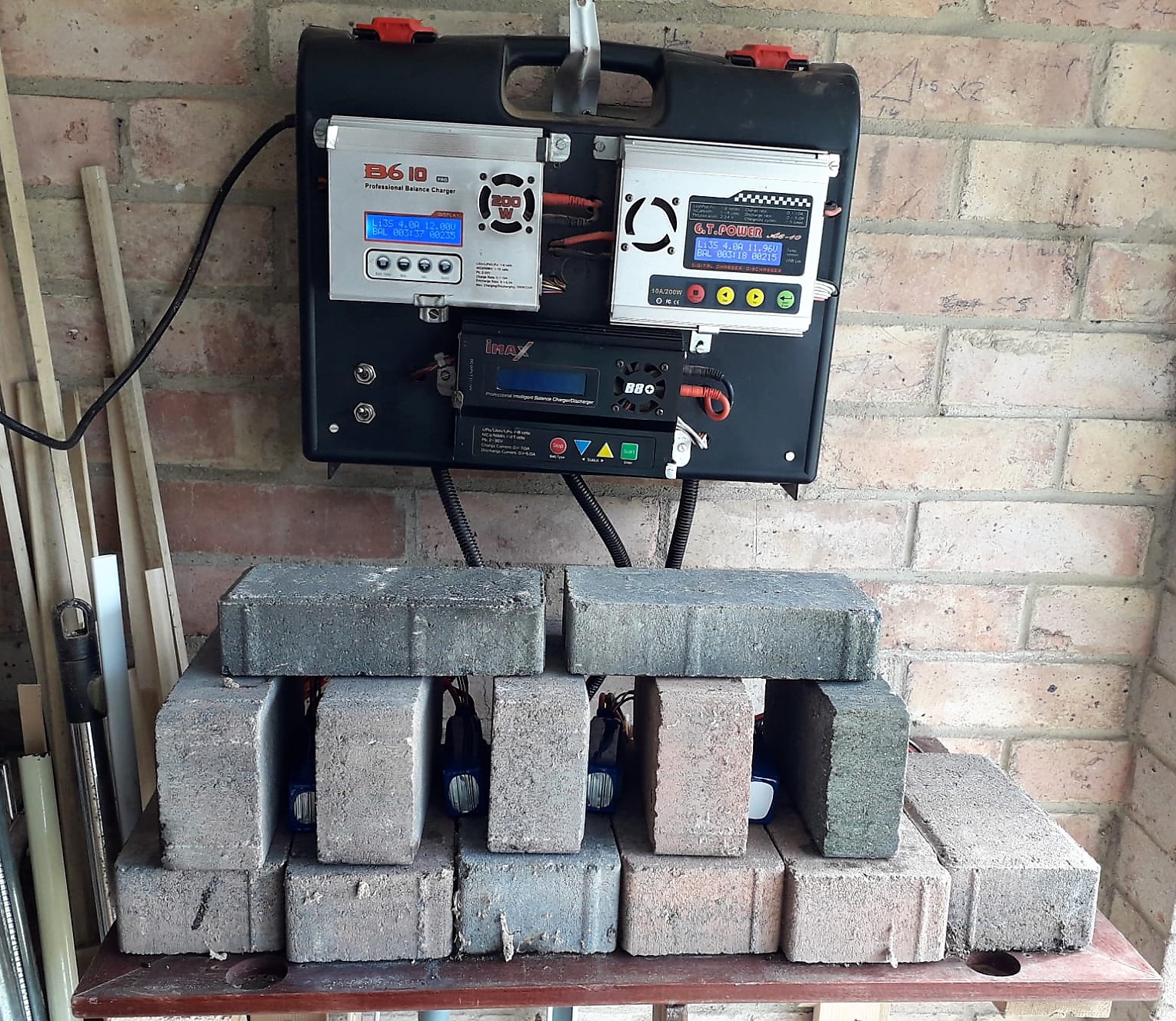 What would happen if one of your lipos caught fire whilst charging, could the fire spread? At the very least the packs should be a non-flammable container to stop any fire spreading.
Earlier this month Captain Slow circulated the offer of some free models and modelling gear that belonged to a Chichester club member who had sadly passed away and young Leo went along and collected some of the models. Two are vintage style and appear to have been IC powered originally but Leo has fitted them out with electric power.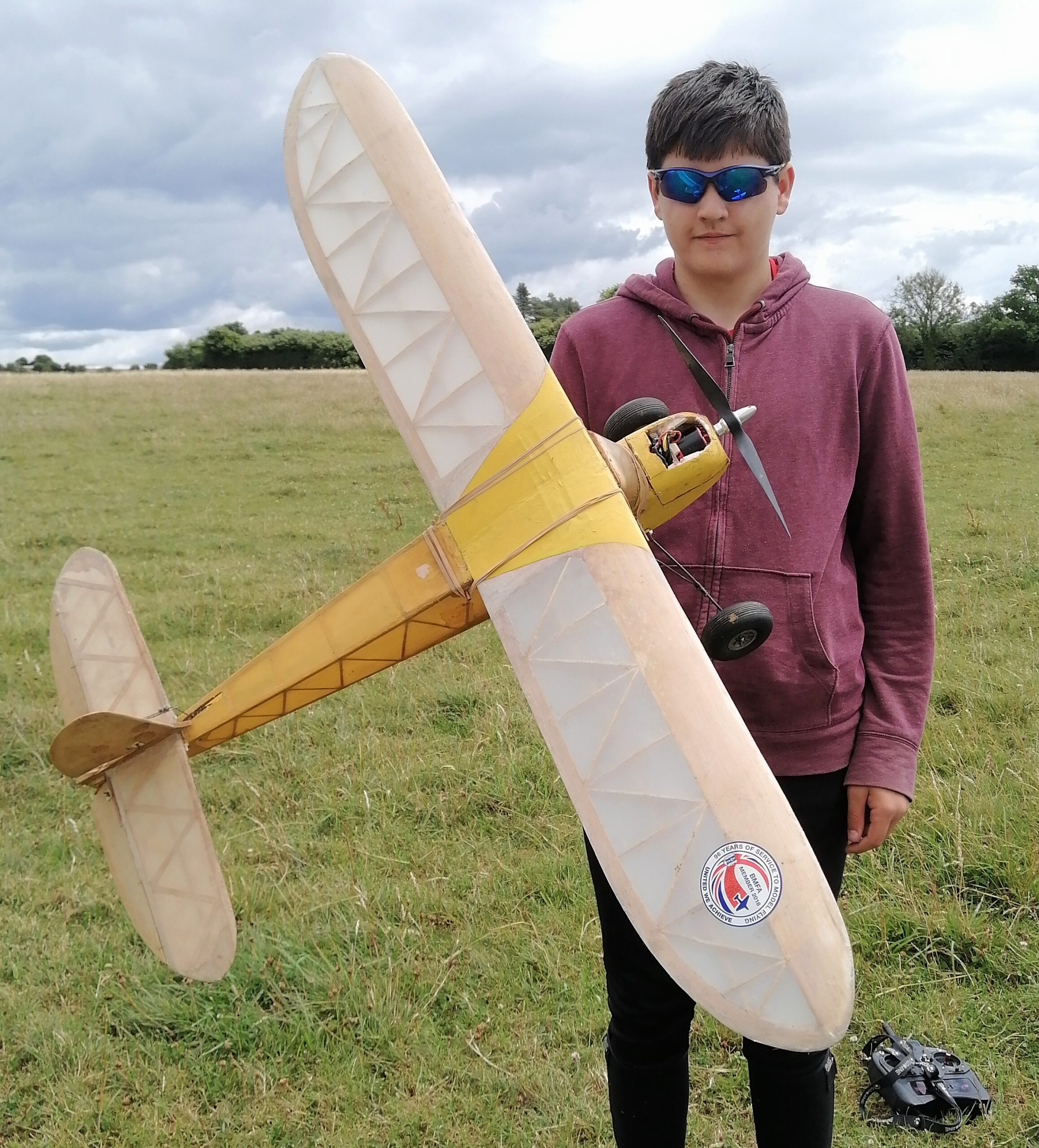
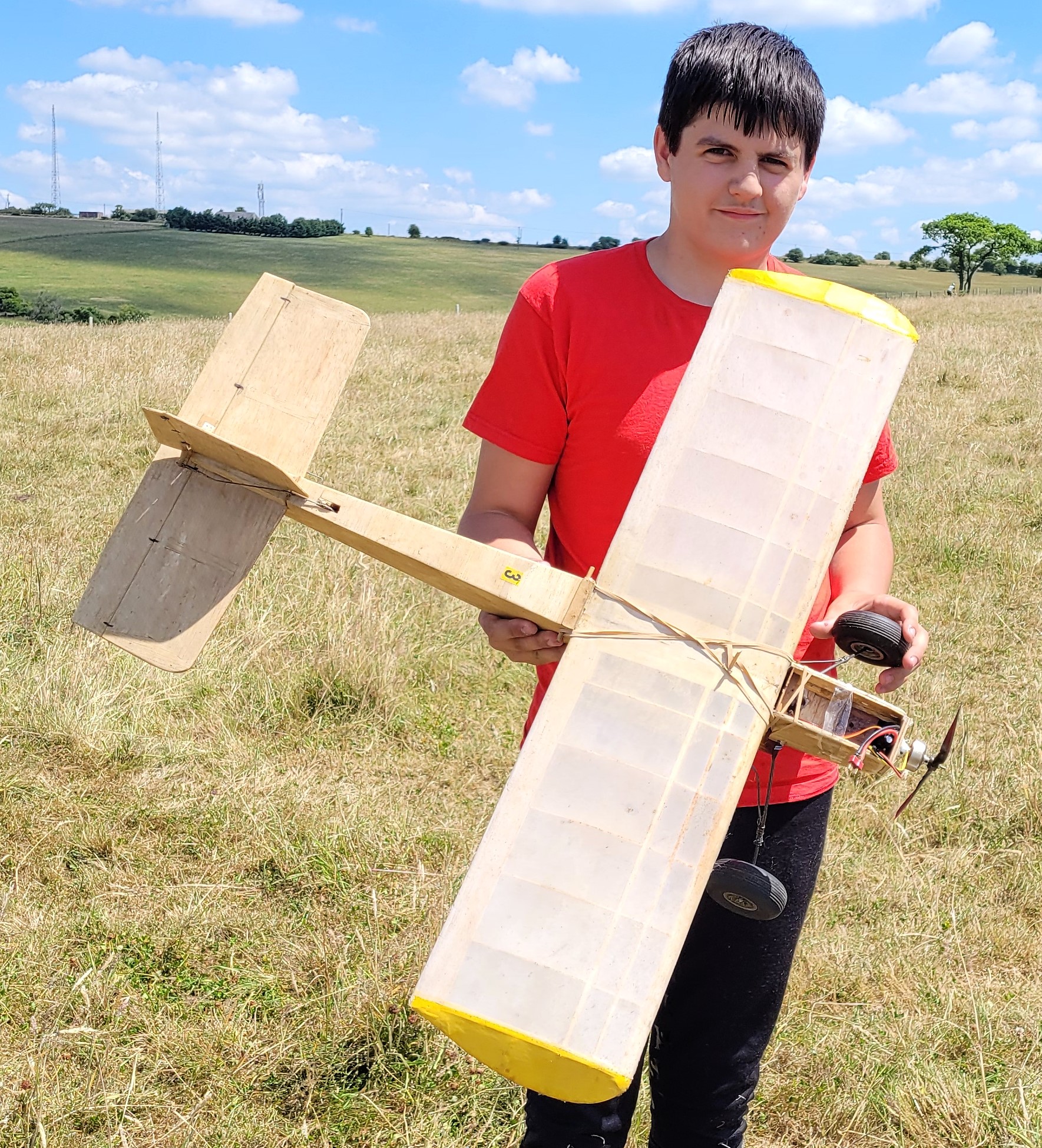
I have no details of the models but in this month’s video you’ll see one of them flying well.
In the May Patch News I included some photos of a couple of models Chas had bought, a Lockheed T-33 Shooting Star and a P-47 Thunderbolt. Neither of the models had flown at the time and I don’t know about the T-33 but the Thunderbolt has now had several flights. Like the other tiny models that some of us are flying the Thunderbolt is made by Eachine but at 500mm span it’s quite a bit bigger than the others in the range. It’s the Razorback version of the Thunderbolt with the ‘bubbletop’ canopy and although I have no idea how true to scale it is I think it looks right and it’s certainly a pretty little model.
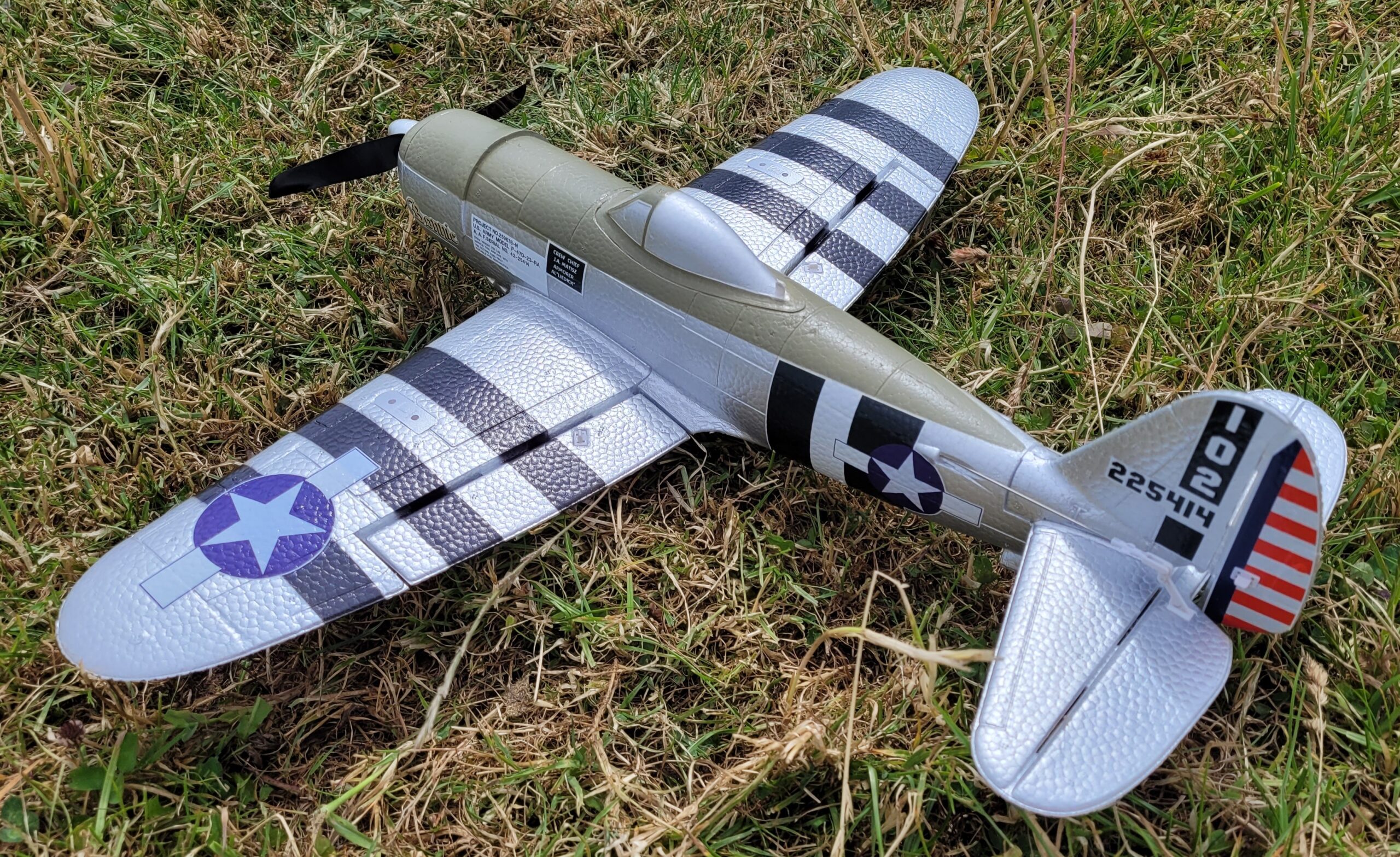
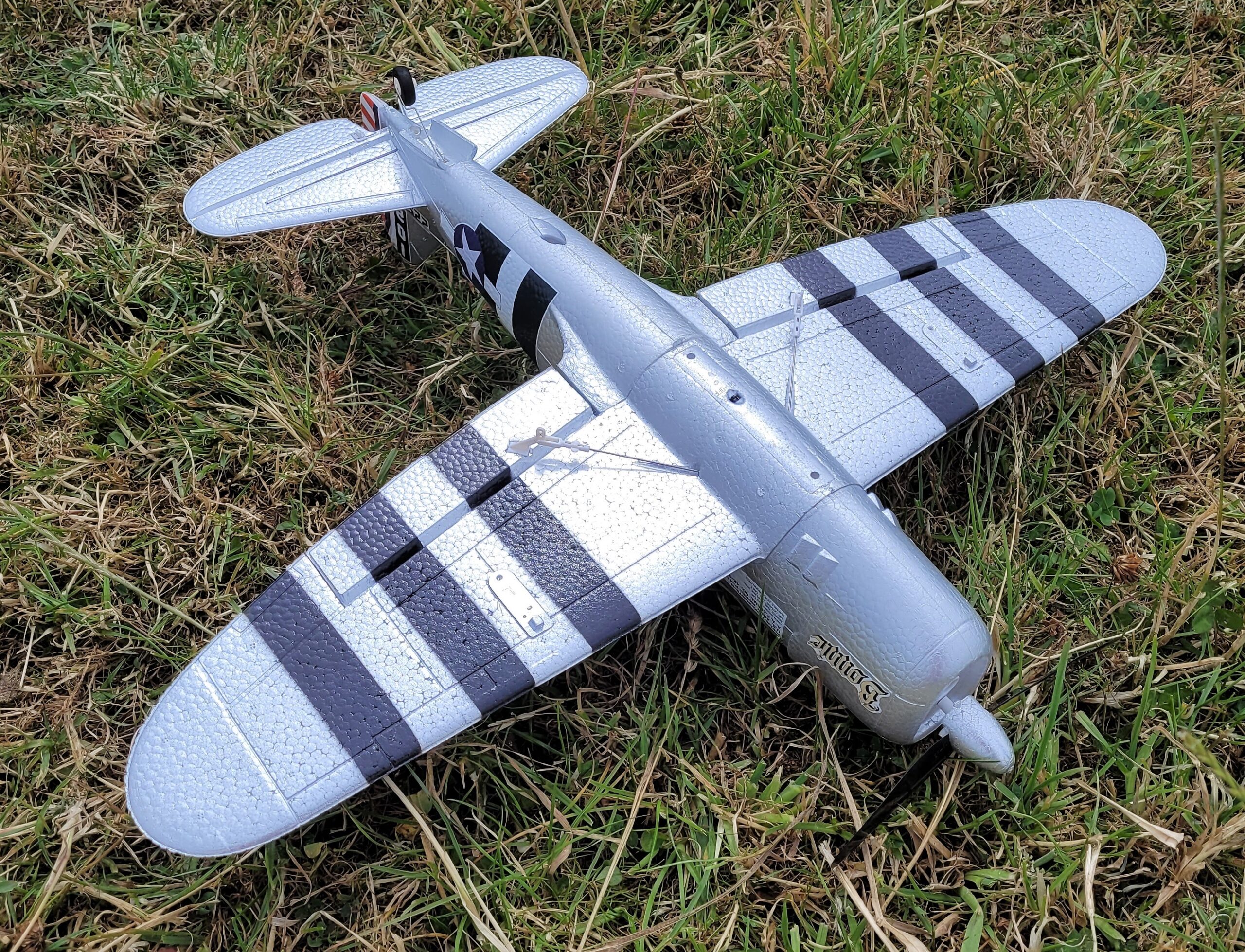 Like the other Eachine models it comes already fitted with the receiver, servos, and a built-in gyro but the transmitter that it’s supplied with is a little different to the others and apparently it uses a different protocol. However Chas has now managed to successfully link the P-47 to his RadioMaster transmitter so doesn’t have to use the Eachine one.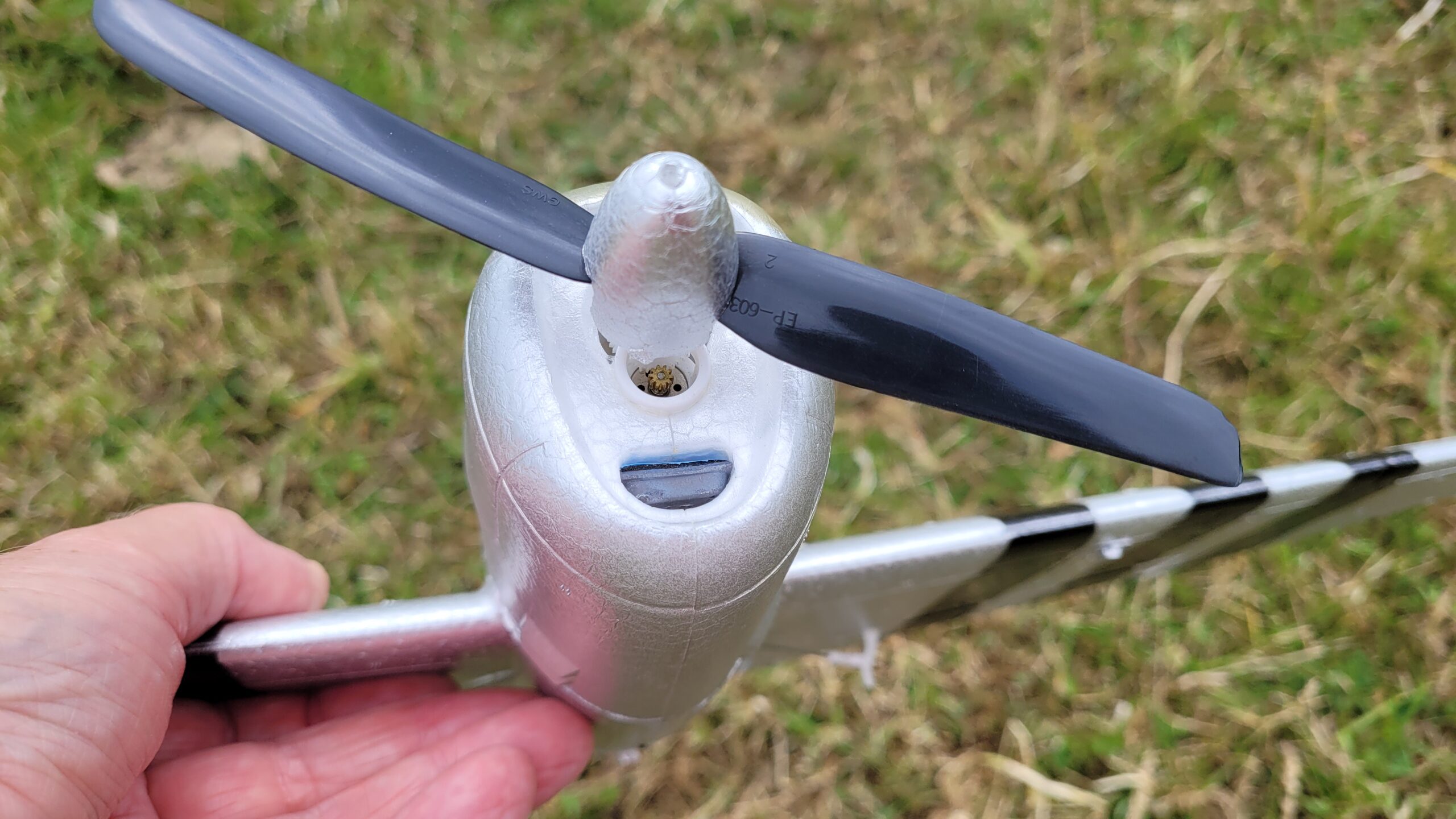
Chas thinks the P-47 uses the same motor/gearbox combination as the smaller models and before flying had read that people were saying the Thunderbolt was underpowered. This turned out to be correct, the little Thunderbolt flew nicely and it looked good in the air but it definitely needed a bit more power. It was great for just stooging around but I don’t think there was enough power for aerobatics. Chas was talking about swapping the motor out for something more powerful so watch this space for an update. Meanwhile watch the video where you’ll see that it flies well enough with the supplied set-up, just a little slow.
After many months of hard, intensive work Captain Slow has finally completed his Sea Vixen, a model that usually takes others a couple of weeks at the most to put together!
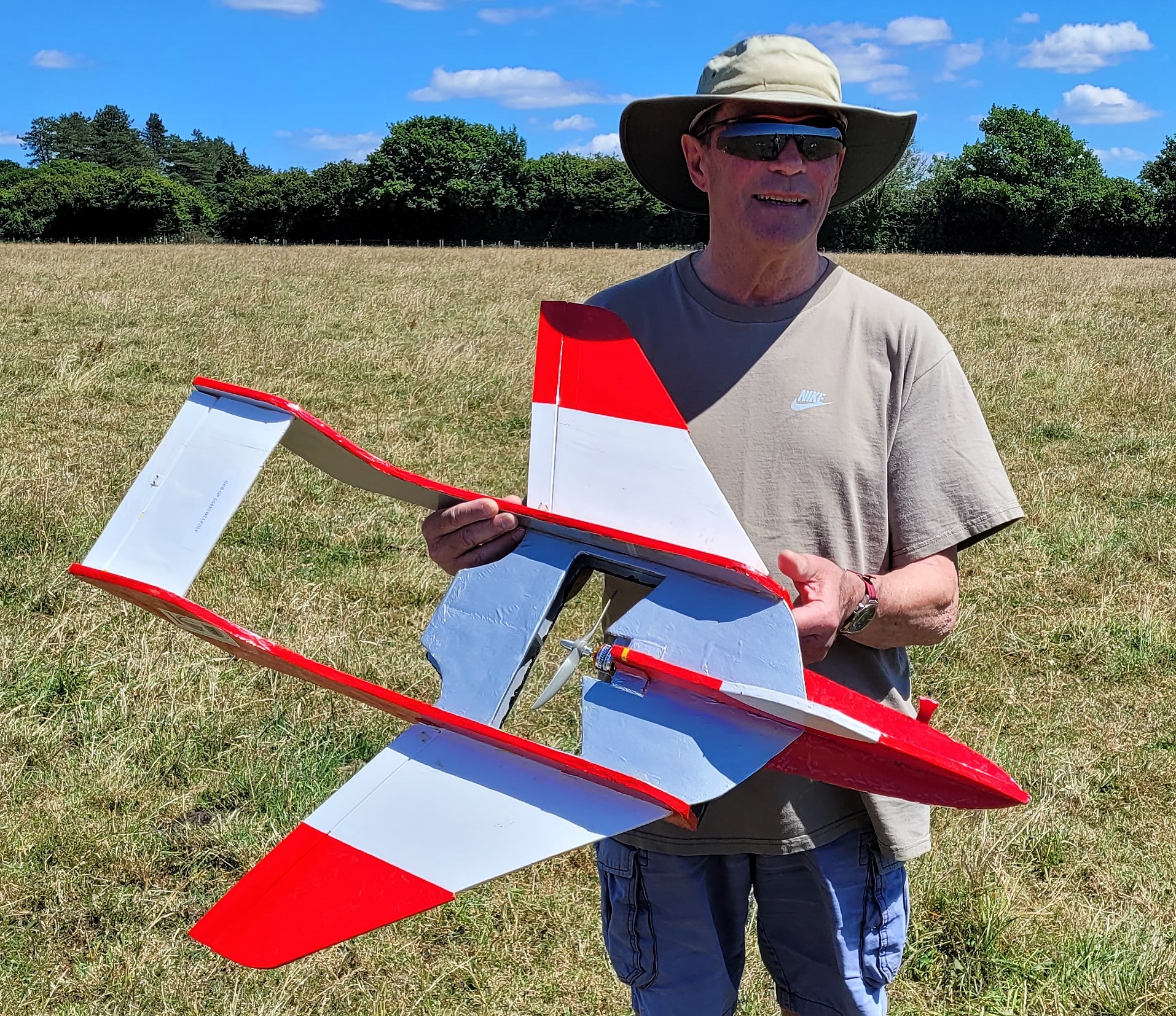 Captain Slow built it using Dwayne Pipe’s plans and it was worth the wait, after all those months of foamboard cutting and then covering the model it finally took to the air.
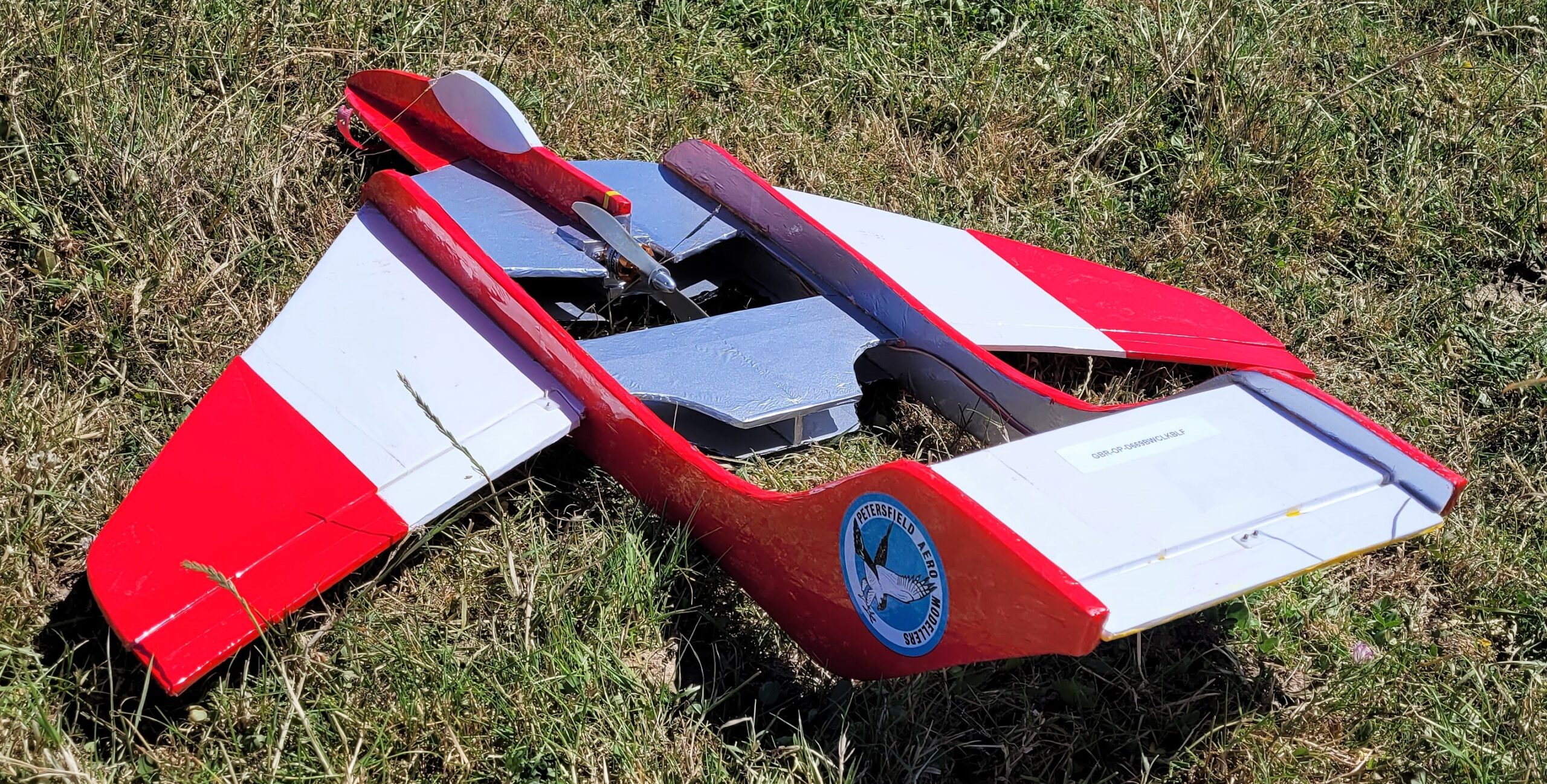 There was quite a lot of debate about the correct C of G position with ‘the further forward the better’ option being tried first. That turned out to be totally wrong and after a couple of false starts and twice moving the C of G rearwards the Sea Vixen eventually got airborne.
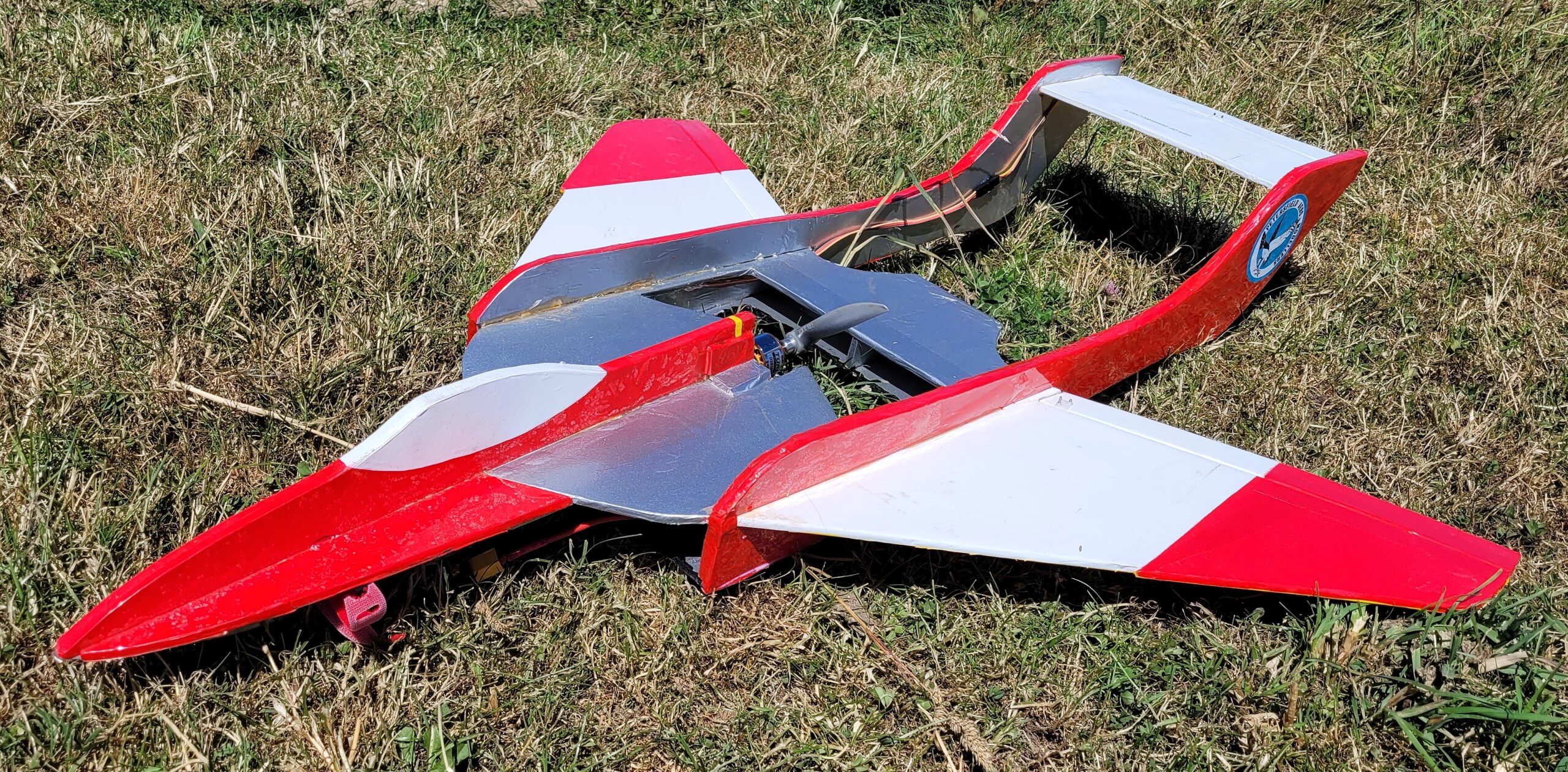 Captain Slow did a few tweaks to the expo and rates before he was happy with the way it flew and the C of G could probably still be moved rearward a little but it now flies well.
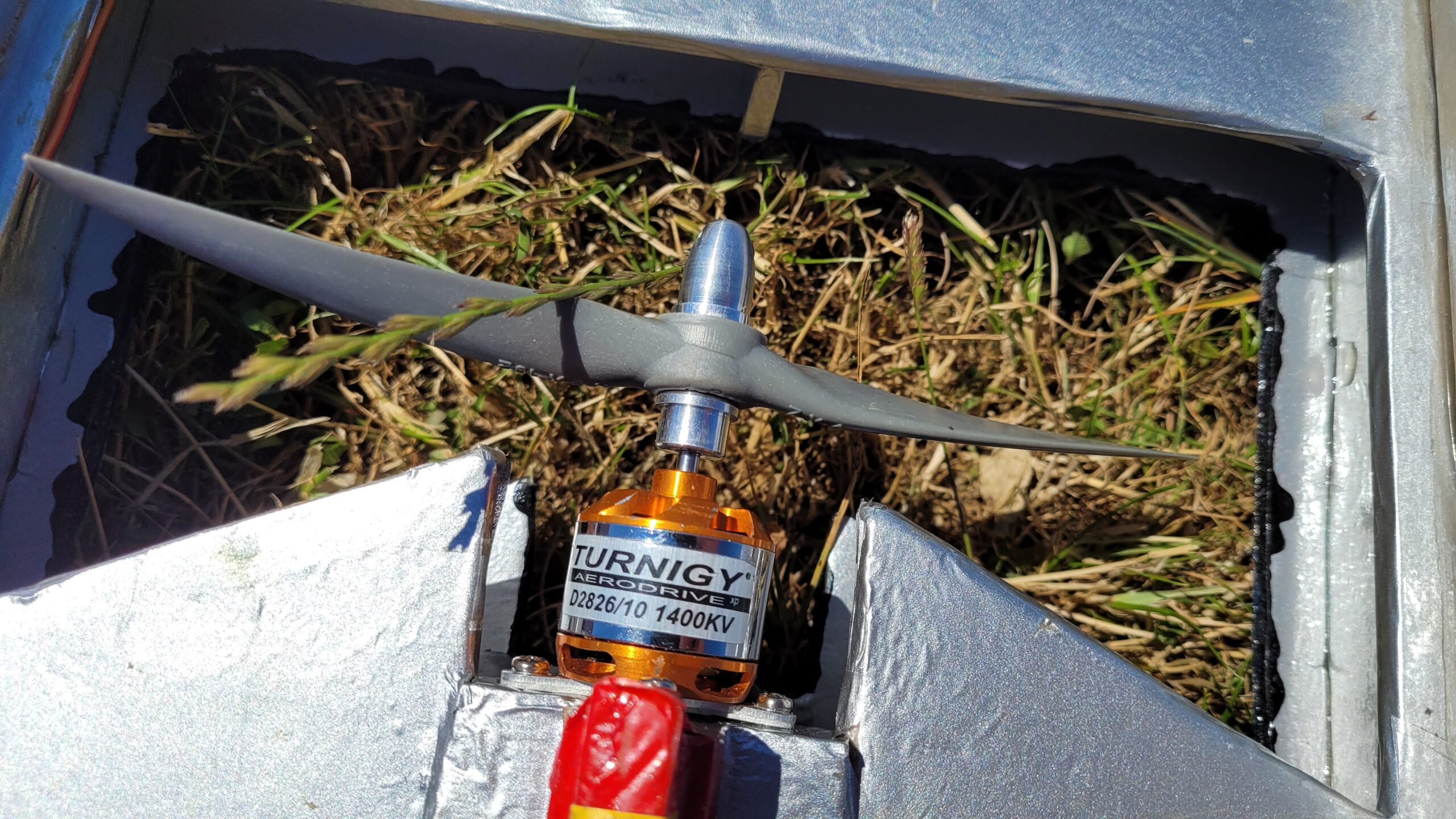 He has fitted it with a Turnigy 2826/10 1400KV motor and is talking about changing it to a higher KV motor to give the model a bit more speed. Captain Slow, more speed? Surely I’ve got that wrong! It’s in the video so take a look and see what you think.
Under the watchful eye of Dougal Entendre new member Geoff Hill has been flying an electric glider that was fitted with an old brushed motor which overheated badly. So he took the decision to bring the system right up to date and fitted a more powerful brushless motor on the front, out in the fresh air where cooling wouldn’t be a problem.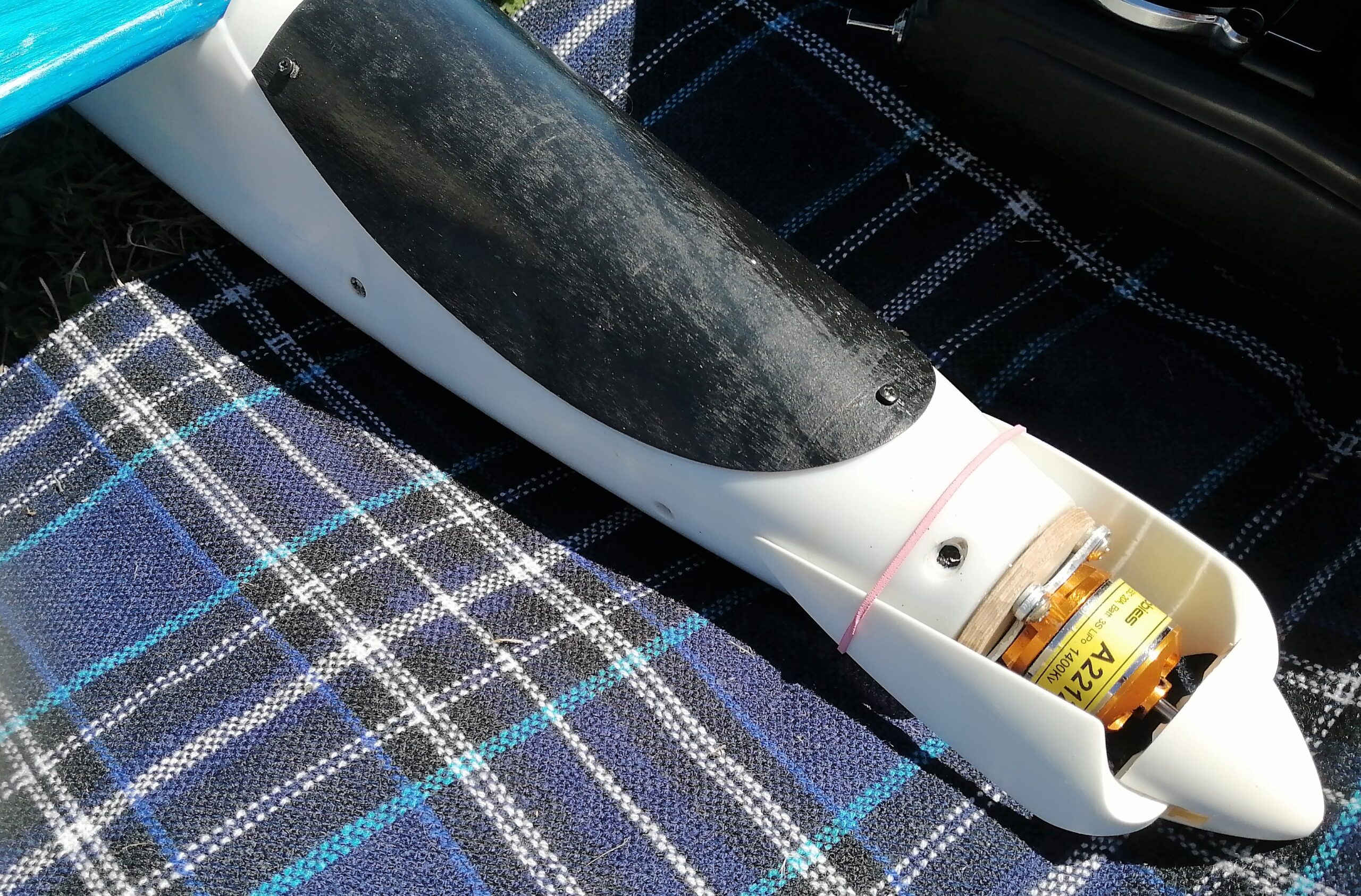
Much better, the glider flew really well…right up to the moment that the new motor tore itself off the front! If anyone is desperate for a hardly used 2112 brushless motor they should start combing the valley as despite lots of searching it hasn’t yet been found!
Dougal himself also had a loss from the front end of a model in July but in his case it was just the propeller from his Mini Blitz. The loss was rather unusual as, whilst it’s not unknown for the prop driver complete with prop to detach, on Dougal’s plane the prop hub broke in half so the whole prop flew off but the driver and the nut stayed in place.
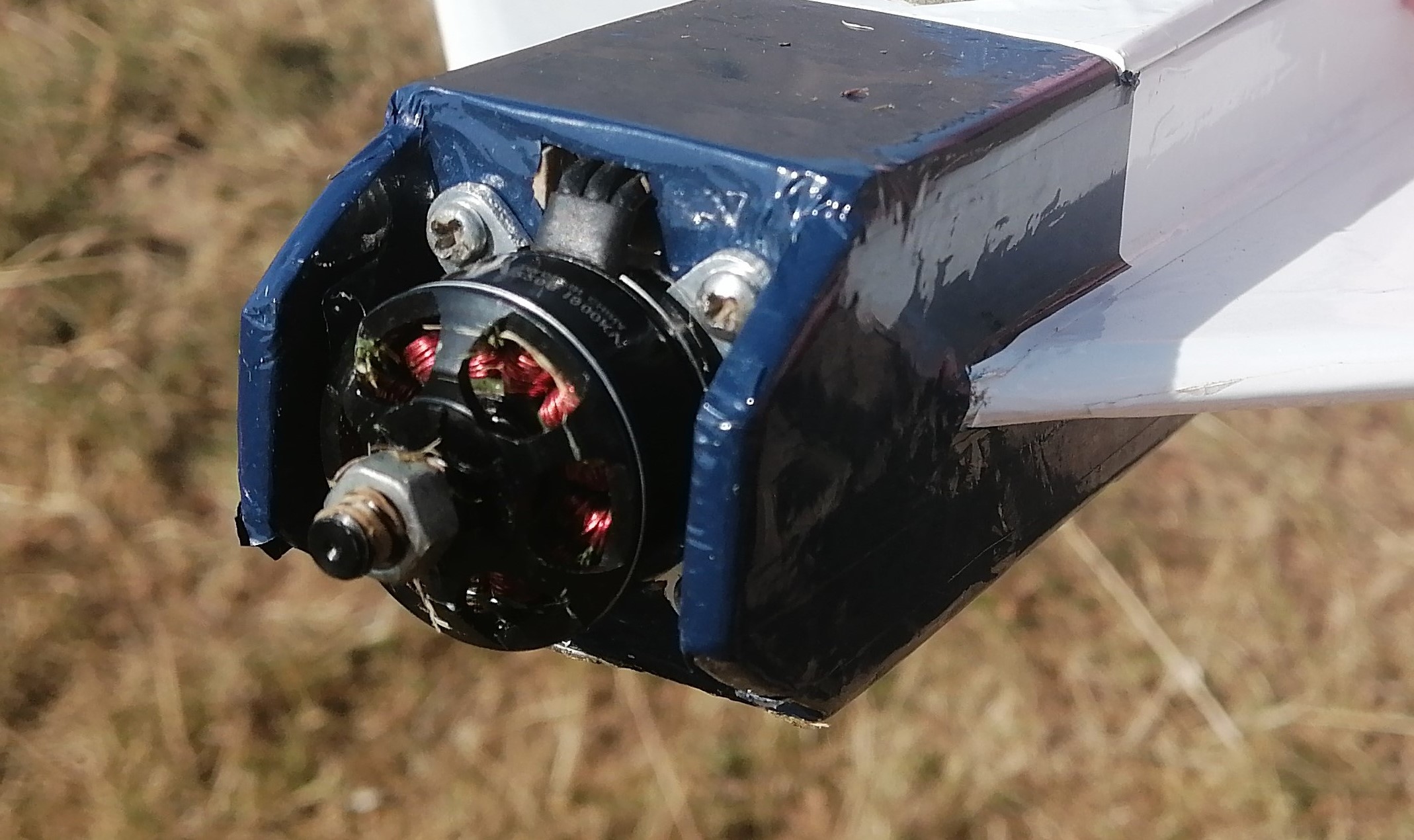 Occasionally a prop will throw a blade, an event that’s usually followed by the imbalance of the remaining blade ripping the motor out of the model, but I’ve never seen a propeller hub break like that. Mind you the prop was one of the extremely cheap ones several of us bought in a HobbyKing sale years ago, I remember buying lots that were only a penny each! Ah yes, the good old days of HobbyKing sales when they actually had stuff to sell.
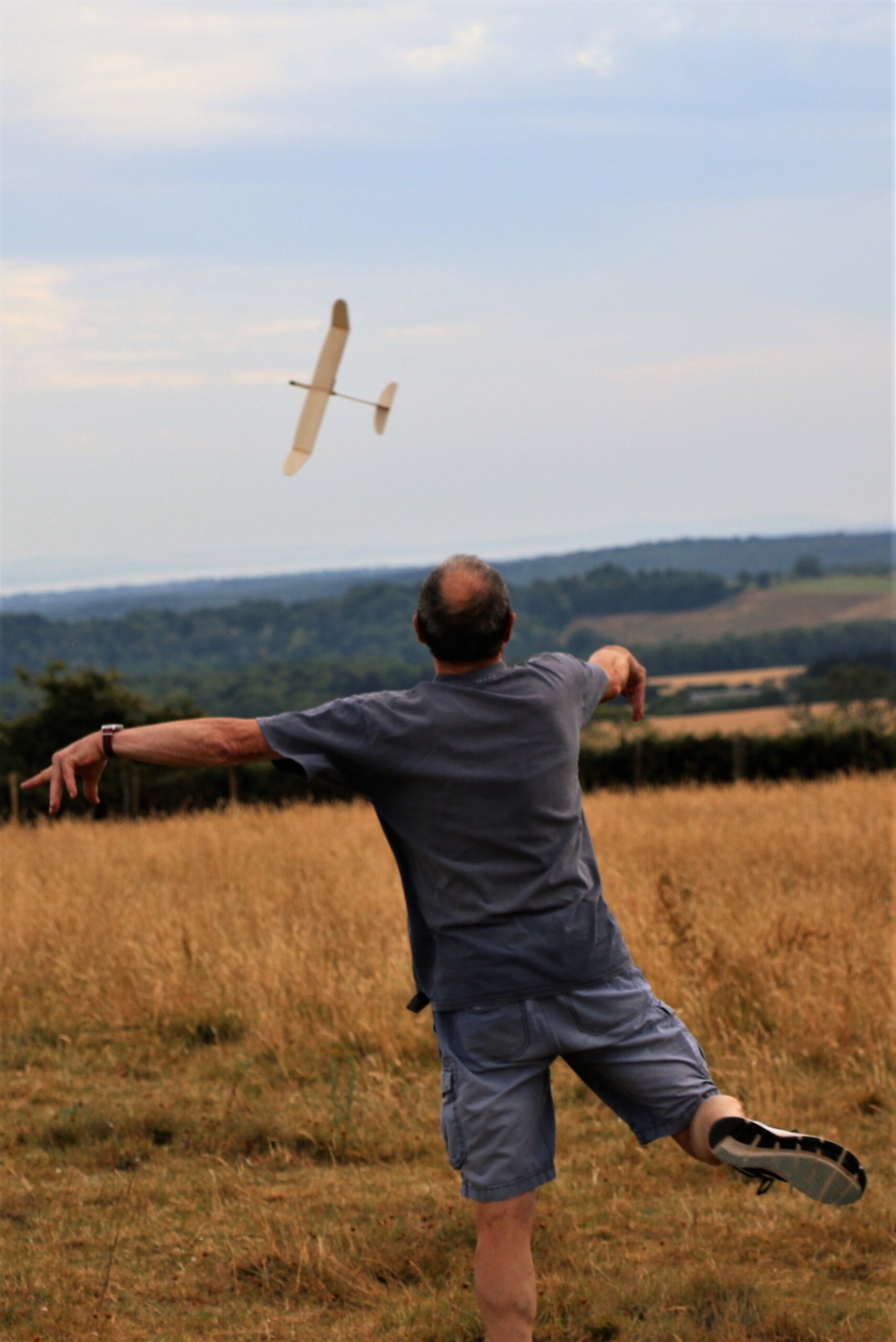
On 13th July Competition Secretary Dwayne Pipe ran the Chuck Glider competition for us. 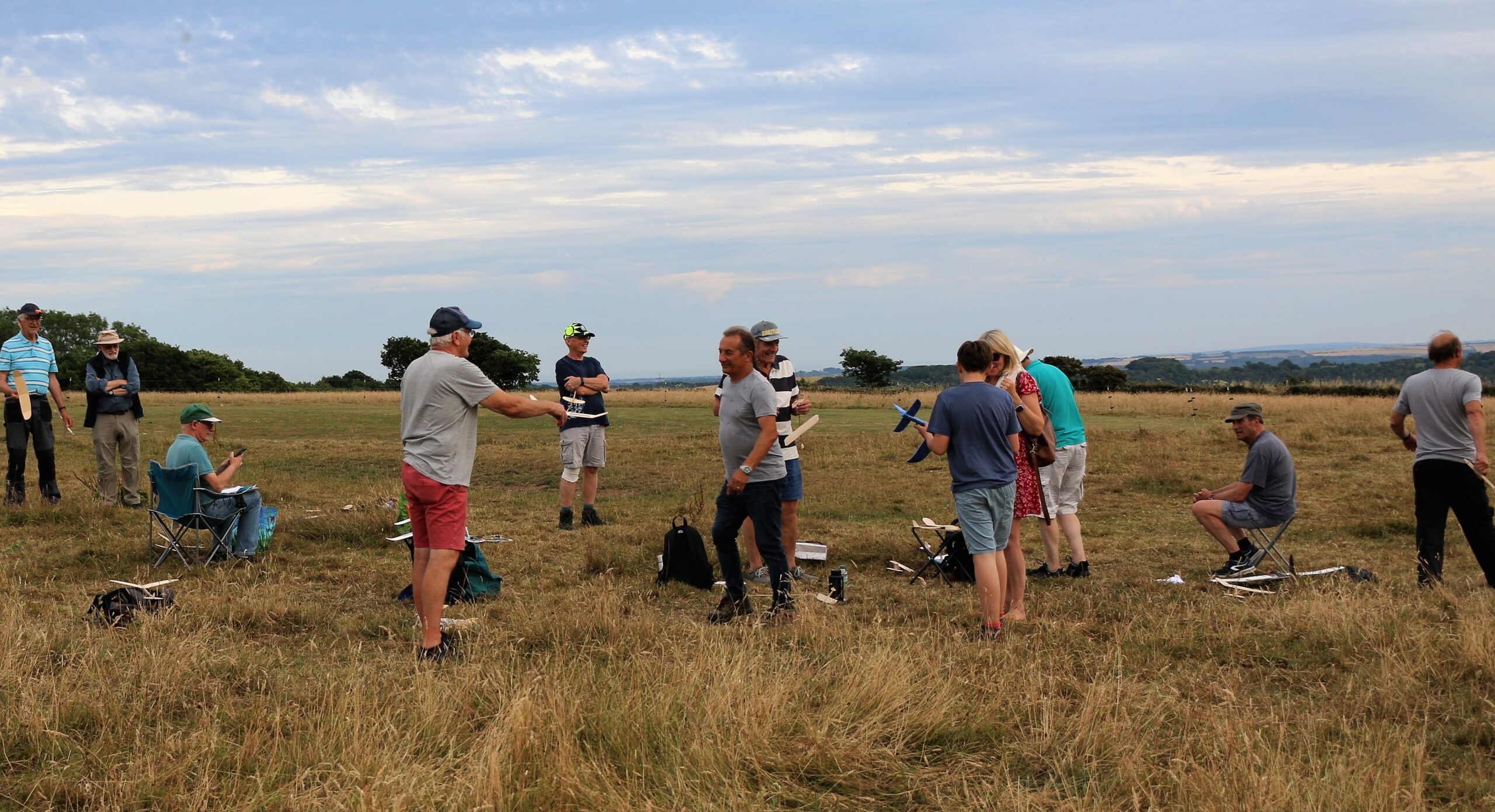 This is Dwayne’s report of the event: This years’ Chuck Glider competition was held once again in perfect weather conditions. No wind and a warm summer evening up the patch. We had a record 13 folk come and despite the chaos of trying to organise PAM members, we all had a good time. The usual suspects won with Andy Palmer romping ahead with a total time of 86.1 seconds. Tony Neal came second with 39.65 seconds and Bob Hill came third with 36.95 seconds. Mention needs to be made to our junior and honorary women’s section of Charlie and Nadine who both joined in the fun. In the catapult launch event Bob Hill came first Geoff Hill came second and Alan Wood came third. The evening ended with a couple of micro planes showing off their paces. Thanks Dwayne, it was a great evening with perfect weather that was enjoyed by all who attended. Kryten took some great photos and commented on the differing styles. But me… I’m saying nothing!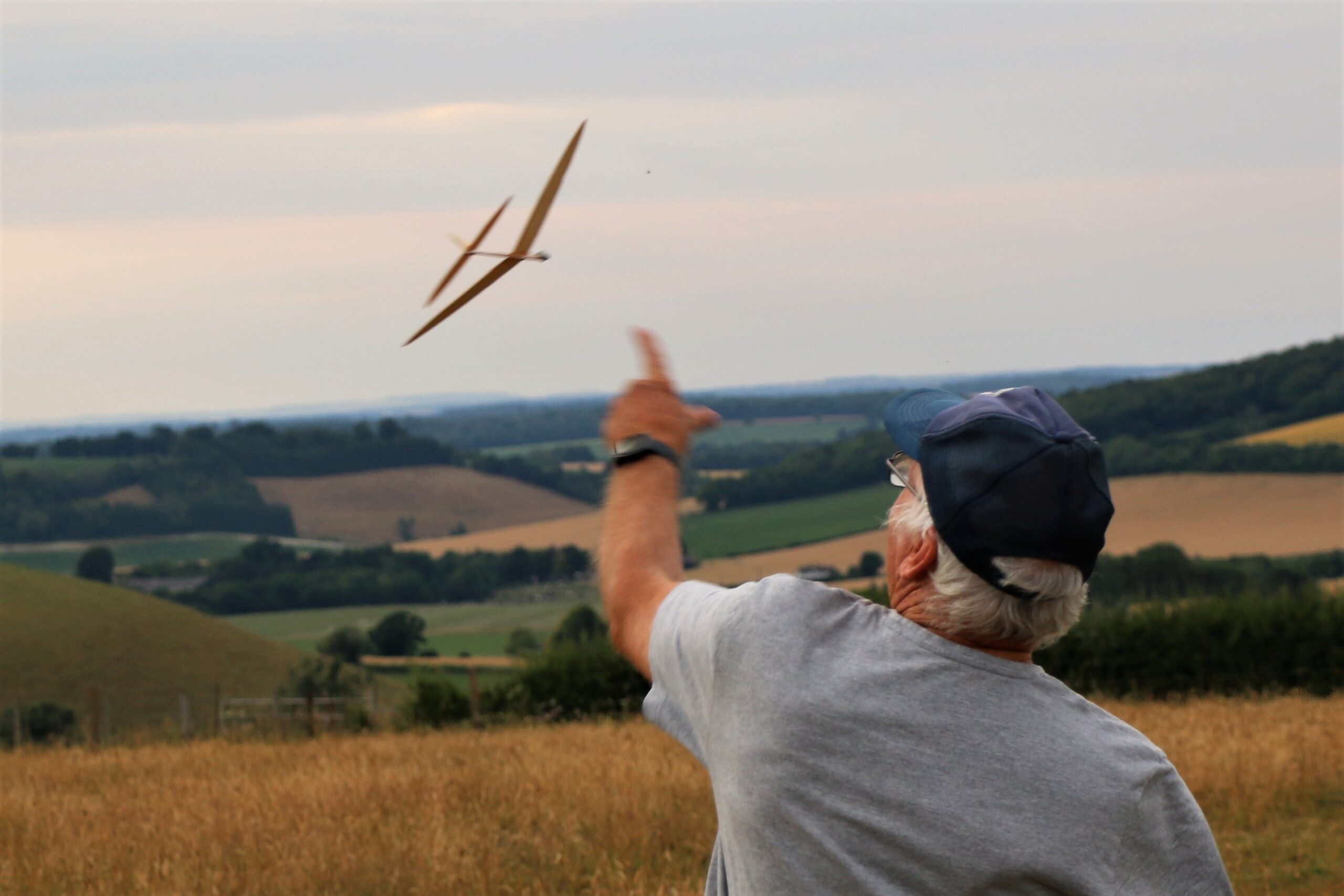
After a long absence Percy Vears returned to the field in July and brought with him two newly completed ducted fan models, a Mig-15 and a Folland Gnat.
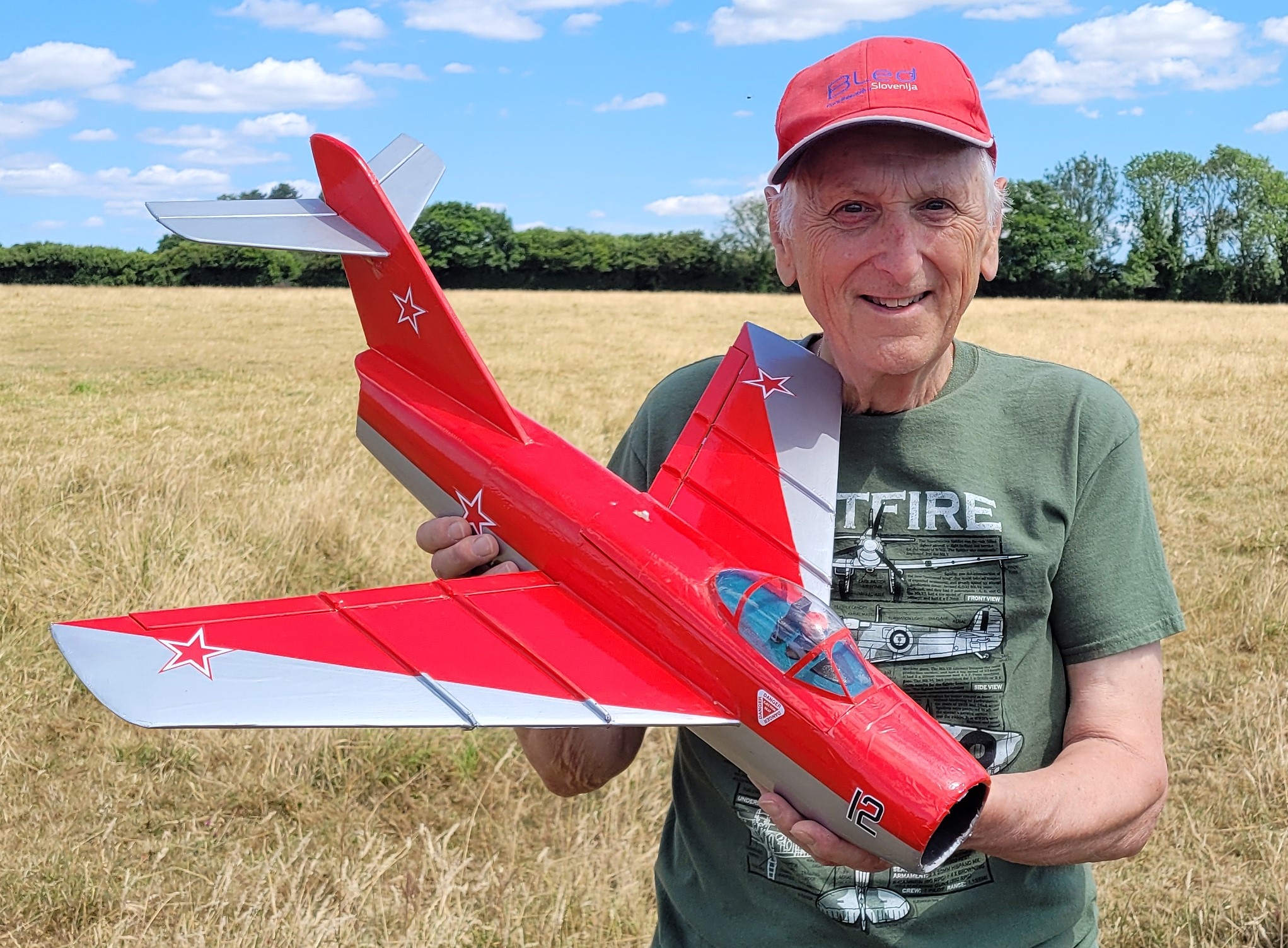
 He built them both from the Tony Nijhuis plans and has made a lovely job of them both. We tried the Mig-15 first but found there wasn’t enough thrust to get away from the launch which we didn’t understand as Percy had used the recommended fan/motor combination.
Percy’s batteries are rather old so he tried one of Dougal’s but it was no better. Back at the workshop he discovered what the problem was: Reading Tony Nijhuis build notes, he specifies 3-cell operation. When I was given an FMS EDF (new and boxed) for this project, I assumed it would be suitable. Following the problems on Friday, I did some further checks and discovered that the motor is available for either 3 or 4 cell operation, but the 3-cell motor should not be used with 4 cells, so trying with 4 cells would probably damage it. The 3-cell motor has 2627-KV5400 marked on it, and the 4-cell is marked with 2627-KV4500, but with the motor fixed within the thrust tube it is difficult to determine which one I have. After much thought I found a solution – use the bright sunlight to illuminate the inside of the thrust tube and use a highly polished table knife as a mirror. I was able to see that I have a motor designed for 4-cell operation. Running this motor with a 3 cell LIPO only gives 400gm of thrust – not enough. With a newly purchased 4 cell 60C LIPO it delivers 823gm of thrust, and since the weight of airframe and battery totals 638gm, should be adequate for a lively performance. Moral – photograph markings on the motor before embedding it in the thrust tube!
So next time out Percy came armed with some 4 cell 60C lipos and the Mig flew beautifully, very fast at full throttle and with lots of power for loops and vertical climbs.
Having initially failed with the Mig we weren’t sure about the Gnat but gave it a go anyway and we were all pleasantly surprised when it just flew away with no problems at all.
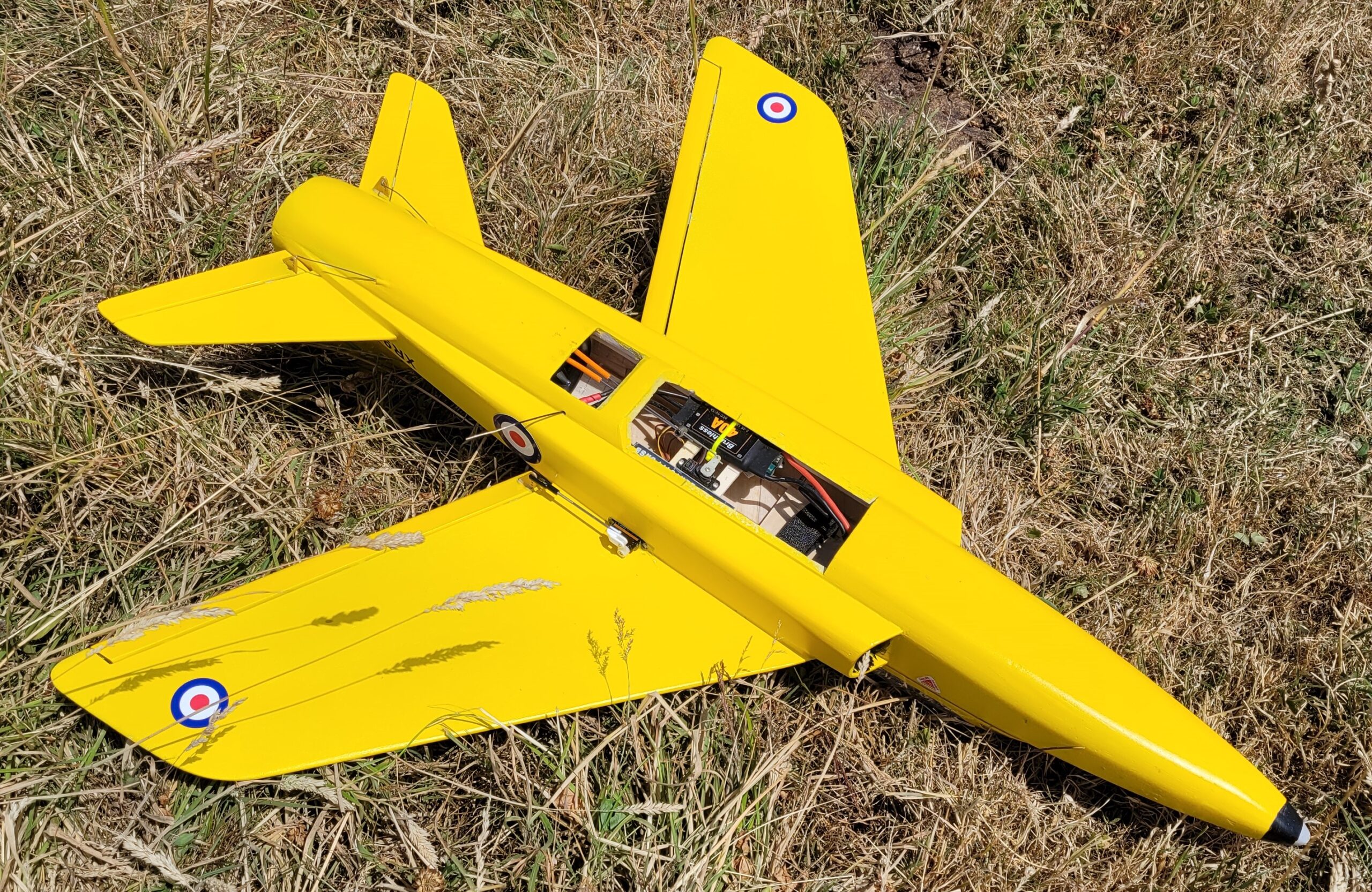
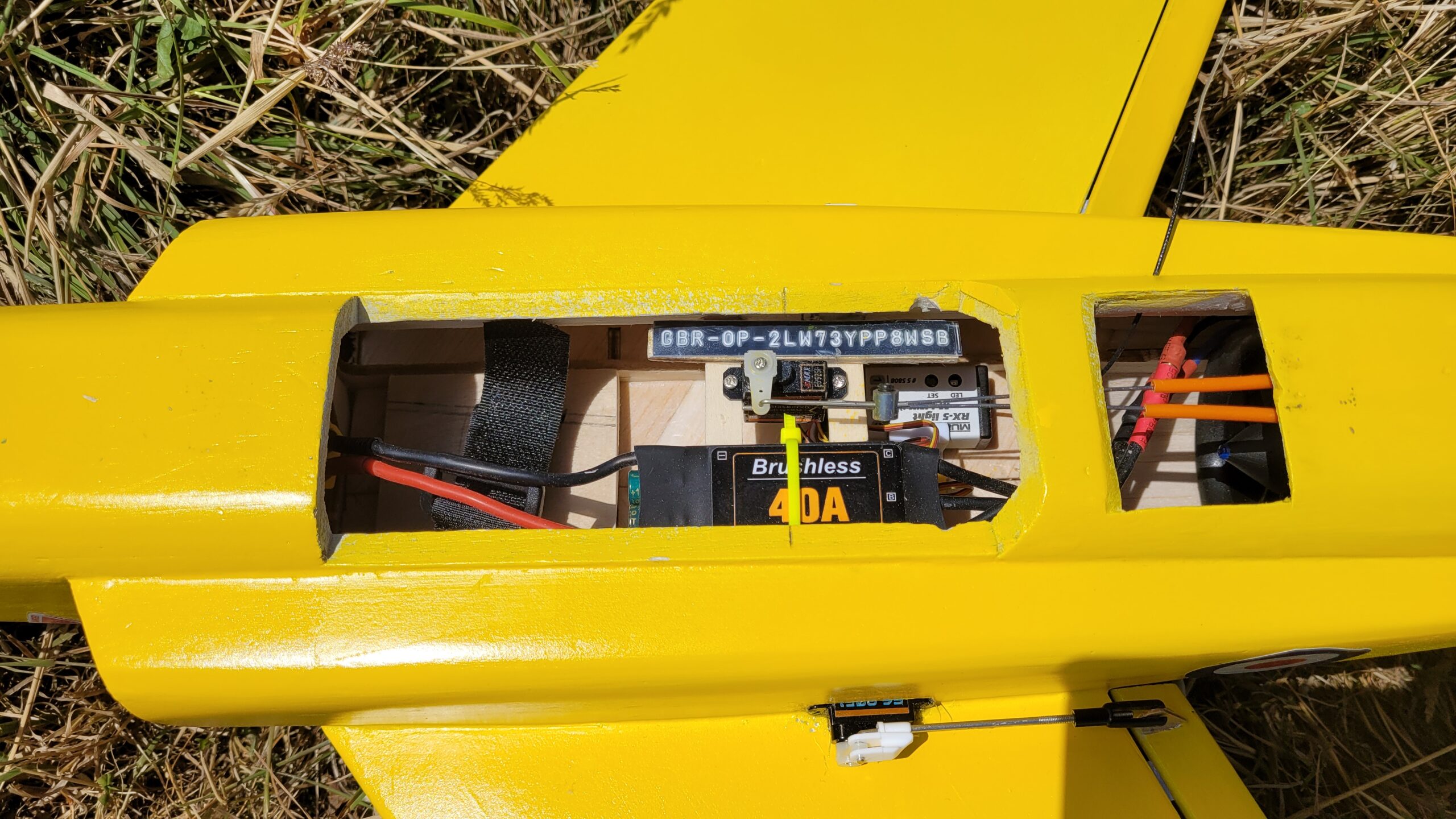 After a couple of circuits the power was starting to drop off, presumably because the elderly lipo was past it’s best, so landing was called and Colin found the Gnat glided better than expected but landed nicely. Some of the flight is in this month’s video for you to see.
Three PAM members had flight experiences away from the patch recently, all as presents from their families to celebrate their great ages! Catapult King enjoyed flying a Lancaster simulator: The Lancaster SIM flight was a present from my family and took place at Perry Air in Shoreham. It was a great experience but as you can see by the landing I really couldn’t get my act together. I’m used to an immediate reaction from my models but here there was quite a delay between me turning and the plane reacting, I’m all over the place. In addition when you turn there’s a tendency to pull on the yoke so again you’re not going where you’re supposed to. There were two flights one of which you fly (or attempt to) under the Severn Bridge the other was bombing the Eder damp, that one I got right but only just. Great day followed by Ham, Egg and chips. You can see the video by clicking HERE. I thought he did well, it looked like a pretty good landing to me.
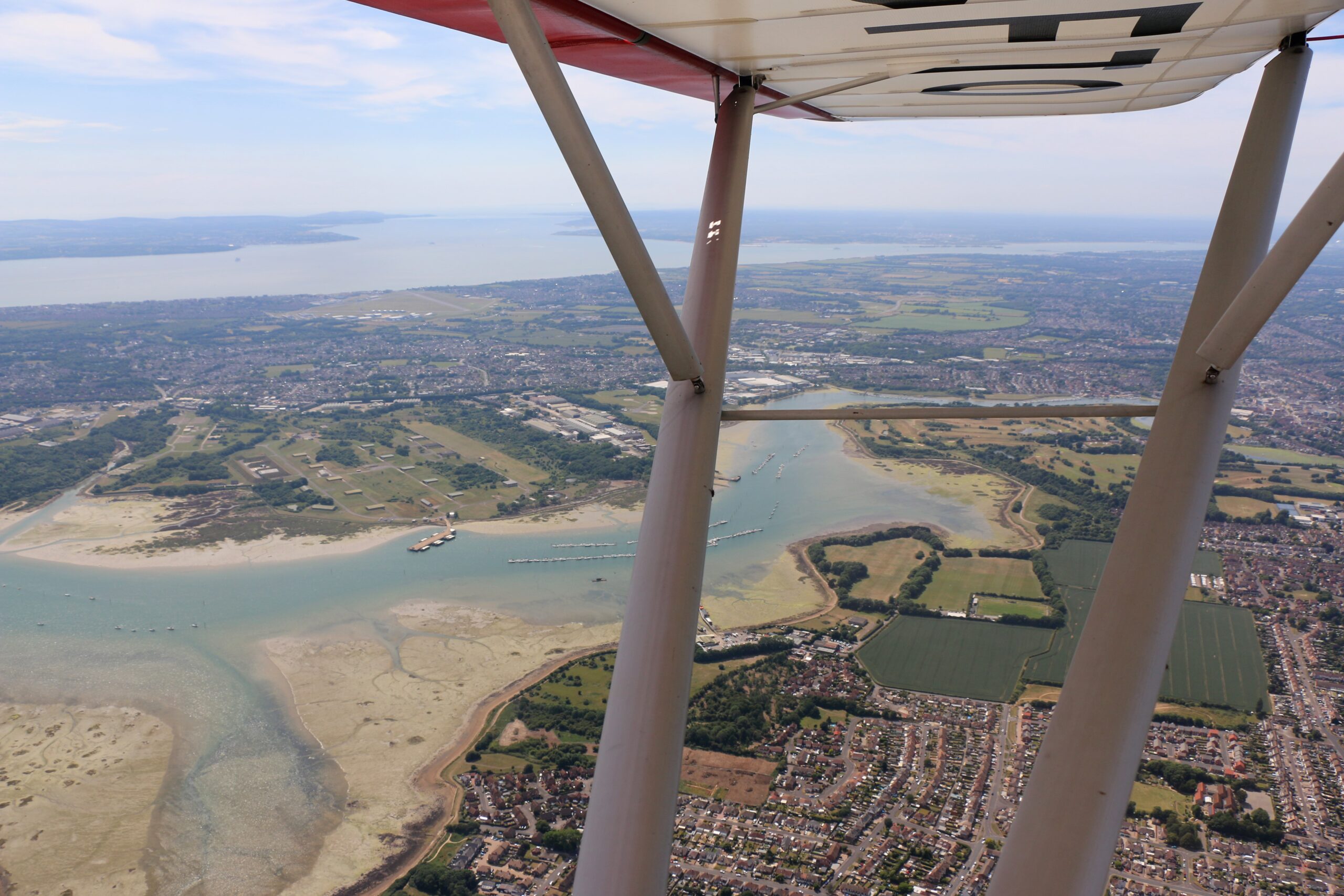
Kryten’s 70th birthday present was a trip with Solent Flight who are based at Lower Upham Airfield which is just 8.8 miles due west of our patch. This is from Google Maps:
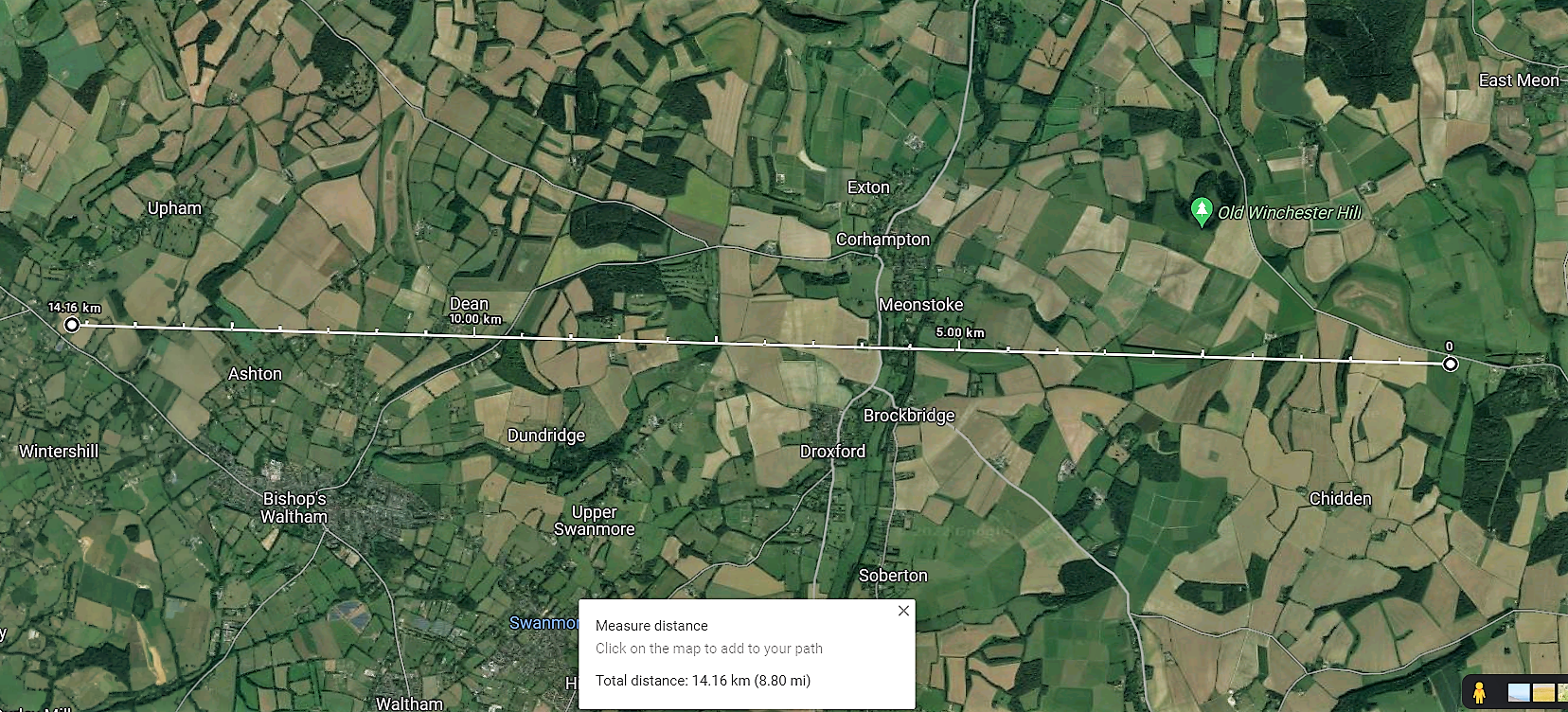 When we see a light aircraft fairly low over our field it’s often one of Solent Flight’s planes.
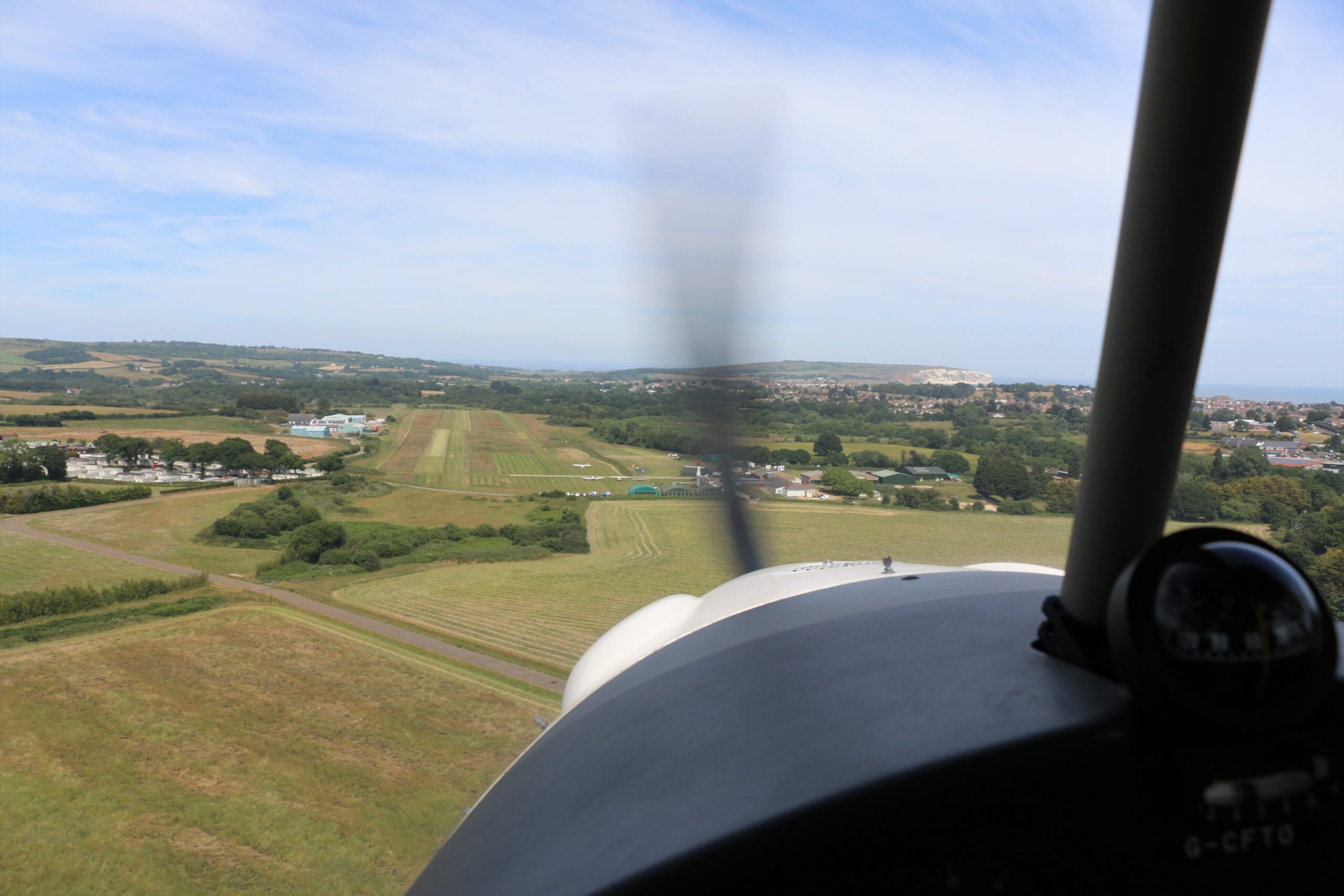
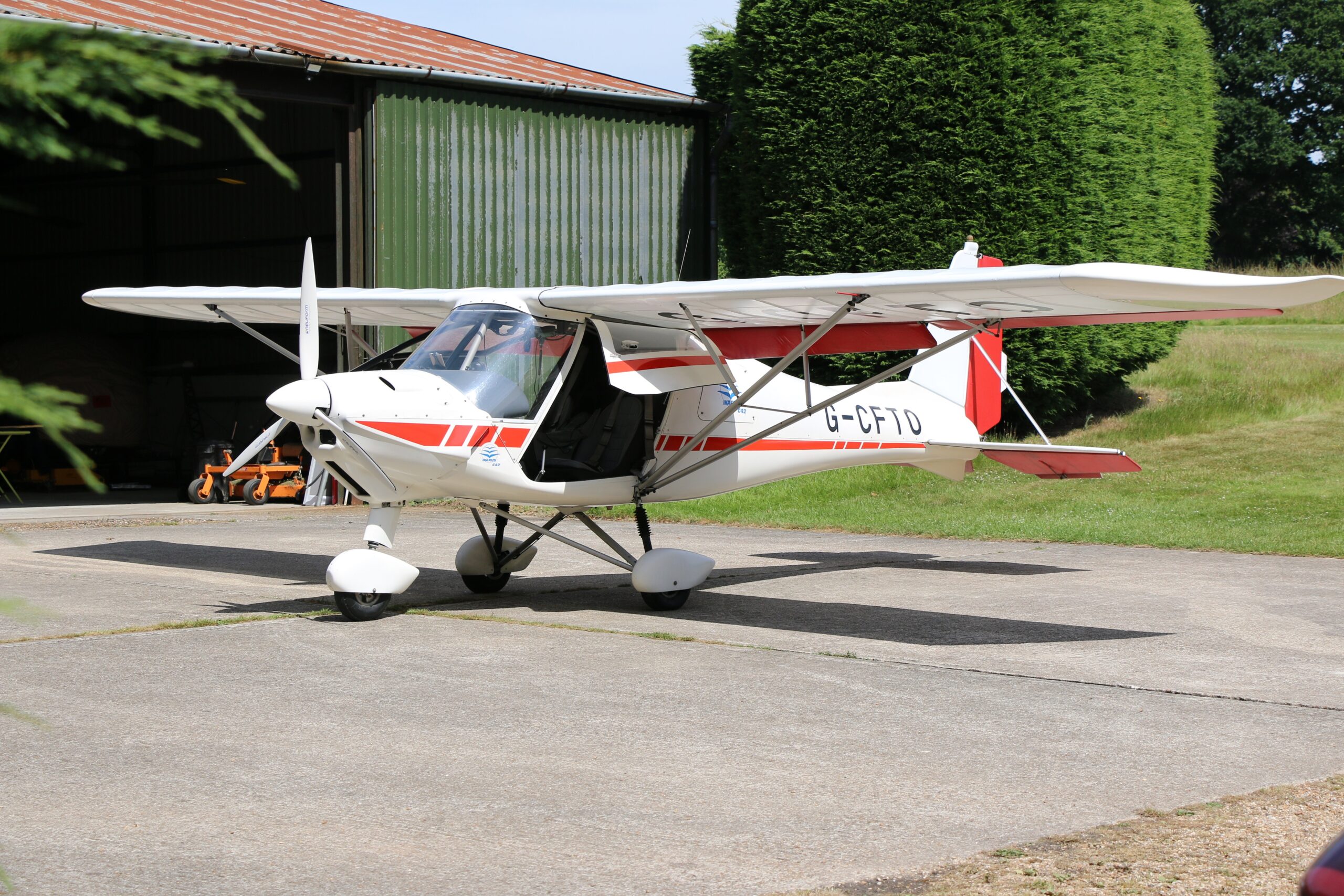 Kryten’s flight was in this Comco Ikarus C42 which was built in 2008 and is powered by an 80hp Rotax 912 engine. He flew out over Portsmouth harbour and the Isle of Wight and did an overshoot of Sandown Airport before heading back over the harbour and up to Lower Upham. As you would expect Kryten captured some lovely photos during the flight:
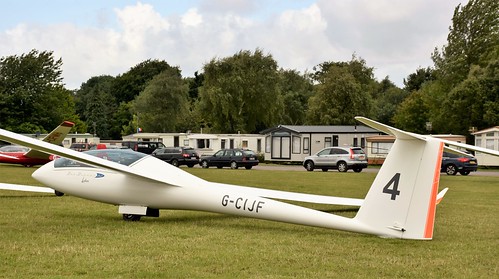
The last of the three was Bob the Builder who received a glider flight for his 80th birthday. Bob took the flight at Lasham Airfield with the Lasham Gliding Society in an ASK21. This is what they say about the glider: Our main two seat glider is the ASK21 of which we have five in our fleet, a German built two seat trainer well known for being one of the safest and most adaptable two seat trainer available on the market.
 Bob says he had a great flight which started with an aero-tow to 2500ft by a Robin DR40 and included some time circling up in a thermal with several other gliders.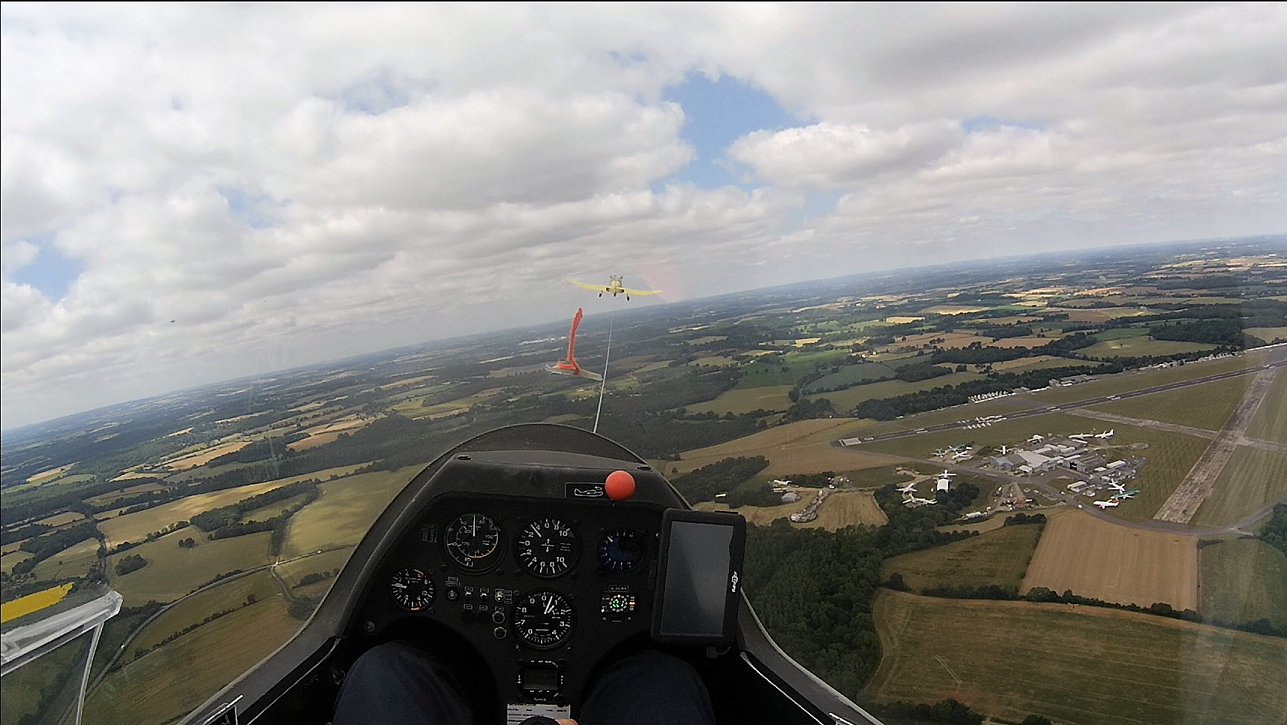
Didn’t anyone warn them that his other name is Basher Bob due to numerous mid-air collisions?! Bob didn’t take any photos but did get some interesting video of the take-off and aero-tow with his headcam which you can see by clicking HERE
New member Peter Fothergill has been getting on well flying his Multiplex Heron electric glider but needed a model with an undercarriage to be able to take his BMFA ‘A’ Certificate so he bought a Weston Models Cougar 2000. I did the test flight for him and was rather surprised to discover that although the elevator was working correctly the elevator trim was reversed. When I took off the model climbed steeply so I pushed in lots of down trim and the Cougar promptly looped! Once I’d figured out what was going on I added lots of up trim until the model stopped climbing and levelled off. Weird, I’ve never seen that before and can only assume it’s something it the programming on OpenTx that needs sorting.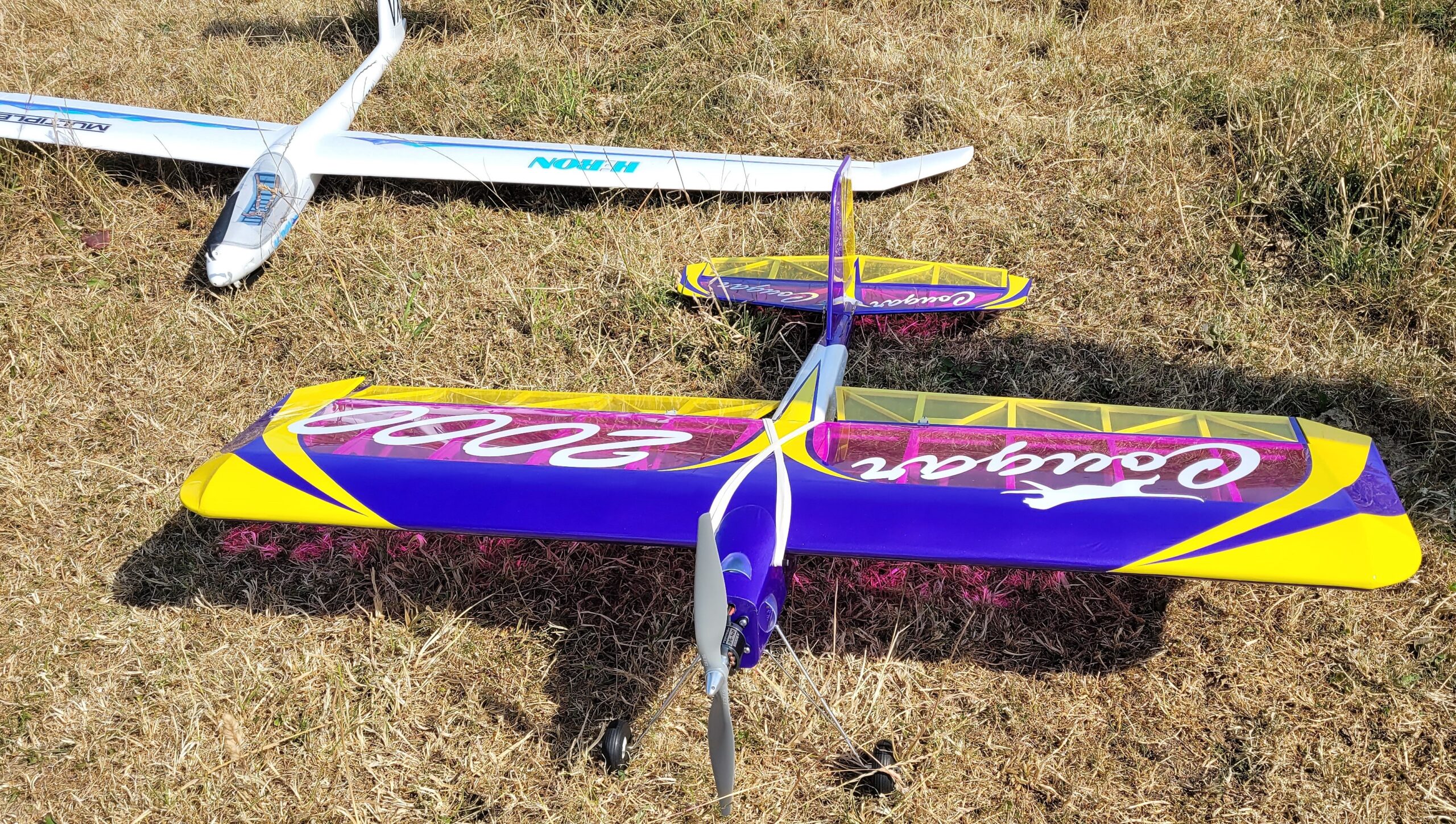
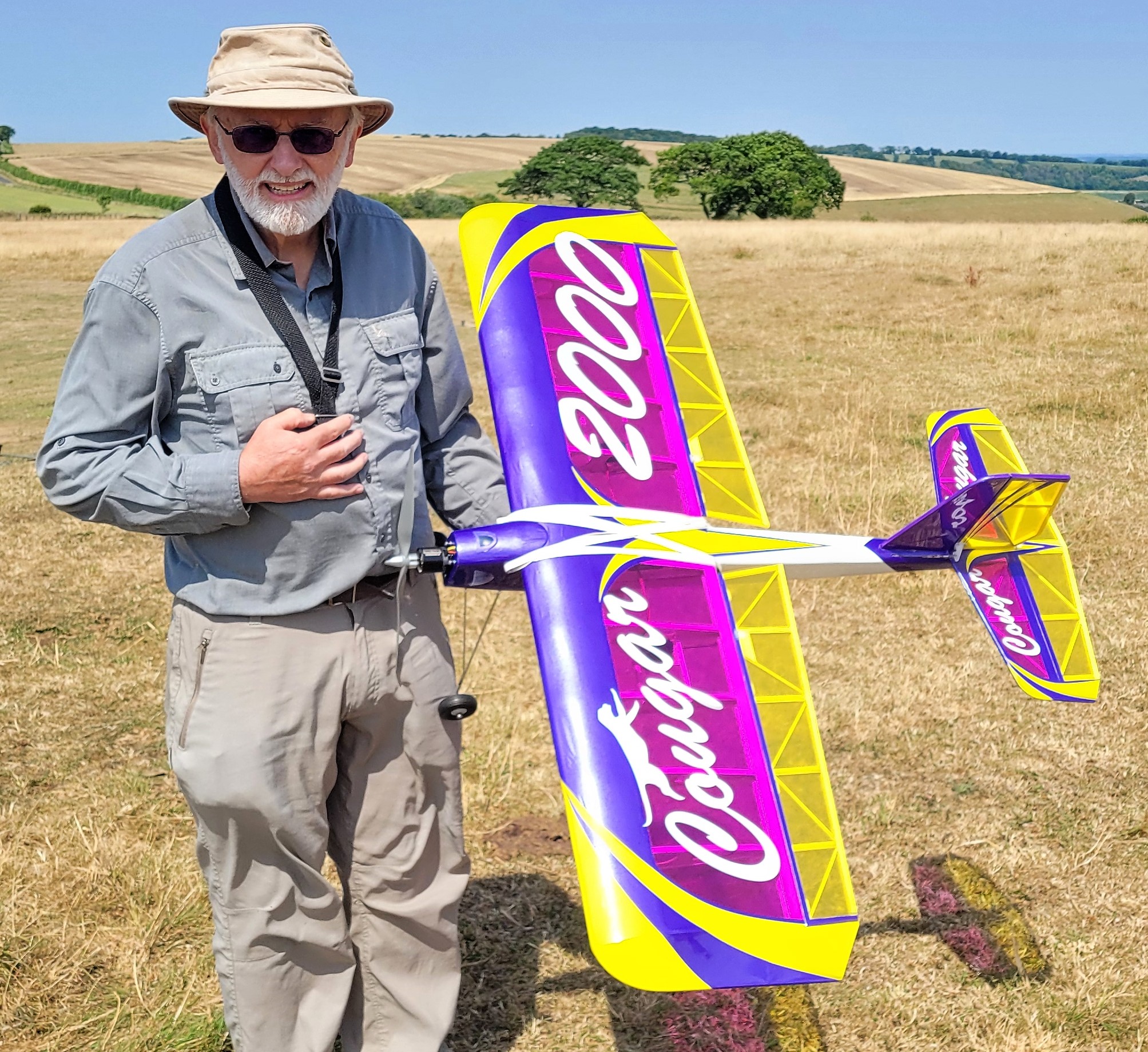
The Cougar flew well and Peter was able to fly it without too many problems and managed to land it safely. The second flight second flight also went well until it came to the landing approach when I think Peter must have pushed down rather than pulled up on the elevator control and the model suddenly dived in, too late for me to save it. There was a lot of damage but Peter says he hopes to repair it sometime in the future.
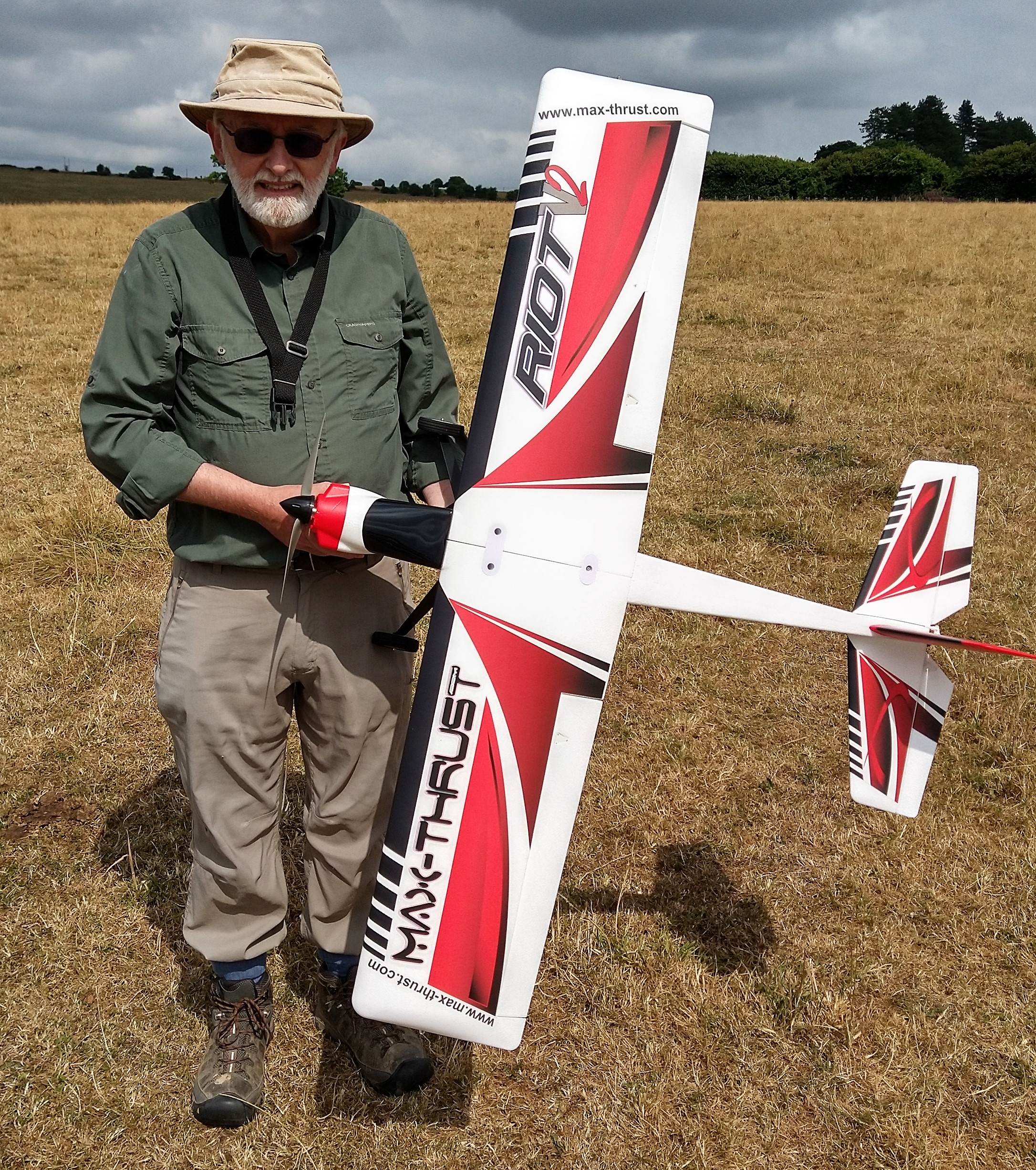 In the meantime he’s replaced the Cougar with a Max Thrust Riot, a model that is probably rather better suited to Peter’s skills at this stage and he’s been flying it well.
Mini-Mike has resurrected an old electric glider that he’s owned for several years and has replaced the old brushed motor that was originally fitted with a brushless one. The glider is a JP Greensleeve which is 2 metre span and it’s now fitted with an Airtek Airmax 3536 910kv motor which swings an 11 x 8 propeller and is powered by a 3 cell 2200mAh lipo.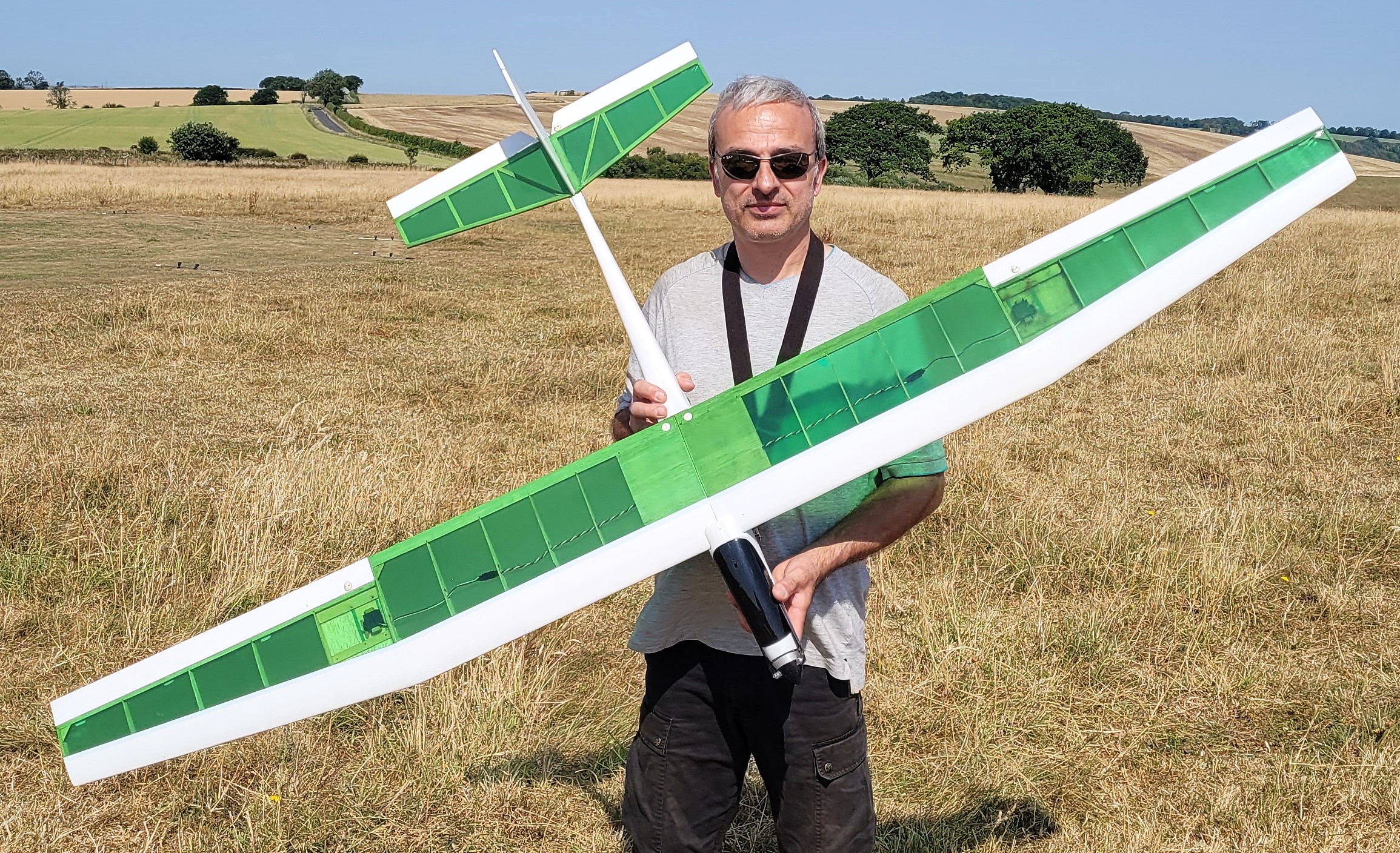
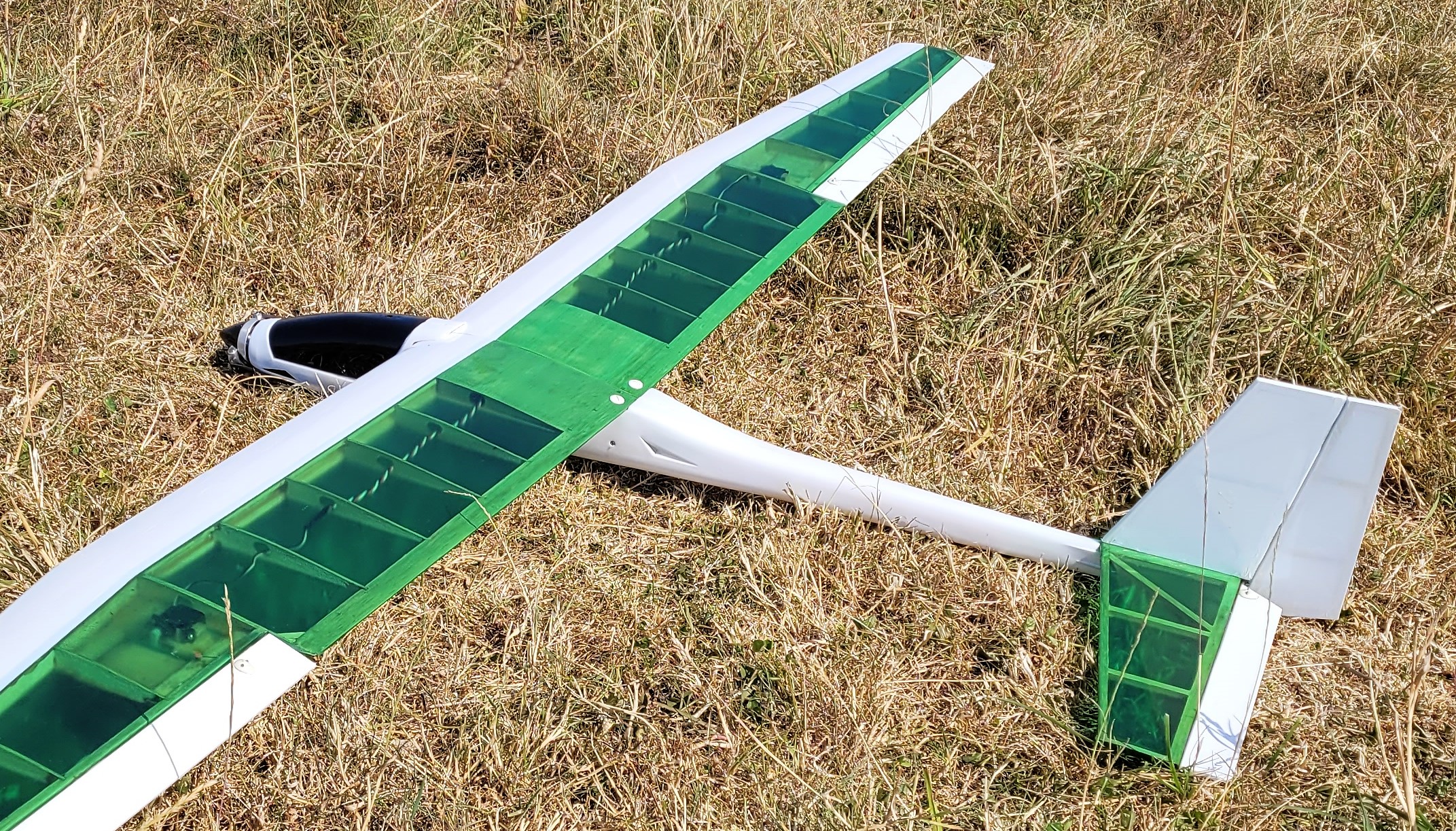
Mike seems to have chosen well, the Greensleeve flies well with the new set-up.
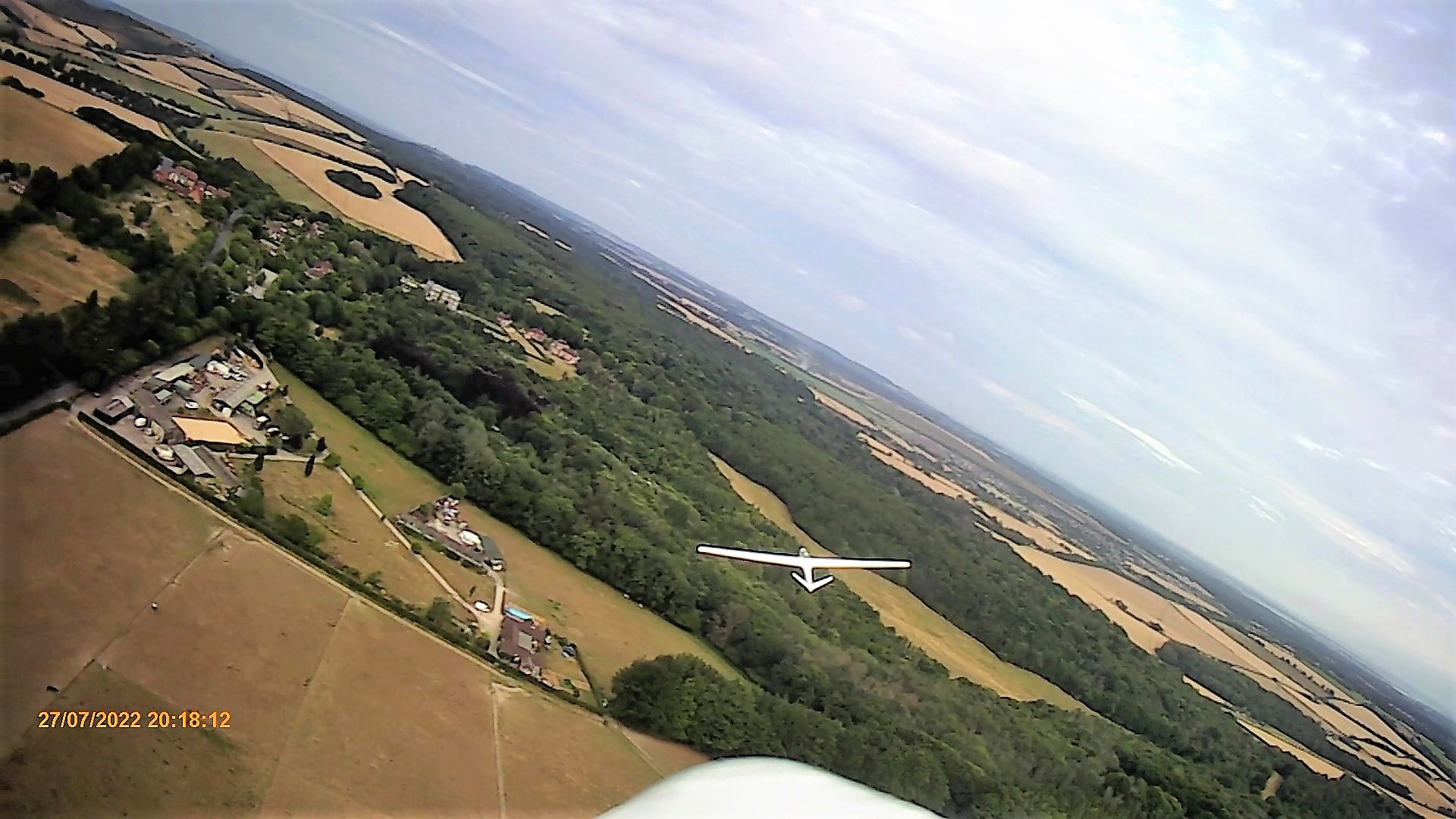
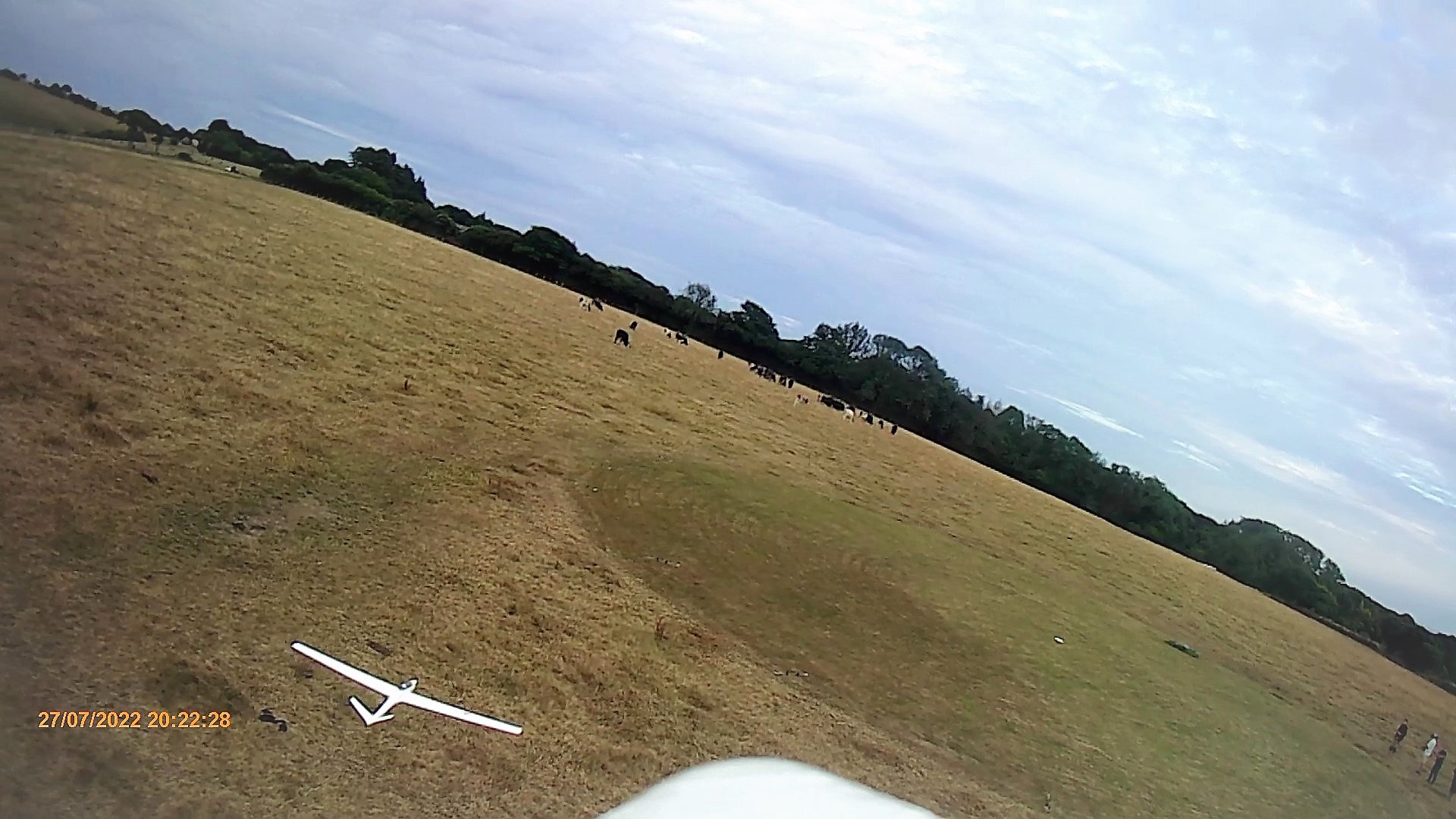
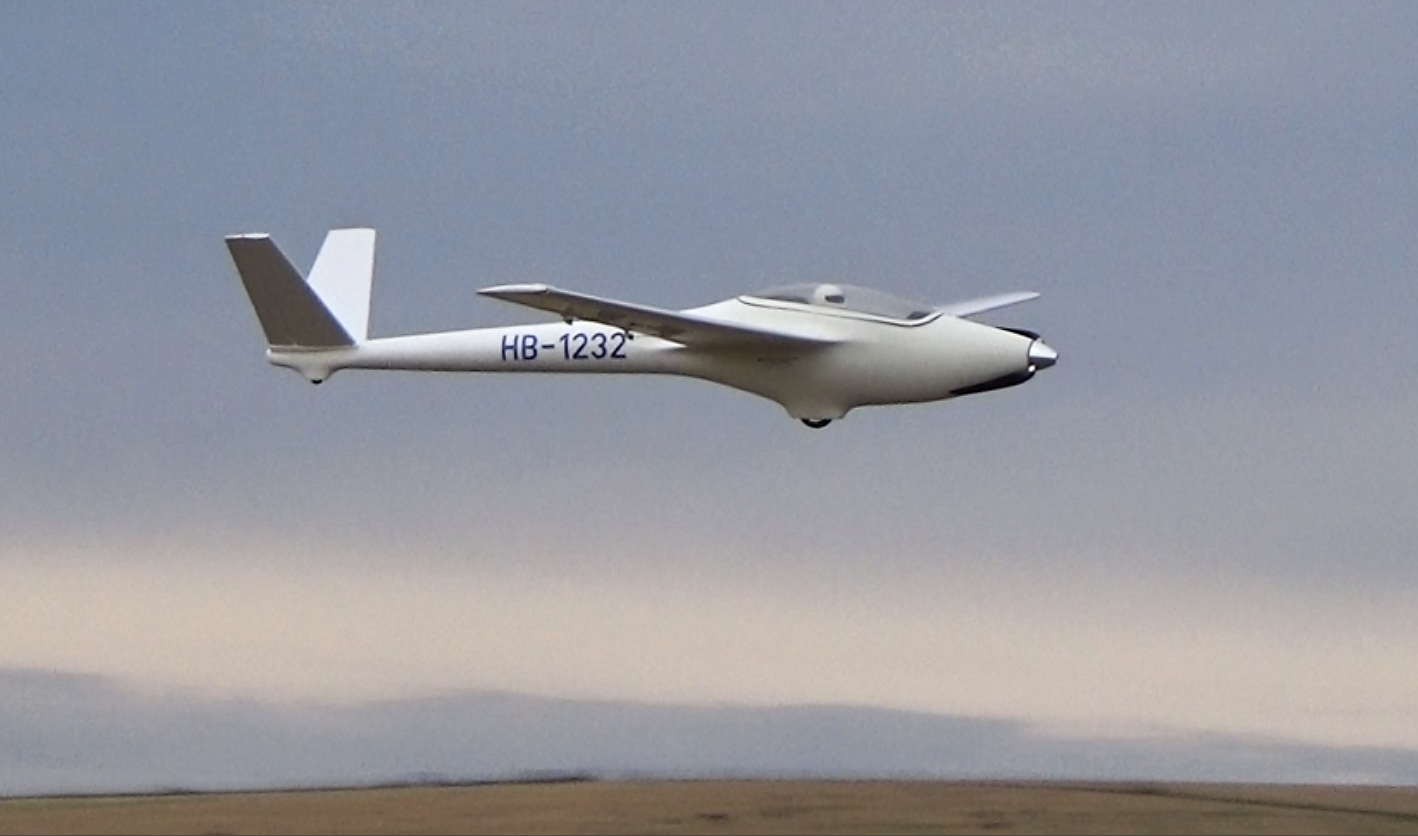
Like Mini-Mike Dougal has also revamped an old glider but Dougal’s is one that was a pure glider before and which he has now electrified. Dougal has previously flown the model as a slope-soarer but decided he’d like to be able to fly it from our flat field.
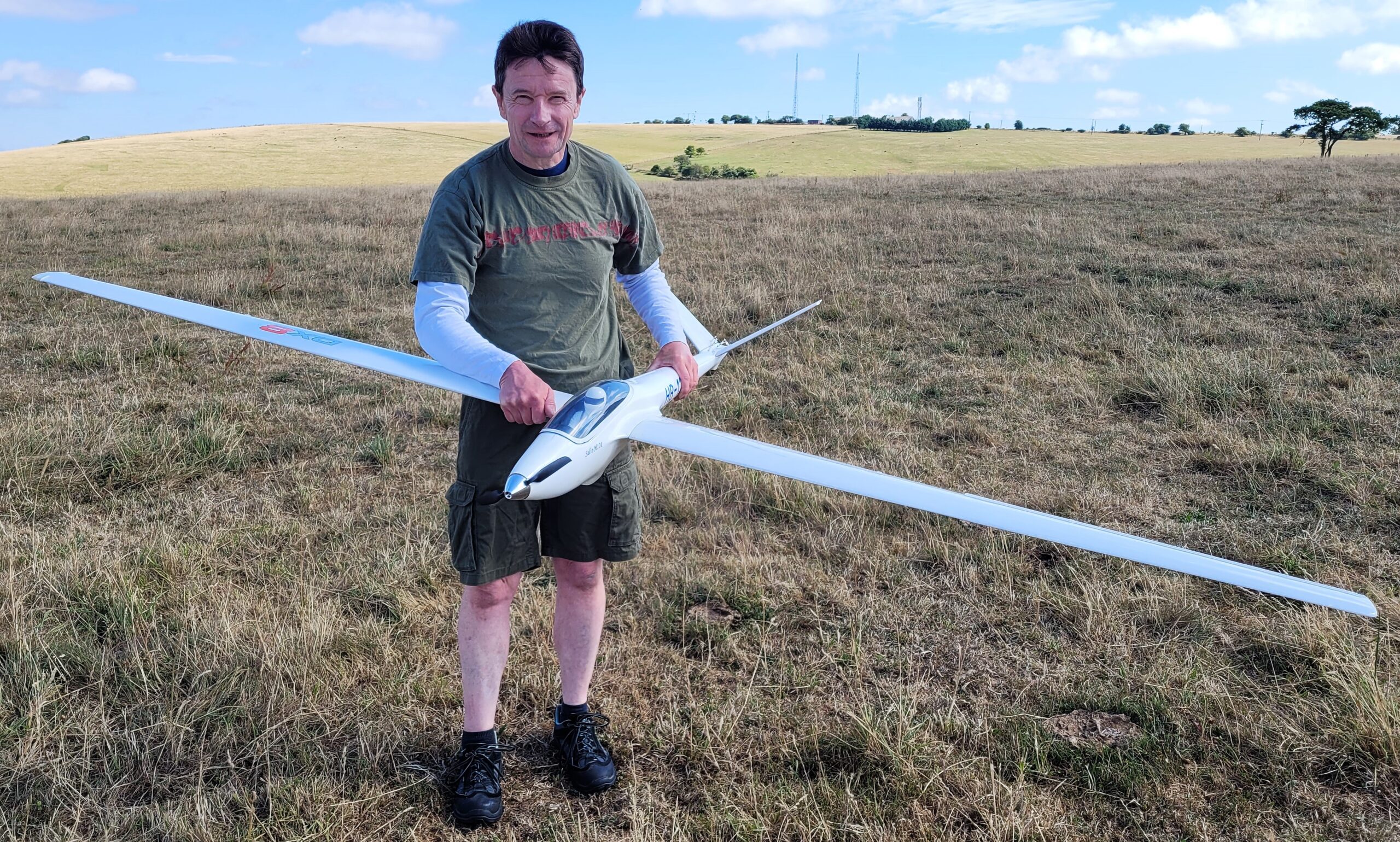 The model is a 100” wingspan model of a Salto H101, an aerobatic glider made of glass composite construction that was developed in Germany in the 1970s. The first time he brought it along the motor wouldn’t run correctly, something we thought was down to a speed controller problem but it turned out to be the motor so Dougal swapped it out for a new 4240 890kv motor and tried again. It’s piloted by the Stig so it should fly well!
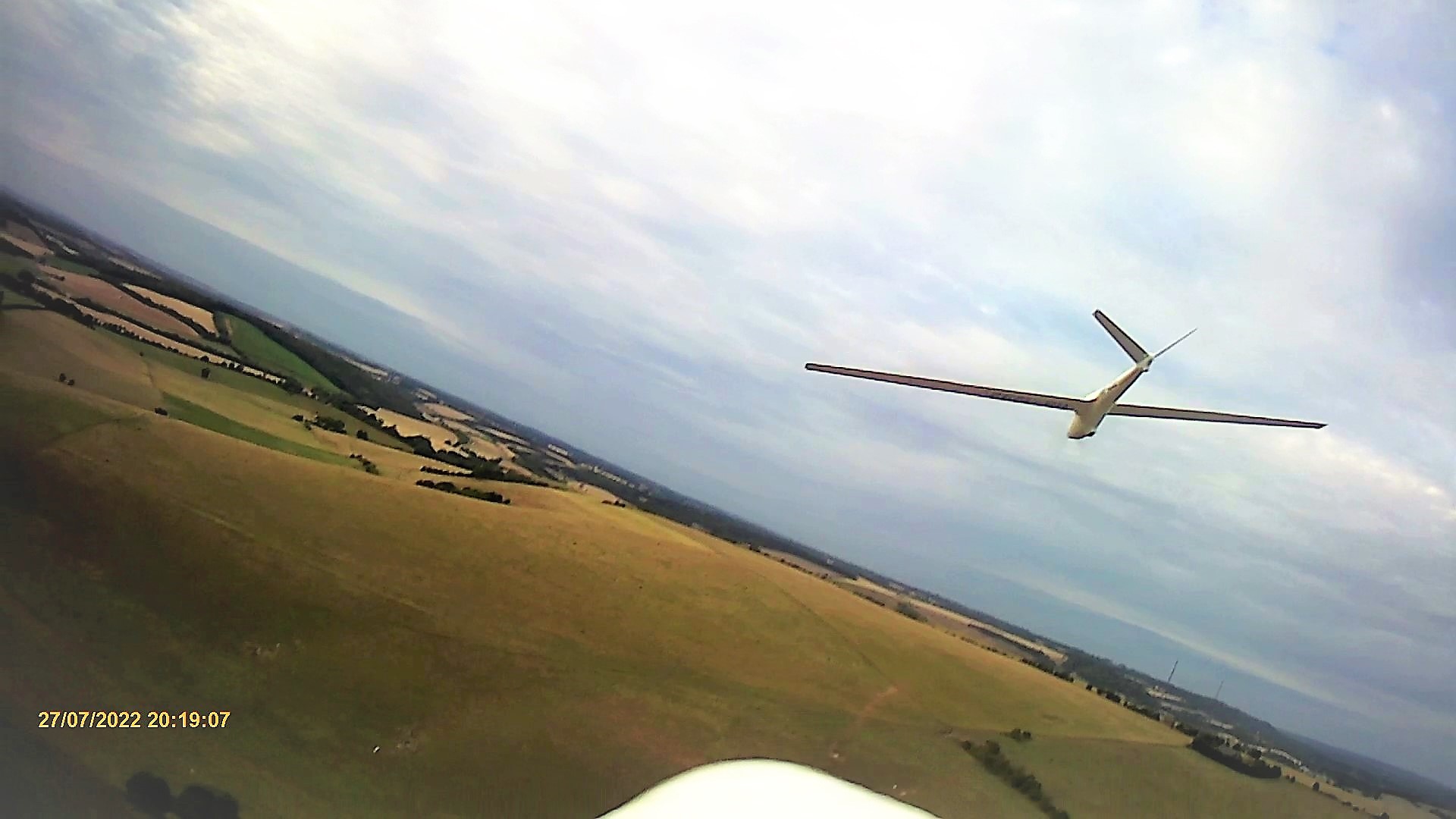
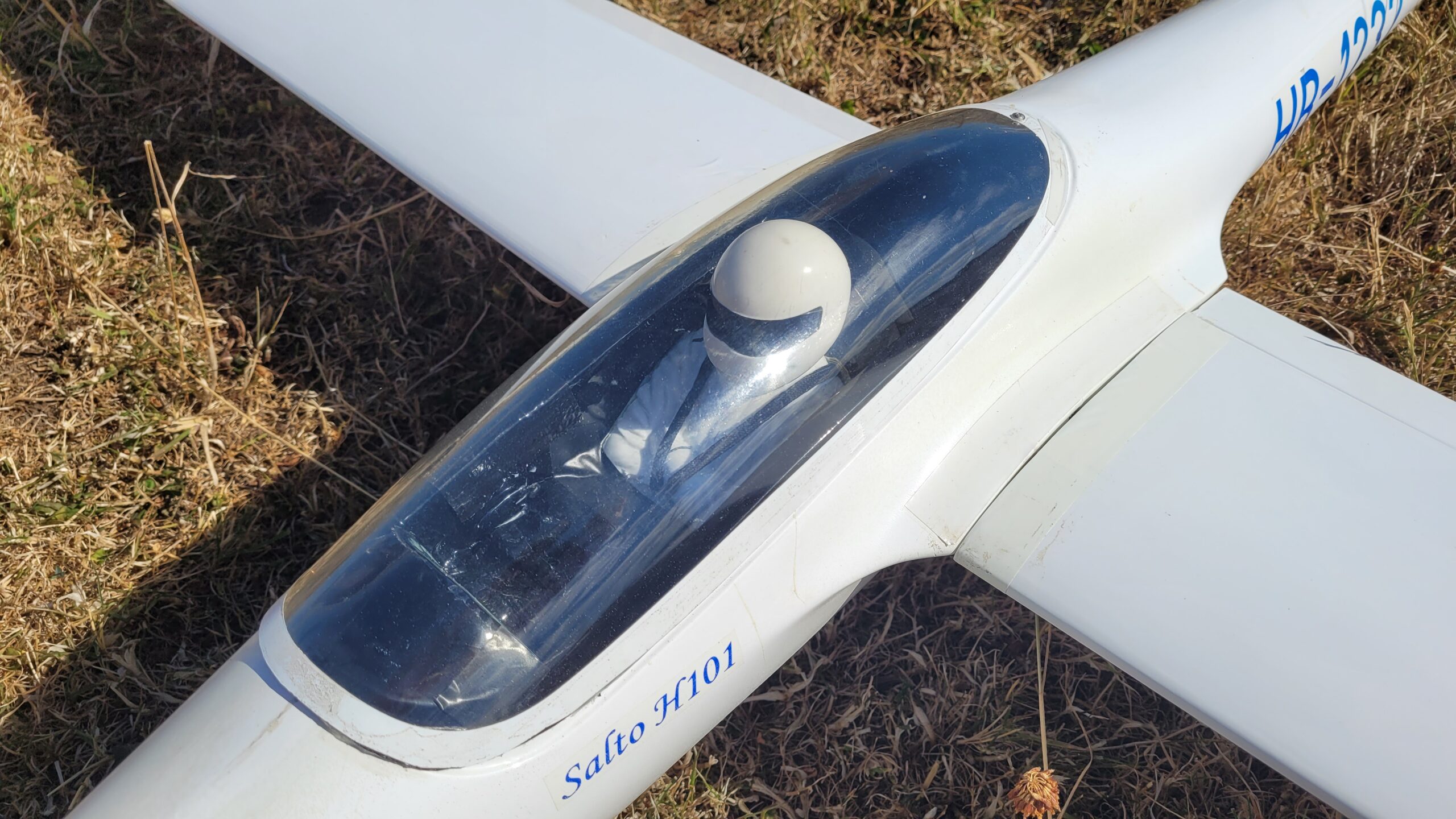 This time the model flew perfectly using a 3 cell battery but the climb out was more gentle than Dougal would have liked so next time out he used a 4 cell pack which proved to be much better. I have some great video of it both from the ground and from my FPV plane but that will have to wait until next month, meanwhile I’ll tease you with some photos.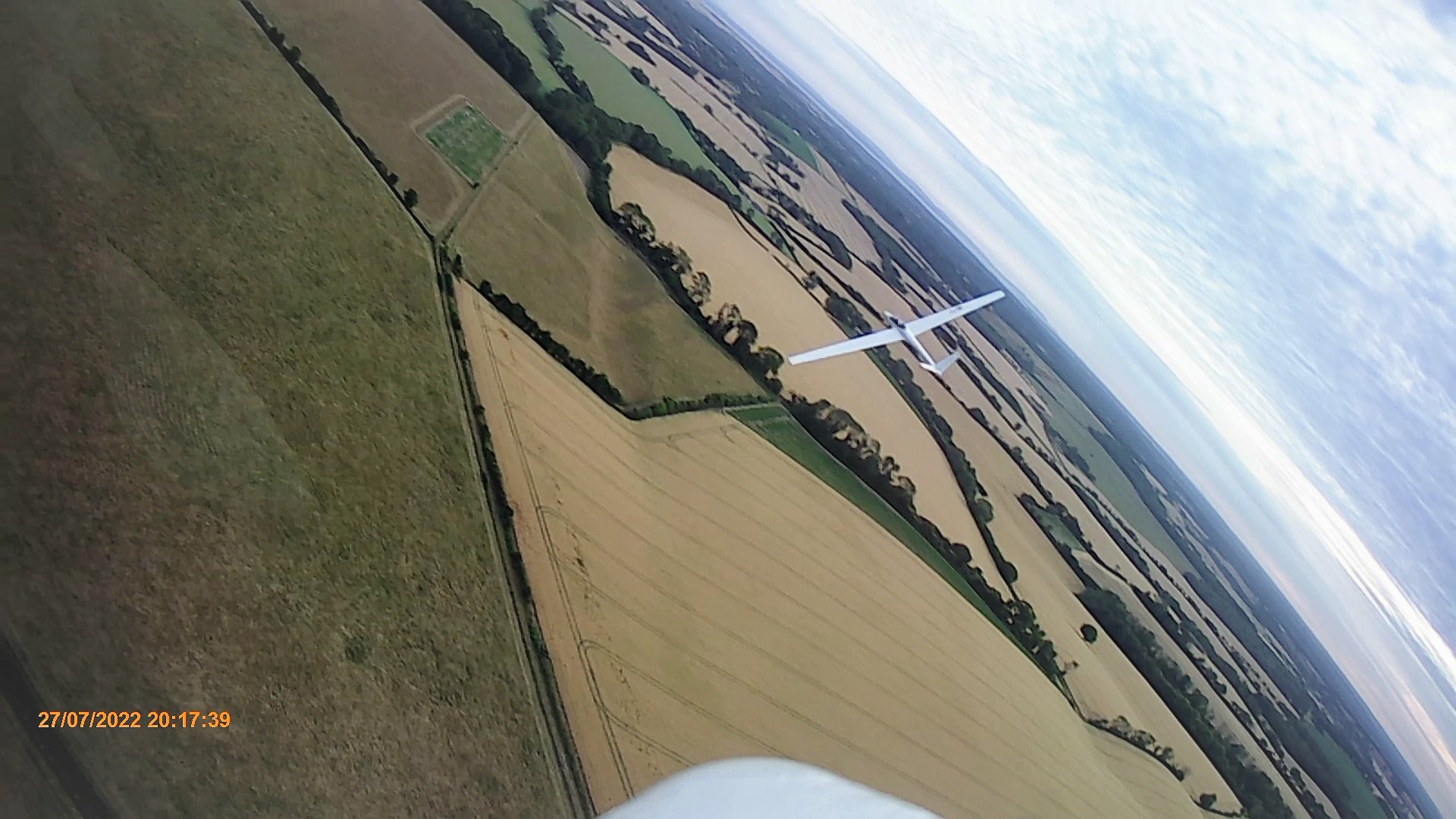
Video time now which this month includes footage shot by me, Dougal, and Captain Slow. Please watch the video full-screen, it’s so much better with small models flying around.
If the video won’t play for you please click HERE
And finally, as we arrived at the field one evening a pair of Apache helicopters flew very low over the field. It was great to see them and as we hadn’t started flying it wasn’t a problem but we need to be aware as it could happen when there are models in the air.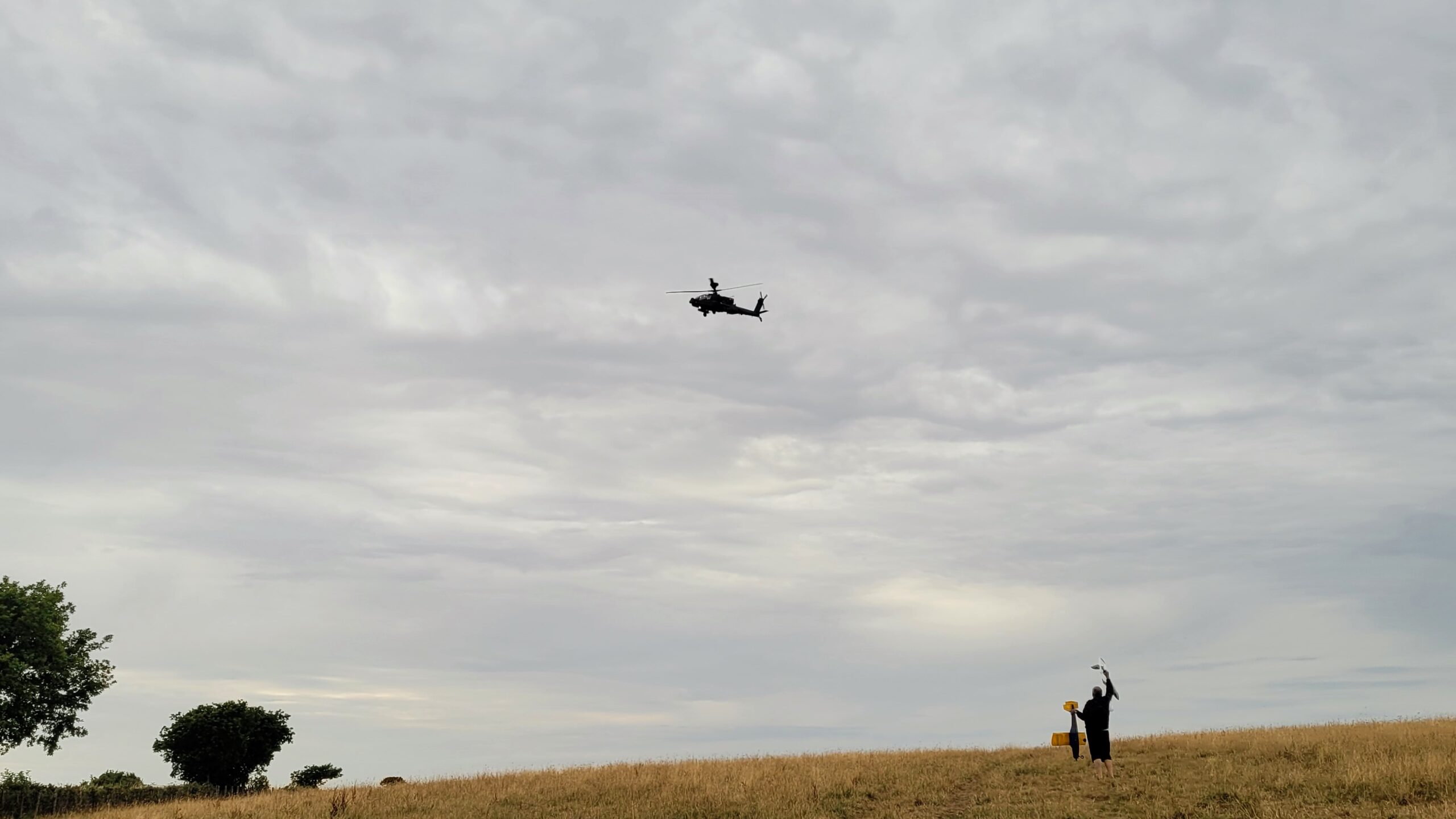
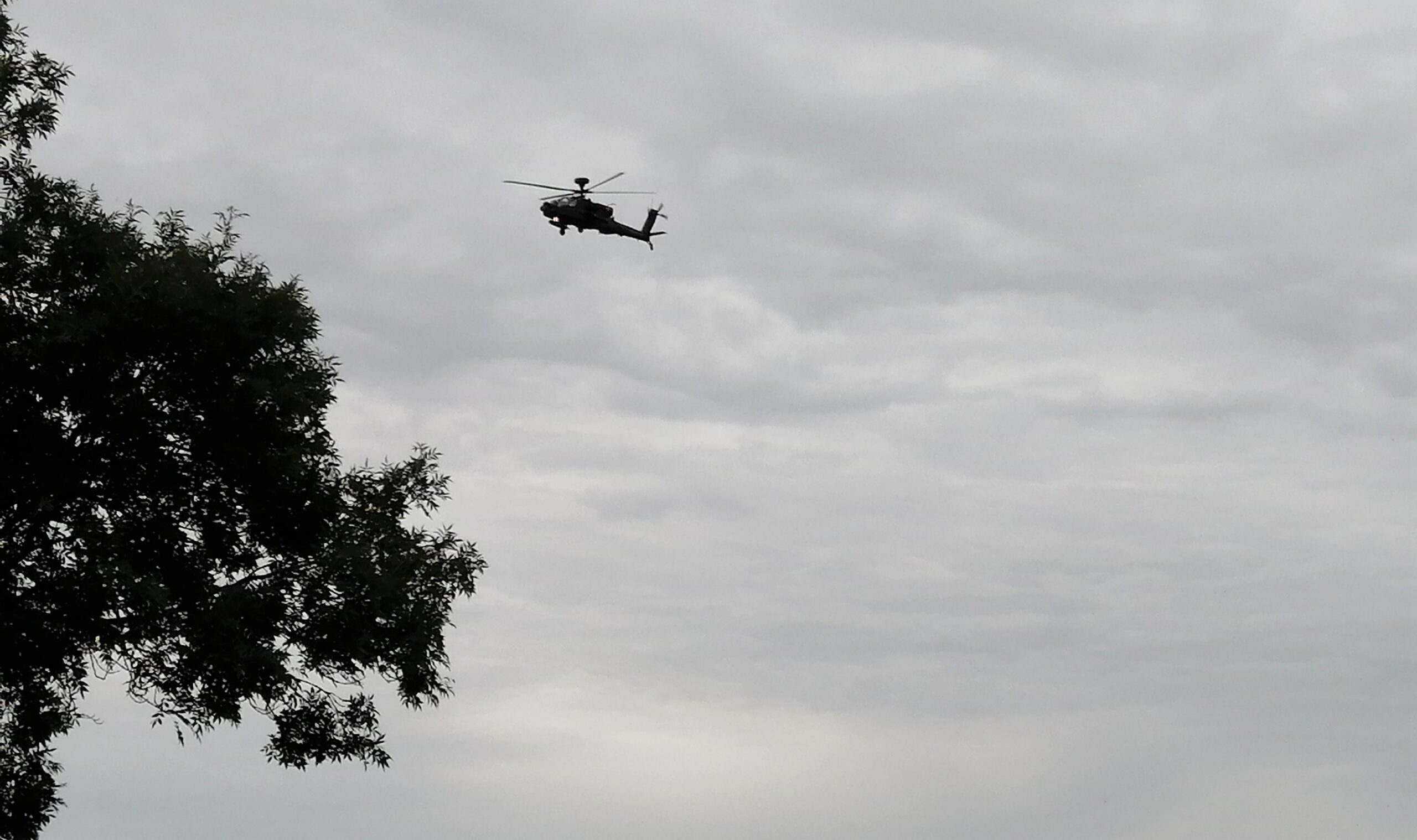
We must always be alert and prepared to take avoiding action at a moment’s notice!
My grandson kept asking me to show him how to make paper planes.
I resisted at first but eventually I folded…
Colin Cowplain
Patch News – June 2022
June saw some lovely weather at the start of the month and we did lots of flying but later on in the month it turned very windy. A fairly long dry spell meant the patch grass didn’t grow very much so we didn’t need to mow too often, and farmer George kept the bullocks in the lower field for most of the month where there’s some shade for them. But when we went along to fly on Friday 24th we were greeted by George’s sons and asked to help move the bullocks into our field. Fortunately this herd is used to us now and they were too interested in the long grass to bother us at all.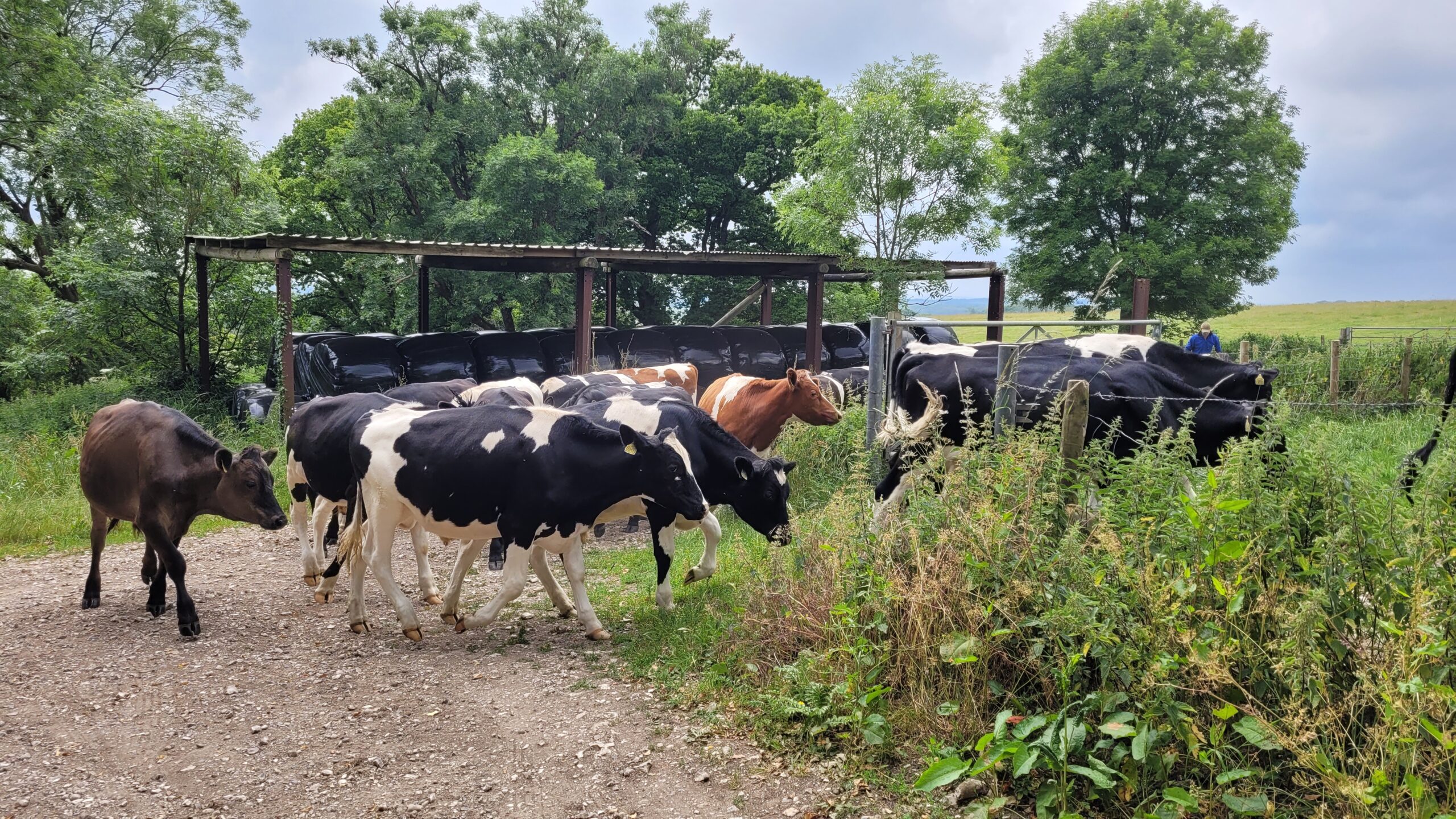
In Patch News last month I included a photo Dougal Entendre rehearsing his Riverdance routine. Well this month he overdid the rehearsing and badly sprained his ankle. 

Of course Dougal came out with a load of rubbish saying he sprained it when leaping up and running to help a struggling pilot save his model but we know the truth…

Fortunately he was able to fly FPV whilst sat in the pits and one of his ‘people’ helped out.
We had a couple of prospective new members visit us in June, the first being Peter Fothergill who is returning to the hobby after a long break. On his first few visits Peter flew a small foamie RTF electric glider fitted with a gyro that flies very well and Peter had no problems at all flying it. Then later in the month, having got used to the little one, Peter brought along a Multiplex Heron, a 2.4m span high performance electric glider.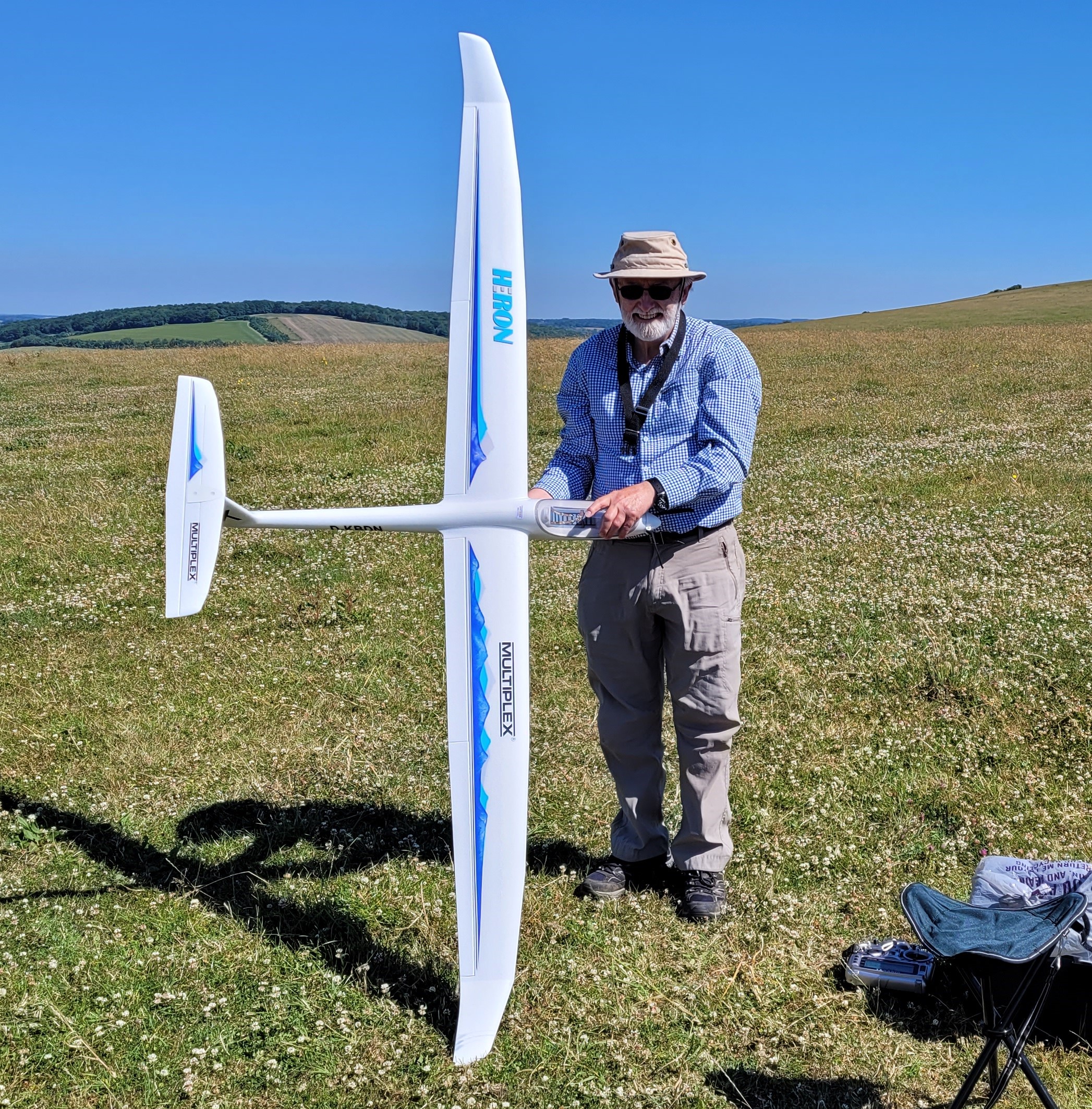
Again, Peter had no problems flying the model which seems to be an excellent performer.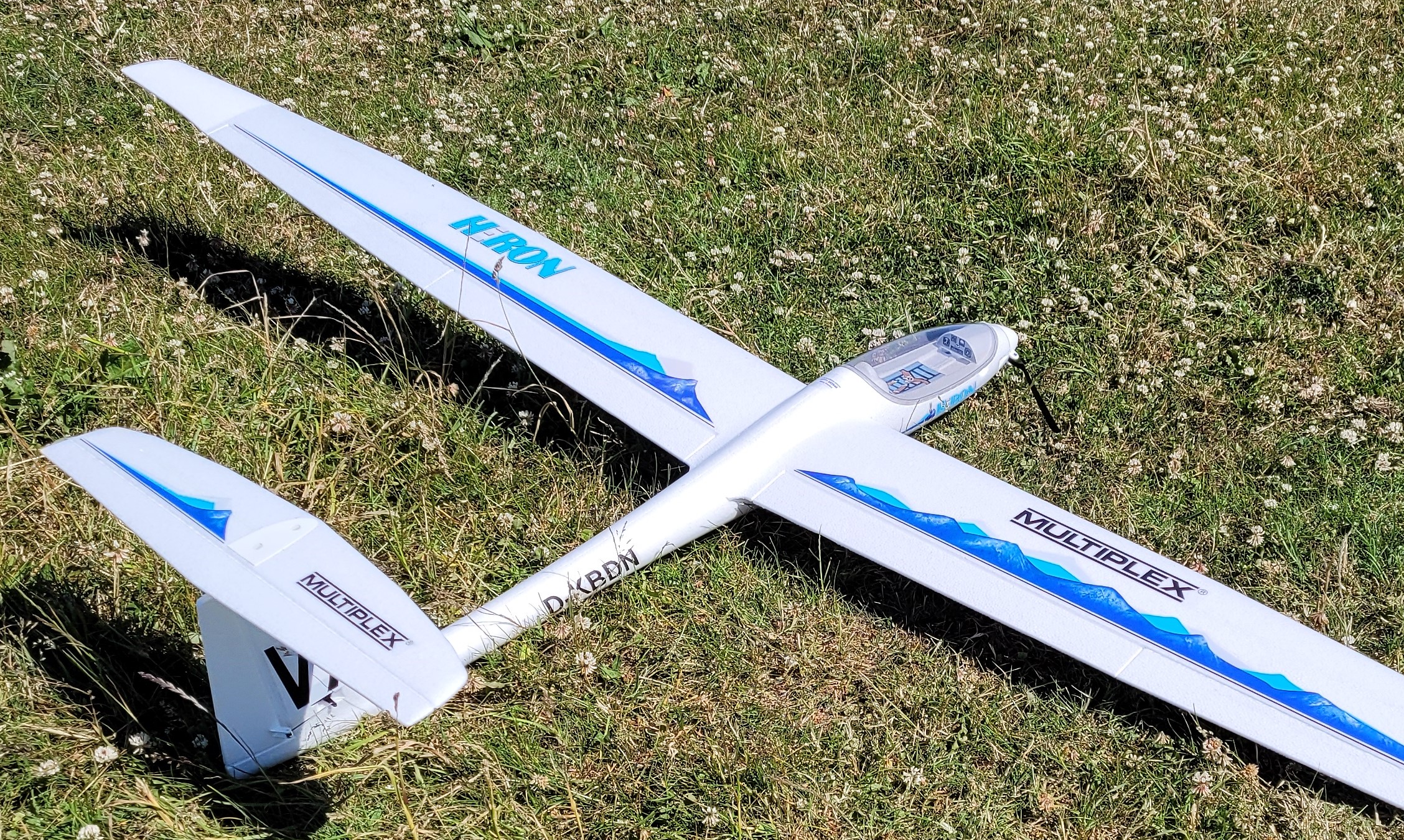 On its first outing the folding prop didn’t fold so the brake needed to be set on the ESC, and every so often the telemetry feedback said “Receiver signal low” and then on one occasion “Receiver signal critical”. It didn’t seem to bother the Heron in the slightest but it did make Peter understandably nervous and he very sensibly decided to land early!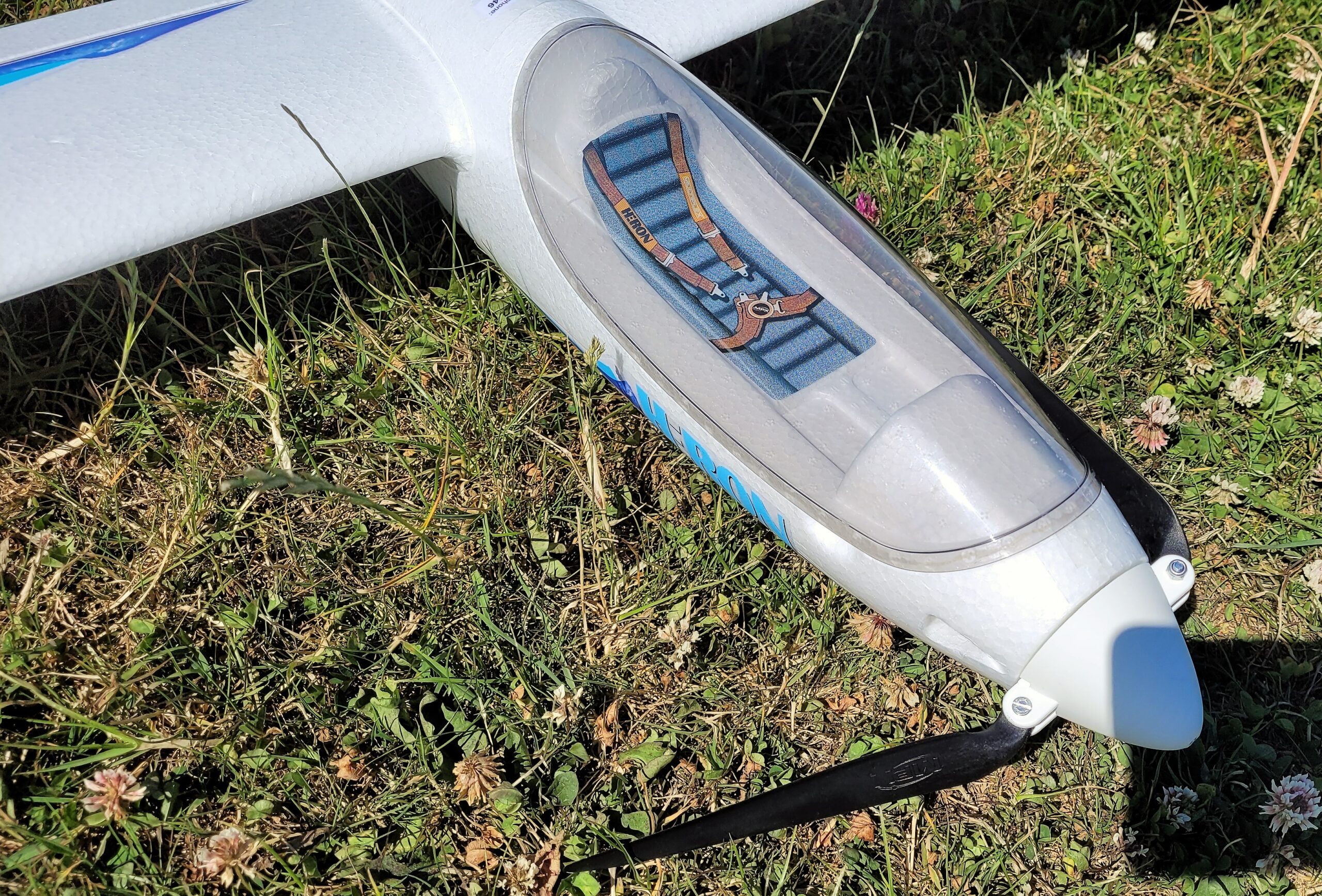
So a couple of things for Peter to sort our but otherwise all was good. Having served his three visits Peter was invited to join PAM and is now a paid up member, so welcome Peter.
The second prospective member was James, a very pleasant thirteen year old lad who was brought along by his mum and dad. James had already been flying a small electric gyro equipped glider for a little while and he quickly demonstrated that he was able to fly it with little help. At the time of writing James has only visited once but he’s very keen and I’m sure he’ll soon return and will be showing all us oldies how to do it before too long.
On the subject of thirteen year old lads, in June Dougal Entendre took and passed Leo for his BMFA ‘A’ certificate so congratulations to Leo. He is very quick and capable at mending broken models so Woody gave him his rather badly smashed Wot 4.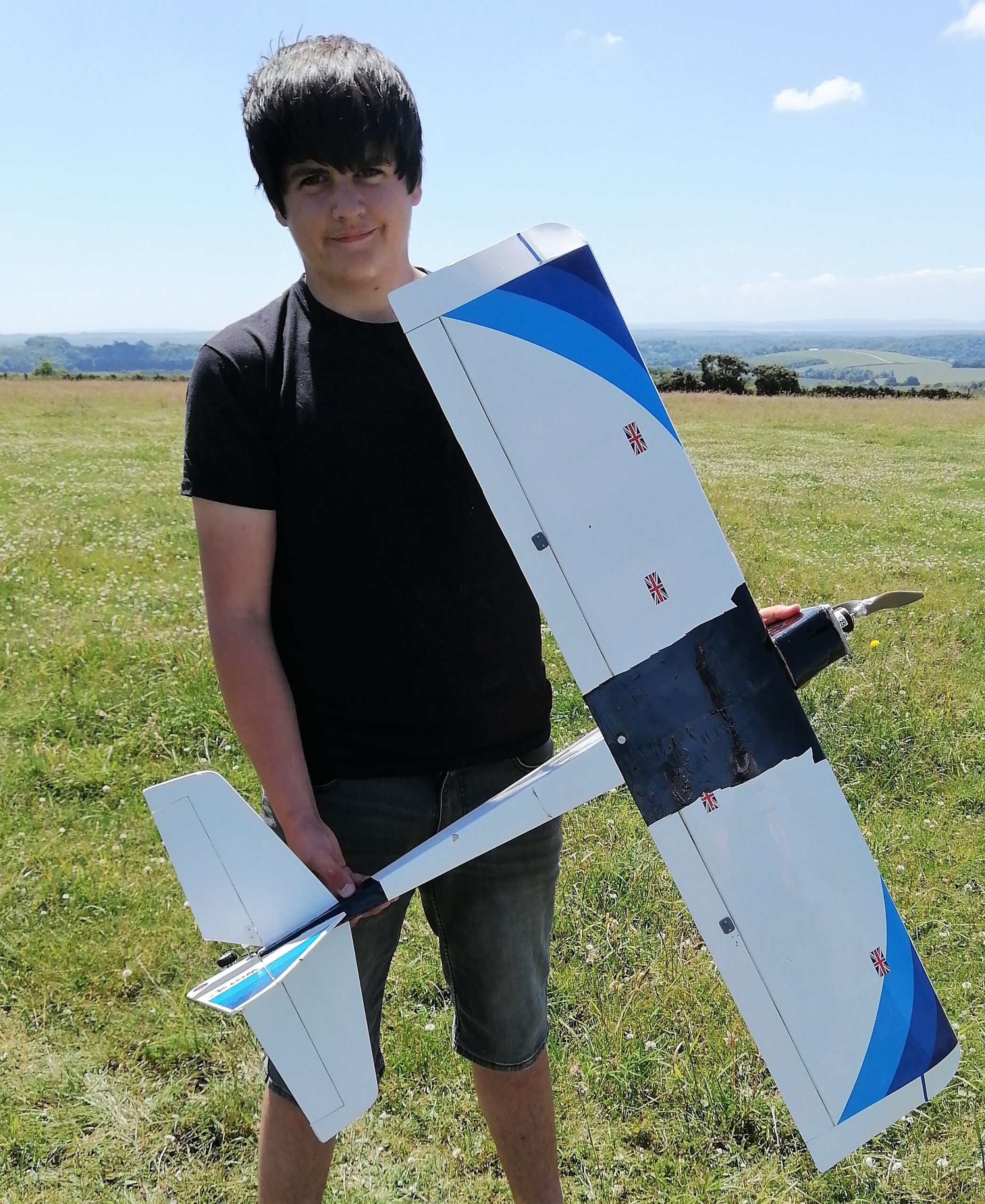
Leo had the Wot 4 fixed and flying again in just a couple of days. He is now also flying the Skylark mini pattern ship that he bought from Dougal; he seems to fly it with no problems.
Charlie (also thirteen) didn’t fly during the cold winter months but returned in June flying his electric glider. Unfortunately his transmitter battery alarm sounded at the end of his first flight and he was unable to have a second flight. So I let him have a flight with my tiny Eachine Mustang which he flew perfectly. I remembered that when Charlie first joined the club his mum Nadine had said she’d quite like to try flying a model so I let her fly the Mustang after Charlie. She coped very well, just needing a bit of guidance on when to turn so the plane didn’t get too far away. I wonder if I can talk her into becoming a member…
As well as Peter’s new Multiplex Heron several other new models were flown in June and the first I’ll feature is Mike Creamer’s foamboard Sukhoi SU-27.
 It appears to be almost the same as the ones we used to buy from HobbyKing before they closed their UK warehouse but Mike bought this one from Banggood.

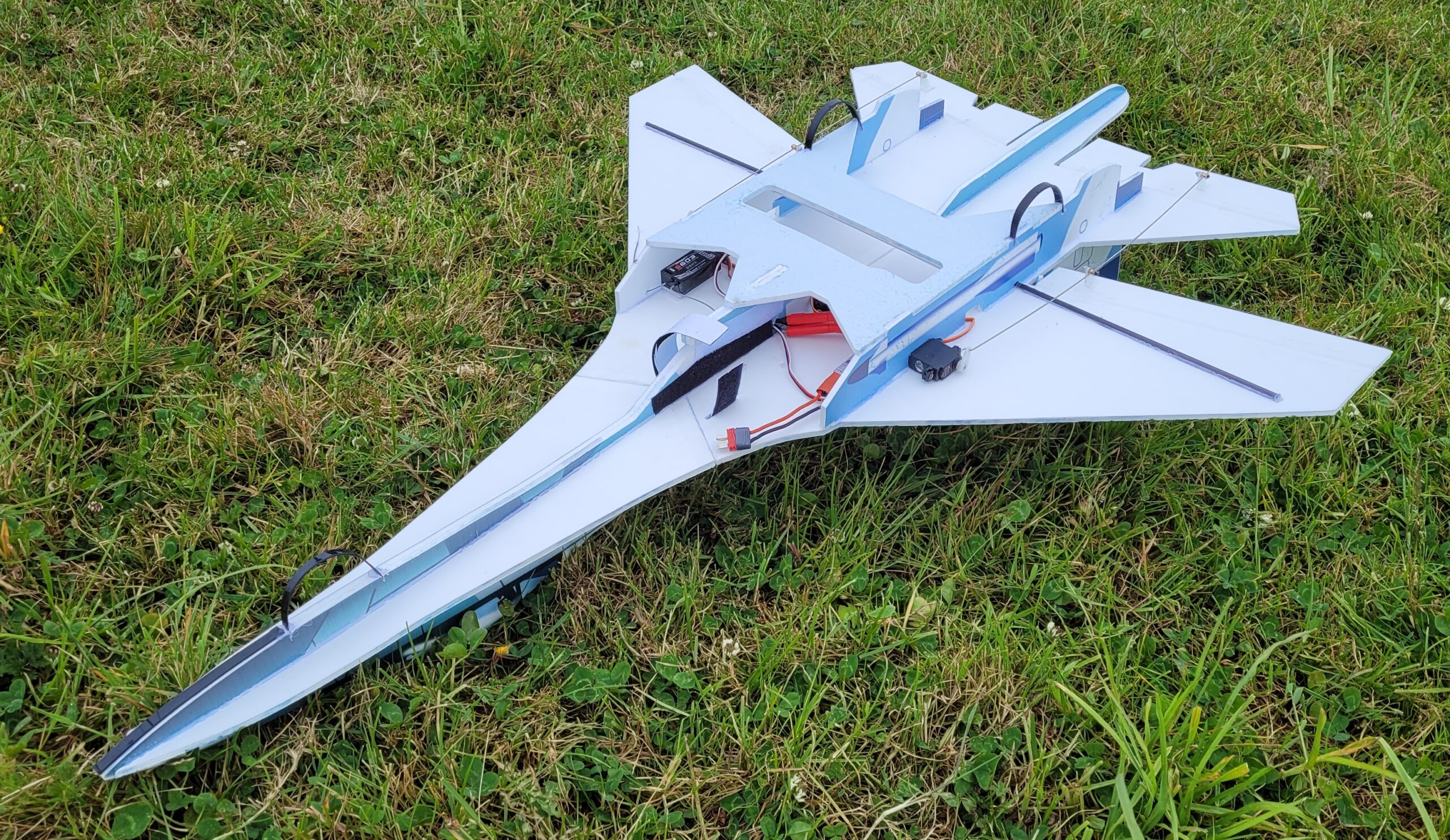 The foamboard models are all pretty similar and Mike has fitted his with a Turnigy motor and Spektrum radio gear. I’ve always said I think the SU-27 is the best of the foamboard jet range and Mike’s has reinforced that belief as it flies brilliantly. It was a bit noisy at first as he hadn’t enlarged the propeller slot but a quick hack with a scalpel soon had it quieter.
1066 is well known for flying very low fast circuits and some of the more childish members (like me) can often be heard shouting “Lower” as he skims the patch. This month he got as low as is possible without crashing and caught some of the grass at the edge of the patch.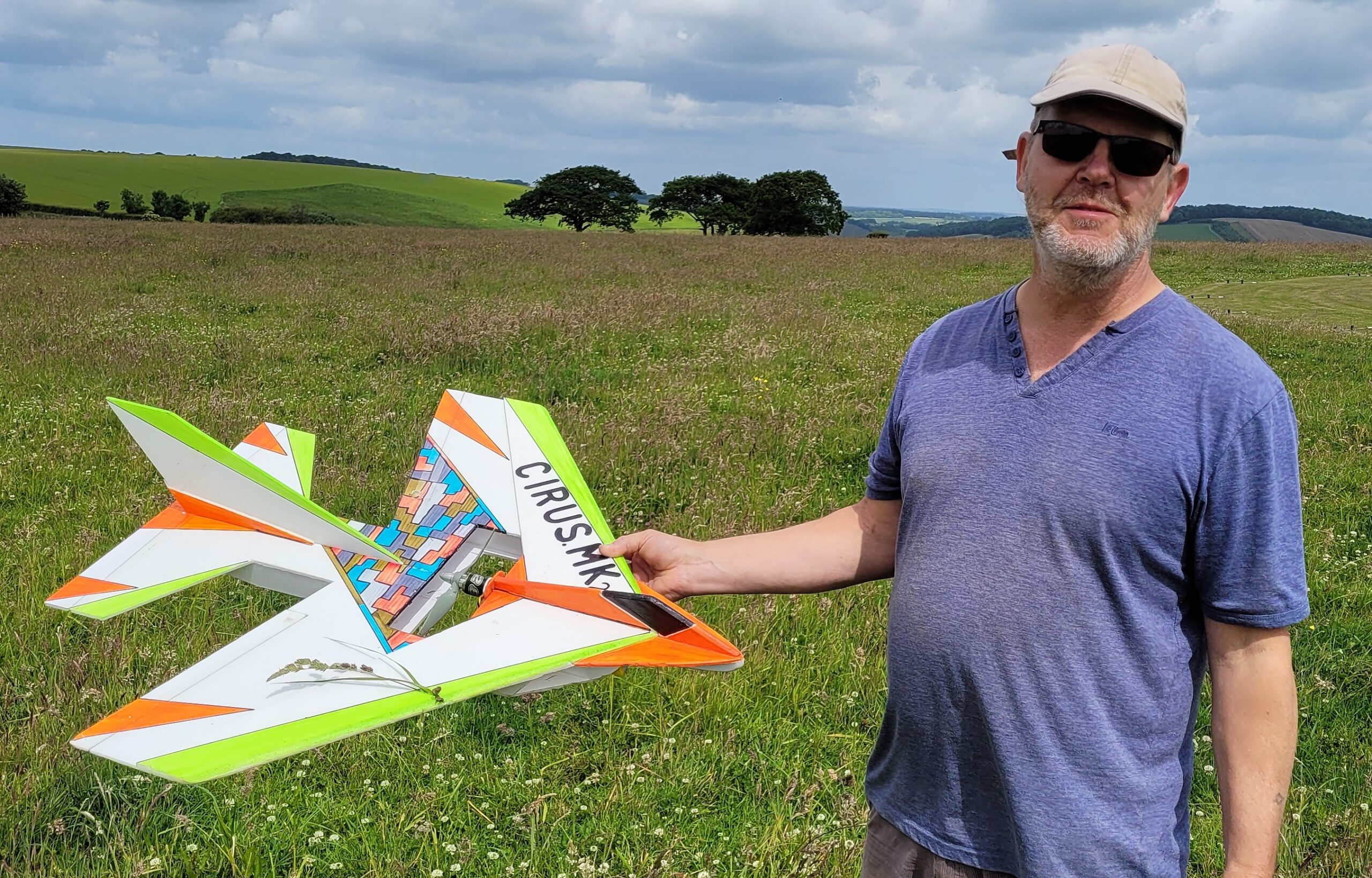 The grass cut into the wing leading edge but fortunately the Cirus just kept on flying.
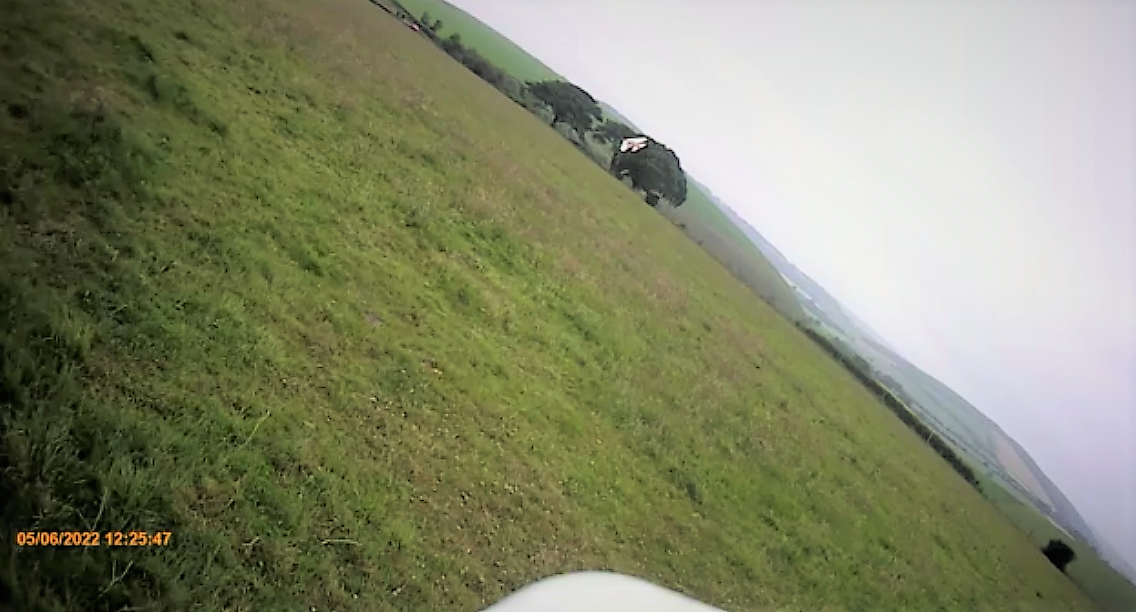
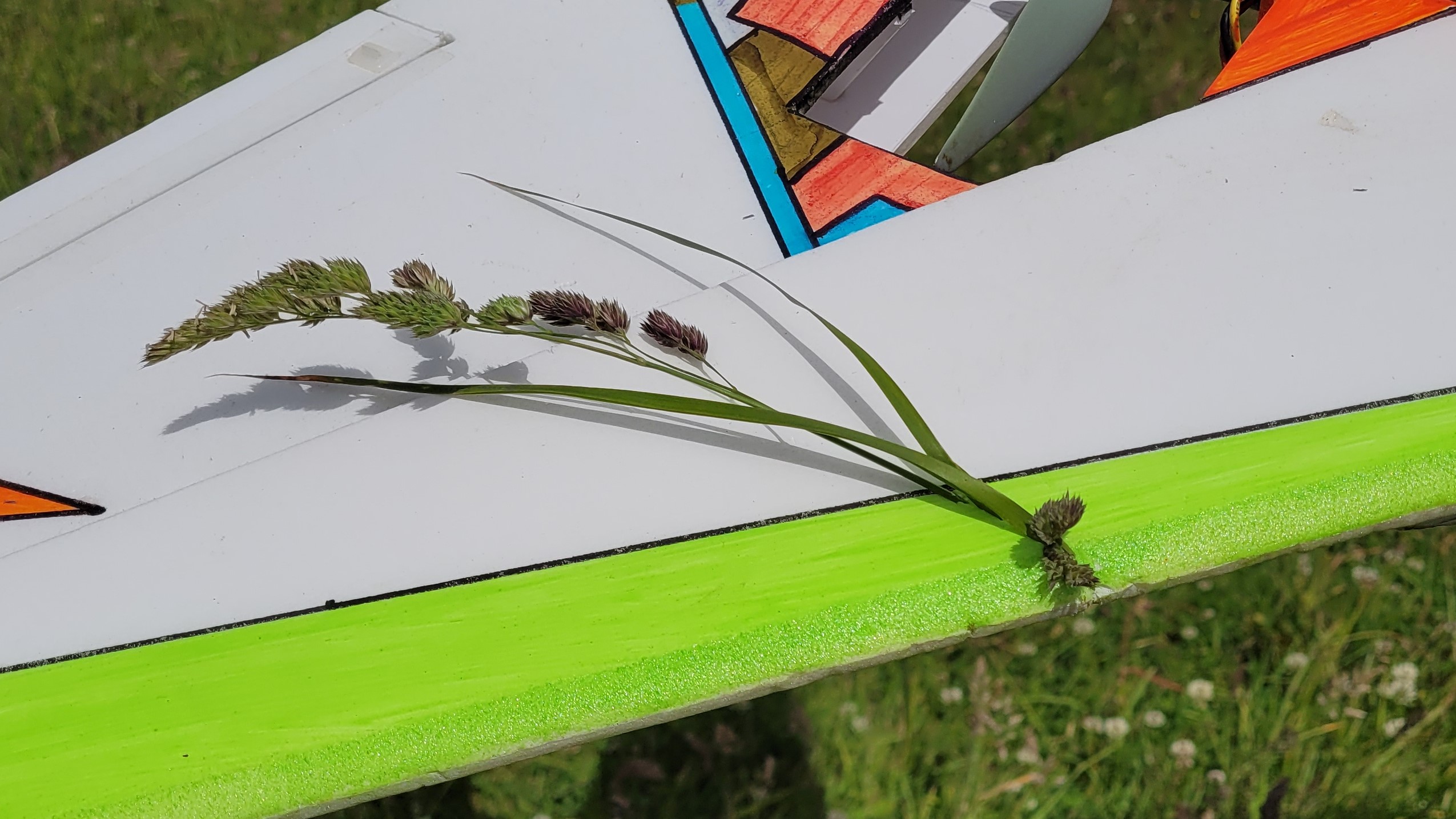 I tried following the Cirus when I was flying FPV one day this month and I’m sure he was trying to get me to fly into the deck… he very nearly succeeded.
The next new model to be flown in June was Bob the Builder’s rather nice E-flite Conscendo Evolution, a 1.5M span electric glider that Bob received for his 80th birthday.
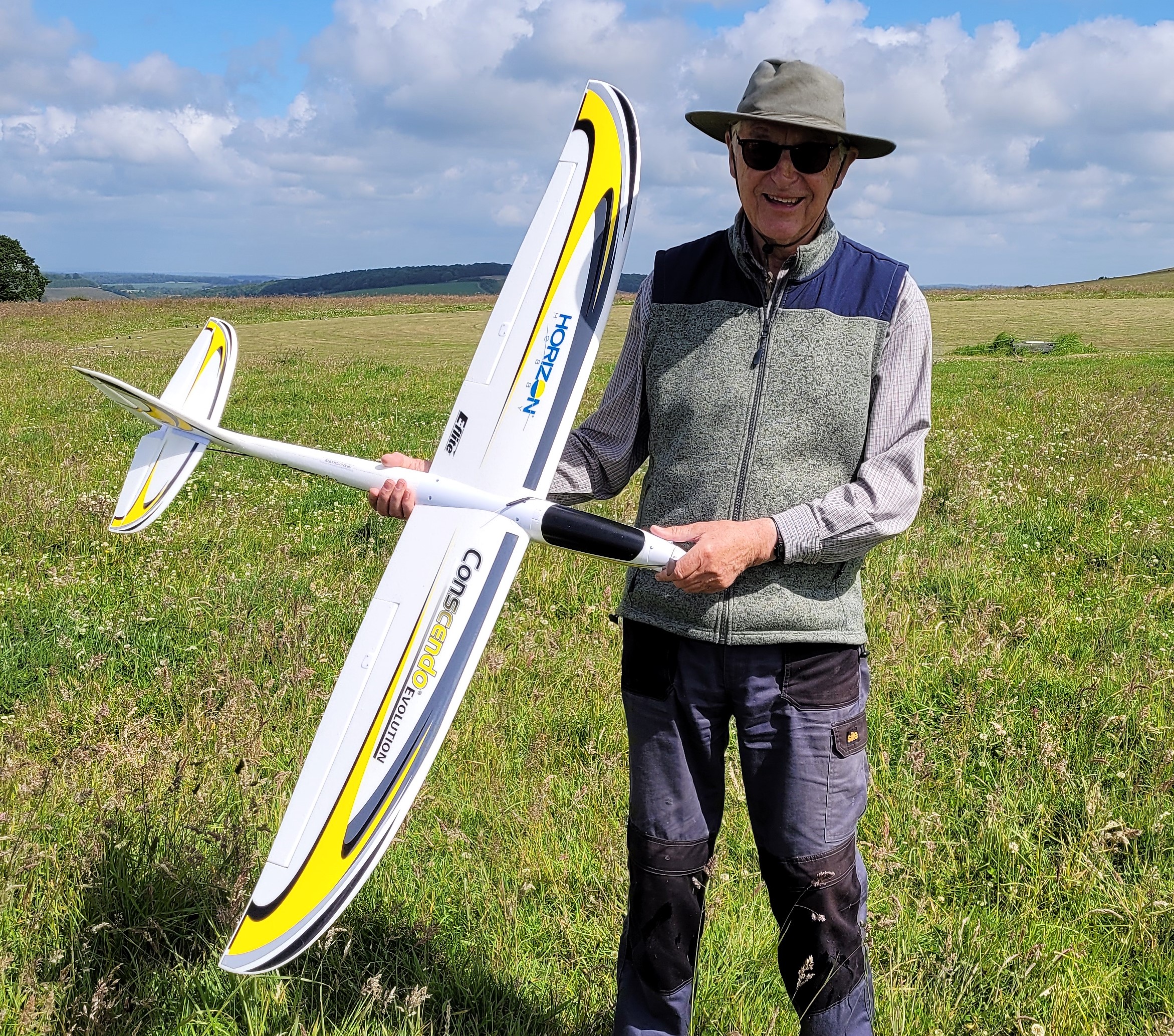 This is what E-flite say about it: With a 3S LiPo battery, the factory-installed brushless power system – featuring a 30-amp telemetry-capable ESC, specially-tuned outrunner motor and folding prop – delivers plenty of thrust for fast climbs to soaring altitude, sport flying and aerobatics. Using a 4S battery, it delivers even more speed and thrust for unlimited vertical performance without the need for modifications or upgrades. The new higher density EPO airframe has the additional strength and stiffness to handle anything an intermediate to experienced pilot will want to do with all that power. Yet the Conscendo Evolution is still easy to launch, fly and land. Flight ready in less time than it takes to charge a battery, the Conscendo Evolution offers a wide range of pilots a unique flying experience that no other model can provide.
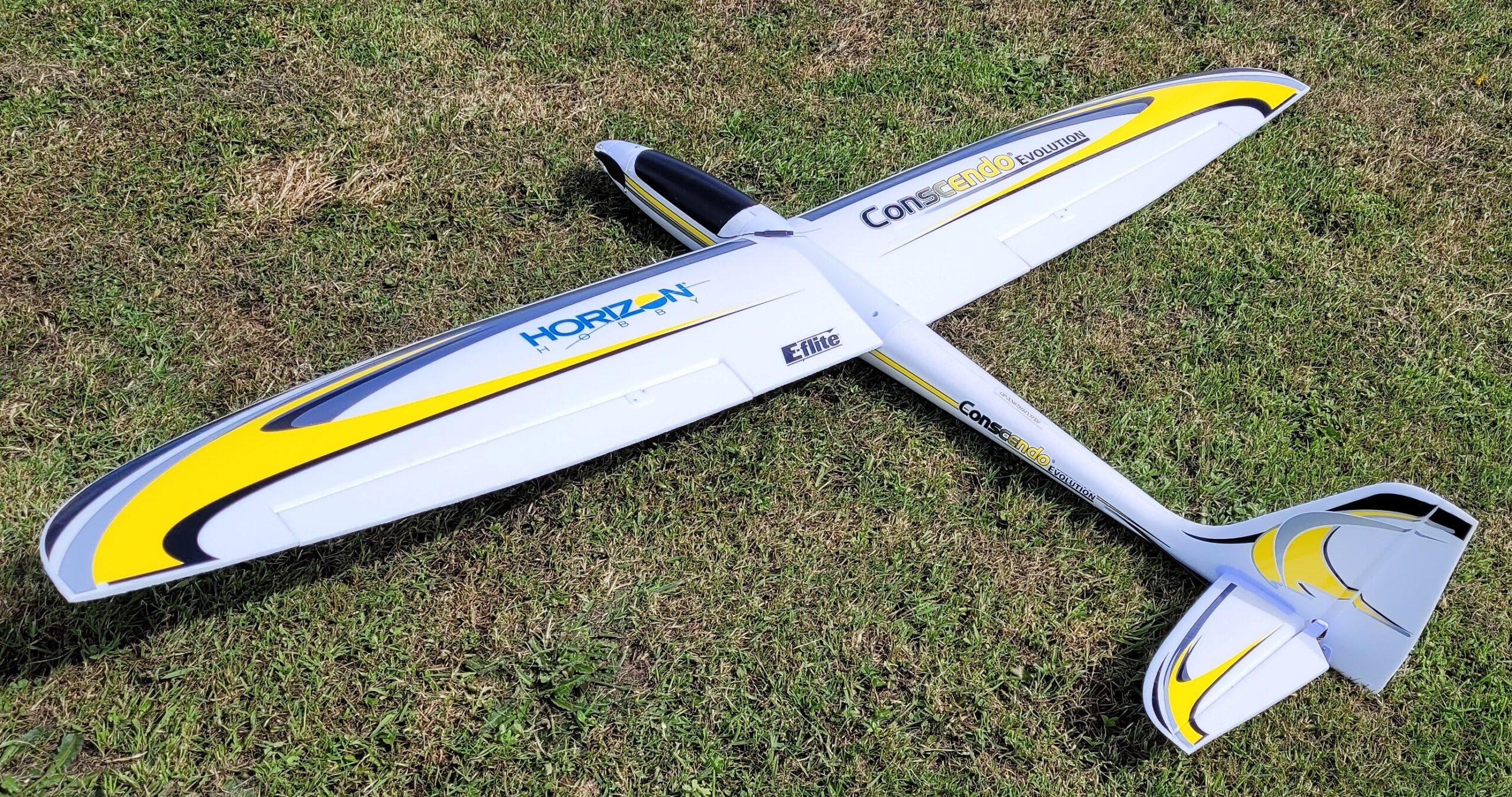
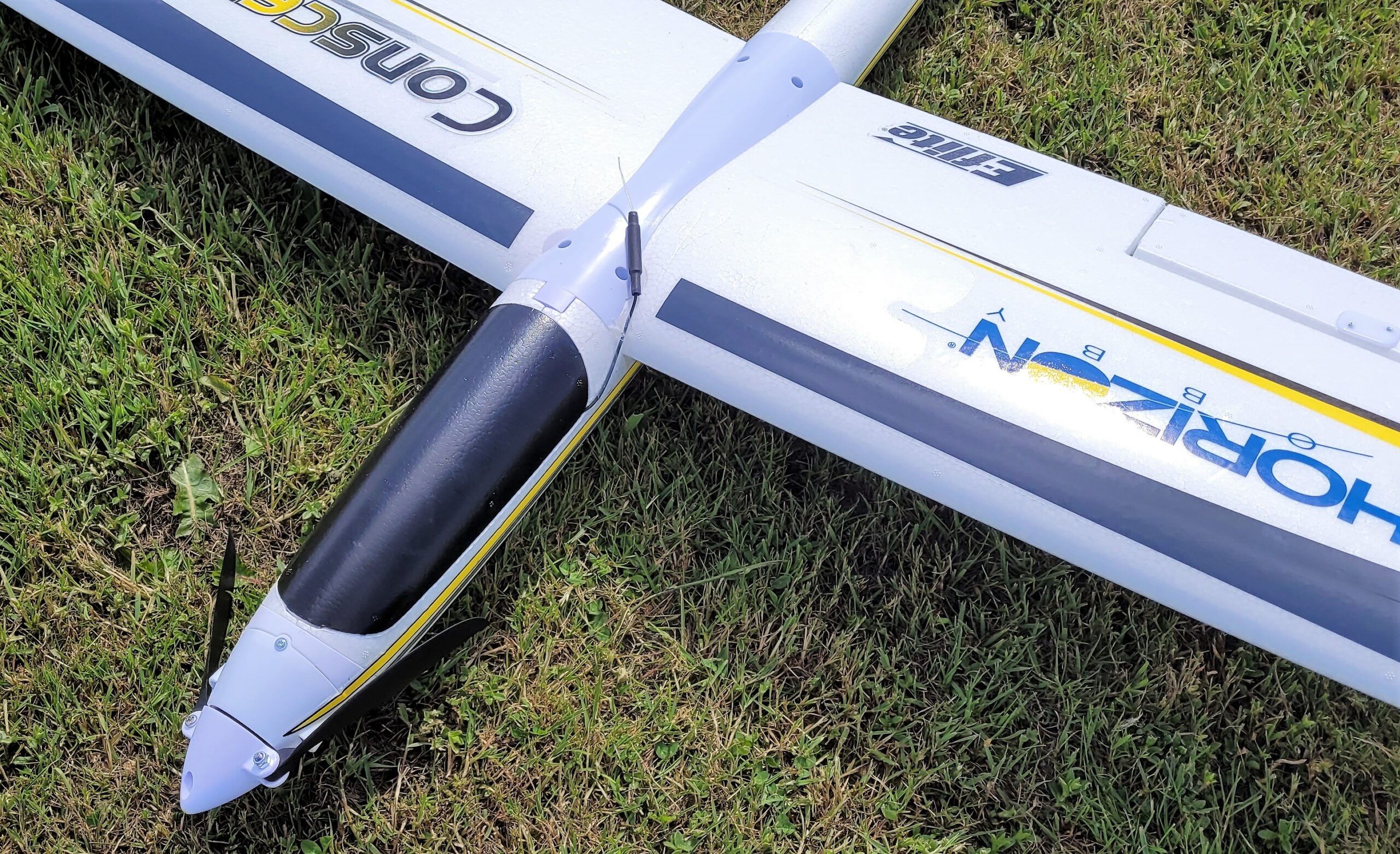 The first flight was made using a three cell lipo and the model flew very well, performing just as described with plenty of power for the usual glider aerobatics. You can watch some of the first flight in this month’s video. On a later flight Bob switched to a four cell pack and the Conscendo certainly had more than enough power for vertical climbs etc.
Dougal went along to the Horsham club’s Airborne Fun Fly on 12th June where he had a good time flying his Maxford Spad, Spitfire, Mini Blitz, and HobbyKing MX2.
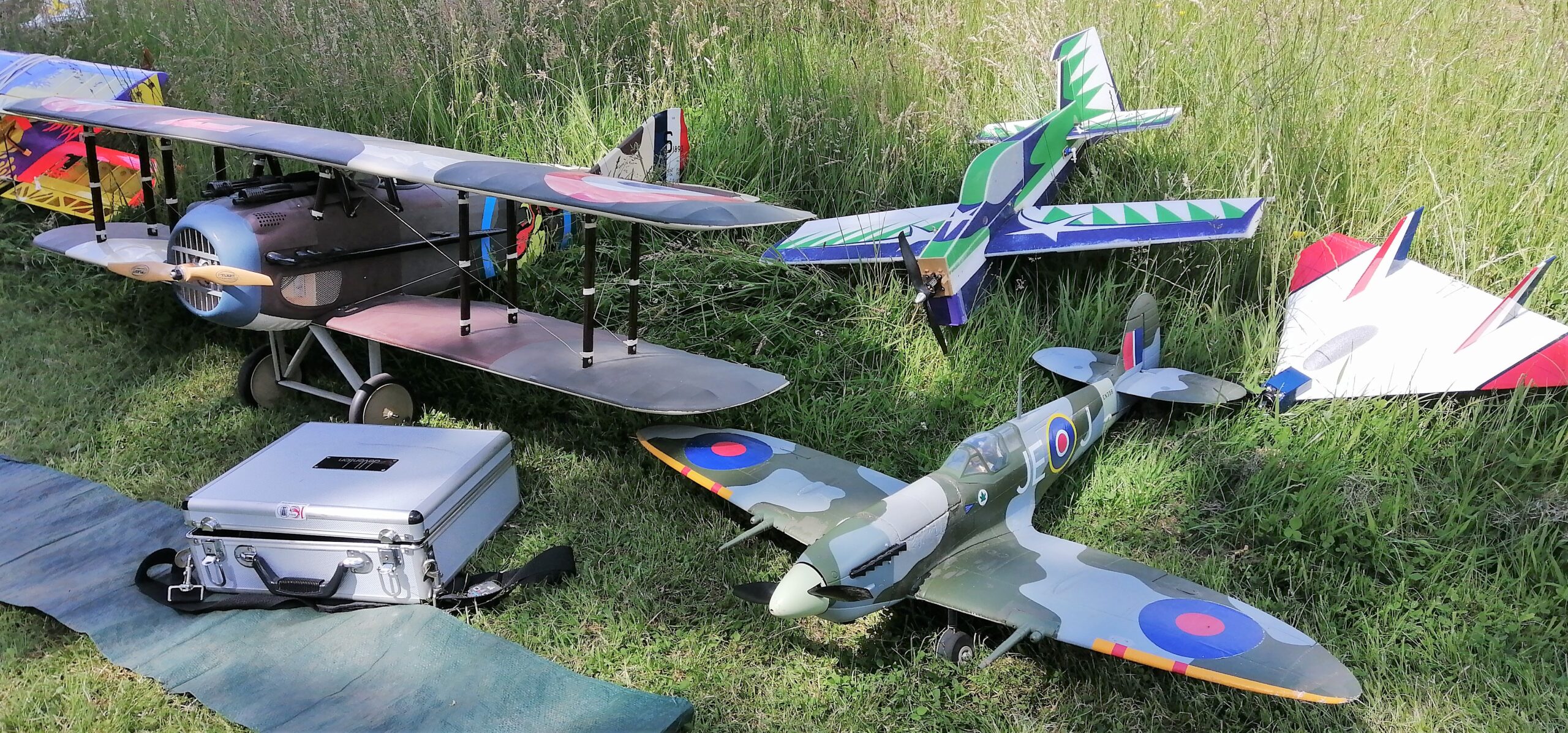 During the event the club ran some fun-fly competitions and Dougal took part, managing third place in the Max Loops in 60 Seconds competition and winning the Two Minute Timed Flight (you have to count, no timers allowed) with a score of 2.03, well done Dougal. He took lots of photos, some of which I’ll include later, and he also filmed some of the models in the pits so I’ll include that in this month’s video.
Woody bought two new models this month, a balsa Max-Thrust Riot and an F-22 Raptor. The Riot came from ModellbauUK at Medstead and the balsa ones are built by Pro-Build.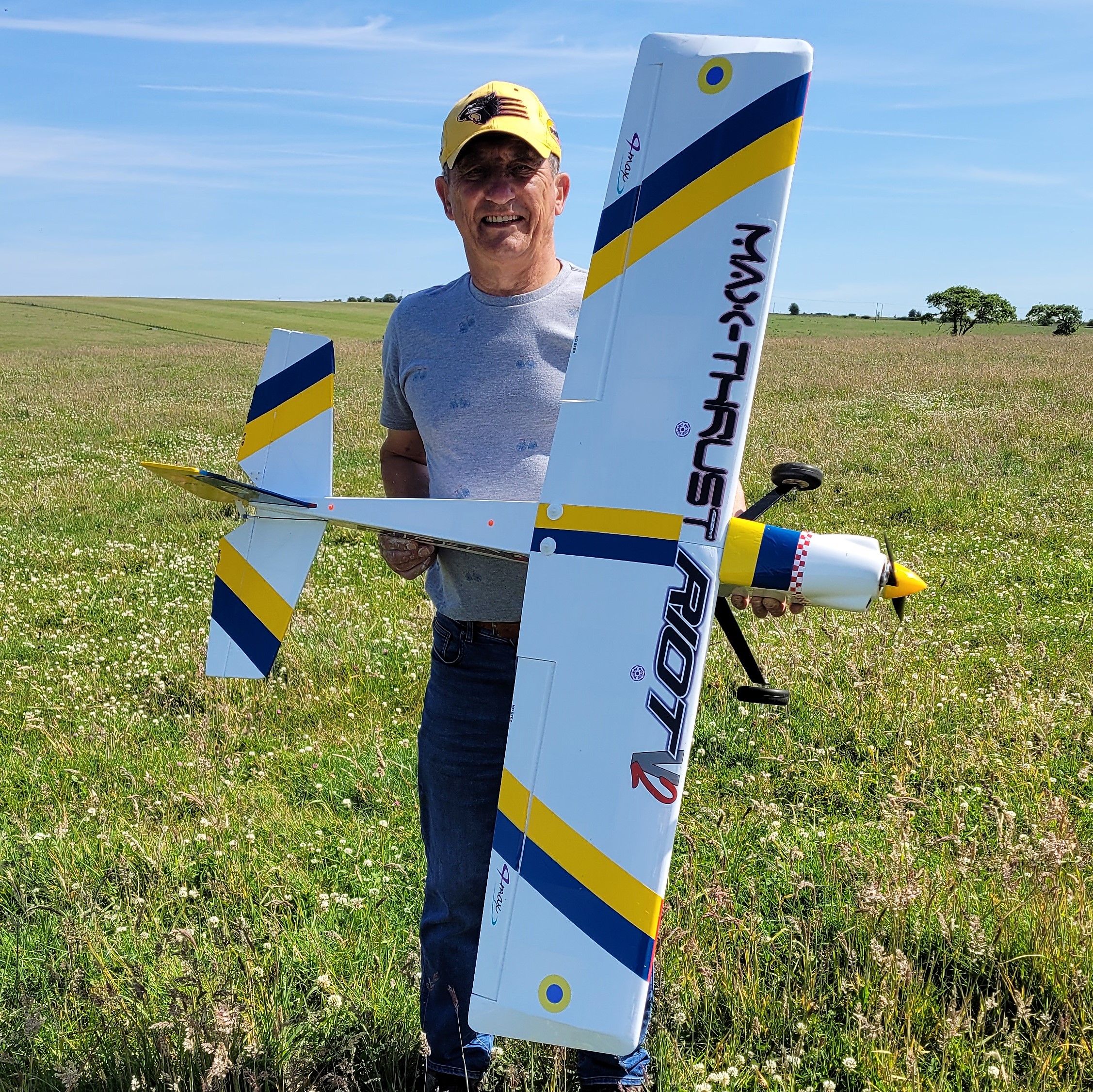
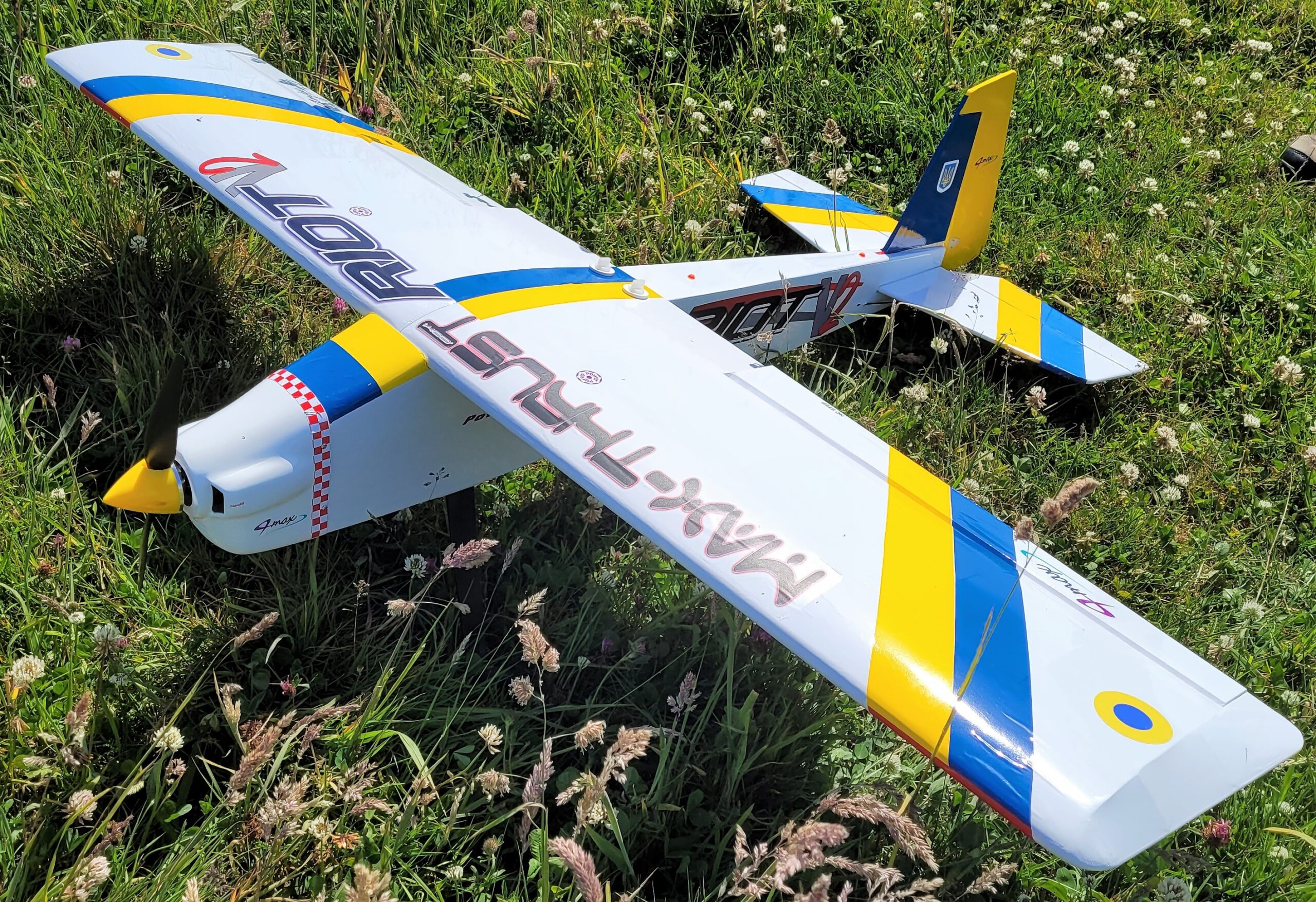 Woody had really wanted one of the original foam ones but ModellbauUK only had balsa ones in stock. The Riot came covered in just plain white so Woody added the blue and yellow Ukrainian trim. I’m impressed, he’s made an excellent job of it, it looks very good.
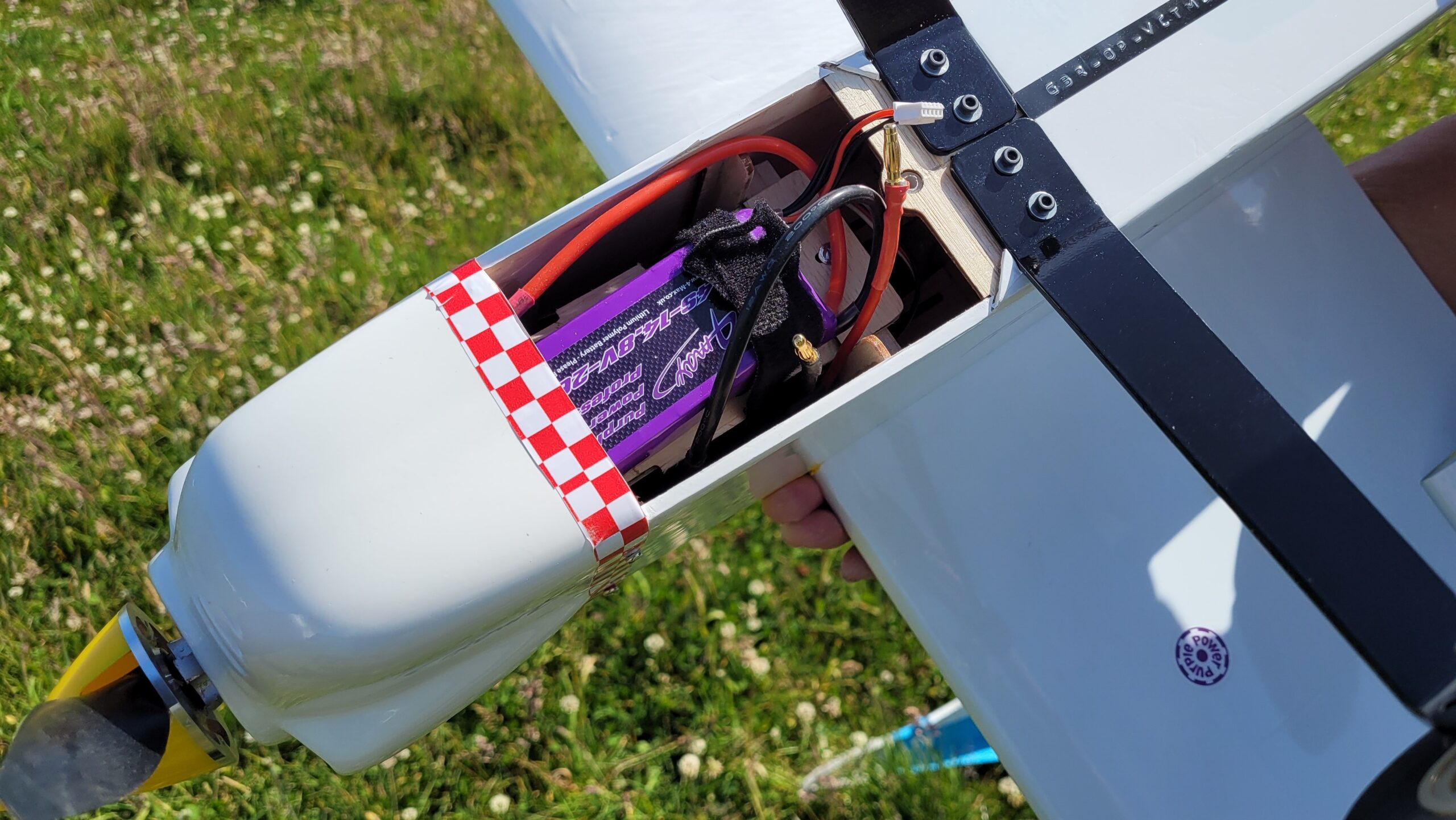 The Riot is fitted with a Purple Power 3542 1000kv motor which spins a 12×6 propeller. It uses a 60A speed controller and a 4 cell lipo. I was surprised how heavy the plane was when I picked it up and Woody explained that he’d needed to add 180g of lead in the nose to achieve the correct C of G but it must be a lot heavier than the foam version even before the nose weight is added. My own foamie Riot is much lighter and flies well on 3 cells, I don’t think the wood version would get off the ground with only 3 cells. Anyway, it was fine on 4 cells and the first flight went well with the Riot behaving exactly as it should.
Woody’s second new model of the month, an F-22 Raptor, came from Banggood and to give it the full title it is an HEE WING Hunter F22 MPP Foam PP Magic Board RC Airplane Kit. That’s a bit of a mouthful for a 400mm span foamboard jet!
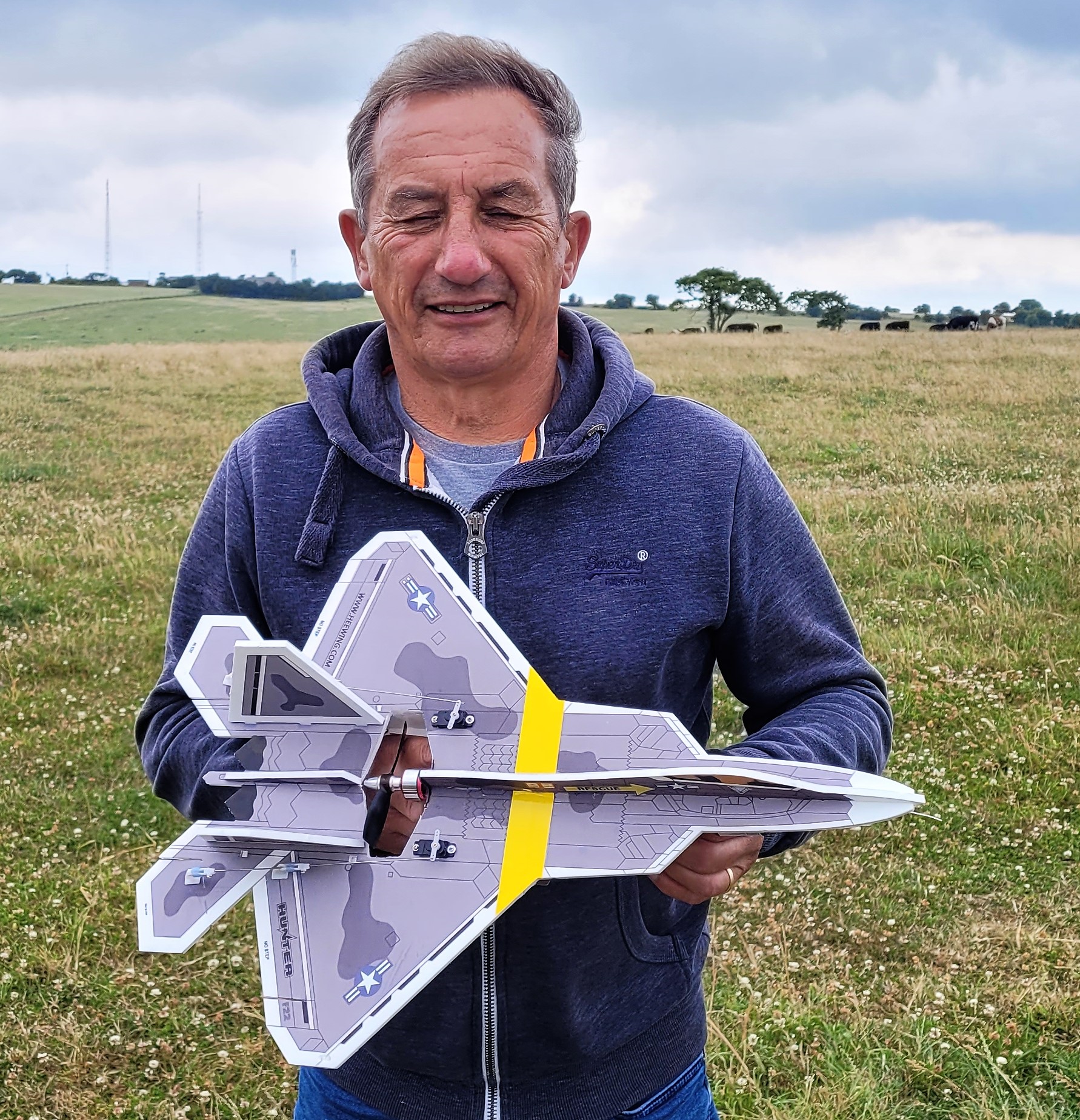
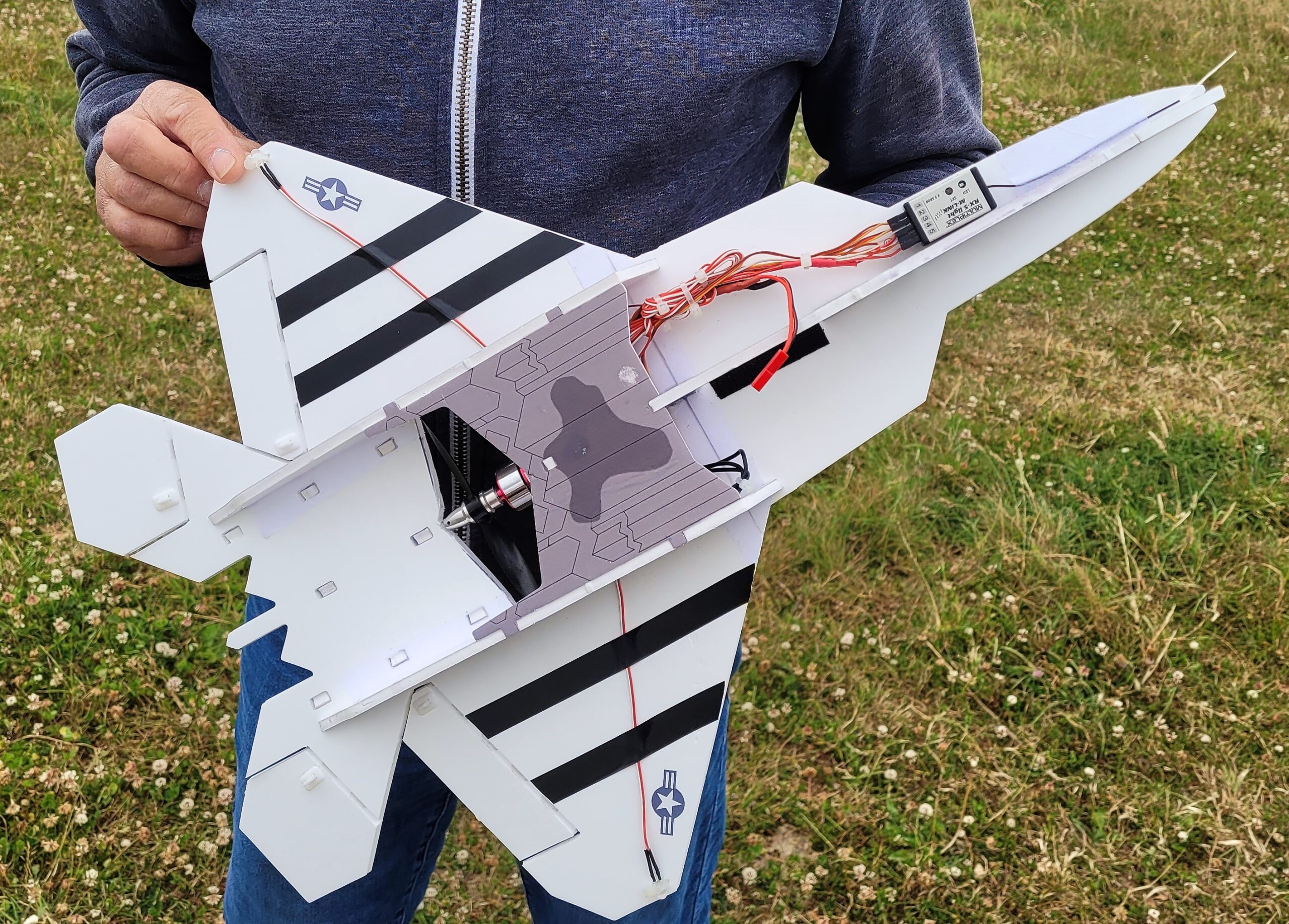 This is the slightly Chinglish description from the Banggood website: This products are producing by MPP magic board, UV print and laser cutting. With gorgeous workmanship and exquisite appearance, this incredible creative RC plane machine is made of lightweight and super durable material, tough and high strength. We set PNP version, which is very suitable for the DIY of airplane model enthusiasts. Electronic combo comes with brushless motor and esc, providing powerful performance. Version comes with flight controller which can self-stabilize flight control, achieve one-button takeoff and stable output to excellent performance. Note: PNP just for easy name, the PP frame PNP listed here is not pre-assemble. It requires assemble after you received.
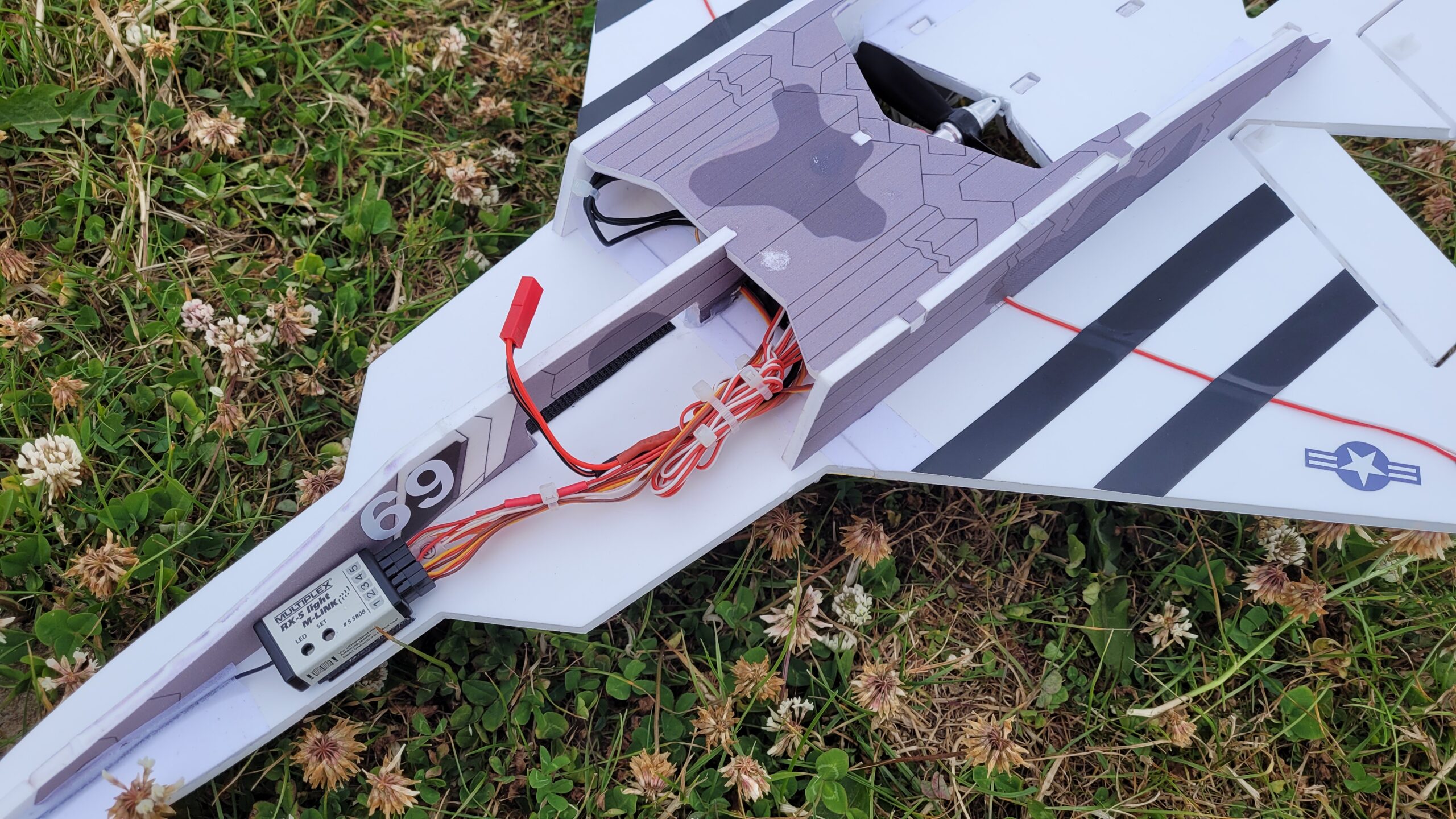 That’s all very clear then! Woody’s is the kit version so basically just the foam airframe parts and he has fitted it out with a Purple Power 2321-2050kv motor spinning a 4 x 4.5 prop and coupled to a 12A speed controller and powered by a 2s lipo pack.
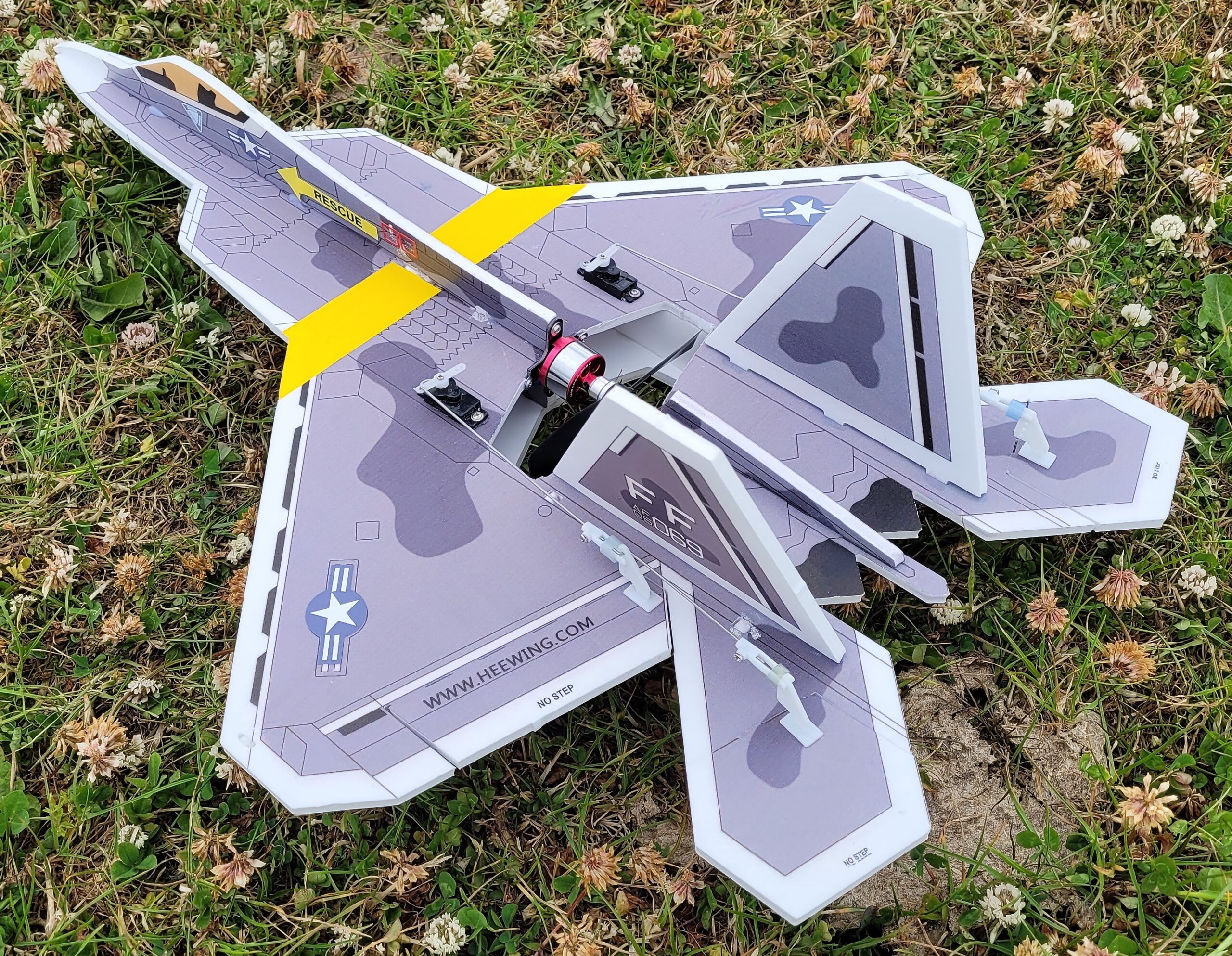 It was very windy on the day that Woody brought the Raptor to the field so he decided not to risk flying it but he has put it together well and I can’t see any reason why it shouldn’t fly ok. I’m slightly concerned that the RTF version which comes complete with the motor, esc, and servos also has a gyro and I’m wondering if it really needs one, time will tell.
We haven’t seen much of Kryten lately but I did find a video he’s made of an electric plane:
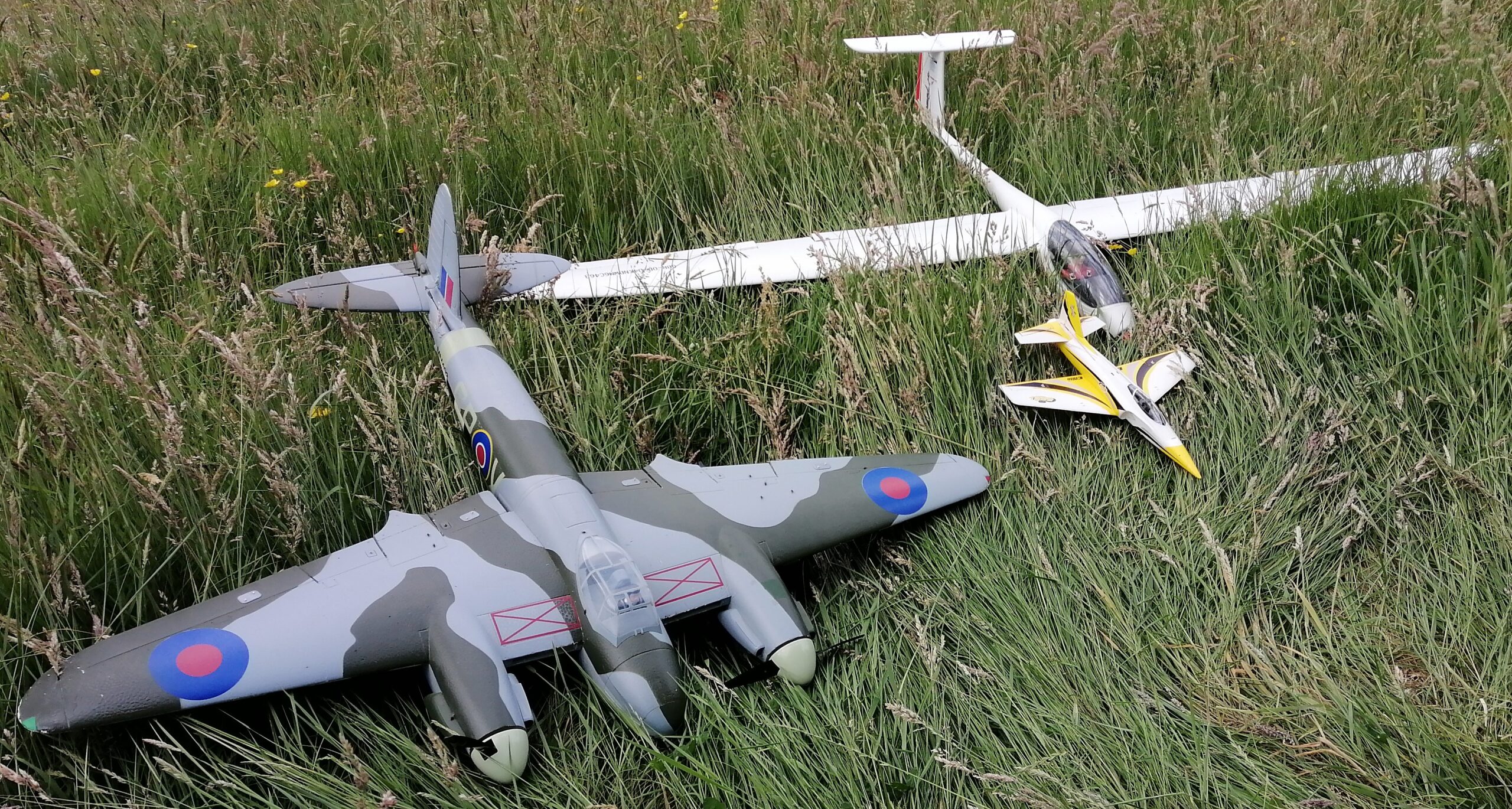
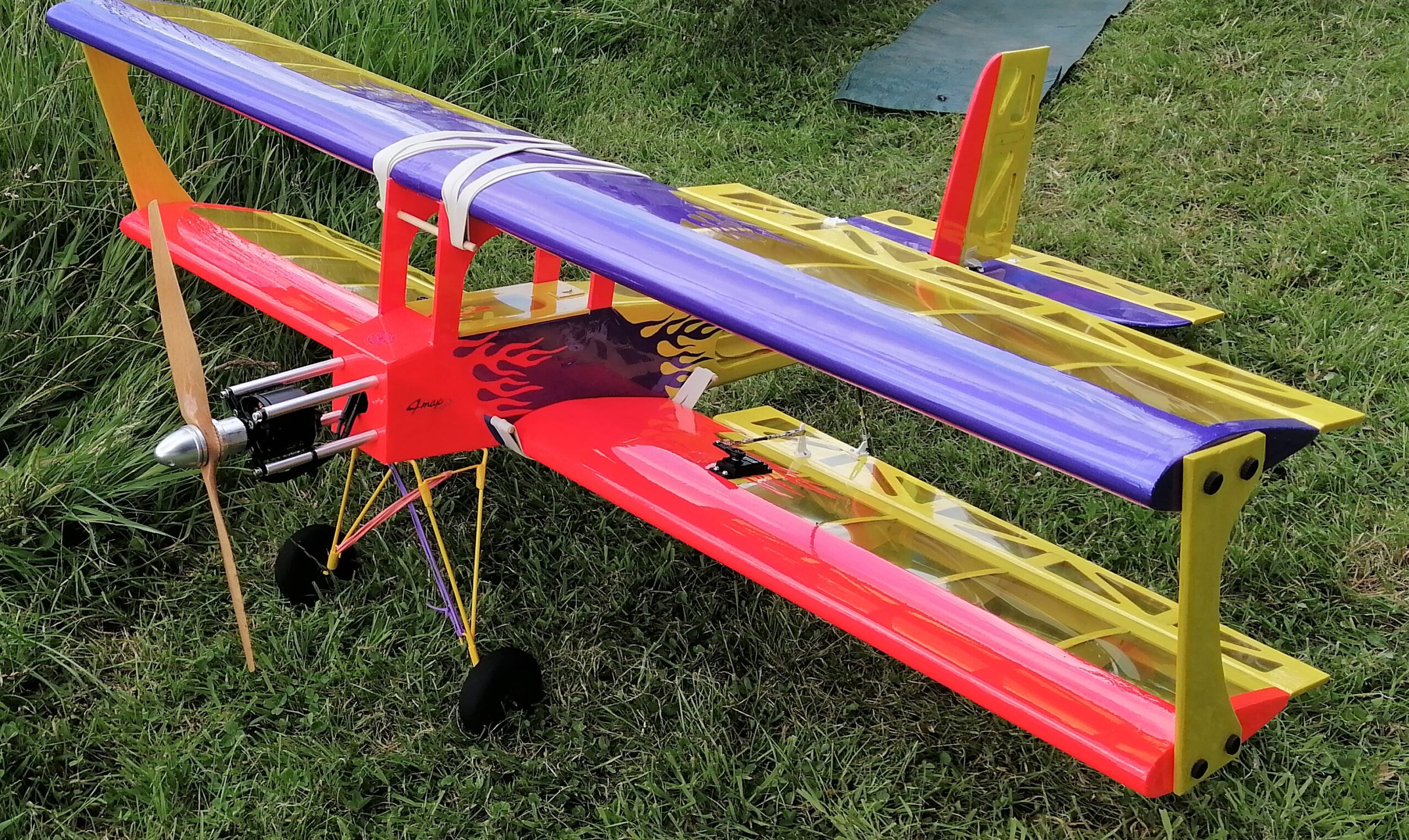
As Kryten has been so busy making that video he hasn’t been able take any photos of flying models so here are some ground shots that Dougal took at the Horsham Airborne event: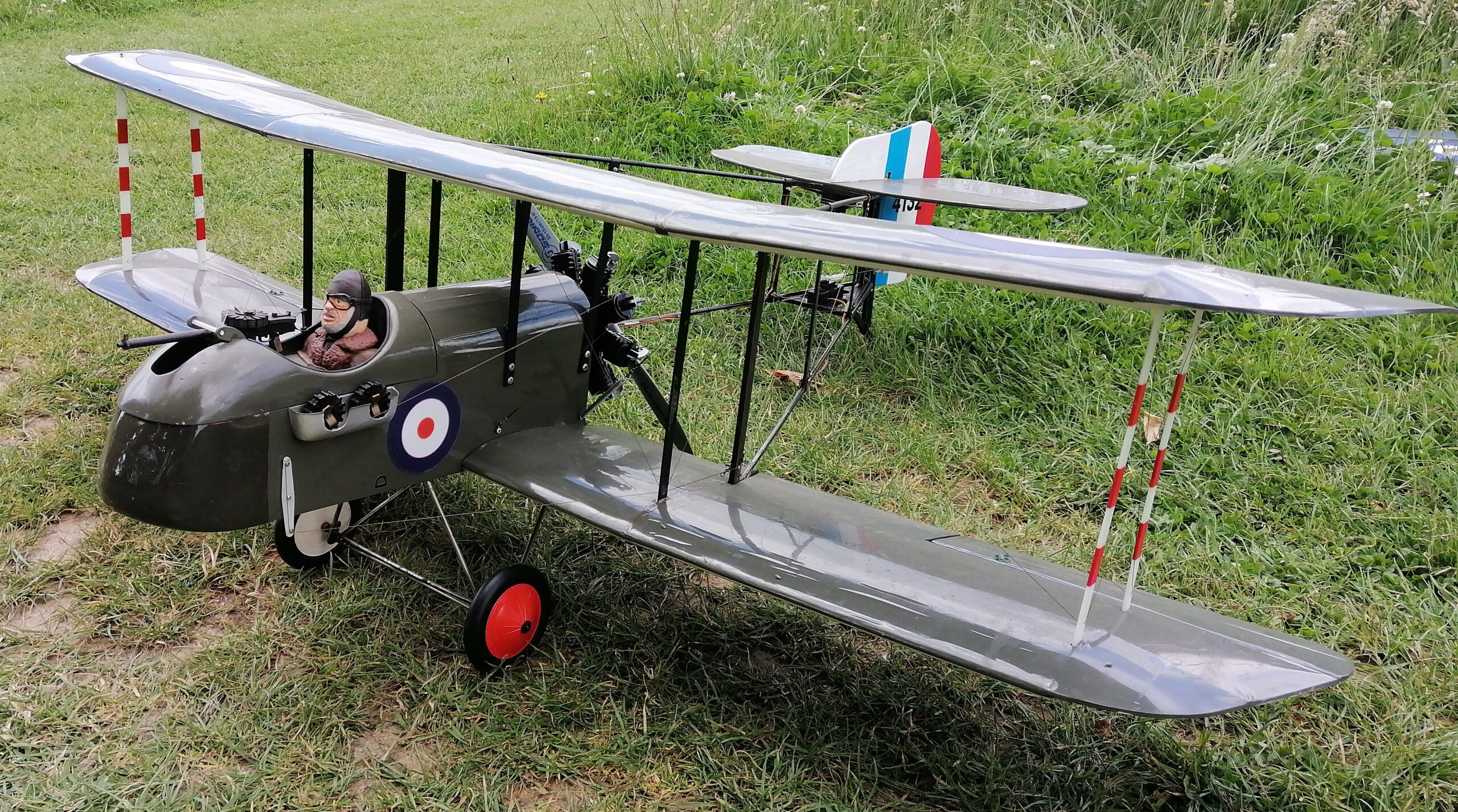



Video time now with content taken by Captain Slow, Dougal Entendre, and me. Please watch the video full screen, it’s so much better with small models flying around.If the video won’t play for you please click HERE
A chap at the airport is waiting for his flight but he’s lost his watch, so he looks around for someone to ask the time. He spots another traveller with a couple of suitcases wearing a very flash looking watch, so he asks him for the time.
The man replies, “Sure. Which country?”
Our chap asks, “Which countries do you have?” to which the reply is “All countries!”
“Wow! That’s a pretty cool watch you’ve got there.”
“That’s nothing. This watch also has a GPS, WhatsApp, e-mail and can even receive TV channels and display them on its miniature active colour pixel LCD screen!”
“That’s incredible. I’ve lost my watch and could do with one like that… would you consider selling it?”
“Well, actually the novelty has worn off by now, so for £100 it’s yours!”
The watch-less traveller can hardly whip out the cash fast enough, and hands over £100.
The seller takes off the watch and gives it to him. “Congratulations, here is your hi-tech watch.” and then handing over the two suitcases over says, “And here are the batteries!”
Colin Cowplain