Patch News – September 2025

 It’s now officially autumn so, as we head towards winter, our flying opportunities will decrease but no doubt many PAM members will still make the effort to fly regularly.
With the rain, the grass greened up nicely but of course it also grew a lot. As the patch grass became too long for many models Woody and 1066 took it upon themselves to go up one morning to mow and found it took two cuts as it had grown so long. Cutting the entire patch twice is a lot of work for two people and is something that we must ensure doesn’t need doing again. Huge thanks to them both for the hard work, we are very grateful.
There seems to have been a lack of new models flown in September, the only completely new model I spotted was Woody’s foamboard F-16 Fighting Falcon that he’s decorated very nicely in the colour scheme of the USAF Thunderbirds aerobatic team.
It’s now officially autumn so, as we head towards winter, our flying opportunities will decrease but no doubt many PAM members will still make the effort to fly regularly.
With the rain, the grass greened up nicely but of course it also grew a lot. As the patch grass became too long for many models Woody and 1066 took it upon themselves to go up one morning to mow and found it took two cuts as it had grown so long. Cutting the entire patch twice is a lot of work for two people and is something that we must ensure doesn’t need doing again. Huge thanks to them both for the hard work, we are very grateful.
There seems to have been a lack of new models flown in September, the only completely new model I spotted was Woody’s foamboard F-16 Fighting Falcon that he’s decorated very nicely in the colour scheme of the USAF Thunderbirds aerobatic team.
 The model was built from a plan published on rc.tomhe.net, a site that has plans for several similar foamboard models including the Eurofighter Typhoon that Woody has already built and which flies very well. The F-16 has a wingspan of 720mm, is 1180mm long, and Woody has fitted a 2212 2450KV motor controlled by a 40A speed controller. The F-16 differs from most of the foamboards that have been built by club members in that it has a rear mounted pusher motor rather than the usual mid-mounted motor. For Woody the F-16 has been a very radical departure from his usual builds, no, not because of the rear mounted motor, but because on this one he hasn’t fitted any lights, not a single one!
 The original construction is for the model to be built from Depron but, as is much more usual for PAM members, Woody has built his using Hobbycraft foamboard. This is 5mm thick and consists of a dense foam core sandwiched between sheets of white paper and comes in A1 size (841mmx594mm). At just £12 for four sheets it’s a very economical building material. If required the paper can be removed by soaking in warm water which has the advantage of making the board lighter (but also weaker) but this also highlights a problem. If the paper covering is left in place there’s a tendency for it to lift if the model is left on wet grass for too long, a waterproof mat is required! As the Thunderbirds colour scheme is largely white Woody has left the paper in place but has taped the cut edges of the board to seal them and hopefully prevent any peeling. The designer says that the F-16 can be flown using tailerons only but the ailerons are also marked on the plan and Woody originally built his with two servos, with each servo driving one elevator and one aileron.
 This seems a strange set-up but lots of foamboard models use this method and it works well. Unfortunately, in a rush to finish the plane, Woody’s linkages weren’t running freely enough and we didn’t want to risk a test flight with them like that. After a general discussion the consensus amongst those present was to disconnect the ailerons and rely solely on the tailerons, something that Woody was able to do at the field.
 The first flight attempt showed there wasn’t enough movement so changes were made. The next try was much better and the F-16 flew reasonably well for a couple of minutes. After more adjustments the third flight was much more successful and the plane flew well and looked good in the air but needed more roll control, so Woody took it home and added two servos and aileron linkages so it now has separate controls for the elevators and ailerons.
 Next time out the F-16 flew beautifully, a great improvement and fully under control. Dougal filmed the first three flights goes so you can see them in this month’s video. At the moment I don’t have any footage of it flying with the ailerons connected, hopefully I can include some next month. Well done Woody, after a few hiccups Thunderbirds Are Go! Yes, I know that expression was the puppet Thunderbirds not the aerobatic team but…!
Sticking with TV for a minute, here’s a Star Trek quote: It’s building Jim, but not as we know it… it’s 1066 building a building board. Following his build of the twisted Blink that featured last month 1066 realised that he needed a building board that was actually flat:
My wife has never been in our loft, but is adamant she knows everything that is up there so I often find myself crawling around, looking for things that have been thrown away years ago. On one such occasion recently I came across a large piece of chipboard, and an old piece of flat pack furniture which must have been there since we moved in, some 26 years ago. You’re probably thinking, what has this got to do with toy planes? Well, with my newly discovered enjoyment of building, I had been thinking of making a building board for some time, so, by chance I had found some of the material needed.
Next time out the F-16 flew beautifully, a great improvement and fully under control. Dougal filmed the first three flights goes so you can see them in this month’s video. At the moment I don’t have any footage of it flying with the ailerons connected, hopefully I can include some next month. Well done Woody, after a few hiccups Thunderbirds Are Go! Yes, I know that expression was the puppet Thunderbirds not the aerobatic team but…!
Sticking with TV for a minute, here’s a Star Trek quote: It’s building Jim, but not as we know it… it’s 1066 building a building board. Following his build of the twisted Blink that featured last month 1066 realised that he needed a building board that was actually flat:
My wife has never been in our loft, but is adamant she knows everything that is up there so I often find myself crawling around, looking for things that have been thrown away years ago. On one such occasion recently I came across a large piece of chipboard, and an old piece of flat pack furniture which must have been there since we moved in, some 26 years ago. You’re probably thinking, what has this got to do with toy planes? Well, with my newly discovered enjoyment of building, I had been thinking of making a building board for some time, so, by chance I had found some of the material needed.
 The construction was straightforward, the sheet material from the loft was squared up leaving as much useable area as possible, the frame and cross bracing (parts from an old airing cupboard shelf I was given) was then glued and screwed to the chipboard.
Because the chipboard was not moisture resistant, and because it will be stored in the garage, all the internal parts were coated with some old varnish.
The construction was straightforward, the sheet material from the loft was squared up leaving as much useable area as possible, the frame and cross bracing (parts from an old airing cupboard shelf I was given) was then glued and screwed to the chipboard.
Because the chipboard was not moisture resistant, and because it will be stored in the garage, all the internal parts were coated with some old varnish.
 The piece of Conti board (that’s Melamine faced chipboard to us non-woodworkers) was left slightly longer and screwed to the framework, this would be the bottom of the board and also create the bottom of a small trough at one end. I took a lot of care to make a flat building surface, clamping the board down when gluing and screwing, however when it was all dry, and I put it on the bench, building surface face down, the whole thing was rocking, very disappointing. Further investigation found the chipboard had got wet at some time in its life and had a swollen in the middle, something I hadn’t noticed.
  Fortunately the fix was straightforward utilising a belt sander and spirit levels. The trough at the end is used to store my glue bottle, and it’s also very handy for catching offcuts of balsa etc. Up to now I hadn’t spent any money, but I needed something on the building surface able to take a pin, traditionally this would be cork, but that would mean spending money! So I eventually used some Hobbycraft art card that I already had, so still no money spent :-). Next, a small piece of sacrificial ply was added to use as a cutting area, this is only pinned on, so it can easily be replaced as and when necessary.

 Finally, a handle was made from an old handbag shoulder strap, so it will be easier to carry indoors to continue building when it’s too cold out in the shed. I get a lot of pleasure making things from stuff that would often have been thrown away and, as I mentioned at the start, some of the materials used will be over 26 years old. They have now been used to make something that should be flat and useable long after I’m gone.
 Having built the board 1066 thought he’d better build a plane, so here’s a preview of his latest model, an Electro Streak that he’s building from the Great Planes discontinued kit.
It’s looking good so far, let’s hope it’s not twisted! More on the Electro Streak next month.
Mini Mike has repaired his Arrows Hobby Albatros after an ‘unexpected arrival’ last year.
Having built the board 1066 thought he’d better build a plane, so here’s a preview of his latest model, an Electro Streak that he’s building from the Great Planes discontinued kit.
It’s looking good so far, let’s hope it’s not twisted! More on the Electro Streak next month.
Mini Mike has repaired his Arrows Hobby Albatros after an ‘unexpected arrival’ last year.
 Fortunately he was able to purchase a new nose and it looks as good as new again now.
 Mike says the Albatros isn’t as nice to fly as either his Arrows Hawk or Avanti and thinks he needs to keep the speed up more than with the others but maybe he just needs a bit more stick time. It was a windy day when he flew it in early September which probably didn’t help and Mike has since found that that the gyro that came with the Albatros doesn’t seem to be working correctly so he’s removed it and will see how it handles without a gyro.
It appeared to go well on three cells though he’s contemplating trying it on four cells.
One day at the end of August Dougal Entendre was flying his Durafly Rare Bear when it suddenly started making a rather nasty noise. Dougal got it down safely and discovered that the motor was obviously far from well, so there was no more flying that day.
Mike says the Albatros isn’t as nice to fly as either his Arrows Hawk or Avanti and thinks he needs to keep the speed up more than with the others but maybe he just needs a bit more stick time. It was a windy day when he flew it in early September which probably didn’t help and Mike has since found that that the gyro that came with the Albatros doesn’t seem to be working correctly so he’s removed it and will see how it handles without a gyro.
It appeared to go well on three cells though he’s contemplating trying it on four cells.
One day at the end of August Dougal Entendre was flying his Durafly Rare Bear when it suddenly started making a rather nasty noise. Dougal got it down safely and discovered that the motor was obviously far from well, so there was no more flying that day.
 Back in the workshop he removed the 3536 1700kv motor, disassembled it, and discovered that at least two of the magnets had come loose. The Rare Bear is very fast when running the stock set-up of four cells with an 8×5 propeller but HobbyKing say that it can handle six cells if the propeller is swapped to a 6×4.5. As Dougal’s motor didn’t last for too many flights on the supplied set-up I would be wary of trying it on six cells. I reckon it’s plenty quick enough on four cells anyway, and Dougal tends to only go to full throttle for short bursts during a flight, but maybe that’s because we are all getting older!
 This is what Dougal did to solve the problem: I re-motored my Rare Bear with a cheap 3536 1450kv unit that I found on eBay. The shaft is different from the old motor so I couldn’t use the spinner originally supplied, but at least you can see more of the dummy radial motor now! Plenty of torque, as I found out when I launched it with a little too much throttle. On the second flight I flick-rolled it fast enough for the canopy to fly off. I landed OK, and fortunately the canopy came down in our field. I am now trying to devise something a bit stronger than just the one magnet fixing. Dougal thinks it’s not quite as fast as before but it still looks crazily quick to me and it’s definitely a little quieter now.
Back to 1066 now, who recently broke the wire undercarriage on his Night Visionaire.
This is what Dougal did to solve the problem: I re-motored my Rare Bear with a cheap 3536 1450kv unit that I found on eBay. The shaft is different from the old motor so I couldn’t use the spinner originally supplied, but at least you can see more of the dummy radial motor now! Plenty of torque, as I found out when I launched it with a little too much throttle. On the second flight I flick-rolled it fast enough for the canopy to fly off. I landed OK, and fortunately the canopy came down in our field. I am now trying to devise something a bit stronger than just the one magnet fixing. Dougal thinks it’s not quite as fast as before but it still looks crazily quick to me and it’s definitely a little quieter now.
Back to 1066 now, who recently broke the wire undercarriage on his Night Visionaire.  Dwayne Pipe kindly picked up a length of 10g wire for 1066 on a recent trip to SMC so all 1066 had to do was bend it to shape, not an easy task with tight ninety degree bends close together. But fortunately 1066 remembered that he had saved a useful wire bending jig from the sale of the late Chris P Bacon’s (also known as Nigel Baker) modelling goods.
 The jig turned out to be excellent and 1066 soon had the wire bent to the correct shape.
 Having the jig helped enormously and the Visionaire is now ready for another outing.
This month the action shots are all taken from the video:
Having the jig helped enormously and the Visionaire is now ready for another outing.
This month the action shots are all taken from the video:


 Video time now, this month with footage shot by myself, Dougal Entendre, and MacFly. Please watch the video full-screen, it’s so much better with small models flying around:
If the video won’t play for you please click HERE
The Final Funny:
It was the student pilot’s first cross country solo and the nerves were kicking in:
Control tower: Can you give me your position?
Student: I am next to a cloud that looks like a lion.
Control tower: Can you be more specific?
Student: Er…Simba…
Colin Cowplain
Video time now, this month with footage shot by myself, Dougal Entendre, and MacFly. Please watch the video full-screen, it’s so much better with small models flying around:
If the video won’t play for you please click HERE
The Final Funny:
It was the student pilot’s first cross country solo and the nerves were kicking in:
Control tower: Can you give me your position?
Student: I am next to a cloud that looks like a lion.
Control tower: Can you be more specific?
Student: Er…Simba…
Colin Cowplain Patch News – August 2025
Well, we certainly can’t complain about the weather in August, it was almost entirely dry and sunny, near perfect conditions for flying in fact. Many of the flying days were well attended, especially the midweek sessions, and several new models were flown.
 With the almost complete lack of rain the grass barely grew so there wasn’t enough for any farm animals to graze in the field and we only needed to mow the patch once.
Onto the new models now, although some are really just revamped or re-emerged models. First to fly in August was 1066’s new and rather swanky delta, an Angelwing Blink V2.
 I first featured the Blink in the June Patch News, when it was almost finished, and I’d held it over from May so basically it took him three months to get the covering done on it!
 I shouldn’t really complain, I’ve taken longer than that to open the box on some of mine, and the Blink covering does look amazing, not so much Blink, more Bling!

 1066 has fitted a 2212 6T 2200kv motor, a 30A speed controller and he’s flying it on three cell 1500mAh lipos. As it’s a delta the Blink has elevons so only two servos are required, so all in all it’s a pretty basic set-up, nothing much to go wrong, and of course the maiden flight would go perfectly… except it didn’t. The power and radio set-ups were fine and the Blink flew sort of ok once 1066 had dialled in an awful lot of aileron trim. Once the Bling was safely back on terra firma we checked the wing for flatness and sure enough, there was a definite twist in the left-hand side of the wing. If you look back to the build info in the June Patch News you’ll see that all the parts are beautifully laser cut and the whole thing slots together making for a very rigid airframe so what could have gone wrong?
 My initial thoughts were that the heat shrink covering hadn’t shrunk evenly and that had induced the twist, in which case a few minutes with a heat gun should correct the problem.
  But when 1066 tried this he found the twist very quickly returned and despite weighting the plane down overnight the wing refused to stay flat. He’s now taken to clamping the Bling down with packing pieces twisting the wing in the opposite direction overnight before every flying session and that has meant it will fly without needing lots of aileron trim although, even as the session wears on, the twist starts to return. But basically it’s fine now and it flies really well, fast and smooth, much as you would expect. You can see it in the video although small fast models aren’t easy to catch with a mobile phone camera.
The next model is not new but Dougal Entendre doesn’t bring his large scale Spad XIII out to fly very often and it’s well worth featuring. The reason it’s rarely flown is mostly due to its size, the Spad won’t fit in Dougal’s car when assembled and it takes quite a while to rig in the car park, and once rigged it’s heavy to carry down to the patch.

 But it’s worth the effort as once the Spad is in the air it flies beautifully. The Spad is a 68” span fifth scale ARTF model produced by Maxford USA RC and is designed to be powered by either an I/C or electric motor. Dougal’s is electric powered of course and uses a pair of 4 cell Zippy Compact 5800mAh batteries connected in series to make an 8 cell pack.

 This provides ample power and Dougal gets flights of around eight minutes while still leaving a safety margin. The fact that the Spad is large and relatively slow means that it’s easier to film than most models we see at the patch so of course it appears in the video.
Changing the subject slightly, here’s some info about an update to my HobbyKing MX2. There have been several of these in the club over the years and, although 3D flying isn’t my thing at all, I bought one a while ago after enjoying test flying Gordon Bennett’s for him.
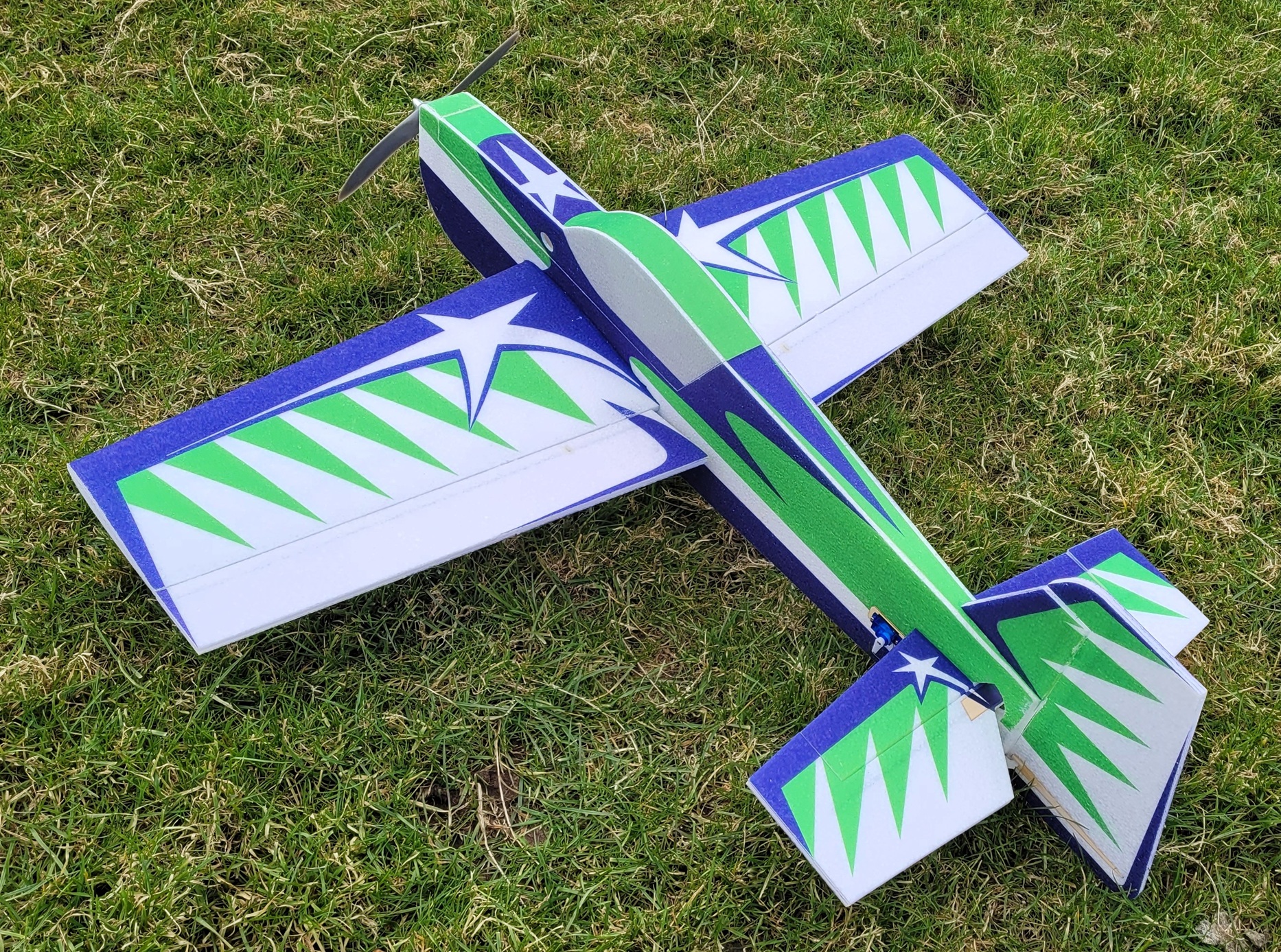 The MX2 is a lightweight 955mm span EPP model that comes as ‘airframe only’ so buyers need to provide all the electronics themselves. Other than fitting a motor and radio there is very little to do to complete the model, basically glue the wings and tail feathers on. HobbyKing suggest using a 2217 950-1100KV outrunner motor although they don’t actually have any for sale. The manual suggests a range of motors to use, 2834, 2215, or 2217 with a Kv in the range of 950 to 1100 and, having discussed it with Dougal, I fitted a 2836 1120Kv Turnigy motor along with a 30A speed controller. The manual also says to use a 3 cell 11.1V 1100-1300mAh battery but I have some 1400mAh packs so I used those when I first flew it in February this year. They were ok but gave fairly short flights.
 The MX2 flew well enough but I didn’t really enjoy flying it so I put it away for a while. But in August I felt I should give it another go and, knowing that others had sometimes used 2200mAh packs I decided to try those. But fitting a larger pack was tricky, especially as it would need to be further back in the fuselage to maintain the correct centre of gravity.
 I didn’t want to cut out the cross-member that was in the way as there’s ply under the foam which is part of a ply stiffening plate that reinforces the whole front end of the fuselage.
  Then I realised the fuselage is really deep at that point so the pack would fit vertically, and after a few minutes of foam hacking I’d solved the problem! I added a small piece of thin ply to keep the wires within the fuselage width, without that it was tricky putting the canopy/top section on. Oddly I find it nicer to fly with the extra weight and I’m enjoying it much more. There’s a short piece in the video proving that I don’t really do 3D!
Back to totally new models now and Mini Mike’s E-flite Sportix, a model that, rather strangely, Mini Mike bought from Appliance Electronics, a company that specialises in household electrical goods but also has a model section. He bought from them as they were offering the best price/delivery at the time, and all went quickly and smoothly.
 The Sportix is a very attractive 1100mm span sports aerobatic model that can be flown on either 3 or 4 cells. This is from the E-flite website: Whether you’re a low-time pilot looking for a “next step” model after mastering your trainer and you’re interested in learning to perform more advanced aerobatics, or you’re an experienced pilot looking for an all-around fun-to-fly sport model, the E-flite Sportix 1.1m is a perfect choice.
 It’s designed to be capable of basic, precision, and aggressive aerobatics, while also being smooth, stable, and predictable in every phase of flight. It was also designed to include a variety of modern-day features and conveniences from LED navigation lights to a two-piece horizontal stabilizer and wings with hands-free servo connections that can be installed and removed without the use of tools or fasteners.
 Yet it’s also conveniently sized to be easy to store and transport without disassembly – and so it can be flown at large parks and sports fields as well as RC flying fields. Factory-installed digital and metal-geared servos with ball-link equipped linkages provide precise and reliable control at every speed. The power system includes a Spektrum outrunner motor and an Avian 45-amp Smart Lite ESC that are compatible with popular 3S and 4S 2200-3200mAh batteries. The maiden flight went perfectly, no problems at all and the Sportix proved to be a nice flying plane. Mini Mike had several flights with it in August with no problems, and even the wheel spats survived undamaged.

 So far Mini Mike has only flown his on 4 cells but is thinking of trying it on 3 cells as it has more than enough power. You can see it performing in the video but bear in mind that it’s a new model and Mini Mike was understandably being cautiously high!
When he feels the need, the need for speed, Mini Mike flies his ElectroStreak (another E-flite model) to which he’s fitted a GPS airspeed recorder. The E-flite website says the model will do 120-130mph when flown on 4 cells, and Mini Mike told me he was sure his would reach 125mph in a dive but he was wrong, it was really pathetic…
 OK, so 124.59mph is pretty close to 125mph! Maybe we should change his name to Maverick Mike! I’m not sure about the 1048.0M/S reading, the plane certainly can’t have dived at 1048 metres per second. Maybe Mini Mike has figured it out and will let us know.
Another model that re-appeared in August was Catapult King’s Purple Piper. The model is actually a John Rutter design called the Pink Piper, but this one’s Purple so…
 The Purple Piper first flew in August 2022 and was originally rather underpowered with a 7×4 prop. So Catapult changed it to a 9×5 which was much better but he didn’t like the folding prop tips being able to touch the front wing band dowel when it folded.
 It’s not a major problem unless it eats the wing bands Catapult! Speaking of which, I hope you didn’t fly it with just the two bands that it has in the photos. It didn’t crash so you either got away with it or had added a couple more before flying! Anyway, Catapult is looking to fit a more powerful motor as the Purple Piper could still do with a bit more go.
In August Dot Cottam finally returned from umpteen holidays and family birthday events and brought along his latest purchase! He’d made an excellent choice and plumped for a Volantex Phoenix 2000 V2. There are several Phoenix electric gliders of various types and sizes in the club and they all perform well. I’m really pleased with my Phoenix 1600.
 Dot’s turned out to be no different from all the others, as expected it flew beautifully and had no problems. Dot enjoyed flying the Phoenix and went home a very happy chappy.
The final new model flown in August was, as Bob the Builder put it “Not a new model, just a recycled one.” I like that, when I crash mine they tend to be recycled to the bin! But Bob isn’t known as The Builder for nothing and this model is a combination of two models that he’d built previously. The fuselage came from his Mini Tasman, his own design smaller version of his XFly Tasman. The Mini Tasman flew well but crashed with radio problems.
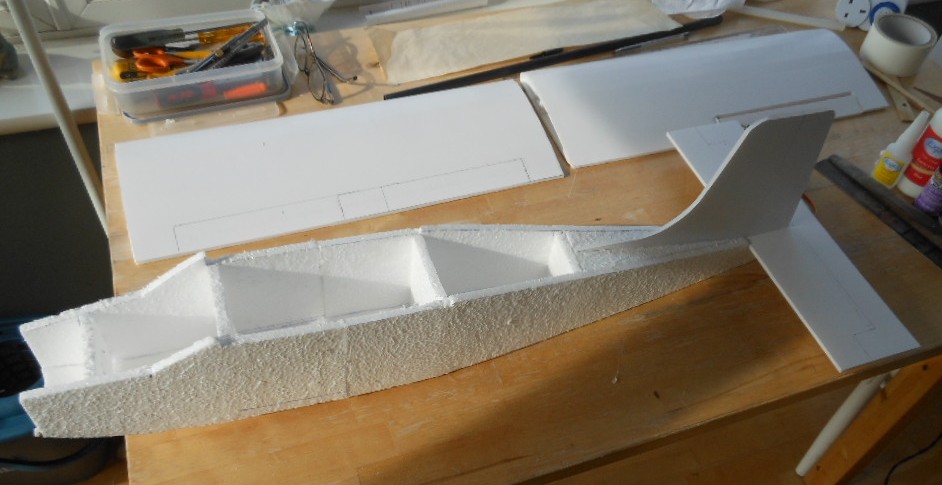 The wings were damaged beyond repair but the fuselage was too good to simply chuck in the bin so Bob modified it slightly and fitted the wings from a one metre span electric powered glider that he’d built during lockdown. He’s named the recycled combo TasLock.
 The powertrain is exactly as it was in the Mini Tasman with a Propdrive 28-36 1400kv motor turning a 9×7 prop, a 40amp speed controller, and a three cell 1300mAh battery.
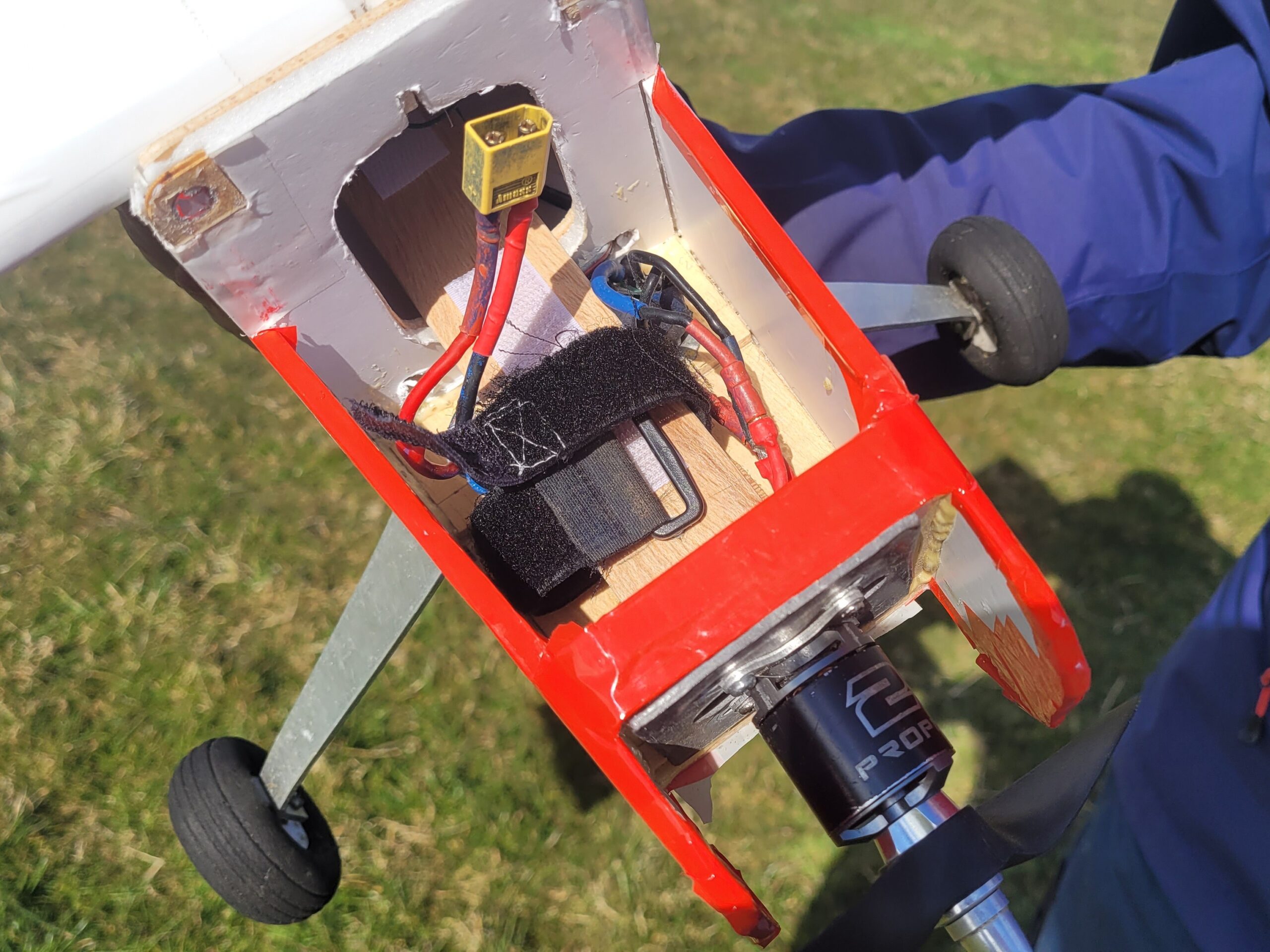 The all up weight is around one kilo which is fine for the size of the wing, but as the wing is slightly swept forward Bob was a little concerned where the centre of gravity should be.
 He obviously got it right as the TasLock flew perfectly with no trims changes required. In Bob’s words “Looks strange but seems fly OK.” He’s right, check it out for in the video.
This month the rather poor quality action photos are all taken from the video:


 Video time now, this month with footage shot by myself, Dougal Entendre, and MacFly.
Please watch the video full-screen, it’s so much better with small models flying around:
If the video won’t play for you please click HERE
The Final Funny:
A man in a hot air balloon is lost so he reduces height when he spots a man below.
He lowers the balloon further and shouts, “Excuse me! Can you tell me where I am?”
The man below says “You’re in a hot air balloon hovering 30 ft above this field.”
“You must be an engineer” says the balloonist. The man asked “How did you know?”
“Well”, says the balloonist, “What you have told me is 100% correct but of no use at all.”
The man says “You must be a manager.” The balloonist says “I am, how did you know?”
“Well” says the man “You don’t know where you are, or where you’re going, but you expect me to help. You are in the same position you were before but now it’s all my fault.”
Colin Cowplain
Patch News – July 2025
July was a great month for the club with lots of good weather and great flying enjoyed by the members. As there was little rain the grass barely grew so we only needed to mow once in July. The sheep have gone for now as there’s not enough grass for them to eat.

 As is usual for July, the annual Chuck Glider competition was run mid-month. You’ll find the Competition Secretary’s full report on the event a little later in this Patch News.
First up of the new models is Woody’s lovely foamboard Typhoon that he’s built using the plans from the RC.tohme.net site which you’ll find HERE. The website says to use Depron but Woody has built his from Hobbycraft foamboard, leaving the covering paper on.
 Woody first fitted the Typhoon with a drone motor but the power seemed a bit marginal so after the first flight he swapped the motor to a Turnigy 2212/10. I don’t think the swap made a lot of difference really but it has enough power although certainly not excessive.
  The speed controller is 30A and Woody is using the usual 3 cell 2200mAh lipo packs.
Woody has finished his in the scheme of a specific RAF Eurofighter Typhoon aircraft, one that is painted in a D-Day commemorative livery. This aircraft, serial number ZJ913, is nicknamed “Moggy” due to the way the letters “FM-G” are arranged around the roundel, resembling “FMOG”. The livery is based on the Hawker Typhoon of 257 Squadron, coded FM-G, flown by Pilot Officer Denzel Jenkins on D-Day. Last year was the 80th anniversary of the D-Day landings, and the aircraft was part of the RAF Typhoon Display Team.
 Woody has made a cracking job of it and it looks great but, oddly for Woody, he hasn’t added any lights, surely a first?! The first flight was ‘interesting,’ Woody asked me to trim it out which I quickly did once it had gone away from the launch. All seemed fine for the next couple of minutes but then it lost radio contact and it dived left into the ground.
 Woody had previously had a couple of unexplained crashes but had fitted the Typhoon with a different receiver so the transmitter became the prime suspect. The transmitter was a Multiplex Cockpit 7 that I’d sold Woody second-hand a good few years ago. I’ve looked through some old photos and found that I was using the transmitter at least fifteen years ago so it hasn’t done too badly. It still works but there’s obviously an intermittent problem, maybe just the aerial connection or similar. Anyway, Woody decided to bite the bullet and bought himself a new Radiomaster transmitter which is compatible with his Multiplex receivers (and various other brands) so after some repairs to the model we tried again.
 Woody has now flown various models using the Radiomaster with no radio troubles so it seems the transmitter was the problem. The Typhoon is now flying well and it looks great in the air. You can see it in this month’s video which includes Moggy diving into the deck!
In the May Patch News I reported that Dwayne Pipe had begun repairs of his Folland Gnat following some fairly severe crash damage and in July he brought it along to test fly.

 He discovered that, despite his best efforts, the wing incidence wasn’t the same on both wings which resulted in a built-in left turn that was too much to be trimmed out.
 Dwayne got the Gnat down safely twice without any damage so he’s now taken it back to the workshop for a bit of re-jigging. There’s a lot to be said for designing and building a model from scratch, it means almost anything can be fixed and got back in the air.
Next up is a Dougal Entendre’s Durafly Rare Bear Reno Racer that came from HobbyKing.
 So, what is the model based on? Rare Bear is the nickname of a highly modified Grumman F8F Bearcat aircraft that has competed in the Reno Air Races, specifically in the Unlimited class. It’s known for its speed and has set many performance records for piston-driven aircraft, including the 3 km World Speed Record of 528.33 mph set August 21, 1989, which still stands in this class. Over many years of racing Rare Bear has been painted in various colour schemes including the gold and white livery that Dougal’s is finished in.
Here’s what HobbyKing say about the model: Do you feel the need for speed? Then this great-looking, extremely fast Rare Bear Reno Racer from Durafly is for you. It is supplied as a Plug-N-Fly model with minimal parts count, so assembly is quick and simple. There is no gluing required, just one screw holds the tail components in place, and 1 screw for the wing. Battery and radio access is via the large magnetically held canopy hatch, so radio installation and battery changes are very easy and straightforward. Durafly has captured this amazing turn of speed with their Rare Bear, on the stock 4S setup with the supplied 8×5 propeller, speeds of around 110mph are easily achievable. But the Rare Bear is not all about speed; slow it down, and it handles beautifully. The controls work well, right down to the very predictable stall, the Rare Bear is just a joy to fly with no nasty tendencies. Back to when flying at speed, on the stock 4S setup, it flies like it is on rails, and gives that locked-in feel while performing aerobatics, huge loops, and long, smooth knife-edge flight are just a breeze to carry out.  The build quality and attention to detail are typical Durafly, it is just fantastic. The Rare Bear is a hand-launched model and belly lander, so underneath, the fuselage and the wingtips are reinforced with tough plastic to take the knocks and bangs. Additionally, glass fibre reinforcements are on all the control surfaces, which really stiffen them up to stop any flutter at high speeds, and the foam hinge line is reinforced with a clear flexible adhesive. The fuselage is also reinforced inside with glass fibre rods running along the length of each side for added strength. It has a solid plastic firewall, stiff pushrods with ball link connectors for positive control, and the scale mouldings include a dummy exhaust and radiator intake. This Plug-N-Fly model is supplied with a pre-installed 3536-1700KV brushless motor, a 60A Aerostar LITE brushless ESC, 4 x metal-geared 9g servos, and an 8×5 propeller. Once it is assembled, all you require is a 4ch or more transmitter and receiver, and a 4S (14.8V) 1800~2200mAh 40C minimum LiPo battery.
  Unfortunately, when Dougal first unboxed the model he found one of the aileron servos was faulty so he replaced it, but the first time he brought it to the field there was a problem with the replaced servo glitching so he couldn’t fly. Checking it out at home he found it was getting very hot so he’s now binned it and has fitted another from his stock. He got onto HobbyKing who sent two replacement servos but they were plastic geared ones, not metal, and the plane definitely needs metal geared servos. Once the servo saga was sorted I filmed the first attempt at flight which didn’t go quite to plan! Chas’s launch was fine but the Rare Bear torque rolled hard left and it cartwheeled right in front of me.
 Amazingly there was no damage so Chas launched it again, this time with Dougal using less throttle. Although it rolled left again Dougal was prepared for it and the plane got away safely, and on subsequent flights Dougal has found that half throttle is the absolute maximum power when launching. Once safely away the performance is amazing, Dougal only uses full throttle for very short bursts as it’s so fast! He says it’s really nice to fly and doesn’t seem to have any nasty characteristics. The video includes the first launch and then some of the flying but it’s too fast for me to get much decent film of it.
As I mentioned earlier, July is Chuck Glider Competition time and our Competition Secretary Dwayne Pipe got everything arranged for the event to be held in the evening of 9th July at the Buriton playing fields. Here is Dwayne’s report: The annual chuck glider competition was held this month, and as usual in the middle of July the conditions were perfect. We had nine people turn up and all took part in the competitions. In the standard Chuck glider category it will come as no surprise to learn that Colin Cowplain won with a significant lead over everybody else. His consistent times are part of the key to his success as his overall time of 58 seconds this year was almost the same as his time last year of 56.1 seconds. Second place was won by 1066 who entered for the first time and had a creditable time of 38 seconds and Tony Neil came third.
 We also had the Catapult glider competition as well, and for this the results were completely different. Dwayne Pipe came first with a time of 79.1 seconds, and Colin Cowplain second with a time of 53.4 seconds and Dougal Entendre third. Everyone seemed to have a good time. I would recommend for next year that you get lots of practise in trimming your aircraft before you turn up on the night.
Thanks for the report and for arranging and running the comp Dwayne. I’ve added some brief clips of the flying to this month’s video, with the best flight I’ve included being one of mine (obviously!). I’ll add some photos of the evening to the Action Shots section below. It’s always a fun evening and everyone seems to enjoy it, including dog walkers etc who seem bemused by a bunch of (mostly) old men chasing little balsa wood toys around!
At the field one day 1066 mentioned that he’d spotted a Volantex Phoenix for sale on Facebook Marketplace and that it would be perfect for Woody who was looking for a replacement for his Max-Thrust Aggressor. After lots of persuasion by others Woody agreed to check it out and Captain Slow took him down to Portsmouth to take a look.
It turned out that the seller was a guy who had previously sold 1066 a model that had turned out to be a very good buy so he was known to be an honest, decent seller.
 The model advertised was a Phoenix Evolution that has a wingspan of 1.6m but also comes with an additional centre section that can be fitted which takes the span up to 2.6m.
 I have an older version Phoenix 1600 and can vouch for its excellent flying characteristics; it’s a reasonable glider but is also excellent for aerobatics. The Evolution has a slightly different wing shape to mine but looks to be basically the same model apart from having the extra wingspan available that would obviously increase its gliding capabilities greatly.
 Woody reckons the Phoenix has never been flown so with the seller asking just £65 for it, just needing a receiver and battery, it was a great deal. Dougal did the initial trimming while I filmed and the Phoenix flew perfectly, with Dougal saying it was really nice to fly. Woody quickly took the controls and was very happy with the way that it handled.
 I haven’t had a chance to fly it myself yet but I doubt it’ll be very different to mine.
Dwayne Pipe has been building again, this time he’s built a Dancing Wings Piper J3 Cub from a kit given to him by 1066. Here’s Dwayne’s rather sad tale of how the building went: Dancing Wings advertise a 1.2 metre Piper J3 cub as a balsa construction kit. The price of between £80 to £90 on the face of it seems reasonable, and one of our illustrious members forked out and bought it. (It’s alright Dwayne, we know it was 1066!)
According to the blurb in the instruction manual: The Piper J3 cub was the most popular commercial aircraft of the 1930s? Barely 7 yards long and instantly recognisable in its yellow and black paint scheme, this nostalgic favourite became the foremost trainer of the era? Eventually training 80% of the United States military pilots by the end of World War 2. A new Cub was rolling off the assembly line nearly every 20 minutes and many of these beloved aeroplanes are still around today.

The quality of the wood was appalling, the instructions confusing and the kit seems to be designed by someone who has never actually flown the plane. On the positive side the laser cut parts fit together well. 1066 started to build it and realised it was going to be a challenge with no guaranteed success. So, he gave it to me, and two months later after a lot of frustration and redesigning large parts of it, the Piper cub is ready to fly.
 The Dancing Wings model has a wingspan of 1200mm, a length of 725 mm and an alleged flying weight of 750g. Mine actually has an all-up weight of 1100g.
I fitted a 30A esc, a 1000kv motor and a 10×6 prop (now changed to a 9×6 prop).
 Progress to date. It refused to take-off from the ground due to severe ground looping.
A hand launch showed that the control surface deflections in the instructions are far too high and the planes first flight lasted about ten seconds with moderate damage.
 Repairs have been made, larger wheels fitted, a new smaller prop installed.
The challenge continues.

The moral of this story is don’t buy a Dancing wings kit unless you have a lot of experience building balsa planes and unlimited patience. Thanks for the report Dwayne, it’s a great shame the quality of the kit was so bad and that so far it hasn’t flown properly.
I filmed the first three attempts at flight so far, you can see them in this month’s video. Since then Dwayne has had a couple more attempts and is gradually getting the problems sorted but at the time of writing the Cub still has some way to go before flying properly.
This month the action shots were taken during the annual chuck glider competition.


Video time now, this month with footage shot by me, MacFly, and Dougal Entendre. Please watch the video full-screen, it’s so much better with small models flying around.
If the video won’t play for you please click HERE
Final Funny:
Two hunters from Ireland were on holiday in Canada and they hired a pilot to fly them to hunt moose. Over the next couple of days they bagged six between them.
As they started loading the plane for the return trip home, the pilot tells them the plane can take only three moose. The two men objected strongly, saying “Last year we shot six moose and the pilot let us put them all on board and he had the same plane as yours.”
Reluctantly, the pilot gave in and all six were loaded. Unfortunately, even on full power, the little plane couldn’t handle the load and went down a few minutes after take off.
Climbing out of the wreckage, Paddy asked Mick “Have you any idea where we are?”
Mick replied, “I think we’re pretty close to where we crashed last year.”
Colin Cowplain
Patch News – June 2025
Well that’s summer over then, the nights are drawing in and it’s time to start looking for your winter build projects… just kidding! We had some lovely weather in June, including two heatwaves when for we all moaned that it was too hot. The sunshine brought out lots of club members and we enjoyed plenty of flying. There were several days with strong winds, but with very little rain the grass barely grew and mowing was rarely required.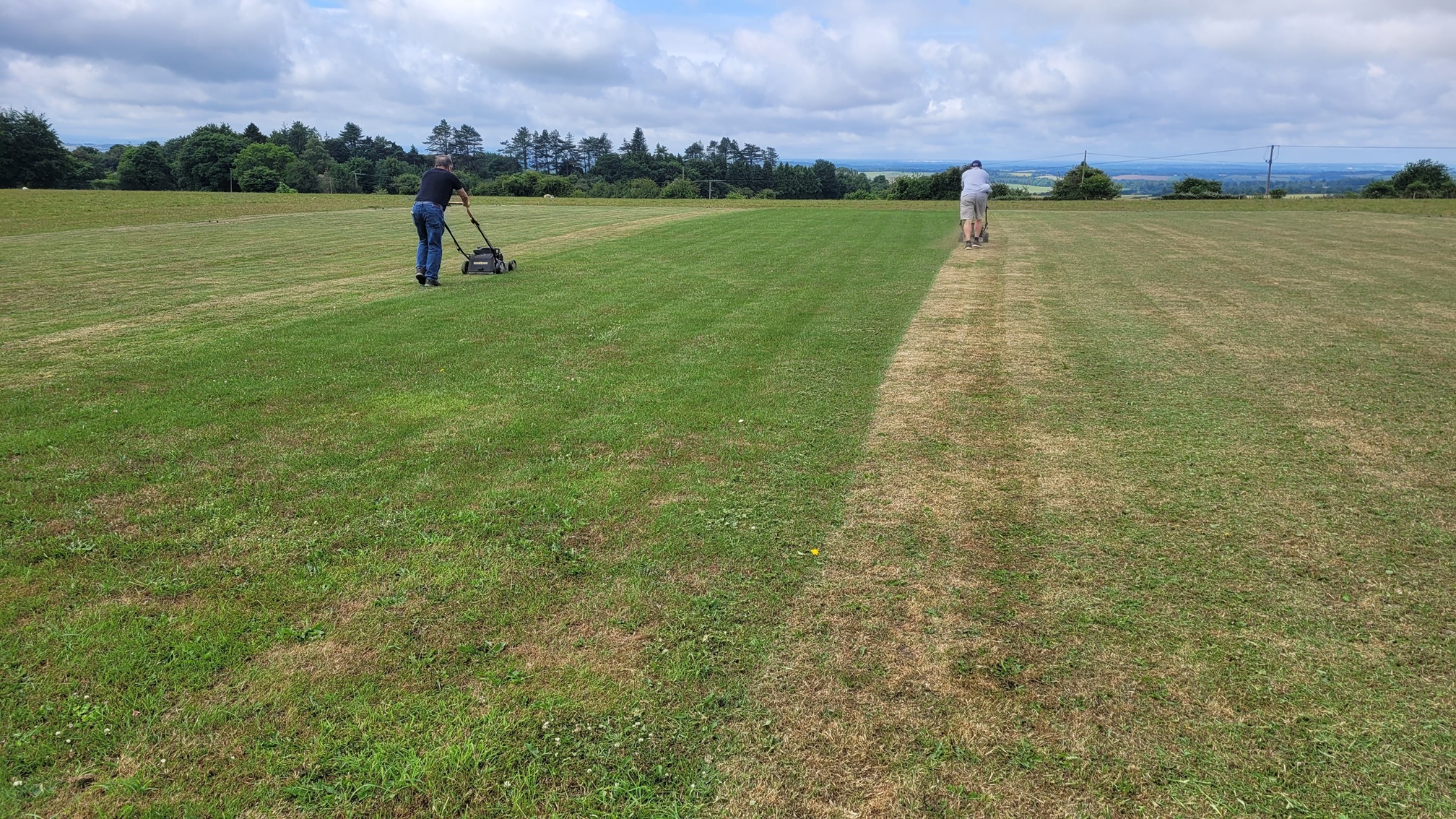
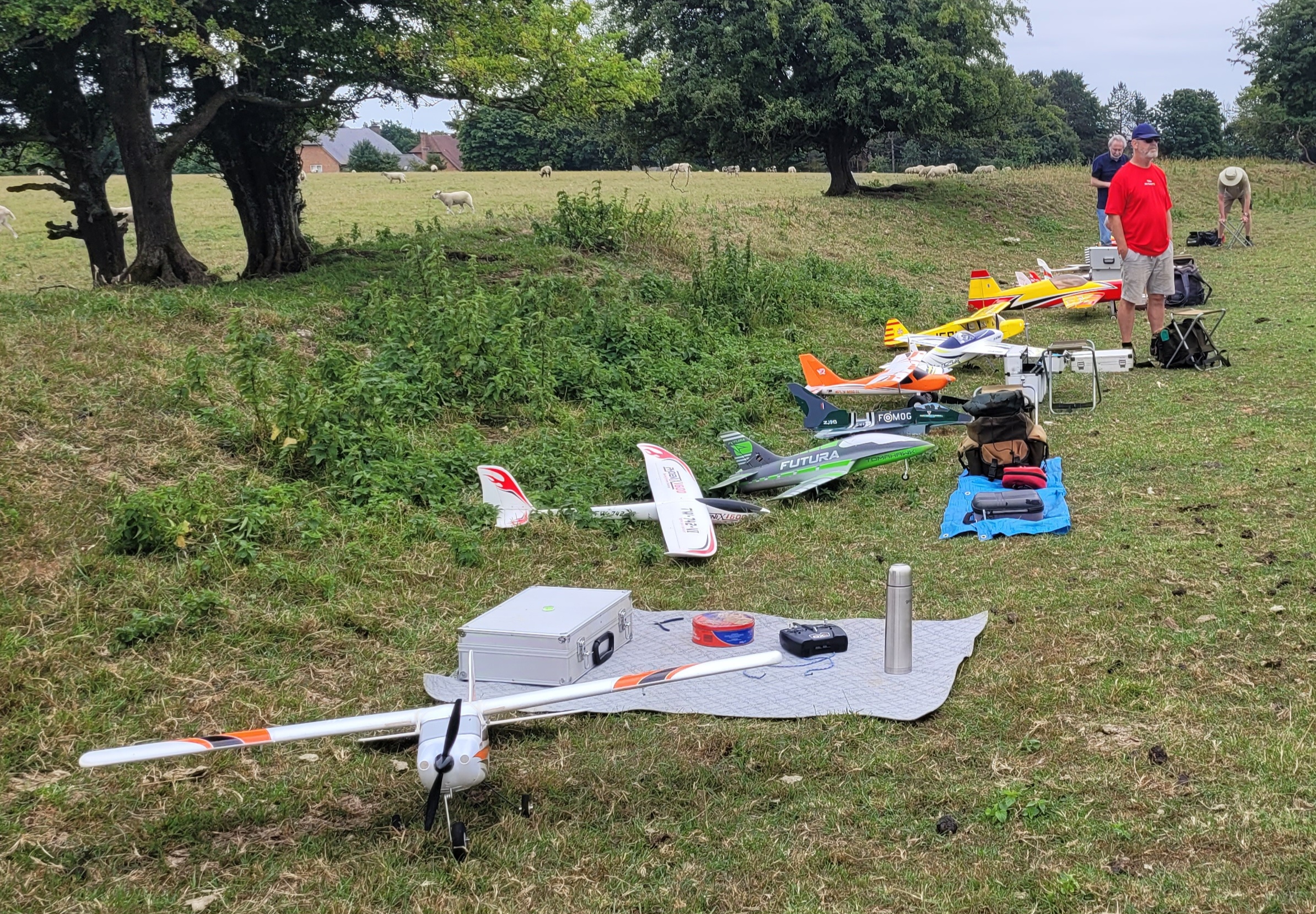 The bullocks have disappeared (to Sainsburys Taste the Difference I believe!) but several hundred sheep came and went a few times throughout June and left plenty of ‘presents’.
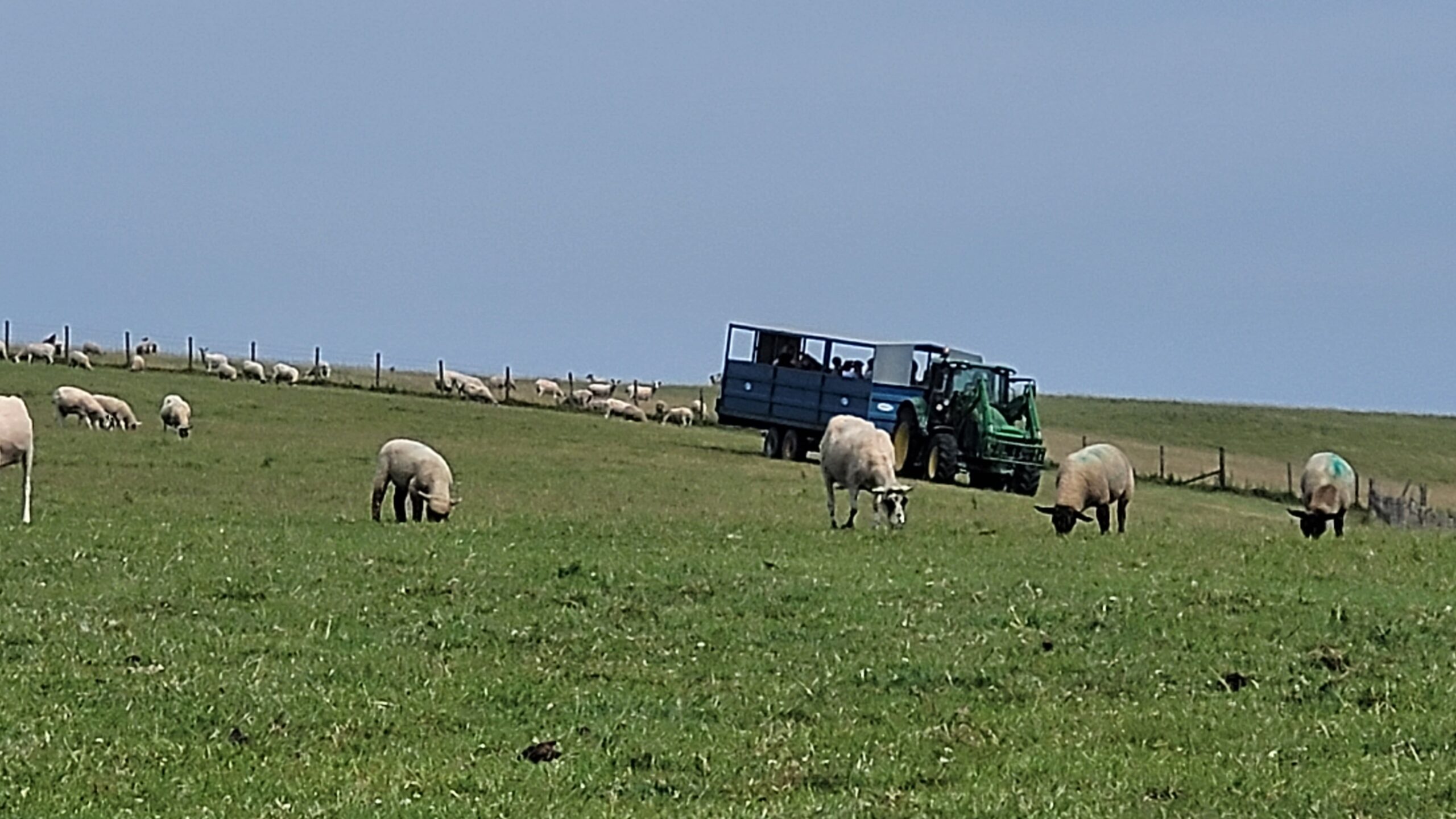 We also saw the farmers doing educational trips for school children, bringing them up to the field in a trailer towed by a tractor. We didn’t have trips like that when I was at school!
With good weather in June a few new models appeared at the patch. First up was Catapult King who brought along two new models, one being a ready to fly ‘toy’, a Sky Viper Vector.
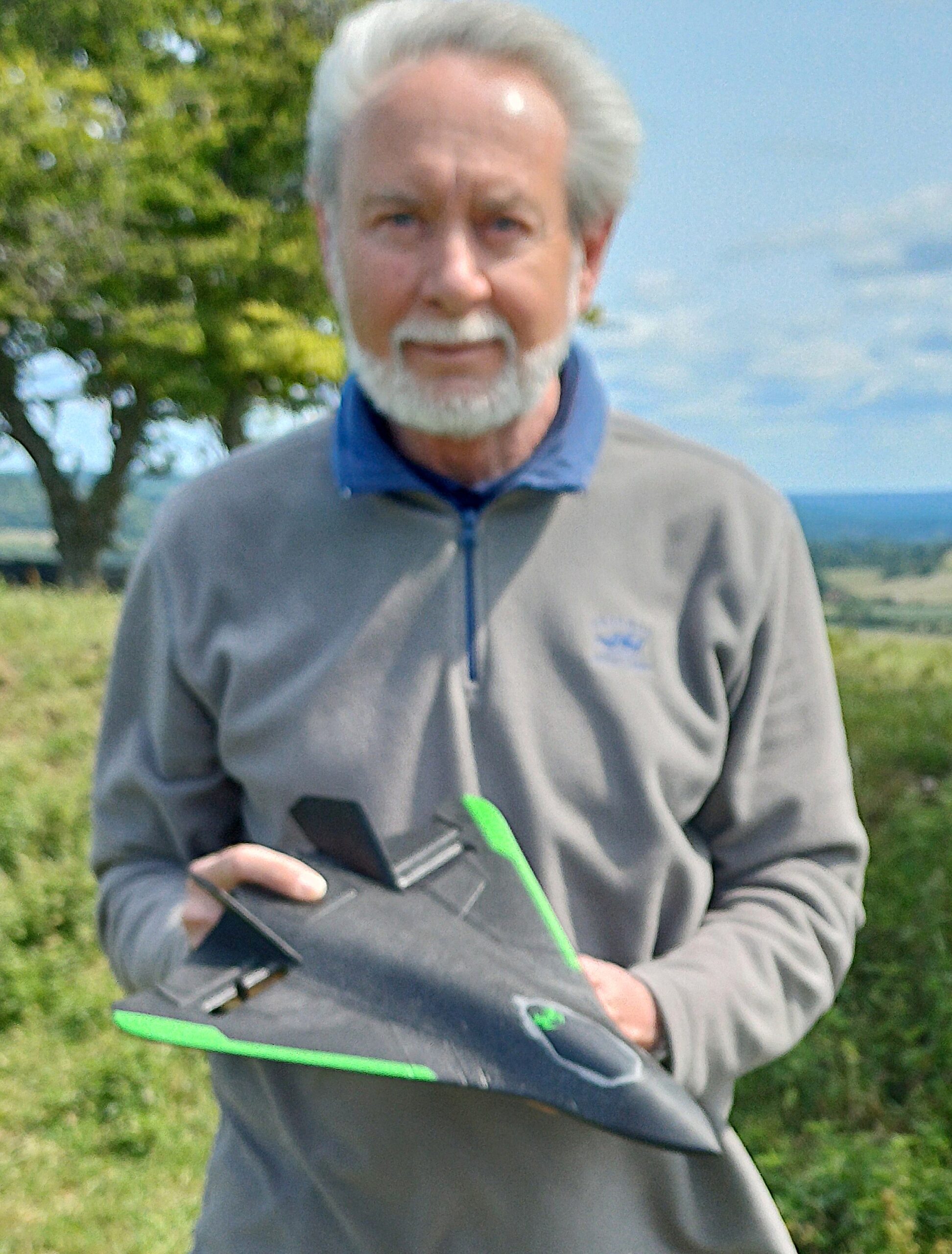 The Vector is the same as both Woody and Captain Slow got for Christmas and Woody has successfully flown his several times, but Captain Slow hasn’t rushed into flying his yet. It was a windy day when Catapult King flew his Viper but it handled the conditions well.
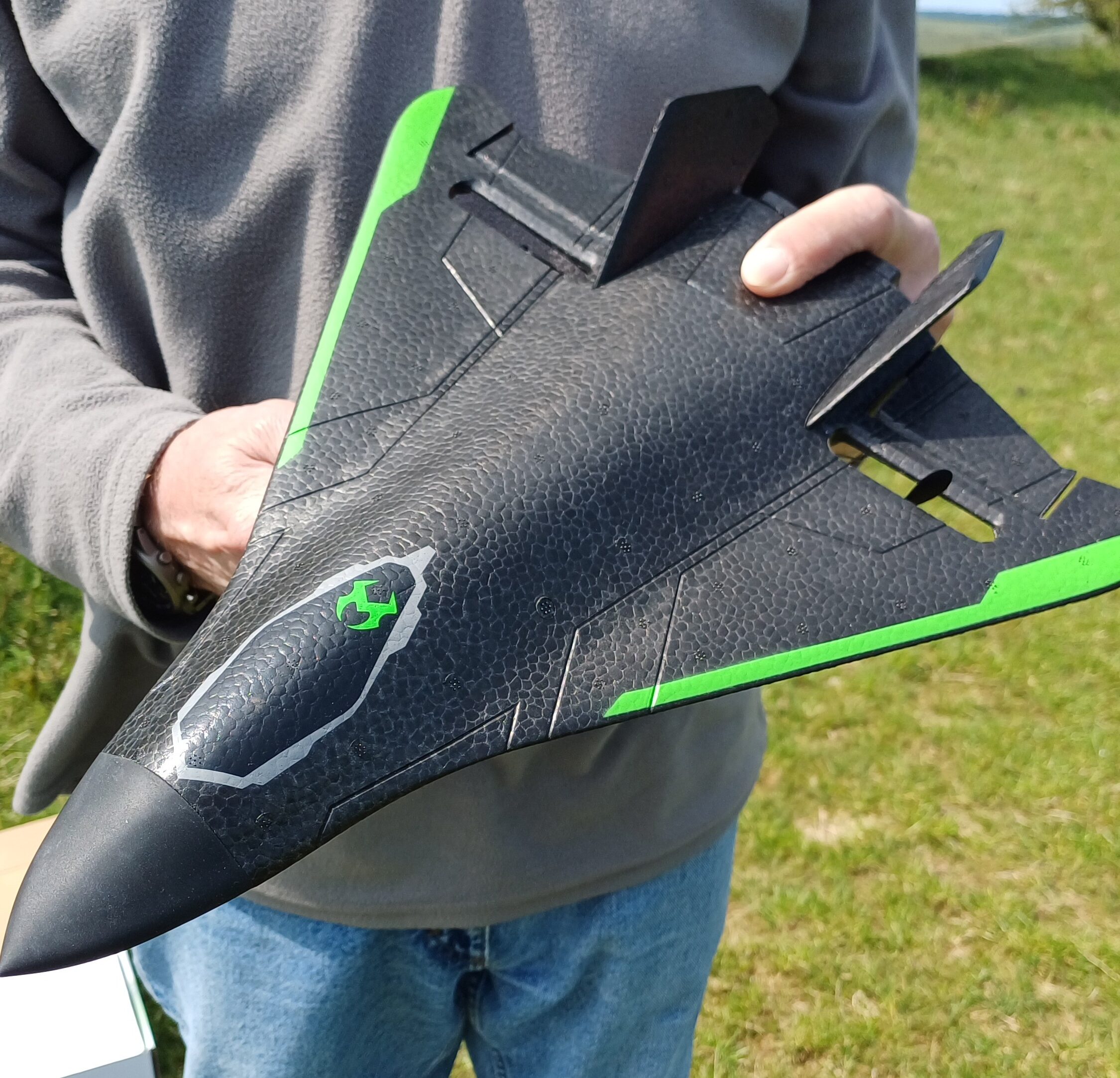 In the video you’ll see a big difference between the upwind and downwind speeds.
The second model that Catapult brought is much more interesting, it is a copy of an E-flite Pulse that he’s built from balsa, unlike an earlier Pulse copy that he’d built from Depron!
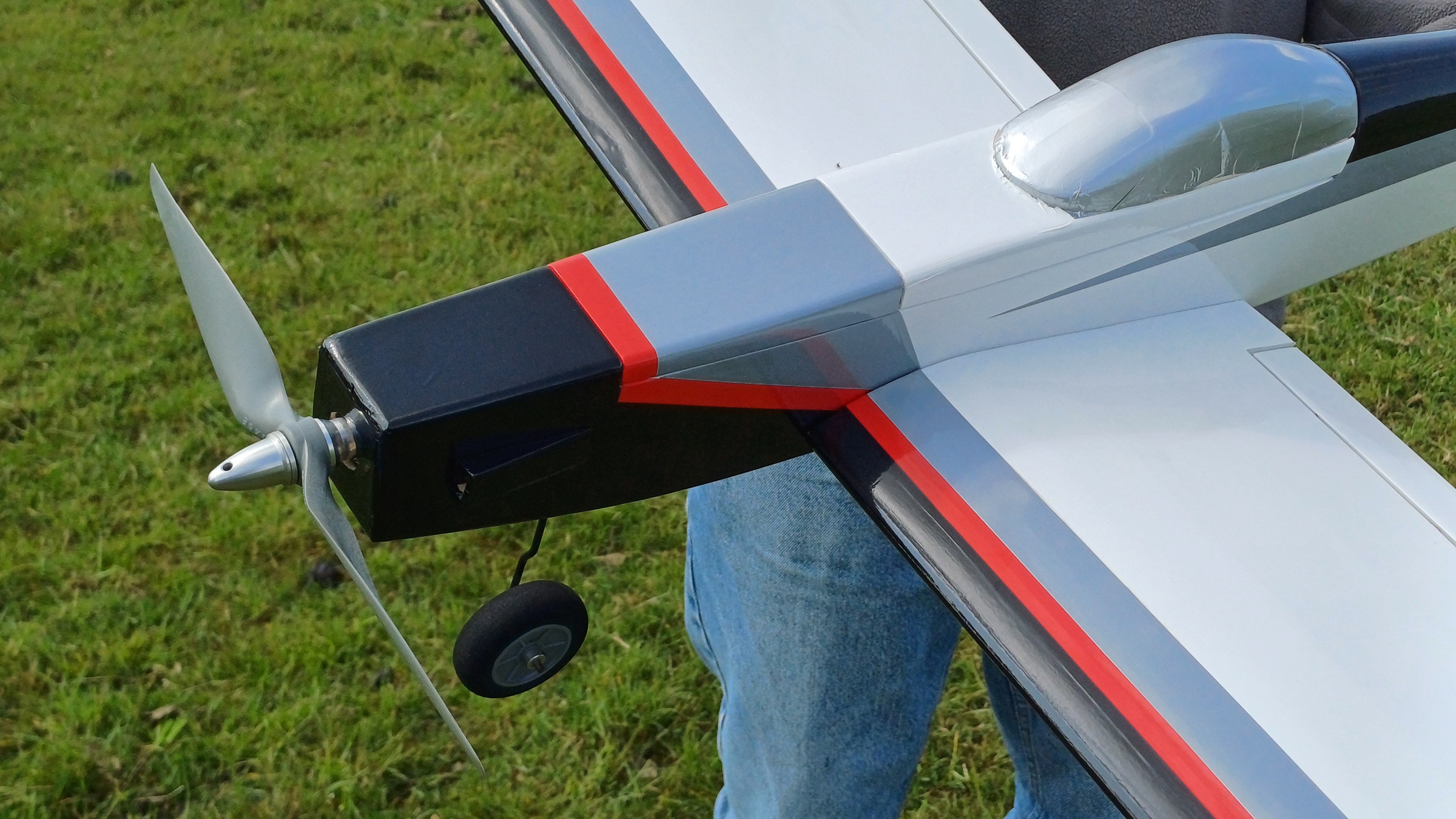
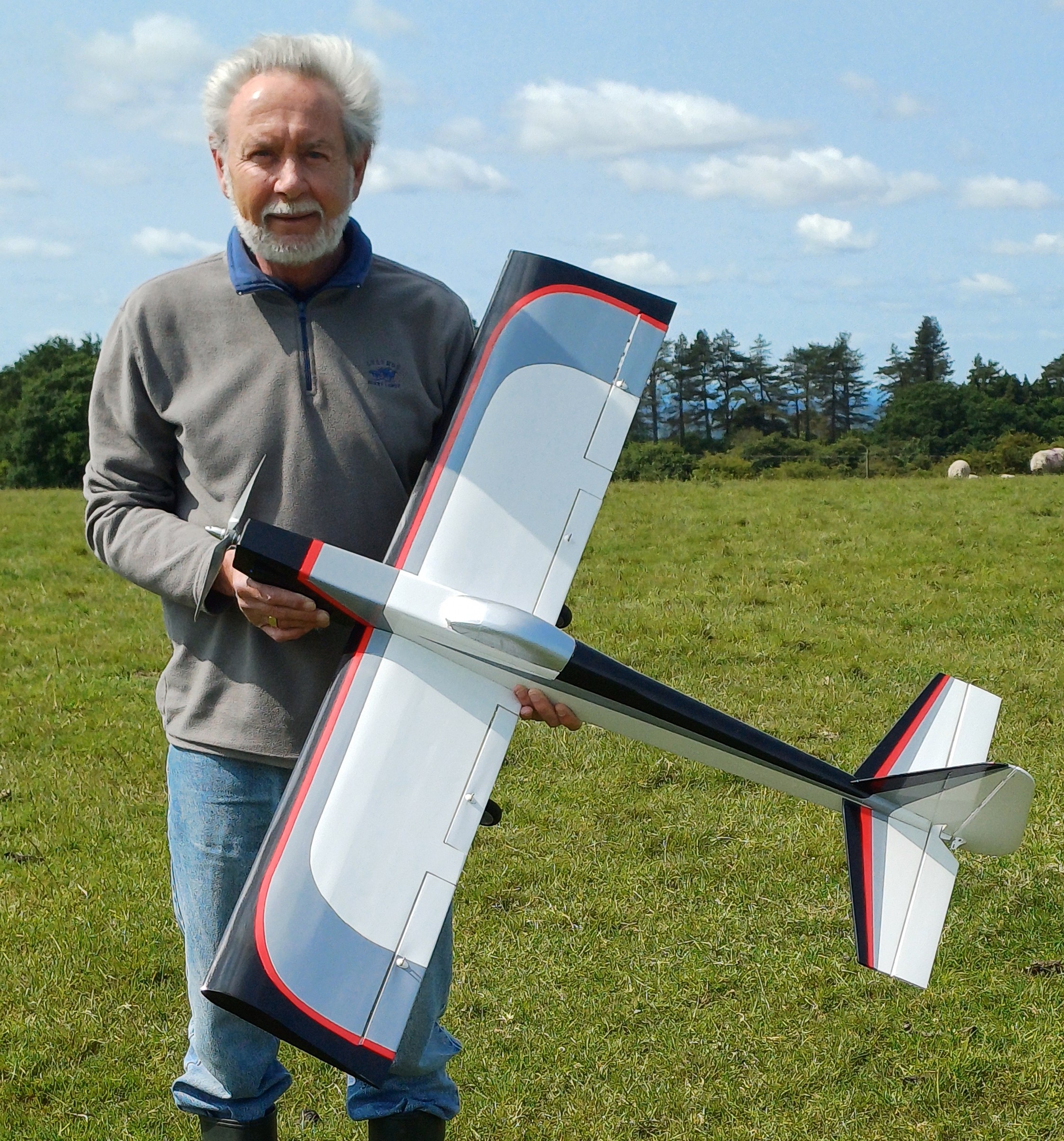 I asked Catapult for a few details: Amazingly this plane came in 200g lighter than the foam version so I used all the electrics from the old one. Good old HK900 servos for all control surfaces, Turnigy 4s 2650 battery, PropDrive 3530 900kv motor, HK 40amp ESC and a 10×6 APC prop (I think if all goes well this could go up to an 11×8).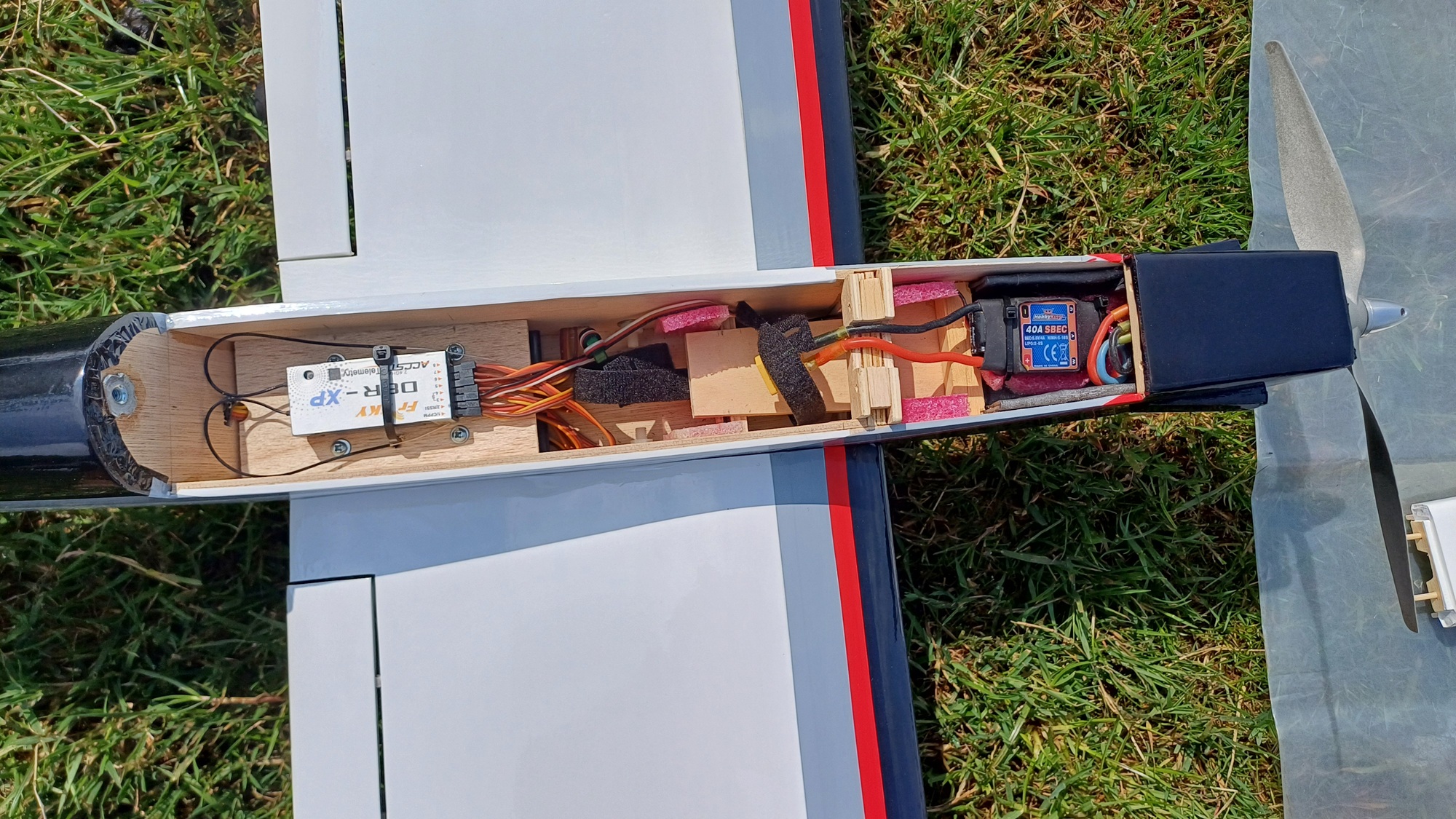
Catapult has made a lovely job of the model, and the quality of the covering, which is HobbyKing film, is amazing. He asked Dougal Entendre to do the maiden flight and this is what Dougal says about it: It took off OK, and was fine once I’d got sufficient down trim in. However, I commented that it looked like the wing was flexing a bit, and it seemed to have more dihedral than when it took off! It also dug in on a couple of turns, so I refrained from doing any aerobatics and got it down fairly sharpish.
 I asked Catapult if he’d found and cured the problem, this is his reply: I had had my concerns about the flex in the wing joints but stayed with it as I thought the dihedral looked more pleasing. However, as Dougal says one gust on the day and it was obvious they were not going to hold very long. It was just as well he landed as on inspecting the wings the original carbon tube had actually split inside the fuselage area. To fix this I cut an old aluminium arrow in half, filed a ‘V’ shape in one end, and then with one end in a drill and the other being guided by the carbon tube (and with a lot of trepidation) I literally drilled the arrow into the wing about three quarters of the way. Unfortunately I didn’t take any pictures. The wing itself though feels very solid.
The next part was the join in the fuselage. I filled the old angled tubes with epoxy (let it cure) and then drilled a new hole directly through the original openings. Finding a carbon rod which fitted the inside of the arrows I then drilled out the original carbon tube from inside the arrows with the longest drill I had, even more scary than before. This goes about as far as the second rib in each wing. Refitting the wings already feels much better than before, but I still need to rework the first rib in each wing from angled to flat against the fuse. Then I think we’ll be ready for a proper test flight. Watch this space. Sadly nobody filmed the test flight so we’ll have to wait for test flight number two.
Not content with putting together his HobbyKing Voltigeur last month, 1066 has also started building another one to add to his collection: Having stumbled across a build video of the Angelwing Blink V2 I decided to take a look at the Angelwing website.
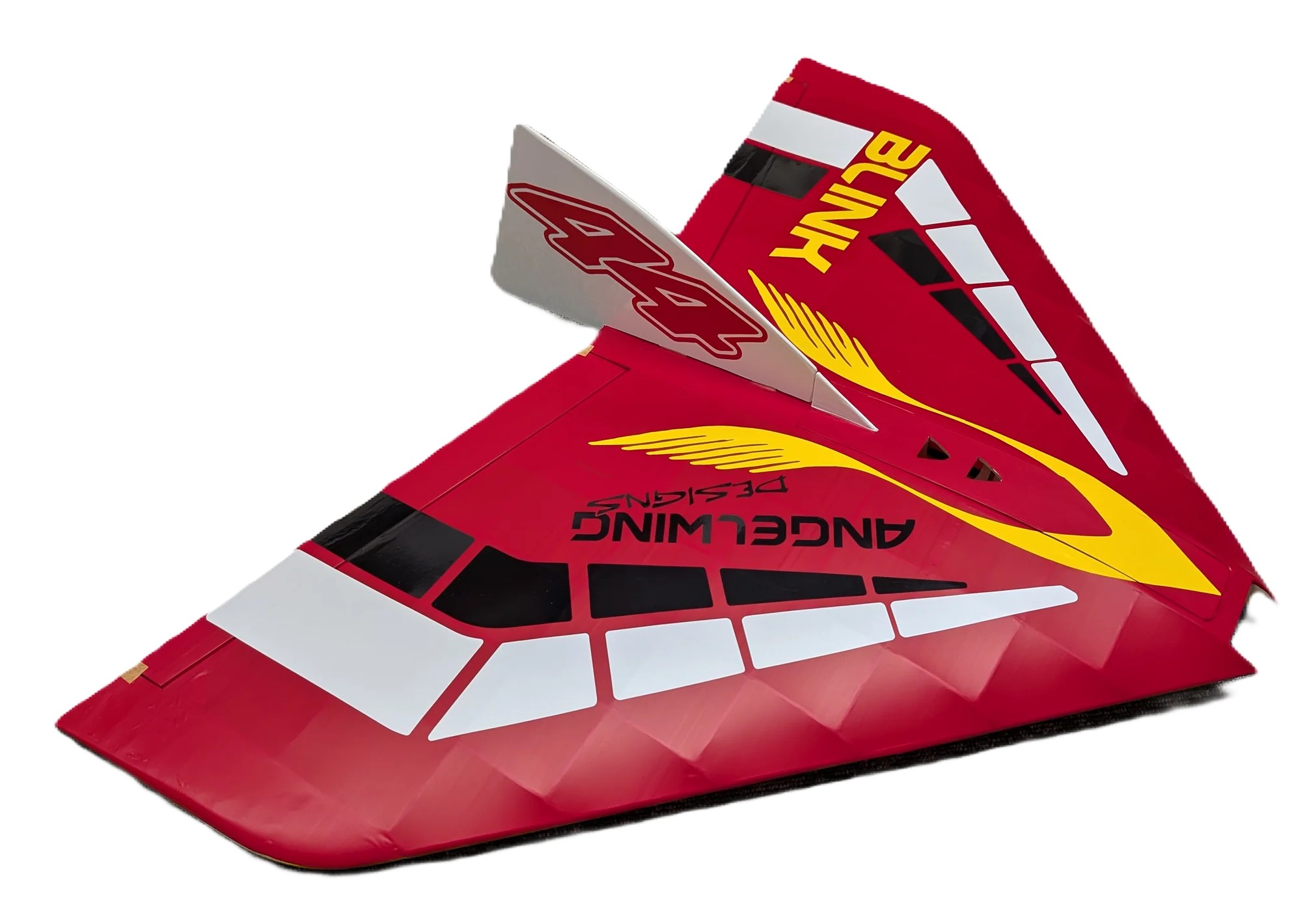 The Blink looked like an interesting and easy build, and for £60 delivered was not so expensive, so after putting one in my basket I ummed and ahhed for a couple of weeks before hitting the buy button. The kit arrived a couple of days later, wow the boxes seem to get smaller and smaller! For £60.00 you don’t get a lot, not even a plan or instructions, these have to be downloaded as a PDF, however they are really good, I’m assuming they are taken from the CAD drawings used in the design process.
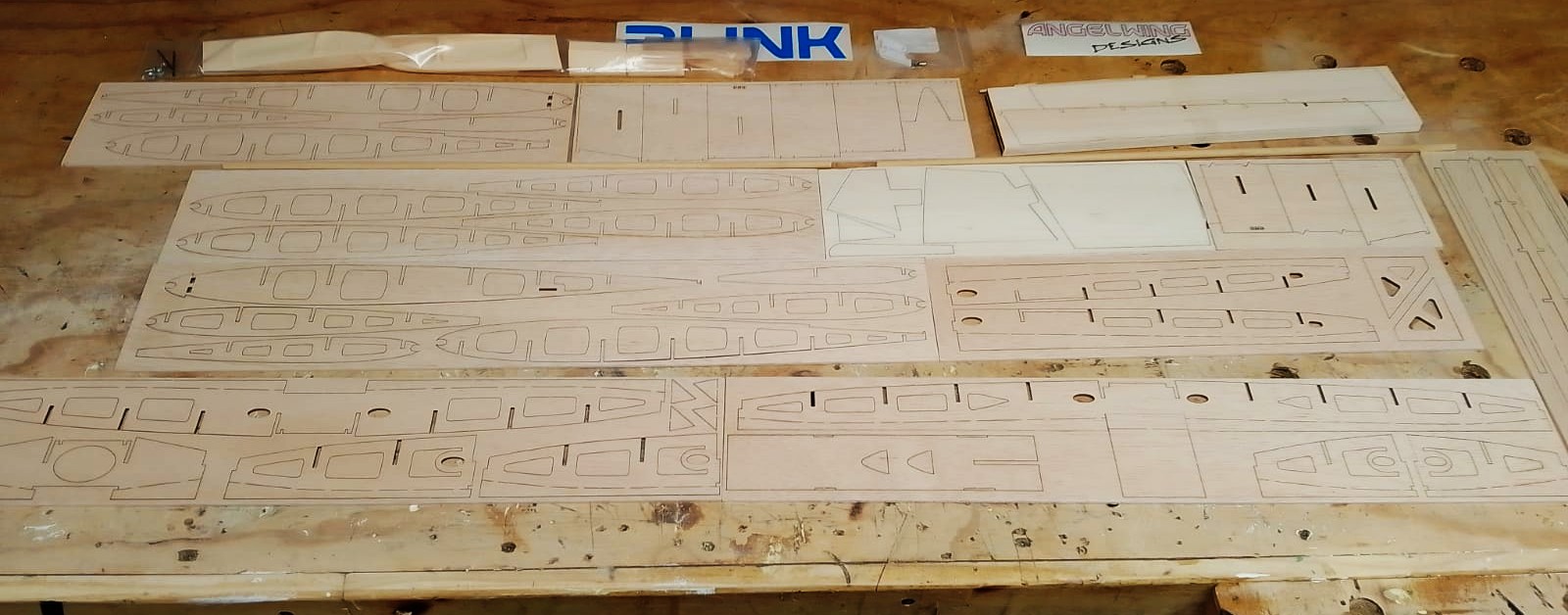
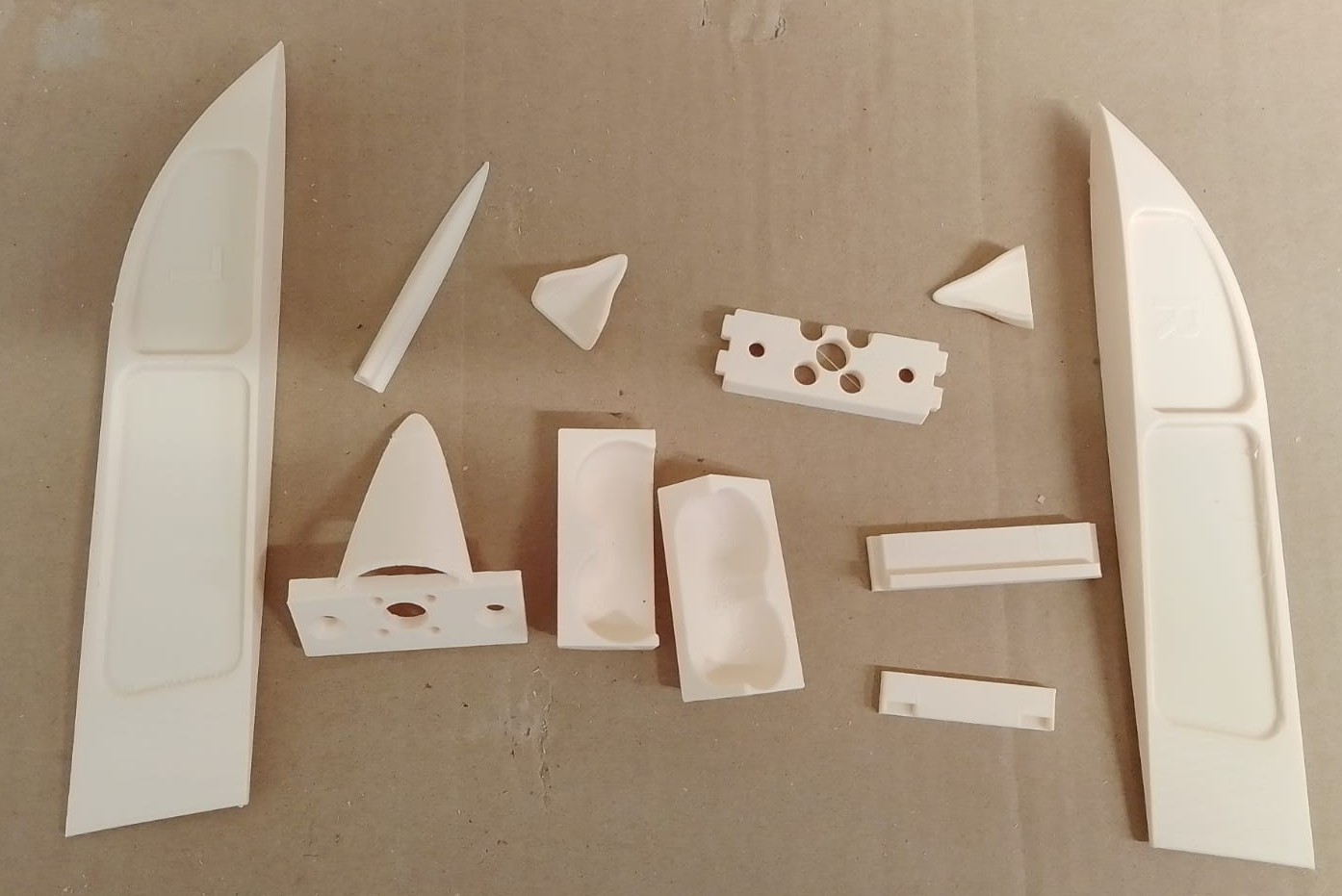 What you do get is a bunch of laser cut sheets of balsa, and a bag of 3D printed parts which includes the motor mount, wing tips, finger holds, rear hatch support, plus a couple of bits I’m not sure about yet. The laser cutting is some of the best I’ve seen, with some of the parts falling from the sheets just taking them out of the box. However when I started building there was one sheet where the laser hadn’t quite penetrated so a knife was required and I did break a few bits on the grain, mainly at the leading edge.
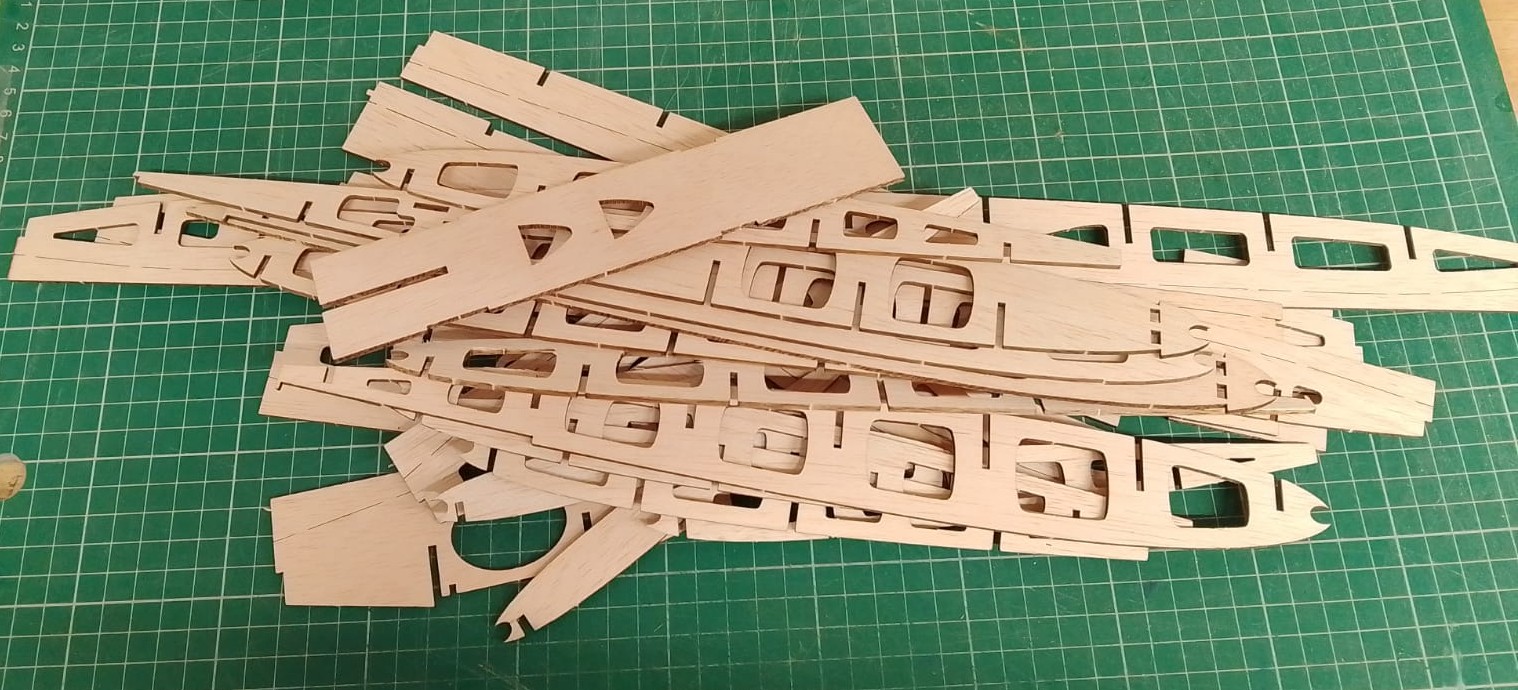 Now I don’t know about you lot, but my old lady is always nagging me about not reading instructions, so why break the habit of a lifetime, besides, I had looked at all the lovely pictures! When I build this sort of kit I like to remove all the parts from their respective sheets first, OK so far, but what I hadn’t noticed was that all the spar components have built in sacrificial jigging so, anyone like to guess how many jigging parts had to be rescued from the bin and be stuck back on, before I realised my mistake?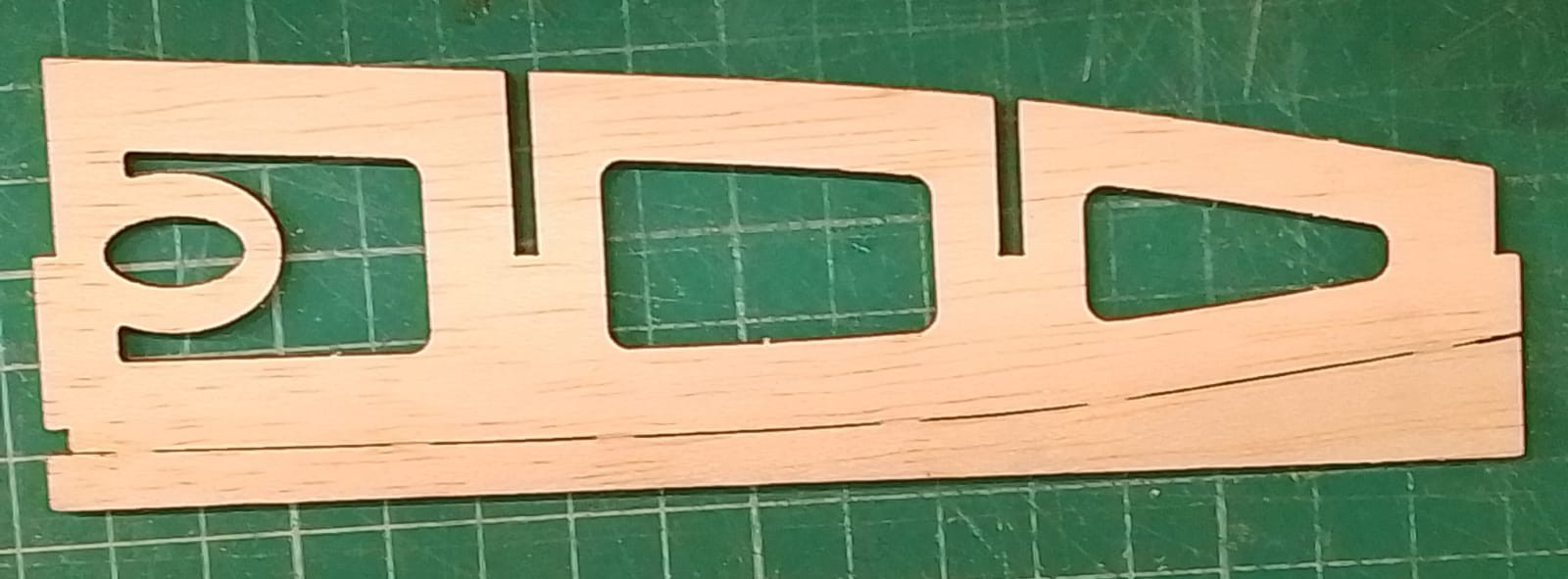
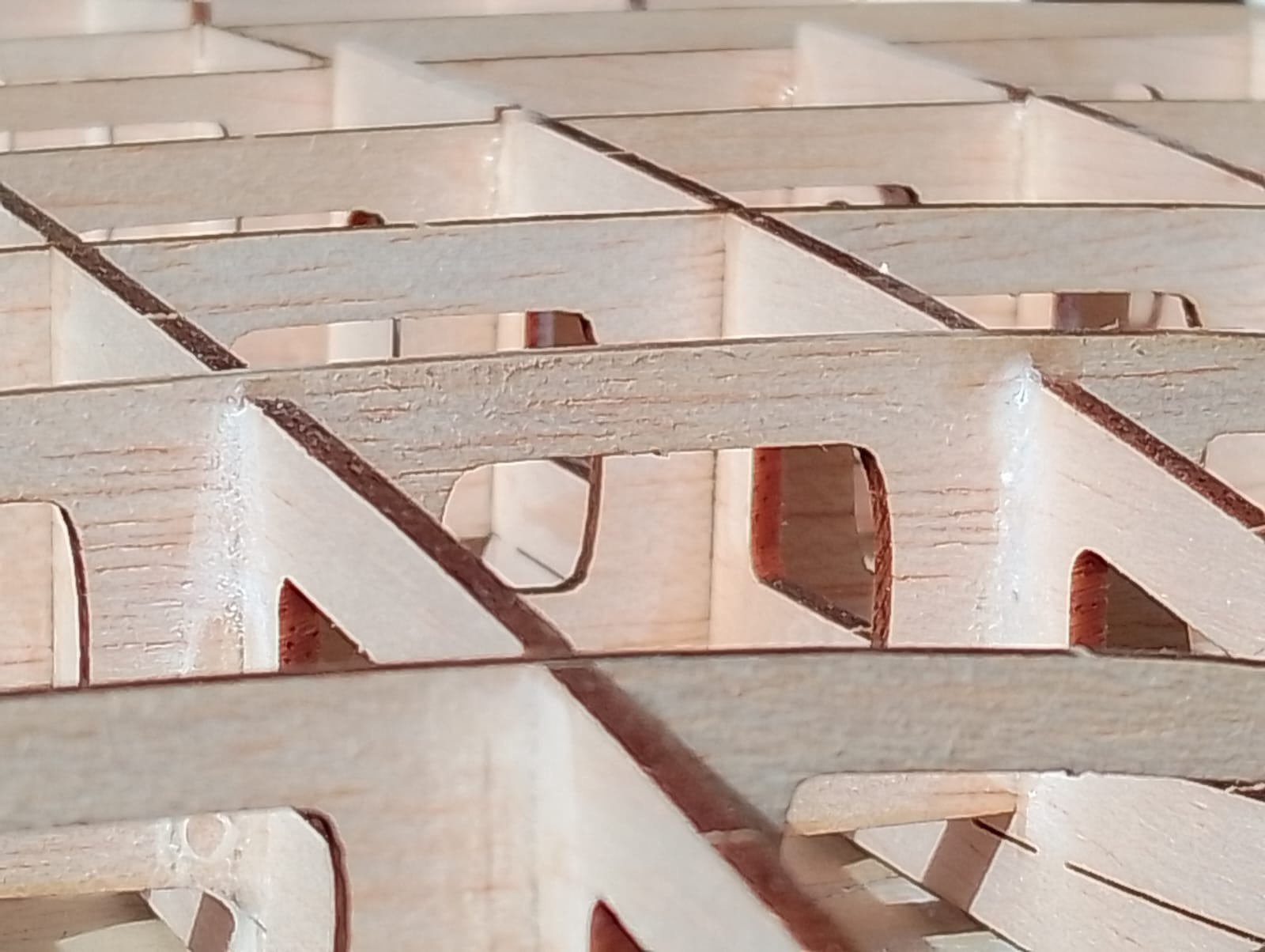
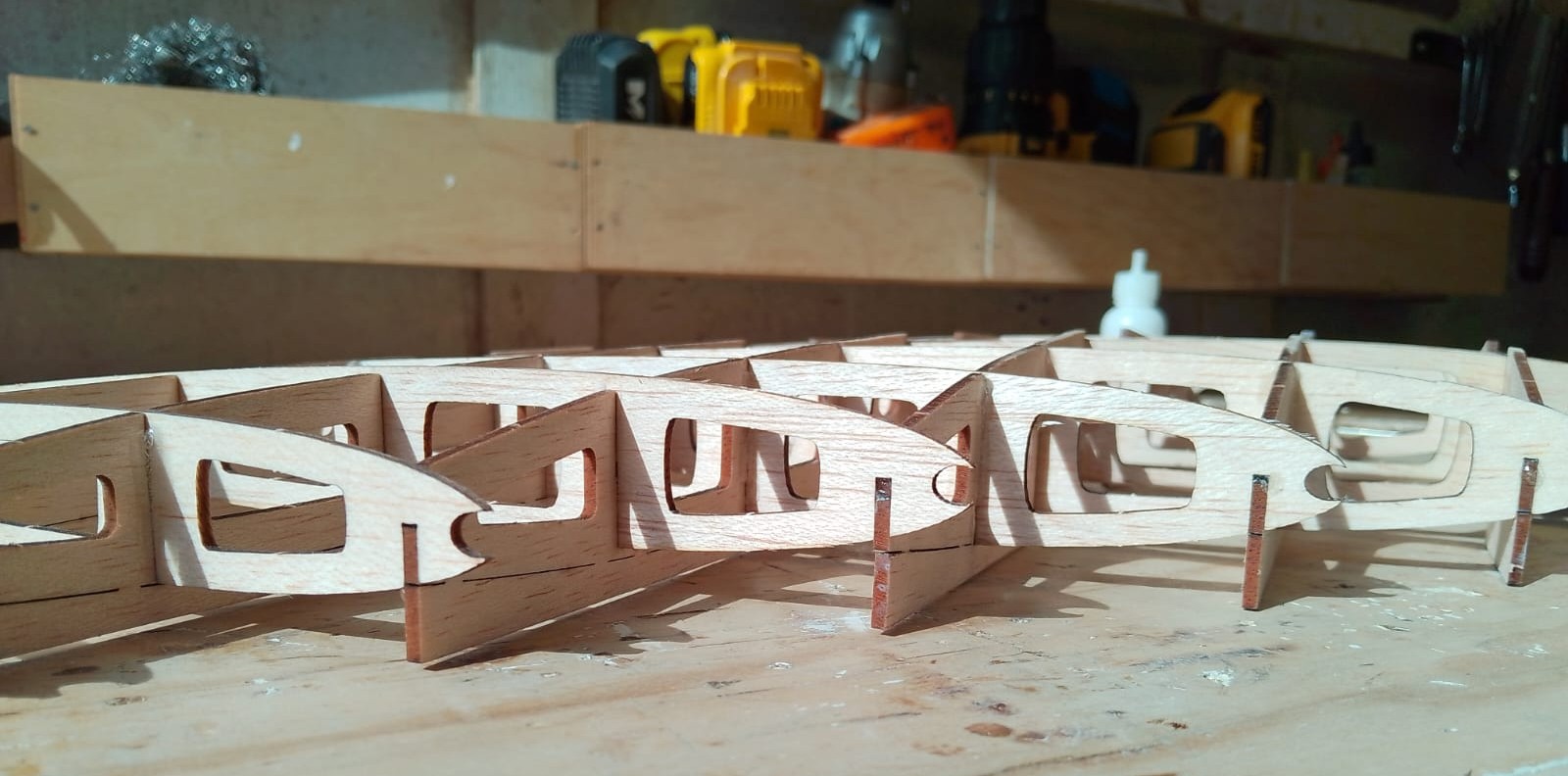 The accuracy of the laser cutting, and the self-jigging design means the model goes together very quickly, I opted to use wood glue in all the slots, backed up with dots of super glue to act as pins while the wood glue dries. Having dry assembled 75% of the wing to check it went together before committing to glue it became very apparent this was a very stable structure, so if I had some very thin glue available, I would have probably slotted it all together dry, then run the glue in. My thoughts so far, well the quality is fantastic, but the model is quite a bit smaller than I thought, so is it good value? So far I think it is, even if I could cut balsa to the accuracy the laser can, it would take days, and it’s very obvious the manufacturer has put a lot of effort into the design.
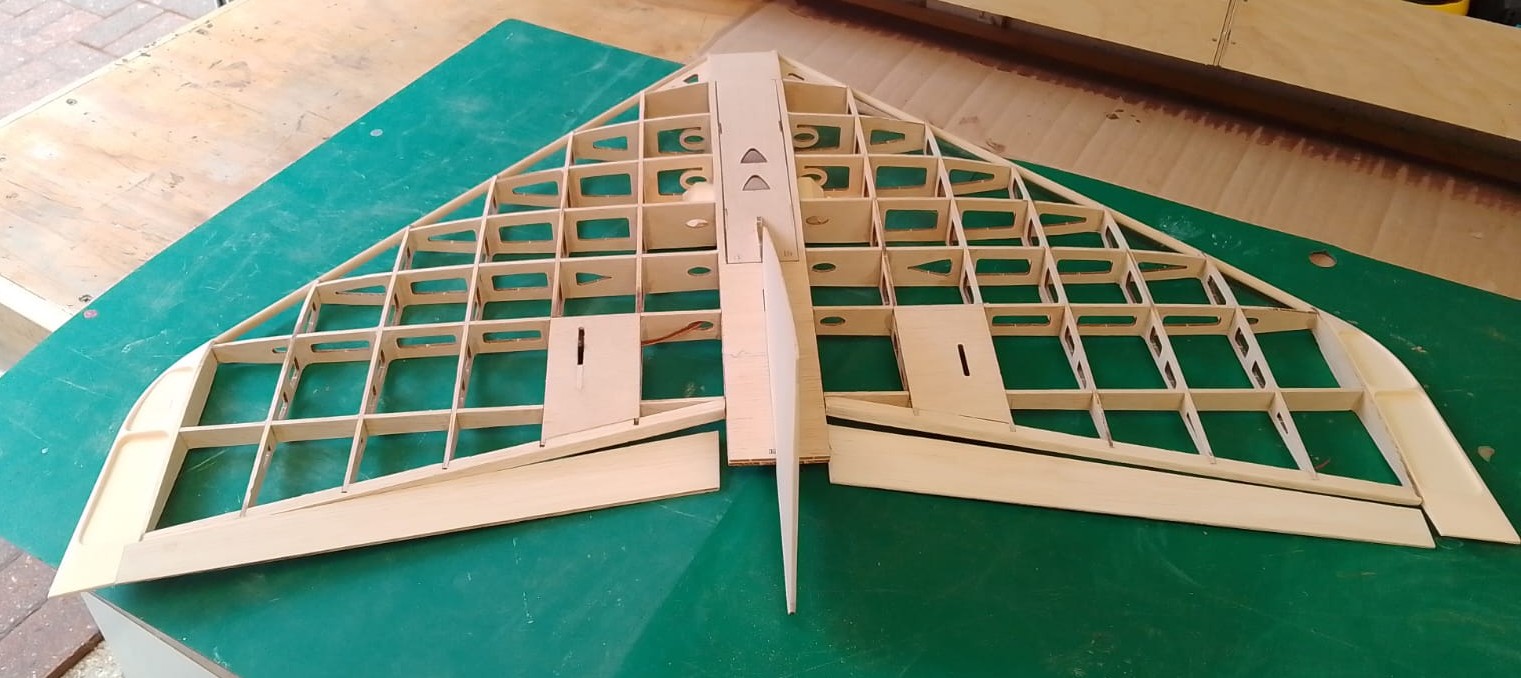 Let’s hope it fly’s as well as it is going together. Thanks 1066, looking forward to it flying.
Dwayne Pipe will be running the club Annual Chuck Glider Competition at 7.30pm on Wednesday 9th July. It will be held at the Buriton playing fields rather than our patch as it will hopefully be less windy and won’t involve a half mile retrieval after every flight! Dwayne has set an alternative date of 16th July if the weather is bad but I can’t make the 16th so I say we’re having the comp on the 9th even if it’s pouring with rain and blowing a gale! There will be two classes, normal chuck glider, and catapult launched glider, with the catapult being provided by Dwayne. It’s always a fun evening so come along and join in.
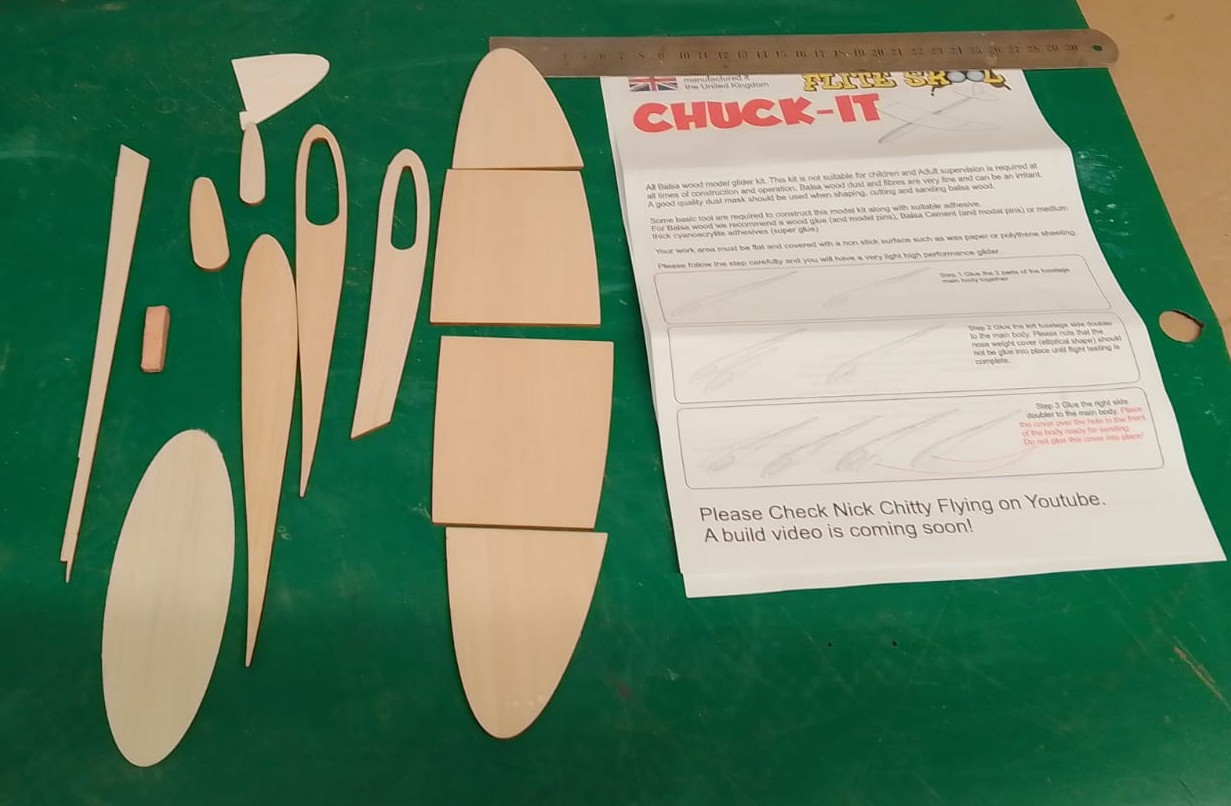 1066 has never taken part in the chuck glider comp but this year he’s got one on the building board and says he intends to be there and win the trophy. He even sent me a photo of the kit he’s building so we know exactly what we’ll be up against.
Dougal Entendre has been busy getting a Sportster that was a second-hand purchase ready for flight, here’s his report: Back when we had the club auction for John Bourne’s planes, there were no takers for his large Sportster. The airframe had to go somewhere, so I paid the club a tenner and had it decorating the ceiling in my hangar.
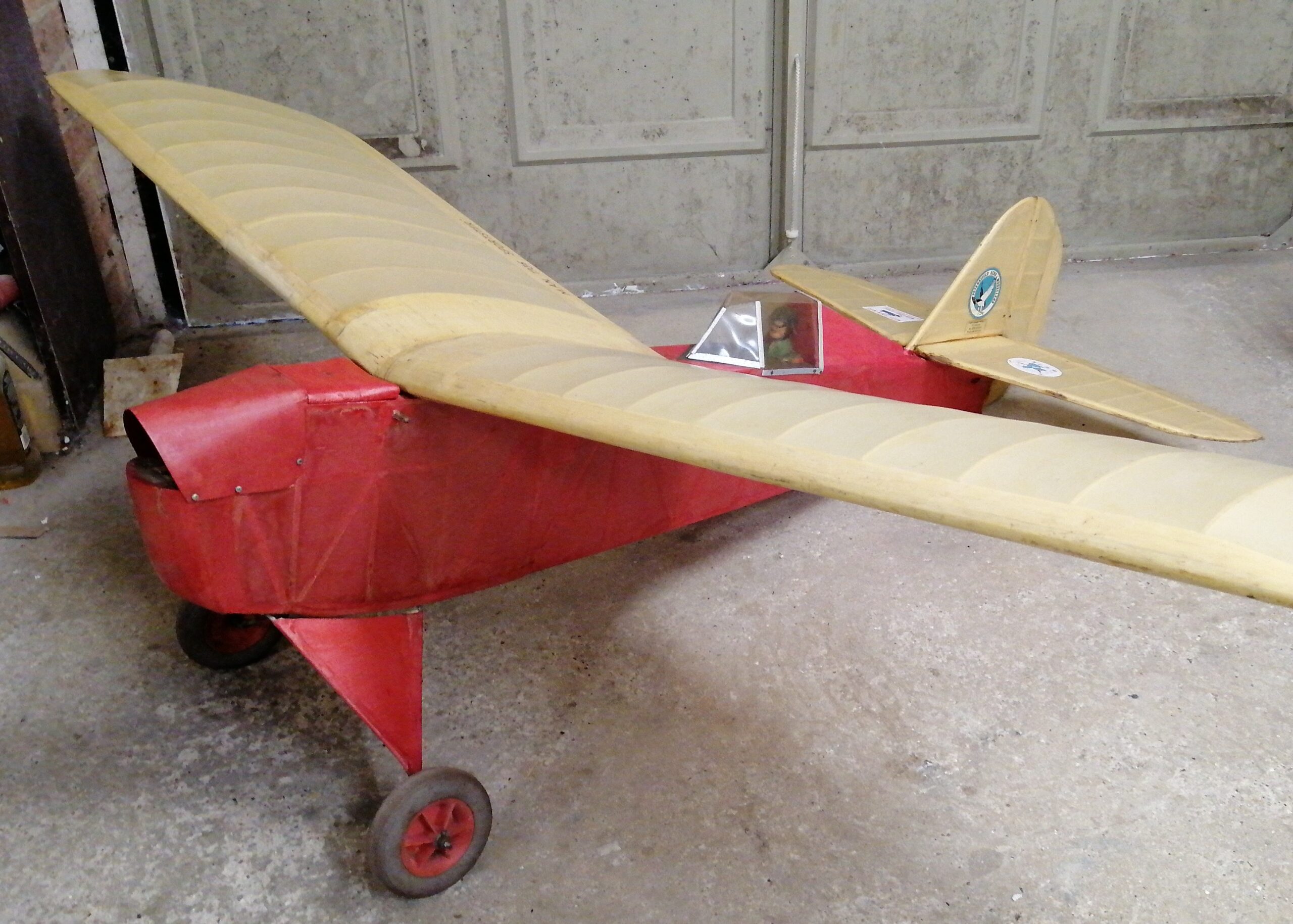
 A few weeks ago I added a motor and ESC, and took it to the patch. 1066 said that I was unlikely to get my usual adrenaline fix from it, but it turned out to be quite eventful!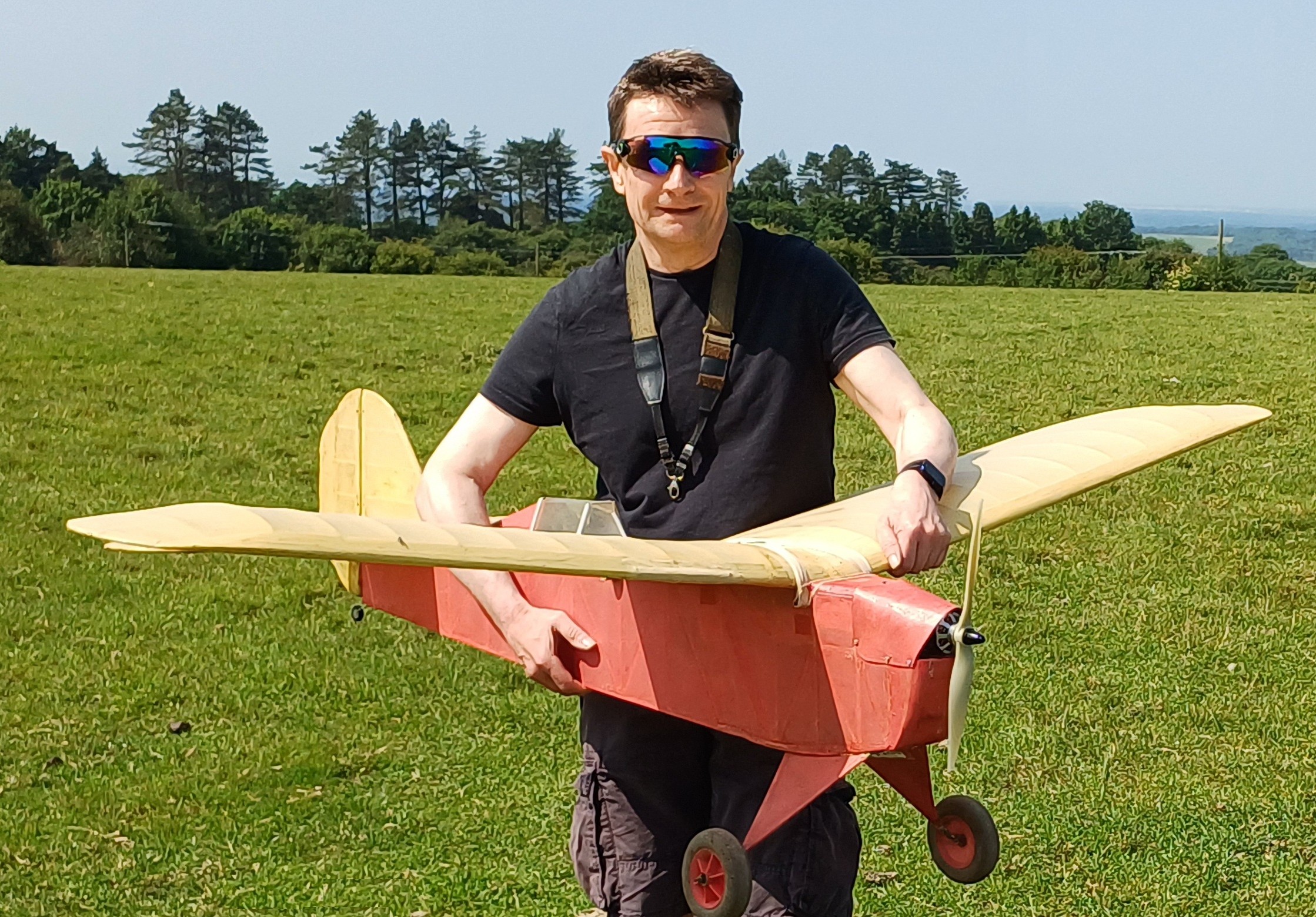
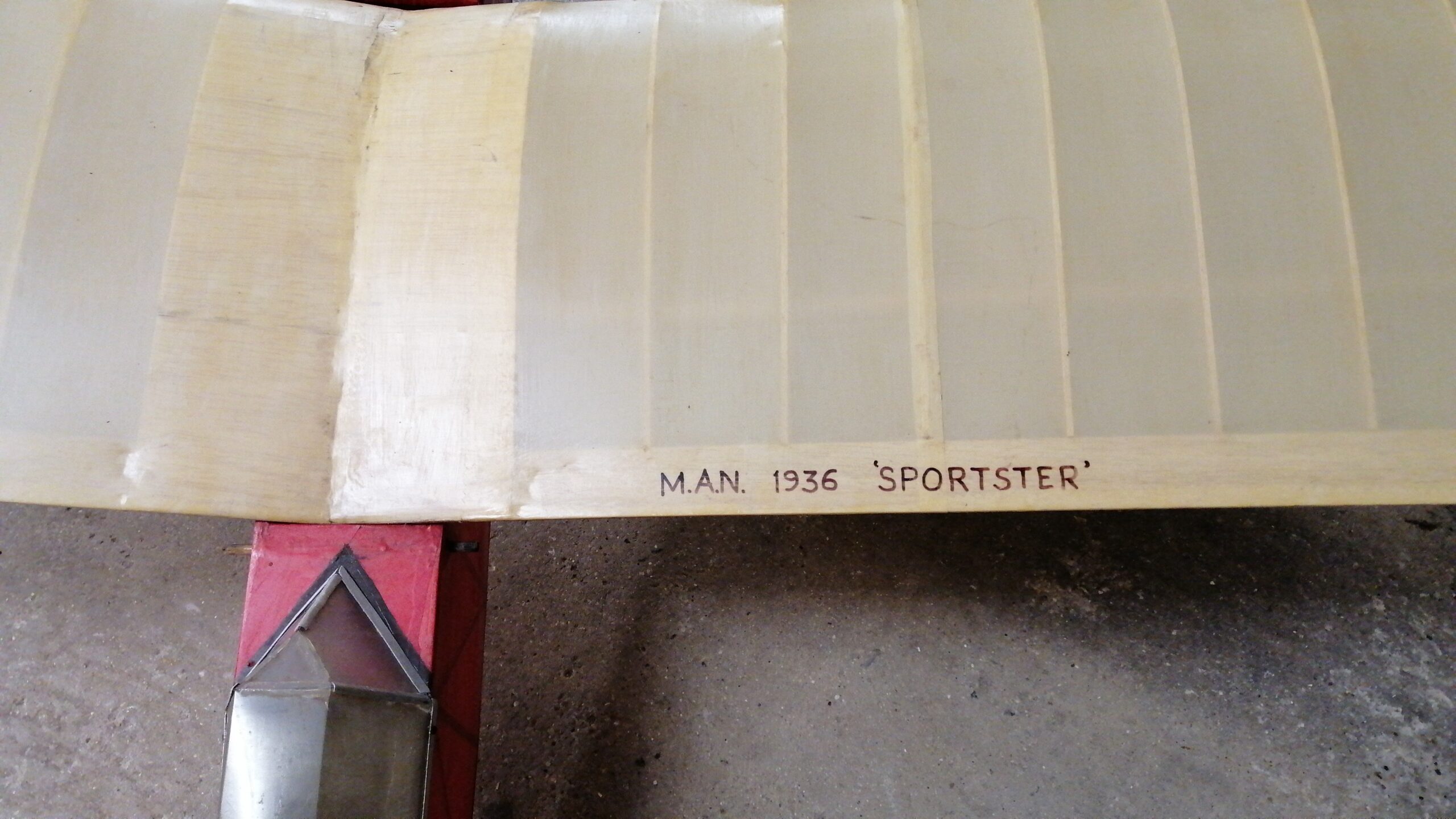 To backtrack; it’s a 1936 design from Model Aircraft News, about 73″ span, and the plan is available on Outerzone. It was beautifully built and covered in what I think is Solartex, with just rudder and elevator controls. It’s got John Bourne’s phone number on it from before it changed to an 01 dialling code, so that dates the airframe to before 1995!
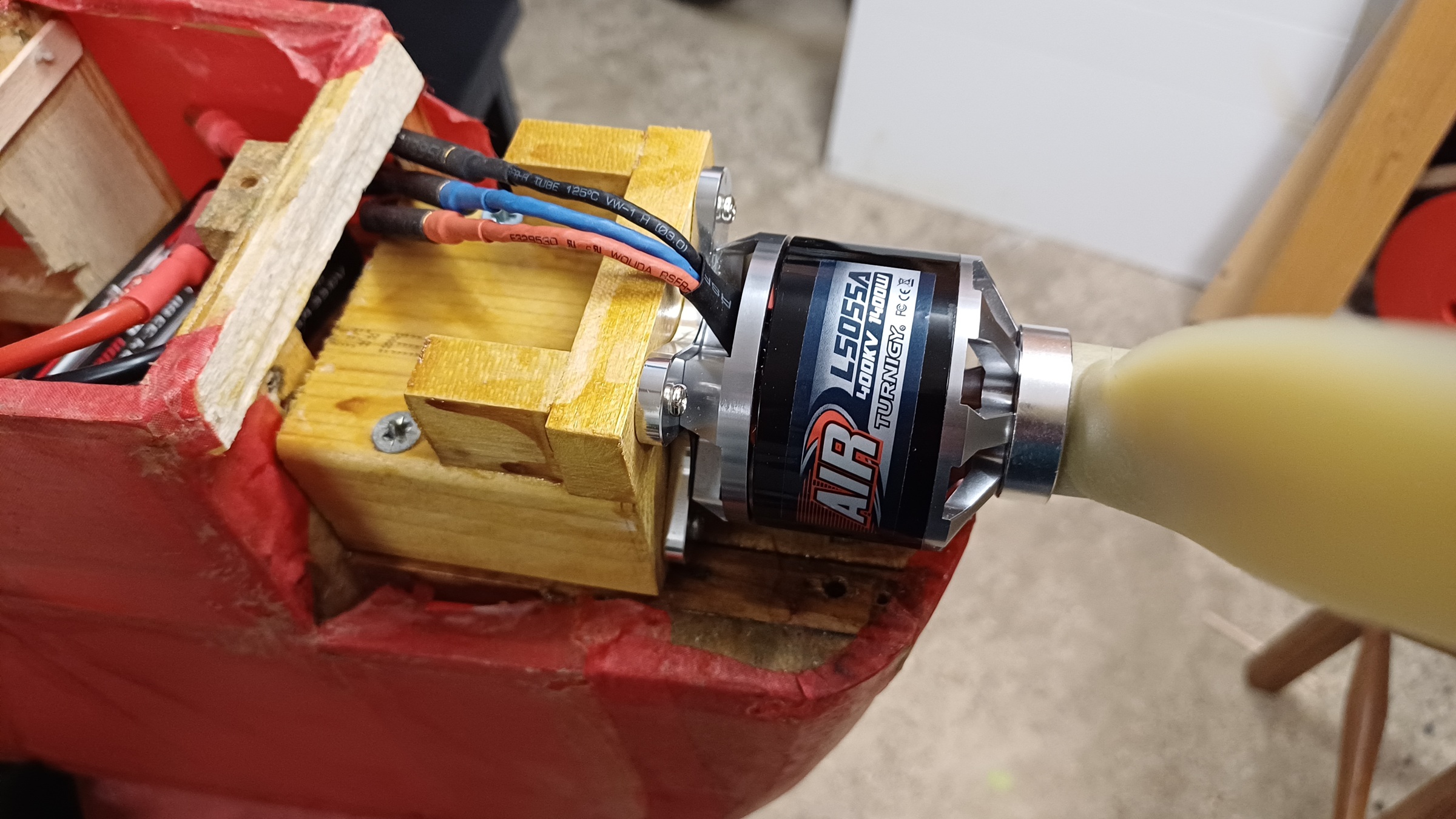 I added a 5055 400kV motor, 80A ESC and a 13 inch prop, with a 6s 5000mAh pack from my Velox. On take-off, it was immediately apparent that it had plenty of power, but needed nearly full down trim. The rudder was powerful, but the plane had a tendency to wallow from side to side, which can be seen in the video. I think it’s due to all the dihedral and the short moment arm. After 5 minutes I landed, flipping it over in the wind, but no damage. Remaining battery capacity: 85%!
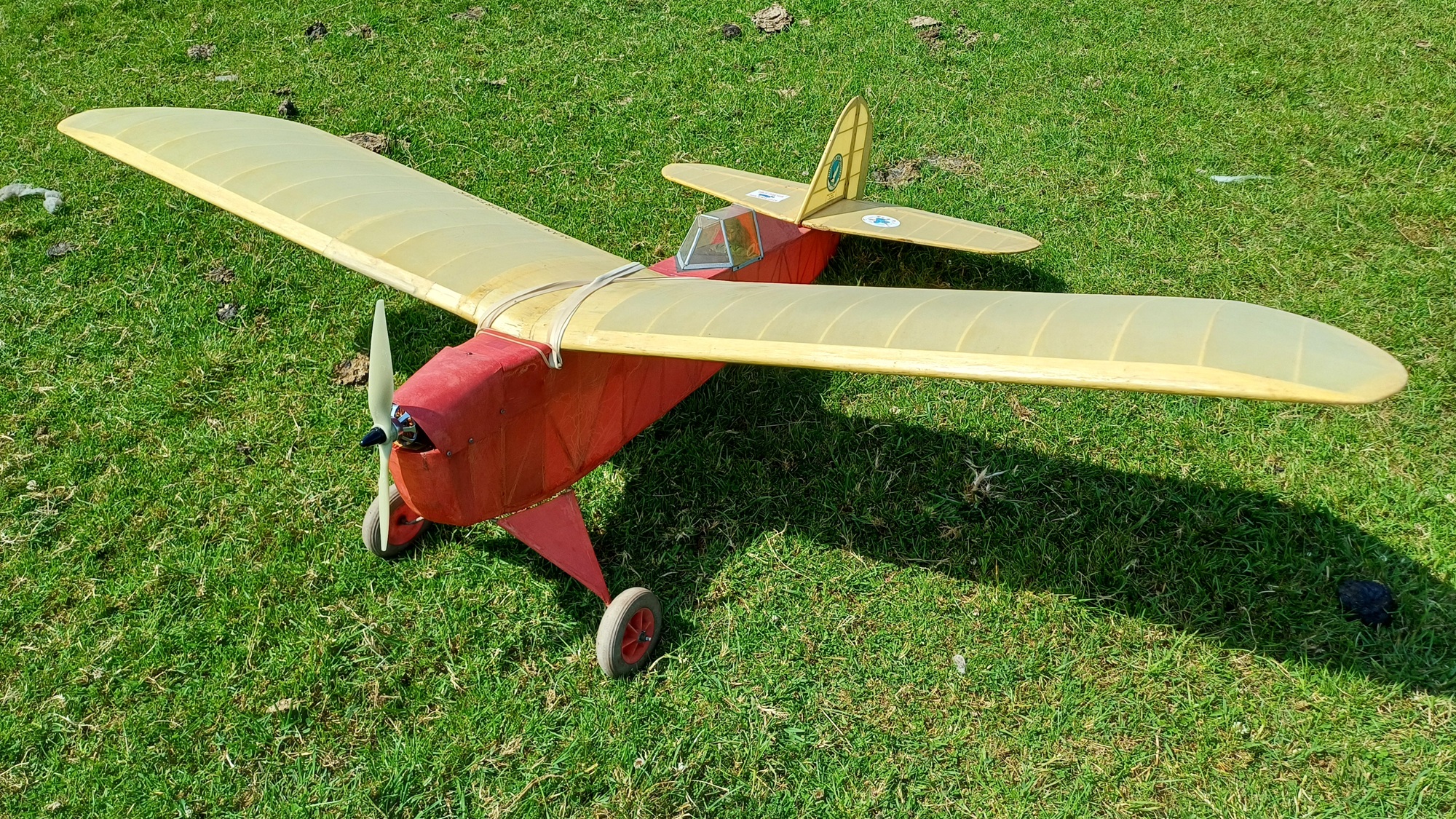 After winding in a load of down elevator I flew it again. After a minute or two I dared to try a loop, but got very violent tail flutter as it pulled out. I throttled back quickly and found I had no elevator control. I turned round using rudder and braced for disaster, but in the event it landed downwind about half way across the field, and didn’t even flip over! On inspecting the damage, I found the elevator control horn had broken off, and the violent flutter had broken the tailplane in the middle (the Solartex held it together well enough for the landing!). I’m not sure what to do now. I could strengthen the tail and move the elevator servo down to the back of the fuselage to eliminate pushrod flex.
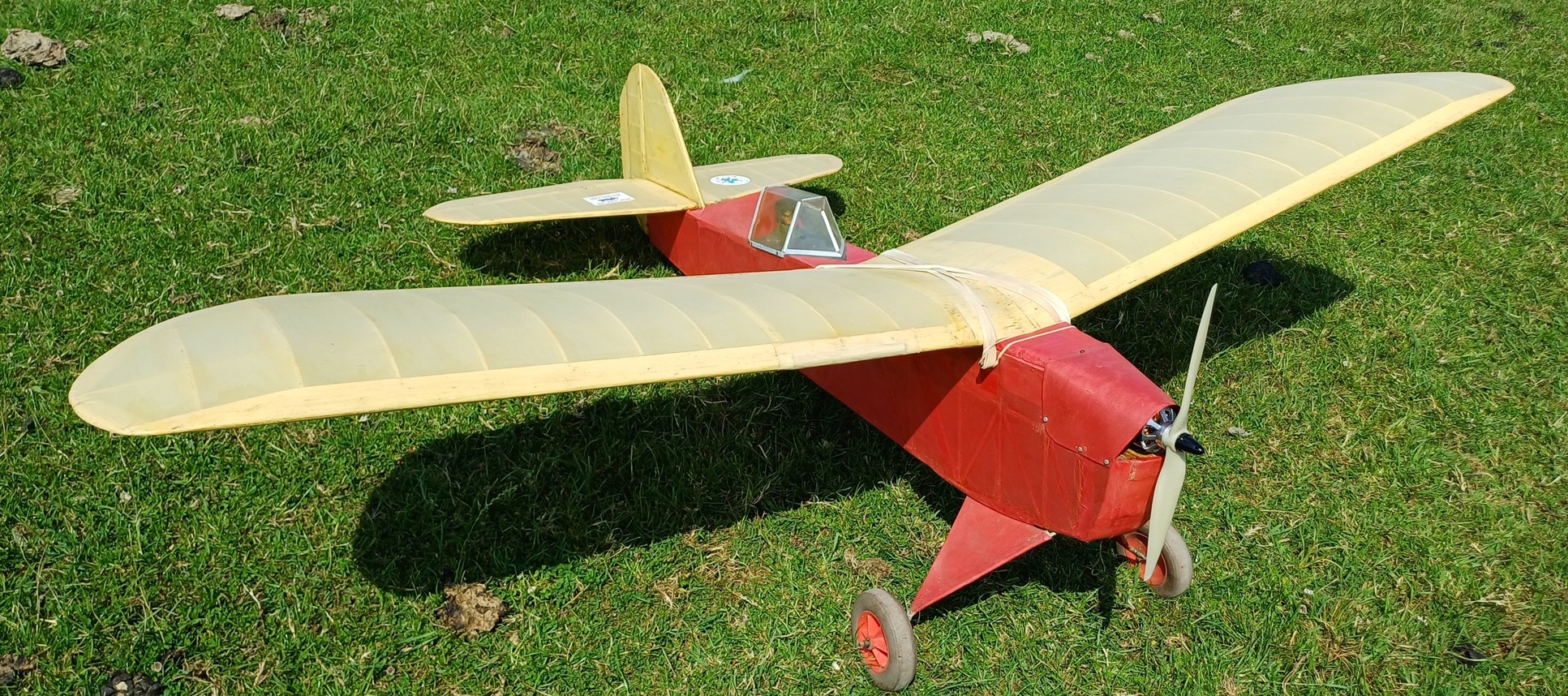 It would still have the wallowy flying characteristic though, so it’s returned to being a hangar queen for now. But at least it flew! Thanks for that Dougal, I rather like it, an ideal model for a calm summer’s day. It’s bound to Dutch roll (wallow) with all that dihedral, not much you can do about that without changing the dihedral but then the Sportster would lose part of it’s charm. I can’t help thinking that six cells provide way too much power, surely it would be fine on four cells, then being lighter and slower maybe there would be less wallowing? Take a look at the video and see for yourselves how it performs.
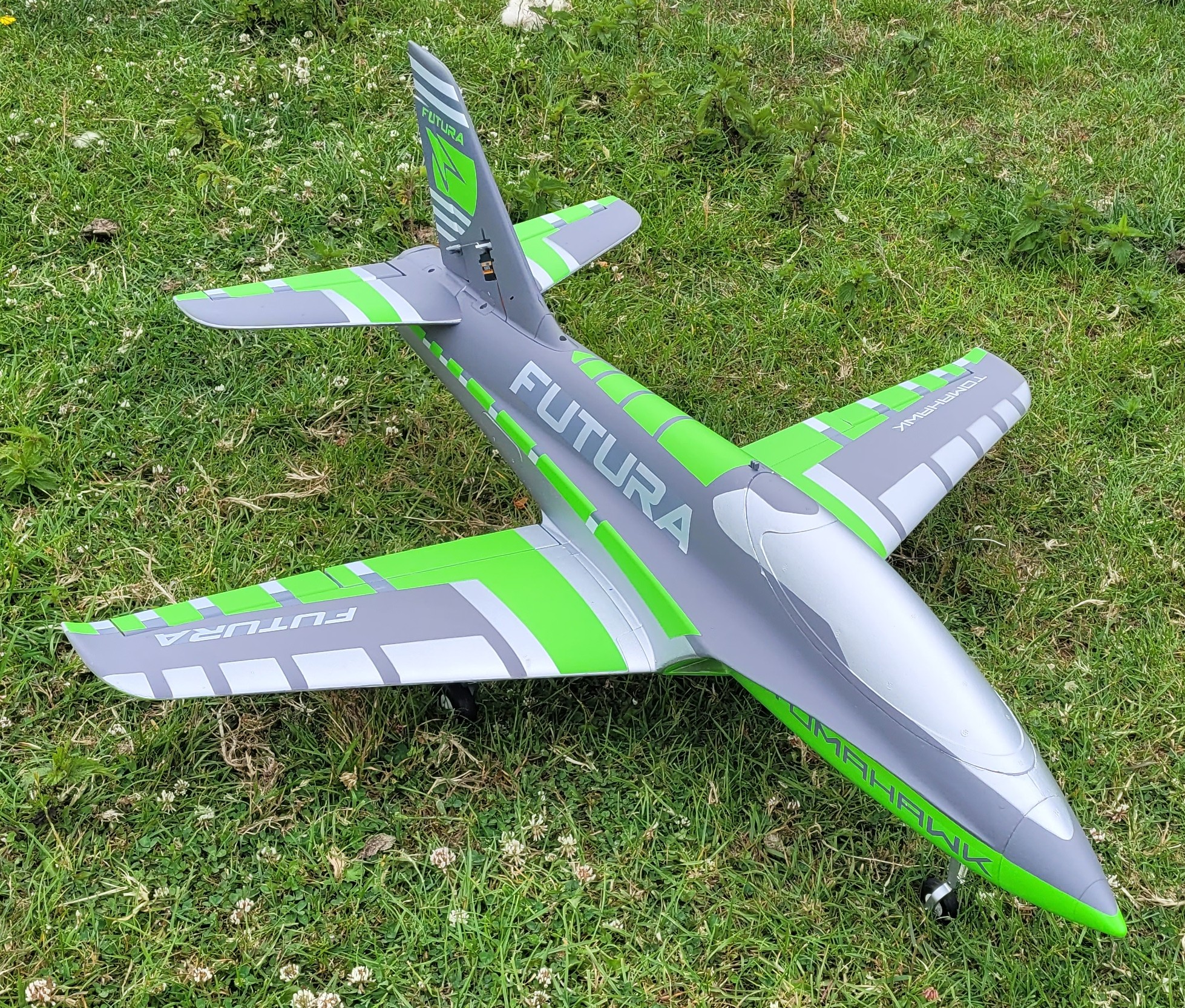
The last new model that flew this month was mine, an FMS Futura. I wasn’t looking a for a new model, like many of us I already have too many, but I spotted the Futura on the AliExpress site for just £109.93 with free delivery and it was simply too cheap to resist. 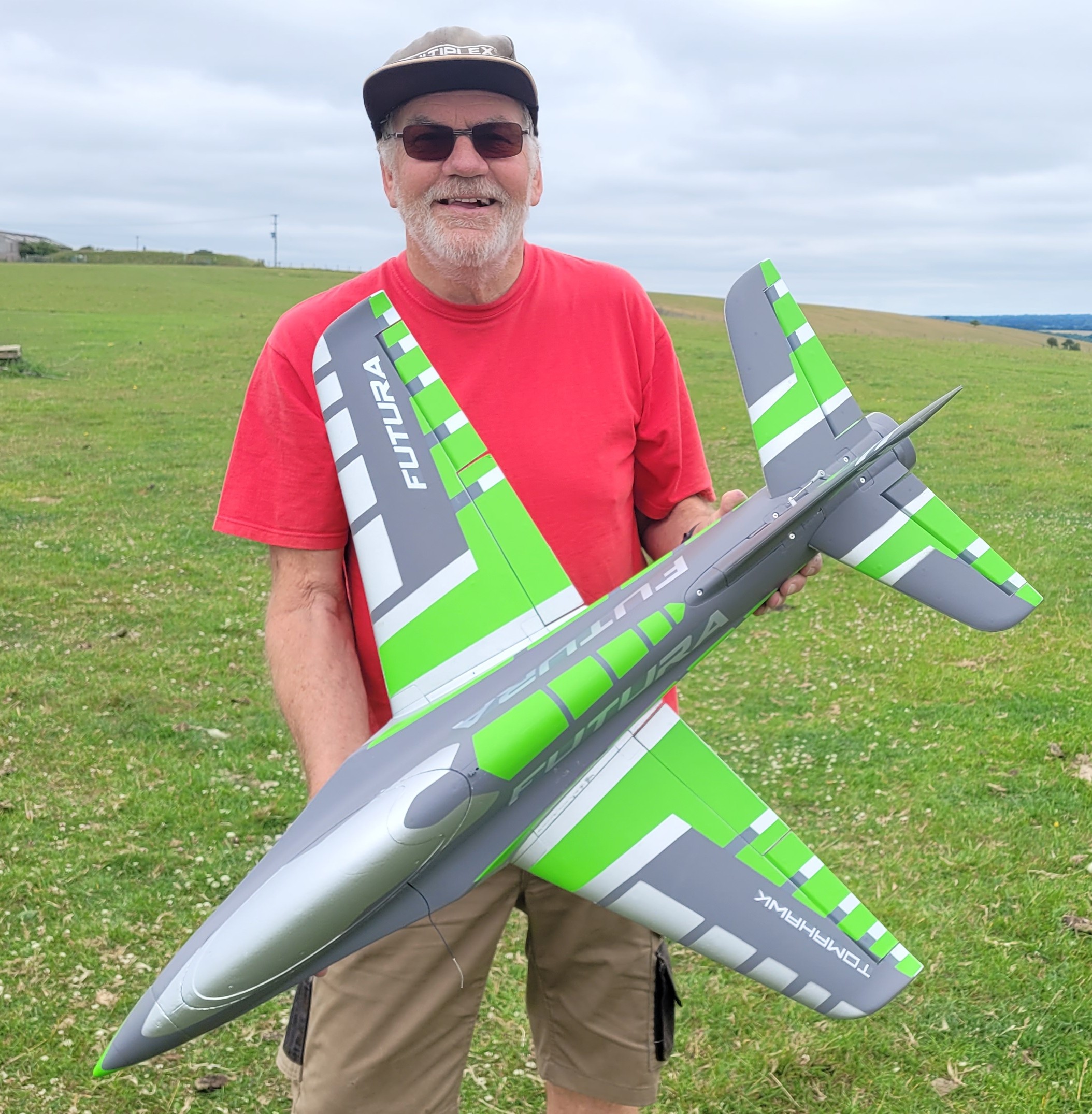 While I was waiting for mine to be delivered the price dropped and on 25th June the price was just £92.15 but the following day it had gone up to £115.46 so keep your eye on it!
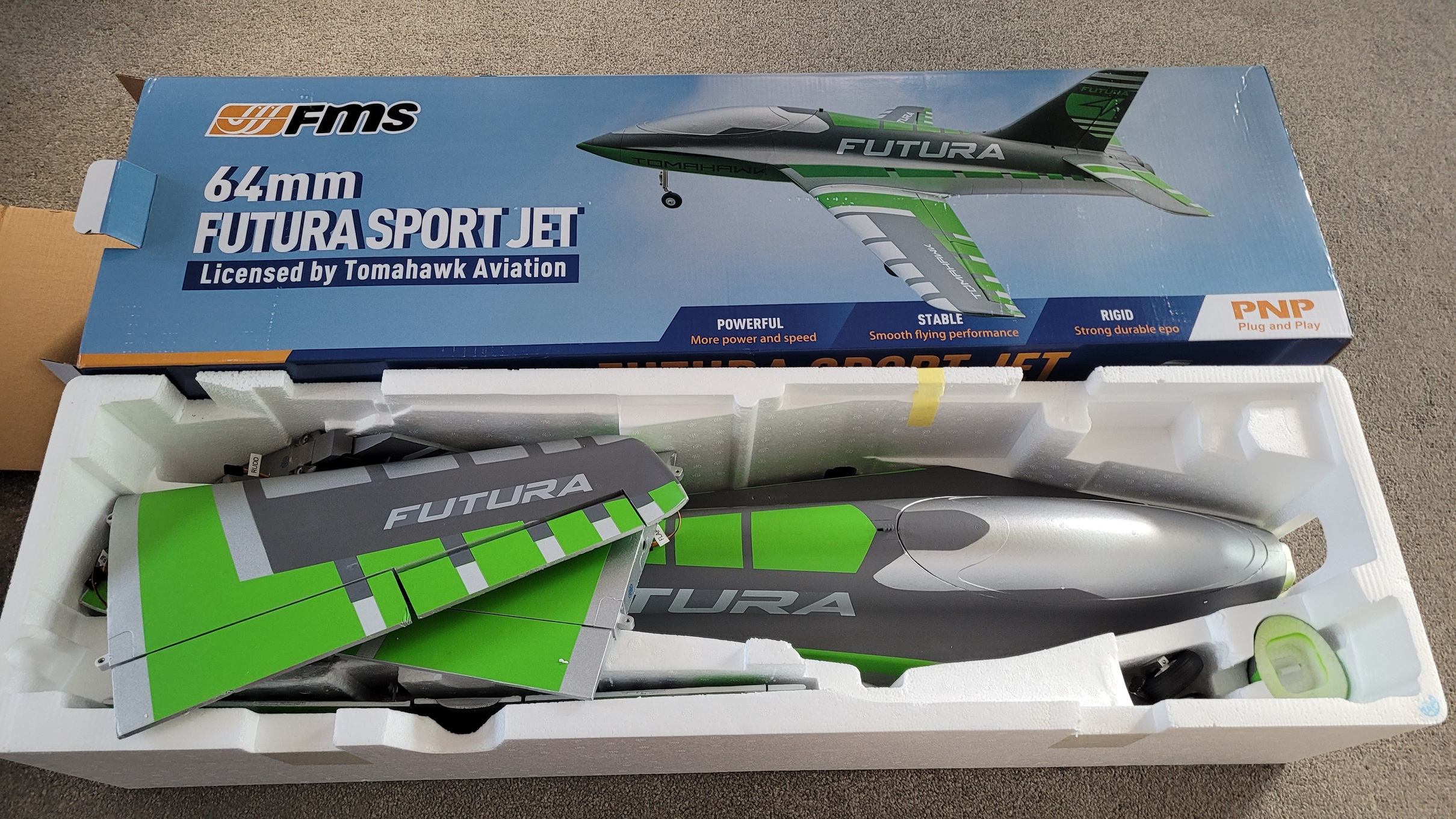 The Futura design has been around for quite a while and there are many versions from enormous turbine powered ones down to small EDF foamies. Mine has a wingspan of 900mm, is fitted with a 64mm fan and runs on four cells. This is what FMS say about it: The FMS Futura is a licensed sport jet developed by FMS in conjunction with Tomahawk-Aviation. Designed by a Sino-German team of engineers, the Futura represents the pinnacle of what a foam jet can be. Futura is definitely a pleasant surprise for those who struggle to choose between speed and stunts. It has high speed, high maneuverability, and excellent handling performance, satisfying players’ needs to experience various flying modes such as free flying, simulation competitions, and stunt flying.
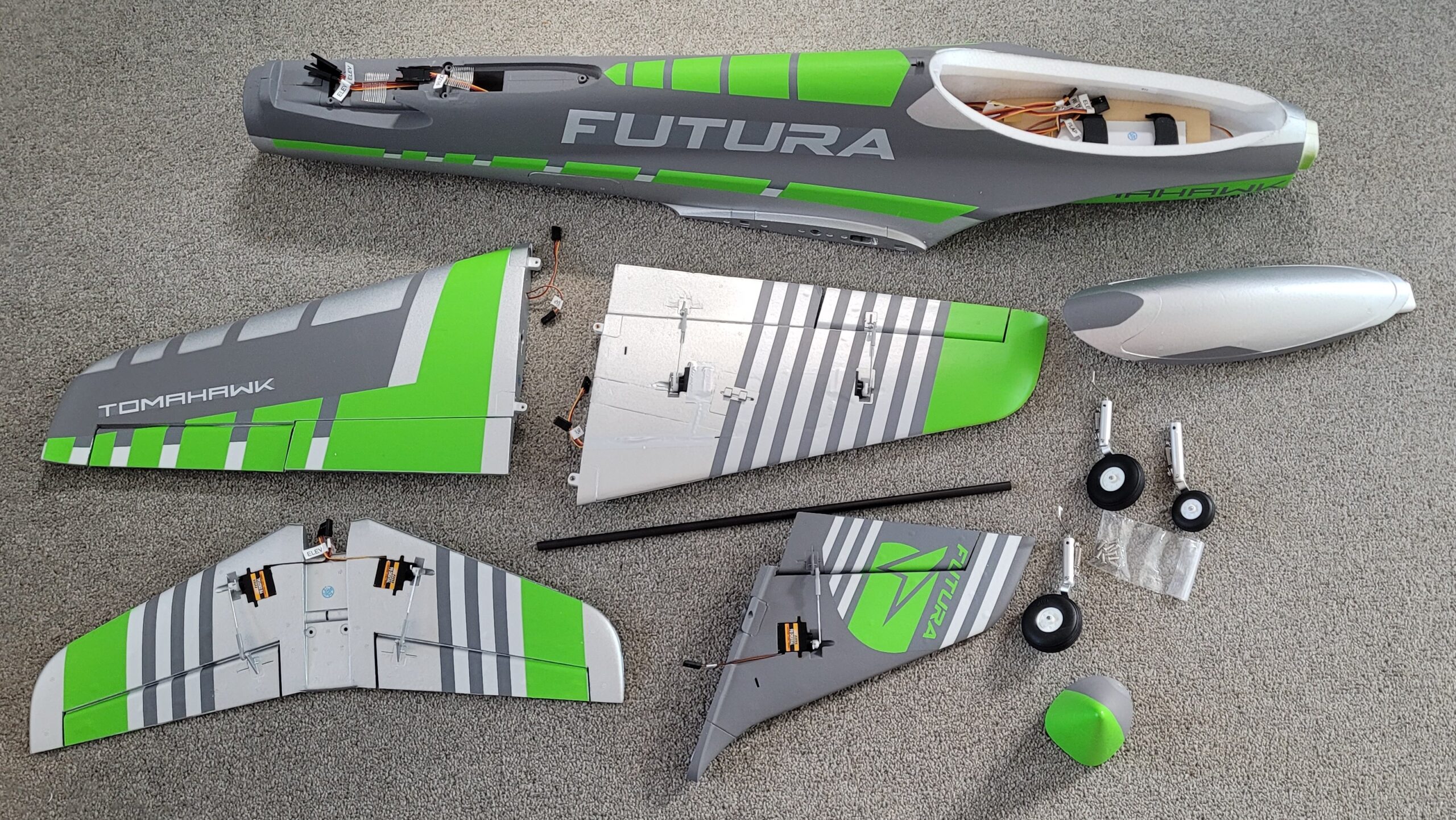 The power system is composed of a high-torque 2840-KV3150 brushless motor, a high-stability 40A ESC, and a 4S 2200mAh-2600mAh battery (to be purchased separately), which is paired with 8pcs high-precision 9g servos mounted on the wings, tail, and front steering position, allowing players to easily experience various control techniques and enjoy the pleasure of high-speed flight. In addition, the wings and tail of Futura have been pre-embedded with reinforced ribbons, and the cockpit is firmly fixed in place with buckle, which allows players to perform aggressive turns, rolls, and flips without any concerns. The CNC all-metal landing gear with trailing-link suspension is highly precise and robust, protecting the plane against rough landings. I placed the order on 26th May and it arrived on 23rd June, a week earlier than the date quoted, and it was in a sturdy box and was undamaged. Construction was simple, the parts simply screw together, no gluing required, then add your own receiver and battery. The ailerons, elevators, flaps, and rudder/steerable noseleg are all fitted with Y leads so only five channels are required.
 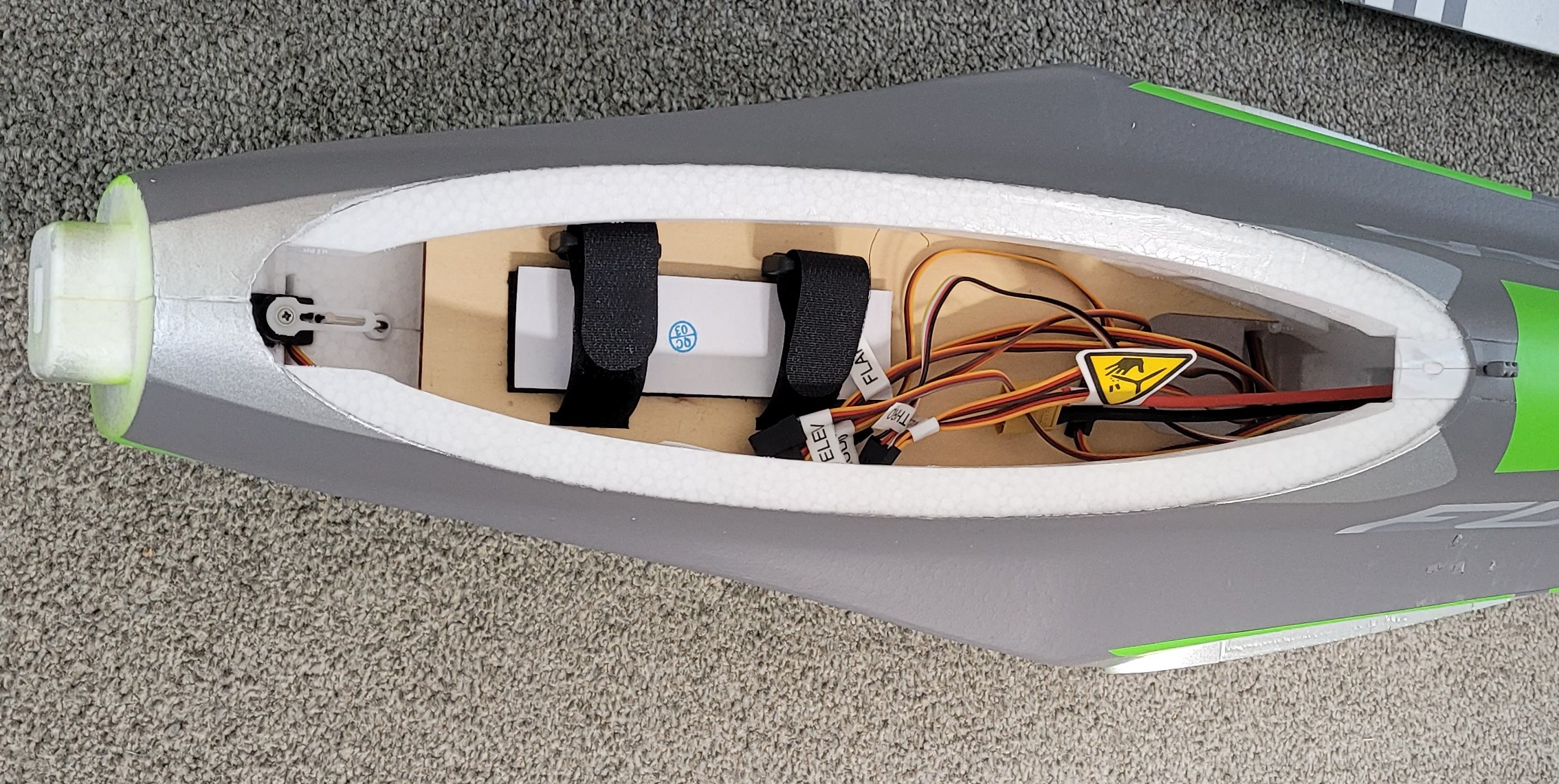 Interestingly the speed controller has an extra signal lead which enables you to have switched reverse thrust but as I am using a five channel receiver I don’t have a spare channel to try it. Presumably you’d only use reverse thrust after landing to slow the model on the ground, or maybe when taxiing, neither of which are relevant on our grass patch. The instructions warn not to engage reverse thrust at more than 50% throttle as it could damage the ESC so it wouldn’t be much use for crazy aerobatic antics!
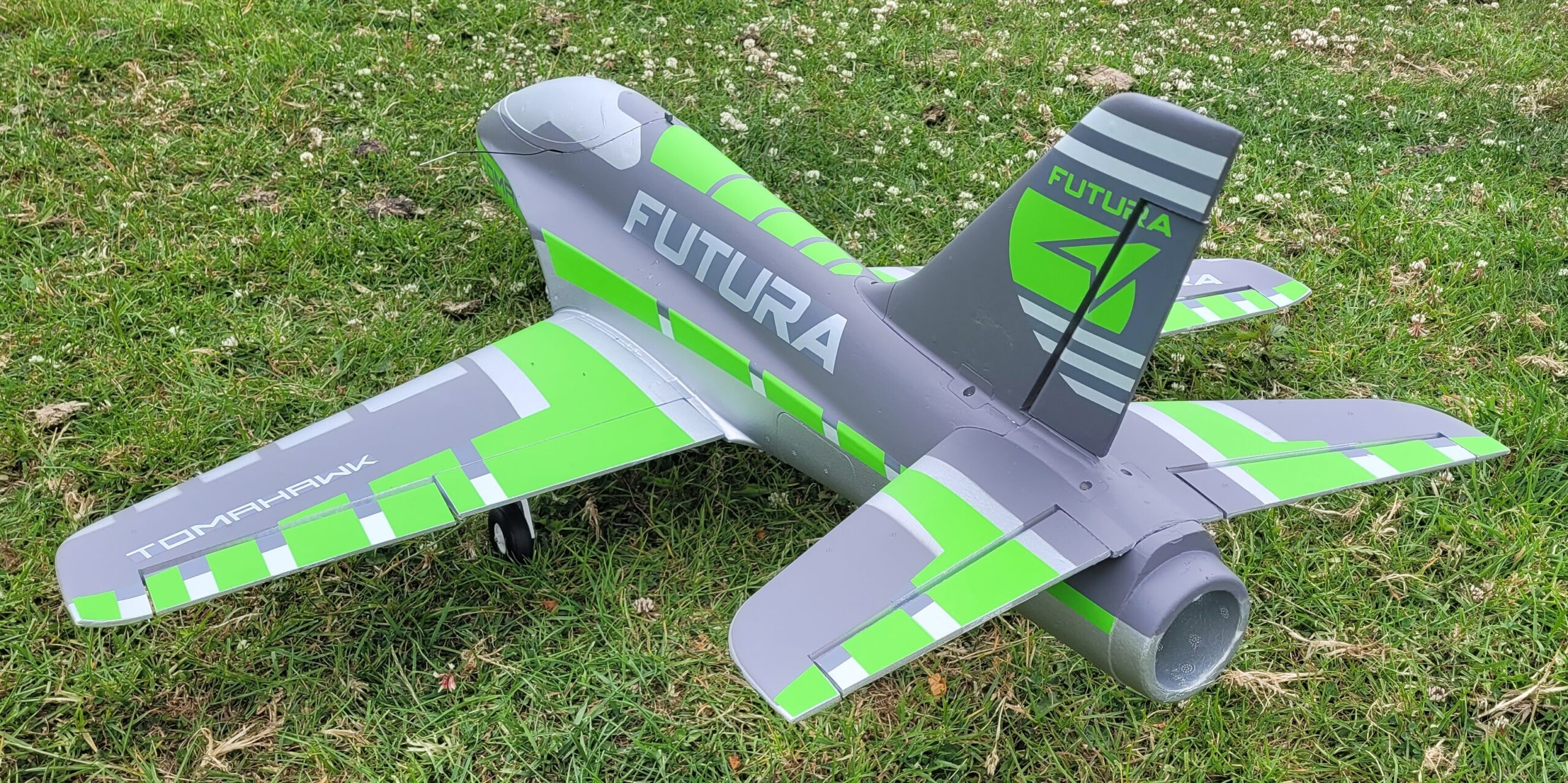 As usual I took some photos of the model before the first flight but then I made the mistake of handing my mobile to Gordon Bennett for him to take a photo of me holding the plane. That’s very childish Gordon (well done!) and his accomplice Woody is no better!
 With the photos taken, the first flight was uneventful, using half flap the Futura took-off from the grass with no problems and then flew beautifully. The power set-up provides plenty of thrust and all the usual manoeuvres are possible. I landed using half flap and the Futura came in nicely and landed gently, no doubt helped by the sprung oleo legs.
 At the time of writing I’ve had three flights with no problems and I’m gradually getting used it’s characteristics. You can of course see some of the flying in this month’s video.
This month the ‘action shots’ aren’t action shots at all (my blog, my rules!):
I’m not sure if I’ve ever mentioned it (!) but back in October 2020 I was fortunate enough to have a flight in a two seat Spitfire from Solent Airport Daedalus, courtesy of my son. 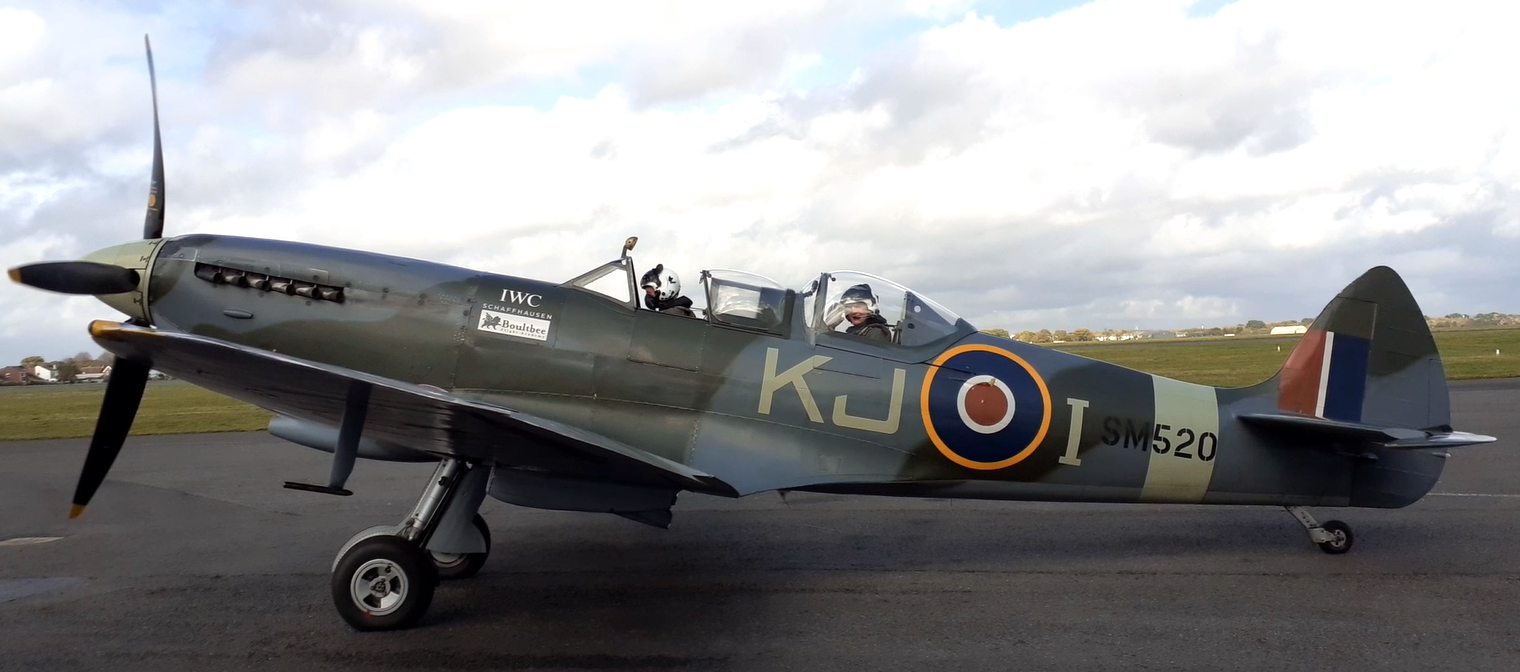
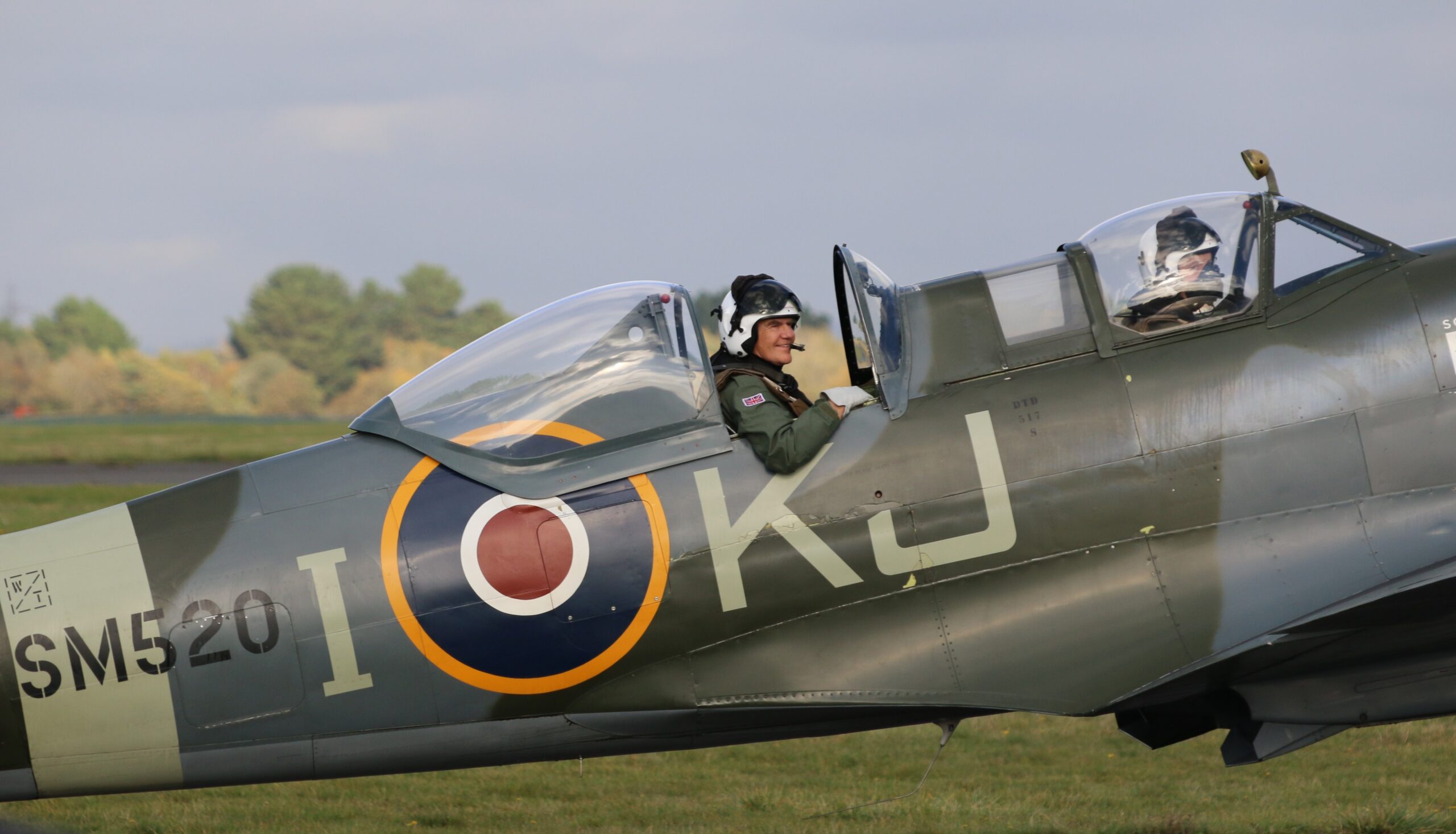
For some strange reason some club members seem to think I mention it far too much, and at the end of June Woody bought me a present in the hope that it’ll finally shut me up!

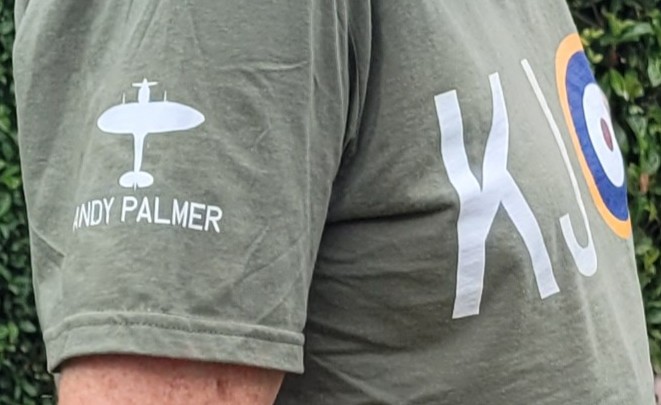
 A T-shirt with all the correct aircraft markings! Thanks Woody… but it won’t shut me up!
Video time now, this month with footage shot by me, MacFly, Dougal, and Dot Cottam.
Please watch the video full-screen, it’s so much better with small models flying around:
If the video won’t play for you please click HERE
Final Funny:
No joke this month but I saw this and it made me chuckle

Colin Cowplain