Patch News – May 2025
I was away for the last week of April and much of May so I missed most of what was going on at the patch. Fortunately both MacFly and Dougal Entendre took lots of photos and video as well as keeping me informed of the various events that I missed, thank you both.
The May weather was very mixed, at the start of the month the unusual easterly winds carried over from April, then there was a spell of glorious sunshine with light winds, and then more normal windy and showery weather returned towards the end of the month.
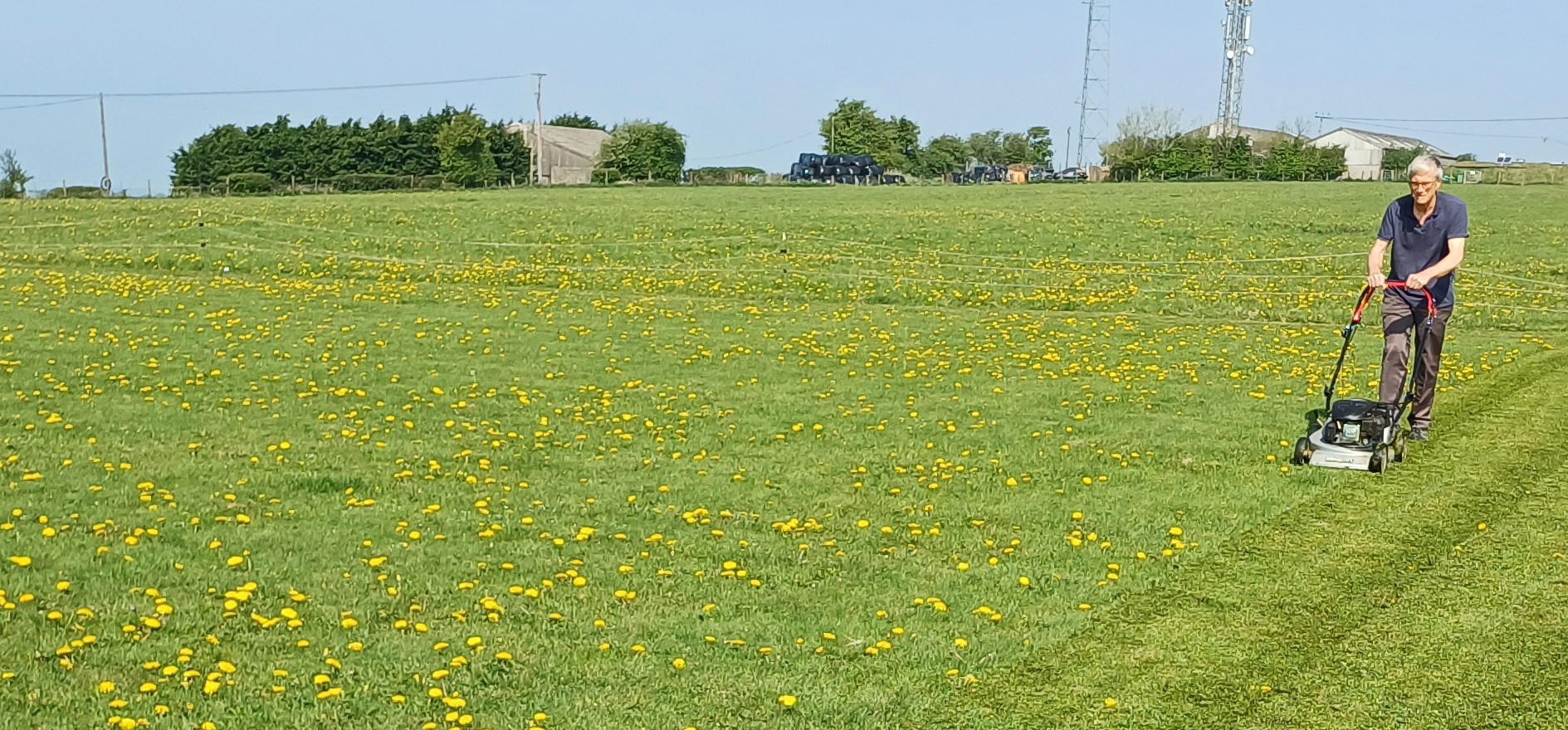 As there’s been little rain the grass hasn’t grown much but the dandelions have flourished! The last Sunday of May was unflyable due to strong winds, but Woody went along and mowed the patch all by himself, that’s a lot of mowing for one person, Woody you’re a star!
On 25th April, just before I went away, Dot (Simon Cottam) took and passed his BMFA ‘A’ test. Dot has recently joined PAM and returned to flying after a break of around fifteen years, and had in fact passed the test previously, but BMFA were unable find it in their records. Of course things have changed a lot in fifteen years with all the new regulations so Dot was keen to take the test again and make sure he was up to date with everything.
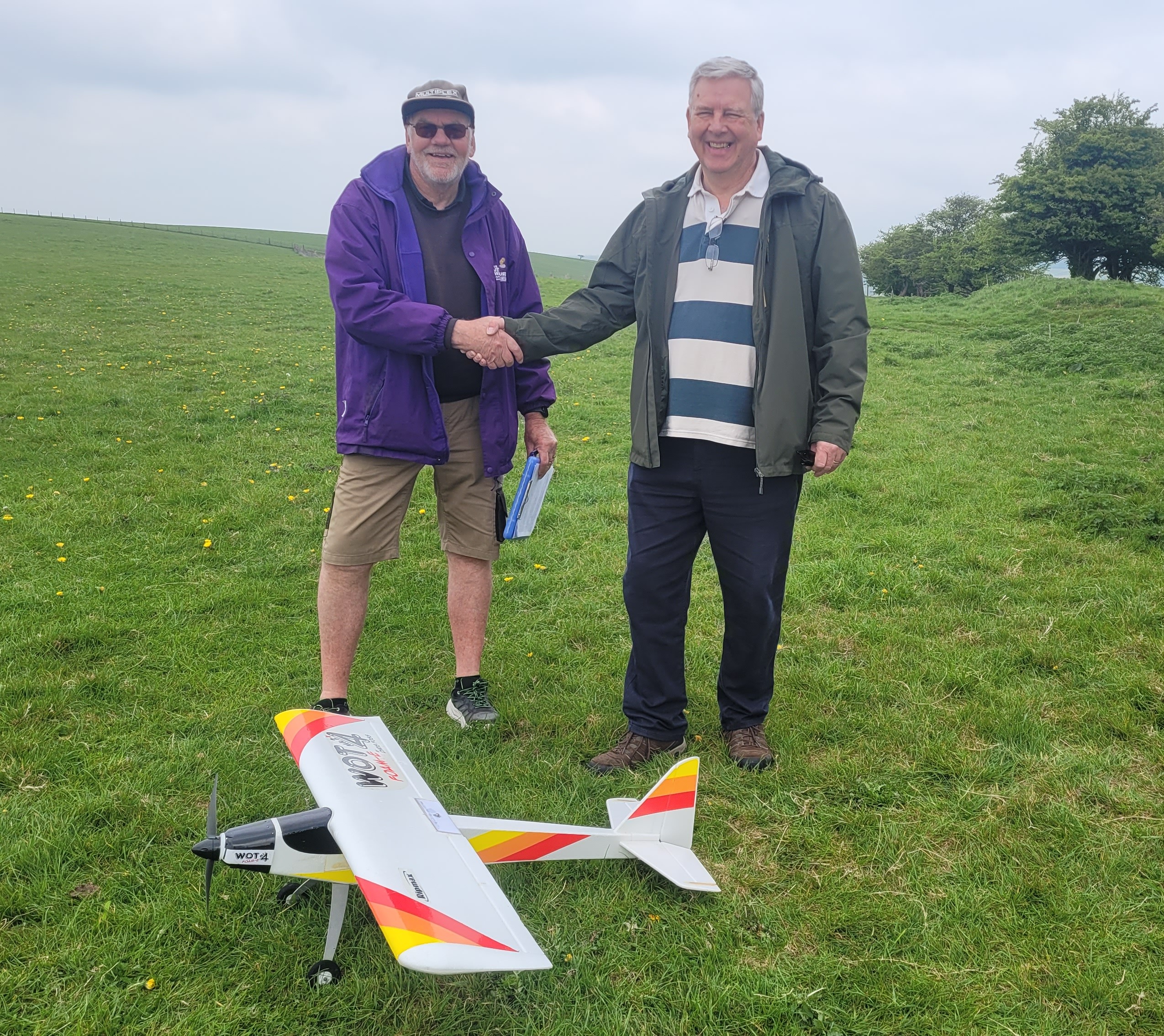 Having watched him flying since he joined us it was clear that Dot is a very capable flier and he sailed through the test with no problems at all, easily the best candidate that I’ve taken. Well done Dot, now it’s time to start practising for your ‘B’ test!
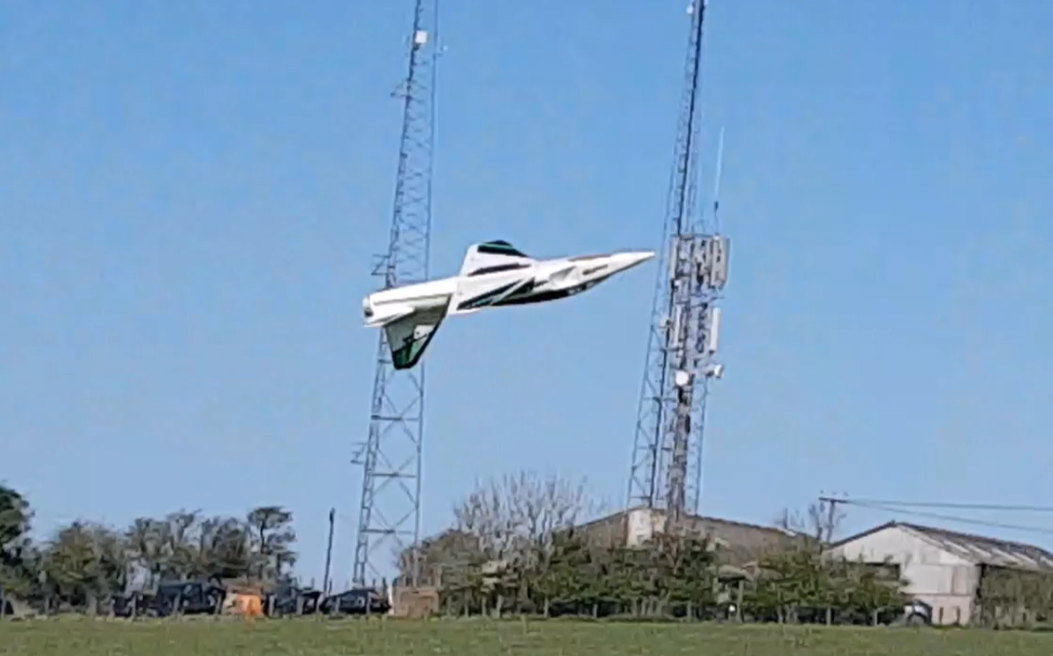
Another event that occurred on the same day was sadly not so good but it did cause a lot of evil laughter amongst all those present. Gordon’s Freewing Grumman Panther has had a rather short and chequered history up to now. It’s proved to be tricky to get away from a hand-launch and has been damaged a couple of times when it’s failed make it, although once up to speed and safely away it flies beautifully. Like all EDFs, with no propwash over surfaces, the pilot has little control until the speed builds up, and that takes a few seconds. 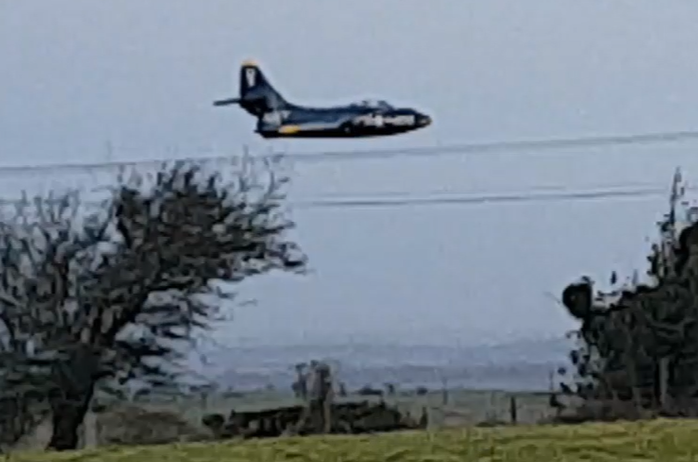
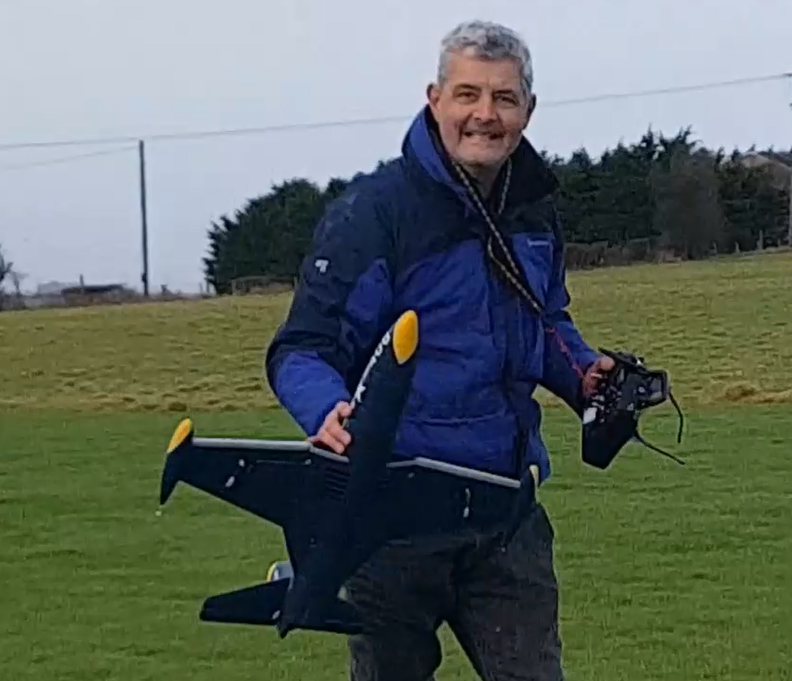 Gordon has been toying with the idea of borrowing Dwayne Pipe’s launch ramp and bungee but, having repaired the damage from the previous failure but not added a bungee hook, he decided to try one more hand-launch. He also decided to hand me the transmitter and do the launching himself. There was a nice breeze blowing so a hand-launch should surely be alright, what could possibly go wrong?! Gordon gave it a perfect throw, nice and level, directly into wind, and the Panther sank very low to the ground, slowly gathering flying speed, straight as a die, and just starting to climb when…it met the fence box!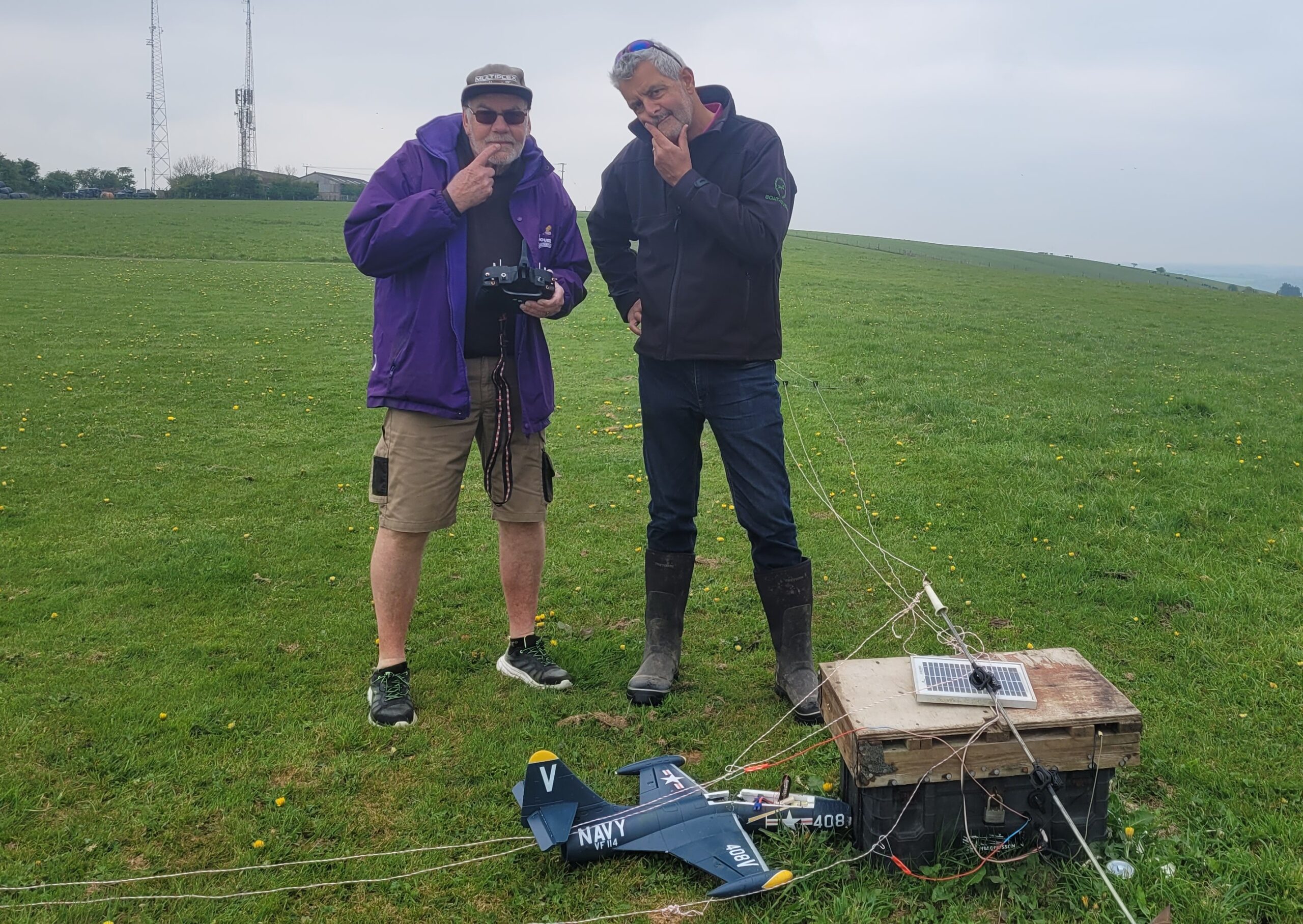
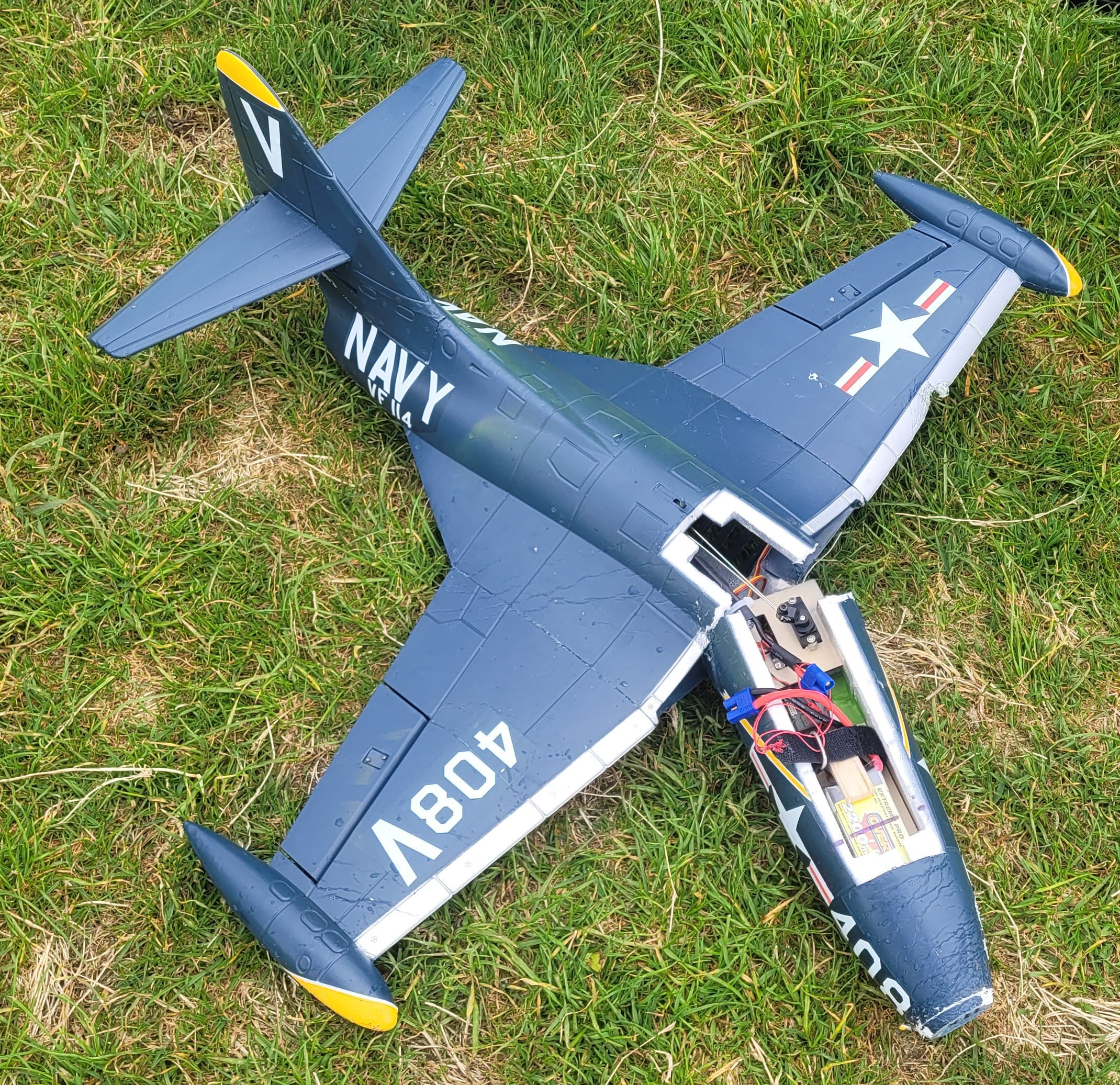
Fortunately (I think?) it hit the box straight on, not with one wing, so the damage wasn’t as bad as it could have been and hopefully Gordon will soon have it back in one piece, and I’m guessing, with a shiny new bungee hook ready to be launched from Dwayne’s ramp.
Thinking of Dwayne Pipe, when I returned from my travels I heard that Dwayne has been unwell. I wrote to wish him well and in his reply he included this: You may remember I spectacularly disassembled my Folland Gnat in April. I have used the last month to rebuild most of it. I hope to get it up to the patch soon. Regards to all the midweek flyers.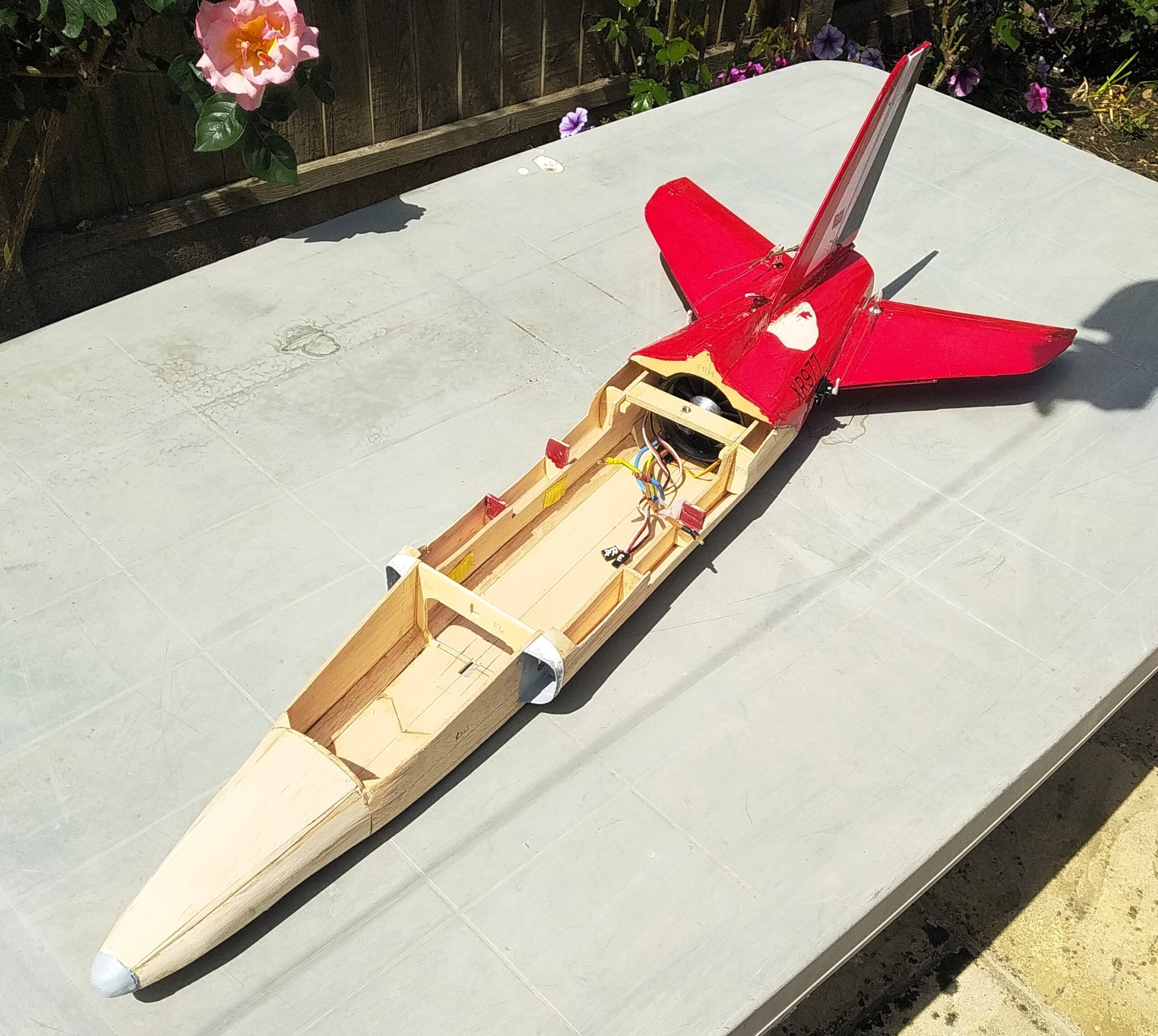 We’re all looking forward to seeing you back at the field and flying again soon Dwayne.
Oh, and by the way, Gordon says please can he borrow your launch ramp?!
We’re all looking forward to seeing you back at the field and flying again soon Dwayne.
Oh, and by the way, Gordon says please can he borrow your launch ramp?!
Also at the end of April a rather unusual event occurred, Dougal Entendre crashed!
Here’s what he says about it: I had a bad day. 2nd flight of the Edge, I tried to enter a knife-edge spin, but it went wrong and I ended up in a fast spin. When I tried to pull out it didn’t seem to respond, and it went in hard, about 3/4 of the way to the car park.
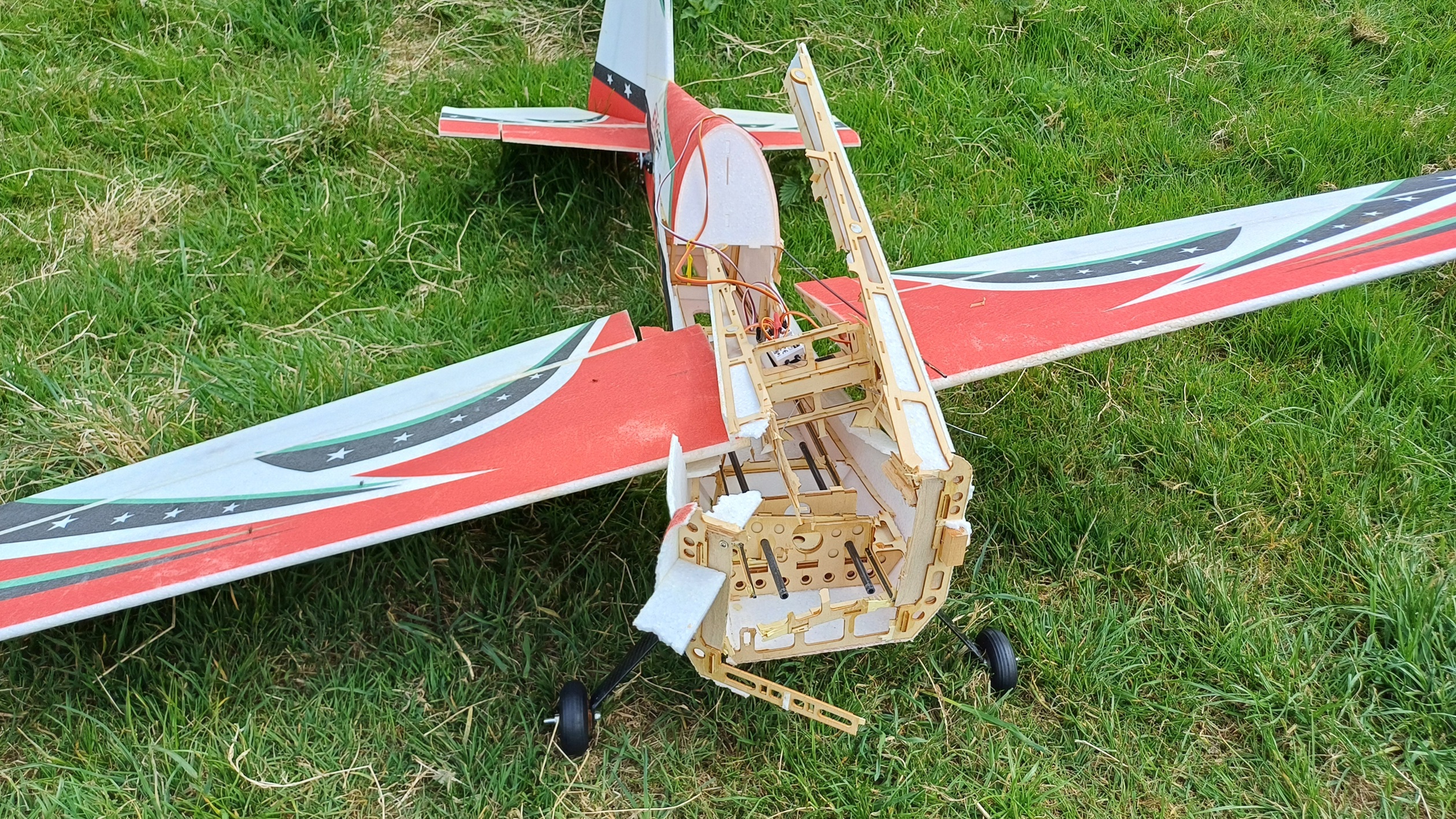 There was a puff of smoke, so I legged it over to the wreckage, most of which was about 3 feet away from the burning batteries and ESC. The cells went off one after the other, and each time one went, it shot out flames about a foot long. I stayed with it until all the flames had subsided and I was sure the grass wasn’t going to catch light.
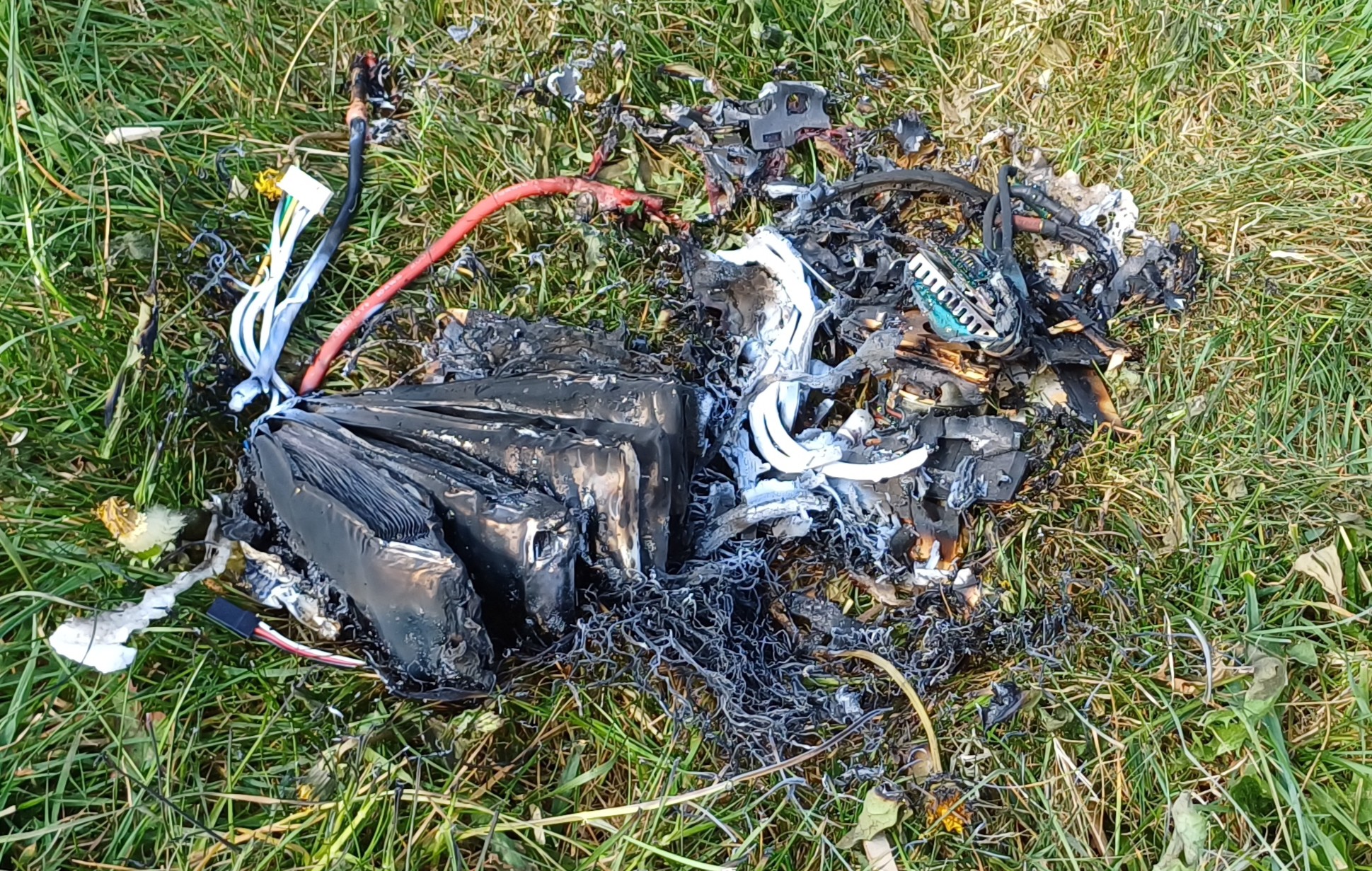 I then returned with my phone to take pictures of the burnt mess, and used the shovel to dig up the motor and charred remains of the ESC. The servos and Rx are OK, but everything else is a write-off. Fortunately I have an untouched kit for another one!
That’s a great shame Dougal but we look forward to seeing the next one when it emerges.
I then returned with my phone to take pictures of the burnt mess, and used the shovel to dig up the motor and charred remains of the ESC. The servos and Rx are OK, but everything else is a write-off. Fortunately I have an untouched kit for another one!
That’s a great shame Dougal but we look forward to seeing the next one when it emerges.
The first new model to feature this month is Mini Mike’s Soar Ahead Sailplanes Blob.
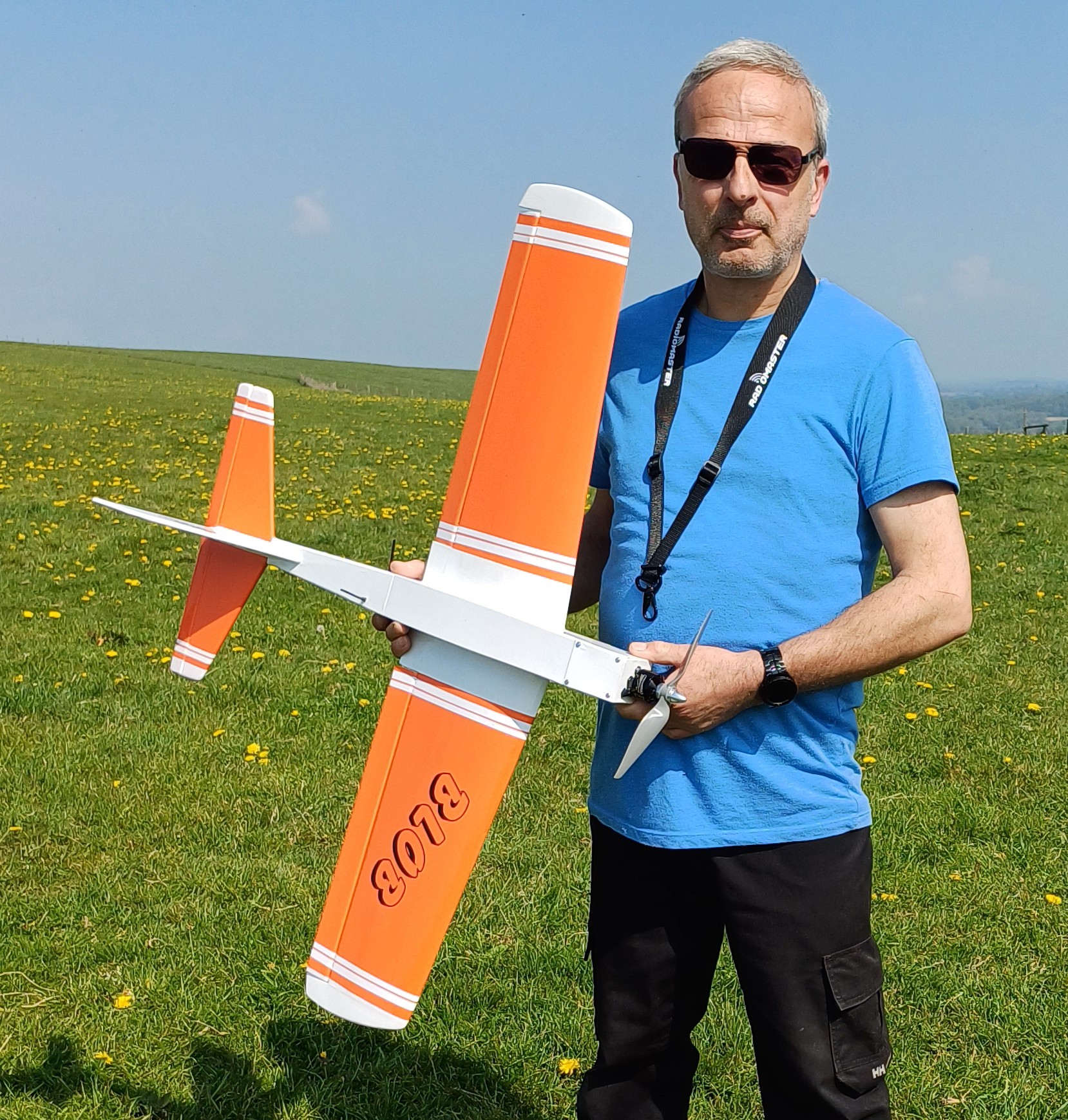 The Blob is a 40” span model that was originally designed as a slope soarer but was then made available as I/C powered and now electric. SAS ceased trading a long time ago but the designs are now kitted by NJR Modelling where the I/C or Electric Blob costs £86.99.
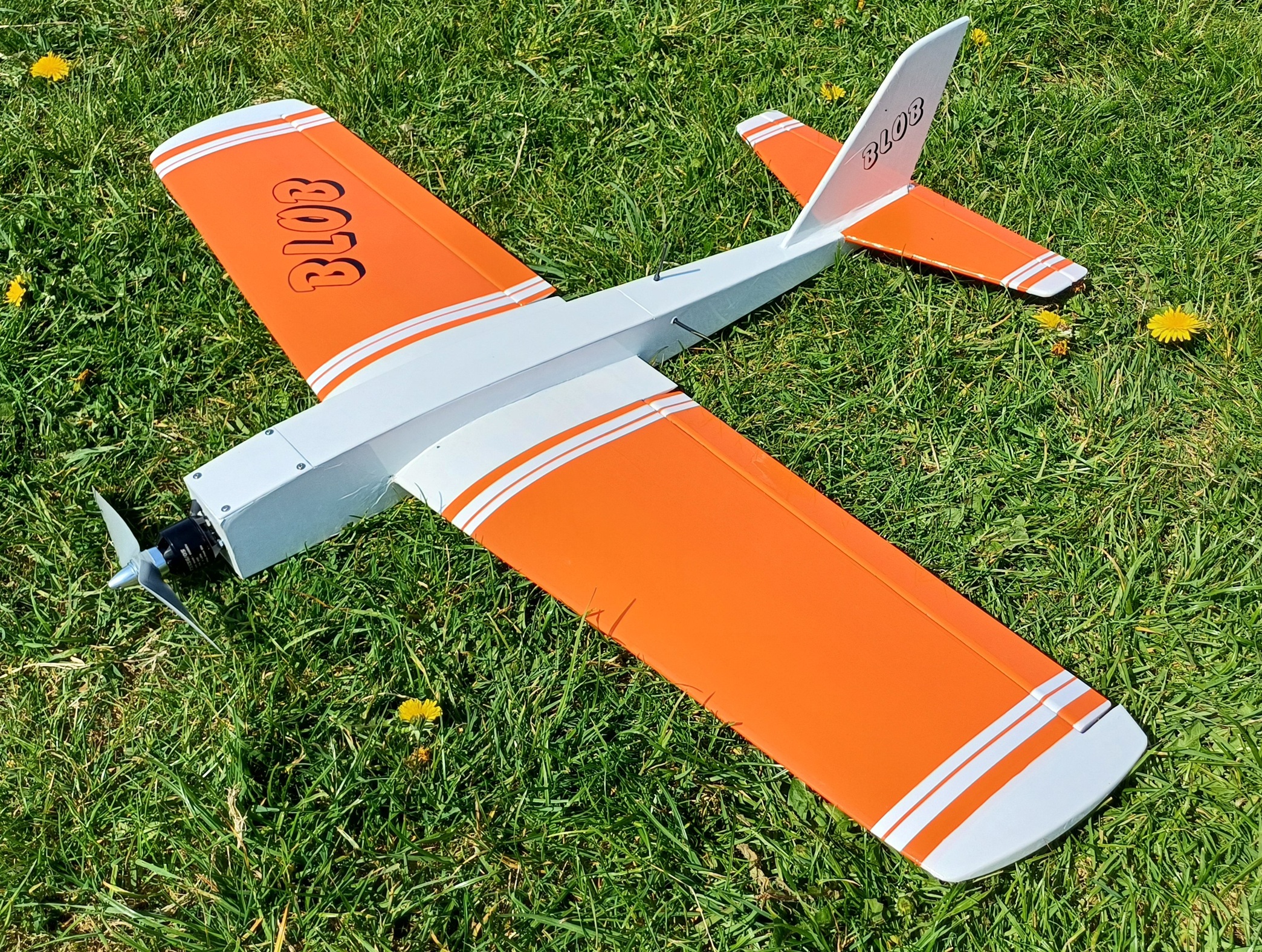 Mini Mike says the kit was a little strange to build as you have to build the fuselage onto the wing rather than slide the wing into the pre-built fuselage as you would normally. This resulted in Mike’s having a slightly bent rear fuselage, not that’s it’s noticeable.
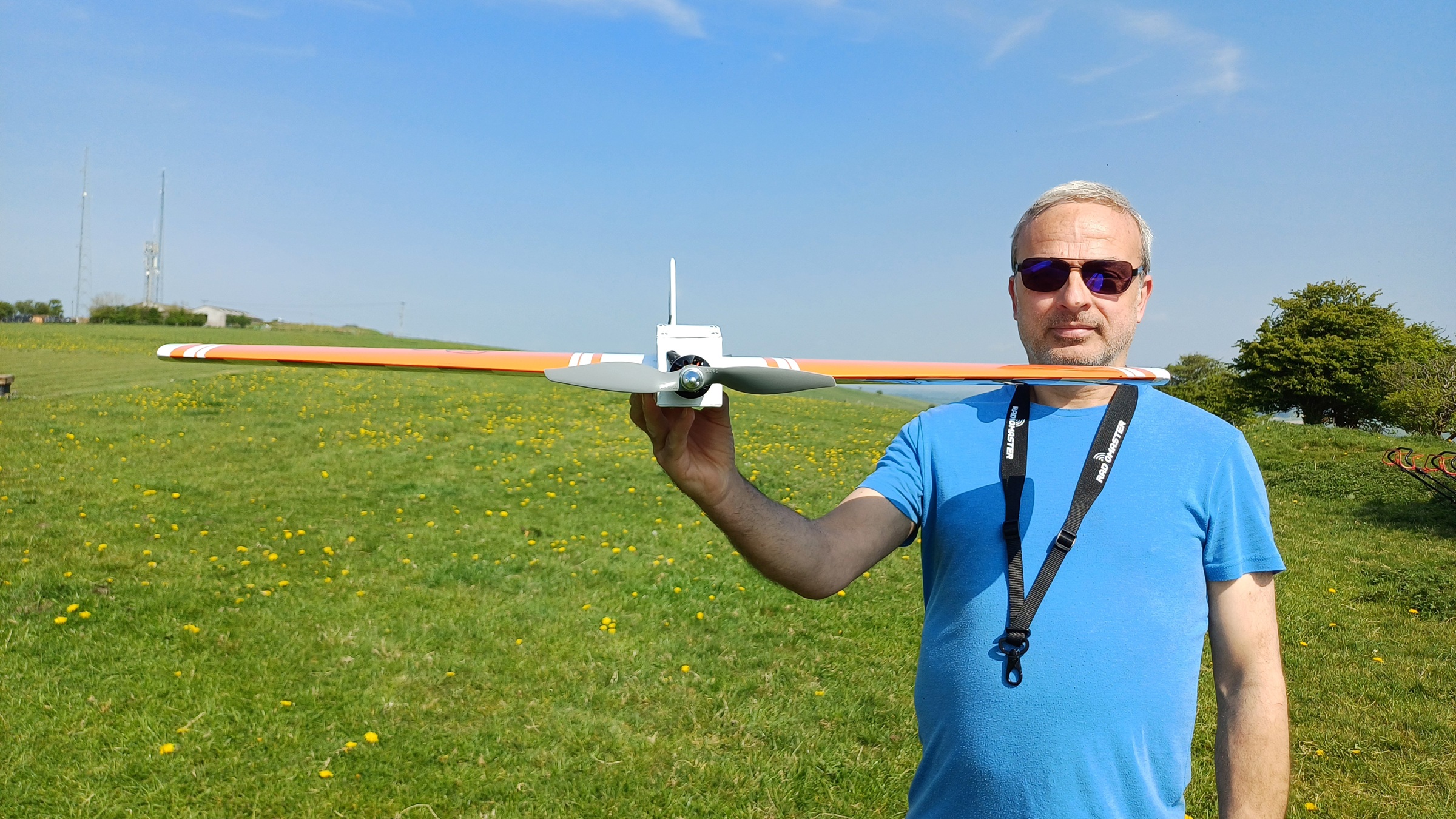 Mini Mike has fitted his with an Overlander 3536/05 1500Kv motor and an Overlander 50A speed controller. He’s using a 9×6 propeller and the new Shorty 2200mAh 3 cell 50C lipos from HobbyKing. He says they are lighter than the standard size ones and get the centre of gravity closer to the correct position. Mike has used JX metal geared servos and there are only two so the Blob must just use one centre mounted servo for the ailerons.
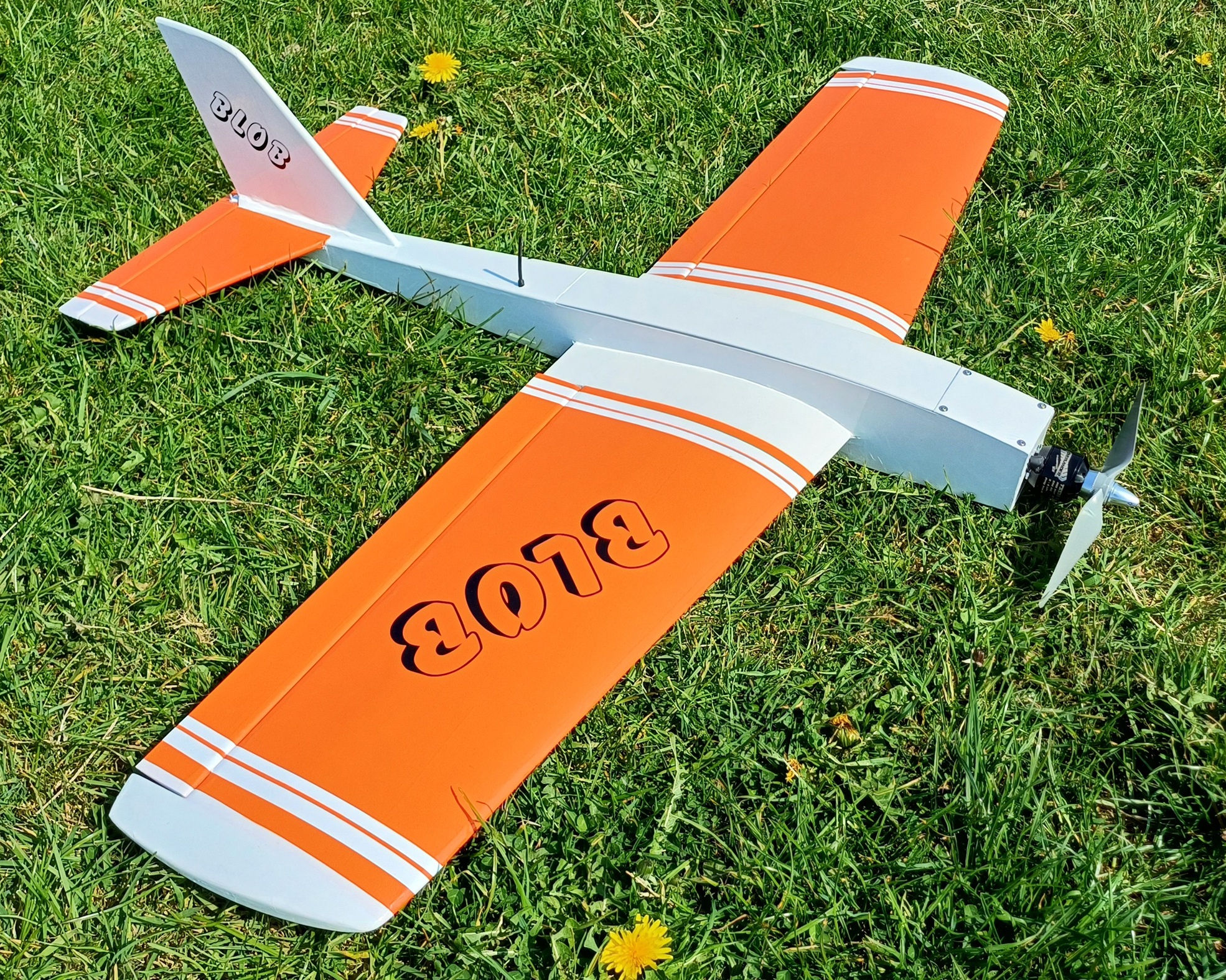 The covering is Ripmax Aero heat-shrink film and very smart it looks too. So, now for the all-important question, how does it fly? I haven’t seen it fly myself yet but, as you will see in this month’s video, it looks to be excellent, fast and smooth, nice one Mike.
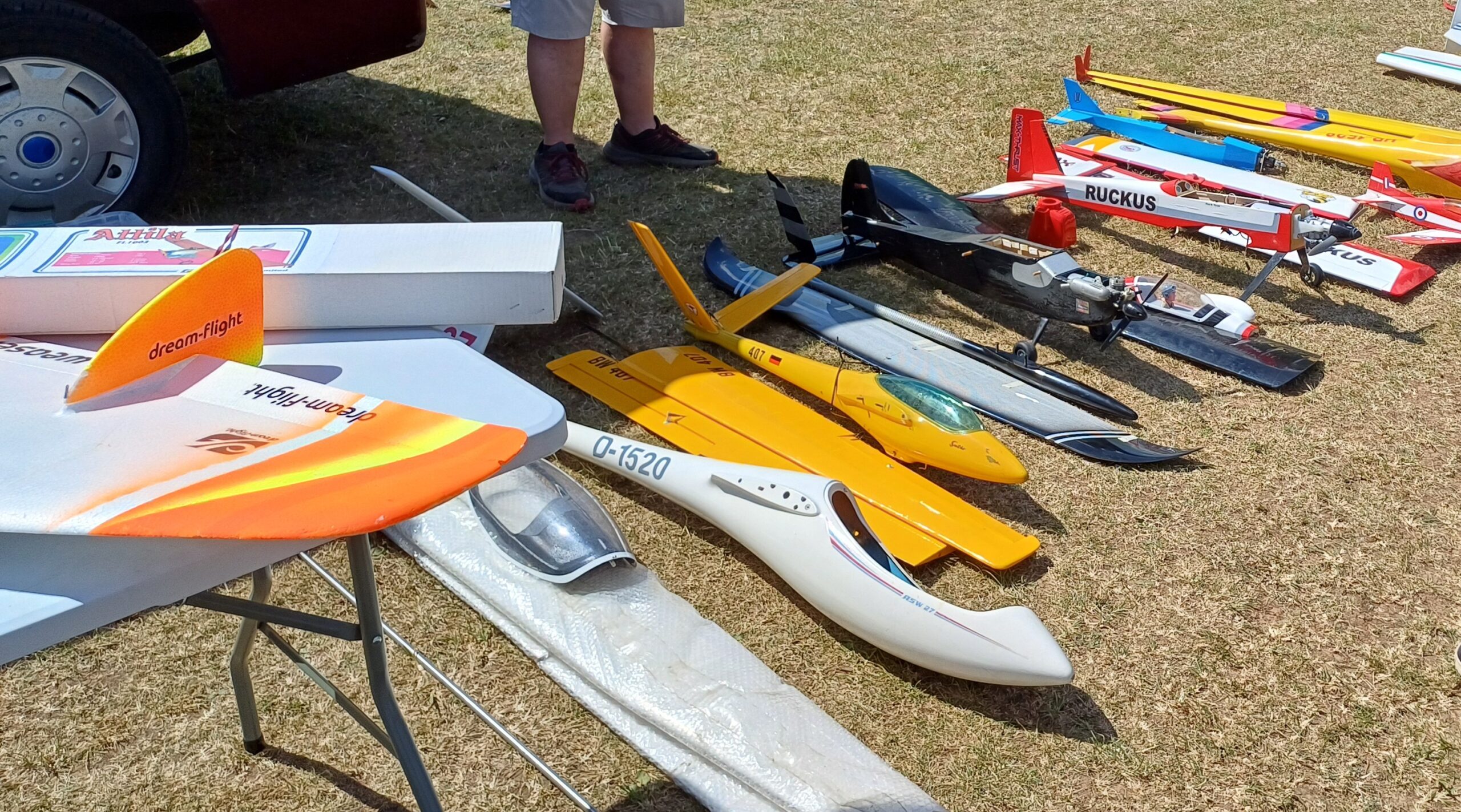
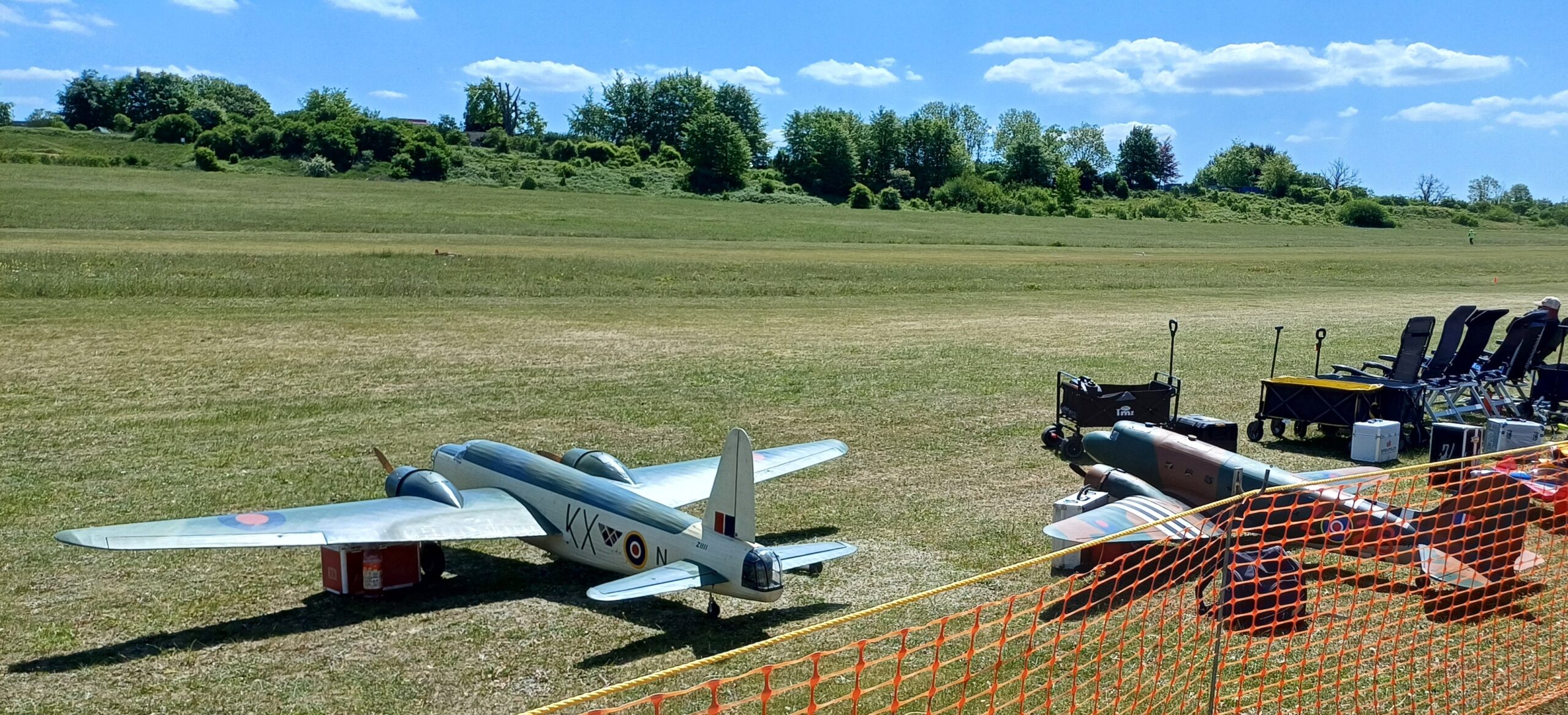
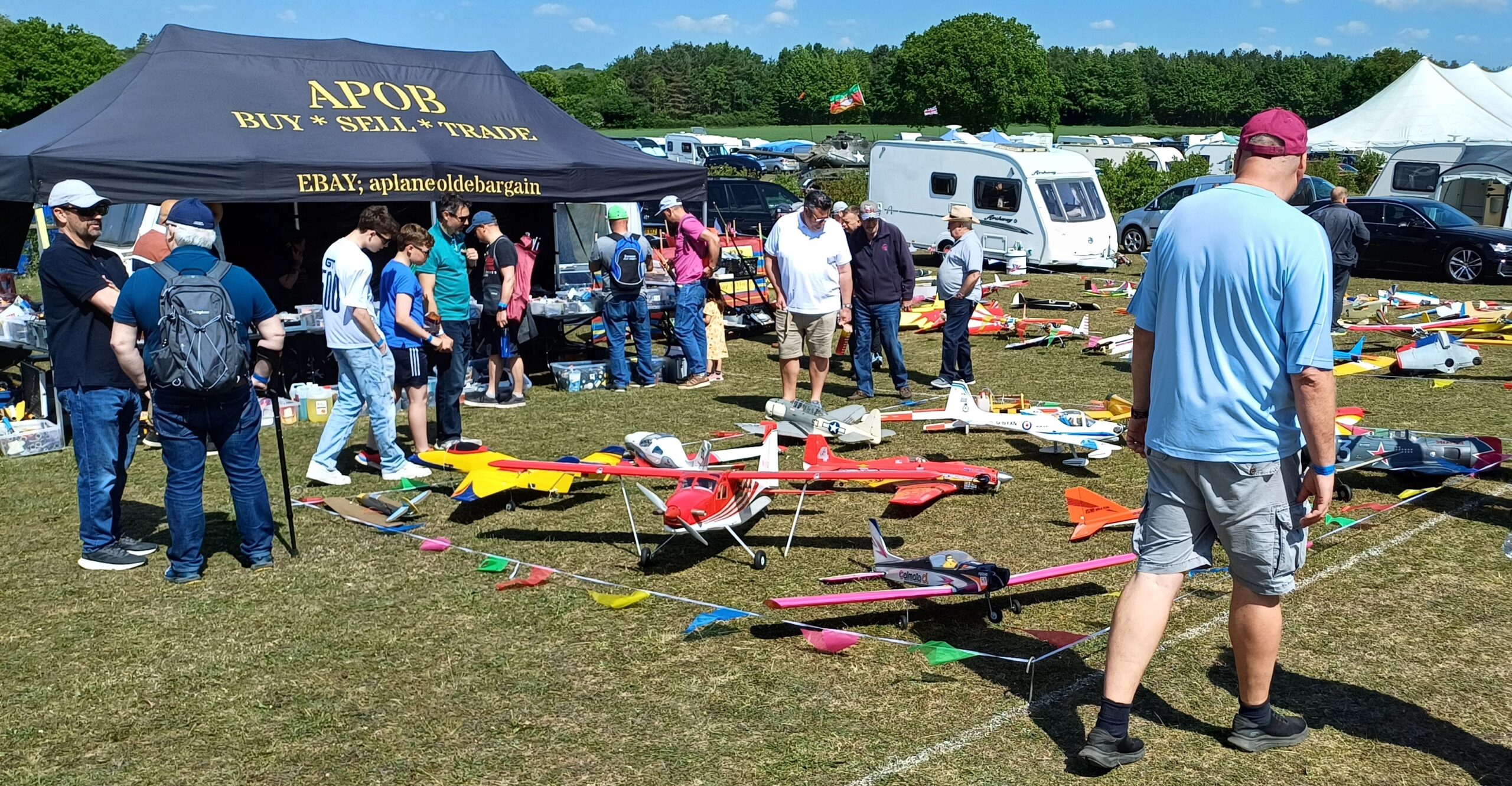
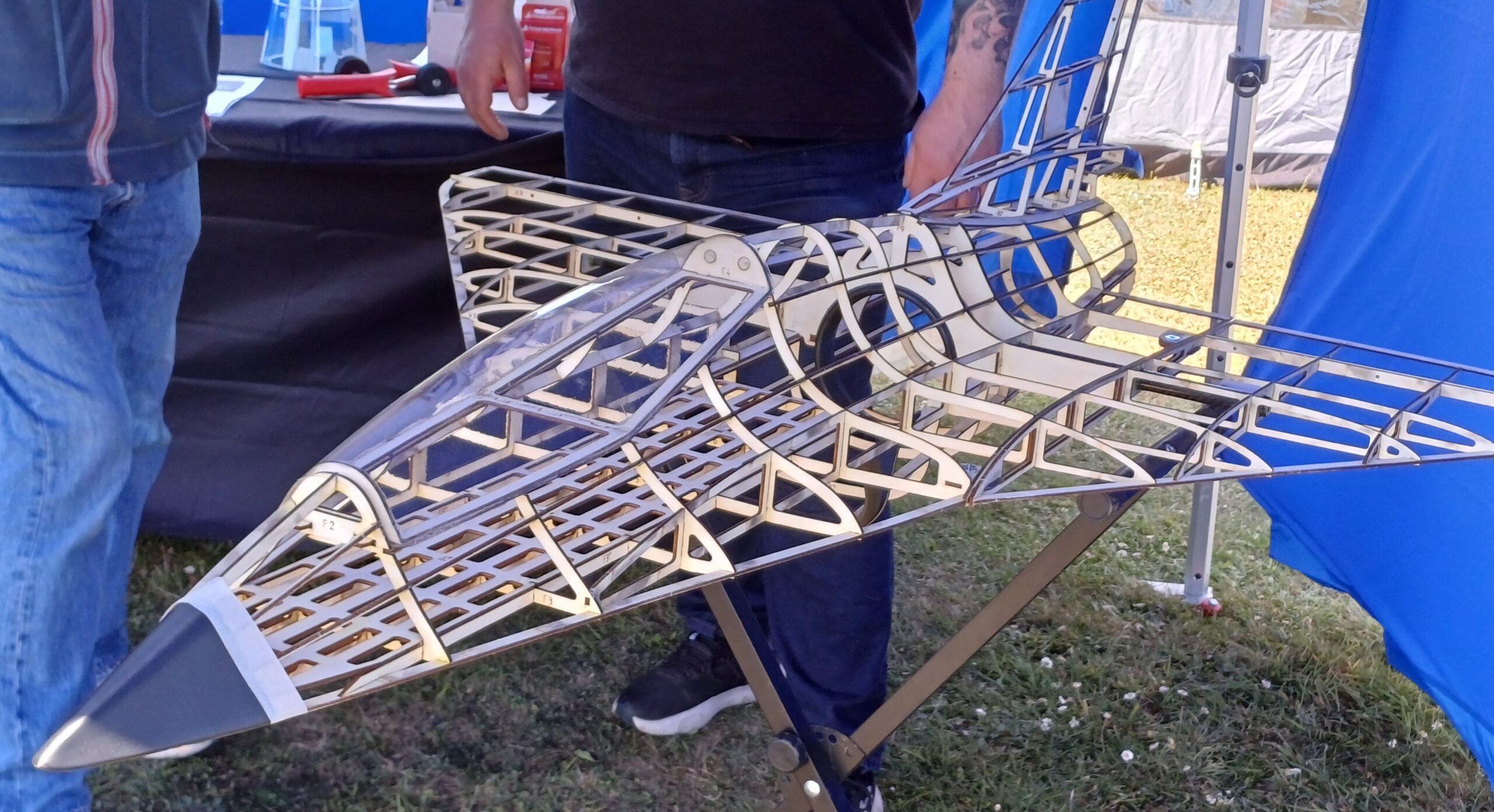
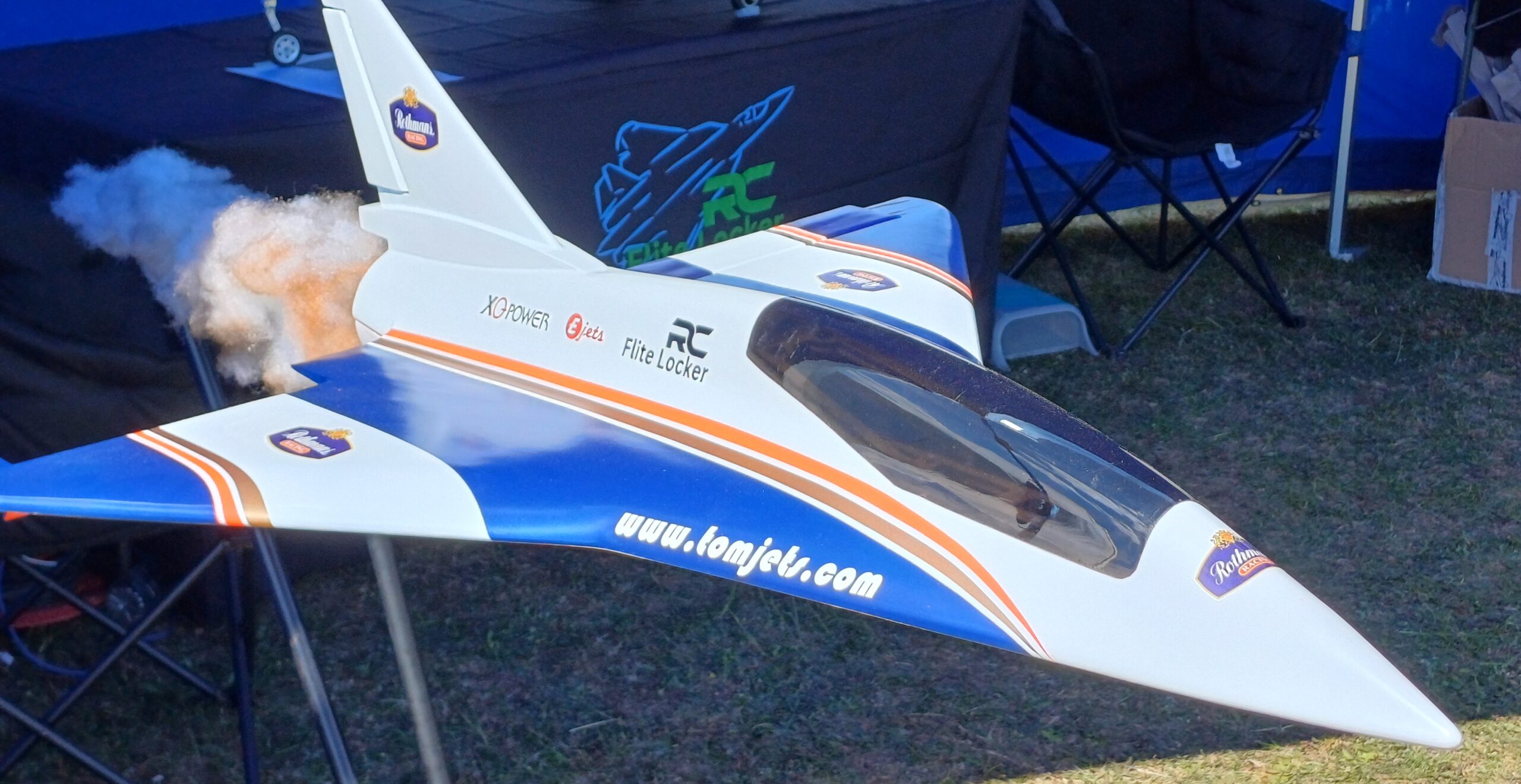
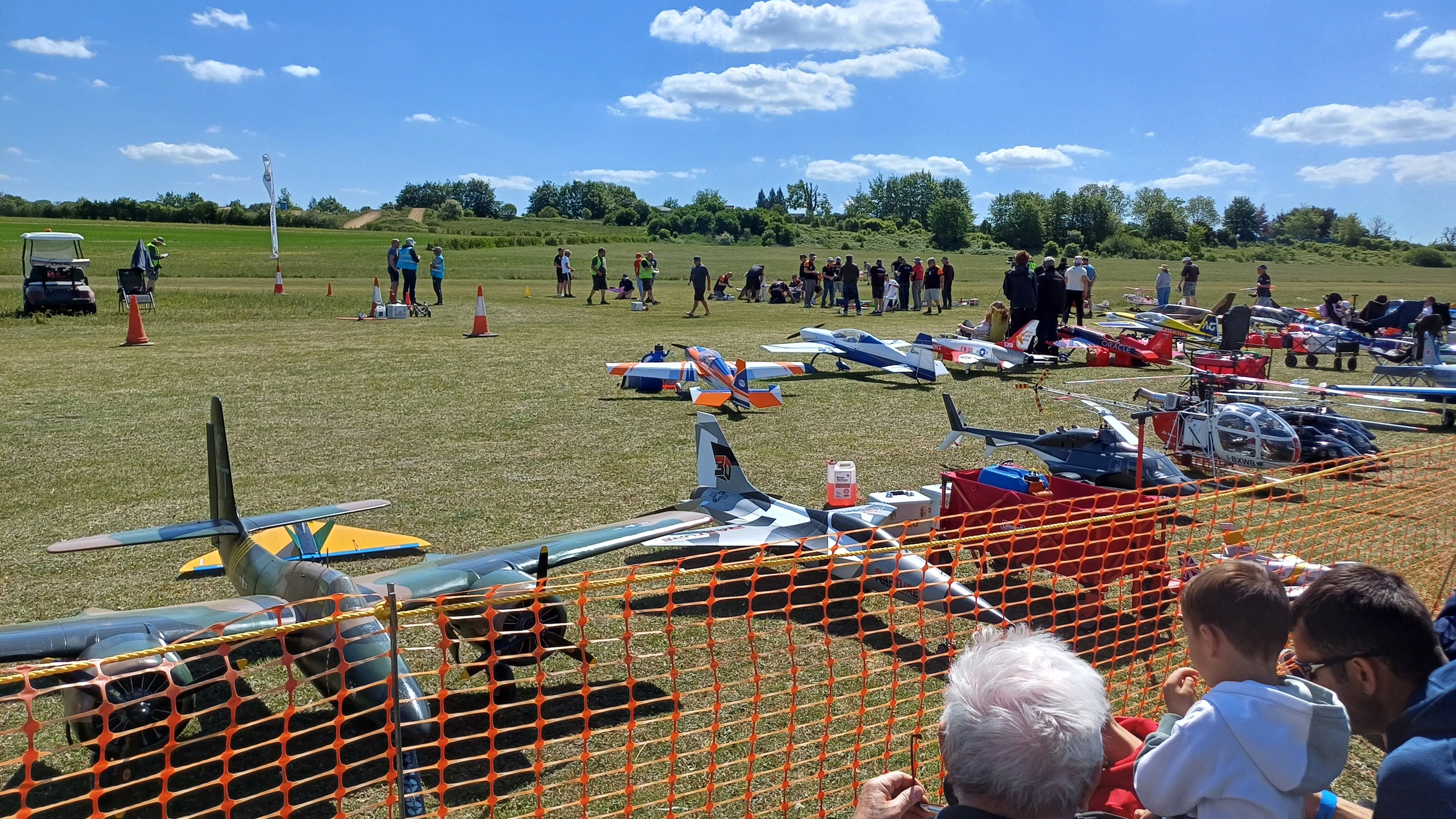
The Popham Model Show took place on the weekend of May 10th and 11th. Sadly I missed the show this year as I was away but several members went and reported it was excellent, with great weather and more trade stands than last year. Dougal Entendre took lots of photos for us, including one of some pilots, I have no idea why he concentrated on these!
 I’ll include some more of Dougal’s Popham photos towards the end of this Patch News. Dougal splashed out and left the show with a model, here’s his report: I picked up a Wasp E2K racer in the bring-and-buy at Popham, just like 1066’s red one, but this one’s blue.
I only paid £50 for it, fully equipped (bind-and-fly), so it was too good to miss.
I’ll include some more of Dougal’s Popham photos towards the end of this Patch News. Dougal splashed out and left the show with a model, here’s his report: I picked up a Wasp E2K racer in the bring-and-buy at Popham, just like 1066’s red one, but this one’s blue.
I only paid £50 for it, fully equipped (bind-and-fly), so it was too good to miss.
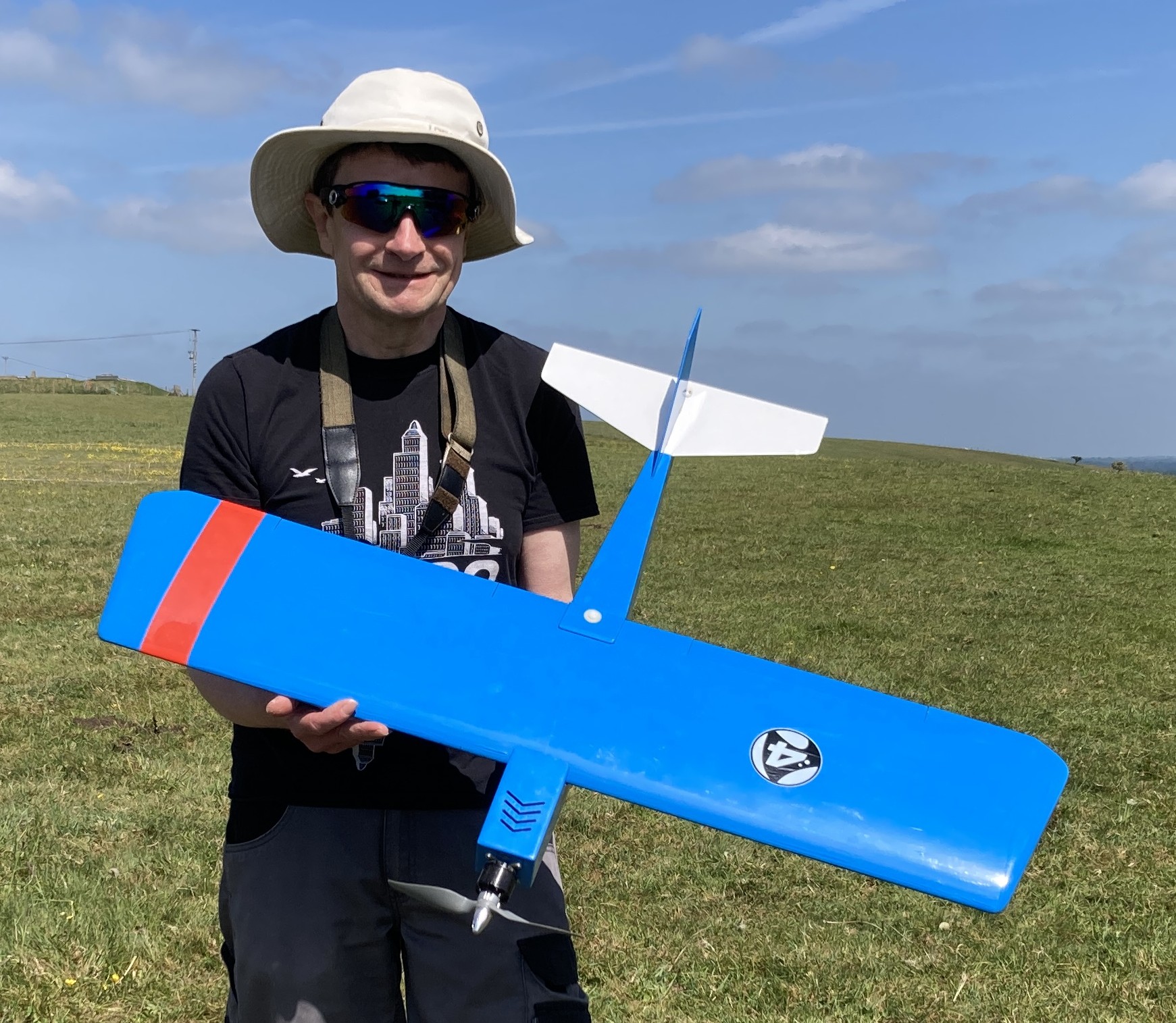 The drawbacks were relatively minor: a slight crack in one fuselage side near the LE, which had been well repaired, and the Rx was Spektrum! Also there’s no battery hatch, so it’s a case of removing the wing to change the battery, but it’s only one bolt.
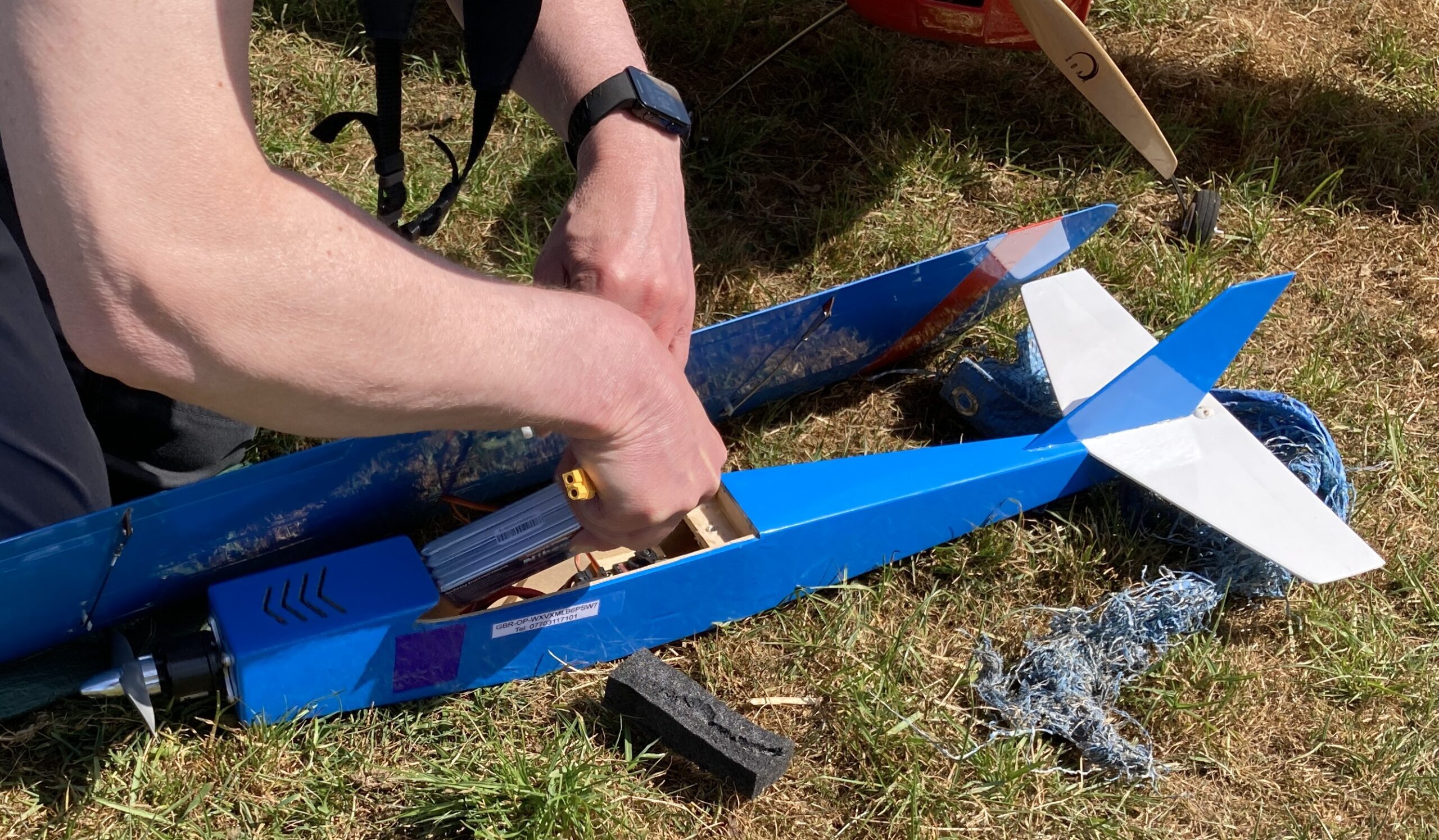 I added a stripe and decal to the wings, as I didn’t fancy my chances of retaining orientation with a plain light blue model! I bought a couple of Nihewo LiPos for it, 4s 2200mAh 100C, currently £47.49 for two on Amazon. I then bound my Radiomaster Tx to the Rx, set up quite small throws (as recommended by the seller), and was ready to go.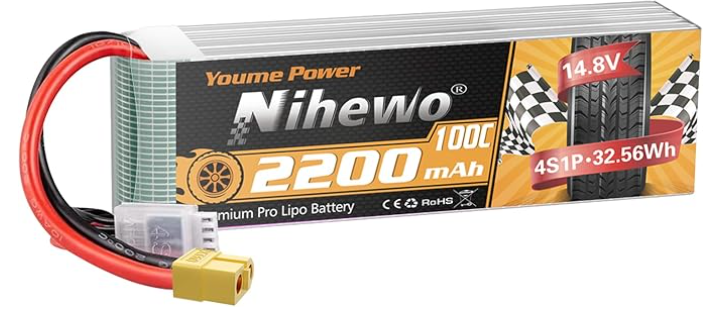
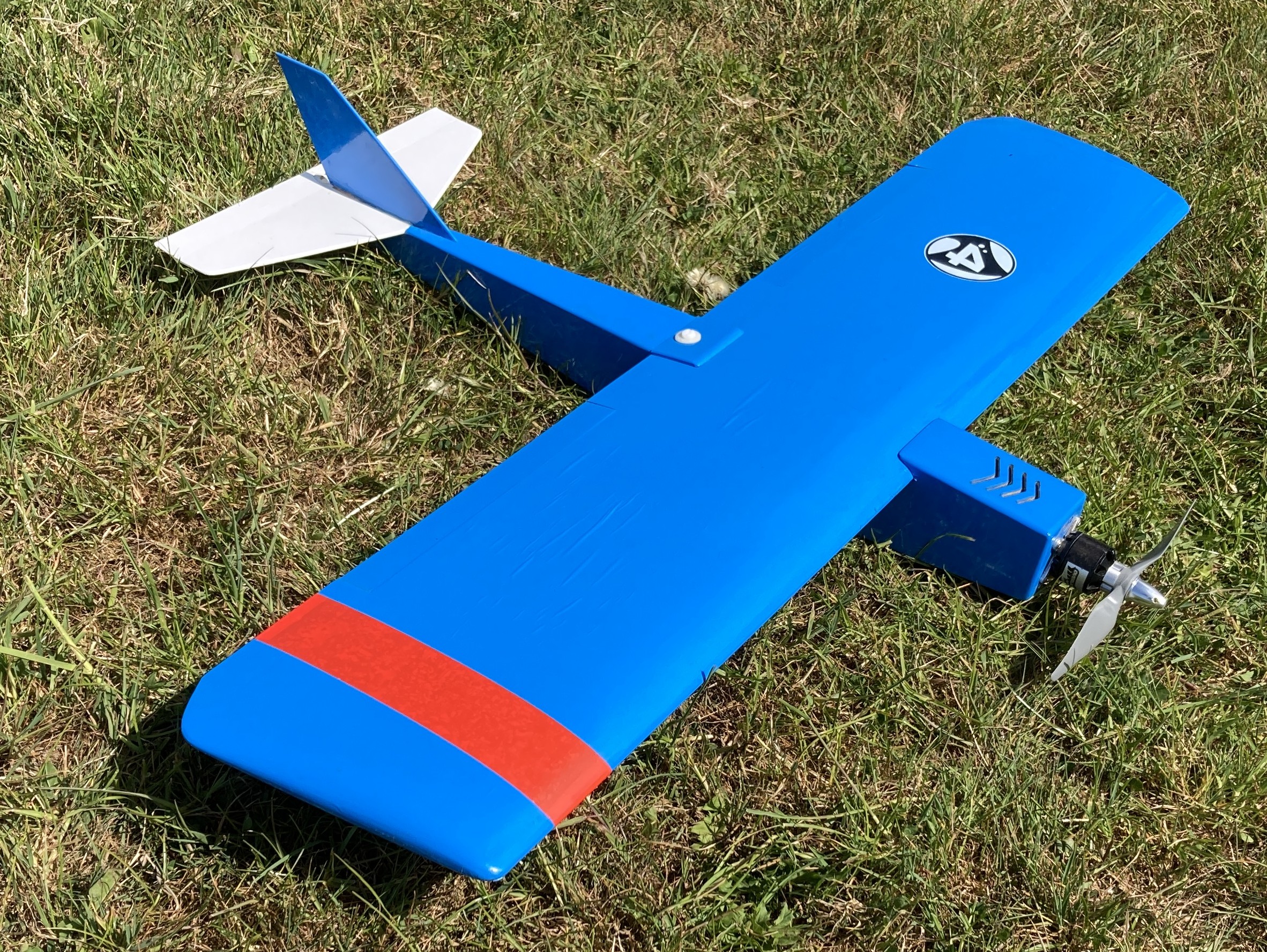 I went off with about 3/4 throttle to avoid torque issues. 1066 launched it and it climbed away rapidly, with only a little aileron trim required. Once I’d gained some confidence I opened up the throttle and listened to it whistle! No issues with the AR6210 Rx – it covered a lot of sky without any problem. It’s a big grin model for remarkably little cost.
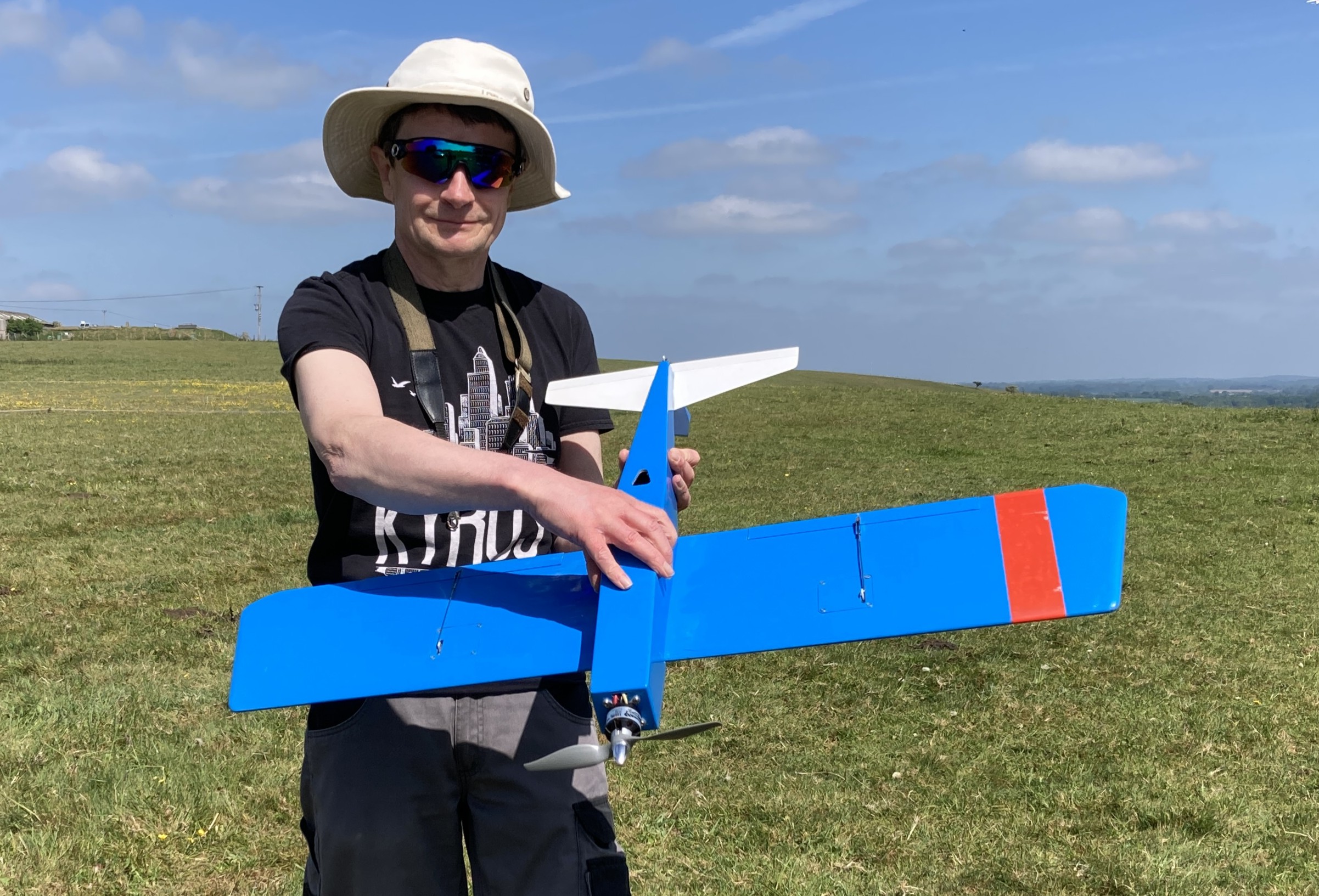 The motor is an Overlander T3536/05, 1500kV, with an 8 x 6.5 prop. The ESC is a Red Brick, but it’s glued in (what kind of psychopath does that?!) and I can’t read the label.
 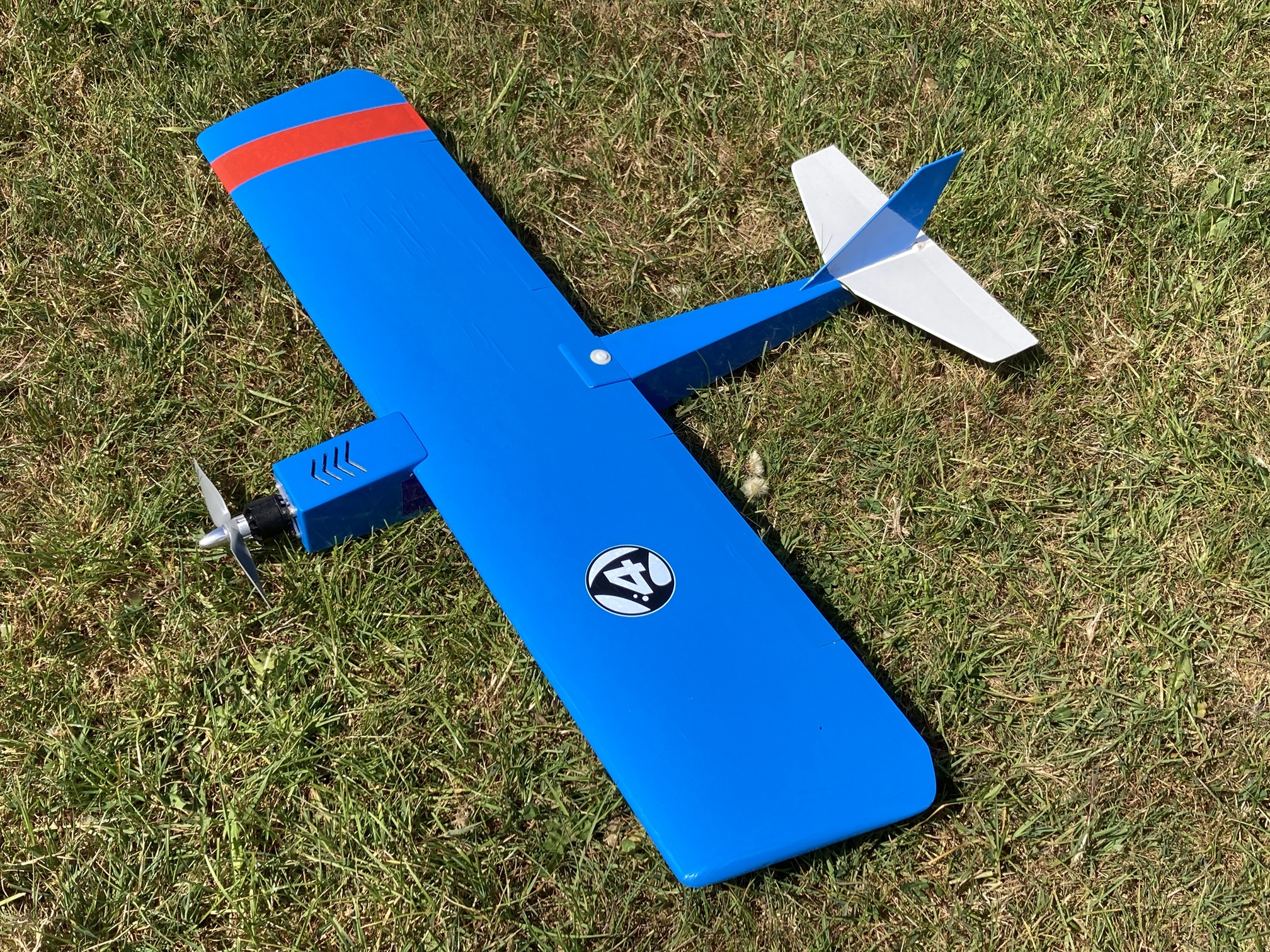 My first flight was 5 minutes, but I only had 10% left in the pack, so I dialled it down to 3 and a half minutes for the second flight, and came down with 33%.
Thanks for that Dougal, the Wasp certainly looks good, and fast flying in the video.
My first flight was 5 minutes, but I only had 10% left in the pack, so I dialled it down to 3 and a half minutes for the second flight, and came down with 33%.
Thanks for that Dougal, the Wasp certainly looks good, and fast flying in the video.
Another new model that flew in May was 1066’s Voltigeur. This is the second Voltigeur that’s been owned by a PAM member, the first one being Cream Egg, but I’m not sure that one is still flying, I seem to remember he had a rather ‘abrupt arrival’ a while back! I’m sure that won’t happen with 1066, he’s much more experienced with aerobatic machines.
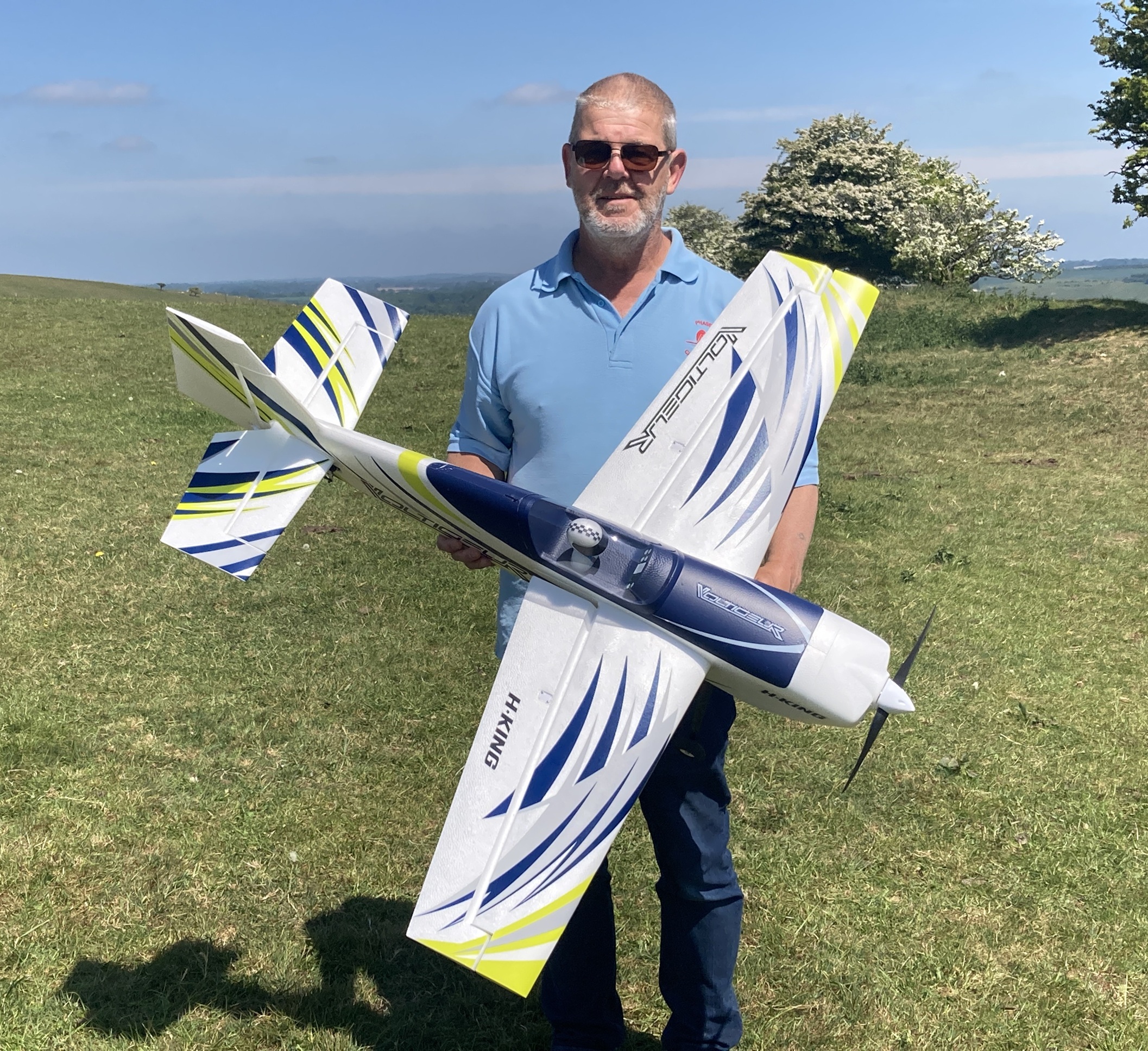 1066 bought his Voltigeur secondhand on Facebook Marketplace for just £125, a real bargain as the current new price is over £200. The plane was still in it’s box and 1066 thinks it has never flown. It was a case of being in the right place at the right time as the seller was within walking distance of where 1066 happened to be when he spotted the ad. The Voltigeur is a 1220mm wingspan EPO moulded 3D model from HobbyKing who say this about it: The Voltigeur is a well-known performer and we’ve just taken it to the next level. Flying the Voltigeur is a dream, using the recommended 3S Lipo battery for aerobatics and sports flying it handles like a trainer, docile, and extremely predictable.
 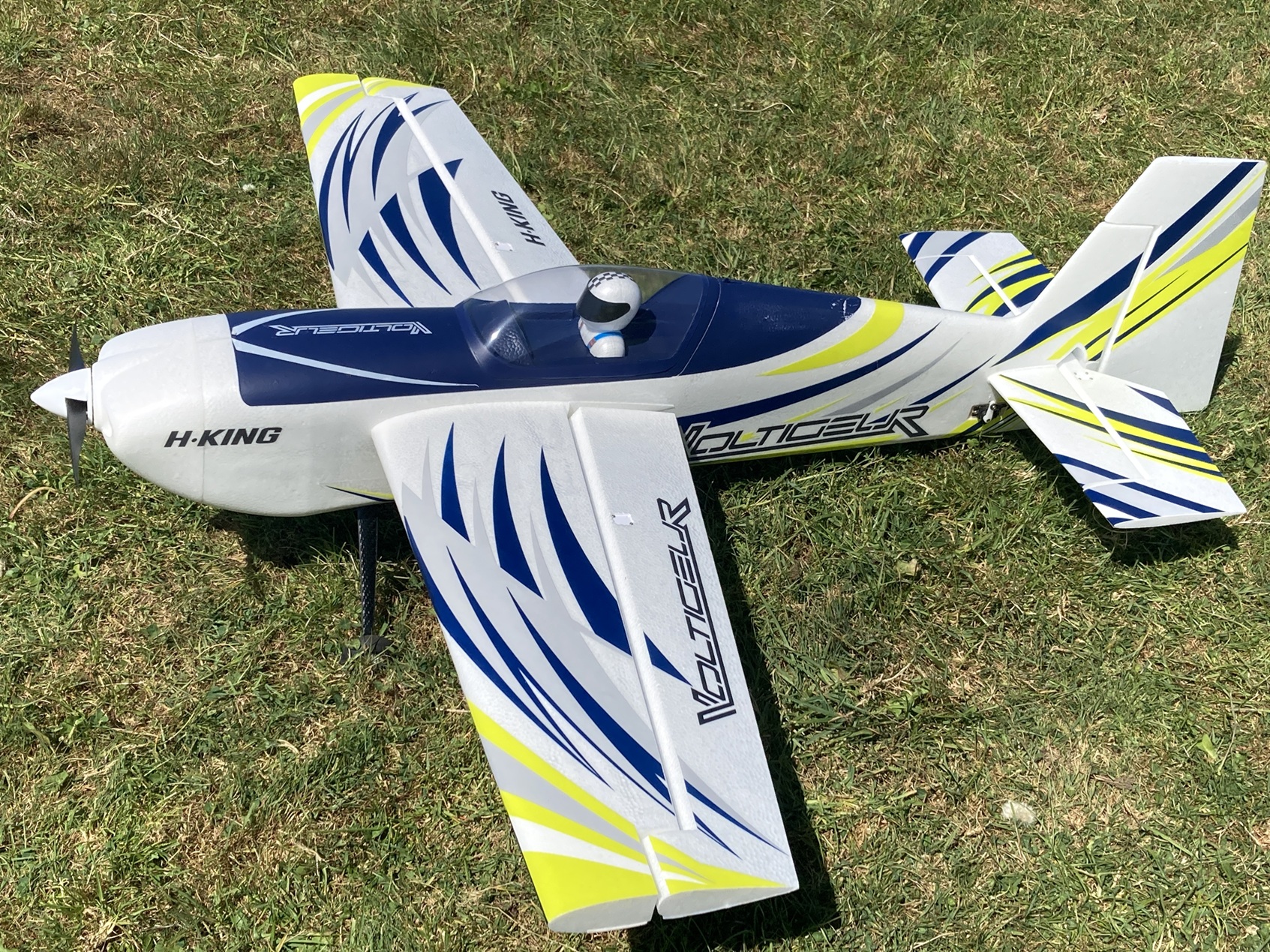 Everything from rolling circles, waterfalls, inverted harriers, and blenders, nothing will stop the Voltigeur. We have improved the drive train to provide even more power (1900g thrust), better efficiency, and cooler running with a 5% lower temperature). To help with the extremes of 3D flying the servo arms have been beefed up and the landing gear has been improved with carbon fiber legs. No more applying stickers as they are factory-fitted too. There is even a bigger, better ESC access hole for more airflow.
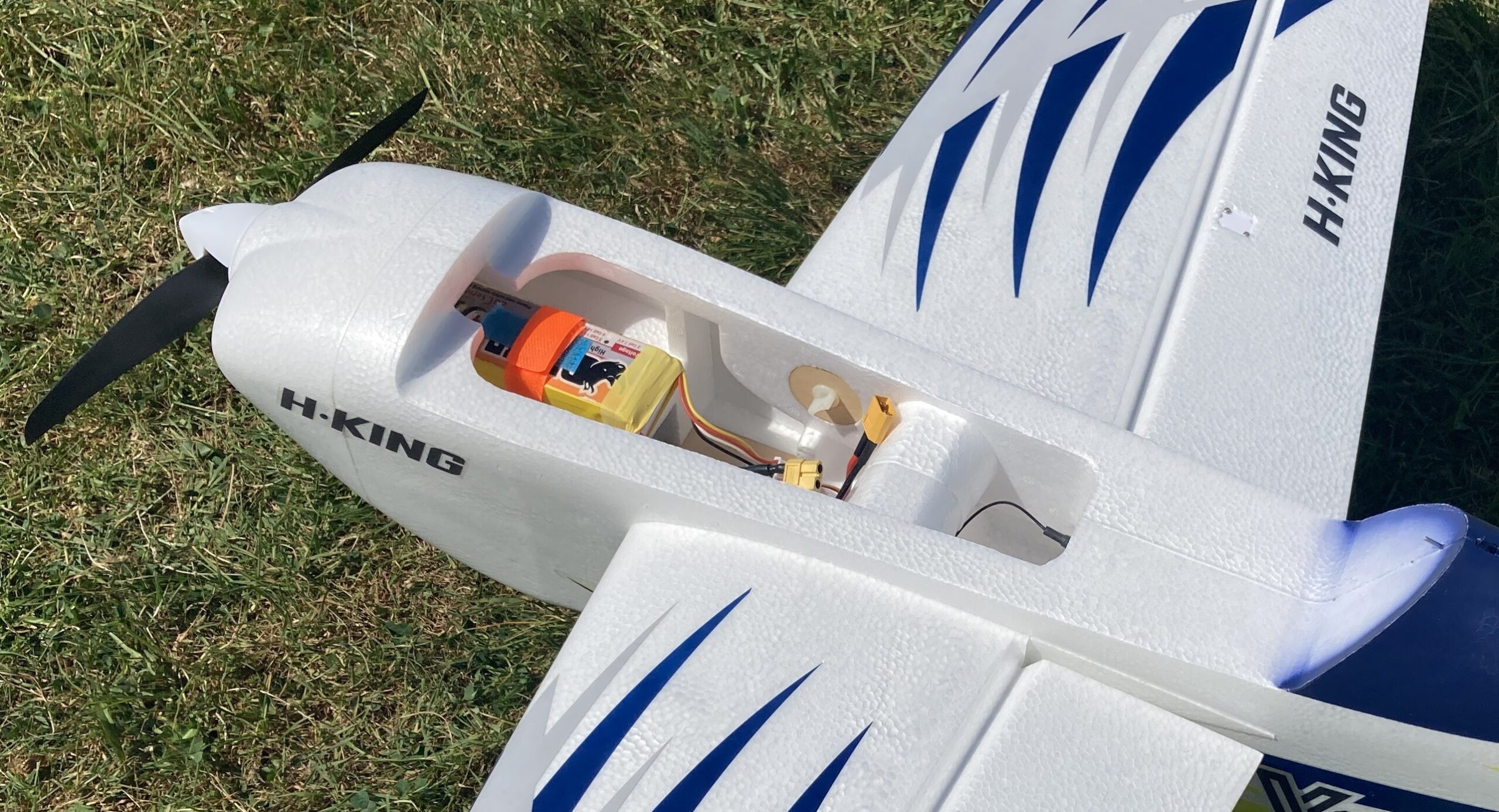 Want even more power? Then fit a 4S battery. You will notice straight away the extra speed and power, you’ll be able to use that extra power and quicker throttle response during your maneuvers. This added power will make your pop tops, rifle rolls, and all the extreme 3D moves that much more aggressive, ideal for experienced 3D pilots.
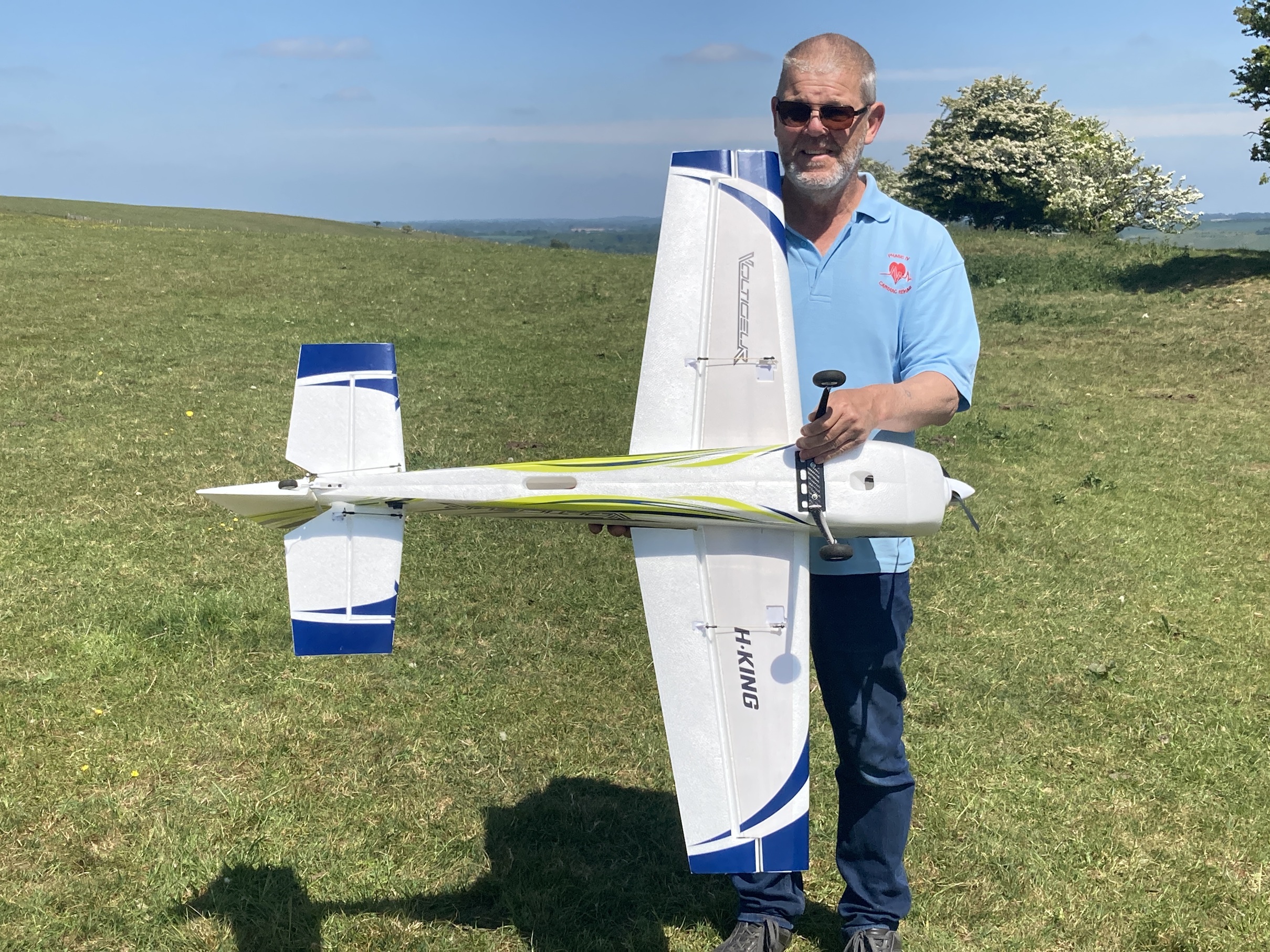
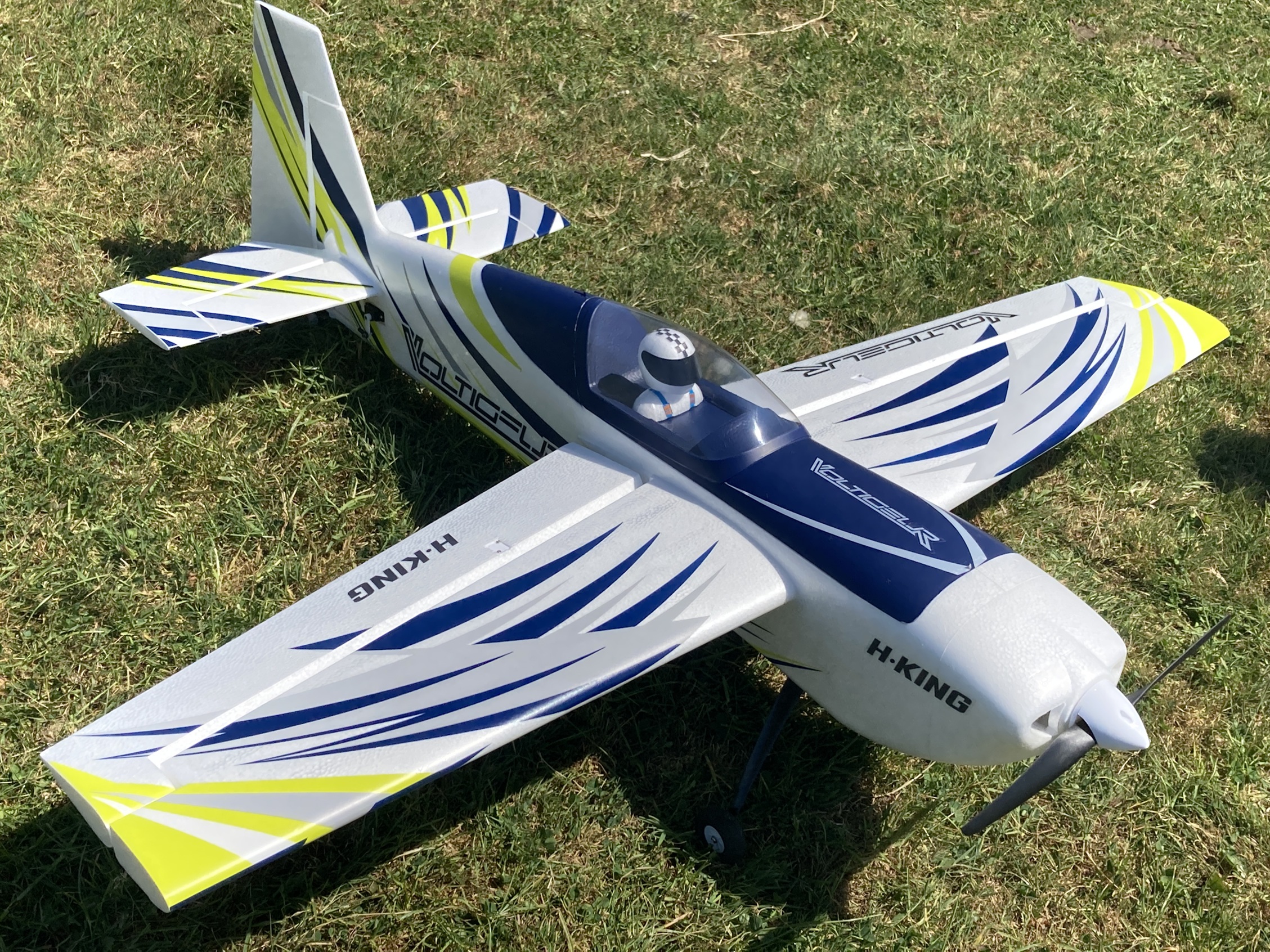 The Voltigeur is a true aerobatic performer and an extreme 3D flying machine. Construction is from lightweight EPO foam and features large control surfaces coupled with masses of power. Perfectly balanced with a mid-mounted full symmetrical wing, large battery compartment, composite glass fiber wing tube, metal gear high-speed servos all around, and all electronics pre-installed. Orientation is not a problem with the highly visible and unique color scheme. The HobbyKing info above is for the Mk2 version and 1066’s is presumably the Mk1 version. He is currently using a three cell lipo which seems to be enough judging by how the Voltigeur is performing in the video, it looks good.
Returning home from St Kitts we walked out and boarded the plane in bright sunshine but then, as we taxied out, the heavens opened and the rain was torrential as we took-off.
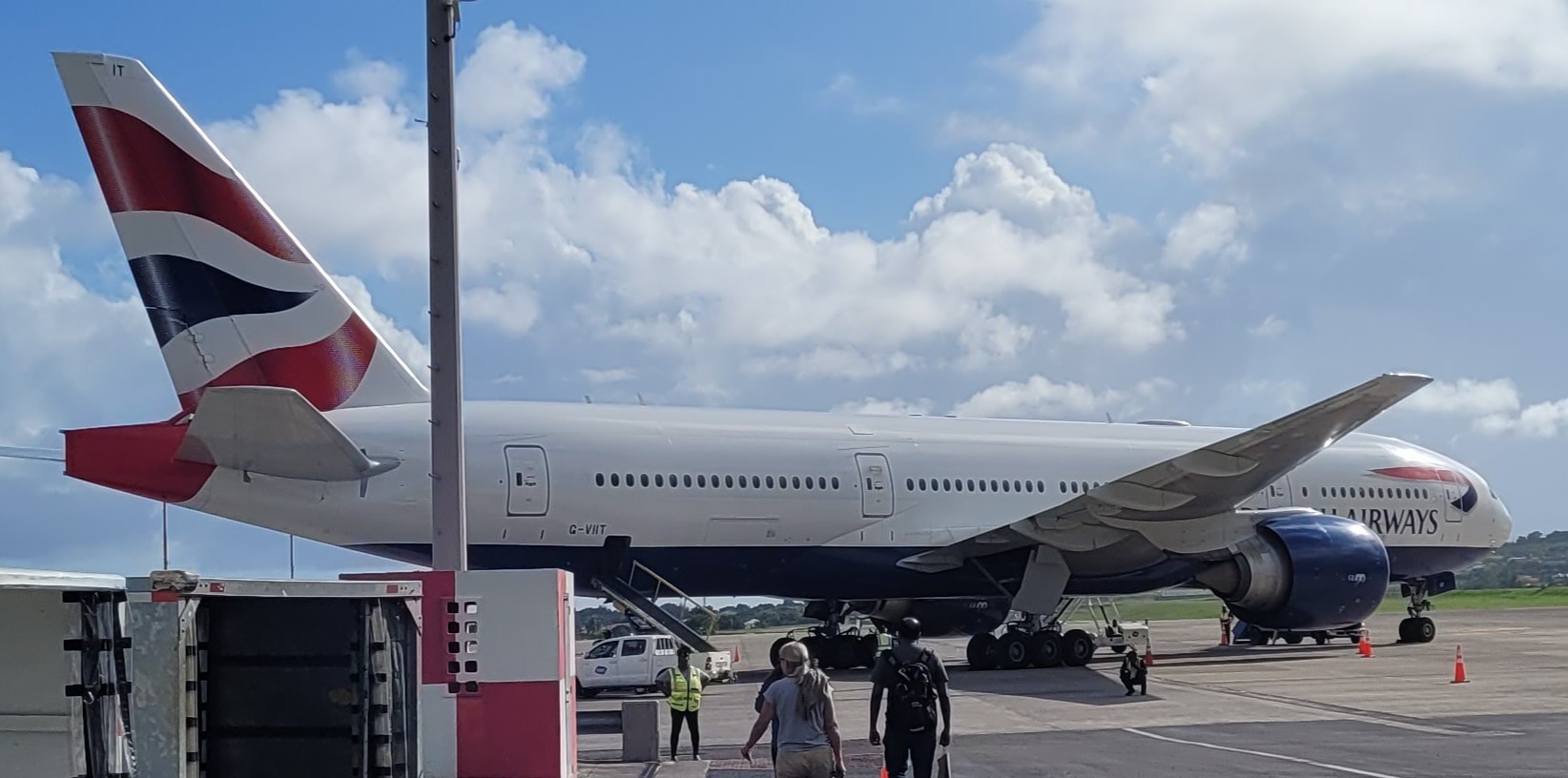 The first leg of the journey is just a short twenty minute hop to Antigua where we landed in sunshine. All the passengers stayed aboard while lots more got on, and the Boeing 777 was fuelled for the Gatwick flight. While we were on the ground I was able to visit the cockpit and was chatting to the crew when two British Airways maintenance guys turned up.
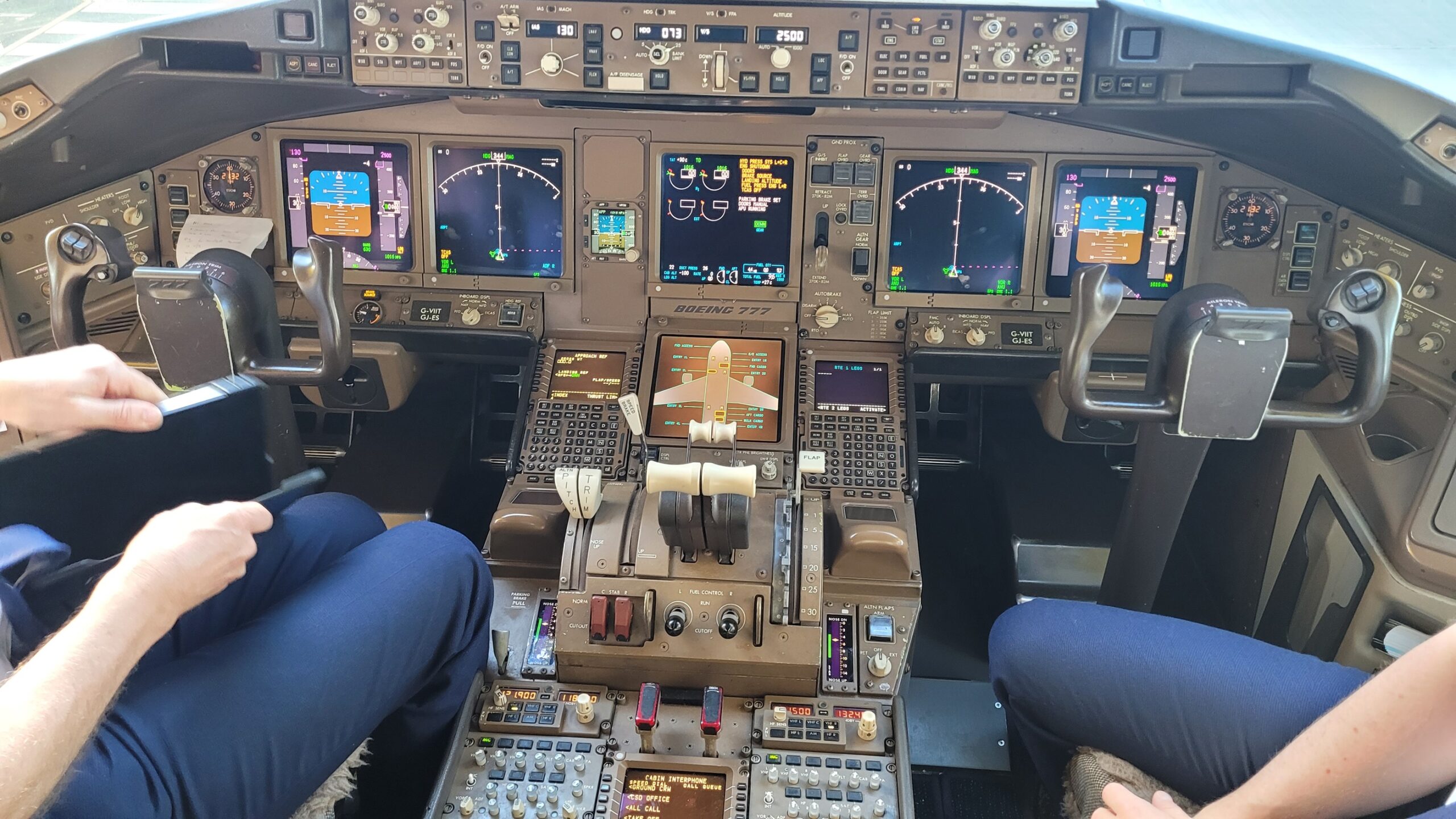 The Captain explained that the windscreen wiper on his side was rubbish and he couldn’t see a thing when we took-off but fortunately the Co-Pilot could! They then wound open the cockpit side window and a maintenance guy hung out of it and changed the wiper blade.
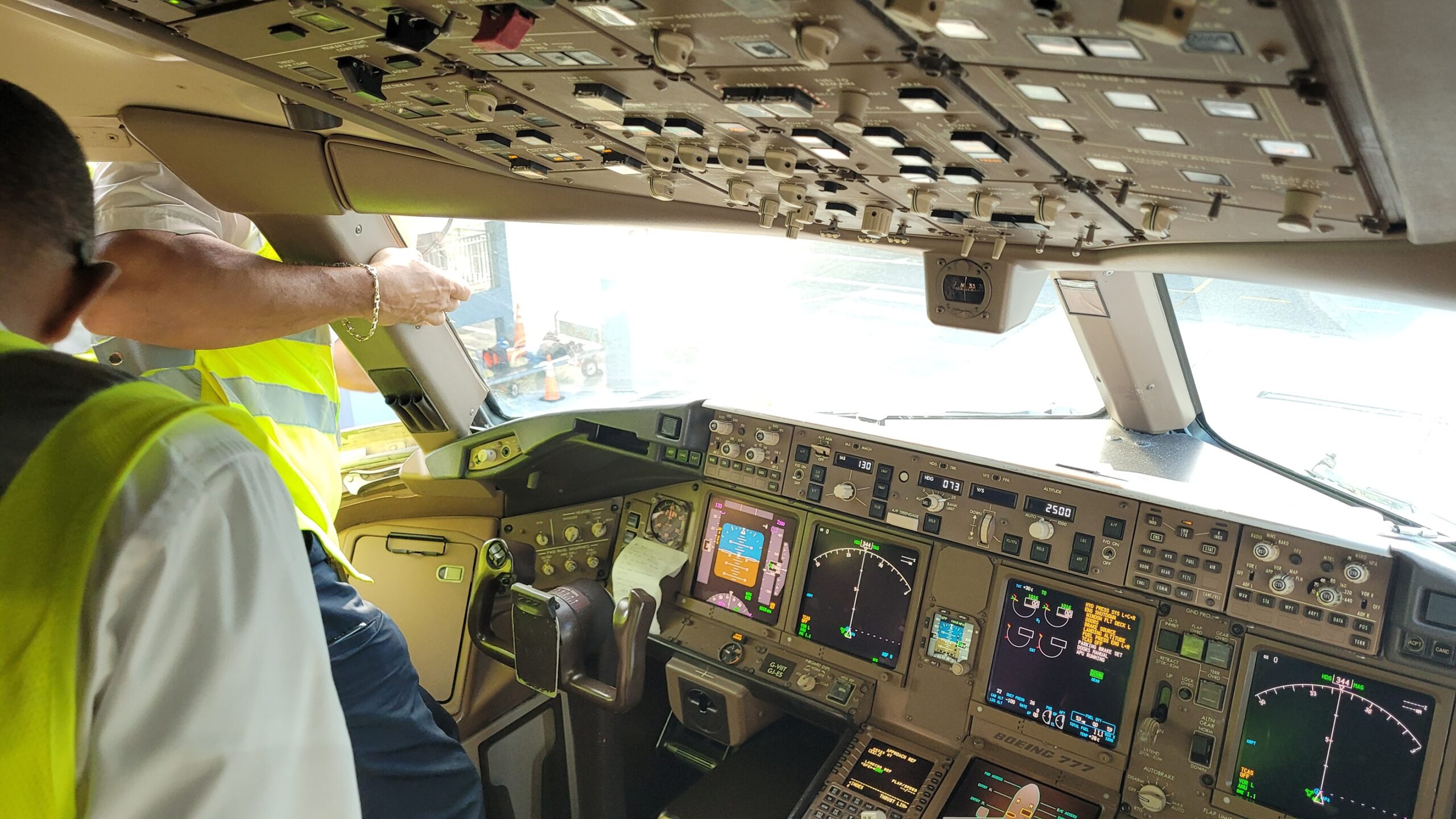
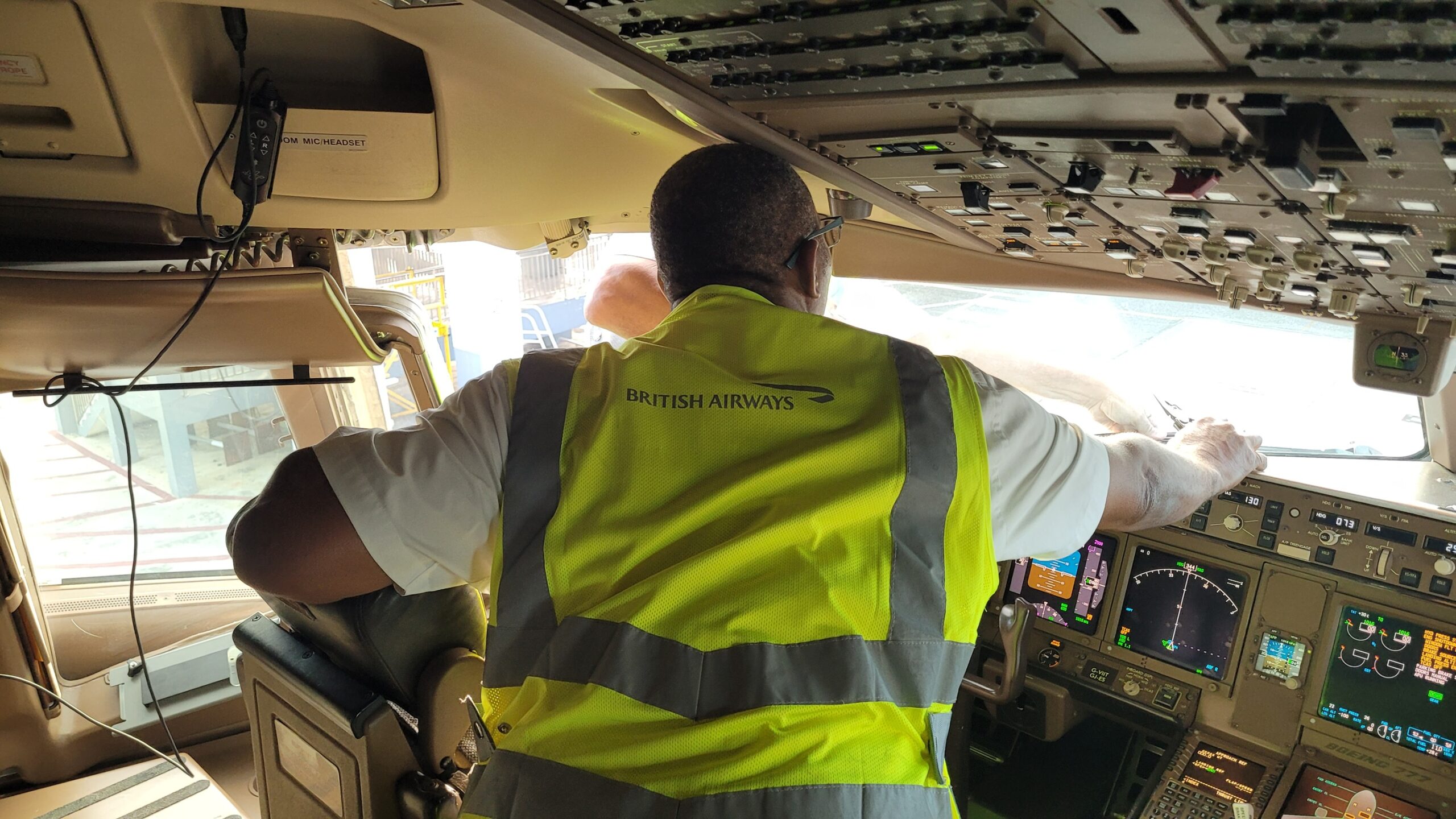 The Captain said if they had waited to change it at Gatwick if would have involved a cherry picker, a mountain of paperwork, and a delay! When they’d finished the Captain told me “Boeing made a great aircraft but they used windscreen wipers from an old Ford Fiesta!”
I was back home in time to test fly the last new model to fly in May, Woody’s XFly Glastar.
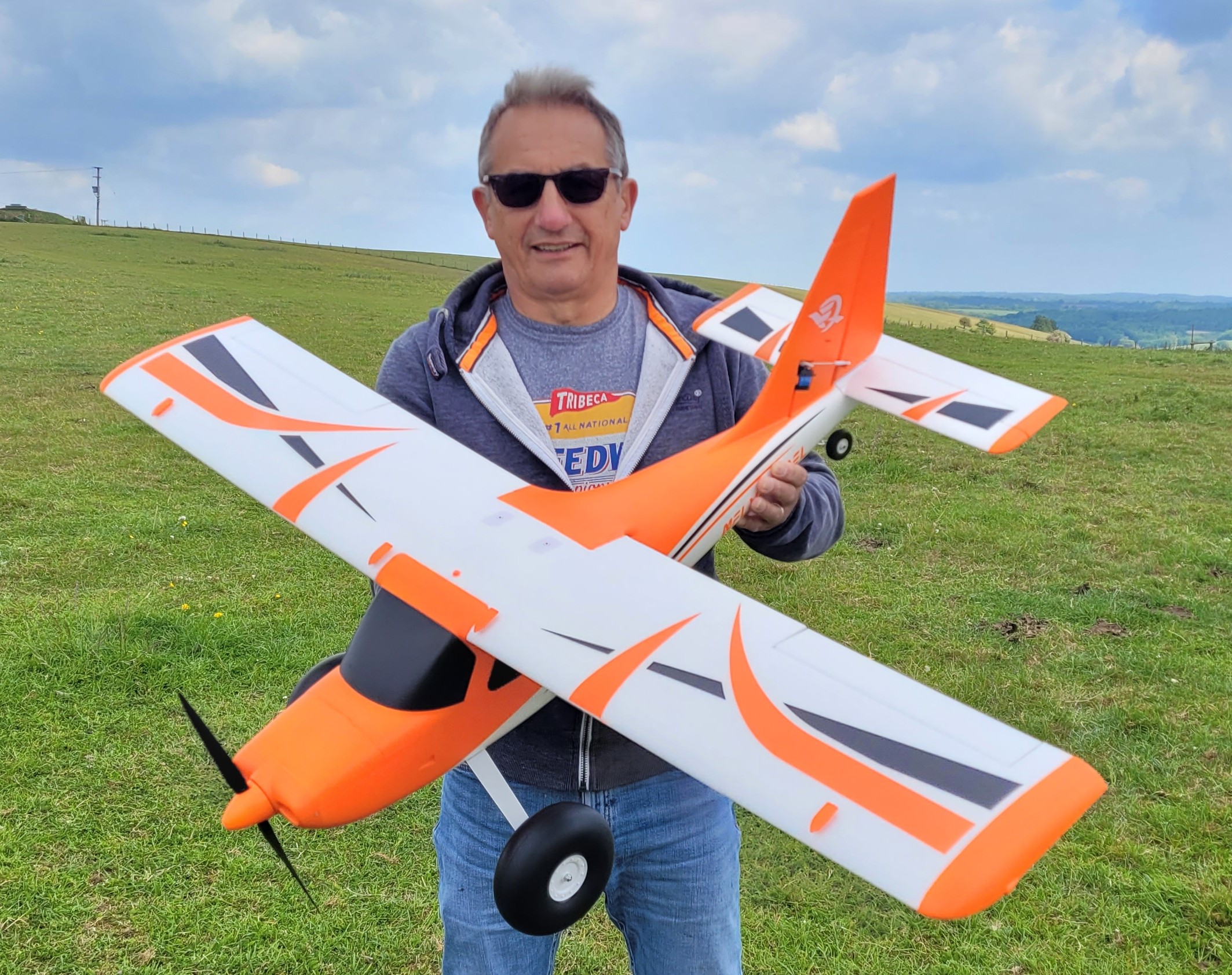 The 1233mm wingspan Glastar is a smaller version of the 1500mm span Tasman and other than the size they look identical, although the Tasman has flaps but the Glastar doesn’t.
 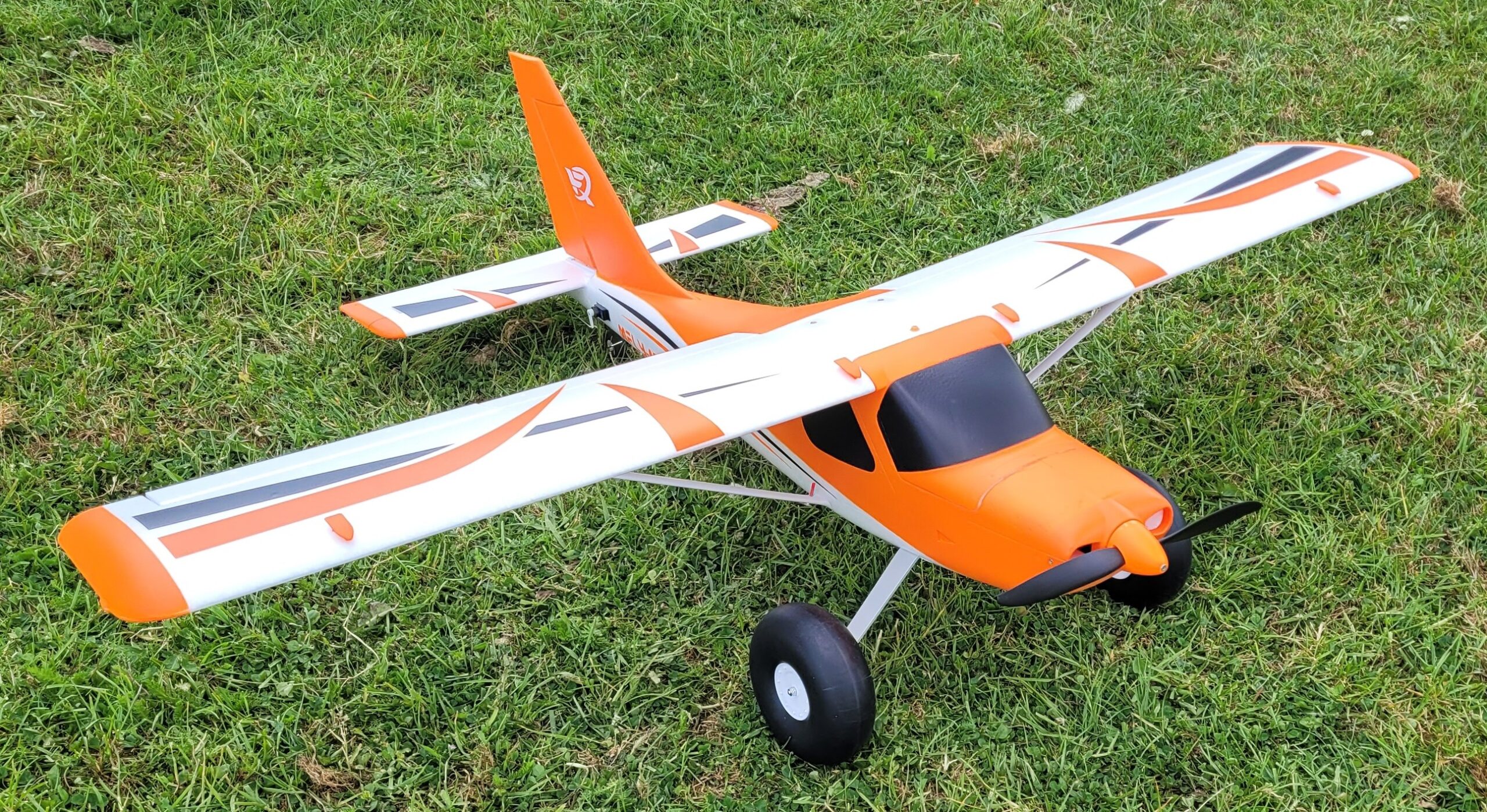 Both Bob the Builder and John Warren fly Tasmans and they appear to be excellent models. Woody’s Glastar is an attractive little model and it proved to be a delight to fly, no problems at all and I soon handed the transmitter over to Woody to enjoy it for himself.
It seems like an ideal model for our field with its large wheels and totally benign handling.
You can see how it flew on it’s very first flight in this month’s video.
Both Bob the Builder and John Warren fly Tasmans and they appear to be excellent models. Woody’s Glastar is an attractive little model and it proved to be a delight to fly, no problems at all and I soon handed the transmitter over to Woody to enjoy it for himself.
It seems like an ideal model for our field with its large wheels and totally benign handling.
You can see how it flew on it’s very first flight in this month’s video.
Instead of the usual ‘action’ shots here are some of Dougal’s pics from the Popham Show: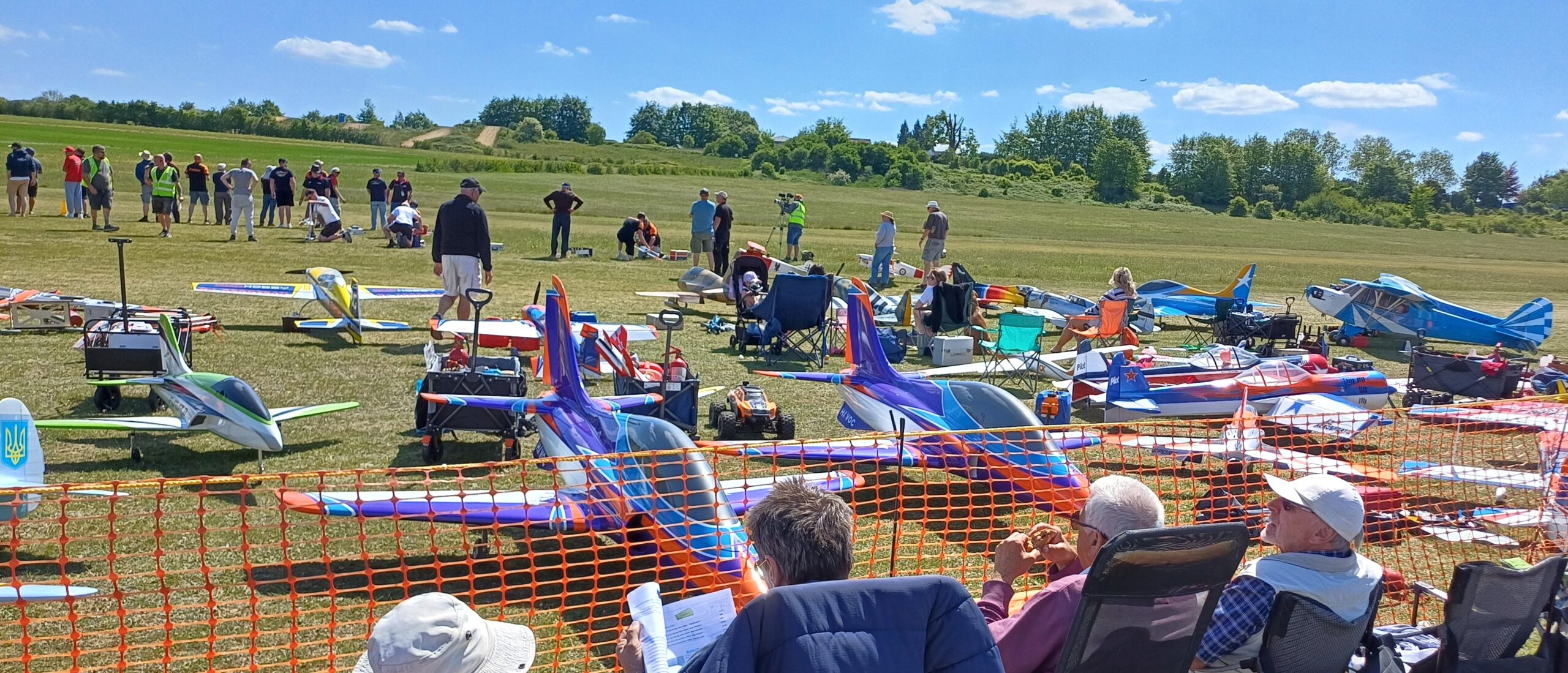

Video time now, this month with footage shot by MacFly, and Dougal Entendre. Please watch the video full-screen, it’s so much better with small models flying around: If the video won’t play for you please click HERE
Final Funny: When a British Airways Boeing 737 touched down at Frankfurt airport the Air Traffic Controller was obviously in a bit of a frivolous mood and he transmitted: “Speedbird 123. Nice landing Captain, but a little left of the centre-line I think.” Quick as a flash, the BA Captain replied in a cool, suave English accent: “Roger Frankfurt Tower. Perfectly correct. I am a little to the left of the centre-line. And my co-pilot is a little to the right of it.”
Colin Cowplain
Patch News – April 2025
This month’s Patch News will only include events of the first three weeks of April as I was away for the last week. But there’s lots to talk about, some flying and some non-flying.
The month began with gloriously sunny but windy weather, exactly as March had ended, and it seemed to continue for ages. The strong wind was from the east so it was perfect for the MVSA slope soarers and they were flying at the same time as us on several occasions.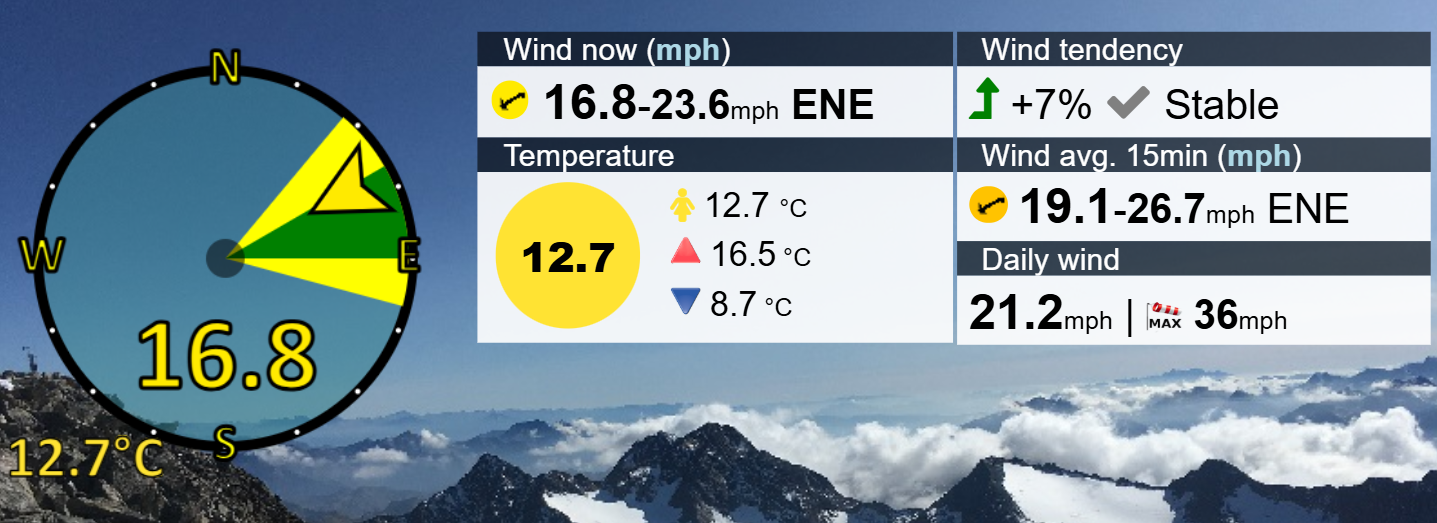
But of course the wind was also in the right direction for the Sky Surfers with their paragliders and hang gliders. Fortunately, most of the time the wind was too strong for them, especially the paragliders, so we didn’t have to stop flying too many times. As I said last month, they seem to stand around a lot, threatening to fly, often with their wing inflated, but not actually take flight. I can see their point, if we take a chance and fly in unsuitable winds, we might break a model but the only thing that gets hurt is our pride.
A bigger problem was the herd of bullocks in the field which was a much larger herd than we are used to. They had slightly damaged the electric fence once in March and, having repaired it and watched them touch it and back away, we thought our troubles were over.

 But in April they trampled over the fence several times. We changed the wire to a different type but it made no difference, they still wrecked it. There was lots of discussion about the reason, was the cause the old batteries or was the energiser reaching the end of its useful life? We couldn’t be sure so, after the fifth time of arriving to find the fence down and damaged again, the decision was made to replace the batteries, earth rod, and energiser.
These were quickly purchased and on April 12th four of us installed all the new gear.

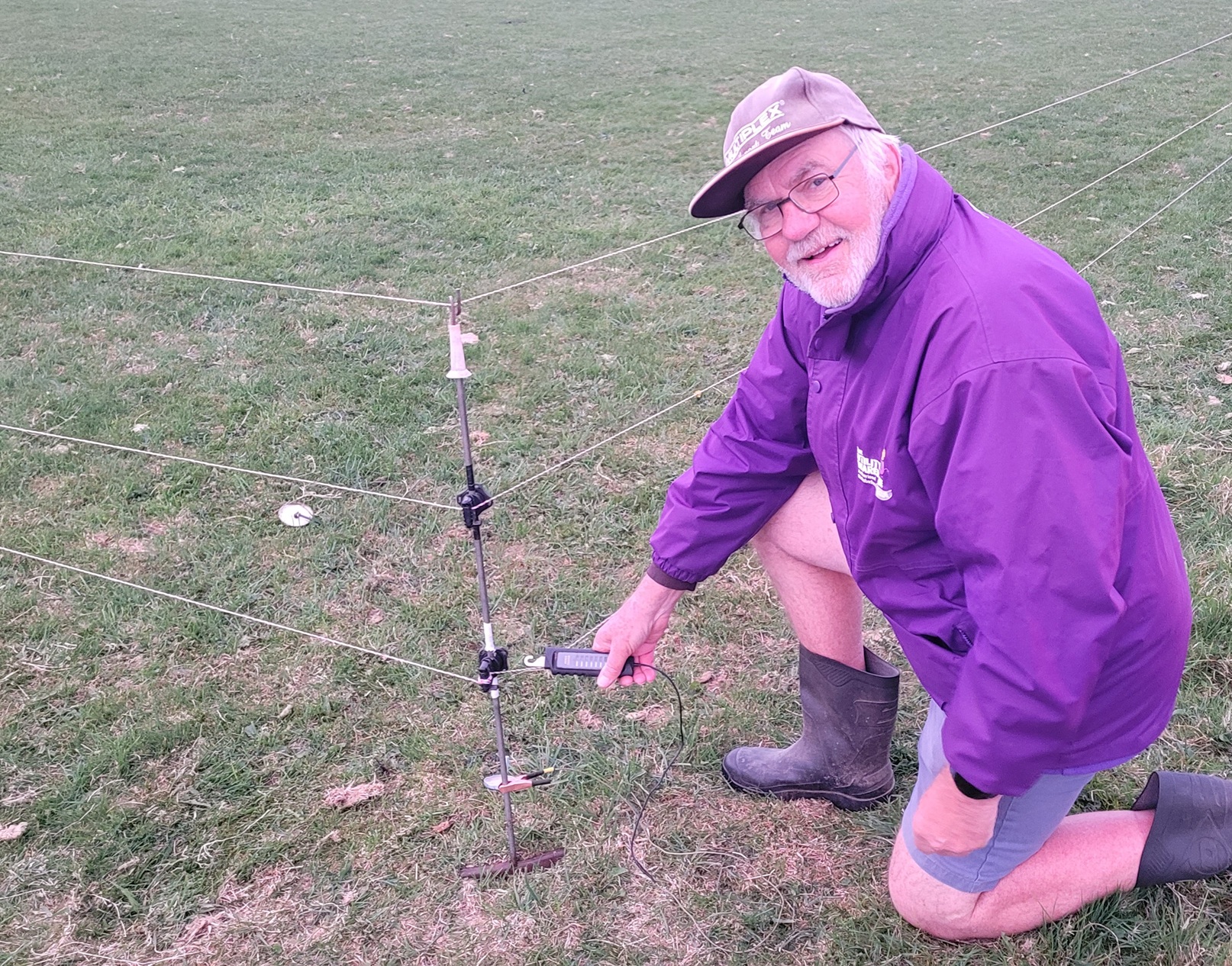
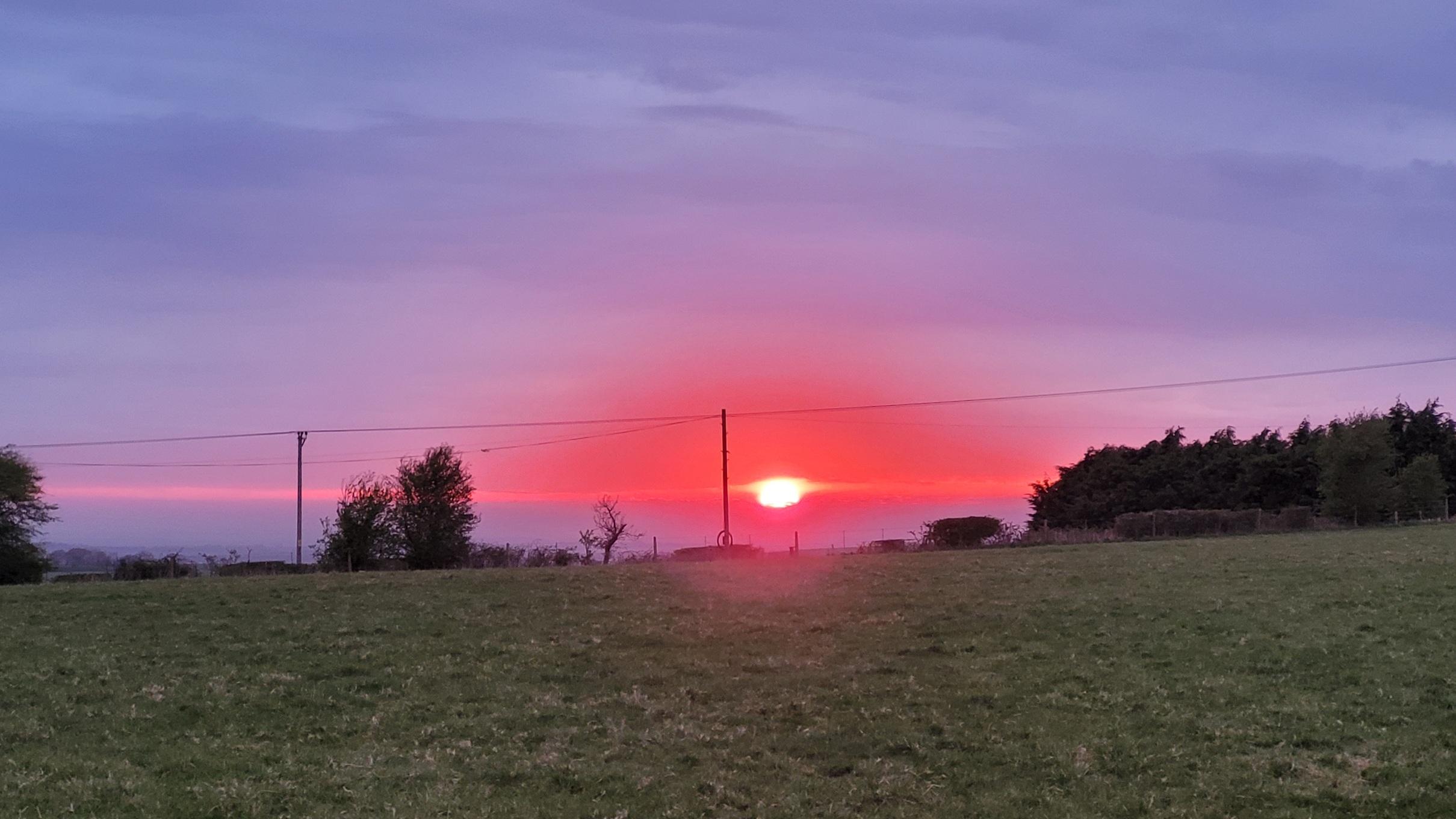 We were treated to a glorious sunset as we finished the work. By then the bullocks had been moved on to fresh pastures, but when we flew on the 20th a different batch were in the field and the fence was untouched so it seems the new gear has done the trick…hooray!
Last month’s blog went live on 1st April so I felt obliged to include an April Fools piece. But almost nobody seemed to spot it, the only ones who mentioned it were 1066 and Page Boy. So what was it? There was a photo that I said was taken from the video with the comment that Page Boy and Mini Mike’s Avantis had flown towards each other and had a near miss.  But if you watched the video you would have seen that the two Avantis were never even in the air at the same time, let alone close. Also, in the write-up I said ‘it must have been Mini Mike’s fault as he was feeling a bit under the weather at the time…poorly lad, as if.’
Well ‘poorly lad as if’ is an anagram of April Fools Day. Mini Mike told Page Boy that he didn’t remember the near miss so Page Boy explained it to him! 1066 posted a comment on the blog about it being foolish to not fly circuits but nobody picked up on that either!
Lots of new models turned up to fly in April, especially when the strong easterly winds had been replaced by more favourable conditions. First up was Mini Mike’s new Electro Streak. 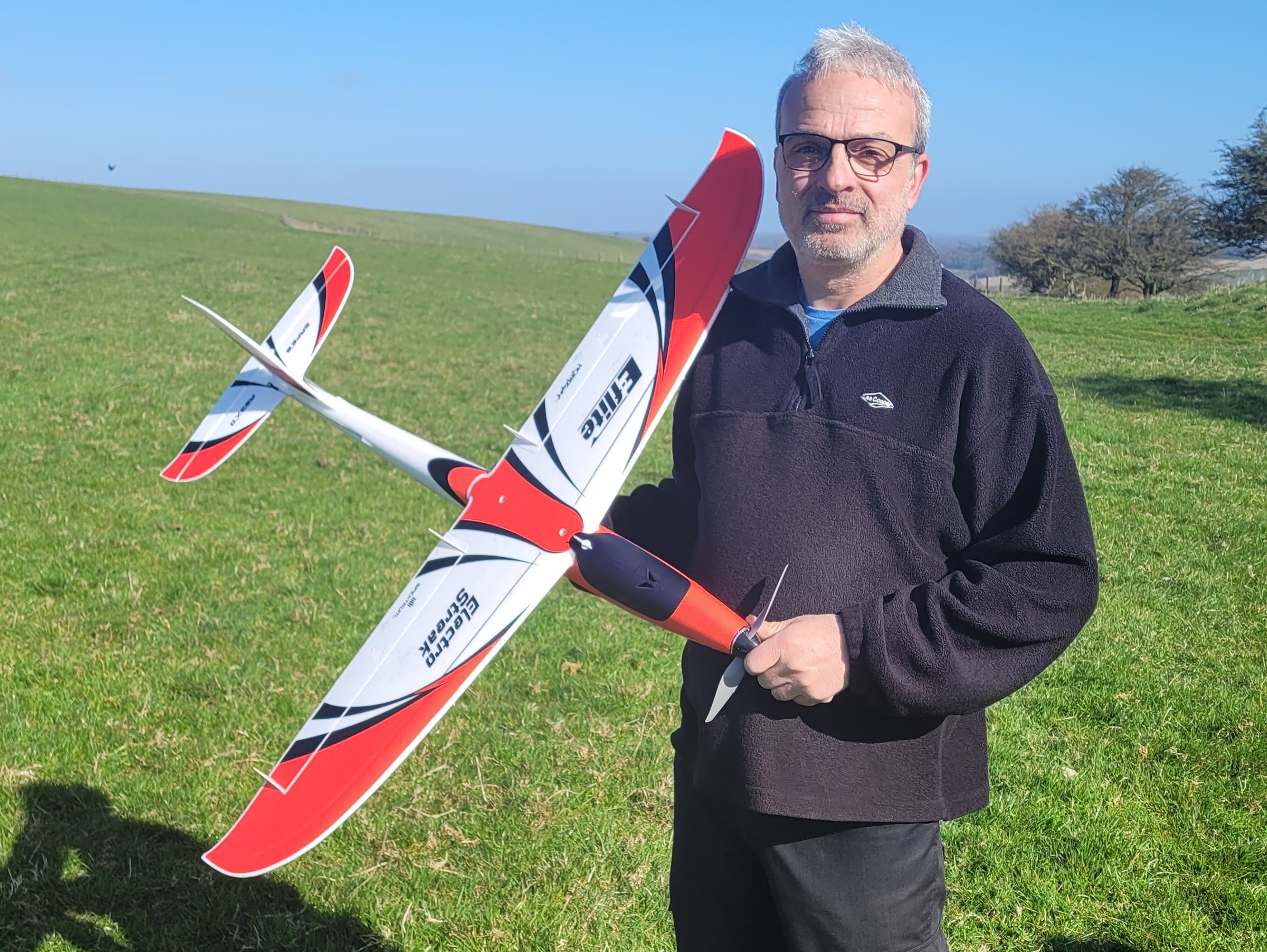 Mike has had a series of Electro Streaks over the years, going right back to the original early balsa ones but this one is an all-foam creation by E-flite which can use either three or four cells. On its first outing he flew it on a three cell lipo pack and it went well but Mini Mike decided he could do better, so for the next outing he switched up to a four cell pack.
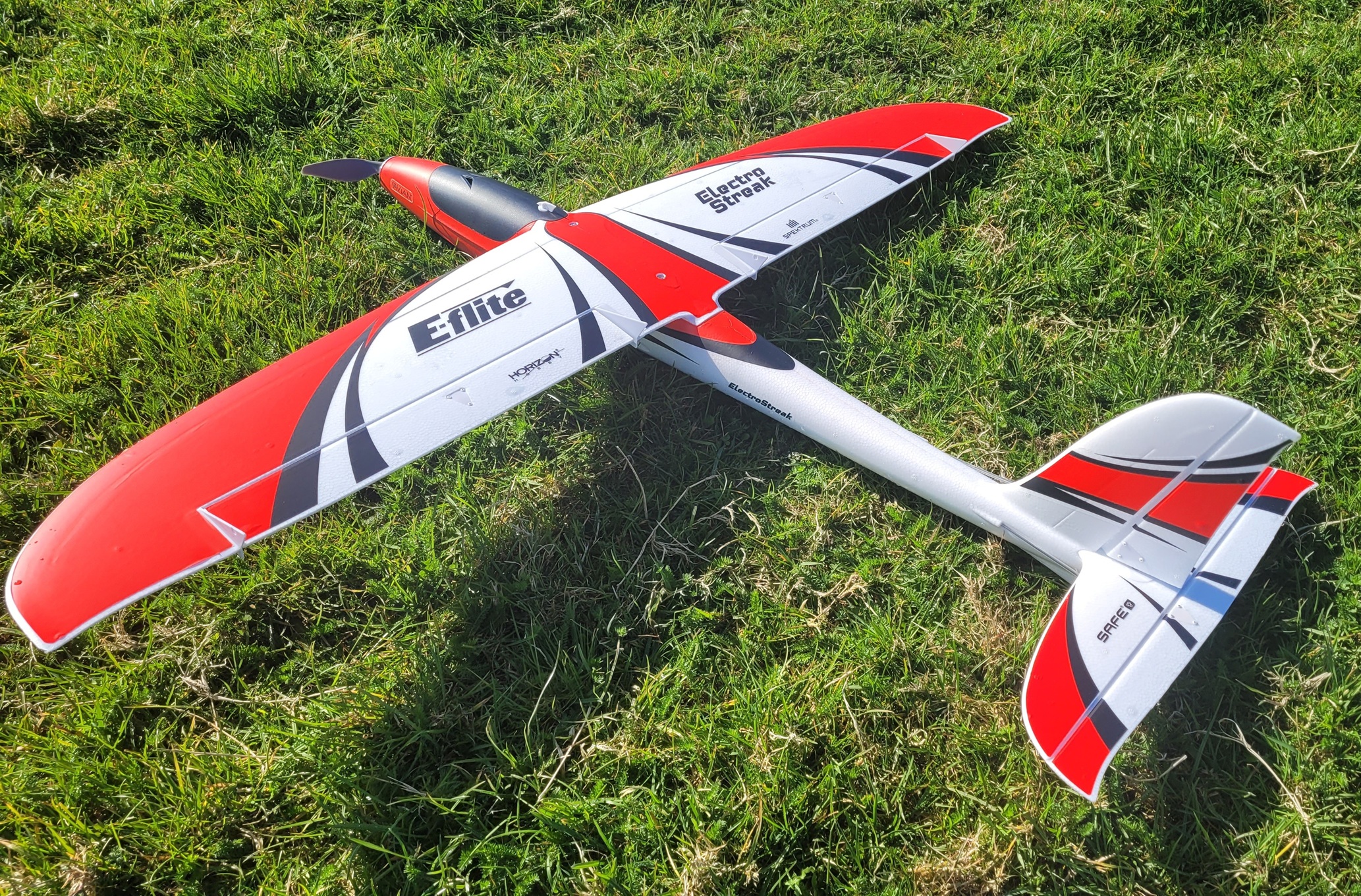
 It certainly shifts around the sky when flat out and I didn’t bother trying to film it, but you can see how it went on the rather cautious first flight on three cells in this month’s video.
Dougal Entendre retired his ancient Slick last month after the much weakened undercarriage parted company with the fuselage yet again. Dougal said there was nothing left to glue it back to in the lightly constructed fuselage, so after years of faithful service it’s flown it’s last. But some time ago Woody had sold an Edge 540T to Dougal when he decided it was too much of a handful, and Dougal had just lost his own identical Edge in a midair collision. So in April Dougal brought the Edge out of retirement to fly again.

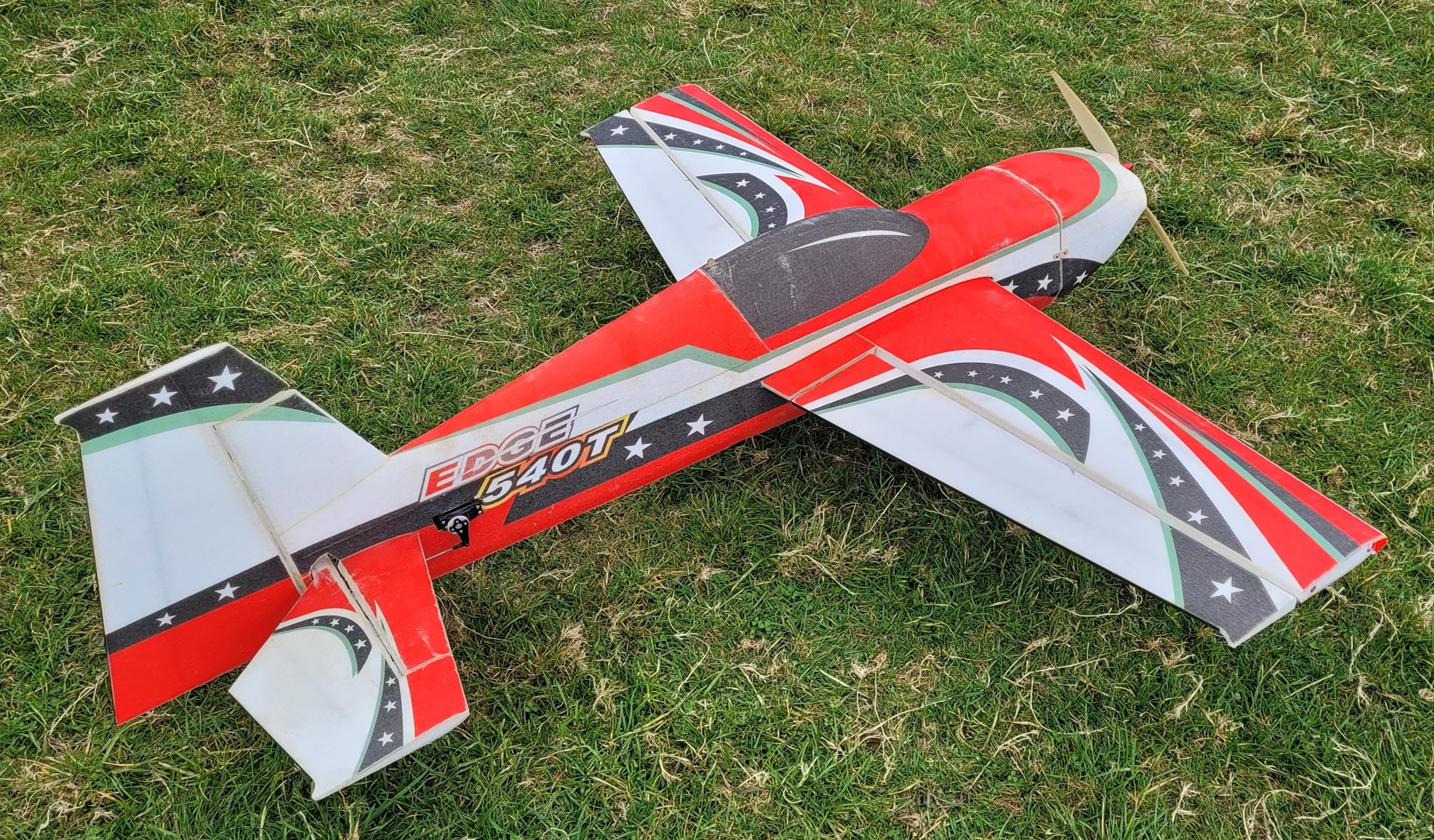 The Edge is one of a now discontinued range produced by HobbyKing that was made of a lite-ply skeleton covered in EPP foam so the model is very light for its 1430mm span.

 The motor is a Turnigy Aerodrive 4250 500kV which is coupled to an 80A speed controller. Amazingly the 14” propeller on Dougal’s previous Edge had survived the midair collision and he is using it on this one. He mostly flies it with a five cell 3000mAh pack but he only has two of those so if he wants a third flight he uses a Y-lead to put two three cell 2200mAh packs in series (equivalent to a 6 cell 2200mAh pack) and says there seems to be no difference in performance. You can watch the performance in this month’s video.
Some of you will have seen Norwegian Nick’s E-Shark at the club EGM in late February. At the time it had not been flown and April was the first opportunity Nick has had to try it.

 As usual Nick had made a lovely job of the building and covering. The plan for the E-Shark is available from Sarik Hobbies and this is what their website says: This is a simple sports or slope (using a folding prop) 41 in. span model design by Graham Dorschell built up from 5mm Depron using the ‘folding wing’ method, with some balsa and Correx board and using basic tools with two 9g servos for delta mix. With just a few parts to cut it turns into a quick model to fly with a 35mm 1500KV brushless motor, 60 Amp ESC, 8″ x 6″ prop and a 3S 2200-3000 mAh LiPo. It sounds good to me, a simple, cheap, small model to chuck in the car for flying at any opportunity, what could possibly go wrong?
  Unfortunately, quite a lot as it turned out. I was flying so I missed what happened on it’s maiden flight, I just saw it going away from the launch but that was all. The next thing I knew was that it had come down somewhere in the distance and Nick had gone off to retrieve it. Sadly the E-Shark had literally crashed and burned and eventually Nick returned with some very charred remains. I’ve no idea what caused the crash but the battery obviously got damaged in the impact and destroyed the rest of it, a great shame.
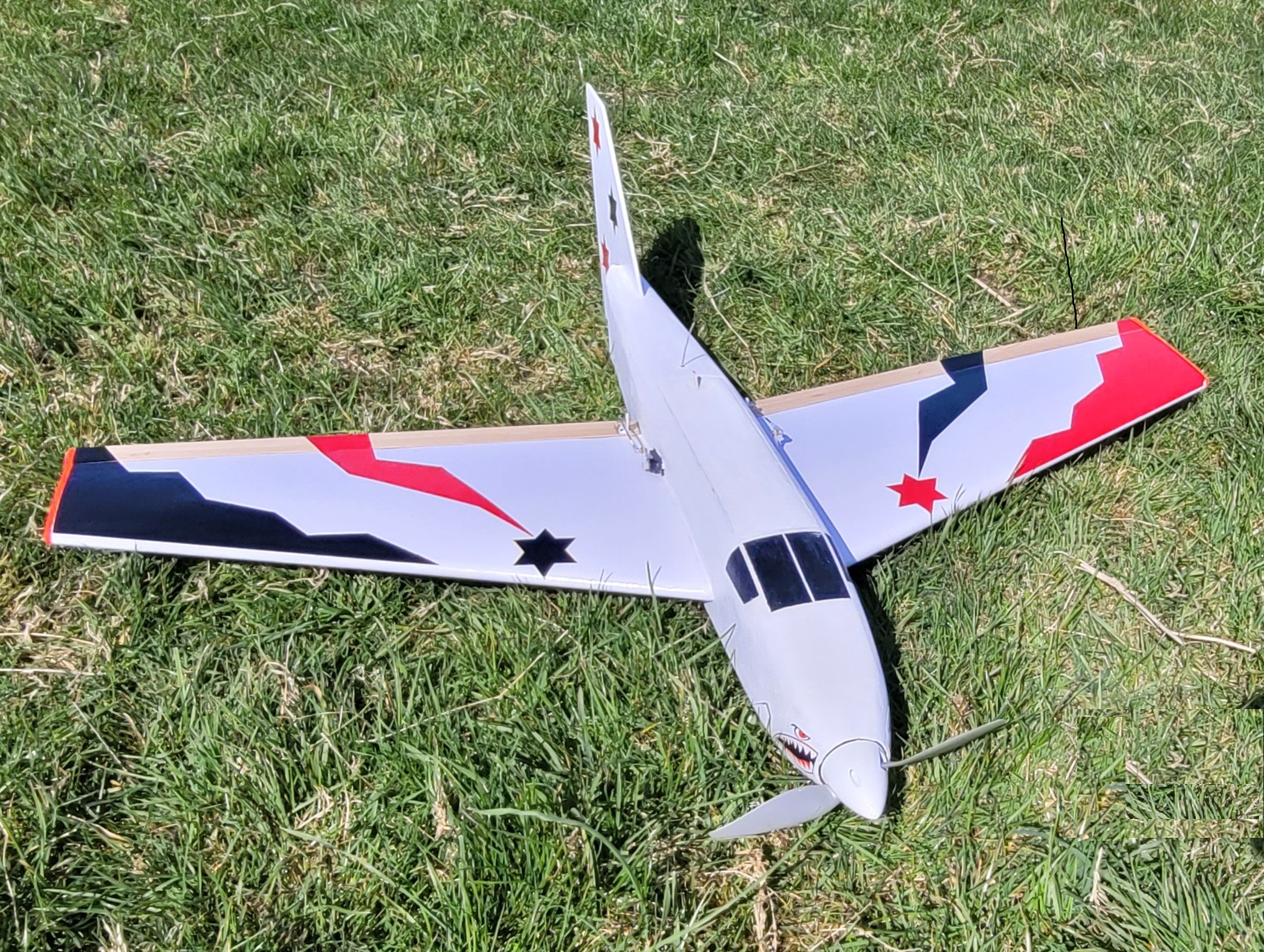 It’s extremely rare for that to happen but it’s a possibility that we all need to be aware of.
Time to move on to happier things now. Having been to the field several times, asked lots of questions, and done loads of research, new member Terry splashed the cash on what seems to be an ideal set of equipment for someone with zero knowledge of model flying.
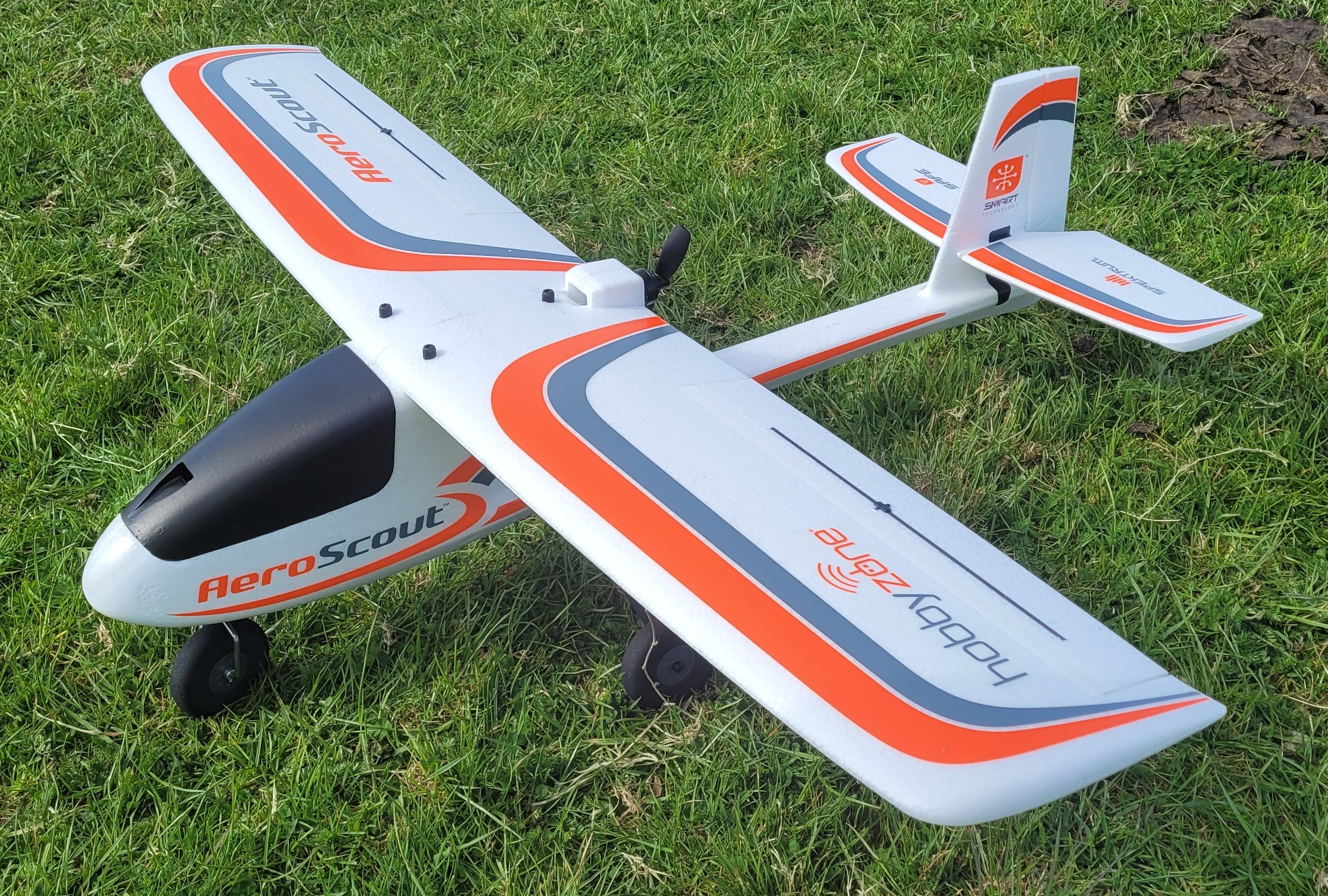
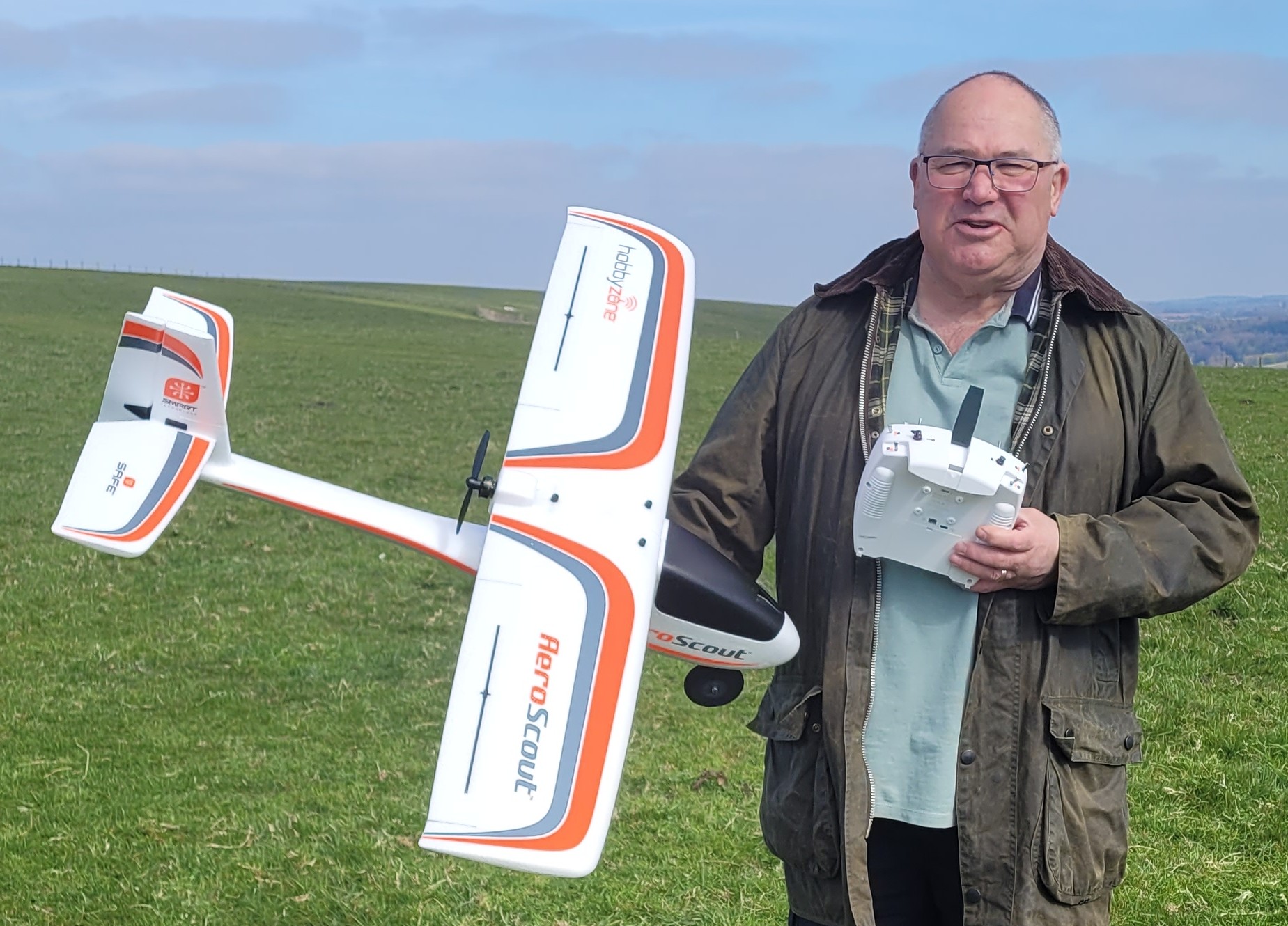 He bought a HobbyZone AeroScout trainer, a Spektrum NX7e+ transmitter, five Turnigy three cell 2200mAh batteries from HobbyKing, and an Overlander VSRmini+ charger.
Here’s what the Wheelspin Models site says about the plane: The HobbyZone® AeroScout™ S 2 1.1m makes learning to fly an RC (radio controlled) airplane more fun and easier than ever before! It’s the perfect trainer because it’s very durable and is equipped with exclusive SAFE® (Sensor Assisted Flight Envelope) technology that helps to prevent overcontrol, loss of orientation and crashes so nearly everyone can learn to fly successfully. It also features Beginner, Intermediate and Experienced flight modes so you can choose the level of stability and control you need at the flip of a switch. The “pusher” power configuration and EPO construction make it more durable than other similar class models. Tricycle landing gear with oversized tires and a steerable nose wheel makes it easy to take off from and land on a wide variety of surfaces from pavement to grass, or you can install the optional floats (sold separately) to fly from ponds and lakes!  Terry was very lucky as for the first couple of sessions he flew the conditions were near perfect with light winds. The AeroScout proved to be ideal for Terry and after just a few minutes in Beginner mode Terry was happily flying in Intermediate mode which gives more control but doesn’t allow the pilot to over control and inadvertently get upside down.
 On only his third flight he took off with no problems and by around flight number seven he was landing safely. On his third flying session there was a strong wind blowing which made Terry realise that it’s not always quite so easy but he coped well and I’m sure he’ll quickly reach the BMFA ‘A’ certificate standard. Some of Terry’s flying is in the video.
When Bob the Builder decided he had too many models a while back he sold his Tiger Moth to Gordon Bennett. Bob had built the Tiger from a HobbyKing laser cut kit back in 2016 and made a beautiful job of it. The Tiger had it’s first flight in September that year.
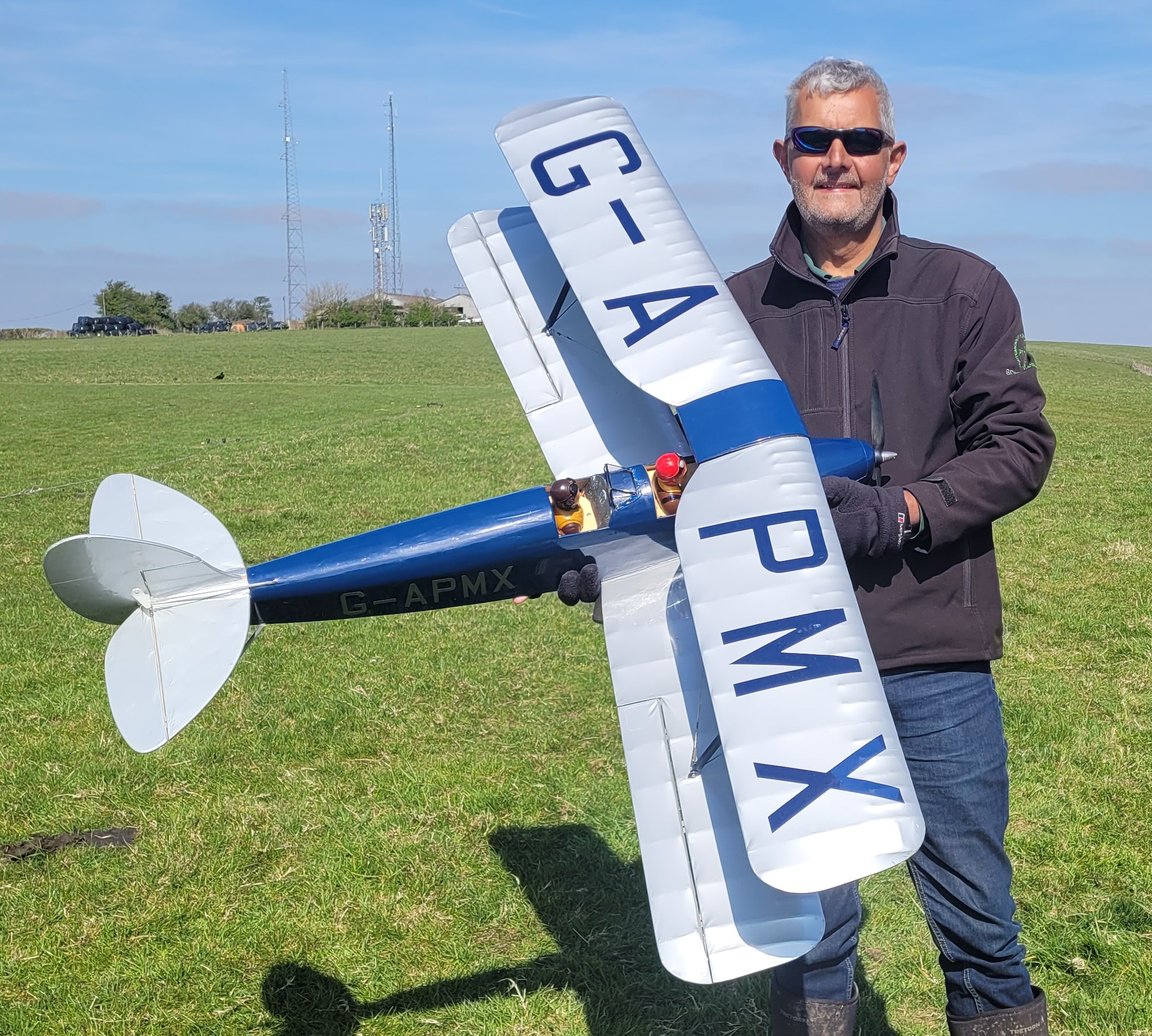
 Bob finished it in the colour scheme of the one Ralph Hubbard landed in our field twice but who was sadly killed doing the Cresta Run in Switzerland in 2017 at the age of 72!
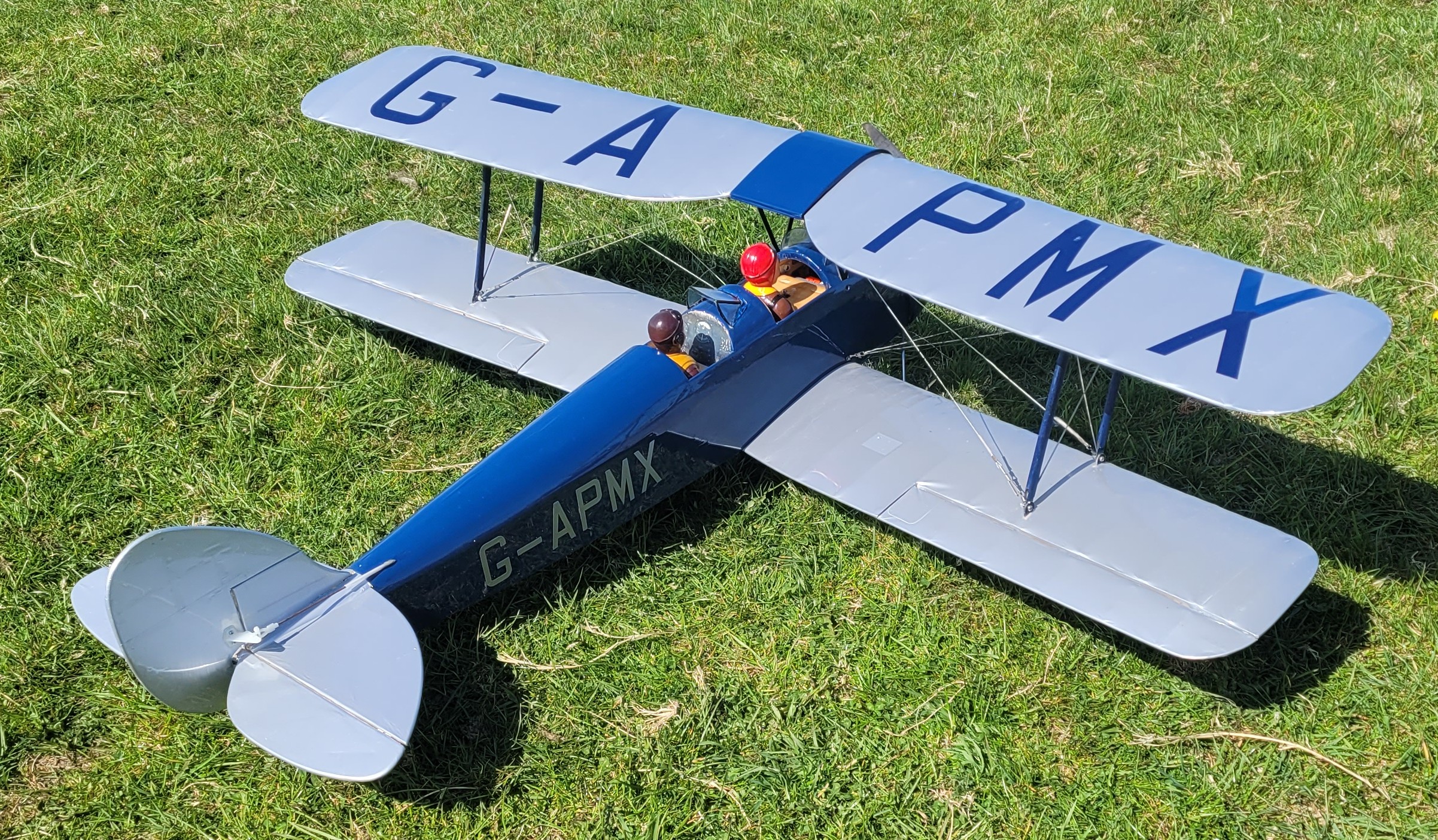
 New owner Gordon has now had several flights with the Tiger Moth and is gradually getting used to flying a fairly draggy biplane,. He has been making a few adjustments to get it flying as he likes but overall it’s a lovely model that flies well as you’ll see in the video.
Last month 1066 decided to sort out his battery packs as, like most of us, he had quite a few that weren’t up to the job of providing decent power for a reasonable time. He spends a lot of his spare time making stuff out of gash wood, pallets, old furniture etc. so, having discarded the duff batteries, he set about making a storage unit for the remaining ones.
 It seems he still has over seventy packs! That’s very neat 1066, are you taking orders?
While he was clearing out his batteries 1066 also cleared out a model. Having finished his new kit-built Mirus 1066 donated his old Mirus look-a-like airframe to Woody.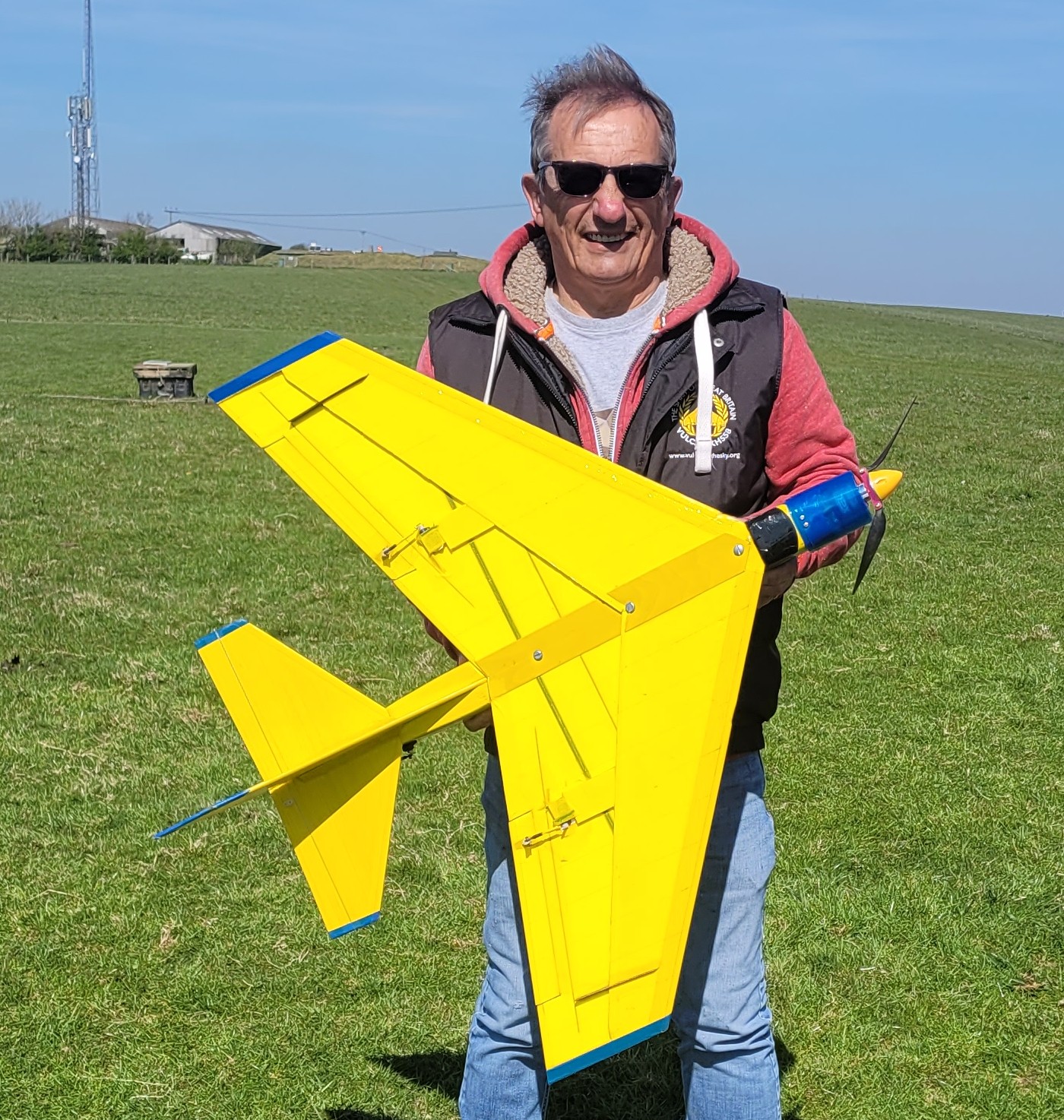
Woody has fitted an Airtek Excell 3536 1400KV motor along with a Hobbywing speed controller, and is using the folding prop that survived when he crashed his Aggessor.
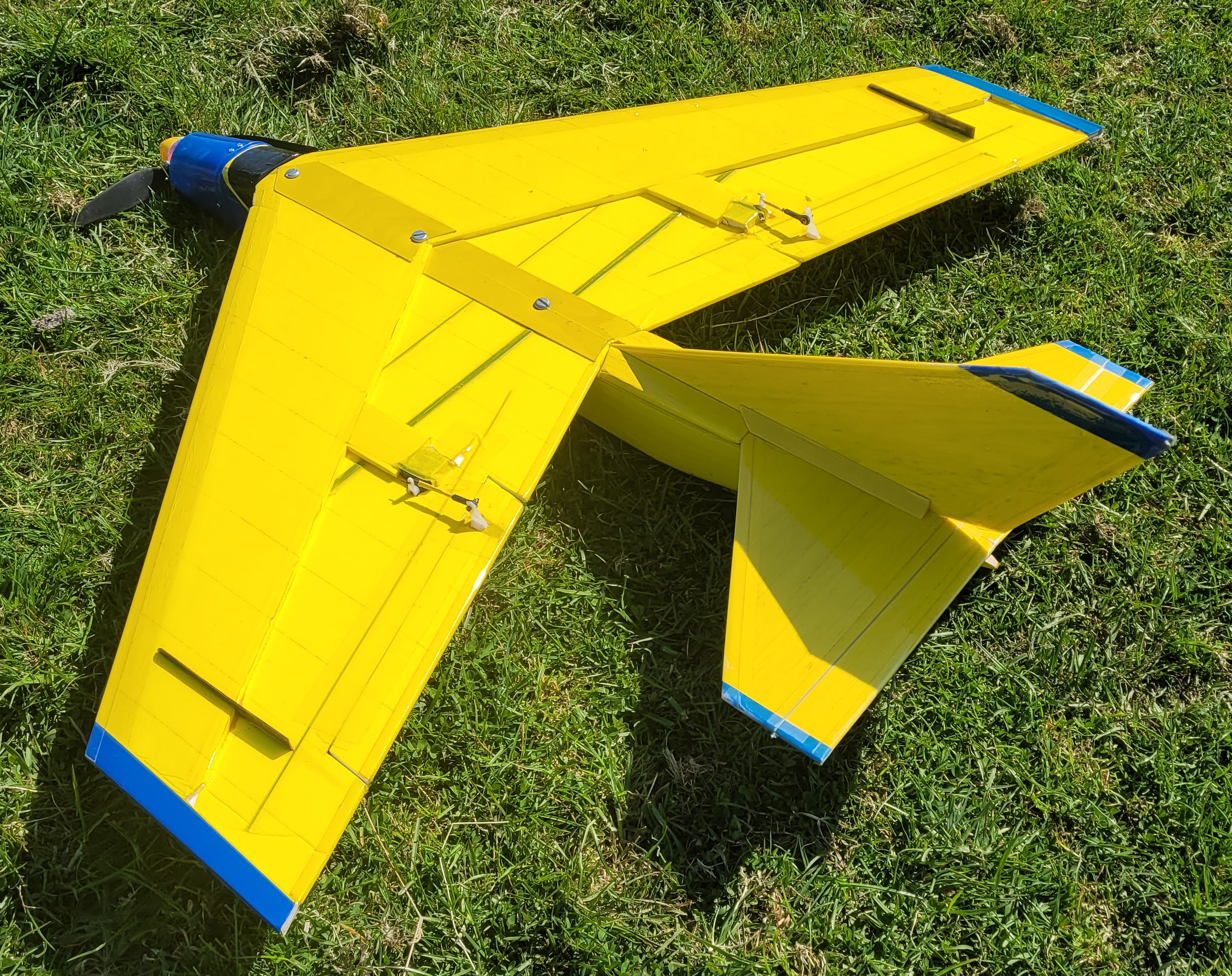 He has made a new cowl from two plastic cups which I notice has a sexy see-through look!
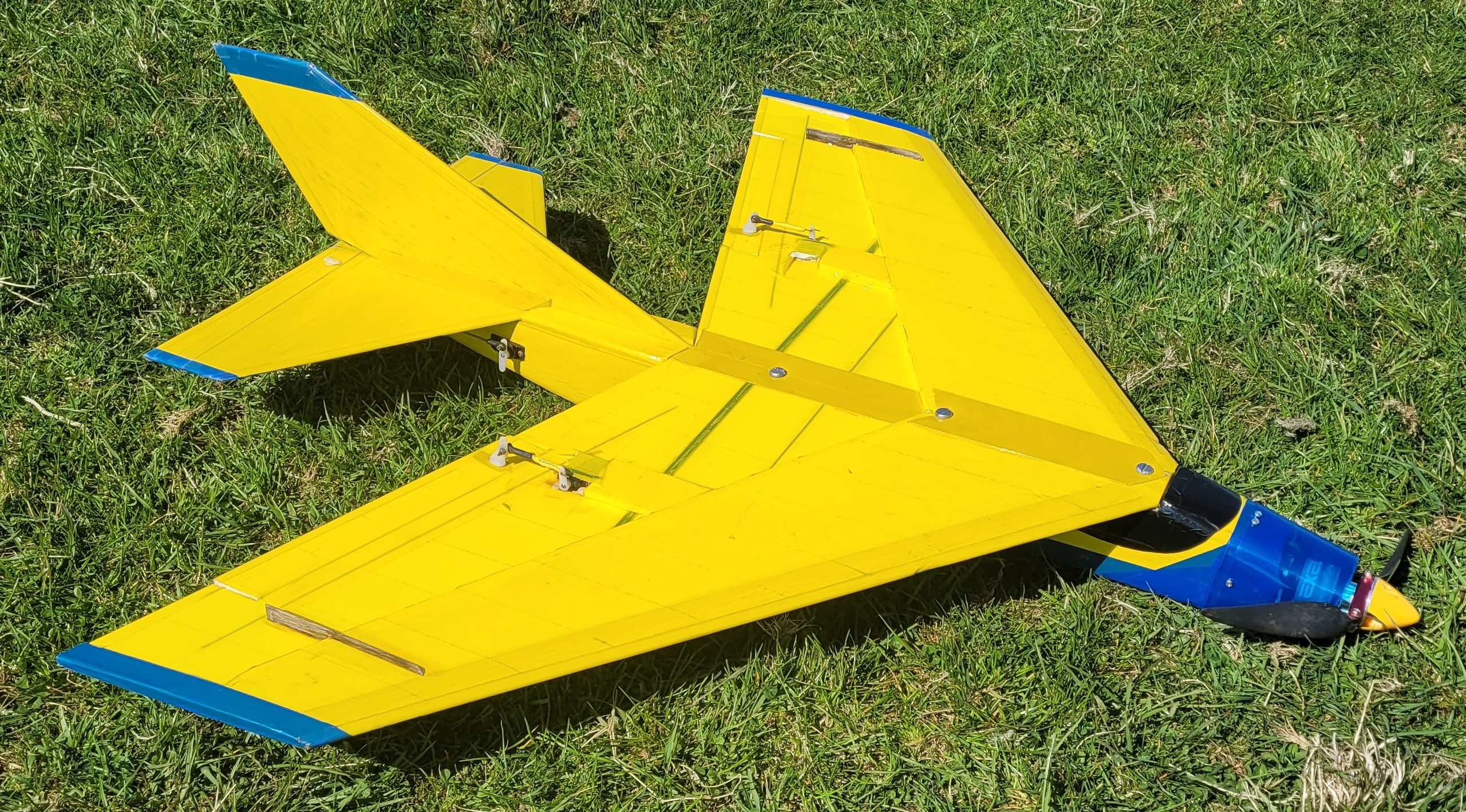 With the rates reduced, and flying it on three cells instead of four, the Mirus is much less of a hooligan machine and seems to suit Woody well. Guess where you can see it in action!
This month the rather poor quality action photos are all taken from the video.
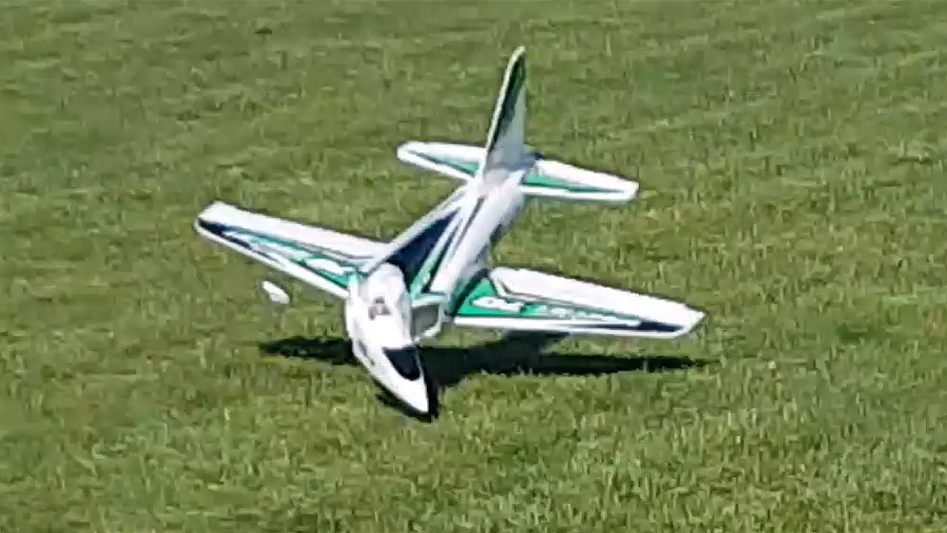
Sorry Dougal but I couldn’t resist including your Sport Jet landing ‘incident’! 



 Video time now, this month with footage shot by myself and Dougal Entendre.
Please watch the video full-screen, it’s so much better with small models flying around:
If the video won’t play for you please click HERE
The Final Funny:
This is supposedly a true conversation between Air Traffic Control and a student pilot.
Cessna: “Jones tower, Cessna 1234, I’m a student pilot and I’m out of fuel!”
Tower: “Roger Cessna 1234, reduce airspeed to best glide. Can you see the airfield?”
Cessna: “Er…tower, I’m on the south ramp; I just want to know where the fuel truck is..”
Colin Cowplain
Patch News – March 2025
March saw a definite improvement in the weather and club members did lots of flying. There was very little rain in the month which meant the parking area has now dried out well and our cars won’t be getting filthy every time we go flying. There was an easterly wind on several days so MVSA members were often flying and on a few occasions the paragliders and/or hang gliders appeared but they seemed to sitting around waiting a lot more than they were flying so rarely stopped our flying. As the weather warmed up the young bullocks that had wintered in the barn were let out into our field and they must have discovered what an electric fence does. One of the corner posts was down when we arrived to fly one day and they’d left us a few presents on one corner of the patch. But the fence had mostly done it’s job as they were all stood around close to, but not on, the patch and once we had herded them away they didn’t bother us again. The next day that we flew the fence was untouched and they had been moved to a different field. They will probably return sometime in the future but hopefully they will have learnt not to touch the fence.
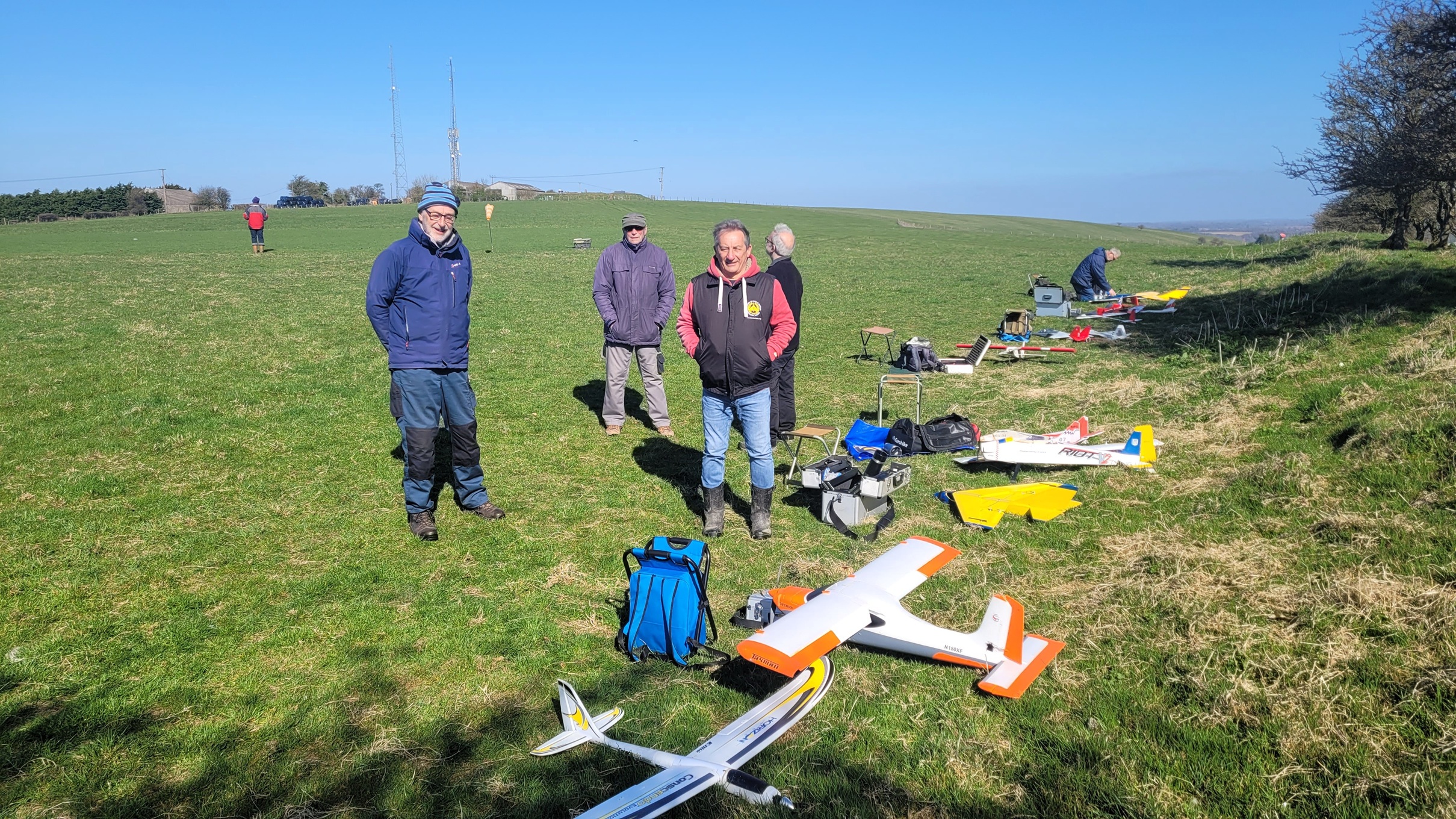 On Sunday March 30th the weather was lovely and sunny but with a very strong wind at ninety degrees to the strip so there was more standing around socialising than flying!
One of the newest club members, Terry Small, has been learning to fly for a few months. 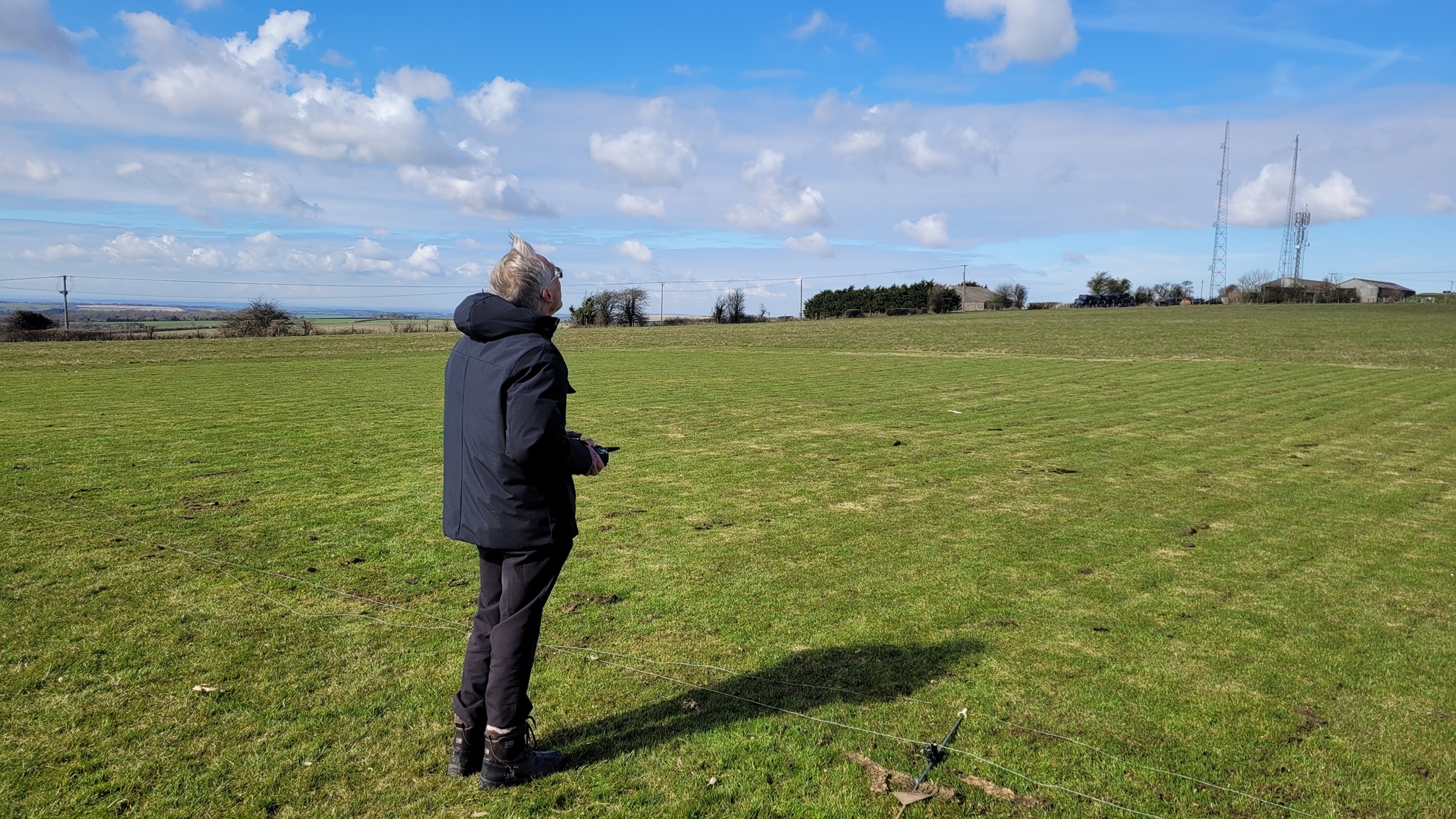 Terry came to the club having already flown a little 700mm span HobbyZone Apprentice STOL which is a scaled down version of the 1500mm span E-flite Apprentice. The little Apprentice is fully stabilised and too light to qualify for the BMFA ‘A’ certificate so Terry bought the larger E-flite version and has been working towards taking his ‘A’ test. He’s done quite a lot of practising on his simulator but complains that the wind at the field is different to the simulator wind, it’s too strong/too bumpy/wrong direction/the wrong sort of wind etc. so 1066 suggested a suitable blog name for him and Terry will now be known as Windshy! He’s had the usual few knocks along the way but nothing too drastic and by the end of March I suggested he was ready for the test. I think I know why he chose to take his test on the 26th when there was a very light wing blowing straight down the strip!
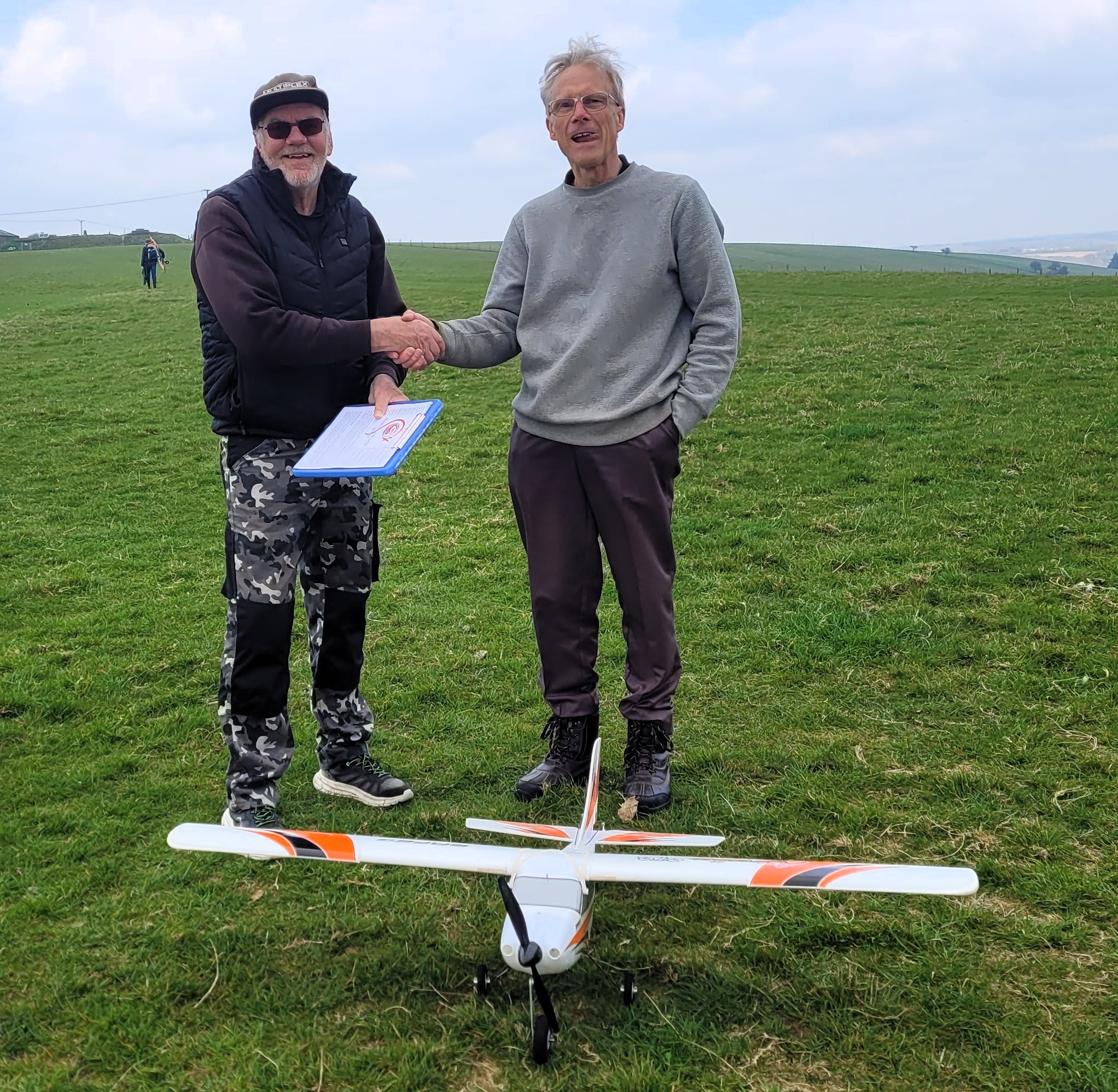 After a couple of practise run throughs of the test Windshy bit the bullet, flew the test for real, answered the necessary questions and passed. So congratulations Windshy, it’s now time to look for a slightly more advanced model…no not a pylon racer or a Lancaster!
Several new models were flown in March and there were also several older planes brought out of retirement to fly again. The first to fly was Page Boy’s Woodpecker that I featured back in January as finished but not yet flown. Page Boy had started the build back in 2018 so there didn’t seem too much of a rush to get it in the air the moment it was completed. But on 2nd March the Woodpecker finally arrived at the field and took to the air.
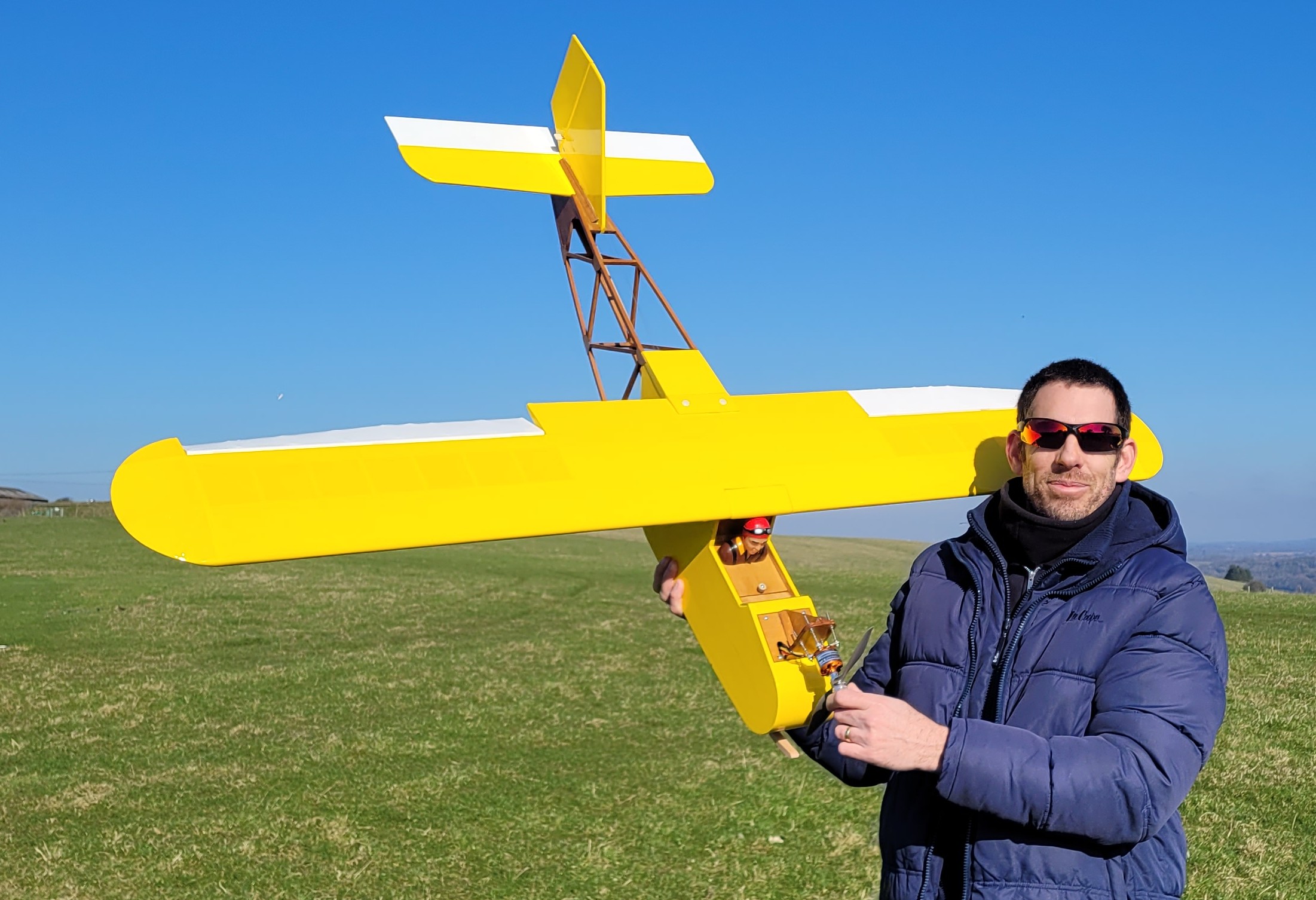
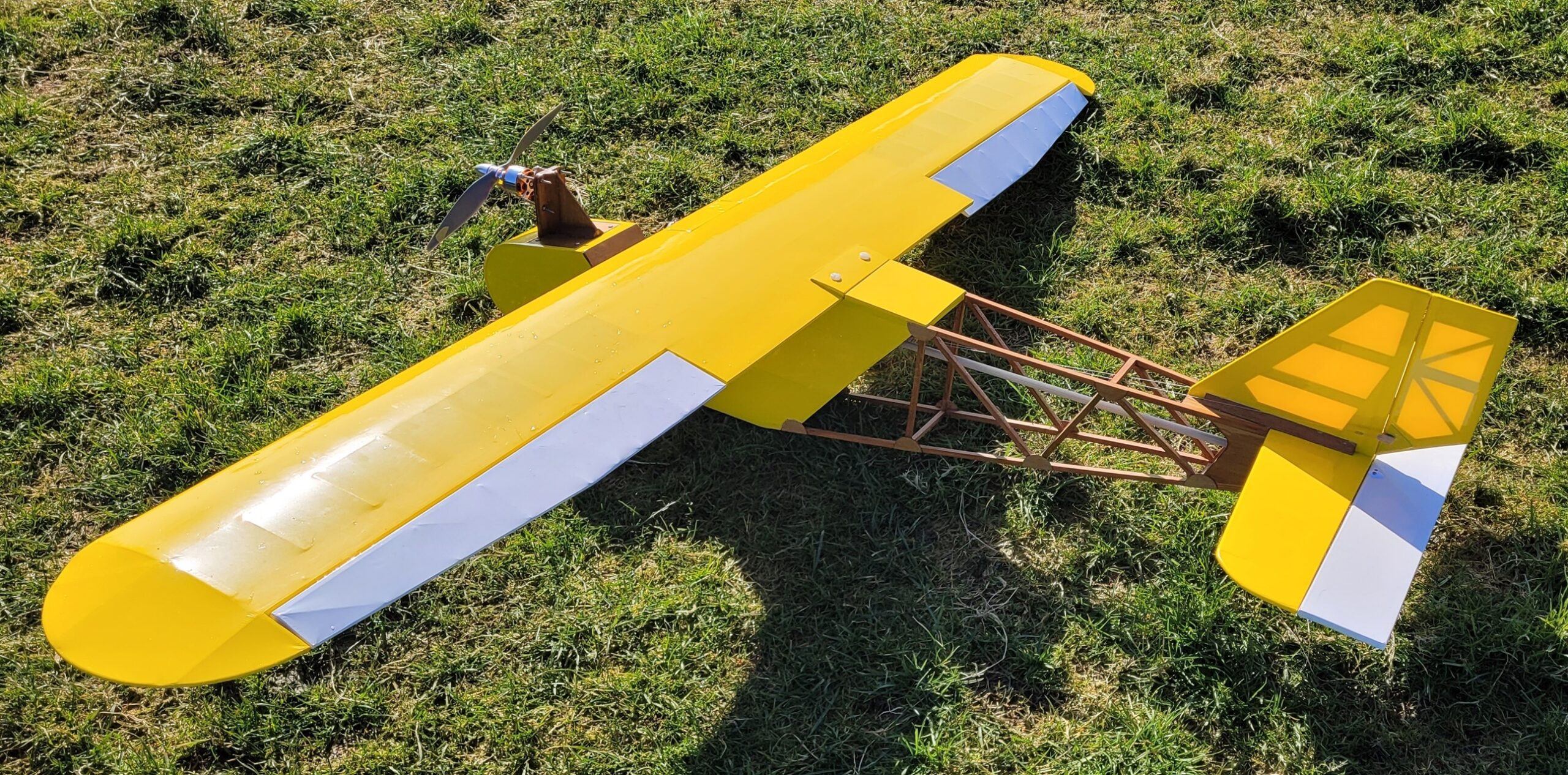 I was surprised when I first saw it as, at 66” span, it was much larger than I had realised from the photos Page Boy had sent me. The Woodpecker was designed by Lindsay Todd and Paul Rice and the original used a 900kv motor and a 3 cell lipo but Page Boy has fitted a 3536 1250kv Turnigy motor and he’s using a 3300mAh 4 cell lipo which avoids the need for a lot of weight in the nose and gives flight times of around 6 or 7 minutes.
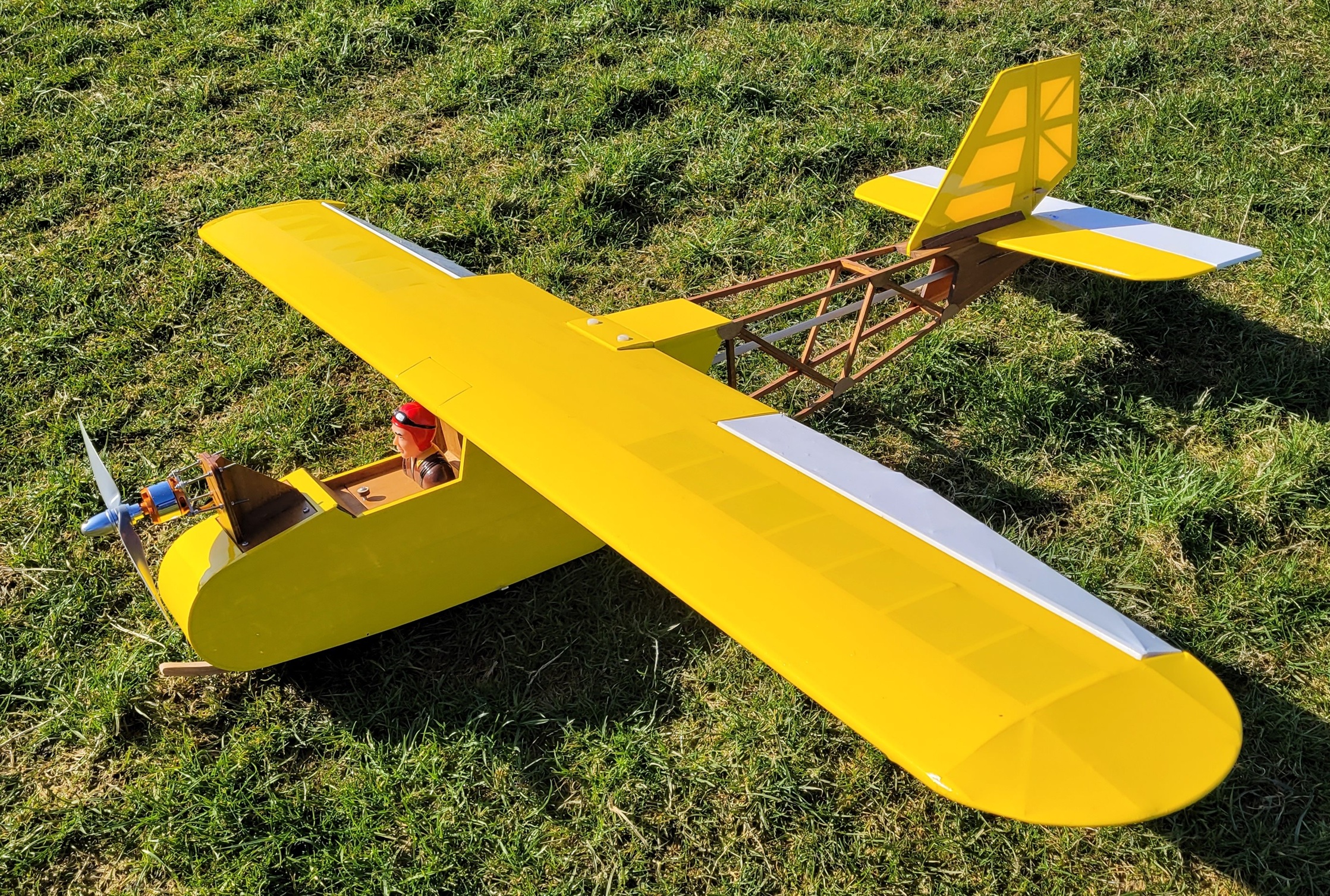 The speed controller is a 60A Turnigy unit and he’s using 4-Max servos for all control surfaces. The first flight looked reasonable but Page Boy said he was struggling as the motor had too much downthrust. As the motor is mounted on a pylon it’s easy to adjust so before the next flight the downthrust was removed and the second flight went much better.
 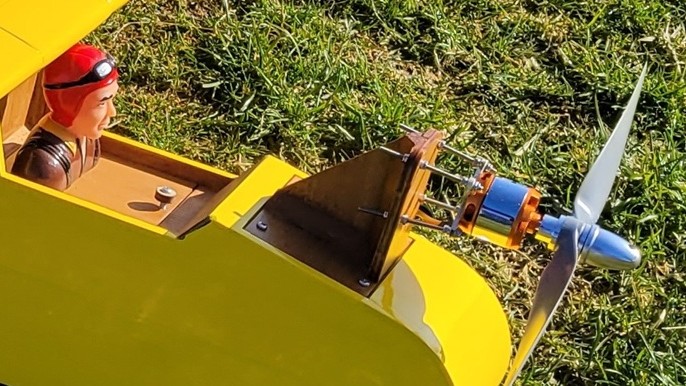 You can see the Woodpecker flying after the changes had been made in this month’s video.
Also featured in the January Patch News but unflown was Captain Slow’s Piwakawaka.
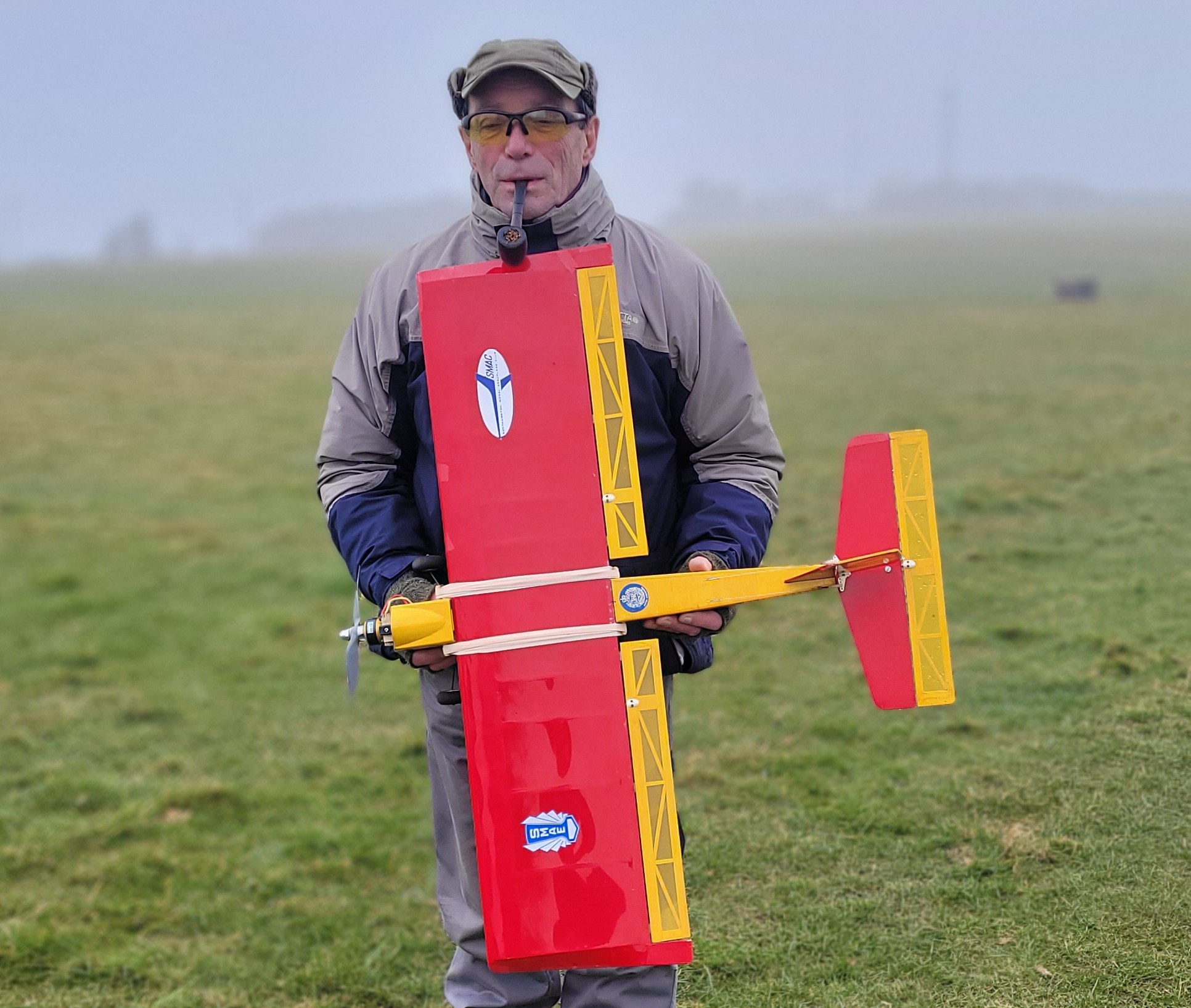 He bought it second-hand from a modeller in Southampton so it has flown previously. It seems very successful, Captain Slow had several flights with it in March with no problems. He’s been using a 3 cell 2200mAh pack but even after two flights on the same battery he’s still landing with around 40% left so he’s thinking of trying it with a 1300mAh instead.
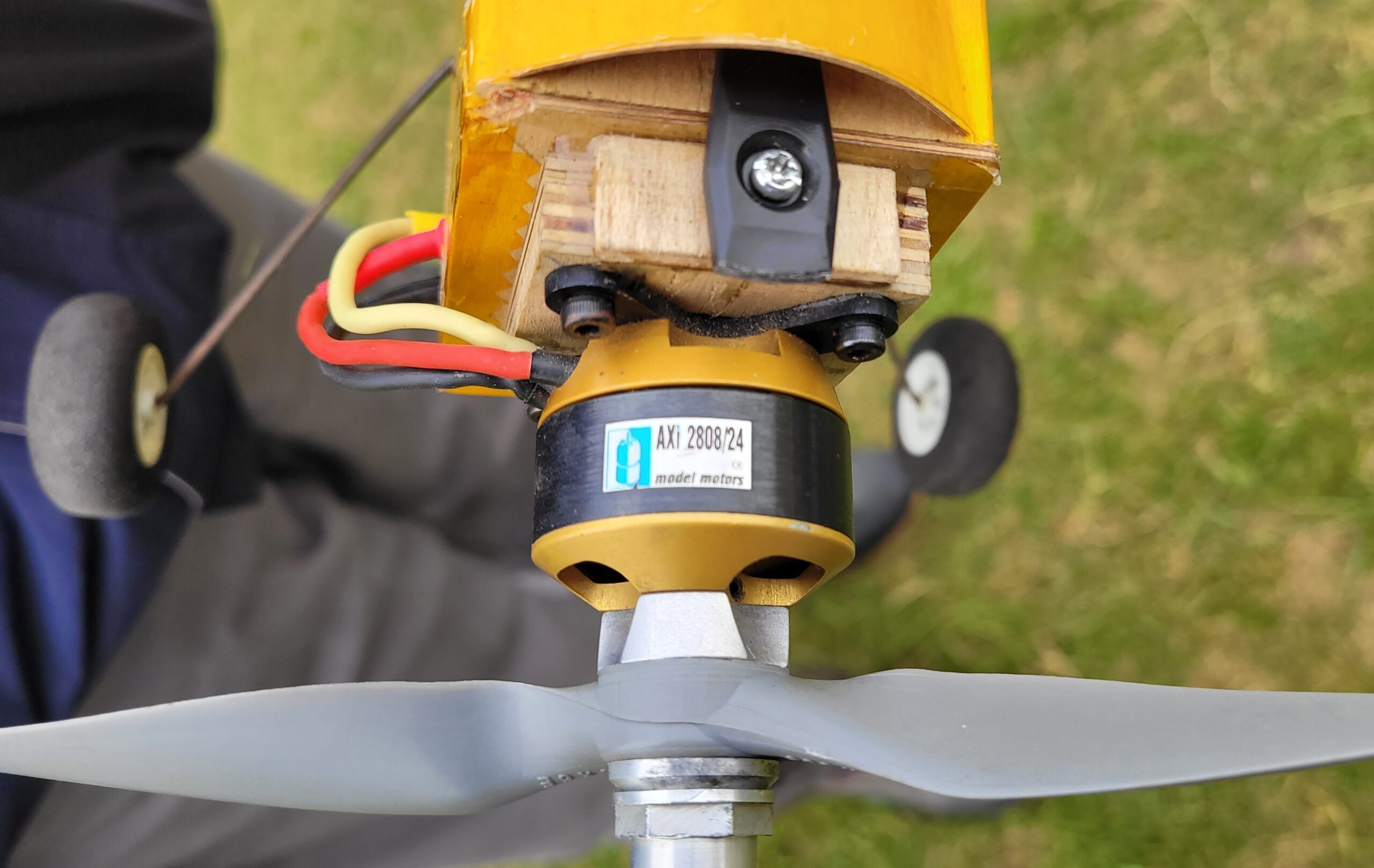 I was going to suggest moving the throttle stick up beyond the mid position occasionally but I wouldn’t want to scare him and then have to change his name to Captain Medium!
The next new model to fly was John Warren’s XFly Tasman. John was after something nice and easy to fly and Bob the Builder suggested the Tasman as he loves his own and finds it very easy. John asked me to do the trimming flight which went perfectly other than it briefly disappearing briefly in the mist/low cloud… not the ideal day for a test flight!
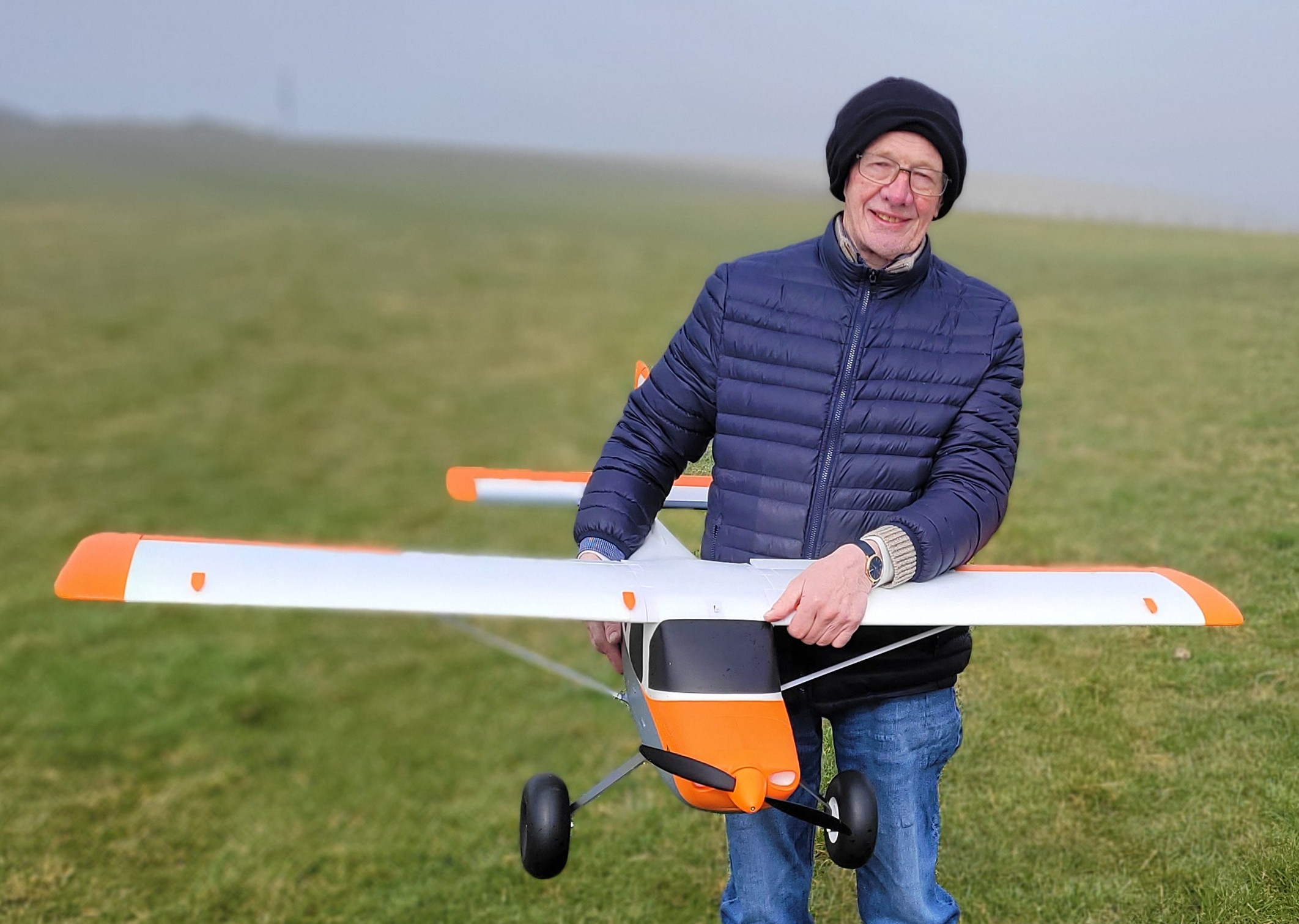
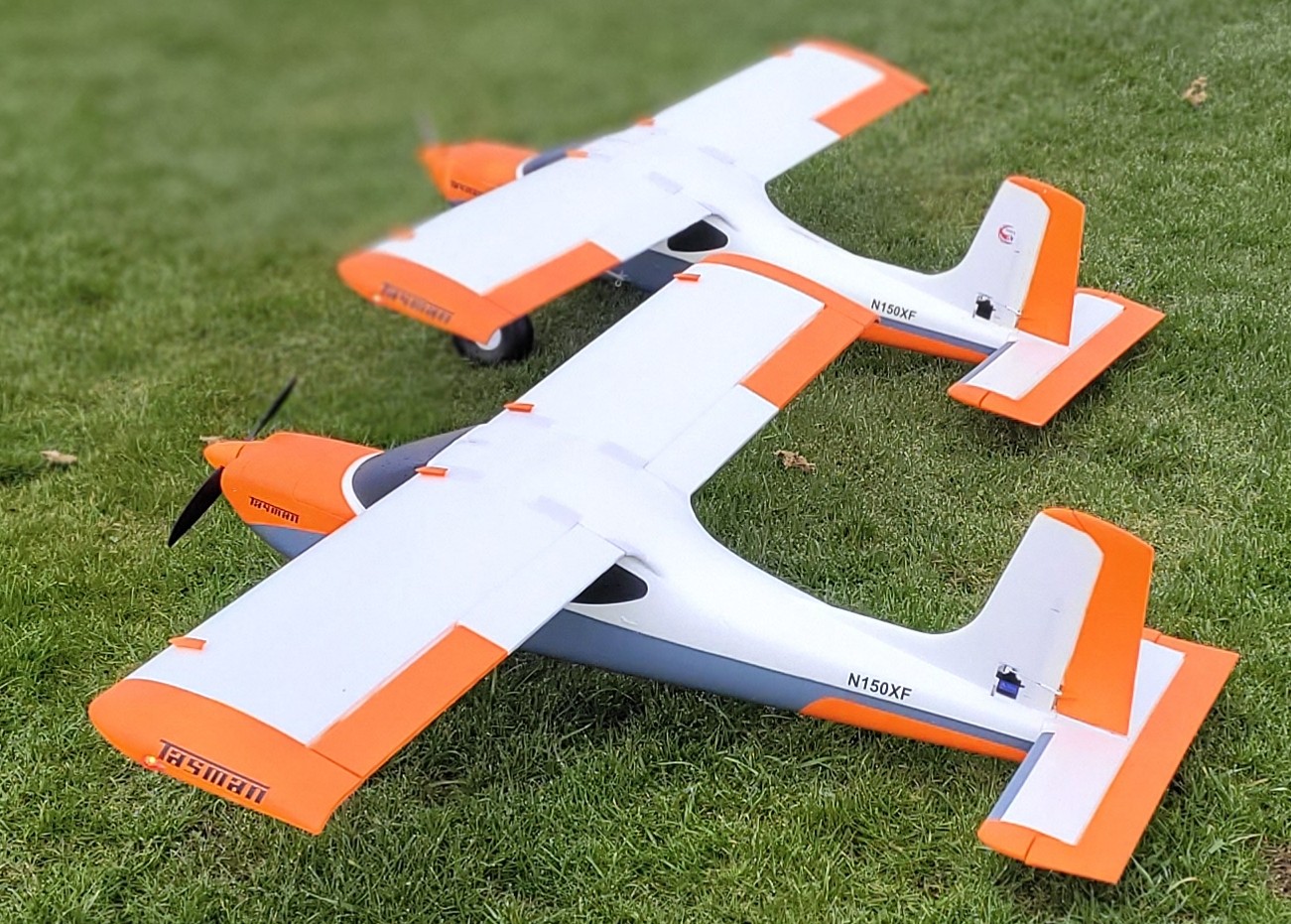 Apart from the murky weather at the start of the flight all was good and John has now had several flights with no problems, the Tasman is the perfect model for John. Both Tasmans are in the video which is slightly confusing but I think I’ve got the captions correct.
At the end of February 1066 broke his VisionAire in half when a low inverted pass went just a tad too low and, much to his annoyance, I snuck a couple of photos into Patch News!
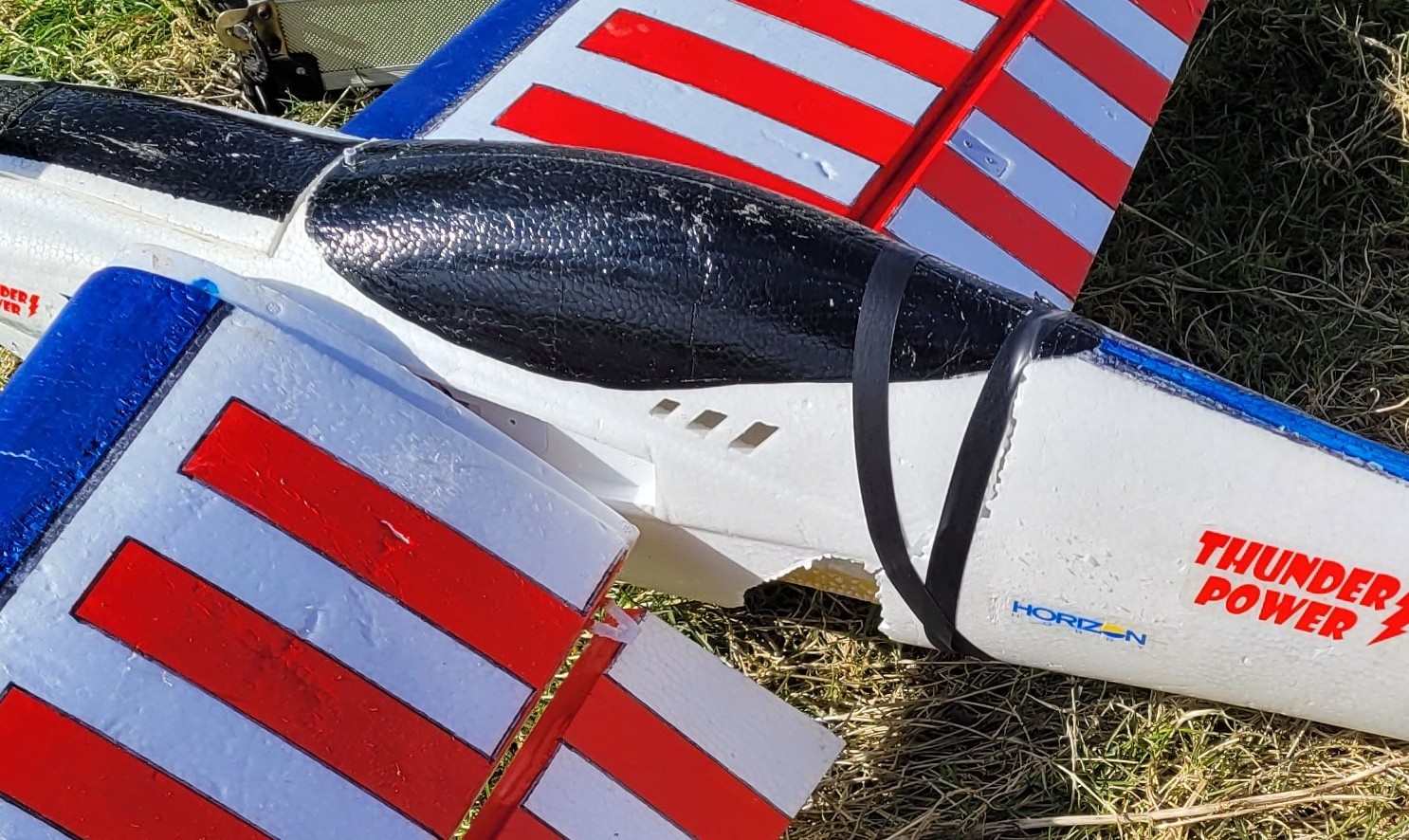 Well 1066 put his repairing hat on and soon had everything back in one piece and looking almost as good as before so it seems only fair for me to show you another photo of it.
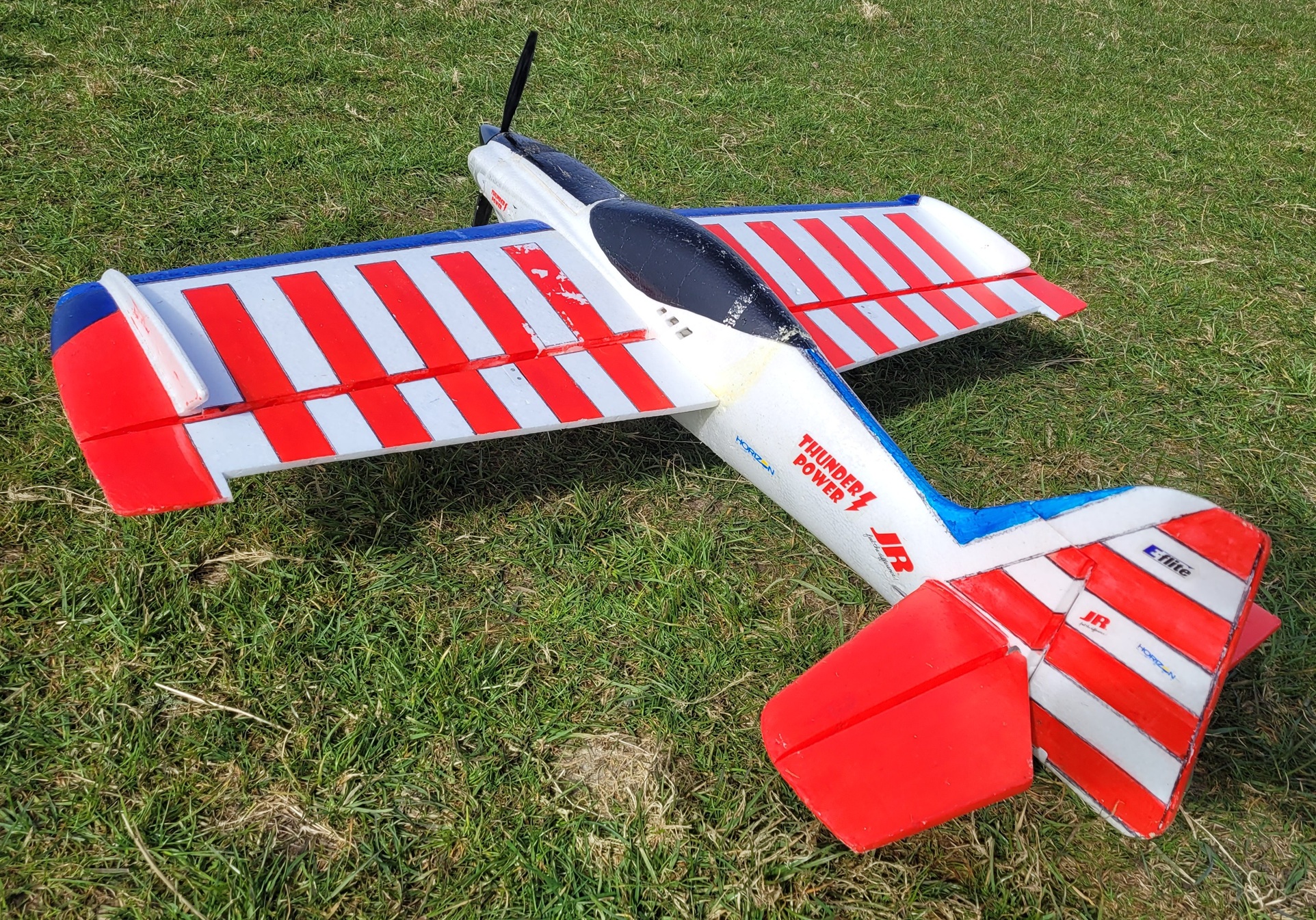 The VisionAire now flies just as well as it did before it’s minor misadventure but oddly 1066 kept refusing to do any low inverted passes with it this month, I can’t think why!
Back to new models now and another from Page Boy, this time an Arrows Hobby Avanti.  Unlike the Woodpecker that took seven years to make it from plan to play the Avanti was bought and flown in the same month. The EPO foam Avanti comes almost finished with an 11 blade fan, 2627 4500kv motor, 30A esc, 6 axis gyro, and 3x9g servos all pre-installed.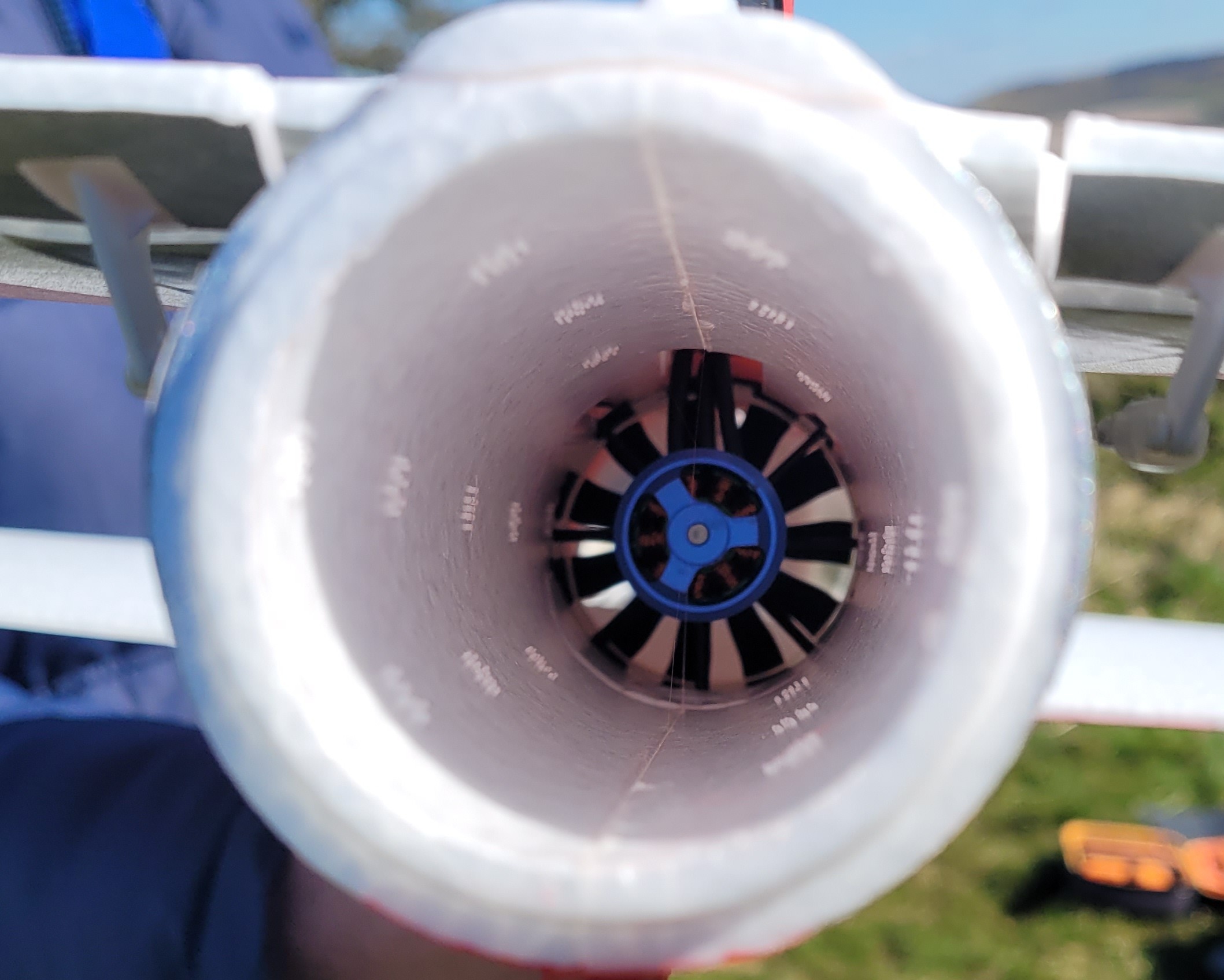
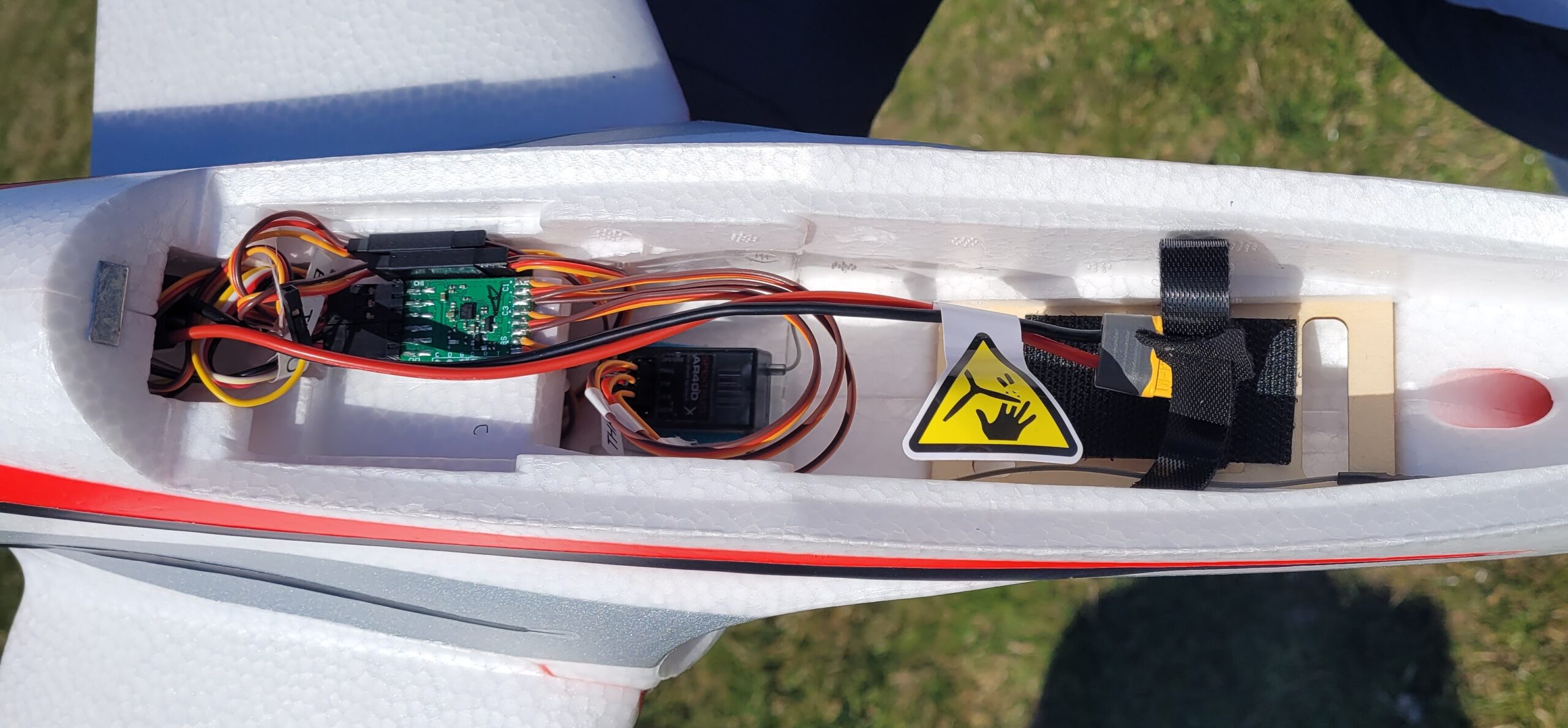 The instructions say just thirty minutes assembly time so buying and flying in the same month should have been easy. This is what the Wheelspin Models website says about it:
Where good-looking, top performing, 50mm EDF sport jets are concerned, little can beat the locked-in, arrow-like characteristics of the Arrows Avanti. ‘If it looks right, it’ll fly right they say and in this instance there’s never been a truer word. Sporting Arrows highly-regarded, jet-like 50mm 11-blade fan and 2627 4500KV brushless motor combo, this 3S-fuelled slick ship will appeal to all who seek smooth, torque-free aerobatics, benign handling and a ‘go where you put it’ performance. OK, got that Page Boy?!
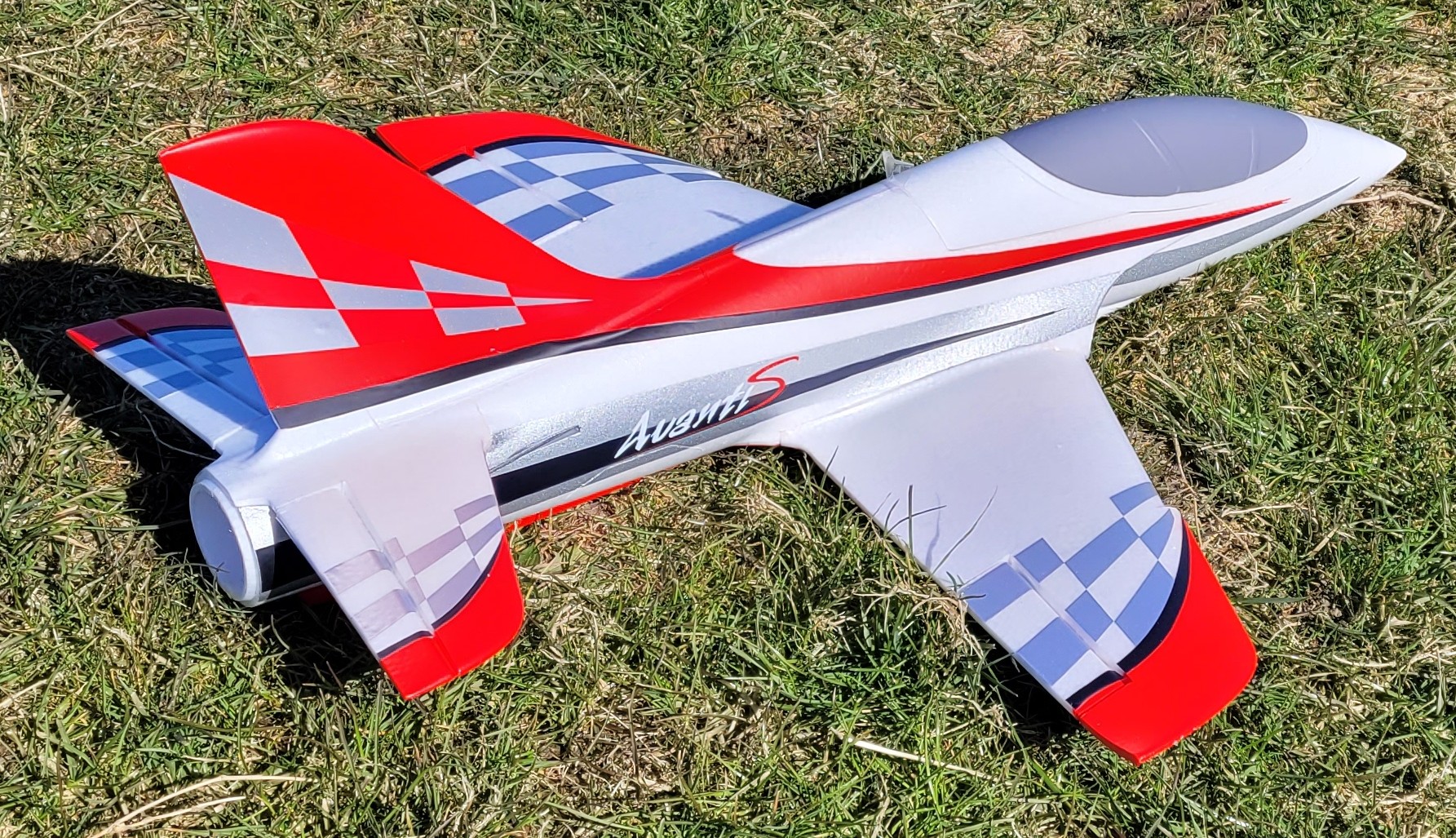 It was quite a windy day that Page Boy test flew his Avanti with some pretty turbulent air so the stabiliser was working hard but all went well and it looked great on the air. Mini Mike also has one of these and they can both be seen flying in this month’s video.
They were very lucky not to have a mid-air at one point, I captured this rather blurry screenshot from the video, Page Boy’s is the nearest one. He reckoned it must have been Mini Mike’s fault as he was feeling a bit under the weather at the time…poorly lad, as if!
I mentioned earlier that Bob the Builder has an XFly Tasman that he’s been flying for a while and he likes it so much that he’s now designed and built himself a mini version of it. 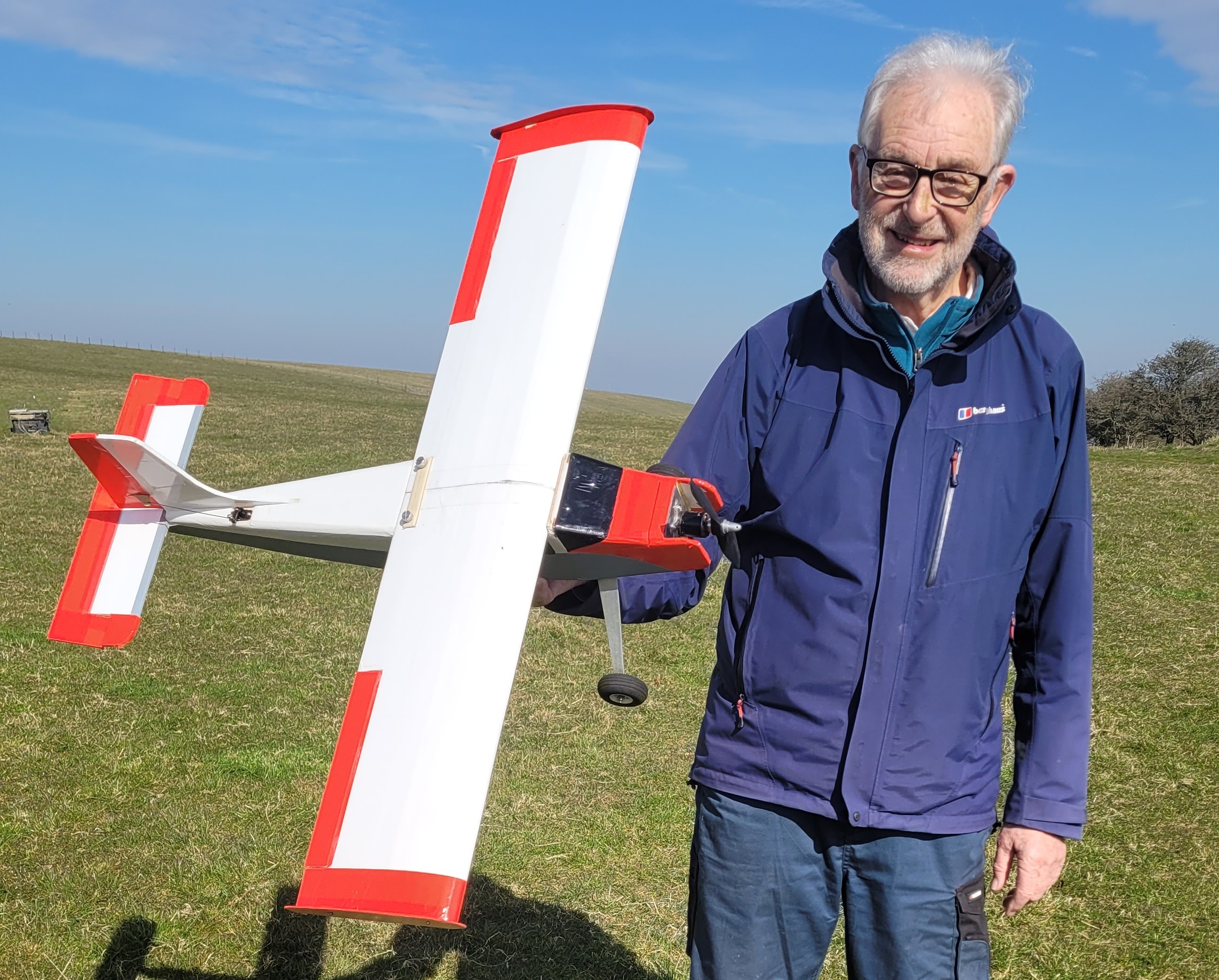 This is what he says about it: Decided I needed to replace my old Basher with something easier to fly. What could be better than a Mini Tasman. I love my big Tasman so decided to scale it down to run a 1300 3s battery. First thoughts were to scale down to 60%. Started making all the dimensions 60%. Wasn’t long before I realised that the wing area was much smaller than 60% which didn’t look right, in fact it was only 36% when you multiplied the wing span by the cord. Decided to change tack and make the area of all flying surfaces 50% of the original area. I watched several YouTube build videos that used 10mm Thermocol foamboard which seemed to make the build very quick and easy. Unfortunately Thermocol doesn’t appear to be available in the UK and the closest I could find was 5mm foam board from Hobbycraft. It was all built from this foam board but with added strength where required and all covered with white or red parcel tape.
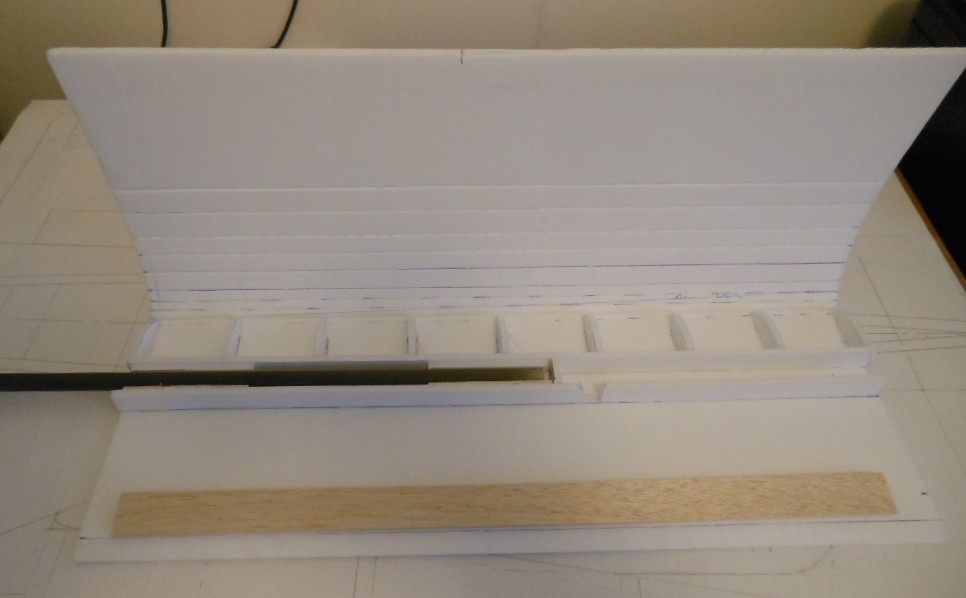
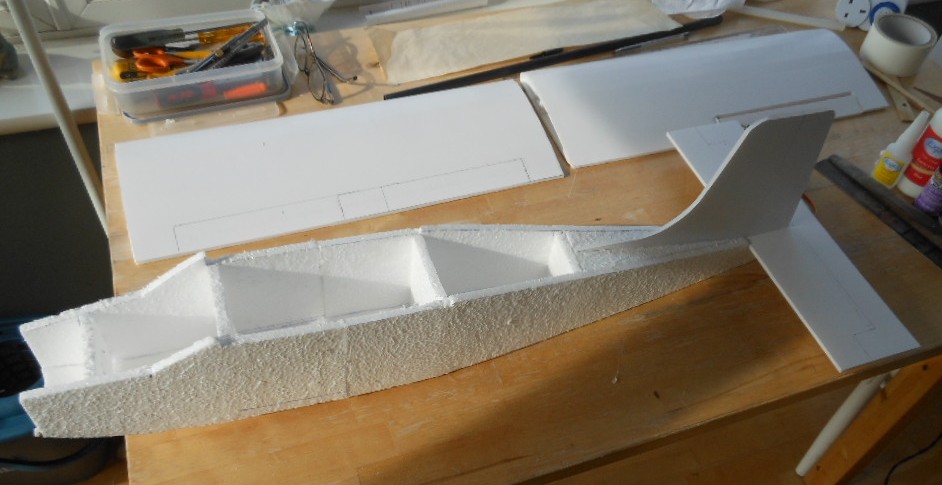
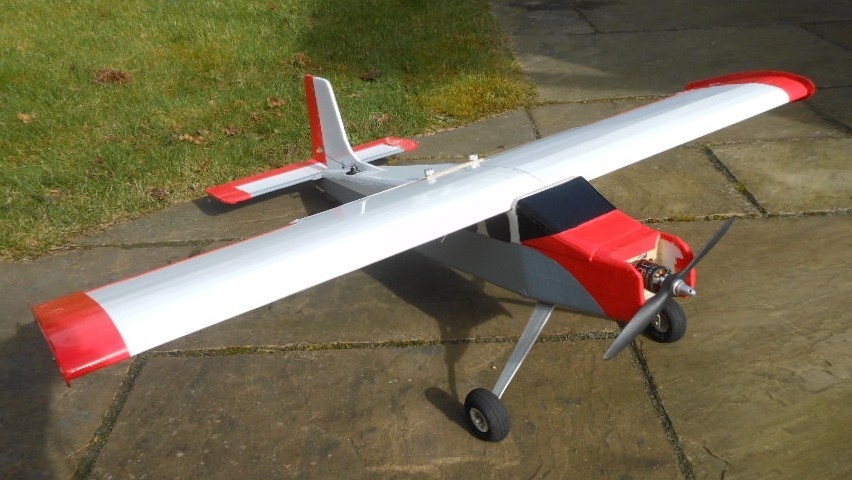 The fuselage bottom has been sprayed with grey paint. Technical data: Wingspan 1000mm, flying weight with 1300 3cell =1065grm, motor is a Hobbyking Propdrive 28/36 1400KV with a 9×6 Prop at 270 watts, 4 servos of 11grms. No flaps or wing struts yet and I need bigger wheels. A little more than half the weight of big Tasman with half the wing area so should fly OK but not quite as slow. Thanks Bob. To save weight Bob has removed the paper covering from much of the foam by soaking it in water. The pics show the construction method well, including the folded over wing profile and carbon joiner.
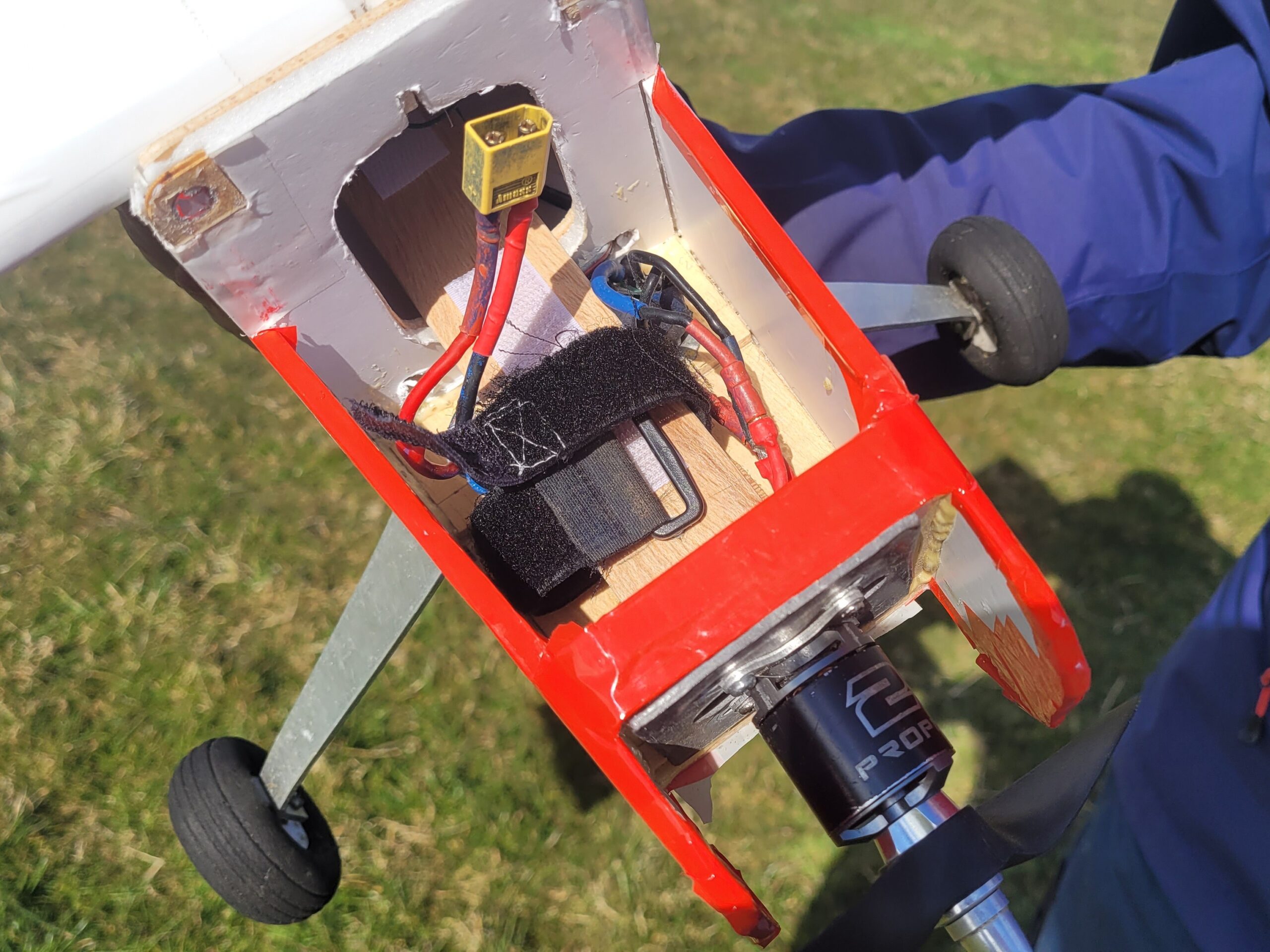 I did the initial trimming for Bob and the plane flew well. I then handed over to Bob and he flew it around for a few minutes before it suddenly dived into the ground. Bob wonders if he’d stalled it but I don’t think so, maybe something broke. The model was damaged but not too badly so Bob soon had it flying again. Everything appeared to be working perfectly but shortly after take-off the Mini Tasman lost radio contact and crashed again. It’s fairly easy to repair and Bob has changed the speed controller as that appears to have been the cause. He will of course give the whole thing a thorough check over before he tries again.
After taking a couple of months away from working on his Mirus 1066 finally got down to finishing and flying it in March. There were a few things he wasn’t happy about in the build, hence the delay, but now it’s all done and the end result looks good.
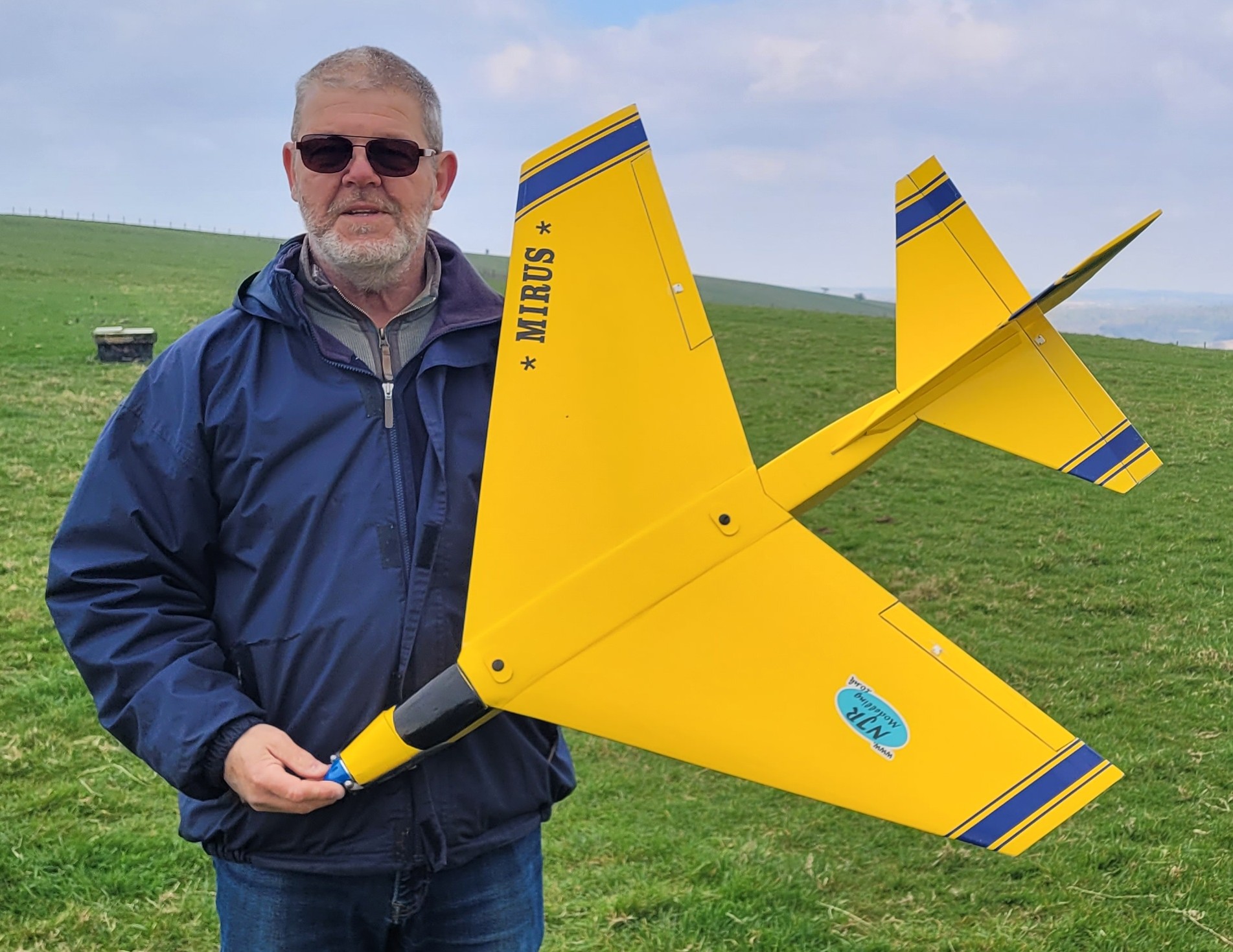 1066 says he had trouble with the covering on the underside and then found it tricky to see in the air so he’s jazzed it up with a few stickers, perfect! He’s fitted a 35mm 1000kv motor, a 70A speed controller, and powers it with a 4 cell 3300 or 3600mAh lipo battery.
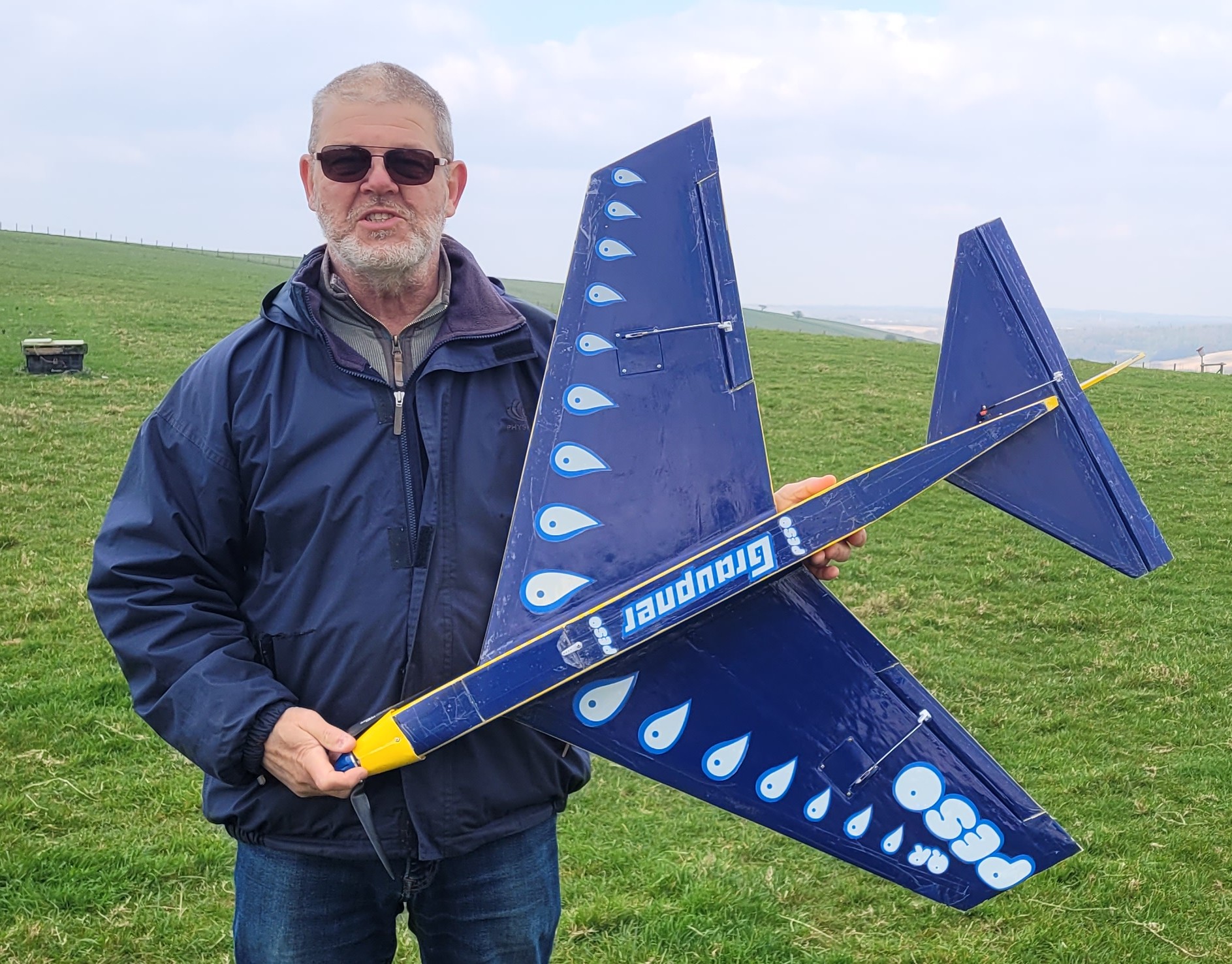 Knowing that it’s very easy to break the prop when landing a Mirus 1066 decided to try an Aeronaut folding prop and for the first flight he fitted a 12×8. The Mirus flew well but wasn’t as fast as he’d hoped, plus it was pulling close to the limit of the esc so he switched to an 11×6 folder which worked much better, more speed and a lower current draw.
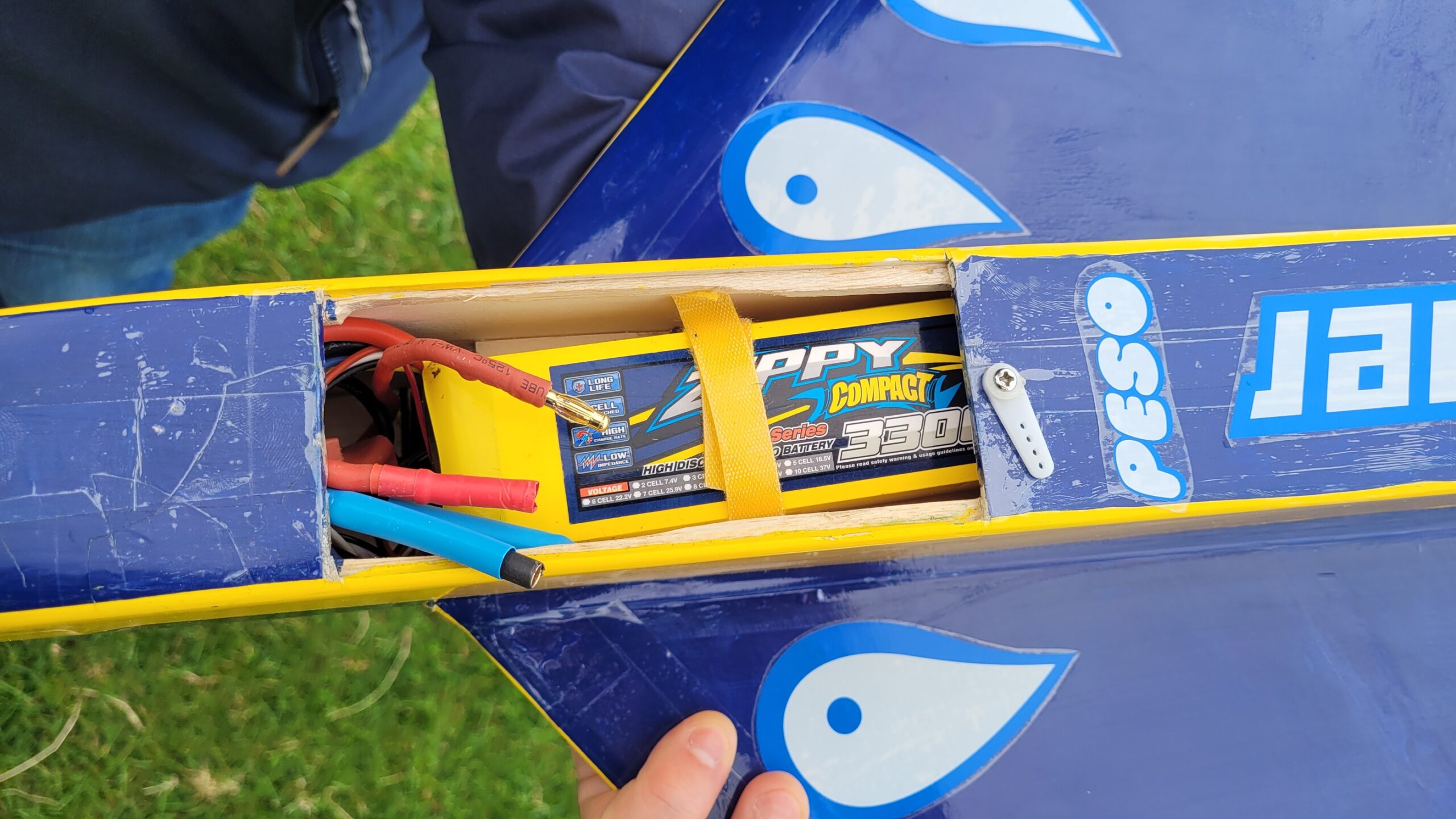 Having hand launched the Mirus a few times I can testify that it has a lot pull! You can see how it went on the first flight in this month’s video, on subsequent flights it was faster.
Last month I wrote that Woody was building a Yellow that he had bought as a plan and laser cut kit from Sarik Hobbies. He’s now finished the build and has finished it in blue covering. Woody has added some yellow trim in keeping with the Yellow name but just to confuse us all he is calling it Bluey instead. The covering is Ripmax heat shrink film.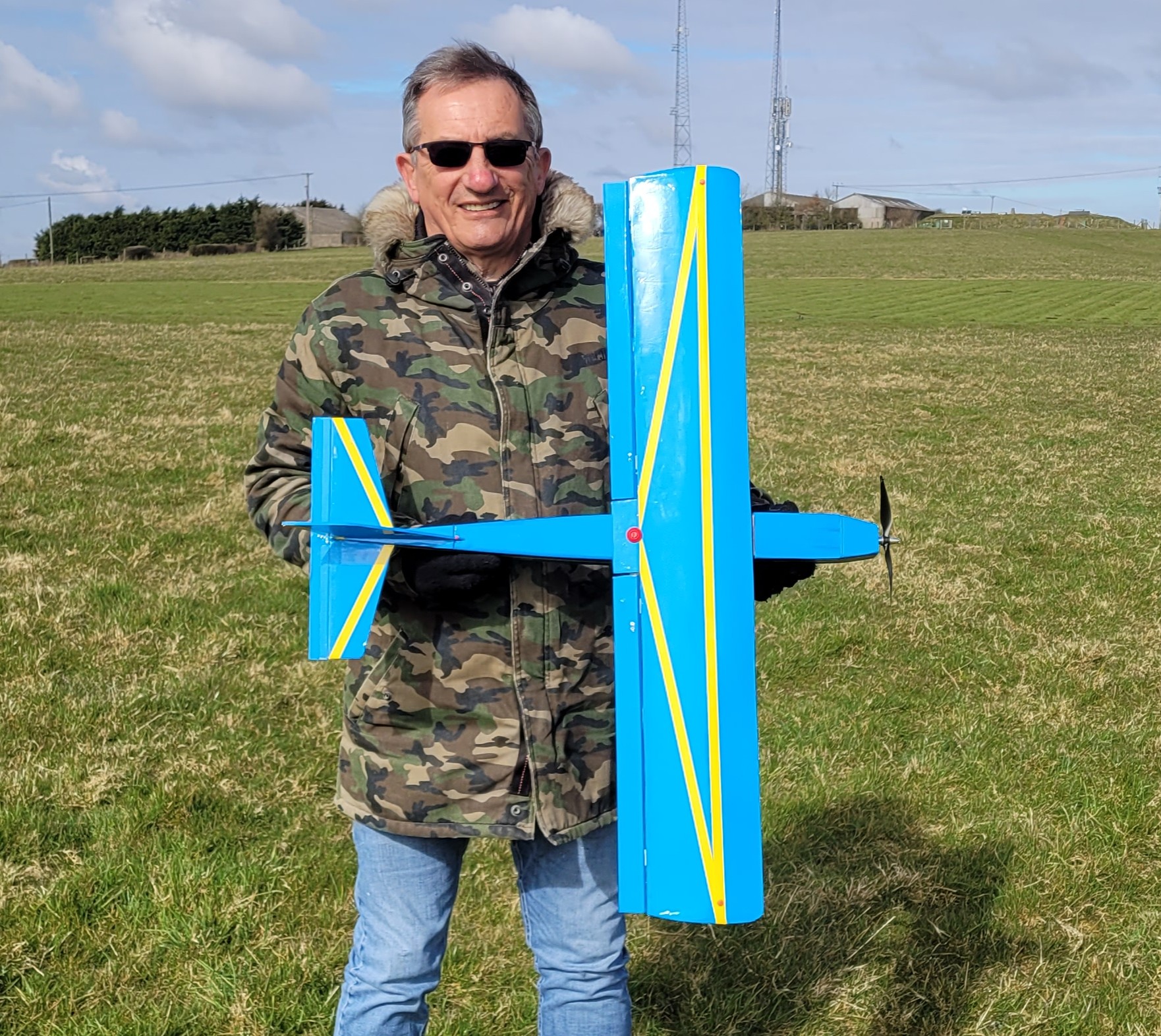
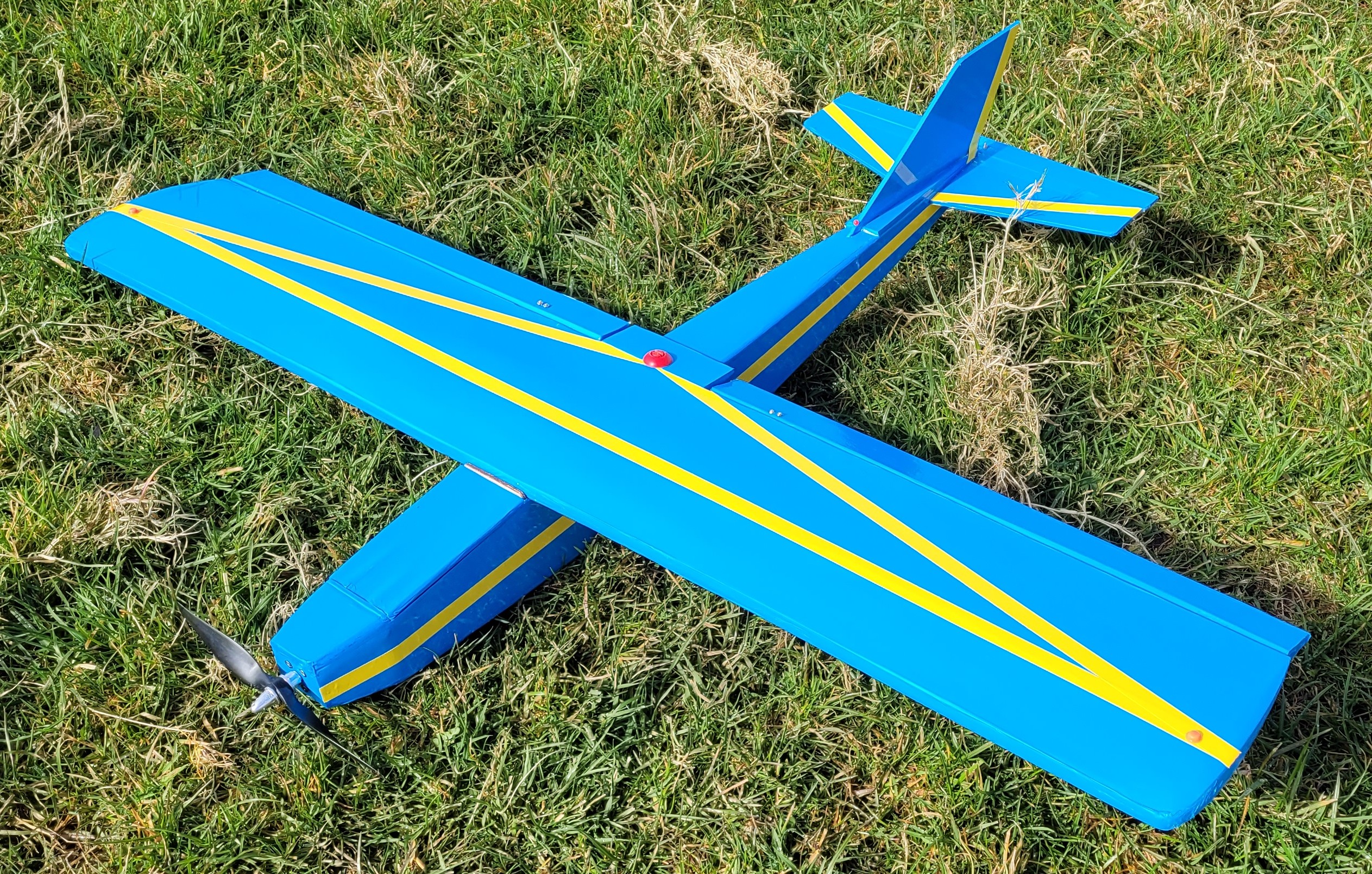
He has fitted a 2810 1400kv motor with a 7×5 propeller coupled to a 30A speed controller and is using a 3 cell 1000mAh lipo. Bluey had a few flights in March with no real problems but Woody is gradually making a few adjustments to get it flying just as he likes.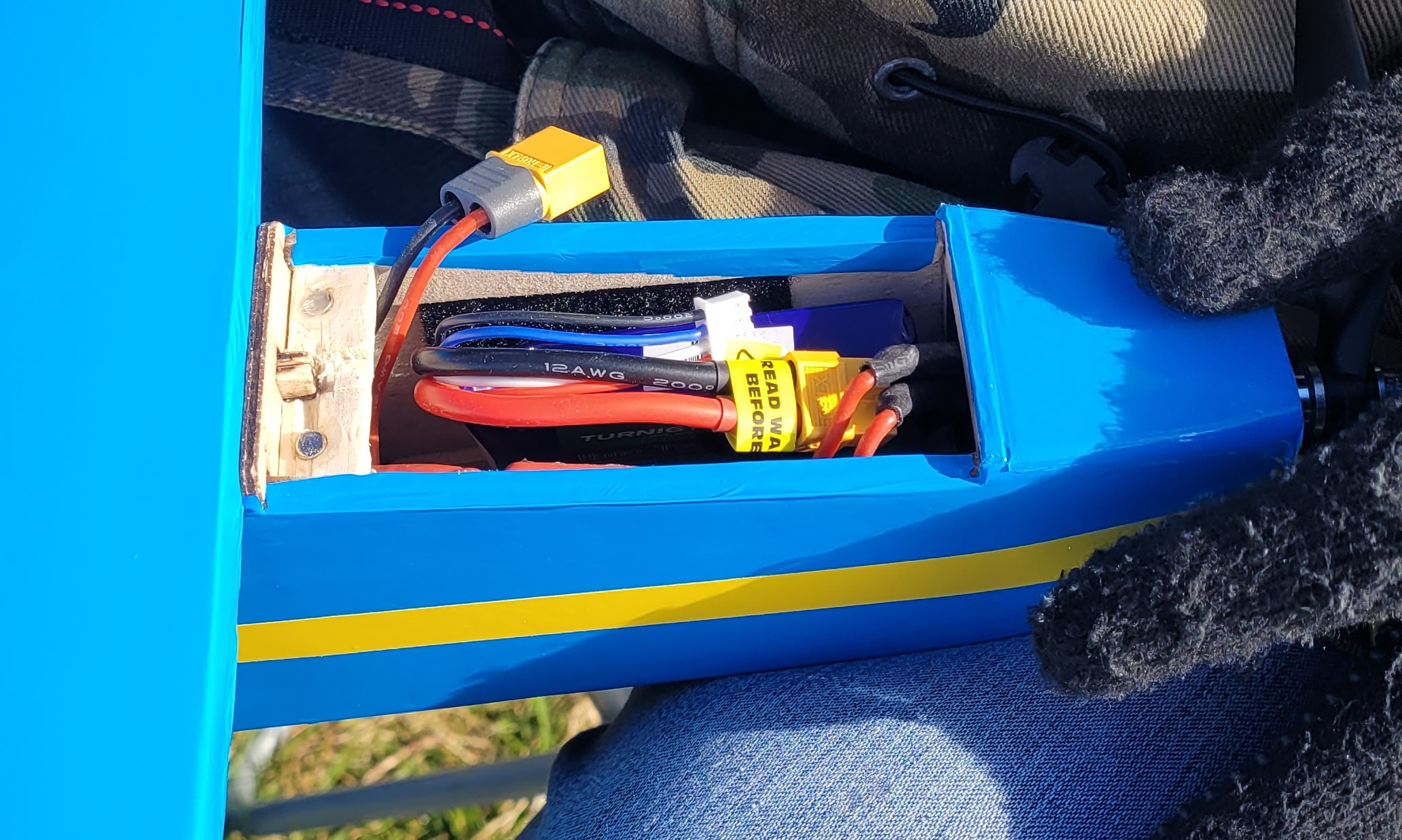
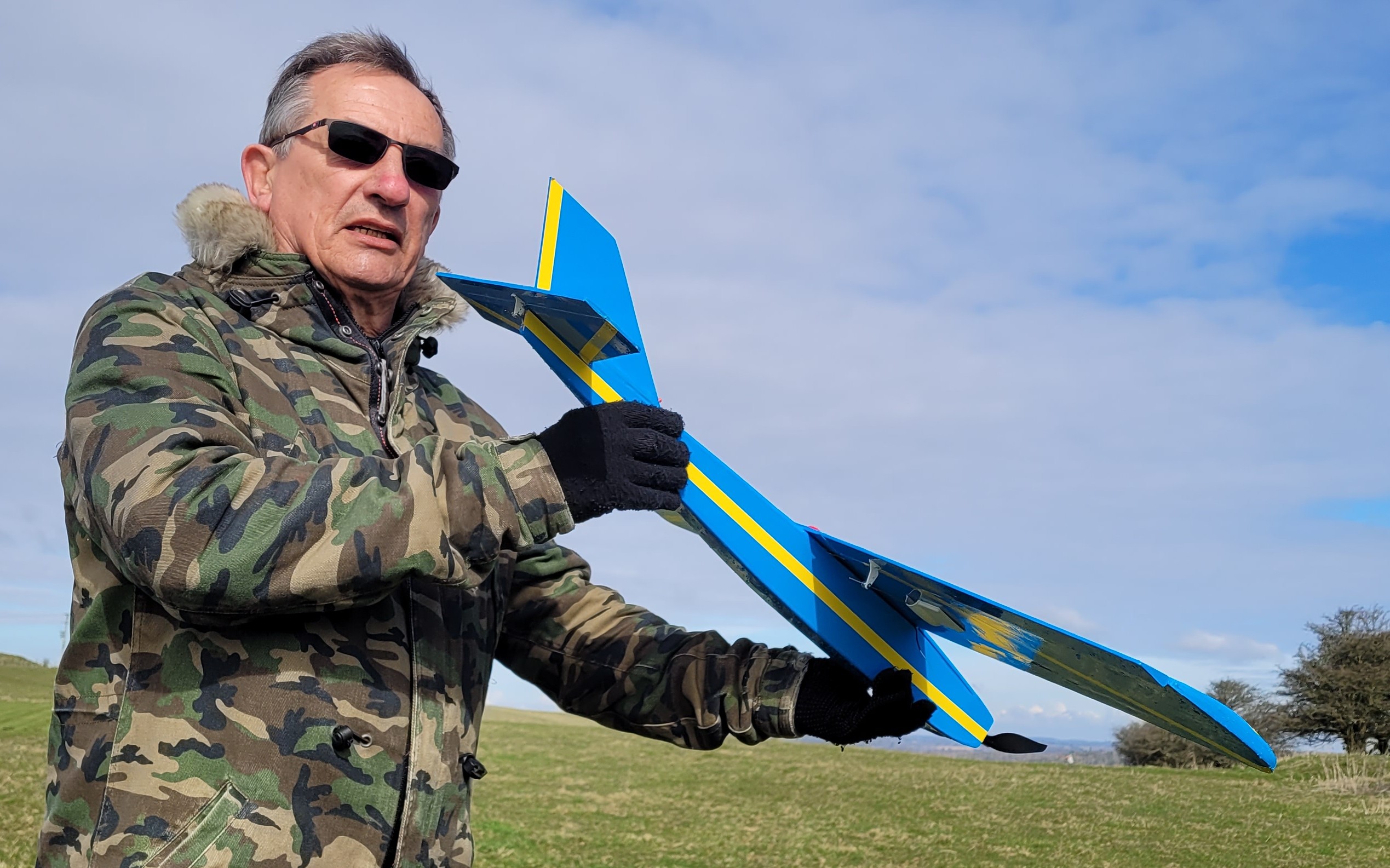
Looking very smart…Bluey not Woody! None of the usual suspects managed to shoot any video of the Bluey flying in March but hopefully I’ll be able to include some next month.
In March I got two models out of semi-retirement and have enjoyed flying them both. First was a Kyosho Raptor that I’d put together back in 2017. Oh look, I haven’t changed a bit…
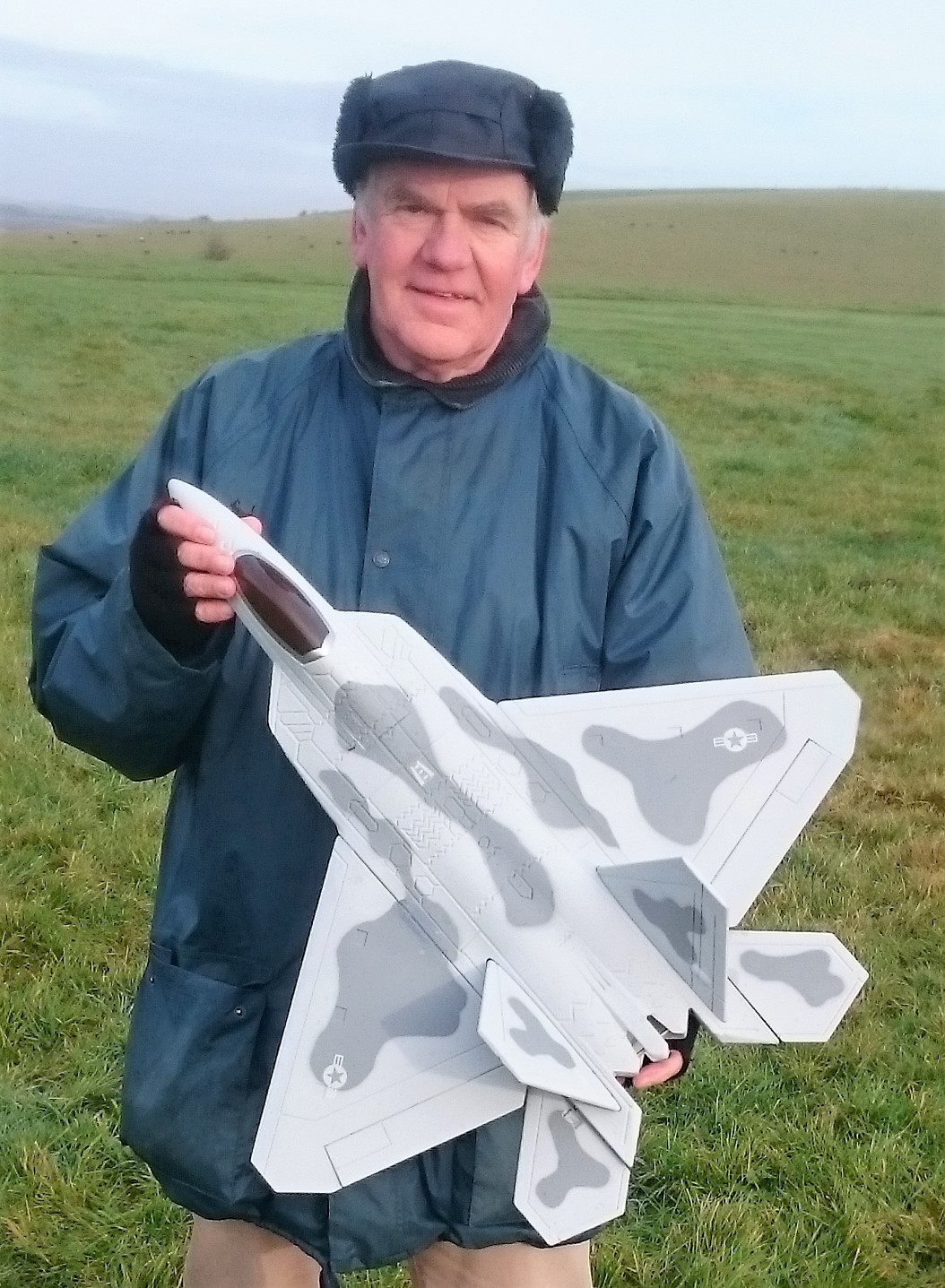 It flew well but one of the aileron servos kept freezing momentarily in flight, fortunately always in the neutral position. Obviously I needed to change the servo but the wiring on the Raptor was all glued in place during the construction to keep the EDF airflow clear.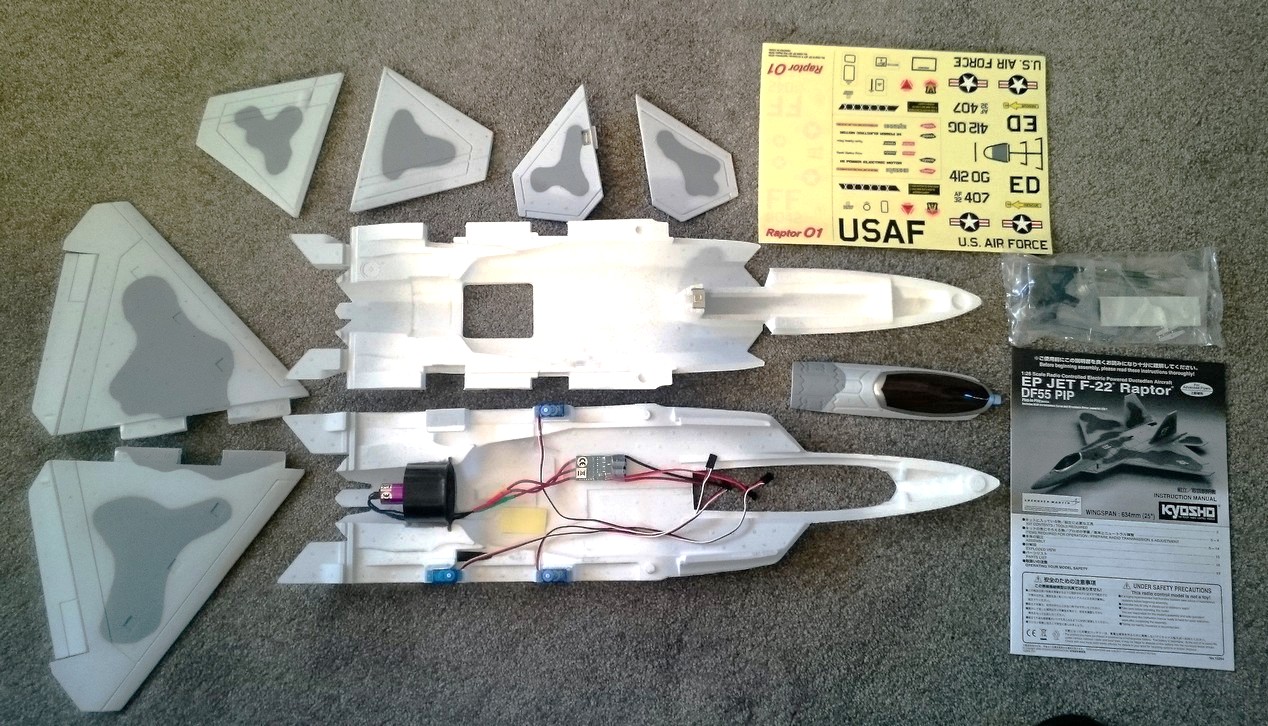
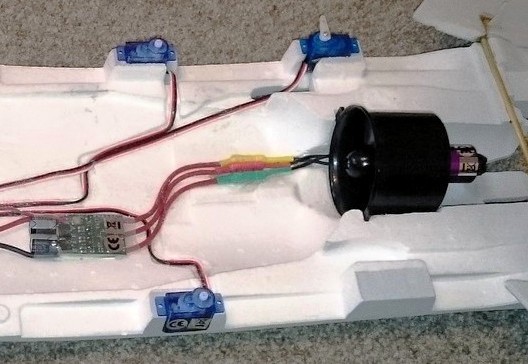 So I stopped flying it while I pondered…for several years! I decided the only thing to do was to cut the servo off, leaving the wire glued in place, and then run the new servo wire through the duct as neatly as possible. Once I’d bitten the bullet if was very easily done, something I should have sorted years ago! The other change I made was to enlarge the battery bay slightly so I could use 2200mAh 3 cell packs instead of the 1300mAh packs.
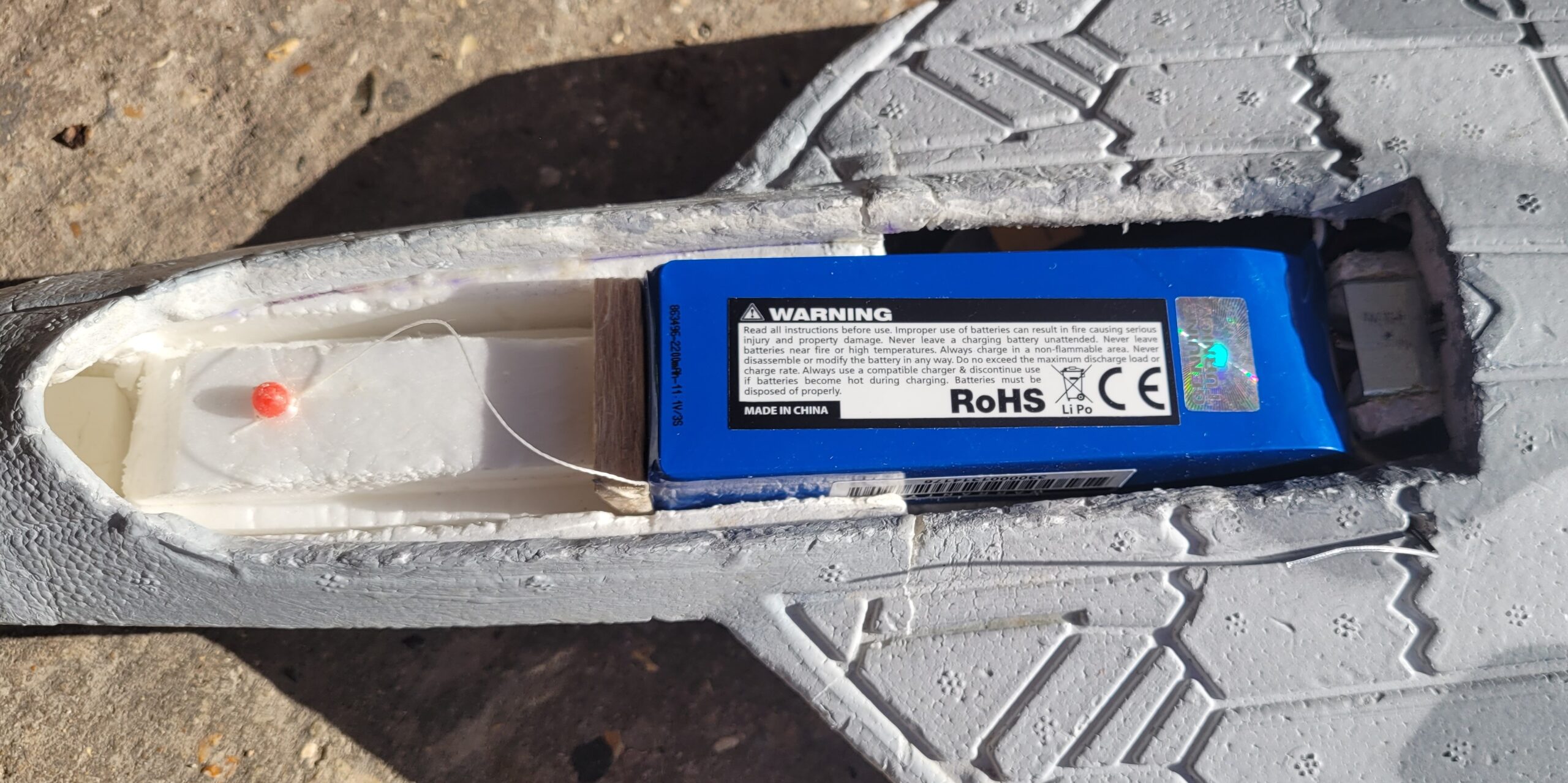 This meant adding even more lead to the tail to correct the centre of gravity so, with the extra battery weight and the lead, the Raptor is now considerably heavier than intended. It needs a bit more of a chuck to get it away from the launch but once airborne it is nice and smooth to fly and I get around five minutes airtime. It’s in the video, I think it looks good.
The other rejuvenated model is my little Sharkface, another model that I had built in 2017.
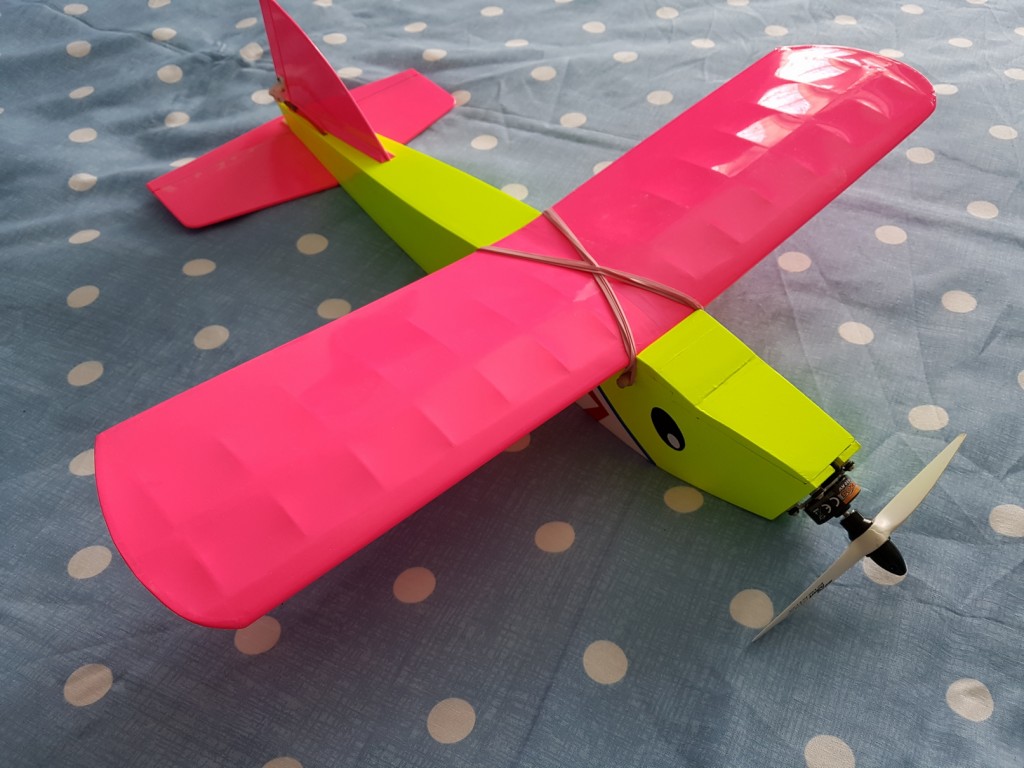 The original was a single channel (rudder only) model designed in 1965 by Eric Clutton and in those days many people fitted them with Cox .049 glow-plug engines, although the design says for up to 1.5cc so some modellers fitted one of the small diesel engines that were popular in the sixties. In March 2017 RCM&E re-issued the original plan along with an article by Shaun Garrity and also added a Mk2 version of the plan which updated it for modern radio by adding an elevator. I’d stopped flying mine because I’d damaged the old ‘bell’ type motor it was fitted with and although it still ran there was a terrible vibration.
This month I rummaged through my stuff for the smallest motor I could find but the best I had was a drone motor from an old foamboard model. It was soon fitted along with a 30A speed controller and, as the old bell motor only used a 10A controller, I knew there was going to be huge increase in power! I fitted the smallest prop I could find, a 5×4, and gave it a go. The first couple of flights were ‘interesting.’ I’ve found that it needs to be launched at less than half throttle and, having reduced the rates a lot, it flies well… mad but well!
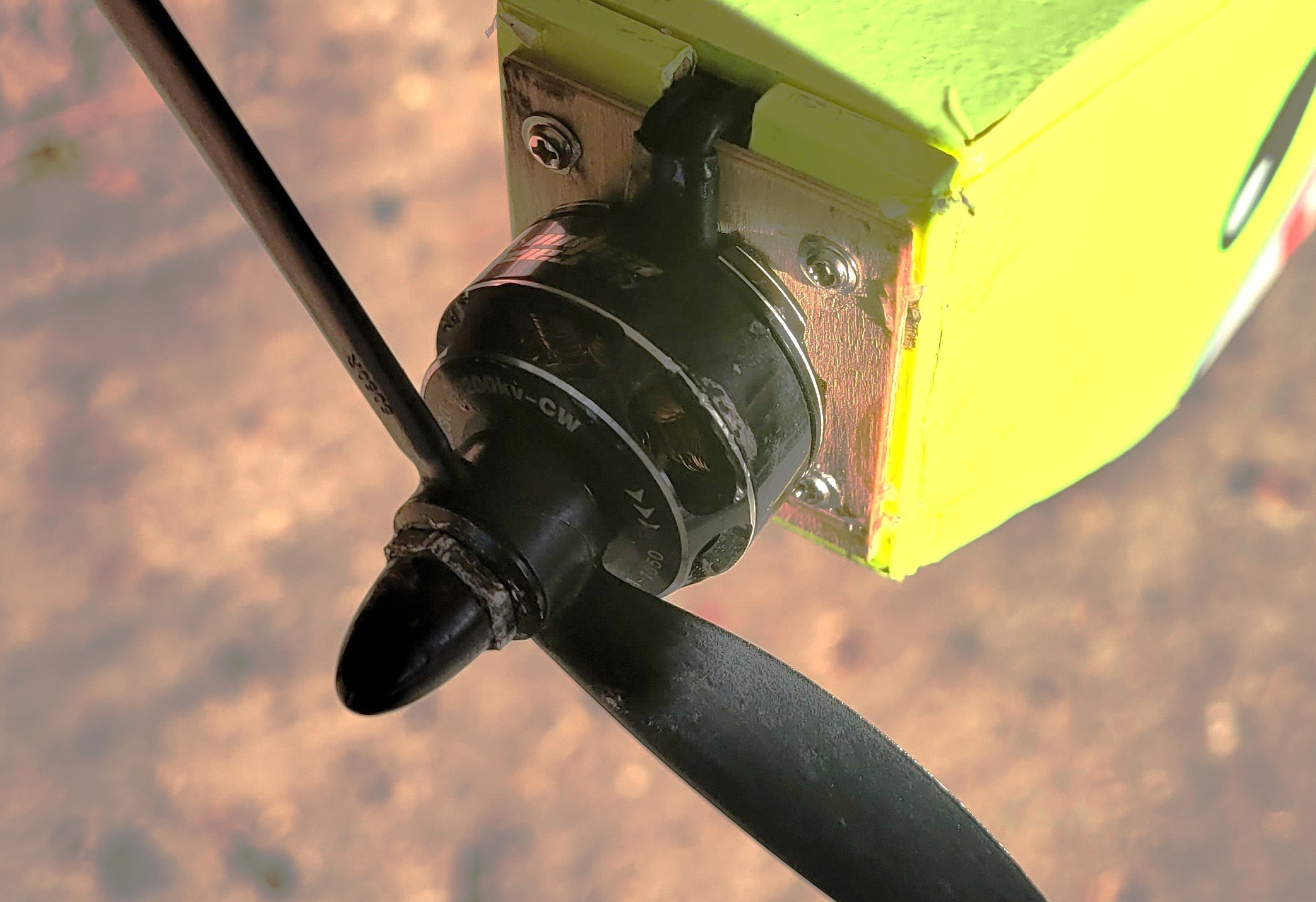 Note how much the covering has faded over the eight years since I built it. I was very lucky with one landing which finished right on the spot, total fluke, I wasn’t even aiming for it!
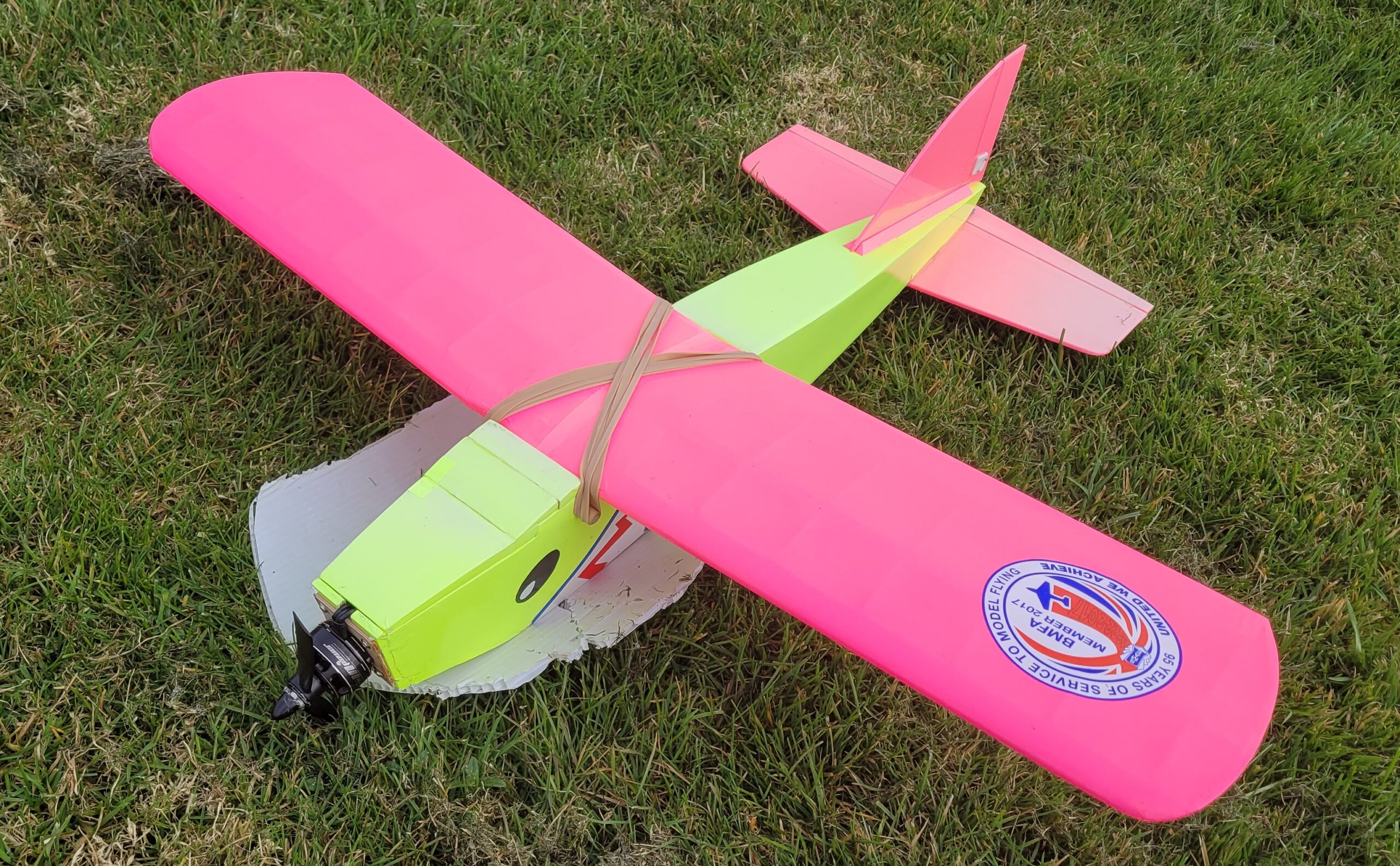 You can see the Sharkface in action in the video, it’s ridiculously overpowered but fun.
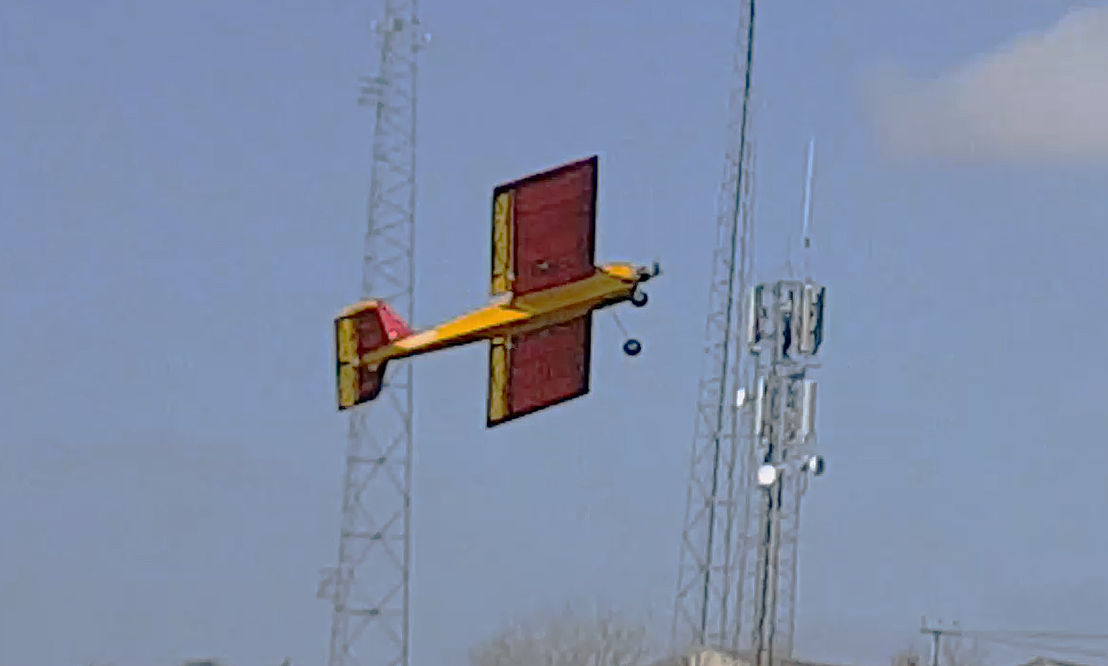
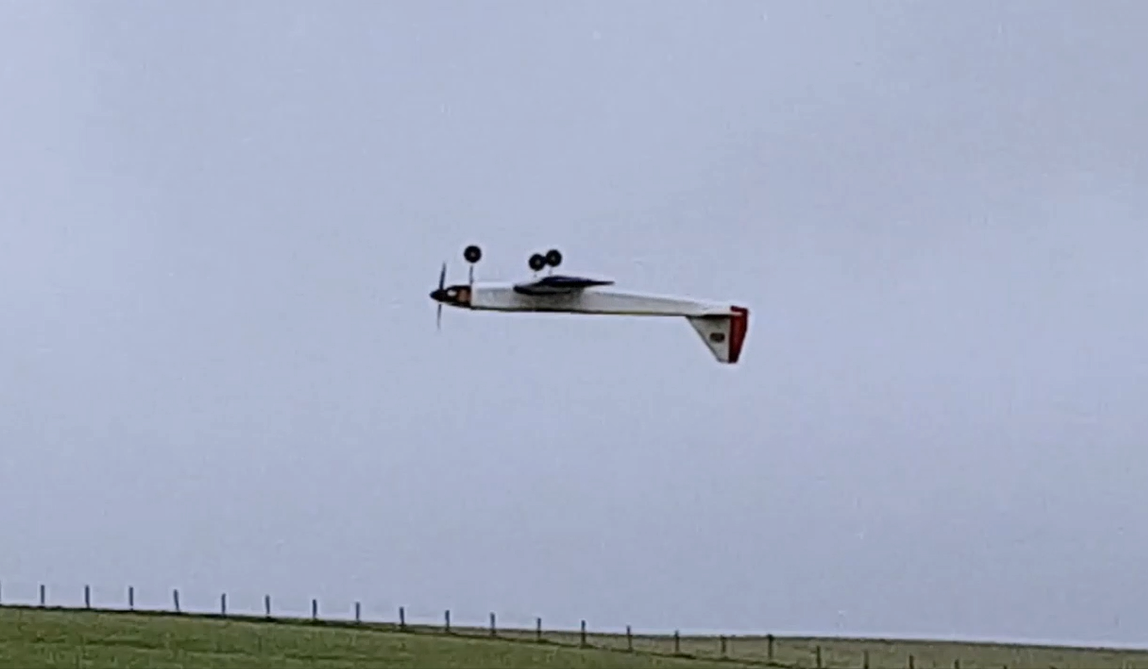
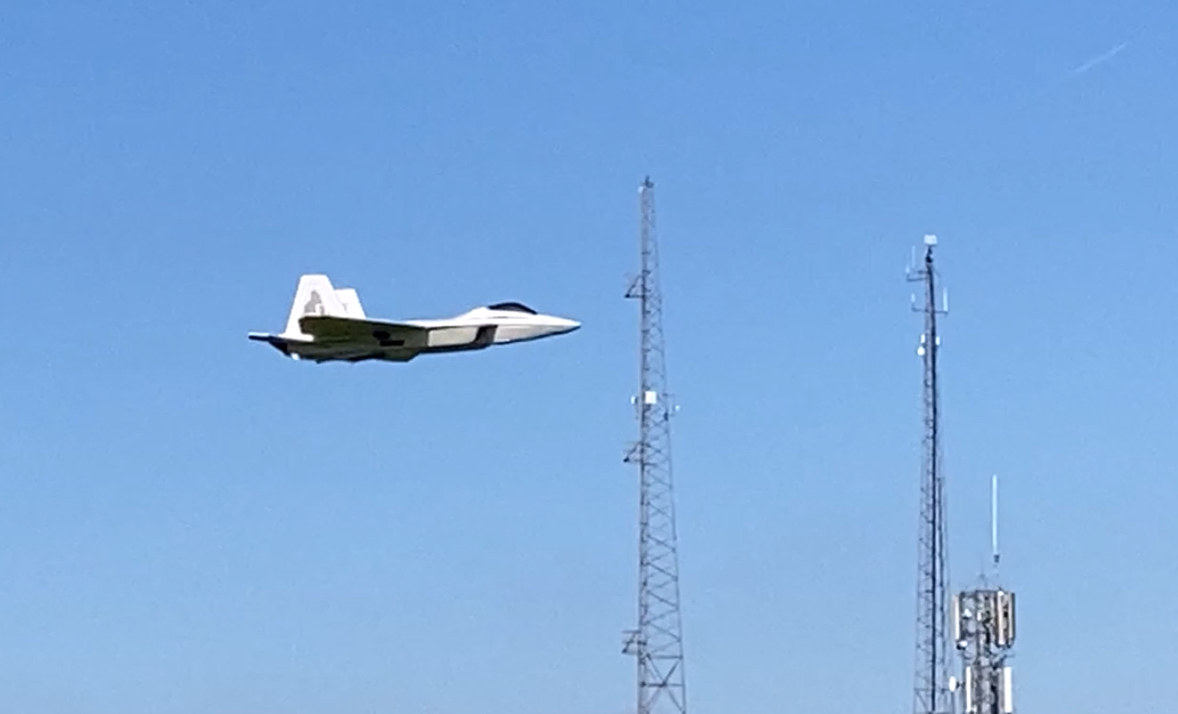
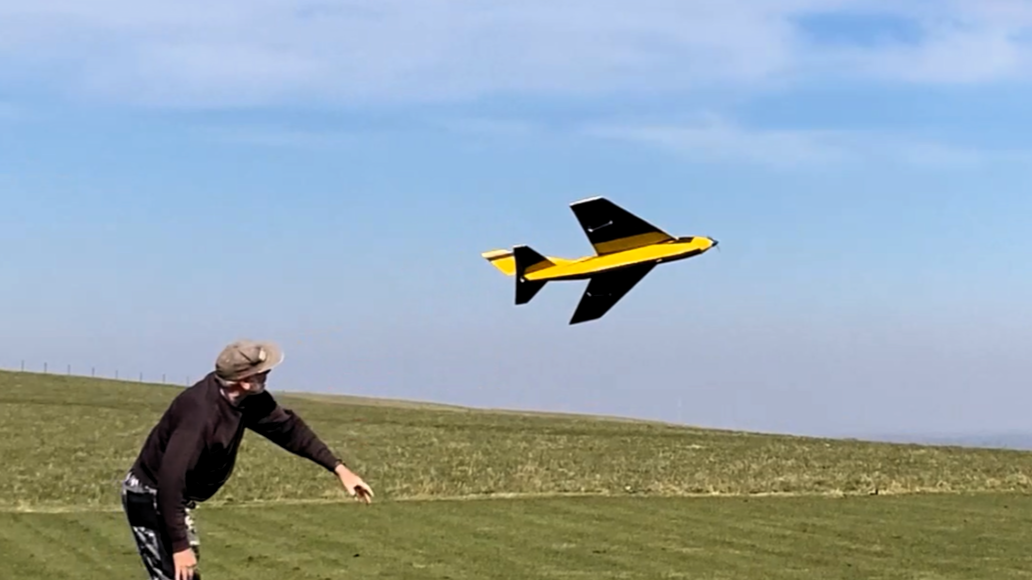
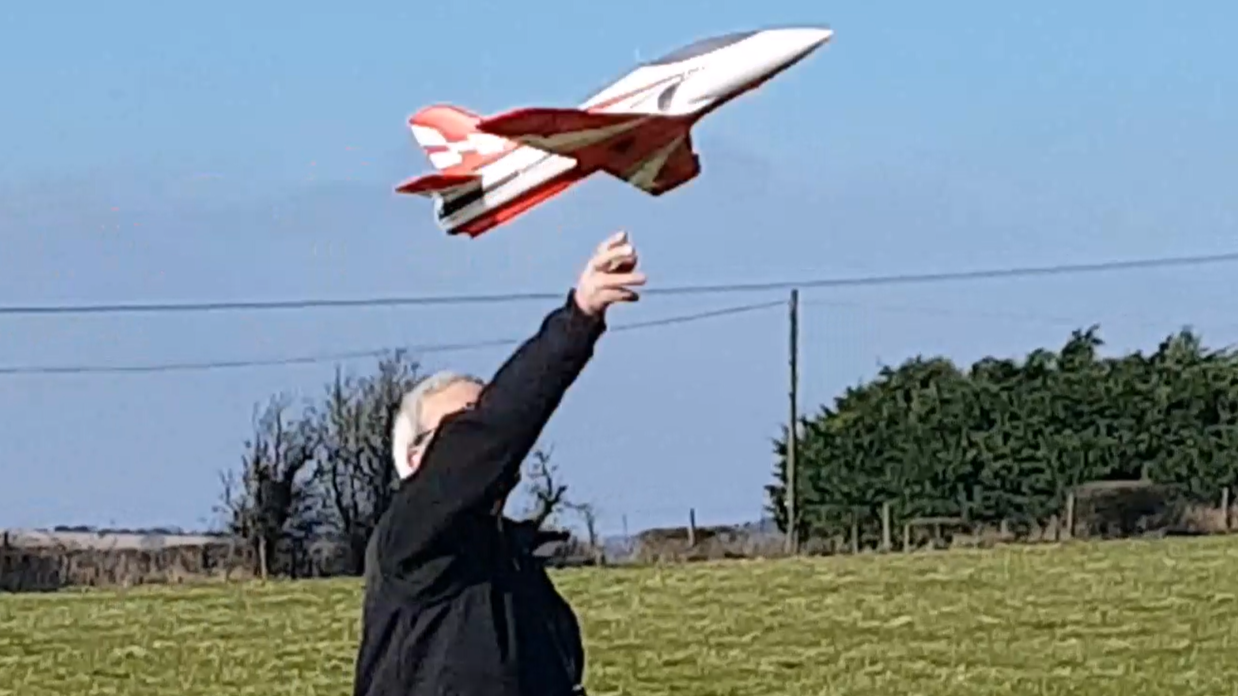
The action shots this month are all taken from the video so rather poor quality I’m afraid: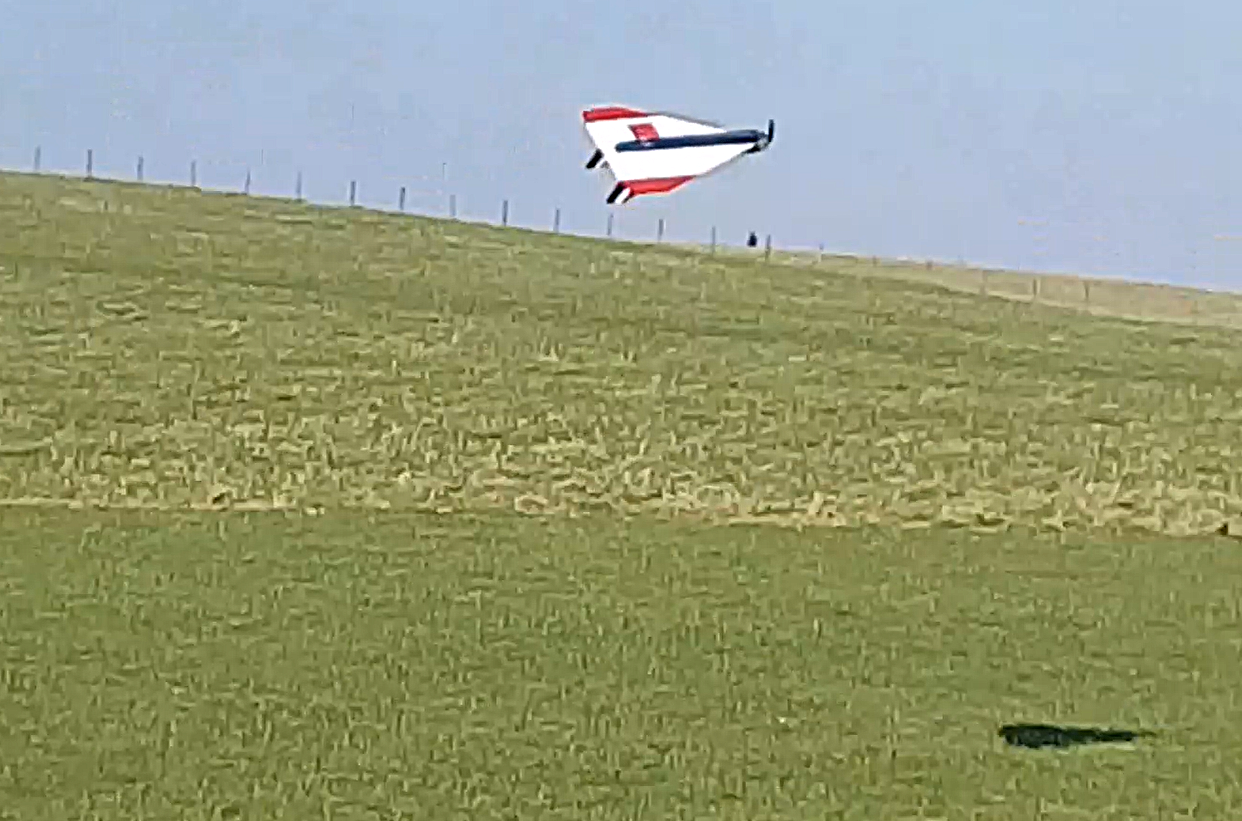
Video time now, this month with footage shot by myself, Dougal Entendre, and MacFly.
Please watch the video full-screen, it’s so much better with small models flying around:
If the video won’t play for you please click HERE
The Final Funny:
This month I have a helpful tip for you when you’re flying off on your holiday.
If you board the plane and spot Jack, your old mate from school, don’t call out “Hi Jack!”
Colin Cowplain
Patch News – February 2025
It’s March, welcome to glorious spring weather and lots of flying opportunities! Well, that might be slightly optimistic but there are signs that the weather is getting better and February was certainly better for us than January. We flew on the decent days and saw several good turnouts of members. Some days were very cold but the hardy ones still flew!  Unfortunately Friday 21st was a complete washout and the forecast for the following Sunday was also dreadful so we flew on Saturday 22nd instead when nine members turned out for an excellent morning of flying and socialising in surprisingly good weather.
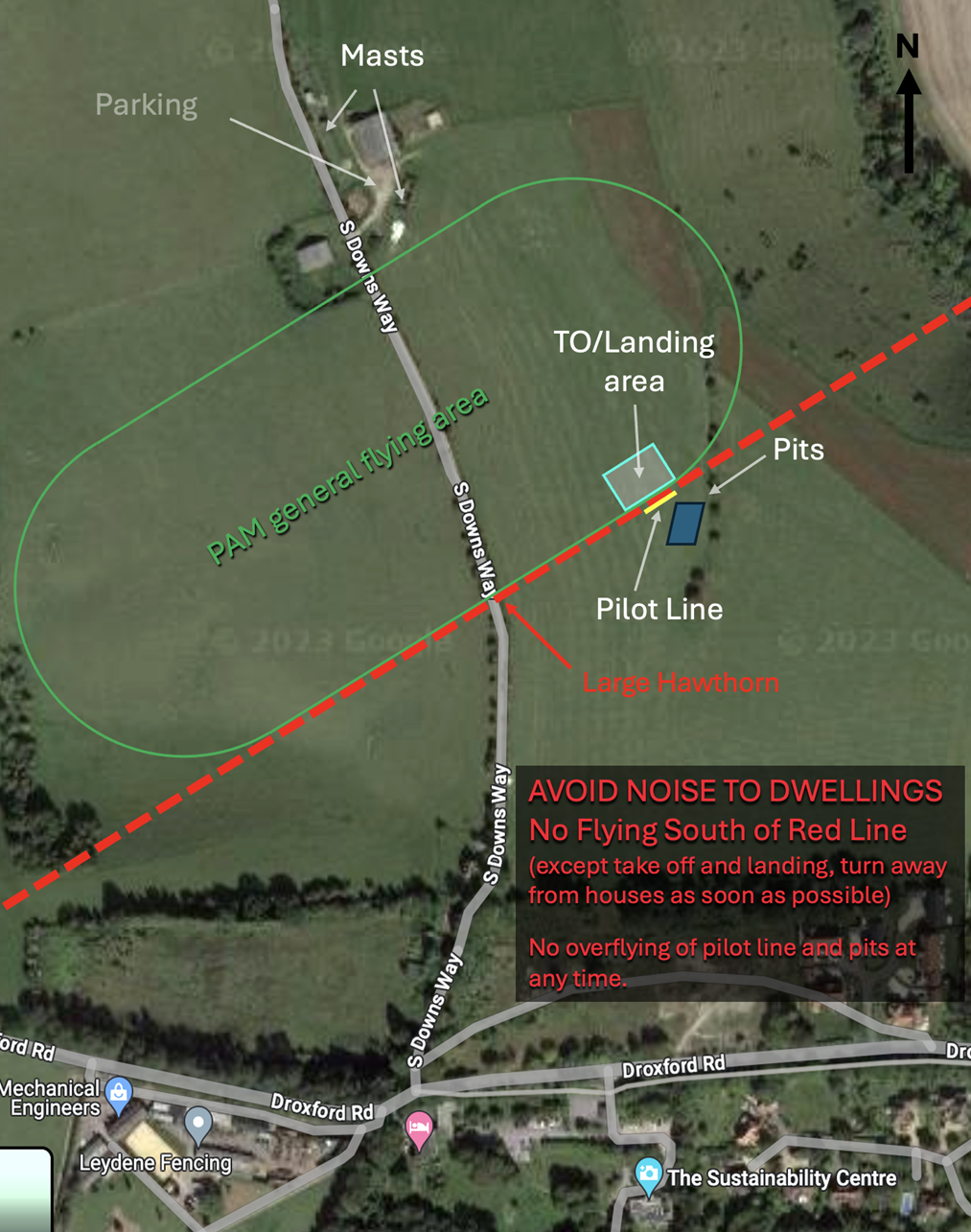
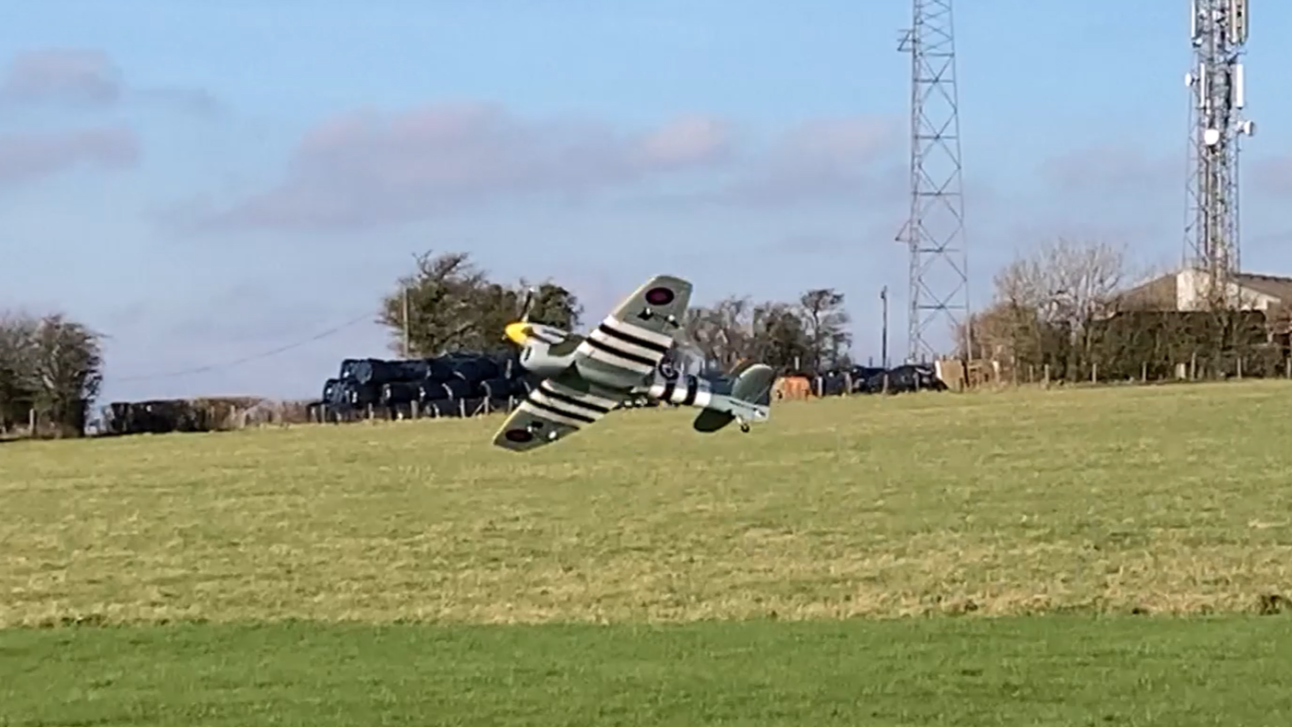 At the beginning of February we rotated the patch clockwise slightly as had been planned previously. This is to ensure better separation between airborne models and the houses (existing and planned). The rotation makes very little difference to our take-offs and landings but the red ‘Do Not Cross’ line that extends both west and east from the southern edge of the patch has rotated with the patch, effectively rotating our whole flying area slightly. So, when standing on the pilot line facing the masts, look left along the edge of the patch, extend that line into the distance, and never fly behind it, simples!
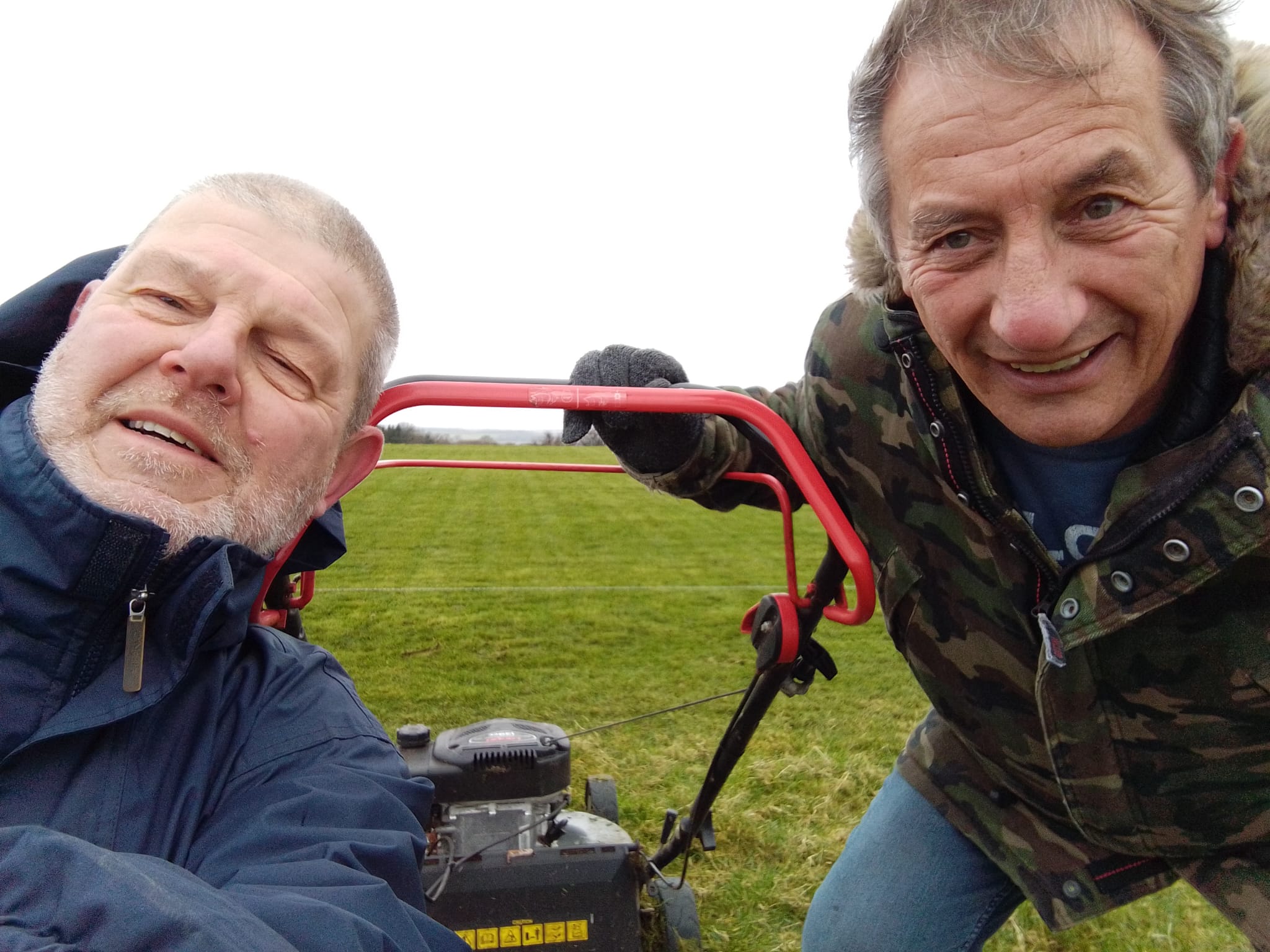
 A couple of days after we’d mowed the newly rotated patch Woody and 1066 went back and mowed the whole patch again and sent me this photo as proof of their hard work!
 Since then we’ve mown it a couple more times so the patch is now in very good condition.
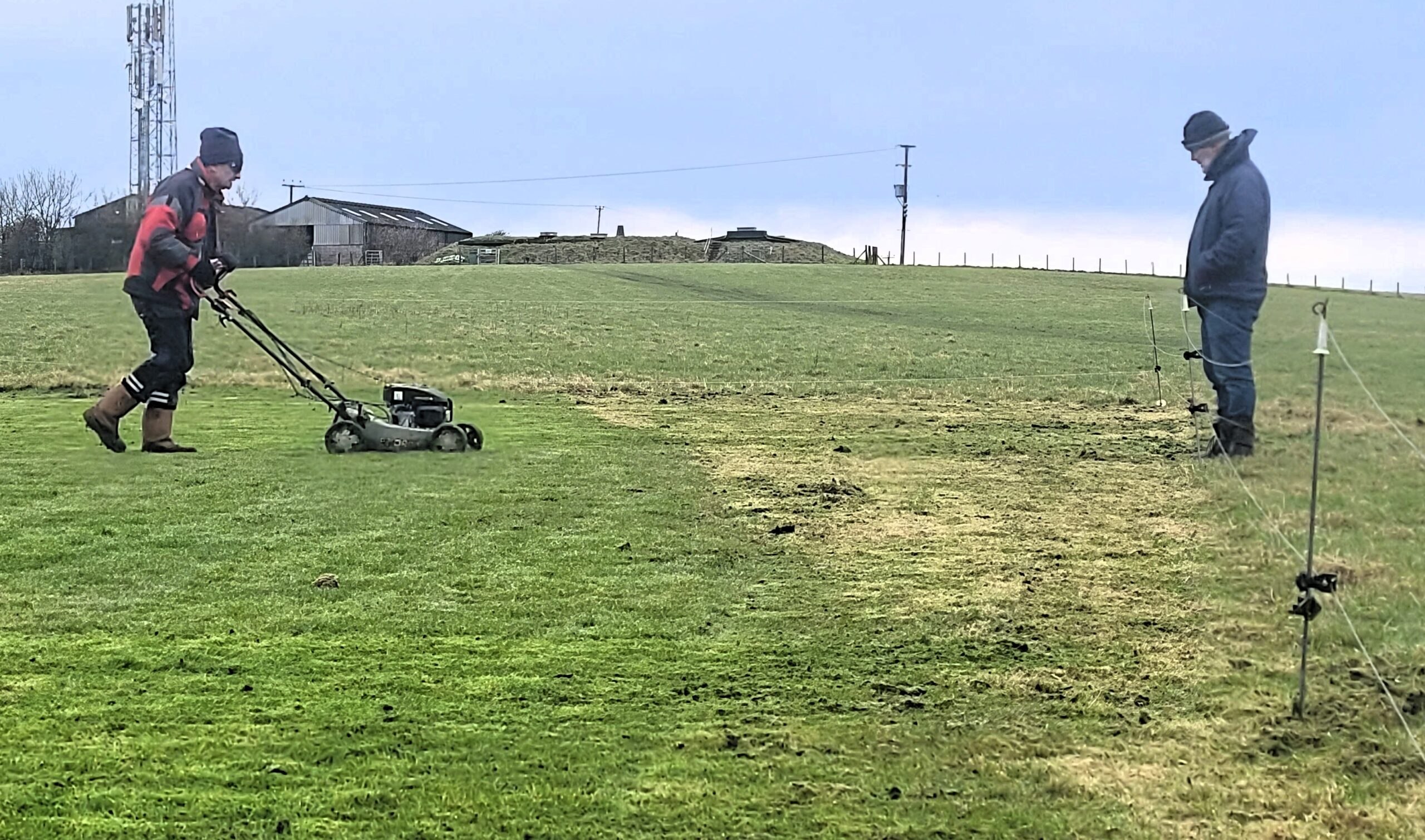
 I think it’s short enough now for Gordon Bennett to remove the wheelbarrow wheels from his Multiplex Extra and replace them with something sensible but I doubt that’ll happen!
On to new models now, starting with one that’s both come and sadly gone in the same month, Woody’s F-117 Lockheed Nighthawk. As I said last month the Nighthawk is one that Woody found on the website of Humayun Najabat but it seems this one was actually designed by someone else. It says Dzung 50 on the plan and I’ve found an S-DiY video of the build that seems rather better than Humayun Najabat’s, you can watch it HERE.
 Woody fitted his usual foamie set-up consisting of a Turnigy 2826/6 2200Kv motor, a 30A speed controller, and a pair of 9g metal gear servos. He brought it along on two flying sessions and we had multiple attempts at each session to get it flying but never managed to get the Nighthawk airborne for more than a few metres. It’s a bit of an awkward thing to launch and it requires a discus style throw. For the first flight Woody positioned the battery as far forward as he could get it to achieve the centre of gravity that was shown on the plan and he’d also needed to add quite a large lump of lead to the nose.
 It seemed odd as the one in the video on the website didn’t appear to have any lead added and the battery was mounted further back. The first few attempts resulted in it nosing straight into the deck so we removed the lead and gradually moved the battery back but, even with full up elevator the Nighthawk refused to fly. After several attempts the nose got damaged so Woody took it home for repairs, and also to change the servo linkages to increase the amount of up elevator that was available. The next time out the centre of gravity was definitely further back than Woody had marked on the wing and there was much more up elevator available so we were hopeful of success but again the Nighthawk wouldn’t go for more than a few metres before hitting the deck, strange and annoying.
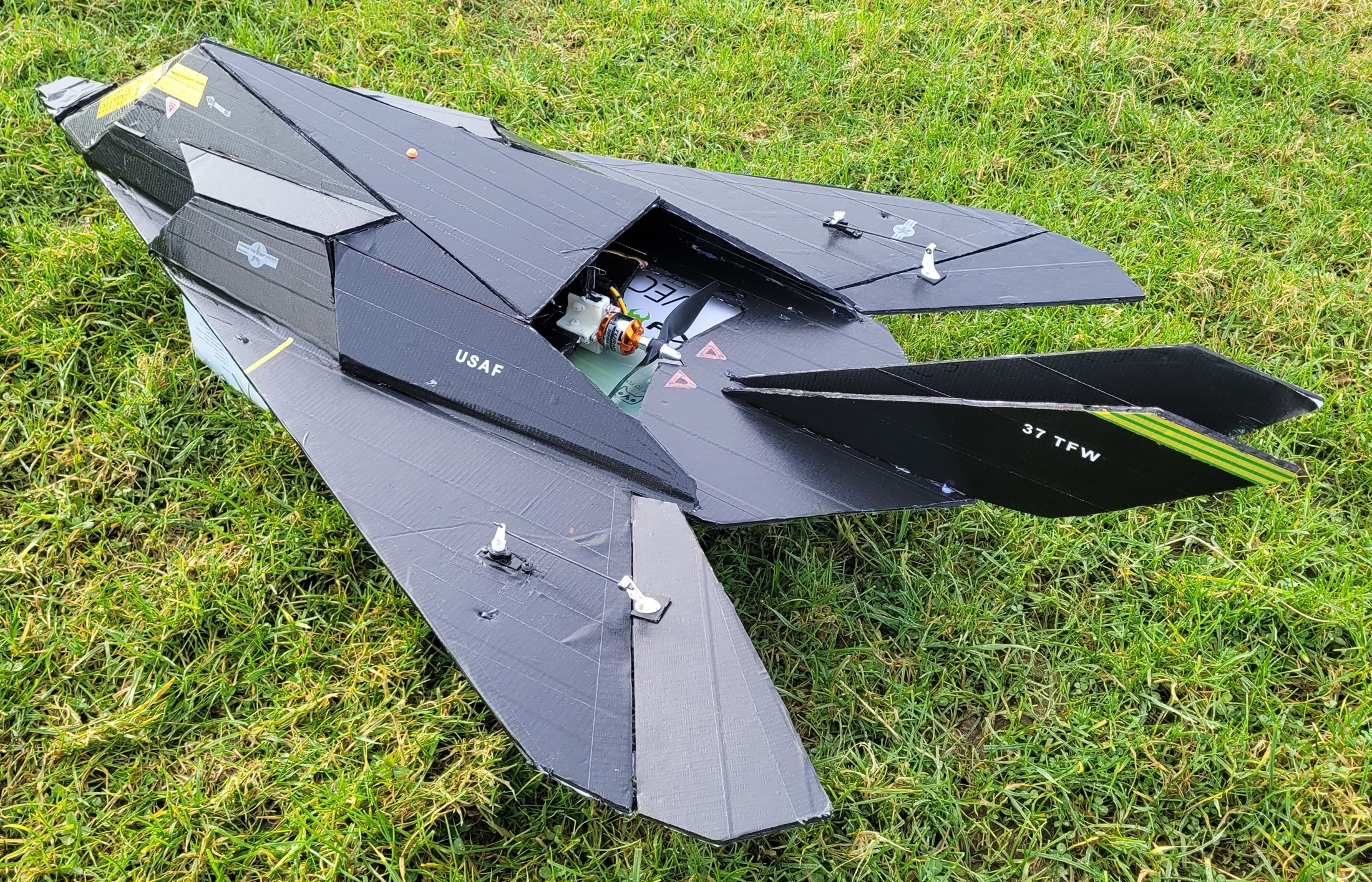 After several more tries there was a bit of damage to the plane but more importantly to Woody’s confidence and patience. He decided to give up in disgust and, having stripped out all the gear, he relocated the remains to the local tip! Since then I’ve had another look at the videos and they say the CG should be about 42cms from the nose which is where Woody had the yellow lines on his. But two videos also show the plane being balanced, and they are balancing at least 3cms further back than where Woody’s marks were.
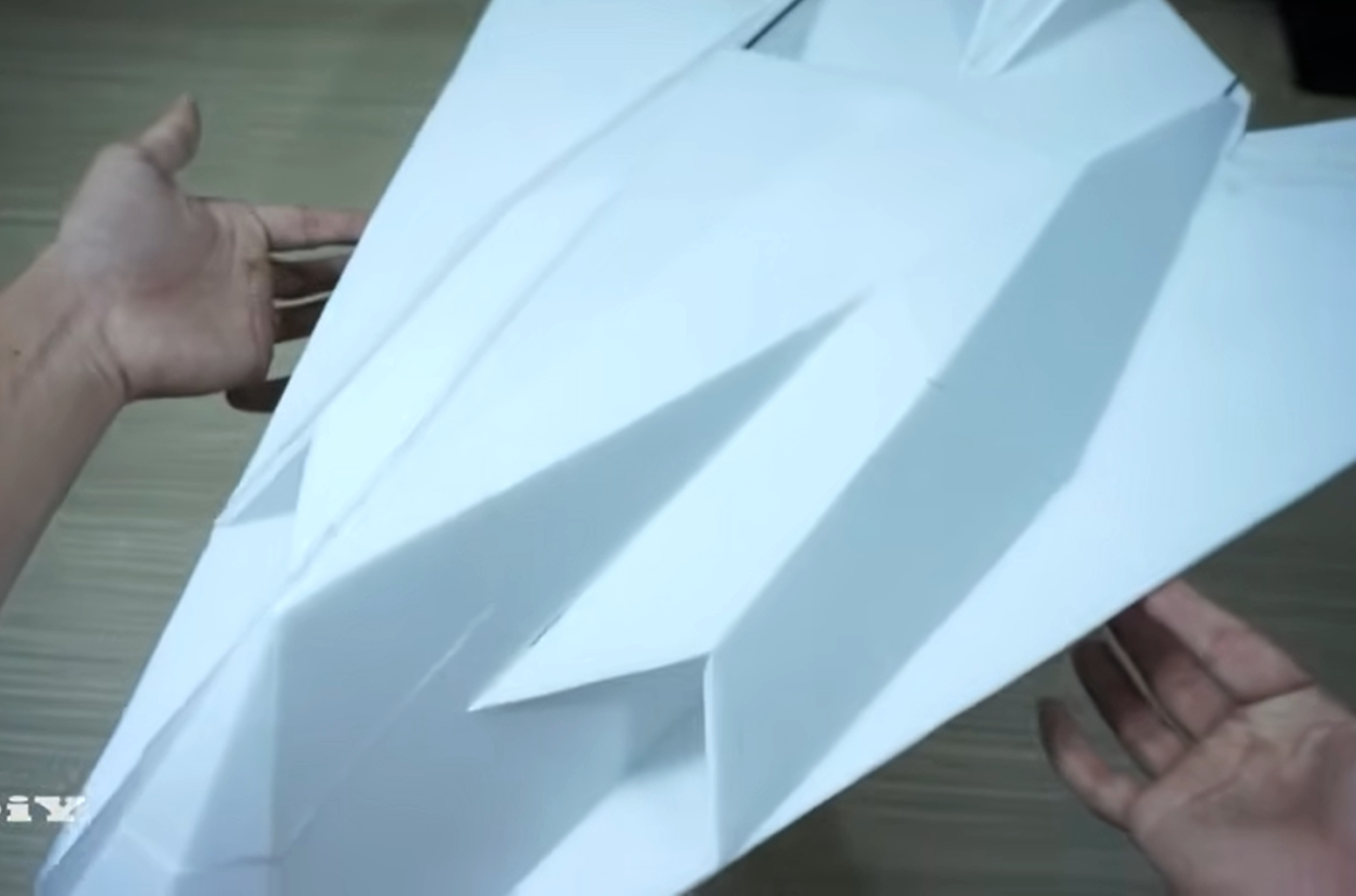
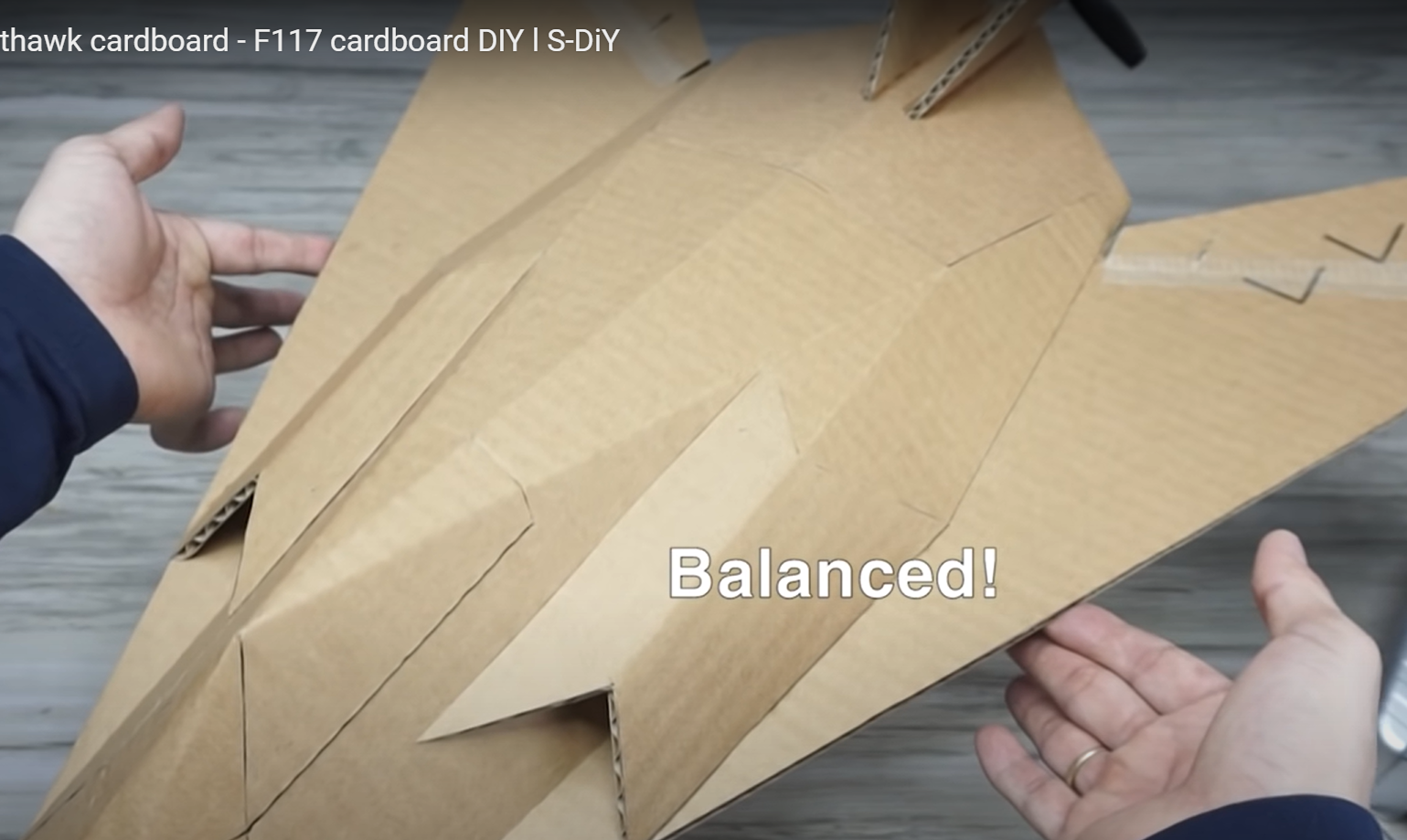 So either Woody can’t measure or the 42cms given is wrong, personally I reckon the 42cms is wrong. I’m pretty sure that if Woody’s Nighthawk had balanced where shown in the videos it would have flown. Never mind, it’s too late now, Woody’s loss is the tip’s gain!
Sticking with Woody, following the Nighthawk nightmare he was feeling rather blue so he’s bought himself a yellow. No, not a yellow, a Yellow, although Woody’s will be blue!
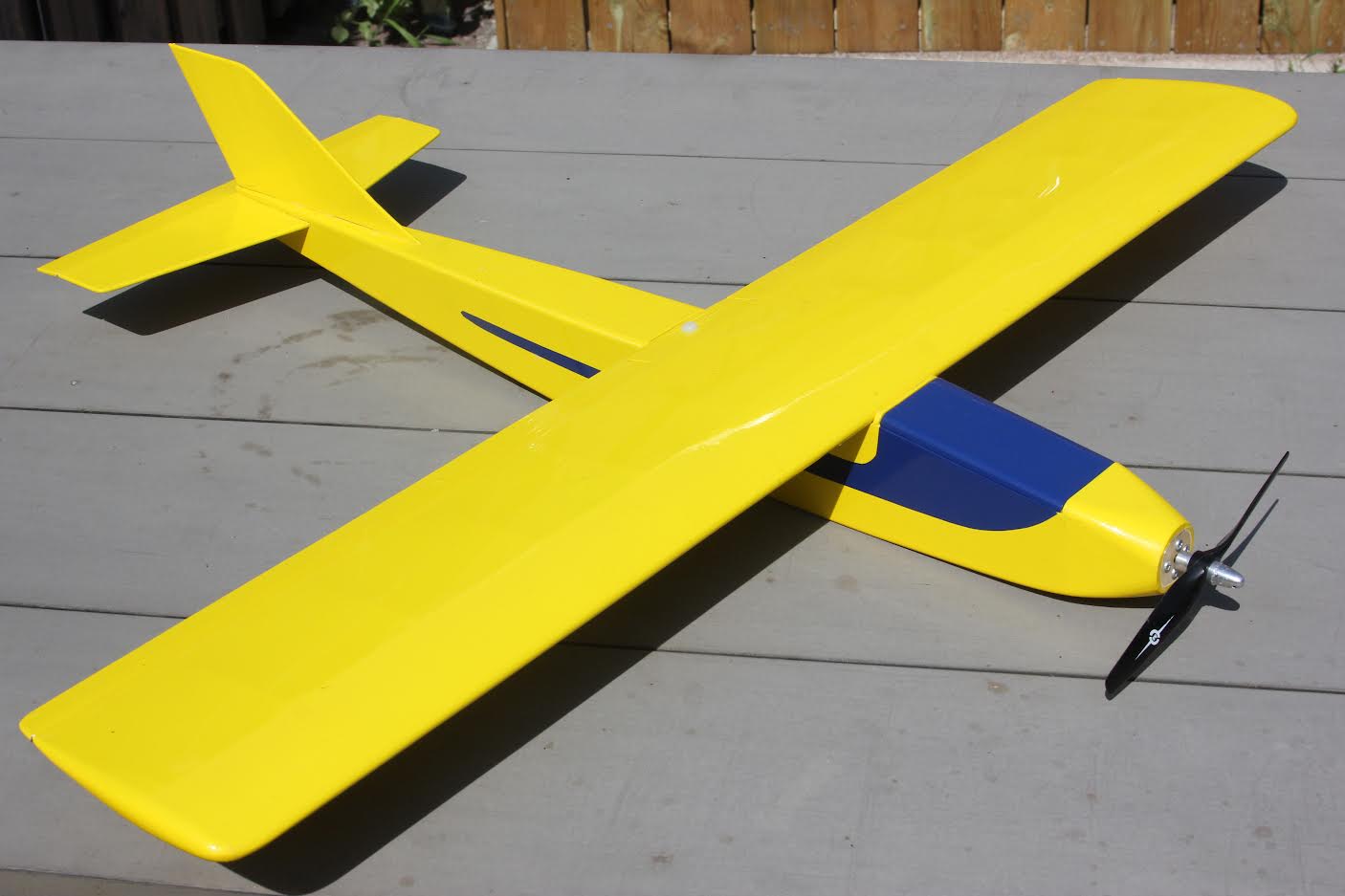 It’s a plan pack from Sarik Hobbies and they say it’s a classic .049 design for electric power and modern lightweight radio control gear designed by Ton Van Munsteren and featured in December 2023 RCM&E Magazine. In case you don’t know what an .049 is, it’s an I/C glow plug engine of 0.049 cubic inch capacity or 0.8cc, mostly manufactured by Cox.
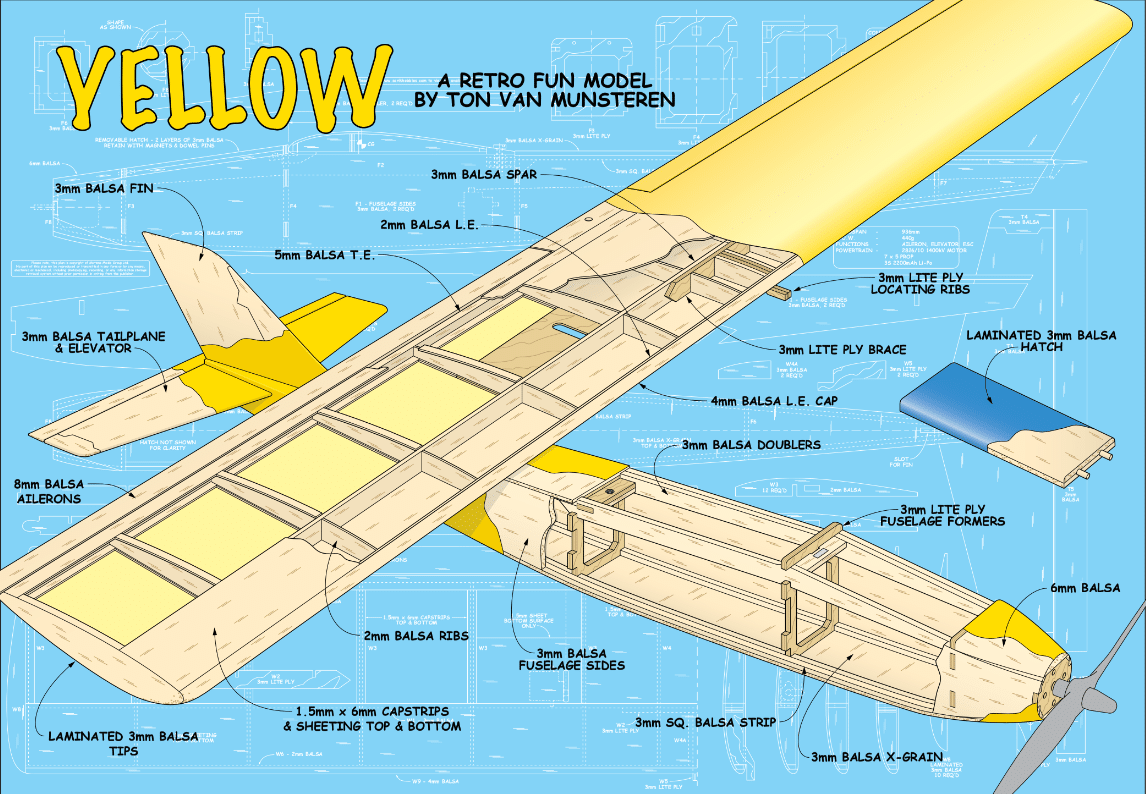 The Yellow has a wingspan of just 936mm and requires a 2826/10 1400kV brushless motor, a 30A speed controller, and a 3 cell 1000mAh battery. It looks like it should be fun and probably ideal for our field. This is what it’ll look like when Woody has finished his.
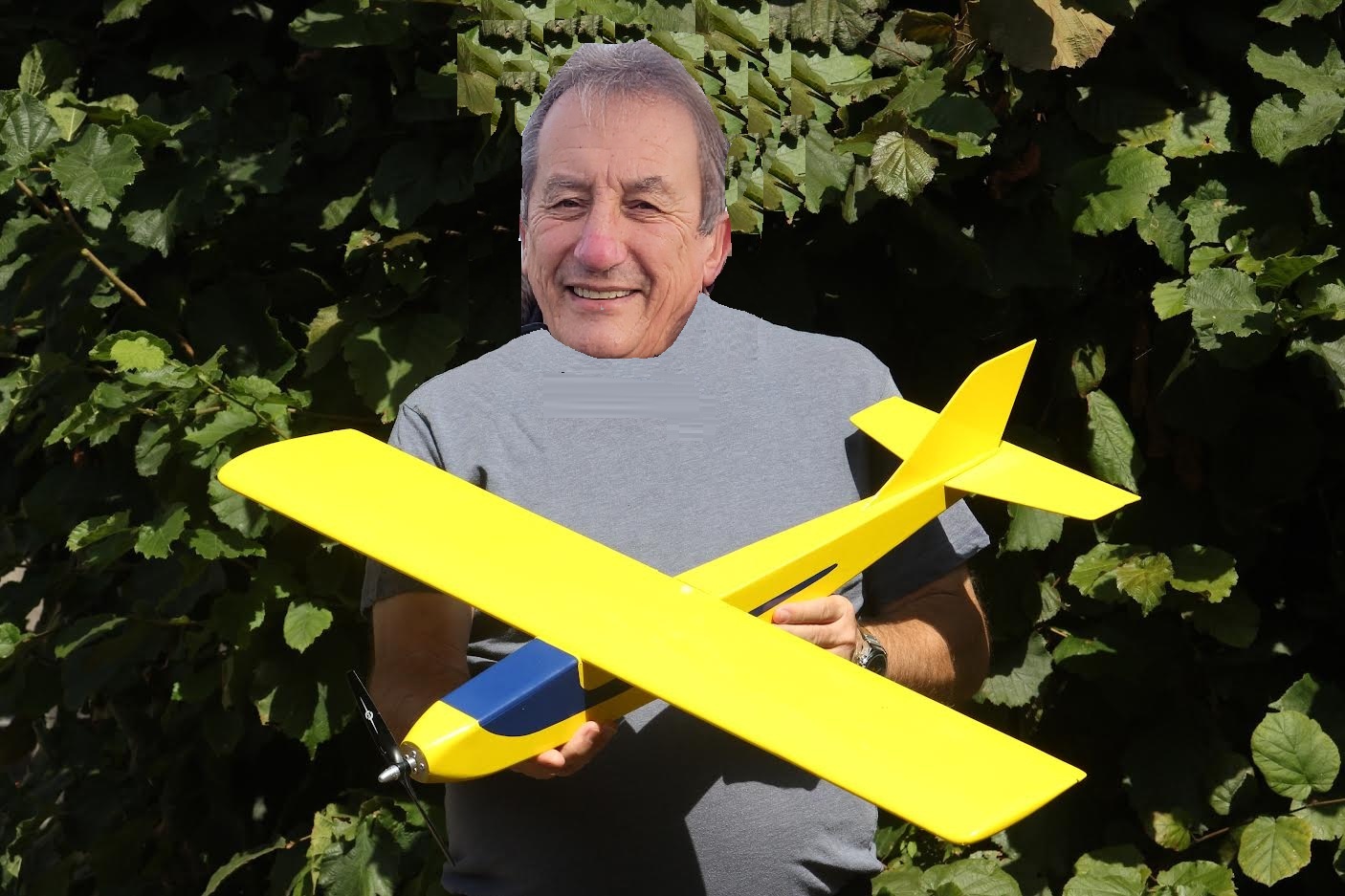 You probably can’t tell that I’ve superimposed Woody’s face over Ton Van Munsteren’s…!
Page Boy came and flew his Wasp E2K pylon racer at the field in February, he has hardly flown at all recently so I think he was getting his hand in for when he flies his new Mirus. 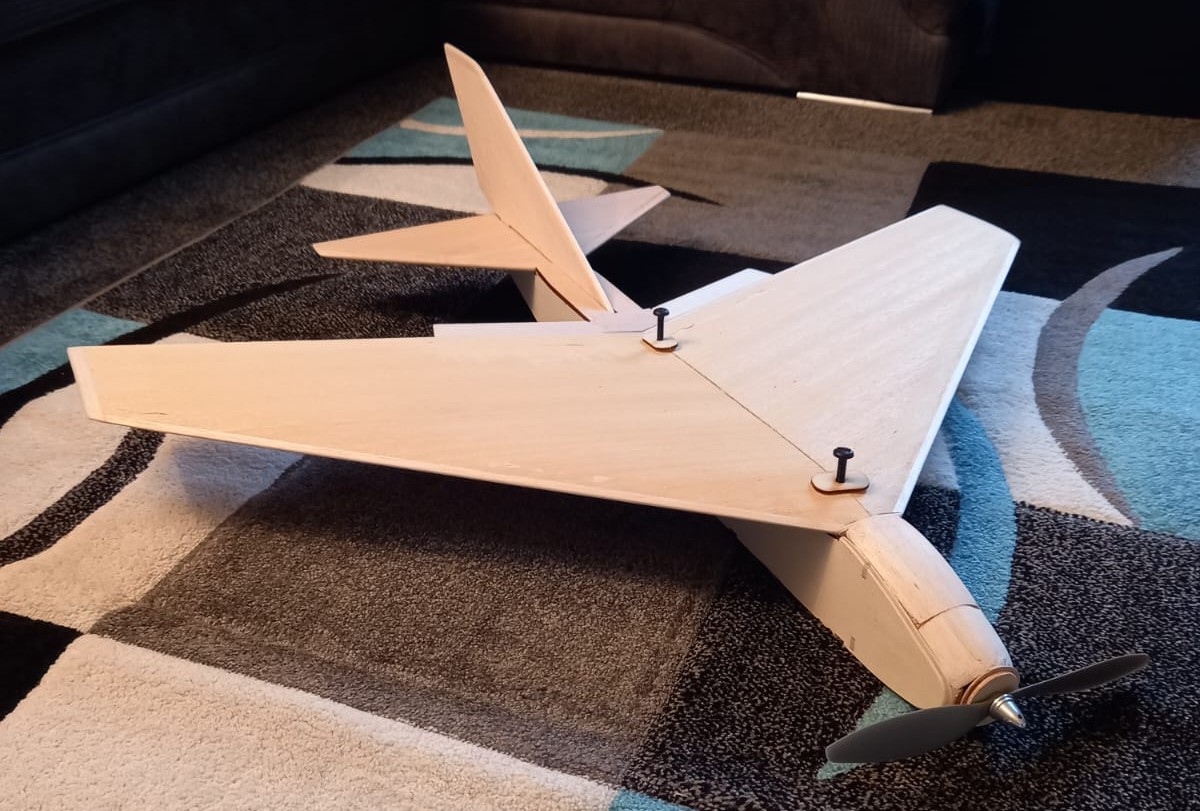 It’s the smaller 25 sized version and Page Boy says he’s happy with how it’s going together and the build is already well on track so we’ll probably see it flying sometime in March.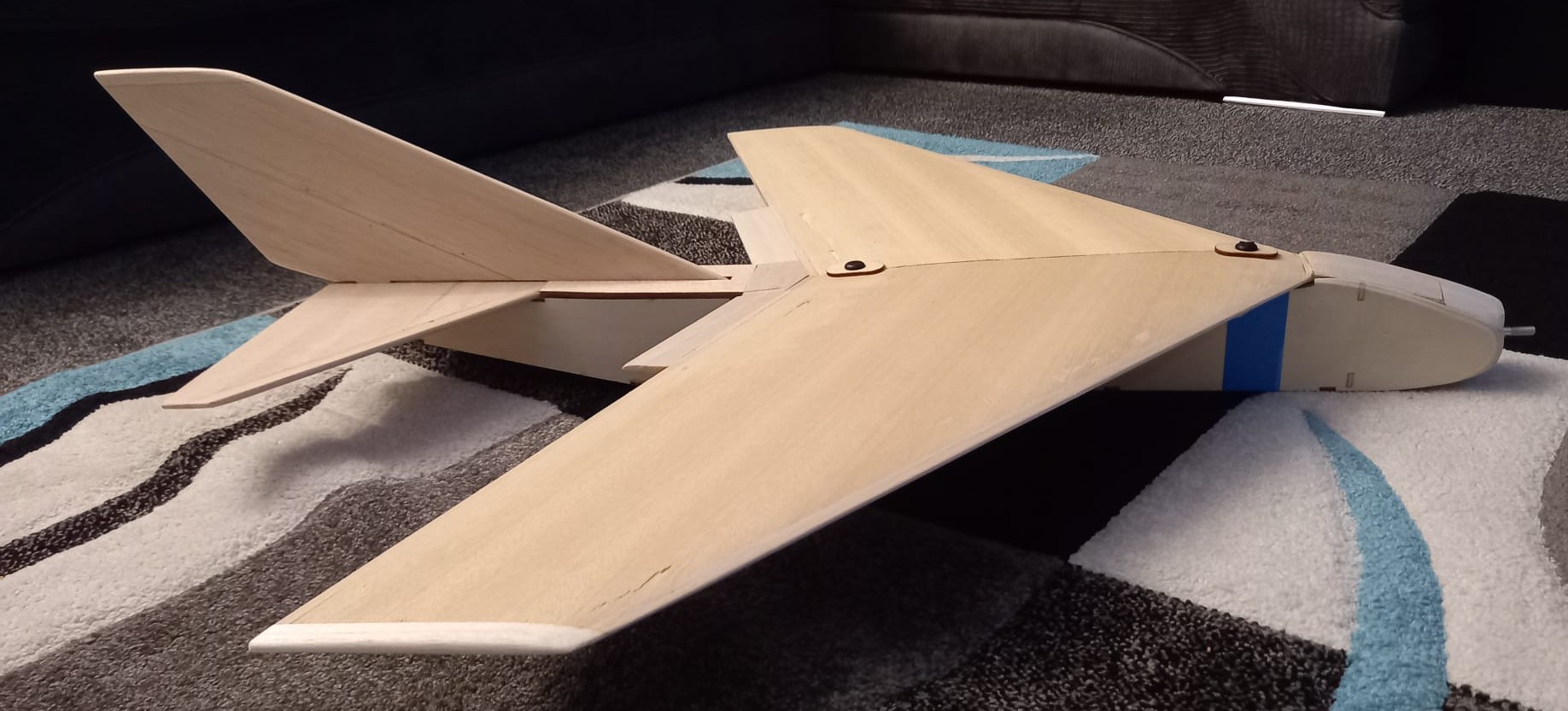
Meanwhile you can see how his Wasp flew in this month’s video. Page Boy also snapped up a bargain that he spotted on Facebook Marketplace this month, it’s an FMS Avanti.
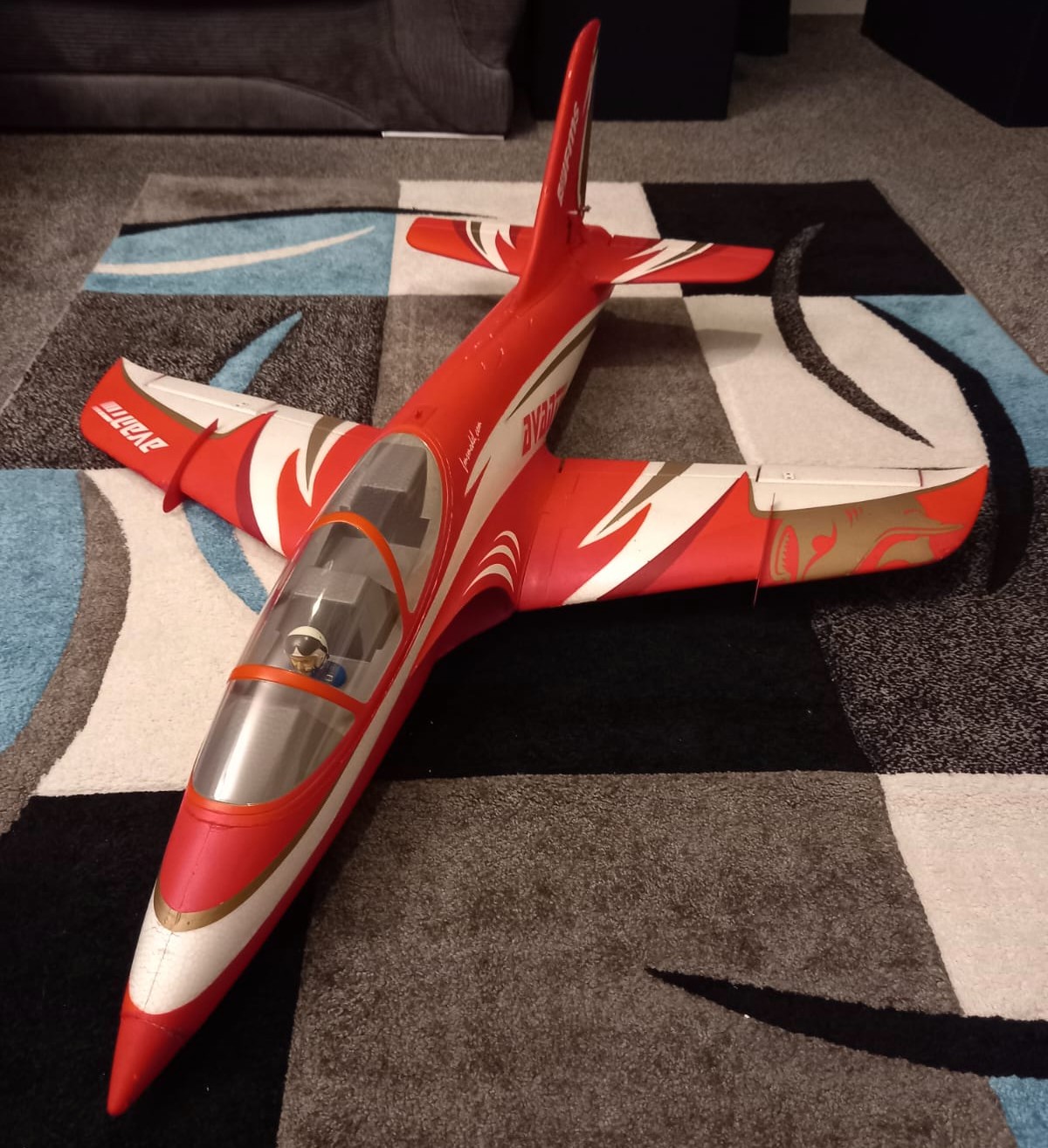 This is from Horizon Hobby: The fantastic 70mm EDF Avanti here! Avanti is a mutual-developed airplane made by FMS team from China and Sebart Team from Italy. The original design and authorization are from Sebart, with the additional FMS advanced production concept, it is finally being a promised finest work. Utilizing many new concepts and technologies from existing planes, this highly anticipated Avanti has the inherent ability to offer a rip-roaring flight. We have optimized the airframe structure markedly to make your time in getting ready for flight quick and easy. The assembly is very straightforward: 7 screws and a carbon fiber wing spar and you are finished.
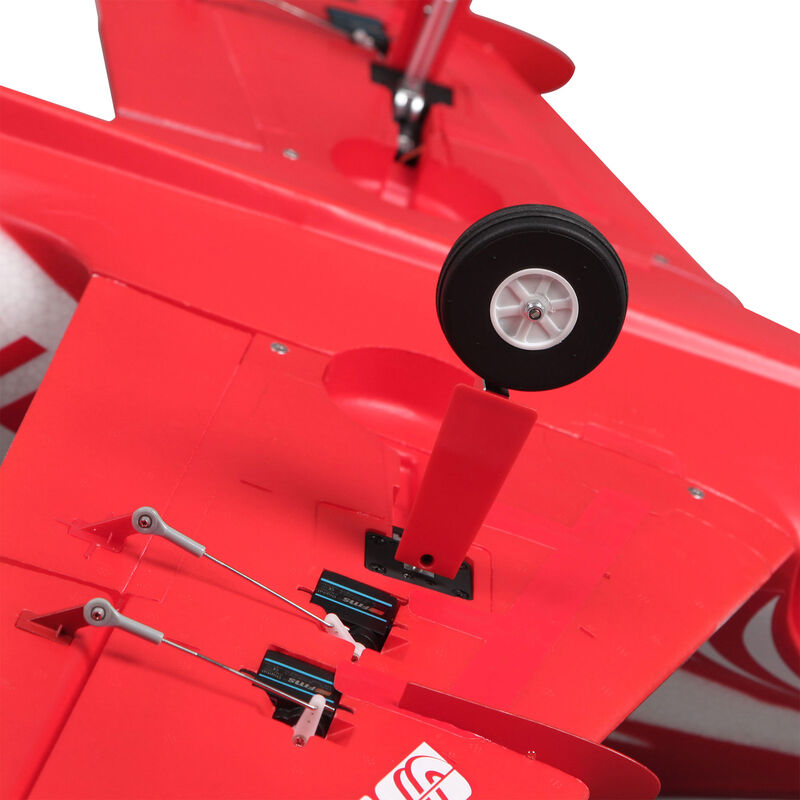
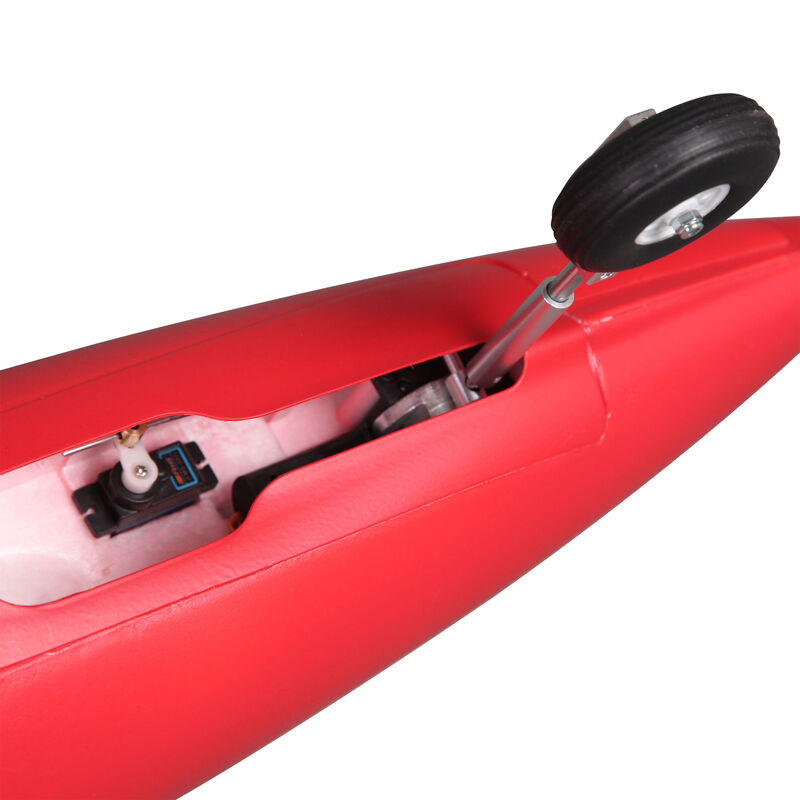 The Avanti features the latest FMS locked-rotor mode E-retract with overcurrent protection, the CNC-processed shock-absorbed front and rear metal landing gear set (Worm Dia. 8mm), a 50mm diameter front wheel and 55mm rear wheels. These are excellent for taking off and landing on both paved and grass surface airfields.
The power system, which provides tremendous thrust and speed, utilizes our new and improved 70mm 12-blade EDF V2, KV1850 motor system. This brawny system, when coupled with a 6S battery, provides a resonating turbine engine sound.
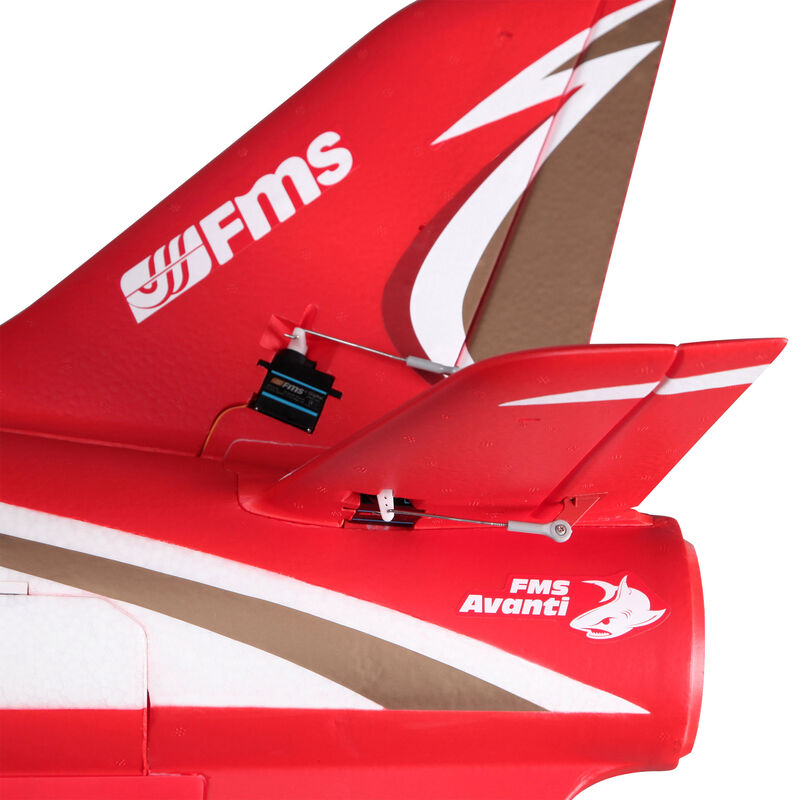 The environmentally friendly water-based paint provides a vibrant and visual red scheme that makes this airplane look fantastic on the ground and in the air.
Well that all sounds great but I see there’s a Version 3 out now so it’s well out of date already, but I’ll do Page Boy a massive favour and take it off his hands for a few quid…!
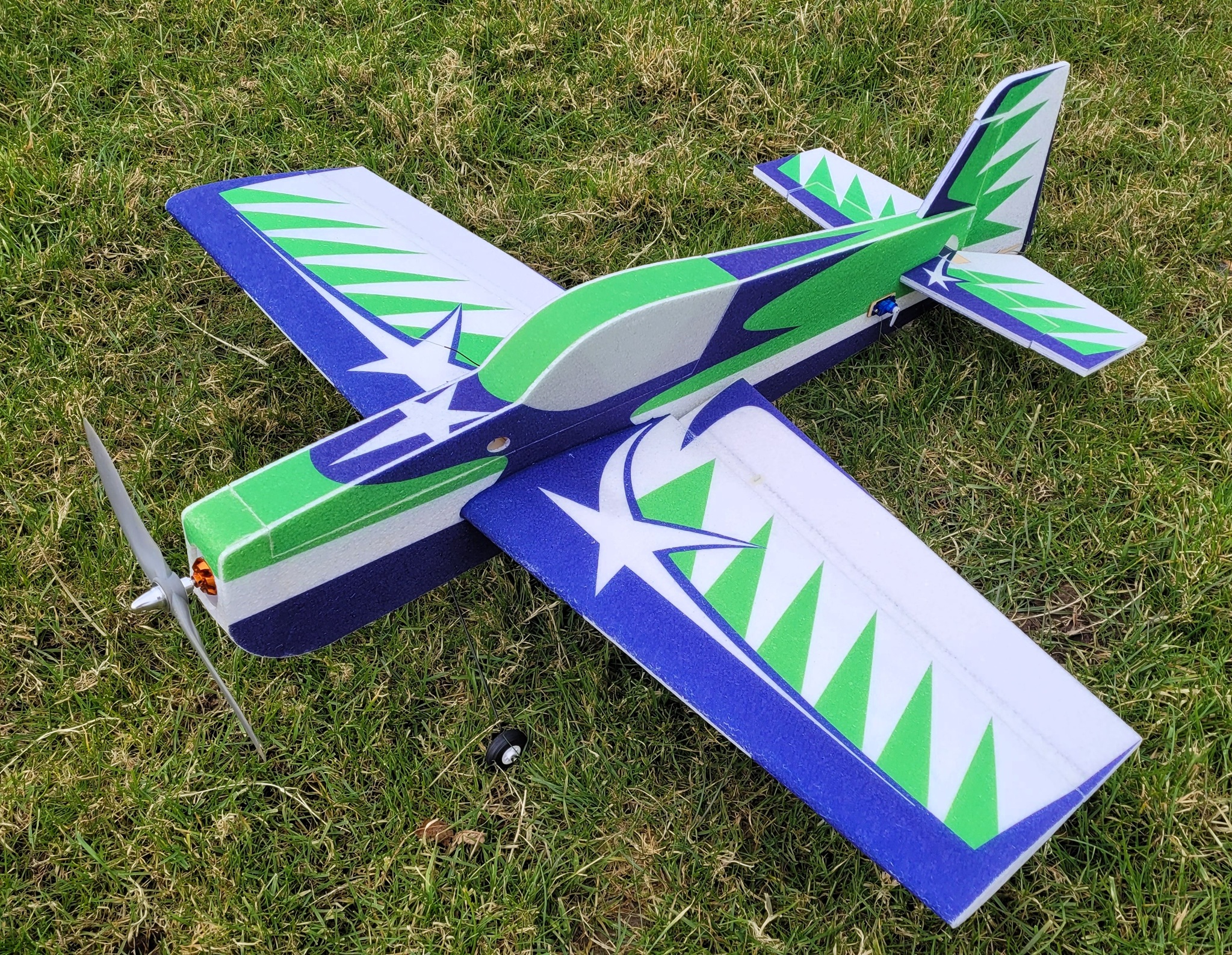
Other than Woody’s Nighthawk the only other new model flown in February was my HobbyKing MX2. Yes, after buying it a year ago I finally got round to putting it together! 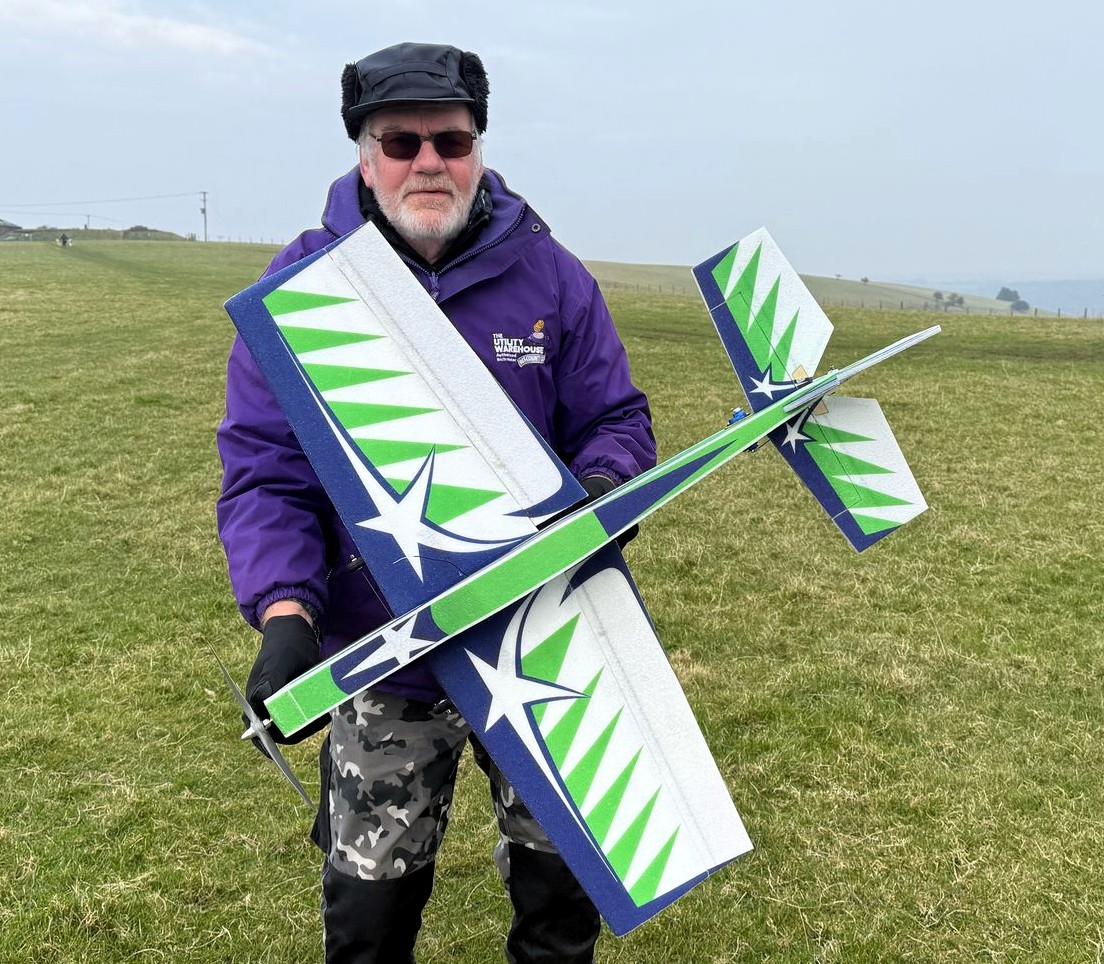
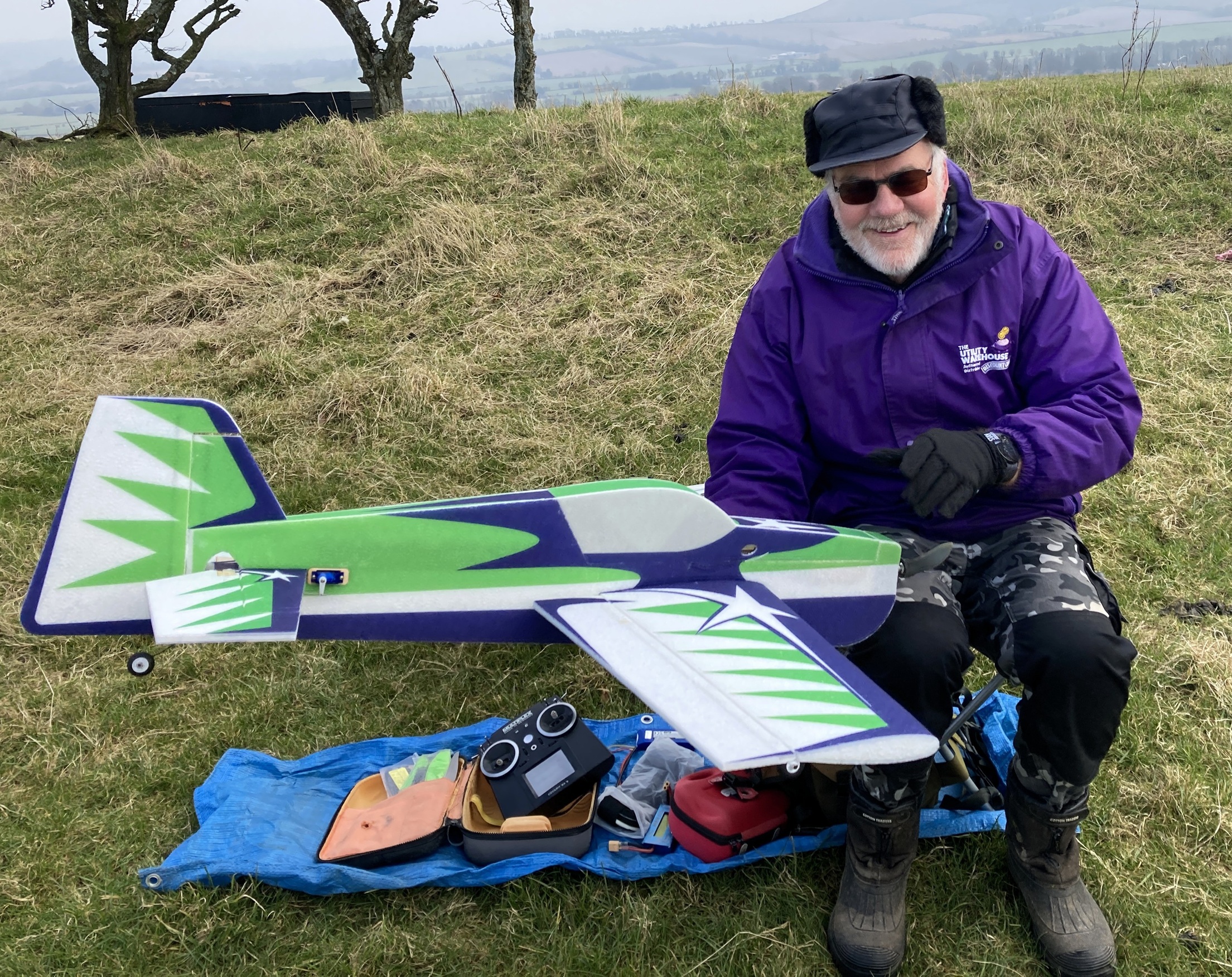 The MX2 is certainly not much of a looker with it’s slab-sided fuselage but it’s a good flier and having test flown Gordon Bennett’s for him I ordered one for myself. The MX2 is made from ‘crash resistant’ EPP, has a wingspan of 955mm and weighs around 550g without the battery. This is what the HobbyKing website says about it: Introducing our EPP 3D MX2. Featuring a fantastic design and layout, this all out EPP 3D’er will satisfy the most eager 3D pilots! Its fuselage is torsionally very stiff yet light with loads of space beneath the long top hatch for your radio and power system. The wing is a one-piece affair featuring EPP construction, a very accurate symmetrical airfoil with 2 additional spars to minimize flex and twist. The control surfaces are something else – the elevator, rudder, and ailerons feature a 3 layer construction (Epp-Depron-EPP) making for stiff surfaces and NO flex at extreme throws! Snap rolls “Snap” and the control response is instantaneous. The light – yet rigid – airframe adds up to one great flying 3D “foamy”. Waterfalls, harriers, flat spins, rolling circles this model has the precision to perform these and any other moves you can think of! Assembly of the airframe in a quick 10-15 minute process with the help of a little medium CA. The radio and power system layouts are very straightforward, the long top hatch making for easy access. This is a great model for general park flying and hardcore 3D. You will be hard-pressed to break this model, it will take hard knocks and just keep bouncing back every time!
Several PAM members have owned one of these MX2s, including 1066, Dougal Entendre, and Gordon Bennett and some still have them. Who doesn’t still have one? Well I’m not one to drag up past mistakes but some of you will remember Dougal’s Dogwood…!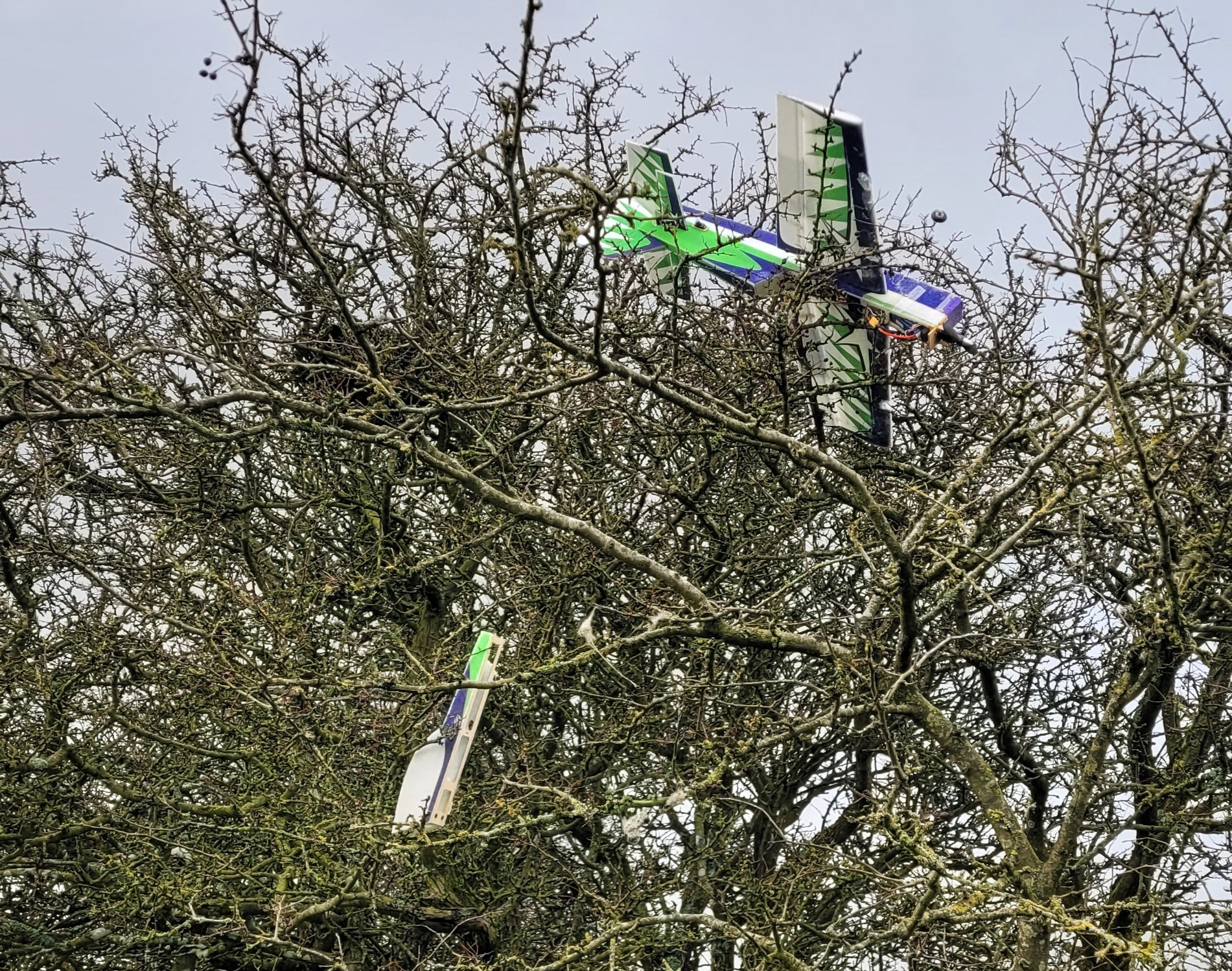
But amusing anecdotes aside the MX2 is a great performer and although 3D flying isn’t my thing I liked Gordon’s when I flew it and thought it would be a good all rounder for me.
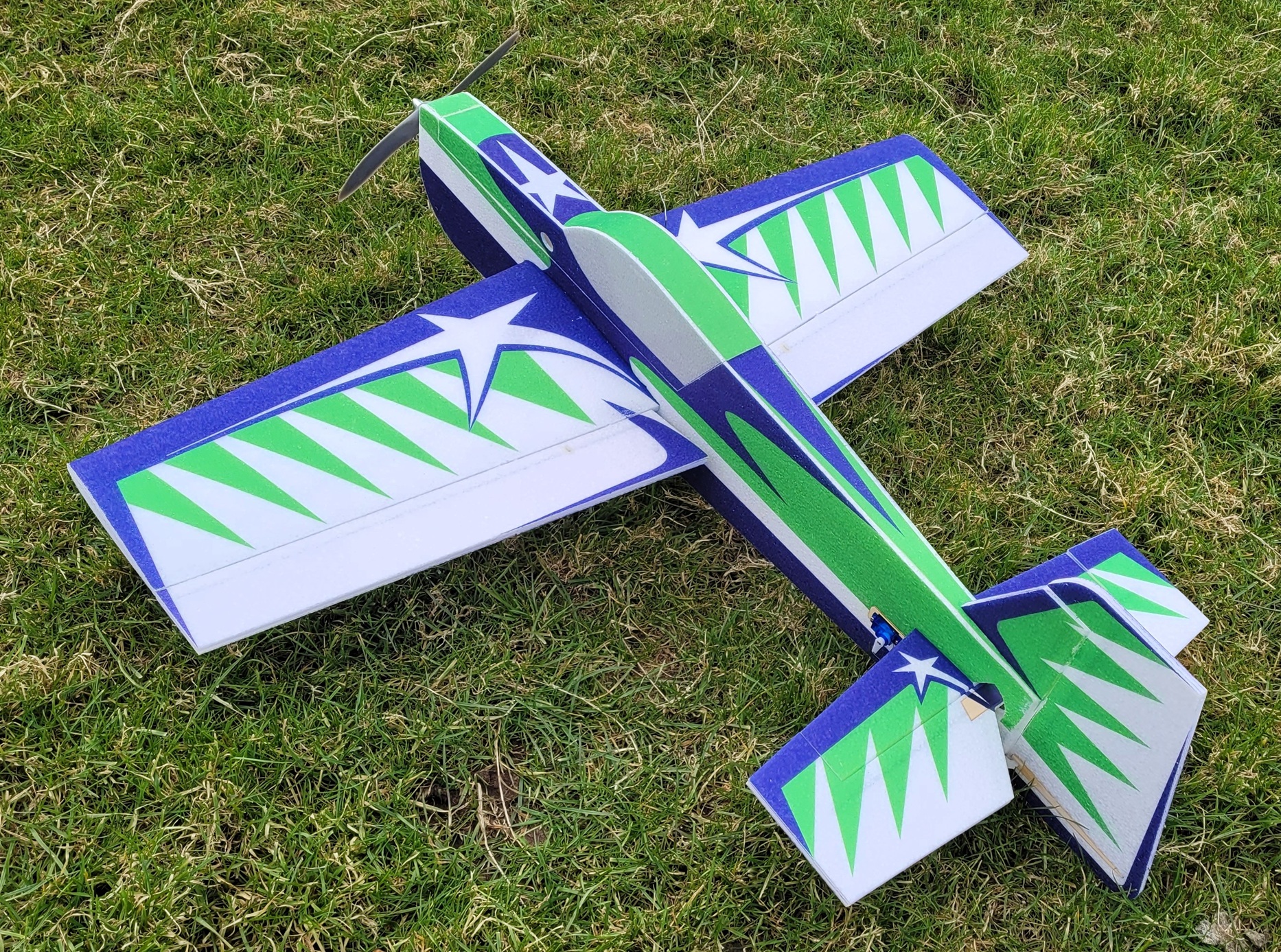 It went together very easily although the HobbyKing claim of 10-15 minutes seems extremely optimistic. The manual suggests a range of motors to use, 2834, 2215, or 2217 with a Kv in the range of 950 to 1100 and, having discussed it with Dougal, I fitted a 2836 1120Kv Turnigy motor. So not in either the size or Kv range suggested but close! The manual also says a 3 cell lipo in the 1000-1300mAh range so I’m using a 1400mAh, but Dougal and 1066 both use 2200mAh packs in theirs. I had to carve out some foam to fit the 1400mAh pack so using a 2200mAh pack must require a lot of foam removal.
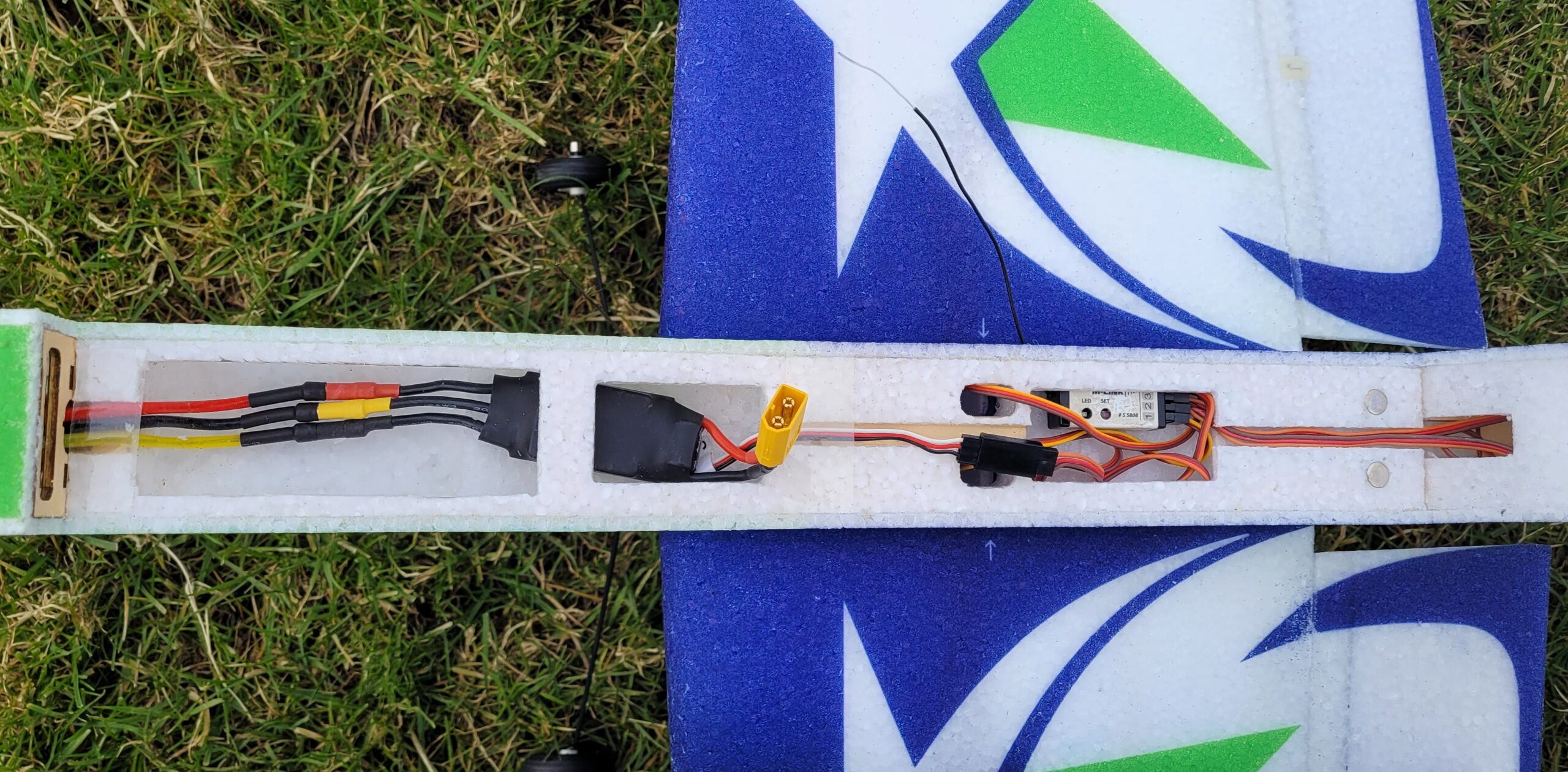 I’ve fitted a 30A speed controller and used four HXT900 9.8g servos which have been fine so far but I probably should have used better quality servos with metal gears. The first flight was good, there was plenty of power for vertical flight and I stuck to low rates which still had more than enough movement for most things. The centre of gravity is slightly behind the specified position and that showed as it was very twitchy on elevator and climbed when flipped inverted! The second flight was similar and I tried high rates briefly but things went slightly awry on the third flight when I used high rates for the whole time. Basically, I got disoriented with the rapid roll rate, and the rearward centre of gravity, plus a lack of height resulted in an ‘unscheduled arrival’. Needless to say MacFly was videoing at the time so you can enjoy my discomfort in this month’s video, but at least it came down on the patch! Fortunately, other than a bent prop adaptor and a small split in the fuselage side the only damage was to my pride. I’ve since had another six flights with no problems.
 When I initially balanced it I used the marks indicated on the wing and realised the CG was slightly behind the marks but I figured it would be ok, so flew it like that. But I’ve just got round to correcting the CG and checked the manual, it says 85-90mm from the leading edge. Thinking about Woody’s CG problems with his Nighthawk I checked the position of the marks and they are at 98mm! I have now added a little lead but it’s still slightly behind the maximum of 90mm. I’ll fly it again and decide whether to add more lead or not.
New member Simon Cottam is fitting in well with the other members and has become a regular at the field. Simon has already been given a blog name and will now be known as Dot after Dot Cotton from Eastenders. He isn’t new to flying but before joining us Dot had last flown about fifteen years ago so he was understandably a bit wary about his abilities.
 Dot needed a suitable model to get back into the sport and Woody managed to obtain a Wot 4 that was built by club member Ian Daniels who sadly passed away some time ago.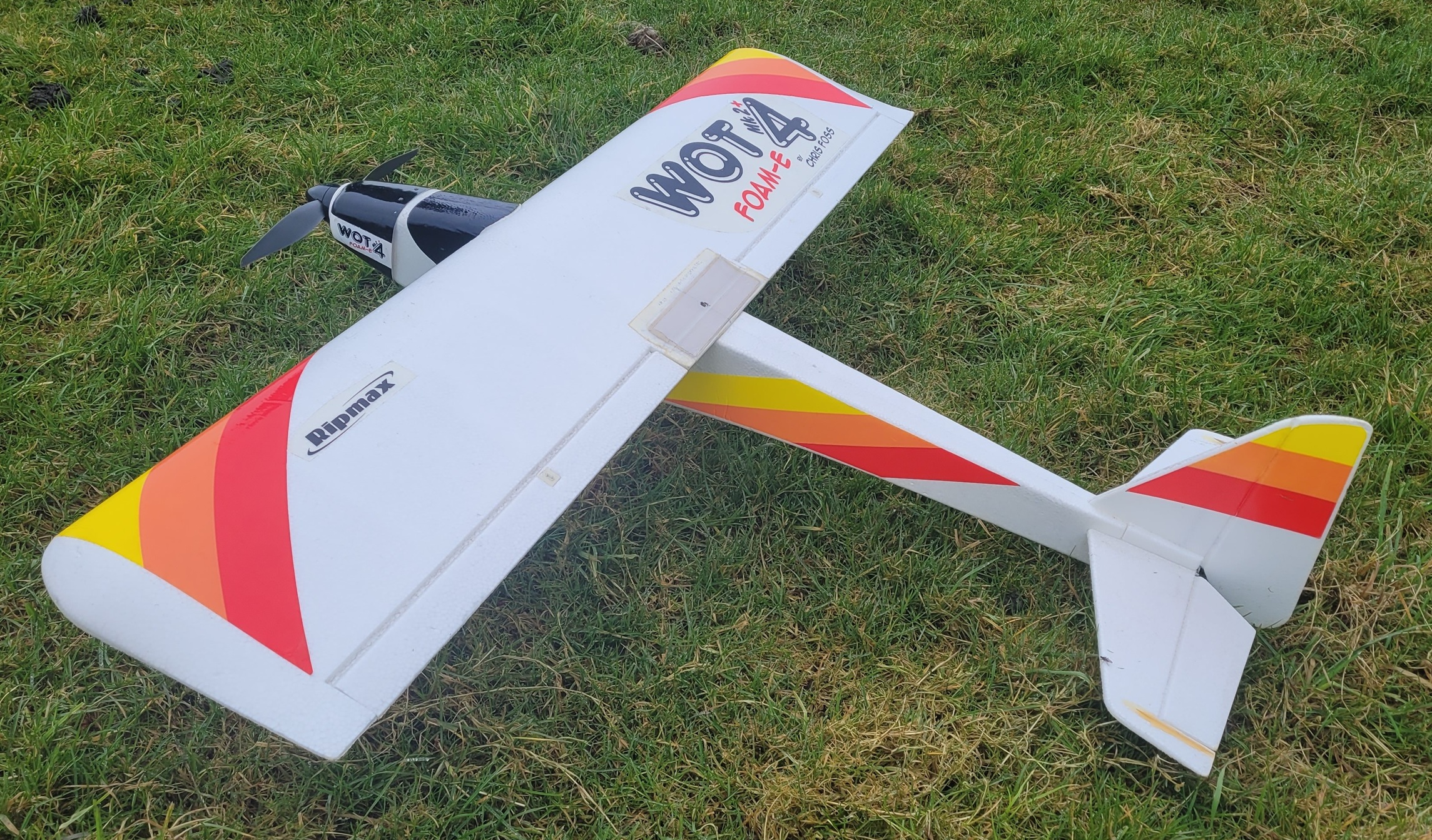
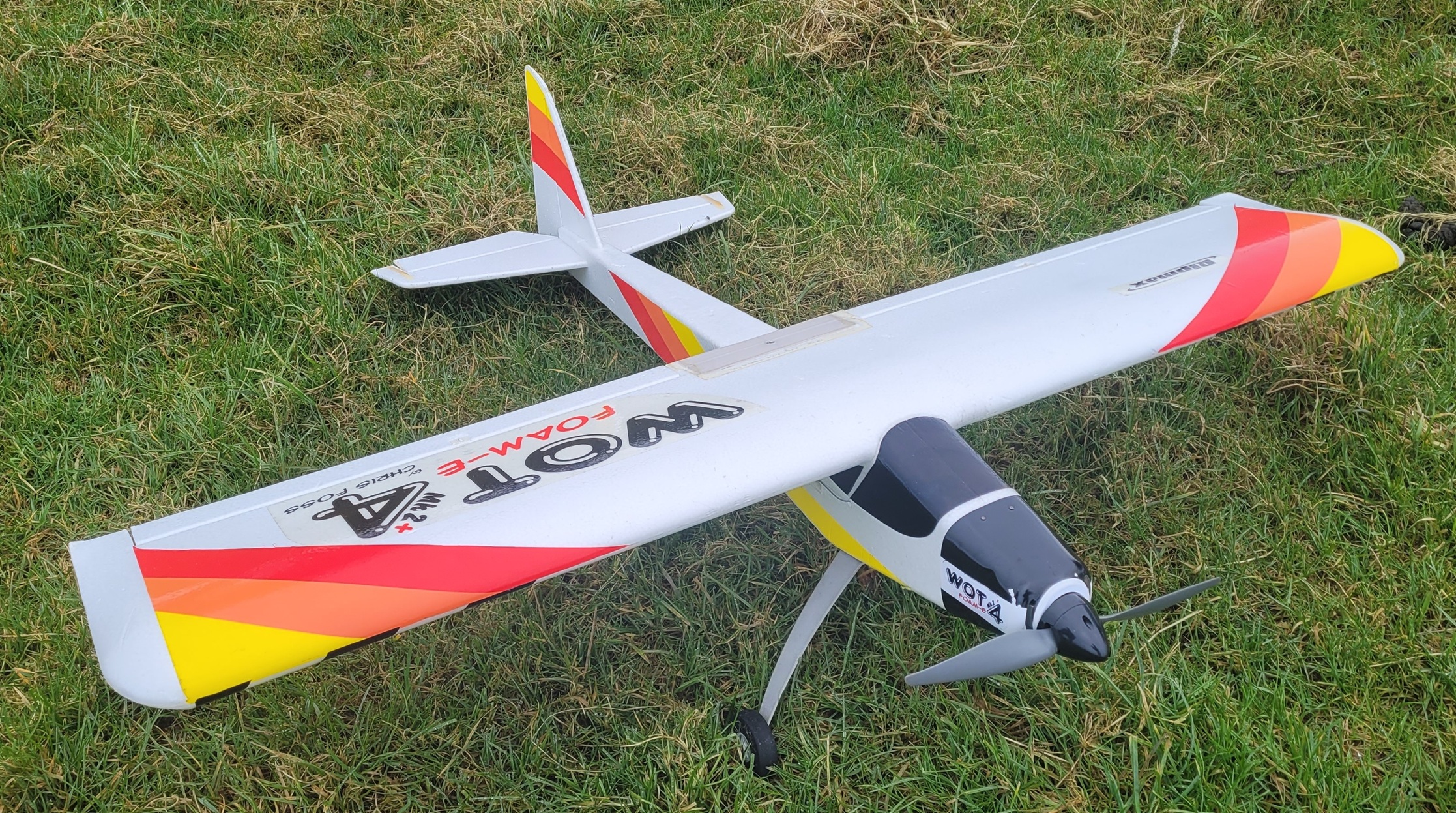 The Wot 4 seems to suit Dot perfectly and you wouldn’t know he’s been away from flying for so long. He has already had several complete flights from excellent take-offs to some greaser landings back on the patch and needs no help from any of the so called ‘experts’.
Speaking of so called ‘experts’, there’s a habit in the club (as in most clubs I imagine) of shouting “LOWER” when someone does a low inverted pass, especially if it was already a very low one. Often the pilot will oblige and attempt an even lower inverted pass, and very occasionally they get it wrong! Well 28th February was one of those rare occasions!
 I don’t want to embarrass said ‘expert’ but many of you will recognise 1066’s VisionAire. Sadly nobody was videoing at the time so you’ll have to make do with post party pictures! The black tape is to hold the broken fuselage together while 1066 carries it back to his car.
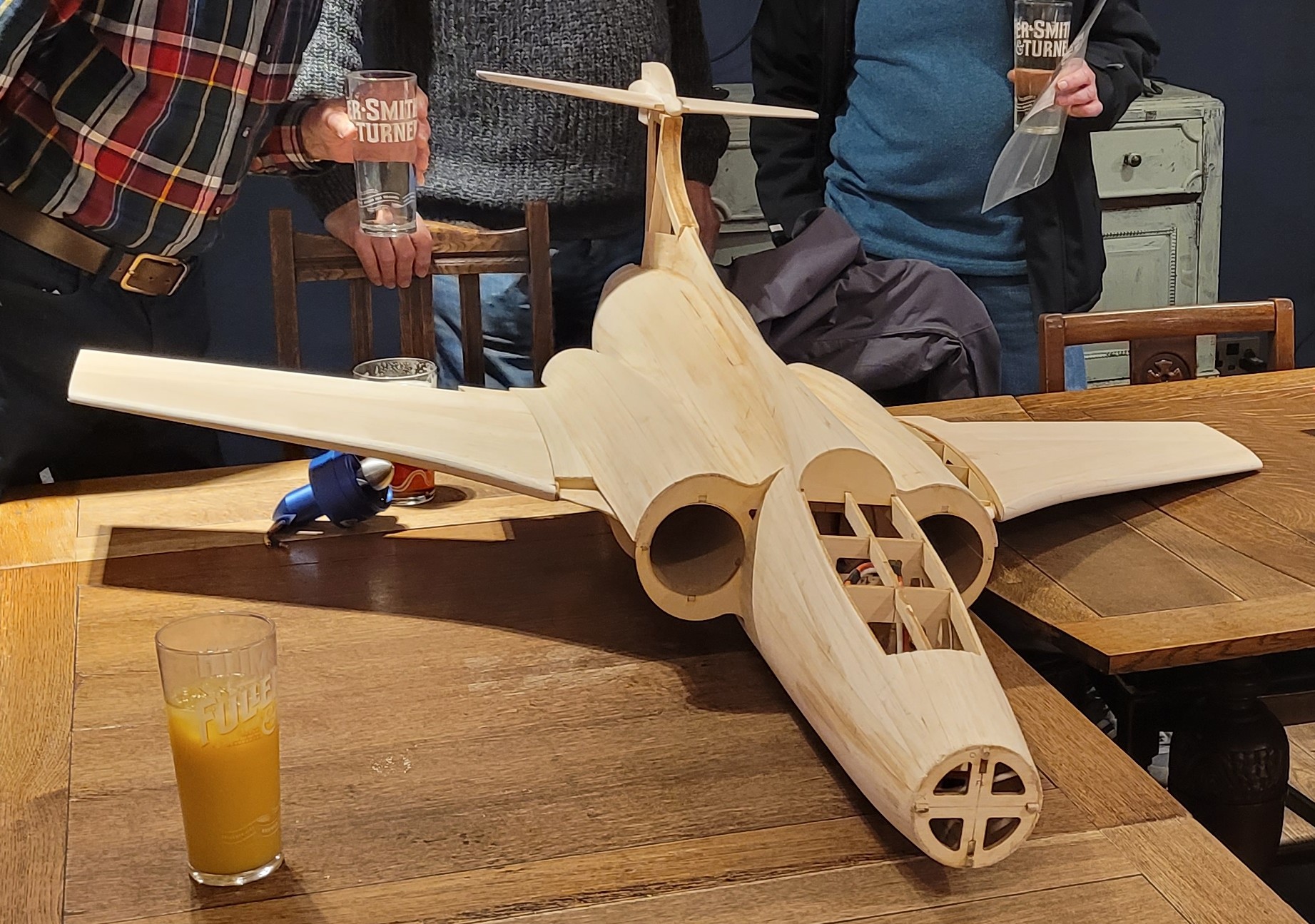
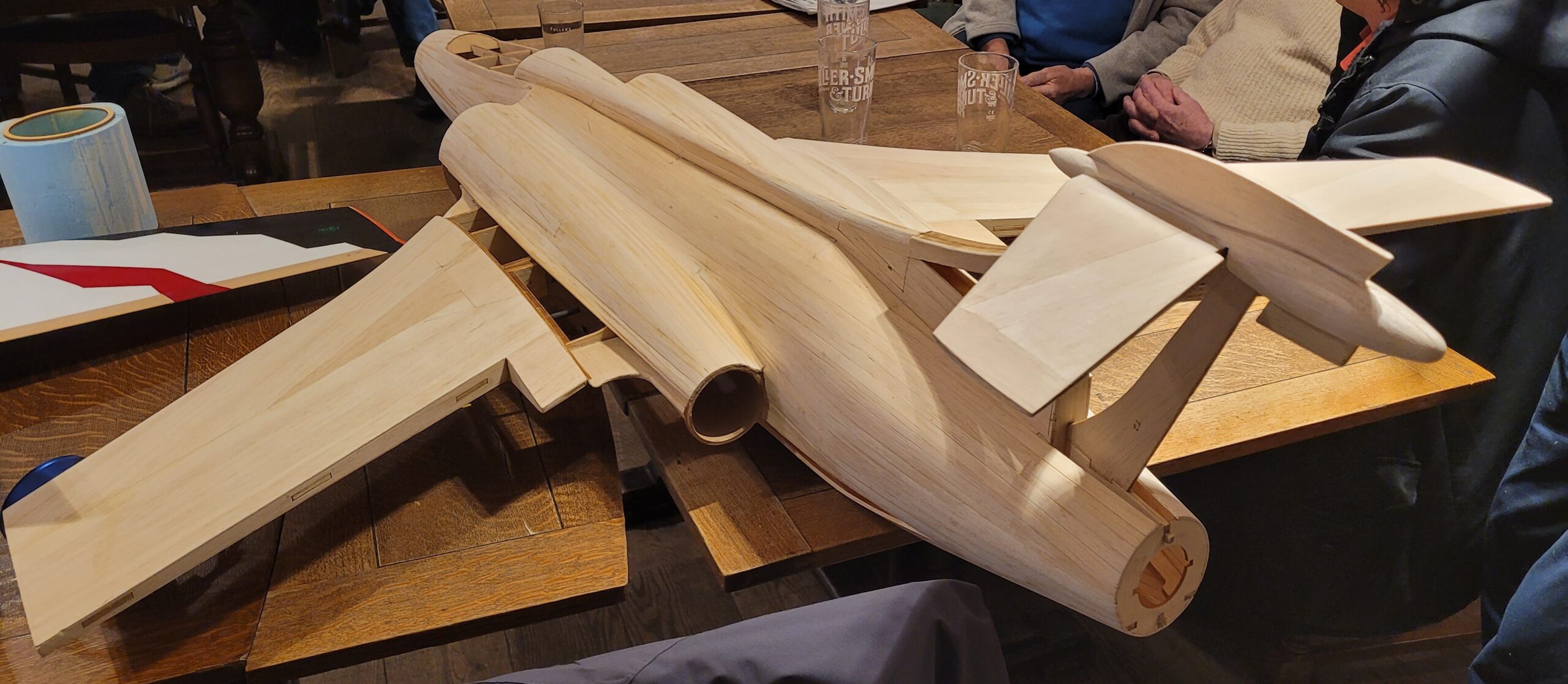
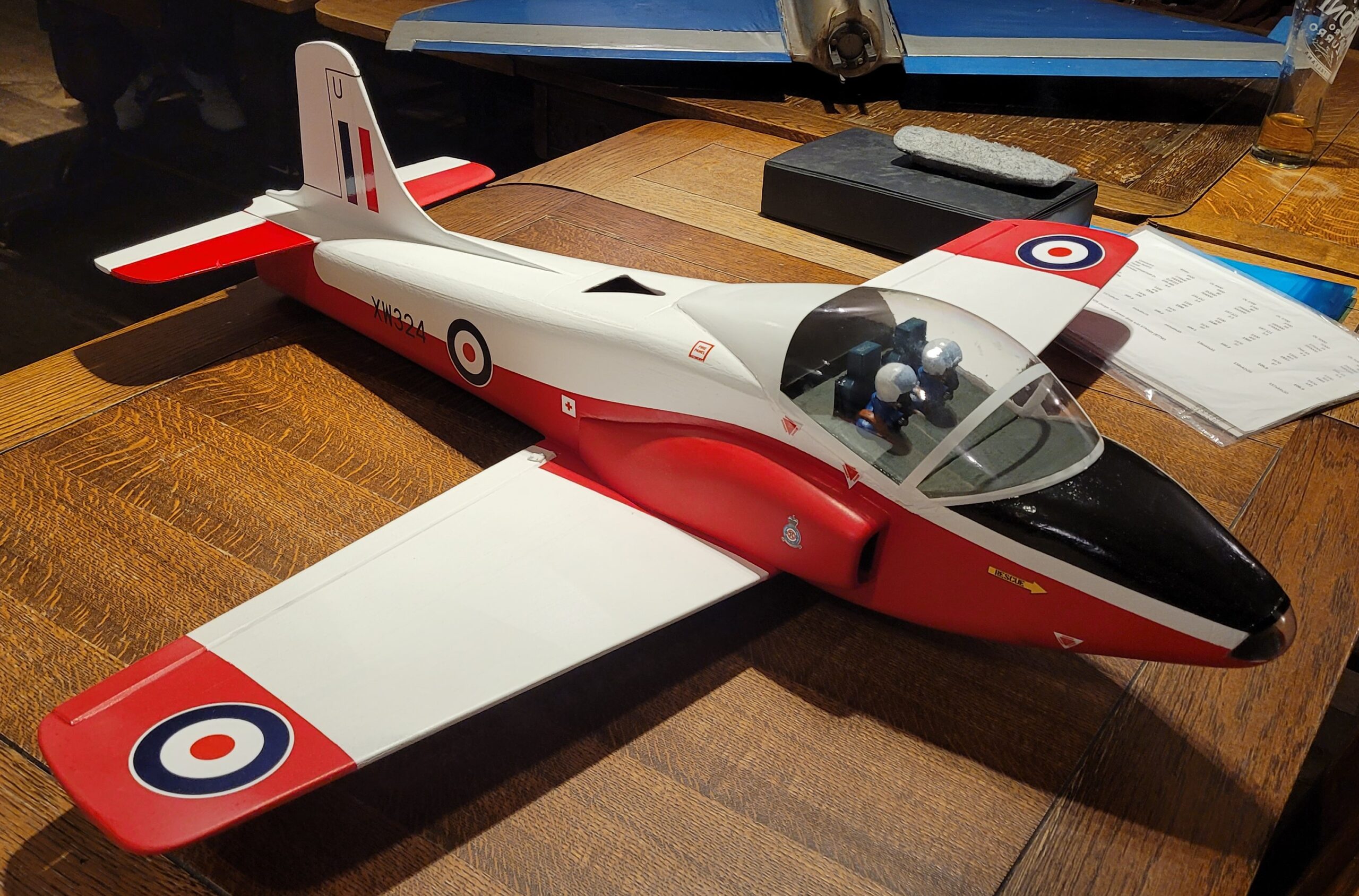
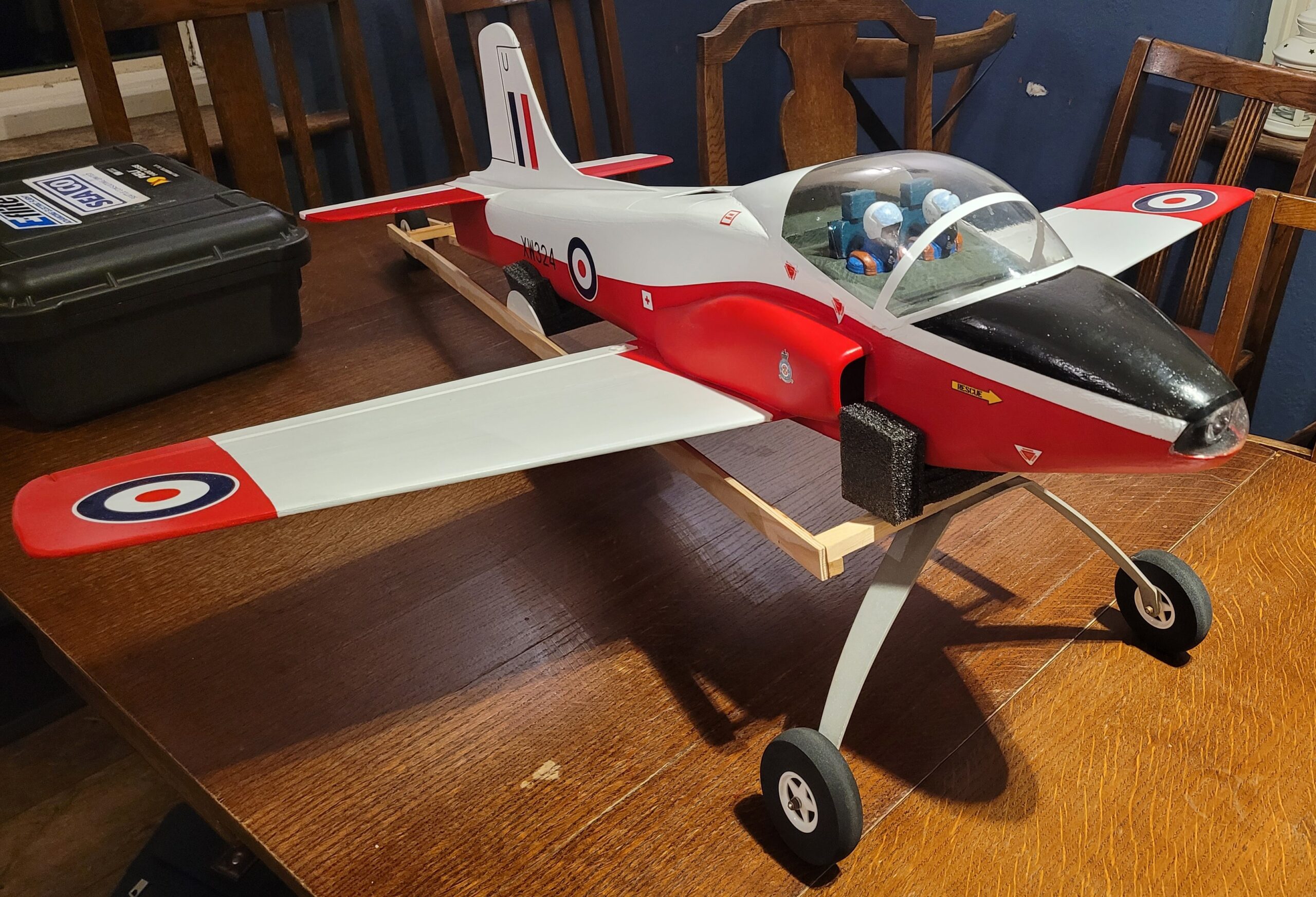
We had a club EGM on Feb 26th to make a couple of rule changes which were quickly and amicably sorted. The evening then turned into a social meeting for the 17 members that attended, several of whom had brought along models to show us. So this month’s ‘Action Shots’ are ‘Inaction Shots’ instead and next month I’ll tell you a bit more about them.
The first two are Norwegian Nick’s beautiful Blackburn Buccaneer:
 Next it’s Gordon Bennett’s jolly perfect Jet Provost:
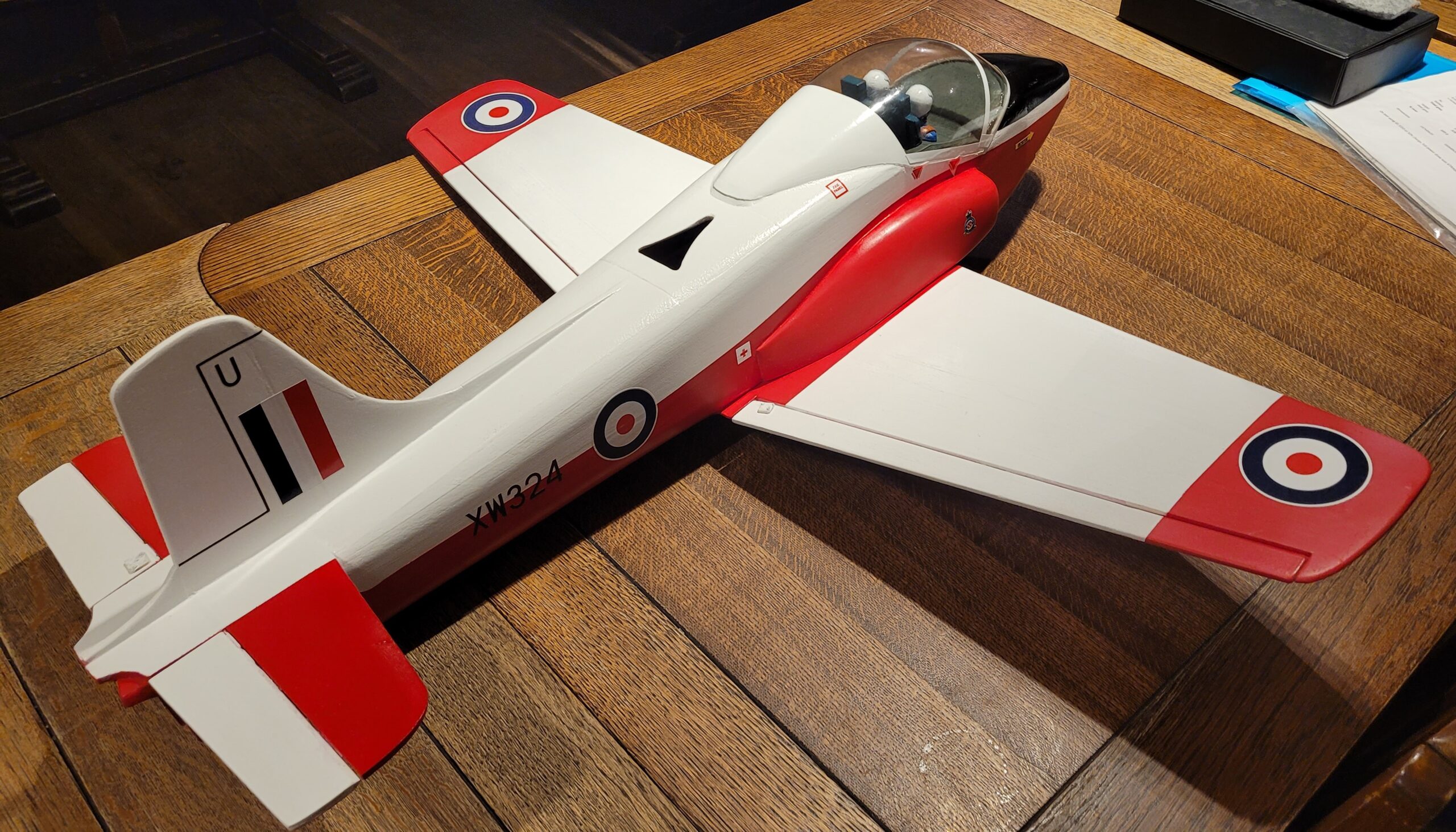 I think he’s taking the big wheel thing too far now!
 And lastly it’s Norwegian Nick’s sexy Shark: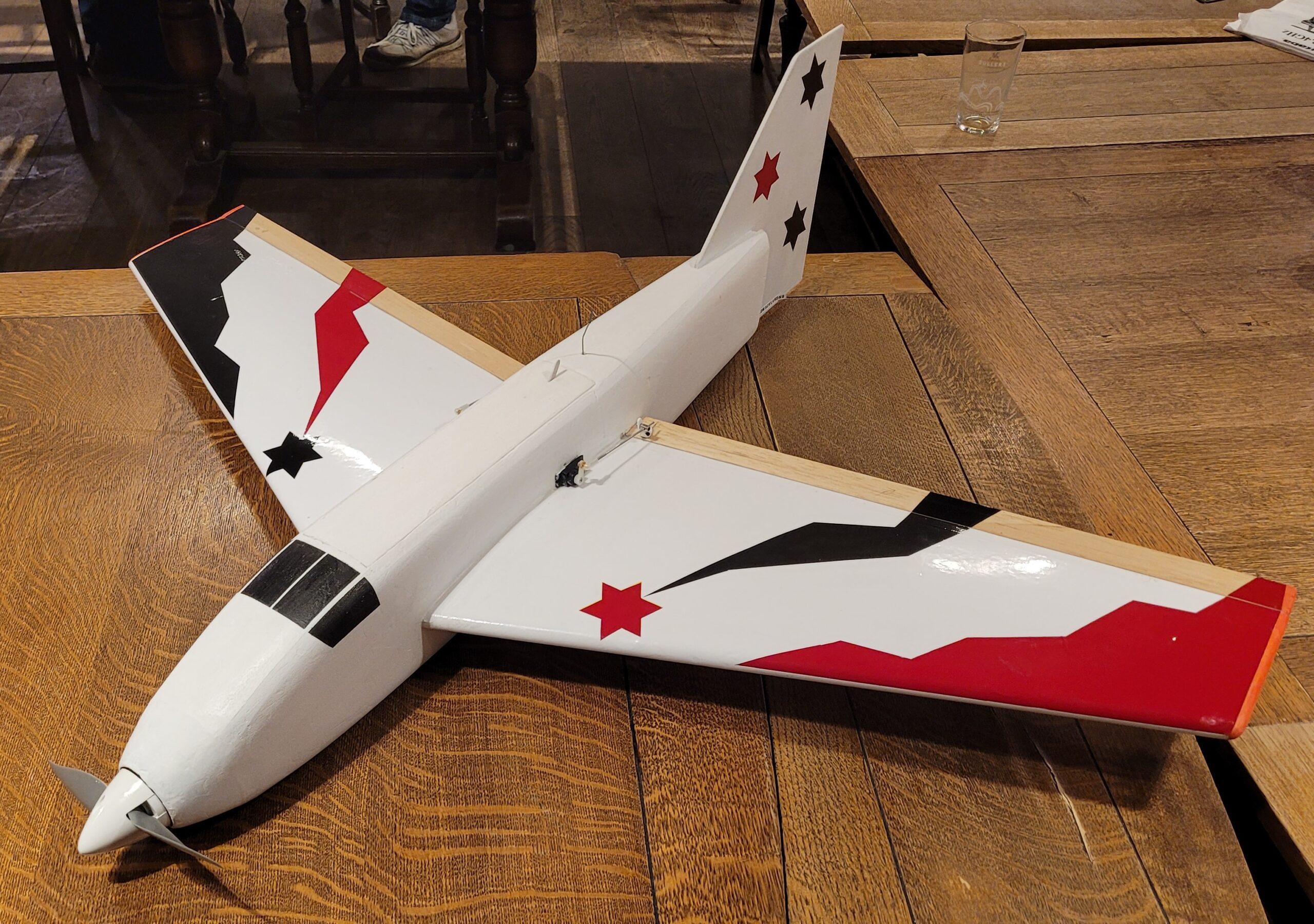
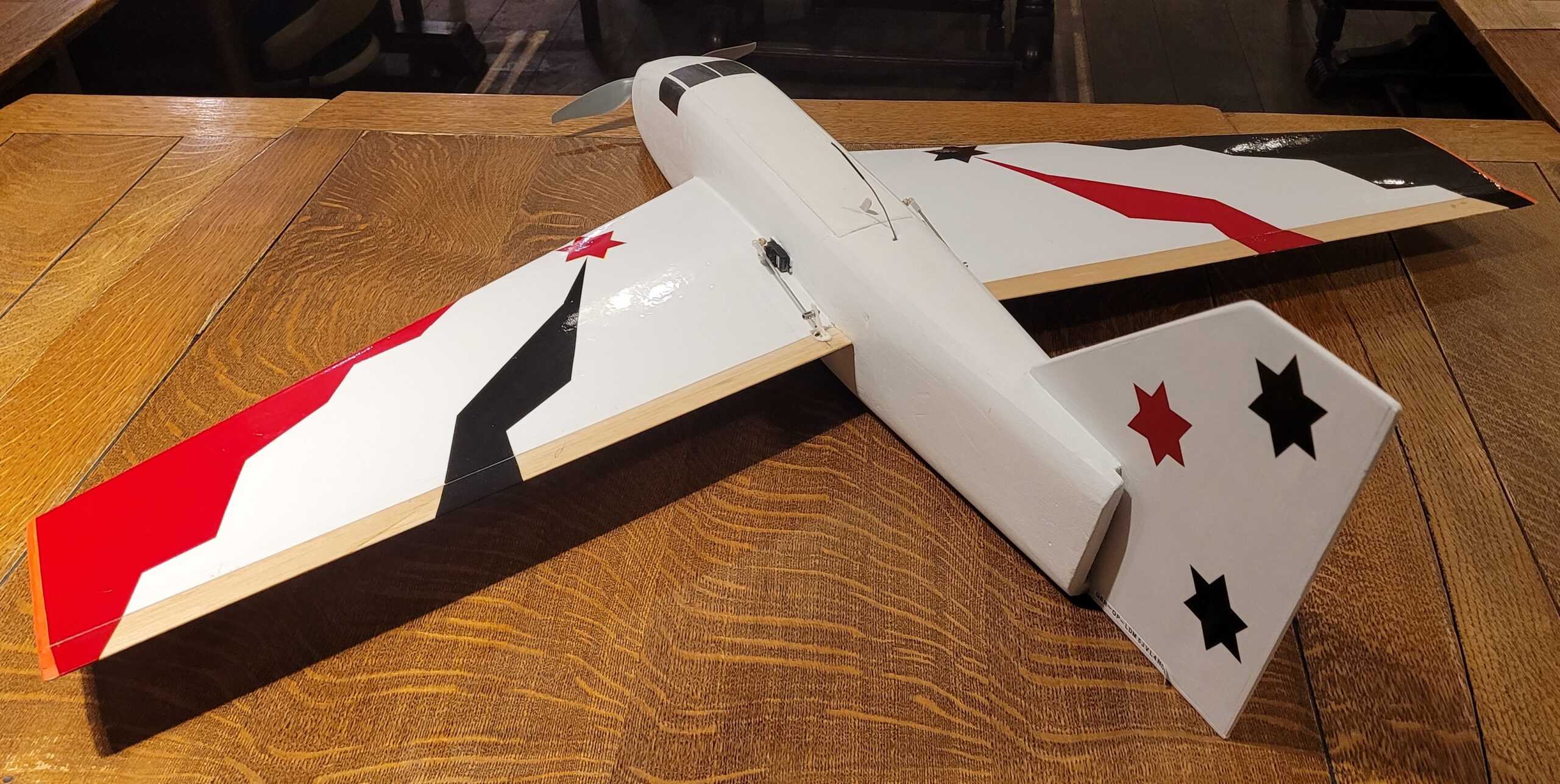
Video time now, this month with footage shot by myself, Dougal Entendre, and MacFly.
Please watch the video full-screen, it’s so much better with small models flying around:
If the video won’t play for you please click HERE
The Final Funny:
What’s the difference between a jet engine and your partner?
You can switch off a jet engine and then the whining stops!
Colin Cowplain