Patch News – March 2016
Its April already and time seems to be flying more than I am! But March hasn’t been too bad, fairly typical spring weather I suppose, lots of wind and rain but also several really nice days. We’ve managed quite a lot of flying and have only been caught out by the showers a couple of times.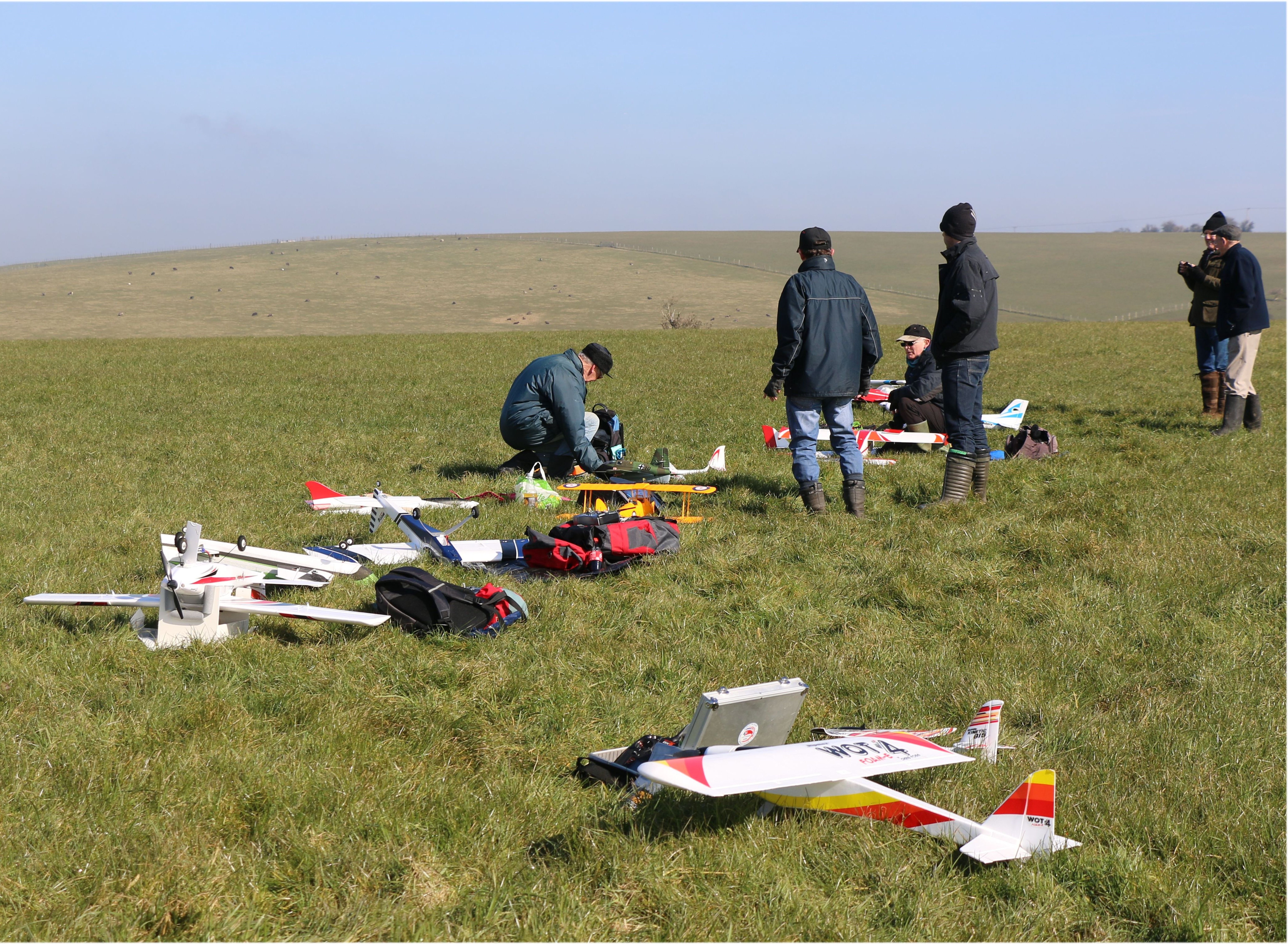 In last month’s Patch News I began by confessing to have crashed my Spirit by flying the wrong model. I still haven’t worked out how to blame Captain Slow (it was his Spirit that I mistook for mine) but in the meantime I’ve managed to repair mine.
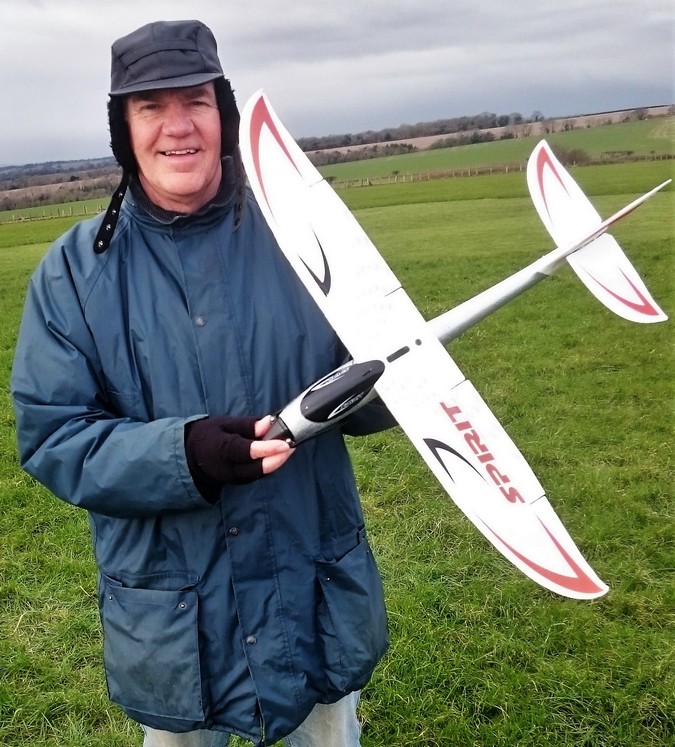 I wasn’t sure it was worth repairing but once I had stripped out all the gear and reshaped the nose in hot water it looked ok so all I needed was some glue, filler, and another prop unit. HobbyKing were out of stock of the folding props both in the UK and Europe but Dougal Entendre came to the rescue with a spare that had survived the demise of his own Spirit. Thanks Dougal.
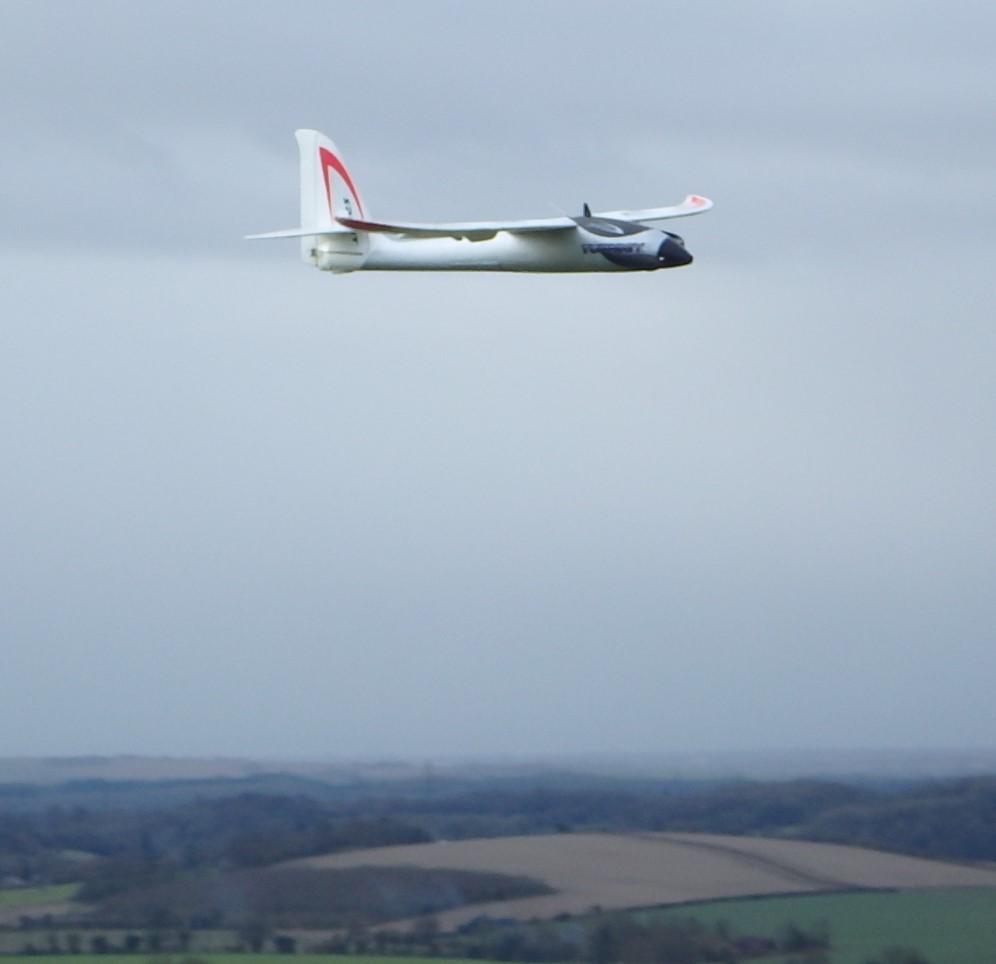 It wasn’t long before the model was back flying again, with just some slight trim changes required, I think (unsurprisingly) there is more motor down-thrust than previously. So eventually there was a happy ending to the tale; now where’s that Corporal Slow bloke…
I included a couple of photos of Gorgeous Gary’s (the alternative suggested nickname was unpublishable!) Acro Wot last month and explained that it’s his first electric powered model. It’s now flown successfully although I think it will take a while for Gary to get his head round this electrickery stuff.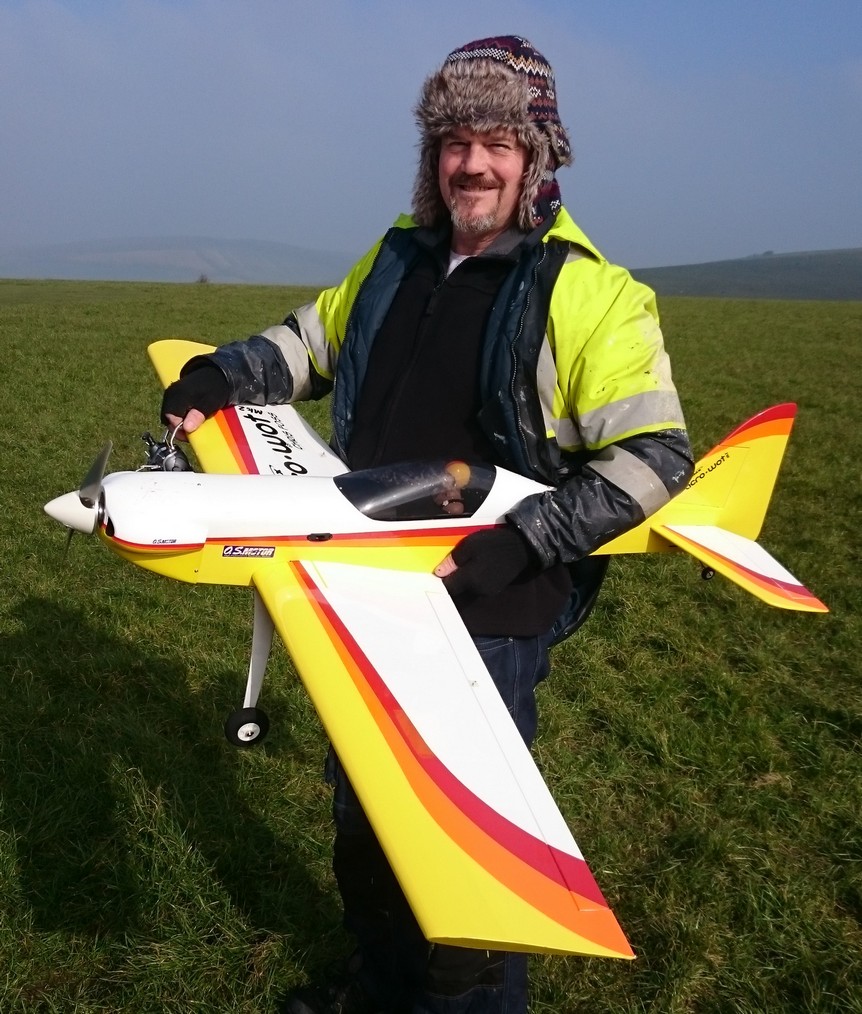 On his first flight I explained the importance of throttle control in order to get a decent flight time and I think he listened a little too well as he was soon staggering around with almost no airspeed. The first couple of flights were fine and if I remember correctly there was 65% left in his 5 cell pack after the first one. But on the third flight the model suddenly stopped flying and, although I didn’t see it, others said they thought Gary just got it a little too slow. It’s easily done when you’re used to listening to an I/C engine and suddenly switch to an almost silent electric motor. Fortunately the damage was light and repairs were soon completed.
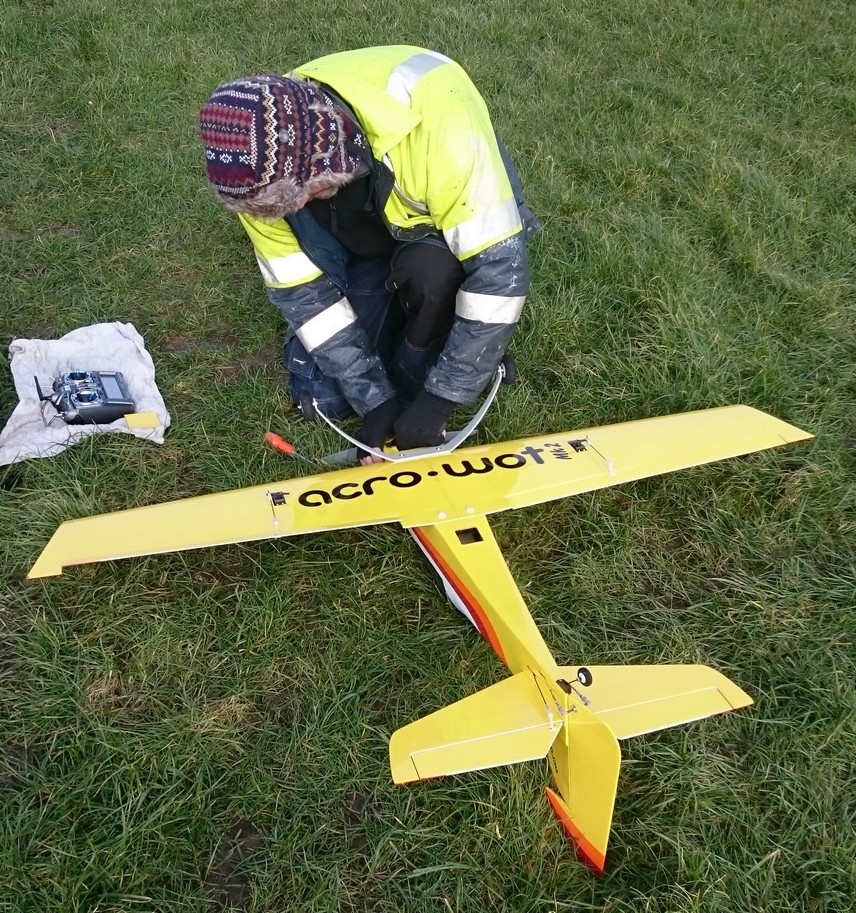 You can see some of the initial flight in this month’s video at the end of Patch News, and you’ll see that at times it was flying rather too slowly. Meanwhile Gorgeous has been forging ahead with his electric delta and it’s now pretty much ready for flight.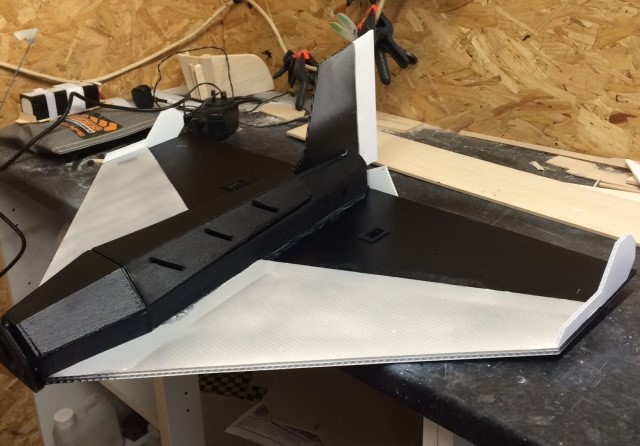
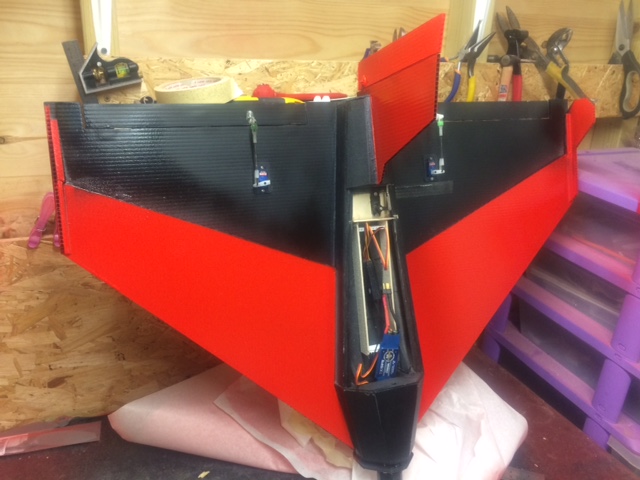 It looks great in its red and black colour scheme and I’m sure it will perform well.
During March I splashed out and bought a couple more Multiplex receivers and a 35A telemetry current sensor. The best price I could find was from a company in Austria and the parcel duly arrived after a few days, but when I opened it I was surprised to find that, whilst the current sensor and non-telemetry receiver were simply packed in Multiplex small polythene bags, the telemetry receiver had its own relatively large Multiplex box.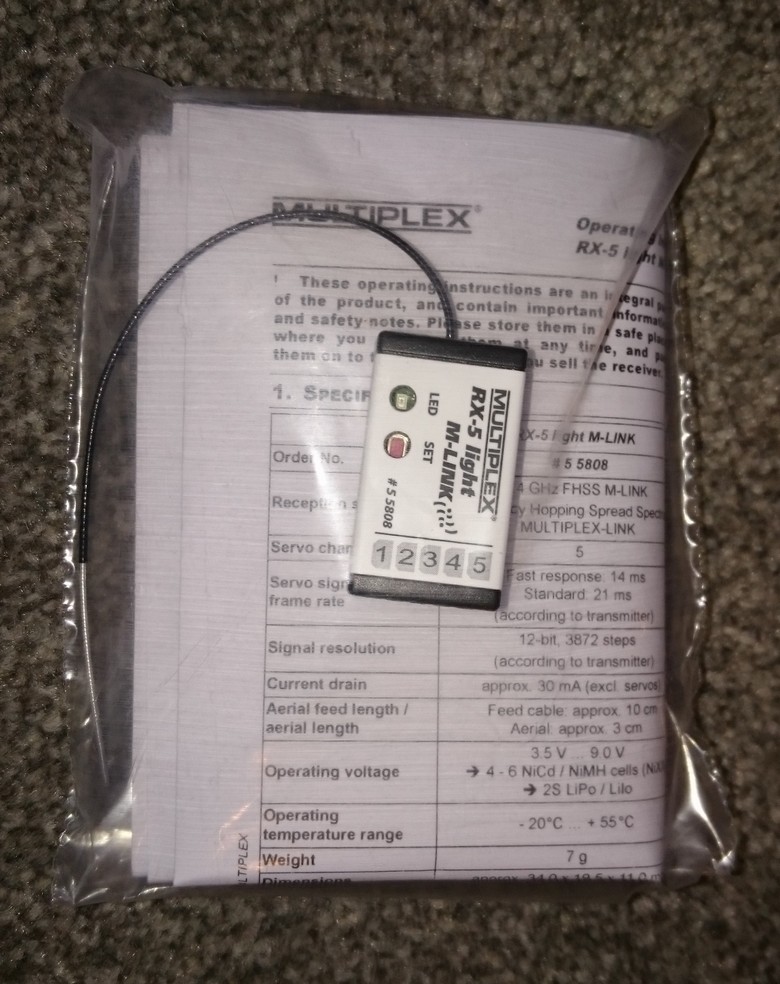
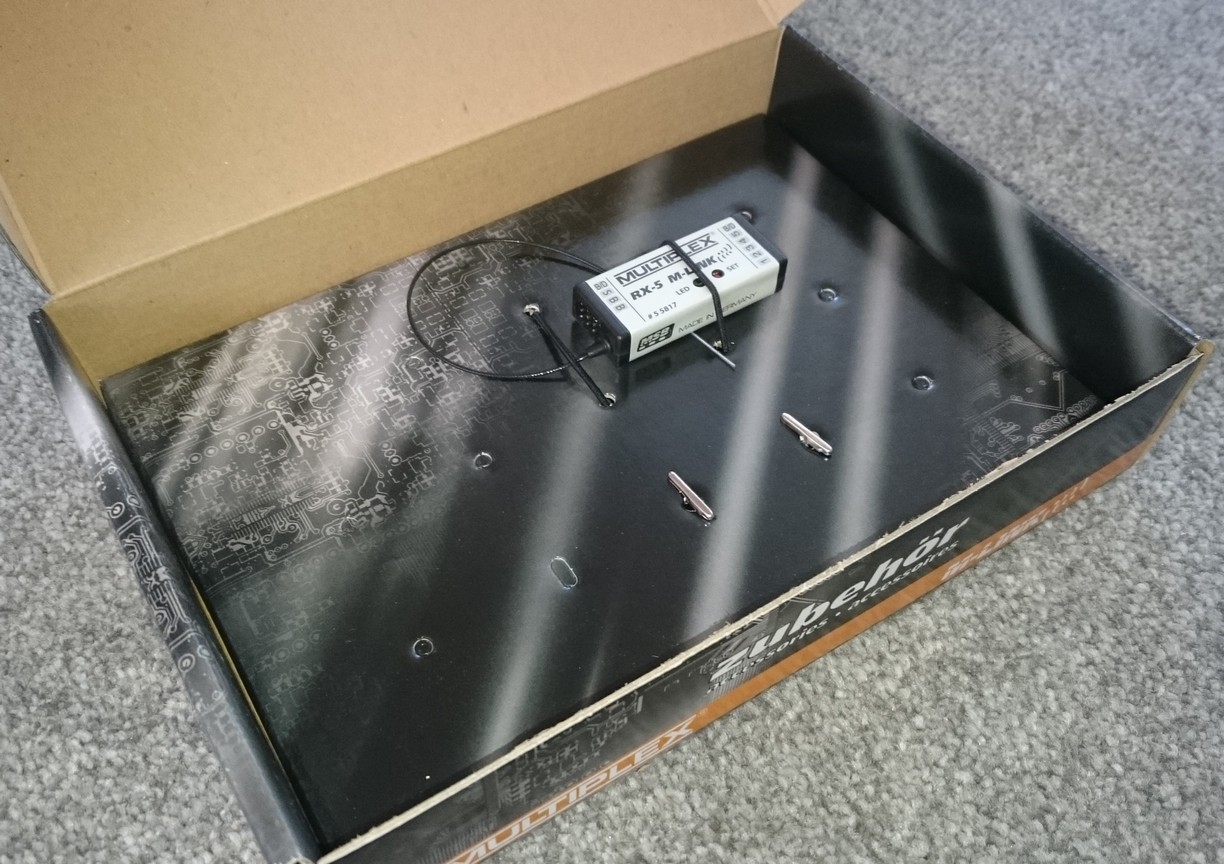 I’m not a particularly green eco type person but it just seemed a bit over the top, maybe it’s part of justifying the extra £15 for the telemetry receiver. I had a couple of models lined up for the receivers, I don’t like having to keep swapping them between models, it can cause a variety of problems as Dwayne Pipe discovered when he brought along his Vega electric glider to fly. He hadn’t flown it for a while and it wouldn’t bind to the transmitter. The mouthy and cruel members present (ok, me) said things like “Bl***y Spektrum again” but then Dwayne discovered there wasn’t actually a receiver in the model at all. Even my beloved Multiplex couldn’t overcome that one! Dwayne sorted it a few days later and the Vega can be seen flying in this month’s video.
The first model to get one of my new receivers was an Art-Tech ASK-21 electric glider that Gentleman Jim gave me last year having decided it wasn’t for him. The full-size ASK 21 is a 17 metre span glass-reinforced plastic two-seater mid-wing glider with a T-tail. It is designed primarily for beginner instruction, but is also suitable for cross-country flying and aerobatic instruction.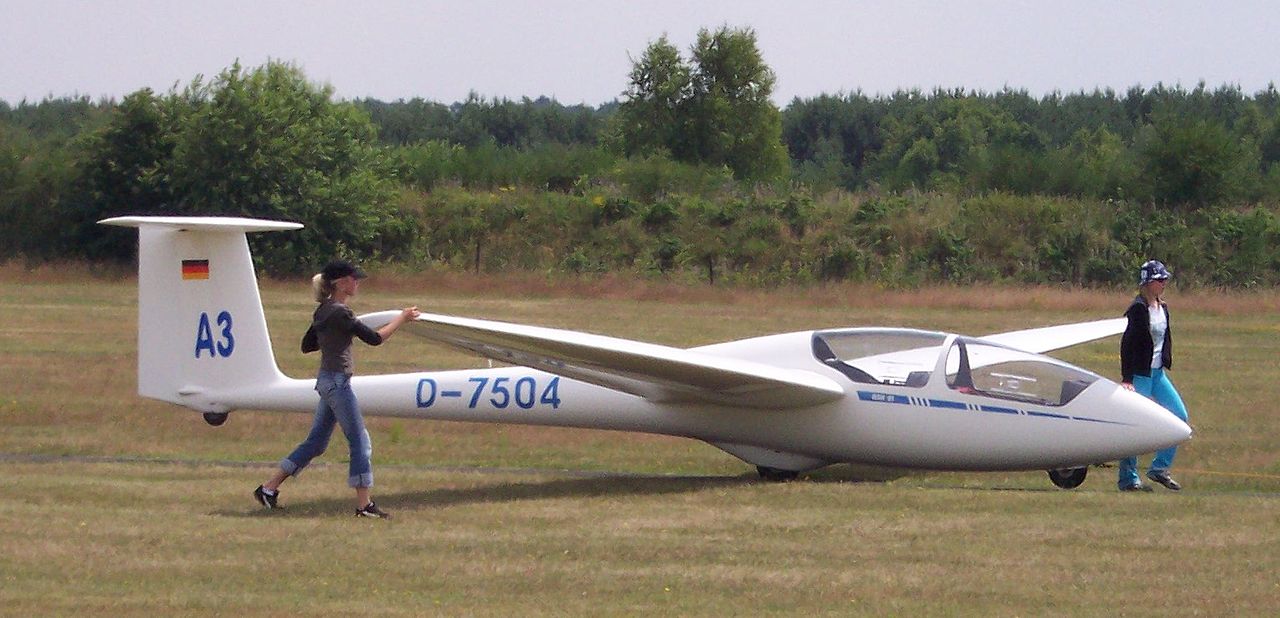 The model is a two metre span moulded EPO foamie that looks really nice and, as far as I can tell, is pretty close to scale. It comes complete with motor, speed controller, and four servos to control ailerons, elevator, and rudder. When Jim put it together we found that although the model flew well it had a nasty tip-stall if slowed up too much. Jim tried moving the CG further forward, cranking up both ailerons a bit to simulate washout, and even added a couple of wedge shaped pieces of balsa on top of each wingtip to try to reduce the stall, but none of it seemed to make much difference. Having scoured the internet Jim found lots of people on various forums talking about the tip-stall problem but there didn’t seem to be any ideas that we hadn’t already tried. So eventually he passed the model over to me where I ignored it until this month.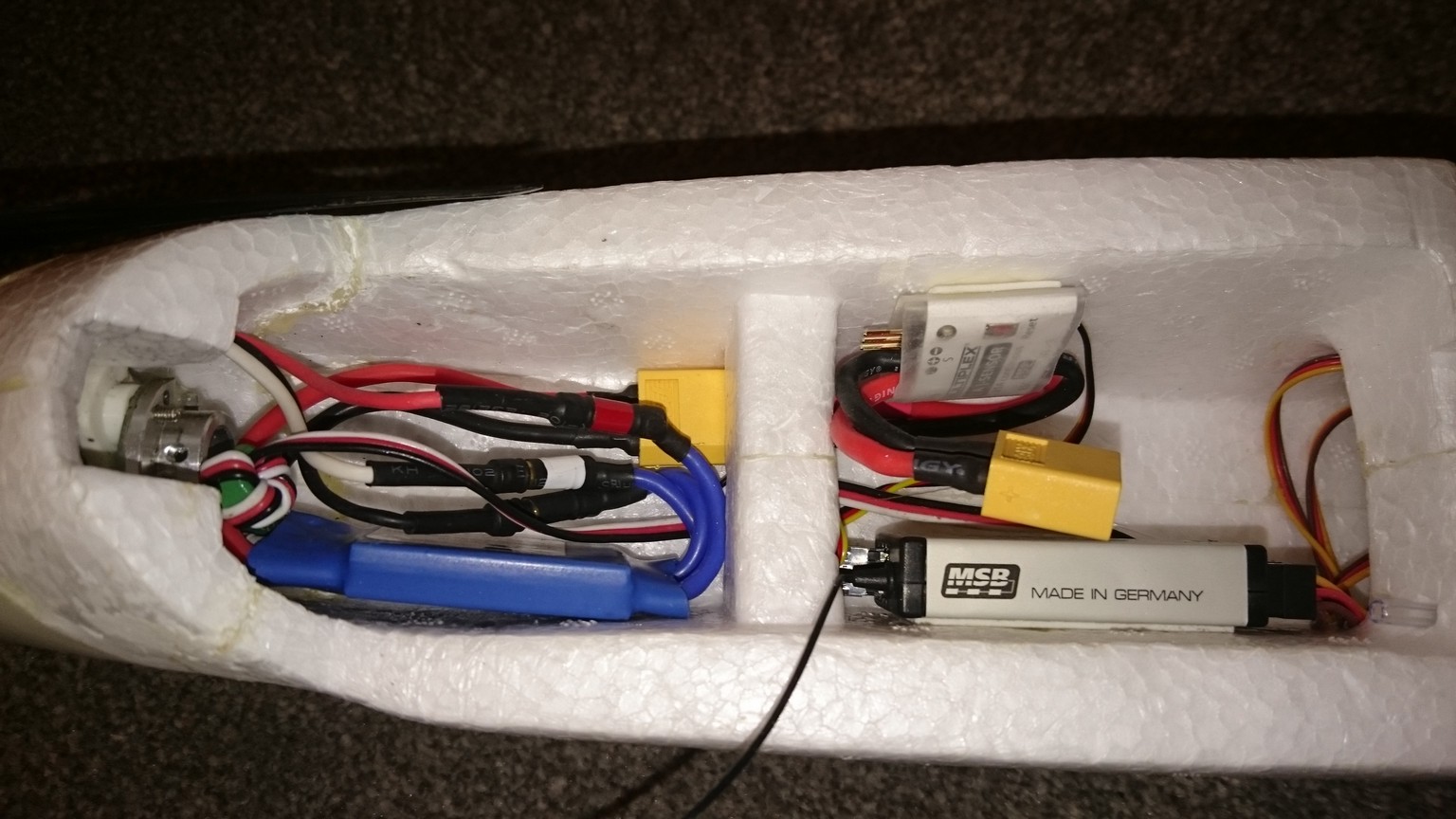
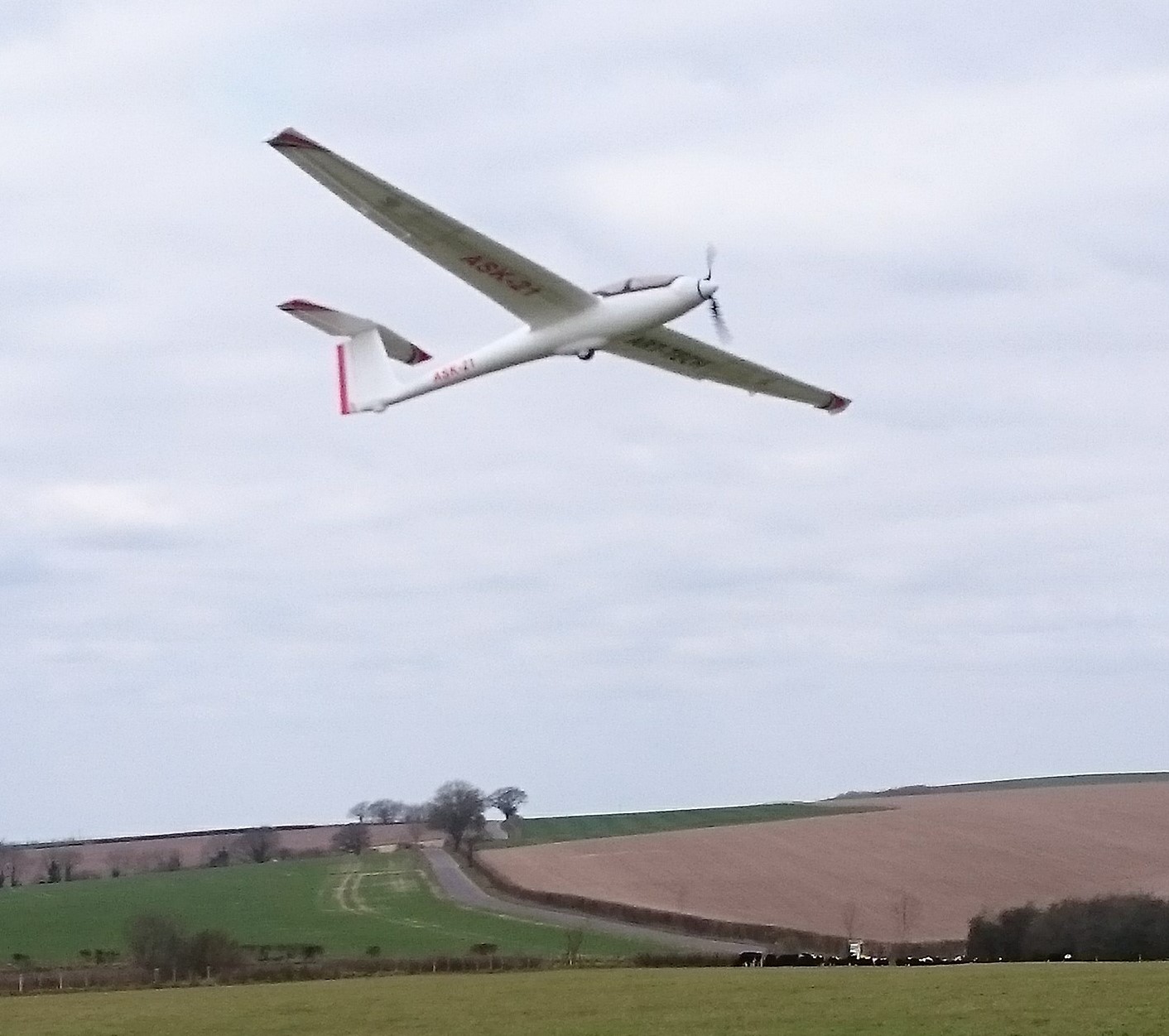 I’ve now fitted one of the new receivers and the current sensor and have had several flights with it, most of over 20 minutes which can’t be bad for a two metre model using a 1000mAh battery.
We’ve had a few animal problems at the patch this month. Firstly the farmer put thirty young bullocks in the field, with the warning ‘Watch out, this lot will lick you to death’. He wasn’t wrong, as in previous years the bullocks proved to be very inquisitive but this lot seemed to be extra ‘friendly’! Fortunately, after only about three weeks, they’ve now been moved back into the lower field and they haven’t done too much damage either by churning up the patch or leaving their deposits. But we now have a different problem, we’ve previously been visited by moles and now they are back bigtime. And I do mean BIG time, we seem to have been invaded by some extra large ones.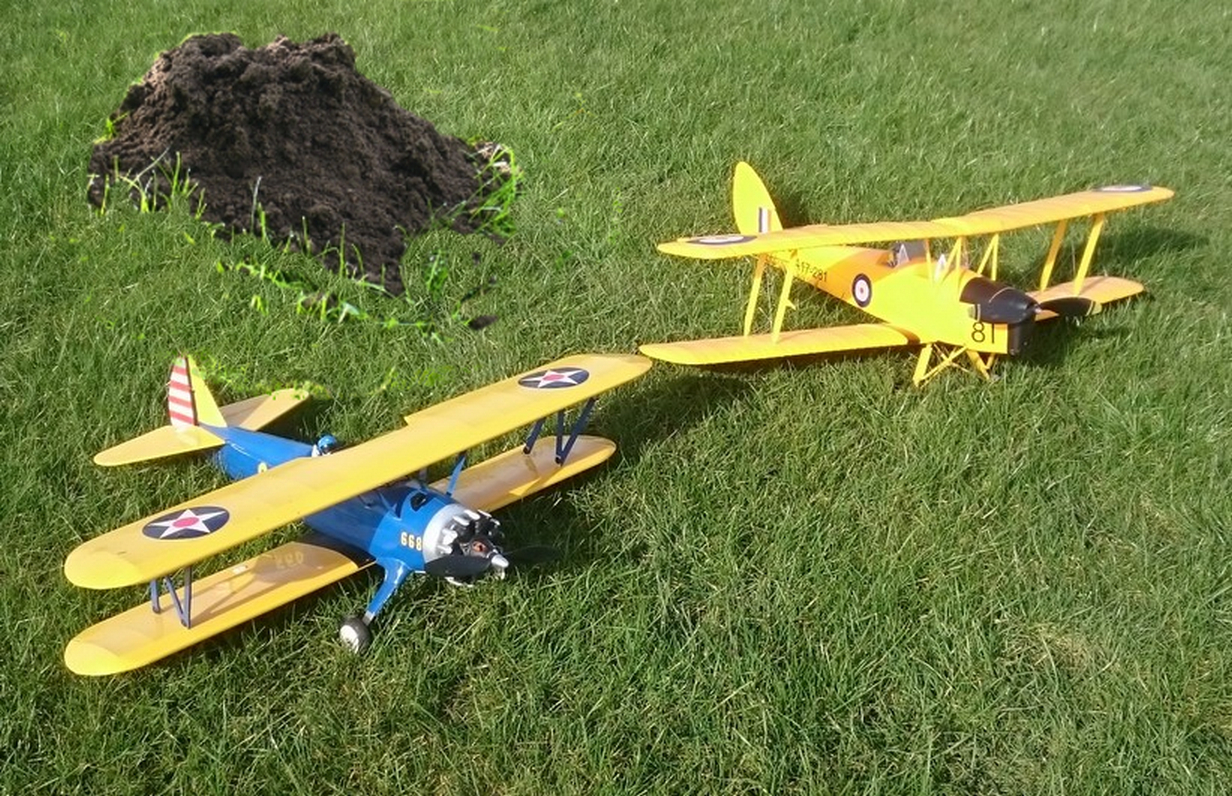 I mentioned it to George (the farmer) and he said DEFRA are investigating the arrival of Talpa Praegrandis (giant mole) in the South. Meanwhile all we can do is stamp the earth firmly back down before flying and hope they go away. So far they have only reached as far as the edge of patch, let’s hope they stop there.
The Easter weekend was mostly typical Bank Holiday weather with the very strong winds and rain of storm Katie, but Good Friday was actually a lovely day. I had family commitments and was unable to attend but Dougal Entendre sent me a report of the days’ happenings. It turned out to be Not So Good Friday when he had problems with his Walkera Devention transmitter. Dougal had switched the Devention software to third party Deviation software over a year ago and it had locked up once causing his Spirit to crash. On Bad Friday the same thing happened again, the software locked up and reset, with the clock resetting to zero, this time causing his Wingnetic to pile in close to Harper’s Oak. He reckons the model is repairable, but won’t be hurrying to complete it.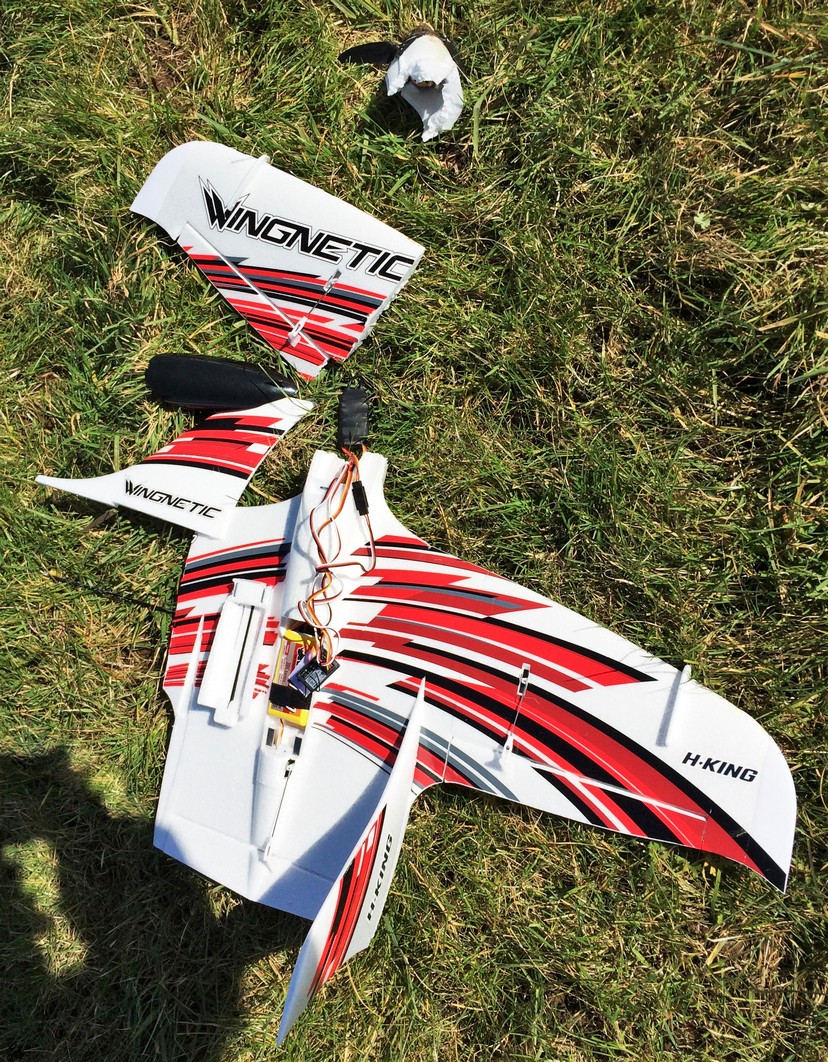 Dougal thinks that the problem was a bug in the Devention software so the solution would seem to be to return to the original Devention software. Let’s hope that sorts it. 1066 also had a problem when a loss of elevator control forced him to make a rapid downwind landing with his Edge. Fortunately the damage was minor but, more worryingly, the elevator was working perfectly after the enforced arrival. I haven’t heard yet if he has discovered the cause of the problem or not.
I also missed JP bungee launching his Vampire for the first time. The model had mostly been hand-launched previously although it had managed to take off a couple of times; it depends on the condition of the patch and the wind strength. But hand launching can be a little variable so JP fitted a hook under the nose and made up a bungee system that, unlike the Smiffy version, doesn’t use a ramp.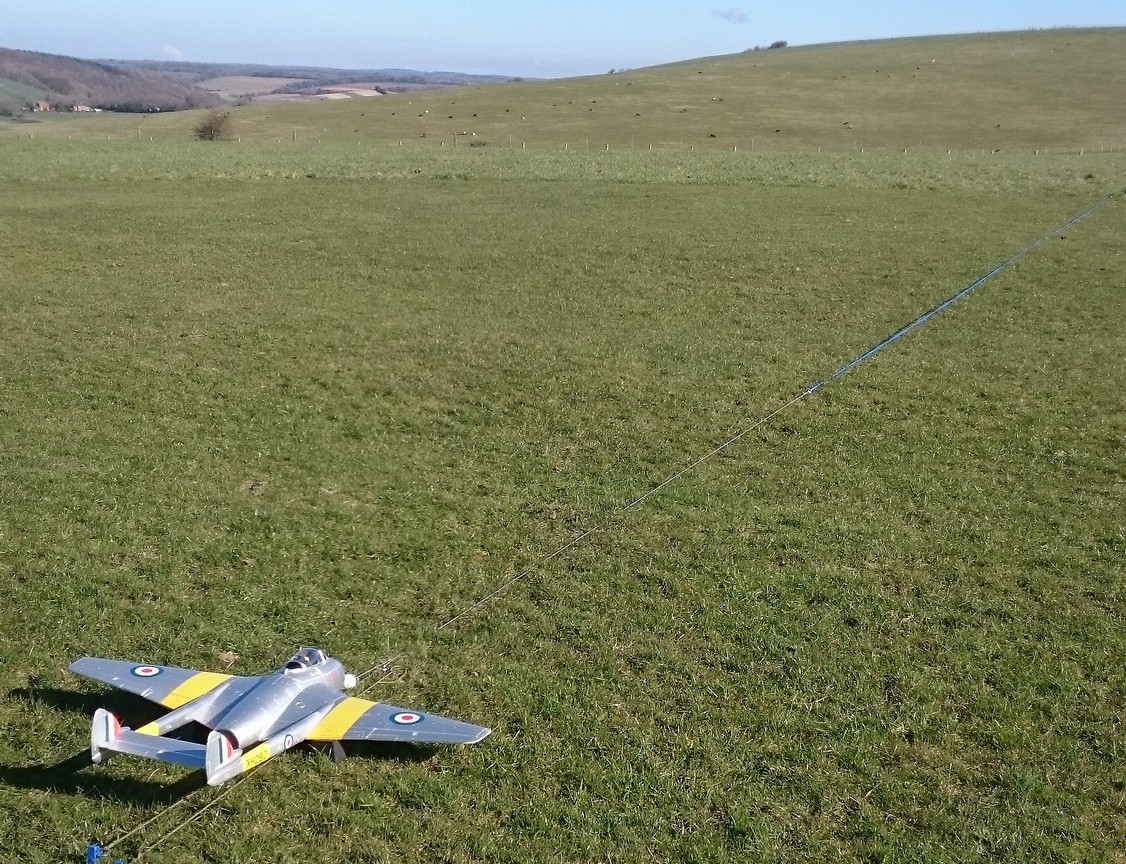 I’ve since seen the system in action and it works well and gives the model an easy safe launch every time. You can see the first launch in this month’s video.
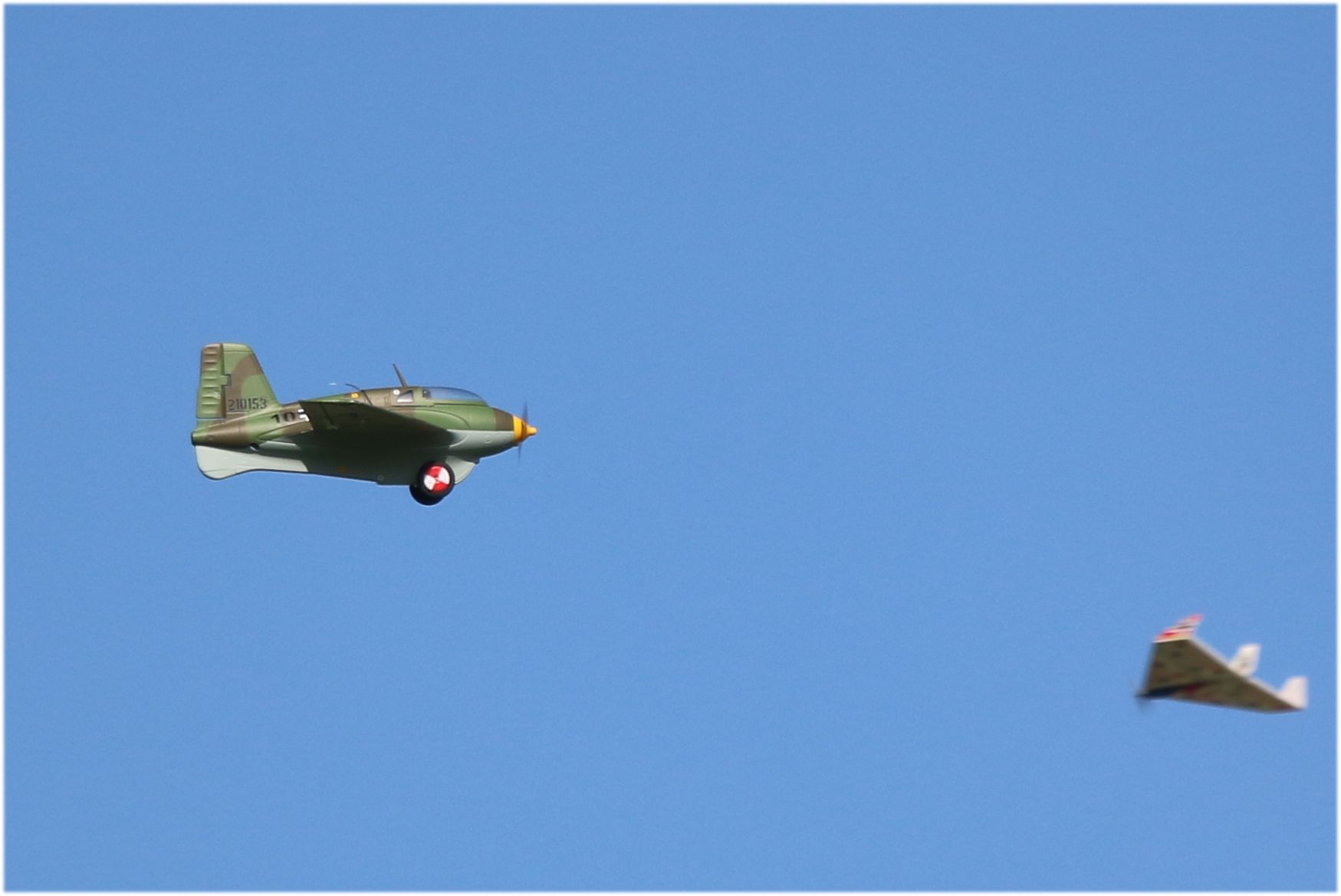
I finally got round to preparing my Durafly ME163 Komet for flight. I say ‘preparing’ as it certainly didn’t class as building, all I had to do was glue in the fin, connect the pre-made control linkages, and fit a receiver. I also added a telemetry current sensor while I was at it.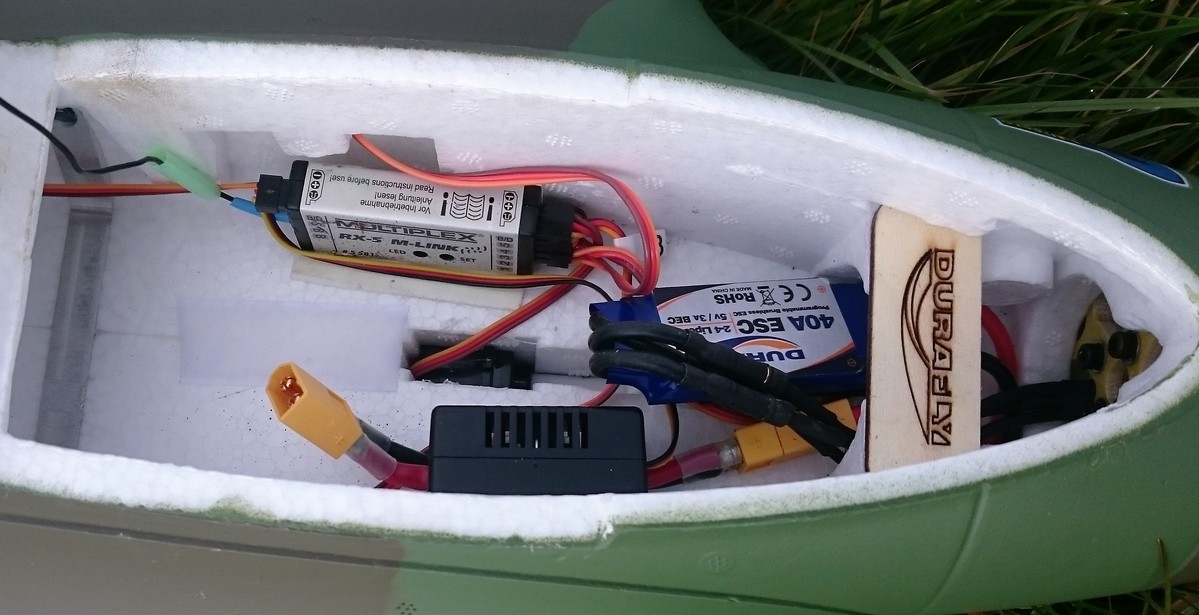
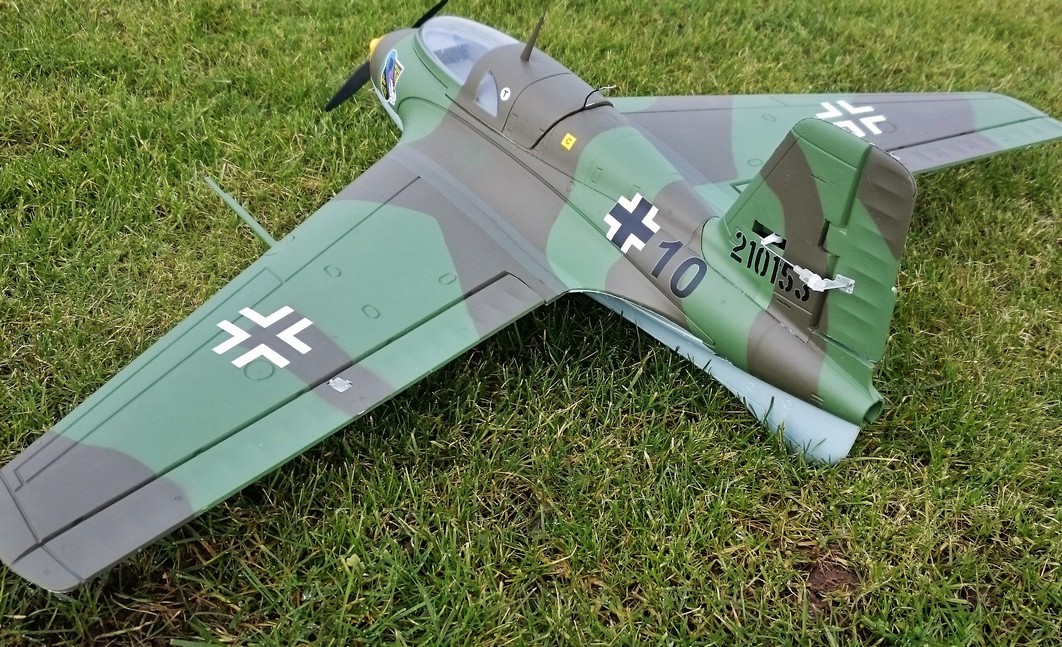
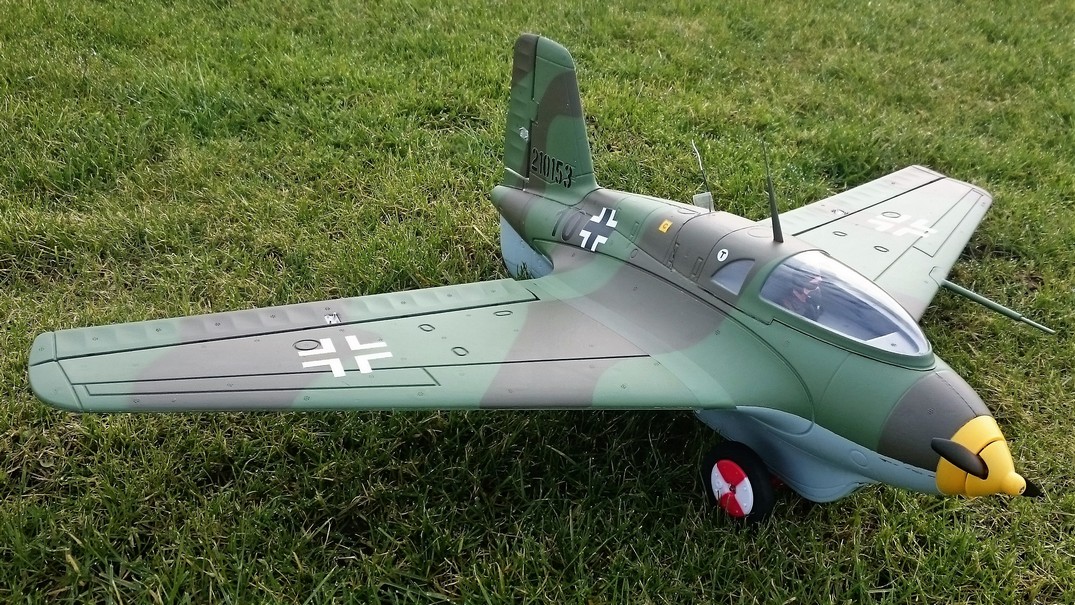 The first flight was ‘interesting’. I’d set the control throws to the amounts stated in the instructions but found it was very twitchy on elevator and very very very twitchy on ailerons. However, once I’d turned the rates right down and added more expo all was well and the second flight was much more pleasant. It’s now had lots of flights and overall I’m really pleased with it. It can be tricky to get off the ground as the scale detachable dolly has a very narrow track and it’s easy to drag a wingtip on the ground causing it to cartwheel, also it has a tendency to bounce into the air and then back onto the ground quite hard. But once safely away I fly a circuit, drop the servo released dolly, and open it up when it goes like the proverbial rat up a drainpipe.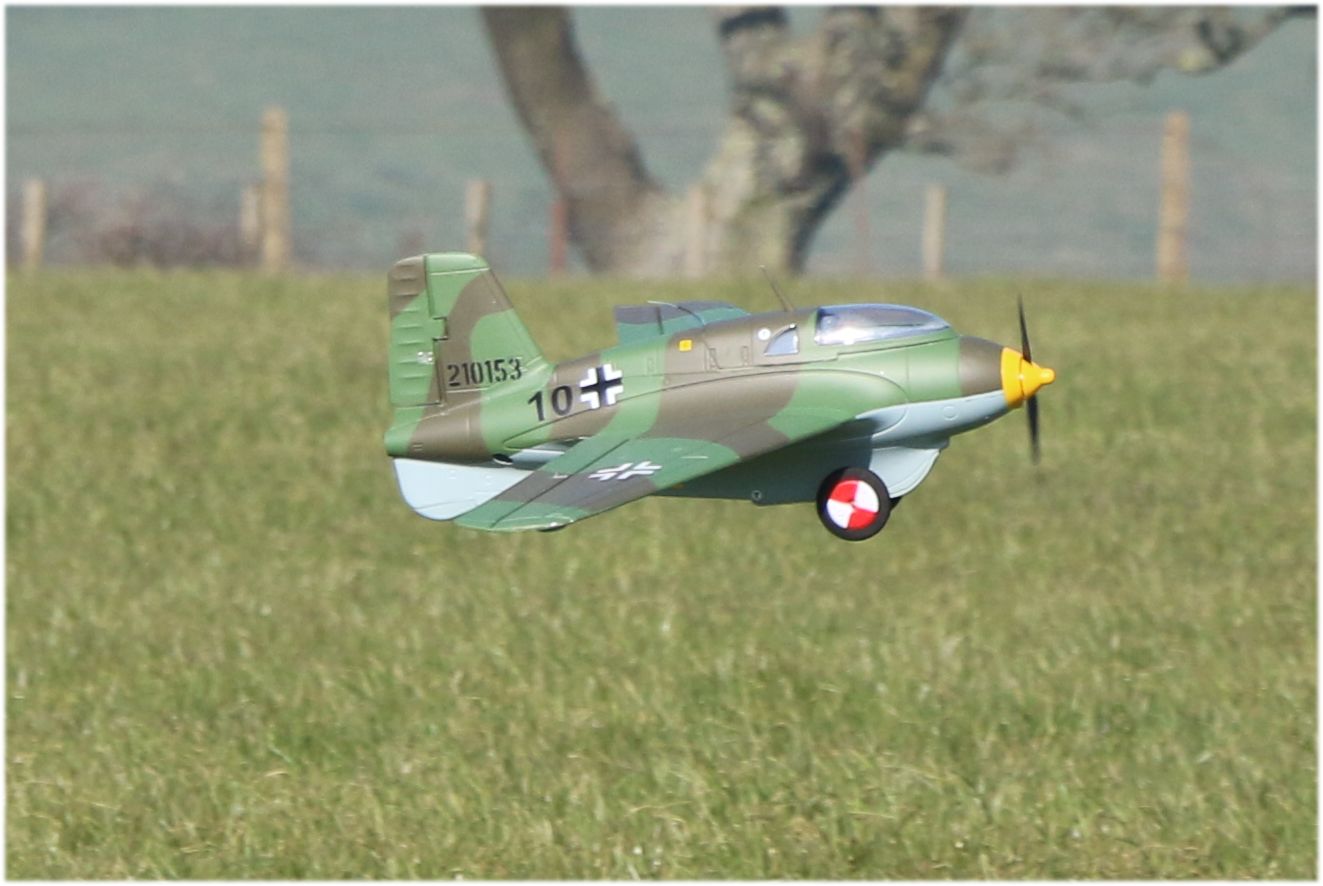
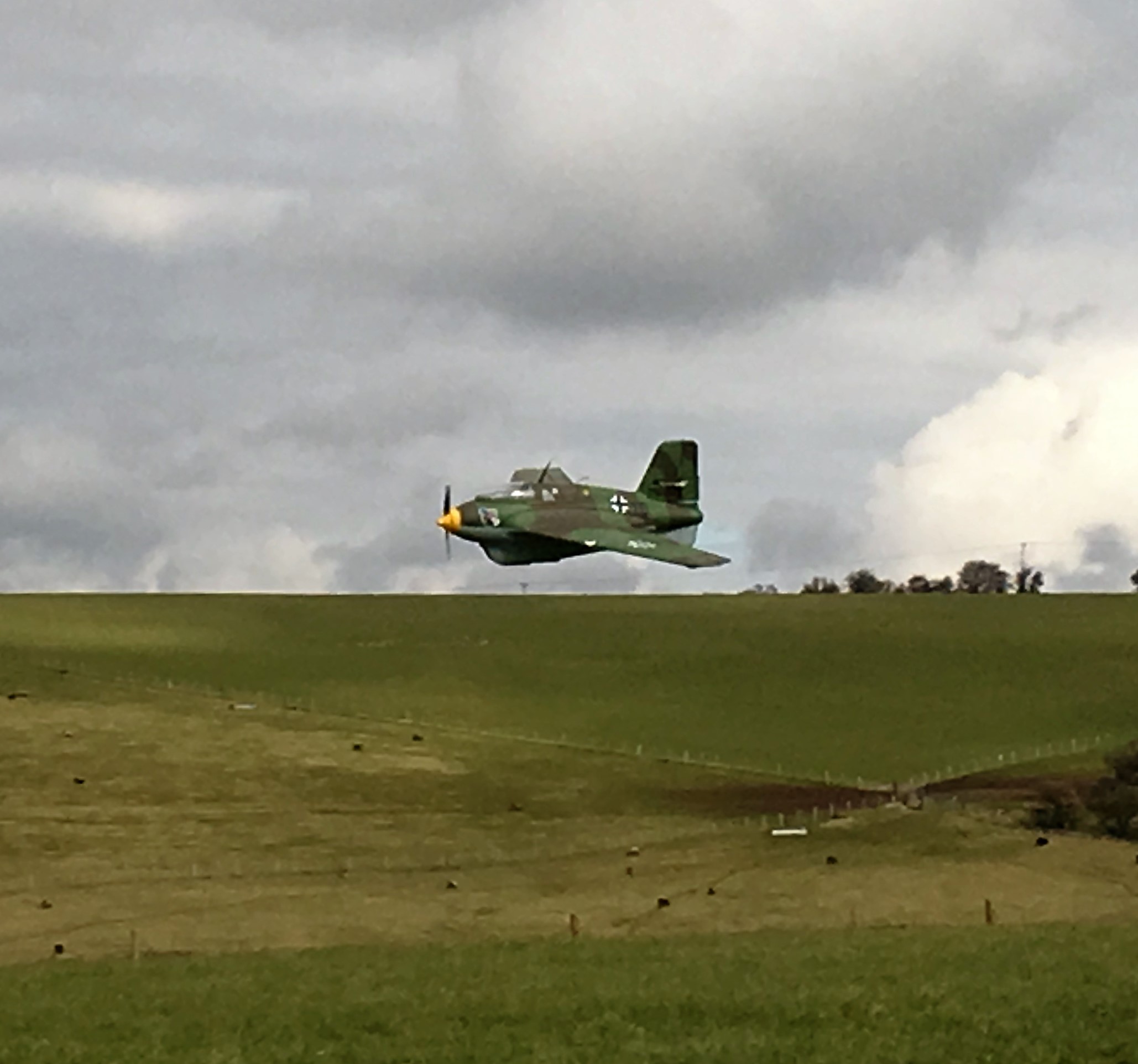 As it’s a flying wing orientation isn’t easy so it’s necessary to keep watching intently at all times, there’s no glancing away to see where other models are when this one is going flat out! But it doesn’t really have any nasty habits and is quite well behaved at reasonably slow speeds, and the landings are pretty straightforward. There are people on the forums saying it’s ballistic on 4 cells but it’s more than fast enough on 3 cells for me thank you. There is the option to fit a rocket in the tail which gives a few seconds of smoke and extra oomph, but it’s mostly for effect and I’m not planning to try it…yet.
The original Messerschmitt Me 163 Komet, designed by Alexander Lippisch, was a German rocket powered fighter aircraft. It is the only rocket-powered fighter aircraft ever to have been operational. Its design was revolutionary, and had performance unrivaled at the time. German test pilot Heini Dittmar in early July 1944 reached 1,130 km/h (700 mph), an unofficial flight airspeed record unmatched by turbojet-powered aircraft for almost a decade. Over 300 aircraft were built, but the Komet proved ineffective as a fighter and was responsible for the destruction of only about nine Allied aircraft.
Continuing with the series of Members Sheds (bedrooms, garages, etc.) this month it’s Modelling Clay’s turn to shine. I am pleased to hear that he’s got his priorities right and soon to be married Tim’s shed is complete, but as yet the house isn’t. Well done that man!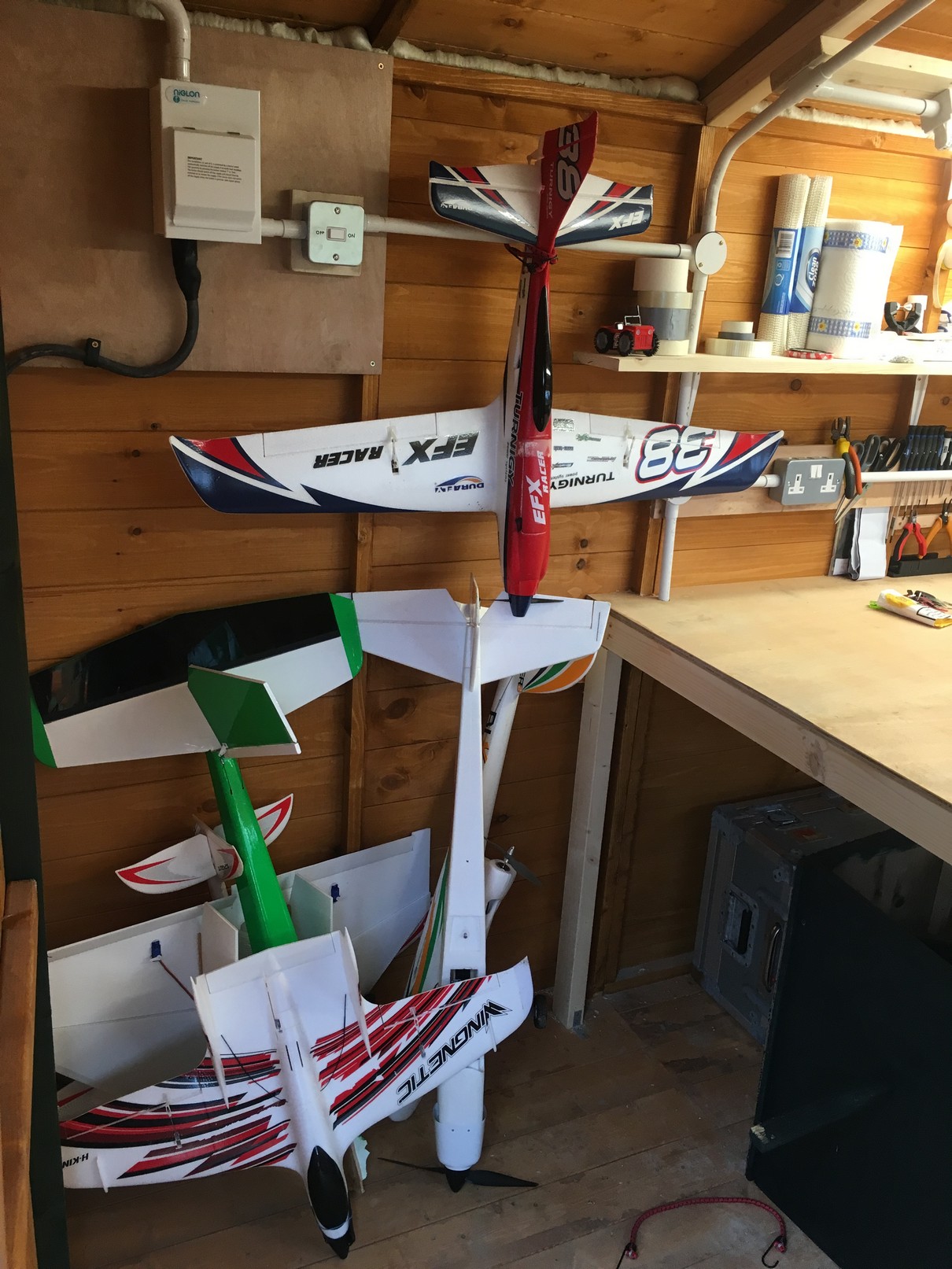
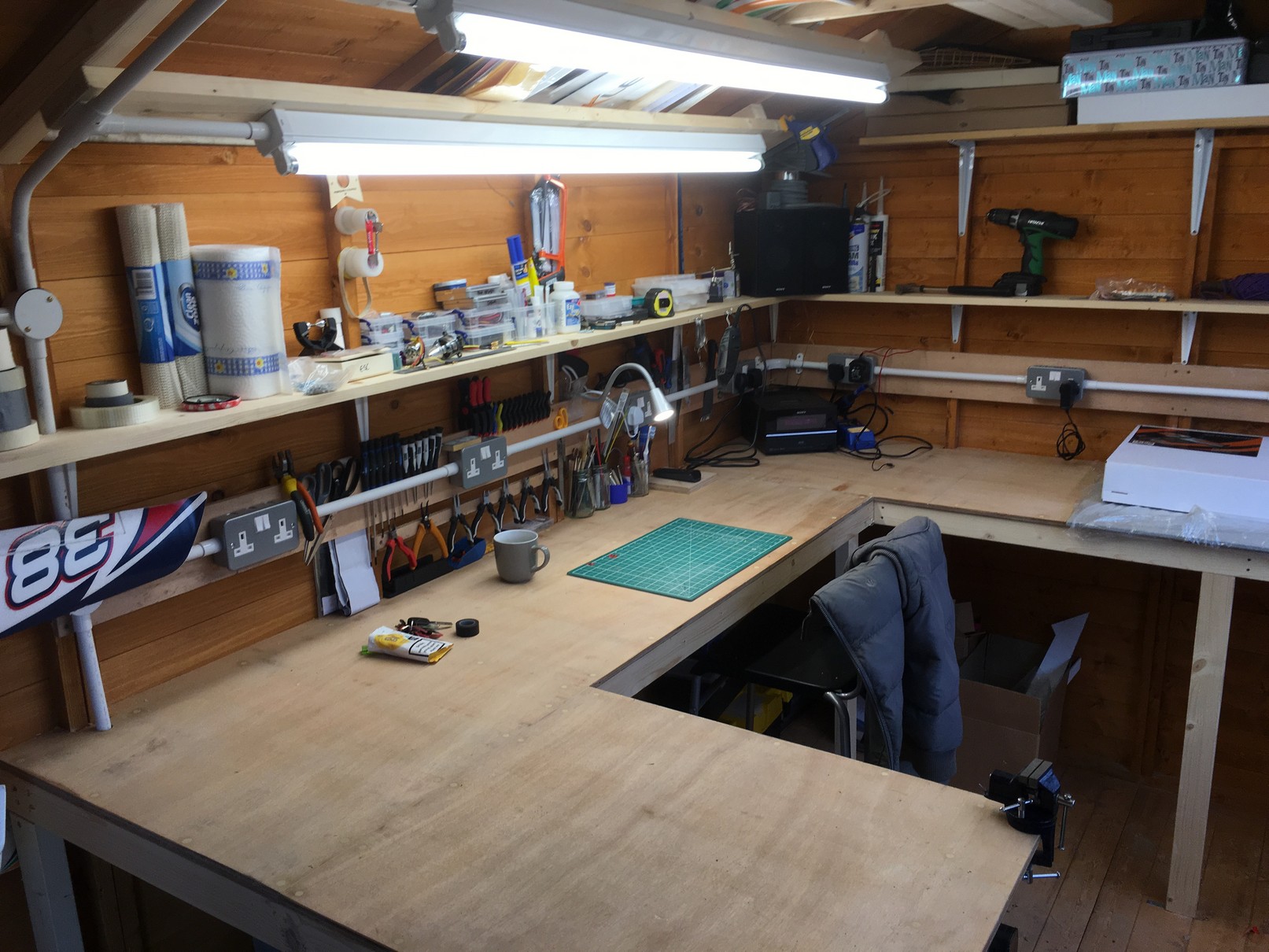 It all looks very posh with a model storage area, large workbenches, loads of lights and electrical sockets, and a charging station in the corner. Of course it’ll soon be full of junk like everyone else’s.
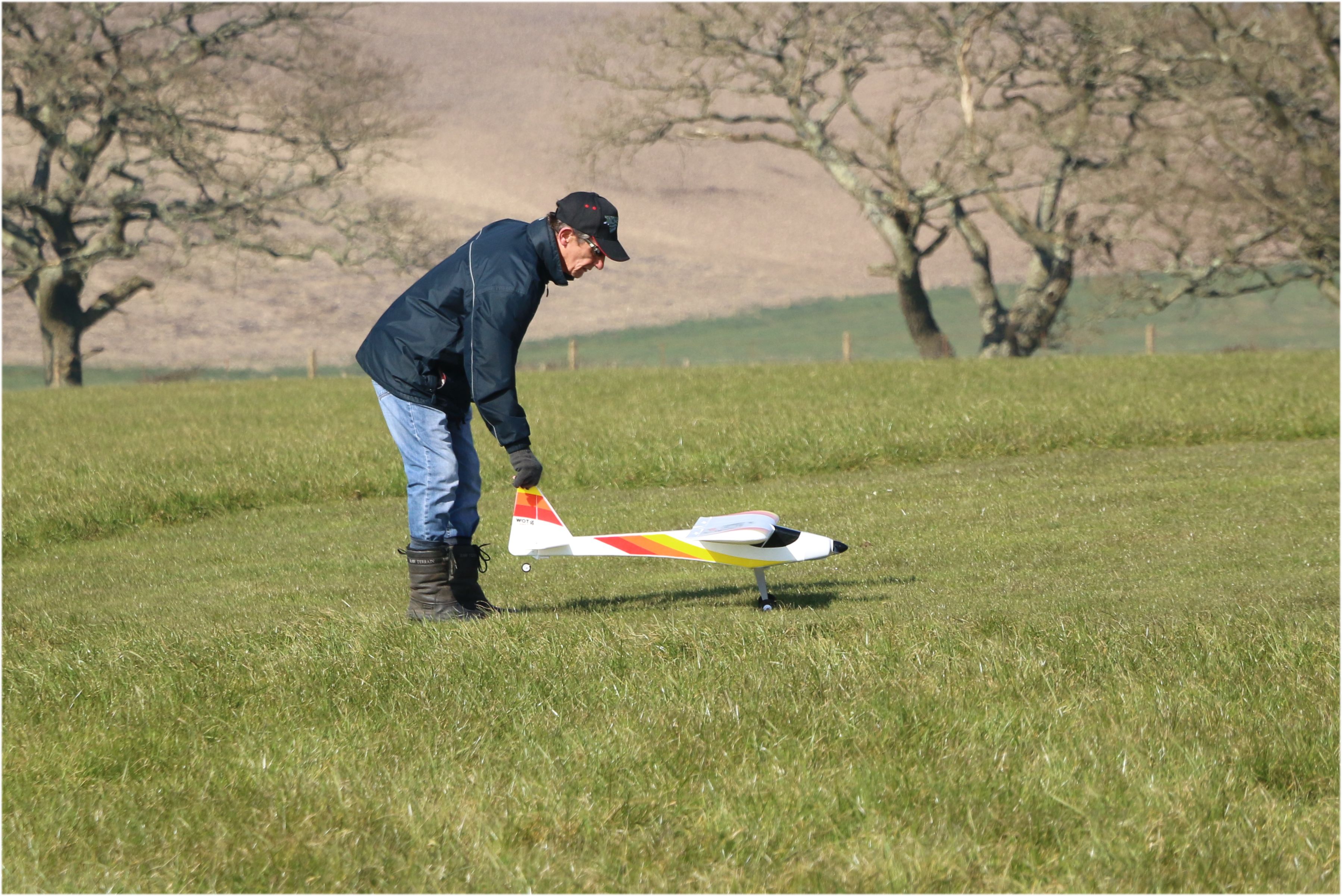
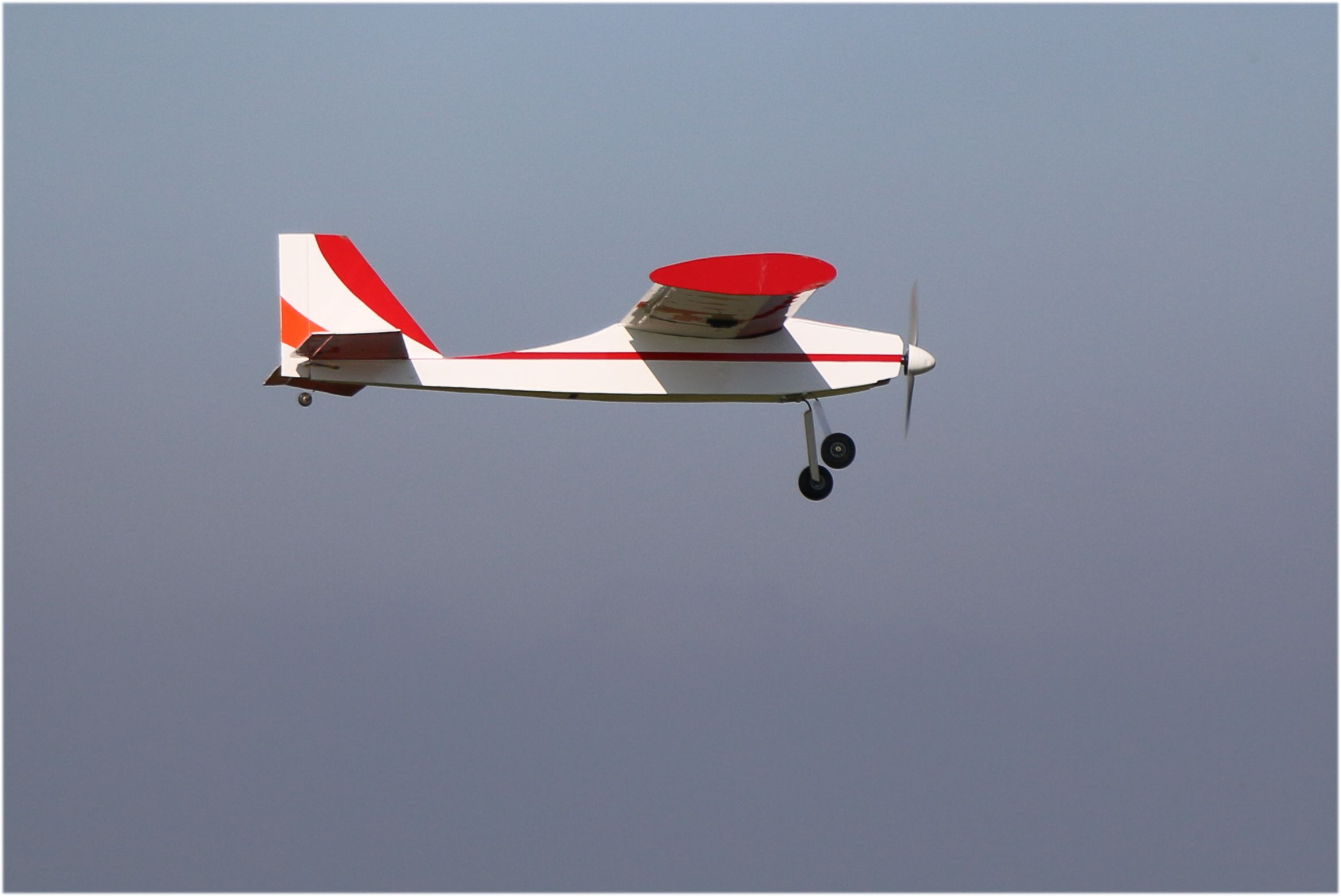
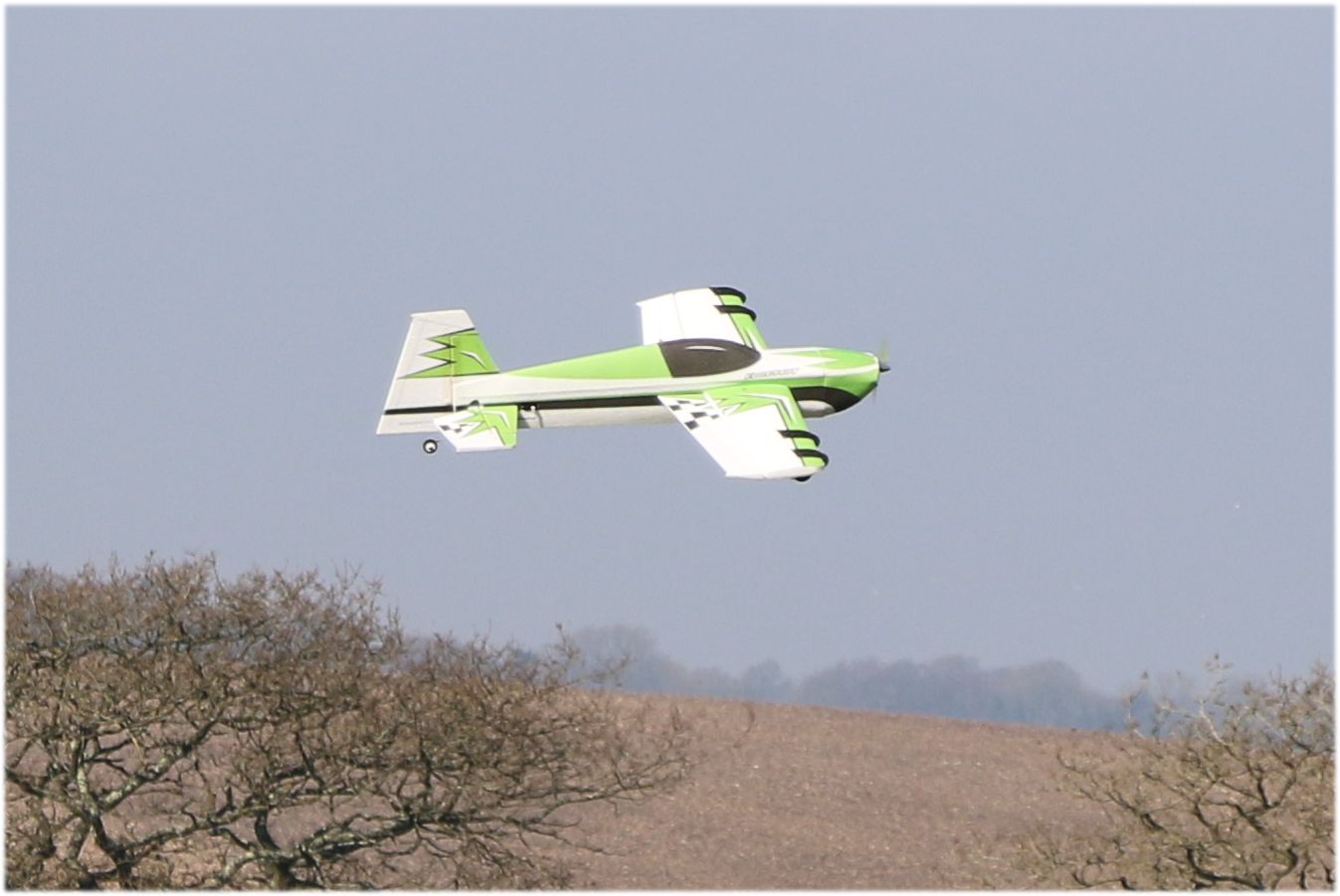
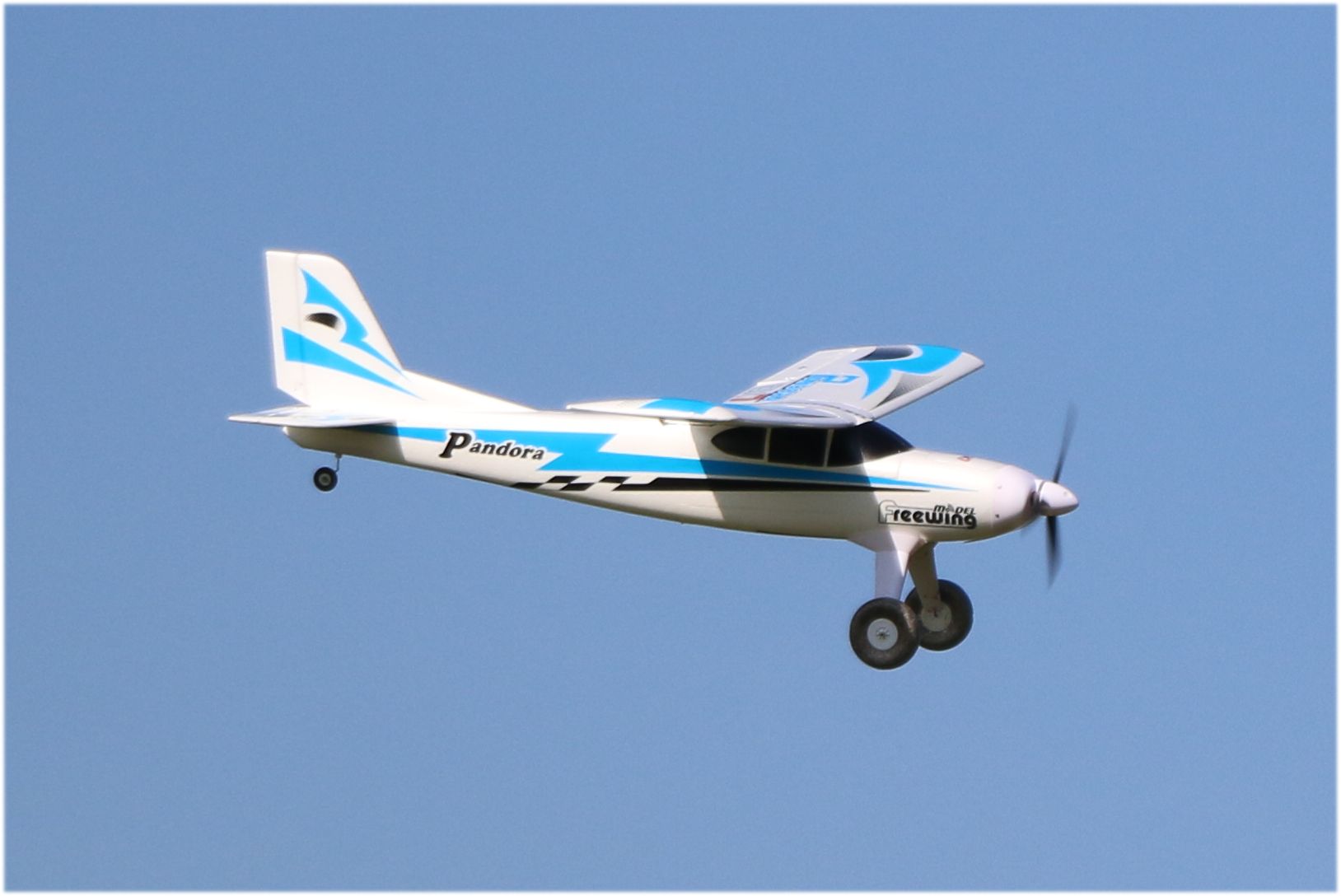
Finally, thanks to all who send me information, photos, or videos for Patch News. This month they included Captain Slow, Dougal Entendre, Gentleman Jim, Modelling Clay, JP, and Rusty G (Graham Swan). Here are a few general photos taken in March.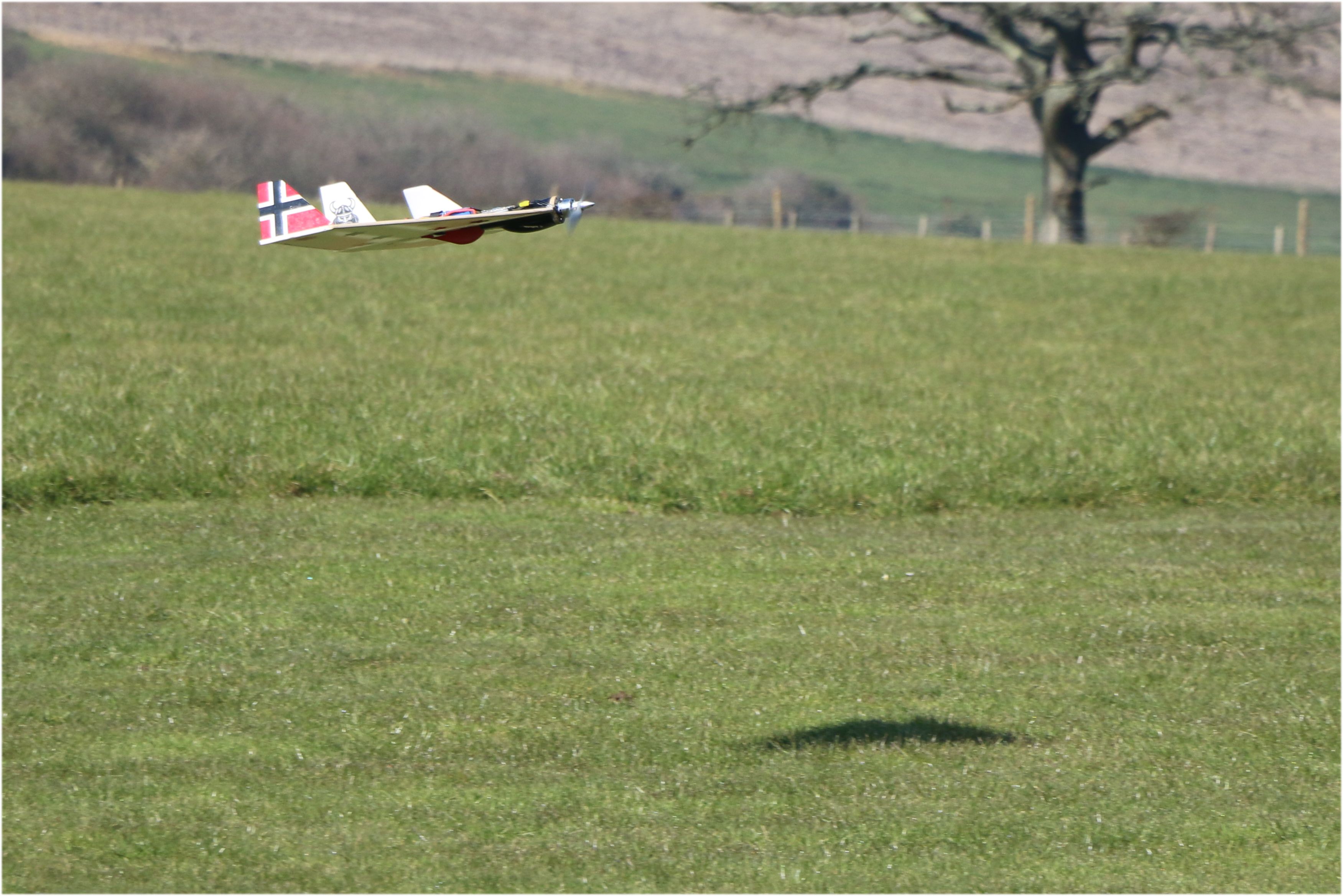
Please watch the video full screen, it’s so much better with small models flying around. If the video above won’t play for you CLICK HERE
And a bonus video from Monty for you. If it won’t play for you CLICK HERE
A BA 747 pilot had waited for take-off clearance for 45 minutes. A Lufthansa 737 was cleared immediately. The BA pilot asked the tower why the German aircraft had been given clearance at once. Before the tower could reply, the German pilot came back with “Because I got up very early in zee morning and put a towel on zee runway!”
Colin Cowplain
Patch News – February 2016
The wintry weather certainly continued during February with more wind and rain but the worst of it always seemed to arrive at the weekends. I was desperately short of material for this edition of Patch News until about a week ago when the midweek weather improved and I was able to fly on four consecutive days. Overall the Midweekers didn’t fare too badly, in fact some midweek days were almost perfect, but I do feel a little sorry for the members that have to work for a living… a little sorry, but not too much!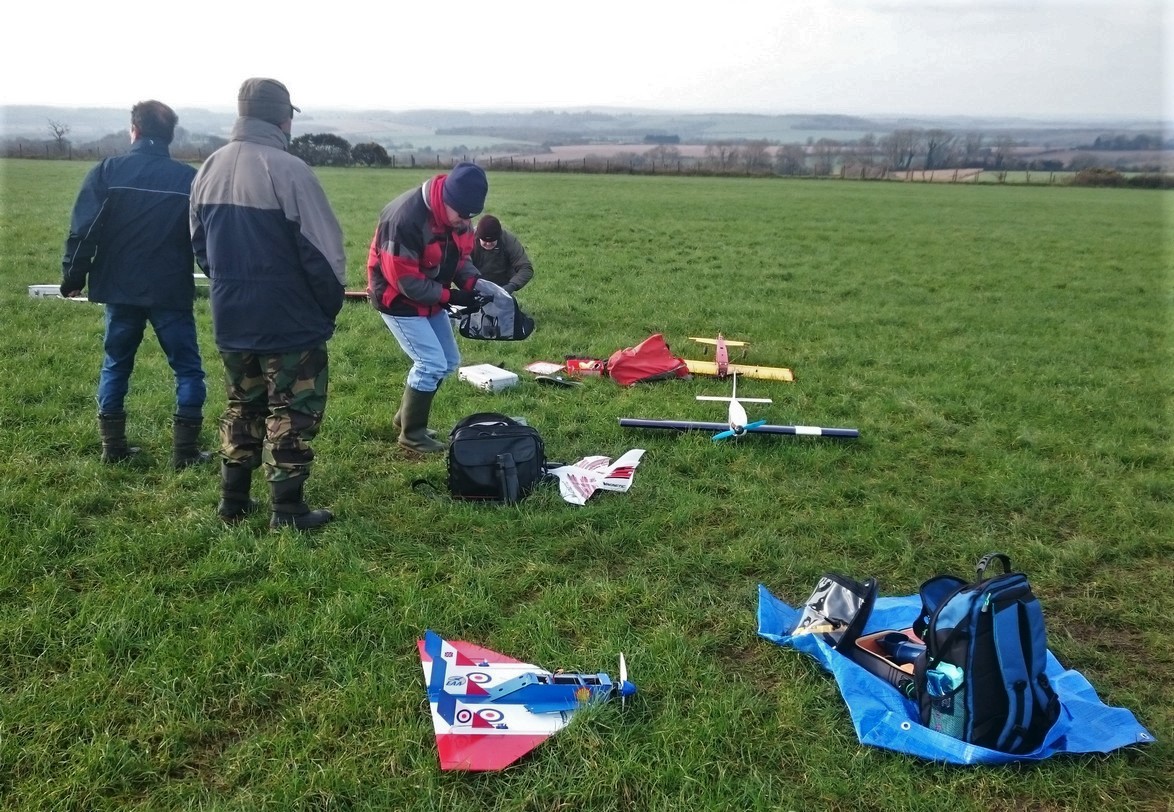 I may as well begin with a confession. If you haven’t already been heard on the grapevine you’ll be pleased to hear that I made a teeny weeny faux pas early in the month…barely worth mentioning really… Captain Slow and I were flying our little Spirit mini gliders, sometimes fairly close together, sometimes well apart, when suddenly we both heard a thump. Captain Slow said ‘What was that?’ I replied that I thought maybe it was a car on the road and continued flying quite happily but about 15 seconds later he said ‘You’ve crashed!’ Only then did the horrible truth dawn, somehow the swine had substituted his own Spirit for mine and I had crashed behind us!
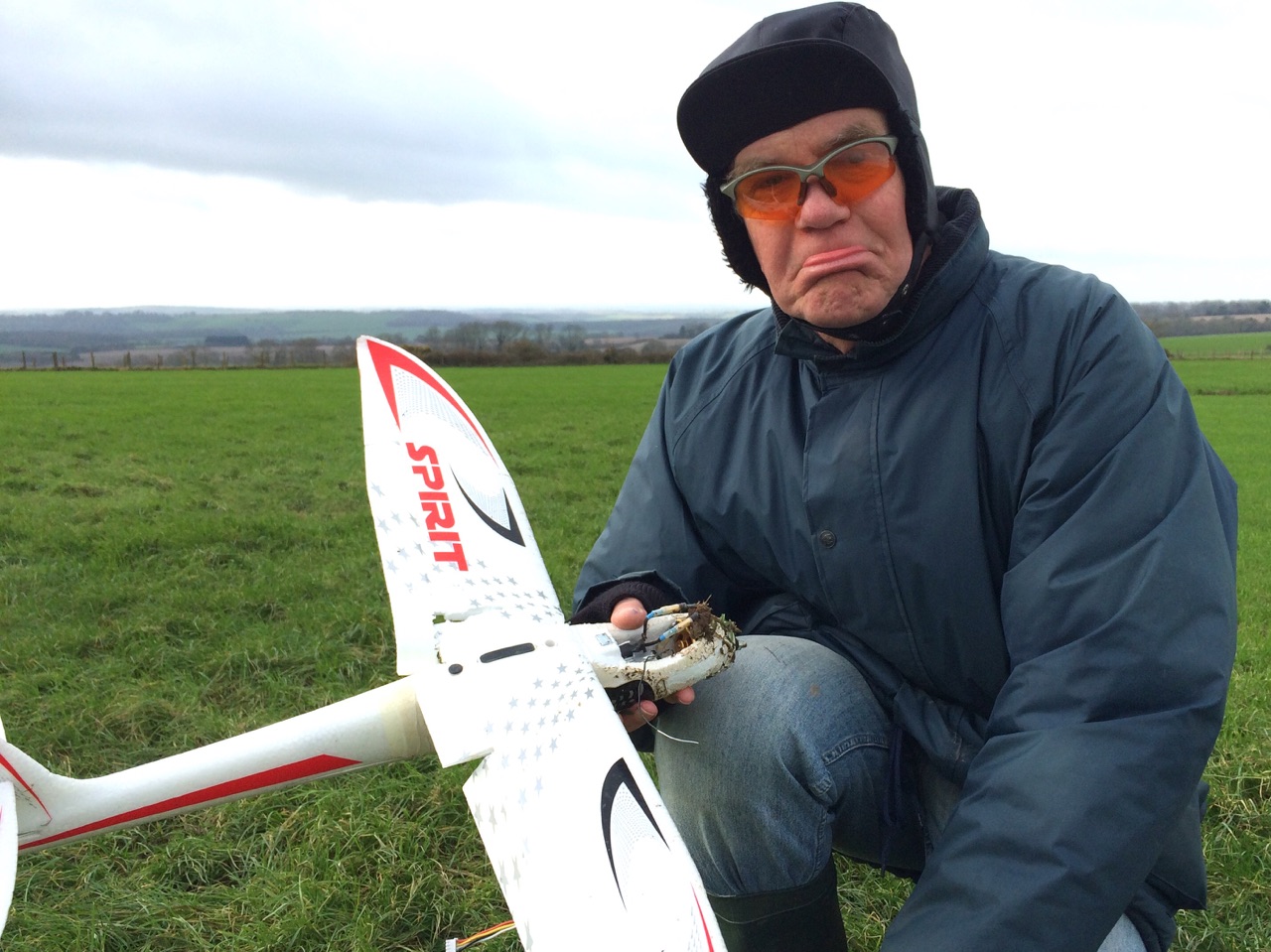 I still can’t figure out how it happened. At one stage we had been alongside each other, just hovering pointed into wind, so maybe it was then. I think I must have had the throttle shut when it crashed as the motor and speed controller are both fine, and the model isn’t too badly damaged.
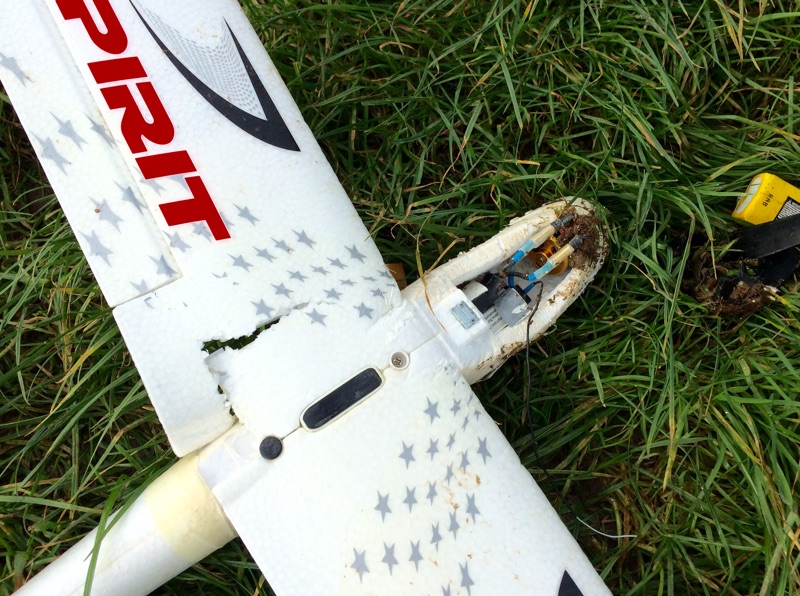 Obviously it wasn’t my fault at all, I blame Captain Slow completely, but so far I haven’t worked out exactly how it was his fault. I’ll let you know when I’ve figured it out! All joking apart, it could have been quite serious as the crash was not far behind us and not all that far from the pits, not good. I wouldn’t want to be hit by a Spirit, even with the motor powered off, and even though they only weigh around 12oz.
Want to know how to straighten out the crushed parts of and EPO fuselage? Here’s how I do it.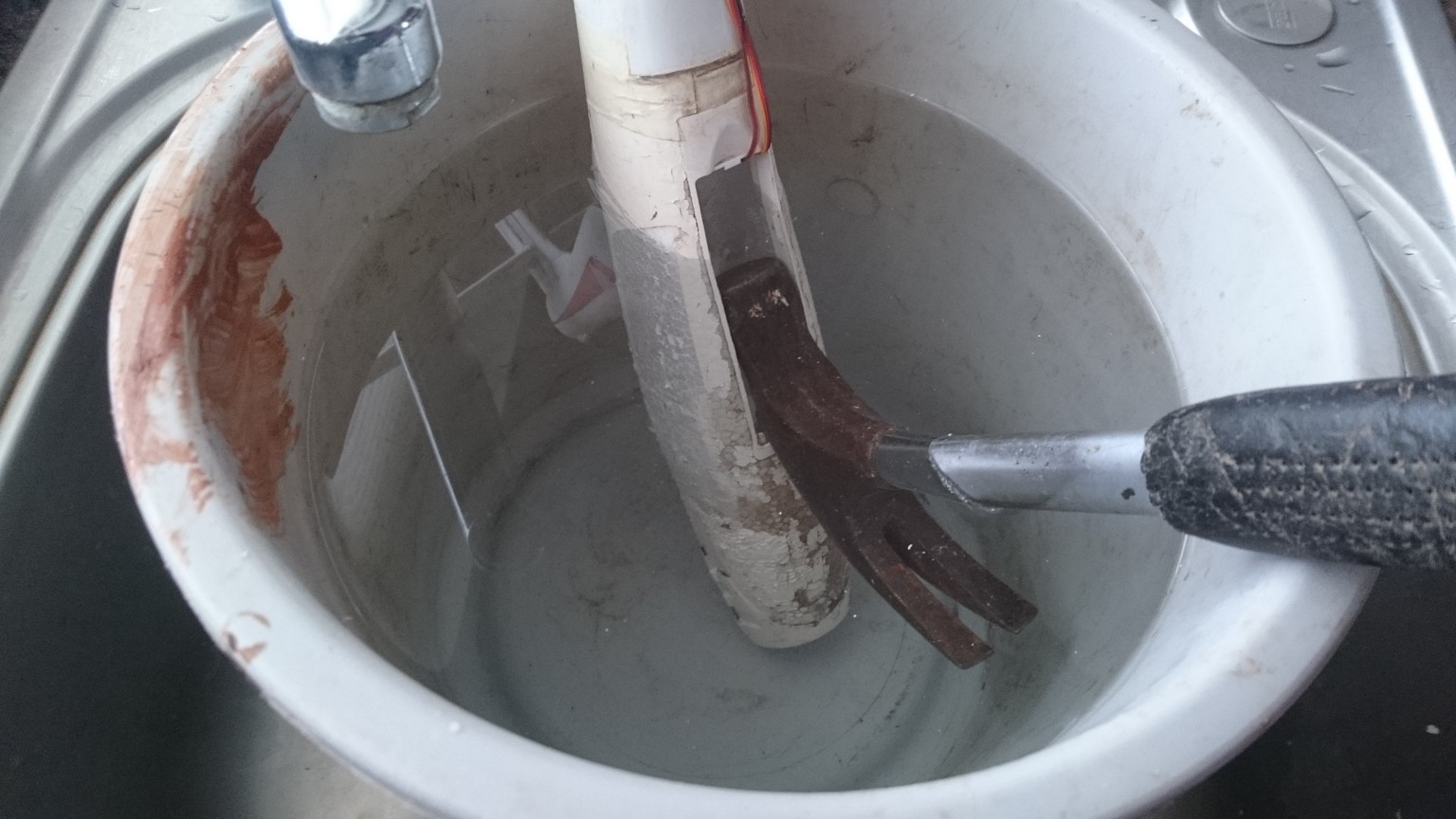 Remove the electronics then just stick it in a bucket of very hot water (but less than boiling point) and top up with more very hot water occasionally. After several hours it’ll be as good as new…ish! What’s the hammer for? No, that’s not to bash it back into shape; it’s to stop it floating!
Now onto happier things. JP and Monty have both managed to get a bit more flying in with their new Vampire and Stuka models. Obviously Monty has to attend school in the week so he’s a bit restricted on flying time but during the half-term week he got to fly JP’s Vampire as well as his own Stuka.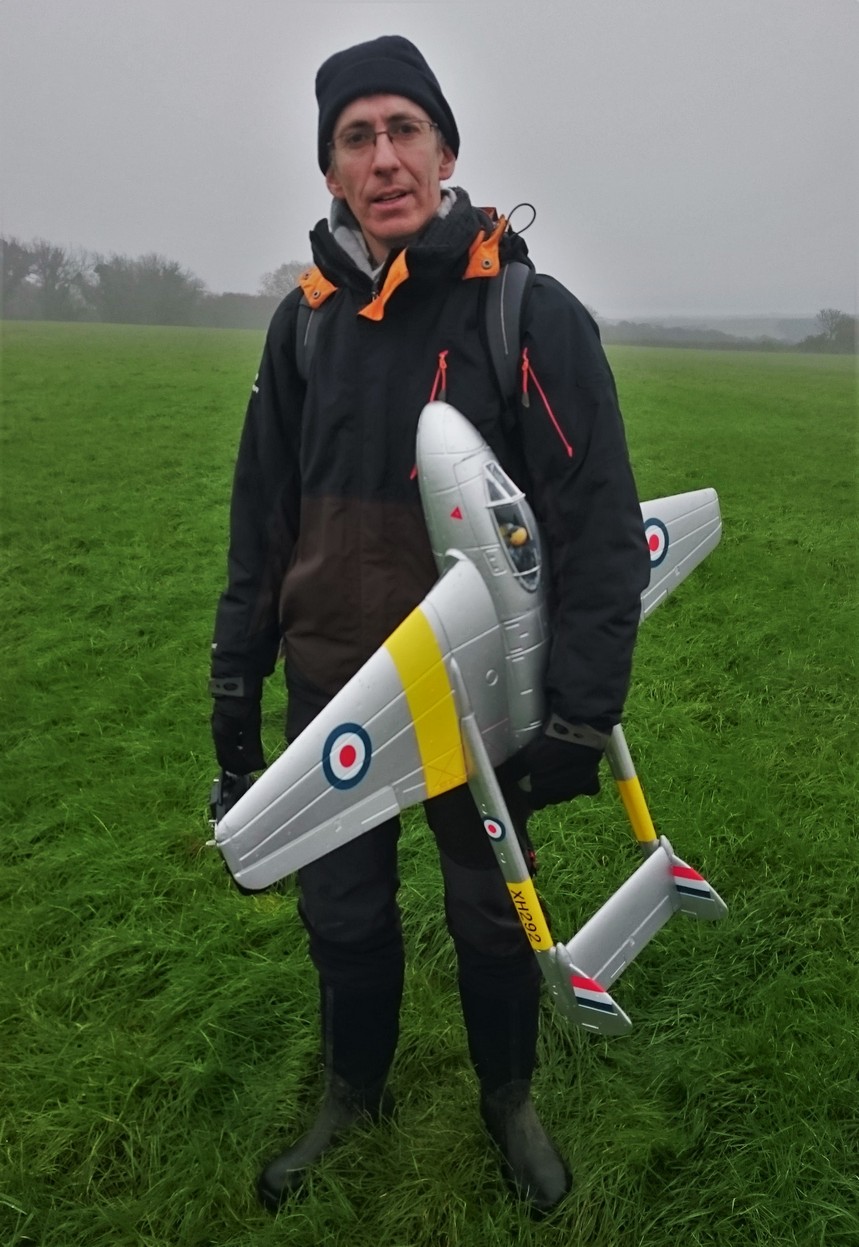
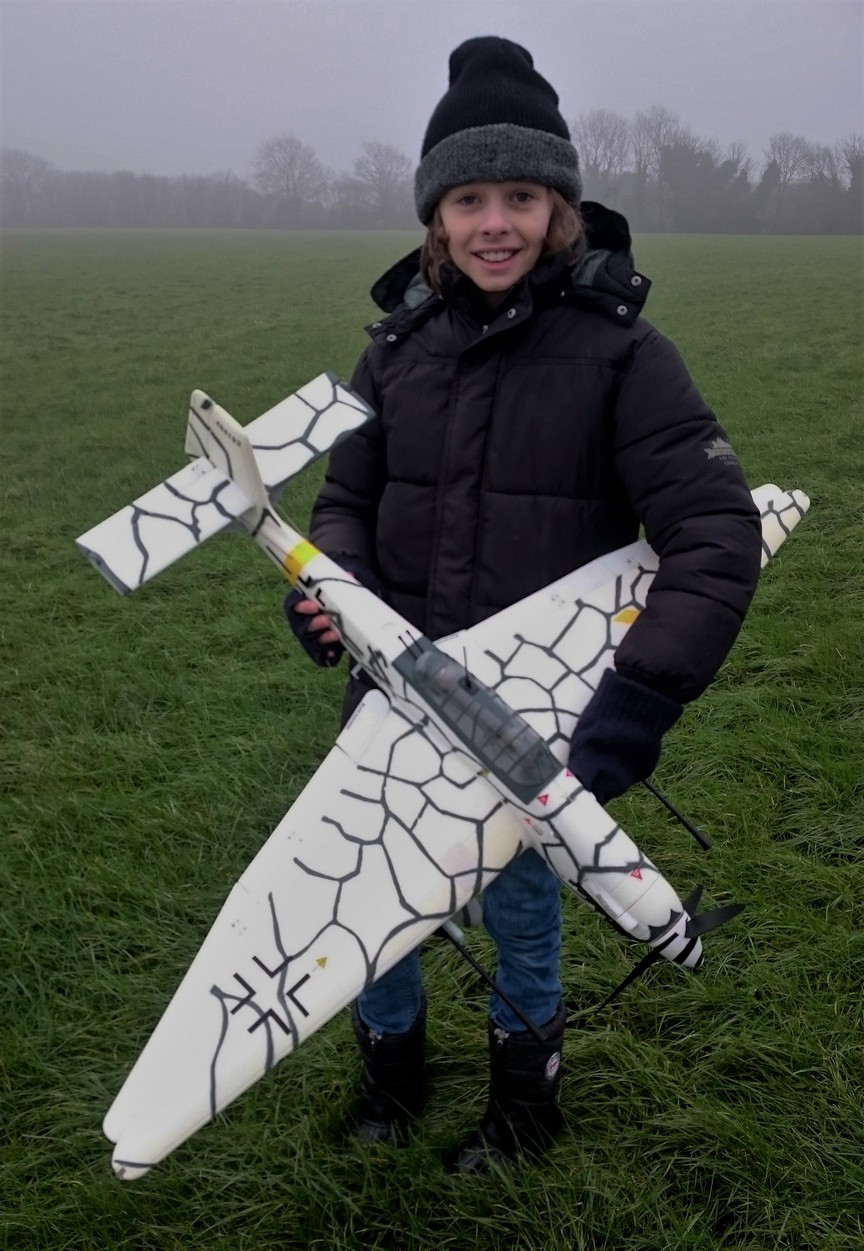 The Vampire has now had quite a few flights and we know from others in the club that they perform well, but the Stuka was a completely unknown entity and I expected it to be really susceptible to tip stalling. But not at all, it seems to be very well behaved indeed. The patch hasn’t really been suitable for taking it off so every flight so far has been hand launched but it goes away beautifully each time. There is plenty of power to haul it out of trouble anyway and for most of the flight it stooges around on half throttle. Monty seems to have got used to it well and has already landed it without problems. You can see him flying both the Vampire and Stuka in this month’s video (at the end of this blog) some of which was taken by JP.
A few of the midweek days have had near perfect flying weather with light winds so I dug out my Boeing PT-17 Stearman. It’s only 32” span and is really only suitable for flying in light winds so I tend not to fly it much in the winter months. Norwegian Nick brought along his DH82 Tiger Moth for much the same reasons so I was able to photograph them together.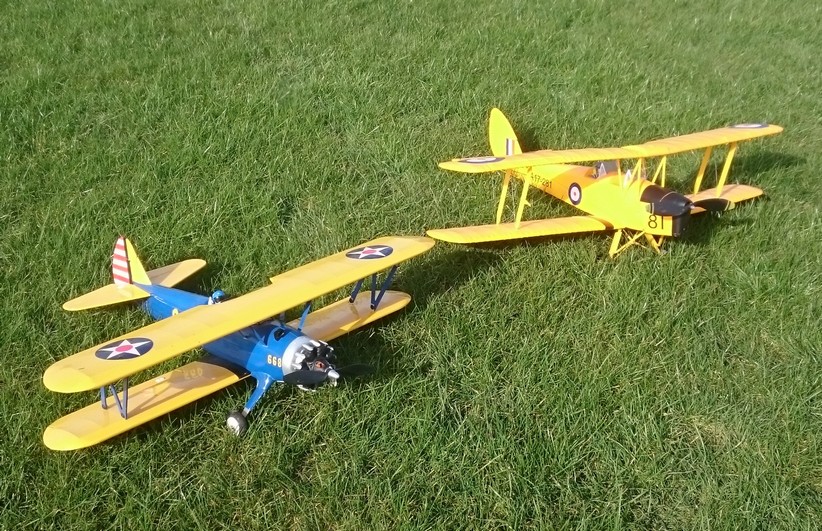 They aren’t the same scale, the Stearman should be a bit larger than the Tiger Moth but they look nice together anyway. Oddly enough, both models were prizes in the club Big Raffles so are probably not models either of us would have chosen had we been buying for ourselves but we are both very happy to have them for the price of a few raffle tickets. We also flew them together but Nick’s Tiger is lighter than the Stearman and wants to fly much more slowly so it wasn’t easy to keep in formation.
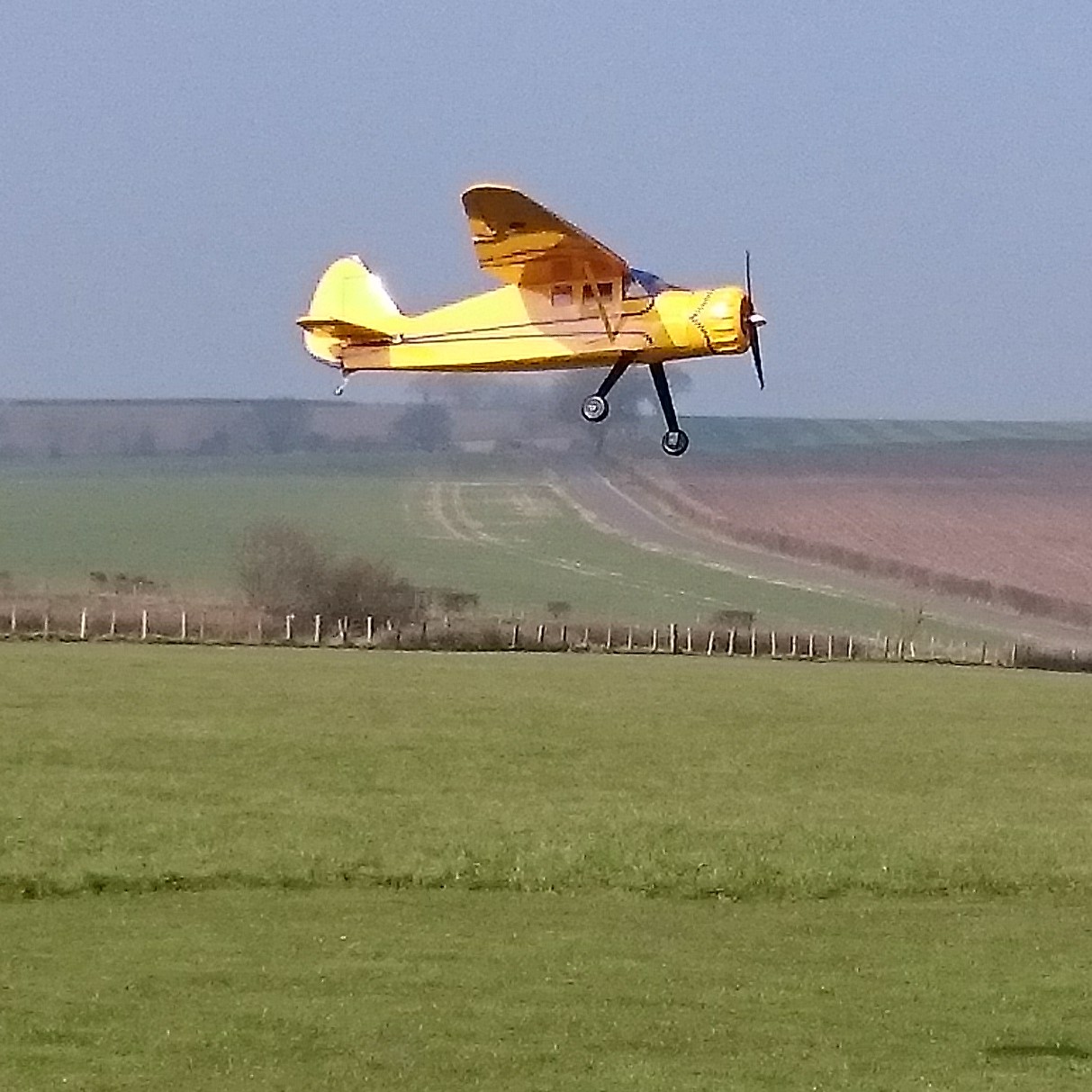
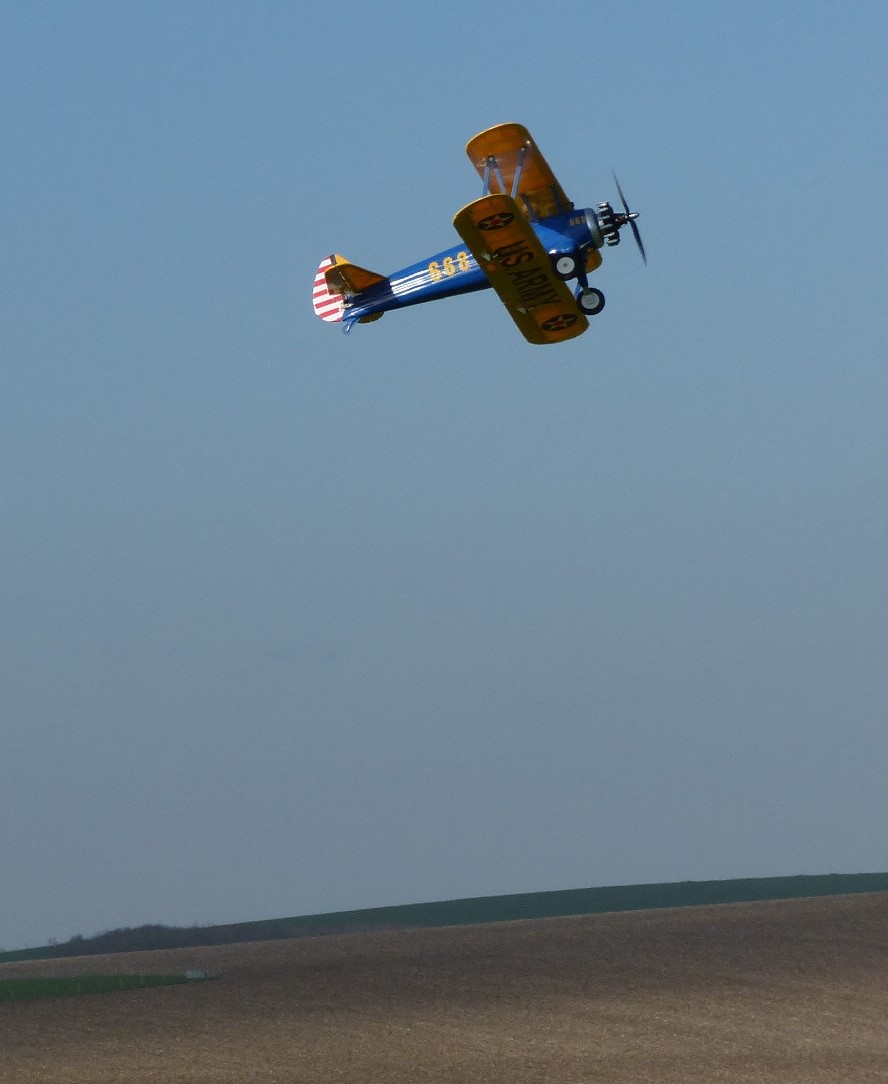 Gentleman Jim took this cracking photo of my Stearman but unfortunately wasn’t able to get them both in a shot together. Another day maybe…
Only a couple of new models appeared this month, the first being Stanley Knife’s lovely Bowers Fly Baby built from the Seagull kit. It’s an ARTF so it’s more of an assembly job than a build but the end result is a very nice model which has enough scale details such as a dummy engine, rigging wires, and braces to keep it interesting.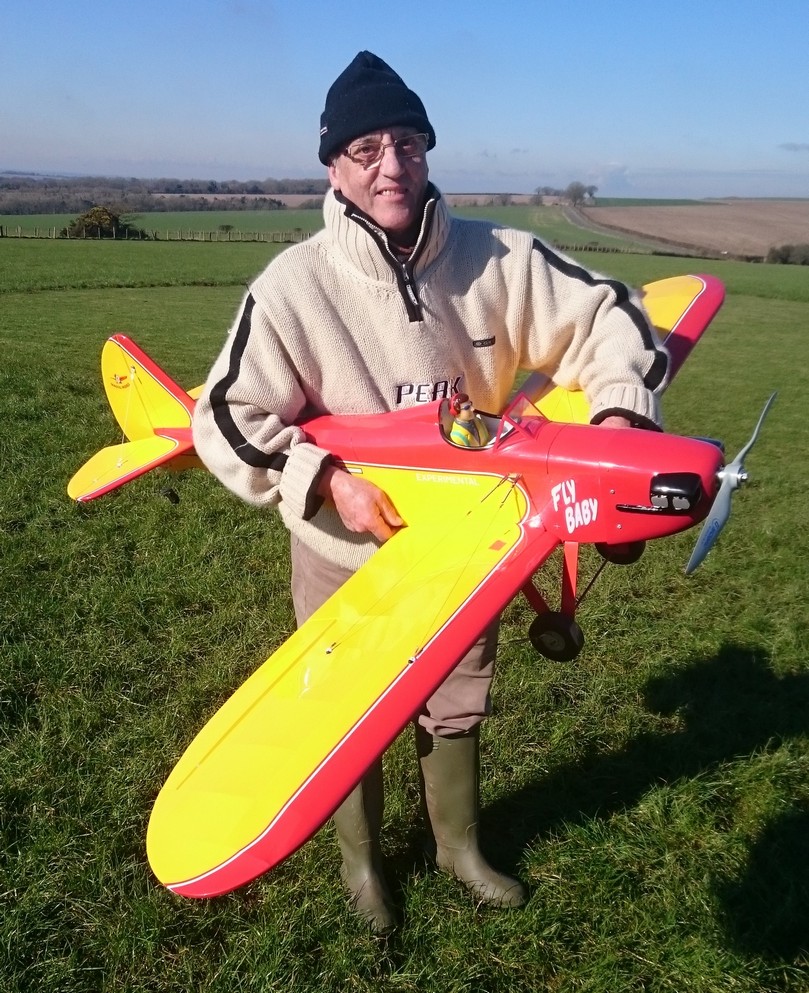 The designer, Pete Bowers, developed an interest in all things aviation as a child and became an aero-modeller.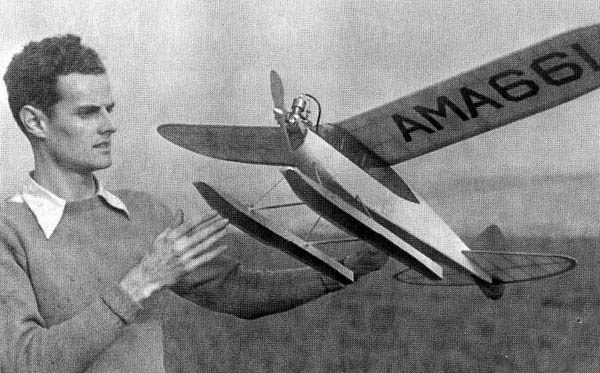
He studied aeronautics at the Boeing School in Seattle and after the war was employed by Boeing until he retired. He was also very interested in photography and one of his photographic accomplishments was that he arranged a “formation” photograph of the Dash 80, Boeing’s 707 jetliner prototype, and his own replica of a 1911 Curtiss Pusher. Pete arranged for the Dash 80 crew to fly a low approach at Boeing Field while he flew formation with a pickup truck carrying the cameraman.
Pete was one of the early members of the EAA (Experimental Aircraft Association) and when they held their first design competition he designed the winning entry, the Fly Baby. It was designed as a simple home-build aircraft and Pete thought he might sell 500 sets of plans, hence the 500 in the original’s registration but there have been over 5000 sets sold to date.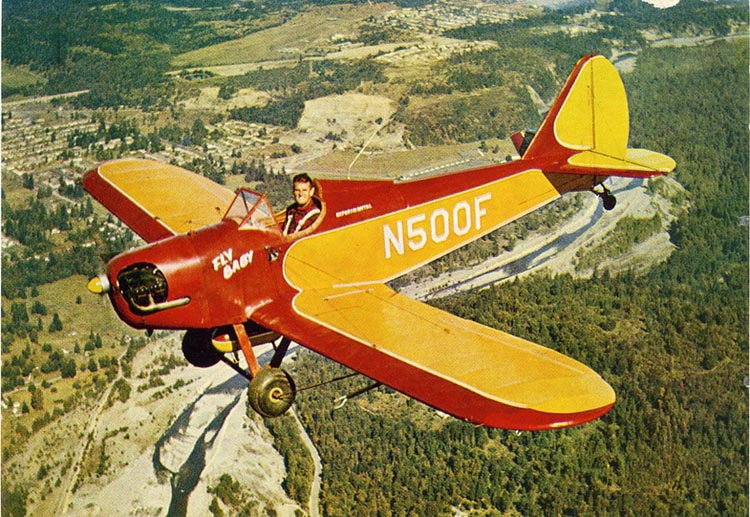
He produced various versions including a Fly Baby biplane that I always thought was called Fly Baby Bipe but the website says it’s Bi-Baby.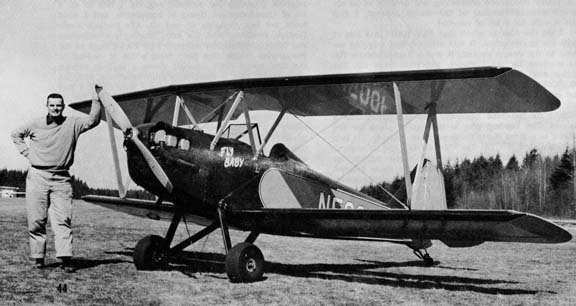
The Seagull model spans 68.9”, weighs around 7.5lbs, and is designed for either a 10-15cc I/C engine or an equivalent electric motor. Viv’s is electric of course and uses a Turnigy SK3-5045 500kv motor. He’s running it on 6 cells and a 16×10 prop which pulls around 900W. It has plenty of power and flies very well.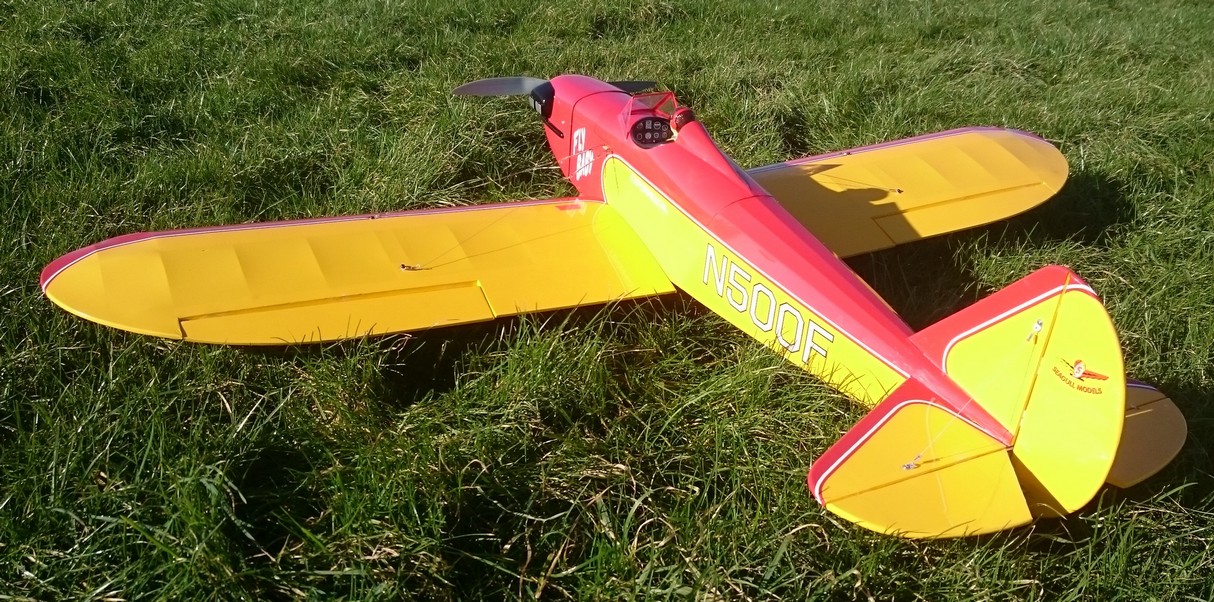
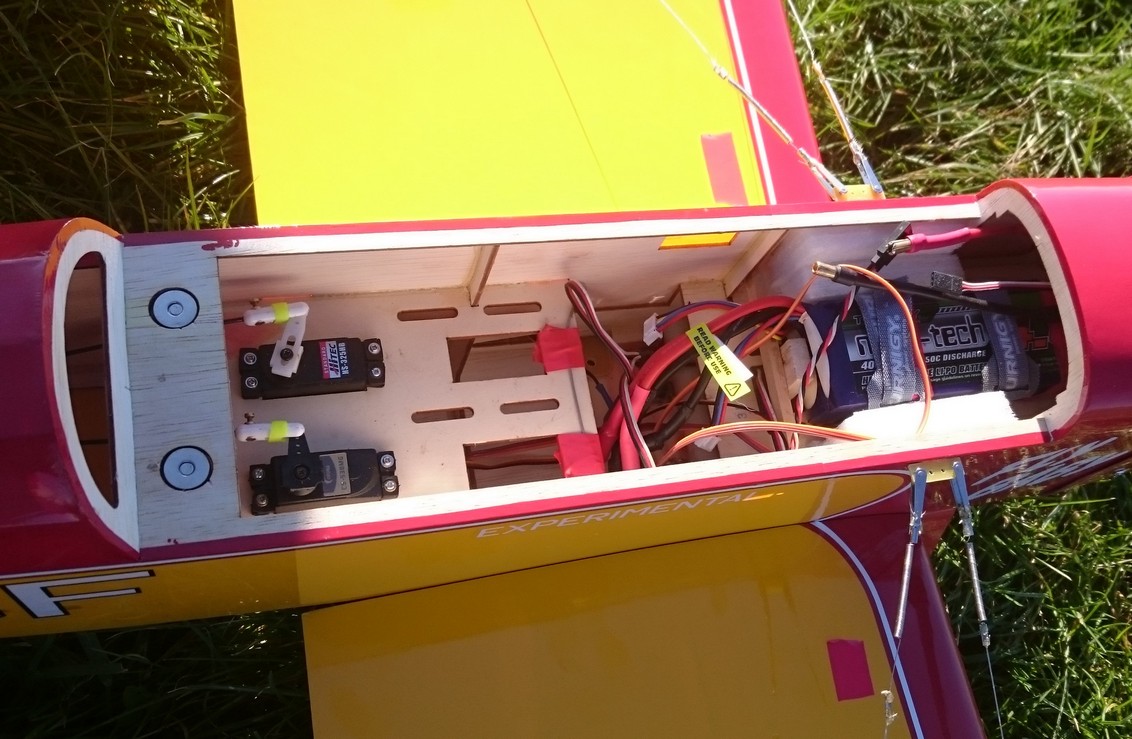 As expected it has nice flying characteristics and it good for mild aerobatics but surprisingly, when slowed right up it does drop the right hand wing quite dramatically. I doubt it will ever cause problems as the tip stall only happens at very low speed. At the time of writing it’s only had one flight, some of which can be seen in this month’s video, but I’m sure it will become a firm favourite that will be flown lots more over the next few months.
The other new model seen this month was 1066’s latest 3D machine, an EPP Mini Sbach 342 from HobbyKing.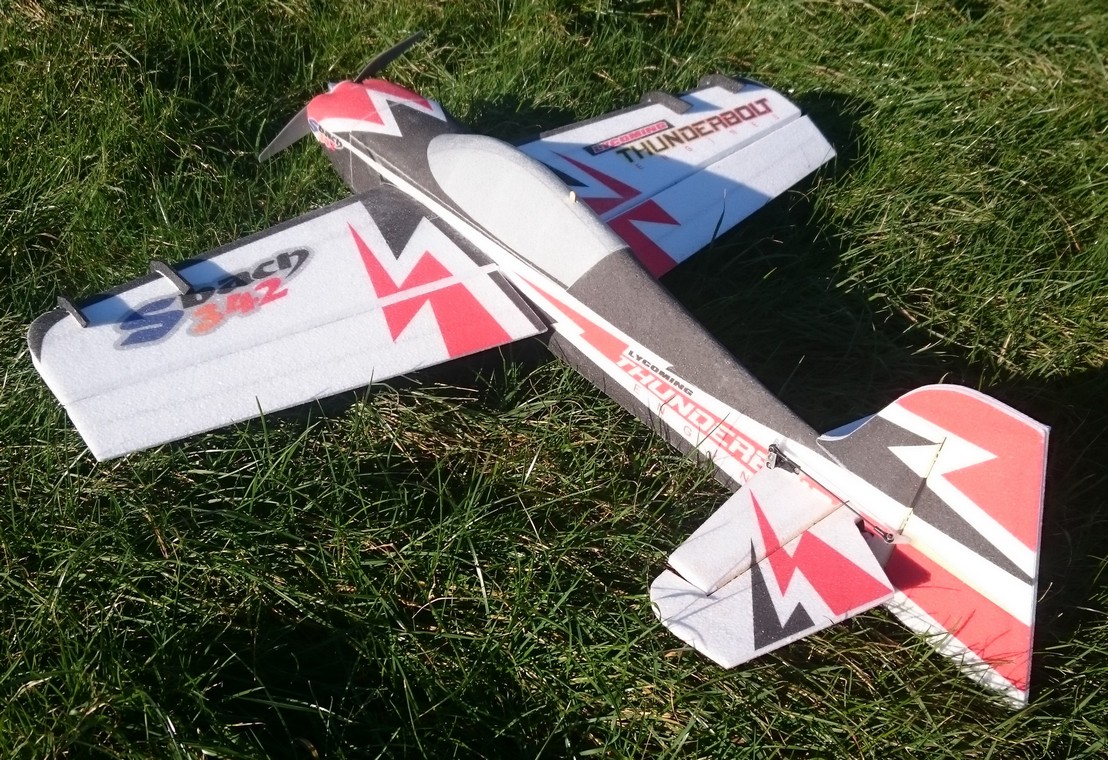 It’s part of the same range as Dan Handley’s EPP Mini Edge 540T 3D that I featured last month and, like Dan’s, it flies brilliantly. The original Sbach 342 is a German high performance two-seat aerobatic and touring monoplane designed by Philipp Steinbach with Albert Mylius and built by XtremeAir GmbH.
 It is a composite structure low-wing monoplane with a fixed conventional landing gear with a tailwheel. It is powered by a 315hp (235 kW) Lycoming AEIO-580-B1A piston engine driving a three-bladed propeller. It is the tandem version of the single-seater XtremeAir Sbach 300 which was designed by the same team in 2004.
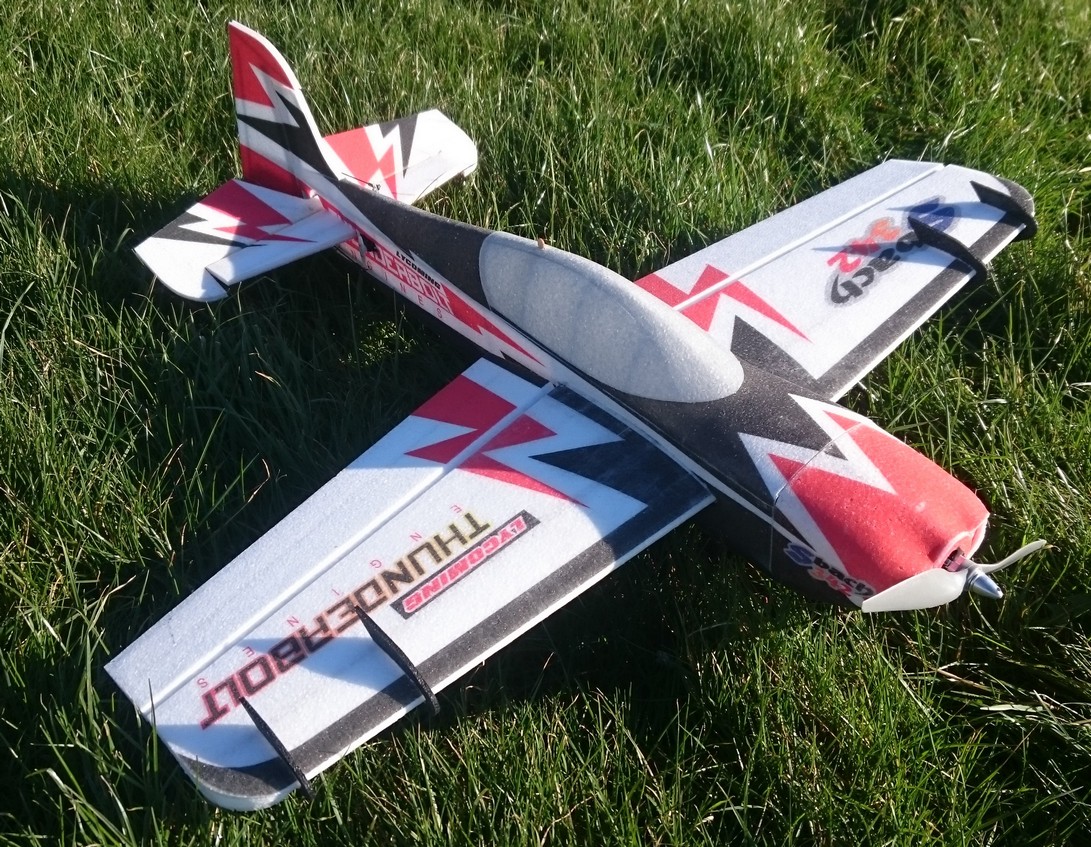 The model features an EPP skin over a plywood and carbon fibre built-up structure making it super-light, strong and flexible. Steve has fitted an NTM Prop Drive 28-30 1200kv motor with a 10×4 prop, a 30A speed controller, and uses 1500maH 3 cell lipos. He has now flown it in a reasonably strong wind which it handled it remarkably well so it’s not just a calm evening flier. I had a flight with it and I have to admit that even though 3D isn’t really my thing I enjoyed it a lot. I flew it on medium rates and didn’t try switching to high rates but it did everything I tried with ease. You can see 1066 flying the model in this month’s video.
The better midweek weather that we had at the end of the month meant Chairman Ron was able to bring the mower up to the patch and all those present mucked it and got the patch into reasonable condition. Gentleman Jim photographed both the Chairman and Vice Chairman Woody doing their bit.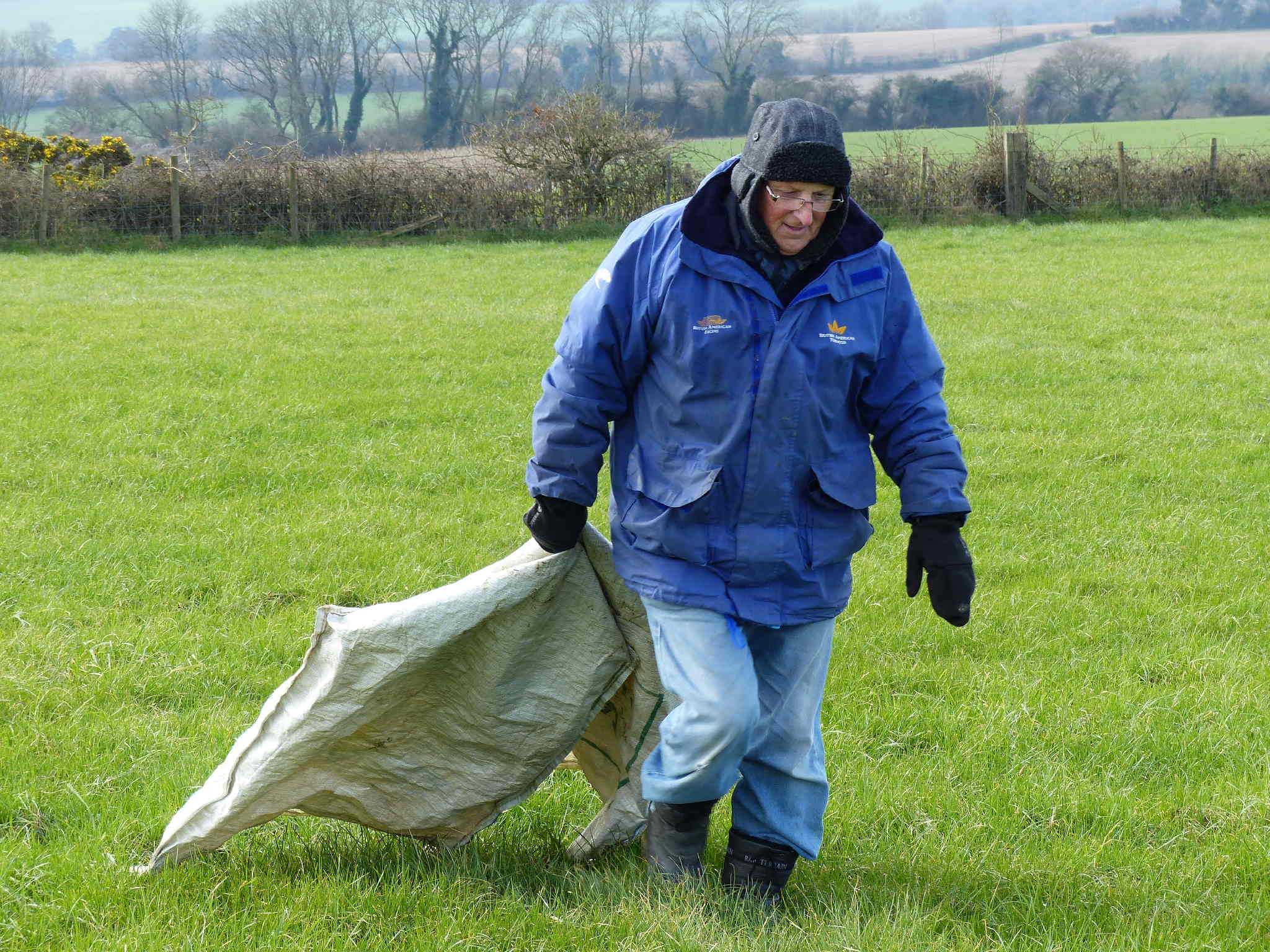
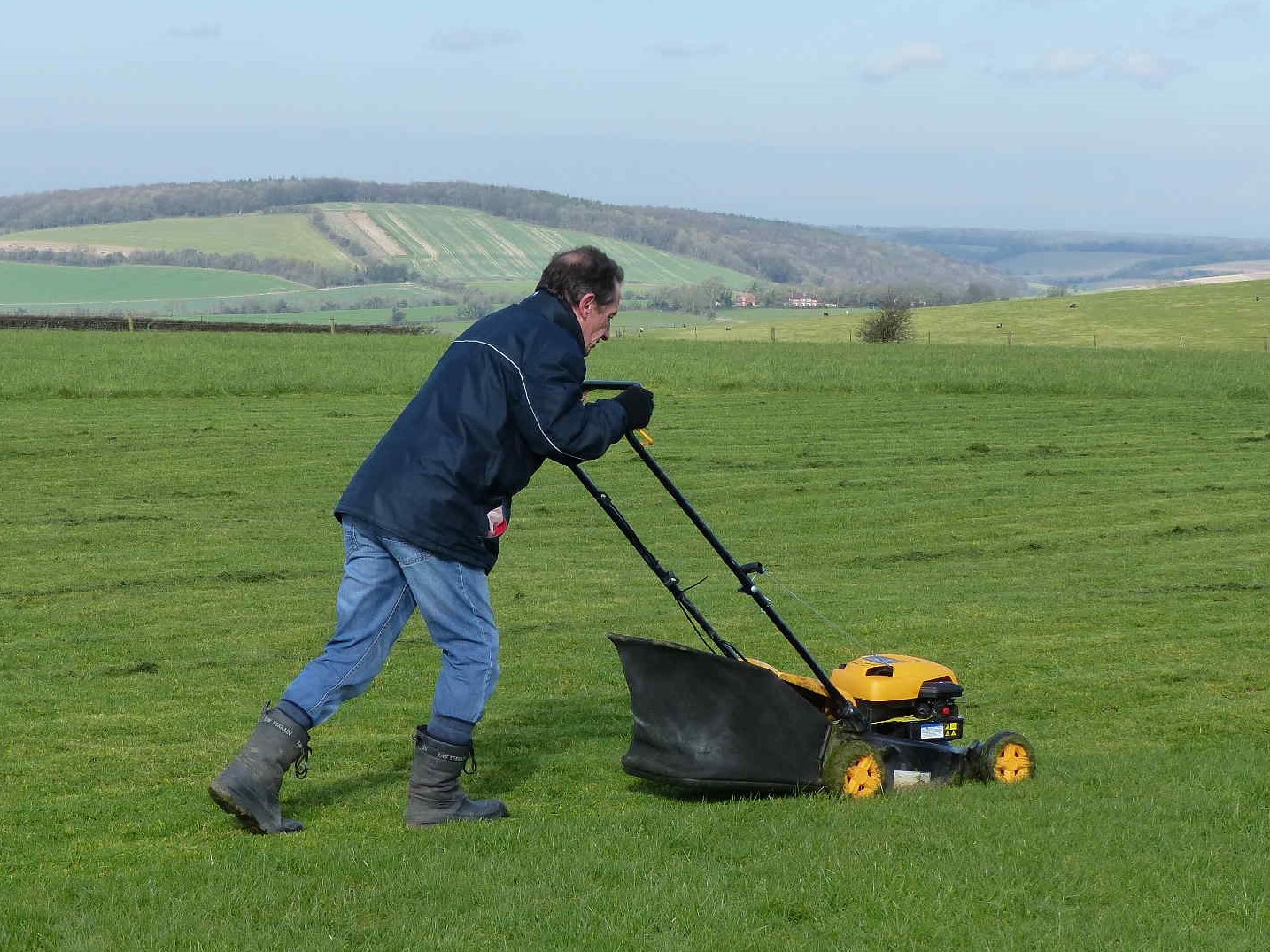 The patch is never going to be perfect through the wet winter months but it’s not bad now and pretty much all of our models should be able to take off without problems.
Gary H has sent me some pics of two models he’s got underway. The first is an AcroWot, an ARTF but it’s the proper wood one not the foam version, and, as Gary is an OS lover, he has fitted an OS motor.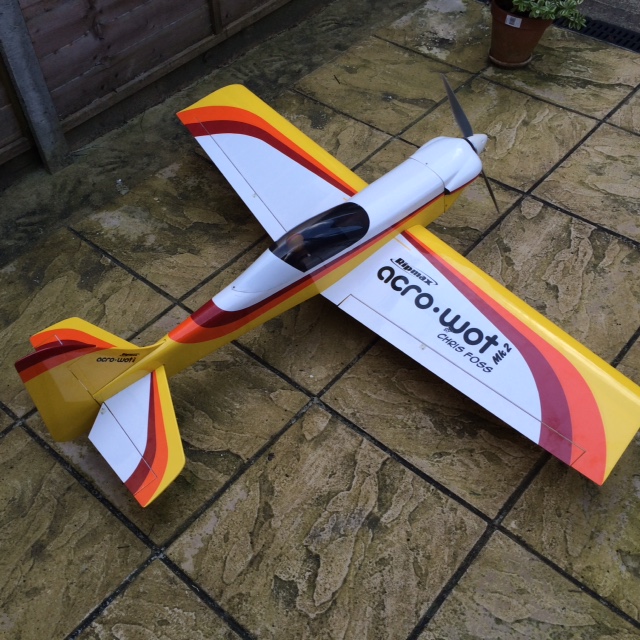 So what I hear you ask, nothing special in that. But there is…it’s an OS ELECTRIC motor that will run on 5 cells!
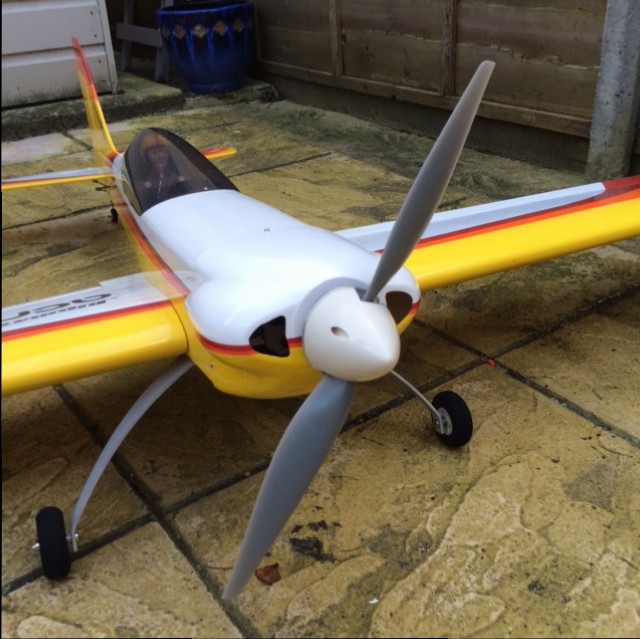 It’s almost finished and ready to go so will fly in early March. Welcome to the dark side Gary, you won’t regret it.
The second model in an own design delta, which is also electric powered. See, he’s caught the bug already!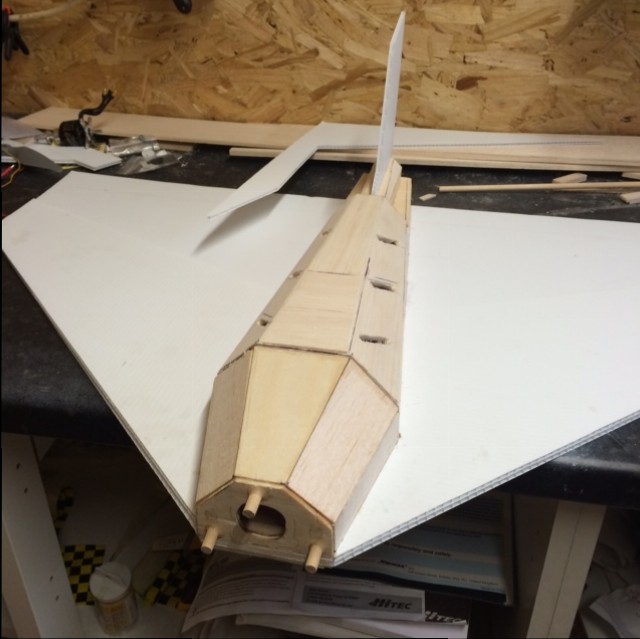
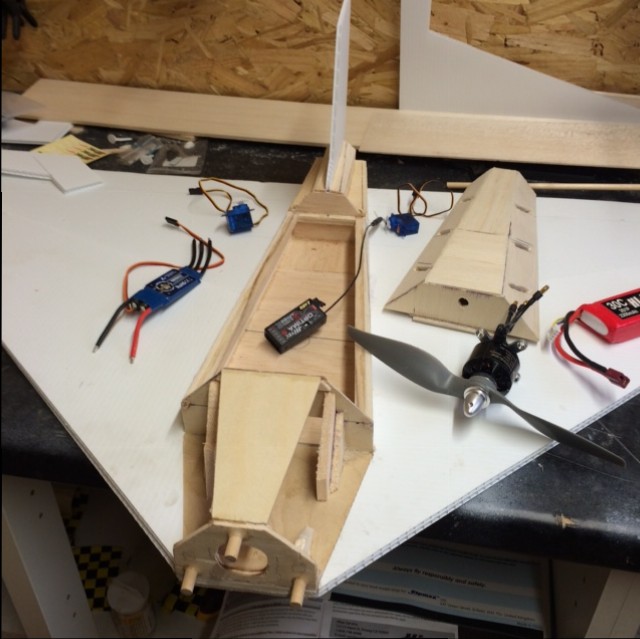 Gary has seen how well the other club deltas fly, scrounged a sheet of Correx, and gone for it. He’s got an Overlander 400W 1500kv motor, a 3 cell lipo, and an 8×6 prop so it should go well. Hurry up and get it finished Gary, you’ll love it, they are great fun to fly in any weather and are very strong.
Following on from Captain Slows’ homemade model storage rack, last month I included some photos of Basher Bobs’ modelling shed and suggested I might be able to run a monthly feature if other members were to send me some photos of their sheds. Well the ever reliable 1066 duly obliged with this very helpful one…Pillock!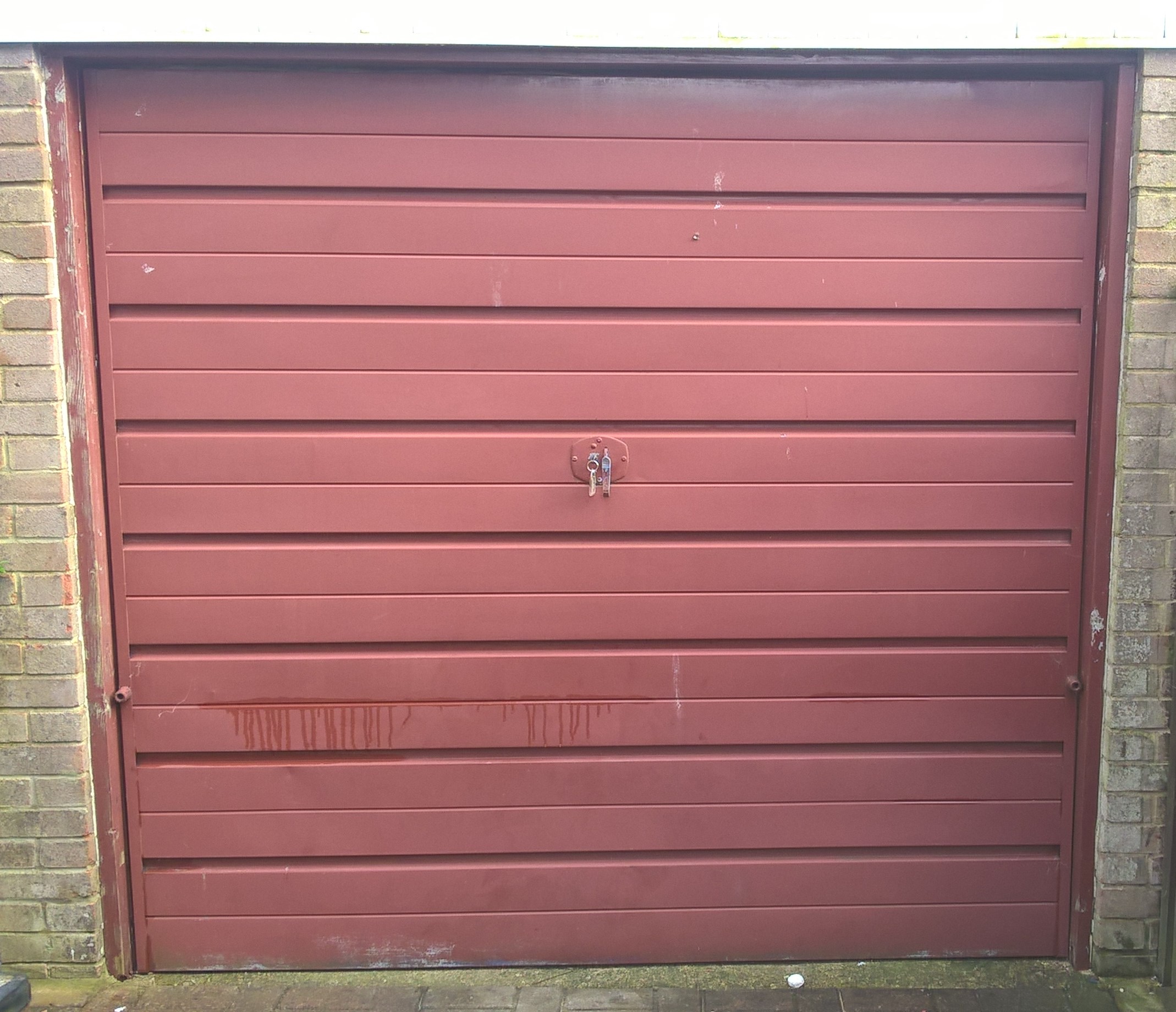 He later relented and sent some more useful ones including his storage area and his battery charging station.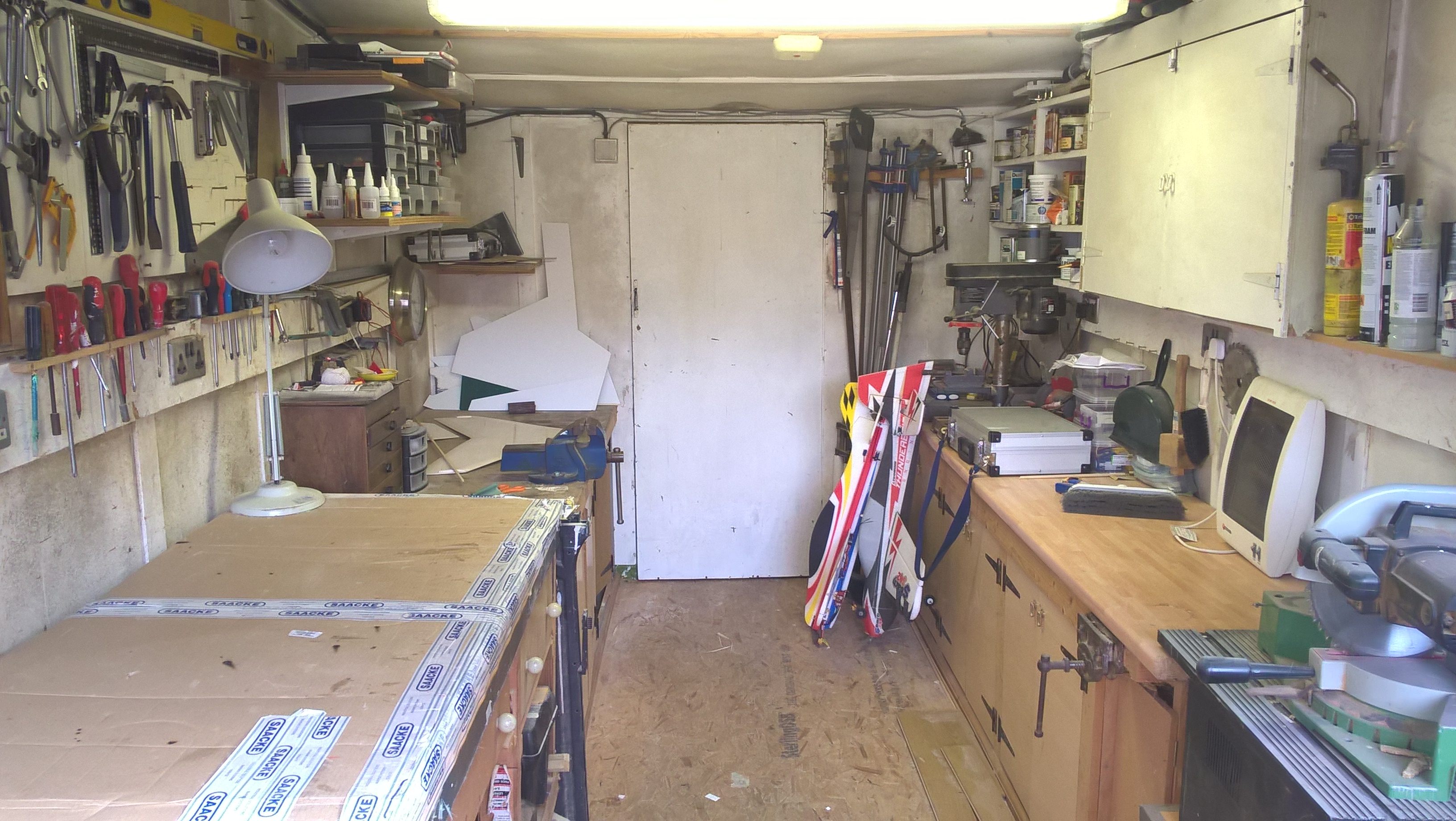
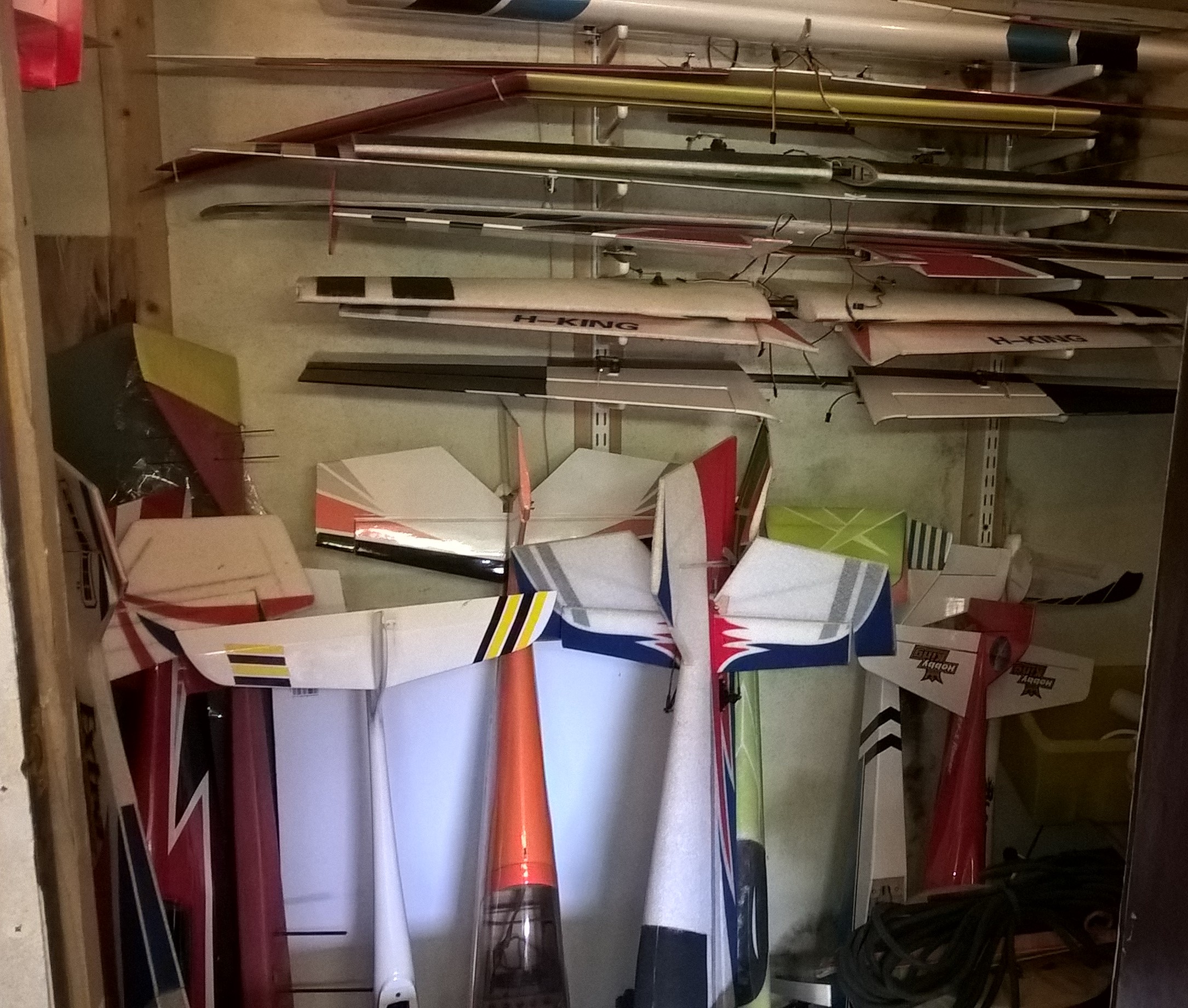
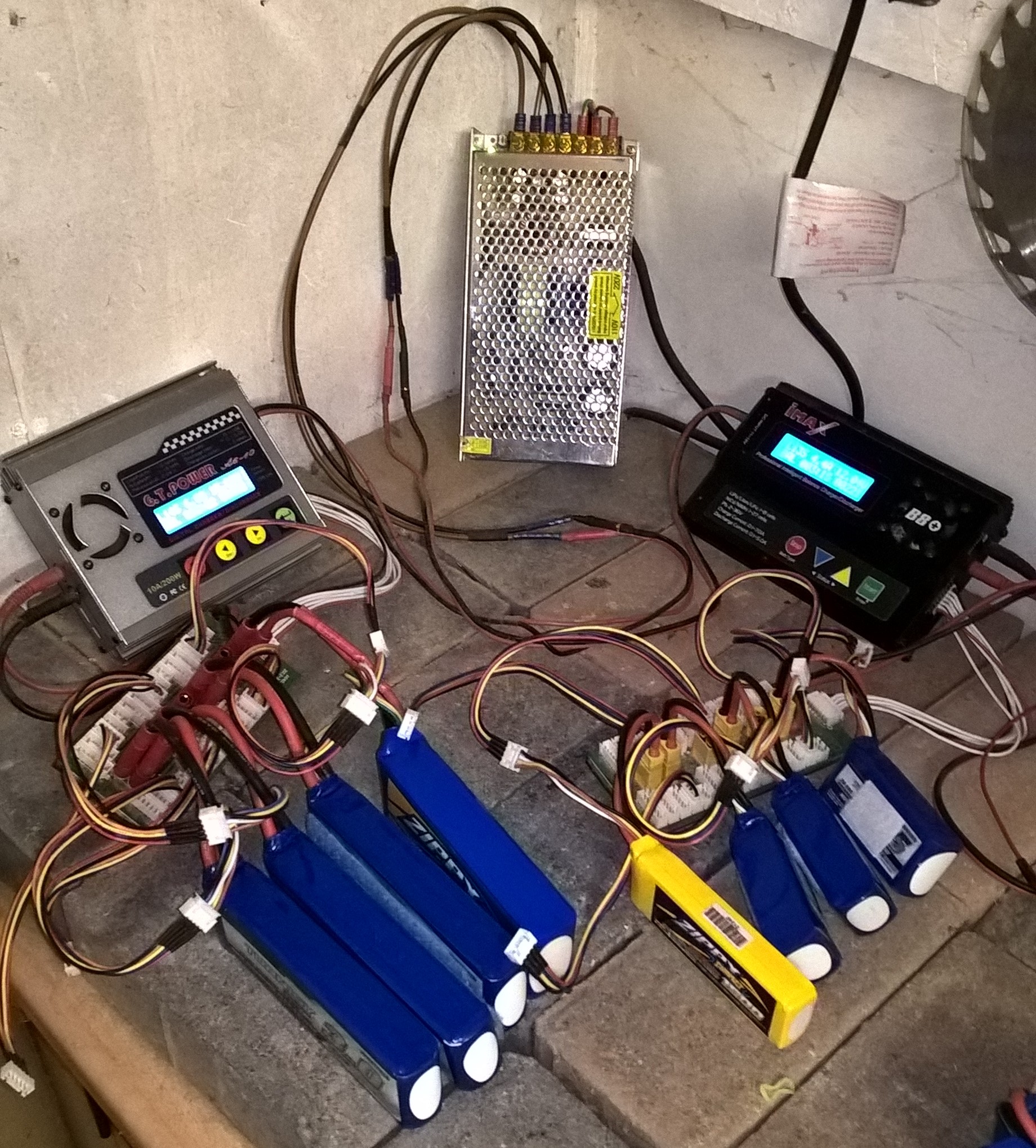 You can see that Steve does parallel charging and has two chargers running from a power supply purchased on eBay. There are dozens of them on eBay typically something like this: DC 12V 24V 5V Universal Regulated Switching Power Supply for LED Strip CCTV – UK You just select one with the maximum current you want to be able to use (I suggest the bigger the better). On that particular site a 12v 33A/400W power supply is £14.99 with free postage, so much cheaper than buying a ‘proper’ one from a model shop. I don’t know enough about electronics to know if they are any good or not but Steve has been using his for some time now without problems. I believe he has one charger permanently set to charge 3 cell lipos and the other one 4 cell lipos. There’s something to be said for that, less risk of trying to charge with the cell count set incorrectly. Please send me photos of YOUR modelling room and/or storage area and/or charging set up, your ideas can help others.
Finally, unusually I’ve got this far without mentioning Dougal Entendre. I don’t want him feeling left out so here he is flying his Sportjet on the very cold and very windy last Sunday in February.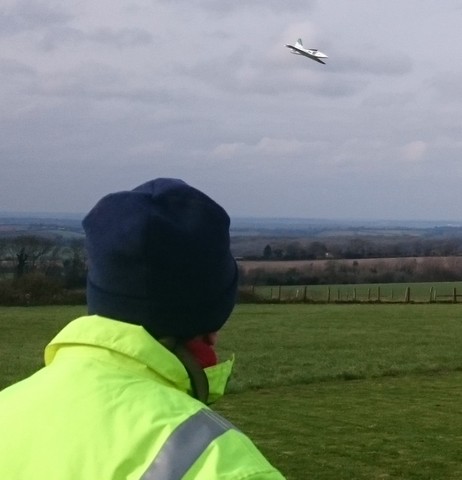
Please watch the video full screen, it’s so much better with small models flying around. If the video above won’t play for you CLICK HERE.
It was a busy Monday morning at Heathrow and whilst taxiing past the parked aircraft stands, the Captain noticed some passengers boarding a Finnair A320. He turned to the First Officer and remarked: “Look at all those people disappearing into Finnair.”
Colin Cowplain
Patch News – January 2016
After the pretty lousy weather of December there was a distinct improvement in January. Several of us flew on New Year’s Day and, although it was very blustery, it was a good start to the year.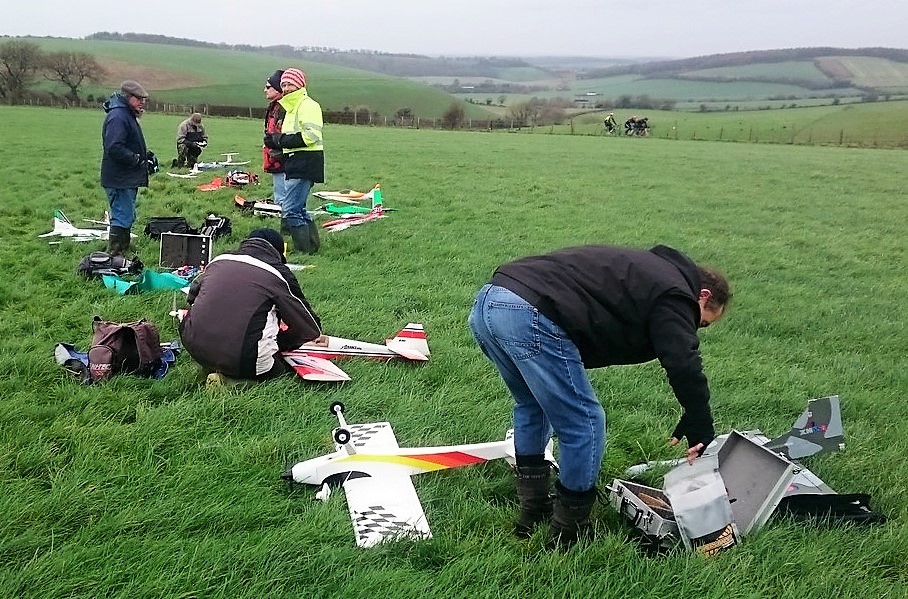 Sadly for the workers the weather wasn’t good on some the Sundays in the month but the Midweekers were able to enjoy several cold but clear and almost windless days. Fog was quite often a problem, especially on Sundays. Only three idiots even bothered turning up on this one. The fog didn’t clear and we slunk off home all miserable…
 With the unseasonably warm and wet weather the grass on the patch has continued to grow but Ron managed to get the mower up there on a couple of suitable days and we all mucked in and got it cut. Obviously it’s not perfect, it’s a bit soggy and pretty bumpy, but it’s not too bad, certainly useable.
Several new models appeared this month and I have loads of photos and video for January so no shortage of material. In fact I had trouble trimming this months’ video down to a suitable length, and at 11 minutes it’s still longer than usual. Thanks to all those who have helped by providing pics and video, keep them coming.
I’ve now worked out how to embed videos correctly (I think!) and this months’ will appear towards the end of this blog. Embedding the video enables you to play it on this page instead of being taken away from the blog. I suggest you watch it full screen by clicking the icon at the bottom right, next to the word Vimeo. Just hit Escape (Esc) on your keyboard to return. And did you know you can zoom in on any photo in the blog simply by clicking on it?
I’d been struggling to find a good nickname for Richard King but he has turned out to be an excellent model launcher and will now be known as Catapult King. He can be seen giving his new F22 Raptor an unorthodox launch in this months video. The Raptor is the same as his previous one but it’s made from Depron instead of the previous heavier Correx.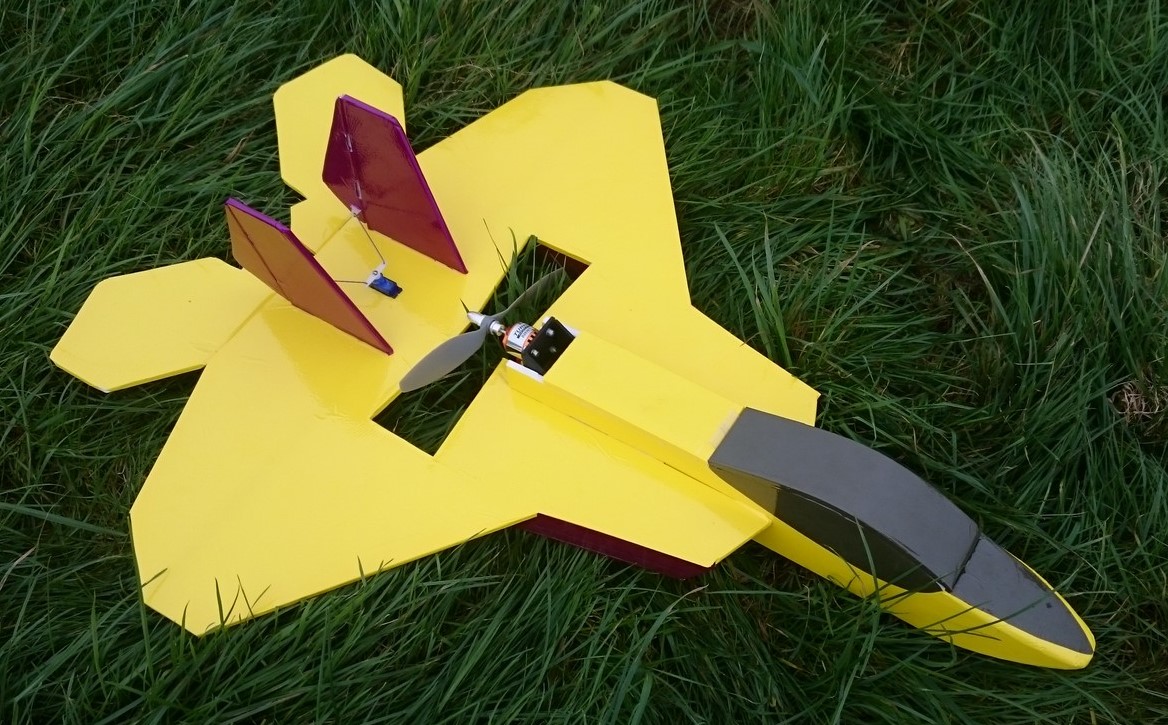 It looks great and flies well, although, like the Correx one, not exactly overpowered. I think Catapult is going to play with different props and maybe motors to speed it up. But the slow speed makes it great for videoing as you’ll see!
1066 managed a vertical ‘landing’ one day with his delta, I think he must have been at full speed when it hit!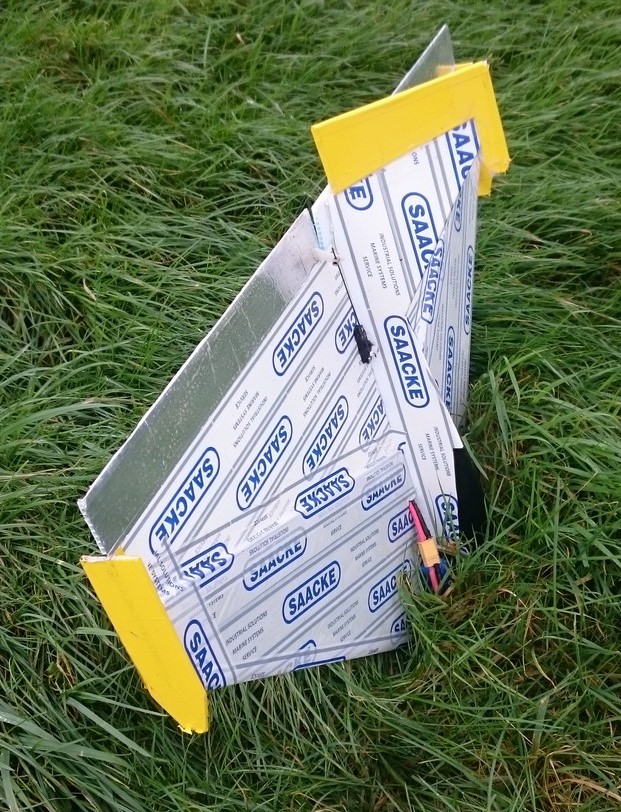 Obviously the arrival broke the prop but he’d soon replaced that and removed the mud, and after a just few minutes it was flying again, that Correx is strong stuff, it’s even Hastings proof!
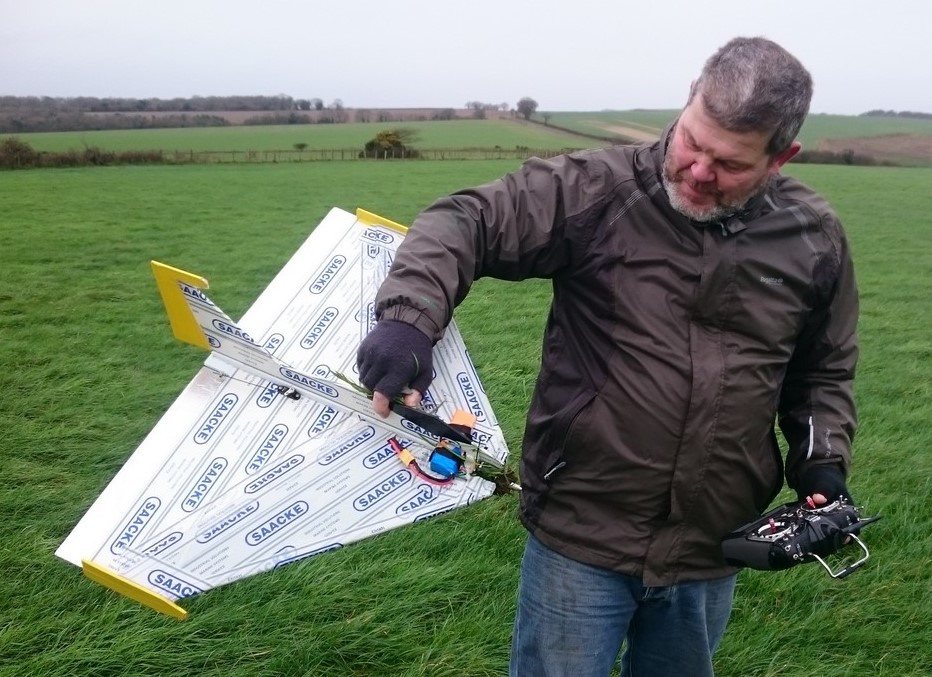 Chairman Ron’s Splot had a landing mishap one windy day, he was caught by a gust just as he was about to touch down and the ensuing cartwheel damaged the fuselage quite badly. Fortunately the wings and tail were fine.
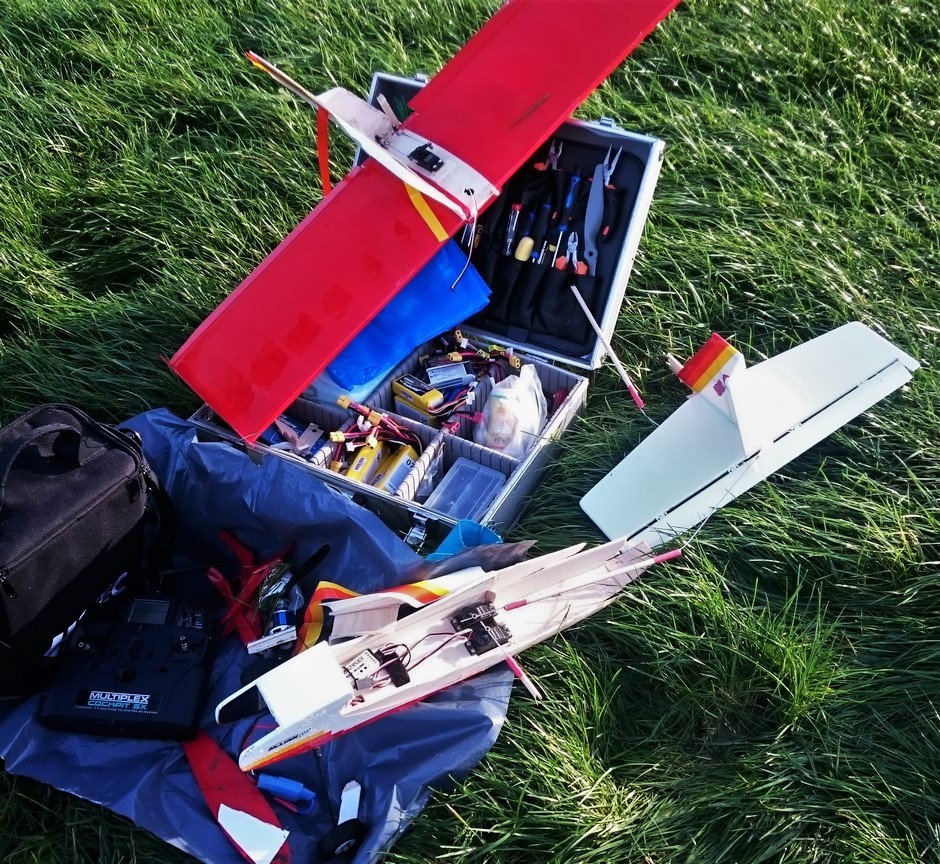 But Ron reports that it was simple enough to repair and most of you will have seen it looking as good as new again when he brought it along to club one evening.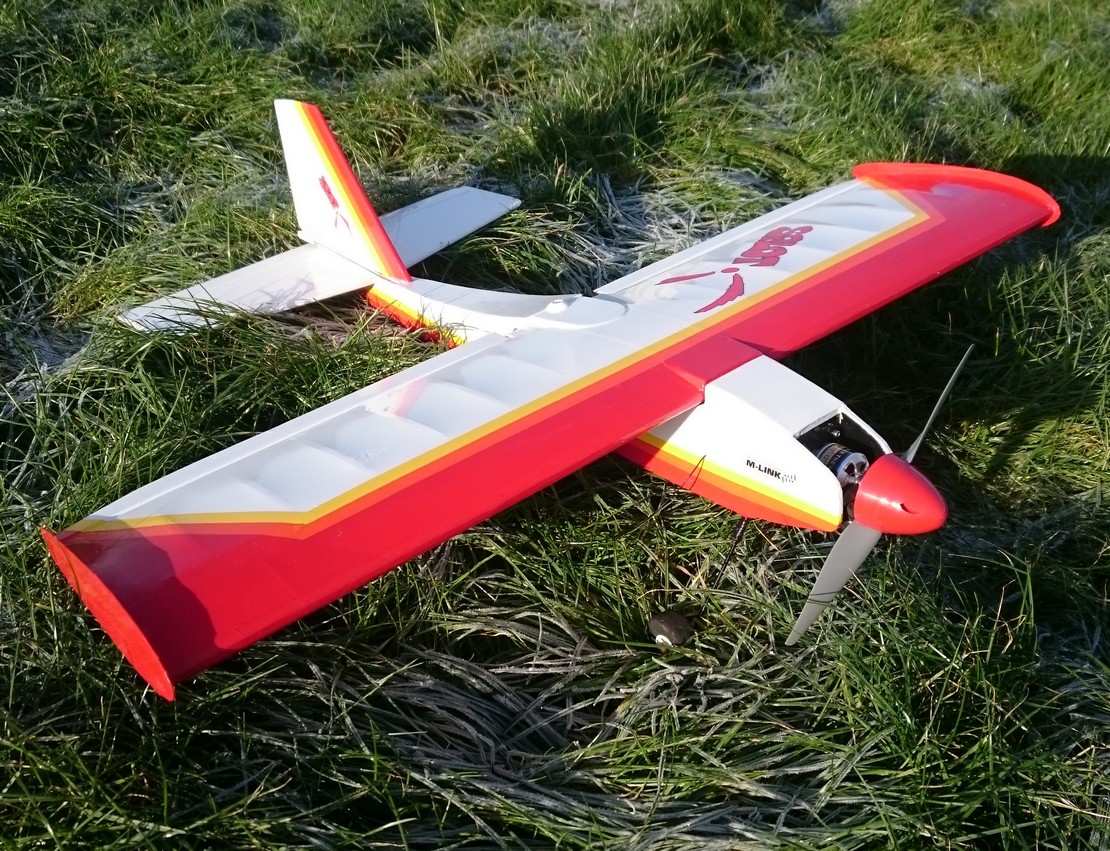
Having been used and abused rather too much Vice Chairman Woody’s Spirit has been retired, but he’s replaced it with a sparkling new Kinetic. I think the almost identical Kinetic is a better buy than the Spirit, the motor mount reinforces the nose somewhat and the motors seem to last longer and are available as spares. Most of the Spirits in the club have now been fitted with Kinetic motors. Woody tells me that, unlike the Spirit, the slightly cheaper Kinetic comes with the stickers already applied making it even faster to get in the air.
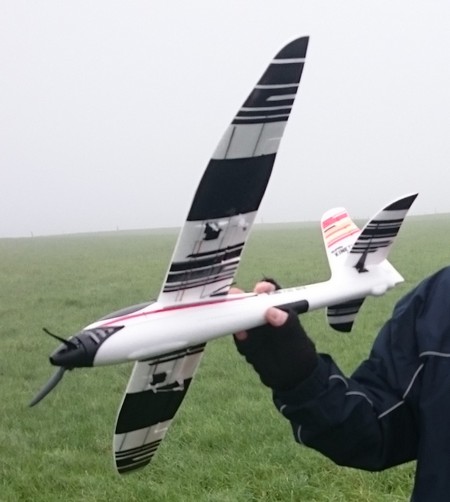
Norwegian Nick has been flying a HET Tucano in January.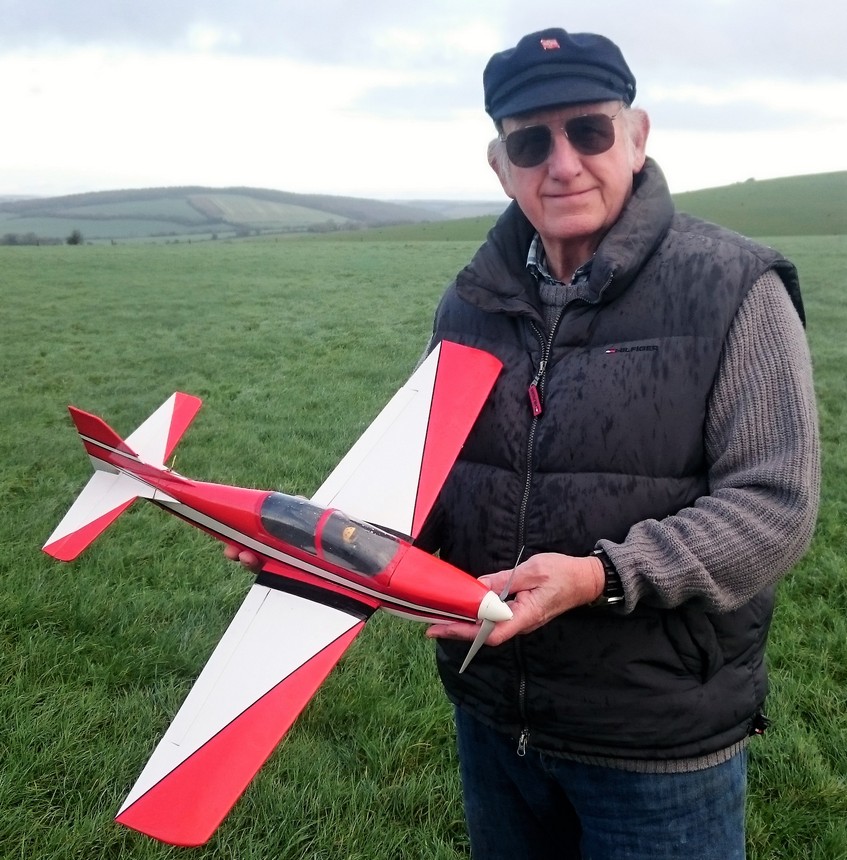 It was his son’s but Nick commandeered the previously unflown model and it turned out to be a nice little flier once Nick had got the control throws and C of G position correctly sorted out. I can’t find any information on the Tucano as HET no longer produce them, all I can tell you is that it’s 27” span.
In the last Patch News I reported that father and son JP & Monty had passed their BMFA ‘A’ tests flying their ST Models Discovery trainer. Having passed their tests it was time to check out what would make sensible second models for the next part of the learning curve, and then total ignore ‘sensible’! JP decided on a Durafly Vampire and Monty a Durafly Stuka, neither of which would have been recommended as second models.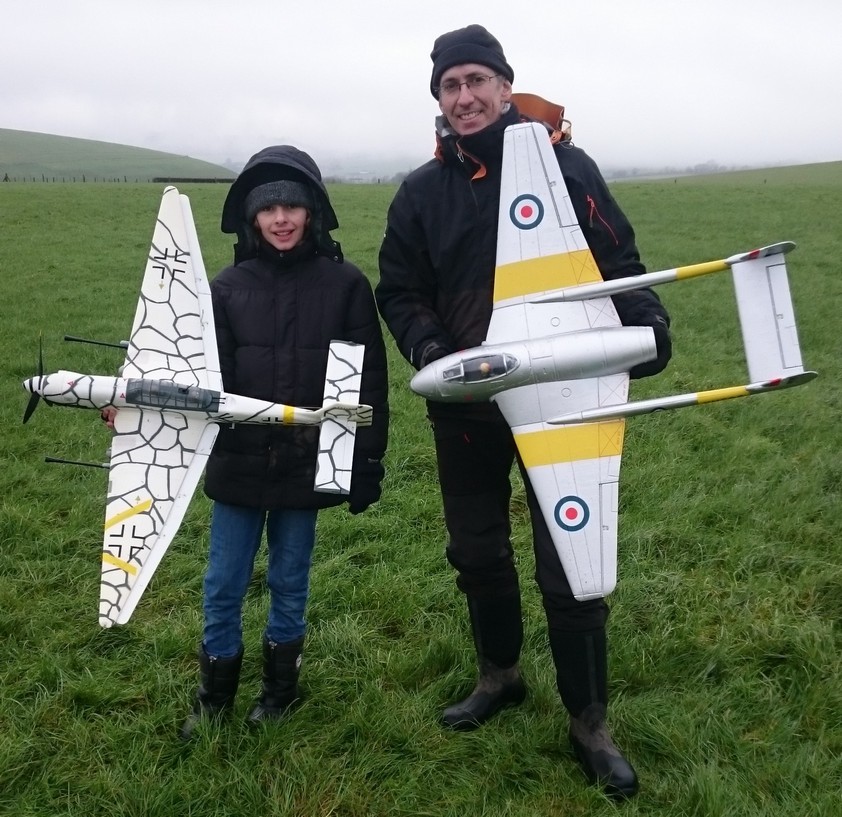 But both models have now flown successfully and JP landed the Vampire on its third flight. There have been a couple of Durafly Vampires in the club previously and they are great little fliers so I think it’s fair to say that if you absolutely must have an EDF for a second model the Vampire is probably the one to choose.
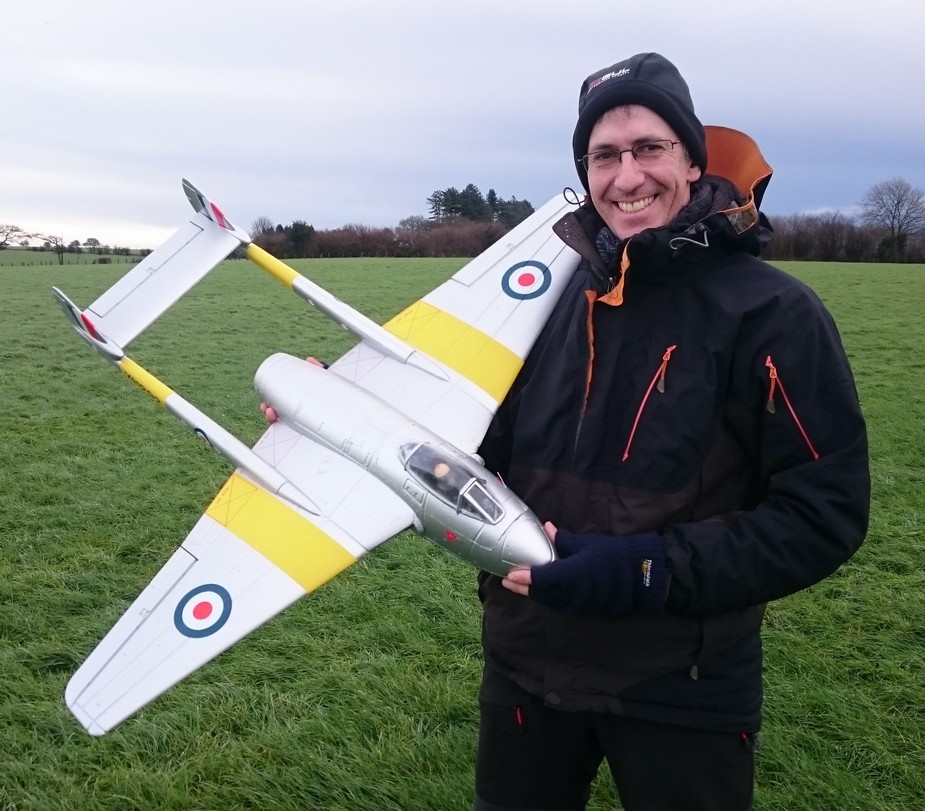 Although it has retracts they haven’t been used yet as the patch isn’t in a good enough condition for the small wheels so JP did a hand launch for the first flight. You can see the result in the photo below, the Vamp should be heading from right to left in a gentle climb!
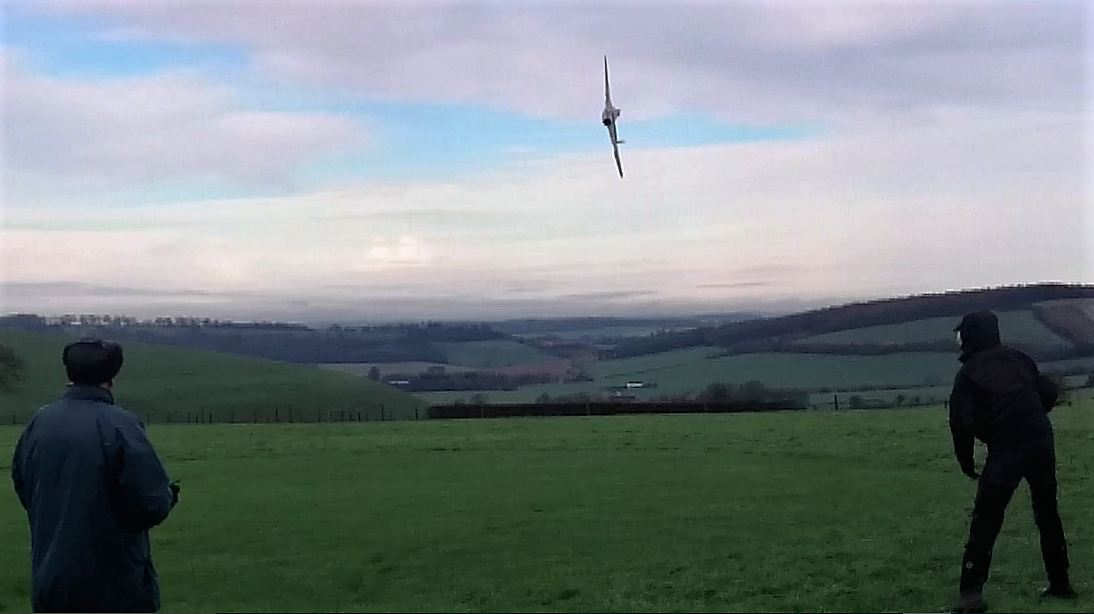 It can be seen in full in this months’ video. To be fair, by the third flight JP’s launching had improved immeasurably.
Monty’s Stuka has only had one flight at the time of writing but the model performed well, much better than I dared to expect. Monty sensibly removed those rather vulnerable looking cannons before the flight.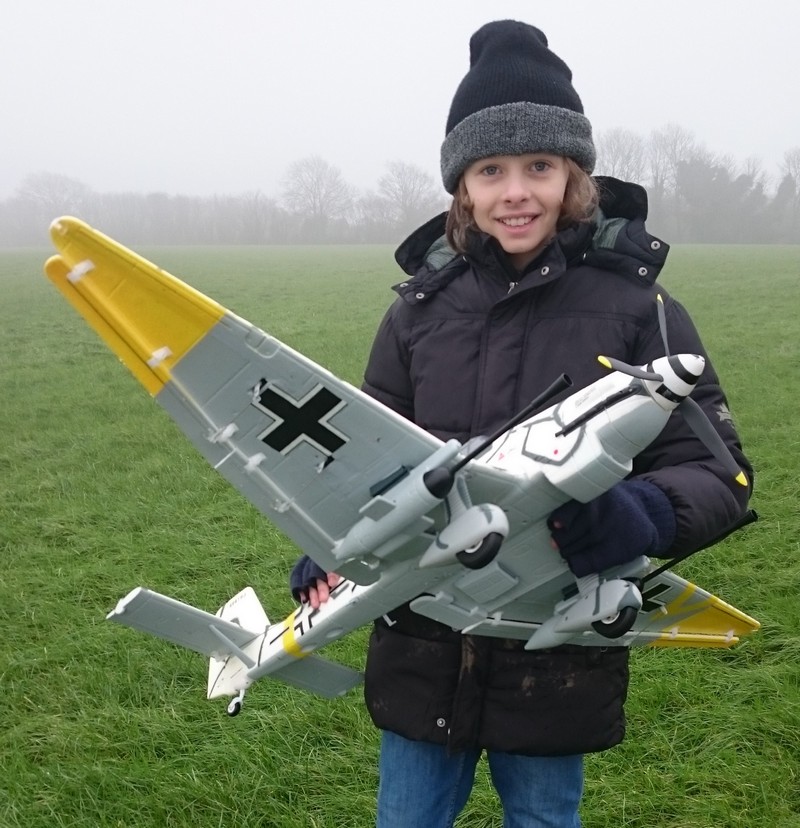 Having experienced JP’s launching, and knowing that Monty has done no hand launching at all, Catapult King stepped up and got the Stuka away perfectly. It has plenty of power and, although I didn’t get a chance to test it thoroughly, it seems to have pretty benign handling with no sign of the dreaded tip stall that the sharply tapered wing could cause. I didn’t use the flaps at all but the Stuka came in nicely with no problems.
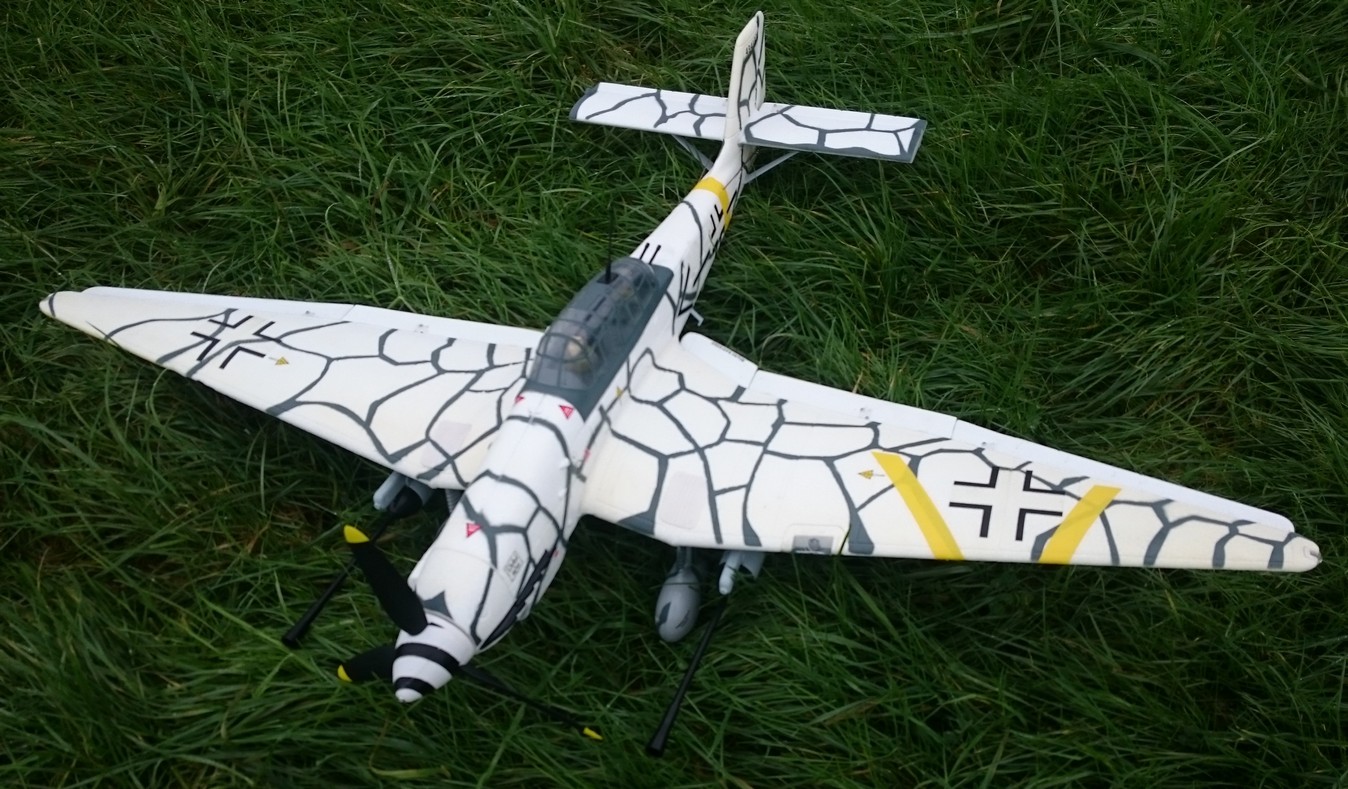 As Monty is at school all week he is only able to fly at the weekends so has been hampered by the weather this month but I’m sure the Stuka will see a lot more flying over the next few weeks.
Since the Delta Challenge last autumn I’ve been flying my delta regularly, it performs well in pretty much any weather and as the airframe cost was about £2.50 for the sheet of Correx I don’t worry too much about it. Being a tough one piece model it’s the ideal model to chuck in the car boot on those ‘might be flyable’ days.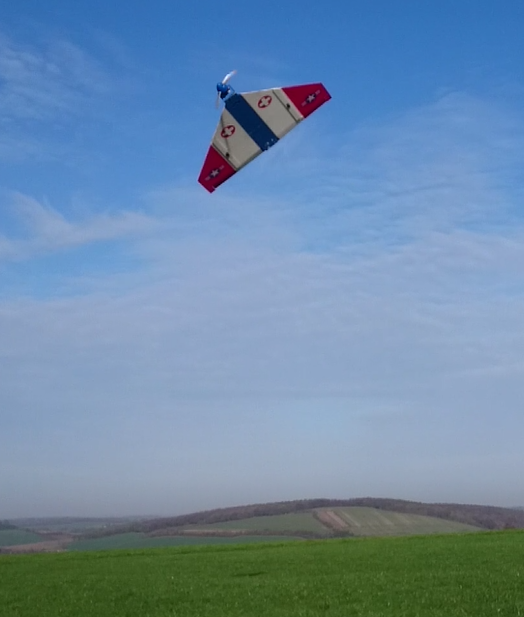
The only problem I’ve had is that it’s a bit noisy. When I built it I fitted an old Axi motor I had spare, in fact in 2002 it was the first outrunner I ever bought and cost about £150 with its matching speed controller. I used it for a long time but eventually it started throwing magnets (possibly due to me using 10 cells on a 7 cell motor!) and I cured the problem by filling the gaps between the magnets with epoxy. But it made an odd noise, presumably it was out of balance, and eventually the bearings started to protest. In the delta the noise was getting worse every flight so I had to do something. The Axi was producing over 400w on 3 cells and the model had unlimited vertical performance, something I wanted to keep. But it also had a large lump of lead at the back, something I wanted to lose, so I looked for a lighter motor that would still produce loads of power. Eventually I settled on an NTM Prop Drive Series 3530 1400kv that cost less than £13 from HobbyKing, how things have changed! It looked very small next to the Axi and I wasn’t sure it would provide enough thrust although the specs said it should. Being considerably lighter than the Axi, it enabled me to lose the lead tail weight so the delta now only weighs 26ozs instead of 30ozs and that really shows up in the low speed handling.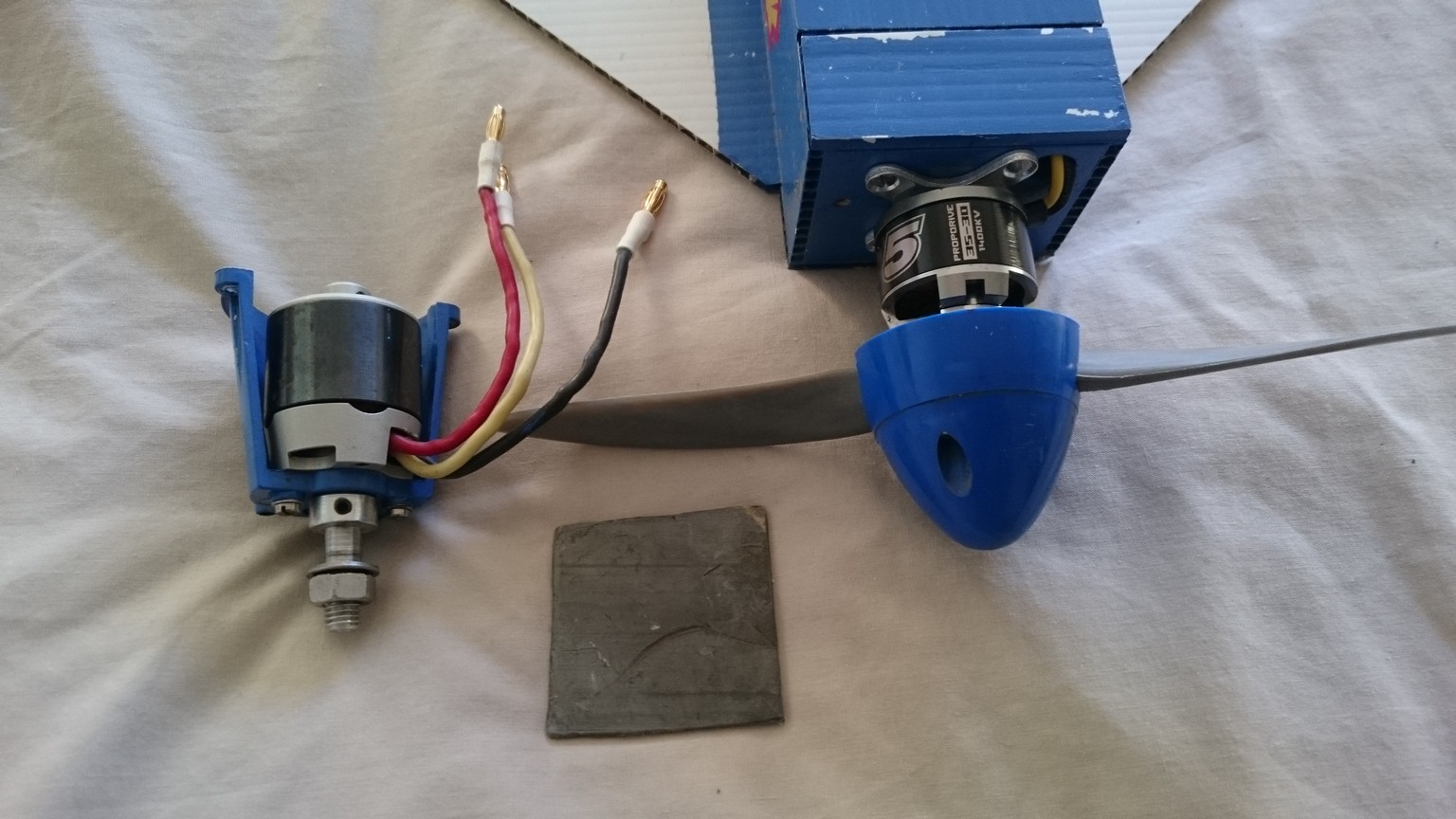 The vertical performance is still there, although maybe a touch slower than before, and the flight time has increased by around 20%, most flights are now around 7-1/2 minutes.
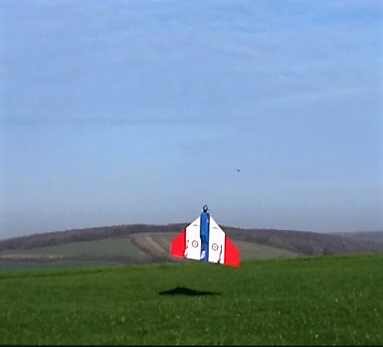
But the most important difference is the lack of noise; I’m no longer embarrassed to open the throttle! So same performance, more agile, quieter, and longer flights, wins all round I reckon. Want to see the vertical take-off? Watch this months’ video.
Dwayne Pipe has now flown the Splot XL that he brought along to a recent club meeting and I’m happy to report that it flies brilliantly.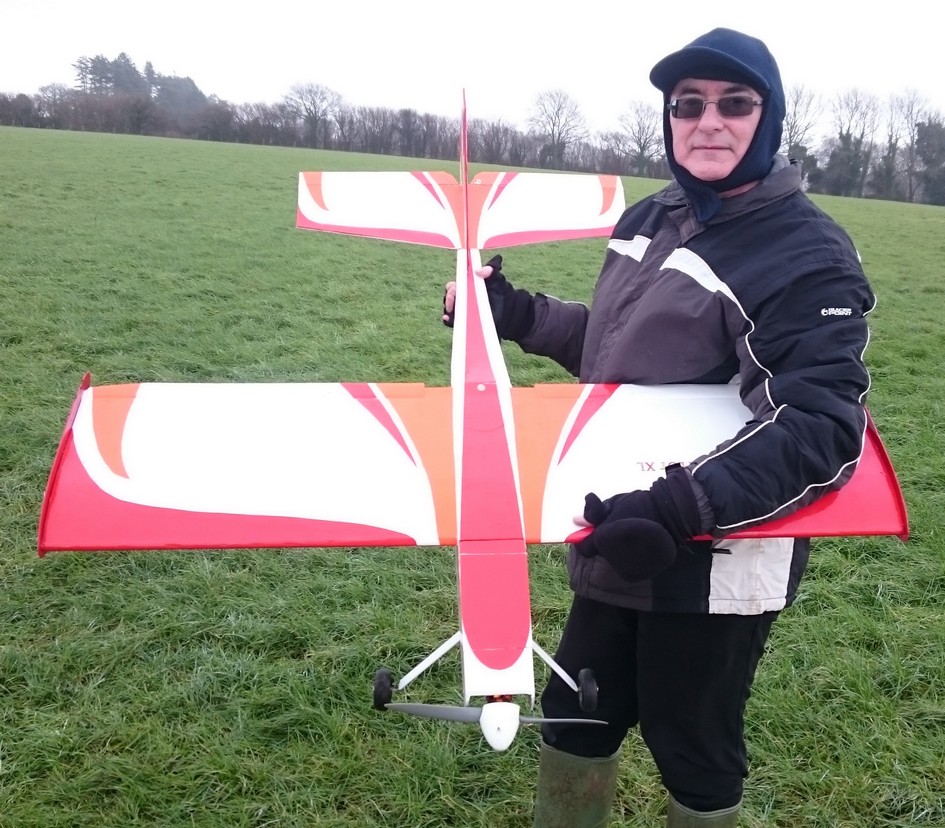 It’s 48” span so is 1-1/3rd scale, the standard Splot being 36”, and Dwayne has made a few minor changes to the construction. The slightly lengthened nose allows him to slide the battery pack in through a hatch on the top, rather than from underneath as is usual on the smaller Splots. The much anticipated maiden flight was very much a non-event; it just took off and flew round as if it had flown hundreds of times before, did a few aerobatics, and landed back on the patch as if it was nothing special.
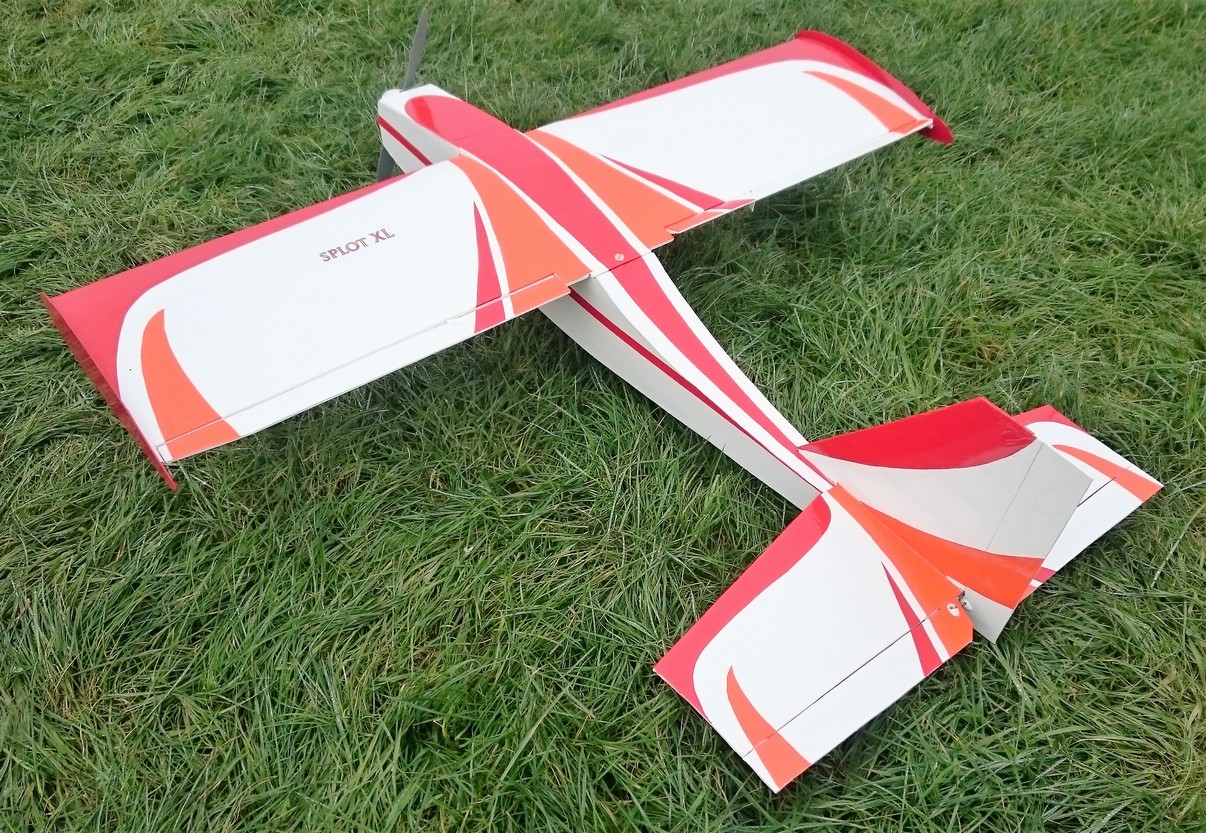 Well done Dwayne.
Basher Bob has been flying his mini Splot again, having extended the wings somewhat. At 24” span it was 2/3rds scale but the wing loading was a little too high to make the flying enjoyable, so, being unable to make it any lighter, Bob increased the wing area by extending each wing by about 3”.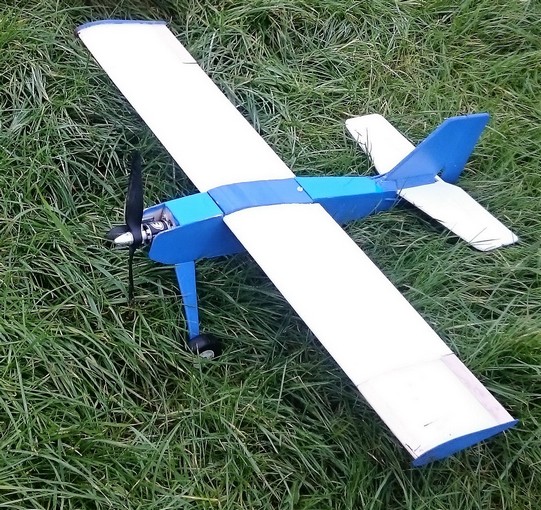
It’s made it a nicer flier but in terms of wingspan it’s not much smaller than standard now. Bob also regularly flies his Splob, his slightly modified standard Splot, which flies very well indeed using either the normal 3 cell lipo or a 4 cell if he’s feeling racy. I was able to get a photo of all three so you can see the difference in size.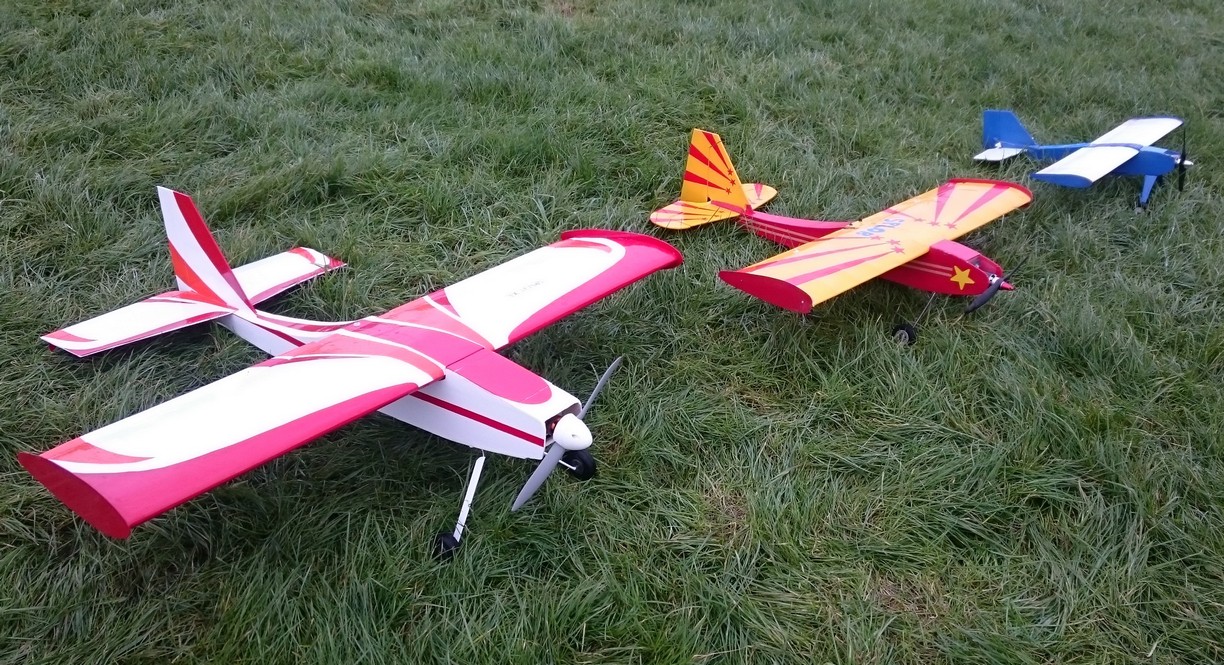 Bob’s Splob can be seen briefly harassing Dwayne’s Splot XL during its maiden flight in the video below.
If the video above won’t play for you click HERE
Norwegian Nick has now flown the Bird of Prey that I featured in its unfinished form a few months ago.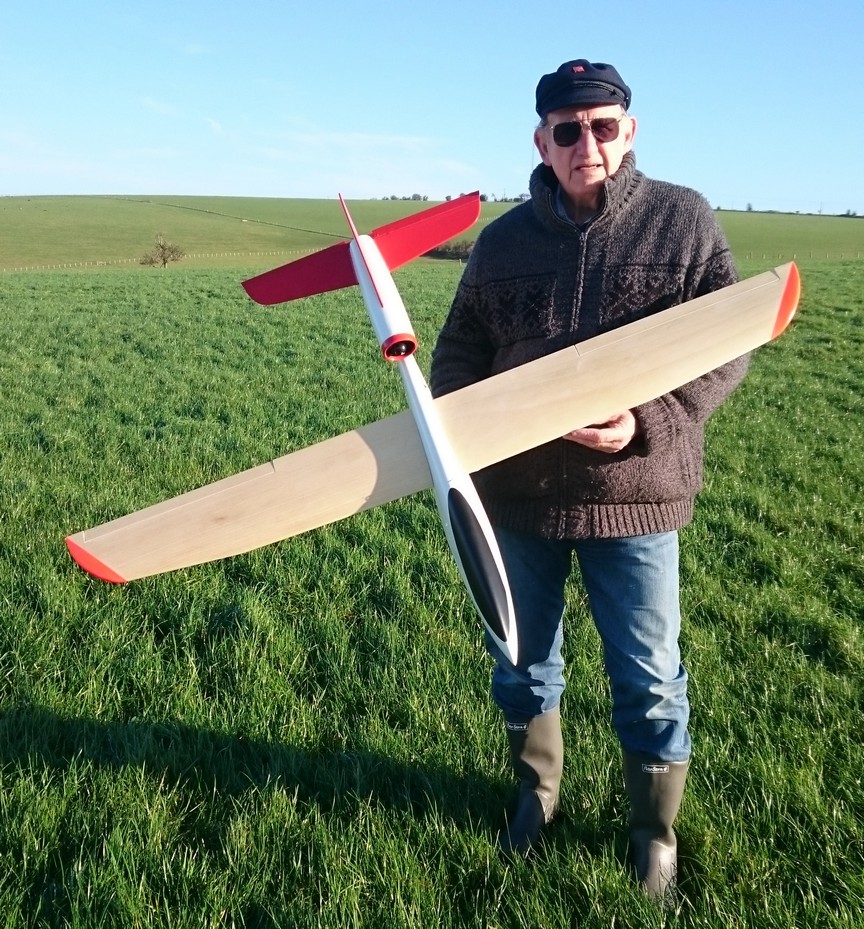 The Bird of Prey is no longer available but was produced by Kavan about 10 years ago and is unusual in that it’s basically a glider but it has an EDF unit mounted in the fin. Nick had a few problems as the original fan unit is no longer produced so he had to modify a larger fan to fit and turn a suitable wooden shroud on his lathe.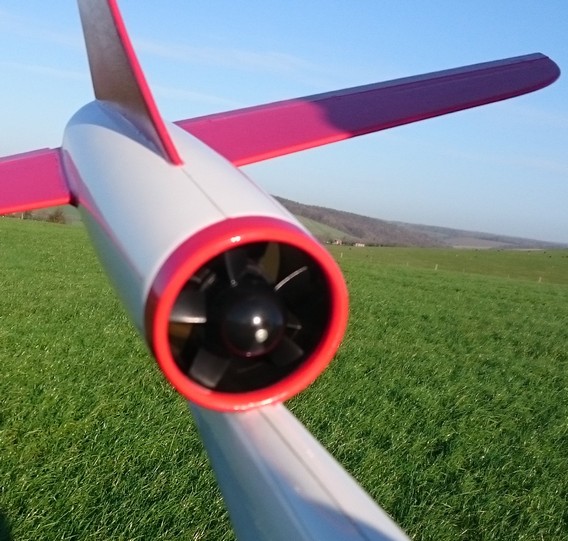
The model is 1565mm spam (about 62”), weighs around 1100gms and has a very nicely made lightweight fibreglass fuselage and obechi veneered foam wings. From the initial launch the model seemed to be making a lot of noise but not going very fast but once trimmed and settled down it flew well with the motor throttled back to around half power, much quieter and not much speed difference. It seemed happiest when it was power off and just gliding, but it is also pretty aerobatic.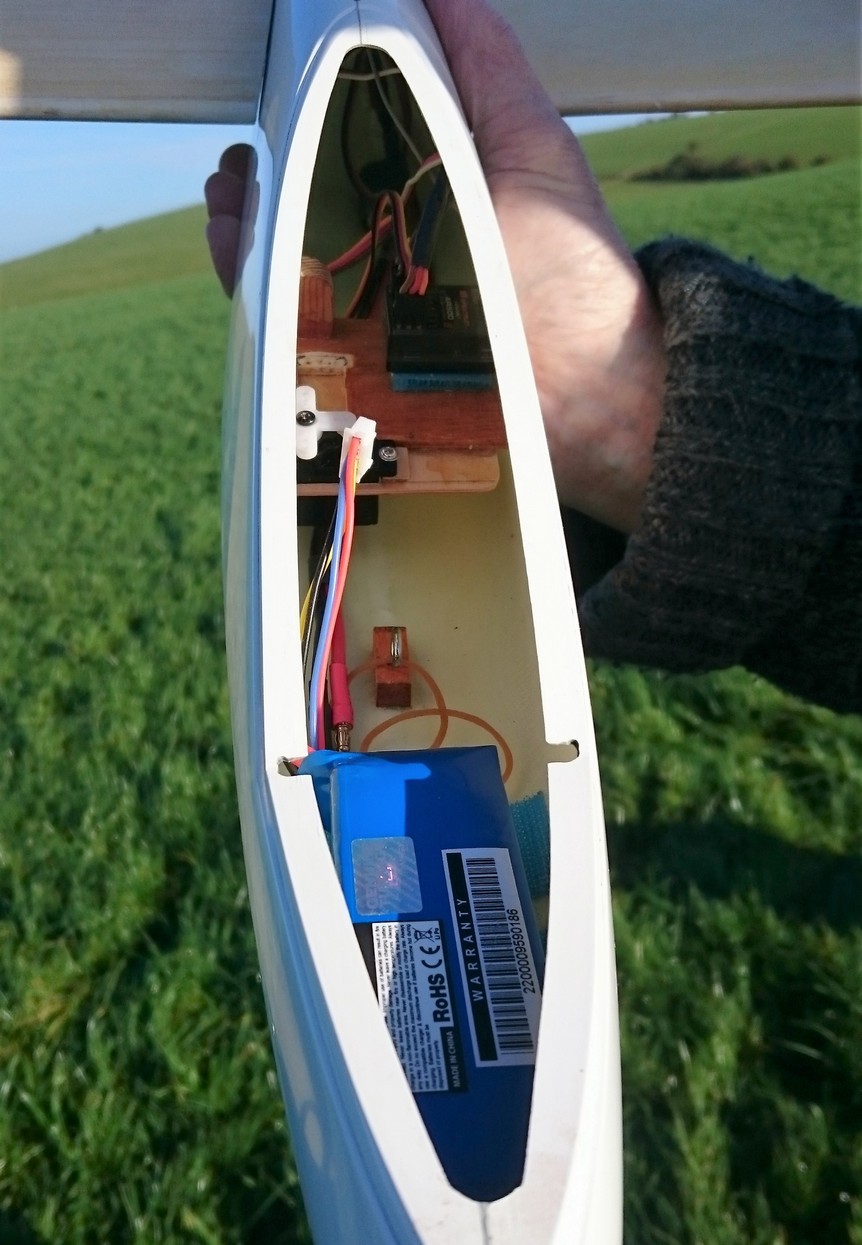 So far Nick has only had a couple of flights and each time he landed with loads of capacity left in the lipo. It shows great promise and I think it will certainly thermal well in the right conditions.
The last new model to fly in January was Dan Handley’s EPP Mini Edge 540T 3D, another one from HobbyKing.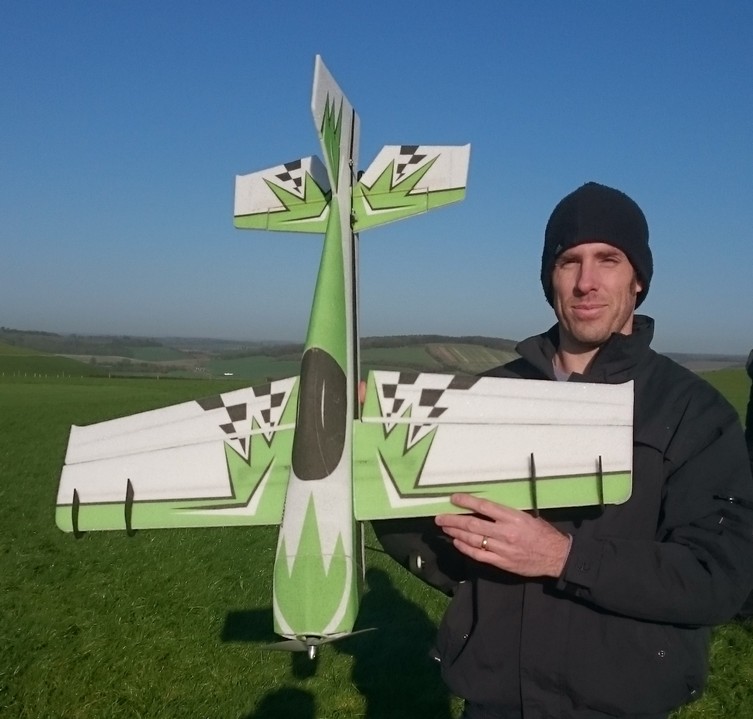 It’s a real 3D machine and should be capable of all the manoeuvres in the book. This is what the webpage says:
The model features an EPP skin over a plywood and carbon fiber built-up structure making it super-light, strong and flexible where needed to shrug off the minor knocks of everyday flying, while retaining scale looks with its fully sectioned cowling, curved canopy, symmetrical air-foil and smooth lines.
Dan says it has quite a lot of EPS under the EPP skin so you need to use foam safe cyano or be very careful where you use normal cyano, you have been warned!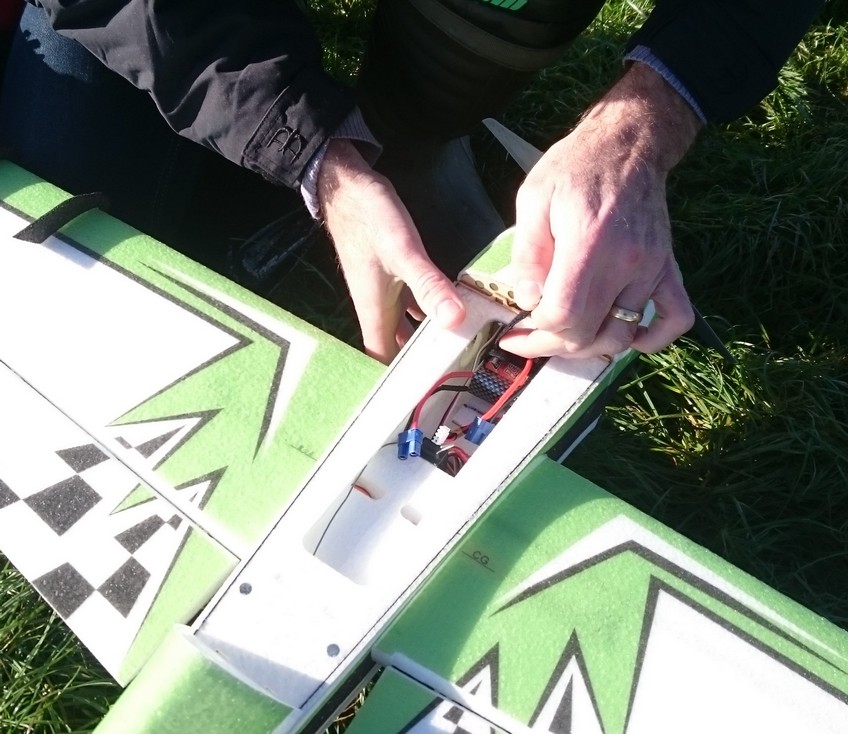 The model looks great and is super light at just 660gms ready to fly. Dan asked me to take it up for the first time and I discovered it’s just about perfect, I didn’t add a single click of trim. It even flew completely hands off when I rolled it inverted, no elevator required at all. I quickly handed it over to Dan who flew the rest of the flight and, after some aerobatics, knife-edge etc., he landed it back on the patch at walking pace. An excellent first flight.
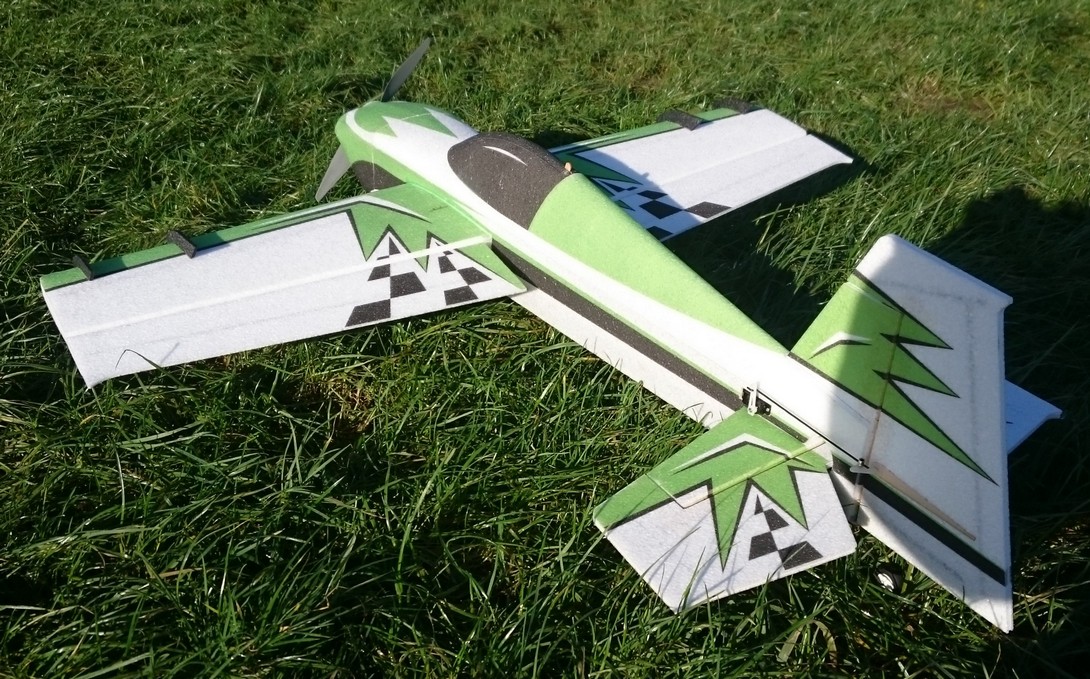 We only had the one flight as the wind got up a lot and being so light I don’t think it will be good in much of a breeze, but it’s a brilliant model for calm days. 1066 has the EPP Mini Sbach 342 3D from the same range under construction so watch this space.
A couple of action shots now, Captain Slows’ Twinstar and Chris P Bacons’ Cougar 2000. Chris P (Nigel Baker) is newly retired and enjoying flying with the Midweekers. Looks like the top rudder hinge has come loose Nigel.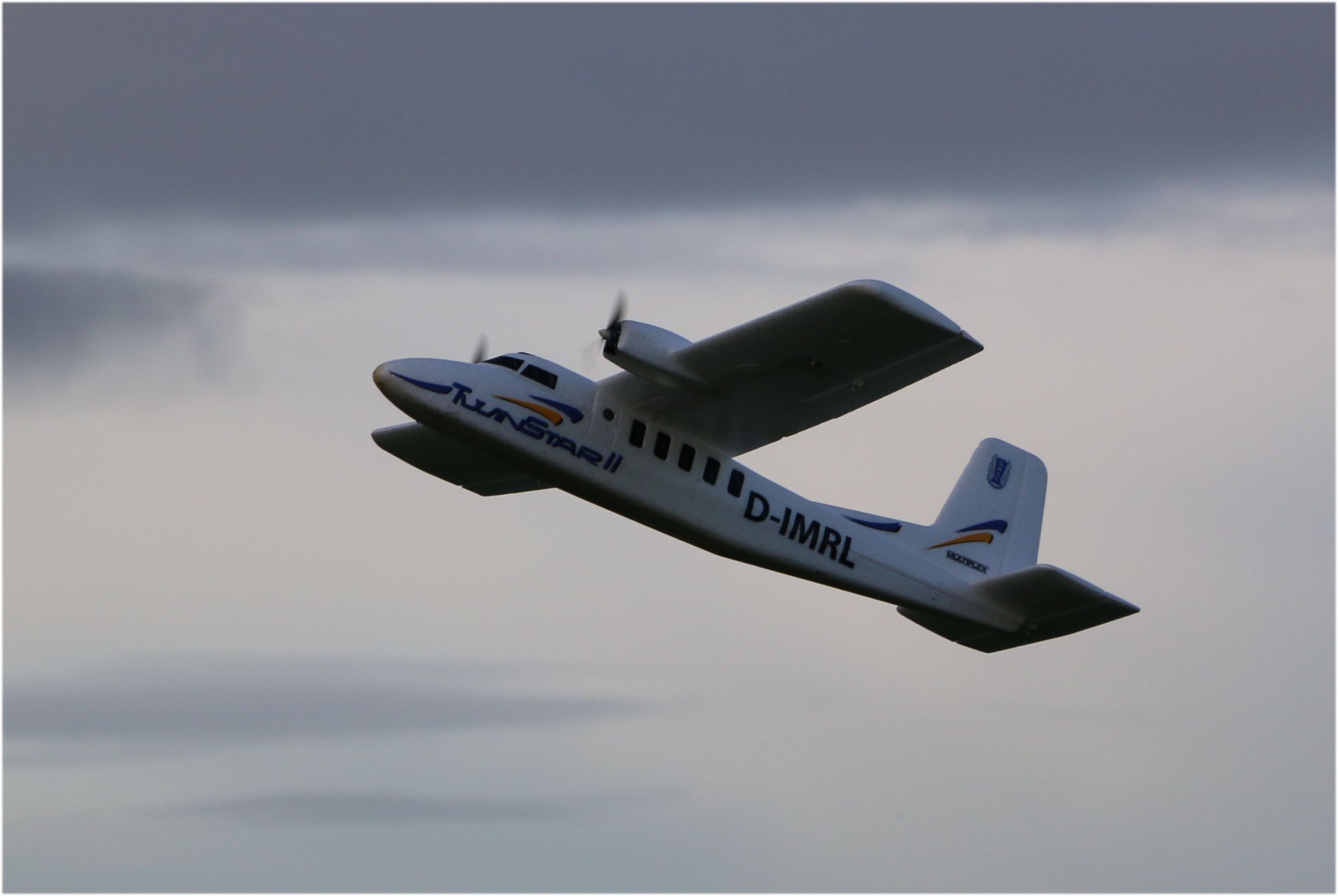
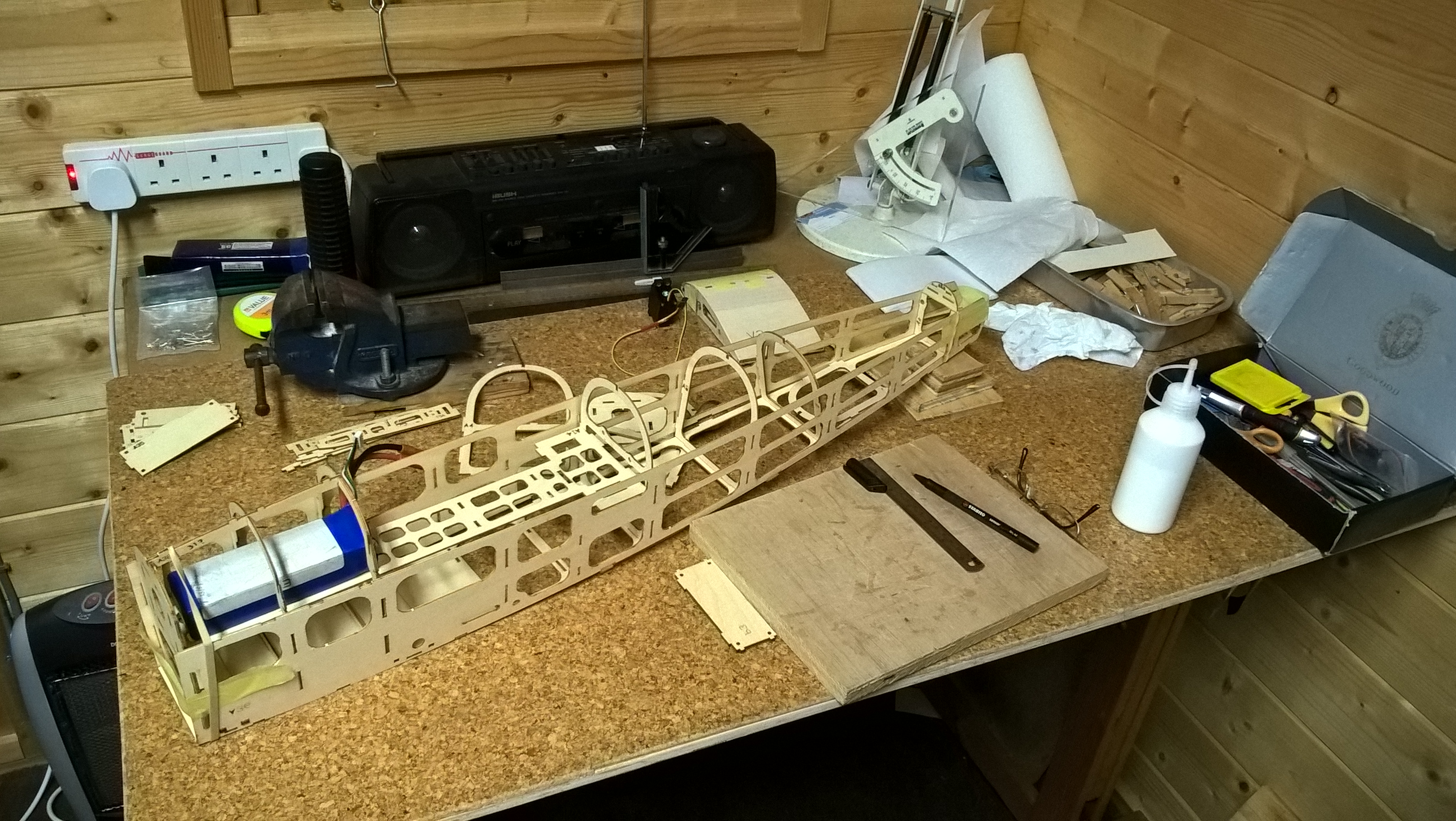
Following on from my pictures last month of Captain Slows’ new model rack and my own shamefully untidy model room Basher Bob sent a photo of his model shed.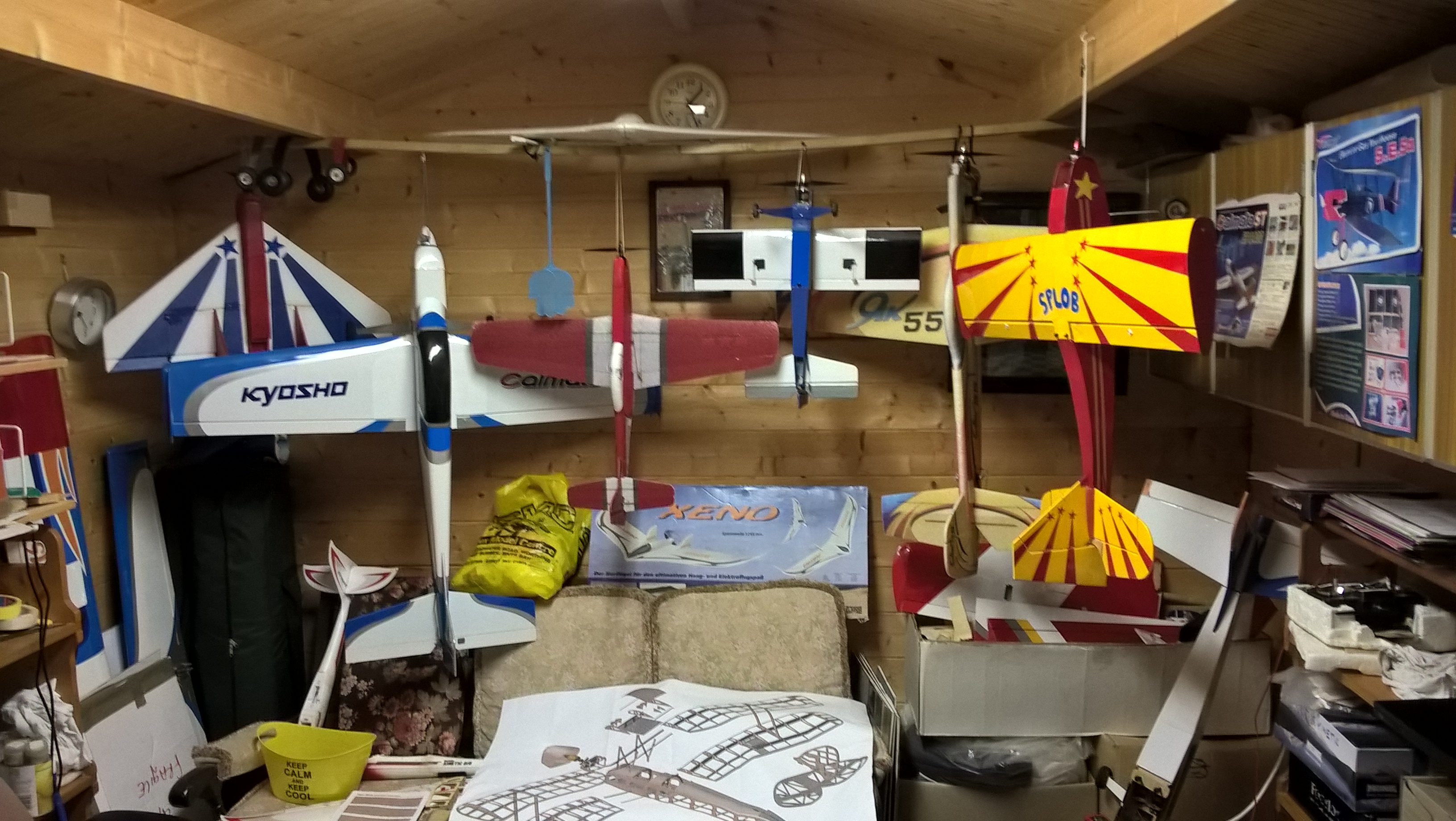 It looks very smart and tidy, and he hangs all his models up at one end. At the other end Basher has a neat building area where he currently building a Tiger Moth.
 Would anyone else like to send me some photos of their model room? We could have a monthly feature.
Finally, us lucky Midweekers were treated to a display by our local friendly Yak pilot one beautiful Tuesday. We had just finished flying when he appeared, so we watched his display that lasted about five or six minutes before he gave us a wing waggle and headed off. So then we, all happy and contented, meandered home for lunch, what a glorious end to our morning. I managed to get some video of it with my phone but the quality isn’t great. I’ve cut out most of the rubbish bits so what left is just under 3 minutes long.
If the video above won’t play for you click HERE
Did you hear that the guy who invented predictive text was tragically killed in plane crash last week? His funfair is next Monkey.
Colin Cowplain
Patch News – December 2015
Well that’s Christmas over for another year, I hope you all had a good time and received lots of modelling related presents. December was a pretty awful month for flying, lots of wet and windy weather that seemed to make a point of being at its worst on Sunday mornings. Fortunately the Midweekers were able to fly on some of the better days but even so we didn’t go to the field as much as we would have liked. This means I don’t have a huge amount of material for Patch News so this edition will be rather shorter than usual, but I’m sure you’ll all be sending me lots of information about your modelling presents so the January Patch News should be back to normal even if the weather stays bad. THIS MONTH’S VIDEO is also shorter than usual but features the EFX Racers of Modelling Clay and Wonky Wiltshire, the Deltas of 1066 and Colin Cowplain, and a few other snippets.
In the last Patch News I pictured a large box that had arrived from Santa (HobbyKing) and on Christmas Day I was finally allowed to open it. Strangely enough it’s exactly what I had ordered, a Durafly Me163 Komet.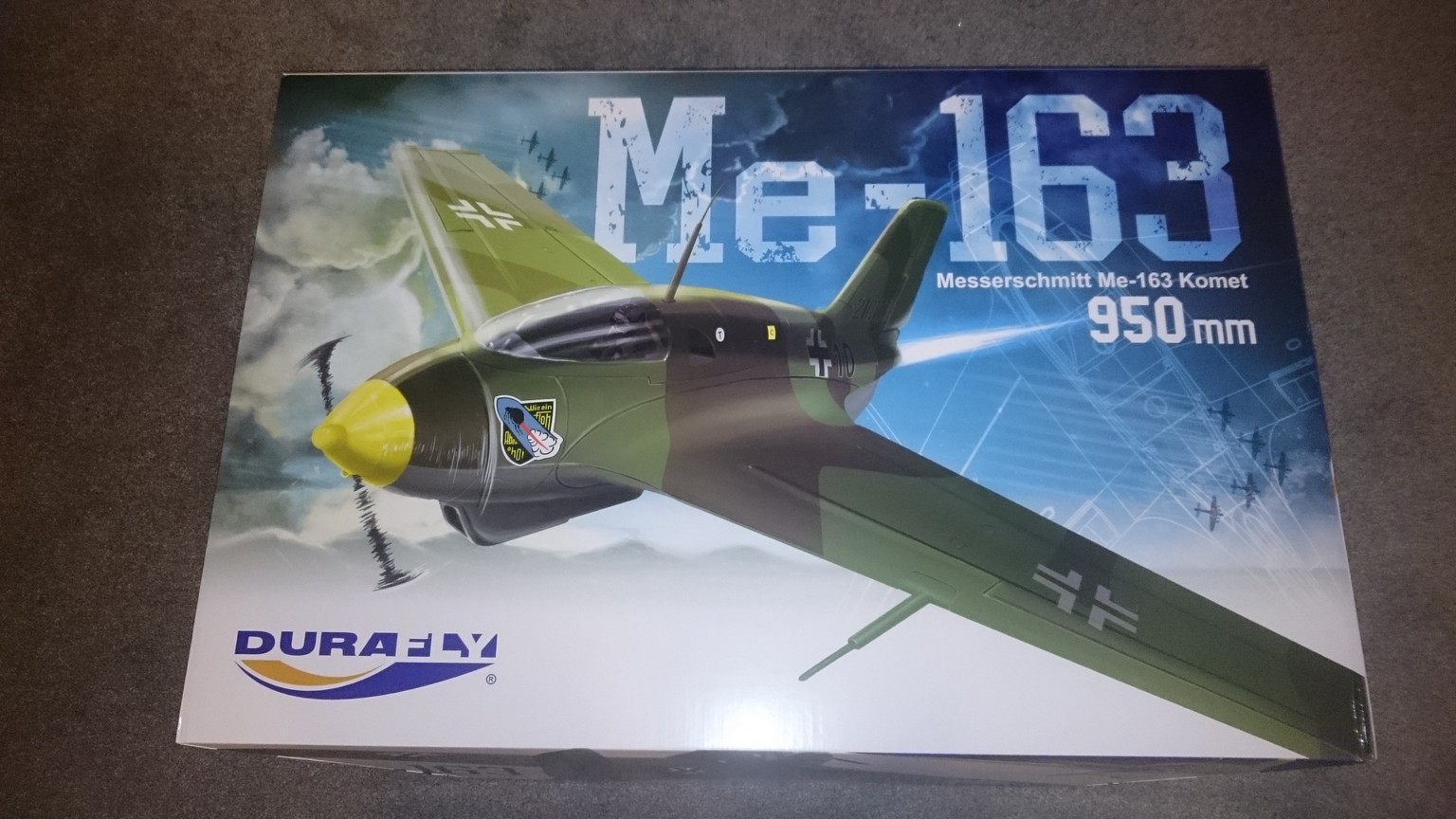 It’s the Plug ‘n’ Play version so there isn’t much to do to ready it for flight, just glue in the fin, screw on the control horns, connect the linkages, and add my own receiver and battery.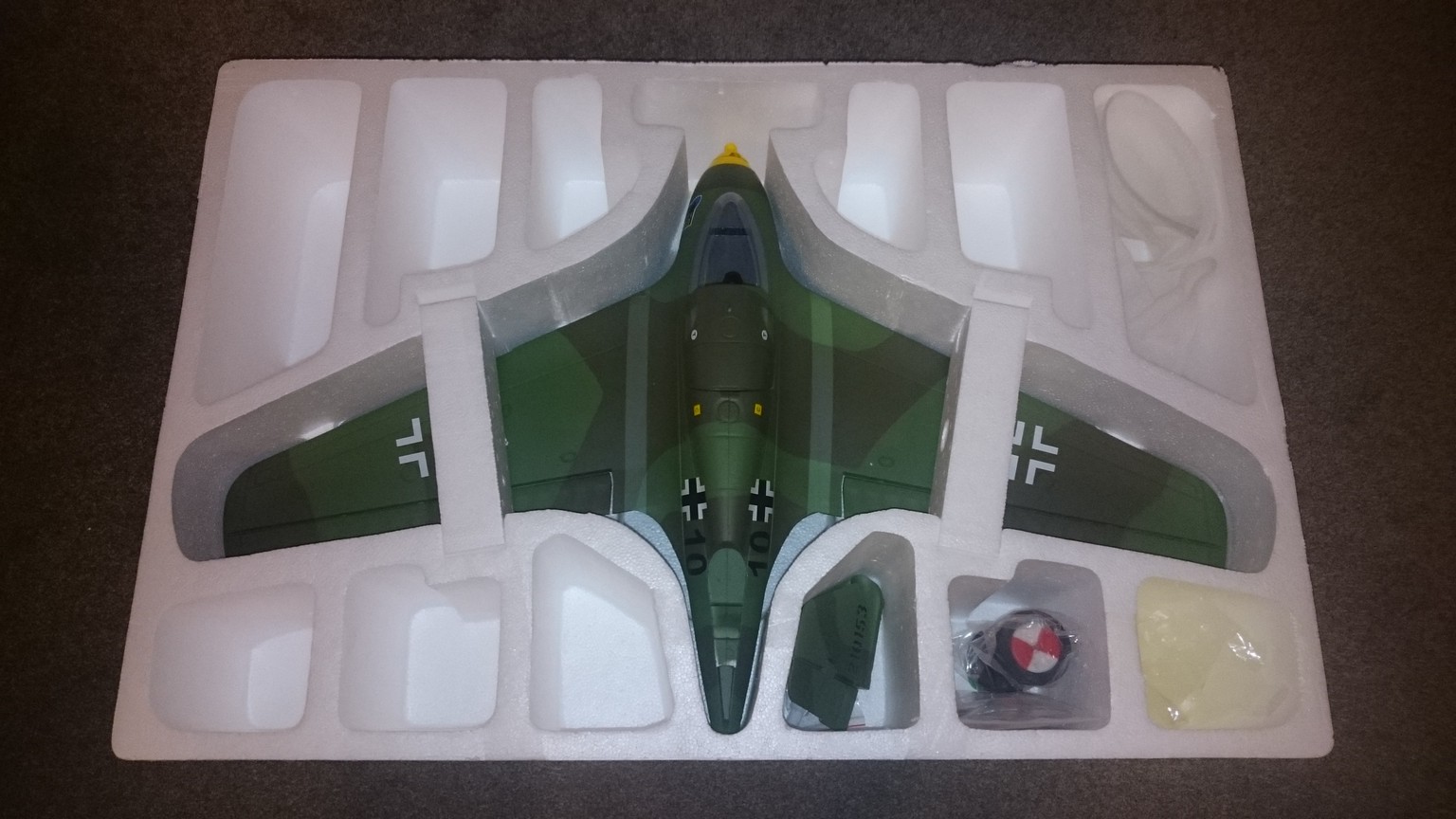
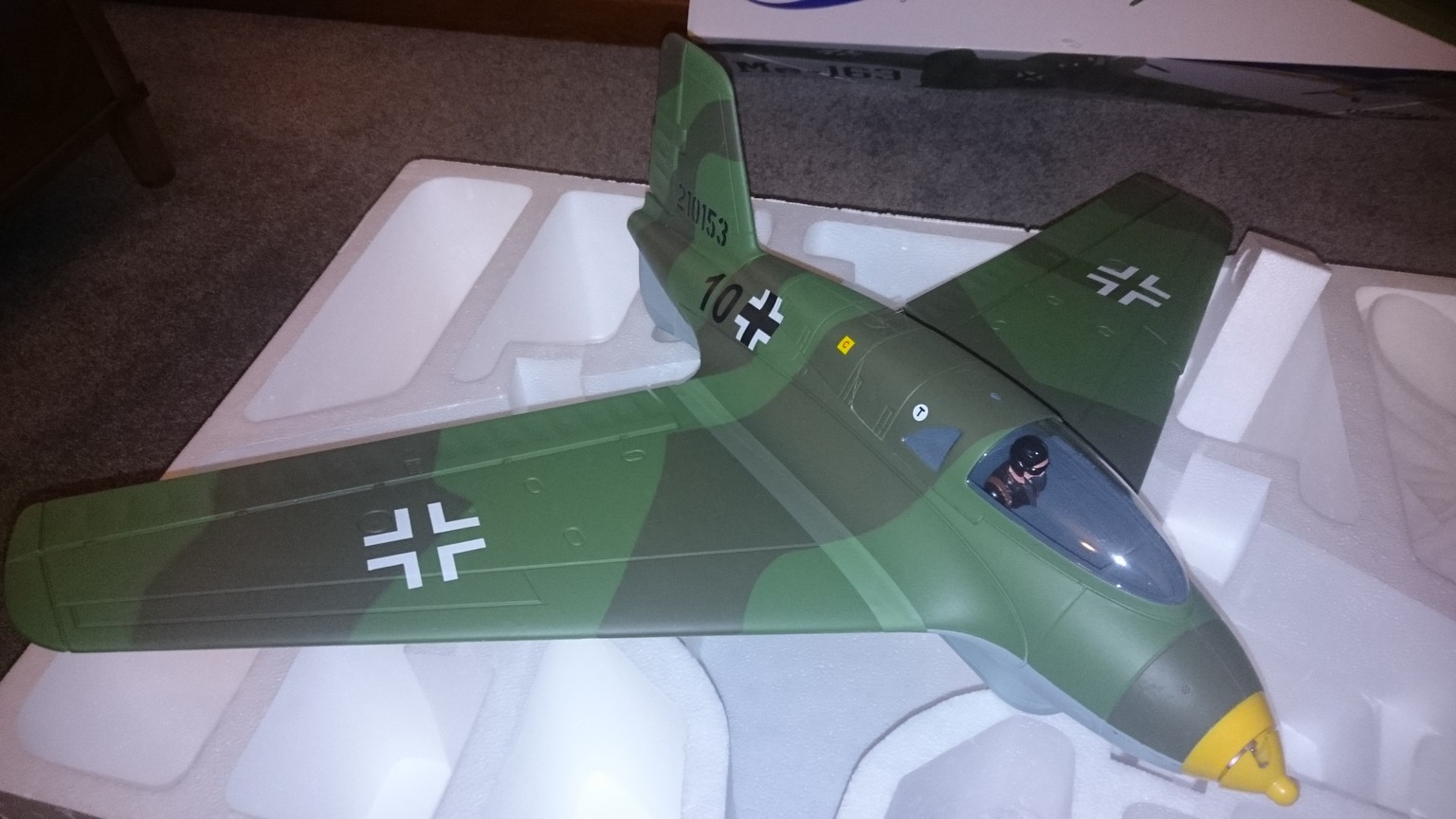
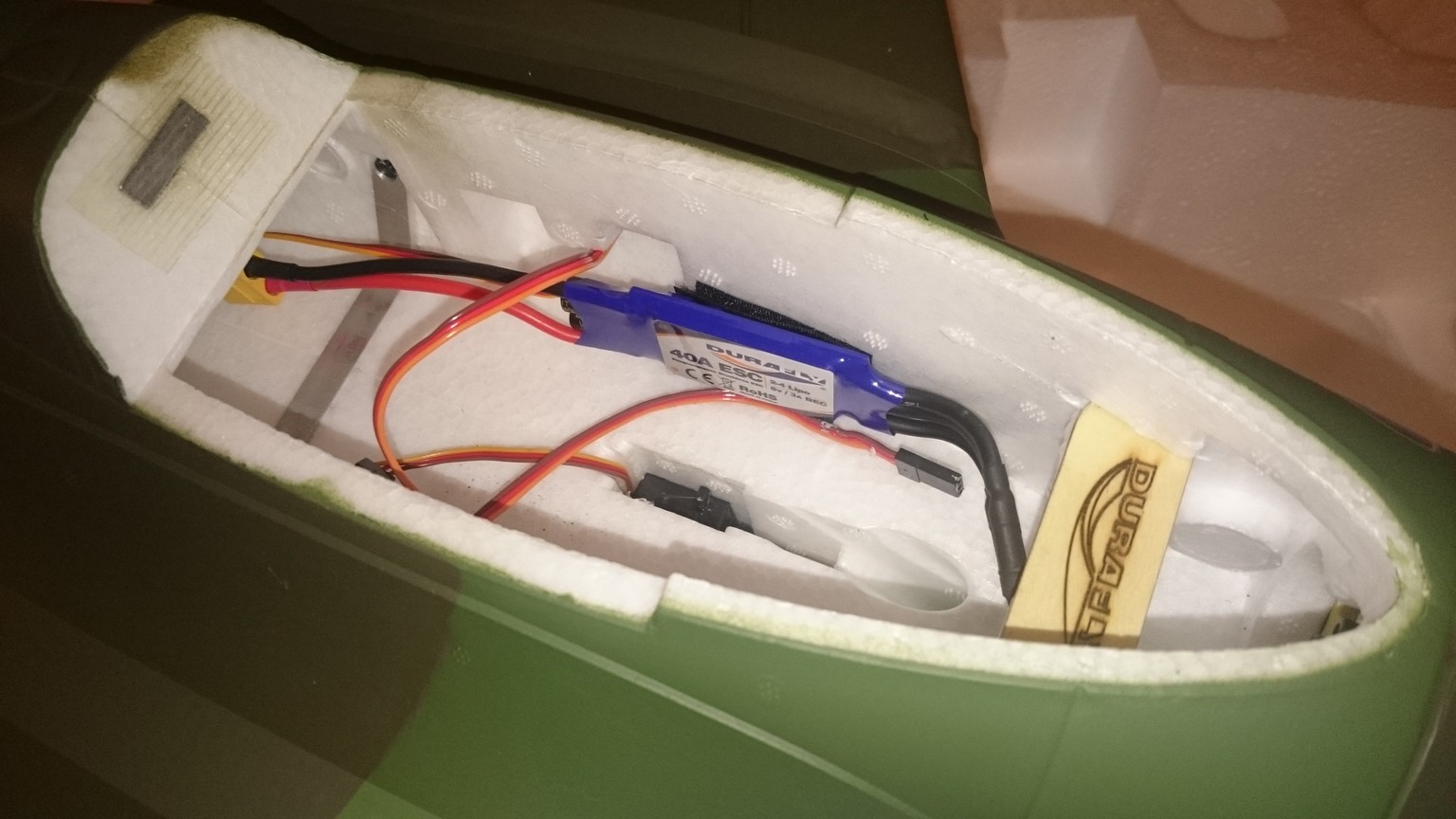 I’ve built a couple of Komets over the years, both of balsa construction and both powered by I/C engines so this one, being an electric powered foamie, will be a bit different. Of course the original was actually rocket powered and it would reach over 600mph after a 70 degree climb of up to 39000 feet in less than 3 minutes, unheard of performance in the 1940’s. It used a lethal combination of C-Stoff and T-Stoff for fuel, lethal because it would dissolve anything organic, which included the pilot. Despite wearing protective suits several pilots were literally eaten alive in accidents, while a luckier few were simply blown apart in explosions. The model has the option of fitting a rocket in the tail for a few seconds of boosted power! So far I’ve only had time for a quick examination of the model but it looks to be of excellent quality and nicely finished.
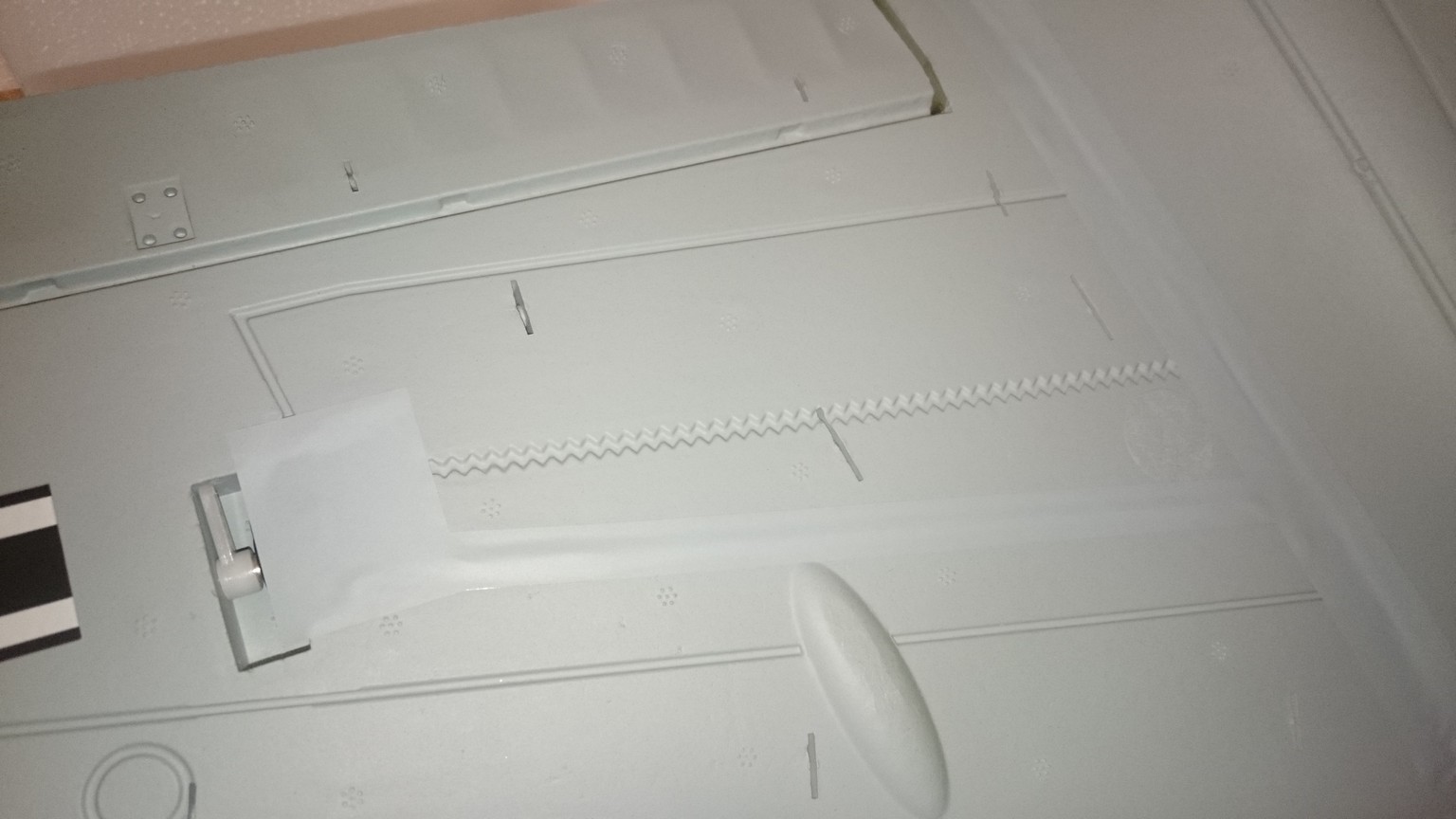 Both of my previous Komets lacked an undercarriage and had to be hand launched but this one features a ‘drop off’ undercarriage, just like the full-size, and the release mechanism and servo are pre-installed. So it should take-off from the patch (I hope), drop the wheels, and then belly land after the flight. It should be ready to fly very soon so hopefully I’ll be able to give a report of it’s flying characteristics next month.
I pictured Basher Bob’s unfinished half size Splot in the November Patch News and Bob brought it along to a December club meeting where the general consensus was that it was too heavy! So Bob decided to fly it on a smaller battery pack than originally planned and all the flights so far have been with a 1000mAh lipo.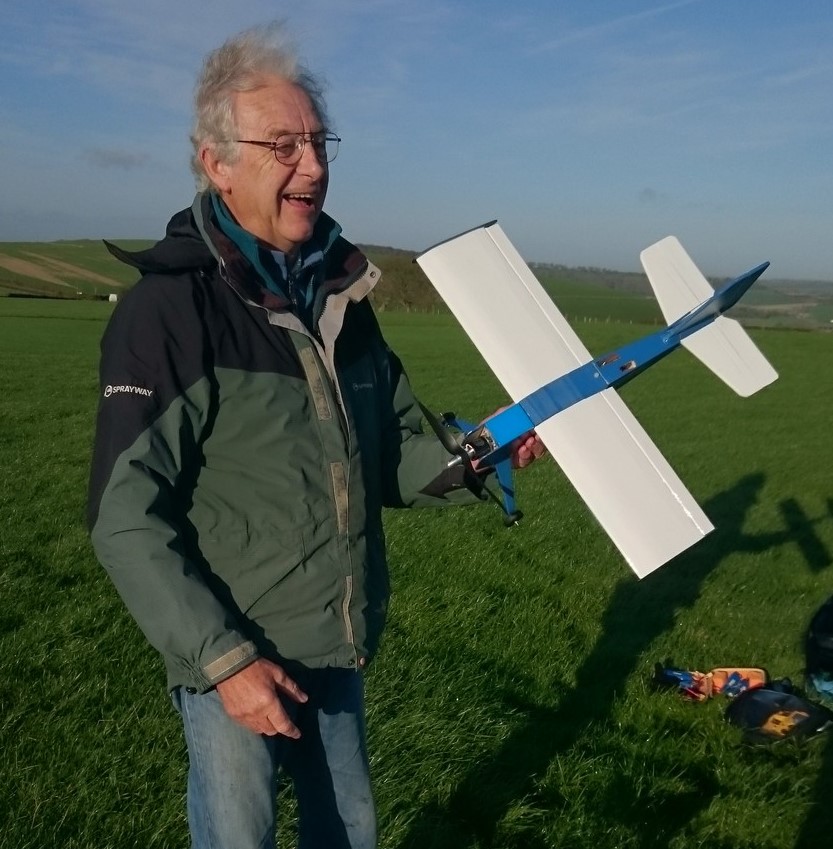
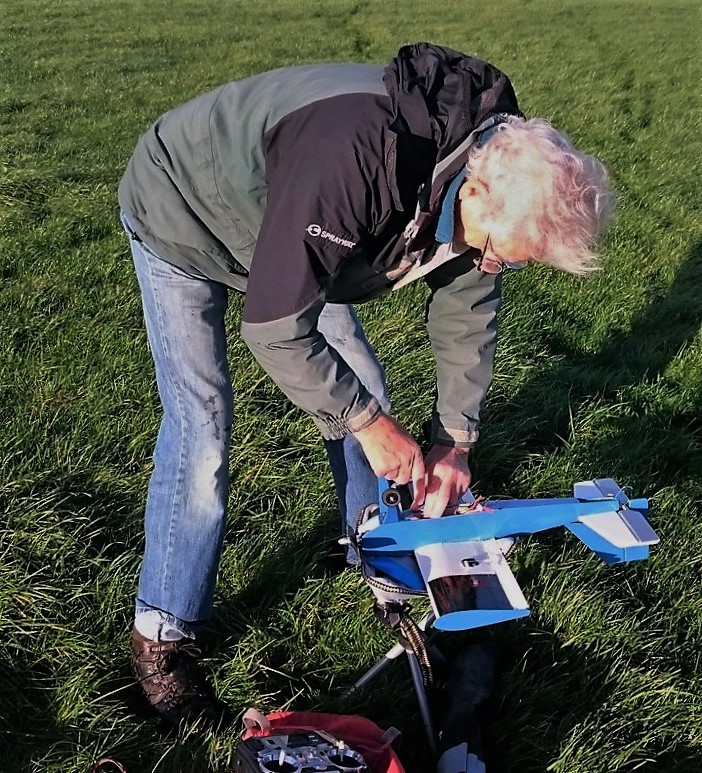 It flies very well, better than I expected really. It just about manages to take off from the patch but the grass is very wet at the moment and longer than in the summer so some flights were from a hand launch. As expected it’s pretty twitchy but overall not too bad, and it doesn’t need to fly as quickly as I thought it would. It would benefit from being a bit lighter but with the control throws reduced a bit and some more expo I’m sure Basher will get on well with it, just remember to stay close Bob!
The highlight of December had to be father and son JP and Monty both passing their ‘A’ tests . They had flown a little with Elmbridge Model Club before moving to Petersfield and discovering PAM in August so they weren’t complete beginners when they joined us. They shared an ST Models Discovery and had a buddy box set-up, and it was immediately obvious that neither was going to take long before being ready for the test. Dougal Entendre and I decided it would be best if we each took one them and Monty drew the short straw and got Dougal!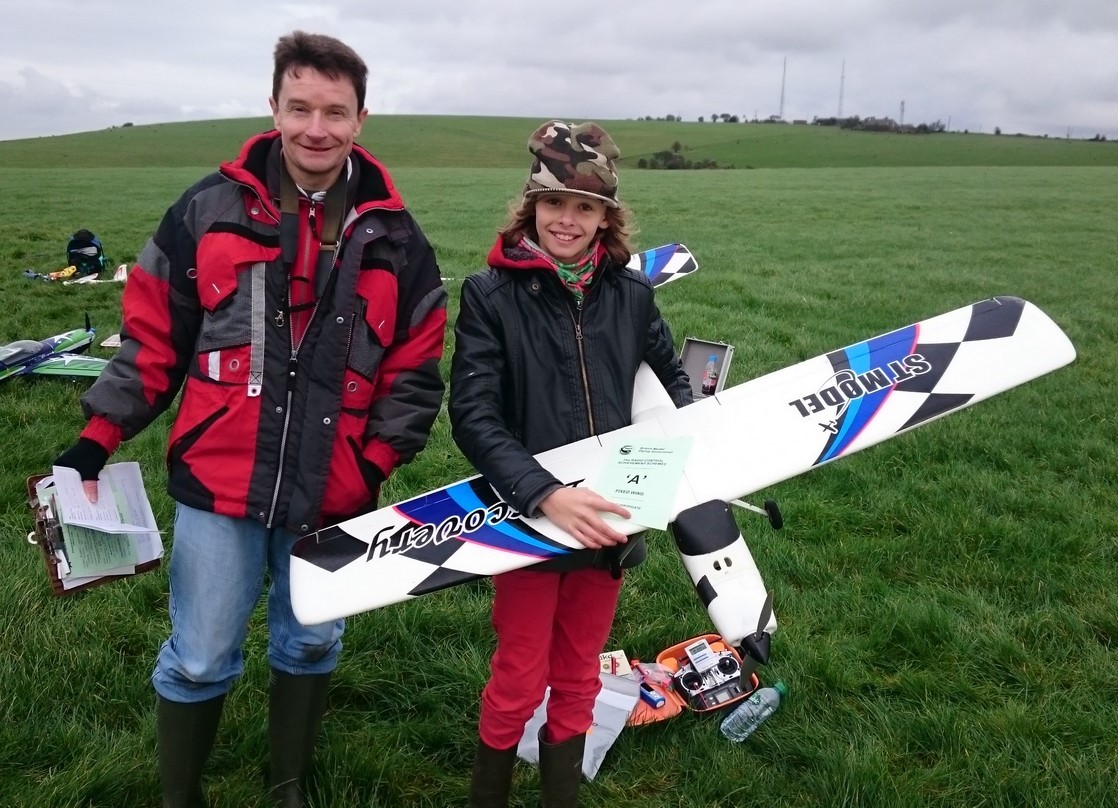 Of course JP had the advantage of being able to get in some extra practice mid-week while poor Monty was at school. JP assures us that he is a freelance photographer but personally I have my doubts, he never seems to do any work and is always keen to fly.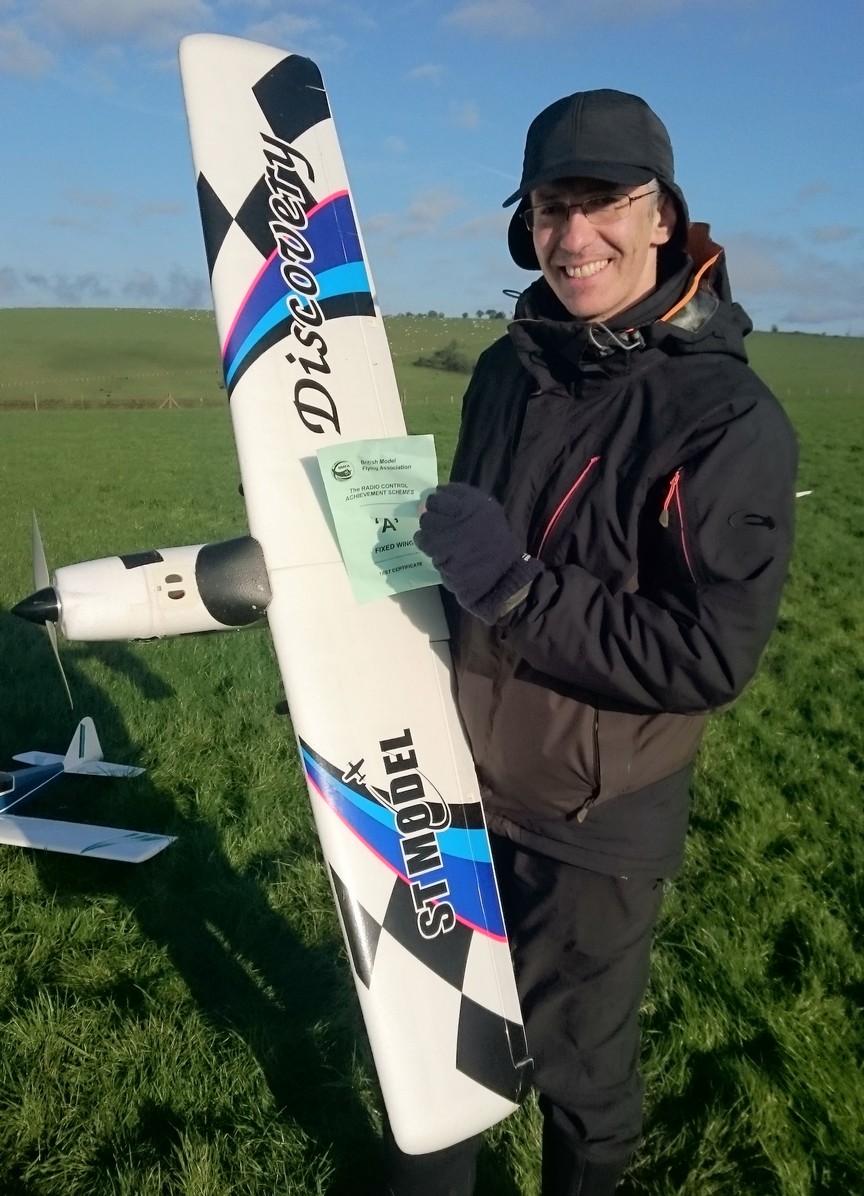
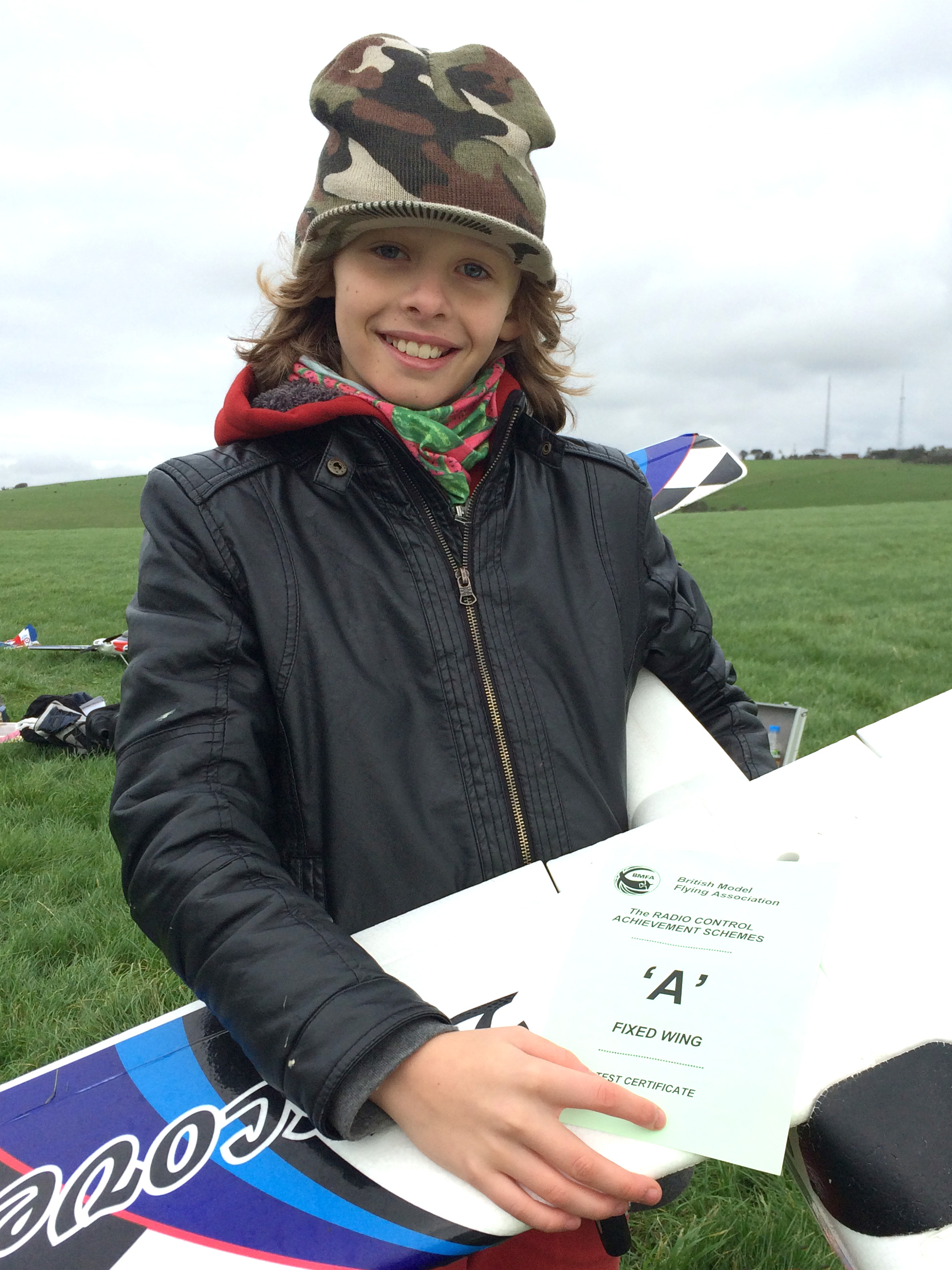 They both flew through the test (groan) and answered the questions with no problems and were duly awarded their certificates at the last meeting of 2015. Well done Monty and JP.
With the winter weather giving him more time for building Captain Slows’ thoughts turned to storage systems. Like me, he uses a spare bedroom for modelling but lacked storage space, and apparently his wife Anne failed to see the beauty of a dining room table covered in models. So, having spotted a rack system on the RCM&E forum, he set to with a hacksaw and lots of plastic pipe and produced this: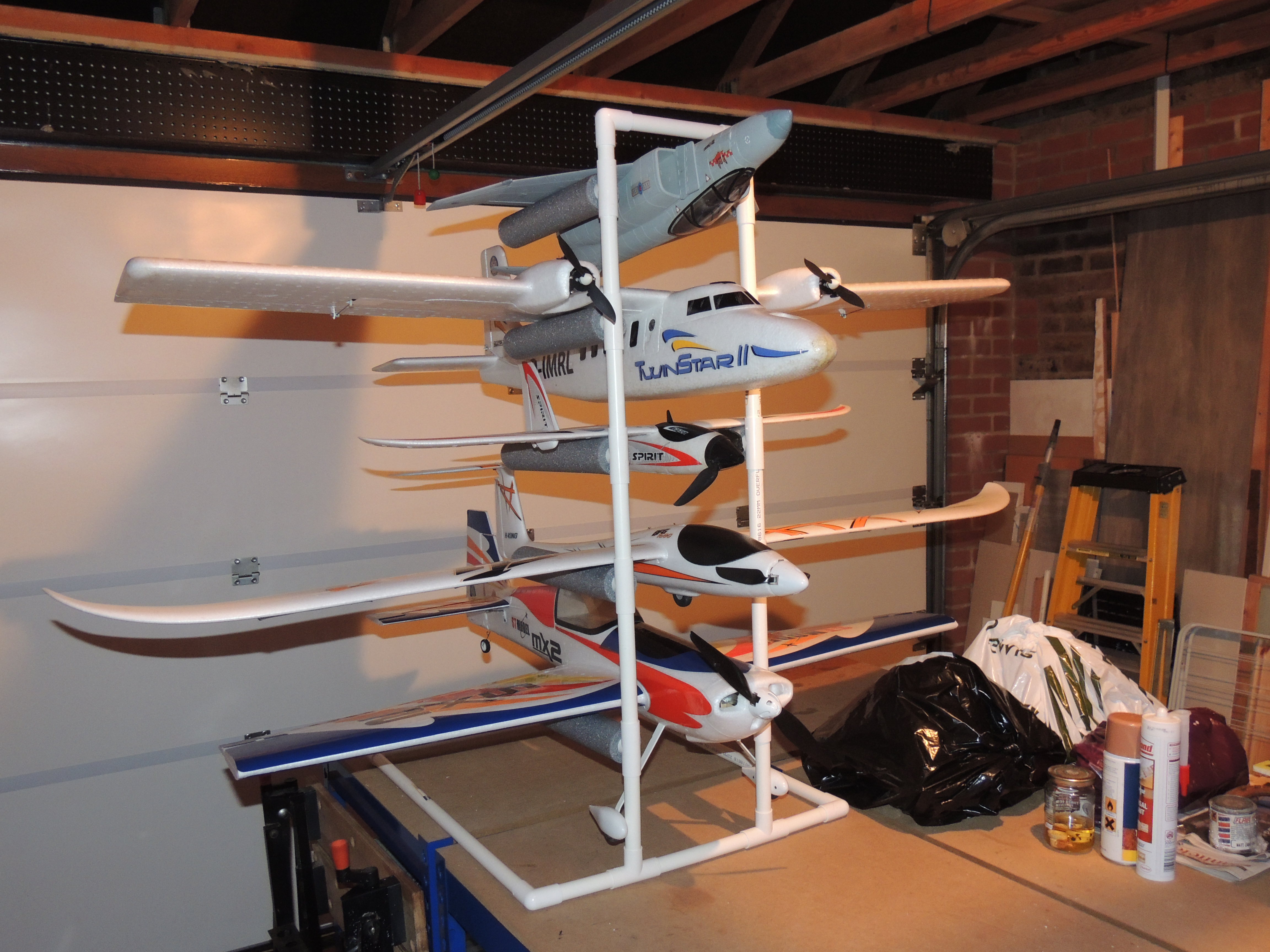 John can now store his models out of harms way in the garage, giving him both room to build more modes and a happy wife, a double bonus. I think it’s rather impressive, although I don’t think I need one as obviously my own model room is always clean, tidy, and uncluttered:
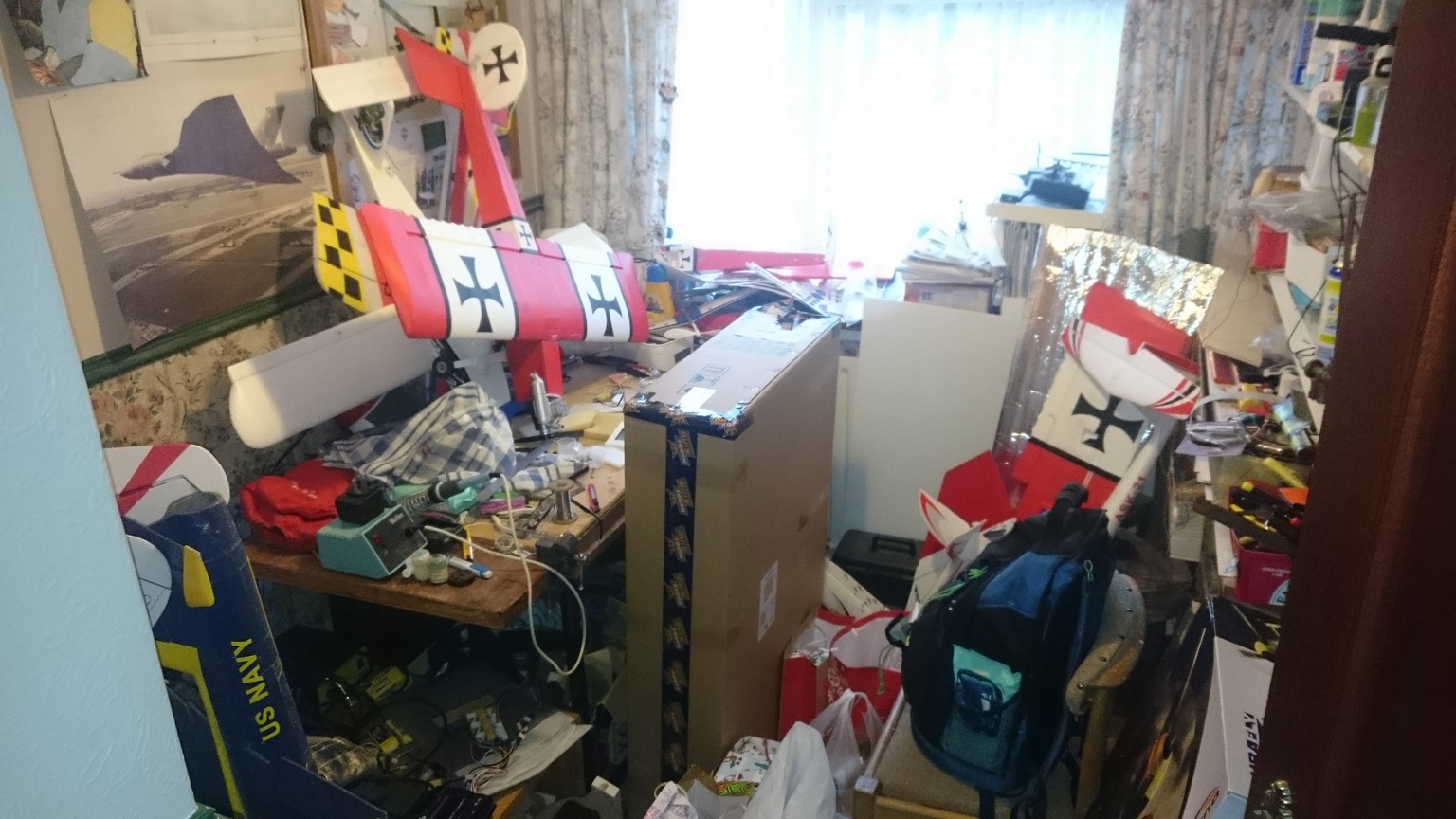 OK, maybe I should start building my own model rack…! I should point out that my model room had turned into the Christmas present store when I took this photo.
We spent one Sunday morning dodging showers and retreating to the barn while they passed. During one of the dry spells Captain Slow was unlucky enough to lose the small foam battery hatch from his MX2 out over the valley and set off to search for it. A few minutes later we spotted a looming deluge sneaking up behind Modelling Clay.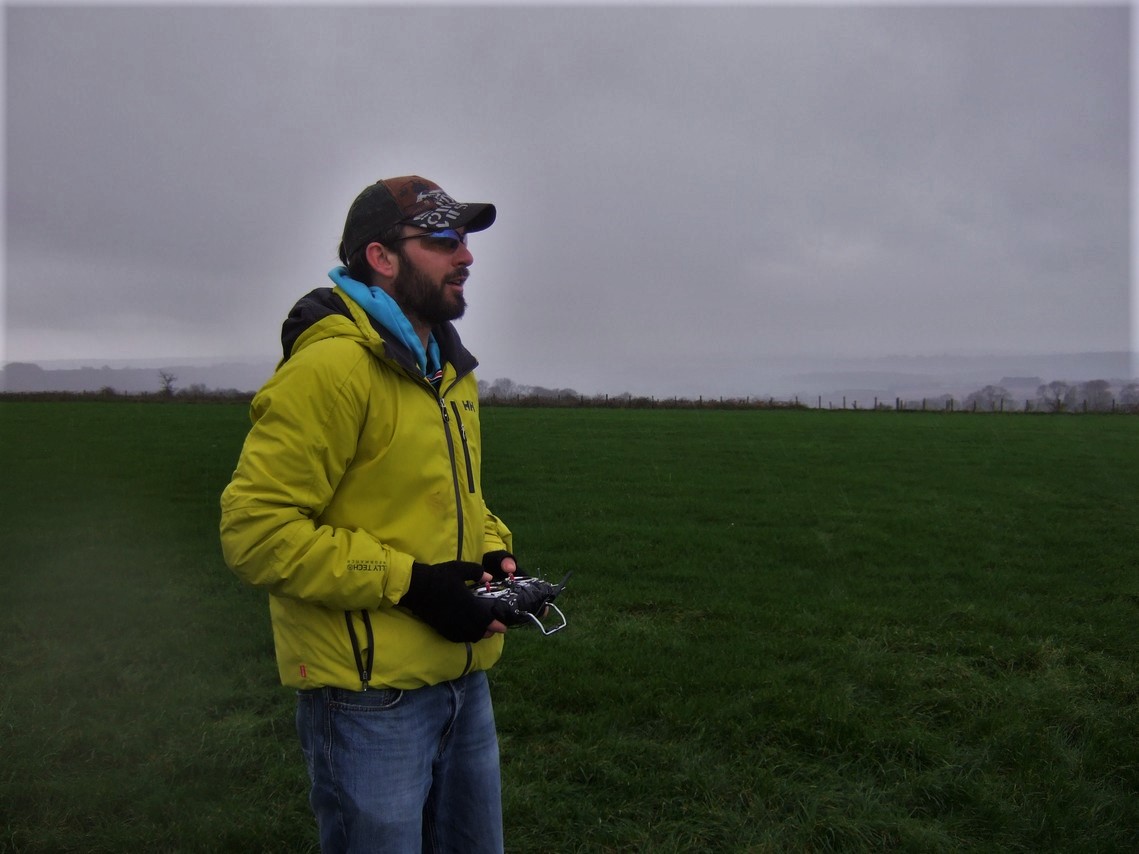 A minute later we were hit by very heavy rain and dashed back to the barn where we discussed Captain Slow’s predicament. We decided that, being an ex-military man, he would have constructed a bivouac, lit a fire, and would be tucking into rabbit stew while plotting the coordinates of the hatch search. Sadly we were wrong and a very wet, bedraggled, miserable, and hatchless Captain Slow eventually returned to the barn.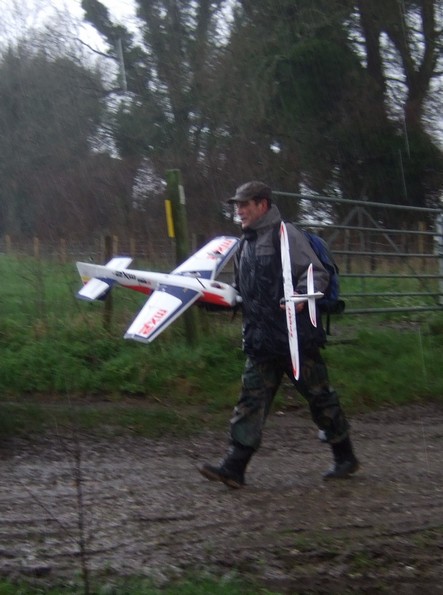
But not to be defeated, Captain Slow made a replacement hatch and he and Dougal sneaked off to the field between Christmas and New Year where the MX2 behaved itself and didn’t eject the new hatch!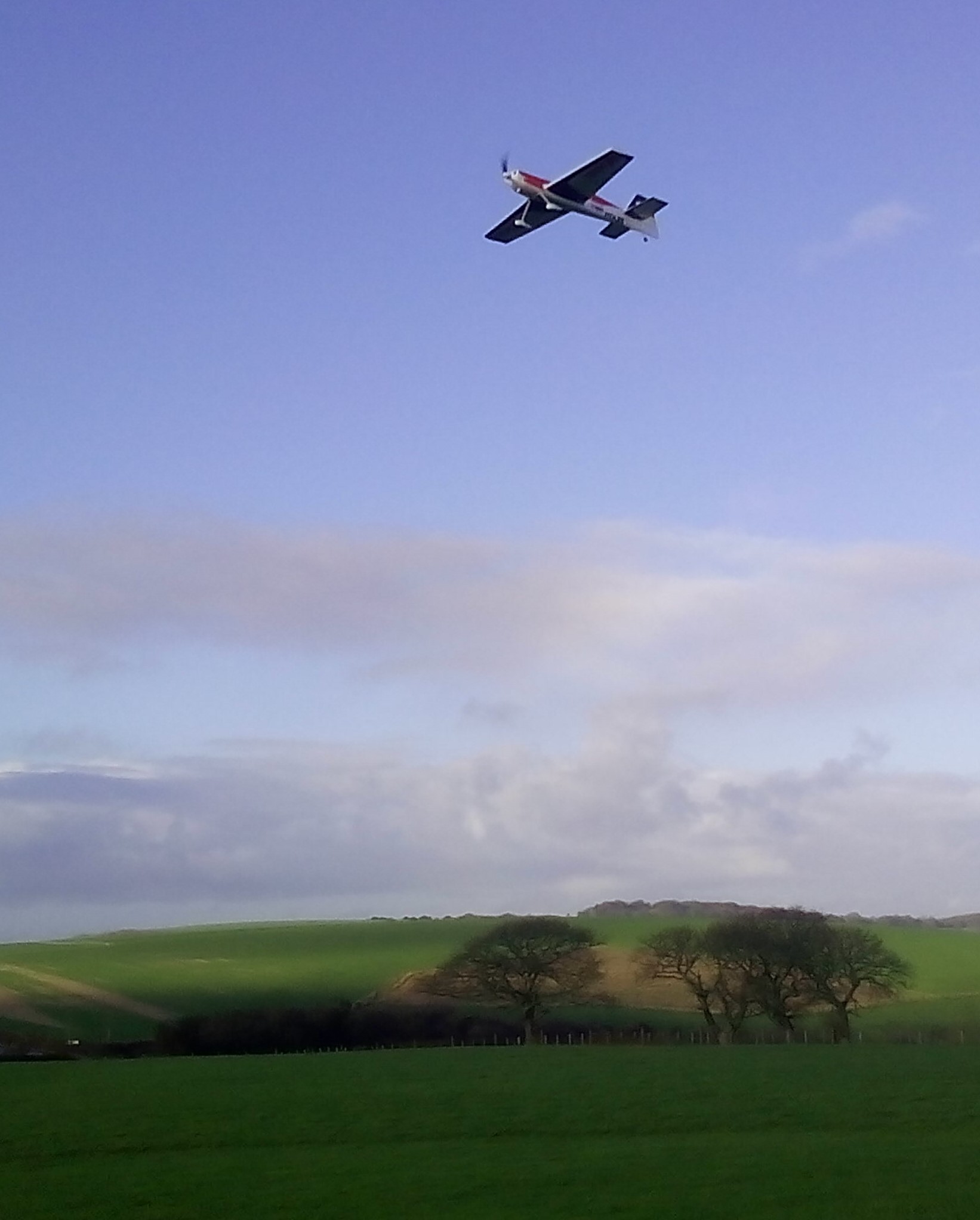 Dougal took the opportunity to test fly his new HK Wingnetic which, I think, he bought in the recent HobbyKing sale. Apparently it performed well, more on this one later.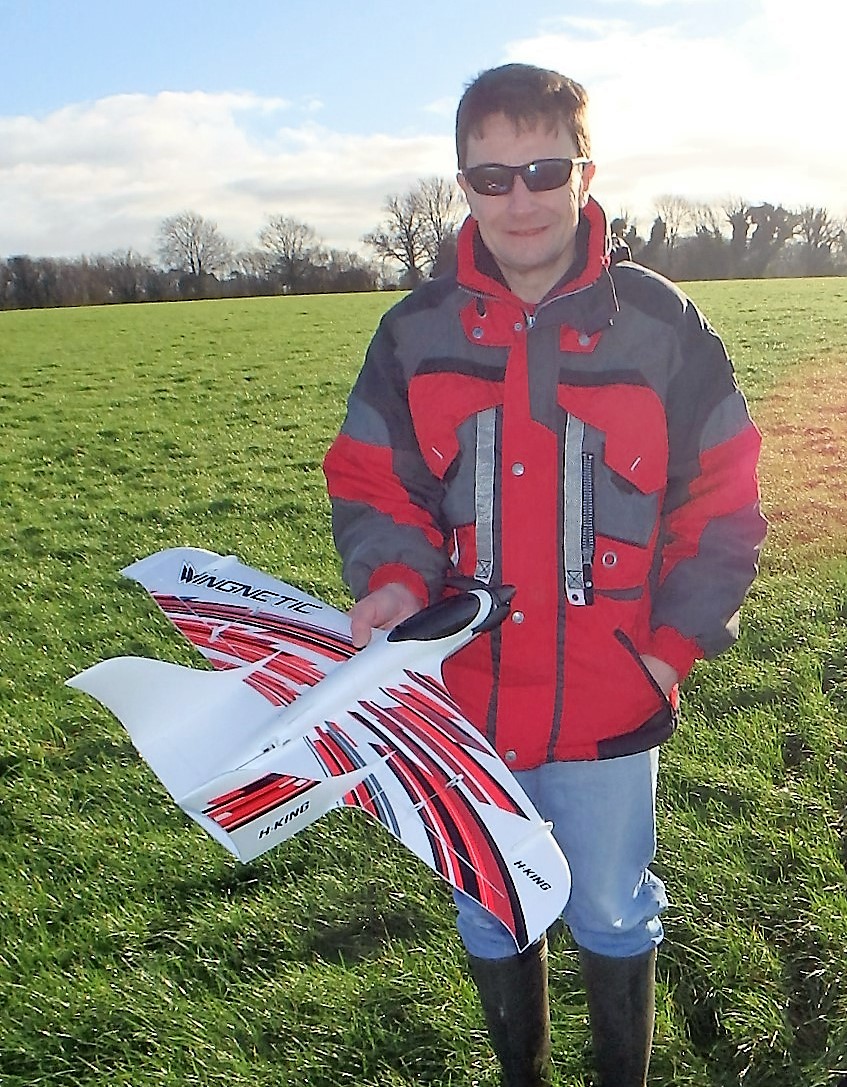
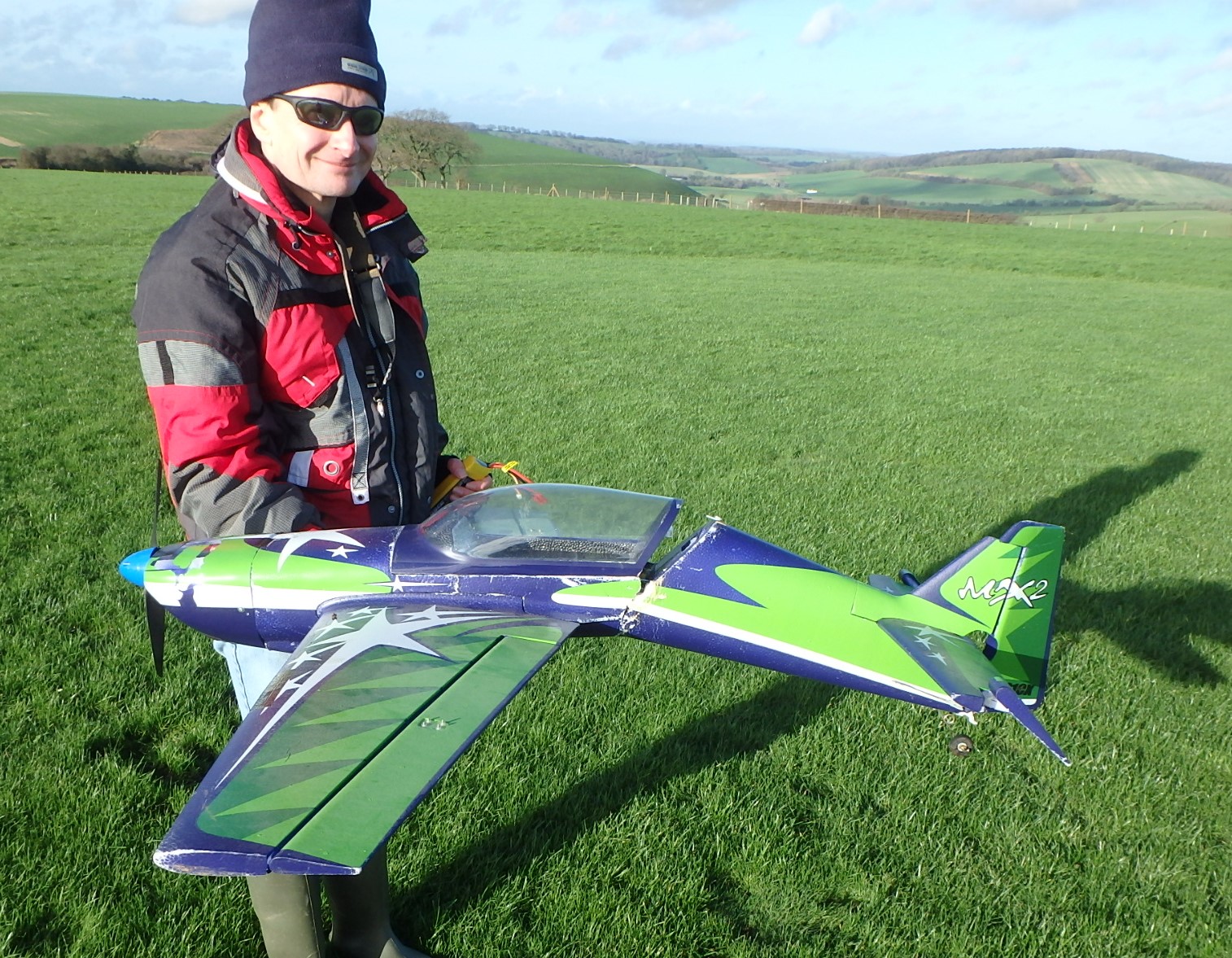 He didn’t do quite so well with his own MX2 unfortunately, it suffered a little in what he describes as ‘a heavy landing’. Never mind, it looks as if the repair should be fairly straightforward.
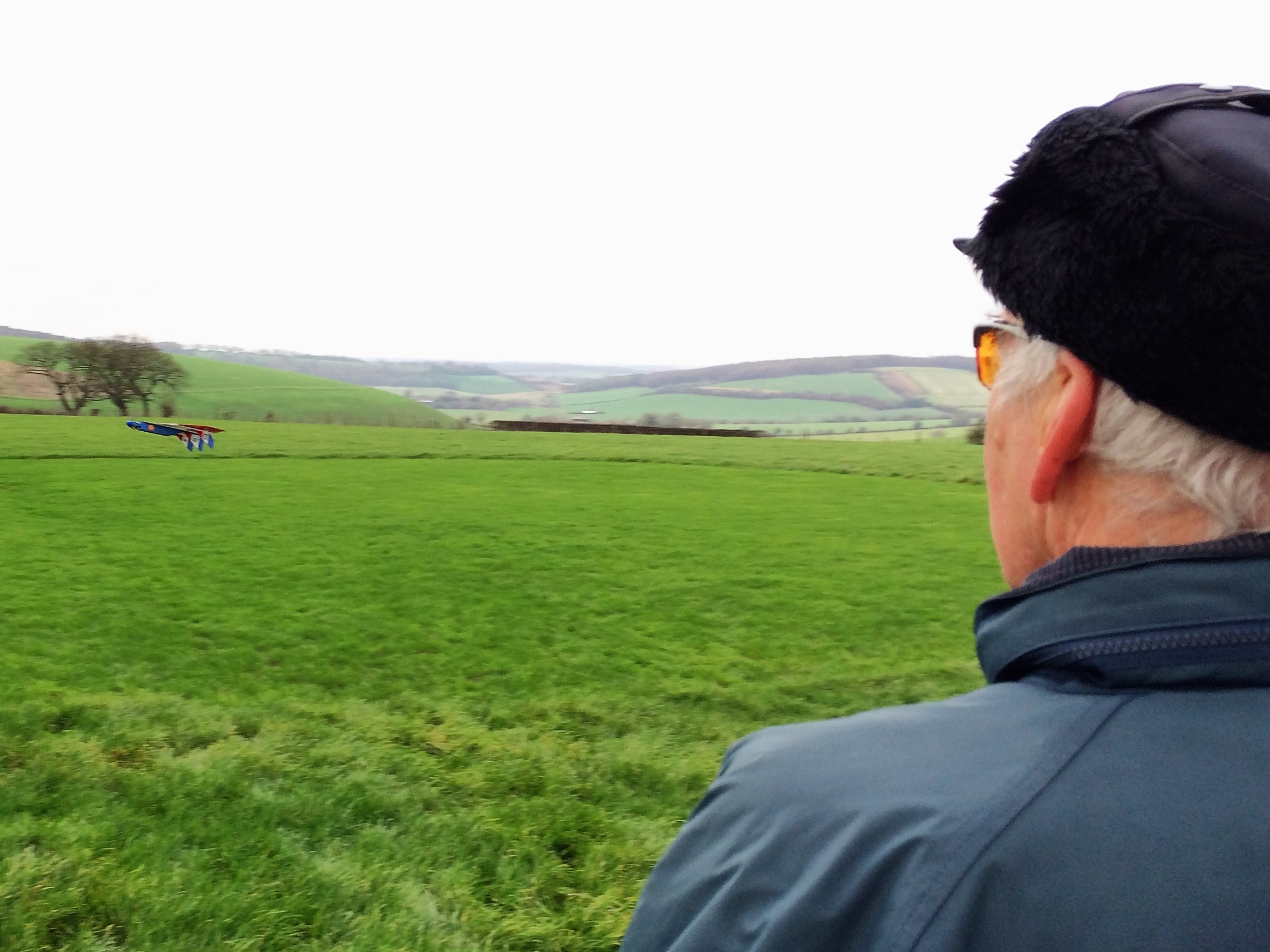
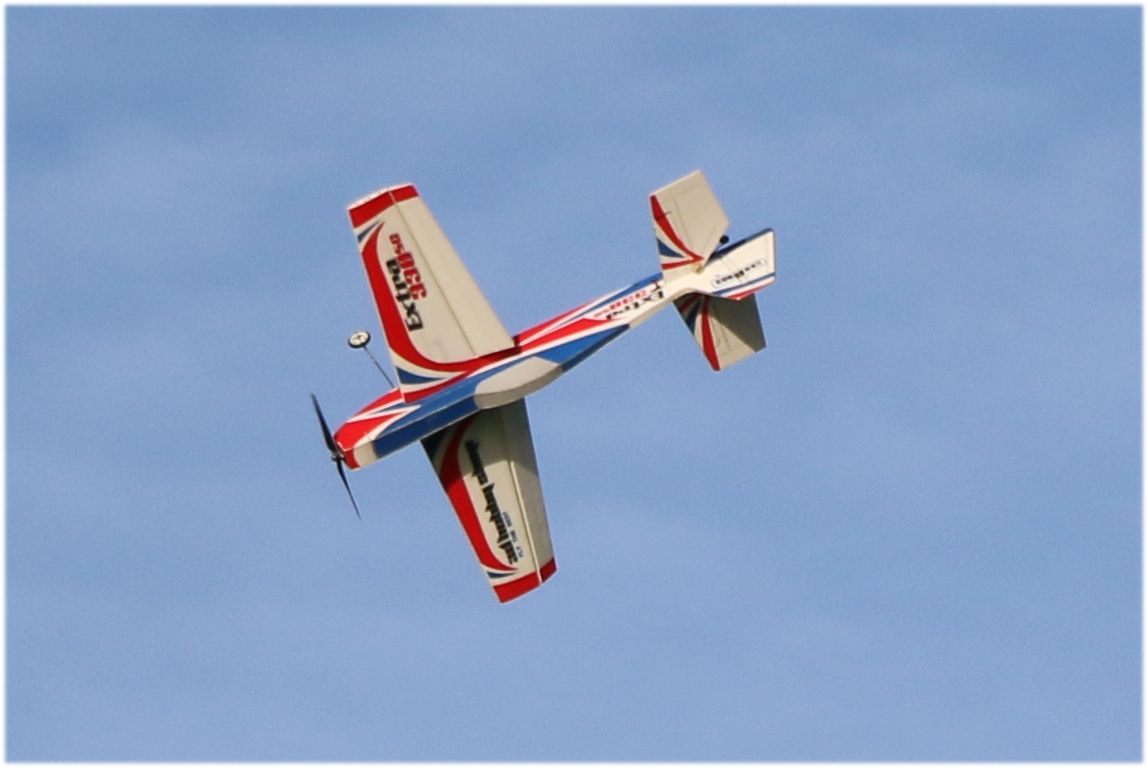
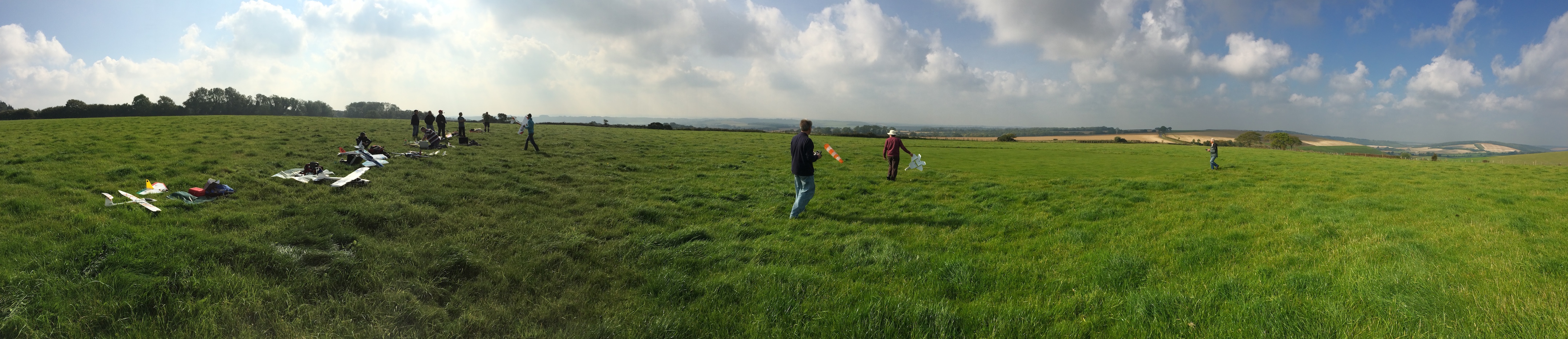
Several people sent me photos this month so included are some from Graham Swan, JP, Dougal Entendre, and Captain Slow, thanks guys.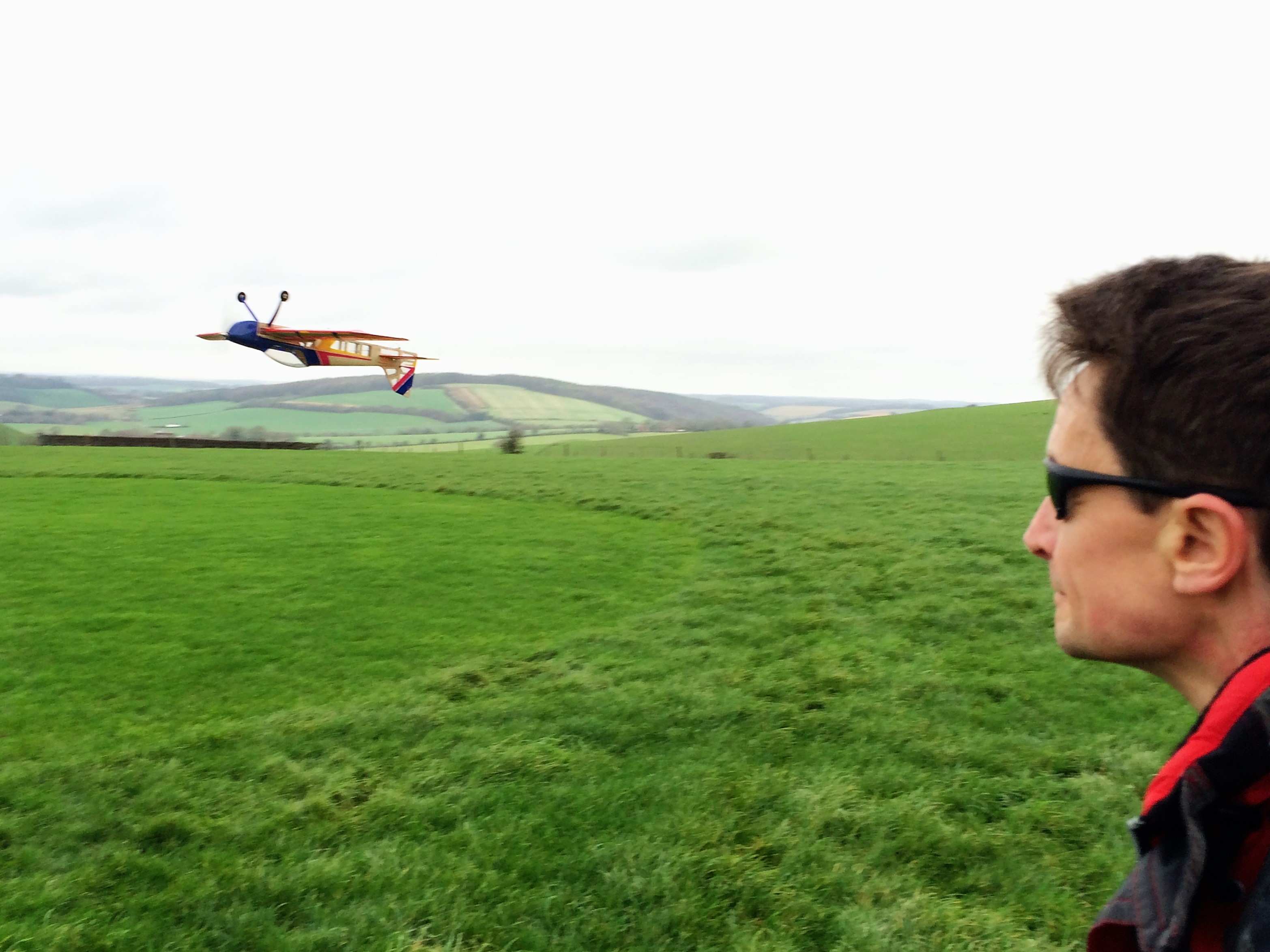
 I’ll finish with a couple of links, first one for all those who think they are good modellers: CLICK HERE And secondly one for anyone looking for an electric trainer with a difference: CLICK HERE Don’t forget to take a look at THIS MONTH’S VIDEO.
A Happy New Year and safe flying to you all.
On a transatlantic flight the turbulence was vicious, and things went from bad to worse when a wing was struck by lightning. One woman in particular lost control. Screaming, she stood up at the front of the plane. “I’m too young to die!” she wailed. “If I’m going to die, is there anyone on this plane who can make me feel like a WOMAN?” For a moment there was stunned silence. All the other passengers had forgotten their own peril, and were riveted by the sight of the desperate woman. Then a gorgeous man stood up at the rear of the plane. Tall, well-built, brown hair and hazel eyes, he started to walk slowly up the aisle. As he did so, he began to unbutton his shirt one button at a time. All eyes were on the man as he neared the woman, who by this time was breathing heavily in anticipation as the god-like stranger approached her. He removed his shirt. Muscles rippled across his chest and back as he reached her. He lifted his arm, holding his shirt, and extended it to the trembling woman. Intense, his gaze never left her eyes, as he whispered, “Here, iron this…then get me a beer”
Colin Cowplain