
Patch News – January 2022
It’s the first Patch News of 2022 and I’m pleased to report there has been a lot of flying going on. The weather was very mild with record breaking January temperatures and also the lowest January rainfall for 25 years apparently. Although the warm dry weather was good for flying it also made the grass grow, so much so that we had to mow the patch, something we don’t normally need to do during the winter months. A plus point is that cutting it made the patch much easier for Dougal Entendre and I to see when flying FPV.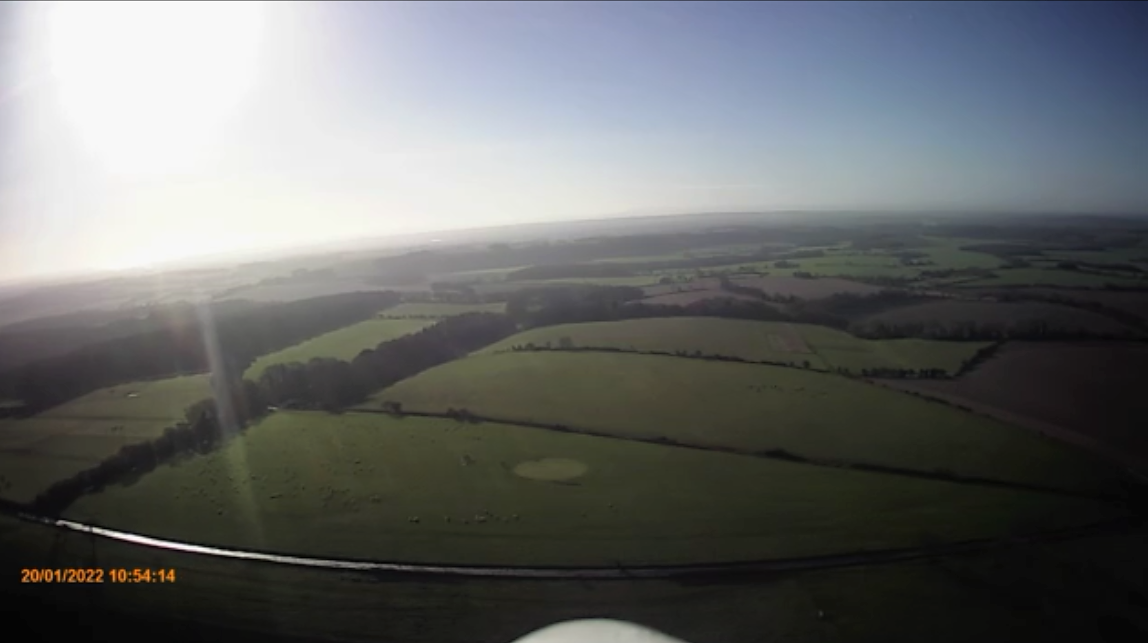 The mowing went well, we told Gordon Bennett to get on with it while the rest of us stood around and let Woody explain just how good his spot landings are to anyone who’d listen.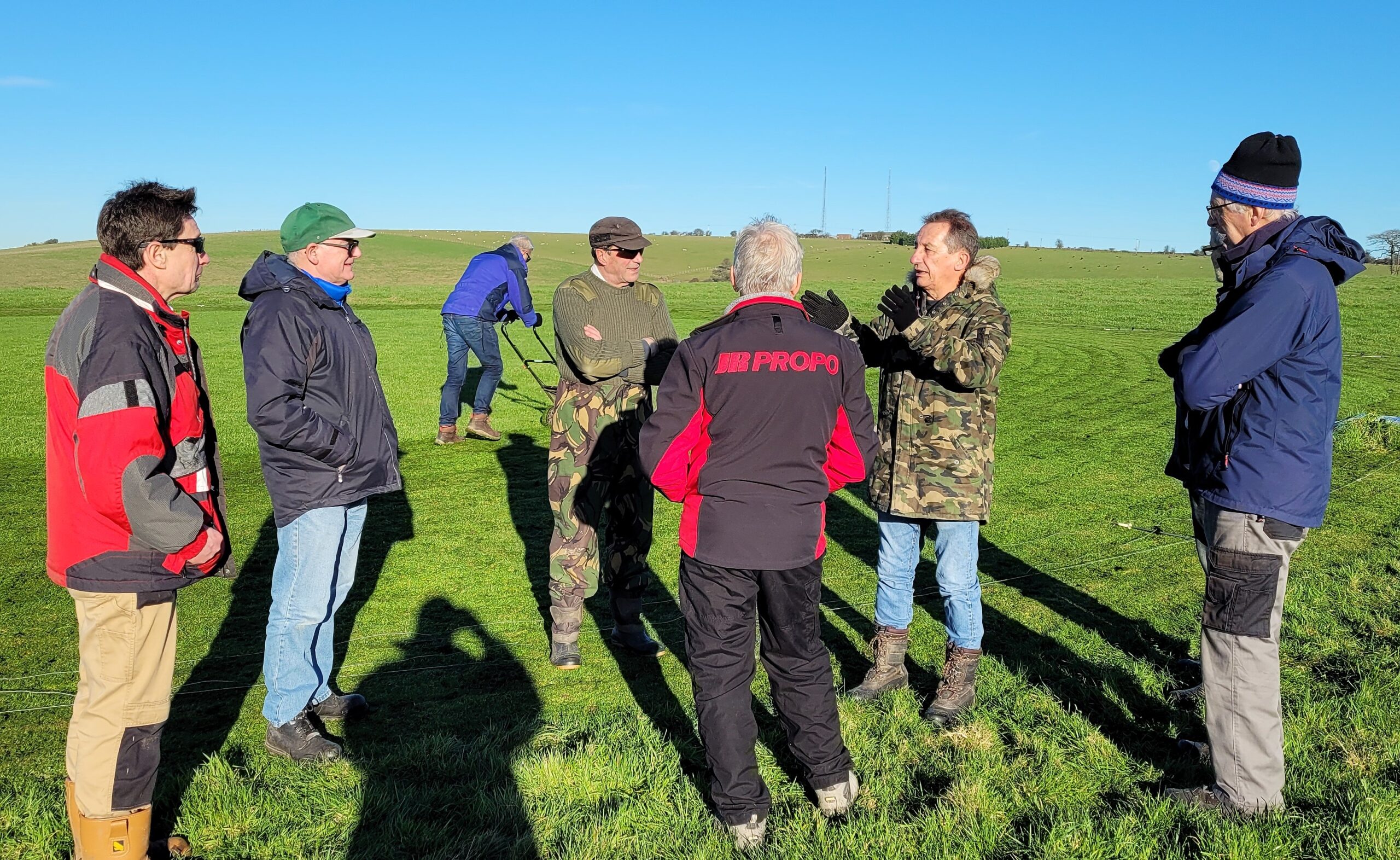
Later in the month we were joined in the field by a couple of hundred sheep for about ten days. Fortunately sheep are much less of a problem to us than the bullocks can be although some of them did start to show some interest in the models in the pits one day.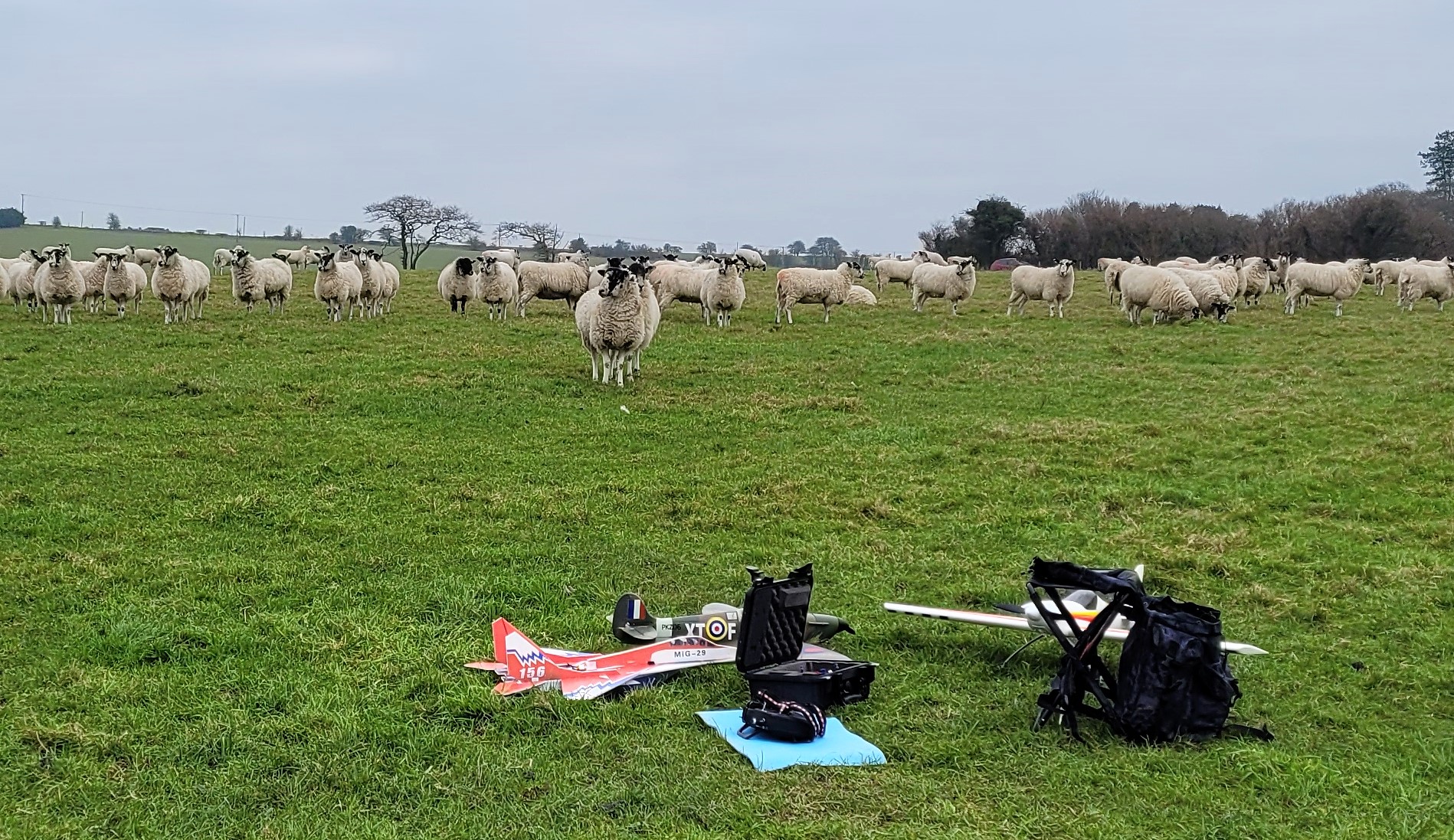 Chas reckoned they just wanted to have a fly. Farmer George said they were all pregnant ewes and asked that we didn’t fly low over them and scare them.
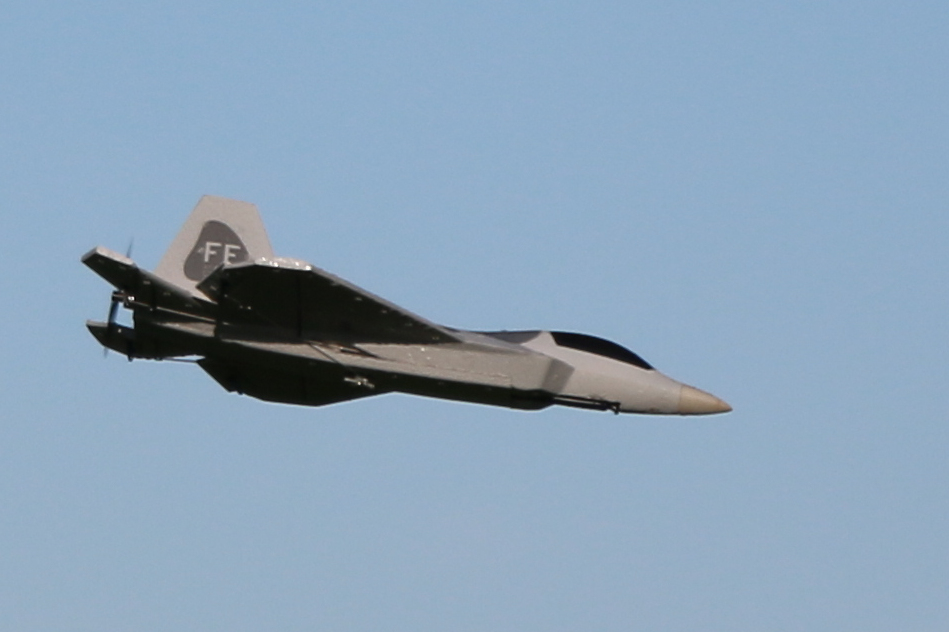
We had light winds for much of the month which gave us perfect conditions for the tiny models some of us have. I’ve been really impressed by the little Eachine Mustang that I’ve been flying for a couple of months and at the beginning of January I spotted the Eachine F22 Mini Raptor with three batteries on sale for just £55.09 on the BangGood UK website. I had a discount voucher which brought price down to £47.92 including tracked delivery and insurance. If you buy an item from the UK website there are no worries about getting stung for import duties and the associated collection fees plus the delivery is very fast, I ordered late afternoon on a Wednesday and it arrived on Friday morning, excellent.
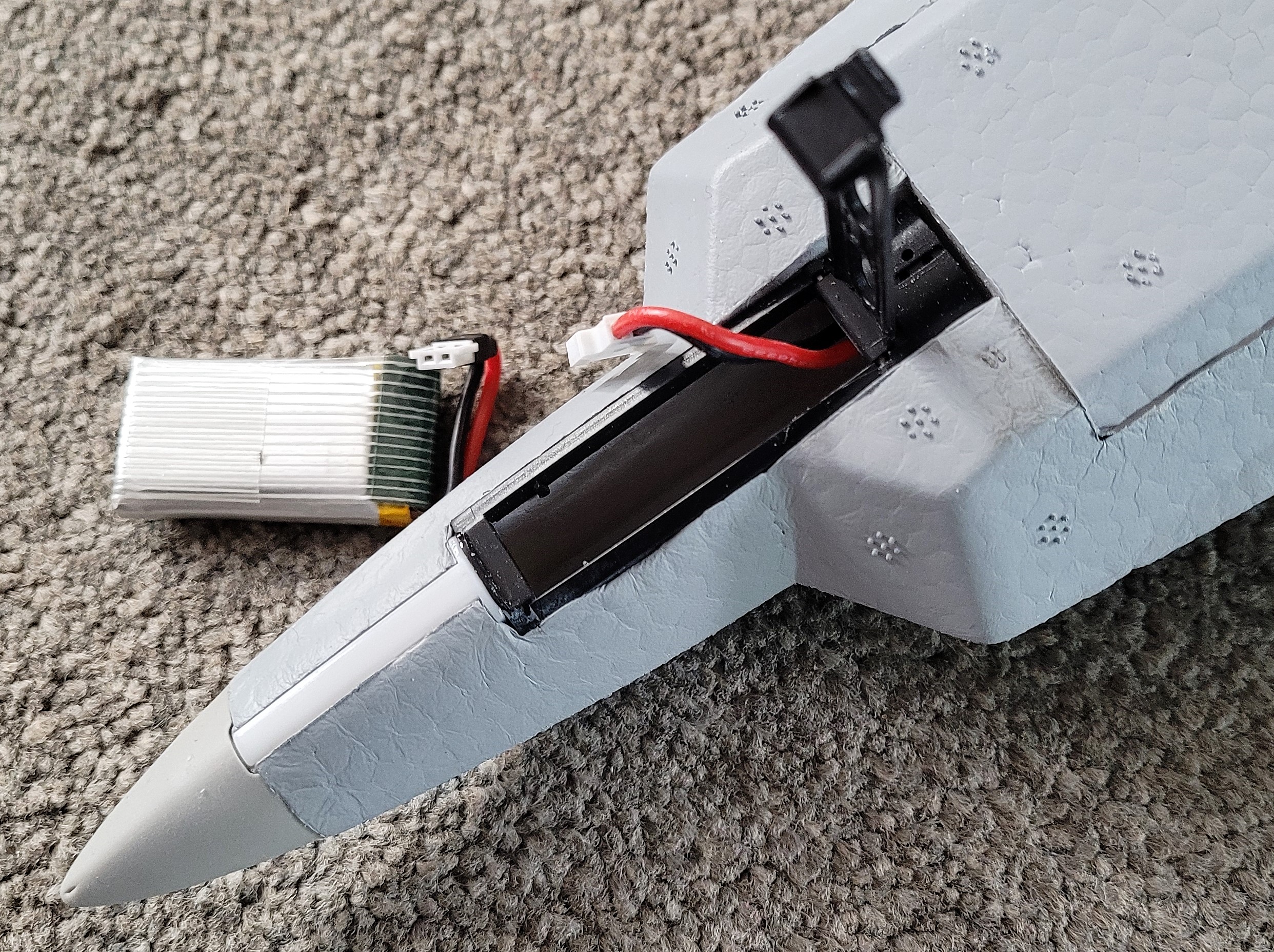
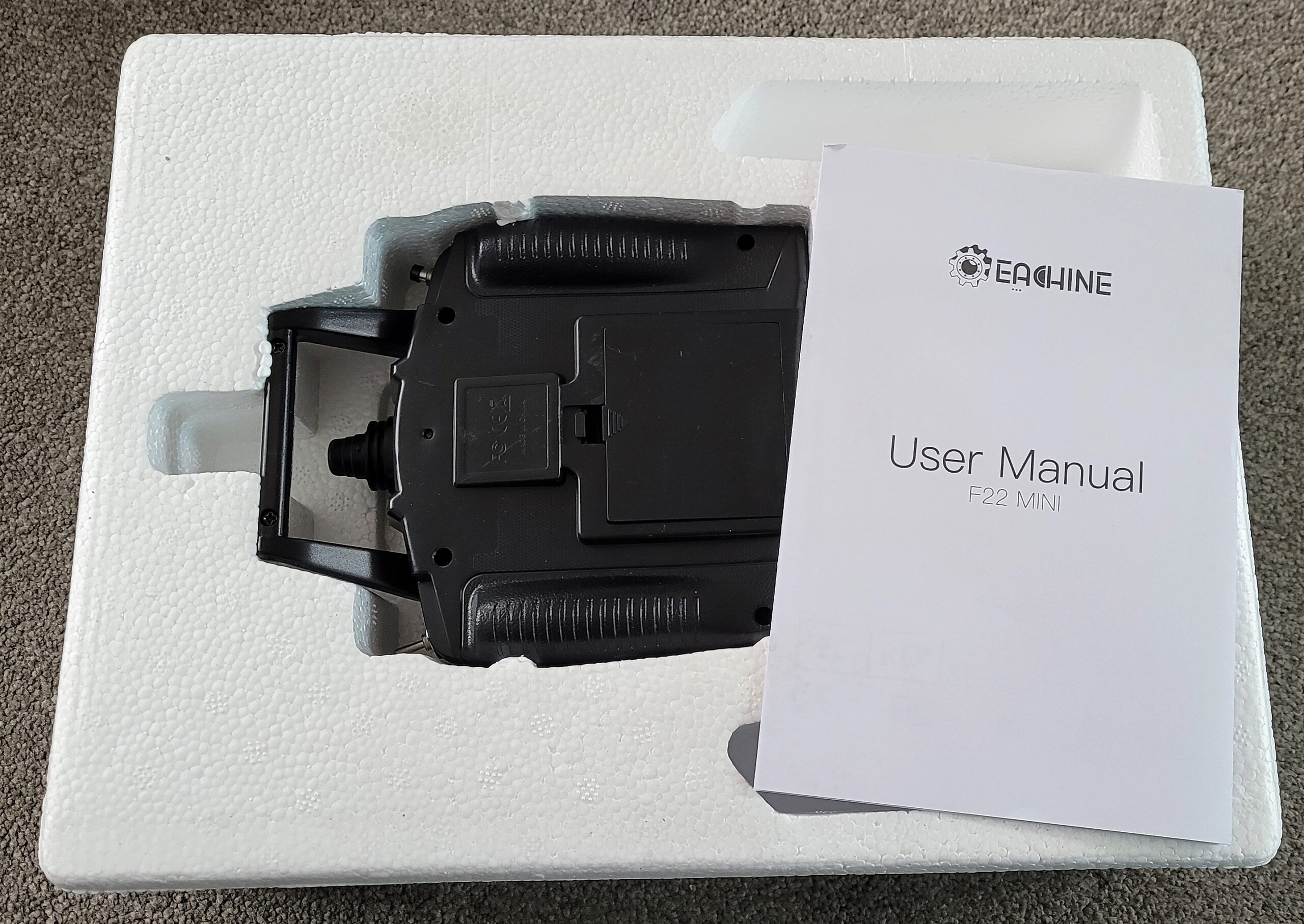 With a wingspan of just 260mm the Raptor really is tiny but it’s fitted with a receiver, two servos, an esc, a six axis gyro, and a motor spinning a 63mm pusher propeller.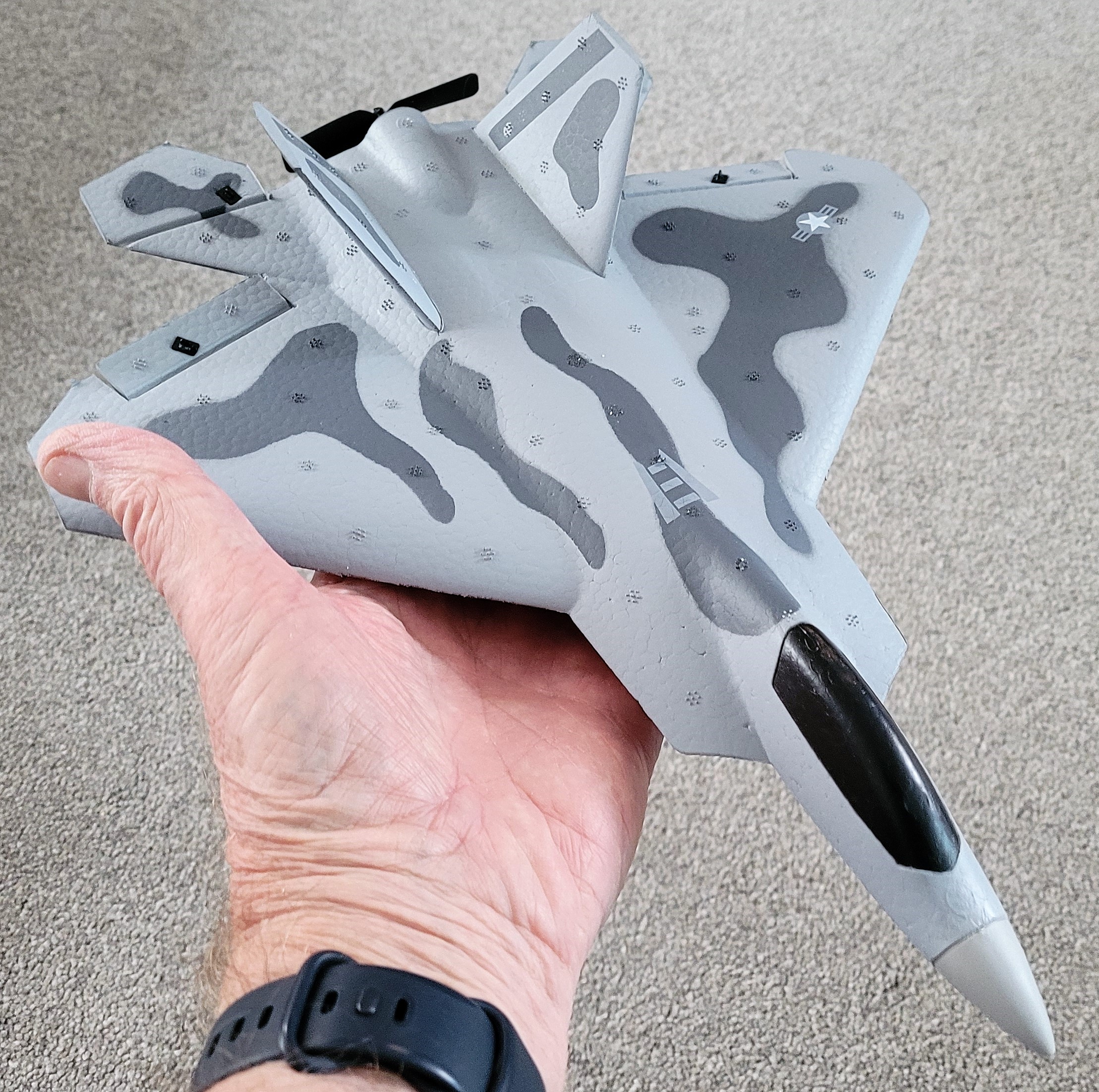
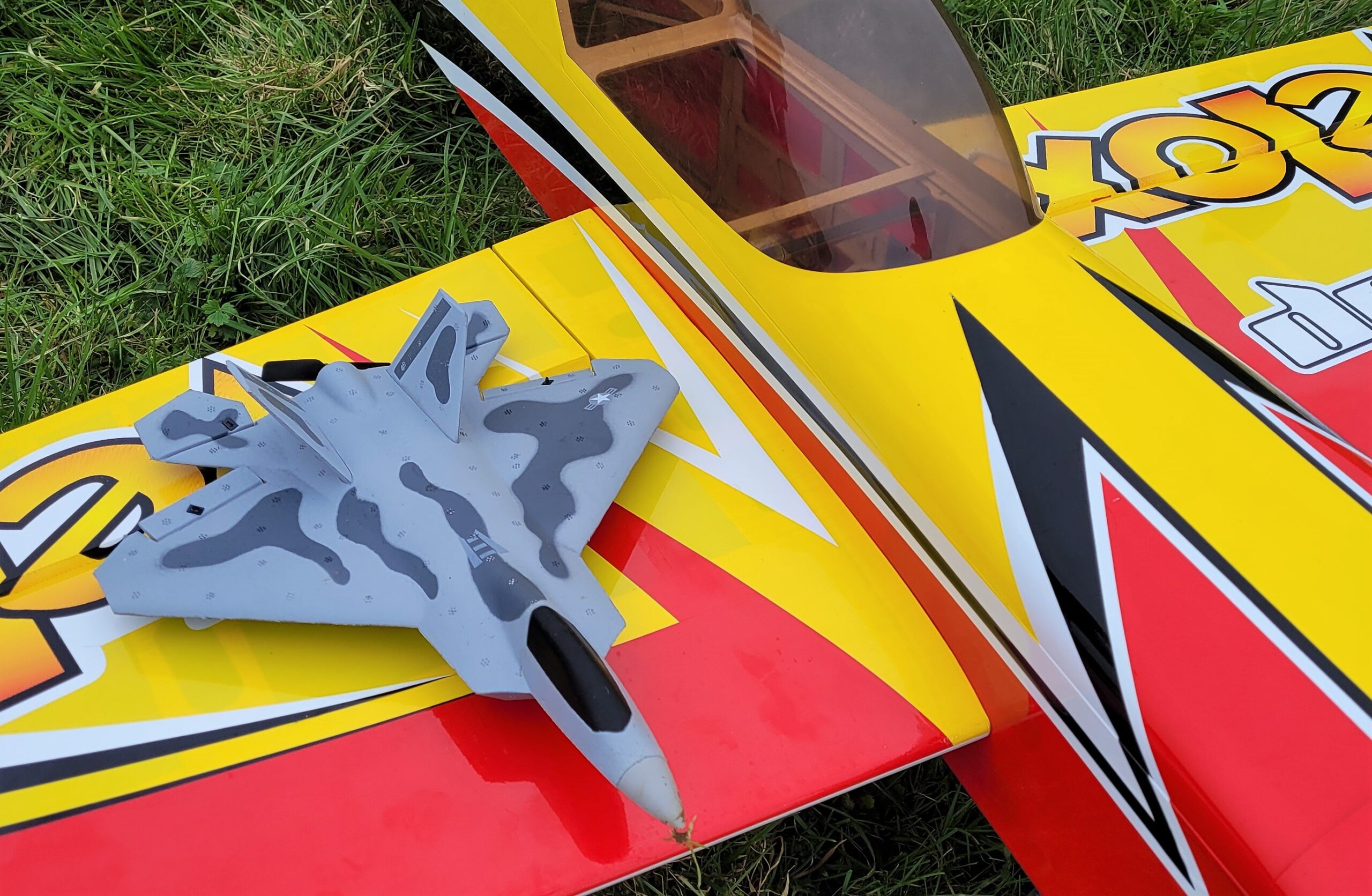 It comes with the same transmitter as the others in the range and has three settings for the gyro and a button for an automatic roll or loop that works even when it’s in Beginner mode. Flying the Raptor is ‘interesting’! Unlike the Mustang which with no stick input will simply fly straight and level I think the Raptor would crash if left alone for more than a few seconds. The gyro seems to act in a slightly different way and the elevator is very sensitive resulting in an undulating flight which can be seen in this month’s video.
 Obviously these tiny models disappear into the distance very quickly and being fast, grey, and a slightly unusual shape makes the Raptor a bit tricky but overall it’s a lot of fun to fly. For Christmas Ian Daniels treated himself to another in the range, the Eachine Spitfire, but as he is unwell at the moment he hasn’t been able to fly it yet. We wish you all the best Ian and look forward to seeing you back at the patch and flying the Spitfire before too long.
Having mashed the nose of his Sukhoi a few too many times Woody grafted on the nose from his defunct Mig and now calls it his Smig!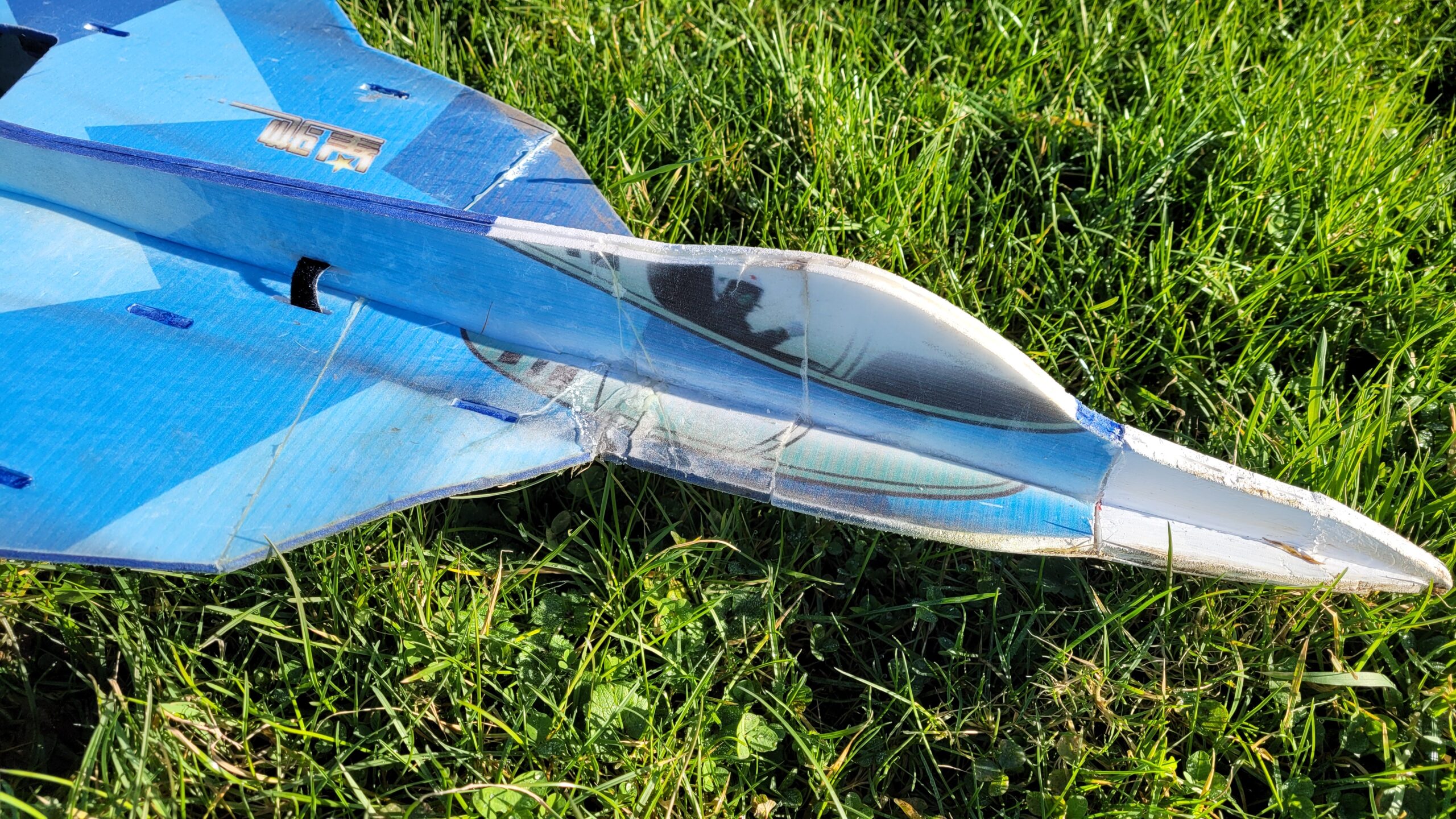
Not many new models appeared in January but Gordon Bennett came along with a rather nice Ripmax Mini Bolero that he’d put together. Things turned into a bit of a tale which I’ll let Gordon tell: Why a Mini Bolero you ask? Well, OK you didn’t but Colin Cowplain did, so now you’ve all got to suffer my reply. He said you’d like to know about the ‘power train’ but I’m not sure I know what that is, so I’ll write something else instead.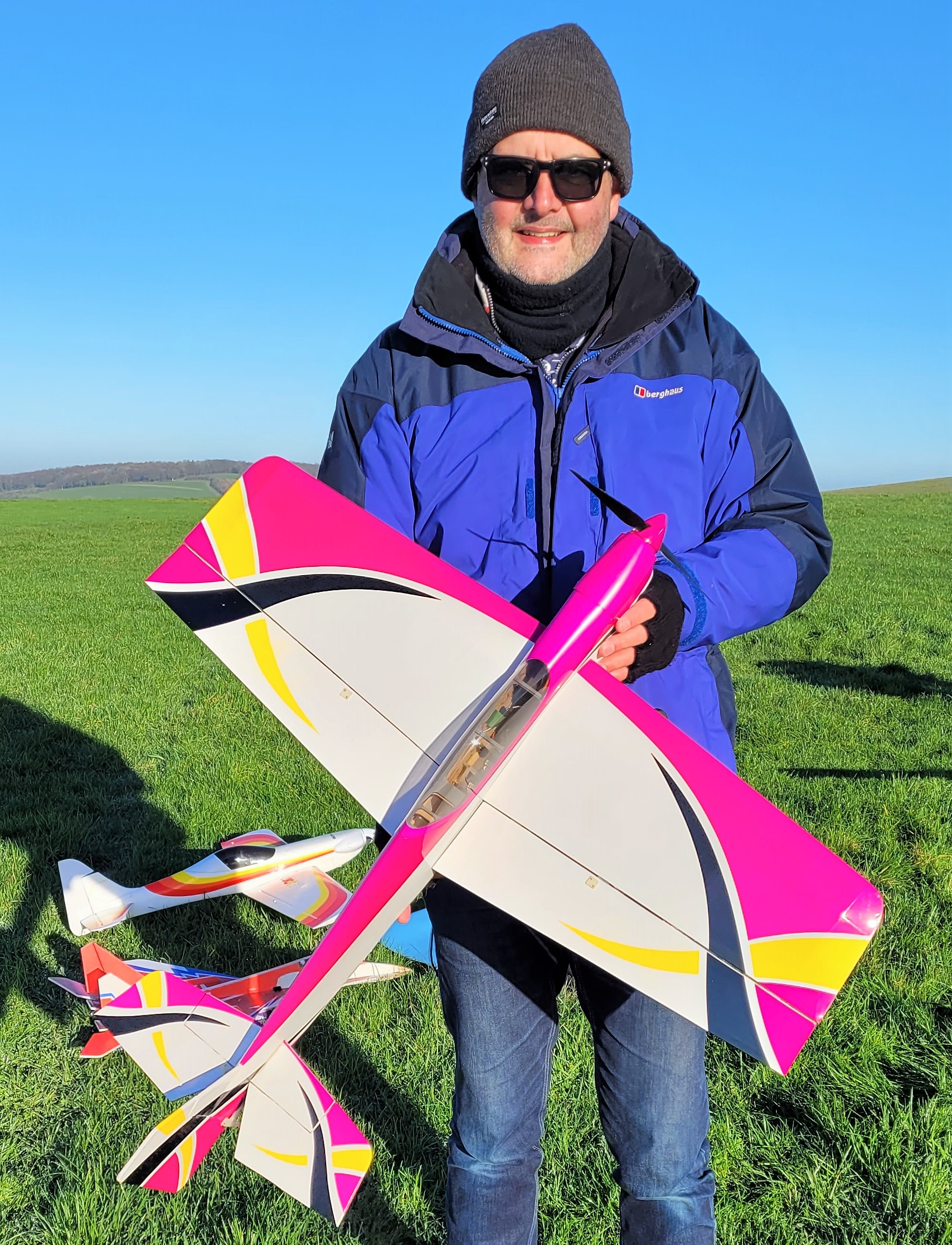
I’ve always been a massive aircraft fan but haven’t had anything to do with models since I was a kid. Actually, that’s not quite true, I did dabble with a Concept 30 Helicopter 20 years ago but never got to a very good standard. I could hover and fly a basic circuit but anything ‘nose in’ tended to rapidly turn to ‘crash-in’. After a while the gloss wore off.
Undaunted, around 10 years ago, I bought a Kiel Kraft Stearman kit (modern technology, rubber power). I had aspirations of being a builder. I’ve cracked on with it during the dark nights and I’m pleased to tell you I’ve nearly finished the fuselage. It’s not covered or anything, I don’t want to rush it, and quite a few of the longerons need repair after I accidently sat on it, but one day it will be gracing the skies and you can marvel at the ‘build quality’.
Along came Covid. Keen to get out of doors and DO something I bought a Mini Sport Cub S. This was tossed around like a leaf in anything but a dead calm and had virtually zero battery life. Pretty annoyed with the advice a certain model shop have given me I called in to give them a piece of my mind and exact some restorative justice. Well, it couldn’t have gone any better and they sold me a Valiant while not resolving any of the issues with the Cub.
The Valiant did turn out to be a pretty good trainer. I flew it in my local park but wanted to do more which is where PAM came in. (I have to be careful here as Pam is my wife’s name and I don’t want to stray into touch and go stories of the marital kind.) Here was a group of like-minded people I could learn from. Eh – hem. As you all had at least 15 aircraft each I decided I needed something more sporty and upgraded to my Acrowot.
The Acrowot turned out to be a much more interesting platform and I still love to fly it. I’m normally trying to imitate either the big graceful stuff that Chas does or some the inverted stuff Dougal Entendre does. I’ve managed to combine the two and fly jerky routines, inverted momentarily.
But still I wanted more. Enter the Mini Bolero. This would allow me to (and I quote) ‘excel in 3D flight and fast agile manoeuvres’, also you can dial down the throws making it ‘docile enough to learn aeros’. So with hazy balletic images of Torville and Dean (or was it that great scene with Dudley Moore in 10) I bought the ARTF kit.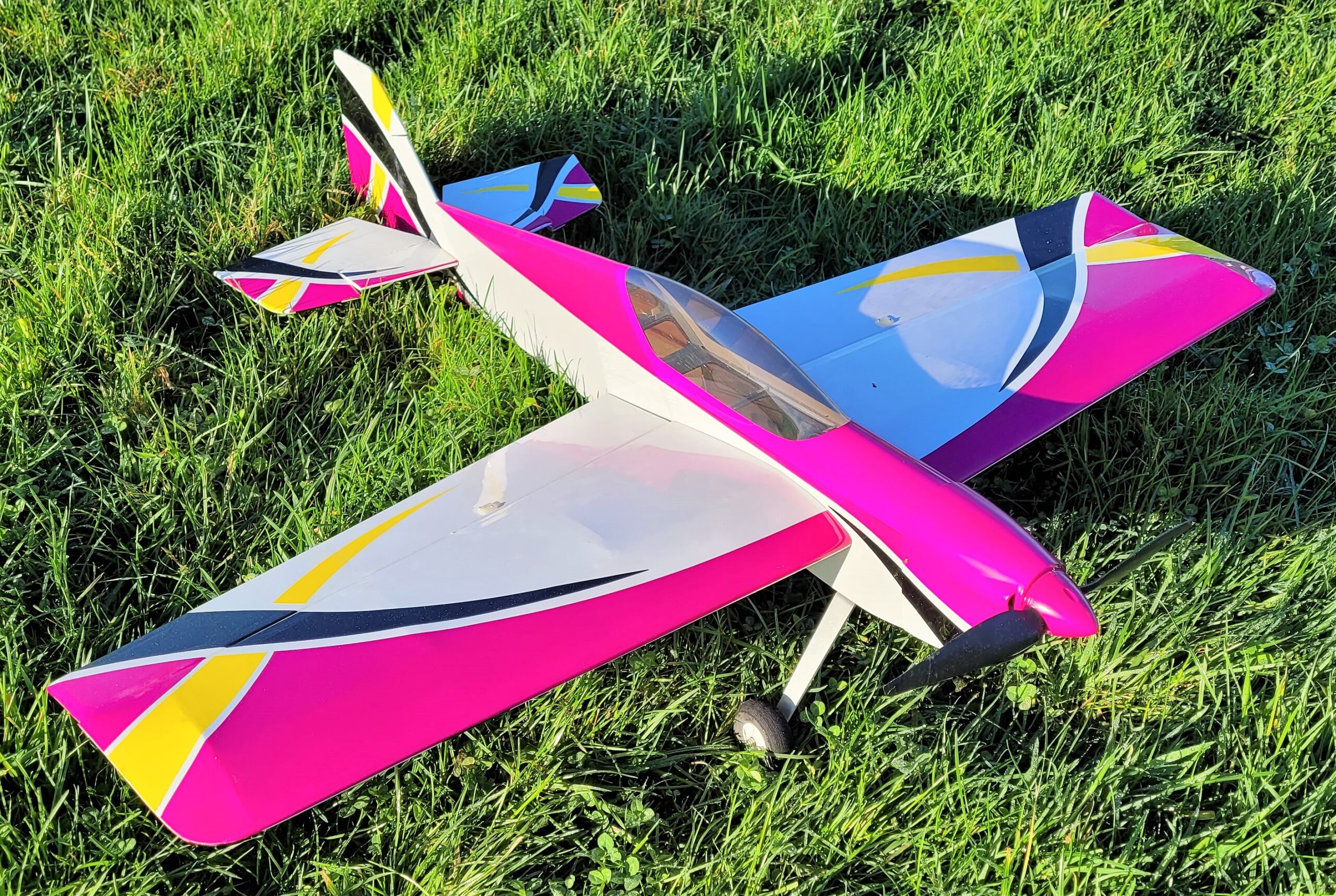 Ripmax make the kit (not everyone knows that Ripmax is derived from our hobbies ability to rip through your available cash at maximum speed) and it’s a really pretty model. Thoughtfully they’ve made the cut-outs slightly too small for the servos so you get the chance to stab yourself with the modelling knife while you enlarge them. Fitting the control surface hinges involve gluing yourself to the model with low viscosity cyano but thankfully A&E is getting really quite good at ungluing people from things like roads since the protests.
On the upside, if the authorities ever need a full set of my fingerprints they’ll be able to find my actual skin, let alone the prints, on my model.
Maiden day. The ESC went straight into LVC surging as someone had programmed it incorrectly. The first few minutes were erratic to say the least but as things improved, I was smitten. I’m not experienced enough to tell you what’s good about it or why I like it but it just ‘feels right’. Subsequent flights improved even further and I began to feel I was almost keeping up with it.
Day two, Friday gardening and flying. Things went well on all flights. Confidence grew and with the sun setting and love hearts in my eyes I tried an inverted circuit. All was well until the turn onto base leg which was sloppy and losing height. At which point I lost her into the sun. Last seen silhouetted near the hedge pointing vertically down around 3’ of altitude.
Ripmax make the kit (not everyone knows that Ripmax is derived from our hobbies ability to rip through your available cash at maximum speed) and it’s a really pretty model. Thoughtfully they’ve made the cut-outs slightly too small for the servos so you get the chance to stab yourself with the modelling knife while you enlarge them. Fitting the control surface hinges involve gluing yourself to the model with low viscosity cyano but thankfully A&E is getting really quite good at ungluing people from things like roads since the protests.
On the upside, if the authorities ever need a full set of my fingerprints they’ll be able to find my actual skin, let alone the prints, on my model.
Maiden day. The ESC went straight into LVC surging as someone had programmed it incorrectly. The first few minutes were erratic to say the least but as things improved, I was smitten. I’m not experienced enough to tell you what’s good about it or why I like it but it just ‘feels right’. Subsequent flights improved even further and I began to feel I was almost keeping up with it.
Day two, Friday gardening and flying. Things went well on all flights. Confidence grew and with the sun setting and love hearts in my eyes I tried an inverted circuit. All was well until the turn onto base leg which was sloppy and losing height. At which point I lost her into the sun. Last seen silhouetted near the hedge pointing vertically down around 3’ of altitude.
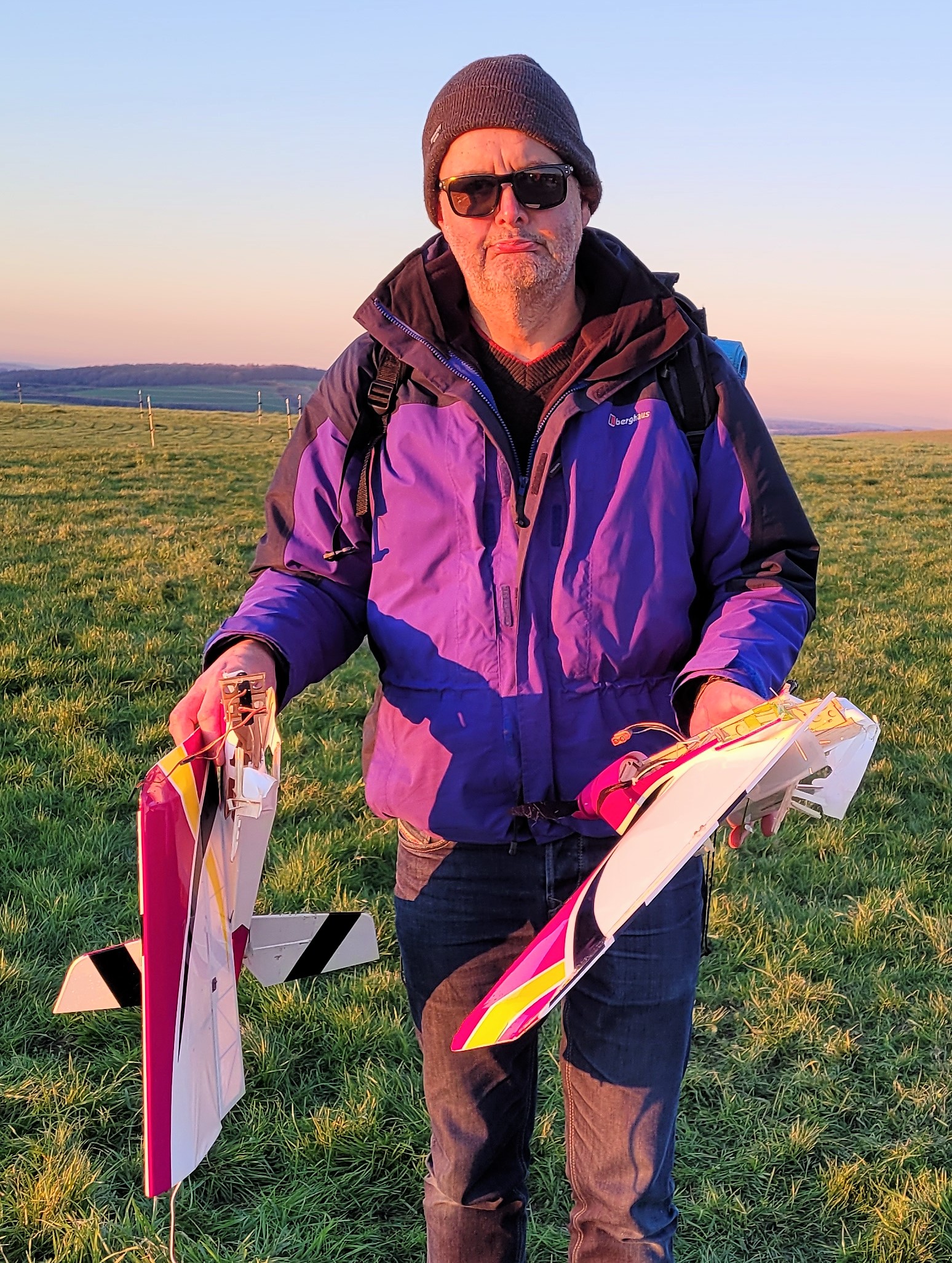 The wreckage indicated she’d gone in on the nose and right wing. Fuselage reduced to Swan Vestas and the wings main spar now repositioned as the trailing edge. The bell at Lloyd’s was rung and a crow cawed above the patch.
Still, plenty more Boleros in the sea so I’ve bought another one. The second build is going much better than the first and if things continue like this, after my next few Boleros, Mr Ripmax will probably want to engage my building services.
The wreckage indicated she’d gone in on the nose and right wing. Fuselage reduced to Swan Vestas and the wings main spar now repositioned as the trailing edge. The bell at Lloyd’s was rung and a crow cawed above the patch.
Still, plenty more Boleros in the sea so I’ve bought another one. The second build is going much better than the first and if things continue like this, after my next few Boleros, Mr Ripmax will probably want to engage my building services.
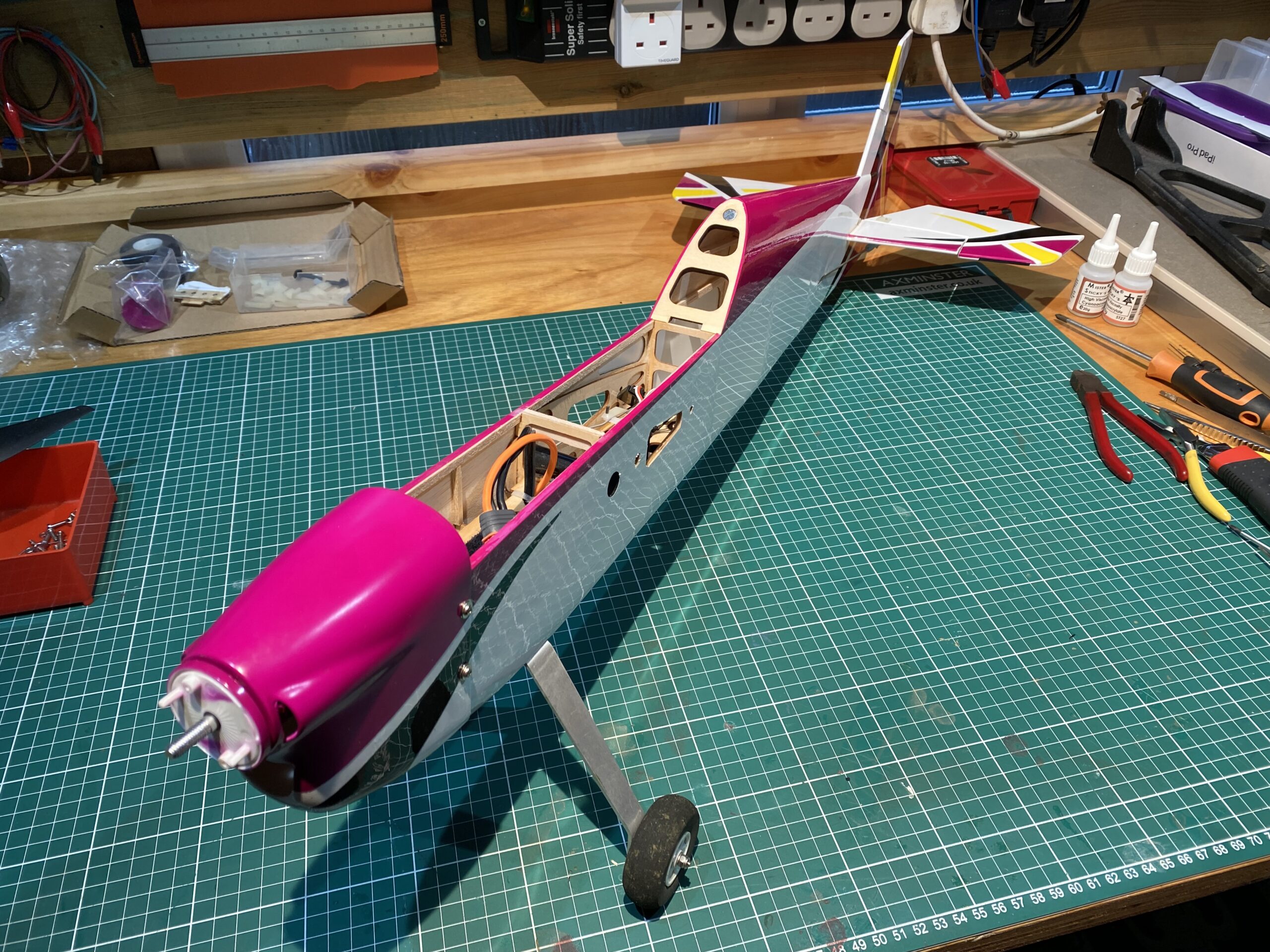 I have to modify the battery compartment to get the c of g right but other than that she’s nearly finished so Bolero II, The Sequel, will be on the patch soon.
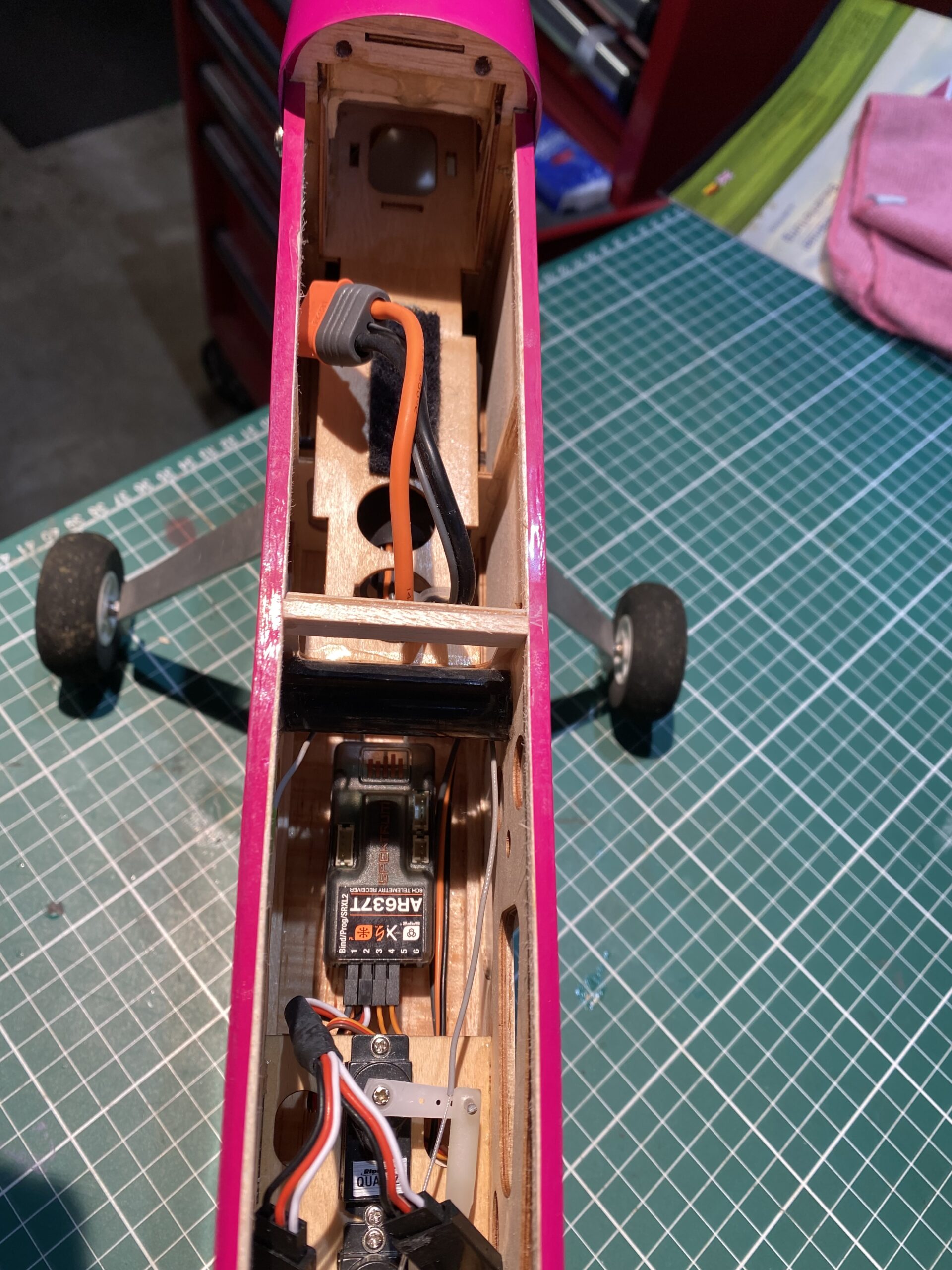 Oh yes, Colin. It’s got a 2217-1100Kv spinning thing with a 10×5 flymo part on the front. 30A esc and the superior ‘best money can buy’ Spektrum tx/rx. You’re only jealous. Thanks Gordon, that’s excellent, apart from the rubbish bit about Spektrum!
Dougal and I have been flying our FPV models for a while now and overall seem to manage well with just the occasional problem to upset things. In January Dougal took off with his Sonic-Modell Binary twin motored plane only to have both motors stop when he was less than a couple of hundred feet high. Had he been flying normal ‘line of sight’ he might have been able to crank it round back to the patch but flying FPV the only option was to use the full-size mantra ‘If the motor(s) cut on take-off never attempt to turn back to the runway’. So he glided straight ahead, cleared the lower track, and landed safely in the lower field. The most dangerous part was retrieval when the bullocks seemed unusually aggressive at the model’s intrusion. Maybe they knew it should have been in our field not theirs!
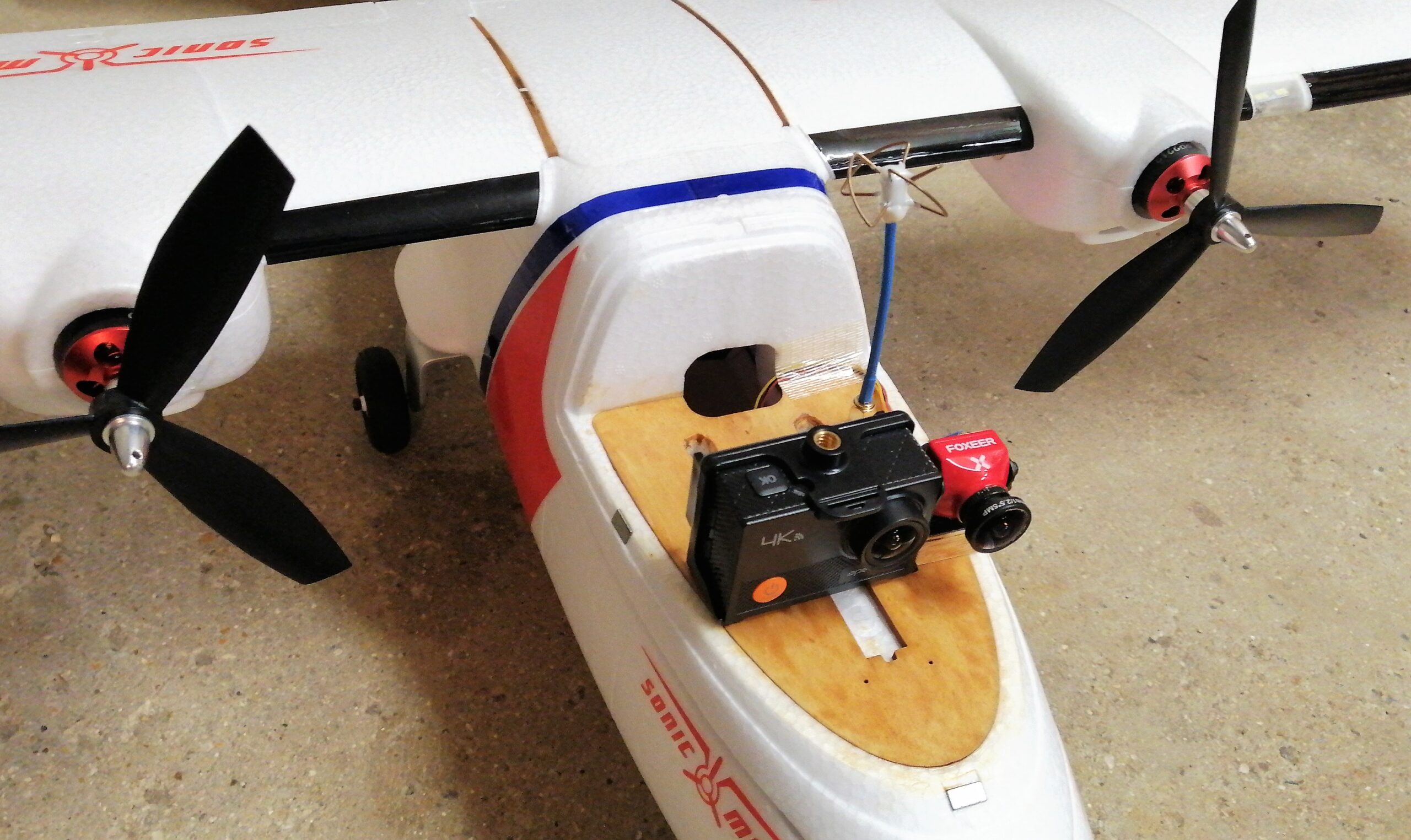 During the subsequent investigation Dougal found the digital video camera was running (but not recording) and wouldn’t turn off, and that the navigation lights weren’t working correctly. The camera was quickly sorted by removing and replacing the battery and the problem with the lights turned out to be a loose connection between the light control unit and the receiver. Dougal thinks the loose connection must have caused an electronic spike that upset the camera and shut down the speed controller. Fortunately the FPV camera kept running so he still had the picture on the goggles. The short flight was recorded by the DVR in Dougal’s goggles and you can see exactly what Dougal saw in this month’s video.
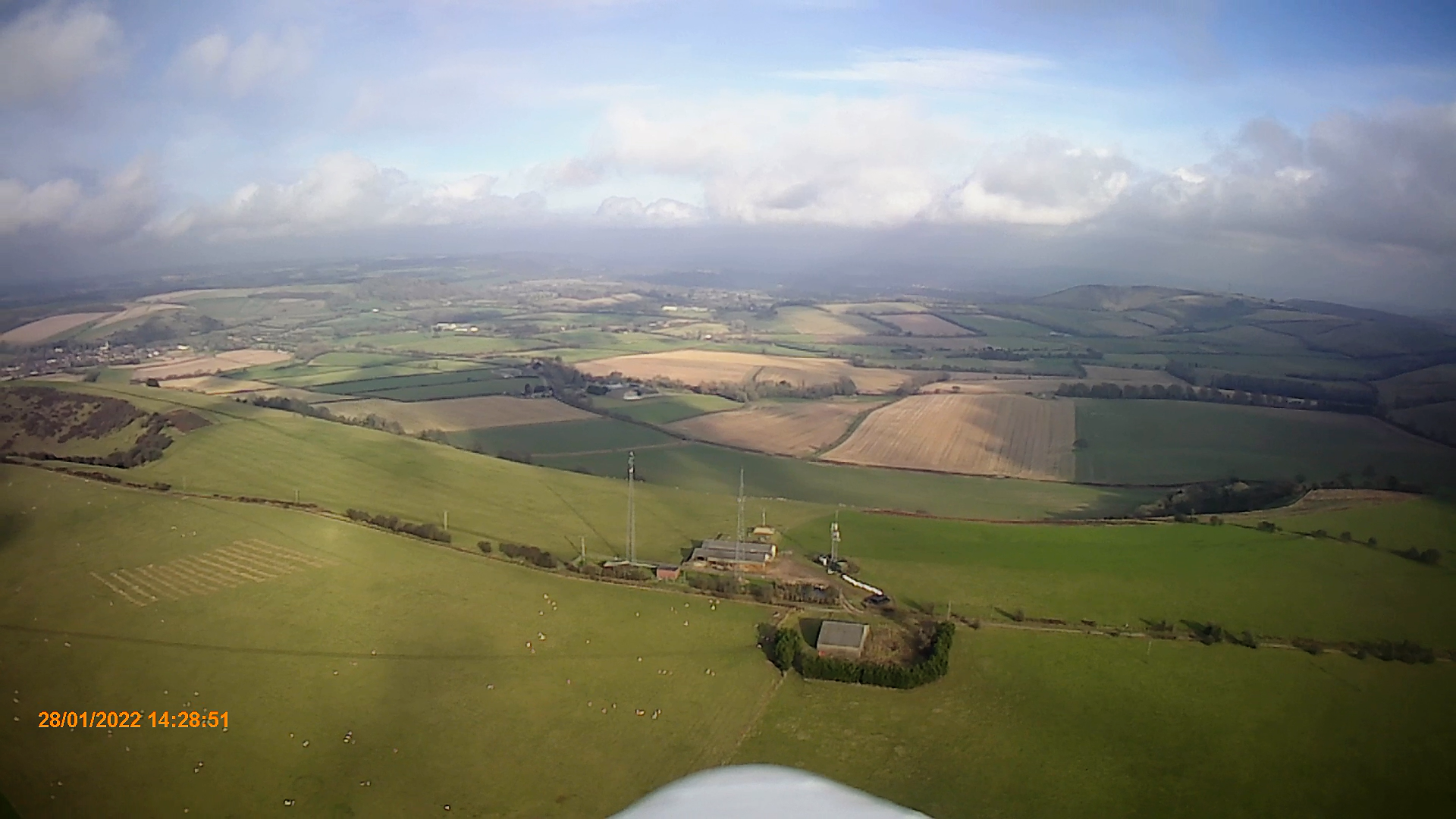 I flew my Ranger at fairly high altitude as far as I dared towards the masts until my spotter said I was just about at the limit of his vision. By then I was getting some break-up on my goggles so it was definitely time to turn round and head back to the safety of our field.
Towards the end of last year Geoff Hill came along to see us about joining the club and I’m pleased to say that he is now a member. Geoff has lots of full-size experience but is new to radio controlled models. He has a Bixler with a buddy box set-up, perfect for learning.
I flew my Ranger at fairly high altitude as far as I dared towards the masts until my spotter said I was just about at the limit of his vision. By then I was getting some break-up on my goggles so it was definitely time to turn round and head back to the safety of our field.
Towards the end of last year Geoff Hill came along to see us about joining the club and I’m pleased to say that he is now a member. Geoff has lots of full-size experience but is new to radio controlled models. He has a Bixler with a buddy box set-up, perfect for learning.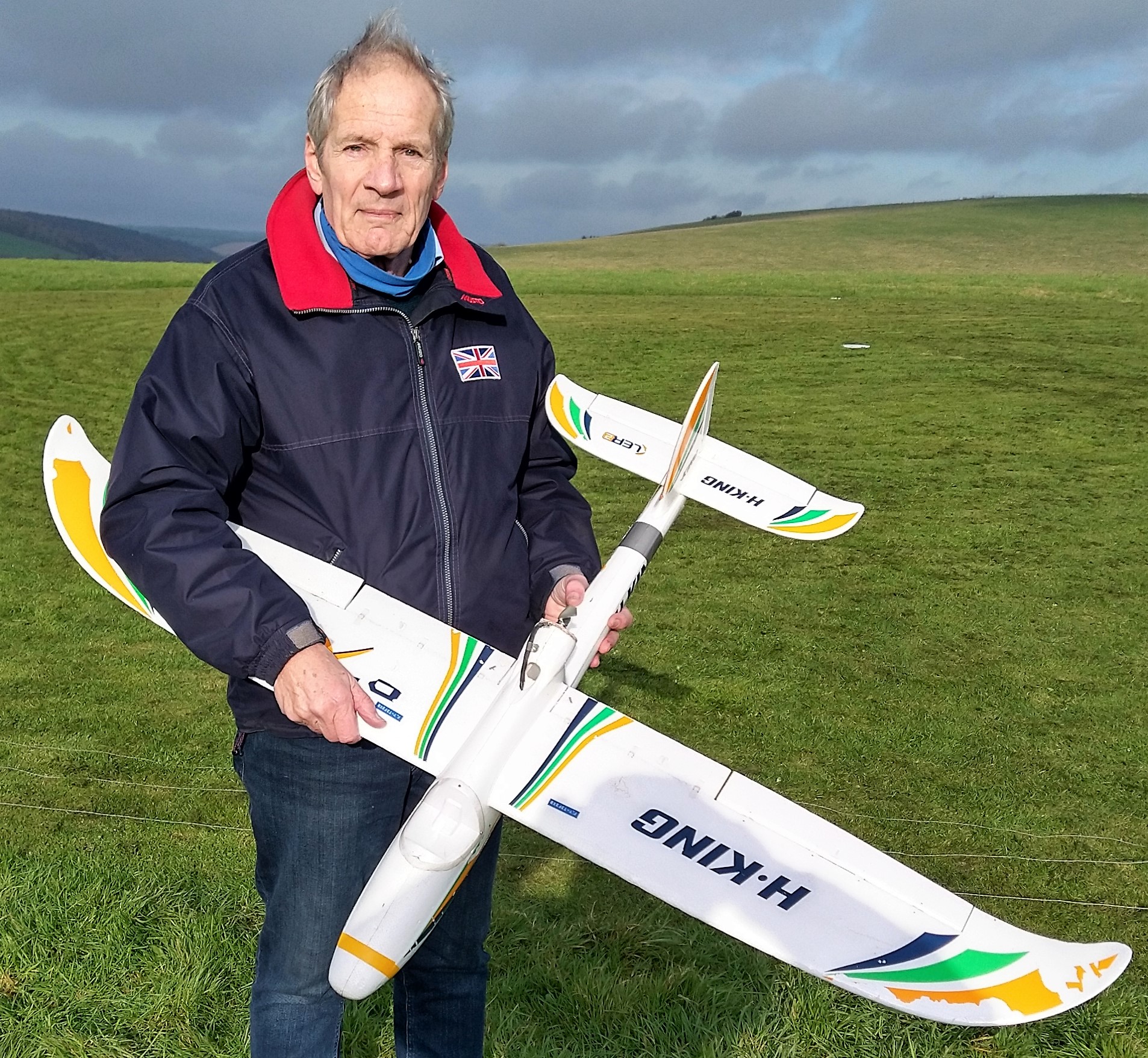
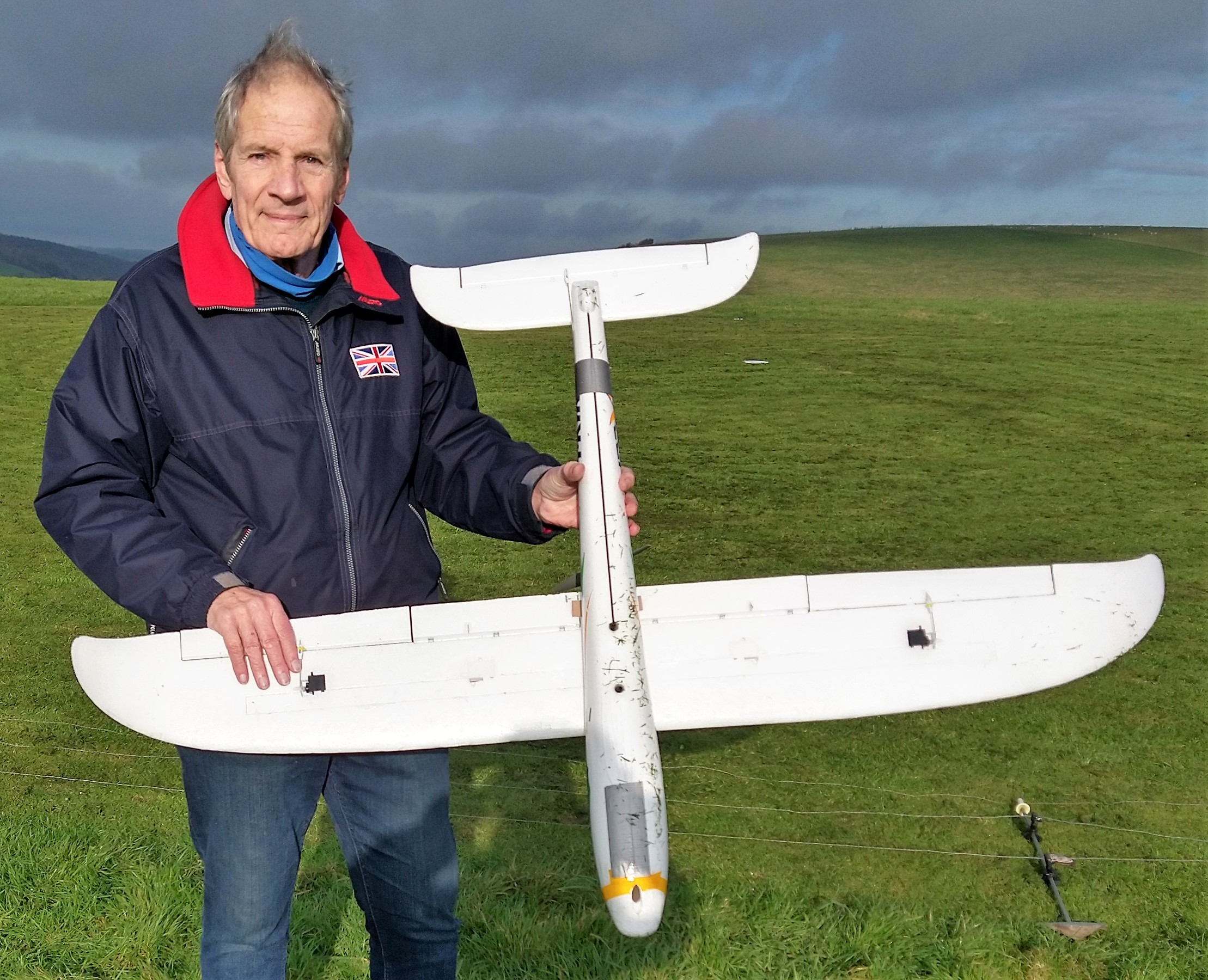 So far Geoff has mostly been looked after by Dougal but is coming along well despite that!
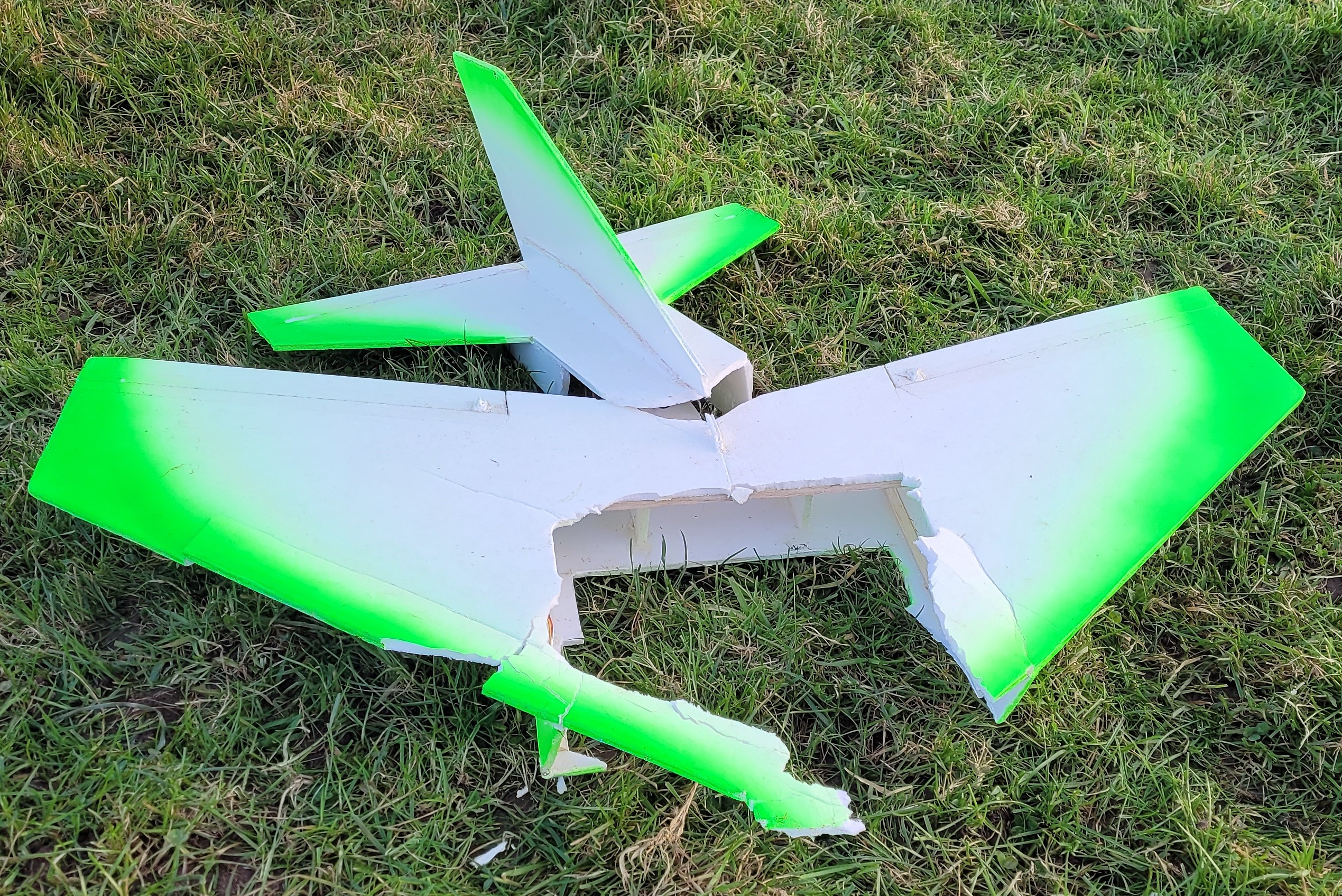
 I’m not sure what happened but 1066 says it wasn’t him! No worries, it’ll soon buff out!
Back to Gordon now for tales of a Spitfire. Have I ever mentioned that I’ve had a flight in one? Oh alright, I’ll shut up… over to Gordon: Spitfire Scramble: I was gifted a Spitfire a while back. It’s a vintage Parkzone complete with the latest 27 MHz radio system. It’s not in a bad state for its age but the nickel battery showed no sign of life with no free electrons willing to jump around. I think I’m right in saying an atom without an electron is an ion, yes I’m positive. Ho ho. Some of these jokes are like meeting an old friend.
The airframe is made from a foam that resembles the interior of a Crunchie bar, covered in a type of cling film with a motif similar to Captain Slow’s trousers. The cling has started to delaminate so it was out with the cyano again.
Anyway, I stuffed a Lipo in it, did some rudimentary checks and bought it up to the field last week. Running up the engine on my final pre-flight test something big fell off and the level of vibration made two of my fillings fall out. Various senior members gave helpful advice without me even asking for it and the Spitfire was returned to the hanger.
Receiver and ESC combo were stripped out and replaced by more modern equipment (I’m now able to use it with the previously mentioned superior Spektrum Tx). A shiny new GF prop replaced the old nylon one that Dougal had laughed at and the big thing that fell off was thrown in the bin.
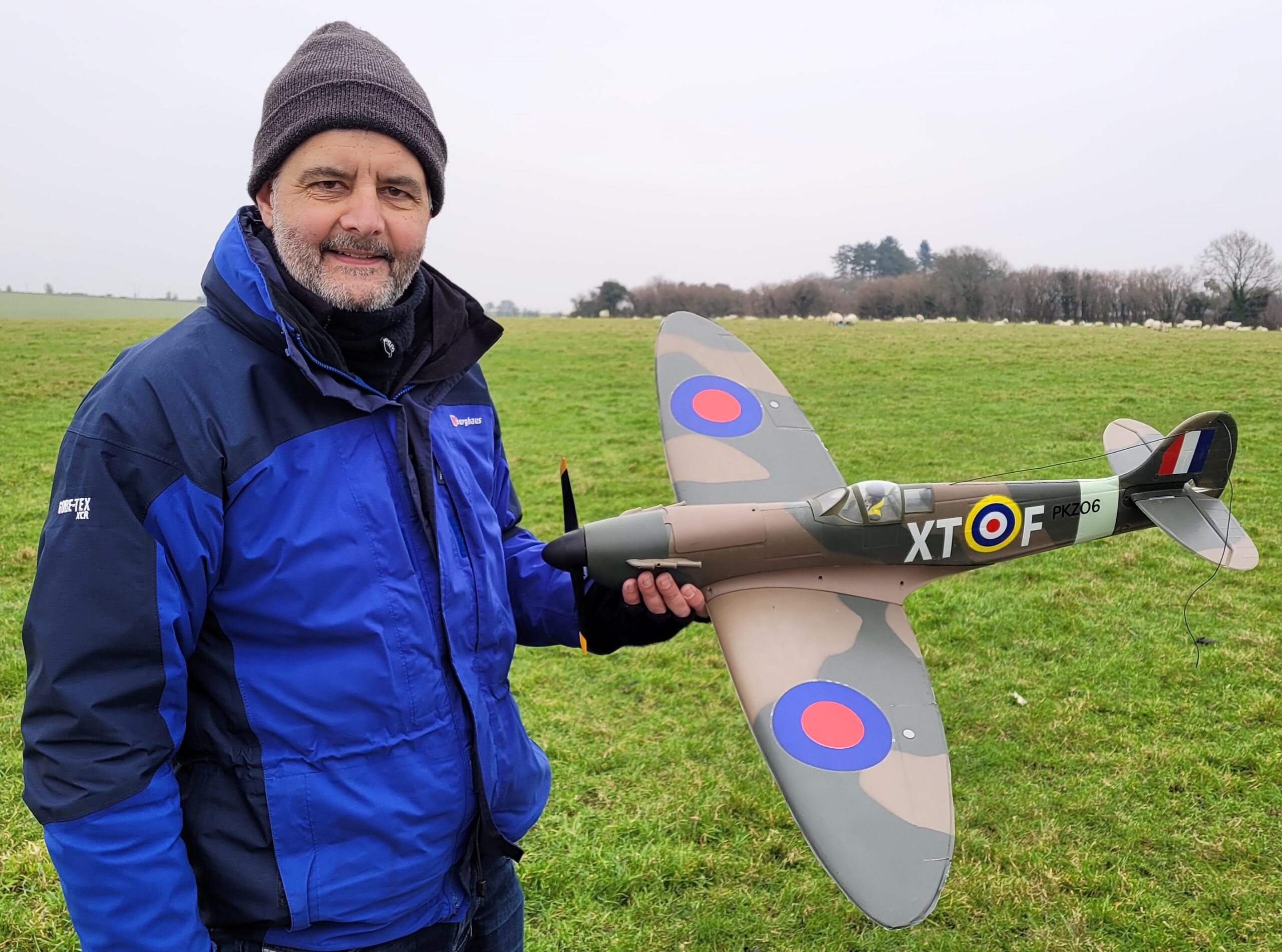 Take two. Things looked a lot better so Colin Cowplain kindly launched it skyward even though there were general crowd murmurings about a perceived shortage of take-off ummph. Despite the C of G and control surfaces having been carefully set by the pre-flight engineers using laser levelling and a theodolite, it was hopelessly out of trim and required plenty of ‘nose down’.
With the first circuit just about completed things seemed to be settling down and the test flight continued. Downwind, two things happened. Firstly, I started to lose sight of it against the murky background and secondly, the engine stopped.
Even though I’m a newly certified ‘A’ (where dead stick landings had to be demonstrated) I immediately froze while the model bucked and stalled. In the spirit of ‘aviate, navigate, communicate’ Colin shouted ‘Keep the speed up’ which turned out to be good advice. People often proffer handy hints and compliments while I’m flying. Only last week Dougal bounded over yelling ‘What the hell are you doing?’ as my Acrowot disappeared over the horizon in the direction of Basingstoke. It’s not my fault the earth is curved.
Luckily, control of the Spitfire was regained and I just managed to limp it back into the corner of the field where its landing was cushioned by a generously sized sheep turd. Model intact, pilot in therapy.
Post flight examination assisted by Woody showed the ‘good value’ Lemon rx I’d bought of EBay, sportingly chops the motor power at any Tx/Rx distance over 15 feet. Dwain Pipe also pointed out that the aircraft colour scheme was in fact called ‘camouflage’, which makes things have a habit of disappearing and should never be flown near Captain Slows trousers in case the two become confused with clearly dangerous repercussions. Back to the hanger for more fettling. Take three imminent.
Thanks Gordon. Since writing the above Gordon has replaced the Lemon receiver with a genuine Spektrum and has now had several successful flights with no further problems,
Take two. Things looked a lot better so Colin Cowplain kindly launched it skyward even though there were general crowd murmurings about a perceived shortage of take-off ummph. Despite the C of G and control surfaces having been carefully set by the pre-flight engineers using laser levelling and a theodolite, it was hopelessly out of trim and required plenty of ‘nose down’.
With the first circuit just about completed things seemed to be settling down and the test flight continued. Downwind, two things happened. Firstly, I started to lose sight of it against the murky background and secondly, the engine stopped.
Even though I’m a newly certified ‘A’ (where dead stick landings had to be demonstrated) I immediately froze while the model bucked and stalled. In the spirit of ‘aviate, navigate, communicate’ Colin shouted ‘Keep the speed up’ which turned out to be good advice. People often proffer handy hints and compliments while I’m flying. Only last week Dougal bounded over yelling ‘What the hell are you doing?’ as my Acrowot disappeared over the horizon in the direction of Basingstoke. It’s not my fault the earth is curved.
Luckily, control of the Spitfire was regained and I just managed to limp it back into the corner of the field where its landing was cushioned by a generously sized sheep turd. Model intact, pilot in therapy.
Post flight examination assisted by Woody showed the ‘good value’ Lemon rx I’d bought of EBay, sportingly chops the motor power at any Tx/Rx distance over 15 feet. Dwain Pipe also pointed out that the aircraft colour scheme was in fact called ‘camouflage’, which makes things have a habit of disappearing and should never be flown near Captain Slows trousers in case the two become confused with clearly dangerous repercussions. Back to the hanger for more fettling. Take three imminent.
Thanks Gordon. Since writing the above Gordon has replaced the Lemon receiver with a genuine Spektrum and has now had several successful flights with no further problems,
Dougal Entendre is well known for his low inverted passes, so we were of course very disappointed when Dougal got one wrong. None of us shrieked with laughter obviously…! He was flying his Mini Blitz and inexplicably pulled up elevator instead of pushing down. Fortunately the damage wasn’t too bad although there is certainly some work to be done.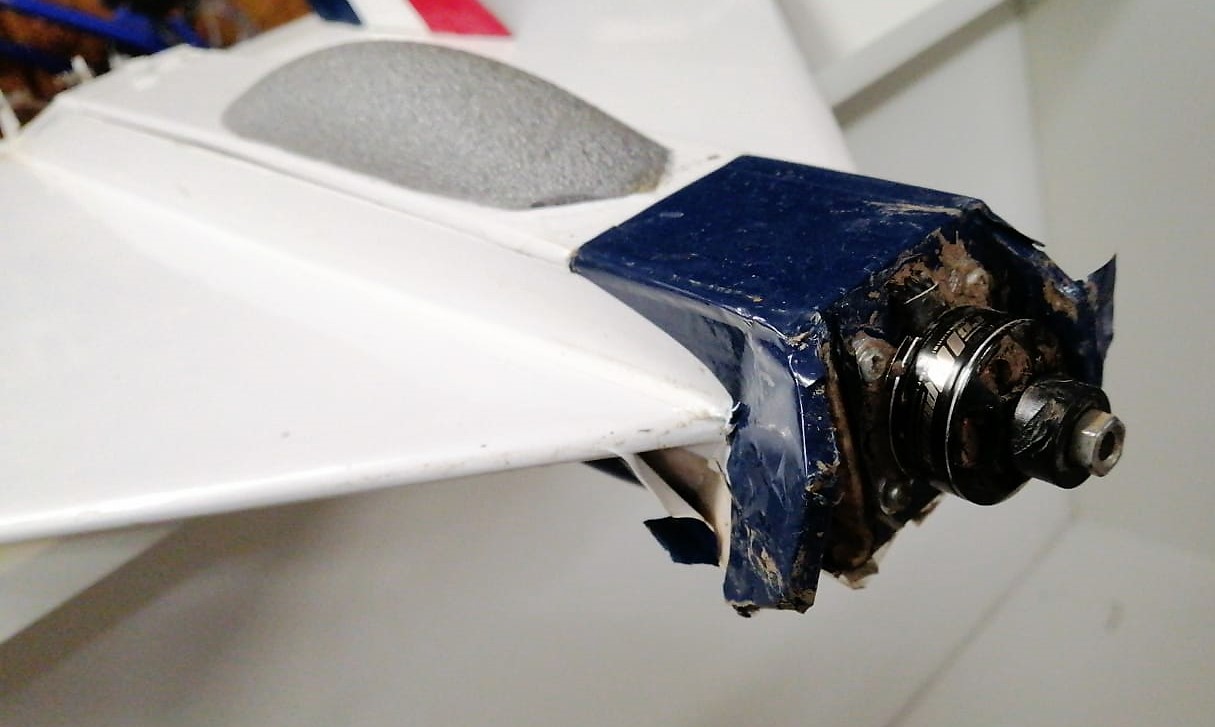
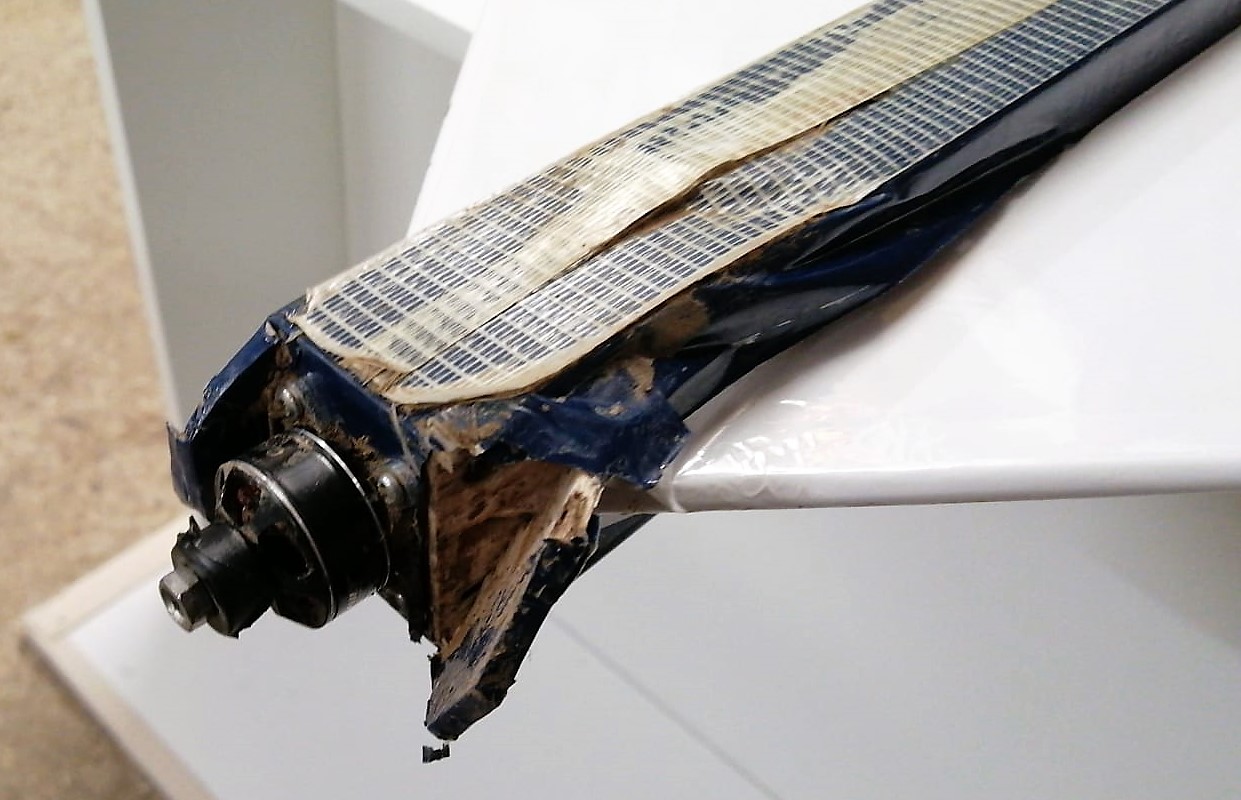 Dougal had cleaned most of the mud from the motor by the time the photos were taken.

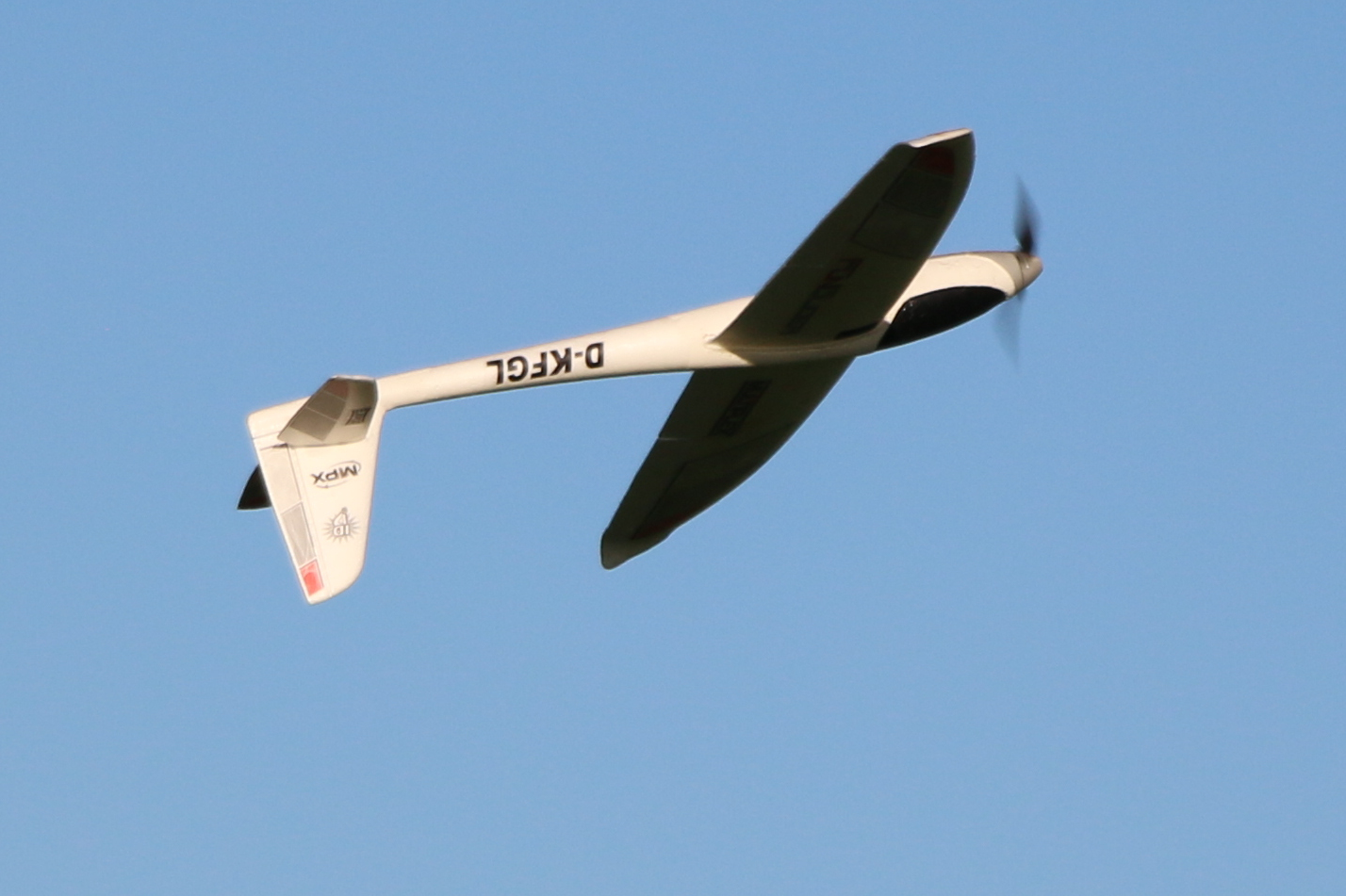
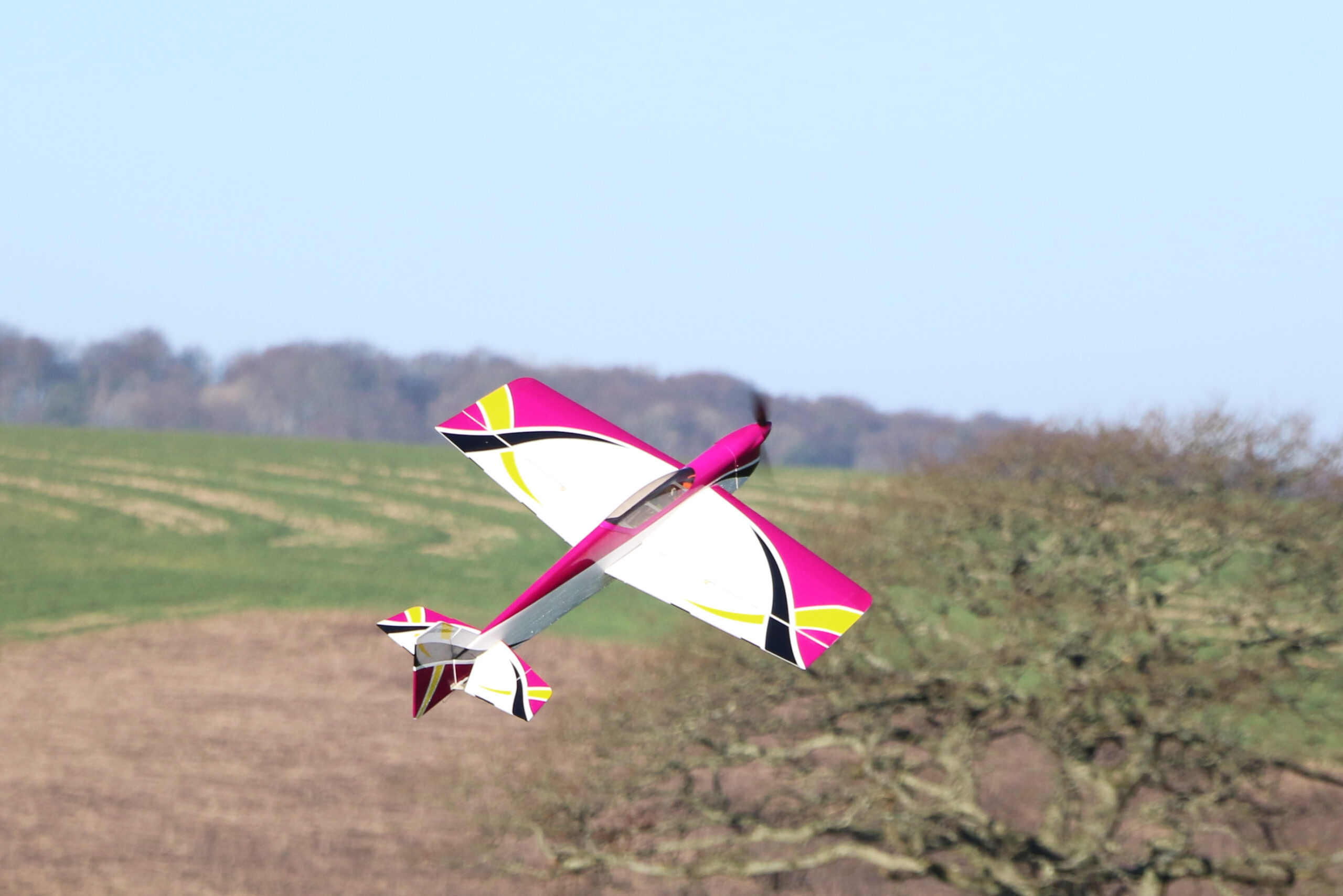
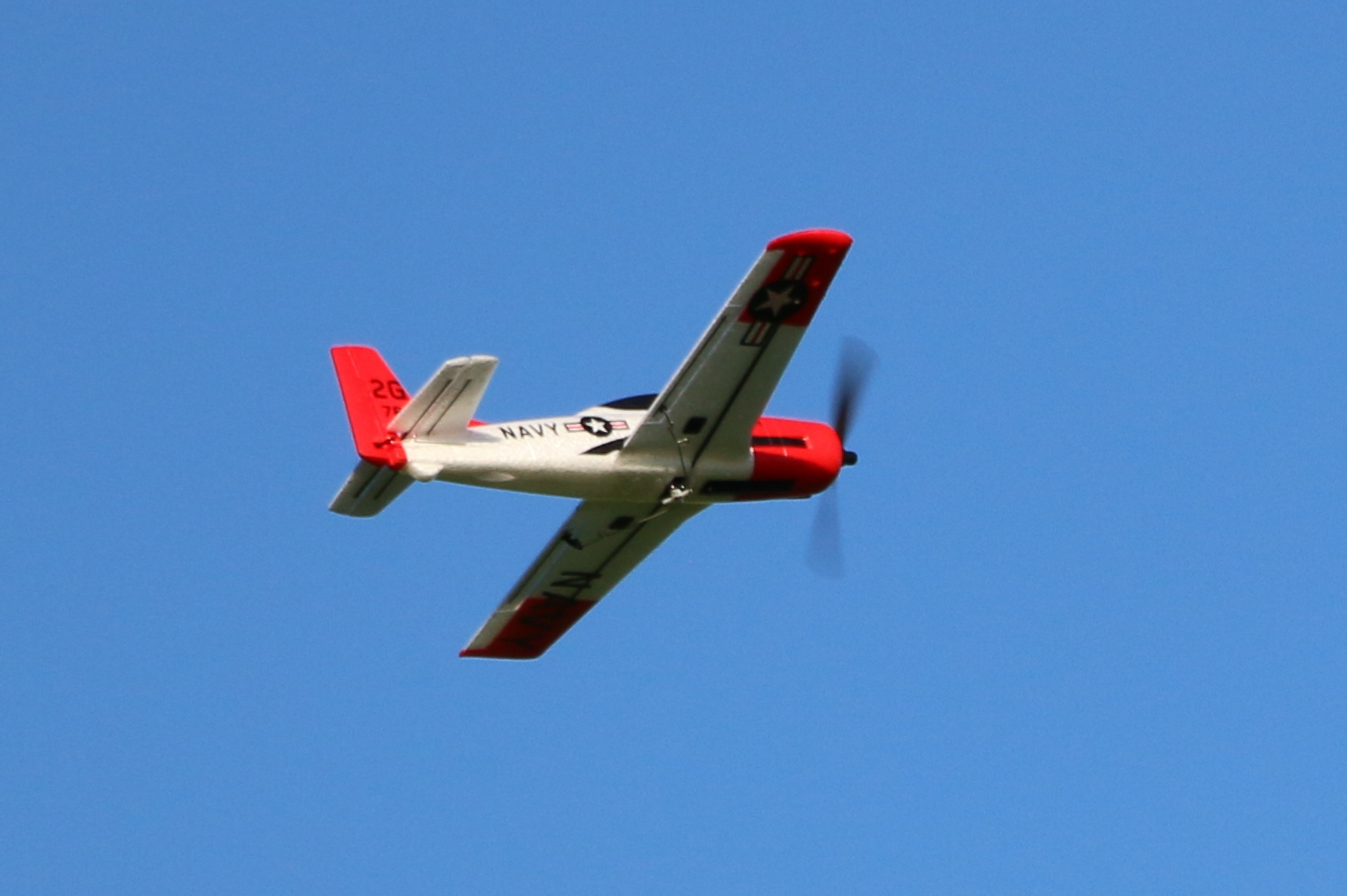
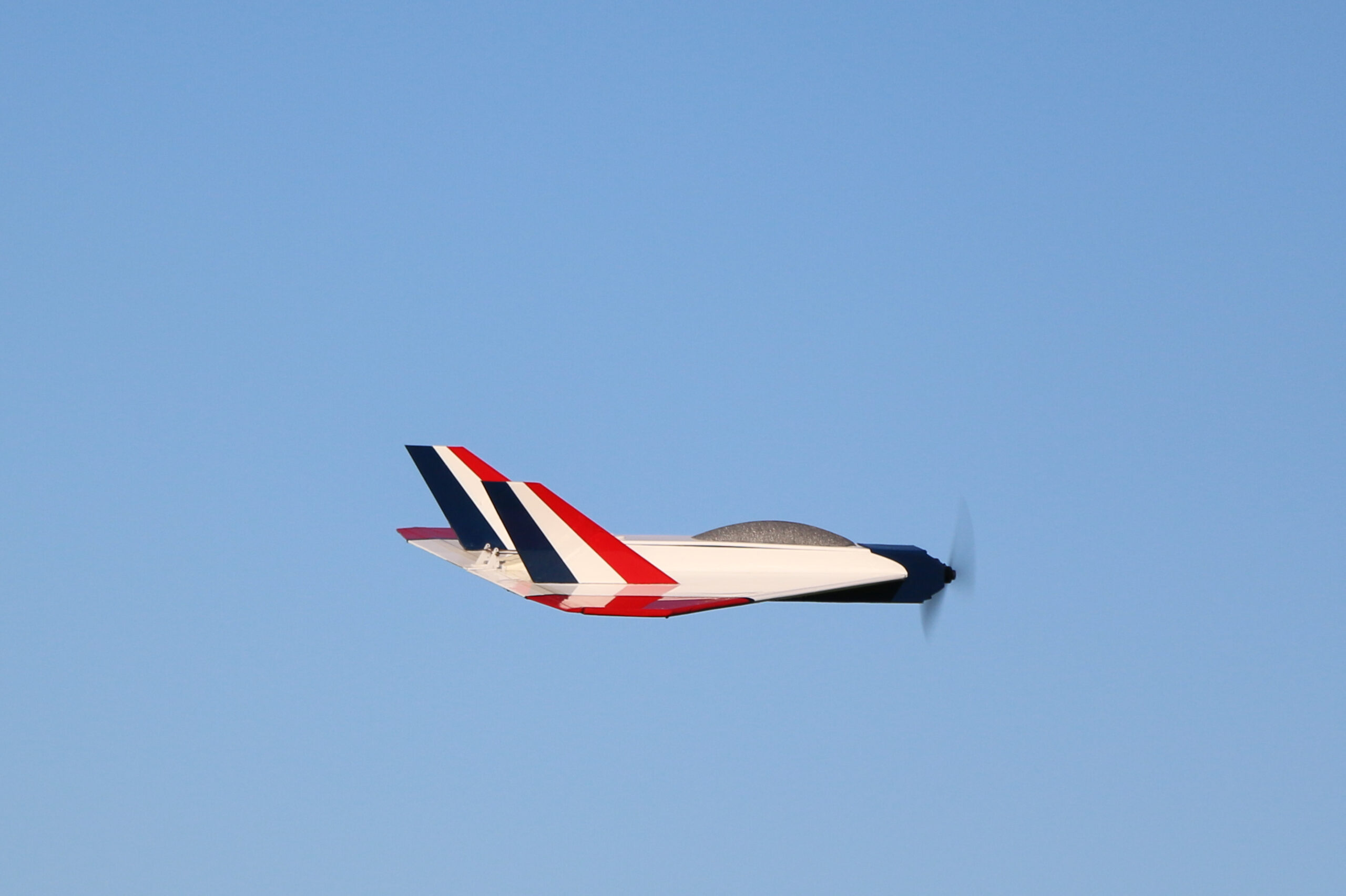
Video time now, this one with footage shot by myself, Dougal, Captain Slow, and Gordon. Please watch the video full-screen, it’s so much better with small models flying around. If the video won’t play for you please click HERE
The airline Captain introduced himself to the passengers as usual and then continued: “British Airways are proud to have some of the best Flight Attendants in the business.” “Sadly none of them are on this flight…”
Colin Cowplain
Patch News – December 2021
Happy New Year! In last year’s December Patch News I said “We’ve finally reached the end of an awful 2020, surely 2021 can only be better can’t it?” Hmm… I’m not sure I got that right but at least we were allowed to fly from the end of March onwards so fingers are firmly crossed for this year. Wishing you all good health and happy flying in 2022.
Several of us managed to fly regularly during December and Dougal Entendre and I both had lots of FPV flights. Typically, with the field being at a high altitude, there were several days when it was foggy first thing and sometimes the murk barely lifted at all. On one occasion a group of us had a few flights in reasonable conditions but as the morning progressed the fog blew up out of the valleys and enveloped us forcing us to stop flying.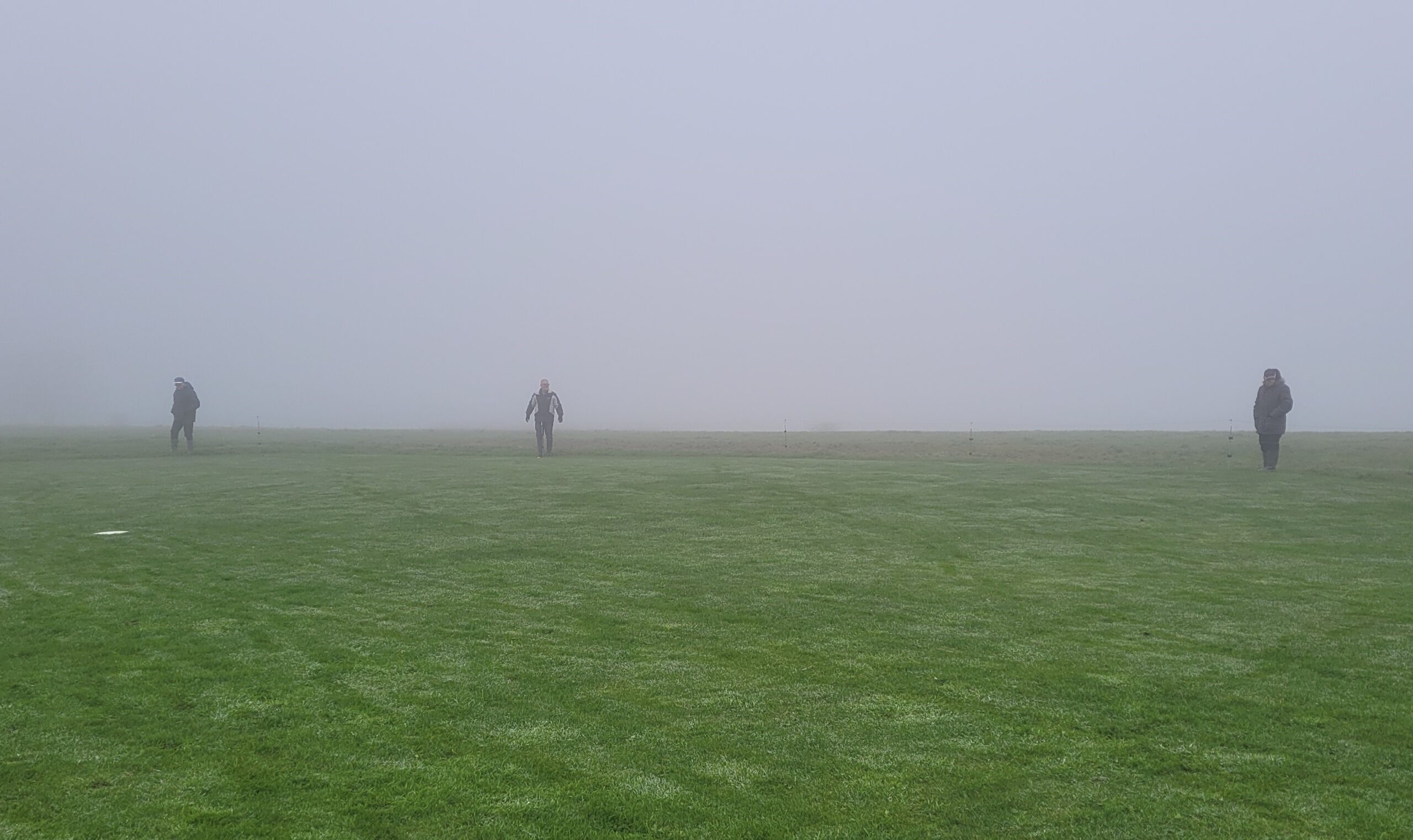
I flew FPV one morning once the mist had begun to lift and quickly discovered that damp air fogs up the camera lens. Captain Slow was spotting for me and when I said I needed to land because of the poor visibility he said it wasn’t a problem as he could still see the model quite clearly. But the view on my goggles could best be described as suboptimal!
I was able to land safely and made the decision to not fly FPV again that morning!
So what did Santa bring you all for Christmas, any exciting new models/motors/radio gear/accessories? I didn’t get any of those but was very pleased to receive three vintage model books, Aero Modeller Annual 1957-8, and Radio Control Manuals 2 & 3 (1967 & 9).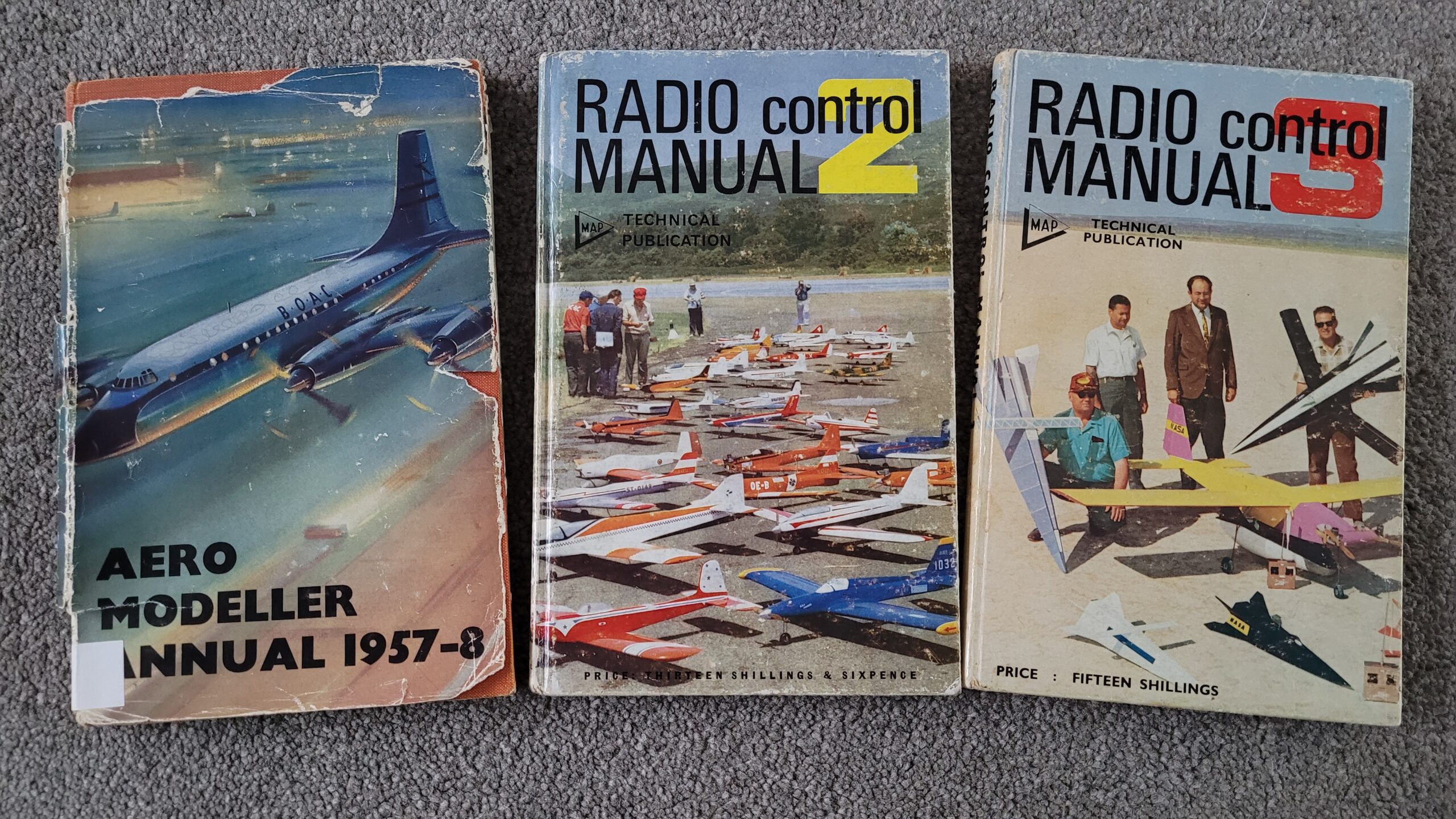 There is some fascinating stuff in all three books, I particularly enjoy reading the adverts.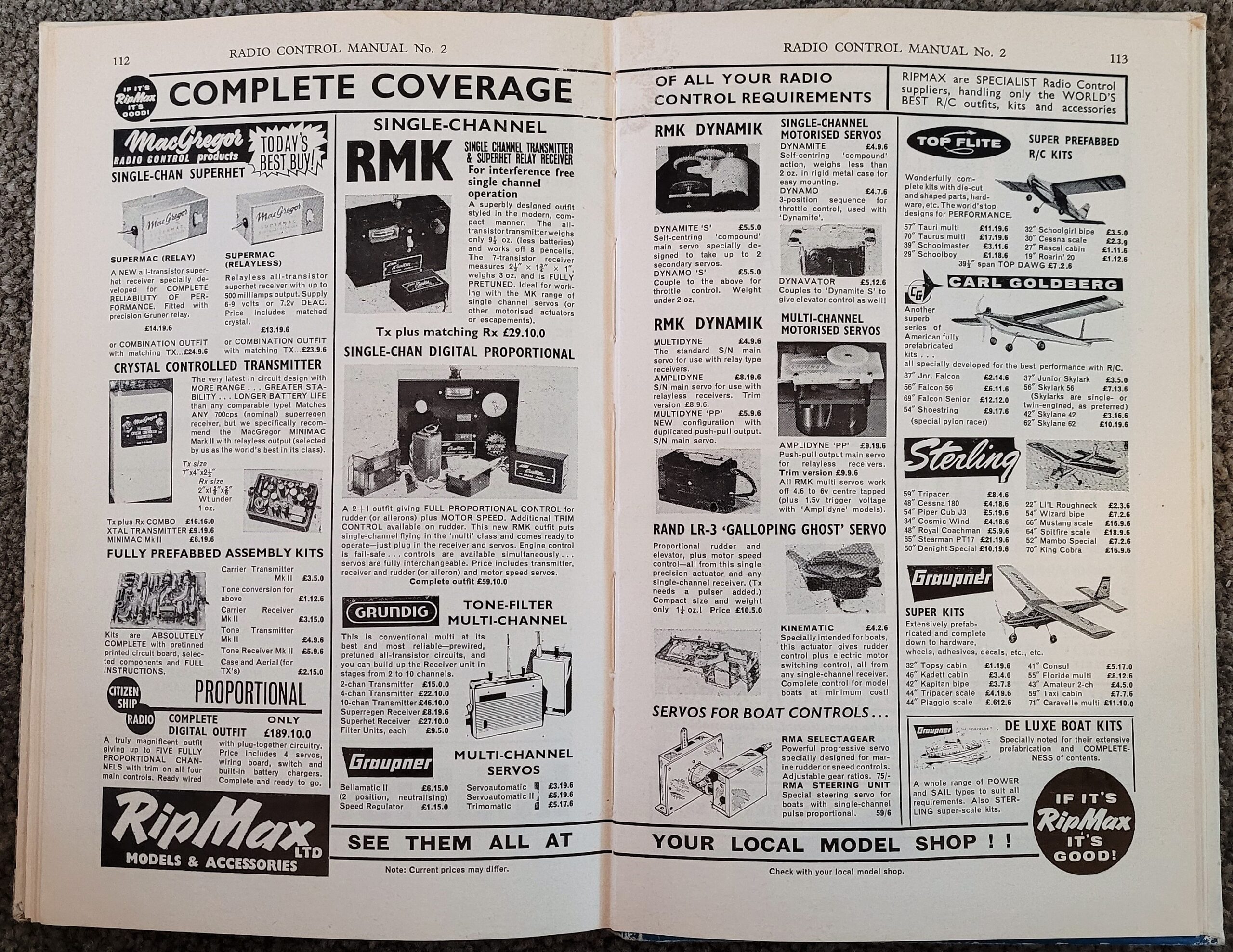
 Would you have paid £363 for a 7 channel Simprop set in 1967? Maybe you’d have settled for the 4 channel set at just £282! Strangely, according to the ad the 4 channel receiver weighs 5 1/2oz but the 7 channel one only weighs 4oz. The servos were a mere 2oz each. Things have certainly changed in 55 years, the micro models that some of us have been flying recently (Mustang, Corsair, Trojan etc) weigh a tad over 2oz complete with battery!
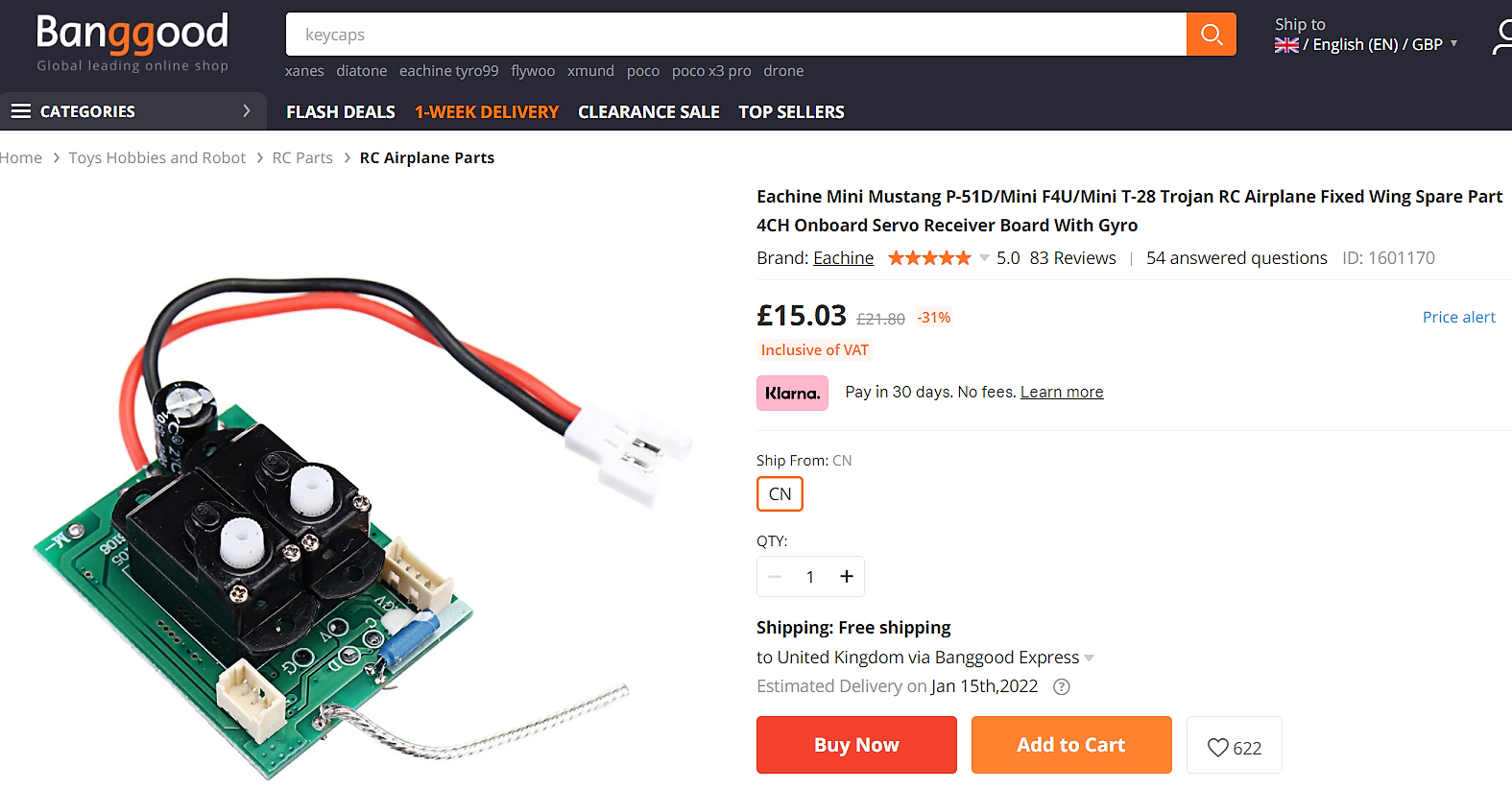 Their main electronics board which includes the 4 channel receiver, 2 servos, speed controller, and the 6 axis gyro can be purchased from Banggood for just £15.03.
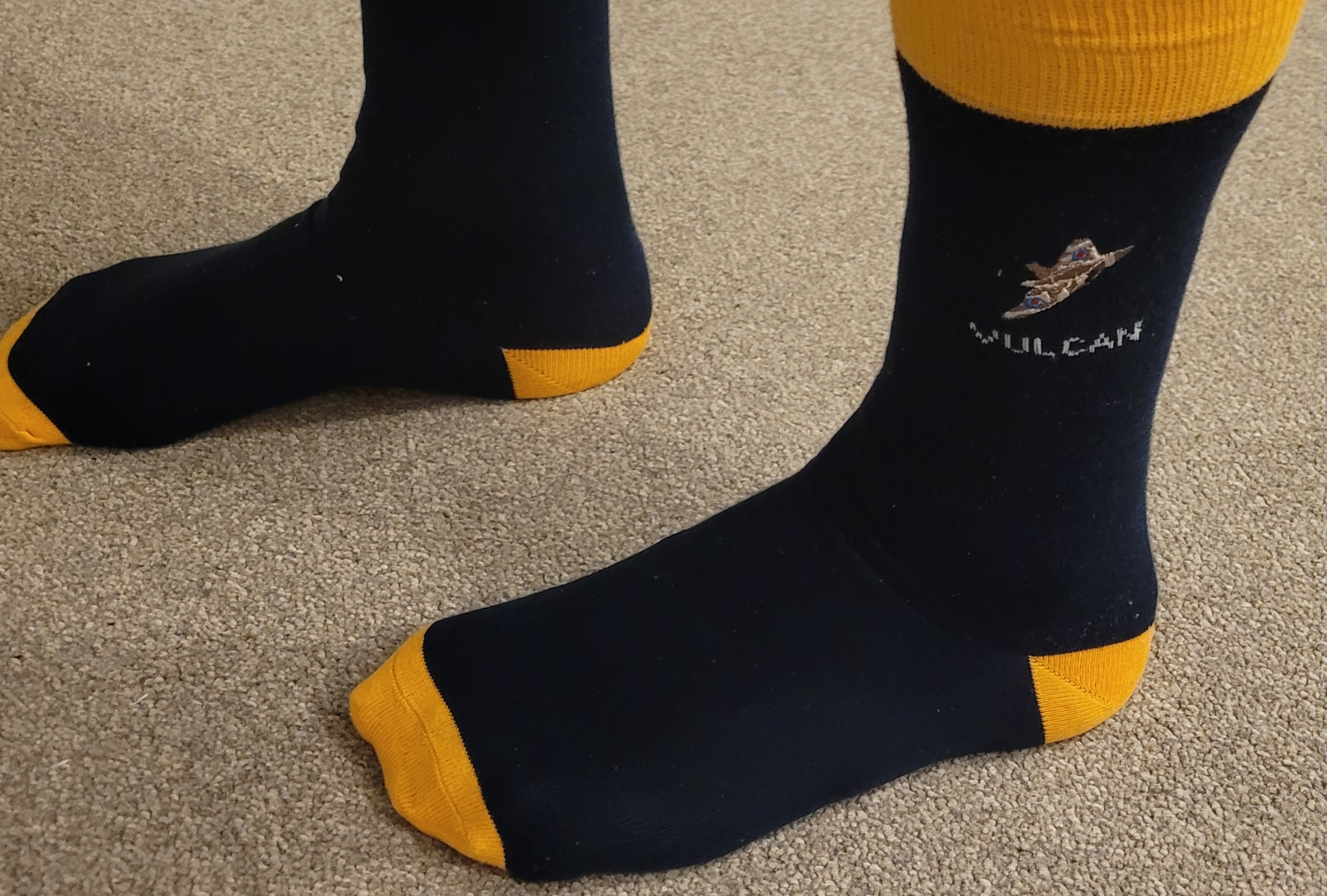
I also received a pair of socks, but these aren’t just any socks, these are Vulcan socks!
Unusually no new models were flown in December, or if they were I missed them, but there has been a fair bit of building going on and also a lot of I/C to electric conversions. On one of the murky mornings while we waited in vain for the skies to clear Ian Daniels showed us a couple of models that he’s converting currently (pun intended!).
The first one is a Dara Club 20 racer which Ian has already fitted with a suitable motor and is now wondering quite how he’s going to fit a 3 cell 2200mAh lipo inside as there’s not much room under the wing. Ian also showed us his Mole, a 49” span low wing sports model he built from a 1987 Dave Richardson plan that was published in RC Model World.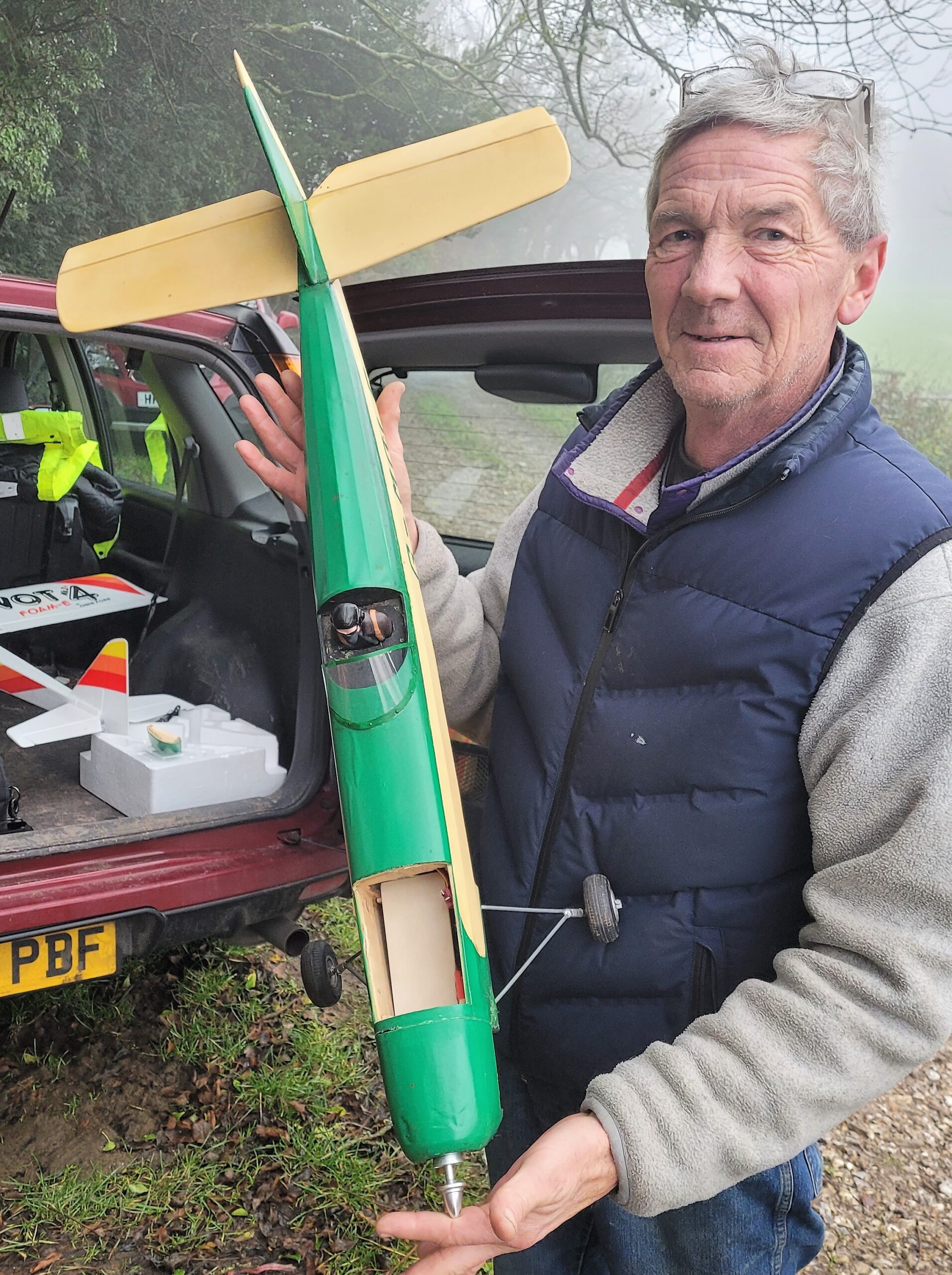
This is what Dave Richardson says about it: The Mole is a sturdy, scalish aeroplane designed around a 25-size engine, well within the building and flying capabilities of a low-time solo R/C pilot and fully aerobatic in the right hands. It features a foam or built-up wing with optional flaps, which add considerably to the fun of flying. Certainly not a first or second model, but third to umpteenth, yes indeed! The Mole looks to be ideal for conversion to electric power. Ian has already got most of his Mole sorted, it should be a much easier conversion than the Dara and fitting the battery is straightforward.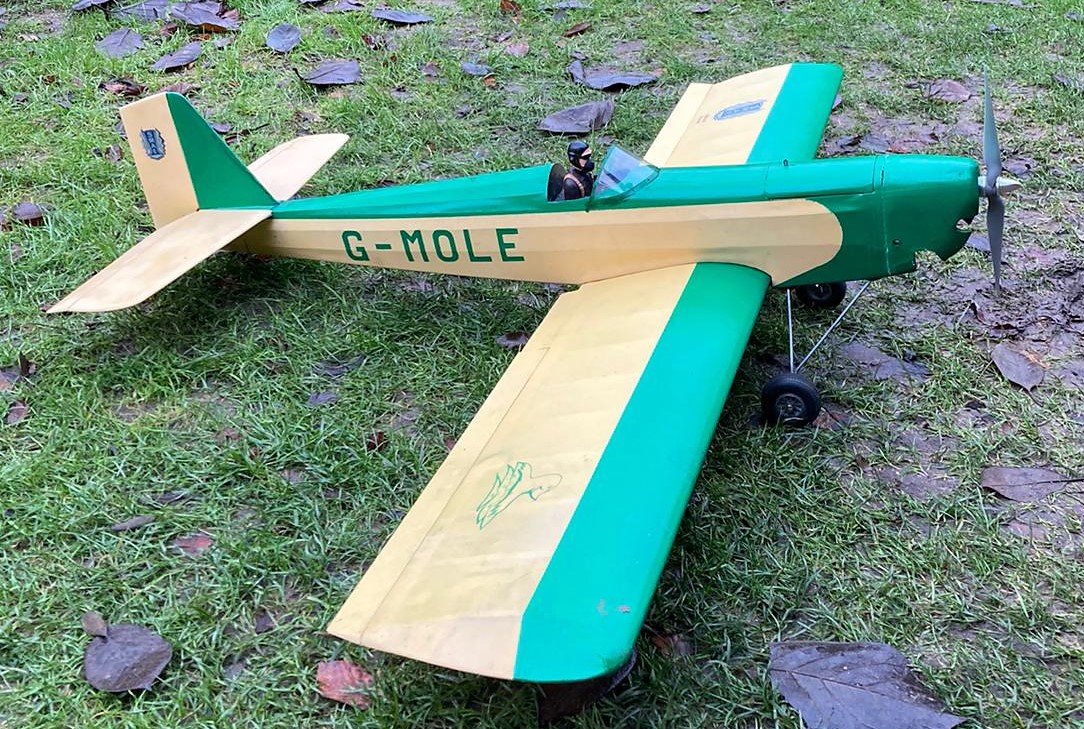
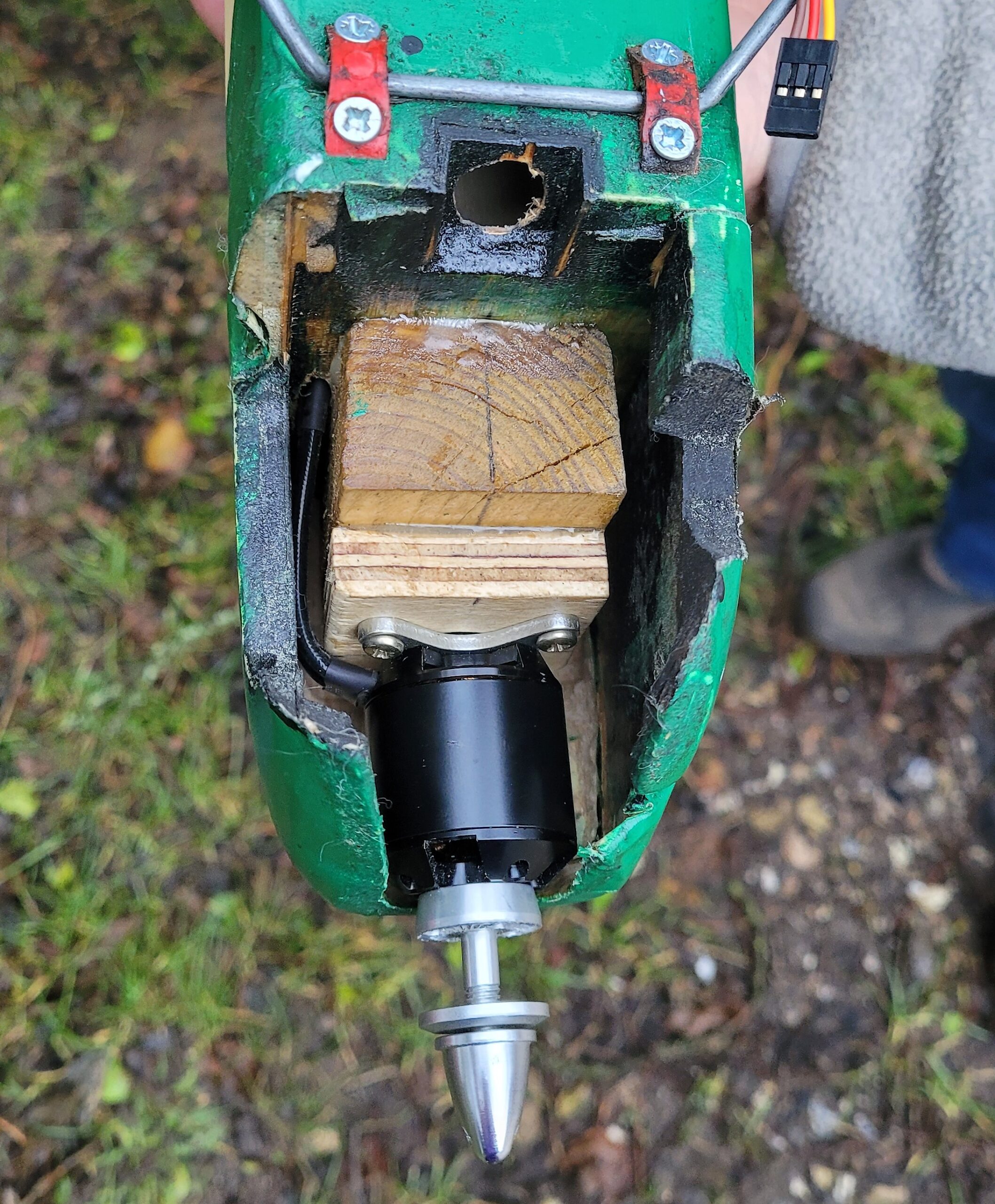
Note the Dougal Entendre motor mounting method, why use nice aluminium stand-offs when you have a lump of 4”x 2” knocking around, enhanced in Ian’s case with some ½” ply! Bizarrely 1066 flew a Mole at a Sandown Symposium back in the late 80’s. He didn’t build it but was asked to fly it and show it off to the crowd, speak to 1066 for the full story.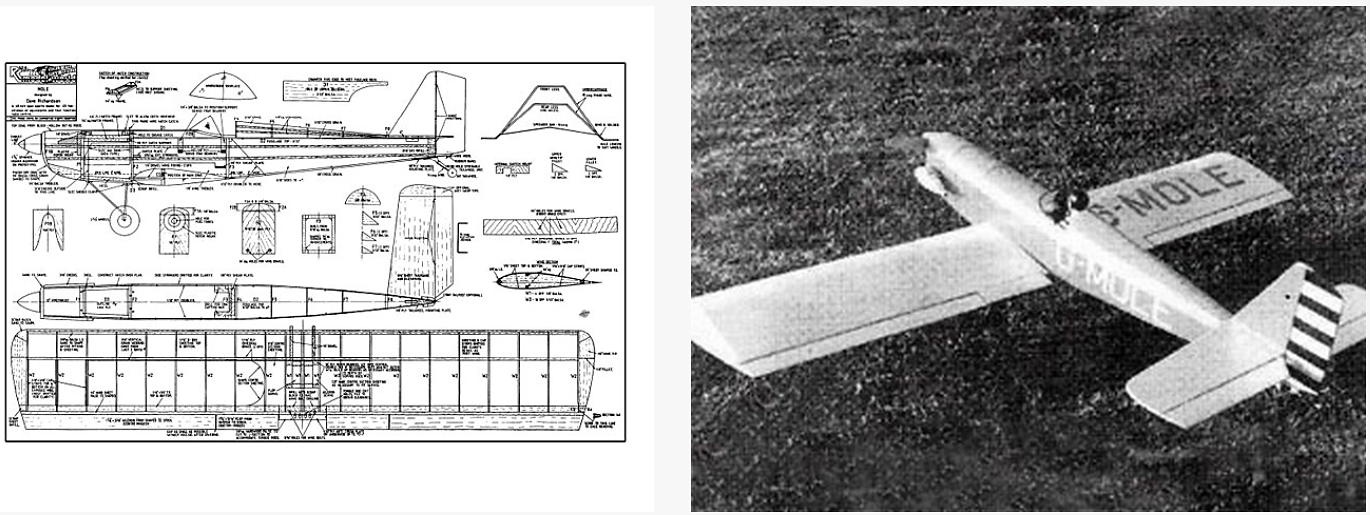 If you fancy building one for yourself the plan can be downloaded from Outerzone.
Dwayne Pipe has been busy building and sent me this: The KF mini Splot is my latest attempt to home build an indoor flyer. The previous five models have all failed due either to instability or lack of power. Weight is everything with indoor aircraft.
The KF mini Splot is based on a scaled down Splot design with a 15 inch wingspan. My previous design had been a mini SU 27 foam board, this had been unflyable. I reverted to the old fashioned elevator and rudder design. To provide the required lift I have used a Kline Fogleman wing section with a large dihedral, the results are much better.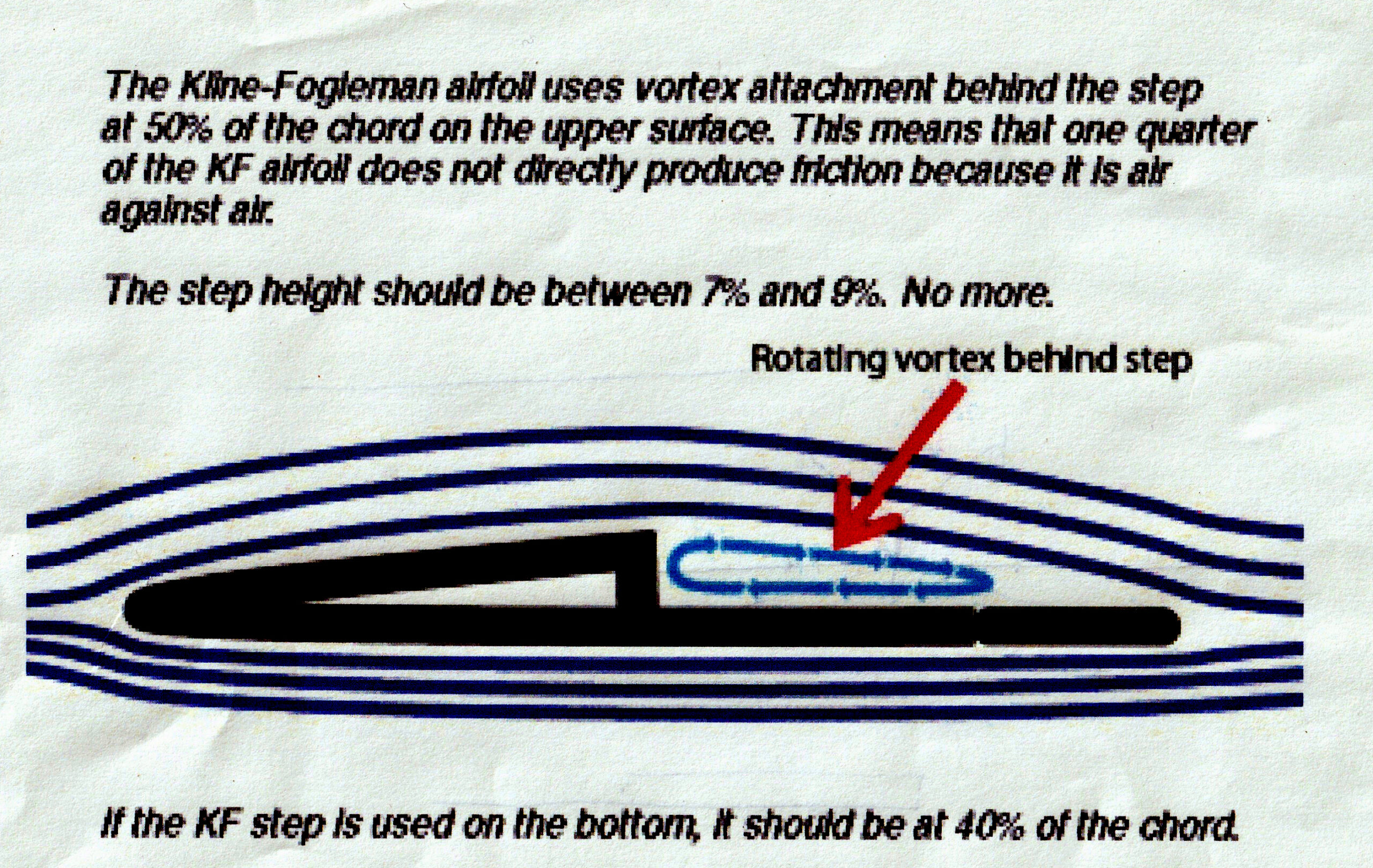
The wings, rudder and horizontal stabiliser are made of 3mm Depron. The body is light 6mm square balsa reinforced with a CF rod.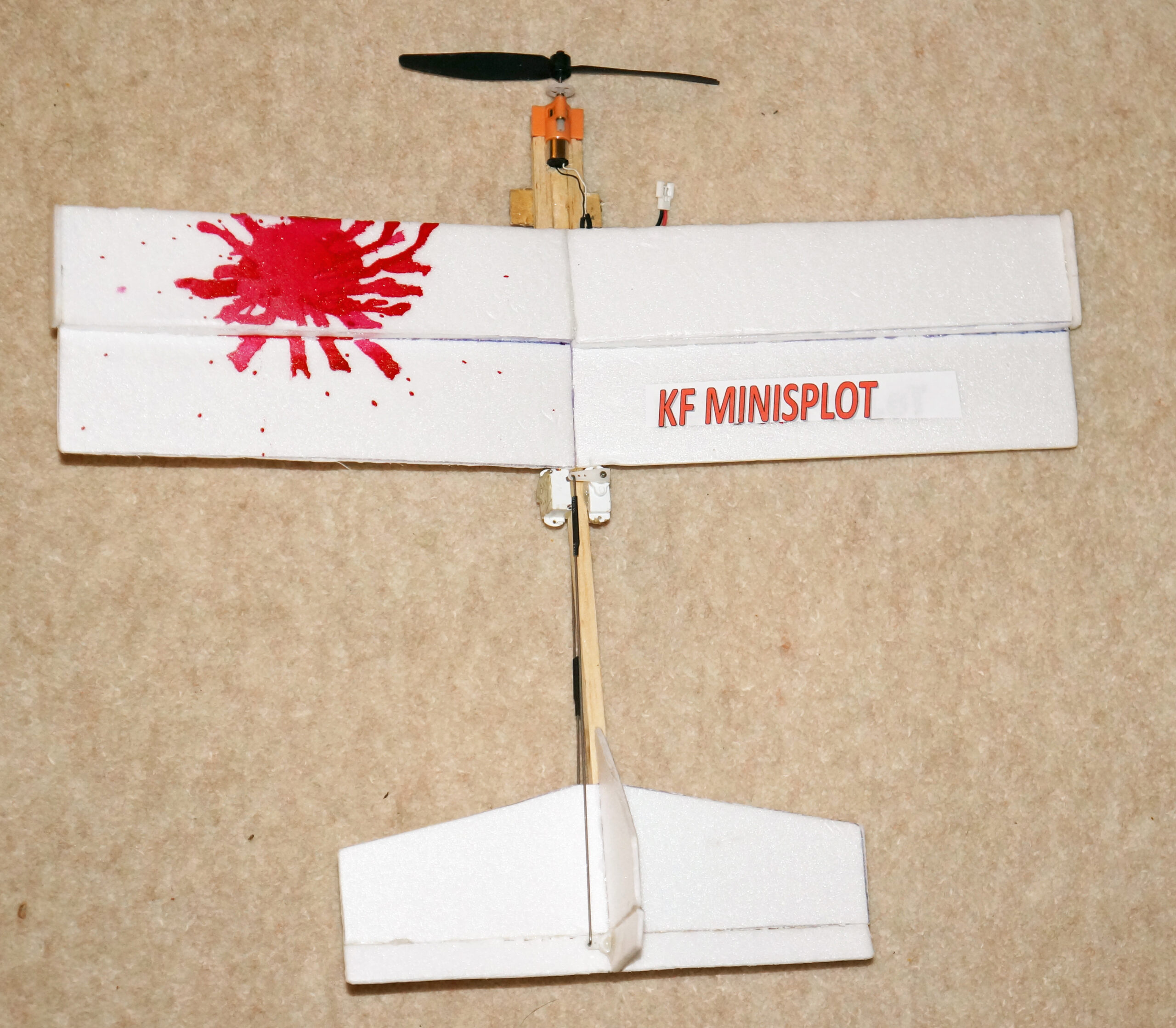
The electronics have been assembled from all over the place. The receiver compatible with my old Spektrum transmitter is a Banggood 2.4G Micro DSM2, this has a built in brushed ESC and comes with four servo micro sockets. Only Hobbyking make 2.2 gram servos to fit these. The coreless brushed motor is from Micro Aces and pulls a 5 inch prop.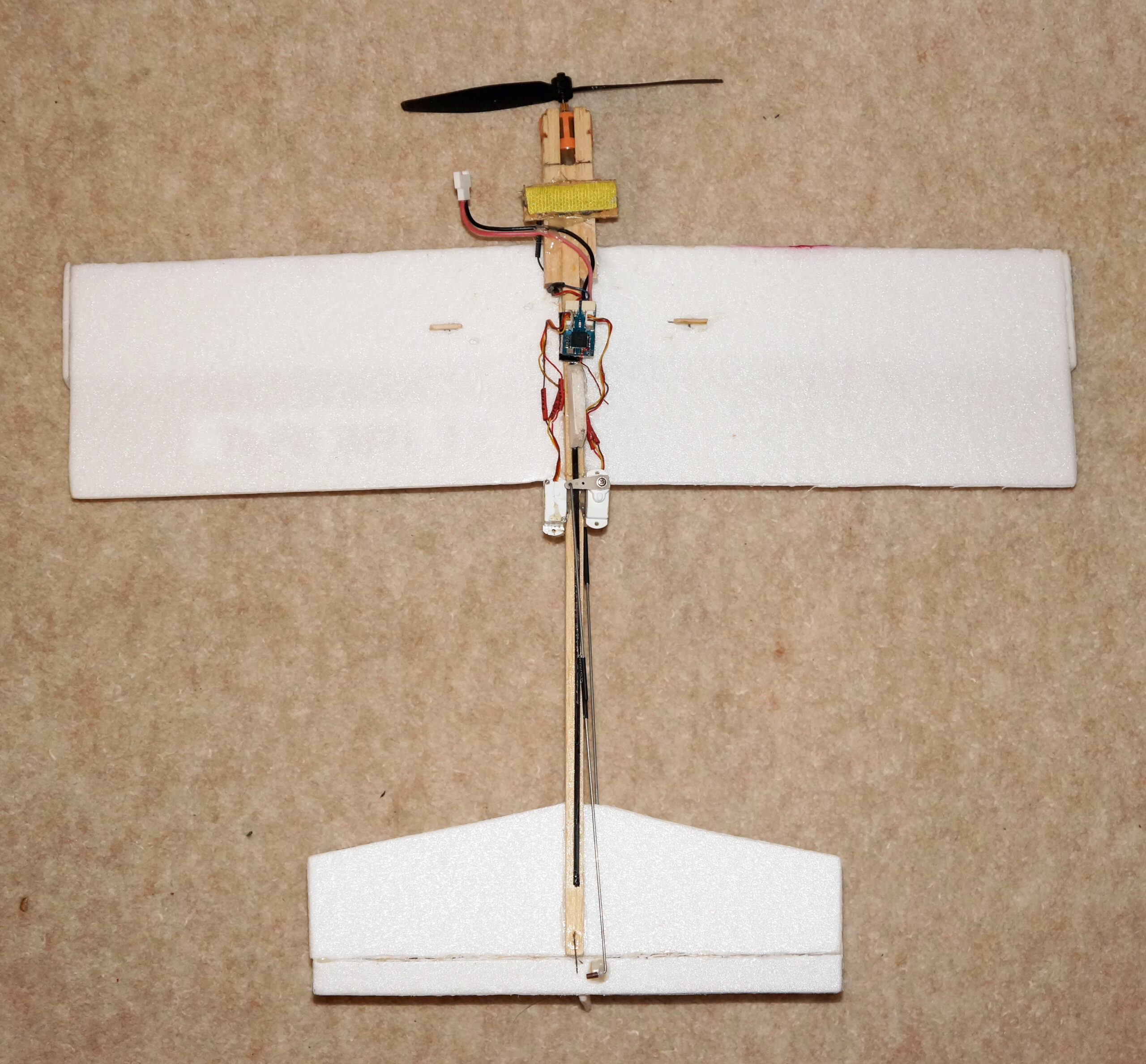 The battery is a 1S 600mah located to balance the plane on its C of G. The whole assembly with battery weighs about 40 grams. Tested on a calm day at the local rec. it has so far flown the best of the lot. That’s excellent Dwayne, at 40 grams the complete model is less than three quarters of one of the 1967 Simprop servos mentioned above!
Chas Butler always keeps himself busy and in December he completed a conversion. Chas says: Here are the details of another model I’ve converted from i.c. to electric power.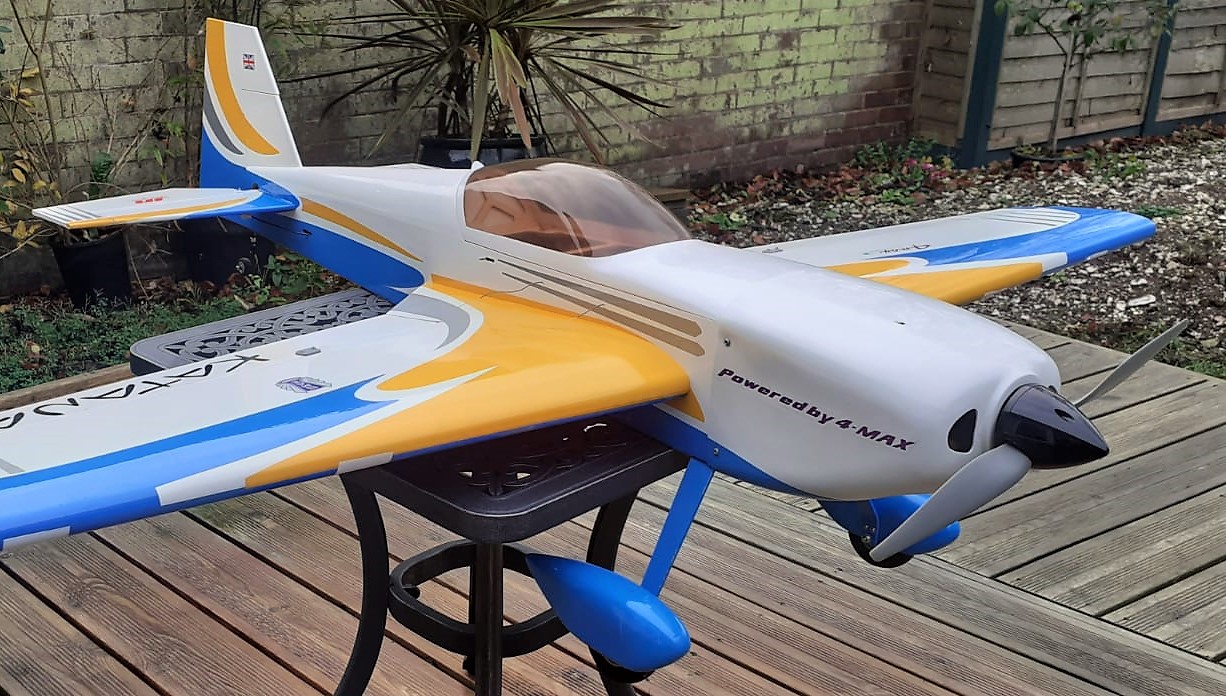
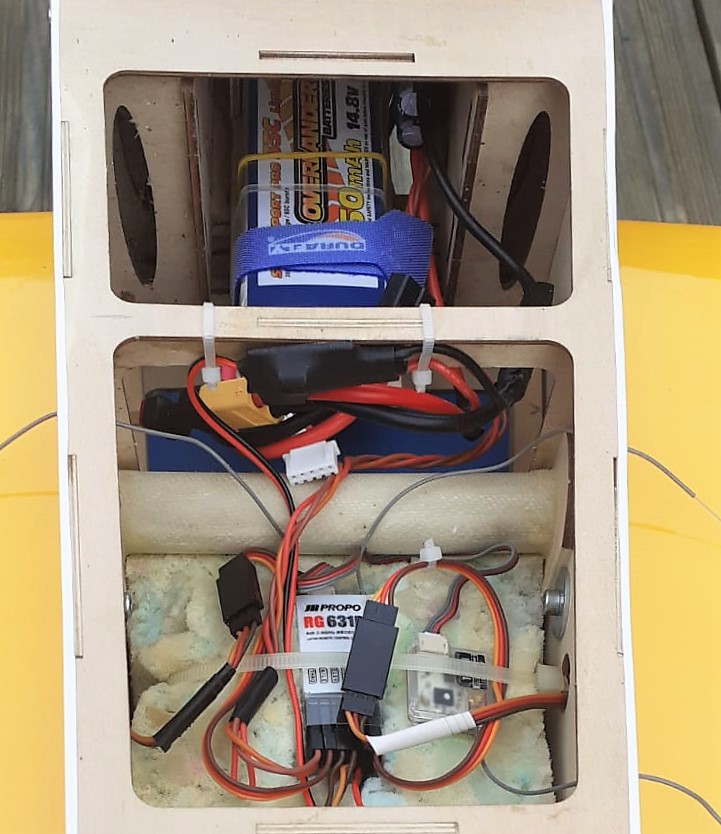
The model is a Katana (Chinese built I believe) which I won in a club raffle whilst I was waiting for my first hip replacement (2004). Initially it had an ASP 46 2 stroke fitted but now it has a 4-max 5055-595kV motor, driving a 13 x 8E ASP propeller, with a 60 amp ESC and a 5 amp UBEC. JR standard size servos are used and the receiver is also JR.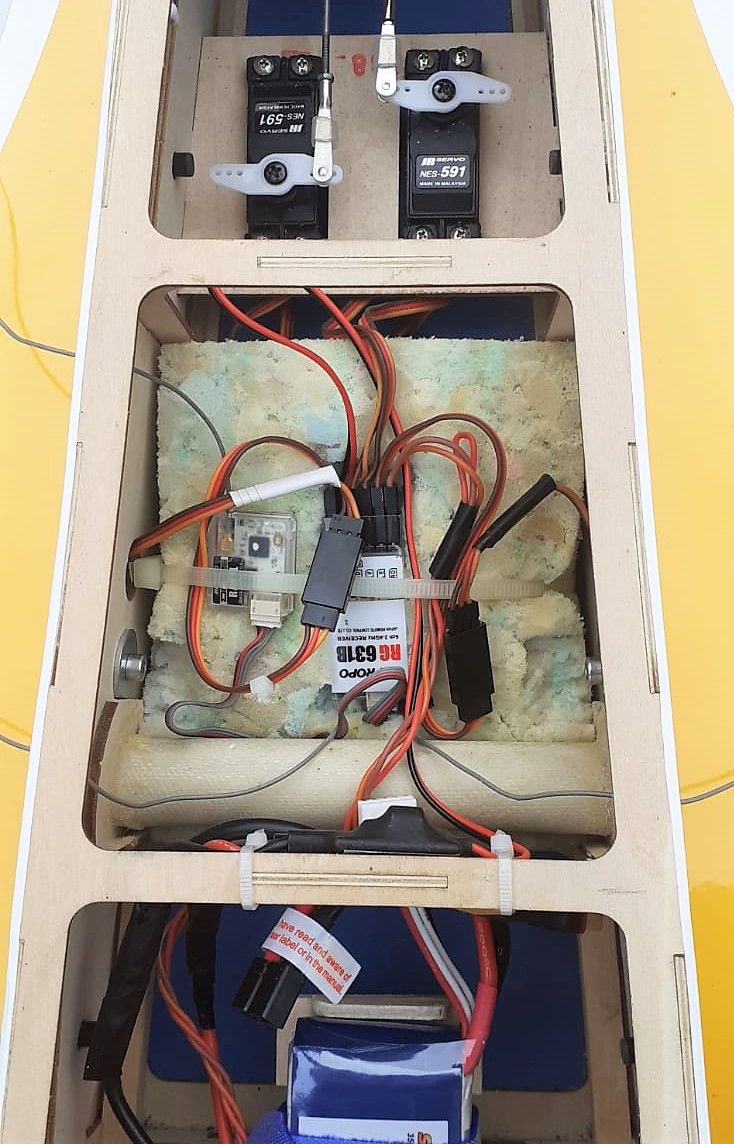
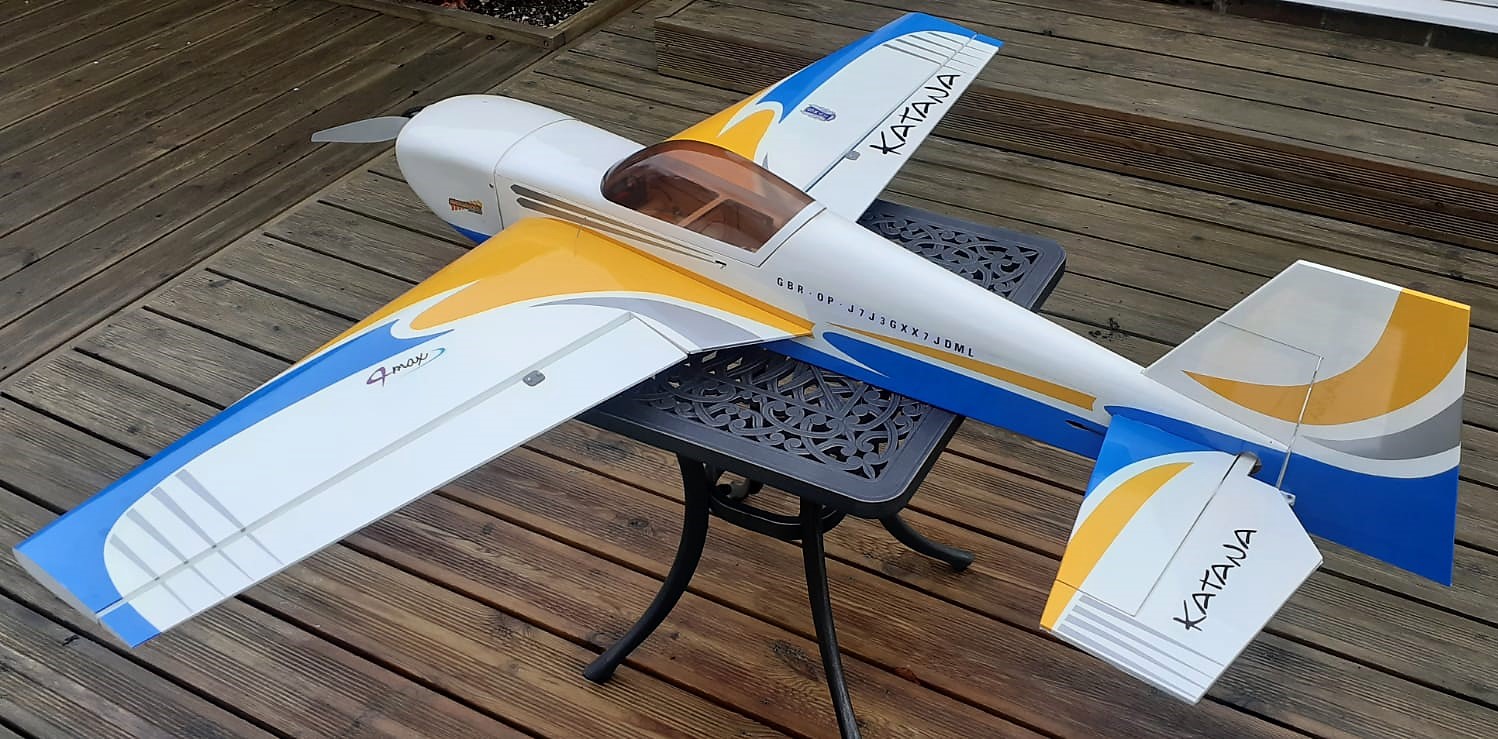
I’m trying 4S 3350mAh to begin with. The model has a wingspan of 55 1/2″, it is 51.2” long and weighs in, with battery, at 6lb 6oz giving a wing loading of approximately 26oz /sq. ft. Will have to see how it performs on this set up. It looks very nice Chas and I think it should go well with that set-up, I look forward to seeing it at the patch very soon.
Page Boy has been splashing out again. He told me he needed cheering up whilst recovering from his recent bout of Covid so he treated himself to a Freewing L-39 Albatros. This is from the Freewing website: Developed originally by Aero Vodochody in the 1960s in what is now the Czech Republic, the Aero L-39 Albatros excelled as a jet trainer platform with its powerful turbofan and overall reliability. The L-39 and its successive variants continues in service throughout the world in militaries as trainers and light attack platforms, and in civil aviation including aerial demo teams and racing.
The Freewing L-39 Albatros is the largest and most capable production PNP L-39 in the world. Optimized for high manoeuvrability and precision flying, the L-39 truly is a “Sport jet wearing Scale jet clothing”. The PNP version uses a powerful 3530-1850kv brushless motor and 100A ESC to power the 12 blade 80mm EDF.
The Freewing L-39 Albatros includes grass capable suspension landing gear, a full coverage nose door, scale wingtip lights, and easily removable tip tanks, ordnance, belly gun pod, and wings. Only one glue joint is required to complete the model’s general assembly. A plastic lined cockpit also resists deformation under sunlight, and optional 3D Printed cockpit detail upgrade parts are also sold separately.
Oh dear, Page Boy has to do one glue joint, I hope he can cope with that! Judging by the photos he sent me he has already glued the joint which I imagine was fitting the fin to the fuselage and it looks ok to me, I can’t see any blobs of epoxy or dribbles of cyano.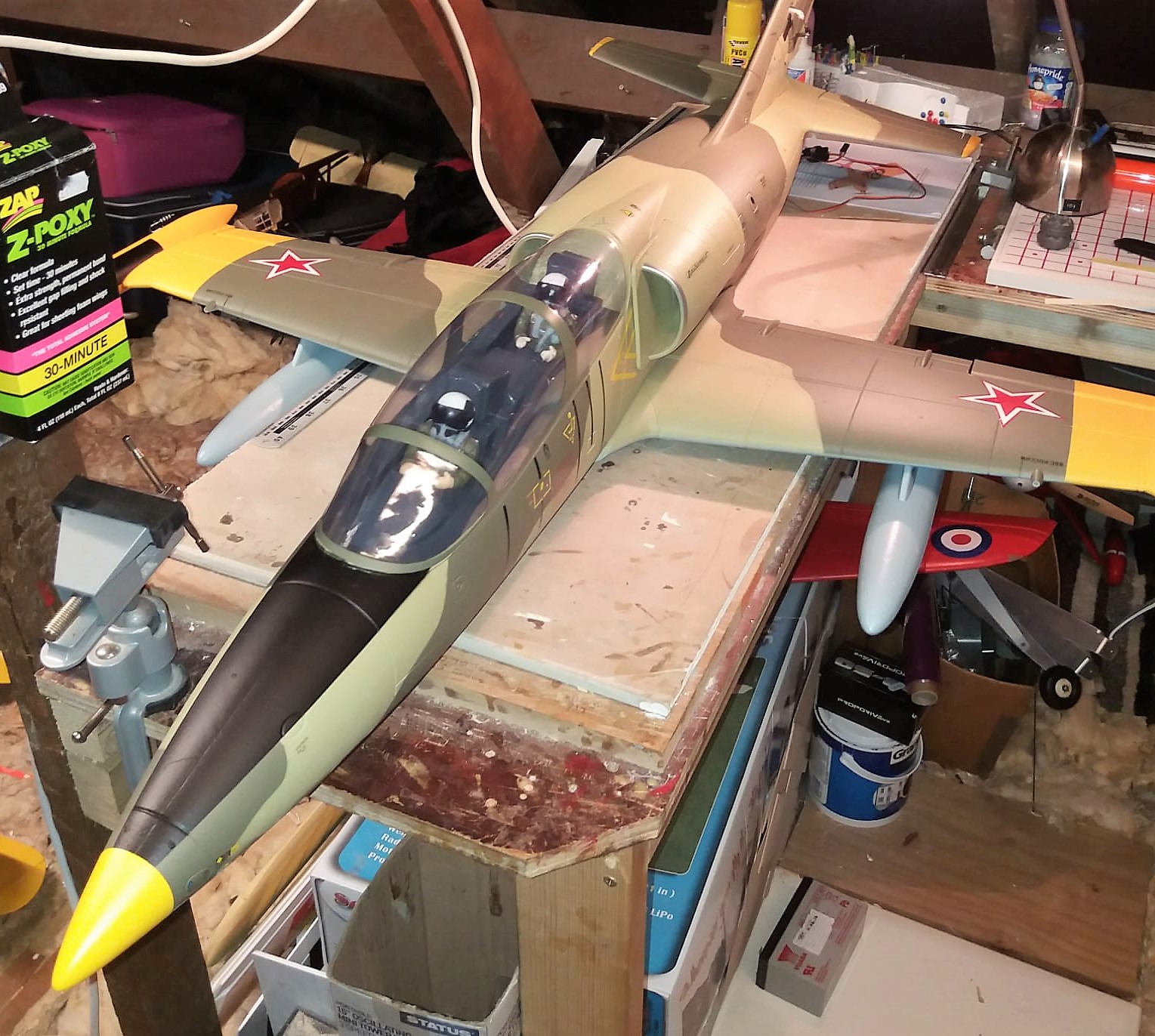
At 1054mm span and 1351mm long the Albatros is quite big compared to many EDFs and is considerably larger than Page Boy’s Hawk. The weight is 2.2kg without the required 6 cell lipo in the 4000-6000mAh range. The model looks superb especially with the lights on although I have to confess that I’m slightly concerned about the gnome! 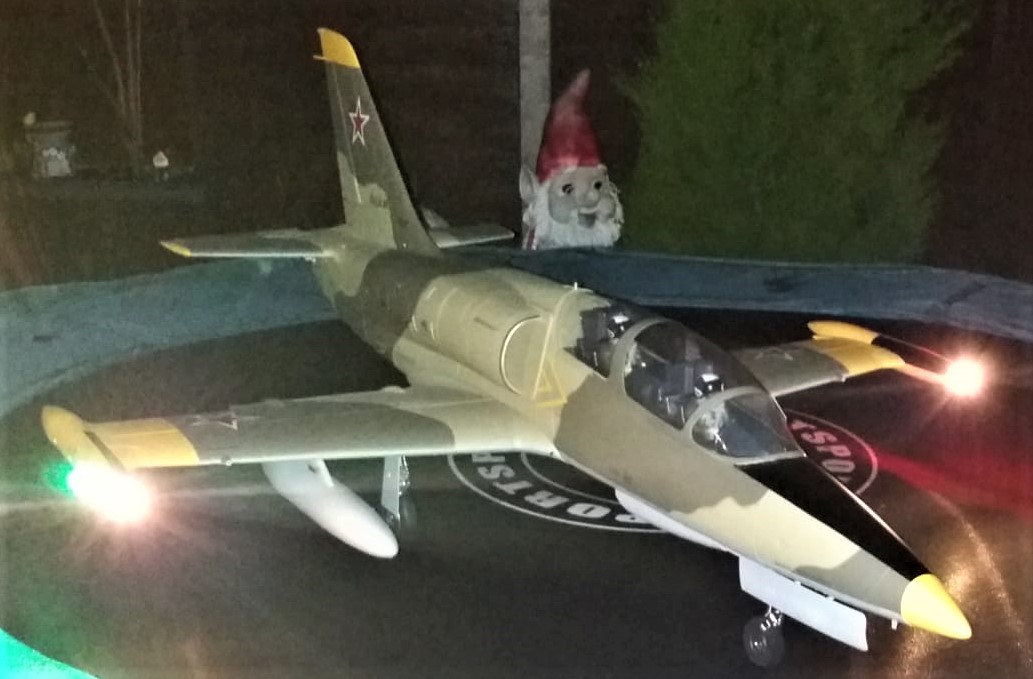
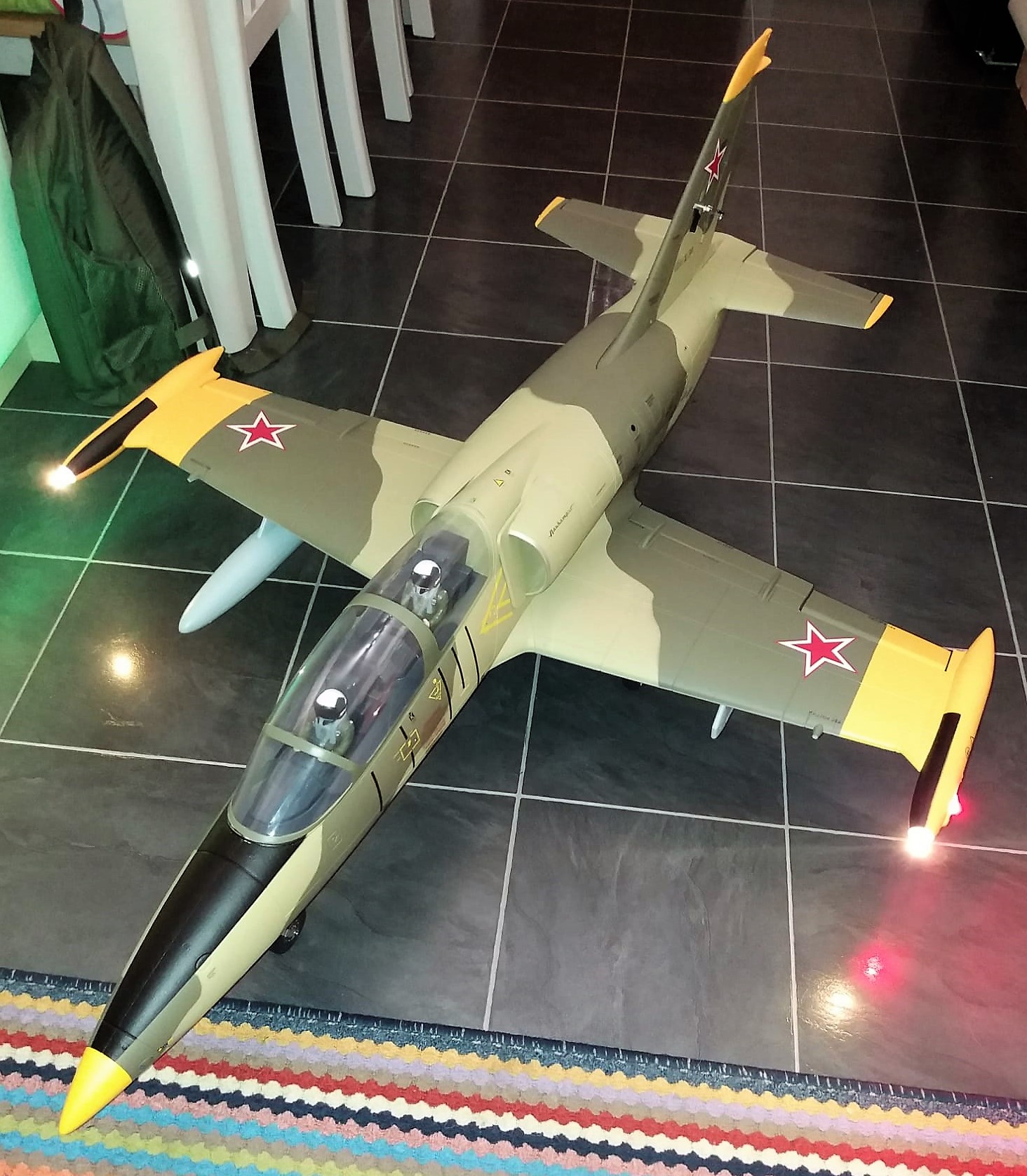 The other concern I have is the nose-leg door that looks is if it would last about five minutes on our patch which brings me to the sad news that Page Boy won’t be renewing his PAM membership for 2022. He is moving to another club that has a much larger area of near bowling green quality grass that is much more suited to EDF models. It will be a great shame to lose him but is totally understandable with his wish to fly larger and more scale EDF models for which our patch really isn’t suitable. Page Boy has been a PAM member for quite a few years and he’s also taking much newer member Richard Osborn along with him. Between the two of them they lowered the average age of the members by about 20 years! You’ll be missed guys, I hope you’ll drop in to see us sometimes.
On the last Sunday before Christmas just four of us turned up, Captain Slow, Gordon Bennett, Woody and me. I snapped this atmospheric photo of Captain Slow arriving…late!
We thought the mist would quickly burn off and proceeded to fly but we had to keep the models very close especially as the mist was blowing through in banks. Gordon and I both flew our Migs and Captain Slow flew his Hummer and we managed ok but when Woody flew his Sukhoi he lost sight of the model as a particularly thick bank of fog blew in. We could all hear the Sukhoi was still flying but not see and it sounded as if it was drifting off over the lower field so Woody shut the throttle and let it come down. We all trudged off the find the wreckage and spread out over the field and soon found the Sukhoi, safe and sound and completely undamaged. You can see some of the morning’s fun in this month’s video.
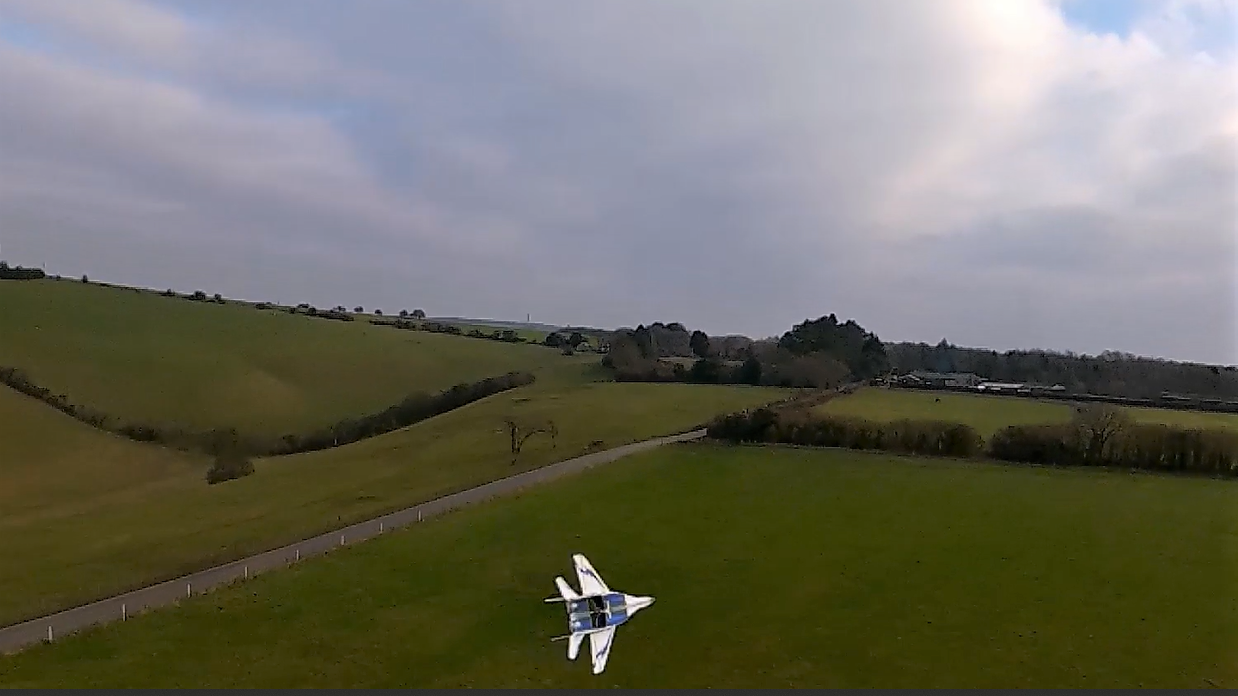
I don’t have any photos from Kryten this month I’m afraid so I’ll show you some screenshots captured from some of the FPV videos Dougal and I shot in December.
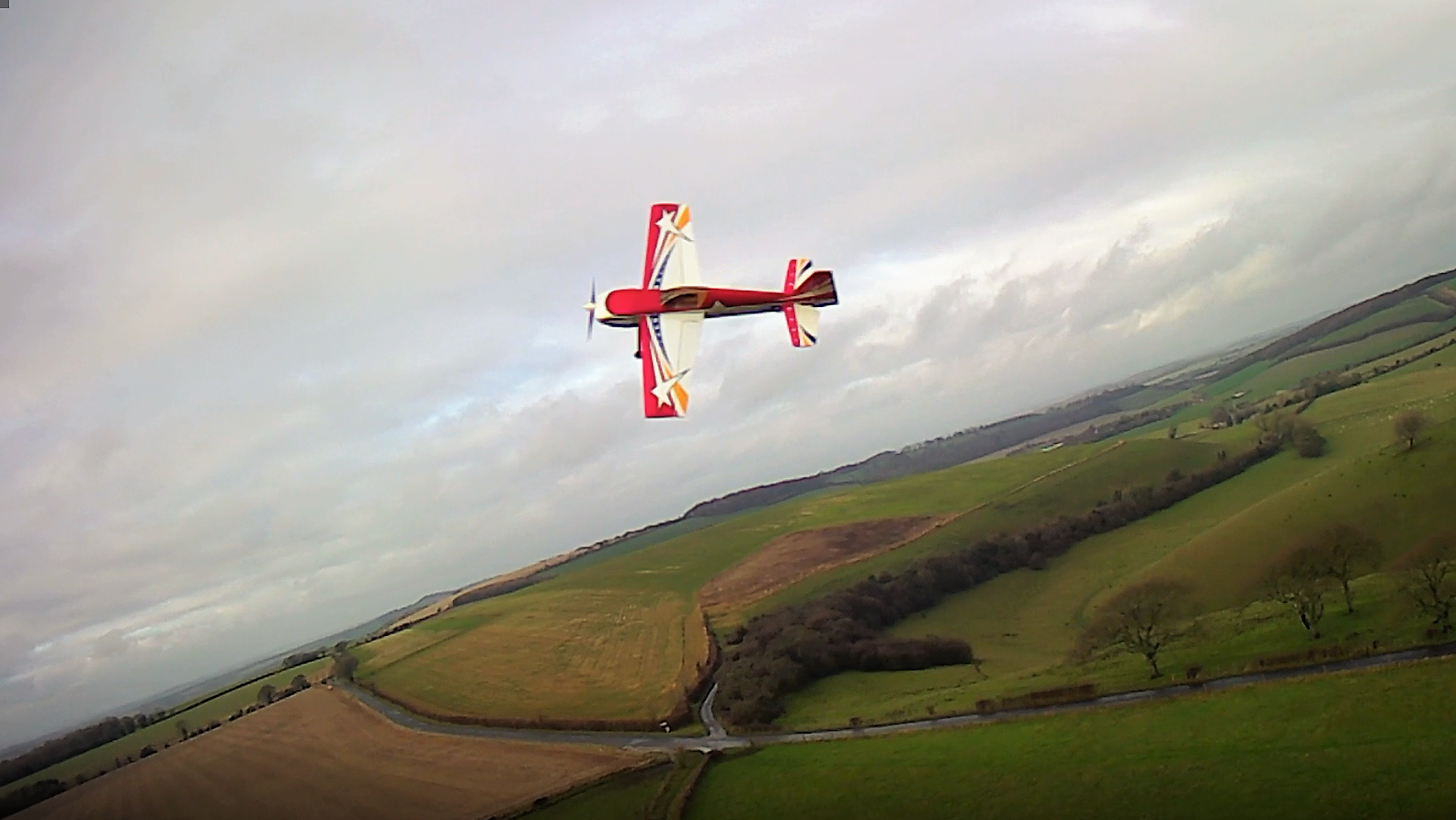

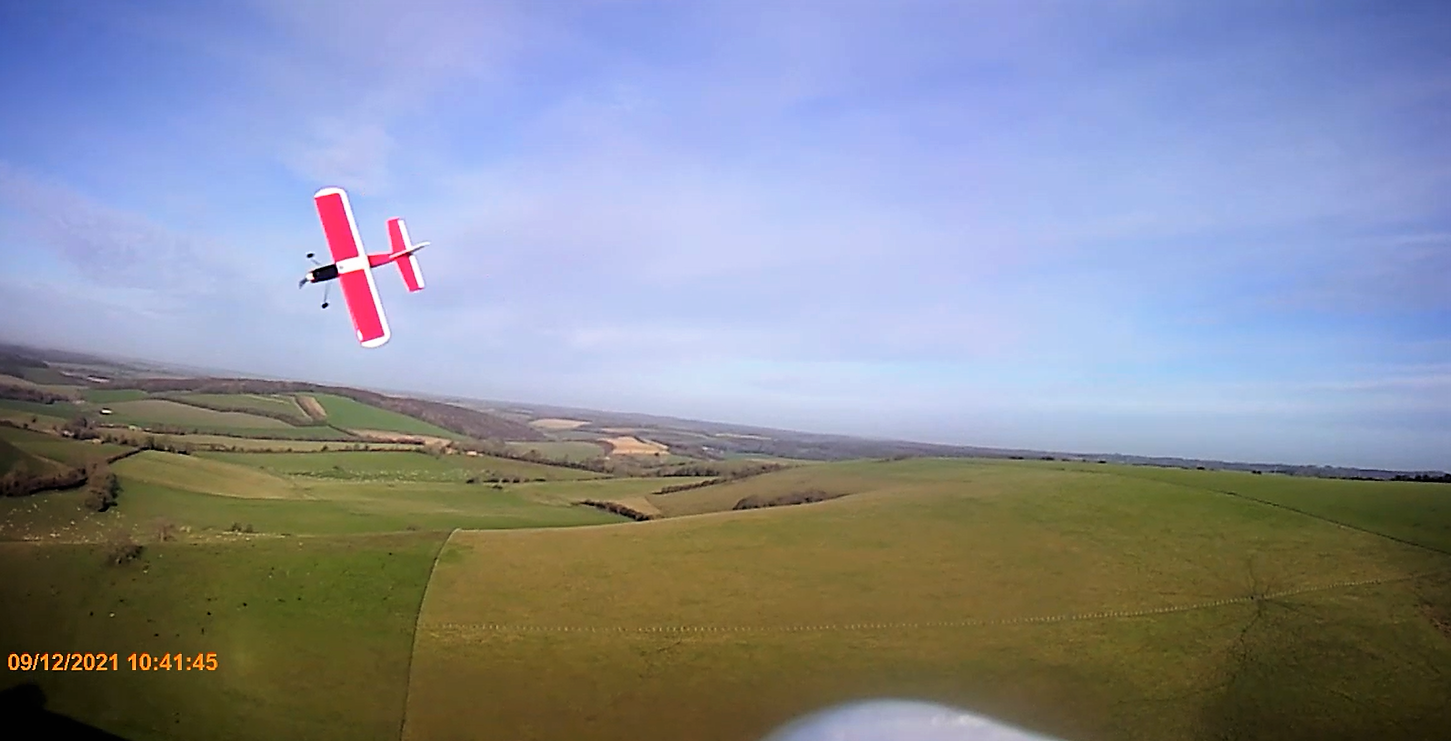
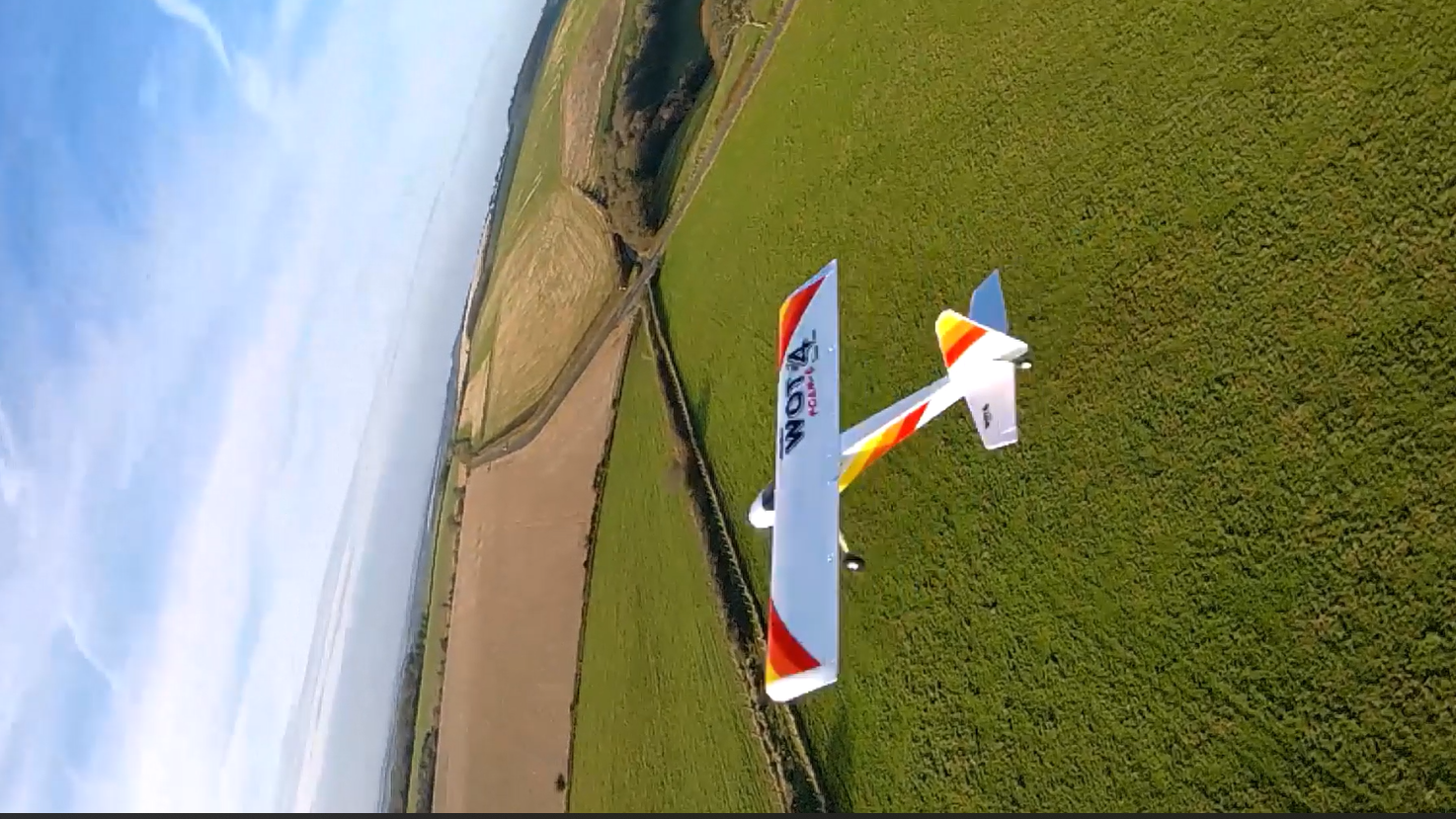
Video time now which this month includes footage taken by myself, Captain Slow, Dougal Entendre, and Gordon Bennett. Please watch the video full-screen, it’s so much better with small models flying around. If the video won’t play for you please click HERE.
The newlyweds were opening their presents on Christmas morning and the groom expressed his disappointment when he didn’t receive any modelling gifts.
His bride said “We’re married now, you don’t need to play with toy planes anymore”.
He replied “You’re beginning to sound like my ex-wife”.
“What?! I didn’t know you been married before!” she exclaimed.
“I haven’t…”
Colin Cowplain
Patch News – November 2021
Merry Christmas everybody! Yes I know it’s a little early but the next Patch News won’t be published until 1st Jan 2022. If you have any modelling Christmas presents on the way please let me know so I can share the joy. In November we were mostly quite lucky with the fairly mild weather and had several flying opportunities when the winds were light. 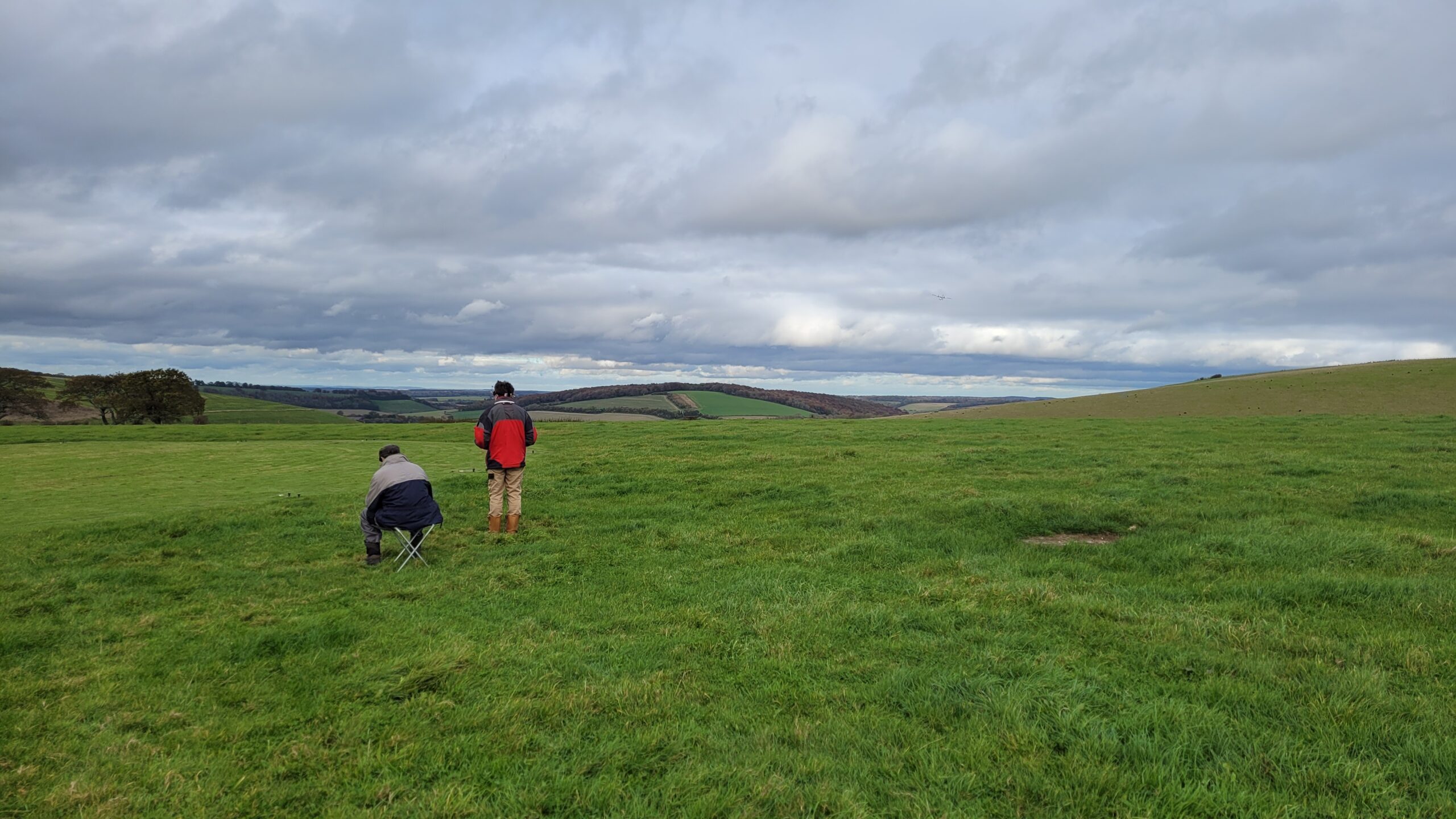
But several of us flew on the last Sunday in the month when it was bright and sunny but absolutely freezing in the brisk northerly wind, unsurprisingly we didn’t last all morning.
The bullocks joined us in the middle of the month and sometimes needed gently herding away by two or three pilots while the others flew but overall they weren’t too much of a nuisance.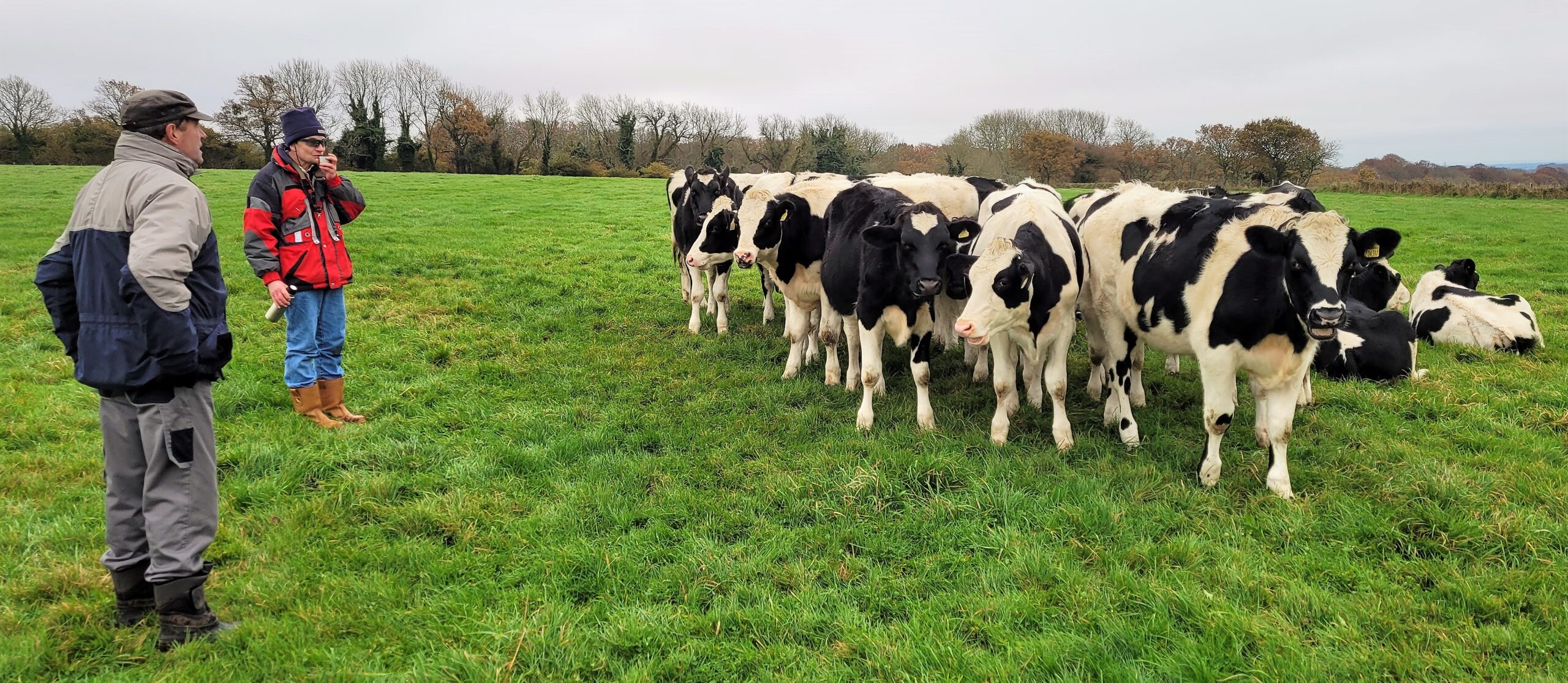
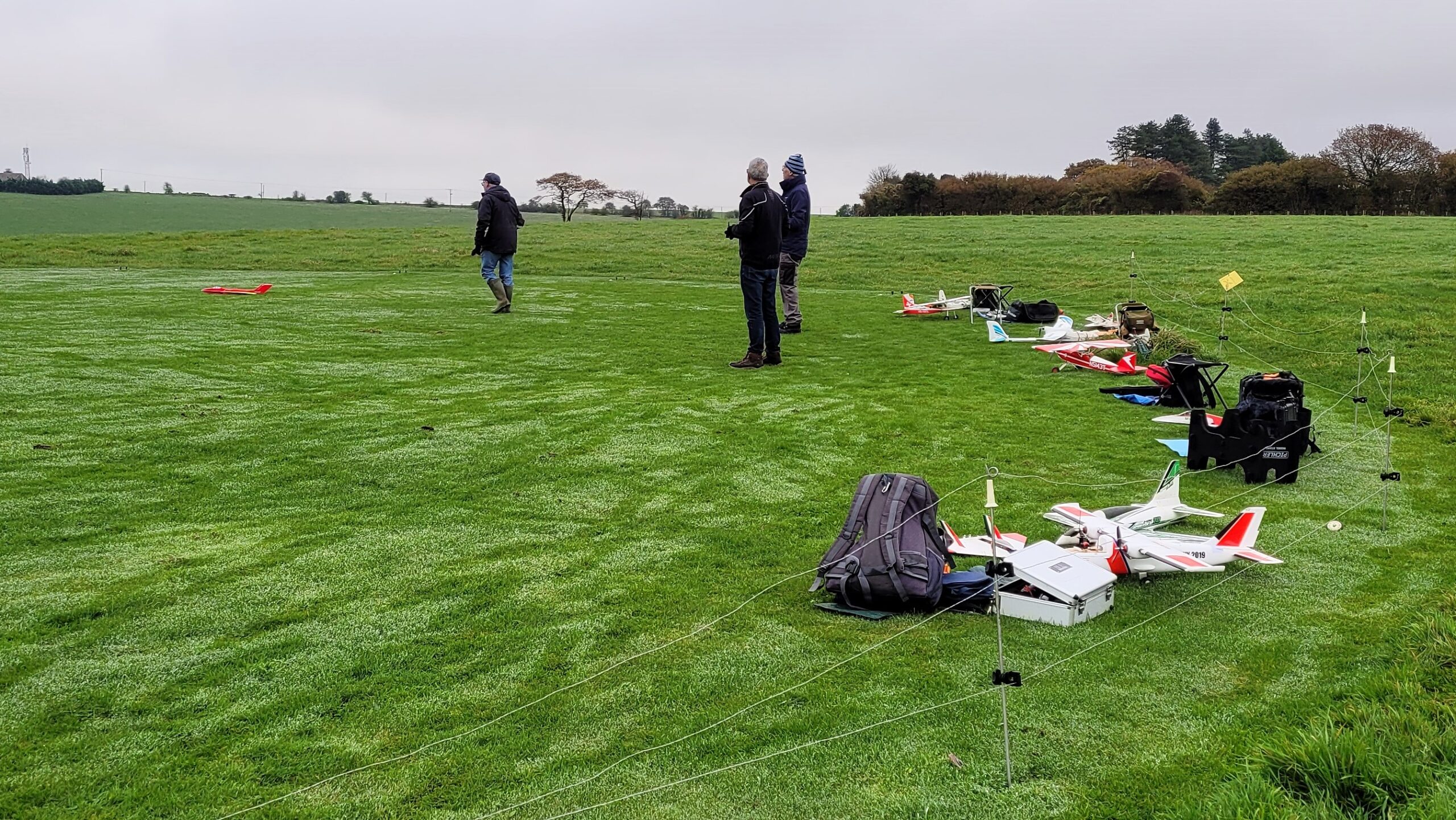 Happily they only stayed for a couple of weeks and the field is now bullock free. New member Gordon (Paul) Bennett passed his BMFA ‘A’ certificate on 3rd November and turned out to be one of the best candidates I’ve taken. Gordon hasn’t been flying models for long but with a history of full-size aviation he has picked up RC flying very quickly.
Straight after passing the test he had a go at the club Climb & Glide competition and had the cheek to beat my score with his first attempt. Gordon could be the only member so far to be awarded an ‘A’ cert and then have it withdrawn on the same morning!
The competition entries are growing in number now and lots of members have had a go at one or more of the disciplines. You can have as many tries as you like so why not give it a go, just chose a timer and/or counter, do your best, and let Dwayne Pipe know your score.
Not too many new models were flown in November but I know of several that are being built ready for next season. Page Boy was on his sick bed for a while but was somehow able to drag himself to his building board despite not being well enough to return to work.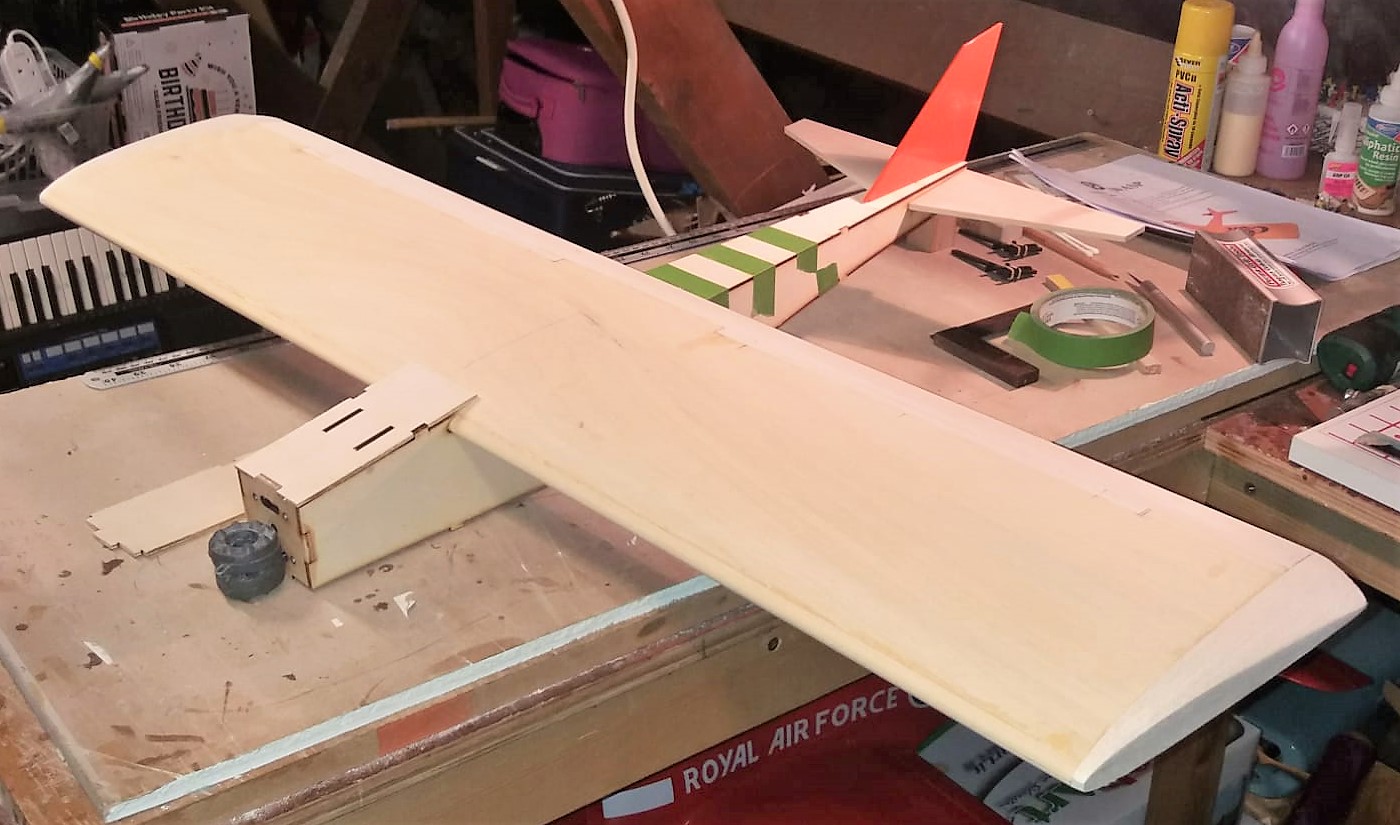
He’s getting on well with this 39” span Wasp E2K electric pylon racer that he’s building. It looks to be coming along nicely although I don’t think the green go faster stripes are quite up to Page Boy’s usual standard! It’s the same model as 1066 has been flying for a few months so I imagine we’ll see the pair of them screaming around the sky early next year.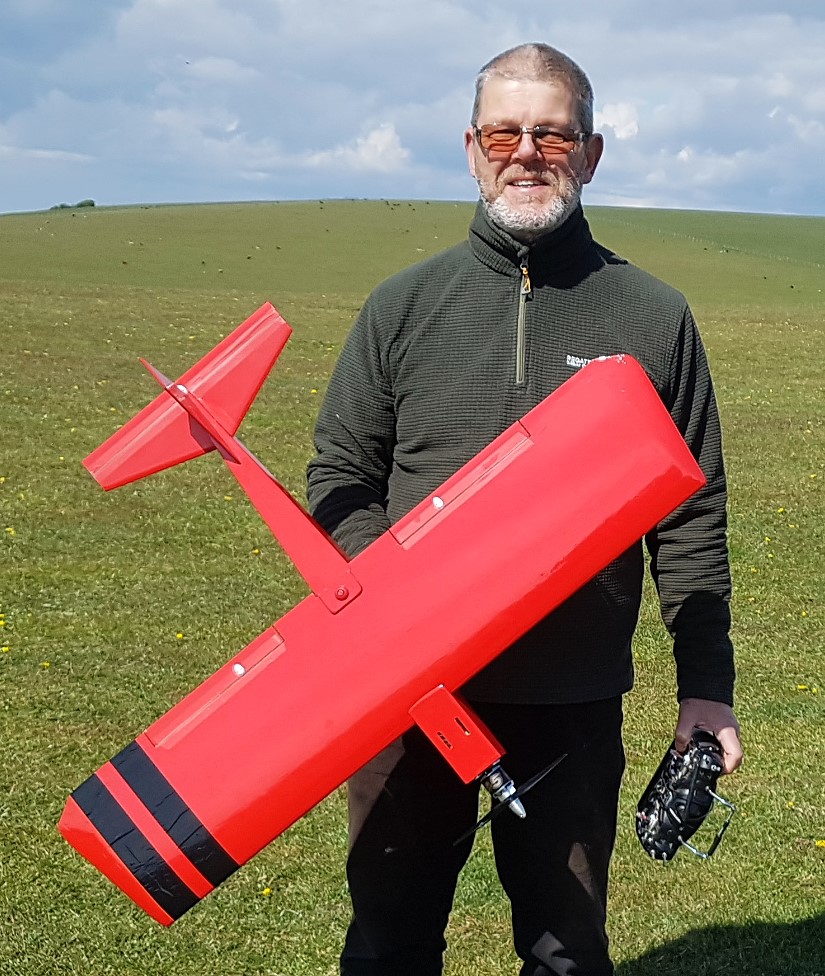
Dougal Entendre seemed to spend most of November struggling with his Skyartec Mini Skyfun, it flies well enough but for some reason the motor keeps cutting out at full throttle.
Here’s Dougal’s account of it: I bought the Mini Skyfun from a guy in Emsworth for £30, complete with Rx, servos, ESC, motor and a 2s battery, but no fins! I cut a new pair of fins from Depron, using my bigger Skyfun as a pattern. Binding my RadioMaster Tx to the Skyartec Rx was no problem, but whenever I throttled up, the motor ran for a few seconds then cut out. Long story short: I’ve tried 2 different 2s packs, 4 different ESCs, 5 different motors (even running without the propeller), replacing the JST lipo connector with XT60, and powering the ESC from a bench supply with a servo tester providing the throttle pulses. The problem persisted. My final solution involves shoe-horning a 3s battery in, with a lower KV motor and a 5-inch propeller instead of the previous 4-inch. It’s better, but the motor still occasionally cuts out if I overcook the throttle.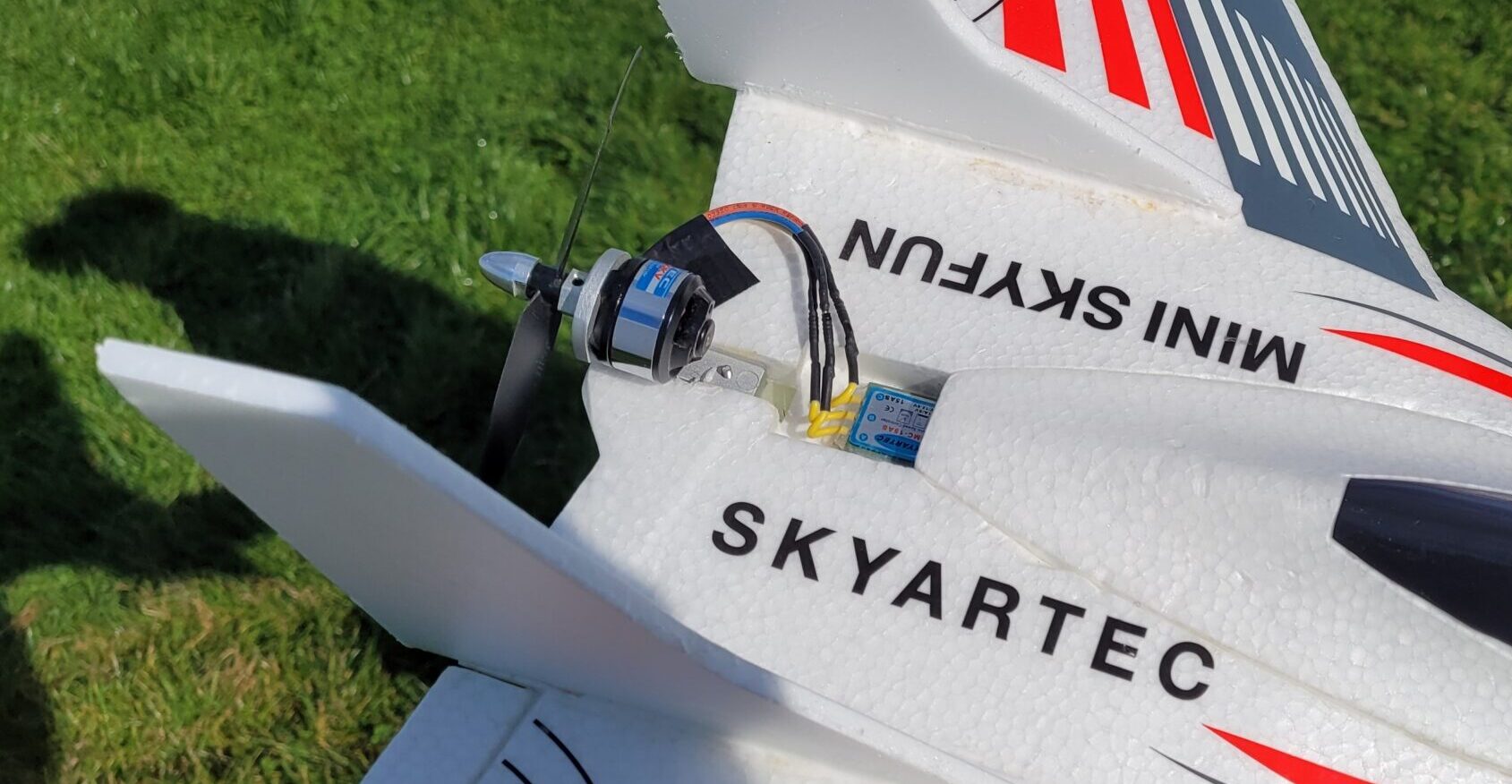
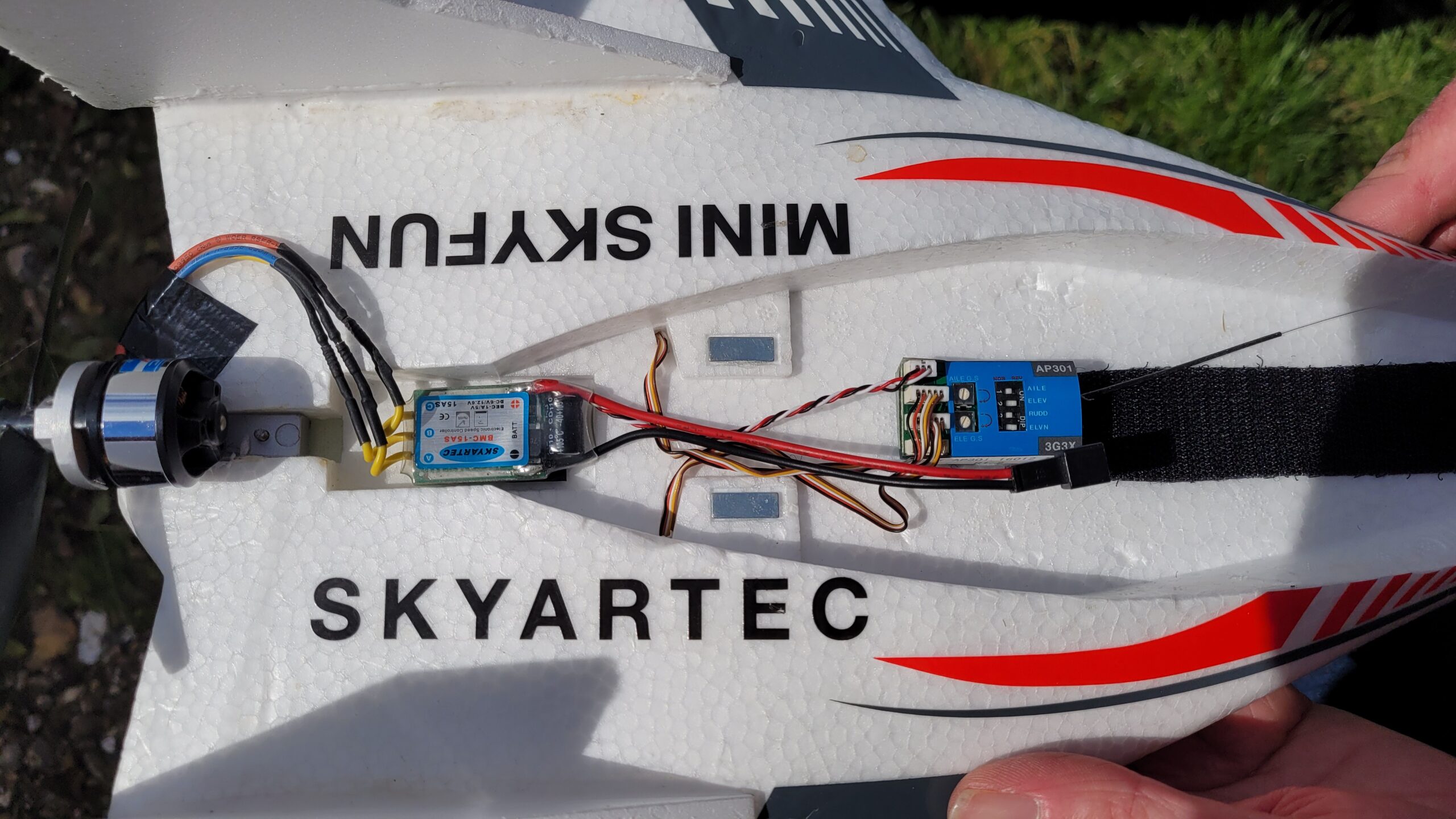
This is strange, as the powertrain is almost identical to the one in my Mini Blitz, which has no problems. I’m sure there’s a rational explanation, such as the airframe being possessed by a malevolent spirit. I think I’m going to give up with it for the moment, as even when I’ve had it flying, I’ve found the elevator trim is inconsistent, and it tends to skew out of loops. One day I may replace the entire avionics, but that’ll be a pain because the current rx uses the tiny JST connectors, so I’ll even have to replace the servos. For now it’s just going to adorn a shelf in the workshop. Yes, it’s a malevolent spirit! Perhaps Dougal has discovered why it was up for sale, not all second-hand items are a bargain.
I’m hoping the second-hand purchase I made in November was a bargain. I hadn’t flown FPV (First Person View) for a while and decided it was time to get back into it. Last year my Volantex Ranger had crashed twice while flying a reasonable distance away but range checks didn’t show a problem. After the second crash I took the gear to Mike Ridley (Multiplex service agent) who found the aerial wire had broken inside the insulation. He fitted a new aerial and everything was fine for quite a while but one day the Ranger suffered radio failure and crashed twice in the same morning, both times within a couple of hundred metres of the patch. I couldn’t find a reason and abandoned the model until this month when I completed the relatively minor repairs and fitted a different receiver.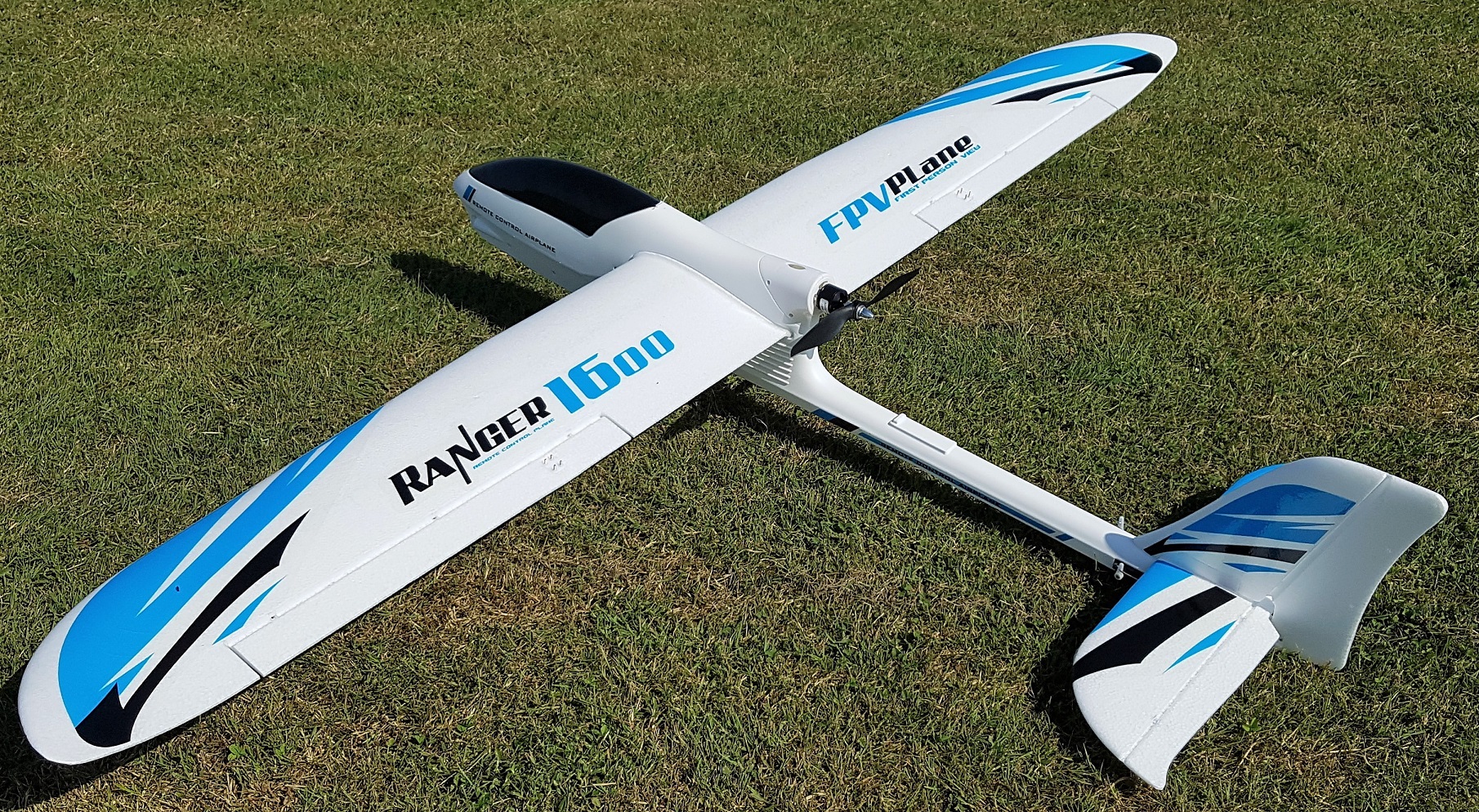
A test flight showed no problems so I then flew it FPV and everything was fine except that the digital recorder built into the video transmitter didn’t work. It makes no difference to the flying but part of the fun of FPV flying is watching the flight back on a computer later.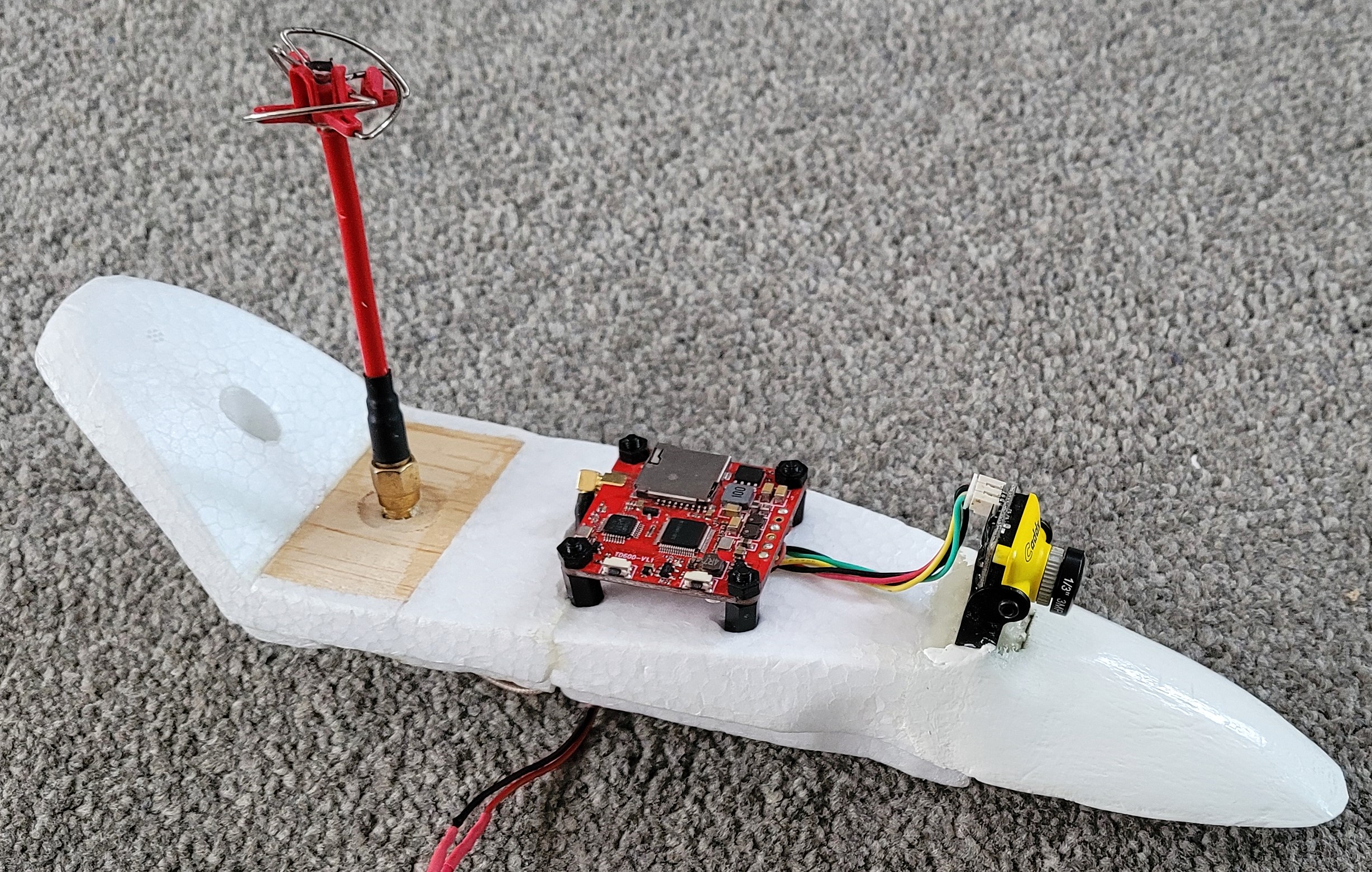
So I decided to buy an action camera as last Christmas one of Dougal’s presents was an Apeman 4K action camera which he fitted alongside his FPV camera and he is getting some excellent results. Action cameras have a much higher quality picture than the little FPV cameras but they have a time lag so aren’t suitable for providing the picture that’s transmitted back to the goggles. I found the Apeman was about £42 in Black Friday sales but then spotted a similar spec second-hand Dragon Touch for sale at £25 and only about a mile from my house. The camera came with a huge bundle of mounts, straps, tripod etc. that I didn’t need so I advertised them on Facebook Marketplace and quickly sold them for £15. So the camera with mount, two batteries, an underwater housing, 32GB micro SD card with adaptor, and a couple of Velcro straps cost me just £10, that has to be a bargain!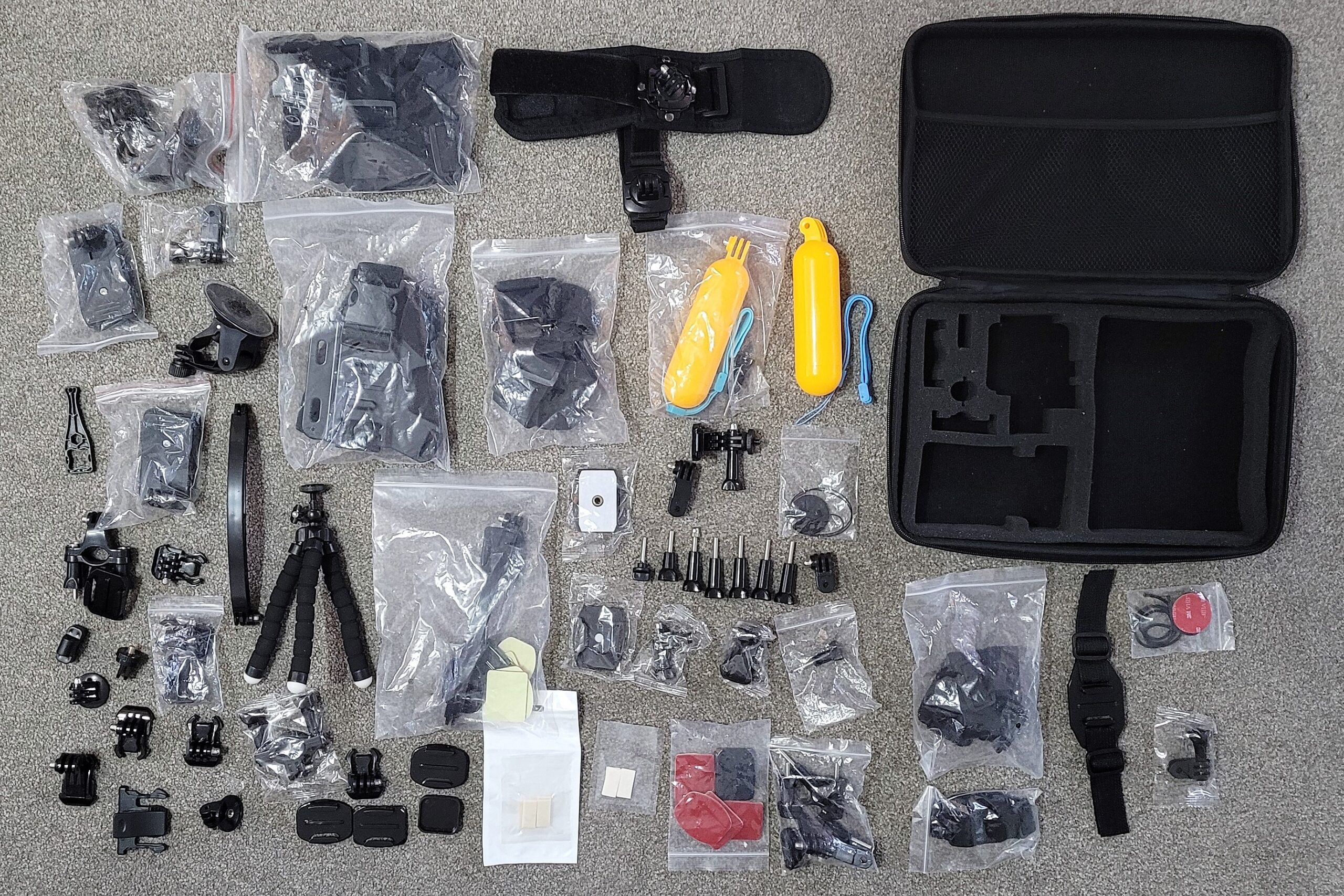 Action cameras are very bulky and heavy compared to FPV cameras so I needed to mount it as close to the centre of gravity as possible and I basically copied the method Dougal has used on his Sonic Modell Binary with the two cameras mounted alongside each other.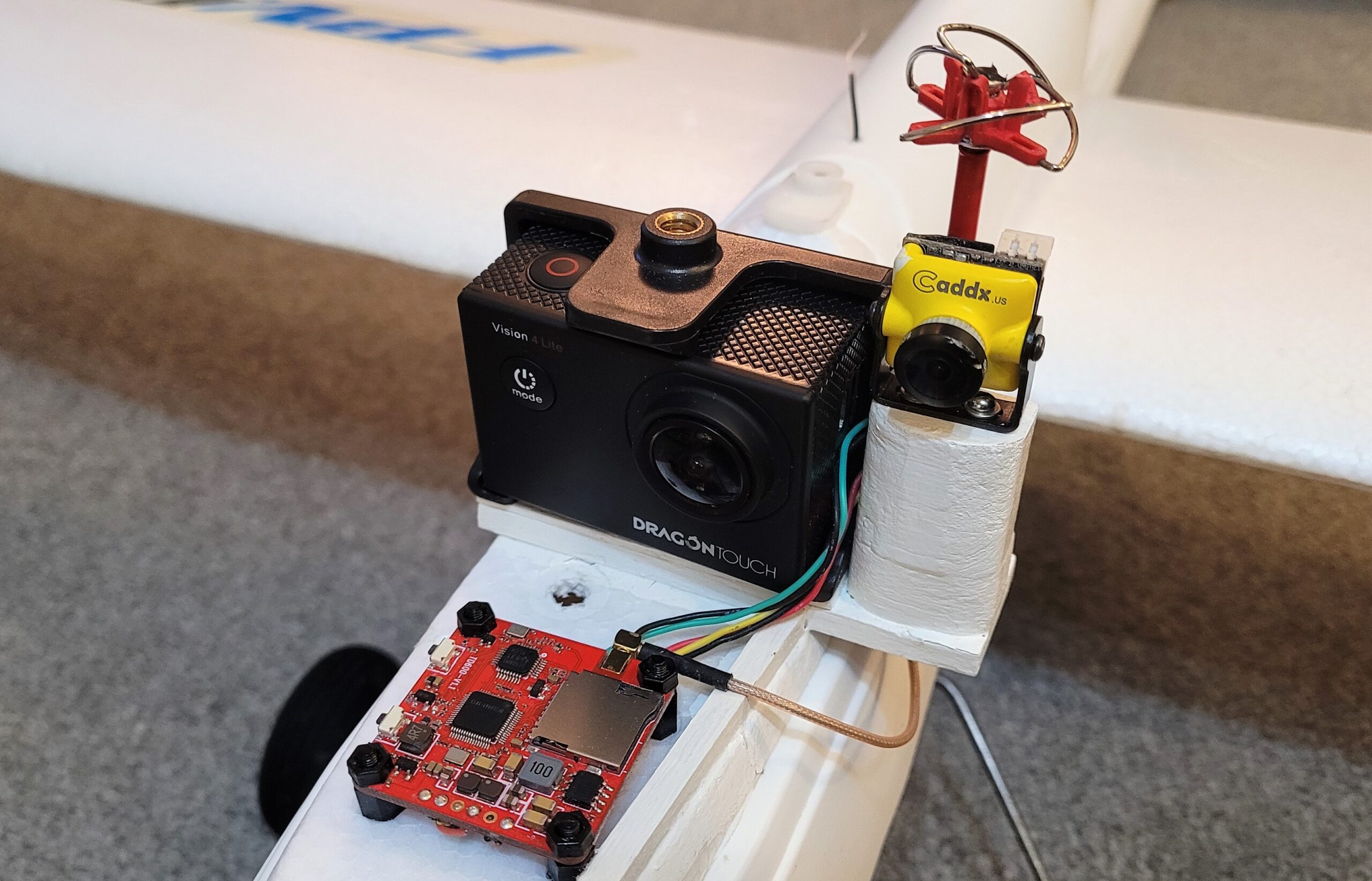
I’ve only had a few flights so far with this set-up but the results are looking good and it provides much better quality videos than with the recorder built into the video transmitter ever did. In this month’s video the FPV footage with a date & time is from the new camera.
Chas rather liked the look of the tiny Mustangs and Corsairs that several of us have been flying recently and kept his eyes open for one at a sale price. One day he spotted the T-28 Trojan from the same range in a Banggood Flash Sale at just over £50 with three batteries and took the plunge. Like the others the model comes complete with a transmitter and is totally finished, all that is required is to charge the single cell lipos using the USB charging lead provided and fit 4 x AA batteries in the transmitter.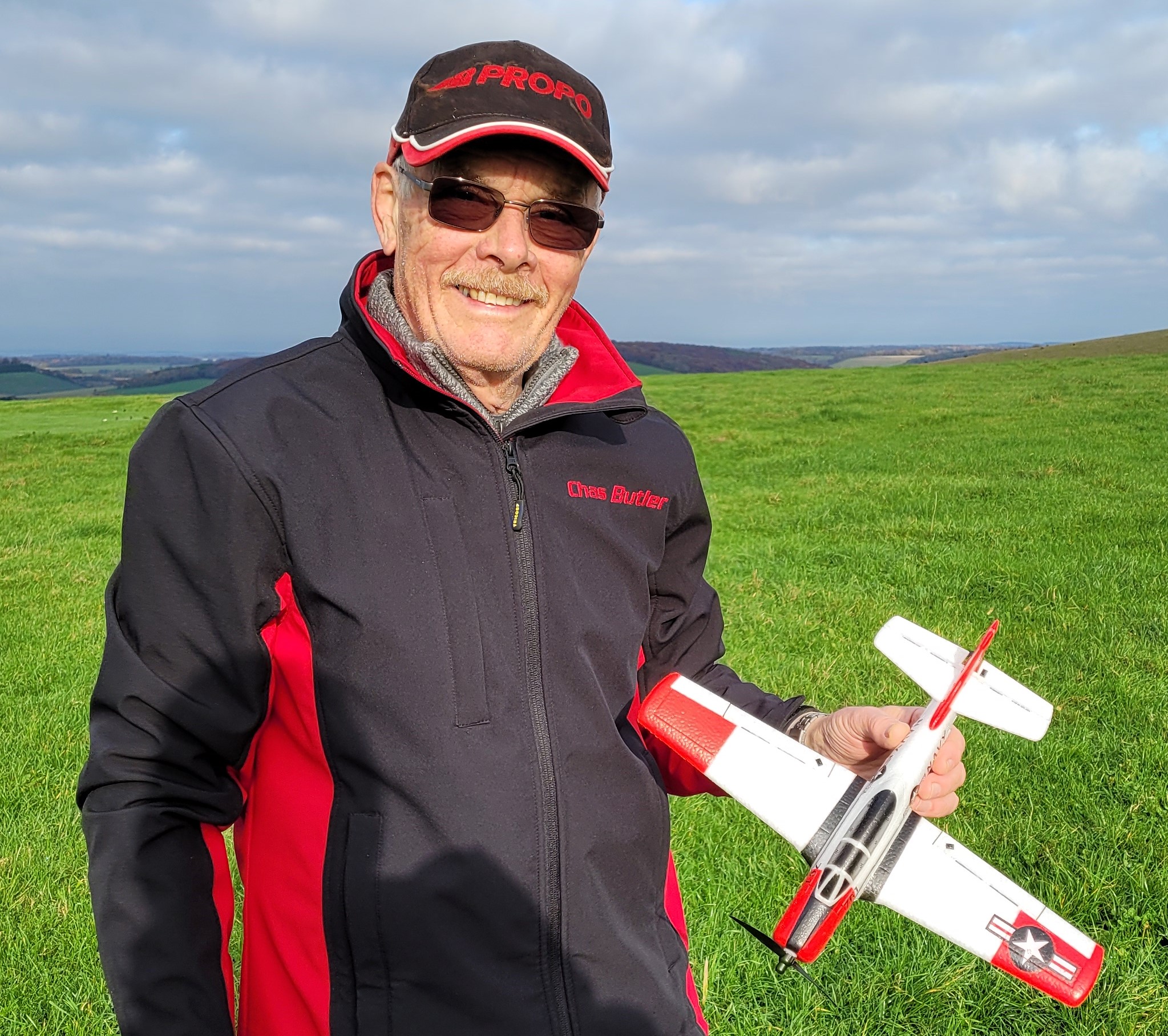
It has a built-in gyro which works very well and can be switched between three modes, beginner, intermediate, and expert. Expert mode switches the gyro off completely and whilst the model is flyable it is quite a handful, intermediate mode is much more pleasant.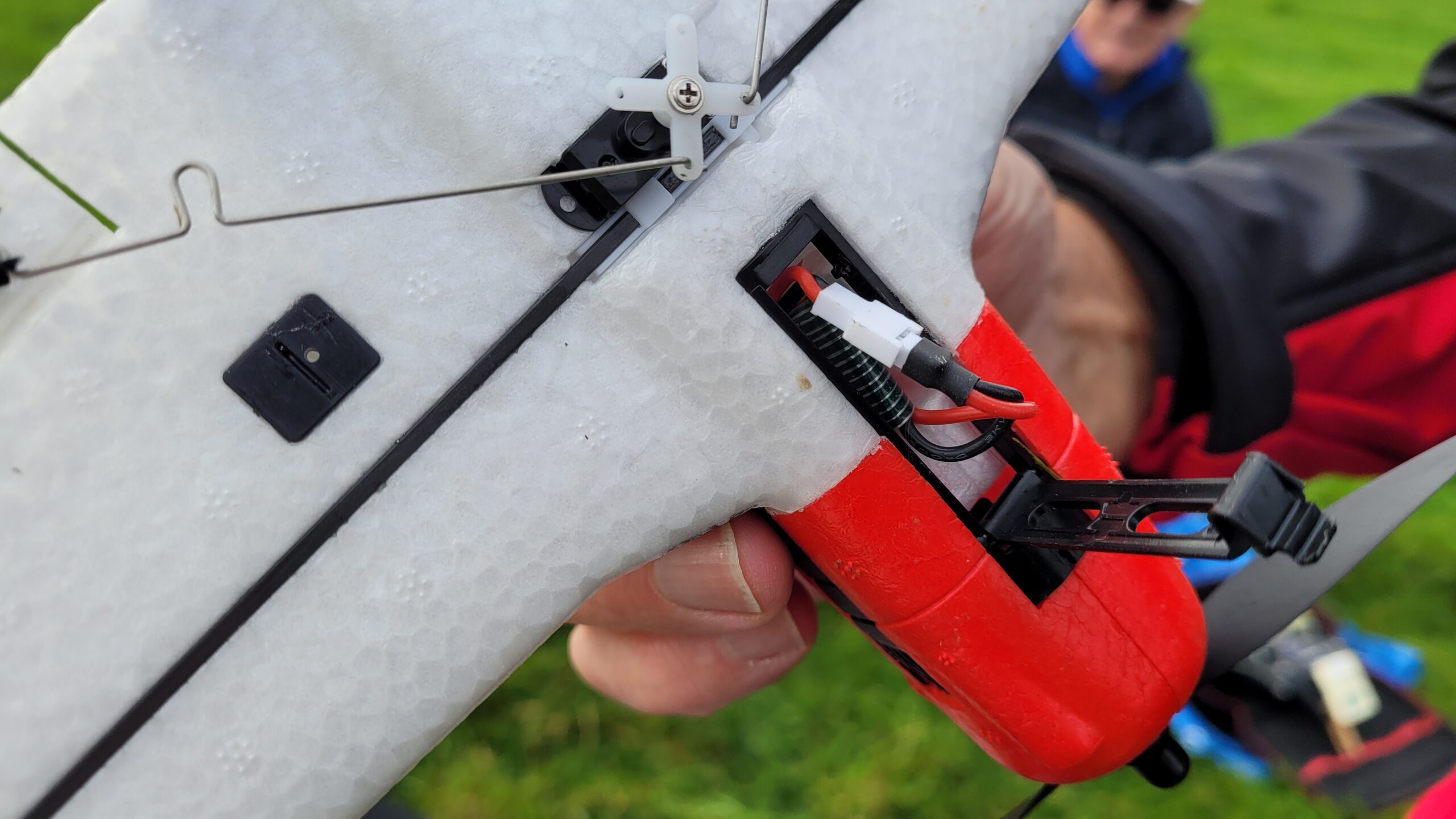
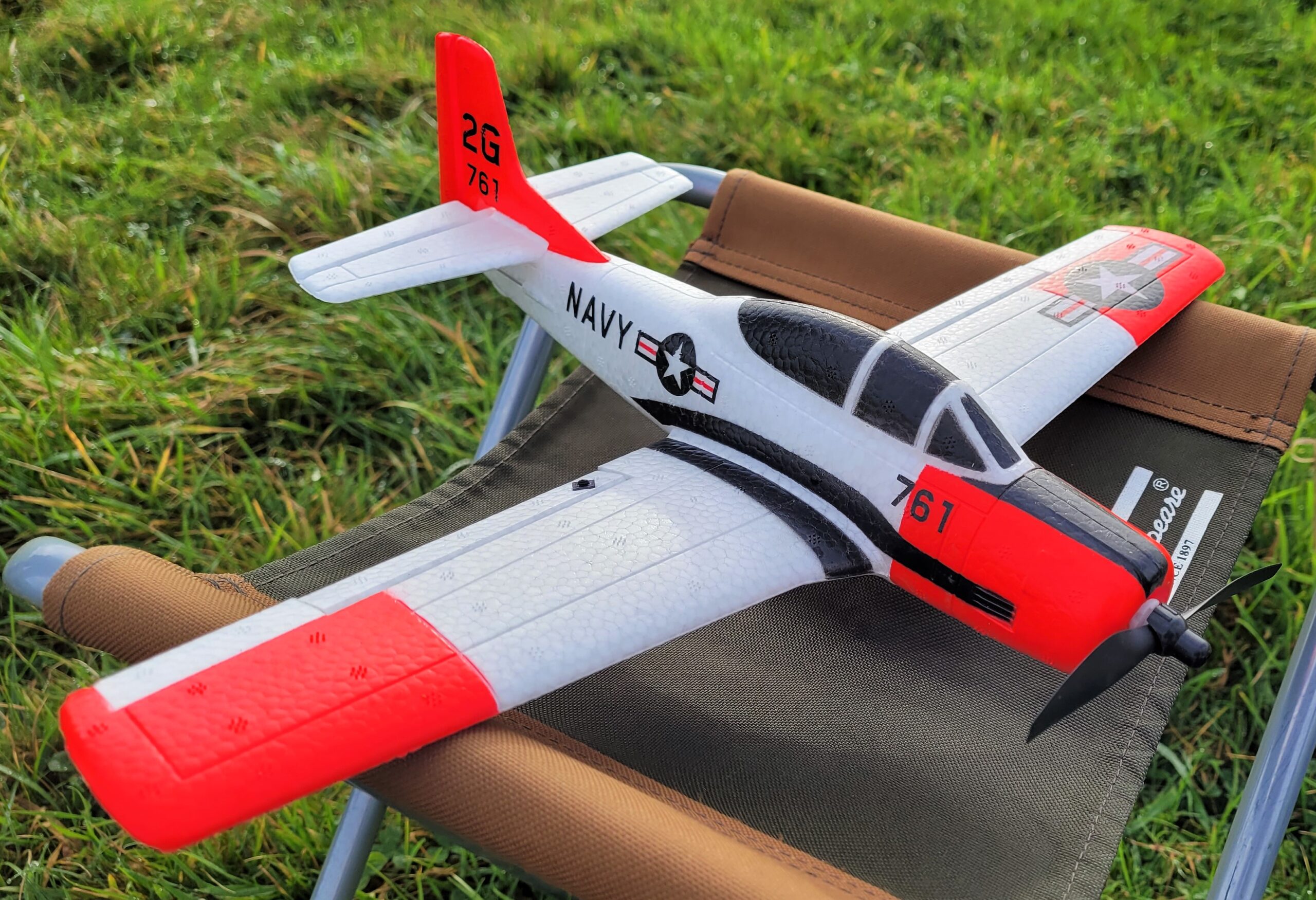
Chas chose a reasonably calm day for the first flight and soon got the feel of the Trojan, finding like the rest of us that keeping the tiny model close enough and in sight was the hardest part. On the first landing Chas hit the spot landing spot but the little Trojan bounced off a couple of feet! The same models are being sold under various manufacturers names, I’ve seen Eachine, Volantex, Sonik and WLTech so far. The ranges are expanding and now also include a P-40 Kittyhawk, a P-47 Thunderbolt, a BF109, and a Spitfire. I’ve just noticed that Wish.com have the Corsair for just £40.72, who’s next to take the plunge? There’s footage in this month’s video of the Trojan and also Ian’s Corsair and my Mustang.
On the subject of the tiny models, Basher Bob’s been up to his old tricks again and cruelly smashed my little Mustang out of the sky one day. There I was flying along, minding my own business straight and level over the patch when Bob’s Sea Vixen suddenly smashed right through me. Bob’s version of the incident may be different but I write Patch News…!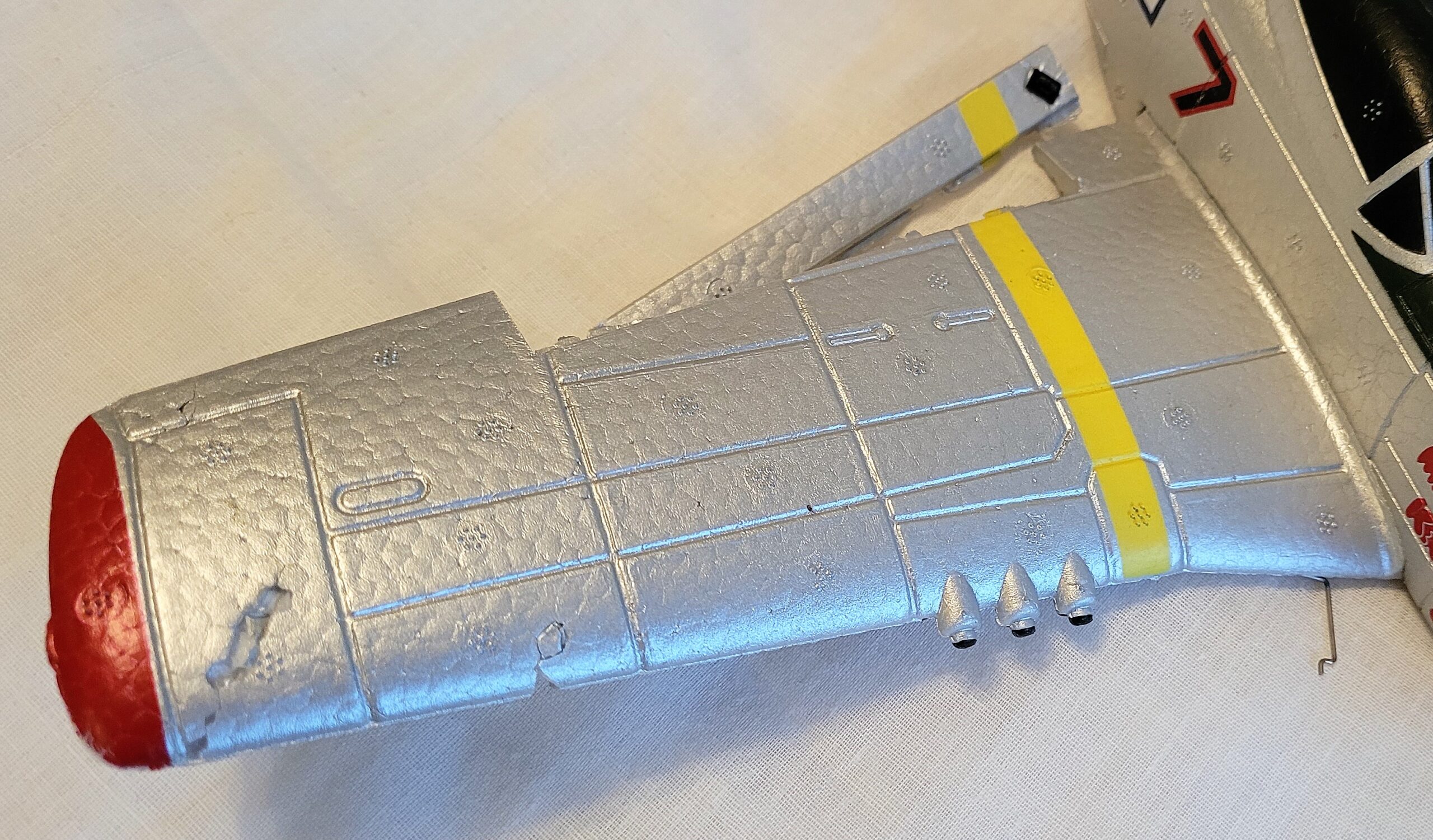
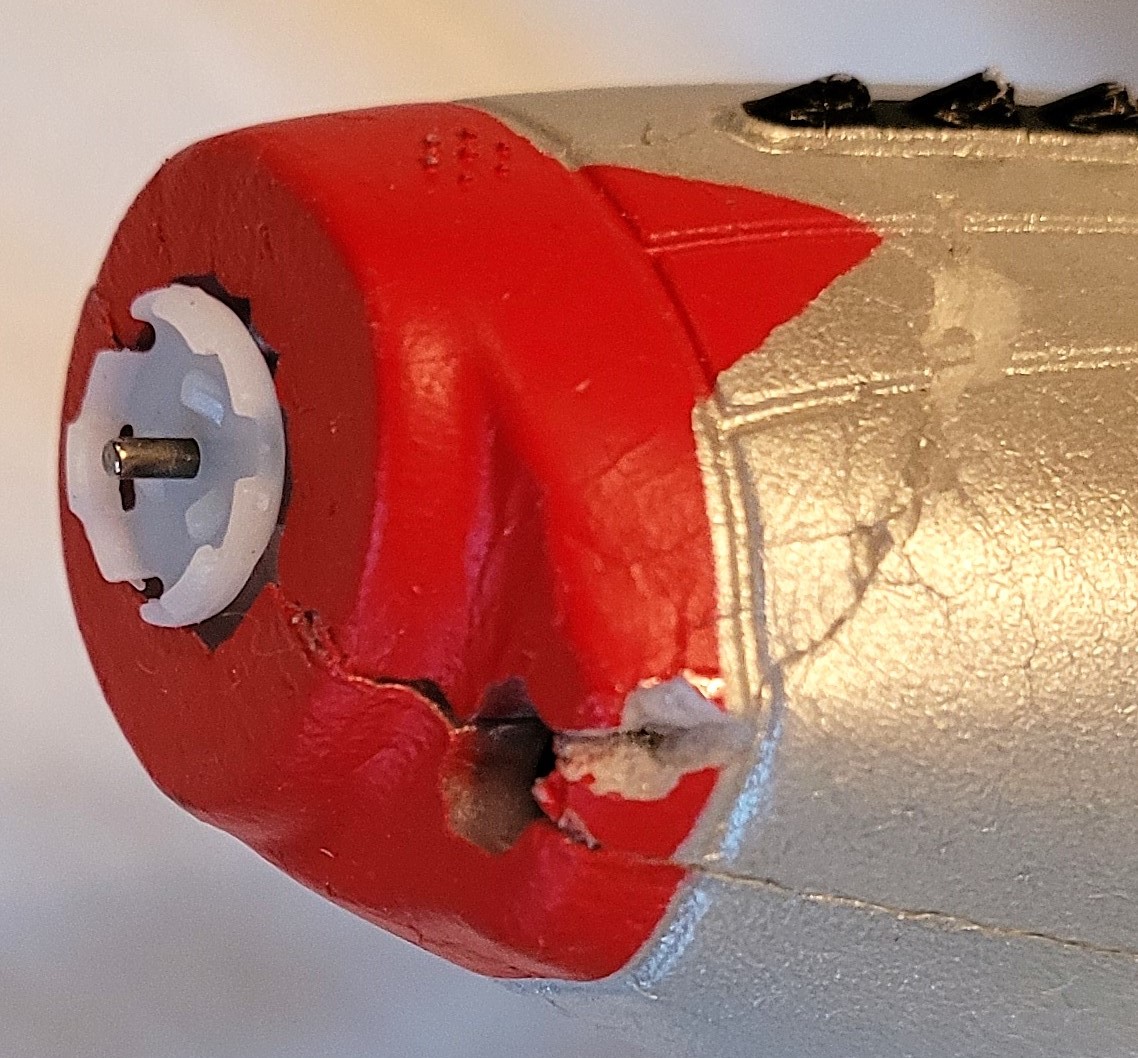
Luckily the damage was fairly minor and by using cyano applied with a pin I was able to glue the detached piece of the nose and a small piece of the wing trailing edge back in place. The biggest problem was the detached aileron which was originally hinged by the foam itself. I cut a couple of tiny pieces of Mylar hinge material, made small slots in the wing and aileron with a pointed scalpel blade, and glued them in with thin cyano.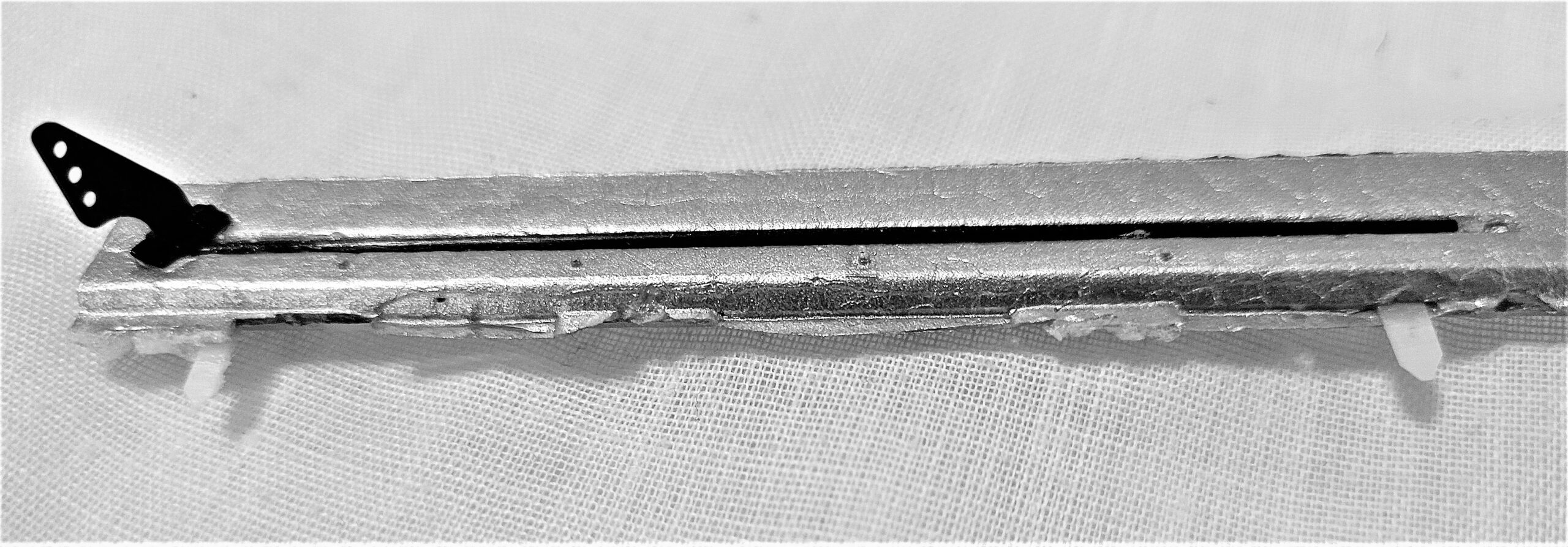
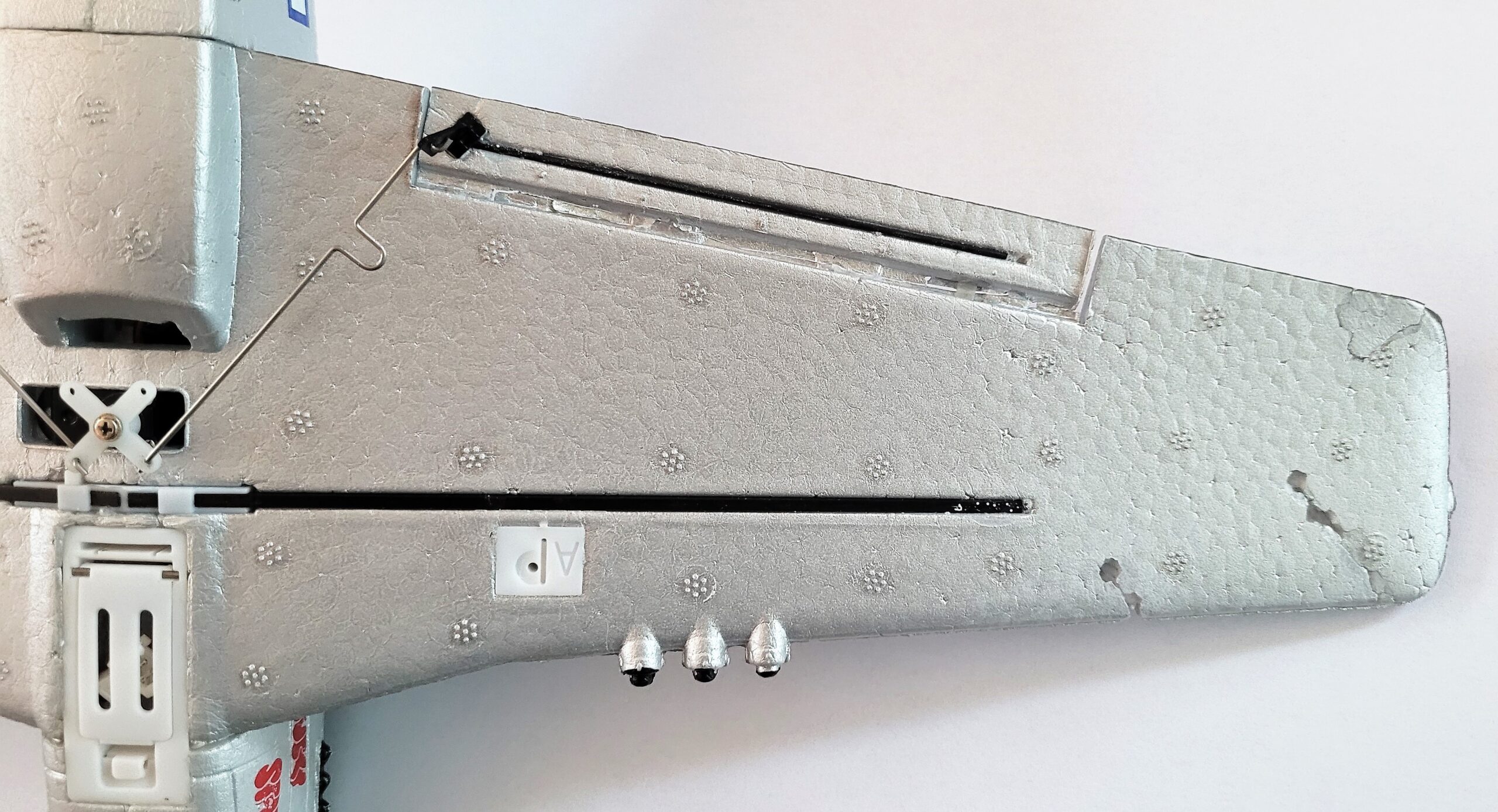
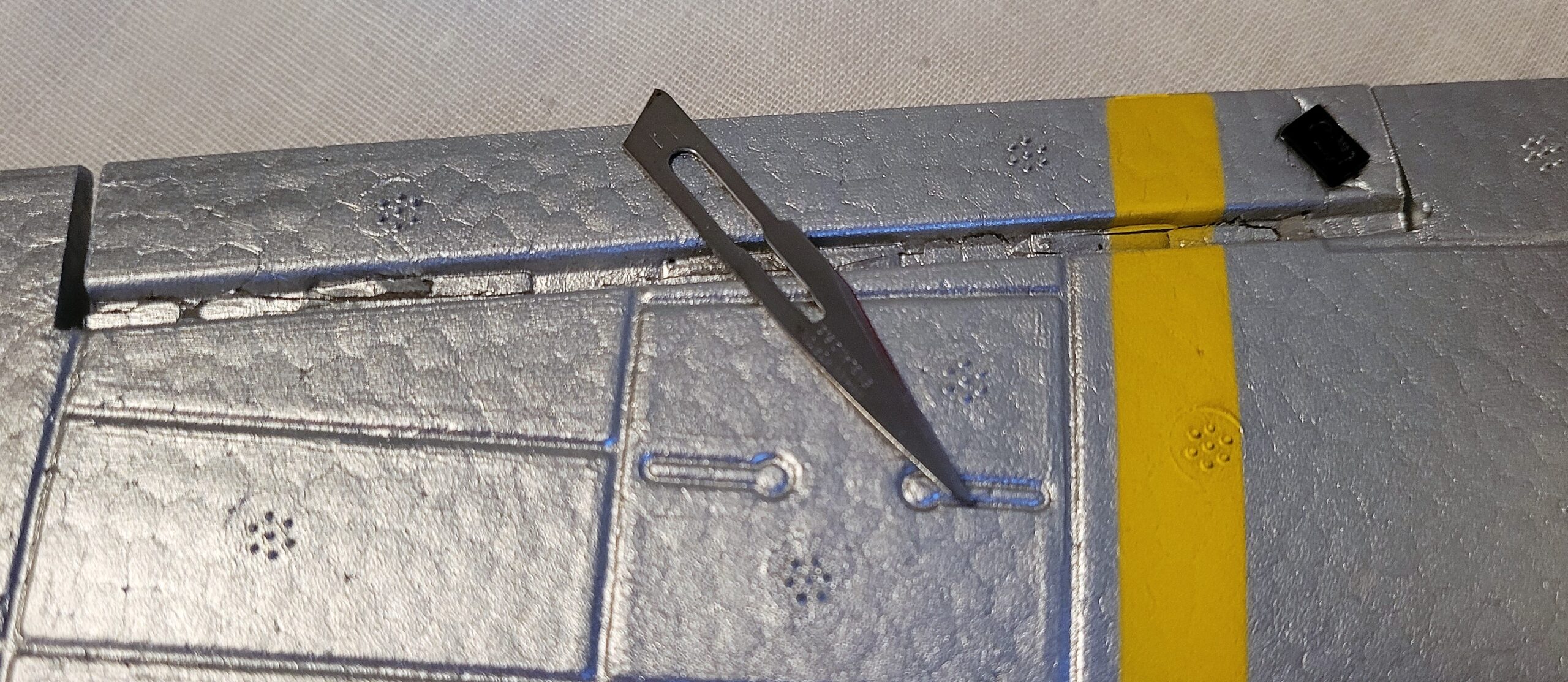 The repairs worked out well and aren’t really noticeable and now the Mustang is flying again as well as ever. Ian and I flew his Corsair and my Mustang together one day while Dougal videoed. It’s not easy to fly them close together or to film them but Dougal was able to get some pretty good footage which you can see in this month’s video.
Having passed his ‘A’ test Gordon Bennett decided he needed some fun so he joined the foamboard fairies. He bought a Mig-29 from Banggood along with a 2212 2450Kv motor which he’s fitted with a 6 x 4.5 propeller and runs from a 3 cell 2200mAh battery.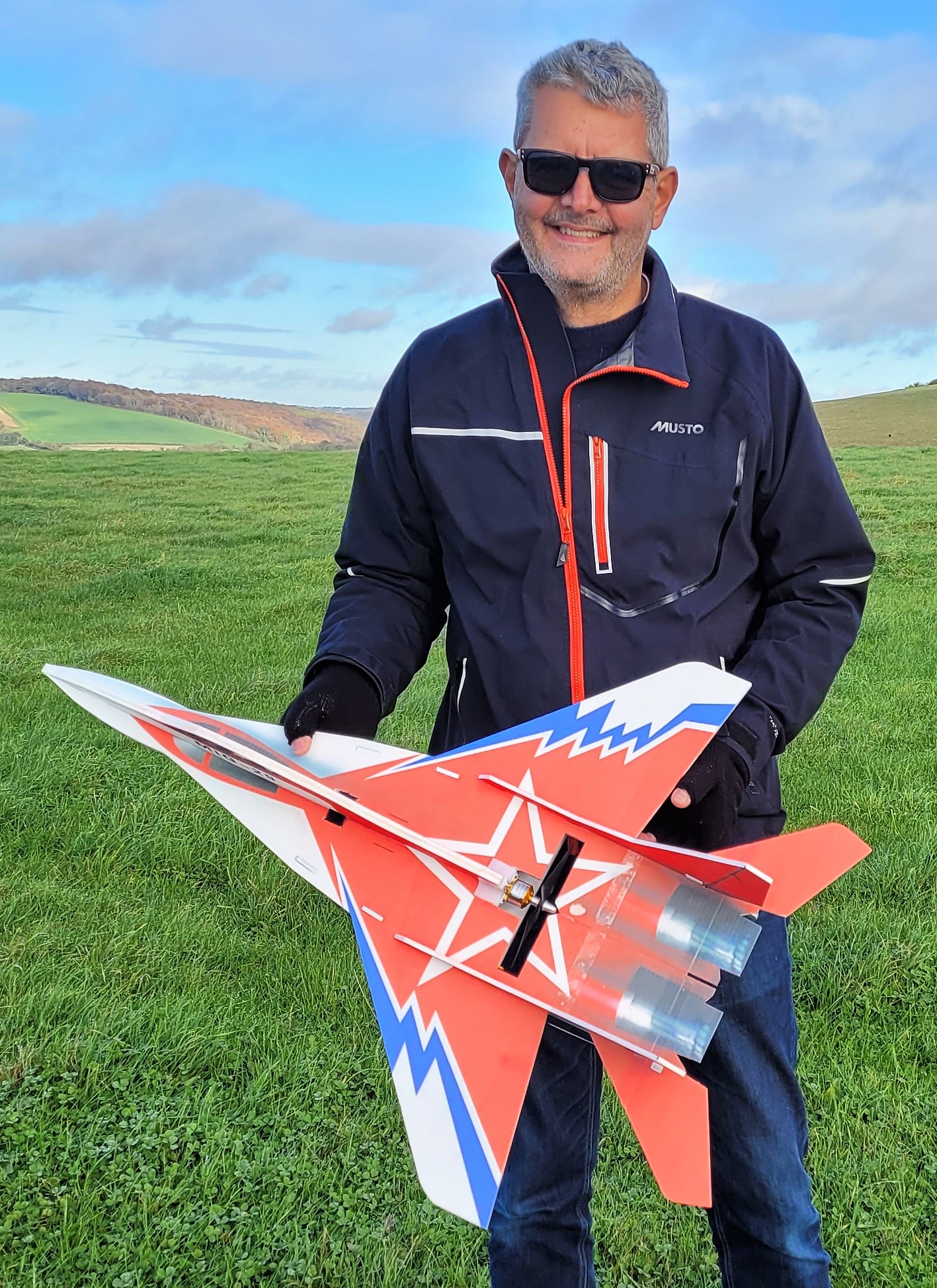
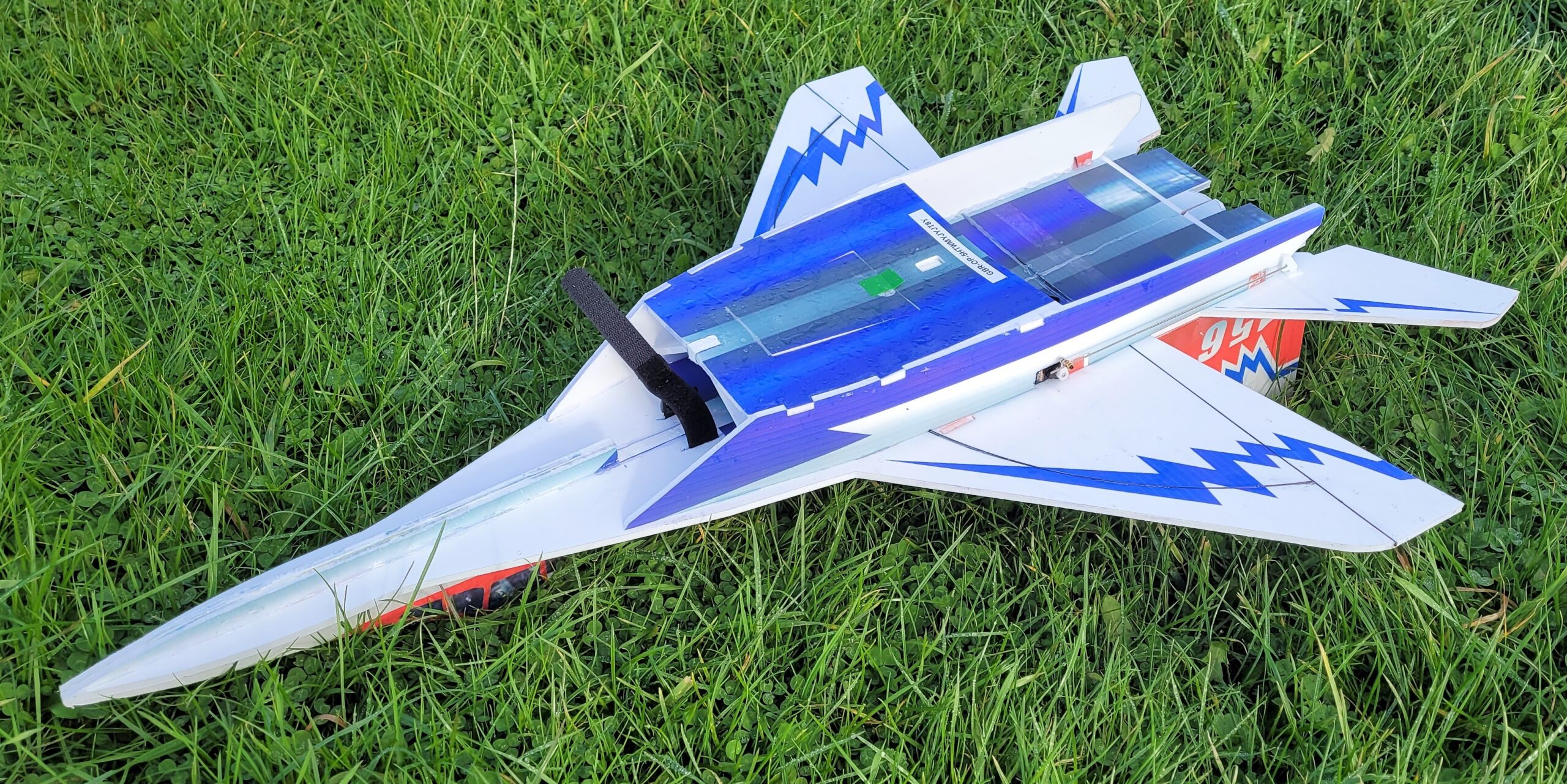
He made a nice job of putting it together and very quickly had it ready for flight. Gordon had never previously flown a foamboard model so I thought he was quite brave doing the test flight himself but all went well. The Mig appeared to be a bit too sensitive on elevator at first but Gordon got it all sorted out and was soon confidently flying low passes etc.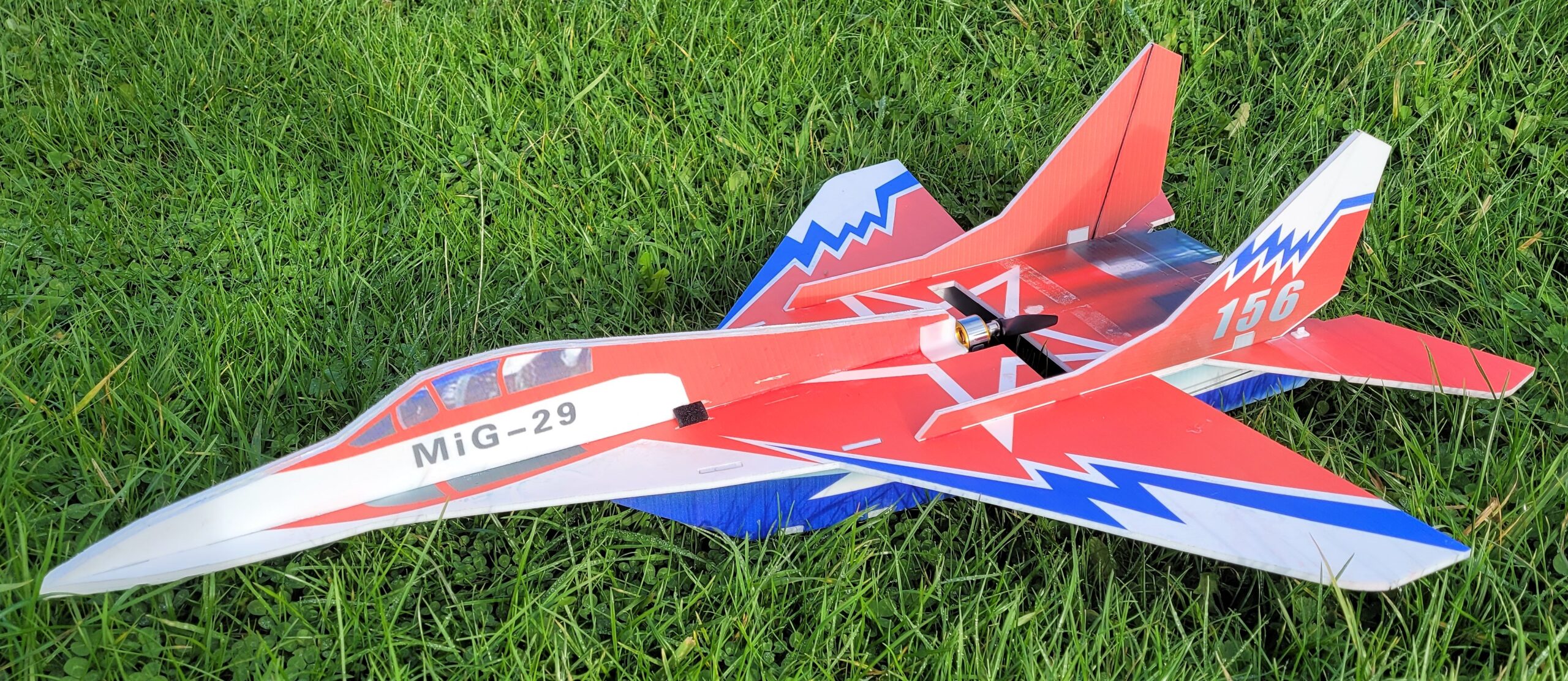 After a few minutes he called landing and dropped the model right at his feet. Well done Gordon, now you just need to learn how to take out Captain Slow’s Mig-29!
Sadly I think my SU-27 will finally have to be retired after hundreds of flights. I bought it in a HobbyKing sale for just £7.64 back in October 2018 and have flown it regularly ever since. For more than three years it’s been my ‘go to’ plane and despite many crashes (mostly due to my lunatic flying) it’s always bounced back and flown as well as ever.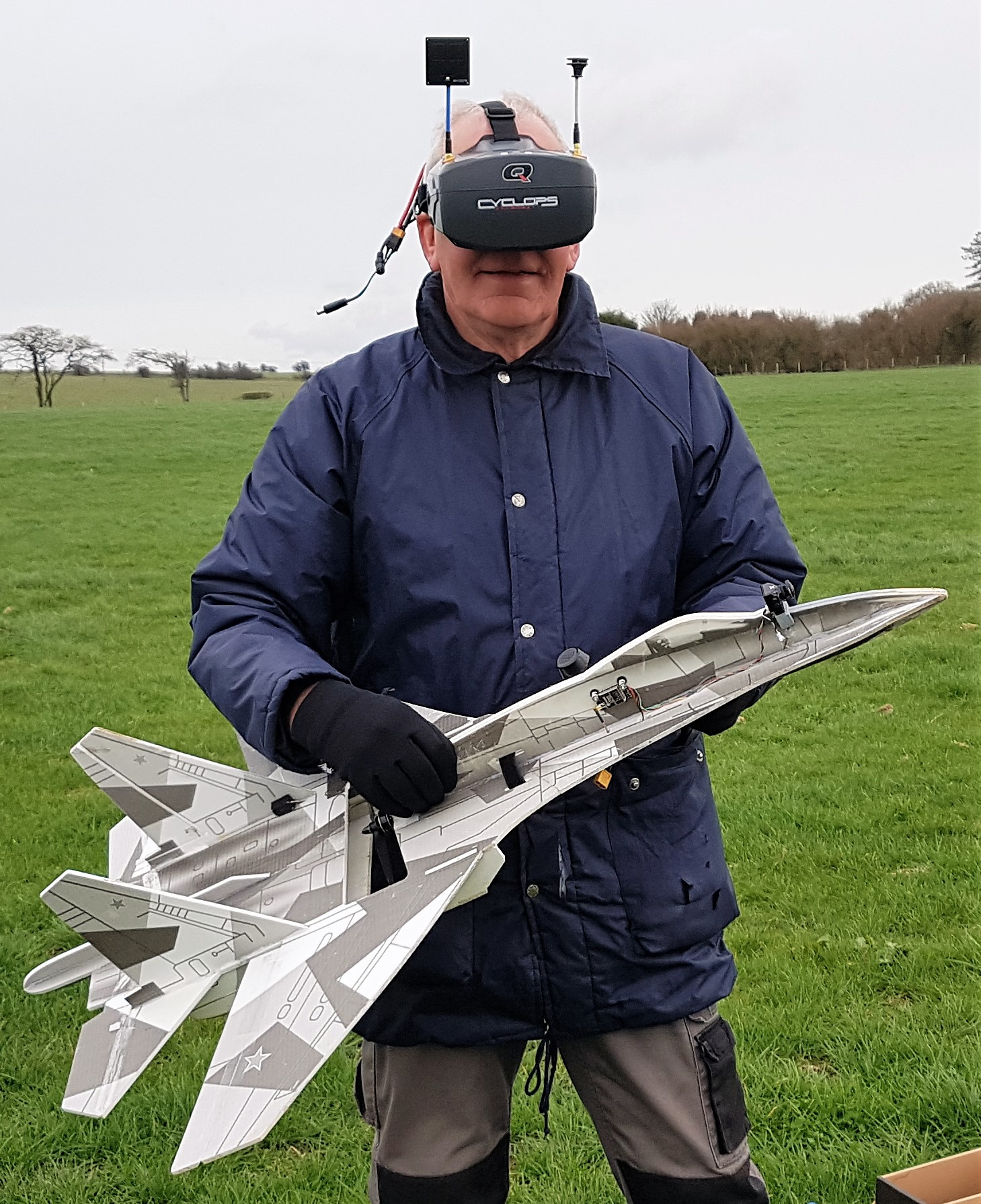
It even survived being the first plane I used for FPV. But in November it had several ‘arrivals’ when the battery came loose so I treated it to a new Velcro strap but on the very next flight it suddenly dived straight in. I’m not sure of the cause, possibly structural failure after so many bodged repairs, or maybe the receiver has had one too many crashes to cope with, but I’m leaning towards a total battery failure, more checks are required.
Fortunately I have a replacement SU-27 tucked away from the time when I bought six at once, five for club raffles and one for me. At the time HobbyKing must have been having a massive warehouse clear out as they were only £2.50 each! It’s time to put it together.
I snapped this rather unflattering shot of Woody one morning. Perhaps I’m being a little cruel using this photo as he was actually retrieving my SU-27 from the lower field for me.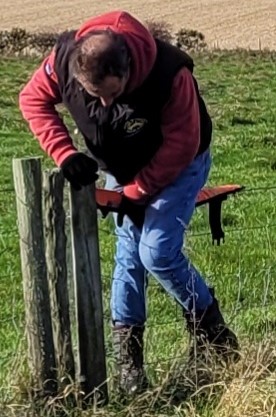
Here’s a marginally better one when he’s posing with his latest win from RC Aircraft Online, a Logic RC flight box. That’s his second win in two months, well done Woody.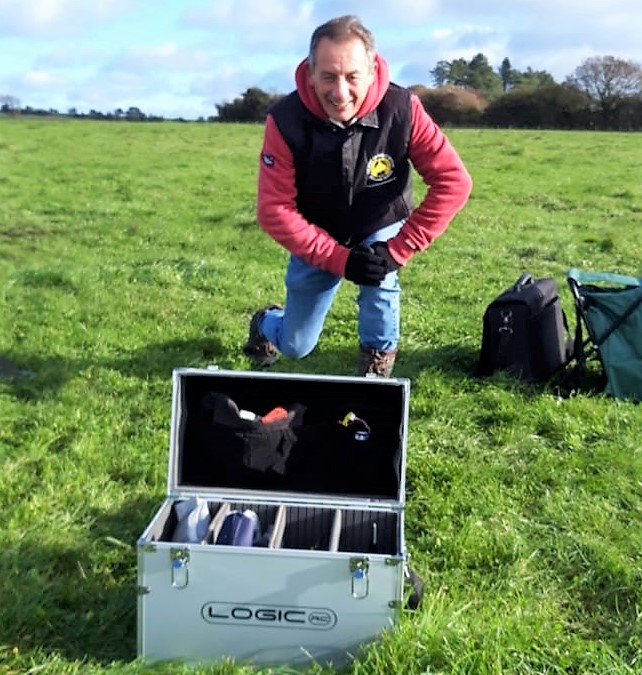
Not at the patch but fairly close by at Boscombe Down some electric records have been broken. Some of you may have seen the news about the development of the Rolls Royce Spirit of Innovation, an electric powered plane that has already smashed several records.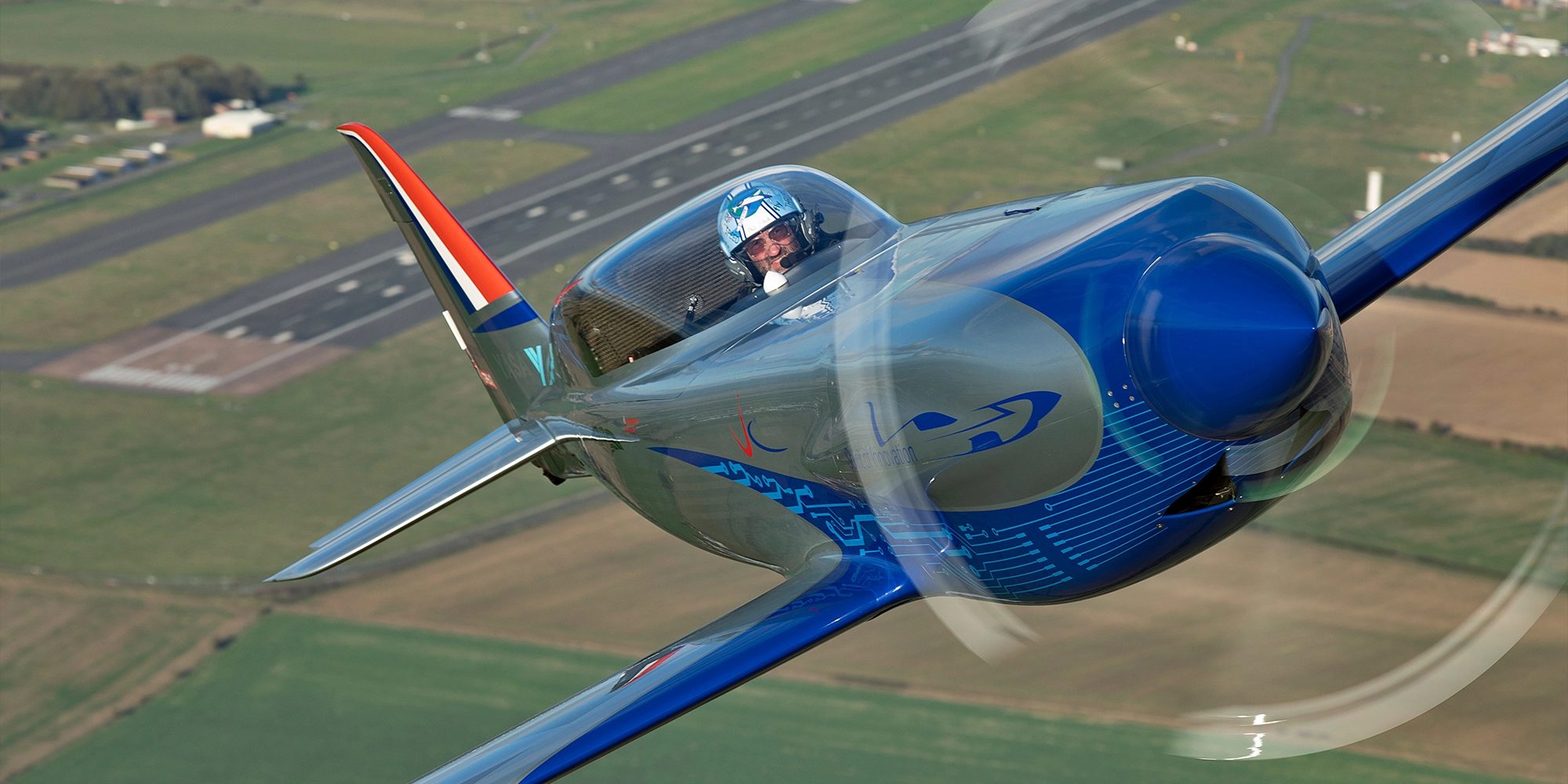 This is from the ExtremeTech website: Rolls-Royce has been working on an all-electric plane, called “Spirit of Innovation,” and the automaker reports that the aircraft absolutely clobbered at least three world records in their latest test flights. For an aircraft that’s only been in the air for a few hours total, that’s pretty impressive — this report comes not quite two months after the aircraft took off for its maiden flight.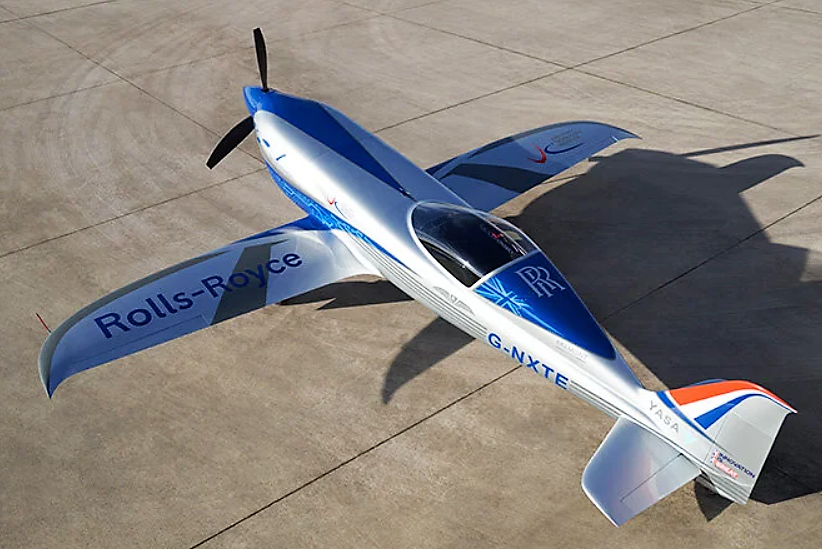
After the flights, the company announced: “We have submitted data to the Fédération Aéronautique Internationale (FAI) – the World Air Sports Federation who control and certify world aeronautical and astronautical records – that at 15:45 (GMT) on 16 November 2021, the aircraft reached a top speed of 555.9 km/h (345.4 mph) over 3 kilometres, smashing the existing record by 213.04 km/h (132mph).”
They go on to say that the day’s later test flights also belong in the record books. While they didn’t push the rest of the later flights quite as fast, at least one still hit 330mph. They also report breaking the fastest time to climb to 3km altitude by an entire minute, clocking in at a final 202 seconds, as well as breaking two other speed records over distances of three and fifteen km, respectively. The flights took place at the UK Ministry of Defence’s Boscombe Downs aerodrome: an airfield not unlike Edwards AFB, used for testing new and experimental aircraft.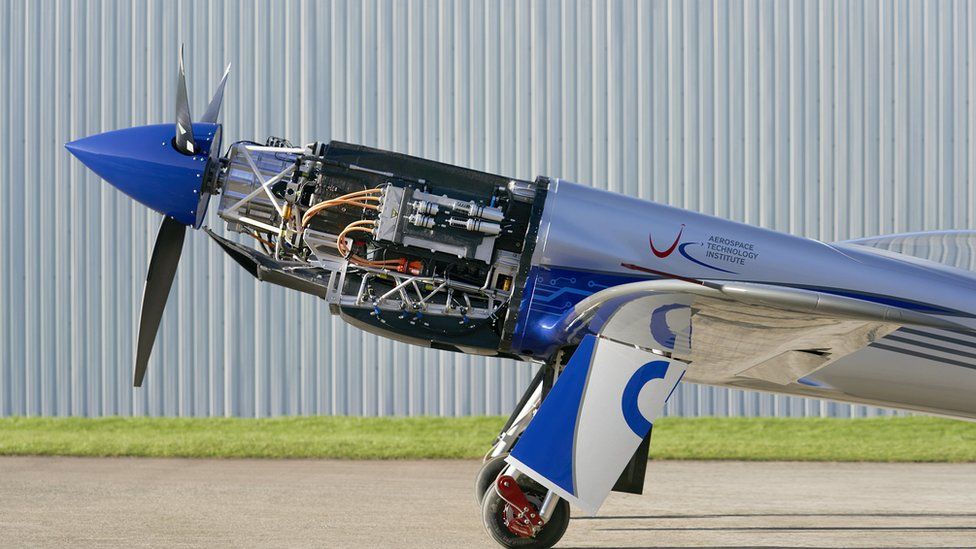
Spirit of Ingenuity uses liquid-cooled Li-ion batteries, and a 400kW power train developed with partners Electroflight and YASA, also of the UK. The single-seat aircraft has an ultralight carbon-fibre hull, and while it boasts the ability to put forth 500+ hp, it can land with two of its three batteries disabled.
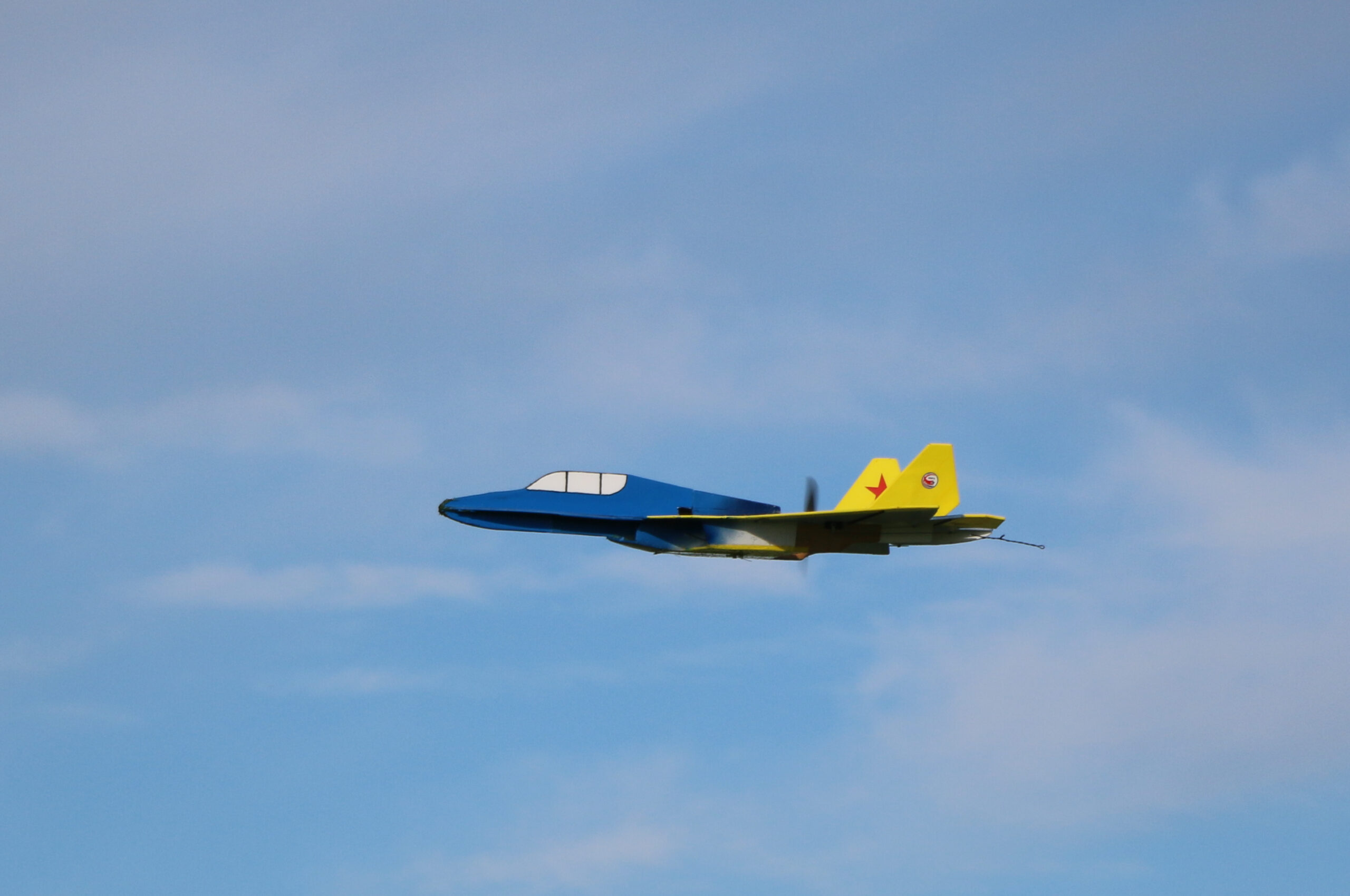
Kryten was able to take some excellent flying shots of our models in November including several of my tiny Mustang, that can’t have been an easy model to snap: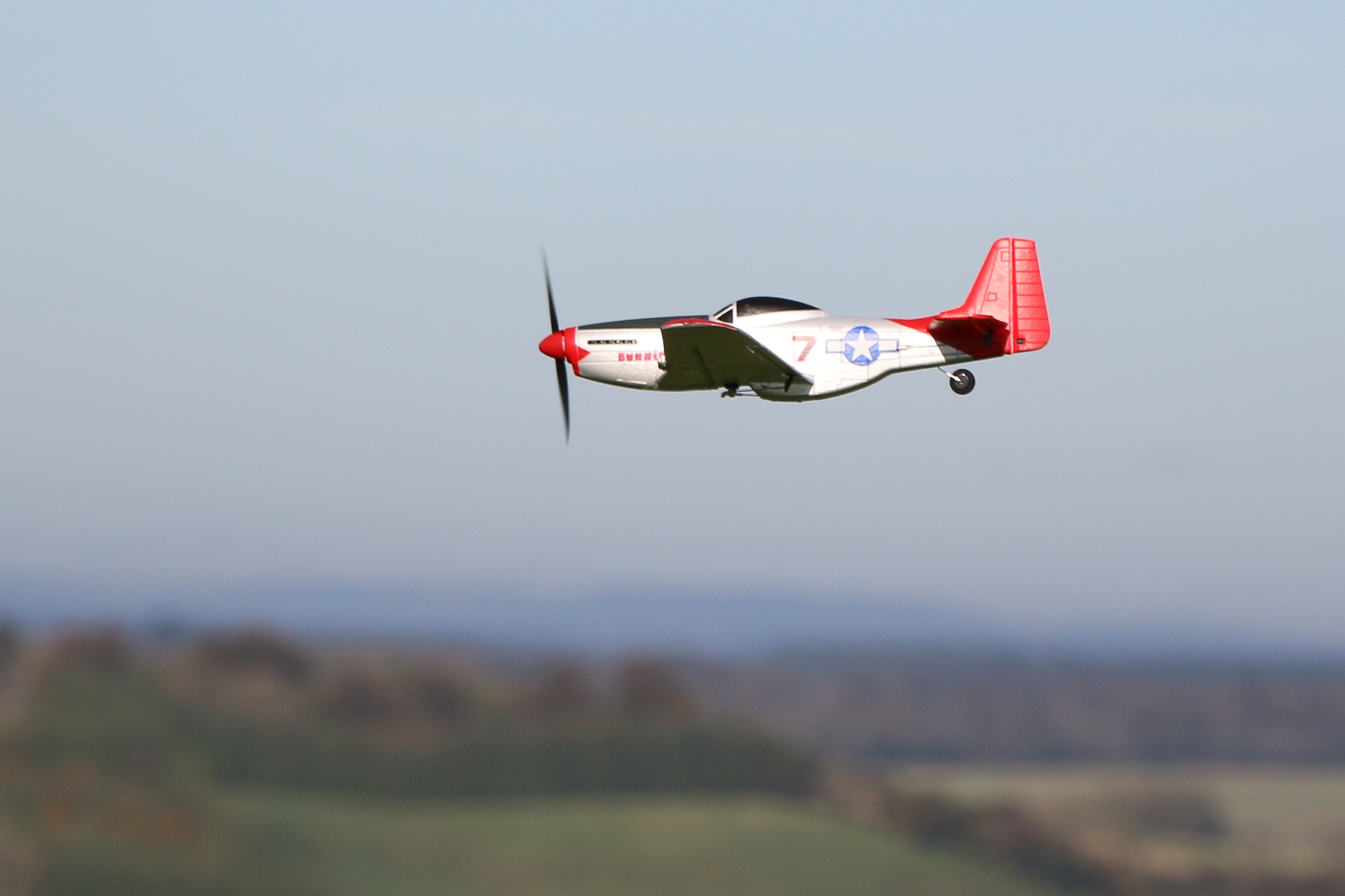

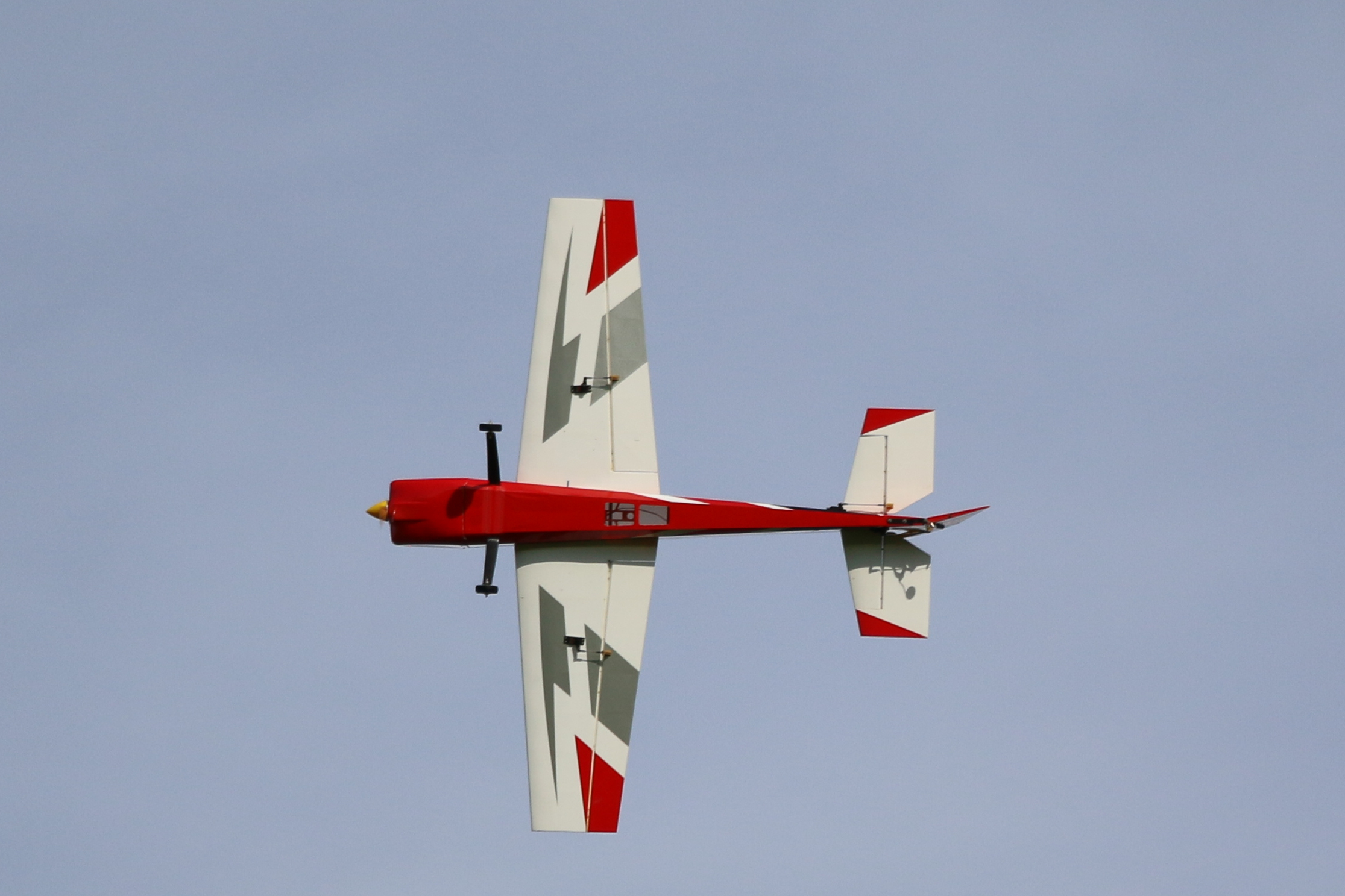
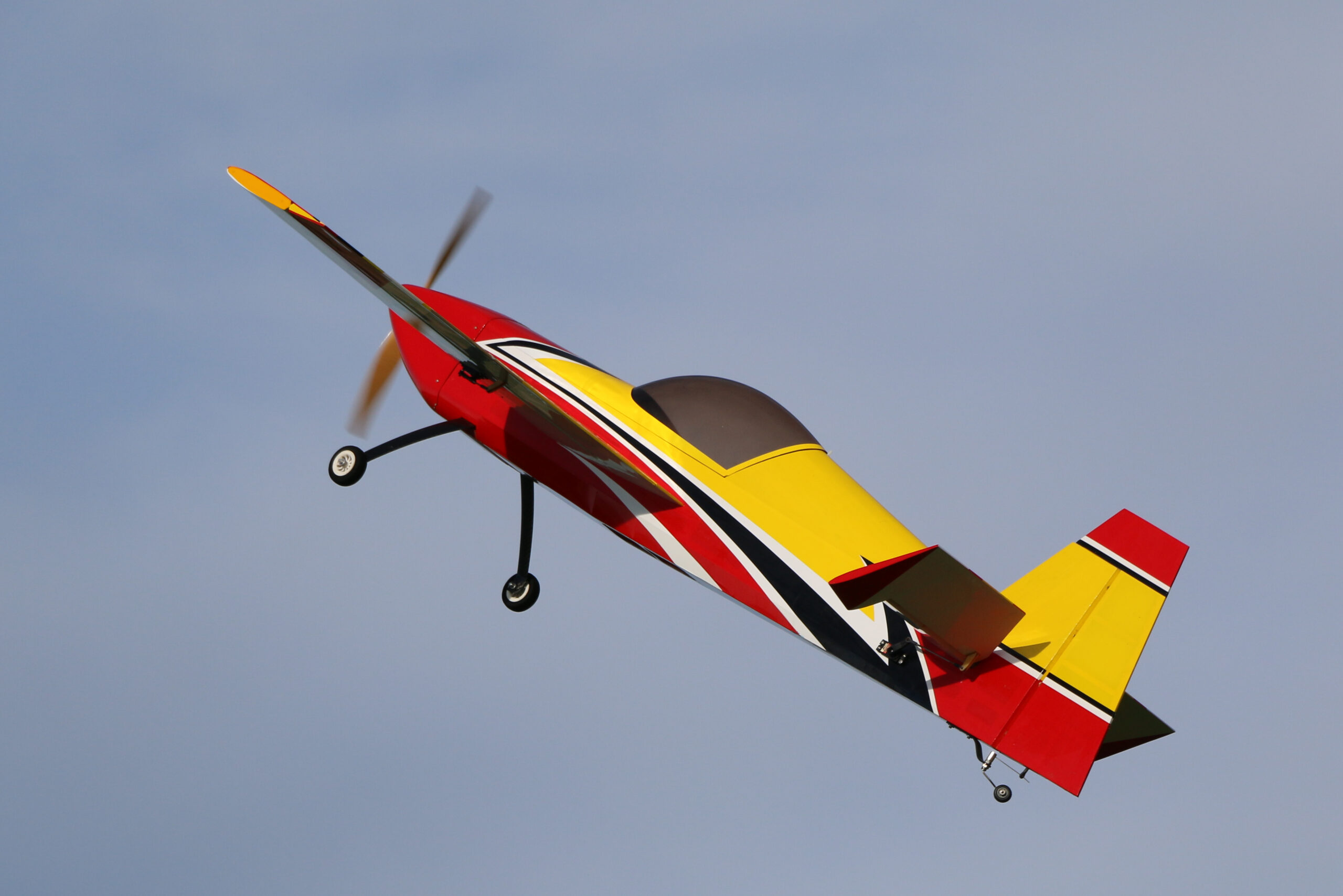

Video time now which this month includes both some ground and some aerial FPV footage by both myself and Dougal. Please watch the video full-screen, it’s so much better with small models flying around. If the video won’t play for you please click HERE
Did you hear about the lady who left her job as an air traffic controller to date a monk? She got out of the flying plans and into the friar…
Colin Cowplain
Patch News – October 2021
Unsurprisingly the October weather was rather autumnal and served up pretty much everything from sunny days with almost no wind to other days with heavy rain and gales.
PAM members managed to fly regularly although some of the calm mornings were rather murky at first but it quickly cleared on most mornings and the sun broke through.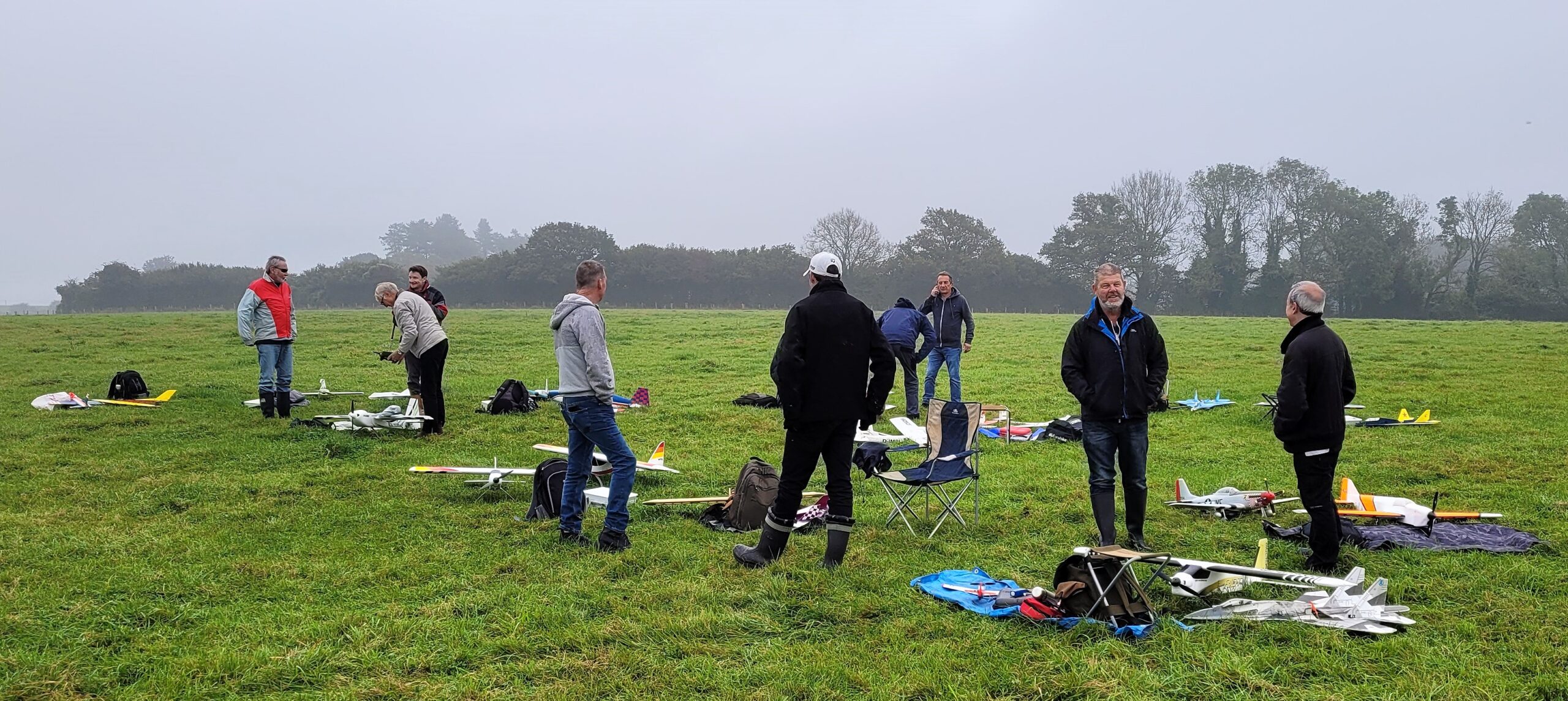
However on one morning we were totally defeated and gave up after about an hour of consoling ourselves with cups of coffee whilst solving all the world’s problems.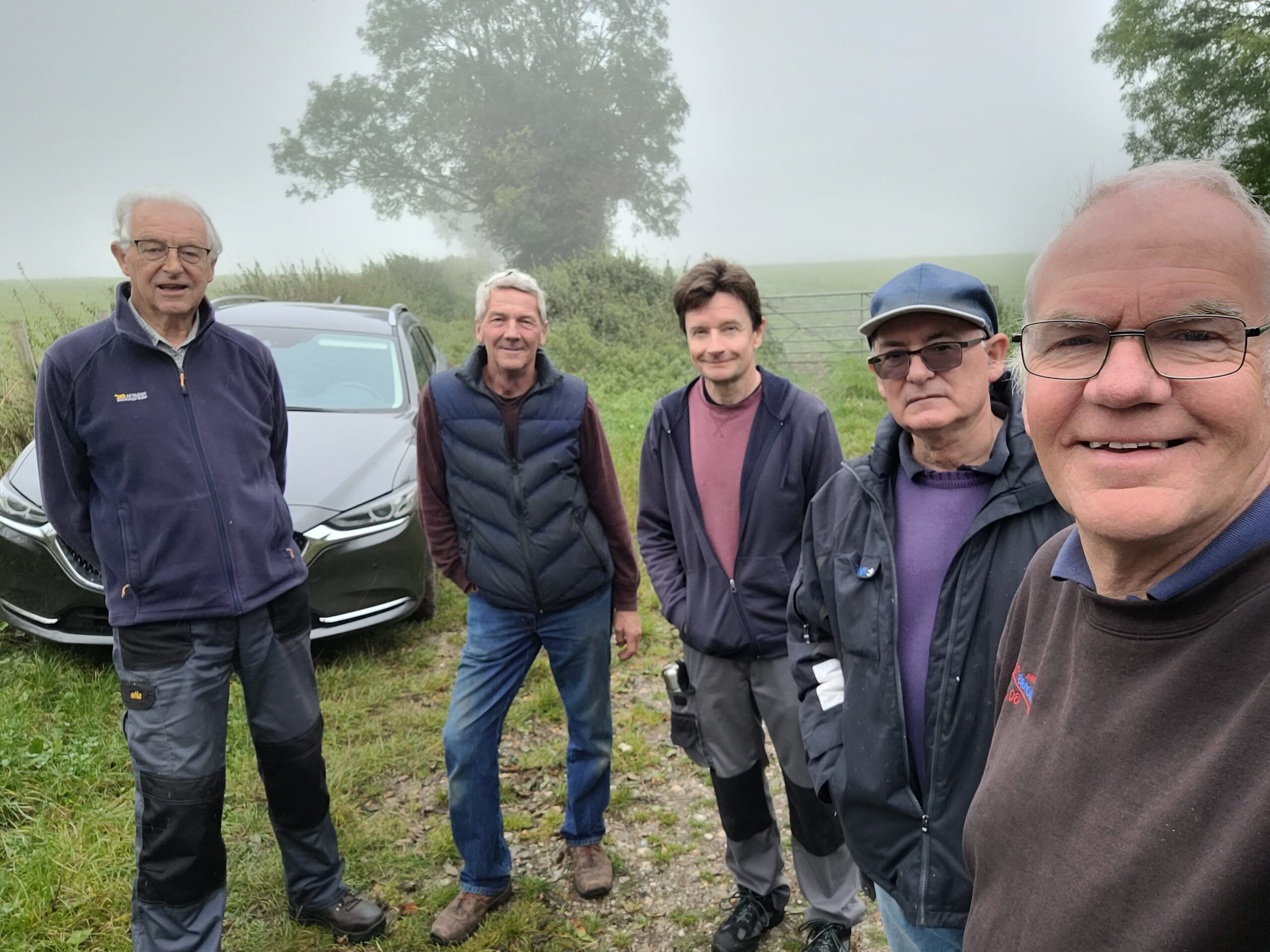
The bullocks disappeared right at the end of September and didn’t return in October. The grass is growing more slowly now and it’s normally mown by the Farts (Friday Afternoon Rural Trimming Society) but in October Dan (Page Boy) and Richard Osborn also cut it a few times. Maybe they should be known as the Drats (Dan & Richard Artisan Trimmers)?
The club Comp Sec Dwayne Pipe has asked me to remind you about the various fun-fly comps that run continually throughout the year. As the name implies they really are just for a bit of fun so next time you are at the field why not pick whichever discipline(s) you fancy and have a go. Full details are on the website, click on the Competition heading. There are two classes for each competition, A and B depending of which BMFA certificate you hold so if you have an A certificate you won’t have to compete against B certificate fliers. Just ask someone to help you with the timing and/or counting and then let Dwayne know your score. I’ll keep the scores up to date on the website Competition page.
Back in June this year Ian Daniels visited the field and must have liked what he saw because despite all our usual insults and mickey taking he decided to join the club. Ian began his modelling career as a child and progressed to radio control at the age of 16 but after college his interests turned to full-size flying and modelling took a back seat. Recently he did a bit of slope soaring but then decided to try power models and found us. He came along with a Wot4 Foam-E and with a little help was soon flying with few problems. Ian has flown regularly since June and practised hard working towards taking his BMFA ‘A’ cert test. I’m pleased to report that in October Dougal Entendre took and passed him.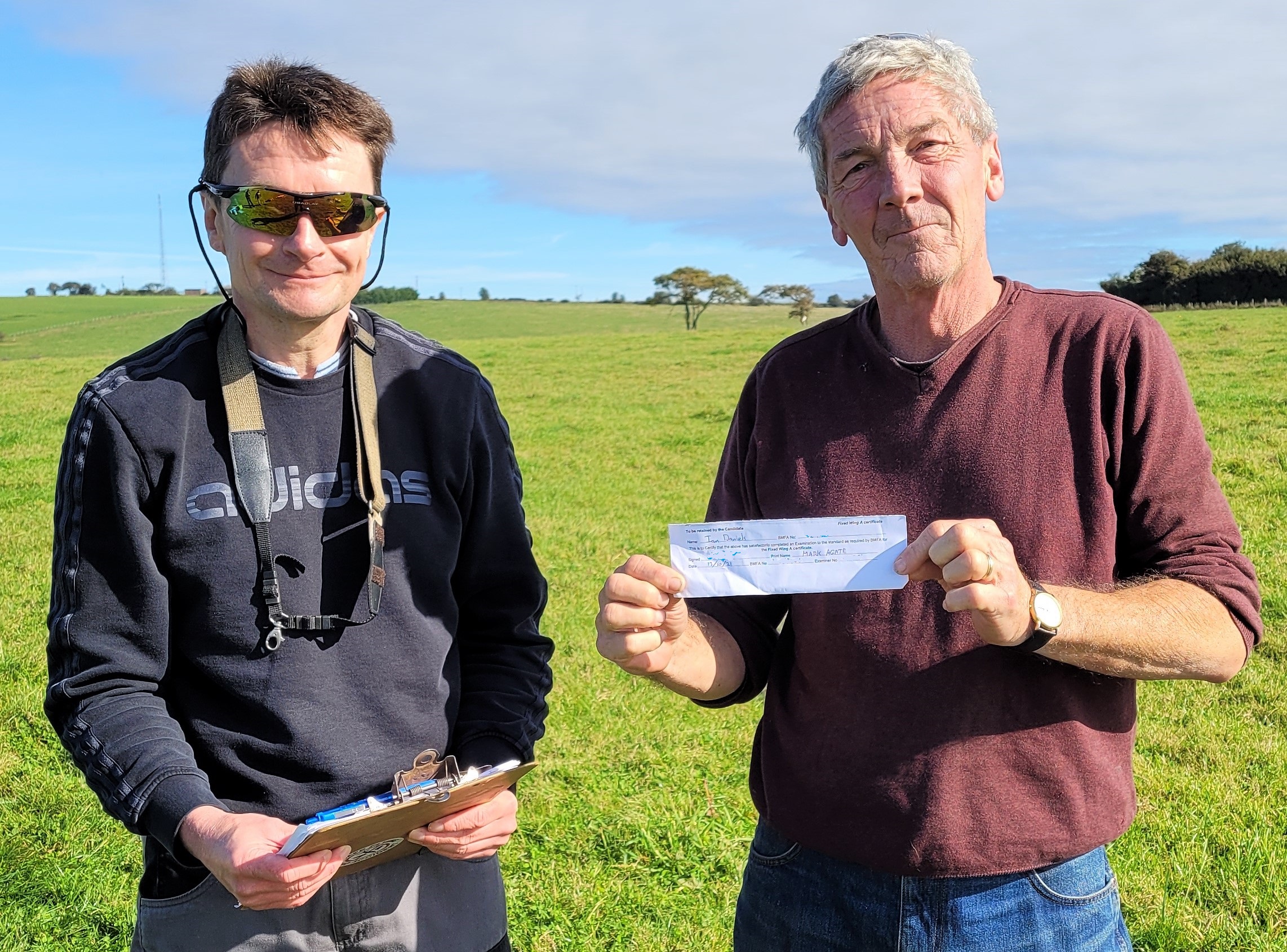
Within a few minutes of passing the test he strode confidently off for his first ‘solo’ flight.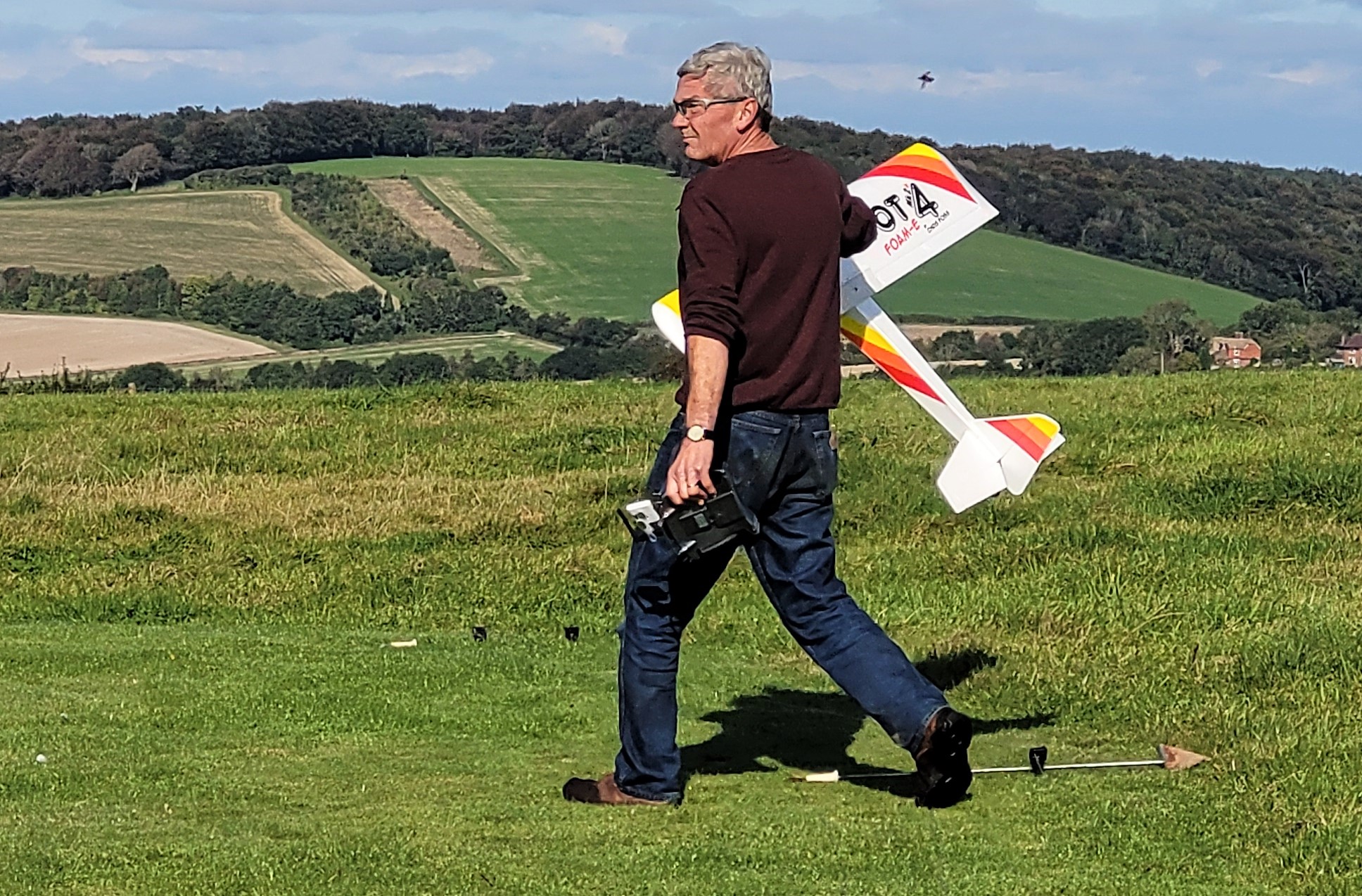
Well done Ian, onwards and upwards now, maybe you’ll want to take your ‘B’ certificate next year. With your aviation background I’m sure you’ll be a great asset to the club.
Early in October another prospective new member, Paul Bennett, found us. Paul had worked for ITV for many years but also has some full-size aviation history and now, amongst other things, instructs on a Boeing 737 simulator. I feel a club trip coming on!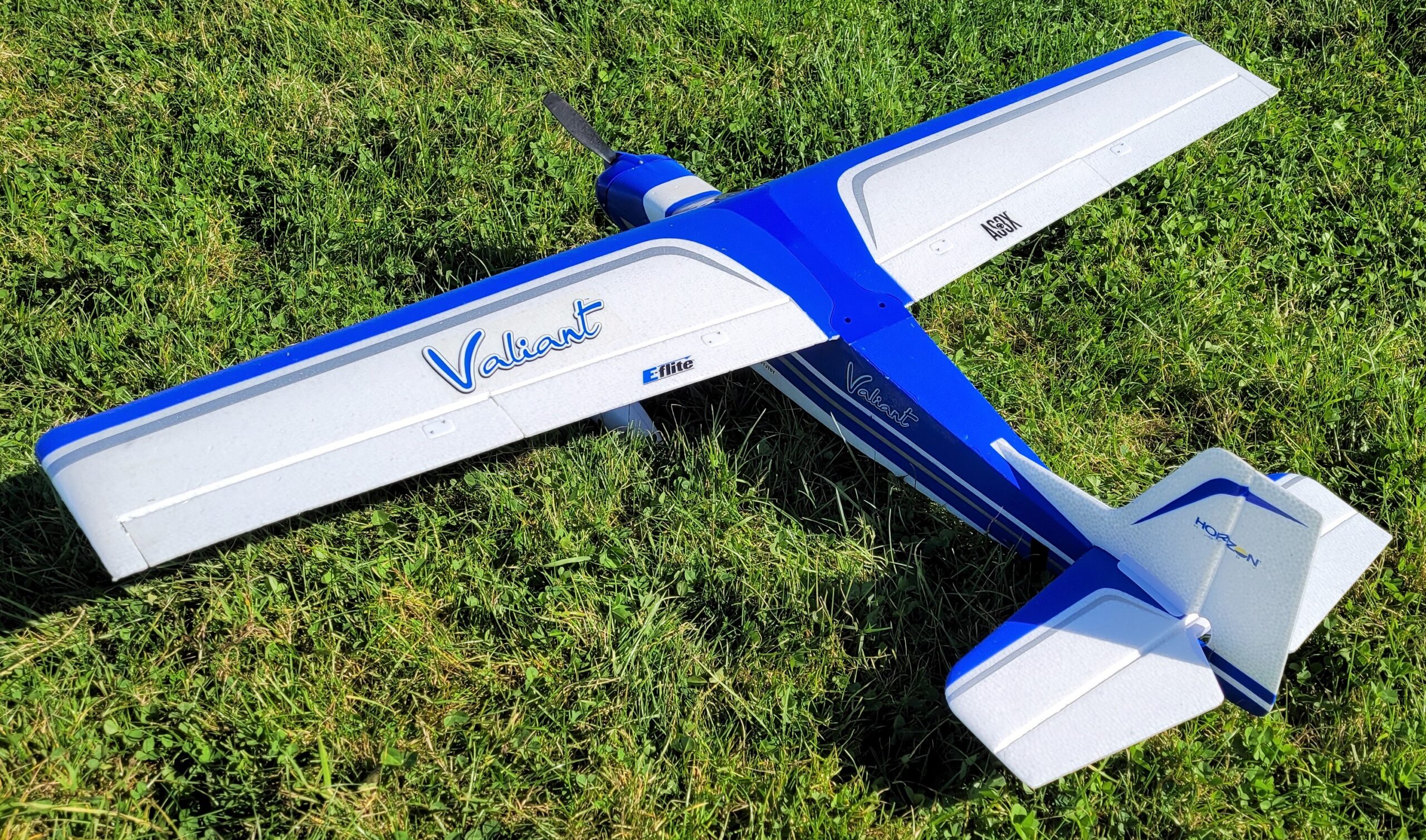
Paul currently has an E-flite Valiant trainer which he flies very competently so no doubt he’ll be another ‘A’ test candidate very soon. Having already flown with us three times in October Paul has now been offered PAM membership which he has happily accepted.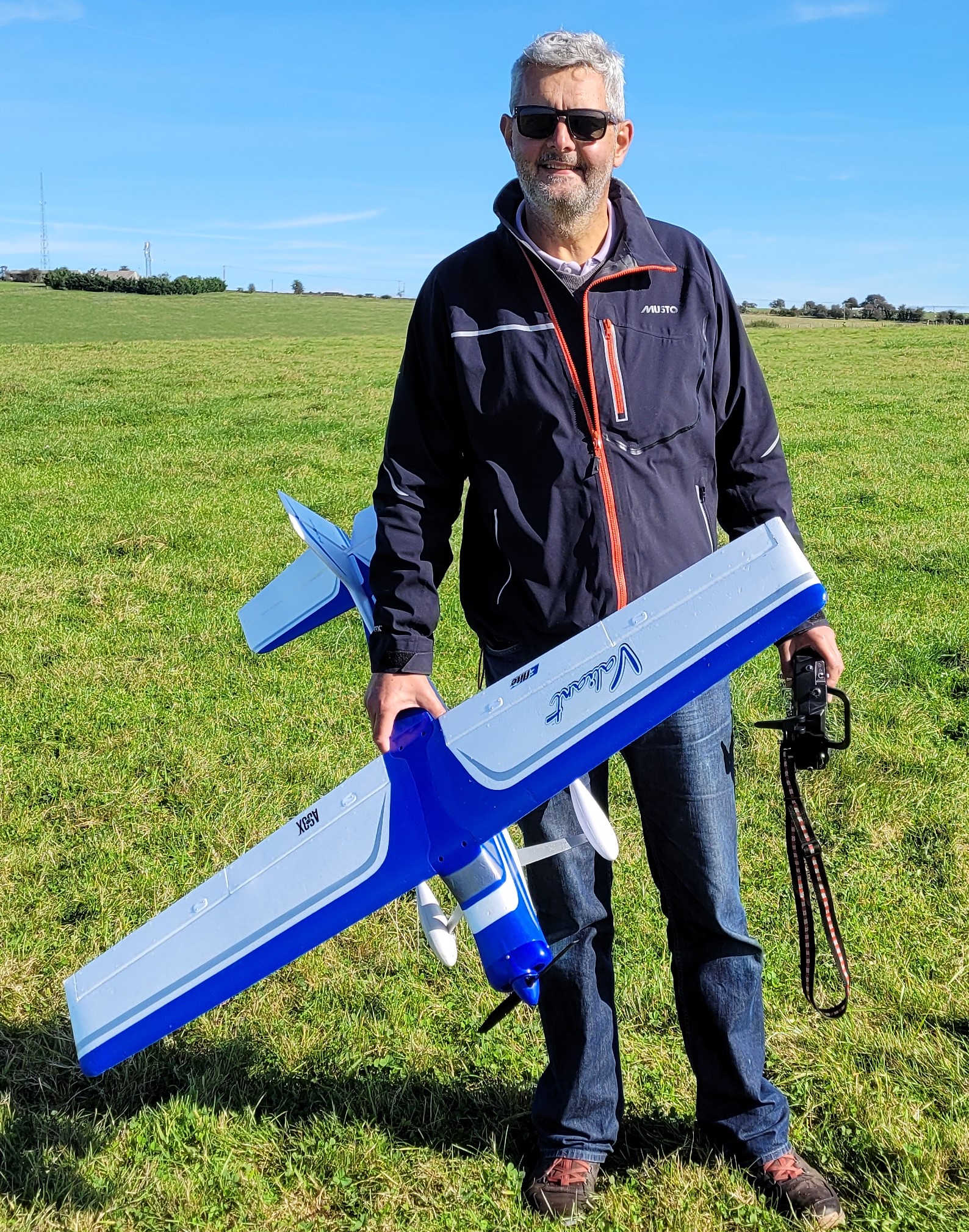
Dougal Entendre immediately said Paul should be known as Gordon Bennett so unless I hear any objections Paul is now Gordon. Welcome to the madhouse Gordon!
Those of you who are in the PAM WhatsApp group will know that I bought a very small Mustang P-51D from Banggood early in October. It’s the same as the one Catapult King has, from the Eachine Warbird Series that also includes an F4U Corsair and a T-28 Trojan.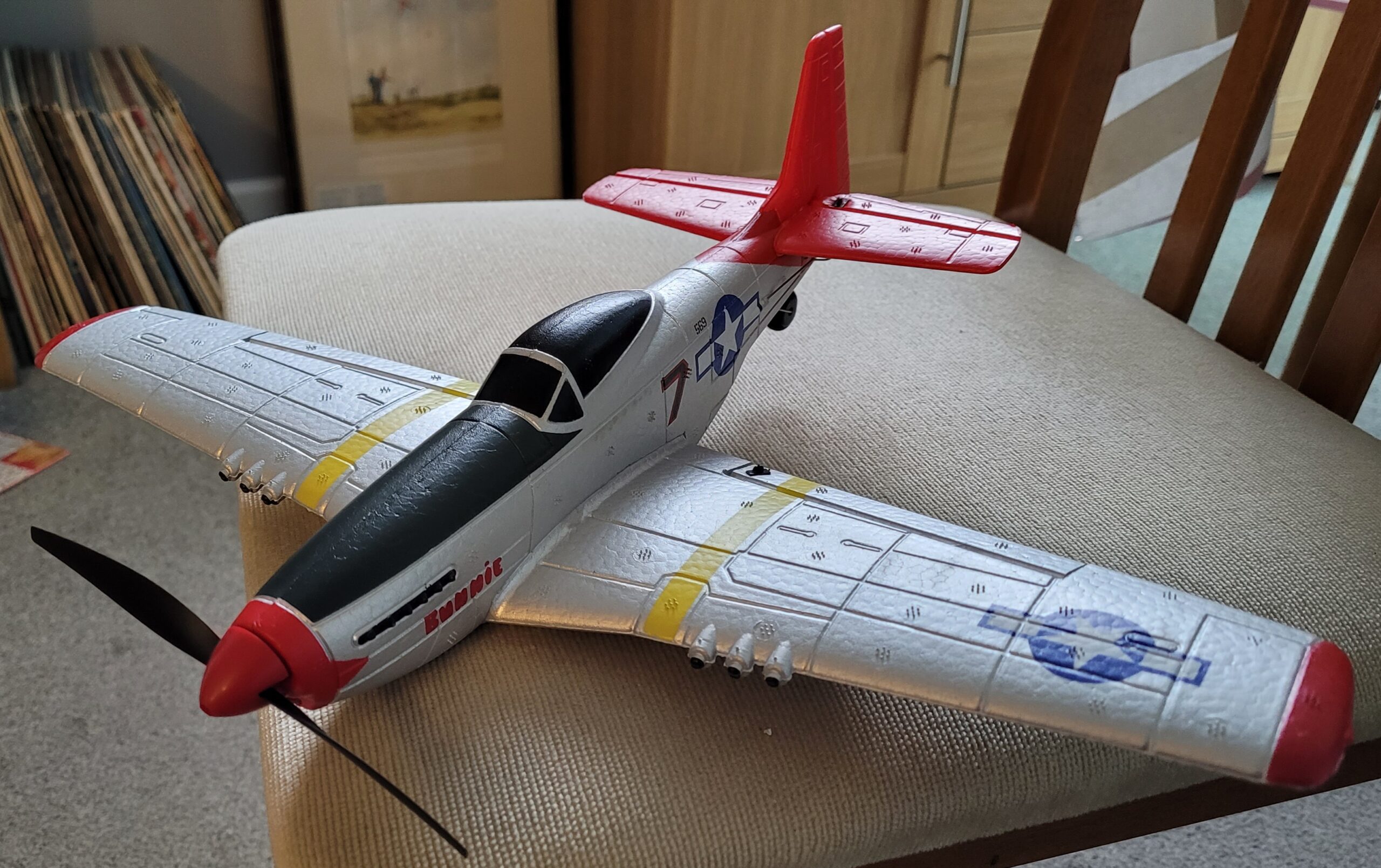
It really is tiny at 400mm (15.75”) wingspan and weighs a mere 60g including the single cell 400mAh lipo. I ordered mine when they were in a Flash Sale in the UK warehouse and with 3 batteries it cost just under £55 including insured delivery. The box contains the completed model, a transmitter, a USB charging lead, a spare prop with spinner, a spare prop adaptor, the undercarriage with screws, and a screwdriver. I initially thought they’d forgotten to include the 3 lipos until I found them in the transmitter battery compartment. I did have to buy 4 AA batteries for the transmitter but everything else is included.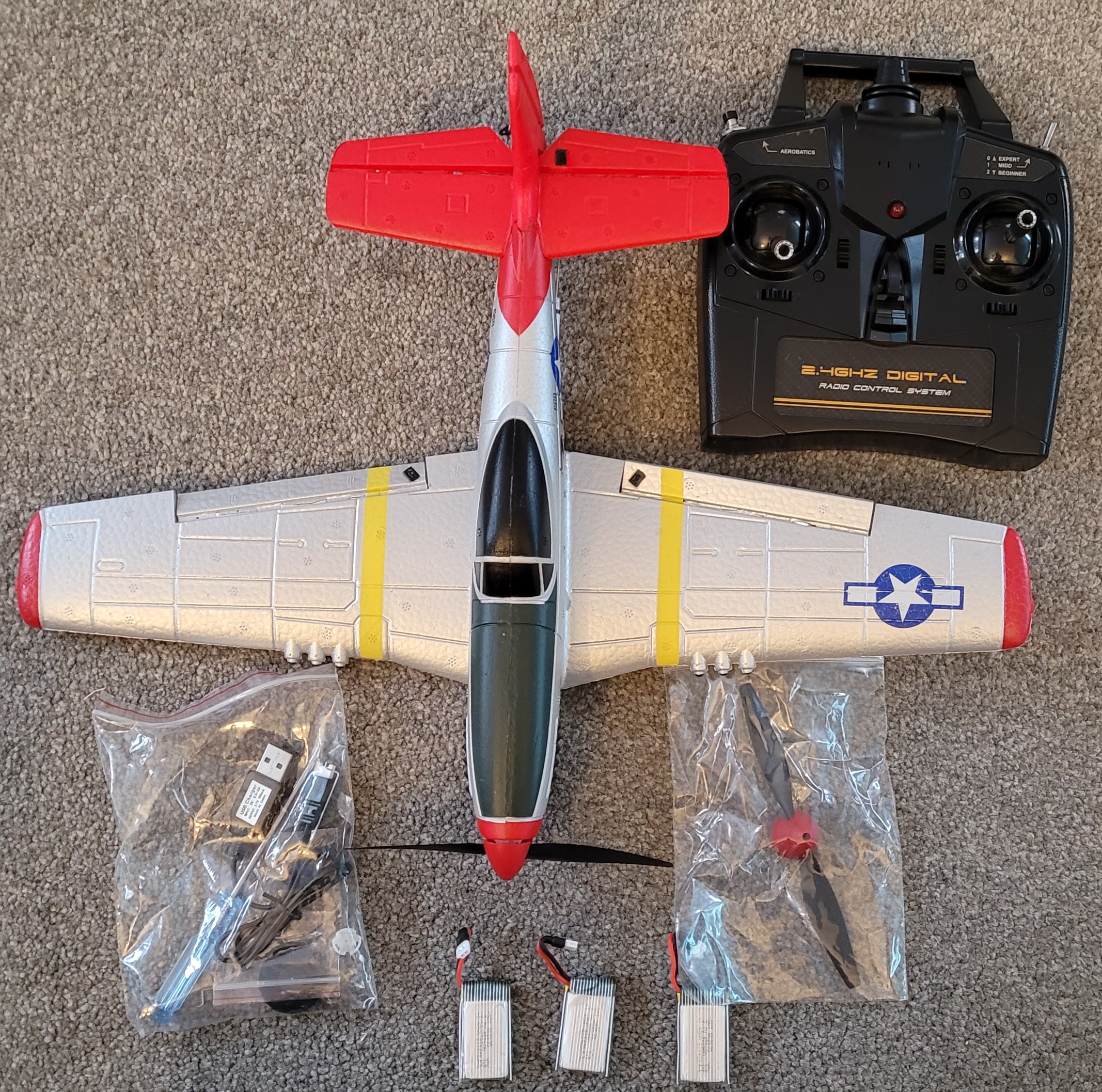 According to the manual each lipo will take up to 3.5 hours to charge from a USB socket but so far mine have been much faster. The model has aileron, elevator, rudder, and throttle controls and the transmitter has a 3 position switch for the gyro enabling the choice of Beginner, Intermediate, or Expert. In Beginner mode the model flies well and stops the pilot over-controlling, it won’t let you get inverted by mistake. If you get in trouble simply release the sticks and the model instantly returns to straight and level flight. In Intermediate the model is still stabilised and will return to straight and level if left alone but you have much more movement and can loop and roll. Expert mode turns the gyro off completely and you’re on your own! In Expert mode the model is very twitchy and takes some getting used to, Intermediate is much more pleasant. There is also a One-Key Aerobatic button on the transmitter, press it once, the transmitter beeps, and the model will then roll or loop once depending on which way you next move the stick. It returns to straight and level flight at the end of the manoeuvre so even if you tell it to roll while diving towards the ground with the wings at 45 degrees it won’t crash! The button works no matter which mode you are in so you can safely fly around in Beginner mode and still do rolls and loops. Probably the trickiest thing is keeping such a small model in sight, it disappears quickly if left alone but can be flown in small circuits when you get used to it. It might be tiny but it attracts a lot of attention, everyone stopped to watch the first flight!
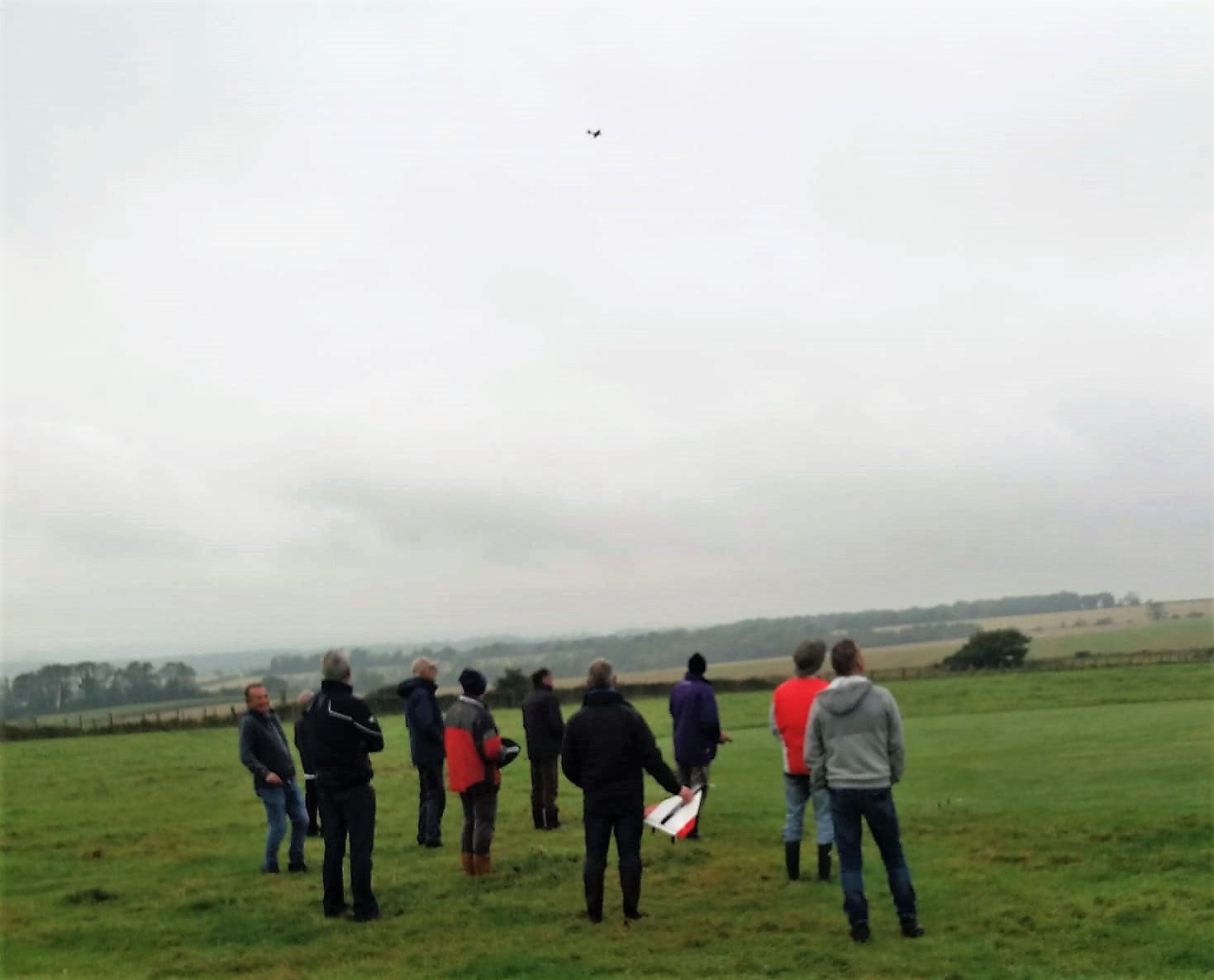 The manual says you can get 15 minute flights and on one flight I did indeed get 15 minutes but 6 or 7 minutes is usually enough with such a tiny model, it’s not exactly relaxing! The manual also says it’s suitable in winds of about 5-7mph but I’ve flown mine in at least 14 mph and it was fine but I wouldn’t advise it in anything much more than that.
Ian Daniels has the F4U Corsair from the same series which flies just as well as the Mustang, and Ian can fly it with no problems. These tiny models are certainly in the ‘toy’ class but they are great fun to fly for not much money and I find them fascinating.
Woody turned up with a couple of new planes in October, a Sea Vixen and an E-flite A-10 Thunderbolt. The Sea Vixen is built to Dwayne Pipe’s design and Woody borrowed Dwayne’s templates to trace around onto the Hobbycraft foamboard. Woody has fitted a Turnigy 2826 2200kv motor, the same set-up as he is using in his SU-57.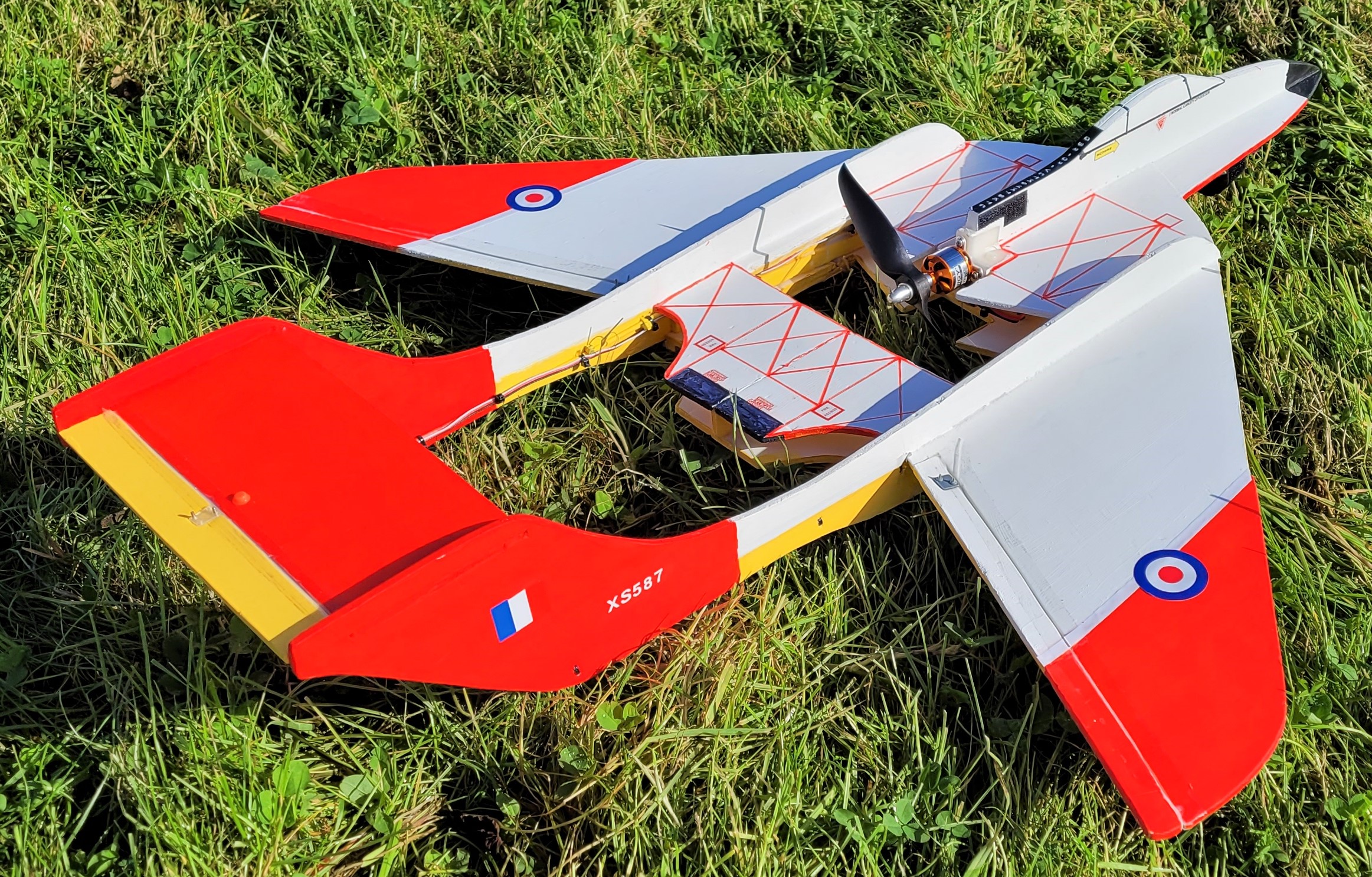
He’s made a nice job of finishing it in the colours of a target towing aircraft XS587 that I believe currently resides at the Gatwick Aviation Museum in Charlwood. The only slight problem Woody has had so far is actually getting it to fly! The foamboard can be a little tricky to keep flat and as Woody discovered it’s very easy to build in a twist during construction. Colin Cowplain donned his flying helmet for the first flight and managed to almost complete a circuit holding in full right aileron before the inevitable ‘landing’.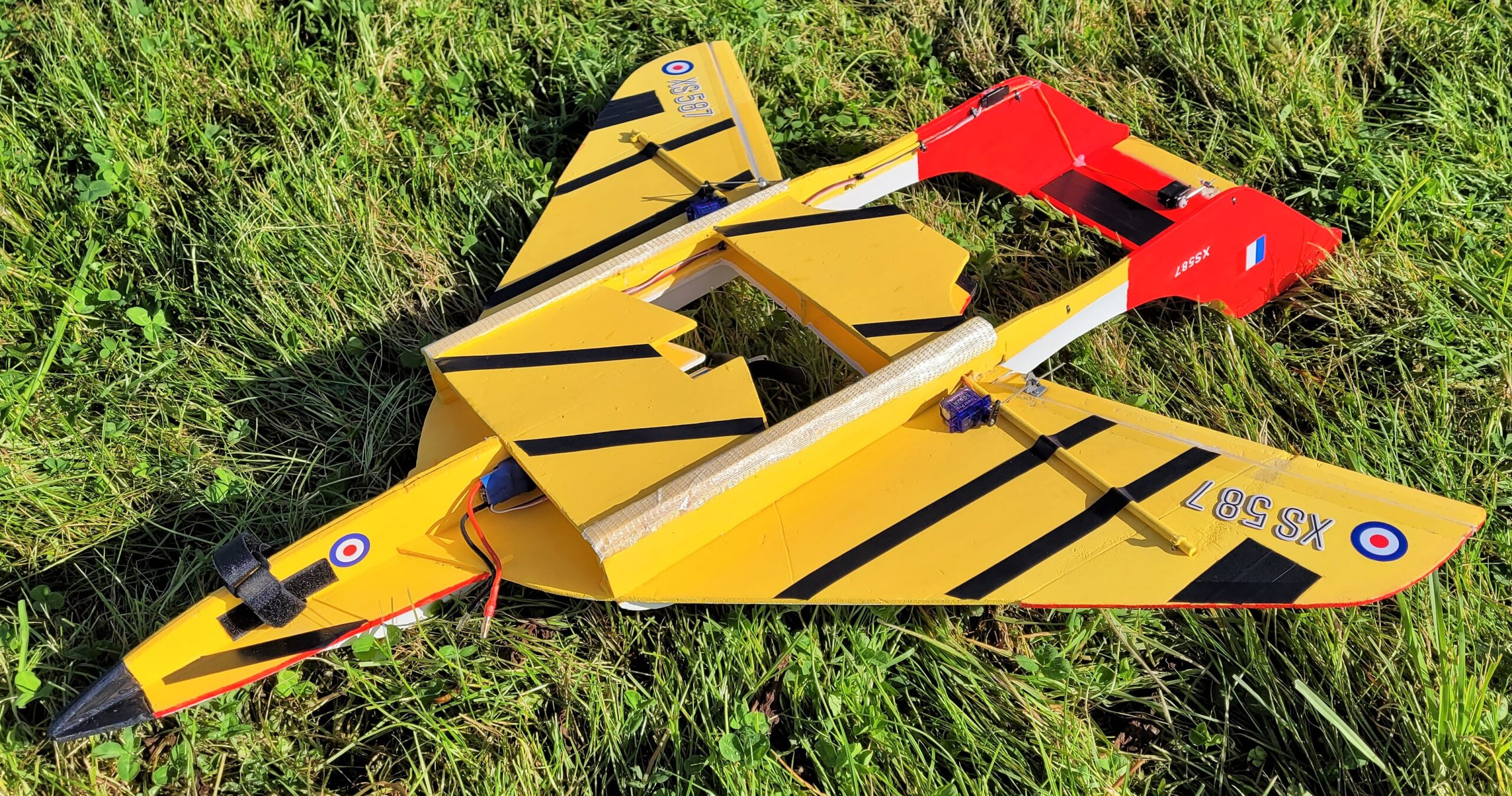 During the repairs Woody managed to straighten things out and it looked promising for the next attempt but even with full up elevator the Vixen failed to climb away from the launch so Woody needs to check the centre of gravity and the incidence. My guess is that whilst repairing the booms the incidence changed a bit. Third time lucky, watch this space.
The E-flite A-10 Thunderbolt was a prize Woody was lucky enough to win in a raffle on the RC Aircraft Online website and very nice it is too, small but beautifully formed as they say.
This is what E-flite say about it on their website: The E-flite® UMX™ A-10 Thunderbolt II Twin 30mm EDF ultra micro jet is the most practical and easiest to fly A-10 RC model yet! New upgrades make this replica of the iconic U.S. Air Force aircraft easier for a wider variety of experienced pilots to enjoy — including those with limited EDF experience. The BNF® Basic model’s industry-leading Spektrum™ 2.4GHz technology binds to your 5+ channel DSMX®/DSM2® transmitter for full 4-channel control, plus the benefits of exclusive AS3X® and optional-use SAFE® Select technologies. It’s 100% factory-assembled and ready to deliver an authentic A-10 jet flying experience almost immediately. The fully-molded airframe features a factory-applied “desert camo” trim scheme and is strengthened with a carbon fiber reinforced fuselage and nose. Factory-installed twin brushless power systems feature more powerful 2S and 3S-compatible outrunner motors with larger diameter 30mm fans, for improved vertical performance and speed compared to other models in its class — plus longer-than-average EDF flight times when using the recommended 450–850mAh LiPo batteries.
Colin did the trimming flight and found the little A-10 flew very well. Woody had fitted a 2 cell lipo and the motors seemed to be pulsing a bit at full throttle and we think that maybe the voltage of the 2 cell pack was dropping too much under load. The model seemed to be flying perfectly despite the pulsing and after a few minutes Colin landed the Thunderbolt safely. Woody is going to try a 3 cell pack next time, hopefully that will stop the pulsing.
Following on from his success with the SU-57 that he built from Hobbycraft foamboard Basher Bob has also built a Sea Vixen to Dwayne Pipe’s design, using Dwayne’s templates.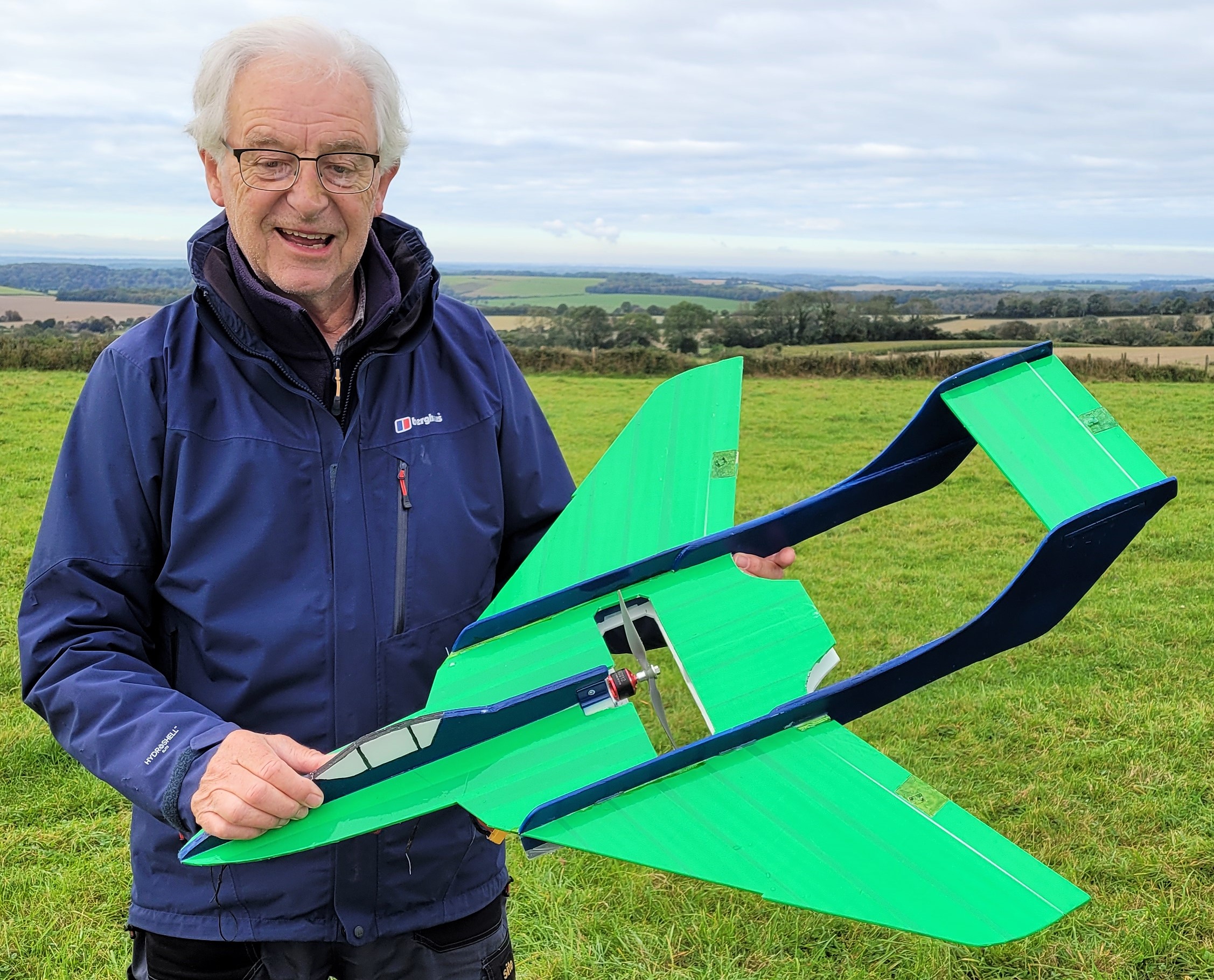 Basher has fitted a BR2212 1800kv motor from Banggood which spins a 7 x 5 propeller and provides ample power using a 3 cell battery. Basher built it pretty much to Dwayne’s plans although he did add some additional foamboard doublers to the rear half of the booms and covered them with lightweight glass-cloth using Eze-Cote resin.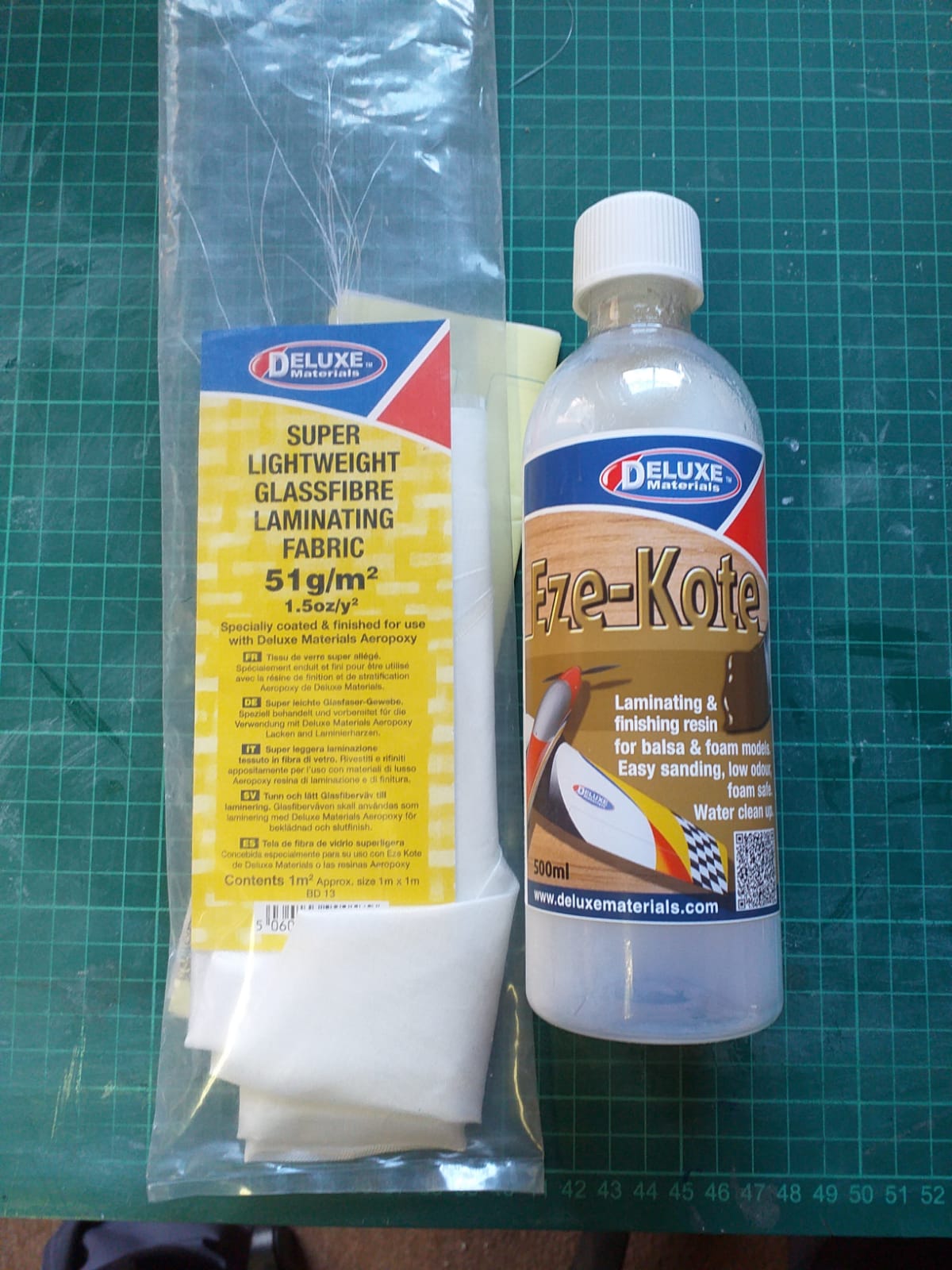
As you can see in this month’s video it flies extremely well and looks good in the air despite it’s rather unusual colour scheme. Rumour has it that Captain Slow also has a Dwayne Pipe Sea Vixen under construction, the first flight is expected to be sometime in 2024!
Having got used to the SU-27 he bought from HobbyKing 1066 has now succumbed to the foamboard fairy and built one to his own design. I told him I wanted a very detailed report about it, a full essay, not his usual one line of info, and for once he did what he was told!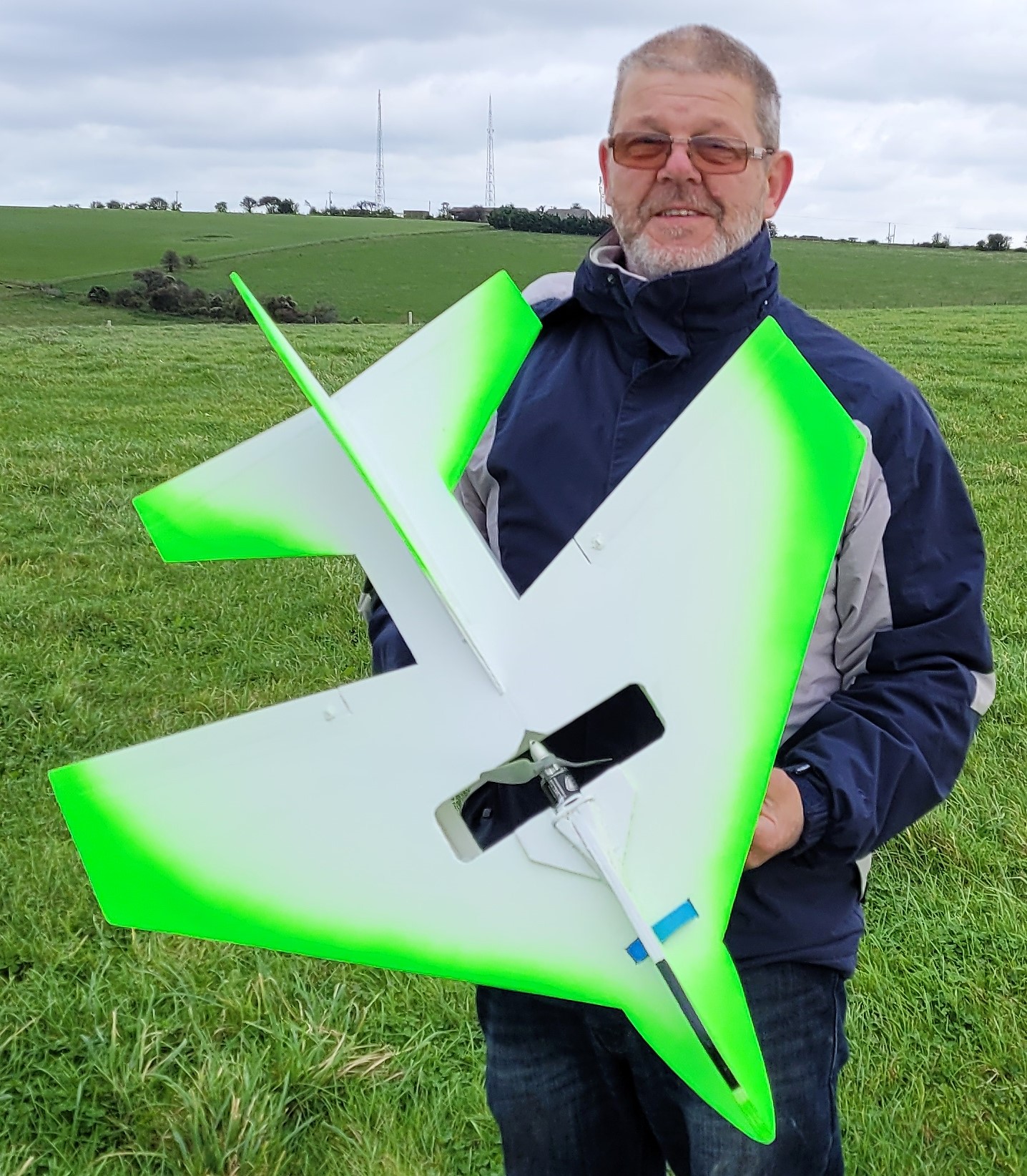
As most of you know I never stop banging on about the poor flying characteristics of the foam board jets, and I also find the sound very annoying, but if you can put that to the back of your mind there is no doubting they are great fun, and at the price we paid when they first appeared, lend themselves to the sort of flying I love, down low and on the edge. And don’t forget the adrenalin rush you get at every launch, wondering if you will be in A&E getting stitched up! Mine has been broken many times, has twisted and bent due to the summer heat, but keeps coming back for more, so I hate to admit that if it was a total write off I would have replaced it. But the prices went to a point I was not willing to pay, so for some time I was considering building something along the same lines from art card, but I have many ideas that never see the light of day!!!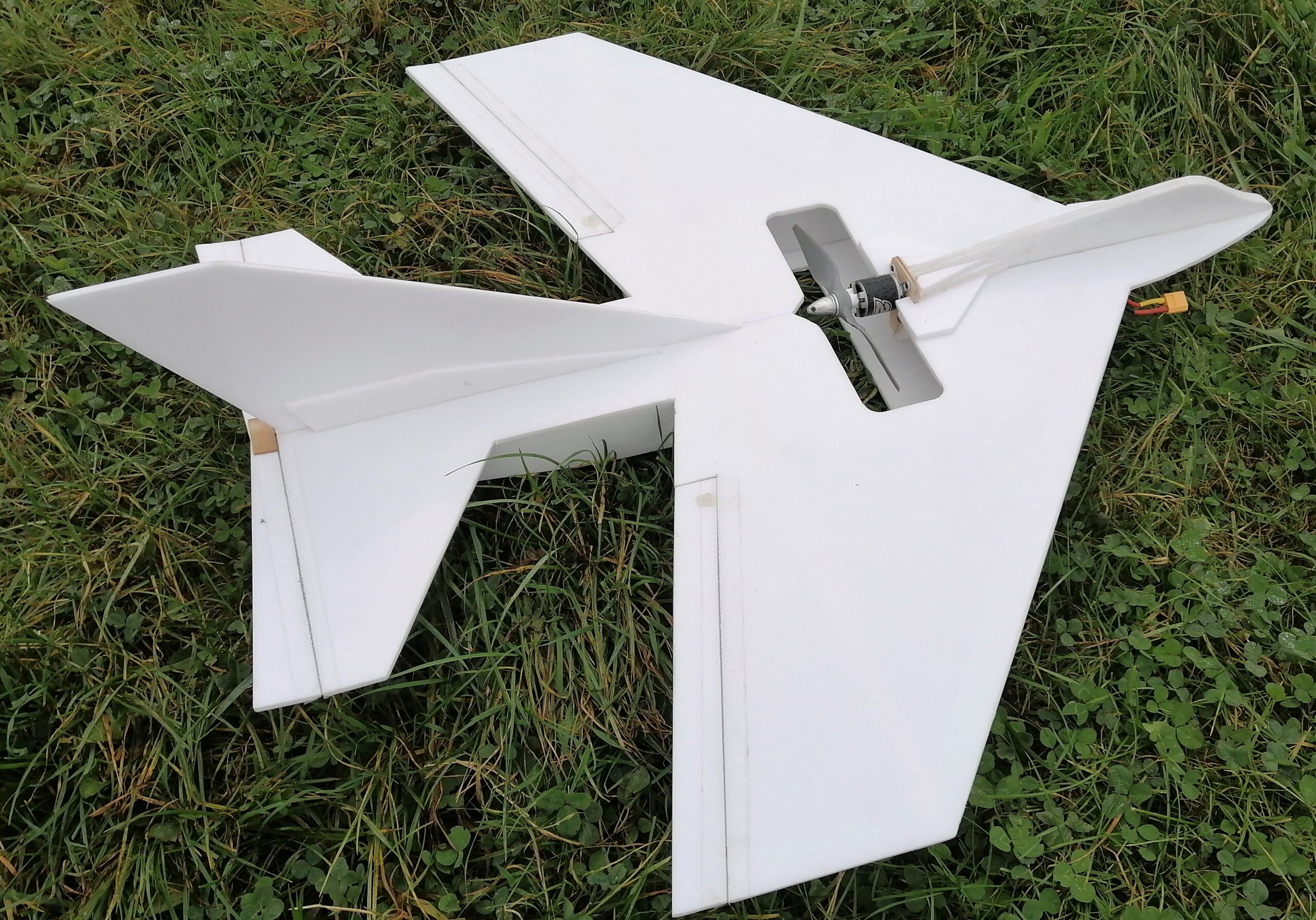
However, when Keith turned up with his own design Sea Vixen made from art card, with the card removed, I was inspired enough to have a go. In a past life when building my own design I would get the lining paper and pencils out, draw a proper plan and produce a model, but that was too much trouble for something with no aerodynamics, or flowing lines, so for this one my approach was lay my Mirus upside down on the card and draw round the outline. Having seen Woody and Bob’s Sea Vixens it was obvious that the art card core material is not as rigid as the material used by Hobbyking, so there would be a need to build rigidity into the structure so the rest of the parts were cut with this in mind, while still trying to keep the Mirus lines. Once all the parts were cut I was now concerned that the wingspan was too big for the material, so I started cutting bits off until it looked right. Next step was to put all the parts in the bath, make a cup of tea and wait for the card to float off! Difficult to explain that one to the wife? Next step was to glue all the parts together with the glue gun, unlike the HobbyKing foam boards and Keith’s Vixen I couldn’t be bothered with all the dovetail type joints, relying on butt joints.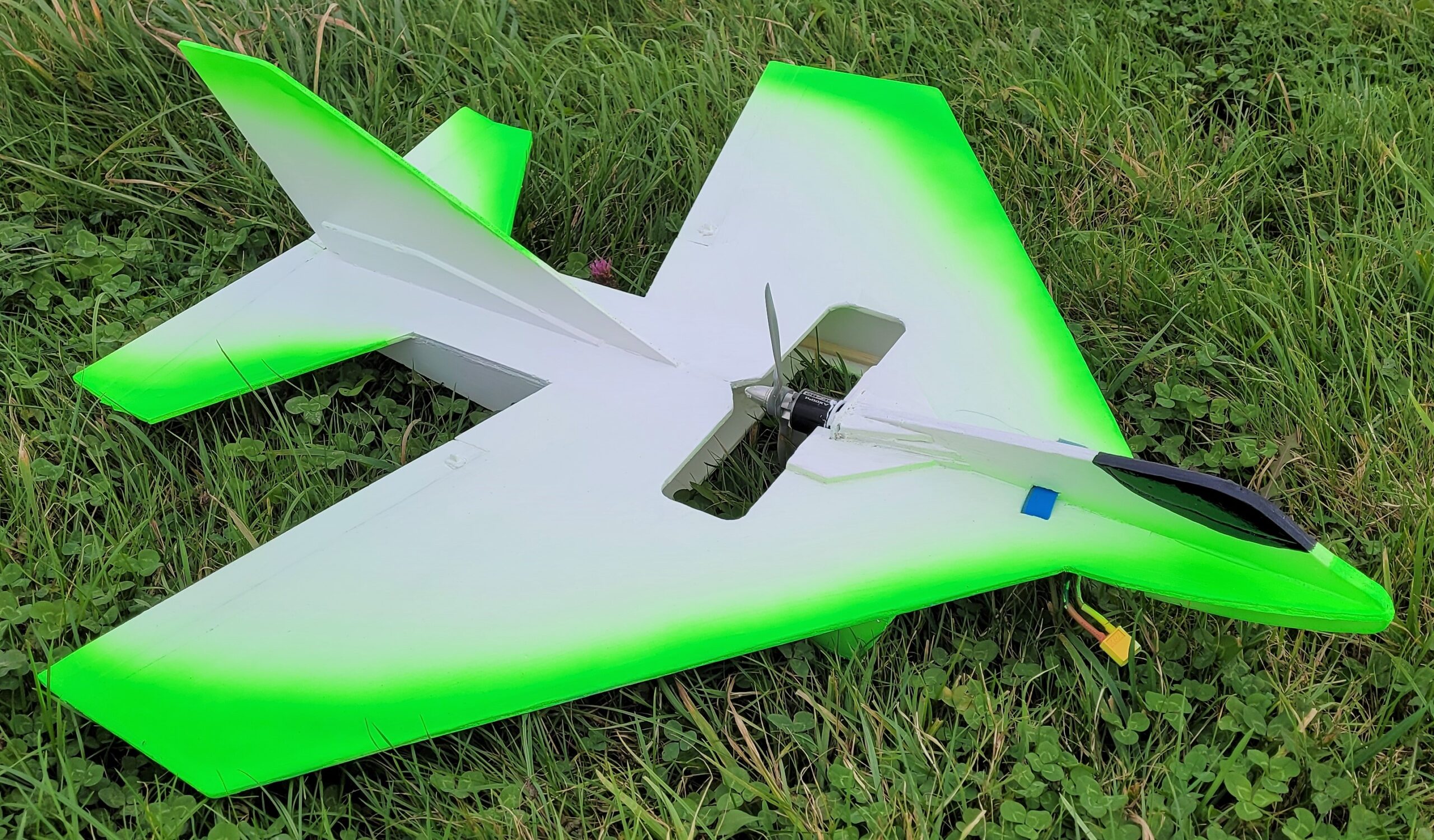 With everything glued together the airframe did look like a Mirus but with nothing above the wing, there was nothing to hold for the traditional way of launching, so a cockpit profile was added, problem solved with the added bonus of extra support for the motor mounting, which was very flimsy. My next design change from the normal foam board set up was to fit a 28 mm, 1400 KV motor and a standard 8 X 4 prop to try to get the noise down. The model was complete but I was not sure where the CG should be, so I took the decision to fly it before adding any decoration. The first flight was on a day when we were all wondering why we were standing in a wet field on such a damp day, and things did not go as I would have liked. My first mistake was rushing the radio installation the evening before and not double checking the controls, which resulted in missing the large amount of up elevator, add to this a rearward CG and the first launch was interesting, but did prove I had enough power available. Changes were made and the second flight was much better, but the drizzle got heavier so there was just one circuit.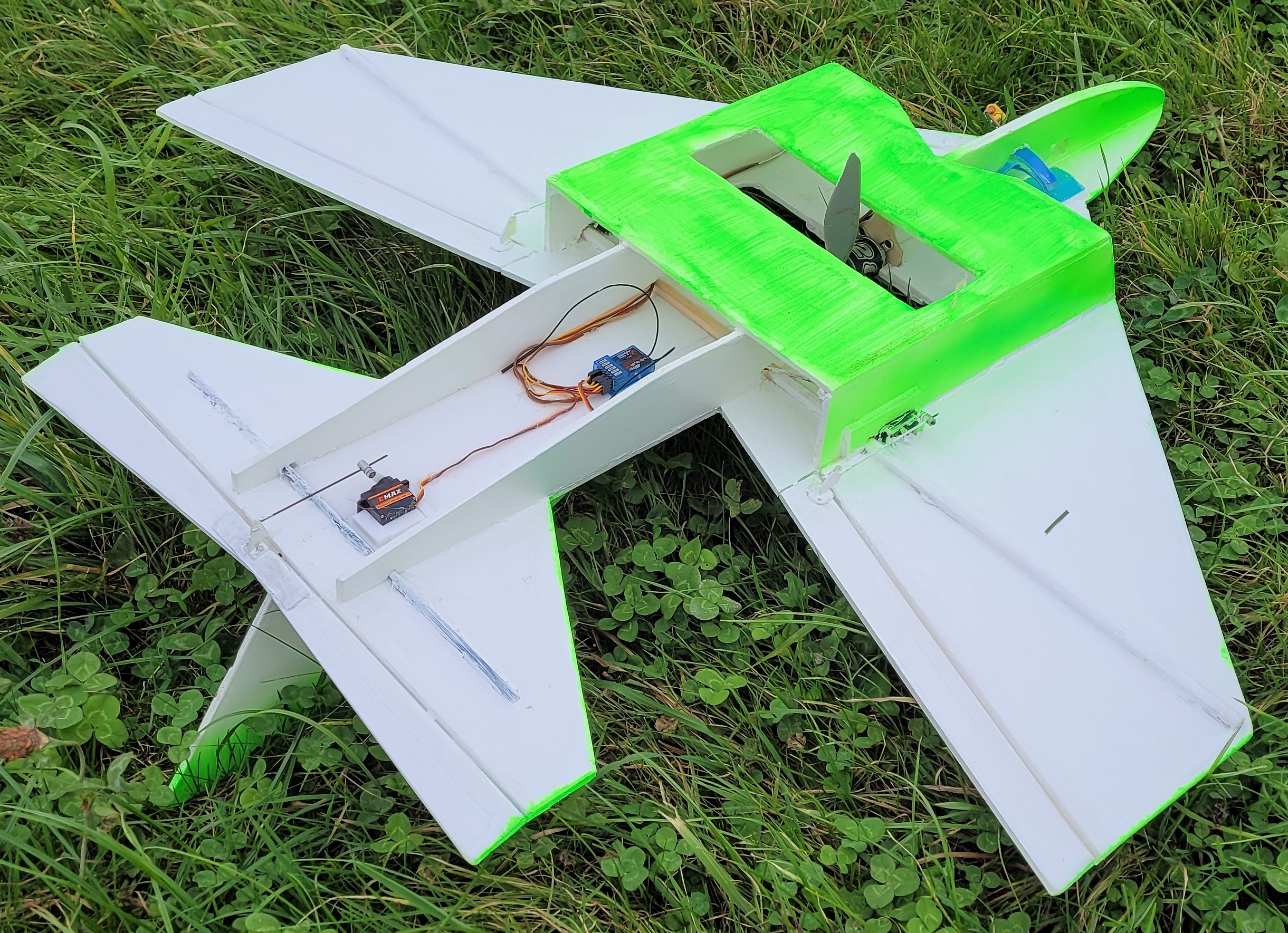
The day did brighten, but before I could have a third attempt Mark noticed that some of the glue joints had failed, so no third flight to date. One positive thing we did discover was due to the need to build rigidity into the structure, the model can be held behind the wing when launching, no adrenaline rush with this one!!! With the model back in the workshop I could see all of the joints on the bottom of the model had failed, and I can only assume this was due to the plane being sat on the wet grass, very odd. I have now re-glued all the joints, given the whole airframe a coat of B&Q water based white gloss, and some stunning artwork. I am sure Andy will expect me to give it a name, one of my favourite films is Conair, and John Malkovich’s character Sirus the Virus so in keeping with that kind of alliteration I thought I would call it Cirus the Mirus. Wow, thanks for that 1066, I shall never complain about lack of information again…until next month! Since writing that 1066 has flown it again and it now goes very well as you’ll see in the video.
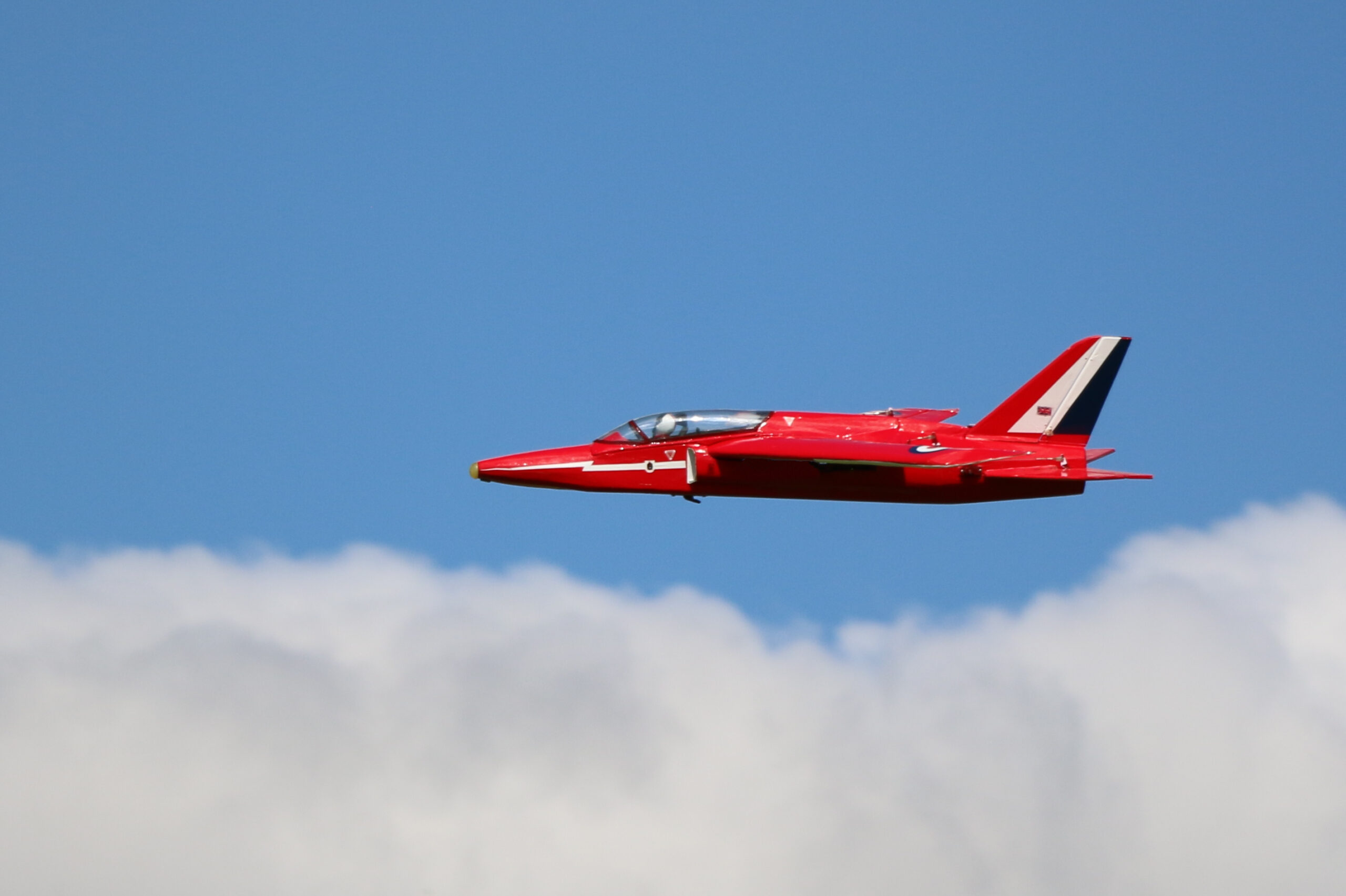
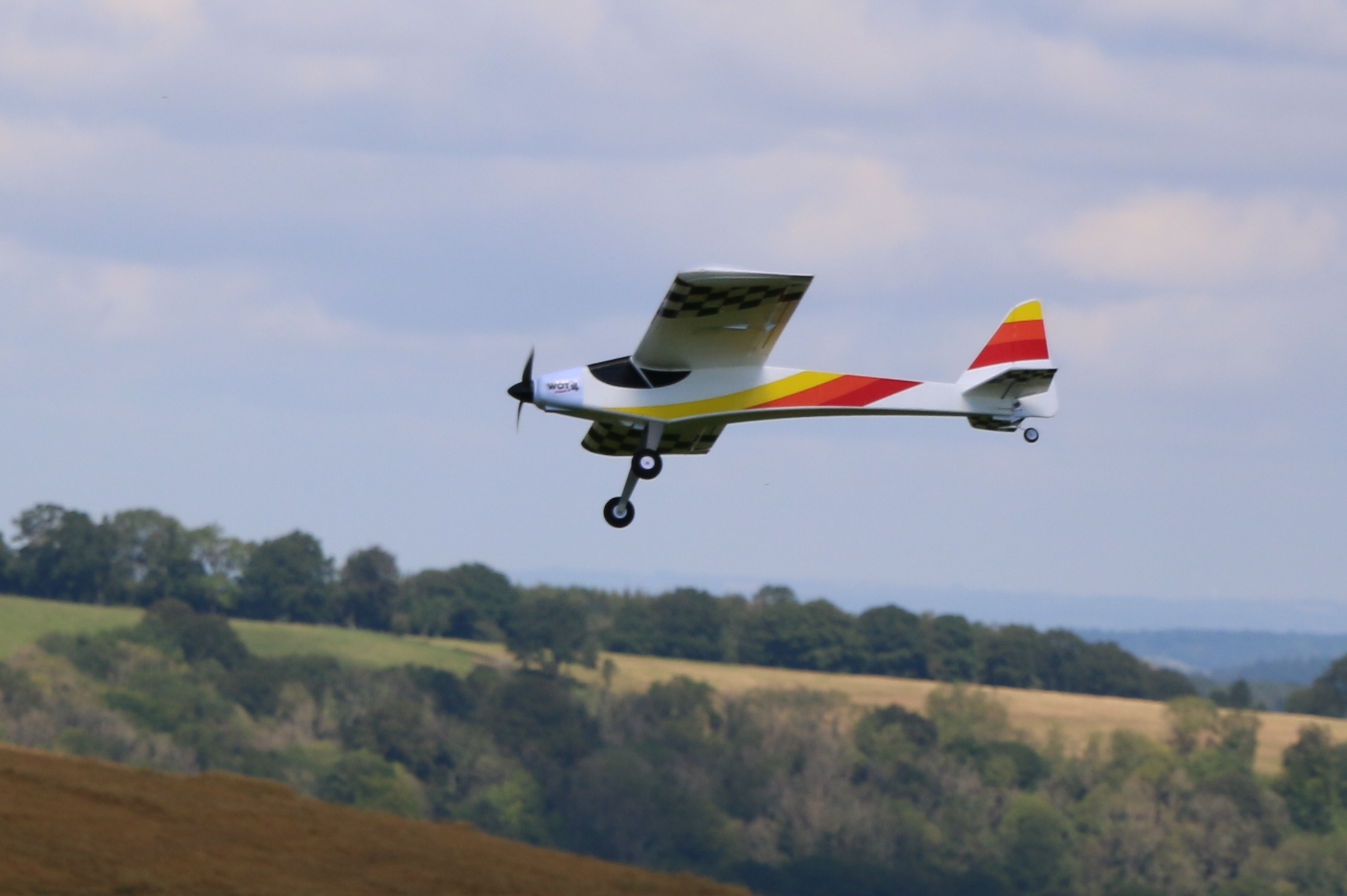
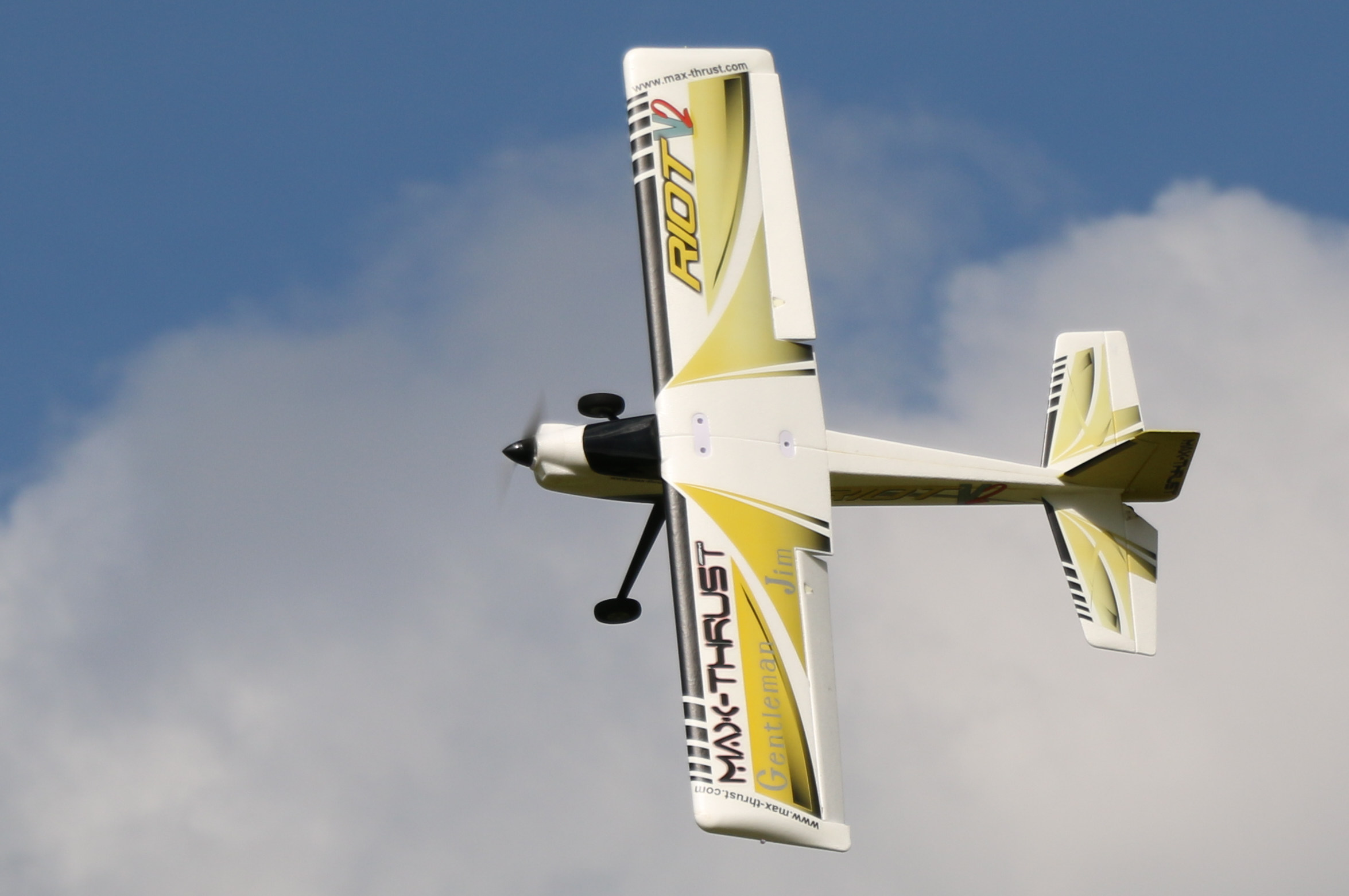
Sadly Kryten didn’t have a chance to take any of his excellent flying shots this month but here are some older ones of his that I haven’t used previously:


Video time now, this month with content recorded by myself and Dougal. Please watch the video full-screen it’s so much better with small models flying around.
If the video won’t play for you please click HERE
I asked the flight attendant if I could change my seat because the baby in the seat next to me was really annoying and constantly screaming it’s head off..
It turns out you can’t do that if the baby is yours…
Colin Cowplain