Patch News – January 2025
I don’t think I’ve ever had so little flying due to bad weather as this month. We expect January to be cold and miserable in the UK but this year it has been particularly bad.
We seem to have been plagued with mist/low cloud a lot more than usual and I’ve lost count of the number of times we’ve turned up to fly only to be thwarted by poor visibility. 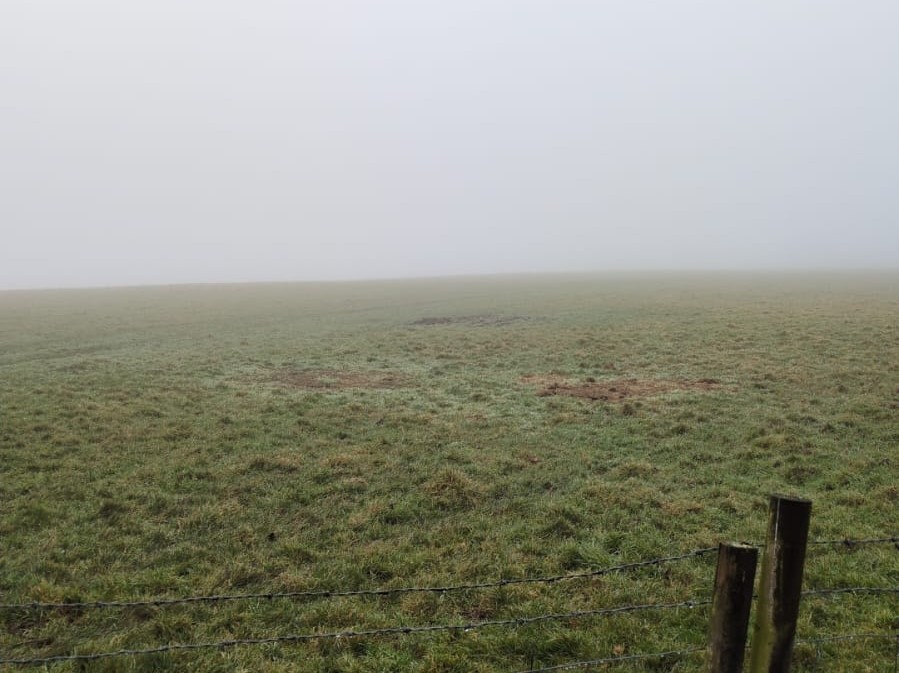 Our new flying site (not so new now as we’ve been using it for a year) is slightly higher than the previous one but I wouldn’t have thought it would make a huge difference.
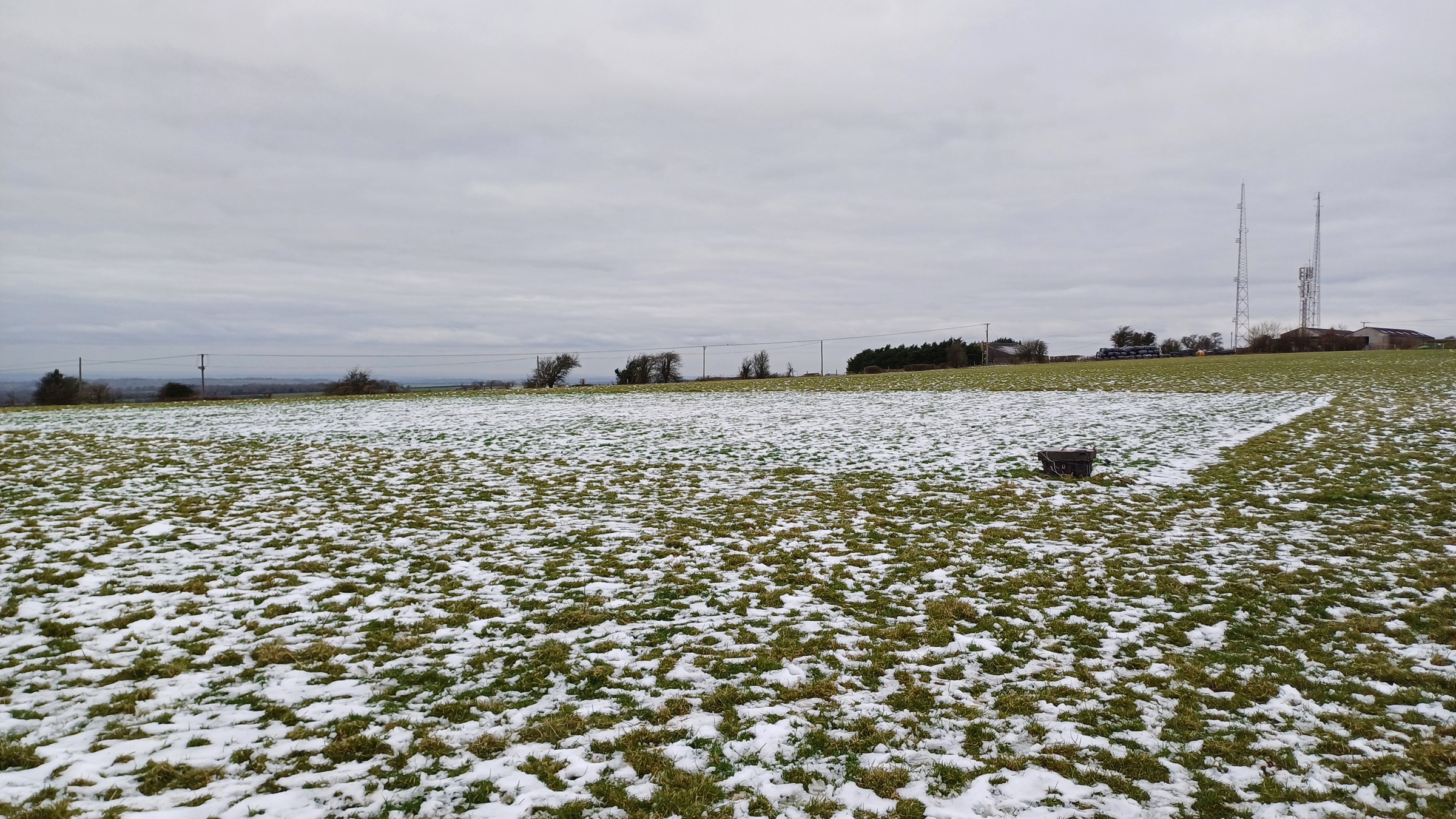
On 12th January there was a light smattering of snow covering the field but that didn’t stop the hardier fliers although it made take-offs tricky and most pilots hand-launched instead.
Our new flying site (not so new now as we’ve been using it for a year) is slightly higher than the previous one but I wouldn’t have thought it would make a huge difference.
On 12th January there was a light smattering of snow covering the field but that didn’t stop the hardier fliers although it made take-offs tricky and most pilots hand-launched instead.
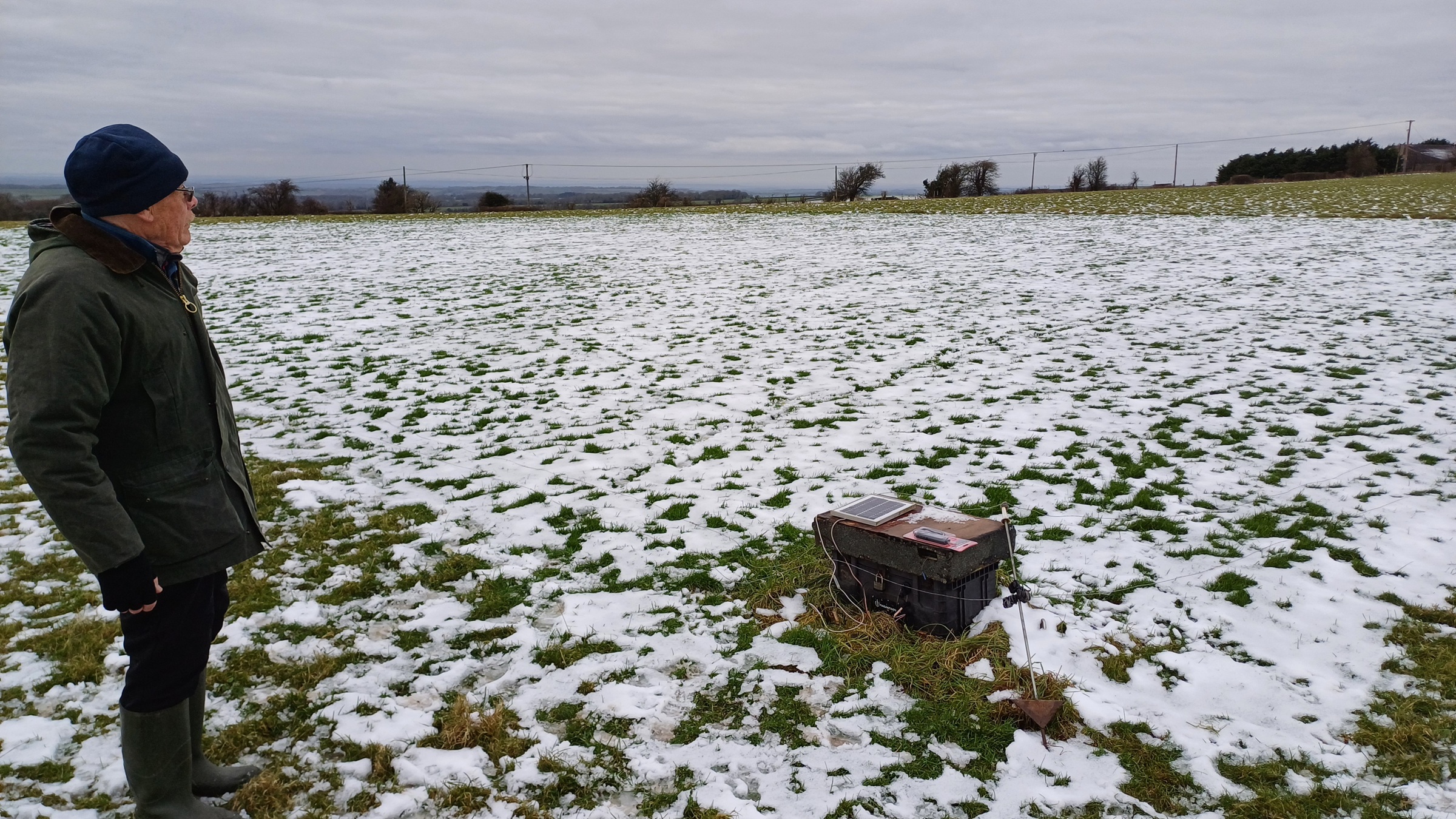 It was good to see that Chas turned out and flew having been unable to make it on lots of days with much nicer weather. Members made the most of the days that were flyable and on one of those days Woody seemed happy to be flying but Captain Slow not so much!
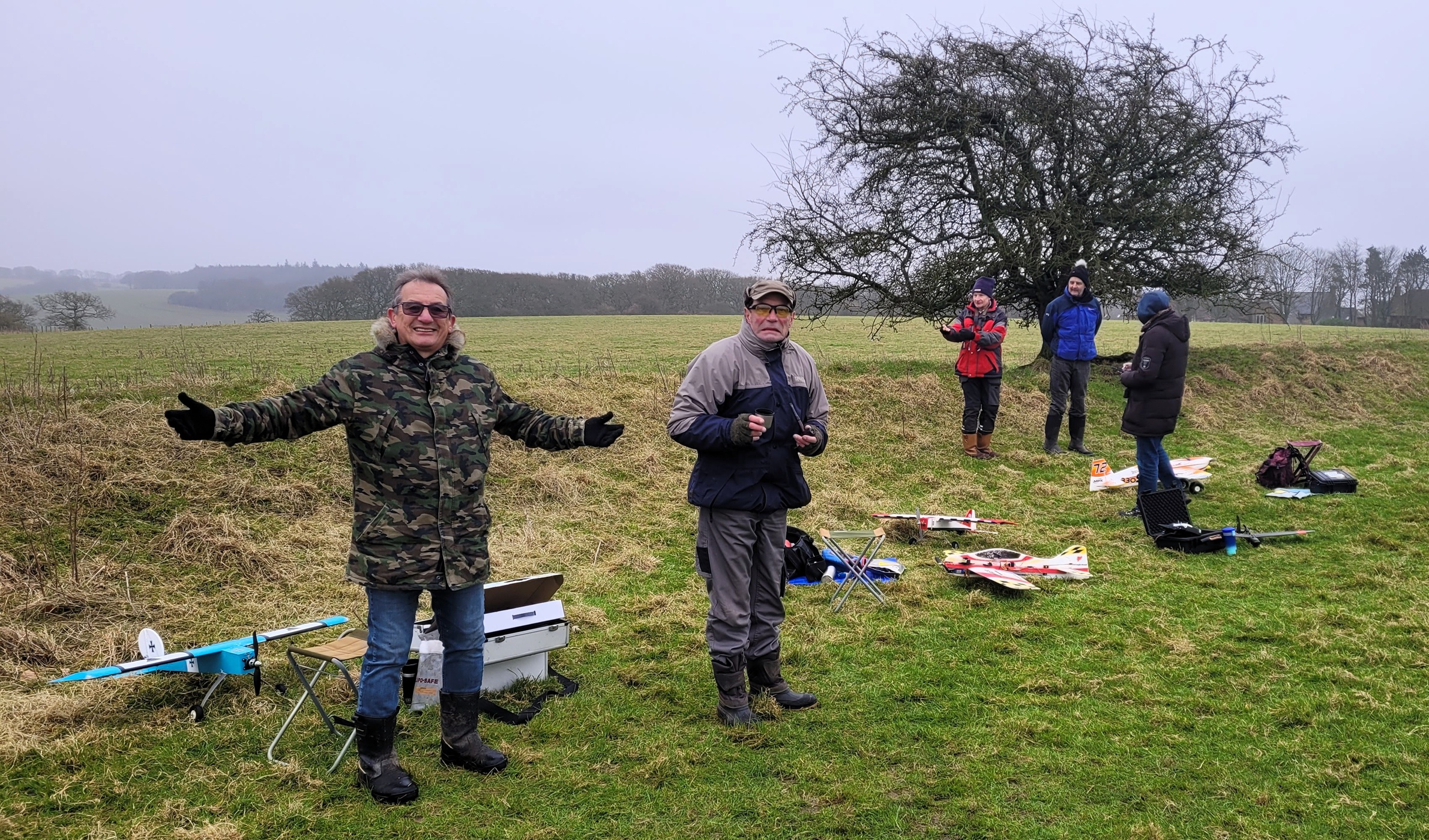
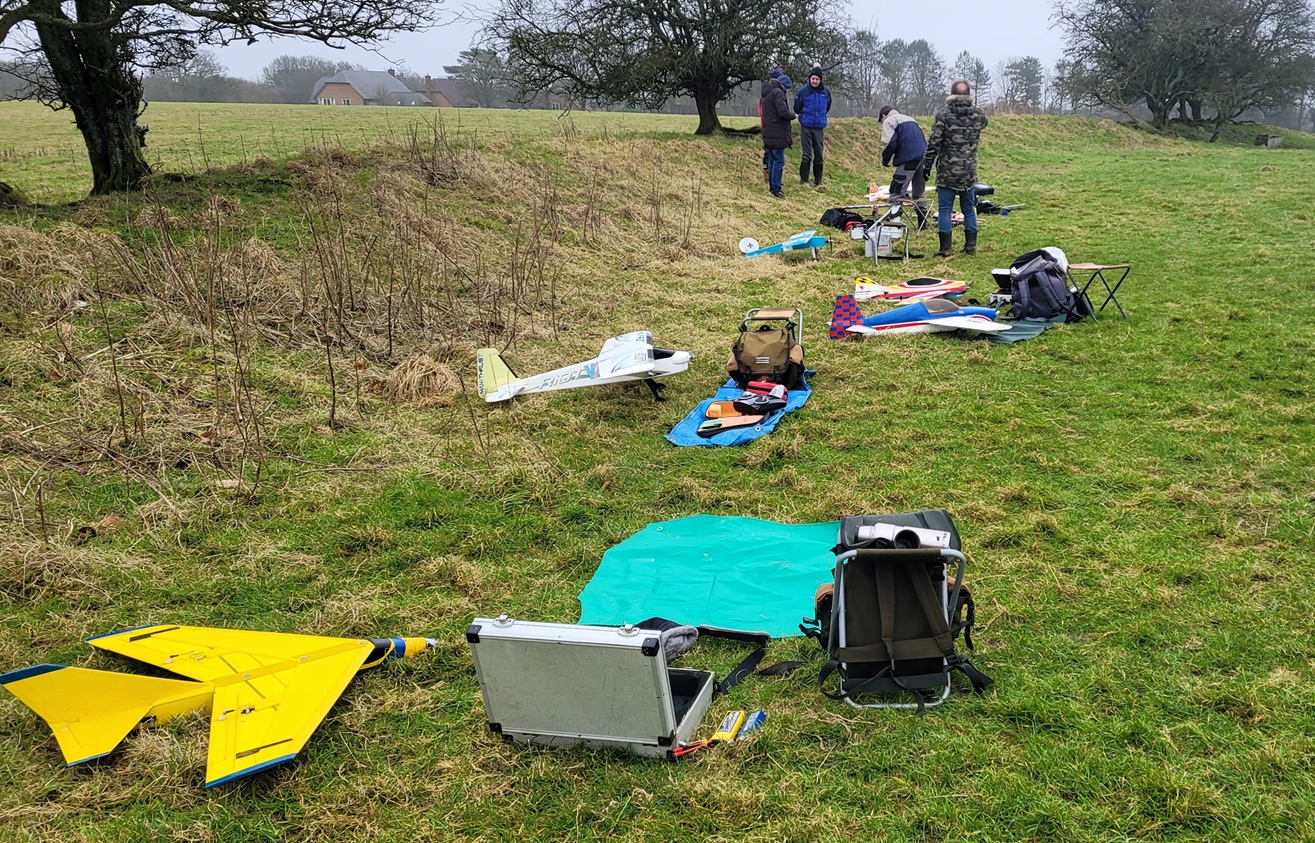 Towards the end of the month storm Eowyn blew through and prevented flying on Friday 24th with heavy rain and very strong winds. More rain and winds were forecast from storm Herminia on the Sunday so several of us took the opportunity to fly in the better weather on the Saturday between the storms. The weather was perfect and, as you’ll see at the end of this month’s video, there was barely any wind and the skies were clear at last.
IMPORTANT NOTICE: We have been asked by the farmer to keep the gate that we drive through into the parking area closed at all times. We can keep it open as we all arrive but we must close it before we walk off into our field and down to the patch. This is primarily for when there are animals in the barn in case they escape into the yard, but rather than checking for livestock each time it’s best to simply make sure that the gate is always closed. The second gate, the one that we walk through into the field, can be left open as long as we are certain there are no bullocks or sheep in the field. If we’re not certain we must close it.
It’s been decided that we should rotate the patch and the red ‘do not cross’ line clockwise slightly to ensure further separation from the existing house close to the end of the track and from the new development that is just starting to the south of the field.
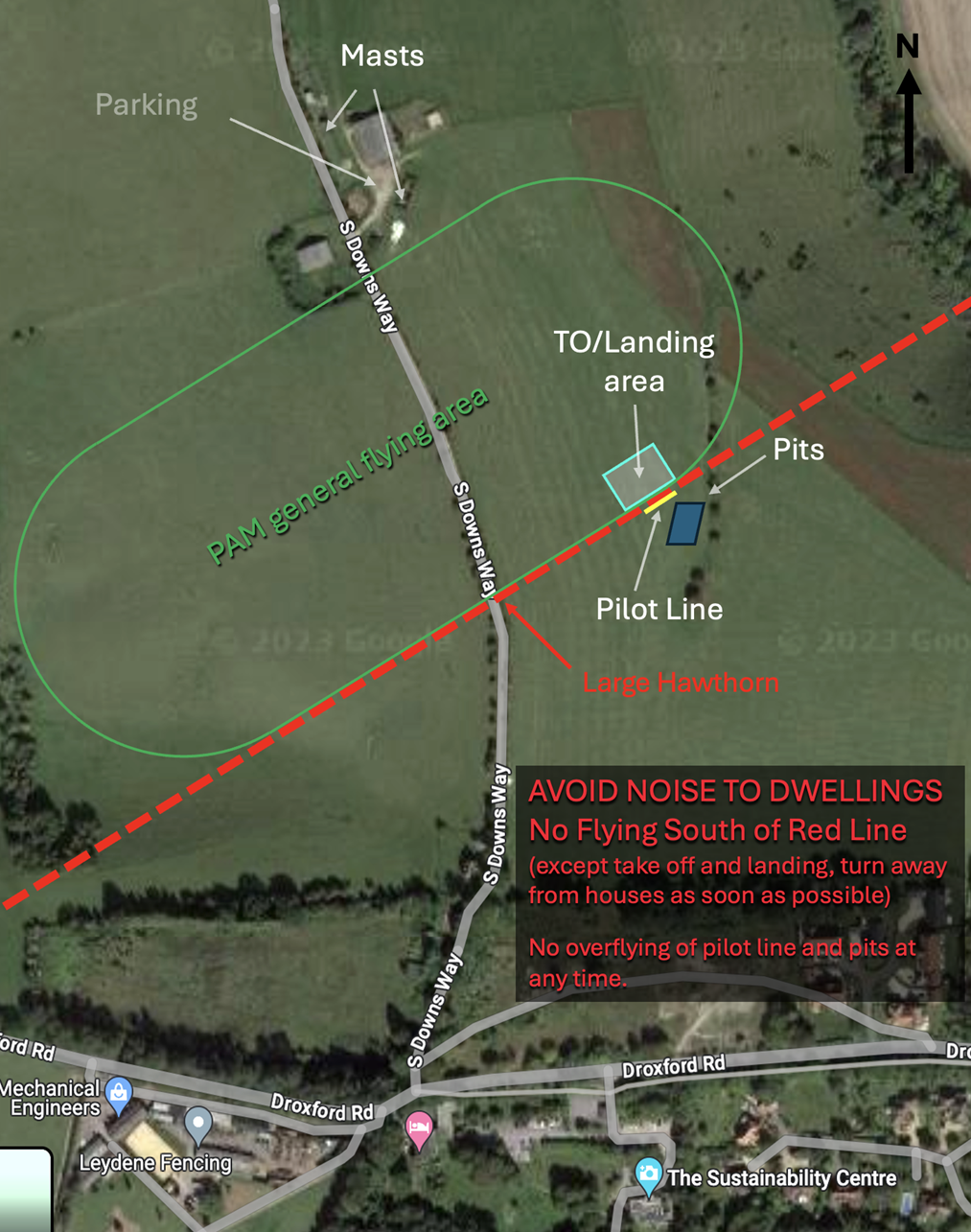 Despite the poor weather the patch grass has grown quite a lot and it now needs a good cut so we’ll do the rotation when we next mow, possibly by the time you’re reading this.
On the nicer January days a couple of new models were flown, the first being a ZOHD Drift by Patrick Beagles. Gordon Bennett has decreed that Patrick should be known as Snoopy, after the Peanuts cartoon dog. Maybe Gordon thinks Patrick is cute and cuddly…
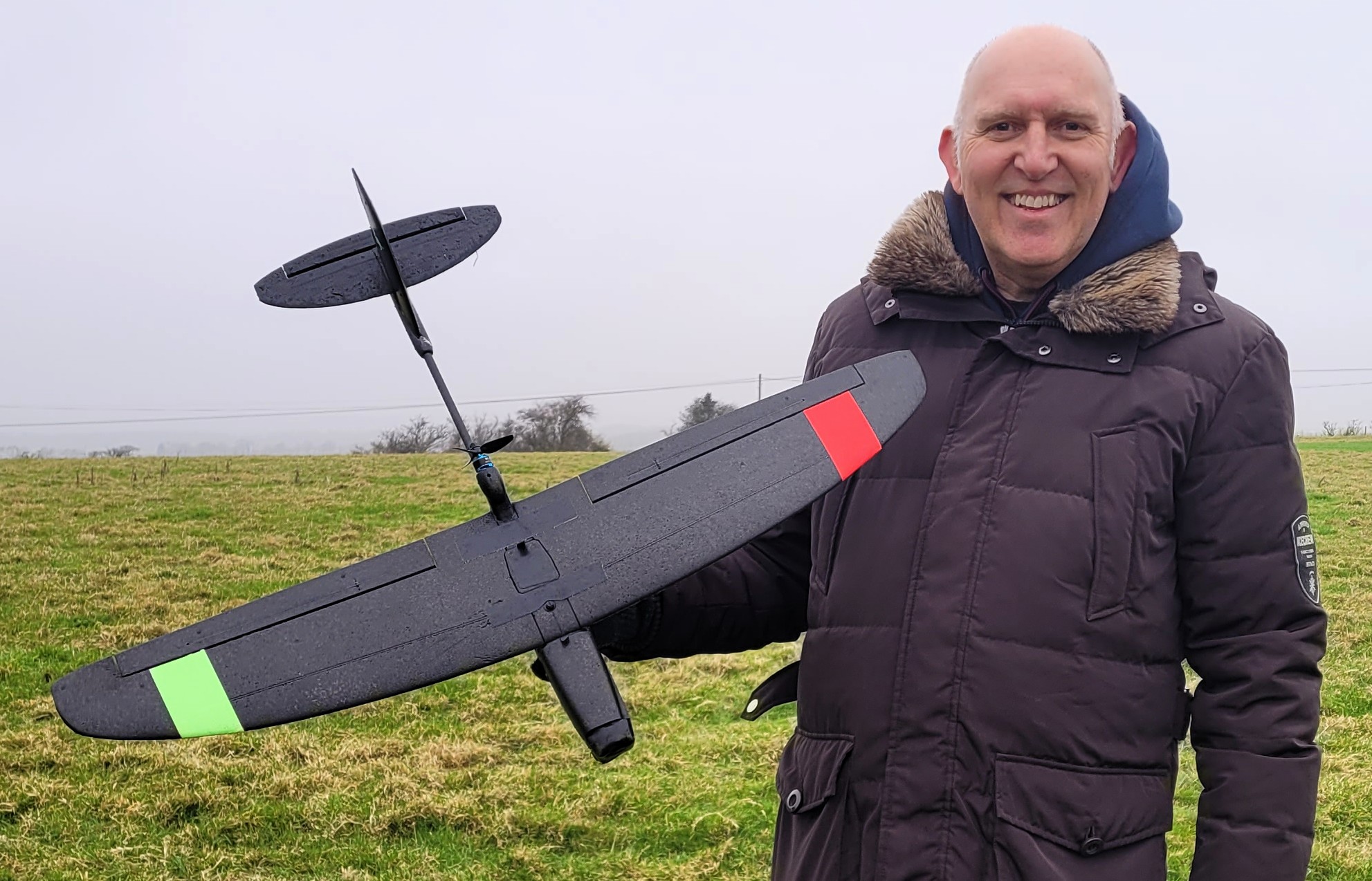 Snoopy’s Drift isn’t actually new but it’s the first time he’s flown it at the PAM field having previously flown it in local parks where he’s broken the boom off a few times.
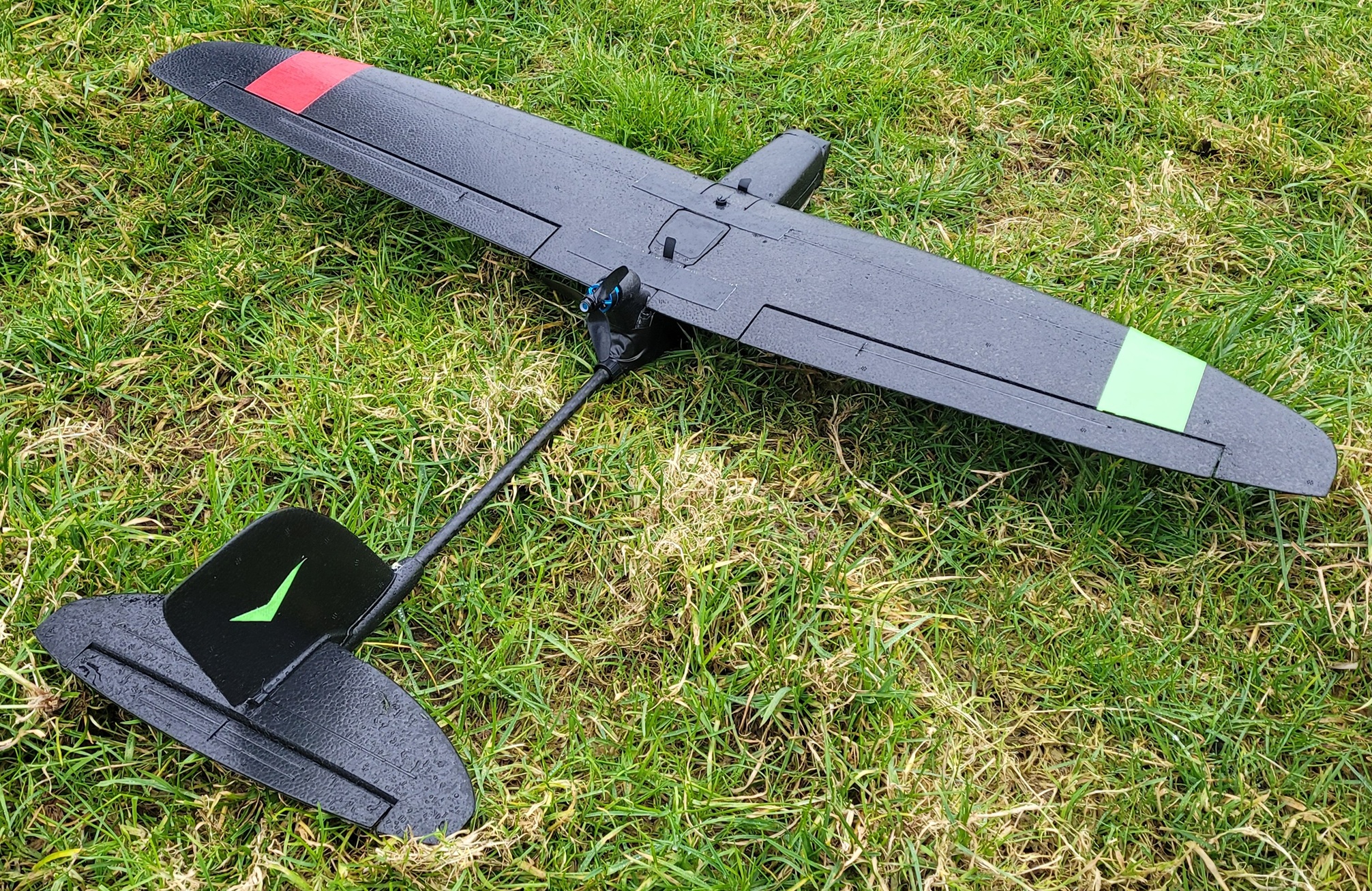 The Drift was first produced in white foam but Snoopy’s is a new Dark Breeze edition in black foam. The black foam is slightly denser than the white foam so it’s a little heavier.
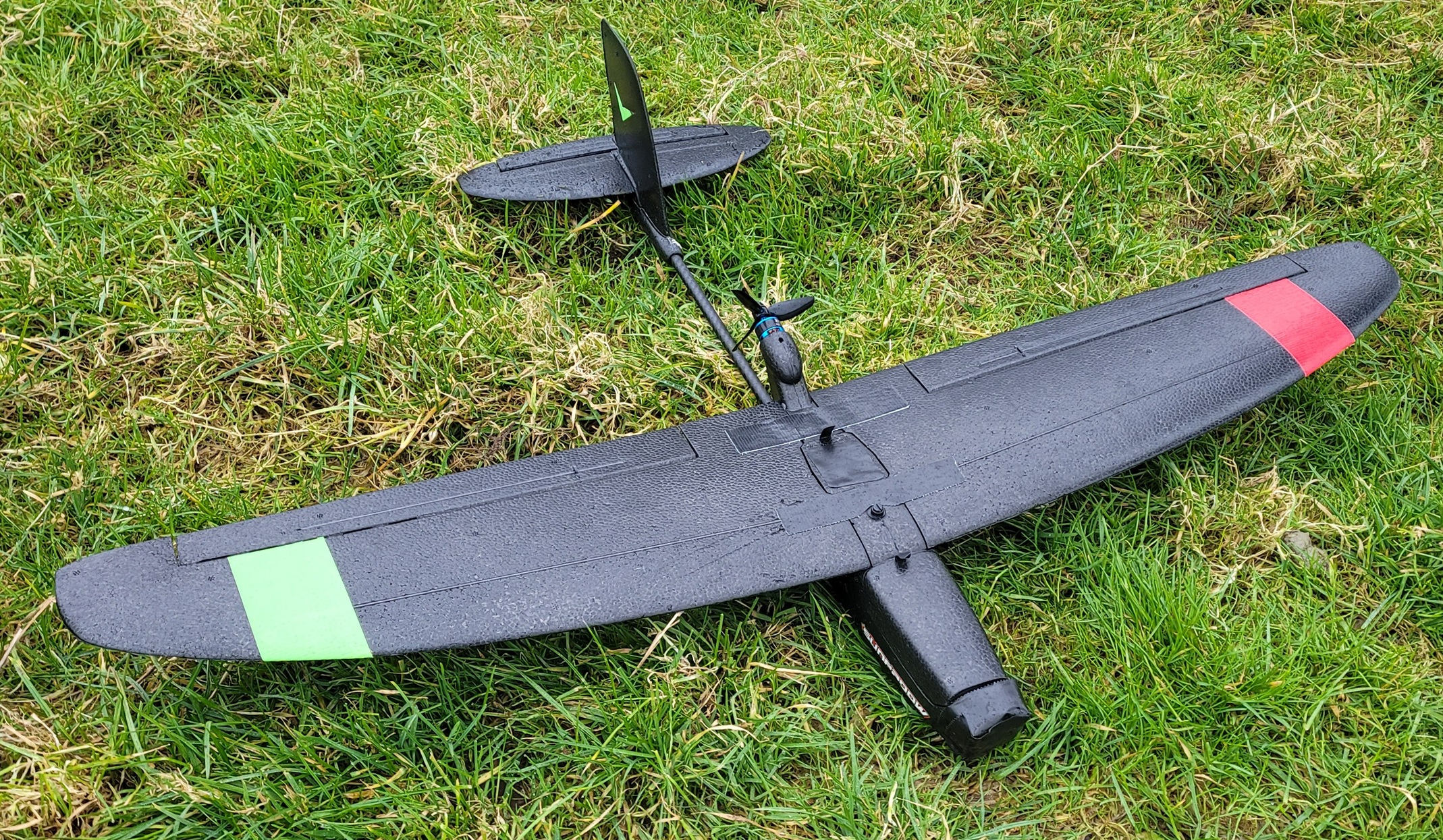 ZOHD bill it as a ‘stealth’ version and it obviously works as Snoopy reckons orientation is difficult sometimes so he’s added some red and green tape to the wings to aid visibility.
He bought his from Hobbyrc where it’s available for around £74, and this is what their website says: The ZOHD Drift Dark Breeze edition is a lightweight and portable RC plane that boasts an impressive 877mm wingspan and a sleek black foam design. It comes with all the key components pre-installed, so you can assemble it in minutes without any glue.
ZOHD bill it as a ‘stealth’ version and it obviously works as Snoopy reckons orientation is difficult sometimes so he’s added some red and green tape to the wings to aid visibility.
He bought his from Hobbyrc where it’s available for around £74, and this is what their website says: The ZOHD Drift Dark Breeze edition is a lightweight and portable RC plane that boasts an impressive 877mm wingspan and a sleek black foam design. It comes with all the key components pre-installed, so you can assemble it in minutes without any glue. 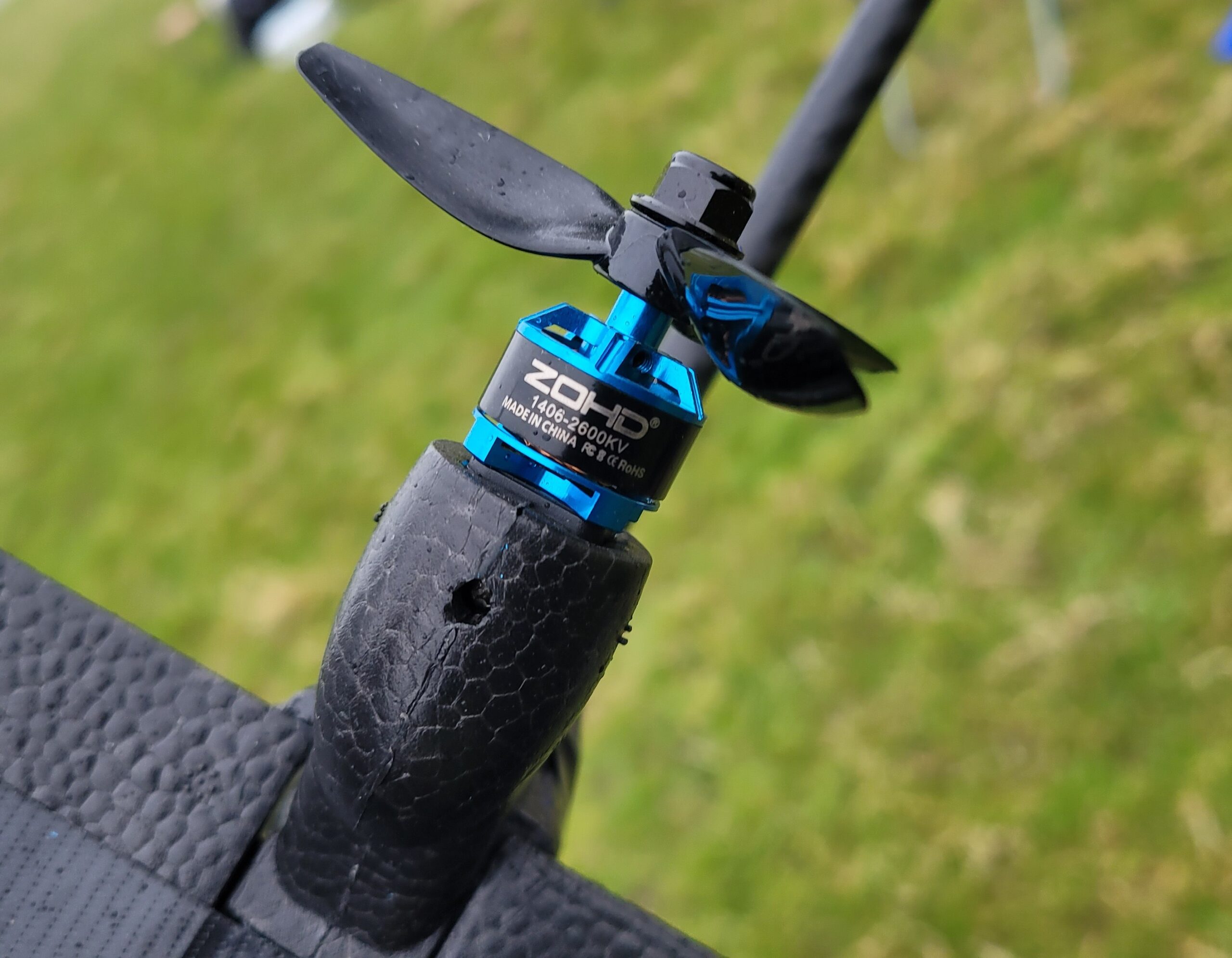 It also includes two different propellers for 2S and 3S LiPo batteries, giving you more flexibility in power and flight time. The ZOHD Drift Dark Breeze edition is designed to be easy to launch, fly and land. It has a dedicated equipment bay for your FPV camera, flight controller and GPS, and a built-in CF rod for extra durability. It has excellent flight characteristics, allowing you to glide smoothly in light wind conditions and perform agile maneuvers with precision. Whether you are new to FPV or looking for a relaxed flying experience, the ZOHD Drift Dark Breeze edition is the perfect choice for you!
As it says, the Dart is designed to take an FPV set-up with a flight controller but Snoopy is just flying his without any of the extras. He uses a 3 cell 1100mAh lipo battery with the supplied 5×3.5 propeller which gives him flight times of up to twenty minutes!
It also includes two different propellers for 2S and 3S LiPo batteries, giving you more flexibility in power and flight time. The ZOHD Drift Dark Breeze edition is designed to be easy to launch, fly and land. It has a dedicated equipment bay for your FPV camera, flight controller and GPS, and a built-in CF rod for extra durability. It has excellent flight characteristics, allowing you to glide smoothly in light wind conditions and perform agile maneuvers with precision. Whether you are new to FPV or looking for a relaxed flying experience, the ZOHD Drift Dark Breeze edition is the perfect choice for you!
As it says, the Dart is designed to take an FPV set-up with a flight controller but Snoopy is just flying his without any of the extras. He uses a 3 cell 1100mAh lipo battery with the supplied 5×3.5 propeller which gives him flight times of up to twenty minutes!
Now for some information from Gordon Bennett about his new toy, a Skynetic Tempest: Andy (Colin) asked if I could write a little about the Tempest. I’m no expert but I think Prospero was betrayed by his brother and the King of Naples…… Not often you get literary gags in Patch News ehh!? (That’s cos most of the readers aren’t bright enough…!) 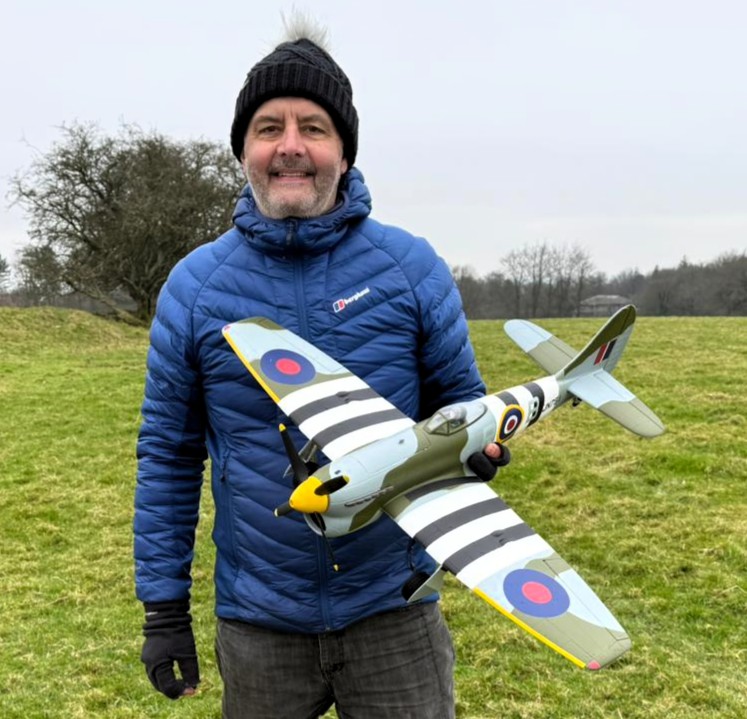 As no one bought me a new model over Christmas I decided to buy one myself. Motion RC were doing a deal on the 80 cm wingspan Tempest and I love the looks of the WW2 interceptor. The Tempest was initially called the Typhoon 2 but as it had diverged so much it was renamed. The aircraft entered service in 1944 and had a much thinner wing and was also one of the most powerful fighters of WW2. At low altitude it was the fastest single engine propeller-driven aircraft of the war. The model is built by Skynetic and arrived nearly ready to go. All you have to do is glue the horizontal stabiliser in and bolt on the wing. One quirk is that they don’t fit any control horns but everything is supplied except a receiver. The Tempest comes with fixed undercarriage and racks for armament.
 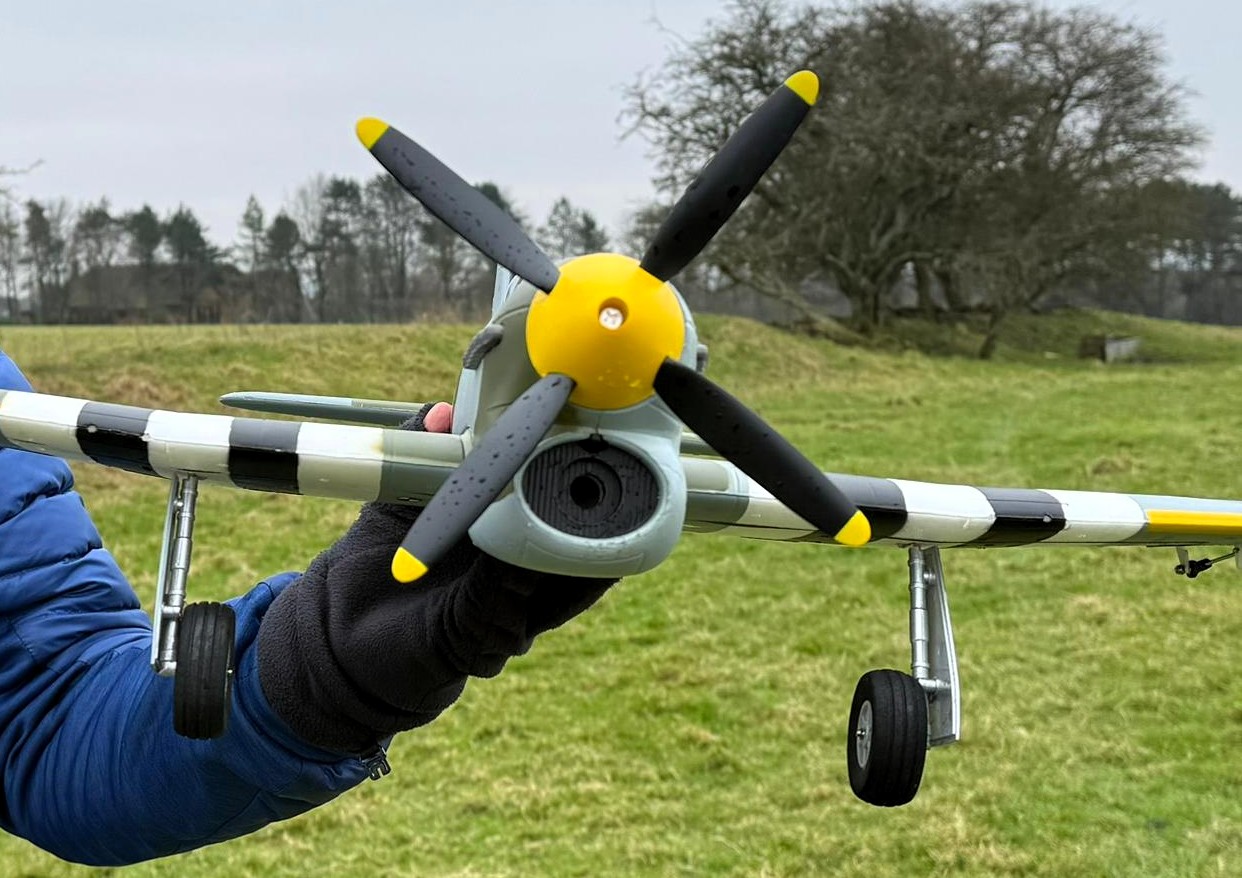 I didn’t bother with the latter but thought I’d give the gear a try, I figured the wheels might help protect the prop on grass landings. The first flight was interesting. She rolled hard left from the hand launch but went away like a wild thing. Way too much deflection on all the control surfaces (no set up info in the manual). Luckily, I’d set up some dialled down rates on a switch which calmed things down a bit. The landing was interesting, as soon as the wheels touched, she did a very fast somersault. This should have been the time to remove the undercarriage, but I got fixated on setting up new rates and forgot.
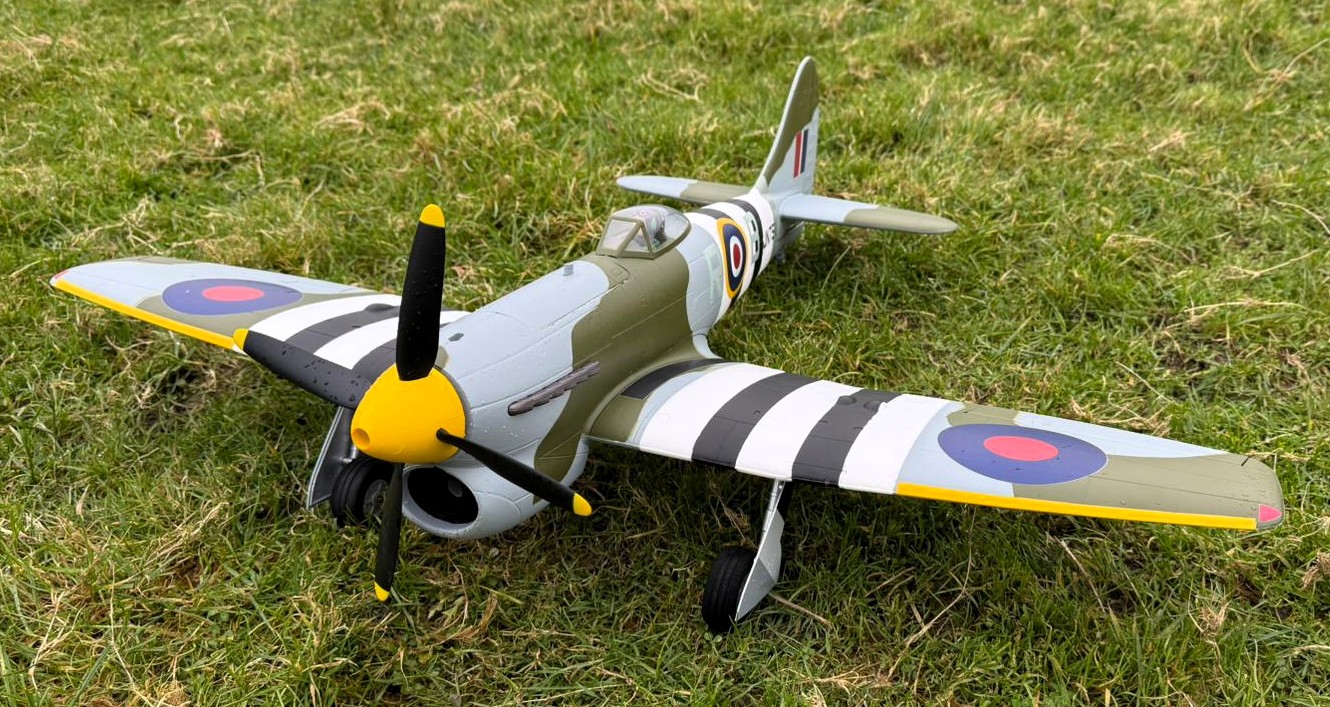 Launch two sorted things. Again, she torque rolled left and this time I couldn’t catch her. The resultant ‘landing’ swiftly removed the gear. Launch three was fine and I had a great flight humming the 633 theme to myself (ok wrong aircraft but who cares).
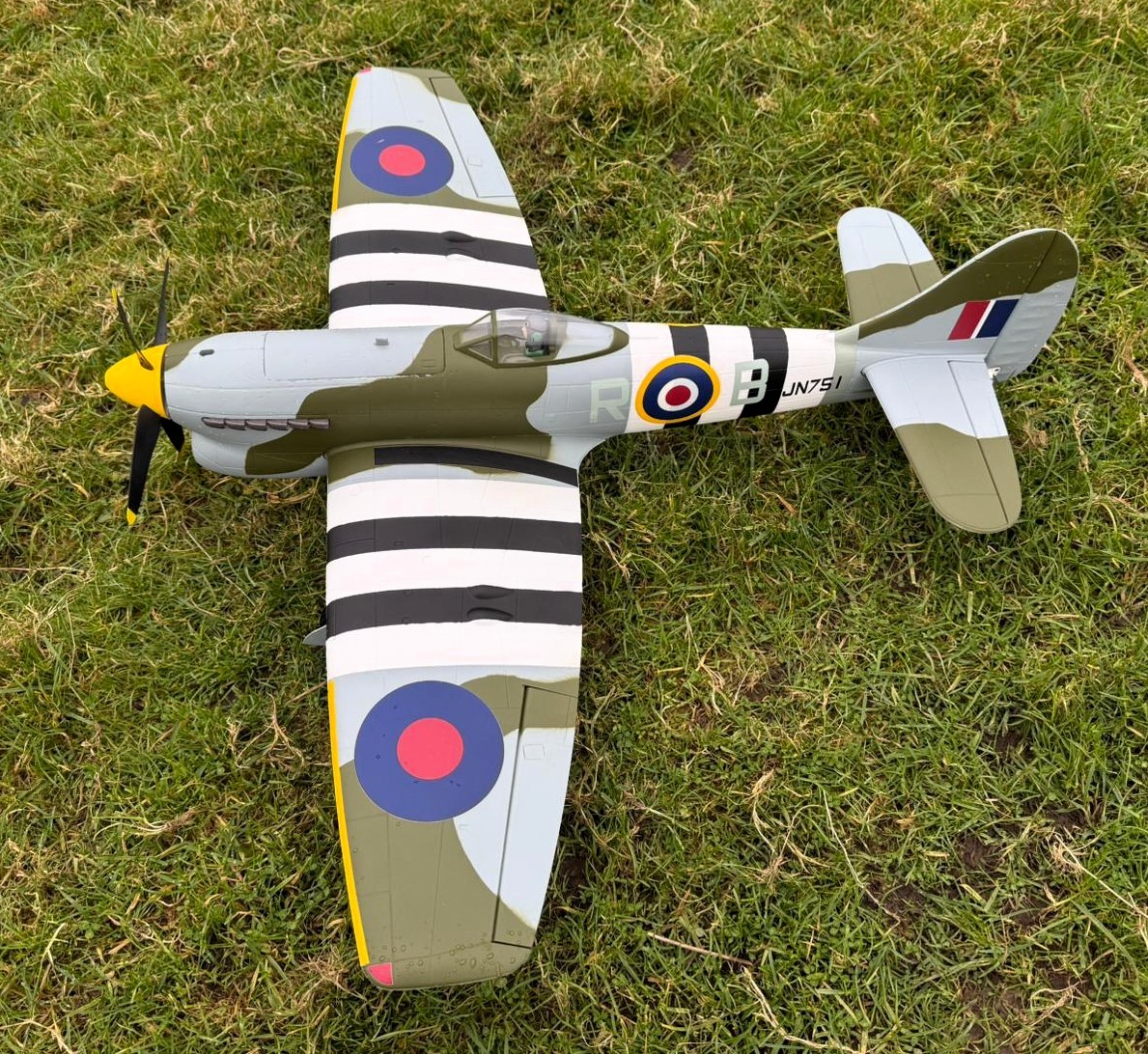 At the next trip up to the patch Mark suggested launching at 75% throttle. I also held in a bit of right rudder and she now goes away really well. For a smallish model I think she looks great in the air. I’m working on the ‘scale flying’ but it helps that she’s really stable in straight and level flight. When no one is looking I can switch the rates back up and do 5 rolls a second. Thanks Gordon, it was good to see how well she flies now you’ve got her sorted. I filmed some of the Tempest in the air which you can see in this month’s video.
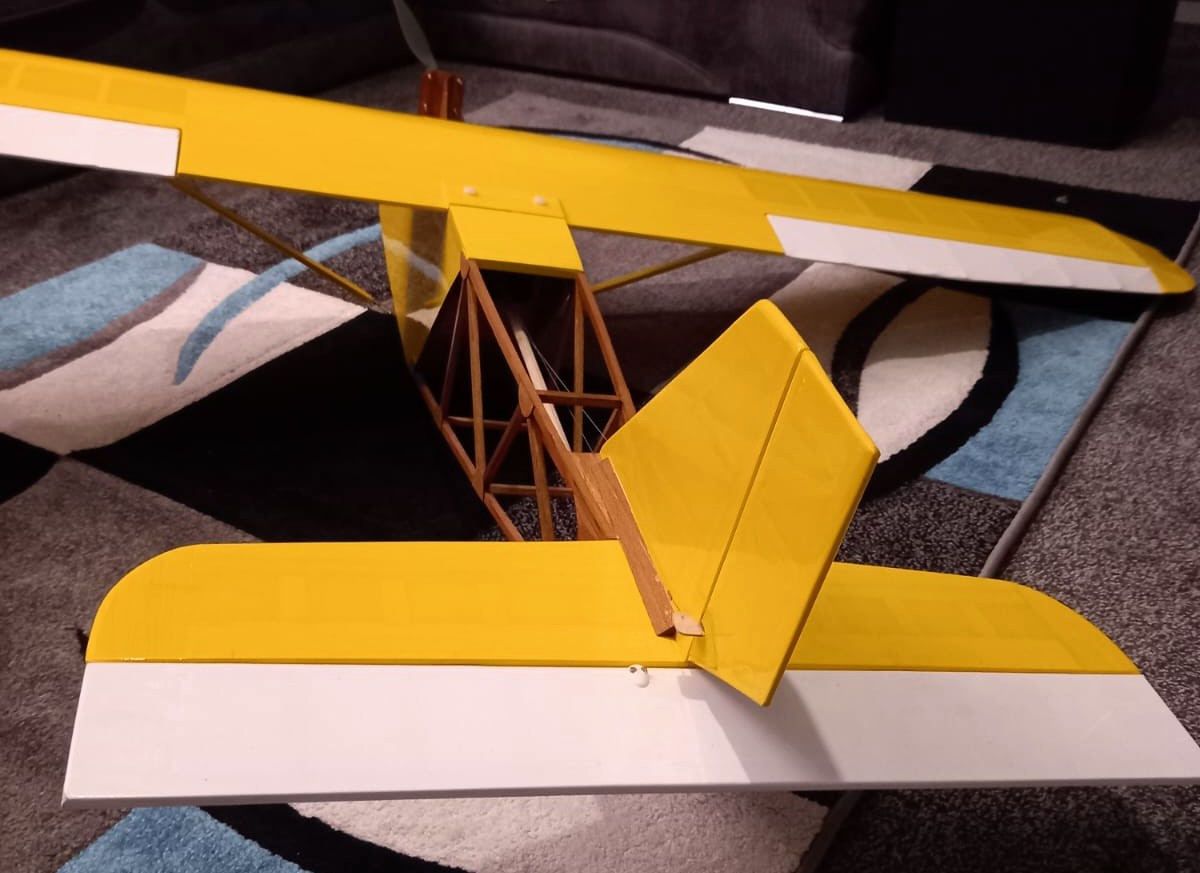
Page Boy has sent me through some photos and information on a couple of models he’s building, the first being a very pretty looking Woodpecker, a model that he was hoping to fly on the last Sunday of January but unfortunately storm Herminia put paid to that idea.
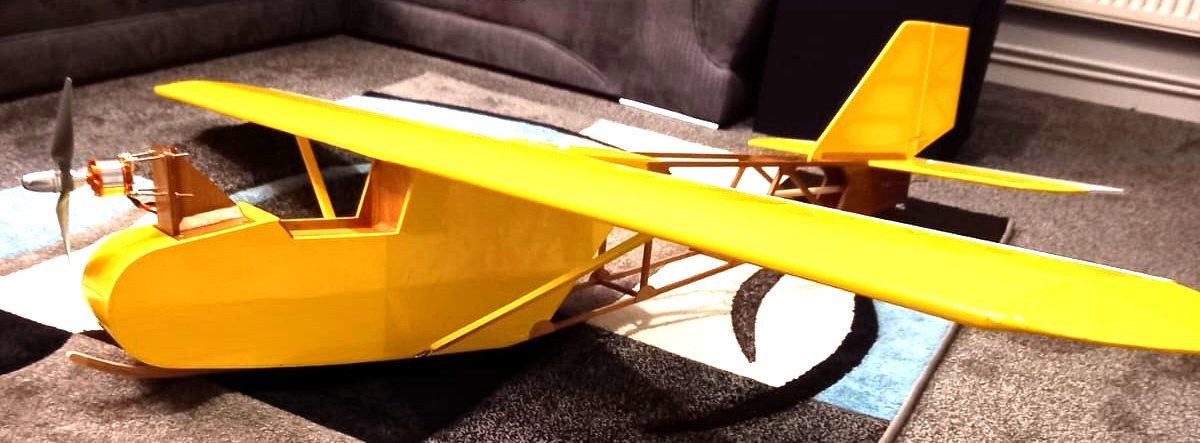 He first started building the Lindsay Todd and Paul Rice designed Woodpecker way back in 2018 but has only just completed it… he must be a friend of Captain Slow!
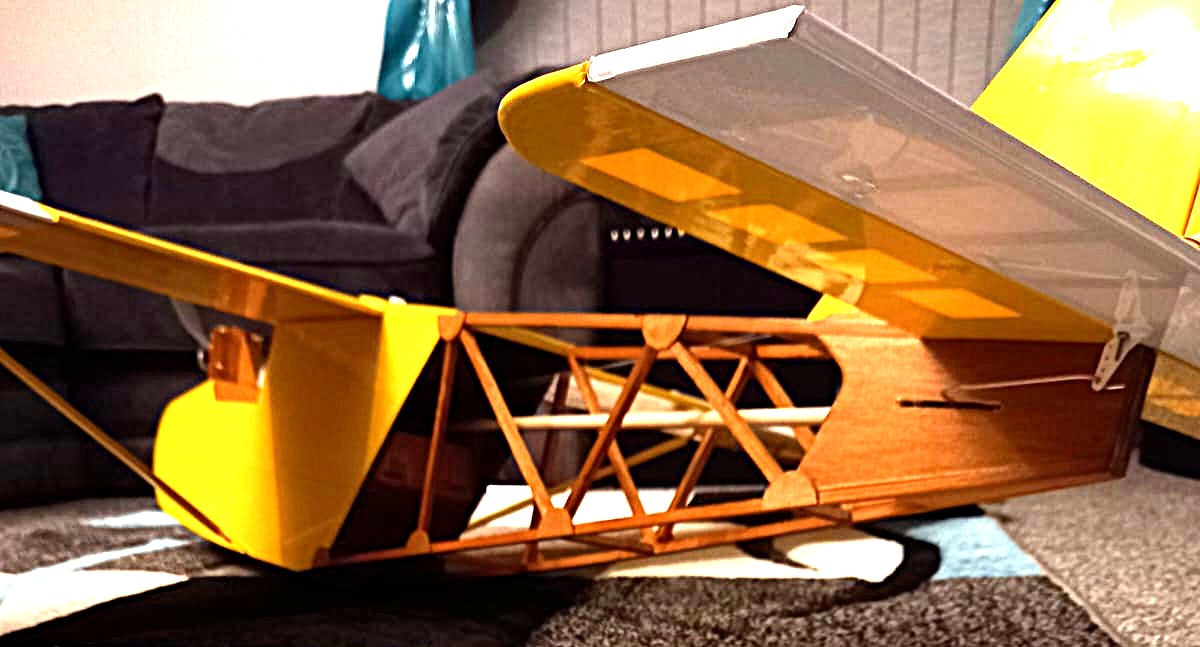 The Woodpecker was a free plan in RCM&E in November 2017 and can be built with either a normal flat tail or a V-tail, Page Boy has gone for the normal one, I think that’s nicest.
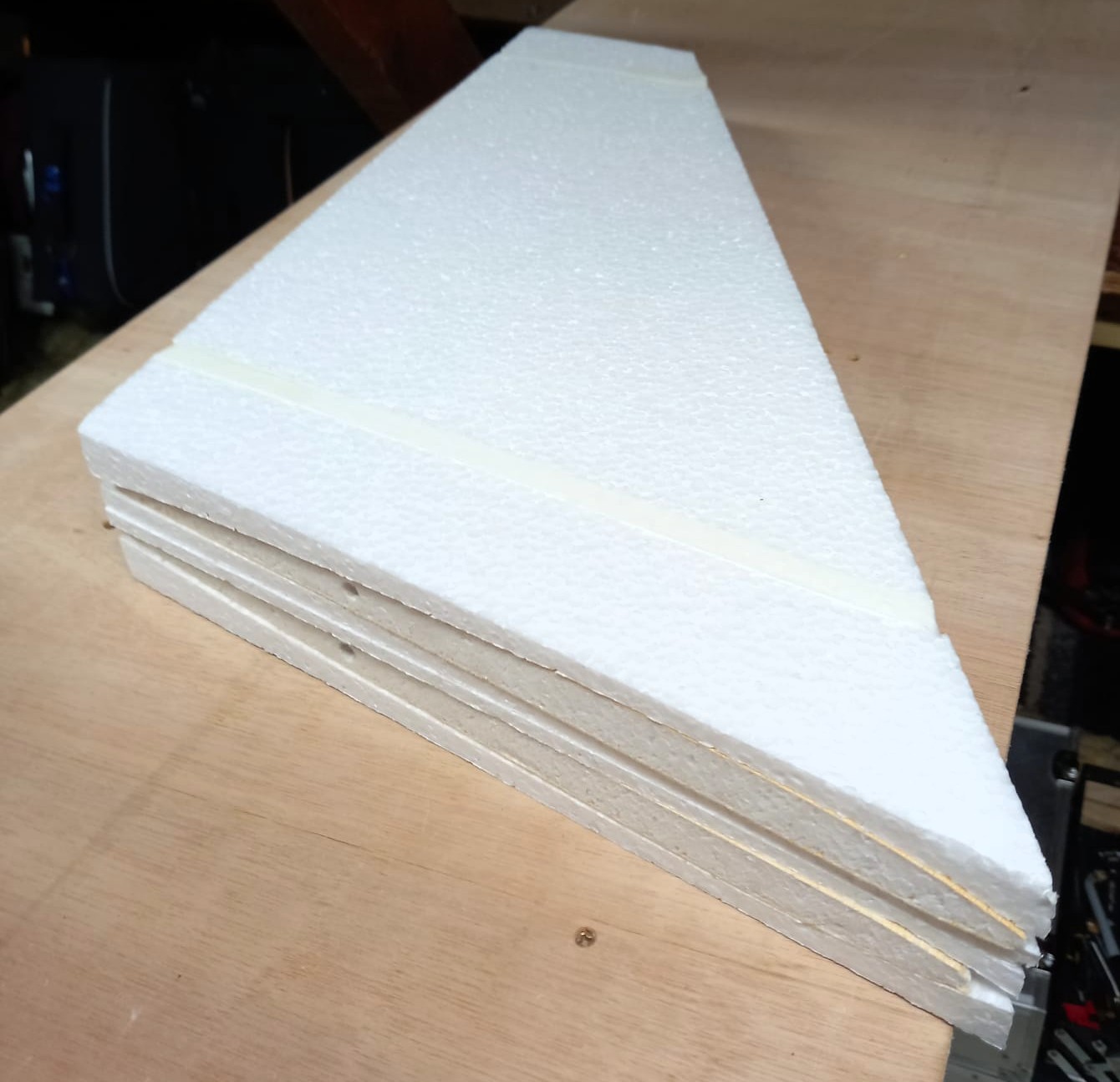
 Page Boy’s other new model is a Mirus that he’s only just bought so, if the Woodpecker is anything to go by, we should see it arrive at the field sometime around 2032!
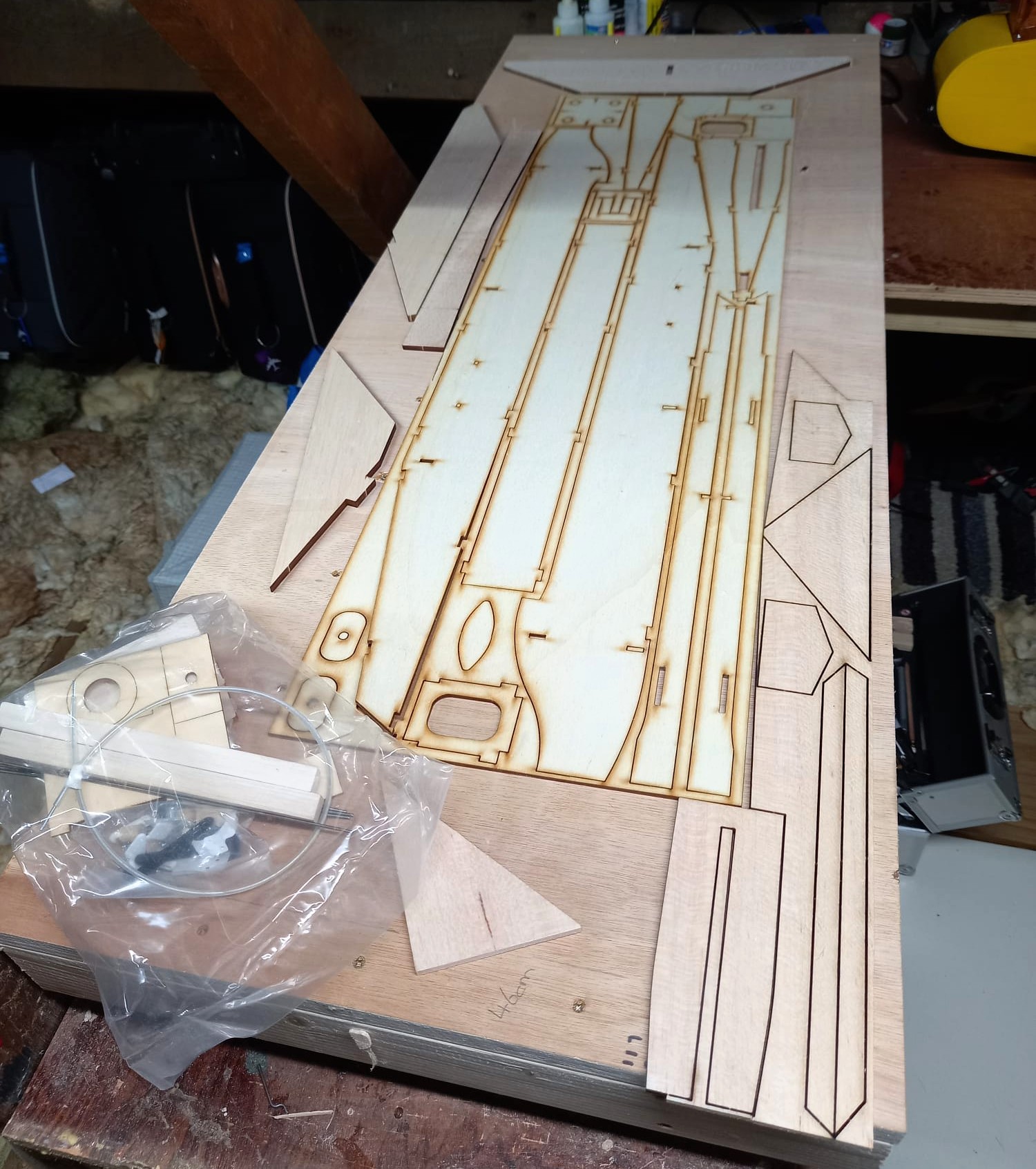 He bought it when he watched Mini-Mike flying his a couple of month’s ago and, like 1066, was inspired to build one for himself. Unlike 1066 (more of his next month) he’s bought the smaller 25 sized Mirus which is the same as Mini-Mike’s. As you can see he hasn’t started work on it yet but hopefully it won’t take too long to put together.
 He’s already decided on the power set-up he’ll be fitting, it’ll be the same as he’s using in his Cloud Models E2K Wasp pylon racer, an Overlander Thumper 3536 1500Kv motor with an 8×6 prop, controlled by a Hobbywing 80A speed controller, and fed by a 4 cell 2600mAh lipo. He’ll be using Hitec HS65 metal geared servos to steer the Mirus around and judging by the speed of his Wasp and Mini-Mike’s Mirus it’s not going to be slow!
Last month I reported on the Sky Viper Vectors that both Woody and Captain Slow had received as Christmas presents. Apparently Santa Claus had spotted them in the Lidl Black Friday sale for just £39.99 and bagged a couple to deliver on the big day.
 Woody has been happily flying his Vector and has now had quite a few flights with it. He’s found that the stabiliser seems to take about ten seconds to sort itself out after launching, it always goes to a very high alpha from launch no matter what Woody does on the sticks. Sometimes it just sinks to the ground at high alpha but usually it staggers away and then there’s a noticeable ‘kick’ and it levels out and flies normally for the rest of the flight, odd.
 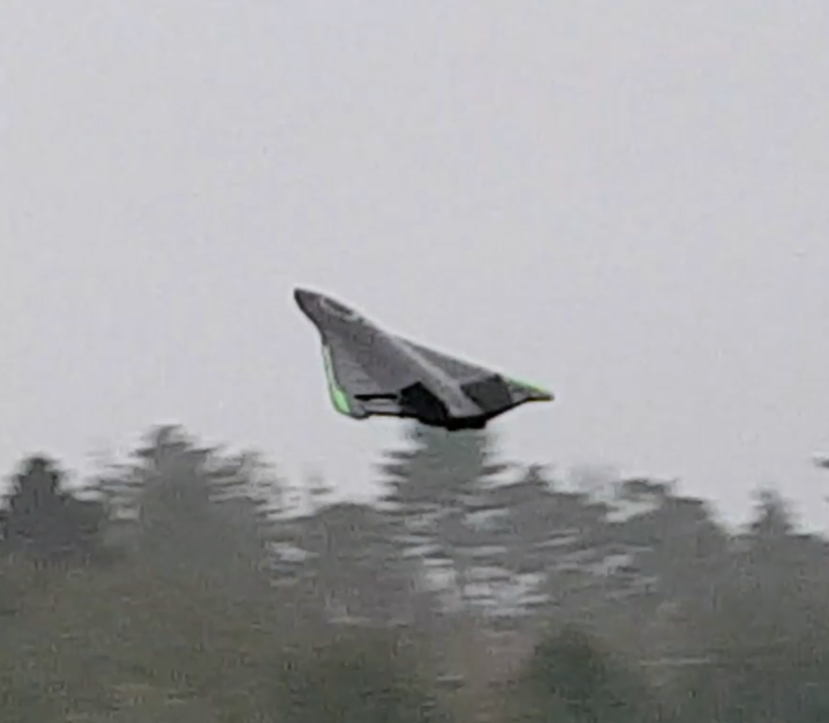 You can see the high alpha from launch in the video although the ‘kick’ isn’t very obvious. Woody has found that waiting with the motors running for at least ten seconds before launching seems to overcome the problem. Captain Slow hasn’t flown his Vector yet, he’s taking it slowly of course but I think he’s been put off by the ‘Built for Speed’ notice on the box. I’ve offered to buy his Vector from him for a much reduced price but so far he’s resisted my cheeky offers. Sadly I think my chances of a bargain have been reduced greatly as last week I saw the Vector for sale in Sainsburys for a huge £100…shhh…don’t tell him!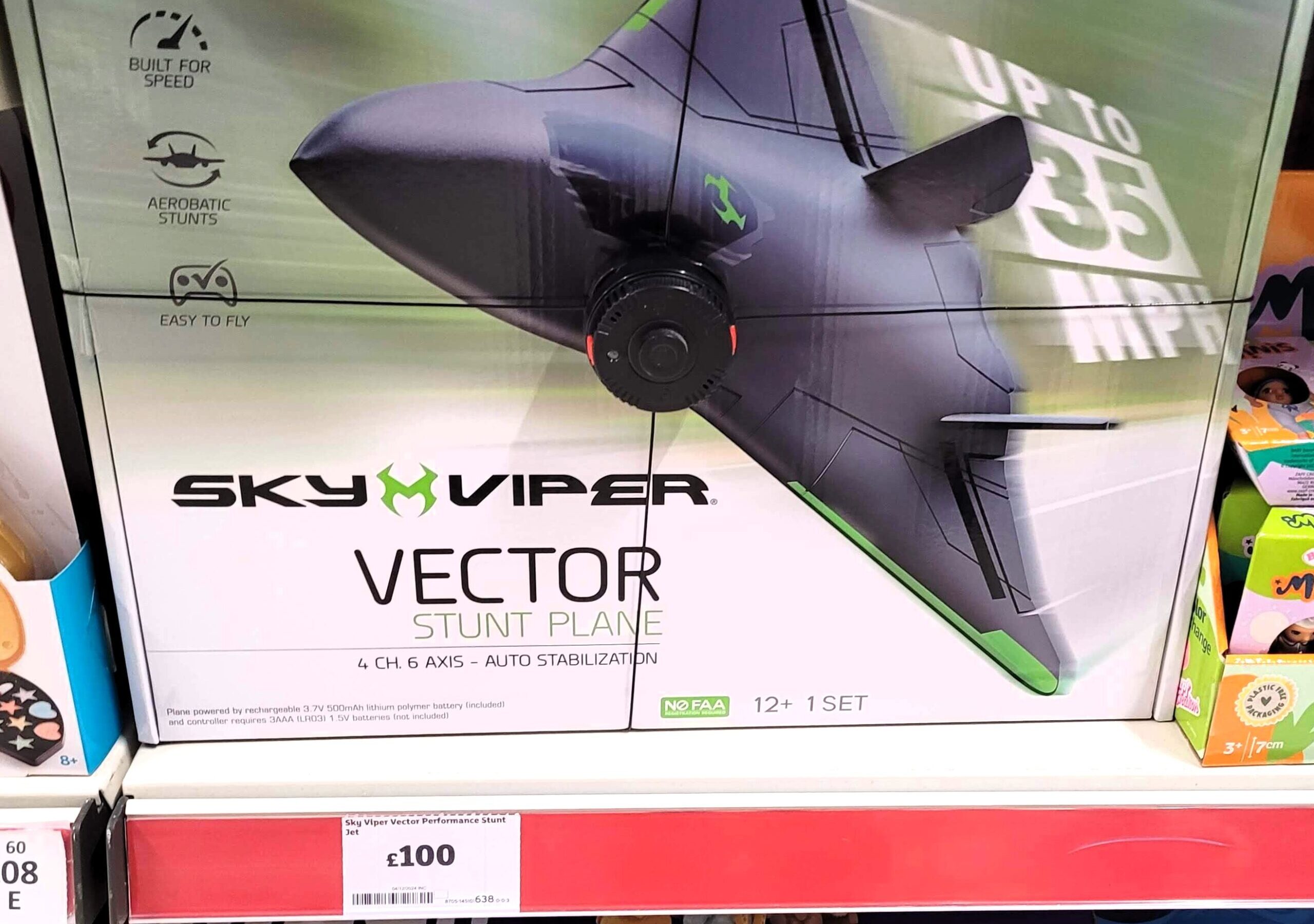
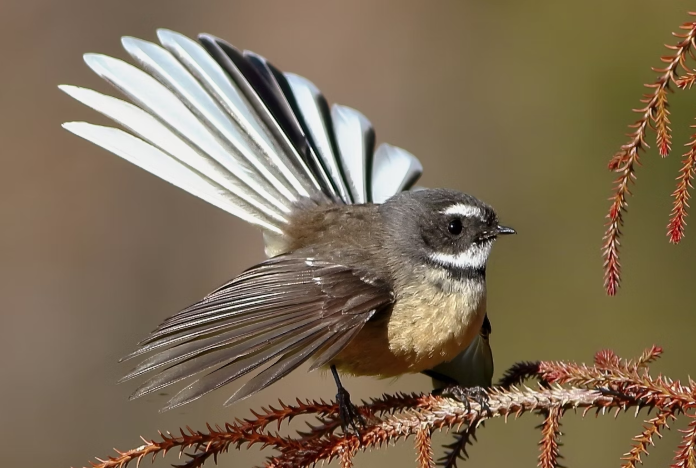
While he’s plucking up the courage to fly his Vector, Captain Slow has bought a second-hand Piwakawaka. A what?! Apparently Piwakawaka is the Maori name of a small bird from New Zealand called a Fantail although the model bears no resemblance to it at it all.
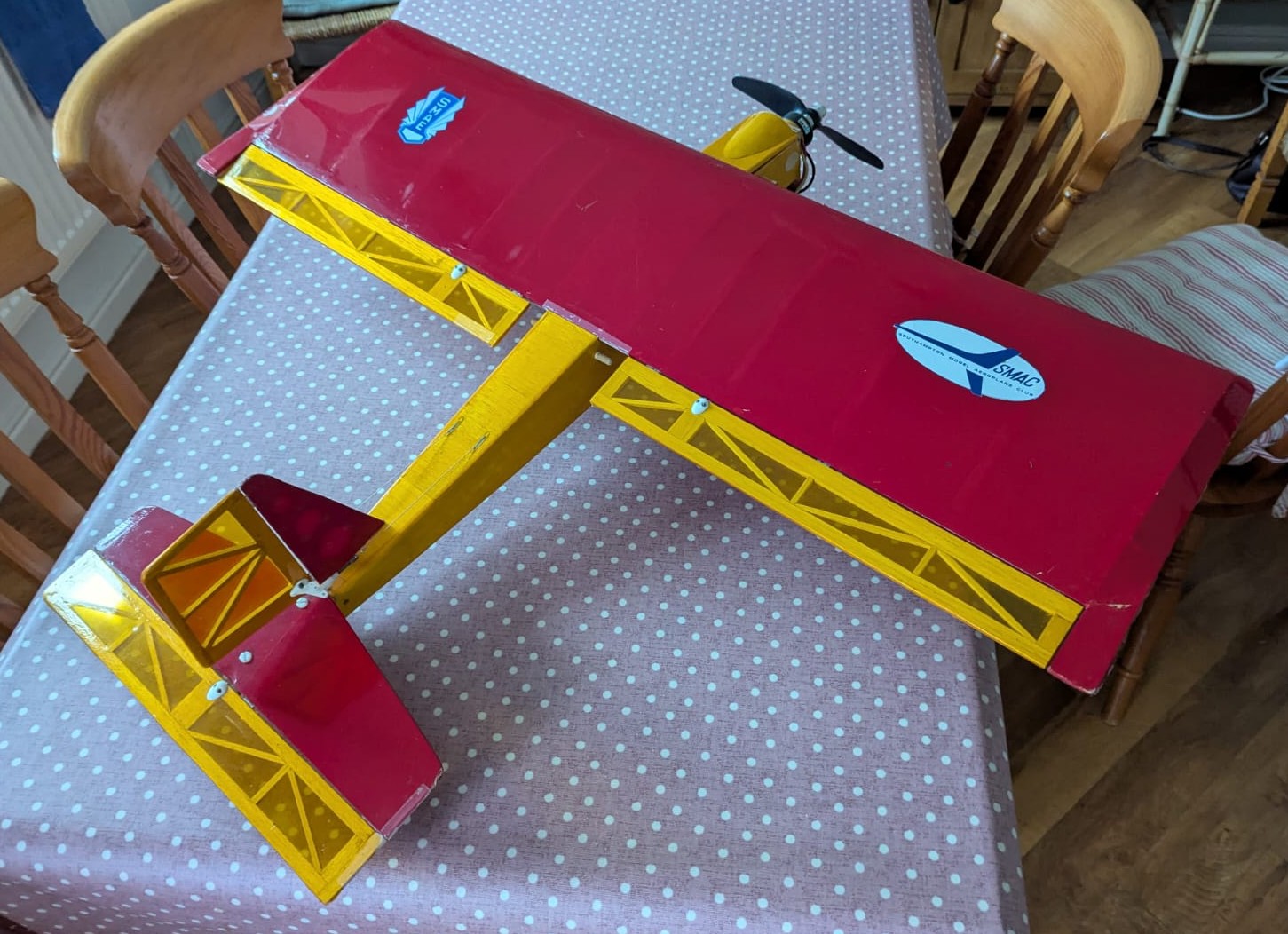 Anyway, this is what Captain Slow says about it: I bought the model from Facebook Marketplace from a chap in Marchwood for £60. It was his fathers who, from what I can gather, was a BMFA member and a member of the Southampton Model Aircraft Club.
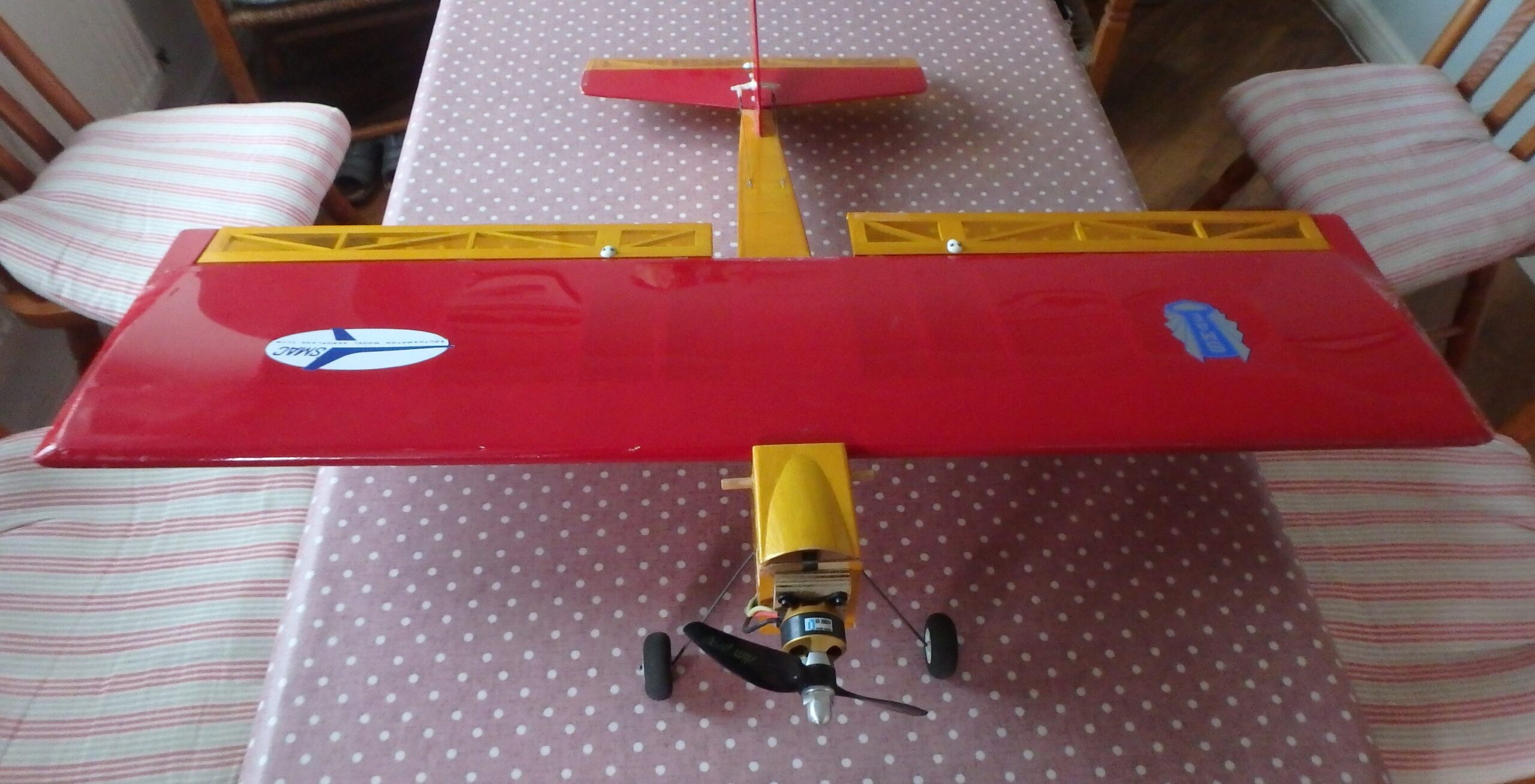 It came complete with the free plan from the Jan 2006 RCM&E and was designed by Ray Huntley. The wing span is 3ft or 91cms. It’s fitted with an AXI 2808/24 outrunner motor, a Jeti Advance Plus 40A esc and 4 Hitec servos and has a pull – pull rudder.
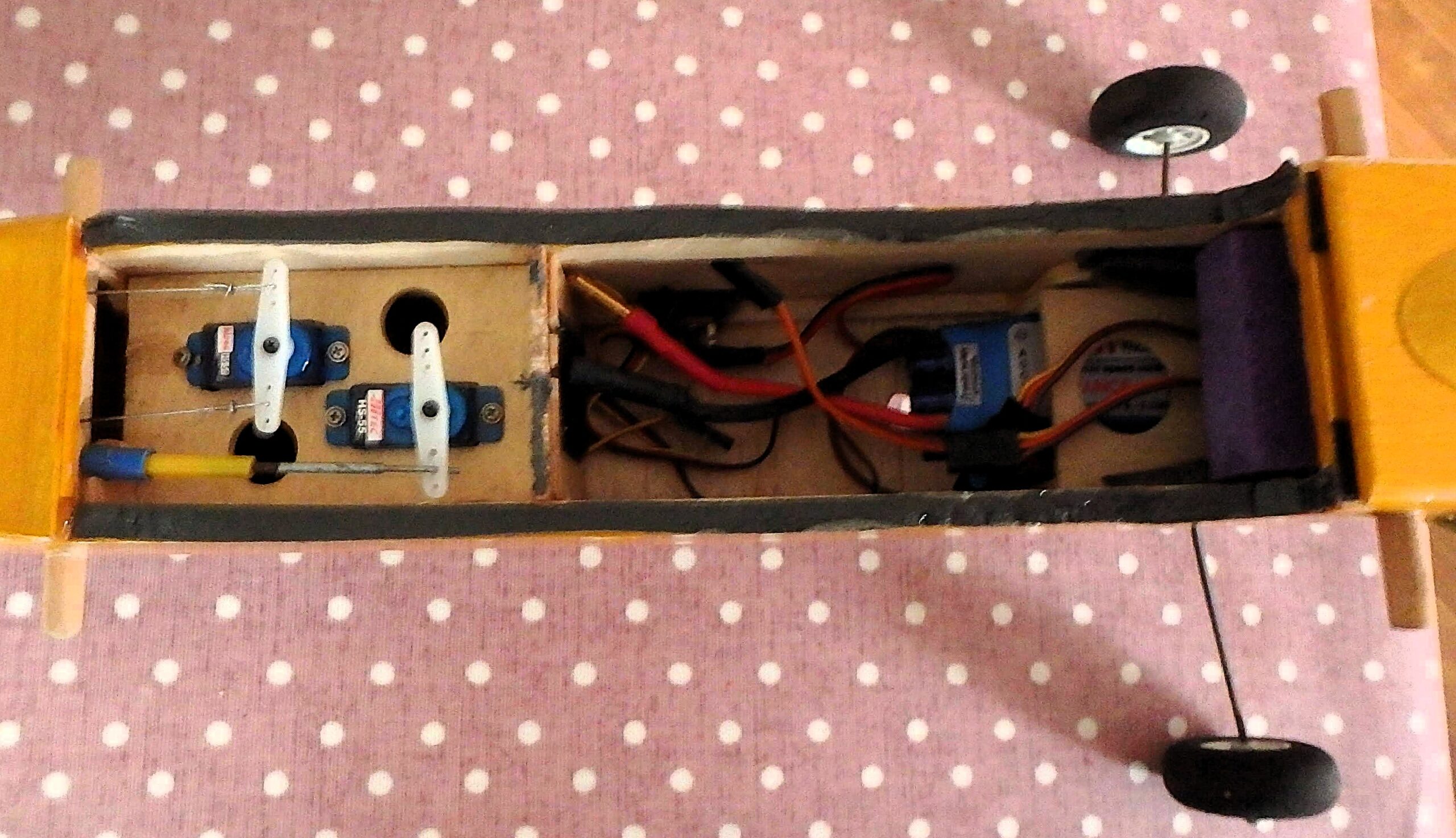 It’s fitted with an 8 x 4 prop which doesn’t agree with AXI’s recommendations, either from the original instructions that I have, or from the AXI web page as it’s a current model apart from the fact that the latest version is 1190 RPM/V as opposed to the 1160 RPM/V of my version. It has a small amount of hangar rash that is easily fixed and I need to change the esc connections to XT60; other than that it’s ready to go.
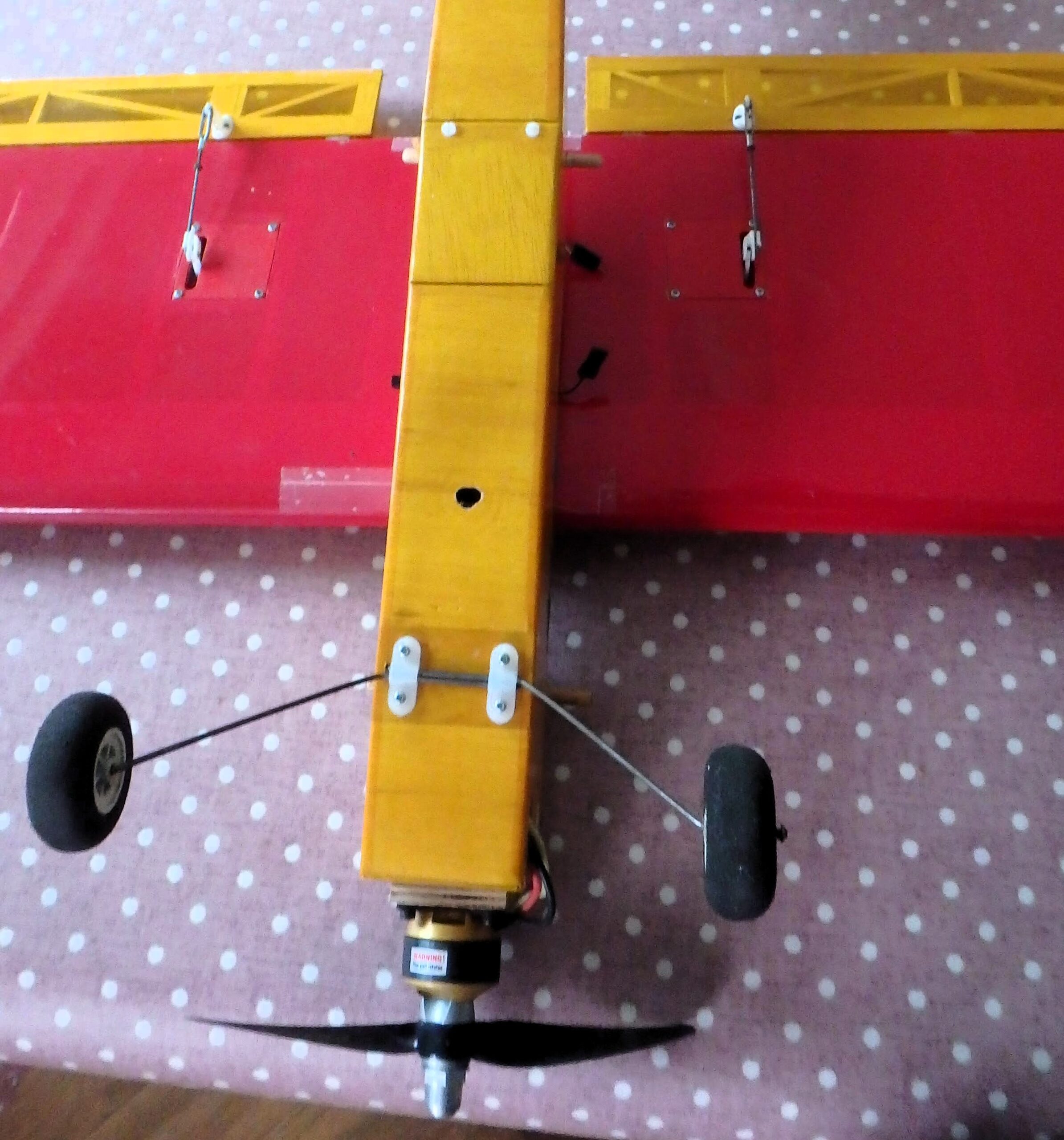 The RCM&E article describes it as a small Limbo Dancer type model, it looks good to me.
Woody has built himself a Lockheed F-117 Nighthawk which is another from the website of Humayun Najabat. He is the guy in Pakistan who also designed the SR-72 Darkstar that Woody built a couple of months ago and was featured in the December 2024 Patch News.
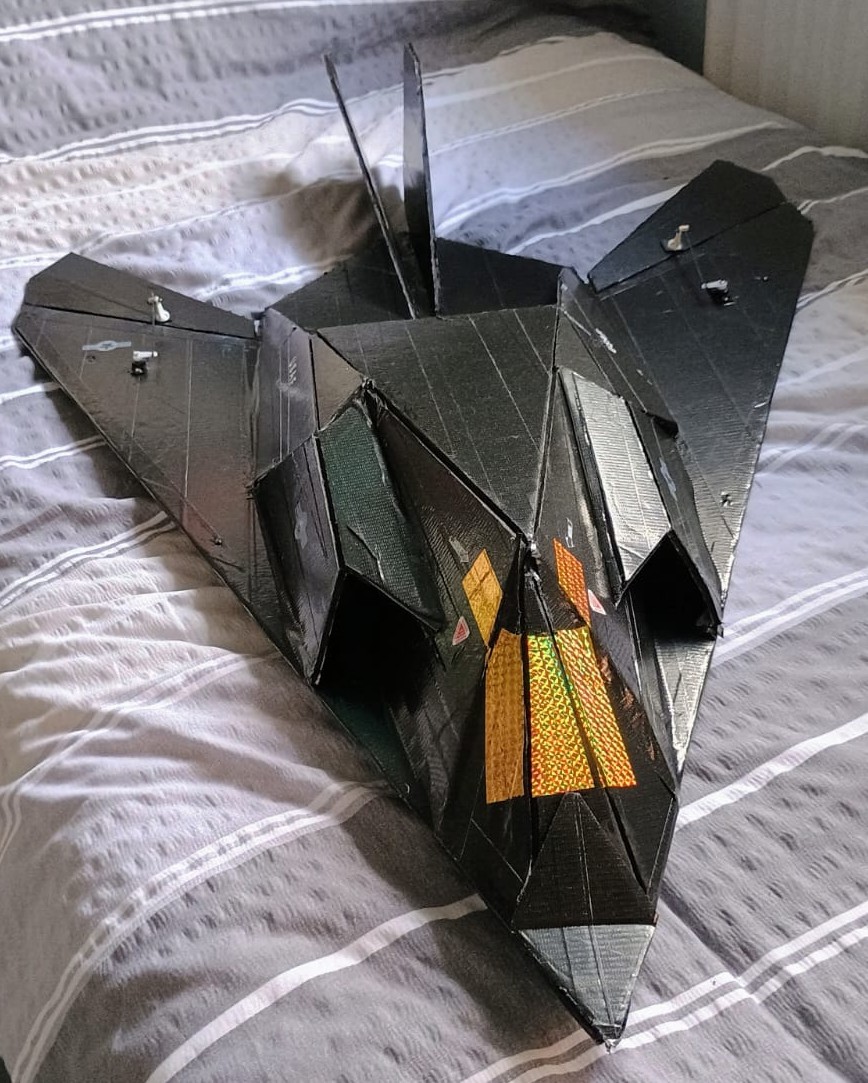 This one was actually designed by someone else, it says Dzung 50 on the plan. I’ve found an S-DiY video of the build that seems rather better than Humayun Najabat’s, you can watch it HERE. The same guy has also made one out of cardboard which seems to fly well!
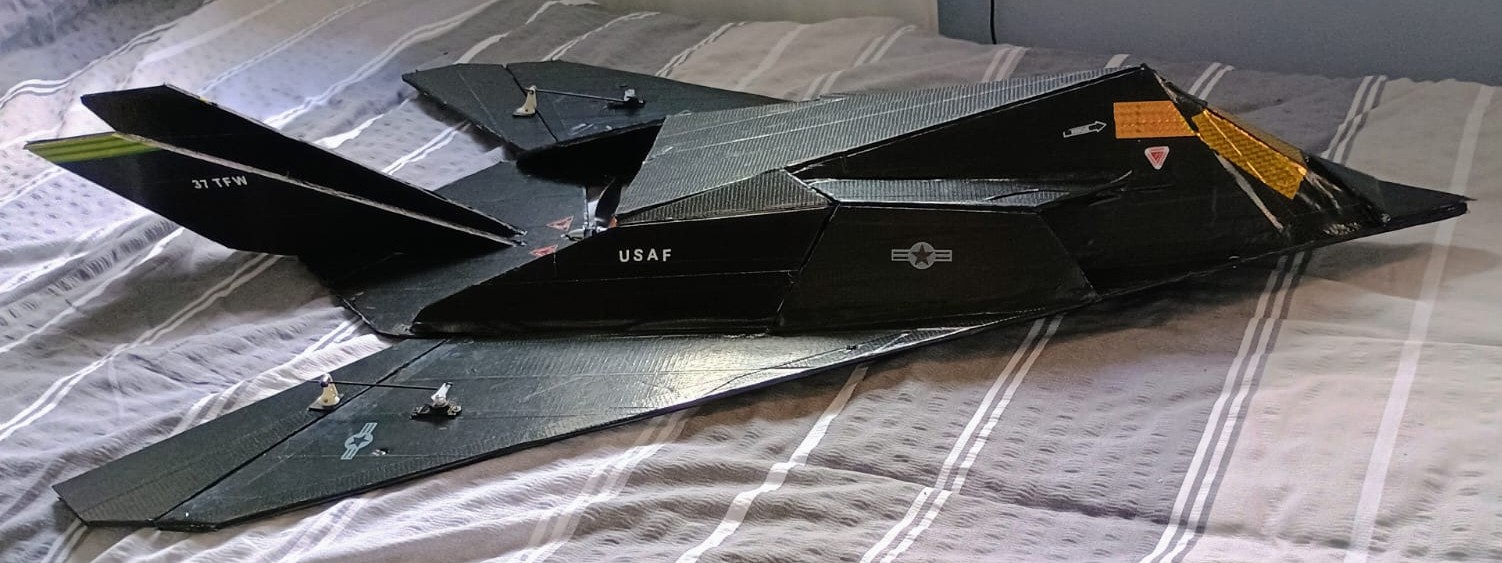 Woody’s is made of foam and he has used his usual foamie set-up consisting of a Turnigy 2826/6 2200Kv motor, a 30A speed controller, and a pair of 9g metal gear servos.
Another new model that has yet to fly is Gordon Bennett’s 64mm Freewing F9F Panther.
It came from Motion RC and apparently is a new 4 cell version of the Freewing Panther.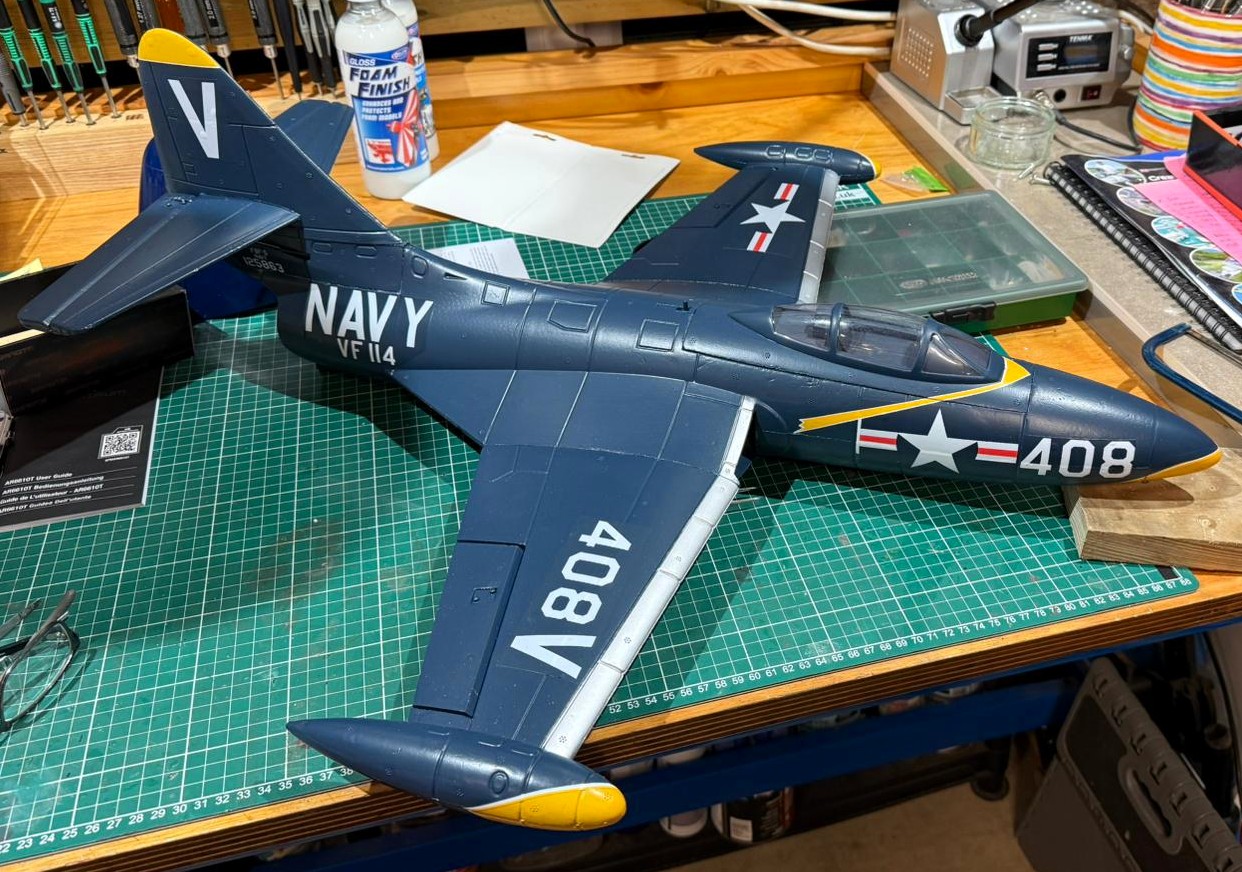 This is from the Motion RC website: The new version of the 64mm F9F Panther has a faster motor, larger 40A ESC, 12B fan for great sound, and runs on a 4S LiPo instead of a 3S. In order to achieve these upgrades, the fuselage mould was updated to create extra room for a 4S LiPo battery and the wing mould was changed to add a tubular spar for extra strength. The canopy magnets were also changed to a latch system to keep the canopy from blowing off due to the extra speed. The changes were worth it! With the extra power and 12 blade EDF sound this already fantastic plane is now even better. Well it certainly looks nice, hopefully there will be a flight review in the February Patch News of the Panther along with Woody’s Nighthawk, and Captain Slow’s Piwakawaka.
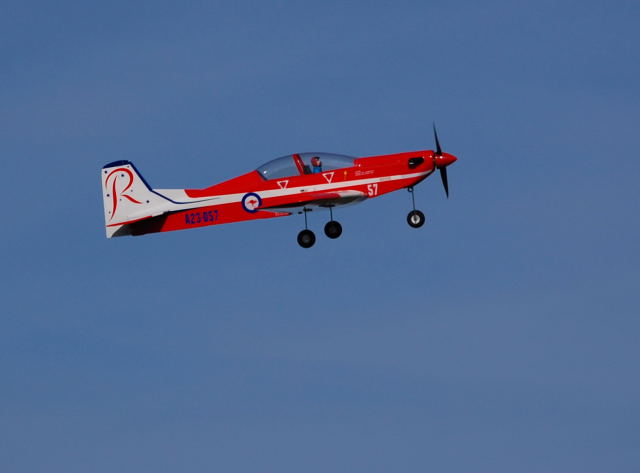
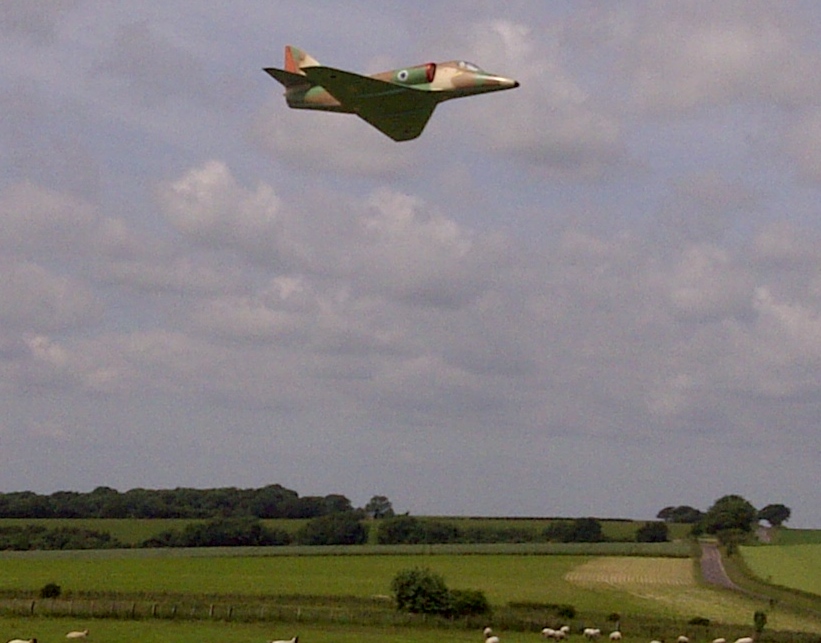
This month the action photos are a few more nostalgic shots from the PAM archives: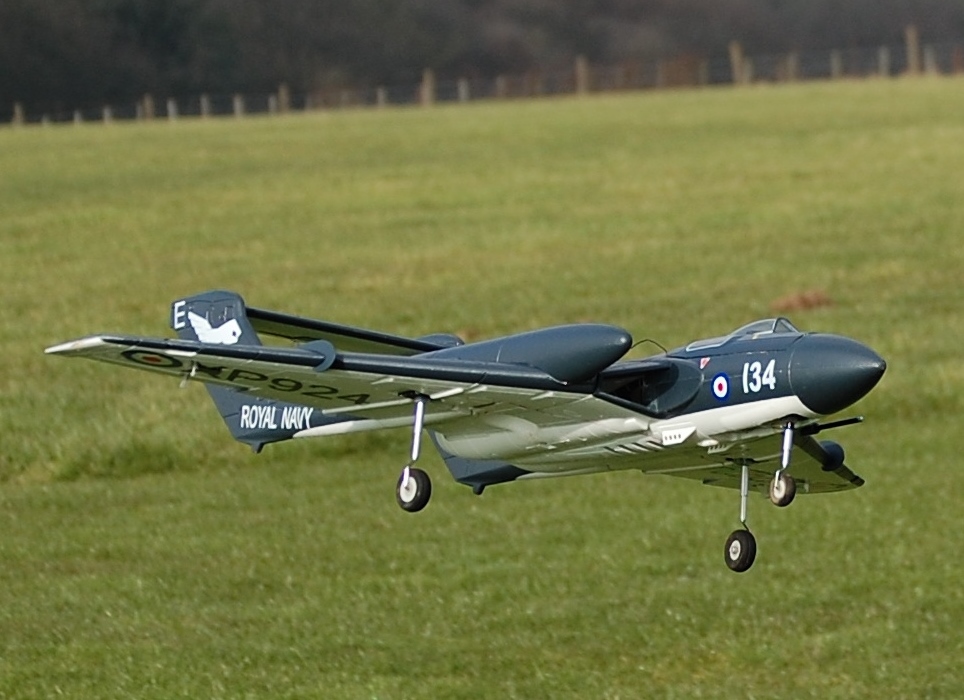



Video time now, this month with footage shot by myself, Gordon, and Dougal Entendre. Please watch the video full-screen, it’s so much better with small models flying around: If the video won’t play for you please click HERE
This month’s Final Funny popped up on Facebook the other day, it made me smile 🙂
Colin Cowplain
Patch News – December 2024
Happy New Year everybody, especially PAM members! I hope you’ve had a great Christmas and are looking forward to lots of flying in 2025. The days are already getting longer again and those long hot summers days are just around the corner…possibly!
 Let me know if you received any modelling goodies from Father Christmas, I already know that Woody and Captain Slow each received a little RC foam plane that Santa apparently obtained in the Lidl Black Friday sale, more of those later. Some of us managed a few flying sessions in December but of course the weather wasn’t the best and several times a few of us made it up to the field but didn’t fly because it was too misty. Six of us went on Christmas Eve despite it looking very murky in Clanfield. We were assured that the mist was about to clear by some idiot (OK, it was me!) who was sadly proved completely wrong.
 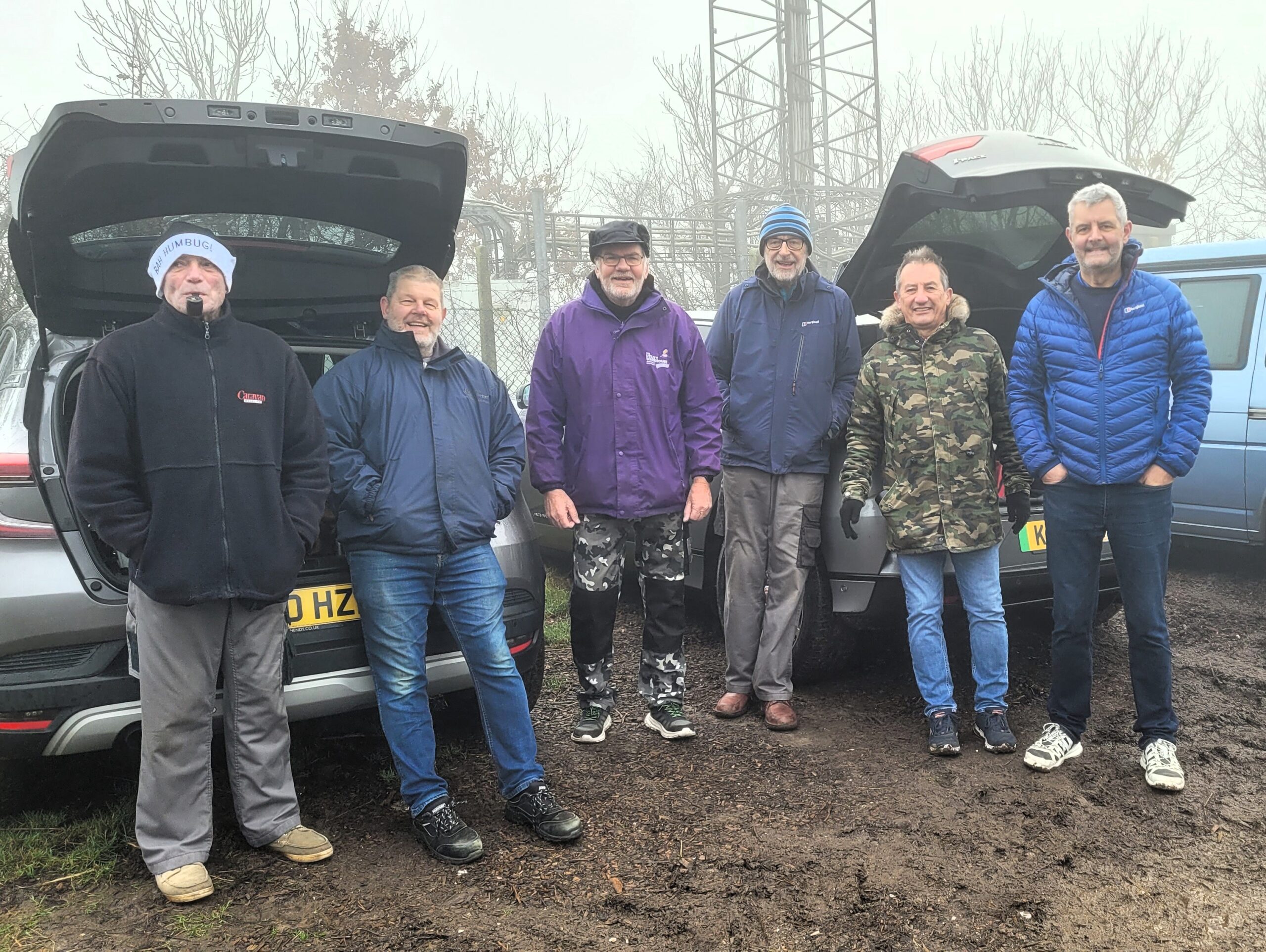 Never mind, it was all made worthwhile as 1066 brought along mince pies for us, surely a Christmas miracle! Chairman Gordon Bennett brought along his wife Pam which brightened up the morning and she photographed the group of merry members. Pam’s presence clarified something for me, I’ve always admired Gordon’s rather confusing loyalty to Petersfield Aero Modellers when he says he’s totally committed to Pam…
December marked the first anniversary of the club using the new site after many years of problem free flying at Chidden Down. I think we can all agree that the first year at the new site has been successful and, comparing it to the old site, there are some good points and some bad points. The track leading to the parking area is longer than the previous one but it’s less bumpy and not so muddy. The first couple of hundred yards are a bit mucky but from there on it’s pretty good. The parking area gets churned up a bit by the farm vehicles but last winter the farmers put down loads of wood chippings which helped a lot, maybe they could do the same again this year. The patch is a great improvement on the previous one, rather than a 30 metre diameter circle we now have a 30 x 40 metre rectangle.
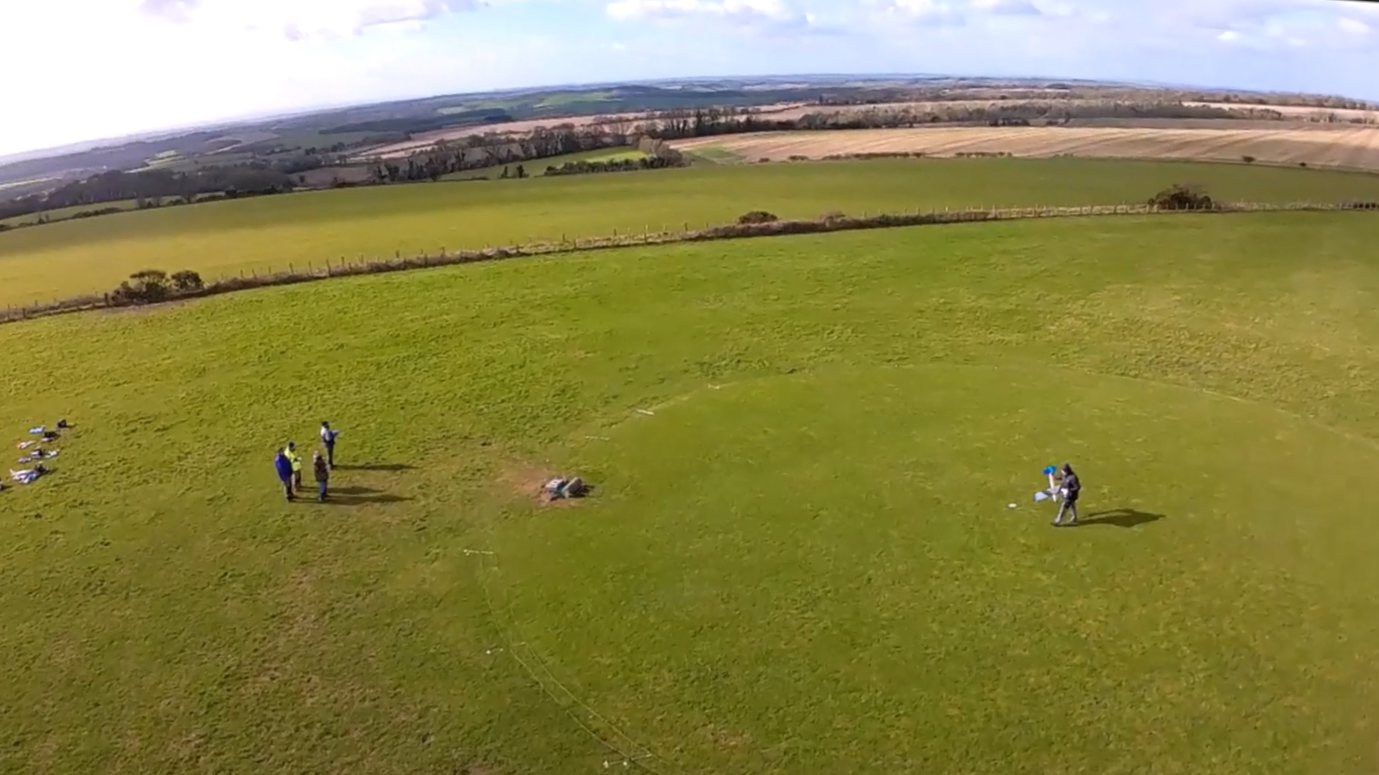
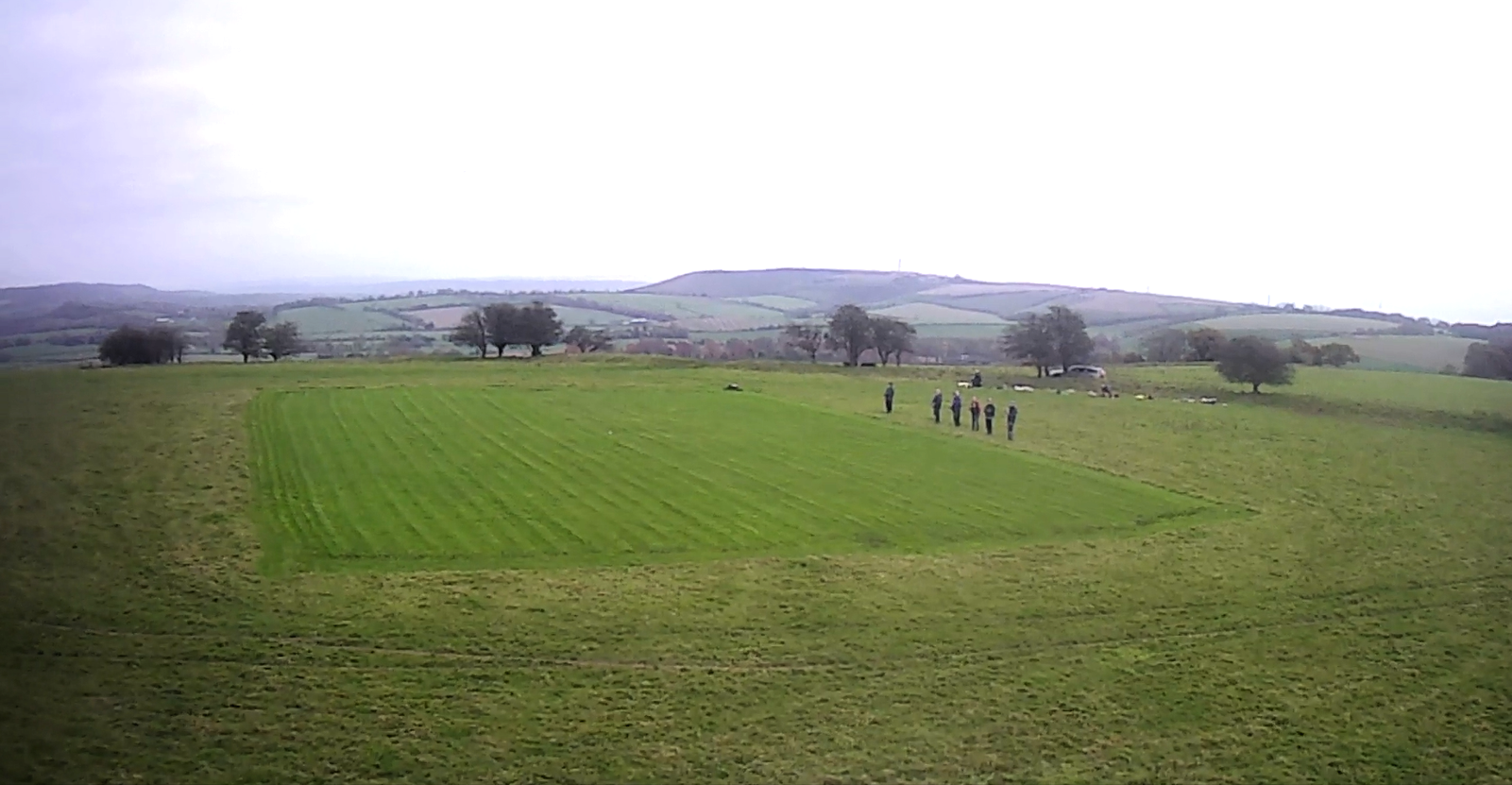 In just a year what was just rough field has become a nice flat area of decent quality grass. We’ve had cattle in the field a few times but much less often than in the old field and they’ve been less troublesome, maybe because the field is much larger overall. There have also been sheep in the field occasionally but they’re rarely a problem to us anyway.
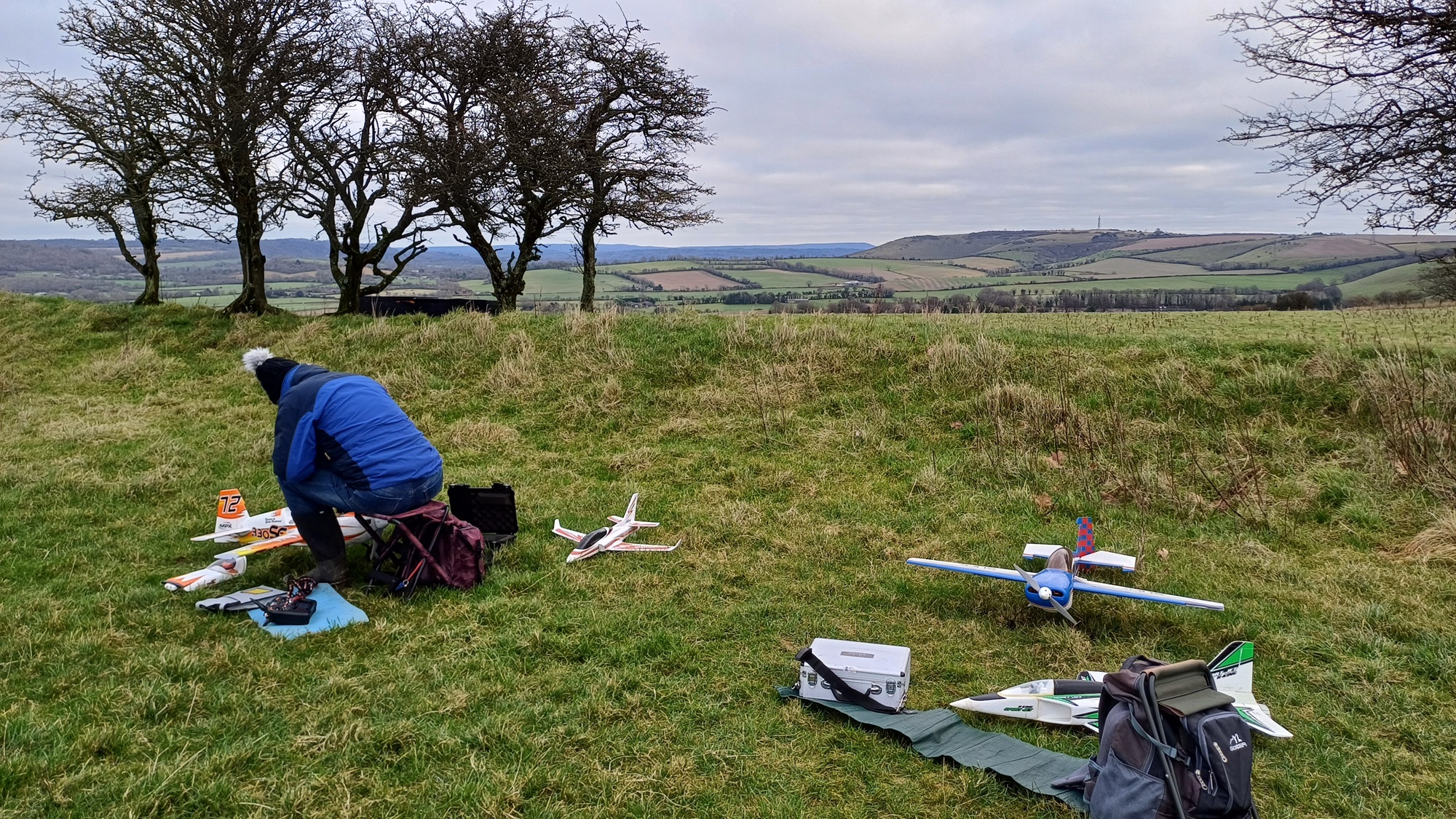 And there are superb views from the field, especially looking east from the pits towards Butser, so fingers crossed that we can have untroubled use of it for many years to come.
On one the nicer December mornings we were joined at the field by Jeremy Stuttard. Jeremy has been a club member for quite a few years but his main club is CADMAC (Chichester & District Model Aircraft Club) as he lives in Emsworth so Thorney is very close for him. Because Thorney is only available for flying on Sundays Jeremy keeps PAM membership for midweek flying, although this year he hadn’t managed to fly with us until December. That meant it was his first time at the new field and Jeremy said he preferred it to the old one as he was never happy about the close proximity of the road before.
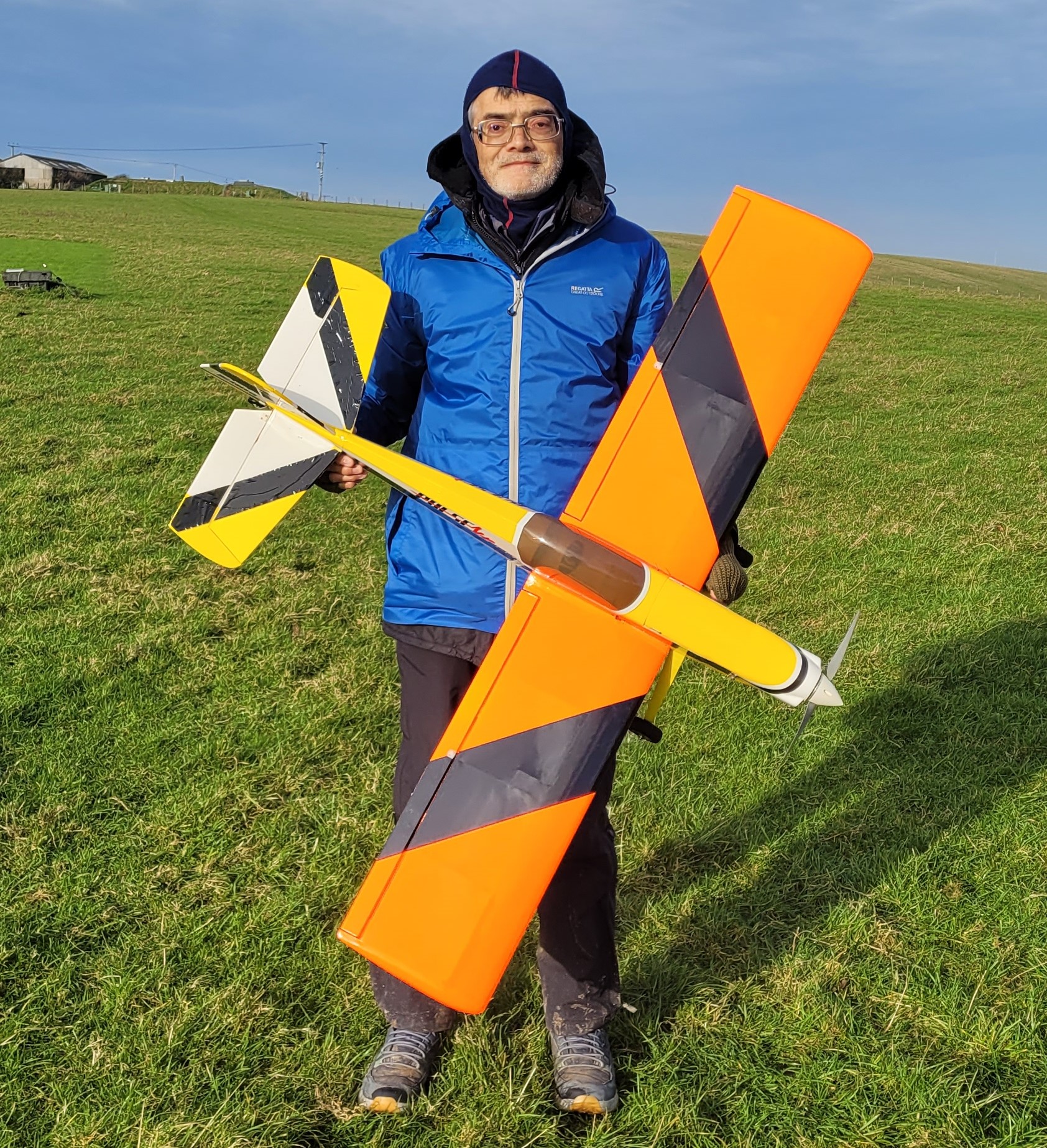 Jeremy flew his E-Flite Pulse 25E, a model I’ve seen him fly before but since then he has re-covered the wings in orange film to help with visibility. Jeremy explained that he’d found the previous white and yellow covering occasionally have him orientation problems and that the orange stands out much better for him. I was a little confused when he kept the wings covered with reflecting protective bags until immediately before the flight and replaced them immediately after the flight but Jeremy explained that the orange covering fades really quickly in bright sunlight and he wants to keep them nice and bright.
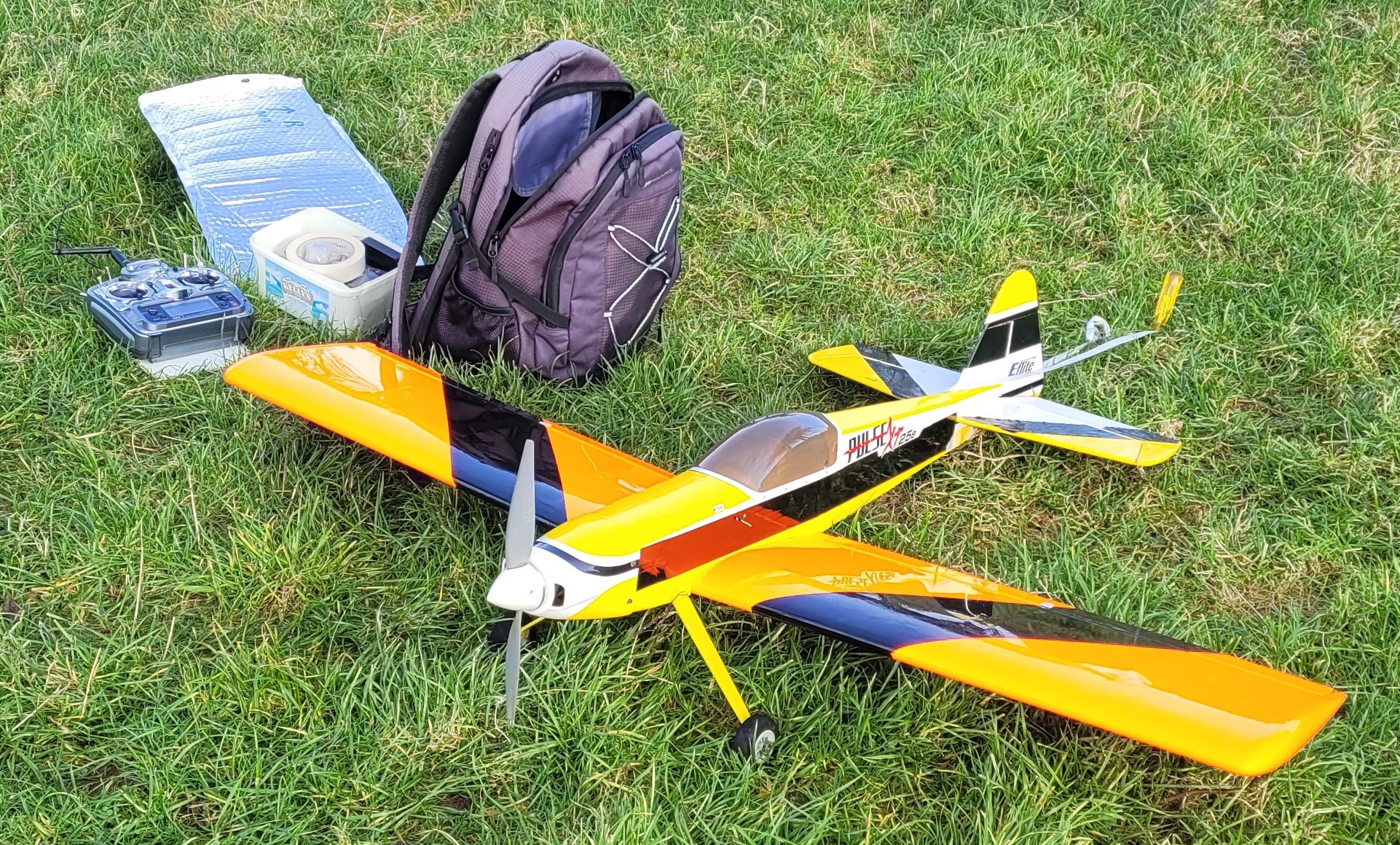
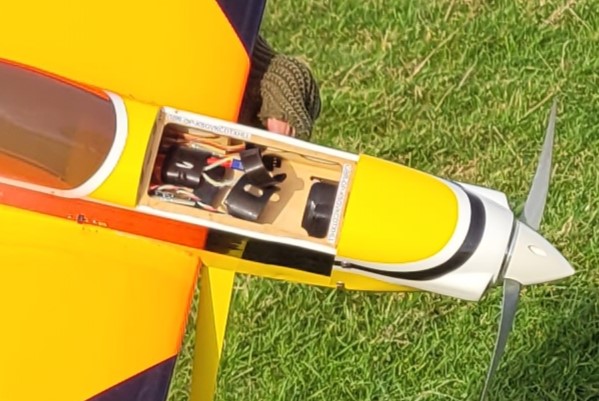 I think the 52” span Pulse is intended to be flown on 3 cells but Jeremy was using a 4 cell pack which fitted in perfectly and the model certainly performed well. Jeremy has his timer set for eight minutes, a decent flight time considering he flew a turnaround schedule of almost constant aerobatics. You can watch some of Jeremy’s flight in this month’s video.
In the last Patch News I mentioned the upcoming AGM. For those of you who missed it the AGM will be held at The Hampshire Hog on Wednesday 8th January, starting at 7.30pm. The meeting agenda will be circulated in due course but, as always, one of the things to discuss which affects us all will be the annual fees. Please put the date in your diaries and make the effort to attend. As always, I will be running a raffle with modelling goodies for prizes so make sure you come along with your pockets stuffed full of cash!
For a few weeks Woody has been telling us about a foamie Darkstar he’s been building and this month he brought it along to test fly. The full-size Darkstar is the top-secret plane that featured in the 2022 film Top Gun: Maverick where it was flown (and destroyed) by Woody’s hero Tom Cruise. To give it its full title the plane is a Lockheed Martin SR-72 Darkstar and is often referred to as “Son of Blackbird”, the amazing SR-71.
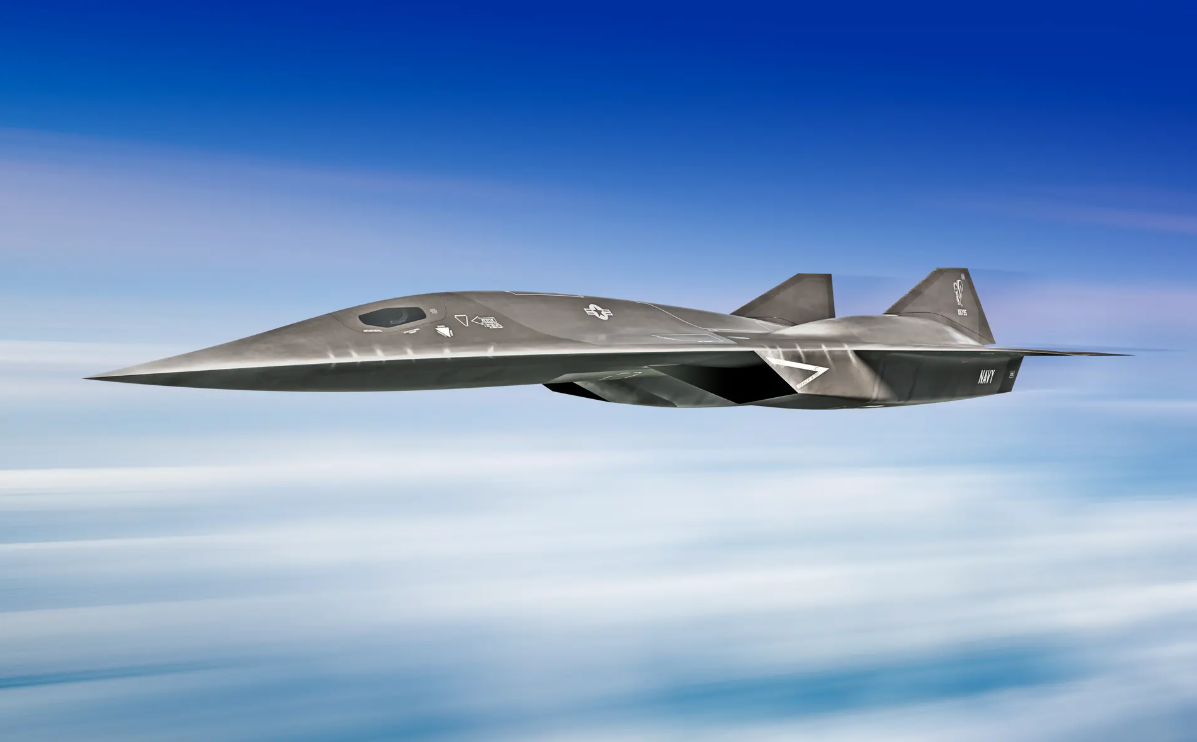 The USA have only recently admitted that the real aircraft even exists and they say it’s not related to the Darkstar in the movie even though the fictional Darkstar was designed with the help of engineers at Lockheed Martin’s Skunk Works division. Next they’ll be saying the Tom Cruise isn’t really the world’s best Test Pilot, pah! Back to Woody’s model, it was designed by Humayun Najabat, a guy in Pakistan who has a YouTube channel featuring various designs of foam models with the videos showing the construction and flying.
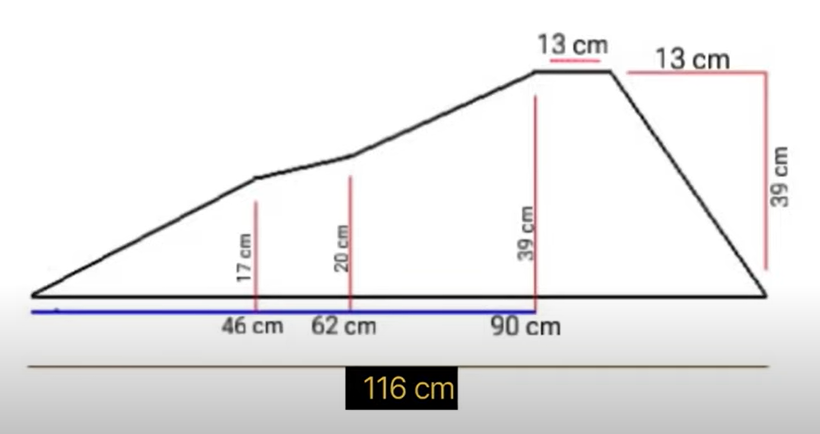
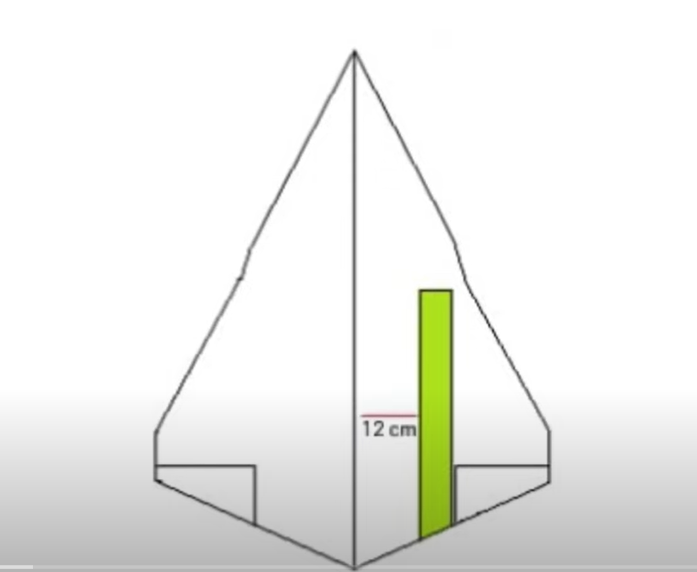
 There aren’t any plans as such but the videos show the basic measurements of the various pieces and basic installation of the motor and the radio gear. Woody said there was no indication of where the centre of gravity should be but in the notes below the video it says 11cm from the motor. Admittedly that’s a bit vague but I assume it means 11cm forward from the back of the motor. Anyway, Woody guessed where it should be and he ended up with the battery further forward than where Humayun has his. The notes also say that Humayun used 10mm Thermocole foam which seems to just be expanded polystyrene.
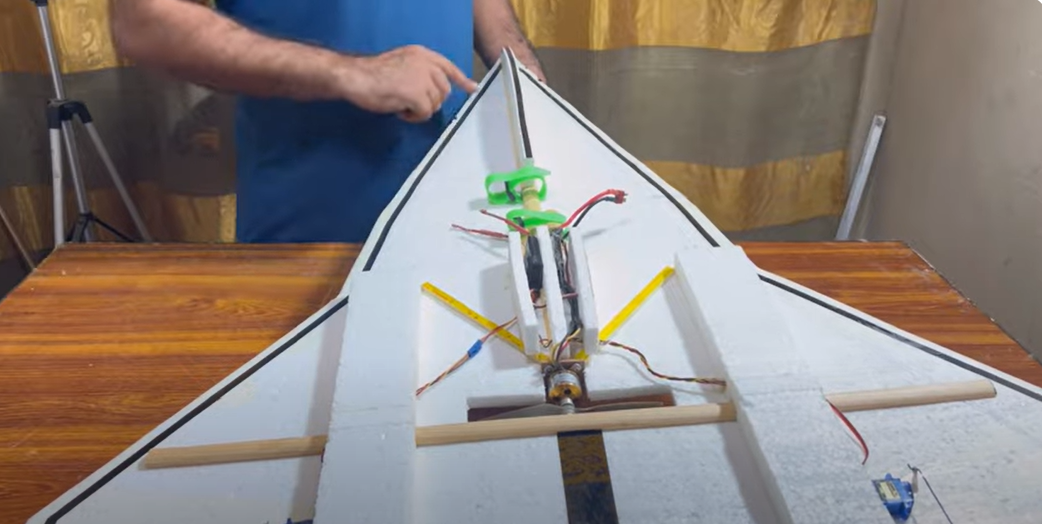 The photos of Humayun’s model are all screenshots taken from his video. His YouTube channel features lots of his models and is well worth a look. It can be found HERE
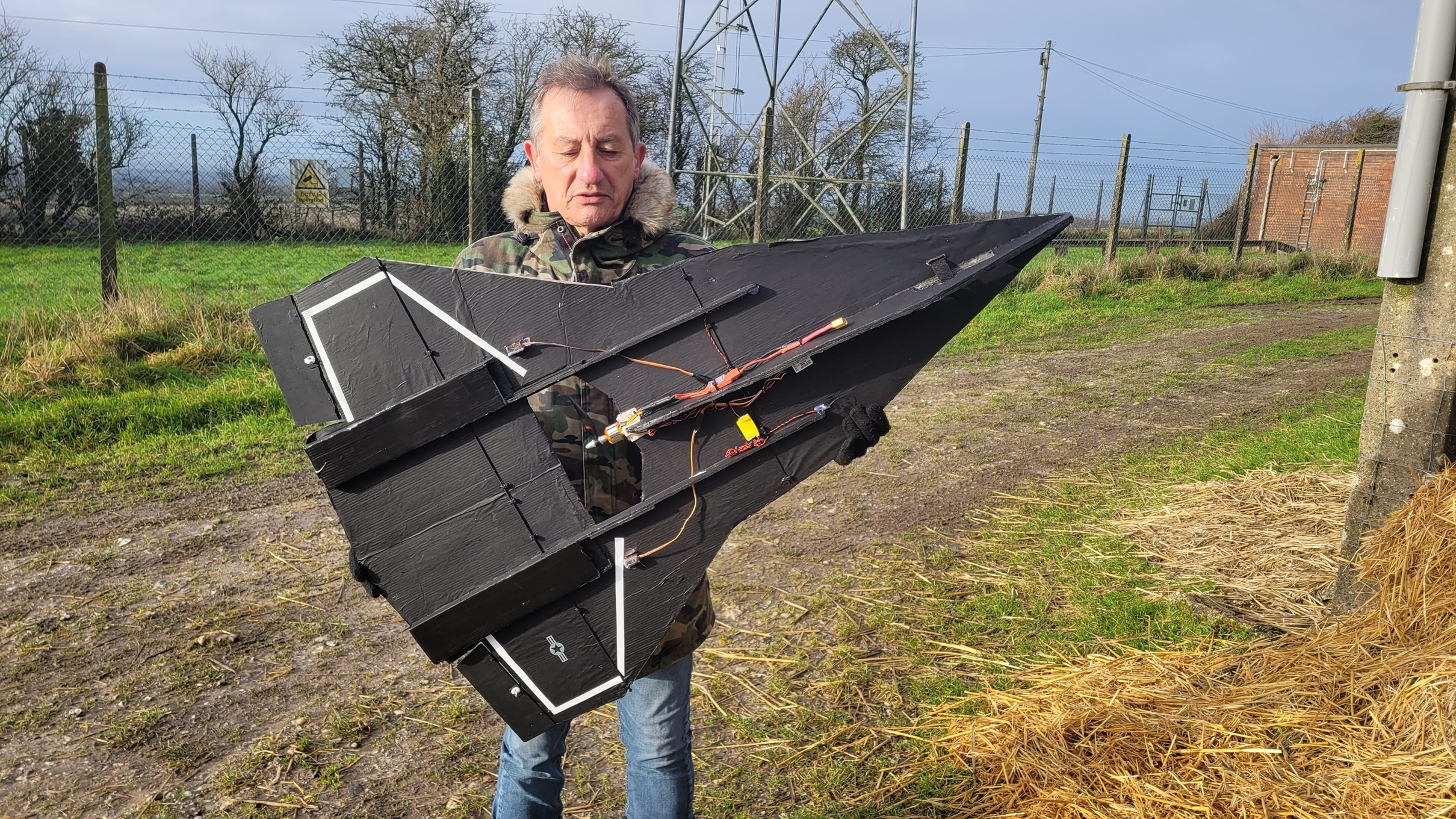
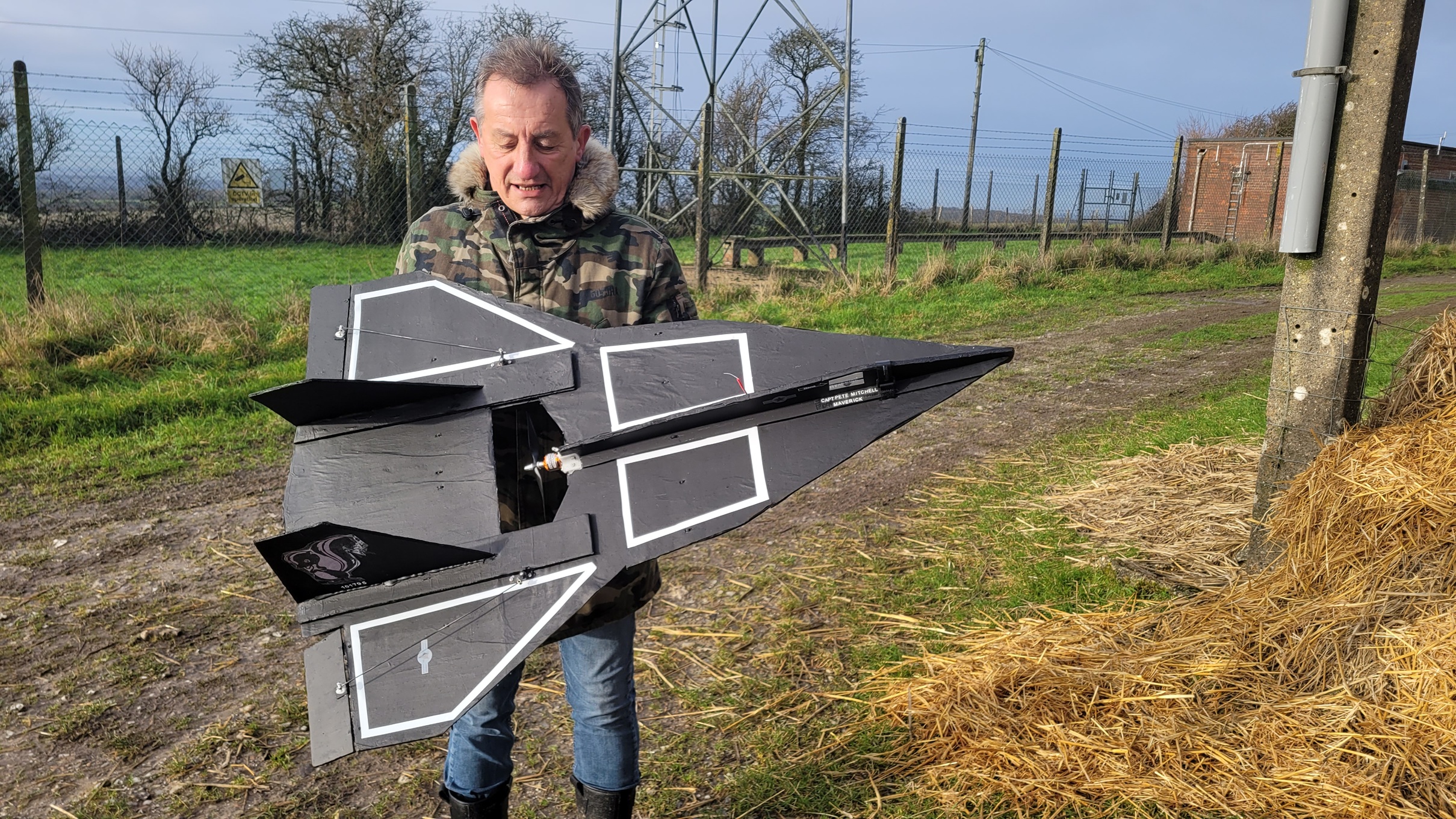 Woody used some 5mm underfloor foam insulation for B&Q and then covered it in brown paper to give it some stiffness. He used his usual foamie set-up consisting of a Turnigy 2826/6 2200Kv motor, a 30A speed controller, and a pair of 9g metal gear servos.
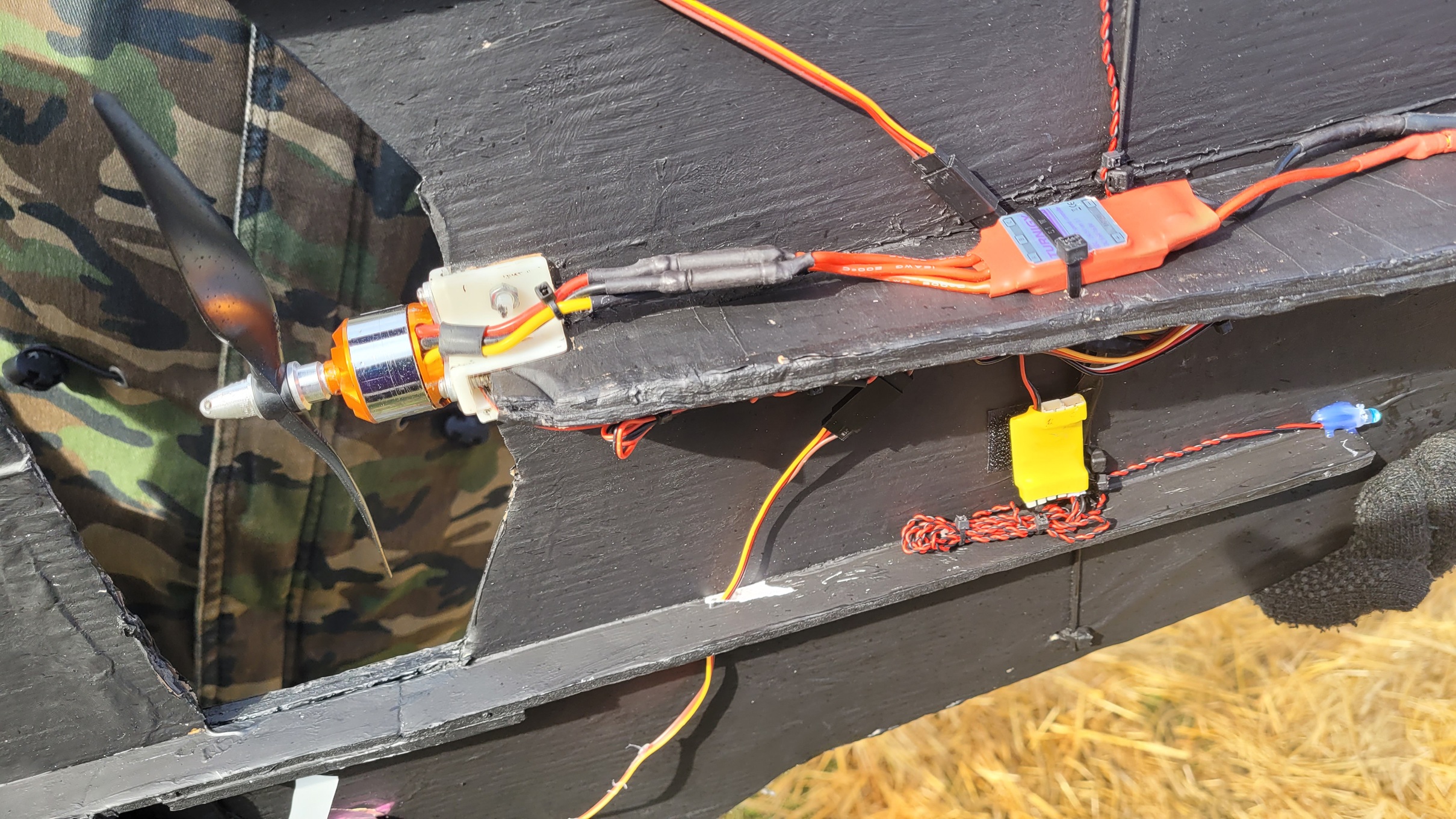 Oh, and lights…obviously! Moving on to the most important part, did it fly? Yes! Very well actually, just a little bit of down elevator trim required but otherwise perfect. Woody is using a seven inch diameter prop rather than the six inch most of us use with that motor and the Darkstar wasn’t at all noisy. The centre of gravity is a little bit too far forward which meant that it wouldn’t maintain inverted flight even with full down elevator but other than that it is a really nice flier and will happily loop and roll. Tom Cruise reached Mach 10 in his Darkstar but Woody’s wouldn’t reach Mach 0.01 downwind in a gale but not to worry, the slow speed handling was excellent. You can see it flying in the video.
Now for more about the Sky Viper Vectors that both Captain Slow and Woody received as Christmas presents. Is it me or does Sky Viper Vector sound like something from an Airplane movie?! Captain Slow spotted them for just £39.99 in the Lidl Black Friday sale, bought one for himself, and then convinced Woody that he also needed one.
It’s a little twin motored foam delta, similar to the Darkstar and comes completed with the transmitter and a single cell 500mAh lipo battery which is charged using a USB lead. 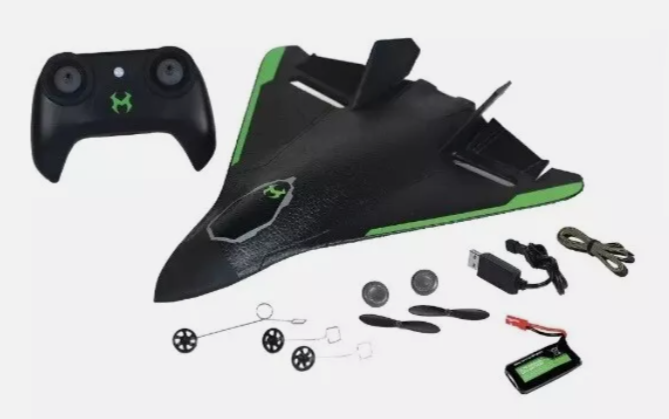 Unlike some foamies the Vector has elevons rather than relying on variable motor thrust.
 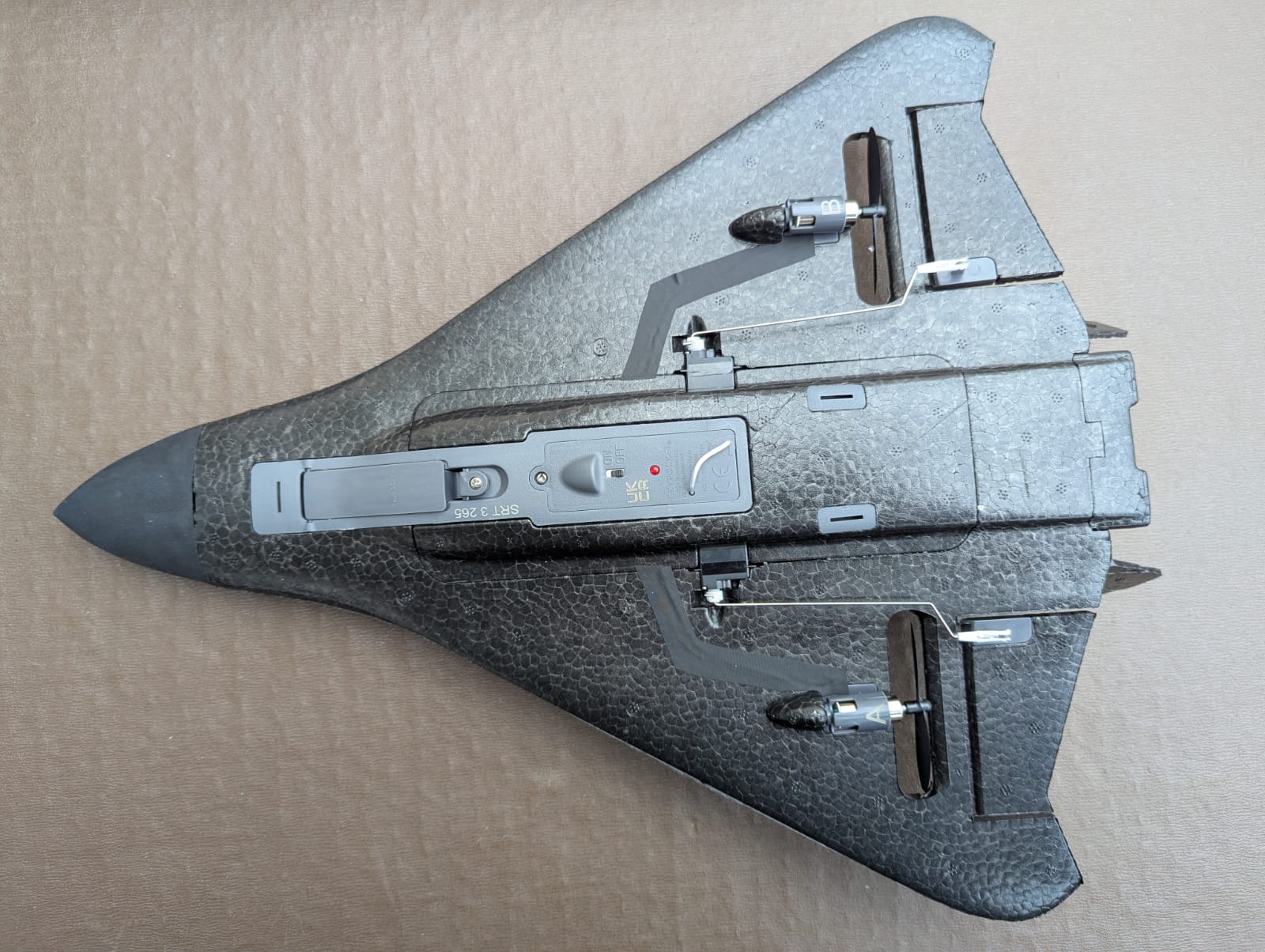 It doesn’t have a rudder so uses variable thrust for yawing but normal aileron and elevator controls are taken care of by servo driven elevons so it should be very manoeuvrable.
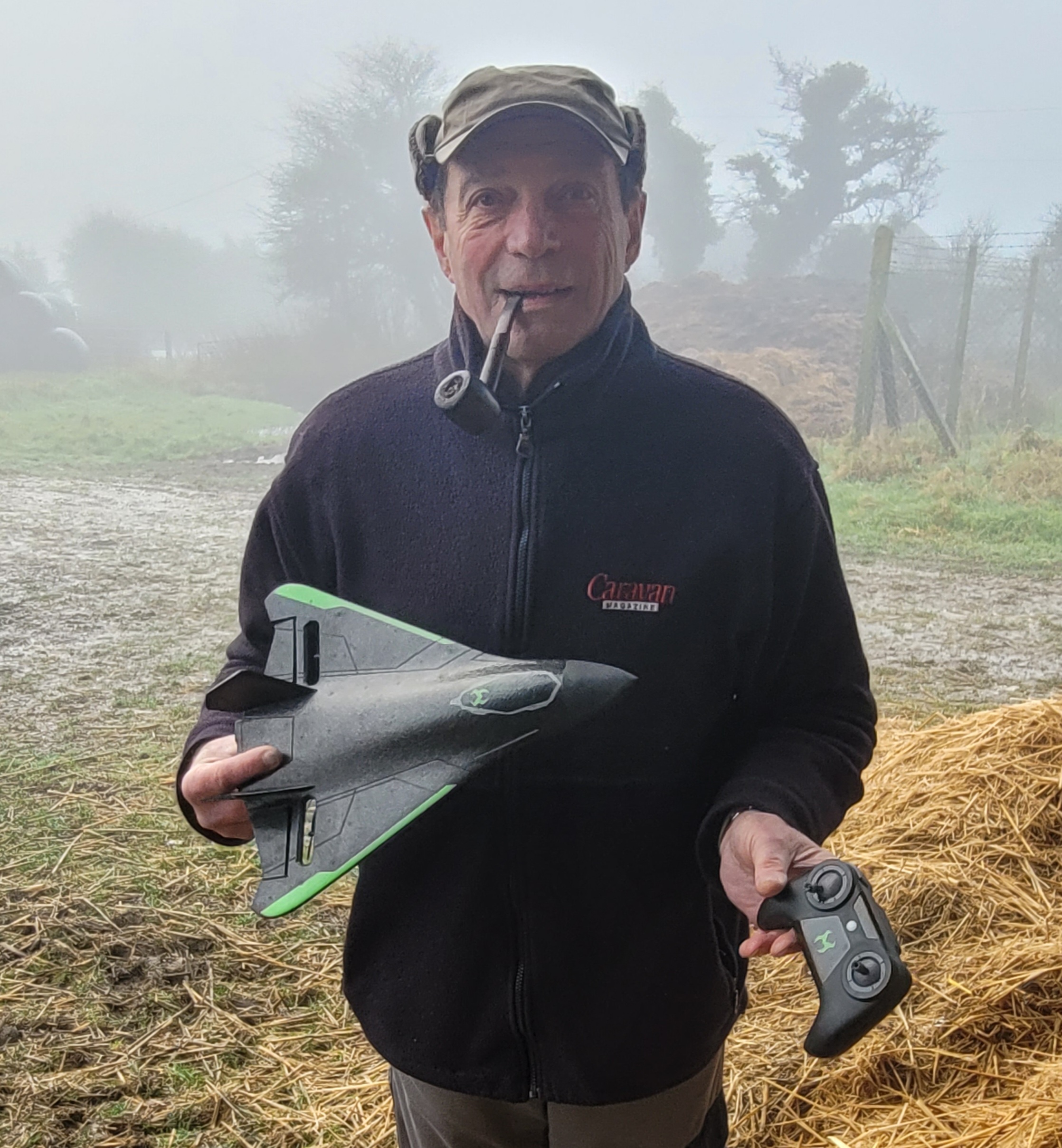 The range is quoted as 600ft and the motors cut off if it goes out of range and the Vector glides down and beeps to help the operator find it. The transmitter has an Aerobatic button which when pressed makes the Vector loop or roll. Unfortunately the misty weather prevented Captain Slow from flying between Christmas and New Year but Woody was able to test fly his Vector on 30th December when he found it was an excellent flier.
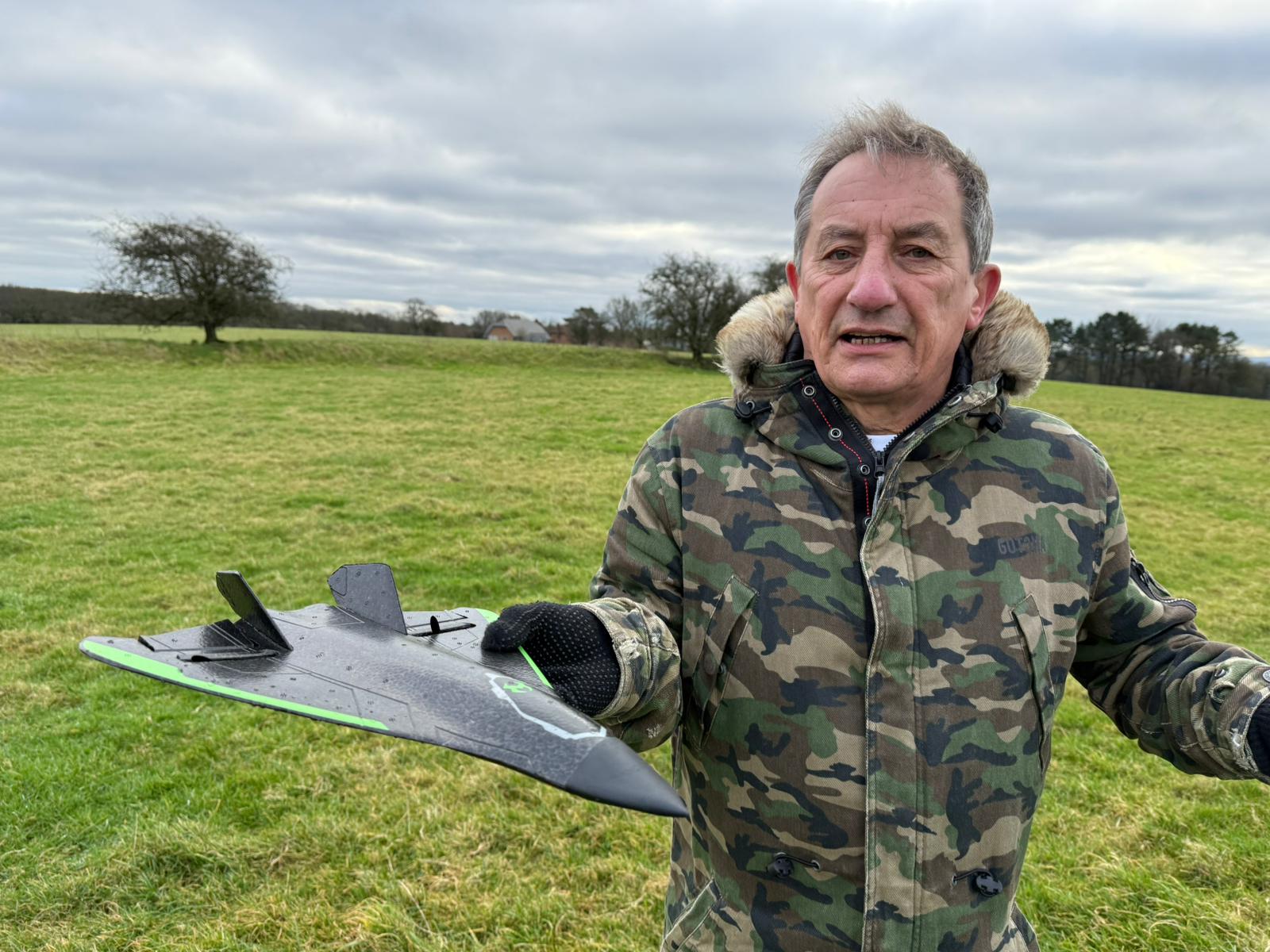 The auto stabilization was certainly working hard as can be seen in this month’s video.
Santa gave 1066 a Christmas present and he’s going to write a full build blog for us.
Here’s Part 1: Introduction & Unpacking: As most of you know I have often mentioned my time displaying the Ken Stokes Mirus at model shows all over the country, although not as often as Palmer has mentioned his Spitfire flight (I have no idea what he means!)
It was a great year spent with like-minded mates, flying toy planes, drinking, and barbecuing. Ken Stokes epitomised the model designer, he came up with a design that really caught on at his local club, before deciding to produce them for sale.
The Mirus was originally supplied as a plan pack which was basically a foam wing, and plan, it came in two sizes, for 25 and 40 size IC motors. Ken would then travel around the shows selling the Mirus out of the back of an old camper van with his wife and dog. Ken was a real character, he was almost deaf, and going by his glasses his eyesight wasn’t great either, and he was never seen without wearing his old straw hat.
 The Mirus display team consisted of around ten guys who were prepared to buy the model, supply everything needed to finish it, cover their own travel costs, and more often than not, pay to get into the show. Then when it came to the display, follow exactly what Ken was doing. But despite all this it really was a great experience. That’s 1066 below!
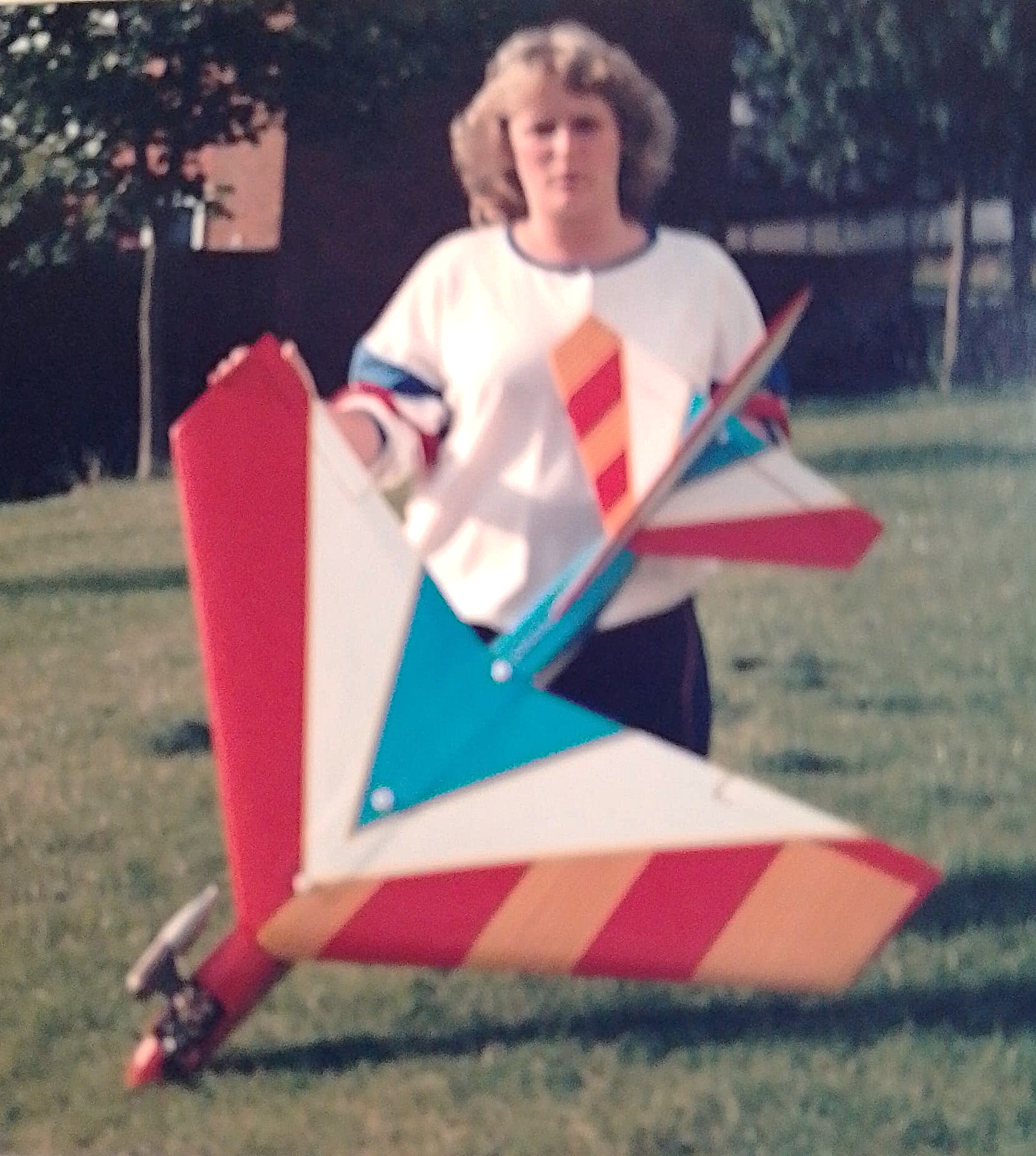
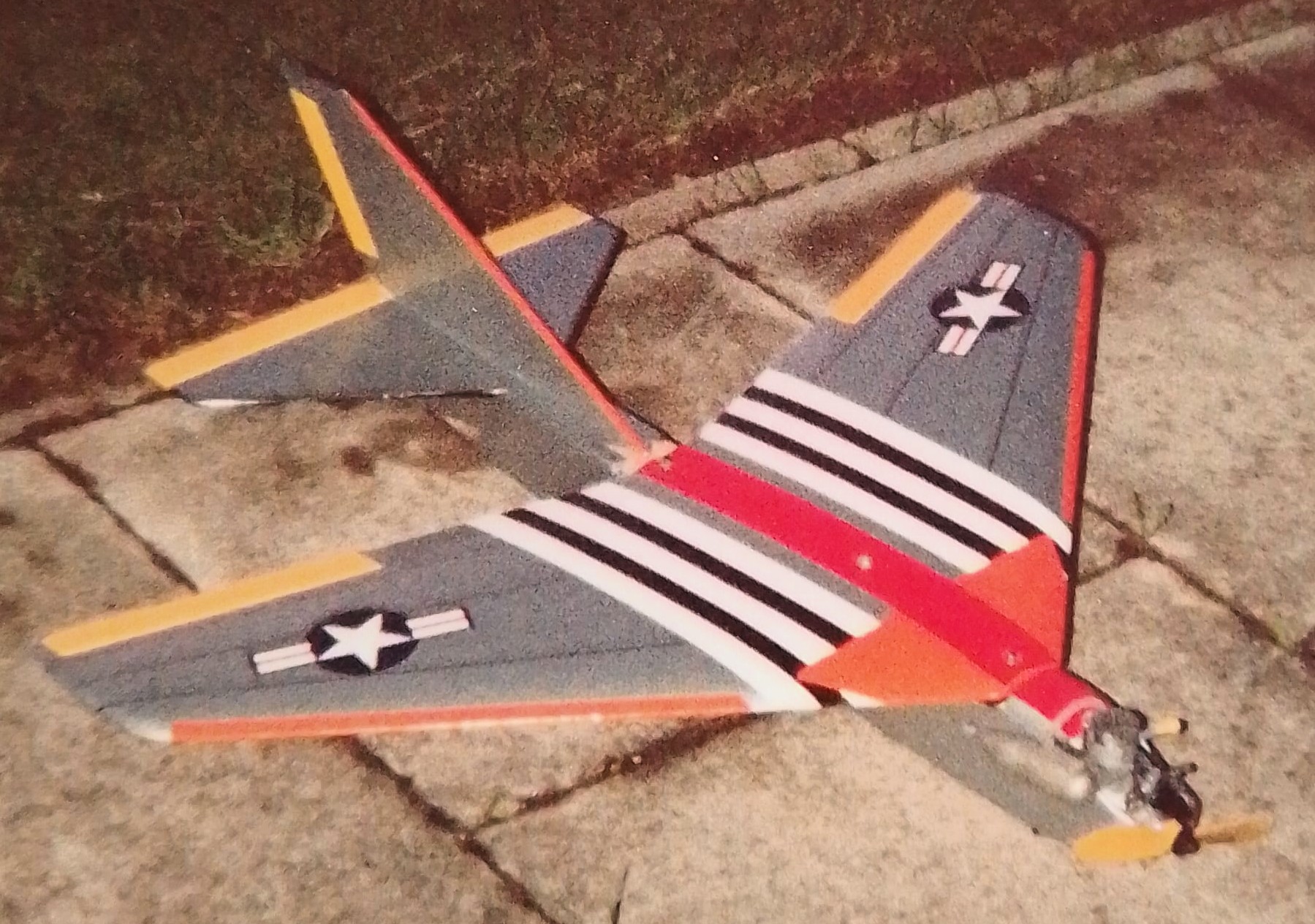 I never kept any of the models I had back in 1981 (yes, I was in my early twenties) so many years later when I had been infected by Andy Palmers constant nagging about flying electric, and the nostalgia voice was constantly in my head, I thought the Mirus would be a great candidate for conversion. By this time Ken had passed, and the Mirus plan pack was no more. After some research I found a guy selling the plan on eBay, so one was purchased. As I said at the start, this was originally a plan pack, and Ken cleverly left off any wing section details so you couldn’t cut your own wings, hmm. Not to be beaten I decided to make a solid balsa flat plate wing, similar to the Weston UK Magnum, however this failed miserably because it was done in the winter, out in the shed, so when it came indoors and dried out it twisted so badly it could not be salvaged.
 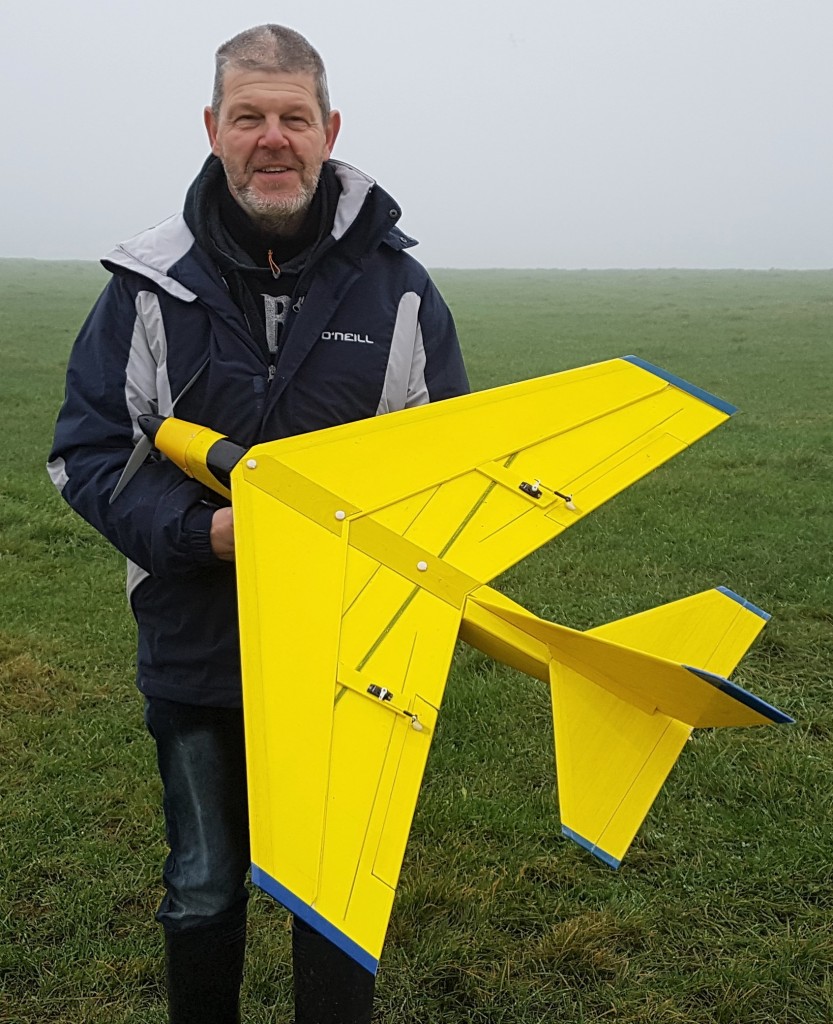 Move forward another couple of years and we all discovered the Kline-Fogleman wing section, and found that art card combined with coloured packing tape could be used to make serviceable wings. A wing was very quickly made, and after some mods has been quite successful for a few years now. Moving forward again, I found a guy on Facebook who had started kitting the Mirus again. Mini-Mike soon purchased the 25 version and when he brought it to the field for the first time the nostalgia voices started nagging again and when NJR Modelling offered a Black Friday deal I decided the wife should buy me a 40 sized one for Christmas. So, let’s get started on the Mirus unpacking.
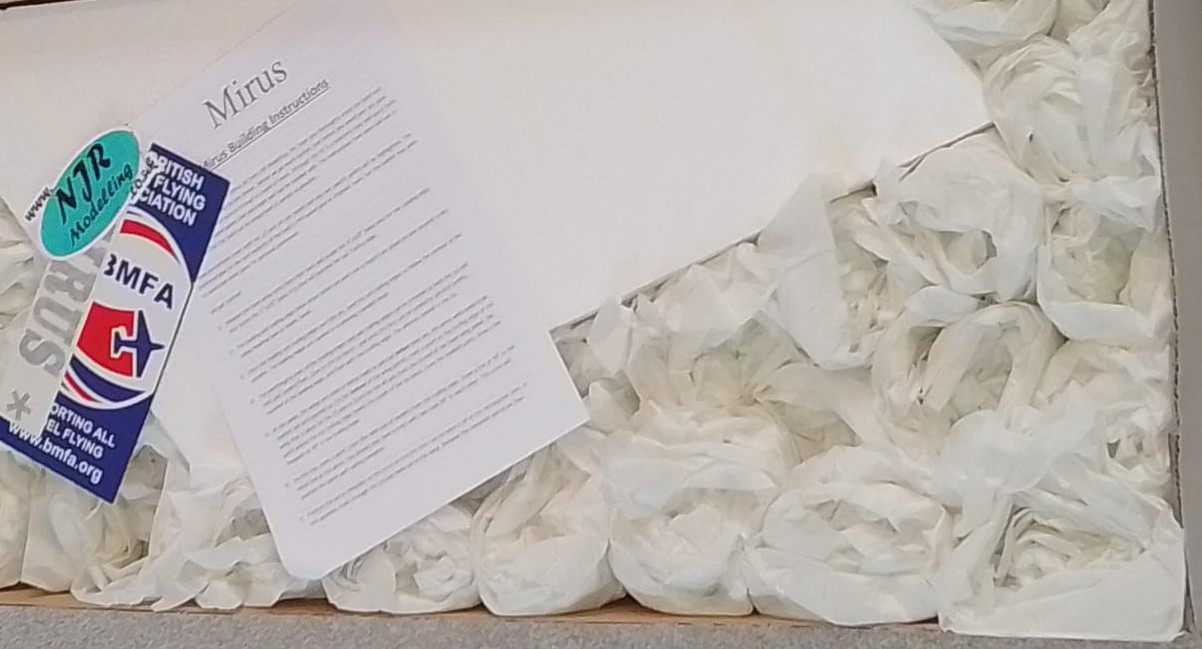 On opening the box you are greeted by the foam wings and a huge amount of tissue (I won’t need a toilet roll for days). Once the tissue was removed a surprisingly small amount of materials were exposed. For the purpose of this blog I removed all the parts from their respective sheets and photographed them to show just how few parts there are for this very simple model. As can be seen in the photos you don’t get a lot for your £100.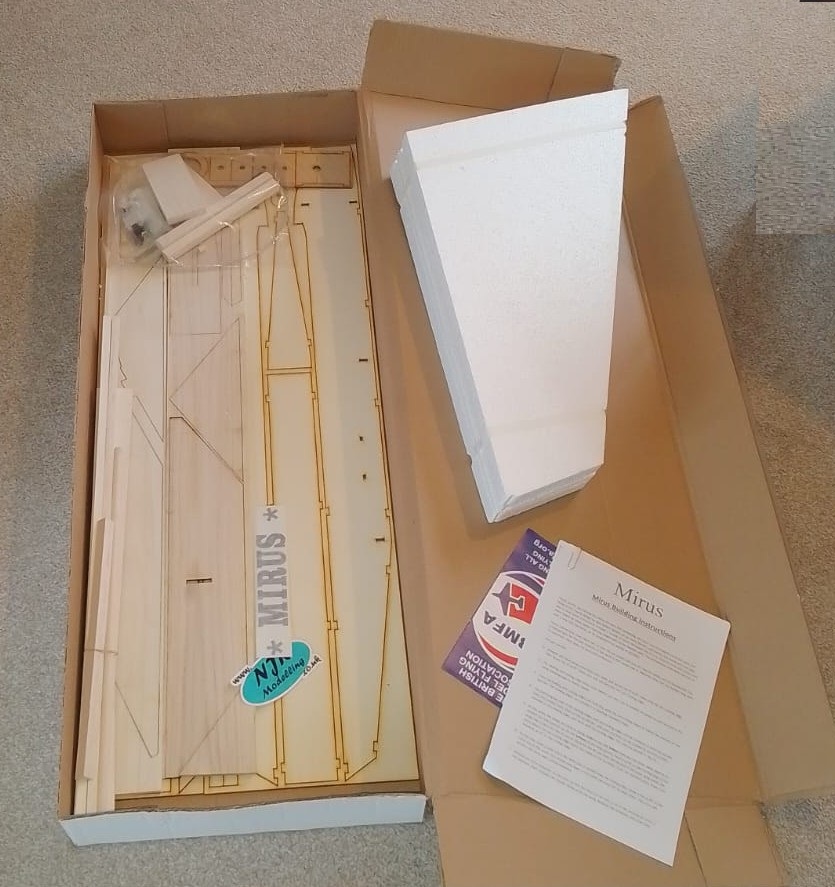
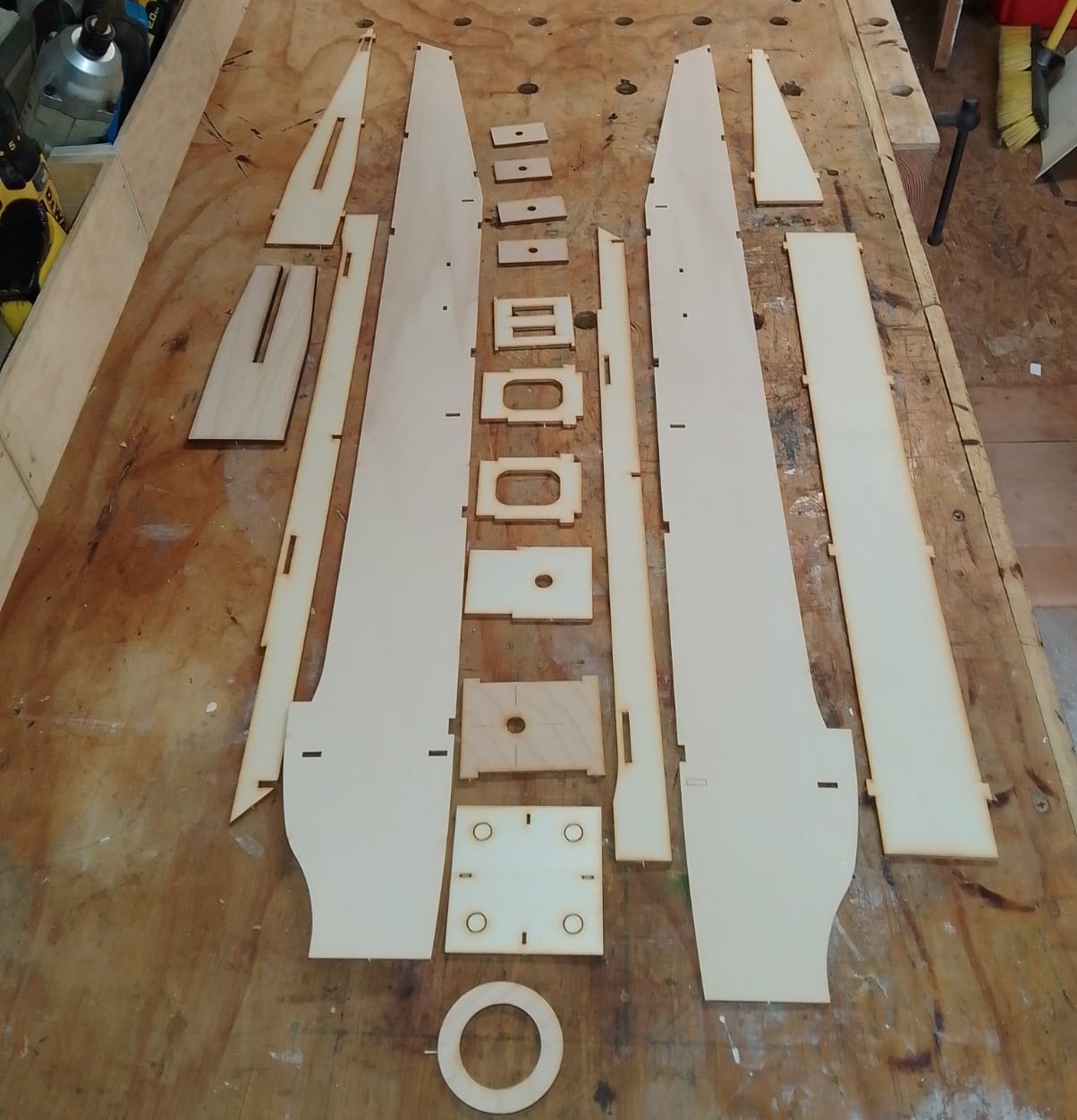 I also took a photo of the scrap and it’s very obvious that NJR had spent a lot of time keeping this to an absolute minimum. So my initial thoughts on the kit are, the materials have been well selected for their respective jobs being a mixture of lite-ply and Balsa.
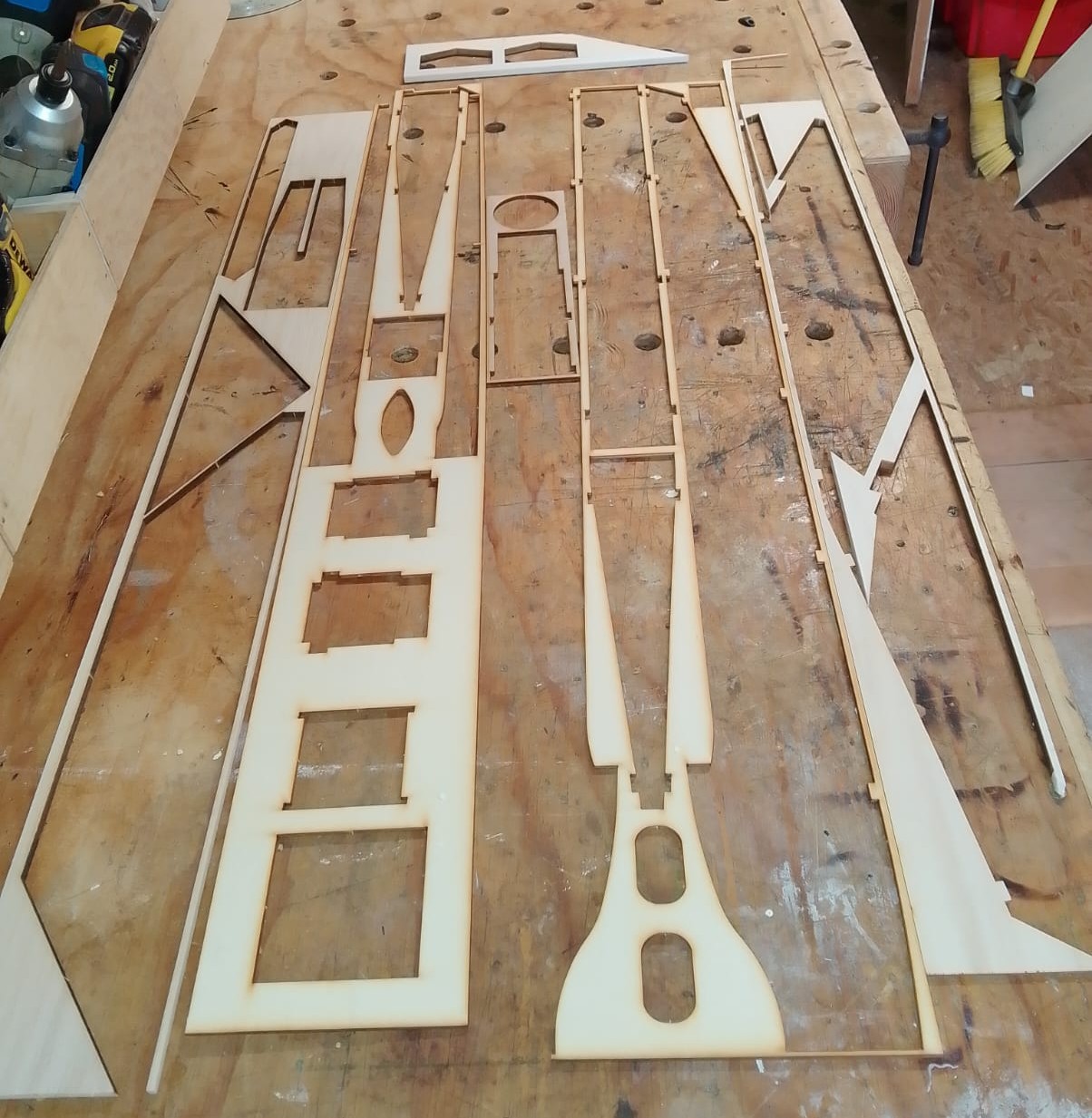 The laser cutting is outstanding, all the parts almost dropping out of their sheet just by taking them out of the box, so requiring little or no sanding. Strangely even though this is an IC kit there is no engine mount or fuel tank. I also think NJR has missed a big market by not having an electric version (yet) so I will have to put a bit of effort to do the conversion myself. Thanks for that 1066, watch this space next month for the build.
This month I’ve delved way back into the archives for some older PAM action shots: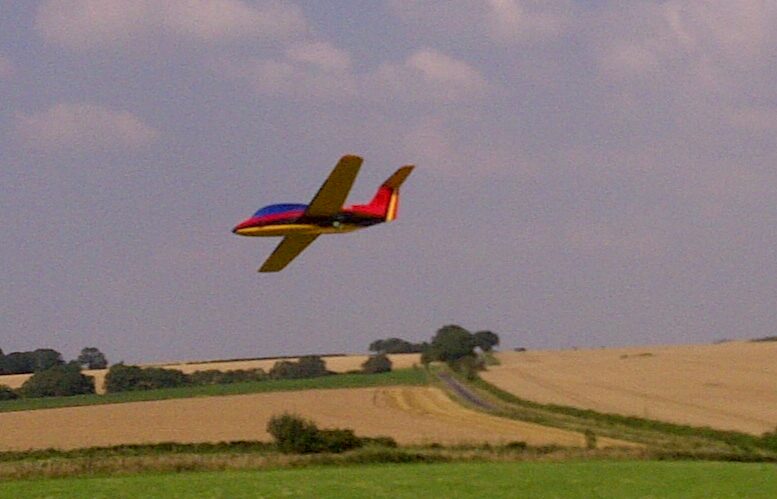
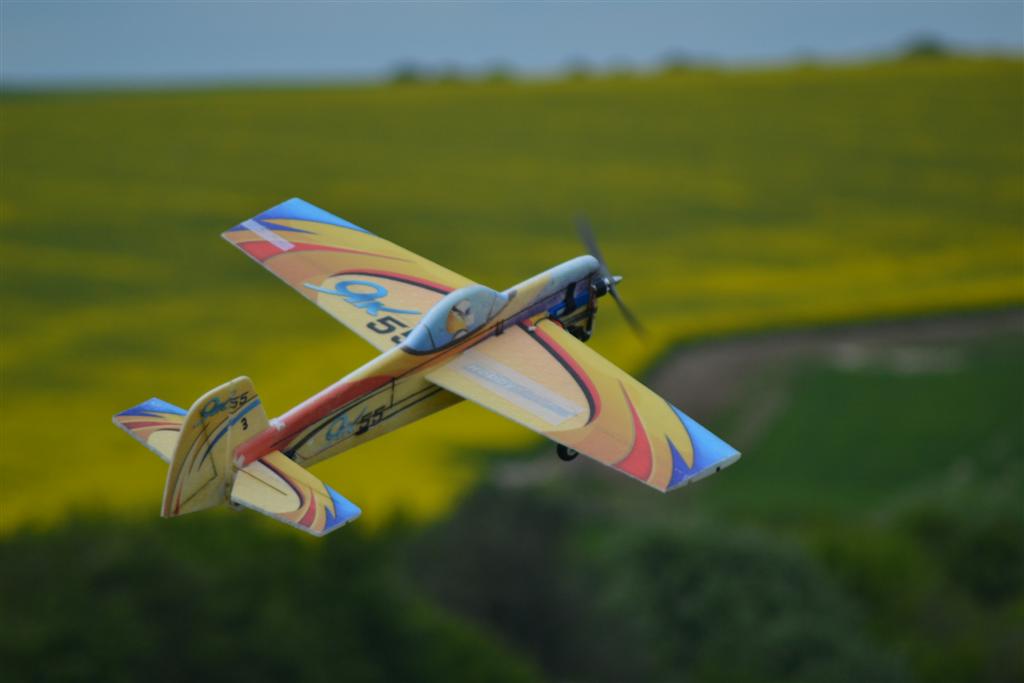
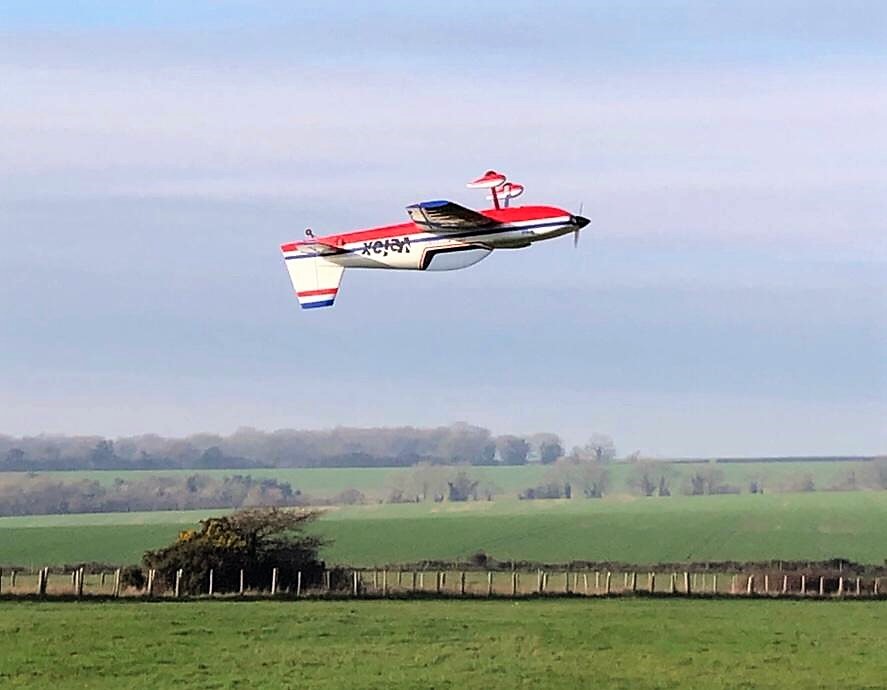
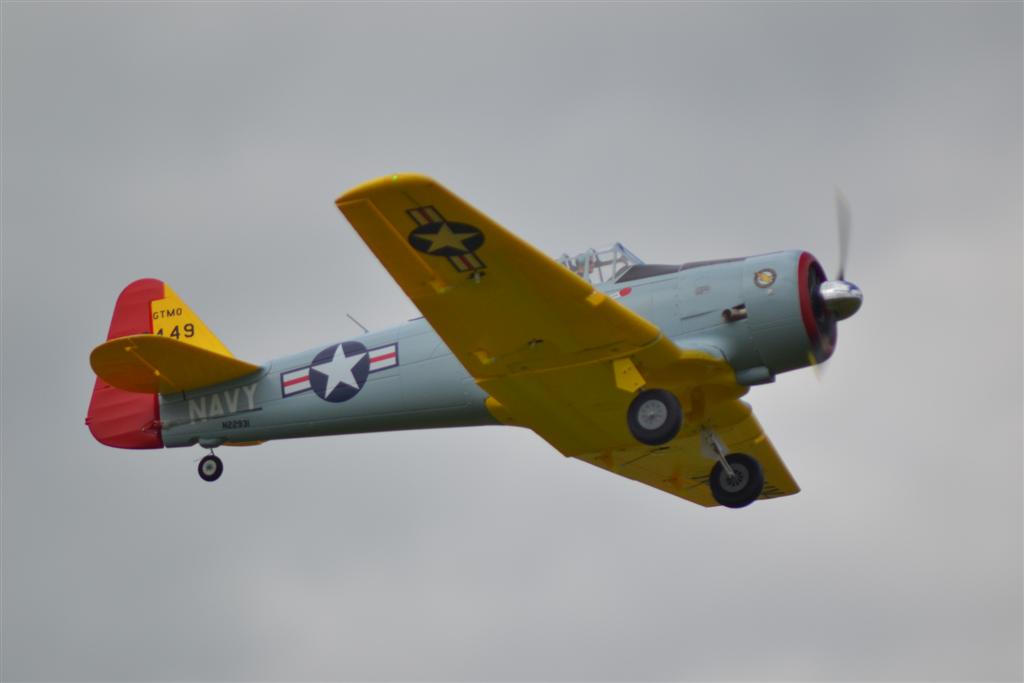
Video time now, with footage shot by myself, MacFly, Dougal, Gordon, and Captain Slow. Please watch the video full-screen, it’s so much better with small models flying around:If the video won’t play for you please click HERE
This month the Final Funny isn’t aviation related but it’s seasonal and made me smile 🙂
Colin Cowplain
Patch News – November 2024
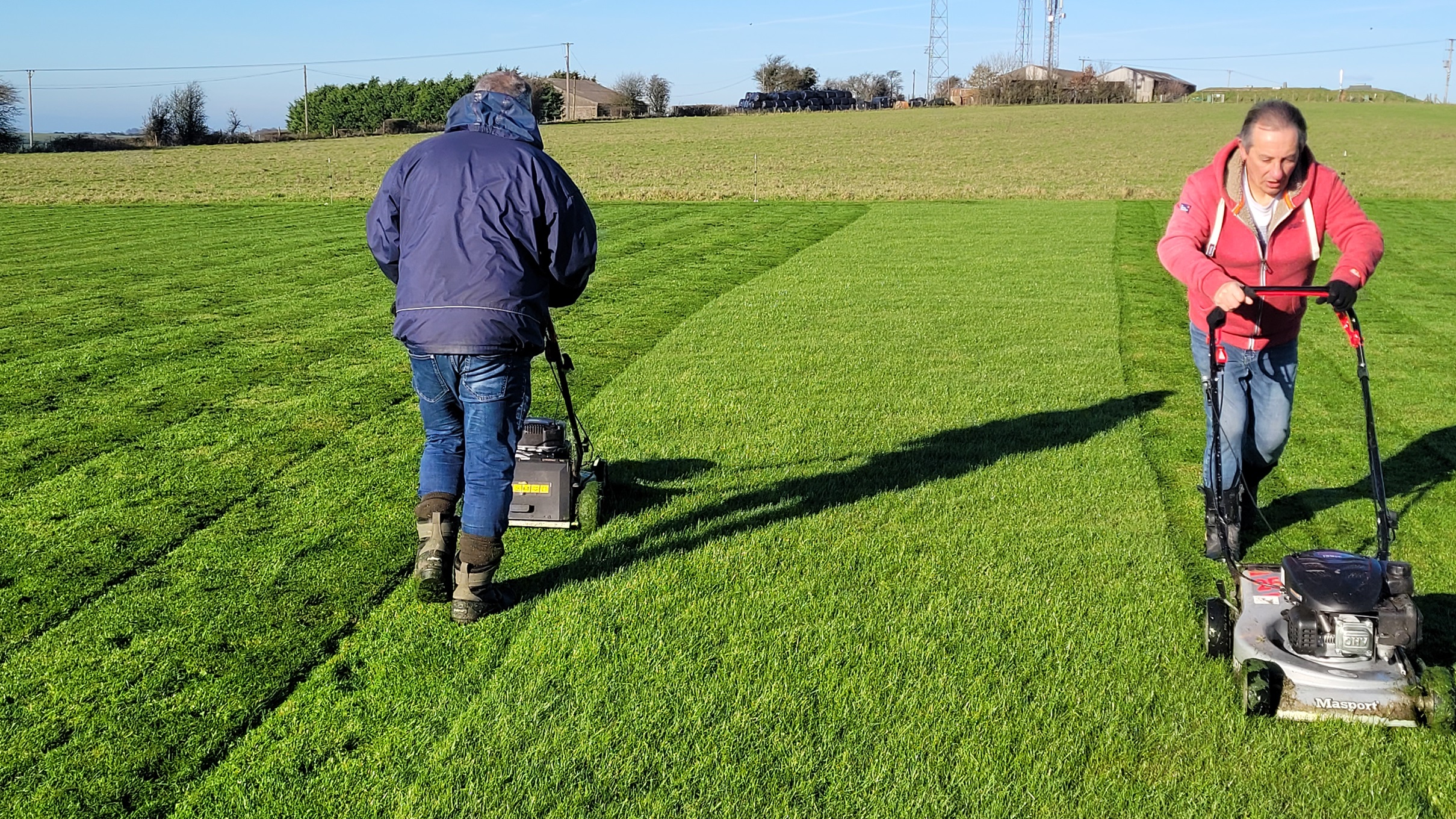
I’ve begun writing this blog on Sunday 24th November when I should be out flying, but storm Bert has put a stop to that. The wind has been blowing at over 30mph all weekend with gusts of over 50mph so I doubt there has been any outdoor flying anywhere today. 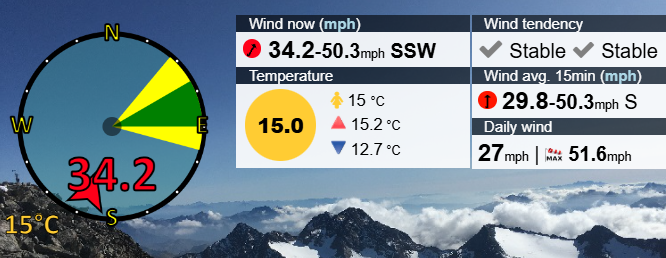 The rest of November has been pretty much normal although there was a little snow in the middle of the month which is unusual in November down here on the south coast. In the last few days of the month we had storm Conall blow through with strong winds and some very heavy rain. But some of the hardier members have been flying regularly throughout the month and on some of the days the conditions were surprisingly pleasant. On the last Friday of the month there was just 1066, Woody, and me at the field. It was a lovely sunny morning but the wind was stronger than forecast (OK MacFly, you were right!) and at 90 degrees to the patch. Despite just being the three of us we mowed the patch before flying.
 While we were mowing we spotted the contrails of four aircraft that were obviously flying together in a loose formation. A quick look at Flight Radar 24 didn’t show them and then, just a few minutes later, another four flew over on the same track, very mysterious…

 Was it Russian missiles? USAF planes flying in? No, Woody later looked on the Facebook pages of EGHF Lee-on-Solent and RAF Coningsby Spotters Group and found the answer, it was two groups of Typhoons returning to Coningsby from Albacete Airport in Spain.
After all the excitement of conspiracy theories and mowing we had a few flights in the now increasingly strong wind and finished the morning by cleaning off the mowers for winter. 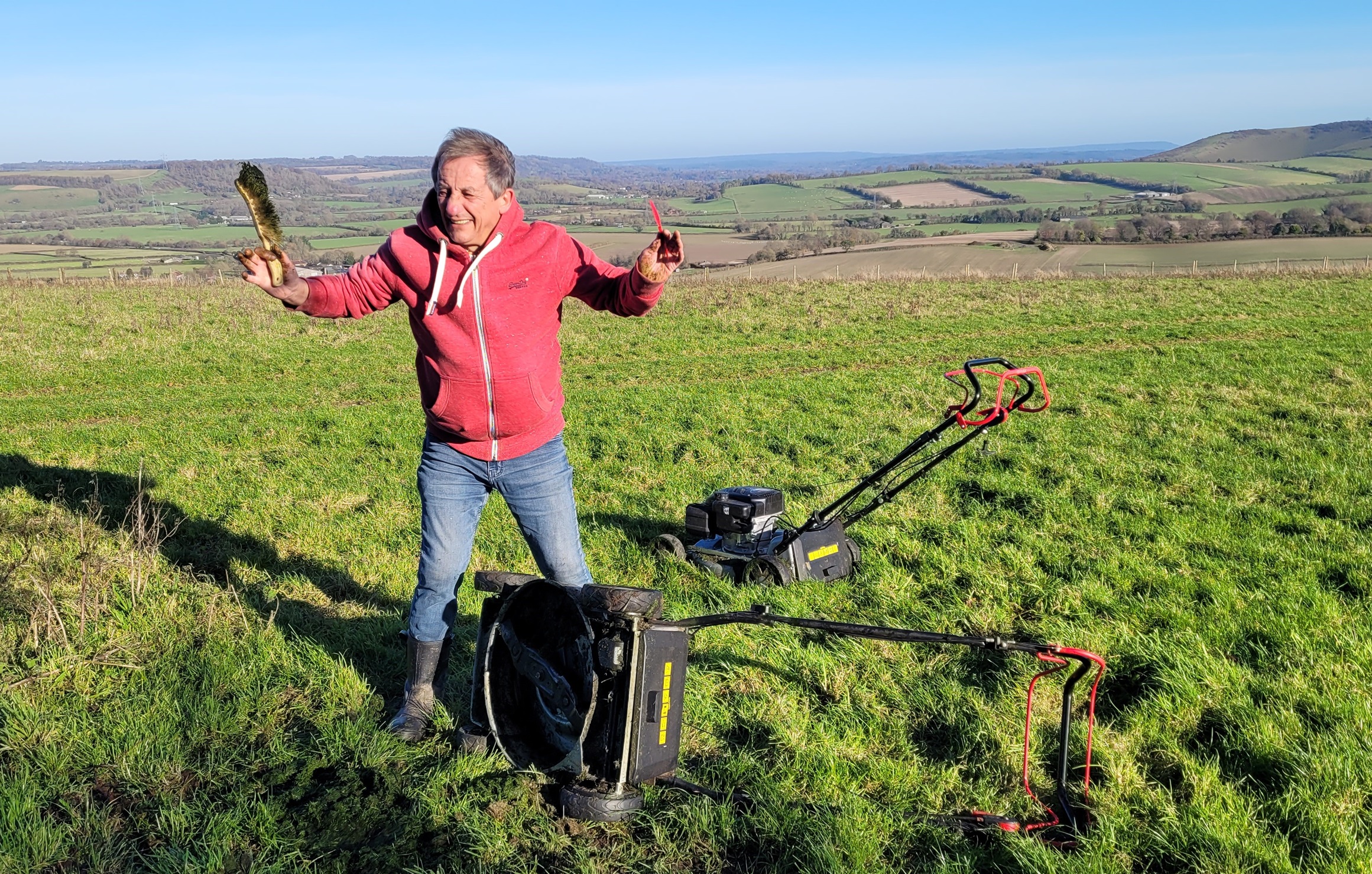
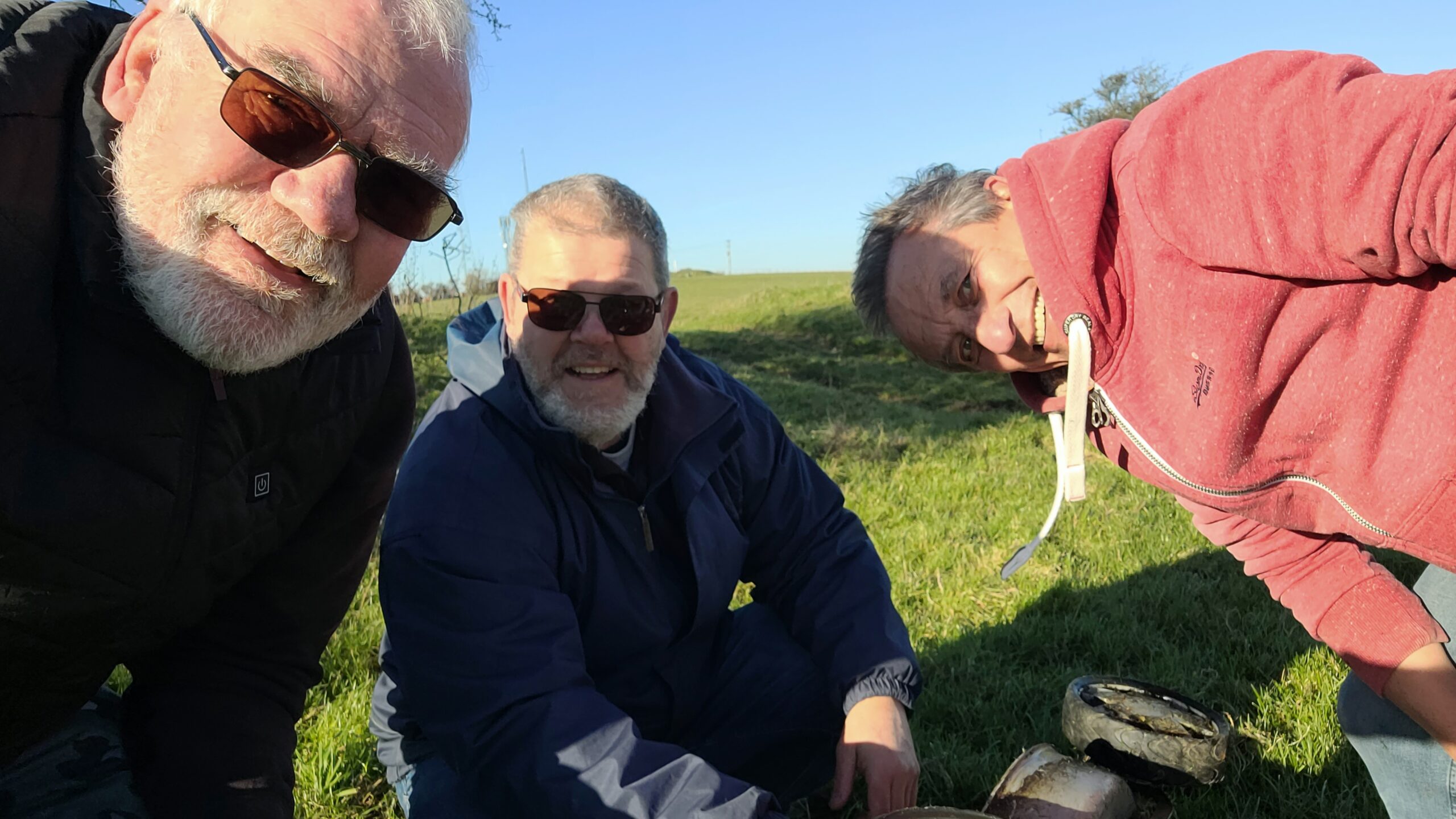 Multiple Magnificent Mower Maintainers? Maybe!
Club members will hopefully have read the email from our chairman about the upcoming AGM. For those of you who missed the email the AGM will be held at The Hampshire Hog on Wednesday 8th January, starting at 7.30pm. The meeting agenda will be circulated in due course but, as always, one of the things to discuss will be the annual fees.
Please put the date in your diaries and make the effort to attend. As always I will be running a raffle so make sure you come along with your pockets stuffed full of cash!
Now for some good news, not that there’s any bad news to follow. Our chairman Paul Bennett (affectionately known as Gordon) has been awarded a Certificate of Appreciation for his contributions to Petersfield Aeromodellers Club. This came about because Woody had applied to the BMFA Awards Committee to put Gordon forward, explaining that when the club lost the field late last year at extremely short notice after around 50 years of flying, Gordon had negotiated with the farmers for us to have the use of a different field.
 Gordon then amended the Constitution and rewrote the Site Rules applicable to the new site. He coordinated moving equipment between the sites and the setting out and mowing the new patch. Everything went smoothly and we have now been using the new site for almost a year with no problems. Woody told the Awards Committee that Gordon did all this while holding down a day job but we all know he just plays with boats now and again!
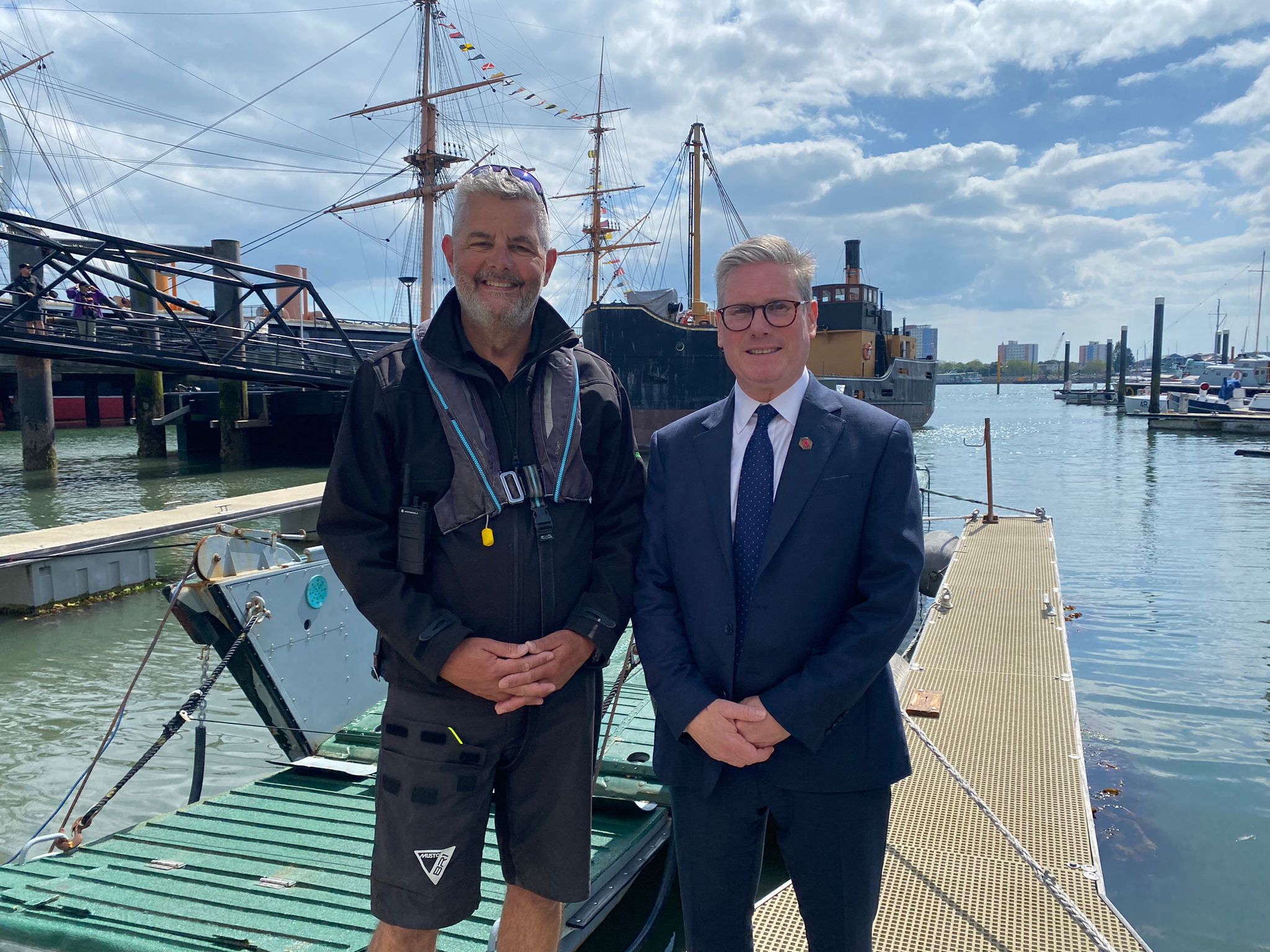 Oh look, a pair of leaders! But seriously, many congratulations to Gordon for receiving this well-deserved award, and well done and thank you to Woody for putting him forward.
I didn’t spot any completely new unflown models at the patch in November but Terry flew his newly repaired E-flite Apprentice, a model that I had missed at the patch previously.
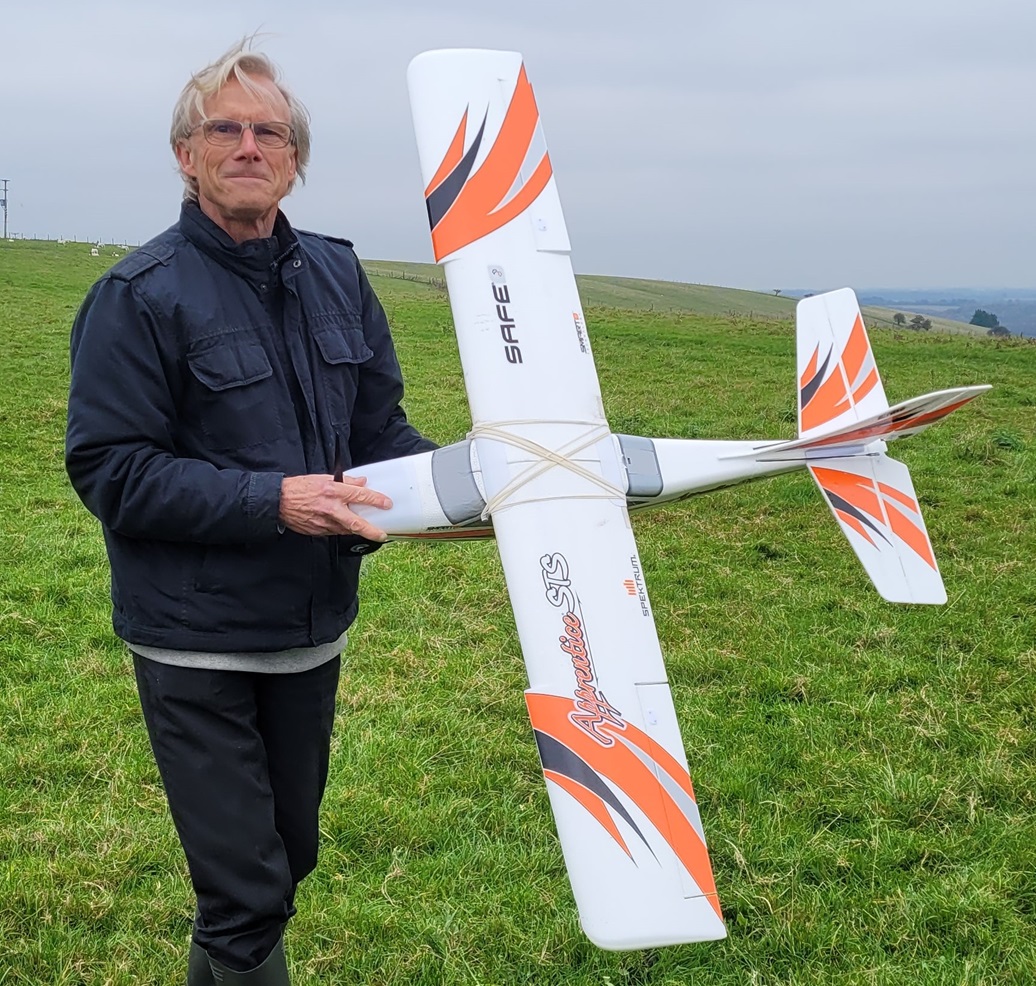 Apparently, one day while I was away, Terry had crashed during a take-off attempt and some repairs were required. Whilst undertaking the repairs Terry changed the nose-leg as he thought the single wire was deflecting and making the Apprentice veer off line.
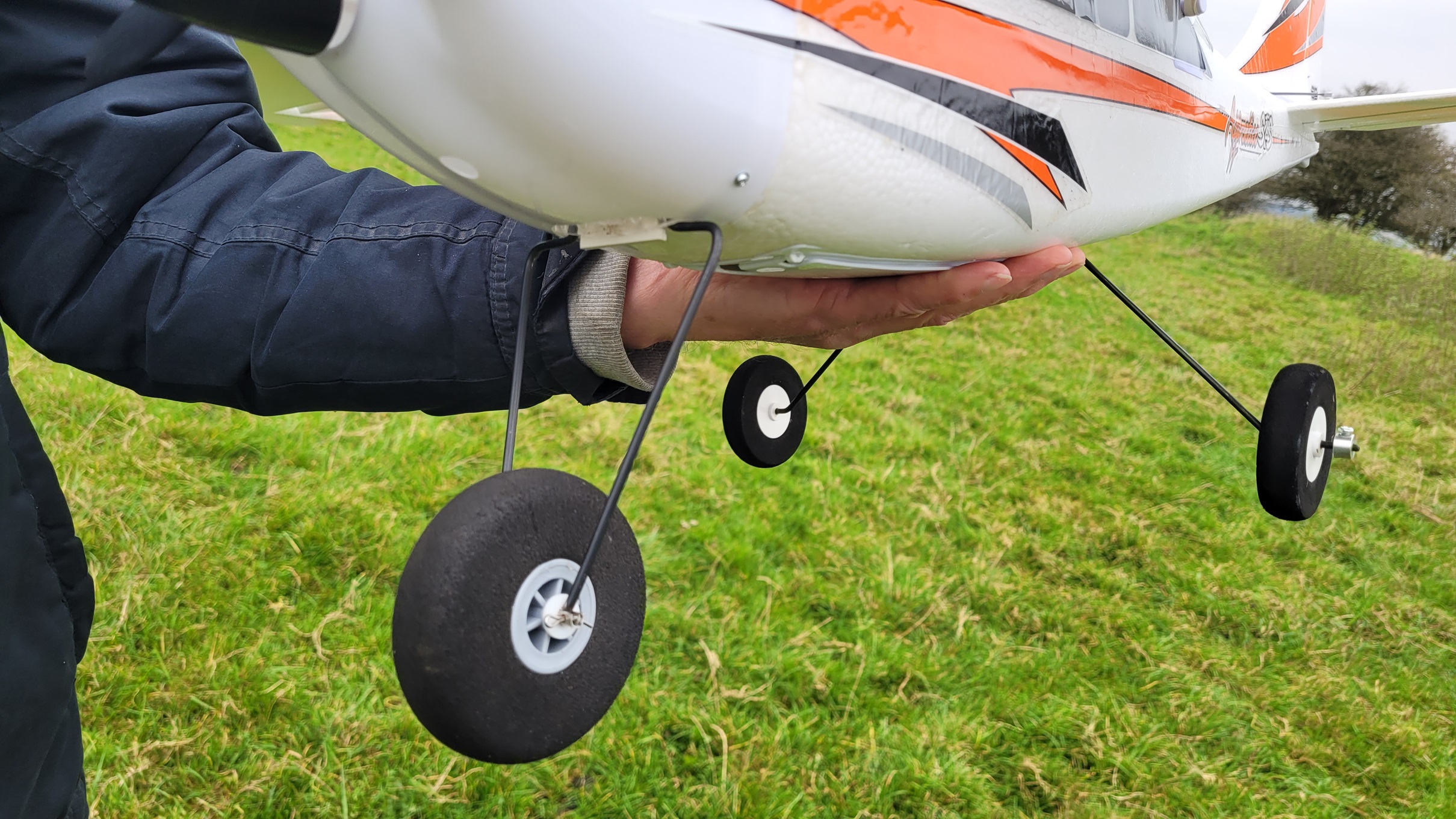 He has now fitted a leg that supports the wheel on both sides and has also increased the size of the wheel. I’m not sure it’s made a big difference as the Apprentice still wants to turn hard right but in this month’s video you can see Terry’s first successful take-off.
Captain Slow brought along his Durafly Auto-G2 Gyrocopter to fly in early November. 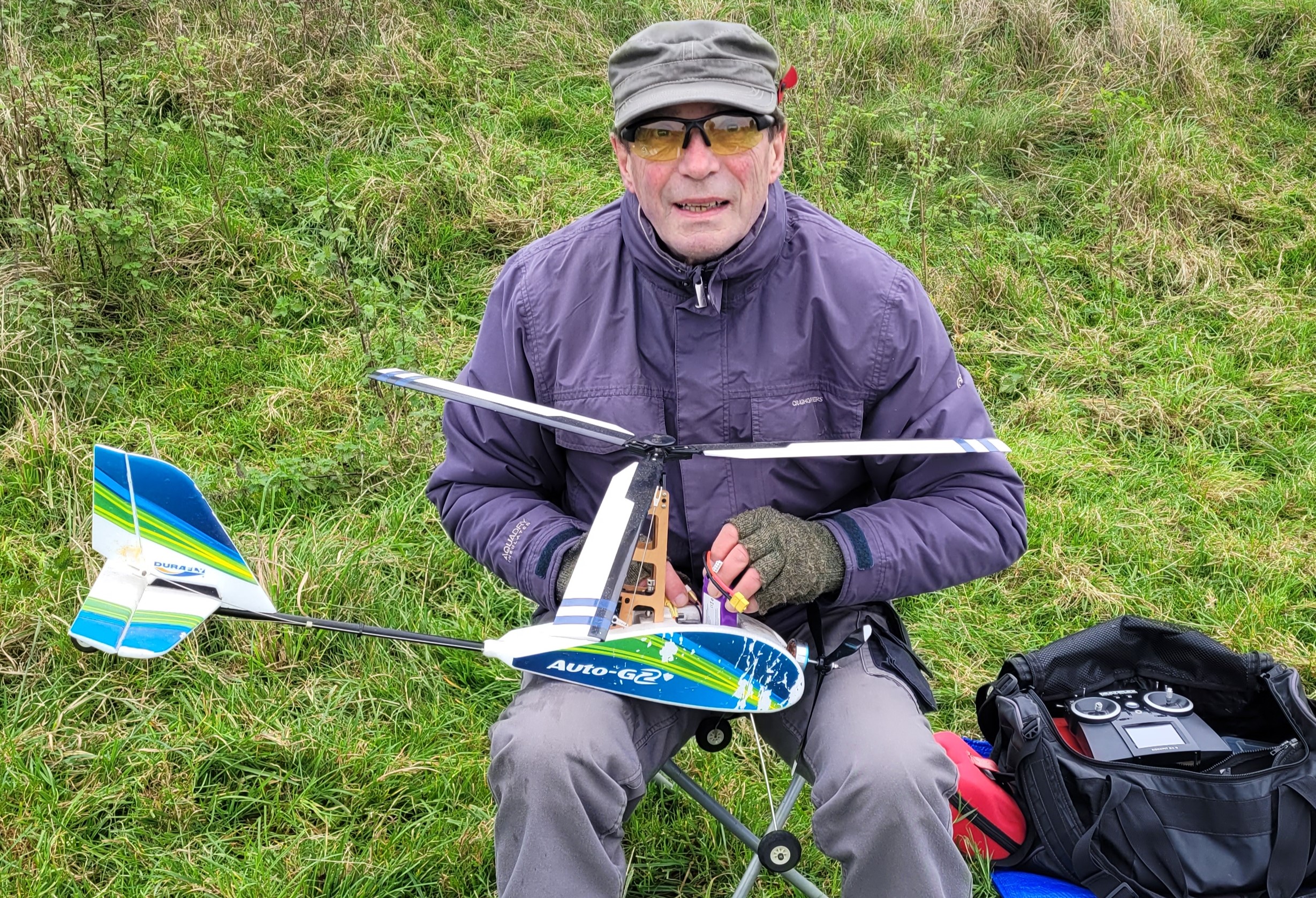
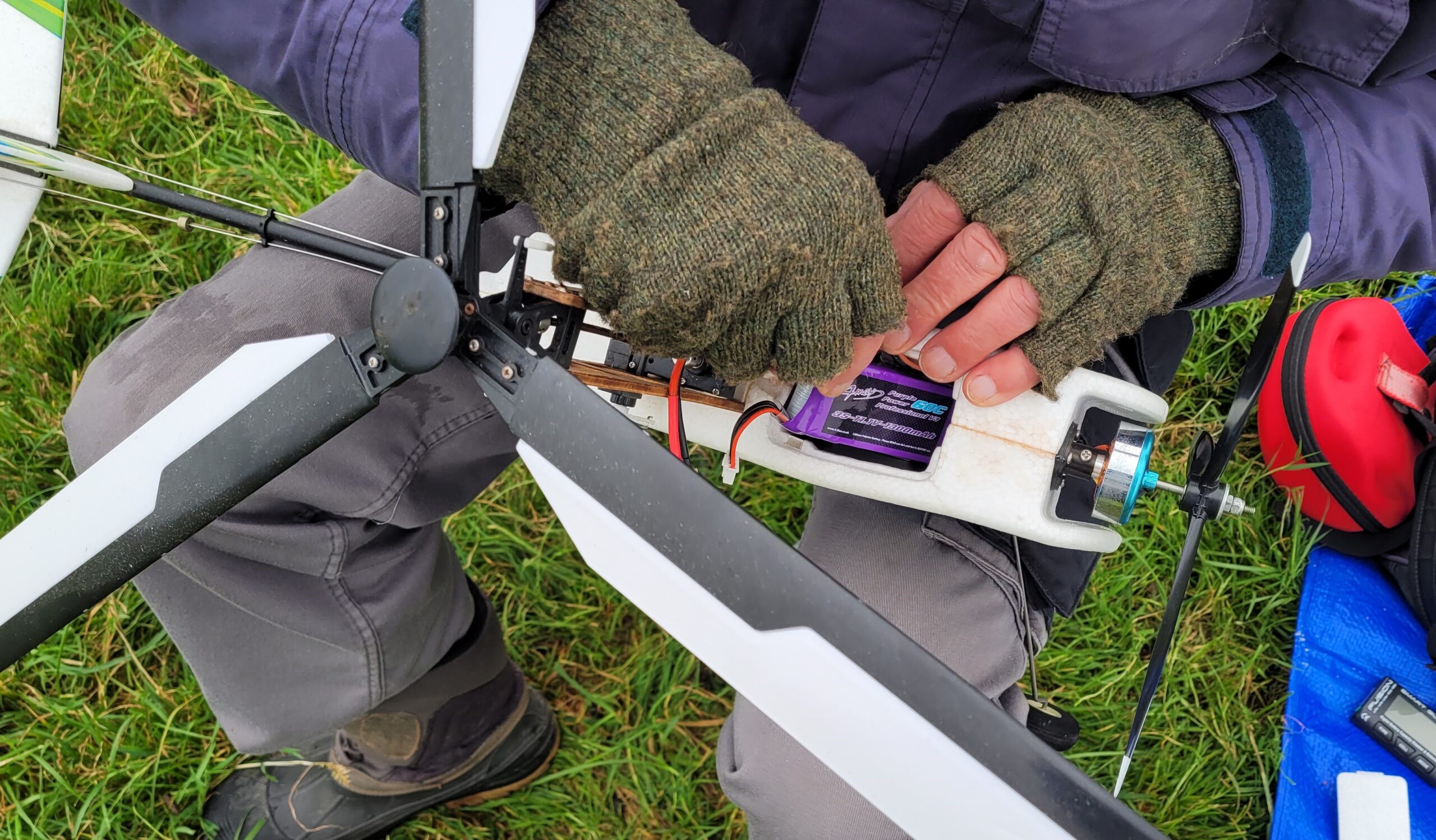 He’d had a few flights with the autogyro quite a long time ago but the flights had been a bit erratic and eventually it crashed. Back in the workshop Captain Slow discovered a problem with one of the servos so he swapped it for a new one and then completed the necessary repairs. When he brought the model along his time there was a crosswind and the grass was wet and a bit long so the model struggled to get off the patch. On the last attempt Slow tried going along the full length of the patch rather than directly into the wind but the crosswind caught him out and the autogyro tipped sideways and broke a rotor blade.
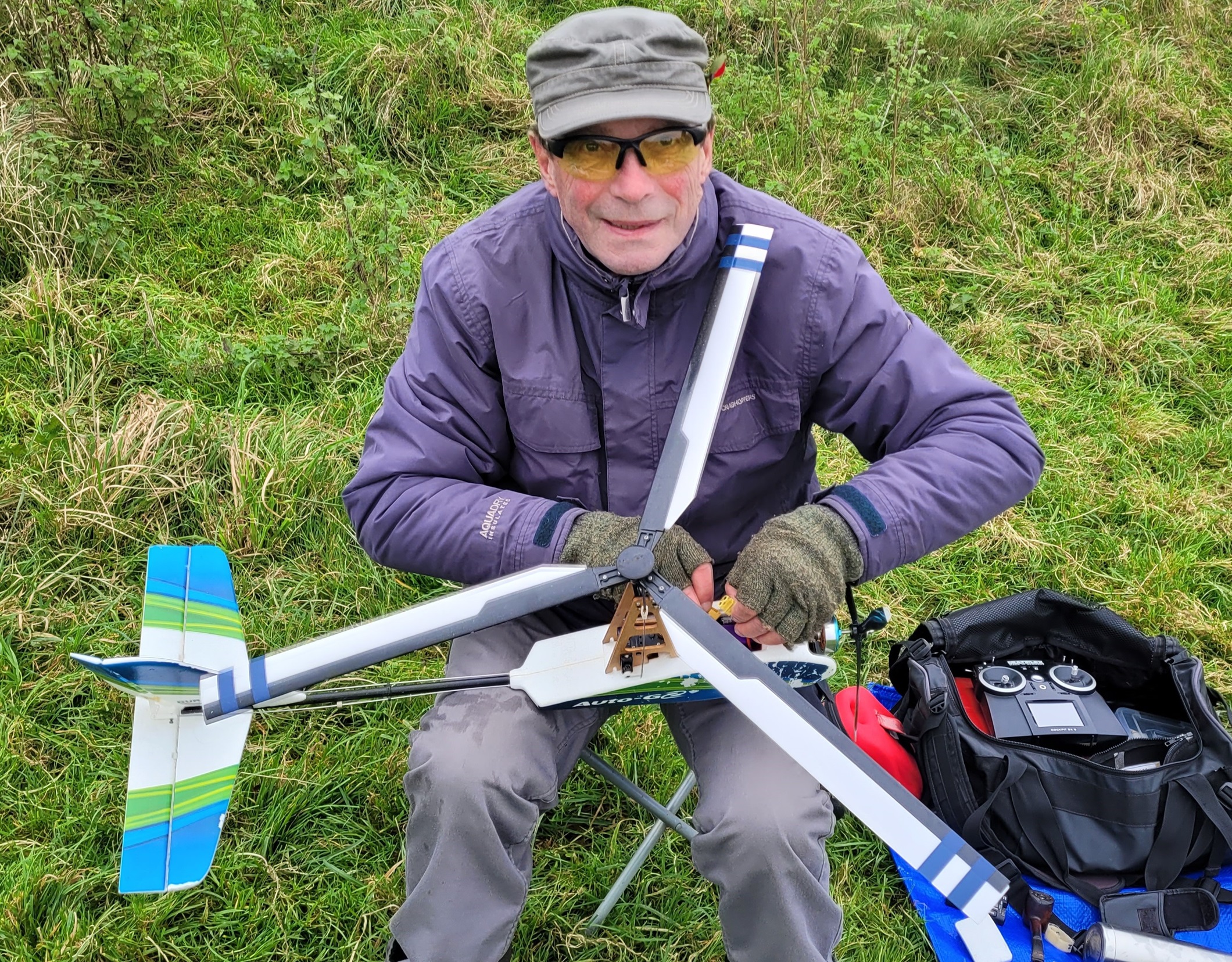 I think a hand-launch would have been better although none of us have much experience of autogyros so who knows. It’s an easy repair so we should see it flying again very soon.
Away from the patch now, many of you will know that Mini-Mike recently went mad and splurged several year’s worth of his modelling cash…on a trip to Australia! So what has that got to do with Patch News I hear you ask? Well nothing really but it does have an aviation link as while he was there he had a flight in a float plane with Sydney Seaplanes.
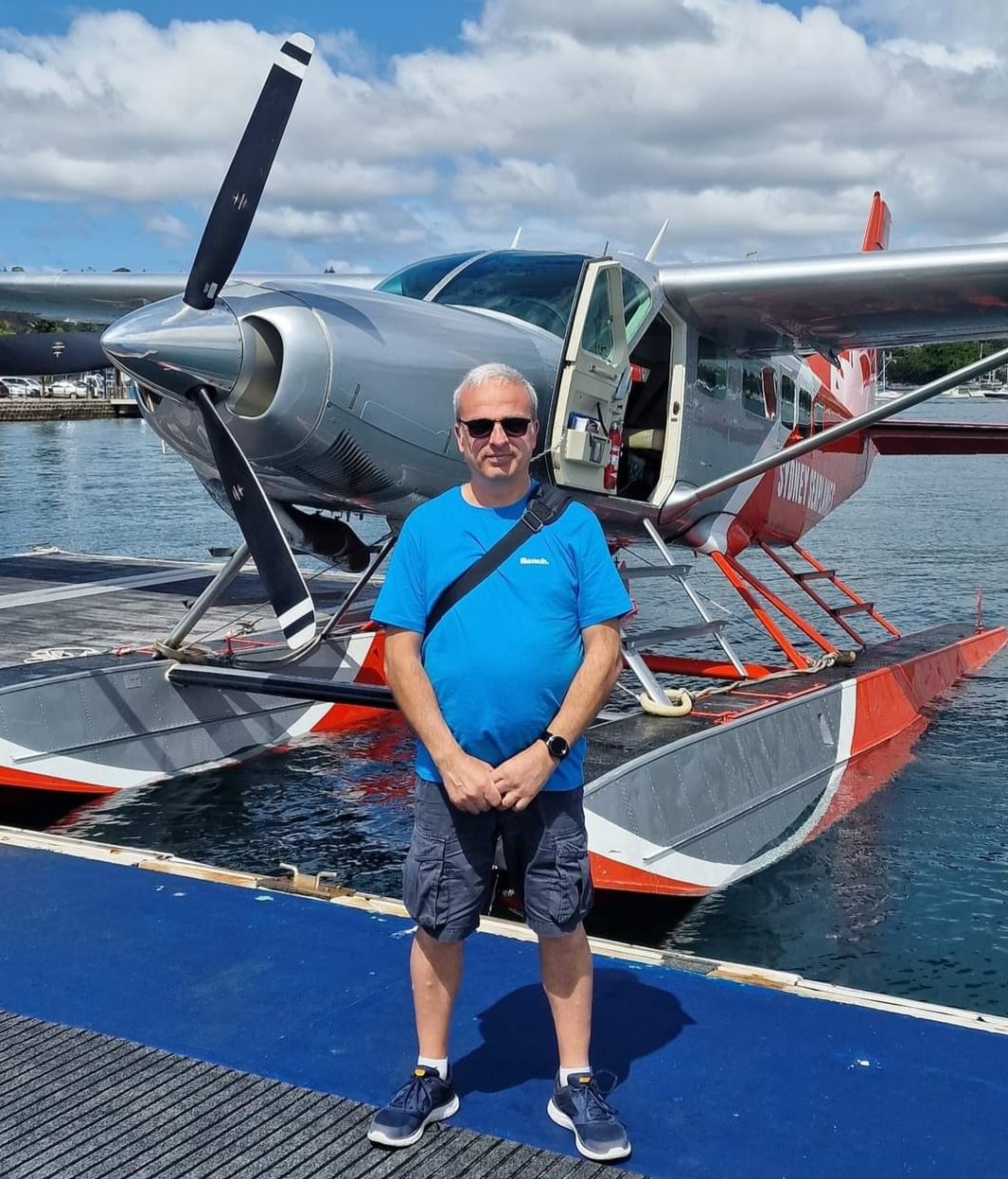 I don’t know about you lot but personally I’m very jealous, it’s something that’s been on my bucket list for ages! Mike’s flight was supposed to be in a de Havilland Beaver but the Beaver went unserviceable at the last minute so he was switched to a Cessna Caravan Amphibian instead. Although a Beaver flight would have been great, a real classic aircraft powered by a huge 450hp Pratt & Whitney radial engine, I imagine the Cessna would be much more comfortable and a great deal quieter as it’s powered by a turbo prop engine.

 The Caravan is larger than the Beaver with a wingspan of 15.9M against the Beaver’s 14.6M and it has much better visibility with more/ larger windows. The Caravan can carry twelve passengers against the Beaver’s seven although if I remember correctly Mike said there were only two passengers anyway so they would have had plenty of room each!
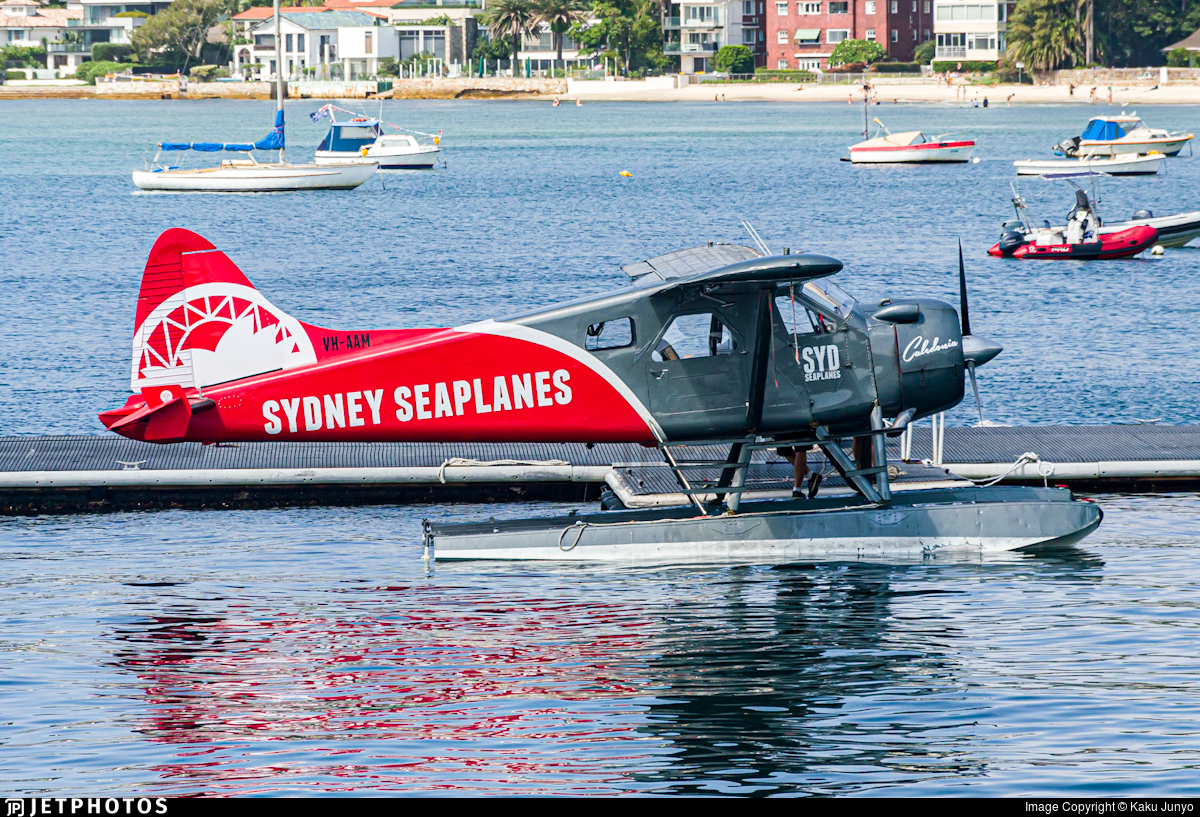
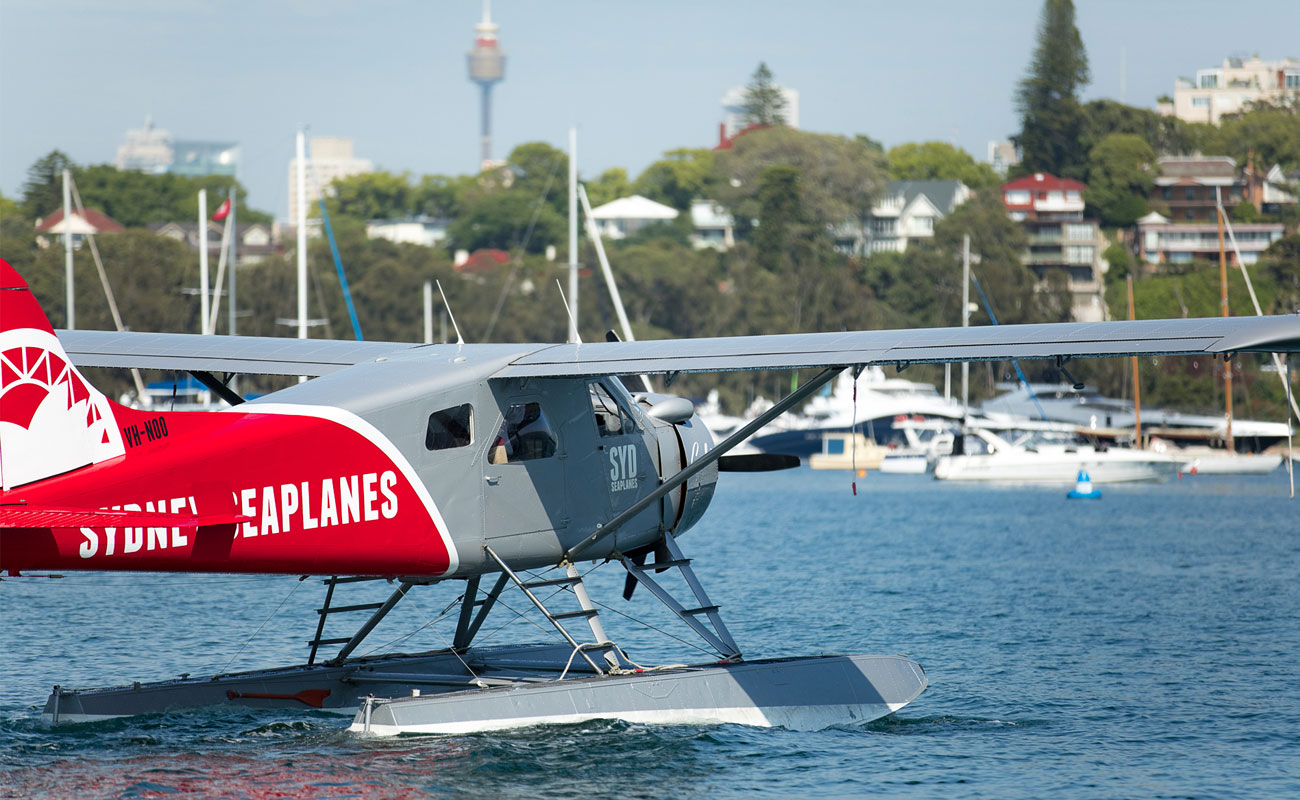 Mike said he was surprised at how smooth the take-off and landings were, not as bumpy as he’d expected and he thought the flight was well worth the money. I thought it sounded fairly expensive until he told me the cost of the Sydney Harbour Bridge Climb that he also did. Not only was the ticket expensive he then discovered that no cameras or mobile phones are allowed on the climb (in case they get dropped onto the road below) so if you want photos you have to buy the ones the organisers take during the climb. Oh well, it’s another thing that just has to be done I guess. It looked like you had a great time Mike.
I’m sorry to say that Bob the Builder must revert to his old title of Basher Bob for a month!
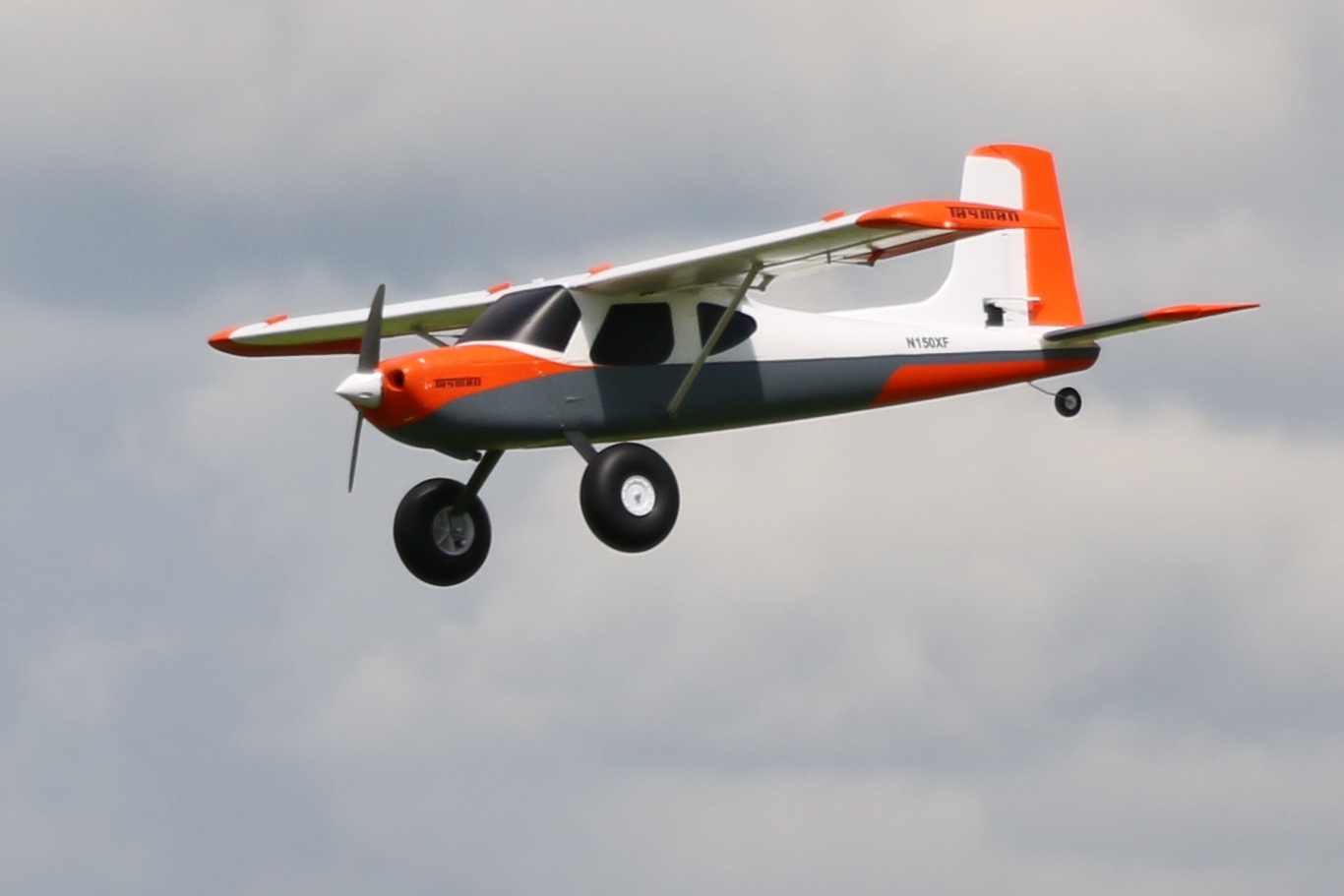 He was flying his XFly Tasman at the same time Captain Slow was flying his Nigel.
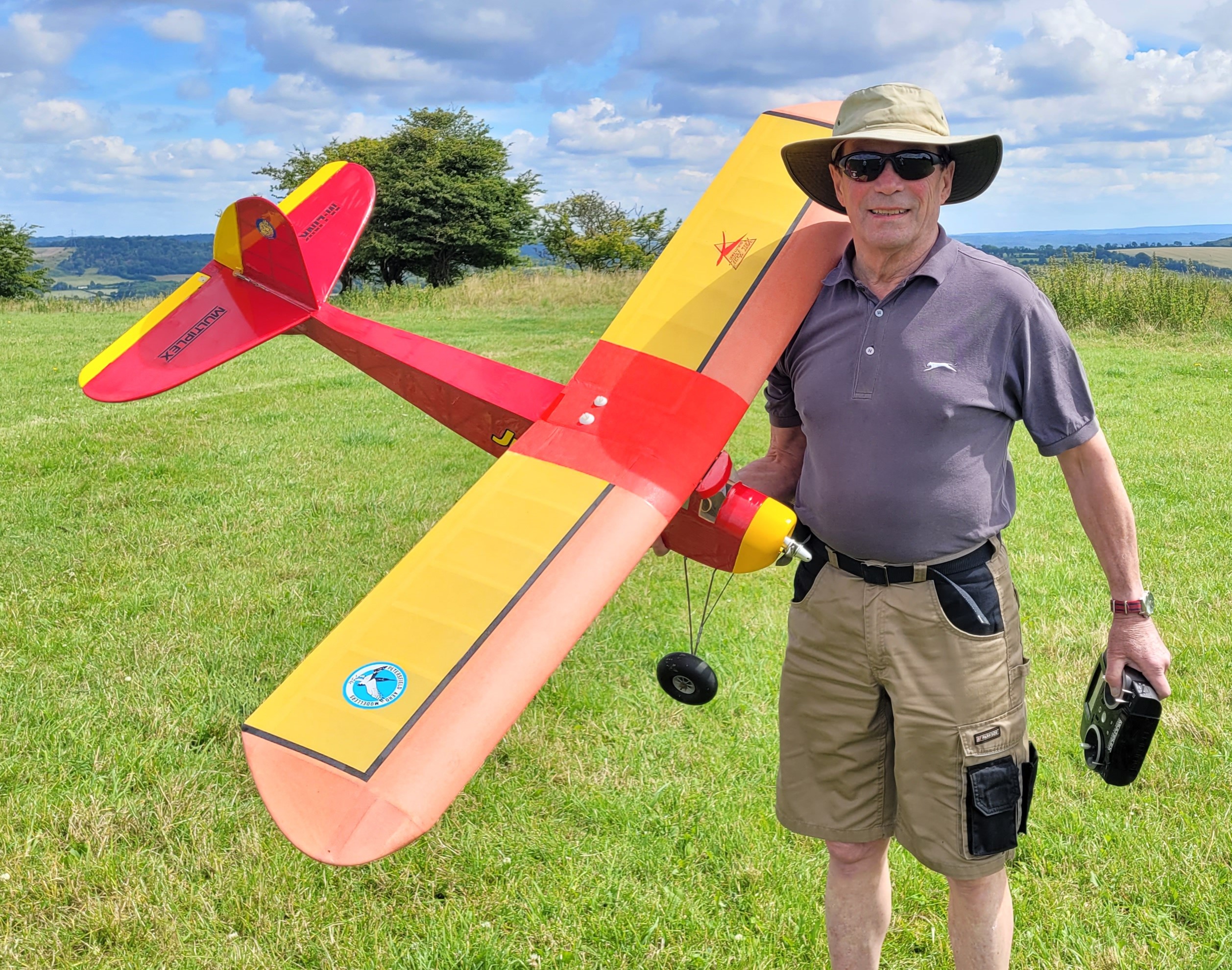 The poor Nigel was flying along, nice and slowly (obviously) when the Tasman tore right into it. Perhaps I should explain that Nigel is actually a Junior 60 that was built by the late Nigel Baker (AKA Chris P Bacon) so when Slow bought it he named it Nigel in his memory.
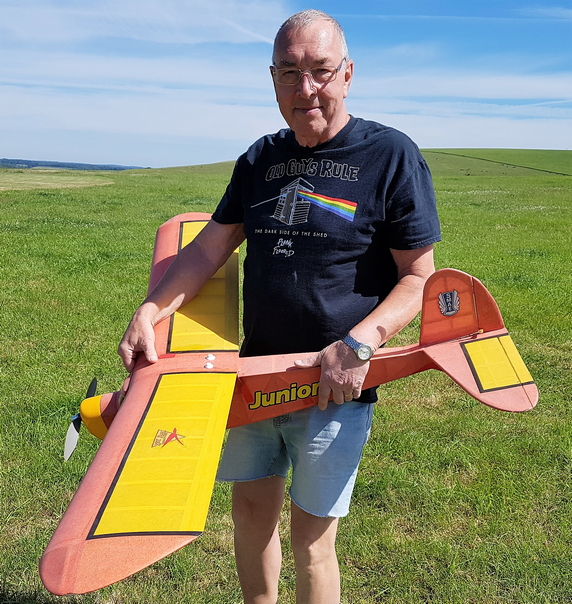 Fortunately Nigel appeared to escape unscathed but the Tasman lost most of its rudder.
  Basher Bob landed safely with no further problems. Now you might be wondering how it could be Bob’s fault when the only damage was to his rudder, did he reverse into Nigel?!
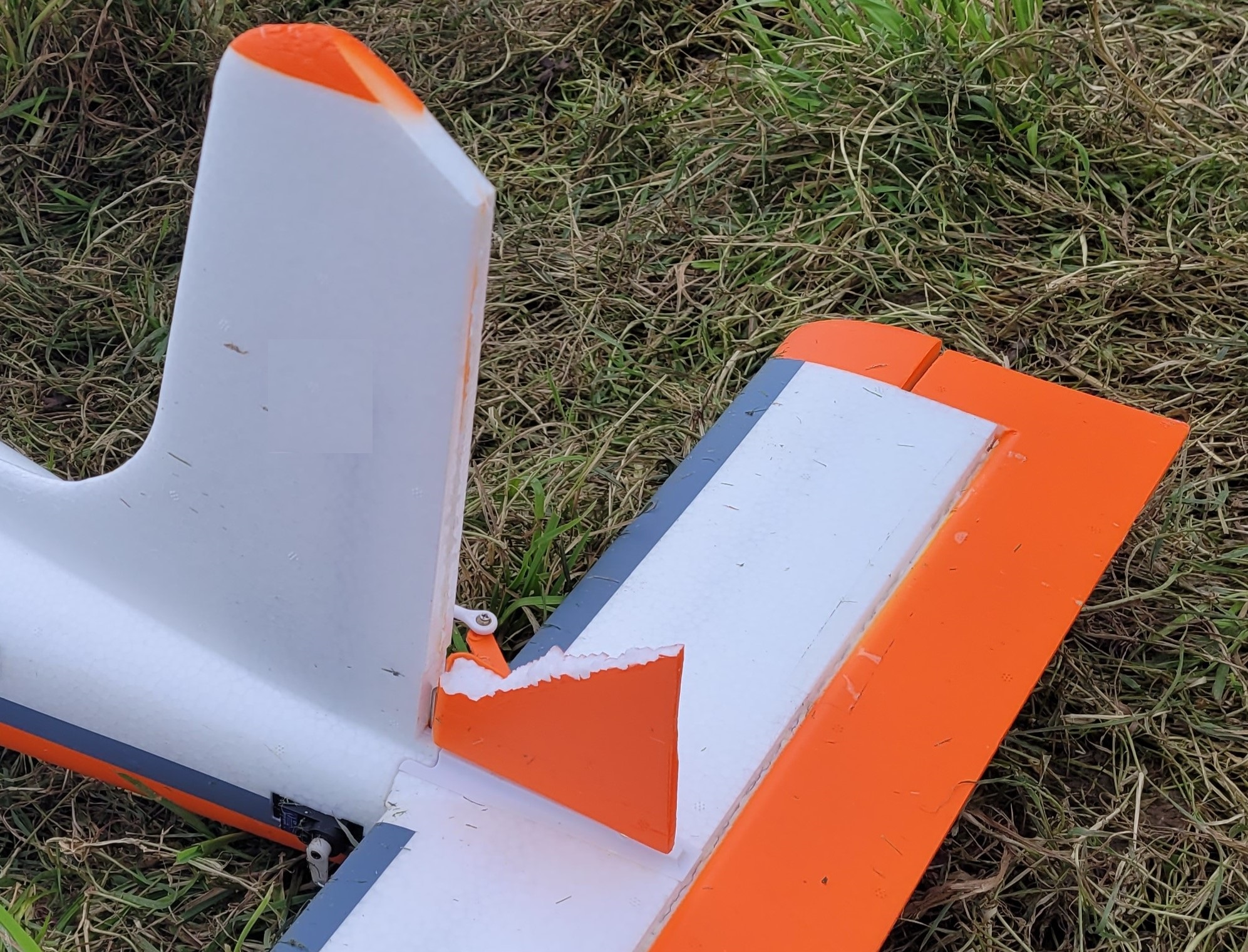 It’s simple, whenever there’s a mid-air collision it is always Basher Bob’s fault, it’s the rule!
Early in the month my wife and I visited the Brooklands Museum in Weybridge, using some tickets I’d received as a present. We’d visited once before, on the first weekend the museum opened over thirty years ago, needless to say there have been a lot of changes! 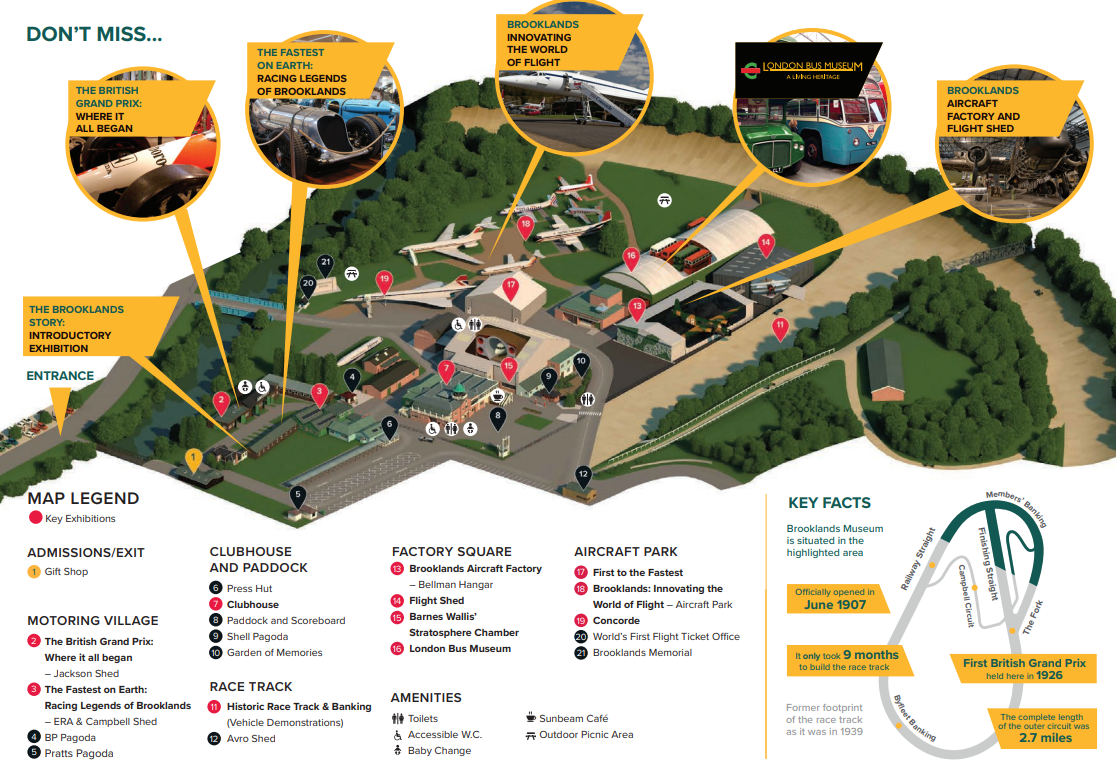 The museum is excellent and covers all the activities that have happened at the old race circuit in the past including motorbikes, cars, and of course, aeroplanes. I won’t bore you with too much information, but if you want to know more visit their website HERE
Amongst all the aircraft here were a couple of items that immediately caught my attention. Firstly, there was a notice on the museum Harrier about the test pilot John Farley.
 The longer serving PAM members will remember that John came to our club meetings a couple of times and gave us some extremely interesting talks about his career as a test pilot, in particular the development of the Harrier, right from the early days of the ‘Flying Bedstead’ (Rolls Royce Thrust Measuring Rig) through to the P1127, Kestrel, and Harrier.
 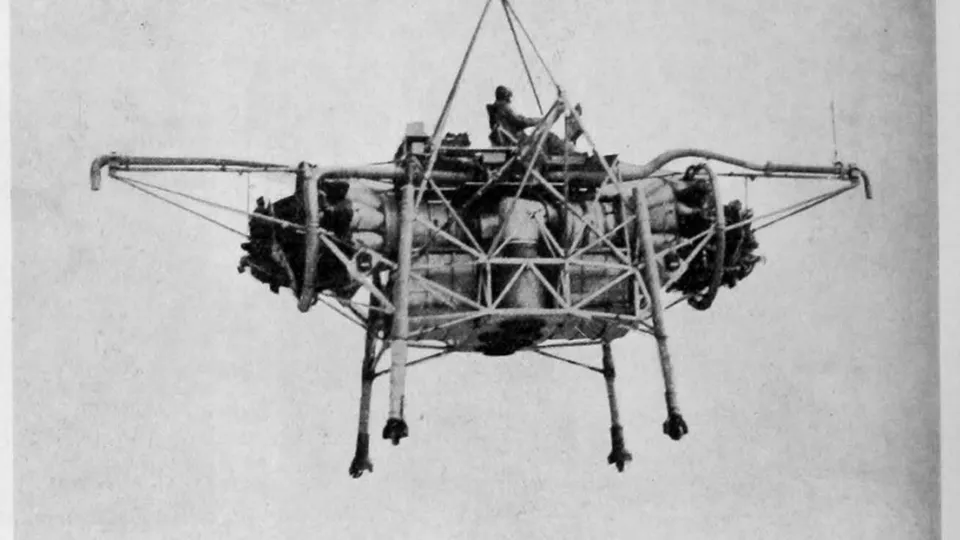 John, who sadly passed away in 2018, had been a keen aeromodeller and was a member of Chichester & District MAC, and he came and flew at one of the early electric flight fly-ins that I ran for Southern Area BMFA at the Winchester MAC site many years ago.
The second thing that caught my attention was this stand about Sir Sydney Camm.
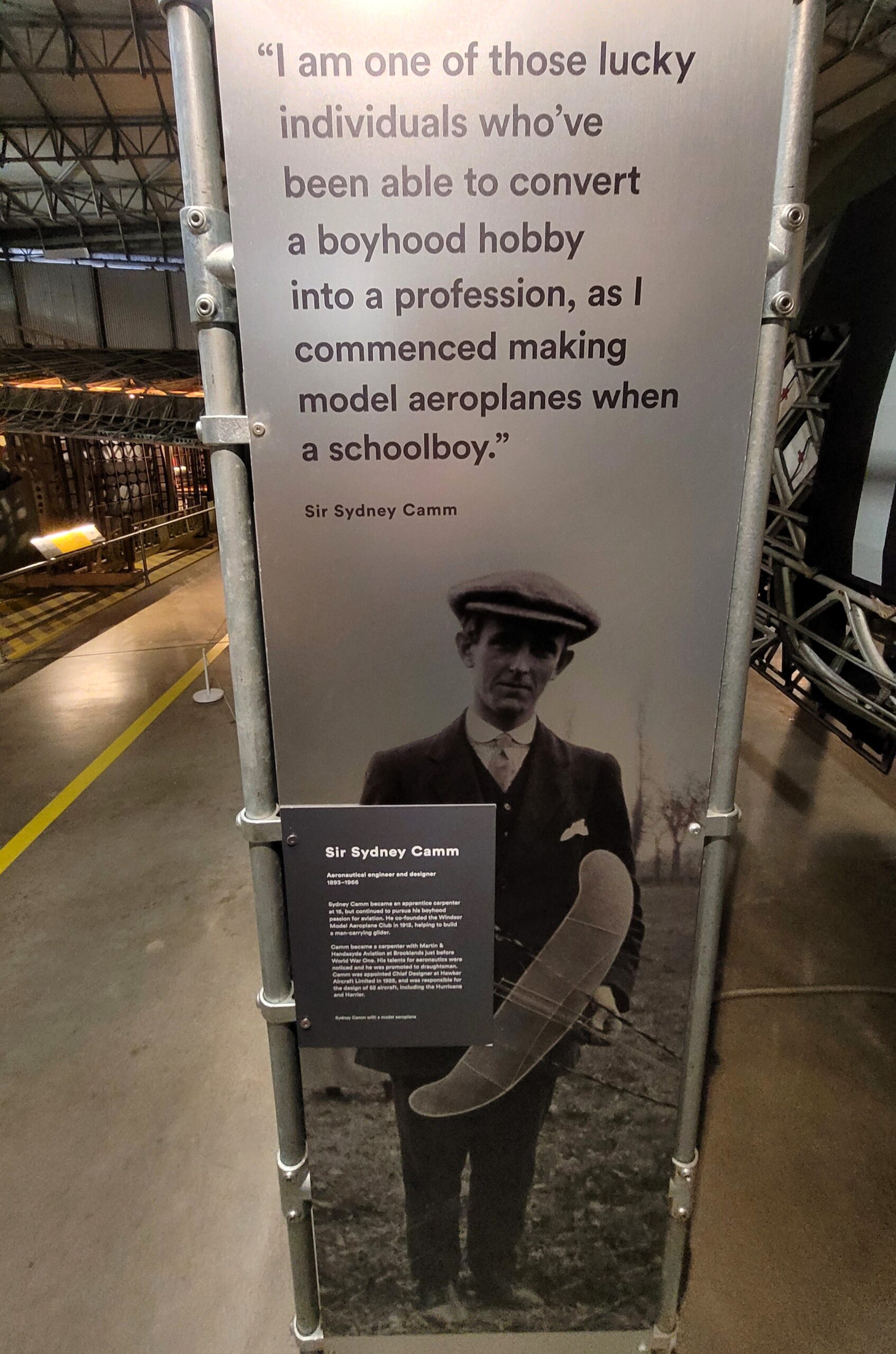 As an aeronautical engineer Sir Sydney Camm contributed to many Hawker designs from biplanes of the 1920’s to the Hawker Hurricane and even the Harrier mentioned above.
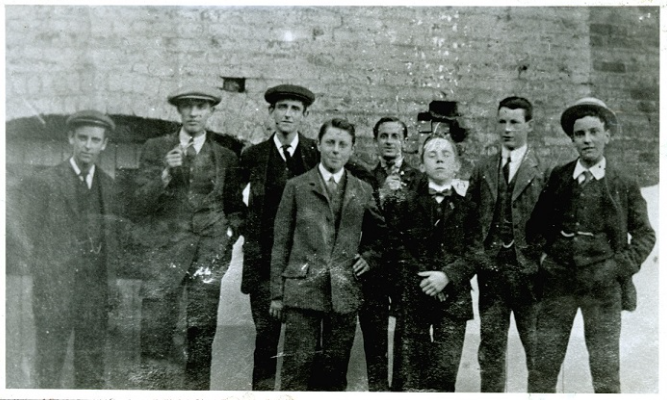
 I found this online: Such was Camm’s fondness for model aircraft that he played a principal role in establishing the Windsor Model Aeroplane Club in 1912. The WMAC was chiefly concerned with designing and making model aircraft, but it also began designs for a man-carrying glider. This black and white photograph was taken at a time close to the WMAC’s inception and depicts its members. So, from left to right: Frederick Camm, Barton, Sydney Camm, Mainwood, Saunders, Stevenson, Stanbrook and Clayton.
 If you haven’t been to the museum I can thoroughly recommend it, it’s well worth a visit.
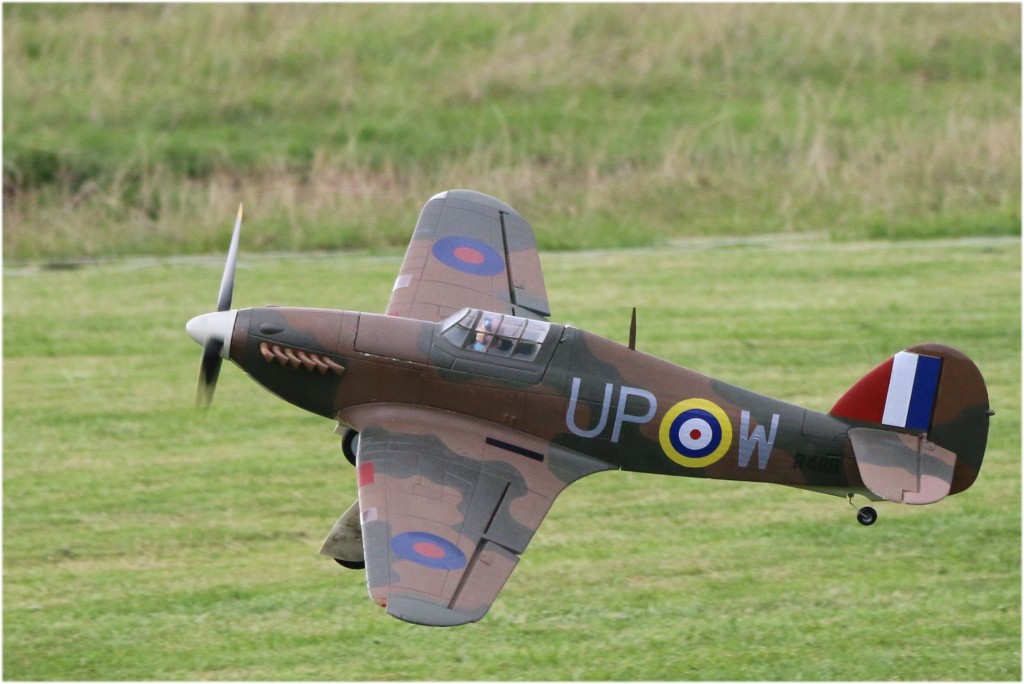
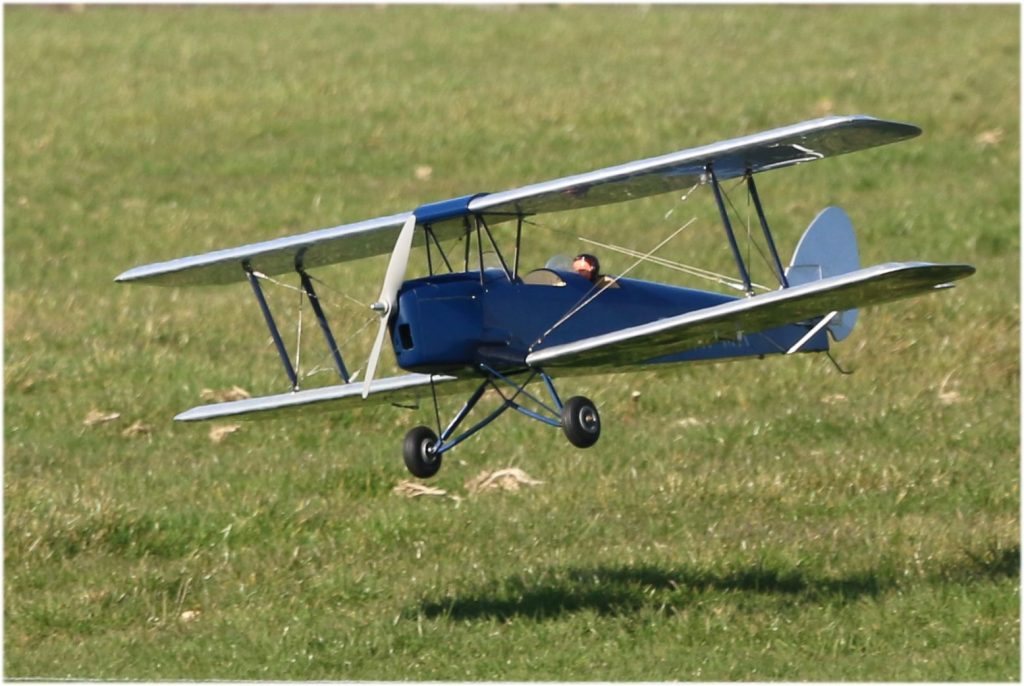
For this month’s action shots I’ve delved into the archives for some of Kryten’s older pics:

 Video time now, this month with footage shot by myself, MacFly, and Dougal Entendre. Please watch the video full-screen, it’s so much better with small models flying around:
If the video won’t play for you please click HERE
I know you’ll all be disappointed but this month I don’t have a joke for you, just this:
Merry Christmas!
Colin Cowplain
Patch News – October 2024
It’s November already, the clocks have gone back and winter is well on the way. So how was October? Better than expected overall, we had several nice sunny days with light winds. Life at the patch continued as usual, we managed a fair bit of flying on the better days, often cutting the grass beforehand, making flying a reward for our hard work. As the weather is now turning colder mowing will hopefully be a rarity for a few months.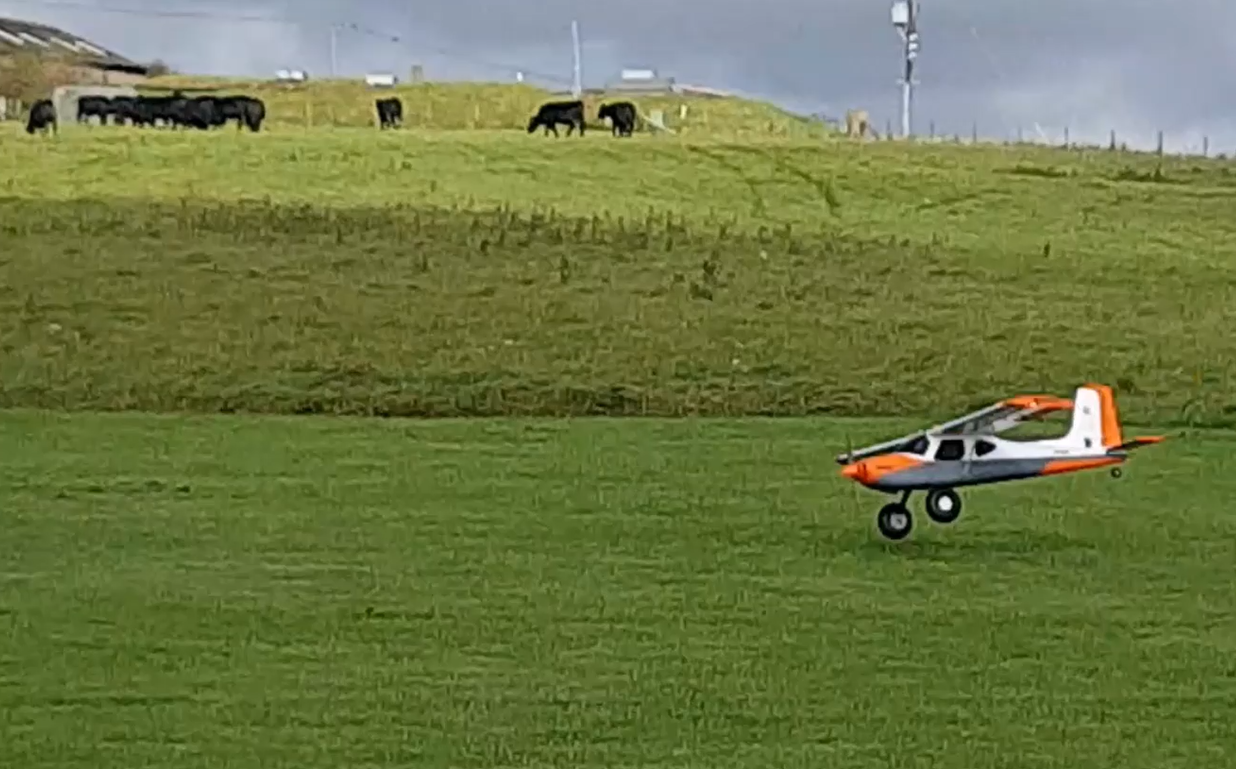
A herd of bullocks joined us for a while but were rarely a problem, once they realised we weren’t there to feed them they just wandered off and left us alone. Later in the month the bullocks went and were quickly replaced by a flock of sheep. Sheep never seem to be any bother other than the ‘presents’ they leave us! The last Sunday morning of October was a glorious, calm and sunny day so we took the opportunity to mow. As we finished mowing, right on cue, in the nick of too late, newbie Patrick turned up to fly. Patrick is fitting in well with the club and it’s about time he had a blog nickname so I’m wondering if being called Patrick Mower would nudge him into action. Of course that might make him think we see him as an 80’s TV star so maybe Patrick Non-Mower would be more appropriate!
Another new Petersfield Aero Modellers member Terry Small flew several times in October with his little HobbyZone Apprentice STOL. With a wingspan of just 700mm span the model is a scaled down version of the very popular E-flite 1500mm Apprentice.
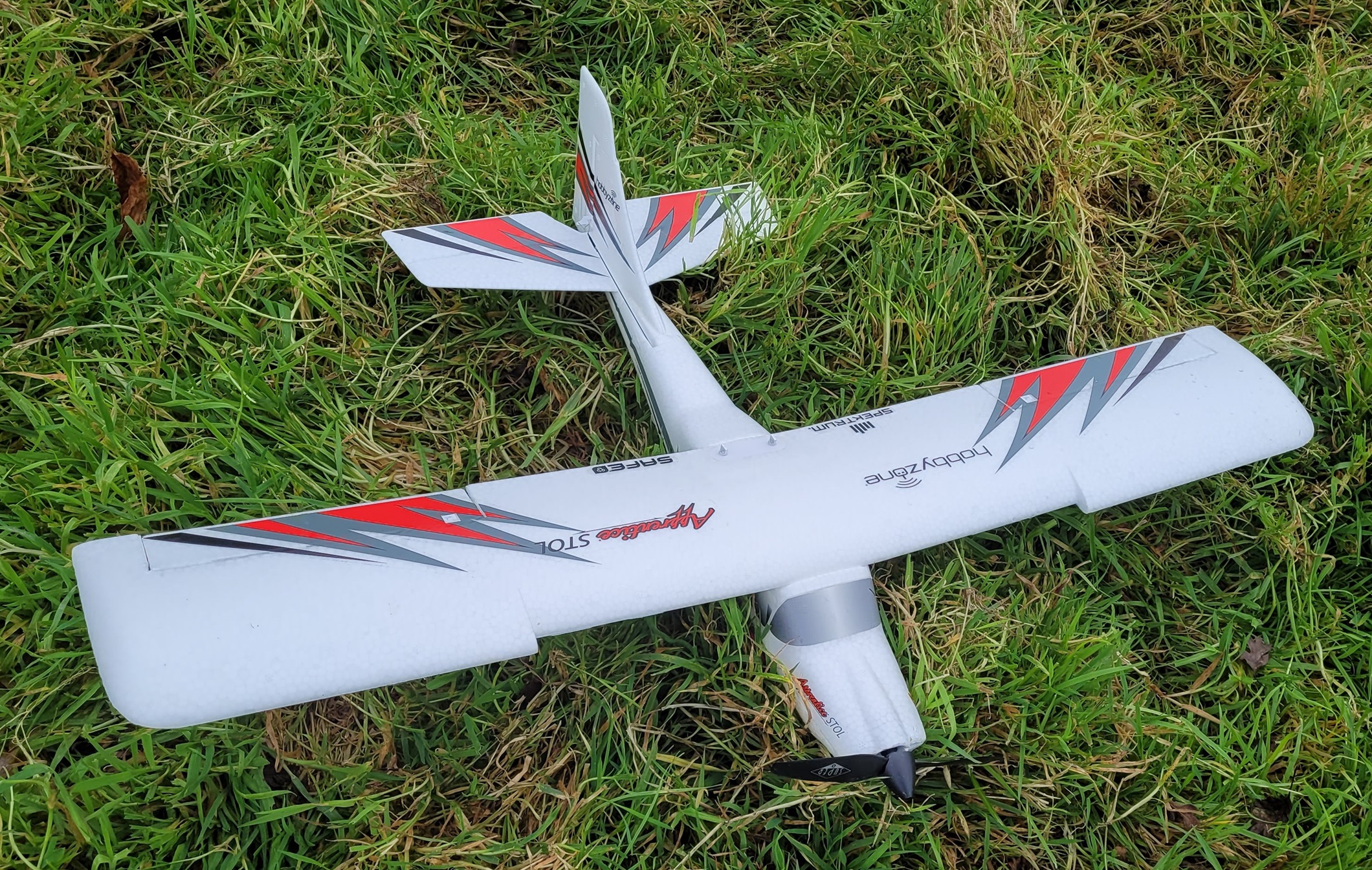 Terry also owns the larger Apprentice but I hear he damaged it while I was away for a few days. It’s almost ready to fly again now but Terry is awaiting delivery of a new wing spar.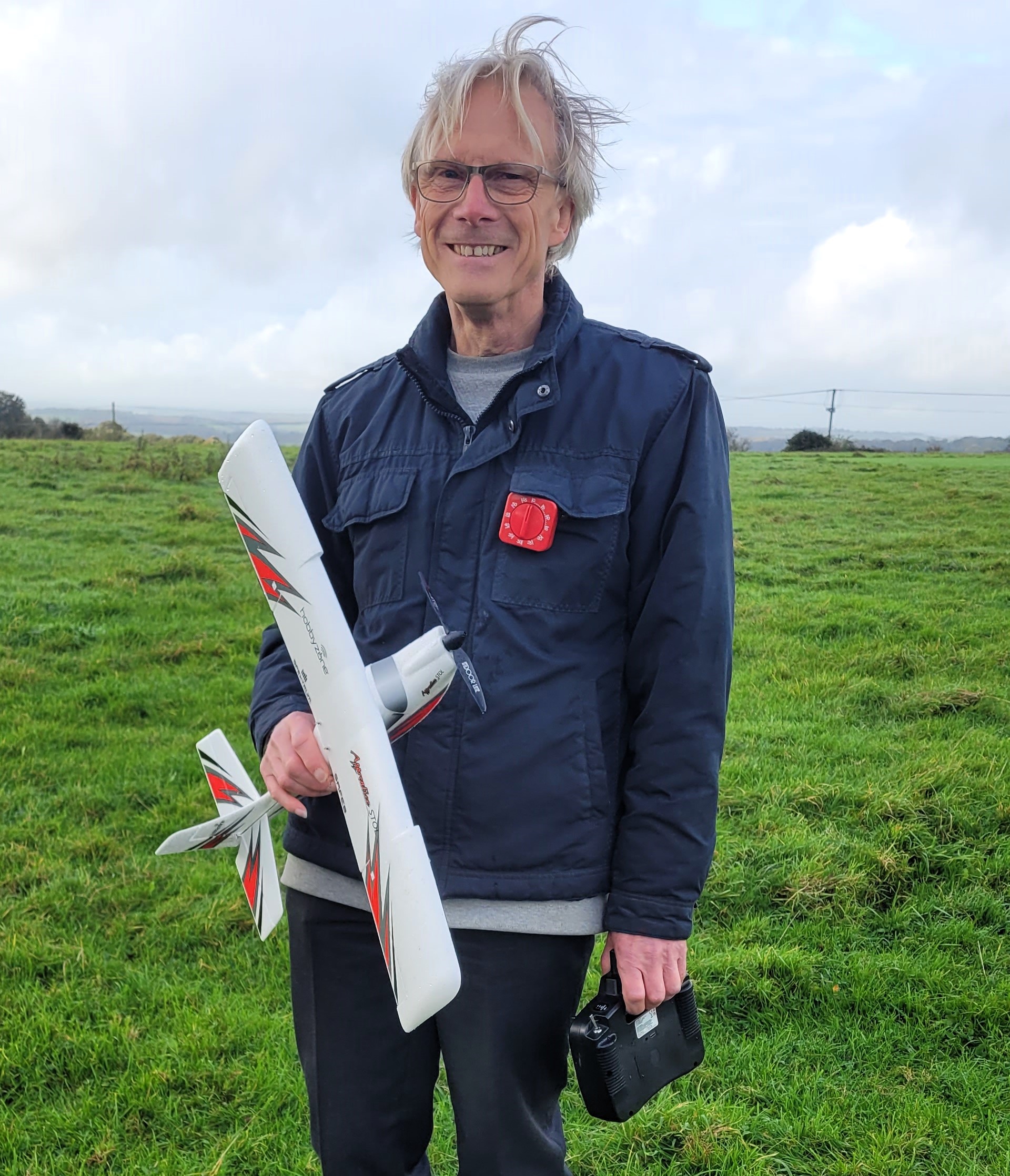
Terry flies quite well with the smaller Apprentice and is using the gyro SAFE system in the Advanced mode as his skills improve. He was complaining that his simulator doesn’t mimic our long grass and windy conditions very well…welcome to the real-world Terry!
As well as the last Sunday of the month having perfect flying weather the morning was improved even further by Woody bringing along celebratory cakes for everybody!
His birthday was actually on the Friday before but the weather was not flyable that day.
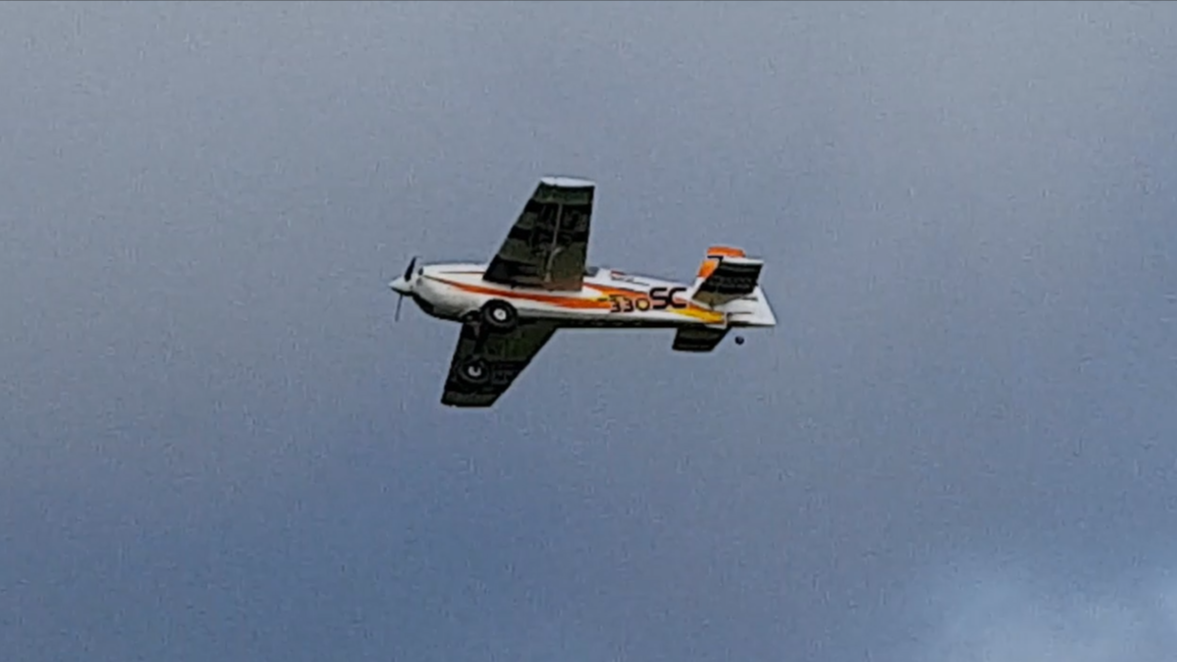
Early in October Gordon Bennett managed to break the fuselage of his Multiplex Extra 330SC in half when landing. Gordon blamed the small wheels and spats, saying they stopped the Extra moving forward on the wet grass, and instead it nosed over and broke the fuselage at the back of the wing when the fin hit the ground. His solution was to remove the spats and replaced the wheels with ones about a foot in diameter.
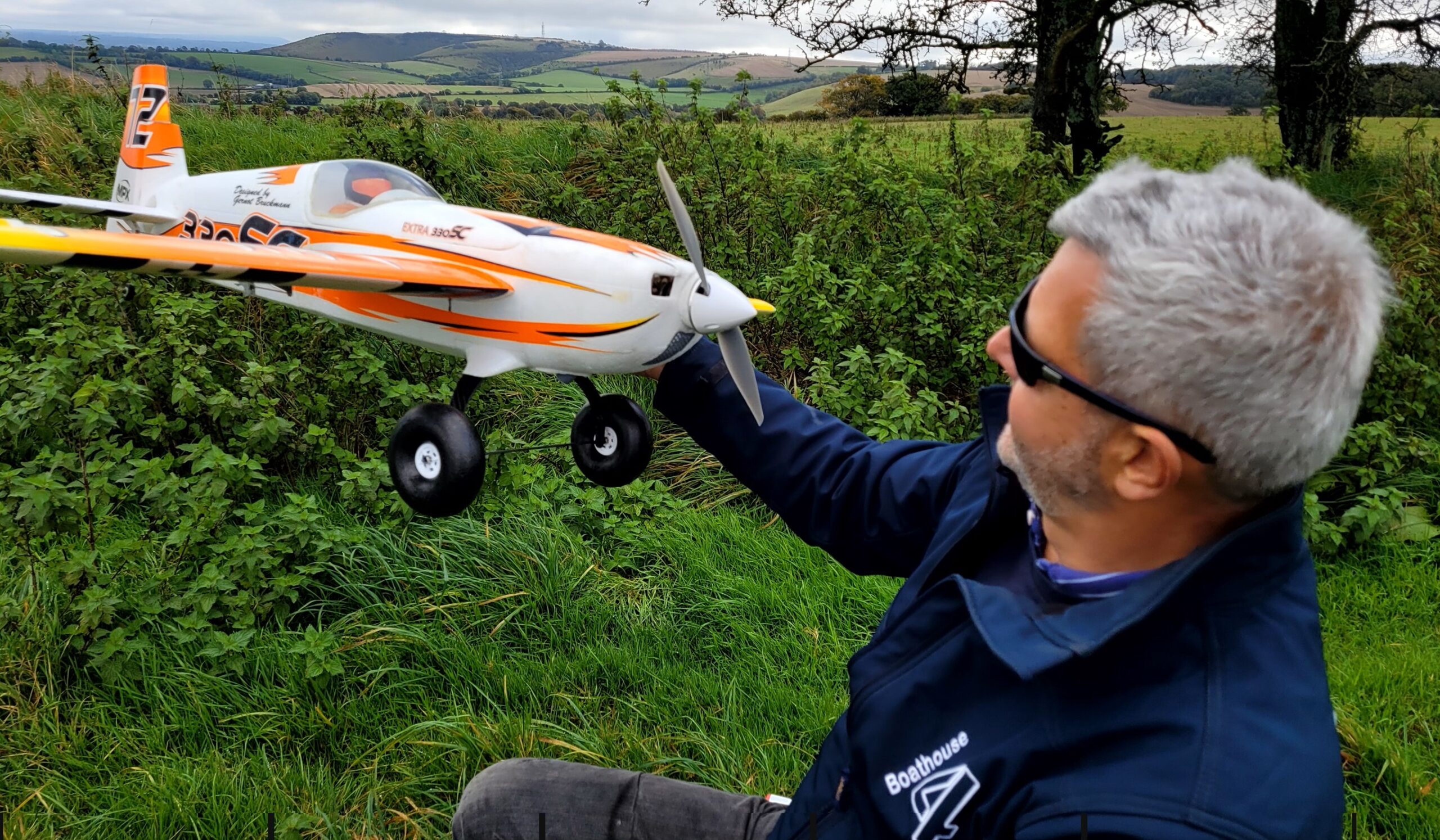 That might be a slight exaggeration but the wheels are much larger than the originals and don’t exactly enhance the look of the Extra. I think I know where he found his inspiration!
  However, never mind what they look like, as you can see in this month’s video the bigger wheels do the job and Gordon has managed several flights without damaging anything.
Last month I reported on the Multiplex Joker that Leo had bought at the Popham Model Show and subsequently sold on to Dougal Entendre. In October Dougal sorted out some of the things he wasn’t happy with on the plane and had a few flights at our field.
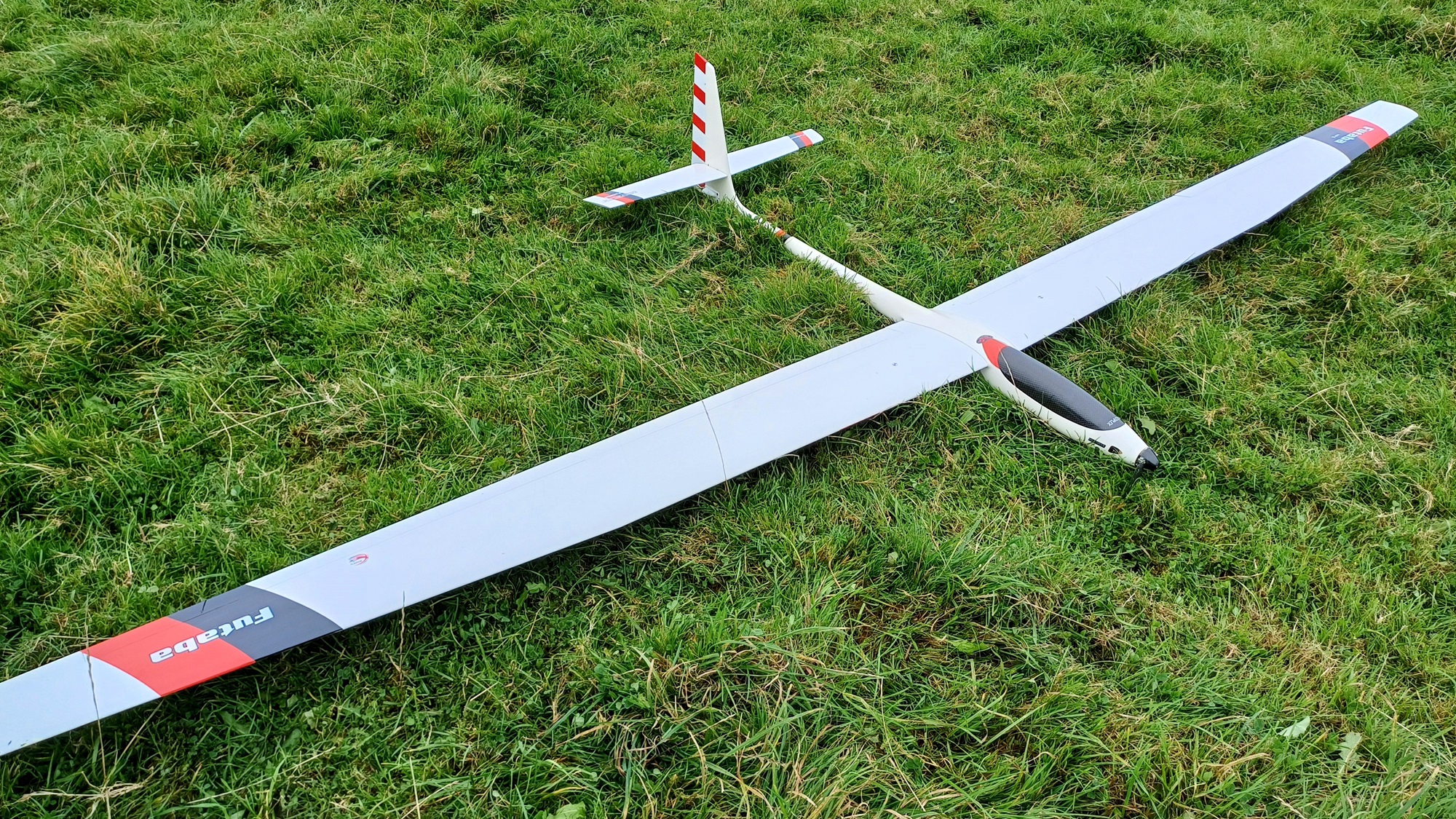 Here is Dougal’s report: Many years ago I designed a 12ft wingspan glider which I called Mr Blue Sky. I did a foam wing using obeche veneer attached with epoxy. The wings were heavy, which gave it an unfortunate characteristic of “digging in” when I tried to do slow thermal turns. This was probably due to tip-stalling, so I never had any success with it. Other designs with lighter built-up wings never seemed to suffer from this problem. When Leo purchased the Joker at Popham and we were heading back to the car with it, I worried that the wings seemed heavy, so it might suffer from a similar characteristic. Fortunately, when Leo had installed his gear and I got to test-fly it, it proved to be a fine performer with no nasty vices. I suspect the Joker performs so well due to its under-cambered section, straight wings (where Mr Blue Sky had polyhedral) and the really smooth epoxy covering job which the builder did. However, after the test flight, we still had to make a snagging list of things which were going to have to be sorted. It read as follows:
1. No ESC brake, so the folding propeller would not fold.
2. Flaps would only work like ailerons, i.e. one went up when the other went down!
3. Vibration at full throttle.
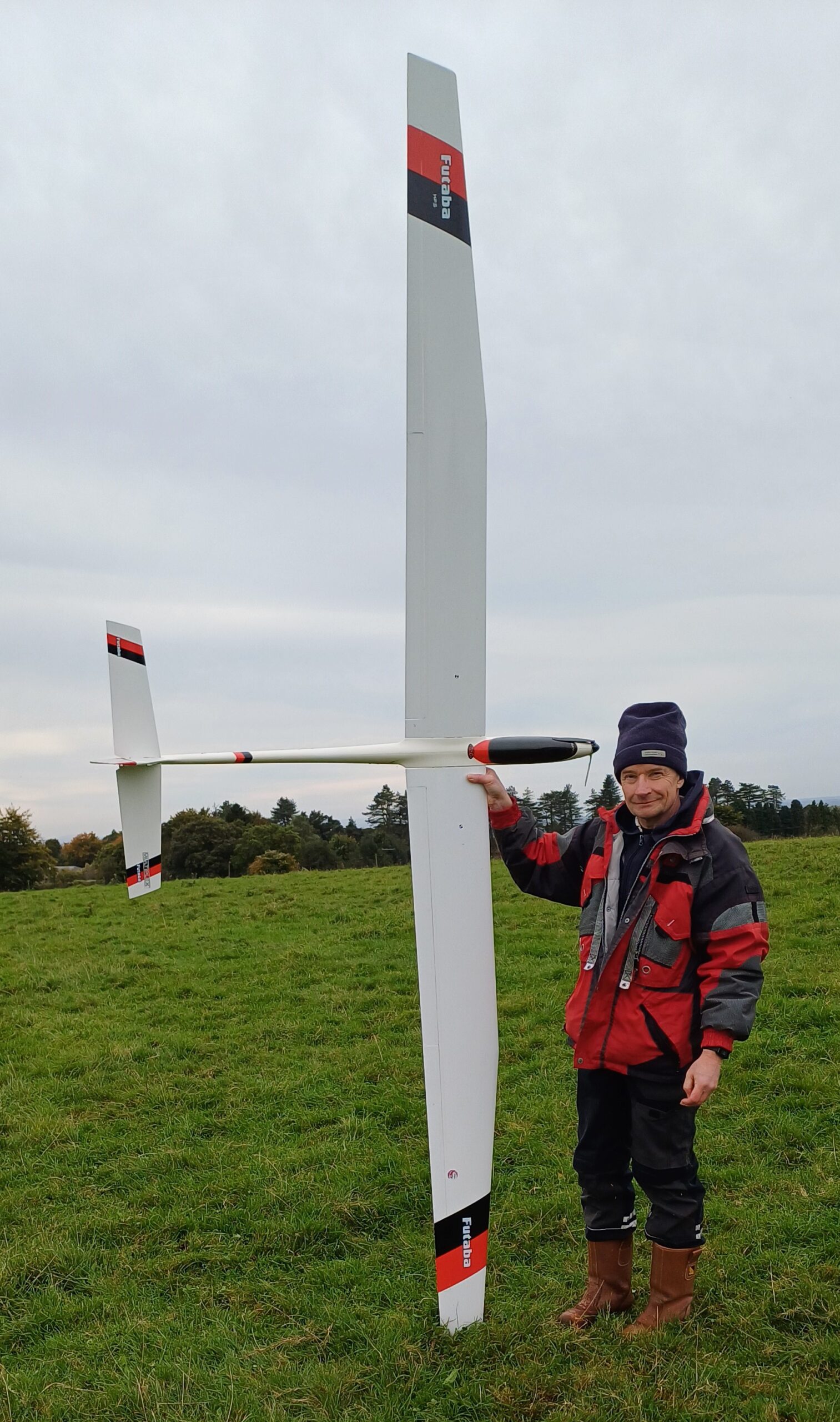 I bought the Joker off Leo, got it in the workshop and approached each problem in turn. It had an Arrows 50A ESC fitted (which I think is the same as used in the Marlin), so I downloaded the instructions and tried to engage the brake.
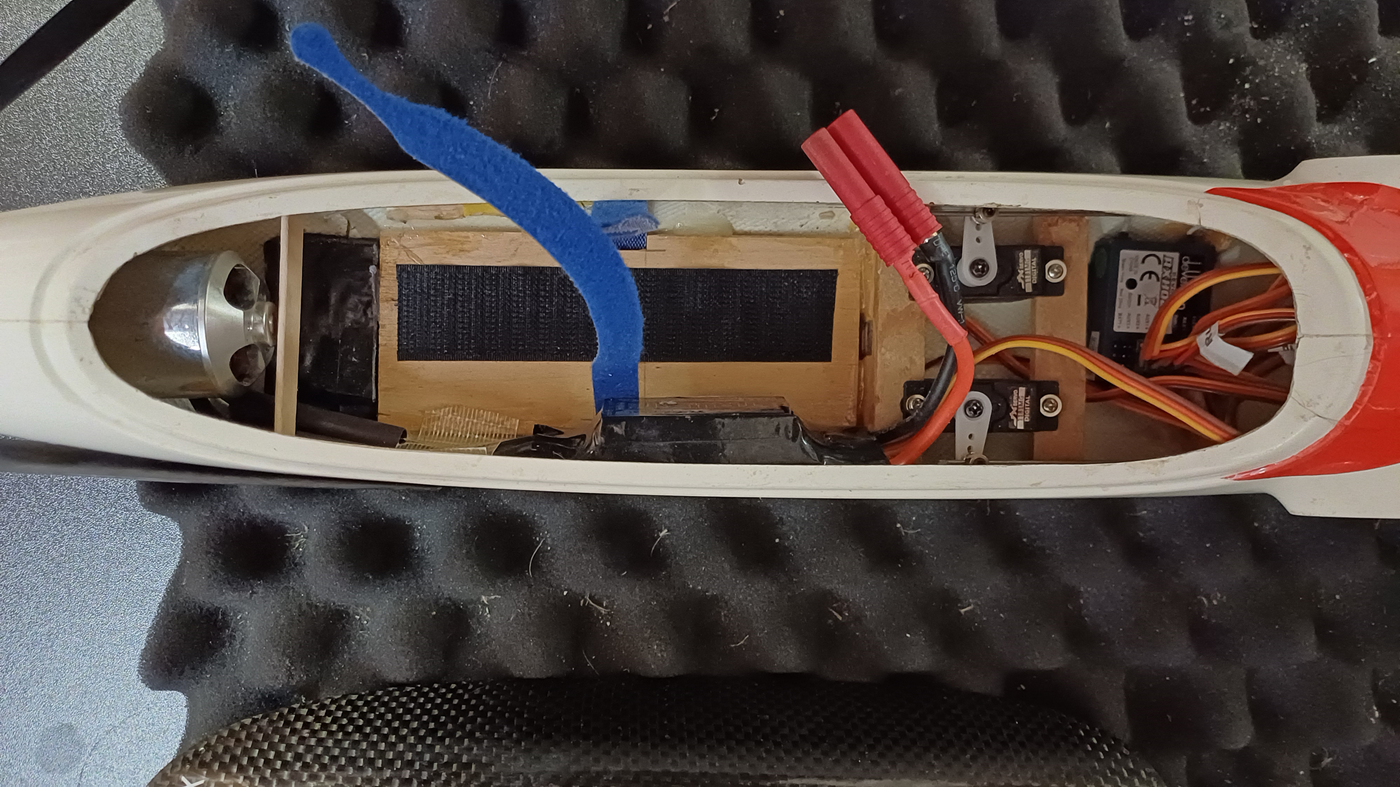 This proved impossible – the ESC didn’t respond to programming using the throttle stick as it should, so I replaced it with a different ESC where I knew the brake worked. I suspect the Arrows unit doesn’t actually have a brake, even though the instructions suggest that it does! The flap problem was solved by removing the Y-lead which the original owner had put in the wiring harness, and driving each servo off a separate Rx channel, with suitable reversing. I did the same for the ailerons, removing the second Y-lead and using separate channels so I could program some differential (more up aileron than down). The propeller seemed to be well balanced, but using a 4s pack at full throttle gave a nasty vibration. Throttling back to about 75% gave no vibration at all, and the model still proved to have a good climb rate, so my temporary solution is to put a limit on the throttle when using 4s batteries. In the long term I may go down to 3s, but that will mean changing the ESC connector! In the meantime I’m using a 4s 3700mAh pack, and used less than 20% capacity for a 12-minute flight in fairly still air.
 I have no idea what the motor is (and I’m not going to remove it to see), but I think a 3s pack should be fine if I add a bit more nose-weight. Thanks for that Dougal, good stuff.
The Joker has connectors mounted in the wing roots that mate with ones in the fuselage so there’s no faffing around with connectors when it’s assembled at the field.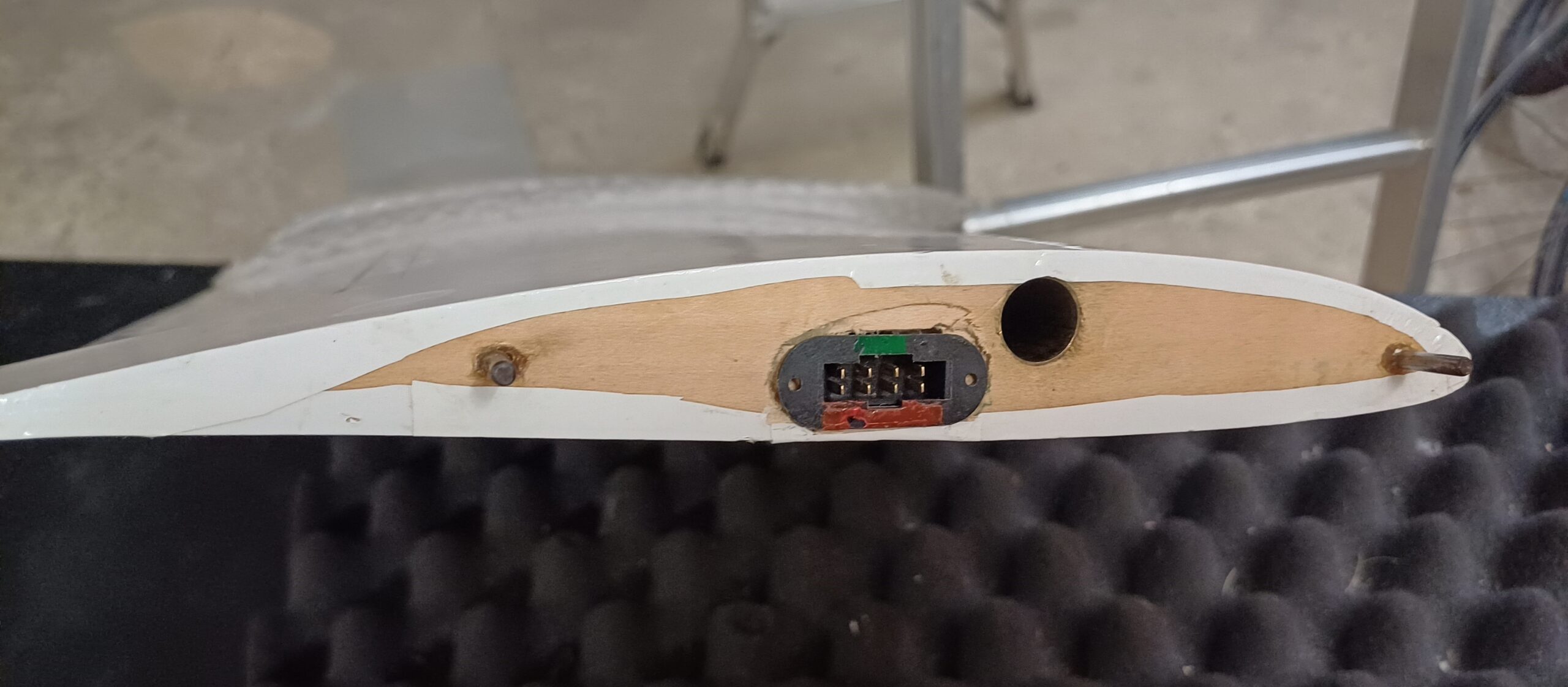

It looked great in the air and floated around well even though there appeared to be no lift.
Following a mid-air collision that wrote-off his E-Flite F-15 Eagle Woody saved all the important and undamaged parts and has now fitted them into an F-18 Super Hornet that he bought from AliExpress. I can’t tell you which one as Woody seems to have bought the last one and it’s no longer listed. It was a bare airframe listed at £29.98 but by the time VAT and delivery had been added it cost around £56, so not quite such a bargain.
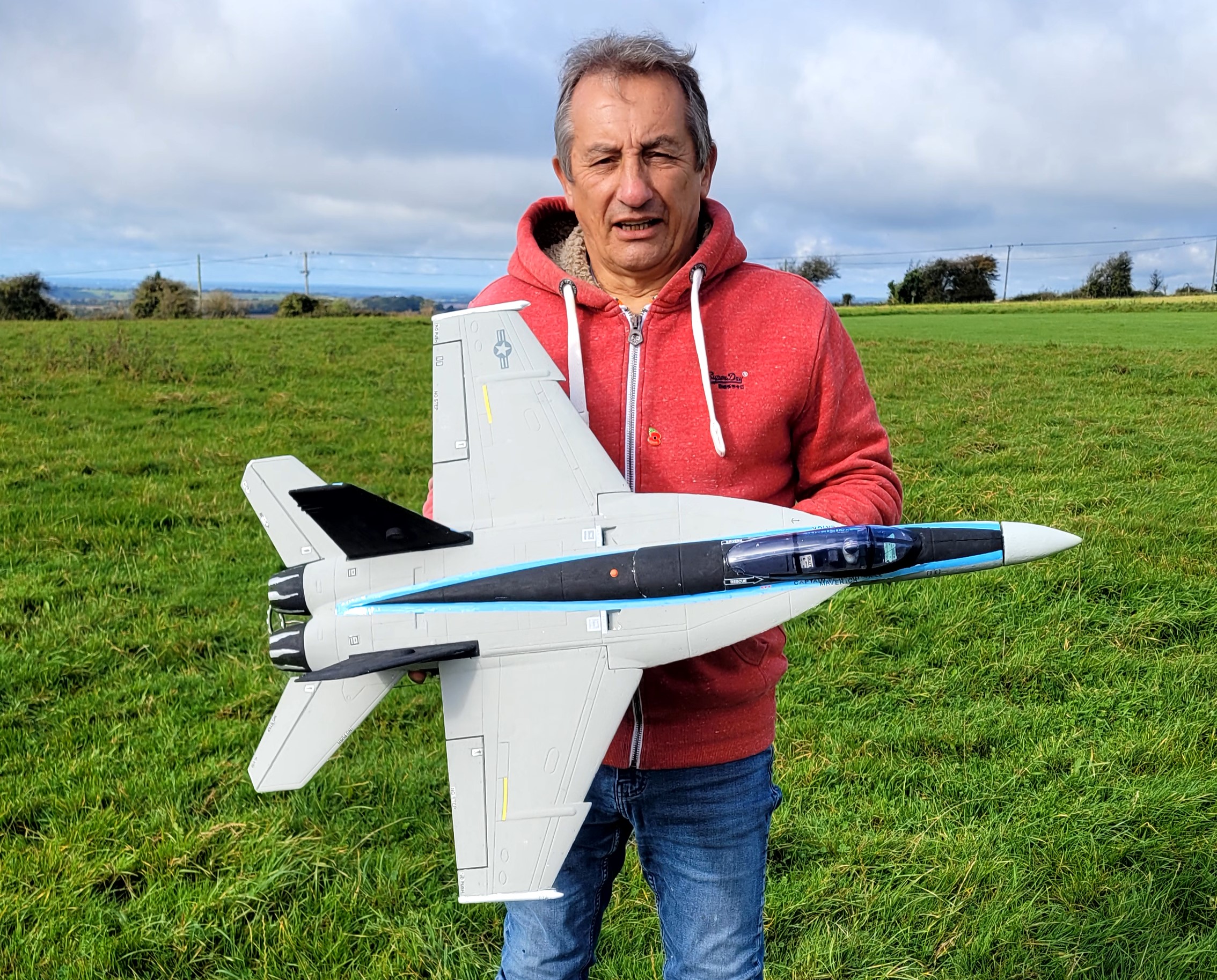
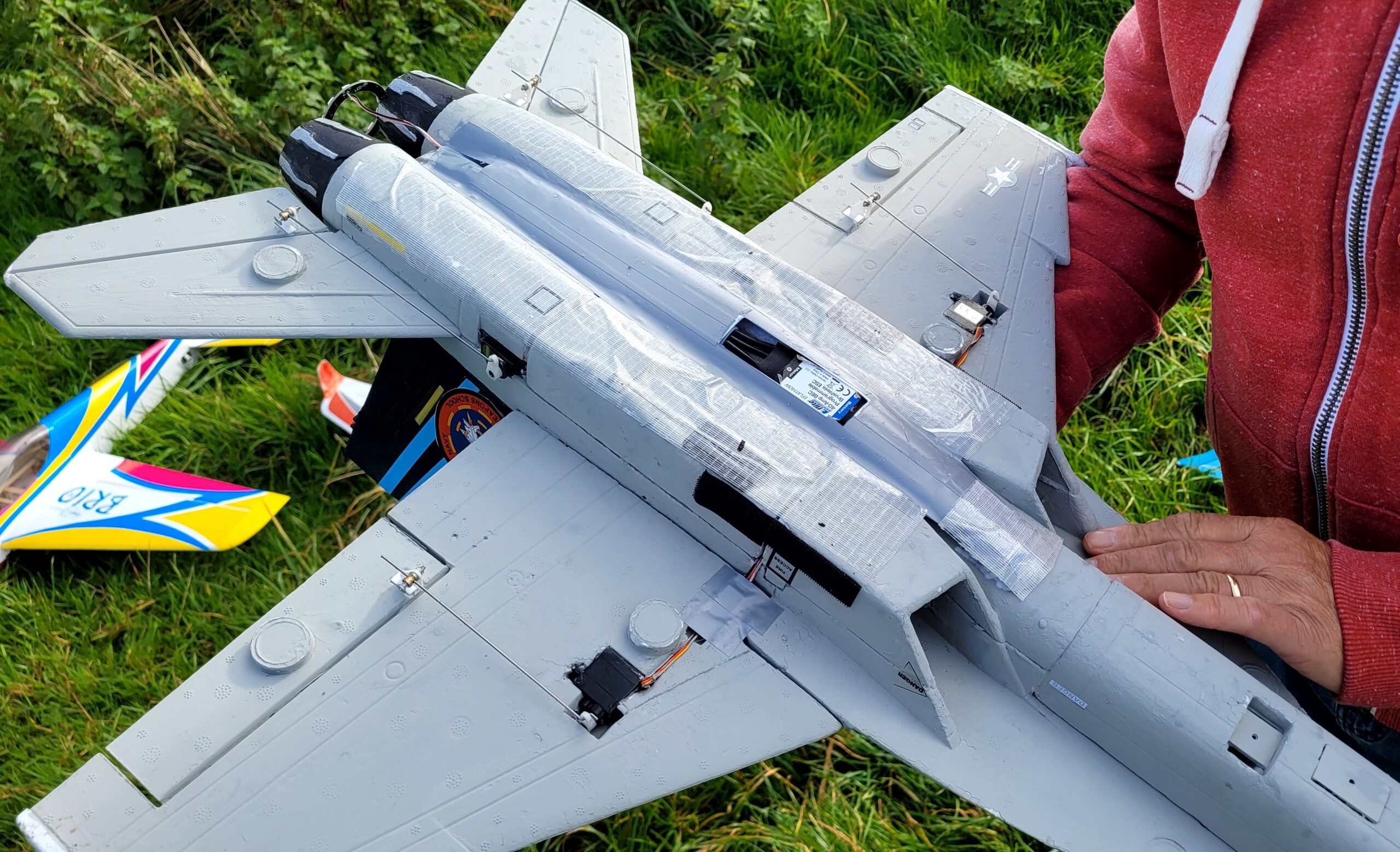 Woody fitted the F-18 with the 64mm fan and motor from the F-15 along with the 40A speed controller and four servos. He finished the Hornet with acrylic paints and of course, as this is Woody I’m talking about, he also added a reheat led light ring at the rear.
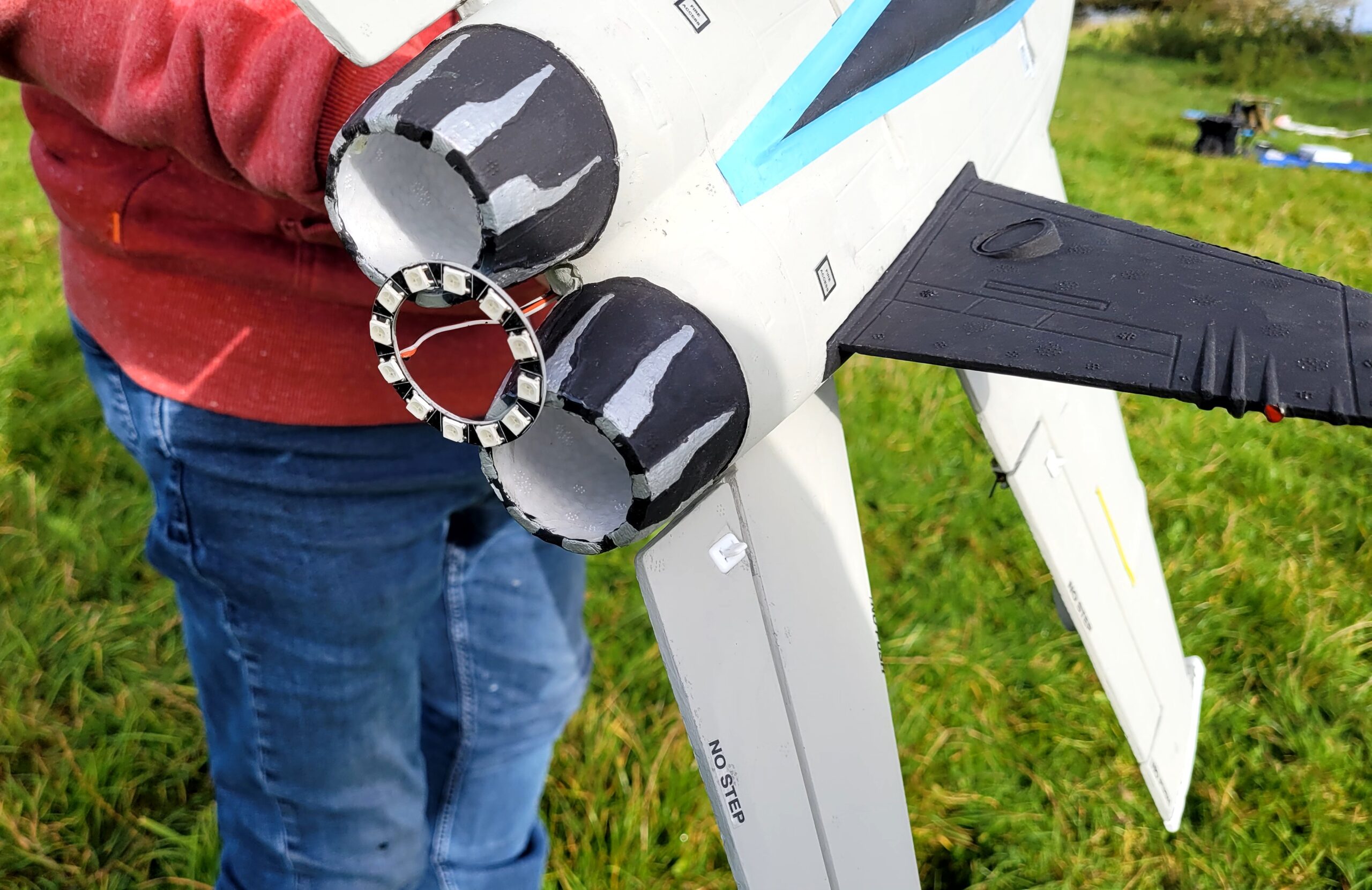 A pair of light rings would have been the more appropriate but he somehow managed to blow one up! The finished model looks smart and being much the same size and weight as the E-flite Eagle it should have enough power, so does it fly? Yes! Woody was unsure of the correct centre of gravity position and the first attempt at flight showed that it was much too far back. So lots of lead was temporarily added to the nose and another attempt made.
 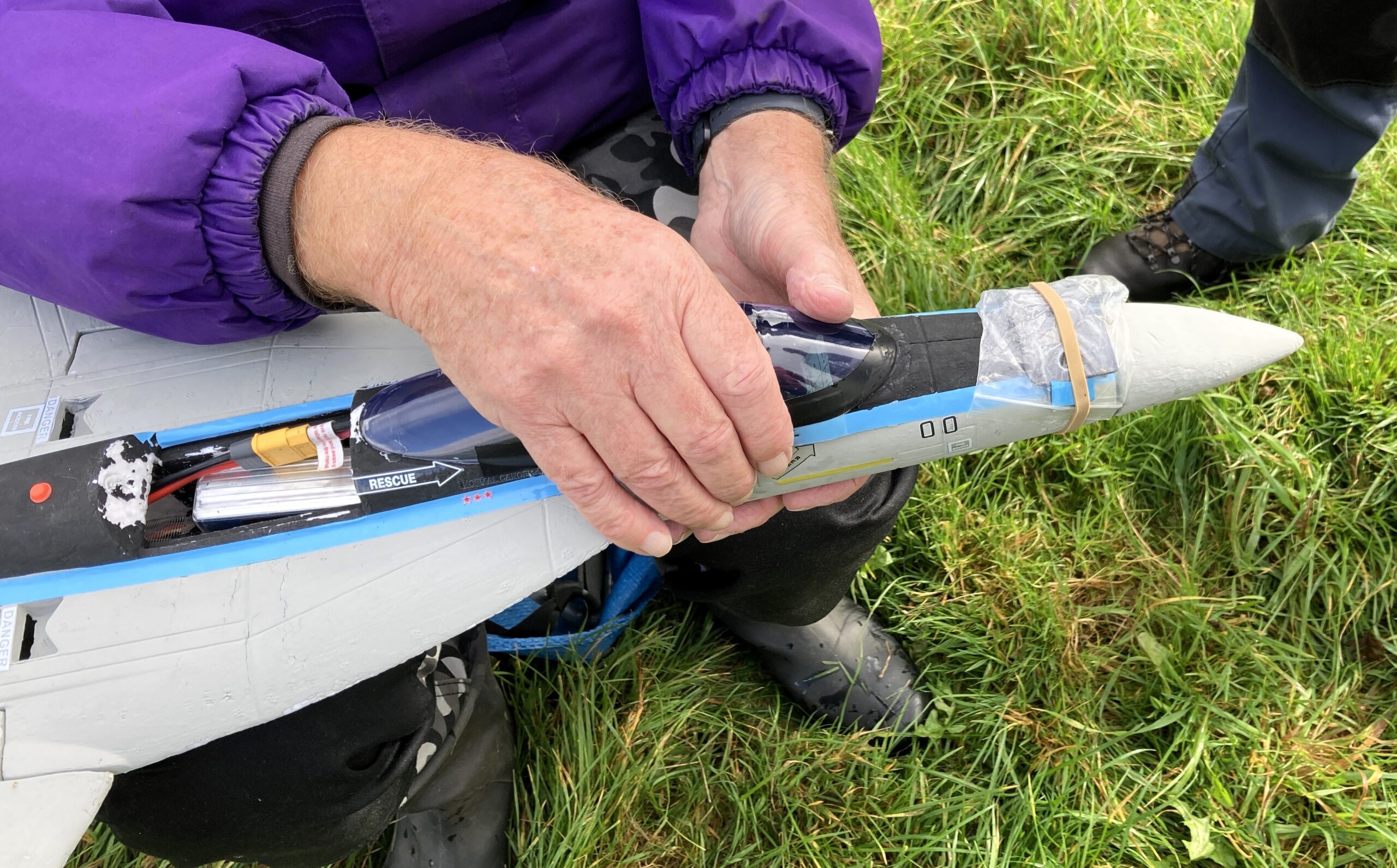 This time the C of G was too far forward and the Eagle wouldn’t climb away from the launch so some of the lead was removed. The next attempt showed the C of G was now correct and it went away from the launch and flew very nicely. Well done Woody, try not to break it! All three attempts and successful flight can be seen in this month’s video.
Young Leo has spent the money Dougal paid him for the Joker (but not on 3 cell 2200mAh batteries apparently!) and has bought a HobbyKing Paramotor V2. Bob the Builder built a few paramotor models several years ago, before the first HobbyKing one was available and had rather limited success with them although it was an interesting trial. But the HobbyKing one seems to be pretty well sorted, particularly the new V2 version.
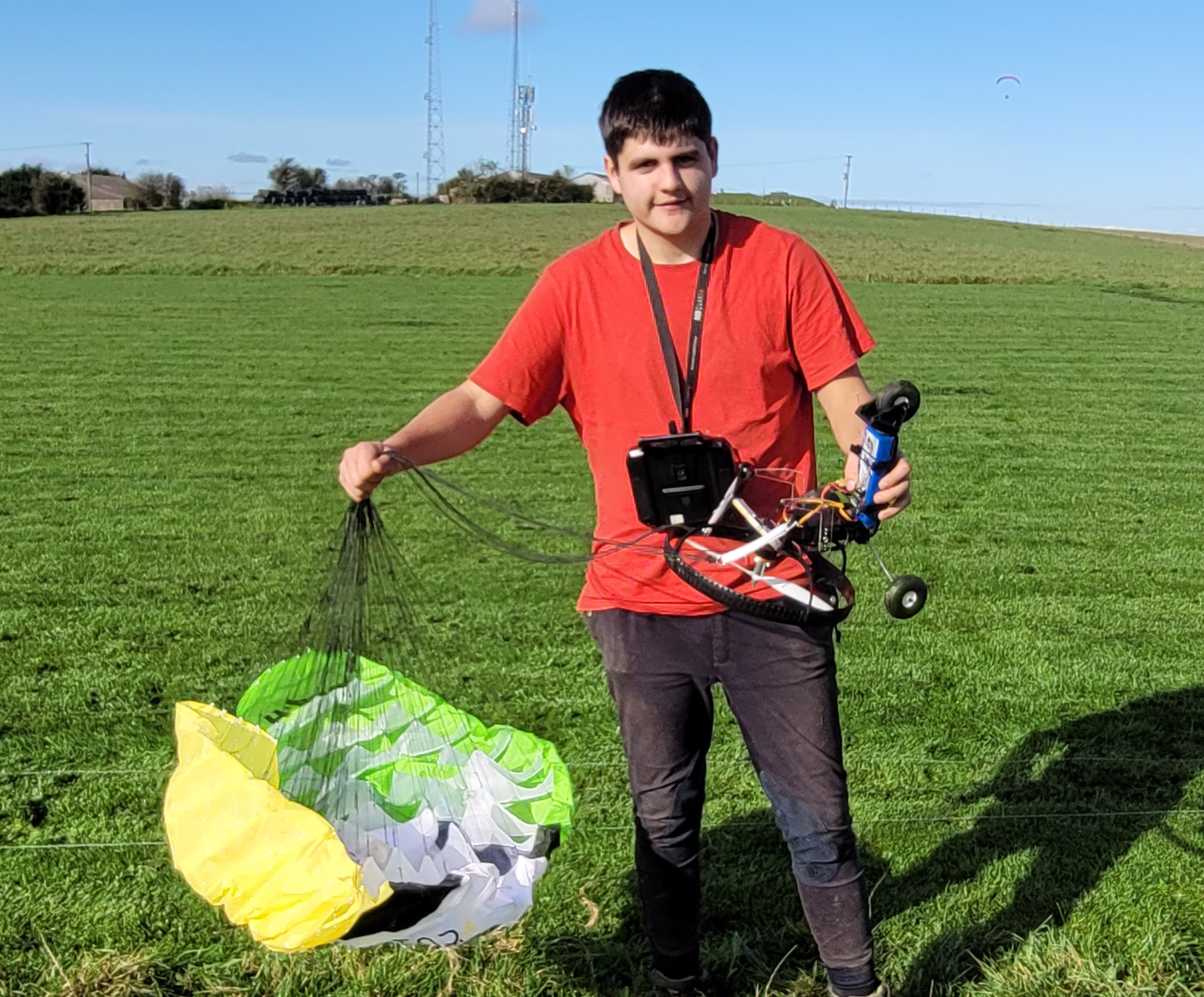 The first couple of attempts at flight didn’t go to plan but after a bit of checking, consulting everyone, and listening to various differing opinions Leo reversed the aileron control and away it went. As it happened there were a couple of full-size paramotors flying as well and I managed to snap some photos that included a full-size one as well as Leo’s.
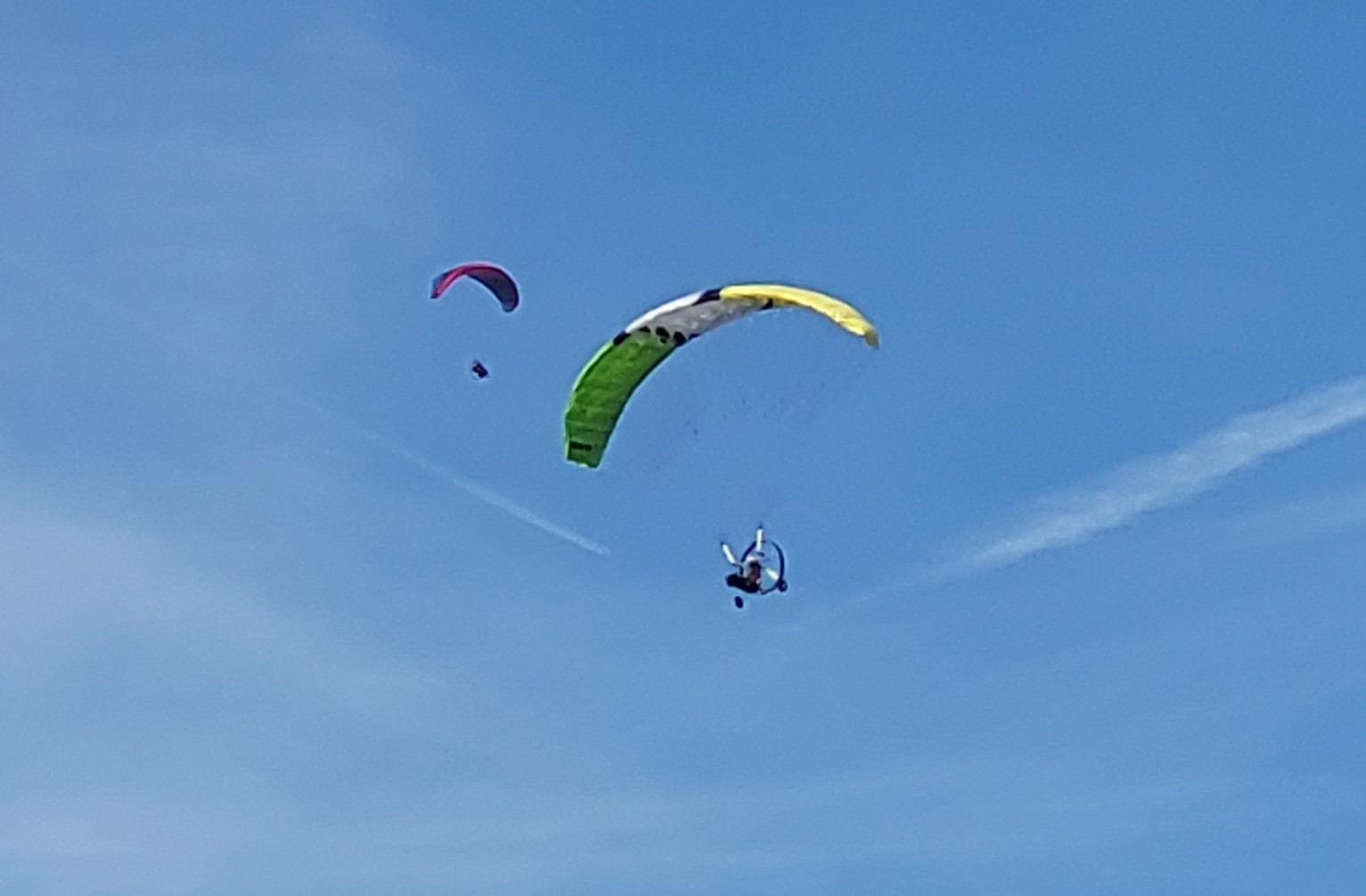
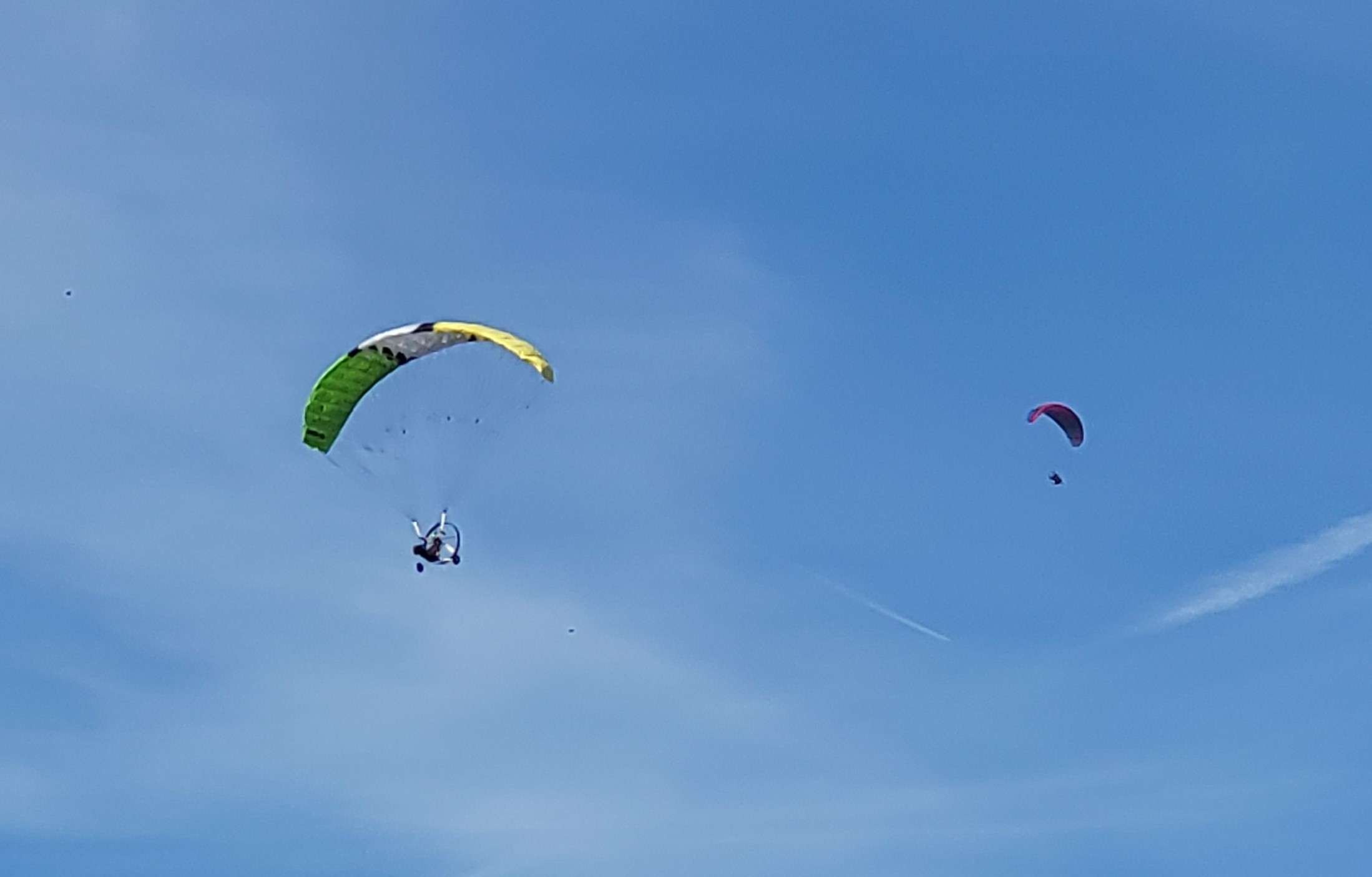 The shots were taken with a high zoom setting and the at no point did the model get remotely close to the full-sized one. Leo didn’t seem to have any problems with the Paramotor and had a long flight followed by a perfect landing back on the patch.
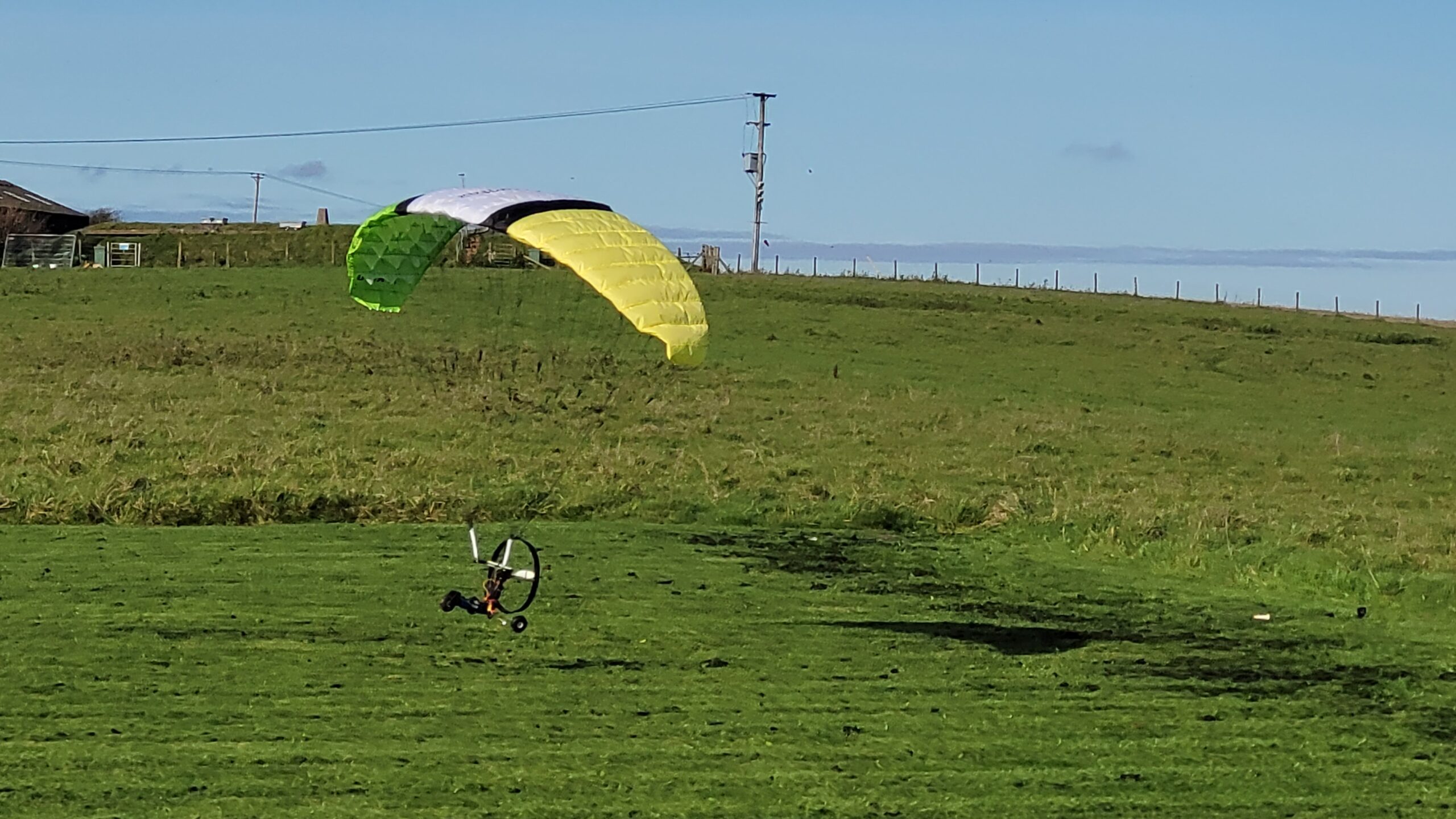 This is from the HobbyKing website: Following on from the incredible success of the first H-King Paramotor comes this V2. The V2 still retains many of the characteristics of the original version, including the ability to perform loops and rolls with ease after a little practice. The large area high performance 2400mm parafoil wing opens quickly for easy launching and due to its design it will retain its shape even in severe turbulence. The single-skin durable wing is made from 100% ripstop fabric and the new, stronger nylon chords are rigged and ready to attach to the durable aluminium gondola. Just like the original version, there is a high level of prefabrication so assembly time is kept to a minimum, and as it is supplied in a Plug-N-Fly format all you will require to get flying is your transmitter, receiver, LiPo battery, and charger. The Paramotor V2 is fitted with a powerful 3530-1400KV brushless motor swinging a 10×4.7 propellor, has a 50A electronic speed controller with 5A BEC, and 2 powerful 15kg high torque metal geared servos. A 3S LiPo battery is recommended and it can vary in capacity to suit different flying conditions. The recommended flying weight is 1.6~2.0kg, in light wind conditions it is best to put a lighter battery in to keep near the 1.6kg weight. In windy conditions, it is better to put a heavier battery in to fly around the 2kg mark. Ultra-long flights of 20~45mins can be achieved depending on the size of the battery used.
It will be interesting to see how the Paramotor performs in stronger winds but in the light winds when Leo flew it there didn’t appear to be any problems at all. MacFly recorded a lot of the first three flights and you can see some of it in this month’s video.
Watching Leo fly his new Paramotor inspired Bob the Builder to dig out a powered hang glider that he hadn’t flown for several years. Bob has changed his transmitter since the last flight with it so everything needed setting up again but after one false start followed by a couple of adjustments the model flew surprisingly well in the light wind of the day.
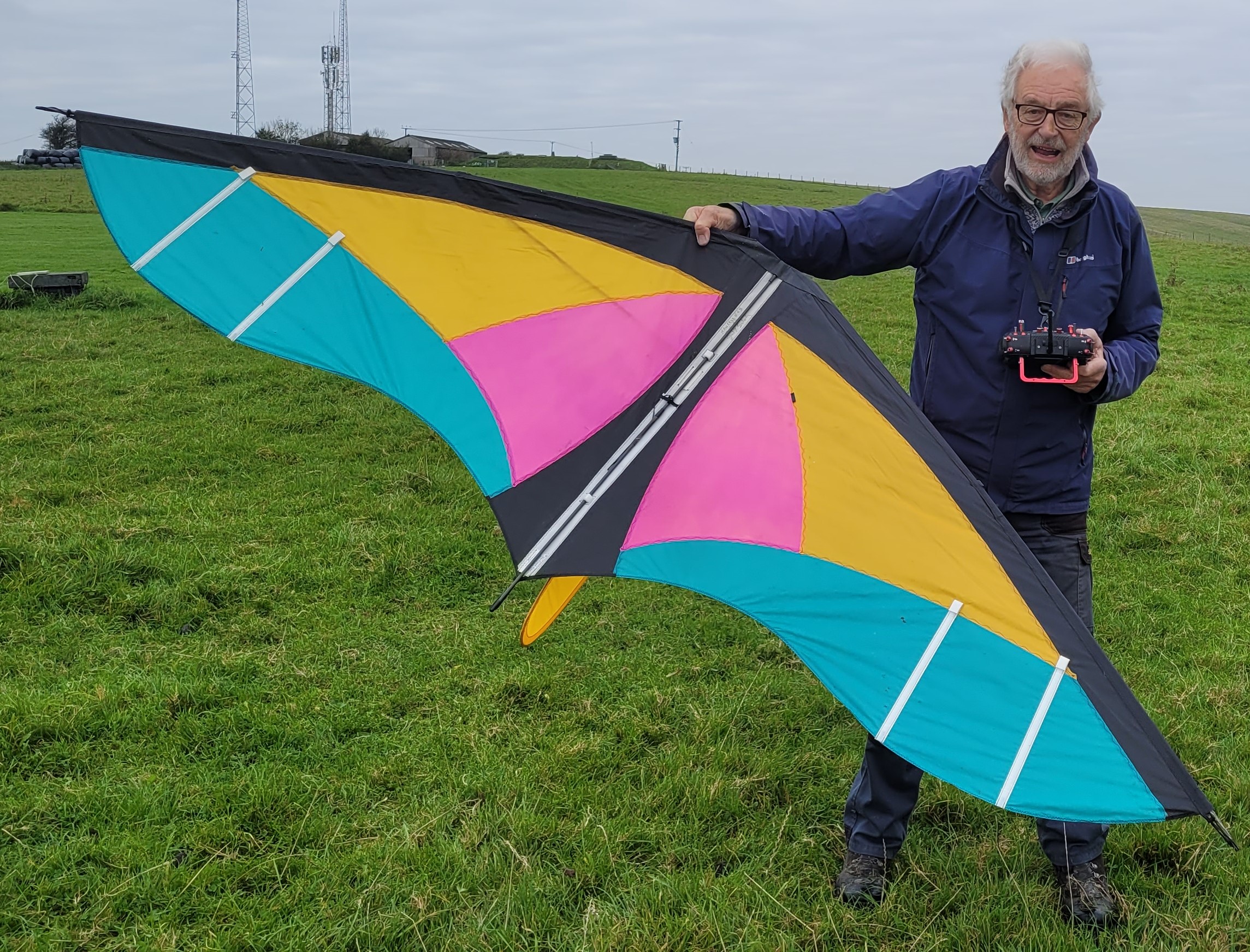
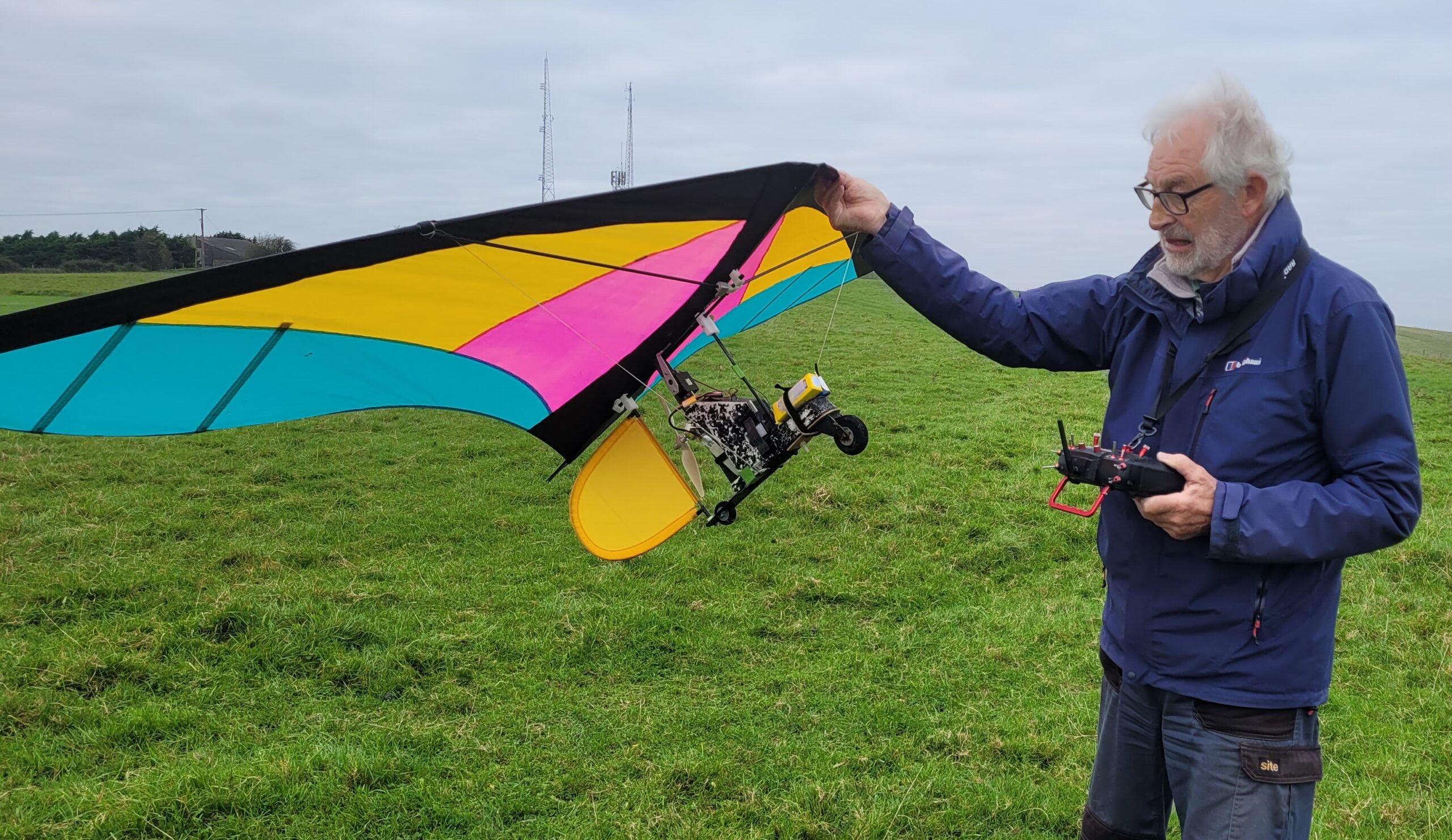 MacFly took some video for us but as it was on 30th October it was too late to be include in this month’s video but it will be something to look forward to next month!
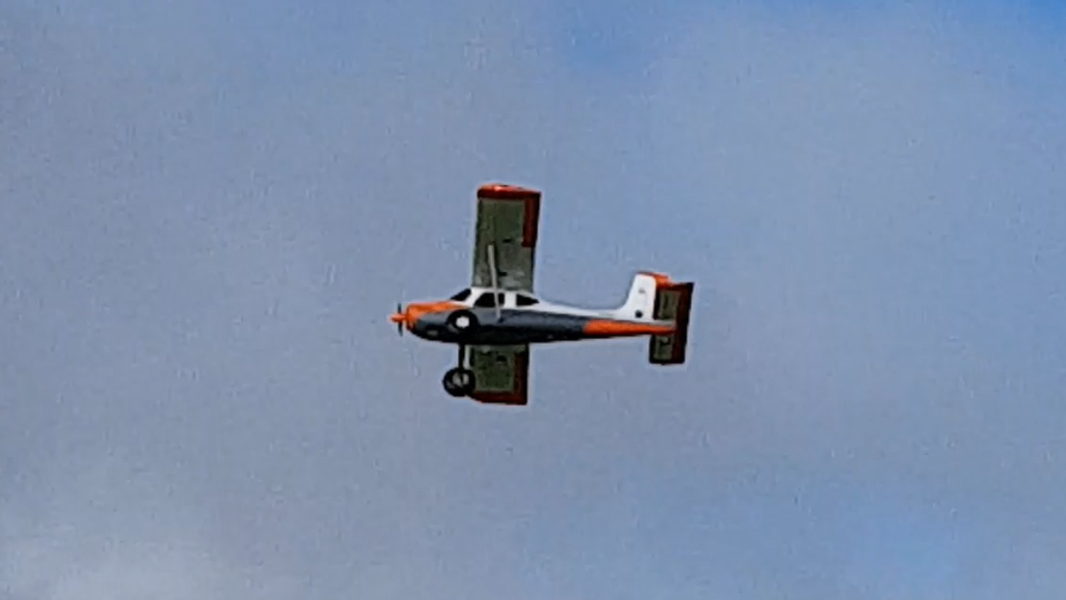
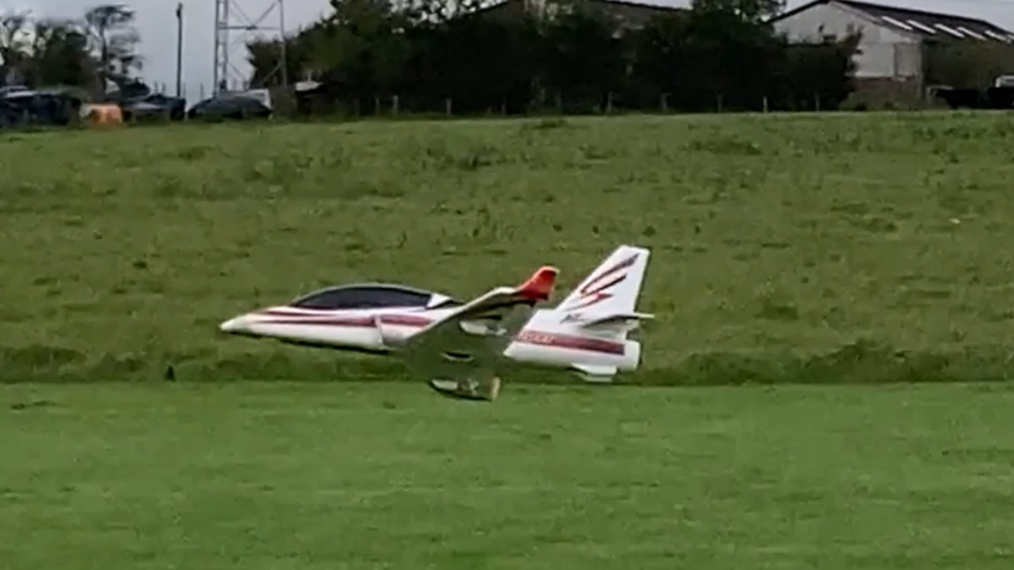
This month the ‘action shots’ are all taken from the video so not the best quality I’m afraid: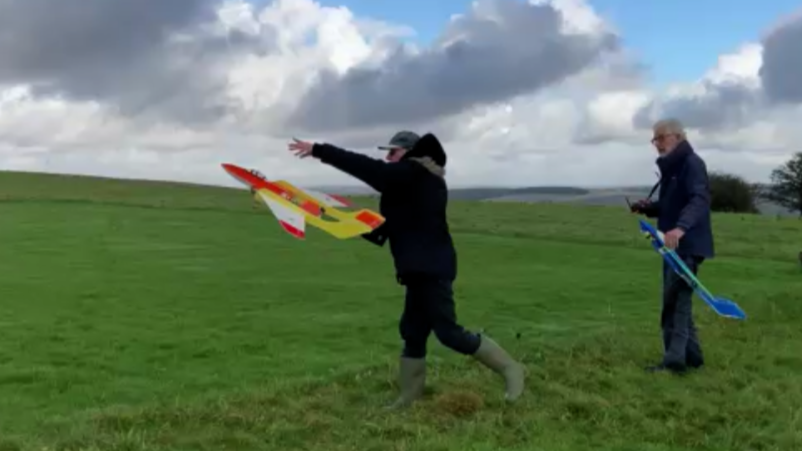

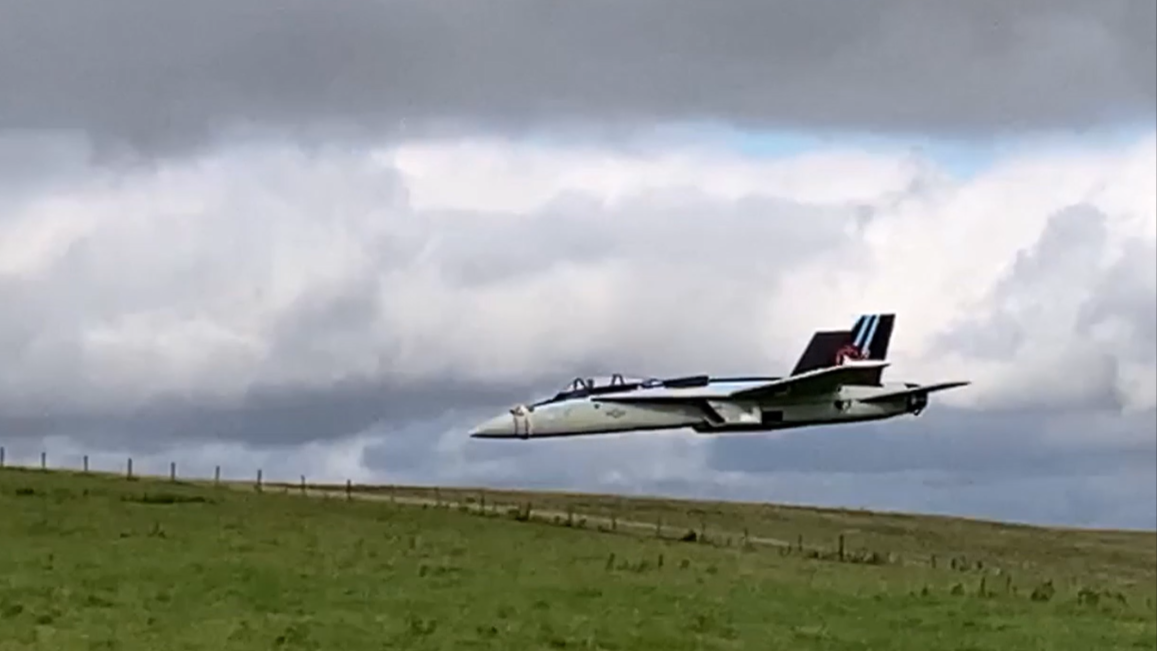
Video time now, this month with footage taken by myself and MacFly. Please watch the video full-screen, it’s so much better with small models flying around:
If the video won’t play for you please click HERE
Marry someone who says things like:
I’m proud of you…
You can do it darling…
I can’t believe you’re mine…
I don’t know where that extra aeroplane came from but it looks amazing alongside all the others and I think we’re going to need a bigger hangar.
Colin Cowplain