
Patch News – January 2019
The club has had a busy start to the year with lots of flying at the patch and several new models being flown. Obviously January brings some challenging weather but overall it hasn’t been too bad, mostly fairly mild although some days were very cold, especially if the low temperatures were combined with strong winds. As I write this on the last Sunday morning of the month I’m not flying because the Hampshire Astronomical Group live weather station (which you can see by clicking HERE) is showing a 10 minute average wind speed of 29mph and a high of 47mph!
 But we’re a hardy lot (well some of us are anyway) and we’ve managed to fly regularly.
As we were returning to the cars after one flying session I noticed a very unusual weather feature, a bank of cloud with an almost dead straight edge that ran from horizon to horizon. I think 1066 said it’s called a Step cloud. The photo doesn’t really do it justice but you can get the idea, it was certainly very dramatic.
We were pleased to welcome a new member, Ian, to the club in January. Ian’s surname is Venn and for obvious reasons he was immediately given the nickname Iven, so if you’re wondering why it’s not spelt Ivan, that’s your answer. Iven visited the field, asked lots of questions about what to buy and from where, and then went to SMC and bought an E-Flite Apprentice fitted with Spektrum radio…hmm. But the Apprentice is a great trainer and it comes with SAFE Technology (Sensor Assisted Flight Envelope) which in theory makes it almost impossible to crash.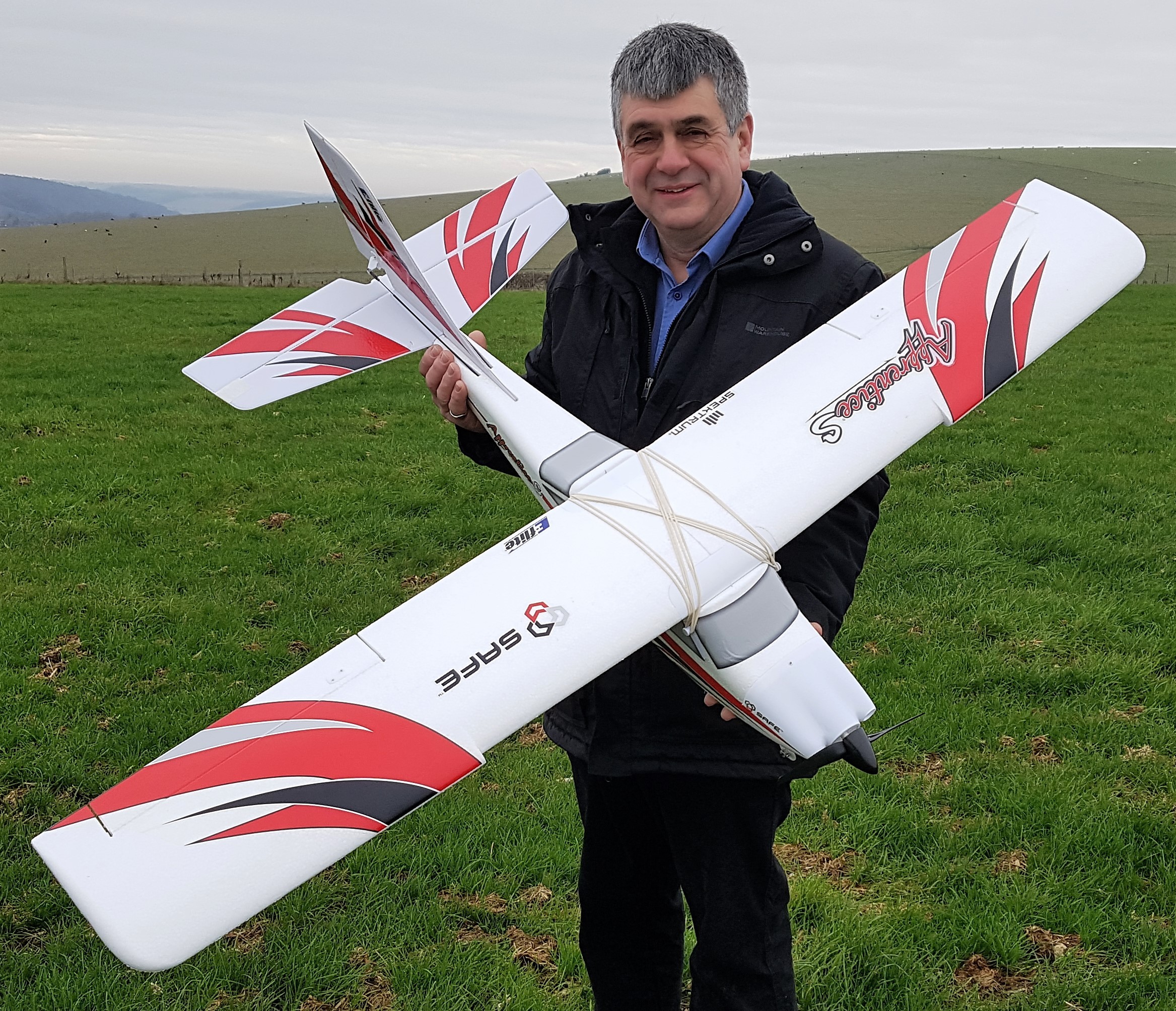 The package includes a 5 channel Spektrum DXe transmitter but that’s a very basic transmitter so Iven also bought a Spektrum DX6e for a bit of future proofing and bound that to the Apprentice instead of using the DXe.
 There is some setting up to do on the transmitter to get the SAFE Tech working correctly but Iven thought he’d sorted it ok when he brought it along to test fly. I gave the 1.5M span Apprentice a quick check over, discussed the various SAFE modes, switched to Expert mode, and all seemed fine so I took it up. Almost immediately it was clear that the SAFE Tech was not performing as it should and was fighting against me as I tried to fly a circuit. I didn’t feel as if I was in total control so I landed. You can see that brief flight in this month’s video. We played around with the different modes and tried again a couple of times but it just wasn’t working correctly so Dougal Entendre and Captain Slow gave Iven a go on their Hummers, hardly ideal trainers! I contacted Kryten as he had learnt to fly with exactly the same model and radio gear and he confirmed that getting the DX6e to work with the SAFE Tech was a bit of a struggle but sent me some web links and YouTube videos to look at. I passed the info on to Iven who had another go at it and returned to the field the next week confident that it was now correct. I flew it again in Expert mode but with much the same results so I switched to Beginner mode and then it seemed to be working better.
 At last Iven was able to have a go at flying and he managed a couple of circuits before it became clear the SAFE Tech still wasn’t right so I landed the Apprentice again. By now I was being to think it was me so I got Dougal to fly it but he also quickly found the SAFE Tech wasn’t right and landed. I believe Iven is now going to remove the SAFE receiver and use the ‘normal’ one that came with the DX6e transmitter so we can just teach him in the usual manner. It’s a great shame as Kryten’s set up worked perfectly from day one and he learned to fly very quickly with very little assistance from others. In the meantime Dougal has set Iven up with a flight simulator so in a couple of weeks he won’t need any help at all anyway…possibly…
If you read Patch News last month you’ll know I was fortunate enough to receive an Avios Bush Mule for Christmas. Once Christmas and New Year were out of the way I moved my models out of my storeroom and it became a model room once more so I was able to assemble the Bush Mule. There really is very little involved in putting it together, just a case of joining and bolting on the wings and wing struts, fitting the undercarriage, and bolting on the tailplane/fin assembly. I also epoxied the tailplane/fin assembly in place, the bolts didn’t seem too firm to me.
 So far so good, but it took me quite a while to connect it all up and program the radio. Both speed controllers and motors come ready fitted and wired up but they each require a radio channel of their own and I wanted to mix them with rudder to give differential thrust when using the rudder. There are also flaps which I programmed using flight phases so I have Phase 1: Flaps up for normal flight Phase 2: Half flap for take-off, Phase 3: Full flap for landing.
 Add to this the cargo door, steerable nose wheel, and lights as well as two aileron channels and elevator and there’s quite a lot of wiring and setting up to sort out. The speed controllers are also able to switch the motors into reverse, useful if you fit the floats and fly from water, but I didn’t have any spare channels left so I can’t use reverse thrust.

 I am also using telemetry, so I fitted a Multiplex 150A current sensor which displays live current draw, max current draw, receiver voltage, the lipo voltage, the strength of the signal that the transmitter is getting back from the receiver, and, most importantly, the milliamp hours remaining in the lipo. All the values can be displayed on the transmitter screen and spoken as well but of course that’s far too much information to take in during the flight so I just have mine set to speak the milliamp hours left when I flick a switch. So it’s like a fuel gauge i.e. it will say “One thousand three hundred and eighty one milliamp hours”. It also speaks the throttle open time when I switch it.
 The first flight was fine, almost no trimming required, and the only problem I found was that the rock solid EPP foam wheels make the landings very bouncy. I’ve since changed the main wheels to softer foam rubber Tundra wheels which has helped a lot but I’ve also found it’s better to land with half flap and a little more speed rather than use full flap. I ordered some parachutes to drop but they didn’t come in time for the first flight so I made up some very small gliders and some toffees with streamers to drop. The gliders were rubbish as were the toffees but the parachutes duly arrived and they’ve proved to be excellent. I now have six parachutes and they’ve been providing lots of entertainment and exercise for everyone who isn’t flying! You can see a parachute drop in this month’s video.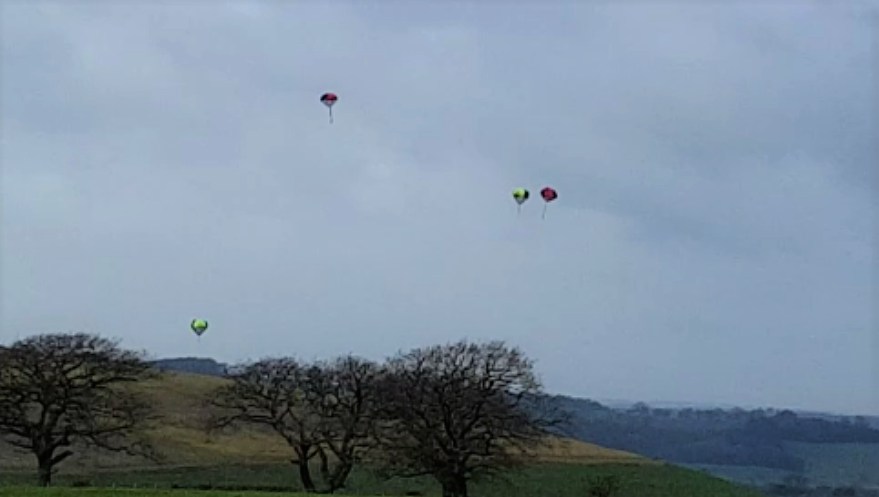
 I did manage to provide some extra entertainment on one flight. I took off as usual, raised the flaps during the climb out and suddenly both motors cut dead. I kept heading straight into wind and landed a few hundred metres down the field. As I walked to retrieve the model I tried to work out why the motors had stopped, I knew the lipo was charged. Then, as I reached the Bush Mule I saw the flaps were down and it dawned on me, instead of raising the flaps I’d pressed the throttle cut button…doh! Needless to say the other fliers present were surprised when I carried the model straight back to the patch and immediately took off again. I was forced to explain my stupidity and of course once they’d stopped laughing they barely mentioned it for next two hours…over and over again!
Speaking of pillocks, 1066 had a couple of ‘moments’ in January and I know he’d be disappointed if I didn’t tell you about them. The first one was when he launched his little Blitz delta and it immediately rolled straight into the deck. He looked down at the transmitter and we all saw the light bulb moment when he realised he’d switched the model to Blaze not Blitz! Never mind Steve, the first two letters were right… His second moment was a couple of weeks later, I saw him drive down the track but a few minutes later he drove back up it again. About half an hour later he returned, clutching the wings that he’d left on the bench!
I photographed Captain Slow’s part built Zagi at the beginning of November last year and featured it in Patch News where I mentioned that SMC say “Buy today, fly tomorrow”. Well this is how it was looking in mid-January.
 Perfection takes time…apparently…
But as the foamboard jet trend continues Captain Slow has finished his Mig-29…blimey, they must be quick to build! He’s fitted his with a Turnigy D2826/6 2200Kv motor and a 6×4 prop. It seems to fly just the same as the others although nobody is sure just how fast it will go as Captain Slow has never reached full throttle!
 As you can see he’s opened up the slot to reduce the prop noise and it seems to prove that the most important gap is the one in front of the prop. Captain Slow is also now building a Sukhoi SU-27…don’t hold your breath…
Gorgeous Gary has also joined the jet jockeys with a Mig-29. He’s using a drone motor, an RCINPOWER G2306 2200Kv, the same motor as I use. They seem good with a 6×4 prop and have plenty of power for the foamies. Gary had a big smile on his face at the end of the first flight … He’s had more flights with the Mig and is coming round to the joys of electric flight at last. And guess what, now he’s got the bug he’s building an SU-27!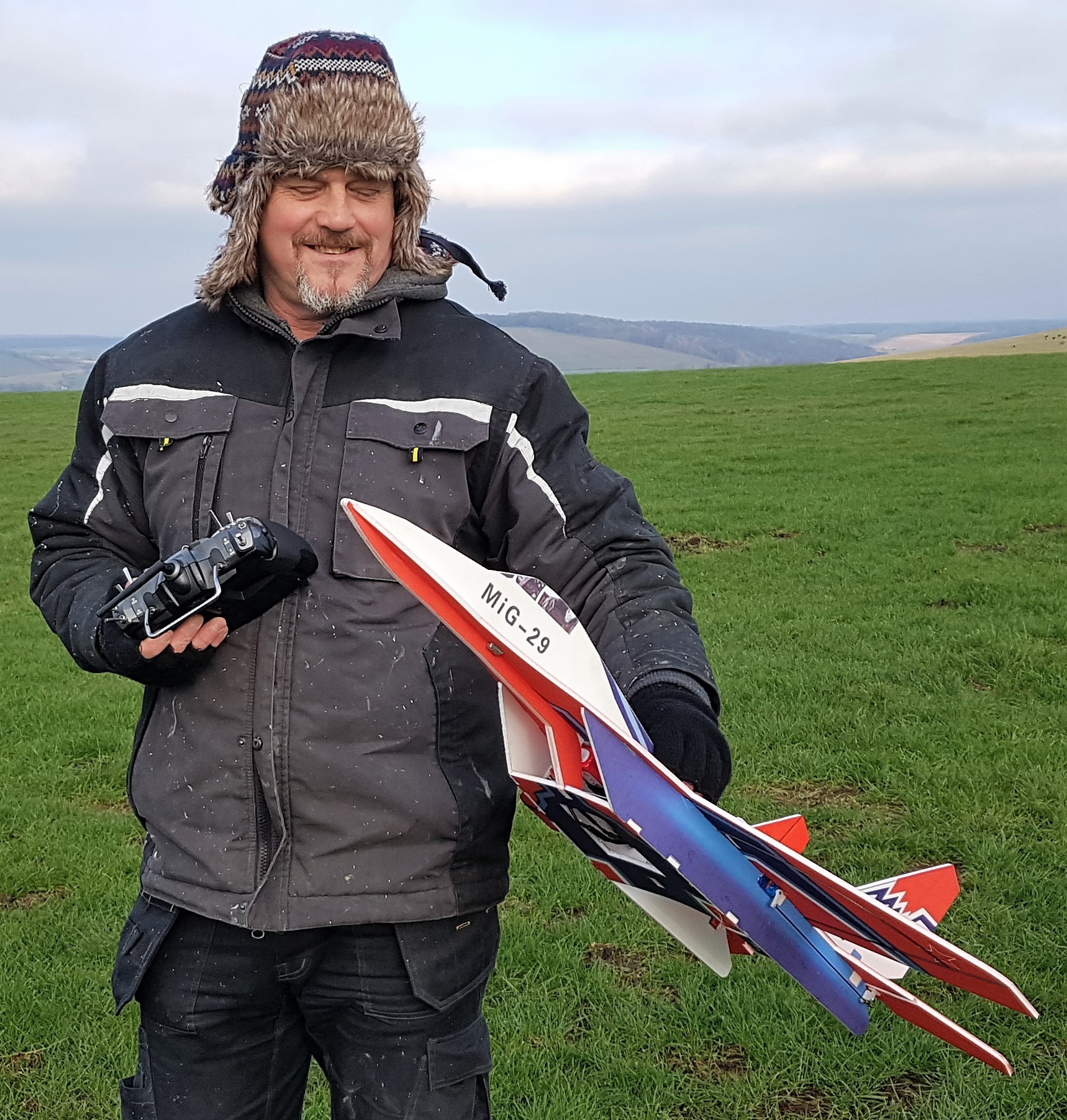
Having enjoyed flying his Mig-29 for a few weeks Woody has now put together a Sukhoi SU-27.
 Being Woody he’s kitted it out with lights and I have to admit it does look impressive in flight, they show up well.
 The Sukhoi is a bit bigger than the Mig and has ailerons as well as elevons which means it’s better for high alpha stuff but not quite as quick flat out. I’ve also retro fitted a rudder to mine which helps with high alpha flying.
Page Boy was given an E-flite Texan for his birthday and very nice it is too. The E-flite models all seem to be good. It’s a 1500mm EPO foam model that comes pretty much complete, just a few screws are required to hold it together, the electronics, servos, linkages etc. are all pre-installed. The Texan comes with electric retracts which have strut covers, hinged doors, and scale wheels, and it has split flaps just like the full-size Texan.
 Page Boy asked me to do the maiden flight and being aware of the Texan/Harvard reputation for tip stalling I was slightly nervous. But the E-flite model is totally viceless, a real pussycat to fly, it took off beautifully, flew around very smoothly, and with the flaps down it just floated in for a gentle landing. You can see it in this month’s video.
Page Boy also sent me some photos of the latest ‘proper’ balsa/ply build that he has underway.
 It’s a Lindsay Todd design called a Woodpecker that has a 70″ wingspan. I thought it was an English Electric Wren, I’m sure that must have been Lindsay’s inspiration. Knowing Page Boy it will soon be finished and flying.
Most of you will know by now that on 10th January we had a Chinook fly directly over the patch at very low level. Fortunately we had just packed up flying and put the fence up when it appeared over the trees by the track we drive down, it flew right over the patch and out over the valley. It was very low, between 50 and 100 feet we reckoned and was going at speed. I quickly snapped a couple of photos but they don’t really show just how low it was.
 Had any models been in the air it’s doubtful the pilots would have had time to take any avoiding action. We are always careful about other airspace users, keep our ears and eyes open, and shout warnings as required but this served as a reminder that we must be extra vigilant. Contact has been made with the relevant authorities to ensure they know when and where we fly but ultimately it’s our responsibility to avoid full-size aircraft at all costs.
A few months ago Norwegian Nick won a Wingnetic in the big raffle and he brought it along to test fly in January. In the usual Norwegian Nick manner he has tarted up the original colour scheme a bit and made it look much smarter than standard. It’s certainly a lot better than my own very old and tatty Wingnetic! Sadly it didn’t quite get away from the launch and incurred some minor damage, but no doubt it will reappear and fly successfully soon. The Wingnetics are great little fliers and several members have enjoyed owning them.
Last month I pictured two models that were being put together by Newbie Nick and Matt. (Incidentally Matt needs a nickname, do you have any ideas?) They are both Pilot-RC Extra 330SCs with 67” wingspan, but Nick’s is a Gen 1 and Matt’s is a Gen 2. The Gen 2 has slightly different reinforcements and some other minor improvements. They were both hoping to fly them last week but Matt discovered some hinge problems with his so only Nick’s flew.
 It has a 400Kv Pilot motor swinging an 18×10 wooden prop, and a 6 cell 5000mAh lipo pack. Nick has fitted Savox 0252MG servos, and a Futaba R7008SB FASSTest receiver which is powered by a 6.6v life battery.
 Matt did the test flight which you can see in this month’s video. It flew really nicely and had plenty of power but the centre of gravity was slightly rearward and Matt wanted to make some slight adjustments to the throws and expo so he landed with plenty of battery capacity for another flight. Nick moved the lipo forward and made the adjustments on the transmitter and then Matt went to take-off again. But there was no power, the prop didn’t turn at all!
 After much fiddling, investigation, and helpful(?) comments from everyone present Nick gave up and flew his F-35 to cheer himself up! Back on the workbench he discovered the HobbyWing Platinum 100A Pro V3 speed controller was dead. Nick has sent it back and has just received a Castle Creations Edge Lite 100A to replace it.
Our patch is in a beautiful spot with lovely scenery all round, particularly to the south where views over the Solent and on to the Isle of Wight can be enjoyed. Late one Friday afternoon I noticed a glorious sunset starting to form and thought what a lovely photo it would make for Patch News. There’s always someone to pee on your parade…
Time now for this month’s video, most of which was filmed by Captain ‘Heavy Breather’ Slow:Please watch the video full screen, it’s so much better with small models flying around. If the video won’t play for you click HERE
This month’s Finishing Funny comes from Dougal Entendre:
The flight attendant sees a suspicious looking couple on board, so she reports it to the Captain immediately.
“Sir, I think we have a case of human trafficking! There is a very pretty, hot and sexy female passenger on board who looks quite frightened, and the man she is with is a fat old slob who looks like a lecher, very sullen, mean and dangerous!”
The Captain responds, “Patricia, I’ve told you this before. This is Air Force One…”
Colin Cowplain
Patch News – December 2018
Happy New Year everybody! Hope you all had a fantastic Christmas and saw the New Year in sensibly(ish). I know some of you had office Christmas parties in December, I trust none of you got yourselves slightly inebriated… December saw the expected mixture of weather and we lost some days because of strong winds and heavy rain but many of us managed to fly on some of the better days. In particular, over the Christmas/New Year break the weather was very kind to us, light winds, dry, and not too cold. We’ve had the shortest day and already it stays light a little later each evening, it will soon be spring. One Sunday morning early in December it was very windy, much too windy for sensible flying, but four of the committee turned up ‘just in case’. The fence battery needed changing so we sorted that, and then 1066 decided it was a good mowing day, too windy for flying but nice and dry.
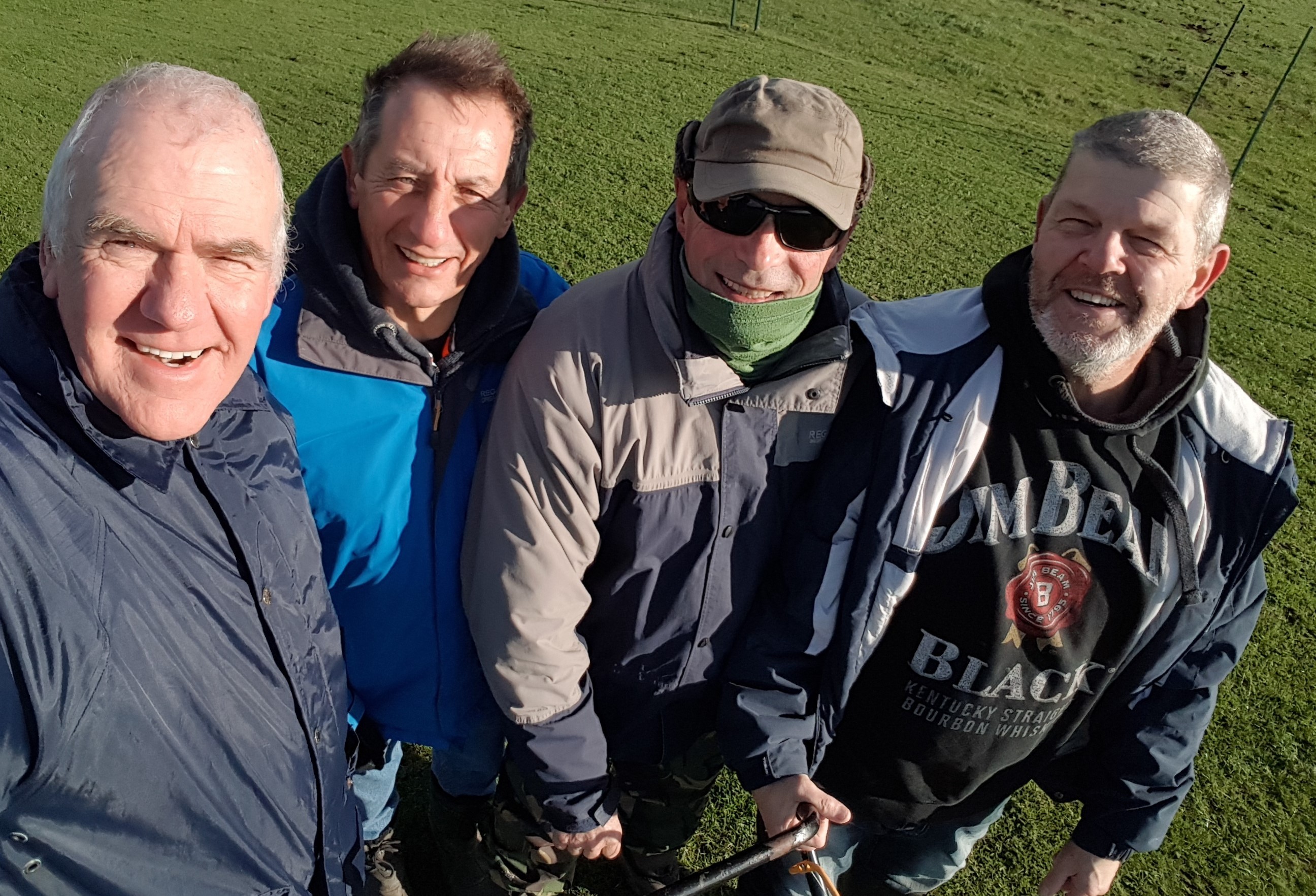 So the fab four spent a happy morning mowing and moaning, moaning about the lack of Dougal Entendre who was apparently nursing a hangover following his office party. Very little sympathy was shown!
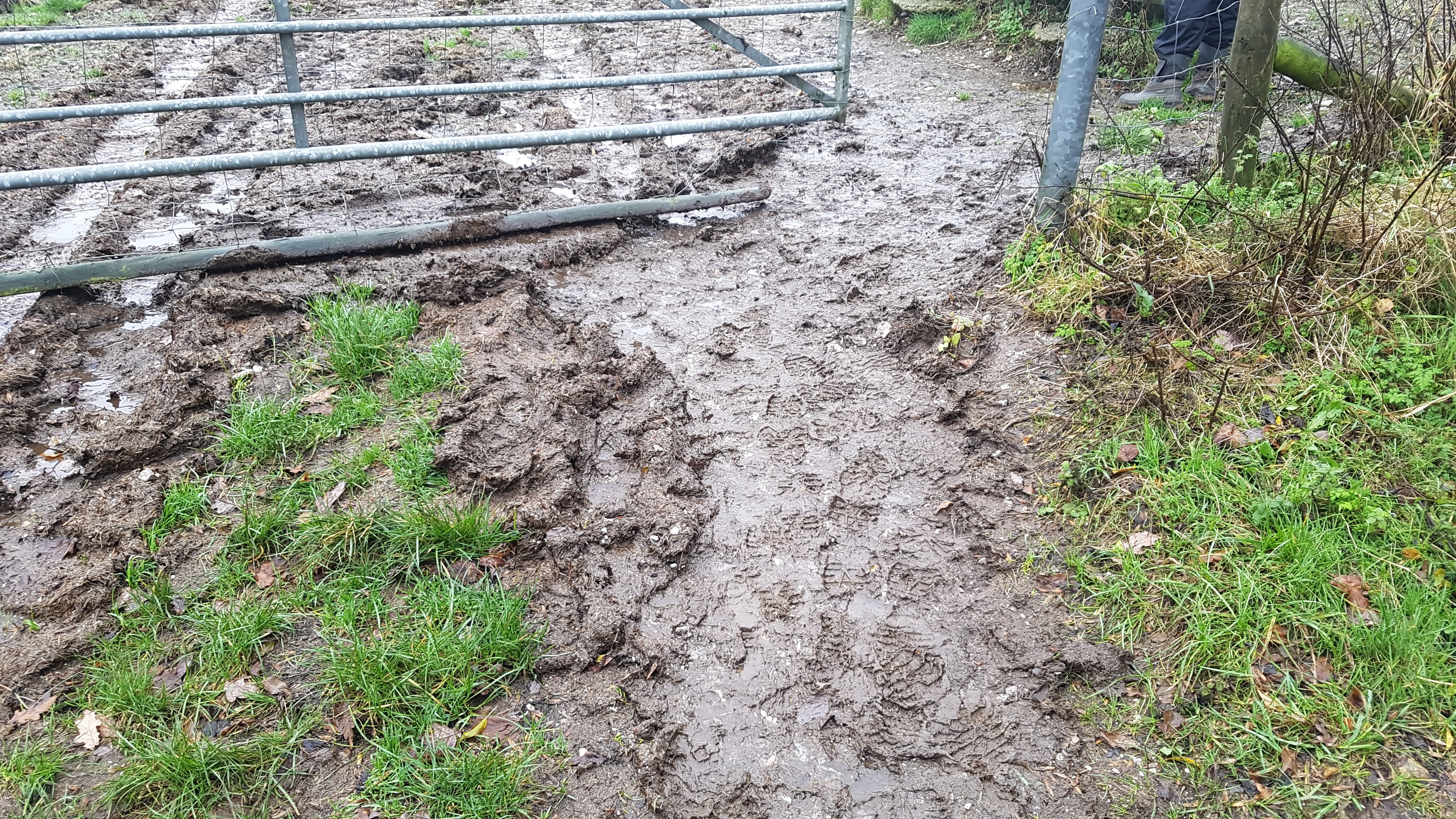 Someone even cleared a bit of a path at one side of the gate through the really muddy area to make access a little easier for us, I’ll let you work out who to thank for Woody’s Way!
Did you get any modelling presents from Santa? Some of you must have found some exciting parcels under the tree…they can’t all have been socks and underpants. Me? Well I did have a visit from a couple of Christmas Elves. Because I behaved myself Mrs Santa gave me permission to treat myself to an Avios Bush Mule from the HobbyKing pre-Christmas sale. Although I had a sneaky peek before Christmas I wasn’t allowed to start putting it together.
 I couldn’t have done anything to it even if I wanted to because with the usual Christmas paraphernalia everywhere and visitors stopping overnight all my planes and equipment had to be crammed back into my modelling room.
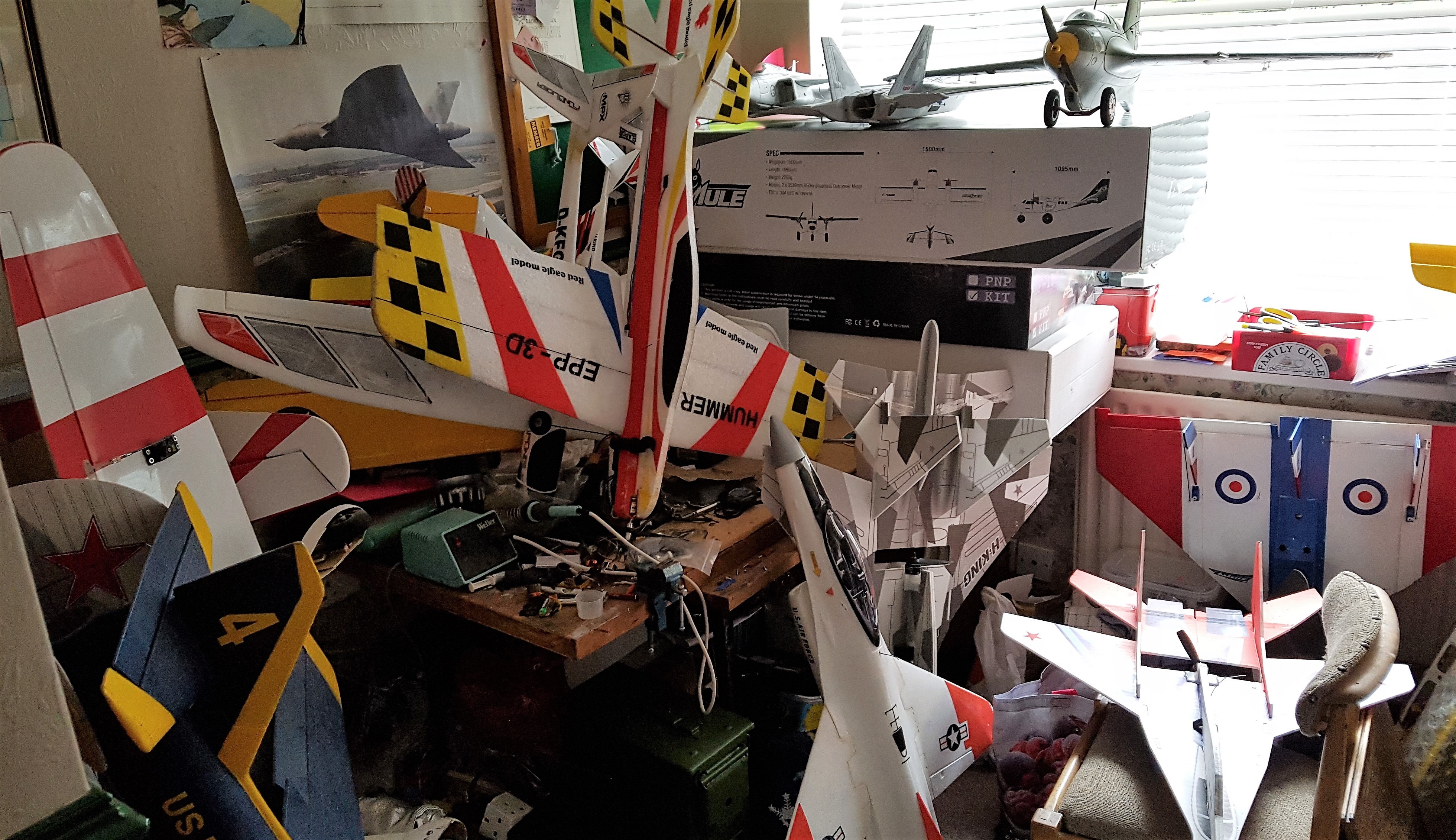 No chance of even opening the box in there let alone putting it together, but now Christmas is over it will be built.
I also received a voucher for two flights with iFly Indoor Skydiving at Basingstoke. For those that don’t know, indoor skydiving is done in a sort of vertical glass wind tunnel that blows air upwards at up to 180mph and the ‘skydiver’ can (hopefully) float around freely. I’ll let you know how it goes, I’m sure I’ll look just as good as this when I do it! Santa also brought me a tricky seaplane kit which I spent a few happy hours putting together on Christmas Day.
The foamboard fun-jet following continues to grow with myself, Woody, and now Bob the Builder flying the Mig-29s.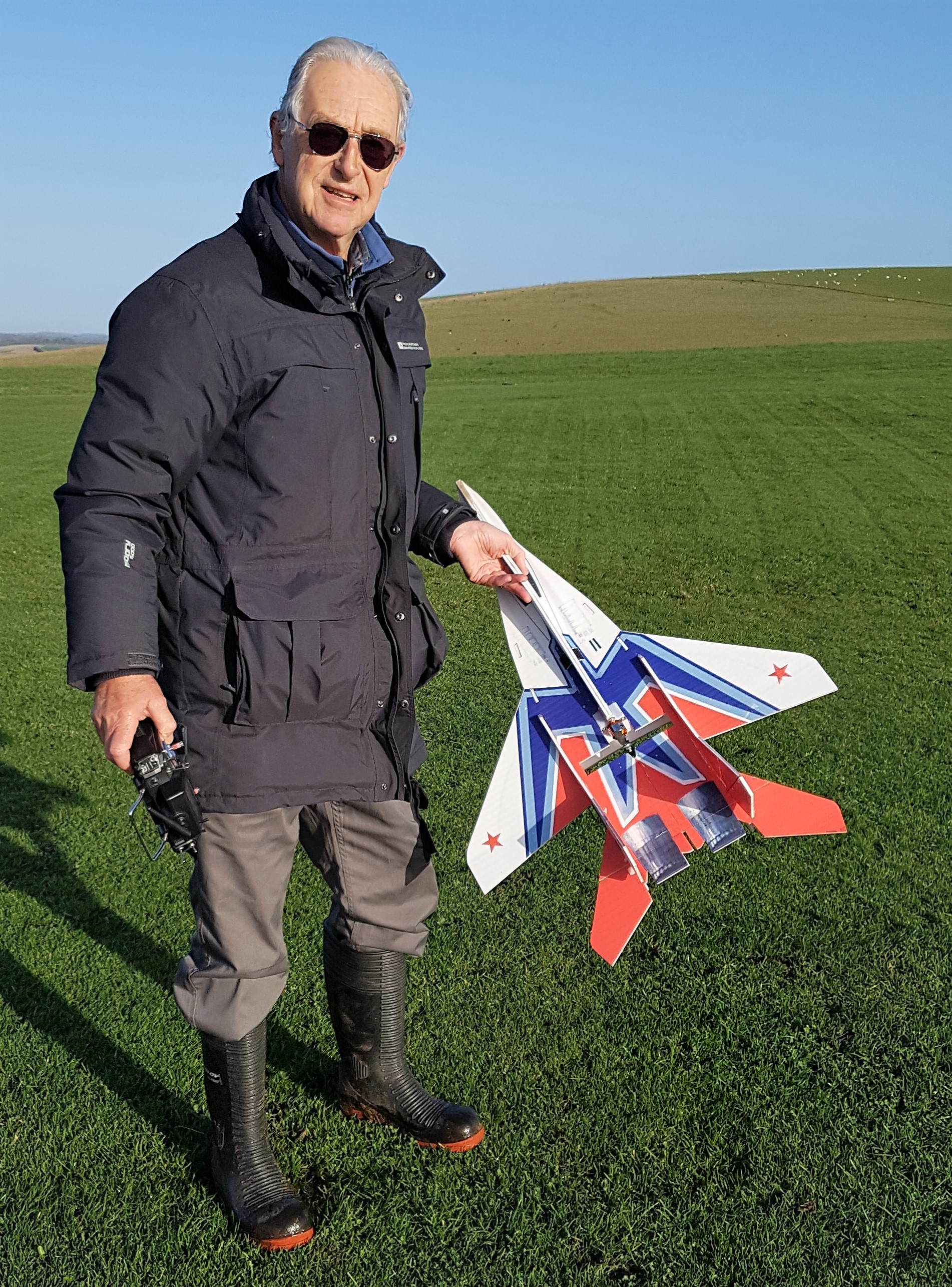
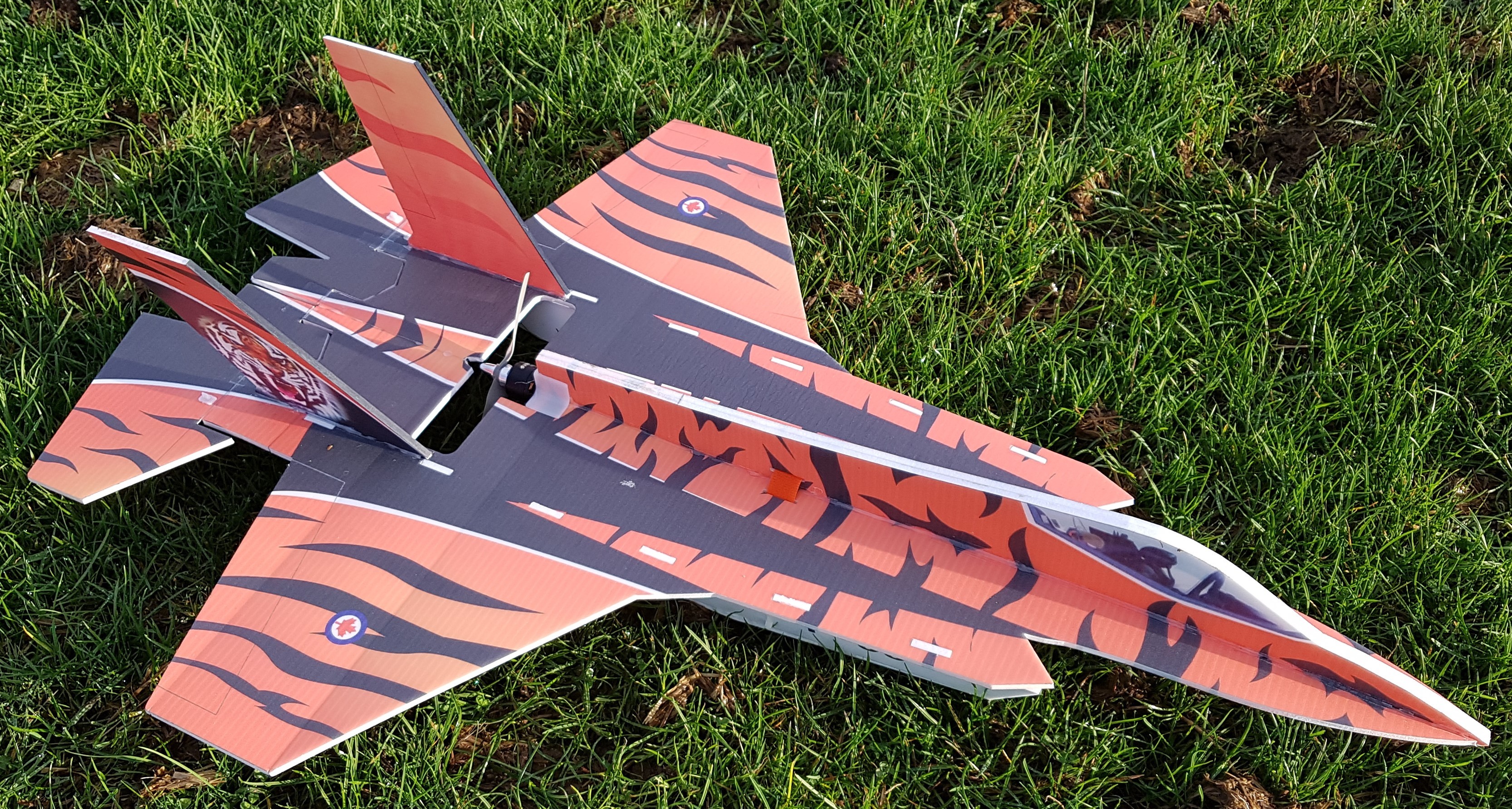
 Newbie Nick has built a Lockheed Martin F-35 that comes in fictitious Royal Canadian Air Force Tiger Meet colours.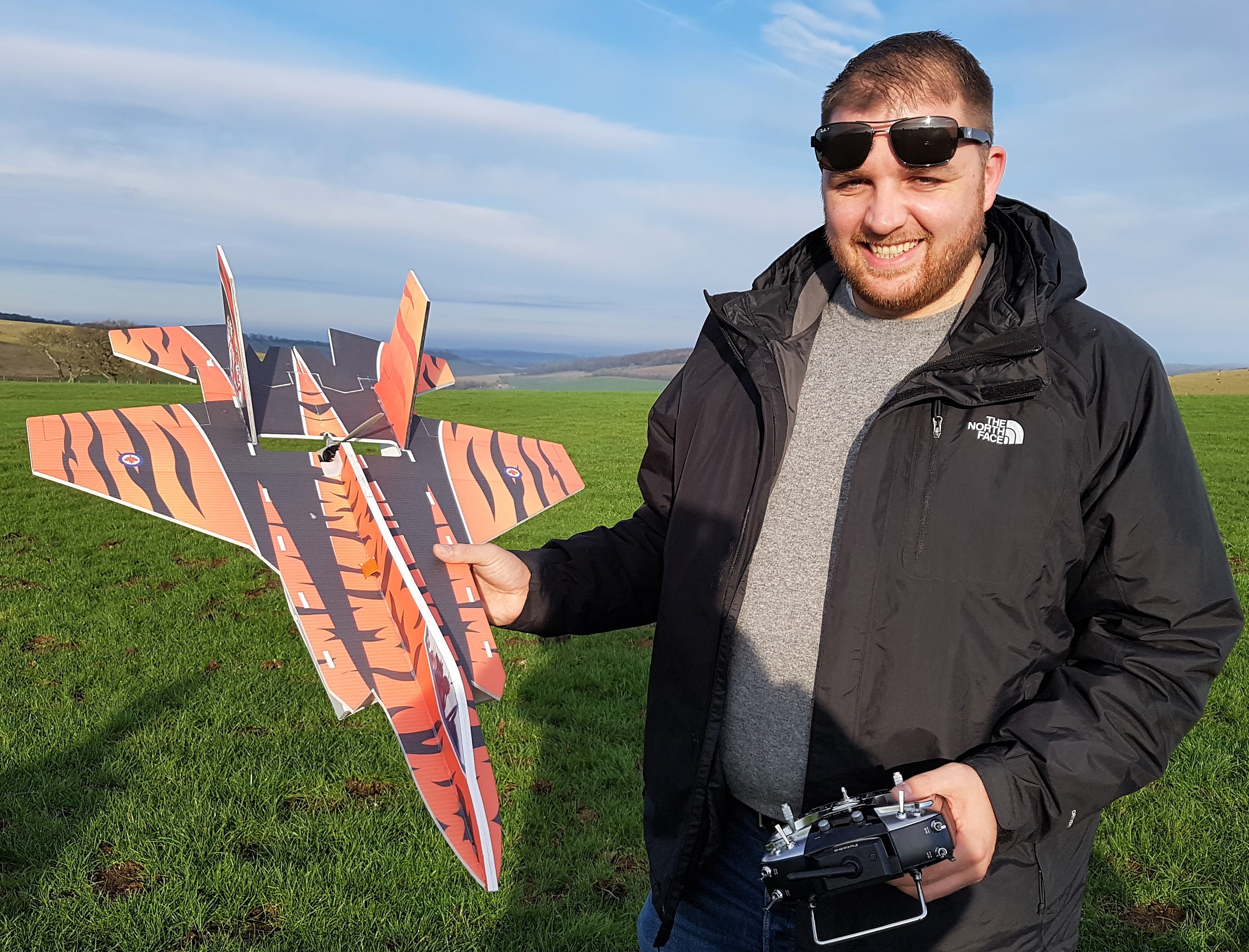
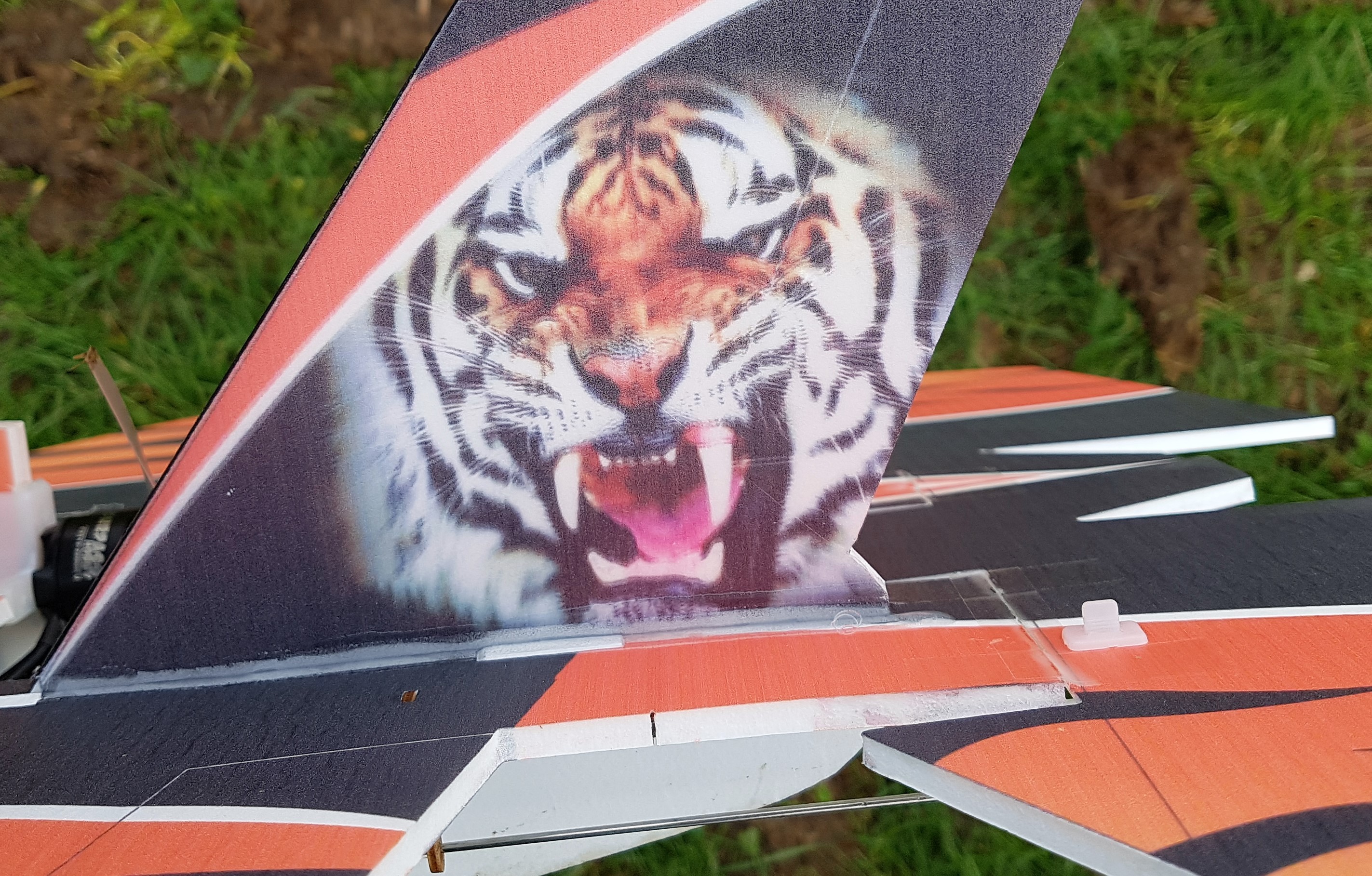 Unfortunately the first motor in Nick’s F-35 burnt out but he ordered a replacement and a few days later it was flying again. Nick let me have a flight with it and I can confirm that it has very similar flying characteristics to the Mig and the Sukhoi. Also like the others it was noisy at first but Nick opened up the propeller slot and now it’s much quieter.
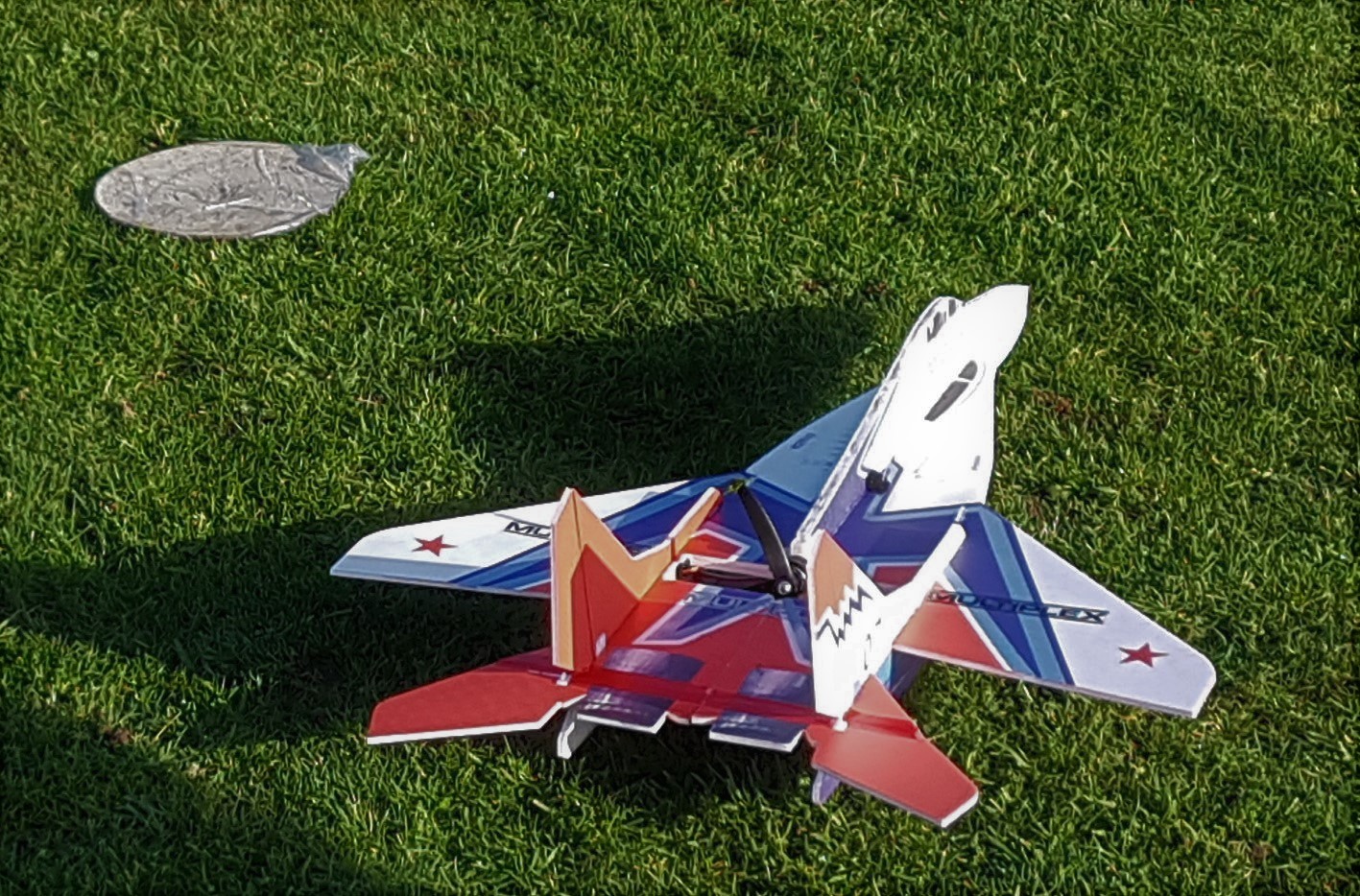
 Woody absolutely loves his Mig and is doing all sorts of manoeuvres with it at low levels, things he’d never do with his other models. In fact, he loves it so much he’s ordered himself an F-35. Captain Slow has now received his Mig from Mrs Claus so we’ll be seeing it soon(ish), and Gorgeous Gary was so impressed seeing them fly on Boxing Day that he has just ordered a Mig for himself! Even Cream Egg wants to get in on the act, he emailed while in Madeira for Christmas asking for details, motor suggestions etc. Because they can land so slowly they are ideal for the Spot Landing competition and Woody was very pleased with this attempt but it wasn’t close enough to win.
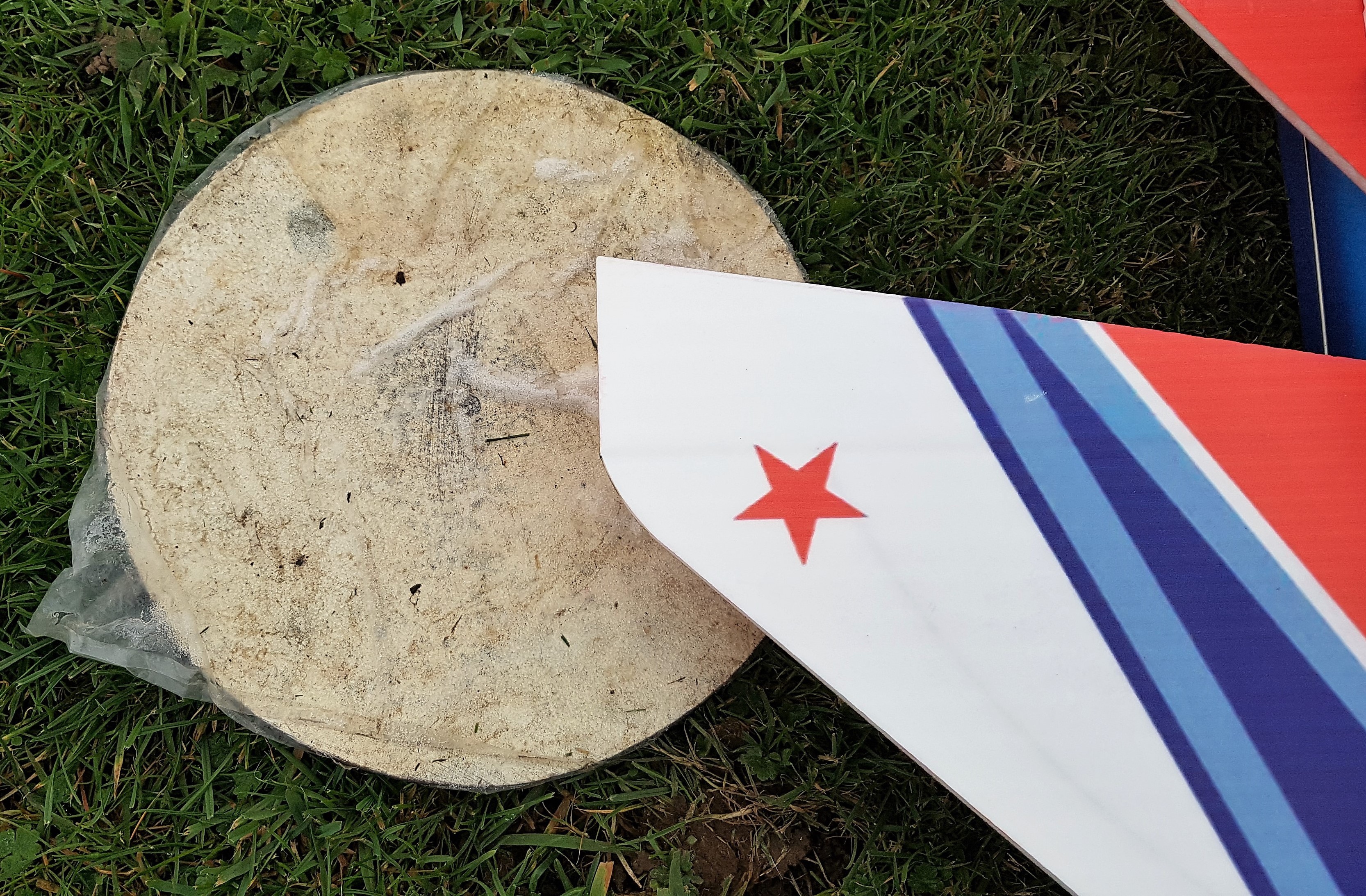
 I was delighted with this attempt at the spot and was convinced I’d won, but 1066 promptly beat me…the swine!
 Despite them only weighing a few grams they will fly in ridiculously strong winds and one Sunday in early December both Woody and I flew the Migs in near gale conditions. Just the two of us plus Dougal Entendre bothered turning out that morning and it was definitely vital to weigh down the models to prevent them blowing away.
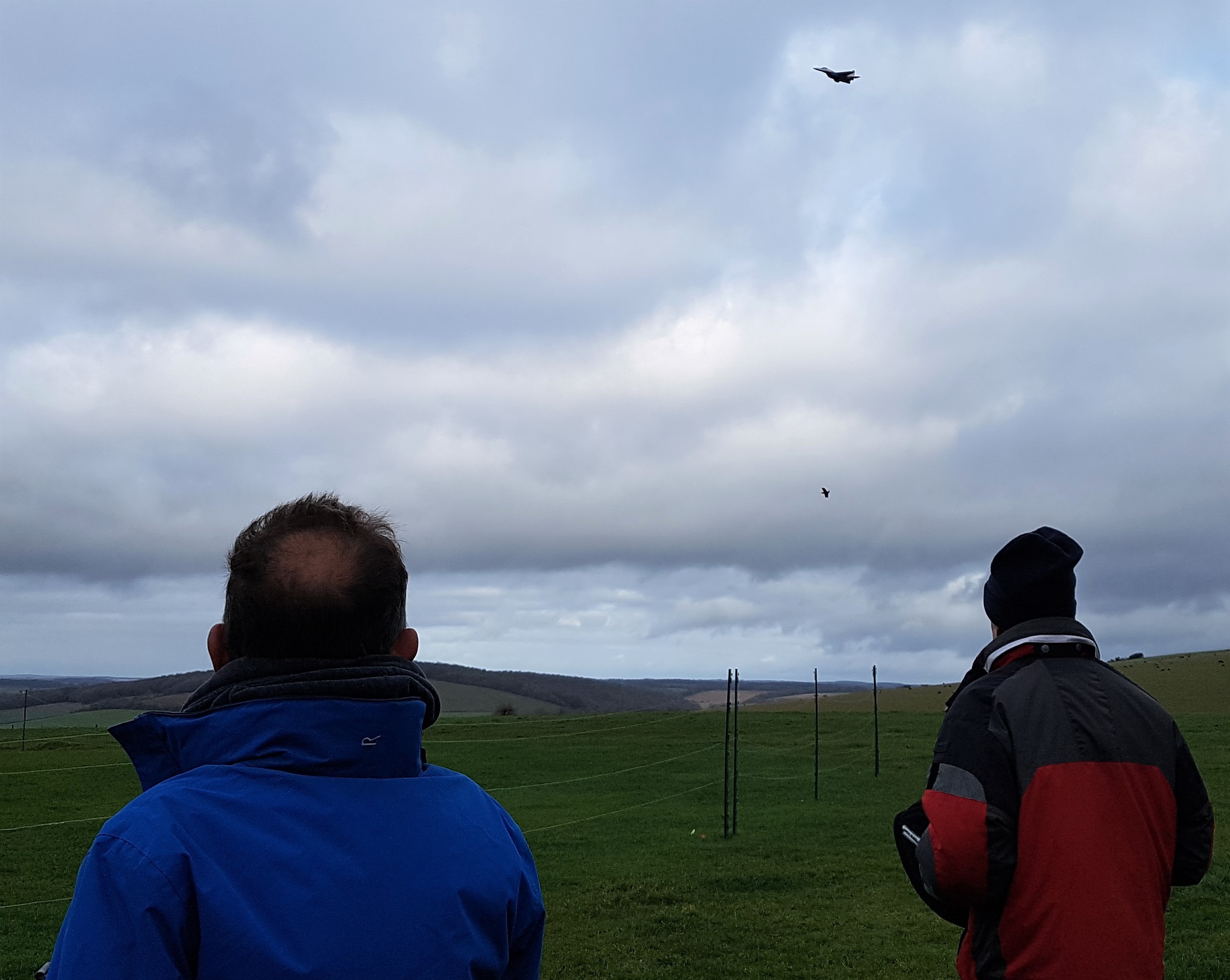
 Dougal was flying a much more sensible heavy model but Woody managed the lightweight Mig well. Not sure he looks too happy in the first photo but in the next one you can see his Mig looking good while Dougal was struggling way down wind. What I need is a camera that shows how windy it was that morning!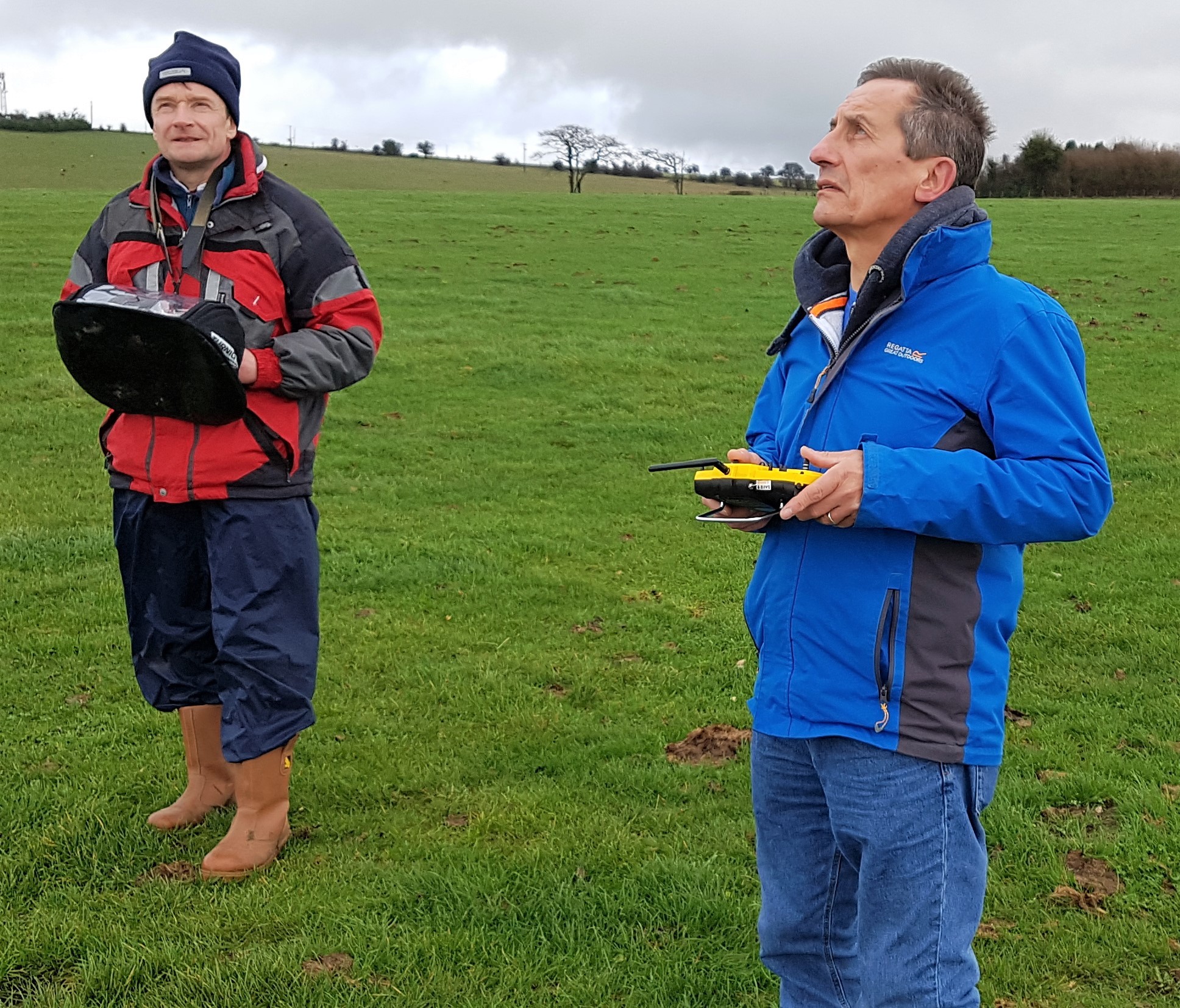
 The only problem with this range of models has been the noise created by the prop running in a slot cut through the centre of the fuselage. We have been experimenting with different propellers, bigger, smaller, 3 bladed etc. with some success but the biggest noise reduction has come from opening up the size of the slot through the fuselage.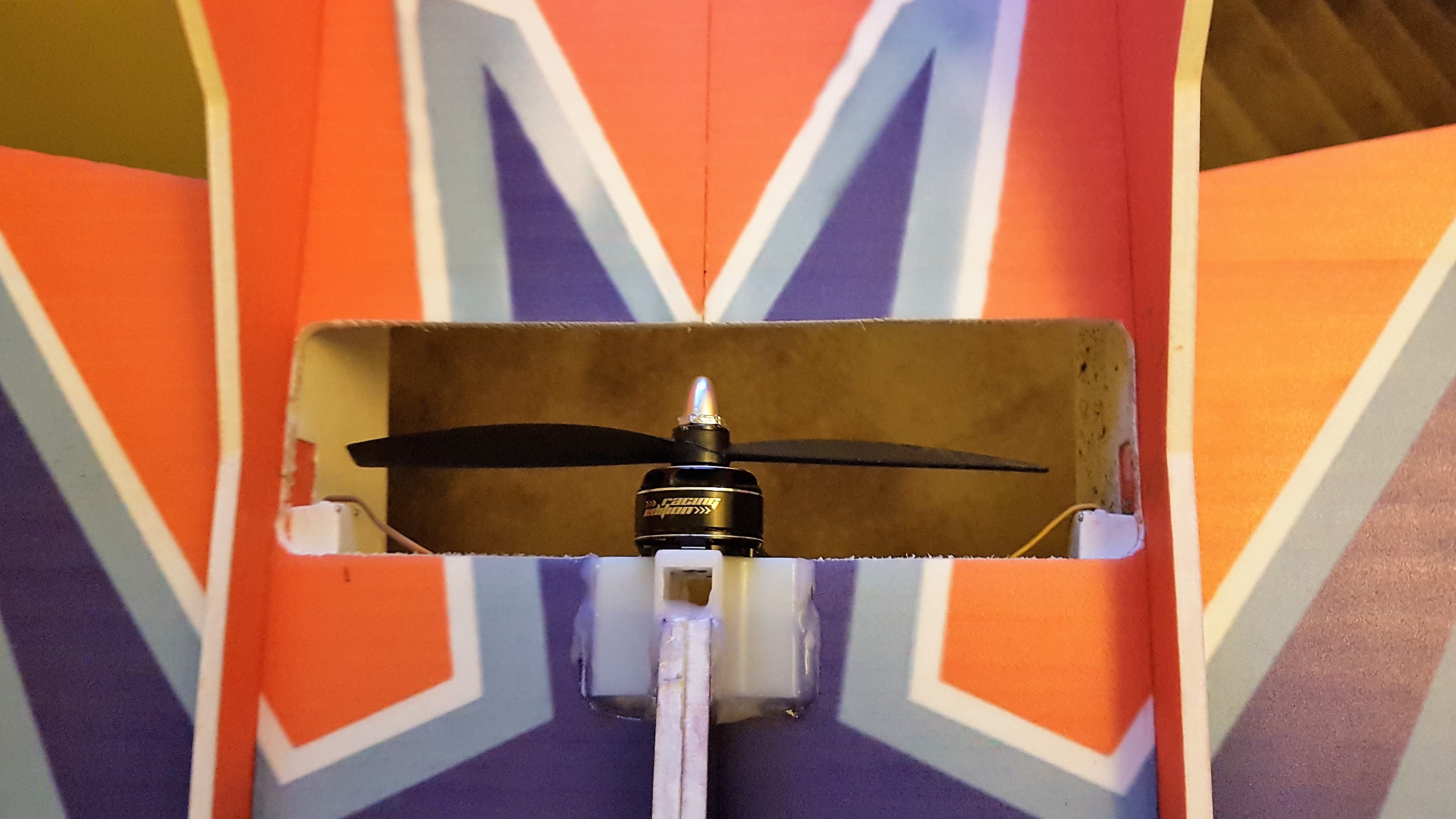
 I’m not sure why but the Migs seem noisier than the Sukhoi and with three now flying, and a fourth on the way, it was important to make them quieter. Cutting the slots wider is simple, reduces the noise dramatically, and seems to make no difference to the flying at all. I’ve now also cut the slot wider in the Sukhoi with similarly quieter results.
I stumbled across a short video (just 38secs) of someone flying a very similar looking foamboard model somewhere in the Far East by the look of it. It’s both amazing and amazingly wrong for so many reasons, have a look and see what you think. It’s incredibly noisy, incredibly powerful, has lights around the edges, and there are two other similar models on the ground presumably marking out the designated flying area, utter madness!
Over the Christmas break I set up a WhatsApp group called PAM Flying Group. Matt suggested using WhatsApp a couple of months ago but as some members aren’t on it I can’t replace the ‘flying tomorrow’ emails, but maybe that will happen eventually. In the meantime if you want to join the group as an easy way to chat and exchange documents, photos and videos just download the free app (Android or IOS) and I’ll add you to the group. This is what Wikipedia says about it: WhatsApp Messenger is a freeware and cross-platform messaging and Voice over IP service owned by Facebook. The application allows the sending of text messages and voice calls, as well as video calls, images and other media, documents, and user location. At the moment it’s free of adverts but I understand that will change in 2019. It’s totally free to use, even for worldwide video calls so I imagine over 1 billion users are a pretty good group to target with adverts. Just let me know if you’d like to join the group.
At one of the December club meetings Percy Vears brought along his Lancaster and talked through the second part of his build blog. Ron is building the Lanc from the Tony Nijhuis plan and he purchased the plan, CNC cut parts, vacuum formed canopy, turrets and cowls etc. to make the project a little easier but there’s still a lot of work to do.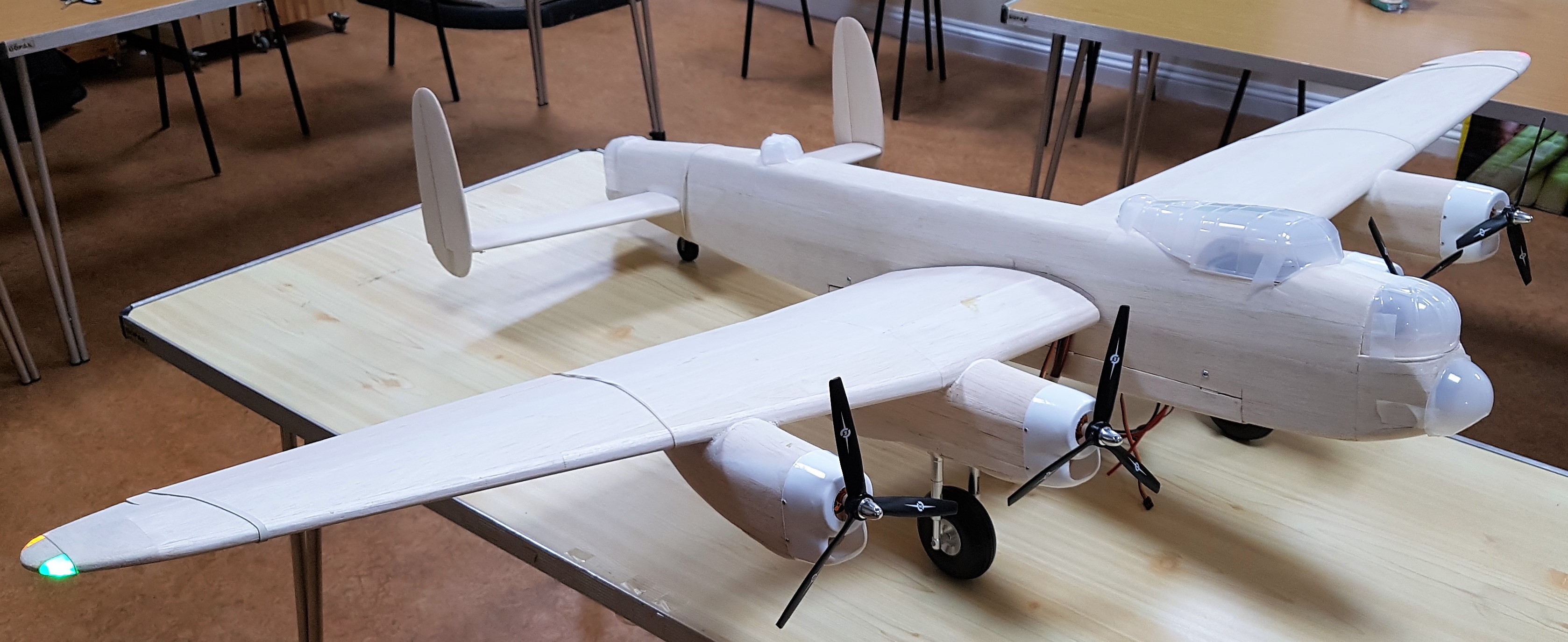
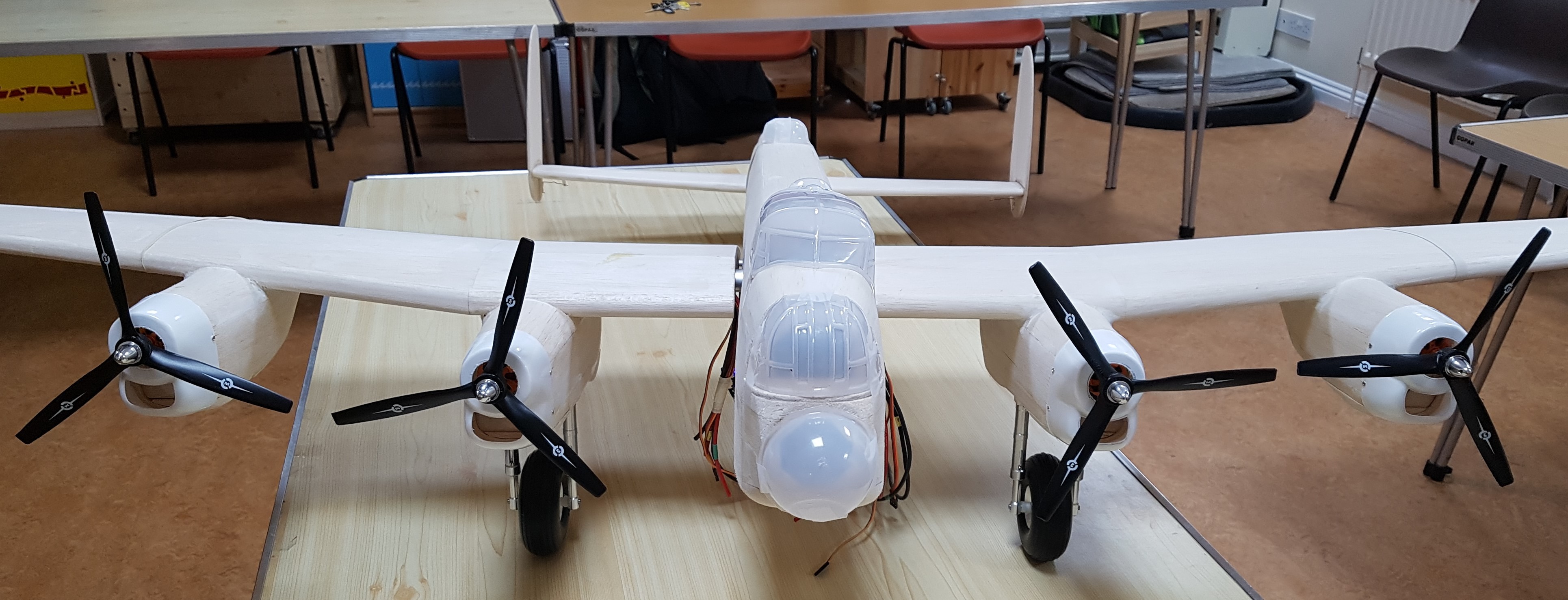
 The building side is now pretty much complete but there’s a long way to go before it’s ready to fly. Ron will be glass clothing the whole model, no mean feat in itself, and will then paint and assemble the various parts. It’s looking good so far, I can’t wait to see it completed and up in the air where I’m sure it will look amazing.
Last month I featured Matt Takhar’s new Velox which at 81” span is one of the biggest models in the club. After the first four flights Matt stripped the model down to check everything over and make sure there were no signs of any emerging problems. He sent me a few photos to use, the first of which gives a good idea of the size of the motor.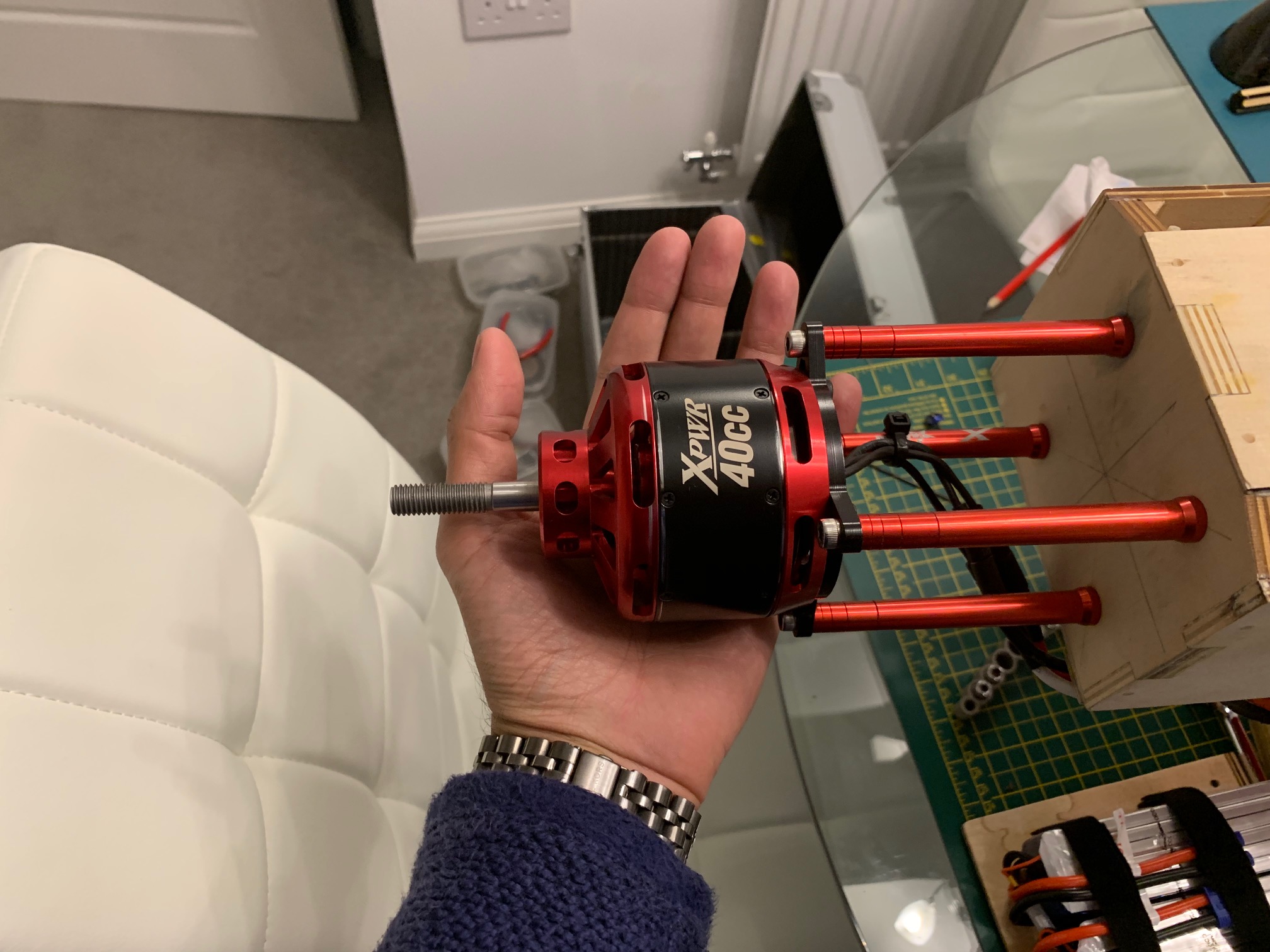
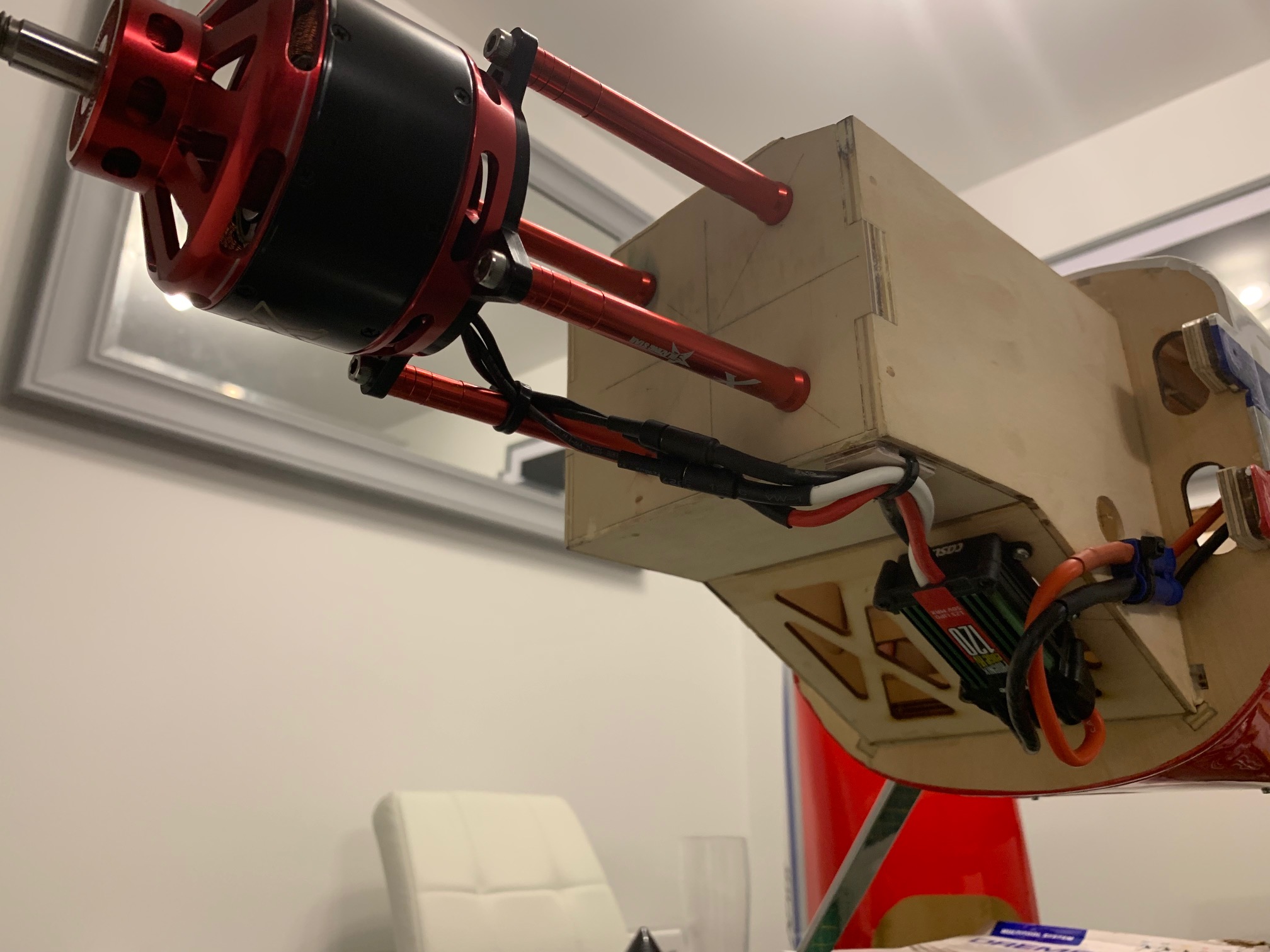
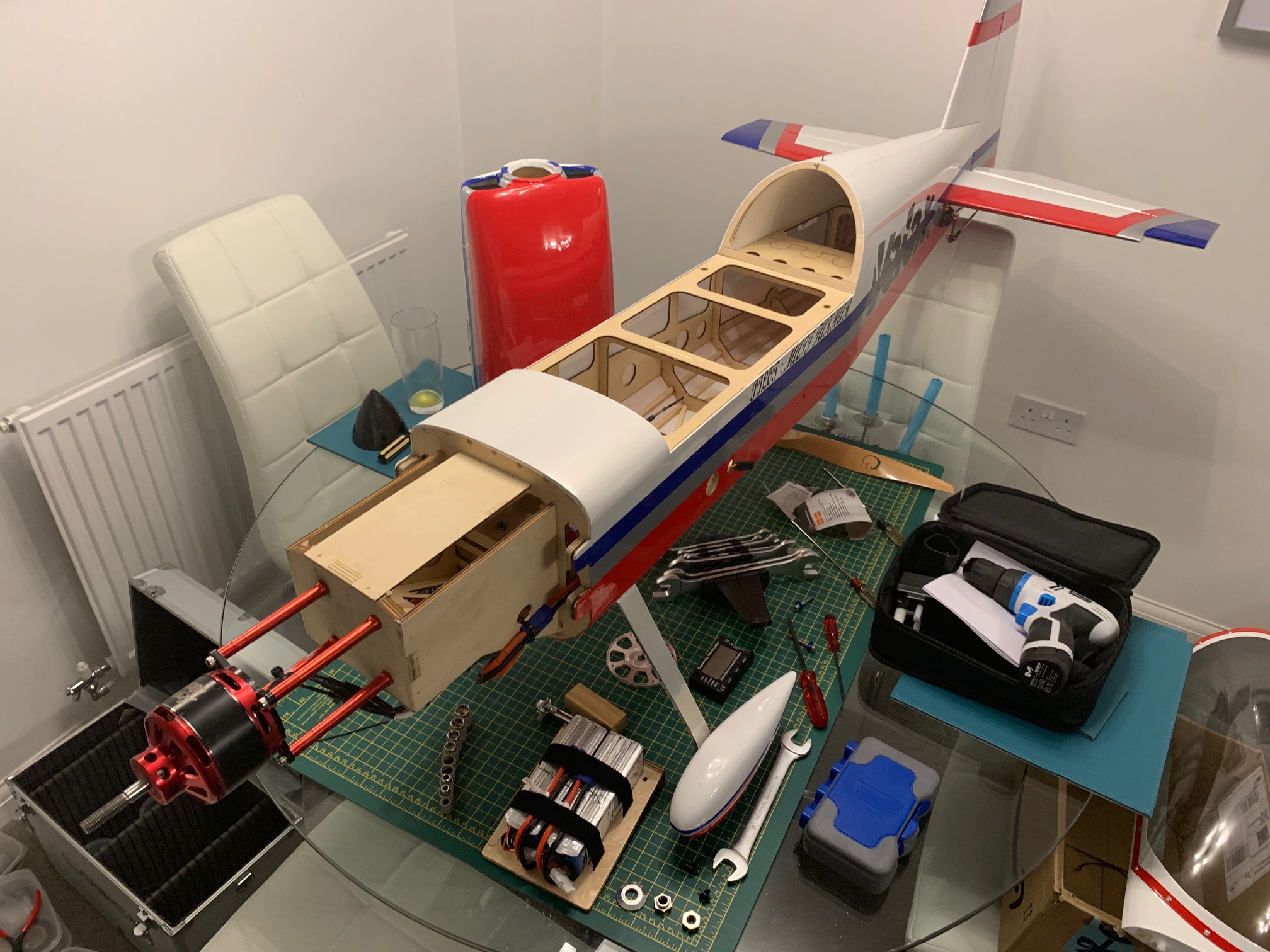 The Velox is now back together and has had several more flights, Matt is getting more confident with it every flight. You can see snippets of flights three and four in this month’s video.
Ok, I’ll stop writing about the Velox now, Matt had an unfortunate ‘development’ on 28th December…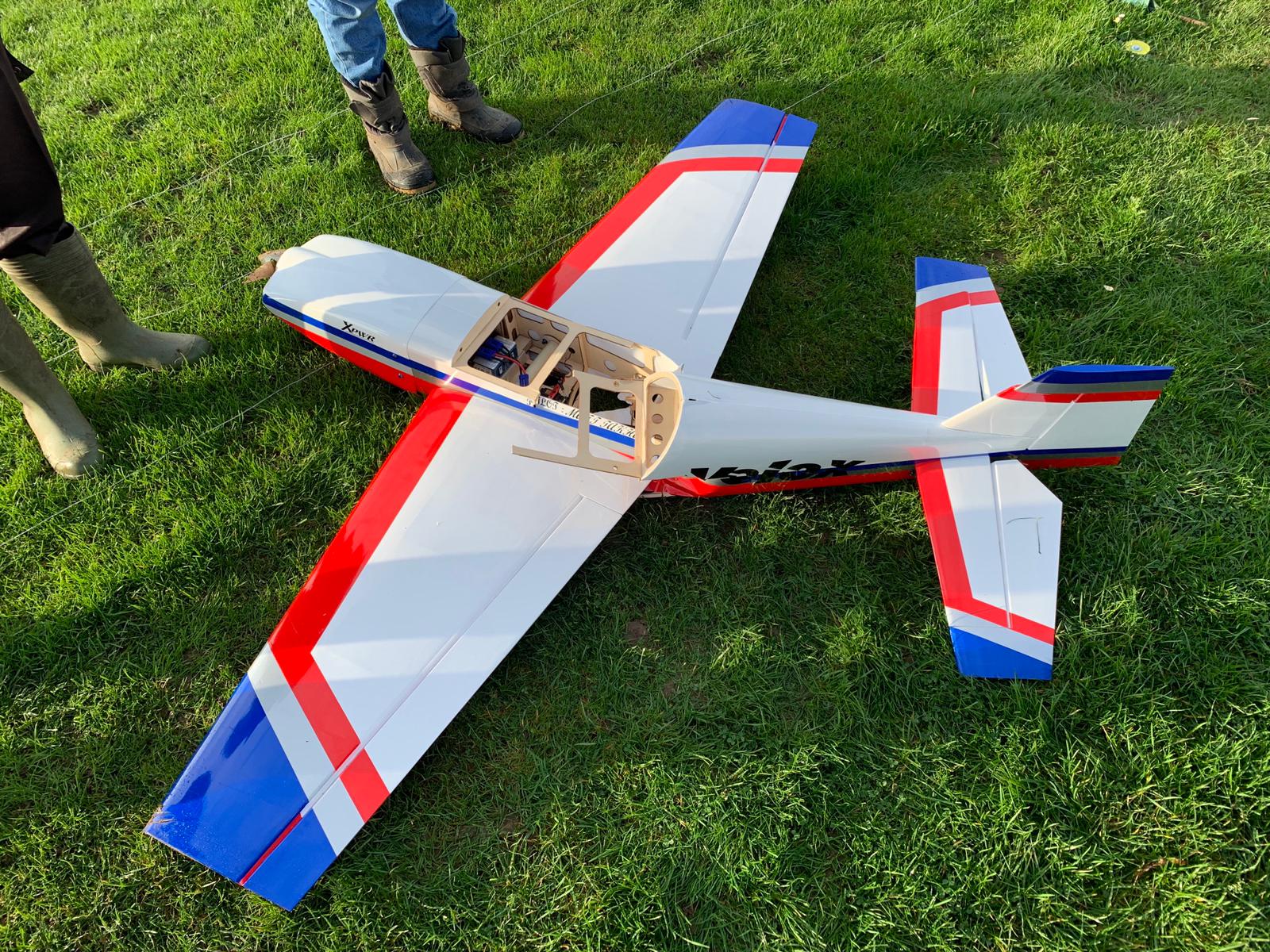 I believe a new fuselage is on order from ProBuild. Fortunately all the gear, motor, speed controller, batteries and so on are undamaged, as are the wings and tail. I won’t go into what happened but it’s rumoured that Matt will be giving a talk at a future club meeting entitled ‘The do’s and don’ts of spin recovery’. Too soon? Sorry Matt!
One of the websites that I often check out is Flite Test and this month, as I’m still of a juvenile disposition, I was immediately attracted to the heading Check Your Crap. It was part of an article on Pre-Flight Checks and I thought it might be useful reading for PAM members. There’s a downloadable .pdf of a basic single sheet checklist that you can print off and keep in your flight bag, and also a short video of things to check before the first flight of a new model. To see it just CLICK HERE. The whole site is entertaining and packed with useful info, take a look for yourself.
Both Matt and Newbie Nick have treated themselves to Pilot Extra 330SCs. These ARTFs are 1714mm span, 1600mm long, and they are designed for either 20cc IC engines or equivalent power electric motors.
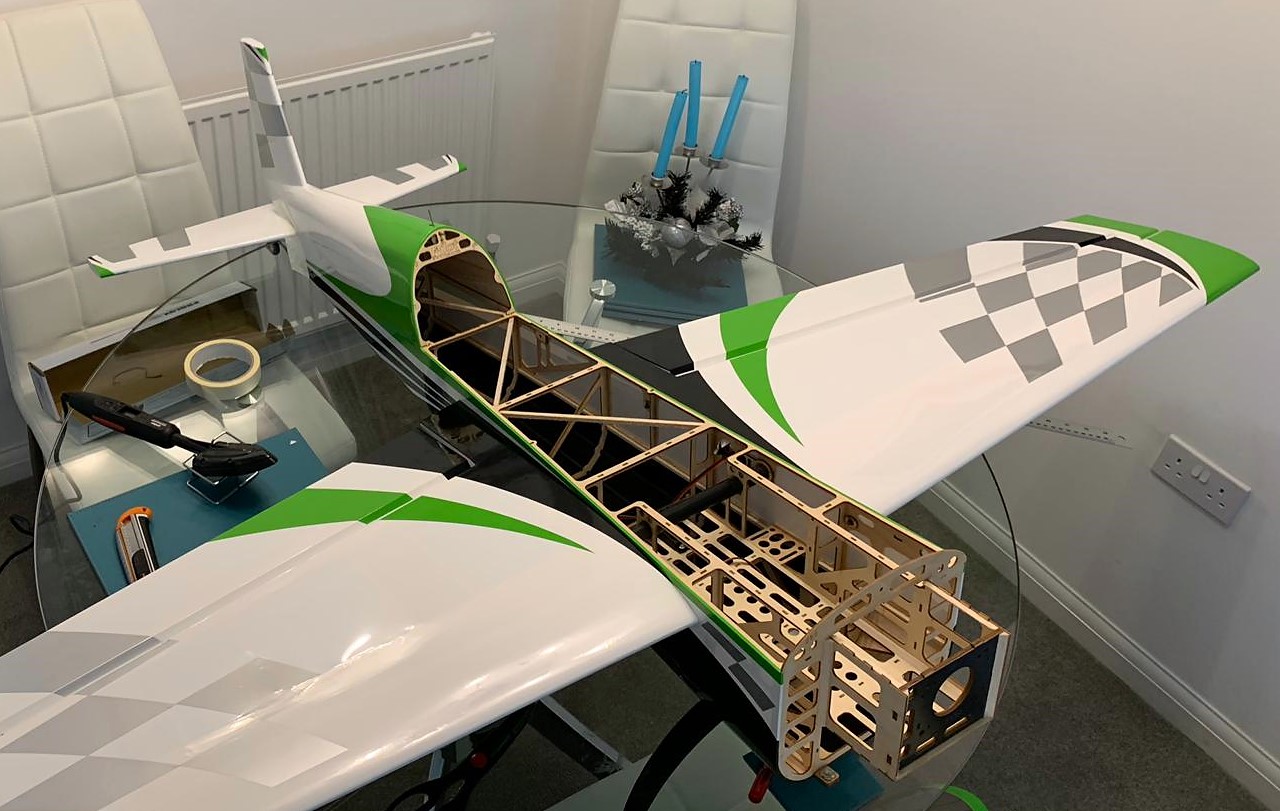
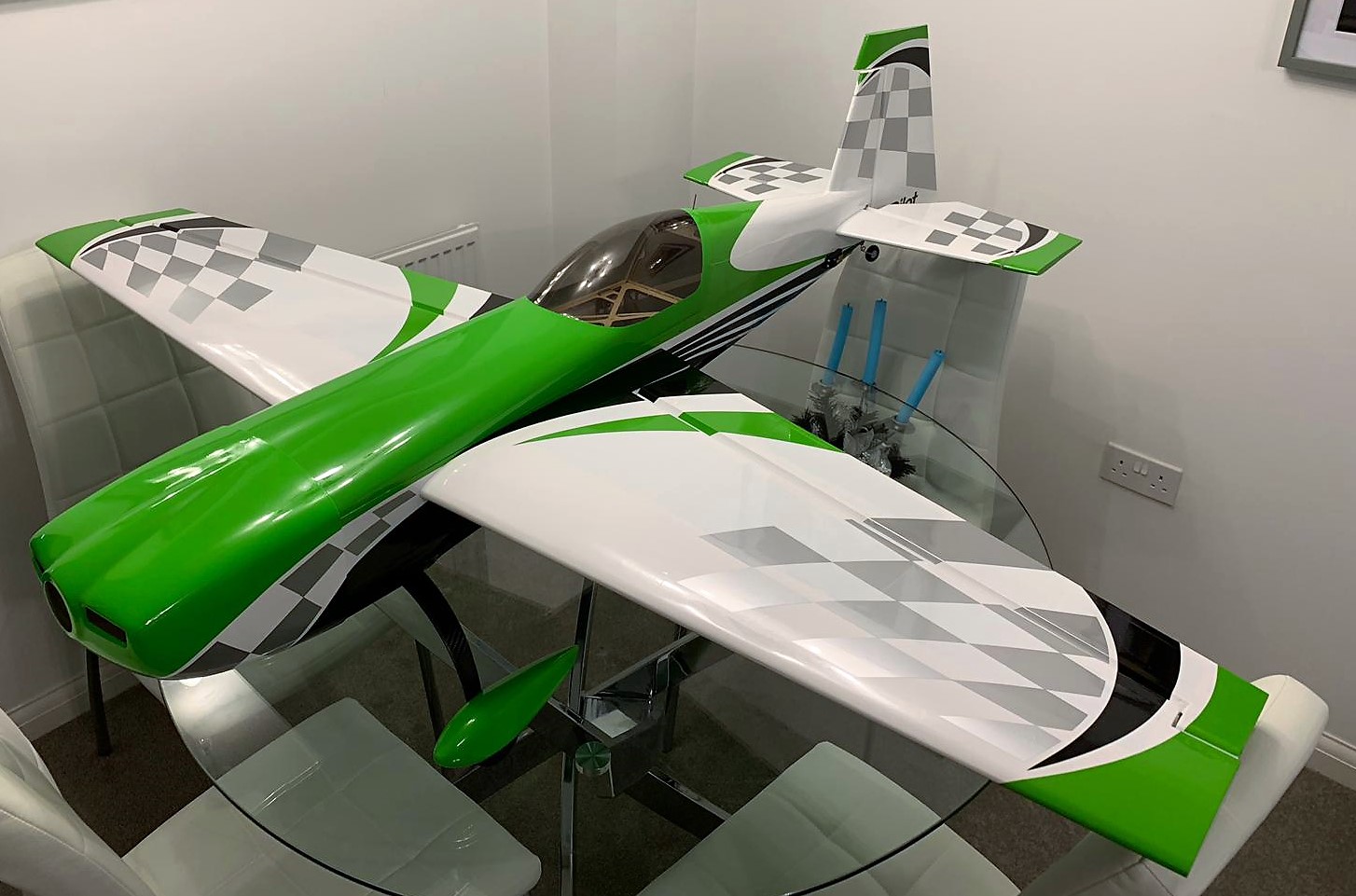
 The electric versions need 400KV motors, 6 cell lipos and 18”x10” propellers. Matt says the supplier was out of stock of the recommended motor so they sold him an ‘upgrade’ one. It’s perfect other than the fact that it won’t fit!
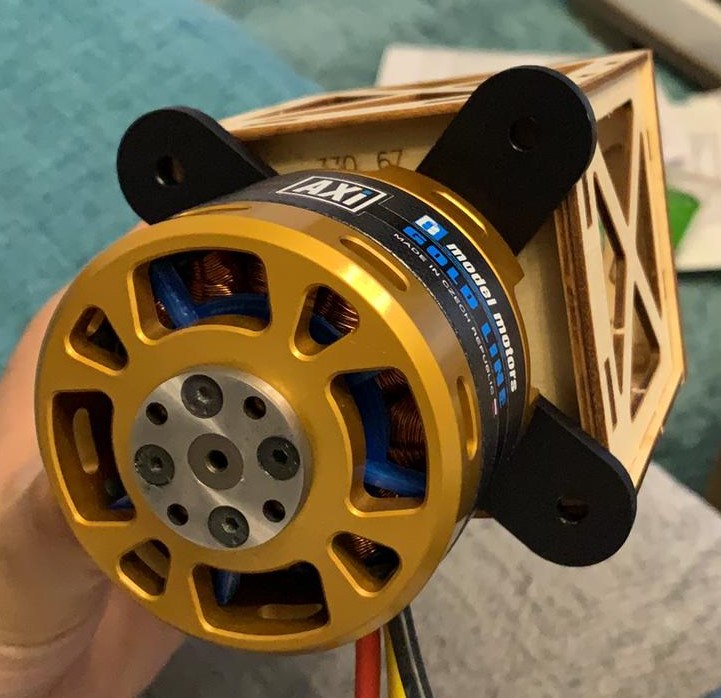 I should have some more photos and power train details when the models have been flown, probably in January.
Time now for this month’s Video:Please watch the video full screen, it’s so much better with small models flying around. If the video won’t play for you click HERE
Why men prefer aeroplanes to women:
- Planes come with instructions.
- Planes don’t have mother-in-laws.
- Planes don’t take forever to get ready.
- Planes don’t mind how many planes you’ve flown before.
- Planes are cheaper to maintain.
- Planes don’t mind when you Touch and Go.
- A plane will kill you quickly, a woman takes her time.
Colin Cowplain
Patch News – November 2018
As I was away at the end of October this edition will cover the things I missed as well as the November highlights. The same applies to the video, it’s a little longer than usual but I think you’ll enjoy it, lots of exciting stuff featured.
November could be called the mucky month as early in the month Farmer George decided the field needed muck spreading. The spreading appeared to be much heavier than we’ve experienced before (it usually happens every third year) and was pretty horrendous the first couple of times we flew.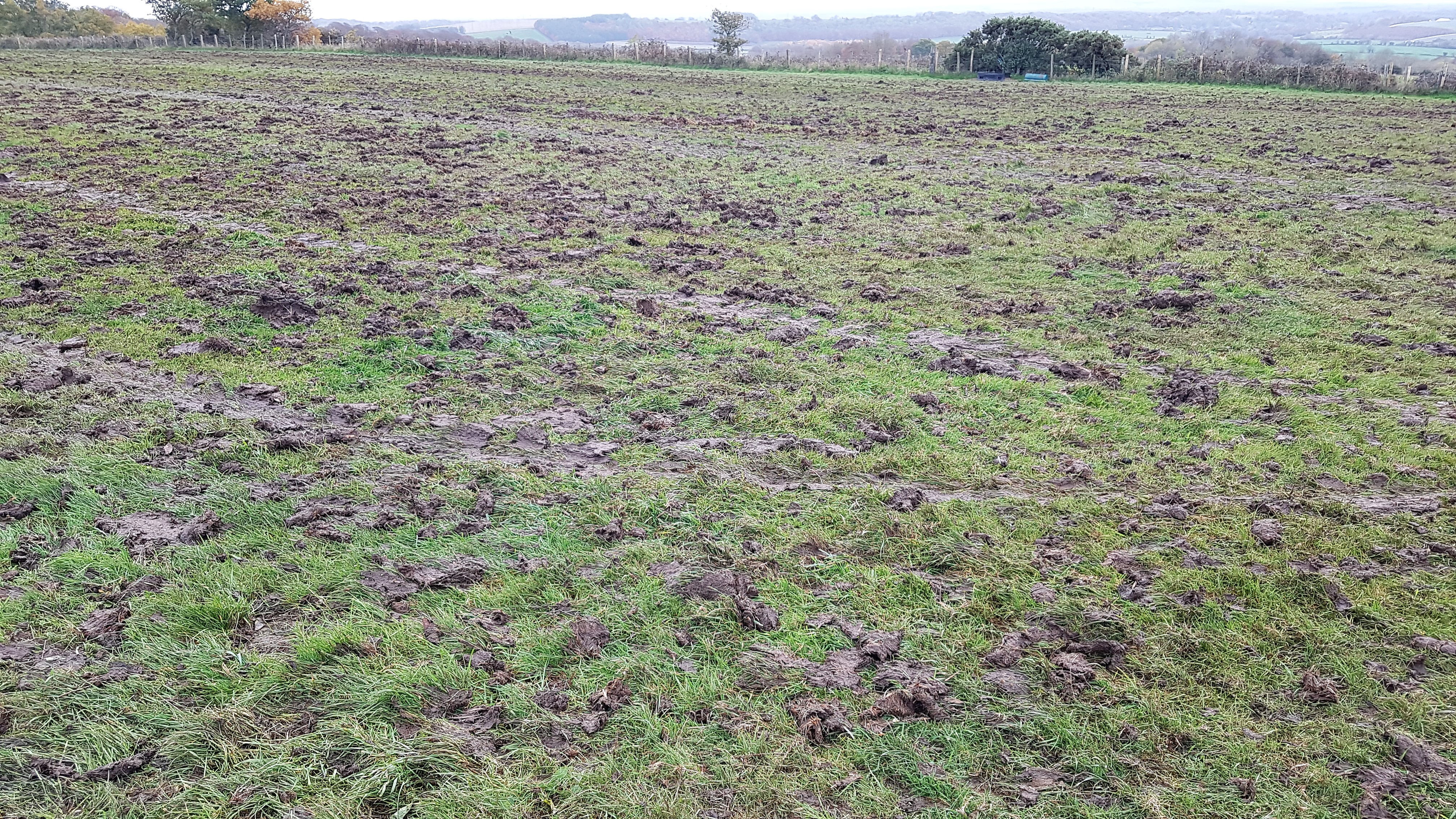 But there was a lot of rain over the following couple of weeks which helped to quickly wash the muck in and the situation soon improved. Fortunately George avoided spreading on the patch and that remains in great condition.
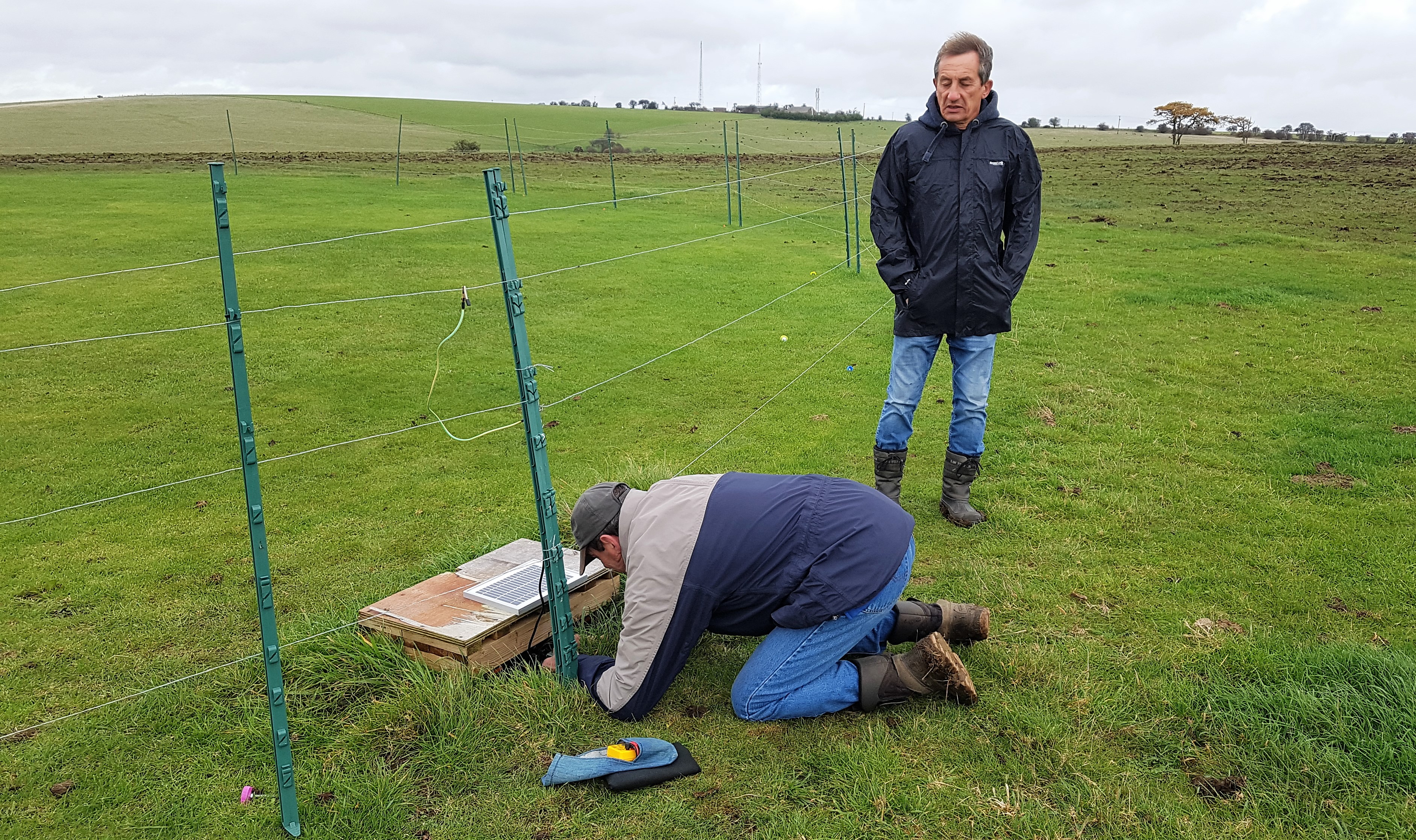 Captain Slow is ridiculously fastidious, one day I caught him trimming the edges with his nail scissors. As I write there’s still plenty of muck around the field but it’s nothing like as bad as it was and it’s getting better each week.
The weather was…er…Novemberish! There were some sunny days but also plenty of wet ones, and we struggled with lots of misty days, windy days and most unusually, some days that were both misty and windy. Never mind, the hardier members still managed to fly quite regularly and several new models were test flown.
Starting with what I missed towards the end of October, Catapult King brought along his repaired Grumman X-29. The model had flown successfully a few times earlier in the year but lacked the thrust that it should have had considering the power the motor was consuming. The model was damaged when Catapult managed a very rare bad launch so he took the opportunity to improve the ducting and add some very neat ‘cheater’ air intakes. The changes certainly improved things and the X-29 went away from the hand launch more positively than it ever had previously.
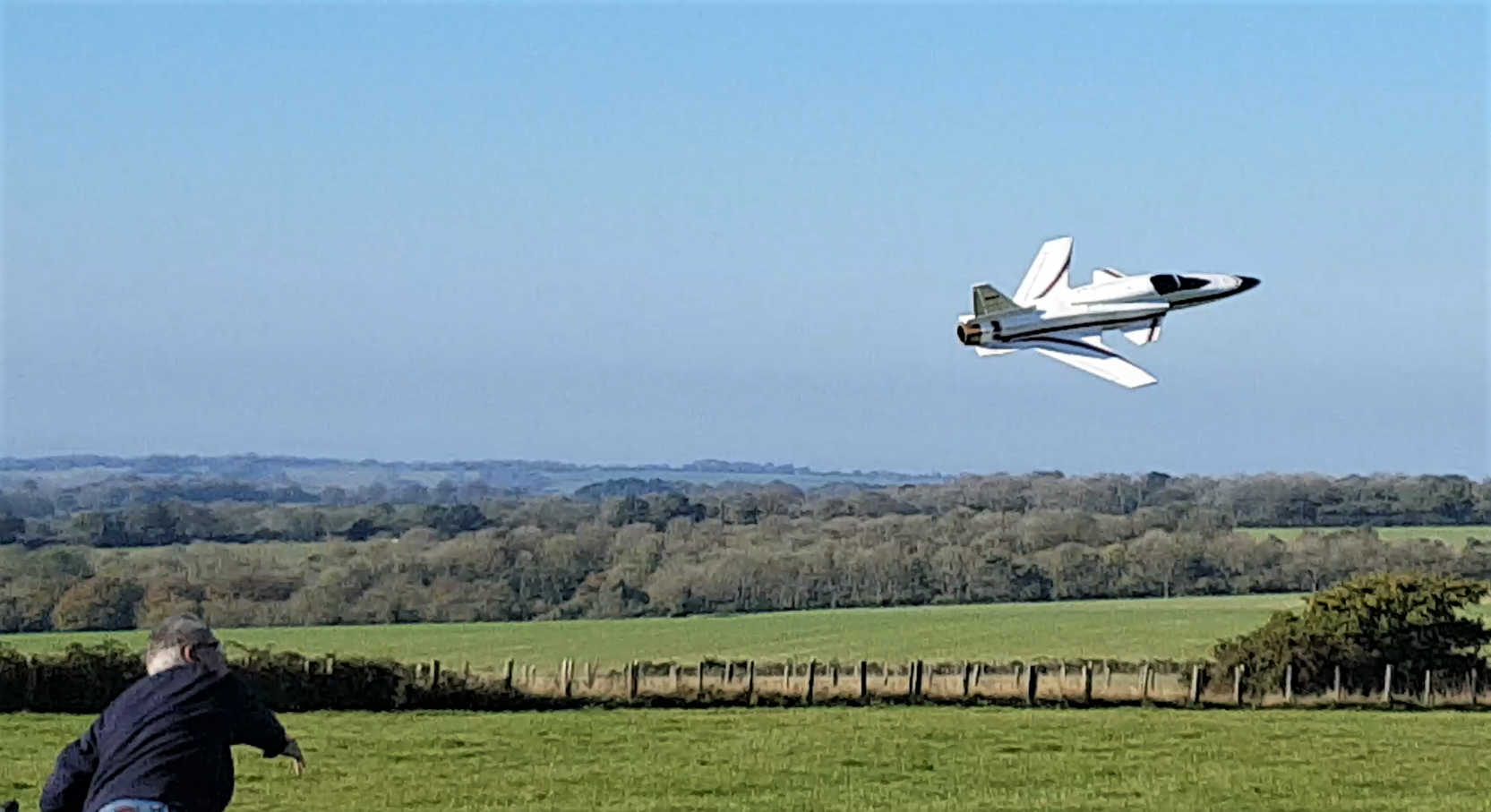 See what you think of how it flies in this months’ video, I think it’s superb for such a challenging model.
In Patch News last month I featured Dougal Entendre’s new Velox but I wasn’t able to include it in the video.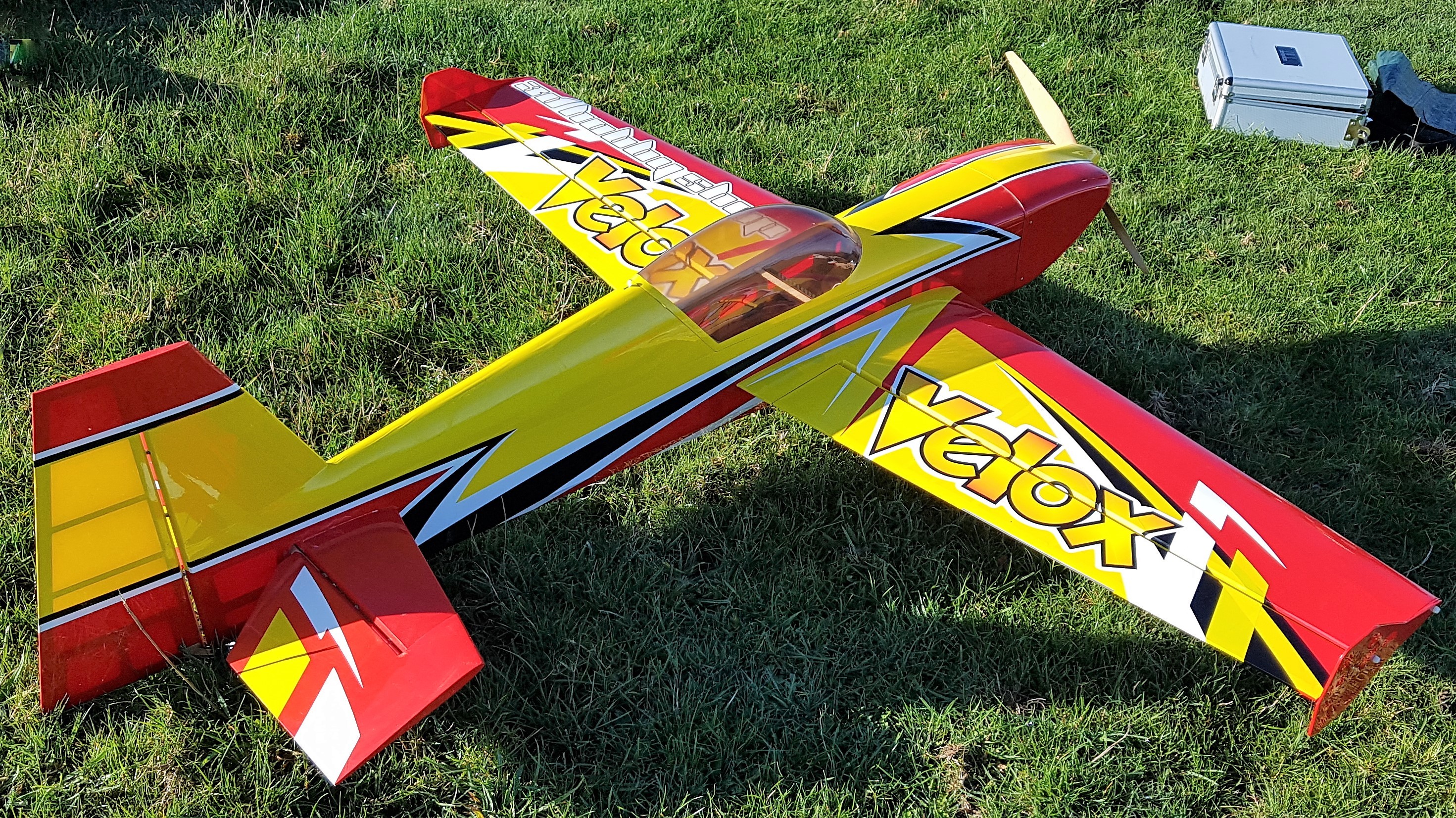 That’s been corrected this month and you can see how well the Velox flies, it even makes Dougal’s flying look good!
While I was away Dougal snapped a few photos for me to use. First up is the repair that Captain Slow has made to his Multiplex FunGlider using some carbon strips. The FunGlider appears to have a weak spot towards the rear of the battery access hatch and Captain Slow’s broke when he cartwheeled it on landing one day.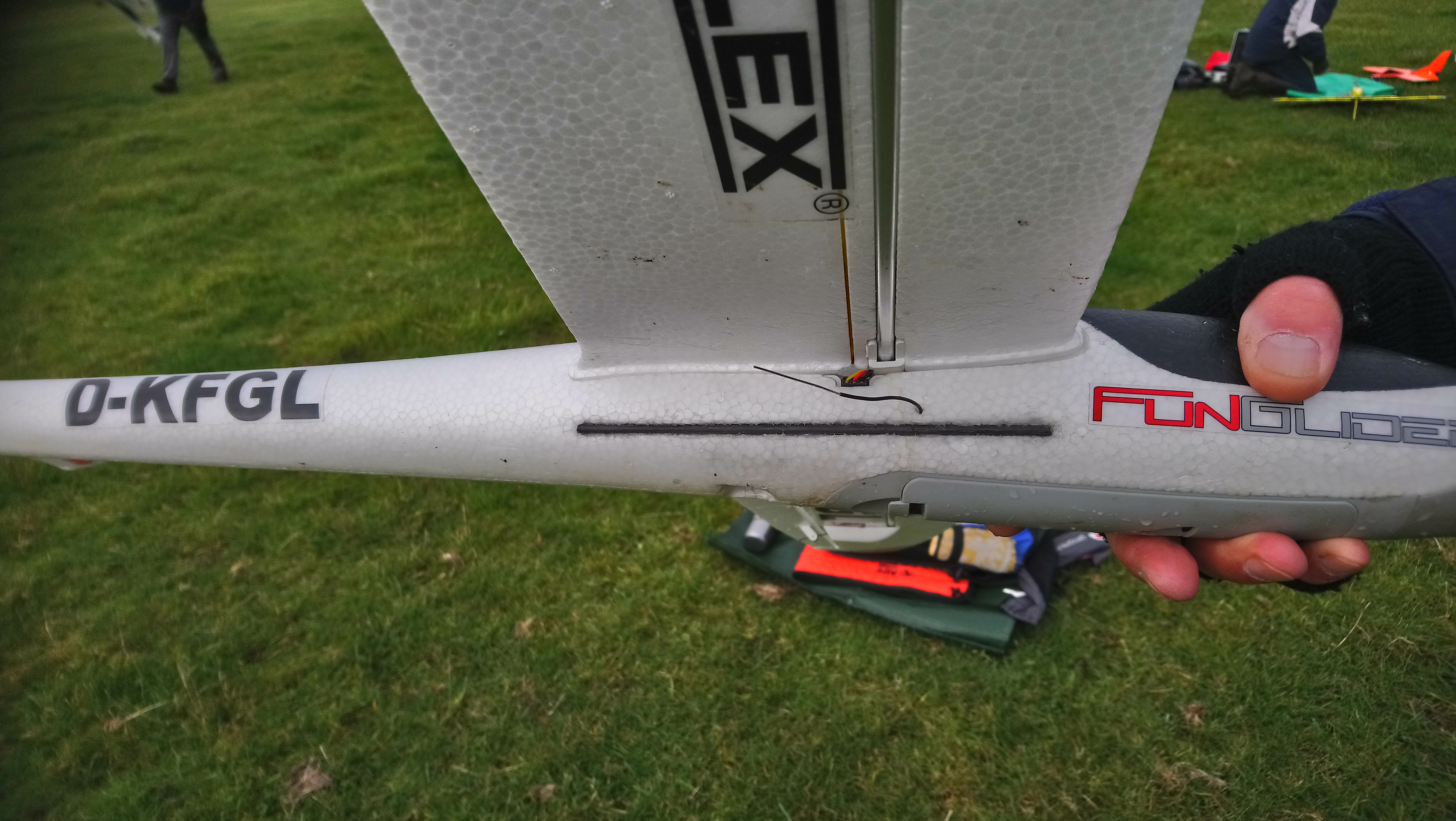
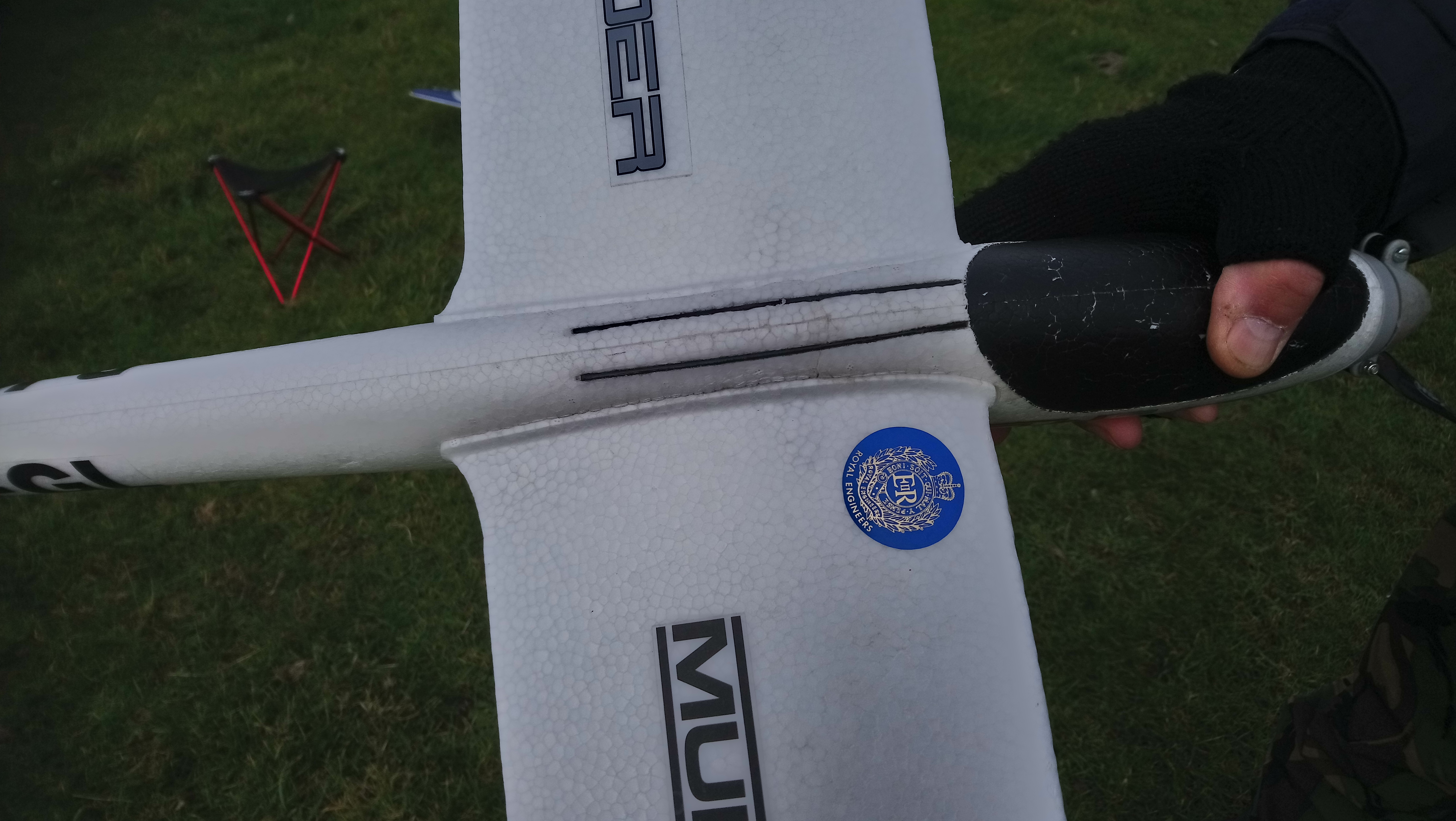 He’s added four carbon strips, one each side of the fuselage and two above the wing area and they have strengthened the weak section a treat. Next time it will break at the back of the wing (don’t ask how I know!).
But Captain Slow’s no fool, he’s has figured out a way to stop damaging fuselages, build flying wings! I snapped a sneaky photo of a new Zagi he’s building at the moment. It’s actually a JP SI 480 EPP Flying Wing from Sussex Model Centre but as far as I can tell it’s just a Zagi manufactured by Perkins.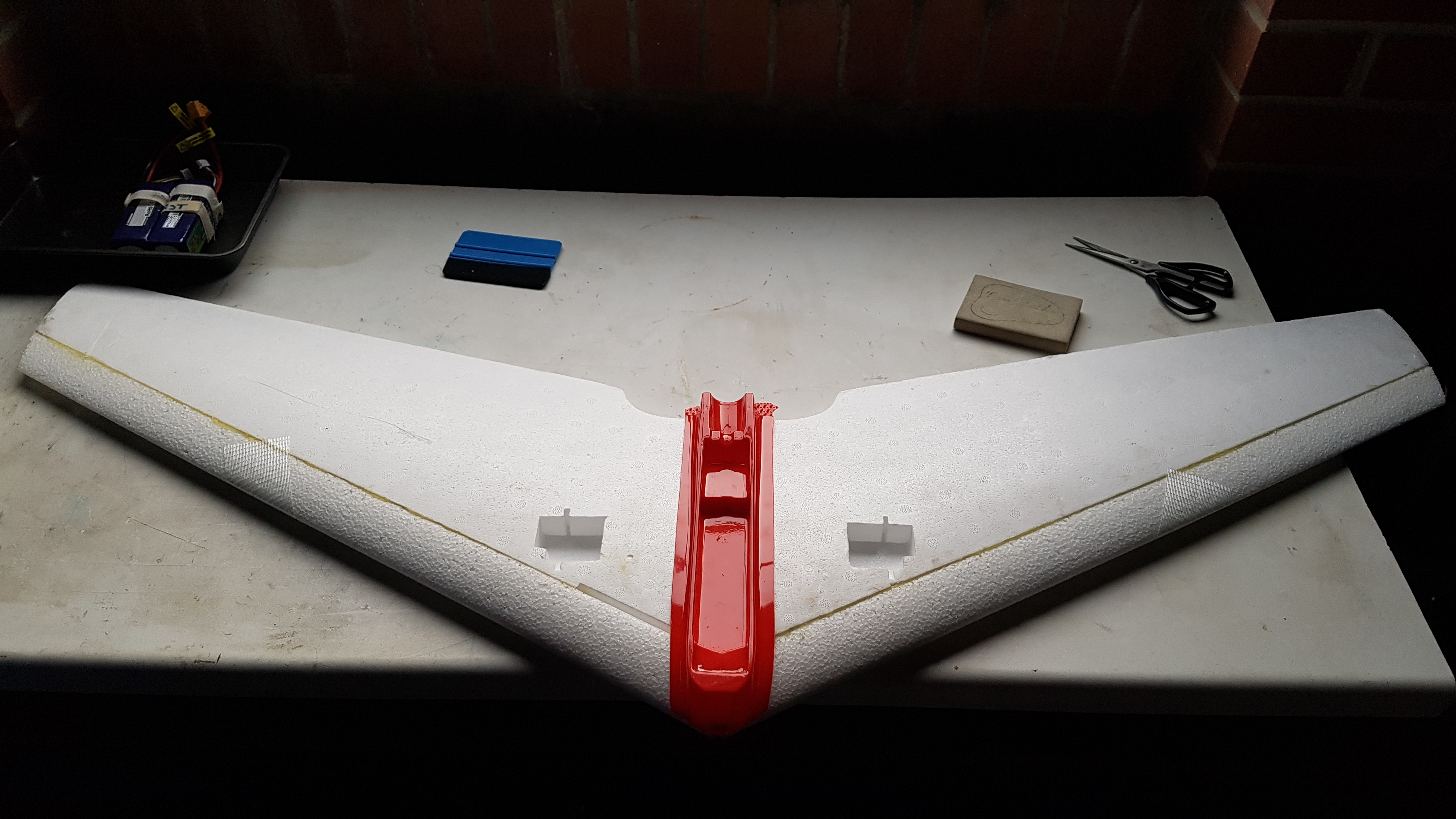 It’s 48” span and should end up weighing around 860g but the important thing to note is that on the SMC website it states “Quick to build – Buy today, fly tomorrow”. I took the photo on 9th November and he’d already been building it for about a week so by my calculations we should see it at the field around mid-December….2021.
The other photo Dougal sent me is of Nick Weatherley with his Max Thrust Lightning. I know both Nick and Matt Takhar owned Lightnings but both damaged them a few weeks ago and I think I’m right in saying that Nick has made one decent model out of the broken remains of the two.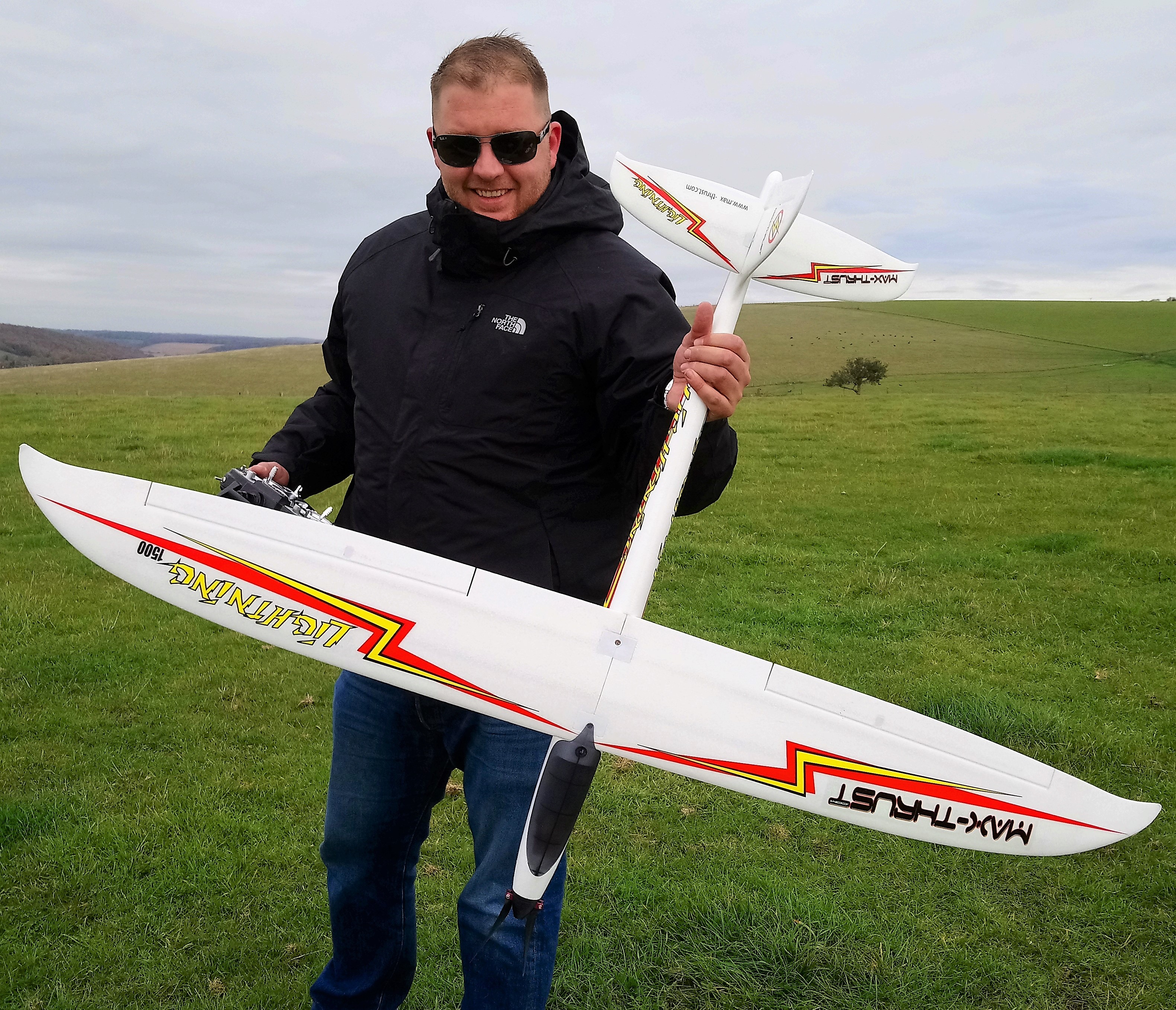
A few weeks ago Gorgeous Gary sent me some photos of his latest project. The model is a 68” span Seagull Models Edge 540 for .61-.91cu.in 2 strokes or .91-1.00cu.in 4 strokes and the finished weight should be around 8 1/2lbs. As a long-term club member Gary is one who is still allowed to fly I/C models but of course they have to pass the BMFA noise test. I’m not sure what engine he’s fitted to the Edge but it’s definitely a 2 stroke and it looks like a .90cu.in to me. Personally I have my doubts that it will pass the test without a serious add-on silencer.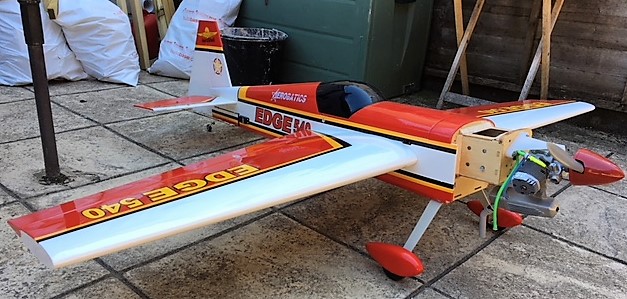 Gary is the only member who still flies I/C reasonably regularly although we don’t seem to have seen him for a while, maybe he flew while I was away? Unfortunately I/C models definitely go against the ethos of the club these days and it’s a great shame he has turned his back on electric models after a couple of bad experiences with them. Compare the Edge to Dougal’s slightly larger Velox and you can see there is no reason at all to fly I/C these days and risk losing the flying field because of noise complaints.
Of course if you like the sound of a ‘real’ engine you can add a sound system to your electric model and have the correct engine noise of the original aircraft. That’s exactly what Woody has done with his Art-Tech Texan.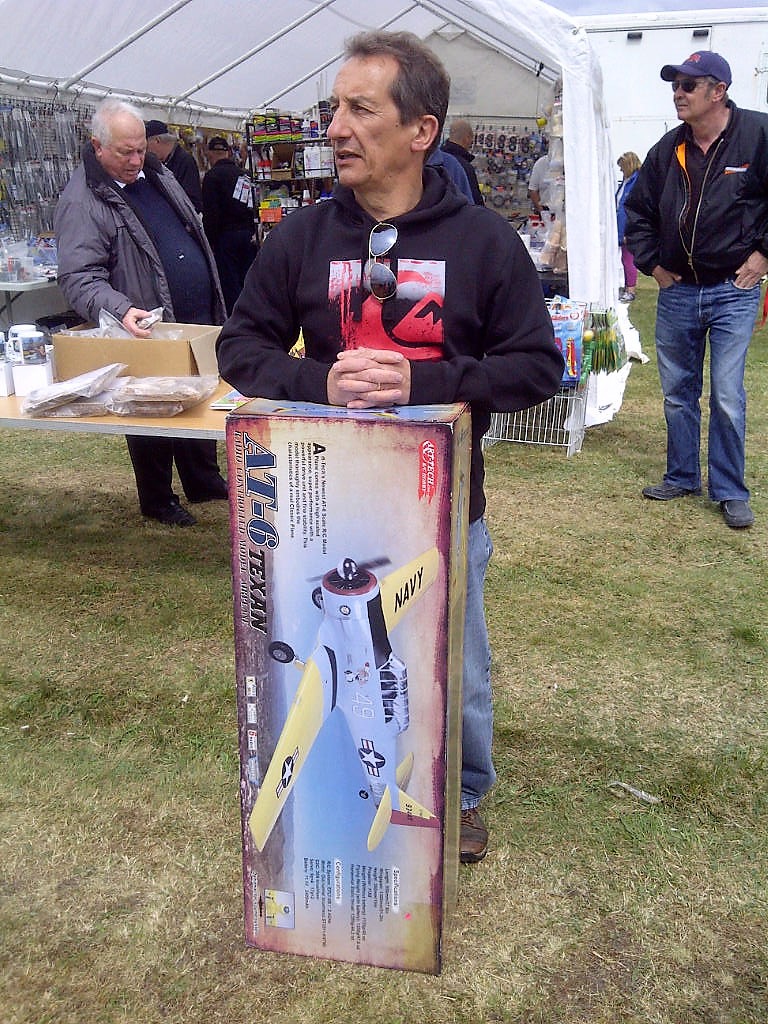 Woody originally bought the Texan at the Blackbushe Show back in 2013 and added the sound system after the first few successful flights of the model. The system is specifically designed for the Texan so it will only reproduce the sound of a Pratt & Witney Wasp but some of the more advanced system will produce a variety of different engine sounds. Click HERE to see and hear the sound system in action. Woody has recently revamped the Texan as it was becoming a little tatty around the edges and he’s repainted it in the black scheme of one that’s based at Goodwood.
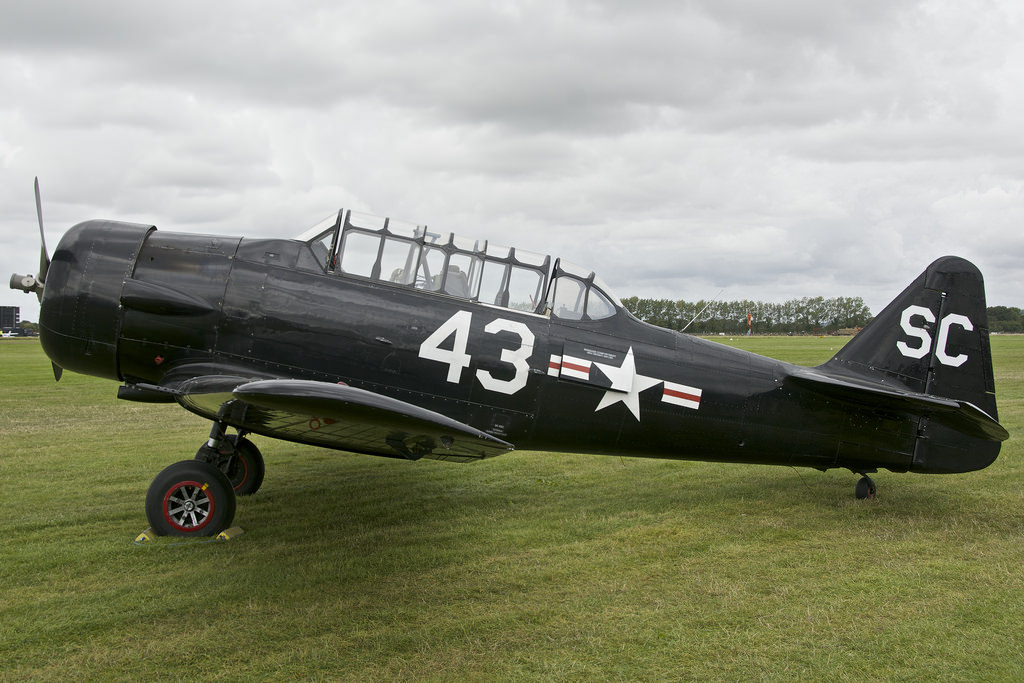
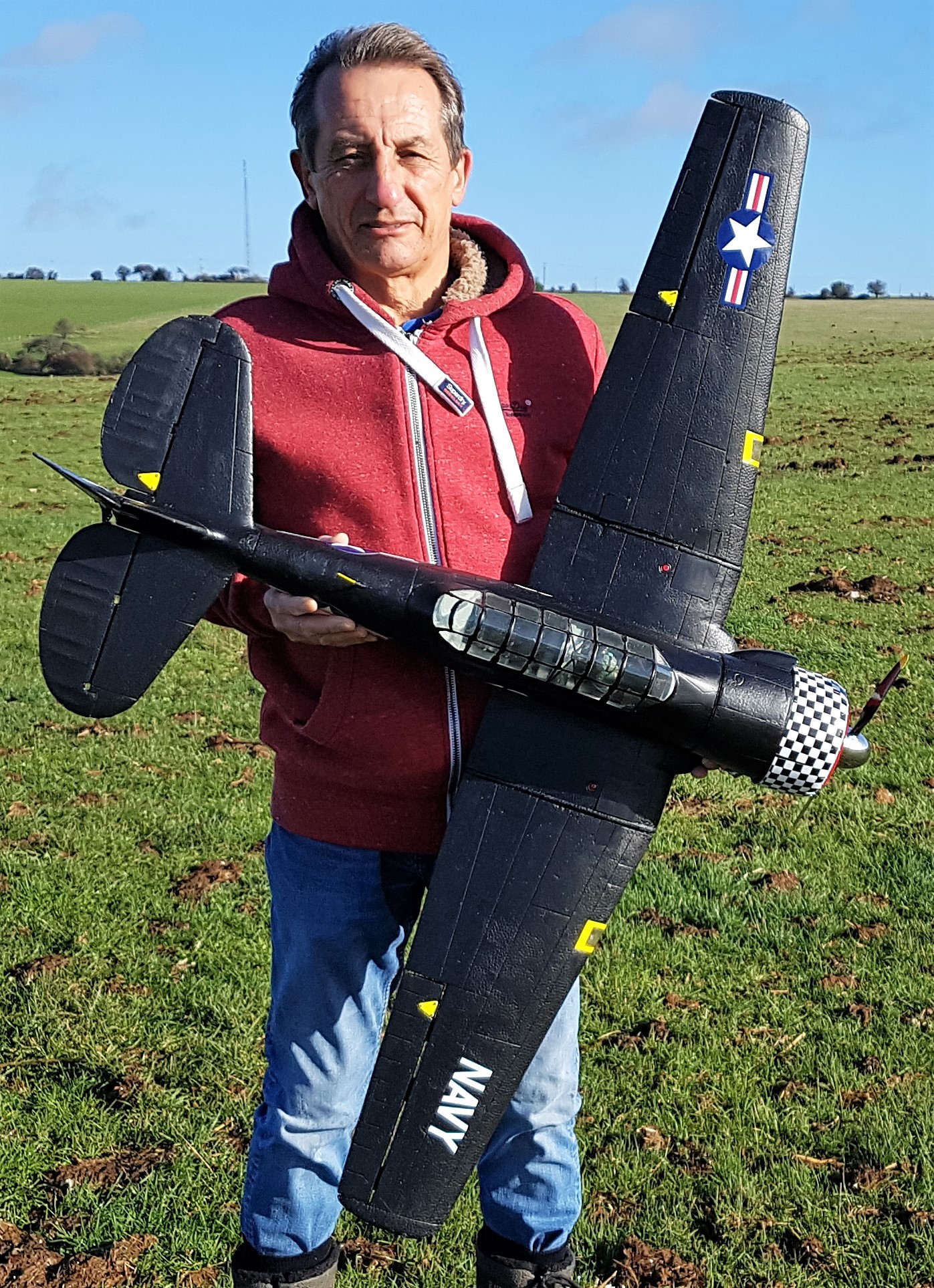 I was a little concerned about it being all black following my difficulties with orientation of Bob the Builder’s all black Dragon so Woody added some yellow highlights and a chequered cowl to help out. The Texan/Harvard is renowned for its’ tip-stalling tendencies and the Art-Tech model is no exception, it will bite if slowed up too much although Woody has managed to tame his model to a large extent with a few adjustments. Following the refurb he asked me to test fly the model and all was well although there were signs that it needs a little lateral balancing.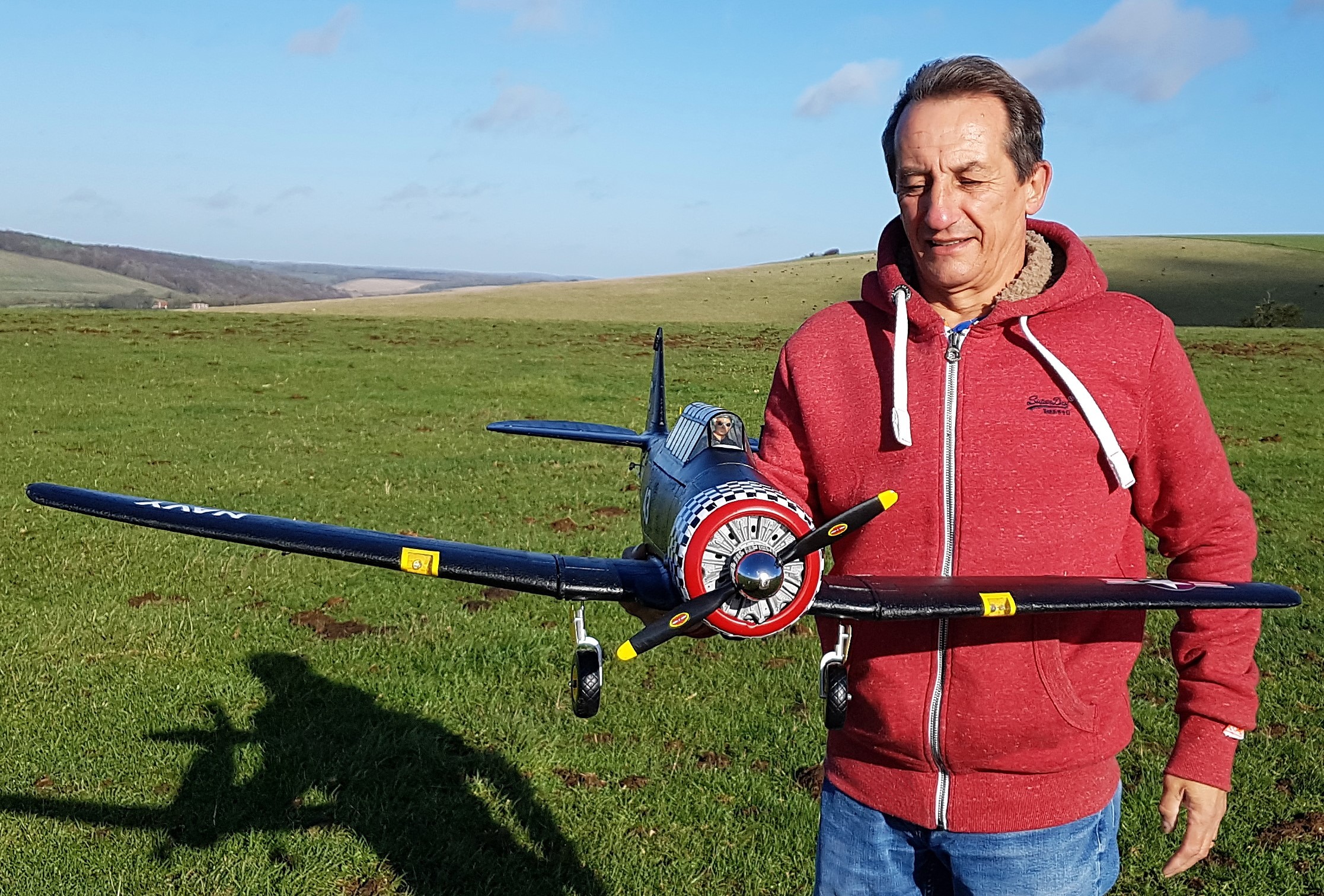
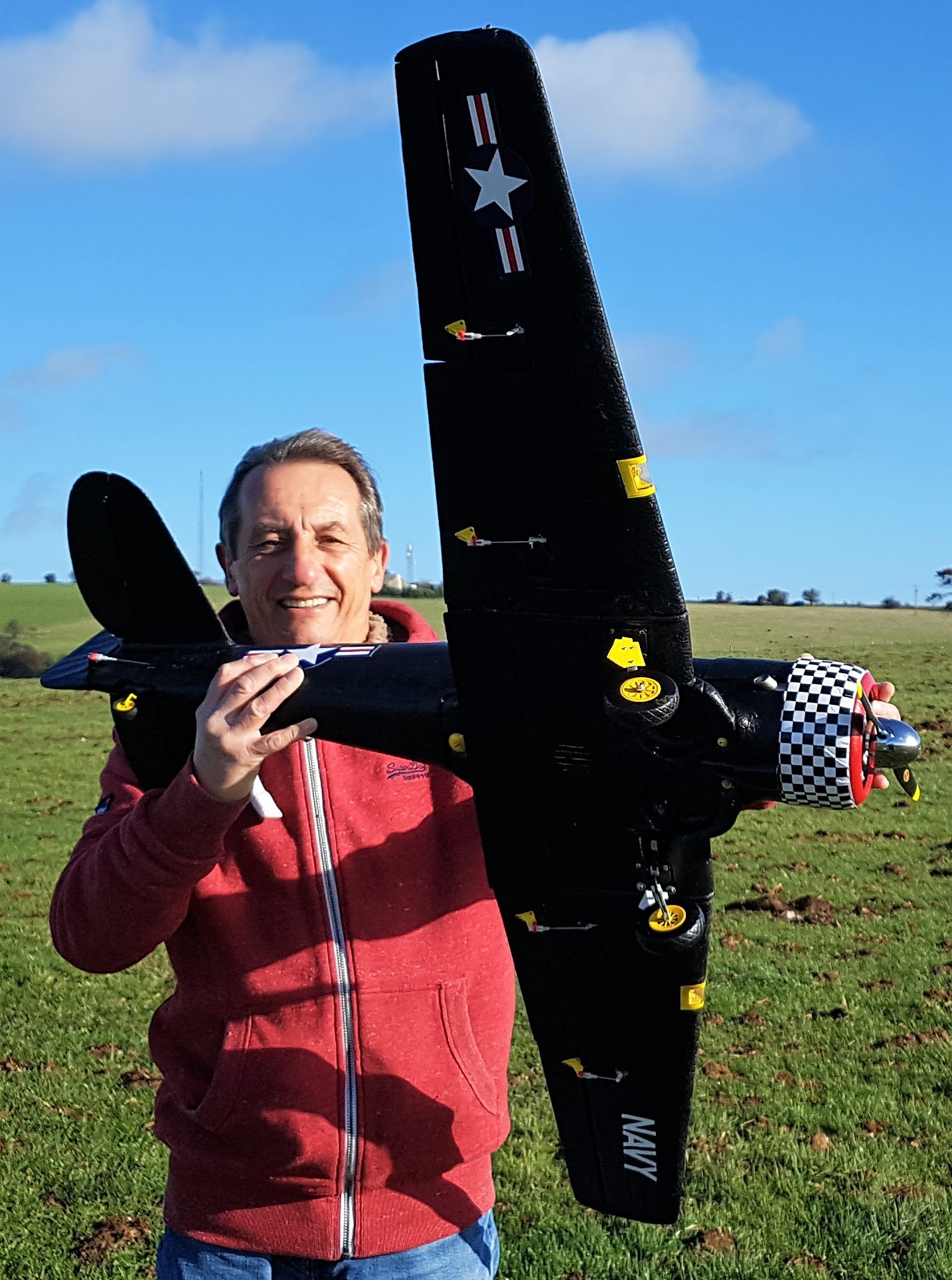 Everyone present watched the flight with interest until I came in to land, the most critical part of the flight. As the model was on the final approach I was watching the speed intently for any sign of the tip-stall when suddenly the sound of a full-size Spitfire grabbed the attention of everyone else. I couldn’t look away and completed the landing just as the Spit roared directly over the patch at fairly low level. Typical! Obviously my landing, that not a single person other than me saw, was absolutely perfect, so smooth and scale like in its perfection, the best ever…ahem!
Bob the Builder has been at it again. No, not crashing, he’s been building, and this time he’s produced Bob’s Bitsa.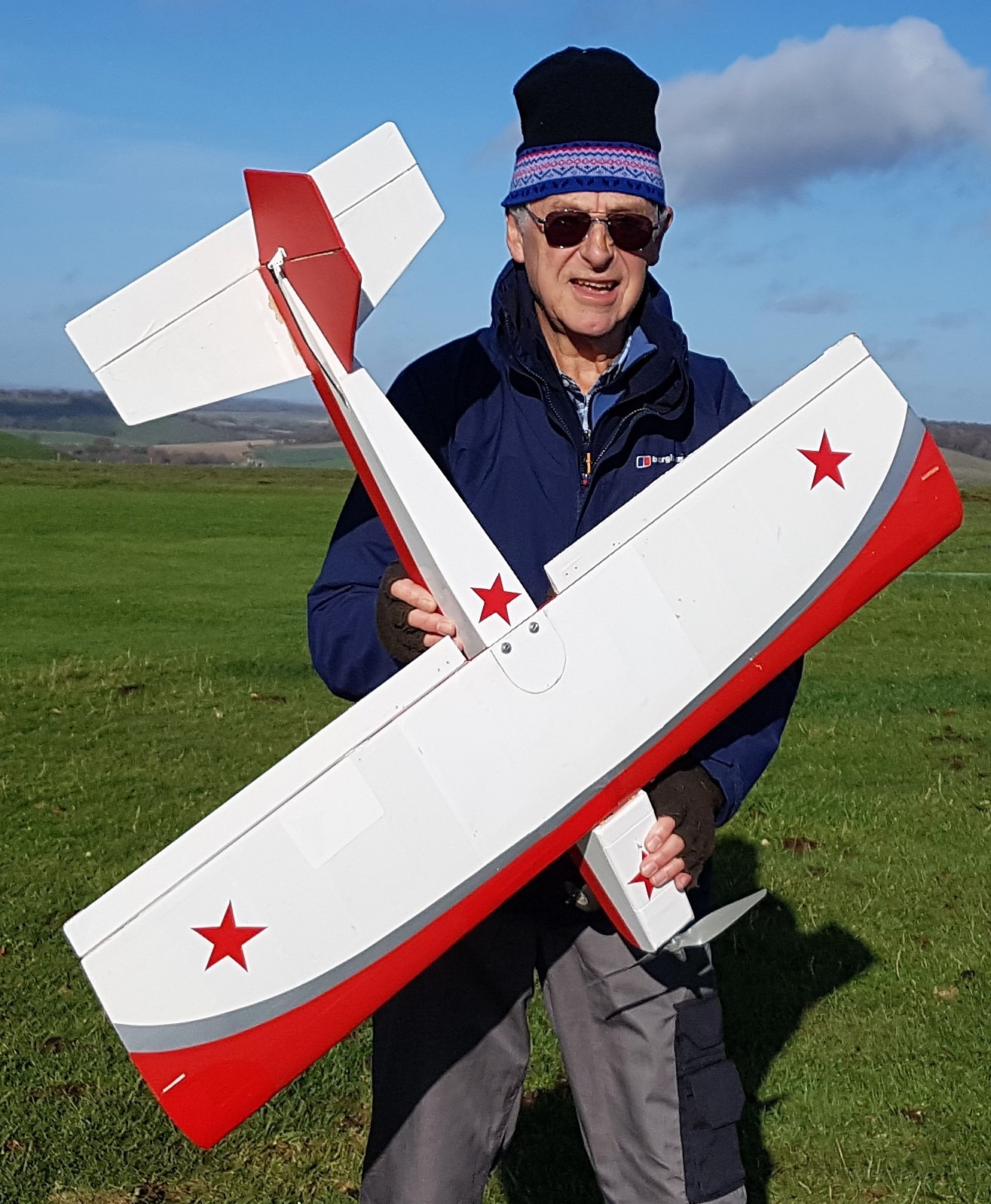 Bob tells me the fuselage comes from a crashed Splot but I think it was Bob version of the Splot as I can see several differences. He’s added a battery hatch to the top of nose, good idea, it’s much the easiest way of swapping out batteries. The motor is a HobbyKing PropDrive 2836 1400Kv outrunner and that’s linked to a 40A speed controller from RobotBirds. It’s very musical and plays lovely tunes when powered up, mostly to annoy everybody else in the pits I think. Bob uses both 3 and 4 cell lipos but says it’s better on 4 cells. In this month’s video I was flying it on 3 cells and it seemed plenty to me but I’ve since flown it on 4 cells and it had a bit more vertical performance. 3 cells produce about 300W and 4 cells around 500W so as the weight of the model is around 3lbs either should be plenty.
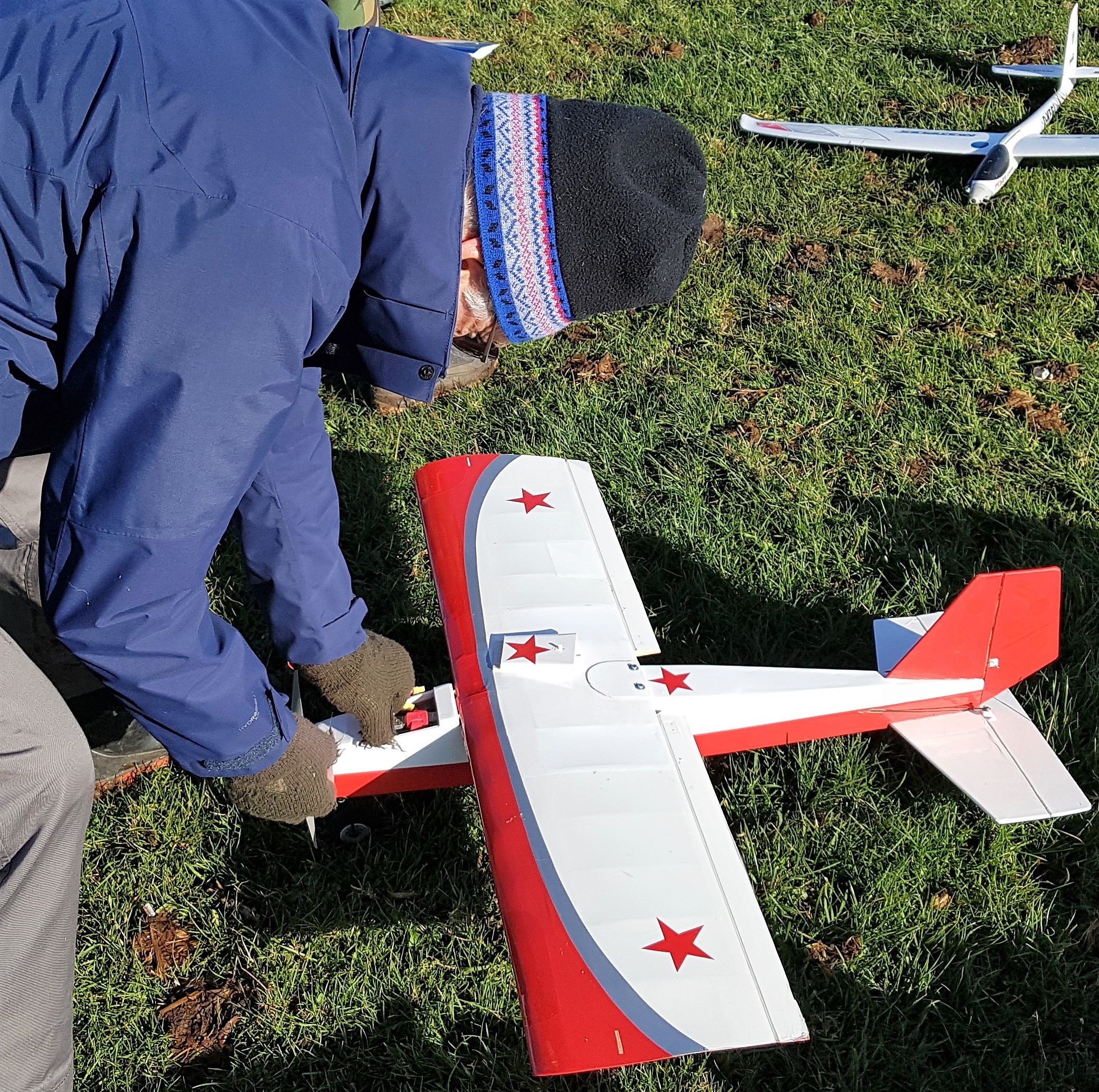 Bob has fitted a tricycle undercarriage instead of the standard Splot taildragger arrangement. The fin and tailplane look like standard Splot items although Bob has enlarged both the rudder and elevator. The wing comes from a broken 5 year old Kyosho Calmato and he’s removed the centre section and re-joined the panels with no dihedral, this gives a wing area about 15% larger than a standard Splot. I hate to be complimentary but he’s made a great job of the covering and the Bitsa looks very smart. The choice of different parts is obviously a good combination as it flies really well, I thought it felt like flying a small pattern ship, it’s very smooth and it grooves well. Bob is still fine tuning things but at the moment the flight time is about 8 minutes so it’s a good model all round.
Jeremy Studdard sent me lots of information about his latest models. We don’t often see Jeremy at our field as he is also a member of the Chichester club (CADMAC) so he mostly flies at Thorney Island where they enjoy the use of the runway, although there are strict rules as to when and where they can and cannot fly.
The first one is definitely my favourite, it’s a 59” span Freewing Venom which is pushed along by a 90mm 12 bladed fan powered by a 6 cell 6200mAh lipo. Look at these excellent flying shots.
 The model is equipped with flaps and electric retracts with sequenced front gear door and sprung oleos. The weight including battery is 6lbs 9oz (just under 3kg) and there is around 6lbs of thrust.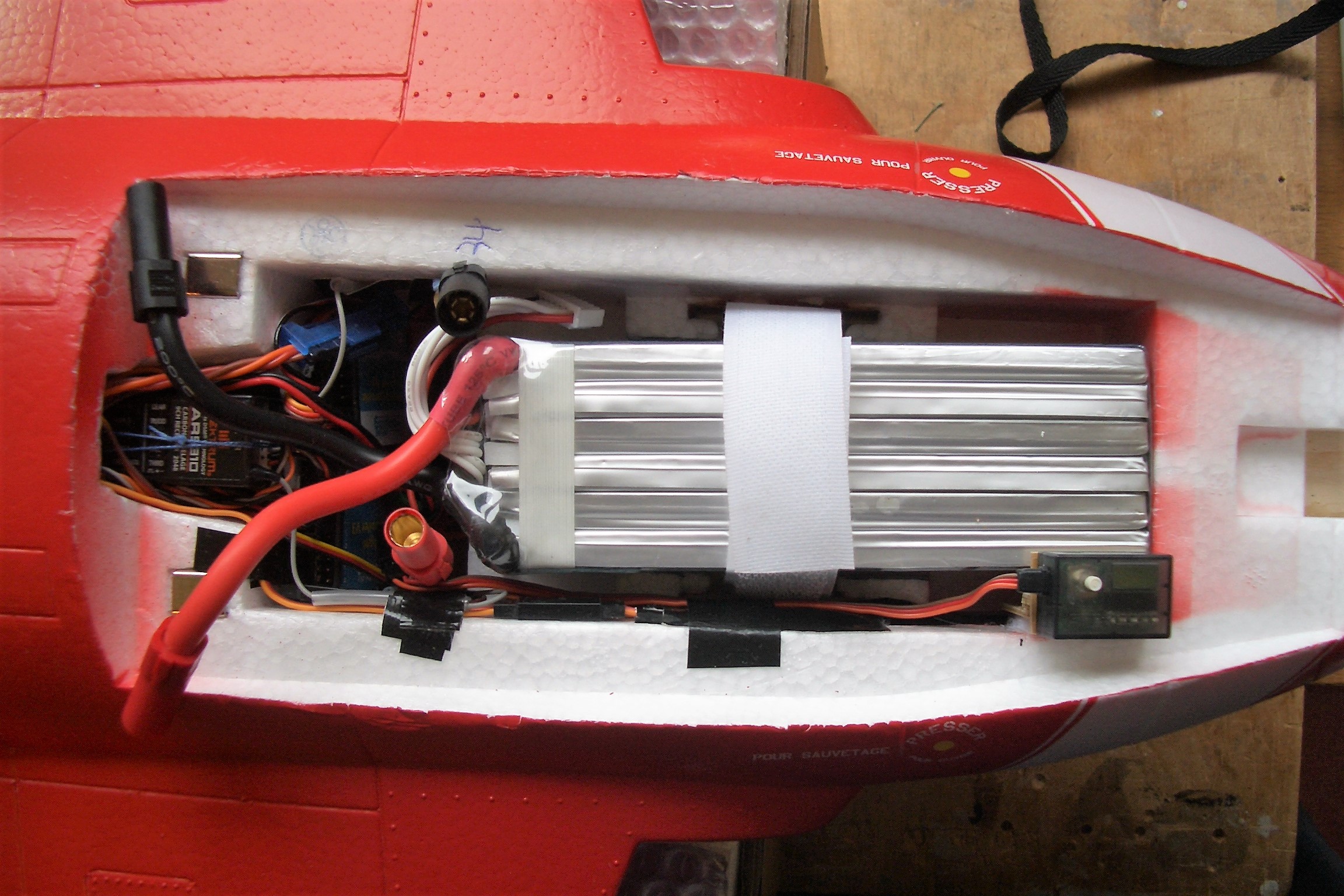
 Jeremy says the fan produces a great jet like sound and isn’t too noisy. He also says this: For my powered aircraft on Thorney I go OTT with receivers, the main Rx has two receivers and I add two satellite Rx’s. Blimey, that 3 more than any of my planes have, I wonder if that’s because he’s had problems or if he’s just playing extra safe? I won’t mention what make of radio he uses…
I’ll let Jeremy tell you about his next one: My other new aircraft this year, I was given it last Christmas but did not assemble & fly it till the summer, is the Sebart Katana 50E. Span 57″, 6lb 7oz including 5S 5000. Sebart have gone to extremes with the lightening holes. The whole thing is very fragile, including around the U/C. I’m even frightened to just pick it up, I have to do so carefully. While it can fly slowly it would not survive my landing skills on the patch, I’m too used to a 50m wide runway. I would want to fit Tundra wheels before trying the small grass patch.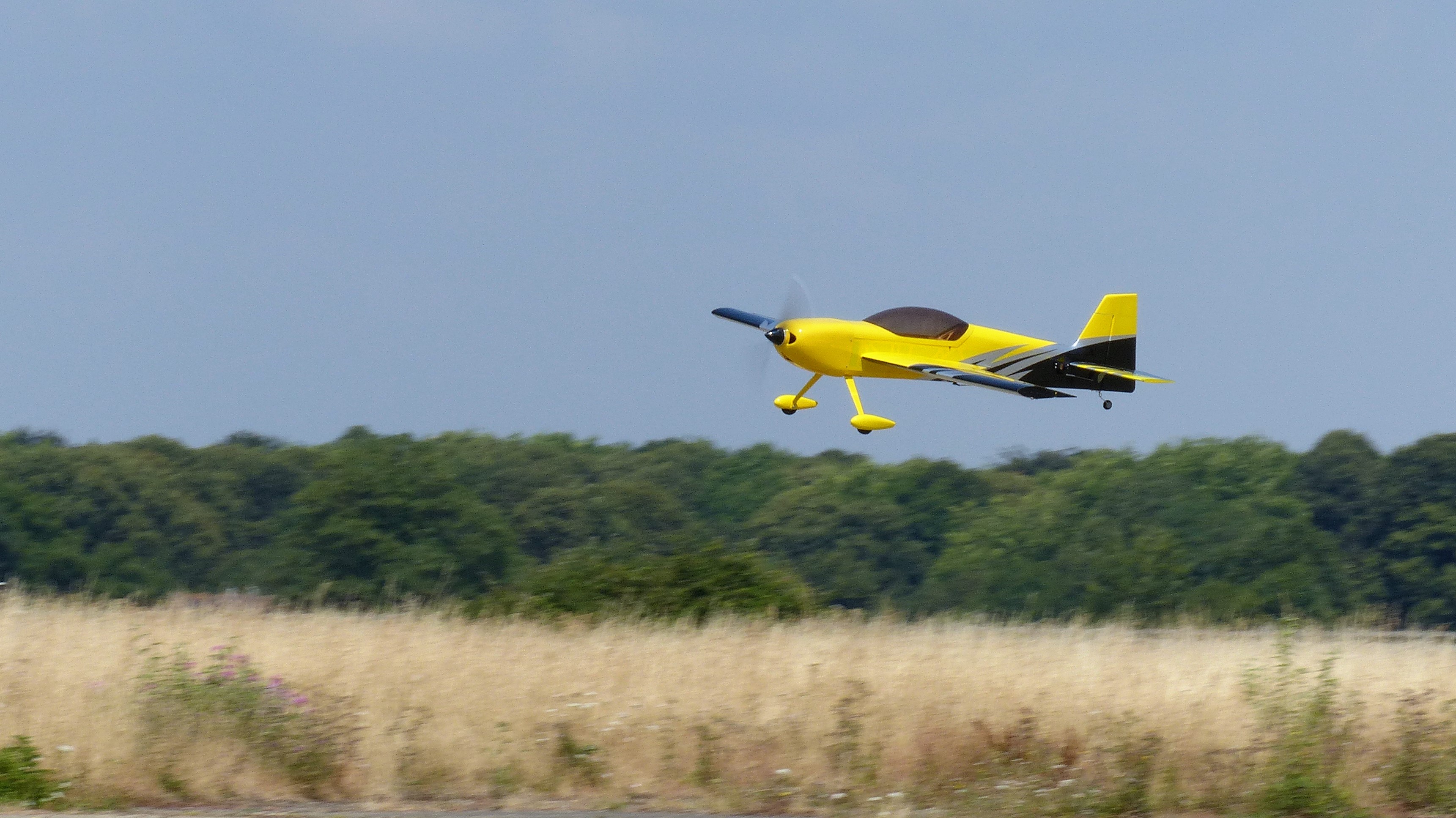 Jeremy also sent some video of his Olympus which you can view by clicking HERE. Thanks Jeremy, great stuff, I’m very jealous of the Venom…I reckon I could fly one from our patch ok…
Matt Takhar turned up in mid-November with a very special new model, an Aerotech Velox Revolution II.
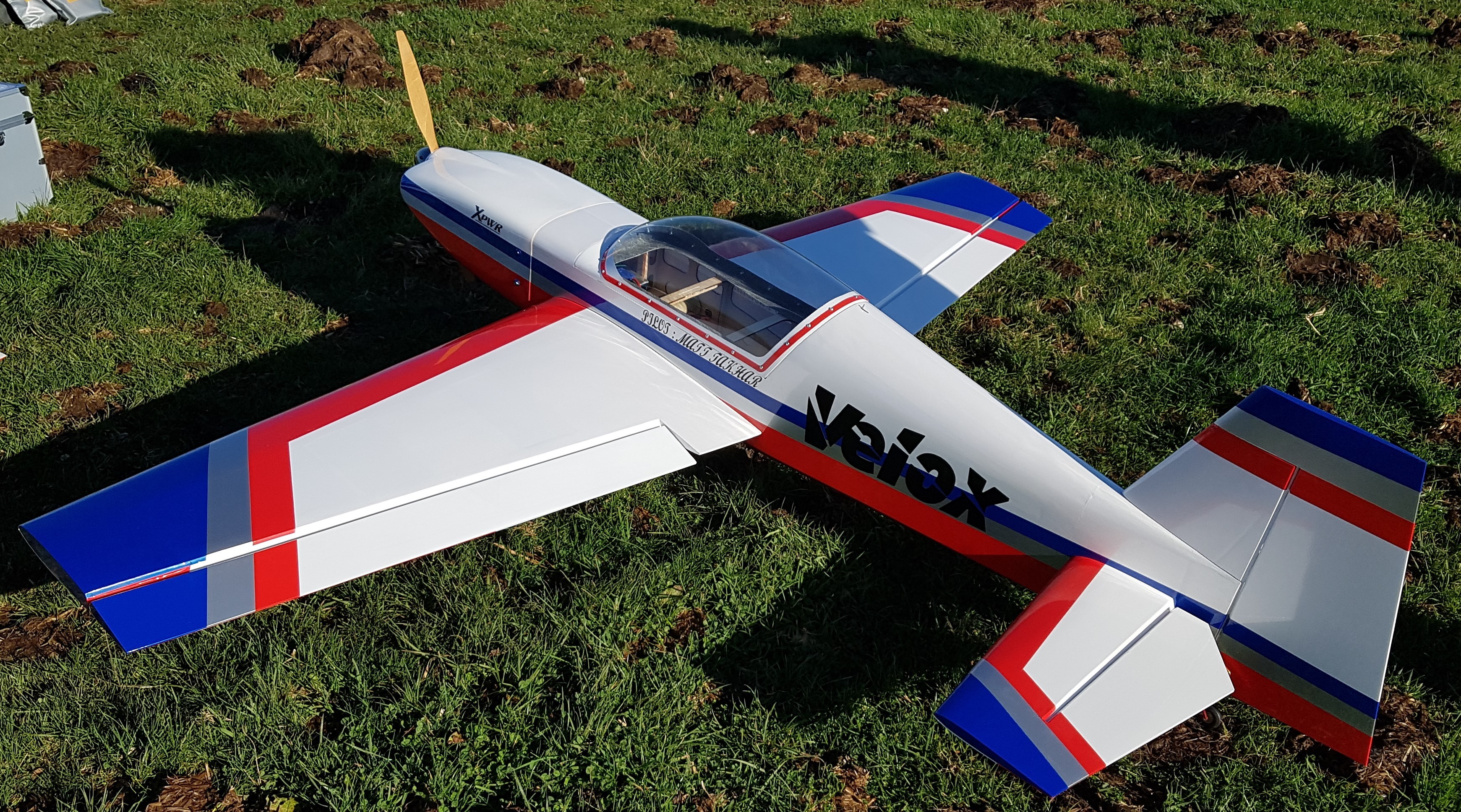 We all thought Dougal’s Velox was big at 70” span and weighing almost 9lbs but sorry Dougal, Matt’s got a bigger one than you! Matt’s Velox is 81” span and the weight is around 15lbs, a seriously impressive model. It was assembled for Matt by ProBuild and they fitted it out with all the powertrain, radio, batteries etc. The motor is an Xpwr 40cc (obviously an electric motor equivalent to 40cc) and is 200Kv which means when run on a 12 cell lipo it’s able to swing a 22×10 Xoar Electric beech wood propeller. The speed controller is a Castle Phoenix Edge HV120 and the batteries are two 6 cell Gens ACE 3700mAh 22.2v 60C packs wired in series to give 12 cells (44.4volts).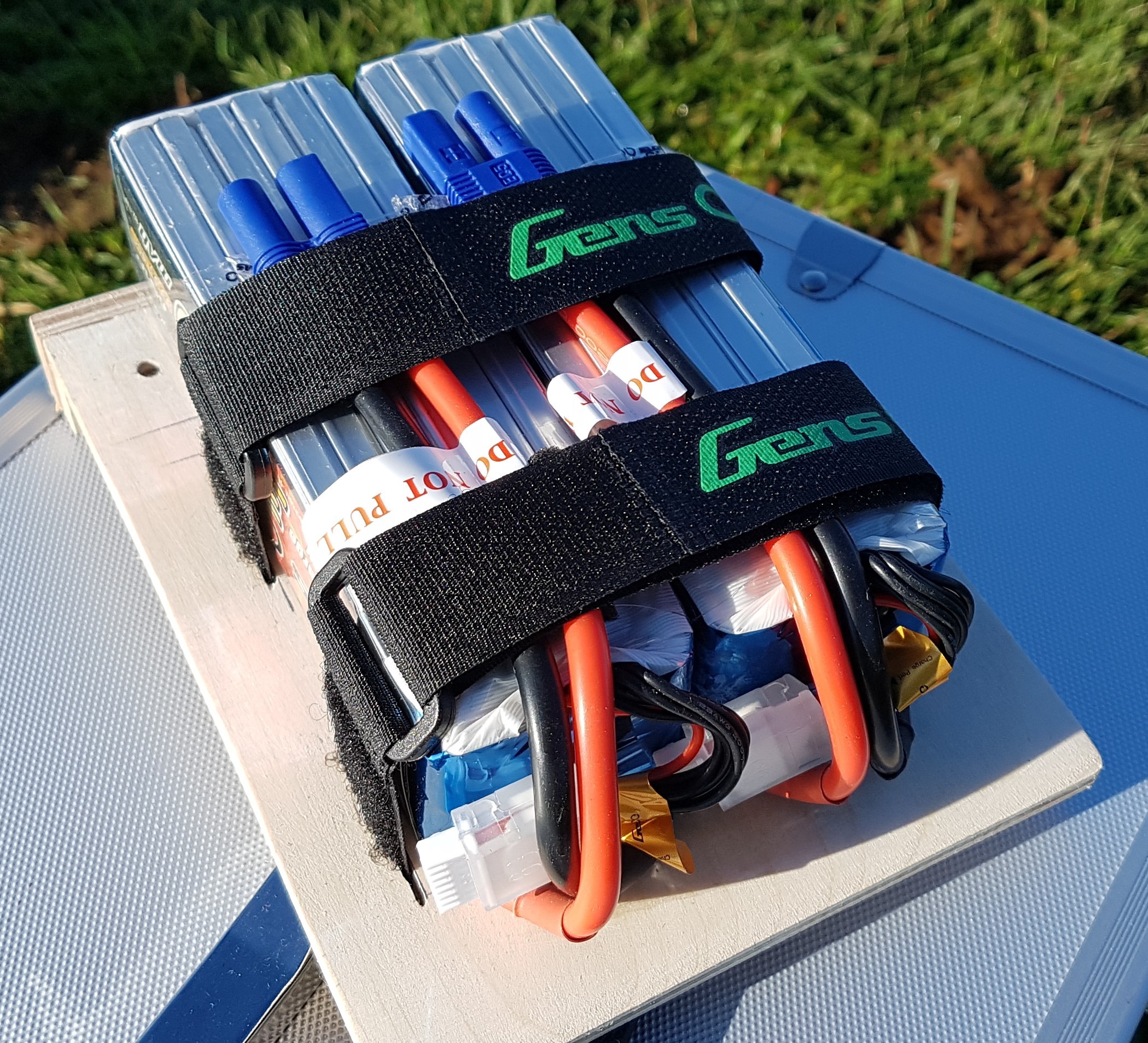
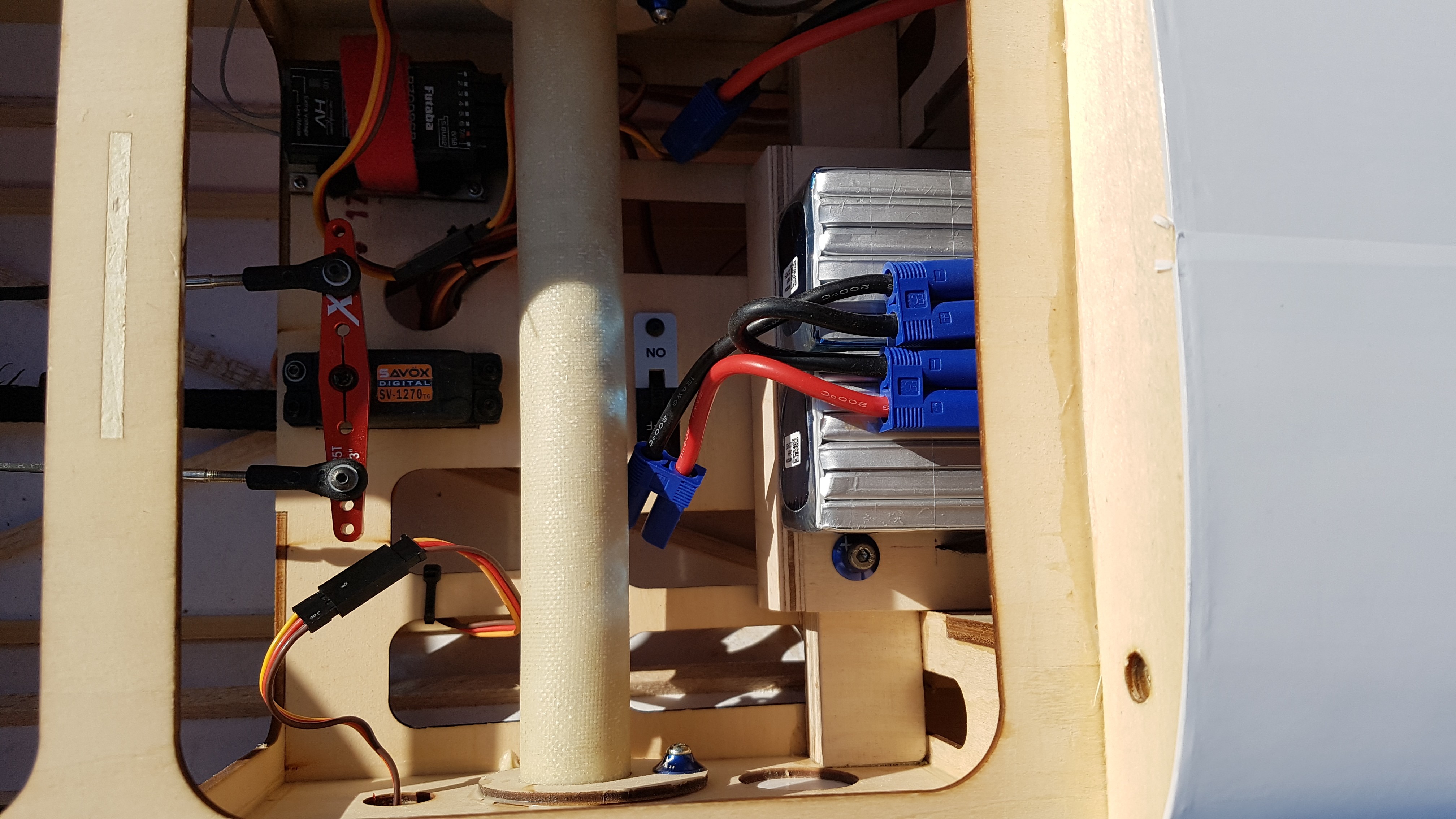 According to the specs the set-up will pull around 90A and uses 4.1kW of power. Matt is using Futaba radio gear and the model is fitted with a Futaba R7008SB (S-Bus) (HV) receiver driving five Savox 1270 HV (30kg) servos. That lot requires a decent receiver battery pack so ProBuild have fitted a Gens ACE 5000mAh 7.4v lipo.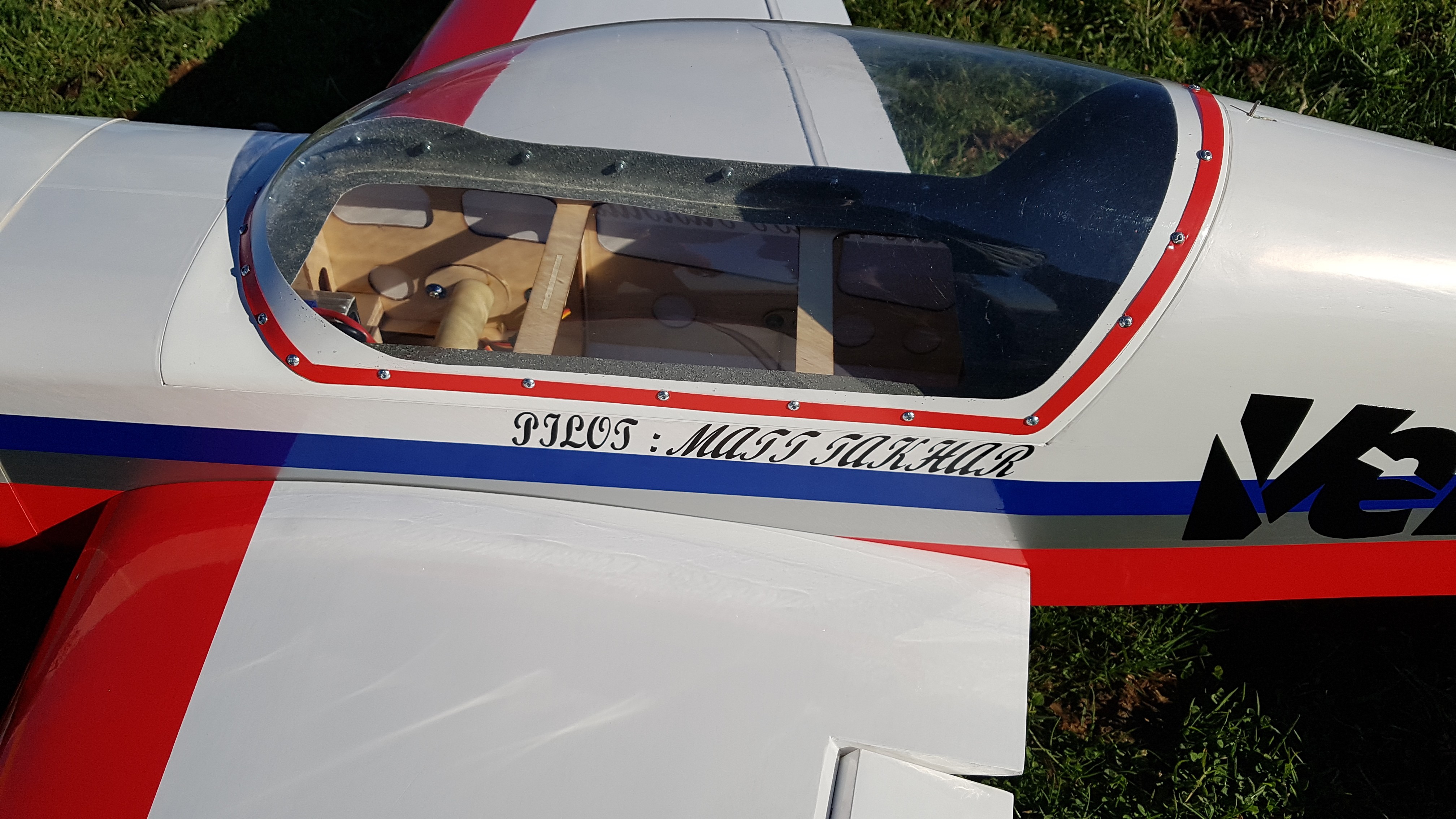
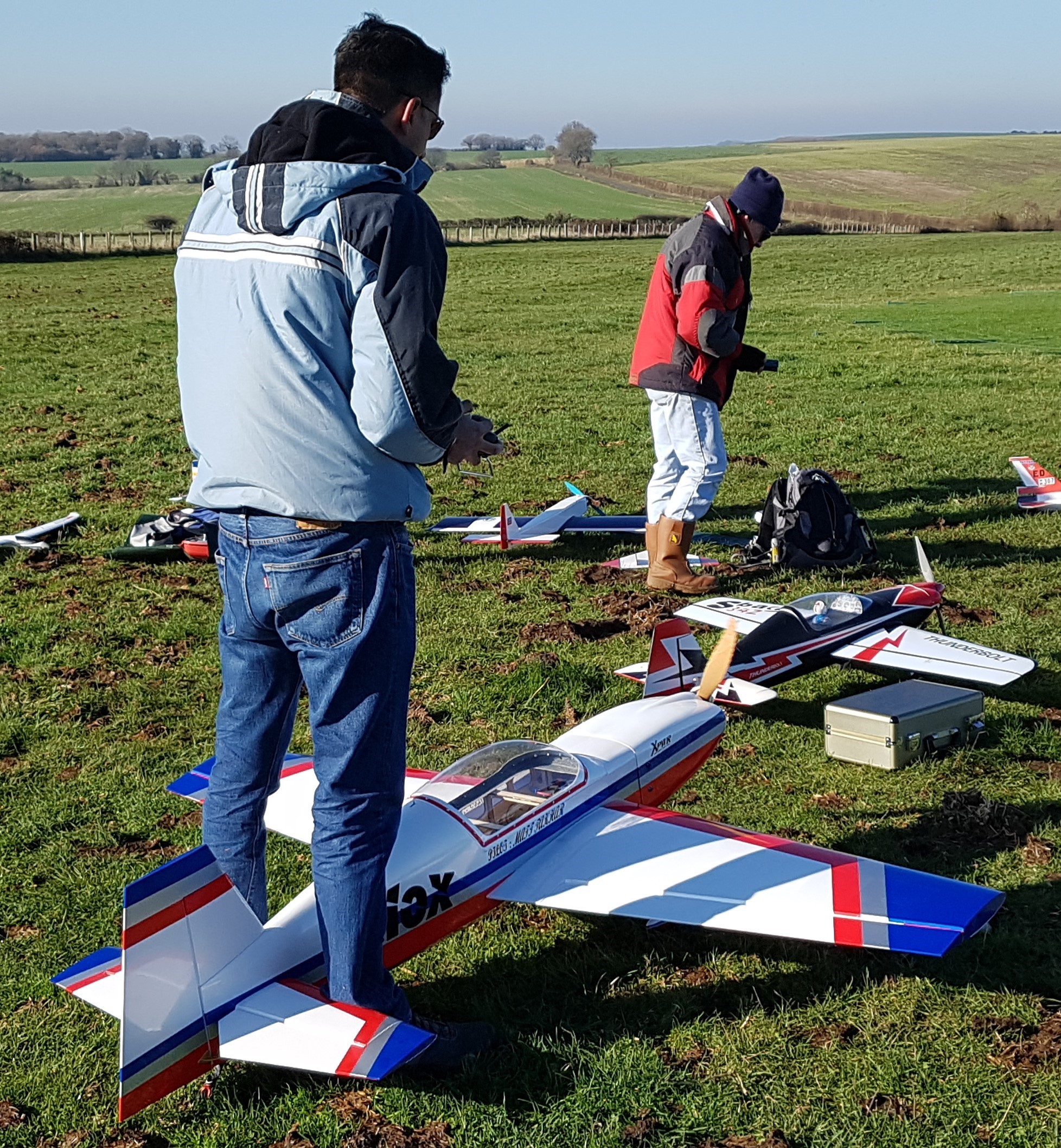 Matt had two flights the first time out with the Velox, the first one being understandably cautious but no problems showed up so, after a thorough check that everything was as it should be, he had a second flight that was more adventurous, although mostly at a sensibly safe height. As you’ll see in the video the model performs beautifully and has loads of power so, as Matt gets used to it, I’m sure we’ll be treated to some top class aerobatics.
Back to much more mundane stuff now!
Following the success with my foamboard HK Sukhoi SU-27 I splashed out £16.40 on a Mig-29 from the same range.
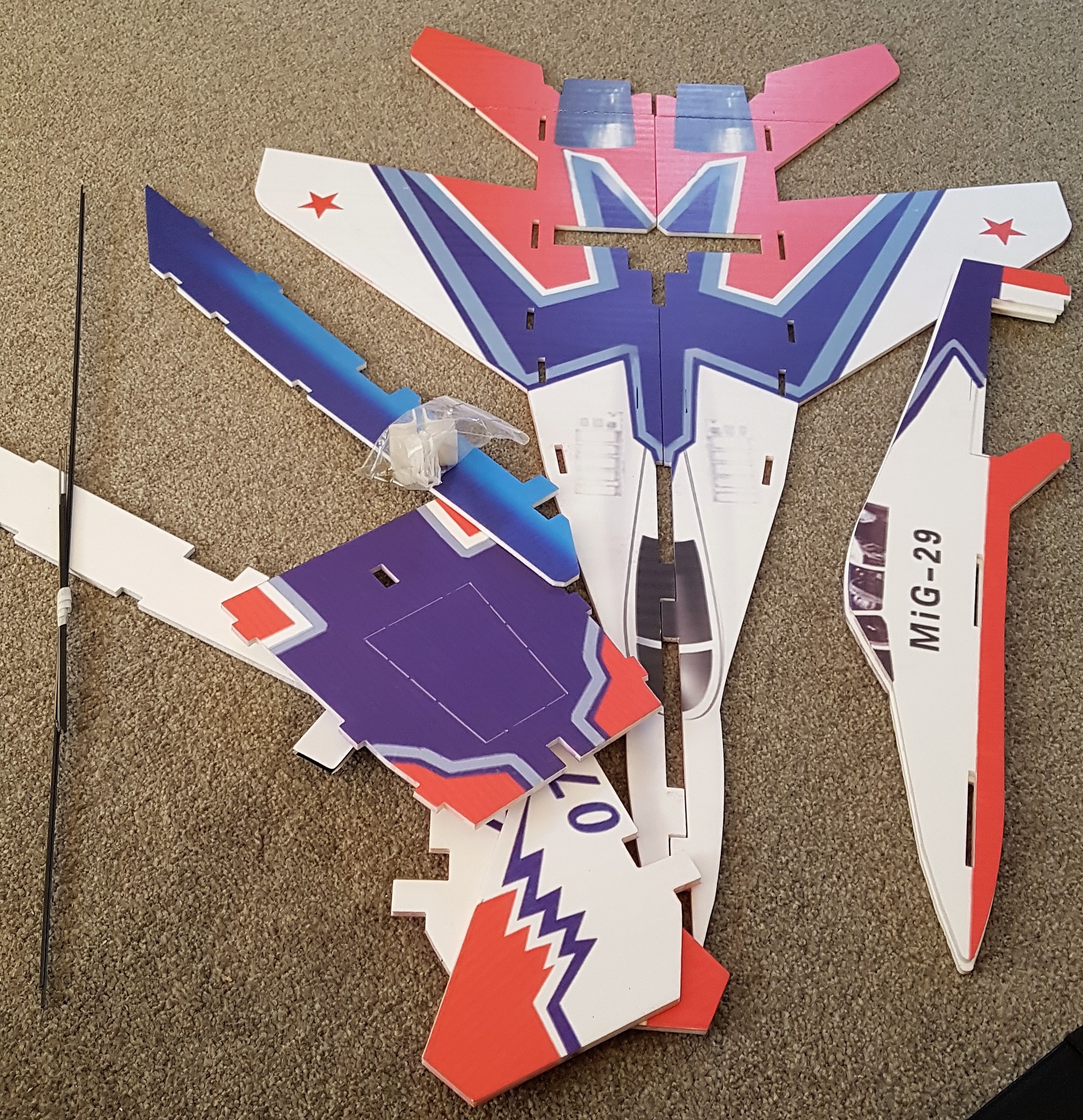 The Mig is similar but a bit smaller and easier to assemble than the Sukhoi and only has tailerons, no ailerons.
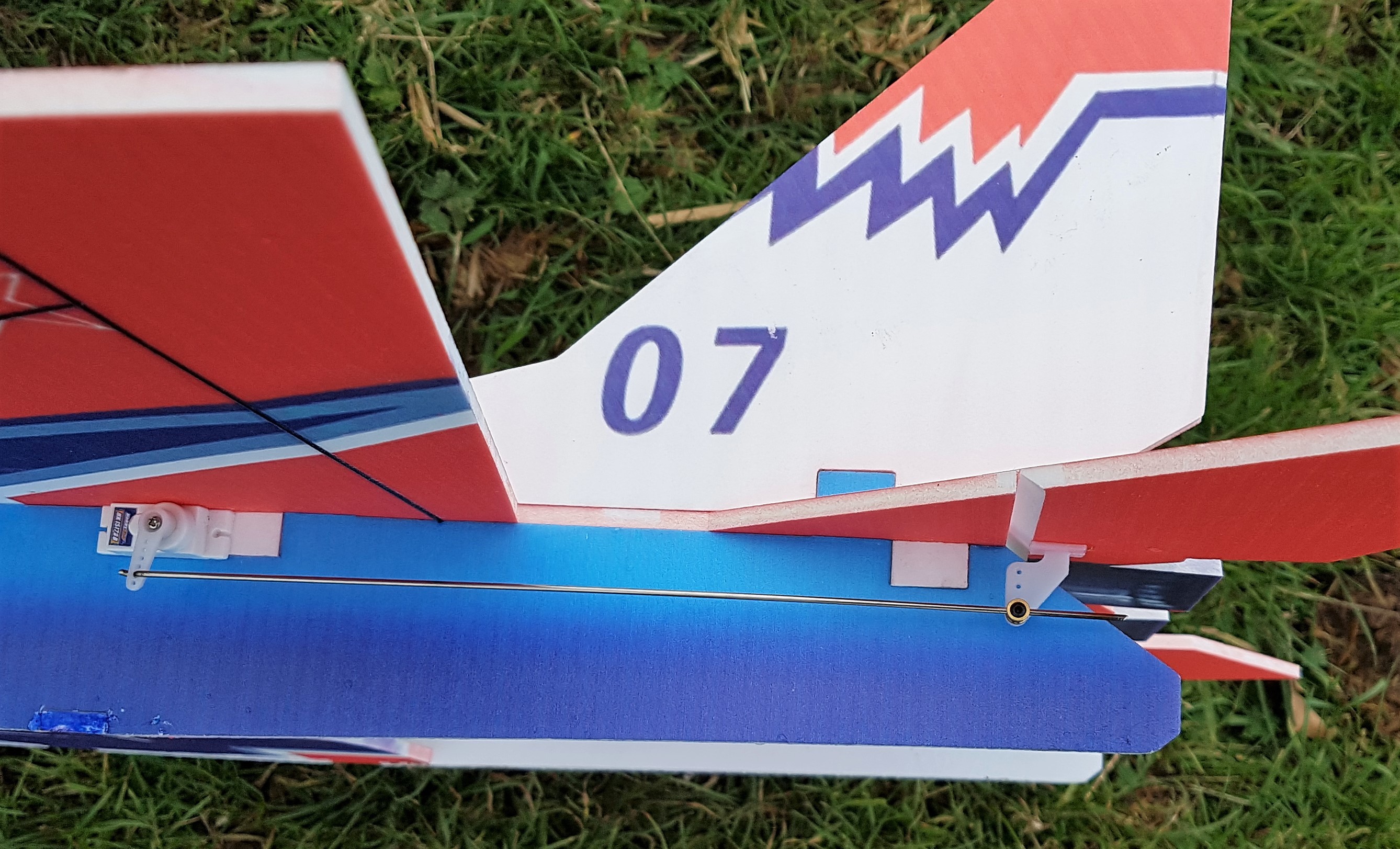 One of the reasons I liked the Mig was the colour scheme, it’s much brighter and more colourful than the Sukhoi and also, unlike the Sukhoi, the colour is printed on the underside as well as the top, it looks good in the air.
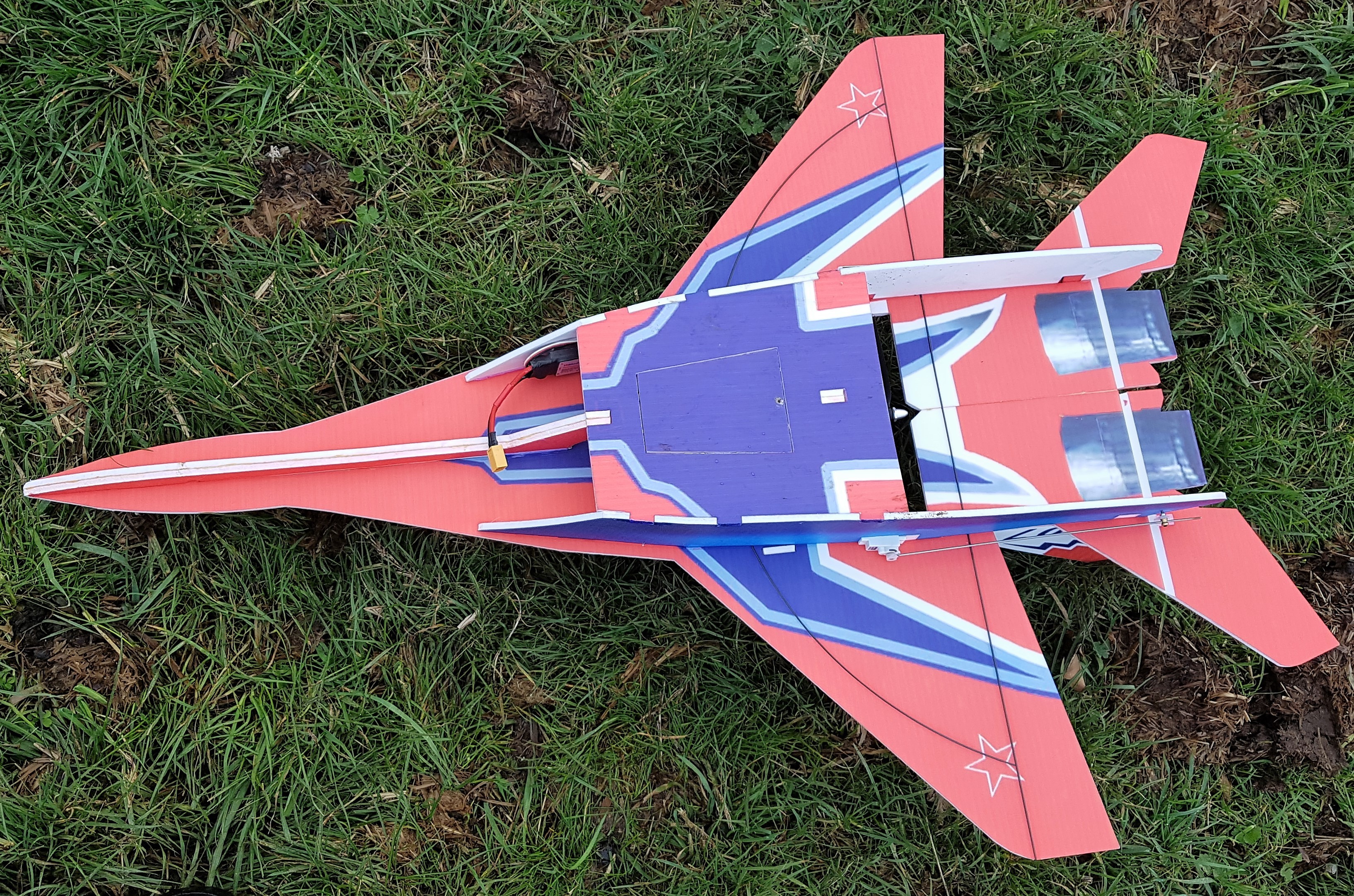 I’m using the same motor/prop/lipo combination as in the Sukhoi and it flies well, lots of fun. Being smaller the wing loading must be a little higher so it’s not quite so good at the high alpha stuff as the Sukhoi and without ailerons it’s not quite so responsive at low speed but overall it’s a great plane for very little money. Woody, Captain Slow, and Bob the Builder have also bought Migs but as I write so far only Woody has finished and flown his.
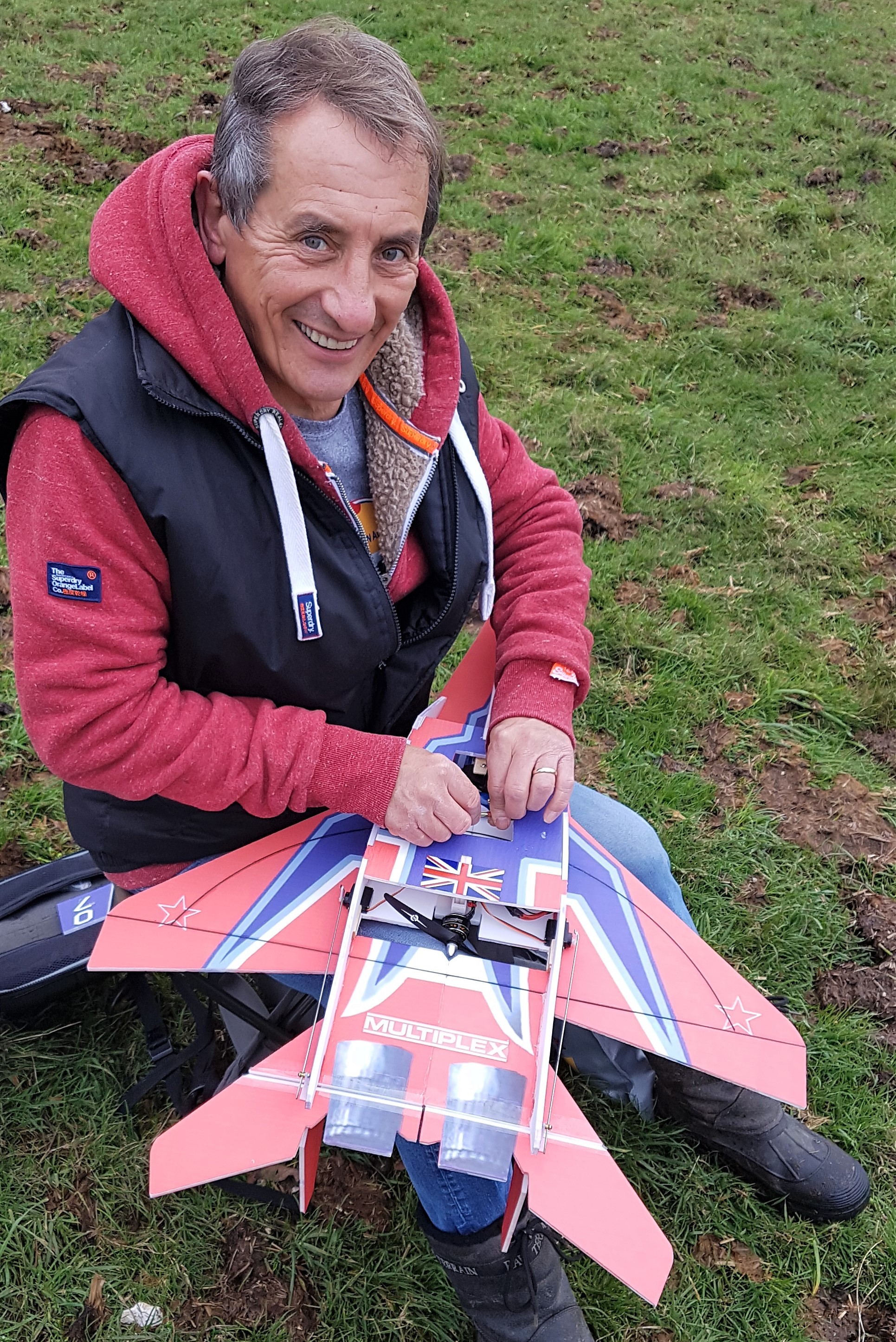 He’s using the same motor as me but has fitted a 7” prop instead of 6” and it sounds much better so I’ll change mine to a 7” as well. I did the initial trimming of Woody’s and found it was bit unstable in pitch so Woody added some weight to the nose which made it much better. I then added some weight to mine as well and now they fly pretty much identically. Woody is getting on really well with his although the fact that they can be blown backwards when landing in any sort of wind is proving a little testing and this was where his third landing finished!
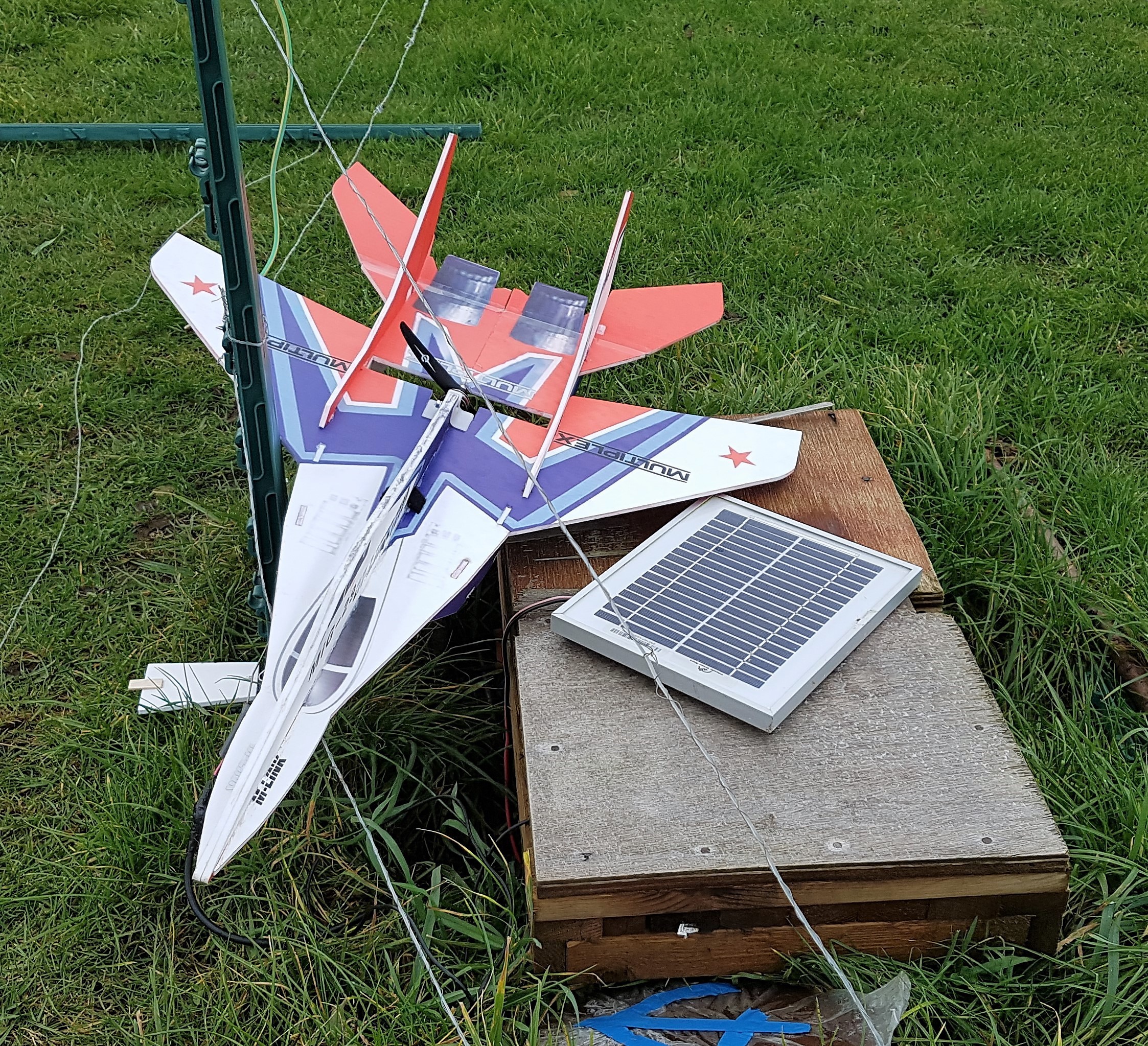 But as it was at almost zero speed there was no damage at all so he’s happy. Both mine and Woody’s Migs can be seen in this month’s video. No doubts Bob’s will fly soon and Captain Slow’s sometime in the next year or two!
Video time at last:Please watch the video full screen, it’s so much better with small models flying around. If the video won’t play for you click HERE
Get your kids into aeromodelling when they’re young, they’ll never have any money for drugs!
STOP PRESS 30TH NOV: PETERSFIELD AERO MODELLERS CAME THIRD OUT OF NINE TEAMS AT THE SOUTHERN AREA BMFA BALSA BRAIN! Team members were Mark Agate (Dougal), Alan Wood (Woody), Andy Palmer (Colin), and Doreen Palmer (SWMBO).
Colin Cowplain
Patch News – October 2018
As I was away towards the end of October this Patch News will be a little shorter than usual and it won’t include any events that occurred in the last ten days or so of the month. No doubt other members will keep me informed of anything I missed and I’ll be able to add them to the next edition. Thanks to Dougal Entendre, Captain Slow, Catapult King, Dwayne Pipe, and Kryten for their photo and video contributions this month.
October saw the expected changeable weather and we missed flying one Sunday morning and a couple of Friday afternoons due to some pretty heavy rain and strong winds. But there were also some absolutely glorious days so we still managed to fly a fair bit, especially the Midweekers. The friendly bullocks that had returned towards the end of September were moved out to the lower field in mid-October which made life much easier for us. But the fence has done its job and the patch is in great condition, just needing an occasional mow now.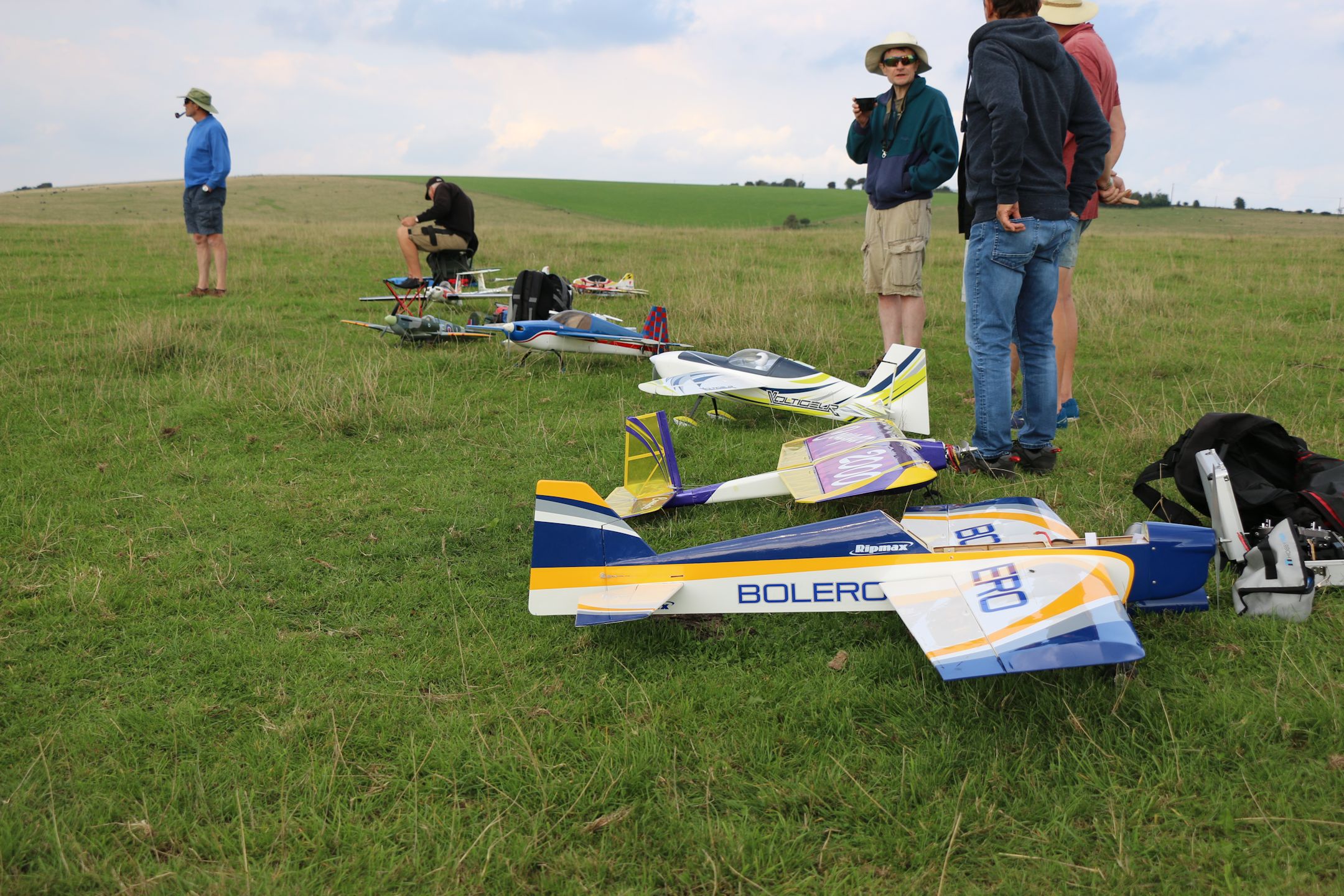 I don’t imagine the existing bullocks will be back in the field again as they’ll be off to a supermarket soon, but we’ll no doubt be joined by some much younger ones in a few months time. I expect they’ll prove to be really inquisitive at first and will probably be a pain until they get used to us.
I’ll begin with an event that actually happened on 30th September, too late for me to include in the last Patch News. Dougal Entendre was flying his HobbyKing Edge 540T and Cream Egg was flying his nearly new HobbyKing Voltigeur when there was a sudden bang, they’d had an unfortunate coming together. As is almost always the case when a mid-air occurs nobody was really to blame, it was just one of those things. Although…Bob the Builder (previously known as Basher Bob due to his fondness for mid-airs) was also in the air at the time of the collision. Just saying…! Cream Egg was definitely the winner of this skirmish, the collision pulled out the Voltigeur’s right hand aileron but, despite the aileron fluttering around still attached to the servo, he managed to land safely back on the patch.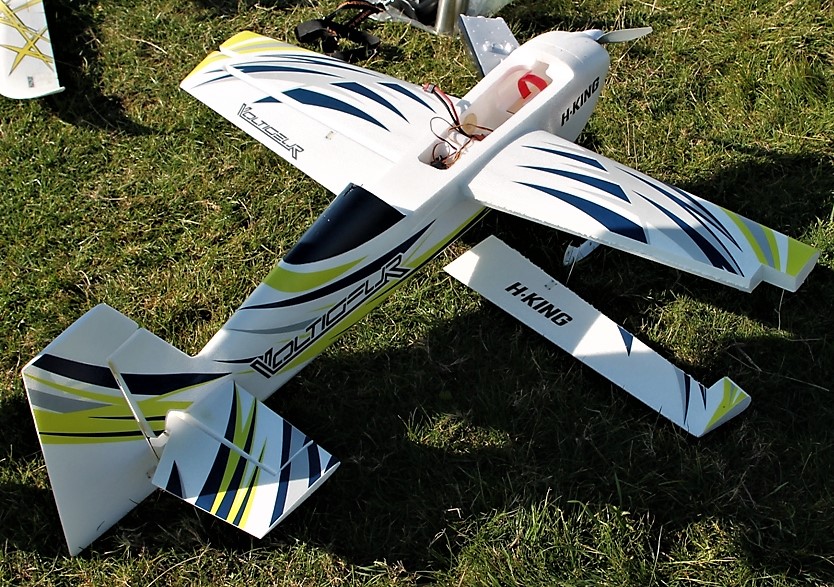 On closer examination we couldn’t find any sign of the impact, not a mark on the model other than the detached aileron. Presumably just the Voltigeur’s propeller made contact with the Edge, and even the trailing aileron was unmarked. Dougal however was not so fortunate, the impact tore the right hand wing clean off the Edge and despite Dougal’s best efforts at knife-edge flight the damage was too severe and the inevitable ‘hard landing’ occurred.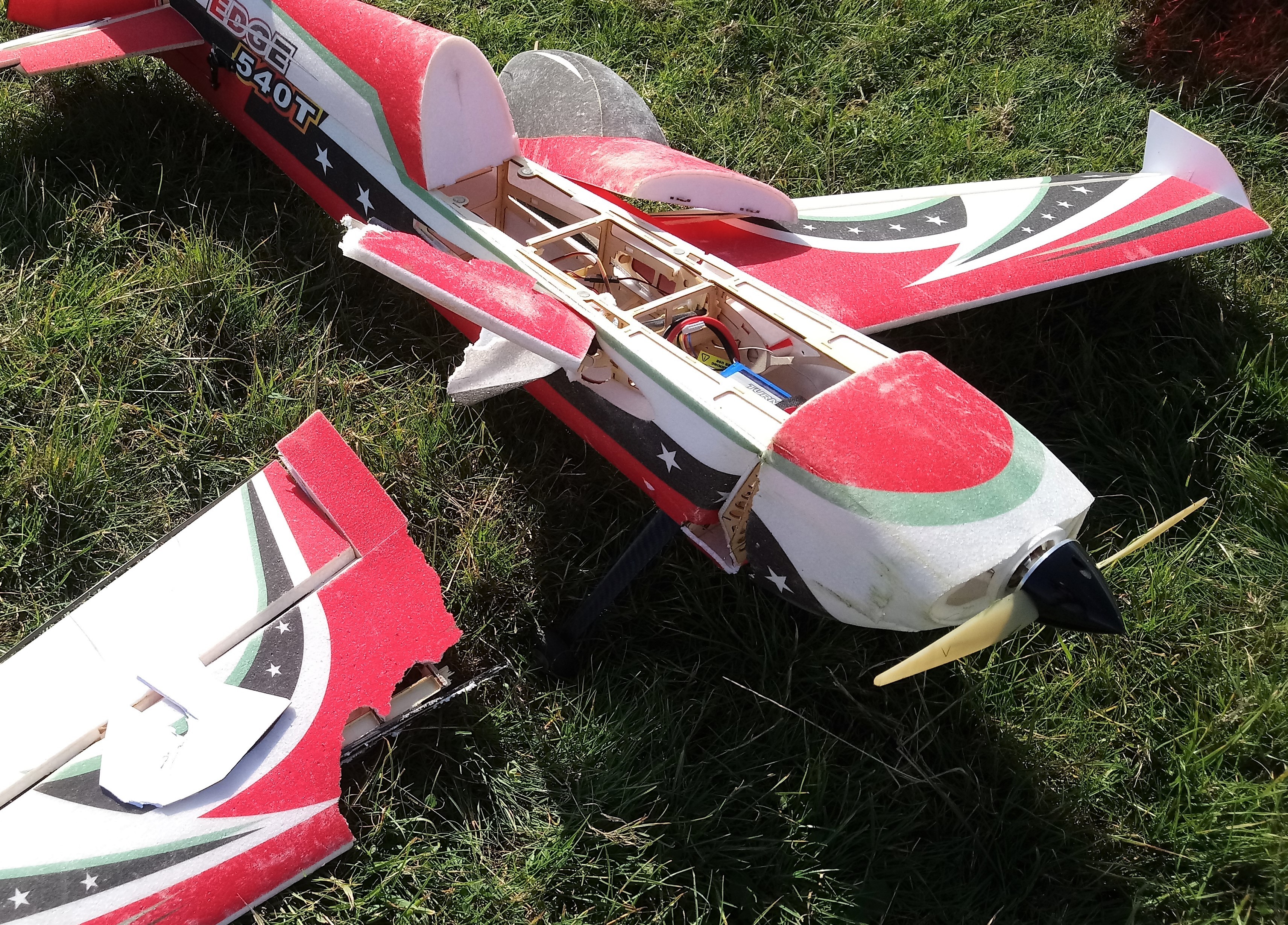
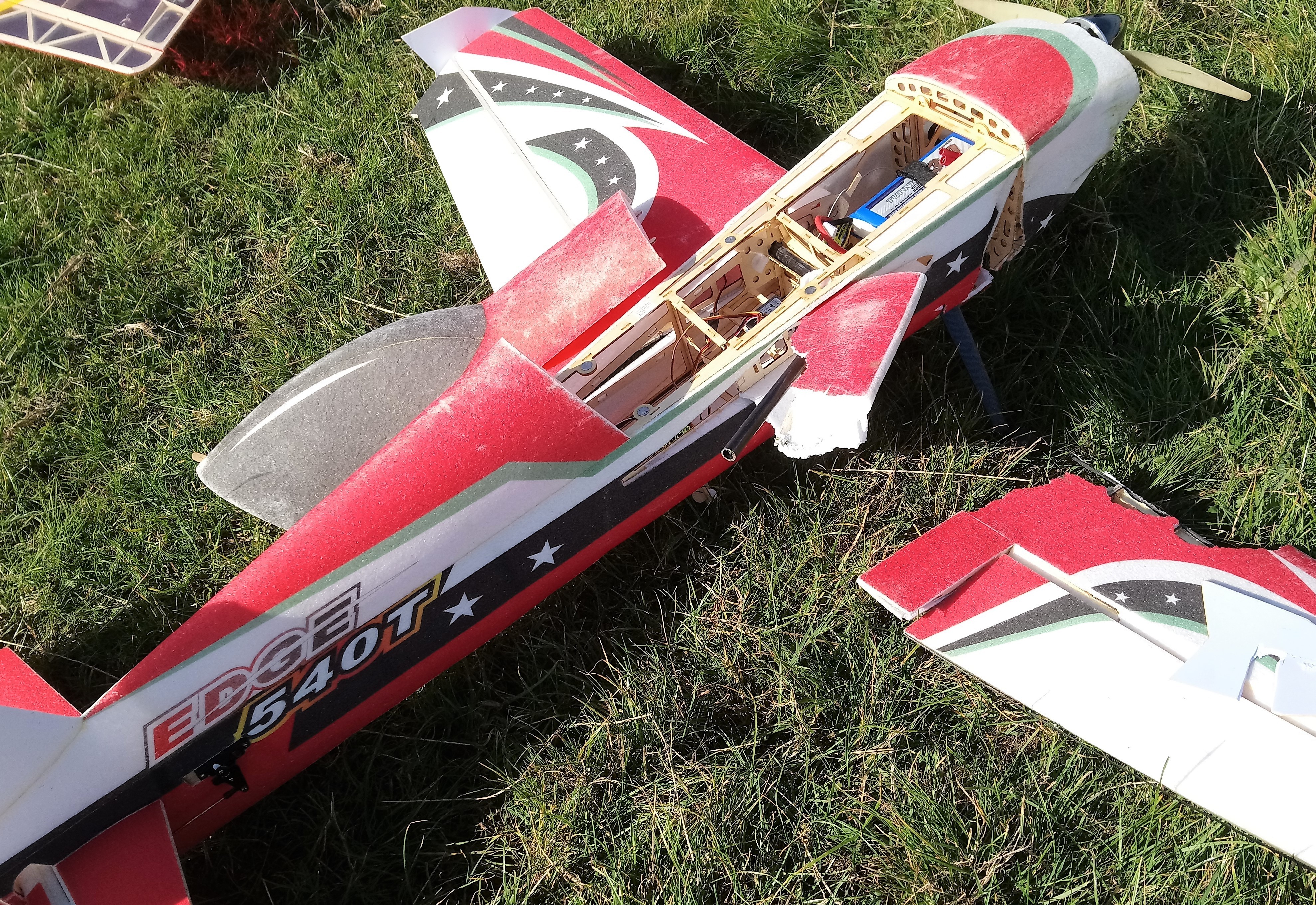 It was quite impressive, the wreckage was a long way from the ripped off wing, he managed several hundred yards of ‘flight’ before it reached its final resting place! Cream Egg had the Voltigeur back flying again a few days later but sadly the Edge has made its way to the big hangar in the sky… Never mind, it was a lovely day and there were plenty of members present to witness and enjoy the event!
Staying with Dougal, he sent me this photo of his Laius last month and it just happens to include his ill-fated Edge.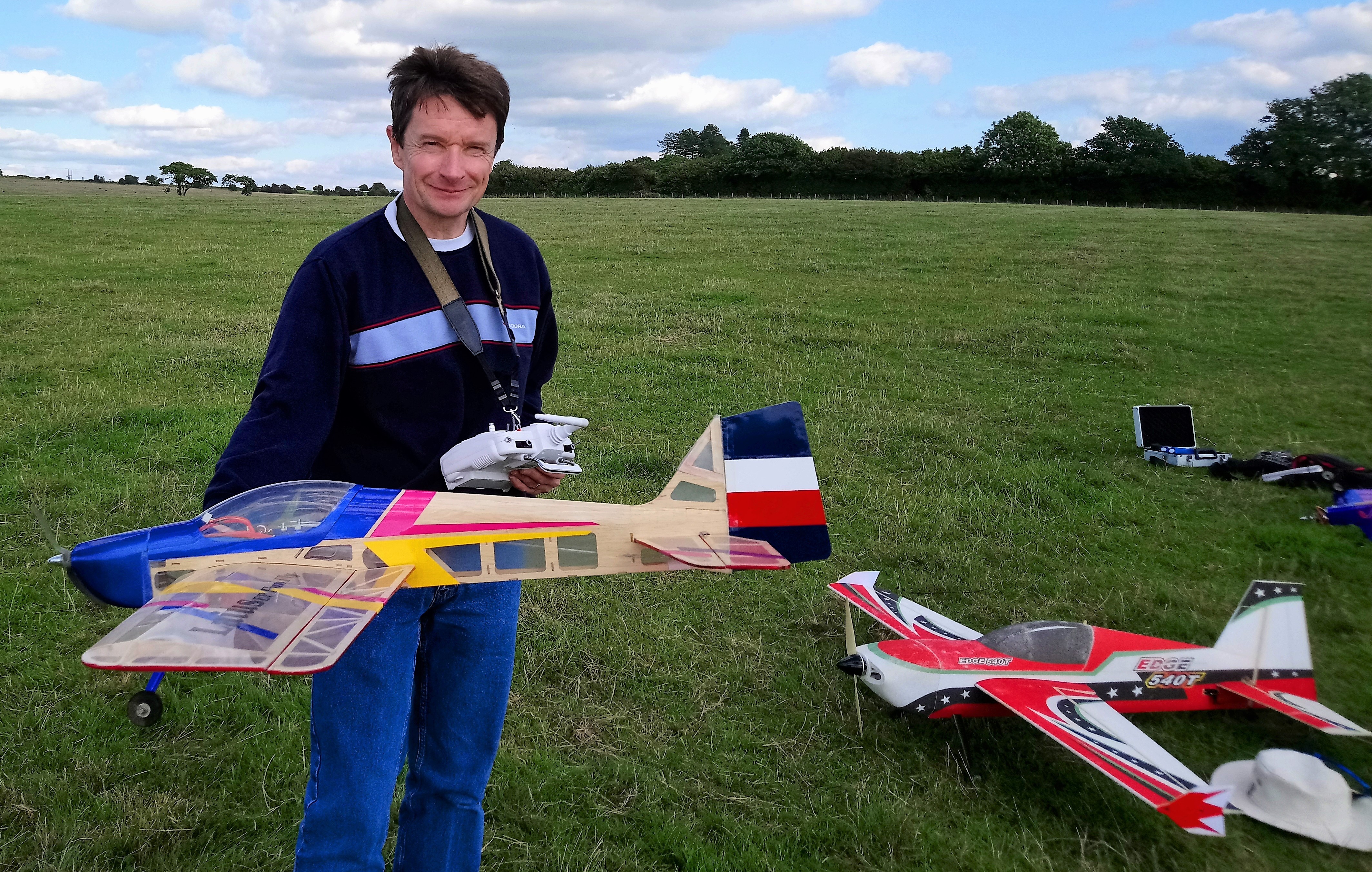 The point of the photo was to show off the huge new rudder he’s fitted to the Laius in the hope that he’ll be able to prop hang the model. I’m not sure if it’s done the trick or not, but I do know he managed to snap the undercarriage and it’s now been replaced with an aluminium one, maybe that was the result of some failed prop hanging?
Stanley Knife has always had a penchant for larger models and during October he flew his 68″ span Black Horse PZL Wilga on a couple of the nicer midweek mornings. I really like this photo of it.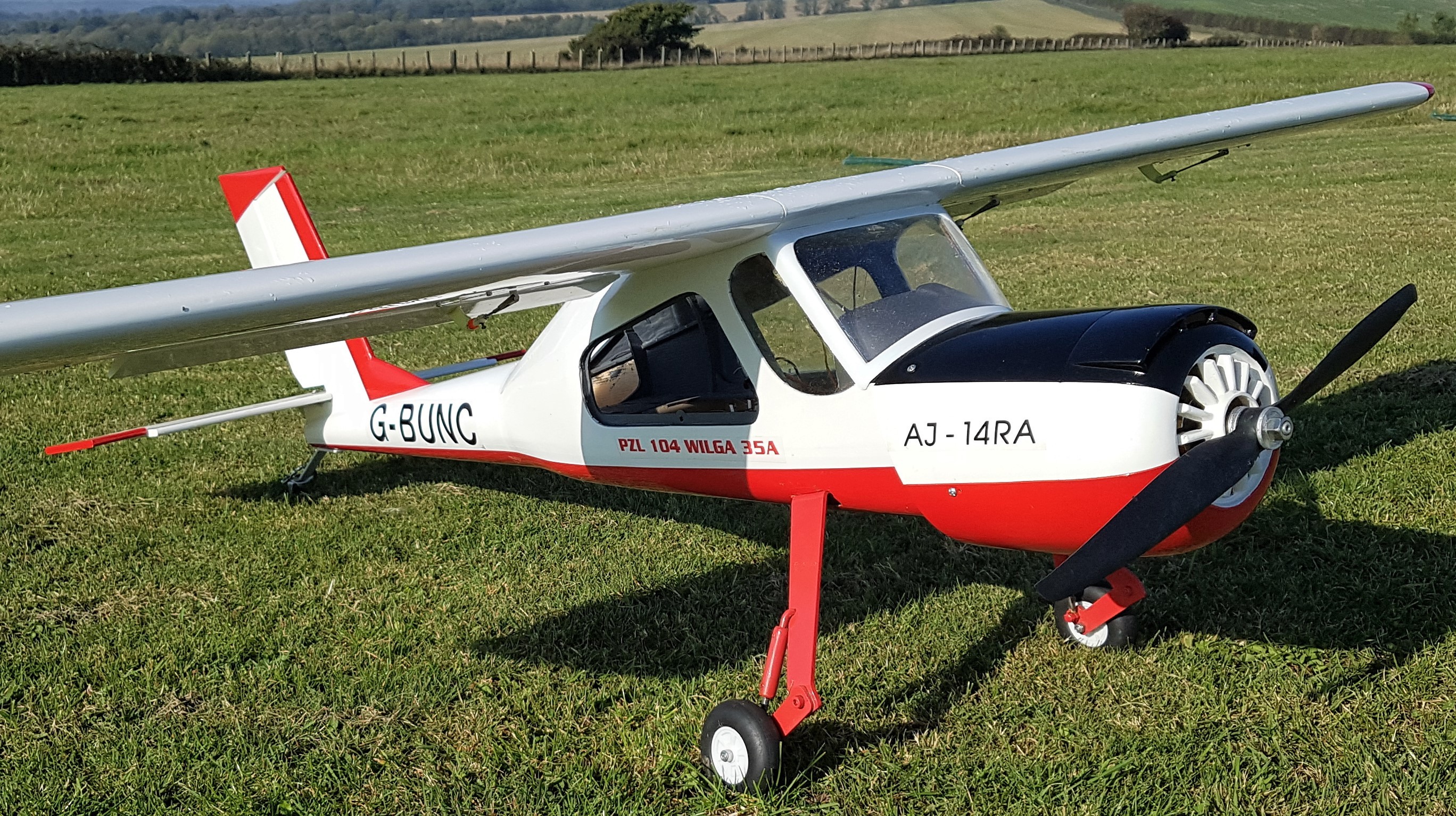 I’ve covered the Wilga in Patch News previously but it was a long time ago and it’s worth repeating. The full-size Wilga was produced by Polish company PZL from 1962 until 2006 with over 1000 being built in many different versions. The version Black Horse have modelled is a 35A (no, that’s not how much current it pulls!) which was a mass-produced basic variant for sports aviation. It was fitted with glider towing hook, and was produced from 1968. It was fitted with a radial engine and the wingspan was just over 11M (36½ feet). The Black Horse model spans 1,720mm (67.72 in) and weighs just under 4kg (around 8½ lbs). Stanley has fitted a Turnigy Aerodrive SK3 motor from HobbyKing and says it produces almost 1300W on 8 cells swinging a 16×10 prop.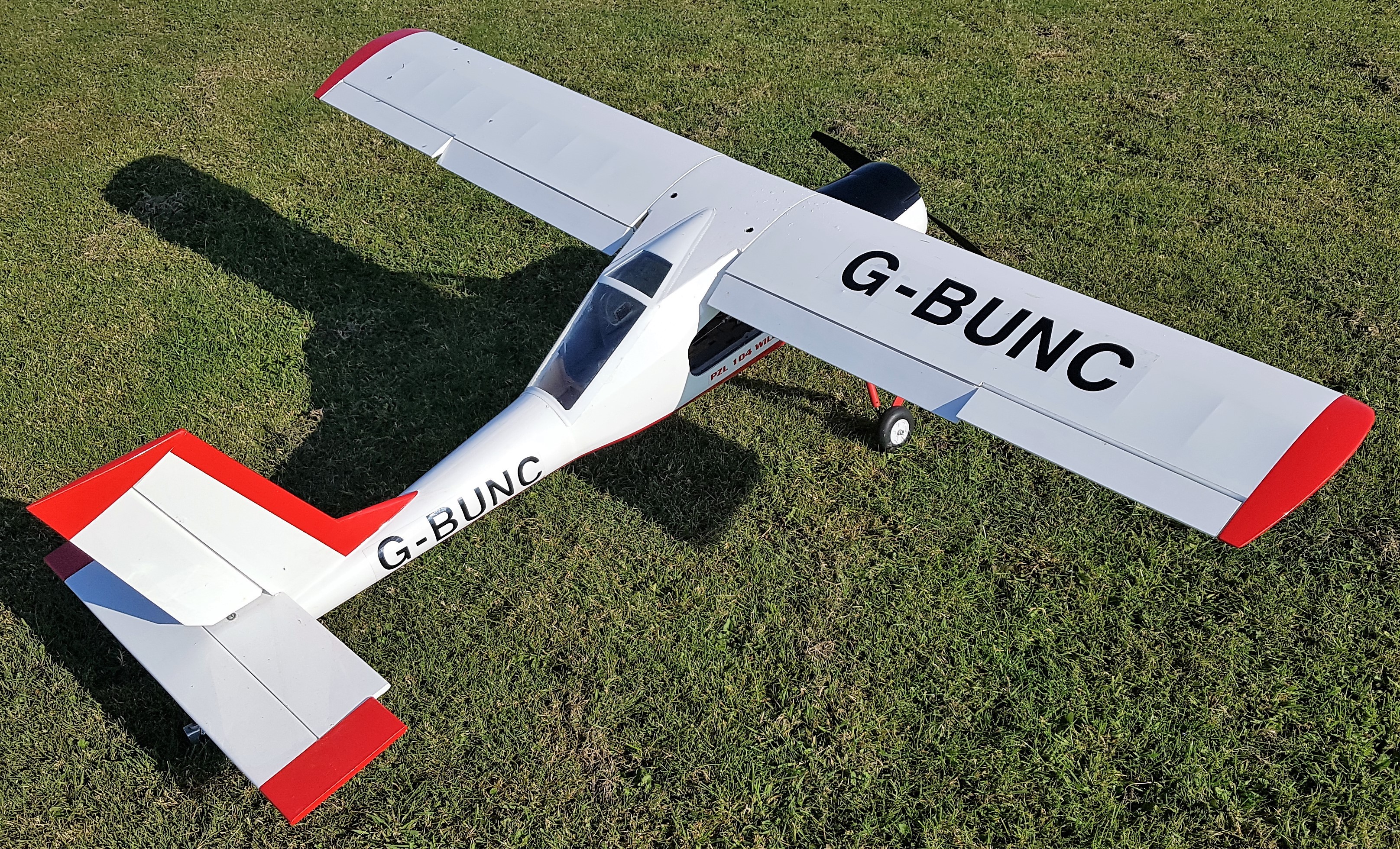
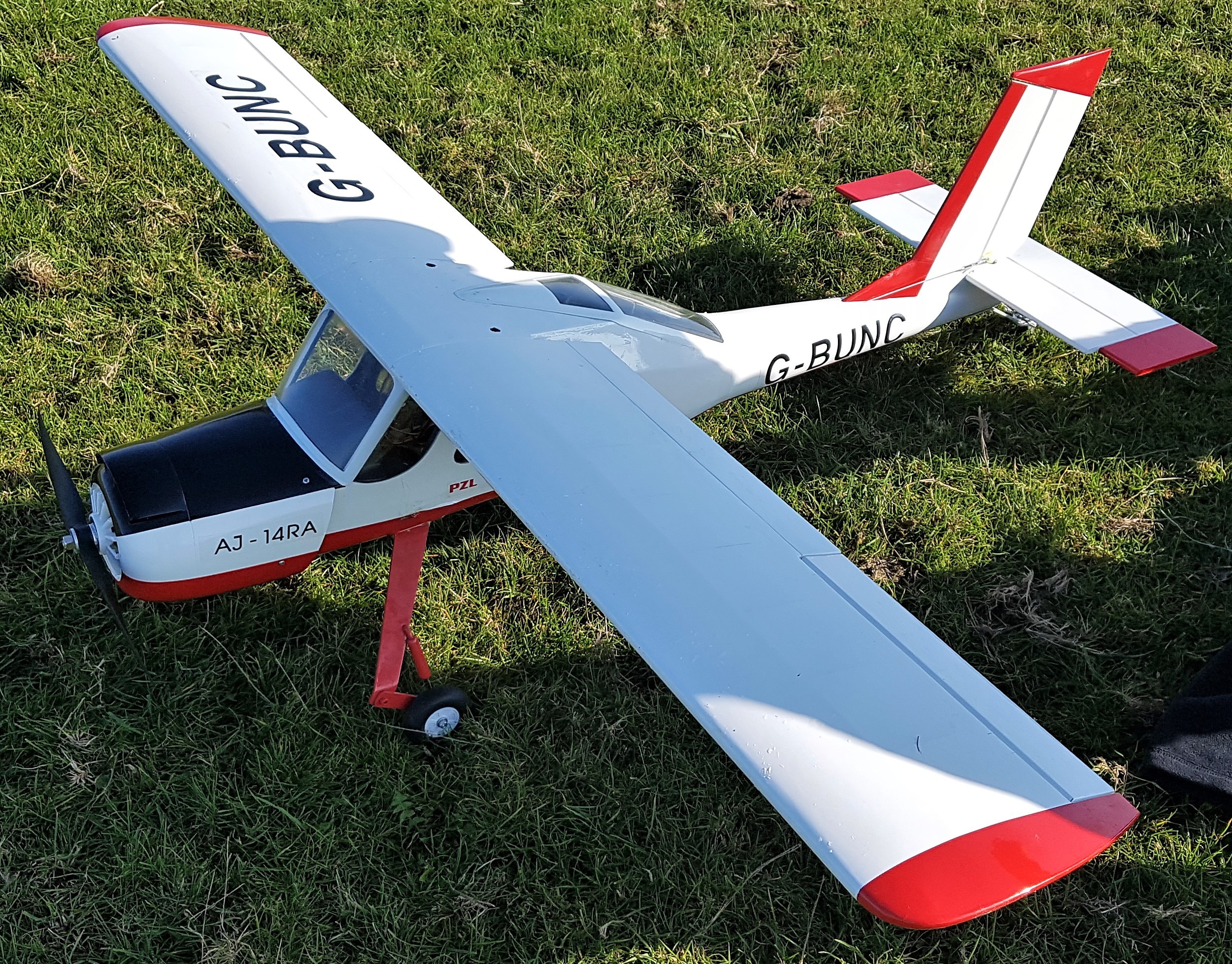 It certainly has plenty of power for the Wilga, the model takes off rapidly and then stooges around beautifully on much less than half throttle for most of the flight, only requiring more power to perform some gentle aerobatics. I shot some nice video of Stanley flying the Wilga, but unfortunately the only landing I captured was the only one bad one he did. You can see the flight in this month’s video.
I got tempted by a HobbyKing promotional email a couple of weeks ago, it was offering a Sukhoi SU-27 kit for just £7.64! Alright, so it was only a Glue-N-Go profile model made of foamboard and with a centre mounted motor but at that price it was simply too cheap to ignore. Unfortunately the cheapest postage option from the UK warehouse was more than £5 which seemed a bit excessive when the kit was so cheap so the obvious thing to was to buy two and effectively halve the postage. After a few seconds listening to a ridiculous voice in my head telling me I didn’t need another plane I pressed the Buy button. 1066 has already bought the second kit for a future club raffle so pay attention, you might be the proud owner of your very own Sukhoi soon!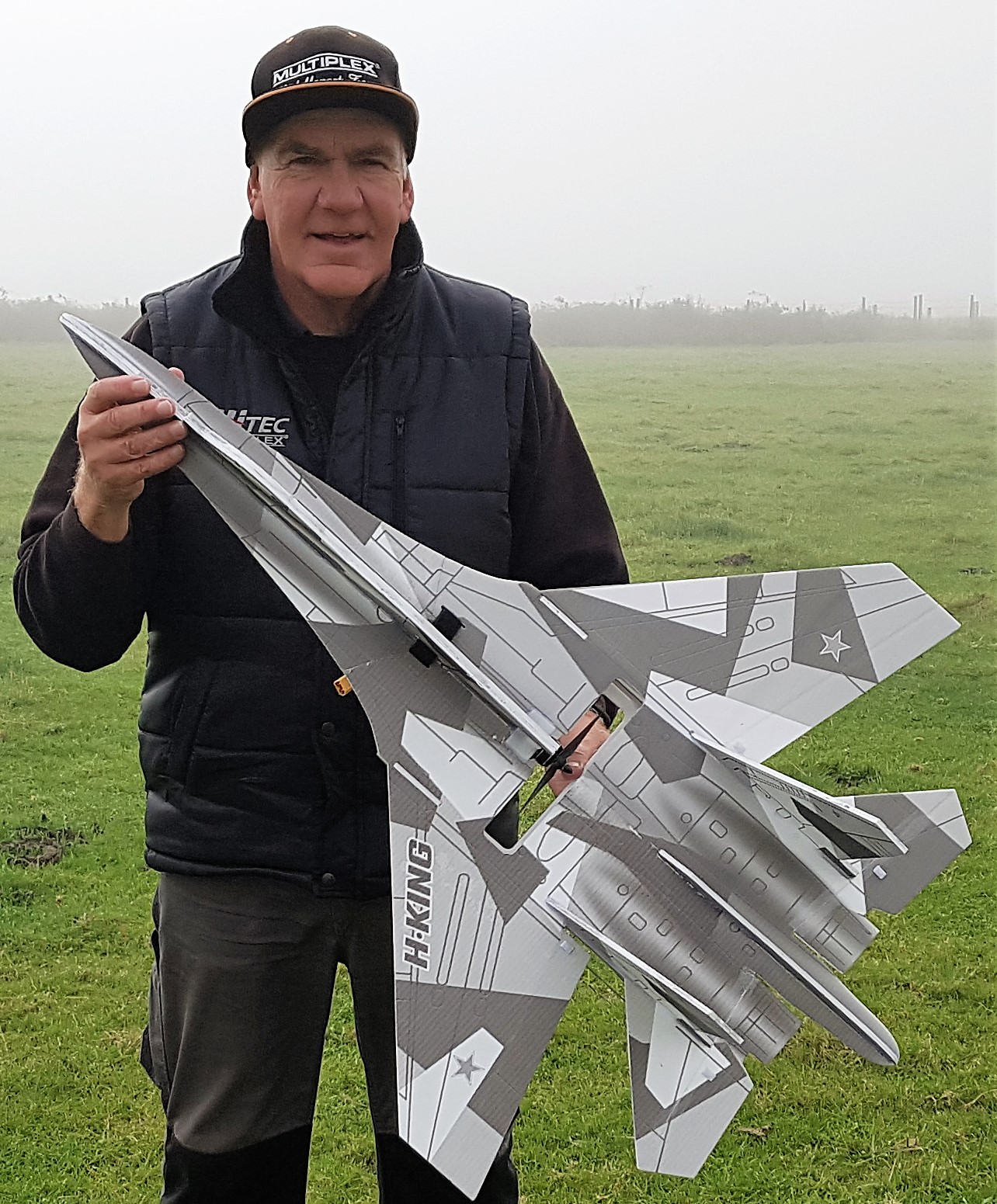
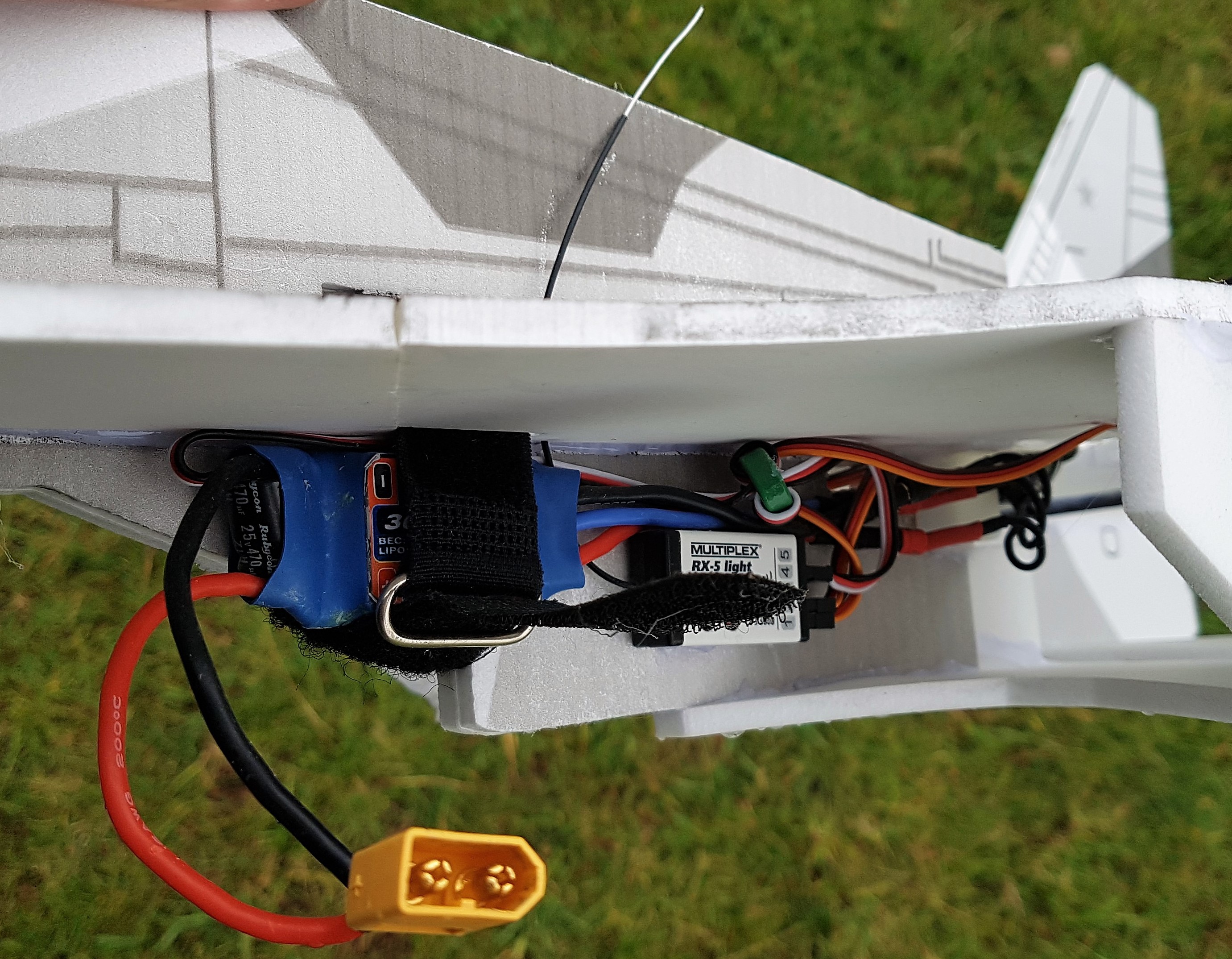
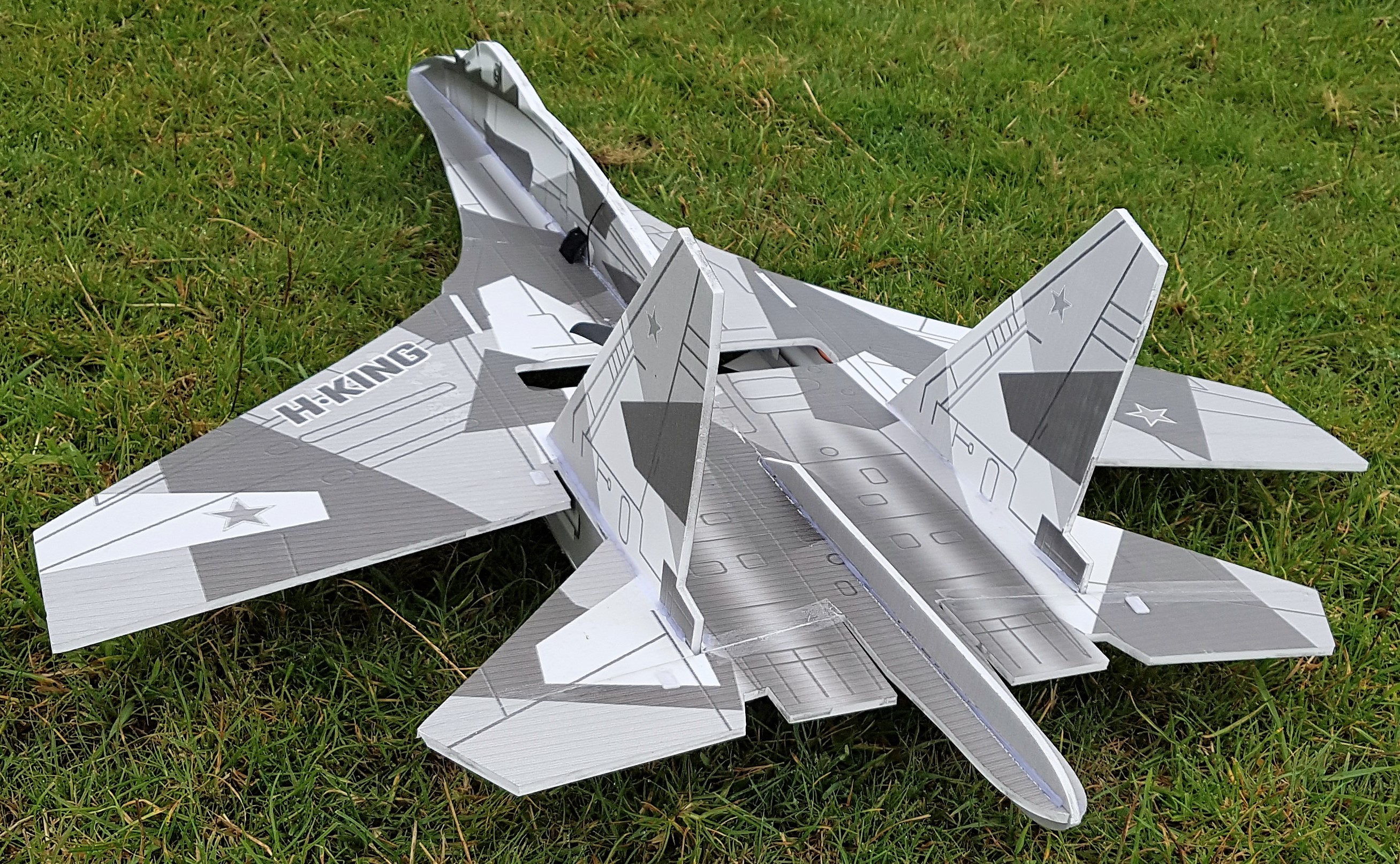 The SU-27 has a wingspan of 750mm and is 1080mm long so is actually bigger than I expected. It also seems to be bigger than HobbyKing expected, the website says 650mm span and 900mm long, odd. The box contains nine pieces of pre-printed laser cut 5mm foamboard a plastic motor mount, a carbon tube, all the necessary linkages, and an instruction booklet. Oh, and 4 screws that are shown in the parts list but I have absolutely no idea what they are for! The builder has to provide a motor, 2 servos, speed controller, receiver, and 3 cell lipo. Unlike the stuff you can buy in art shops the foamboard is not paper backed and HobbyKing say it’s impervious to water. It all goes together very quickly, almost all with hot melt glue, and mine was ready to fly in just a couple of days.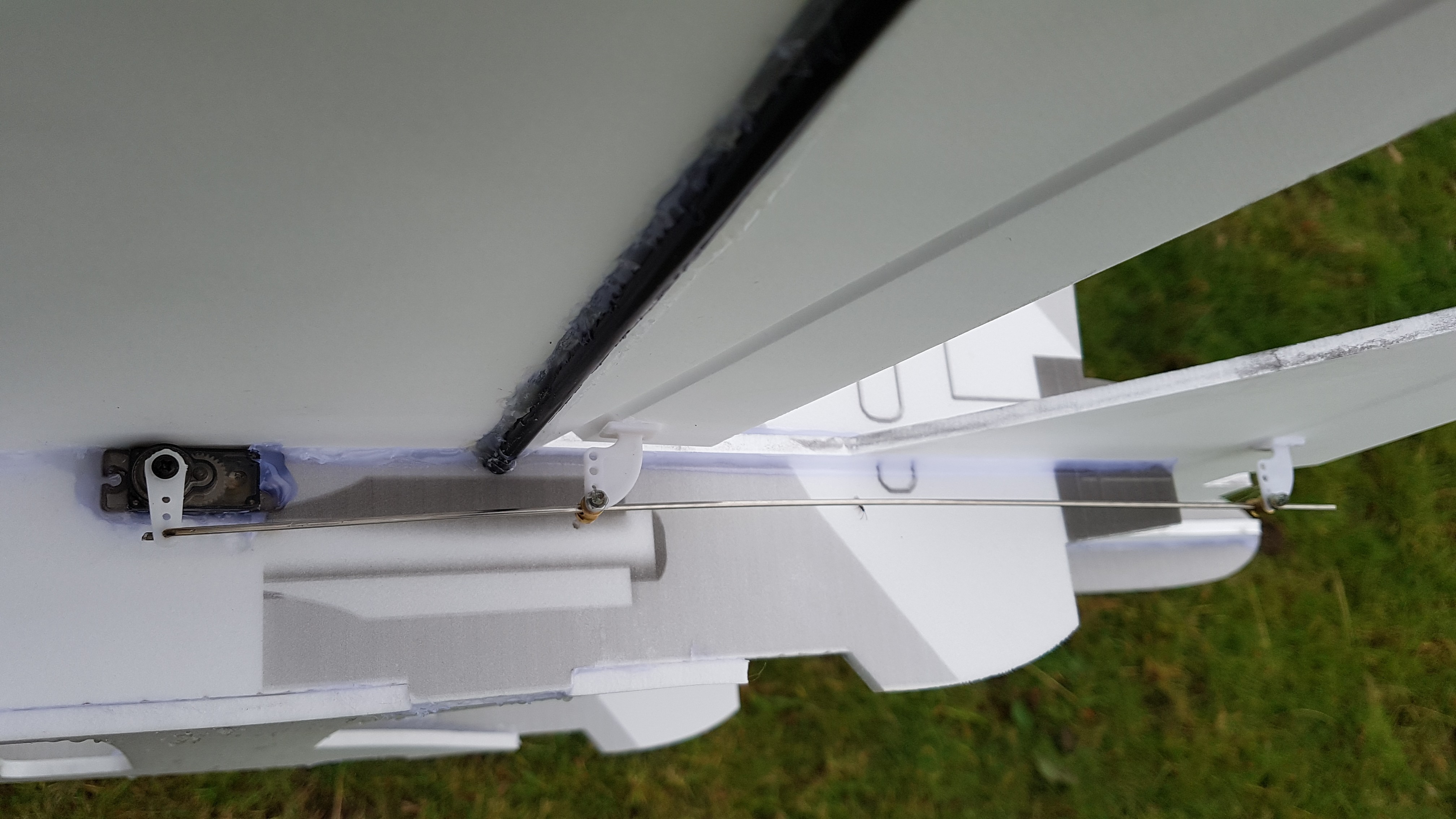
 A servo on each side of the ‘fuselage’ drives one aileron and one elevator half, so up elevator also gives up aileron, and the elevator halves also act as ailerons. I would have expected up elevator to be combined with down aileron so it seemed rather odd. So would it work in practice and how would the plane fly? The short answer is yes, brilliantly!
 Despite my doubts about the way the control surfaces operate they proved to be perfect in the air and the Sukhoi is nicely responsive to both ailerons and elevator. The specs say 1300-2200mAh packs can be used and I’ve been using 1300 and 1800 packs with no problems. With a 3 cell 1300mAh graphene lipo mine weighs 450g and balances at the suggested C of G with no lead required. It does feel very light for its size and that shows in the flight performance, it will slow right down to walking pace and still remain easy to control. Open the throttle and it will climb away vertically but I have to say it does become rather noisy at full throttle so I spend most of the flight stooging around at high alpha low speed where it’s most fun anyway.
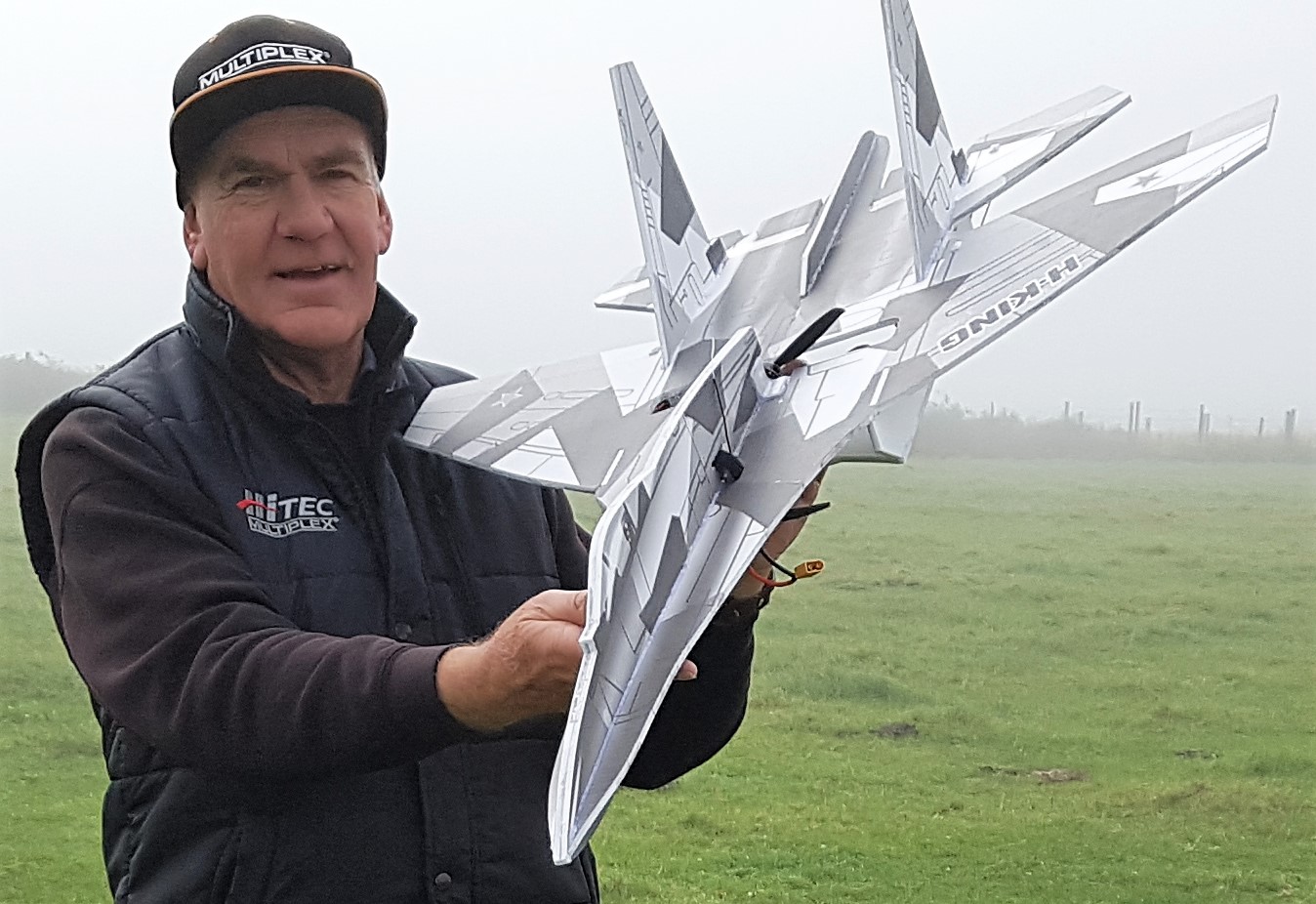 The noise is a result of the centre mounted propeller, pushers that have the propeller close to the wing trailing edge suffer the same problem. I’ll try a few different prop sizes to see if I can quieten it down a bit but otherwise it’ll be a case of avoiding full throttle most of the time, not a problem.
Captain Slow spent some time visiting old friends in France during October. Knowing they were into modelling he took his Multiplex FunGlider with him and they managed to enjoy some flying on the land alongside their house.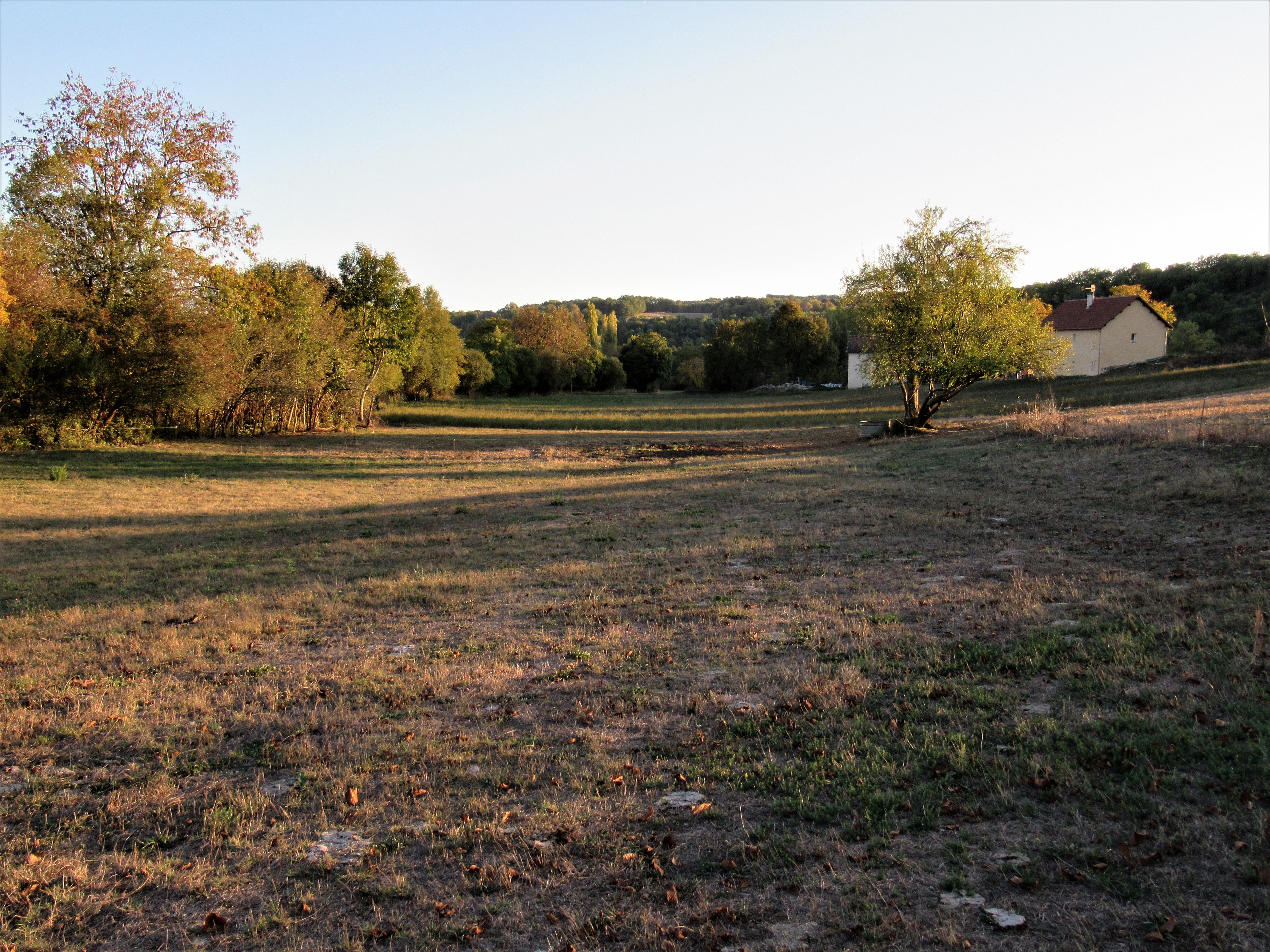
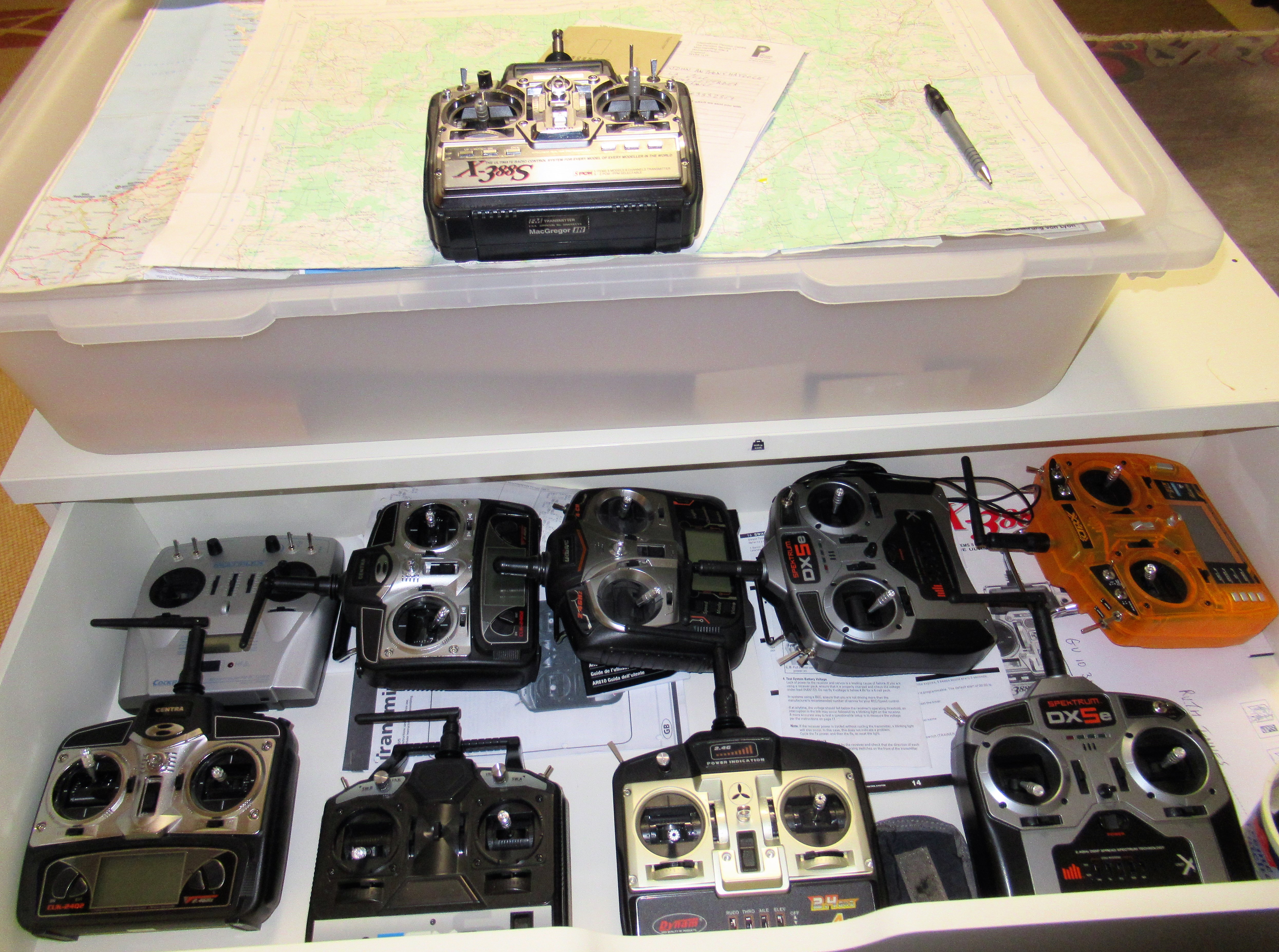 Captain Slow also discovered that his friend collects transmitters, he sounds like he could be Dougal’s new best friend although with only ten transmitters he’s not really in the same league yet!
1066 has been on a spending spree but not on new models, he’s recently relieved ex-PAM member Cyano Steve of his remaining modelling gear. From what I could gather he picked up a variety of top class 3D models (some in need of repair), batteries, and props for a bargain price. Cyano Steve used to buy top quality 3D models and 1066 has already started flying Steve’s old 51″ AJ Slick. The initials AJ stand for the designer Andrew Jesky, and Andrew is a world class aerobatic champion so he should know what he’s doing when designing a 3D model.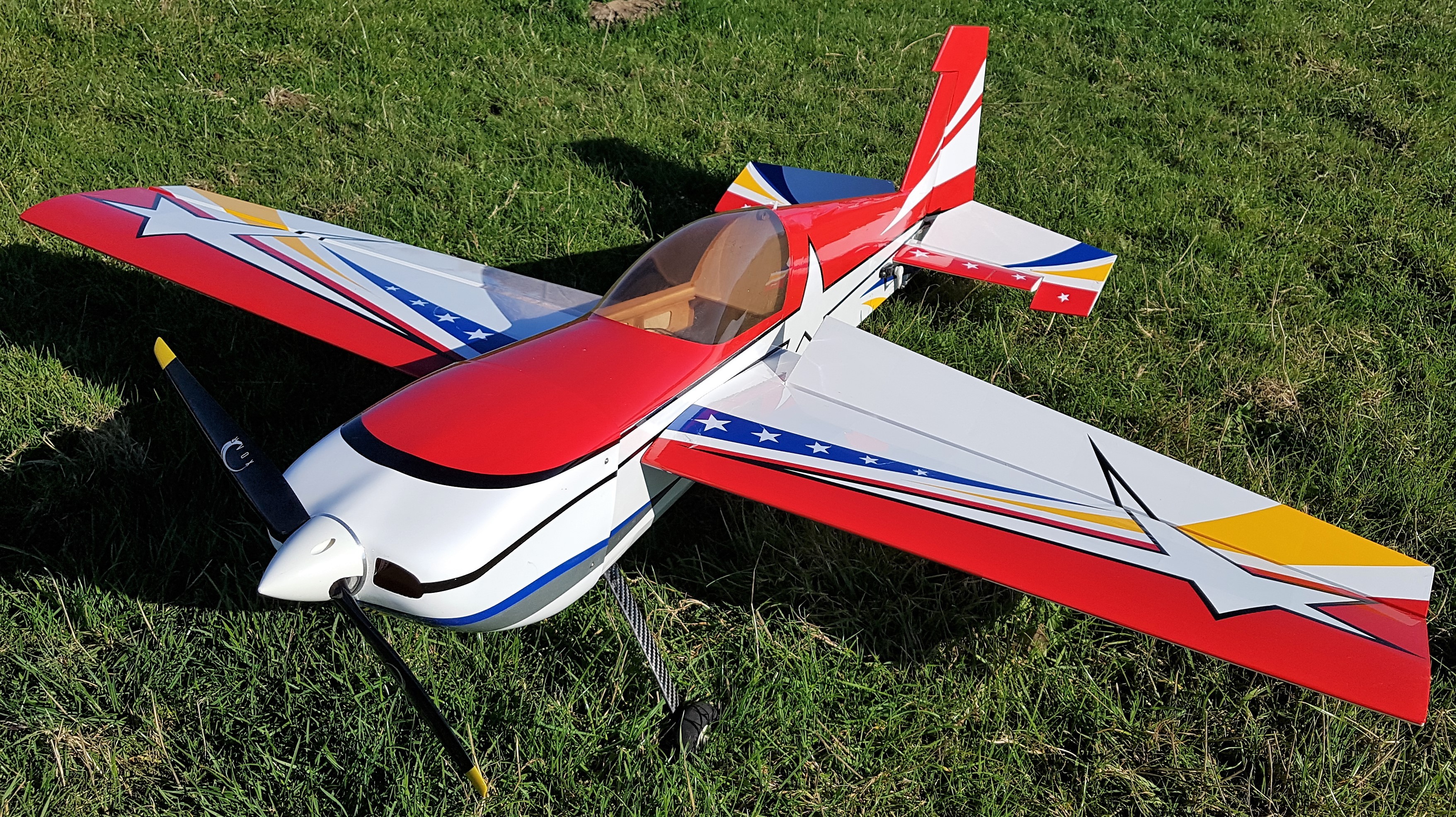
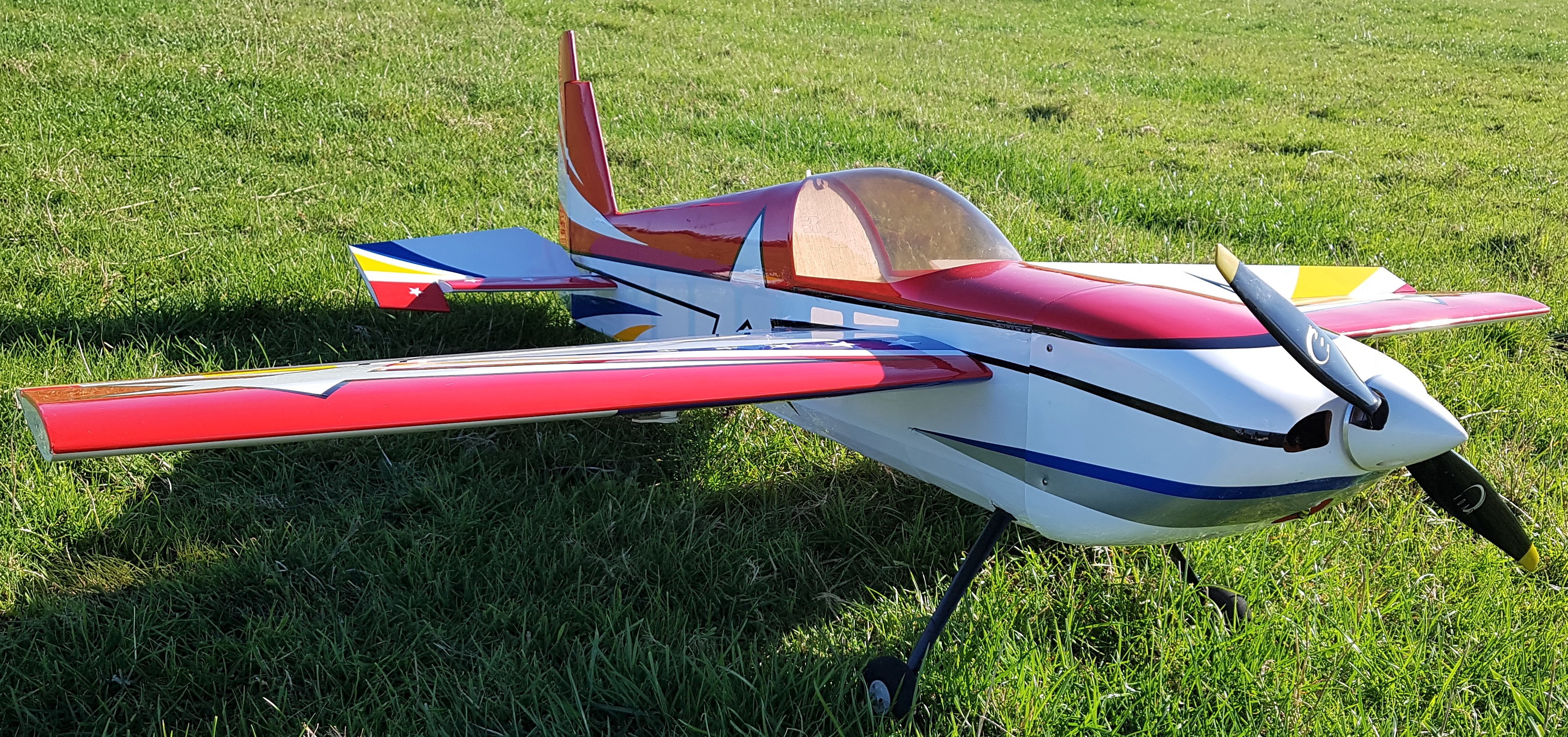 1066 seemed to be getting on very well with the Slick on the first few flights that I watched so we can look forward to some impressive aerobatics in the future. Right now he’s still being careful with it but I’m sure that will change!
In Patch News a couple of months ago I featured Dougal Entendre’s shiny new Freewing Moray that had an excellent first flight but crashed on it’s second flight. Last month I explained that the cause had turned out to be failure of the speed controller and in October Dougal had another go with the newly repaired model.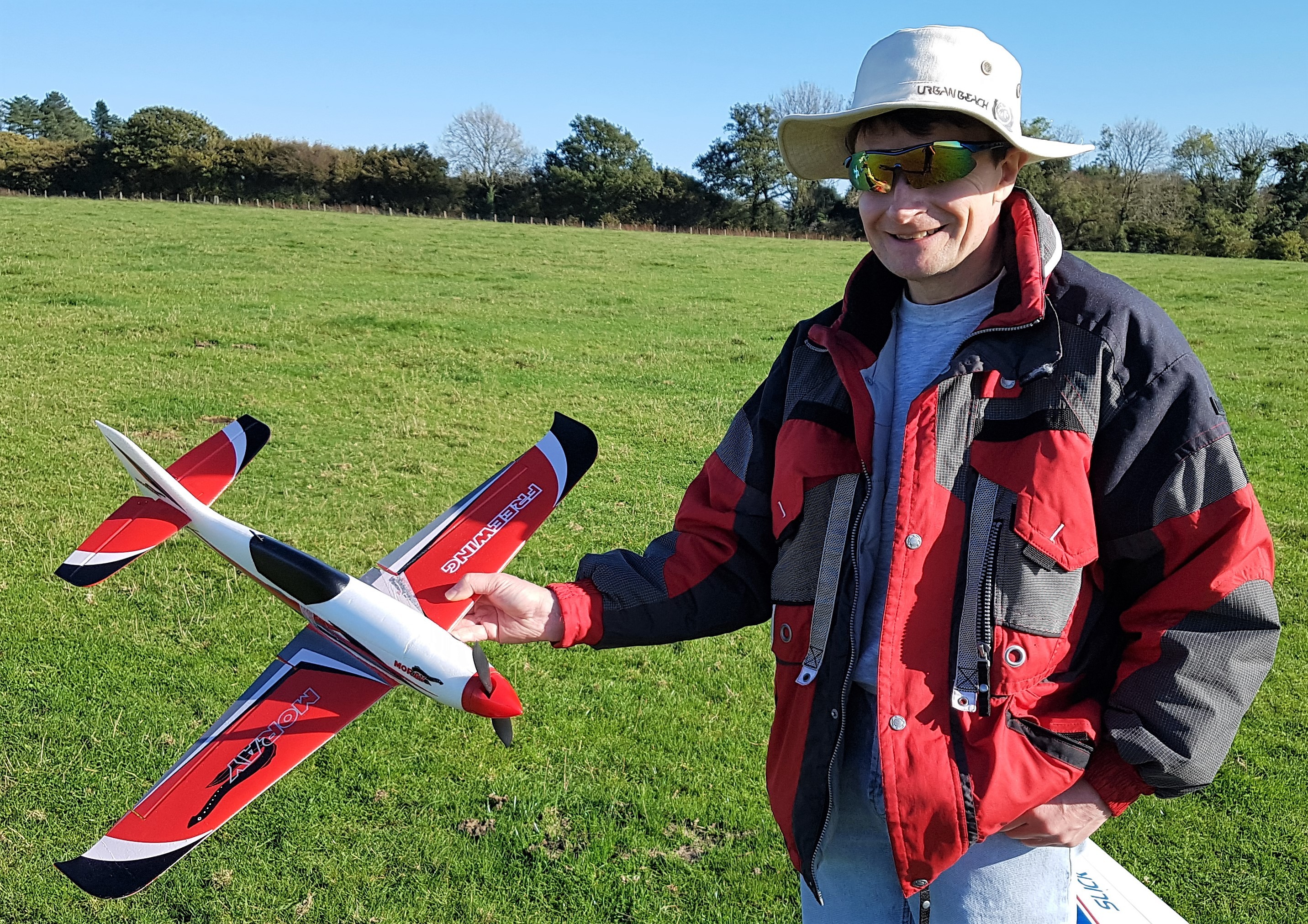
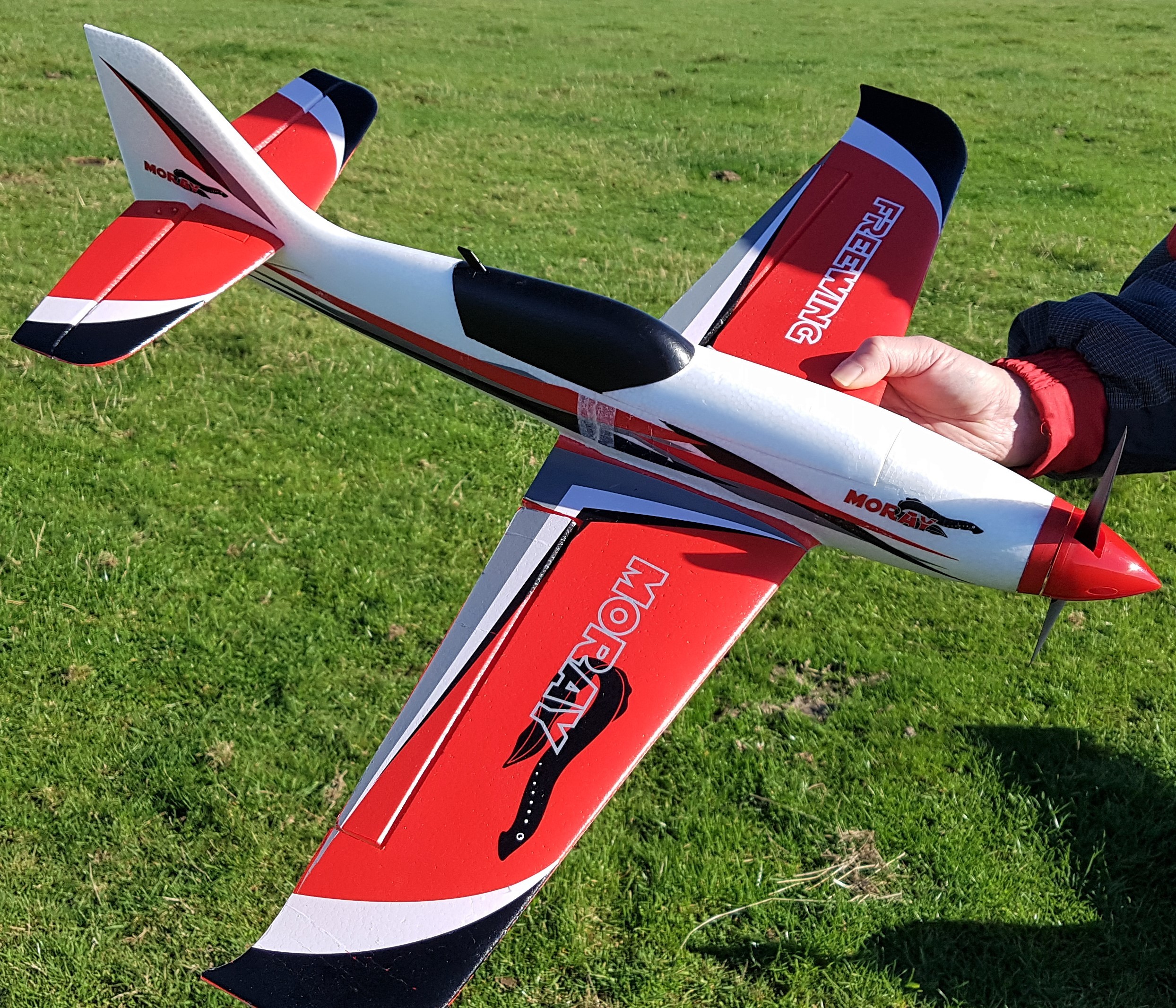 He’d made a good job of the repairs and fitted a new motor and speed controller so all was looking good. Sadly it didn’t go well, the Moray rolled hard left from the launch and crashed. Presumably the motor torque caused the roll and Dougal’s application of right aileron wasn’t enough to stop it. Sadly, I’m not sure he’ll bother repairing it again.
Never mind, Dougal has a shiny new model to play with, or rather a shiny secondhand model. One of the models that 1066 bought from Cyano Steve was this lovely 3D Hobby Shop Velox and he’s now sold it on to Dougal.More details next month but for now, it’s a tad under 6ft span, weighs just under 9lbs, and Dougal flies it on 6 cells.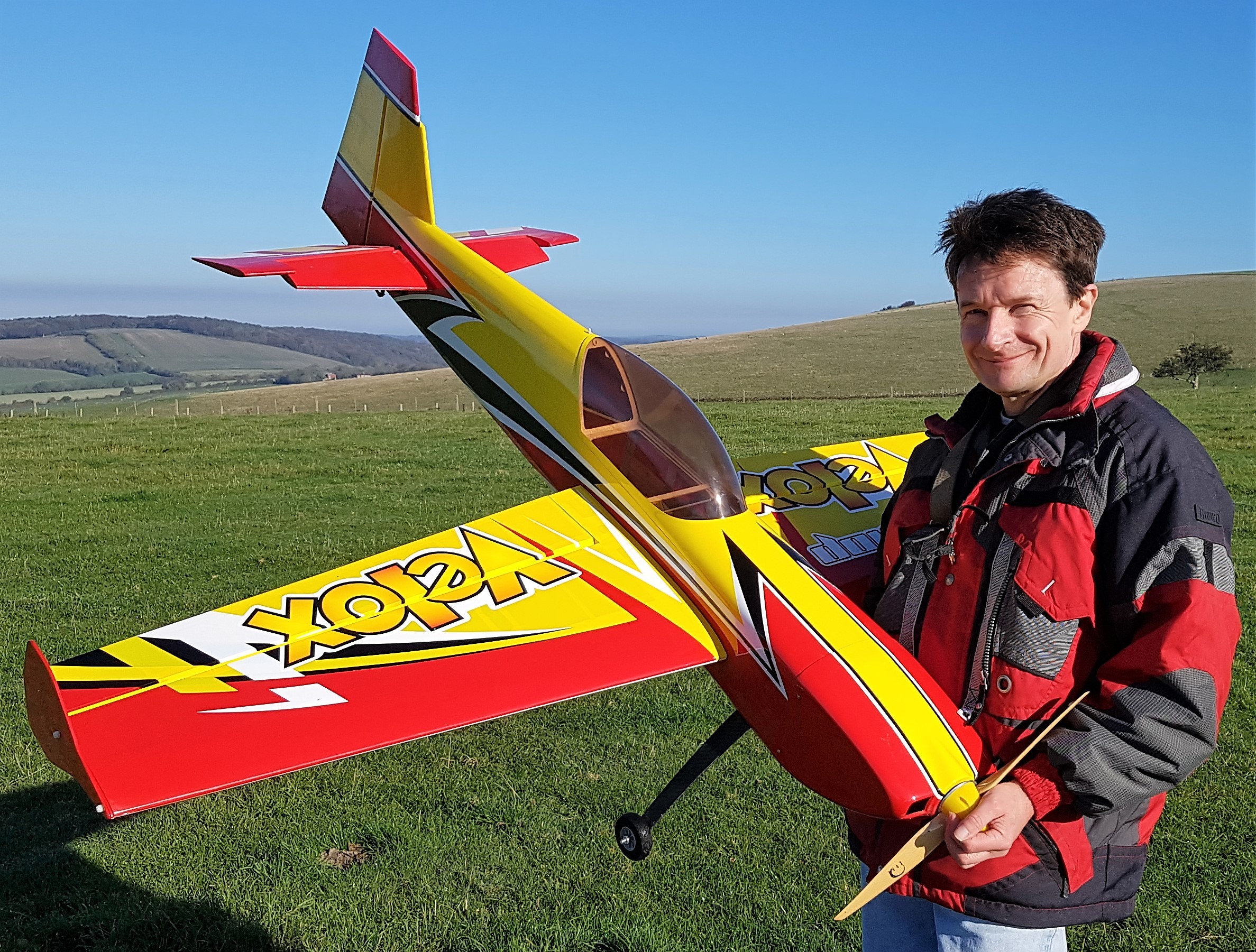
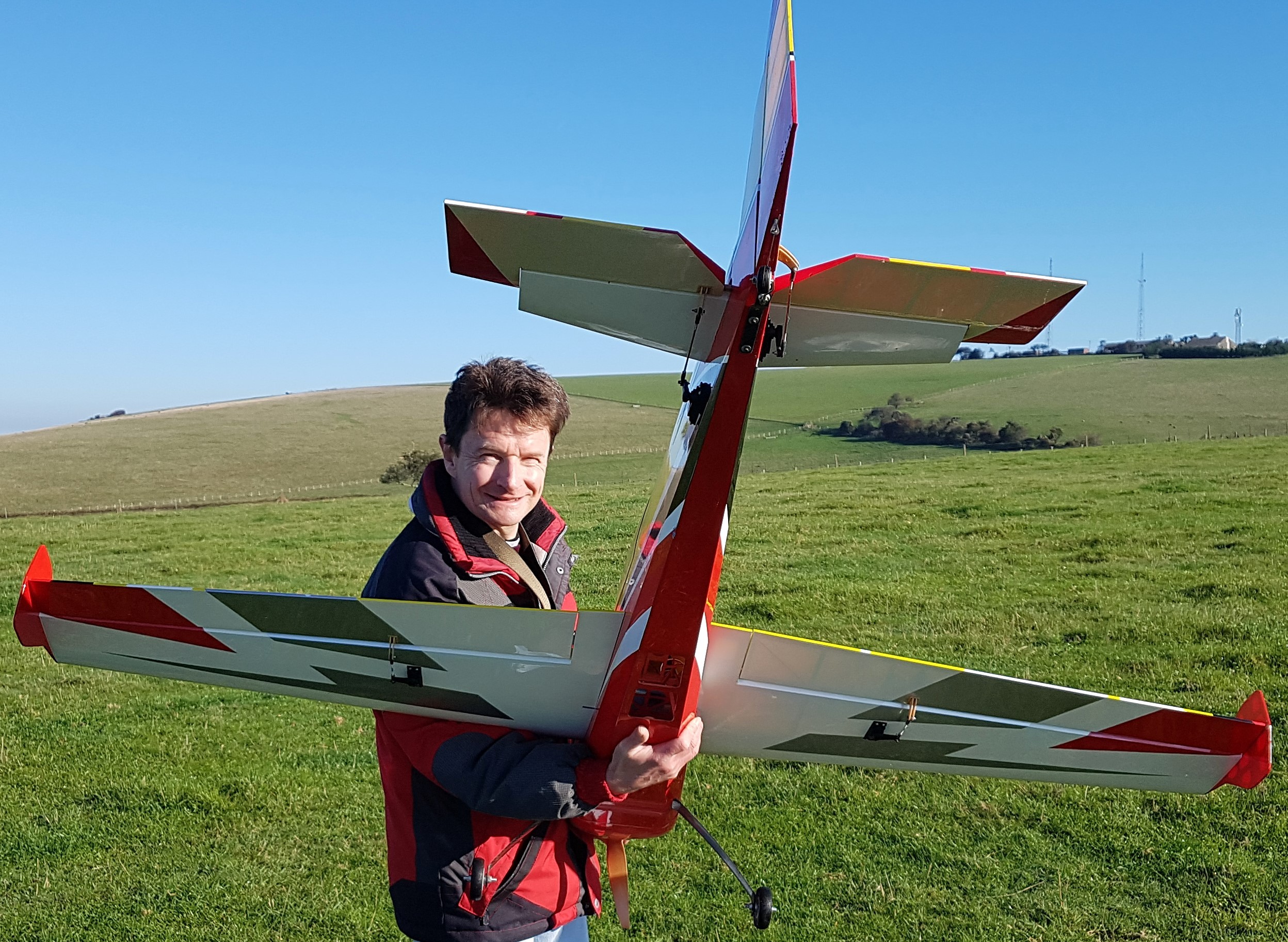 It flies beautifully and I have taken some video which you’ll be able to see in the next Patch News.
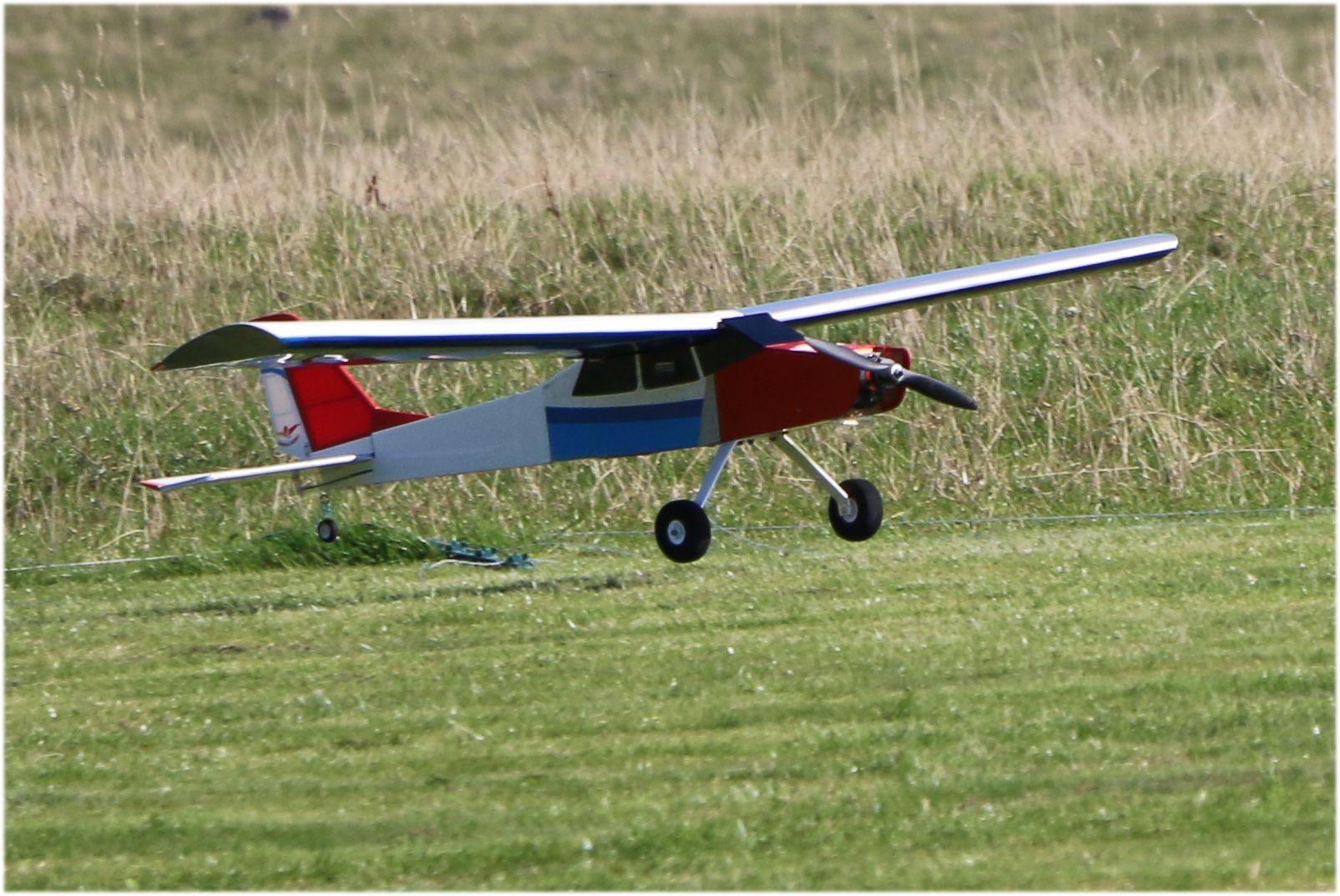
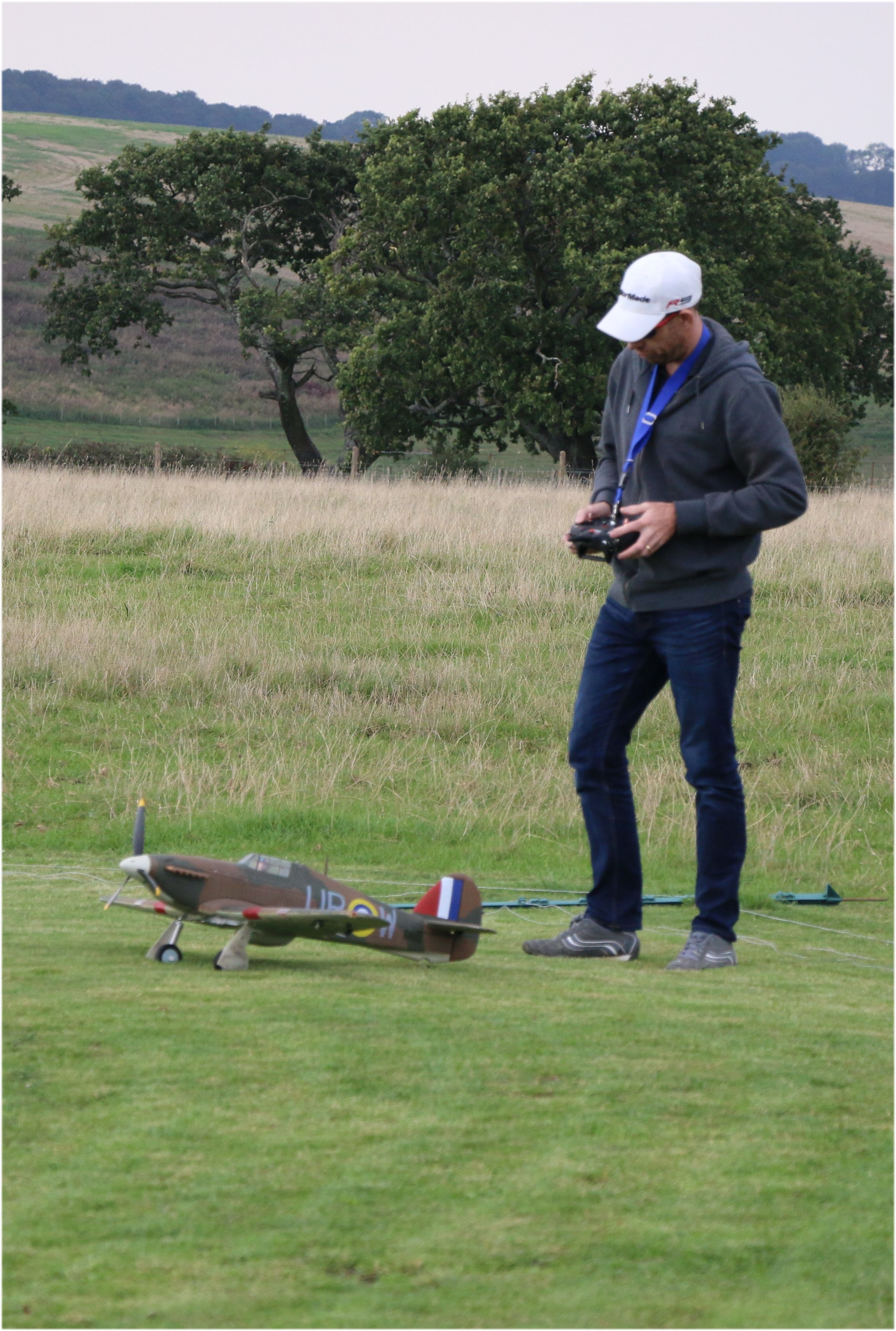
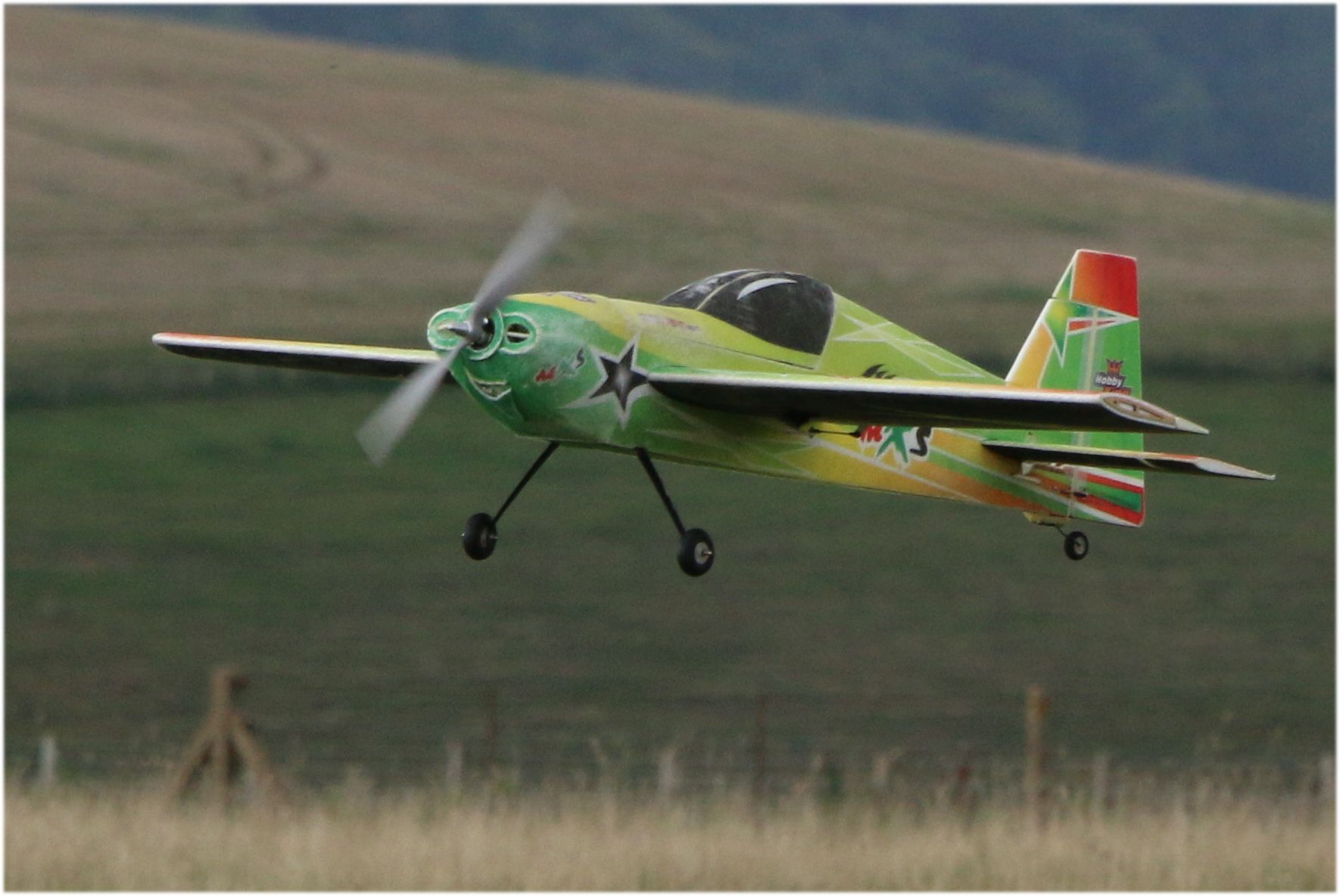
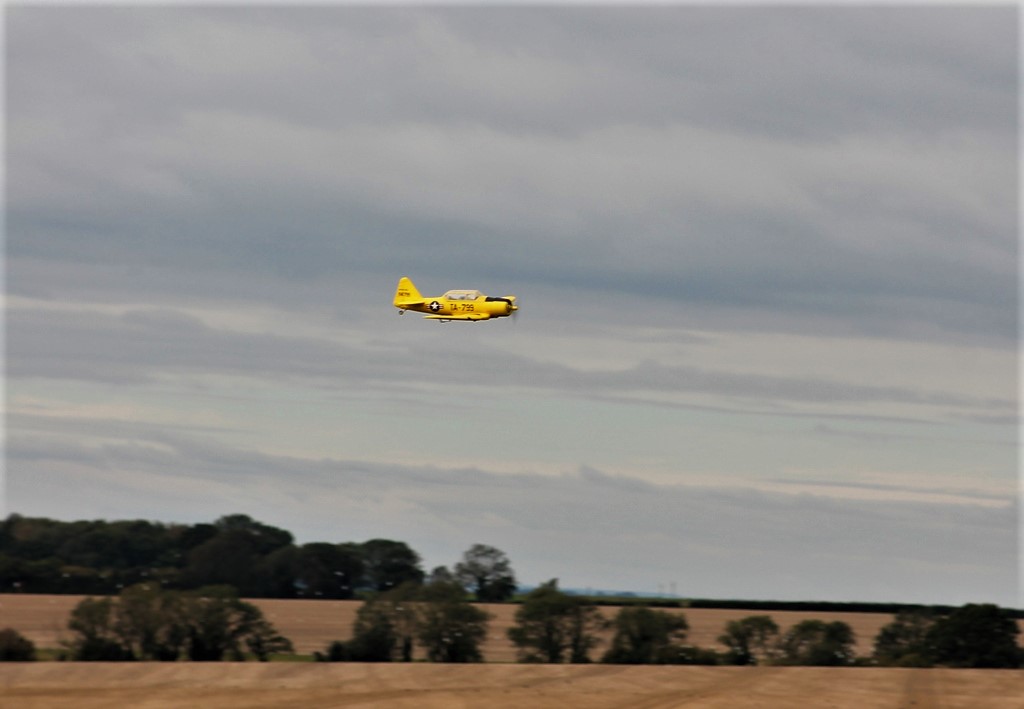
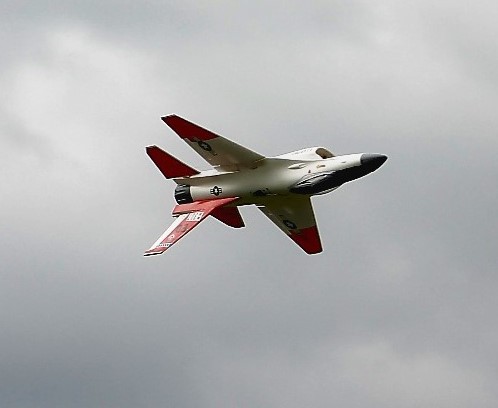
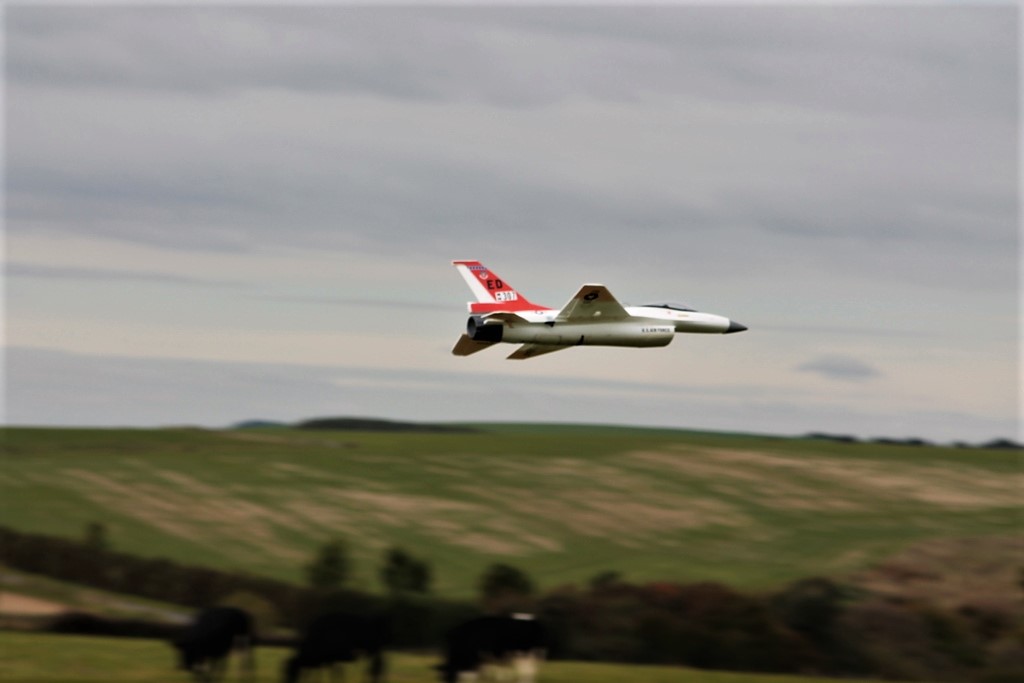
Here’s a selection of Catapult King’s and Kryten’s excellent flying shots that I held over from last month: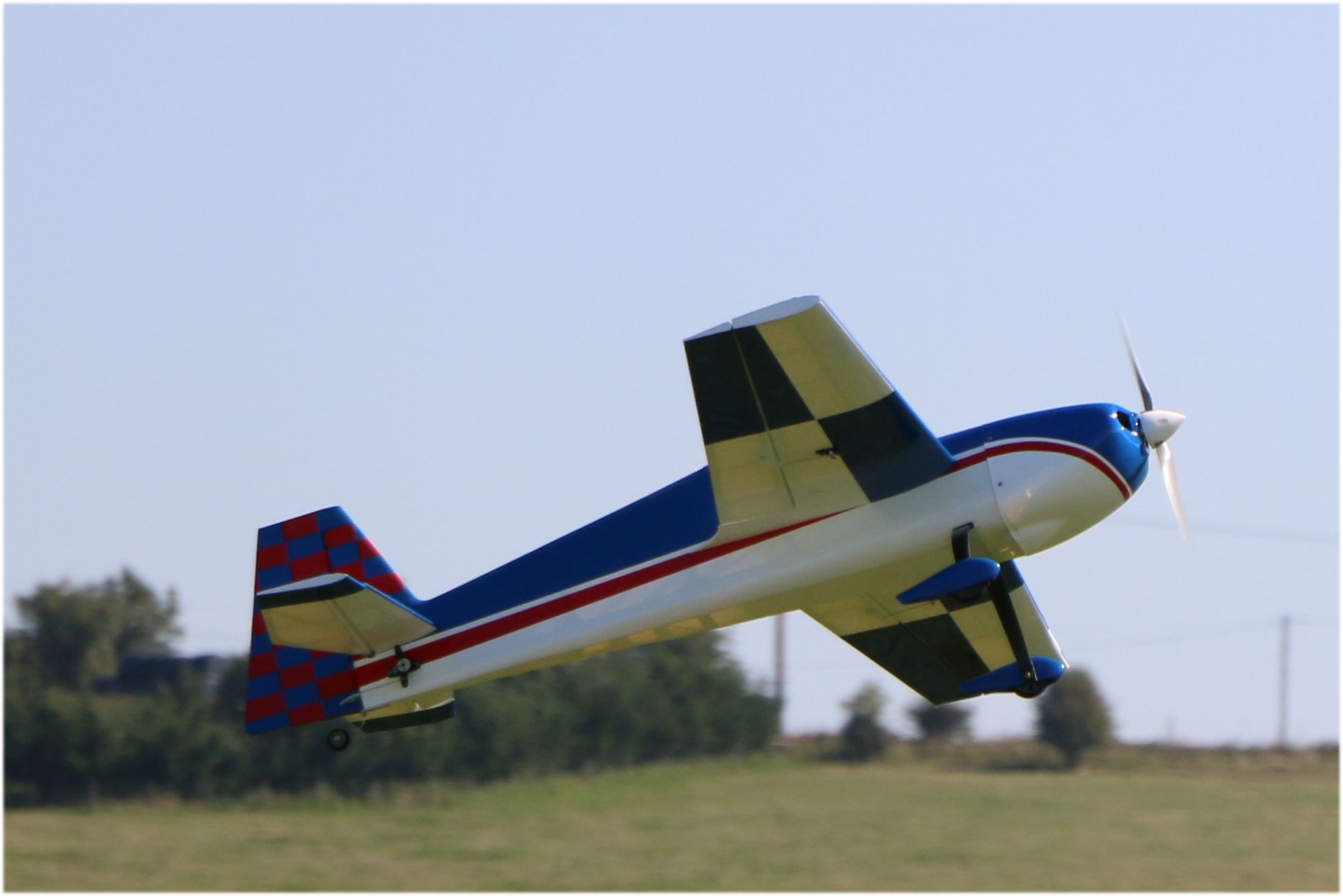
 Video time now:Please watch the video full screen, it’s so much better with small models flying around.If the video won’t play for you CLICK HERE
An airline pilot dies at the controls of his plane and goes straight to hell where the devil takes him to the ‘arrivals’ area. There are three doors, marked 1, 2, and 3. The devil tells the pilot that he will be allowed to choose his own hell, but first the devil has to take care of something else, and disappears for a couple of minutes.
The curious pilot sneaks a look behind door number one. He sees a pilot going through pre-flight checks for all eternity. He looks behind door number two, and he sees a pilot that forever finds himself trying to resolve emergency situations. He looks behind the last door, and sees a Captain being waited on hand and foot by scantily-clad stewardesses.
The devil returns just as the pilot gets back to his waiting position but he only offers the pilot a choice of door number one or two. The pilot says, “But I wanted door number three!”
“Sorry,” replies the devil, “that’s stewardesses’ hell.”
Colin Cowplain