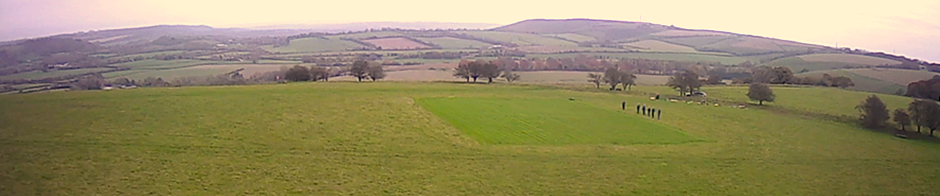
Patch News – September 2020
October has arrived and the Covid crisis continues. As you are all aware the Government restrictions were tightened in September so we have reduced the number at the patch to six again. The booking system remains in place so if you want to fly please email John Wheeley to book a slot. All members can view the bookings online to see who and when people are going but in order to keep control of the system it’s not possible for members to add themselves.
Reading the BMFA guidance it seems we could probably increase the numbers if the club does a risk assessment etc. but the feeling in the committee at present is that we shouldn’t be trying to use ‘wriggle room’. As far as I am aware no members or any of their families have contracted Covid, let’s do our best to keep it that way.
The sheep arrived in early September as farmer George had predicted but we were surprised to see there were so many, George told us there were over 500 of the woolly wonders! They did a great job of ‘mowing’ the whole field for us but of course they also fertilised every single bit of it at the same time so it’s slightly mucky.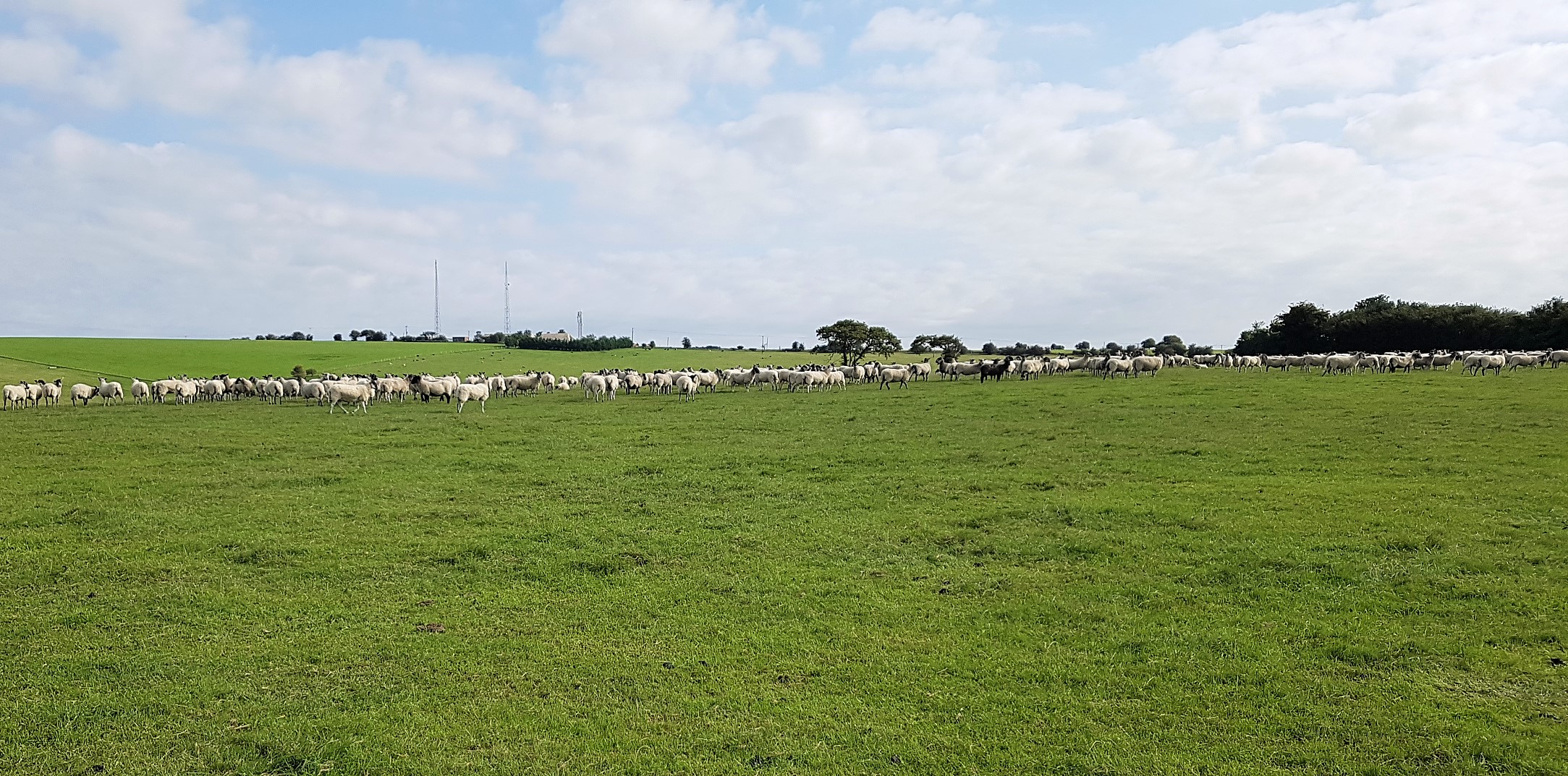 Never mind, it’s not as bad as the larger deposits that the bullocks leave for us. We were concerned that the electric fence might not stop the sheep, their thick fleeces insulate them well, but our fears were unfounded and the patch remained sheep free. They have now been moved out again and the field should remain animal free for a while.
The patch is in excellent conditions and has been mown regularly by members of the FARTS, one of whom is Kryten: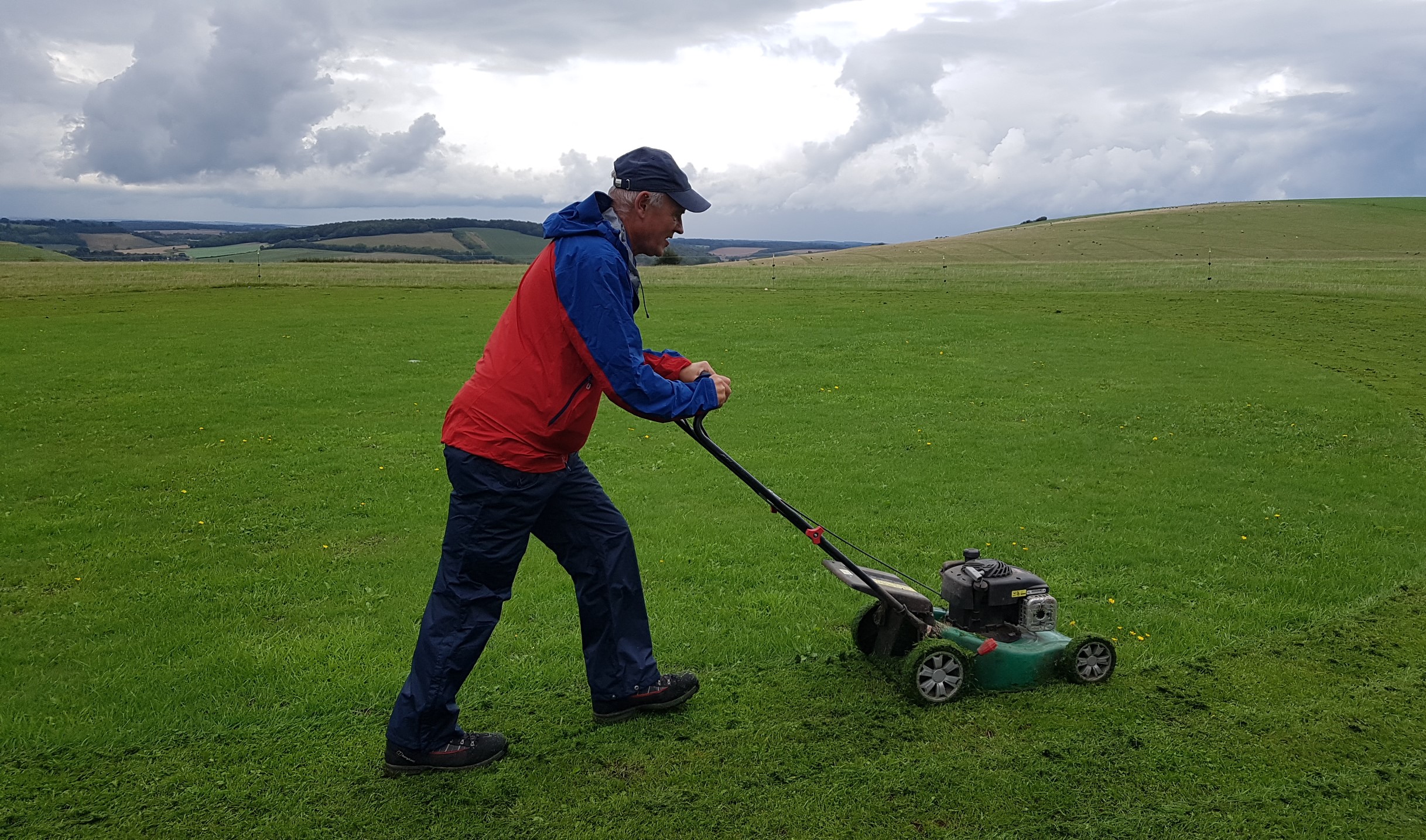 As we are now into autumn the mowing duties will reduce in frequency but so will the flying opportunities and September brought some very windy days although there were a few nice days as well so we flew several times.
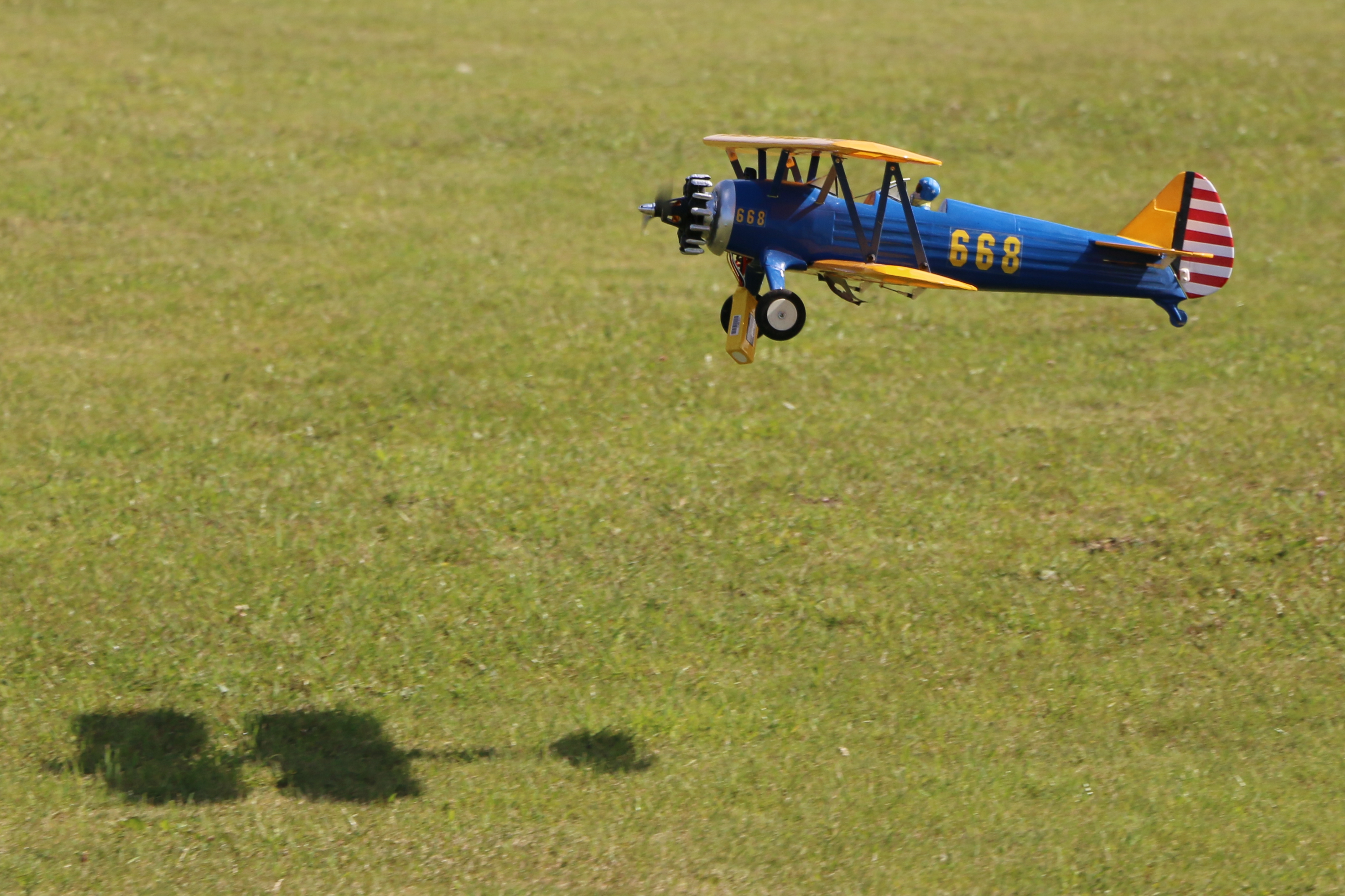
On the PAM WhatsApp group in mid-August Page Boy asked if anyone was interested in buying his Volantex Phoenix 1600 electric glider. I’d been vaguely thinking about selling my little Boeing Stearman as I rarely fly it so I suggested doing a straight swap. Page Boy agreed we exchanged models a few days later. I was away on holiday at the beginning of September when I received some aerial shots of the Stearman from Page Boy that either Richard Osborn or his daughter Nicole had taken. I said “Don’t crash it” and he confessed that he’d already done so!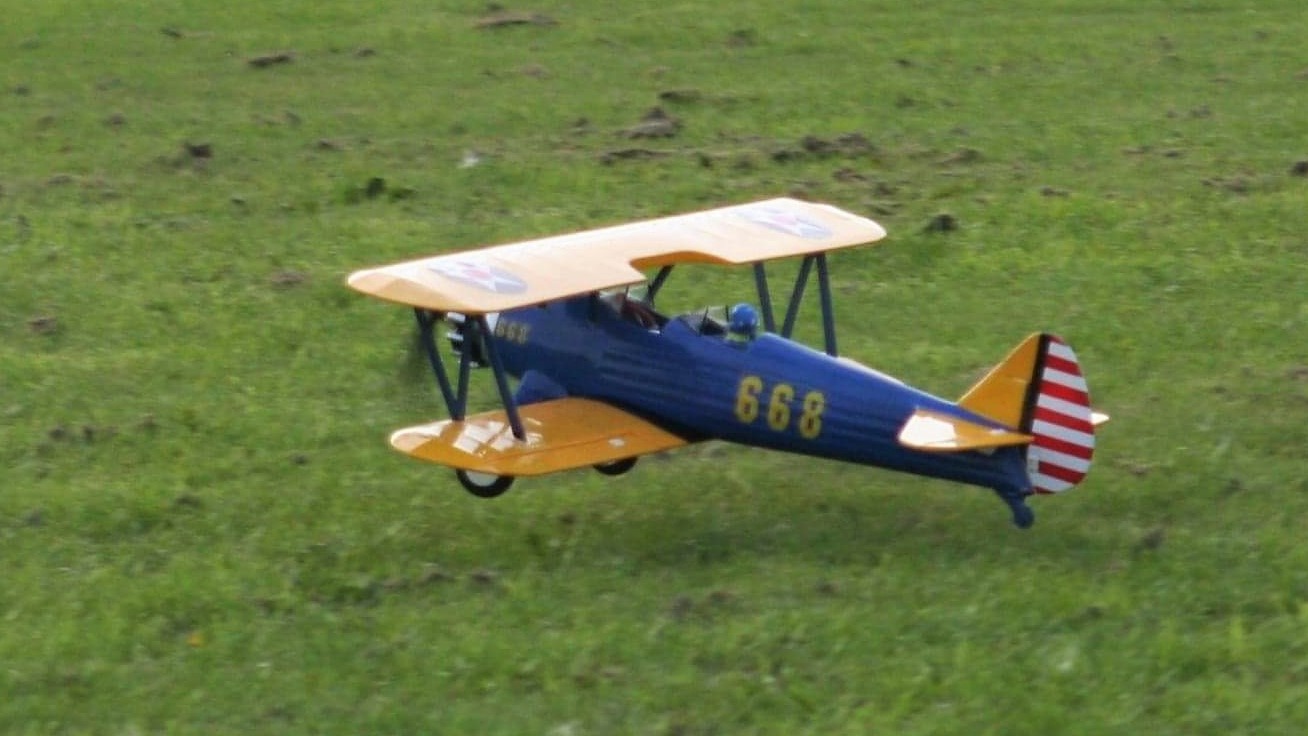
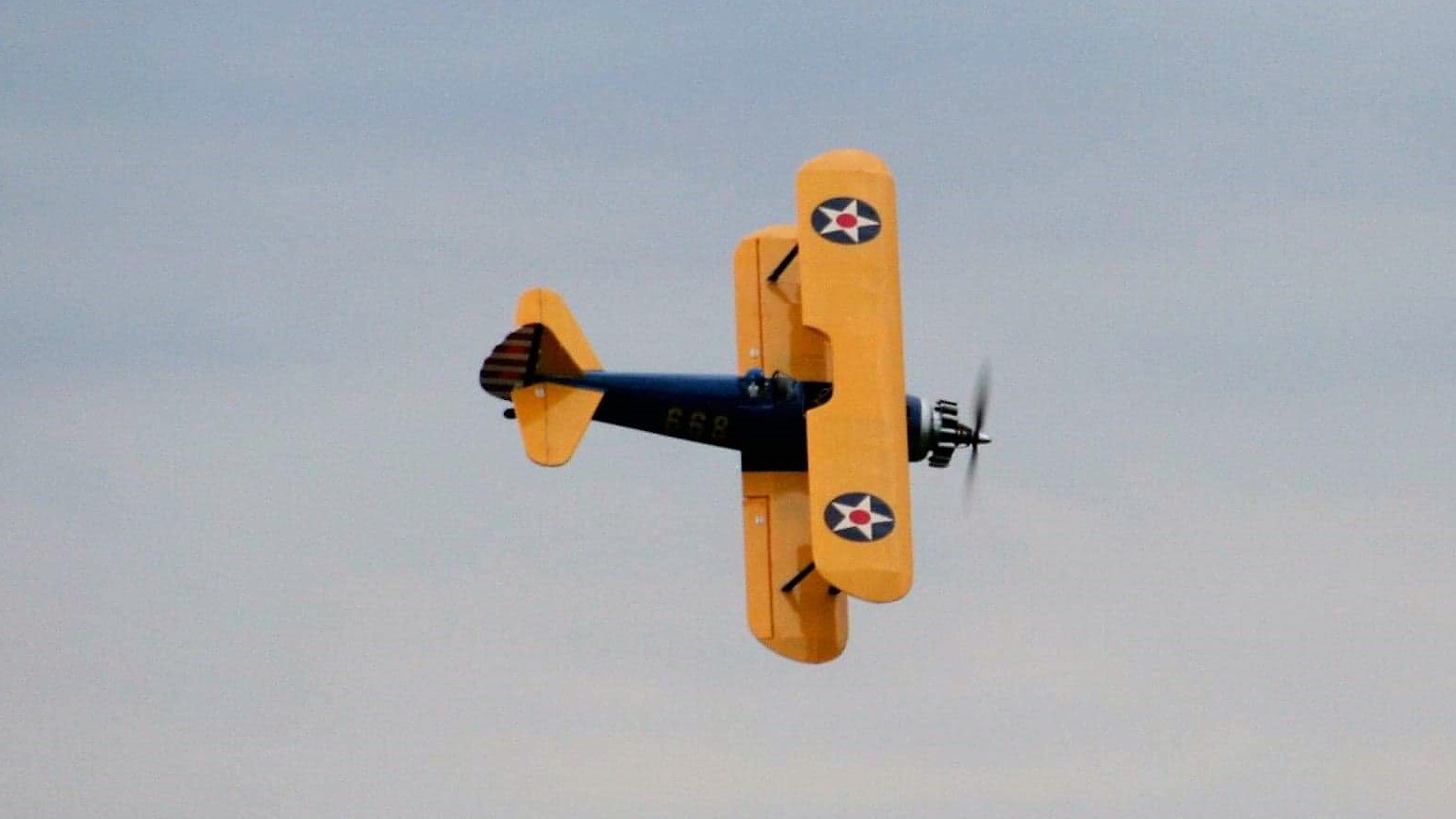 Page Boy said that the Stearman failed to get away from the first take-off attempt but it must have survived undamaged as there were lots of photos of it in the air. Maybe he’d never flown a draggy biplane before.
I had done the maiden flight of the Phoenix for Page Boy when he first put it together so I knew it was a nice flier. On my return from holiday I fitted one of my receivers and flew the Phoenix. But about two minutes into the first flight there was suddenly no power and I realised the motor had failed. Page Boy said my 15 day warranty had just expired! When I examined the motor I found that the wire insulation had burnt through and the motor was dead.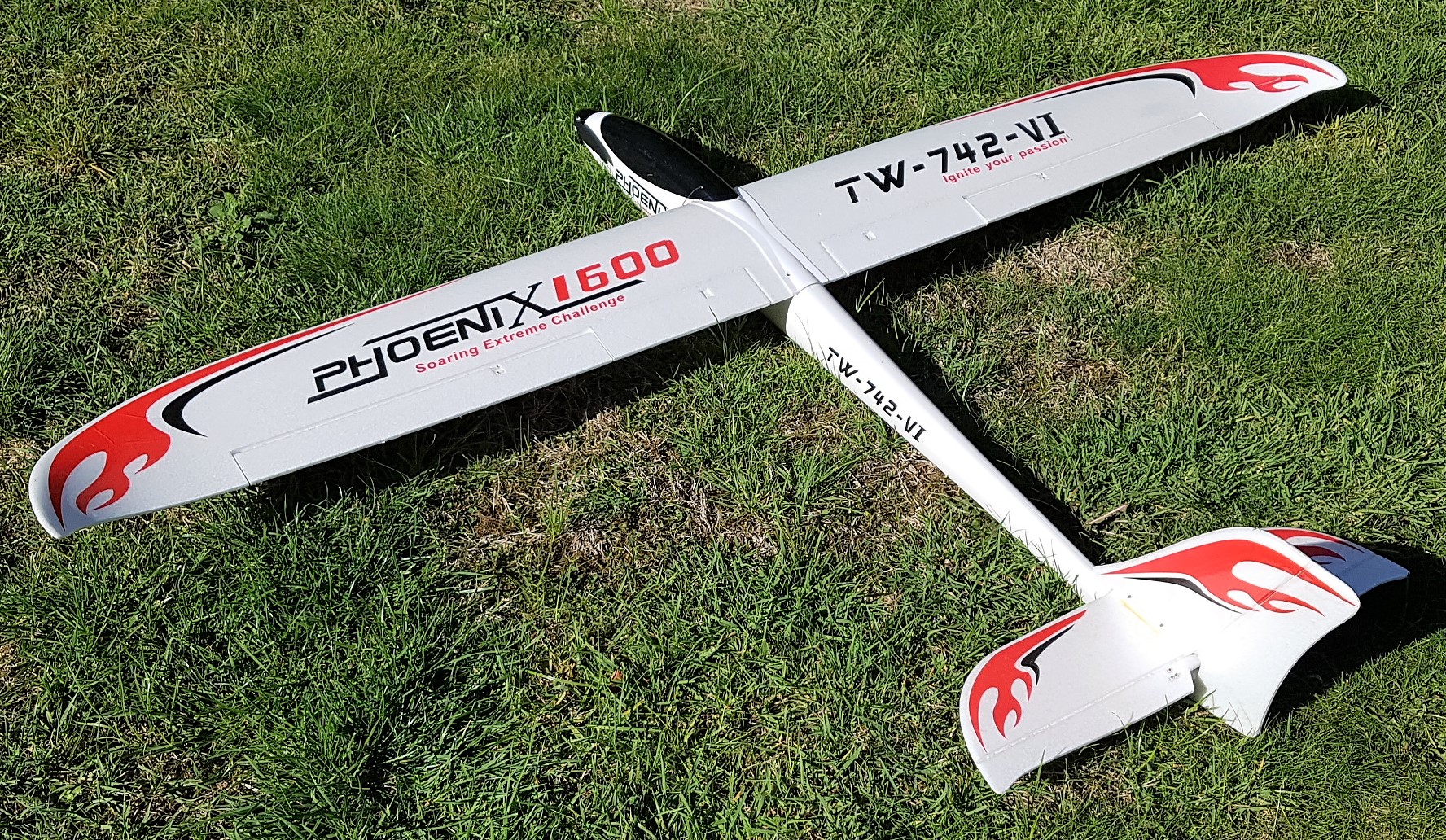
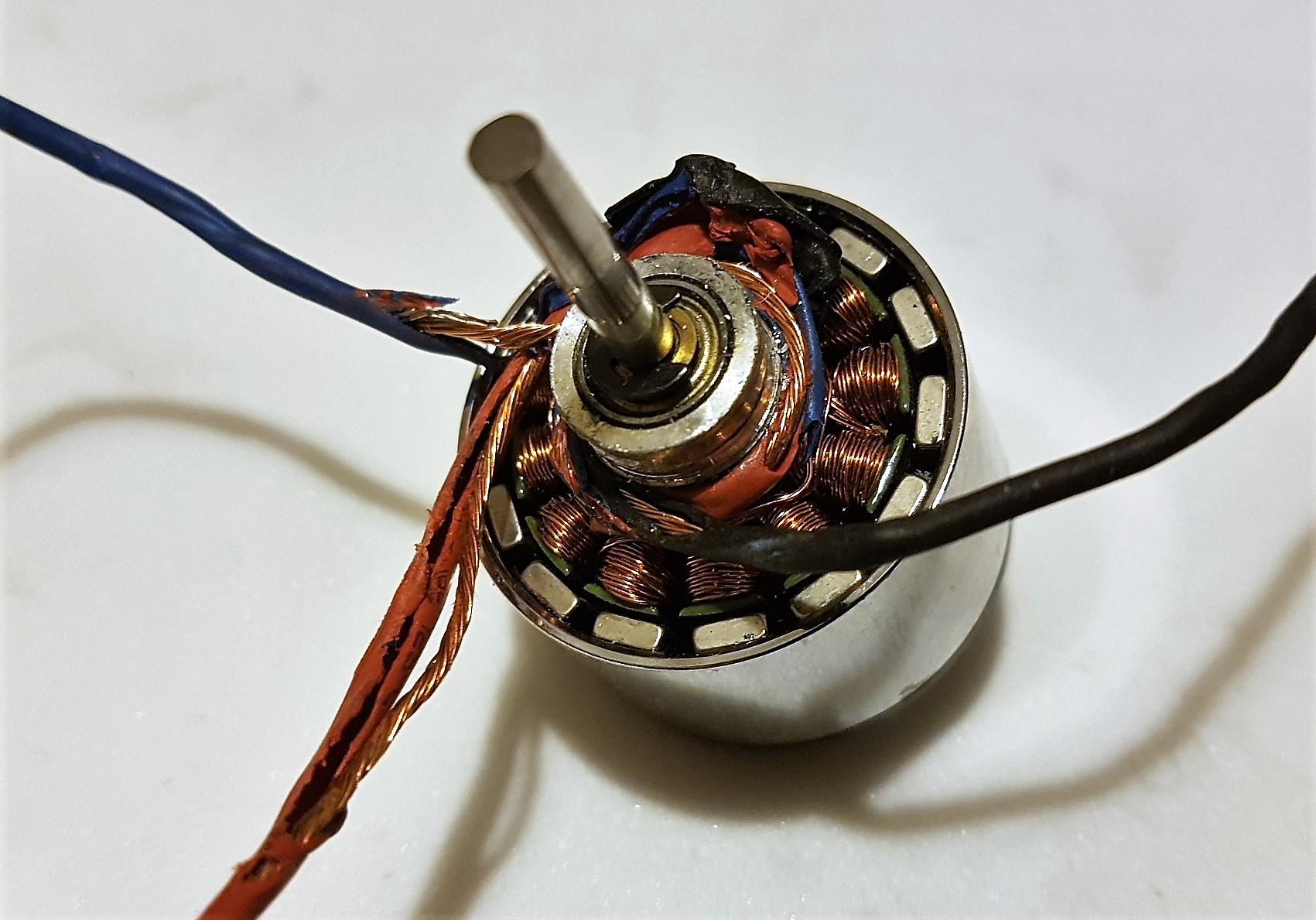 It’s a known problem on those motors so I replaced it with a spare Propdrive motor I had in my spares box and it’s now back flying again. It’s a great flier, more aerobatic than the Phoenix 2000 but not such a good glider of course.
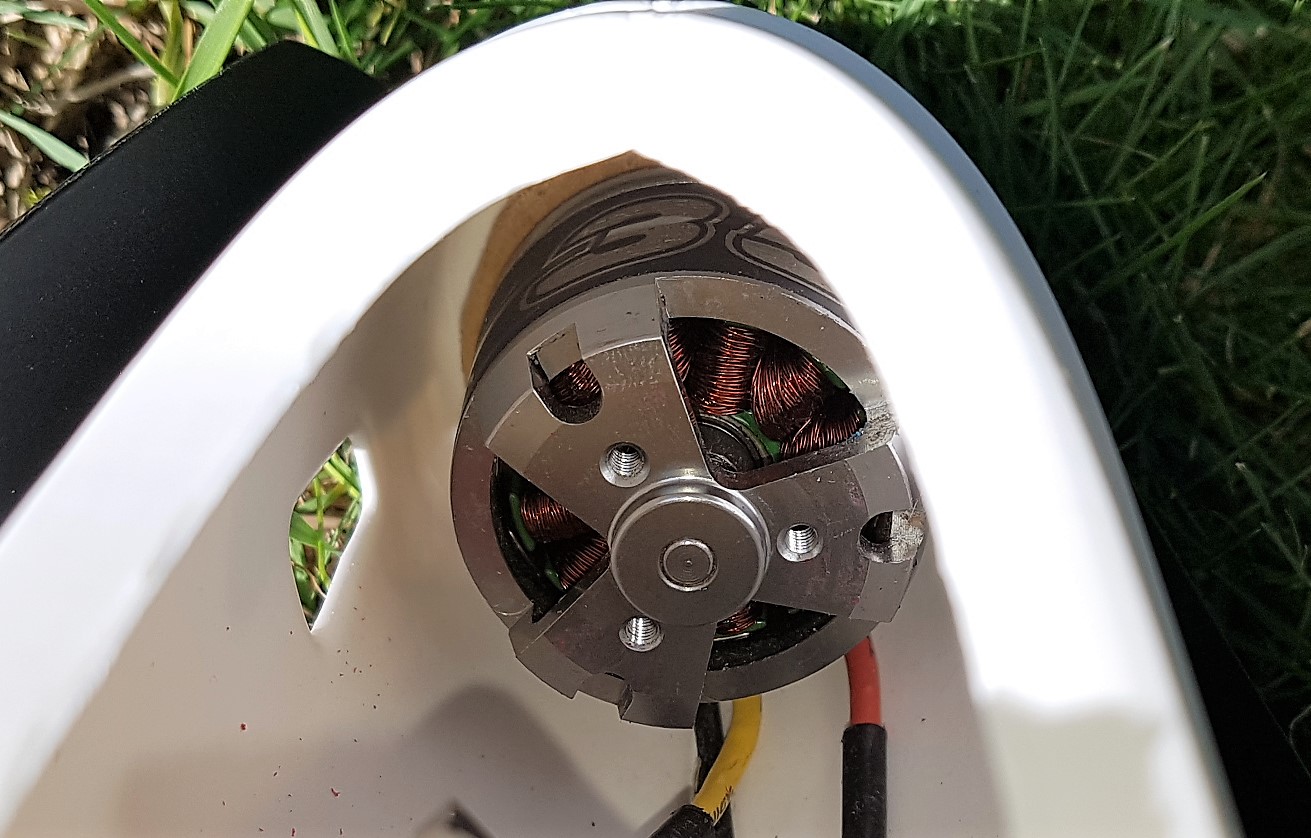 Now if I could just work out how to turn the speed controller brake on to stop the folding prop from windmilling…
Along with the Stearman photos there were also some of Richard’s new model, a pretty Cirrus SR22T from E-flite.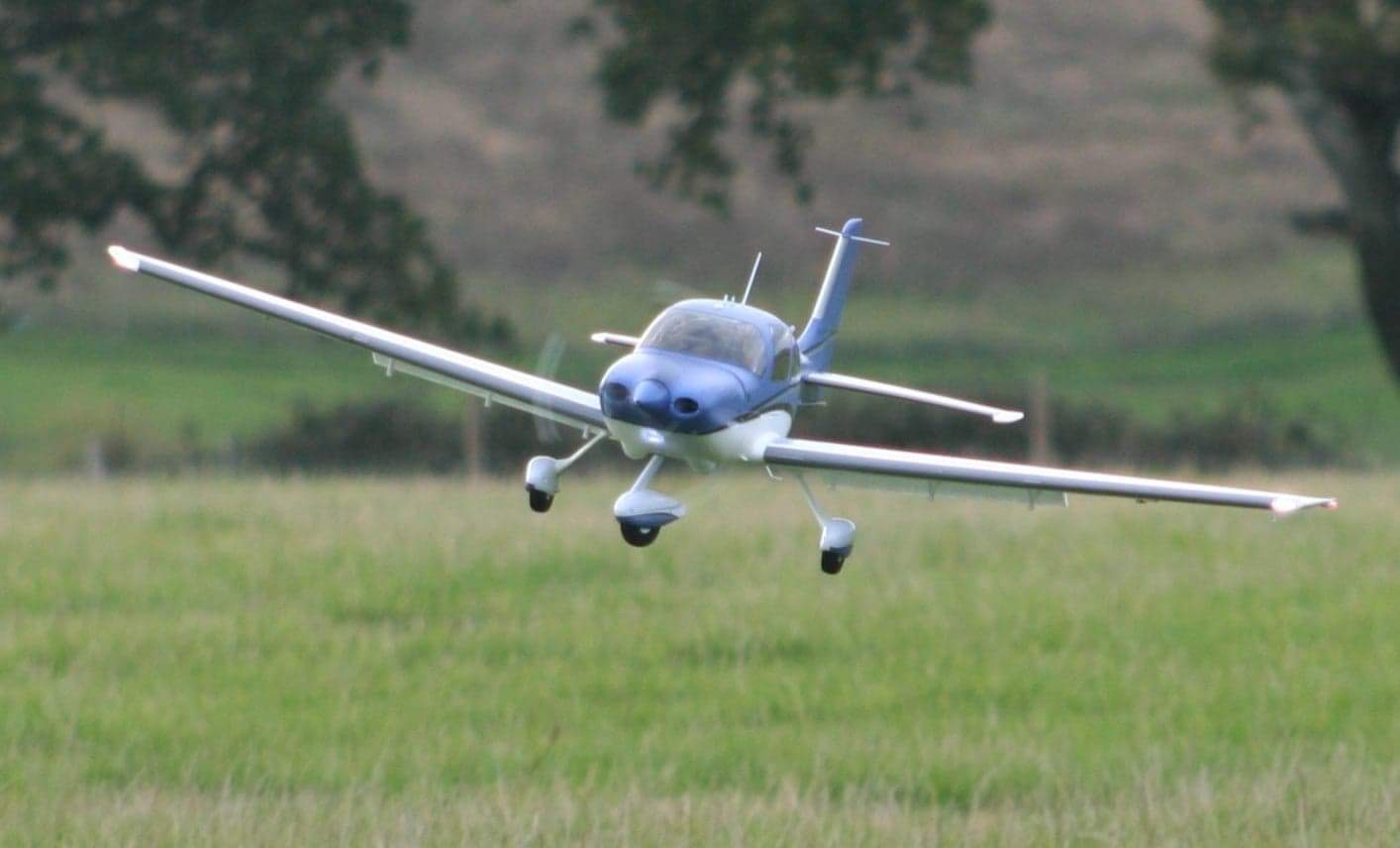
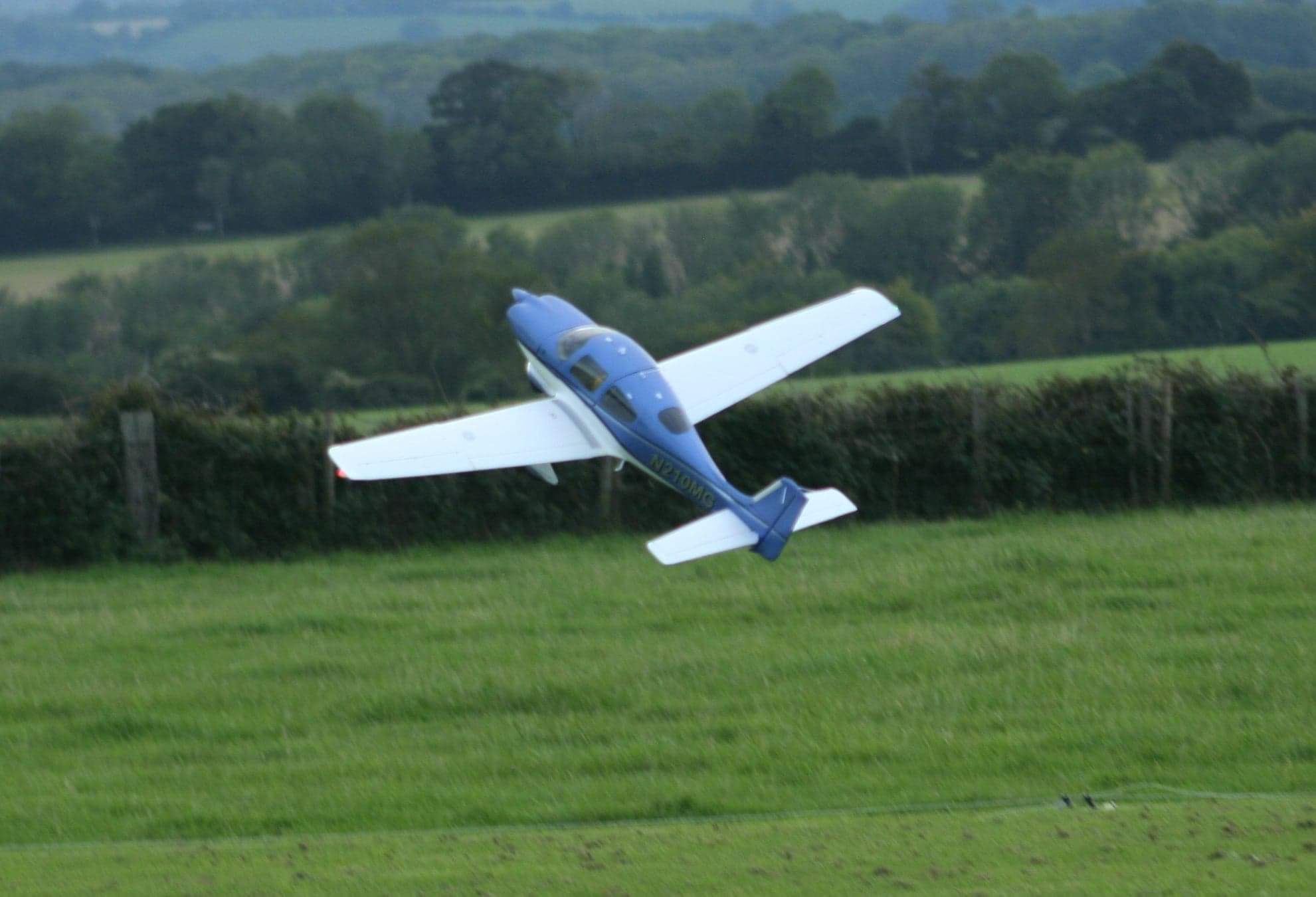 The Cirrus is 1500mm span foamie that comes in a Plug’n’Play package and is equipped with the Spektrum SAFE technology. This is what the E-flite website says about the full-size and model: Cirrus Aircraft has blazed a trail for the future of single-engine aircraft by developing modern safety, performance and amenity standards pilots crave. Generation 6 of their SR22T carries on the innovation hot-streak. As a result, more pilots can consider personal air travel the practical everyday commuting solution predicted by technology experts decades ago. The E-flite® Cirrus SR22T 1.5m park flyer is an officially licensed replica inspired by the original to deliver rich detail and a host of modern functional features that make scale flight an uncompromised thrill ride for more RC pilots than ever before.
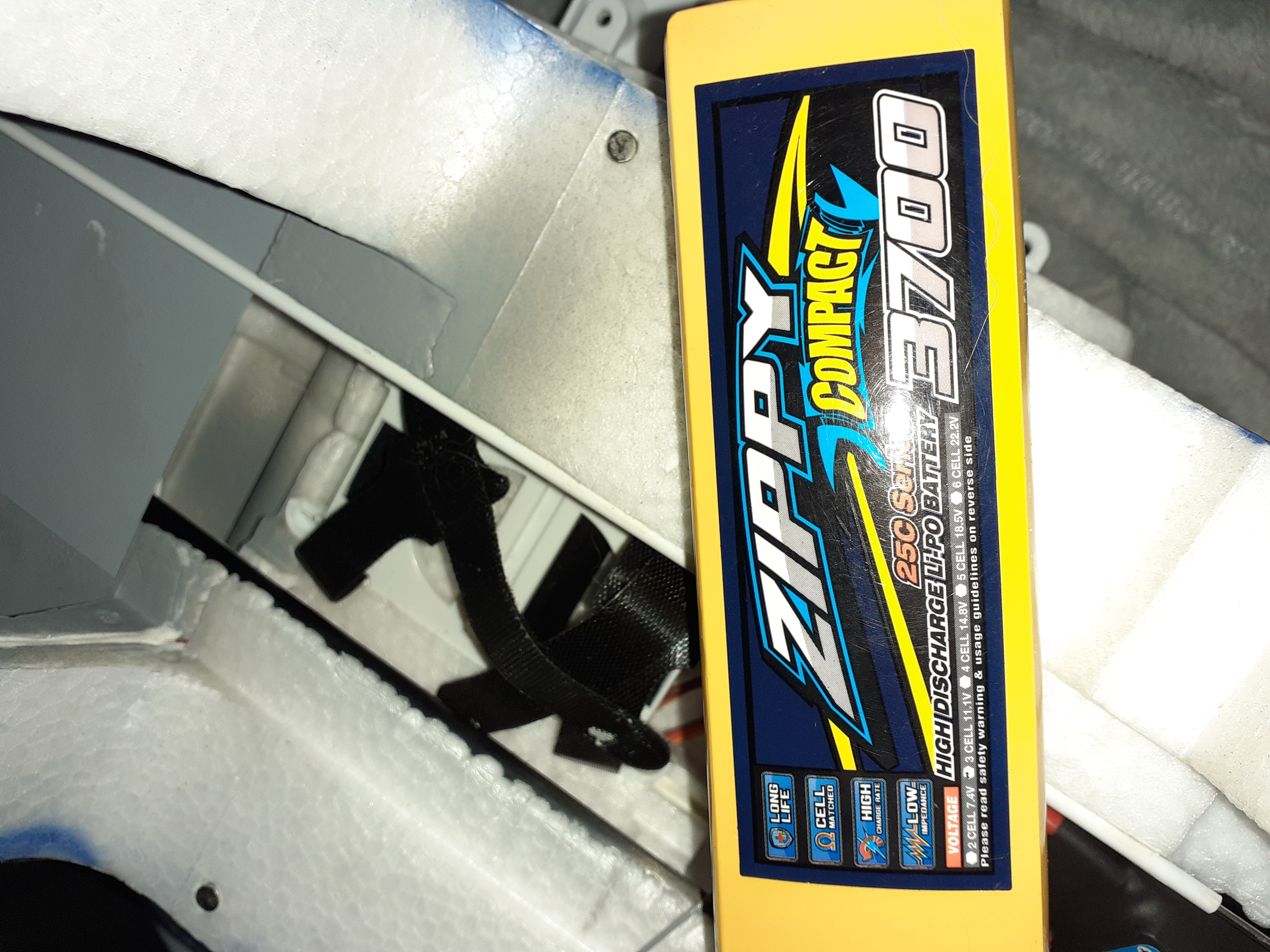
The E-flite® Cirrus SR22T 1.5m celebrates the general aviation marvel with a scale model that’s easy to appreciate and fun to fly for a wide range of pilots. Like the full-scale airplane, this officially licensed E-flite replica is generously appointed with features that will get you in the air and flying in style. The two-piece, plug-in wing is equipped with slotted flaps, lights and a convenient Hands-Free Servo Connection System. Functional interior cabin and exterior navigation LED lighting combine with its modern trim scheme for authenticity that’s easy to appreciate from any angle. Rugged tricycle landing gear and steerable nose gear utilize over-size wheels to make take-offs and landings on grass fields or paved surfaces seem effortless while matching fairings and wheel pants complete the luxurious outline. Tinted cabin windows, a pilot figure and detailed cockpit take the scale experience even deeper. Plus, the powerful brushless motor and three-blade propeller deliver plenty of power to perform scale manoeuvres and sport aerobatics with ease.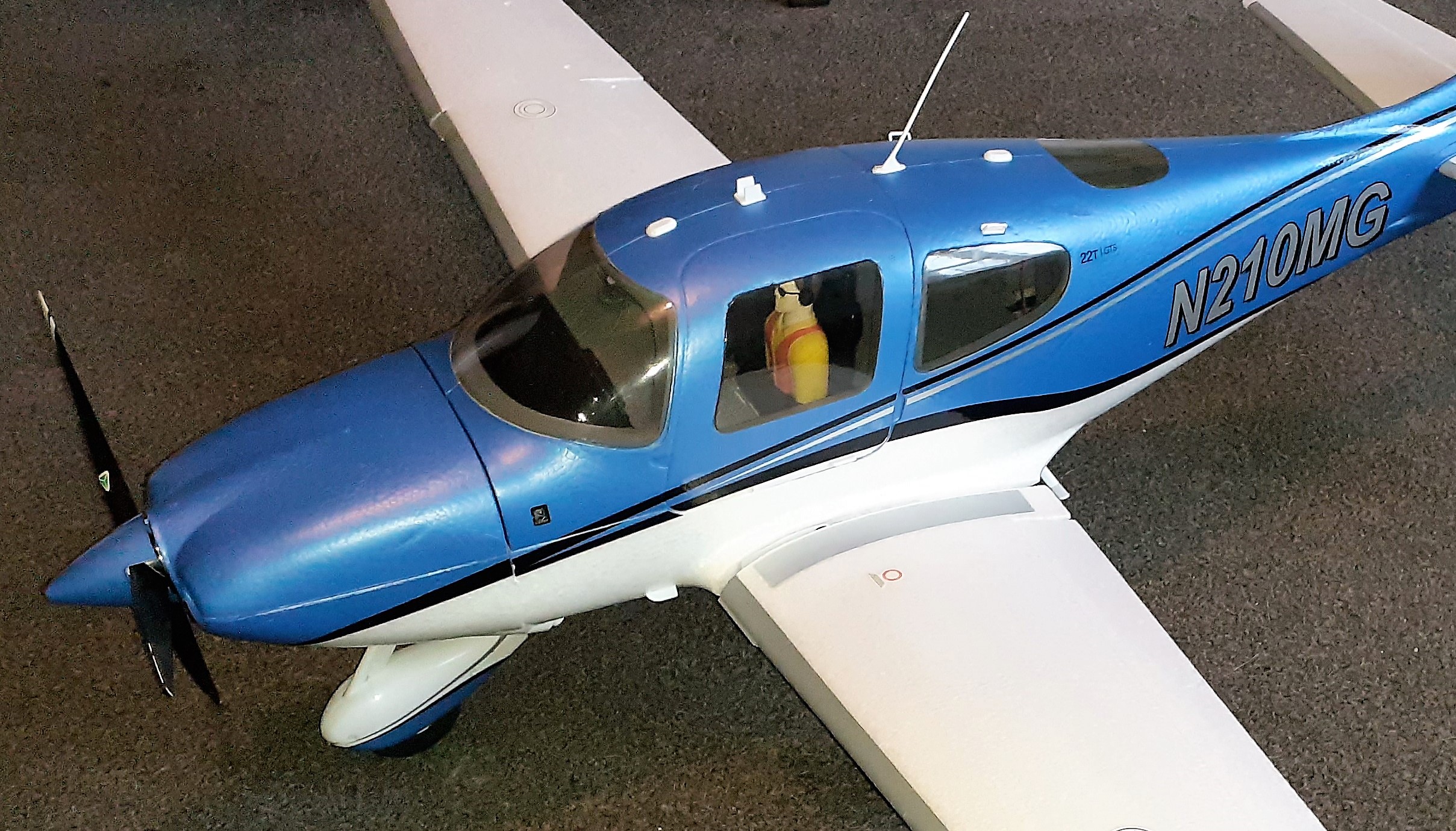 The Cirrus comes with an E-flite BL10 1250Kv outrunner,, an 11×7.5 three bladed prop, and a 40A speed controller. There are six 9g servos operating ailerons, elevator, rudder, flaps, and steerable nose-wheel. That nose-wheel looks a bit off in the first of the flying photos! Richard is using a 3700mAh 3 cell lipo so should get good long flights.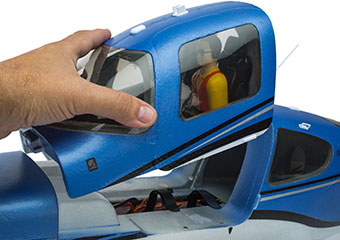
 I haven’t seen the Cirrus yet but it looks really nice in the photos and Page Boy (who did the maiden flight) said it flew extremely well and with the flaps down it landed at walking pace so is an ideal second model for Richard.
We has a visitor to the patch in September, Ben Smith, who contacted me via the club Facebook page and asked if it was ok to come along and see what we were all about. Unfortunately I was away on the Sunday he came but others took a photo and some video of Ben flying his Hawker Hurricane. It’s a foamie from Dynam and looks to be a good model. It’s 1250mm span, 1003mm long and weighs around 1450g. It comes with a 600Kv brushless outrunner, a 40A esc and a 3 bladed prop. It has worm drive electronic retracts which presumably means they go up and down in a nice scale like manner. Dynam suggest using a 3000mAh 4 cell lipo which should give flights of around 10 minutes.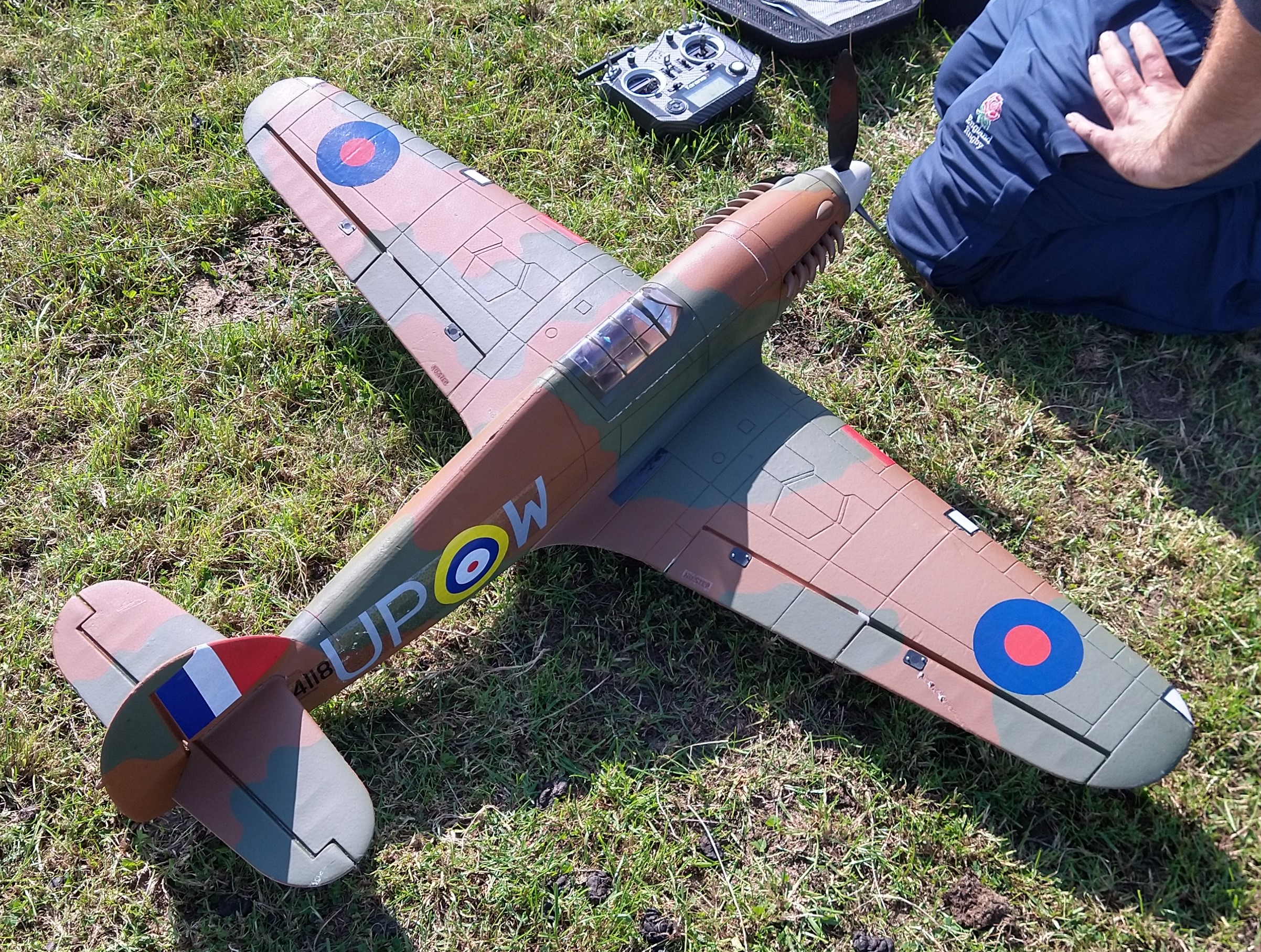 You can see it flying in this month’s video, Ben looks to be a very capable flier and hopes to join the club shortly.
In September I got around to putting together the Yak-130 that I’d bought from Banggood a couple of months ago.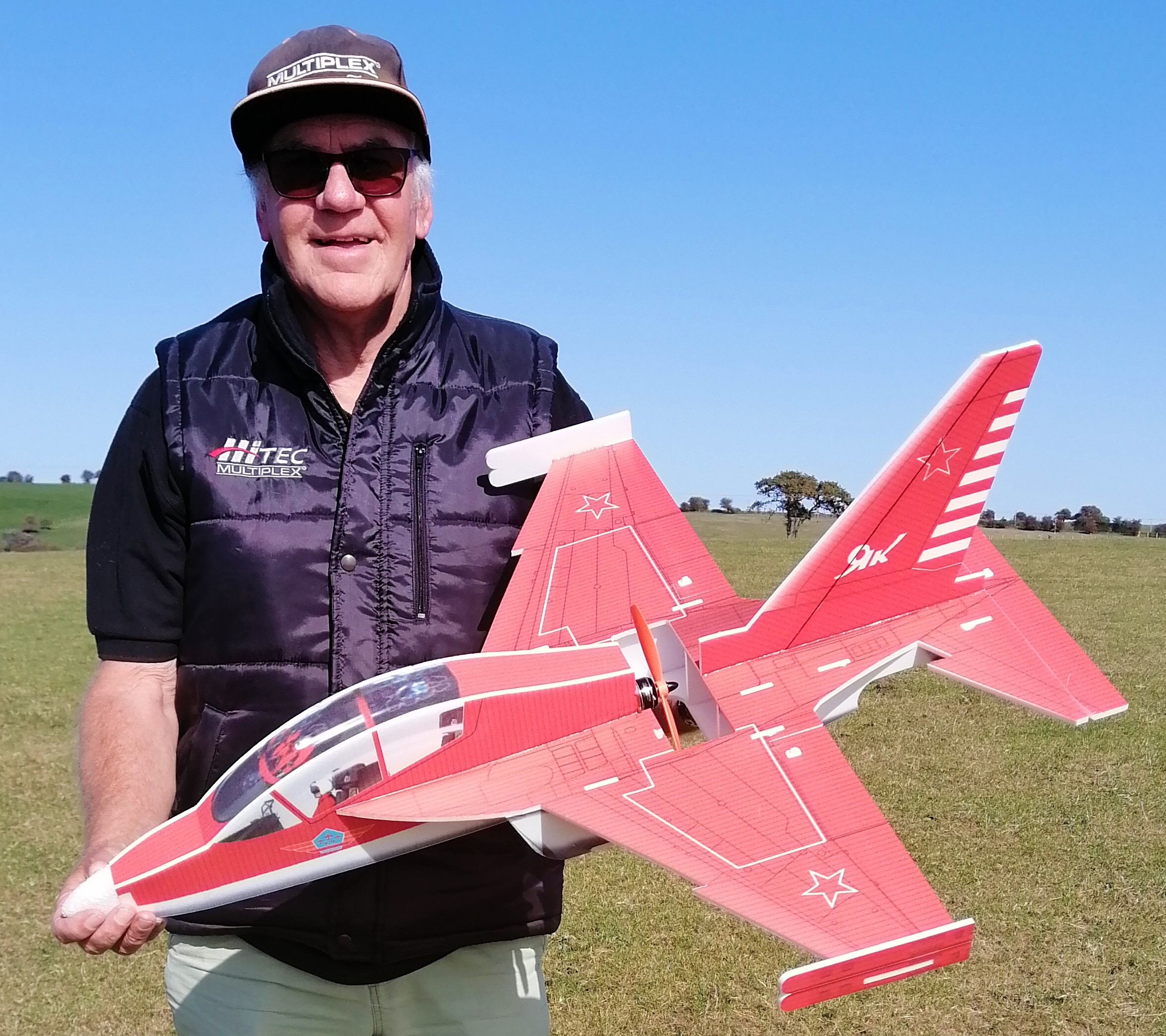 I chose it because it has more of a fuselage than the other foamboard models and despite basically being a square foam box I think it looks rather pretty, especially in the air. It didn’t come with any instructions but the method of assembly is pretty similar to the SU-27s & Mig-29s that HobbyKing sell. I used a hot melt glue gun for all the joints that can’t be seen from the outside of the finished model and cyano for the joints that can be seen. Hot melt works well on foamboard but is a bit messy and doesn’t look very good, cyano doesn’t melt the foamboard and seems to work ok but I’m not convinced that it’s as strong as hot melt. You do need to be very careful when using cyano as it’s very easy to spoil the printed coloured finish with just a tiny drop in the wrong place… ask me how I know!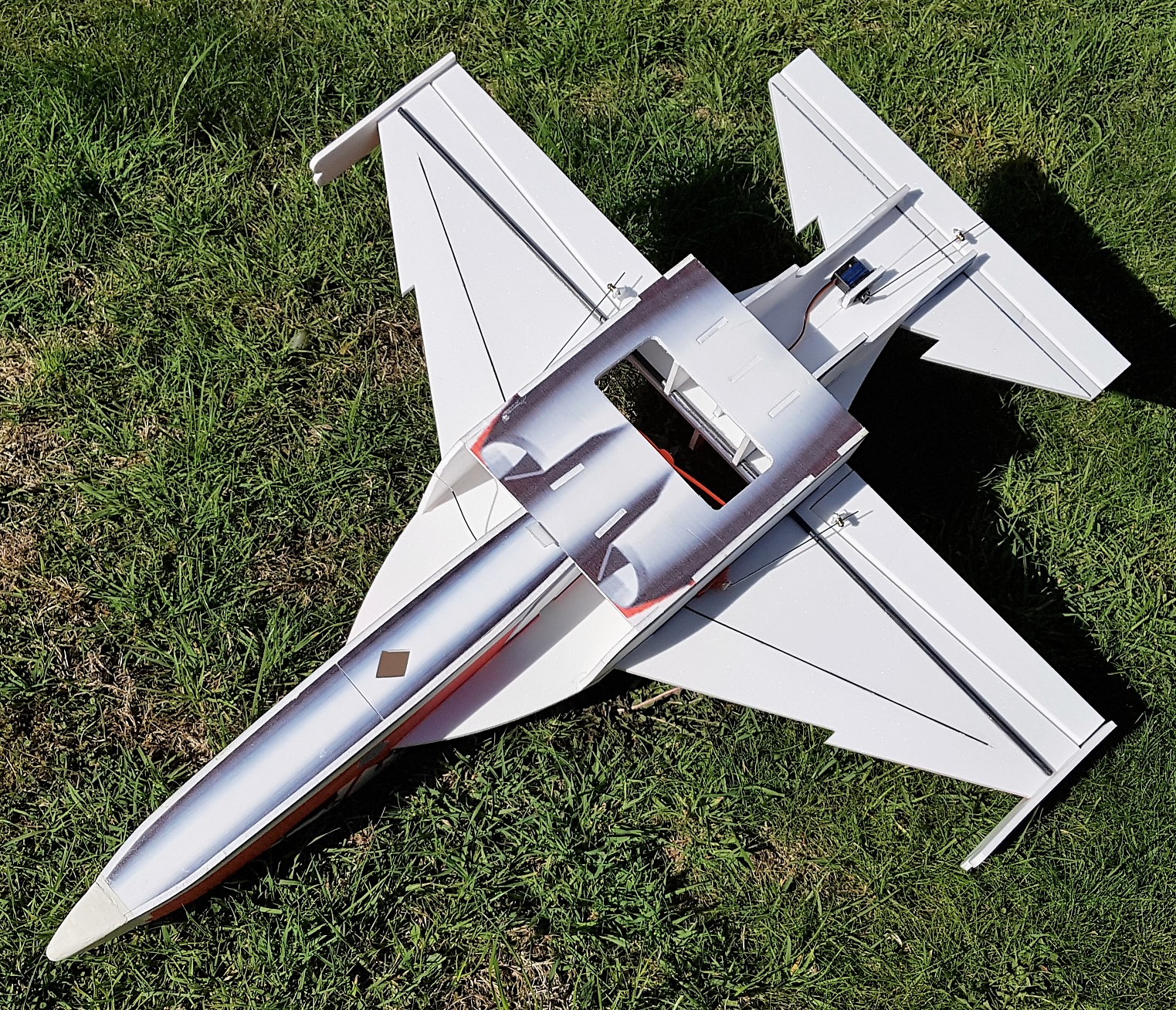
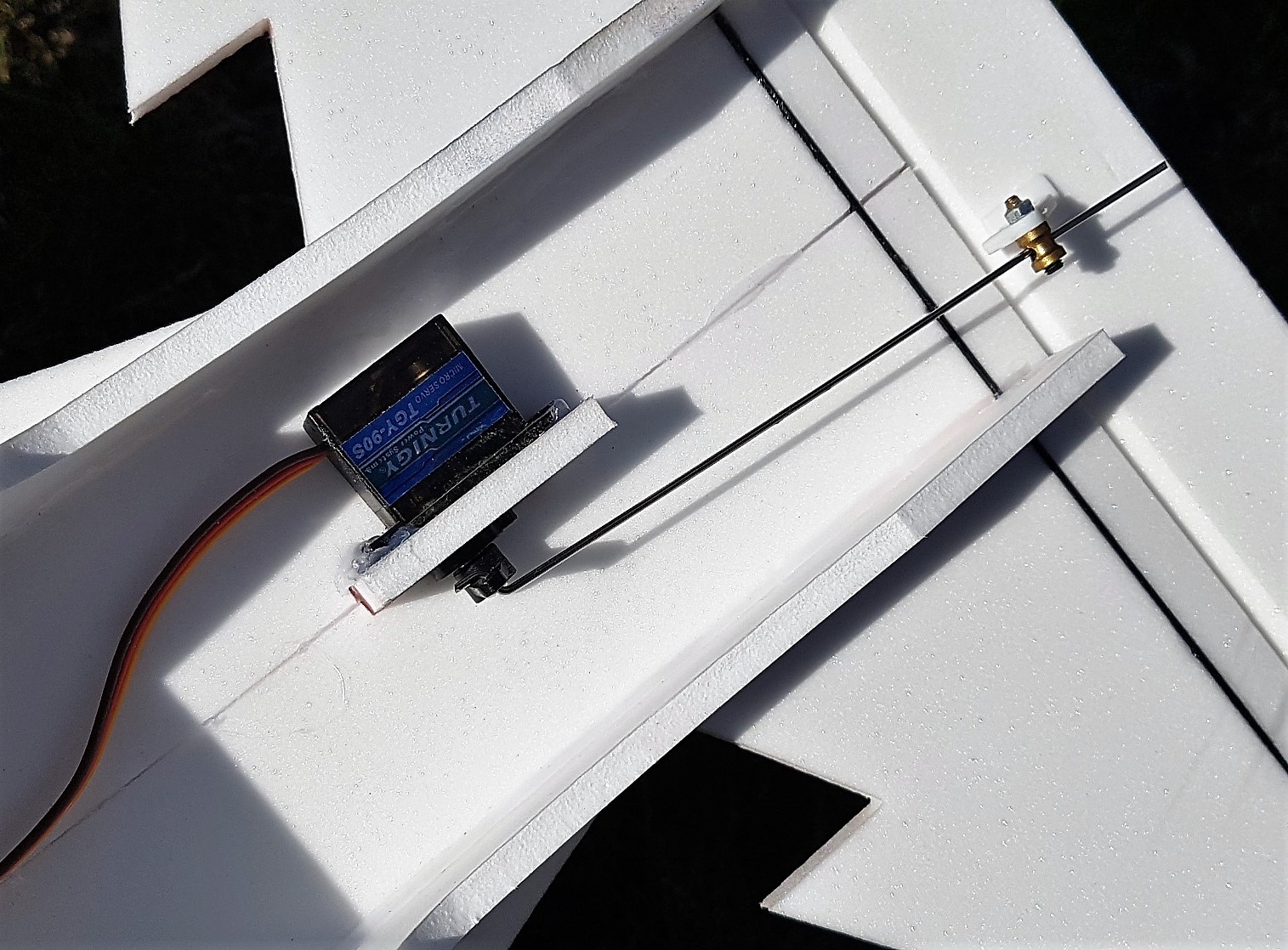 The kit includes a carbon tube wing spar and a few pieces of flat carbon strip that fit into pre-cut slots in the wing, tailplane, and fin. The ailerons are cut out but remain attached by the thinnest of foamboard hinges and I didn’t think they’d last long in flight so I used Blenderm tape over the top and I also used Blenderm to attach the elevator.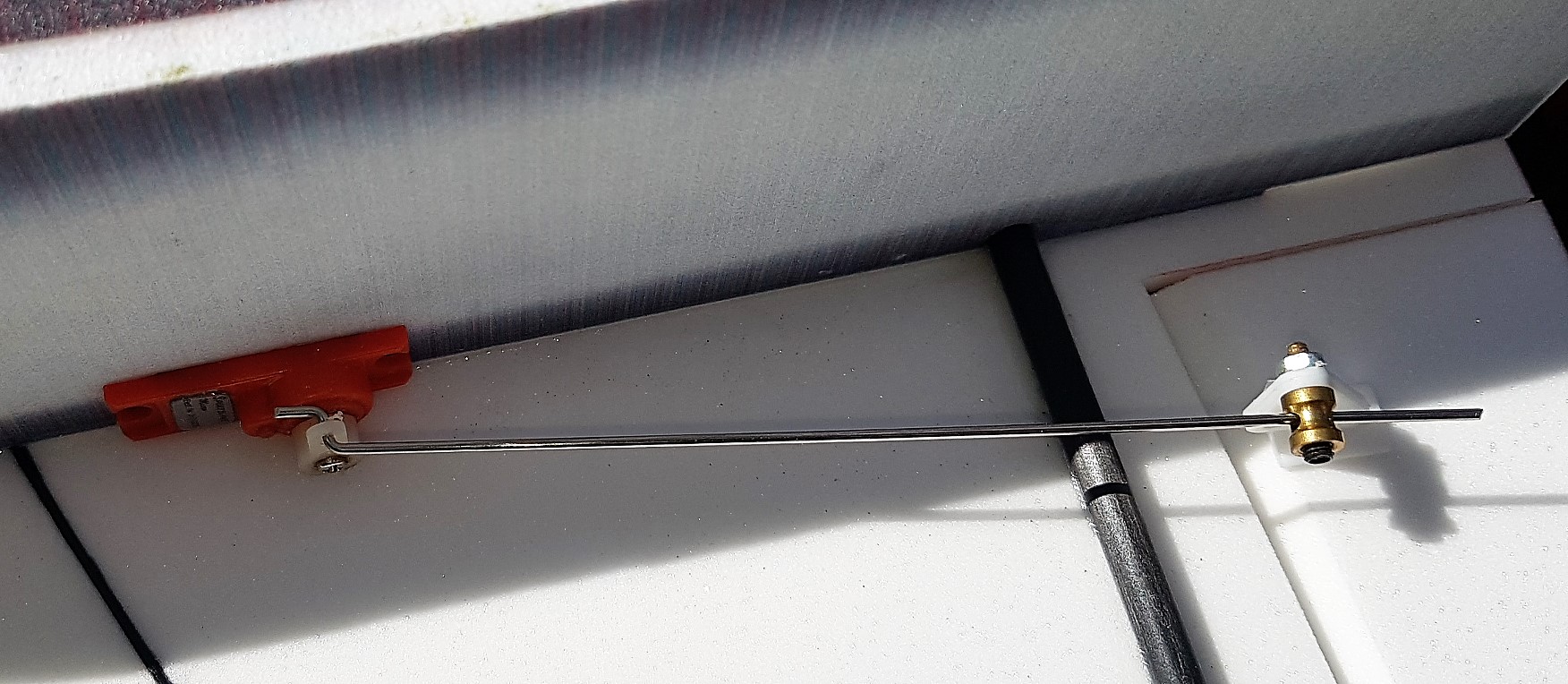
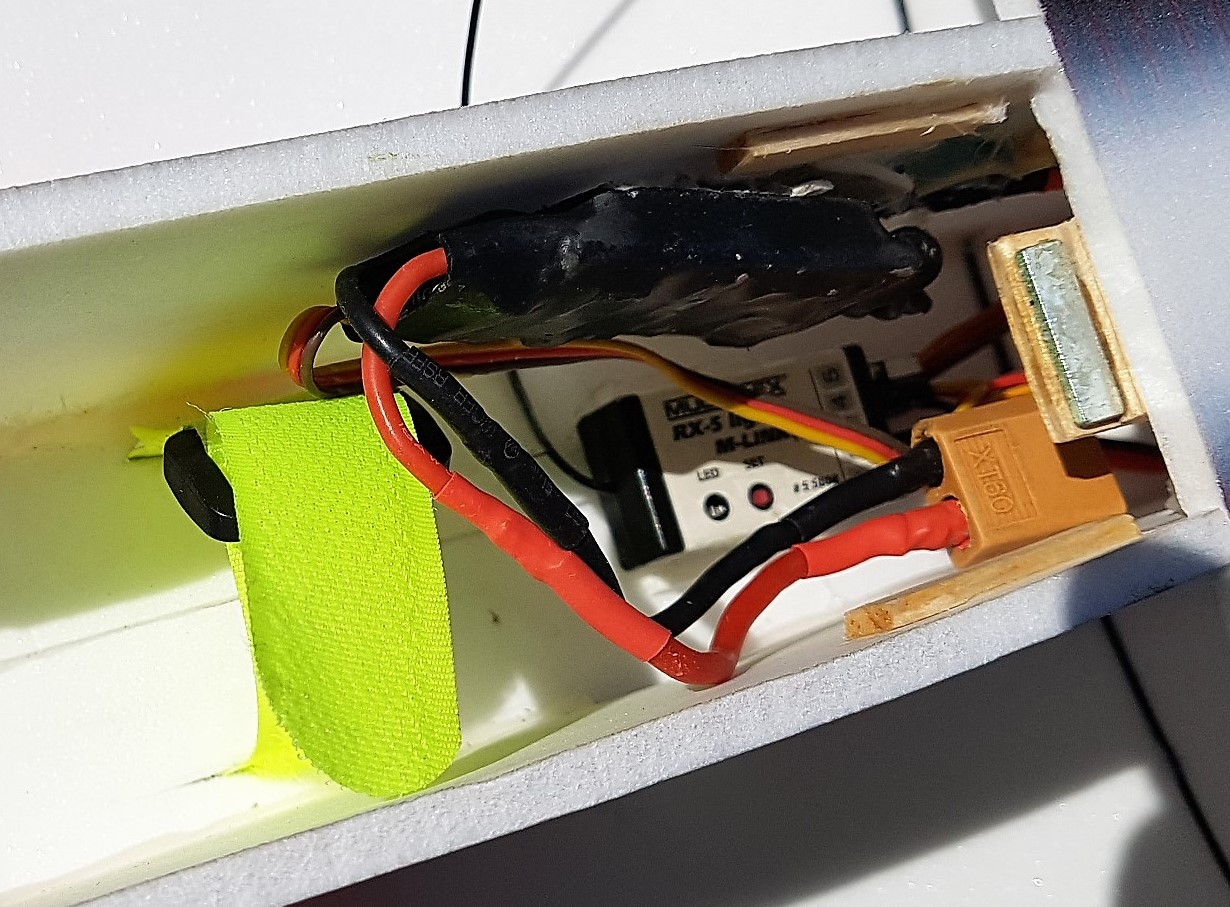 There are pre-cut holes for the servos and all the linkages and control horns are supplied and they all fitted perfectly. There is a ply plate to mount the motor, once fitted the motor can’t be removed without cutting the plate out of the airframe. As with the other foamboards I’ve opened up the propeller slot considerably to reduce the prop noise. I used exactly the same powertrain as I already have in both my SU-27 and Mig-29, a 2306 2200Kv drone motor fitted with a 6×4.5 prop and a 3 cell lipo with a capacity of anything from 1300mAh to 2200mAh. I initially fitted a 25A speed controller I had in my spares box but on the first flight I discovered two problems, firstly that it seems to be in helicopter mode and takes about 5 seconds to power up to full speed, and secondly 25A isn’t enough.
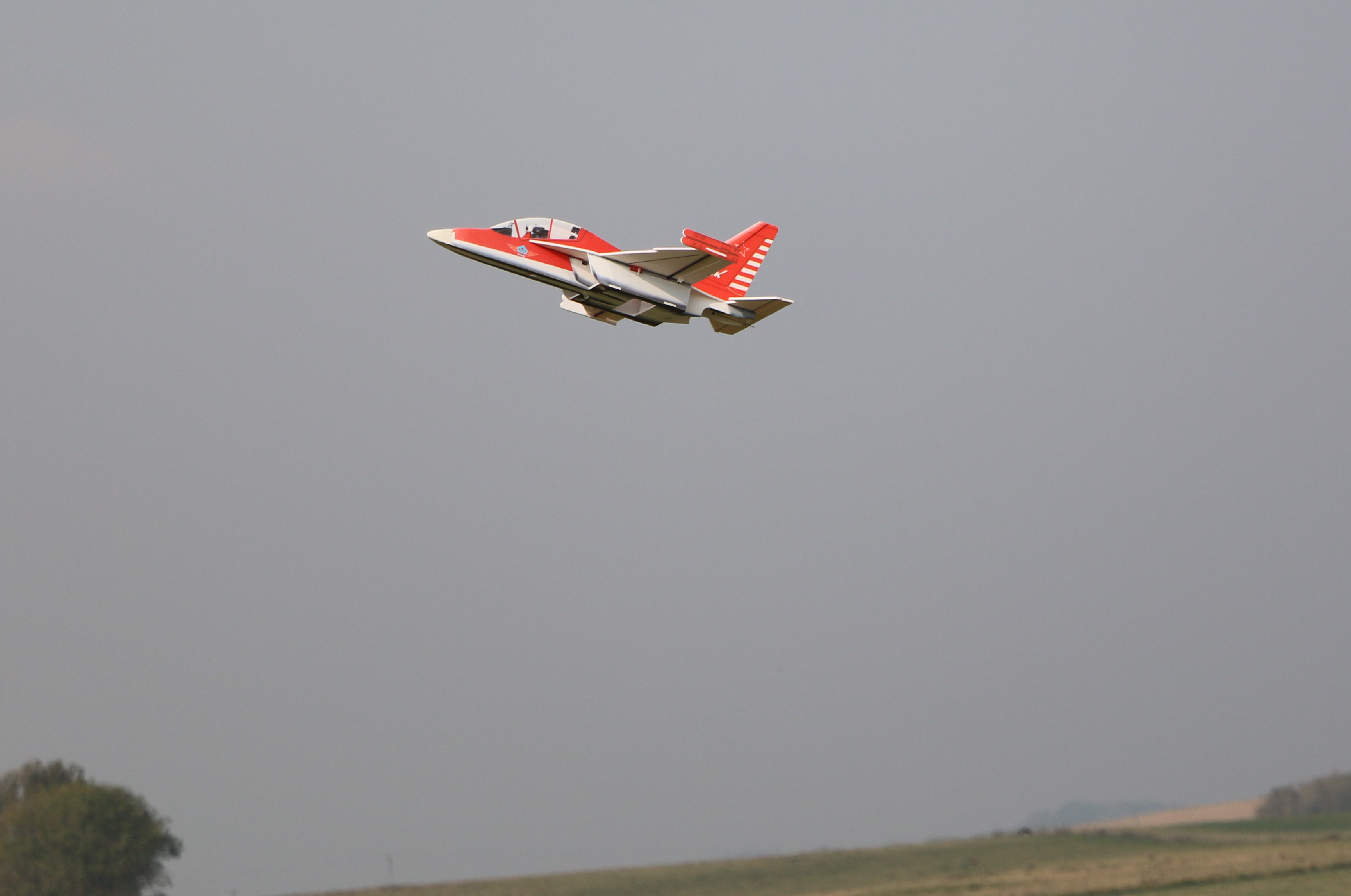 Some of the first flight can be seen in this month’s video where you’ll see that the motor suddenly stops due to the speed controller objecting to the high current. Fortunately the Yak was over the patch in a very strong wing at the time so the plane simply floated backwards and landed on the patch! I used a 6×3 prop for the rest of the flights that day and didn’t have any more over current problems but I haven’t been able to change the helicopter mode so I’ve now fitted a 30A controller that is in the correct mode. The Yak flies very well, similar to the other foamboards, although like the Sukhoi, I intend to fit a rudder to improve the handling when in high alpha.
On the morning of Sunday 27th September Dougal Entendre and others were flying and Dougal was making the most of some slope lift with his Multiplex Blizzard in the strong northerly wind. He had a good first flight but this is what he reports happened next: Just prior to launching for the 2nd flight I saw a low helicopter to the North, so I didn’t launch. Just as well, because it came almost directly across the patch at about 3 times house height, towards the IOW. It was a red Gazelle, and fortunately none of us were flying at the time, or there could have been a conflict. Fortunately there was no problem this time and we have never had a problem with full-size aircraft but it serves as a reminder to us all to always be alert and aware of other aviation.
On the last Saturday of September we met up with prospective new members Stephen Crowley and his son Max. There was a very strong wind blowing so we didn’t fly but we checked over the model they have built. It’s a 42” Balsa Basics Cub produced by Vintage Models, a three channel trainer that is described as ‘docile and friendly’.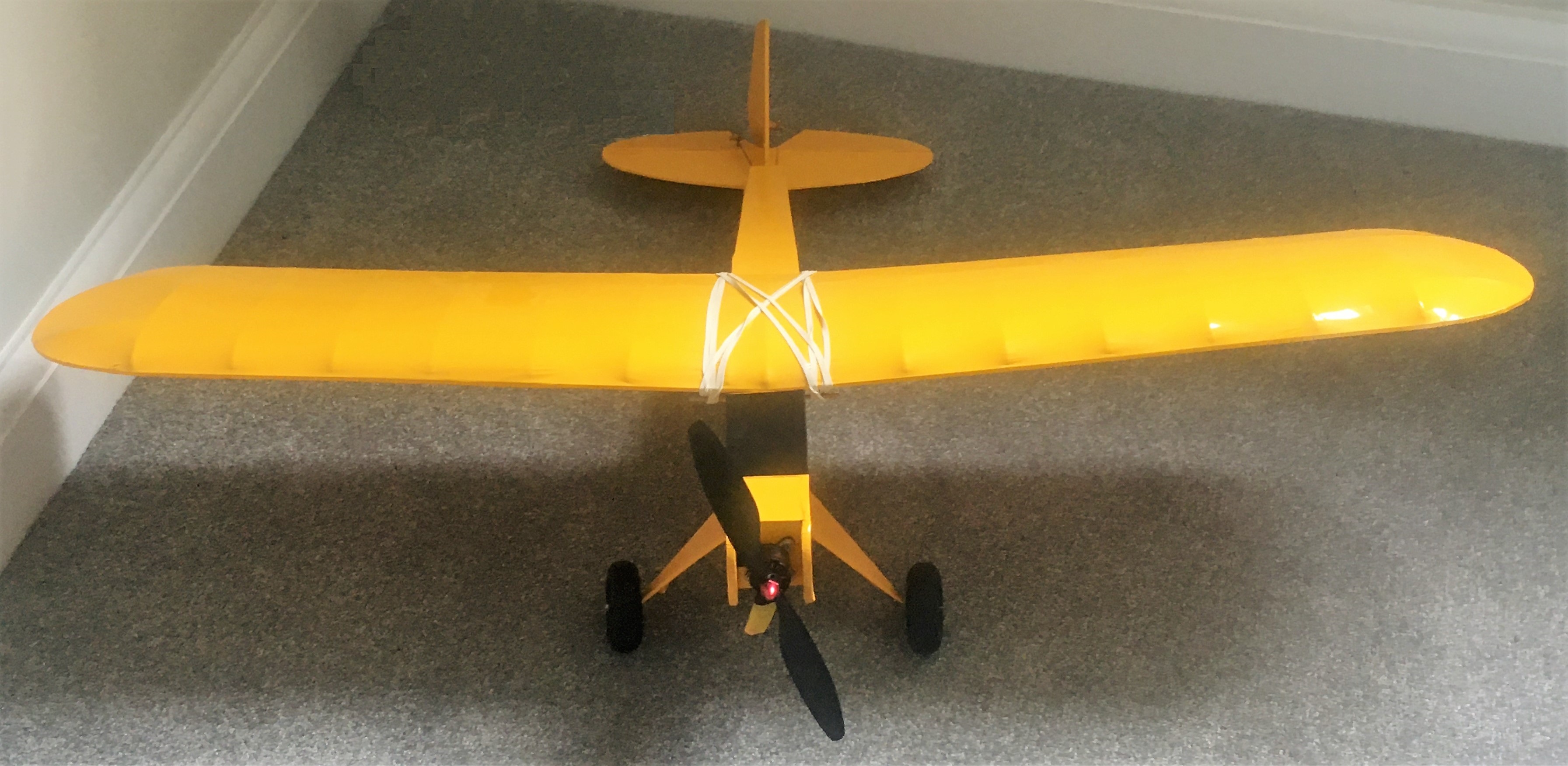 Stephen and Max have made a good job of the model and only a couple of minor issues were pointed out which should be easily sorted. Unfortunately with Covid limiting the numbers at the patch, winter approaching, and Max being at school five and a half days a week it might be a while before Stephen and Max are able to get much flying in but hopefully we’ll be able to get them in the air before too long.
Meanwhile young Charlie has been doing well with his FMS Easy Trainer as has now done several flights from launch to landing with no instructor assistance at all. His first landing was on the patch and it quite rightly earned him a well-deserved round of applause from all in the pits. The strong September winds curtailed some of his flying but he’s coming on in leaps and bounds. His next model will be a secondhand Wot-4 kindly donated by John Warren.
A couple of days ago I saw one of our near neighbours posting leaflets through letterboxes and I was intrigued to know what they were. Would it be raising money for the NHS, a socially distanced coffee morning, an 80th Battle of Britain celebration? In due course he reached our letterbox and I rushed to read it…he’d lost his drone!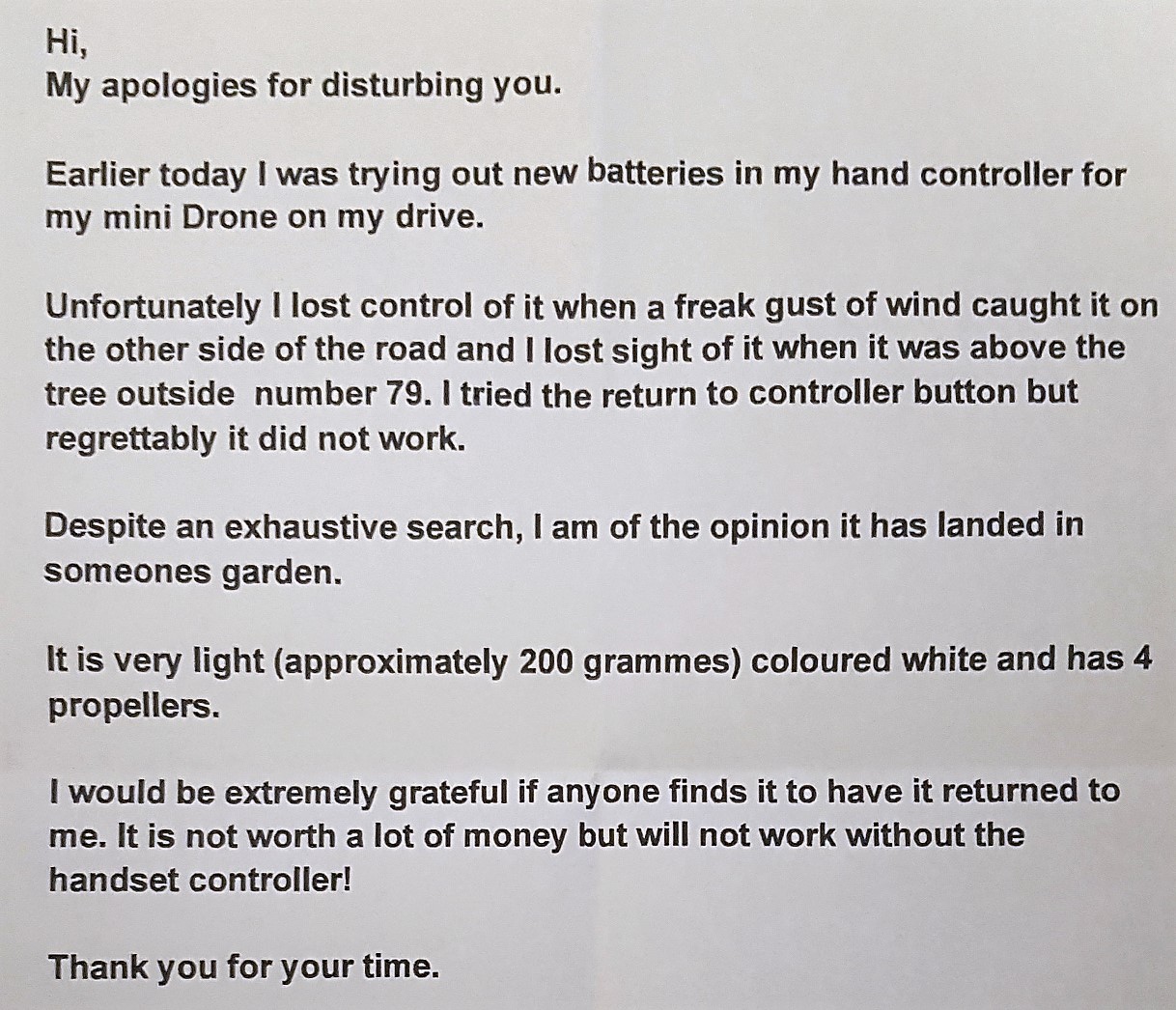 I’ve removed the chaps name and address to save his embarrassment. I know I shouldn’t laugh but it did strike me as rather funny. I had seen a drone buzzing around a couple of times but couldn’t work out where it was from, now I know! It was extremely windy the day he lost it, much too windy for a lightweight drone, so I’m not surprised the Return to Home function didn’t work, his best bet would to be to follow a line downwind. At the moment I don’t know if he’s got it back or not but I would imagine someone would be kind enough to hand it over if they found it.
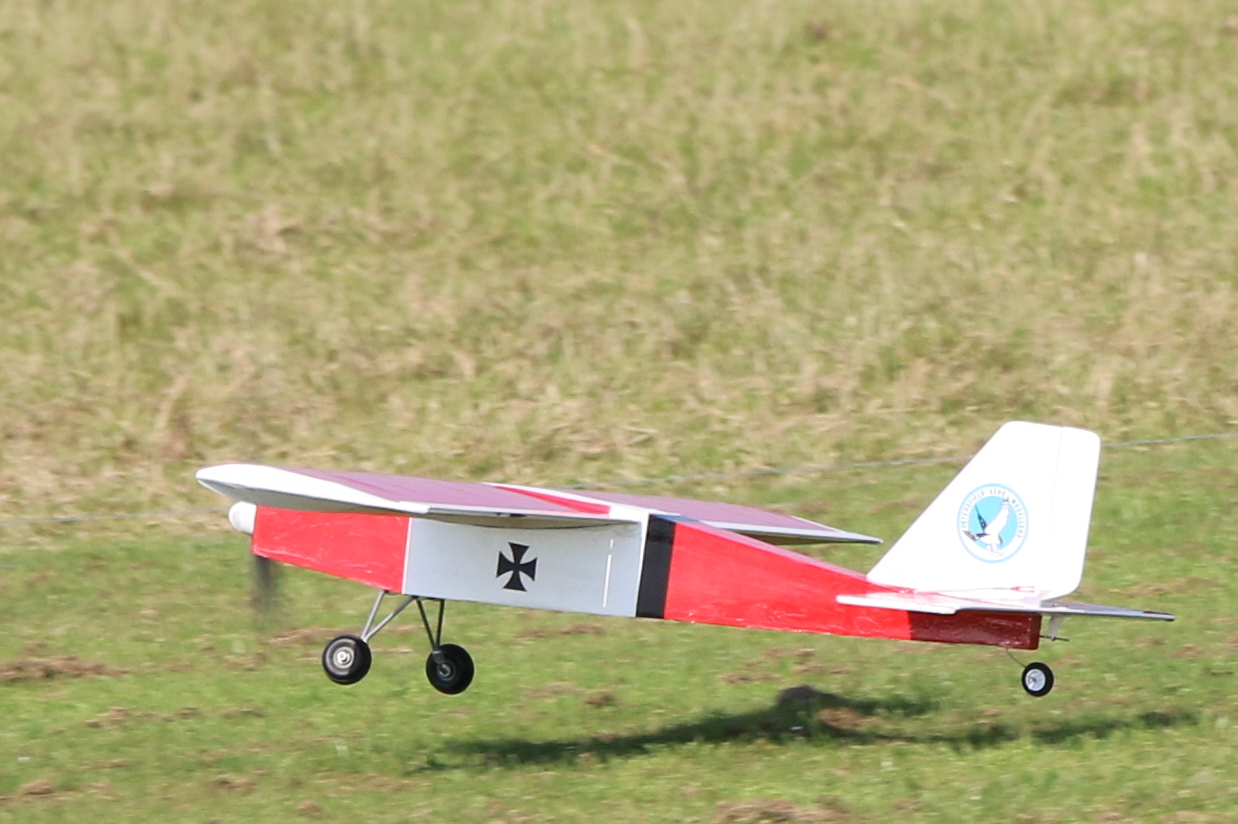
Kryten took some more excellent photos this month, here’s a selection for you to enjoy: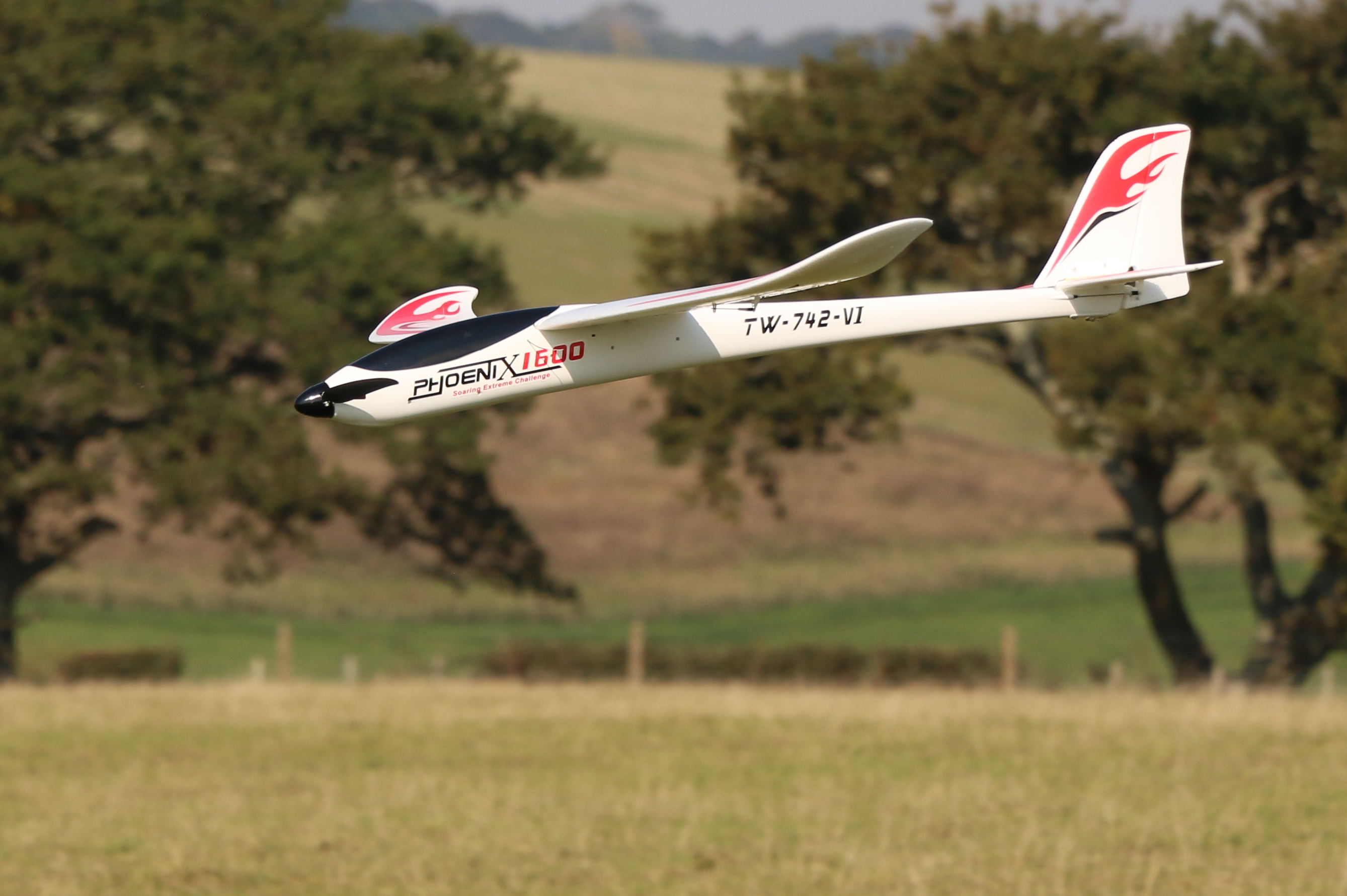


 Video time now, please watch the video full screen, it’s so much better with small models flying around.If the video won’t play for you please click HERE
An F-4 Phantom pilot at a joint military and civilian airfield requested clearance to take off, but the Air Traffic Controller told him he’d have to hold due to the large amount of civilian traffic. After several repeatedly impatient requests to take-off by the Phantom pilot the Controller suggested that if the pilot could reach 14,000ft within half the runway length he could take off; otherwise he would have to continue to hold. To the Controller’s surprise the Phantom pilot acknowledged the tower and began to roll. At the runway halfway marker the aircraft pulled up vertically and kept going until it reached 14,000ft, then levelled off. The Air Traffic Controller had no option than to hand the Phantom pilot over to Departures and wish him a nice day, since the pilot had met the conditions laid down. He said it was the most amazing thing he’d ever seen!
Colin Cowplain
Patch News – August 2020
I suppose after all that’s happened in 2020 nothing should surprise me but the August weather still came as a bit of a shock. It varied from several days of unbearable heat with the highest temperature recorded for 17 years to 70mph gales and of course several storms. Halfway through the month the bullocks returned to the field but they are mostly not interested in us, requiring just an occasional shooing away if they get too nosey. Late in the month the bullocks went and sheep are expected, a first since we’ve had an electric fence so things might get interesting!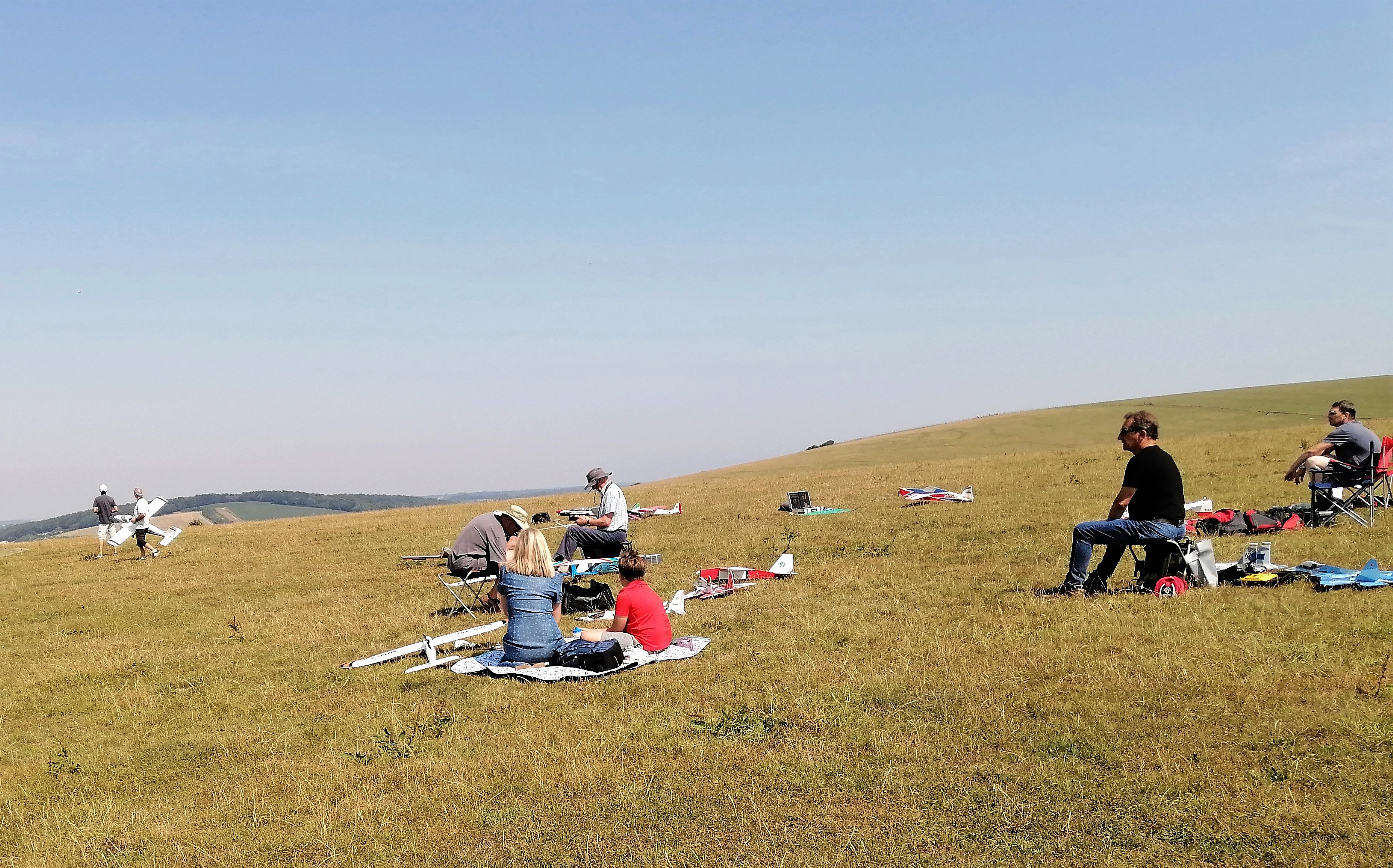 There was lots of flying, mainly by the usual regulars, but young Charlie, Chris Winkworth (WingCo), and our latest recruit Richard Osborn all flew several times and seem to be getting on well and are learning fast.
This month we heard the very sad news that Ron Vears’ wife Rosemary passed away on 15th August having bravely fought cancer for more than three years. Rosemary was a great supporter of Ron when he was our club Chairman for three years and she attended many of the club social events where she was always a happy and popular figure. Our thoughts are with Ron and we hope to see him flying with us again soon.
Several new models were flown during August, and the first I’ll feature shocked us all when it eventually made an appearance after about three years of building. Yes, Captain Slow’s Splot (or should it be called Splate?) has flown!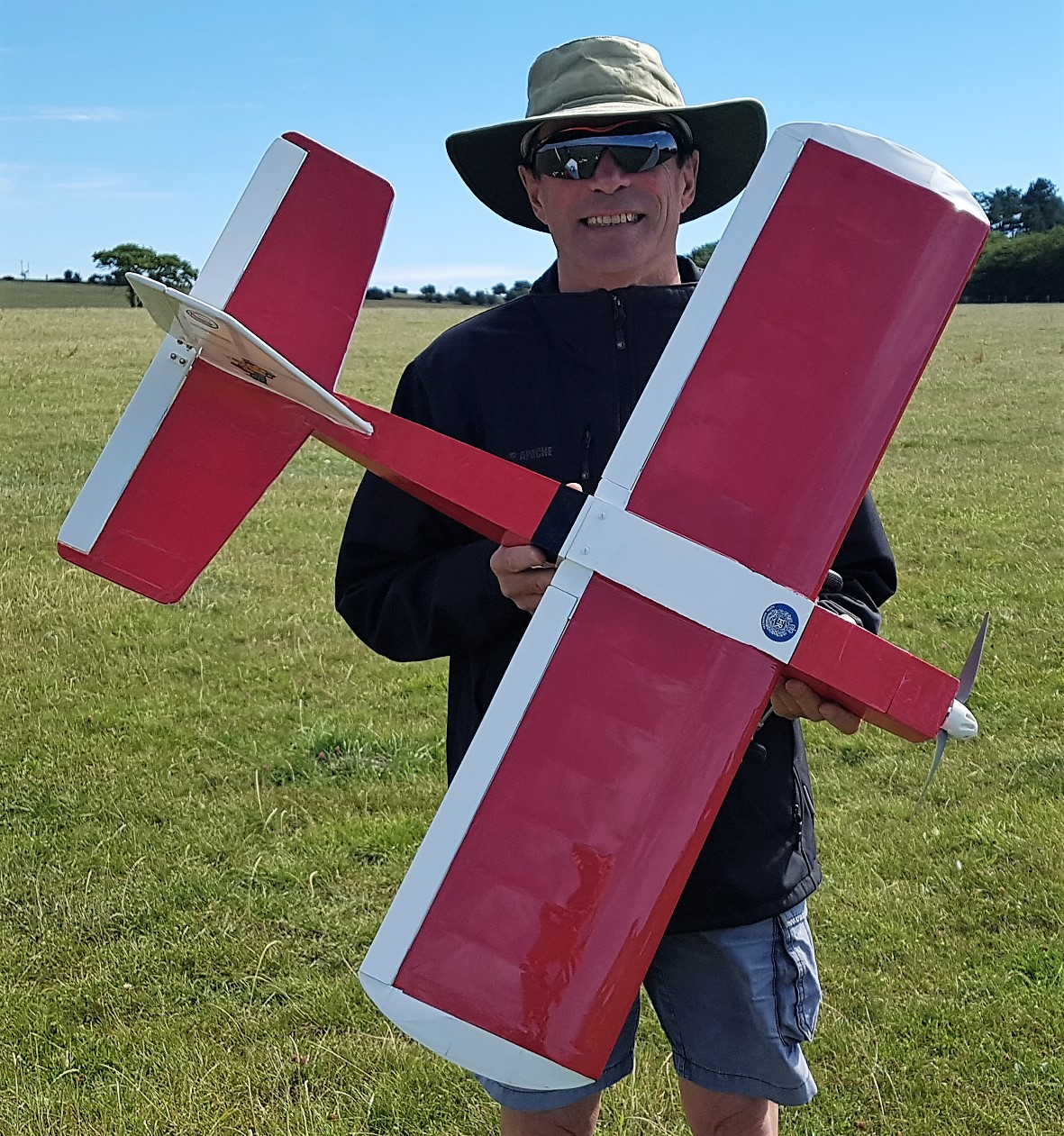 It’s pretty much a standard Splot although Captain Slow has fitted ‘normal’ wingtips rather than the usual Splot endplates, thus increasing the span from 36” to 1m. The weight is 35ozs without the lipo. He is using a 3536 1000kv motor that he salvaged from his Durafly Ugly Stick and a 40A esc from a Wot4 Foam-E. Powered by a 2200mAh 3 cell lipo it swings an 11 x 5.5 prop and only pulls around 23A so the Captain should get decent flight times. He has stuck to the original single centre mounted servo on the ailerons and soldered up his own rock solid undercarriage.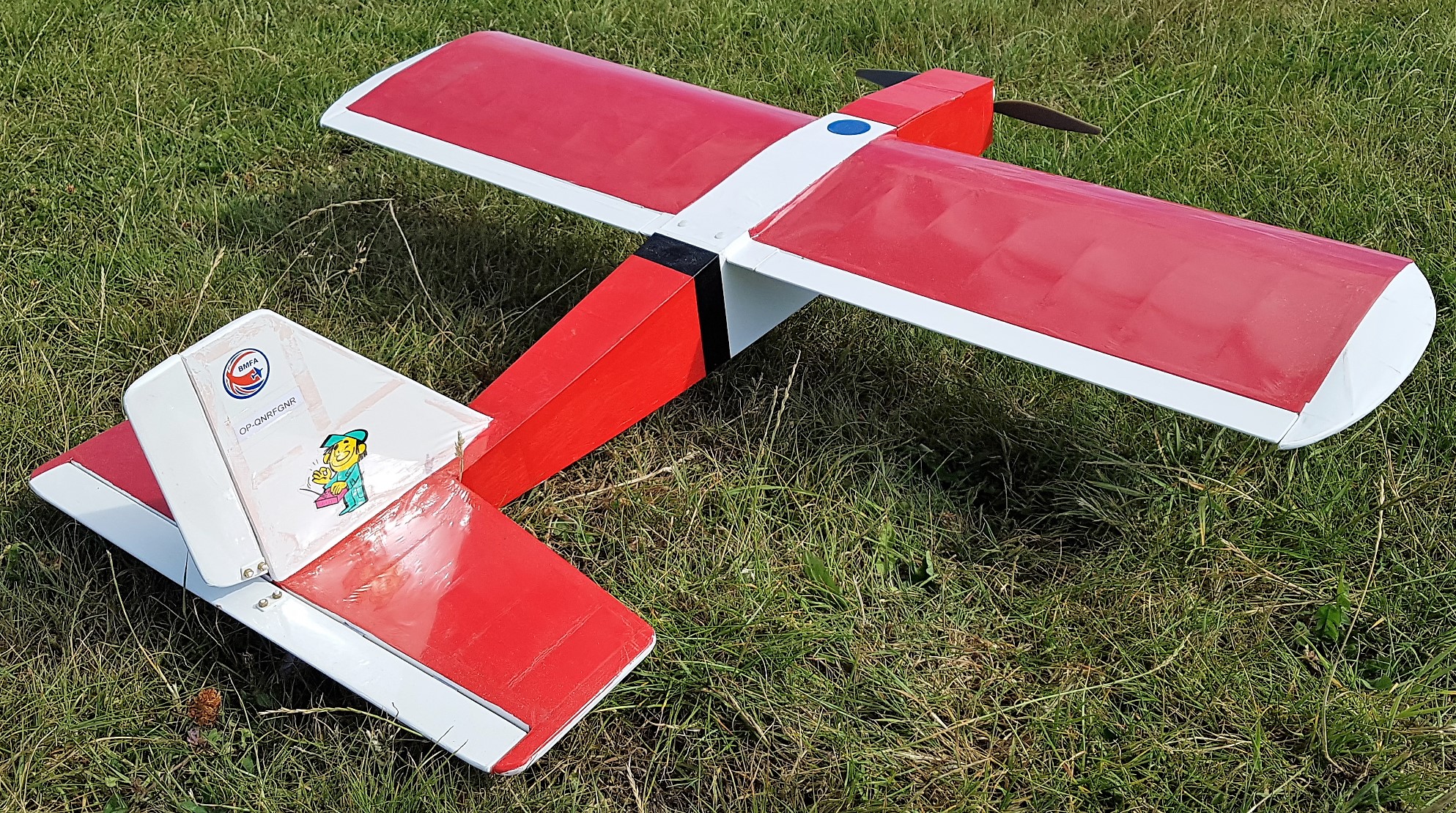
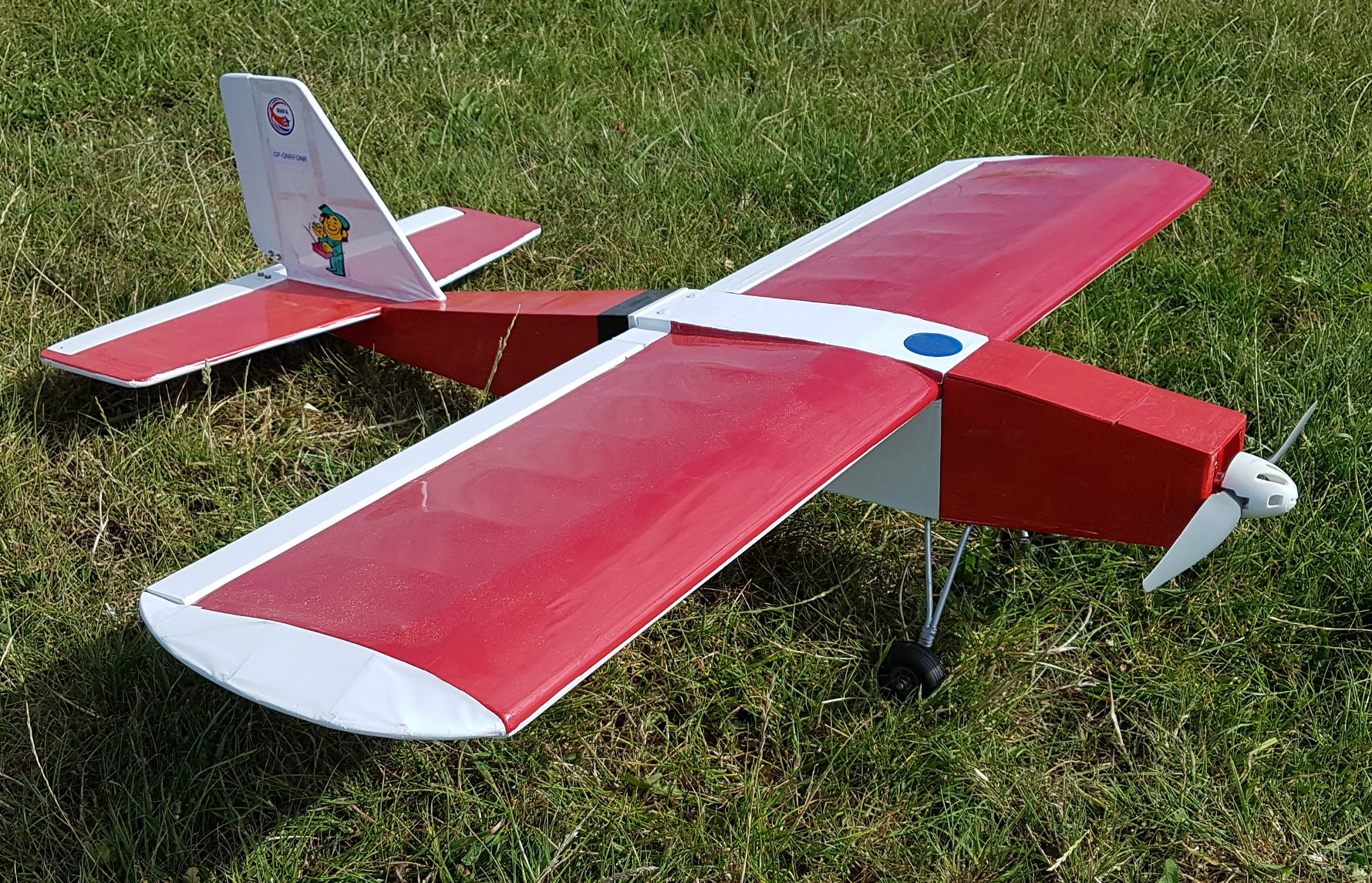 After such a long wait, tales of woe, problems with various types of covering and more, the flight was an anti-climax, it just flew as it should with just a little trim needed. I think it will become a firm favourite although maybe it’s a bit too quick for Captain Slow’s sedentary ways! You can see some of the first flight in this month’s video.
Page Boy first flew his Slec Fun Fly on 31st July, too late for the last Patch News. Page Boy says the laser cut kit was perfect and, although he was surprised to see so many lite-ply parts, the final weight came out at 4lbs which is fine.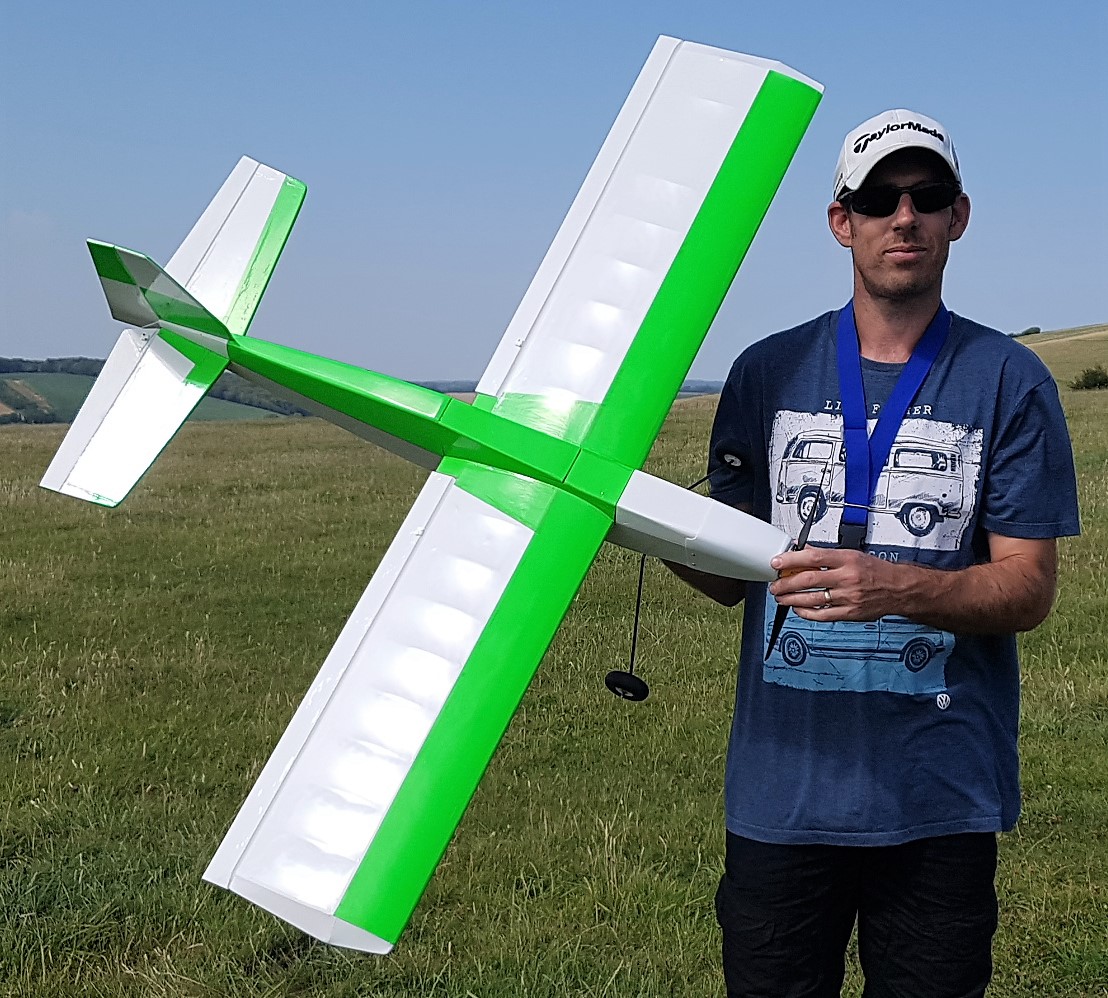
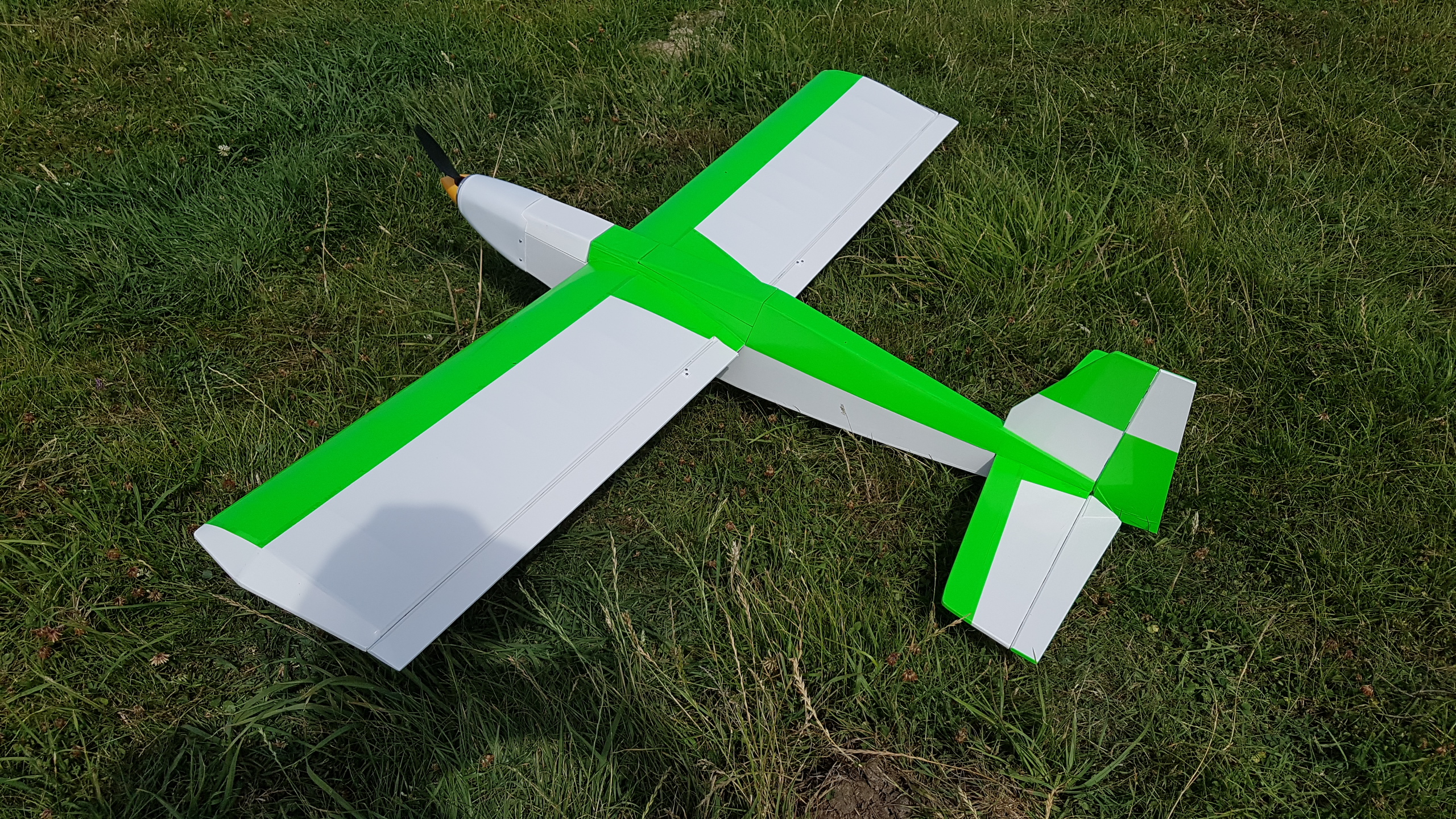 He is using a Turnigy G25 motor fitted with a 12 x 6 propeller and a 60A Hobbywing speed controller all powered by a 4 cell 2650mAh lipo. Page Boy originally bought some Futaba S3003 servos on eBay only to discover that they were fakes so he binned them and bought some standard sized metal geared ones from 4-Max instead.
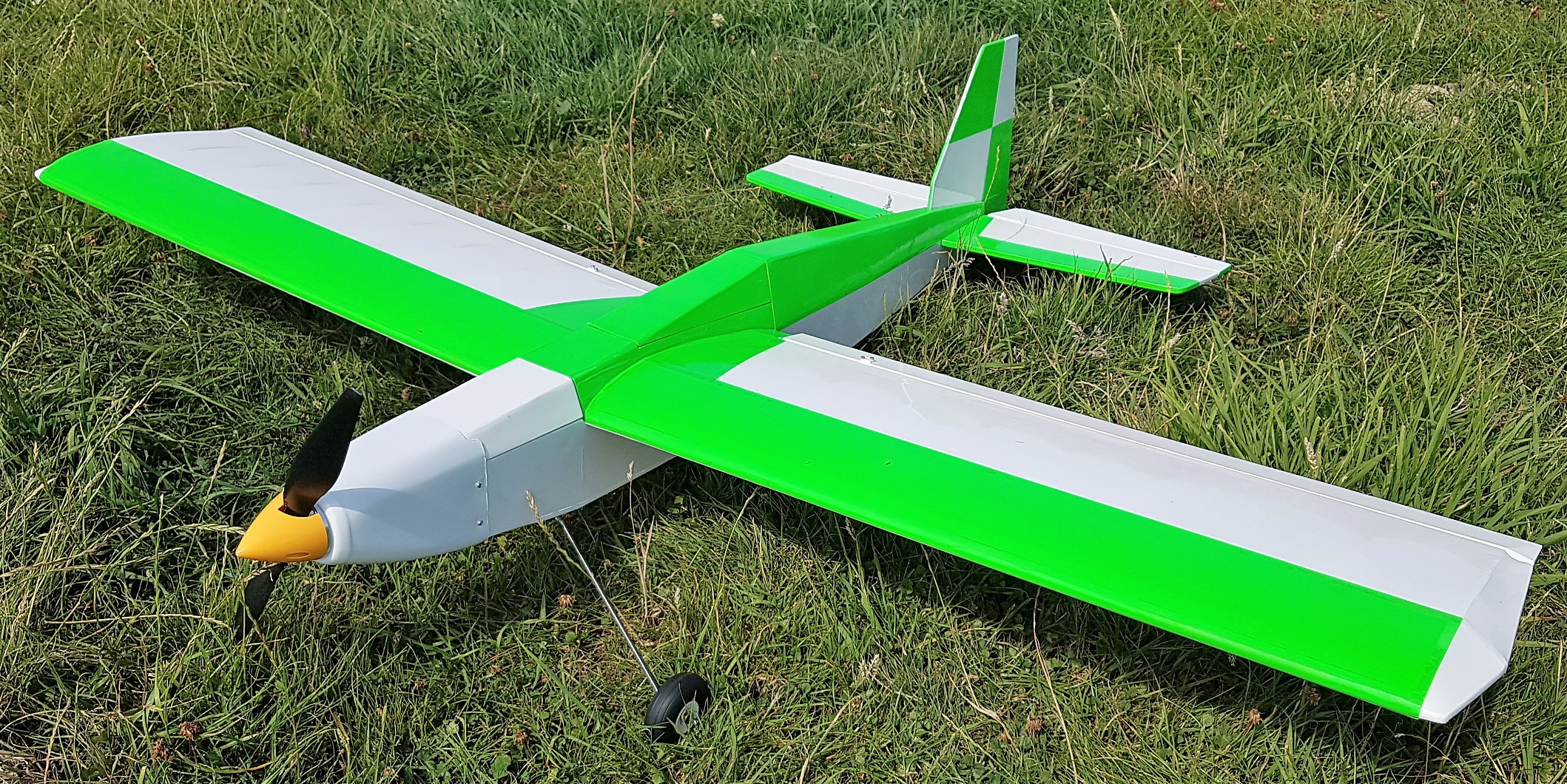 The covering is HobbyKing green and white film and he intends to add some trim later. I think the ‘cockpit’ needs to be black, it would look much nicer. The first flight went well and Page Boy seemed very happy with the performance.
Page Boy also flew a Wingnetic that he won in a club raffle ages ago but has only just got round to putting together. 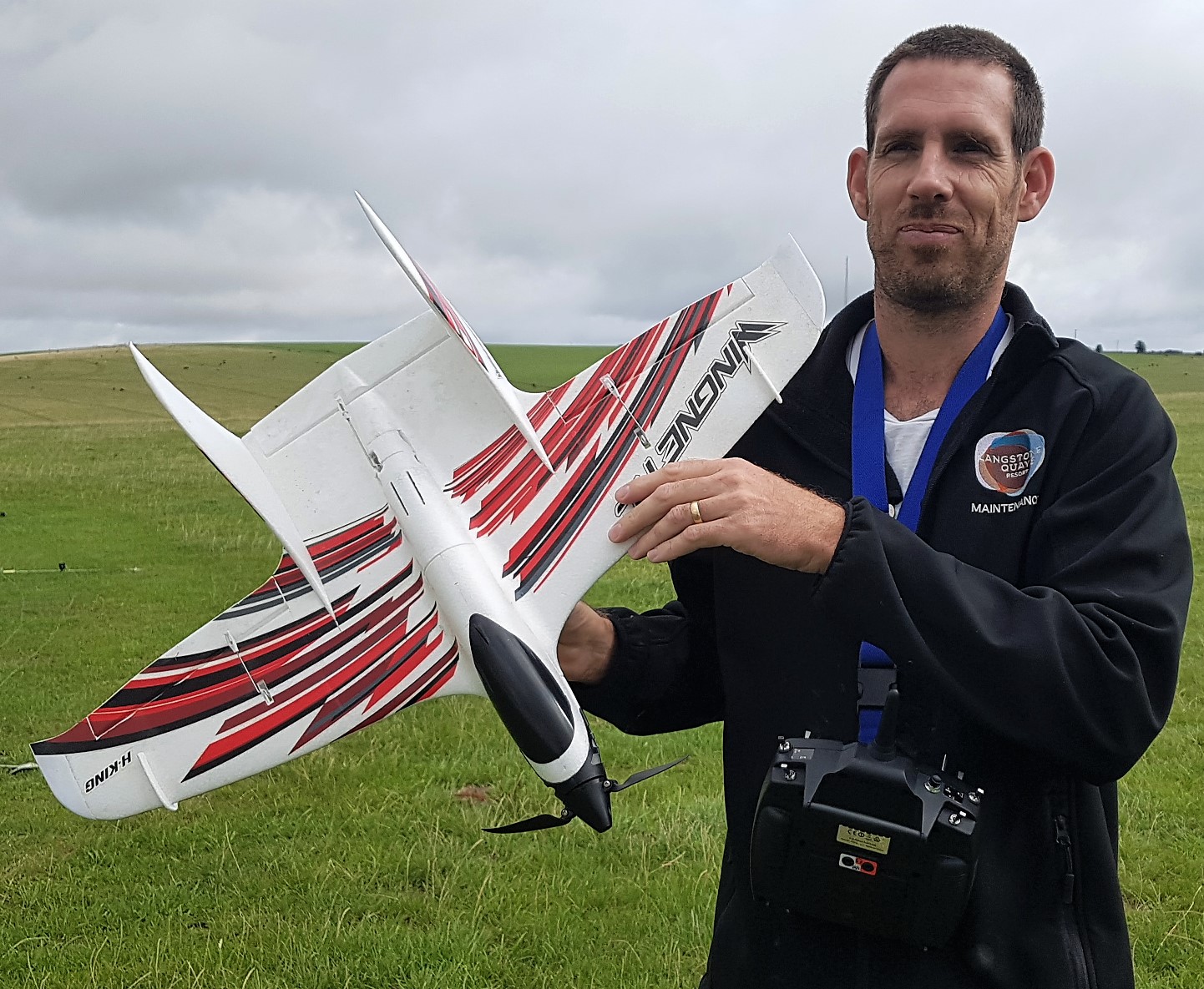 The maiden flight went well, in fact Page Boy said the Wingnetic flew better than he had expected, excellent.
When WingCo first came to see us he brought along a model that he had built. We checked it over and declined to fly it until it had been fitted with ailerons as we didn’t rate it’s chances very highly with just rudder and elevator controls. WingCo duly went away and fitted ailerons as suggested and also a rather large castoring tailwheel.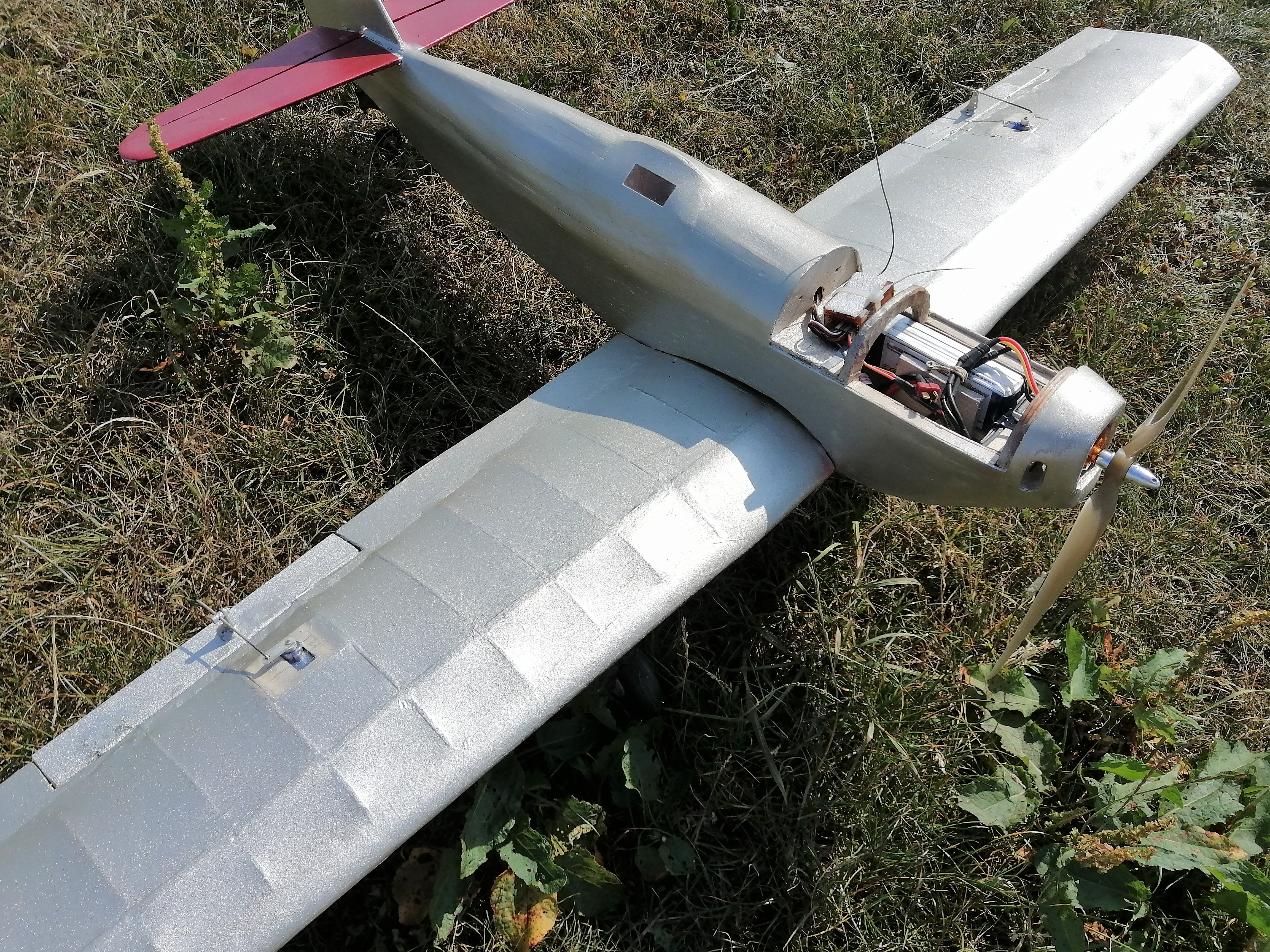 Dougal Entendre was given the dubious honour of doing the first flight which proved ‘interesting’! Initially Dougal had trouble getting the model off the ground (he blames the tailwheel) and once it was in the air he had trouble trimming the ailerons. He soon realised the ailerons weren’t working as they should so quickly landed and then discovered that the linkage to the port wing aileron had come undone. Dougal did well to get it down safely without any damage so with the problems sorted it should be fine next time out. WingCo is also putting a trainer together.
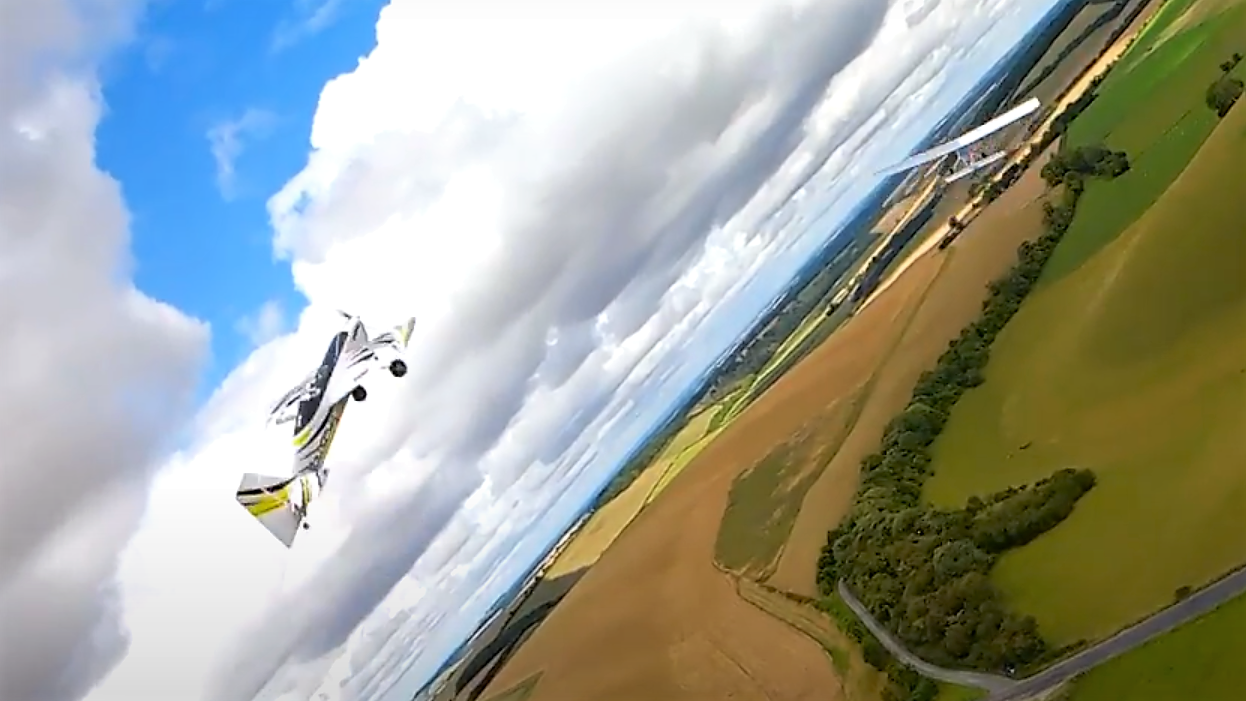
Kryten captured this great shot of Dougal’s FPV Skyfun whizzing past John Warren’s Jocasta. “Coming through”!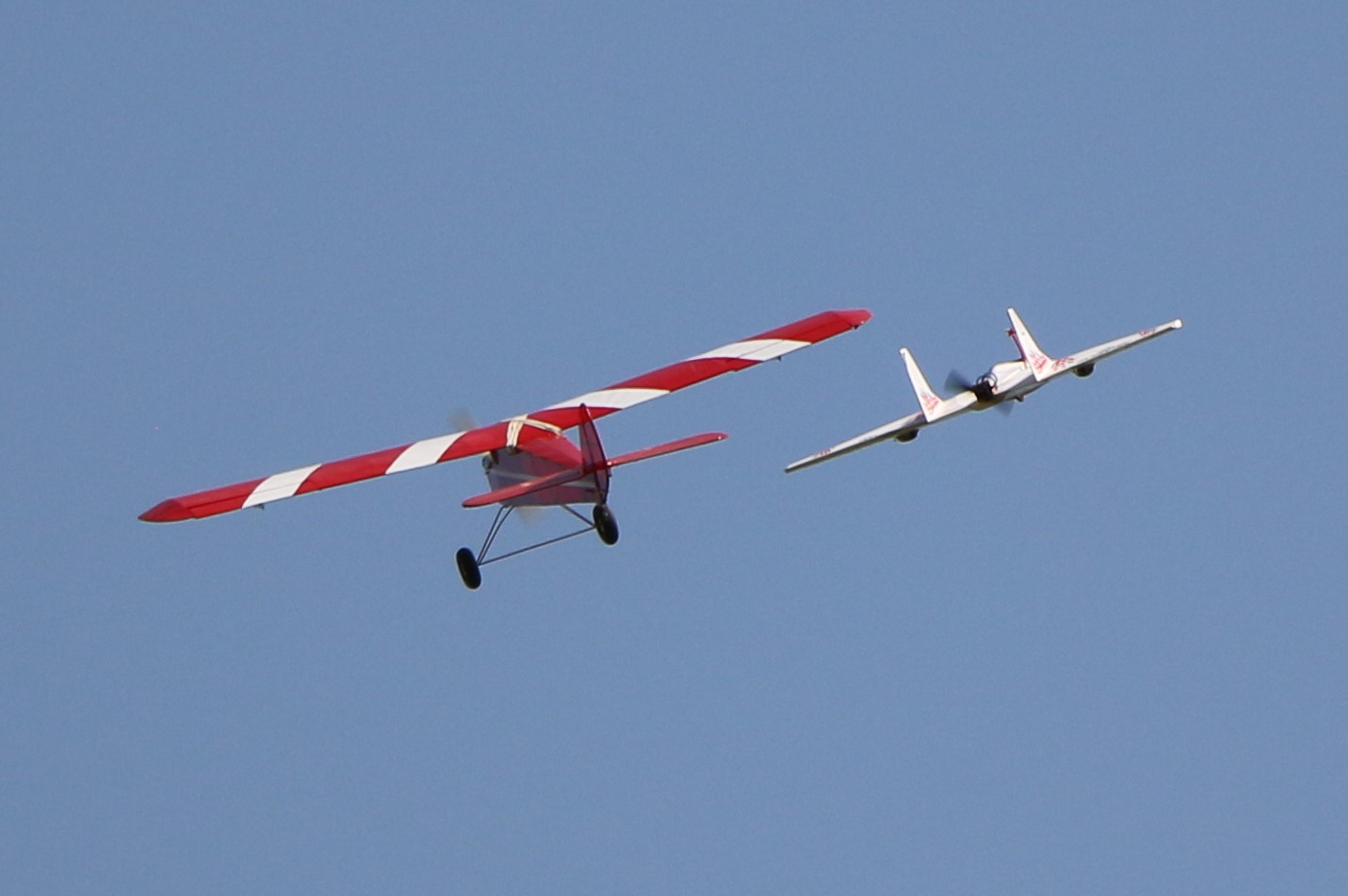 Dougal also captured some nice air-to-air screenshots of others members’ models from his FPV video footage.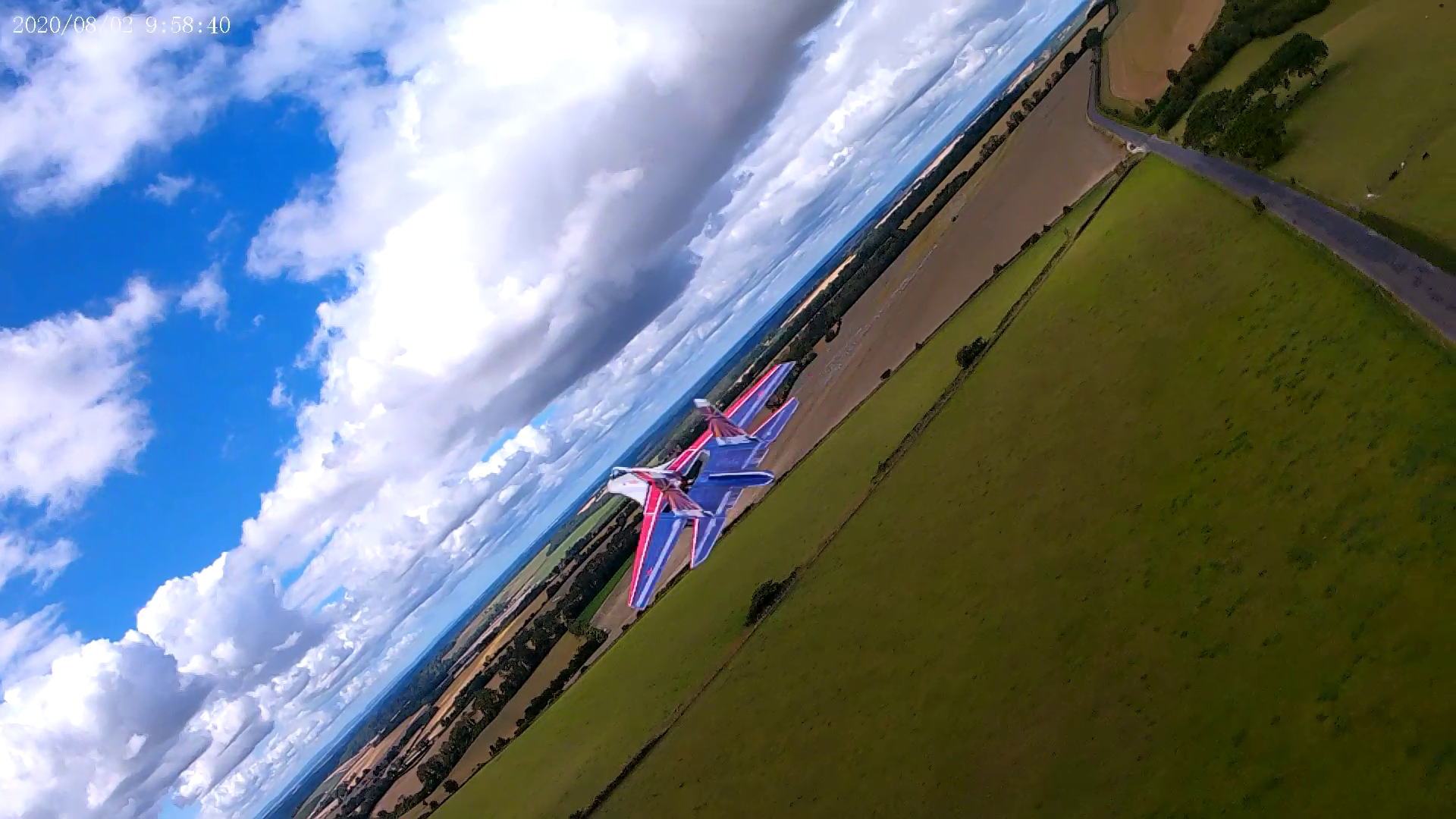
Mini-Mike had a bit of a moment with his large scale P.68 Partenavia Victor one day. He had just taken off when suddenly both motors cut but fortunately he got down safely with no damage to the plane. On investigation Mini-Mike realised what had happened and confessed that when he intended to raise the flaps he’d hit the wrong switch and turned on Throttle Cut instead. Now what sort of idiot would do make an elementary stupid mistake like that…says the man who has done exactly the same thing with his own Avios BushMule…twice!
One model that didn’t survive the month was John Warren’s Albatross. The model has had rather a chequered history with several crashes and rebuilds. I’ve flown it several times and it’s flown well enough although I think it was a step too far for John’s piloting skills. John brought it along following the latest rebuild and asked me to test fly and trim the model. It took off ok although it needed quite a lot of aileron trim but when I began a fairly gentle right hand turn the starboard bottom wing abruptly failed, dropping down by about 30 degrees.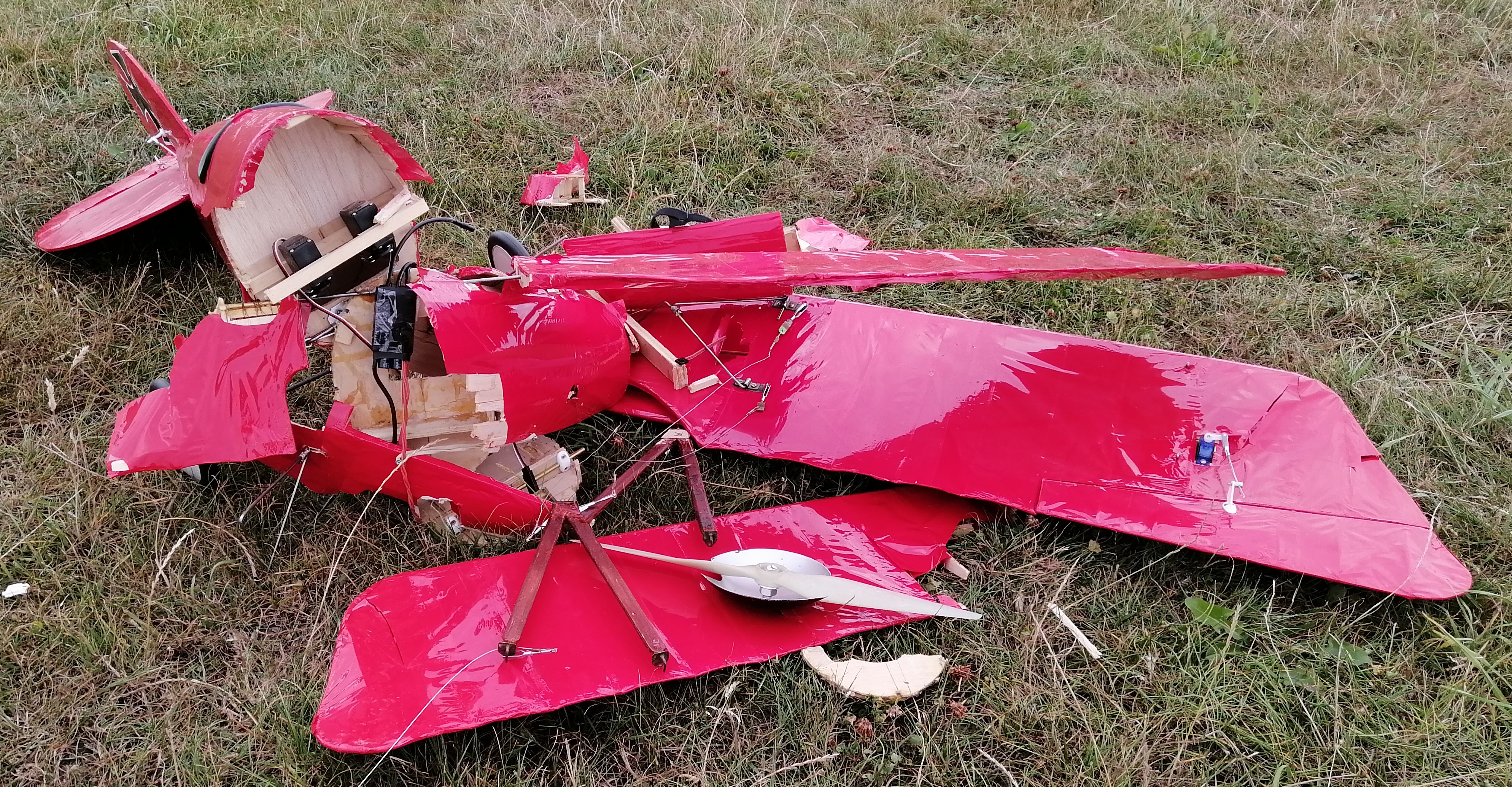 I’ve never seen a wing fold downwards before, no idea what broke. Apparently, unseen by me, John had been repairing one of the interplane struts prior to the flight so I imagine that was a factor. There was nothing I could do and the Albatross spun in and was terminally damaged. It’s a shame as the model had looked good in the air on previous flights although, as can be seen in one of Kryten’s photos, it was prone to a variety of inflight failures.
 Look closely and you’ll see a trailing rigging wire as well as the more obvious loose tyre. Not to be defeated John has already started building a replacement Albatross, let’s hope he builds in some more quality this time.
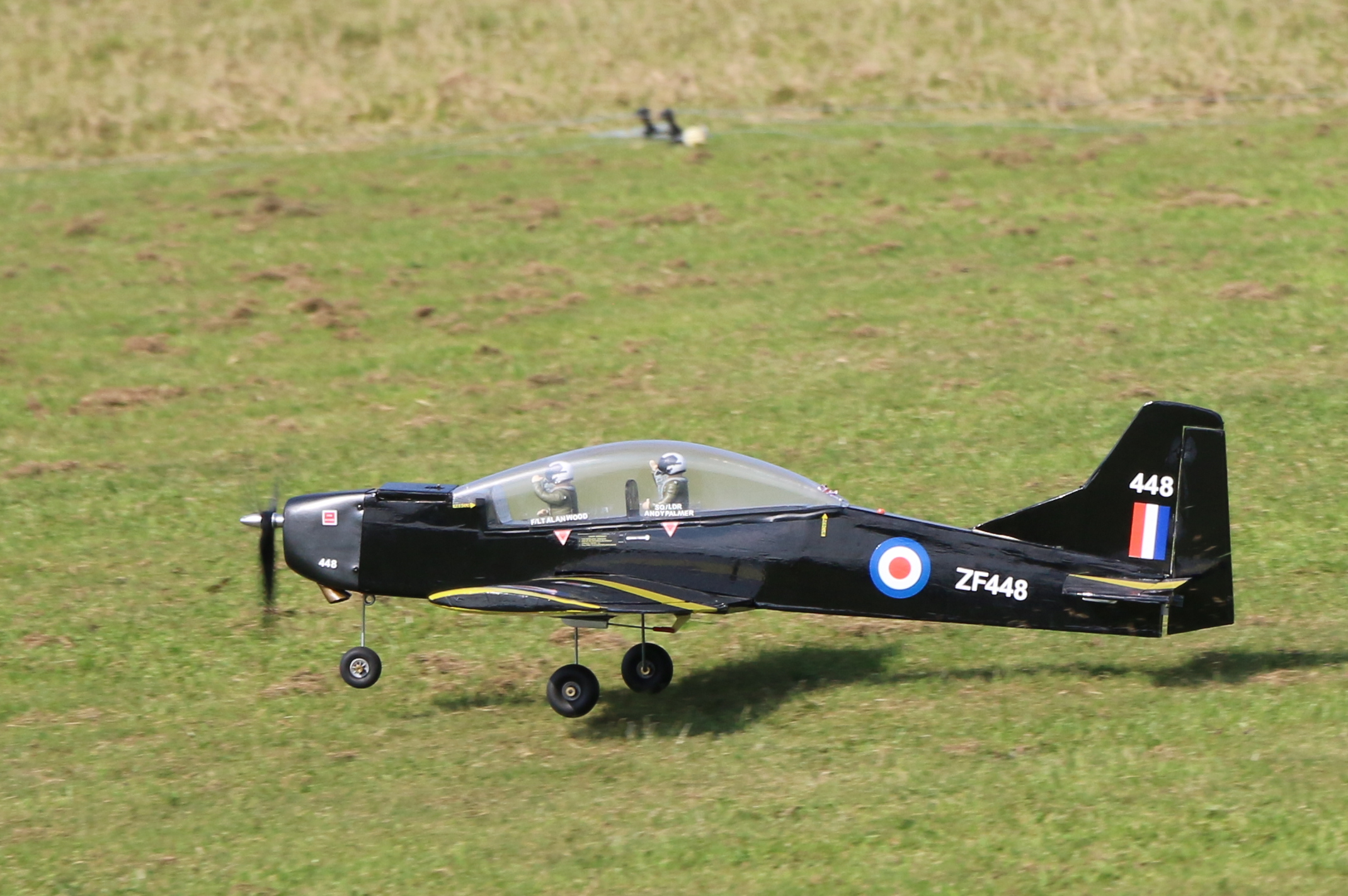
On a more cheerful note Woody (or Major Disaster as Captain Slow now calls him) has built a rather nice Tucano from a Phoenix Model Products kit. He has fitted a Ripmax Quantum 25 motor, a 60A speed controller and an 11 x 7 prop. It runs on a standard 3 cell lipo in the 2200 to 3000mAh range and weighs around 3 1/2lbs with the battery.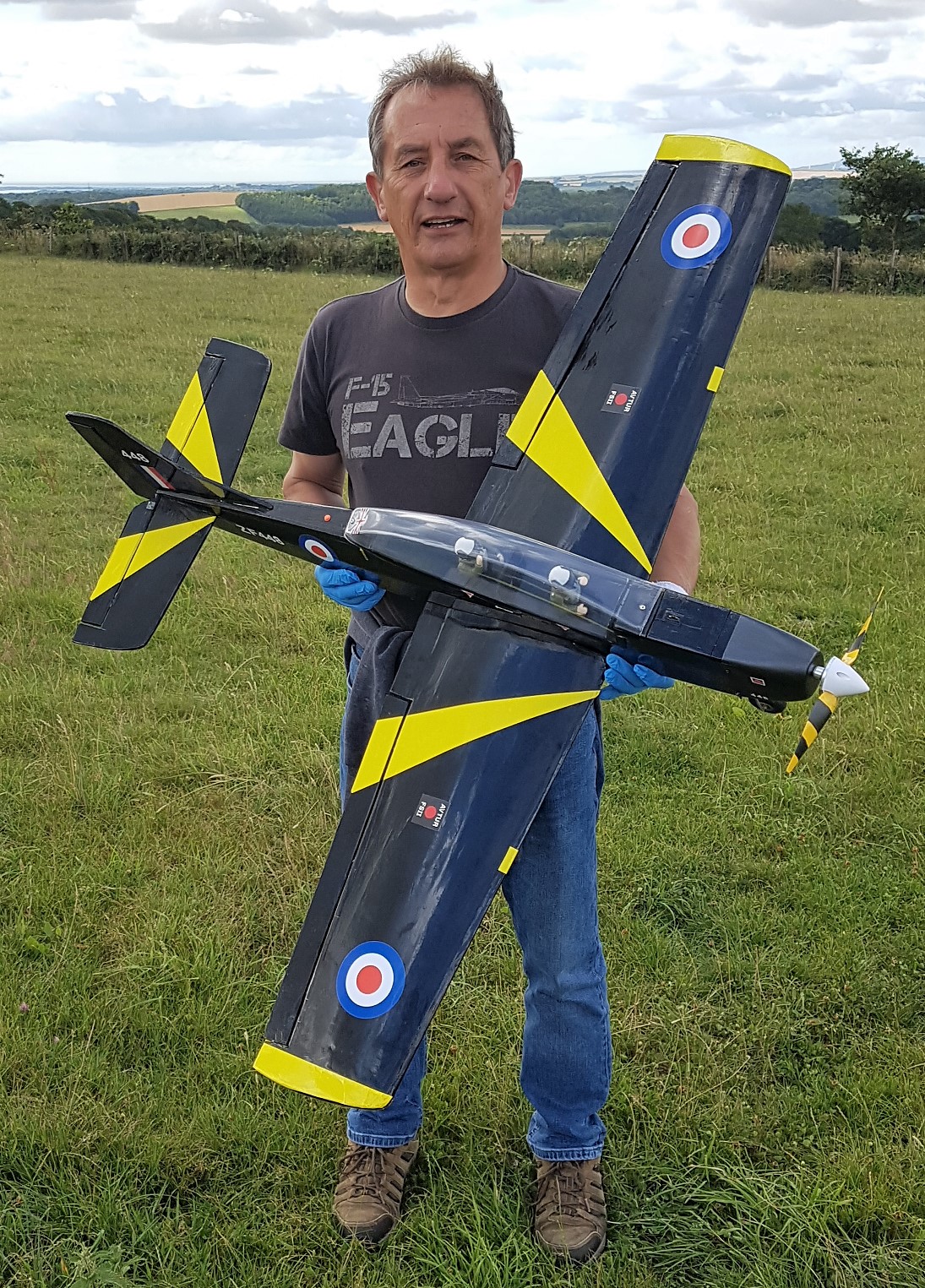
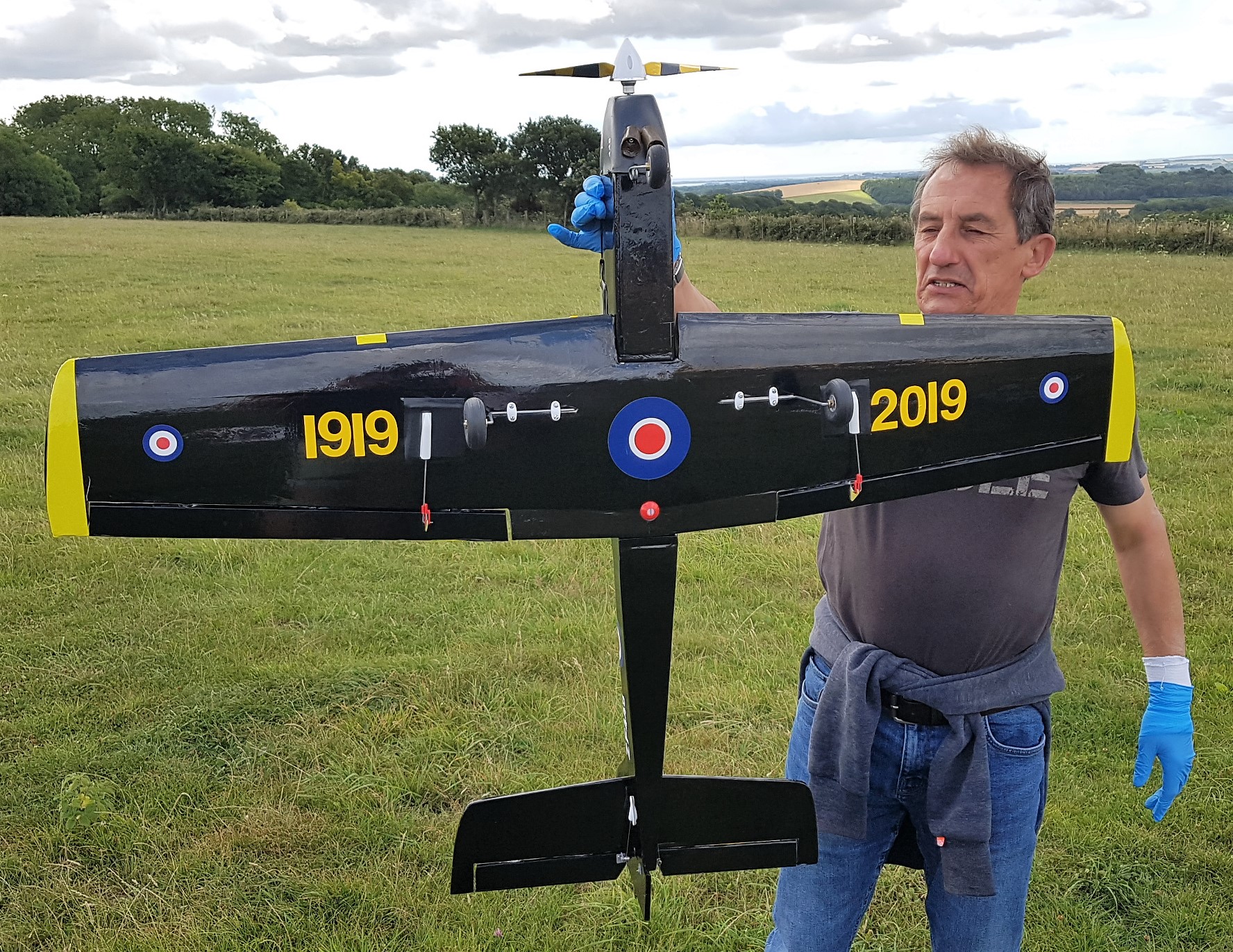 Woody chose the colour scheme of the RAF Tucano Display Team aircraft ZF448 and it looks very smart in mostly black but with some yellow trim. The test flight went very well with no problems. Just don’t mention bananas…
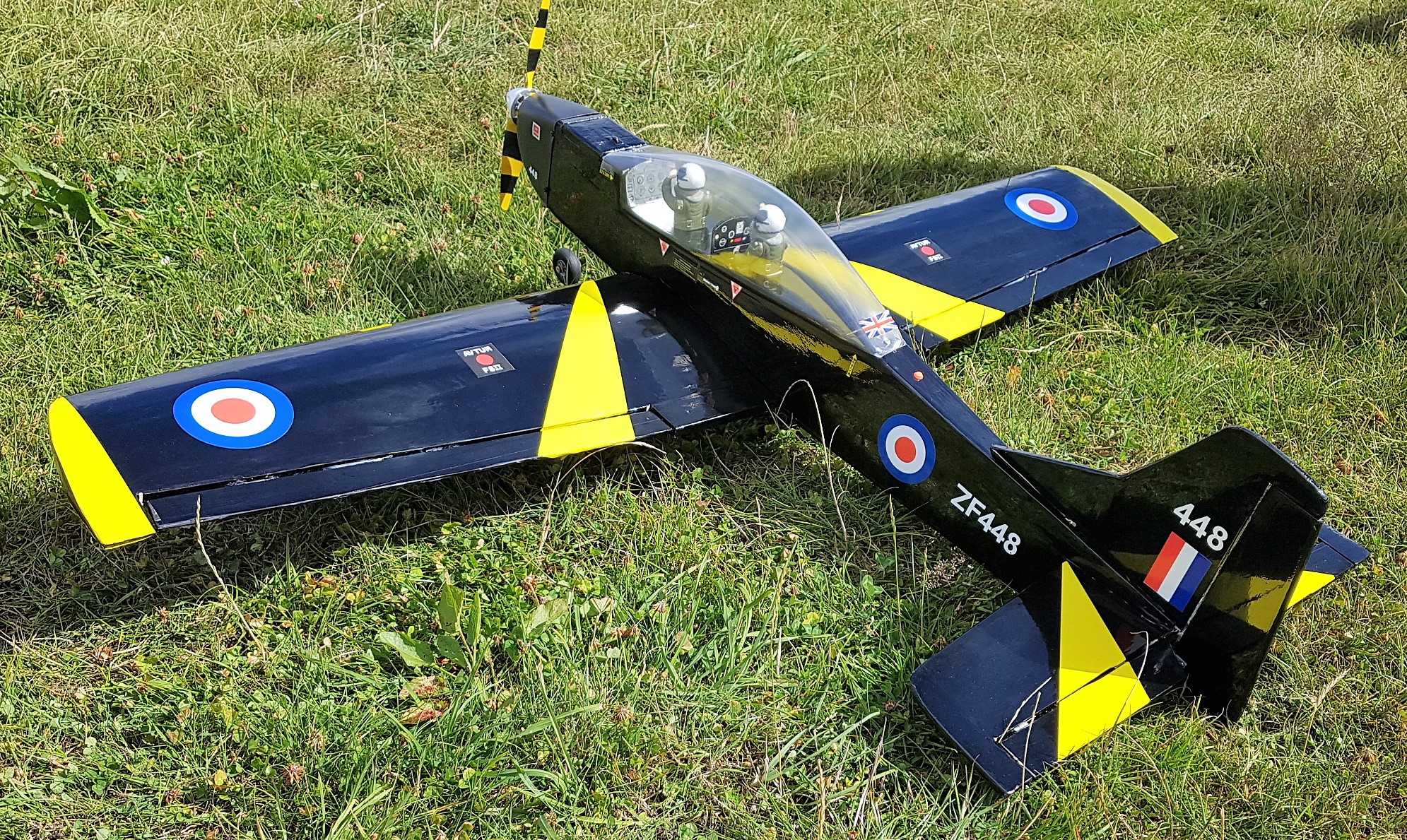 It’s a lovely flier, quite gentle but fully aerobatic with no vices so it should prove to be the ideal model for Woody.
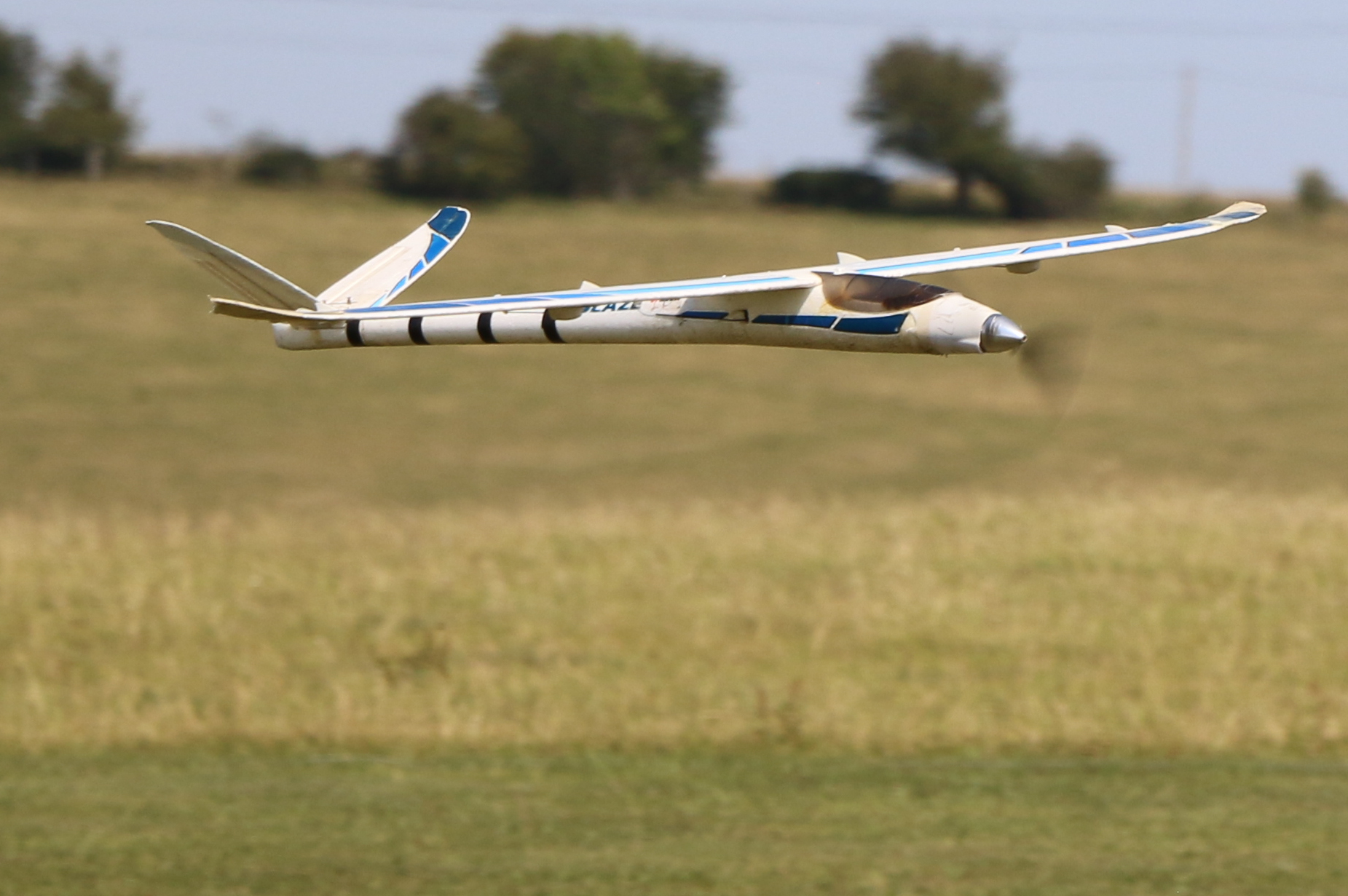
We had an interesting moment at the field one day when Dougal and 1066 decided to do some synchronised flying with their electric gliders. Dougal was using his Multiplex Blizzard and 1066 his ST Models Blaze, a pair that are reasonably well matched for flying together. Unfortunately they only got as far as pulling up to climb and turn at the end of the first pass when they collided! I don’t think of either of them was particularly at fault so I’ll blame them both equally. Immediately after they touched Dougal realised he had a control problem but he made it back to the patch and landed safely. 1066 on the other hand seemed to have full control but no power so he had to land out.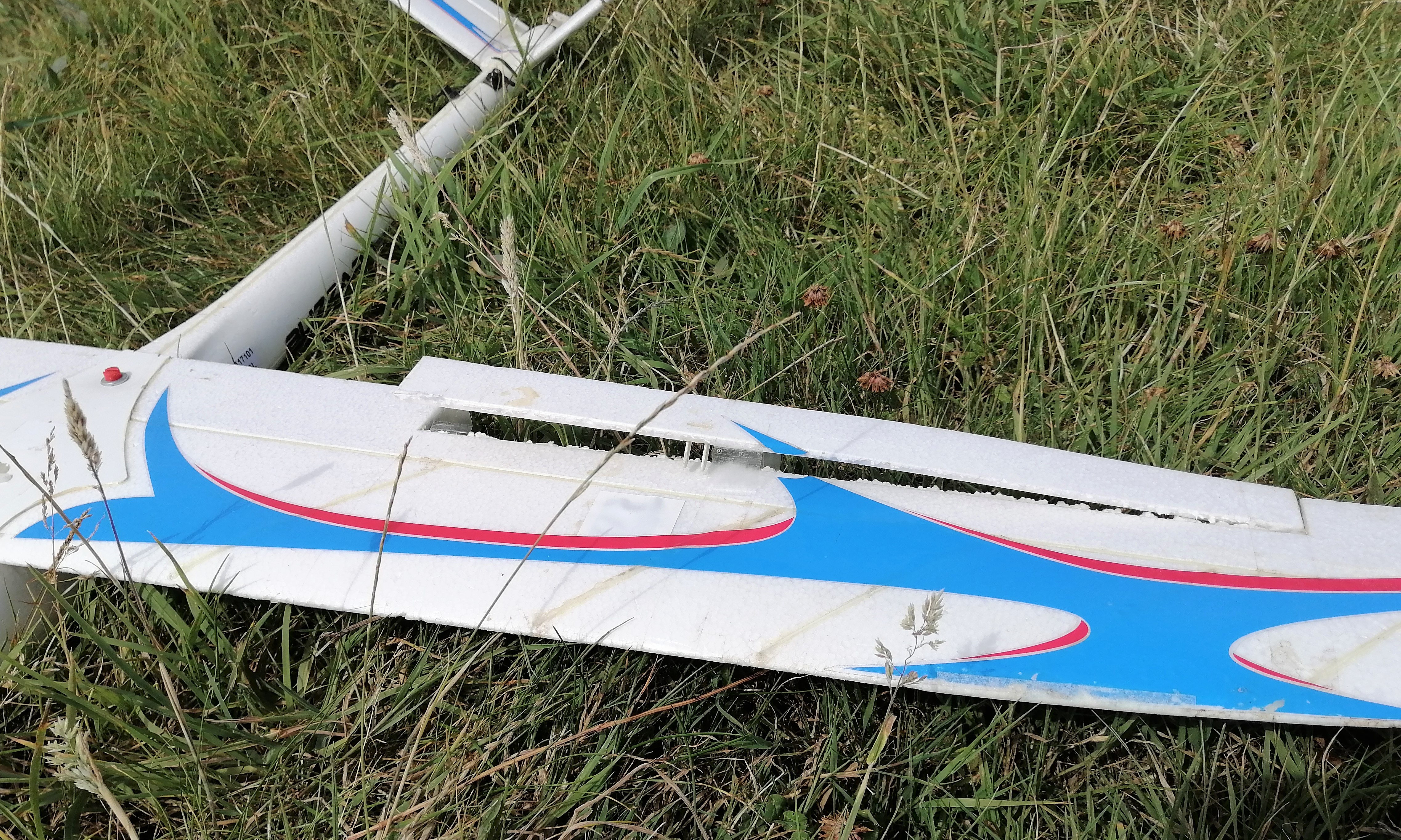 When we looked at the damage we found that Dougal’s Blizzard had one aileron hanging off and the control linkage to that aileron has disappeared, while on 1066’s Blaze the whole nose complete with the motor was hanging off. Presumably the Blaze prop had hit the Blizzard’s aileron linkage which broke half the prop and the ensuing vibration tore the whole nose off! Fortunately both models were easily repaired and were soon flying again…but not together.
Rumour has it that 1066 also had another very near miss but this time without any damage. Apparently, one day when I was absent, he did a low inverted pass with one of his foam 3D machines in the normal ‘I can get lower than you can’ way when he actually scraped the fin along the ground before climbing safely away! Sadly nobody has any photographic proof of this event so I’ve asked 1066 to repeat it for me to film but so far he’s declined…chicken!
Newbie Richard Osborn has been looked after mostly by Page Boy and is learning quickly with his Wot4 Foam-E.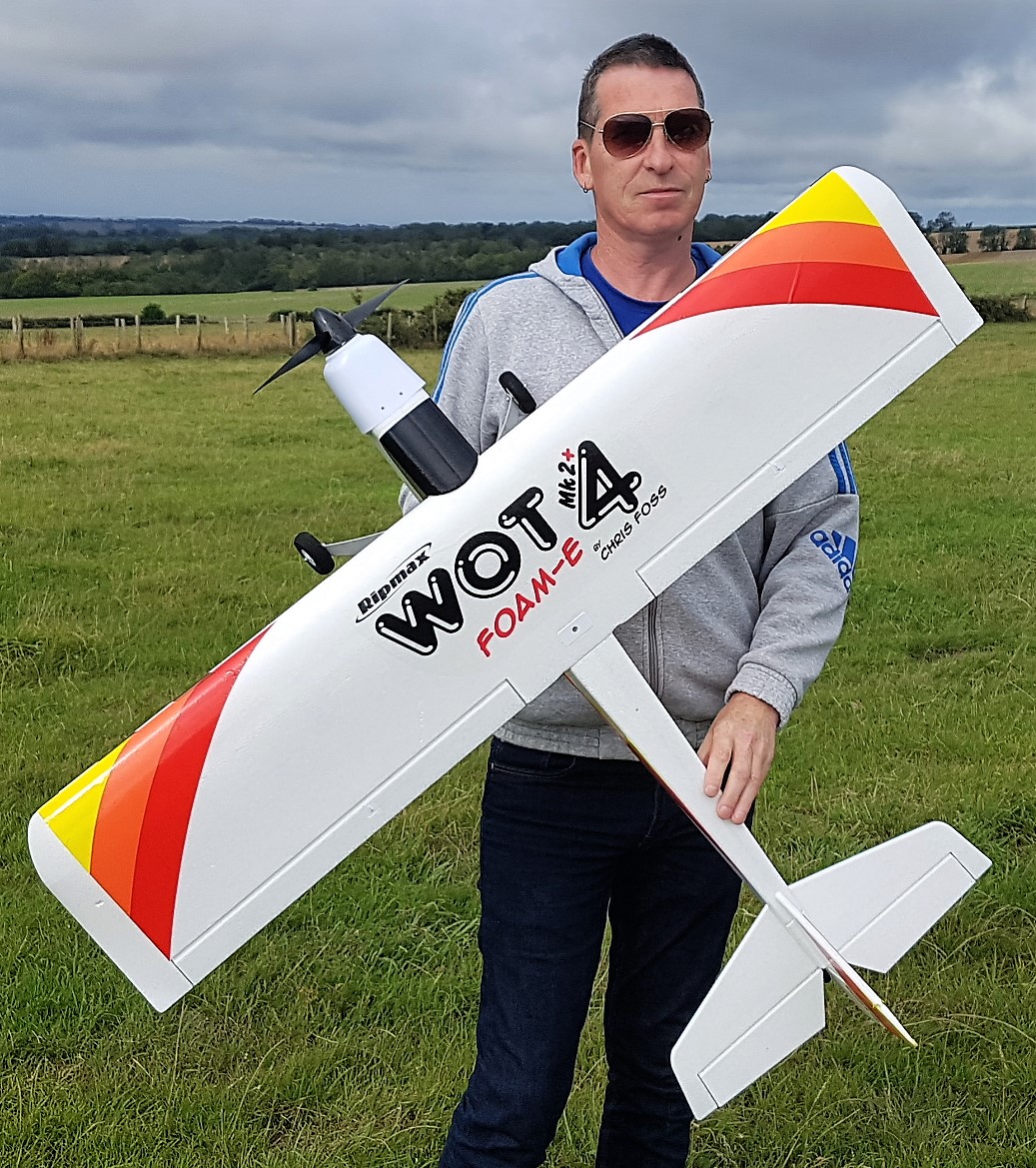
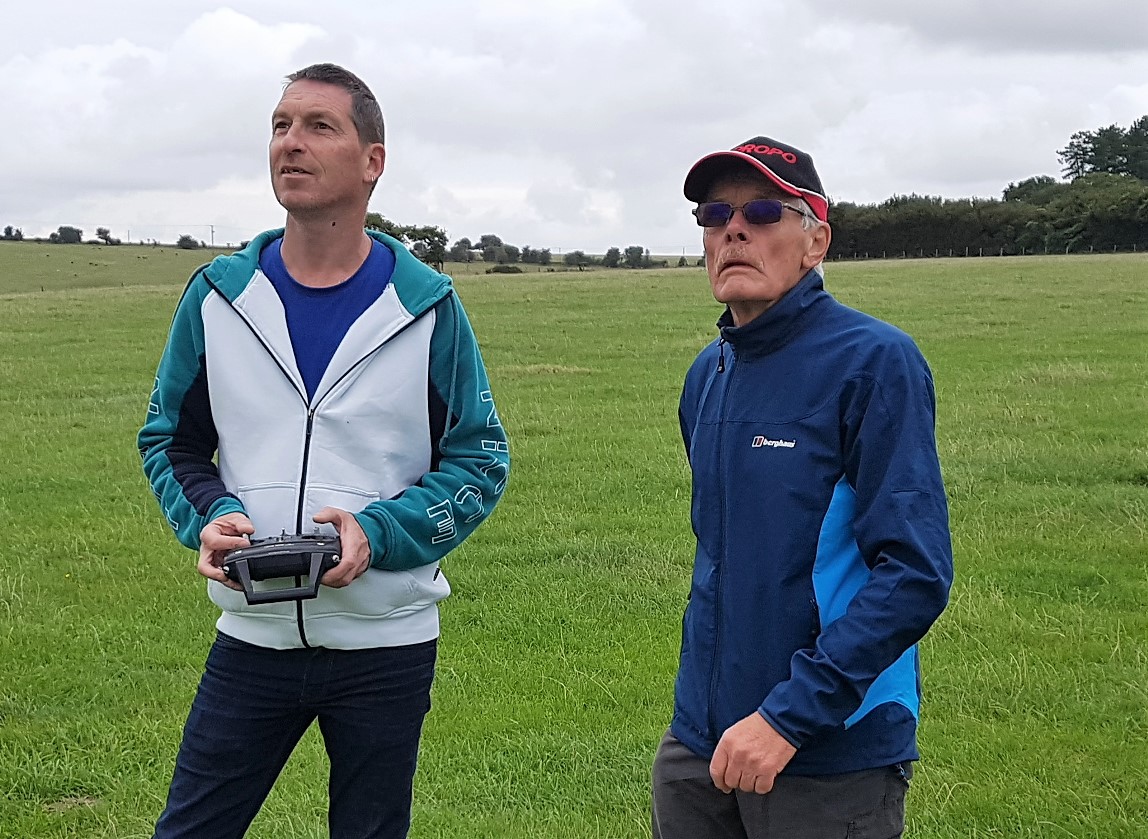 Chas has also watched over Richard for a few flights, an experience that I think they both enjoyed.
I spotted this in a free paper the other day about the Coastguard trialling drones for search and rescue missions: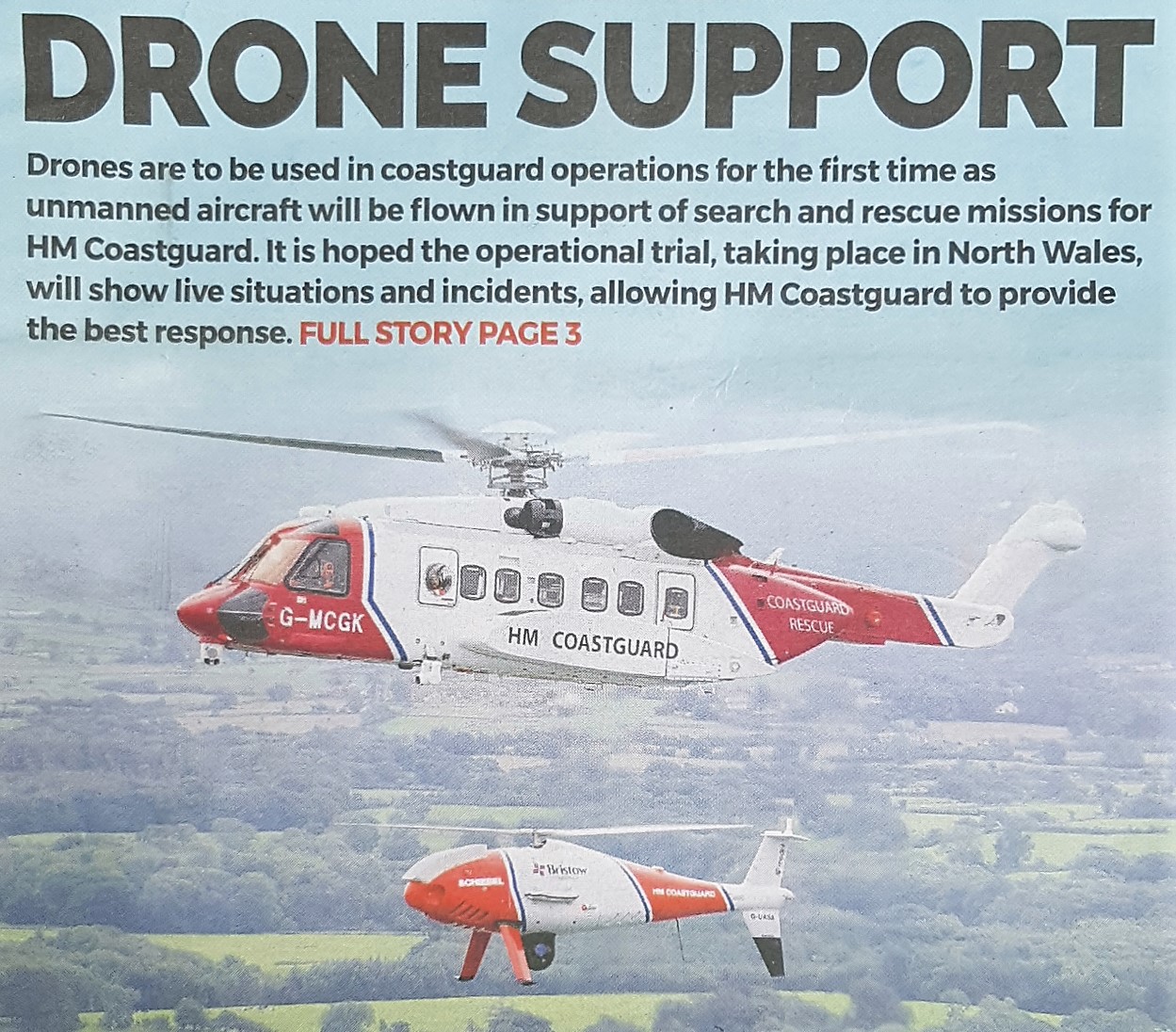
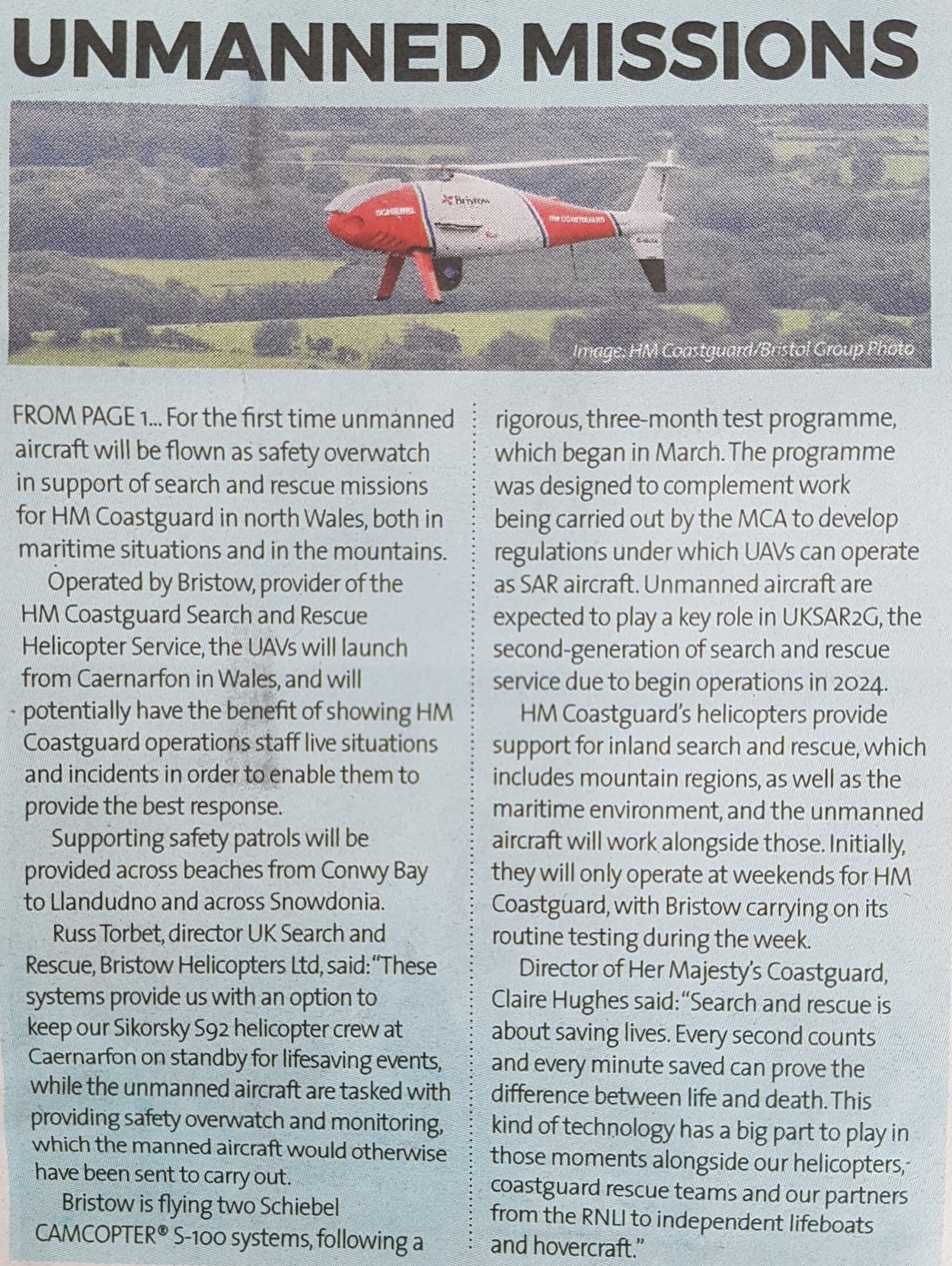 Although we don’t fly drones the general public and government seem to link model aircraft to drones so any positive publicity for drones can only be a good thing, it makes a change from the bad press they normally get.
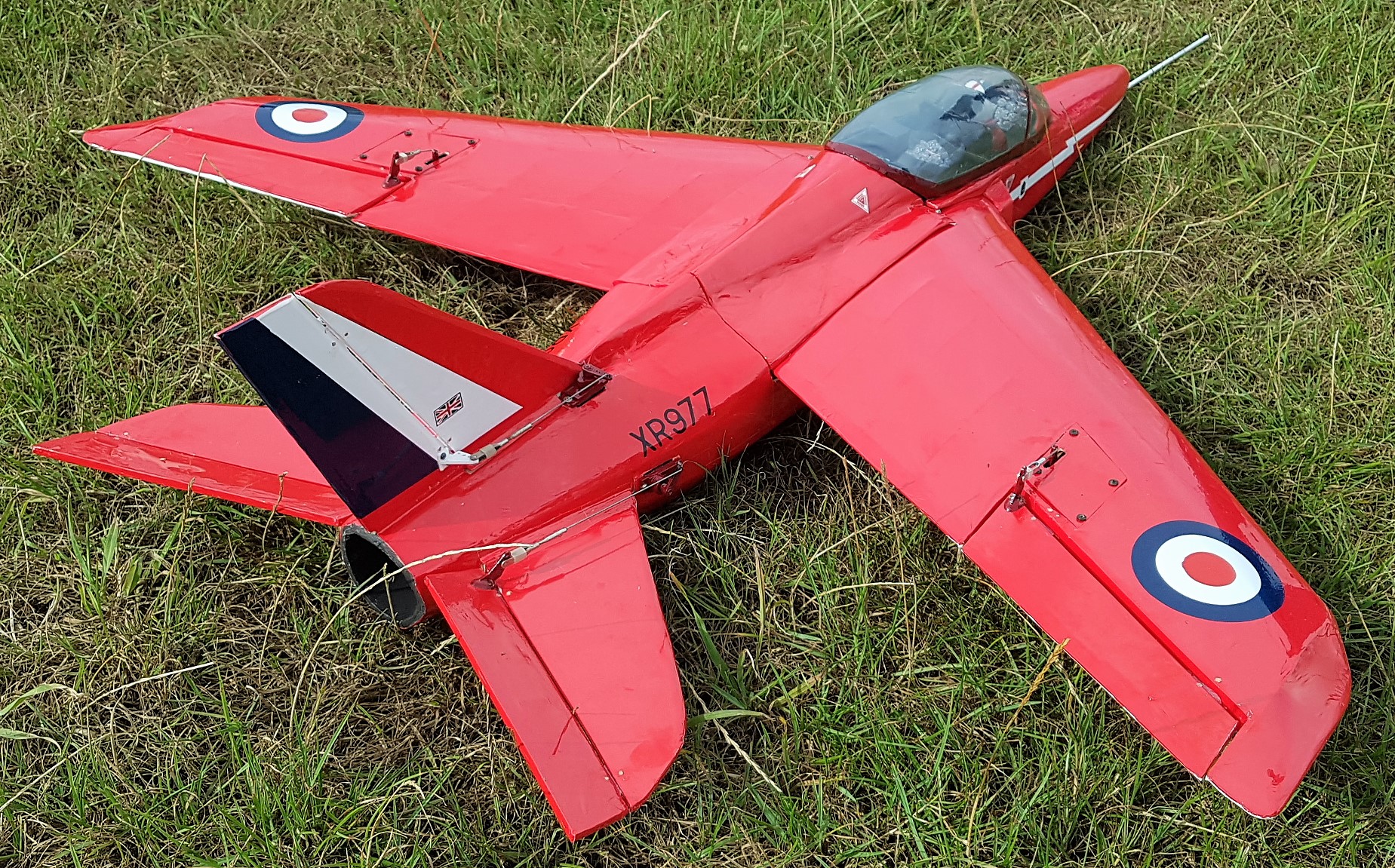
Recently I’ve been posting photos of the build of Dwayne Pipe’s latest edf model, a Folland Gnat. Dwayne drew his own plans for the Gnat, scaling everything up from an Airfix plastic kit that he’d been given for Christmas.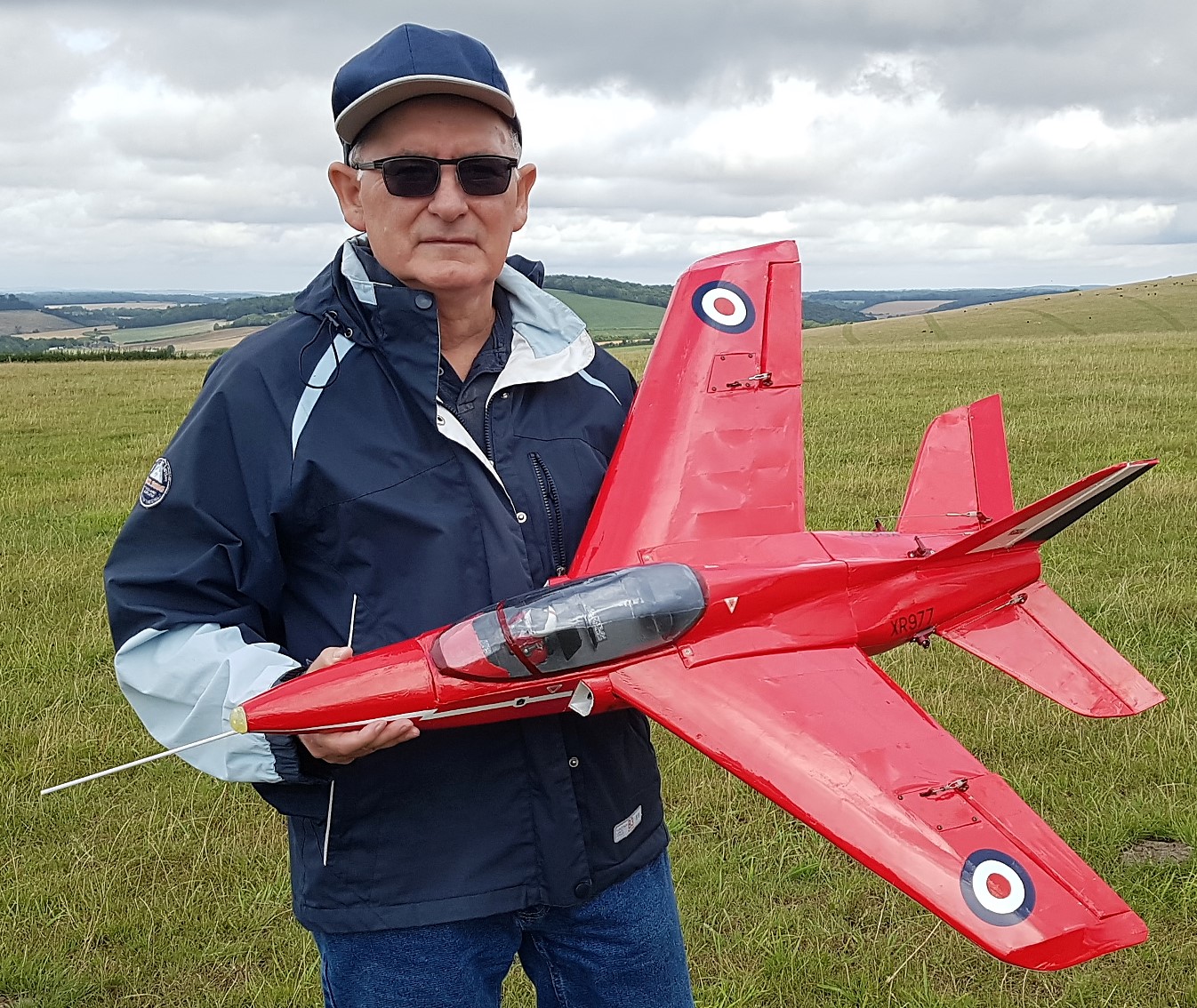
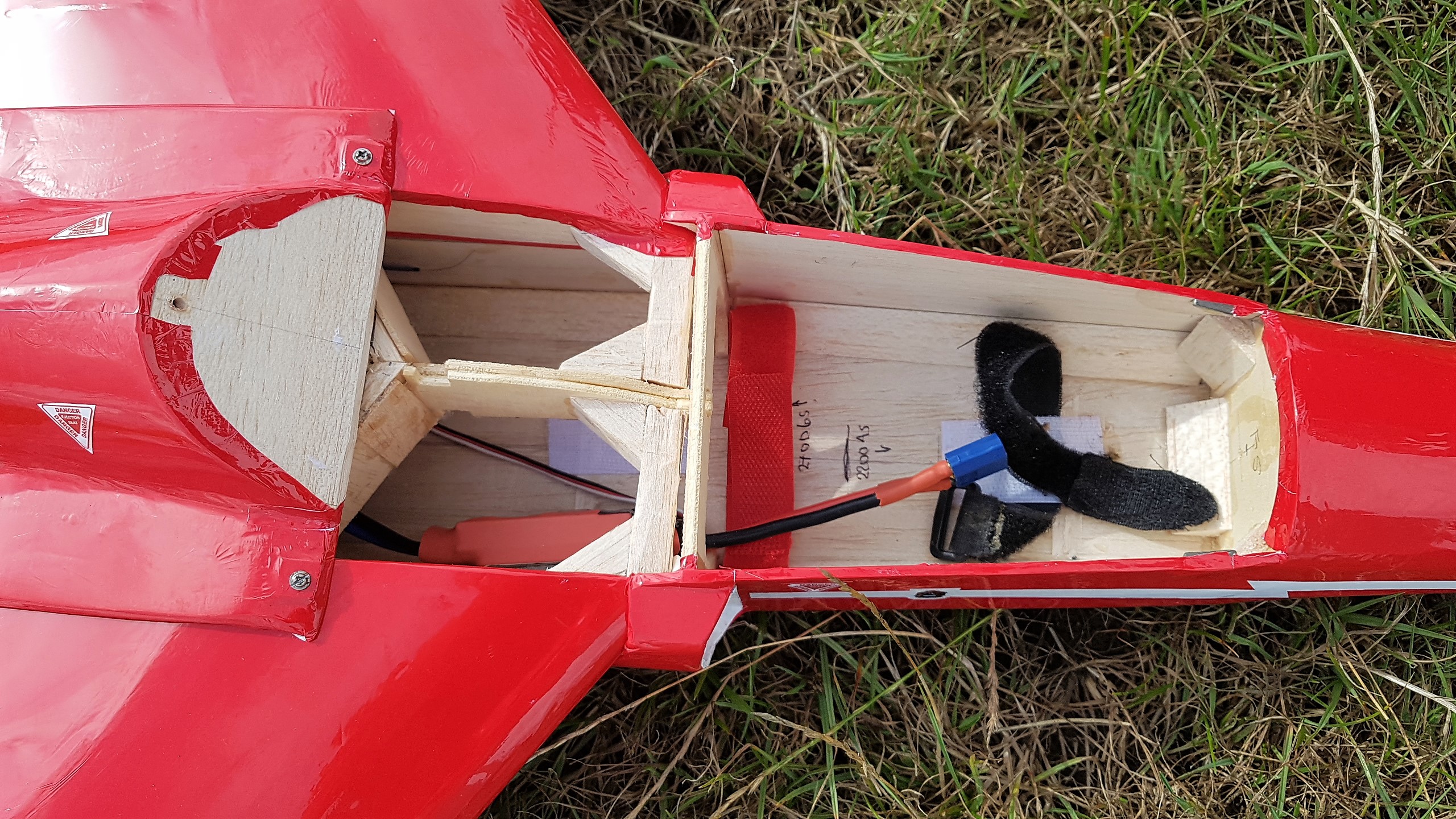 The Gnat is 36” span and also 36” long, Dwayne confesses that he has increased the size of the wings and tail by 20% to reduce the wing loading. The completed model weighs 2lb 15oz with a 4 cell pack which gives a wing loading of 20.6oz/sq. ft. Power is provided by a 12 bladed 70mm fan from Banggood coupled to a HobbyKing 80A speed controller and this gives 2lb 4oz of thrust and pulls 50A. This month Dwayne got the Gnat all finished in a nice Red Arrows colour scheme and asked me to do the test flight. He was unsure if there would be enough power using a 4 cell lipo so he had set the model up to take either 4 or 6 cells. To me 4 cells felt to be providing enough thrust so we decided to do the first flight with that. Dwayne launched the Gnat and it simply climbed away with just a little down trim being needed. The Gnat performed the usual rolls, loops, stall turns, and inverted with no problem at all so after four very enjoyable minutes I landed it safely back on the patch and declared the model to be a triumph.
 Unusually Dwayne flies Mode 3 so I had lent him a Multiplex receiver and set the Gnat up on my transmitter in my usual Mode 2. Alongside my Multiplex receiver Dwayne fitted one of his Futaba receivers so after I had trimmed the Gnat he simply swapped the servo leads from my receiver to his own, copied the trim settings to his transmitter and flew the model himself, simples. The only minor problem Dwayne had was that when landing he found the Gnat floated on more than he had expected and he overshot the patch. Not a problem, the Gnat landed gently. But…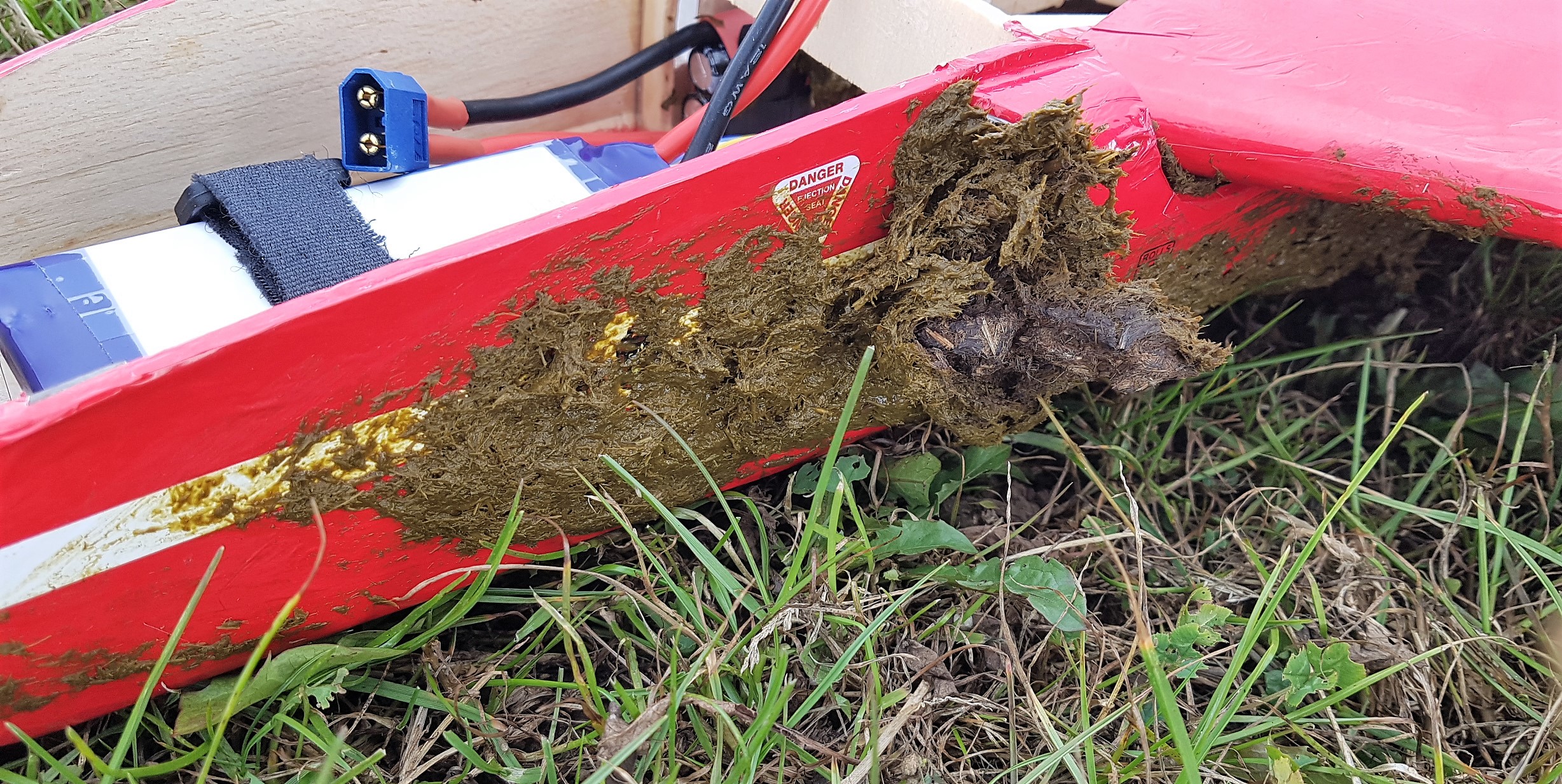
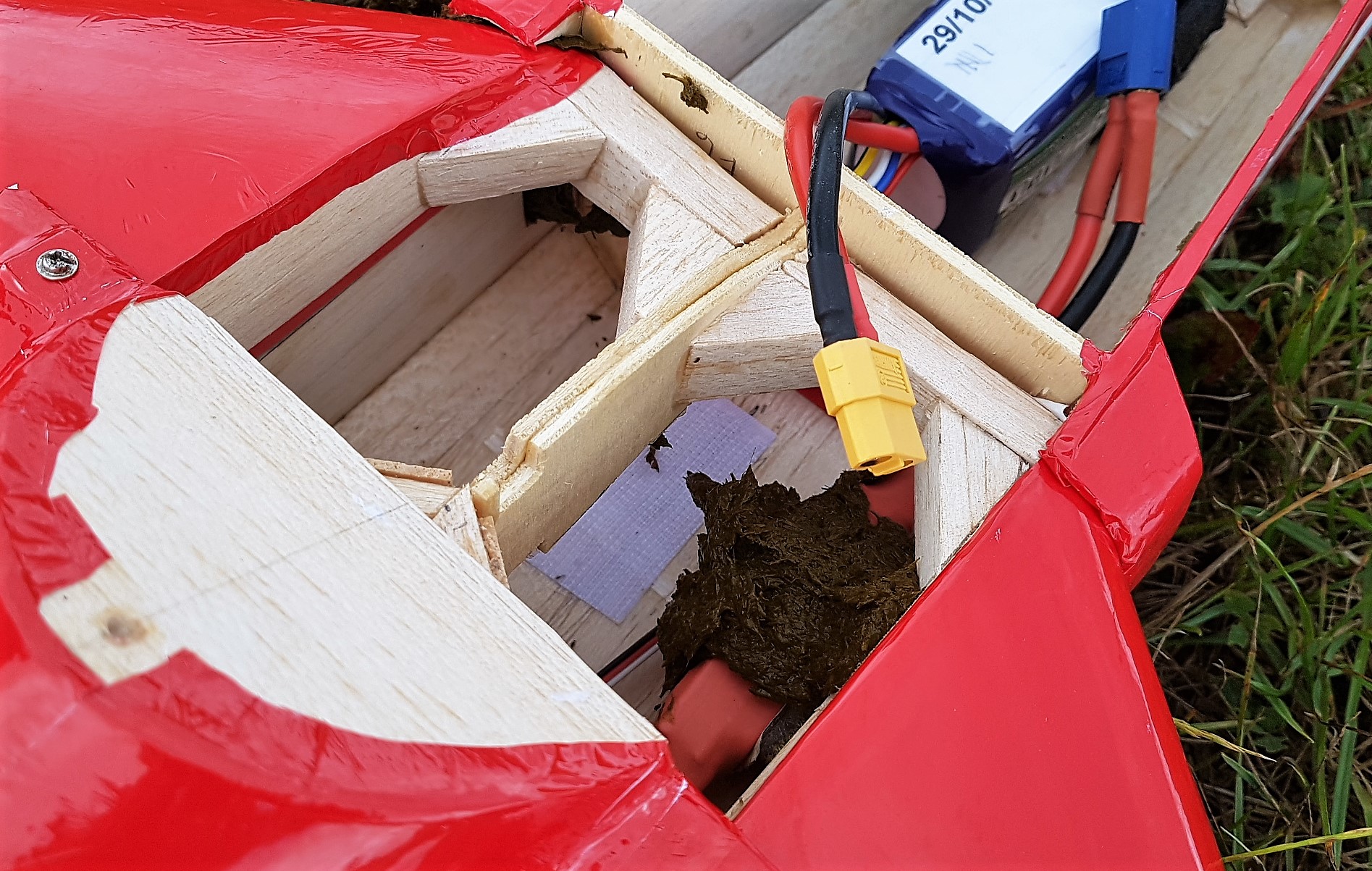 Dwayne was in for a shock when he retrieved it…remember the bullocks were in the field! The Gnat had skidded through some very fresh poo which filled both air intakes! In this month’s video you’ll see snippets of both flights.
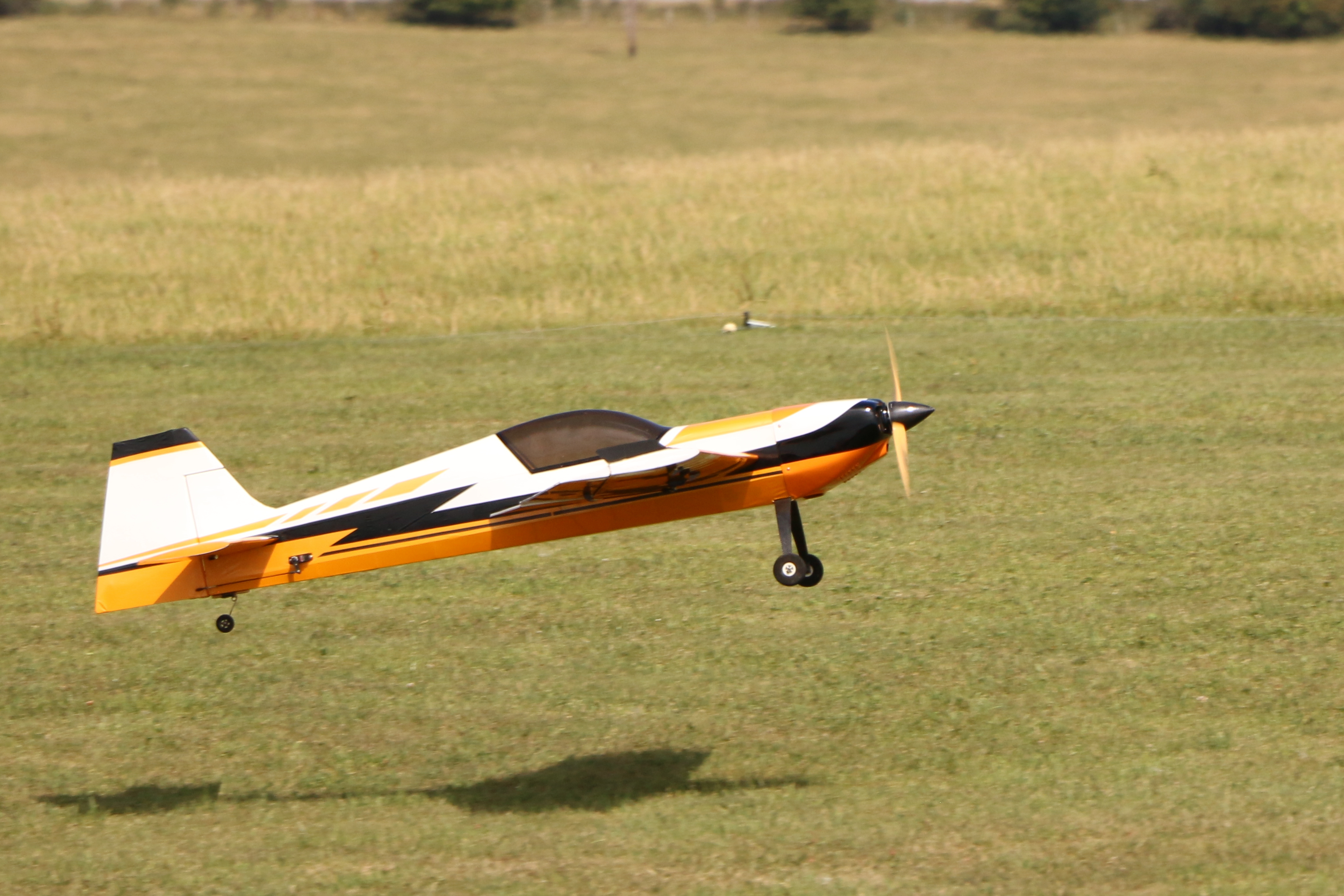
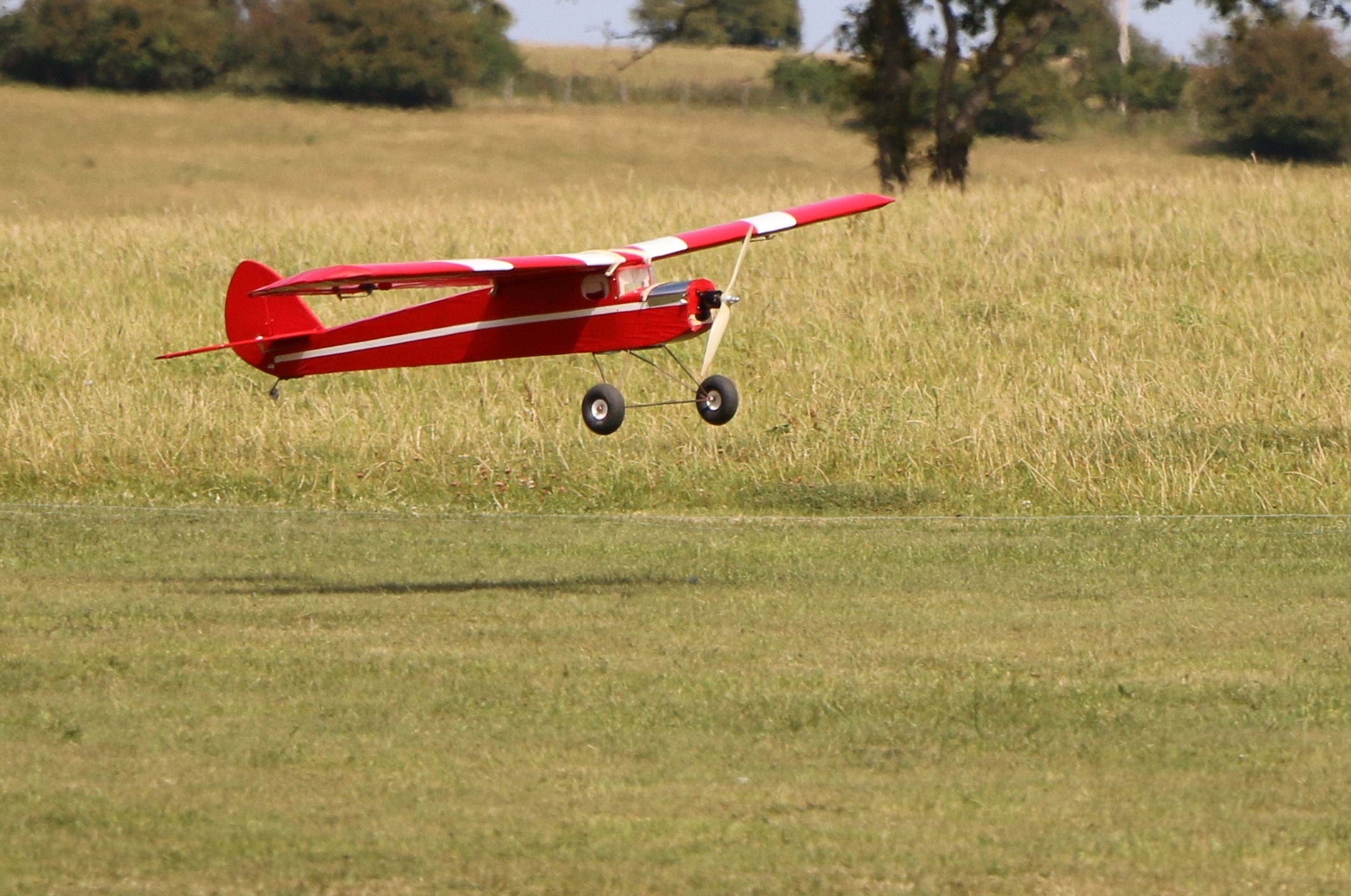
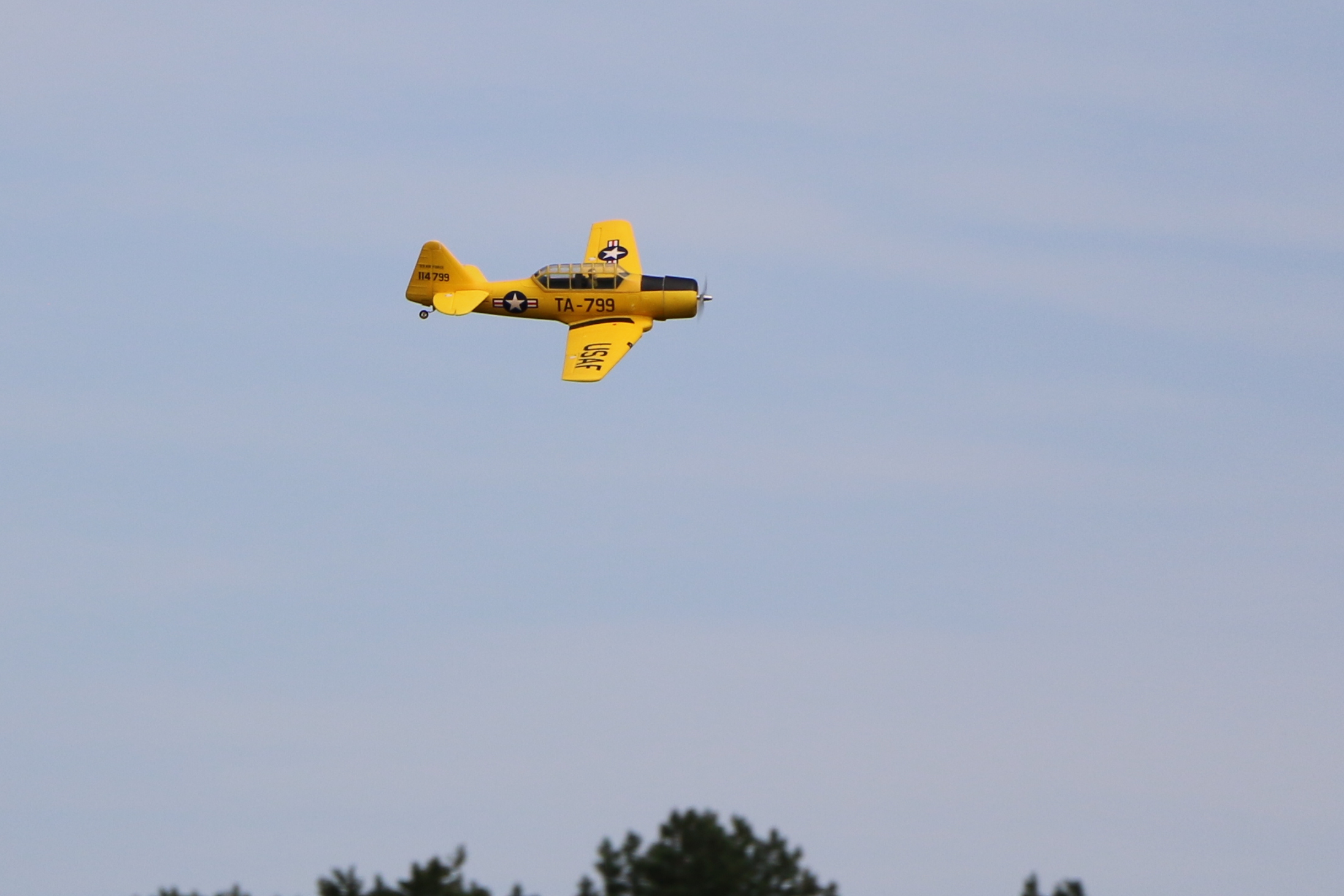
Kryten sent me lots of his superb flying shots this month, some of which you can see below. I update the cover photo of the club Facebook page most weeks and this week I used one that Kryten had taken of my Stearman. BMFA then posted it on their Facebook site, giving us a free plug and web link. It’s already had almost 2000 views!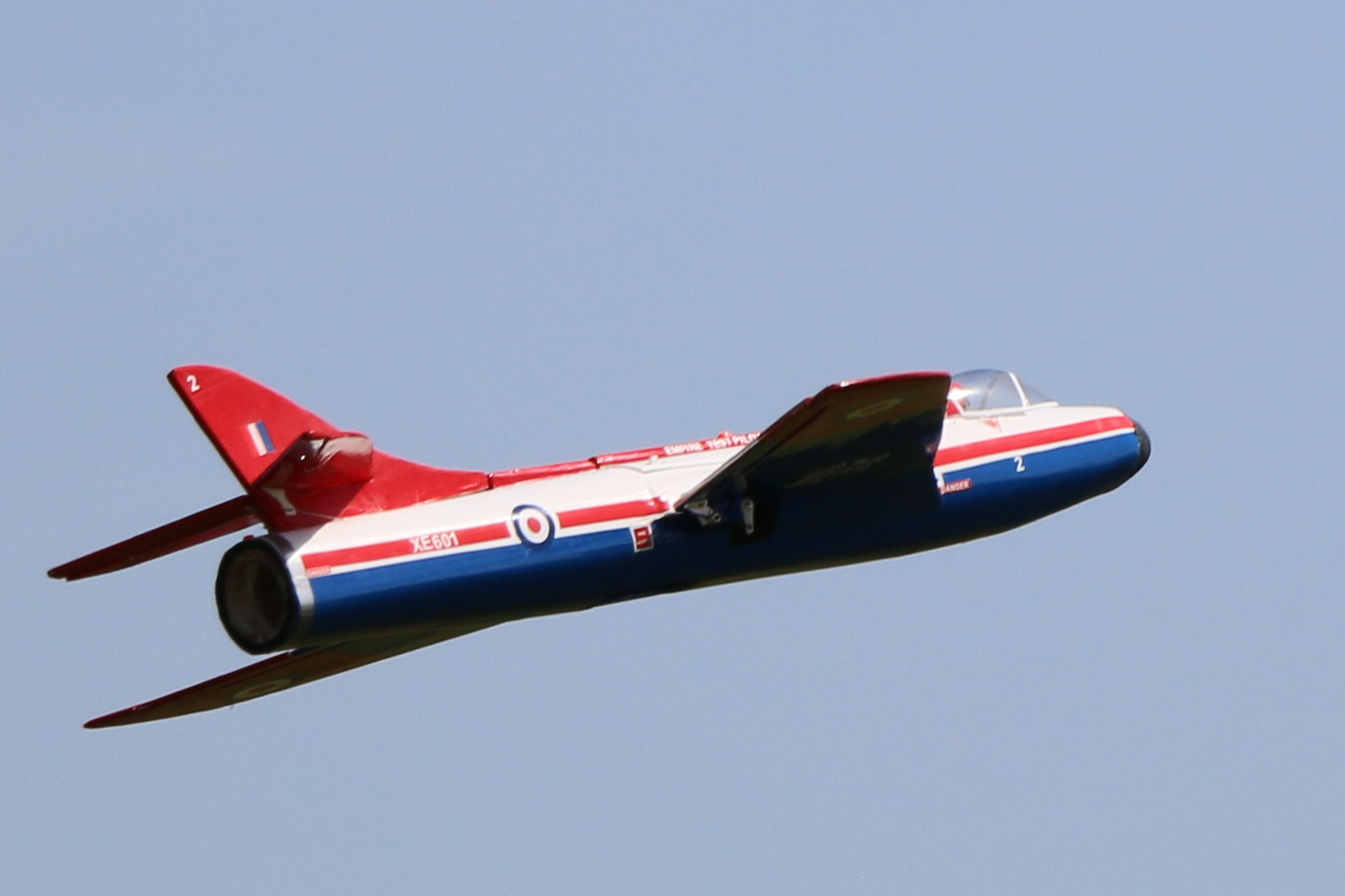
 Video time now, this month with additional contributions from Dougal Entendre and Captain Slow, thanks guys. Please watch the video full-screen, it’s so much better with small models flying around.If the video won’t play for you please click HERE
A huge military Lockheed C-5 Galaxy was sitting on the tarmac near a little Cessna that was waiting to take off.
The Cessna pilot was rather nervous of the C-5 and asked the tower to check the intentions of the military plane.
Before the tower could reply the C-5’s huge nose cargo doors opened and a voice came over the radio booming:
“I’M GOING TO EAT YOU!”
Colin Cowplain
Patch News – July 2020
August already and despite the Covid-19 restrictions many of us have managed lots of flying in July. The number allowed at the field is now a theoretical 30 but the booking system remains in place so if you want to fly please email John Wheeley beforehand, preferably at least 24 hours before. July saw several of the models built during lockdown flown for the first time, including Woody’s Hawker Hunter which finally got airborne. The patch is in excellent condition having been regularly mown by the FARTS (Friday Afternoon Rural Trimming Society).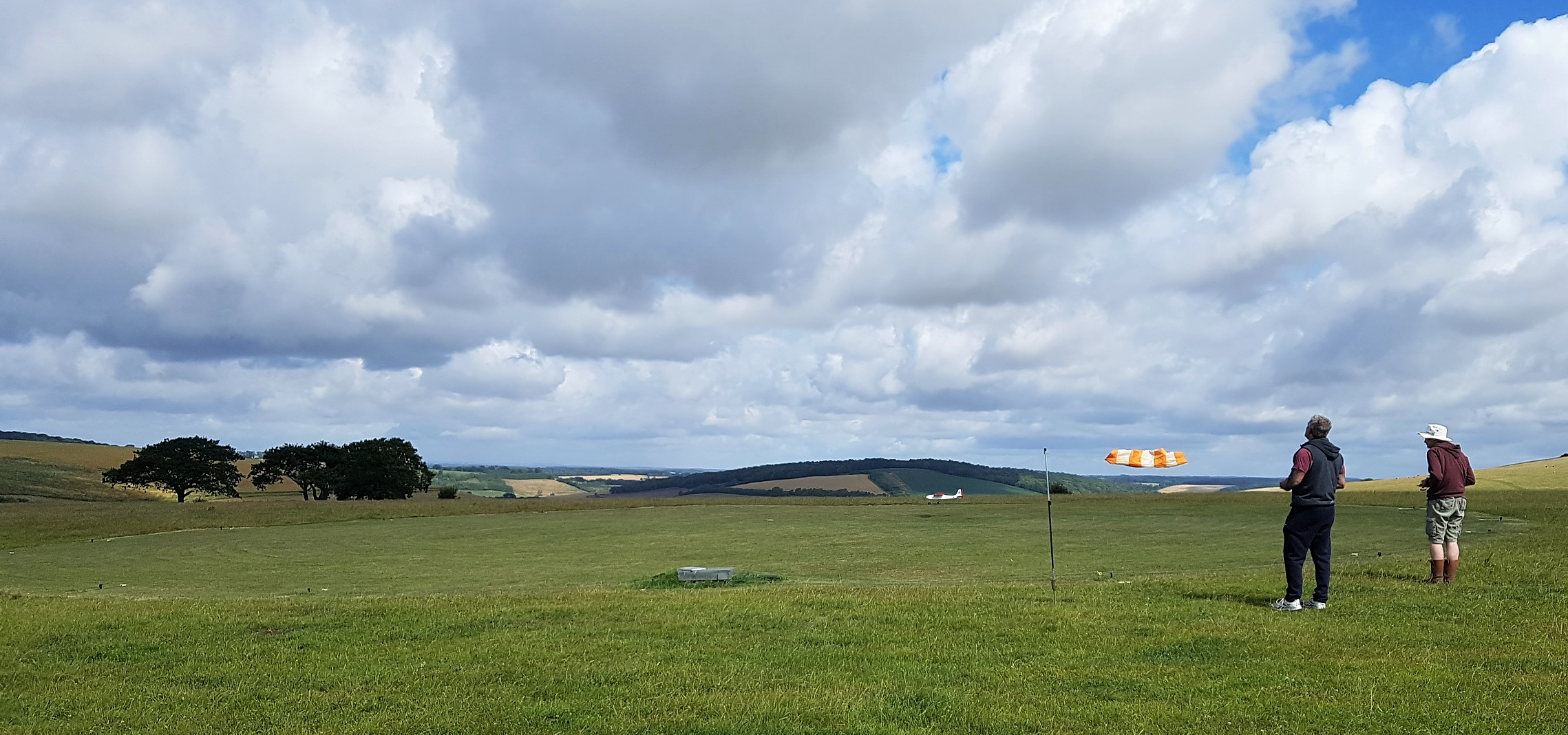 The sunny weather brought out lots of insects including this little grasshopper that hitched a lift on my F-22 Raptor.
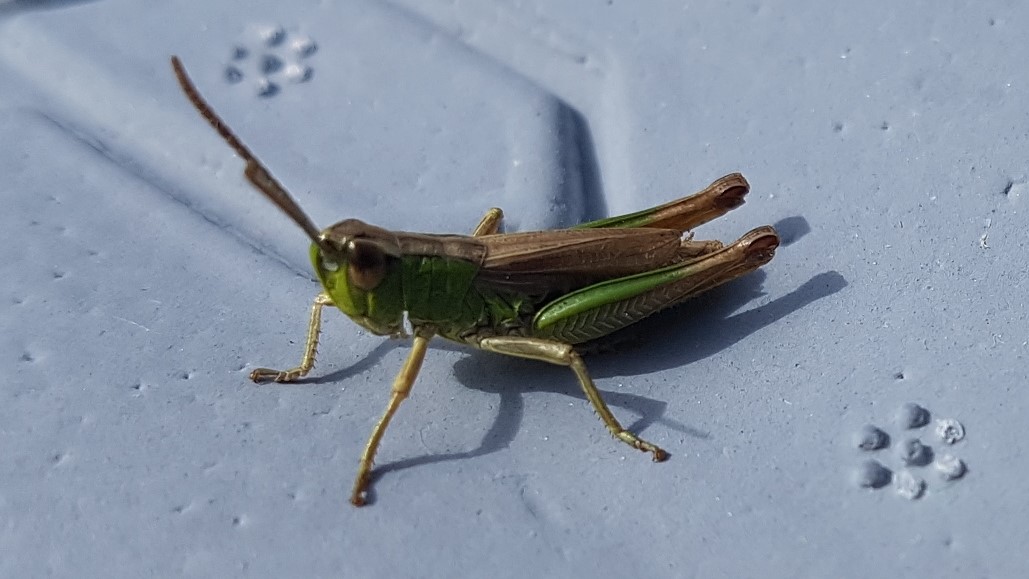 One of the Ikarus C42’s from Solent Flight based at Lower Upham airfield appeared to be practising engine out procedures when we arrived one morning, fortunately only one of them was directly over our field.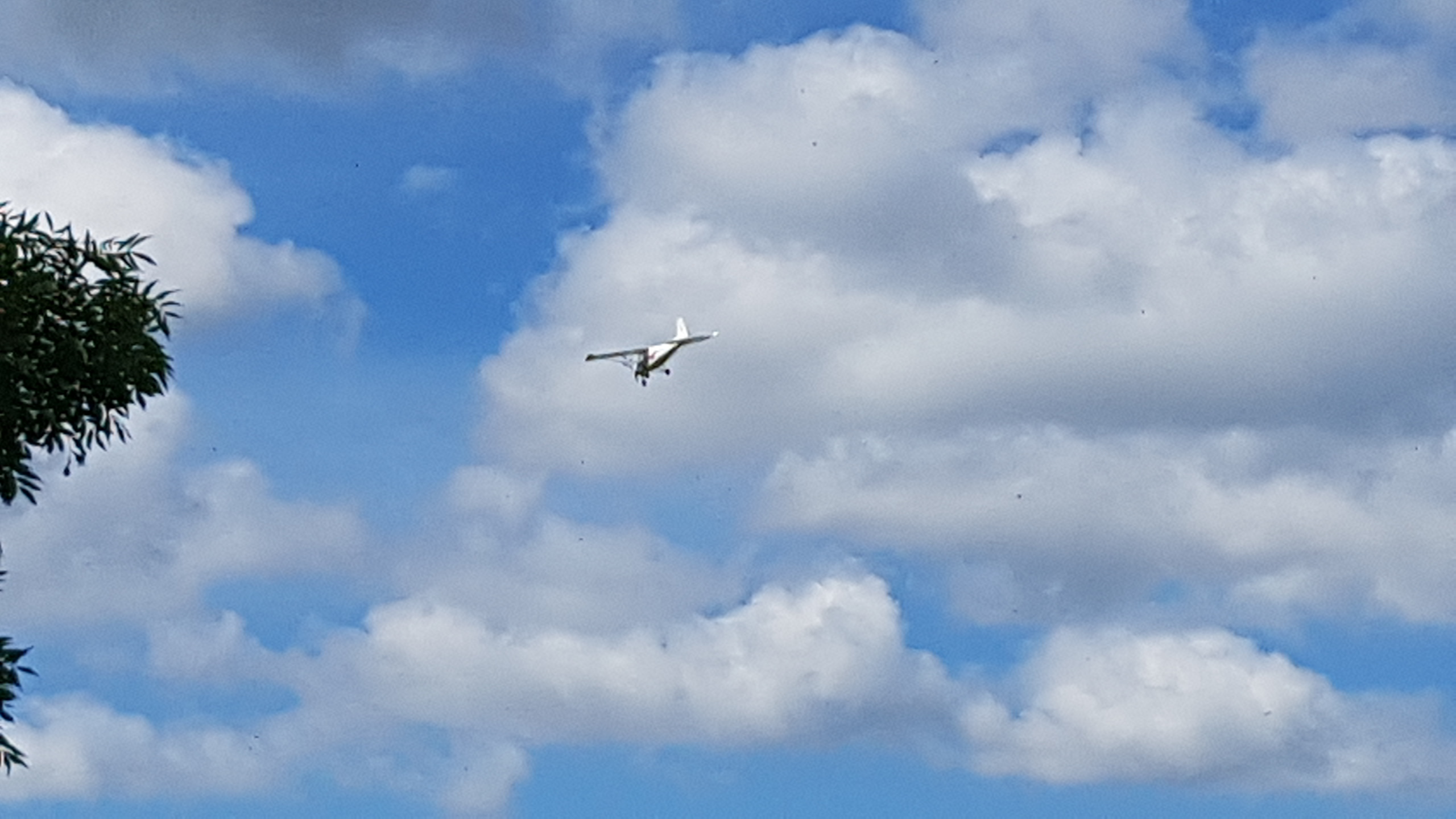
Last month I reported that Woody’s Hunter had been completed but we hadn’t managed to get it away from a launch. One of the problems was a sticky elevator snake and Woody managed to sort that. Then he did a thrust test which proved to be ok but the overall weight of the model was much more than it should be so in July we tried it with a 1500mAh battery instead of a 2200mAh. As well as saving weight it moved the centre of gravity slightly rearward to the correct position. Catapult King was seconded for launching and at last the Hunter took to the skies. It was a bit out of trim and very twitchy on ailerons but at least it was flying. When landing I discovered that it suddenly drops the right wing if slowed up but it survived undamaged. After some adjustments to the control movements and exponential we tried again and the second flight was much better, still twitchy but much better.
 I kept the speed up on the landing approach and got it down safely on the patch. Excerpts of both flights are in this month’s video. Sadly I think it will never be perfect because it’s just too heavy but it flies and looks great in the air
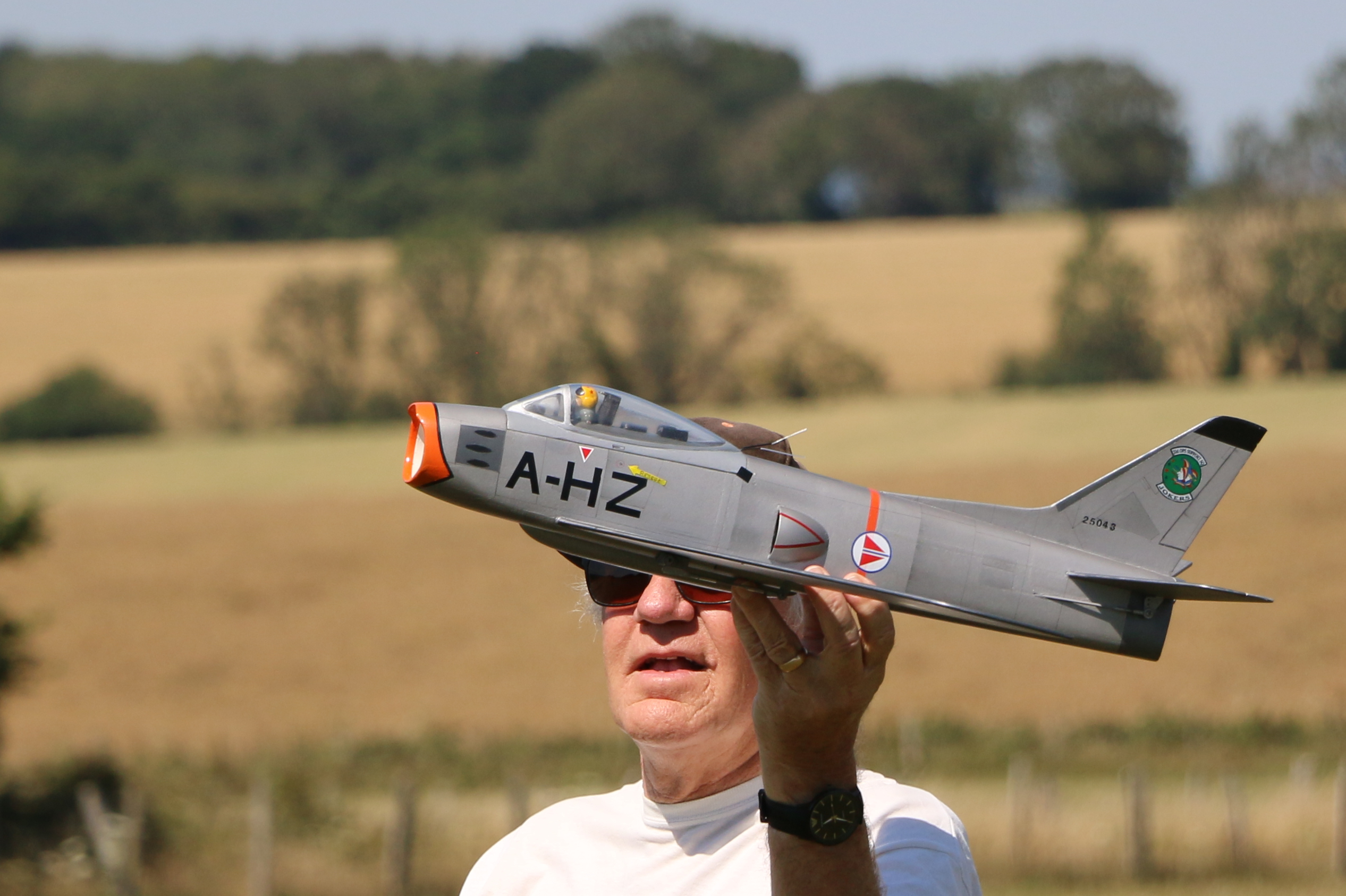
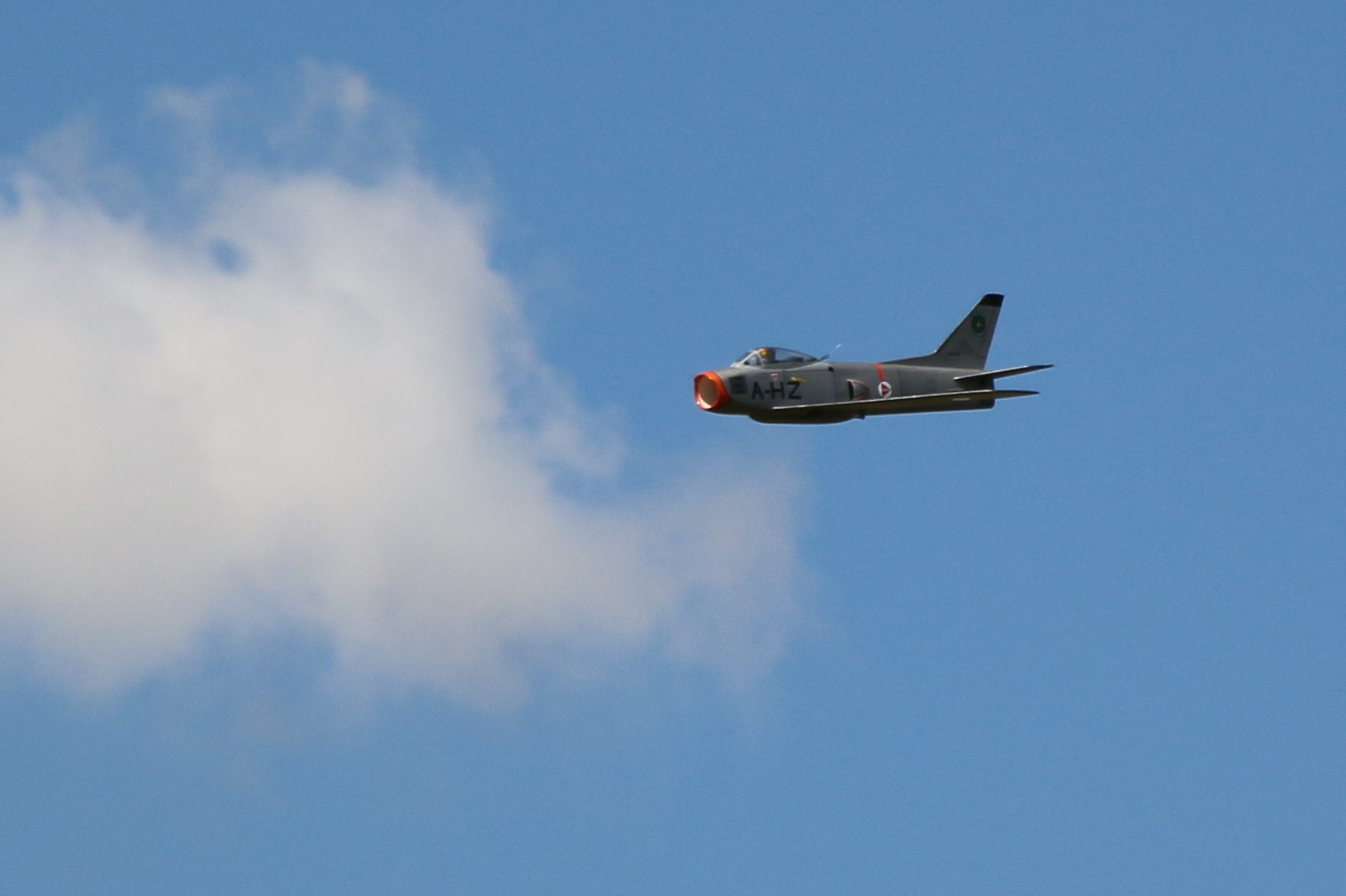
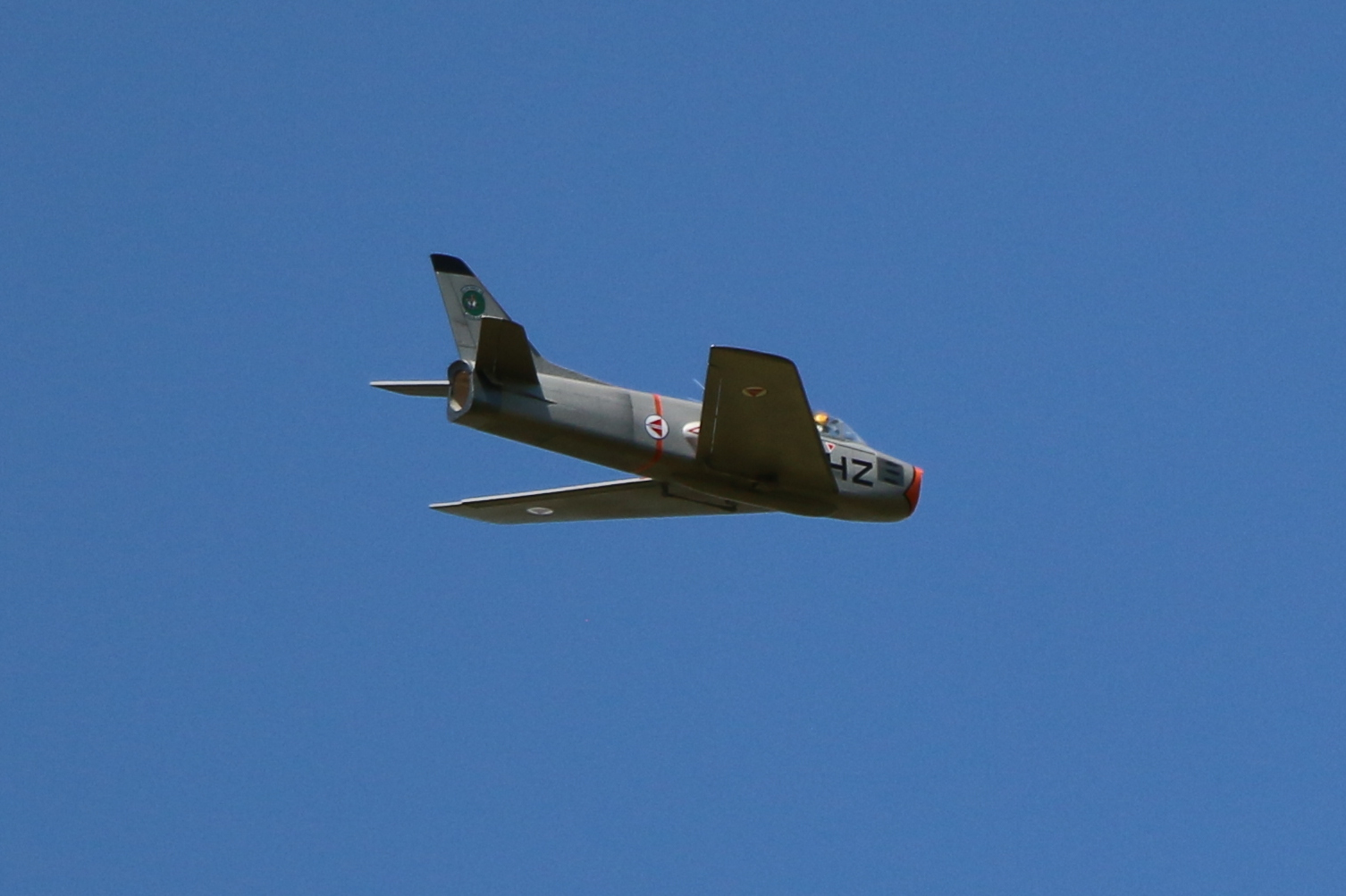
I also featured Norwegian Nick’s F-86 Sabre last month which was almost ready for flight. Nick flew it twice in July and it flies really well although, like the Hunter, it’s proved to be rather too twitchy on ailerons at first.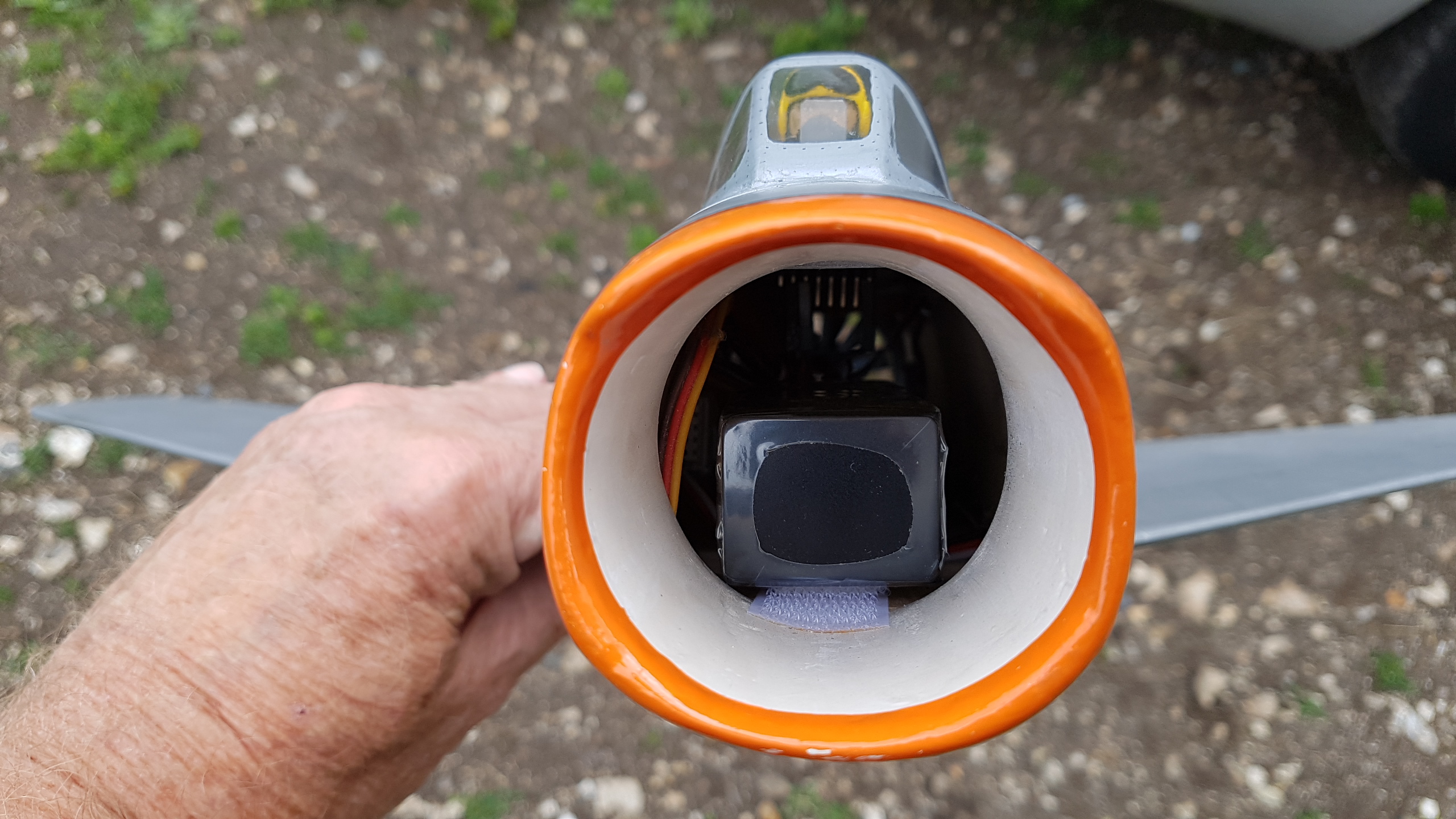 The Sabre uses 4 cells rather than 3 but still manages to weigh less than the Hunter. After the first successful flight Nick went off to finish the colour scheme and it now looks superb in it’s Royal Norwegian Air Force ‘Jokers’ colours.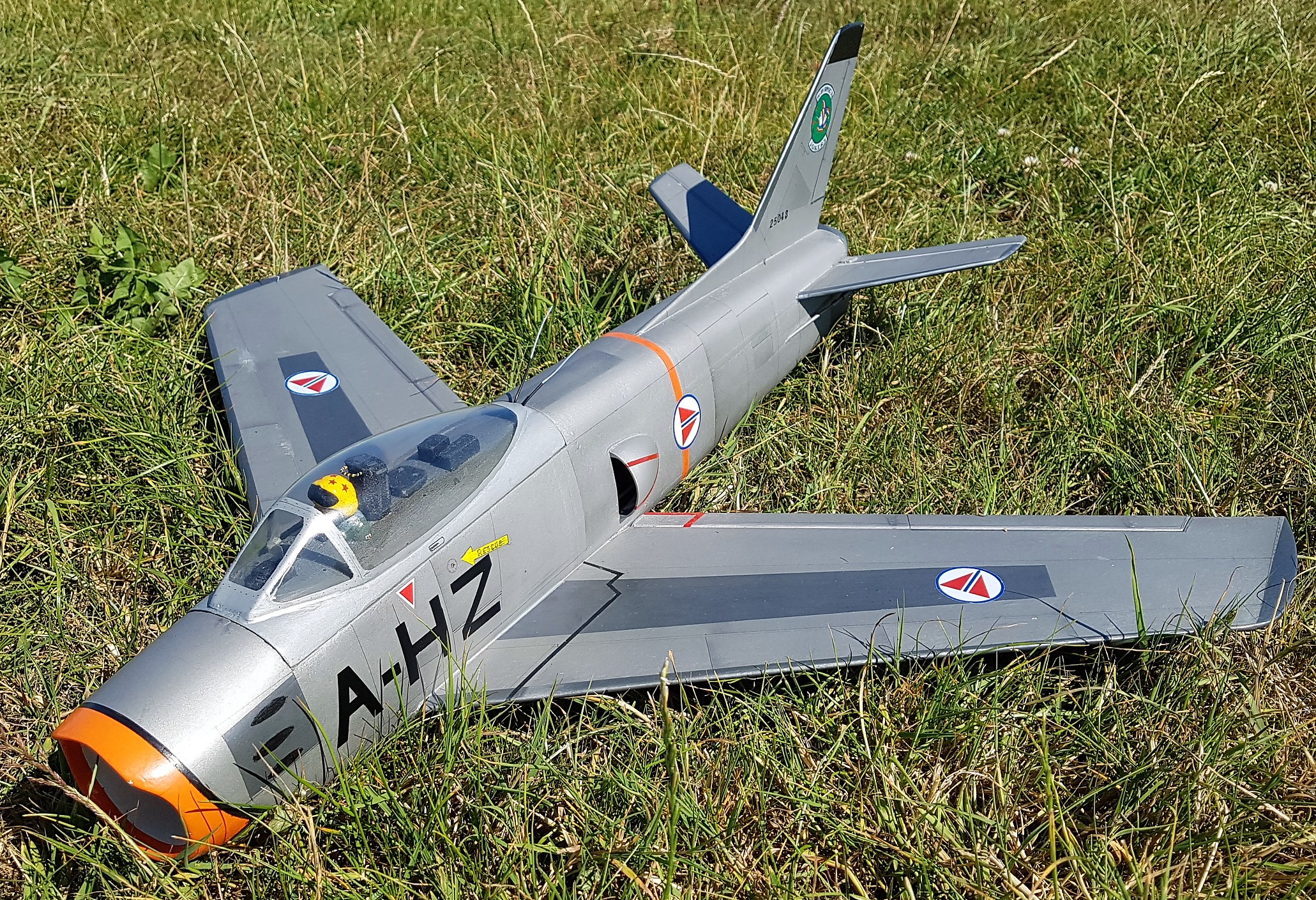
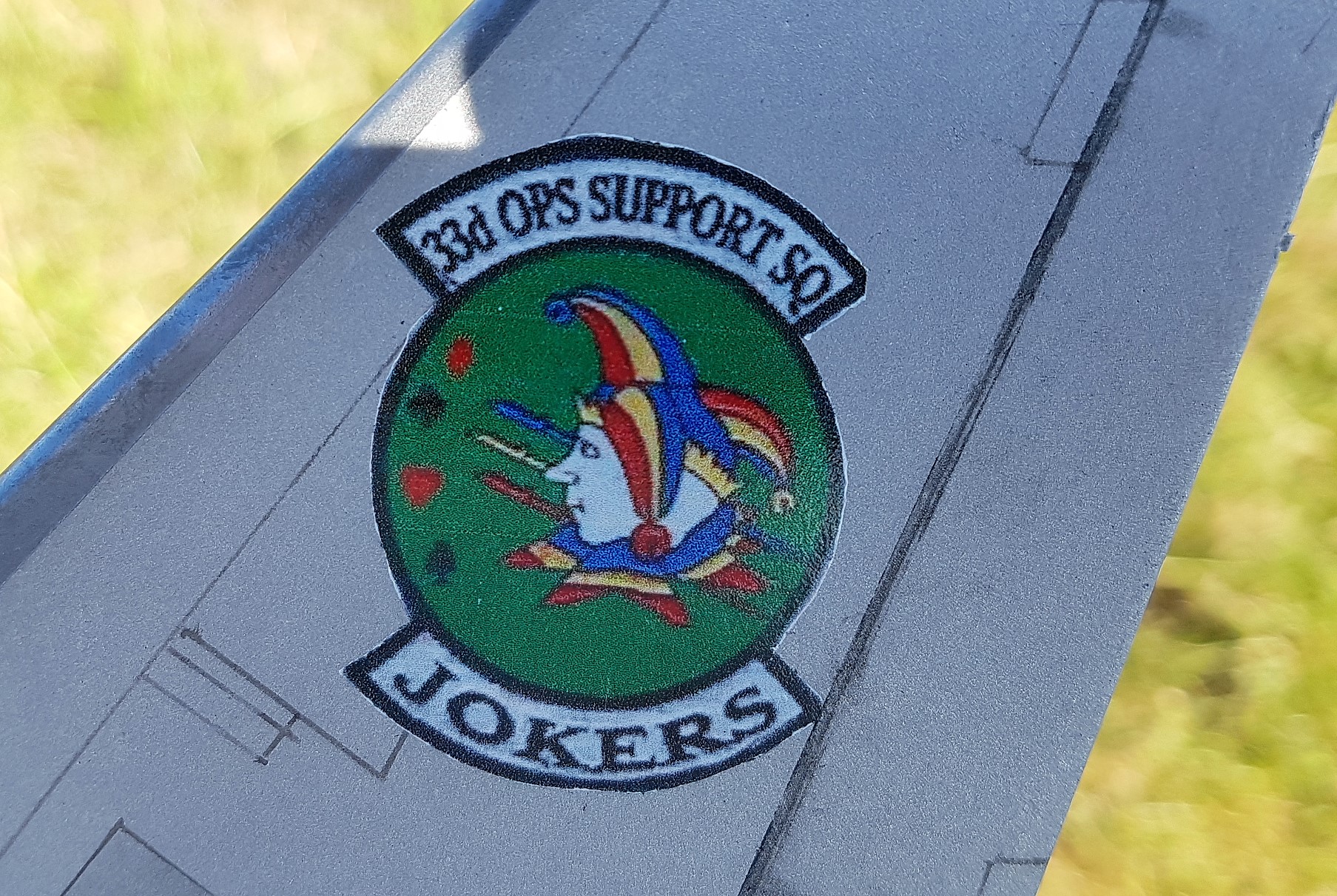 He flew the Sabre again later in the month and it goes away from the launch well and flies beautifully although it did suffer a rather abrupt arrival caused by twitchy ailerons and loss of orientation I think. Fortunately there was no damage so with a little more tweaking it should be perfect. Some of the first flight can be seen in this month’s video.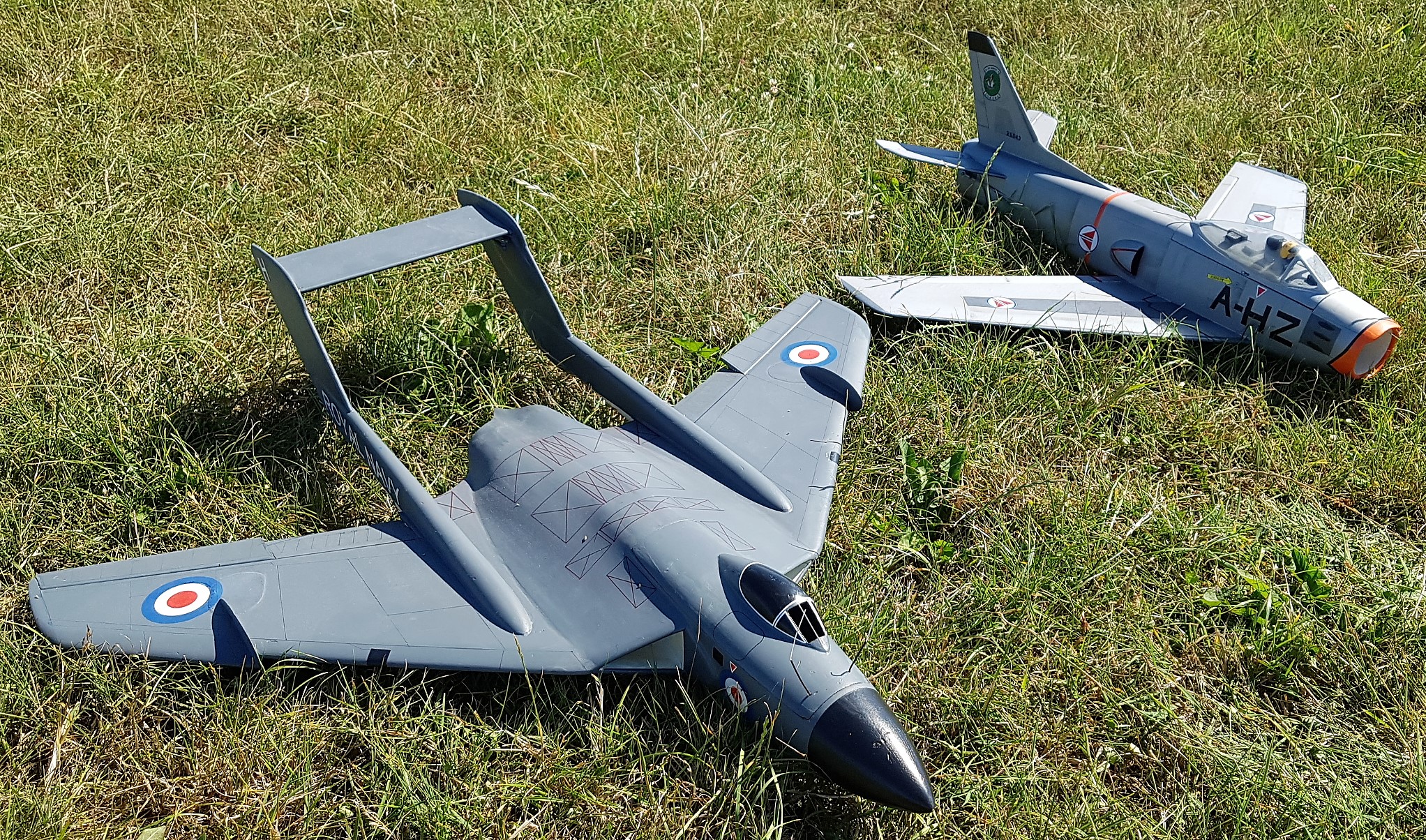
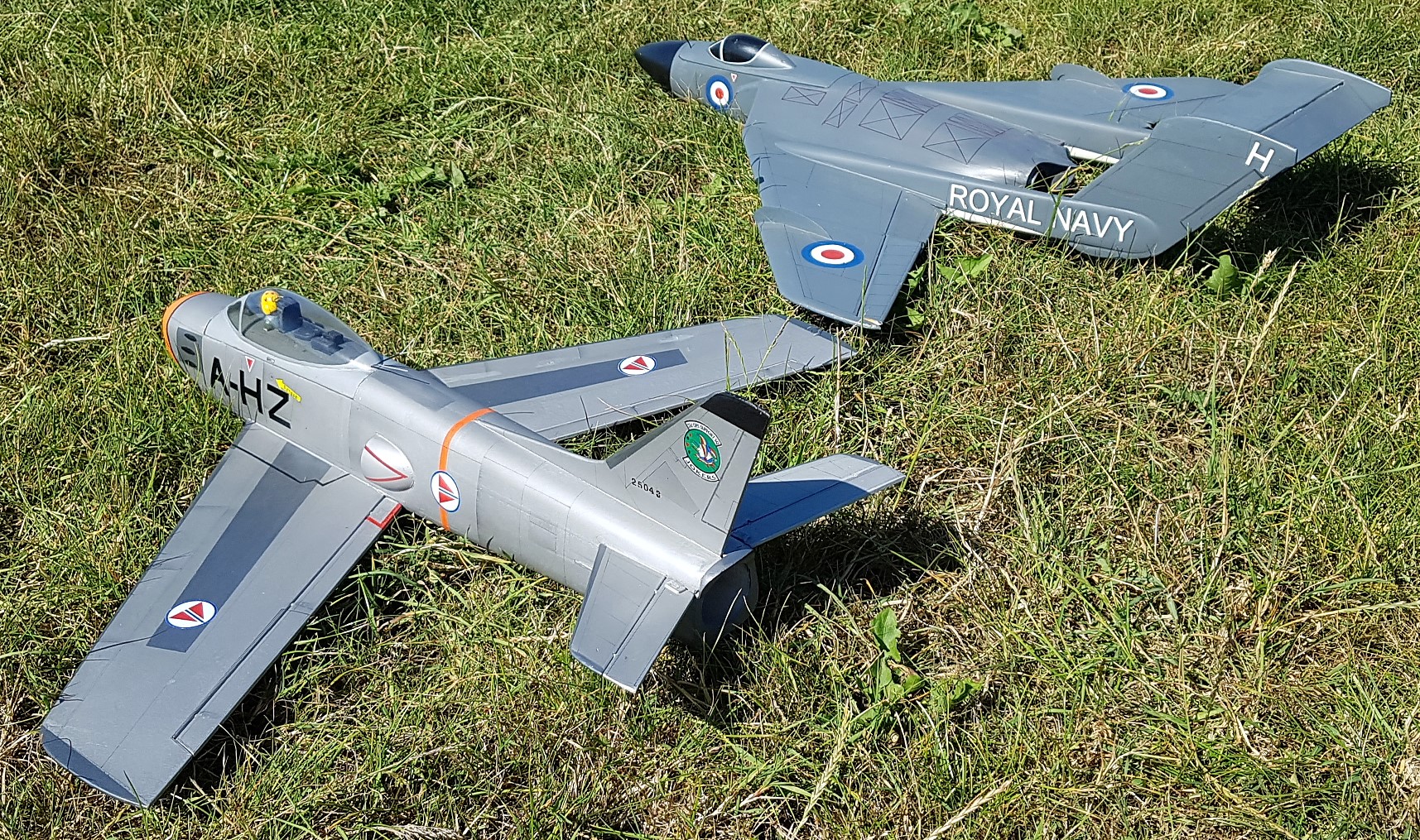 Nick also brought his Sea Vixen along to fly but after setting up the launch ramp and bungee he discovered that the Vixen launching hook was broken so he couldn’t fly it. Never mind, they looked brilliant together on the ground.
In the June Patch News I admitted to being jealous of Captain Slow’s model rack so I decided to make one for myself. Over the years my model room has become a model store and every time I want to do some building or repairing I have to empty the room of the models. She who must be obeyed is very understanding but does sometimes mention it when there are models on the landing, in the second bedroom, and especially on our bed. Luckily I don’t have any oil dripping I/C models these days! The obvious solution was to store the planes in the garage but unusually we do actually put a car in it so what I needed was a bench mounted rack. I was able to fix the rack directly to my workbench, a shelf, and a rafter so I didn’t need it to be free-standing like Captain Slow’s.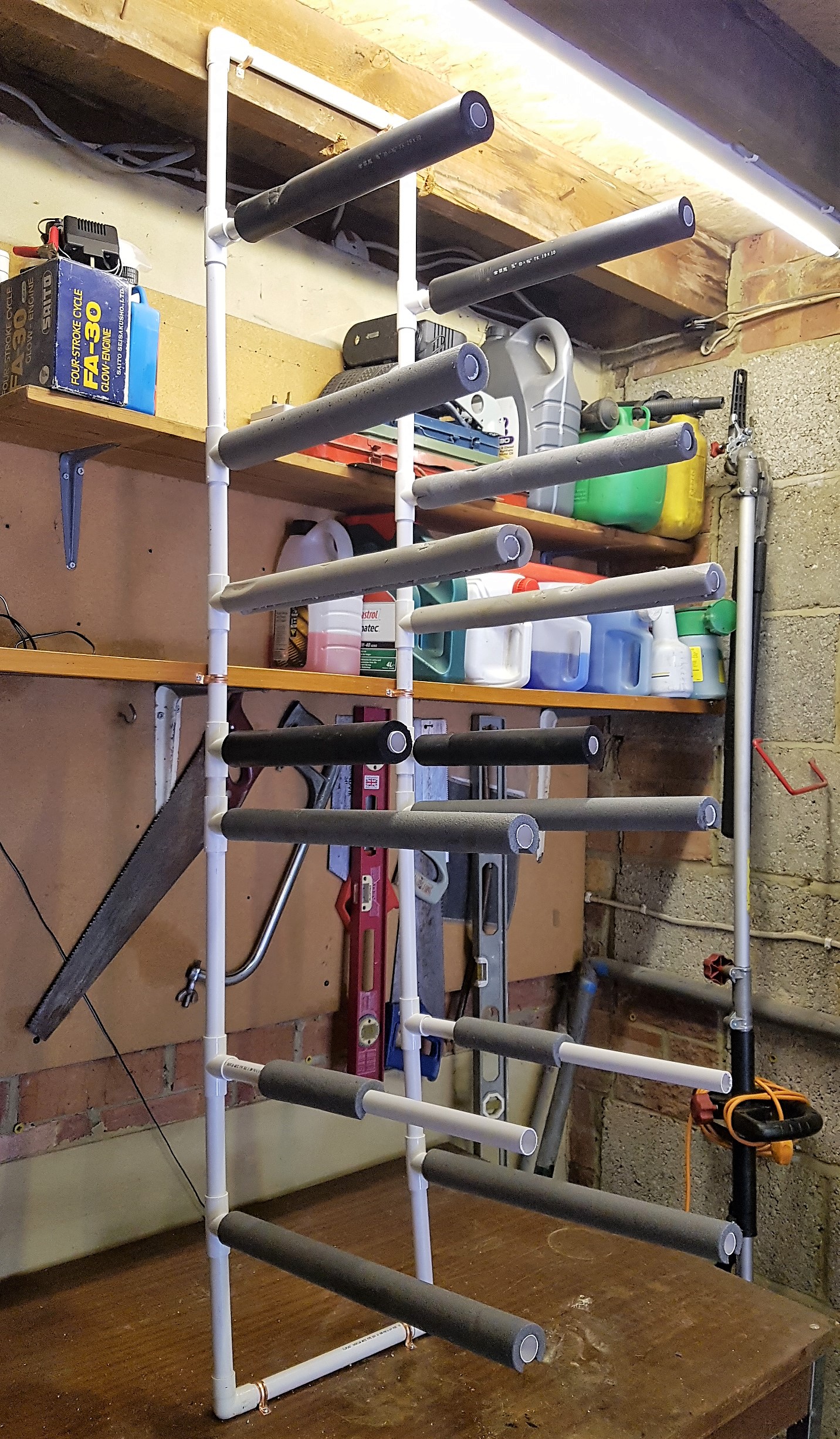
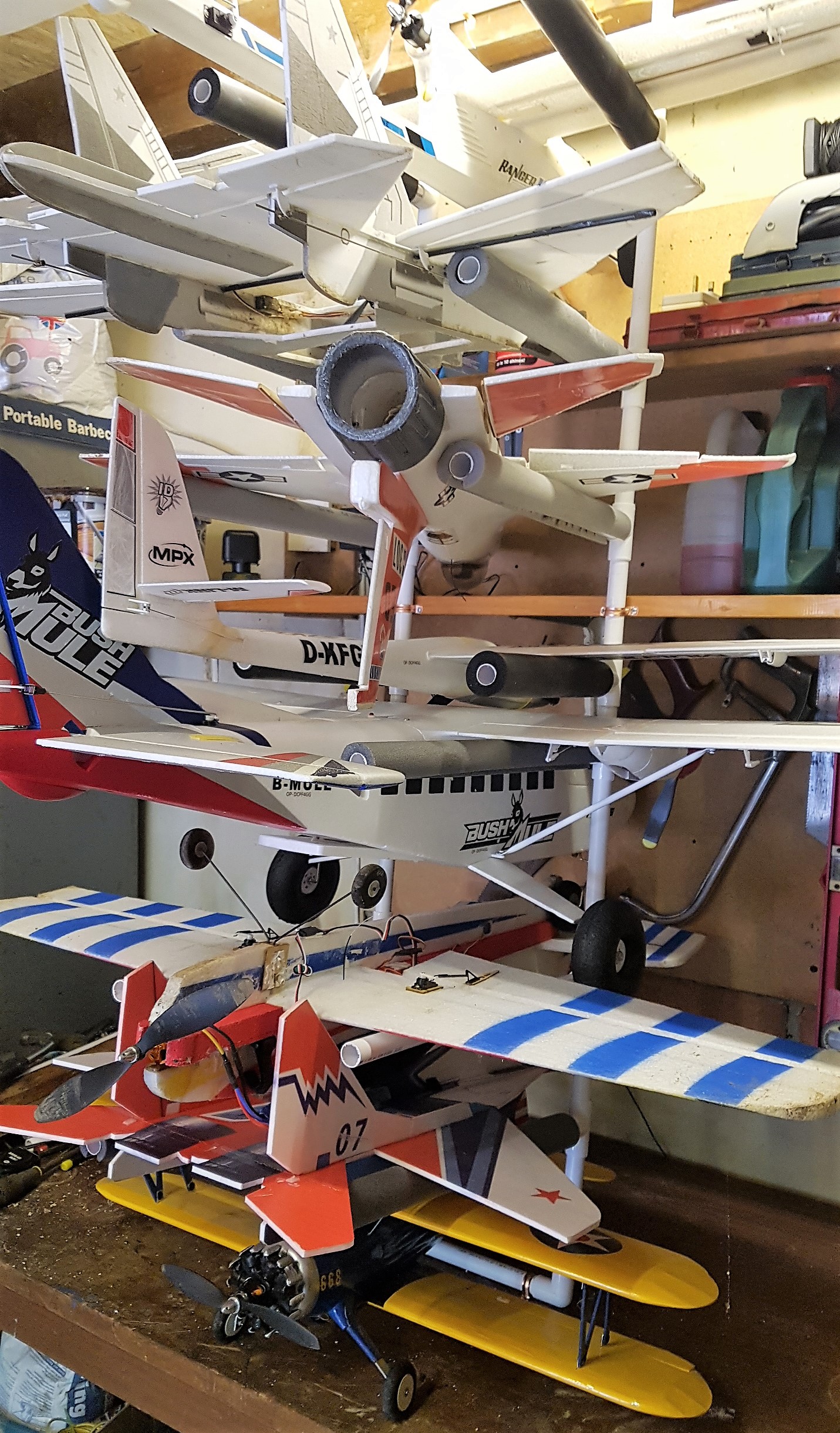 This also meant it could be taller and hold more models, mine holds eight. I can stand the remaining small models on the bench around the rack and there are currently thirteen models on there. I spent just under £20 at Screwfix on some 21.5mm overflow pipe, a few 90 degree bends, and some T pieces. I already had the foam insulation.
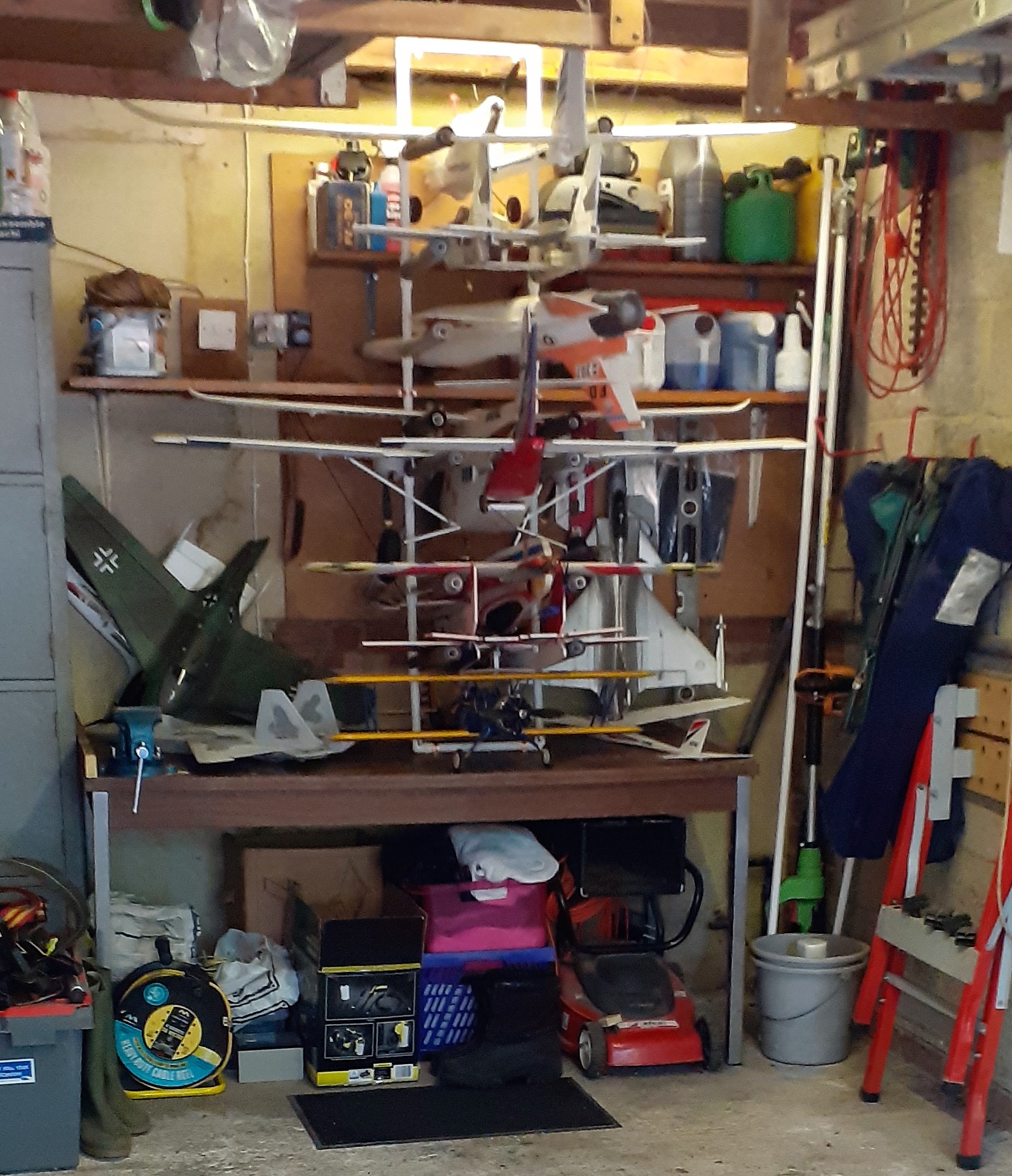 Note that it’s overflow pipe and fittings not water pipe. The fittings are just a push fit and would normally be glued but for my purposes I didn’t need to glue them so it will be easy to reconfigure for different models later on.
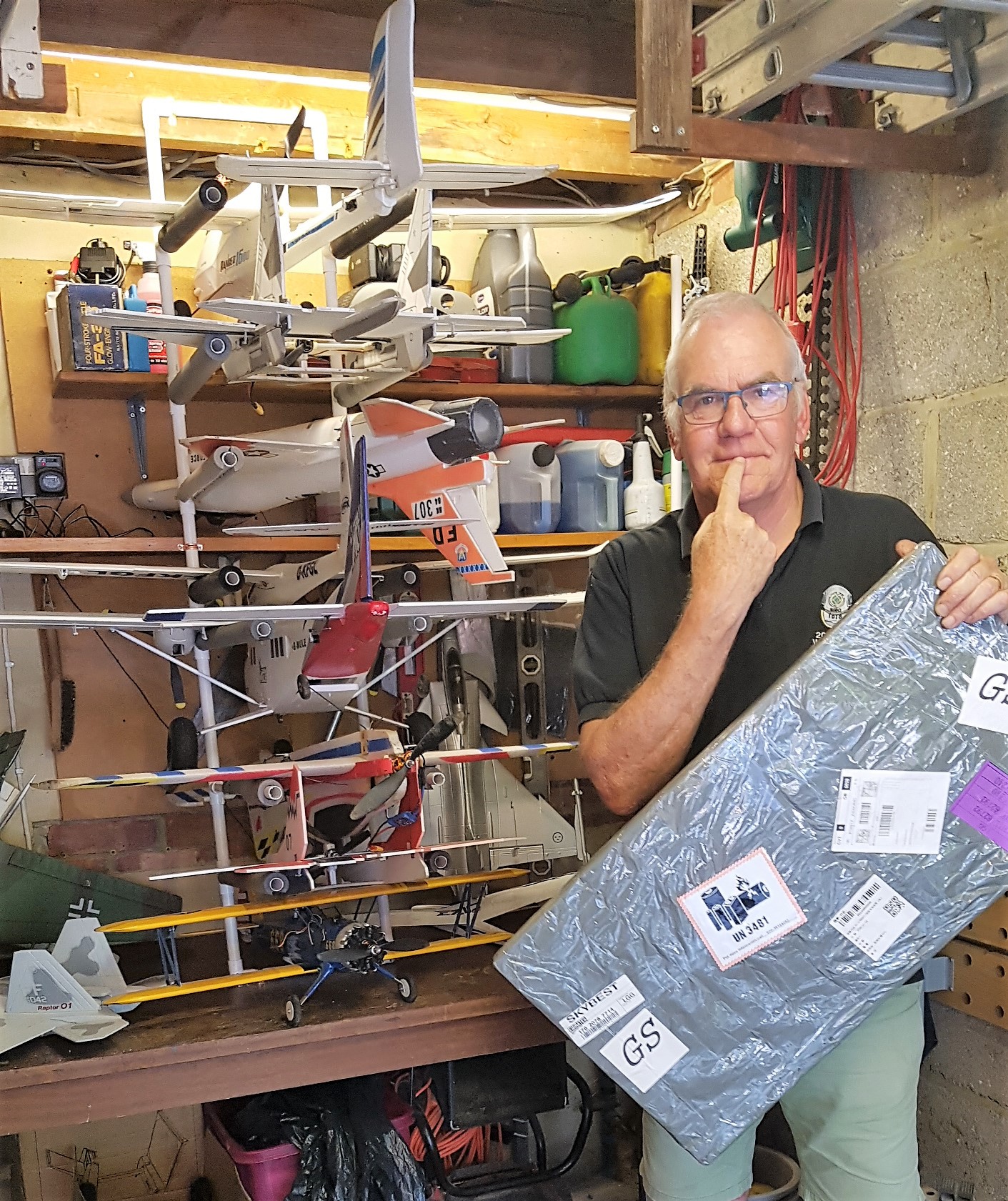 Literally just as I was placing the last model in the rack and demonstrating to Doreen how brilliant it all was a courier arrived with a parcel for me, yes, another new model…how embarrassing, unsurprisingly it was mentioned!
So what could be in that thin package? It’s another foamboard jet of course and this time it’s one from Banggood.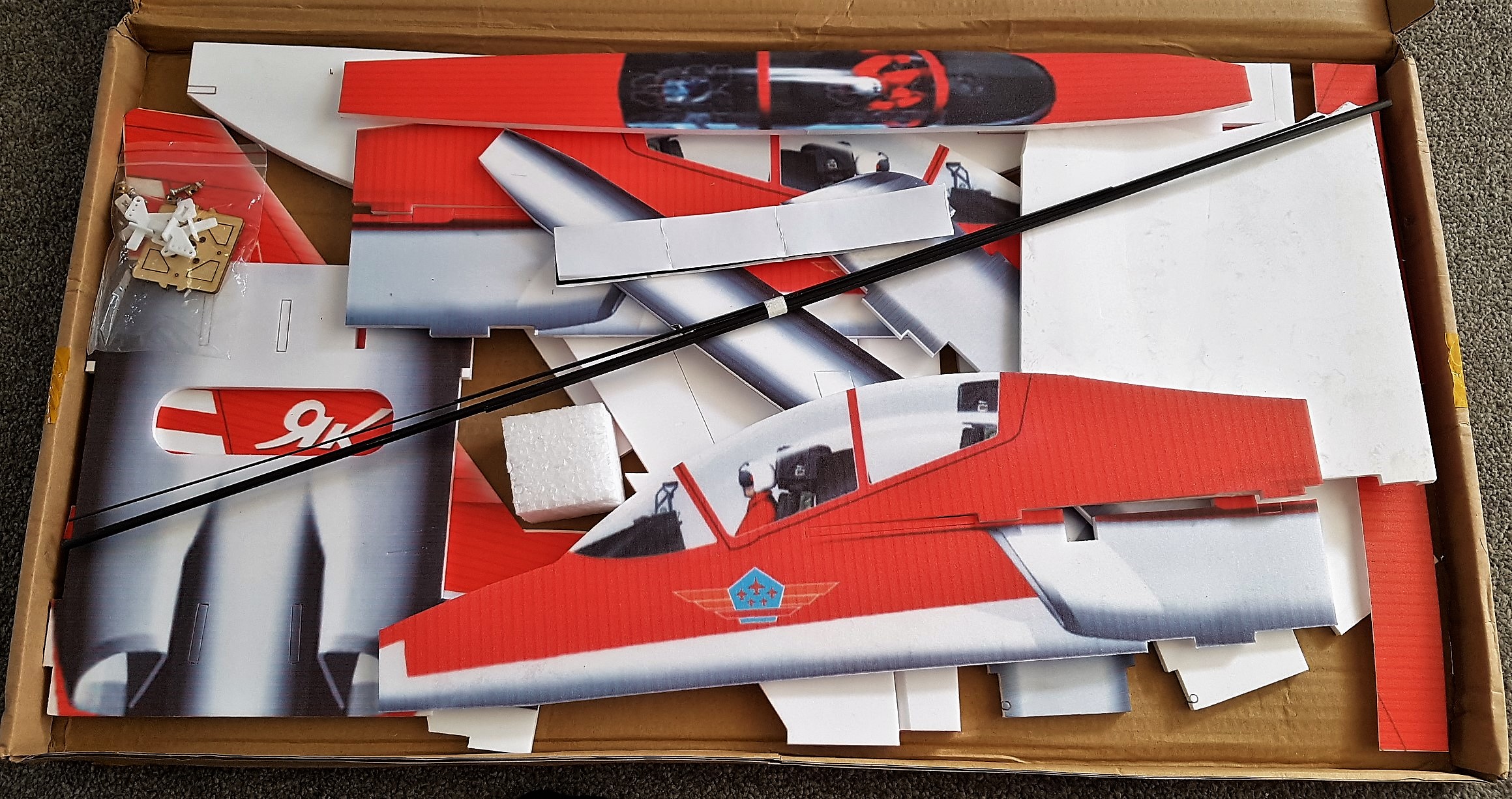 It’s a Yak-130 that has a part-box fuselage and I think it looks rather pretty, I hope it flies as good as it looks.
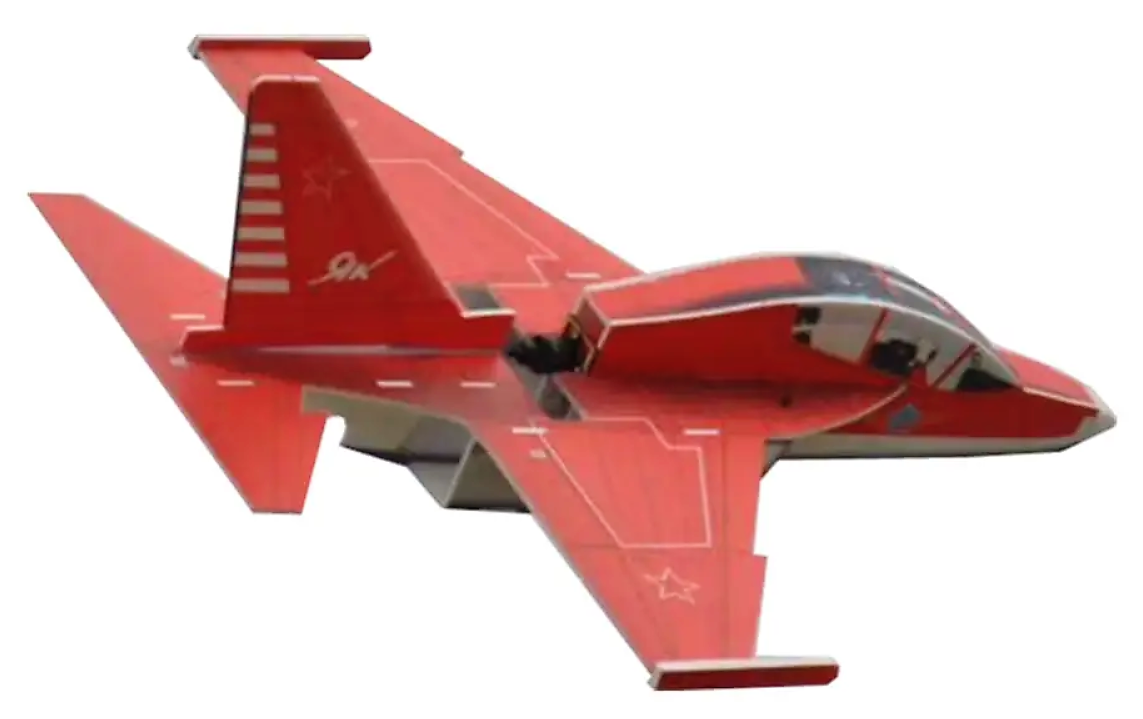 I really fancied the JAS-39 Saab Gripen but, as well as being a few pounds dearer, for some reason the postage on it was £9.52 but only £1.65 for the Yak. I had some discount points to use so the Yak cost me just over £23 including delivery. I haven’t had time to build it yet but it arrived undamaged and looks good, watch for a report next month.
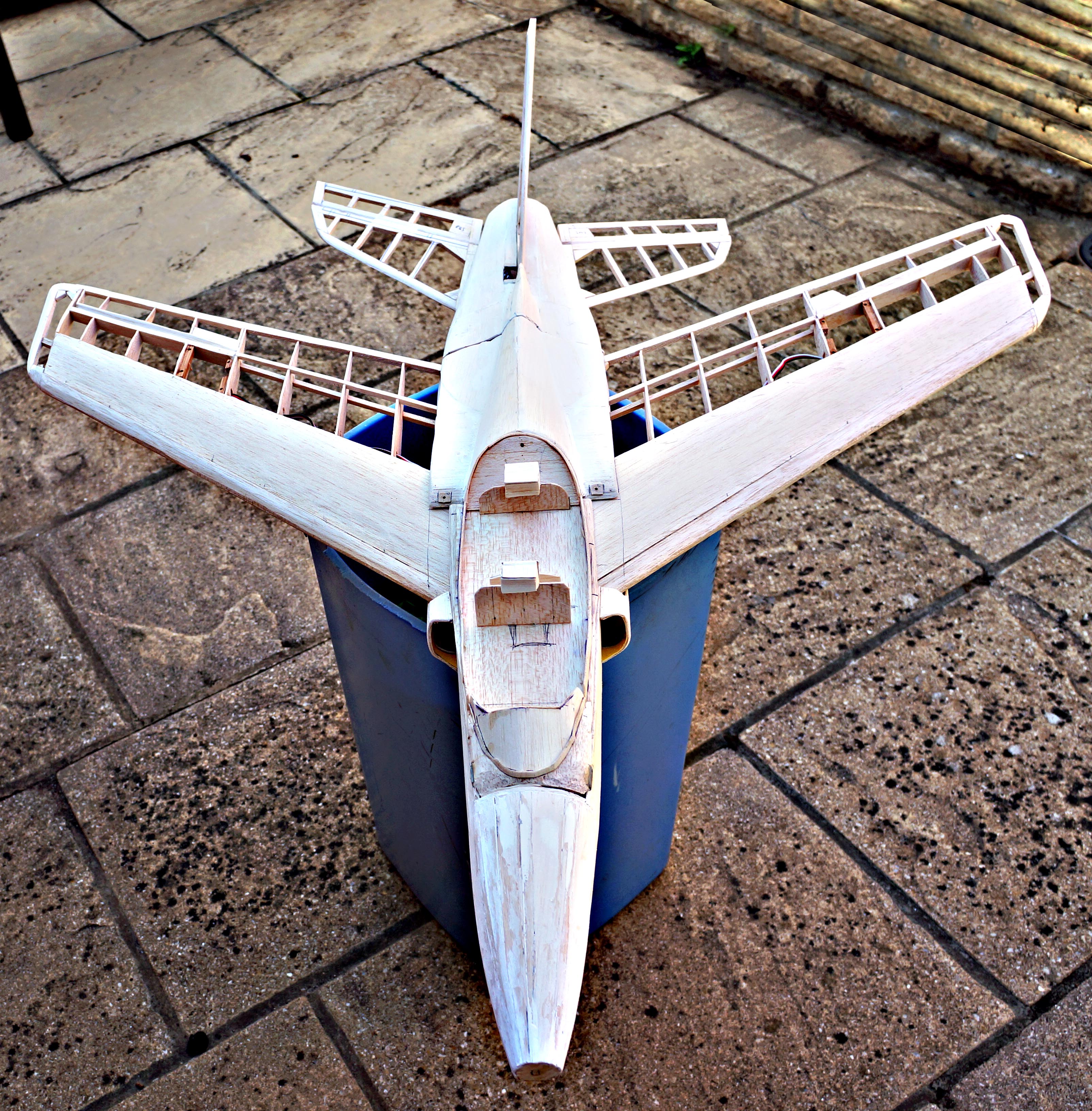
The Folland Gnat that Dwayne Pipe is building from scratch is coming along nicely and should be ready to test fly before too long. Early in July he sent me a couple of photos of the completed construction, ready for covering.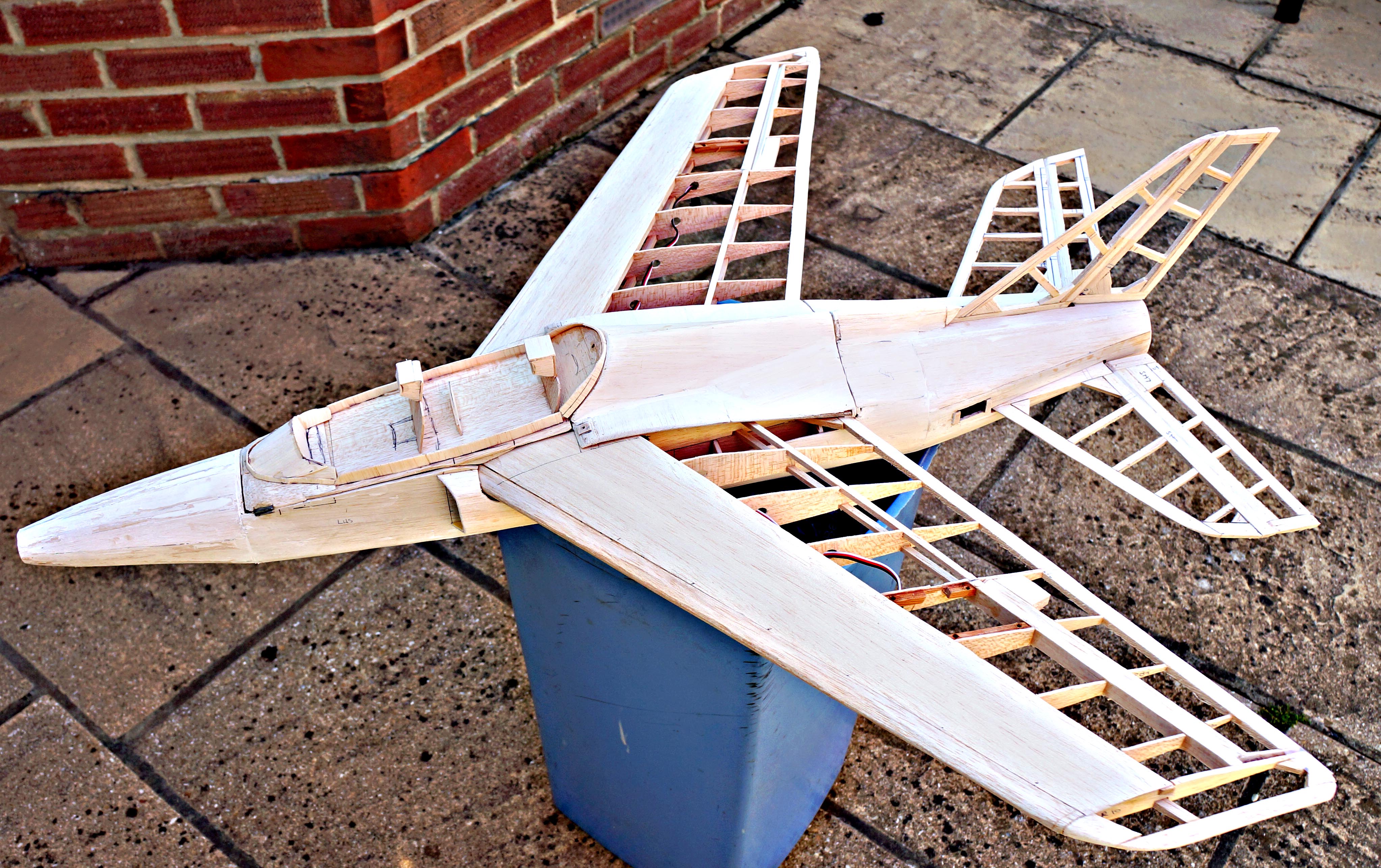
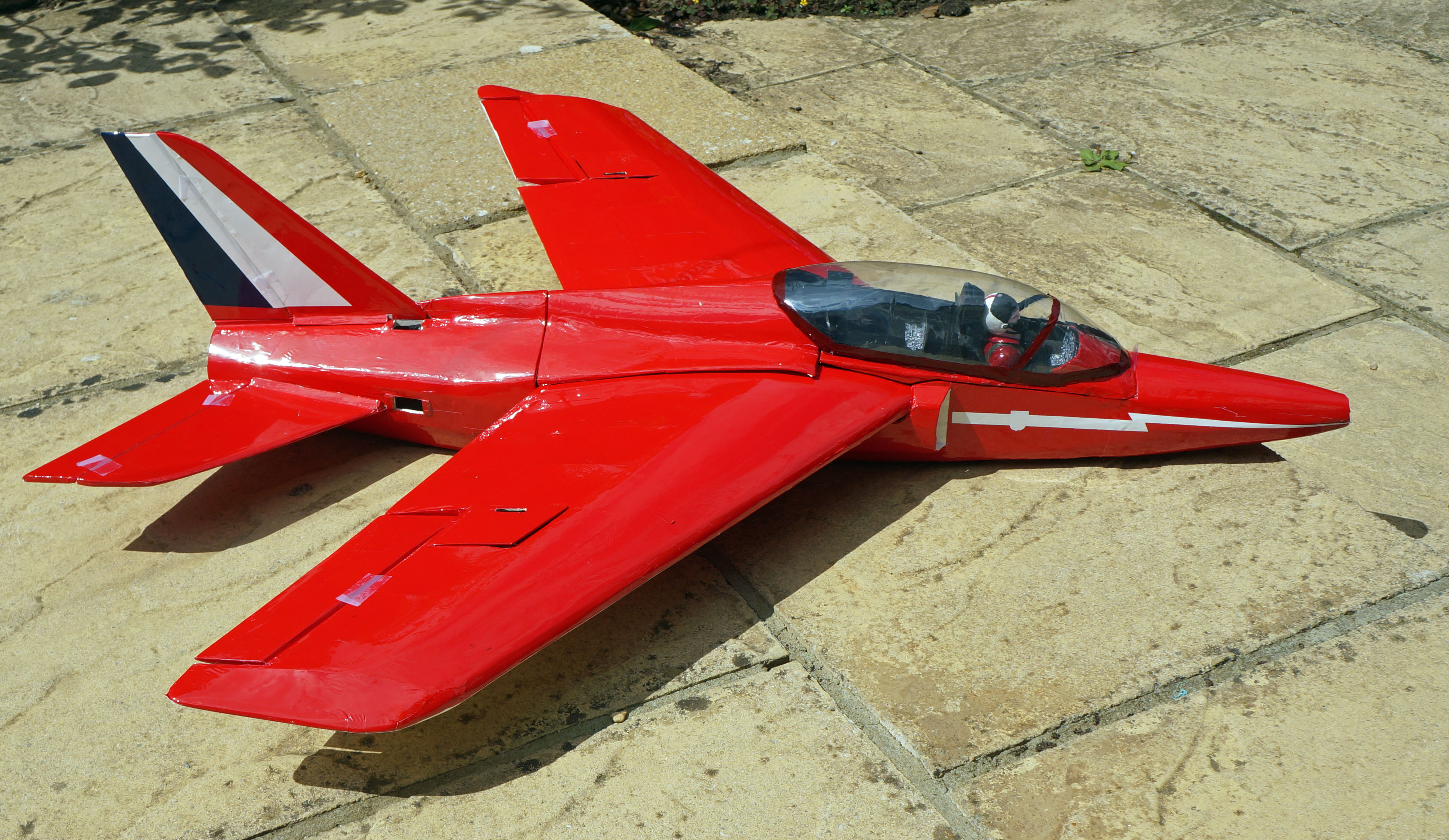
 Then at the end of the month he sent some more of the covered model, just got to hinge the control surfaces etc.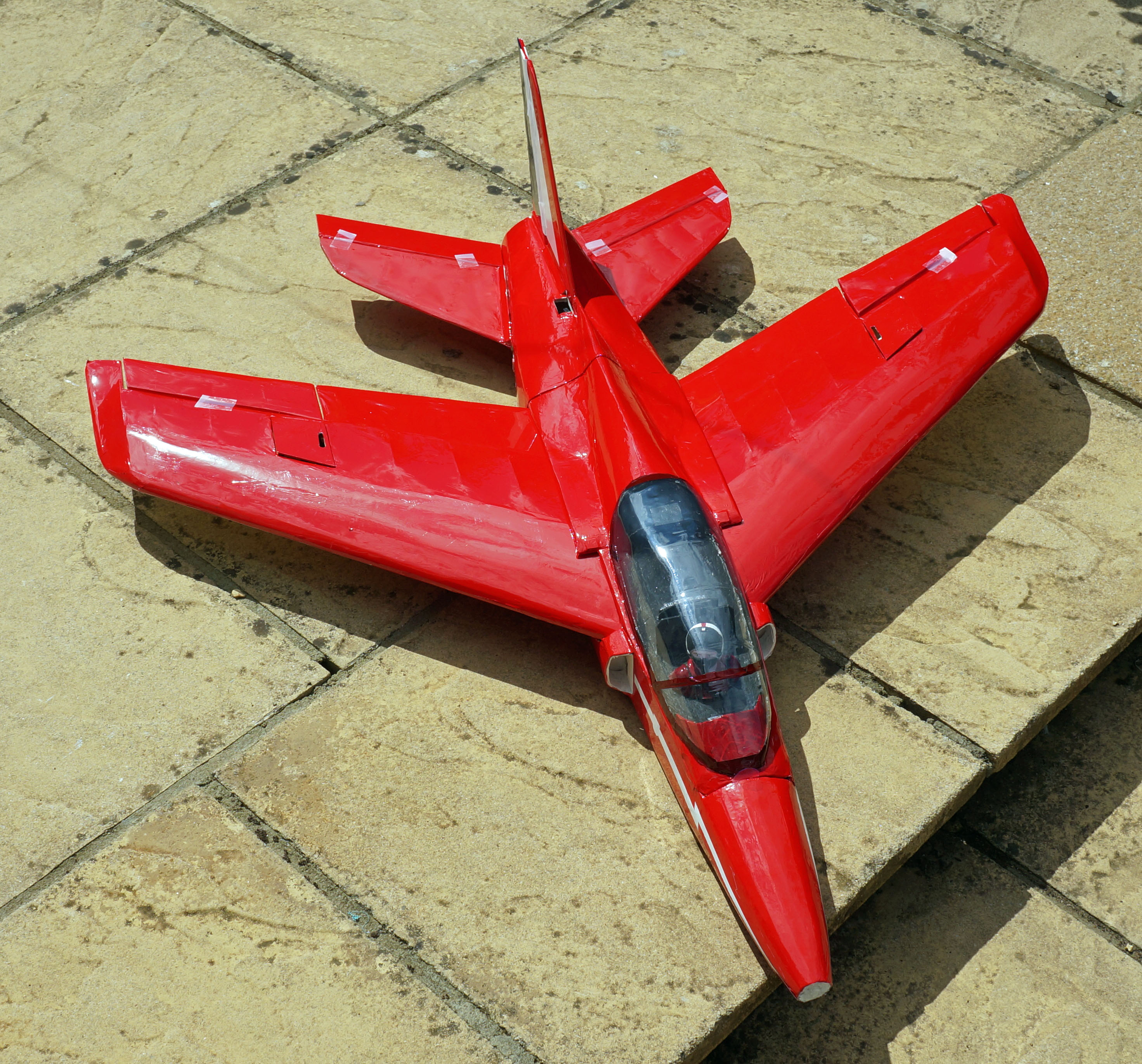
Catapult King recently bought the foamboard Sukhoi SU-27 that Dougal Entendre had won in a club raffle a while back. Dougal says he doesn’t like them so decided to sell it on rather than build it and discover that he was wrong!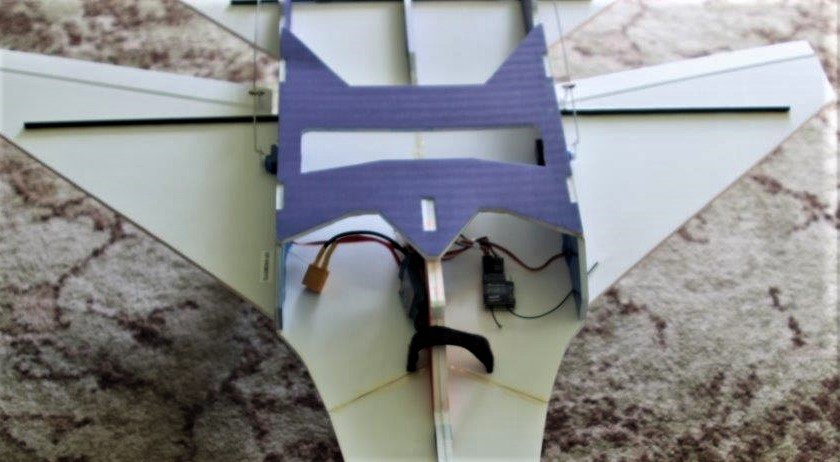
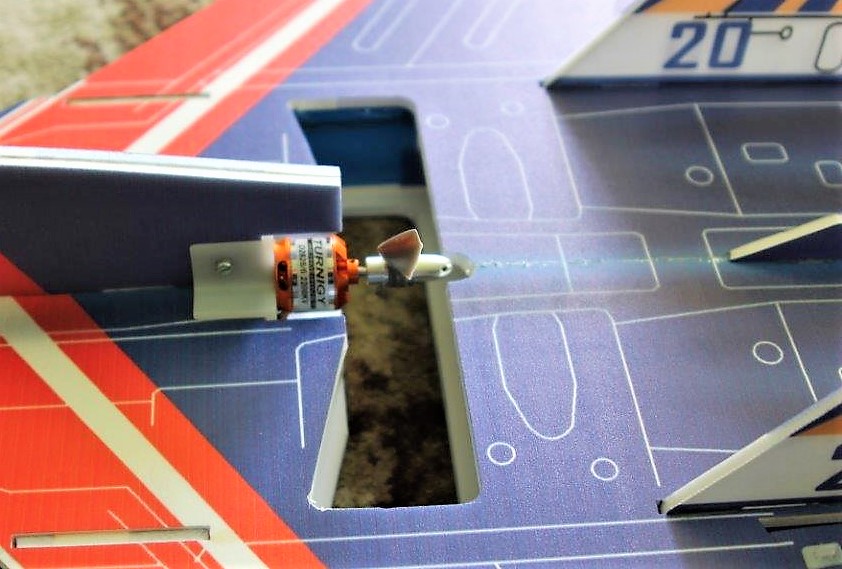 This is what Catapult said about it: It uses a 2200mAh 3s battery as the weight seems to be needed to get close to the CG, there’s a FrSky D4R-II receiver and a good old 30A HobbyKing ESC (Love em!). The motor was the hardest as I couldn’t find one for love nor money during lock down, but Gary came to the rescue and gave me a Turnigy D2826 2200Kv which he had spare, thanks Gary. Catapult soon had it all put together and asked Dougal to do the test flight for him. The test flight went well and Dougal soon handed the transmitter back to Catapult who had no problems at all with the Sukhoi. I have to confess that I forgot to photograph Catapult with his new toy but you can see some of the first flight in this month’s video, including the part when Dougal almost buried it while inverted.
Certainly the biggest new model to be flown this month was Mini-Mike’s rather lovely P.68 Partenavia Victor. The kit was made by Modell Studio in the Czech Republic and at 2m (79″) span it’s a big one and it only just fits in his car.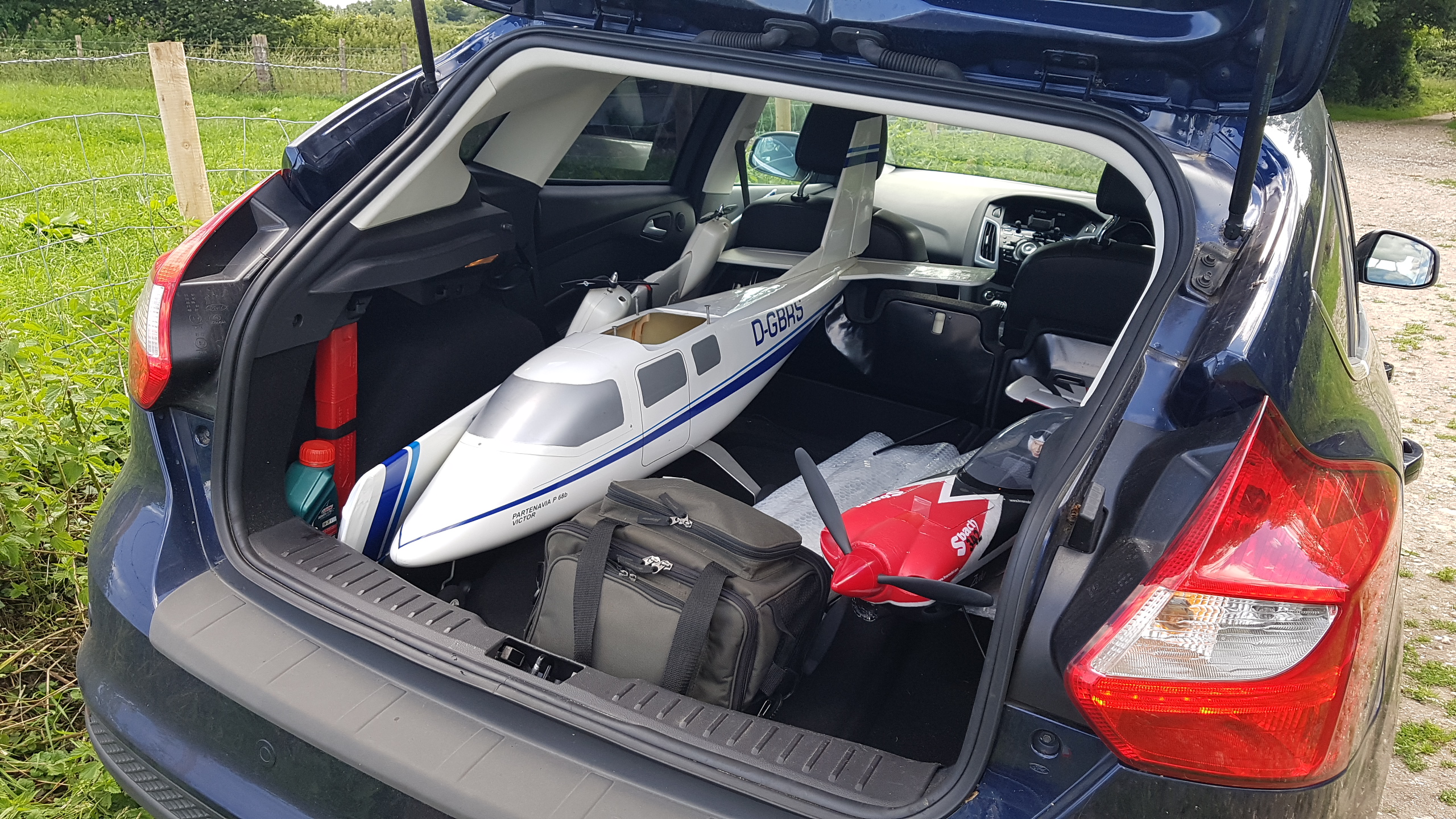
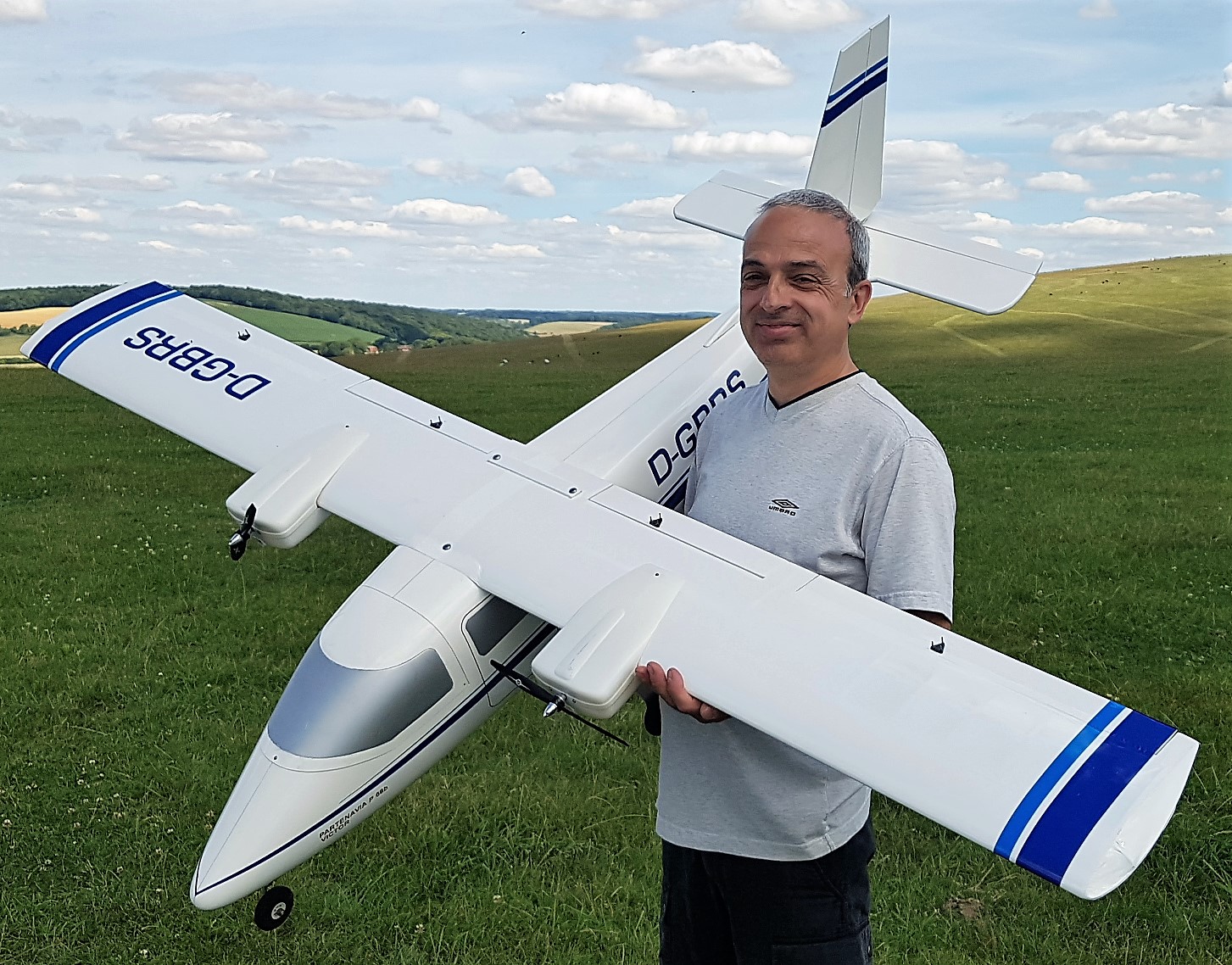 Mini-Mike has fitted the Victor with a pair of Tornado Thumper 3542 1250KV motors that are powered by a pair of 4 cell 3300 lipos. There’s plenty of room in there to fit whatever batteries he wants and one very cruel person was overheard saying that Mini-Mike will be useful when it comes to the lambing season! I’ve no idea what they meant…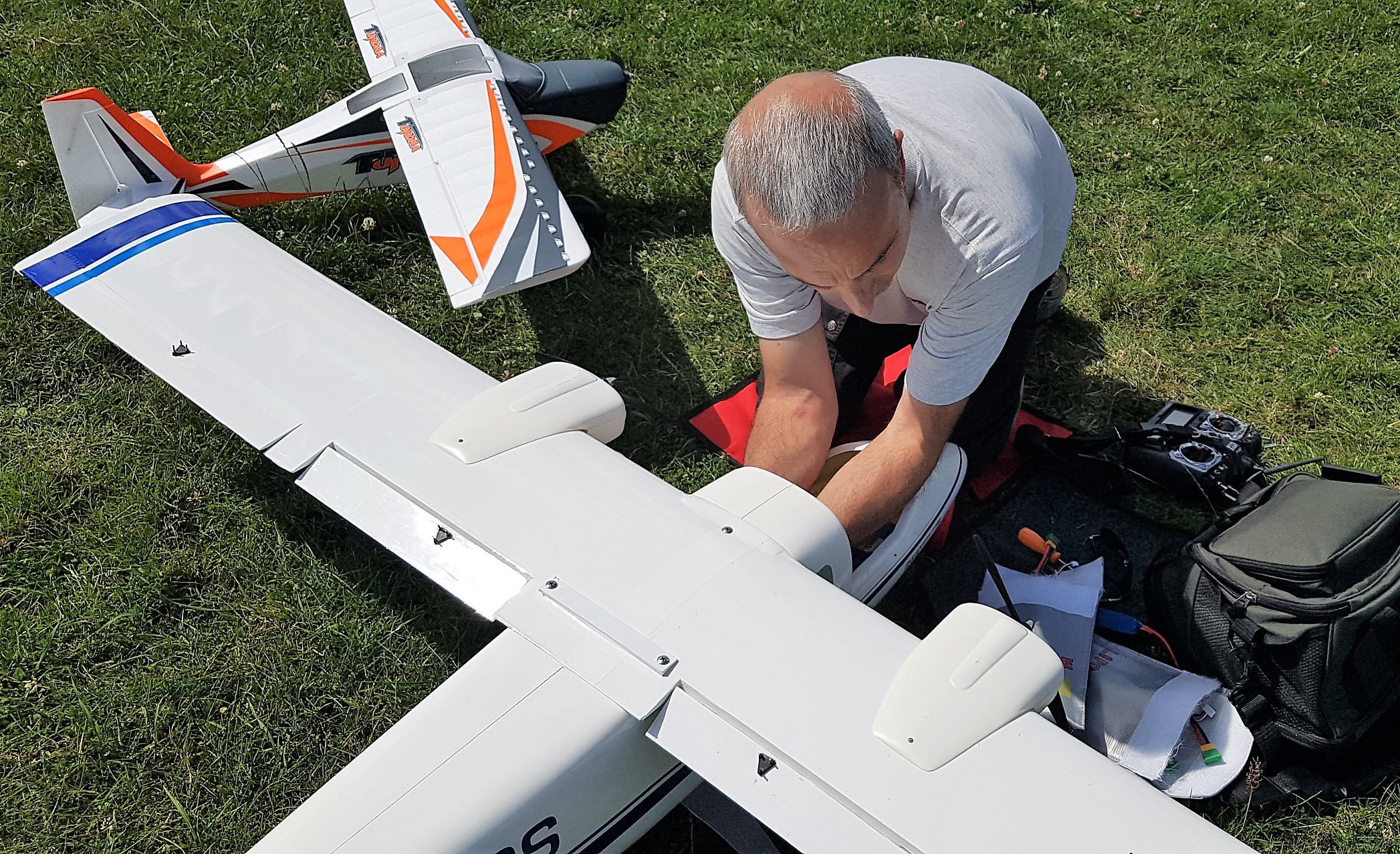
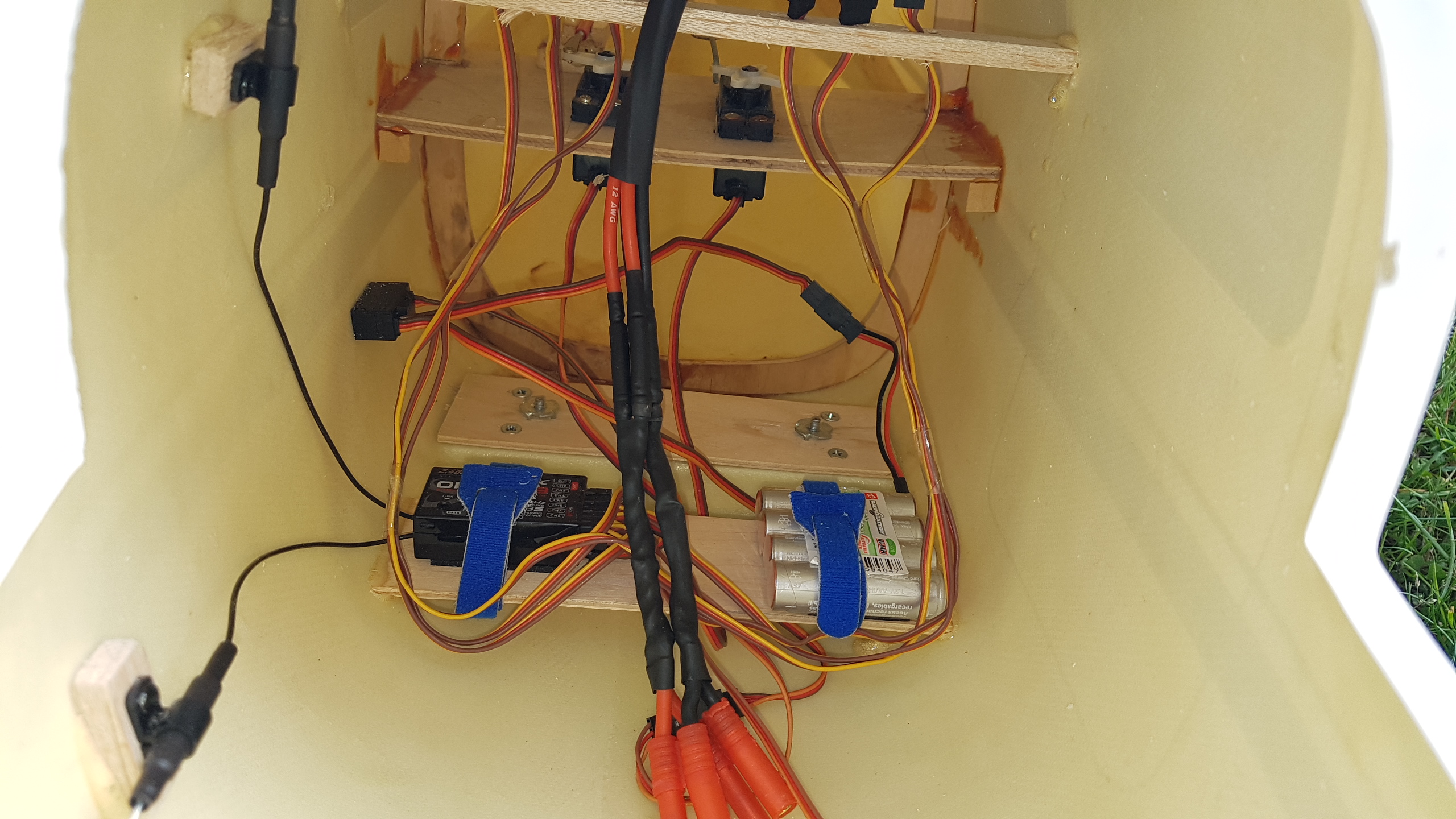 He said the 1250KV is too high and even using 9×6 props the motors are pulling more than the stated maximum current but he decided to see if it would fly and then decide what changes to make. He needn’t have worried, the Victor shot into the air despite the motors sounding very odd. Once he’d reached cruising height and raised the flaps the model burbled around on about third throttle but even then the motors didn’t sound too happy.
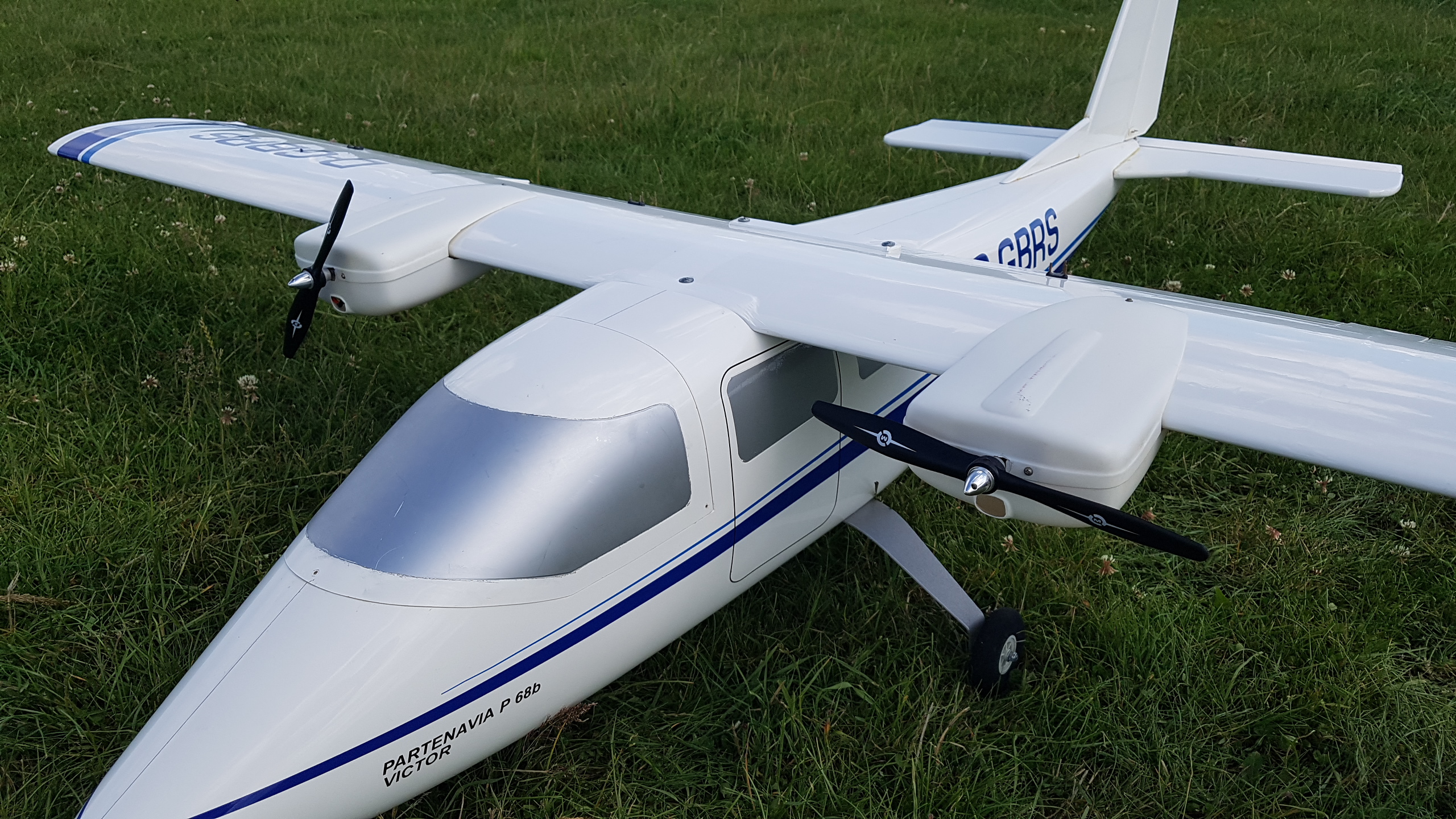 It was reminiscent of Bob’s Easy Twin that had similar problems with erratic running motors which he eventually solved by replacing the Y-lead between the receiver and speed controllers. Anyway, the Victor stooged around for several minutes, looked great, and was otherwise problem free. Not wanting to push his luck Mini-Mike called landing, lowered the flaps, and discovered the Victor floats on a lot but made a nice landing just off the patch.
We were very pleased to have two prospective new members attend the field towards the end of the month and I understand Page Boy will be bringing a third one along with him soon. The first to appear was Chris Winkworth who initially came along one Sunday while we were sheltering from the rain in the barn. Chris brought along a model he’s been building on and off for a few years and it was given a thorough going over by us all, poor Chris!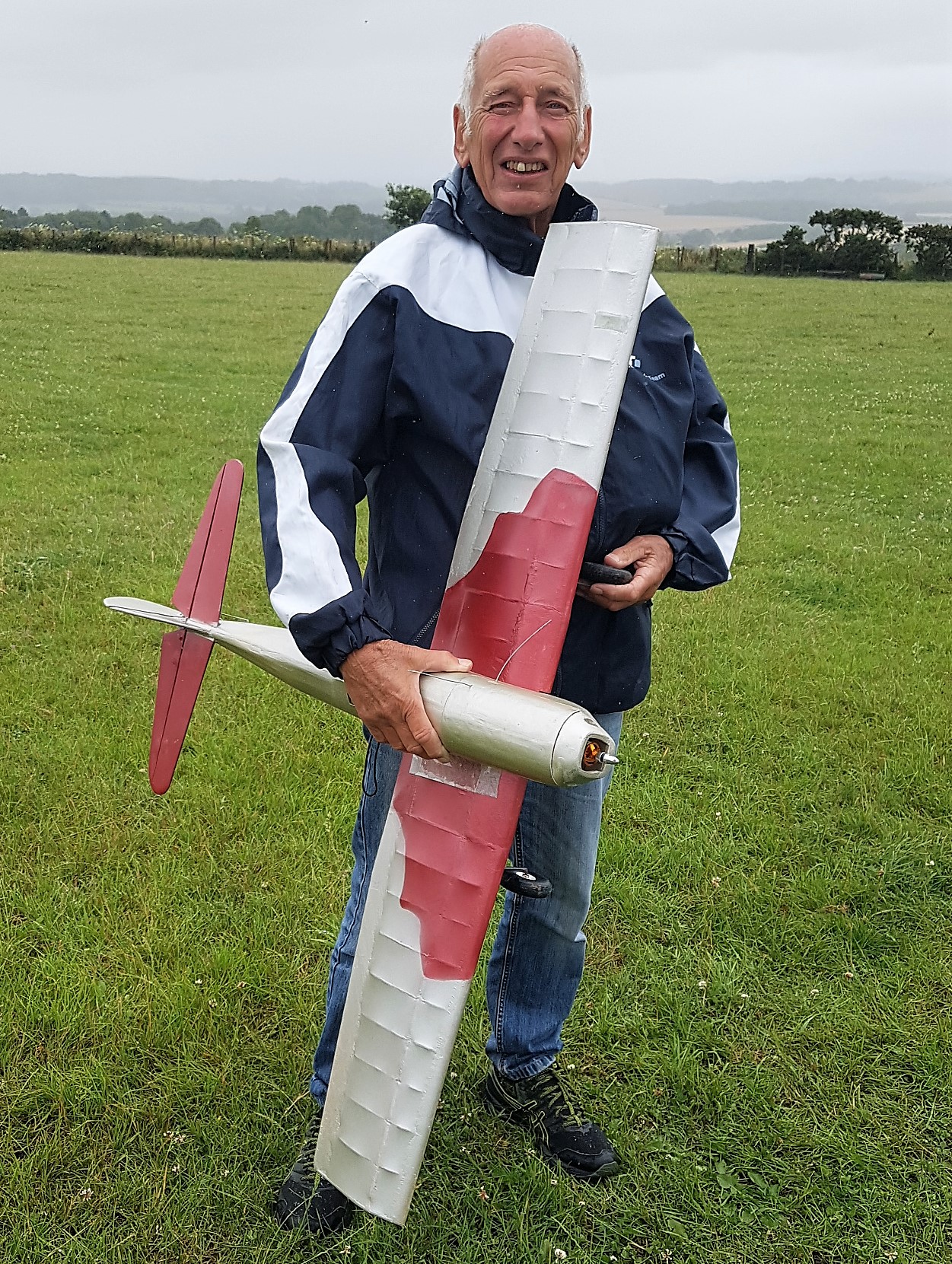
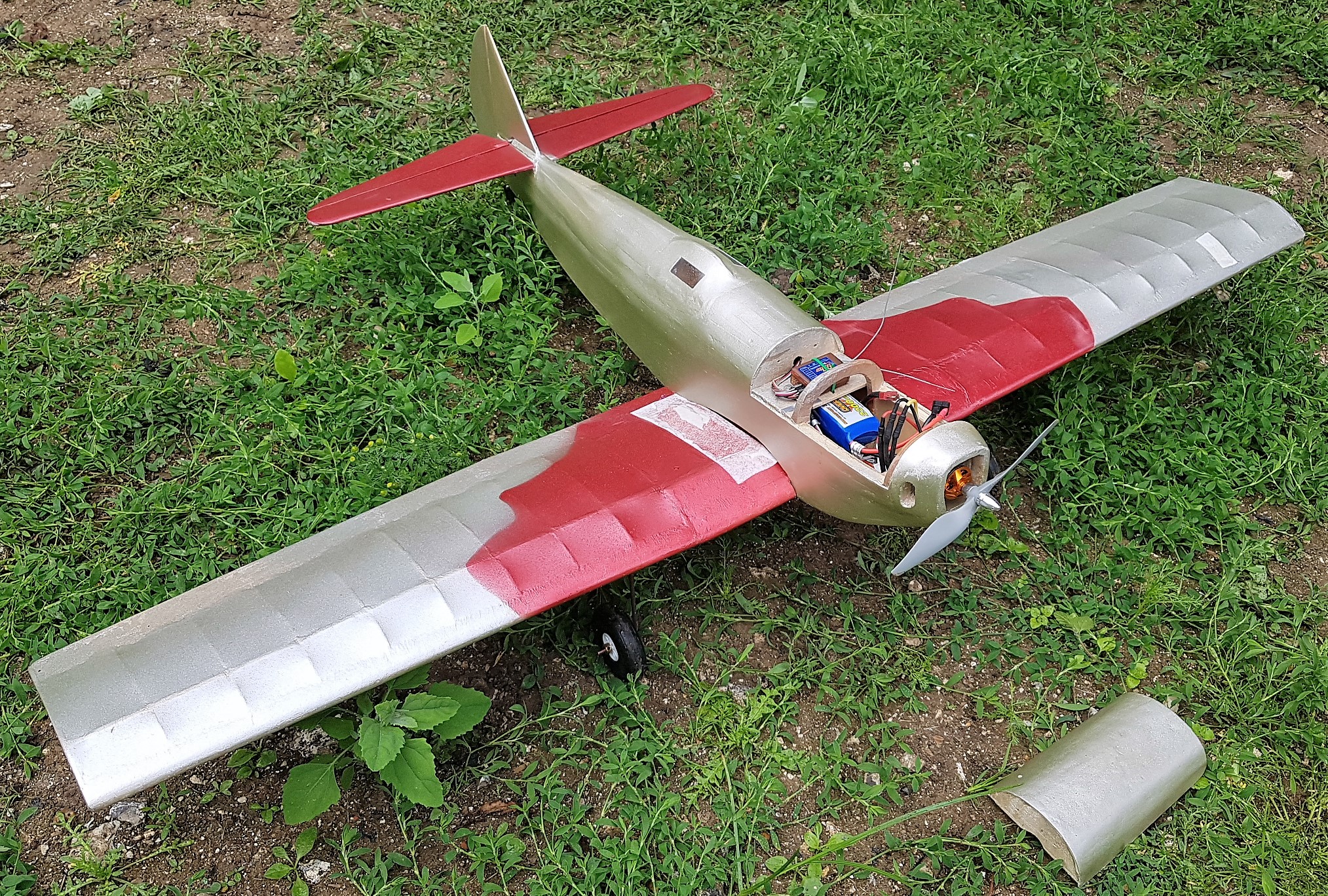 It’s a tissue covered semi-vintage style low-winger but currently only has rudder and elevator controls. The general consensus was that with almost no dihedral it’ll need to to be fitted with some ailerons before anyone risks flying it.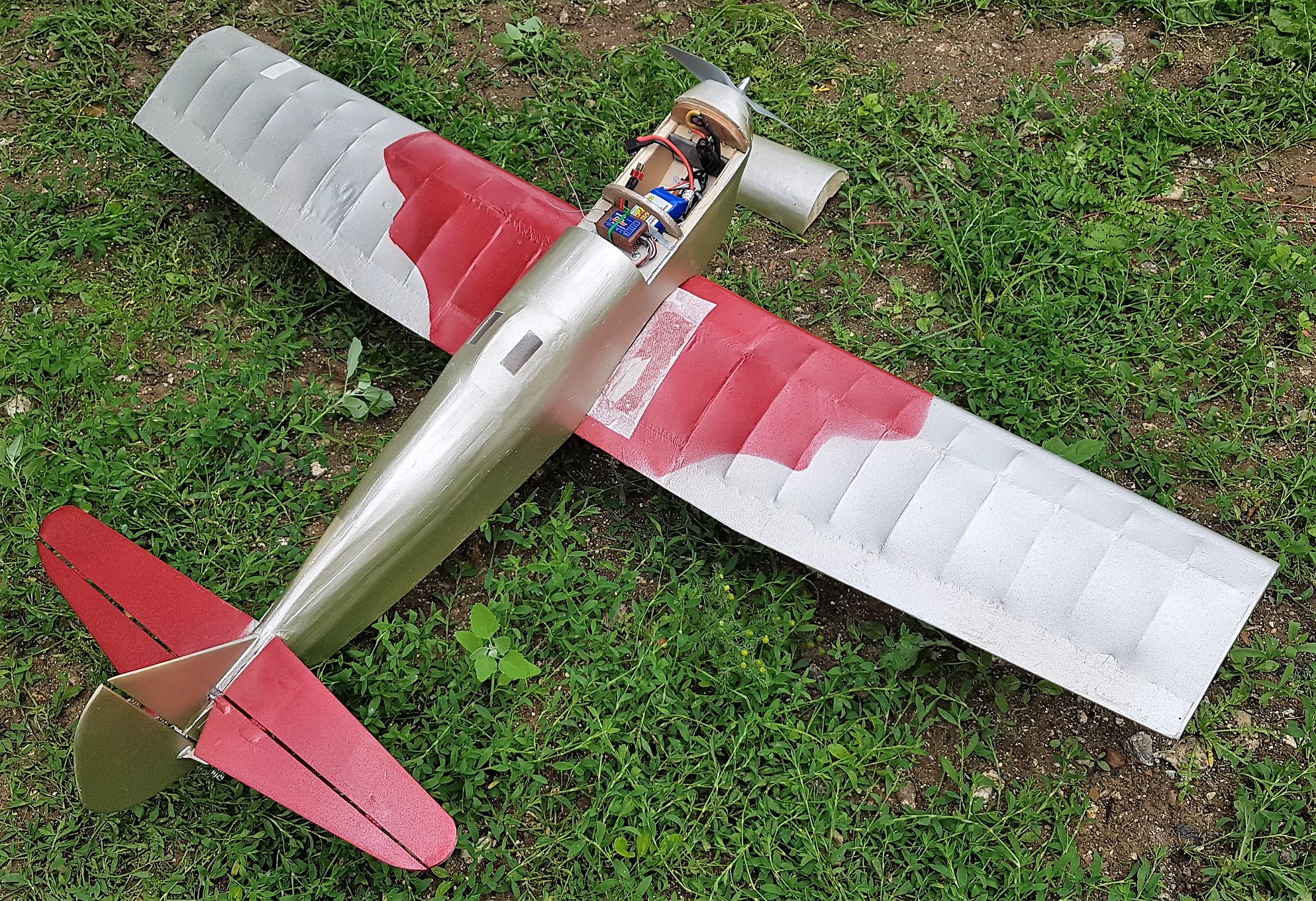
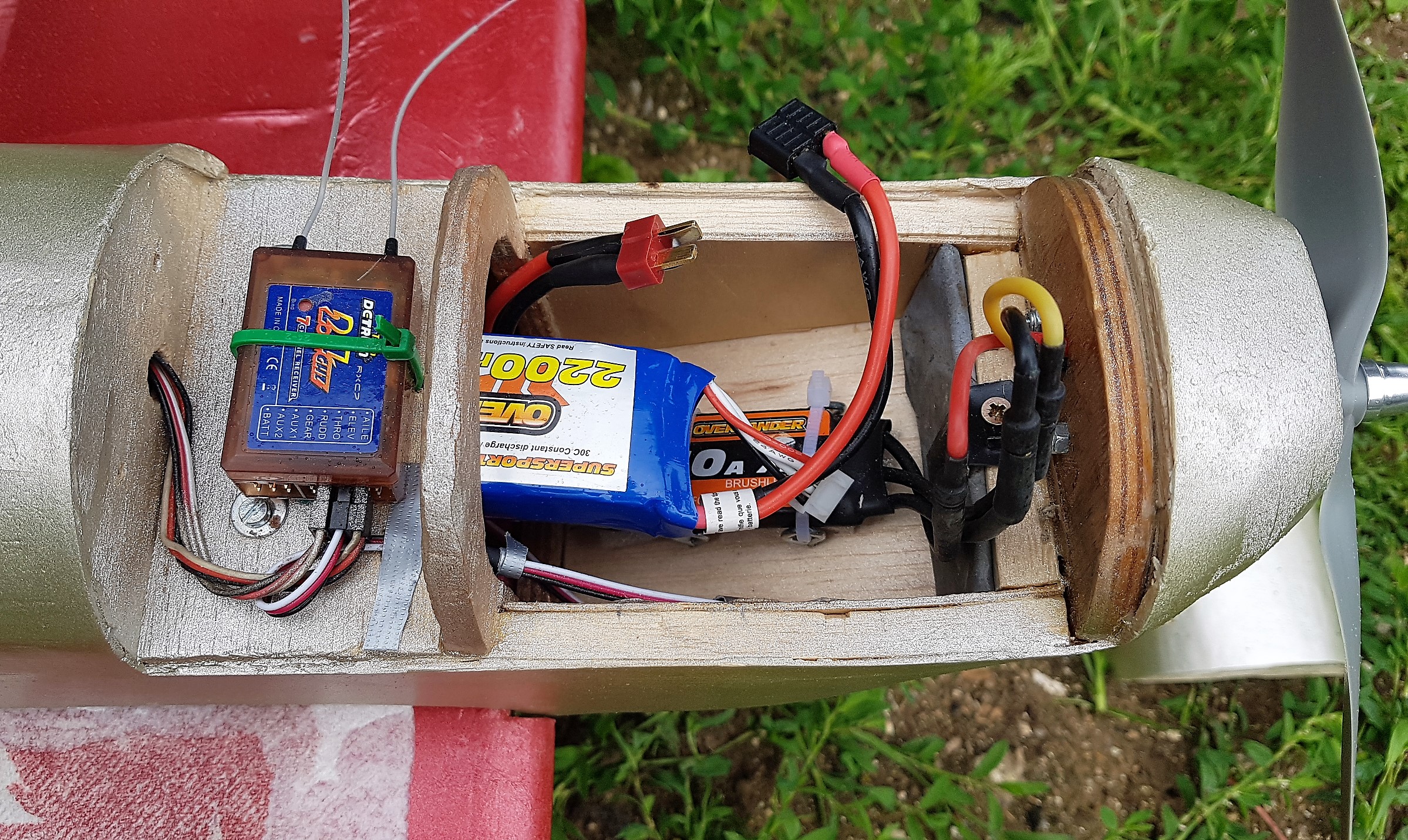 Dougal Entendre got really excited when he spotted that Chris had a make of radio that he’d never heard of before! It’s a Detrum 2.4G GAVIN-6A 6CH. Dougal found the manual online quicker than you could say ‘Google’ and immersed himself in that for the rest of the morning. Chris was very heartened to know that even if the model doesn’t fly and gets smashed to bits he can always flog the radio gear to Dougal for a zillion pounds!
The second newbie was 11 year old Charlie who was brought along by mum Nadine. Charlie came equipped with an FMS Easy Trainer, a 1280mm spam foamie with a top mounted pusher motor powered by a 2 cell 1200mAh lipo. I think it must have come as a PNP including the radio gear as the transmitter is a small toy style one with manual trims. I haven’t seen manual trims for years, they seemed very odd having long been used to electronic ones.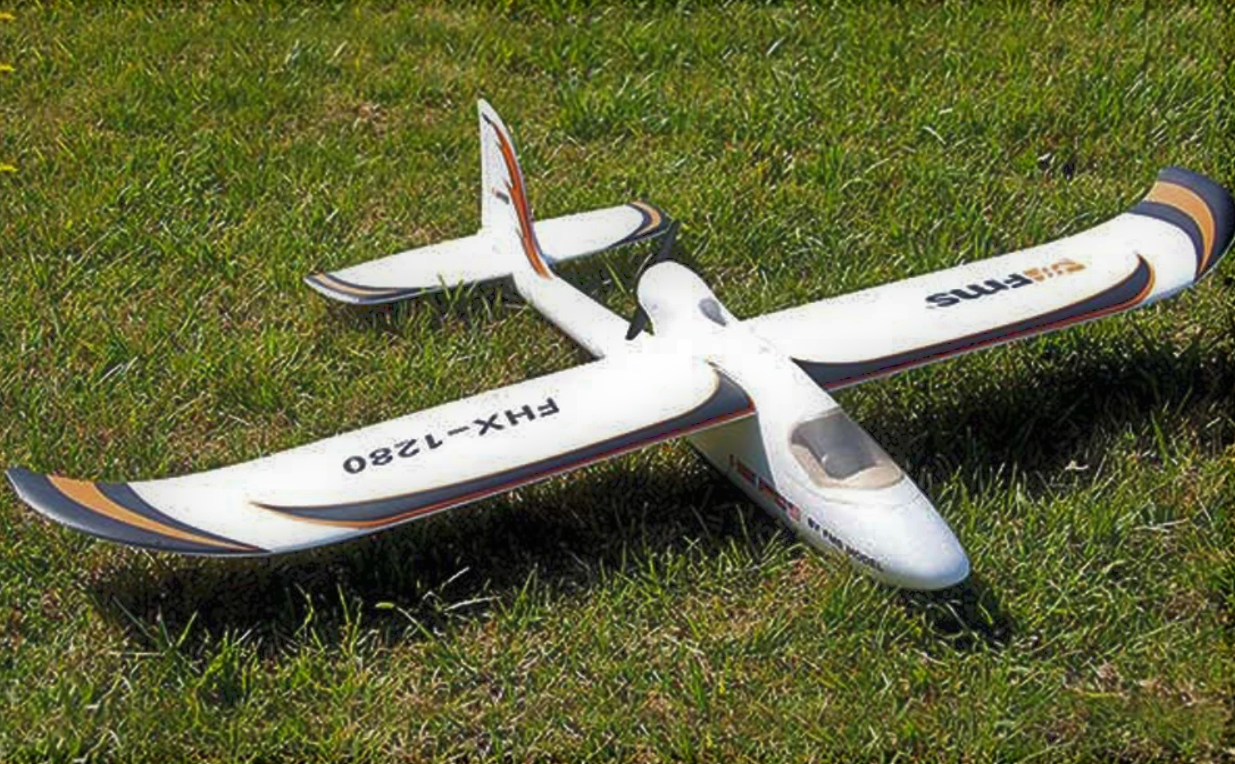 Bob the Builder gave the model a thorough check over with Charlie and made sure everything was as it should be and in doing so discovered the lipo was only 31% charged. None of us had any 2 cell packs with us so the test flight would need to be a very short one. I was nominated as test pilot and can report that the model was perfect, no trims required, it handled the fairly windy conditions well, and should be an ideal trainer for Charlie.
Knowing that we had some new kids on the block Captain Slow and Woody sorted out a buddy box set-up for the newbies to learn on which consisted of Woody’s Wot Trainer and a pair of Spektrum transmitters with a buddy lead. Captain Slow and I test flew the model and trimmed it out before handing the slave transmitter over to Chris to try. It all went well so after a quick battery change Charlie had a go and again everything went well.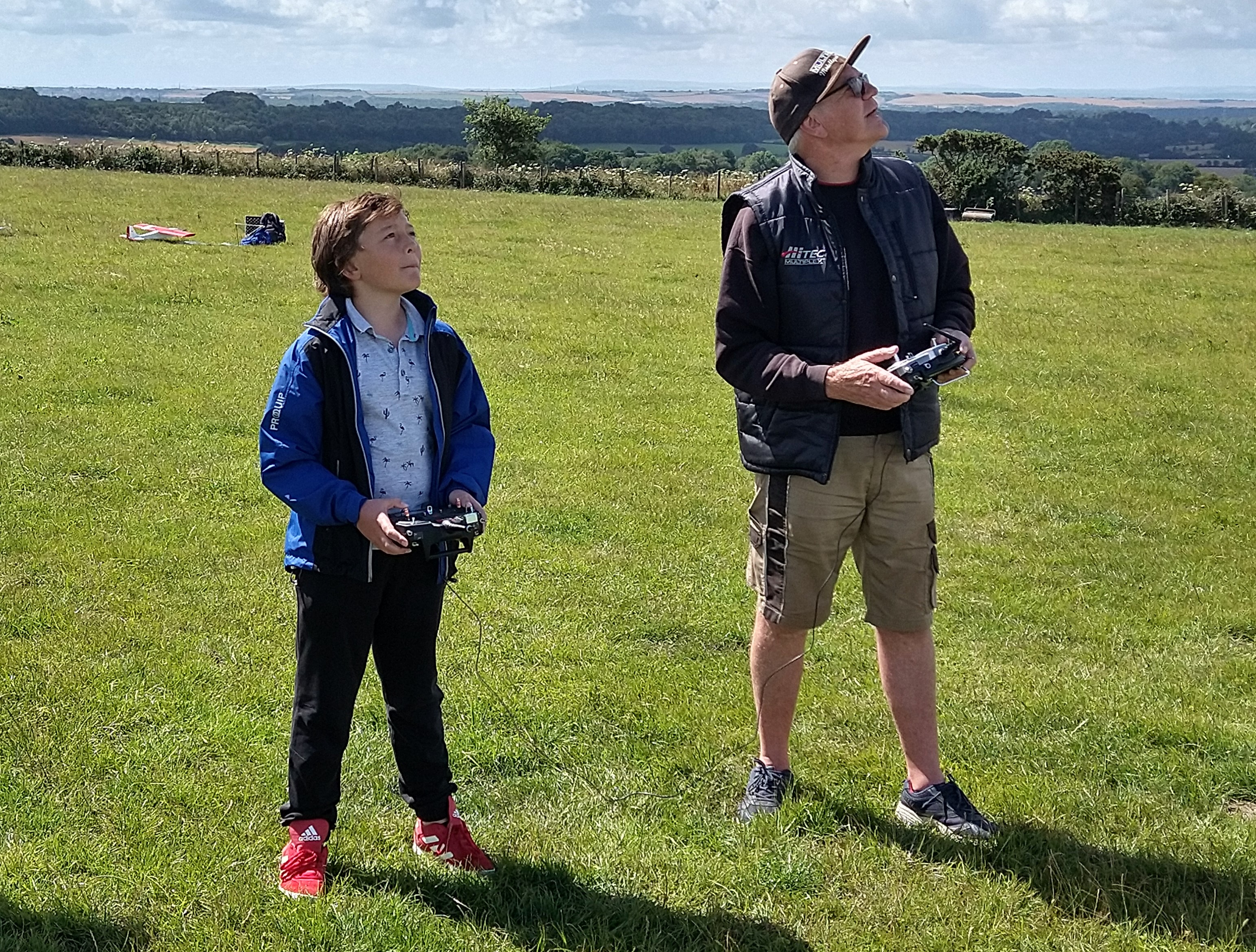 They both over-controlled as beginners always do but after a few minutes they were getting the feel for it and should be fine given so more practice. We had enough lipos to give them both another flight and this time Dougal was given the Chief Test Pilot’s hat. He soon handed control over to Chris and all fine for a few minutes.
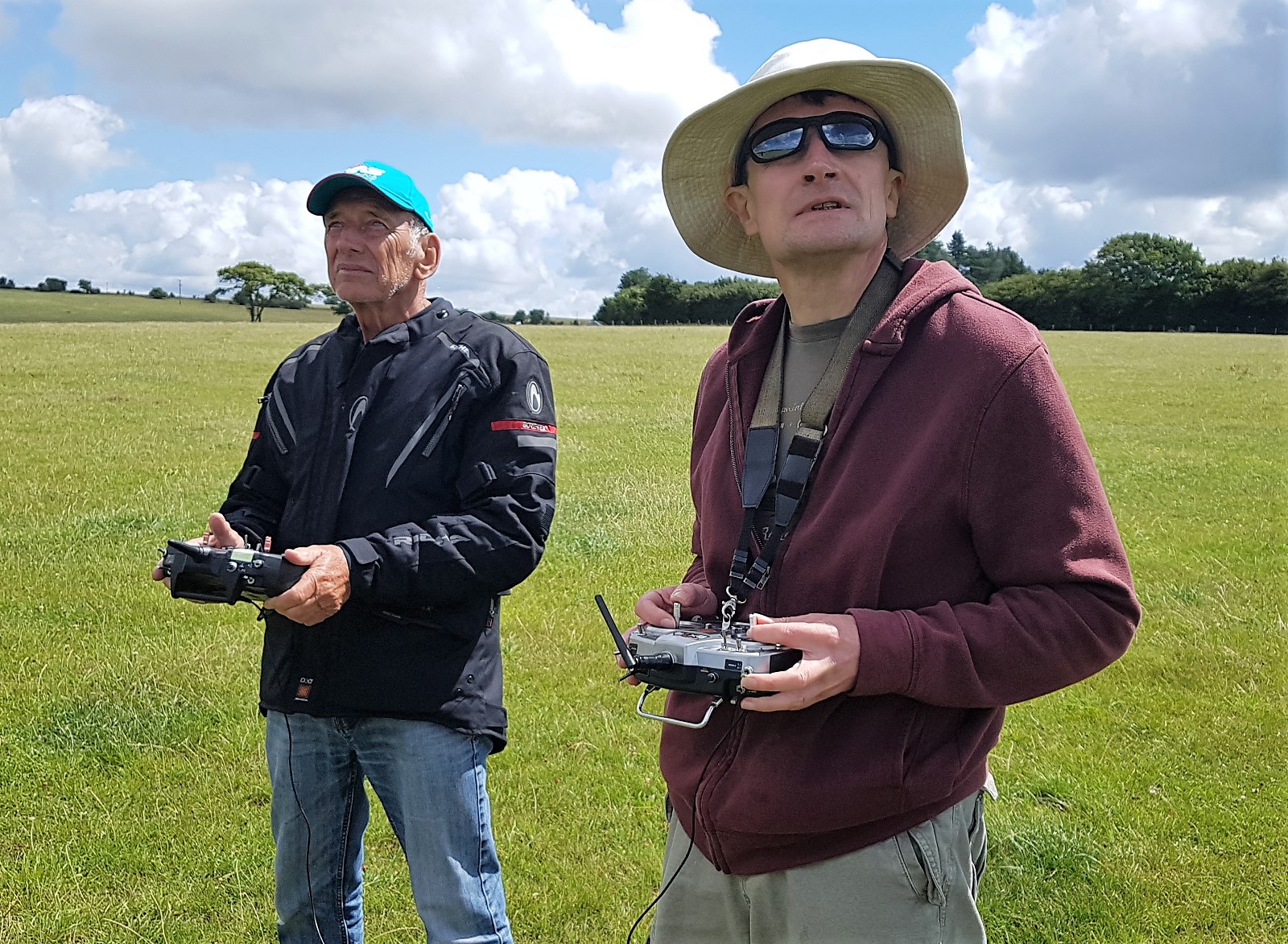 But Dougal suddenly found he had no power although the radio seemed to be working ok. The model came down in the valley but fortunately the damage wasn’t bad, just the tail broken off. We initially assumed he had run out of battery but when checked it there was about 60% remaining. The motor was tested and appeared to be fine so that only left the radio. Further checks will be carried out but it would seem to be yet another case of b….dy Spektrum…
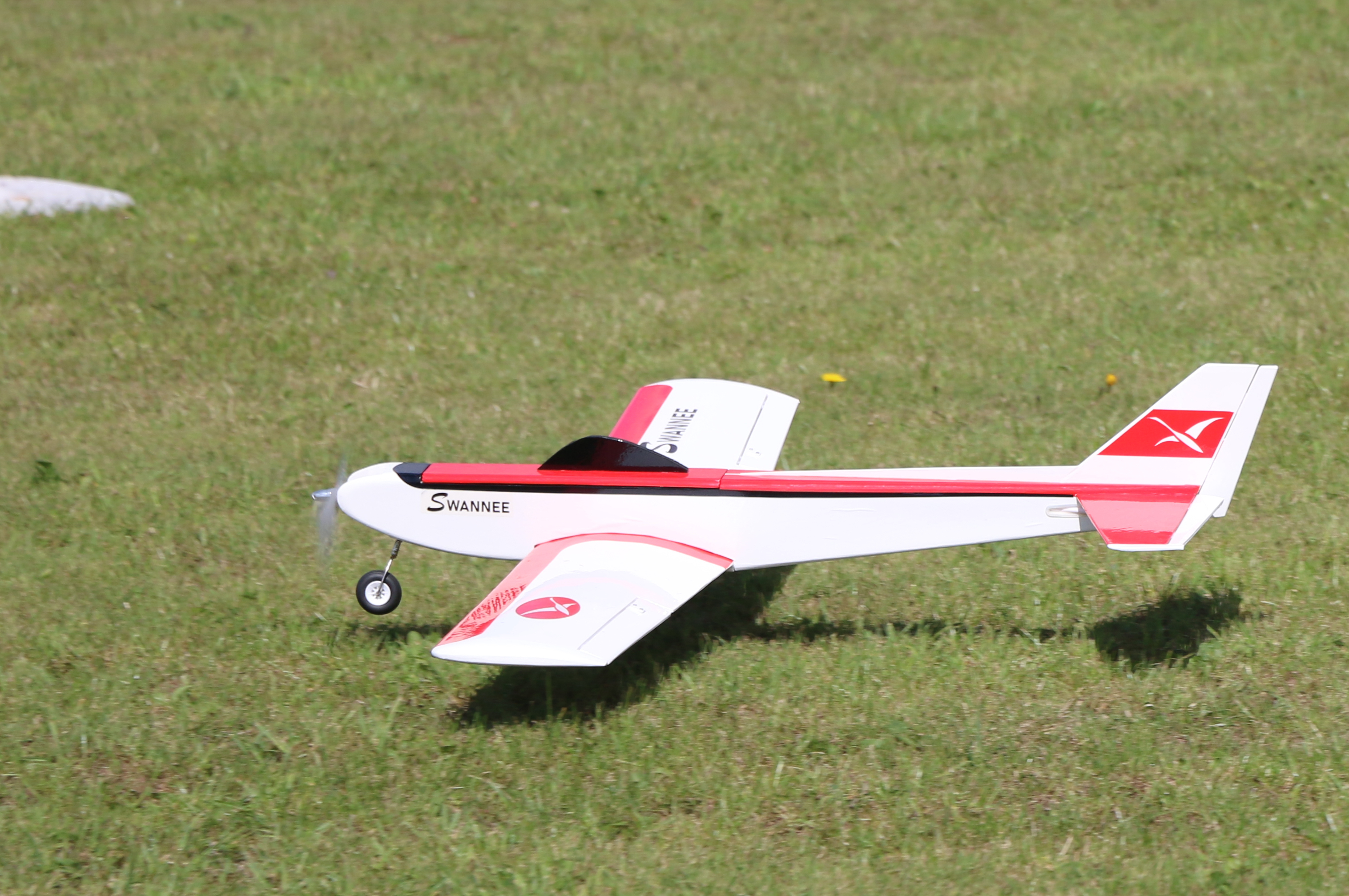
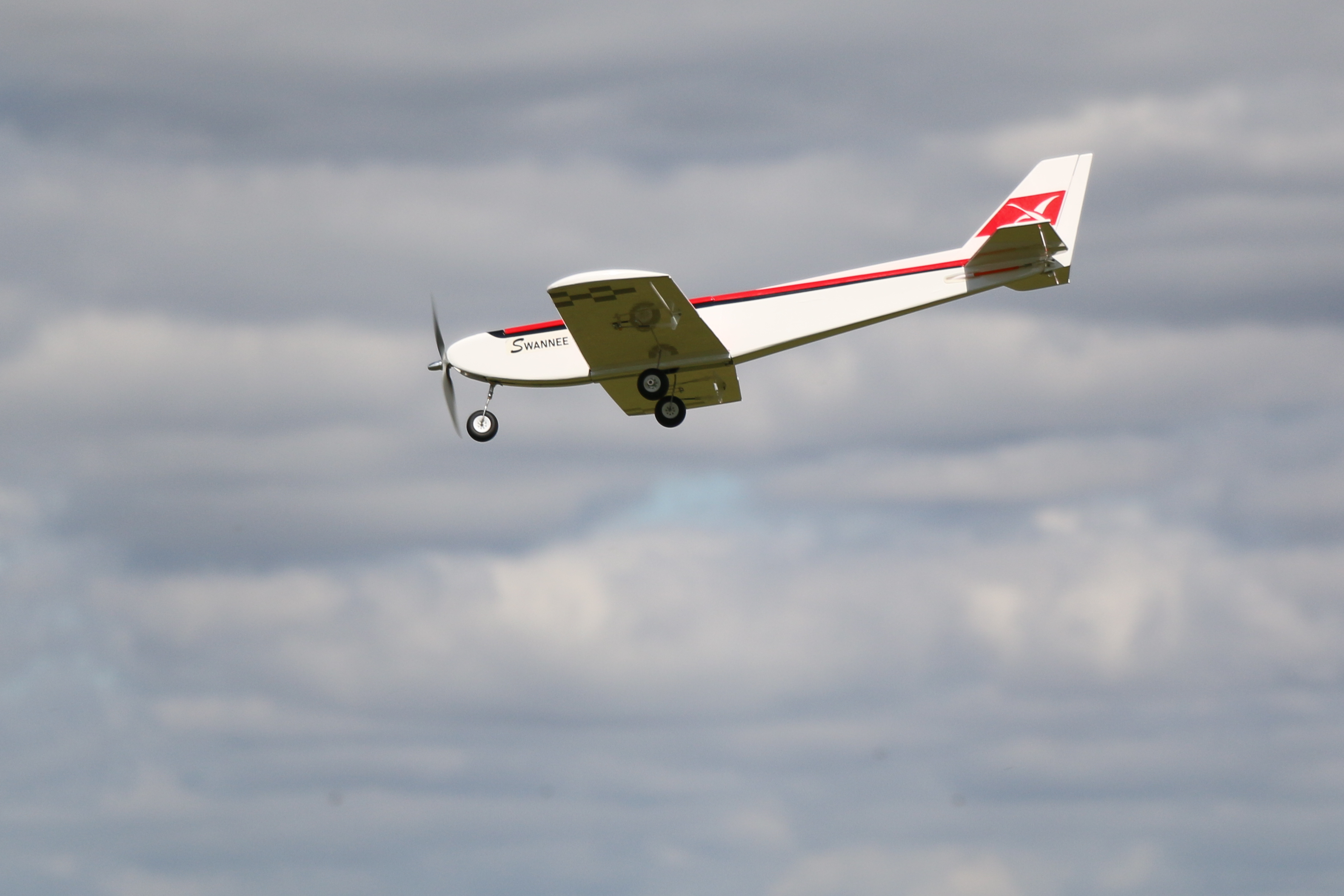
Over the winter Kryten built himself a new Swannee, a conversion of a single channel model that he had first built way back in 1966. I featured the new Swannee in June this year so I won’t bore you with the details again, suffice to say that this one has electric power, throttle, rudder, elevator, much reduced dihedral and ailerons. Kryten’s made a lovely job of the model and has been waiting quite a while for a decent day to test fly it. The Swannee is a low-wing model which was quite unusual back in the days of rudder only control and Kryten’s never flew very well.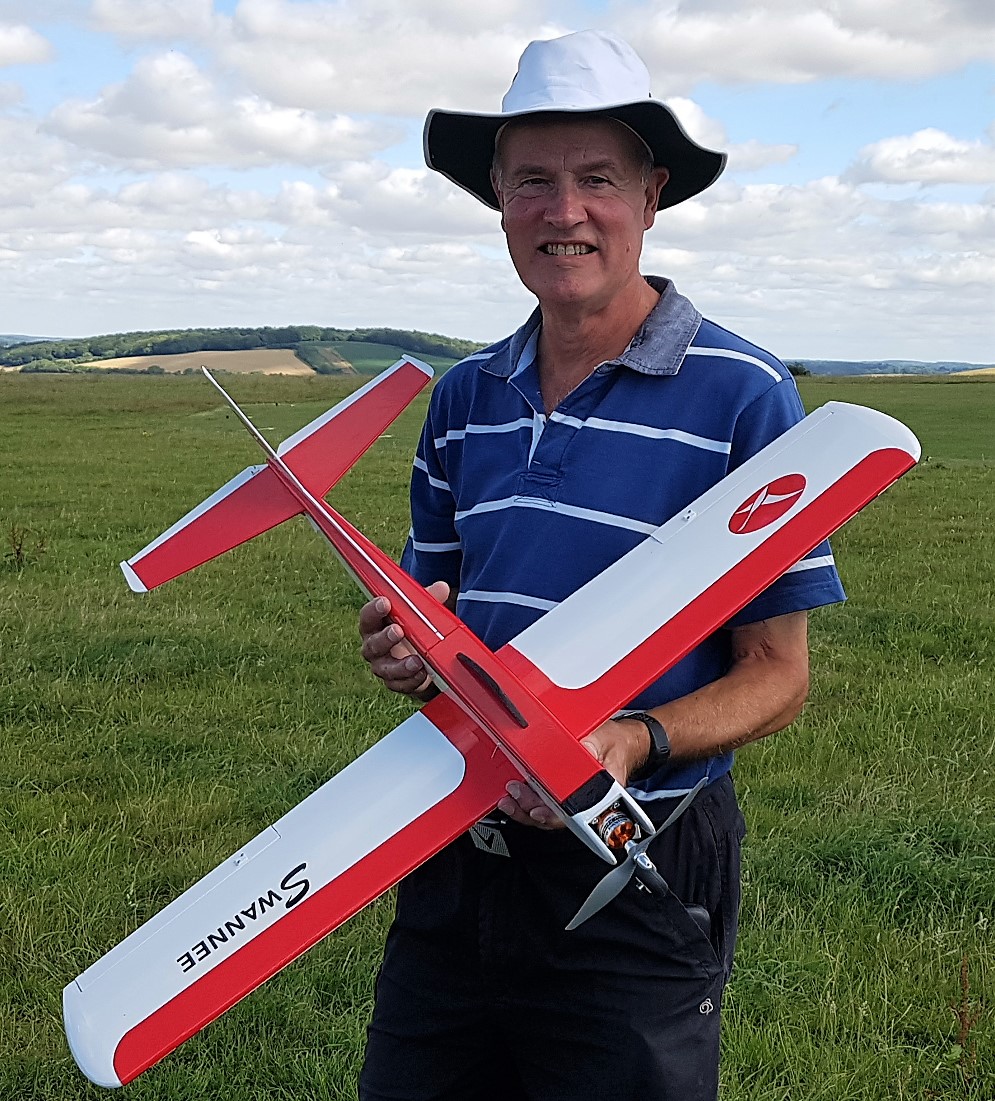 Kryten thinks that was probably more down to his lack of building skills and a decent building board than the model design so we had high hopes for the new version. We weren’t disappointed and, after the addition of some down elevator trim (not surprising as single channel models had to climb under power) Swannee flew beautifully. Success after just 54 years! Kryten managed to take some flying shots while I did the test flight and I shot some video while he was flying it. It was too late to add the video this month but you’ll be able to see Swannee in action next month.
Apparently I missed the fun one Friday afternoon when Woody landed the wrong side of a barbed wire fence and managed to get himself totally caught up on it. He spiked his left arm and caught the right leg of his trousers on the top strand was unable to move, remaining trapped until 1066 spotted his predicament and went along to free him. The sad part of the tale was that nobody took any photos of the woeful Woody! Captain Slow promptly re-named him Major Disaster and continuing with the ranking theme Chris Winkworth will henceforth be known as WingCo.
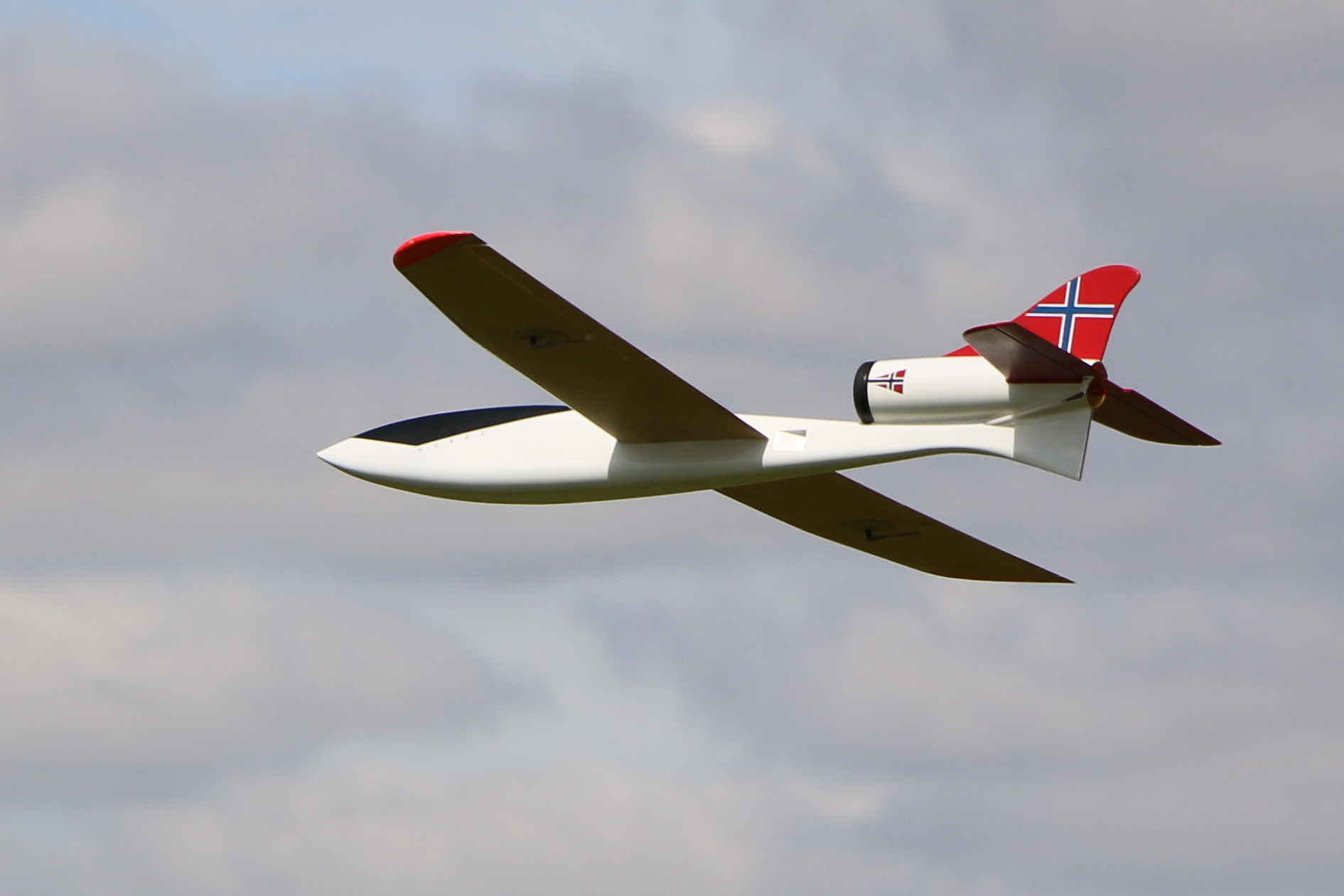
Kryten brought his decent camera along in July so I have some of his excellent quality flying shots for you to see, Nick’s Sabre in particular looks superb. Apparently the only usable shot he got of my Stearman was as I was doing an emergency landing because the battery was hanging out. A likely story Kryten, I’ll remember that…!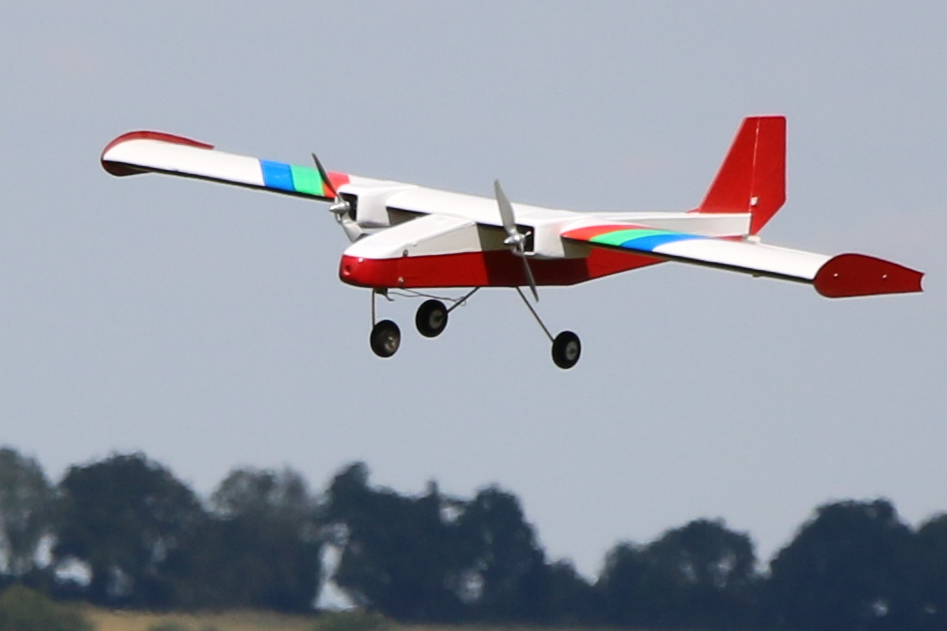
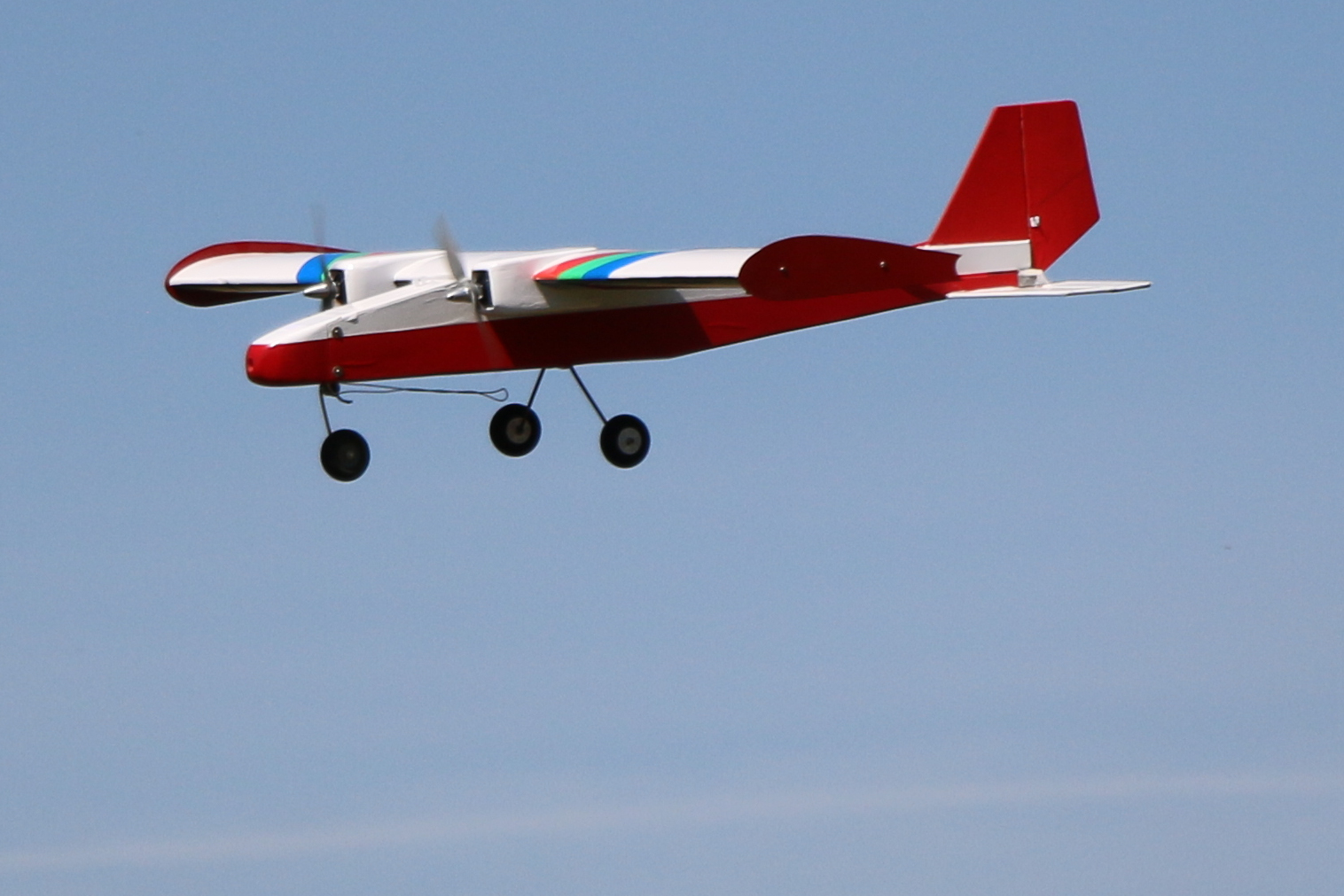
Video time now, this month with additional contributions from Dougal Entendre and Captain Slow, thanks guys.Please watch the video full-screen, it’s so much better with small models flying around.If the video won’t play for you please click HERE
A Beechcraft KingAir (a ten seat, twin engine aircraft) had just left the runway on take-off when there was an enormous bang and the starboard engine burst into flames. After stamping on the rudder to sort out the asymmetric thrust, trying to feather the propeller and going through the engine fire drills with considerable calmness and aplomb, the stress took its toll on the Captain.
He transmitted to the Tower in a level friendly voice: “Ladies and gentleman. There is no problem at all but we’re just going to land for a nice cup of tea.”
He then switched to Cabin Intercom and screamed at the passengers: “Mayday. Mayday. Mayday. Engine fire. Prop won’t feather. If I can’t hold this asymmetric we’re going in. Emergency landing. Get the crash crew out.”
The aircraft landed safely but with the passengers’ hair standing on end.
Colin Cowplain
Patch News – June 2020
As I begin writing this edition the country is slowly returning to normal, or at least ‘the new normal’ and many members have managed to get some flying in. The gradual easing of the lockdown rules has also made life easier for patch maintenance and it’s been mown several times which has brought it back to almost pristine condition although the lack of rain has caused it to go rather brown. The mowing has been led mostly by 1066 and Captain Slow has managed to keep the fence going throughout lockdown with regular charging and changing of the battery.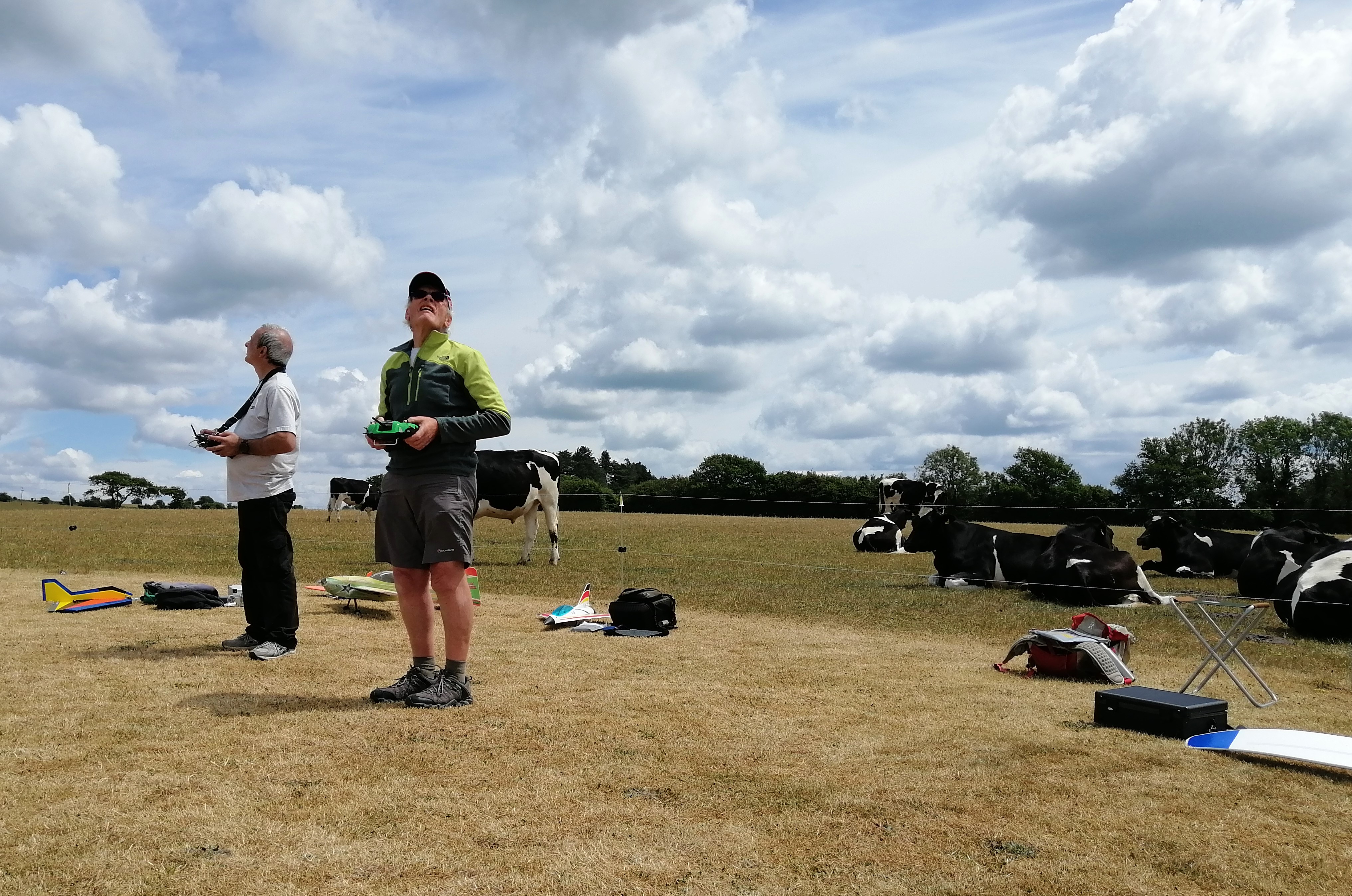 At the end of May the bullocks returned and tended to join pilots alongside the patch but they’ve learnt not to touch the fence so haven’t caused us any serious problems. It would be nice if we could teach then not to wander across the take-off and landing areas at critical moments but overall they’ve been more of an irritation than a problem.
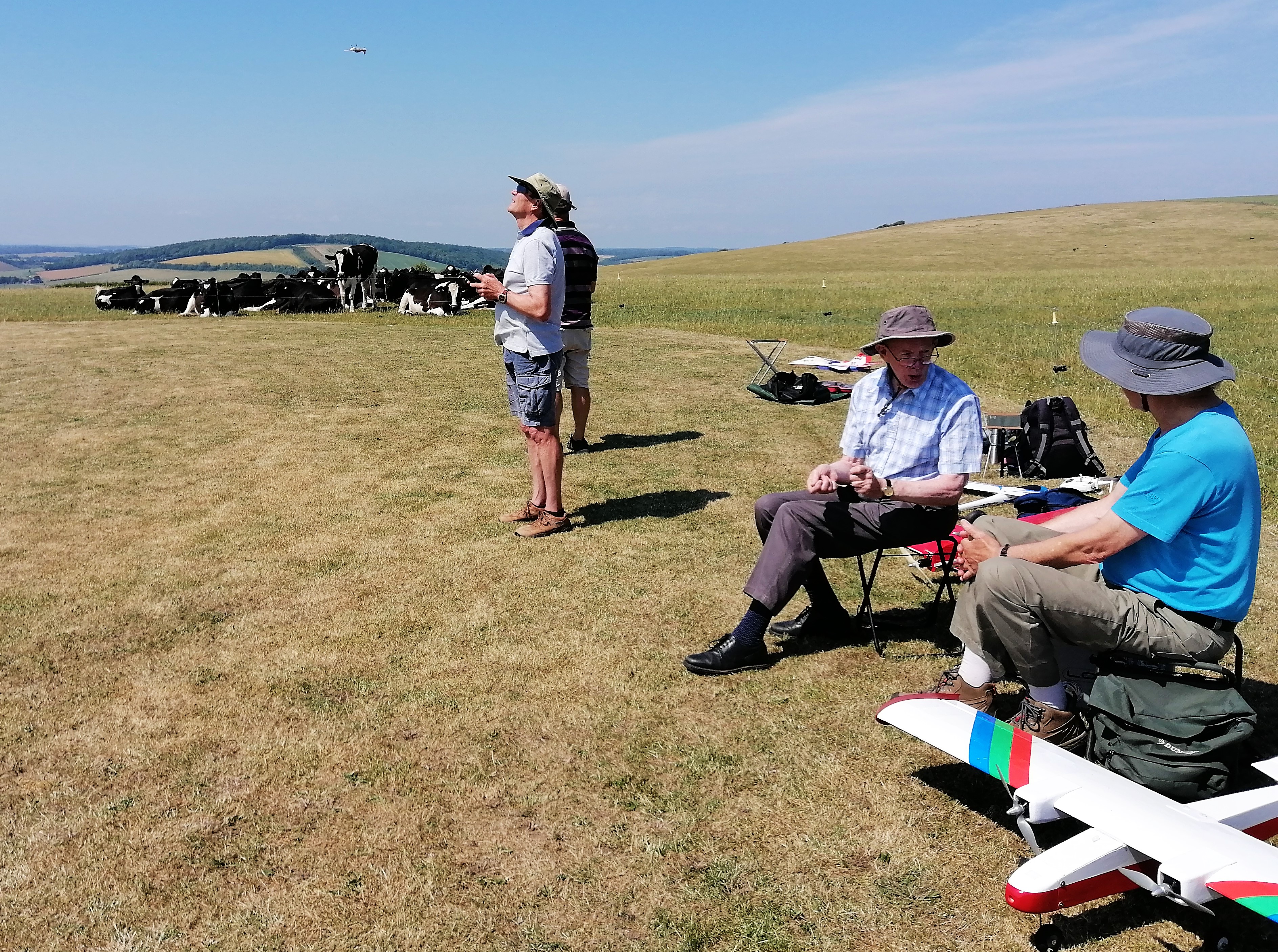 Dougal Entendre tells me that Woody backed into the live fence during one session and rather disturbingly he seemed to enjoy the shock! Mike Smith did the same thing next time out but apparently found it less enjoyable. This time the bullocks visit was only a brief one and at the time of writing the field is bullock free again. Oops, you can ignore that, on Friday 26th Woody reported that the bullocks would be returning and sure enough they’re back.
During lockdown there were so many new models being built that I was overwhelmed with material for Patch News so I expected to be able to report on lots of maiden flights but that just hasn’t happened. With the restrictions of the number of pilots at the patch I haven’t attended as much as usual so I expect I’ve missed a few of the new models but will catch up over the next couple of months. Please send me details and photos of any new models I’ve missed.
One I haven’t missed is Captain Slow’s now infamous Splot. It’s infamous because the build of the really basic, fast to put together model took the Captain two years to complete, and I haven’t missed it because it still hasn’t flown!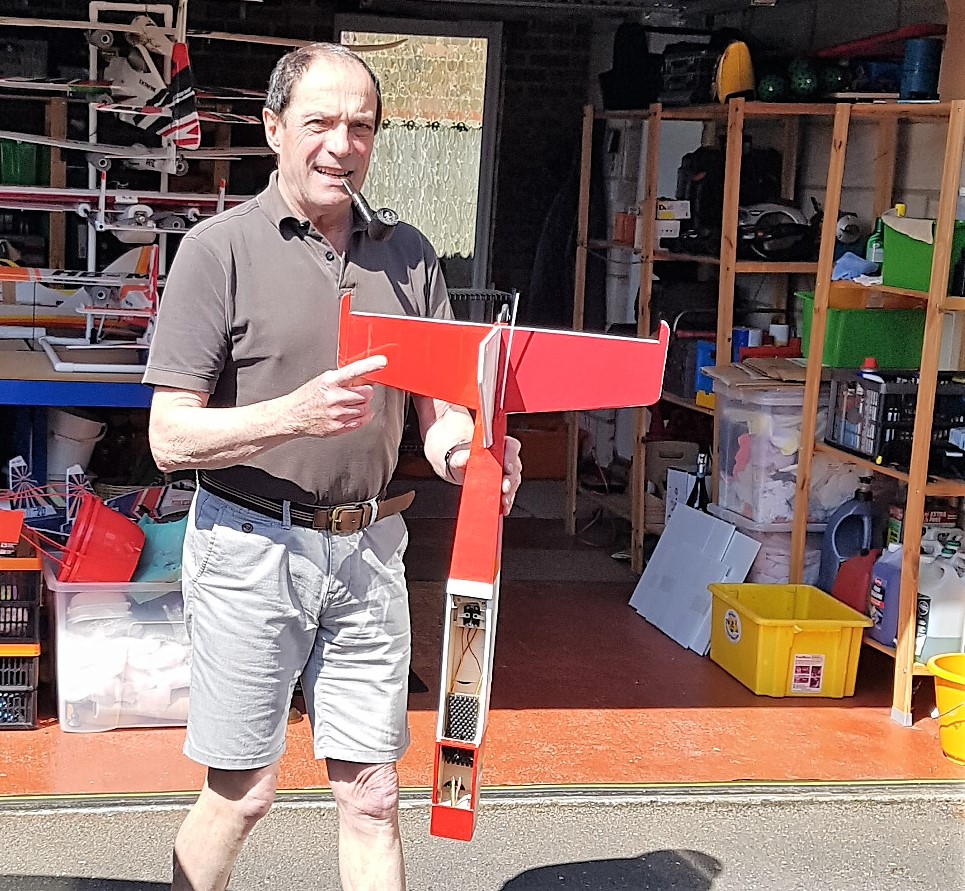
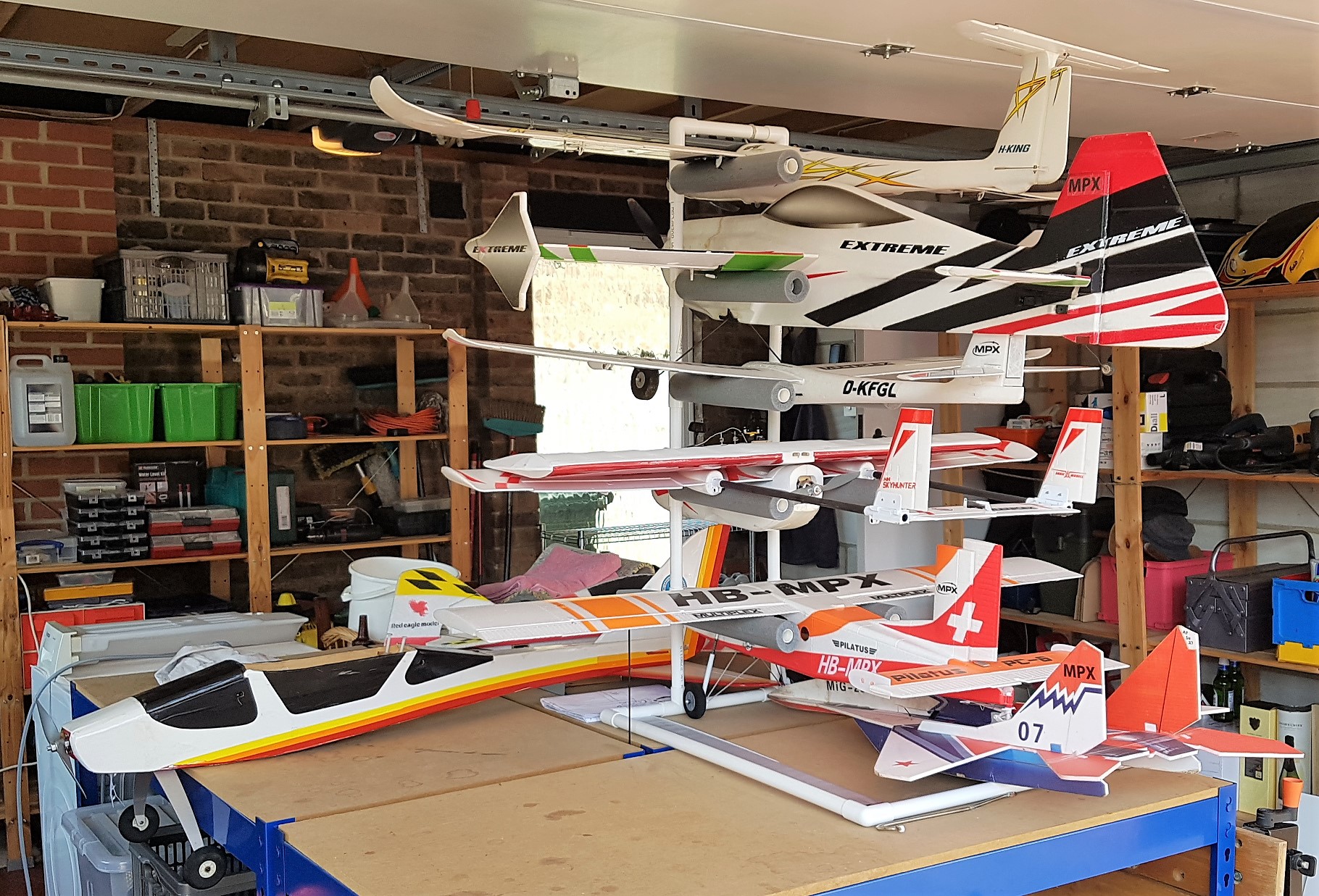 I sneaked a couple of socially distanced photos in mid-April when I dropped by Captain Slow’s place to collect the fence battery and the Splot was virtually finished then but 2½ months later it still hasn’t flown. He swears it’s all finished but doesn’t want to rush into anything. I must admit I am rather jealous of his model storage rack though.
I forgot to include one particular photo in the last Patch News and it’s one that I know you’d want to see. Bob the Builder and I were flying as soon as we were allowed and before the patch has been cut. Because the patch grass was longer than the rest of the field we left the fence up and flew from outside the circle, landing between the pits and the patch. At least that was the idea but Bob misjudged one landing and ended up here: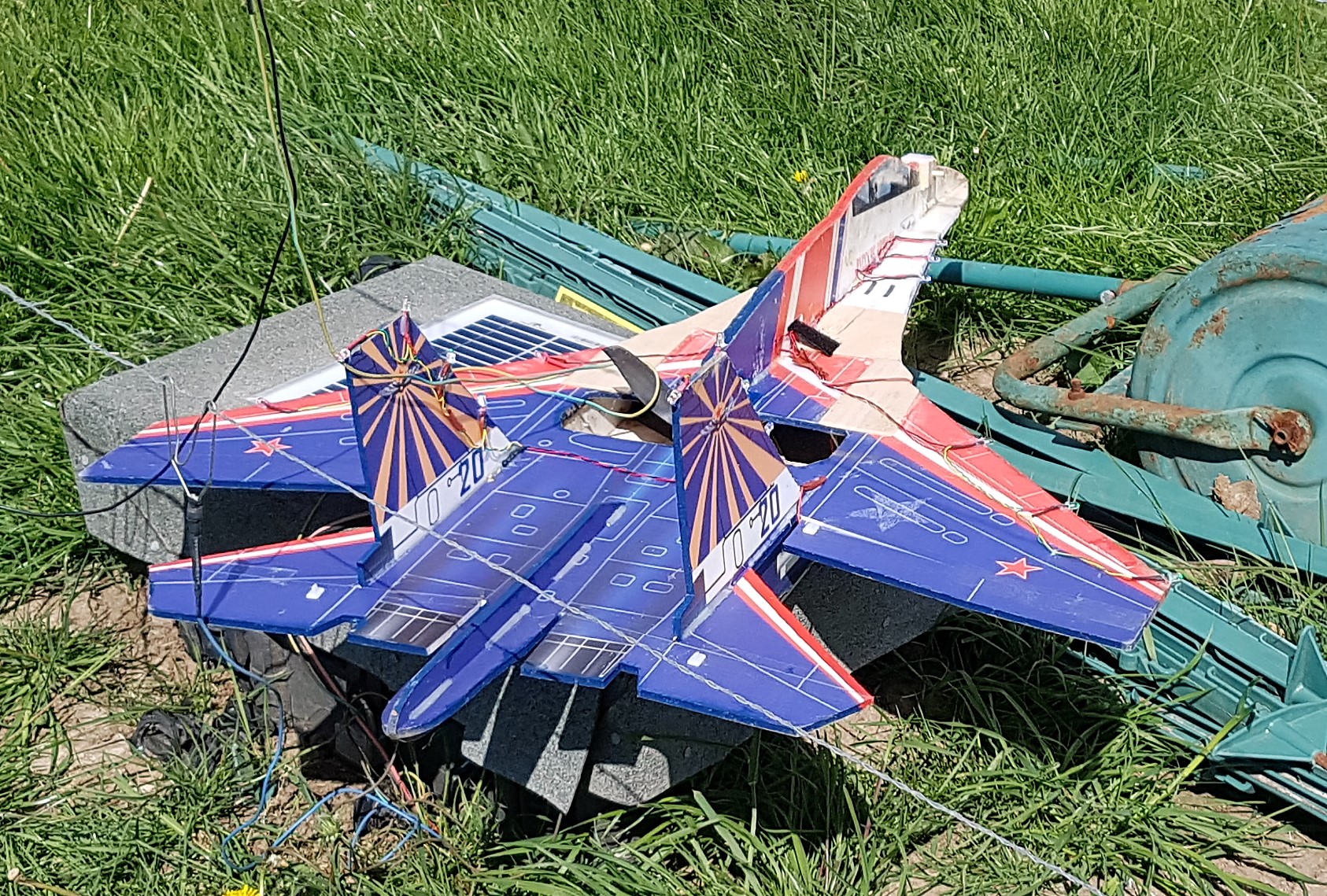 I bet he couldn’t do that again if he tried! Luckily there was no damage, and the plane was ok as well.
Bob has now fitted a pair of new motors to his EasyTwin. The model flew well with the original motors but one of them made some fairly horrible noises at particular throttle settings and Bob could never be sure it wouldn’t suddenly seize up, especially bad news on a twin. So he’s splashed out on a couple of Tornado Thumpers from Overlander. I asked him for some comprehensive details of the new set-up and this is what he sent me: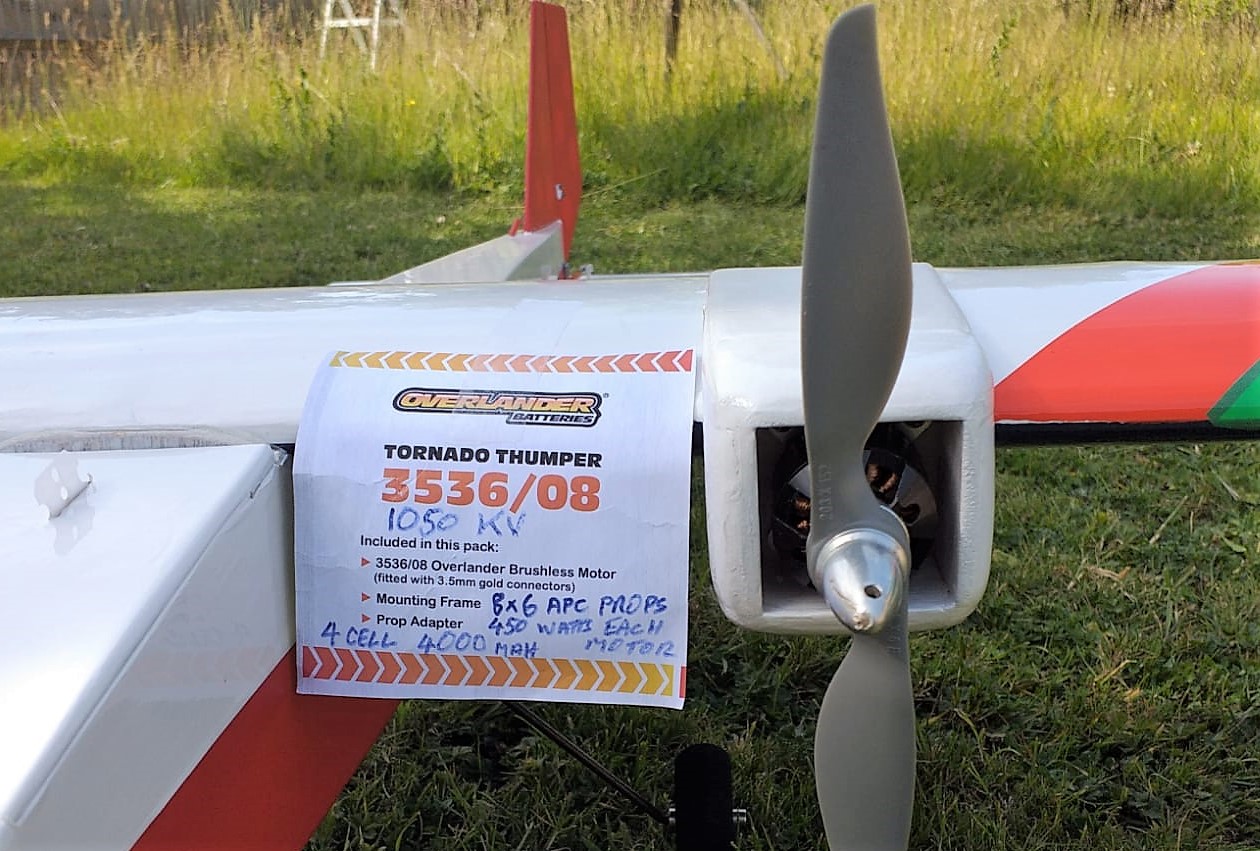 I just can’t get the staff… Oh, he did say “10 minute flights”. It can be seen flying with my BushMule in the video.
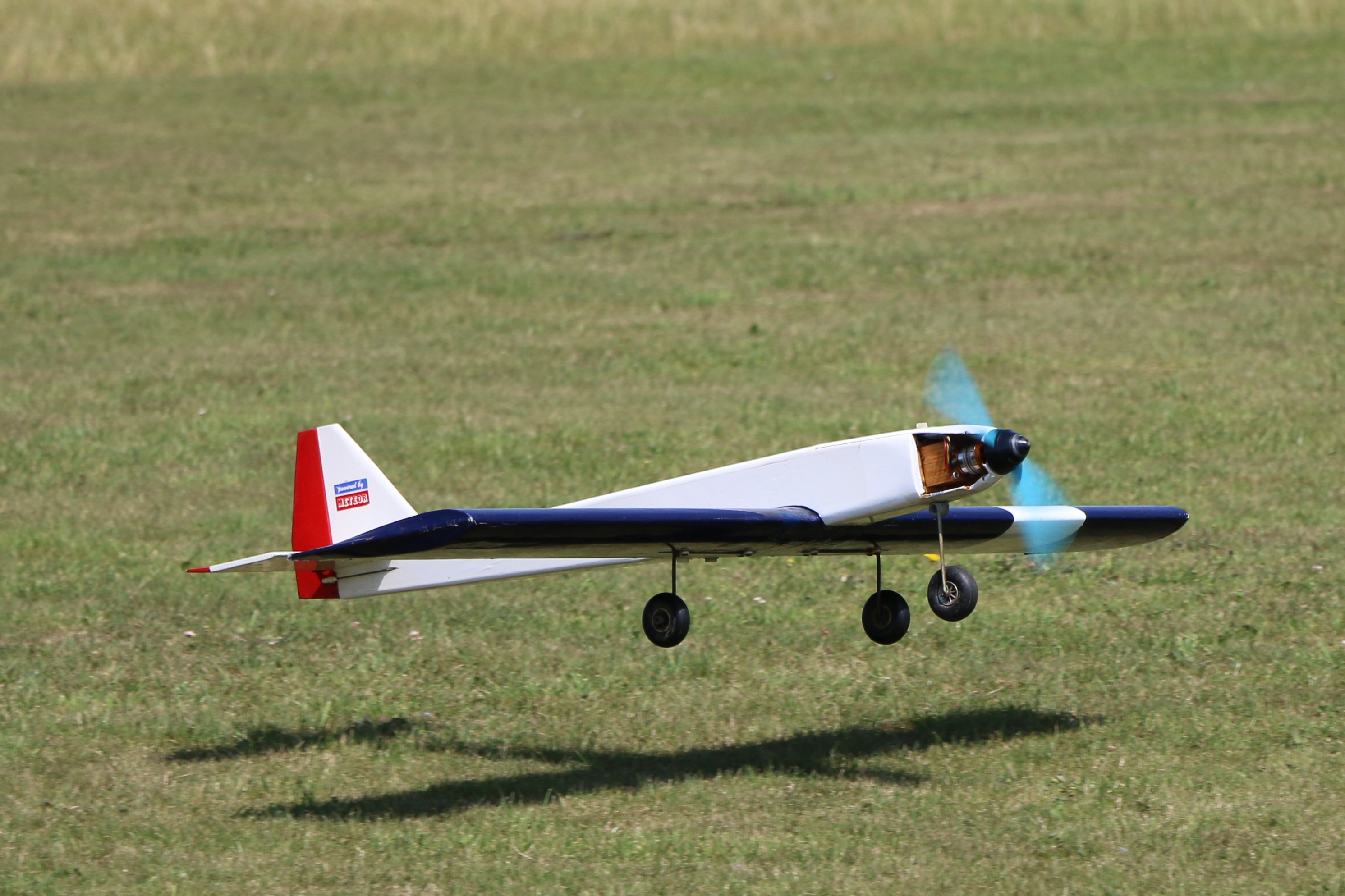
A couple of months ago Dougal sent me some photos of his venerable Fun 3 model. It’s now 40 years old having been originally built it in 1980 although the fuselage was rebuilt 4 years later following an ‘incident’!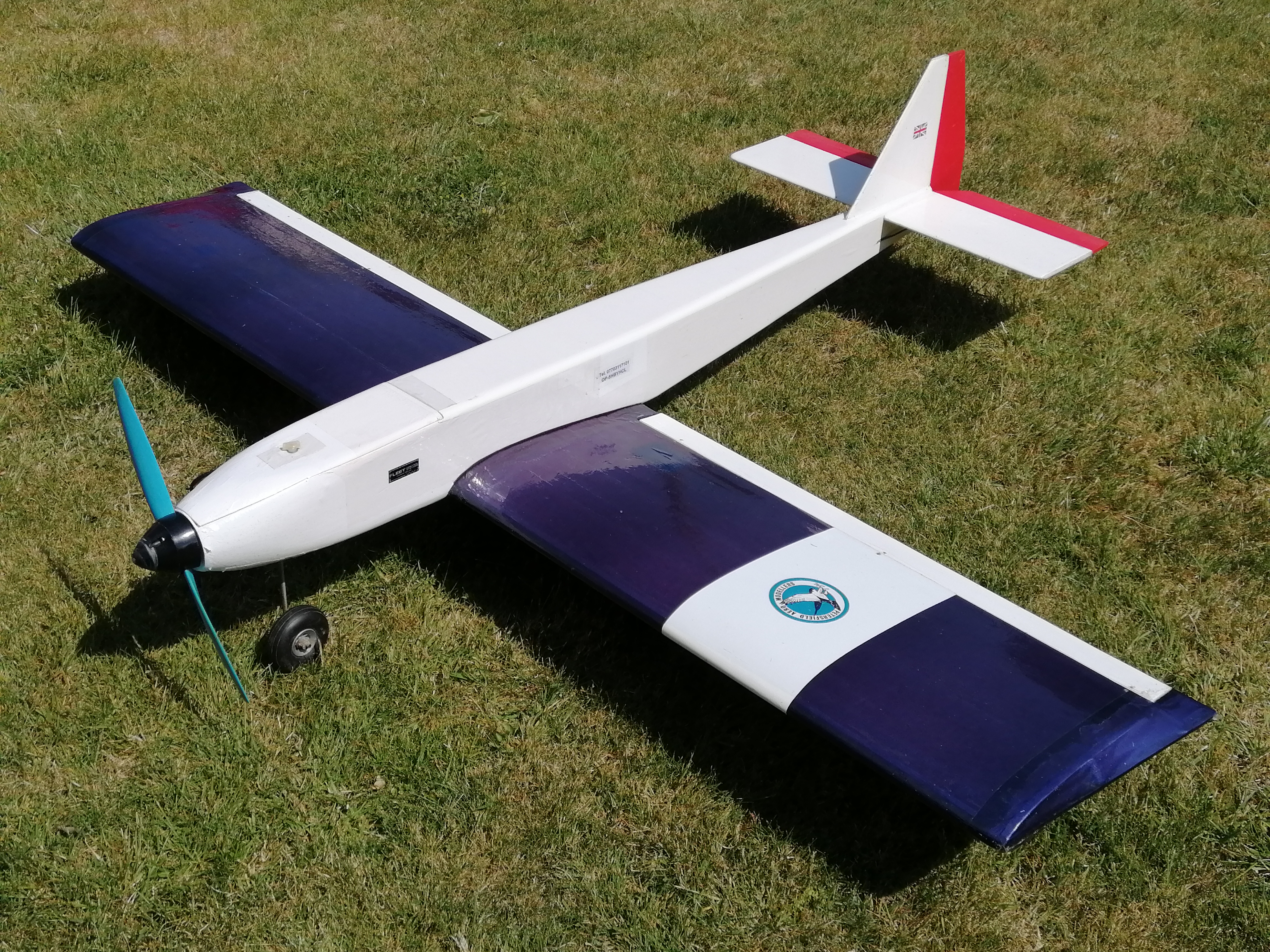 It’s been successfully flown with a variety of power sources, the first being a Meteor 40 with a tuned pipe (I bet that was noisy) and now of course an electric set-up which Dougal says makes it go better than ever.
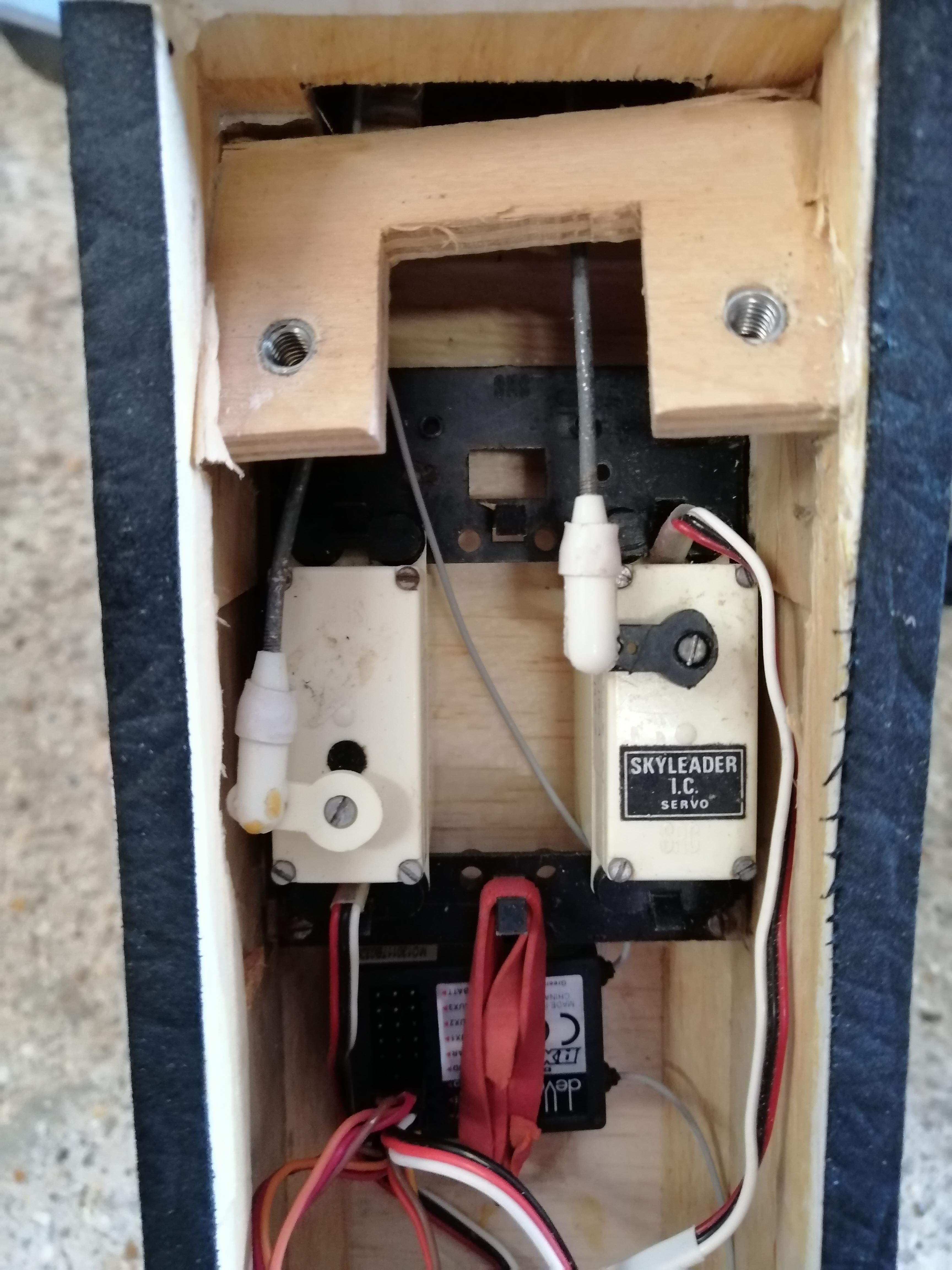 It is still using the original Skyleader servos which look rather out of place next to the tiny 2.4GHz Devention receiver, how things have changed in 40 years. But also notice the wing bolt plate that is looking very dodgy, I think that might have seen the end of the model had it not been spotted!
Last month I showed you a couple a photos of Woody’s almost completed Hunter that he’s built from the Tony Nijhuis plan. It’s now finished and I’ve had a few attempts at getting it flying but so far without success.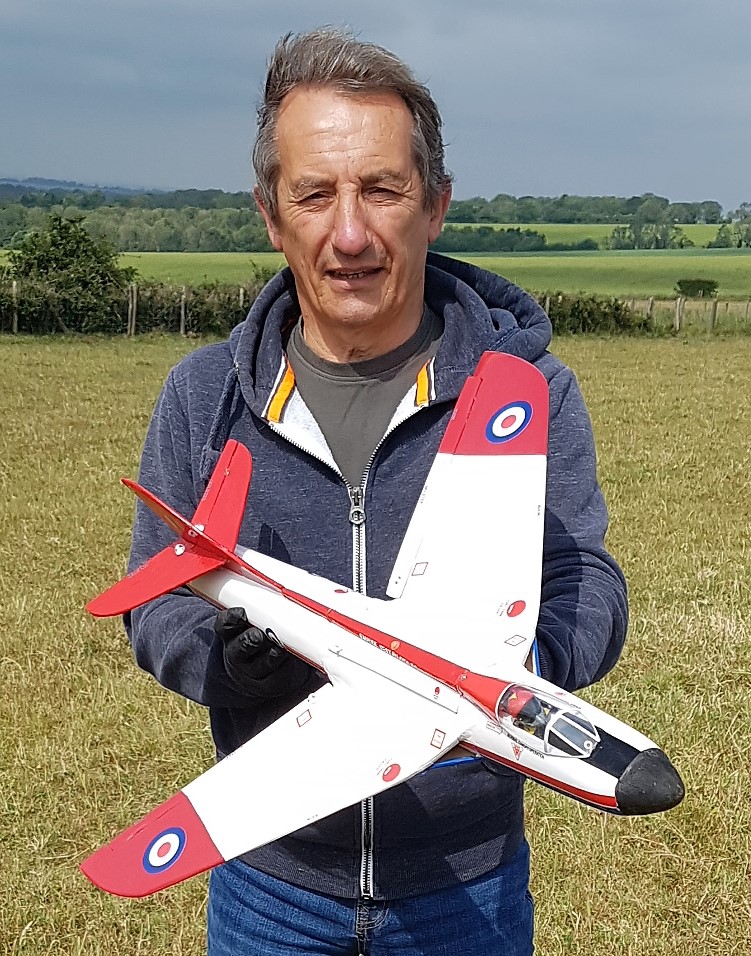
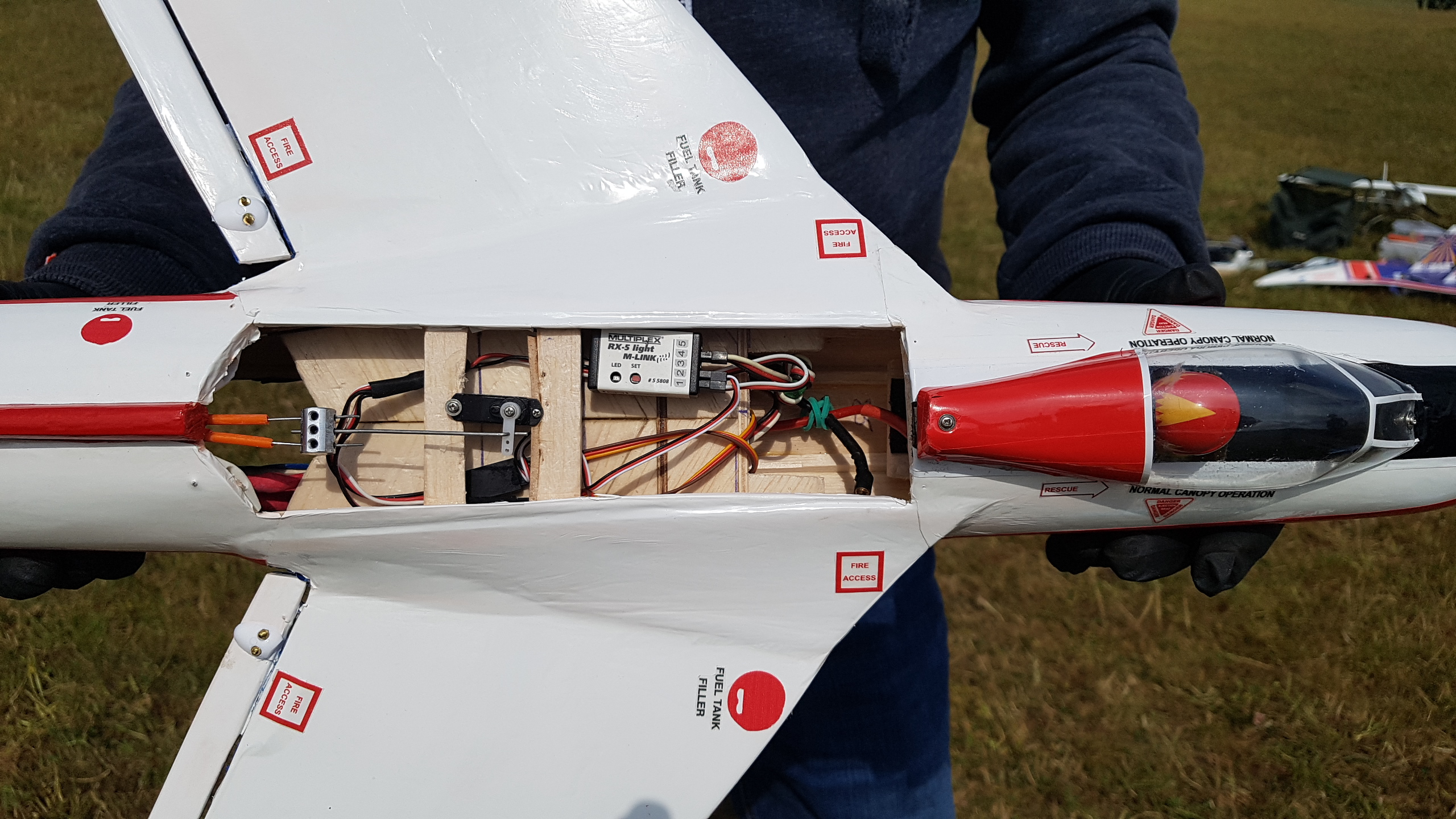 The model looks nice but I wonder if it’s overweight as it just won’t go away from a hand launch. After several unsuccessful but undamaged attempts Woody is going to check the weight and measure the thrust to see if they are what the plan says they should be. It has the same fan and motor as my Raptor but feels about twice the weight although to be fair the Hunter uses a 2200mAh lipo and the Raptor only a 1500. We’ll see what the scales tell us.
Norwegian Nick brought his almost completed Sabre along to the field to show us one day. Like Woody’s Hunter the Sabre was built from a Tony Nijhuis plan and is using the same FMS fan but with a 4 cell rated motor. In theory that means it should have around a third more thrust so it ought to have plenty of power.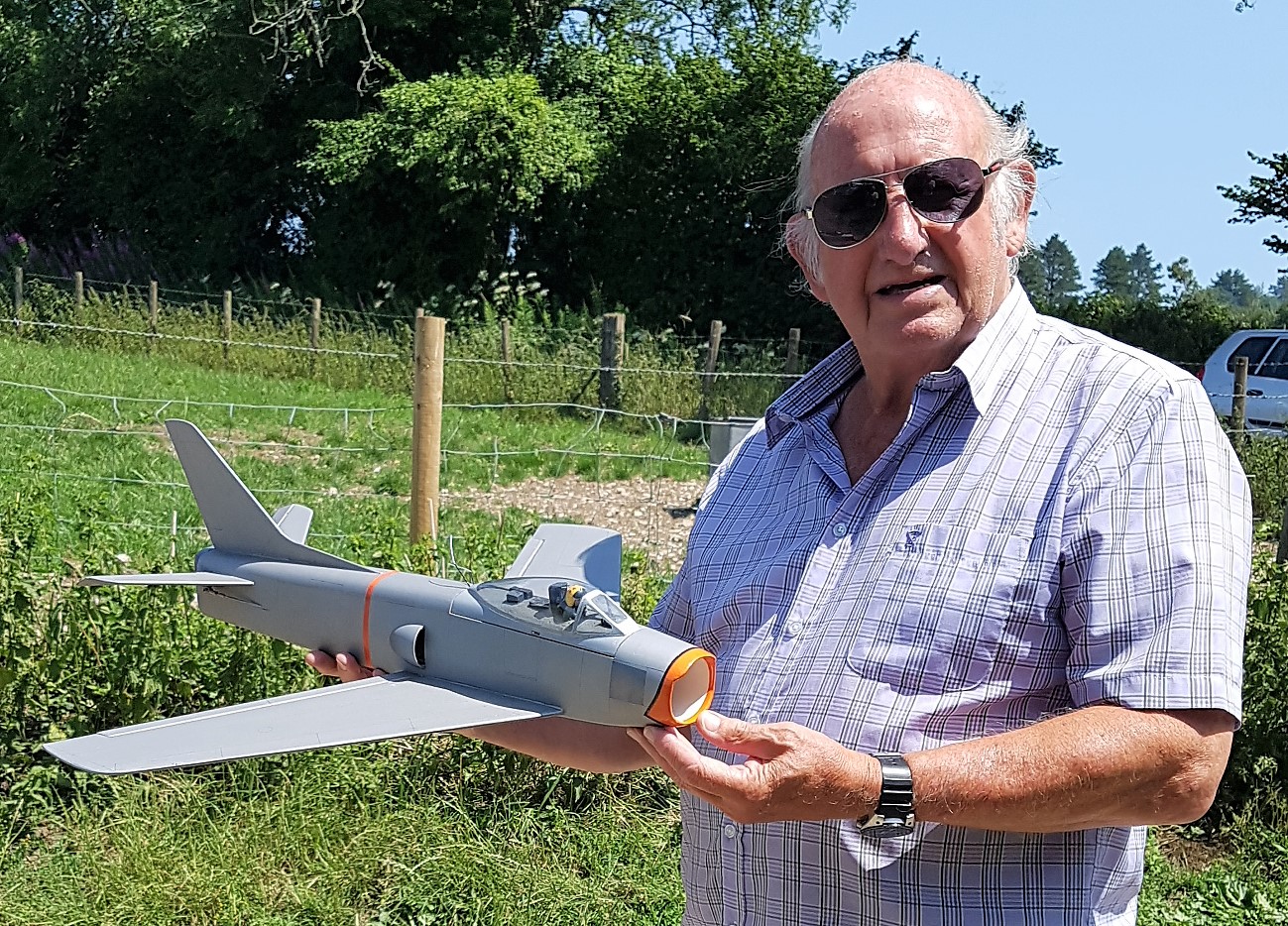
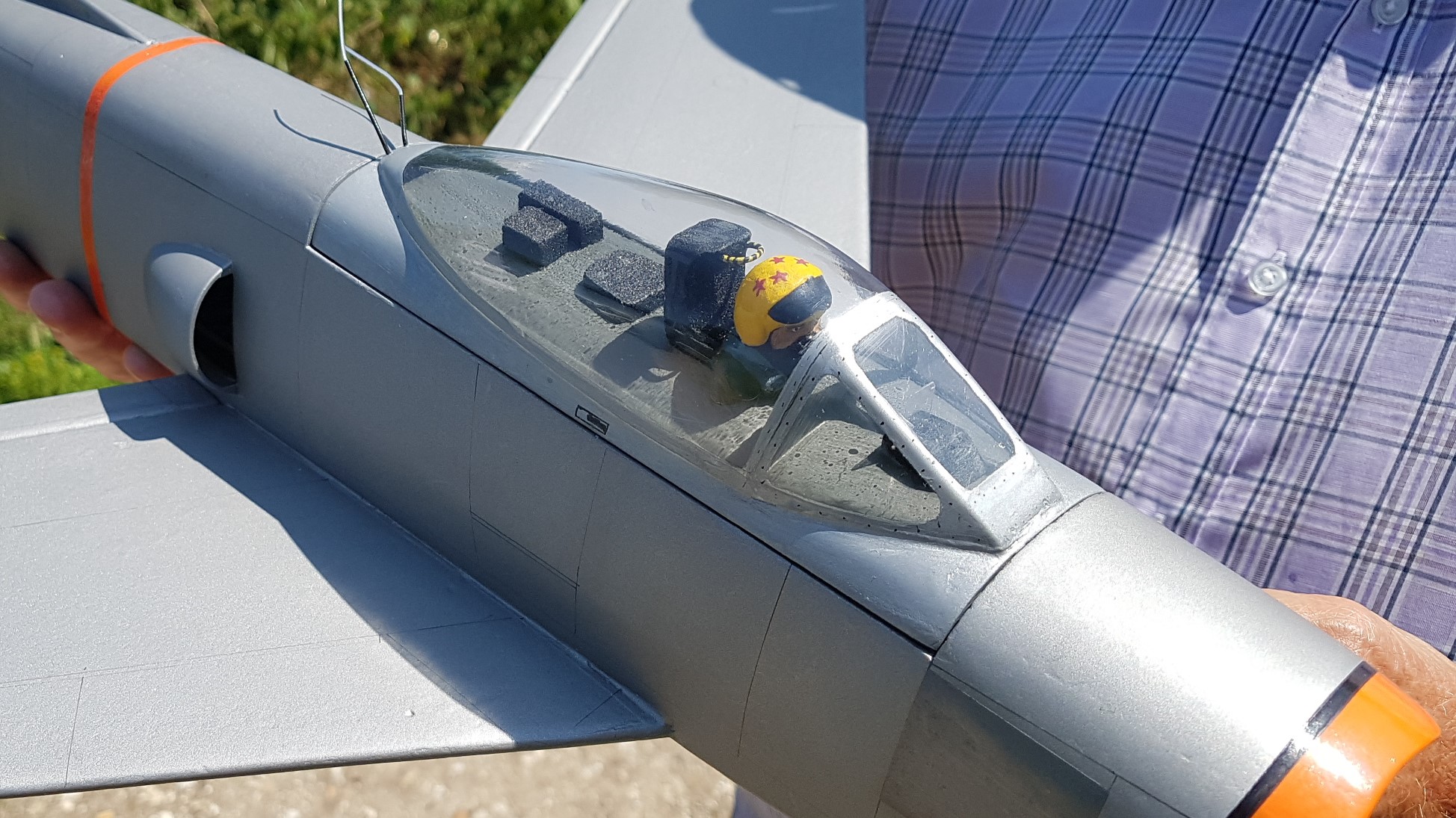 The model is built to Nick’s usual high standard and is very nearly ready to be test flown. Personally I have to say that I have some doubts about the pilot, I’m not sure he can be relied on, he looks completely legless…
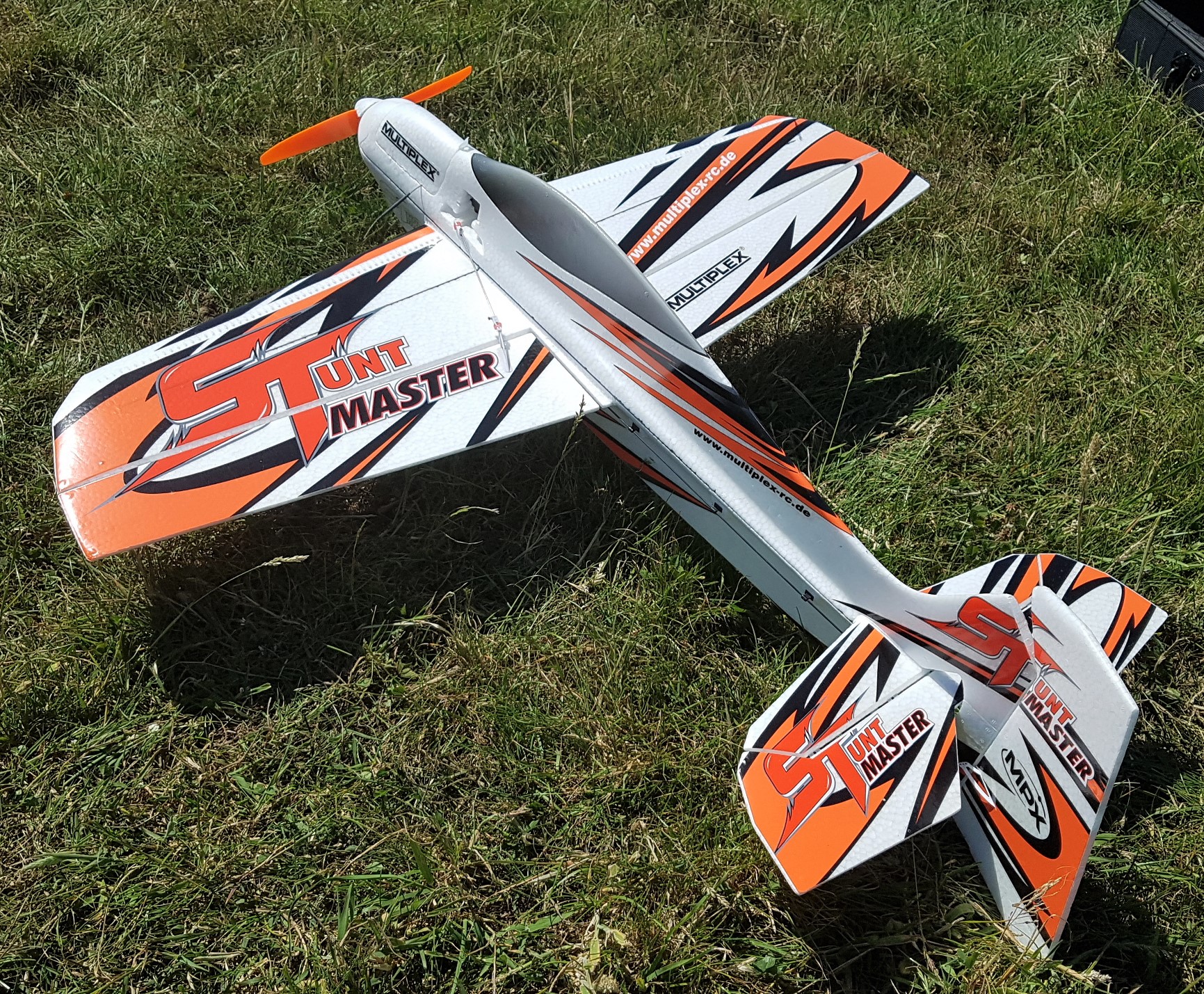
Several months ago, in the heady pre-lockdown days, I featured a Multiplex Stunt Master that Chas Butler had picked up for a good price at the LMA Much Markle show last year. The Stunt Master is made from Elapor (the Multiplex version of EPO foam) with carbon fibre reinforcements, has a wingspan of 870mm and weighs just 350g.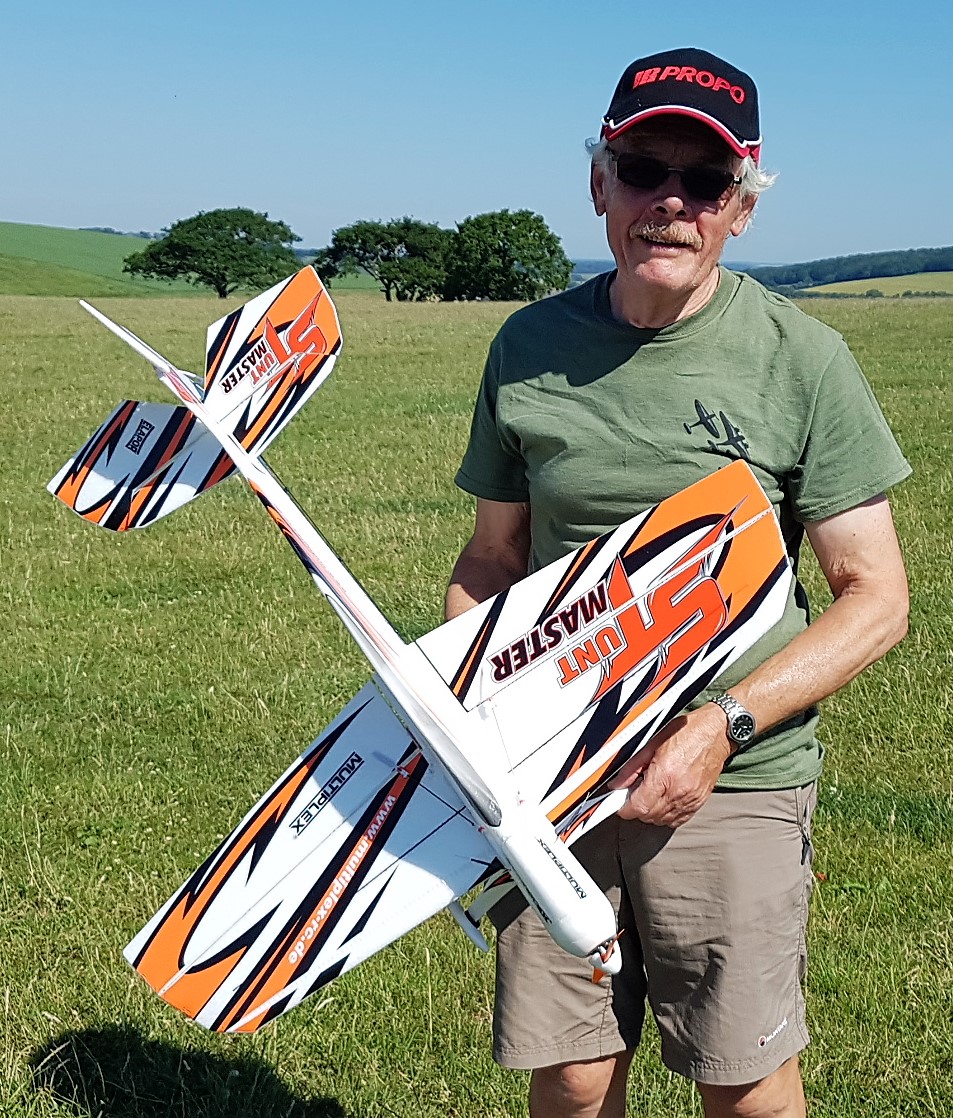
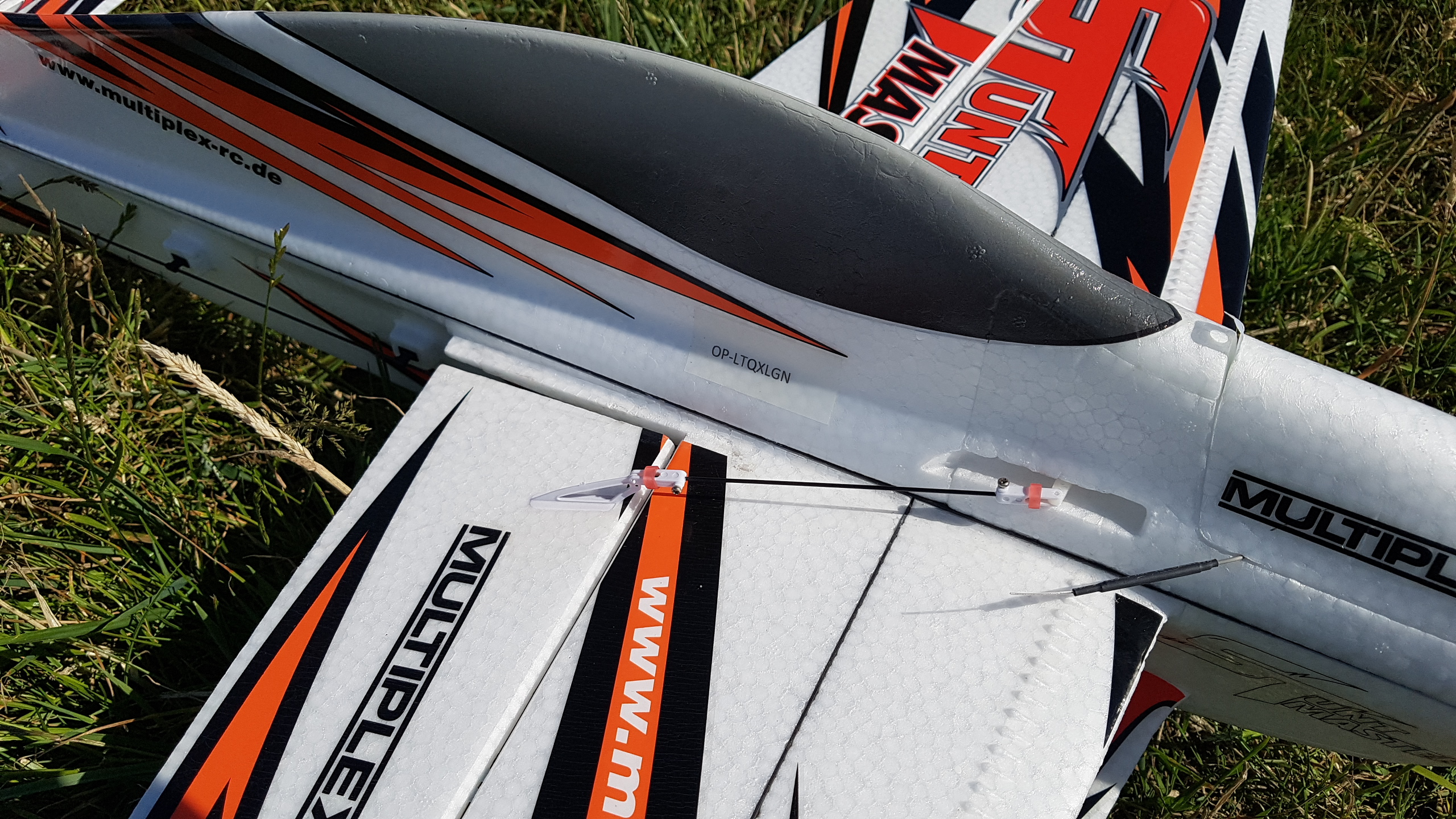 The ready fitted hardware consists of a Permax 2206 1050kv outrunner, a 20A esc and three 8g servos. The prop is secured by a rubber O-ring so any unscheduled arrivals won’t damage the motor shaft, not that Chas will have any unscheduled arrivals. Both ailerons are operated by one servo mounted centrally in the fuselage above the wing, an arrangement that is pretty unusual on outdoor models these days but maybe it’s more common on indoor ones.
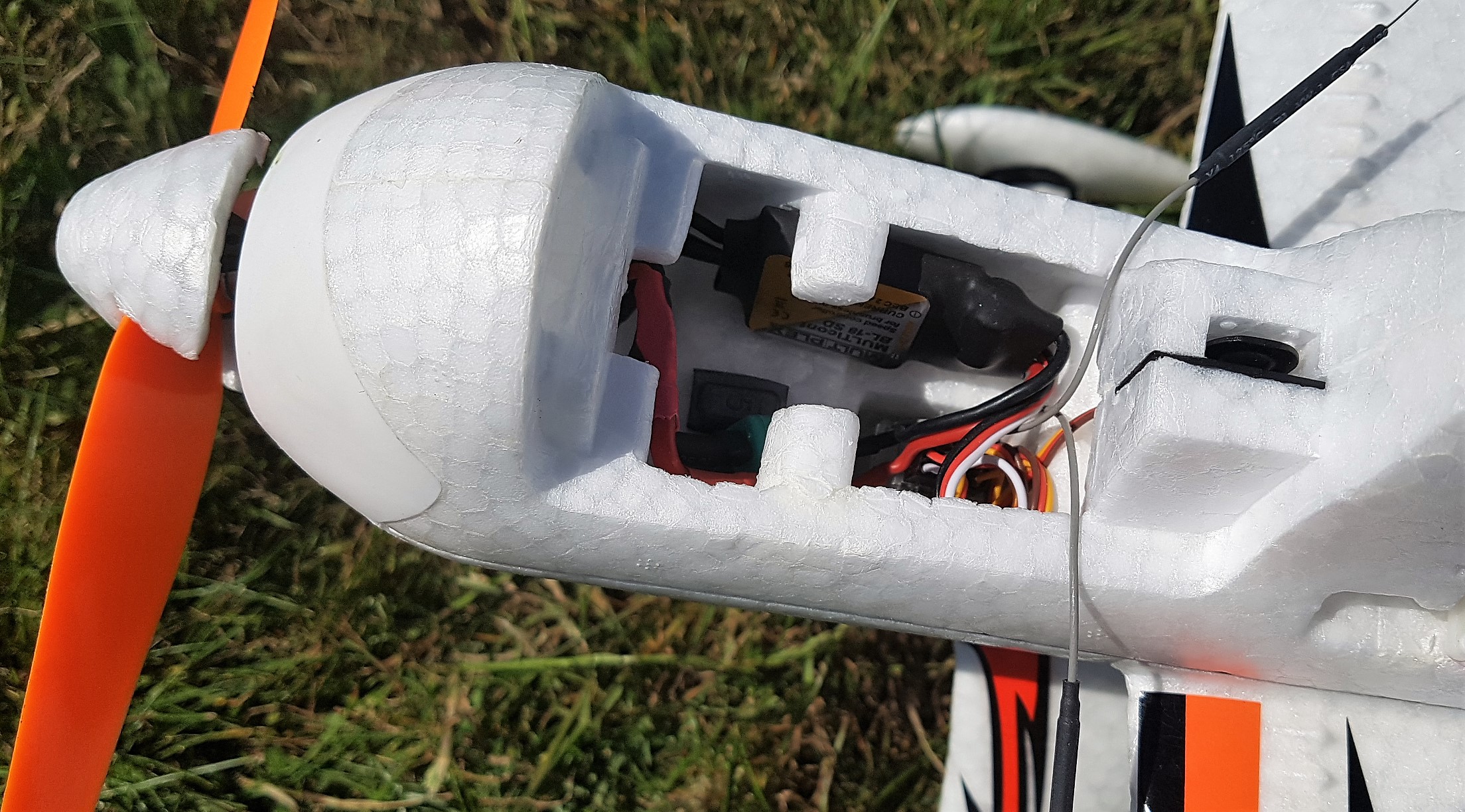 Due to winter, windy weather, the lockdown etc Chas hadn’t got round to flying his new toy but towards the end of June the weather seemed perfect for its first flight. Despite being the hottest day of the year so far the conditions weren’t actually ideal as there was a reasonable breeze blowing from the east which always means turbulence from the trees. But the first flight went very well and even subsequent flights in the increasing wind were fine.
 Chas was delighted with the model and it certainly looked good in the air. The flights I watched were with the rates in the ‘standard’ setting, wait until he tries ‘3D’ setting! You can see some of the maiden flight in this month’s video.
Towards the end of June both Captain Slow and I started flying FPV again. We both had some successful flights without any problems but then Captain Slow decided to fly his SkyHunter normally, ie. not using goggles. It was flying fine although the turbulence off the trees but getting worse as the morning wore on, especially low down. I was trying to get some flying shots of the model so asked him to do a low pass…big mistake, entirely my fault.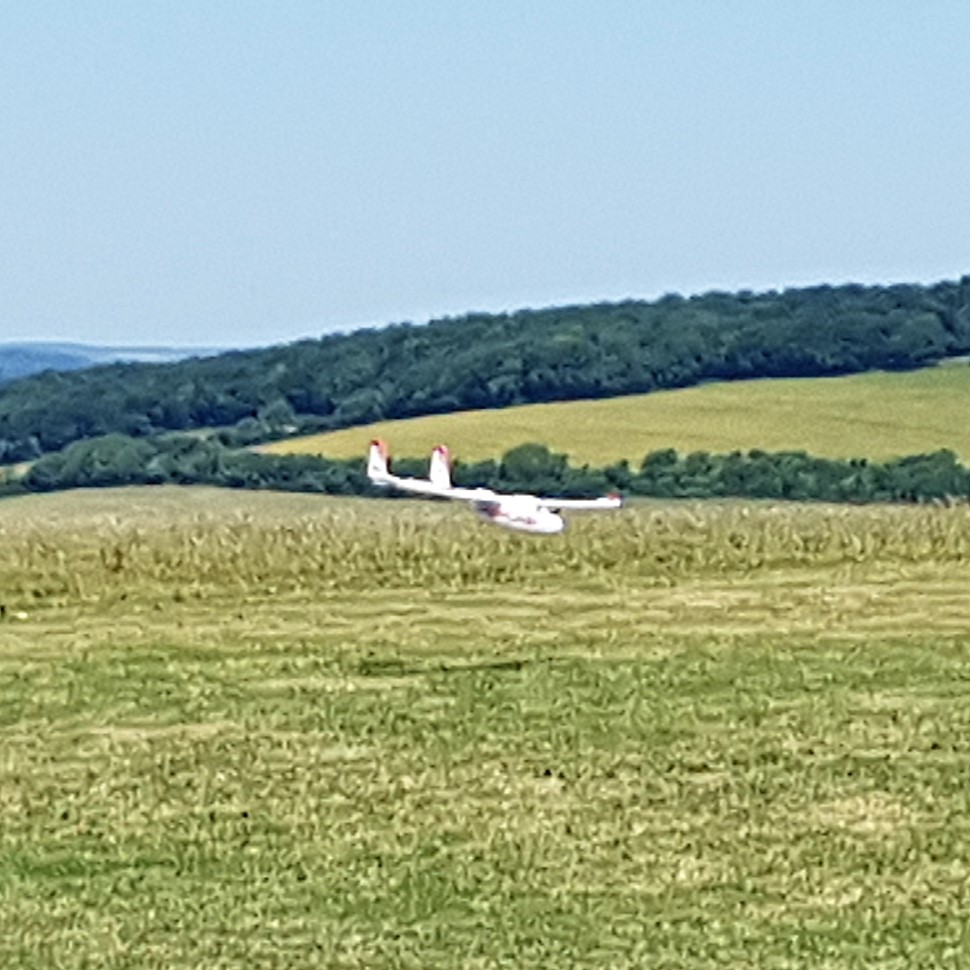
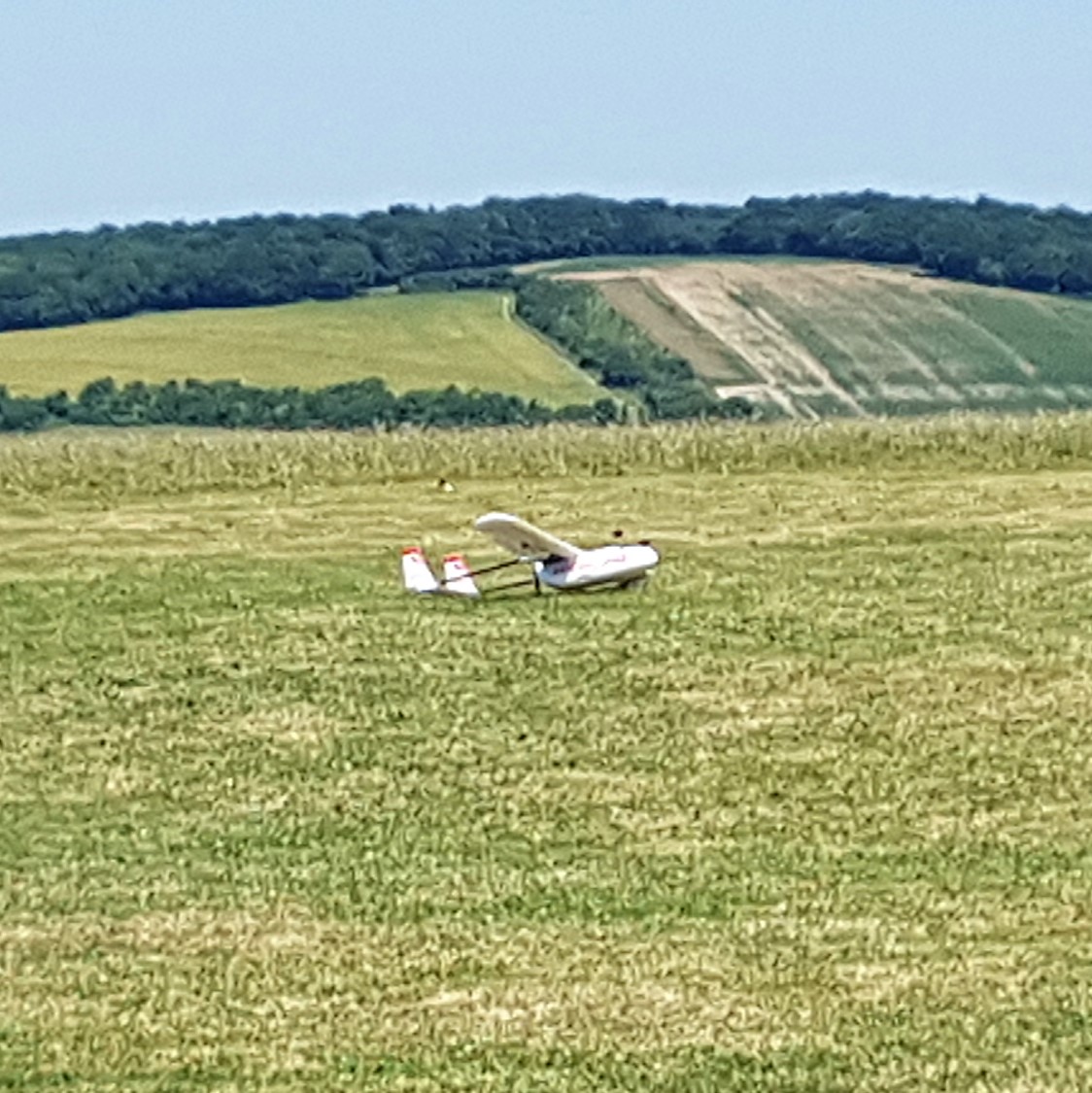
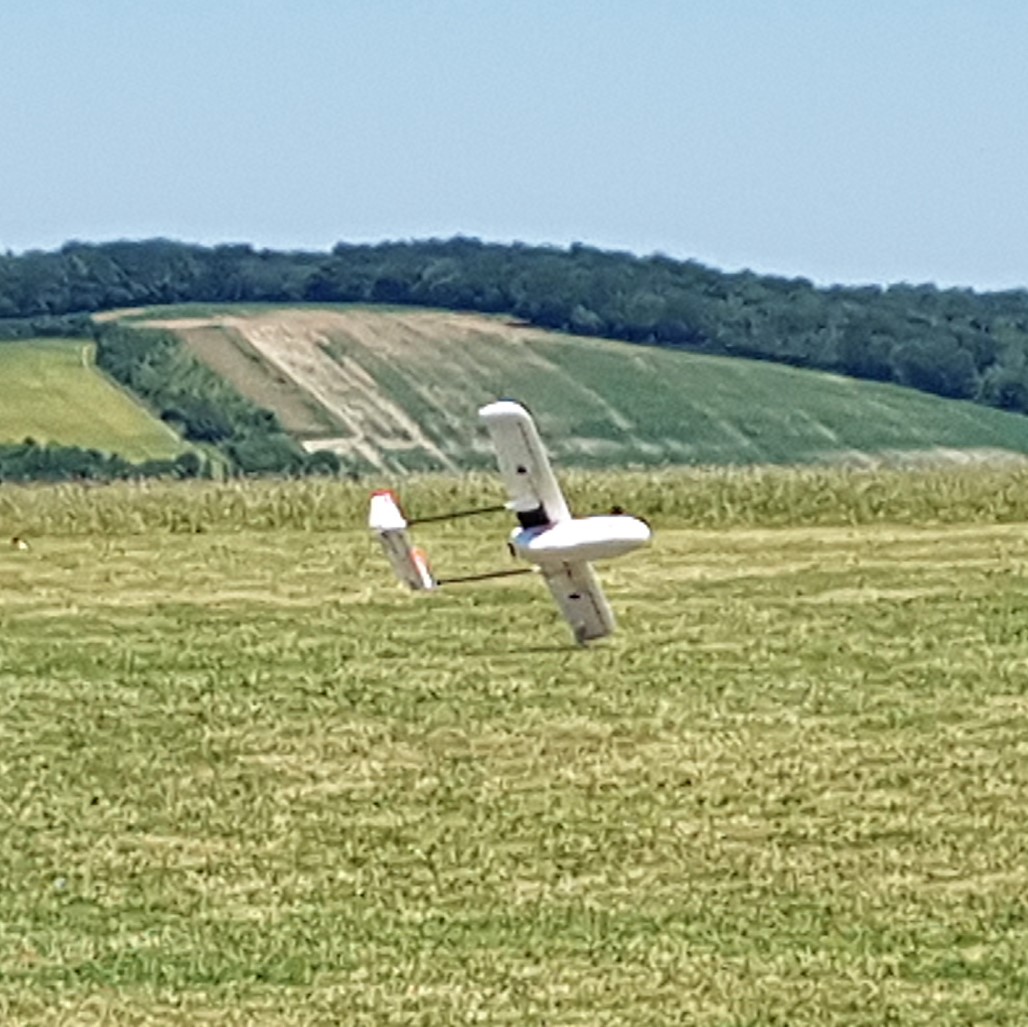
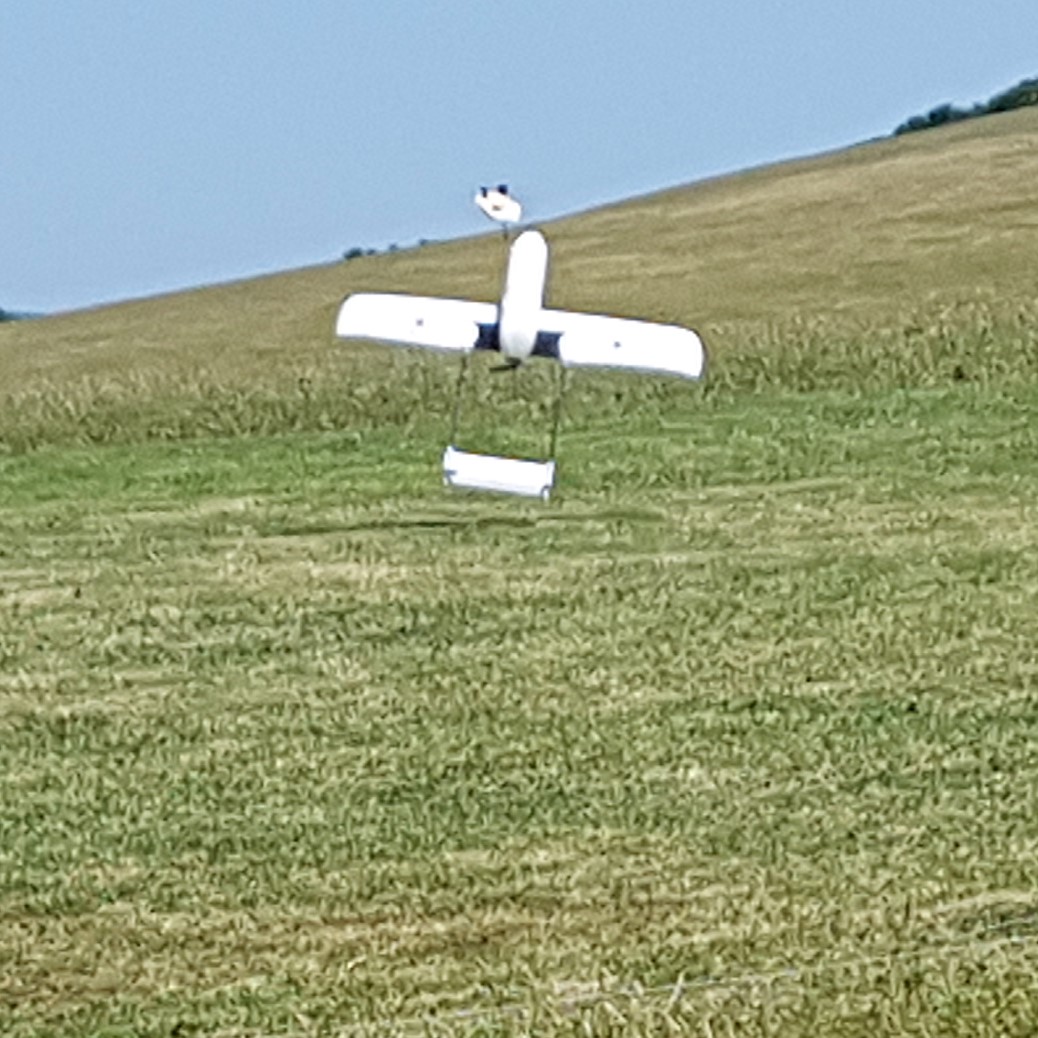 It’s a shame I was taking stills rather than video but you get the idea, the pass was a bit too low for the conditions. Fortunately there was no damage other than a cracked joint in the nose and a big dent in Captain Slow’s pride!
Dwayne Pipe sent through a couple of photos showing how he’s progressing with his Folland Gnat. It’s a totally scratch built model, Dwayne has drawn up his own plans, scaling everything up from an Airfix kit.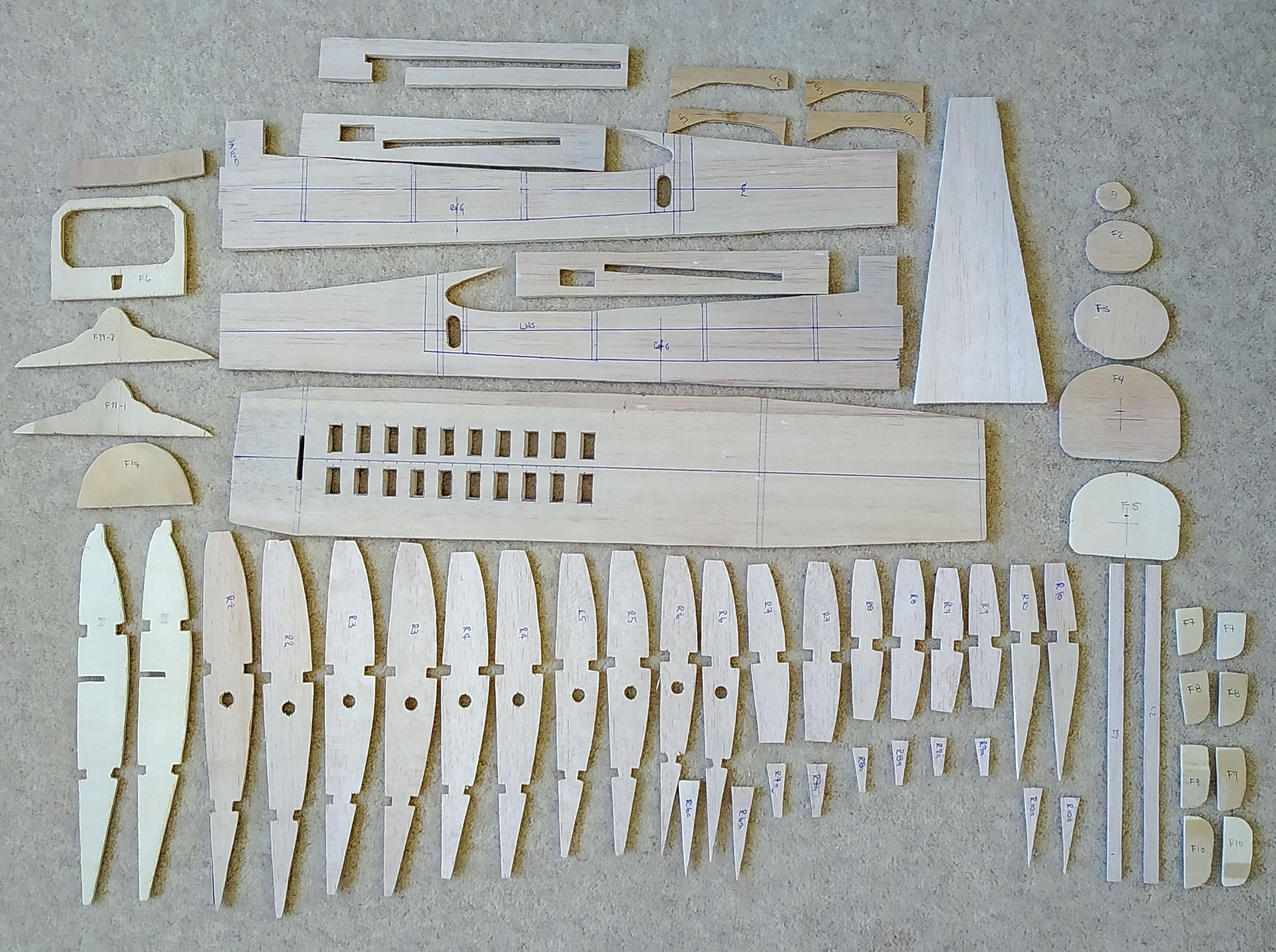 He began by producing a kit of parts and now has the wings almost done, I assume there will be a carbon joiner.
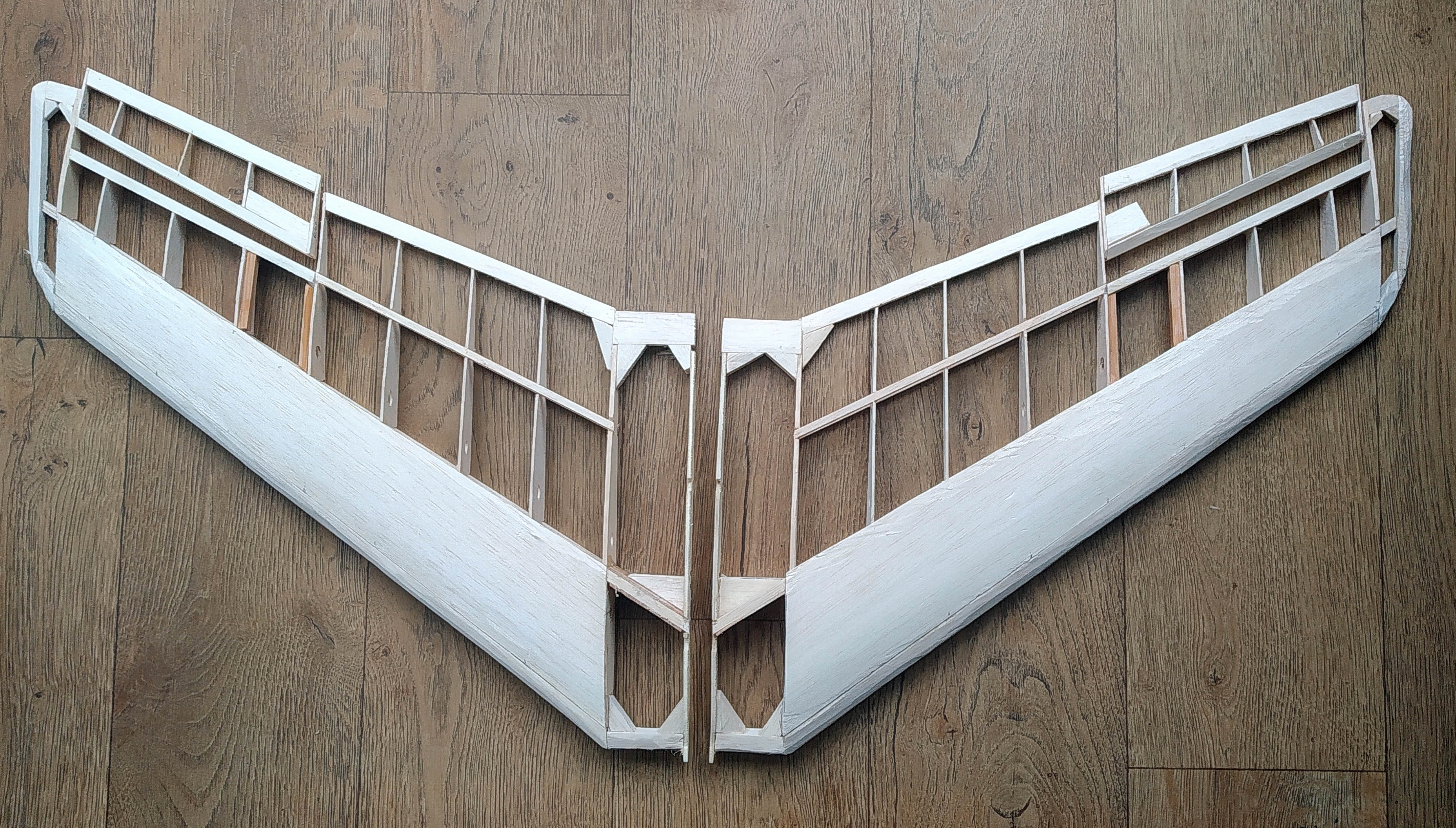 Dwayne is going to fit a 12 bladed fan from Banggood which he’s tested on an 8 cell lipo and gives around 1.5kg of thrust so in his words the performance should be ‘lively’! Dwayne is building up quite a bit of experience with EDF set-ups, his scratch built TSR2 goes very well as you can see in this month’s video.
Catapult King has now repaired his own design Yellow Tail following an early flight ‘incident’ when he discovered that models with very thin tapered wings are prone tip stalling, something that’s all part of the learning curve I’m afraid.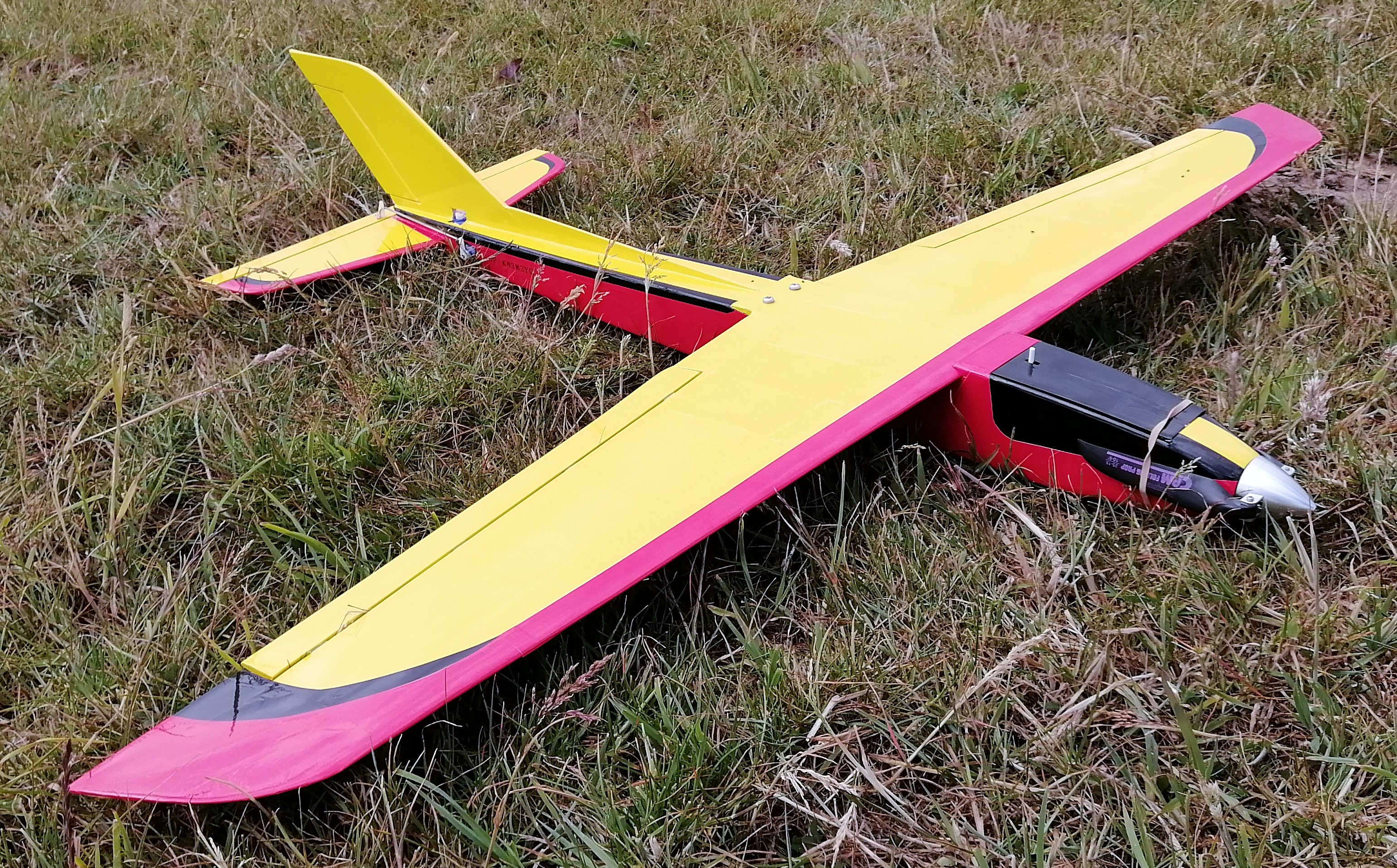 He based it on 1066’s Pichler HiSpeed, taking the basic sizes and then modifying them to his own requirements.
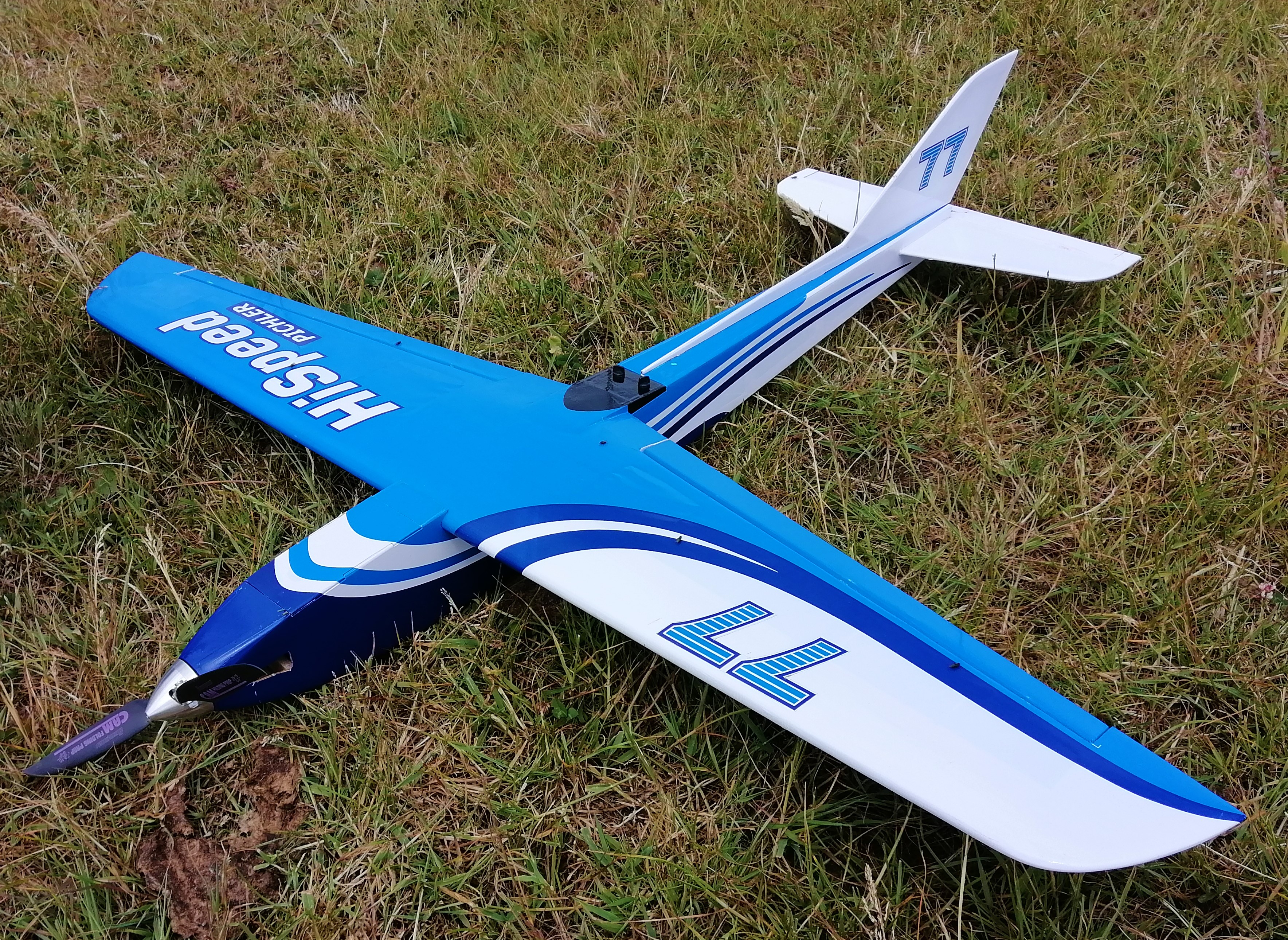 This time out Catapult kept the speed up and the Yellow Tail performed well with no problems.
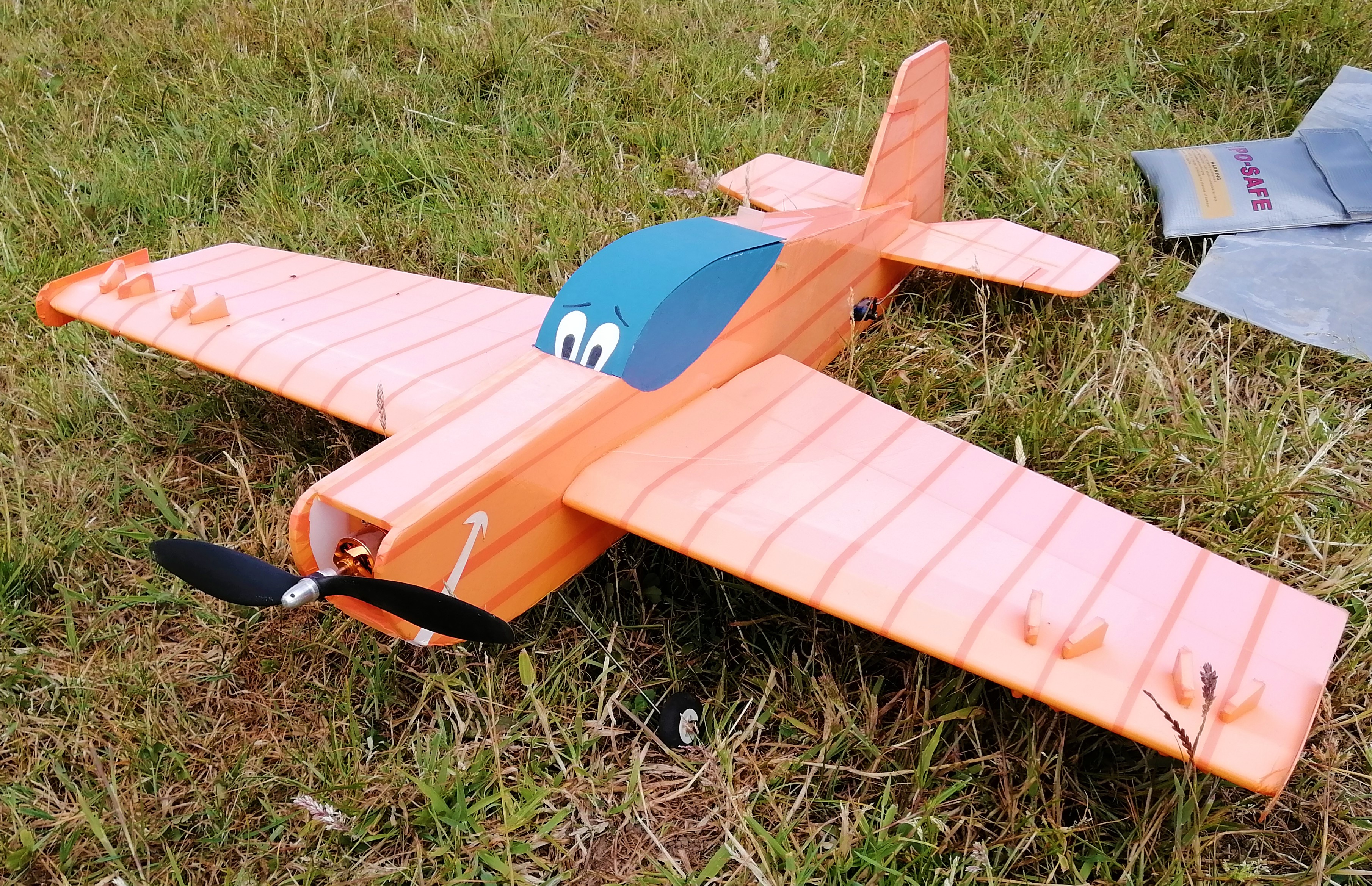 Catapult also flew his Bug, a model he built from the Flite Test plan, which is constructed almost entirely from Depron so is very light. The day was rather breezy so hardly ideal Bug conditions but it just about coped.
The weather has been quite amazing for the last couple of months but it became cooler and windier at the end of June. On Sunday 28th Dougal Entendre, 1066, and Bob the Builder had booked a slot and they all flew despite the strong wind. Here is Dougal’s report on the morning: When Steve and I met up, we decided to go in the lower field as we both had hand-launchable models and didn’t fancy dealing with the cattle. I flew the Sportjet and the Blizzard, and Steve flew his Mirus. The wind was strong but not too bad. Then we saw Bob going in the gate of the upper field, so I went over to tell him where we were. Steve went back to the car to get his hotliner out as there seemed to be lift about. Bob flew his Walrus and made the most of the lift which we found over the bottom of the field.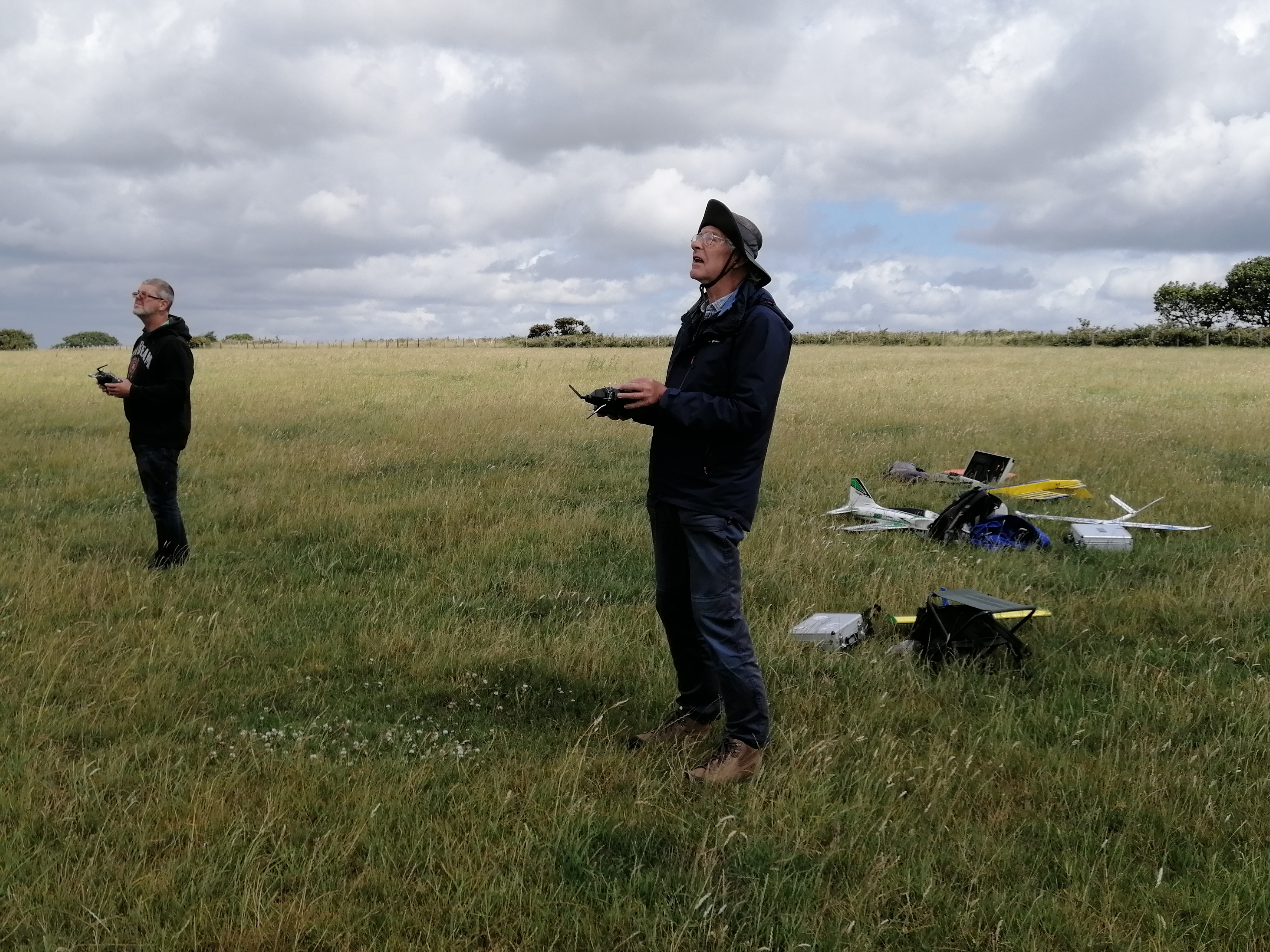
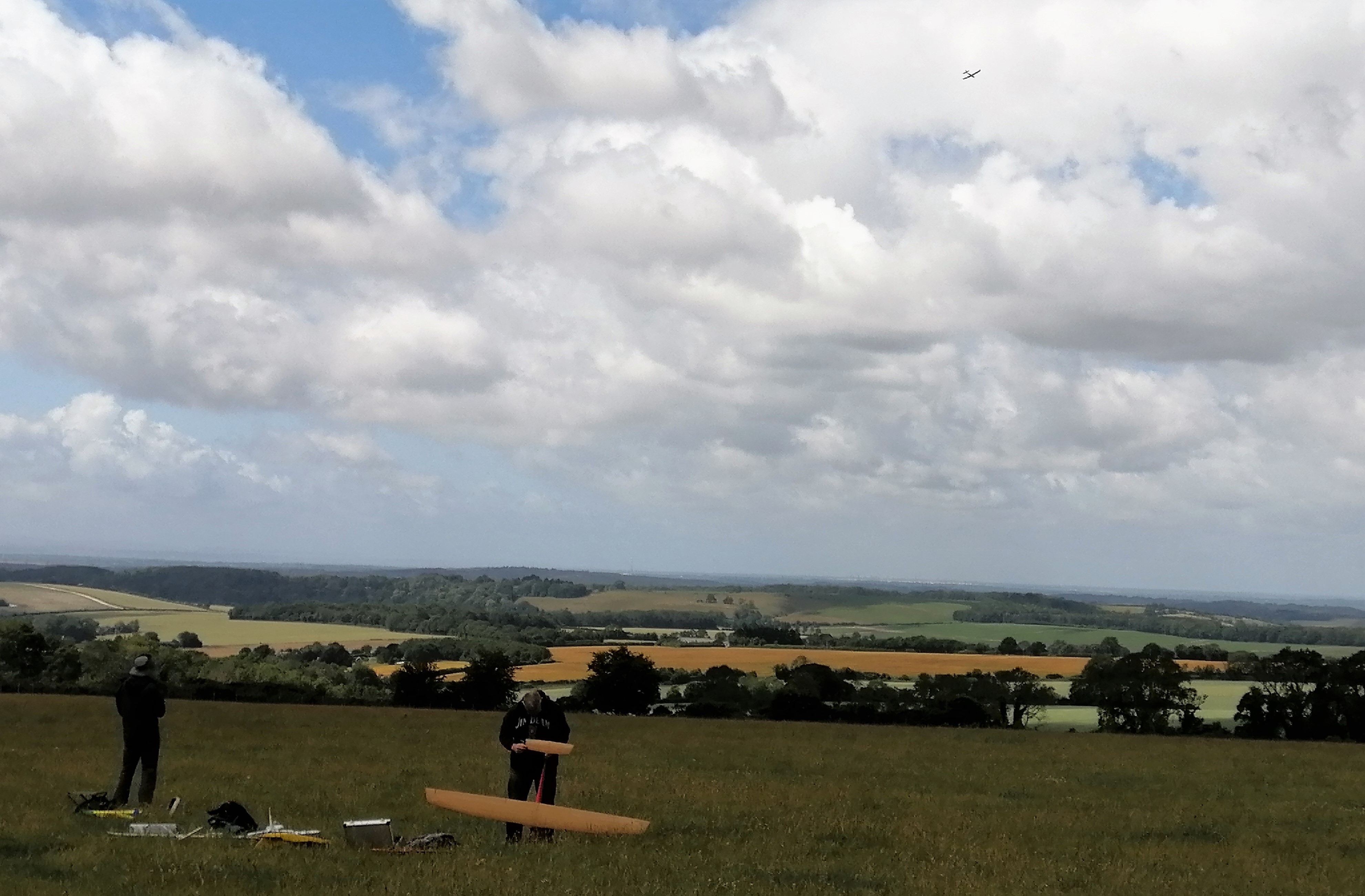 The wind was coming up from the south-west, so some of it may have been slope lift, but there were strong and bumpy thermals coming through too. On my second Blizzard flight it started to rain quite heavily, so Steve and I landed, and Bob left at that point. The rain soon stopped though, and I still had 87% in the Blizzard battery, so we flew again. I must have spent fifteen minutes or so working bumpy thermals, and Steve did the same with his hotliner. I landed with 55% still left in the battery! So all in all a surprisingly enjoyable morning, and we were glad we made the effort! Thanks Dougal, sounds fun, sometimes the more challenging days turn out to be really good.
Video time now, and this time includes contributions from me, Captain Slow and Dougal Entendre, thanks guys. Please watch the video full-screen, it’s so much better with small models flying around.If the video won’t play for you please click HERE
Do you think invisible aeroplanes will ever be a thing?
I just can’t see them taking off…
Colin Cowplain