
Patch News – May 2020
Things looked up a little for aeromodelling in May as the partial lifting of the lockdown was announced on 11th which meant two people could go to the patch and fly as long as they stayed at least two metres apart. Captain Slow came up with a system of booking slots which seems to be working well and many members have been out flying in the glorious weather. Initially there was the problem that the patch grass had grown very long and the bullocks were in the field but the bullocks were soon moved out and Iven offered to cut the grass with his self-propelled mower. The patch is the long stuff on the right in this photo, Iven is mowing around the edge. Captain Slow accompanied him and did a battery swap but Iven preferred to just mow alone and he eventually finished several hours later with five one cubic metre bags of grass that he took away in his van. We are all very grateful Iven, it was a mammoth job that would have taken the members very much longer with the club mower.
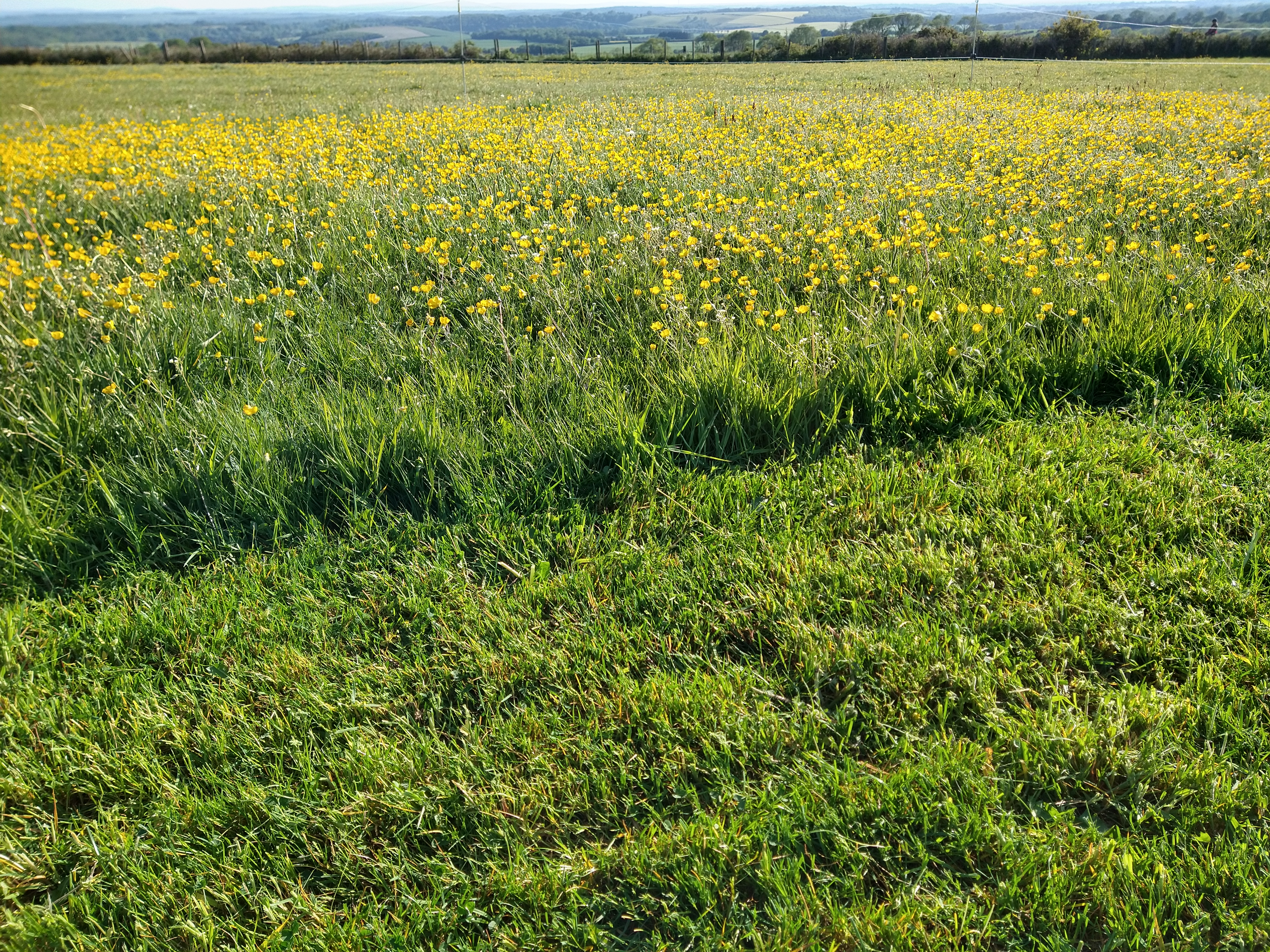 Since then 1066 has mown it twice with Mike Smith and once with Colin Cowplain. Unfortunately the bullocks returned on 27th May which will make things a bit trickier, especially with just two flyers at a time.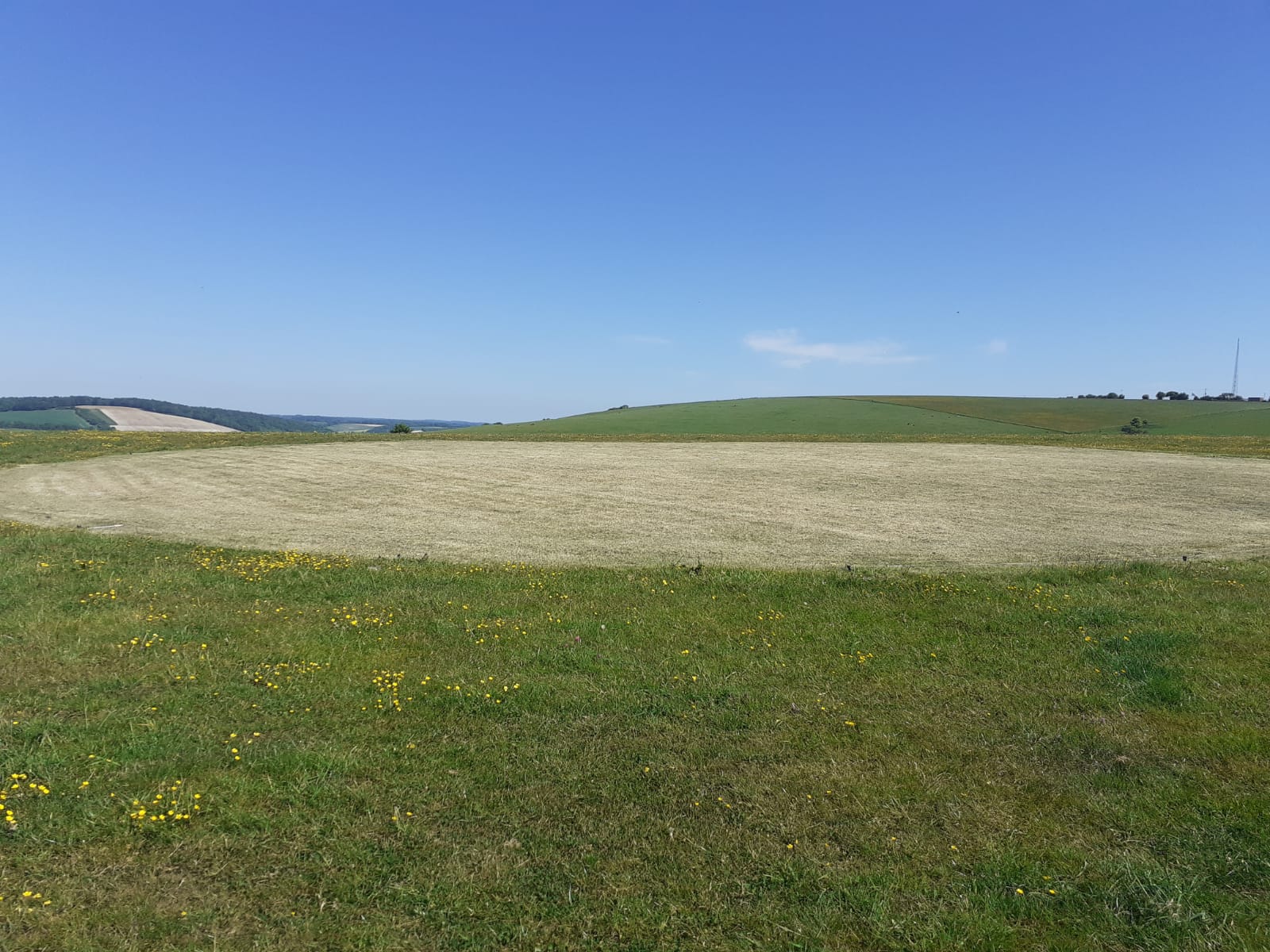
Continuing from last month with some of the new models that have been built during lockdown I’ll begin with Kryten’s Swannee. For those of you who don’t know Kryten is really Graham Swan so when the Swanee plan was first published when he and I were at school together it was almost compulsory that he built one! This is what he says: When an article about Swannee appeared in Patch News in July 2018 I was quoted as saying the model was “awful”. I first built this plane in 1966 when it was first published as a free plan in the Aeromodeller magazine.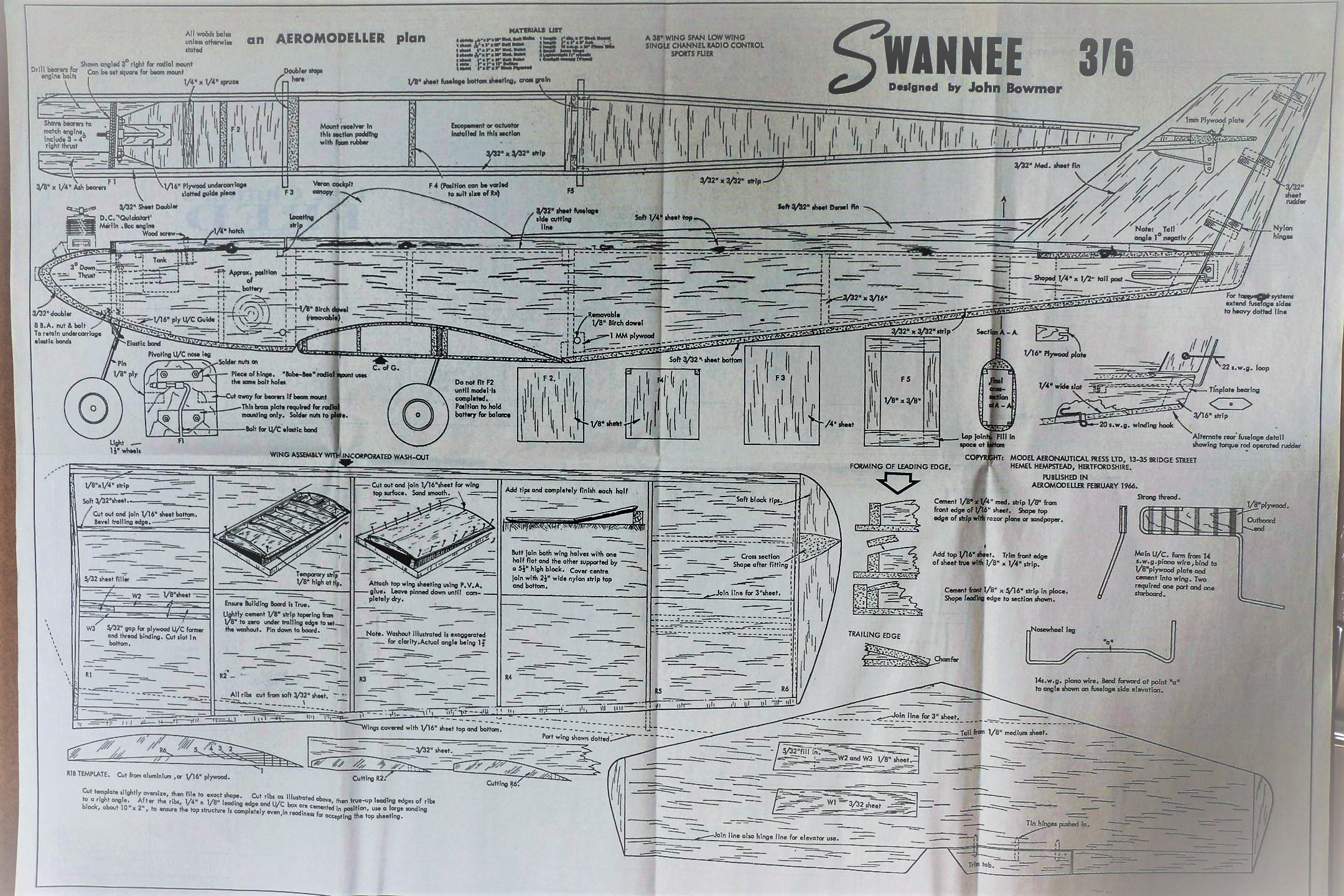 Thinking about my comment, after reading the article, I concluded that it was my building skills and lack of accuracy that were awful rather than the model, which never did fly satisfactorily. I decided later in 2018 that Swannee V2 would be my “winter build” project ready for the spring of 2019. In the event it has taken slightly longer than that to carry out and complete it.
Firstly I decided that I would add aileron control as the original model was single channel “rudder” only. The original version had a large amount of dihedral and small amount of wash out built into the tapered wing construction. I think the washout was the Achilles heel of my first model. The wings are formed from 1/16th balsa skins top and bottom with a tapering set of ribs effectively keeping the skins apart. The plan indicated 1½ deg or 1/8th inch of washout along the trailing edge. At the time I used my Father’s work bench as my “model building board” and I am sure that the surface had more twist in it than that before I even started!!
So with a nice flat building board I am hopeful that V2 will be more successful. The main changes are:- Converted to electric power including a battery tray, extended to include space for an AS3x receiver installed directly on the CofG. Incorporated aileron control with HXT servos built into the wings Stiffened up the front fuselage with light ply doublers. Reduced the dihedral, the angle of attack and omitted the washout all as suggested in an RCM&E April 2017 article. Added elevator, an option on the original, and rudder controlled by servos rather than the “rubber band” powered escapement. Omitted the rubber band fixing of the wings and replaced them with nylon wing bolt arrangement.
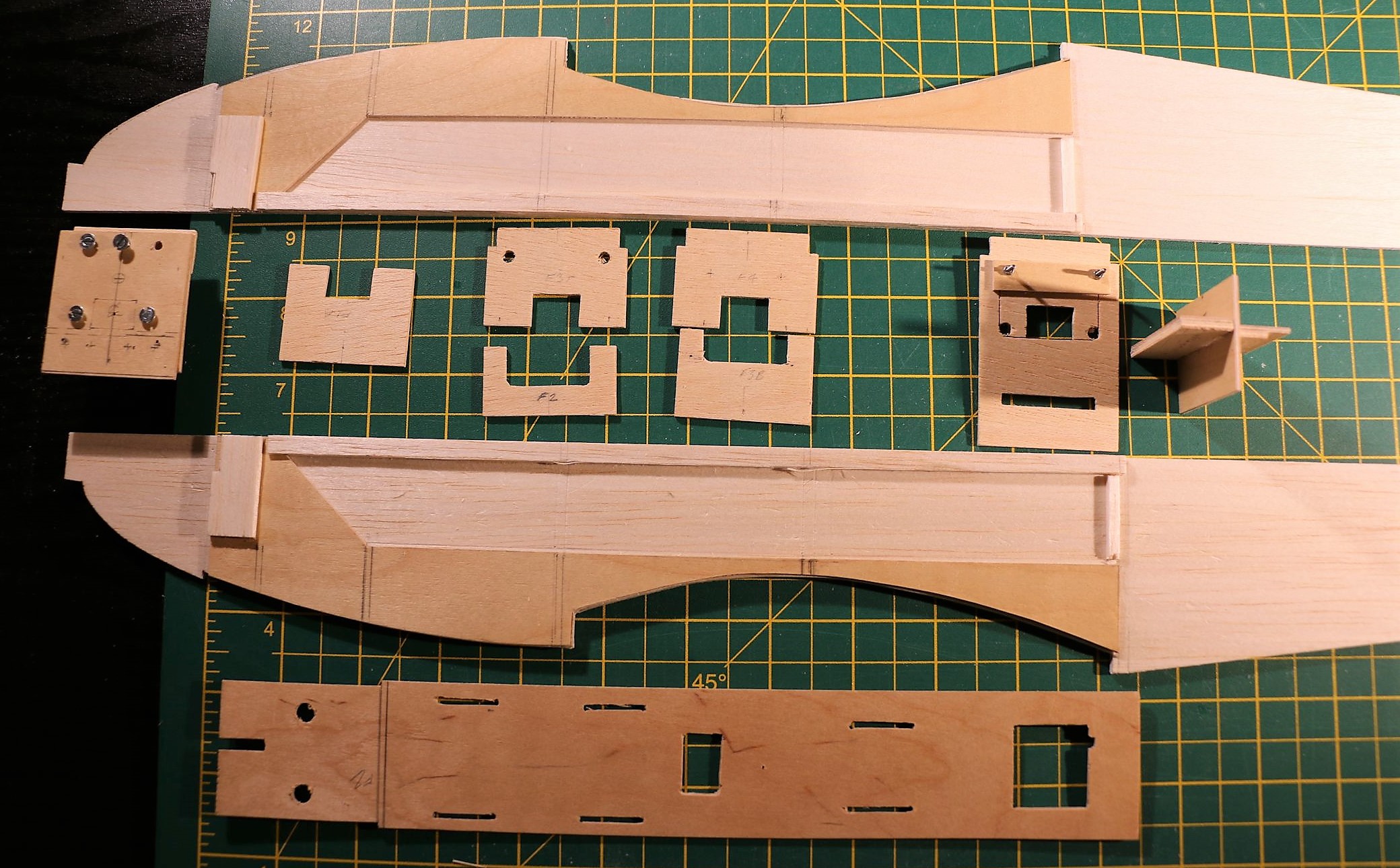
Otherwise the 36-inch wingspan Swannee V2 is constructed true to the plans and then covered in Hobby King film. Incidentally, the small cut outs in each of the formers shown in the photo, are to enable them to slide onto an aluminium box section which acts as a jig to keep the fuselage straight. This is removed before the engine mount is attached to F1.
All up weight including a Zippy 3cell 1000MaH battery is 22 ounces rather than the single channel target of 16 ounces. This equates to 15 ounces per sq ft (Please note that by way of a tribute to the age of the original model I have used imperial units)
The (dare I say it) Spektrum AS3x receiver has been set up with three flying modes:- Mode 1 General flying – no gains Mode 2 Launch – heading gain and rate gain Mode 3 Landing – rate gain
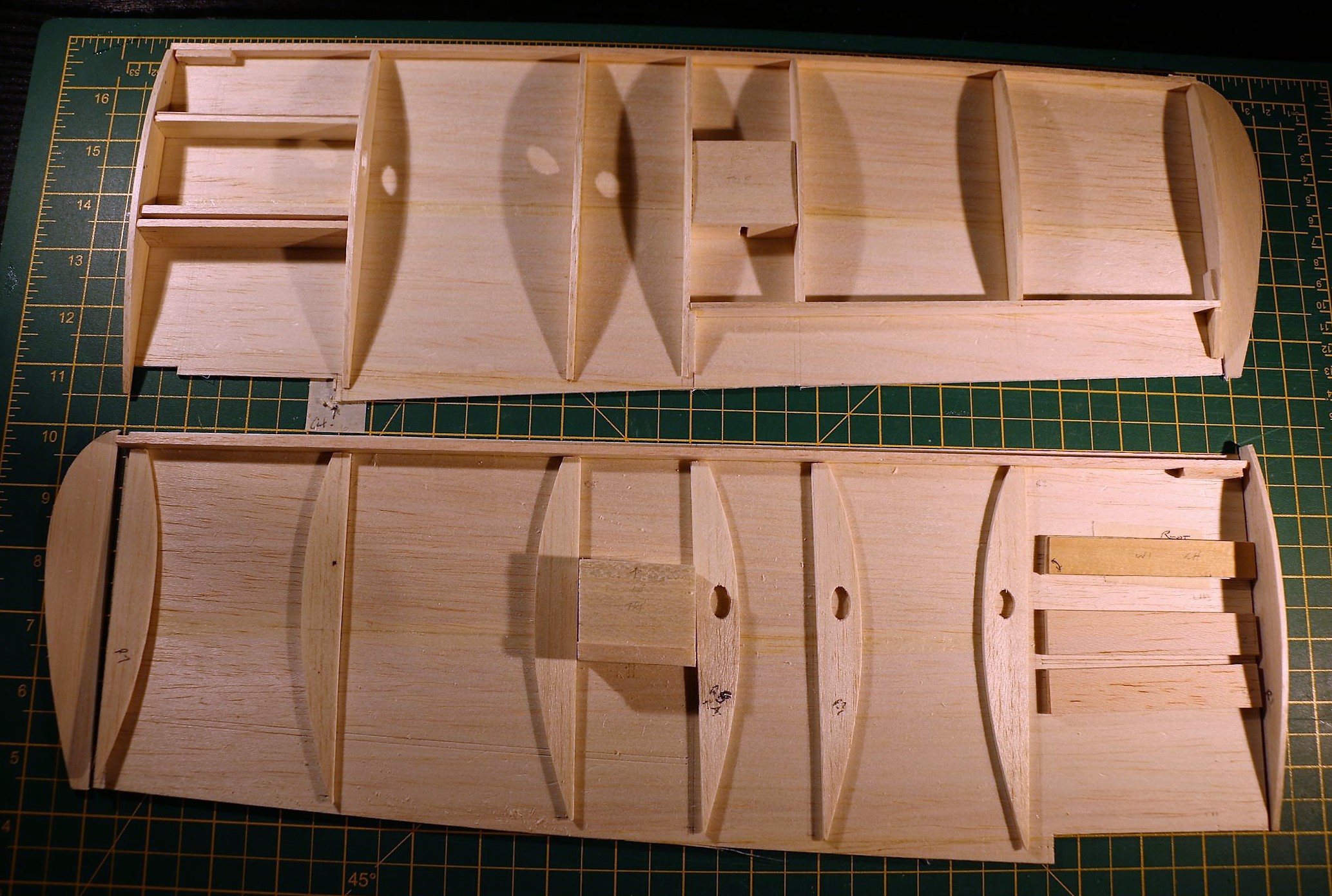
Kryten sent through lots of construction photogaraphs which included the formers, fuselage, and wing halves.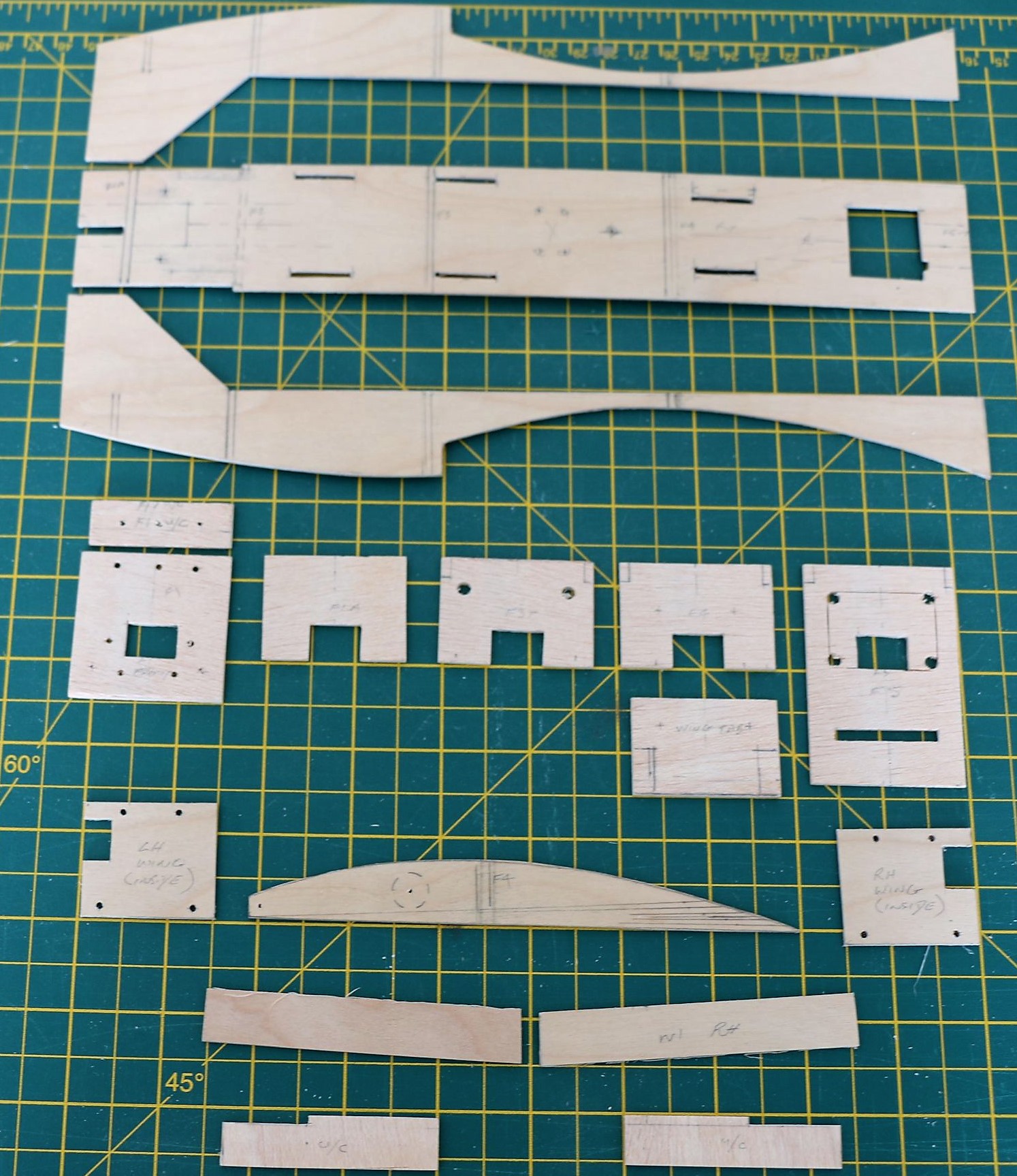
 Here’s the model ready for covering and then completed with some very nice water slide decals that Kryten made.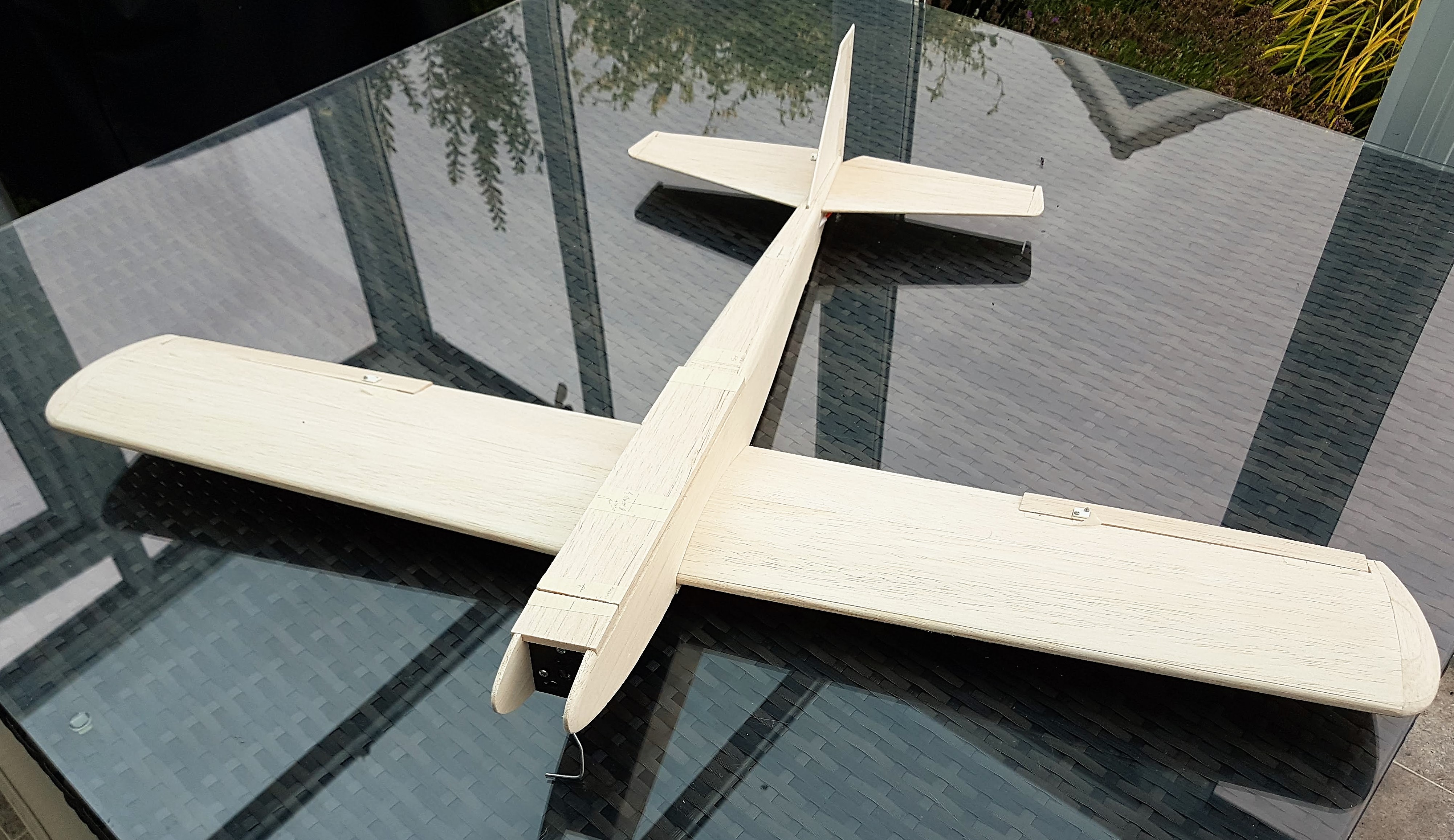
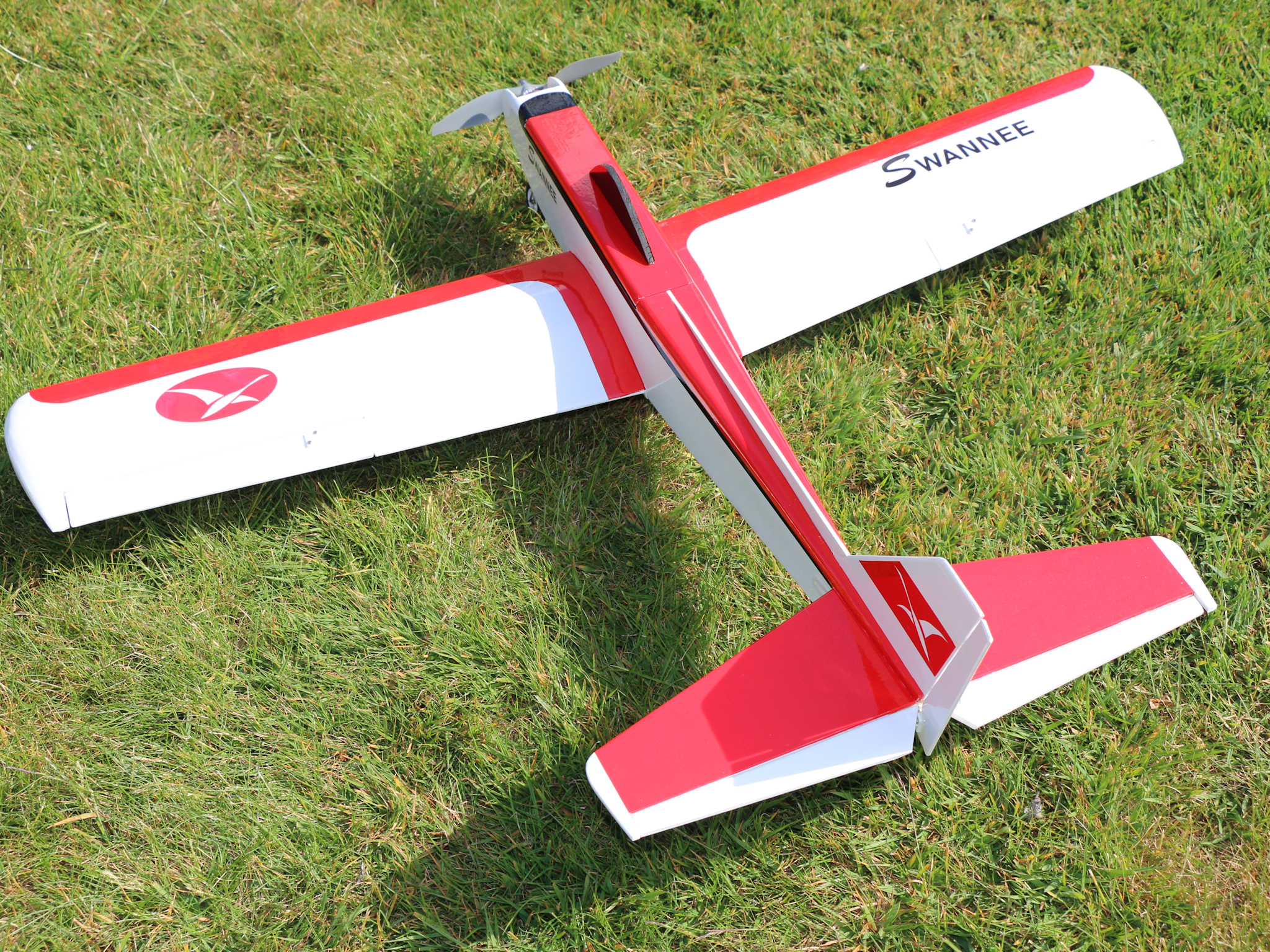 And here’s Swannee flying…but only virtually. Hopefully Swannee will be test flown for real before too long.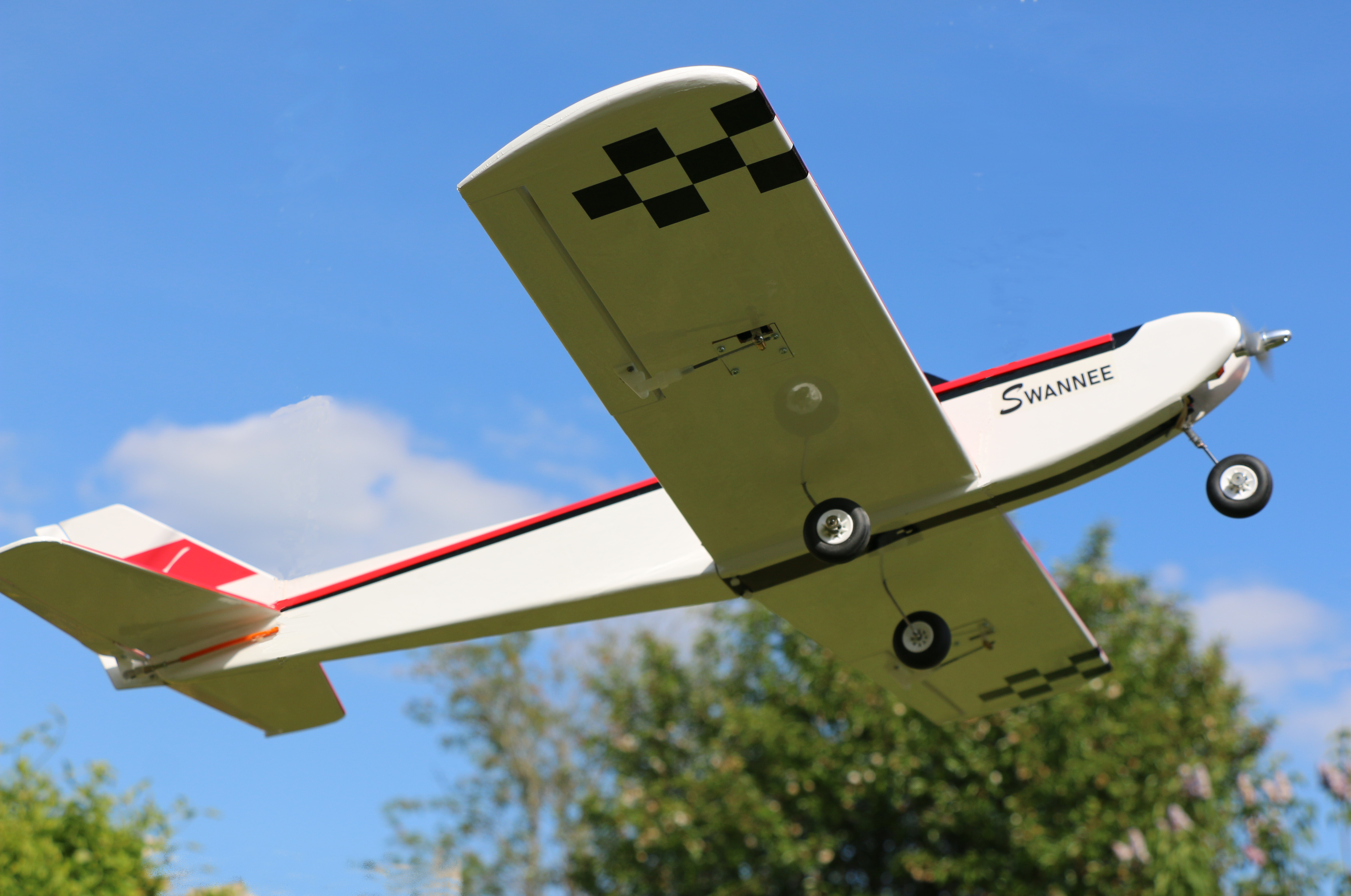
Page Boy has been busy building a Skywriter, a 48” span sports-scale biplane designed by Lindsay Todd.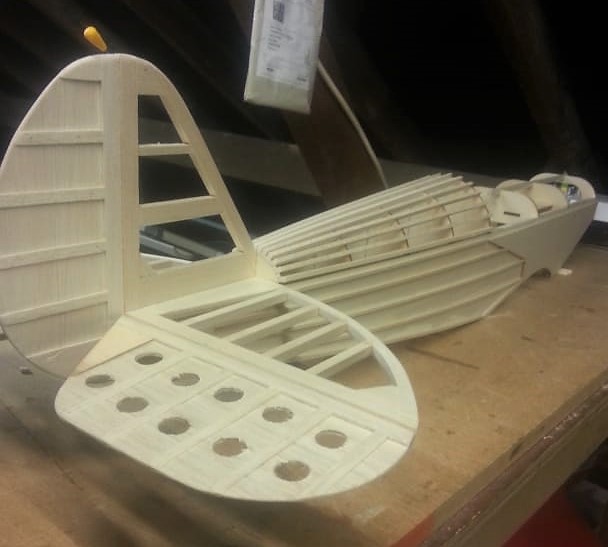
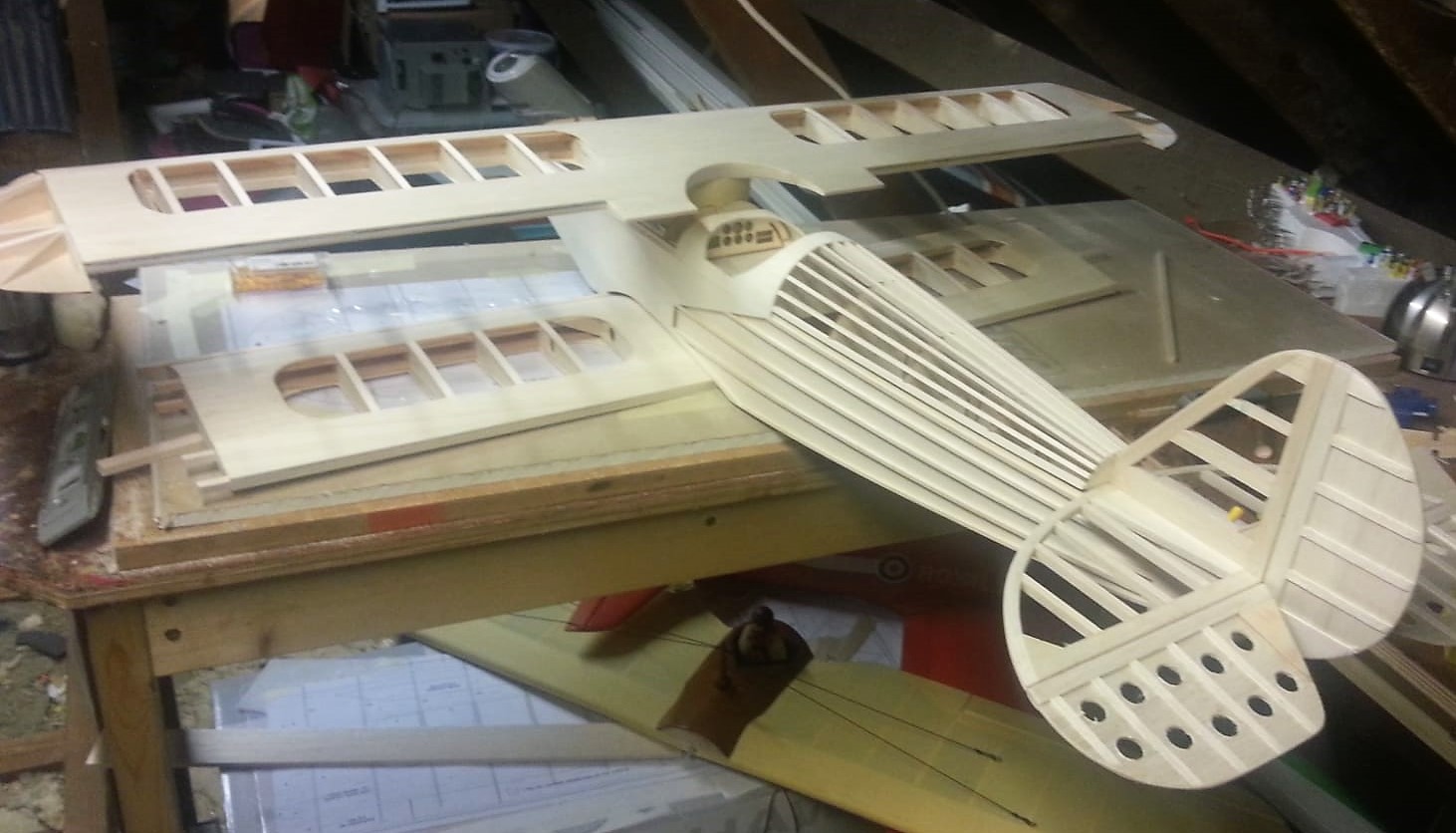 I don’t have any information about the motor etc at the moment but it looks as if he’s making a lovely job of the airframe and as the lockdown continues I don’t suppose it will be too long before it’s ready for covering.
Last month I mentioned that Matt Takhar was building something that’s a complete departure from his usual stuff.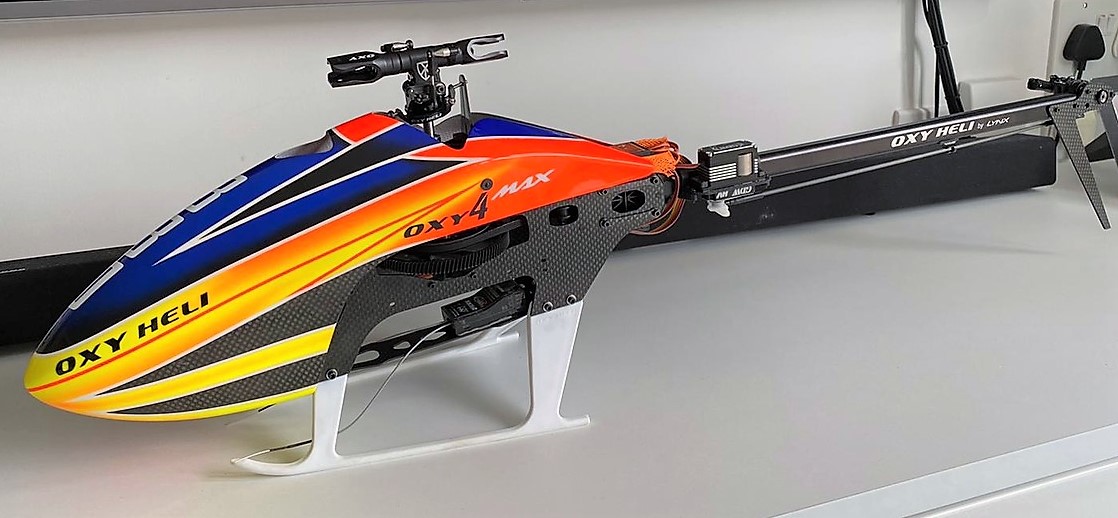 I can now reveal that’s it’s an Oxy4 Max helicopter! As we only fly fixed-wing models at the field a helicopter is quite a rarity for a PAM member although Captain Slow used to be heavily into choppers and some members do have small ones… but that’s another story! Matt is intending to fly his new toy with Hayling Helis in due course.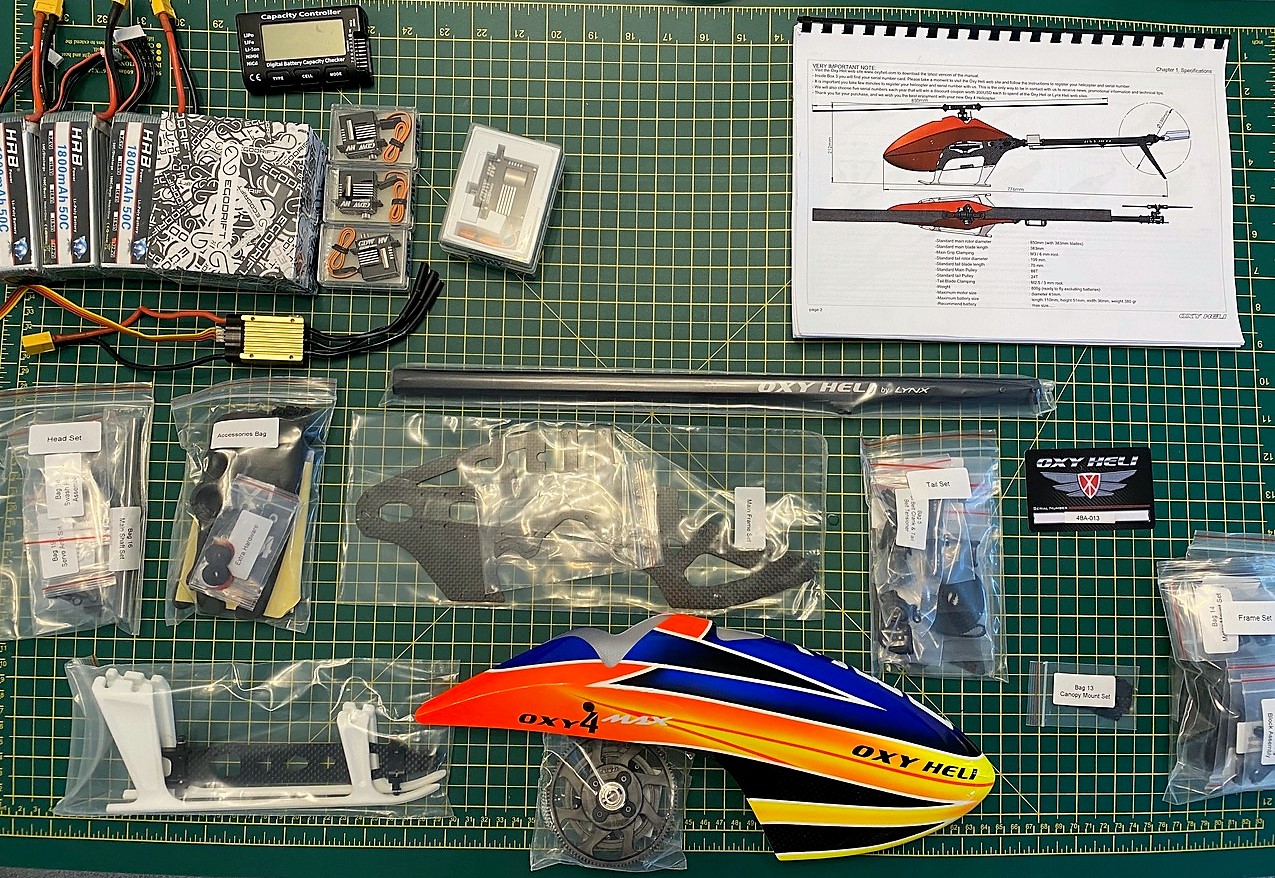
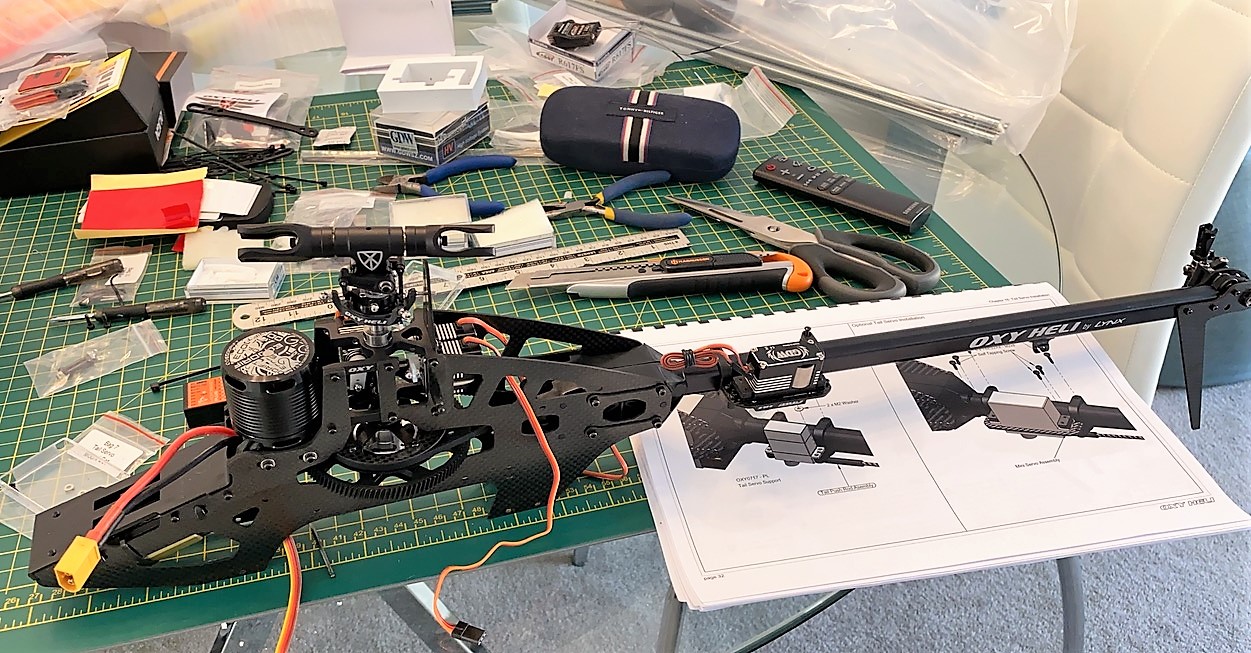
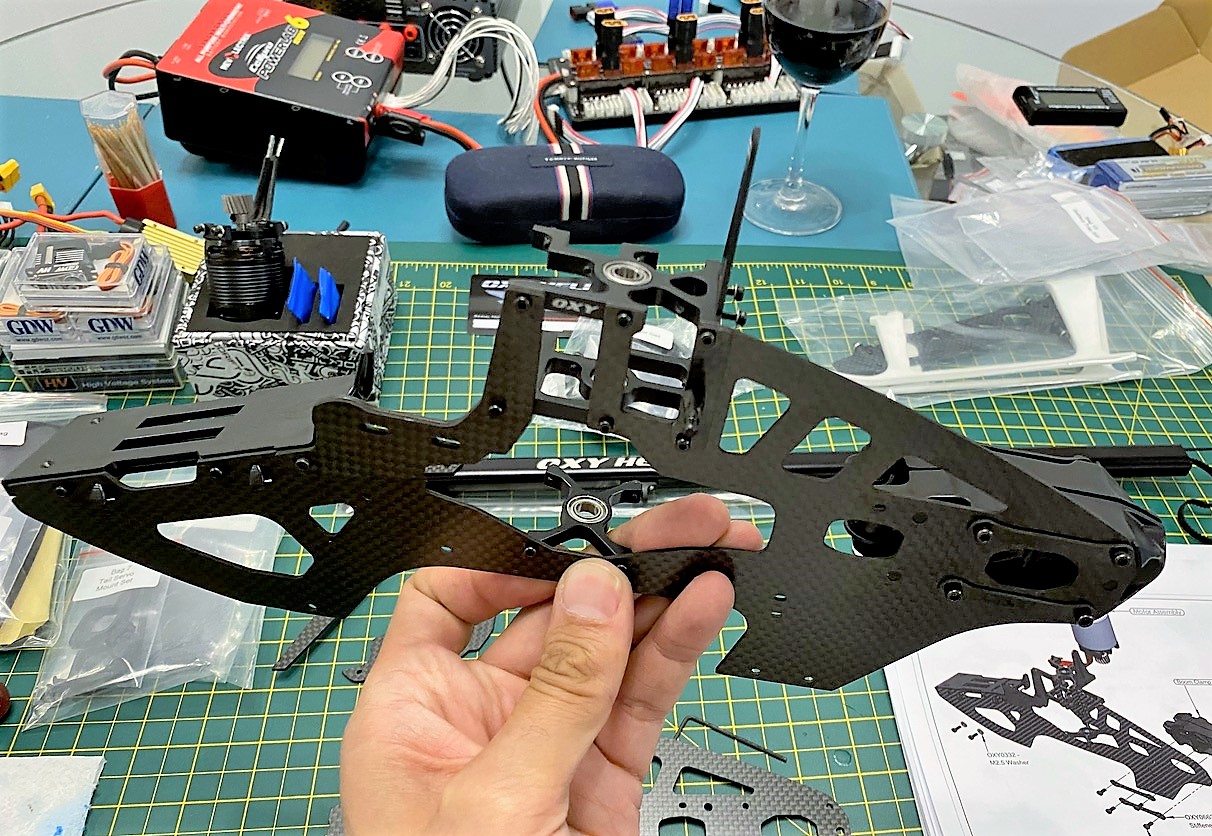 Matt says: Here’s the spec… I don’t actually know what most of this means or does, but it all sounds good!
Oxy 4 max
GDW DS595MG Tail servo
GDW DS290MG Cyclic servos x 3
Scorpion Tribunus 06-80amp Esc/SBec
Egodrift Tengu motor 3220/960KV
HRB 6S 1800mAh lipos x 3
Micro Beast flybarless unit (aka the magic box of tricks)
Fun-Key FK RT Carbon Fibre Main blades
Fun-Key FK RT Carbon Fibre Tail blades
Matt says: Here’s the spec… I don’t actually know what most of this means or does, but it all sounds good!
Oxy 4 max
GDW DS595MG Tail servo
GDW DS290MG Cyclic servos x 3
Scorpion Tribunus 06-80amp Esc/SBec
Egodrift Tengu motor 3220/960KV
HRB 6S 1800mAh lipos x 3
Micro Beast flybarless unit (aka the magic box of tricks)
Fun-Key FK RT Carbon Fibre Main blades
Fun-Key FK RT Carbon Fibre Tail blades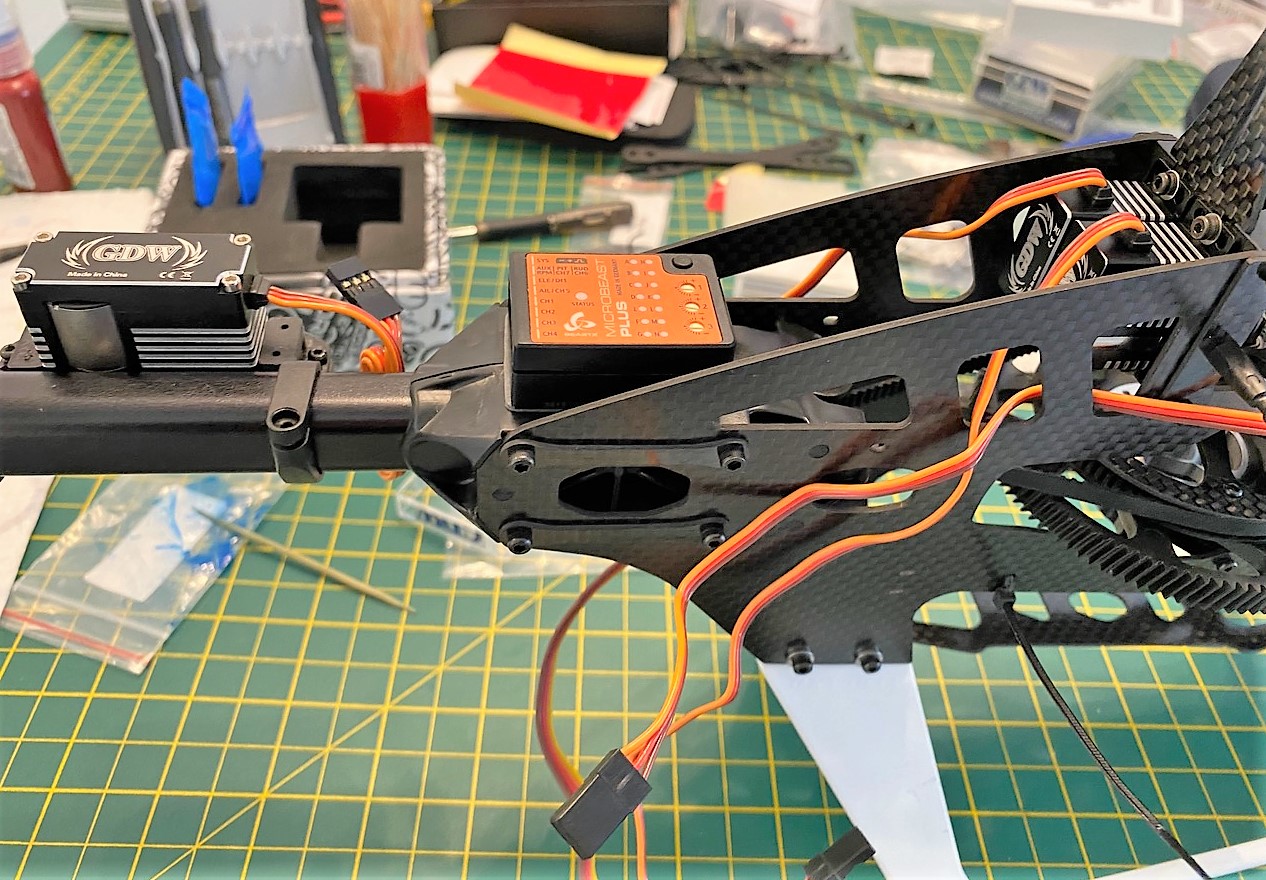 The build has been very enjoyable, mainly down to learning something new. Although I will admit I spent the best part of three hours trying to work out how to setup the flybarless unit with the RX/TX, it uses a single SBUS lead from RX to unit.
That looks like a real feat of engineering, not what we normally think of as building. Good luck flying it Matt!
The build has been very enjoyable, mainly down to learning something new. Although I will admit I spent the best part of three hours trying to work out how to setup the flybarless unit with the RX/TX, it uses a single SBUS lead from RX to unit.
That looks like a real feat of engineering, not what we normally think of as building. Good luck flying it Matt!
Norwegian Nick is still at it, building models that is. He sent me some info on his large Tiger Moth that looks almost ready to fly now: Bought it on eBay, cost £50. It’s a 1/5th scale Toni Clarke creation. When I got it home and gave it a good going over, I thought that’s 50 quid down the drain. It had been covered in doped on nylon cloth and painted in an awful earth colour probably dating back to the early 80s… Anyway in for a penny in for a pound. I used about 2 pints of cellulose thinners to remove all the covering which seemed to take ages. On exposing the frame work it was obvious that quite a lot of Balsa would need to be replaced. The wings thankfully were ok and needed no attention. The fuselage top and bottom longerons were spruce and in good nick however all the lattice balsa struts rudder and elevators just crumbled to dust when squeezed. So I bit the bullet acquired a set of plans and rebuilt all the affected structures. On completion I noticed that the tailplane was slightly offset to the horizontal but thought I don’t care anymore it will still fly. Covered in plain Solatex and sprayed to the Norwegian aircraft insignia.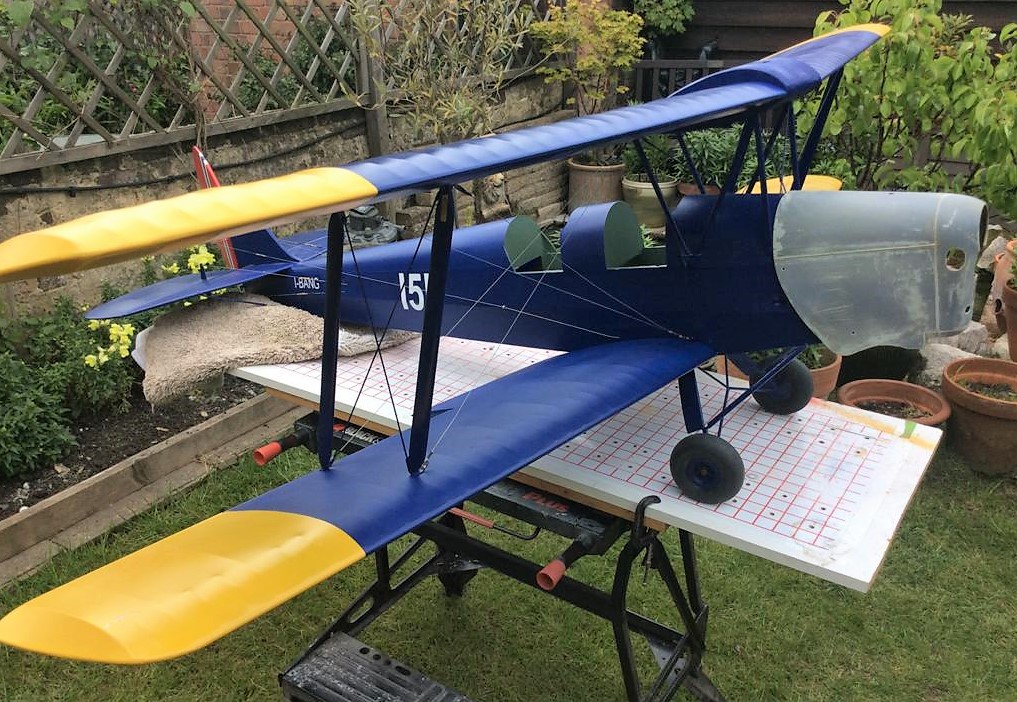
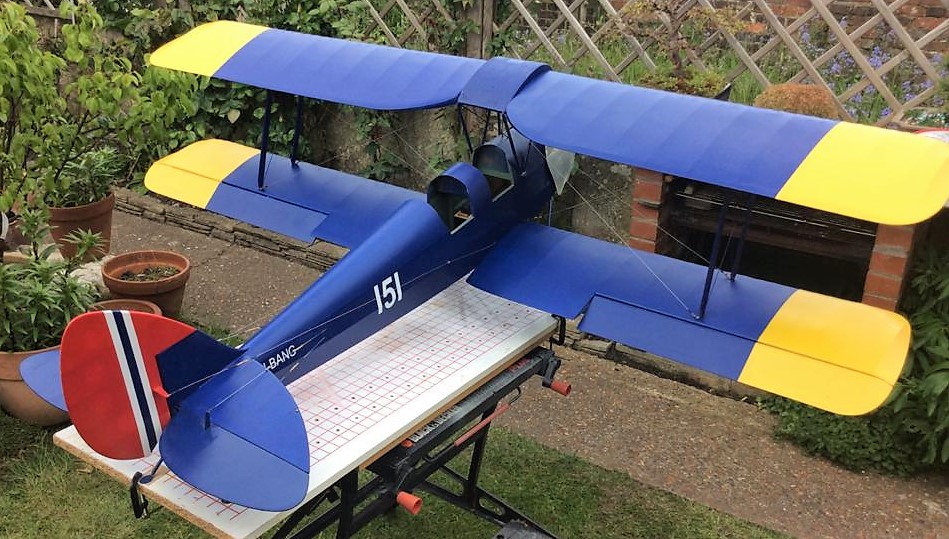 All servos were the first Futaba 3003s, huge, and control linkages in the wings were bell-cranks and wire pushrods. Now fitted with Hitec servos throughout and conventional push pull cables for elevators and rudder control as per full size. Had to make new struts for wings because they were absent when bought. Anyway enough of the waffle, it’s just over 6ft wingspan weighs out at about 10 lbs which is normal. Reluctant to power it with electric motor which would have involved major dockyard surgery on the front end and I think would belittle the concept of a Tiggie so have fitted a Laser 70 4-stroke for power which I guess will be abhorrent to some. Just been online and the price of the same model from Toni Clarke is 499 Euros so fifty quid seems a bargain.
It looks great now Nick, well worth the effort and it will make an excellent stablemate for your 80” span Citabria Pro.
All servos were the first Futaba 3003s, huge, and control linkages in the wings were bell-cranks and wire pushrods. Now fitted with Hitec servos throughout and conventional push pull cables for elevators and rudder control as per full size. Had to make new struts for wings because they were absent when bought. Anyway enough of the waffle, it’s just over 6ft wingspan weighs out at about 10 lbs which is normal. Reluctant to power it with electric motor which would have involved major dockyard surgery on the front end and I think would belittle the concept of a Tiggie so have fitted a Laser 70 4-stroke for power which I guess will be abhorrent to some. Just been online and the price of the same model from Toni Clarke is 499 Euros so fifty quid seems a bargain.
It looks great now Nick, well worth the effort and it will make an excellent stablemate for your 80” span Citabria Pro.
Nick’s also got a Peter Holland Archie biplane underway, well he wouldn’t want to run out of things to do would he?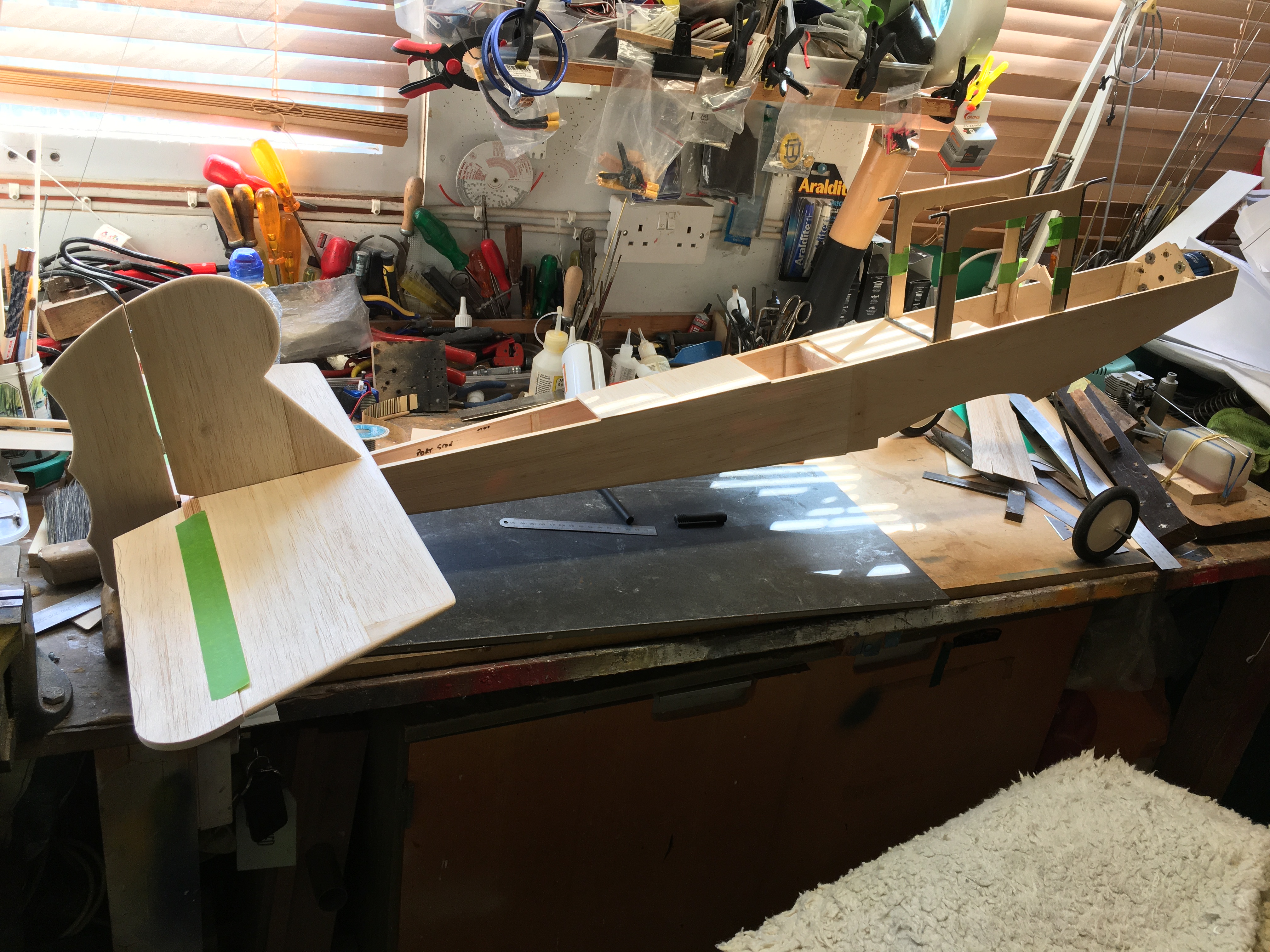
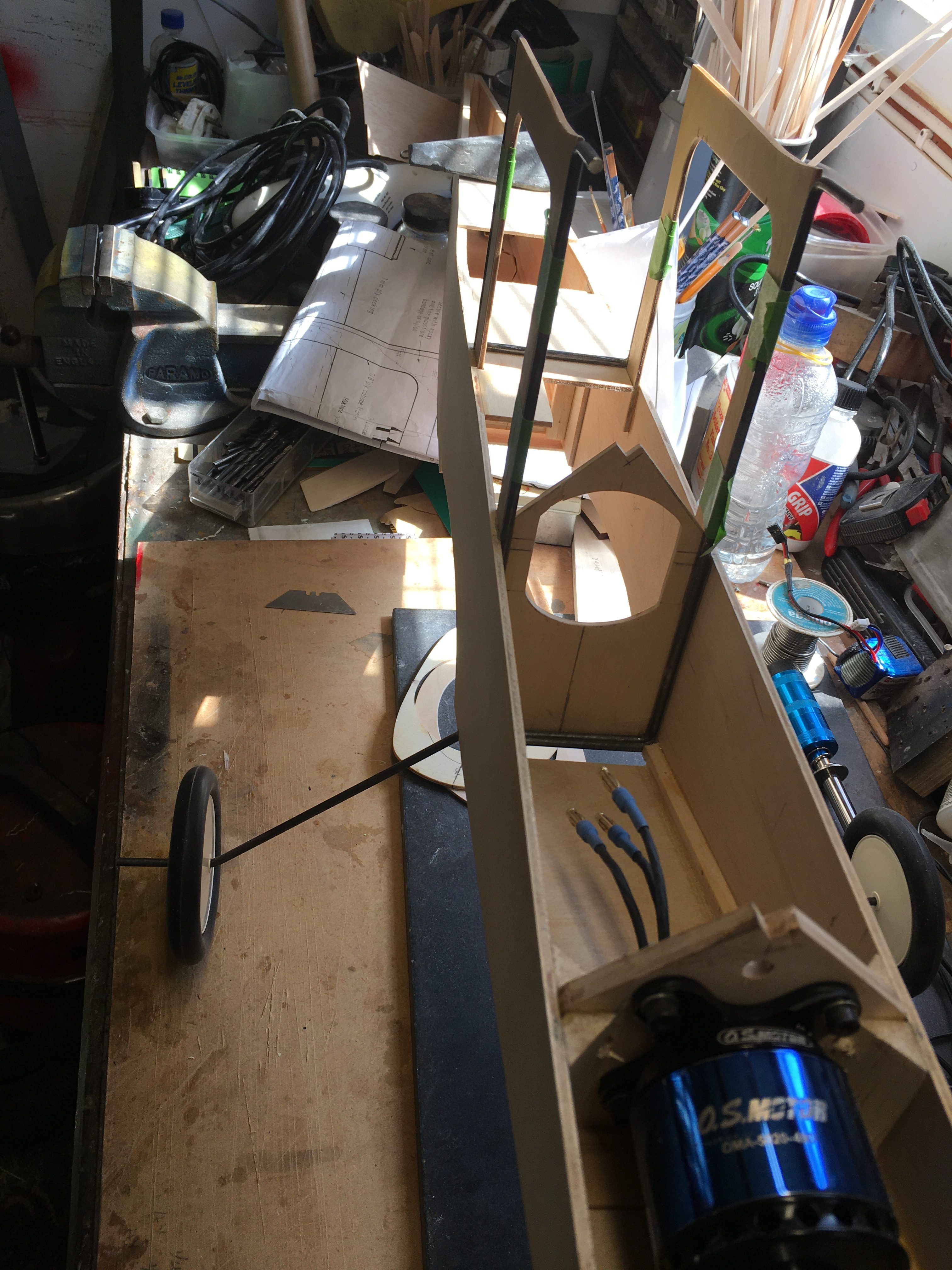 So that’s a Sabre, Buccaneer, Tiger Moth, and an Archie…are there any others that I don’t about yet Nick?
I forgot to mention the March competition in last month’s Patch News. For those who didn’t read the Comments section the winner was Kryten who correctly named the three S’s as Swanage, Studland, and Sandbanks just eight hours after it was posted! I was really pleased with the photo but I didn’t expect anyone to get the answers so quickly, in fact I wasn’t sure it would be recognised at all. Well done Kryten, here’s your Gold Star ⭐
Last month I set another competition, this time to guess the number of lipos in my ammo box. This comp wasn’t as popular but several members had a go. At one point I said that there was a tie, giving what I thought was a really good clue as that meant there could only be three possible answers. Surprisingly only one person had a go after that and with a one in three chance Page Boy correctly guessed 39. Well done Page Boy here’s your Gold Star! ⭐
Another model awaiting a test flight is this rather nice Hunter that that Woody has built from the Tony Nijhuis plan.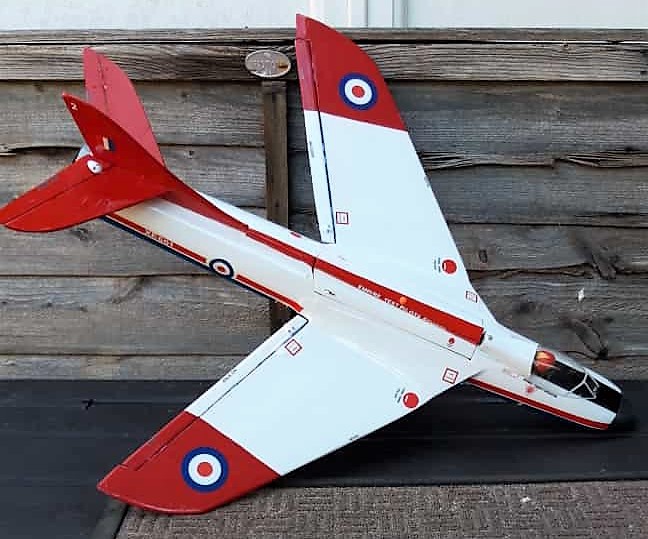
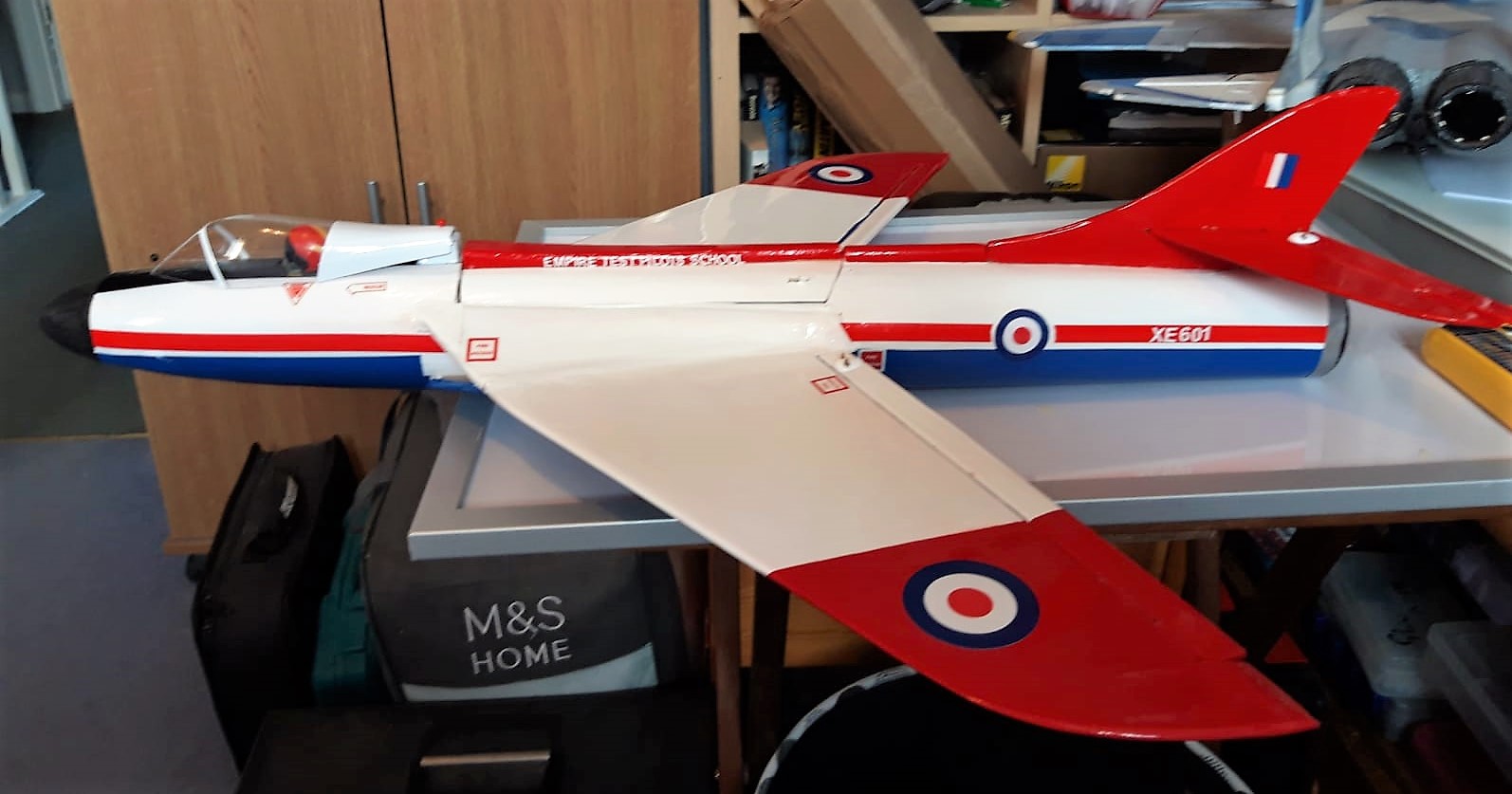 Woody bought the laser cut kit and fitted the recommended FMS 50mm fan and motor along with a 40A Hobbywing speed controller. The colour scheme is from the Empire Test Pilots’ School as Boscombe Down, in fact this one:
 I’ve recently fitted the same fan/motor combination to my F-22 Raptor and am happy to report that the performance is much better than with the previous Dr Mad Thrust unit. I also had to replace the speed controller as the original was a 25A unit and the FMS set-up pulls a good 30A. I fitted a 40A one that I had spare and it so happens it’s a Hobbywing one so my set-up is identical to Woody’s. I believe the Hunter uses 2200mAh 3 cell lipos but I can’t fit those in the Raptor, I’m using 1300mAh 3 cell or some old (ex-Cyano Steve) 1800 Gens Ace ones that will just fit.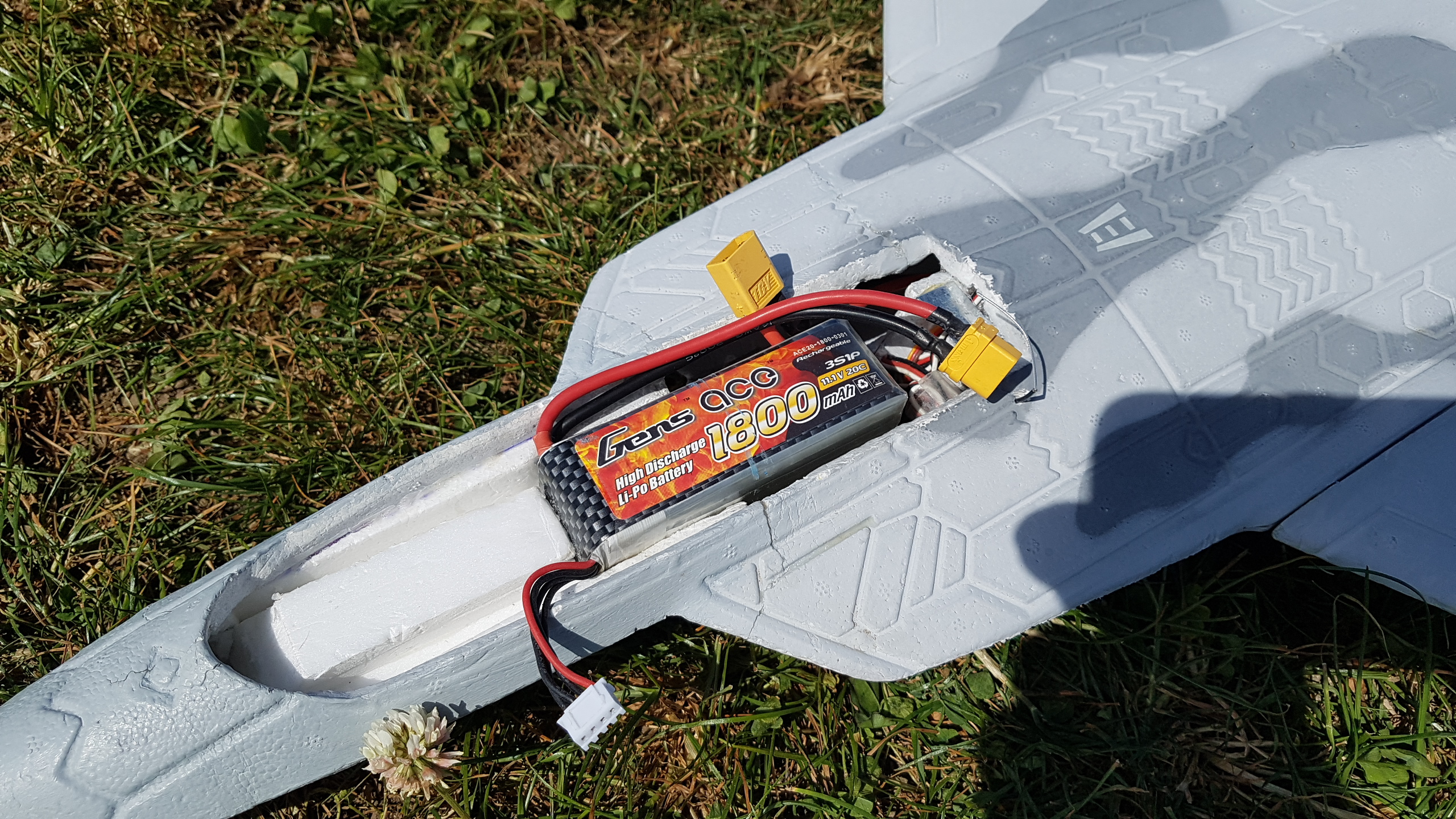
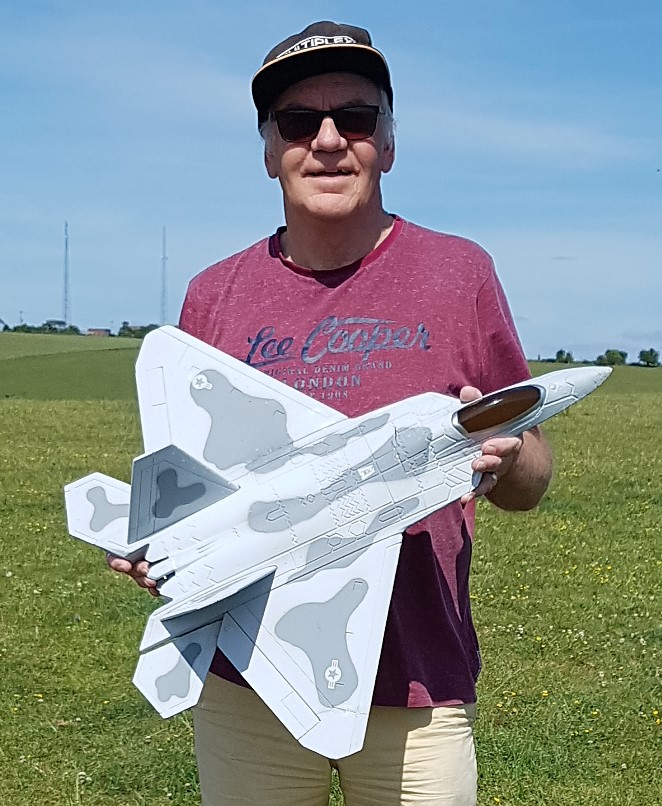 I haven’t managed to find any new 1800’s that aren’t too big so maybe my next lipo purchase will be some 1500’s.
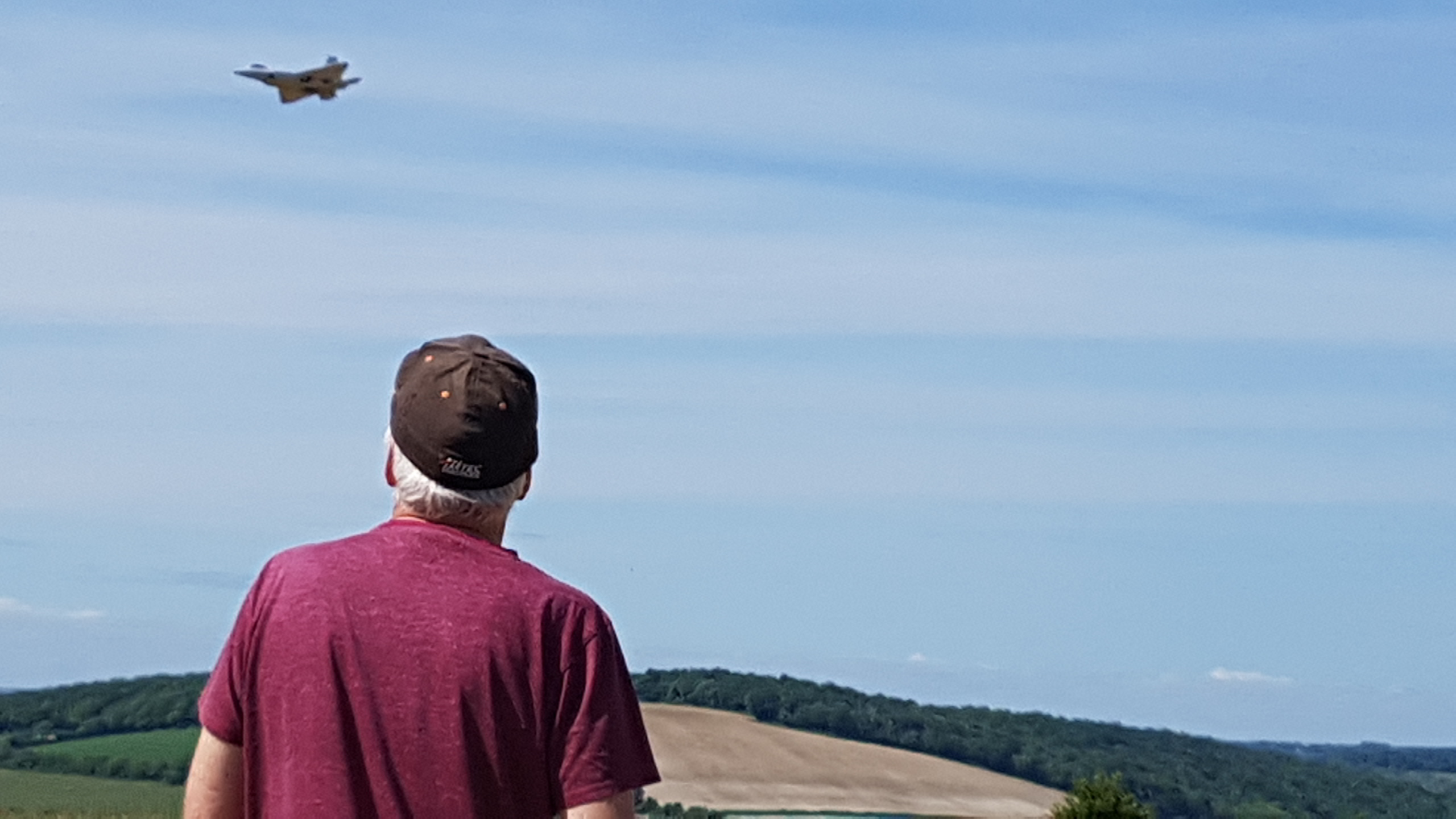 The FMS fan is superb, it’s whisper quiet and noticeably more powerful than the Dr Mad Thrust unit. Of course the extra power means the flights are a little shorter but only using full throttle for steep climb outs and loops etc prolongs the available time to an acceptable length. See it in this month’s video. It will be interesting to see how the performance of Woody’s Hunter compares, the Hunter has a much more modern ducting design than the Raptor. Norwegian Nick’s Sabre will use the same fan but with a 4 cell motor so should be even better. Watch this space.
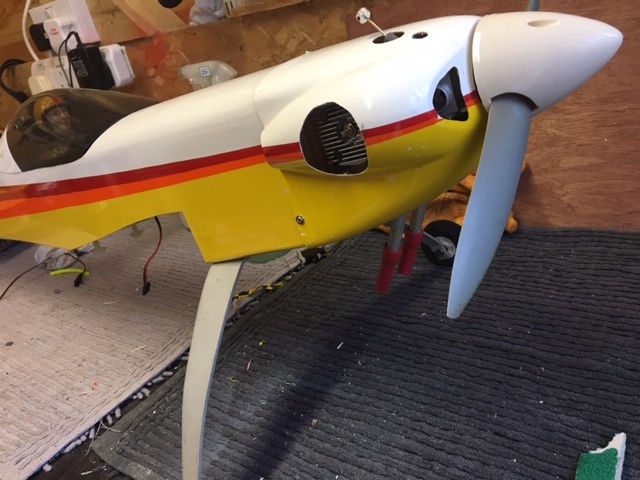
Gorgeous Gary has put together a Multiplex Funjet Ultra, he might be surprised by the speed of the thing, Multiplex say it will do 125mph! Gary has got a Himax c3514-2900 motor, a 60A esc, and will be using a 3 cell 2200mAh lipo.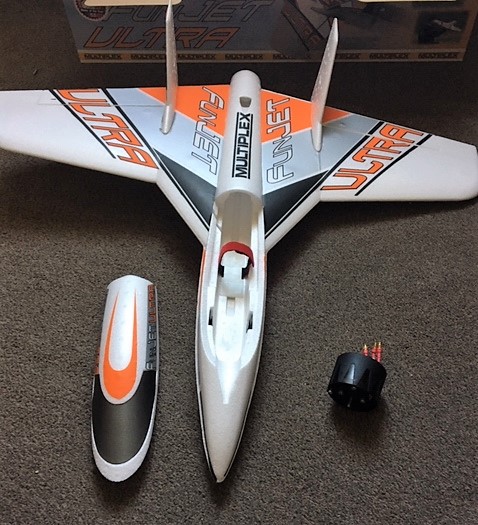 Gary has also been buying more I/c engines, he’s fitted a new OS55 to his existing Wot-4 and has built a new Acro-Wot that also has an OS55. He’s been flying since the partial lockdown lifting but not tried the new models yet.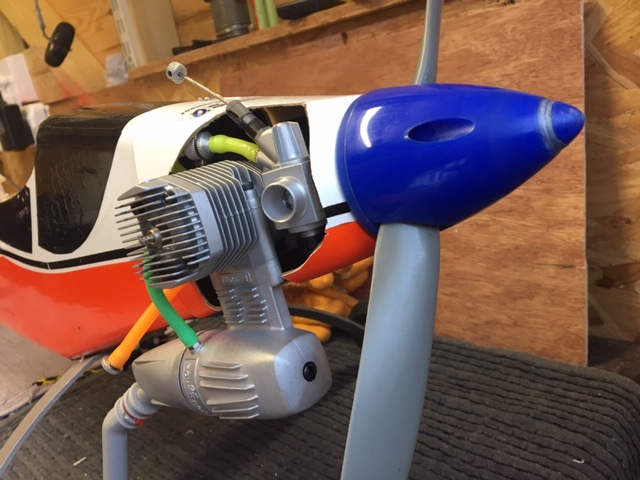
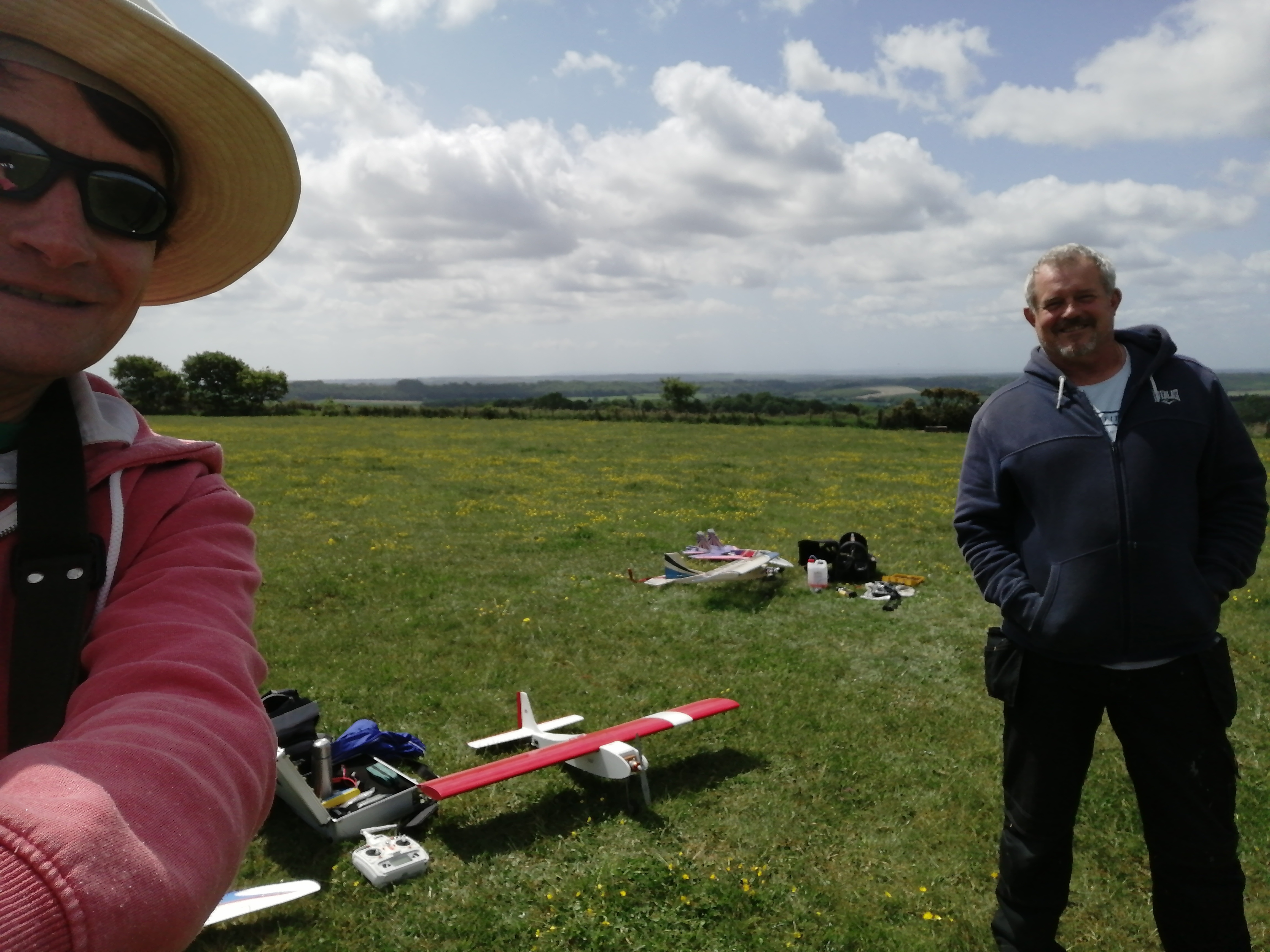
 Dougal Entendre took this selfie of himself and Gary at the patch. Now I’m not sure if it’s just the photo but there appears to be rather more of Gary than last time I saw him. Could that be too many lockdown pies Gary?!
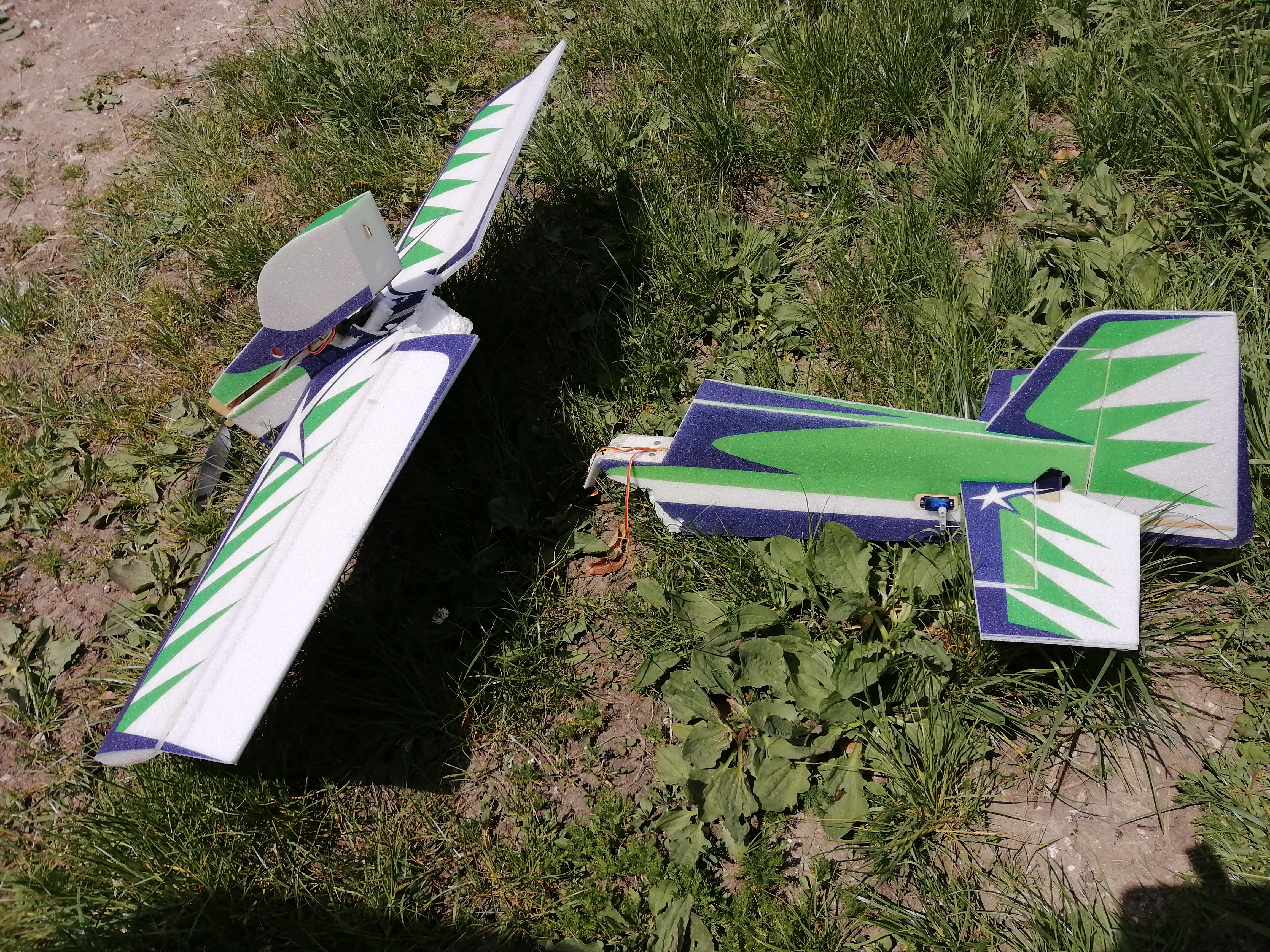
 Dougal also sent a photo of his prop hanging mishap, it seems he’s a bit out of practice but he said it would buff out.
 He was right, it did buff out a treat, good as new now. Well apart from the cowl but that was an earlier mishap.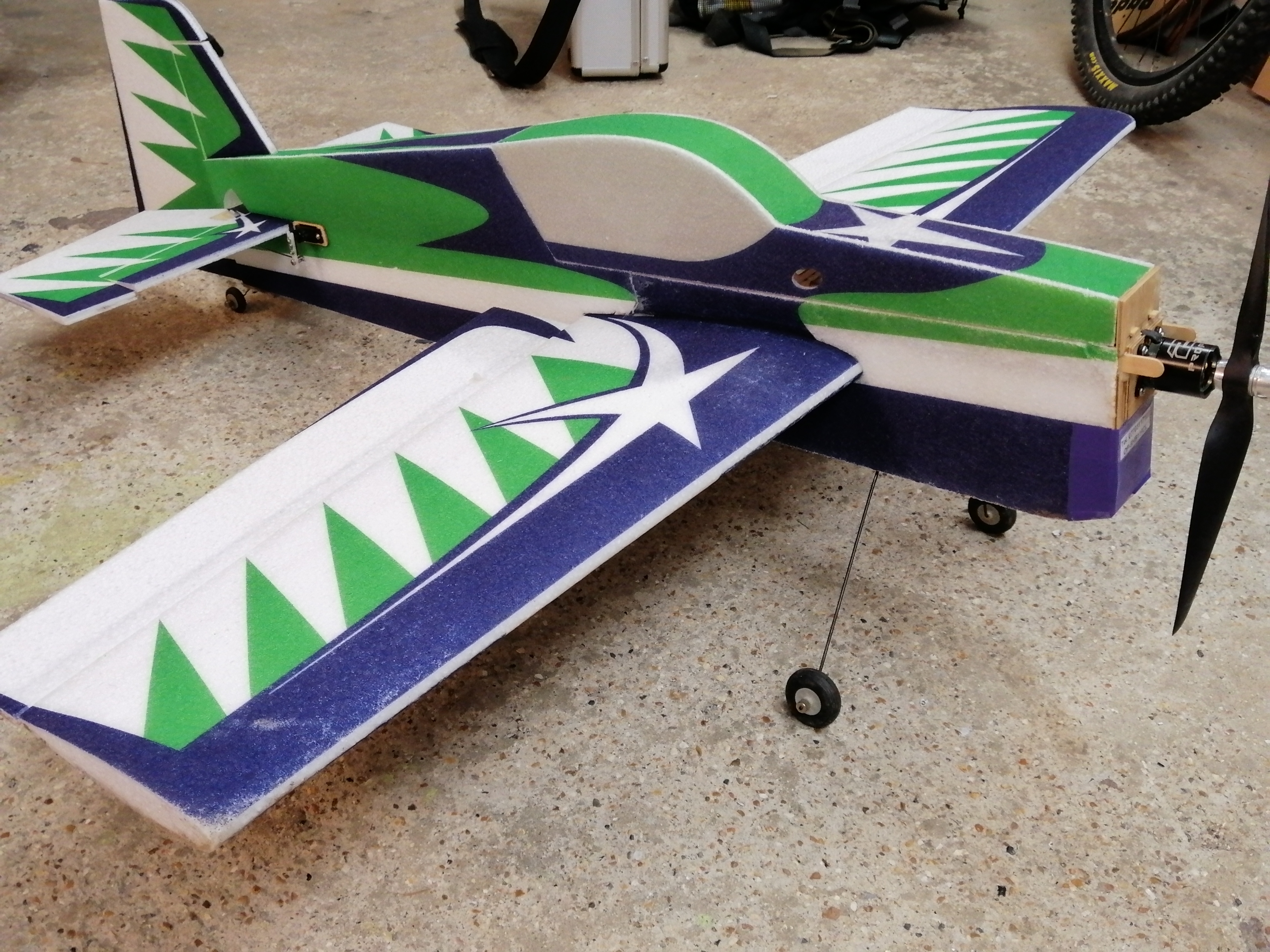
I explained last month the Dwayne Pipe had treated himself to a new Futaba radio and he’s been using it in earnest.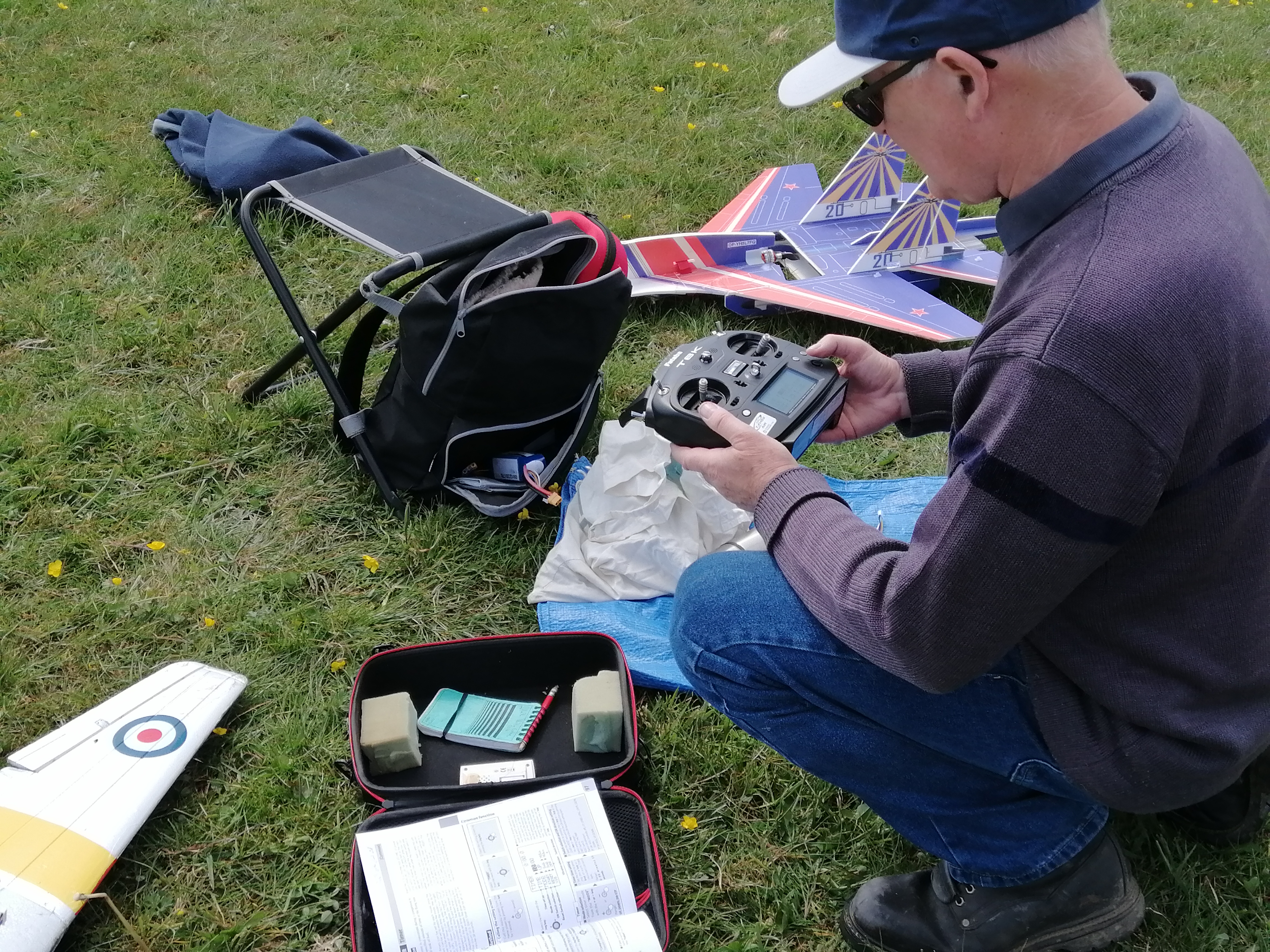 Getting everything set up can take a bit of getting used to with a change of manufacturer so the instruction manual has seen some heavy use but there have been no more unexplained crashes so it’s been a worthwhile change.
Almost last but by no means least is Bob the Builder’s new EasyTwin, an own design twin engine sports model.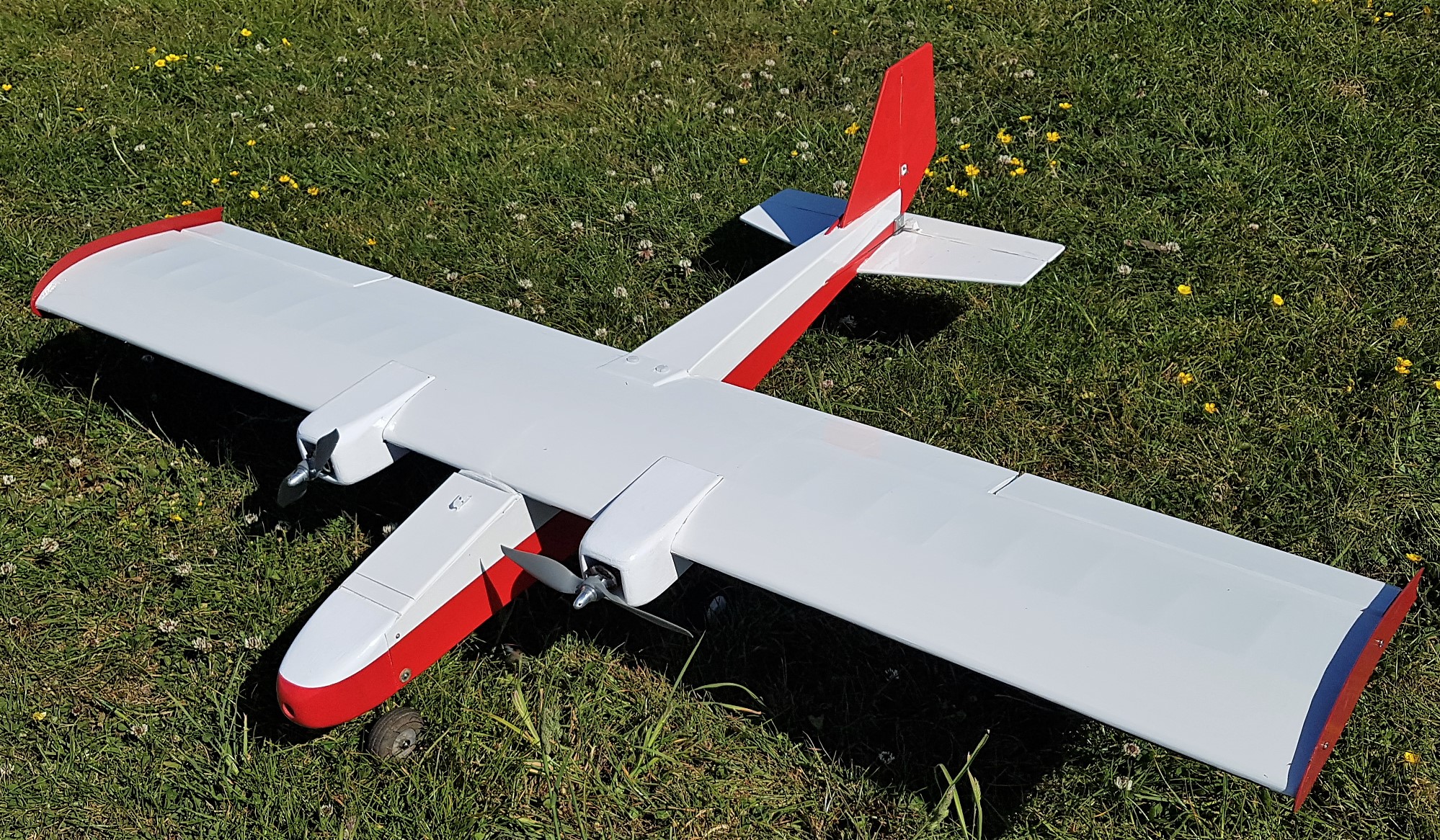
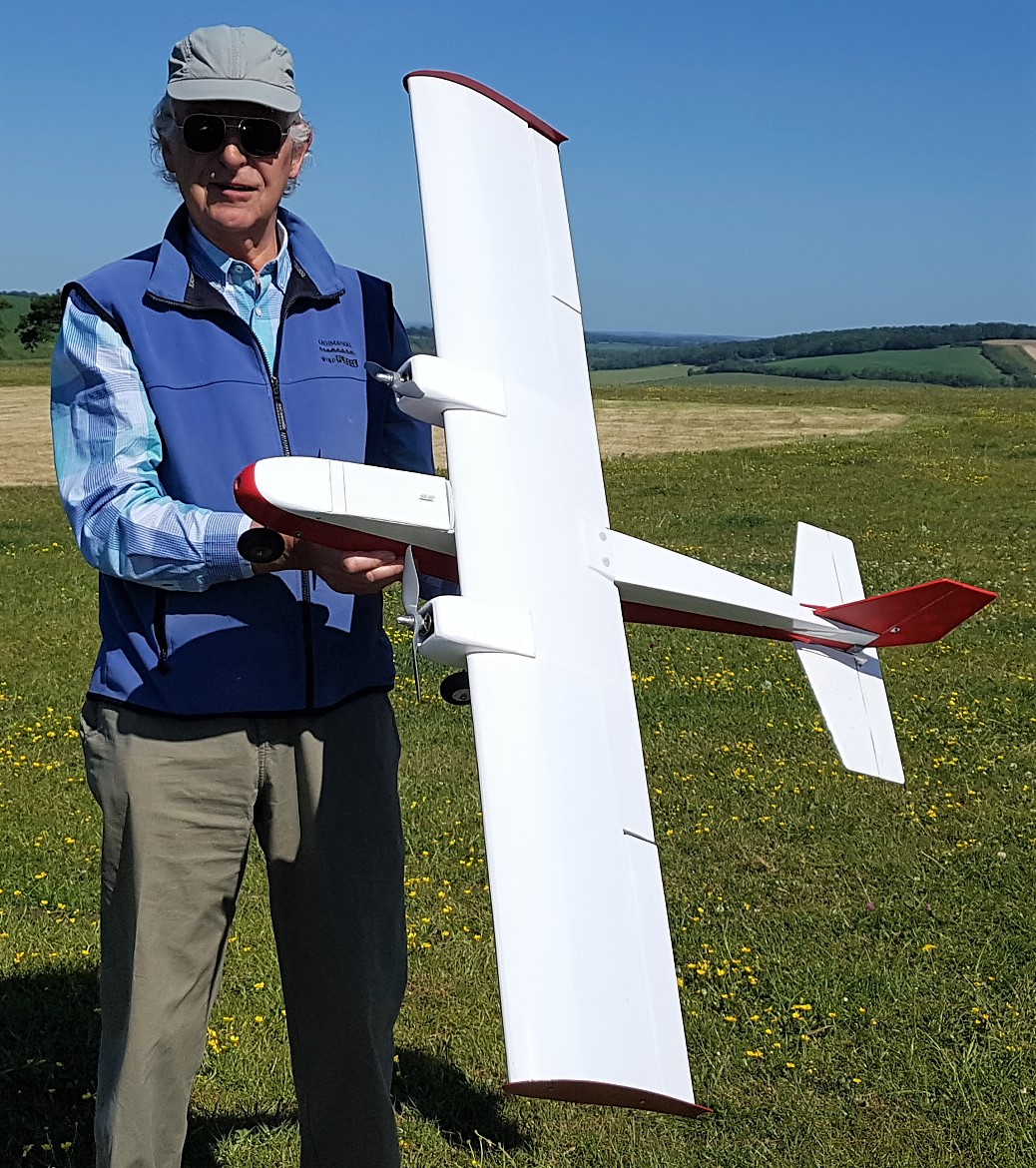 I did the test flight last week and after a little trimming and dialling down of the rates the model flew beautifully. The only problem was that the motors weren’t making the right noises, well one wasn’t anyway. At low throttle and full throttle they both seemed to run together nicely but at just above half throttle there were some very strange noises, definitely not correct, although it didn’t seem to affect the flying too much.
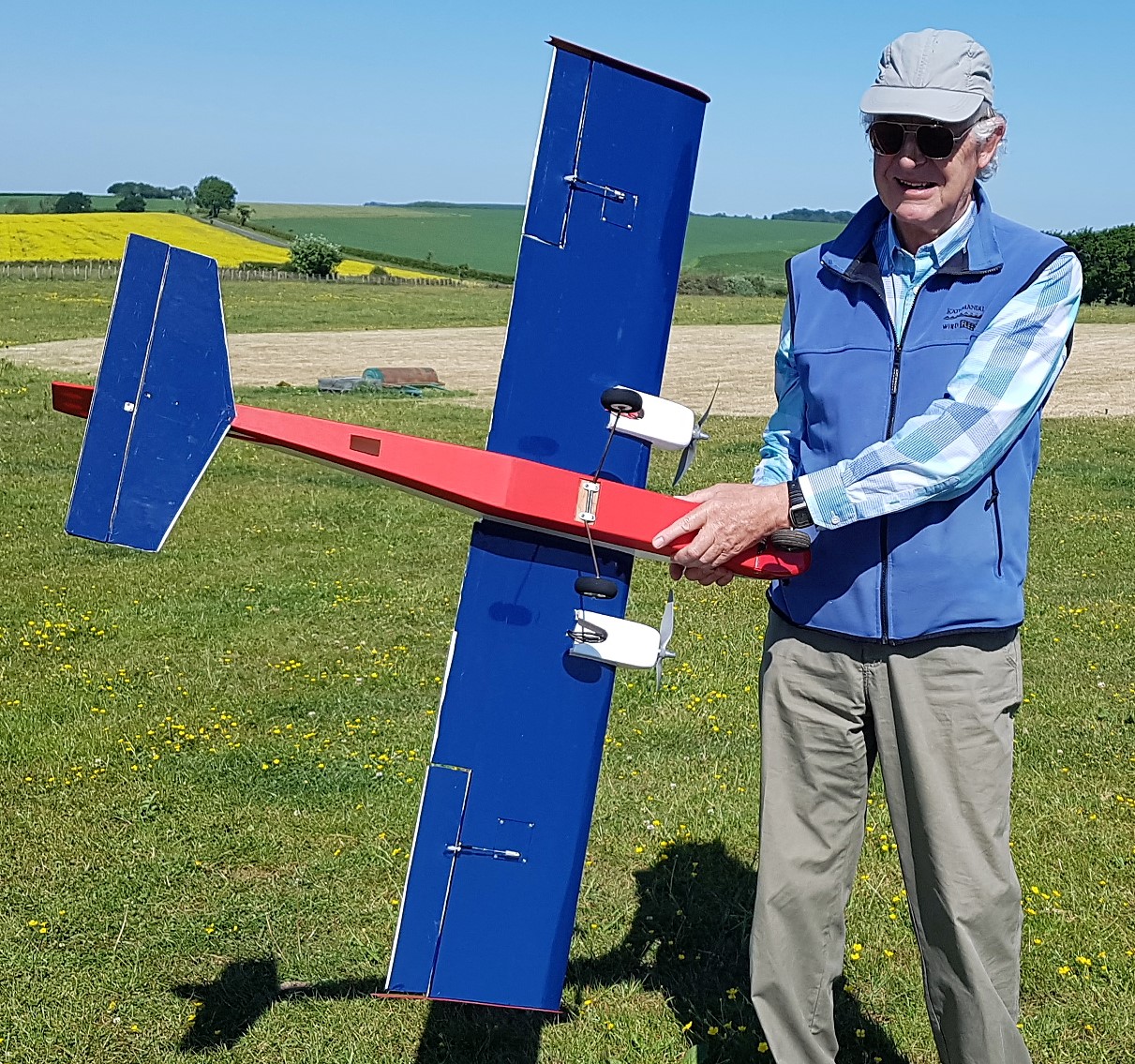 The idea of building the twin was to use up a couple of old motors and a spare speed controller he had kicking around. I mentioned that running two motors from one controller was not advisable so Bob forked out for a matching pair of new ones. It now looks as if Bob might need to buy a pair of motors as well which rather spoils the whole idea. Never mind, it’s a nice model and flies well. You can see it in action in this month’s video.
Bob also built this during lockdown, just for something to do really. I have no details, what you see is what you get.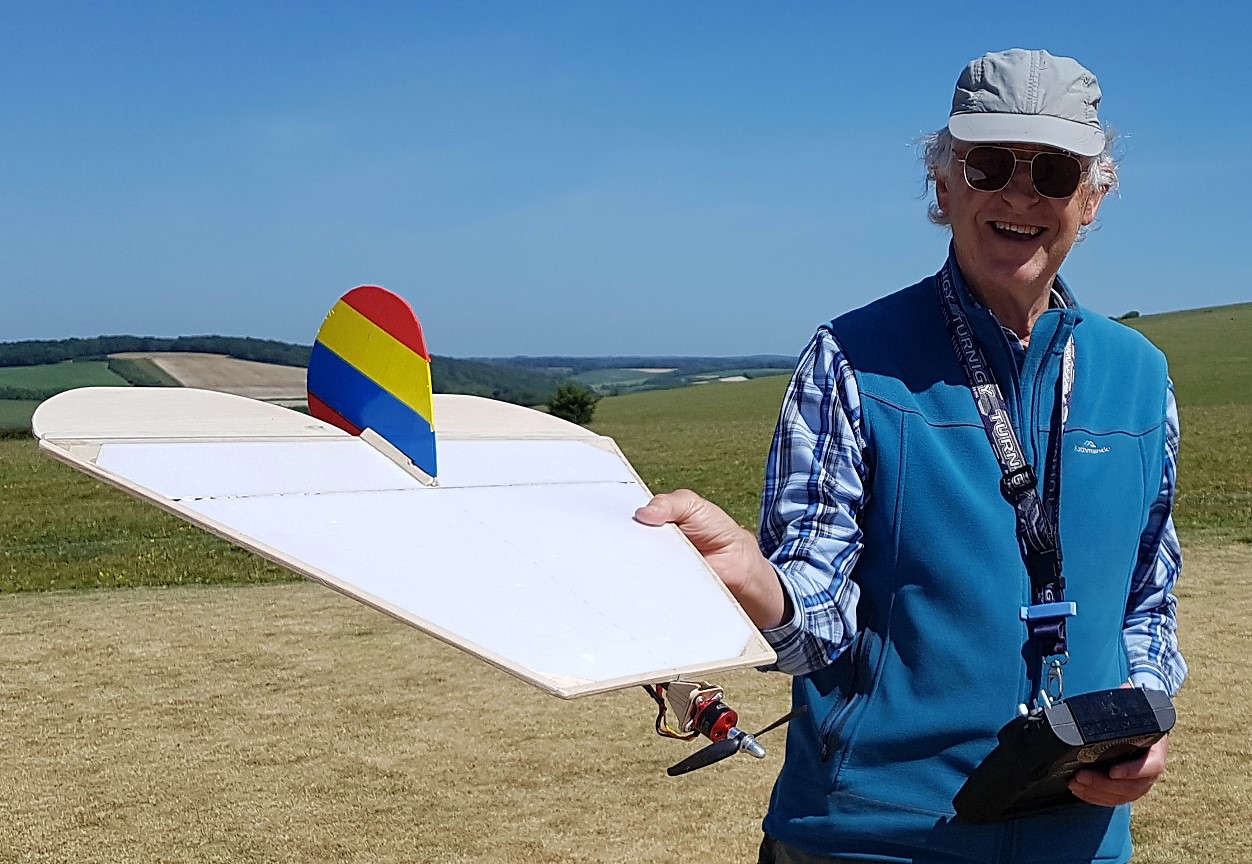
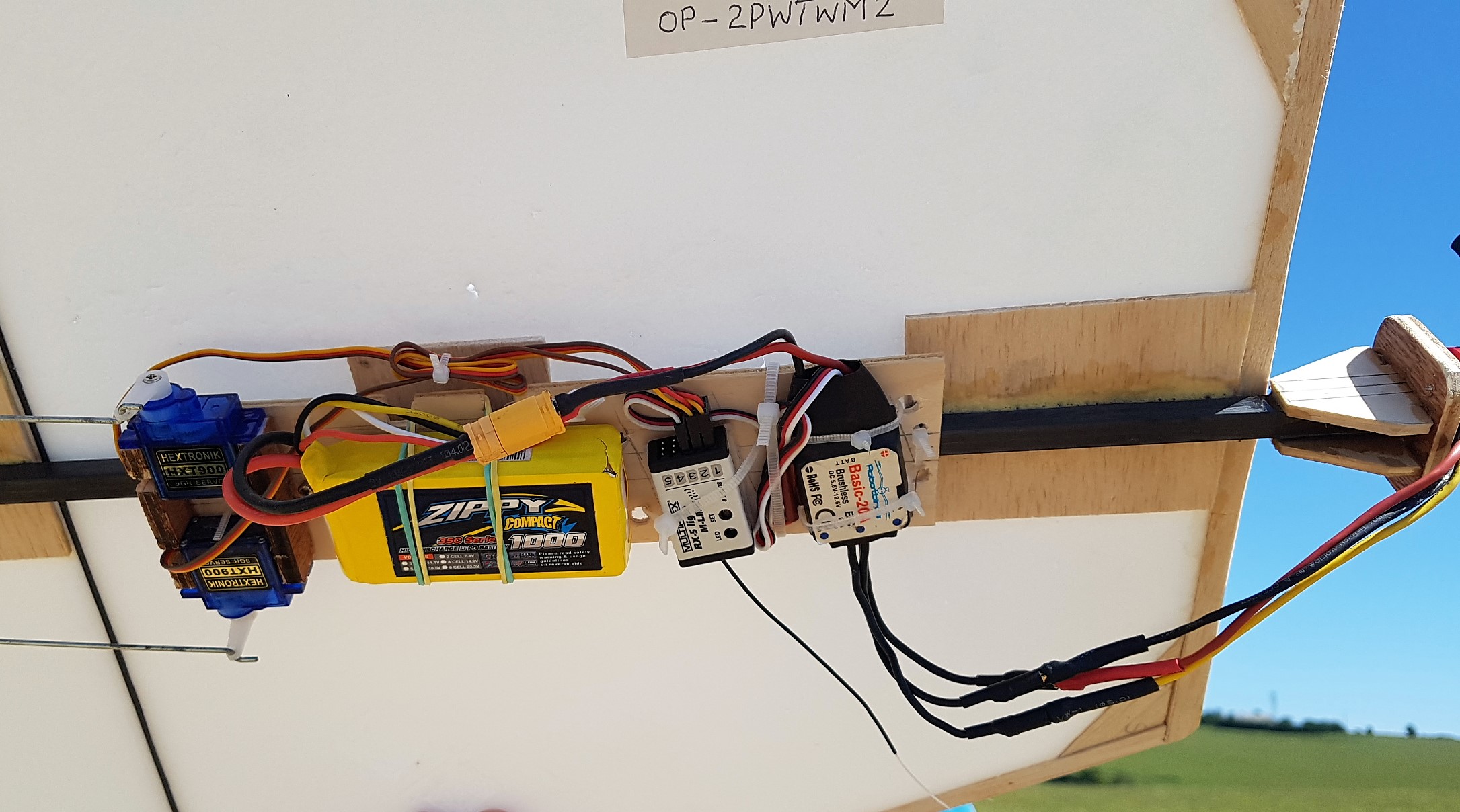 Well it looks ok so the all important question is how does it fly? Just watch the video, it’s hilarious!
1066 sent through some photos of the last new model of the month, Mike Smith’s Durafly Tundra V2.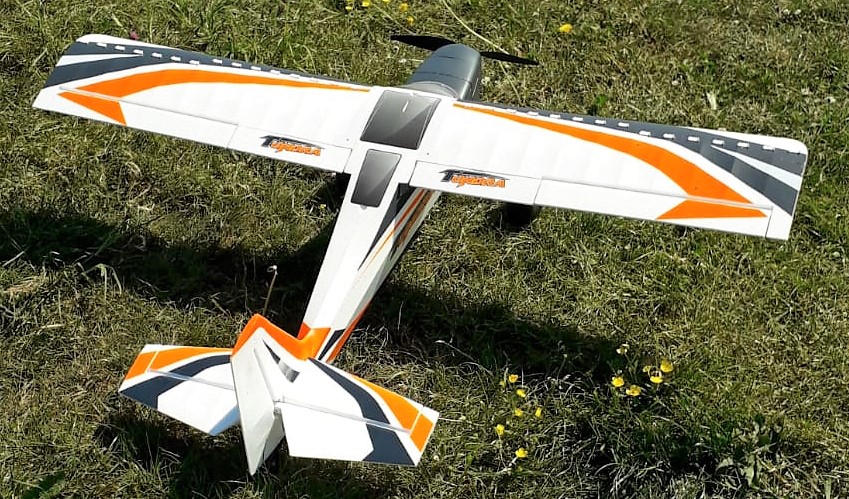
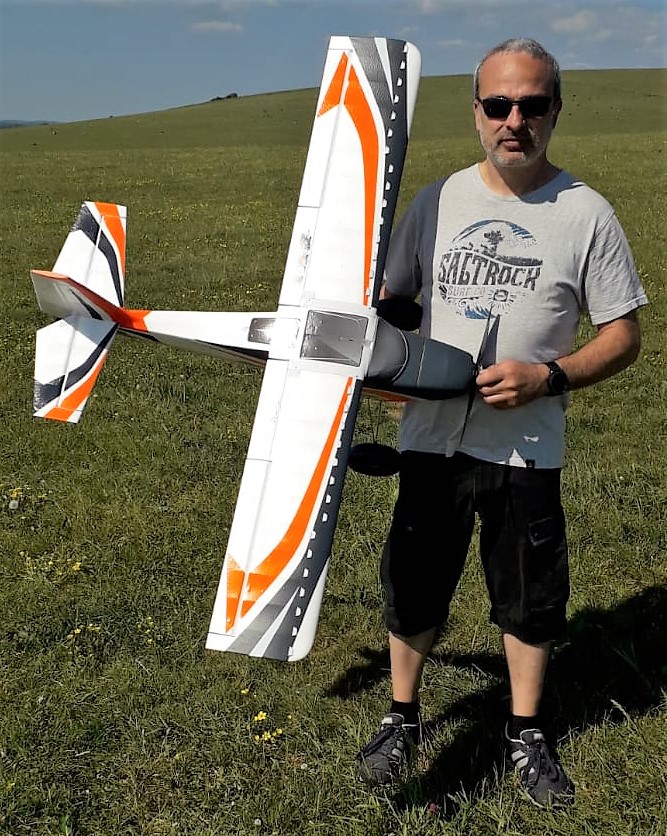 It’s a standard PNF (Plug’N’Fly) model so very little work is required but Mike ordered it on a Tuesday, it arrived on the Saturday, and he flew it on the Monday. One of the unexpected joys of lockdown!
Video time now and this month your cameramen were me, Captain Slow, Dougal Entendre, and Bob the Builder, thanks chaps. Please watch the video full-screen, it’s so much better with small models flying around.If the video won’t play for you click HERE
Some of you might also want to watch a second video. A couple of weeks ago, during a lockdown clear out, I found a VHS tape of the 1987 Nationals Fun Fly that Don Eades, Graham Head, Dick Hall, and myself entered. The tape was made by the event organisers using a camcorder and copies sold to competitors. I haven’t been able to play VHS tapes for many years so I had it converted to an MP4 file. I found the original video was 1hr 12mins long so I’ve edited it and made a PAM version which is mostly of the four PAM members and is 22mins long. It will probably be of little interest to many current members but it is a bit of club history and it’s here if you’d like to watch it:If the video won’t play for you click HERE
Give a man a plane ticket, he’ll fly for a day. Push him out of an airborne plane and he’ll fly for the rest of his life.
Colin Cowplain
Patch News – April 2020
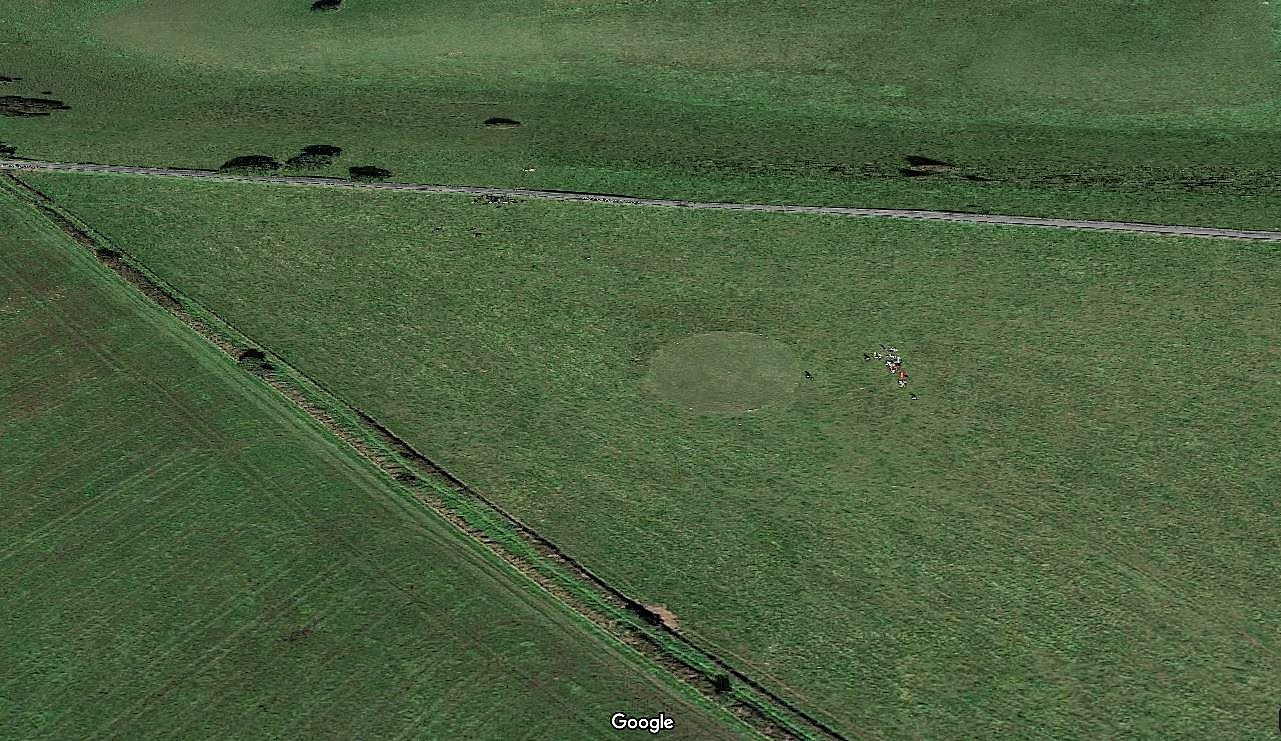
As April has been the first full month of lockdown with no flying at all this Patch News will be concentrating on how we’ve all been keeping busy. However, the patch hasn’t been totally forgotten and some members have been along and checked the fence as part of their daily exercise. The battery has been changed regularly and everything is in order which is fortunate as Woody reports that the bullocks are due to return shortly.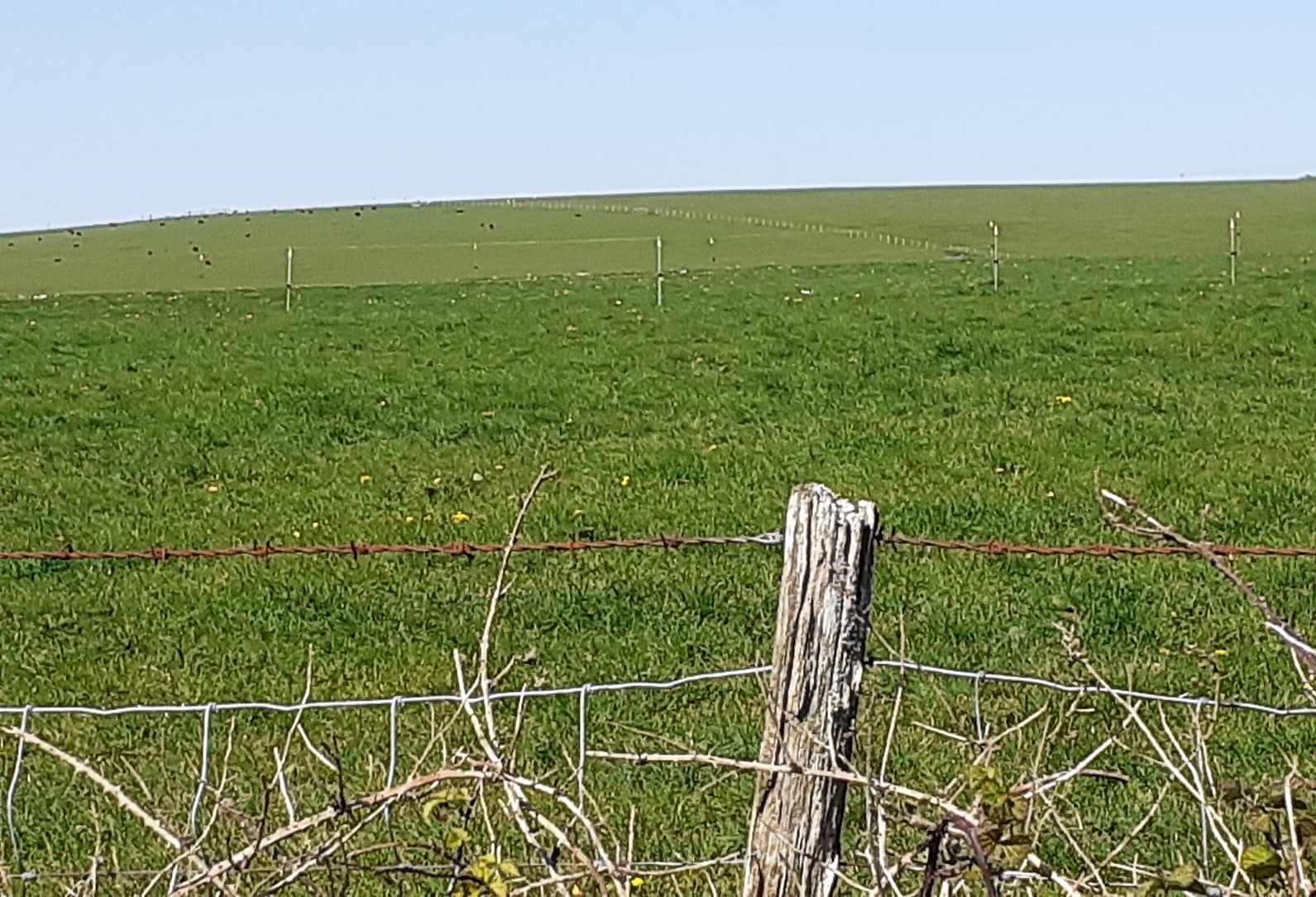 Dougal Entendre pointed out that the photos of the patch area have been updated on Google Maps and now show some of us at the field. It’s even possible to see the spot and now I know why I didn’t win the spot landing comp, the spot isn’t in the middle! Obviously all my spot landing attempts were dead centre of the patch…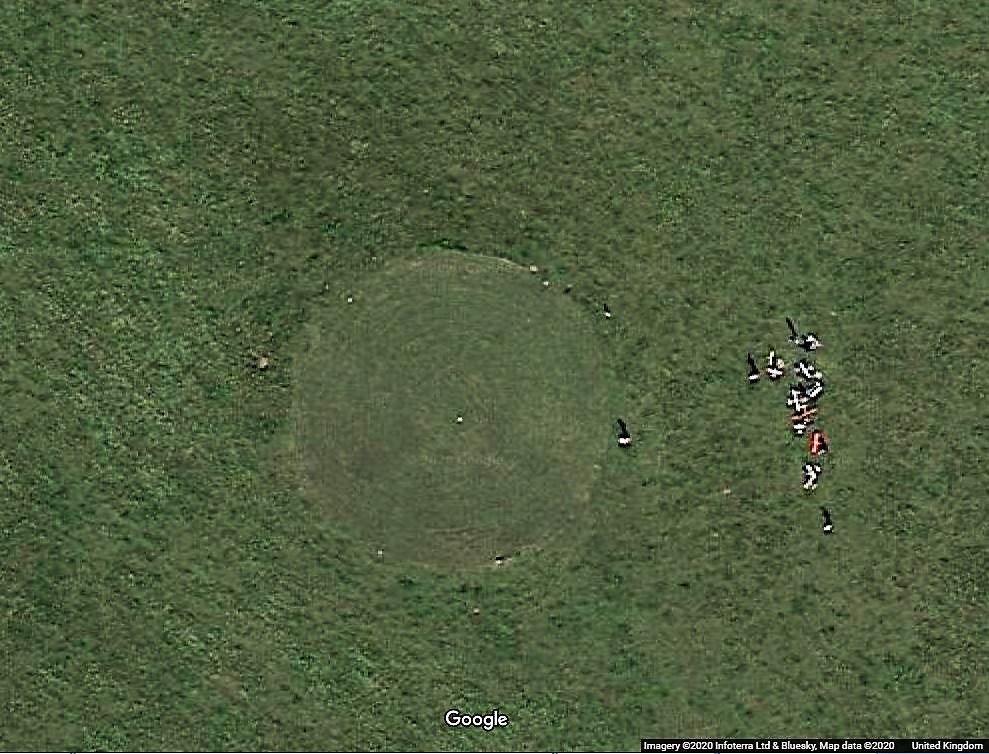
My request for photos and information about your projects has been answered with a deluge and I now have enough material for at least two editions. Thank you all for your contributions, Patch News wouldn’t be possible without them especially during lockdown. If your model doesn’t feature in this edition it will be in the next one.
I’ll begin with one of several of Norwegian Nick’s projects, definitely a major project, a Blackburn Buccaneer.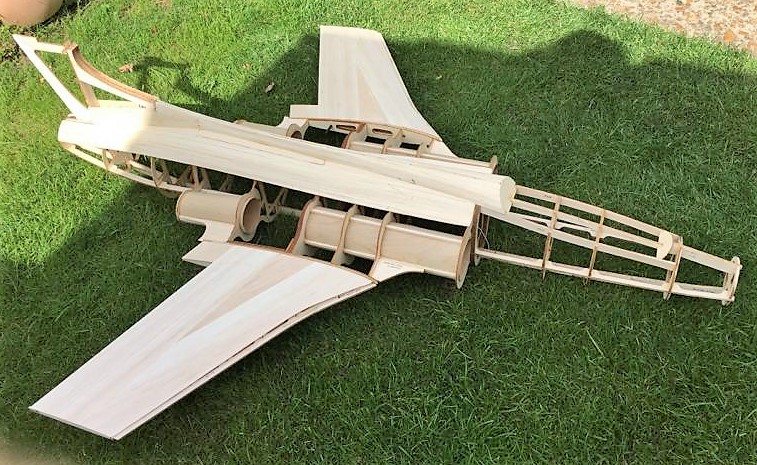 Nick mentioned that back in his naval days he’d worked servicing Buccaneers for three years so I asked him for some more information: I got drafted from H.M.S. Bulwark, a commando carrier with just Wessex Helios in 1975 to RAF Honington in Suffolk which had a detachment for 809 squadron Buccaneers. We had 3 of the squadron Buccs already to go in case they lost any when they were deployed on Ark Royal which was deployed over the pond to the USA. We also looked after and maintained 4 RAF Buccaneers of 208 conversion unit which trained RAF pilots and observers for front line squadrons. Prince Charles in his youth was going to visit the Ark Royal in the North Sea and we had to provide him with one of our Buccs. We were sent up to the Firth of Clyde to embark on Ark Royal, he then flew on board and stayed for 4 hours then flew off. We as the maintainers were then flown off to Lossiemouth and then back to Honington by a Sea Devon aircraft. Now I can see why Nick wanted to build one.
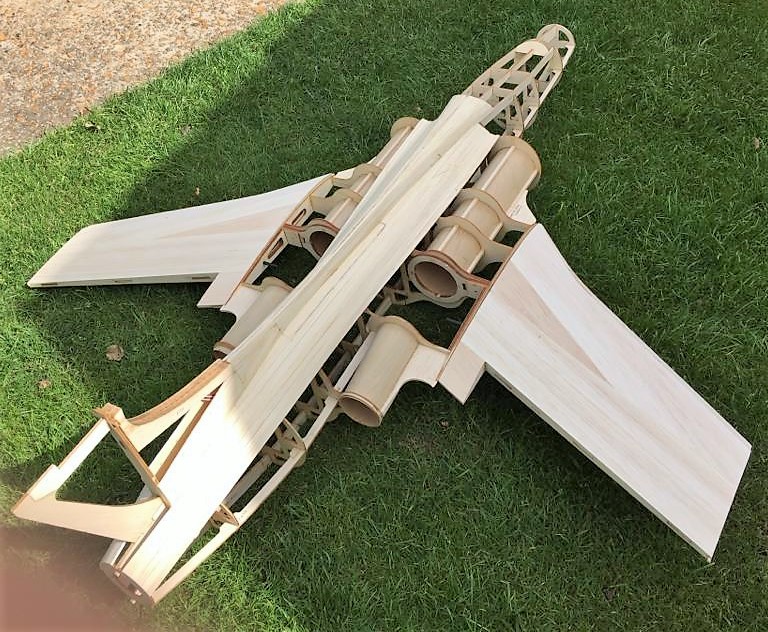 Nick chose a Mark Douglas designed Buccaneer S2 kitted by Belair Kits. The fuselage is 1925mm in length and it has a wingspan of 1350mm, AUW should be around 10 lb 4 oz. Nick has bought two Lander 76 mm fans at 1600W each and two 85A esc’s that will be fed by two 6 cell 6000mAh lipos. The servos are a mix of Hitec 225s and HS 125s.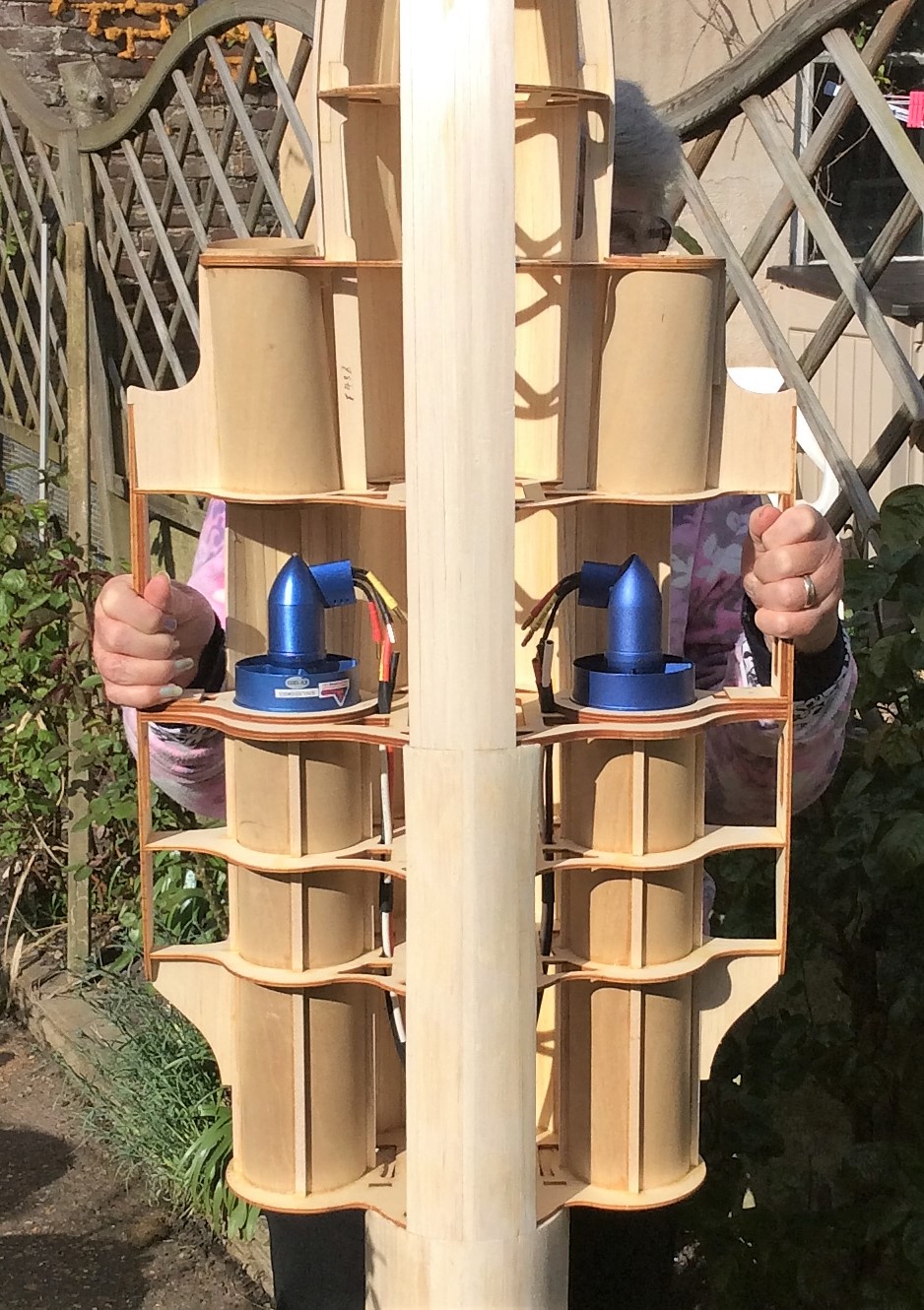
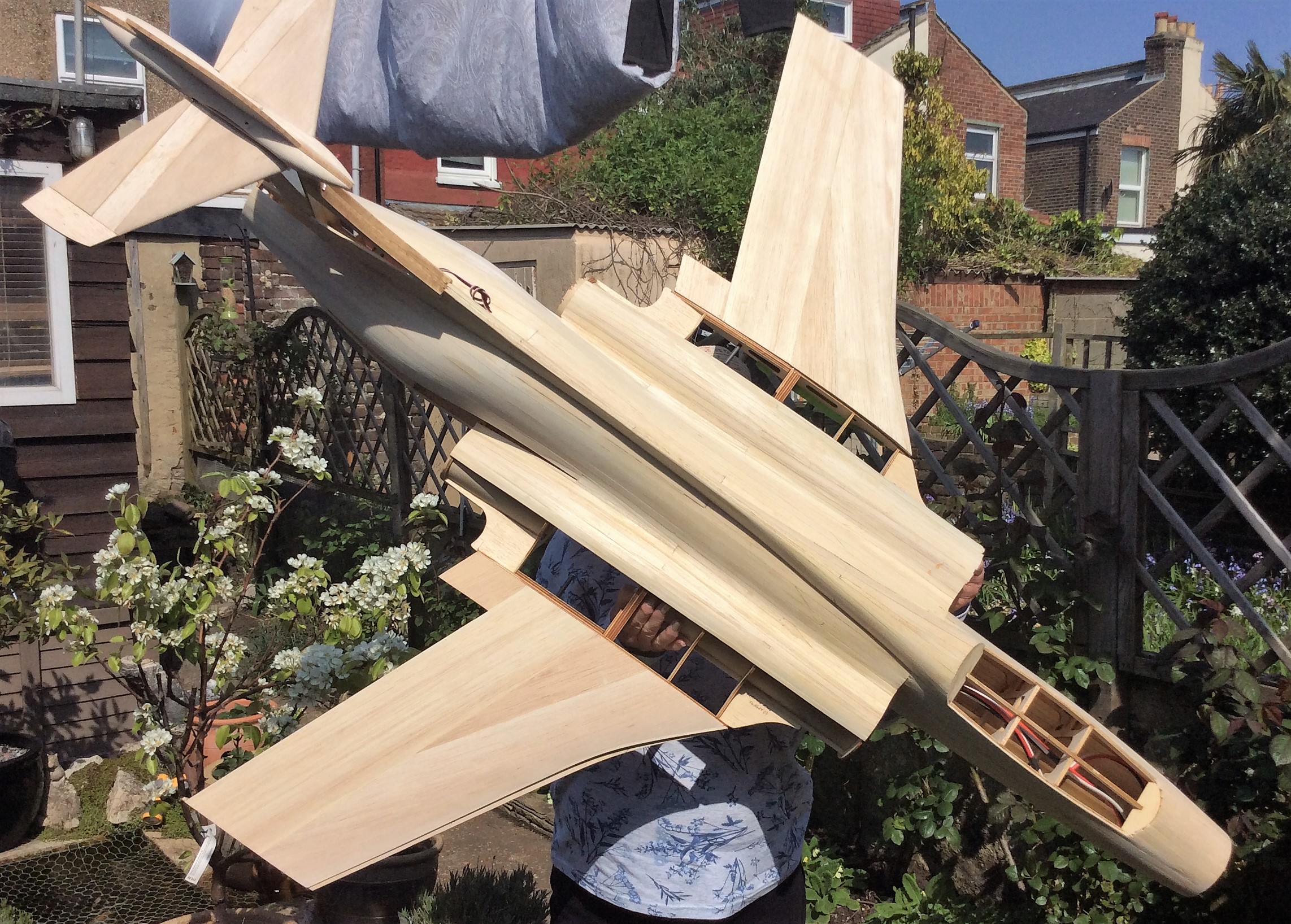 The fuselage construction consists of framed bulkheads spaced by longerons and then the whole fuselage has to be planked due to the shape. Nick admits it’s a pain but says he’s winning and once finished it will be sanded to shape and then glassed. The wings were built as normal with spars and ribs and then sheet balsa covered. Wow Nick, just wow, that’s a heck of a project! I’m really looking forward to seeing the completed model.
You’ll be amazed to hear that Dougal Entendre has bought another transmitter as he was down to his last twenty or so! He sent me his excuses reasons. My reason for buying the Jumper T16 was in part because it uses the OpenTx software. I thought I really ought to get to grips with that, as Tx software used to be a major interest of mine back in the 20th century. But also the T16 is a multi-protocol Tx, so in theory I could use it for all my existing Walkera Devo receivers, plus any bind-n-fly indoor models I might choose to buy. These tend to use Spektrum or Frsky-compatible receivers, or various other makes, and all I would have to do is select the right protocol for each model. Actually getting hold of a T16 proved to be tricky as everywhere seemed to be out of stock, or charging about £200 for it, or both. I eventually found a supplier on Amazon.com (the USA site), who said they could get it to the UK for £135 (including customs duty). I ordered it in late January, and it reached me as promised in the middle of March.
It’s a good looking Tx which seems to be styled after a current Futaba model, and has a colour screen. It’s not a touch-screen – it uses a roller and pushbuttons just like the old Spektrum DX8 I had about 7 years ago. The sticks have Hall effect sensors instead of pots, so they have a very smooth feel to them. You have to provide either a 2s LiPo battery, or a pair of 18650 Li-Ion cells. A piece of equipment I’ve been designing at work uses the latter, so you’ll never guess what I ended up with!
It all sprang into life when I powered it up, but it soon became apparent that the roller switch was working very intermittently, and some of the pushbuttons didn’t seem to work at all. On subsequent power-ups the screen displayed a message that it had a stuck key. My heart sank as I contemplated returning it, but a Google search revealed quite a few other people had had this problem, and it could be solved by re-seating a couple of ribbon cables inside the Tx. So, following the advice of a YouTube video, I undid the screws to open the Tx, then set about undoing the connector clips at each end of the first ribbon cable. This cable was only about 2.5cm long and 0.5cm wide. When I undid the second connector clip there was a “ping” and the ribbon cable disappeared. It had obviously been held in compression, and had now pinged off to God-knows-where. I spent about 20 minutes searching the floor for it to no avail. I tried shaking the Tx upside-down, but nothing fell out. Eventually I found the ribbon wedged behind one of the PCBs in the Tx, to my great relief.
I eventually completed the reseating for both cables (carefully!) and screwed the Tx back together. The message about a stuck key didn’t show on the splash screen when I powered up, and what’s more, all the pushbuttons and the roller now worked properly! A good result, but one has to question the manufacturer’s quality control.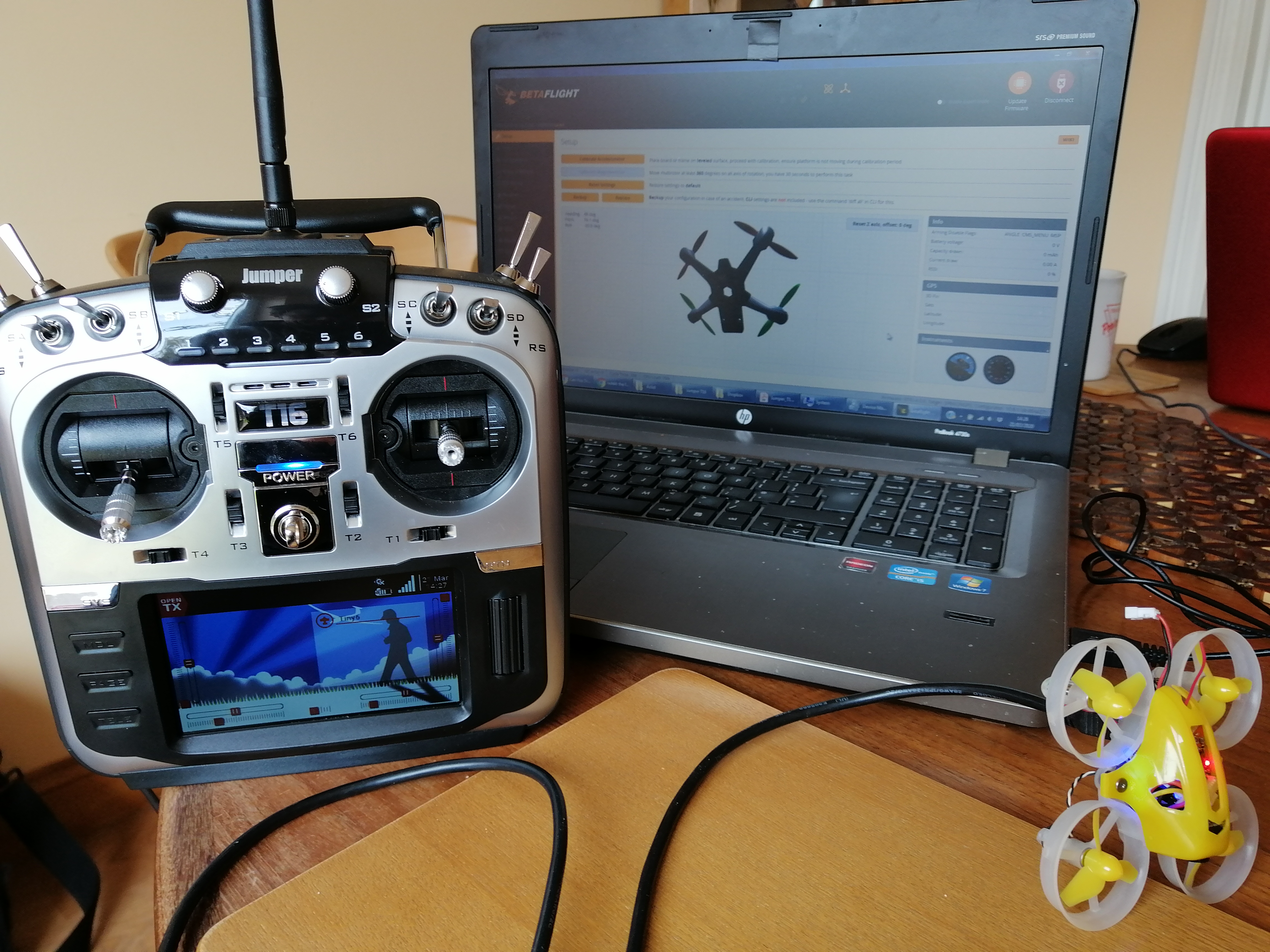 The next thing to do was check the version number of the firmware. Sure enough there was an update on the Internet, and apparently it was an important fix for a couple of bugs. So I had to download OpenTx Companion on my PC, and connect the Tx with the USB cable to update it. I also had to remove the SD card from the Tx and copy a new load of data files to it. I think this stores most of the graphics and sound files, but I haven’t investigated its contents in detail yet.
Then to do battle with OpenTx. There are a LOT of menus, and I think I’ve barely scratched the surface of what it’ll do. It seems very capable, but it’s a big learning curve to find your way round it. For example, it seems to default to being a 4-channel system. I needed a switch allocated to a fifth channel, which entailed going into a different menu to assign one of the switches as an input to channel 5. It still didn’t work though. I then had to go into the mixer menu to assign the mixer to an output, and then it did work. I’ll probably get used to it, but it’s not for the faint-hearted. Anyway, I’m quite looking forward to exploring its capabilities, especially the audio (must get a sample of “Highway to the Danger Zone”!). That’s all very easy to do on a Multiplex Cockpit transmitter Dougal! So far I’ve only tried it with an indoor quadrotor to keep me flying through this period of social distancing. That meant another huge learning curve to set up the quad using an app called Betaflight but that’s another story. Having read all that reminds me that Bob the Builder almost bought the same Jumper T16 transmitter before choosing the less complex but rather more expensive Multiplex Cockpit. Dougal is finding the Jumper quite taxing and he used to write transmitter software and has a D.Phil in computers systems (yes, he’s genuinely a Doctor) so I think Bob made the right decision. When I queried Dougal about his qualification he said if anyone expects him to be the other sort of Doctor he tells them to take two Aspirin and ring him in the morning! You can see Dougal flying the quadrotor in this month’s video. Rumour has it that in the winter Dougal will have to upgrade the Jumper to a Coat…
Meanwhile Bob the Builder has a new project on the bench, a twin engine camera plane that he might eventually use for FPV. I only have limited information at the moment but Bob tells me it’s going to look quite similar to this one.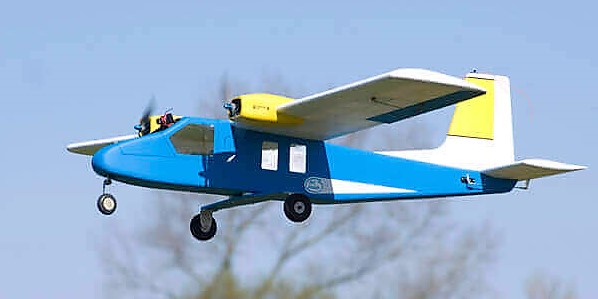 The wingspan is 1300mm and it will be powered by a pair of 2836 1400Kv PropDrive motors from HobbyKing, a pair of 40A speed controllers, and a single 4000mAh lipo. Bob seems to be re-using the tailplane and fin from an old model, a good bit of upcycling. With most of the actual building done it’s looking nice, should be a good flier.
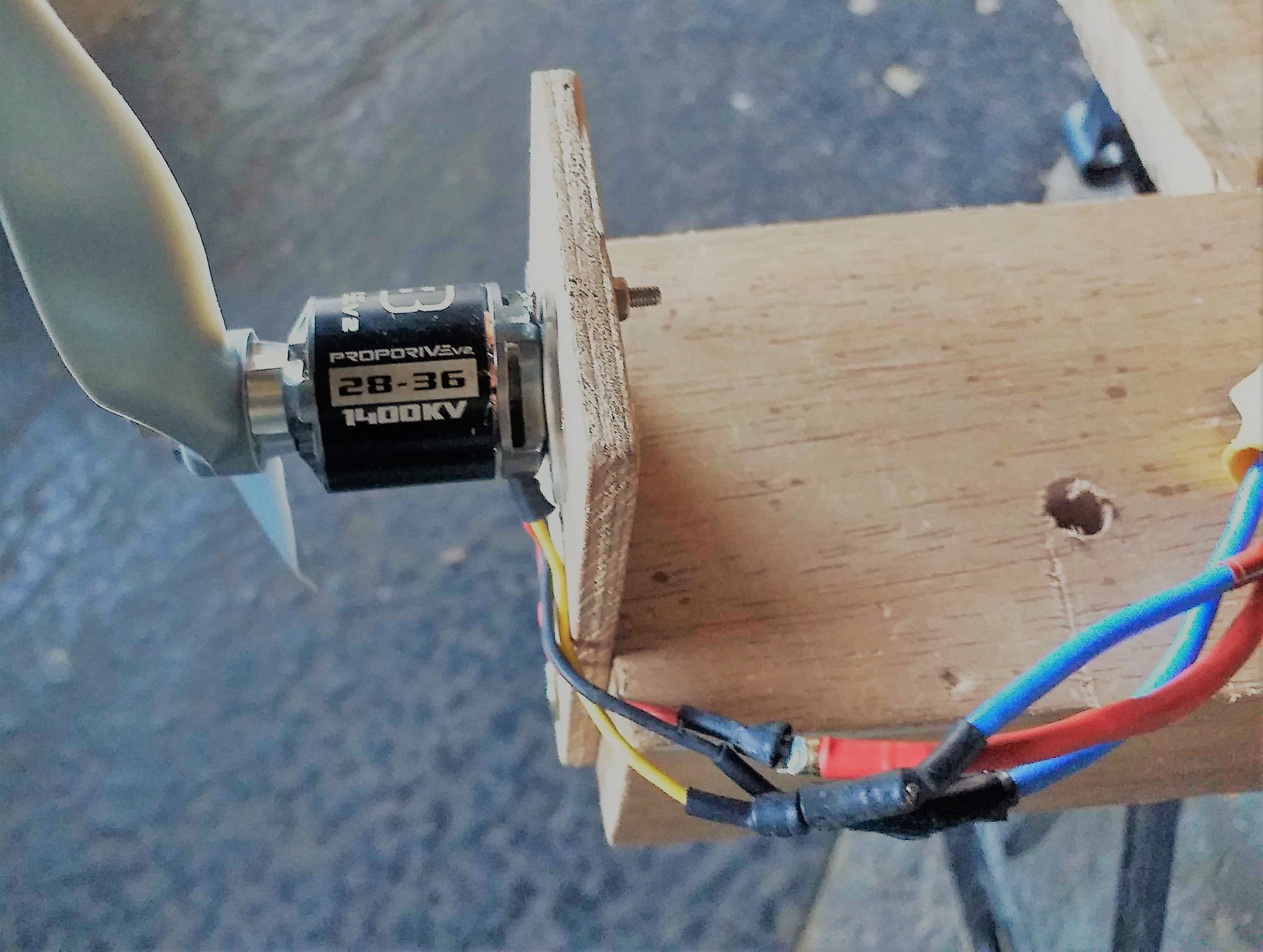 The motors will provide around 400W each which should be plenty of power. The one in the photo looks to have a pusher prop on it so expect Bob is going to correctly have both props rotating in towards the fuselage.
Another twin now, Mike Smith’s Partenavia Victor that he bought from Puffin Models about twelve years ago and has finally got round to finishing. At 79″ span it’s a big one and the kit was made by Modell Studio in the Czech Republic.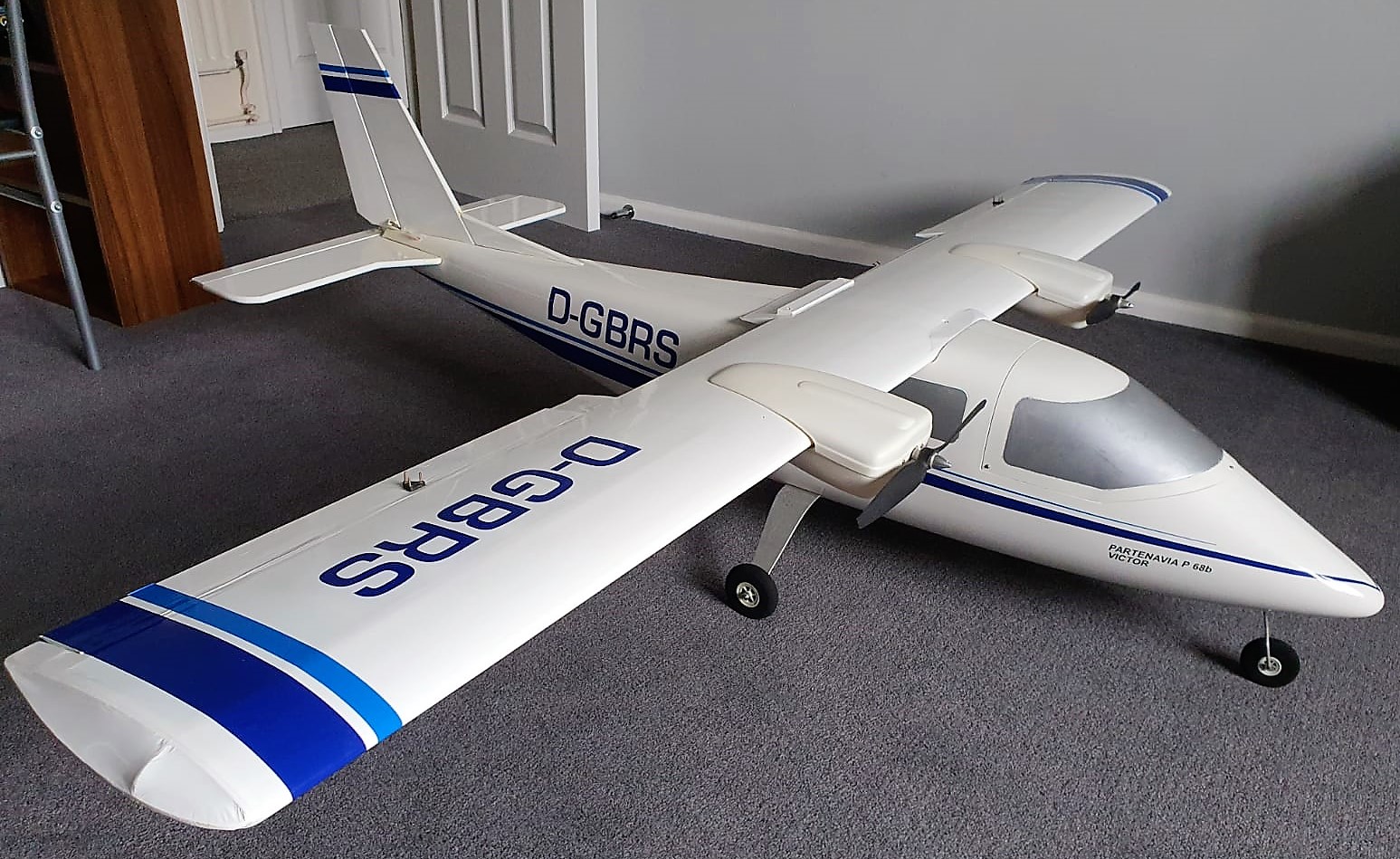 Mike has fitted the Victor with a pair of Tornado Thumper 3542 1250KV motors and will be using a pair of 4 cell 3300 lipo packs. The quoted weight is around 10lbs but Mike is hoping his will be a bit lighter as the original used heavier nicads batteries. He’s concerned about a lack of power but looking at the motor specs I think it’ll be fine.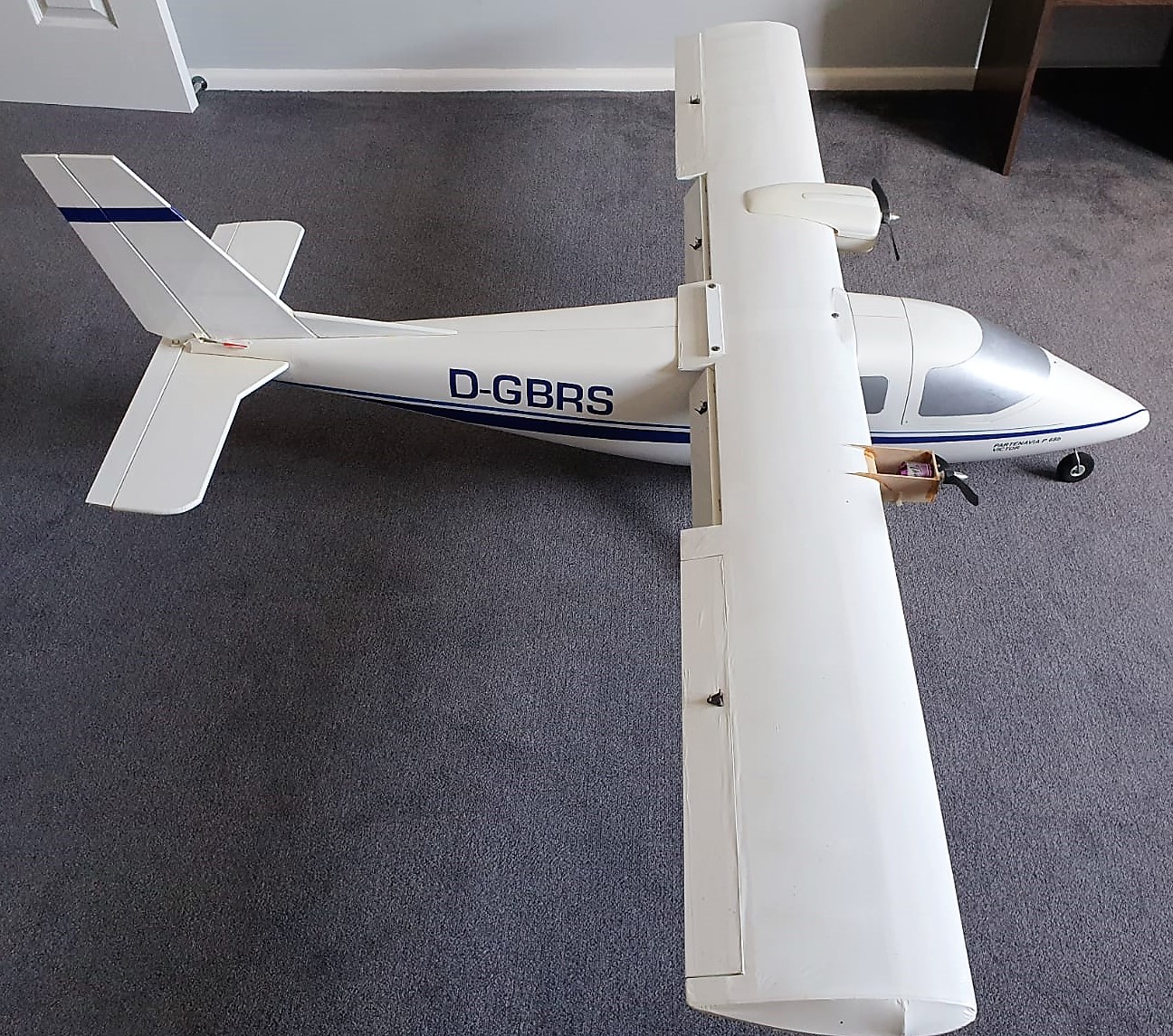
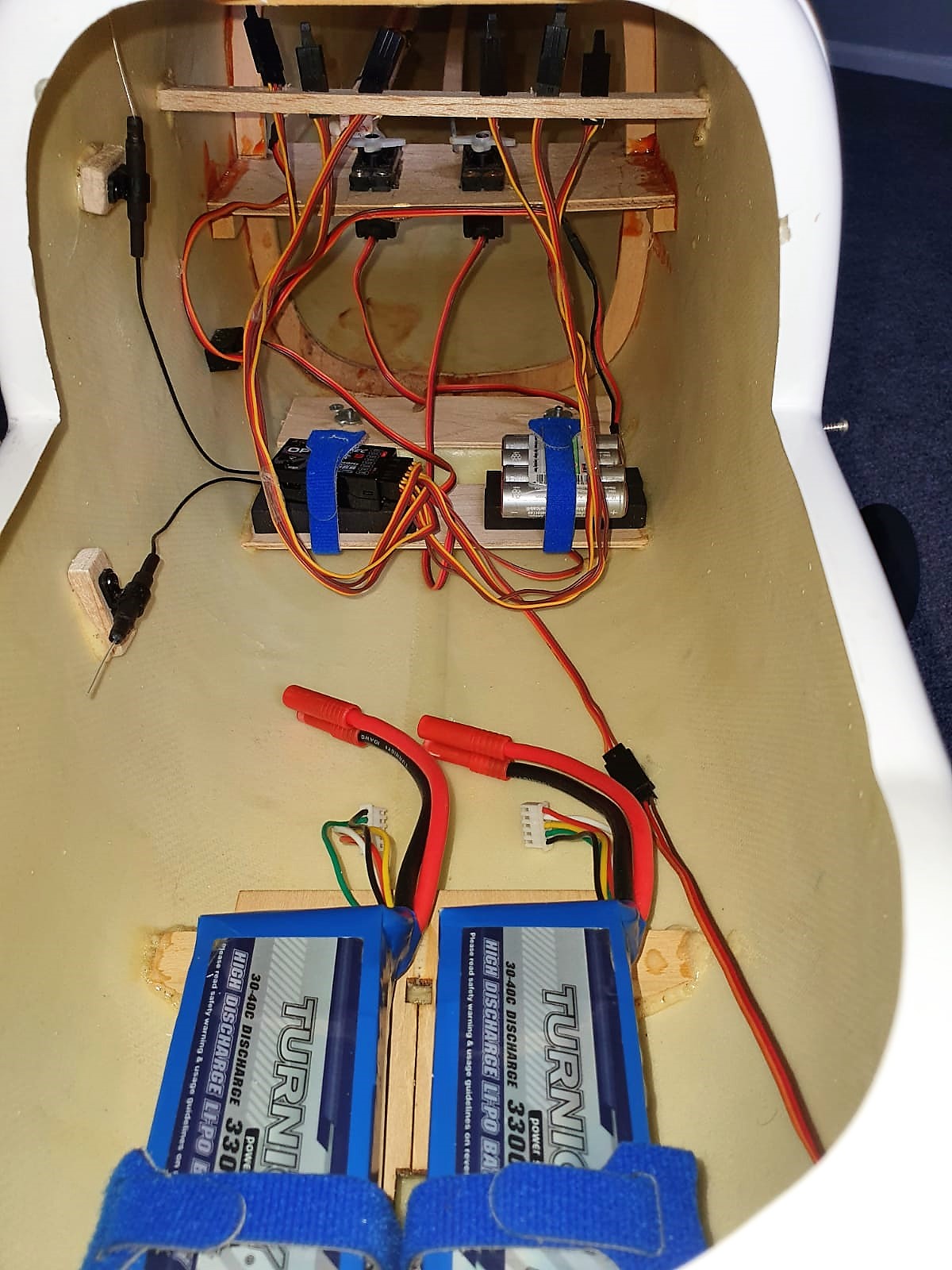 Like the full-size the model is fitted with flaps to slow it up for landing. Space for all the gear isn’t a problem and Mike managed to squeeze everything in, I reckon he should cut a hatch and join my BushMule on a parachute drop!
1066 has sorted through his lipos and ditched thirty five duff ones! He then charged/discharged all the remaining ones to the correct storage voltage and sent me a photo of how he’s storing them, certainly much neater than mine.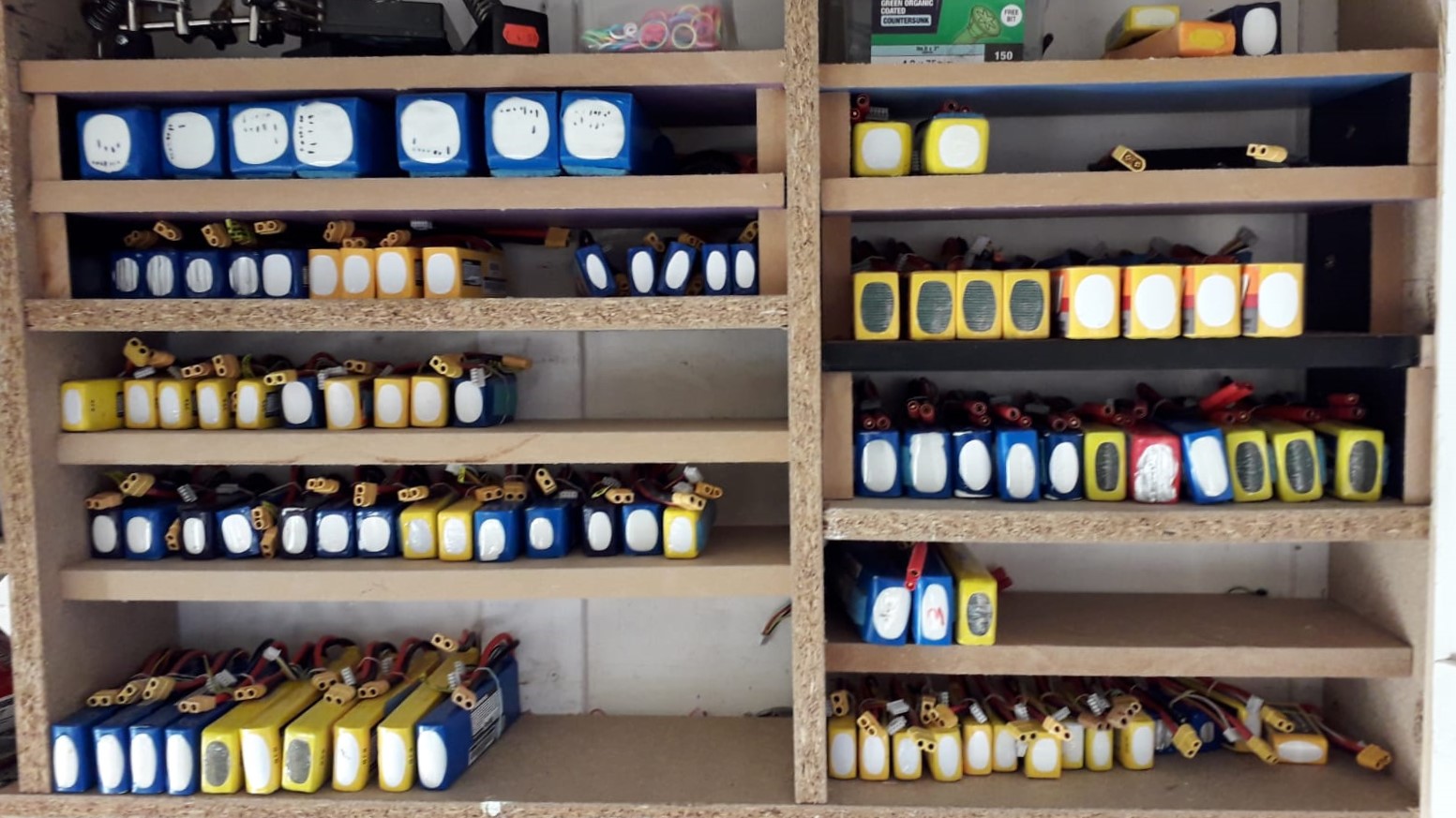 I’ve also set all mine to storage voltage but I didn’t get round to sorted out the duff ones. This gave me an idea for another Gold Star Competition: How many lipos are in my ammo box? There’s a mix of 3 & 4 cell packs of capacities from 1000mAH to 4000mAH. Would you like a clue? I’m afraid I don’t have one, your guess is as good as mine.
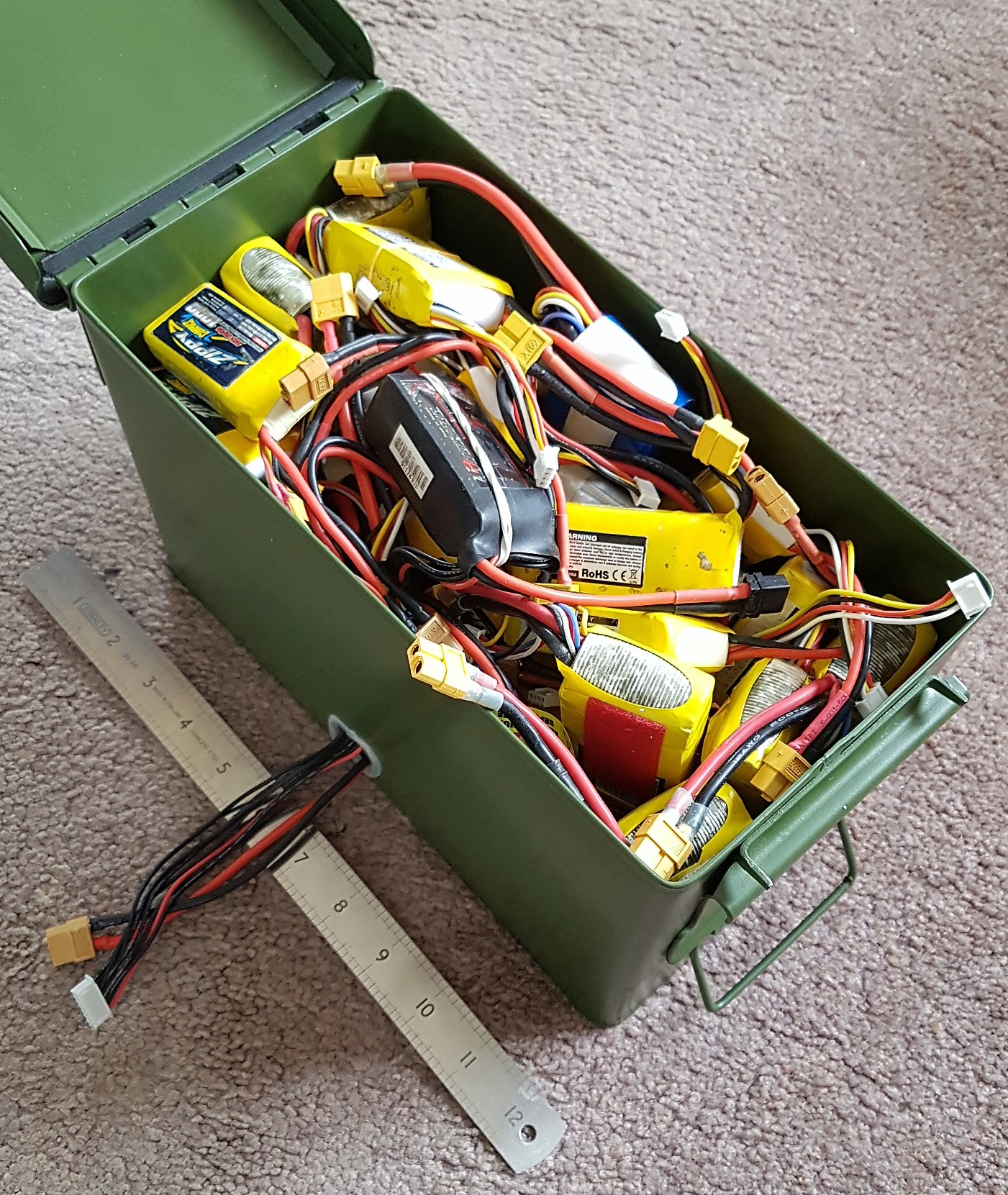 I haven’t counted them yet but I struggled to get them all in there. Oh, and the balance board is still in the bottom. Please enter your guesses in the Comments, one guess each, nearest is the winner.
1066 also sent me some photos of what he thinks was his last scratch built model, a Pitts Special S-1S.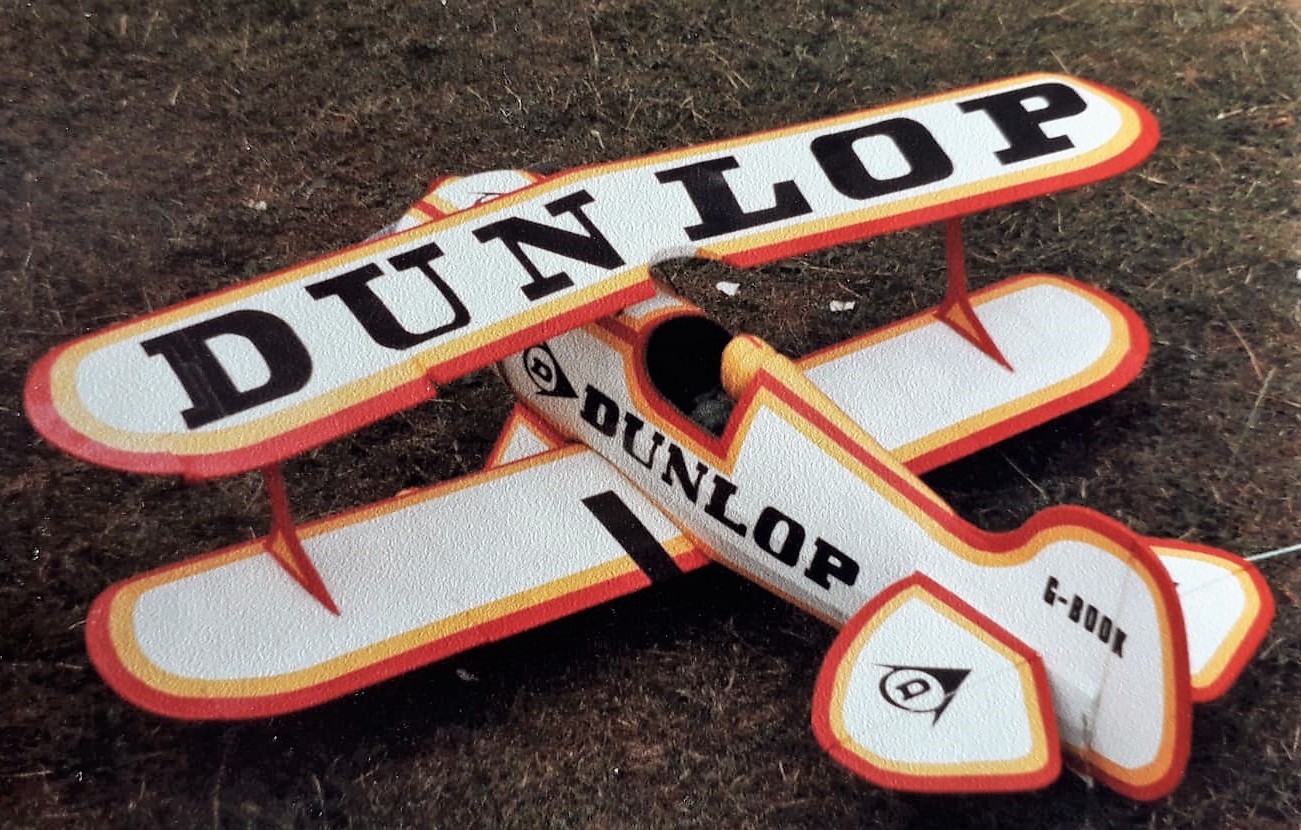 He cut his own foam wings and used the Avicraft Panic method to skin them. He said after all the work it was a rubbish flier and that put him off scratch building for life. He was using an OS61FSR but it really needed a 90.
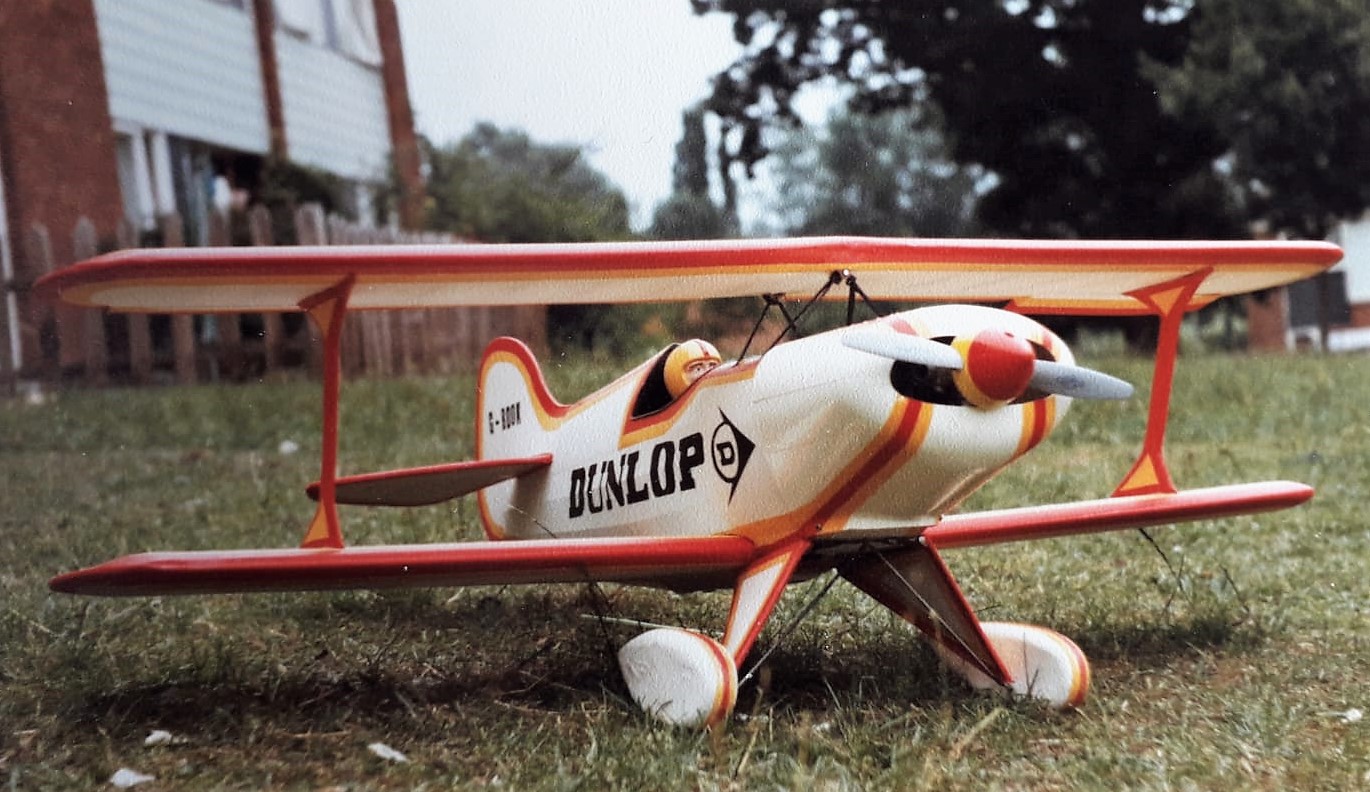 The model may not have flown very well but it looks superb to me. The full-size G-BOOK was the late Brian Lecomber’s display Pitts back in the 1980’s but in 1992 it was unfortunately destroyed by a fire after landing. Apparently the fire was caused by a leak of diesel oil from the smoke system, fortunately nobody was injured.
Matt Takhar has sent me some info on two lockdown projects, one of which is a complete departure from his usual stuff but that one will have to wait until next month. This month I’ll just show you his latest 3D plane, an Extra 300-EXP. He says it wasn’t much of a build as it’s an Extreme Flight kit so there was little work to do.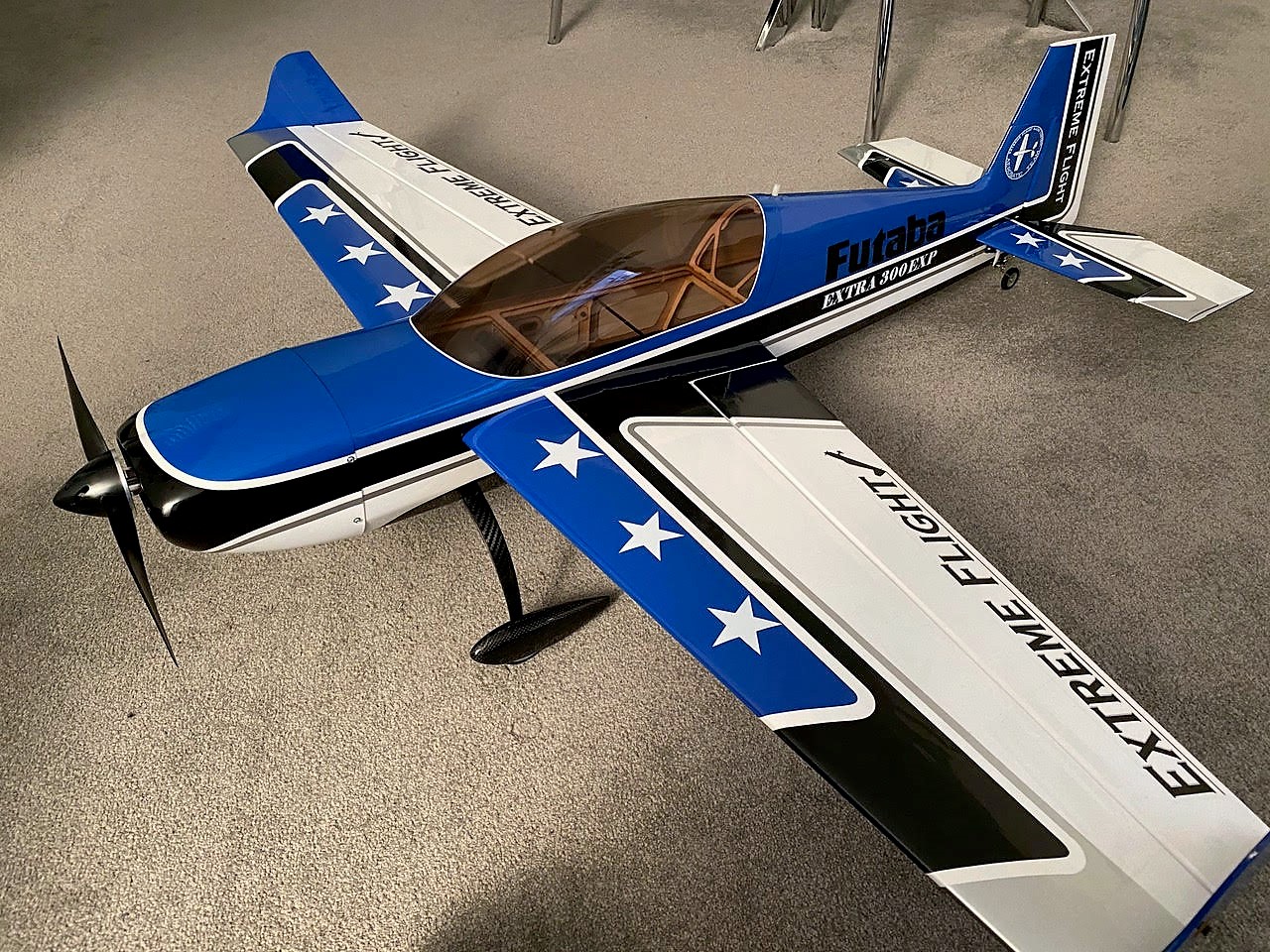 Both the wingspan and length of the Extra are 48”, the wing area 500sq. in. and the weight 42-46oz. Matt has fitted it out with an Extreme Flight Torque 2814T 829kV motor coupled to a Hobbywing Platinum Pro 50A V3 esc.
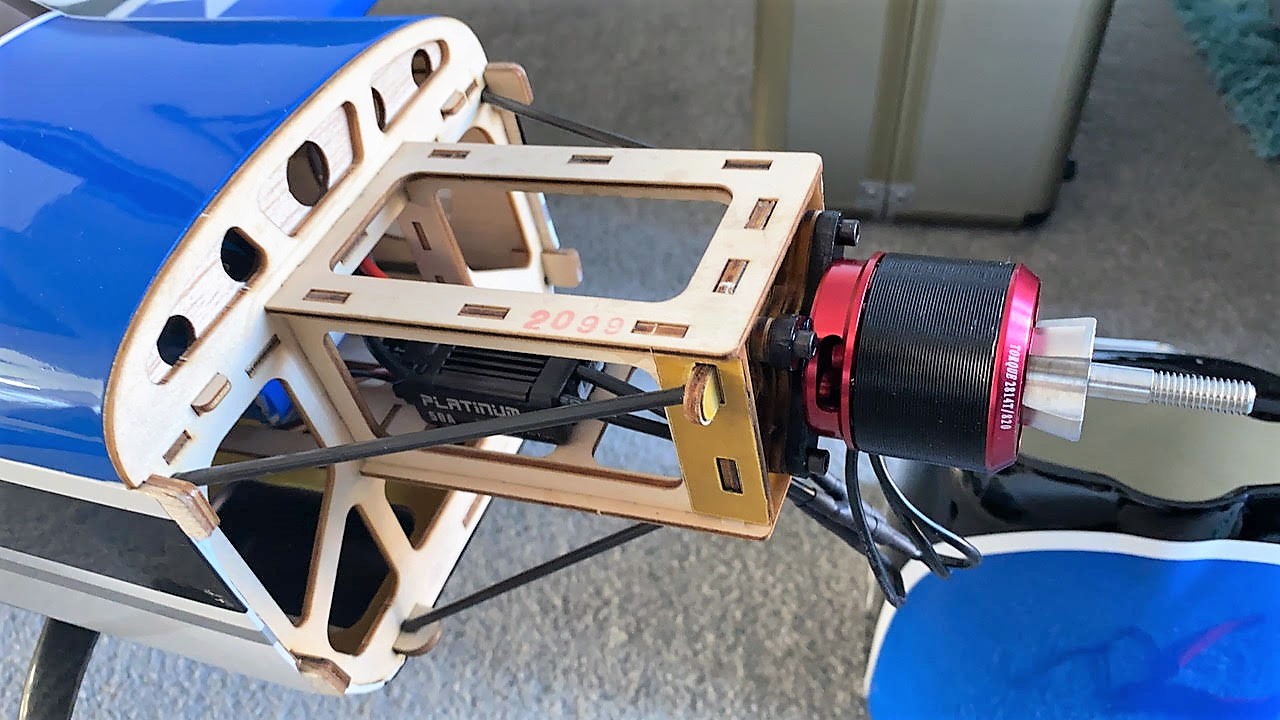 He’ll be using a 12×6 APC Electric Prop and I assume it’ll be on a 4 cell lipo. The servos are all Savox SH-0257MG Micro Digitals. I love the colour scheme and no doubt it will perform as well as the other Extreme Flight models.
Many of us are familiar with the Avro Lancaster that Percy Vears has been building for a while now and barring fitting the radio gear, and final testing/adjustments, the project is more or less complete.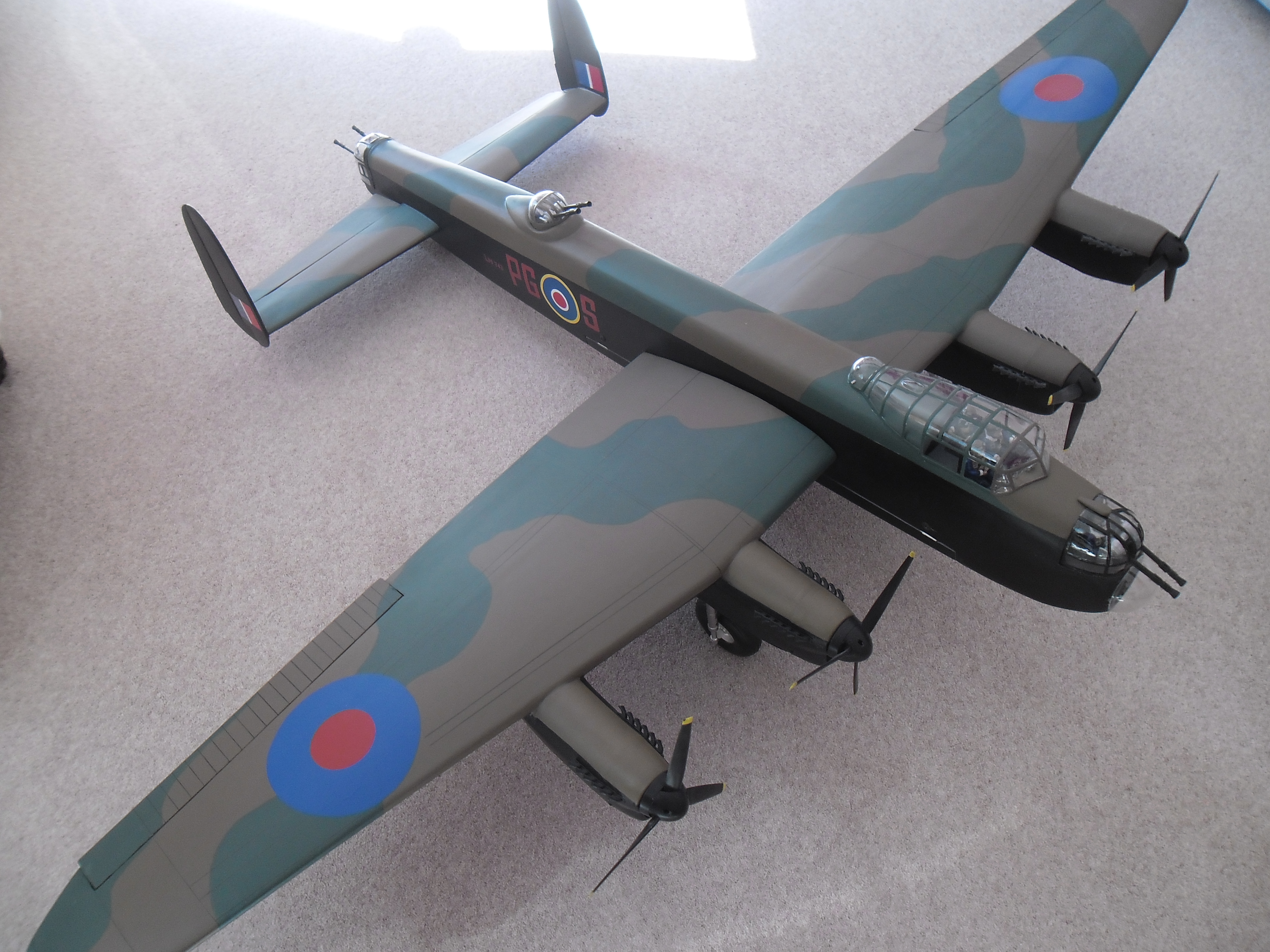 This is what Percy says about it: The airframe was built in balsa/ply from a Tony Nijhuis 72” Lancaster kit. This was finished with 18gm glass fibre cloth and Z-Poxy resin. Halfords High-Build primer was used to take out some of the bumps and dents (most of which is removed by sanding). This was then followed by a coat of Halfords Grey Primer.
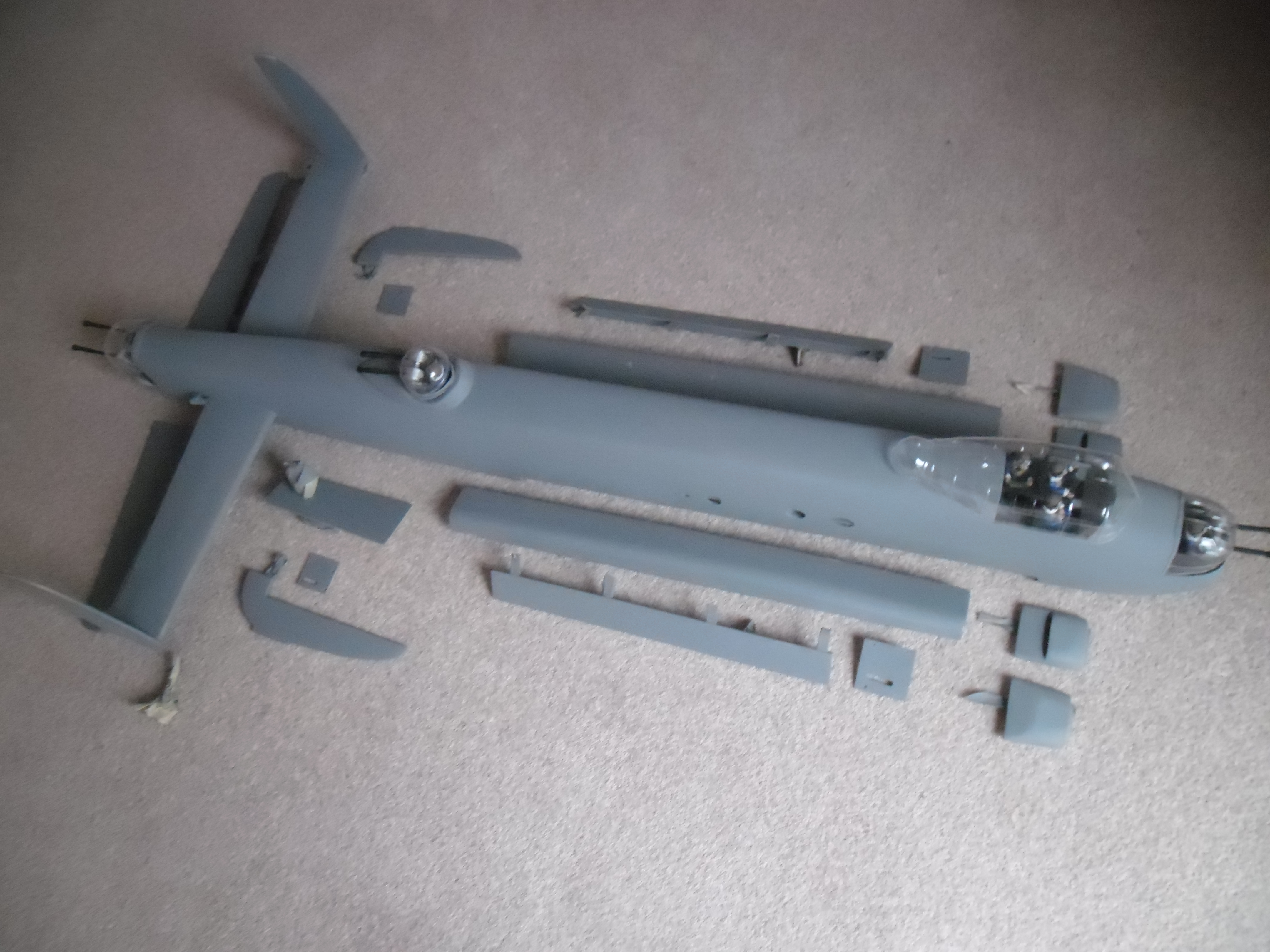 Camouflage colours on the top surfaces were Matt Dark Earth (Humbrol 29) and Matt Dark Green (Humbrol 30), and after application of the roundels, were sprayed with Halfords matt clear lacquer. The underside and fins were painted with Halfords Satin Black Lacquer. Roundels and lettering were cut from Solar Film.
 Some items required were not readily available off the shelf, so this forced me to engage in the world of 3D printing (another learning curve!). These included pilot/crew figures, Browning guns and spinners, plus other small parts.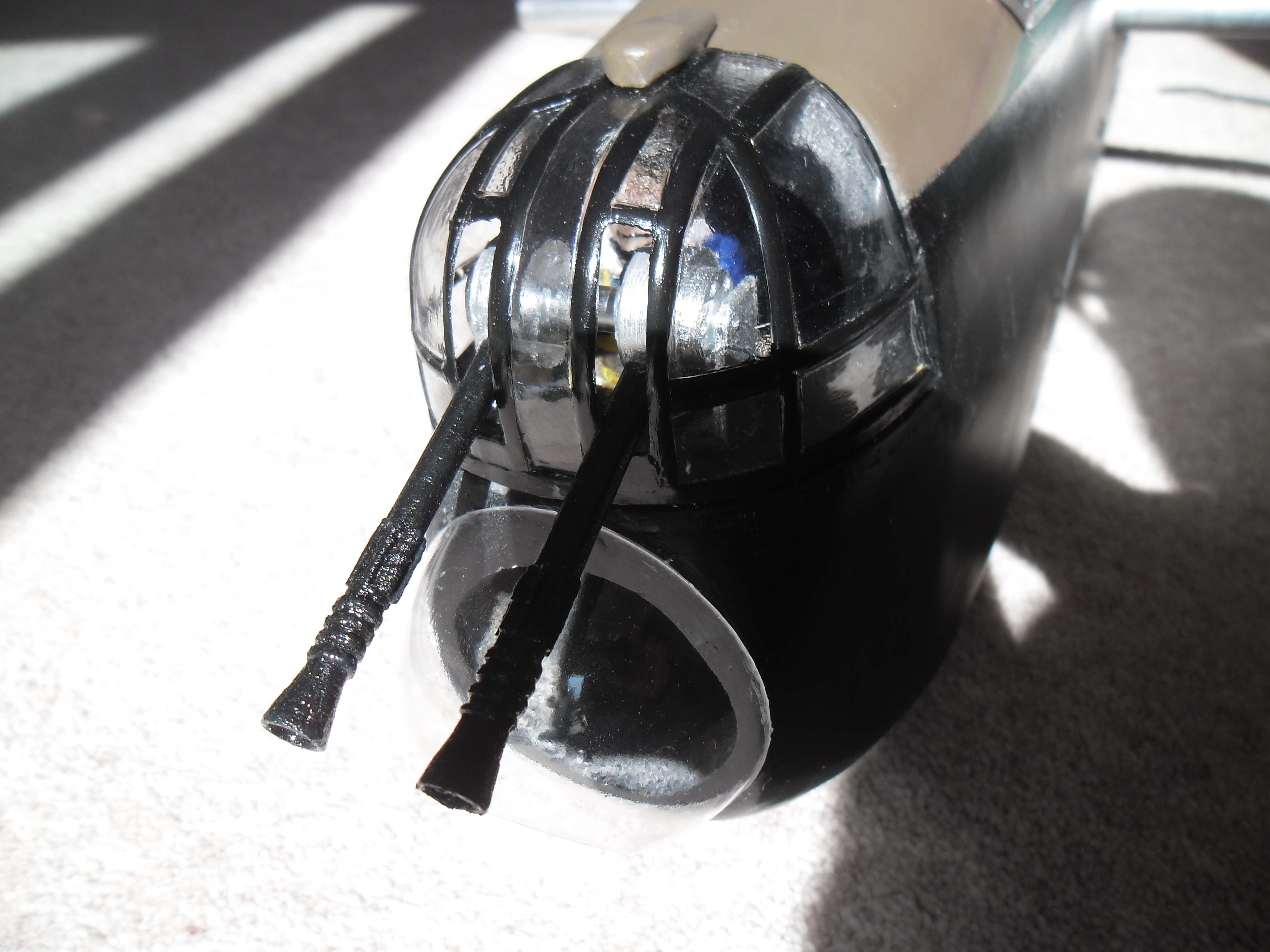

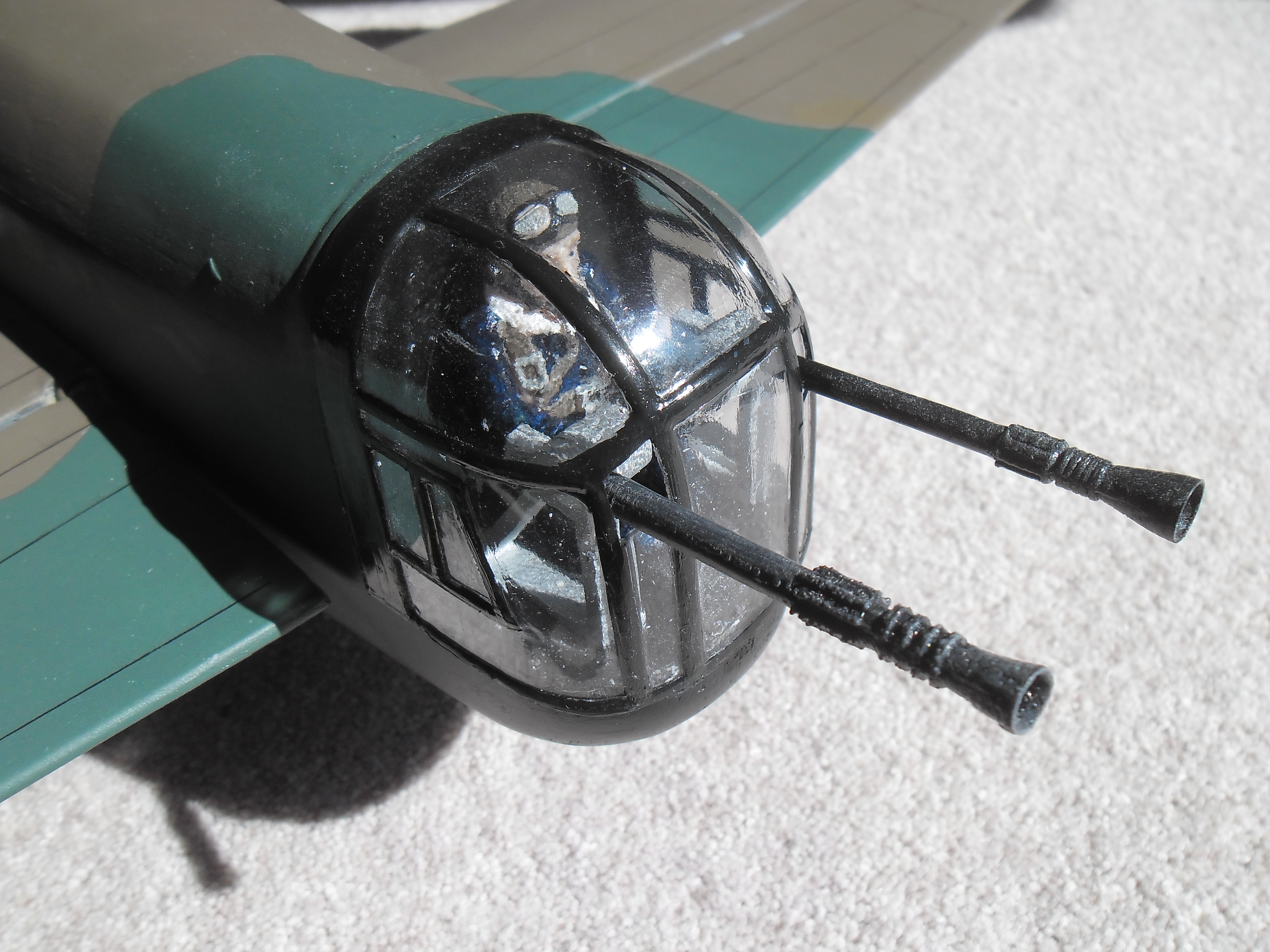 The electronic parts (apart from Tony Nijhuis supplied retracts) came from HobbyKing and are as follows:
- Motors: 4x Turnigy D2836/8 1100kv brushless
- ESC: 4x HobbyKing 30A
- Rudder servos: 2x Turnigy TGY-D56MG (flat profile)
- Other servos: 4x Turnigy TGY-50090M
- UBEC: 5V, 5A (learnt from Vulcan – separate UBEC needed)
- Battery: 3s 5000mAh 40C
- Propellers: 4x Master Airscrew 3-blade 8×6 (2xCW & 2xCCW)
The overall weight is likely to be in the region of 3Kg (6.5lb) so performance with 700W (824W peak) is likely to allow the aircraft to lumber along at scale speed, rather than exhibit aerobatic performance.
Excellent Percy, it looks superb and I’m sure it will fly very well. At just over 100W/lb I think it will have plenty of power and should ‘lumber along’ perfectly on about half throttle.
Last month I mentioned that Dwayne Pipe was looking for some new radio gear and he replied with this: I finally lost confidence with Spektrum when on three flying occasions the aircraft just fell out of the sky for no obvious reason ( apart from my own rubbish flying). To confirm it the ailerons reversed themselves in mid-flight while I was using my Spektrum transmitter on my flight simulator at home. So I have abandoned Spektrum and bought a Futaba T6K transmitter and receivers. Nick S lent me an old Futaba transmitter and instruction manual so I got the hang of the programming, I have been transferring all my models over to Futaba which seemed to take forever.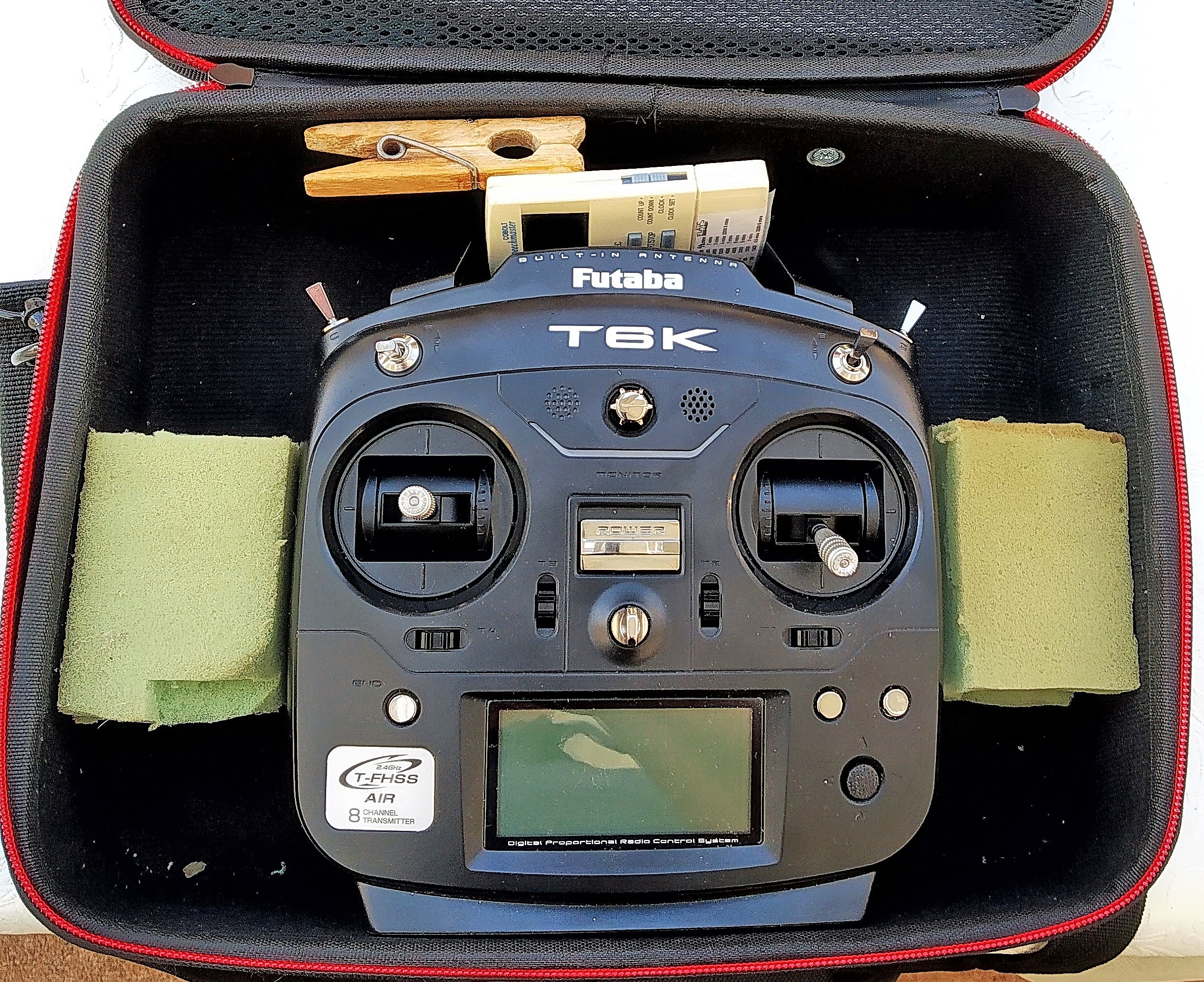 Still haven’t tried it out in real life, so that’s something to look forward to when the grownups let us out to play.
Meanwhile Dwayne has started another project and he’s doing it the proper way, starting from scratch: With all this time on our hands I have been looking for a challenging build project. I fancied a more aerobatic edf than my TSR2 (which is good at flying fast in a straight line). A BAE Hawk would have been fine but Dan’s is so good that I couldn’t compete. For Christmas, presumably to keep me out of trouble, my wife bought me an Airfix Red Arrows Folland Gnat kit, which looks really good and being mid wing should be hand launchable. So my latest project is to design a Folland Gnat using just the Airfix kit and the three section drawing that comes on the back of the box.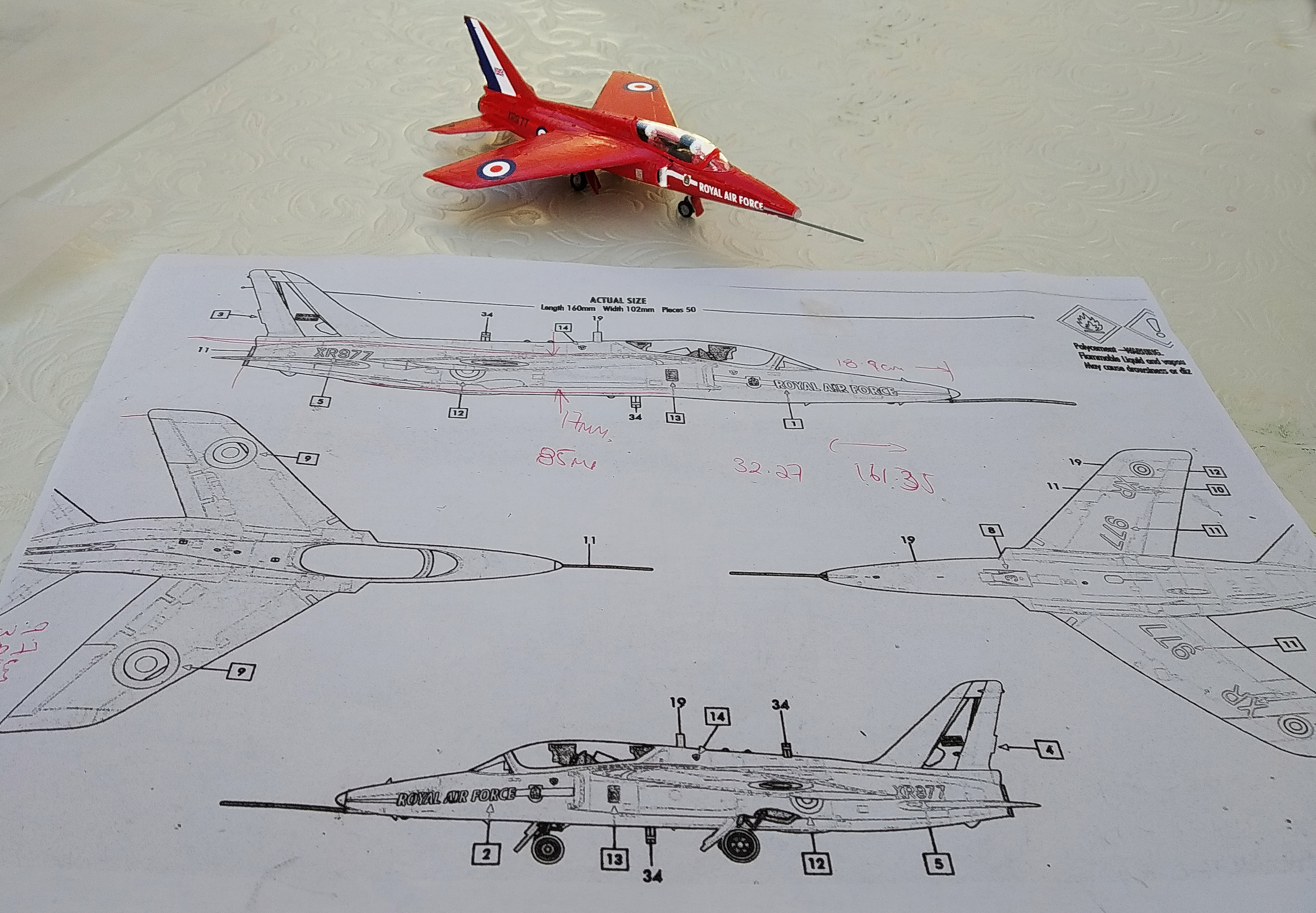
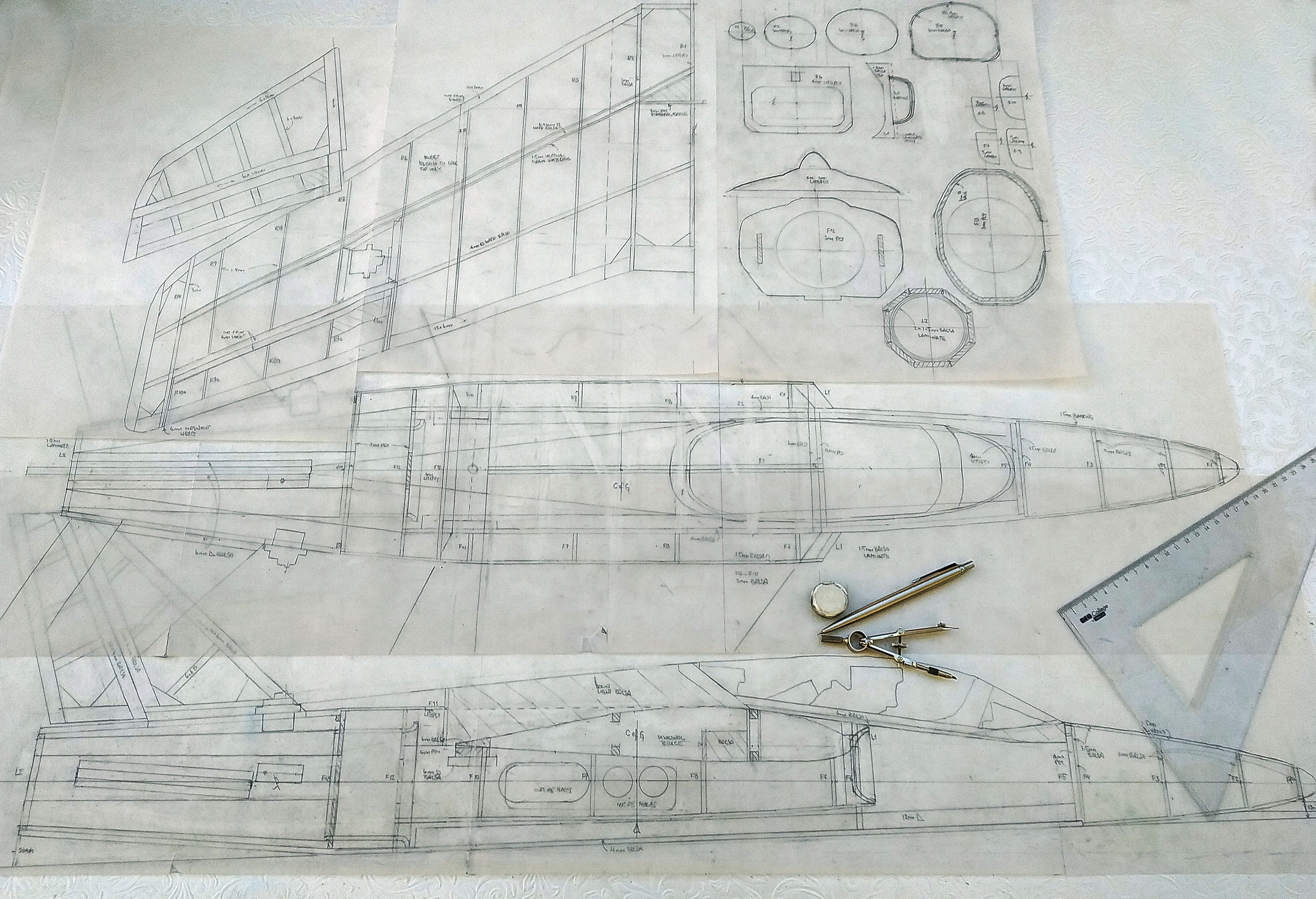 Based on a 12 blade 70 mm fan and a 36″ wingspan I have drawn out the plan using only a setsquare, rule, pencil and eraser. Very old school. I’m very impressed by your plans Dwayne and I can’t wait to see this one finished.
Newbie Nick has bought a 1 metre span Strike 3 DLG from Hyperflight, I took this is from their website: The Strike 3 is superbly made using 30 g/m2 Carboline spread carbon, the model is exceptionally light, while also being strong and very rigid, allowing high launches. Still air times of 2 minutes have been reported by strong launchers, and pilots enjoy the excellent performance and sweet handling. Its full span ailerons allow camber adjustment in flight, giving it a wide speed range, allowing it to be flown in moderate winds, which is unusual for 1m gliders.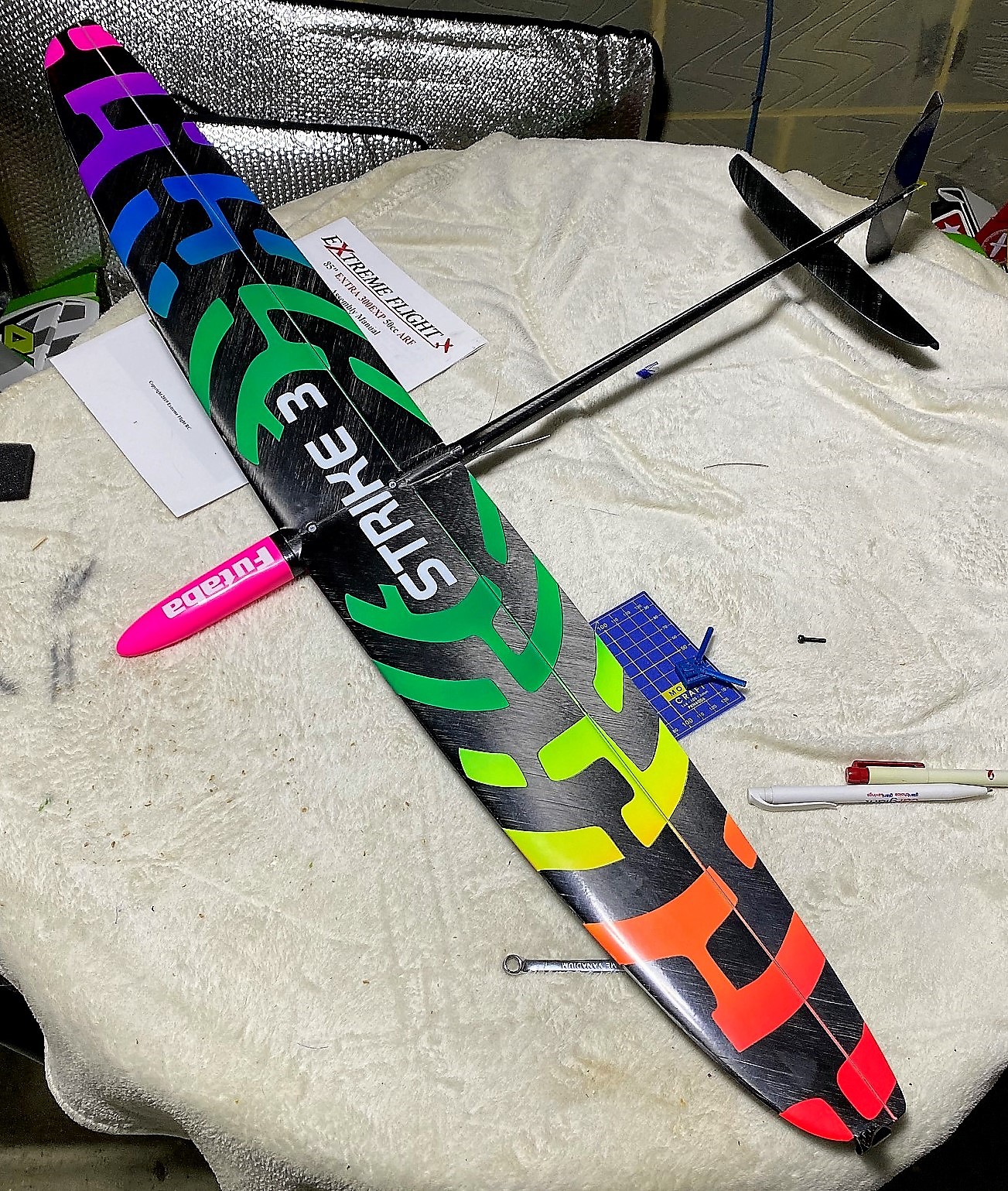 Under the Kevlar nose cone Nick has fitted four Blue Bird Nano HV digital servos to control the ailerons, elevator, and rudder. The rudder and elevator are sprung in one direction and use a Kevlar cord to pull against the tension.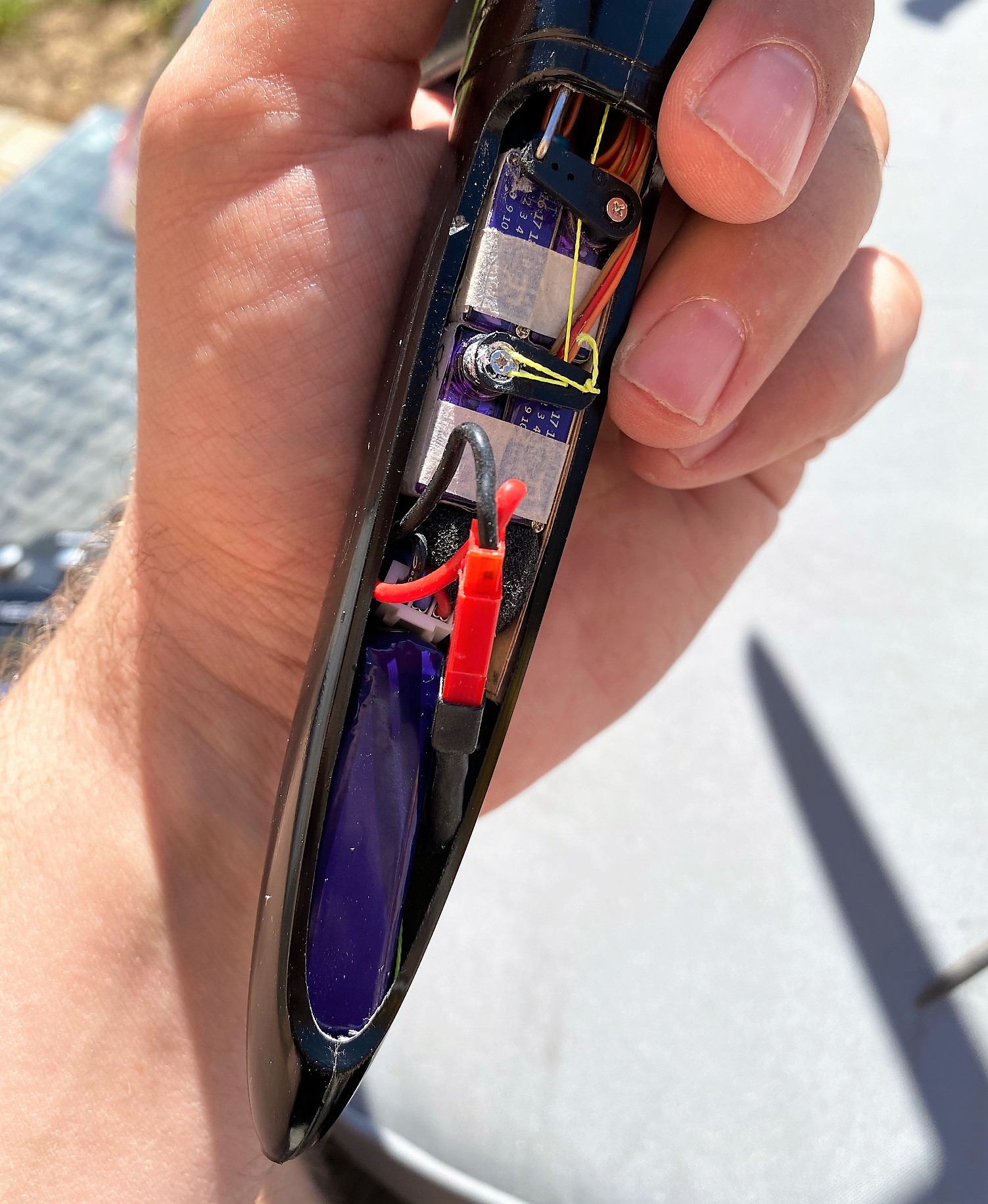
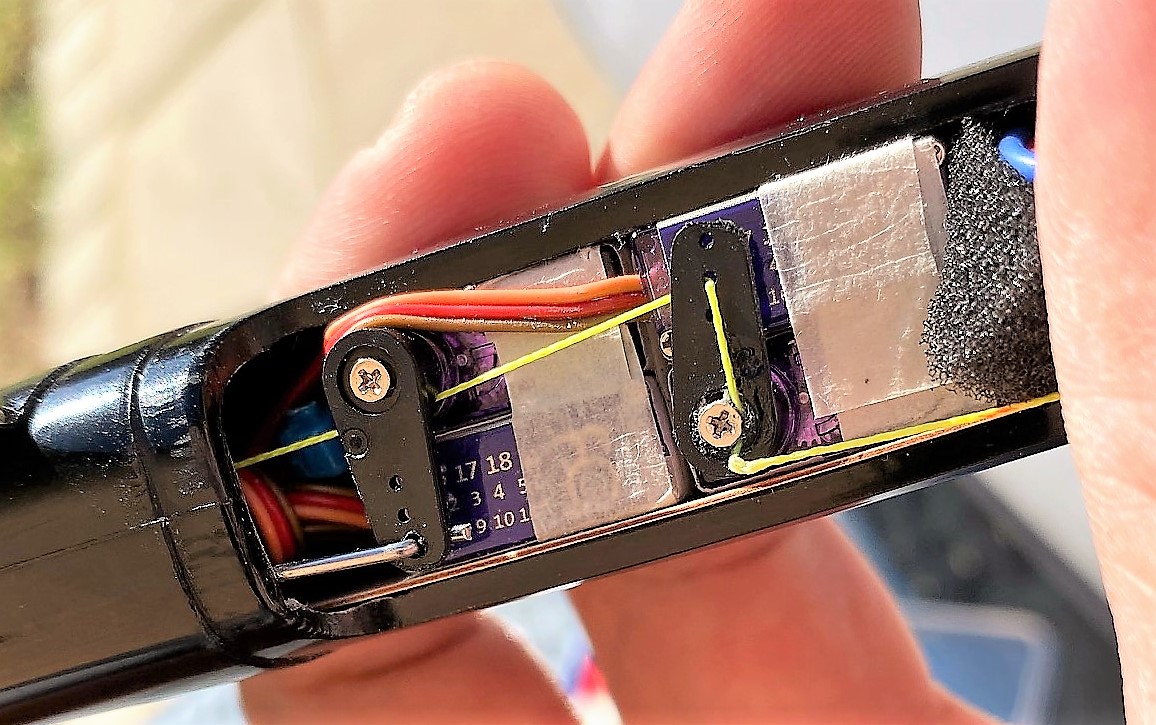 The four servos are stuck together then glued to a thin ply tray then the whole assembly is glued into the fuselage.
 Nick has mounted the receiver under the CG and has fitted a 2 cell 300mAH battery in the nose and the all up weight is just 130g. It’s certainly an interesting very high tech model that should perform very well.
Video time now. Yes I have managed to cobble one together with contributions by myself and Dougal. Please watch the video full-screen, it’s so much better with small models flying around.If the video won’t play for you please click HERE
A pilot walked into a bar and asked for a packet of crisps.
“What flavour would you like?” asked the barman.
The pilot replies “Have you got helicopter flavour?”
“No sorry, just plane”…
Keep safe everyone – Colin Cowplain
Patch News – March 2020
This is going to be a really tough Patch News to write. I have, perhaps surprisingly, loads of information and photos but the terrible state of the world being ravaged by Covid-19 has now brought everything to a screeching halt and the next few months look like being very bleak indeed. Obviously all club meetings have been cancelled for the foreseeable future and no flying is allowed either. The PAM Flying Group on WhatsApp has seen quite a lot of use recently including the obligatory ‘jokes’. The group is a great way of keeping in touch while we are isolating and should help keep us sane. Doreen and I returned from Marrakech three weeks ago so have been self-isolating pretty much since then and I have to admit that I’m already finding it a bit of a struggle mentally, hopefully contact via WhatsApp will help us all through. If you aren’t a group member and would like to be added just let me know.
We are lucky that (as of 24th March when I started writing this) Captain Slow is willing and able to visit the field every couple of weeks and swap the battery as part of his allowed daily exercise. But things are changing very rapidly and even that may not be possible soon. Obviously we’ll be unable to mow the patch so some work will be required when this is all over. This was the last session before lockdown, Woody and Capt Slow social distancing.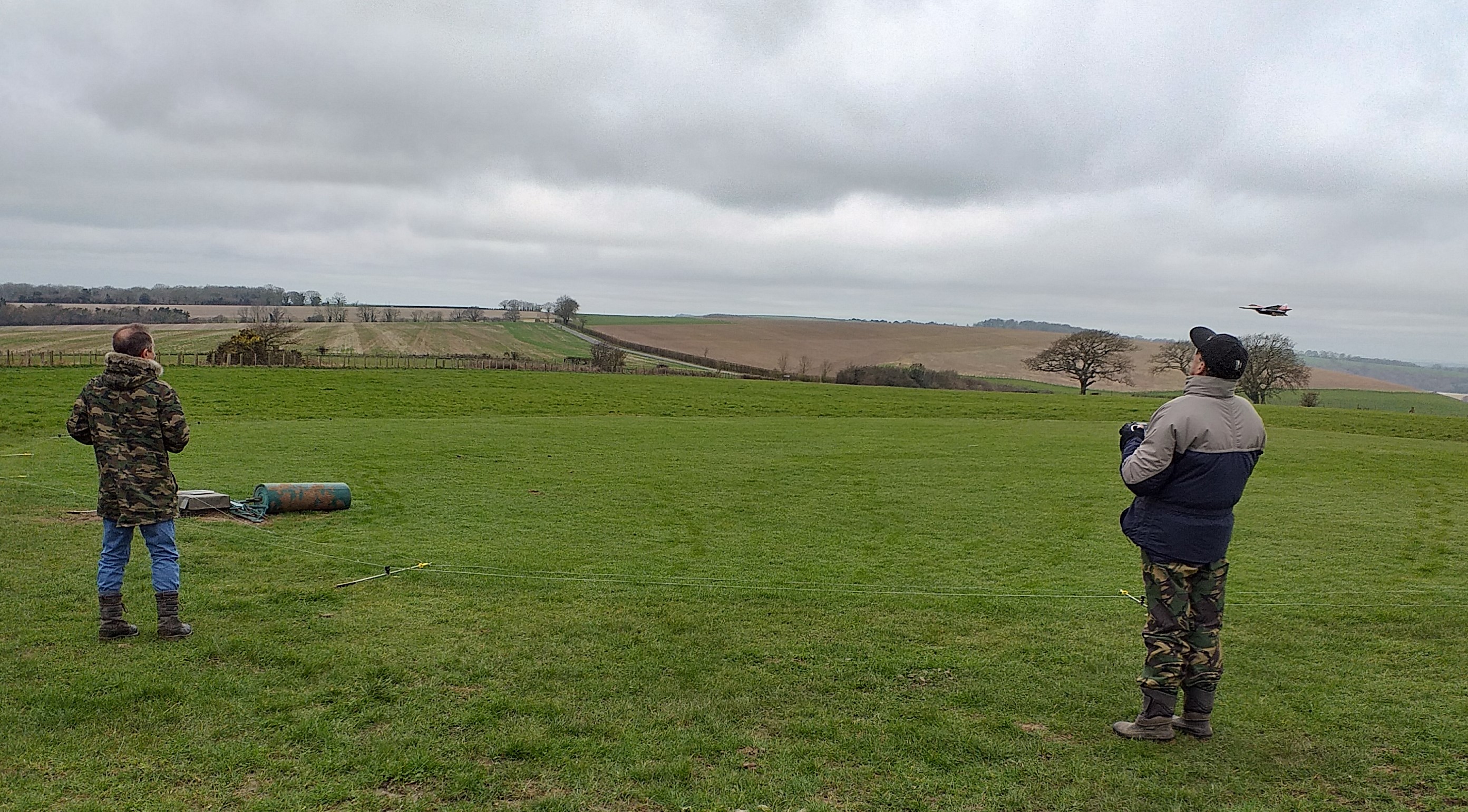 The bullocks returned to the field on 18th March having spent the winter in the lower field. Usually they are only in the field for about a month before they get moved on and don’t return for another couple of months. So if we are very lucky and are able to fly again in three months we’ll probably have their company again but right now that’s the least of our worries. The last day I personally flew it was ridiculously windy so just Dougal Entendre and I turned up.
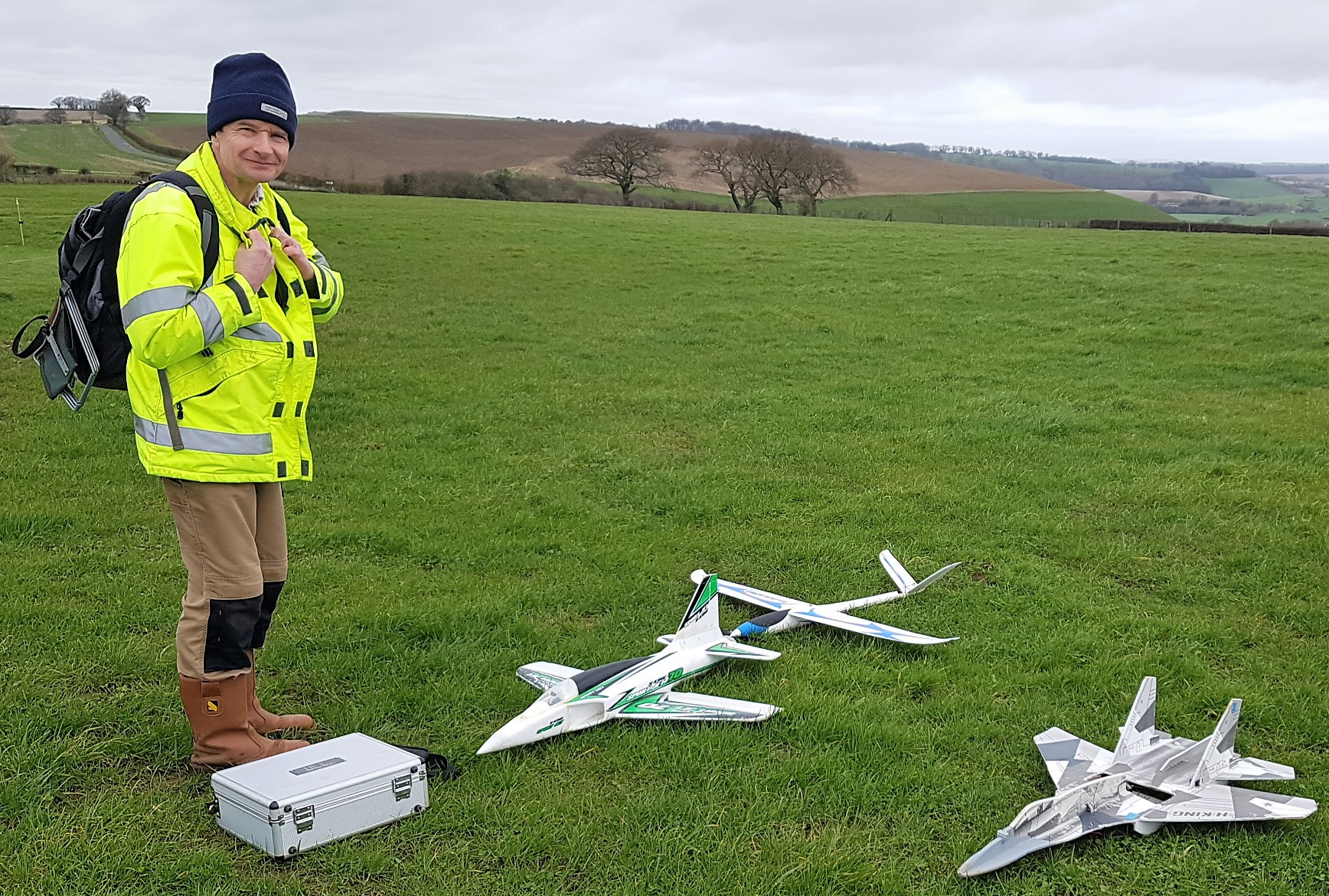 This edition will be published on 1st April and I would normally attempt to hide an April Fool piece somewhere within it but this year it just doesn’t feel right. So here’s the photo that I was planning to use along with a caption along the lines of ‘1066 got a bit too low on one of his many knife-edge passes right across the field’. Of course the truth is that he simply put the Edge down when he needed two hands to open the gate but that’s much more boring!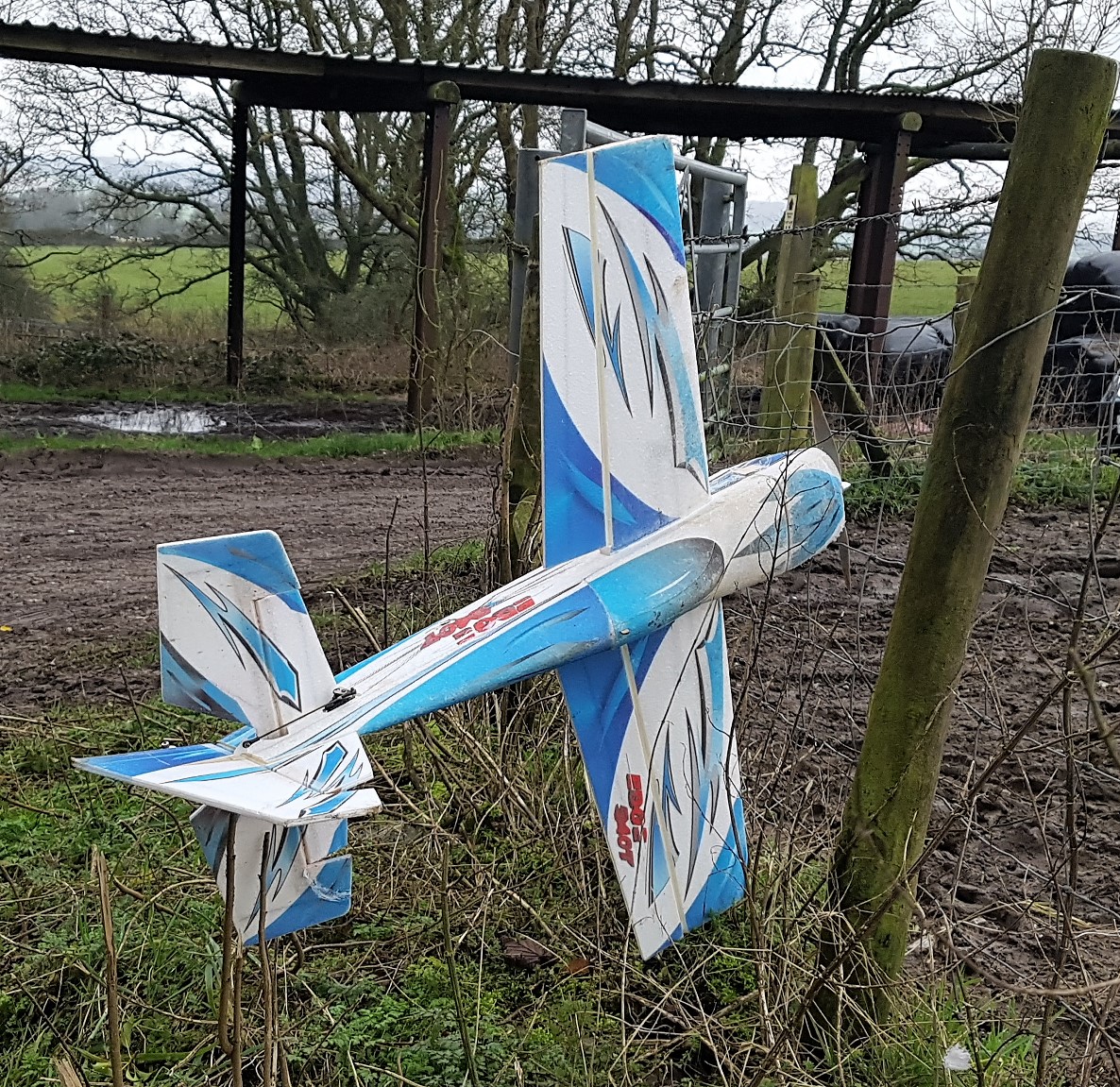
A couple of months ago I featured Dougal Entendre’s Snub Nose Skyfun, the snub nose being the result of bit of FPV trouble with a cloud. In January Dougal had added an HD camera to the flat front and was test flying it without the FPV gear but he’s now added an FPV camera alongside the HD one and has installed a new toy, a flight controller.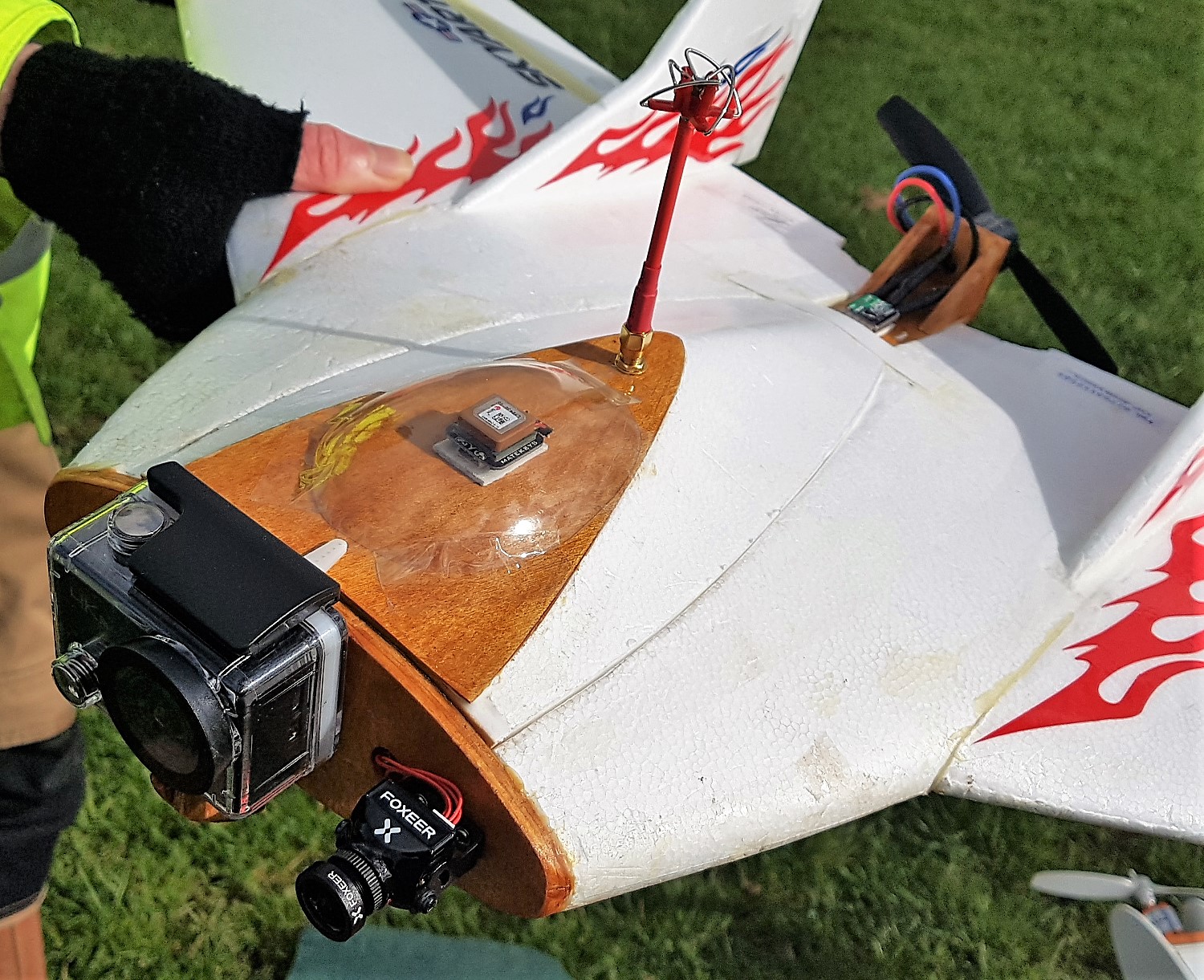
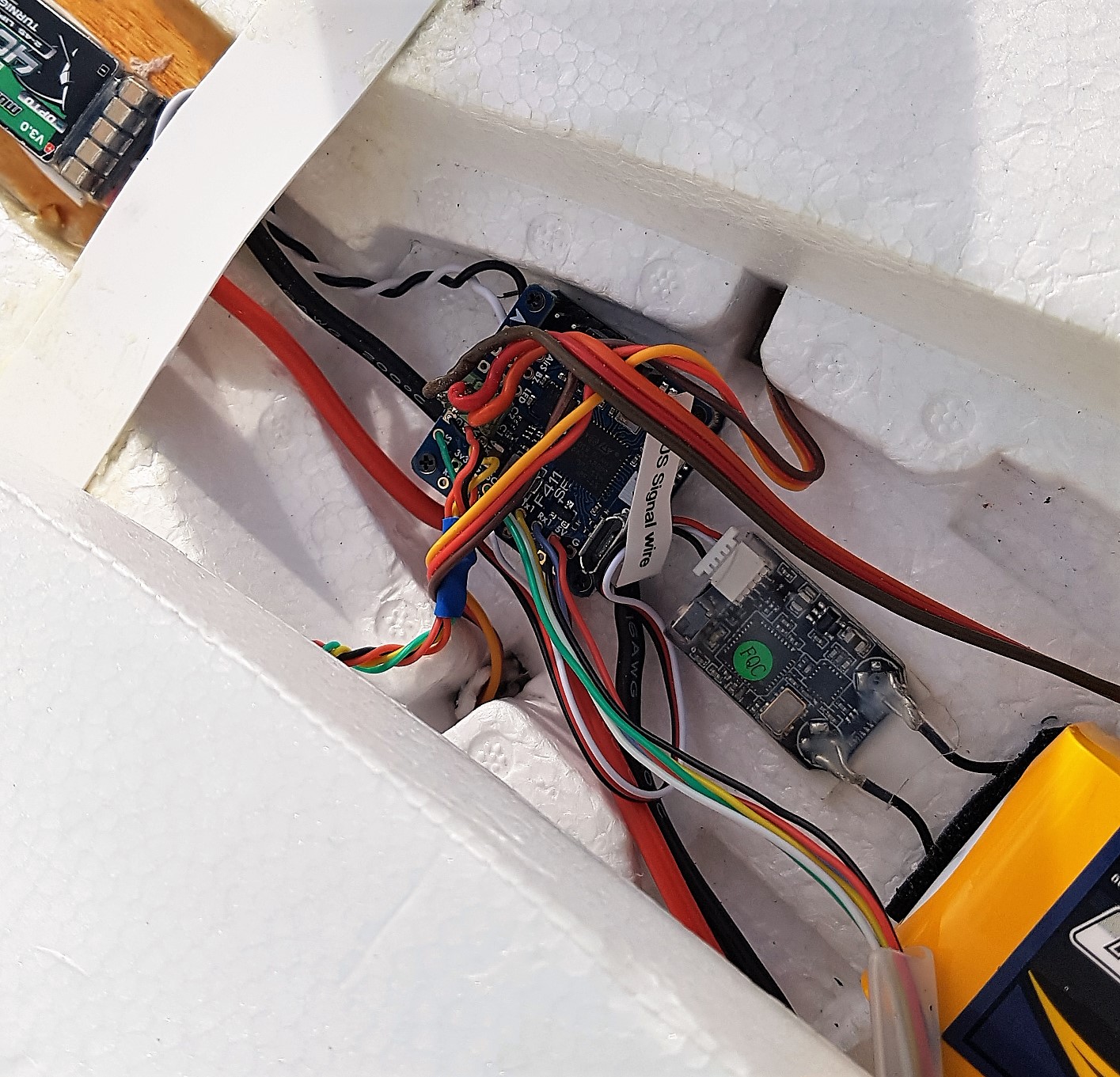 The controller can relay lots of live information from the plane back to the pilot where it is displayed on the goggles. The information can be tailored to suit the pilot’s requirements but can display things such as artificial horizon, altitude, height, distance from pilot, current draw, battery voltage and a whole lot more besides.
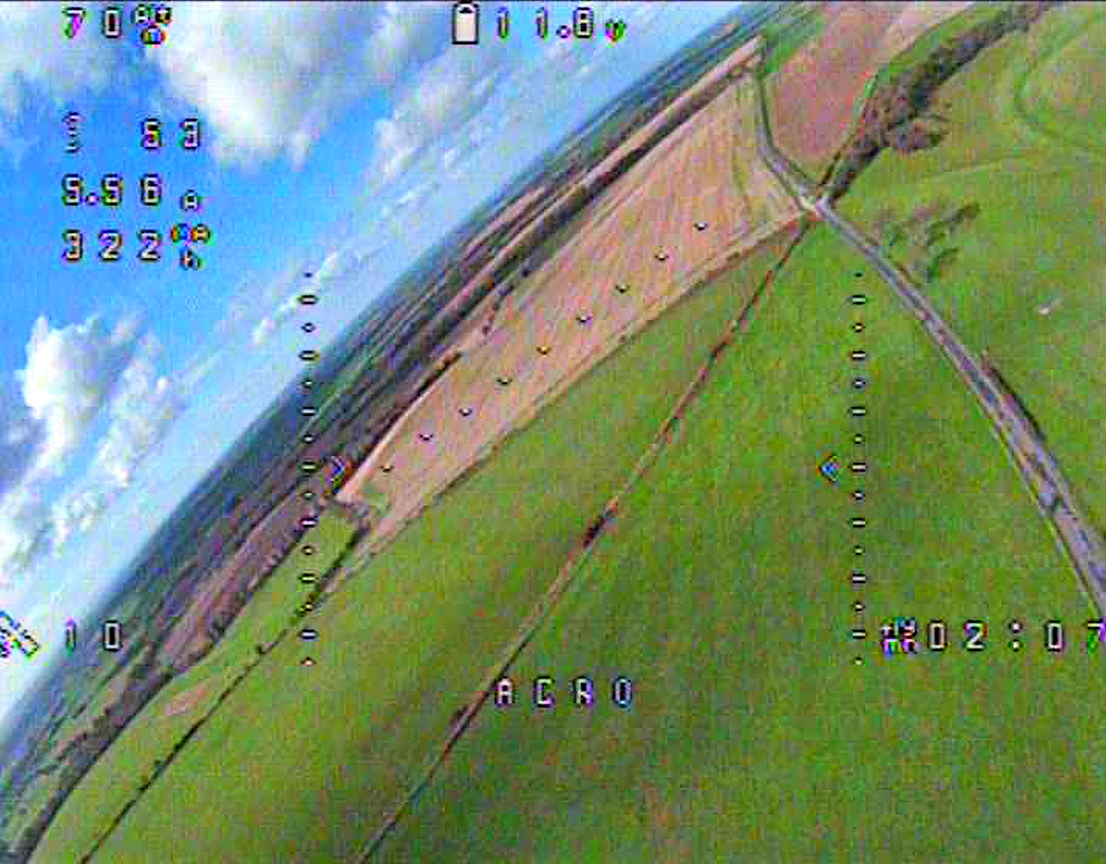 One of the most useful things for Dougal is the display of an arrow that always points back towards the pilot, so should he ever lose his way (and the spotter loses sight of the model) he will always know which way is home. Oddly at the moment he doesn’t seem to have got that part working, I know setting up the flight controller tested his wiring and computing skills to the limit and he’s almost, but not quite, got it sorted. Just as soon as he’s figured out how to get everything working correctly I shall steal the information and fit a flight controller to my own FPV model! In this months’ video I have included some of the FPV camera video interspersed with the HD camera video so you can see the quality difference between the cameras and also the OSD (On Screen Display).
During Dougal’s first flight he did a low pass in front of the pilot line (just showing off really) and it was perhaps a little lower and a little closer to the pilots than he intended. But what he had forgotten was that although we had taken the fence down we had left the post nearest to the pilots up, after all nobody would fly that close so it wouldn’t be a problem would it? Well it very nearly was a problem for Dougal as this video screenshot shows.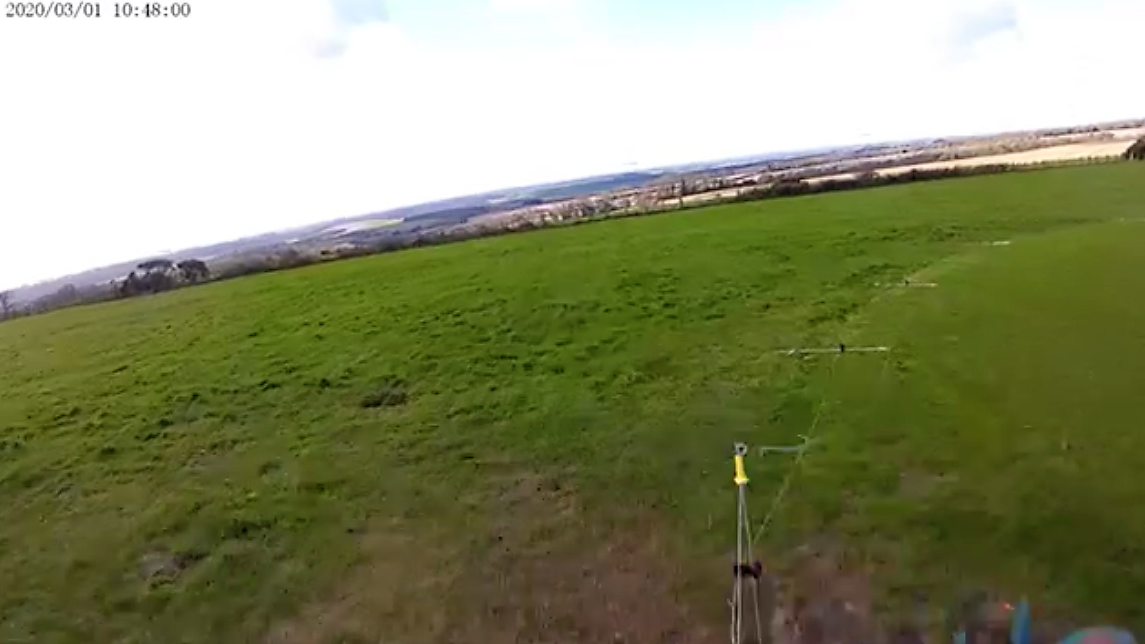 Yes, that really is a genuine onboard shot, he couldn’t have got much closer without hitting it!
Dwayne Pipe has done some repair work to his Acro-Wot following a bit of a mishap. If I remember correctly he wasn’t certain if the crash was caused by pilot error or a problem with the radio, he’d had a few odd unexplained things happen during the previous weeks but it’s sometimes difficult to tell. He’s made a nice job of the repairs and being in need of a replacement canopy he recycled an old squash bottle which I think looks rather good.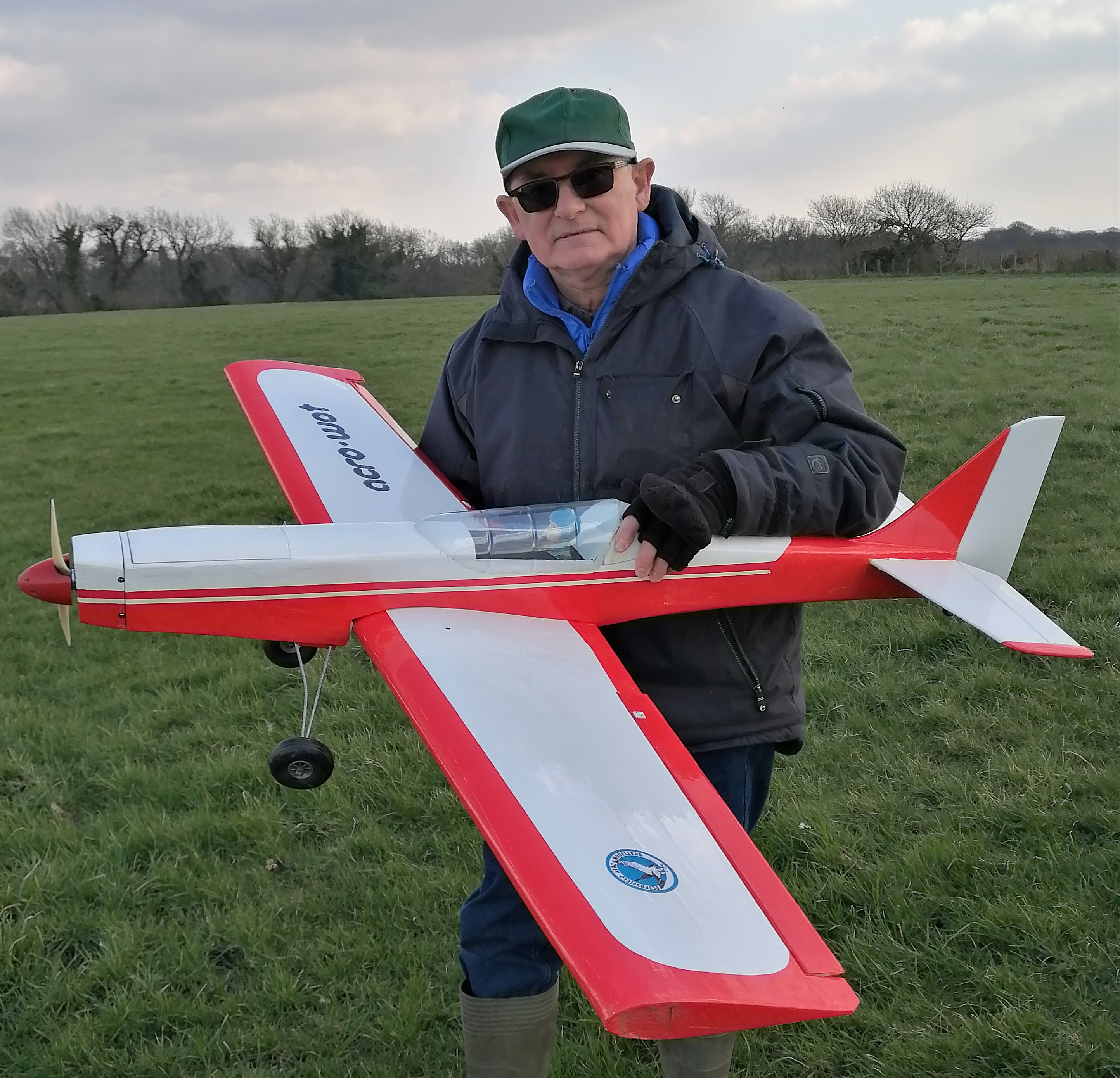
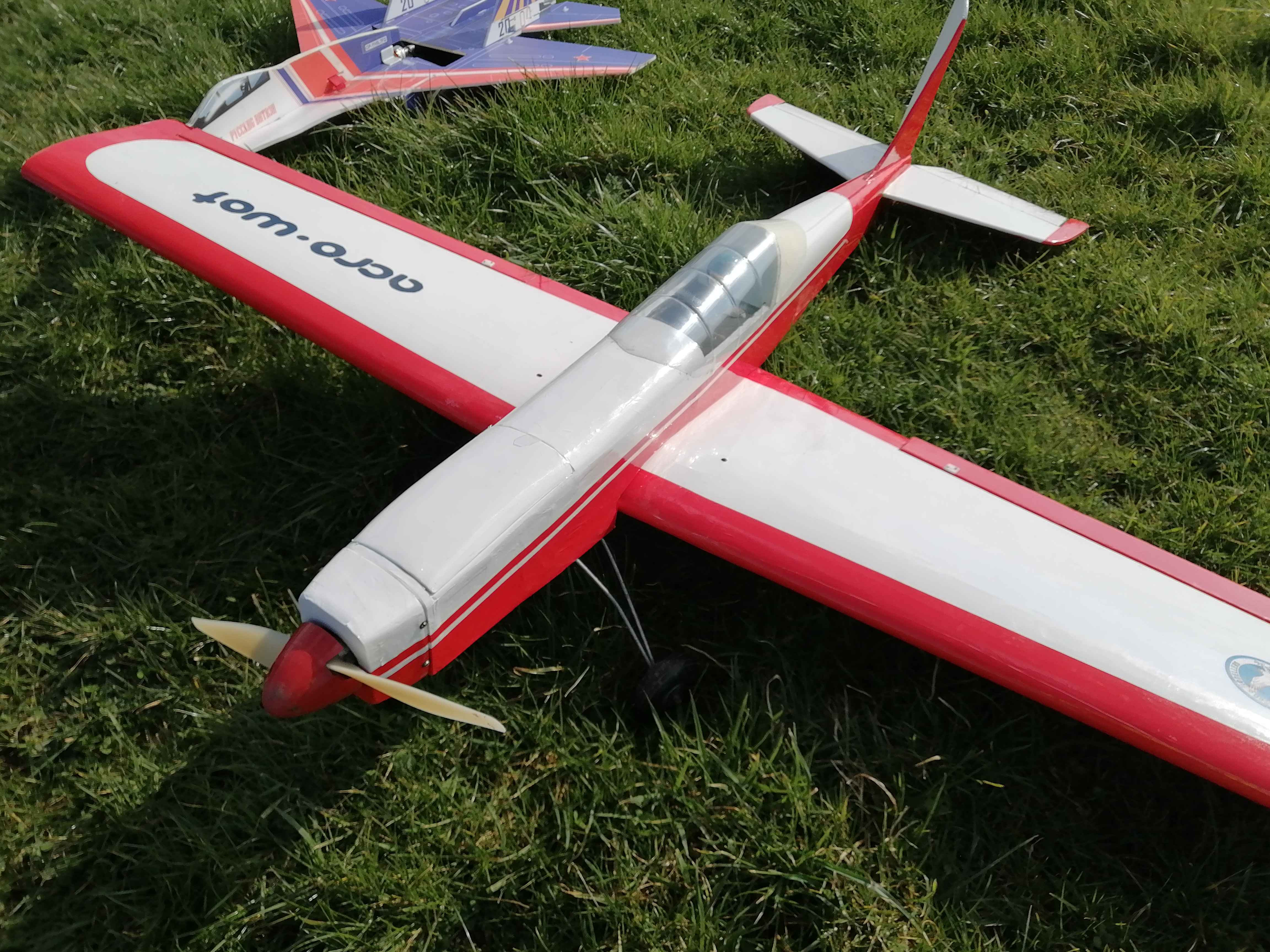 Acro-Wot aficionados will notice Dwayne has extended the nose a little in order to make achieving the correct centre of gravity easier, I think he did that before the latest repairs. So, how did the test flight go? Not well I’m afraid.
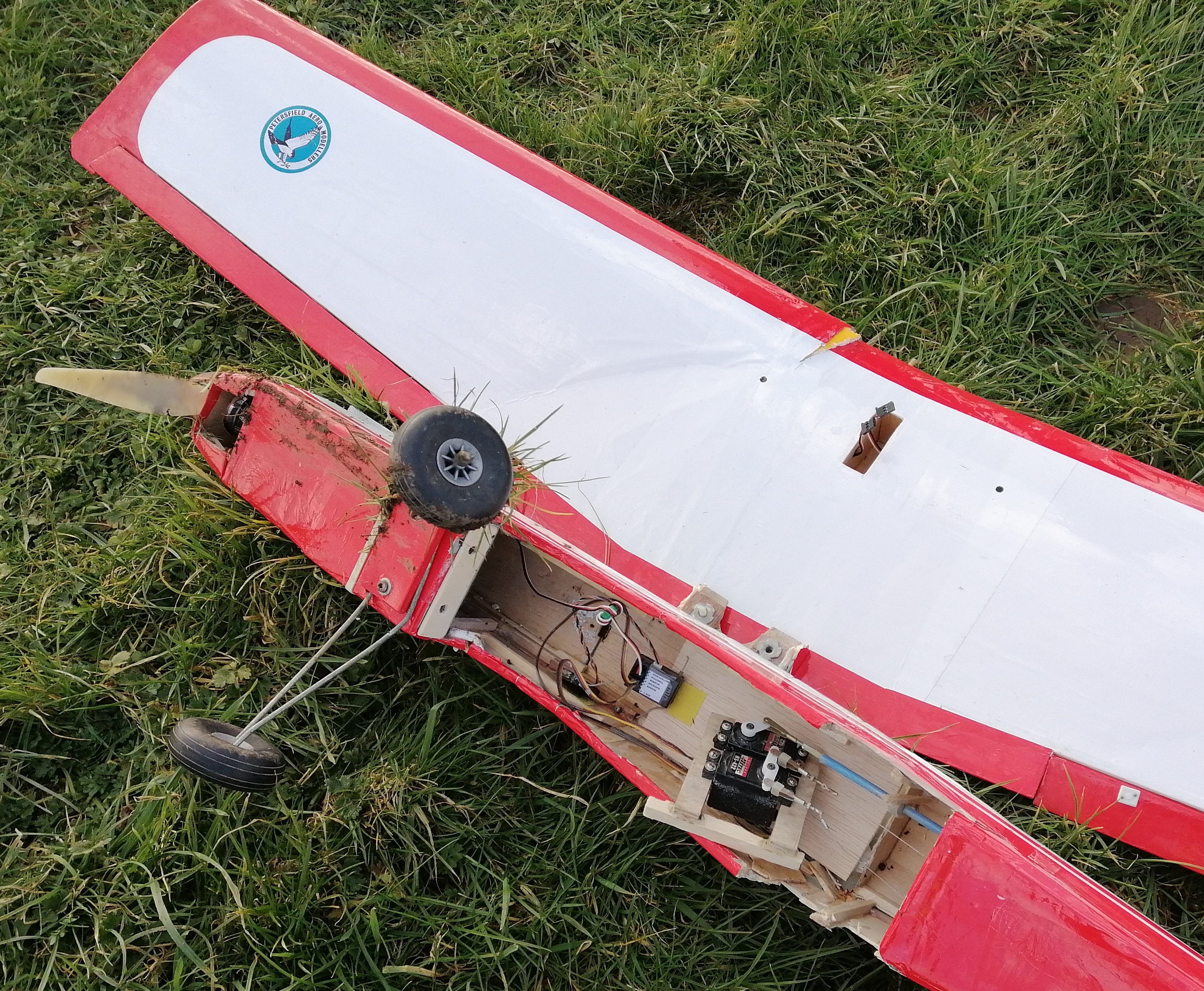 At least Dwayne has now answered the radio problem or pilot error question, it was the radio! Fortunately Dwayne is a master of repairs and the damage doesn’t look too bad so I expect the Acro-Wot will re-emerge once we are able to start flying again. Meanwhile Dwayne is on the lookout for a new set of radio from a different manufacturer and I was surprised he didn’t snatch Niki’s hand off when he offered a Futaba set for sale. That one was grabbed by Iven I believe. Maybe Dwayne has already bought something, let me know Dwayne and I’ll keep everyone up to date.
Back to Dougal now as he’s splashed the cash on a Multiplex Blizzard electric mini hotliner. Not much cash though as it was a second hand one that he spotted being sold by a Portsmouth seller on eBay. He won the auction but when he popped down to collect it the model wasn’t up to the standard he’d expected from the advert. The fuselage had been broken in half just behind the wing and repaired fairly averagely. The seller said he’d forgotten about that!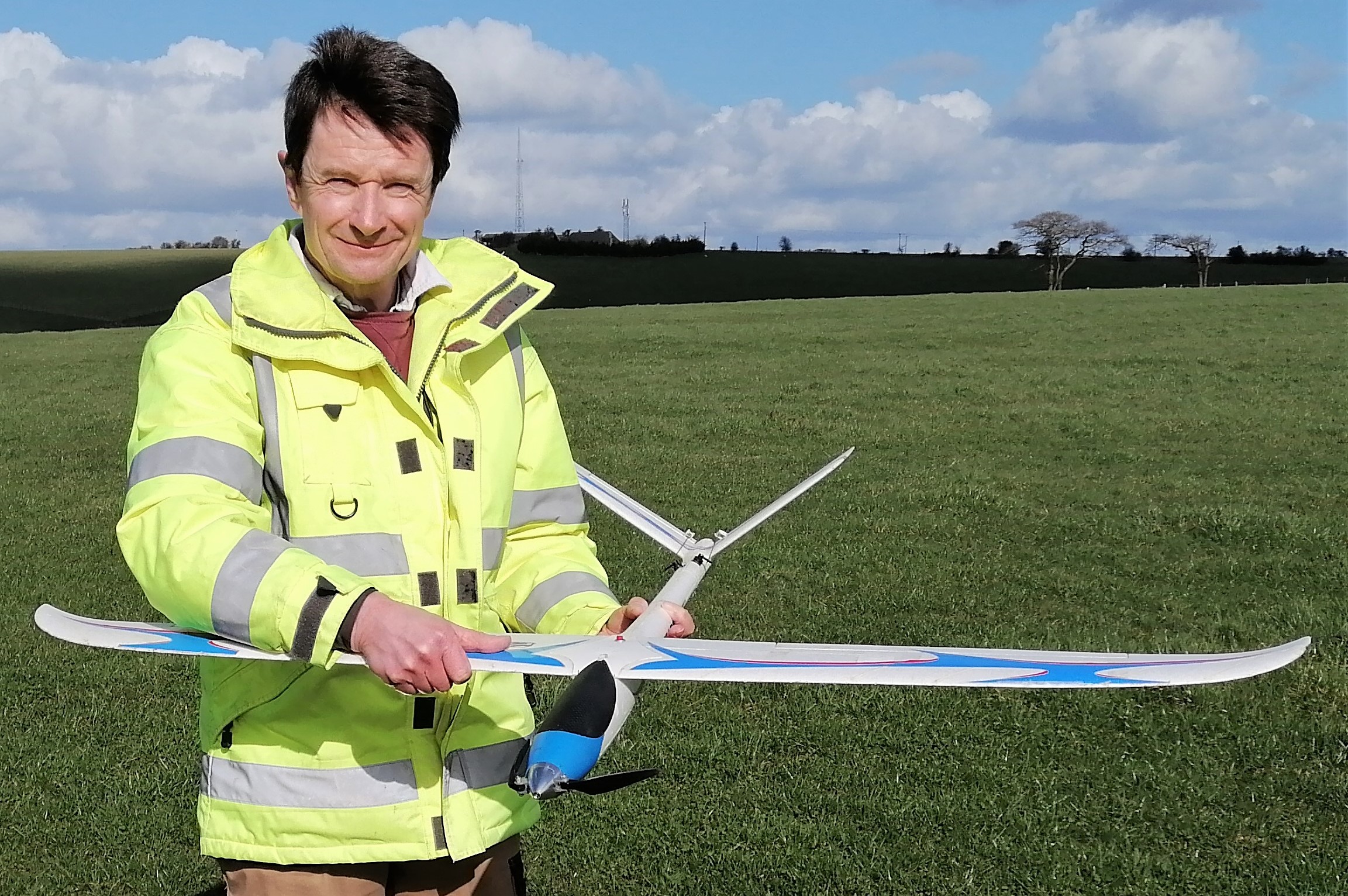 After some price renegotiation Dougal came away pleased with his purchase. Apparently the seller told Dougal that it had loads of power and was quite fast but when he flew it Dougal found it barely had enough power to fly and certainly wasn’t fast. But the Blizzard had been fitted with an eight inch prop which seemed rather small and the motor wasn’t pulling much current so Dougal swapped to a ten inch prop which transformed it.
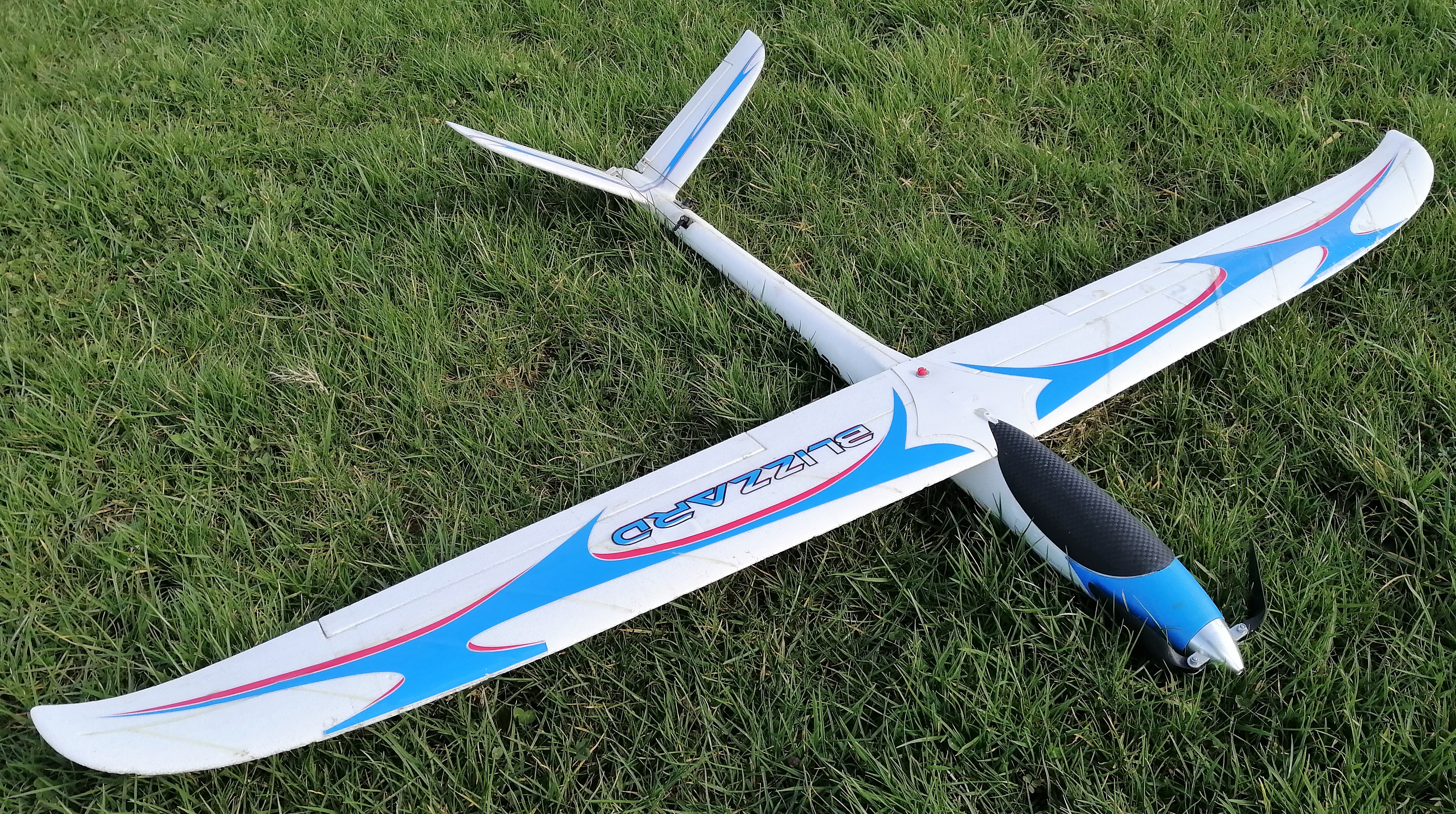 He could probably still go to a bigger diameter or higher pitch if he wants some more speed but it’s now a good performer anyway. You can see some of the flight with the larger prop fitted in this month’s video.
OK, it’s competition time now. Usually I would offer a humungous prize for a comp winner but as I don’t have anything to hand, can’t shop, and won’t see the winner for months anyway this one is just for a gold star! During our flight from Gatwick to Marrakech I took a photo of a part of England that I immediately recognised. The gold star goes to the first person that names the three S’s in the photo. No you idiots, not Sun, Sea, and Sky! Click on the photo to enlarge it, it’s much clearer then. Just put your guesses in the Comments section.
With no flying allowed for now we’re seeing an increase in the number of new models being built and that’s what I’ll have to concentrate on for the next few editions. Those of you in the WhatsApp group will have seen some of them already but I will give you more information about them. First up this month is Niki Weatherley’s lovely Extra 300.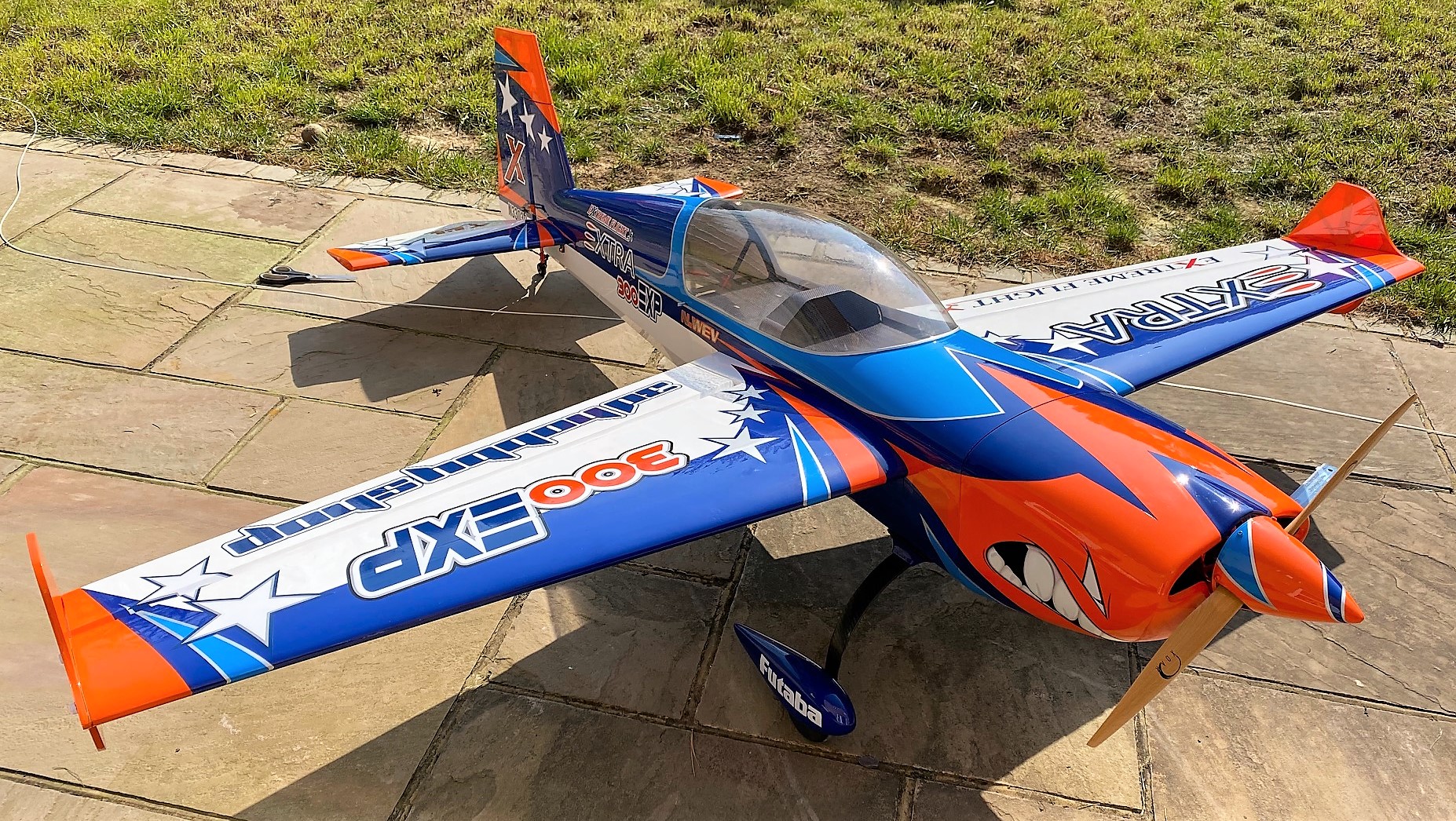
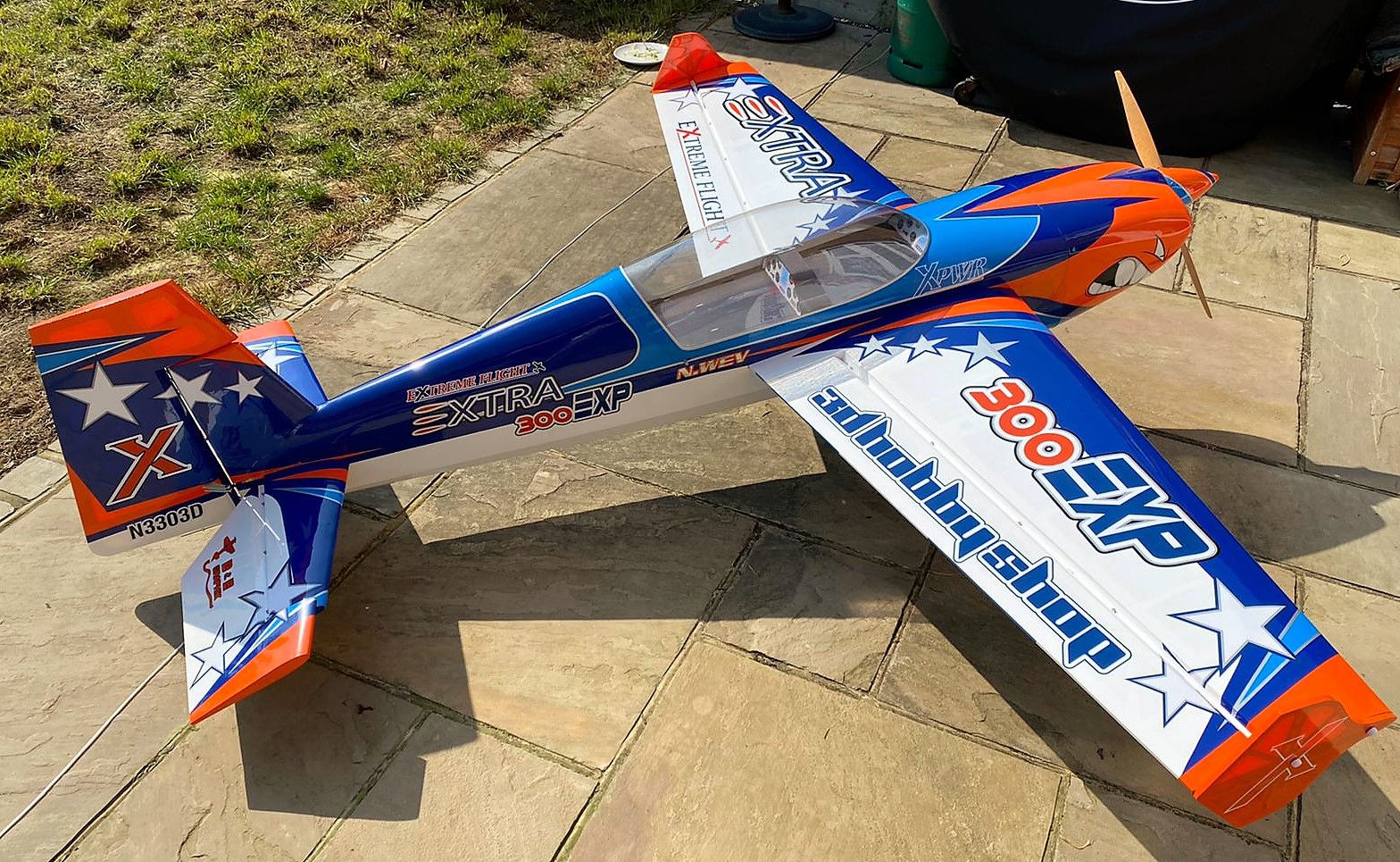 When I first saw the photos of it in the garden I didn’t realise how big it was, it has a wingspan of 85” (2160mm). It’s made by Extreme Flight and is designed specifically for either 50cc petrol engines or equivalent electric motors. This is from the Extreme Flight website: Precise, agile and aggressive yet super stable and light on the wing, the 85″ Extra excels in all modern aerobatic flight regimes. With reduced control surface throws the Extra is a big pussycat and makes a great sport flyer. Crank up the rates and prepare to be amazed by the truly unlimited potential of this airframe! The 85″ Extra 300 EXP is loaded with features including advanced use of composites for a super strong, rigid, yet light weight airframe, carbon fiber wing spars, main gear, tailwheel assembly, wing and stab tubes. It features a 2 piece removable stab with internally mounted elevator servos. The Extra is available in 2 high visibility Oracover color schemes with high contrast bottom colors and a pro quality hardware package including genuine Dubro ball links. Elevators and ailerons are pre-hinged and hinge lines are sealed with Oracover, facilitating a quick assembly. Experienced modelers should be able to finish assembly in a couple evenings of relaxed shop time.
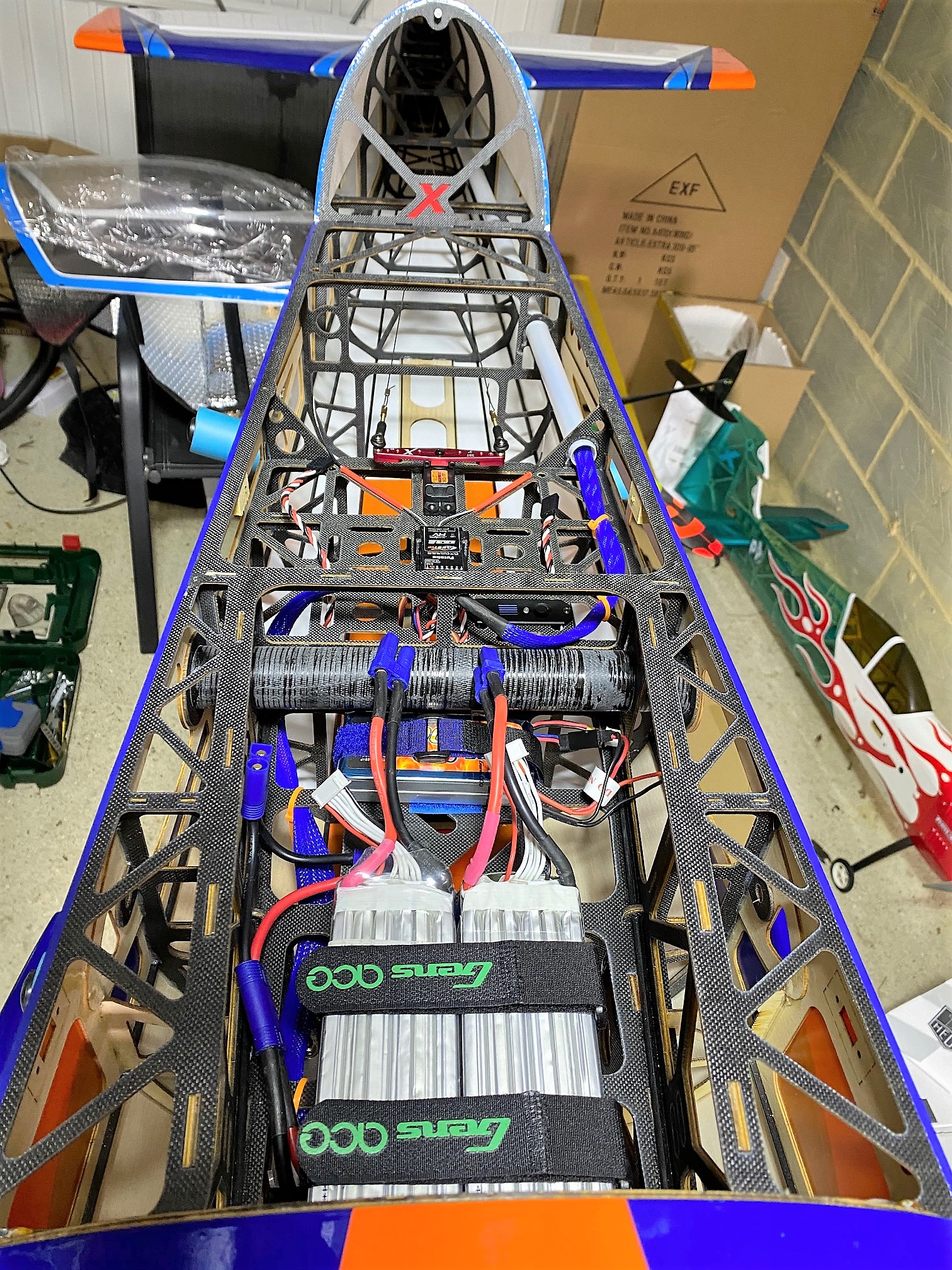
Personally I’d be chicken and would be going for the reduced throw, big pussycat, sports flying but somehow I don’t think that’s what Niki will be doing! He has of course gone for the electric option and having initially ordered a 60cc (electric equivalent) set-up he’s now decided that was overkill and has settled on a 40cc 200Kv Xpwr motor, 120A HV Castle Creations speed controller and a 12 cell lipo. The lipo consists of two 6 cell packs of 4000 to 5000mAh with a 65C rating which are connected in series. That’s the same powertrain as Matt uses in his 81” Velox.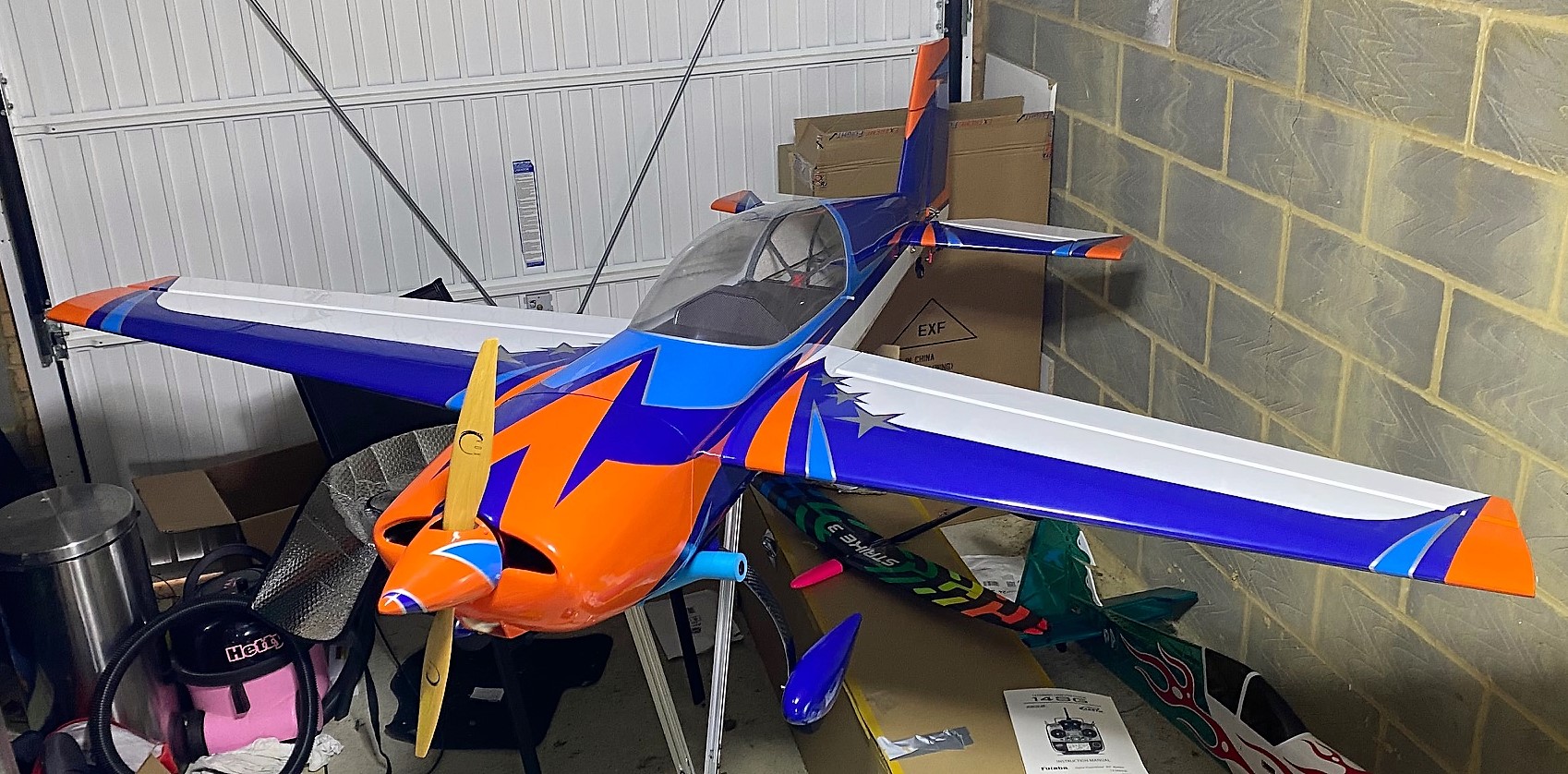 Niki is using a Futaba 7008SB receiver and Savox HV-1270TG servos all round, just one of which costs more than some of my planes! Niki will be using telemetry to keep an eye on current draw, temperatures etc. which seems like a very wise move to those of us who witnessed the speed controller in Matt’s Velox catch fire mid-flight.
 The excellent graphics on the Extra that you can see in the first two photos came from B&E Graphix in the States. All in all that’s a very impressive plane Niki, I look forward to seeing it fly before too long.
Bob the Builder has been idling away his isolating time by pimping up his Sukhoi SU-27 with lots and lots of LEDs. Bob is intending to try night flying when he can find a suitable time and place. Woody will be so jealous!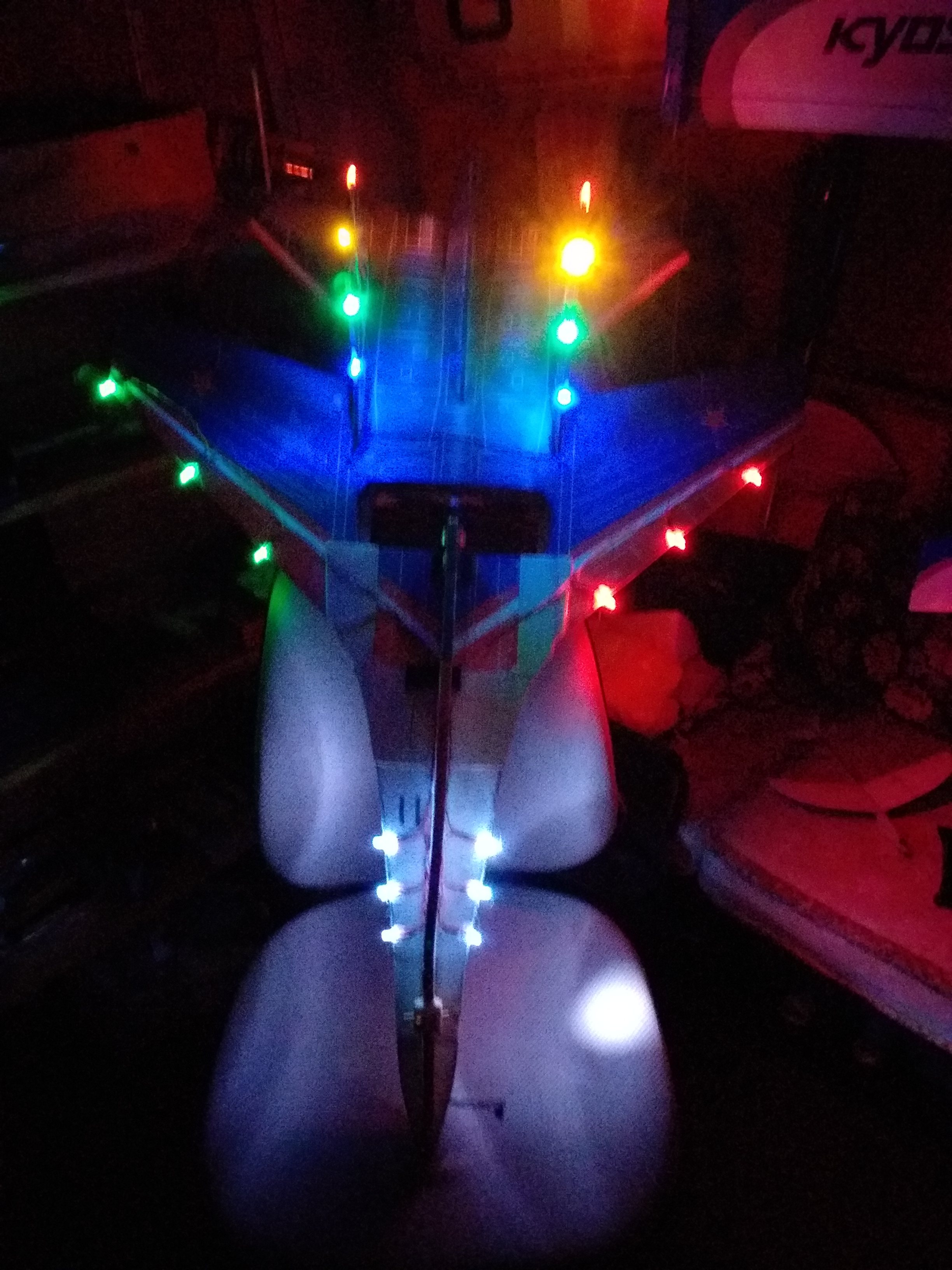
Next is a Tony Nijhuis Sabre with a span and fuselage length of 25 ½” (650mm) that Norwegian Nick is building. Nick says the all up weight should be about 16 ounces (450gm) but his might be slightly over that because instead of the intended 3 cell set-up he’s fitted a 4Max 50mm fan which will use a 4 cell 1800mAh lipo and a 40A esc.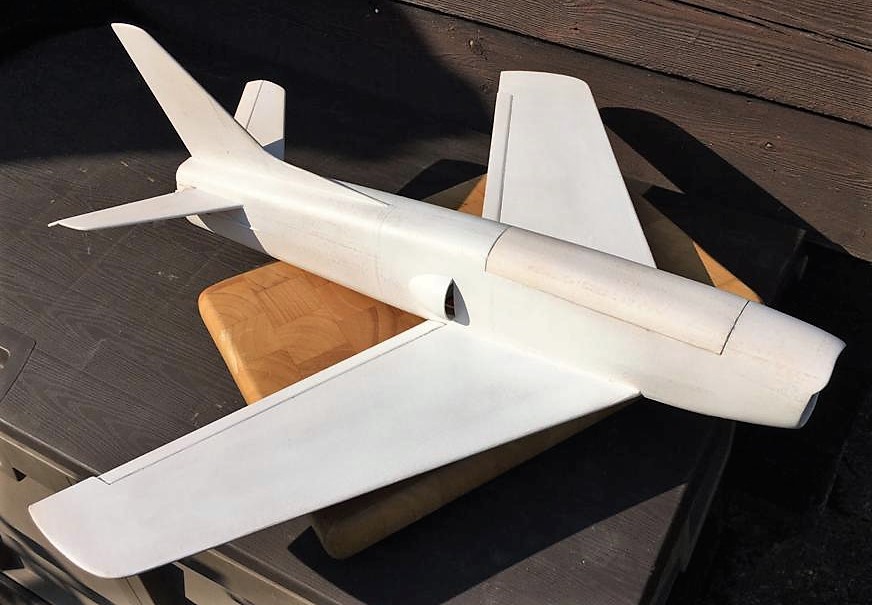
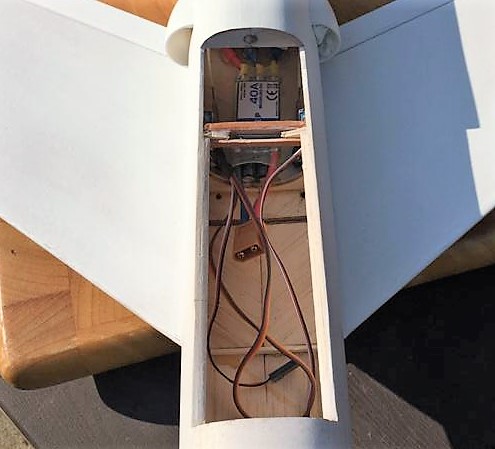 The Sabre is of all balsa construction which Nick has covered with tissue and it will be airbrushed with acrylic paints. He’s run the motor and says it sounds superb, the fan has been aerodynamically balanced so there’s no vibration.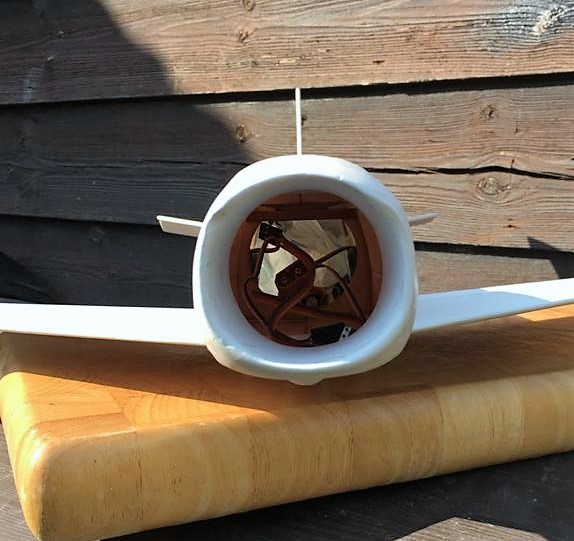
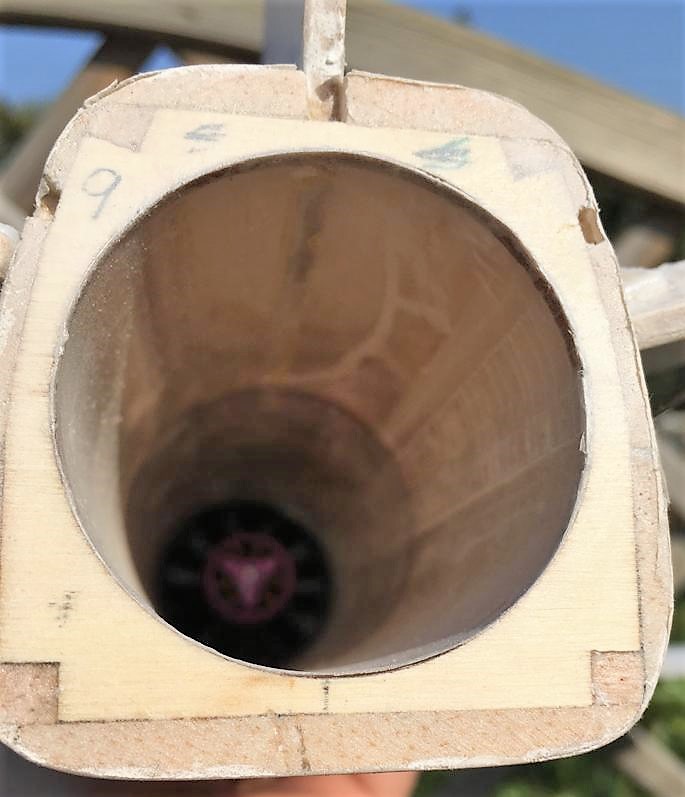 I know Woody has a similarly sized Tony Nijhuis Hunter under construction and he is using the recommended 3 cell set-up so it will be interesting to compare the performance of the two. It would be nice to see them flying together.
Speaking of Woody, I took this shot of his Sukhoi SU-57 flying early this month. It’s nothing like the standard of Kryton’s photos of course but not too bad for a mobile phone and I like it. Click on the photo to enlarge it.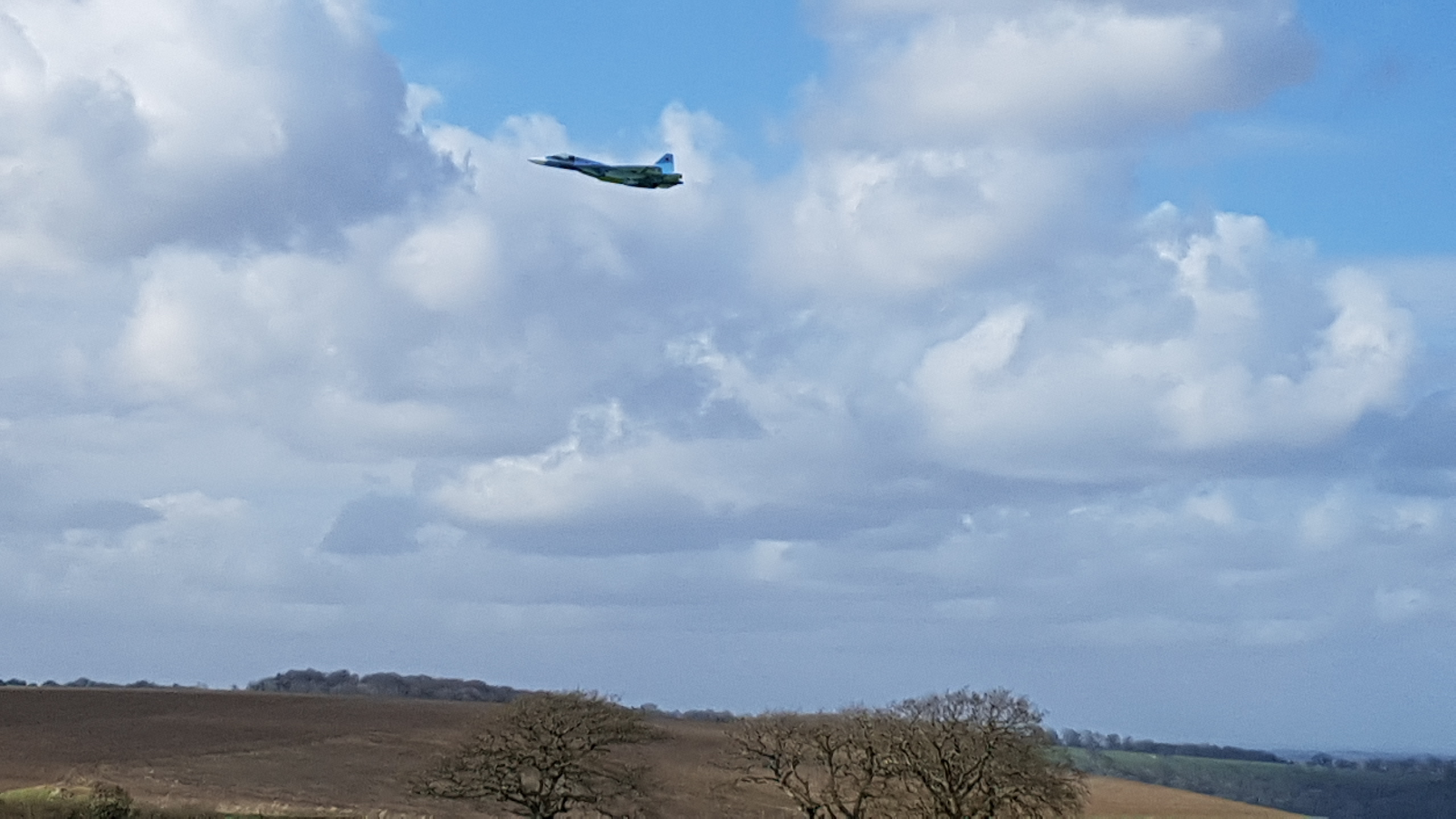 As well as his Lysander Chas Butler is spending his isolation time working on a 104” (2640mm) span Jamara Discus CS that he’s had for several years. As a glider it weighs about 1.2kg but he’s now considering electrifying it.
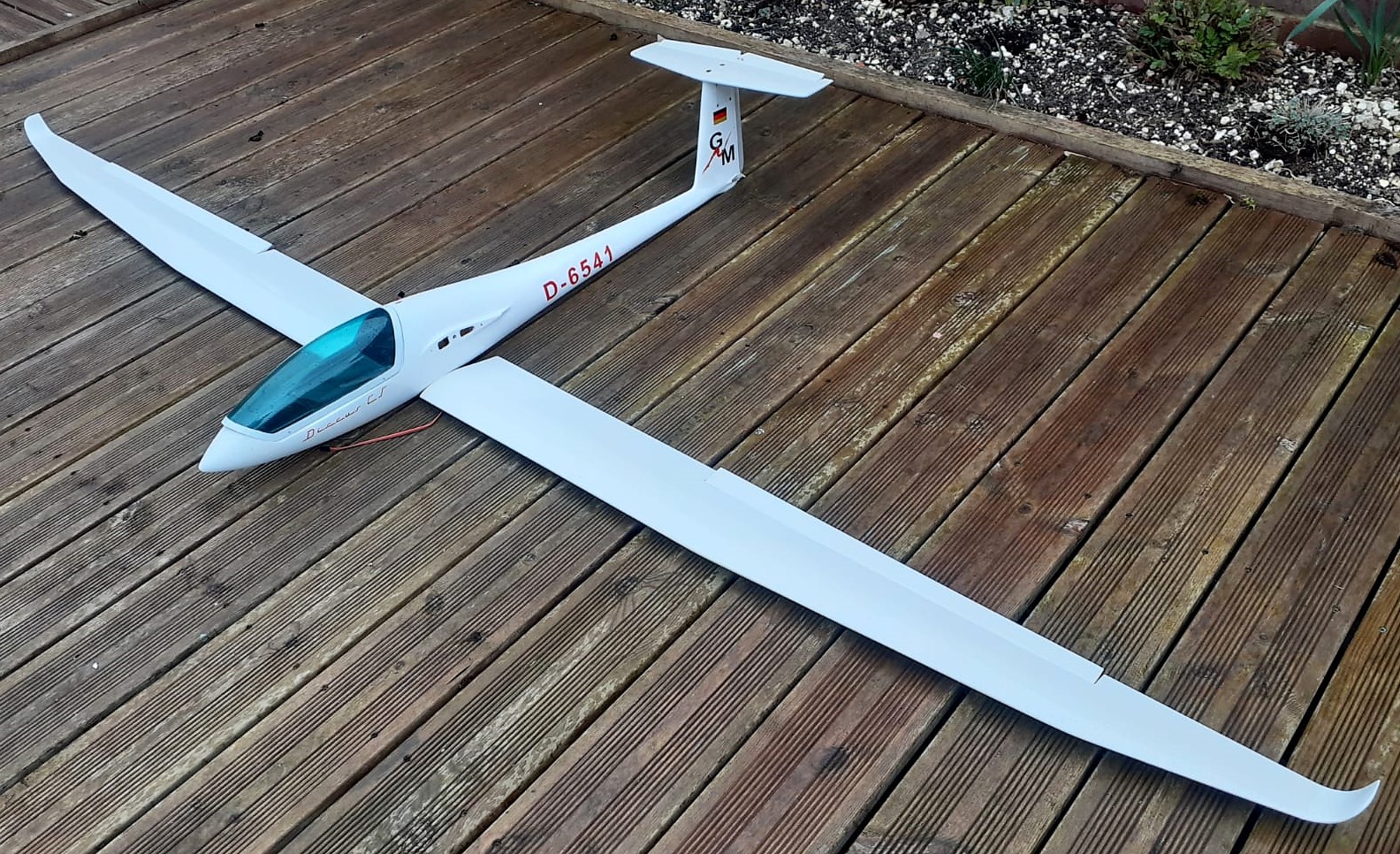 He’s planning to use a 1070Kv motor with a 12×6 folding prop, a 60A speed controller and a 3s 2200mAh lipo. Sounds good to me, should go well Chas. The problem that he has at the moment is that the damp has got under the gel coat on the fuselage and made it bubble so he’s got some rubbing down and spraying to do first.
STOP PRESS: He’s done it!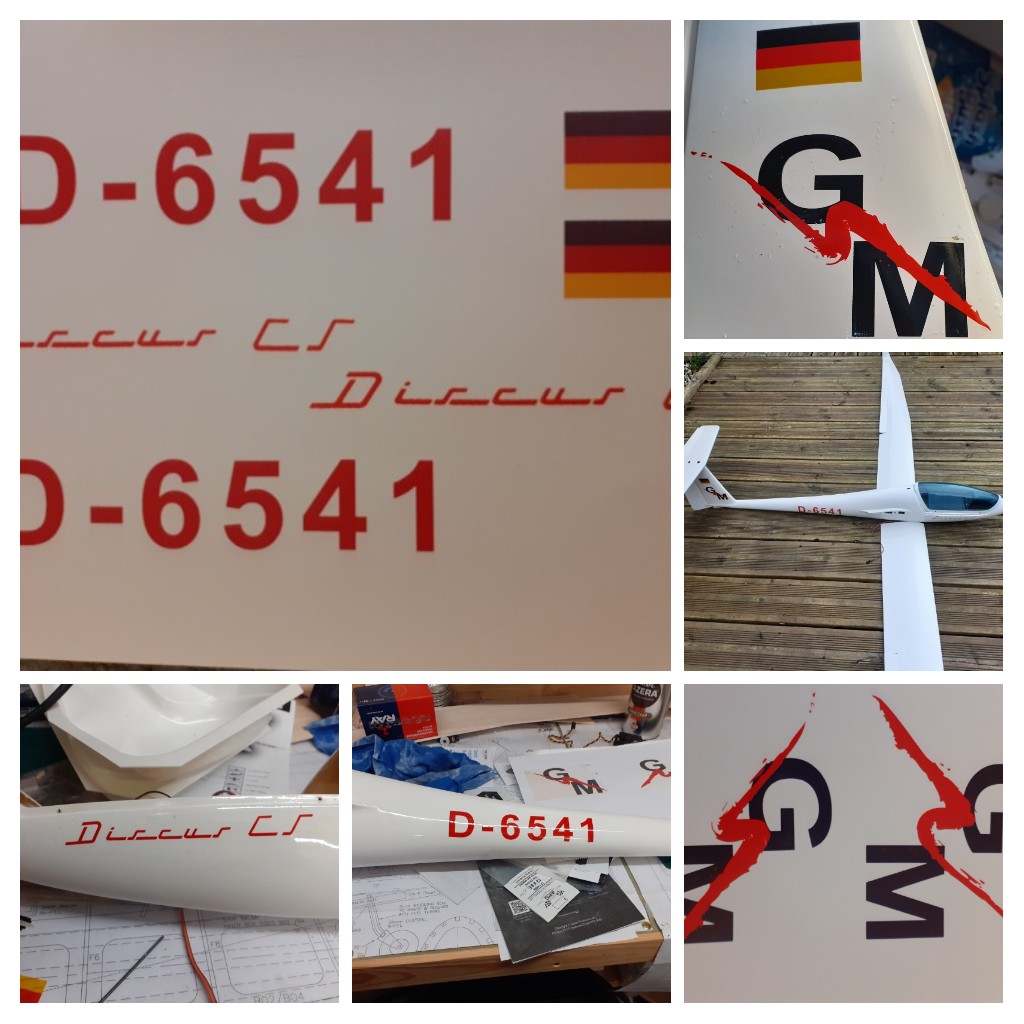 Chas photographed the original decals on the fuselage before rubbing it down and then used Photoshop to reproduce them on waterslide paper. I assume he used Photoshop to make the rather nice photo collages he sent as well.
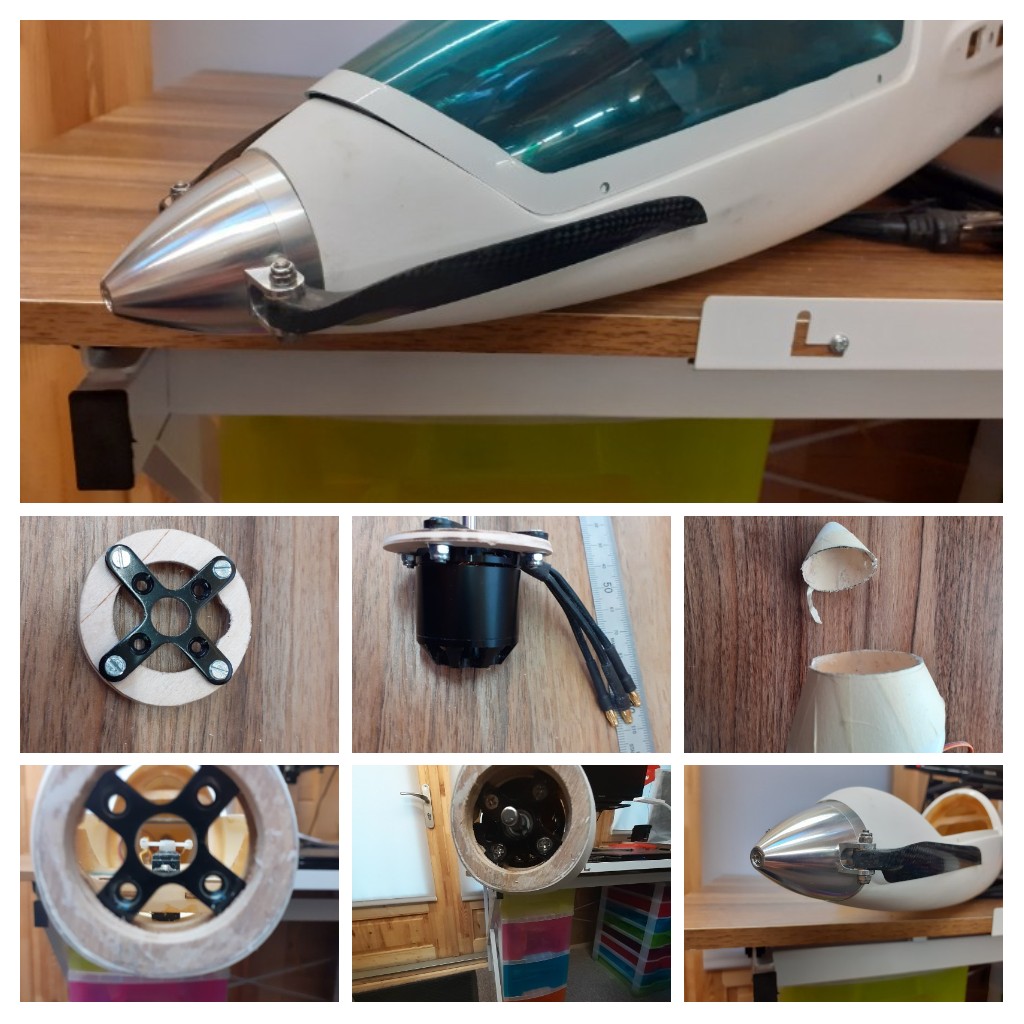 Next he bit the bullet, sawed the nose off the fuselage and mounted the motor onto a plywood ring that he then epoxied into the nose. He’s now test run the motor and the power seems fine. That’s all very neat, good job Chas.
Video time now and of course this will be the last video for a while unless I am able to find some old footage to cobble together. This month some of the video and photos come from Captain Slow, Bob the Builder, and Dougal Entendre, thanks guys. Please watch the video full screen, it’s so much better with small models flying around.If the video won’t play for you please click HERE
What’s the difference between politicians and flying pigs?
The letter F…
Stay safe
Colin Cowplain
Patch News – February 2020
As anyone living in the UK will know the February weather was nothing short of atrocious, we had storm after storm after storm. Some of the more hardy PAM members managed a few flights early in the month but that was about it. We did manage to continue with the patch repairing following the bullocks January wrecking spree. The old FARTS dragged the roller around a few times, concentrating on the area of the patch that was the most badly churned up.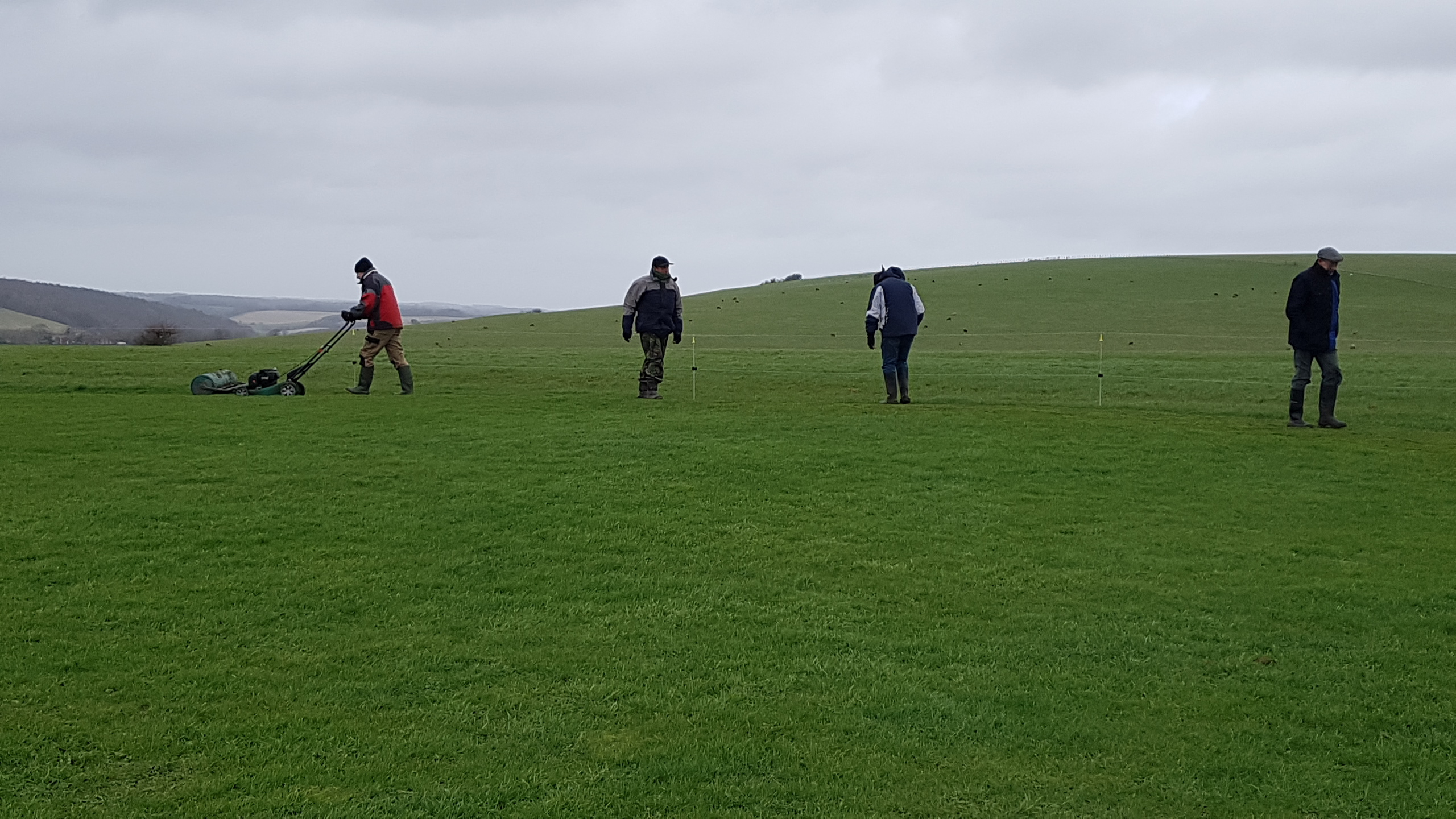 About the only advantage of having so much rain in February was that the ground was soft enough for the roller to be quite effective although there were times when it was just too soggy to roll. Towards the end of the month we even managed the first cut of 2020 and that made a big difference to the patch quality. Hopefully the weather will improve soon and we’ll be able to mow regularly, which should then bring a rapid improvement in the grass.
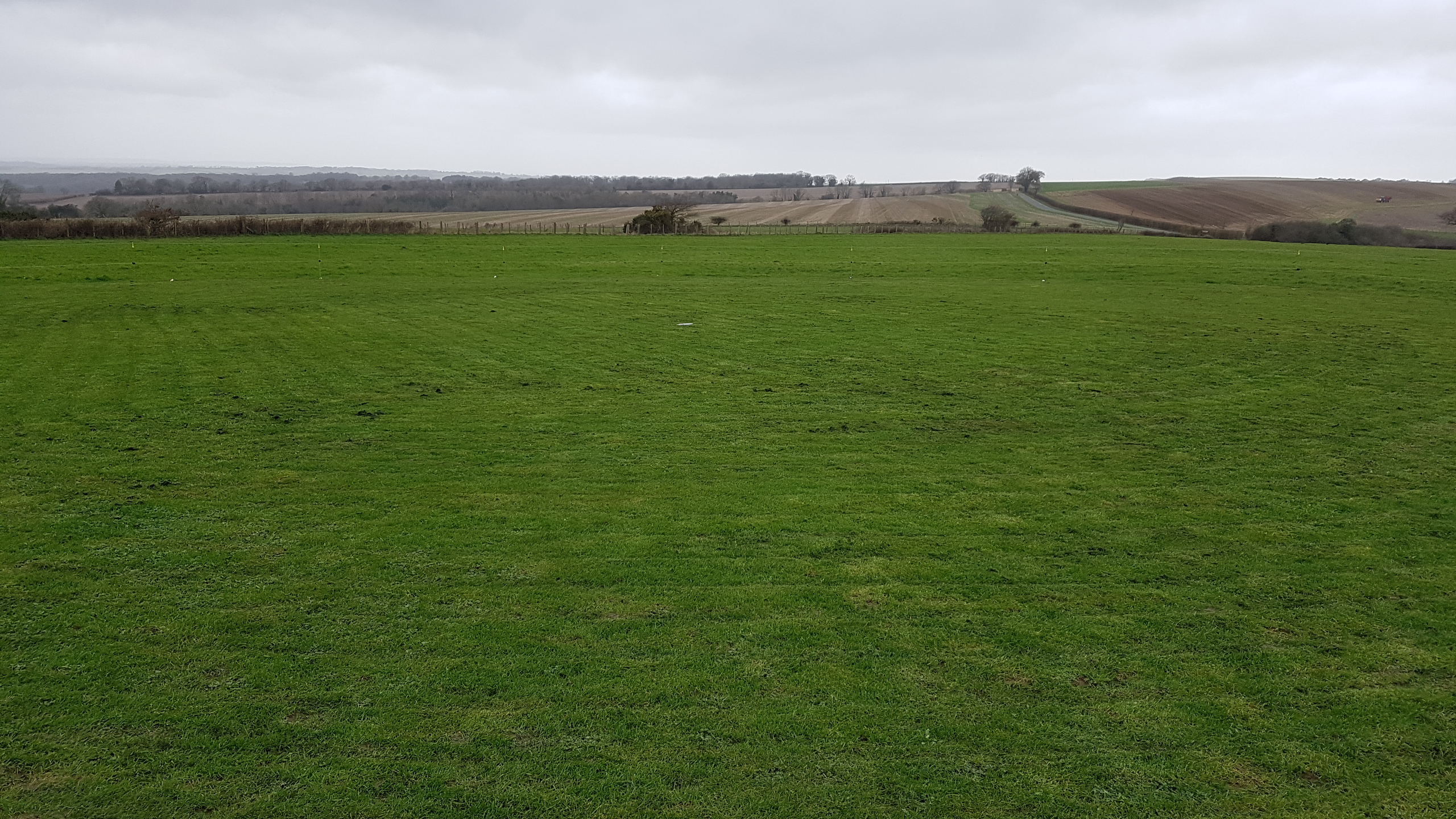 But don’t despair, it’s perfectly good enough now for most planes and only ducted fan models with small retractable wheels would have problems getting off. One good thing about the terrible weather was that the bullocks would have been too exposed in ‘our’ field so they have remained in the lower field where there is some shelter for them. However, while they were in the top field in January Jeremy kindly took this photo of one of them licking my car.
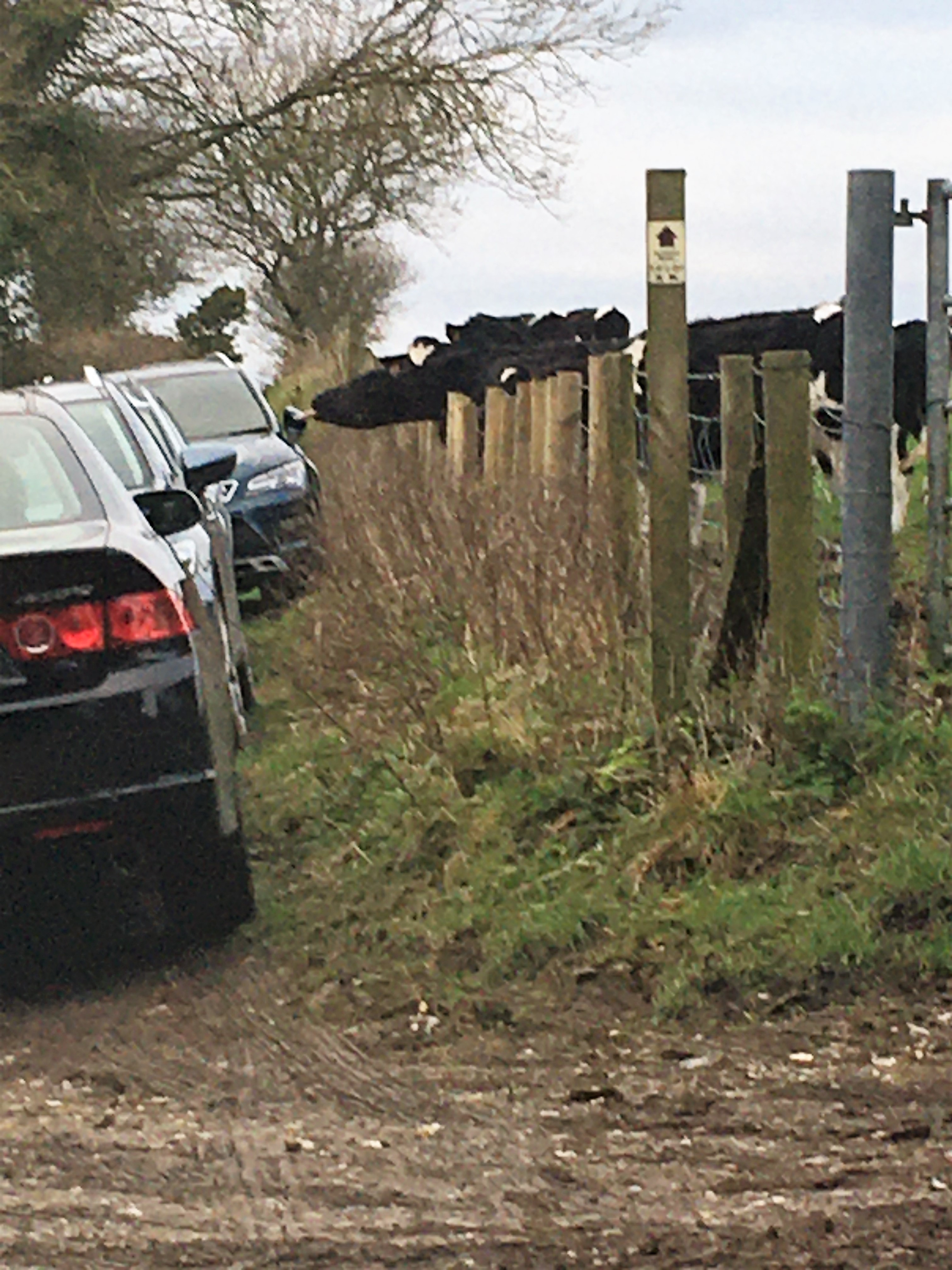 Jeremy reckons I need to be nicer to the bullocks and park closer but I’ve made a note to park further away!
The majority of what flying we did manage in February was done with foamboard jets, partly because despite being really light they handle strong winds very well and partly because they’re dirt cheap so it doesn’t matter too much if the worst happens. Dougal Entendre filmed some of them for this months’ video and he managed to catch Captain Slow’s SU-27 smashing mercilessly into my SU-27. Here are a couple of video screenshots of the ‘landings,’ amazingly my model was undamaged despite it looking bent in the middle in the second photo!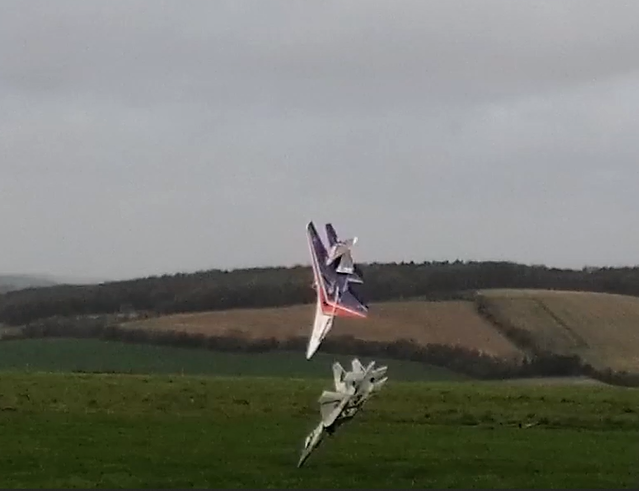
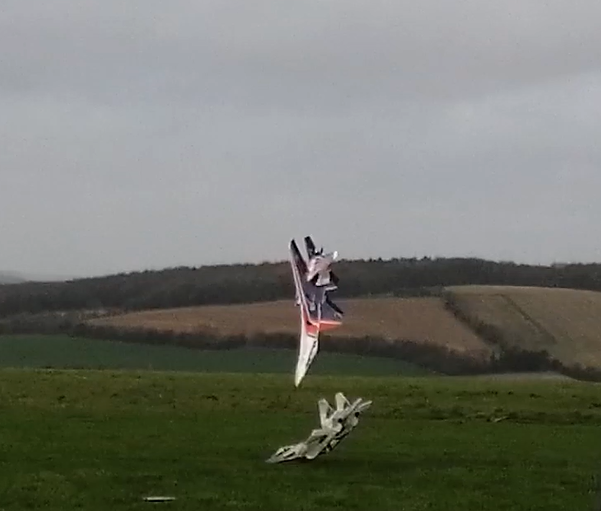 Of course Captain Slow blamed me but the video proves beyond all doubt that it was his fault… Well ok maybe not but I write this so that’s what I’m saying! I re-launched and carried on flying but Captain Slow’s Sukhoi had lost one of its fins and he wouldn’t fly it again despite my assurances that it wouldn’t matter. The video ends with some footage of my SU-27 going rapidly backwards on 26th Feb, a day that must have been one of the windiest ones on which we’ve flown. Bob the Builder filmed it but he also flew that day, as did Dwayne Pipe and Captain Slow.
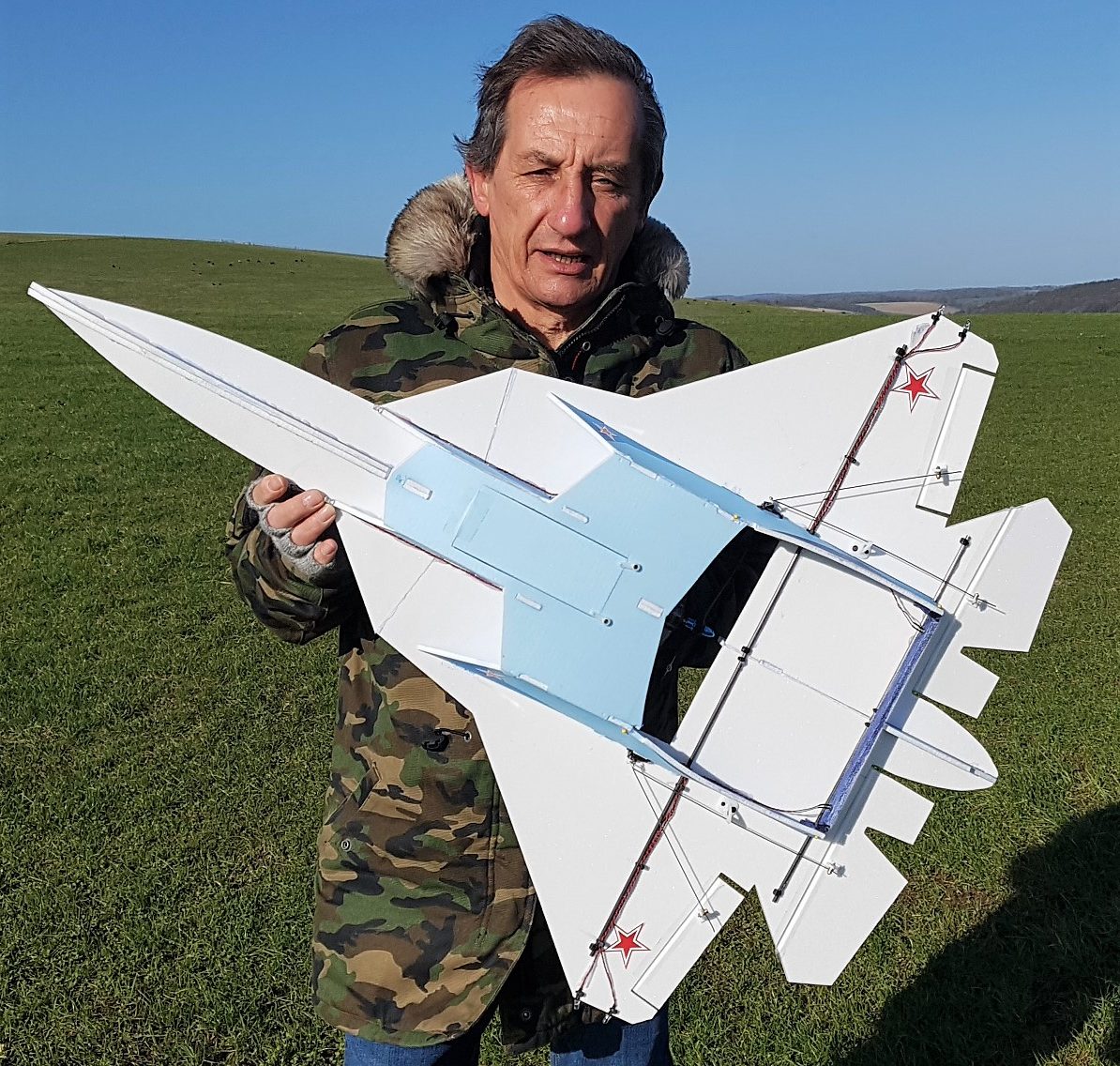
Unsurprisingly I only spotted one new model during the month, a rather nice foamboard T-50 that Woody purchased from Banggood. The T-50 is one that HobbyKing don’t sell and anyway HobbyKing don’t have very much stock of any of the foamie jets at the moment. I wasn’t sure it would be as good as the SU-27s and Mig-29s because I thought the large wing area might make it susceptible to gusty winds but that fear seems to have been unfounded. I had never heard of the T-50 so I Googled it and found this on Wikipedia: The Sukhoi Su-57 is a stealth, single-seat, twin-engine multirole fifth-generation jet fighter being developed since 2002 for air superiority and attack operations. Sukhoi’s internal name for the aircraft is T-50. The Su-57 is planned to be the first aircraft in Russian military service to use stealth technology. Its maiden flight took place on 29 January 2010 and the first production aircraft are planned to be delivered in 2020. The fighter is designed to have supercruise, supermanoeuvrability, stealth, and advanced avionics to overcome the prior generation fighter aircraft as well as ground and naval defences. The Su-57 is intended to succeed the MiG-29 and Su-27 in the Russian Air Force.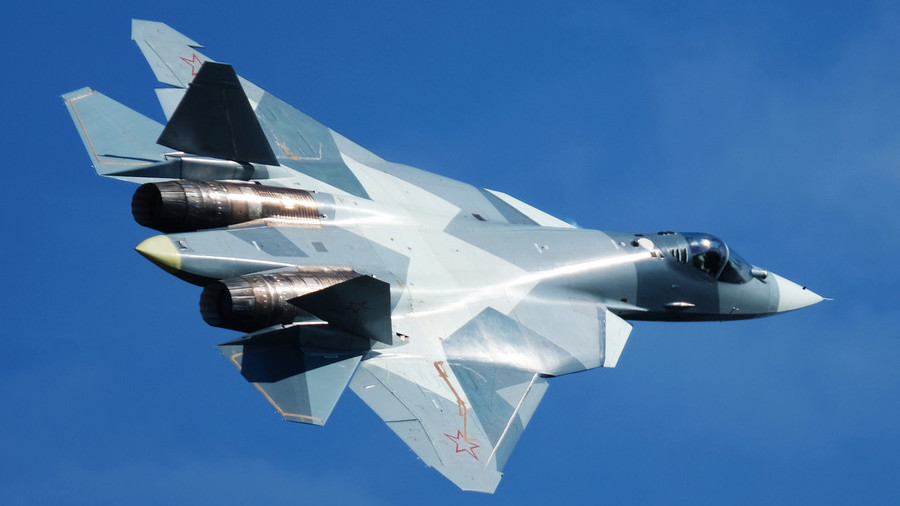
 So the SU-27s and Mig-29s we’ve all been flying are now outdated, we need to rush out and buy SU-57s!
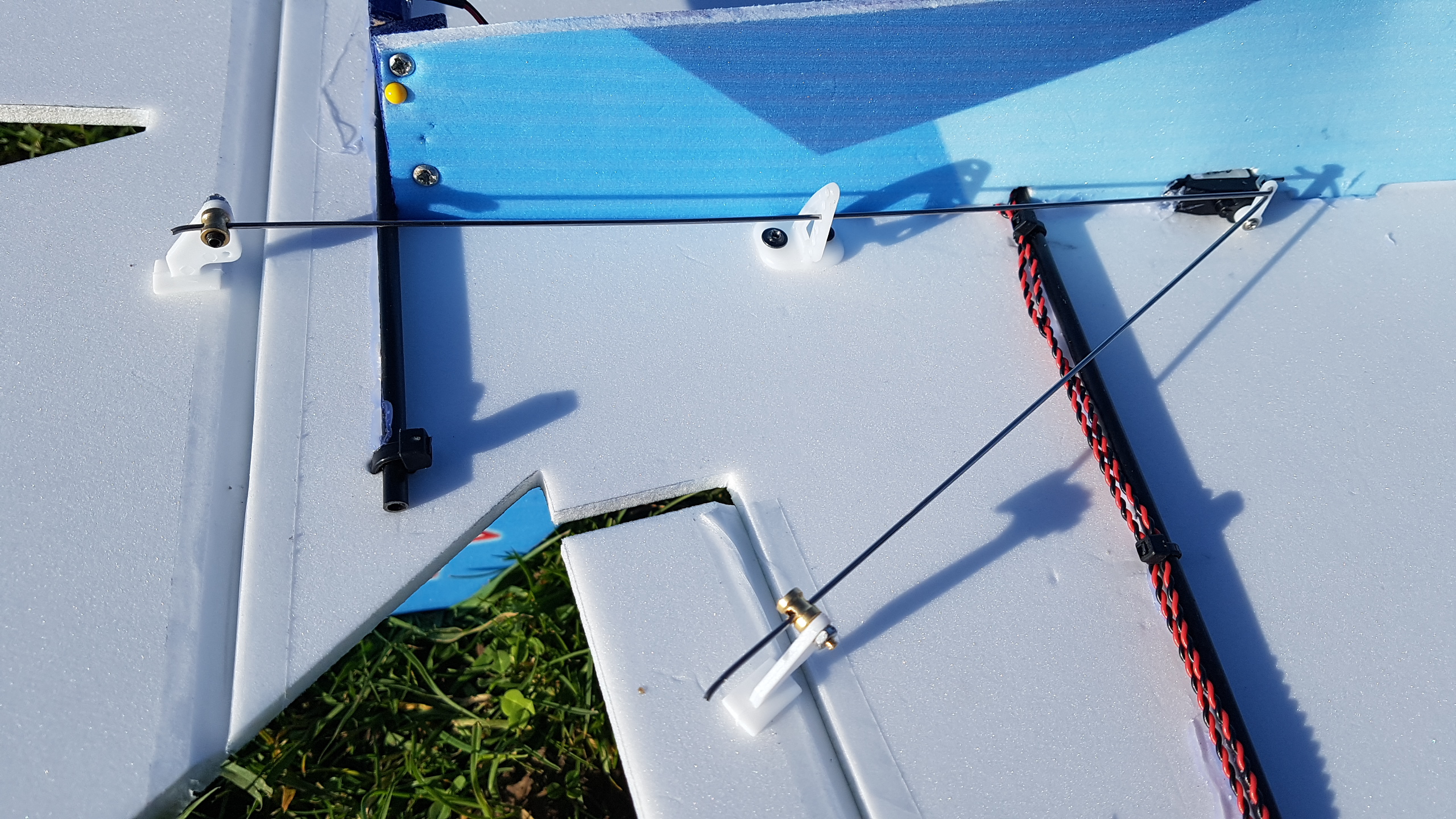 Woody’s equipped his with a Turnigy 2200kv motor and a 30A speed controller. He’s using a 3 cell 2200mAh lipo which also powers the Turnigy lights that he’s added. Woody asked me to do the first flight and it immediately flew just like the others with hardly any trim being needed. It handled the blustery wind well, much better than I had anticipated, and I was soon able to hand the transmitter over to Woody who had no problems with the T-50.
 The NATO name for the SU-57 is Felon so go on Woody, fly it like you stole it!
Although the awful weather has stopped most of the February flying it has meant we’ve had more time for building and I have some models that are still under construction models to show you. First up is Captain Slow’s Splot which isn’t really under construction, it’s like a couple more pieces have congealed together since the last time I saw it!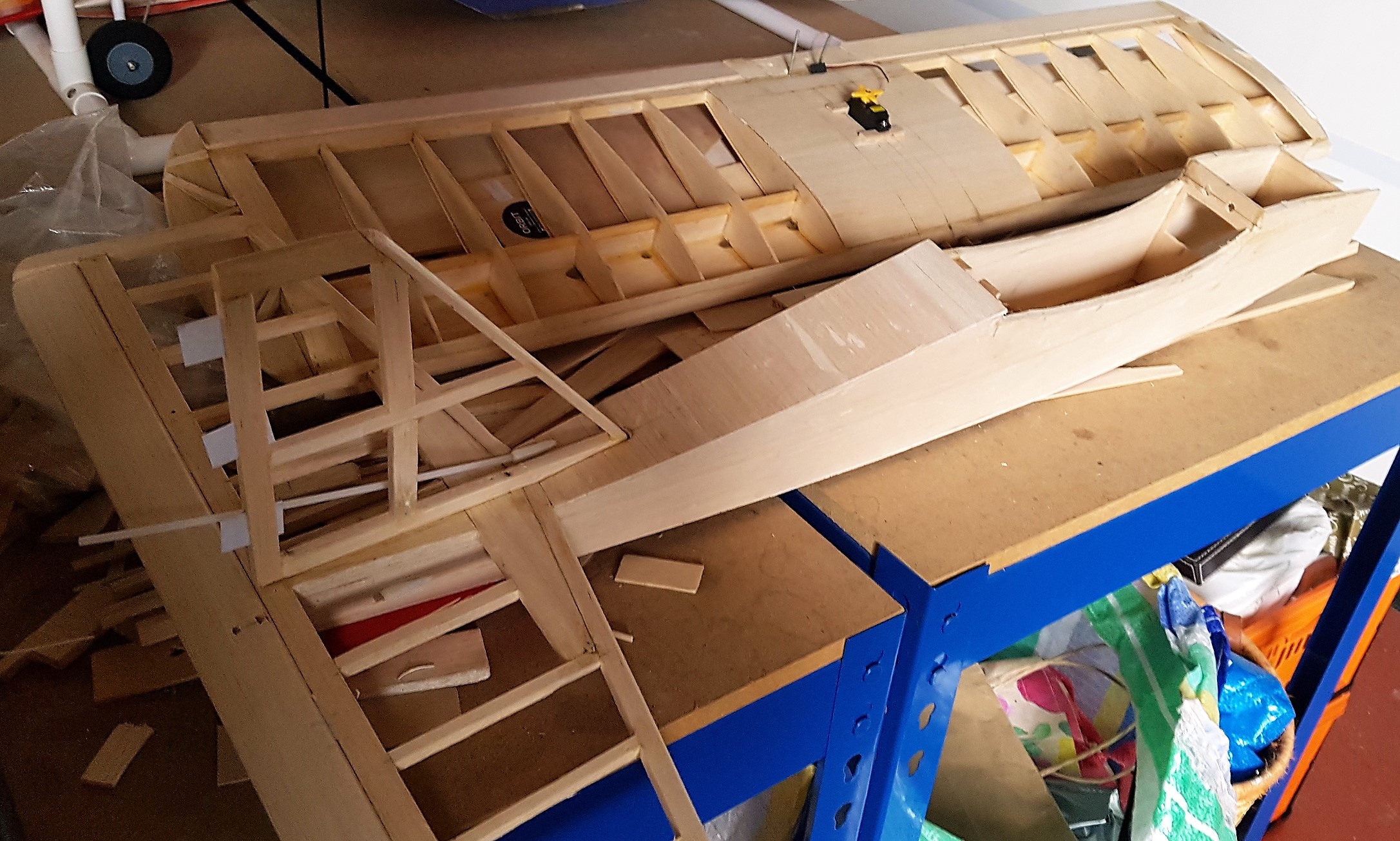 It’s looking pretty good so far and at the current rate of progress he’s just about keeping ahead of the woodworm. But I mustn’t be negative, Captain Slow reckons he’ll have it ready for its’ maiden in April…next year, seriously!
The next model is Chas’s very nice Westland Lysander that he’s building from a Tony Nijhuis plan along with the laser cut kit of parts. It’s 1/9th scale giving it a wingspan of 1676mm (66”) and not an easy build as you can see.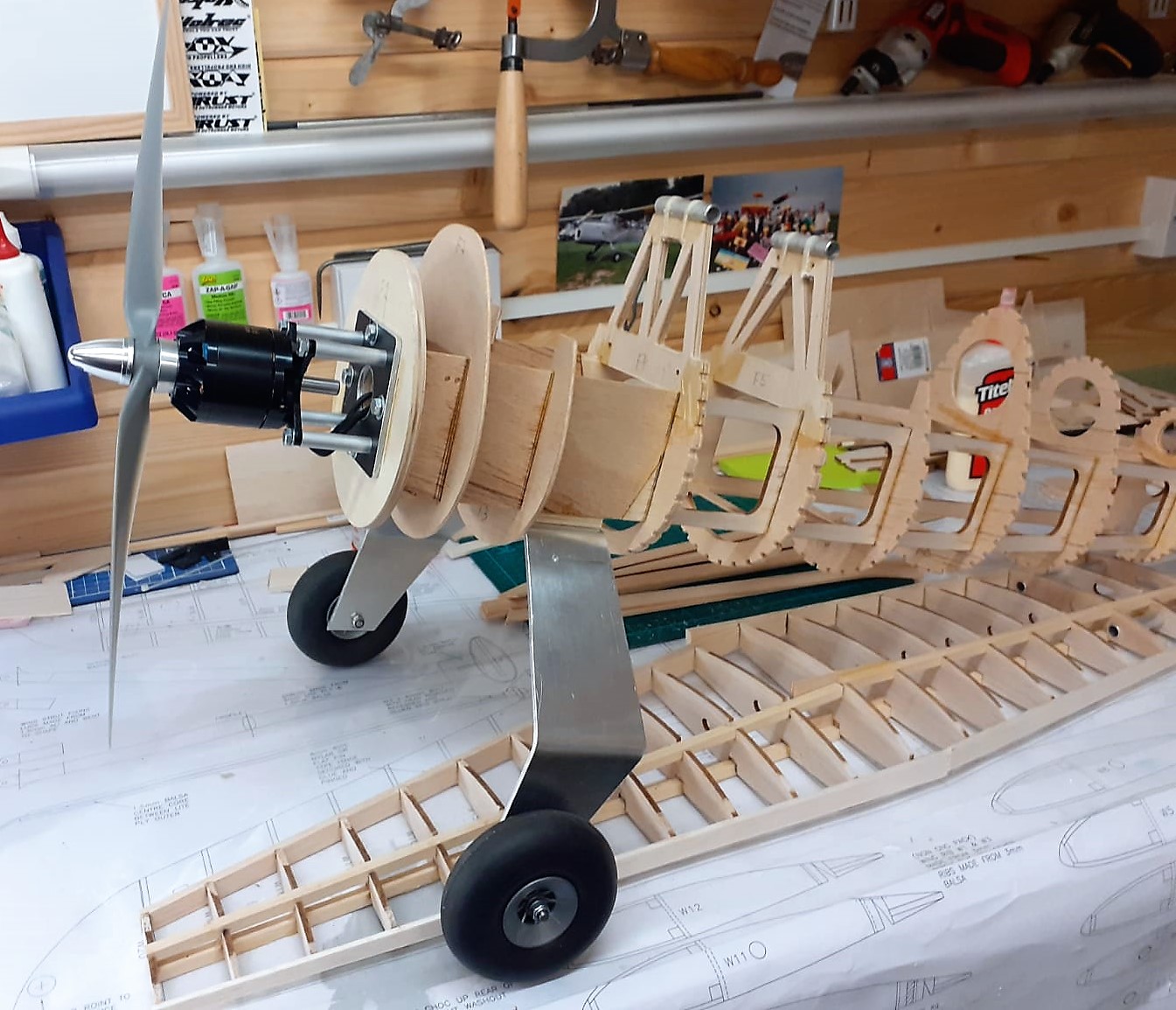
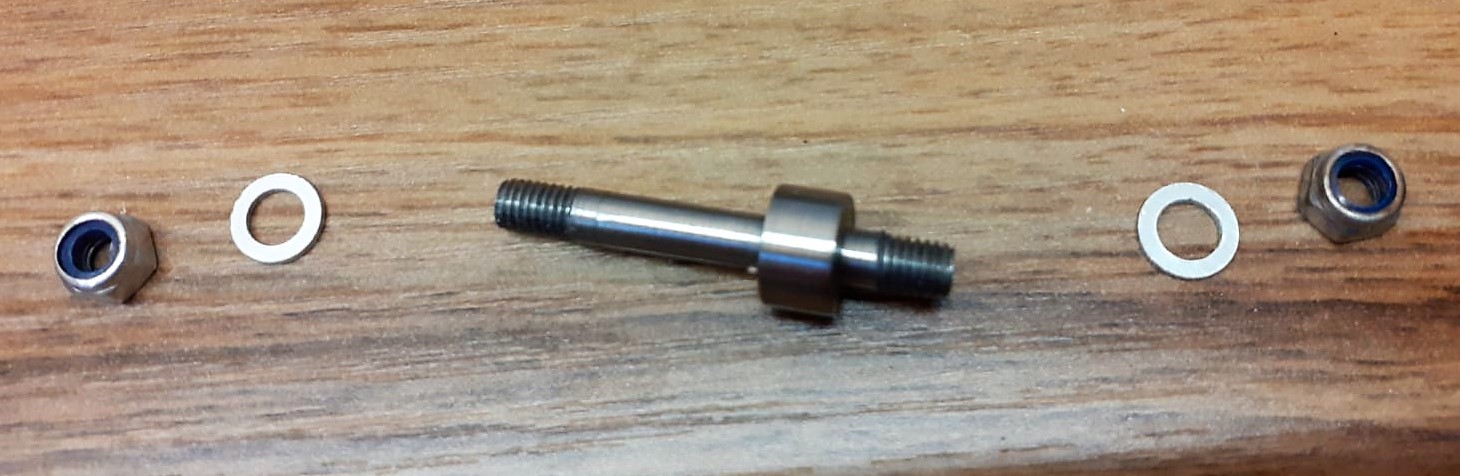
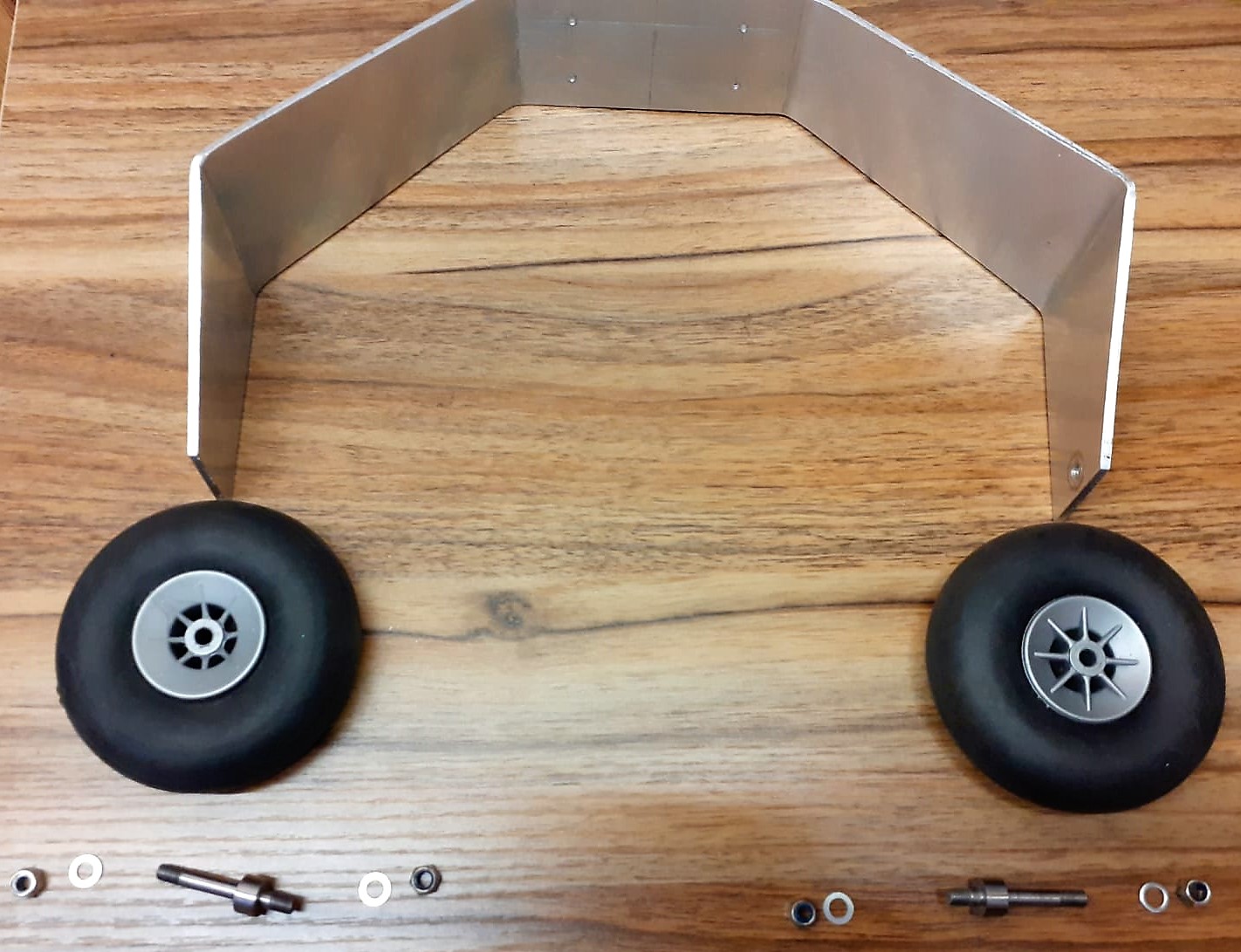 This is what says about the construction so far: The undercarriage was fabricated from 3mm aluminium sheet and the stub axles turned on my lathe, as were the ‘stand offs’ for the motor. The motor mount face place was fabricated from an odd piece of Duralumin. As you may have noticed I have made a start on the starboard wing. This is quite tricky as the wing chord increases before it narrows again whilst the dihedral changes and the wing depth changes. I’m a little concerned about the aluminium undercarriage as it’s completely independent of the wheels spats and undercarriage fairing. If it bends it will be difficult to straighten. Therefore I’m considering fabricating a carbon fibre item. I can use the aluminium undercarriage to form a mould for the carbon fibre one. I’ve done some research on carbon fibre fabricating not realising there are two different routes to go down, hot and cold cure. Hot cure has the resin and hardener impregnated in the cloth and needs to be kept in a freezer. When used it is best vacuumed in a bag and then baked for eight hours at 100 degrees C. I think I’ll go the cold route which is similar to using fibreglass. This uses more traditional epoxy and hardens at room temperature.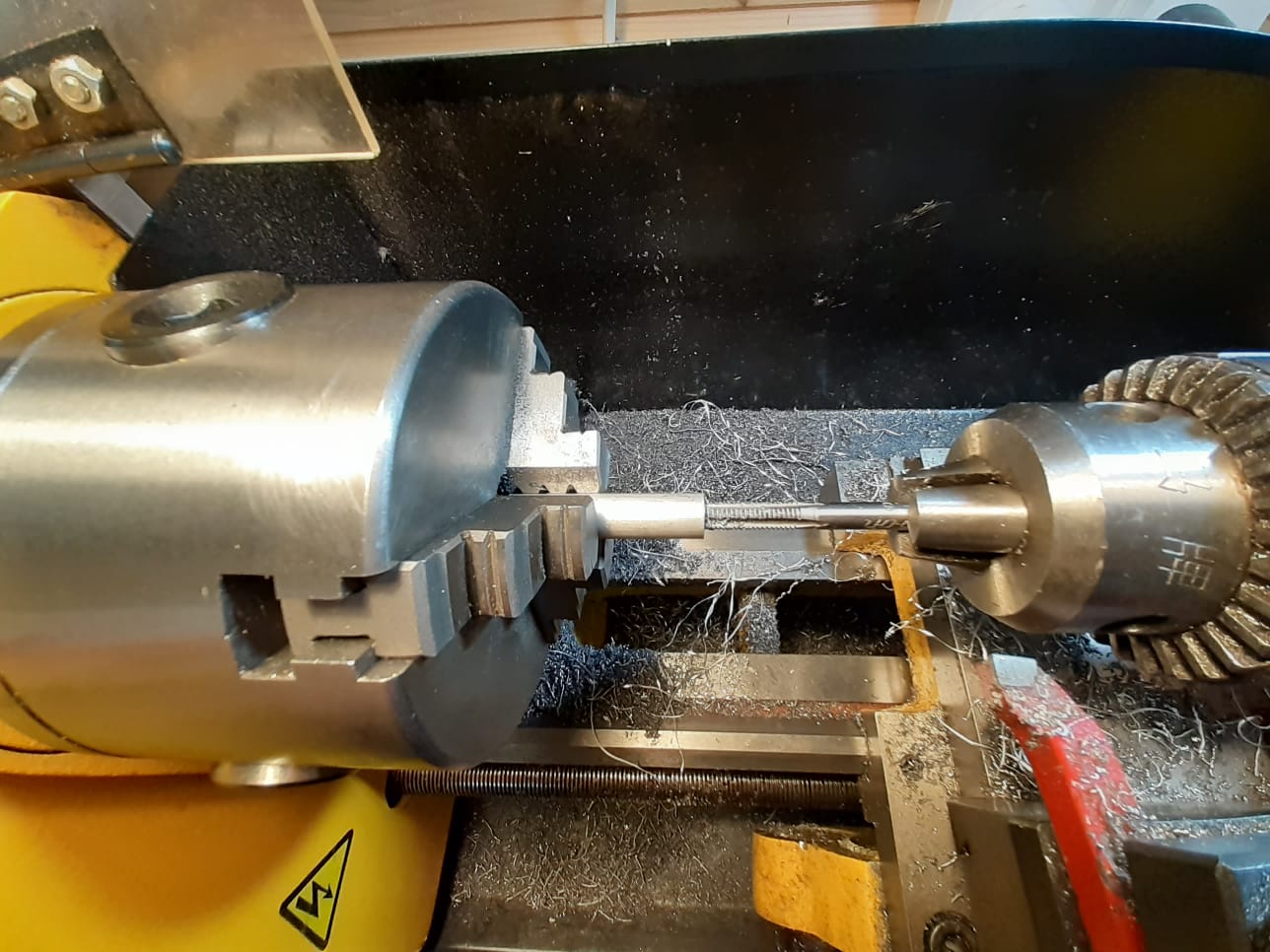
 Thanks for the info Chas, I think it’s going to keep you busy for quite a while yet. I wonder if any of the companies that produce carbon fibre parts for models have done Lysander undercarriage legs, unlikely but it’s worth a check.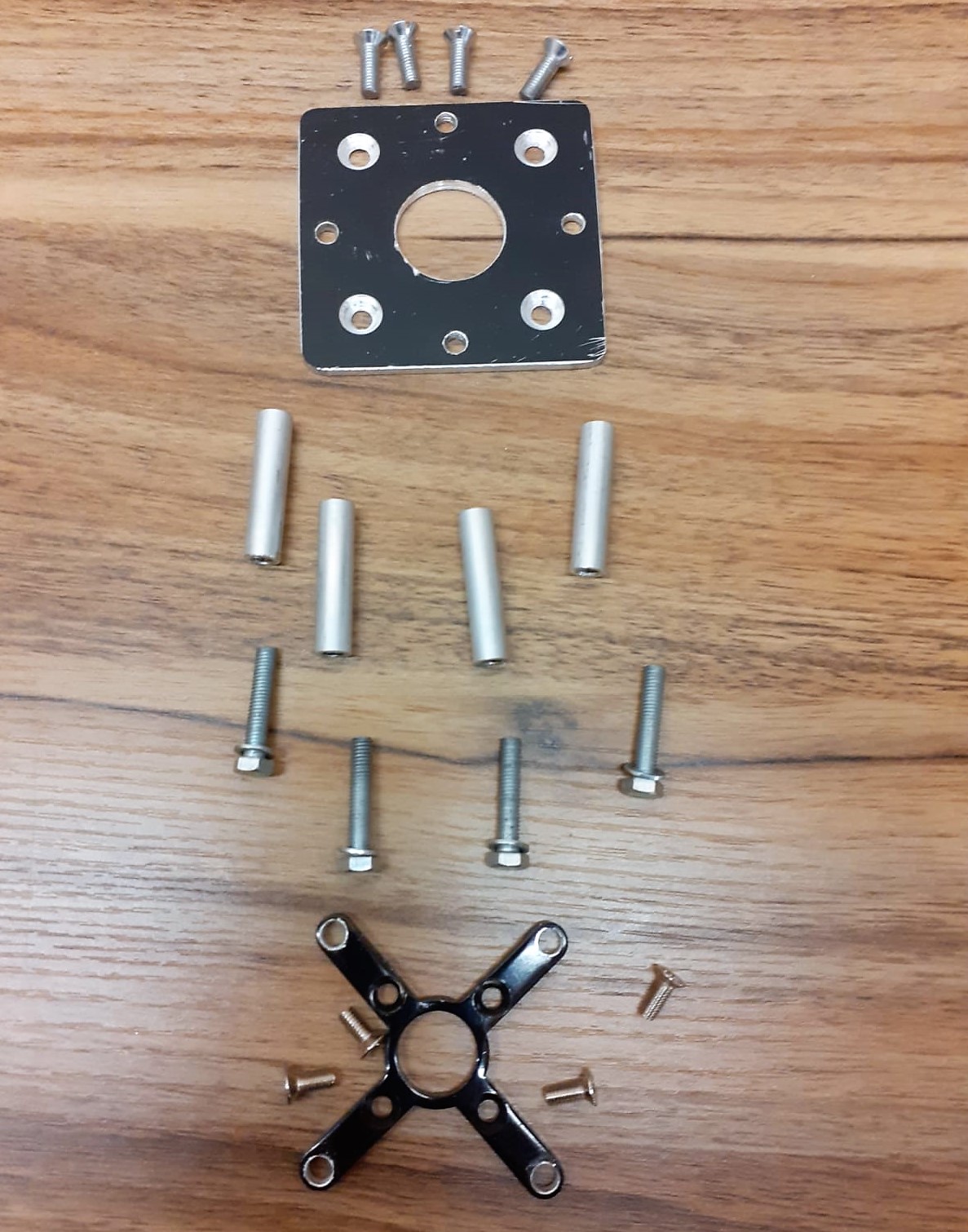
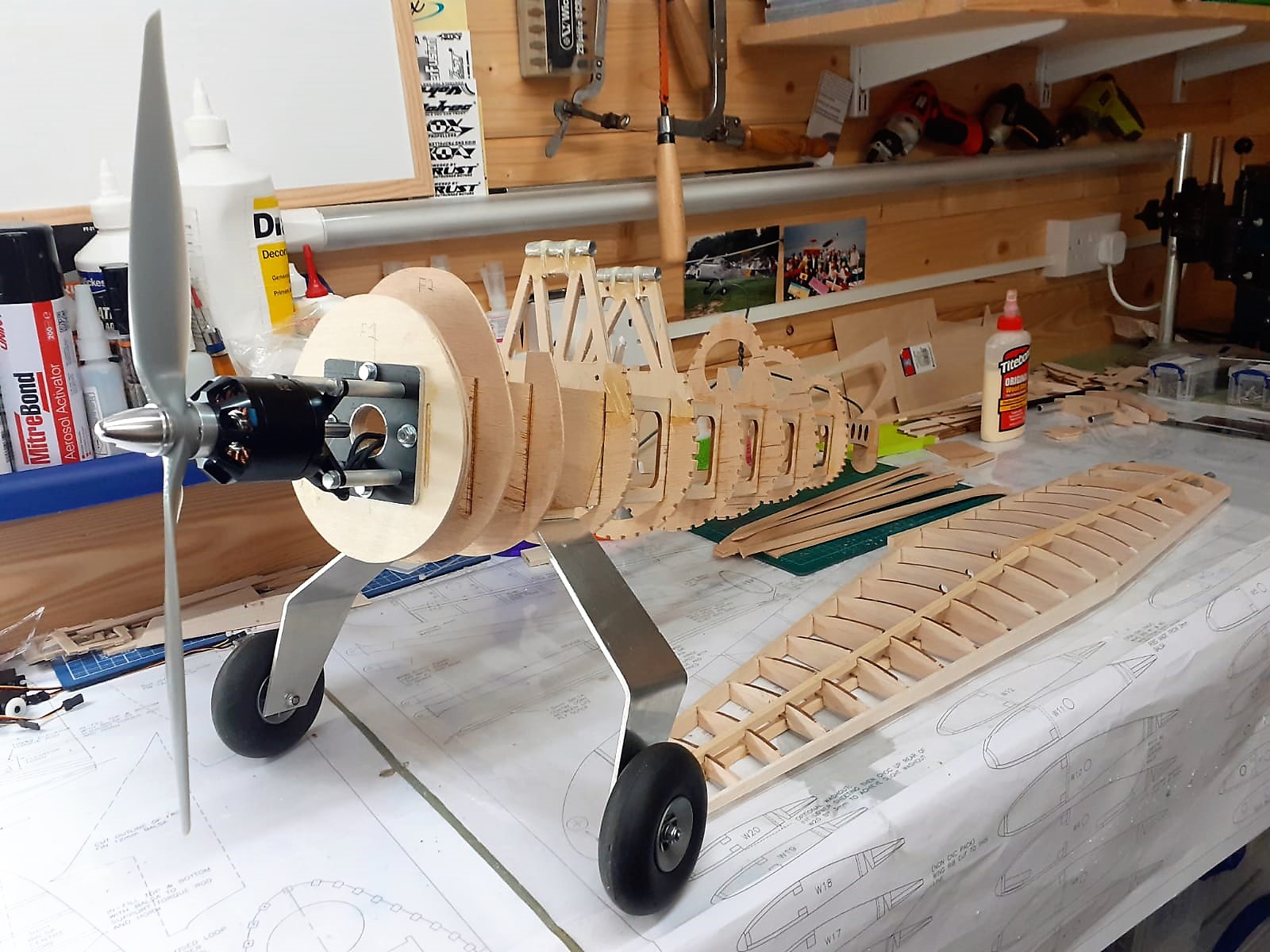 The final weight of the model should be around 6lbs and Chas will be powering it with a 595kv 4-Max motor with a 14×7 prop, a 70A esc and a 4 cell 4500mAh lipo. I can’t wait to see it in the air, fabulous.
Also in February Page Boy sent me a photo of his Lyndsey Todd designed Woodpecker that he’s now covered.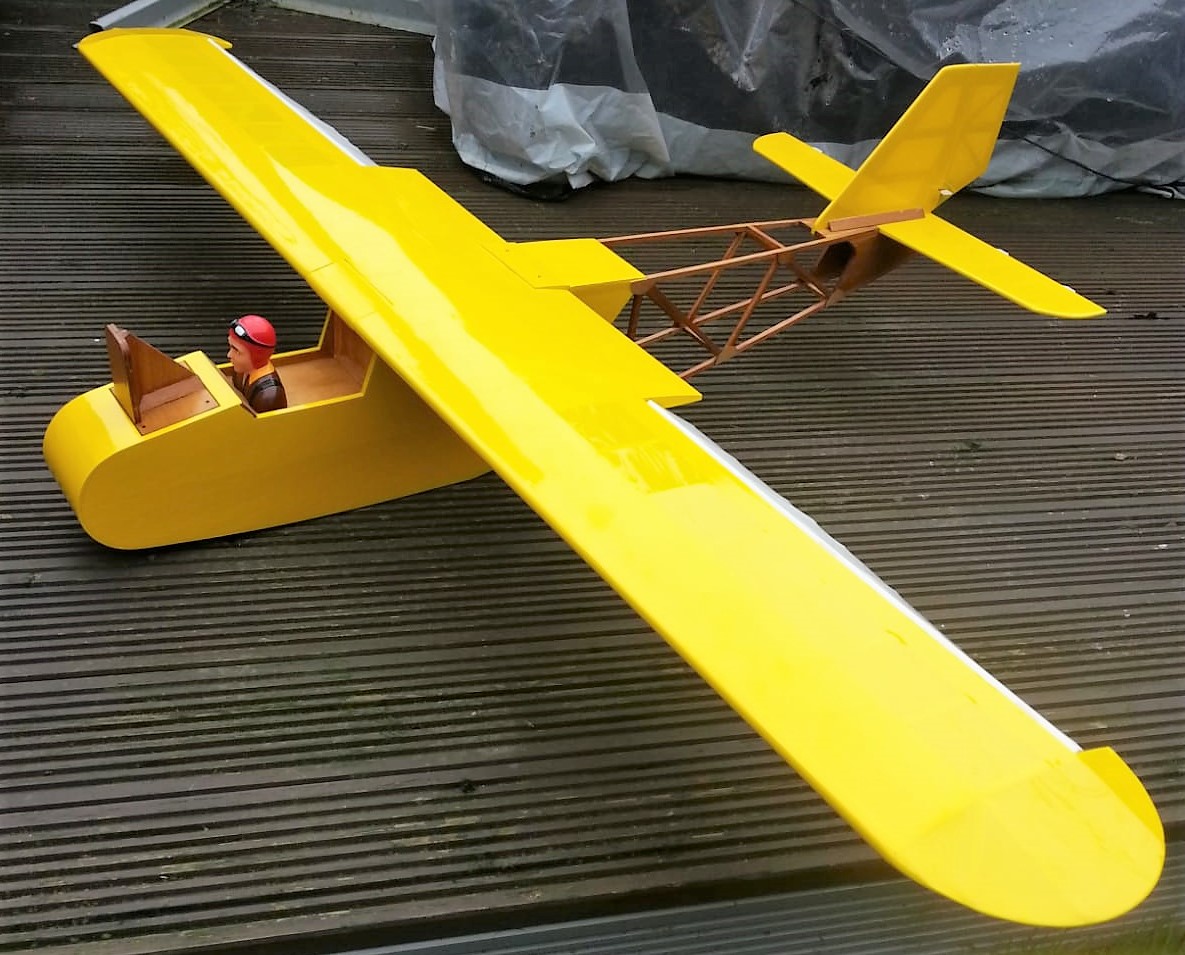 I featured the model prior to covering way back in January 2019, what have you been doing Page Boy?! The Woodpecker is 70” wingspan and now looks pretty much finished, just needs the radio and motor fitting and it’ll be ready to fly. It should make a very nice calm summer’s day type of model.
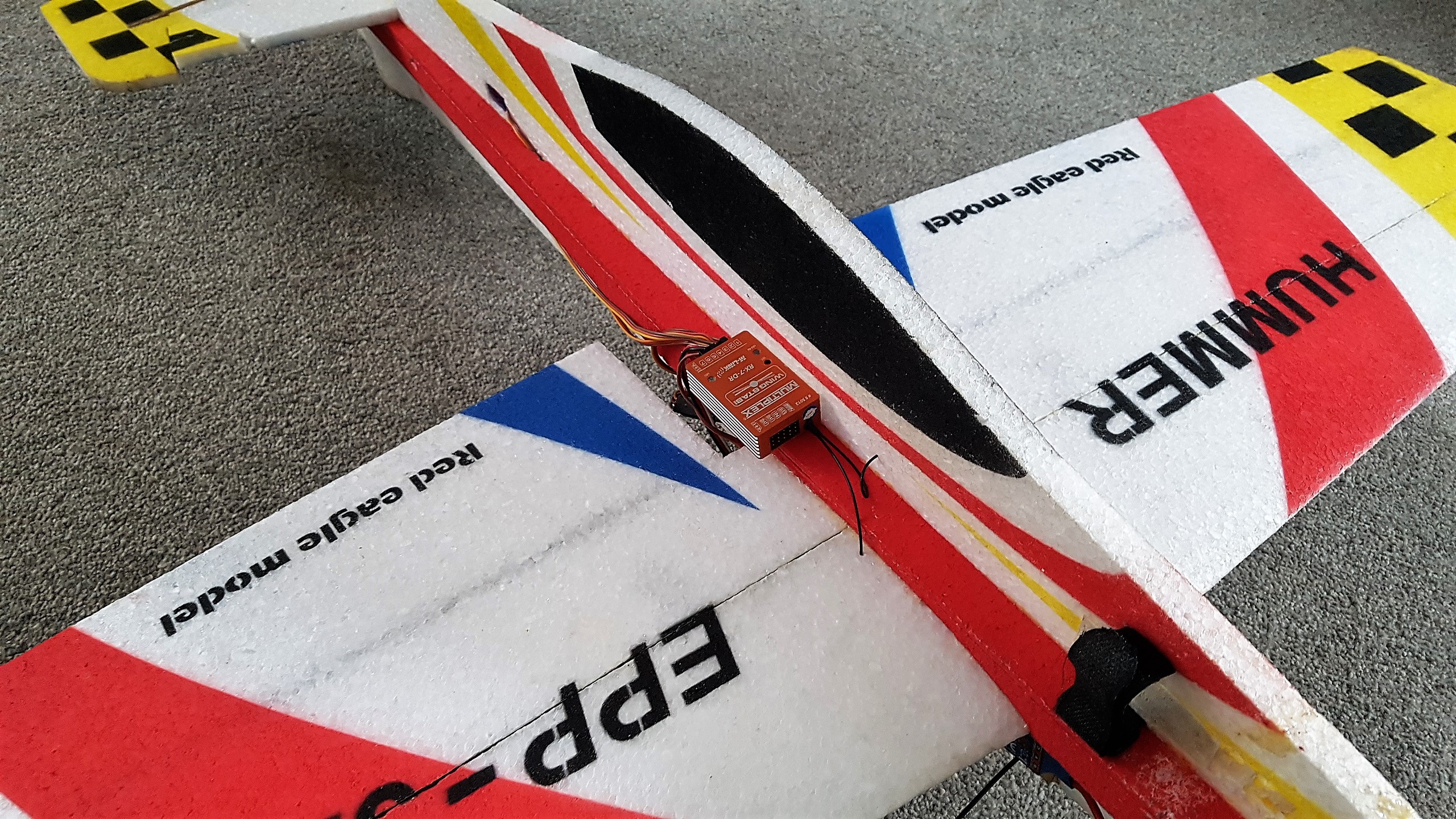
A few months ago I bought myself a Multiplex Wingstabi Easy Control RX-7-DR. Basically it’s an advanced 3-axis gyro with a built-in 7 channel telemetry capable dual receiver. I have been looking at the Wingstabi range for a while but was put off by them being standalone units (without receivers) and they were very expensive, even a 7 channel one cost about £107. They needed to have all the parameters set-up on a PC or using a smart phone app but you’d need a Multiplex Bluetooth module for that, more expense. But then Multiplex produced the Easy Control version, available with or without a built-in receiver, that can be easily set-up just using a transmitter. Still not cheap but with a special offer mine cost around £95 which compares well with £73 for the equivalent receiver without a gyro.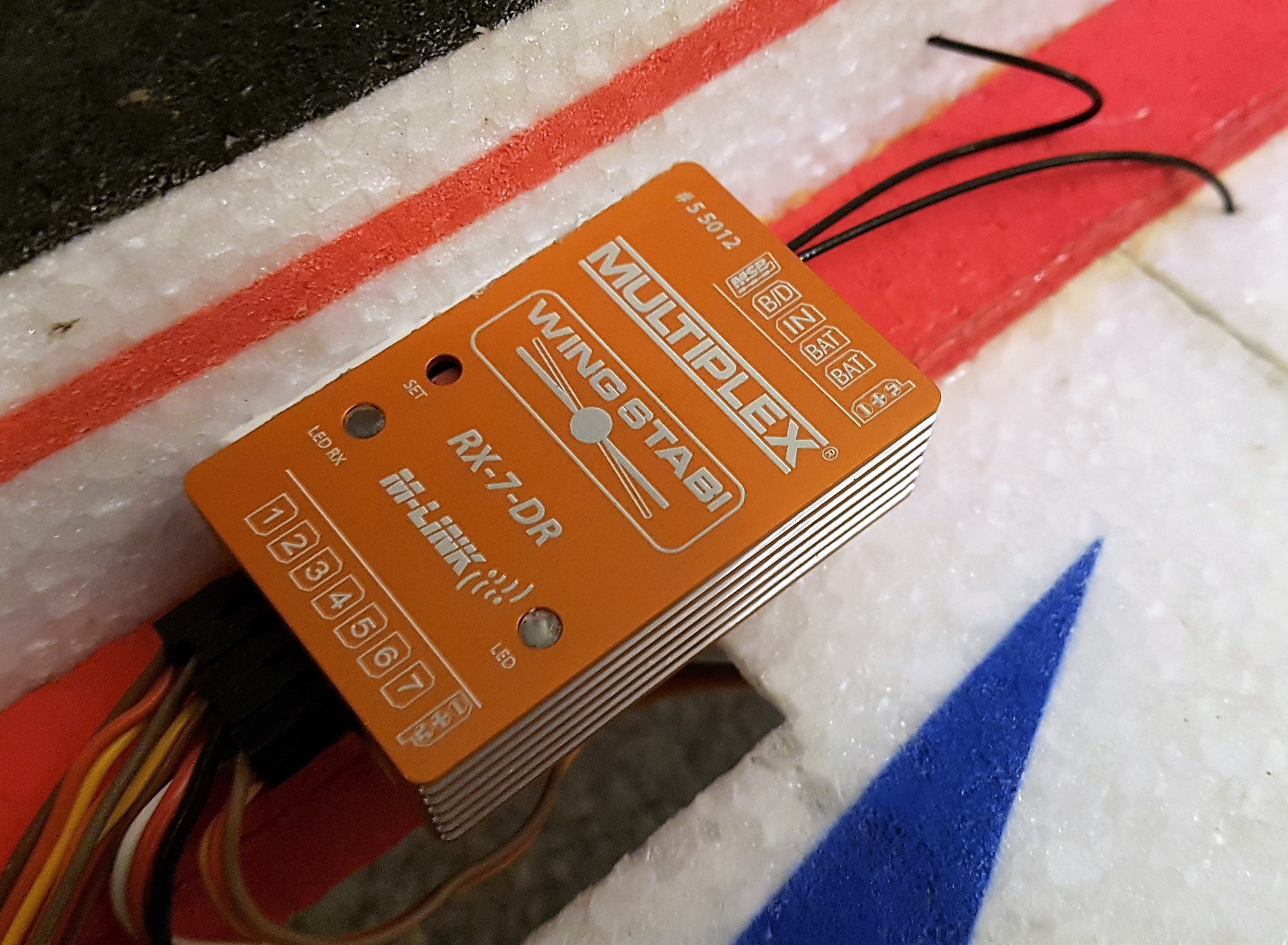 The Easy Control version can be upgraded to the full version with a free software download. I already have the necessary lead so I can do the upgrade for no cost but I haven’t bothered so far. I’ve fitted mine to my Hummer as I wanted to see if it would help with my prop hanging skills (or rather lack of prop hanging skills).
 Here’s a Multiplex video that, at about 40 seconds in shows a guy prop hanging a couple of feet off the ground when his mobile rings. He put the transmitter on the ground to answers his phone and the plane just stays prop hanging!
I’ve searched the box thoroughly but can’t find the girl in mine! The gyro can be switched from the transmitter to Damping, Heading Hold, or Off. The Damping mode simply damps out wind turbulence, even on a really gusty day the model doesn’t get thrown about at all, a definite plus when trying to land safely. Heading Hold was the mode that interested me most, and with it switched on the Hummer will indeed prop hang unaided. But of course the plane has to be in the correct attitude with the correct throttle setting when you switch to Heading Hold, I’ve done it several times but not at low level. More practice required methinks. If you fancy trying a Wingstabi for yourself the versions without a built in receiver will work with any make of radio gear, you don’t have to use Multiplex radio.
With the lack of flying this month there are no flying shots to show you but there is a video, and this month some of the video and photos come from Captain Slow, Bob the Builder, and Dougal Entendre, thanks guys. Please watch the video full screen, it’s so much better with small models flying around.If the video won’t play for you please click HERE
Many years ago I dated a lovely girl for a while, she was a hot air balloonist.
At least she let me down gently…
Colin Cowplain