
Patch News – August 2015
I am writing this on 1st September which is classed as the start of autumn but frankly August seemed like winter much of the time; it was mostly cold, windy, and very wet. However, some days weren’t bad (as you can see in the video) and most fliers managed to get some flying in at some time during the month.
I’ll start with the model I ended with in the last Patch News, my HobbyKing Cri-Cri. I bought it in the recent sale where it was discounted by 75% and the cost including postage was a mere £30.40. The model is a Plug’n’Fly so the ‘build’ was pretty straight-forward, the main problem was that, with the battery secured by the pre-installed strap, the CG came out much further forward than the position given in the instructions. So I moved the both the strap and the battery as far rearward as possible but the CG was still a little too far forward. Other than that there were no major problems, just a few small niggles that were easily sorted. OK, so it still looked like a bargain but this month I had to fly it.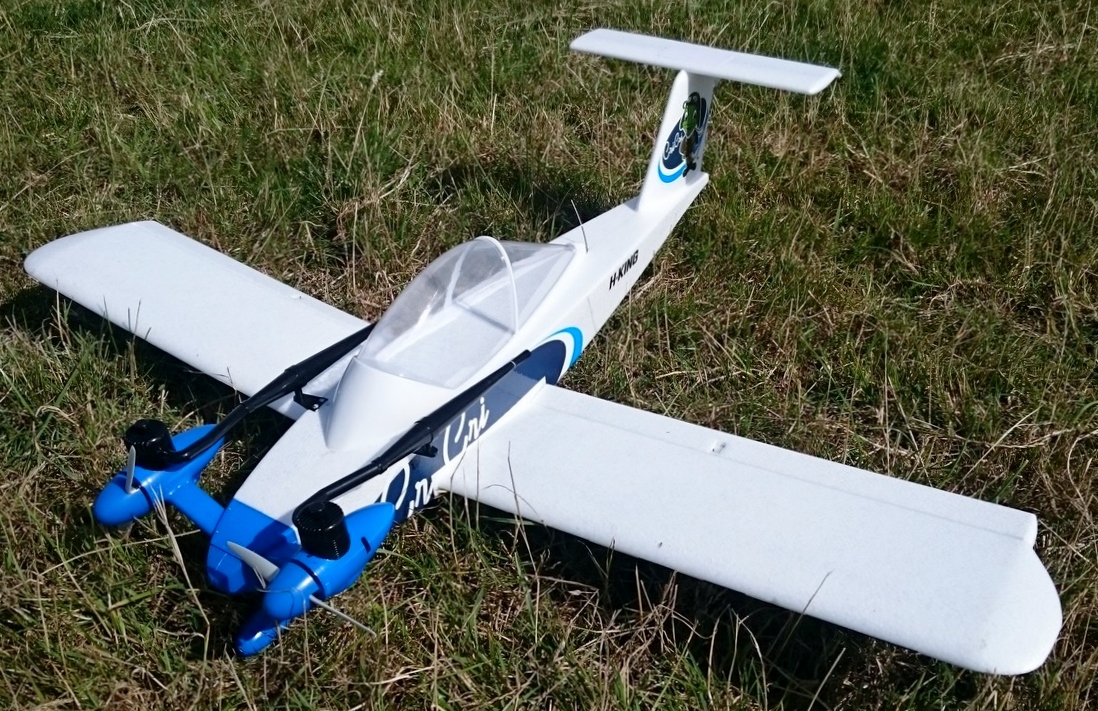 The Cri-Cri is a scale model so it has tiny scale sized wheels and spats, not an ideal combination for our grass patch. When I tried to take-off for its first flight I opened the throttle fully and the plane didn’t move an inch!
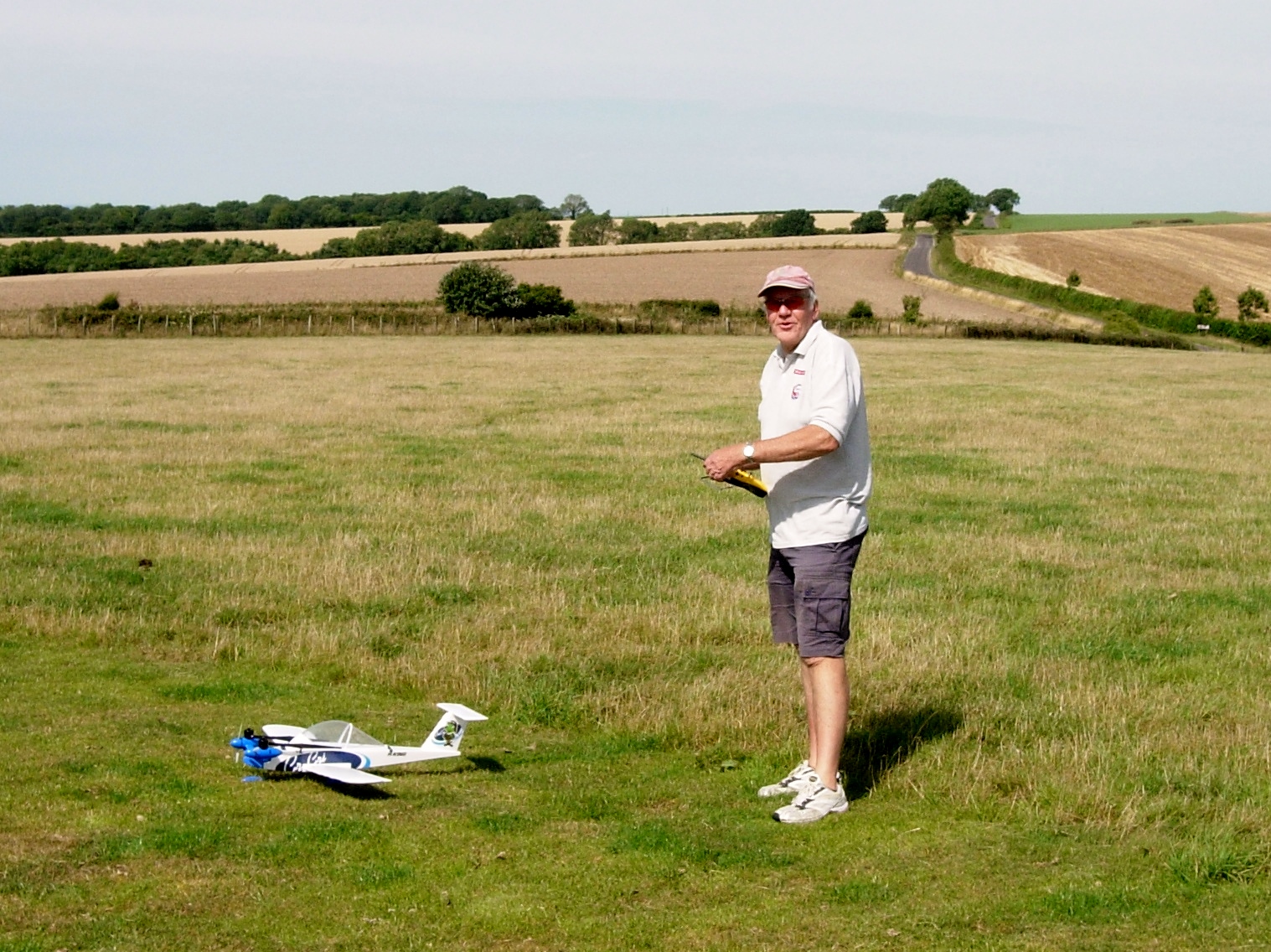 So Steve 1066 gave it a chuck and away it went…sort of… The elevator was very sensitive and it needed some up trim but at least it was flying. Then I throttled back and the nose went up really violently and the model promptly tip-stalled. Not good. After a few minutes I decided to land but each time I throttled back the nose shot up and I had to add a load of down elevator to hold level flight. Fortunately she landed without damage other than stripping the gears on the nose-wheel servo. Some of the eventful first flight can be seen in THIS MONTH’S VIDEO.
Over the next few weeks I added some up thrust to the motors, moved the battery pack as far forward as it would go, cranked up both ailerons a few turns to help stop the tip-stalling, replaced the nose-leg completely, moved the main undercarriage forward 30mm, fitted larger wheels, and ditched the spats. The flight before last it managed to take-off, just, but the following flight it didn’t make it again. I think I need to move the main wheels even further forward.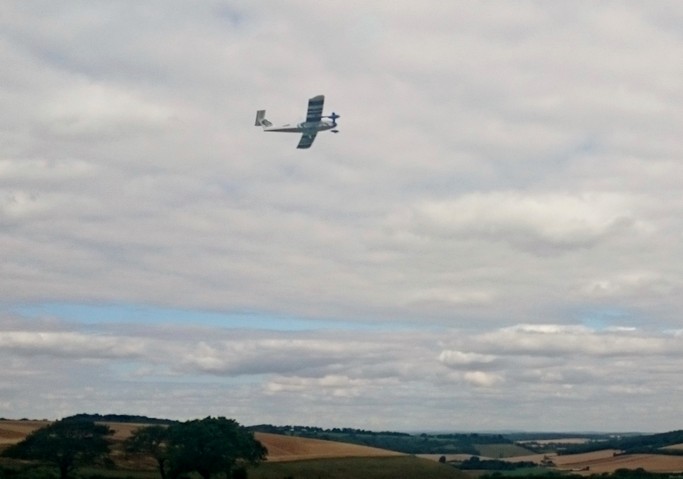 But overall it’s not flying too badly now, there is no pitch change when I shut the throttle, it has heaps of power and is pretty fast (as is the full-size). It rolls well and is very nice to fly inverted, but with no rudder the loop isn’t too good as it’s not possible to correct any skew out, and it doesn’t really do much other than fly around. I may add a rudder to make more manoeuvres possible. So was it a bargain after all? Well even without the airframe and one stripped servo I’ve still got two motors, two speed controllers, and three servos so I suppose the answer had to be yes. But will it ever be my favourite flier? No.
In the same HK sale that I bought the Cri-Cri Steve H (1066) bought a Wingnetic which turned out to be a much better choice. Most of you will know that the Kinetic and the Spirit mini gliders are virtually the same thing, the biggest difference being a different motor although the performance of the two is almost identical. On balance the Kinetic seems to be the better choice as the motor is more durable and has a stronger mount. The Wingnetic is a flying wing version of the Kinetic, the front of the fuselage, motor, motor mount, and prop appear to be exactly the same. But instead of ‘glider’ wings and normal tailplane/fin arrangement the Wingnetic has a short stubby wing, two vertical fins, two ailerons and an elevator.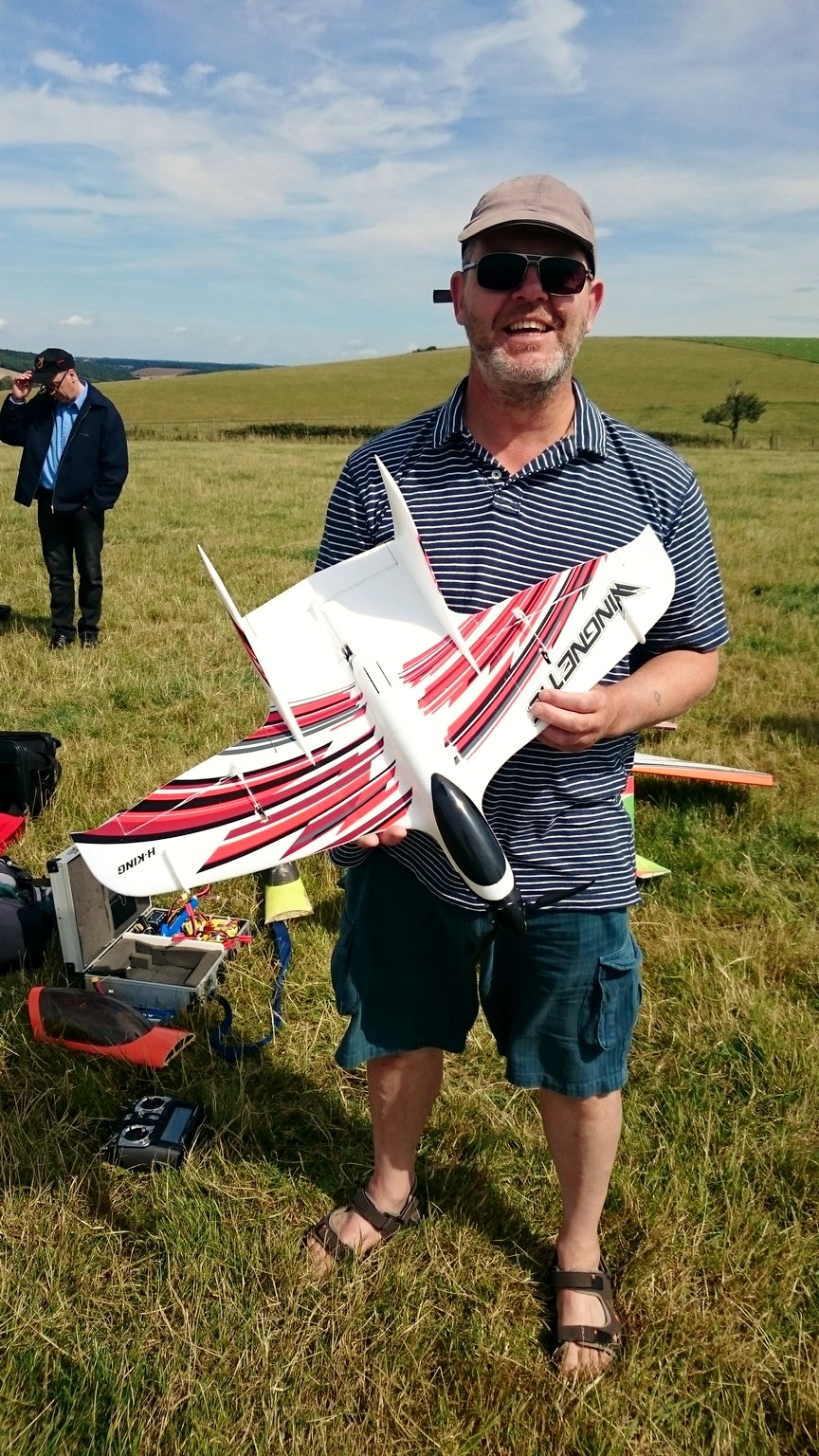
It’s available an ARF, ARF plus motor, or PNF, so you can choose whatever suits you best. How does it fly? Absolutely brilliantly! It’s like a hairier, even more aerobatic version of the Kinetic but without such a good ability to soar of course.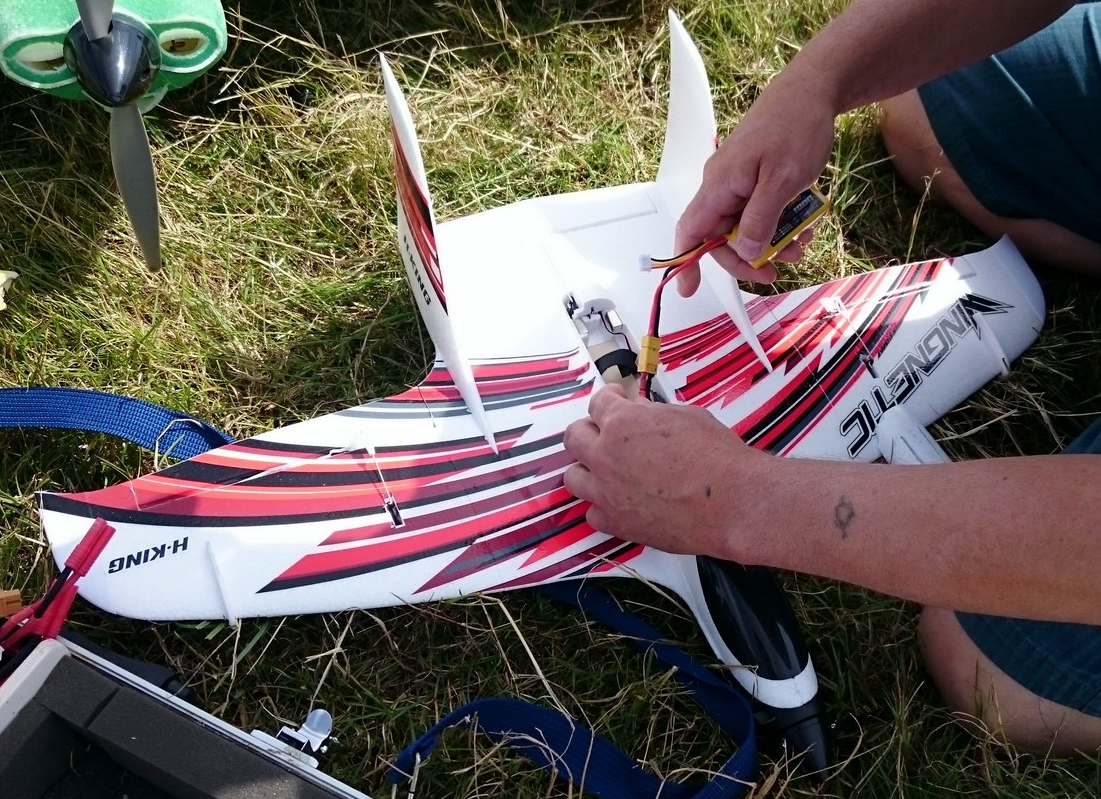 1066 was good enough to let me have a flight with his and I immediately felt comfortable with it. It’s very good value even when not at a sale price, I thoroughly recommend it.
We were joined in August by father and son JP (John-Paul) and Monty Bland. Both had been learning to fly at the Elmbridge Model Club in Surrey but a recent house move to Petersfield has brought them to PAM.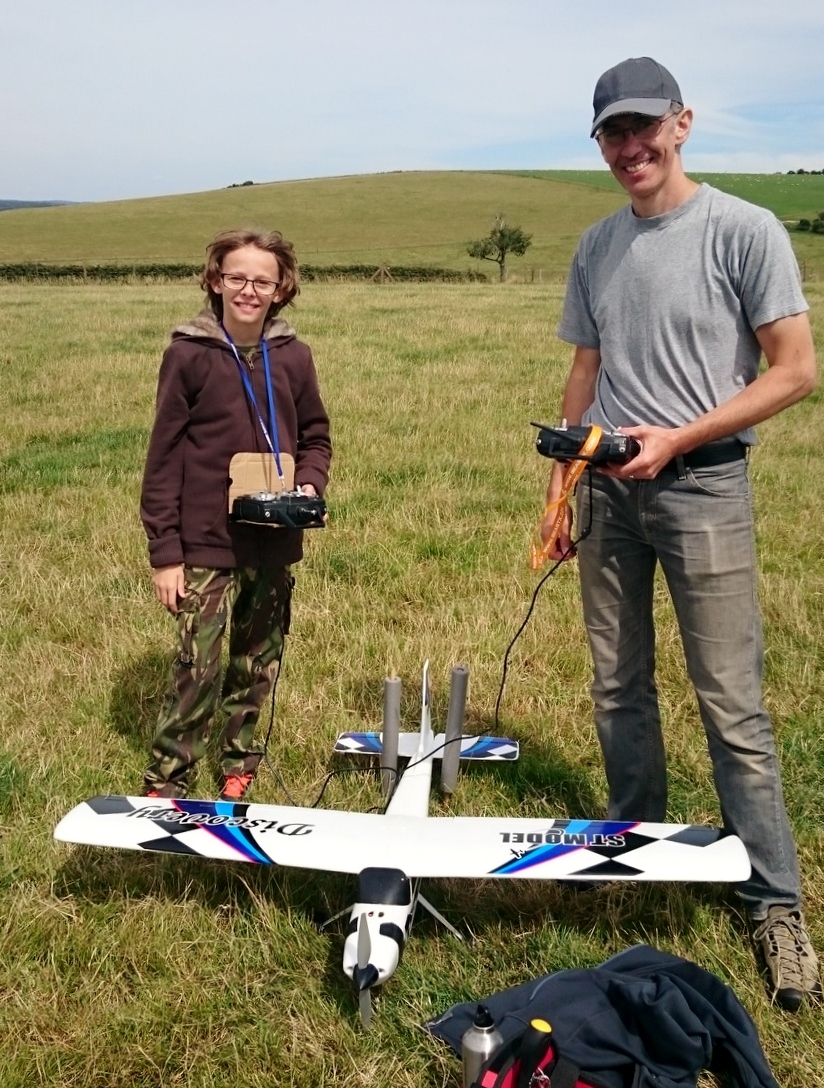 They come fully equipped with an ST Discovery (electric powered of course) and a Futaba buddy box set-up, ideal. They’ve had a bit of a layoff due to the relocation but both were soon happily flying again although the winds we endure up on the South Downs seemed to be a bit of a shock, and our small patch is concentrating their minds. Both are doing well and I don’t think it will be too long before they take their ‘A’ certs, Monty seems very keen to beat dad to it!
Captain Slow recently maidened his BFG 1600 electric glider. It’s yet another EPO foam model from the HobbyKing stable and is very much like a larger (1600mm span) version of the Spirit in appearance. Like the Spirit it comes with a pylon motor mount so you can choose between a nose mounted motor and folding prop or pylon mounted with a fixed blade prop. Captain Slow chose the former. The model comes ready equipped with a 1300kV 2208 motor, 20A speed controller, and 4 x 9g servos. It’s ‘flap ready’ and includes the hardware but not the servos for flaps, an option John has chosen to go for and they seem to work well. It uses the small 3 cell lipo packs that many of us are using in the Spirits; the specs say 1100-1300mAh although John is using some 1500mAh packs with no problems.
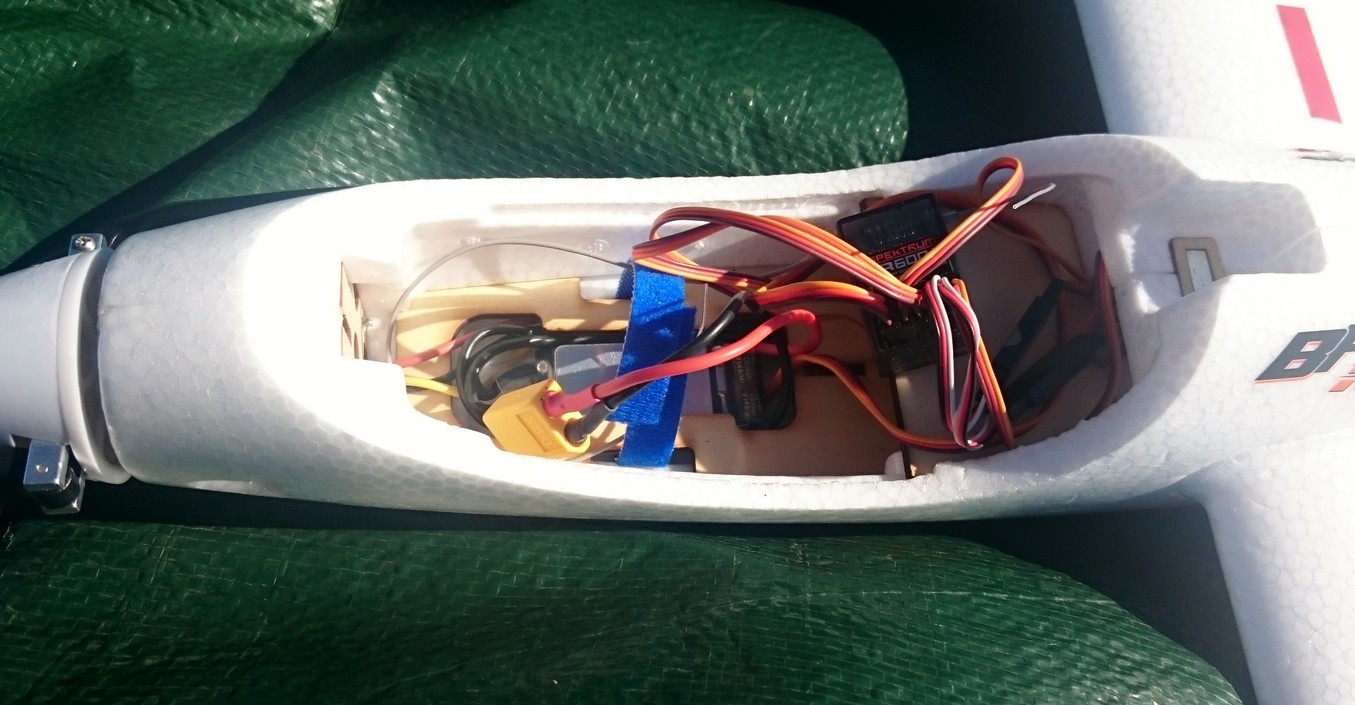 It flies well, and is fairly sedate on the 3 cell pack, but will perform mild aerobatics if you get bored with thermal hunting. You can see the model flying in THIS MONTH’S VIDEO.
Gentleman Jim spent some of the bad weather days refurbishing his Eflight Pulse. It’s had lots of flying and was starting to get a little tatty around the edges so Jim stripped off the old covering and replaced it with a fresh new scheme.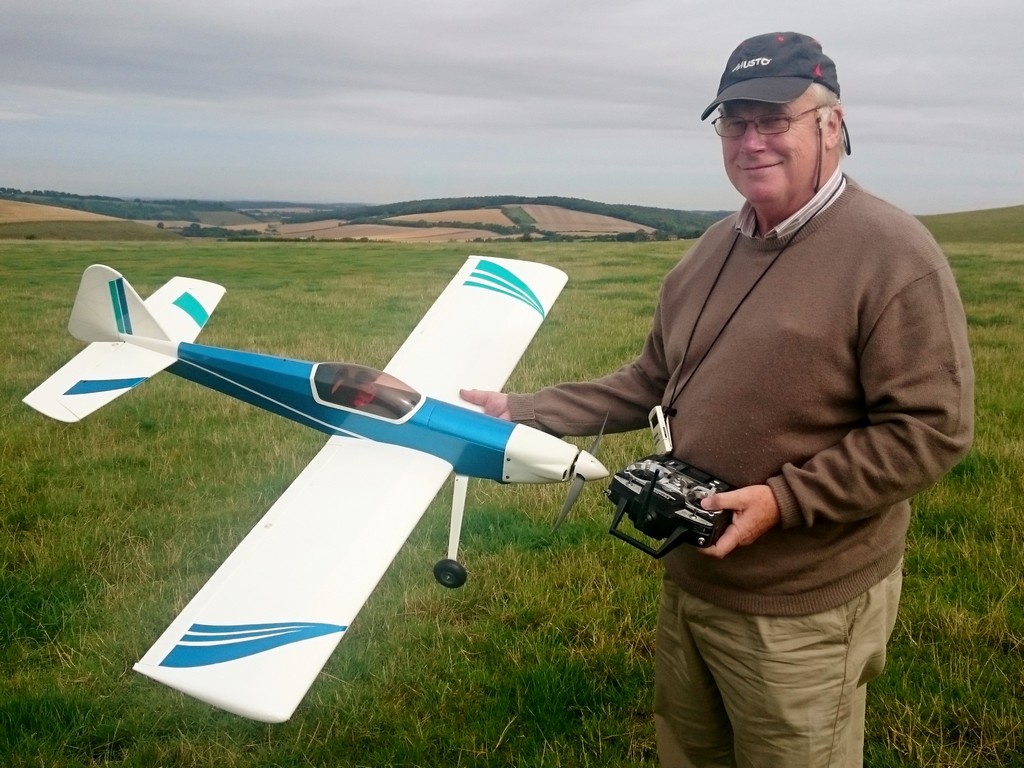
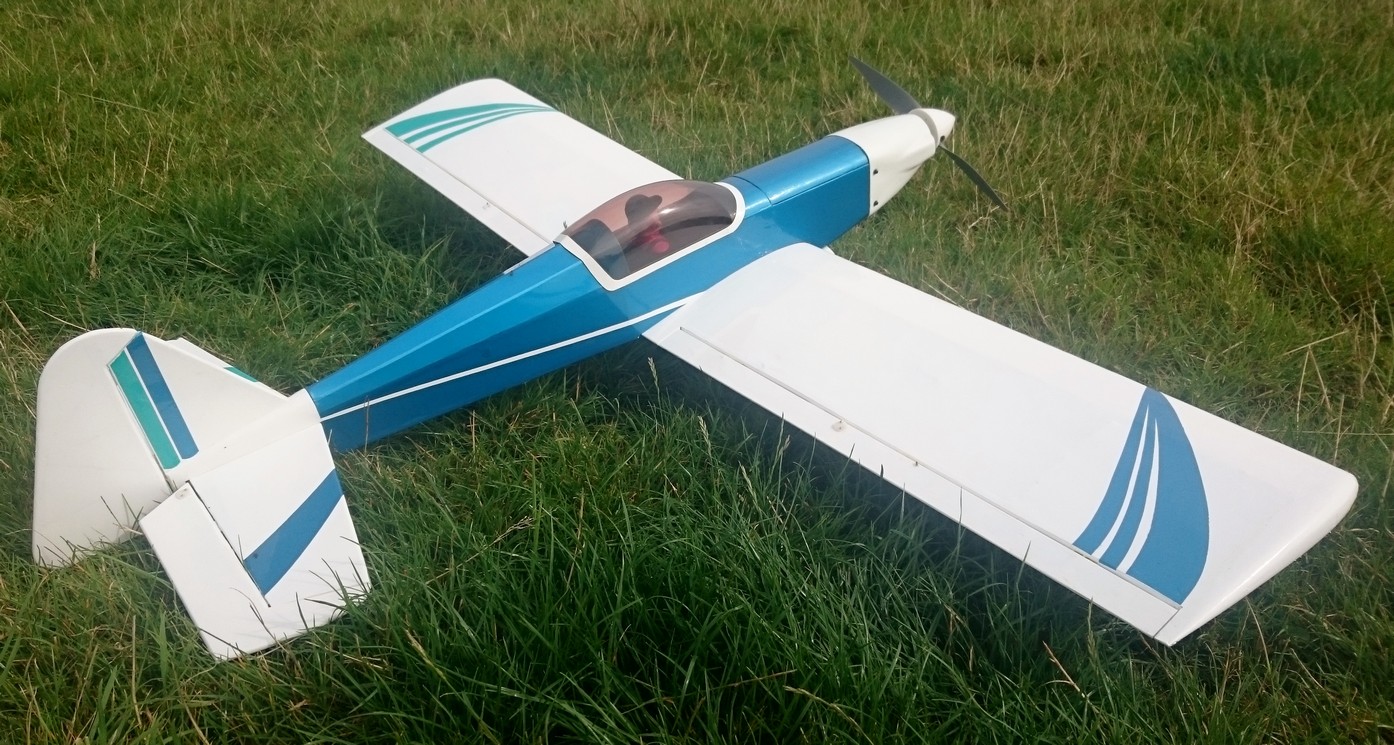 As you can see he’s made a cracking job of it and it looks very nice in its non-standard colours. It flies as well as ever; the model doesn’t seem to mind its change of clothes.
Richard King (still looking for a nickname, he wasn’t keen on my last suggestion!) has built an F22 Raptor. I was away on the day he brought it along but Dougal Entendre sent me some photos. I don’t have any details but I’m sure it’s built from a Flite Test plan/kit. Dougal said it was made of Correx but if it’s the Flite Test one it’s actually foam board.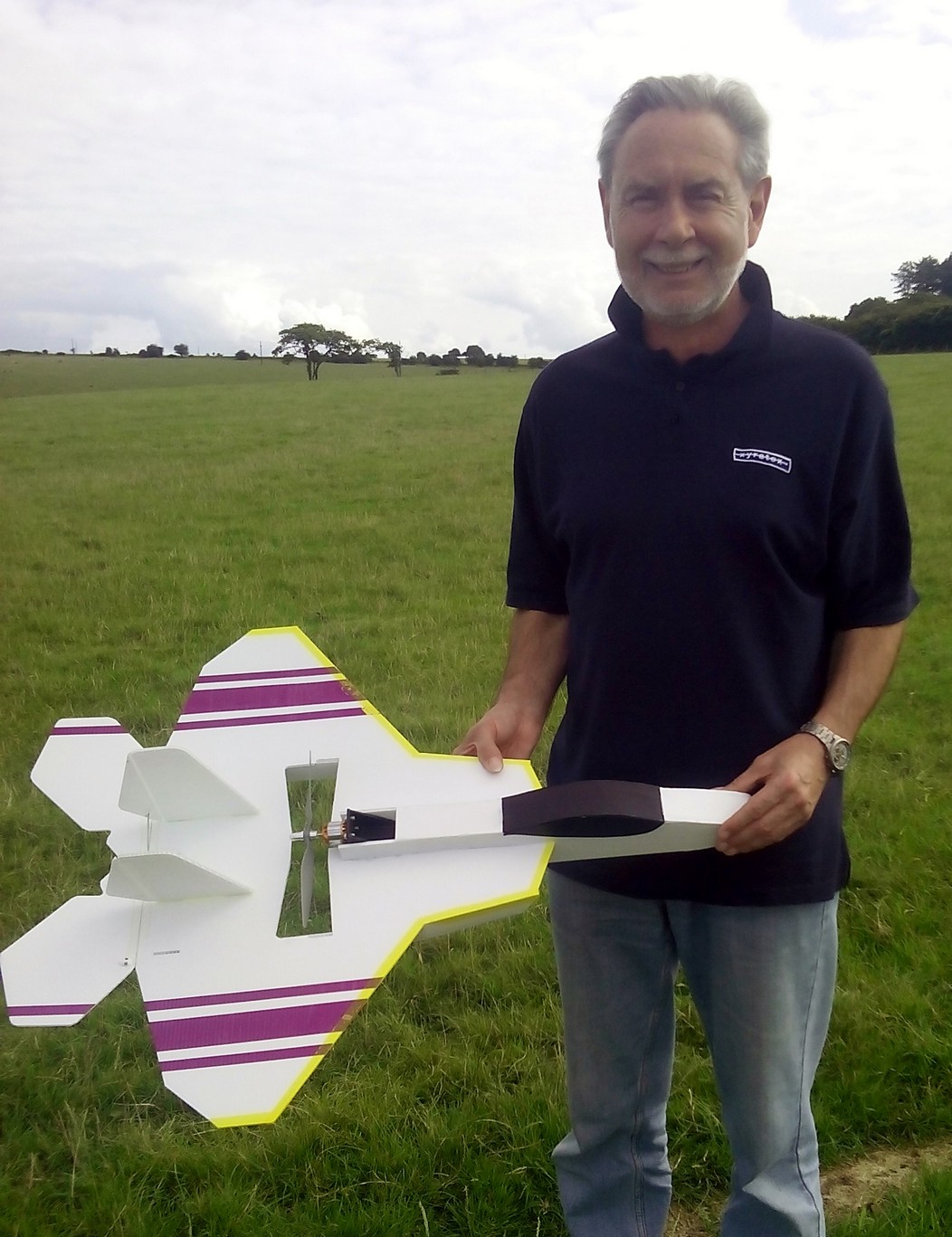 If you aren’t aware of Flite Test you need to check it out so CLICK HERE It’s a great, fun, site with loads of very good information and an ever growing line of models that can be purchased in various forms, with or without the electronics pack etc. Mark test flew the Raptor and says it was a little marginal on power with a 9×4 prop. A 9×6 prop improved things a bit but Richard hopes to try either a 9×7 or 9×8 for more speed, or maybe a higher kV motor, the current one being a little low at 1000kv.
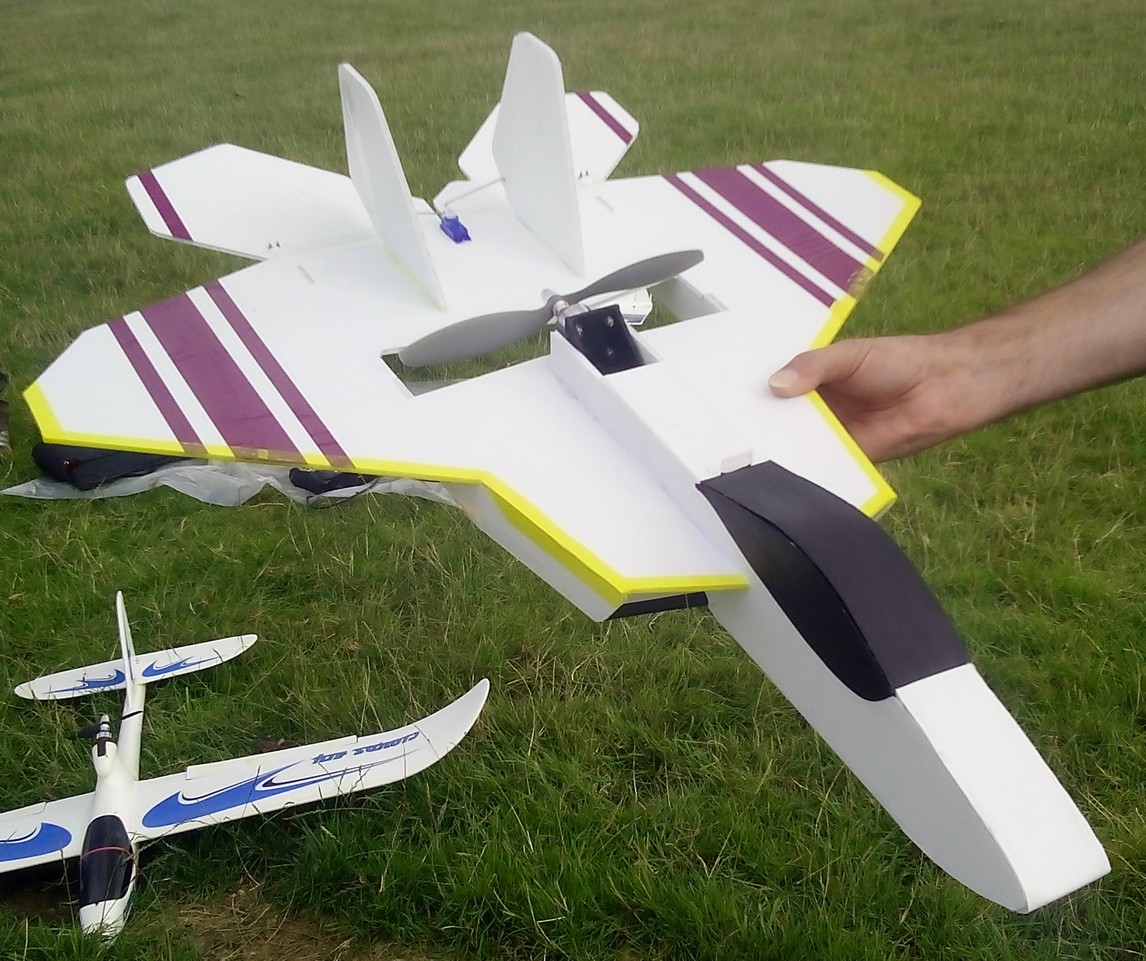 Anyway, it looks fantastic and I’m sure Richard will give us the full details later. In the meantime I want a go with it mister, please, pretty please!
Modelling Clay has been splashing the cash again. Having learnt to fly in a ridiculously short time on his ST Discovery (despite 1066’s best efforts to bin it!) he progressed to a Wot 4 Foam-E which he mastered in a couple of outings. So now he’s gone for speed with a Durafly EFX Racer.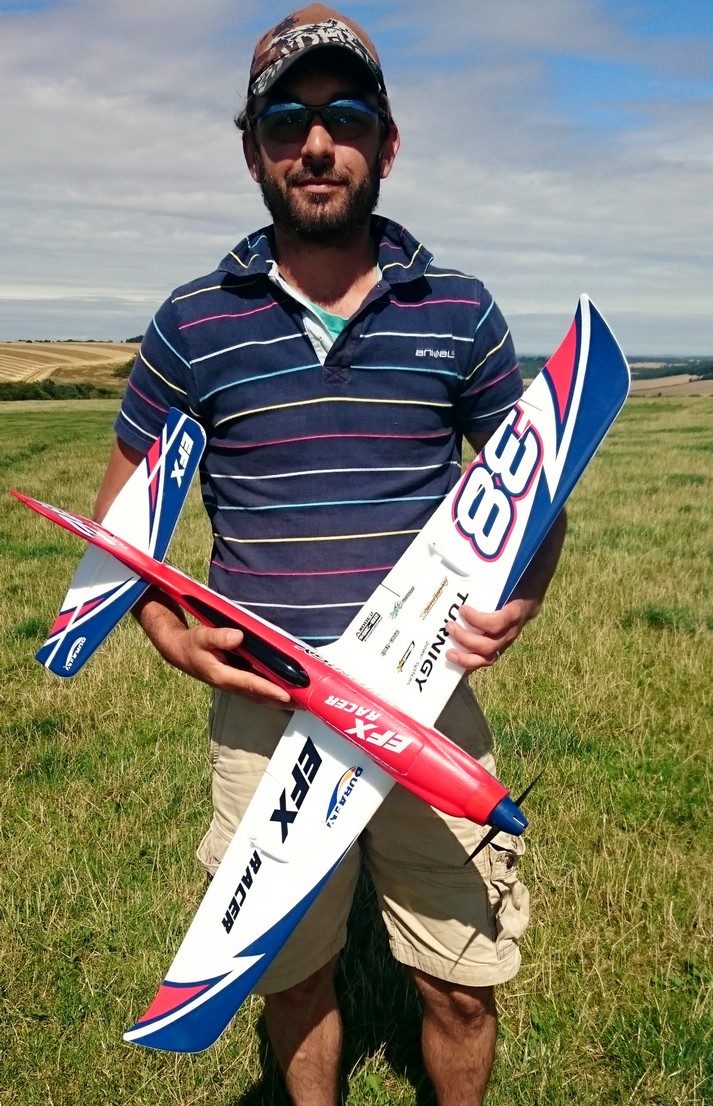 Durafly is one of the HobbyKing ranges and at 1100mm span the EFX Racer is designed as a kind of club flier pylon racer that will take either 3 or 4 cell lipos. Tim is using 3 cells at the moment but I don’t suppose it will be long before he tries it on 4 for a bit more speed. Mind you, it’s far from slow on 3 cells and I think Tim is finding it plenty quick enough for his skills at the moment.
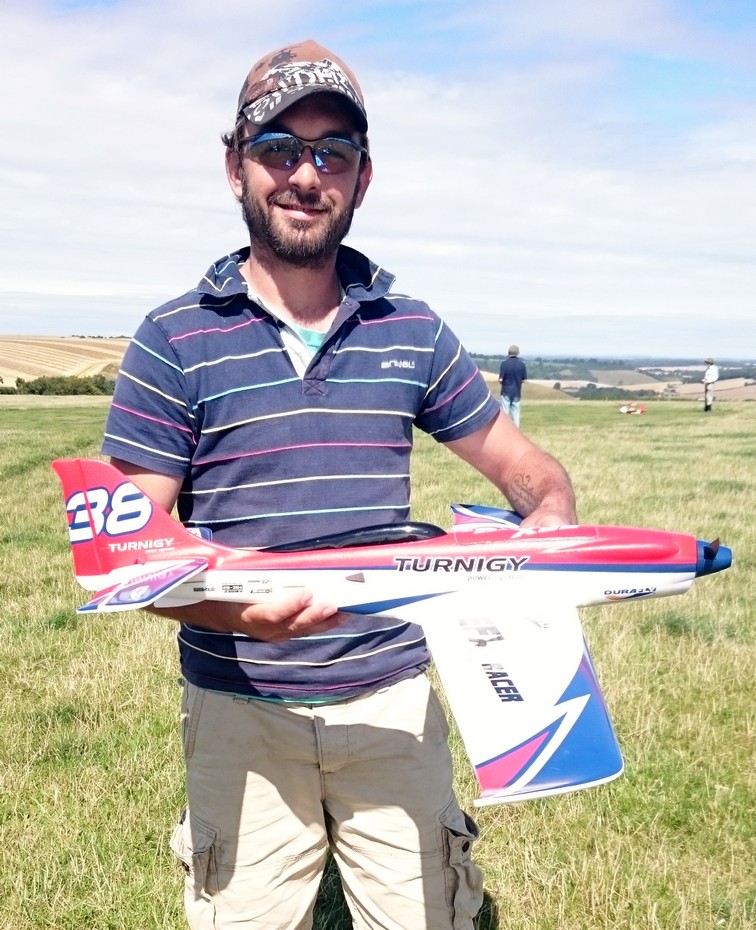 The EFX Racer can be seen in THIS MONTH’S VIDEO.
Tony Neal brought his new Pilatus PC9 to show us at a club meeting a few weeks back. It’s from…yes I know this is starting to sound like an advert for HobbyKing but if you keep buying them…! I think Tony bought it in the recent sale as he said it was only £79, at the moment it’s showing as £127 from the UK warehouse although I’ve just had the ‘one time offer’ at £118 pop up. The Pilatus PC-9 was an improved version of the earlier PC-7, but it featured a larger cockpit with ejection seats, a more powerful engine, and a host of structural improvements. It has been used by numerous countries as an advanced trainer aircraft. It was even built under license by Beechcraft and used by the United States Air Force as the T-6A Texan II. The model is 1200mm span and is Plug’n’Fly so comes ready fitted with 6 servos, a retracting tricycle undercarriage and a 3648 650kv motor coupled to a 45A esc. All you need is a 6 channel radio and a 4 cell lipo of around 2200-2600mAh. It has a rather unusual feature, you have to plug the battery pack into a socket on the outside to open the servo controlled canopy so you can then put the battery inside the fuselage and reconnect it. Tony didn’t like that at all, partly because the canopy servo operation restricts access considerably, so he did away with that system and simply removes the canopy manually.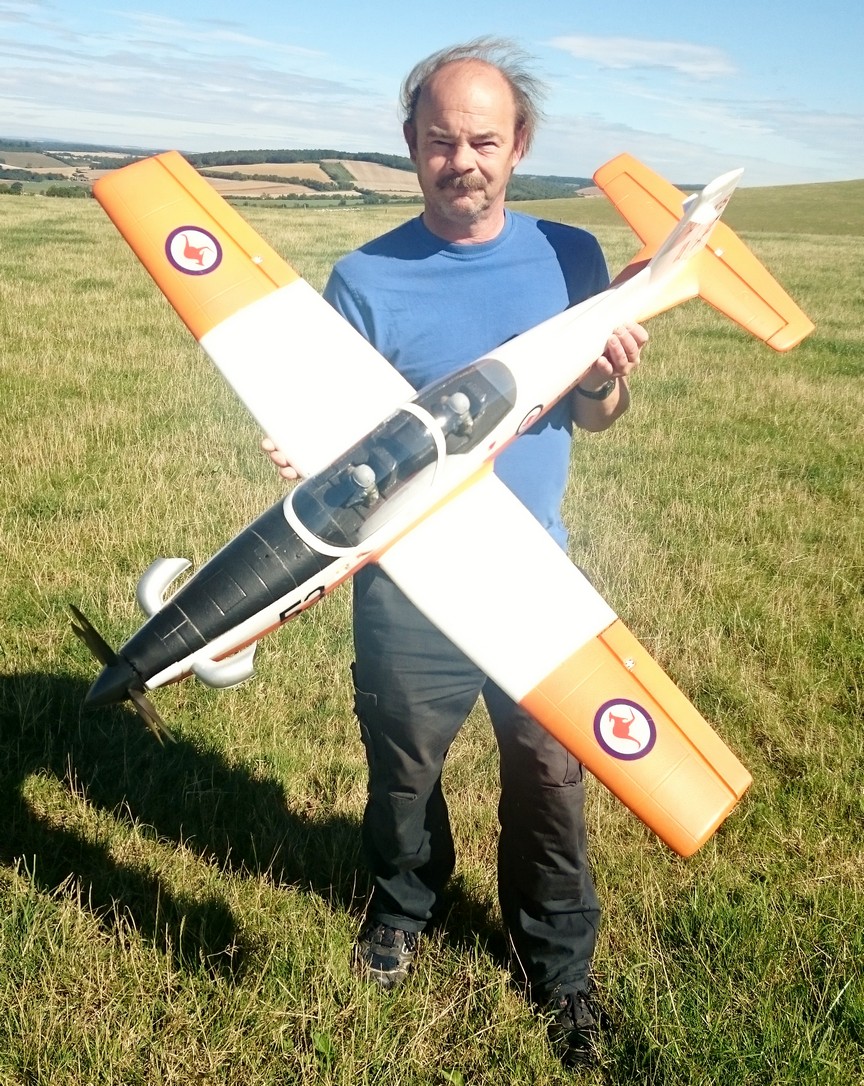 It’s finished in an Australian colour scheme, that of No2 Flight Training School of the RAAF and looks very smart. The first time Tony brought it to the patch the retract sequencer packed up despite working perfectly until then. He thinks it may have been due to having removed the canopy system which is also run from the sequencer. After a couple of weeks a new sequencer arrived and all was well once more so he brought it along again.
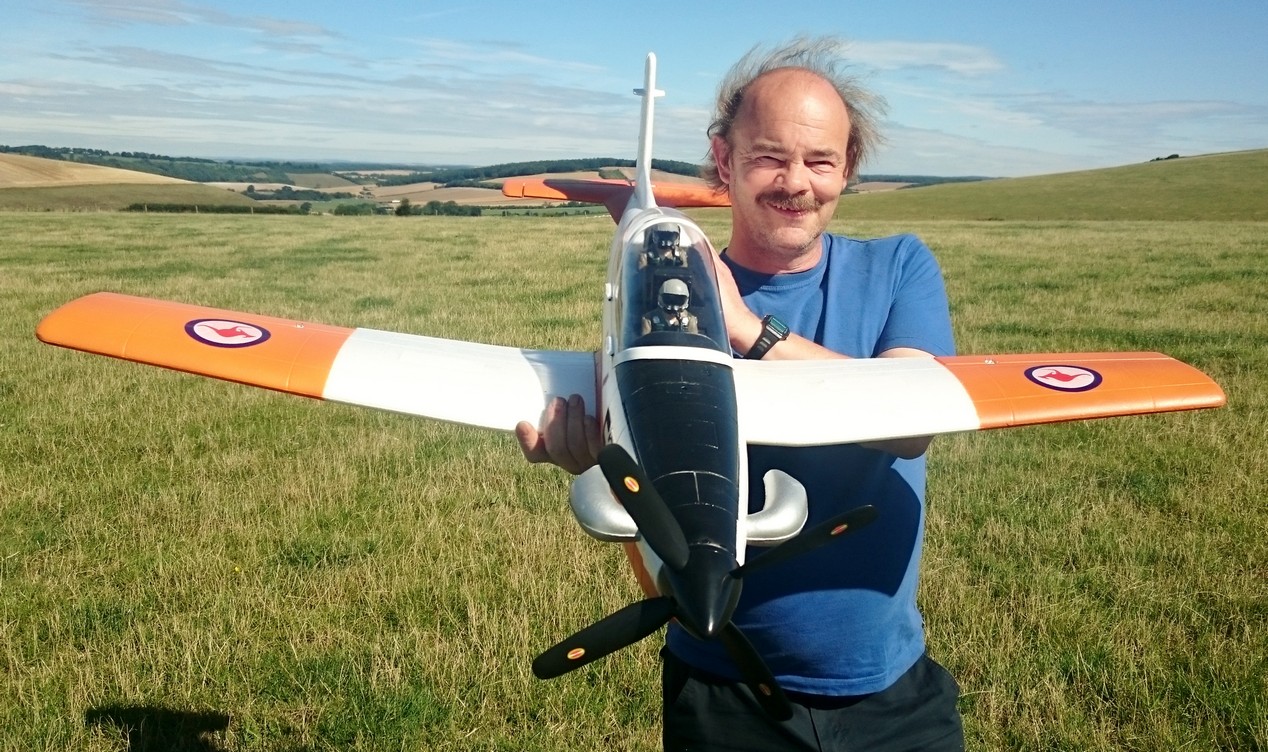 With everything working he went for the first flight but the model didn’t quite get away, it lifted off (just) at the end of the patch but appeared to be lacking speed and it did a mild cartwheel. Fortunately the only damage was a neatly removed fin which will be very easily mended. I’m not sure what Tony’s plan is for the next attempt; possibly change the scale 4 bladed propeller? No doubt he’ll soon get it sorted; it’s a lovely looking model and needs to be up in the air where it belongs.
August seems to have been Wot 4 month, Woody bought a Wot 4 Foam-E which flew very nicely, as expected, and he managed to remove the undercarriage after a few flights, also as expected! Don’t feel bad Woody, it happens to all of them, easily fixed.
John Warren splashed out on a proper wooden Wot 4. Actually I think it’s the HK Student 64E Intermediate Trainer but to you and me it’s a Wot 4. I’ve no idea what the 64 is, the span is 1200mm not 64 inch.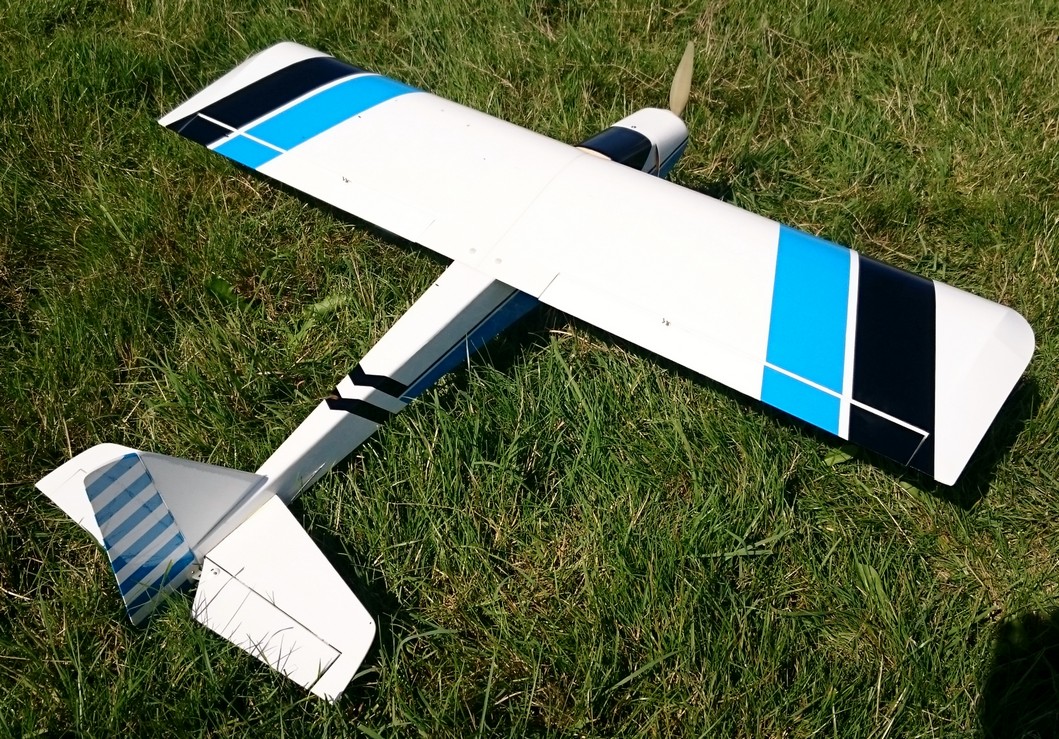 John got me to test fly his new pride and joy and it shot off the ground at a remarkable rate on just under half throttle. It flew perfectly, just didn’t need more than about third throttle at any time during the flight so I asked John a few questions about the power train. It was on 4 cells as that was the packs he wanted to use but he hadn’t checked the wattage or current draw. So after the first flight we put a watt meter on it and found that at full throttle it was pulling about 80A and over 1000 watts!
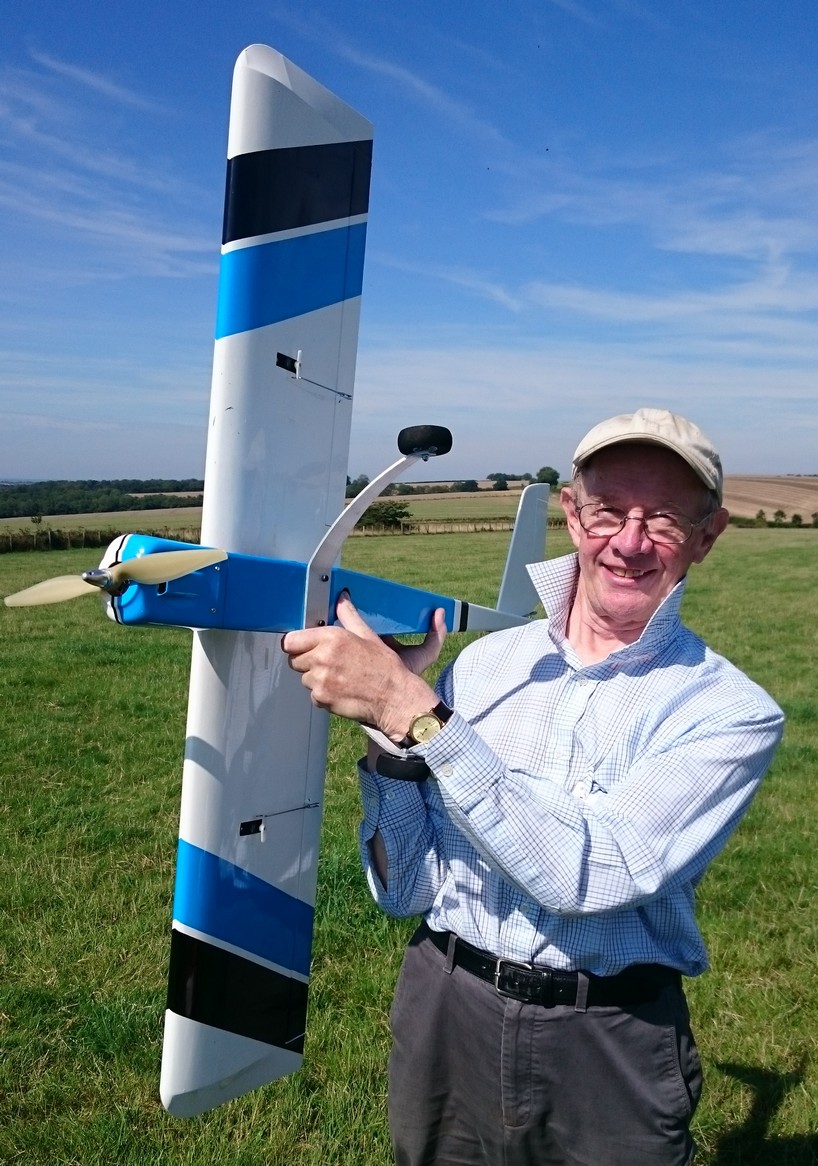 John has gone off to try some smaller props to reduce the power to a more sensible level and tame the beast somewhat. I think the answer is to use 3 cells, it probably needs a different kV motor really but it might be possible to sort it with a prop change.
 Otherwise John’s best bet is to flog it to Smiffy, although he’d probably still say it’s under powered!
Norwegian Nick flew this lovely little Tiger Moth at Buriton before one of the recent club meetings.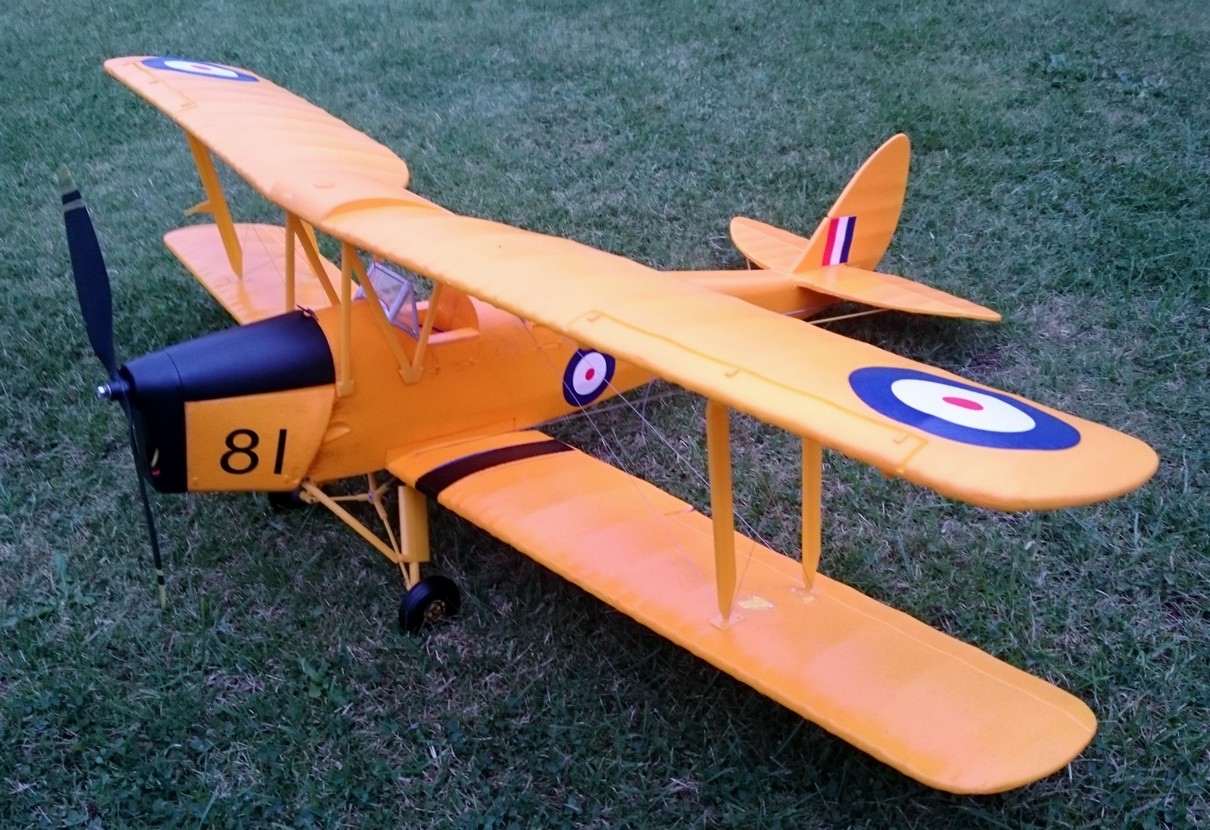
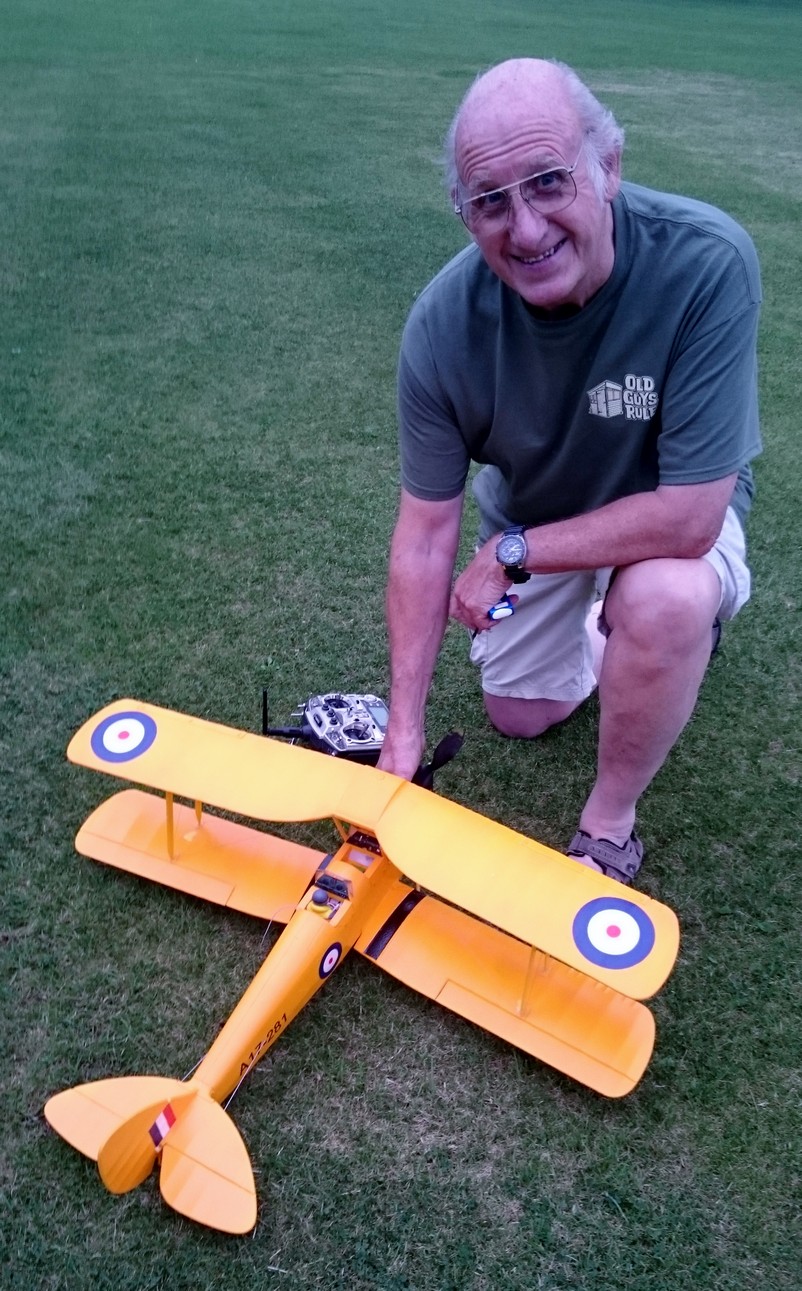 I’m afraid I didn’t get any information about the model other than that Nick won it in a club raffle. Obviously it isn’t going to be a suitable model for windy conditions but in the calm evening weather before the meeting it was great, flew beautifully and looked very much the part.
Last but not least this month, Captain Slow sent me some photos of Basher Bob’s parasail as I was away the first time it flew this month. I thought it was a new model but Bob tells me it’s his six year old Hawkeye that he hasn’t flown for a couple of years.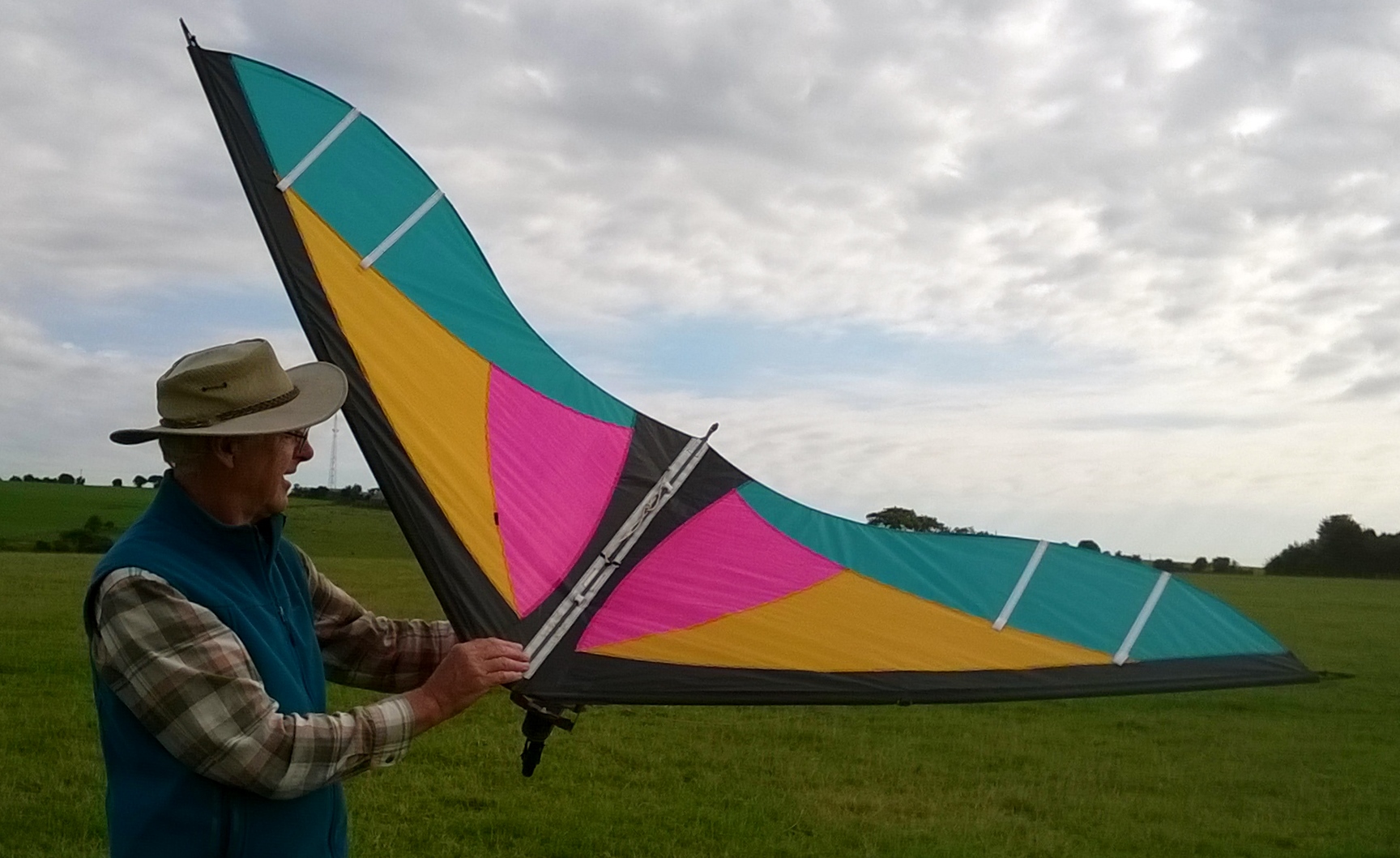 It was designed for aerial photography before the days of quadcopters and is made from lightweight kite material and carbon rods. It has a wingspan of around 2300mm, a 230watt motor, 25 amp esc and a 2200 3s battery. The controls are throttle, rudder, and CG shift (a Basher mod). It doesn’t have an elevator, more power makes it climb, and another servo operates the camera shutter. Flight times are 15 minutes plus. Basher reports that it’s very docile and easy to land, just shut the throttle! It’s a problem in high winds as increasing the power to make it penetrate increases the angle of attack and makes it climb instead, hence the CG shift mod. It’s always good to see something different from the norm at the patch, nice one Basher.
On Bank Holiday Sunday I went to the Wings & Wheels show at Dunsfold with Jim and Woody. It was a great day and I might include a few photos in the next Patch News. I was a little short of video this month so I’ve added a couple of minutes of Wings & Wheels at the end of THIS MONTH’S VIDEO.
After boarding the plane at Heathrow Airport for New York and taking his seat, the businessman noticed a very beautiful woman boarding the plane. He realized she was heading straight toward his seat and bingo – she took the seat right beside him. “Hello”, he blurted out, “Business trip or vacation?” She turned, smiled enchantingly and said, “Business. I’m going to the annual nymphomaniac convention in the United States …….” He swallowed hard. Here was the most gorgeous woman he had ever seen sitting next to him, and she was going to a meeting for nymphomaniacs! Struggling to maintain his composure, he calmly asked, “What’s your business role at this convention?” “Lecturer,” she responded,” I use my experience to debunk some of the popular myths about sexuality…”
“Really”, he smiled, “what myths are those?” “Well,” she explained, “one popular myth is that African-American men are the most well-endowed when, in fact, it’s the Native American Indian who is most likely to possess that trait. Another popular myth is that French men are the best lovers, when actually it is the men of Greek descent… We have also found that the best potential lovers in all categories are the Irish.”
Suddenly the woman became uncomfortable and blushed. “I’m so sorry,” she said. “I really shouldn’t be discussing this with you, I don’t even know your name!”
“Tonto,” the man said. “Tonto Papadopoulos, but my friends call me Paddy.”
Colin Cowplain
Patch News – July 2015
Summer, what summer? July was really mixed up weather wise, we had some lovely weather at the beginning of the month but then it turned more like late autumn with wind and rain. Fortunately the last few days slowly improved so hopefully August will be much better for us.
I was away at the start of the month so Dougal Entendre kept me up to date and sent me some photos.
It seems the main thing I missed was a pair of Nicks. DoughBoy (treasurer Nick Squire) flew his Cougar 2000.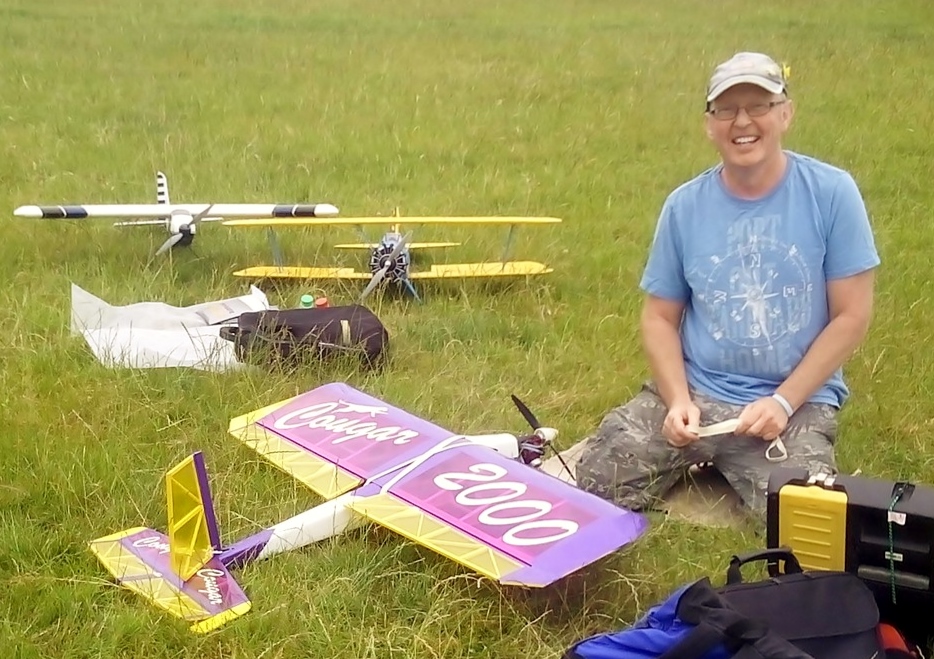 This was significant for two reasons, firstly it’s I/C powered (a rarity in the club now) and secondly he remembered where the field is!
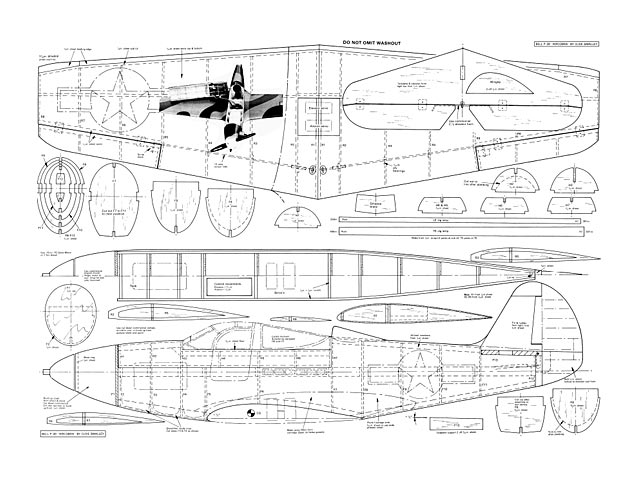
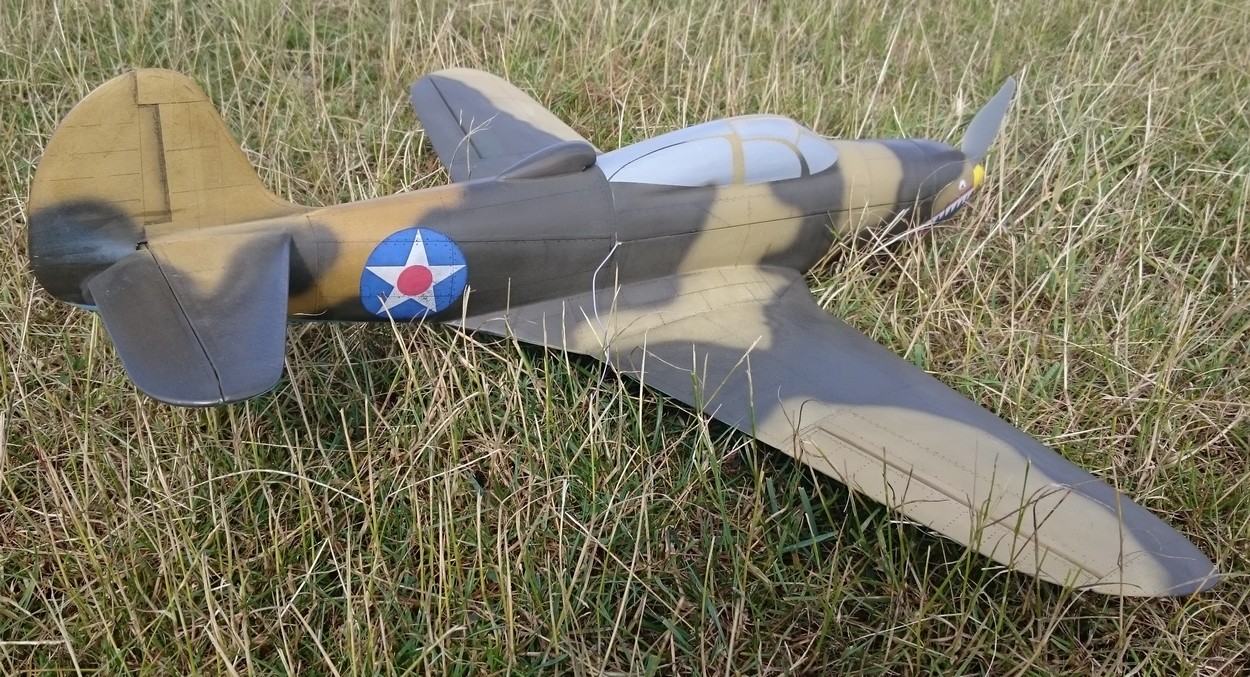
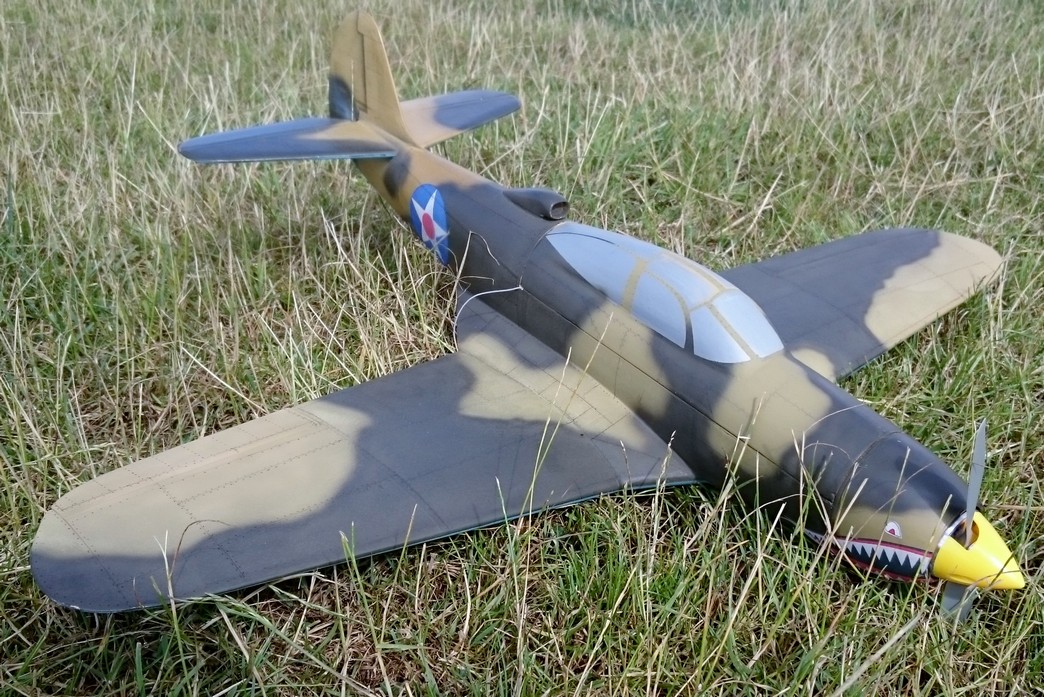
Nick Sivertsen also made an appearance after an absence of a few months. Nick is a ‘proper’ modeller and he brought along a P39 Bell Air Cobra that he had built from a Clive Smalley plan.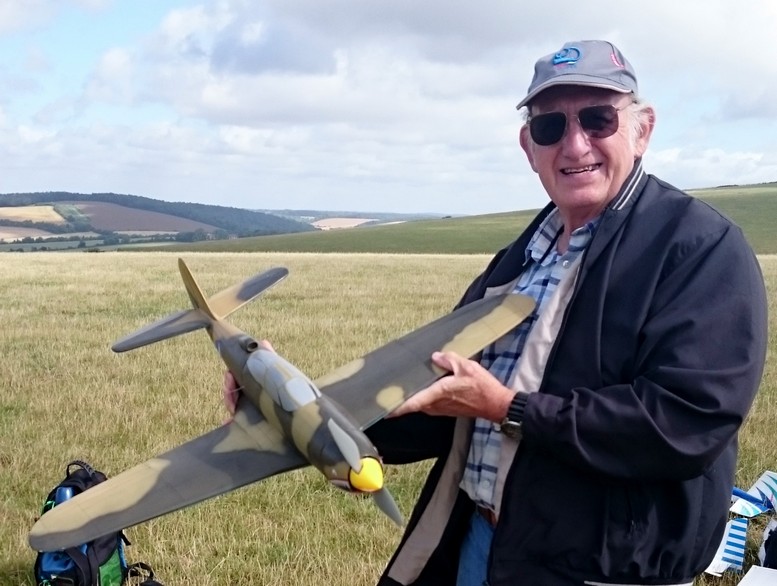 The plan was a feature in the June 1983 edition of RCM&E and Nick built most of it not long after but never got round to finishing it. It is 31.5” span (800mm) and in those pre-electric days it was designed for a glow or diesel engine of .10 – 15cu in.
 Nick had made a lovely job of it and it looked great with its airbrushed spray job complete with panel lines etc. Unfortunately Dougal reported that it nosed in straight from the hand launch and removed the nose very neatly.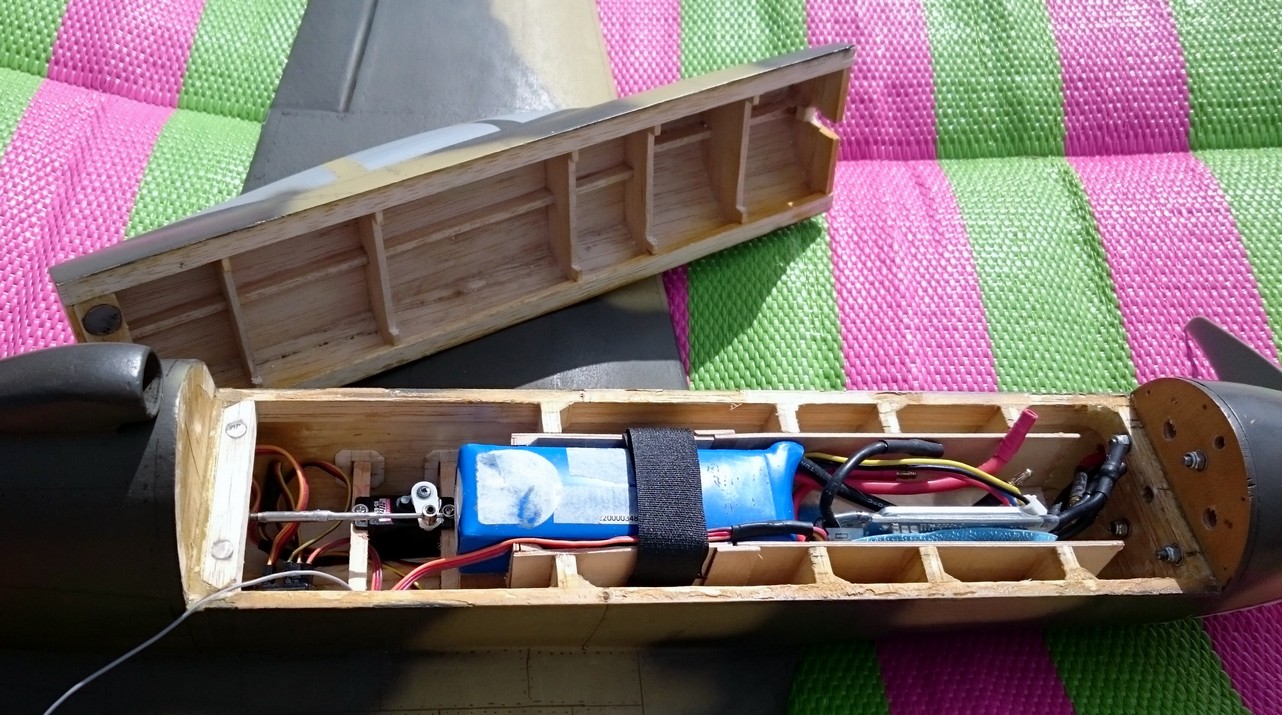
 Undaunted, Nick returned a couple of weeks later with the repaired model and the addition of some lead in the tail. This time I got to launch it and I decided an underarm launch would be easiest…oh dear! On the first attempt the model half rolled hard left and knocked the fin clean off. This was soon replaced with the help of some cyano and we tried again. This time I launched it overarm (more height=more time to sort it). It seemed to leave my hands ok but almost immediately rolled hard left again, and this time, with the extra height and speed, the result was an awful lot of damage.
 Sadly Nick says he won’t bother repairing it. We don’t really know why this happened; certainly Nick had built it straight and true. I commented at the time that it felt heavy. I think the motor Nick used was well over the power of a .15cu in I/C equivalent so maybe a smaller and lighter motor/battery combination would have been better. There was loads of power but if the wing loading was too high maybe I couldn’t launch it at the flying speed required. I guess we’ll never know but it was certainly a shame to see such a nice and unusual model destroyed in seconds.
On a happier note Nick also brought along a new model that he’s putting together, a Kavan Bird of Prey EDF glider. It’s very unusual, I’ve certainly never seen a tail mounted ducted fan on a glider, but Kavan are known for producing quality things so I’m sure it will turn out well.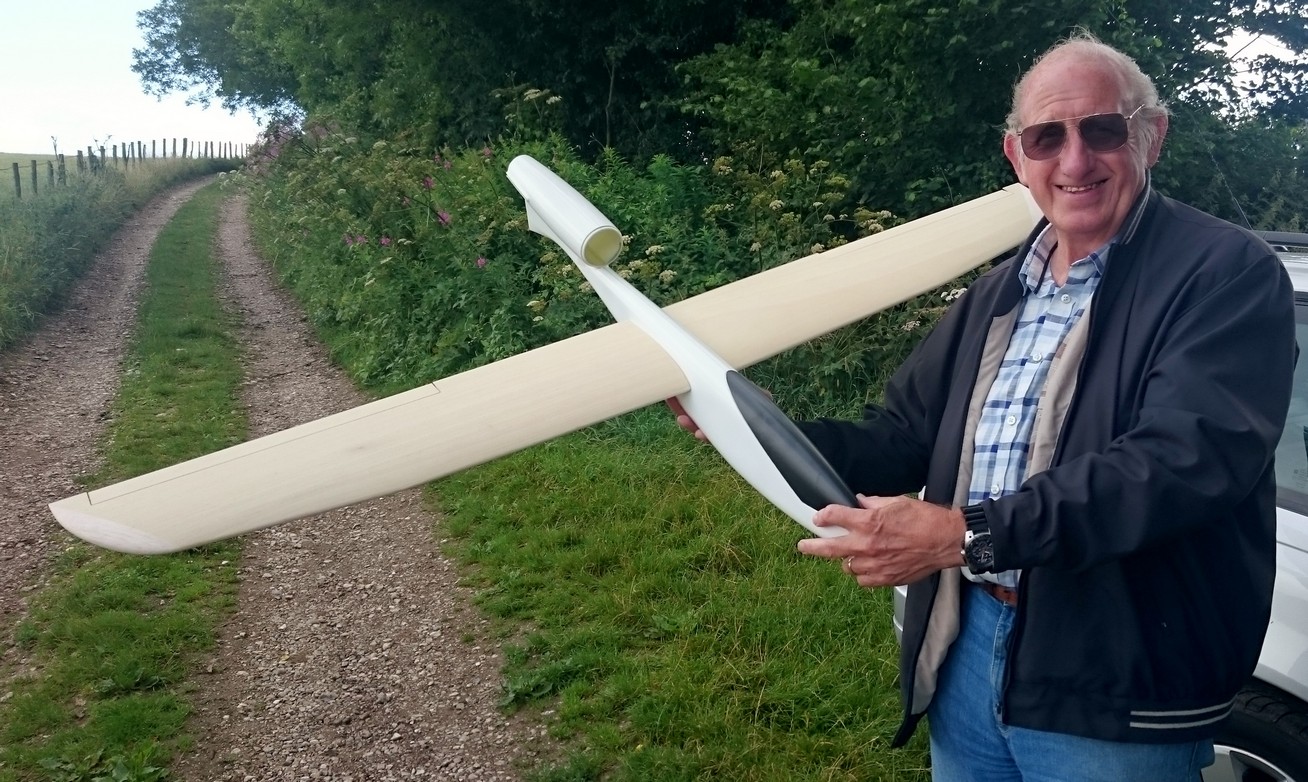 The wings are foam with obechi covering and the fuselage is fibreglass, it’s all beautifully made. It has a conventional tailplane and the fin mounts on top of the fan housing. This is certainly one I’m looking forward to seeing fly.
Some of us have been flying at Buriton before club meetings and taking advantage of the calm evenings.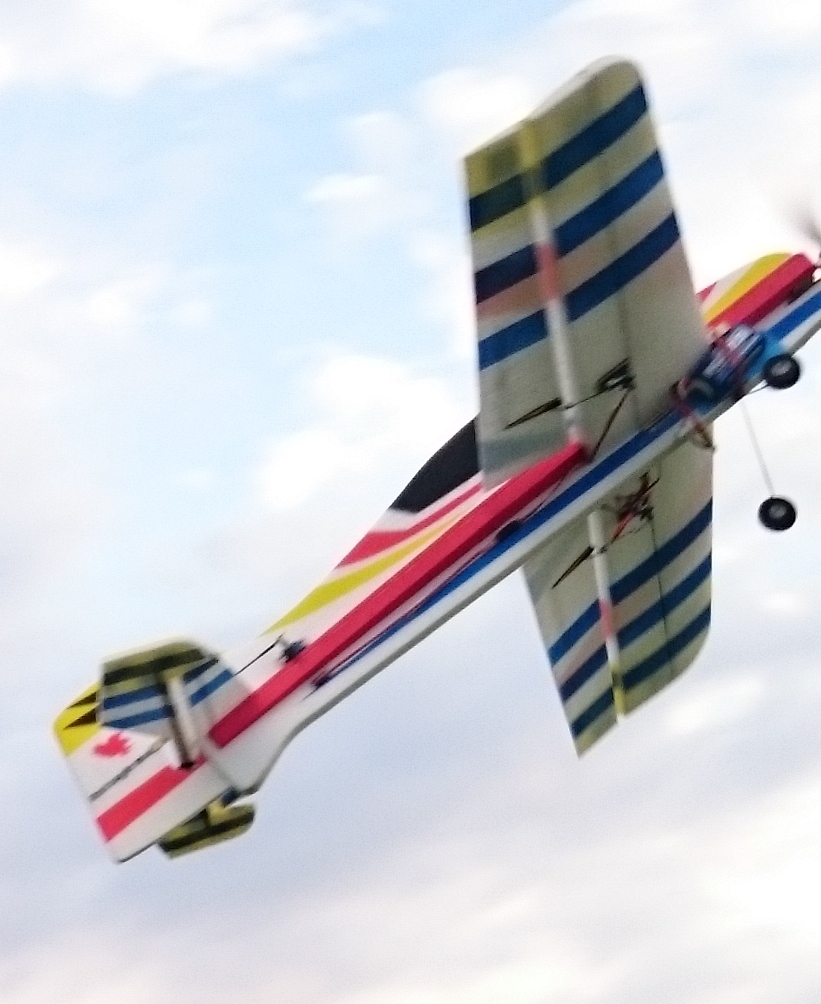 The HobbyKing Hummers are ideal for this, they are extremely manoeuvrable so are good for park flying, and they fly so much better in calm conditions than they do in even a light wind. Dougal Entendre and 1066 were flying on the evening that I took the photos, both Tony Neal and I have also flown our Hummers there but weren’t that particular evening. The pair managed to get very close to each other a couple of times whilst honing their prop hanging skills.
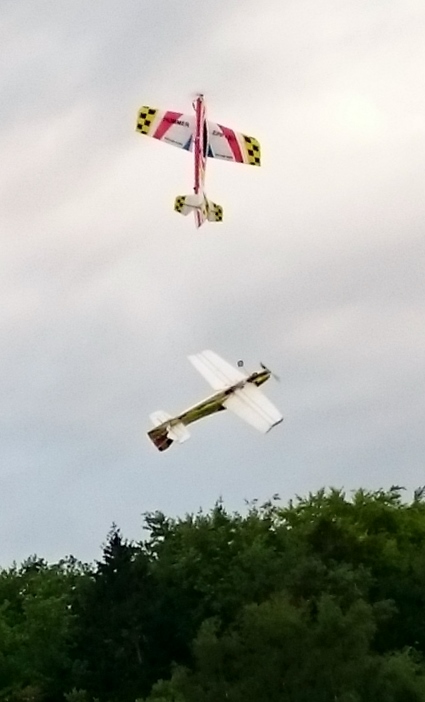
Steve’s is actually a Hyperion Sniper, probably what the HK Hummer was copied from but the Hummer has been improved somewhat.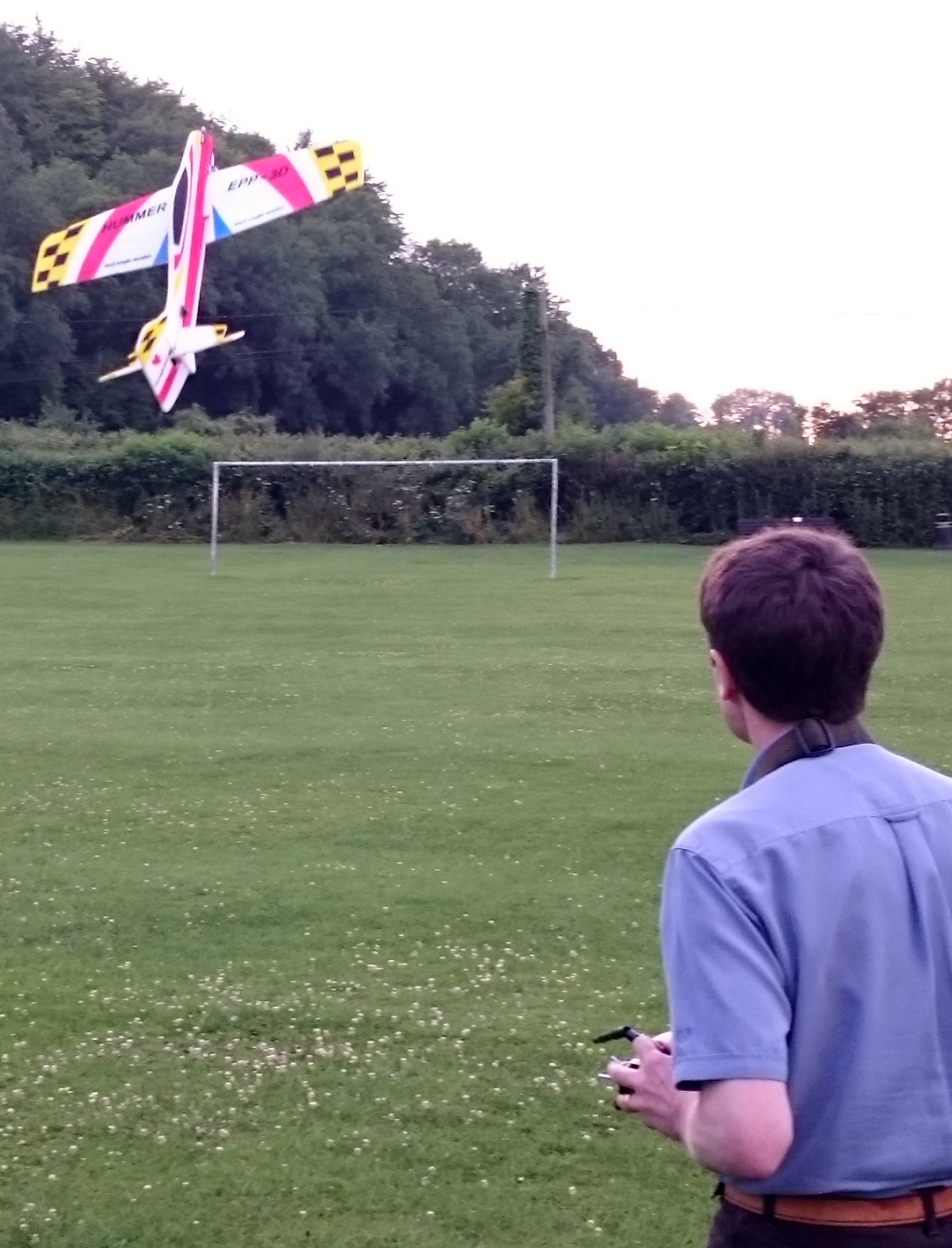
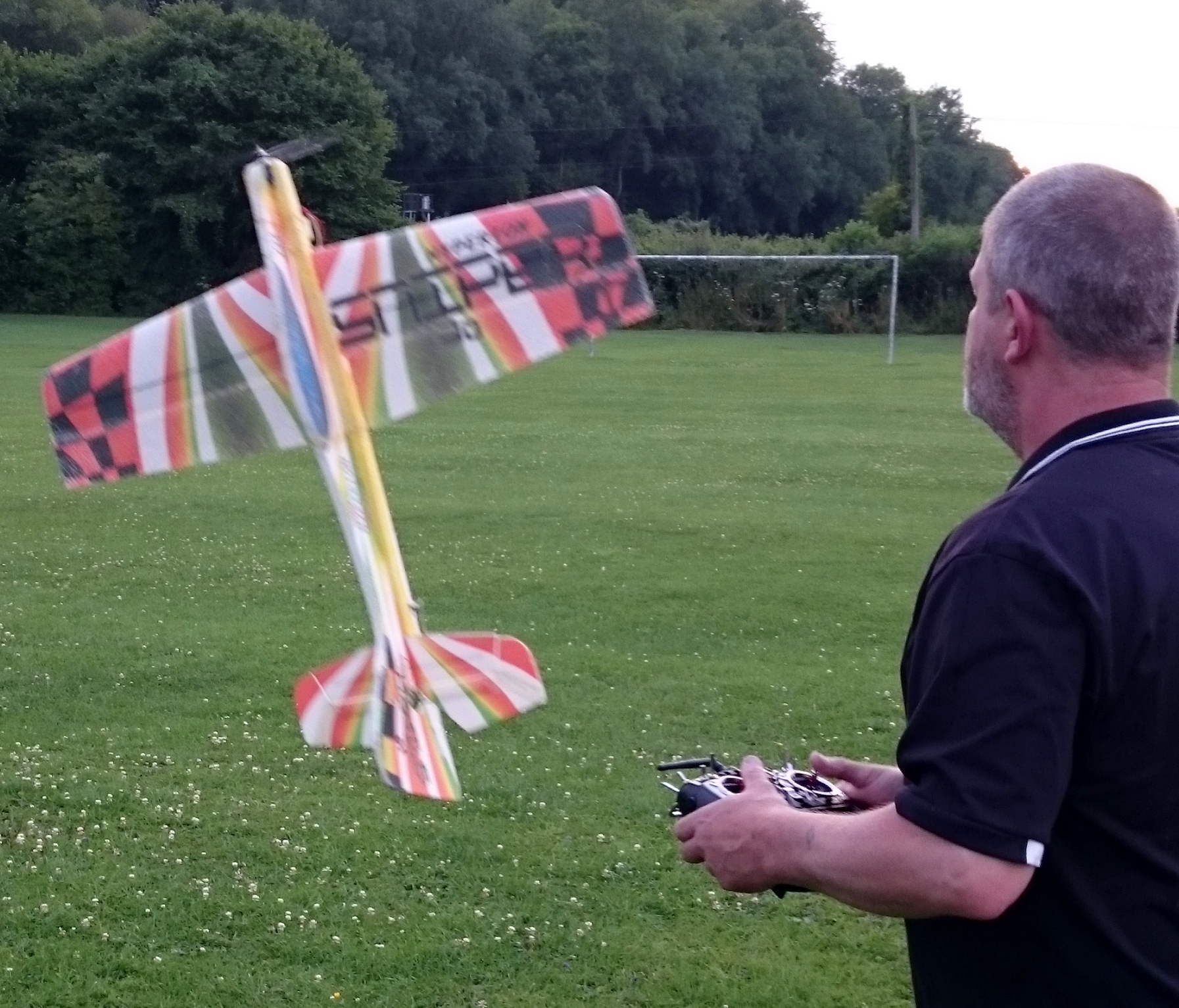 At one point 1066 managed to touch the wingtip on the ground and proved the fuselage is very flexible, amazingly it didn’t break!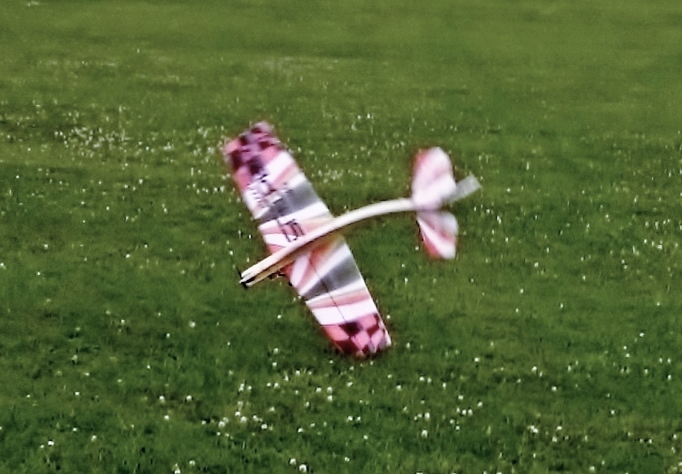
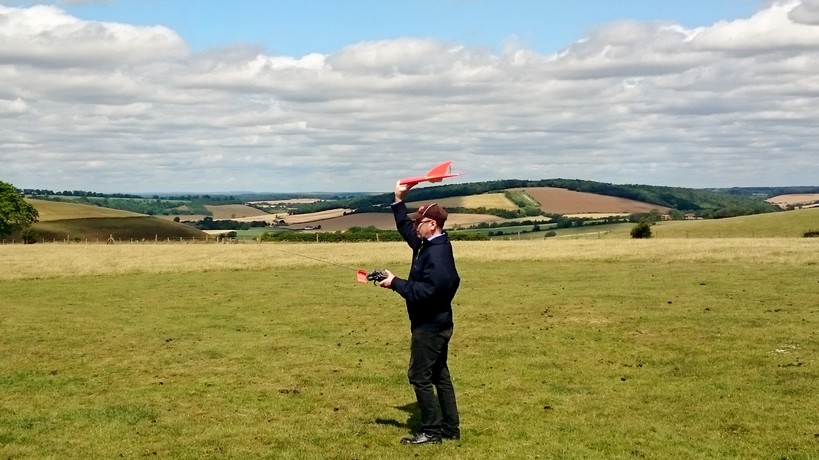
Chris Hard has been flying his wings again; these are two of his favourites, a Great Planes Slinger at the back and a Ripmax Wild Wing at the front.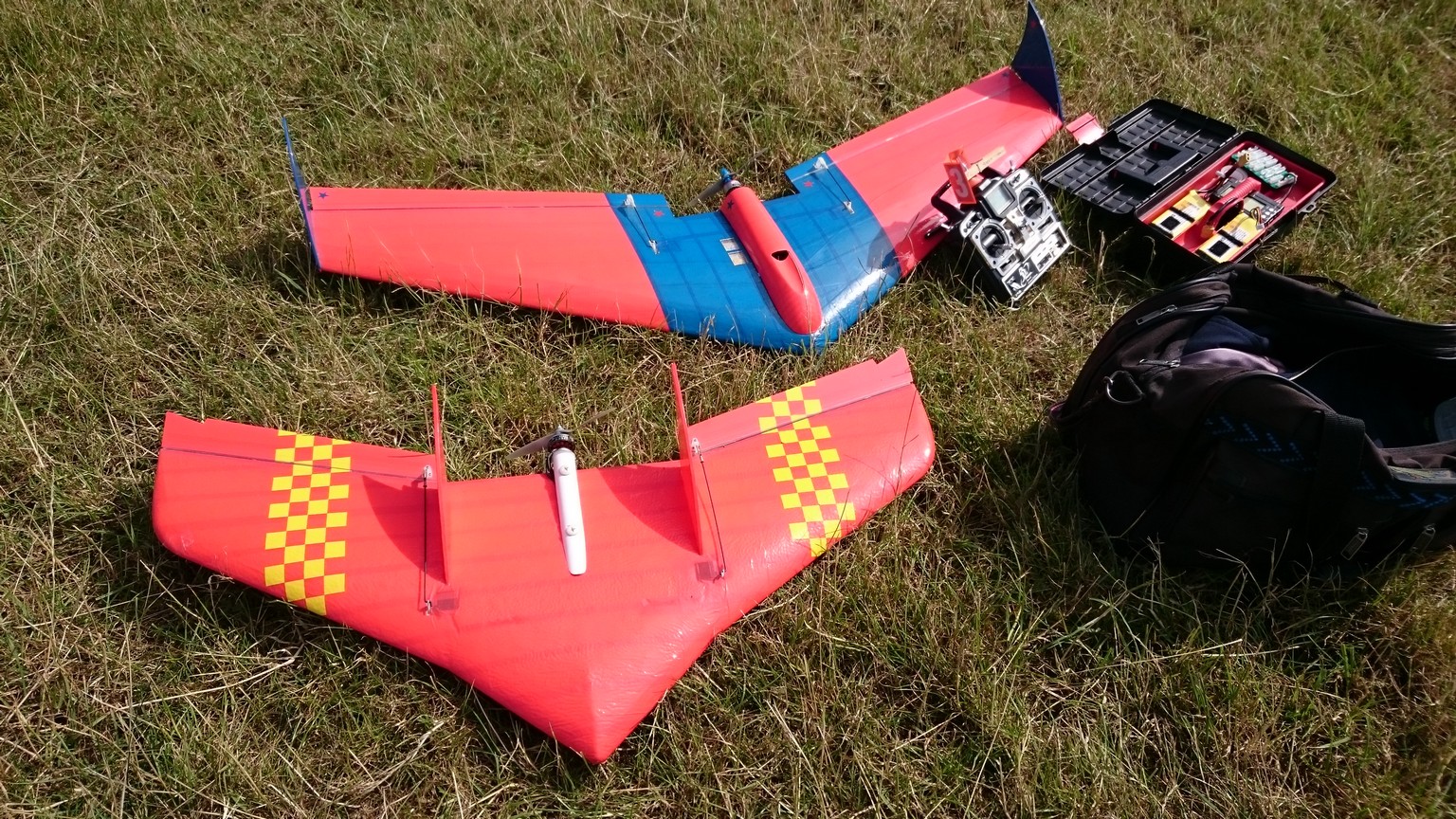 Launching can be a bit of a problem with flying wings but Chris shows how he does it with the Wild Wing.
 You can see the Slinger flying by clicking on THIS MONTHS VIDEO.
The video also has just a snippet of Dwayne Pipe landing his Vega electric glider. I covered it in Patch News last month but since then Dwayne has made some changes. The original design was rudder/elevator but Dwayne wanted ailerons so he guessed at the size they would need to be. It turned out that they were pretty ineffective so Dwayne has now doubled their size and they work much better.
A couple of weeks ago Bob Hill and I were flying our Spirits one midweek morning, with the whole sky all to ourselves, when he ruthlessly smashed his Spirit into mine! I saw something fluttering down from mine but I still had some control so I did an emergency landing without any further damage. Bob meanwhile was sniggering away, saying his was all ok, but suddenly his canopy detached and fluttered away (haha!). The piece he had ripped off my poor Spirit turned out to be one of the tailplane halves, hence rather reduced control. Luckily we managed to find both Bob’s canopy and my tailplane half fairly easily so Bob could fly again and I was able to complete repairs at home. I’m sure you’ll agree that as Bob’s canopy hit my tailplane it was obviously totally his fault, so from now on he’ll be known as Basher Bob. Basher Bob actually features quite a lot in THIS MONTHS VIDEO but unusually he’s behaving himself.
Several months ago Tony Neal arrived at the patch with a very nicely built De Havilland Chipmunk.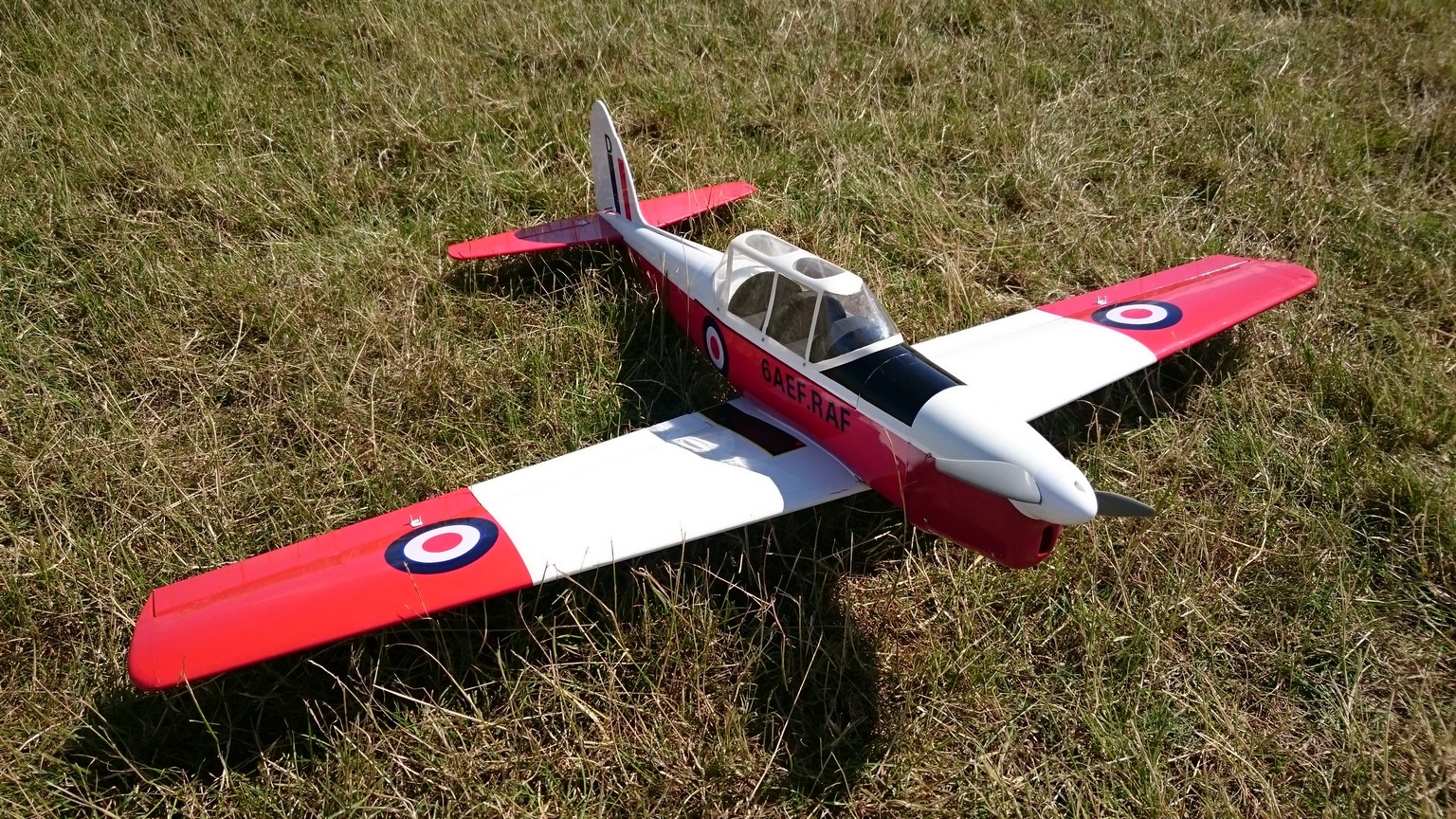 He had built it from a Chiltern Models kit that dated from around 1985. It was designed by John Camlen as a Semi-Scale sports model for 25 to 40 size glow engines. Wing span is 53 inches, which makes it approx. 1/7th scale. Tony had converted it to electric using a 500 watt motor running on 3 cells. It looked good, he’d made a very nice job of the build, and it looked as if it should just fly with no problems. Wrong, Tony just couldn’t get it off the ground! It wouldn’t lift off cleanly, kept dropping a wing and acting peculiarly in general. Tony took it home, made a few changes, brought it back and tried again, but it was still much the same. This happened several times, always with similar results, it simply wouldn’t fly but there didn’t appear to be any good reason.
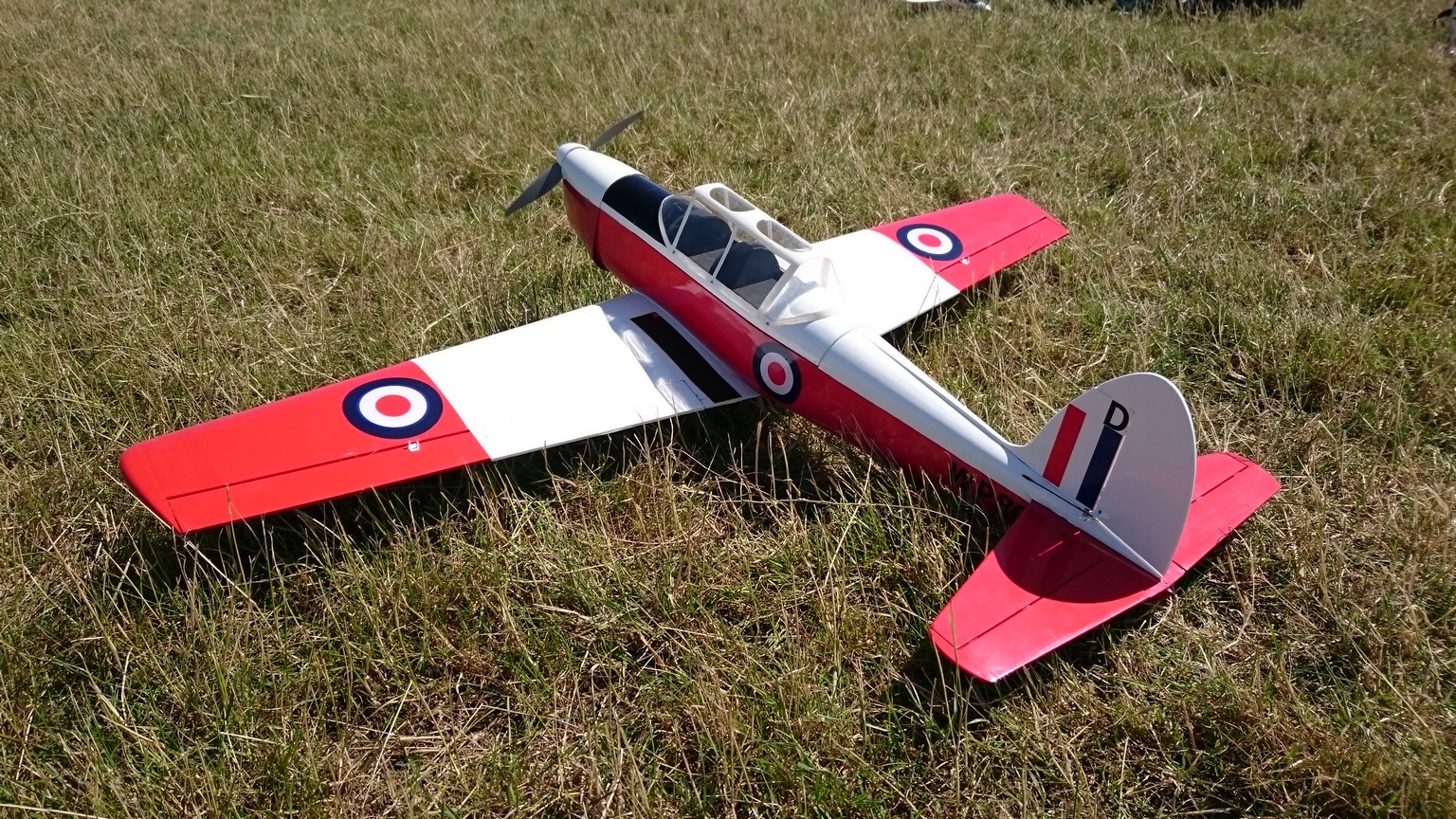 But finally, earlier this month, success at last! Once Tony had got it into the air he learnt more about the trim, the correct control movements etc. and he was able to improve it greatly for the second flight which was much better. I’m not sure how it felt to Tony but it looked good in the air and I think he’s pretty much tamed it now. Some of the second successful flight, including take-off and landing, can be seen in THIS MONTHS VIDEO.
Also in the video is Modelling Clay flying his Wot 4 Foam-E. When watching him fly, completing rolls, loops, bunts, and low inverted passes, it’s difficult to imagine that he’s only been flying for around 3 months. He’s already passed his ‘A’ certificate and I’m sure he’s destined to be a very good pilot in the future. But, to stop him getting too big headed, he had a bit of a problem last week. Tim was flying his first model, an ST Models Discovery trainer, practising low inverted passes (no mean feat itself with a trainer) when he had, in his own words, ‘brain fade’ and discovered that a bunt from inverted requires down elevator not up!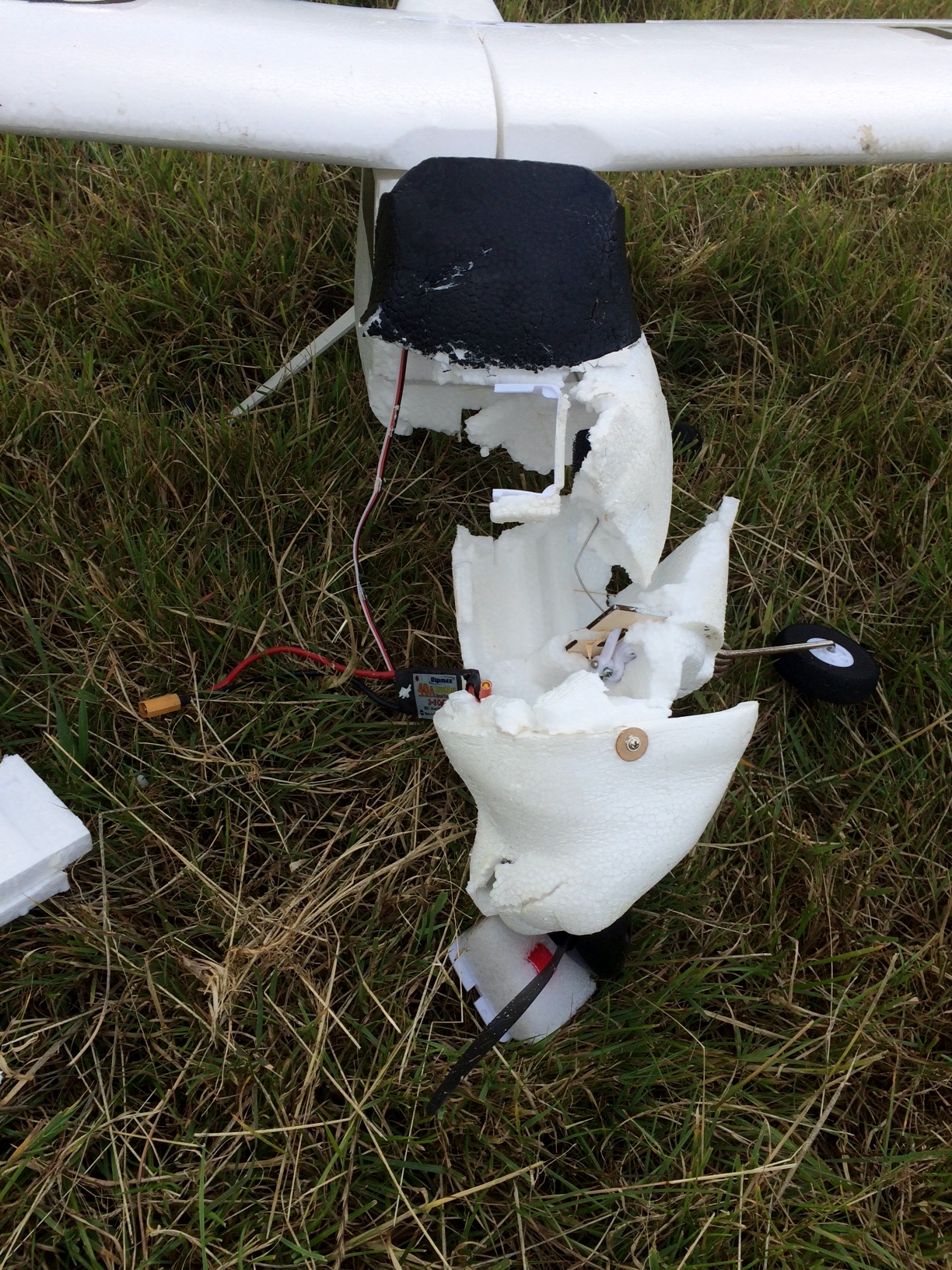
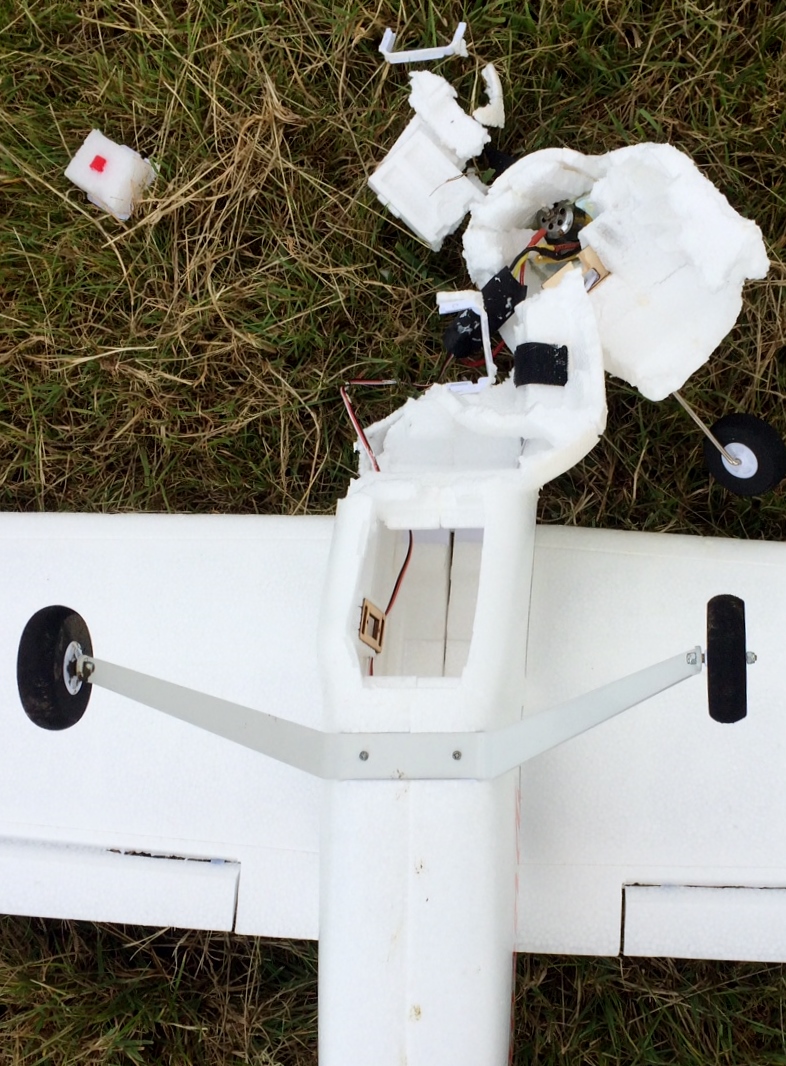 The result wasn’t pretty, a bit beyond a call for help from dad!
If you were at the last club meeting in July you will have seen my latest purchase. The HobbyKing website had a 4th July sale but I didn’t see anything that really appealed so I didn’t buy anything. However, a couple of weeks later I had an email from them saying ‘HK Sale Reloaded’ and one of the offers was a little foam Cri-Cri reduced by 75% to just under £24.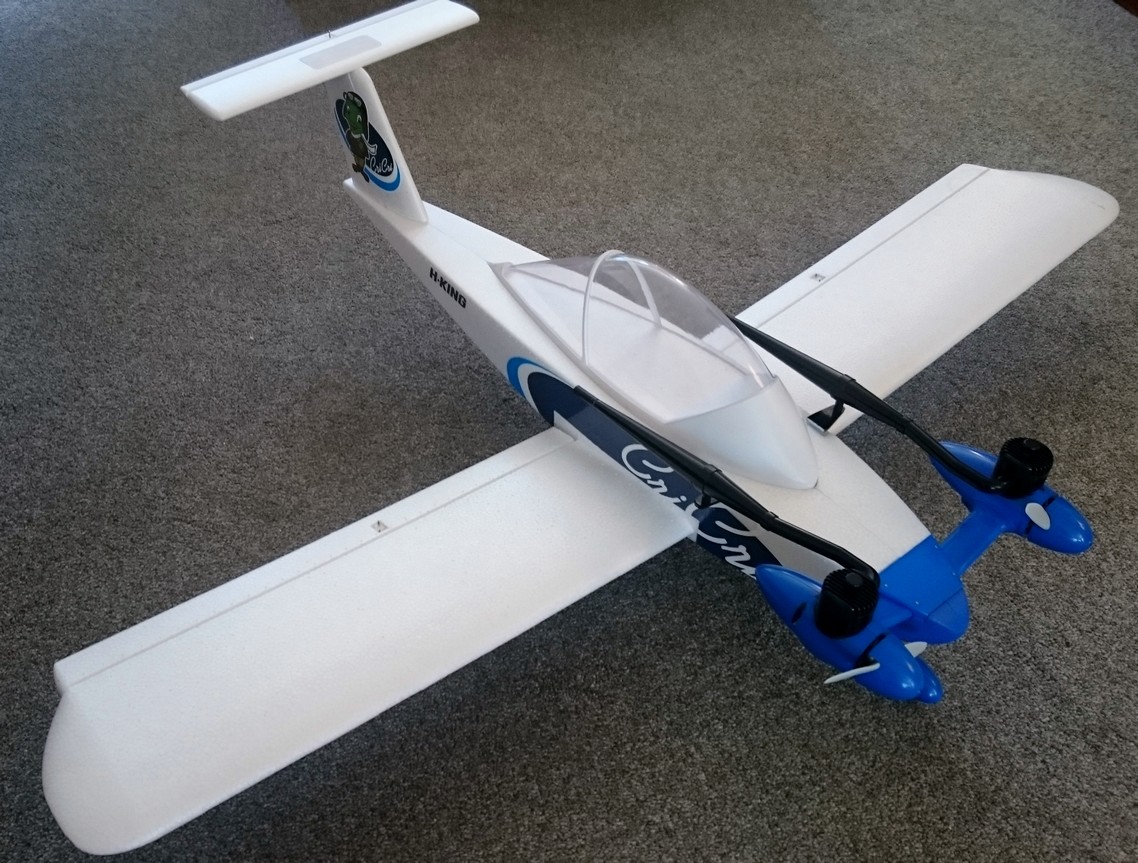 This scale plane is a twin engined EPO foam model of 1050mm span that is classed as PNF (Plug N Fly) so comes almost complete, and is fitted with 2 x 2825 1850KV outrunner motors, 2 x 20A speed controllers, and 4 x 9g servos, and a pair of counter rotating props. Even with the postage and the $/£ conversion the total price was only £30.40 so I couldn’t refuse!
The full-size Colomban Cri-Cri is the smallest twin-engined manned aircraft in the world, designed in the early 1970s by French aeronautical engineer Michel Colomban. The aircraft is made from aluminium sheet glued to Klegecell foam and is capable of mild aerobatics. It’s just 4.9m span (16ft 1in) and 3.9m long (12ft 10in), and the empty weight is 78kg, considerably less than me!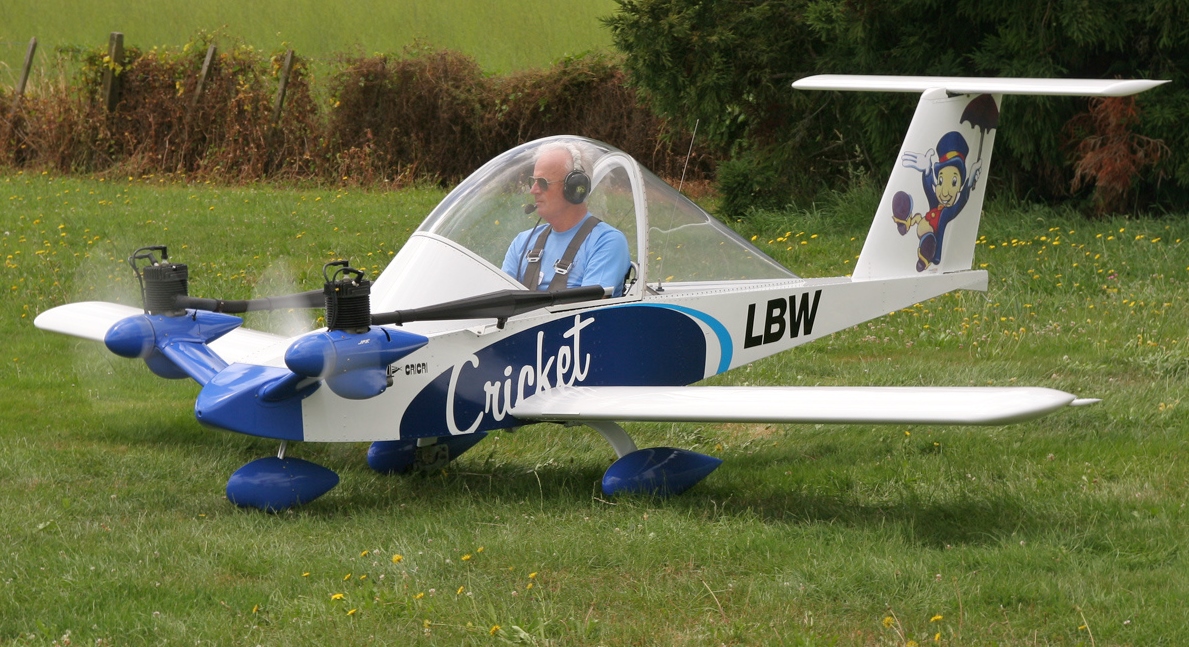 There have been various versions built including several with 2 x 15 horsepower (11kW) electric motors.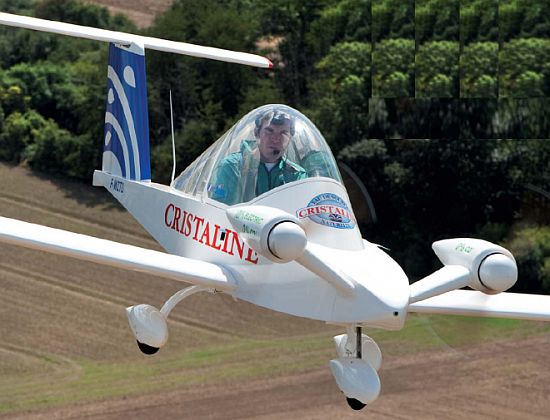
Another electric one with 25 horsepower motors set the world speed record for electric powered aircraft at 162.33mph. The electric ones use lipos, just like us!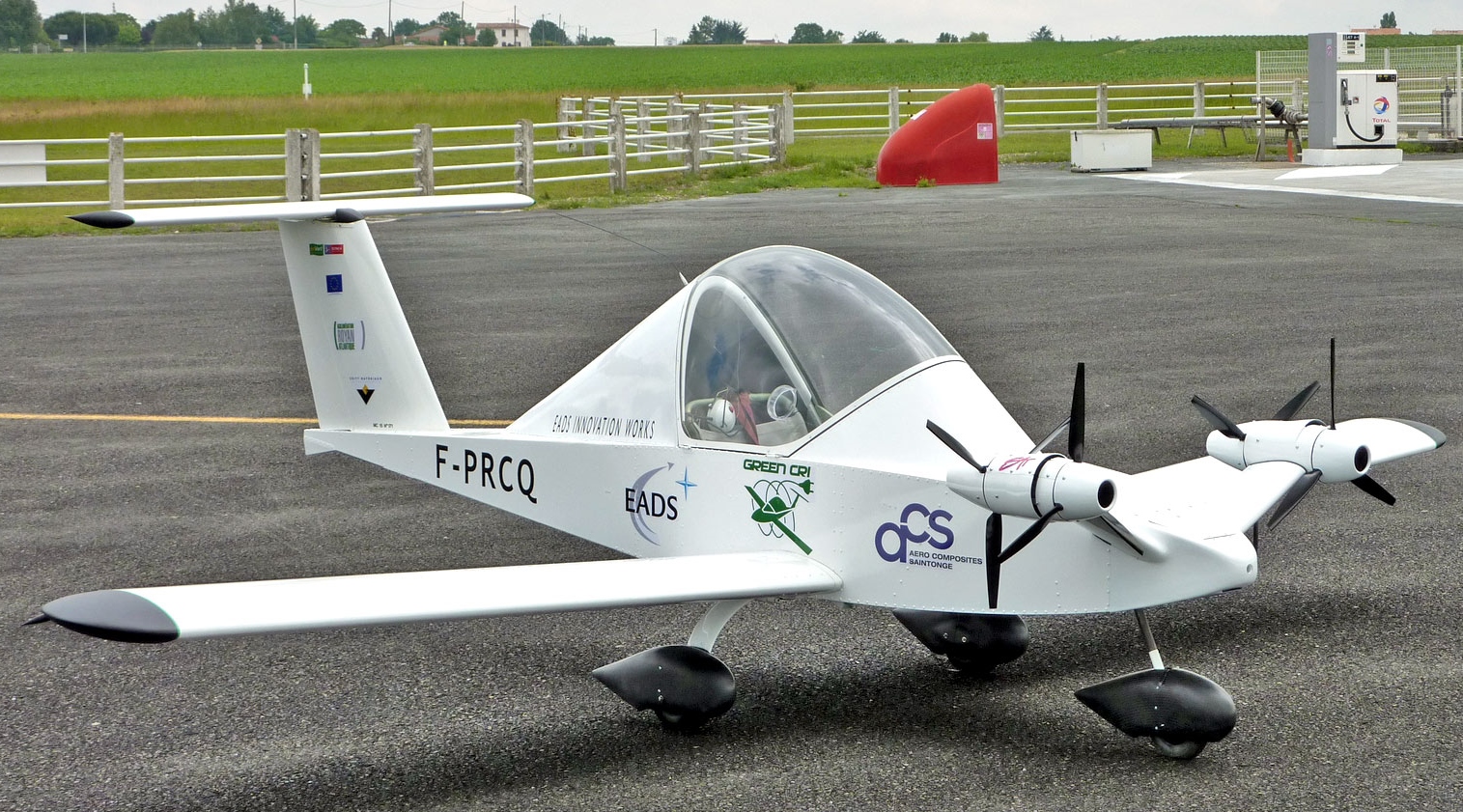 EADS (who build Airbus airliners) produced one with 4 electric motors.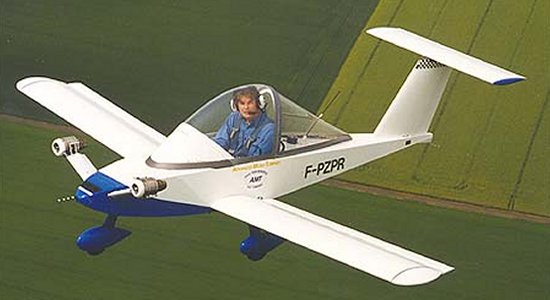
There are even turbine ones, I wonder if they are using model turbines?
It only takes a few hours to put the model together and I’m hoping to fly mine on 2nd August. It definitely needs a very large but very light pilot, perhaps I’ll attempt some foam carving…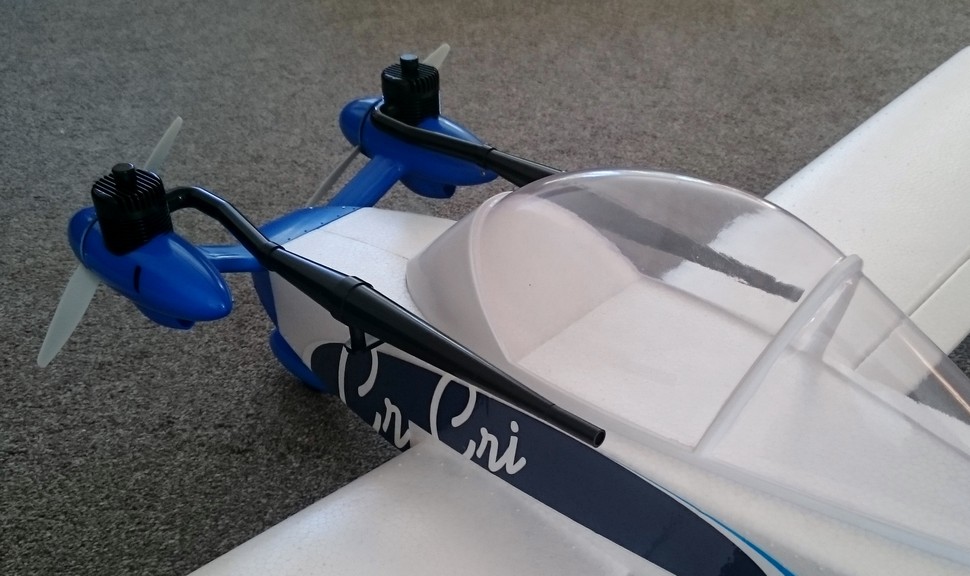 Like the full-size, the models appear to fly fast and as they only have tiny wheels and are fitted with spats take-off from our small grass patch may be a challenge. Hopefully it will slow up for landing, time will tell.
Q: What separates three whores from two alcoholics?
A: The cockpit door!
Colin Cowplain
Patch News – June 2015
This edition of Patch News is a little later than usual as I’ve been away for much of June. In fact I started writing this on 14th June in the hope that I can upload it to the website in the first week of July. I’m relying on others to provide information and photos for the second half of June; it will be good to see what I’ve missed.
I’ll start with the CAP 20L of John Warren. John built the CAP a few months ago from a Peter Miller plan in RCM&E and converted it to electric power. It flew very nicely and looked ok but I remarked at the time that having proved it flew well John needed to add some trim to make it more scale and even prettier. Well now he has. 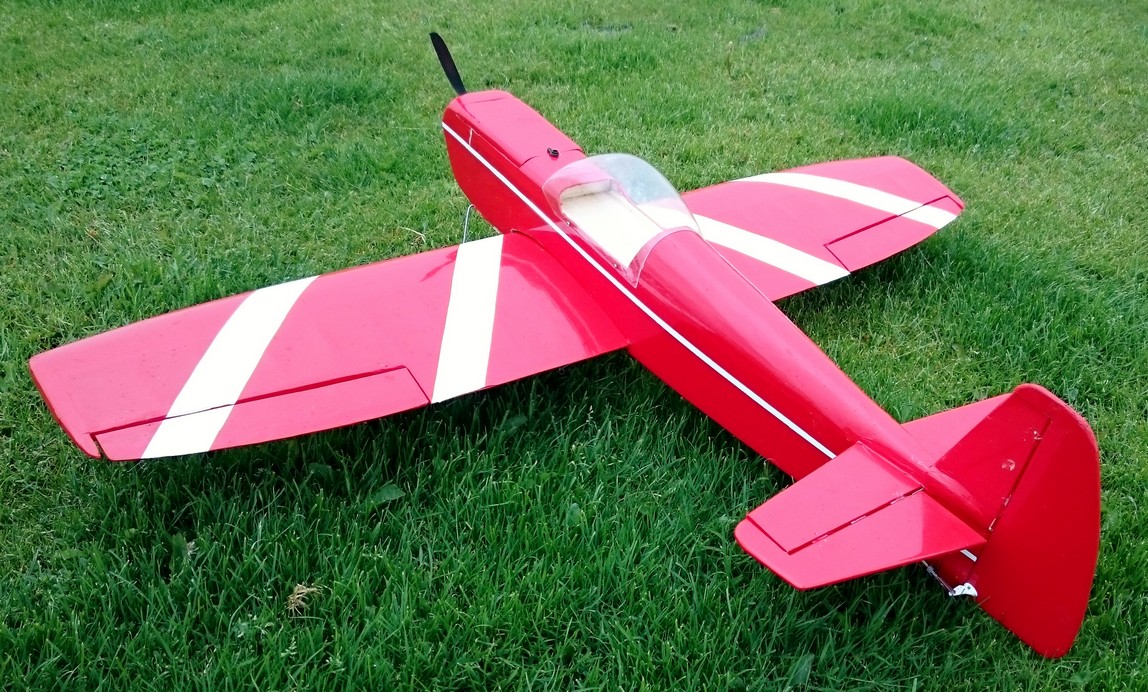 Just the addition of some fairly straightforward stripes to the wings and a trim strip along the fuselage has made a huge difference and really brought the model alive.
 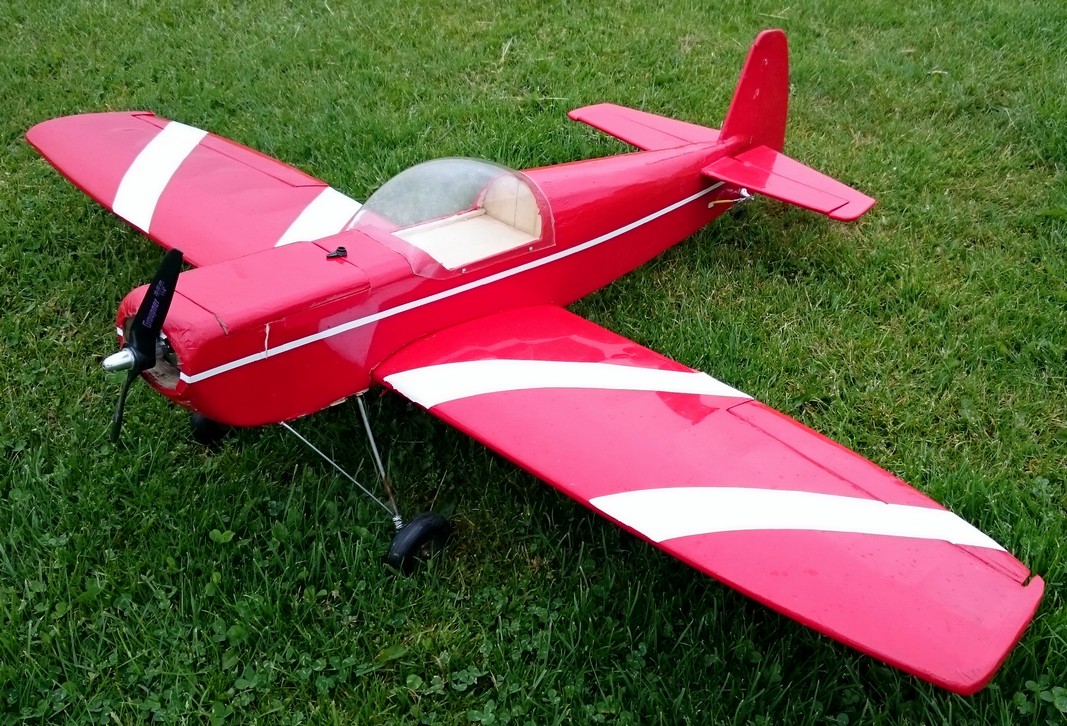 Unfortunately shortly after I took the photos John managed to break it! But have no fear, I’m sure it will soon all be repaired and flying again.
On the subject of repairs, you may remember that I bemoaned the Almost Ready To Fail undercarriage mountings found on many of the ARTFs nowadays, in particular the UglyStik from HobbyKing, one of which I own. It’s a great flier and, for a foamie, it’s a pretty good replica of the original balsa and ply model design that first appeared in the 70’s, even sporting a dummy I/C engine that hides the fact that it’s gone all modern and is electric powered. But the undercarriage mounting was just too weak and I managed to tear it out on our grass patch. Captain Slow was especially pleased to see me do it as I’d previously featured his own UglyStik with the undercarriage removed in the same manner. Anyway, the problem was quickly sorted with the addition of a much stronger ply plate to replace the plastic original and I found it could then withstand the rigours of multiple touch-and-go’s with ripping out again. But now I’ve found another problem. Having strengthened the undercarriage mounting hugely the stresses are transferred to the next weak area…and the whole nose comes off!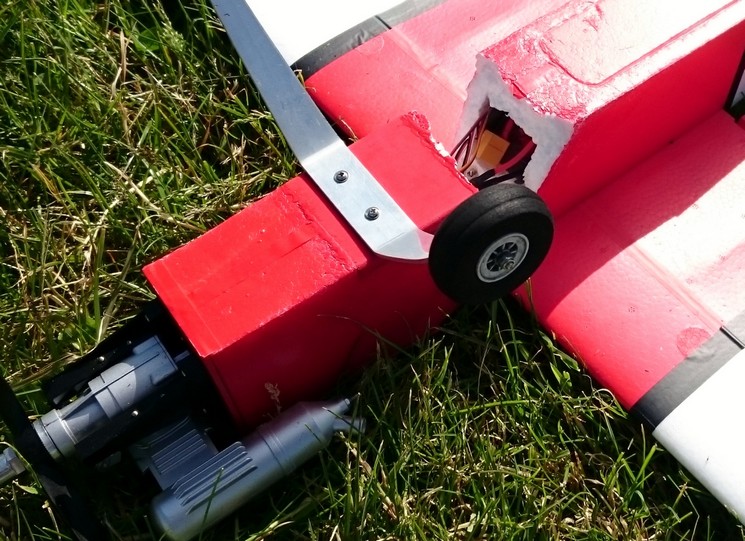 ‘It was a pretty gentle landing honest guv.’ So then I inset a strip of spruce on each side of the fuselage but on the very next flight I found that the spruce flexed enough to allow the foam the crack without breaking the spruce! Now I’ve added thin ply doublers to each side (inside) to spread the load and stop the flexing and so far they seem to have done the trick.
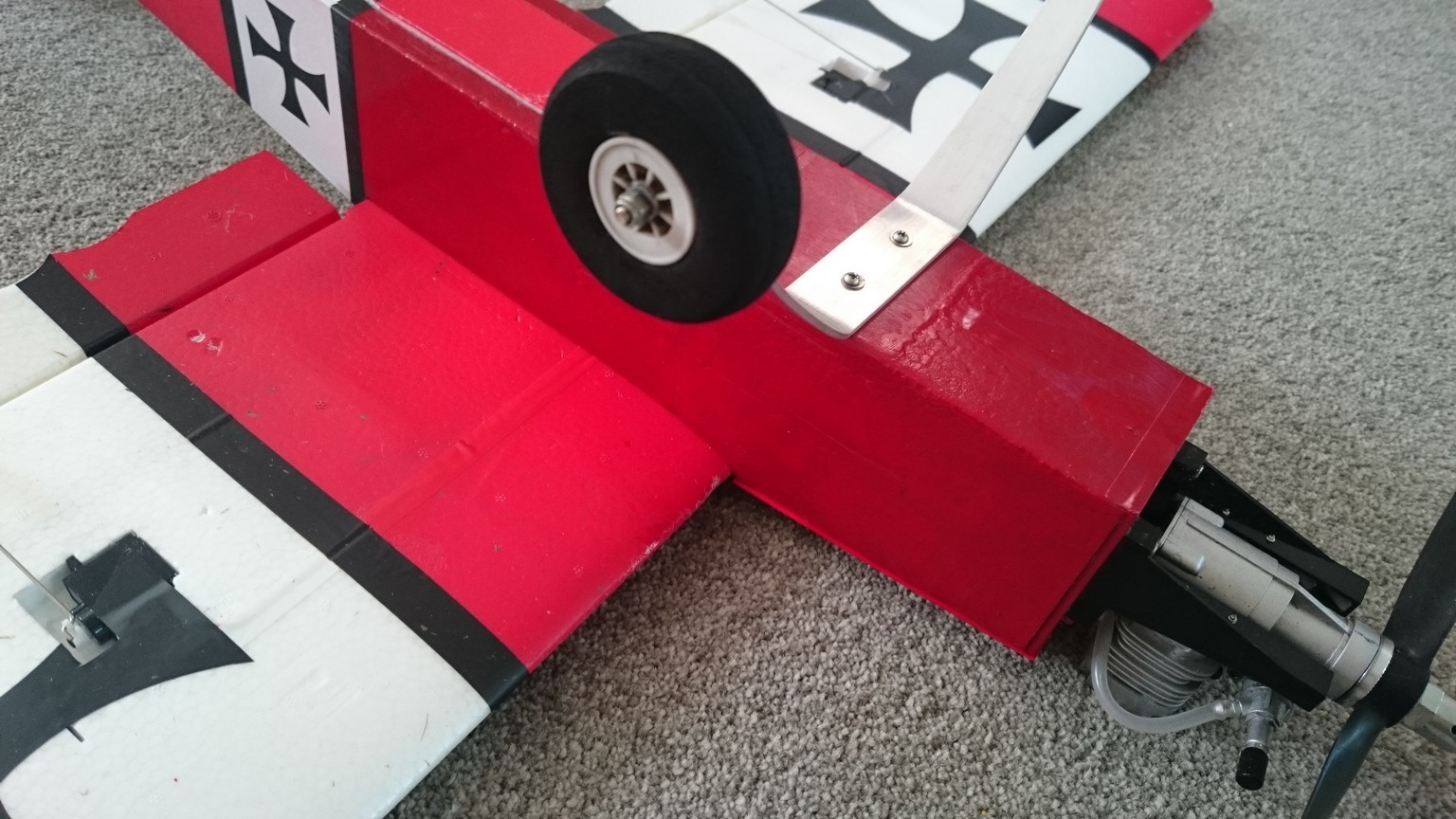 Fingers crossed, watch this space. Of course it wasn’t all bad news, all the nasty boys in the pits really enjoyed the sight of my poor Stik breaking its nose!
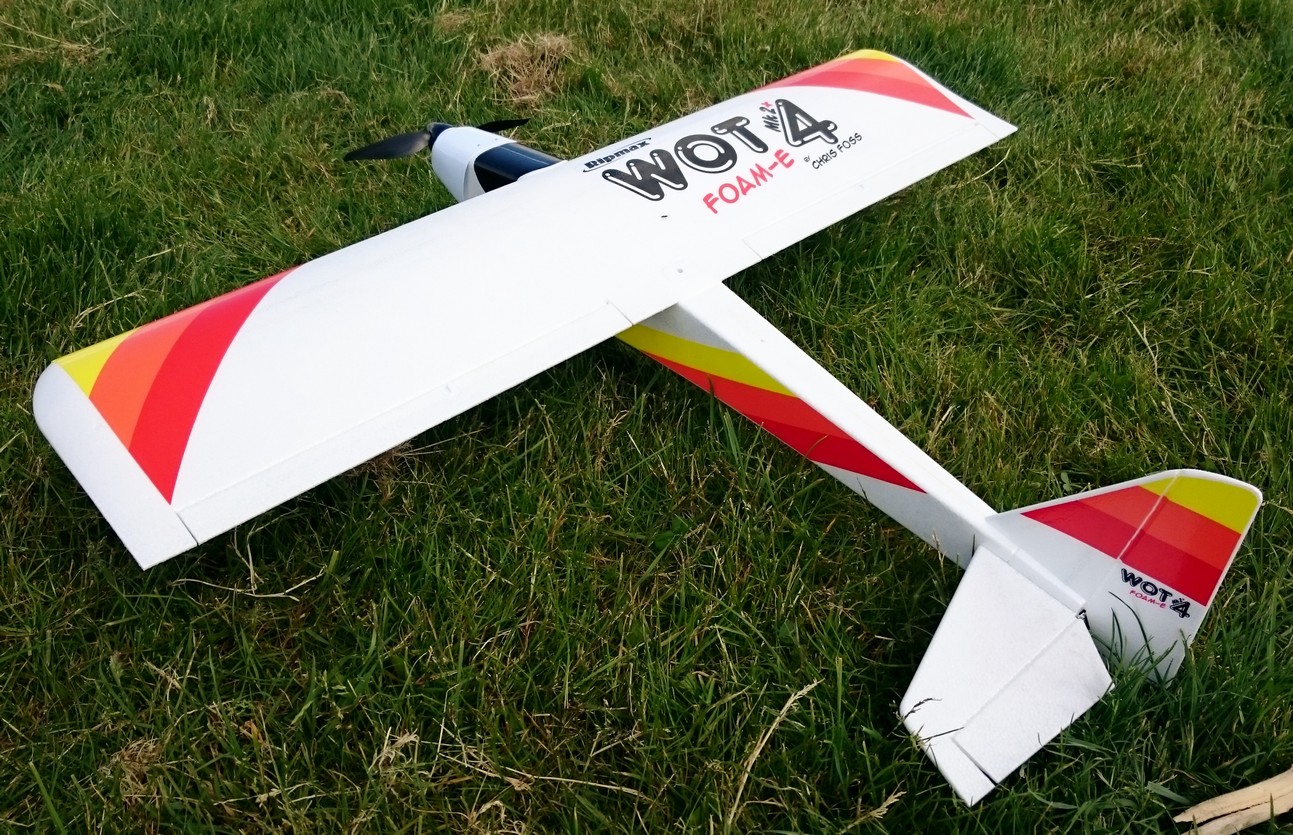
I reported last month that Tim ‘Modelling’ Clay had learnt to fly and passed his ‘A’ test in a remarkably short time, flying his ST Models Discovery. He has also been flying a Bixler 2 with great success and in June he added a Wot 4 Foam-E to his growing fleet.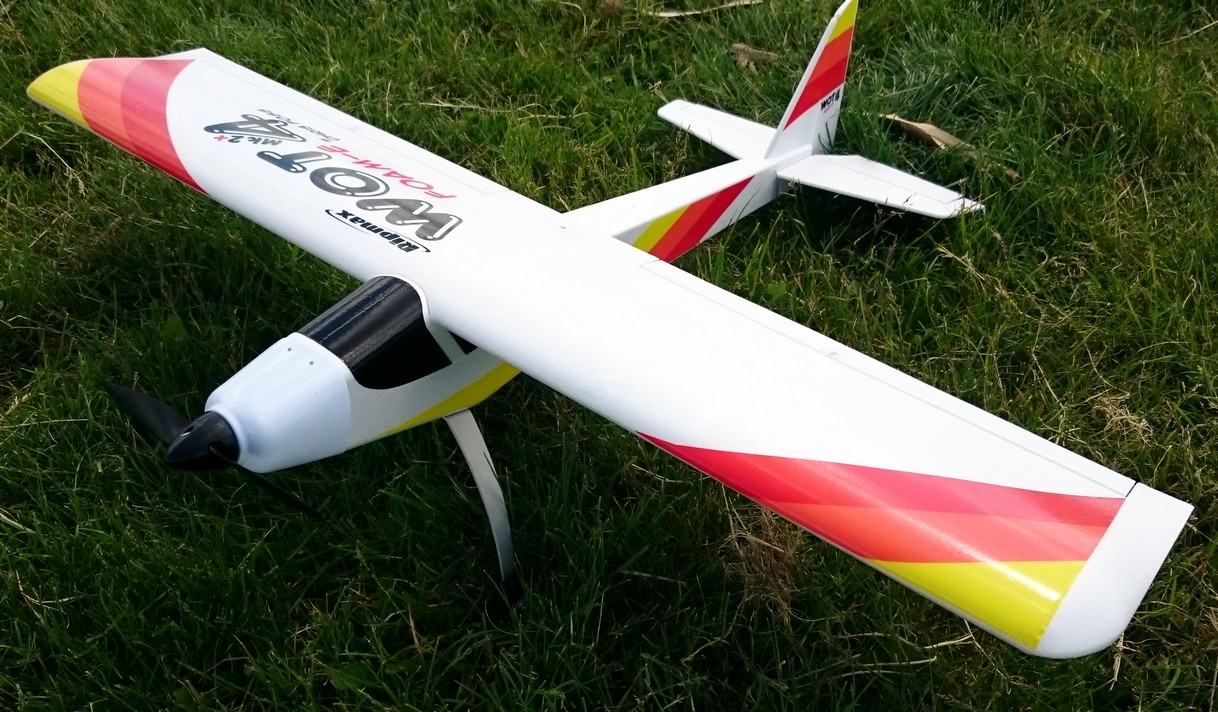 Steve 1066 did the first take-off and trimmed the model before handing the transmitter over to Modelling Clay who promptly demonstrated some very acceptable loops and rolls before performing a perfect landing smack in the middle of the patch.
 One of the older club members was heard muttering ‘I wish he’d hurry up and break it so I can go home happy’! I would name the culprit but I don’t want to upset anyone…especially Bob Hill!
Dwayne Pipe (Keith) turned up at one of the rather windy midweek flying sessions with a new electric glider. It’s new to Dwayne, having previously been owned by ex-member Jim De’ath. Unfortunately Jim had to give up aeromodelling a few years ago when he had a health issue but he now attends an art group run by Dwayne. It’s a small world, nice to hear that Jim is enjoying a different hobby. The model is a Vega, designed by Neville Mattingly many moons ago, and was kitted under the Wonderwings name.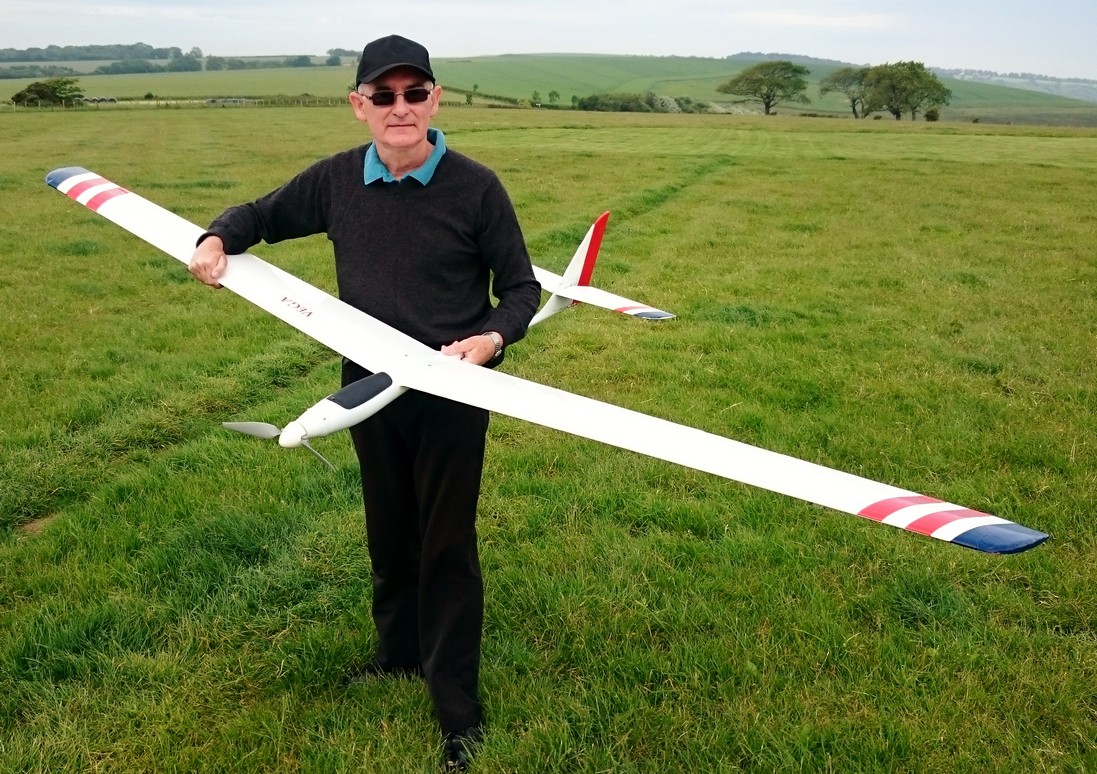 It has a GRP fuselage and, I think, veneered foam wings and Dwayne has fitted it with a modern electric outrunner and 3 cell lipo. As it’s a bit of an unknown we watch the first flight with some trepidation but all was well.
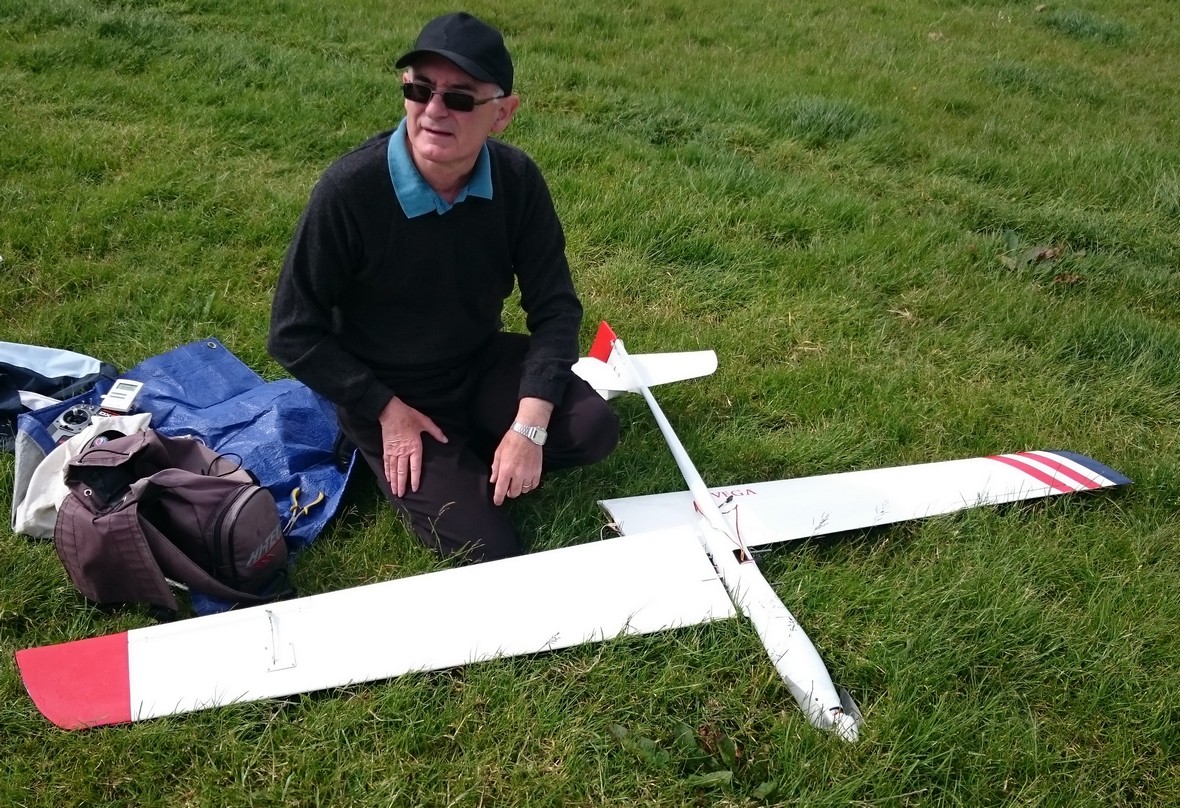 It has tiny ailerons and they didn’t seem very effective at all so Dwayne had to use lots of rudder as well, and the blustery conditions weren’t ideal for a test flight but after an anxious first minute or so Dwayne had largely tamed it and brought it back to a successful landing. I videoed the flight and some of it can be seen on the MONTHLY VIDEO
Desperate Dan flew a flying wing at the patch during June, a Tek Sumo. It’s fully equipped with FPV (First Person View) and a video camera and flew surprisingly well I thought.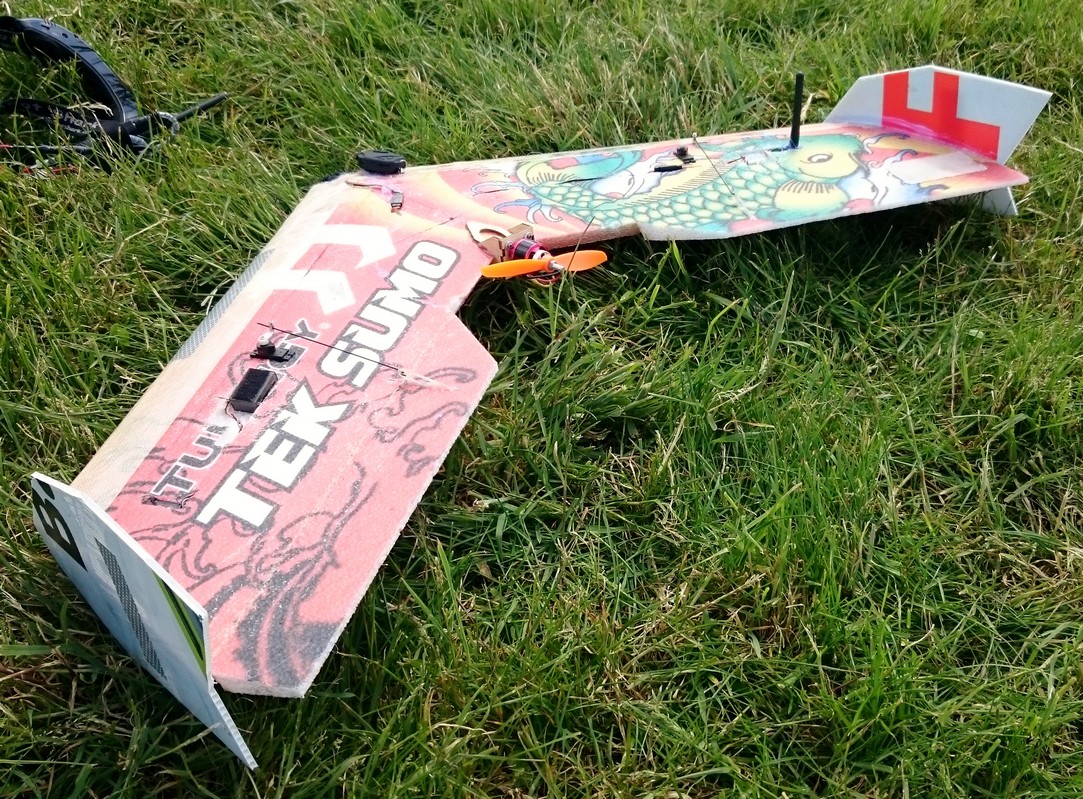 A pilot flying FPV must have a spotter who watches the model and advises the pilot if they’re getting too far away or close to objects etc and I helped Dan out for one flight. He is now well used to flying FPV, although mostly with drones, and he had no problems flying it around at all. A couple of times the watchers from the pits thought he got too close to the road and he was genuinely surprised by the comments as he was happy that he was well clear of it. I wonder if it’s down to the camera making everything look further away than it really is, it’s all down to field of view apparently. Anyway, after a few minutes Dan offered me a go.
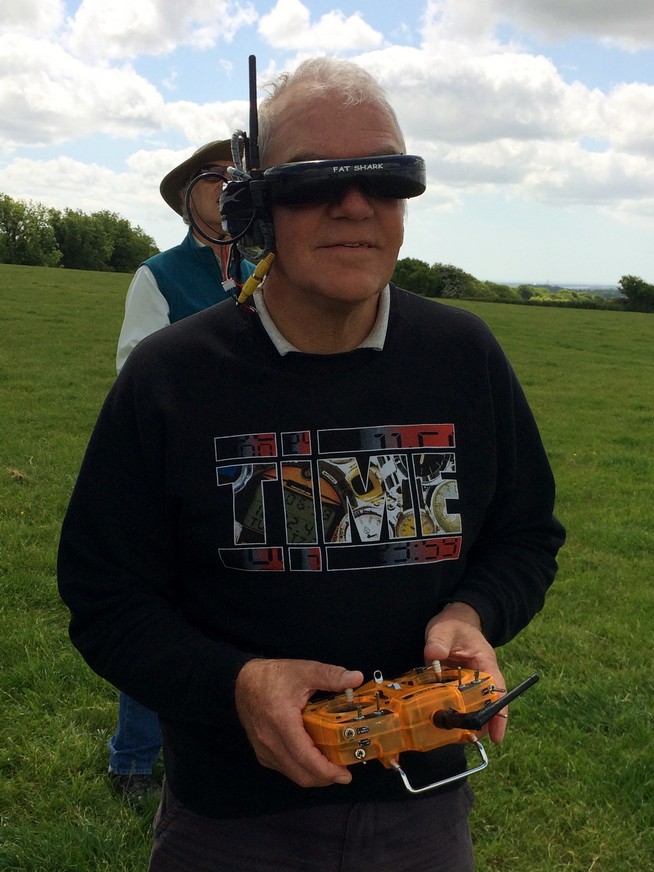 I somewhat reluctantly agreed, my previous attempt with one of Dan’s FPV planes didn’t end well although he assures me it was caused by a battery connection failure. The Tek Sumo was fine, easy to fly around and, once I’d settled down, reasonably easy to know where I was. It’s all very well being able to fly the plane around but to be aware of where it actually is in relation to the patch is a whole different thing, I suppose it comes with practice but I can certainly see why a spotter is essential.
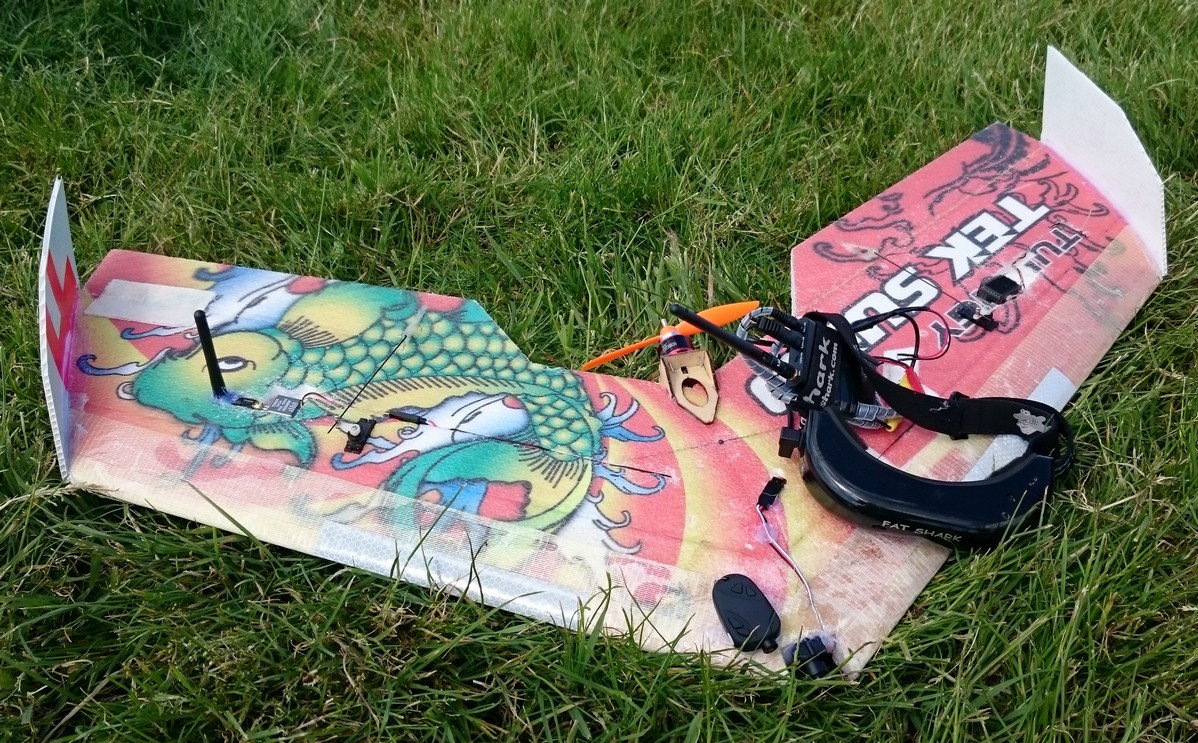 Dan says it’s easier if you fly lower but I was keeping fairly high just in case…! Dougal said he’d like to see the view through the goggles but he didn’t want to take control at the same time so I flew it ‘normally’ while he wore the goggles. He seemed quite impressed until I started doing aerobatics and made him feel sick! I can see why many FPV pilots sit on a chair while they fly. To see some of Dan’s flight watch the MONTHLY VIDEO
John McEvoy has been building a Smith Miniplane for a while and he’s now completed it. It’s built from the Sig Manufacturing kit and John has made an absolutely beautiful job of it, faultless.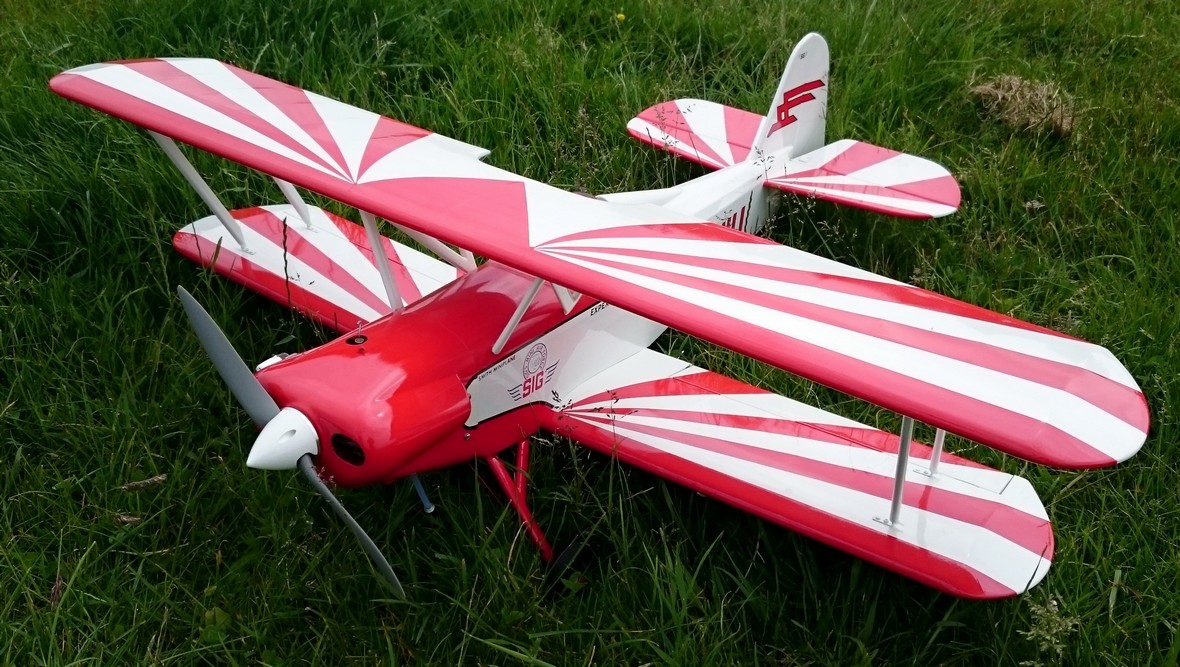 The original full-size Miniplane was designed and built in 1957 by Frank Smith of Fullerton, California, and was an early example of engineering with the amateur homebuilder and weekend pilot in mind. It could be constructed with tools easily within reach of the average craftsman, and in the air it was stable and easy to fly. The top wing spanned 17 feet, and the empty weight was a mere 600 pounds. Powered by a 100hp Lycoming, the tiny Miniplane cruised at 120 mph, climbed at a fantastic 2,500 ft. per minute, and was highly aerobatic. It was just what many sportsman pilots were looking for! In 1974, Glen Sigafoose, then President of Sig Mfg. Co., acquired a complete Smith Miniplane to use for aerobatic practice. Glen’s beautiful red, white, and black aircraft was the inspiration for Sig 44” span kit version of the Miniplane.
 John has fitted a Saito four stroke engine to his model, I think it’s the FA-62 but I could be wrong. That is 0.62 cu inch or 10cc, so quite a large motor for a 44” span bipe but I think John said it weighs nearly eight pounds so it’s no lightweight. John brought the model up to the patch unexpectedly and we didn’t have either of the noise meters available but it didn’t seem too loud so we allowed a couple of test flights. But it will have to pass the 82dB sound test before flying again. I did the test flight and it flew as well as it looks, lovely, no vices, gentle stall, and very aerobatic.
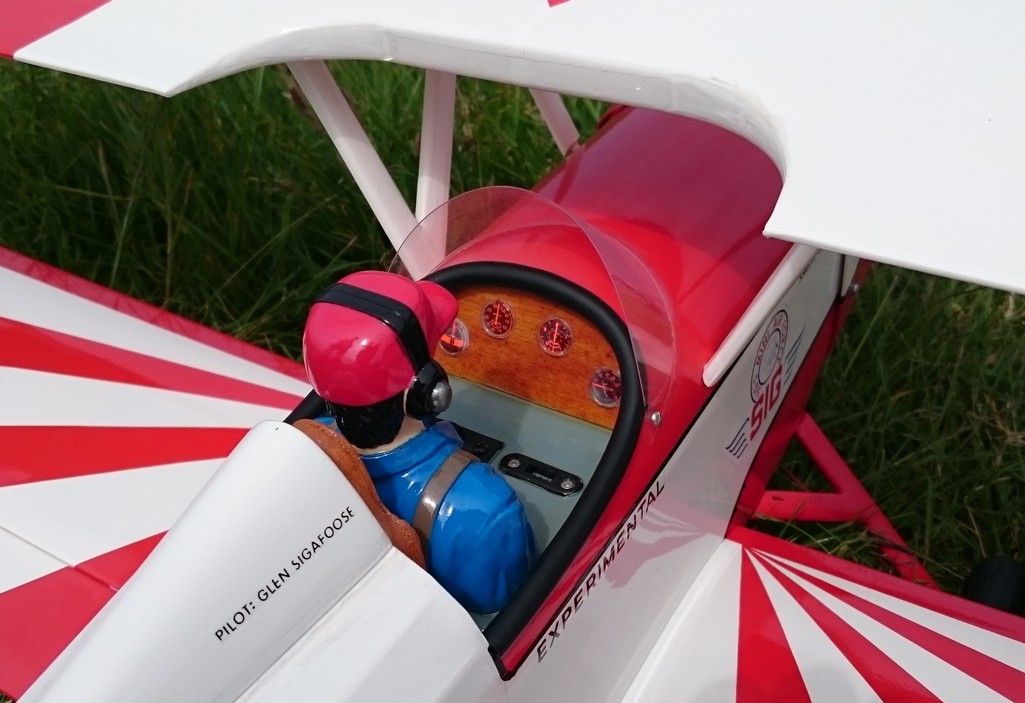 John did the second take-off with no problems and then flew around very happily and performed the usual loops and rolls etc. The engine tick-over speed was a little high so the model wouldn’t slow up quite enough on the approach so both landings ran into the long grass but with no damage. So now there are just two things that must be sorted, the noise test (which I doubt will be a problem), and John must take his ‘A’ certificate. It’s ridiculous, John is perfectly capable of passing the test, he flies better than many of the new members that have passed the test as part of their learning process. Come on John, it’s unfair to all the others that have made the effort, unfair to the qualified pilot that has to stand next to you, and it’s breaking club rules, so TAKE THE TEST! To see some video of John flying the Miniplane watch the MONTHLY VIDEO
Dougal Entendre has been good enough to send some info and photos of things I missed in the second half of the month; first of all, 1066 Hastings has at last realised his limitations and has gone back to flying a trainer, a Wot 4.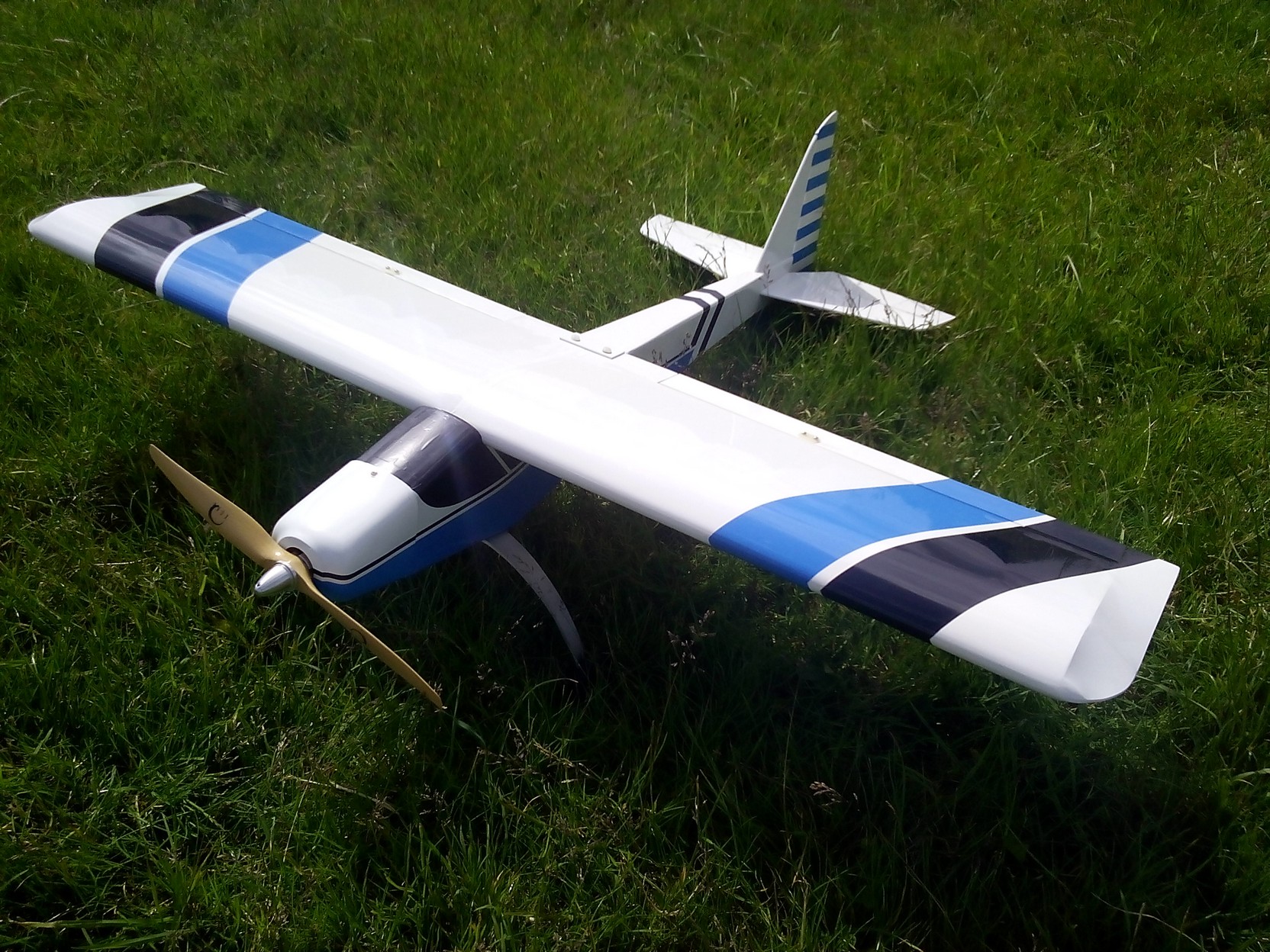 Well ok, that may not strictly be true, it’s not a Wot 4 it’s a HobbyKing Apprentice 64E Intermediate Trainer. He won it in the club raffle (that he runs buts I’m inferring nothing…). Apparently the CG was too far back initially so Steve had to add a fair bit of lead to the nose, and he then felt it was a bit underpowered with the stock set-up so is planning to try a larger propeller. If that doesn’t work he’ll switch to a larger motor.
Chris Hard has emerged from his winter hibernation and flew one of his flying wings, this one is a Ripmax Wild Wing, and he’s using a 3S 2350mah lipo, 150Watt 1700KV outrunner, 6 x 5.5 prop.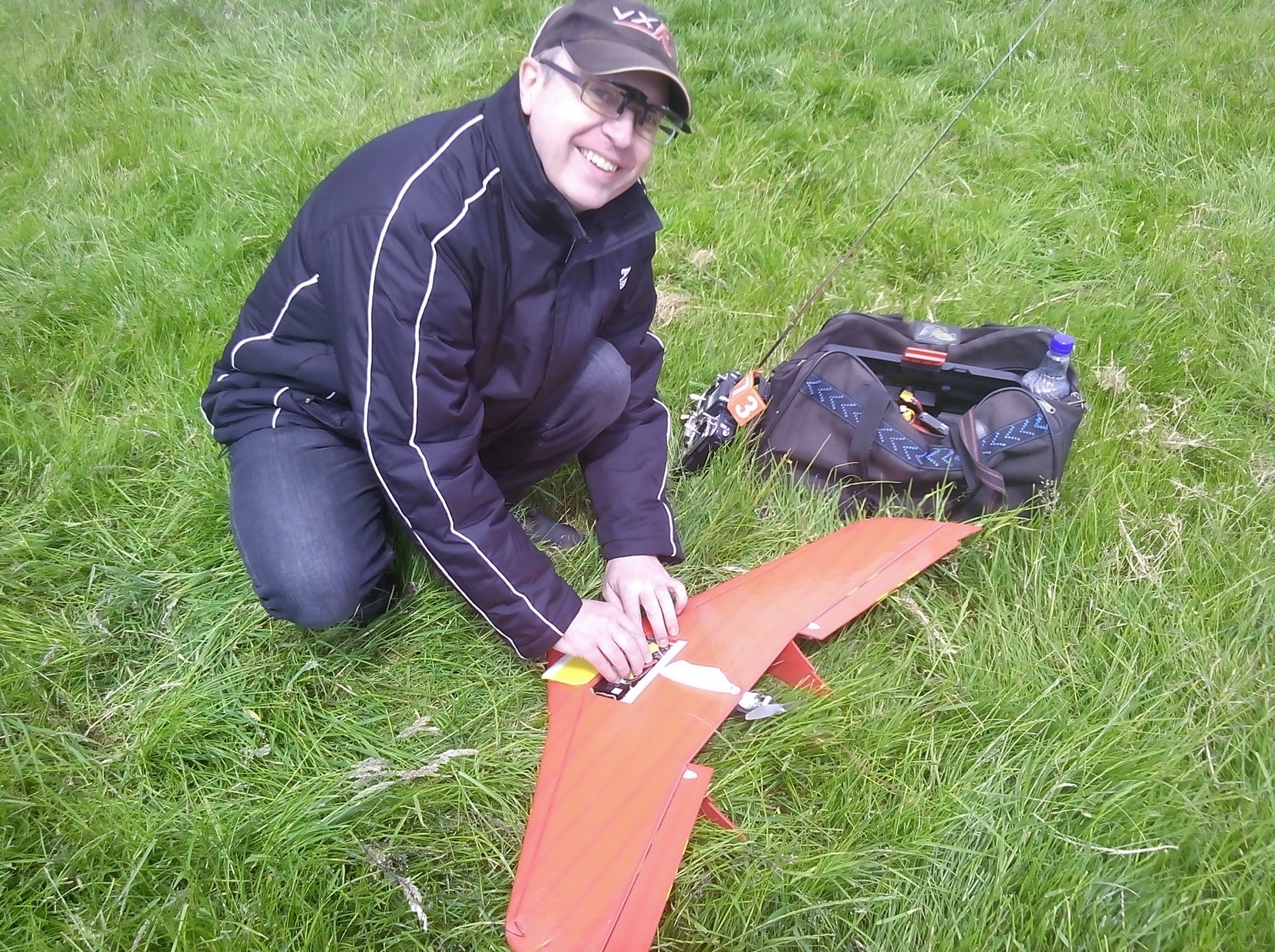 Look at that transmitter, a great long aerial with frequency number on it, must be 35 MHz, how quaint, I remember those! Seriously though, there’s nothing wrong with 35 MHz as long as you can get around possible interference that can cause glitches when using electric power.
Dwayne Pipe sent me the following: Spektrum DSM2 alert
An article in the June RCME by Simon Cocker made me aware of a couple of issues of the much maligned Spektrum DSM2 system used by a lot of club members. They may also apply to other receiver systems as well so don’t get smug because you fly something else. It may also account for some of the unexplained crashes we get.
The first is that the 2.4GHz system uses a line of sight signal so that if the plane can’t see the transmitter because its flown behind dense tree cover, or into the valley of death, or someone has walked in front of the transmitter, you lose the connection to the plane and the controls on the plane go to failsafe until the line of sight is restored.
The second is more dangerous and involves the receivers’ failsafe settings in the event of power failure. The receiver needs to see a clean start up at the right voltage when the power is connected. If the receiver power is interrupted due to dodgy connections or shaky hands while connecting the battery, the receiver will be only partially bound. That means that the range of the receiver is limited making it much easier for the plane to fly out of range and control. It will pass all the ground checks and you will only notice the problem in flight. The Spektrum receivers are fitted with led’s which are a continuous red when correctly bound and flash if partially bound. The solution to this problem is to arrange your Spektrum receivers so that you can positively see that the led’s are continuous red after you have connected the battery and before you fly. Thanks for that Keith, important information.
Early in the month there were five Spirits at the patch so, with agreement of the committee members that were present, we flew all five together.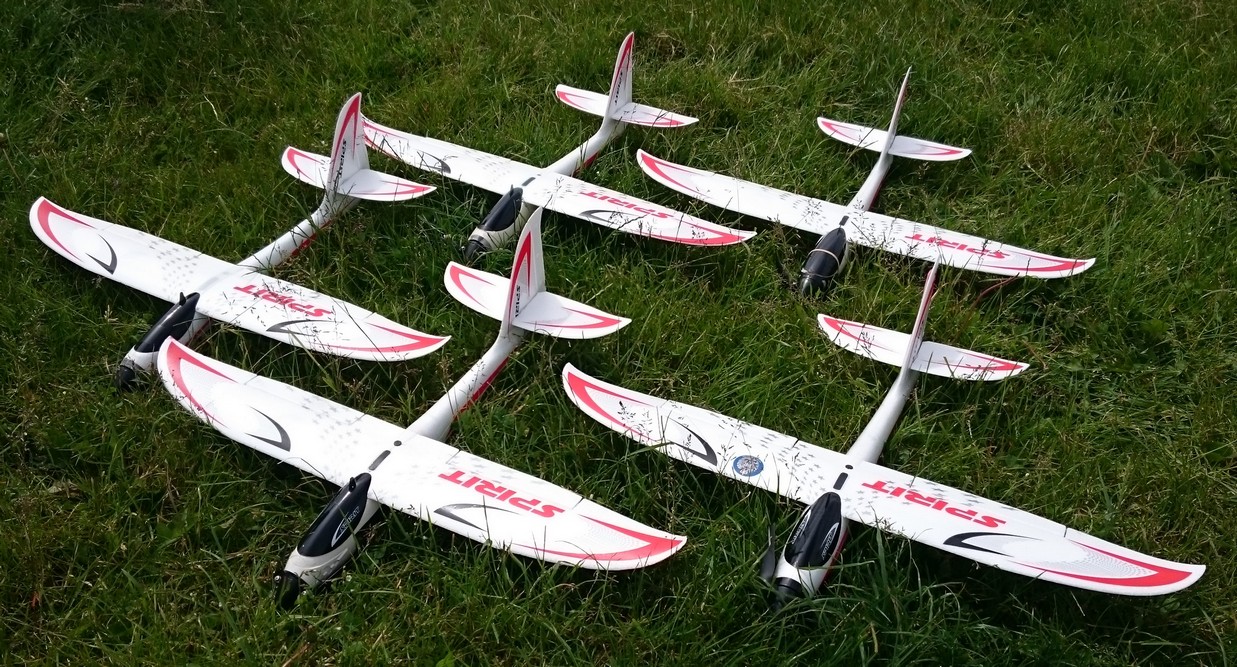 Lots of fun, quite a sight, and no issues! There was good thermal lift on 21st June and when Captain Slow and Dougal flew their Spirits they went for duration, with Dougal landing at 20 minutes 31 seconds from a 6 minute motor run, and with 47% capacity remaining in the 1500mAh pack. Not bad for a cheap foamie!
 One evening whilst in South Wales I had a couple of flights with my Spirit on Swansea beach.
Captain Slow turned up with an old Ripmax Coyote, which he had previously flown as a sloper, but had now electrified.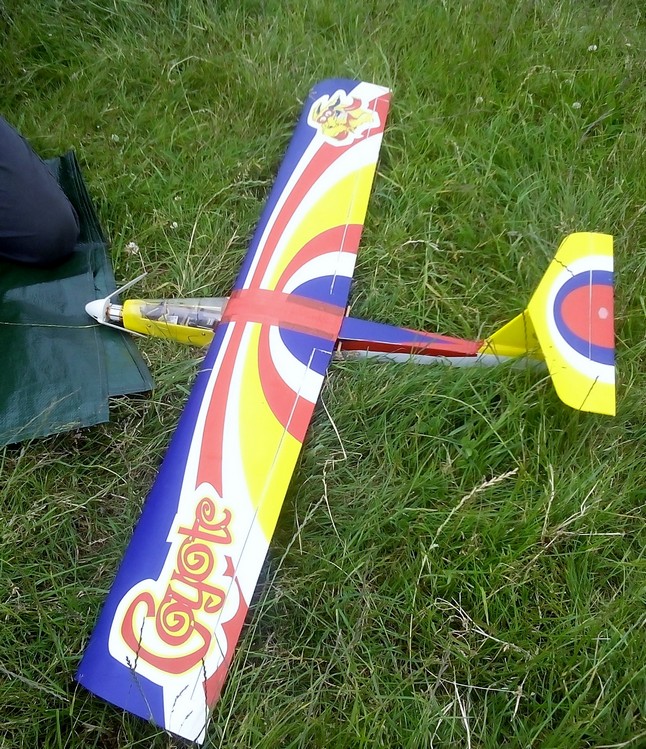 The canopy is part of an old Coke bottle due to a previous incident. It was a real handful on the first flight due to a rearward CG, but he moved the batteries forward and transformed it into a much gentler beast for the second flight. It looks as if it has a very short moment arm so I can imagine the CG would be quite critical.
This month, instead of my usual joke I’m using a cartoon that Dougal found in a BARCS newsletter from the mid-1980s.
Colin Cowplain
Patch News – May 2015
Time flies and already it’s nearly June so time to report on May. The May weather was a bit of a let-down after some of the lovely weather we had in April, rather wet and fairly windy, although there were some decent flying days as well. Fortunately it was good for our annual pilgrimage to the Blackbushe Model Show.
Incidentally, I will be away quite a lot in June so all reports/photos/videos will be extra welcome, thanks.
I was in Spain for a week in May but I did manage one flying shot.

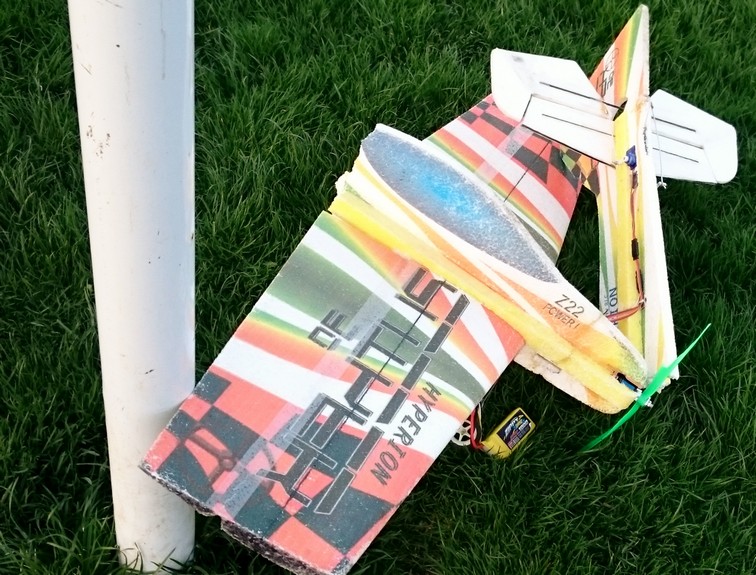
To start off, I must include a couple of things that I forgot in April. The first one wasn’t actually at the patch; it was before the start of one of our club meetings at Buriton. Steve 1066 decided that a bit of limbo between the goal posts was a good idea…it wasn’t, those steel goal posts are very hard!
Secondly, I had forgotten to take a photo of Richard King after he had taken his ‘A’ test. Well here he is, looking suitably pleased with his achievement, well done Richard.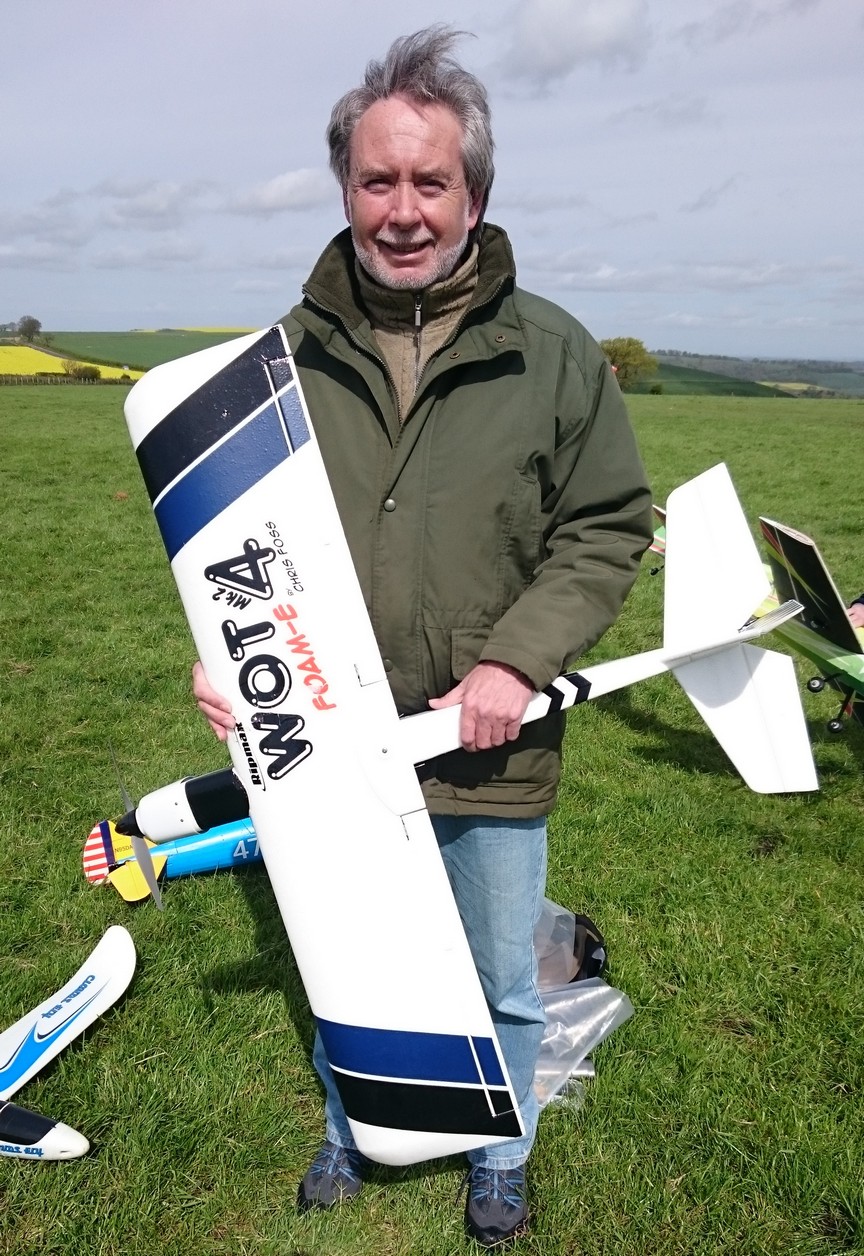 He doesn’t have a nickname yet, somehow Dick King doesn’t seem quite right…any ideas?
I must thank Richard for taking most of the video in this month’s video, everything before 1066 with his DLG was filmed by Richard, to watch it click on MONTHLY VIDEO and you’ll see Dougal’s Spitfire & Laius, Mike Smith’s Squall, Nigel Baker’s Wots Wot, Steve H’s Apollo DLG, and a couple of snippets from Blackbushe.
Last month I related the sorry tale of the first flight on newbie Tim Clay’s ST Discovery. If you remember it crashed before he even got to touch the transmitter, some sort of record I think! But now both the Discovery and Tim are flying really well, Tim has completed many flights totally by himself, including the take-offs and landings, with just the odd word of advice and guidance from whichever ‘expert’ has been with him. He managed a bit of a cartwheel on one landing which caused minor damage but that was soon sorted.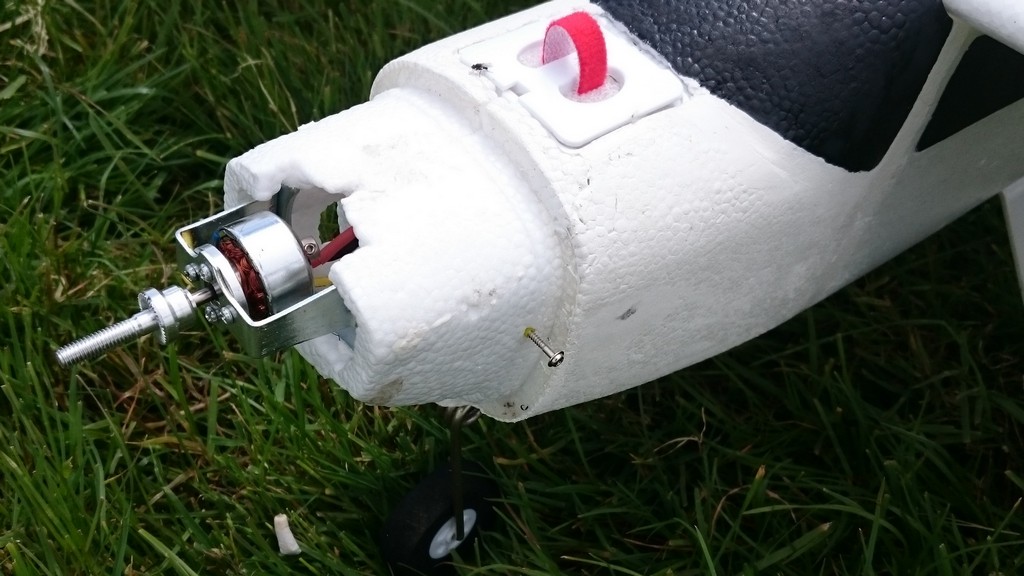 I’m sure Tim will be taking his ‘A’ test in the next couple of weeks.
Tim has also been flying his second model, a HobbyKing Bixler 2.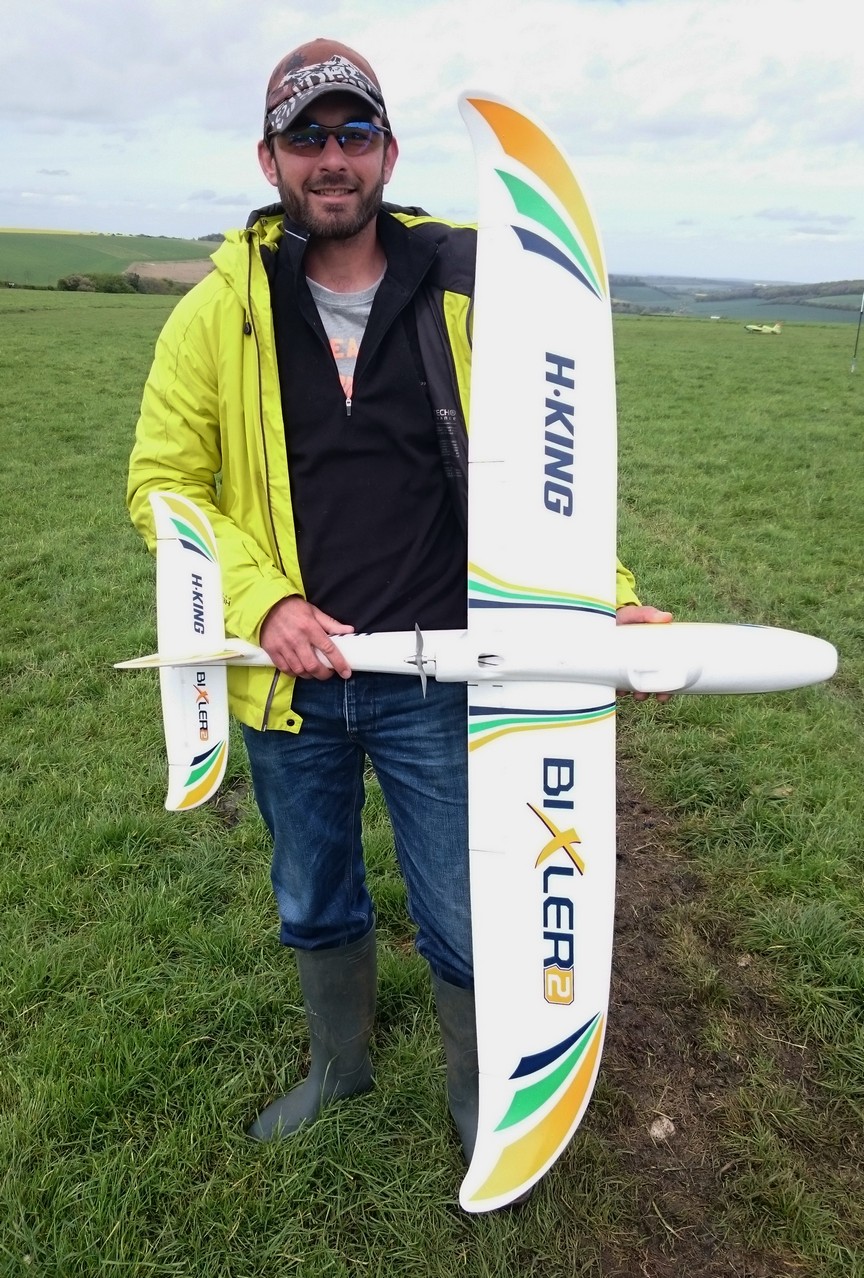 I have to say the Bixler seems an excellent model, flies really well, stable, but also aerobatic when required, I can see why they are so popular.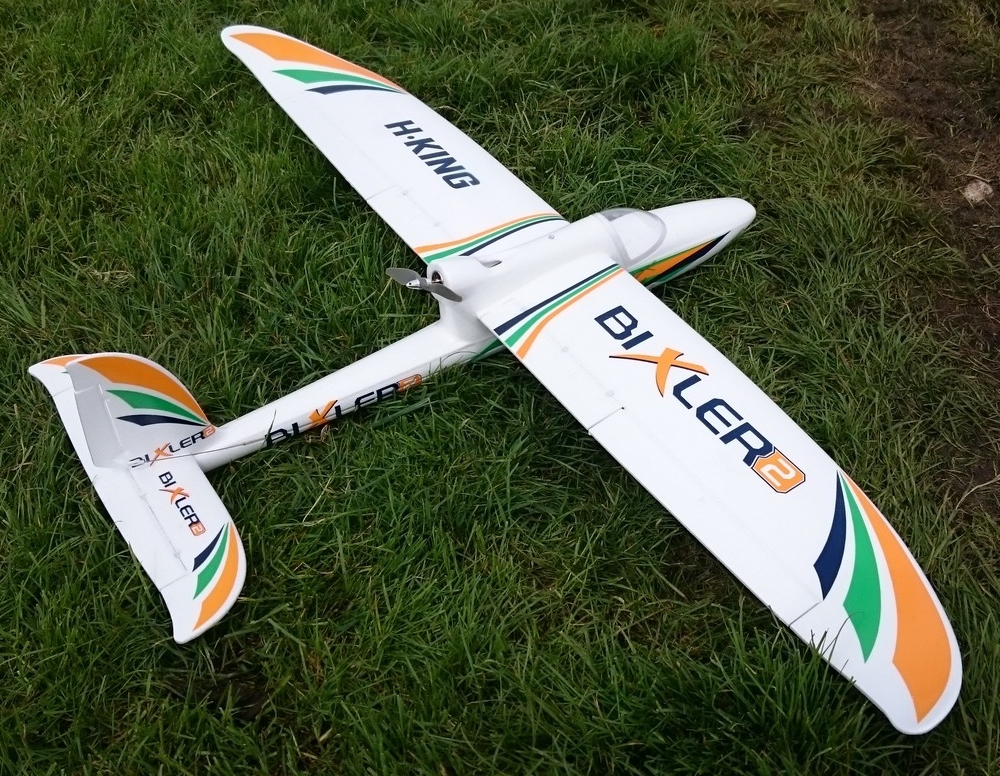
I mentioned Blackbushe earlier, this year it was on 16th May. I won’t say too much about it as I think DoughBoy (treasurer Nick Squire) is going to write a proper report with lots of quality photos.
Unlike last year (which became known as Crashbushe) there was no carnage, in fact I didn’t see a single crash all day. It seemed as if half the club was there to see some great flying, helped no doubt by the presence of Ali Machinchy, and some superb models.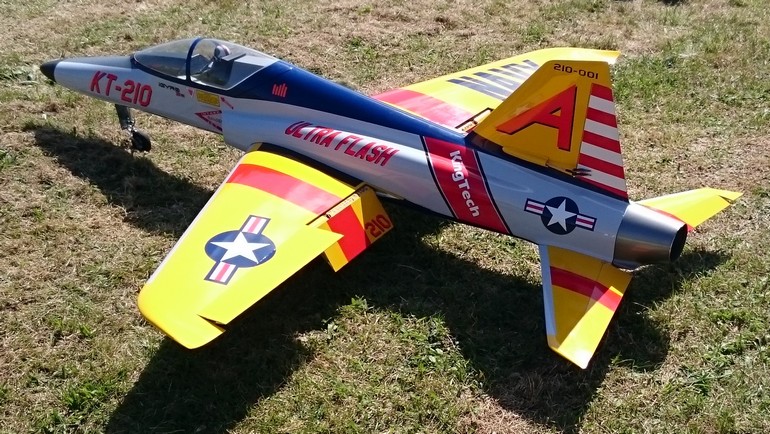 Viv (Stanley Knife) said he would like to have seen more ‘club’ style models such as Acro-Wots and such like and I think he has a point; virtually everything flying was a ‘show’ model rather than the sort of stuff we fly week in week out. And Chairman Ron pointed out that there weren’t many warbirds this year, although there was a Battle of Britain Memorial Flight trio of a Lanc, Spit, and Hurricane. There were loads of jets, turbines are becoming increasingly common these days, lower costs and simplicity of operation are big factors I imagine.
This year the show was opened by Steve Holland flying a 66% scale, 4 metre span Aerokot, the full-size itself being a home-built modelled on a Bucker Jungmeister.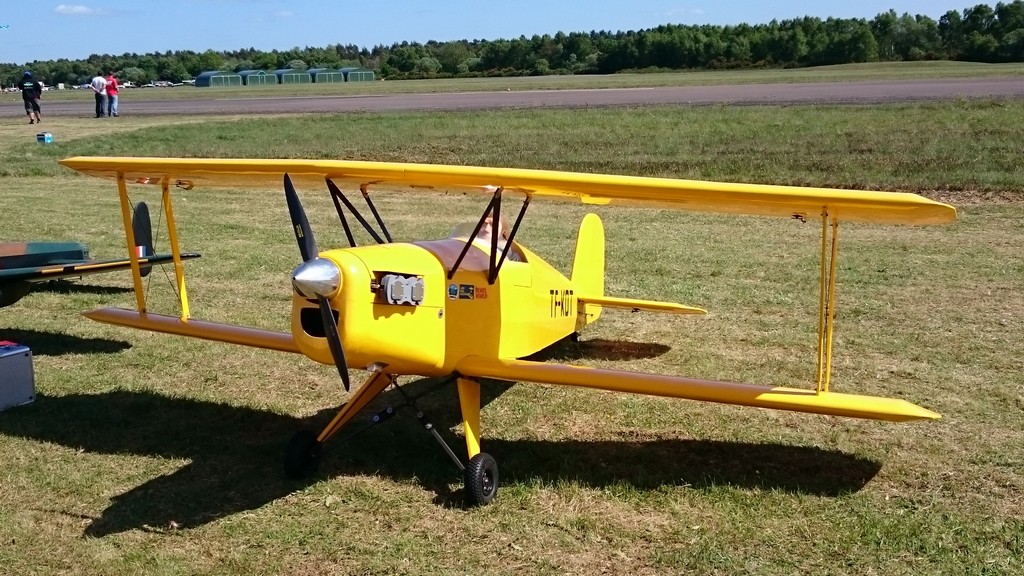 It is powered by a DA150 petrol engine and Steve used his expertise to show it off very well I thought.
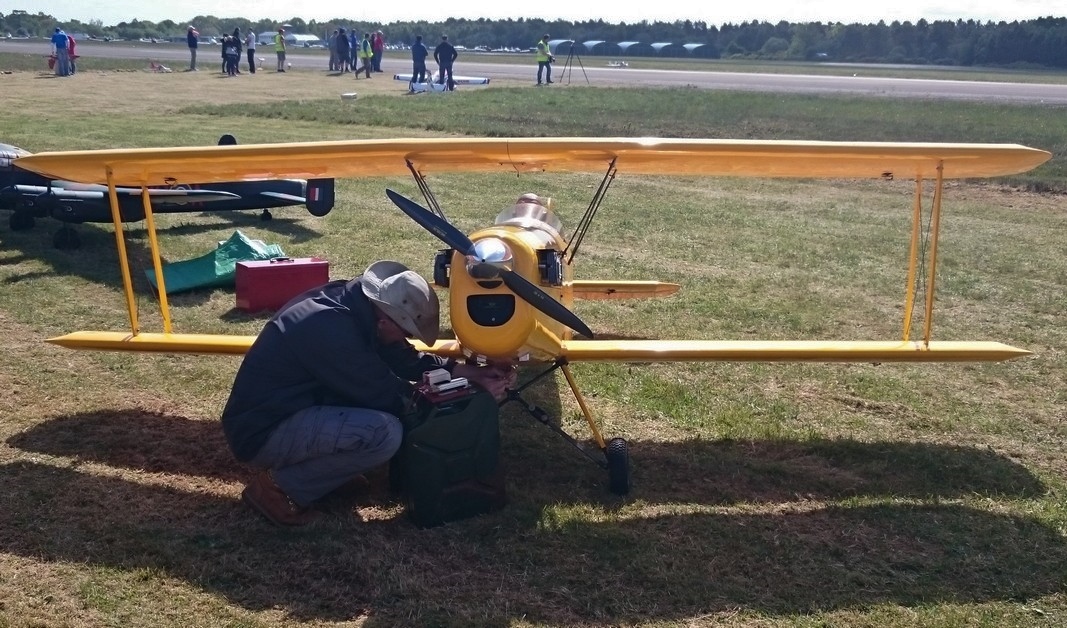 But I wouldn’t want to pay the fuel bill!
The Bishops father and son team were flying new models this year, Krill Avanti S’s with Jet Italia turbines. They hadn’t flown the models together before Blackbushe and understandably they weren’t as good in formation as we are used to seeing with their Red Arrows Hawks but by their third flight of the day there was a noticeable improvement.
 But what made them stand out was the thrust vectoring fitted to the models which enabled them to prop hang (?), amazing to watch, especially when they turned the smoke on!
There was another jet duo; Simon Potter and Paul Camilleri, flying 2.5 metre span Tomahawk Futura jets.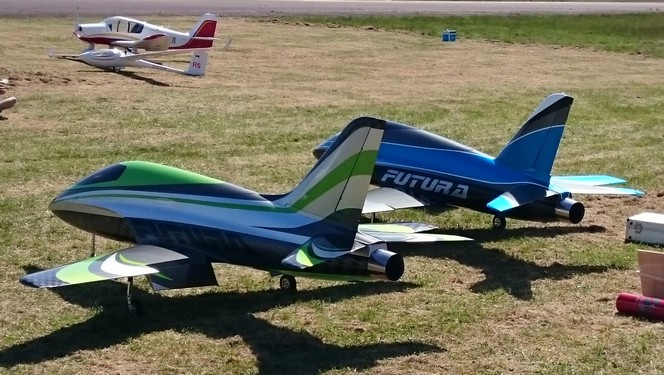 They were also very good, one of them doing a pass so low I don’t think there would have been room to lower the wheels…seriously!
When the commentator said that Ali was flying with Spektrum radio in his jet DoughBoy and 1066 laughed but Tim fell to his knees in prayer!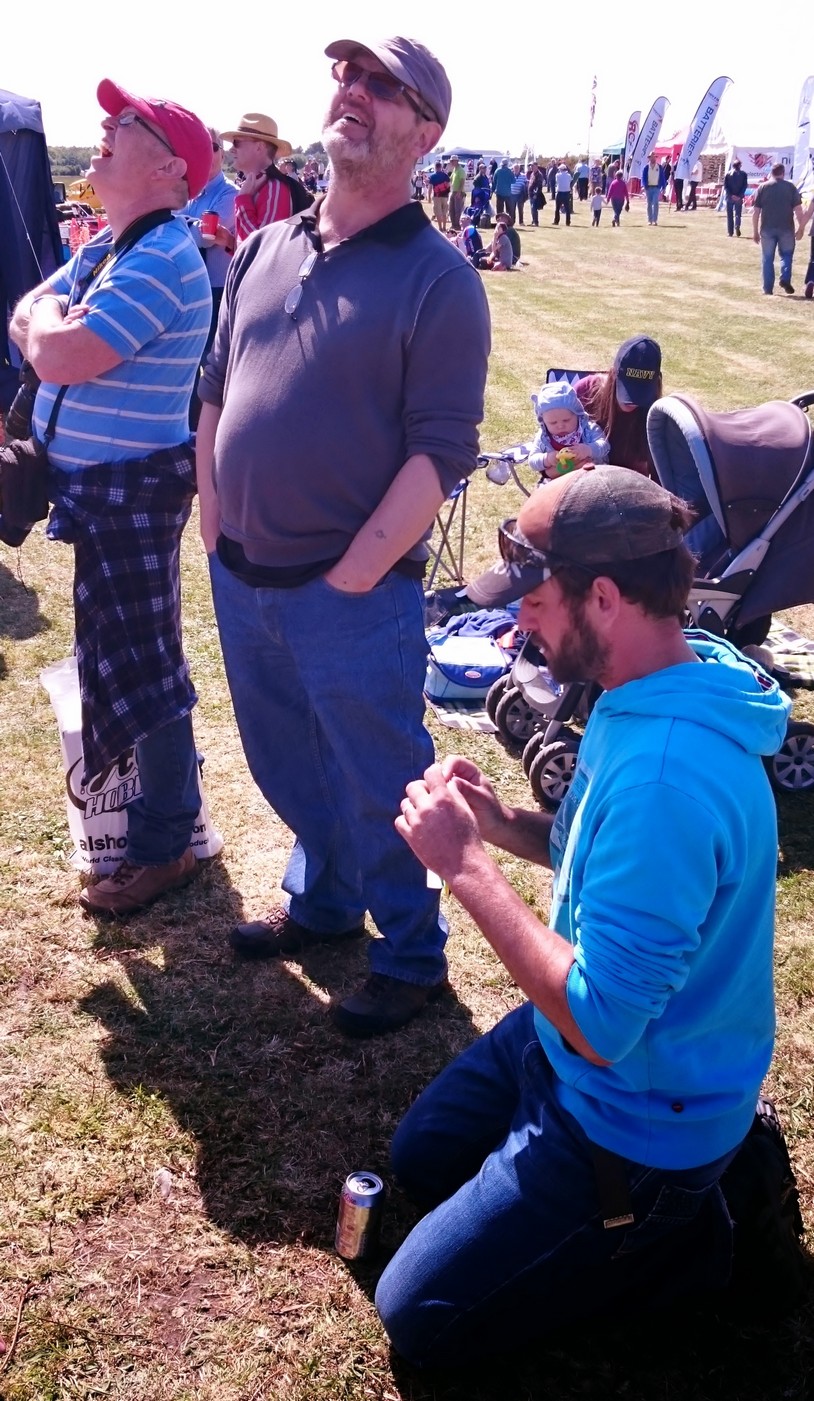
Fortunately there weren’t many helicopter slots, something for which us fixed wing pilots were grateful, they are just boring to us I’m afraid, a real yawn. Gentleman Jim obviously thought so anyway!
Captain Altitude (Woody) splashed his cash on a new Spektrum DX6 to replace his DX6i that is playing up. He’s pictured here testing it out at our field the next day.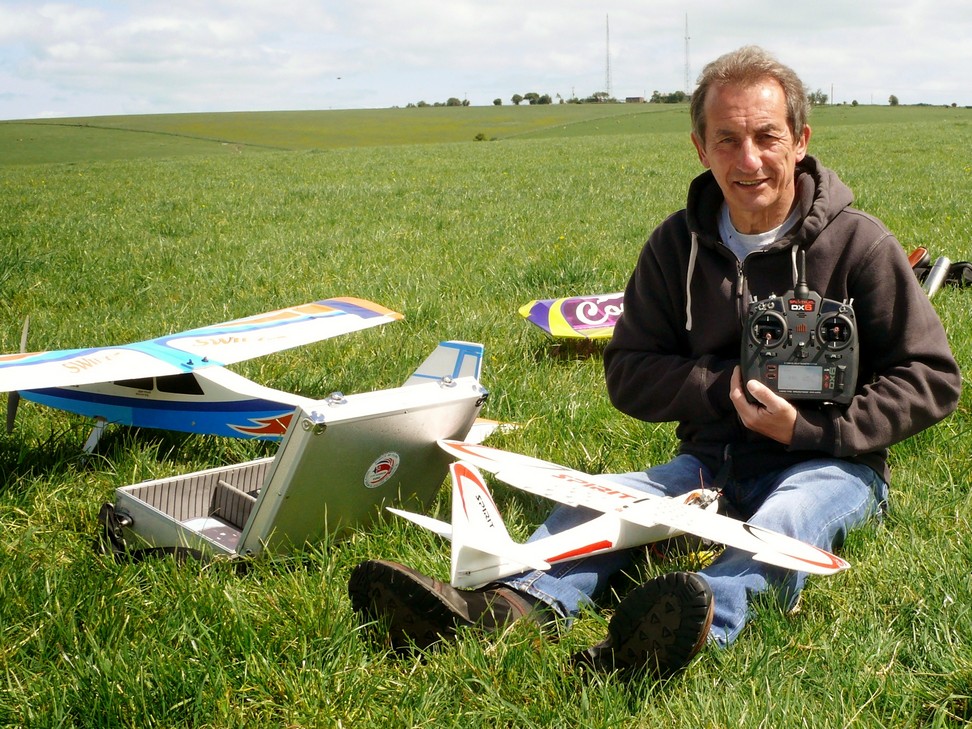
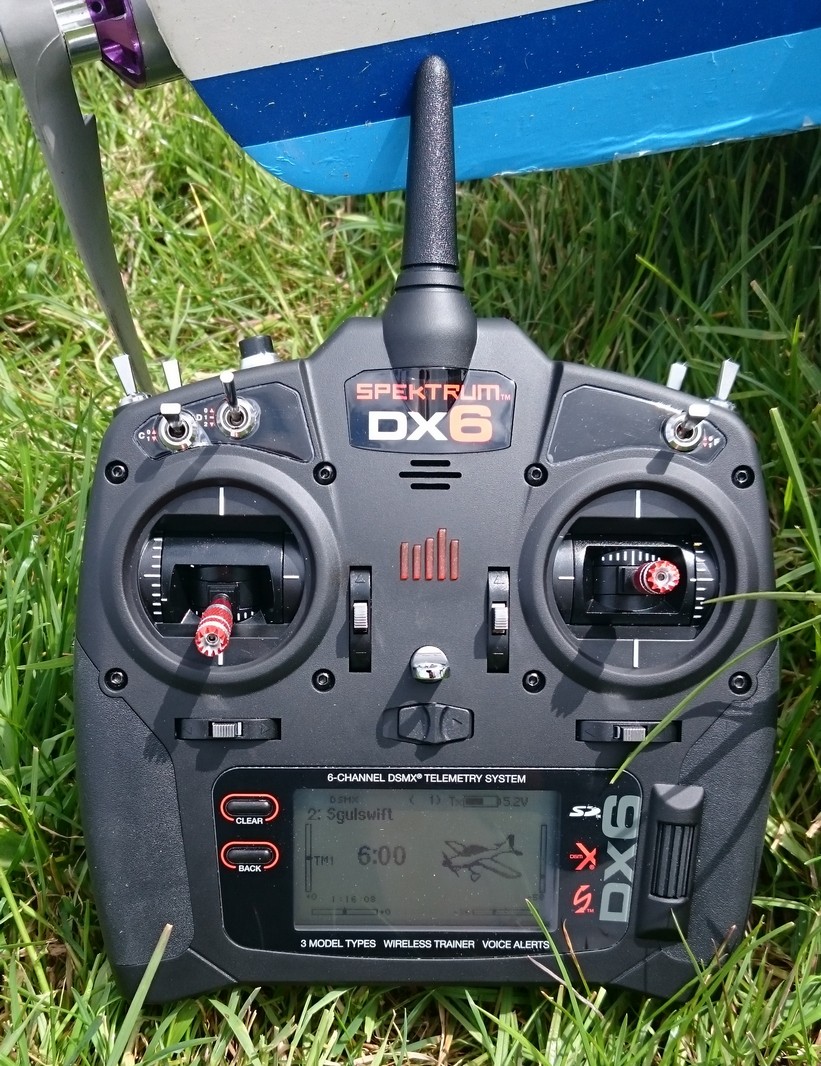 Smiffy bought a Blade helicopter to play with in his garden and then realised that it was Bind’n’Fly so his Hitec transmitter wouldn’t bind to it. A normal person would have simply fitted the chopper with a Hitec receiver but not Smiffy; he bought a Spektrum DX6 transmitter instead.
There weren’t too many new models seen at the patch this month but Stanley Knife turned up with this lovely new Spacewalker.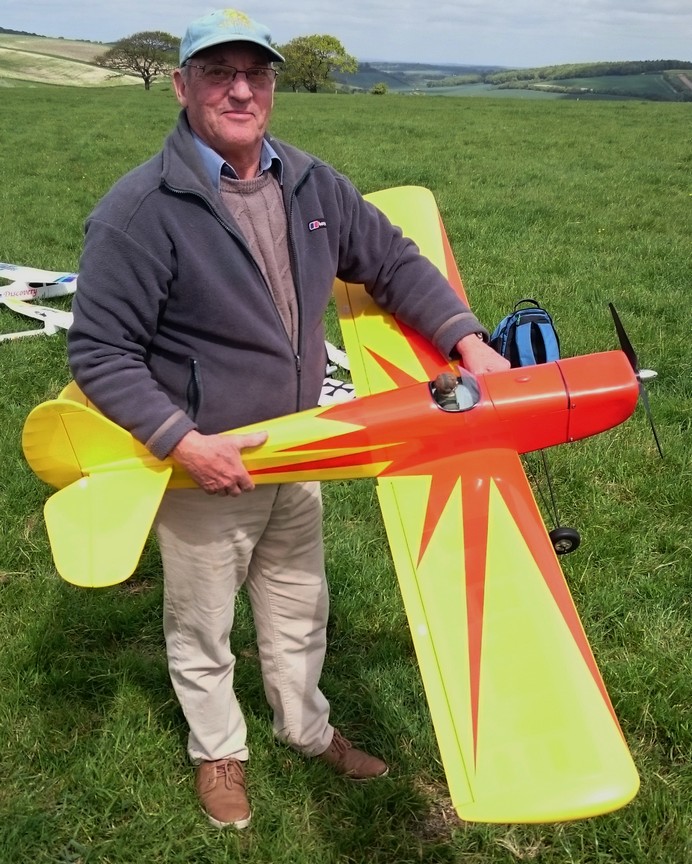 It’s from HobbyKing and at 1580mm span it’s designed to be either I/C or electric powered. Stanley chose the electric route of course and obviously got the motor/battery choice just right as the model flies beautifully.
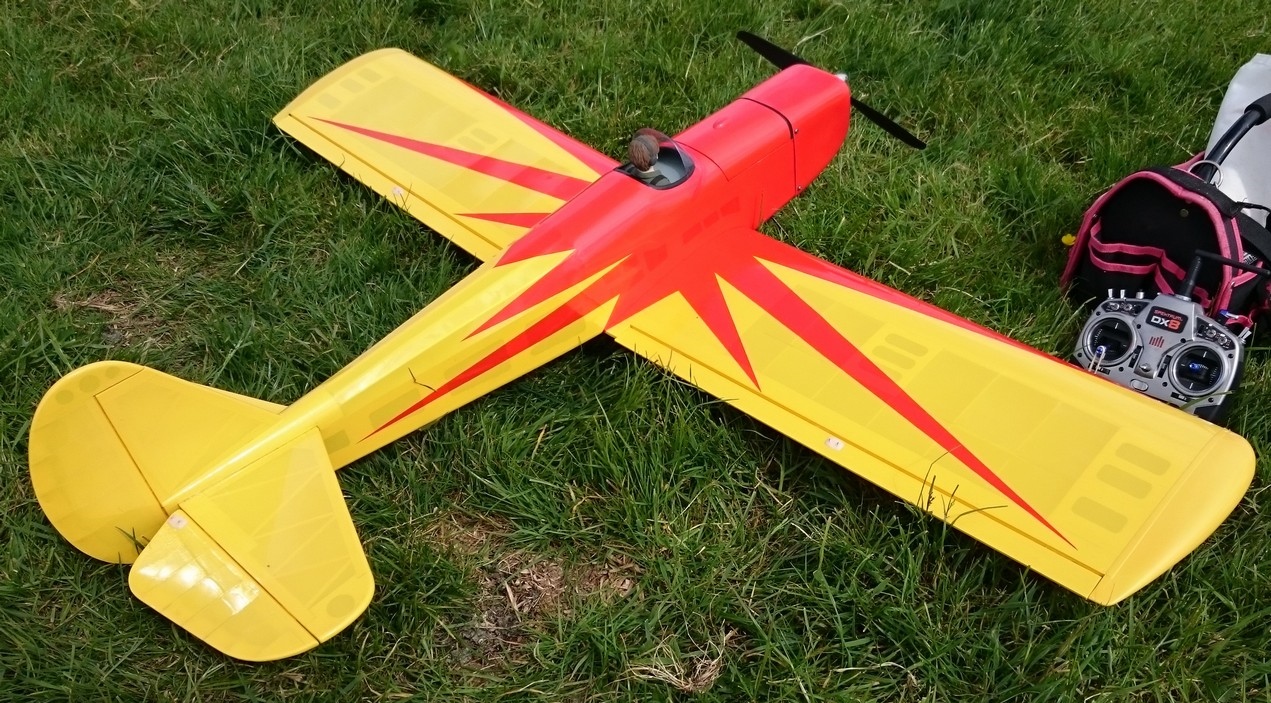 It’s a ‘proper’ film covered balsa and ply model with a GRP cowl, not a foamie.
In traditional manner Nigel Baker managed to remove the Almost Ready To Fail undercarriage from the new fuselage of his Wot 4 Foam-E. It’s nothing that a decent ply plate won’t sort out.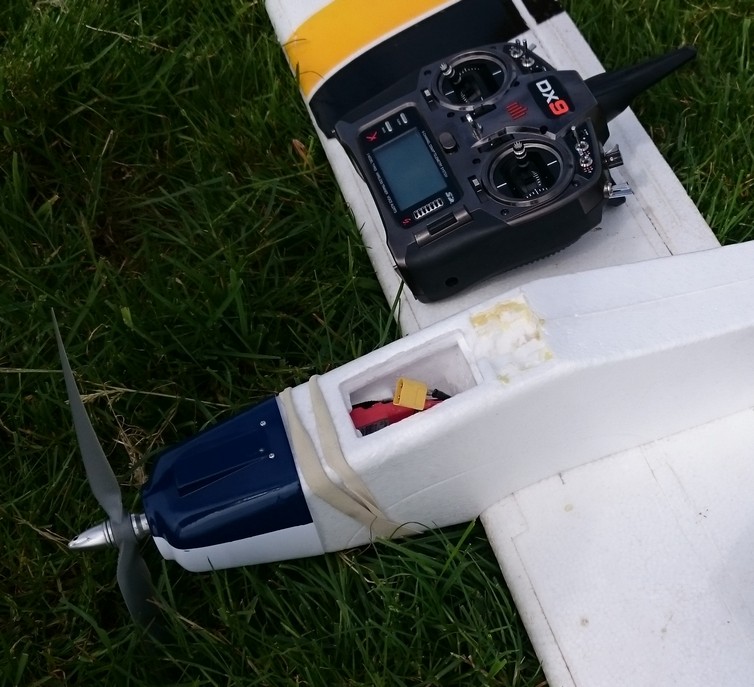
You can tell that summer is on its way, several models that we haven’t seen over the winter made re-appearances. Mike Smith flew his Phase 3 Squall again in May, the first time for a few months.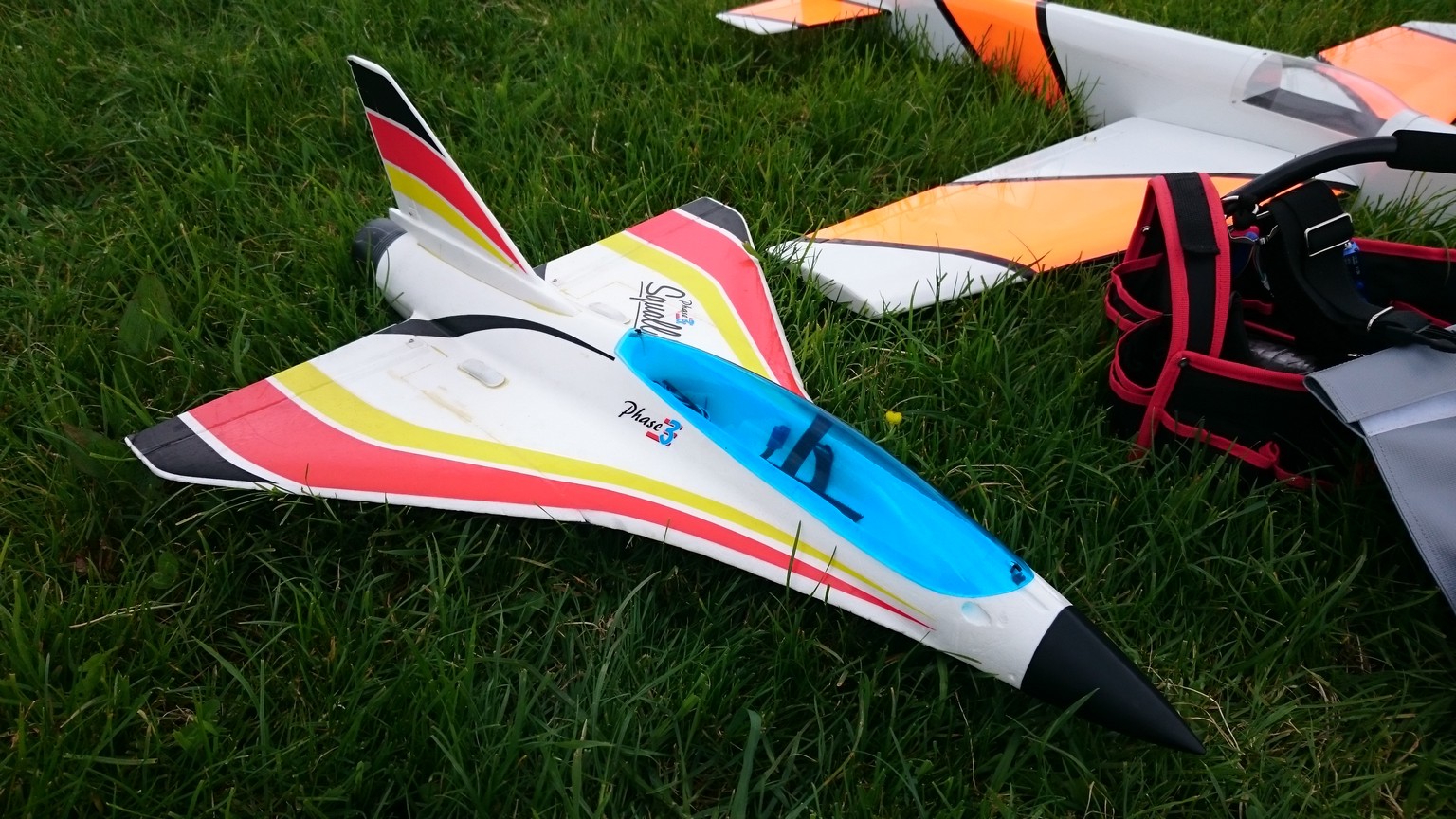 It’s EDF and I’d forgotten how quick it goes, and it rolls like an electric drill. It features in this MONTHLY VIDEO
Dan Handley flew his Dynam Hurricane for the first time in a while.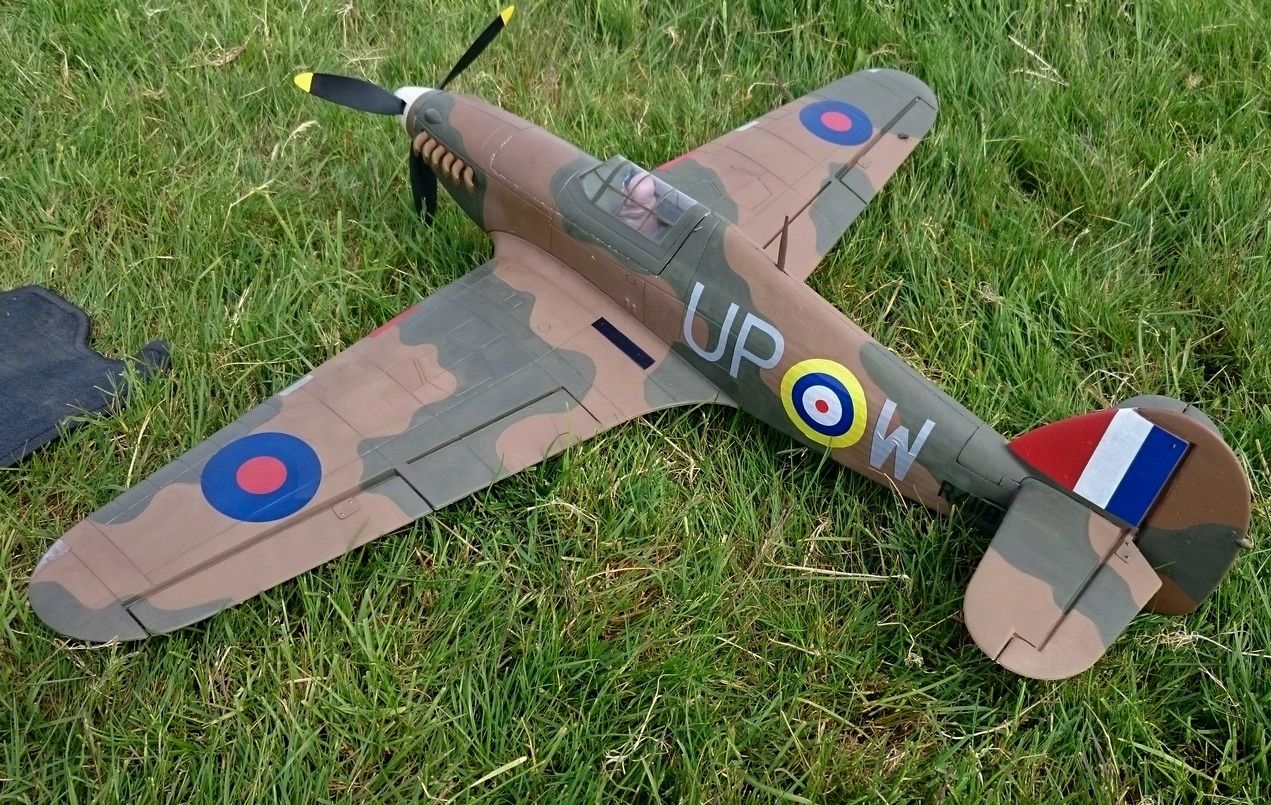 It’s 1250mm span, uses a 4 cell lipo to drive a 600kv motor, and comes fitted with worm drive retracts.
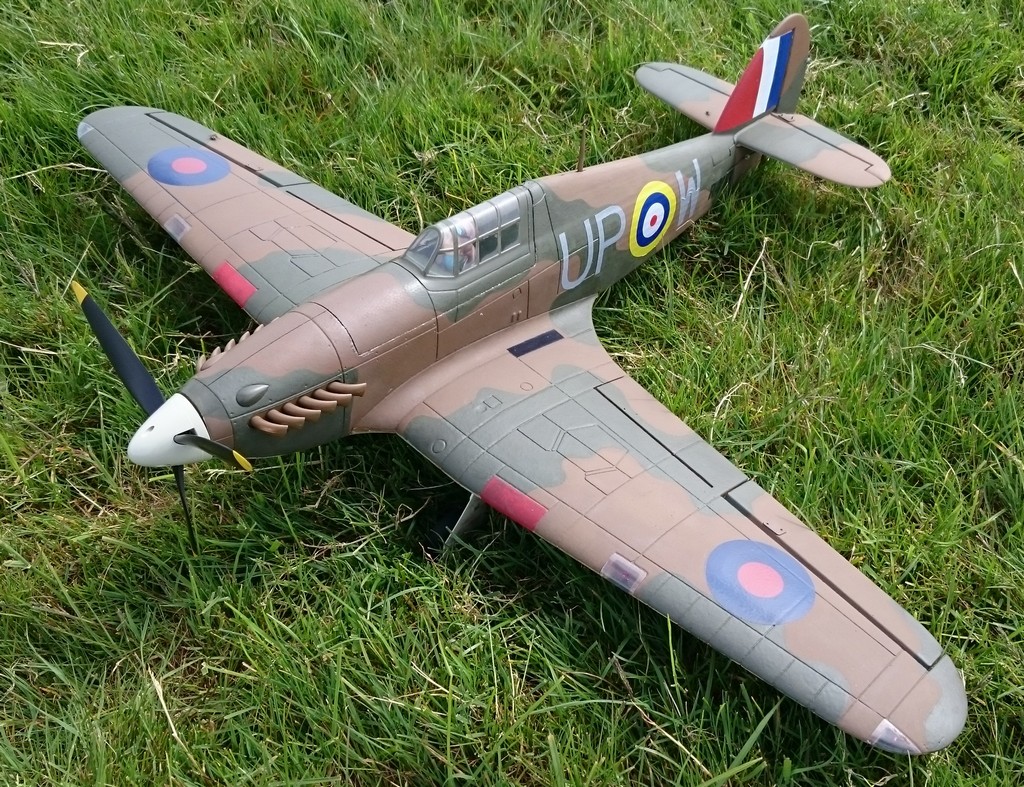 It’s a foamie but it looks great and flies very well.
The rather battled scarred SE5a belonging to Bob Hill also flew again this month.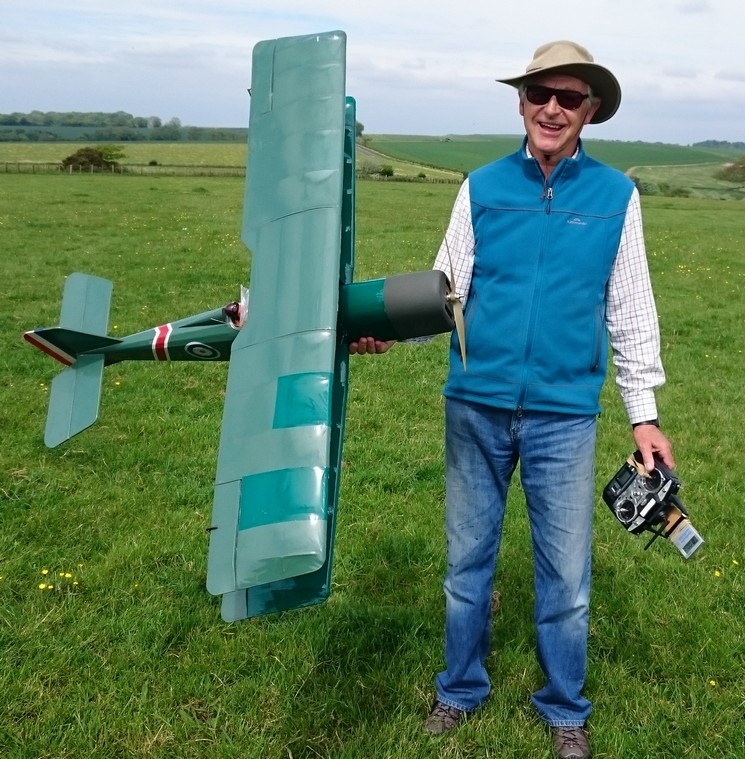 It flies well but isn’t a model you’d want to fly in the winds of winter, especially the winds we get on top of Chidden Down.
The Spirit Mini Sport gliders continue to thrive and Tony Neal has now joined the throng, although he has gone for a Kinetic instead of a Spirit. The two models are virtually identical although they are fitted with different motors. A few Spirit motors have failed (including my own) and HobbyKing don’t stock replacements so the easy choice is to fit a Kinetic motor instead. They aren’t a direct swap but are pretty easy to fit, although it is necessary to use a Kinetic prop as well.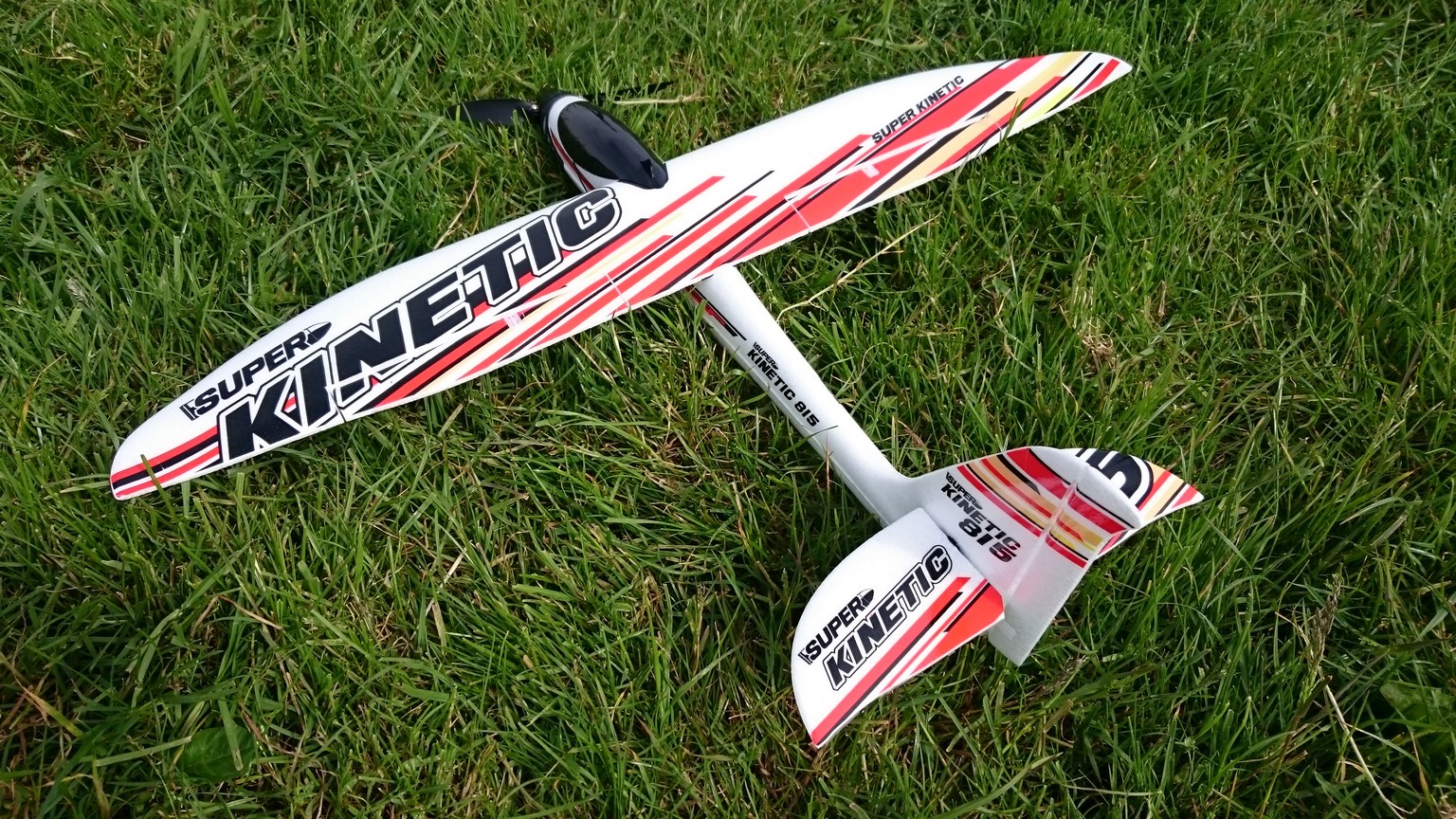 Bob Hill has also gone the Kinetic route; I think he managed to destroy his Spirit in a less than perfect ‘arrival’. I have only just discovered that the Kinetic comes with the decals already applied. As applying the decals is the biggest job required to complete the Spirit I reckon the Kinetic is the way to go.
As I’m talking about the Spirits I’ll include a photo that Dougal Entendre sent me a little while ago. His elevator servo needed replacing so he had to remove the servo cover that is factory fitted. He says it was easy to prise off and he managed to replace the servo and refit the cover without problems.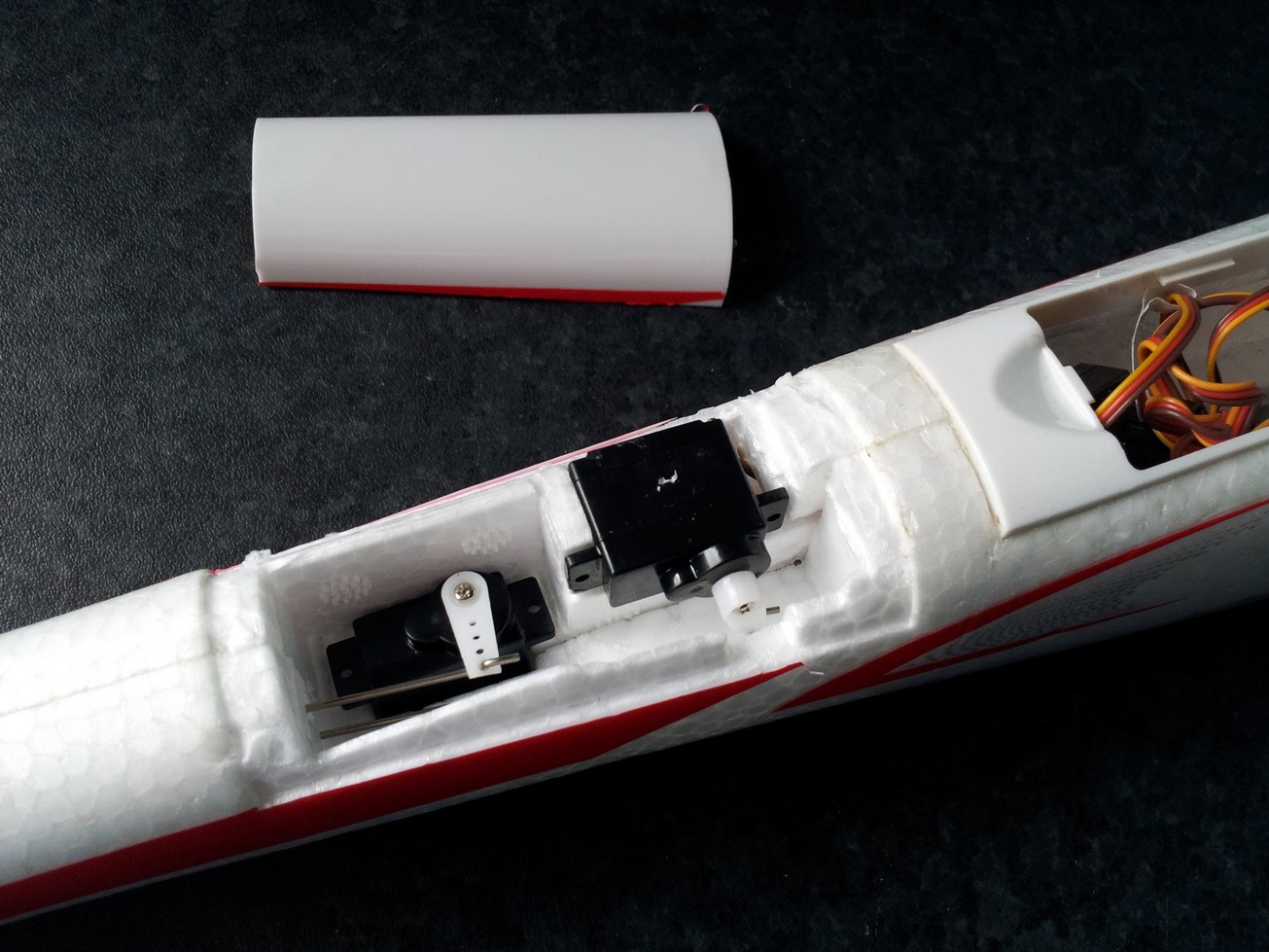 I was surprised by the servo layout; I had assumed both the servos would be fitted upright, not with one laying on its side.
I took the plunge in the HobbyKing May Day sale and ordered a Hummer. It’s one of those horribly ugly 3D EPP profile fuselage things made from packing cases but it does what it’s supposed to do. It was only £16 odd so I thought I should at least try 3D to find out what the appeal is. So far I haven’t found out!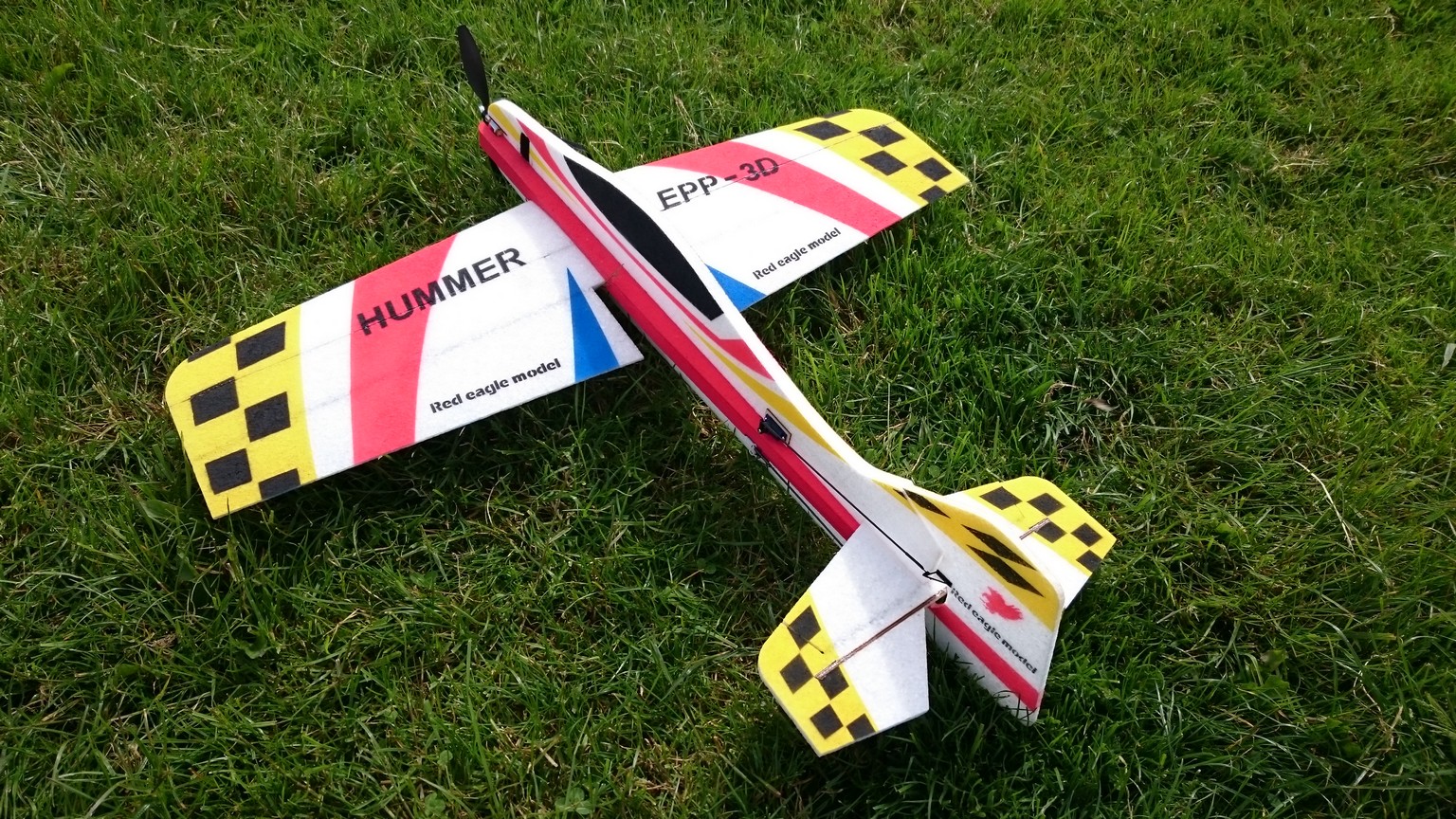 That’s probably because mostly I’ve found out that I can’t do it but I’ve only had a few flight so I’ll keep at it and see what happens. The ‘kit’ was pretty good, everything fitted ok, and the carbon rods alone would have cost more than the whole kit at most models shops. I used cyano for virtually the whole of the construction, time will tell whether that was wise or just lazy.
Unbeknown to me Dougal was putting one together at the same time so now there are two of us trying to learn how to prop hang. We could be the next Bishops…or not.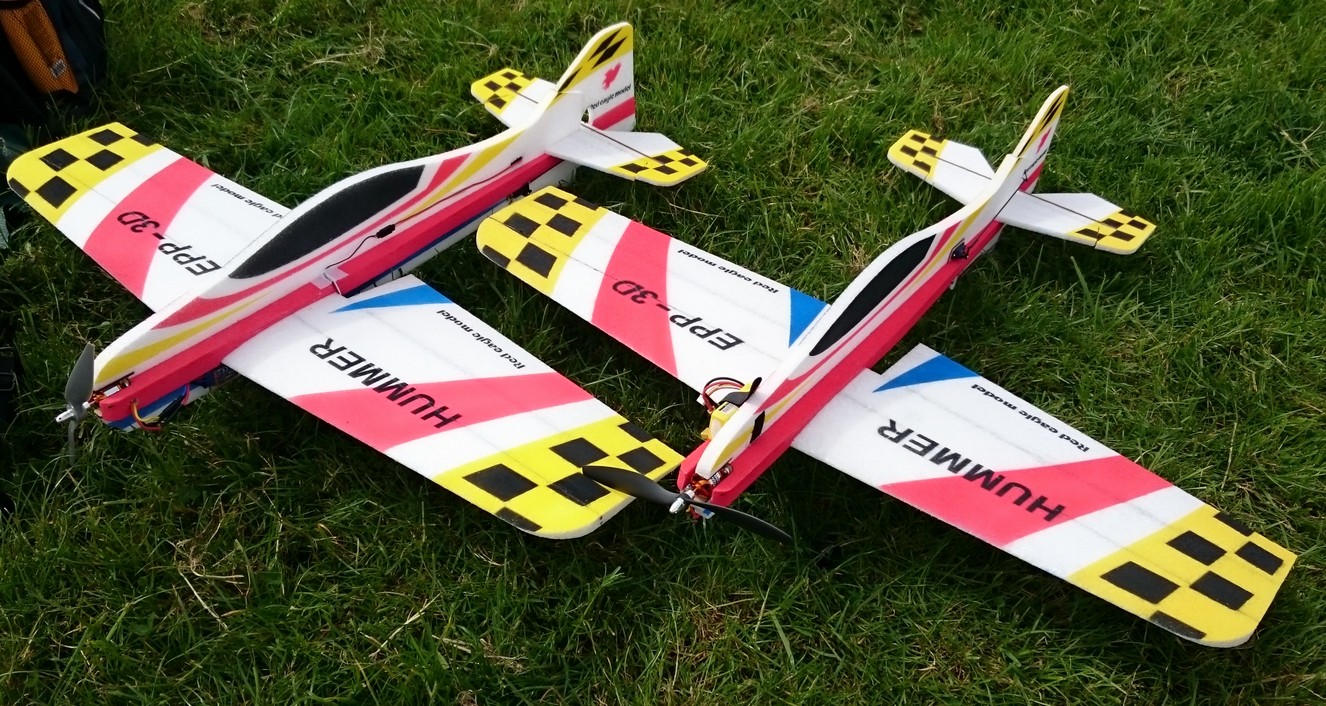
The last new model we saw in May was 1066’s Apollo DLG. This is yet another from HobbyKing, and has a fibreglass fuselage pod and tail boom, with pre covered balsa and ply built up wings and tail.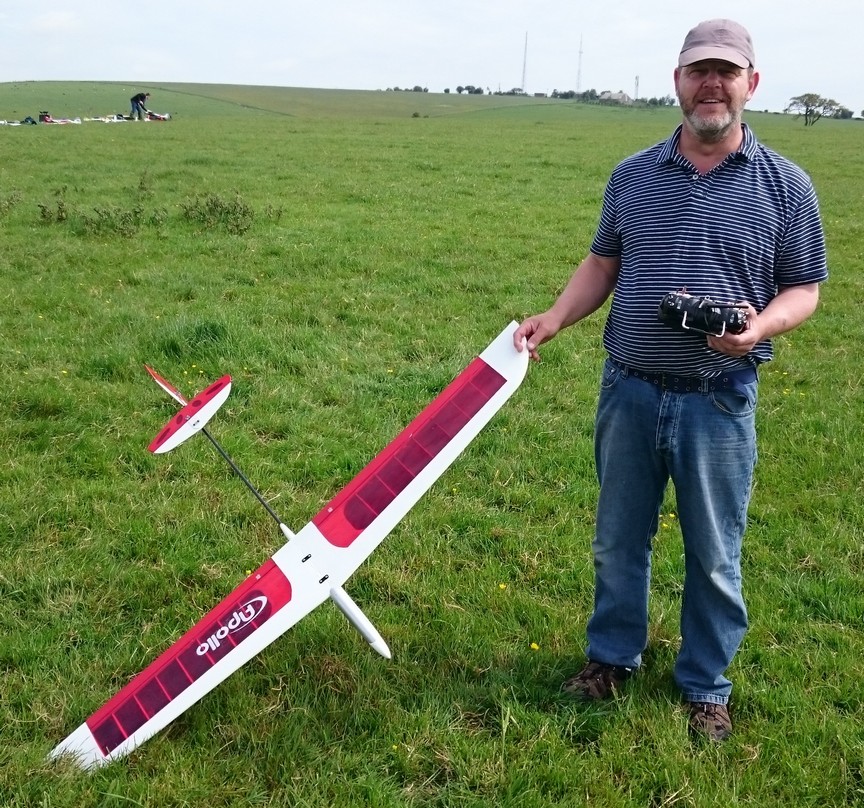 The HK listing mentions composite so I think it must have carbon in the spar. A full composite DLG model costs a lot of money, this one is under £50. For those who don’t know, DLG stands for Discus Launch Glider, and that’s just how they are launched. There is a peg mounted vertically through the wingtip that the pilot hooks his fingers round, he then spins round a complete turn and releases the model into wind. Once the technique is mastered the models can reach amazing height and, being very lightly built, they can stay aloft for a considerable time, searching out the weakest of thermals. It’s a highly skilled class of modelling, and it will be interesting to see how Steve gets on with it once he’s mastered the launch and trimmed the model correctly. See it in action in the MONTHLY VIDEO
Meanwhile 1066 has been showing off his knife-edging skills with his Extra 300. This one is an ex-Cyano Steve model, produced by 3D Hobby Shop.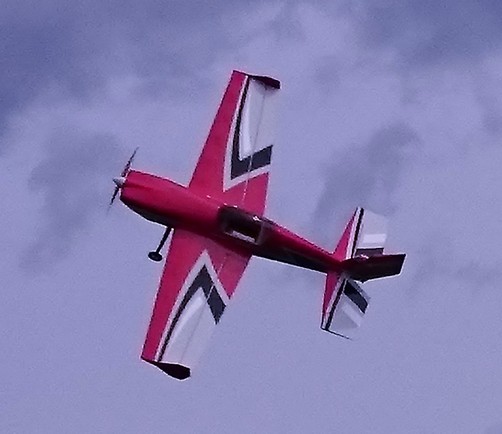
Captain Slow was good enough to send me a link to an airline Safety Announcement, it’s very funny and well worth watching, you can see it by clicking: HERE
STOP PRESS: Tim Clay took and passed his BMFA ‘A’ certificate this morning. Well done Tim, you’ve reached this stage very quickly, some of the more experienced pilots are watching you with envy!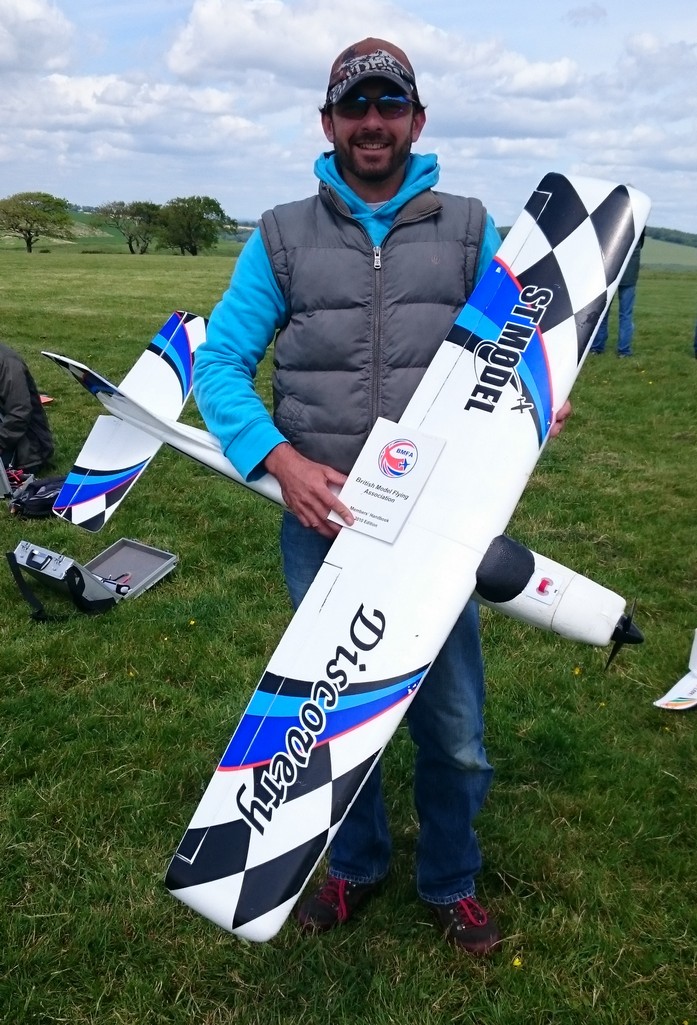
Remember: You do not need a parachute to skydive. You only need a parachute to skydive twice.
Colin Cowplain