
Patch News – February 2017
February is a short month and I’m off to Marrakech at the end of it so I’m making an early start on Patch News, I’ve begun writing this edition on 18th February. Hopefully I’ll be sprawled out by a pool in the sun when you read this.
The first couple of weeks of the month were not good for flying, wet and windy with quite a lot of low cloud and fog thrown in for good measure. But it seems to be improving now and today is absolutely glorious, let’s hope it lasts. (It didn’t). But some Sundays still saw a good turnout at the patch despite the gloom.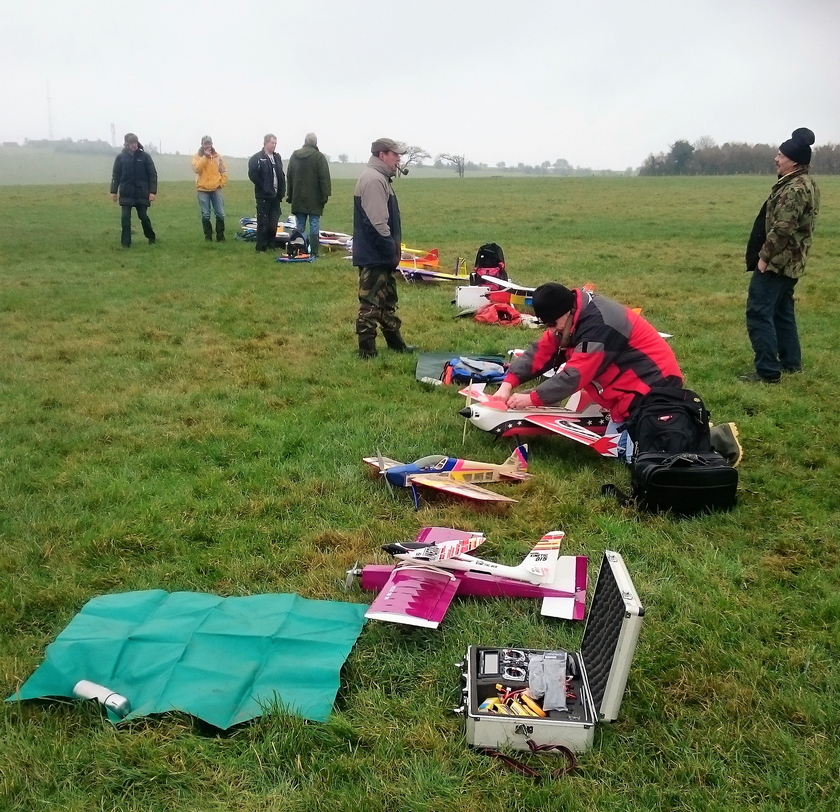 I’ll begin by following on from a couple of disasters I had in January. If you read the January blog you’ll know that firstly, I managed to lose my Spirit mini-glider when it disappeared into cloud (at great height) and I didn’t see it emerge so had very little idea where to look for it. And secondly, my new F-22 Raptor failed to get away from its very first launch and the two second ‘flight’ ended abruptly with a very broken nose.
Well February was much more successful. Firstly, I found the Spirit. Or I should say my wife found it. Almost a week after it vanished we were driving towards the field from the Old Winchester Hill direction when Doreen suddenly said she could see it! It was on the far side of the valley, about 2/3rds of the way up. I can’t work out why we didn’t spot it earlier; it was certainly visible from the road alongside the field and probably from the patch. Anyway I hiked off and retrieved it and found that, although the airframe was a not repairable, the electronics seemed basically ok.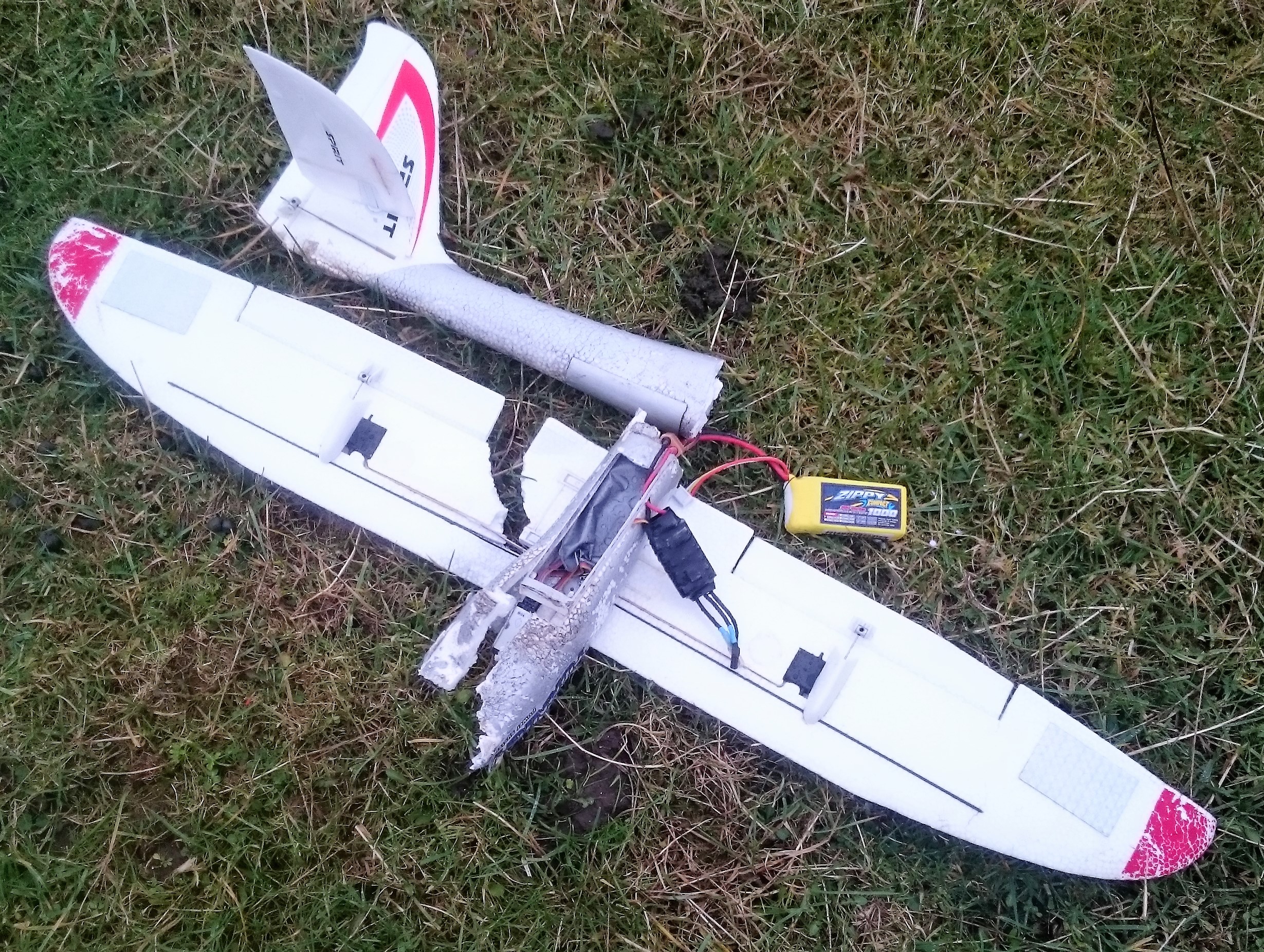 In the time it had been lost the weather had been foul so everything was very wet, but after a thorough drying out of all the parts everything worked perfectly. So that’s the motor, esc, 4 servos, and receiver that have lived to fly another day. Unsurprisingly the lipo seems to have developed a dodgy cell so that’s been binned. I salvaged all the usable airframe fittings and scrapped the rest. I’ve already used one of the carbon wing spars, the Depron fuselage of my Euro Fun-Fighter was too flexible so I cut a slot and glued in a Spirit wing spar, it worked a treat.
 The second success was with the Raptor. I managed to make a reasonable job of the repairs once I’d worked out how to straighten out crushed polystyrene. The hot water trick that works well with EPO foam seemed to do nothing at all to polystyrene but steaming the parts and gently pulling them back to shape worked fairly well. I ended up gluing pieces of crushed fuselage to Depron sticks so I could hold them over the spout of a kettle for long enough to heat them through! Eventually I jig sawed it all back together and added a little extra strength where possible. The end result wasn’t too bad, especially from the top, and it was certainly good enough for another attempt at flight.
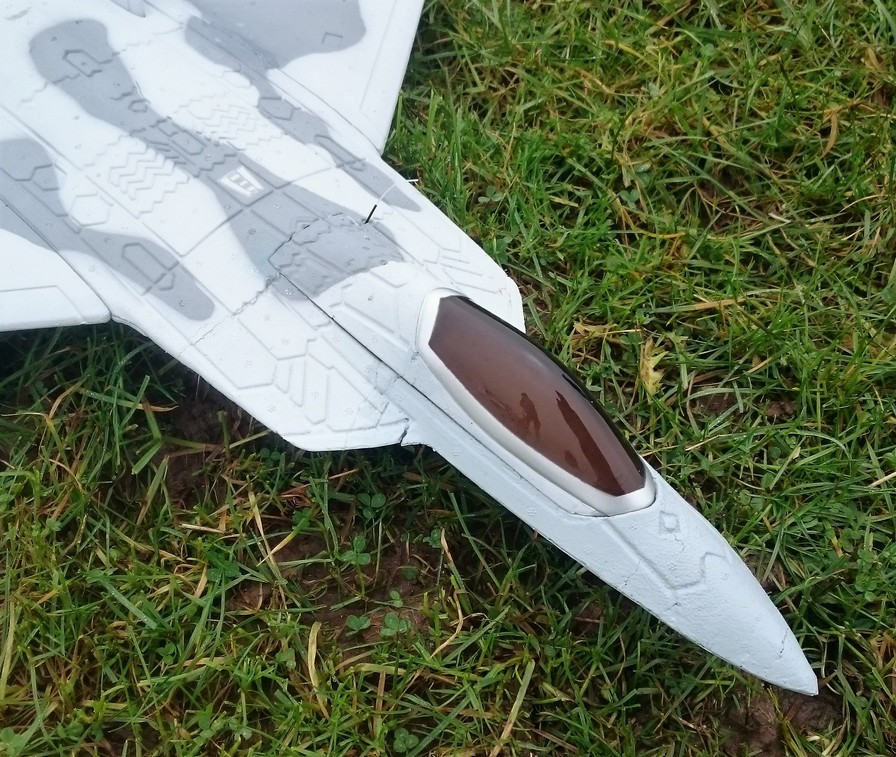 For the second attempt at flight I used an 1800mAh lipo instead of a 1300 which brought the C of G forward a bit, and I reduced both aileron and elevator rates a little. Success! It went away from the launch pretty well and I was able to get it trimmed out fairly quickly. At the time of writing it’s had 19 flights with no more problems. It’s got pretty good power for an edf model and will do large loops without falling off the top. It’s nice to fly now I’ve sorted the rates and expo to comfortable levels and looks good in the air. Also, importantly in these sensitive times, it’s pretty quiet for an edf, not nearly as noisy as some, and it’s actually quite a pleasant sound. Some of the first successful flight was recorded by Dougal Entendre and it can be seen in the video at the end of this Patch News.
Also in the video is part of the first flight of Catapult King’s Pulse’ish back in January, as recorded by Modelling Clay.
This month has seen lots of success stories. Last month I reported that Dwayne Pipe’s Mk19 Spitfire had flown successfully although I hadn’t seen it myself and had no photos or video of the event. But now I have, it’s flown several times and very nicely too. At first Dwayne had no undercarriage fitted and had to rely on hand-launches, but wanting to be able to take-off he retro fitted a non-scale one.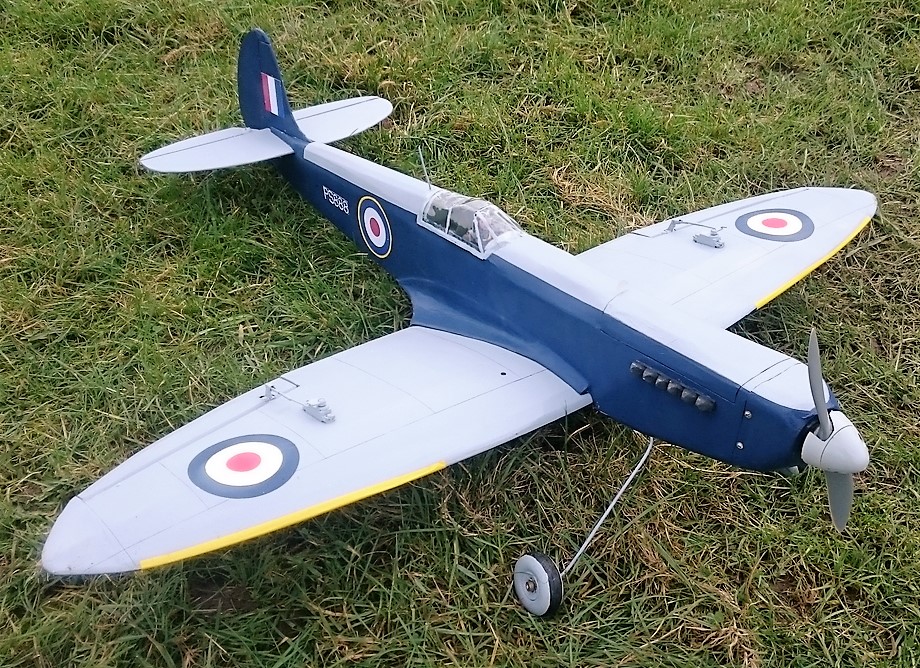
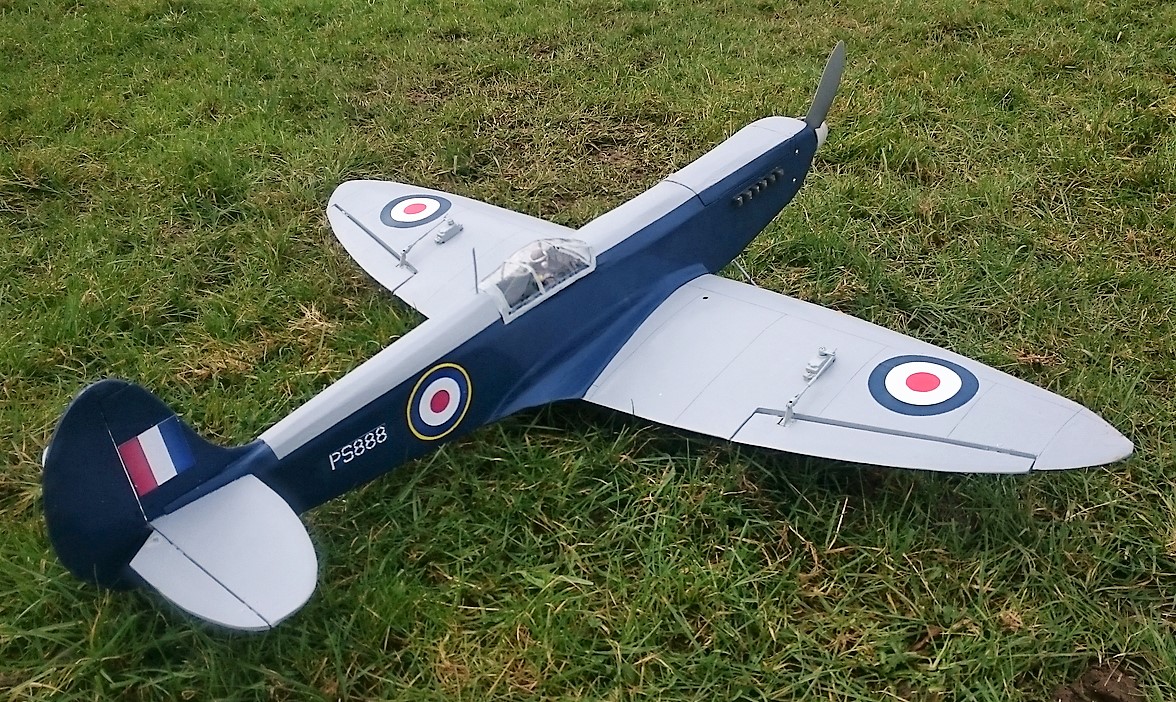 This worked well enough but really didn’t look too good in the air. So now he has developed a drop-off undercarriage that is servo released, so he can take-off, drop the U/C on the first pass over the patch, fly around looking like a Spit should, and then belly land when the time comes. It works a treat and the first take-off and U/C drop features in the monthly video along with some of an earlier flight and an ‘interesting’ landing. I think Dwayne didn’t want his landing filmed so he decided to try and scare the cameraman (me) out of the way!
Chris P Bacon has also had success, eventually, sort of…! I gave Chris P lots of stick last month for fitting his new Wot 4 with one of those dirty, noisy, smelly I/C engines, an SC52 4-stroke that he bought second-hand. At the beginning of the month Chris P brought it up to the patch on 4 occasions and took it home again each time without flying it. There were various problems, all engine related, but eventually he got everything sorted and flew it.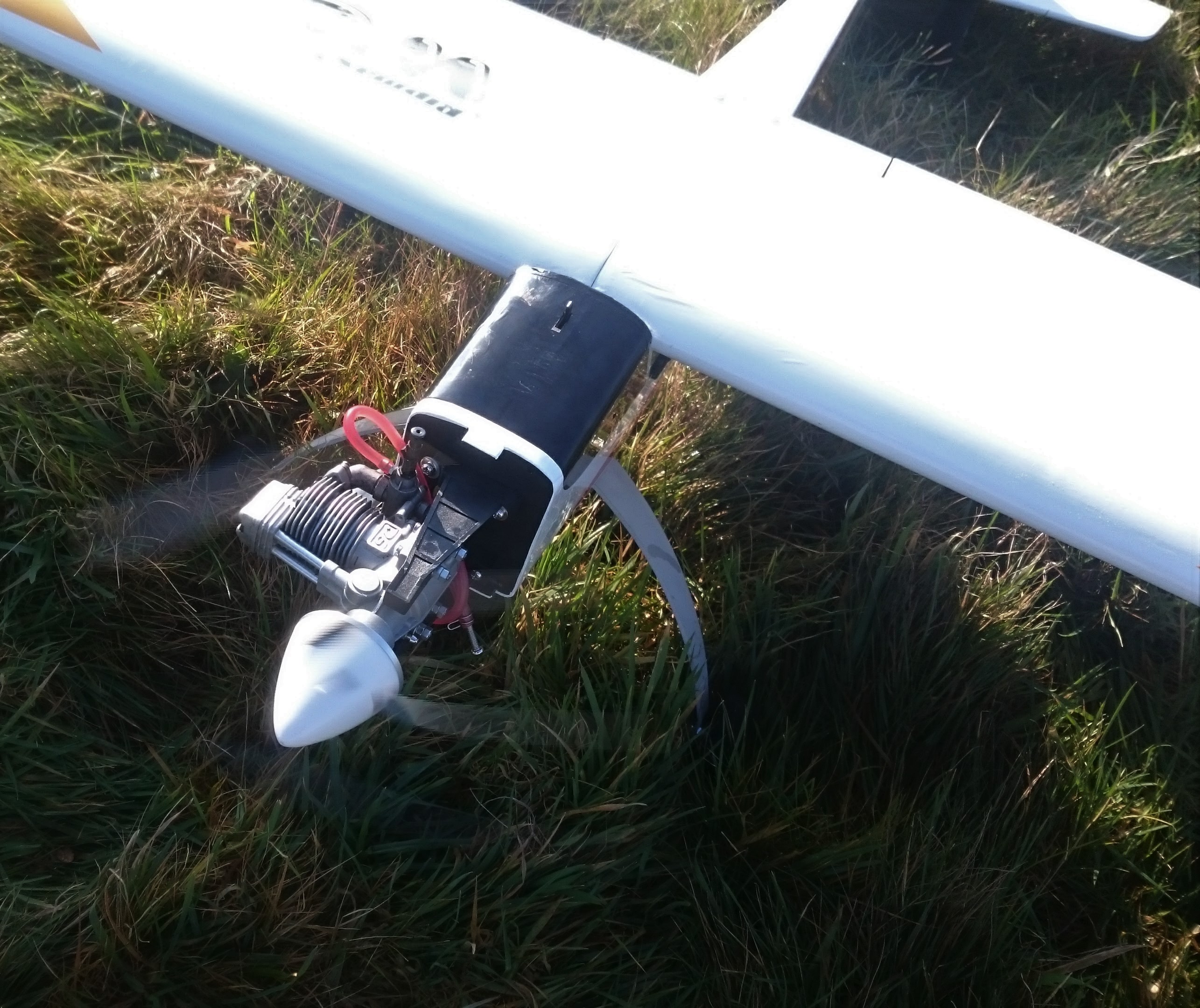 It flies well (of course it does, it’s a Wot 4) and performs much as you would expect. Chris P is having a few problems getting the tick-over slow enough to land nicely and on one flight he asked me to land it. I did a low pass and could see that the undercarriage had rotated about 45 degrees to the right! It seems that the vibration from the engine had shaken the retaining screws loose and one had fallen out. I came in to do a very gentle landing, expecting the plane to suddenly veer offline when the wheels touched but instead, the other screw came out and the whole undercarriage fell off!. Fortunately there was no other damage so with the help of a couple of screws and some thread lock it will soon be flying again.
Remember the tale of Captain Slow’s Art-Tech Diamond? In short, the motor threw a prop blade and the whole of the front of the model was torn apart by the vibration! The model was repaired but the supplied and pre-fitted motor continued to give fixing problems. So Captain Slow decided it had to go and fortunately, realising the Spirit nose was similar to the Diamond, he was able to graft on a Spirit motor mount.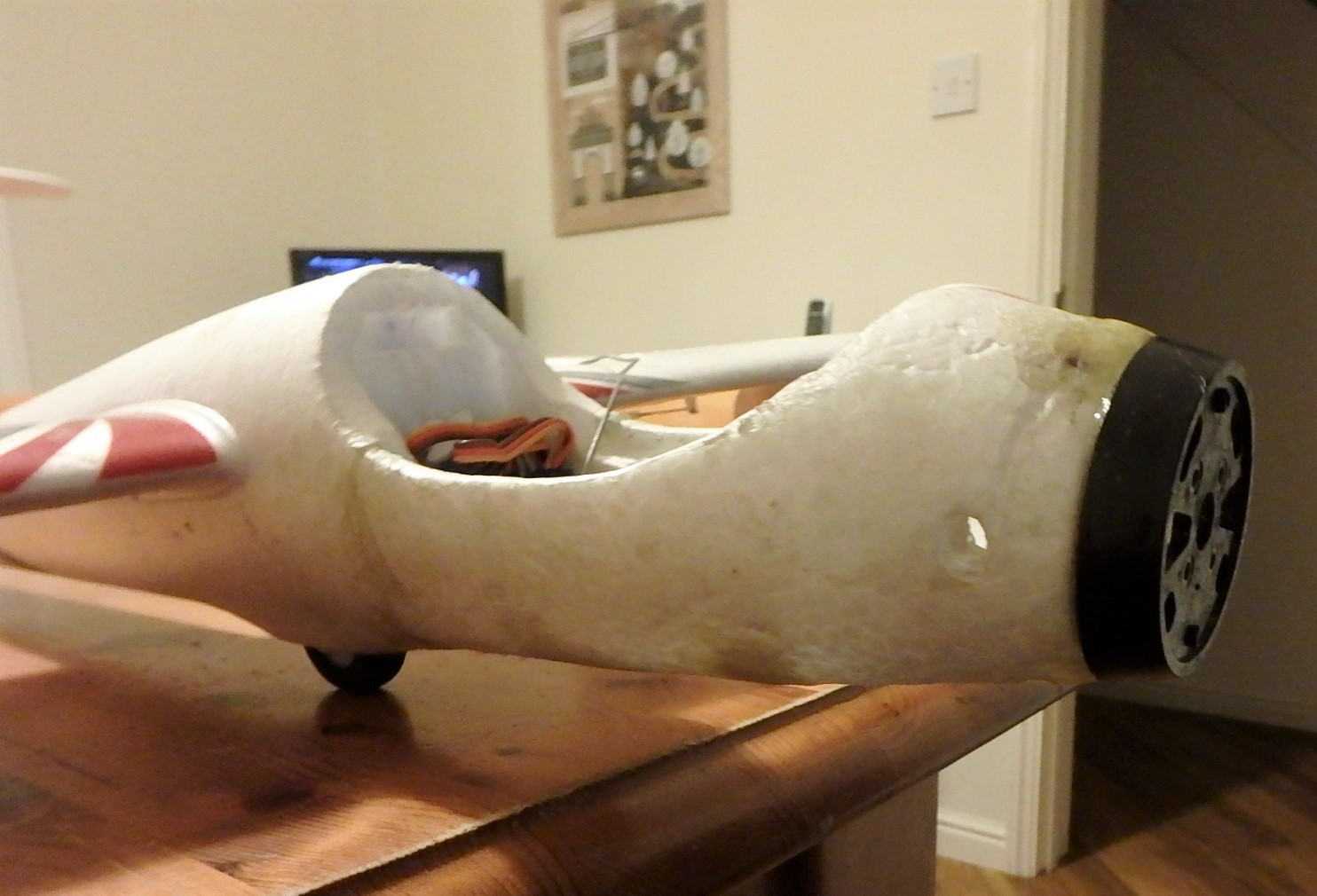 Since taking this photo he has completed the repairs and fitted a Spirit motor and folding prop, and the model has had several successful flights. So you could say a deceased Spirit has returned from the grave…
Time for a quick competition: No prize, but can anyone spot which current club member is in this very blurred pic? It was taken from a video that is several years old. Do you think he looks like the same young man in the red boiler suit in this photo? Well it’s not!
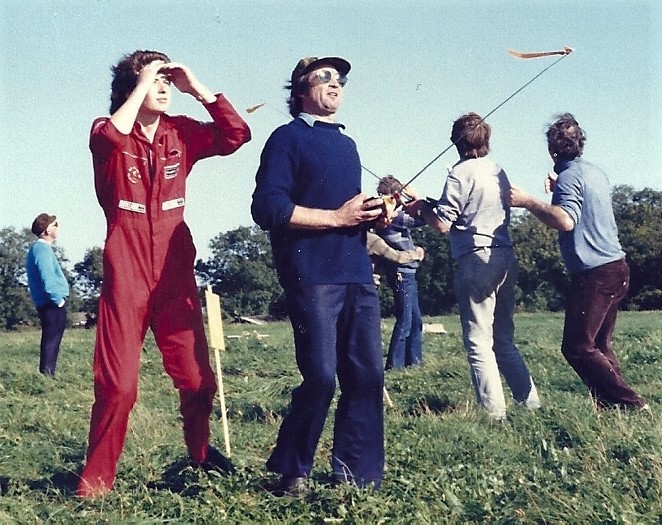 That is a very young Phil ‘Wonky’ Wiltshire, taken during a PAM pylon race competition many moons ago.
February 19th saw four new models being test flown; people must have been waiting for decent weather. First up is a new delta from 1066. It’s the same wing planform as the Delta Challenge models but this time he has gone for a three step Kline-Fogleman section and has fitted a 6mm square carbon spar.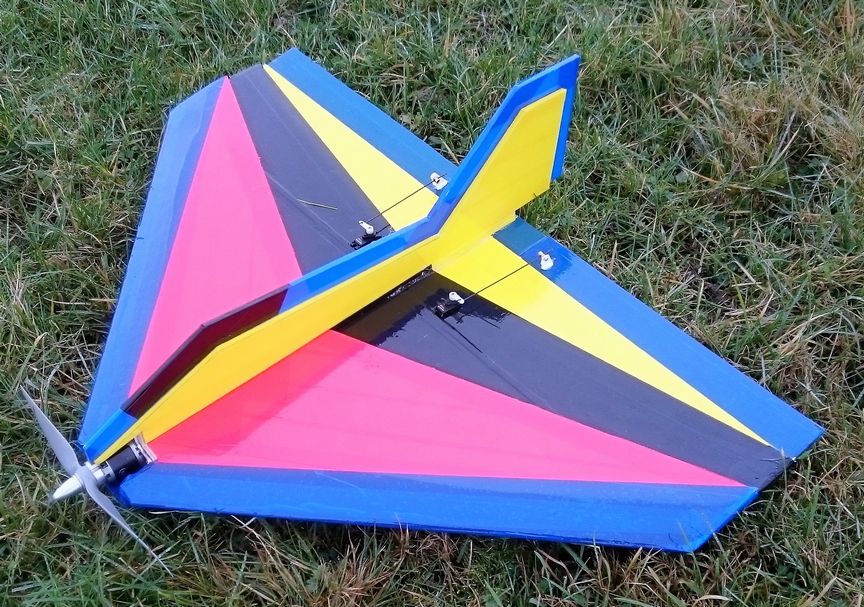 As you can see it has a profile fuselage on the top of the wing but there’s a box underneath to house all the gear. The model is mostly Depron but has some Correx to strengthen the underside for landing. I made the mistake of taking one photo and then saying ‘Now show me the bottom’…
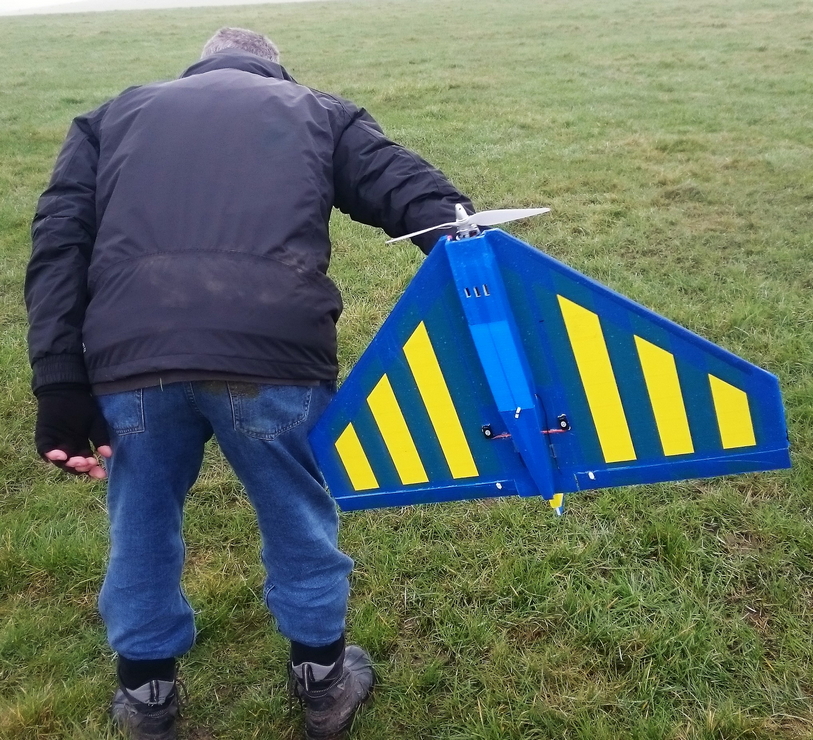 Oh dear! 1066 has fitted a larger motor than in his previous delta, this one has a 35mm 1400kv motor, the previous one had a 28mm 1200kv. He’s also upped the esc to a 60A and fitted a 9 x 6 prop. I think it looks much nicer than the earlier version; the multi-colour packing tape finish works well. It flew well but the testing was cut short by a so far undiagnosed radio problem (bloody Hitec…no hang on, they own the totally perfect Multiplex!). I didn’t manage to get any video of it flying yet but hopefully I’ll manage to take some to include next month.
John Warren brought along his newly completed Sunday Flier. John flew a Sunday Flier to death (literally!) for several years and he liked it so much that he decided to build a new one.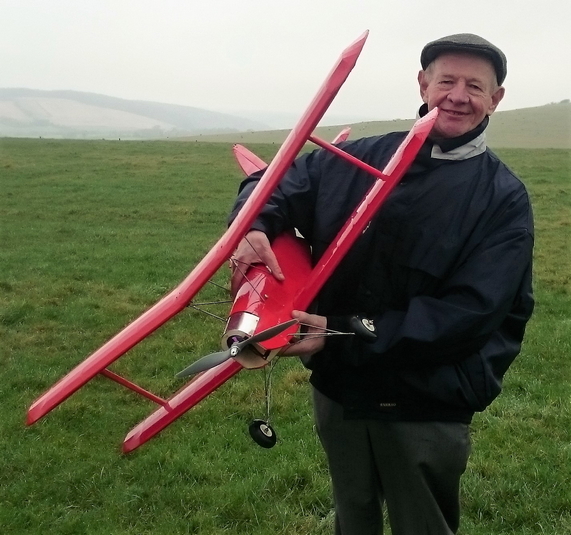 The first one was built donkeys years ago from a magazine free plan and was fitted with an I/C engine. When John joined PAM he swapped it over to an electric set-up and eventually added ailerons, the original design being rudder/elevator. The new model has proper inset ailerons on the lower wing, and a purpose-built battery housing in the top of the fuselage between the cabane struts.
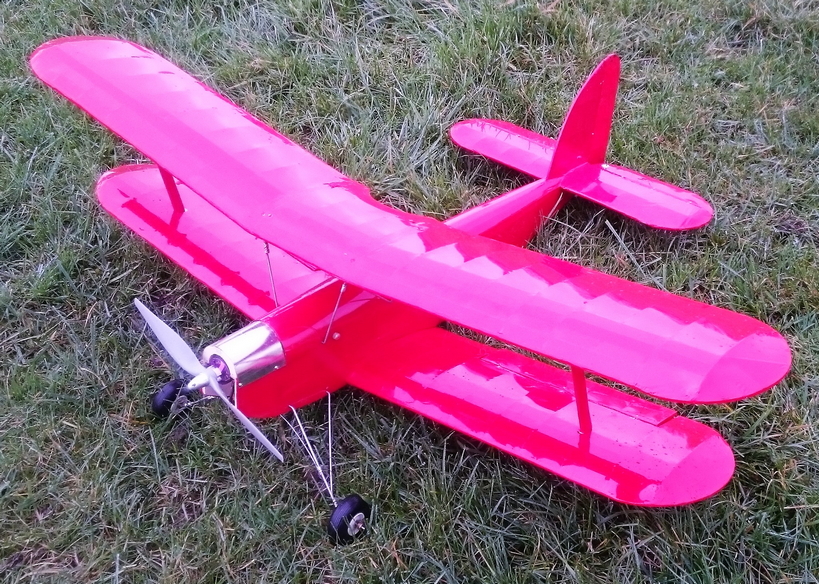 Sadly the first flight didn’t go to plan (I blame the test pilot, some bloke called Colin Cowplain!). The model took off with virtually full right rudder to try to keep her straight and despite the application of full right on both rudder and ailerons the model went round to the left and crashed close to the pits area. Not good. Dougal Entendre recorded the whole short flight and edited ‘highlights’ are in this month’s video. The wings survived pretty much unscathed but I fear a new fuselage is required. I’m sure John will soon have it rebuilt and flying successfully.
Modelling Clay was given a pass-out (he’s a newly-wed you know) and brought along two new models, a Splot that be built from the plans, and a HobbyKing Extra 330LX that he was one of his many, many large raffle wins.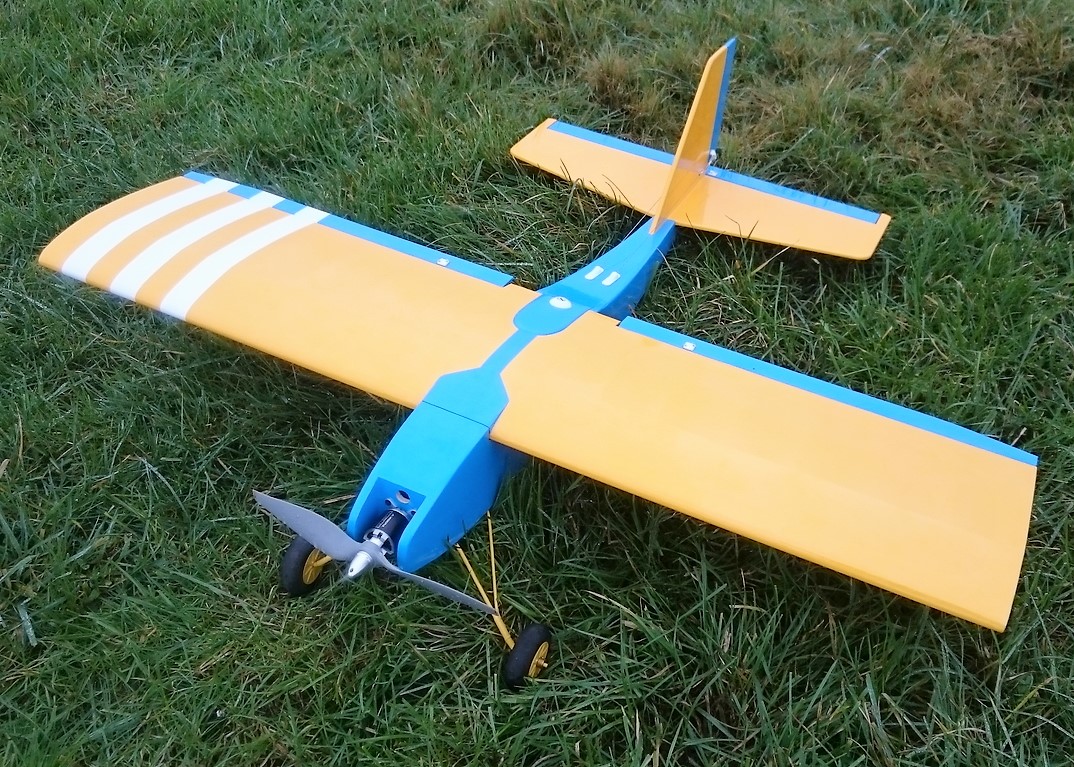 The Splot was built pretty much as per plan but converted to electric power of course. He fitted a 28-36 1400kV NTM Prop Drive motor, a 40A speed controller, and a 2200mAh 3 cell lipo. Using a 10 x 6 prop it pulls around 490 watts so with a weight of just 2.1lbs it’s got loads of power.
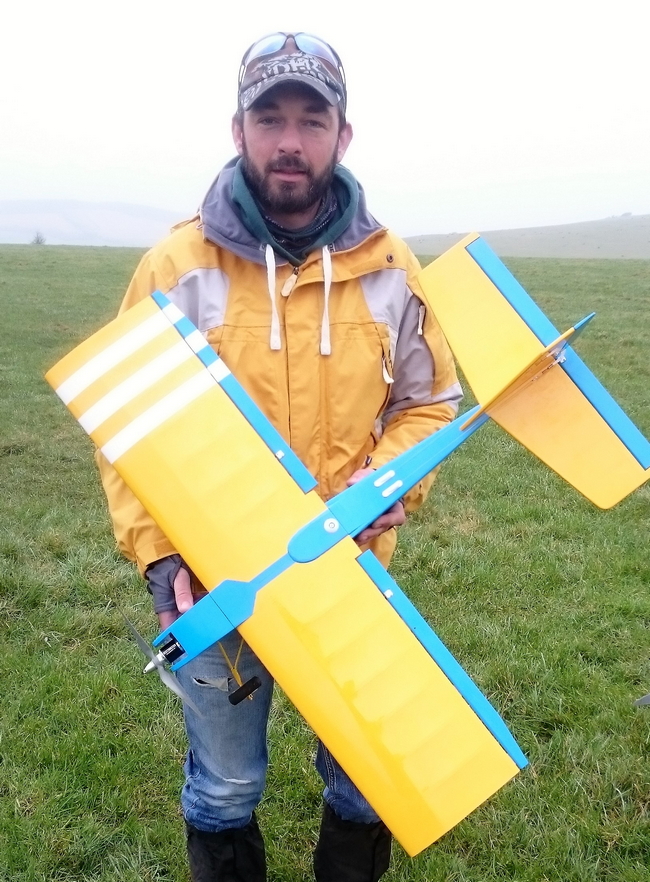 Modelling used Emax metal geared servos, and covered it in HobbyKing film. I reckon it looks really nice.
I get confused with all of Modelling’s raffle prizes, there have been so many, but this one is a HobbyKing Extra 330LX with a profile fuselage, a wingspan of 1200mm, and it’s mostly made from EPP foam. It has a lightweight ply frame to stiffen the fuselage and carbon reinforcement in high stress areas.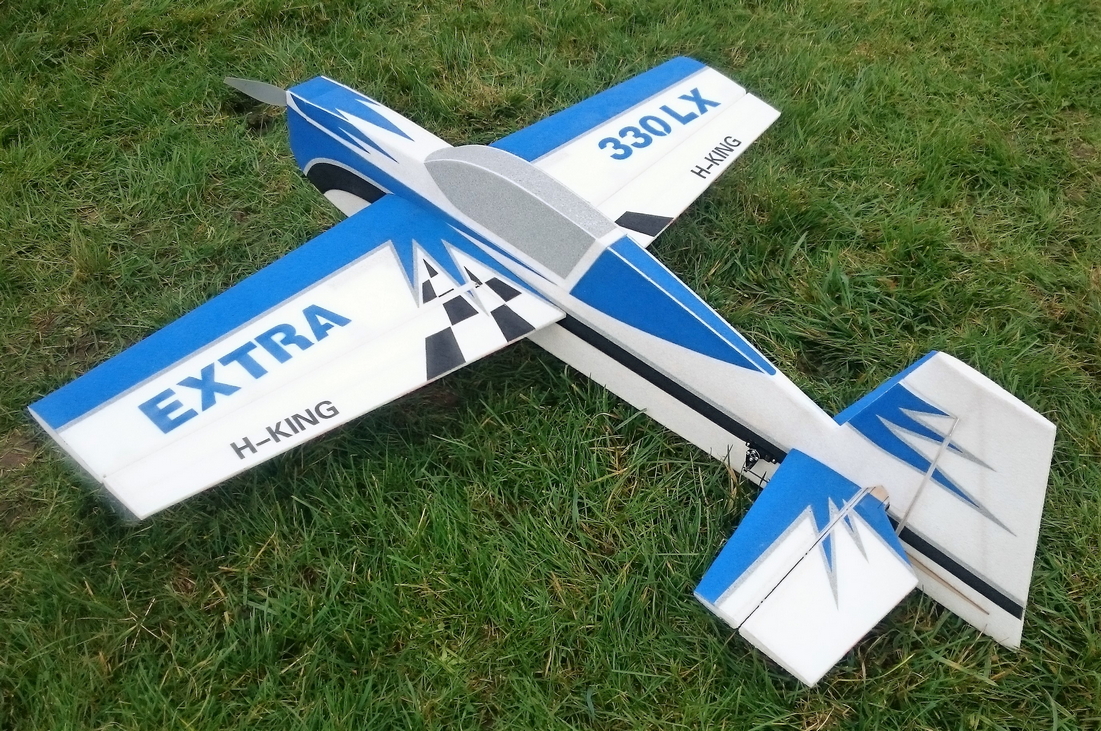 He used a 12 x 6 prop on a 42-35 750kV NTM Prop Drive motor for the first flights but says he’s going to swap to 13 x 8 prop for more power. The motor is powered by a 3000mAh 4 cell lipo via a 70A speed controller.
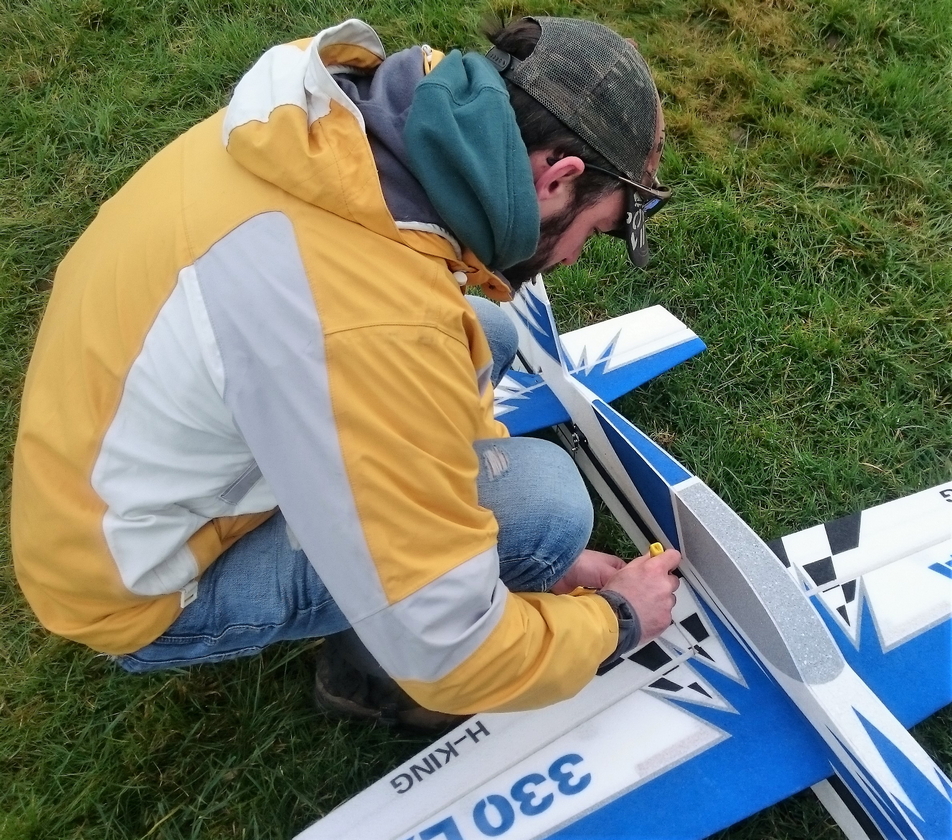 At the moment he’s getting around 600watts but that will increase with the larger prop, and with an all up weight of 3.2 lbs he should have plenty of power for prop hanging.
I filmed quite a lot of the Splot first flight but only got the take-off of the Extra as I was called to help with the trimming. They both flew well and, as you’ll see in the video, Modelling did a very good first landing with the Splot.
While I’m talking about Modelling I thought you might like to see a photo I snapped of him at the AGM. It’s all in the reading material sweetie…!
Basher Bob has many friends in the club and one of them, Chris P Bacon, was kind enough to send me something he spotted on the HobbyKing website. Chris P is now convinced that Basher is secretly producing his own lipos…
As you will have realised I’ve been looking through some old photos and I found was this one of our President.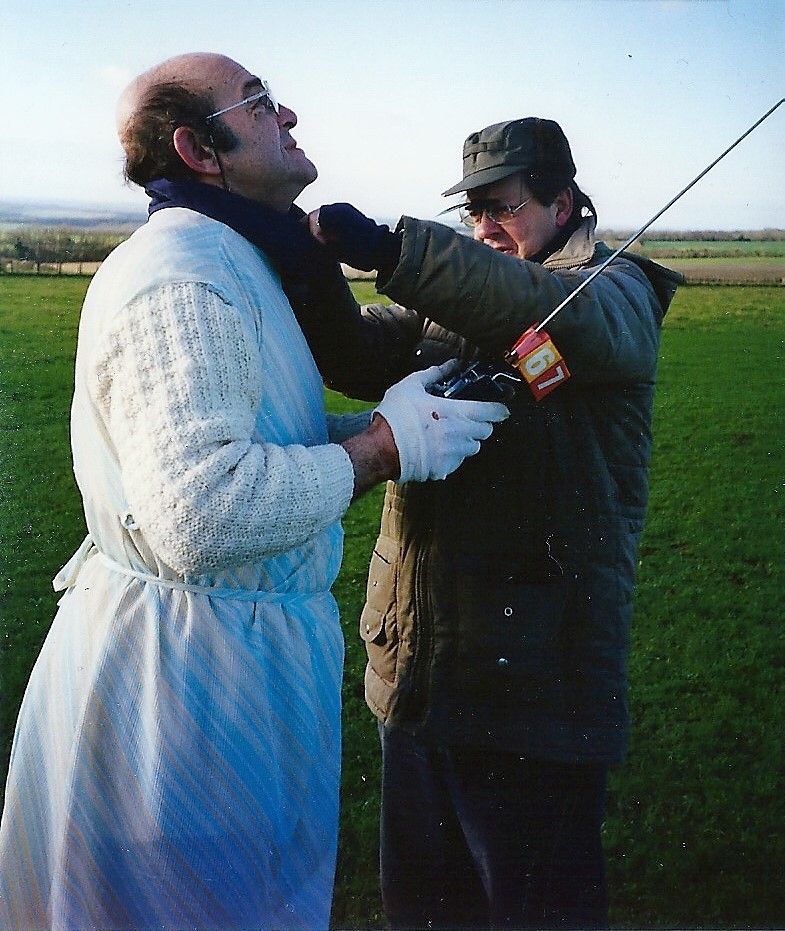 You might want to ask him why he’s wearing a dress and what on earth ex-member Ken Boucher is doing to him???
OK, it’s time for this month’s video, turn your sound up for this one. Please watch the video full screen, it’s so much better with small models flying around. If the video above won’t play for you CLICK HERE
Three of the more senior PAM members were walking up to the patch one morning:
Gentleman Jim said ‘It’s windy isn’t it’?
Dwayne Pipe replied ‘No it’s Thursday’
Basher Bob said ‘So am I, let’s go for a beer’
Colin Cowplain
Patch News – January 2017
I must begin this month with the very sad news that Frank Buckland’s wife Pam passed away on 8th January. I’m including the news here because I know many ex-members read Patch News and they may not have heard of Pam’s passing. Many of you will know Frank, he was one of the club’s earliest members and served on the committee for many years in various positions including Chairman. Pam was always on hand to support him and attended many of the club social events including the dinners, barbecues, and quizzes that we used to hold annually. Pam’s funeral took place at Chichester Crematorium on 30th January and was attended (among others) by myself and Doreen, Don and Lizzie Eades, Peter Turley, and another ex-member Ken Boucher and his wife Jill. After the service many of us went back to The Five Bells at Buriton for refreshments and a chinwag. Frank asked me to thank the club for the card and all it’s good wishes.
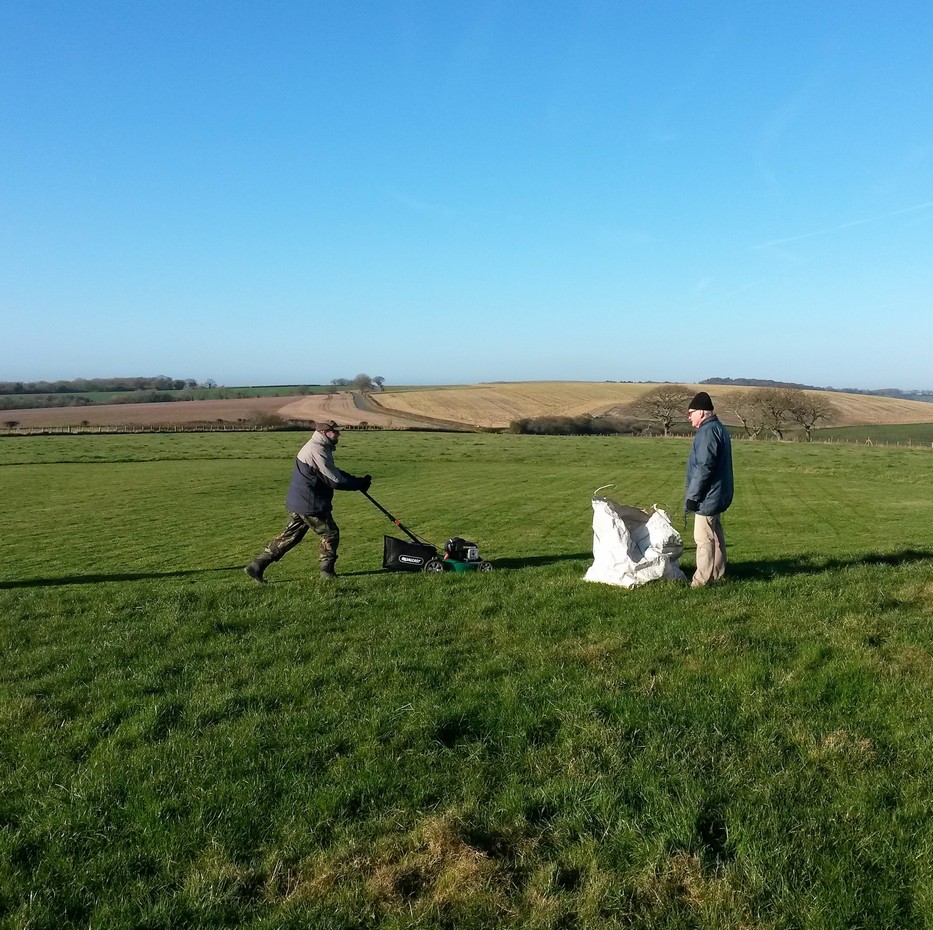
Moving on to happier matters now, many club members managed to fly in January although, as expected at this time of year, the weather made some Sundays un-flyable. One weekend the forecast was bad for Sunday so Dougal Entendre sneaked up to the field on the Saturday. He sent me this photo of his models in the chilly conditions: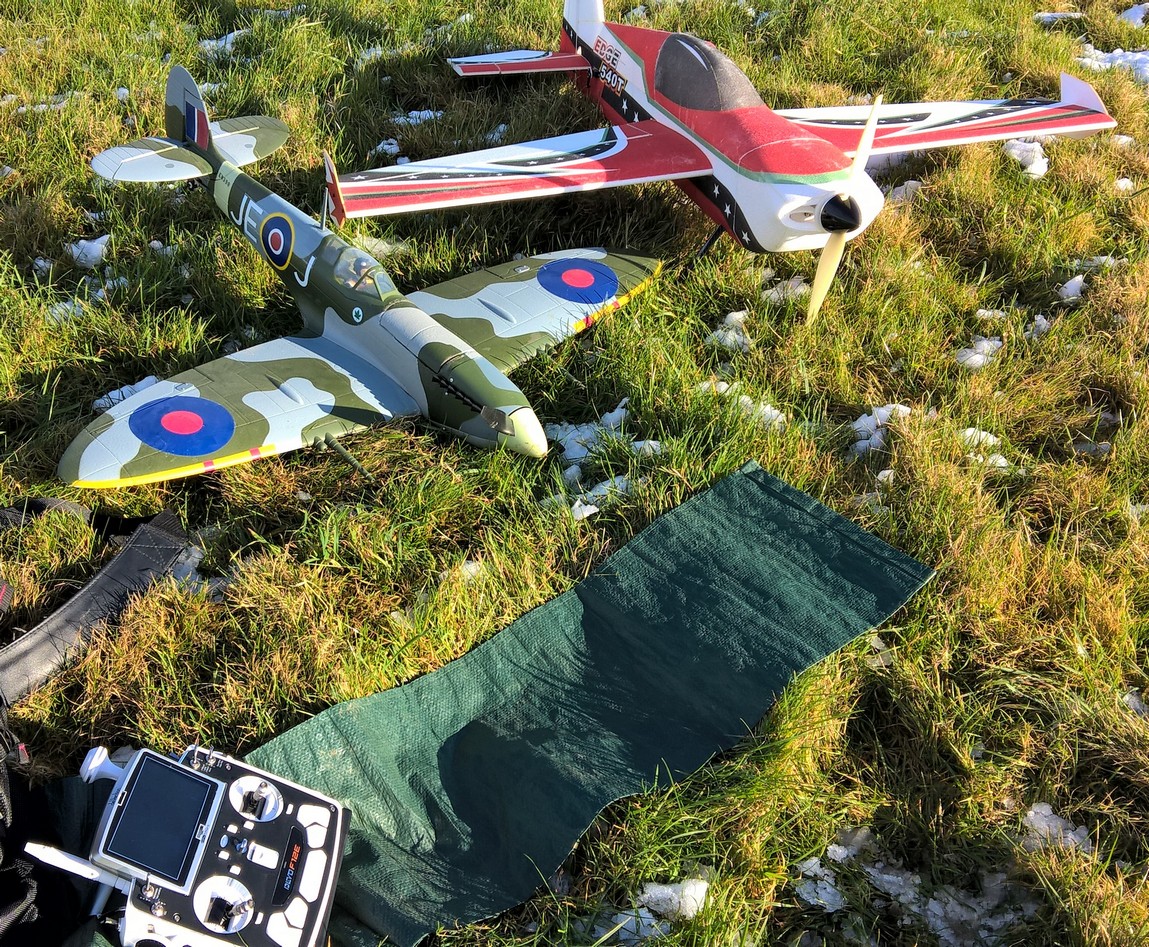 There were a few lovely (but cold) midweek days and on one of them the Midweekers present took the opportunity to mow the patch. Captain Slow pushed the mower while I had the much more important job of giving directions!
 Several new models appeared in January, I’m not sure if they were Christmas presents or simply the result of the lousy weather forcing people to spend more time in the shed. Probably a bit of both I reckon.
Musical maestros (or should that be Guitar Gits?) Chris P Bacon and Mike Creamer saved up their pennies and ordered a pair of wood Wot 4 Mk2’s. This version of the Wot 4 is constructed from lightweight balsa and ply and comes ready built and covered. Unlike the 47.4” span Wot 4 Foam-E the wood version is 52.6” span, the same size as the original Wot 4 that was designed by Chris Foss back in 1977 and available as a plan. It was first kitted in 1981 and has since been produced in a variety of versions and sizes. There are optional I/C or electric ‘power packs’ available for this latest wood version, simply choose the route you wish to take.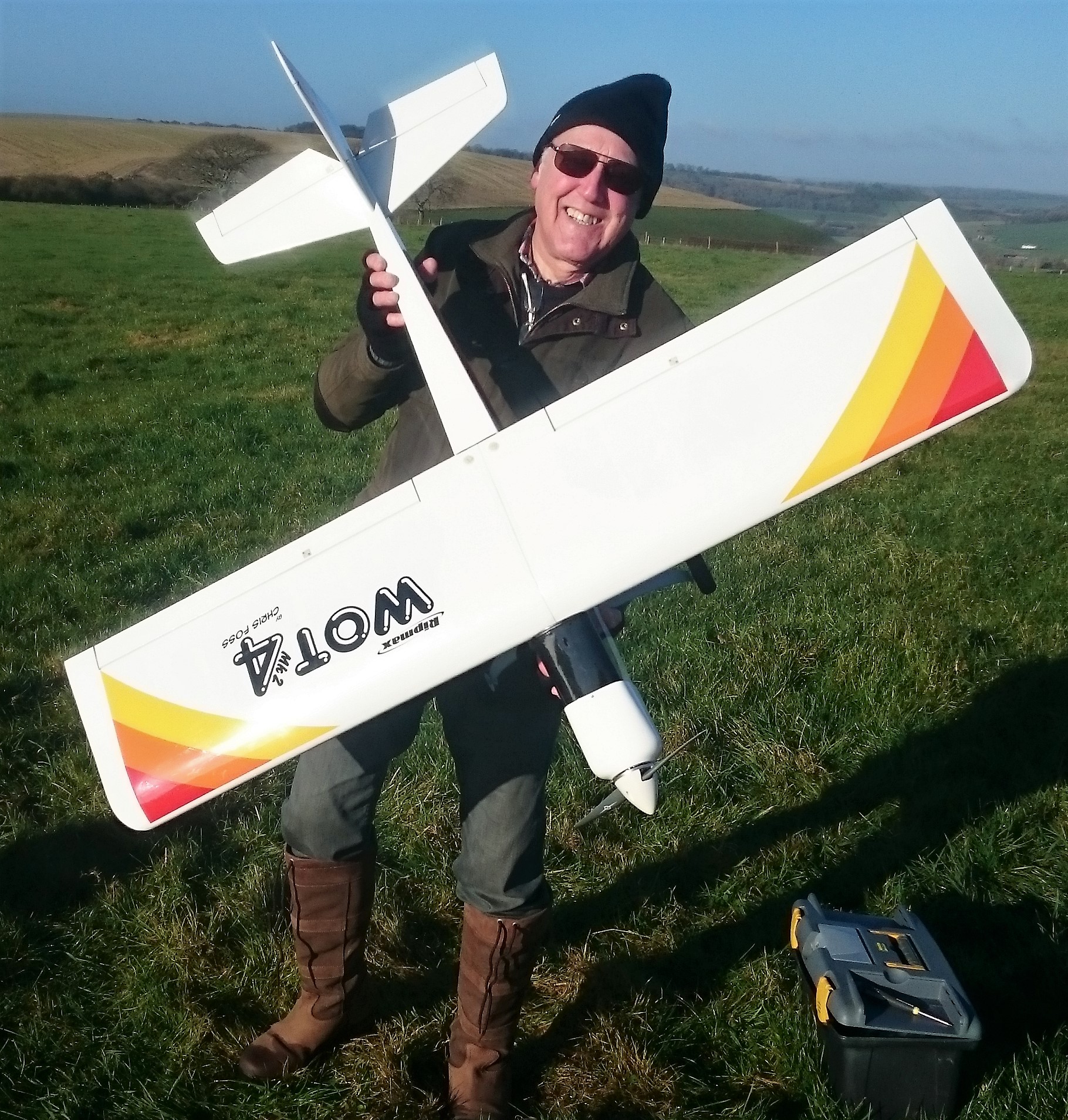 Mike sensibly chose the electric route and fitted his model out with a Turnigy 1000kv motor, an Aerodrive 3542 I believe. This is coupled to a 60A speed controller and is powered by a Zippy 3300mAh 4 cell lipo battery. Using an 11 x 8 prop Mike gets plenty of power and the battery has around 35% remaining after a 6 minute flight.
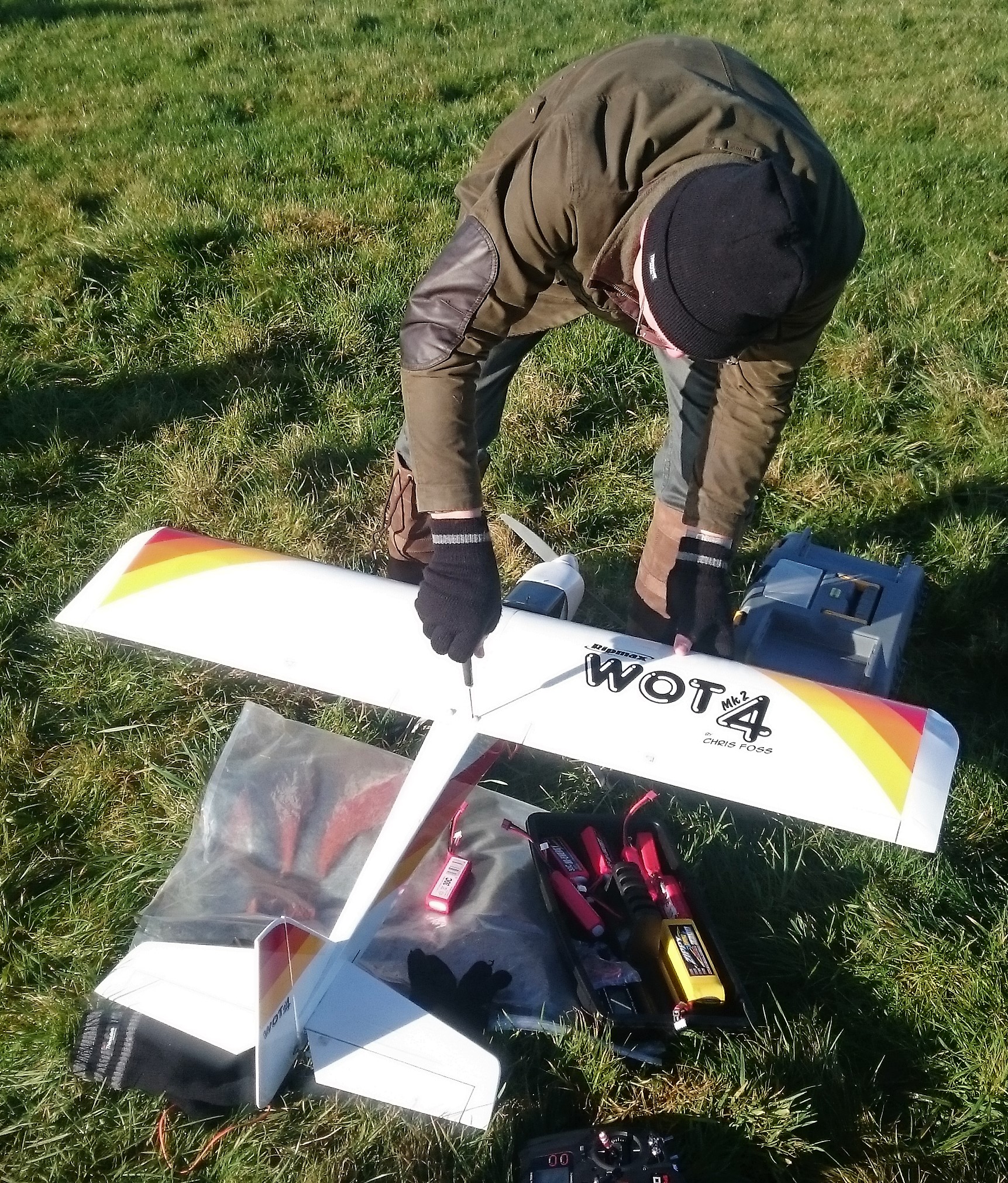 The plane’s first take-off and landing can be seen in this month’s video at the end of the blog. The model has now had several flights and Mike is getting on well with it, it’s an ideal follow-on plane to his Freewing Pandora.
On the other hand Chris P Bacon had a major brain fade and fitted one of those dirty noisy smelly things to his new Wot 4! Apparently it’s an old fashioned internal combustion engine, an SC52 4-stroke. He said something about a bucket list and wanting to get it out of his system. He’s already bought the sporty convertible and plays a guitar, let’s just be thankful he’s too old to ride a motorbike or chase women these days!
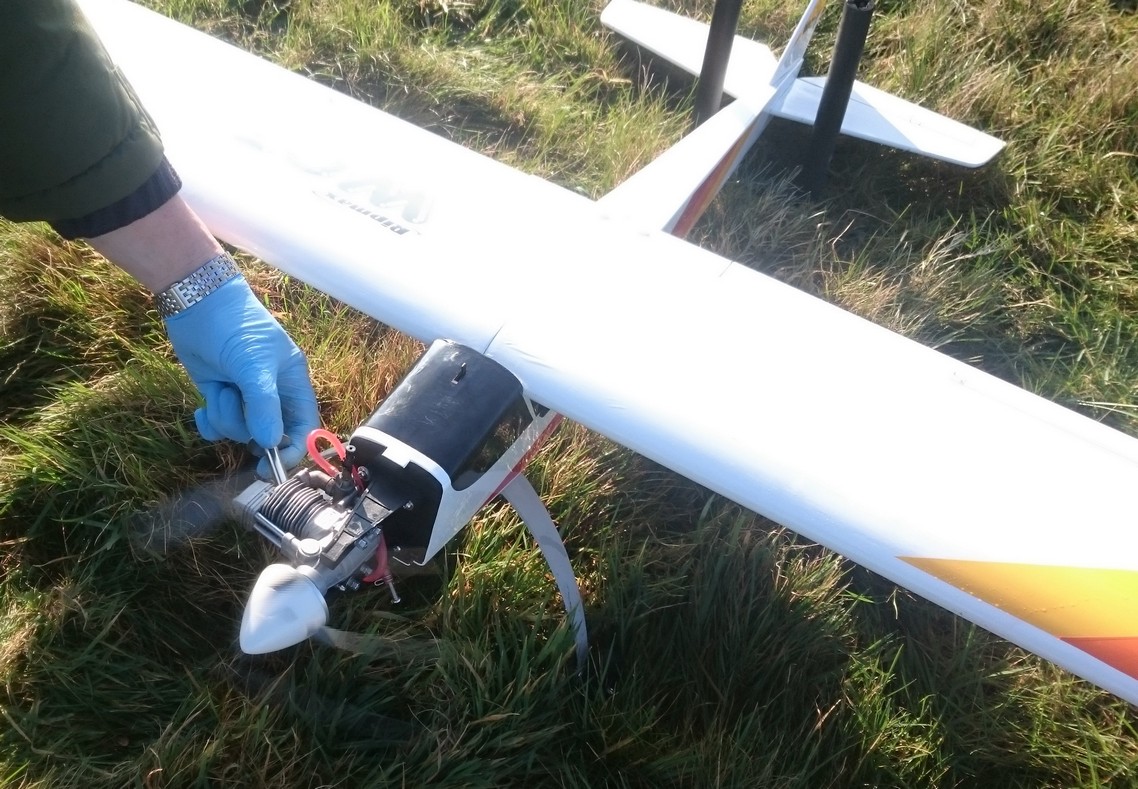 Don’t you just love the blue rubber Marigolds? Wait until Ursula finds out you’re using them for something other than the washing up Chris P! So, how does it fly? At the time of writing we’re still waiting to find out. It’s passed the noise test ok and Chris P got it running and handed me the transmitter to do the test flight but I found only one aileron was working. Once we got the obligatory “Bloody Spektrum” etc. comments out of the way we found the problem was actually a broken aileron link, so there could be no test flight that day. The linkage has now been fixed and no doubt it will fly well as soon as the weather produces a decent day.
I think Chris P is having trouble justifying the money he’s spent on an electric starter, a lead acid battery to power it, a glow clip powered by a NiCad battery, and a trolley to carry it all on. It obviously wasn’t worth all the expense and hassle for just one I/C plane, so he’s also fitted an I/C engine to an Acro Wot, this time a Laser 70 4-stroke. The first I knew of this was when I received and email from Chris P with the subject line ‘A really dirty picture’. Obviously I clicked to open the email as quickly as possible, only to be met with this: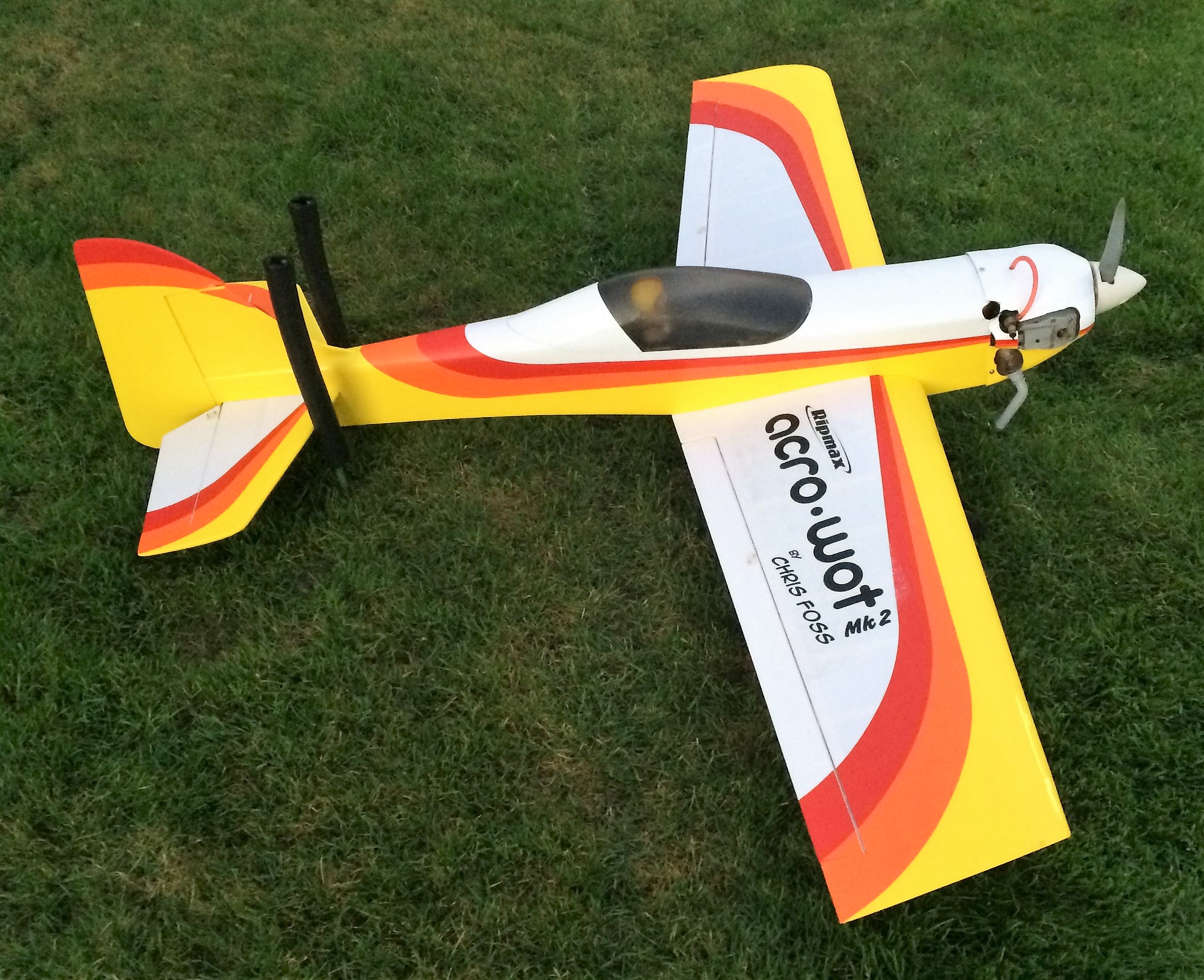 Never mind, it looks nice apart from that big lump of iron sticking out the front, the bits of fuel tubing, the needle valve, the exhaust, and the hacked about cowl. But I’m sure it will fly well and I look forward to having a go with it.
Not strictly new, but certainly heavily modified, is this flying wing being beautifully modelled by Basher Bob. It started life as a Multiplex Xeno, a moulded foam pure flying wing with a centrally mounted motor that drives a pusher prop via an extension shaft like this one (not Bob’s).
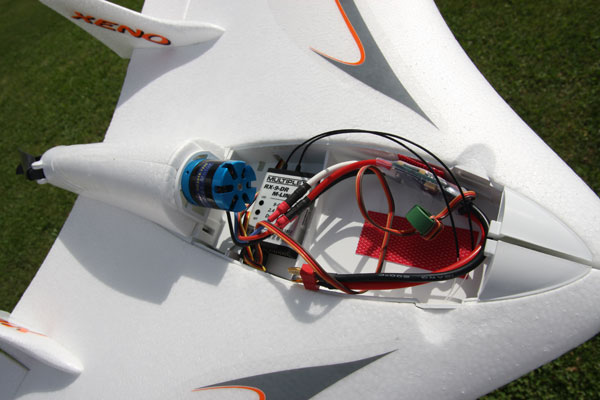 It’s intended to be used for thermal or slope soaring and is unusual in that it folds in half so it can be carried up the hills in a rucksack. But Basher didn’t really like the flying characteristics, he felt it always seemed a little unstable, and he found it was all too easy to bend the extension motor shaft. So he built a detachable fuselage with an NTM Prop Drive 28-36 1400kv motor mounted at the front and a large central fin behind the wing. He uses a 40A esc and a 3 cell 2200mAh battery. The extra fin area has improved the stability and with a 10 x 6 folding prop there’s little possibility of bending the motor shaft. The all up weight is now around 40 ounces and, although the glide probably isn’t as good as before, it’s still good and Basher wants the model to be a sports flier rather than a soarer.
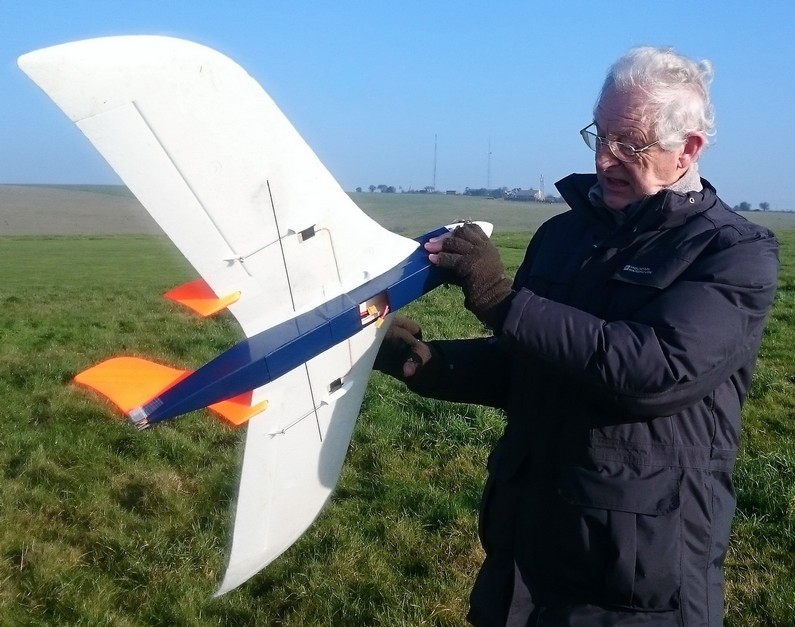 The fuselage can be easily removed if Basher wants to take it slope soaring and the wing still folds if necessary. So all in all the conversion has been a great success. Bob always likes to get a B into his model names so he now calls it a Beno. Personally I felt the B should have gone at the other end but I was banned from calling it that…
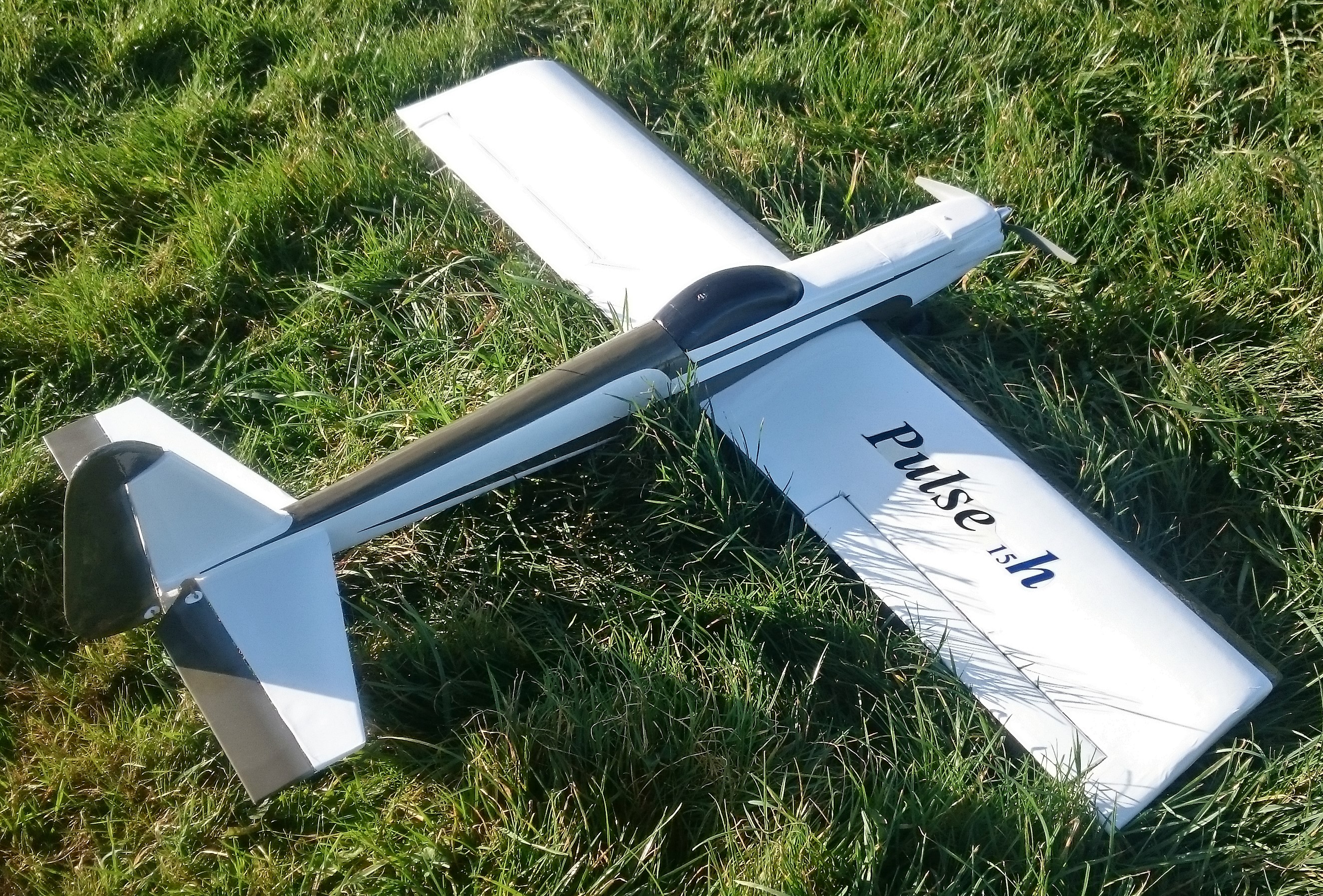
Next up is Catapult King’s new model, the Pulse’ish. Catapult was impressed by a magazine article on the E-Flite Pulse and decided to build his own version of it. He studied the photos, took measurements, and scaled them up.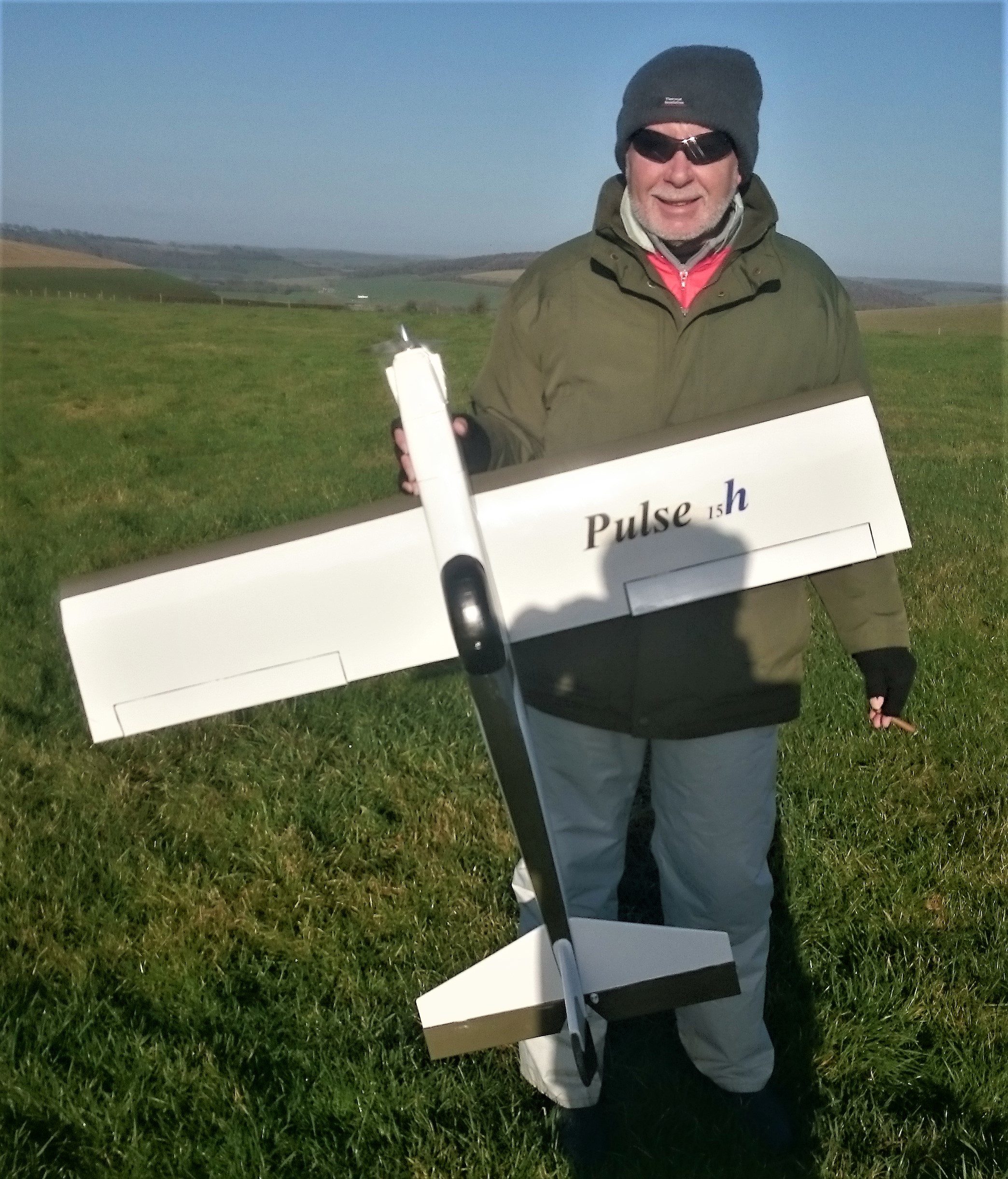 This is what Catapult says about it: Starting from a ply box to support the battery, ESC, receiver and support the wing etc. the plane is made mainly from Depron and took around six months to complete due to lack of technique and know-how. It has been covered with PVA and parcel brown paper followed by HobbyKing shrink wrap. It currently flies on an NTM 35-30/1100kv motor (following the accident with the NTM 35-42 drive shaft) and a 10×6 prop on a Turnigy 4s 2650 battery.
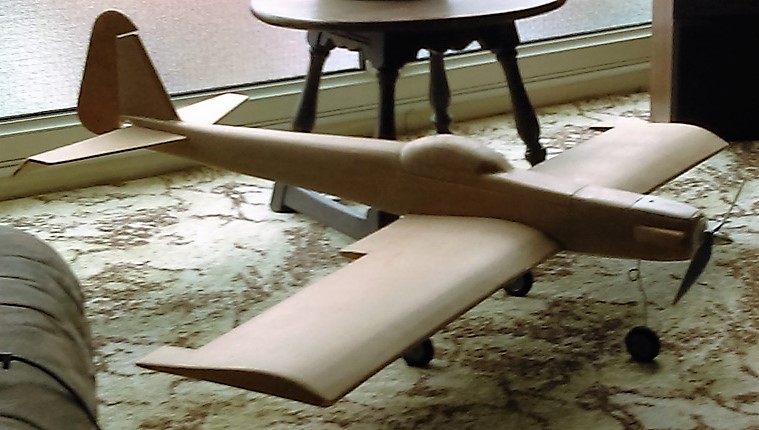 It looks pretty smart even just in its brown paper covering and even better once the shrink film had been applied. Catapult opted for a tricycle undercarriage rather than the more common taildragger.
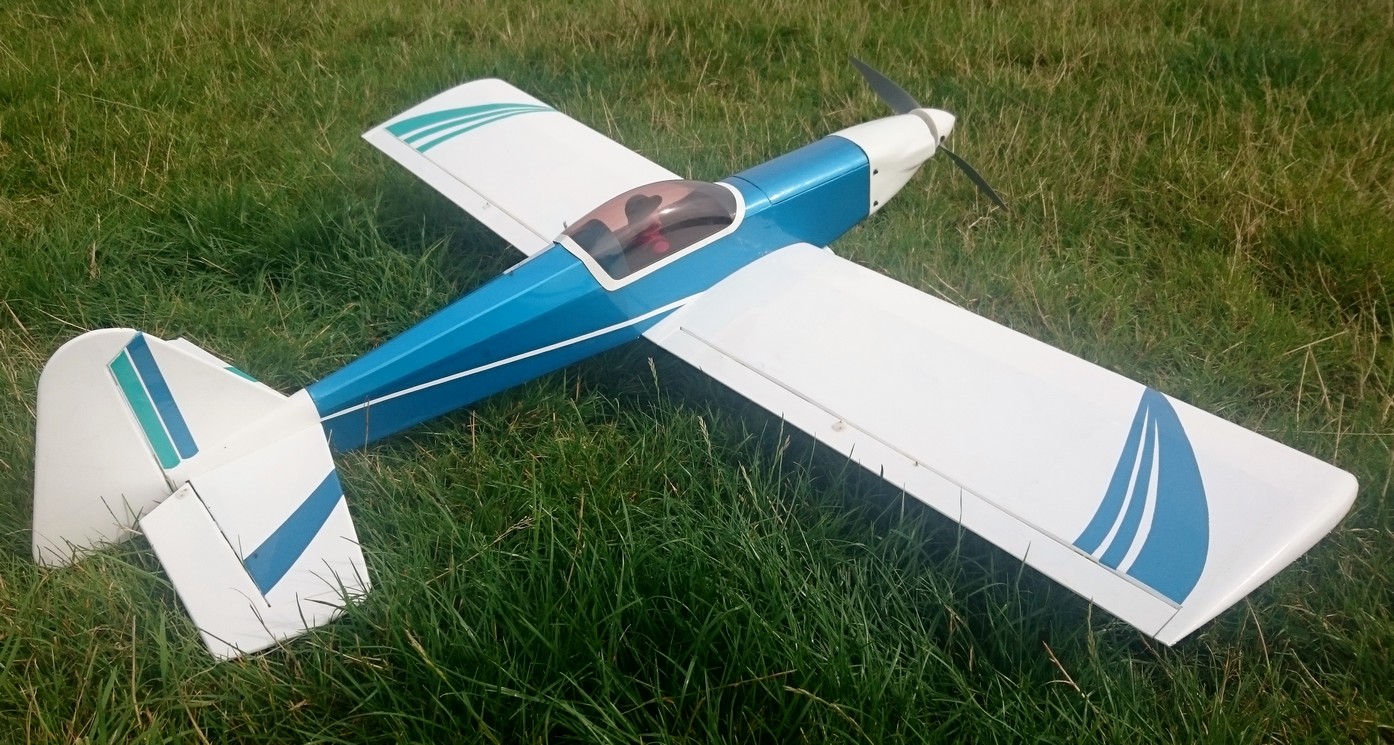
 Gentleman Jim flew an E-Flite Pulse for a long time and found it to be an excellent model. Here’s a photo of Jim’s genuine E-Flite Pulse to compare with Catapult’s Pulse’ish.
 I’ve flown the Pulse’ish a few times now and can vouch for its good flying characteristics. Kryten snapped this excellent action shot which shows off the very flat bottomed wing well: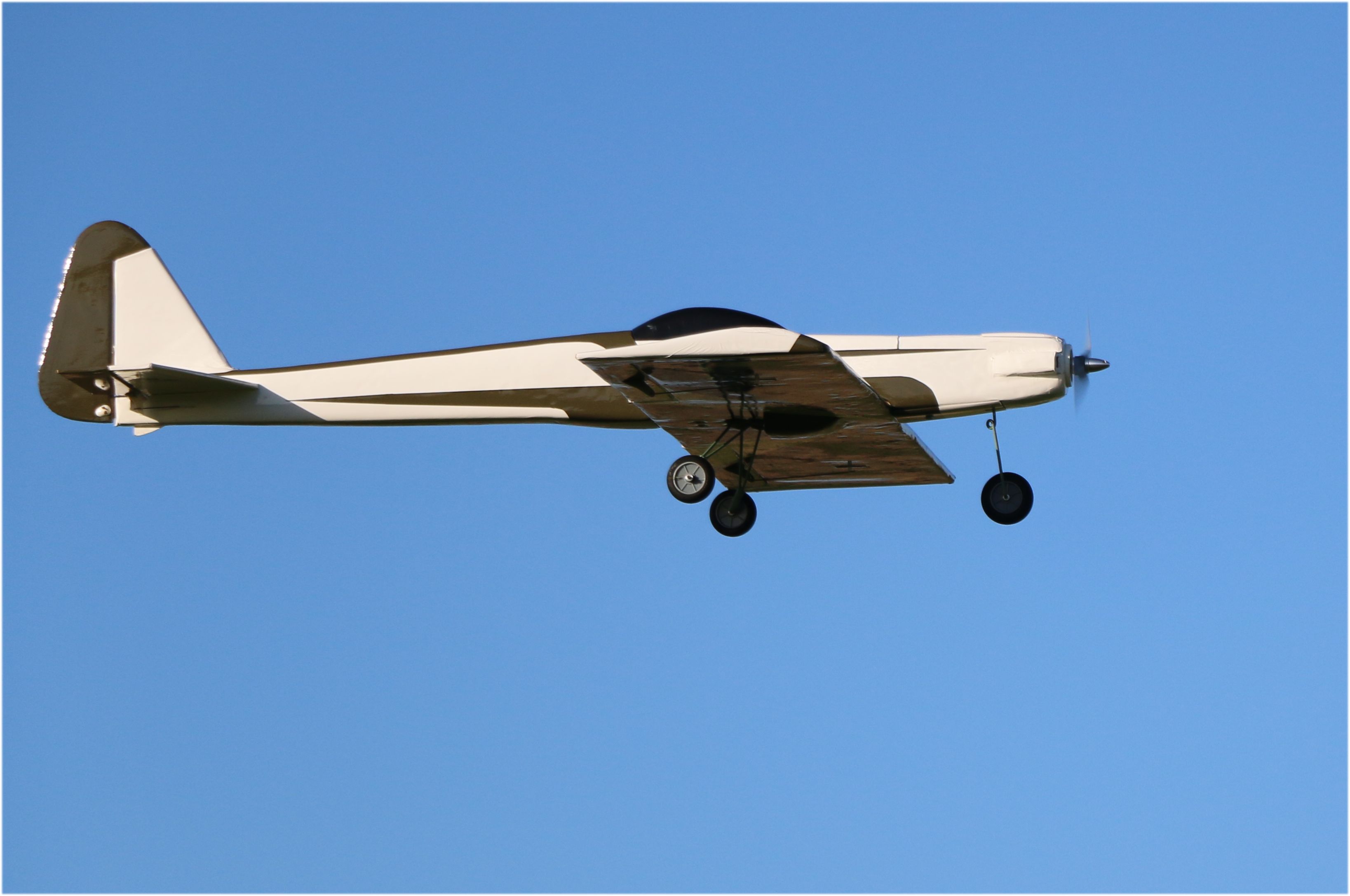
January didn’t turn out to be a good month for me; I had a couple of minor disasters. The first one involved my new Raptor. Last month I included some photos of the untouched kit and here it is again with the all-flying tail feathers assembled and positioned, and all the wiring tidied up and glued in place. The wiring needs to be glued in place to keep the duct clear and get the smoothest possible airflow. After thorough checks that the servos and speed controller worked correctly and the fan ran in the right direction the other half of the fuselage was epoxied in place, effectively sealing all the electronics away forever. Then I added the wings and fins and connected up the linkages. This was when I realised one of the ailerons servos wasn’t returning to centre correctly! I’d checked the servos moved and didn’t judder but without the output arms fitted I hadn’t noticed that the servo stopped in a different position every time. After an awful lot of head scratching I eventually managed to remove the servo, fit a new one, and re-glue the wiring in place. I’ve never done keyhole surgery before!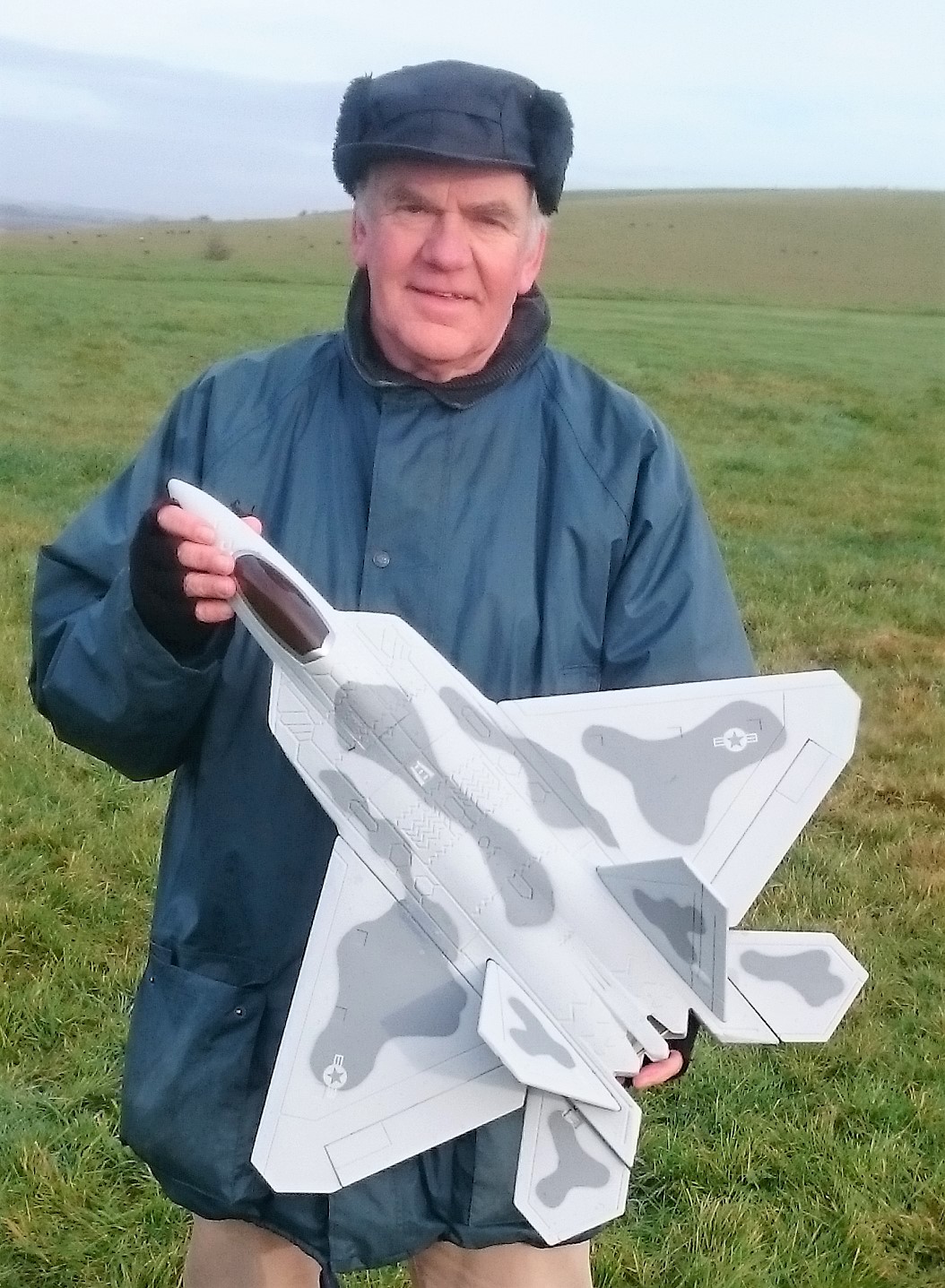
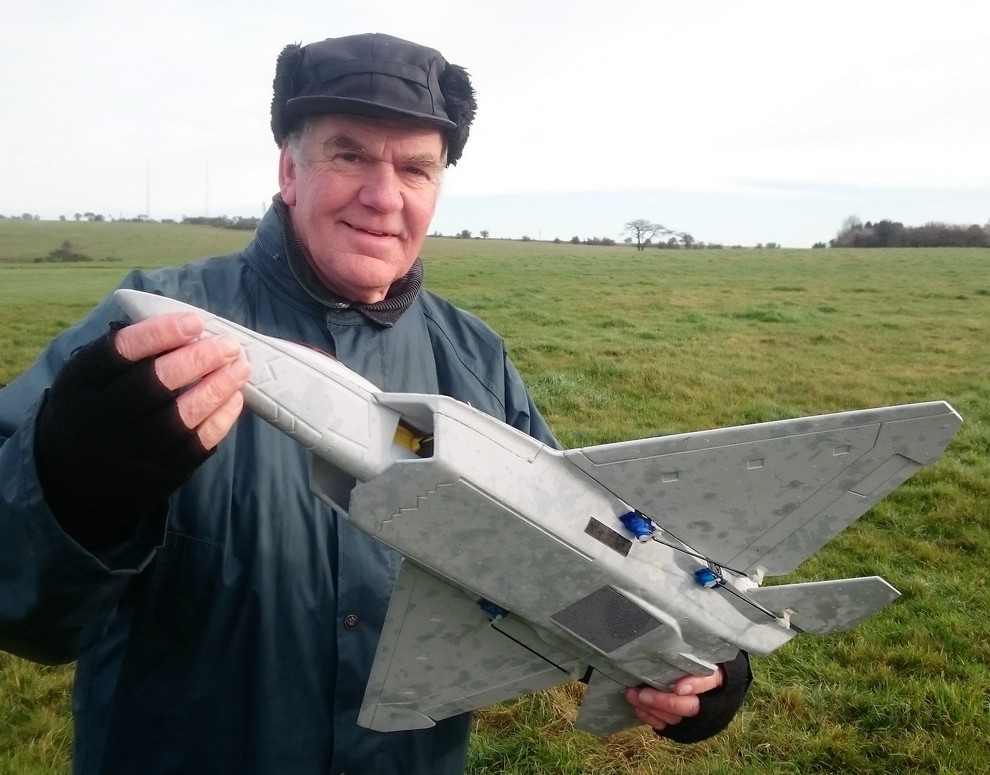 The finished Raptor looked good and I was confident it would fly well…wrong! I’m not sure what happened but basically it failed to get away from what seemed to be a perfectly good launch.
 The polystyrene fuselage didn’t like the rapid arrival and the nose was quite badly damaged. Never mind, it’s repairable, although it will never be as pretty as before. Once it’s sorted I’ll try again, watch this space…
My second disaster occurred on Saturday 28th January when I was flying my venerable Spirit mini-glider. This photo of it was taken way back in the summer of 2014: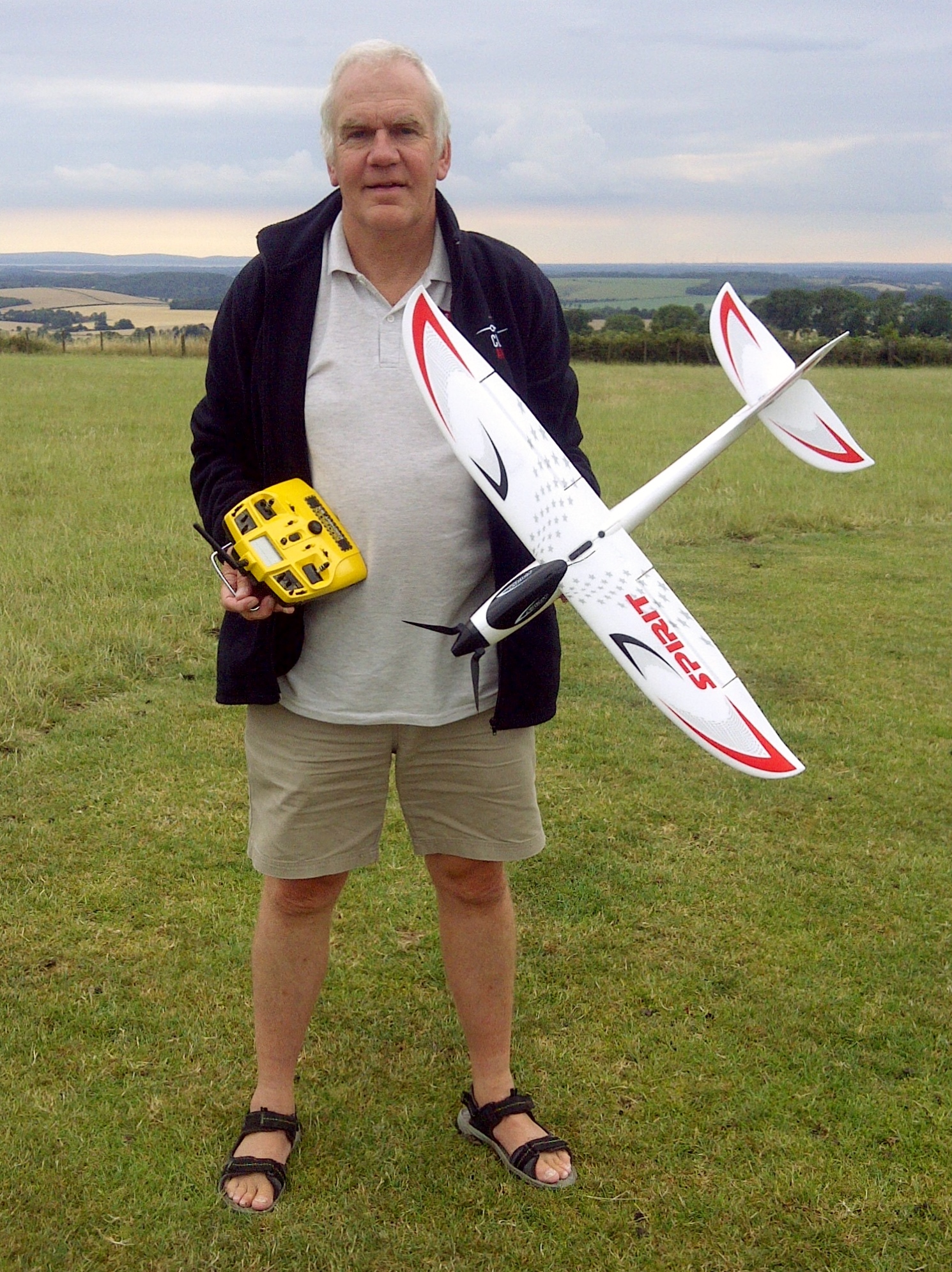 I often fly it up to a great height and then spin it back down again but on this occasion it vanished into the clouds. No problem I thought, it’s happened before, just put it in a spin and watch for it to re-appear. Only this time it didn’t! Both Basher and were watching the model intently when it entered the cloud but neither of us saw it come out again. I suppose it’s possible it got sucked up by a thermal and didn’t come out, but that seems very unlikely. It’s much more likely that we both simply failed to spot it, the Spirit is only 32” span and it was very high at the time. I tried various manoeuvres while scanning the sky but neither of us saw it again. The wind would have carried it north towards East Meon but I really have no idea where it’s likely to be, and despite both Doreen and I traipsing around the hills for several hours we didn’t find it. I’ve had hundreds of flights with the Spirit and it had been repaired a few times but I still enjoyed flying it and I don’t like losing it. On a slightly more cheerful note I’ve just checked the HobbyKing website and both the Spirit and similar Kinetic are in stock in the UK warehouse…tempted!
Returning to happier things now, Dwayne Pipe has built another Spitfire. His earlier Spit flew reasonably well but was rather overweight which did nothing for its flying characteristics.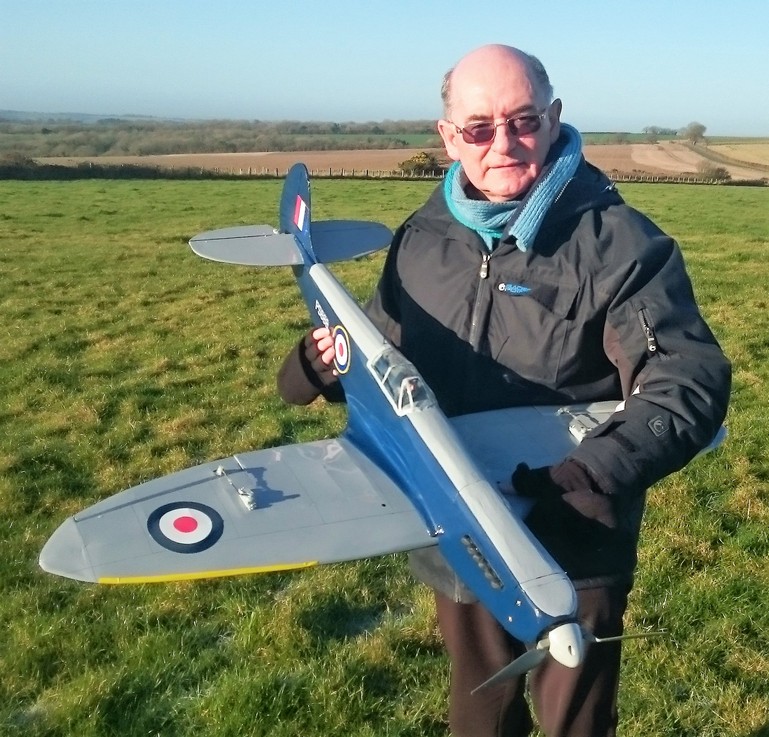 Some of you may have seen the new one when Dwayne brought it along to a recent club meeting but for the rest of you here are some details. Dwayne drew the plans himself and based it on one of the last operational Mk19 reconnaissance Spitfires based in Malaysia in 1954. It’s 43 inches wingspan and weighs just over 3lbs, so it’s a little smaller but much lighter than his previous Spit.
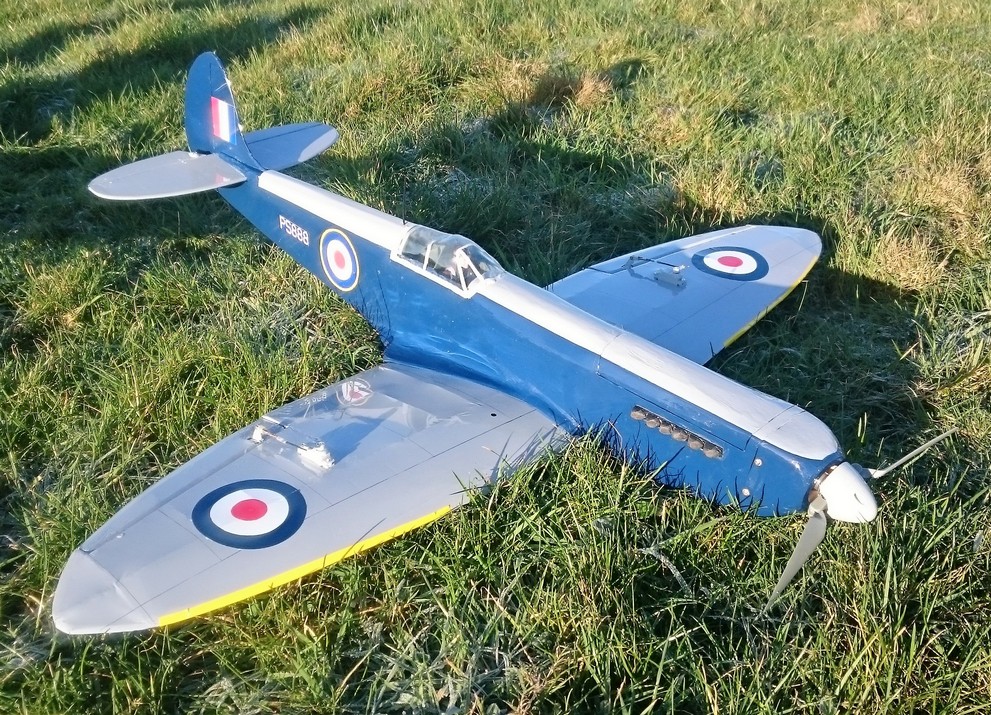 He’s fitted a 1000kv motor, a 60A speed controller, an 11 x 8 folding prop, and a 3 cell lipo to provide the power. Dwayne confesses to have lengthened the nose a little so he can get the CG in the right position without the need to add weight. I wasn’t at the patch on the day of the first couple of flights but all went well and apparently the Spit is very well behaved. At the moment the Spit is hand launched but Dwayne has built in undercarriage mounts so he can add an undercarriage later if he wants.
 Hopefully I’ll get some flying shots and video for the next Patch News, in the meantime you’ll just have to enjoy the static shots. I’m sure you’ll agree Dwayne has made a lovely job of it.
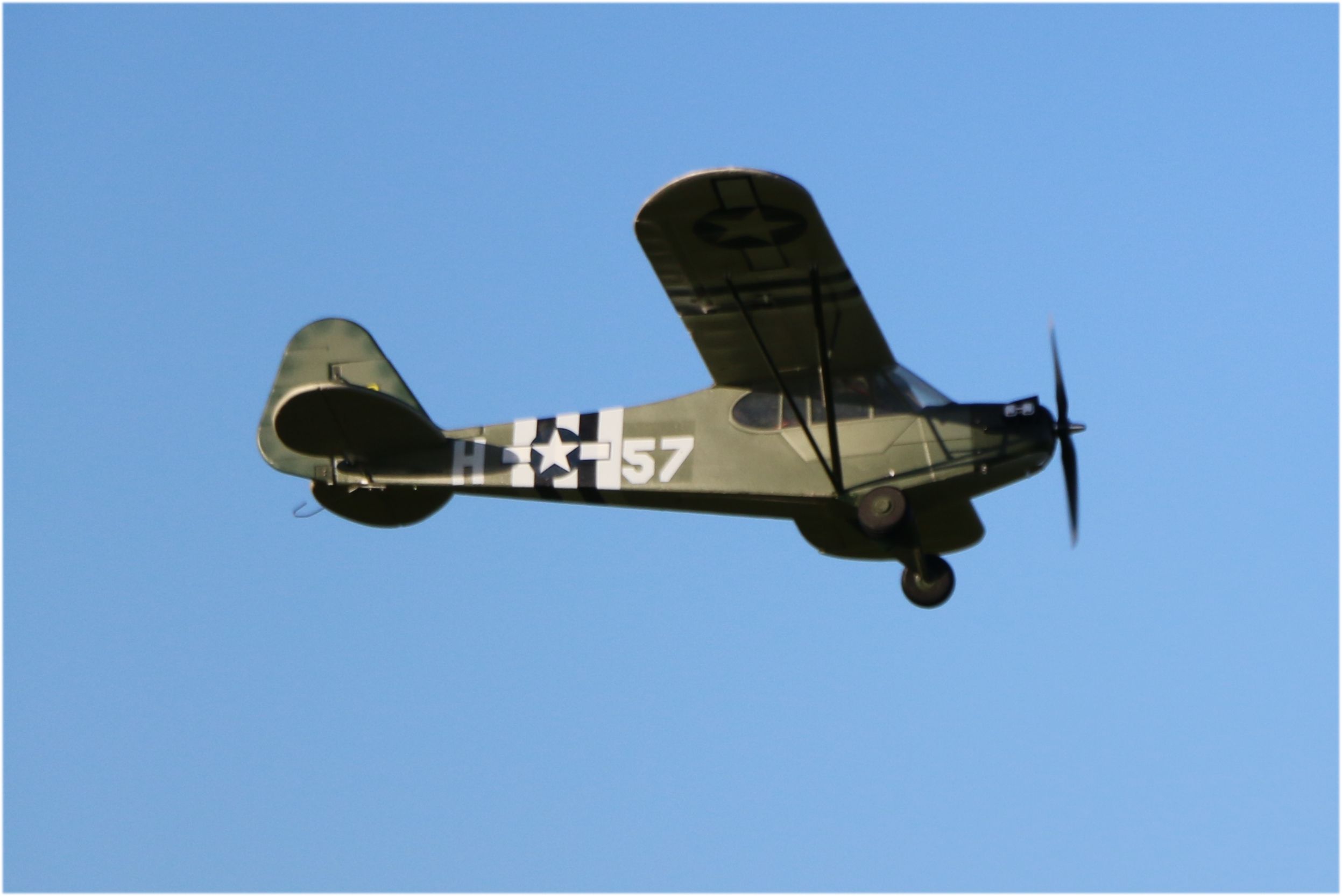
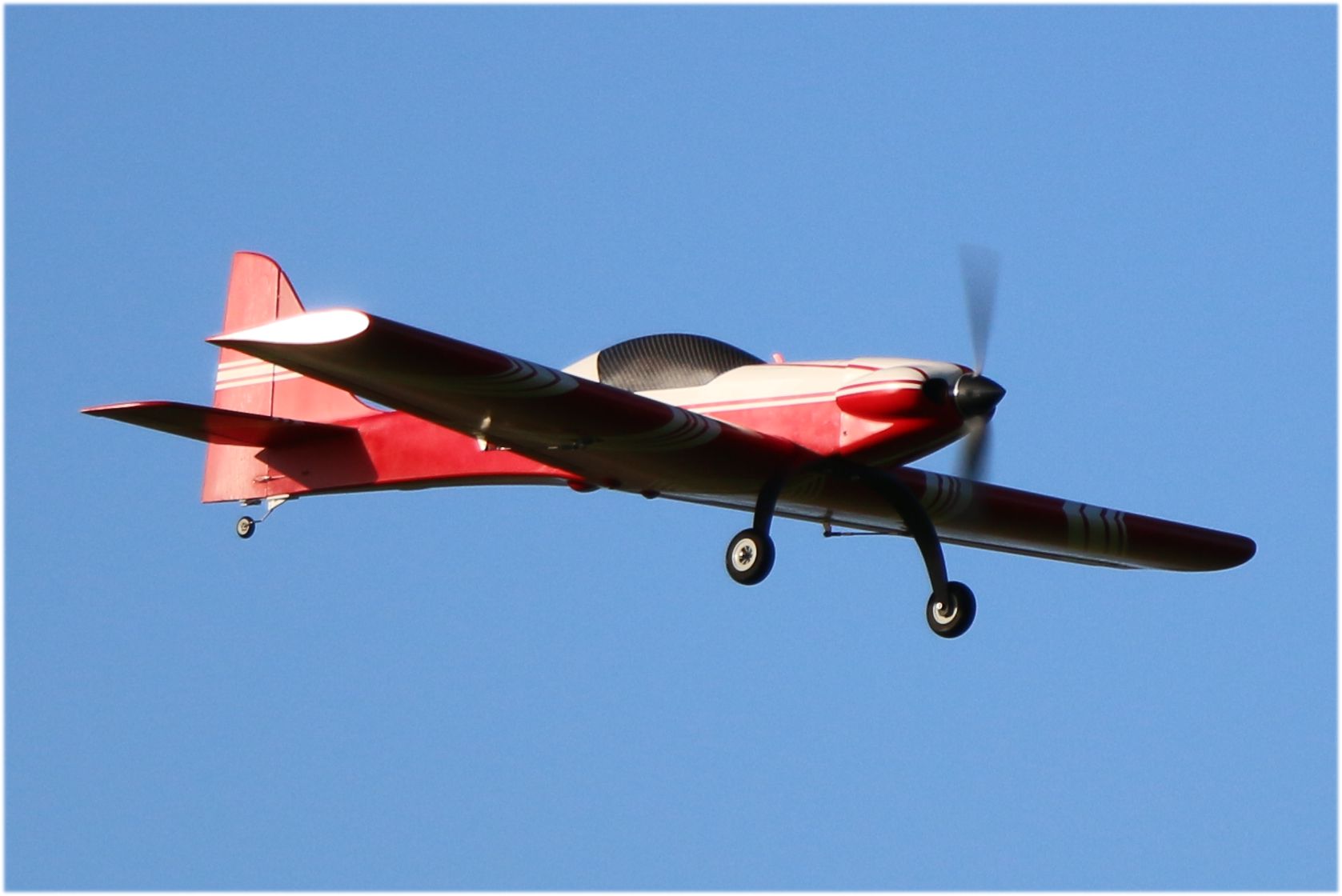
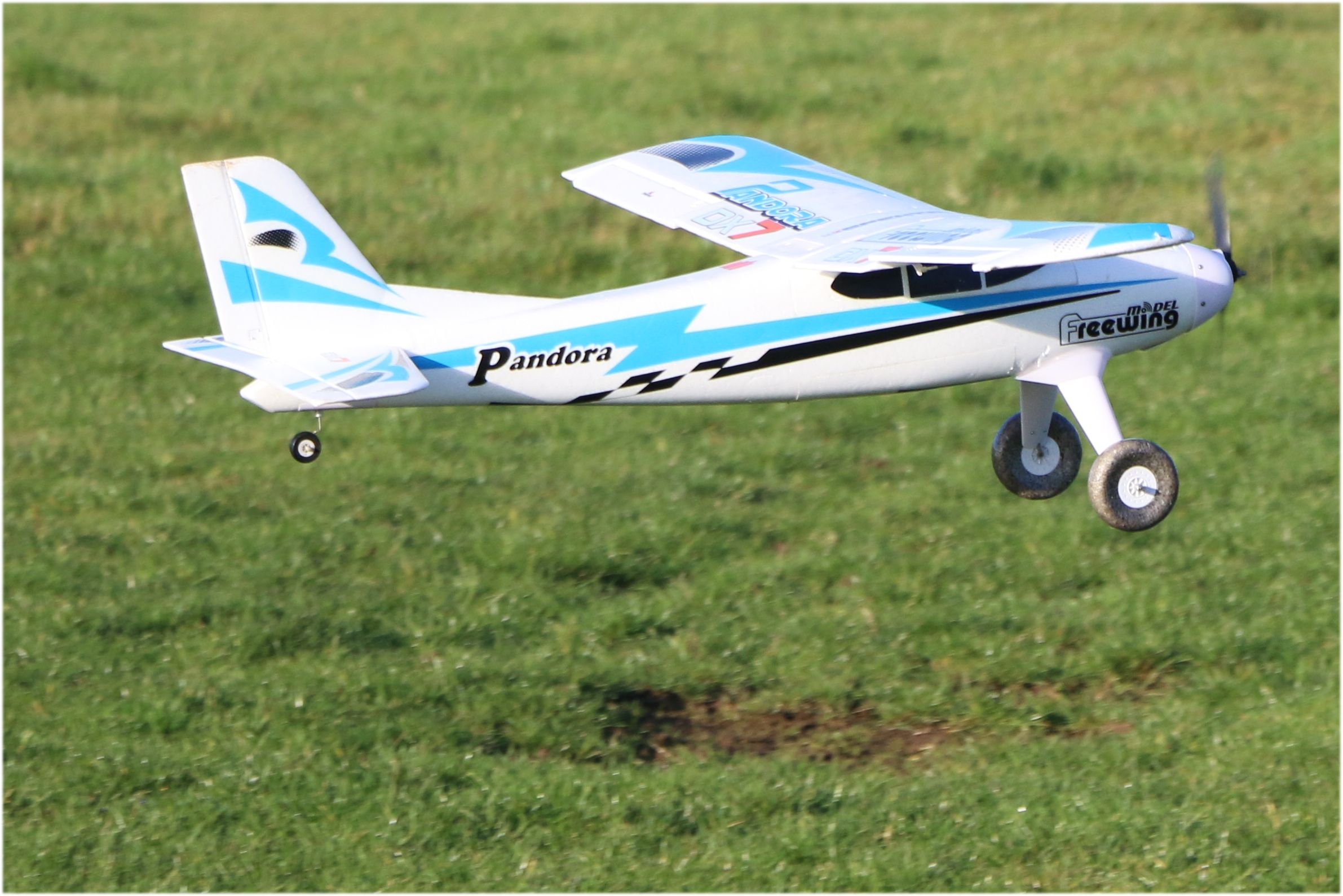
January 2nd was a cracking flying day and Kryten took these superb shots of Woody’s E-Bandit, 1066’s Grasshopper, Modelling Clay’s Acro Wot, and Mike C’s Pandora: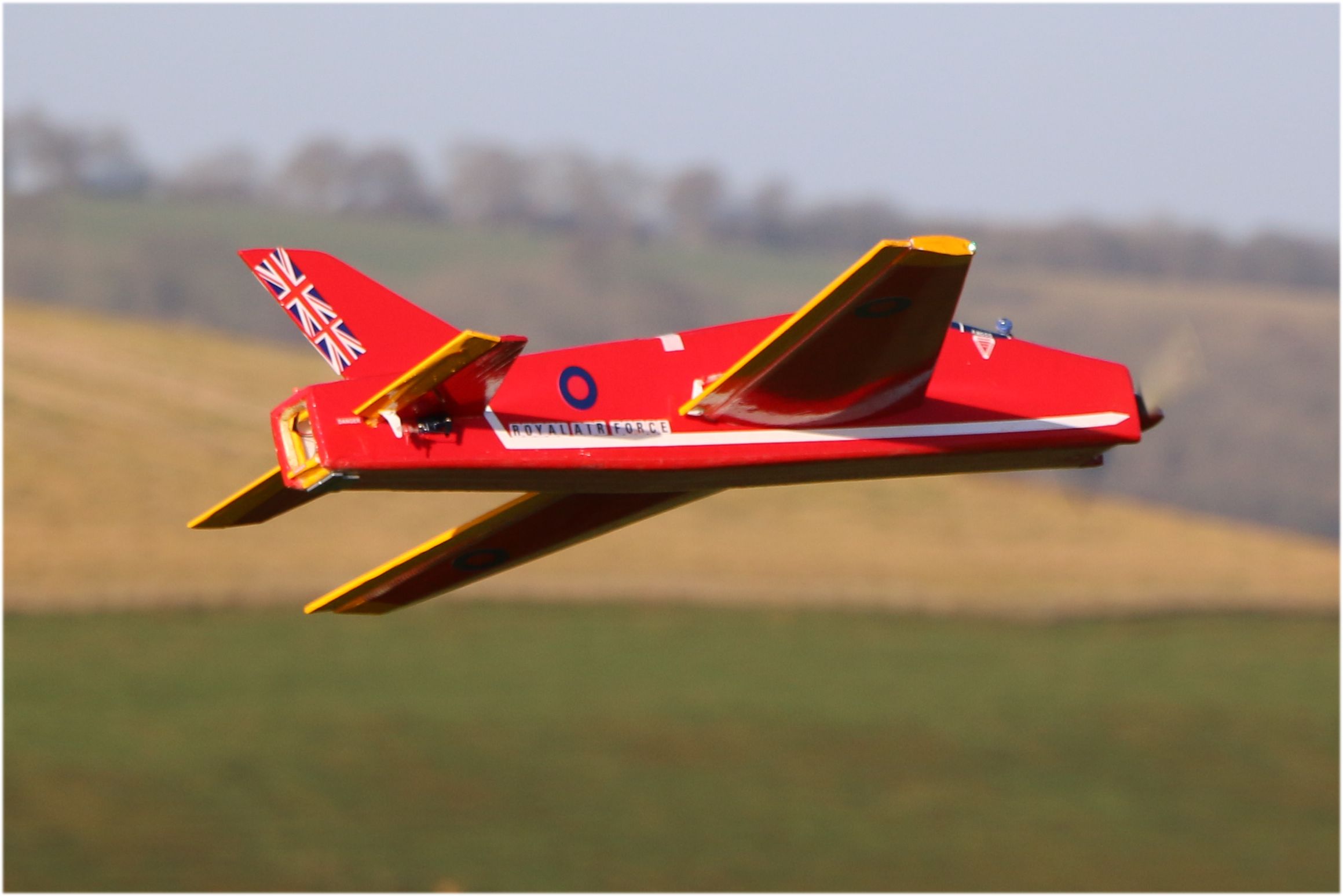
Please watch the video full screen, it’s so much better with small models flying around. If the video above won’t play for you CLICK HERE
A blonde lady is a passenger in a light aircraft when her pilot collapses.
She grabs the mike and calls out: “Mayday! Mayday! My pilot is dead, help me!”
Air traffic control responds “Don’t worry, I’ll talk you through this. What’s your height and position?”
“I’m 5 foot 4 inches and I’m in the plane,” she says…
Colin Cowplain
Patch News – December 2016
Happy New Year everyone! I hope you’ve all had a brilliant Christmas and fantastic New Year’s Eve. Still got a headache? Serves you right, I have no sympathy for you at all! So who was lucky enough to receive some modelling gear as presents? Please send me your photos and info, and I’ll include some next month. No Basher, no repeats of last year please, I want AERO modelling photos, not you in your Christmas Y-fronts and socks again.
As was to be expected the December weather was variable. We didn’t have too much rain but up at Chidden Down lots of days had early morning fog which sometimes lingered the whole day. On those days a few of us flew Hummers, about the only things flyable in the murk, and then only if you can prop-hang reasonably well. We did have what could have been a nasty ‘moment’ one morning. I will say no more about it except that Tony Neal will now be known as Slasher Neal.
But we also had some good days and 22nd December was just about perfect. With a very gentle south westerly wind to blow the fog away the day was bright and not too cold. The mist lingered down over Portsmouth and the Solent but it was perfectly clear at the field. The lovely weather lured some of the Midweekers away from their Christmas preparations and I was joined by Gentleman Jim, Dwayne Pipe, Basher Bob, Woody, and John Warren.
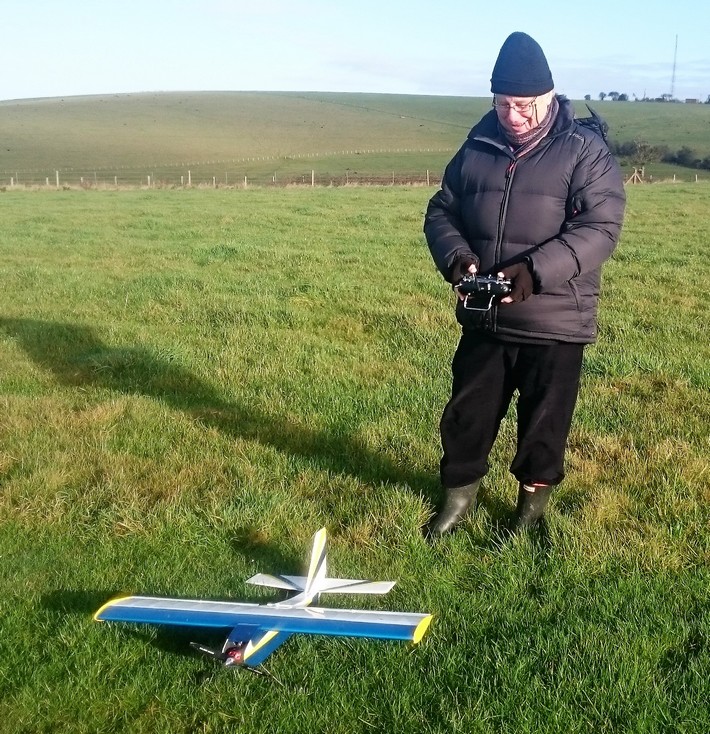
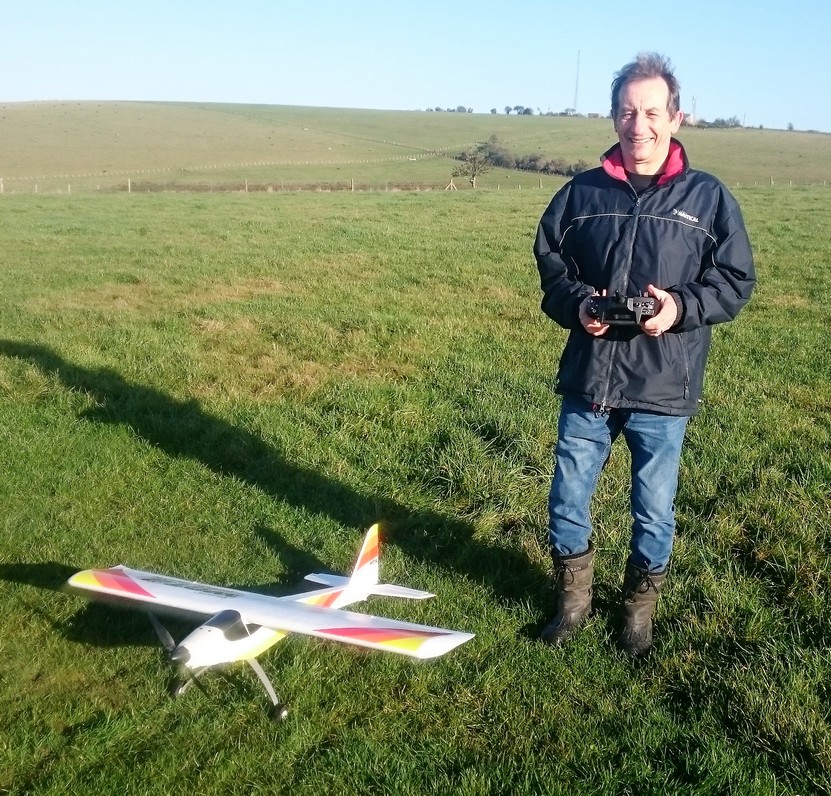 It was especially good to see Woody back flying again following his replacement knee op. I’m sure his flying had improved, maybe his knee jerk reactions are faster now!
If you were paying attention last month you’ll know Santa had promised me a Kyosho F-22 Raptor. Well surprise surprise on Christmas morning there it was under the tree. It’s 25” (635mm) span and is moulded in polystyrene foam. Not sure how durable that will prove to be; nowadays virtually all foamies are made from either EPO or EPP.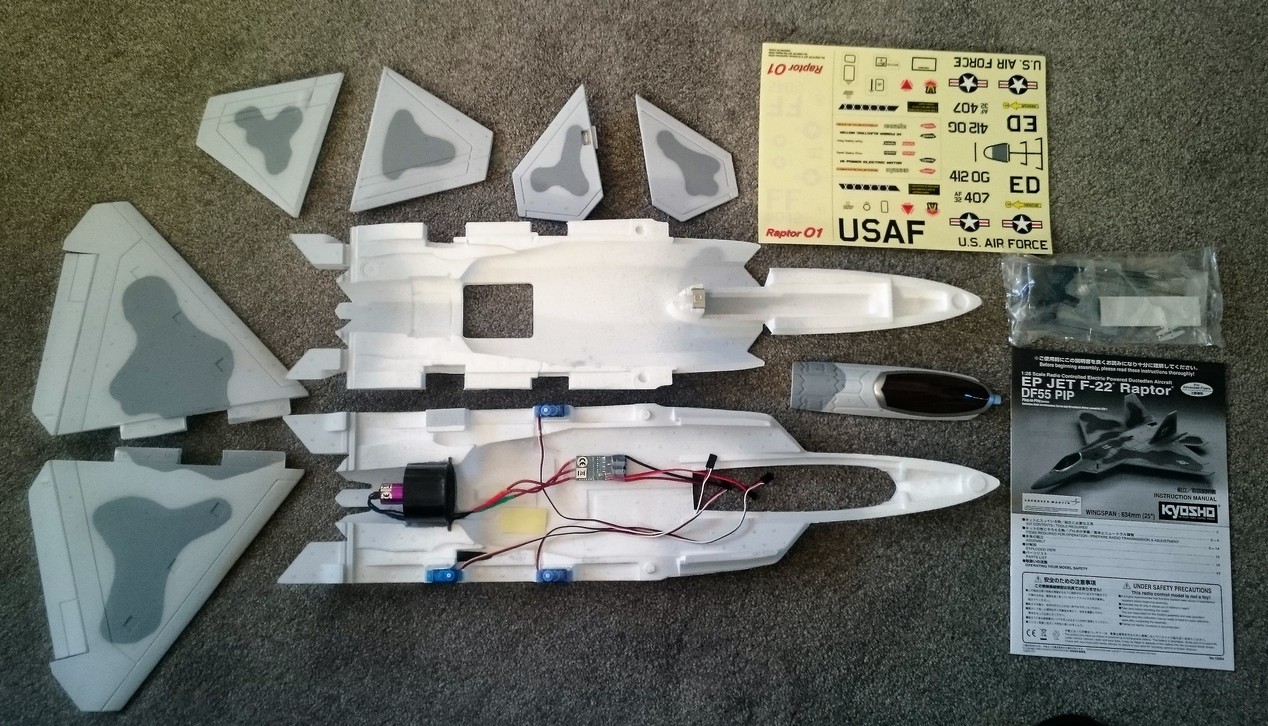 It comes with all the necessary electronics, 3 servos, the motor, the speed controller, and a 55mm diameter fan unit. Those wings may be scale but I’m sure they’re way too small!
This is from Wikipedia: The Lockheed Martin F-22 Raptor is a fifth-generation, single-seat, twin-engine, all-weather stealth tactical fighter aircraft developed for the United States Air Force (USAF). The result of the USAF’s Advanced Tactical Fighter program, the aircraft was designed primarily as an air superiority fighter, but also has ground attack, electronic warfare, and signal intelligence capabilities. The prime contractor, Lockheed Martin, built most of the F-22’s airframe and weapons systems and did its final assembly, while Boeing provided the wings, aft fuselage, avionics integration, and training systems. The high cost of the aircraft, a lack of clear air-to-air missions due to delays in Russian and Chinese fighter programs, a ban on exports, and development of the more versatile F-35 led to the end of F-22 production. A final procurement tally of 187 operational production aircraft was established in 2009, and the last F-22 was delivered to the USAF in 2012.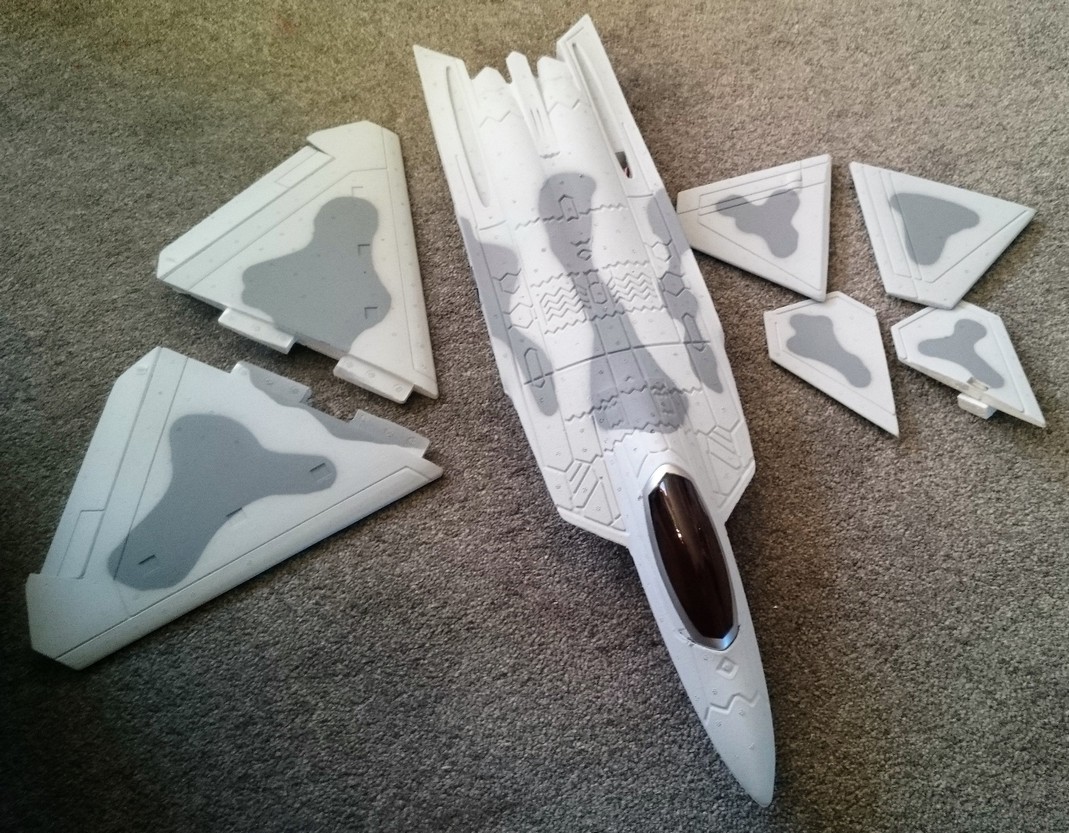 Although the model is a fully moulded foamie there’s still a reasonable amount of assembling to be done and, being polystyrene, I won’t be able to use my usual lazy-boy cyano. There hasn’t been any foam-safe cyano in the raffle (useless Hastings, useless) so I suppose I’ll have to use epoxy.
It’s been a good month for me as not only did Santa bring me the Raptor, but also Mrs. Santa gave me permission to buy a new transmitter, and of course it had to be Multiplex again.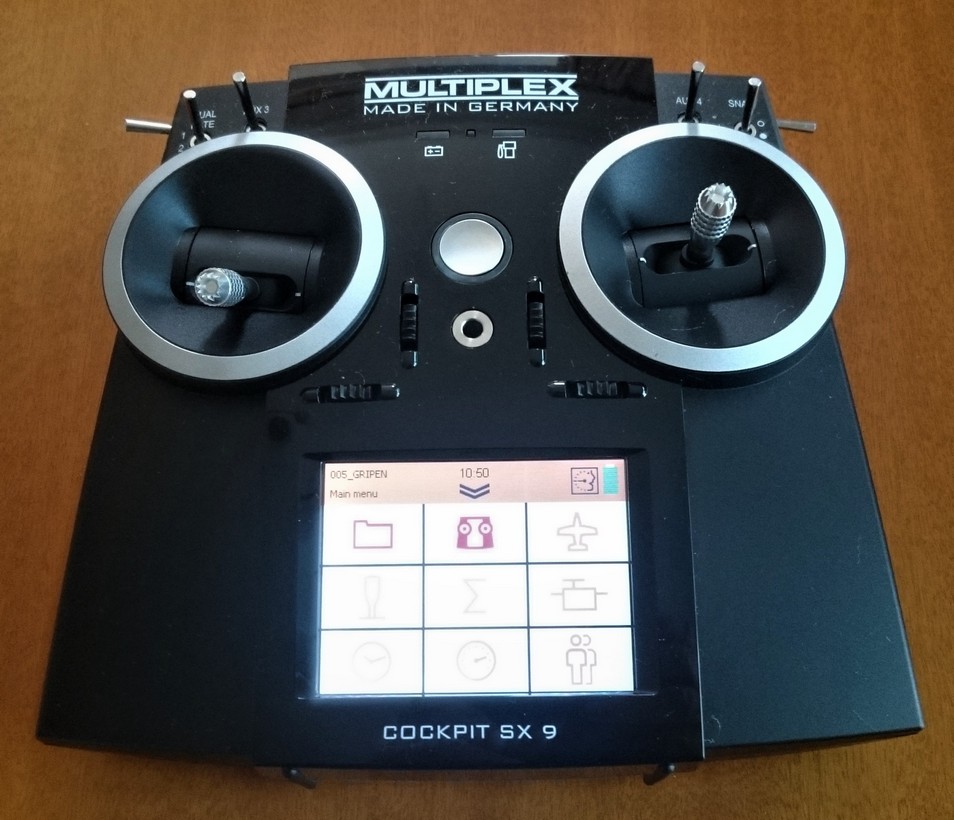 I didn’t really need one, my faithful Multiplex Cockpit SX is still performing faultlessly, but the new transmitter (rather confusingly also called the Cockpit SX) does have a few extra features, the most obvious one being speech. On the old set the throttle-linked countdown timer beeps at various times, and there are different beeps for various alarms, particularly if telemetry is being used, but the pilot has to glance at the screen to read the actual values.
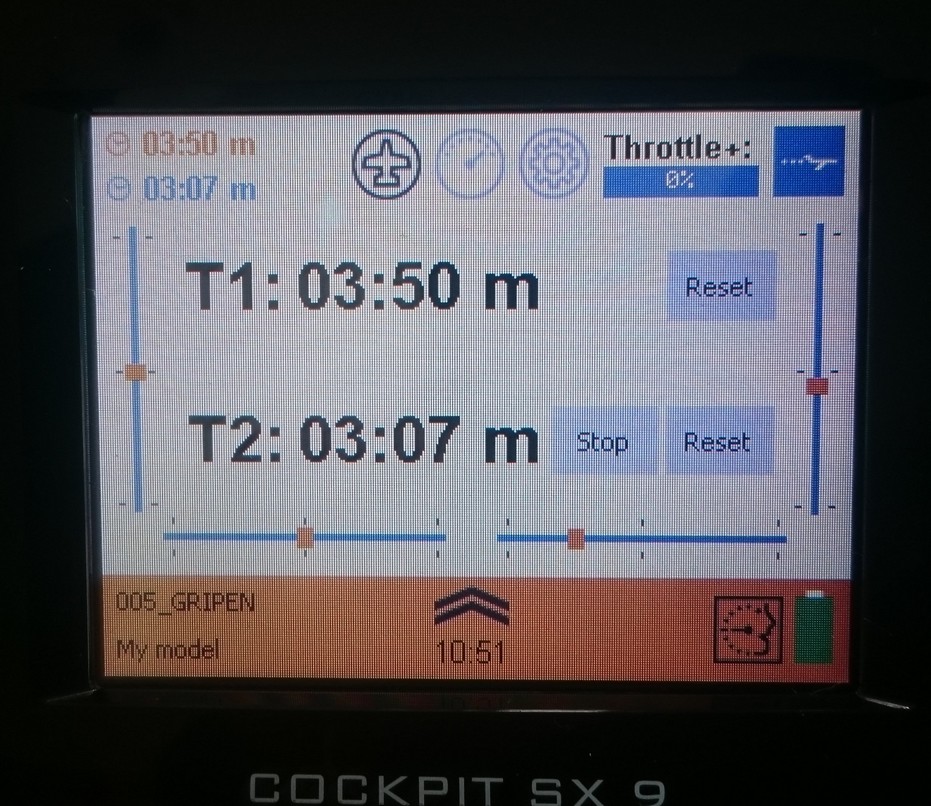 But on the new one it speaks the time during the countdown and, if you use telemetry, will speak (for instance) the current the motor is pulling, the milliamps left in the battery, or whatever else you set up. The frequency and volume of the announcements can be adjusted and you can listen to them via an earpiece if you wish. I have used 16 of the 18 model memories on the original set, although it is possible to download and save them to a PC for recall if required later. The new set has room for 200 models so I don’t think I’ll run out! It comes with a USB lead to charge the single cell 4000mAh LIFE battery, and the same lead it used to download free software updates.
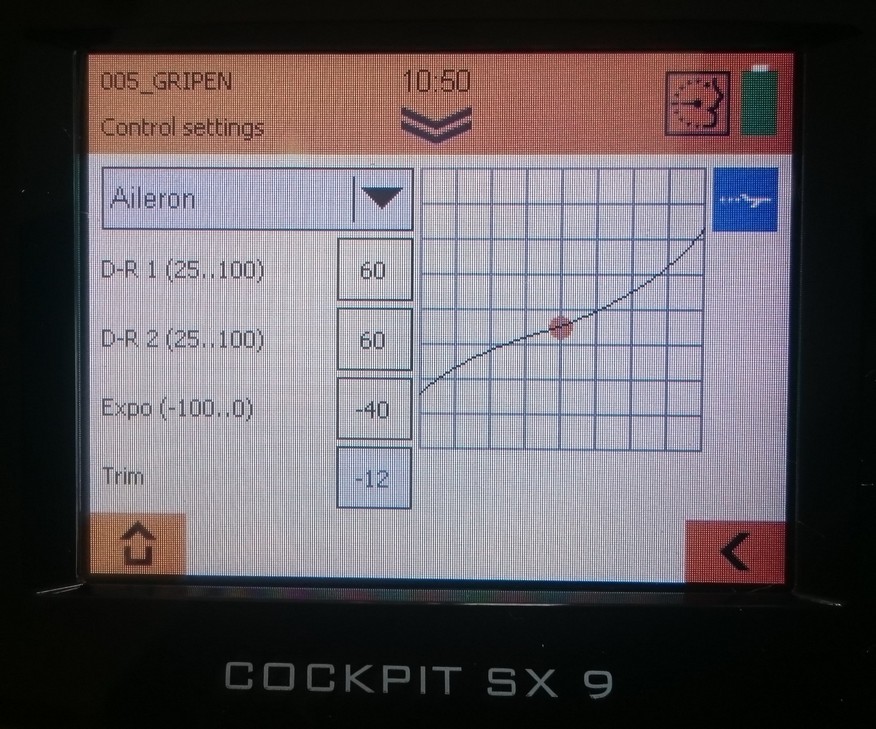 Multiplex seem to bring out new transmitters in a fairly basic form and then add extra features that people request. The Cockpit SX has been out for around a year and as soon as I connected mine up it downloaded an update that included another 8 mixers. The setting up is all done on the full colour TFT touch-screen which works very well although some of the text is a bit small for my aged eyes.
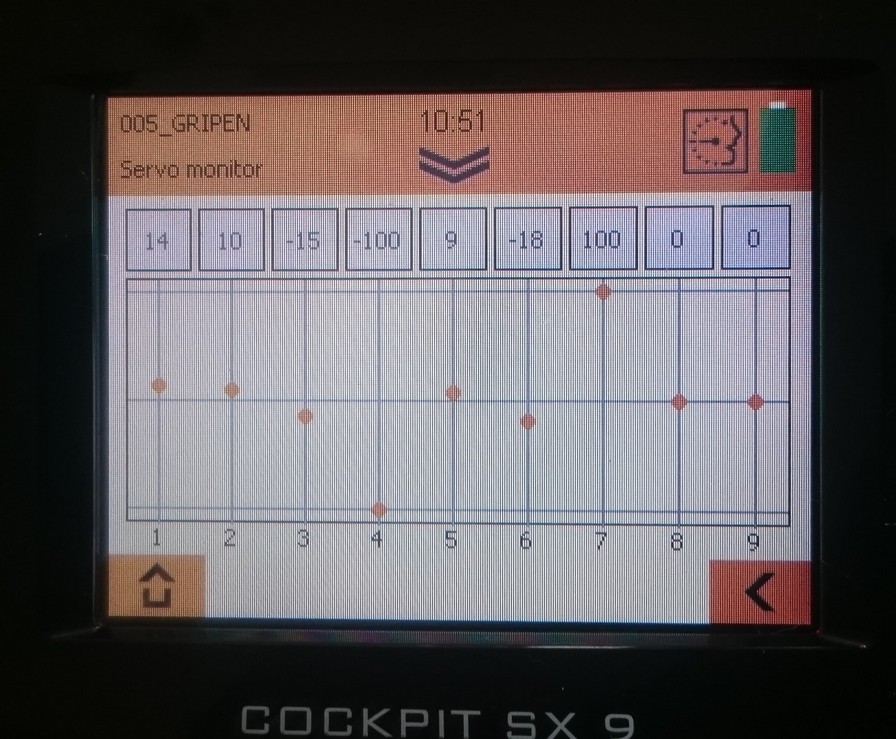 Of course other manufacturers also produce sets with much the same features but Multiplex have an enviable reputation for reliability and the M-Link FHSS system is generally accepted as being bulletproof and that has certainly been the my experience so far. Dwayne Pipe asked how long I’ve had the original transmitter and I’ve been looking back through my photos to find out. I’ve found some of me holding the transmitter 5 ½ years ago so I think it’s probably just under 6 years old, pretty good going I reckon.
While I was looking back through my photos I stumbled across this one from February 1999. If I remember correctly it was taken to commemorate the club’s 25th anniversary.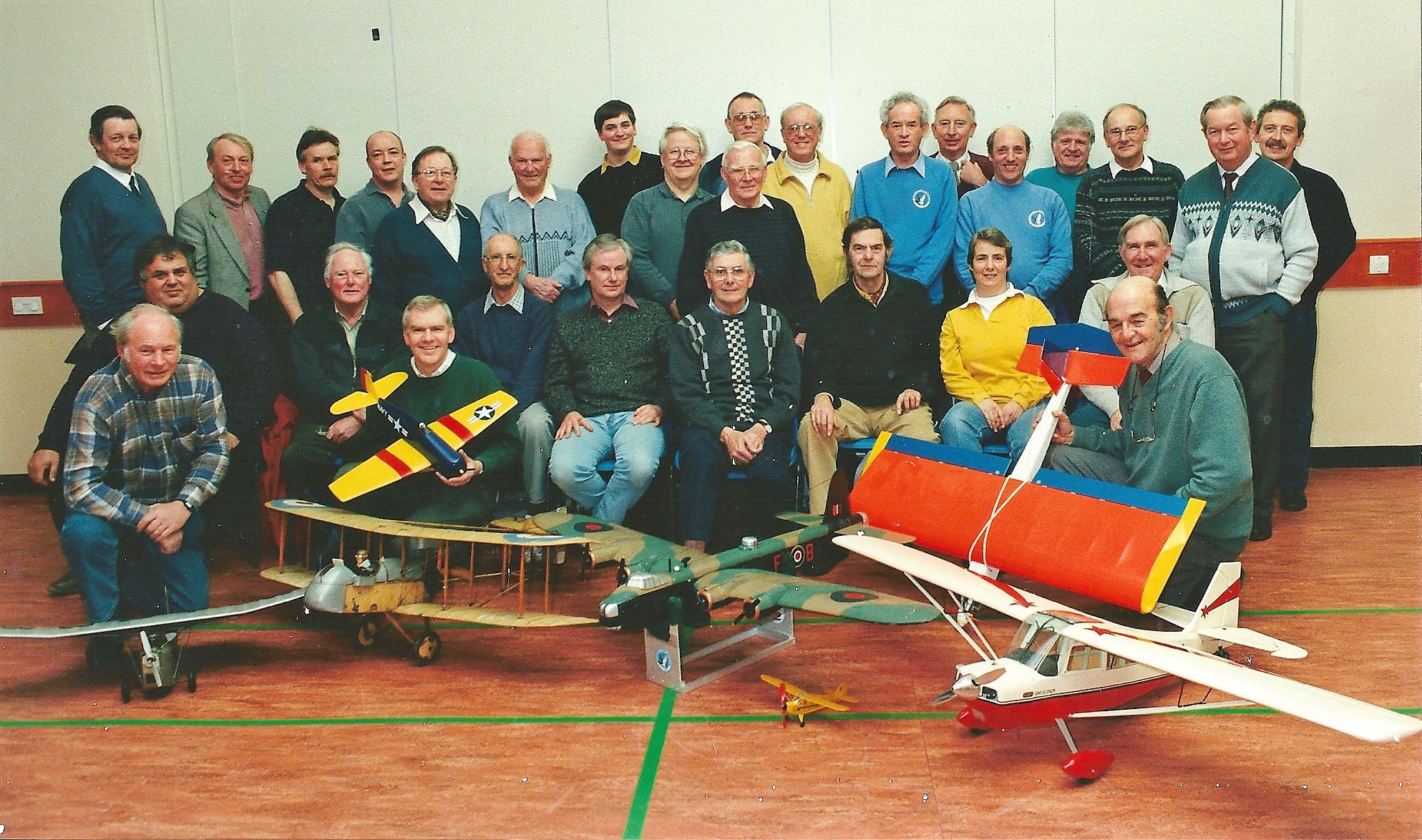 A few of us are still PAM members but sadly a few have passed away. What is surprising is that Viv and I are the only two in the photo that are still flying regularly with PAM, although Ken Knox and John Evans fly with other clubs.
Dougal has sent me some information about the Spad XIII that Santa Angie bought for him.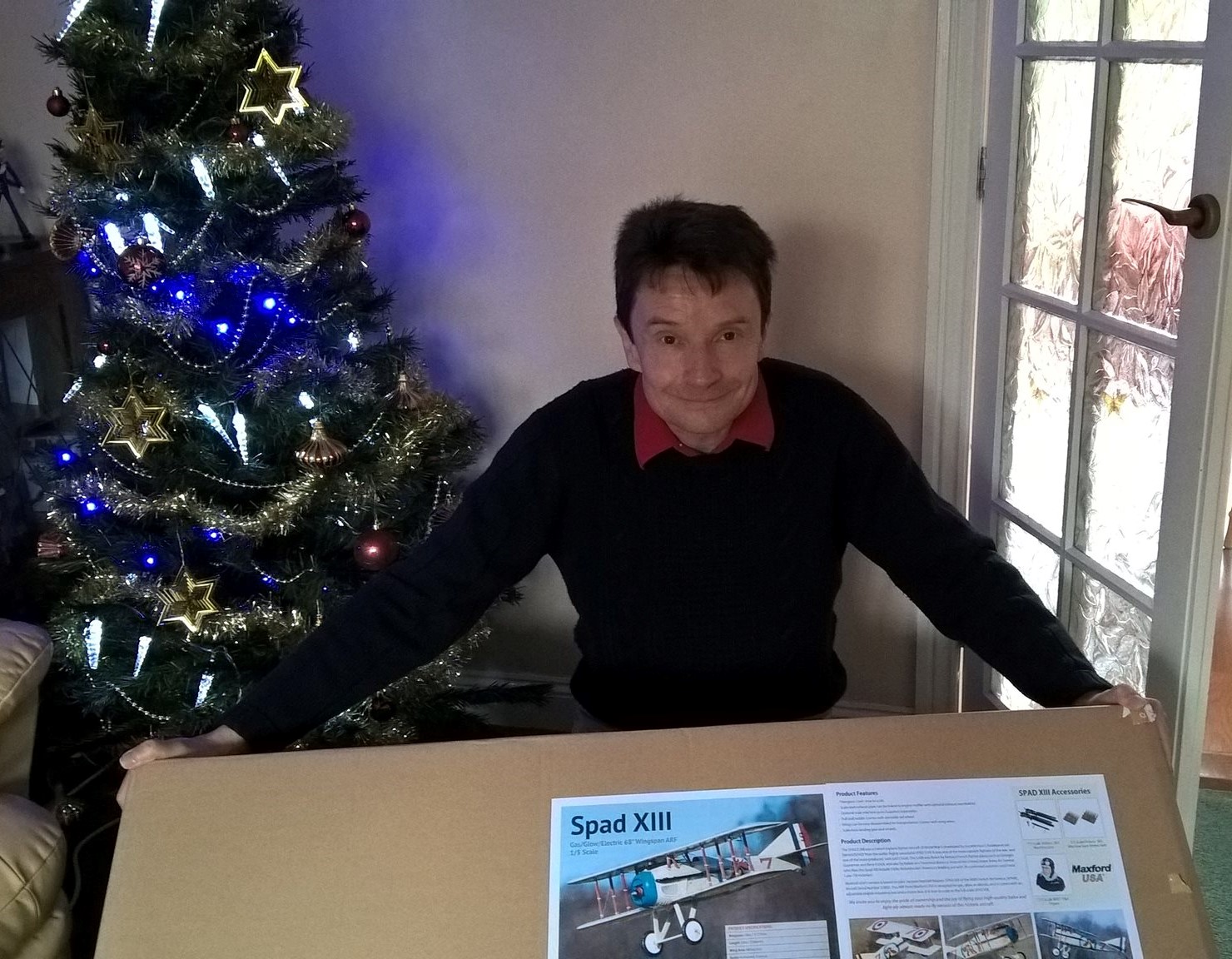 At fifth scale it’s 68” (1727mm) span, so pretty big, especially for a biplane, and is going to need a large motor and an 8 cell lipo. It’s an ARF so it requires final assembly rather than actually building from scratch but Dougal says there’s still quite a lot of work to be done. It’s an accurate, true scale, very comprehensive (and expensive) model and I’m looking forward to seeing it in the air. I can still remember Dougal’s last Spad, sadly it didn’t end well…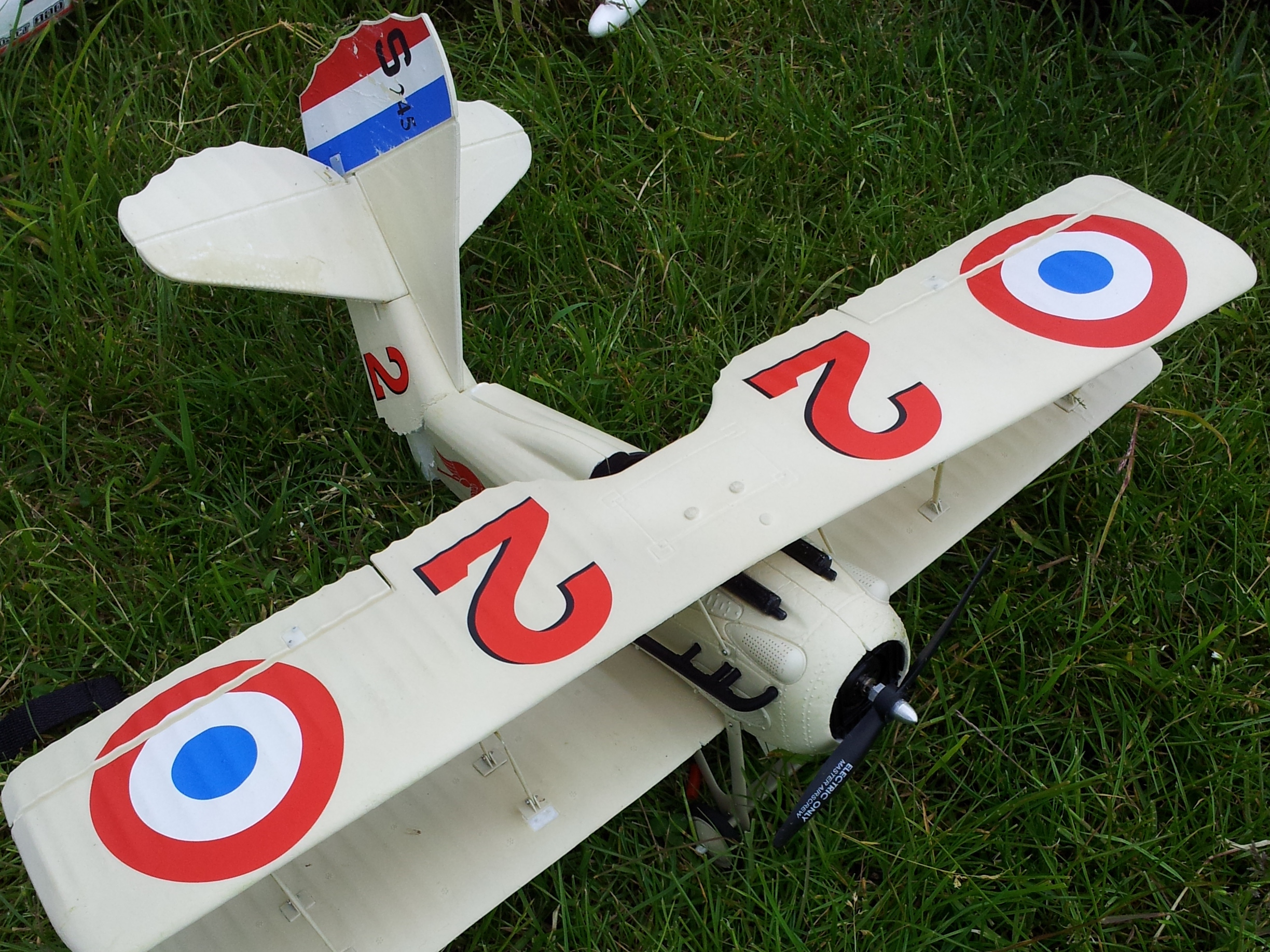
In December Terribull brought along a revamped model that I had test flown a couple of months ago.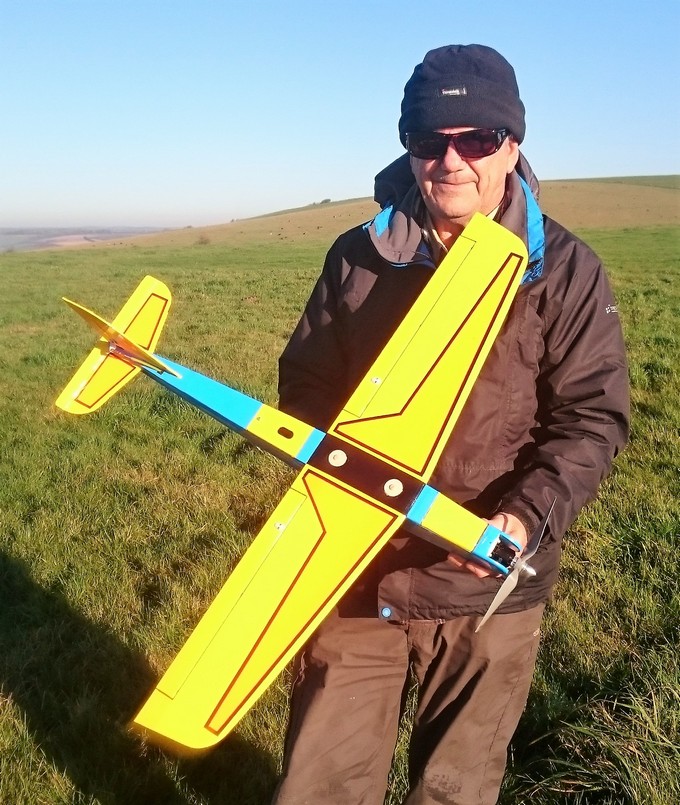 This is what Terribull says about it:
A few years ago I decided to build a model called ‘ Gonzales’, which was a free plan in a Quiet & Electric Flight magazine. The plane was built to plan except for the motor which I could not source, so I decided to fit a KMS inrunner which produced 350 watts on a 6/4 prop. Five flights were made using 3s 2200 lipos and all went well. But about 3 mins into the sixth flight it had total radio failure and the model tent pegged itself in the ground. The only bits still in one piece were the wings and tailplane.
More recently, the plane was rebuilt using the old wing and tailplane, and the model was taken to the patch for a test. It proved to be a handful so I decided to let Andy have a go at flying it. The model needed huge amounts of aileron trim to level the plane out but it survived. Back at my other club I took it for a flight which revealed the settings used up at the patch did not work, something had altered, and the plane crashed demolishing the first 10 inches of the fuselage. At that point I did consider stripping it out and scrapping it, but no, the fuselage was repaired using the jigsaw of broken balsa complete with a modification to the fuselage sides that incorporated side cheeks to offer some protection to the motor, as well as making the model look better. The wing is my own design made of balsa sheet, and a rudder was added.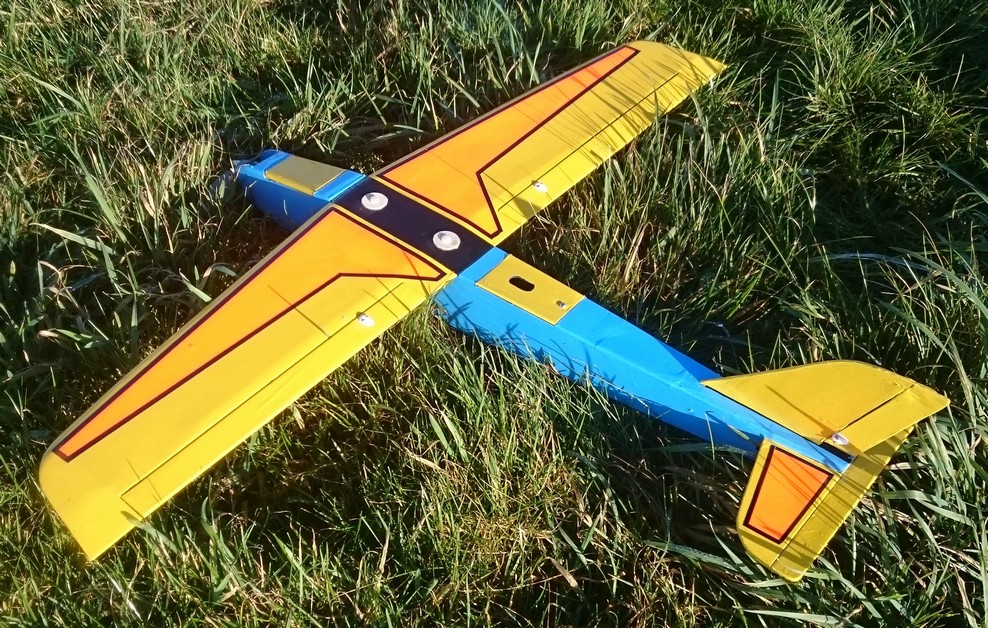 The model uses an Overlander 2836/08 outrunner with a 9×6 prop producing 220 watts. Up at the patch recently I allowed Mark to fly it. After slight trimming the plane was decreed a success, highly manoeuvrable and neutral flight. So, not bad for a rebuild which I think is way better than the original. As for its name, I call it ‘Aerobat’.
Woody didn’t waste his time while he was recuperating following his knee op, he built a new model.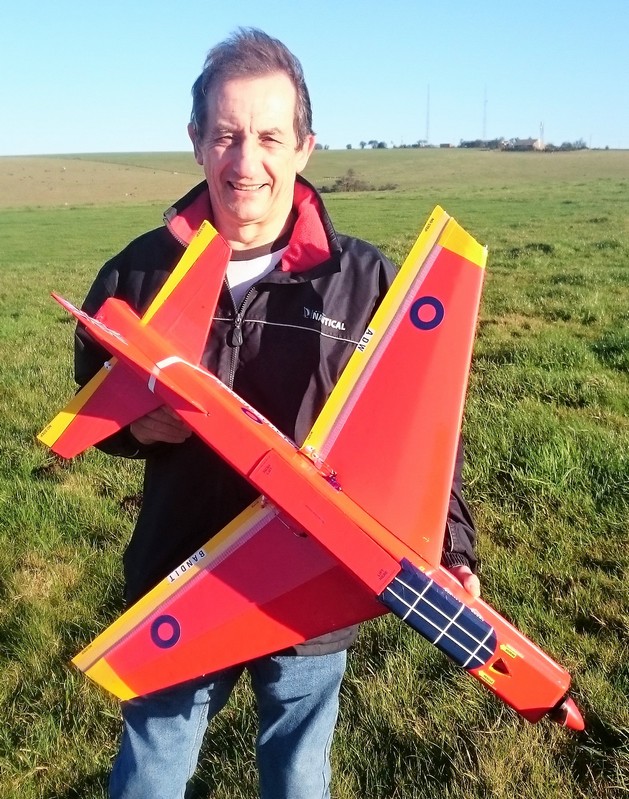 It’s an E-Bandit which was designed by Graham Dorschell and was a free plan in RC Model World in June 2015. It’s a 35” (890mm) span jet style model which is constructed mostly from Depron so it’s quick to build and is a light model. Woody has fitted an E-Max 2815/07 1100kV motor with a 9×6 propeller, a 60A esc, and uses a 3 cell 2200mAh lipo. Woody loves his lights so he’s fitted a Lander lighting kit with an LED afterburner.
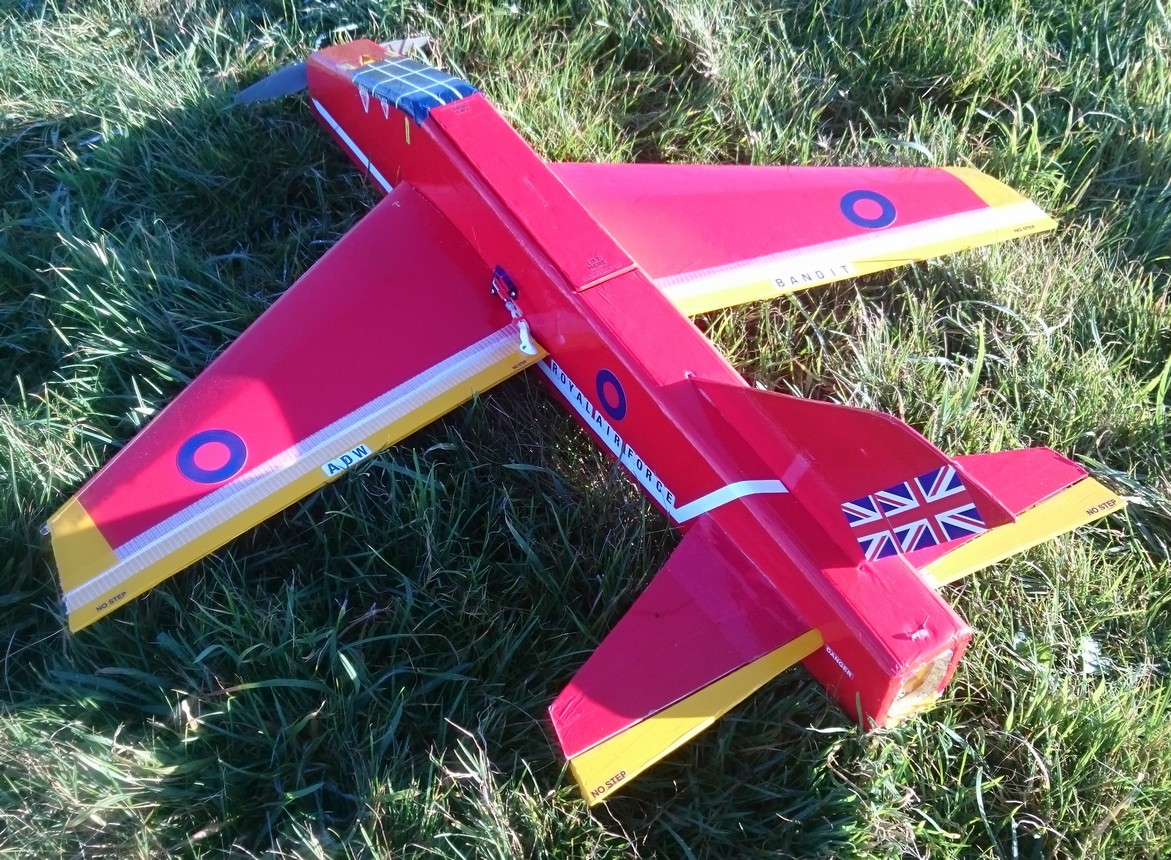 I test flew the model and I have to say I was too busy trying to trim it out to notice any lights! But after a few adjustments it was flying quite nicely and, with a little more sorting, will hopefully serve Woody well. Both the E-Bandit and Terribull’s Aerobat can be seen in this month’s video. Dougal kindly videod the E-Bandit for me.
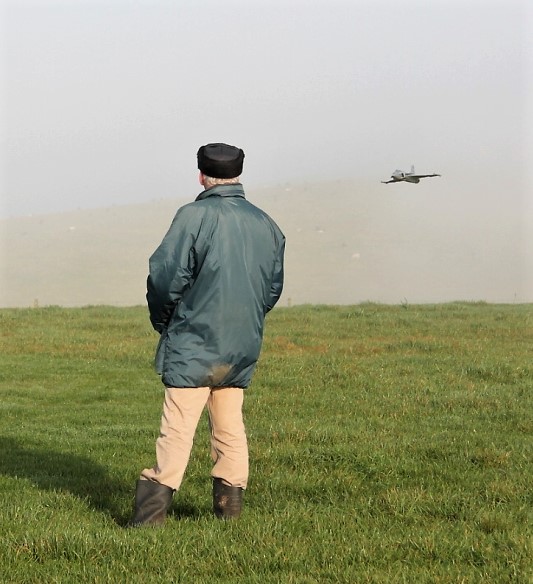
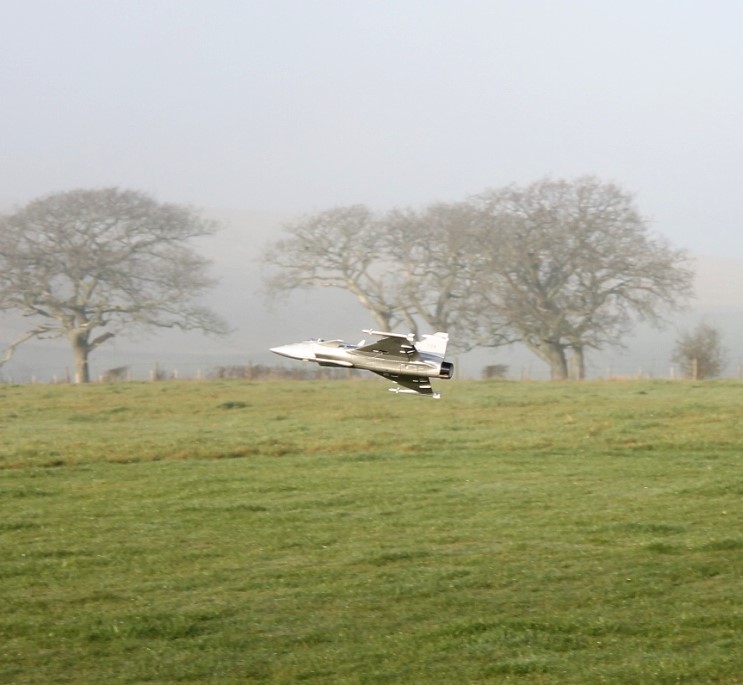
On a rather murky 30th December Catapult King snapped some pics of 1066 Hummer hovering and Colin Cowplain flying his Saab Gripen. Catapult also shot some of the video this month.
Please watch the video full screen, it’s so much better with small models flying around. If the video above won’t play for you CLICK HERE
Fred and Maureen were flying to Australia for a two-week vacation to celebrate their 40th anniversary when suddenly, over the public address system, the Captain announced, “Ladies and Gentlemen, I am afraid I have some very bad news. Our engines have failed and we will attempt an emergency landing. Luckily, I see an uncharted island below us and we should be able to land on the beach. However, the odds are that we may never be rescued and will have to live on the island for the rest of our lives.”
Thanks to the skill of the flight crew, the plane landed safely on the island.
An hour later, Fred turns to his wife and asks, “Maureen, did we pay our deposit cheque yet to the bank?”
“No, sweetheart” she responds. Fred, still shaken, then asks, “Maureen, did we pay our credit card yet?”
“Oh no! I’m sorry. I forgot to send the cheque,” Maureen says.
“One last thing, Maureen.“ Did you remember to send cheque for the car loan this month?” he asks.
“Oh, forgive me” begged Maureen. “I didn’t send that one, either, I’m so sorry.”
Fred grabs her and gives her the biggest hug in 40 years. Maureen pulls away and asks “So, why did you hug me?”
Fred answers, “Oh they’ll find us…”
Colin Cowplain
Patch News – November 2016
Cripes Carruthers, another Patch News, I don’t know where the time goes! The November weather was much as expected really, some good days but also plenty of less good ones. The Midweekers got caught out by early morning fog a few times (look, 10am is early for us retirees) but we managed to fly most times after a coffee and a chat.
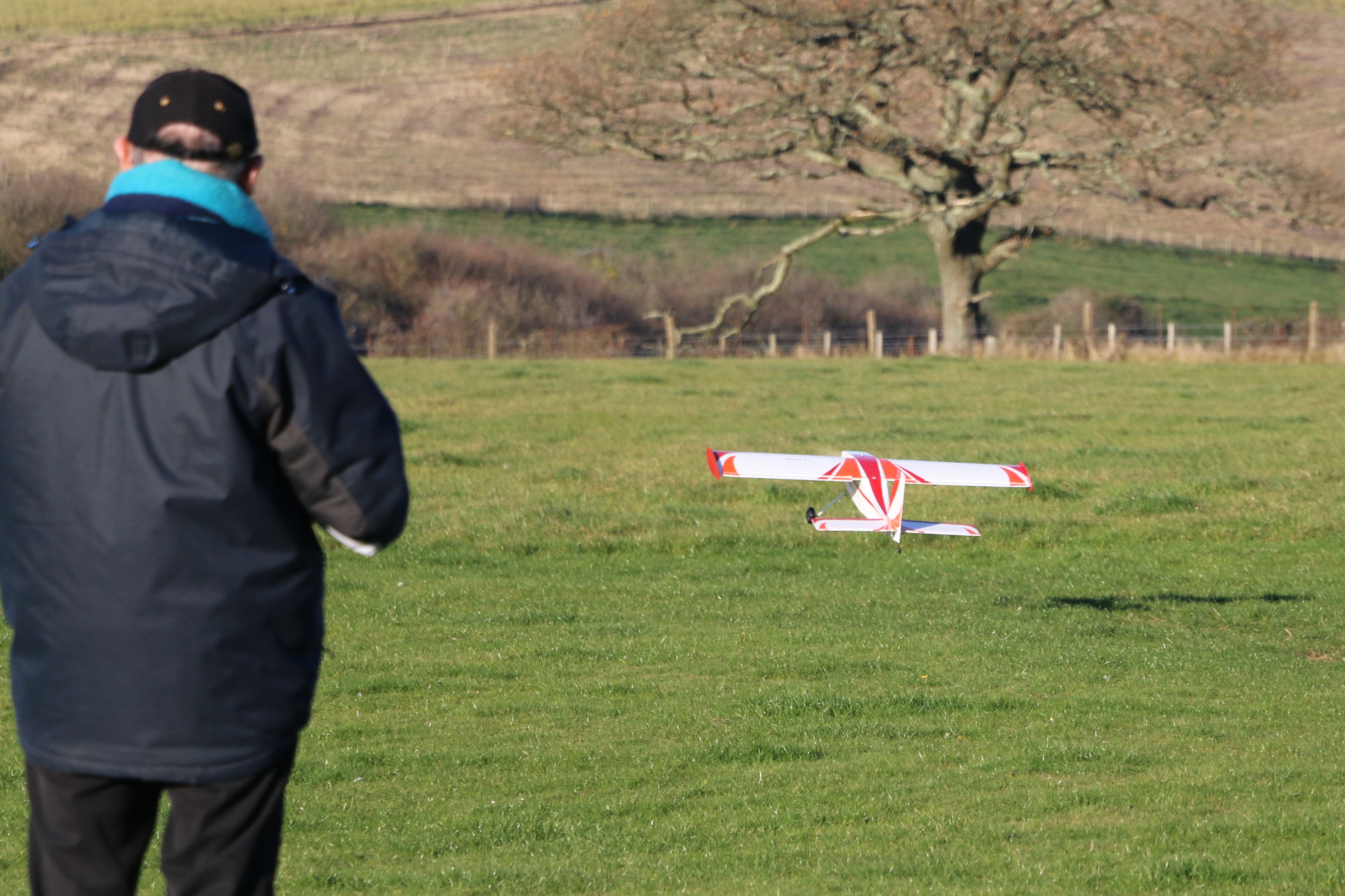
As I proof read this Patch News on 30th November I’ve just returned from the flying field and the weather today was absolutely perfect with wall to wall sunshine and virtually no wind at all, one of those gorgeous cold and crisp winter mornings. Kryten snapped some great photos including this one of Norwegian Nick’s twin ducted fan Sea Vixen.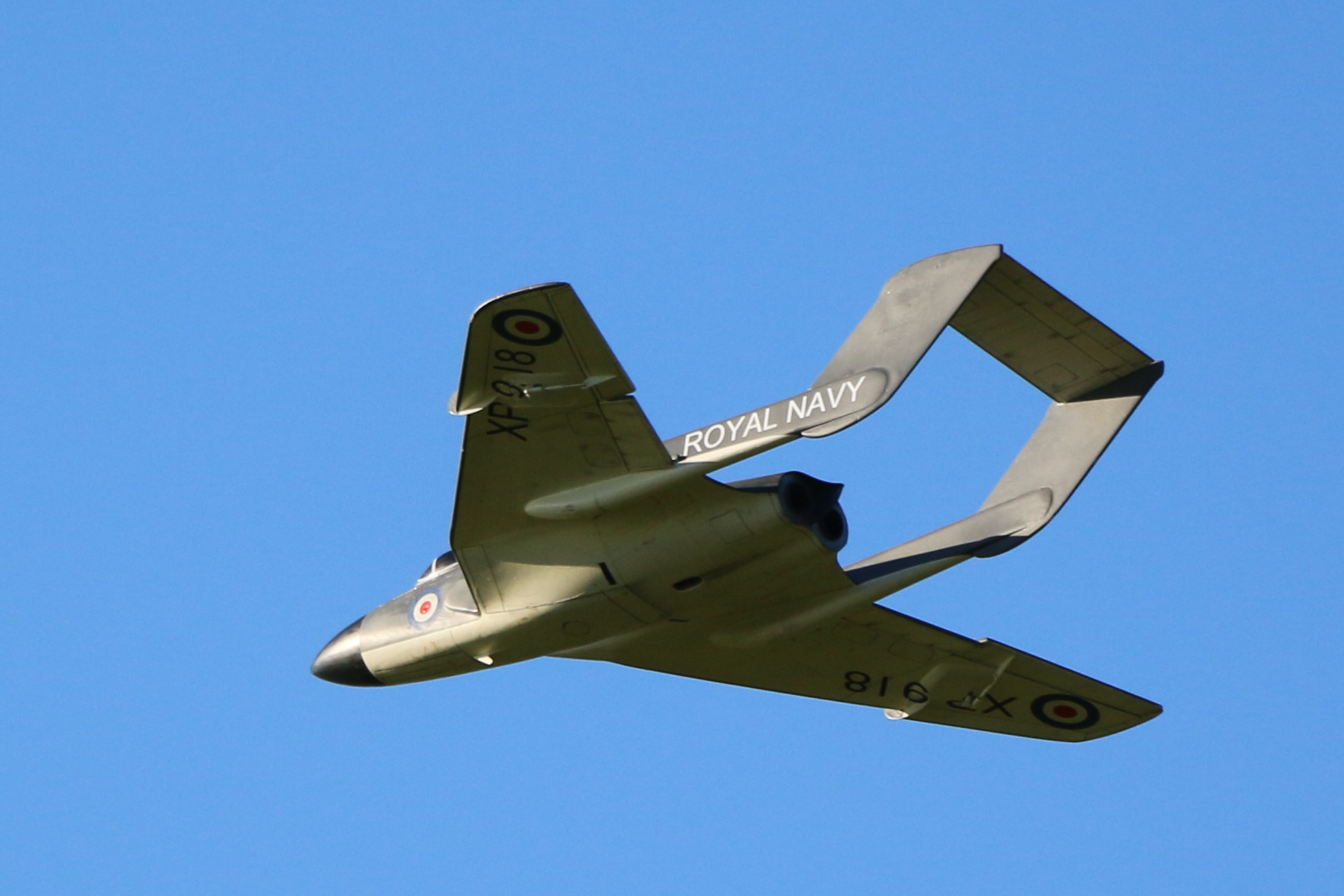 And also this one of Dwayne Pipe just taking off with his 48″ span Splot XL
 We had some ‘away from the patch’ highlights in November, Percy Vears brought his Vulcan along to the first club meeting of the month and did a couple of short taxi runs across the room for us.
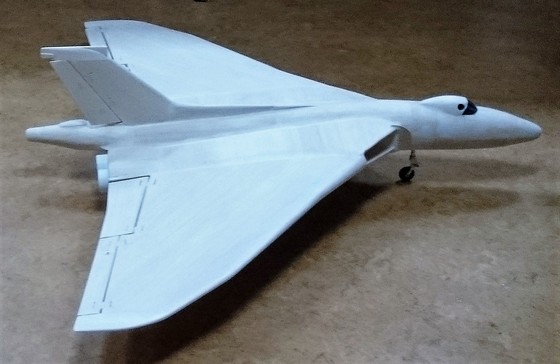 It’s looking very good and is now pretty much ready for glass-clothing and painting.
At the other November club night we were fortunate enough to have a talk on helicopters by Ken Gale. Ken is the Southern Area BMFA ACE (Area Chief Examiner) for helicopters and has built many of those strange egg whisk things over the years, including I/C, electric, and gas turbine powered ones. He brought along a couple of models for us to see and chat about, a sixth scale (big!) Bell 47G and a turbine powered Eurocopter EC135 in the colours of the Hampshire & Isle of Wight Air Ambulance.
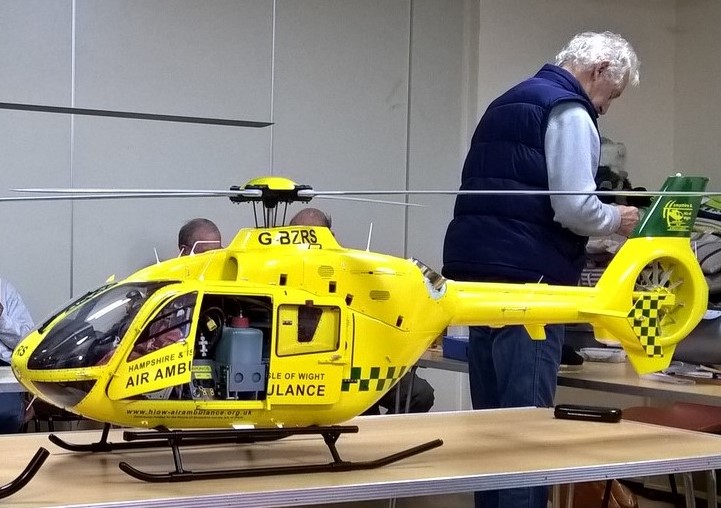 As I’m not into helicopters at all most of the technical details of them washed over me somewhat but they were both beautiful models built to the highest standards.
Petersfield Aero Modellers entered a team for the recent Southern Area BMFA Balsa Brian competition which was held on 25th November. The team members were myself, my wife Doreen, Gentleman Jim, and Woody. Woody is recovering from his replacement knee operation but made the effort to support us at the event. The questions were very hard, most seemed to be aimed at folks even older than us, but we managed a top ten position. OK ninth. How many teams entered I hear you ask? Ahem…moving on…
Following the September Patch News Part Two which featured the Kline-Fogleman models I was surprised and pleased to see a comment from Dick Kline himself. It was great to hear that he appreciated our efforts and took the trouble to comment. He also sent a link to a video of a model B-17 with a KF wing section and on-board cameras which is worth a look: CLICK HERE.
There was also a comment on the Patch News video on YouTube from an English guy who has been playing with various KF sections for some time. Again, it’s worth a look: CLICK HERE
As it’s now December and the time for frivolities I’ve decided to run another Caption Competition. Kryten took this photo early in November and I’m sure you guys can come up with something suitable!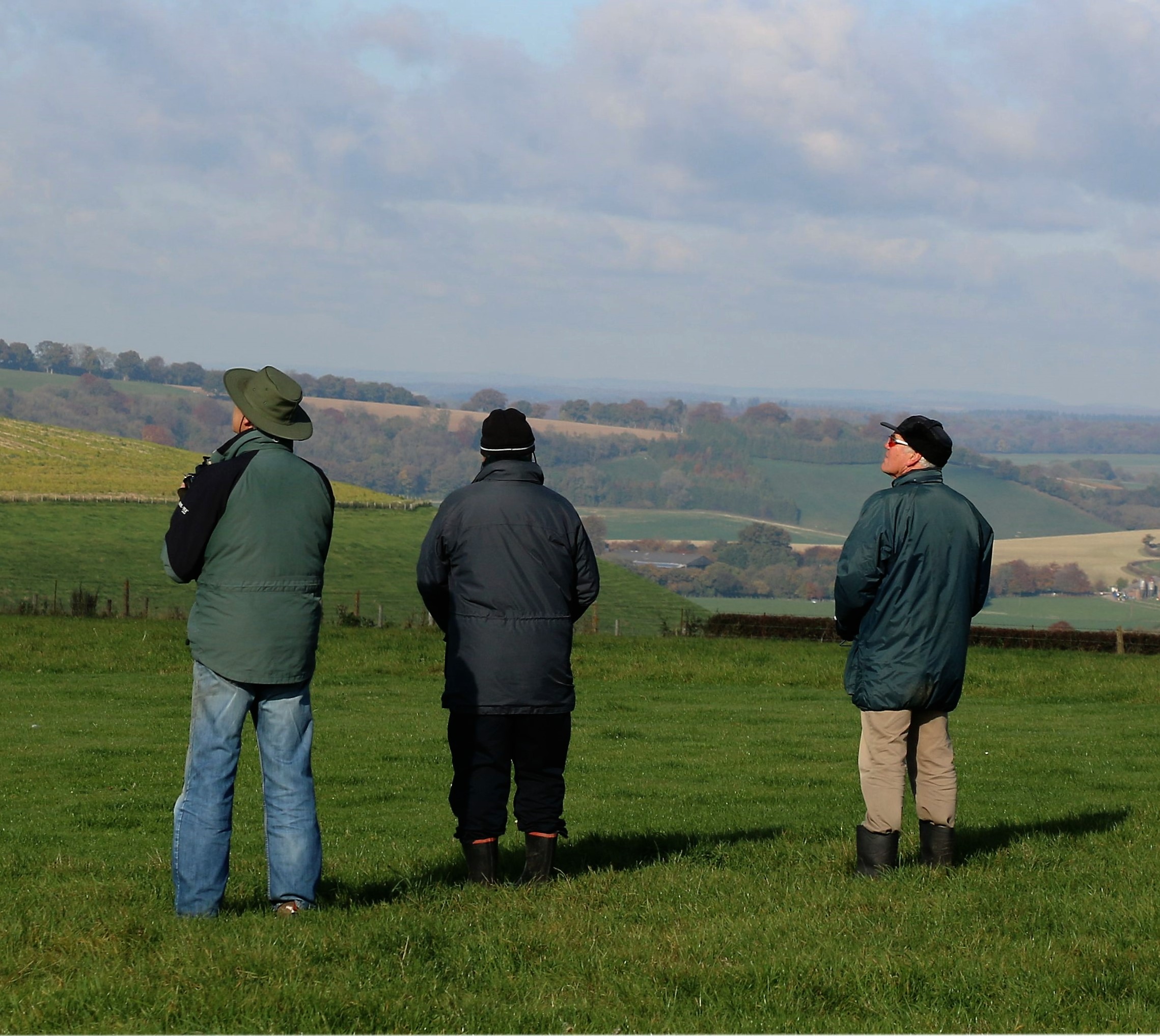 There will be a decent prize for the winner which I’ll award at the first meeting in January so get commenting chaps.
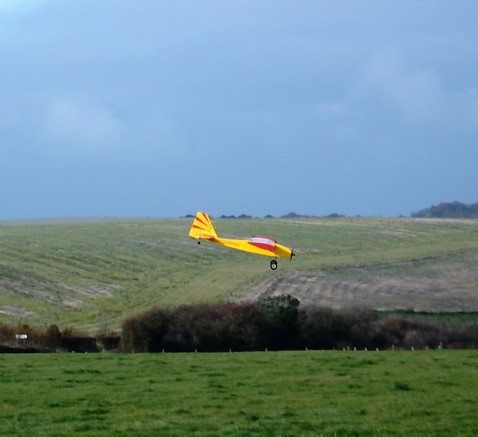
Basher Bob has been at it again! He built a Depron wing for his Splob (a Bob variant of a Splot) and several members were asking about the construction method. Always one to oblige Bob, promptly broke the wing in half so we could all see exactly how he’d built it. Wasn’t that nice of him?!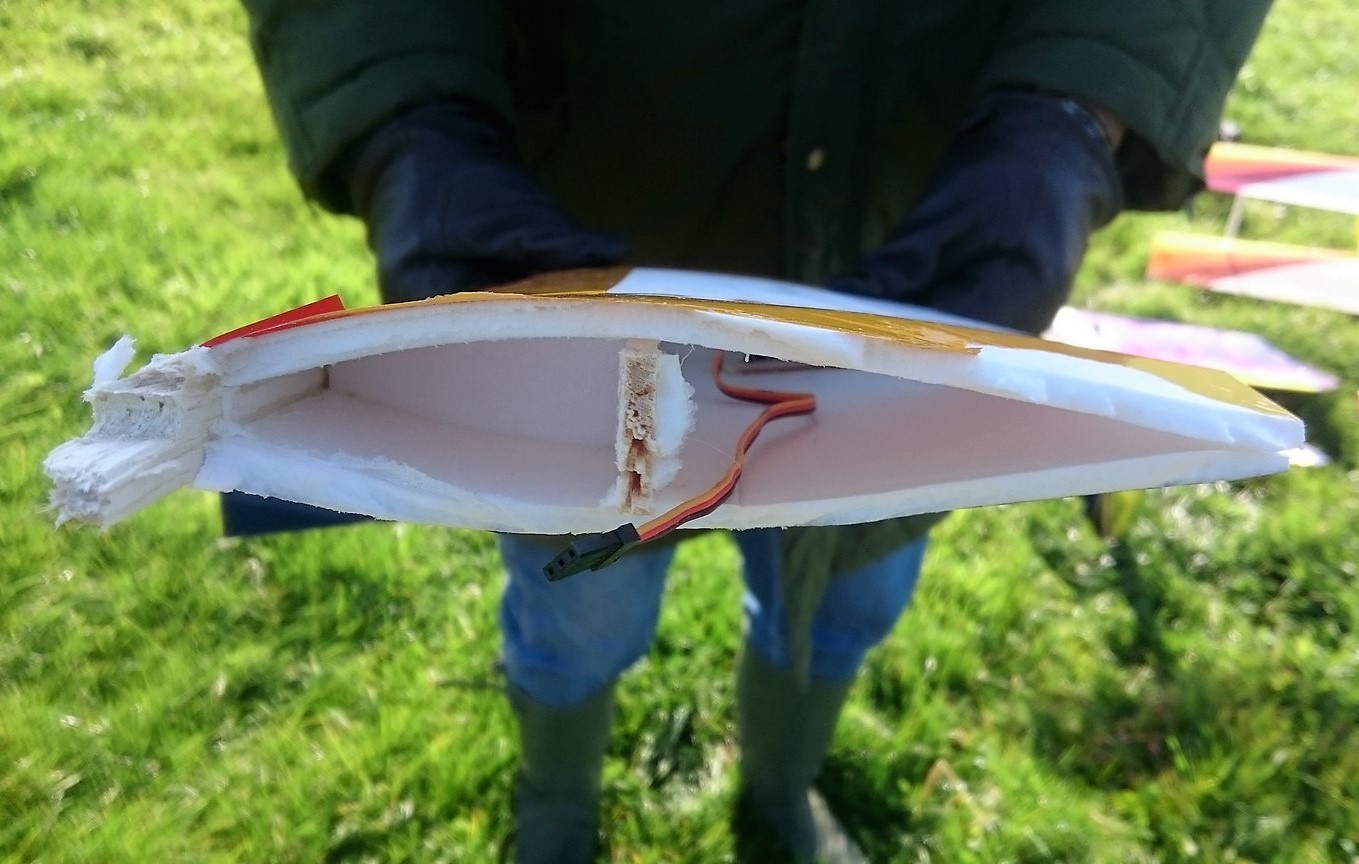 I’m not sure if Basher managed to repair the broken wing or if he built a complete replacement one but one way or the other it’s now flying very nicely again as can be seen below.
 I only spotted one new model at the patch in November; that must be a record. It’s a 47” span E-flight Extra 260 that Gorgeous Gary has put together. The motor is an O.S. 3805-1200 and it’s linked to a 40A esc and a 3 cell pack.
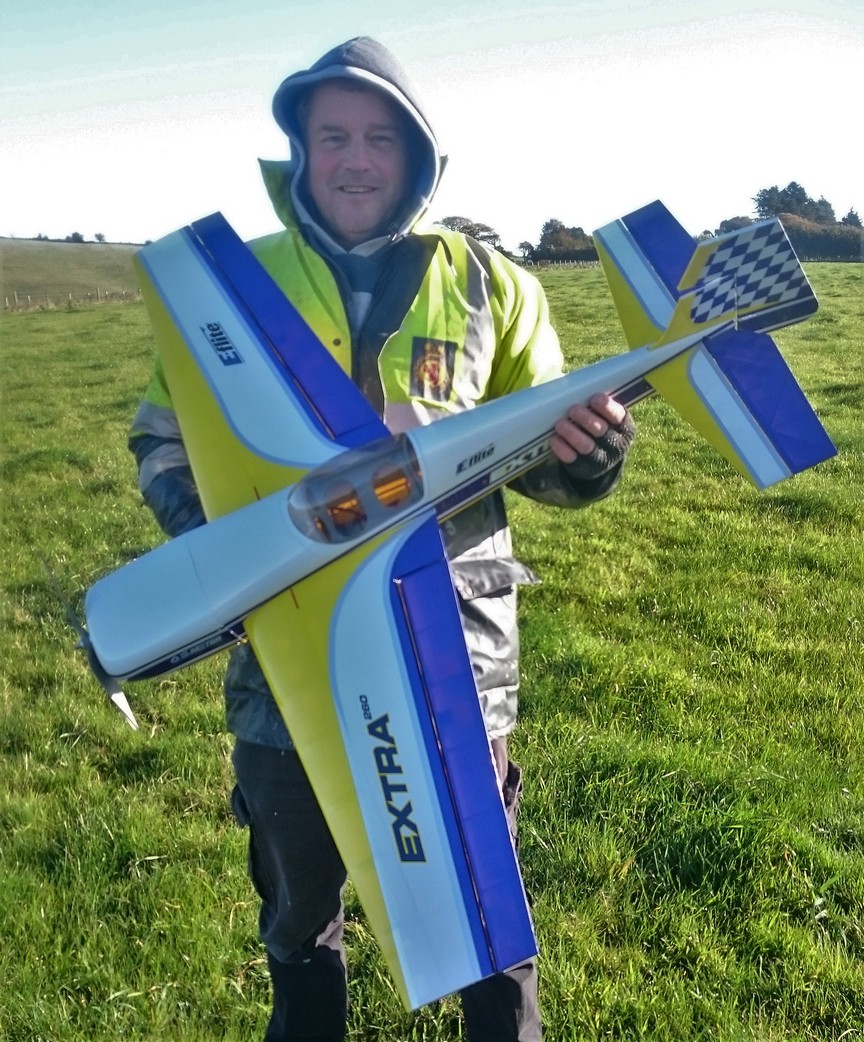 He’s only had one flight with it so far as he was having problems with a shortage of power. It was a very windy day and as soon as it got into the air it was obvious that it didn’t have enough power, so a new model, a lack of power, and a strong wind; not a good combination.
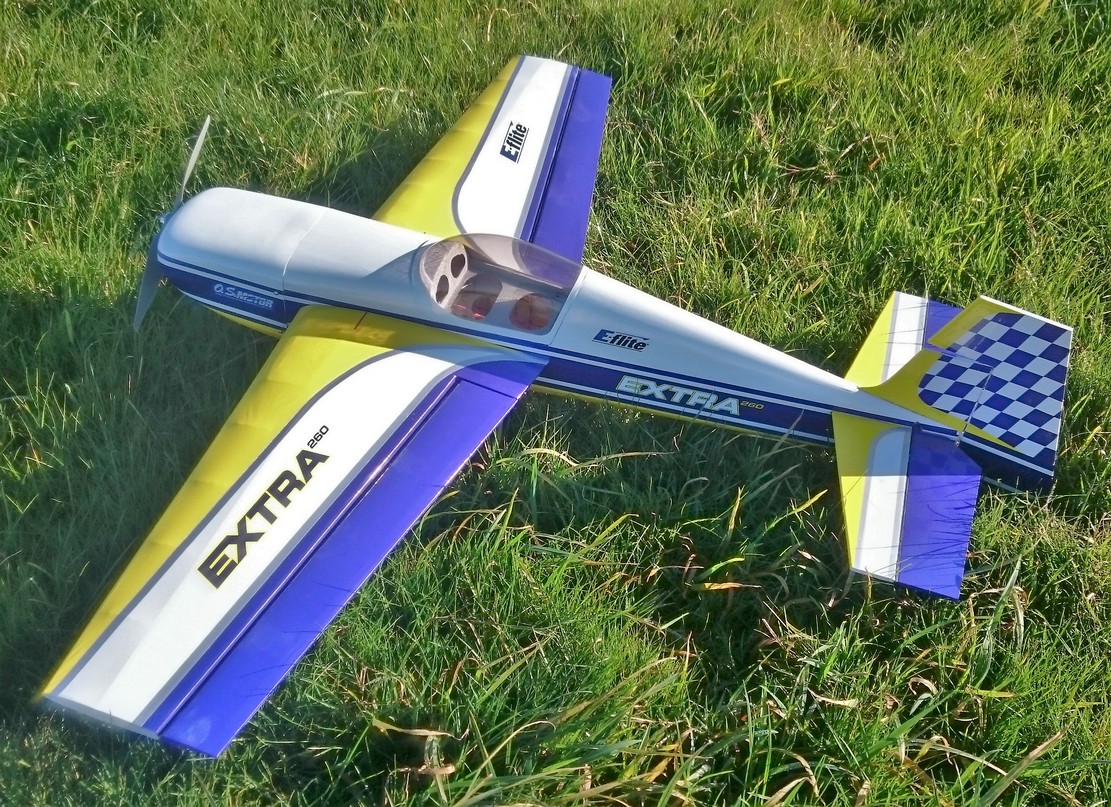 After a fraught few minutes Gary managed to get it back on the ground without any damage and he’s now gone away to try to figure out what is causing the problem. I think the speed controller probably needs setting-up as the motor is capable of delivering over 500W and the model only weighs 29ozs! You can see some of the flight in this month’s video at the end of this edition.
Also in the video you’ll see Kryten flying his E-flight Apprentice early in the month. He’s been practising hard for his ‘A’ certificate and I’ve been making him do endless figure 8’s, rectangular circuits, and dead-stick landings. The latest version of the Apprentice comes fitted with SAFE (Sensor Assisted Flight Envelope) which is basically a multi axis gyro that recognises the aircraft attitude relative to the horizon. It can be switched in different modes to provide either gentle assistance to smooth out turbulence or an almost fool-proof setting that won’t let the model stray too far from straight and level and immediately returns the model to straight and level flight when the sticks are released. It seems to work very well and I’d go as far as to say that in full SAFE mode it would actually be difficult to crash. Kryten seemed totally underwhelmed when I explained that he’d have to fit a non-SAFE receiver to take his test but he duly did just that and continued to practise. I had barely taken control even when he first started flying and he’s now reached the stage where I just get bored watching him so I suggested it was test time. I’m pleased to say that towards the end of month Dougal Entendre took and passed him, so very well done Kryten.
Christmas is almost upon us and Doreen absolutely insisted that I should buy a new plane for my present (well that’s not exactly the wording she used but I’m sure that’s what she meant). I’ve been flying my little EDF Gripen a lot recently and I fancied another EDF, in particular an F22 Raptor as they have a decent wing area and generally look like they should fly well. So I duly Googled ‘EDF F22’ but most of the ones I found were large expensive ones with retracts, requiring six cells etc. when all I wanted was a cheap, 3 cell, hand launched, chuck it in the back of the car type. The Gripen is 510mm (20”) span and has a 50mm fan. But then I stumbled across a Kyosho F22 that is 635mm (25”) span and comes with a 55mm fan, so it’s a bit bigger than the Gripen but not by too much, perfect.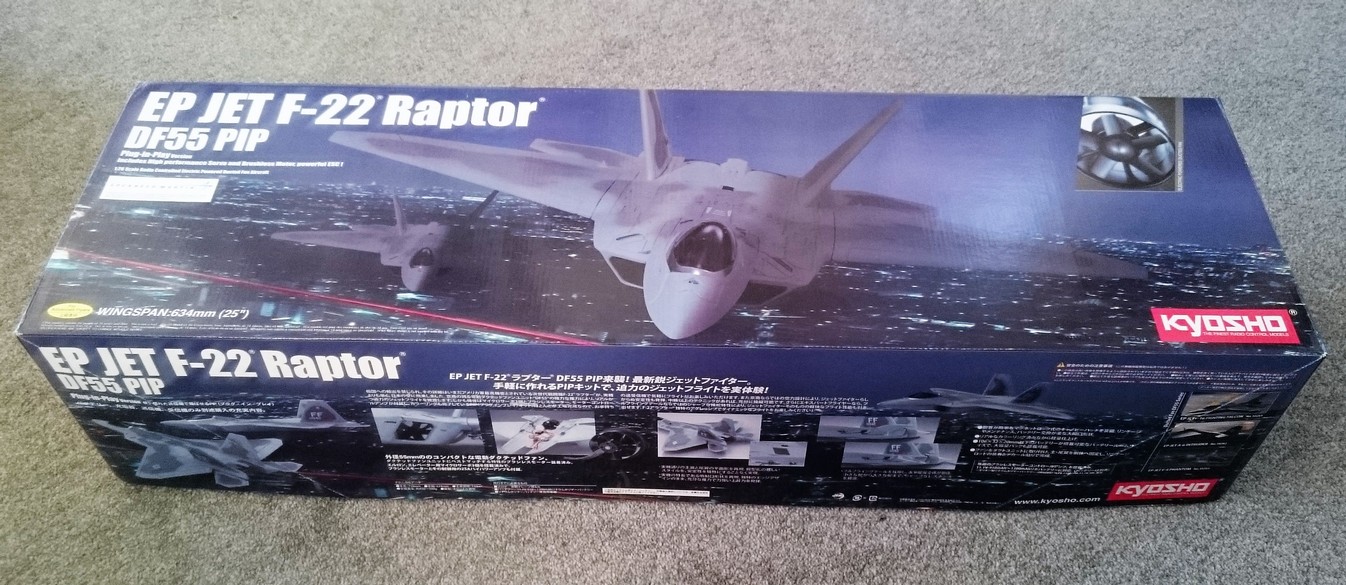 The model seems to be discontinued, I think it was first produced in 2008 and the only negative I can see is that it’s made from EPS (polystyrene) not the now normal EPO. The only place I found that was selling it was Kings Lynn Models and they showed the RRP as £140.93 but had it for just £49.90. For that price it seemed rude to refuse so I ordered one and it arrived the next day, excellent service. It’s the PIP (Plug-In-Play) version which comes complete with the fan unit, motor, speed controller, and 3 servos. There’s actually a reasonable amount of work to do to complete the model but I don’t think it will take too long, although I’m not allowed to start it until after Christmas! On Black Friday I wondered if Kings Lynn Models had any kind of sale on so I checked the website and discovered that the Raptor has gone up to £99.90! I wonder if it had been incorrectly priced previously and they’ve now corrected it but I don’t really know. Maybe it will be reduced again in a January sale? I’ll have some more photos in the next Patch News but in the meantime you’ll have to make do with the one of the box.
I couldn’t make it to the patch on the last Sunday of November but Dougal Entendre and Captain Slow were good enough to send me some information and photos of what I missed.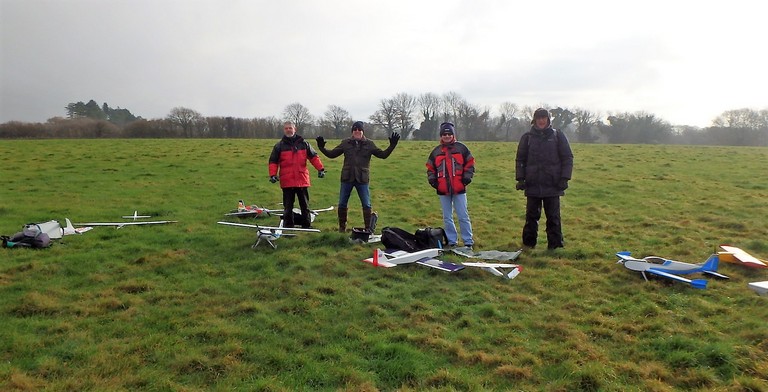 It was a windy day so only a few members turned up but seems like I missed quite a lot; firstly Dougal managed to fold the wings of his Vignette. The Vignette is Dougal’s variation of a Spirit, using the Spirit wing attached to an own design fuselage and V-tail and fitted with a Wingnetic motor.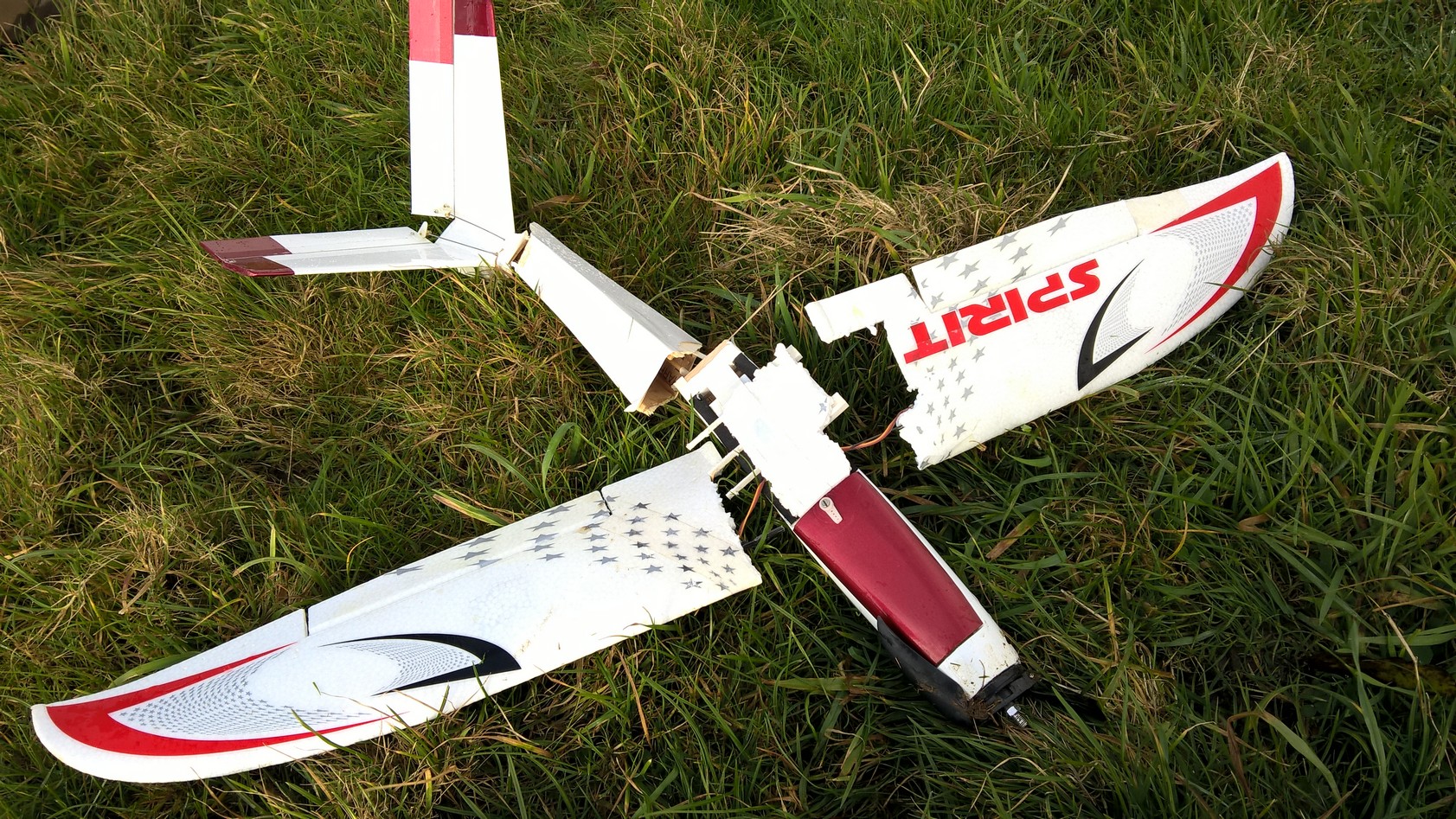
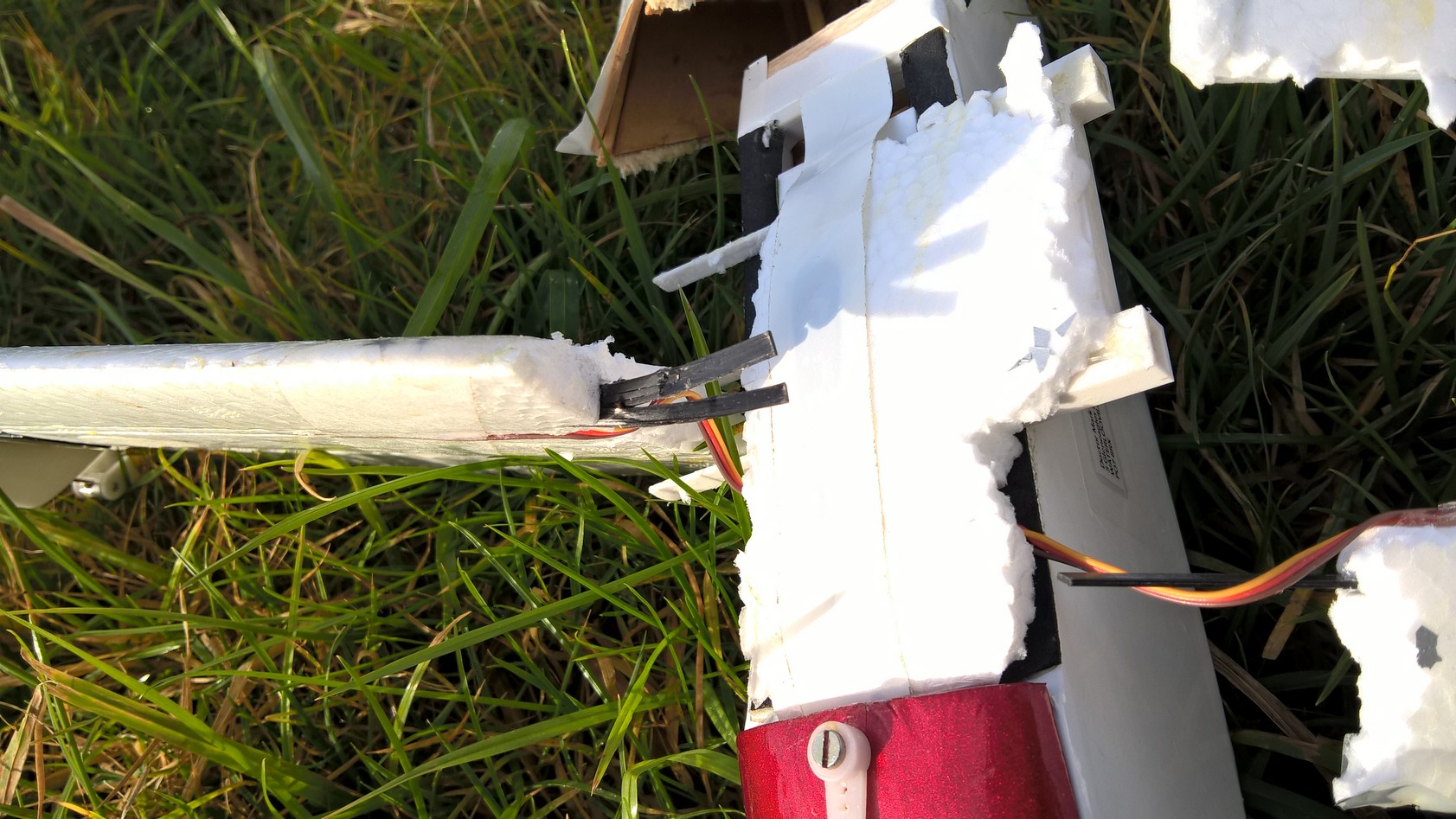 This is what Dougal said about the failure: On the first flight with my Vignette, all seemed well until I pulled a fairly violent turn and the wing folded. She went in from about 80ft high, breaking the fuselage into three on impact. As the photos show, the carbon fibre main spar of the Spirit wing had failed. The Vignette fuselage was only a little bit heavier than the Spirit one, so I don’t think that explains the failure. The ex-Wingnetic motor was definitely more powerful than that in the Spirit, so that may have contributed. The wing had previously had a breakage of the foam about 2 inches outboard from the spar failure, but that repair held up OK. In the end, I think it was just a result of pulling high-G manoeuvres on a windy day. I haven’t decided what to do with the bits yet – I still have the Kline-Fogleman wings, so I’ll either stick the fuselage back together, or might do a new one eventually. The Spirit wing has definitely had it though. You’re not kidding Dougal!
The other notable occurrence was 1066 having a launching problem with his Speedy electric glider. Apparently he had one good flight (the launch can be seen in this month’s video) but for the second flight the launch didn’t quite go to plan. 1066 is right-handed so when he launches he has to quickly move his right hand back to the stick to make any necessary corrections. Unfortunately this time his hand landed on a switch instead of the stick and despite pulling really hard on it the switch didn’t add any up elevator at all!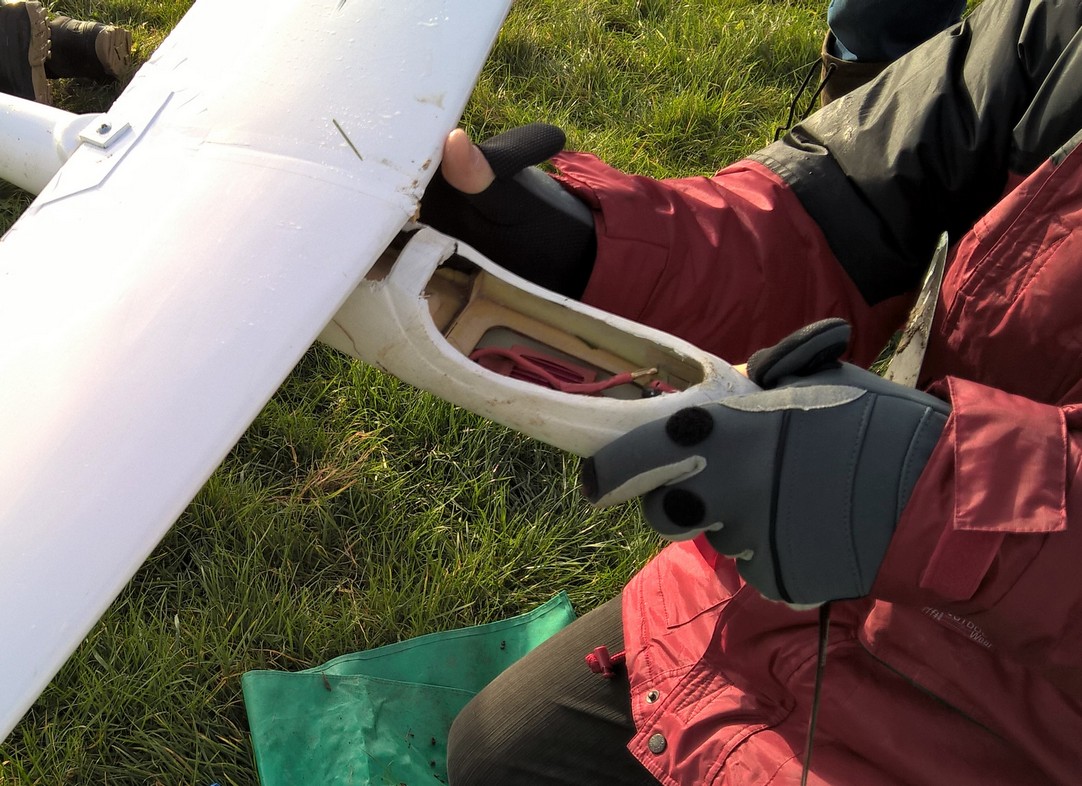 The resulting dive into the mud damaged the wing mounting but everything else was intact apart from 1066’s pride.
Captain Slow captured this shot of Mike Creamer’s Freewing Pandora just about to gently touch down on the patch on the same gusty Sunday, nice once Mike.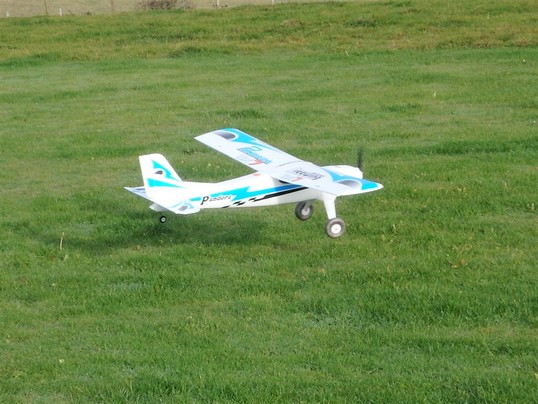 He also took this lovely photo of John Warren’s Wot 4. Actually it’s the HobbyKing version of a wooden Wot 4 but you’d find it hard to find any differences.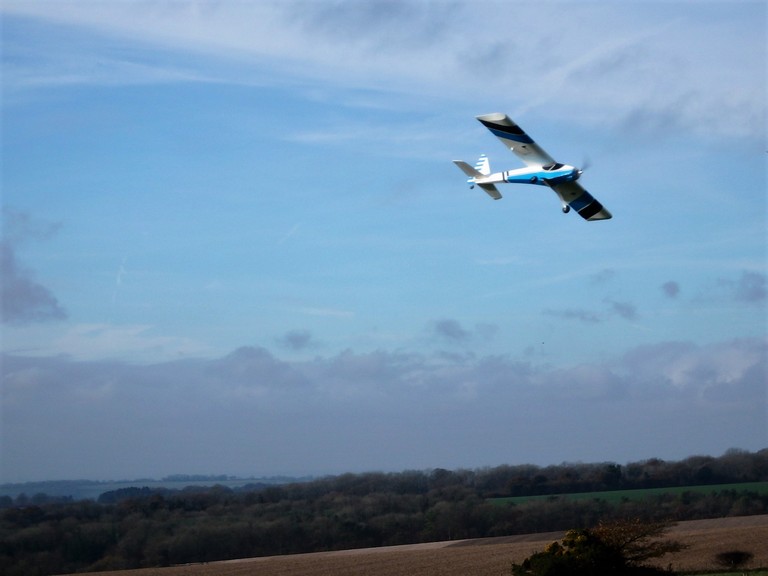
I recently had one of the HXT900 servos fail on my Delta and I needed a replacement fairly promptly. It never seems worth ordering just one servo so I wanted to buy four, but that would have meant paying around £6.50 postage on a £10.50 order if I ordered them from HobbyKing. So I searched on eBay and found Coolwind Models were selling four HXT900’s for £14.30 including delivery. They arrived quickly and the Delta was soon flying again. The Coolwind Models website is worth checking out, their main interest seems to be in autogyros but they are also good for many of the smaller things we use such as servos, speed controllers, props and so on. They also sell silver steel rod in various sizes which might be useful to replace bent motor shafts. You can find them HERE.
Many of us use XT60 connectors on our batteries and speed controllers and most people seem happy with them. But did you know there is now an XT60U (Upgrade)? This is what HobbyKing say about them: The best battery connectors on the market just got better with the development of the XT60U. Like the original XT60, this connector is made from high-temp nylon with gold connectors so the XT60U continues to provide an excellent high-amp connection for applications up to 65A.The change in design has made it shorter and lighter and far more user-friendly for connection and disconnection with an improved grip area. The XT60U is completely compatible with the original XT60 connectors so you can use them straight away.
Purely in the interests of my readers (obviously) I ordered some of the new ones and they seem good. Here’s a photo of the old and new ones so you can see the difference in sizes.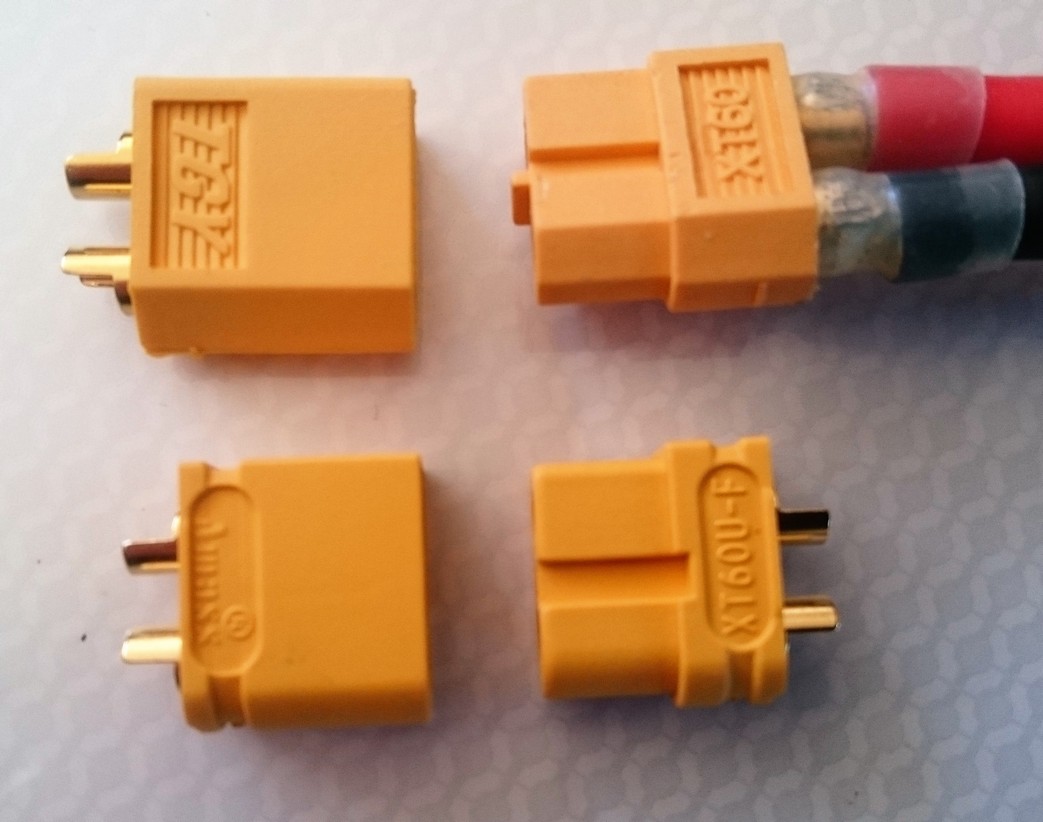 Rather oddly, at the moment they have a special offer for pairs of them and it will cost you just £1.48 for 5 male and 5 female connectors, but if you buy either 5 males or 5 females they will cost you £1.56! These prices are from the UK warehouse. Incidentally HobbyKing have recently introduced a ‘letter’ postal rate of £1.24 for up to 100gms. There must also be a size limit as a pair of HXT900 servos will cost £1.24 postage but if you add a third servo the package will come via Parcel Force at a cost £5.19 even though the weight is still only 57gms.
Dougal sent me this photo of how he stores his models in his ‘hangar’ the other day. To my mind the most surprising thing about it is that he has an artex ceiling in his garage, how posh is that!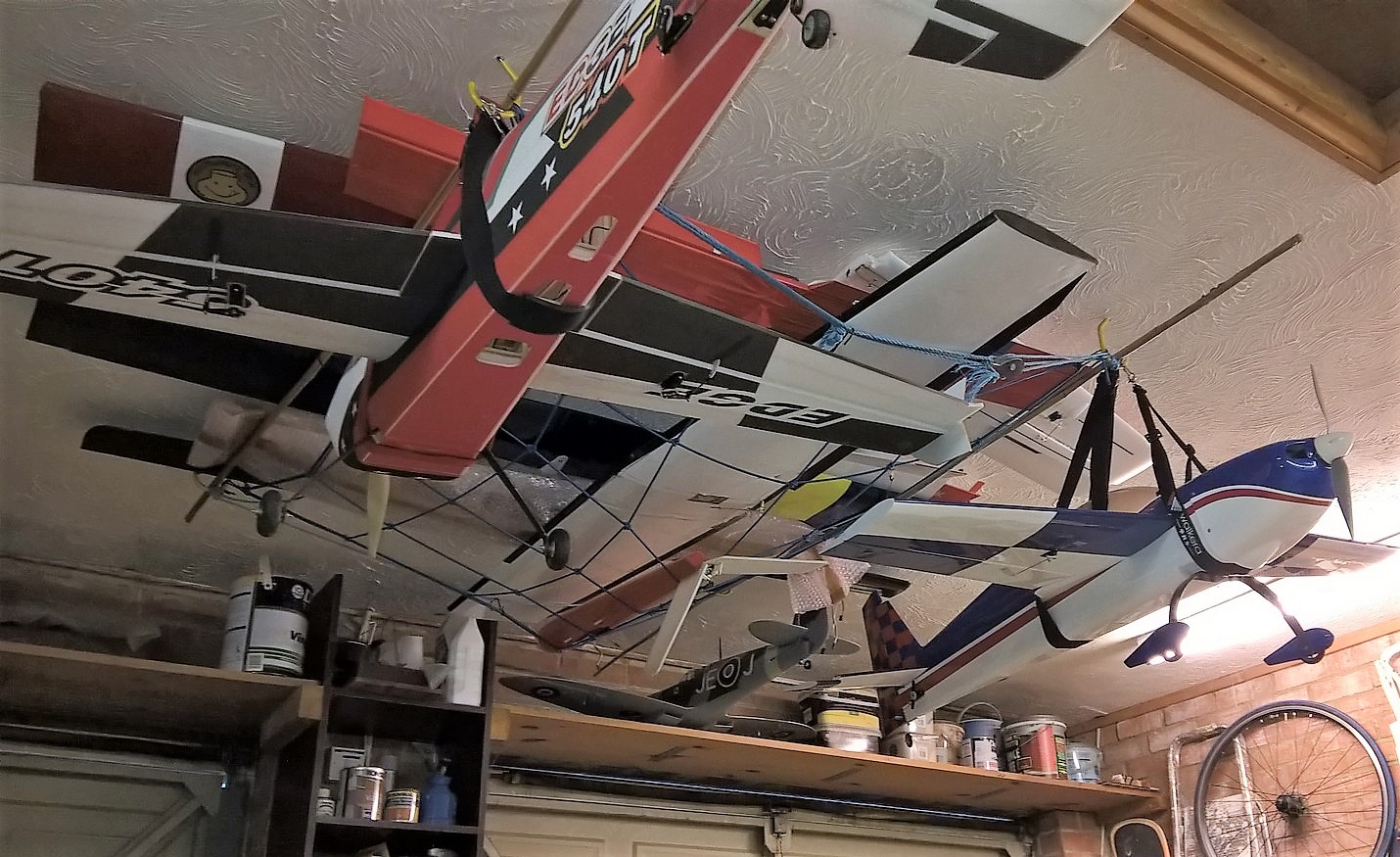
Now for this month’s video:Please watch the video full screen, it’s so much better with small models flying around. If the video above won’t play for you CLICK HERE
A plane is on its final approach into the airport and the pilot comes on the intercom “This is your Captain speaking, we’re now on our final descent. I want to thank you for flying with us, and I hope you enjoy your stay”.
But he forgets to switch off the intercom and the whole plane can now hear the conversation from the cockpit. The co-pilot says to the pilot, “Well, what are you doing today?”
Now all the passengers are listening intently to this conversation. “Well,” says the captain, “first I’m going to check into the hotel and brush my teeth, then I’m going to make a move on the new stewardess.”
The new stewardess is so embarrassed that she runs from the back of the plane to try and get to the cockpit to turn the intercom off. But halfway down the aisle, an elderly lady grabs her by the arm to stop her, leans over and says, “No need to run, dear, he’s got to brush his teeth first.”
Colin Cowplain