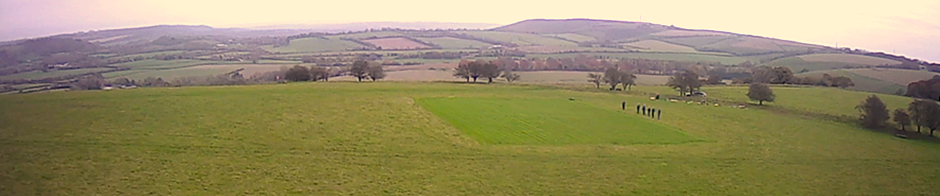
Hoorah, the weather is improving at last! It’s far from perfect but at least March did see lots of rain free days and even several days of sunshine. There were some misty starts early in the month which either prevented flying altogether or delayed flying by an hour or so. 
A couple of times during the month we switched flying from Sunday to Saturday to take advantage of better weather, which suited some more than others. Things went downhill again slightly towards the end of the month but overall March was pretty good.

 The warmer, drier weather meant that the grass started growing quickly again so on 11th March 1066, Woody, and I (the Trimming Trio?) went along and cut the patch. Woody and 1066 did a further cut on the last day of the month so the patch is in tip-top condition,
Several new models made the most of the improved weather and achieved their maiden flights. The first was Woody’s Lockheed SR-71 Blackbird that I featured in last month’s Patch News but at the time the bad weather had prevented Woody from flying it.
 That changed in March and the Blackbird finally flew, and it flew very well indeed. We knew from the Blackbird that Norwegian Nick built a couple of years ago that the Laddie Mikulasko design was good and Woody’s flew just as well as Nick’s, smooth and steady.
 It has loads of power and will climb almost vertically on full power but it’s easy to get disorientated at any sort of distance so it’s much more pleasant to throttle back and fly tightish circuits at low level. Good one Woody, it’s definitely one of your nicer models.
The building bug is still afflicting 1066 and over the past few weeks he’s built a Bitsa.
 A what I hear you ask? I’ll let him explain: If you read my article on the MX2 from last month, you will already have an impression that I have no shame in taking advantage of people’s generosity. This is nothing new, if you have been in the club long enough you will remember Steve Montague, Steve was one of those people who would throw everything at a new hobby. He also liked quality with most of his models being either 3D Hobby Shop, or Precision Aerobatics, and they were always fitted out with high quality electrics. So I’m sure you’re wondering what all this has to do with me?
Well, I think Steve is one of those guys who gets bored easily and is often looking for the next challenge, he is also very generous, just like our Mr Woody, so when he hinted he was thinking of selling anything, I was always the first sniffing around his shed, with the aim of making the most of his generosity, and hopefully separating him from his champagne models at lemonade prices. One of those models was a 48 inch 3DHS Extra.
 The Extra was a fantastic model to fly with no bad habits, as you would expect from this manufacturer, but such models can lead you to believe you are a better flyer than you actually are, so you start pushing things just a bit too much, which always ends in that inevitable crash. In the case of the Extra the fuz was destroyed, but the wings, tail, and rudder hardly had a scratch, so they were salvaged and put in the back of the shed.
After a couple of years I decided to make a profile fuz out of Art Card, I decided to base the outline on the Hobby king foam MX2 I had at the time (the same as Colin is currently flying). Unfortunately, between the time of the original crash and building the new fuz I lost the carbon wing joiner, so the project went on the back burner for another couple of years until I found a wing joiner. Sadly, my shed is just a bit damp in winter, and we all know what happens when paper gets damp! The next fuz I built, once again used Art Card, and the same outline, but this time the batteries, electrics etc would be housed inside. On this occasion I really wasn’t happy with the finished structure and put it to one side, only for history to repeat itself over the next winter. By the start of 2026 I decided the second fuz was only fit for the bin, but I didn’t want to bin the perfectly serviceable wings and tail parts, so fuz number three was born, still using the same outline, but this time it would be a balsa and ply construction, and revert to the original profile design.
 There isn’t a lot to say about the construction, I think the photos are self-explanatory.
 I came across a few problems, like how to make a simple wing retaining system which allowed easy removal of the wings for storage. I also wanted a sturdy undercarriage, none of the flimsy ARTF types we all moan about. As the build progressed I felt it was going to be tail heavy, so I mounted the wing about an inch further back than I had originally intended, which proved to be the correct decision, as it still needed the larger battery to balance. The model was finished with a red iron on film that I had already purchased, and luckily it was a good match for the original covering.
 The electrics were again sourced from AliExpress for under £50.00, this was a 3536 1250 KV motor, 2 x 17g, 2 x 9g metal gear digital servos, and a 60A Esc. The battery slot was made to take a 3 cell 3300mAh battery, mainly to get the CG in the correct position, finally a 10 x 5.5 prop seems to work perfectly keeping the current draw under 60A.
 I have now built and test flown three models this year, and all have been on mornings with poor visibility, but this one was the worst of all. Luckily the first flight was a non-event with almost no trim required, further flights showed some down and right thrust would improve things, and a bit of nose weight for the lighter batteries, but that was all.
 So to summarise, before COVID I broke a great model, I then failed to build two fuselages, but I didn’t give up on those wings and tail feathers, and six years later I have a very practical model that fits in the car fully assembled, has a lot of the doner models characteristics, and cost very little money, win, win, win. I can vouch for the fact that the Bitsa is an excellent flier and you can judge for yourselves in this month’s video.
In March Bob the Builder strapped an old Runcam video camera to the nose of his twin.
 Bob says the camera is an old 4k Runcam2 that has been very troublesome. He was about to chuck it away but decided to take it apart. He put the battery in while it was apart and it seemed to work ok, so he carefully reassembled it and it is still working. When Bob sent me the footage I was surprised by the quality so I’ve included some in this month’s video.
Dougal Entendre splashed out on a new EDF model in March, an F-16 Fighting Falcon.  Here’s what Dougal says about it: My HobbyKing Sportjet is getting old and battered now, so I thought I’d treat myself to a brand new EDF. AliExpress seems like a good place to go for this kind of thing, and I soon found a 70mm F16 for 4 cell 2200 packs.
 It was available as a PNP (just add Rx and battery) for less than £150 delivered but it’s gone up slightly now. It was advertised as having 6 servos, which seemed a bit excessive, but turned out to be 2 for the ailerons, 2 for the elevators, 1 for the rudder and 1 for the steerable fixed gear nosewheel. The undercarriage looked really ugly, so I decided to dispense with it, and removed the nosewheel servo to keep as a spare.
 Colin has the old HK F16 for 3S packs, which looks like it came out of the same mould. His has all-moving tailerons (and no ailerons) where mine has fixed tailplane halves.
 The fuselage on mine has painted plywood alignment plates stuck on at the tail root, to ensure you get the right amount of negative incidence on the tail.
 It seemed like an excessive angle, but I figured it was to counteract the extra weight of the 4S pack up front. The plane failed to get away from the first hand launch due to insufficient up elevator, but came down flat with no damage. Clearly all that tail incidence wasn’t quite enough! After dialling in full up trim it got away successfully, and handled really well once trimmed. The 4S pack gives it quite a turn of speed, but it can take a 2200 pack down to less than 30% in 3 minutes, so I’ve ordered some more packs to make sure I get plenty of airtime! For details on the AliExpress website click here: https://www.aliexpress.com/item/1005009290799312.html?spm=a2g0o.order_list.order_list_main.10.24af1802JFnxYa
The demo video of it is good, but I guess you get less than 2 minutes if you fly it like that! Click on the link above to watch the short demo video, it’s well worth a look, and then see Dougal’s flying in this month’s video. Incidentally the video is almost all maiden flights!
At my house we’re keen on recycling and Havant Council won’t accept many types of plastic in the green recycling bin, basically only plastic bottles. We have to take yoghurt pots, margarine tubs, and plastic trays etc from the fridge to a special bin at Asda in Waterlooville. Every time we have a load to take I think about trying to make a plane out of it, and this month I actually tested a glimmer of an idea, a delta type that I called Polar Fly.
 The fuselage would be easy but the delta wing requires more thought, I haven’t yet figured out how to make it rigid enough without using lots of wood to brace it which rather defeats the object of the thing. So now it’s all gone to the bin, maybe next month… Adios Polar Fly!
Following some struggles with the P-51B Mustang that he had constructed from foamboard using the Flite Test plans Dwayne Pipe decided to build a balsa version.
 Here’s what Dwayne has to say about it: Having built and attempted to fly the foamboard P-51B (with not much success), I decided I liked the plane but not the foam design. When the foamboard model had its last flight, I decided to redesign the plane using the traditional balsa and plywood method, recycling the hardware from the previous model.
 I have designed and built a few models now, so it was out with the set square, paper and pencil (not forgetting the eraser). I designed the P-51D bubble canopy version, which I think looks better anyway, basing the shape on the Airfix model I have, but increased the wing area by about 30% to keep the wing loading down.
 The wings also have a small amount of washout, and the air foil section is based on a Tony Nijhuis Spitfire I built years ago with good glide and low speed performance. The design was finished by early January, and the build took from then until March.
 The first flight was better than all the flights of the previous model and apart from some tweaking of the down thrust and side thrust on the motor it needed little trimming out.
Specification
Wingspan 31.6 ins
All up weight 24 oz
30A speed controller pulling a 6×4 prop with max current of 19.8A
Battery 3s 1600mAh
Thanks Keith, it was good to see it flying so well. It is, of course, in the video.
Having recently ‘retired’ his JP F38 Hornet Delta Racer a slightly bruised MacFly bought himself a Durafly Tundra V3 “Inspire” which should suit him very well, a good all-rounder.
There are already a couple of Tundras in the club but MacFly’s is the first of the V3s.
 Here what HobbyKing say about it: After the incredible success of the Tundra V1 and V2, Durafly has decided to produce yet another version with even more improvements to bring the Tundra series bang up to date. The V3 is now a pure 4S set-up so it has power in abundance to make your flying even more fun than it was before (if that is at all possible!). Other changes and improvements include daylight bright LEDs (so bright they are suitable for true dawn-to-dusk flying), a reinforced nylon prop that is more efficient, and better balanced, a return to the classic EPO foam wheels which are lighter, and stronger, pre-installed pushrods, hex-head bolts and screws throughout.
 The V3 is available in the classic Tundra green and white scheme, or a red and silver colour scheme Durafly has called the “Inspire”. The reason is that the original Tundra was “Inspired” by the “Highlander” full-size SuperStol experimental airplane.
 The Tundra V3 also includes the revolutionary Aerostar RVS (reverse function system) G2 ESC, this ESC offers instantaneous reversing, so there is now no need to stop the prop before reversing. This makes it perfect when using the Tundra V3 on the water as a floatplane, but it is also great fun in the air, and really good for short landings, just ensure the prop is on nice and tight!! The tough EPO foam construction is beautifully finished, and being “Plug N Fly” the Tundra V3 is supplied with the powerful, and reliable Aerostar 3636-900KV brushless motor, the Aerostar RVS G2 40A ESC, and 6 high quality 9g servos. Retained from the V2 are the upgraded landing gear and fixings, vortex generators, improved wing connectors, and battery tray.
 MacFly asked me to do the test flight and all went well. The only slightly strange thing I found was that it needs rudder input as well as ailerons to turn nicely, maybe some differential aileron would help. But overall it’s a very nice easy flier and ideal for our field.
Mini Mike brought his new HobbyKing Viper 64 to the field for it’s first flight. Mike bought the model a couple of month’s ago but has been saving it (plucking up courage?).
 He also bought a couple of Turnigy BoltX LiHV 6S 2400mAh 22.8V 80C LiPo batteries to power the Viper. This is from the HobbyKing website: The H-King Viper 64 is affordable, very stable, and has predictable handling qualities, making it the ideal choice for your first venture into flying EDF jets. It has stunning looks, and the performance on its 6S set-up gives it a fantastic turn of speed and the ability to perform big, jet-style manoeuvres, this makes it also the perfect sports jet for the more experienced RC pilot.
  The H-King Viper 64 is based on a small two-seater homebuilt jet airplane designed by the Viper Aircraft Corporation in the States during the late 1990s. The durable, lightweight EPO airframe of the H-King Viper 64 combines strength with durability.
 This plus the powerful 6S set-up allows the Viper 64 to perform nice big loops, rolls, hesitation rolls, Immelmann’s, Cobras, Cuban-eights, and much, much more. At the other end of the scale, the low-speed handling is equally impressive, making the Viper as mentioned before the perfect choice for beginners to EDF flying. The included flaps and stylish winglets provide lift right down to very slow speeds allowing for perfectly controlled high alpha landings. The supplied sprung fixed landing gear is also simple, rugged, and uncomplicated, making it ideal for operating from grass-flying strips.
 This quick-to-assemble “Plug N Fly” version of the H-King Viper 64 EDF jet comes complete with a 6S compatible 2840-2300KV brushless motor, matched to a 64mm 12-blade fan unit, and a 45A LiPo/LiHV compatible brushless ESC, this gives an abundance of speed, thrust, and a realistic turbine-like sound. Then there are 8 x 9g servos pre-installed at the factory, two on ailerons, two on flaps, two on the separate elevators, one for the rudder, and one for the steerable nose-gear. The H-King Viper 64 is a great flying, great sounding, fast EDF jet with incredible stability that gives it that locked-in, rock-solid feel, it is the perfect choice for first-timers at EDF flying, or as a sport jet for the more experienced RC pilots. The Viper 64 also looks great as well, both in the air and on the ground, it’s guaranteed to turn the heads of all the pilots down at your local patch.
 I think I can safely say that everybody who watched the maiden flight was impressed, the Viper went very well, looked and sounded great, and Mini Mike obviously enjoyed flying it.
Take a look at some of the action shots from this month’s flying, all are from the video:


Video time now, with footage shot by me, Dot Cottam, Dougal Entendre, and MacFly. Please watch the video full-screen, it’s so much better with small models flying around:
If the video won’t play for you please click HERE
The final funny:
What’s the difference between a flying pig and a politician?
The letter F…
(Other politicians are available)!
Colin Cowplain

Excellent as always Colin .
Thanks Woody 🙂
;
Thanks again Colin. Good to see the new models. I’m sure there’s an April fool in there somewhere, but didn’t spot it.
Thanks Dwayne. Yes, it’s there alright…I can’t believe you didn’t spot it!
Great work as always Colin, but as we now expect the April fool it’s much easier to spot, and this year the component parts were mostly very clear, and I have to admire your creativity on the words April fool.
Thanks 1066, and well done!. It’s actually April Fools Day!